
WHY ARE WE HERE? OSHA BB Pathogen standard. The more you know, the better you will perform in real situations!
|
|
|
- Mariah Booker
- 10 years ago
- Views:
Transcription

1

2 WHY ARE WE HERE? OSHA BB Pathogen standard anyone whose job requires exposure to BB pathogens is required to complete training employees who are trained in CPR and first aid The more you know, the better you will perform in real situations!

3 What is a BB Pathogen? Microorganisms that are carried in the blood that can cause disease in humans
4 Malaria Common BB Pathogen Brucellosis Syphilis Hepatitis B(HBV) Hepatitis C(HCV) Human Immunodeficiency Virus (HIV) Diseases

5 Human Immunodeficiency Virus (HIV) HIV is the virus that leads to AIDS HIV depletes the immune system HIV does not survive well outside the body No threat on contracting HIV through casual contact

6 Hepatitis B (HBV) million Americans are chronically infected Symptoms include: jaundice, fatigue, abdominal pain, loss of appetite, intermittent nausea, vomiting May lead to chronic liver disease, liver cancer, and death Vaccination available since 1982 HBV can survive for at least one week in dried blood Symptoms can occur 1-9 months after exposure
7 Hepatitis C (HCV) Hepatitis C is the most common chronic bloodborne infection in the United States Symptoms include: jaundice, fatigue, abdominal pain, loss of appetite, intermittent nausea, vomiting May lead to chronic liver disease and death
8 Potentially Infectious Bodily Skin tissue, cell cultures Any other bodily fluid Fluids Blood Saliva Vomit Urine Semen or vaginal secretions
9 Transmission Potential Contact with another person s blood or bodily fluid that may contain blood Mucous membranes: eyes, mouth, nose Non-intact skin Contaminated sharps/needles
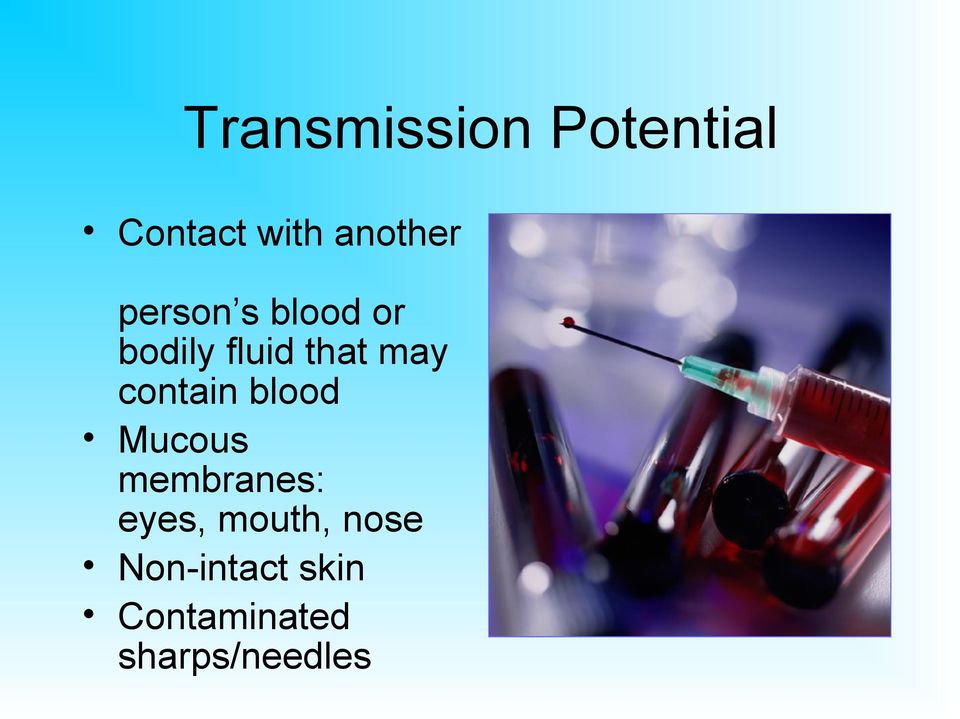
10 Your Exposure Potential Industrial accident Administering first aid Post-accident cleanup Handling of returned product Janitorial or maintenance work Handling of any waste products

11 Universal Precautions Use of proper PPE Treat all blood and bodily fluids as if they are contaminated Proper cleanup and decontamination Disposal of all contaminated material in the proper manner

12 Personal Protective Equipment (PPE) Anything that is used to protect a person from exposure Latex or Nitrile gloves, goggles, CPR mouth barriers, aprons, respirators
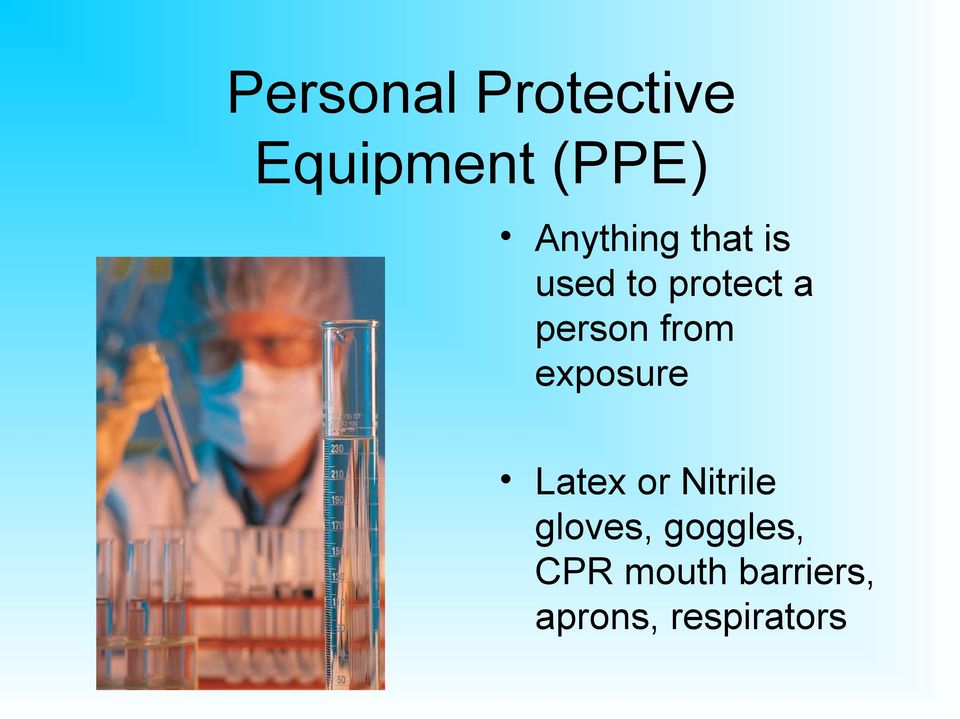
13 PPE Rules to Remember Always check PPE for defects or tears before using If PPE becomes torn or defective remove and get new Remove PPE before leaving a contaminated area Do not reuse disposable equipment
14 Decontamination When cleaning up surfaces use Hepacide Quat Do an initial wipe up Spray and allow it to stand for ten minutes then wipe up Dispose of all wipes in biohazard containers PPE should be removed and disposed of in biohazard containers
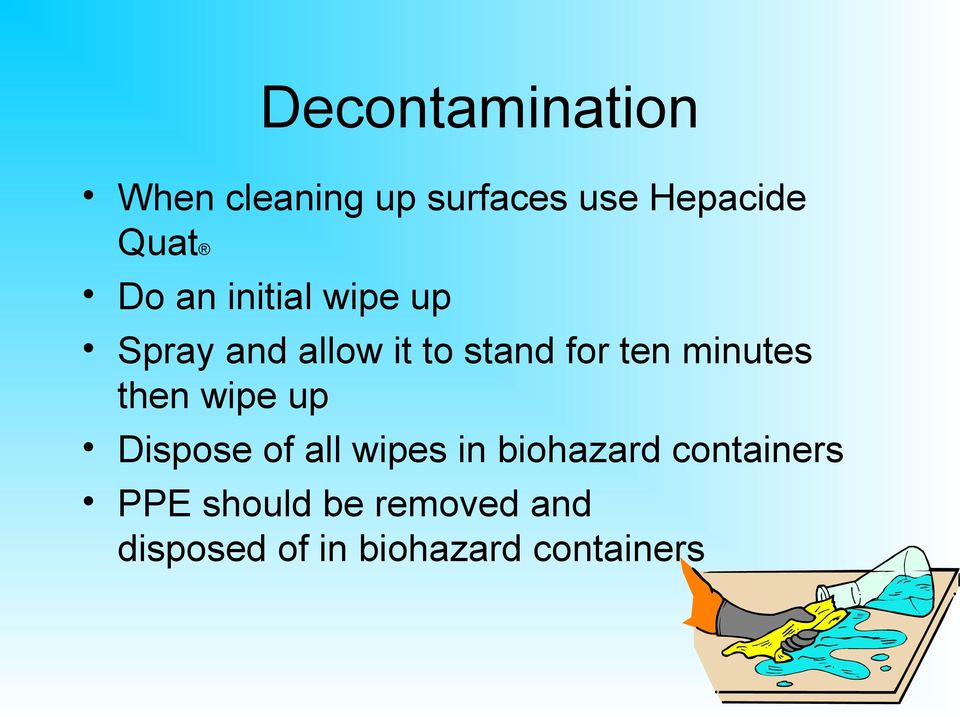
15 Hand Washing Wash hands immediately after removing PPE Use a soft antibacterial soap A hand sanitizer can be used but wash with soap and water as soon as possible.

16 Regulated Medical Waste Liquid or semi-liquid blood or other potentially infectious material(opim) Contaminated items that would release blood or OPIM when compressed Contaminated sharps Pathological and microbiological waste containing blood or OPIM
17 Labels must include the universal biohazard symbol, and the term Biohazard must be attached to: containers of regulated biohazard waste refrigerators or freezers containing blood or OPIM containers used to store, transport, or ship blood or OPIM Signs & Labels

18 Exposure Incident A specific incident of contact with potentially infectious bodily fluid If there are no infiltrations of mucous membranes or open skin surfaces, it is not considered an occupational exposure Report all accidents involving blood or bodily fluids Post-exposure medical evaluations are offered
19 Post-exposure Evaluation Confidential medical evaluation Document route of exposure Identify source individual Test source individuals blood (with individuals consent) Provide results to exposed employee

20 Hepatitis B Vaccination Strongly endorsed by medical communities Offered to all potentially exposed employees Provided at no cost to employees Declination form
21 Recordkeeping Medical records include: Hepatitis B vaccination status Post-exposure evaluation and follow-up results Training records include: Training dates Contents of the training Signature of trainer and trainee
22 I n Conclusion BB pathogen rules are in place for your health and safety Failure to follow them is a risk that does not need to be taken
23 Brenda Herndon USD 505 School Nurse
Bloodborne Pathogens. Scott Anderson CCEMTP. Materials used with permission from the Oklahoma State University
 Bloodborne Pathogens Scott Anderson CCEMTP Materials used with permission from the Oklahoma State University What is a Bloodborne Pathogen? Microorganisms that are carried in the blood that can cause disease
Bloodborne Pathogens
 Bloodborne Pathogens Learning Objectives By the end of this section, the participant should be able to: Name 3 bloodborne pathogens Identify potentially contaminated bodily fluids Describe 3 safe work
Bloodborne Pathogens (BBPs) Louisiana Delta Community College
 Bloodborne Pathogens (BBPs) Louisiana Delta Community College 1 Bloodborne Pathogens Rules & Regulations Office of Risk Management (ORM) requires development of a bloodborne pathogens plan low risk employees
Blood borne Pathogens
 Blood borne Pathogens What Are Blood borne Pathogens? Blood borne pathogens are microorganisms such as viruses or bacteria that are carried in blood and can cause disease in people. Types of Blood borne
Roger Williams University. Bloodborne Pathogens Exposure Control Plan
 Roger Williams University Bloodborne Pathogens Exposure Control Plan Revised 12/2010 ROGER WILLIAMS UNIVERSITY BLOODBORNE PATHOGENS EXPOSURE CONTROL PLAN I. STATEMENT OF POLICY It is the policy of Roger
Bloodborne Pathogens Program Revised July, 5 2012
 Bloodborne Pathogens Program Revised July, 5 2012 Page 1 of 16 Table of Contents 1.0 INTRODUCTION...3 1.1 Purpose...3 1.2 Policy.3 2.0 EXPOSURE CONTROL METHODS 4 2.1 Universal Precautions.4 2.2 Engineering
EXPOSURE CONTROL PLAN (sample) 1 Child Care Directors and Employers
 EXPOSURE CONTROL PLAN (sample) 1 Child Care Directors and Employers The Model Exposure Control Plan is intended to serve as an employer guide to the OSHA Bloodborne Pathogens standard. A central component
OCCUPATIONAL SAFETY AND HEALTH ADMINISTRATION (OSHA)
 OCCUPATIONAL SAFETY AND HEALTH ADMINISTRATION (OSHA) The OSHA/VOSH 1910.1030 Blood borne Pathogens Standard was issued to reduce the occupational transmission of infections caused by microorganisms sometimes
OSHA s Bloodborne Pathogens Standard 1910.1030
 OSHA s Bloodborne Pathogens Standard 1910.1030 Jens Nissen & Kennan Arp Iowa OSHA Enforcement 515-281-3122 [email protected] or [email protected] Bloodborne Pathogens Standard Federal Law 29 CFR 1910.1030
The methods of implementation of these elements of the standard are discussed in the subsequent pages of this ECP.
 Exposure Control Plan (ECP) for Bloodborne Pathogens Updated 9/15/2009 Purpose Our Company is committed to providing a safe and healthful work environment for our entire staff. In pursuit of this endeavor,
BLOODBORNE PATHOGENS EXPOSURE CONTROL PROGRAM
 BLOODBORNE PATHOGENS EXPOSURE CONTROL PROGRAM Purpose: The purpose of this program is to eliminate or minimize employee and student exposure to blood and other potentially infectious materials. This exposure
Bloodborne Pathogens. San Diego Unified School District Nursing & Wellness Program August 2013
 Bloodborne Pathogens San Diego Unified School District Nursing & Wellness Program August 2013 Why Another In-service?? Cal/OSHA mandates that employees with occupational exposure are informed at the time
FLORENCE TOWNSHIP BOARD OF EDUCATION FILE CODE: 4112.4/4212.4 Florence, New Jersey
 FLORENCE TOWNSHIP BOARD OF EDUCATION FILE CODE: 4112.4/4212.4 Florence, New Jersey Regulation Exposure Control Administration BLOODBORNE PATHOGENS A. The district safety and health program officer, district
POLICY 08:18:00 BLOODBORNE PATHOGENS CONTROL PLAN
 POLICY 08:18:00 BLOODBORNE PATHOGENS CONTROL PLAN I. Purpose and Scope The purpose of this plan is to establish guidelines and precautions for the handling of materials which are likely to contain infectious
Bloodborne Pathogens. Updated 1.21.13
 Bloodborne Pathogens Updated 1.21.13 Purpose OSHA s Blood-borne Pathogens Standard protects anyone with a job-related risk of contracting a blood-borne borne disease The standard outlines preventative
OCCUPATIONAL EXPOSURE TO BLOODBORNE PATHOGENS (29 CFR 1910.1030)
 I. Introduction OCCUPATIONAL EXPOSURE TO BLOODBORNE PATHOGENS (29 CFR 1910.1030) It is estimated that approximately 5.6 million workers in health care and other fields are exposed to bloodborne pathogens.
DO YOU WORK AROUND BLOOD OR BODY FLUIDS? Cal/OSHA s New Rules
 DO YOU WORK AROUND BLOOD OR BODY FLUIDS? Cal/OSHA s New Rules Labor Occupational Health Program University of California, Berkeley 1994 ACKNOWLEDGMENTS This booklet is a publication of the Labor Occupational
A P P E N D I X SAMPLE FORMS
 A P P E N D I X A SAMPLE FORMS Authorization for Disclosure Consent for HBV/HCV Antigens, HIV Antibody Documentation of Staff Education Employees Eligible for Hepatitis-B Vaccination Hepatitis-A Consent
WEST VIRGINIA UNIVERSITY EXPOSURE CONTROL PLAN FOR NON-HOSPITAL PERSONNEL
 WEST VIRGINIA UNIVERSITY EXPOSURE CONTROL PLAN FOR NON-HOSPITAL PERSONNEL POLICY The West Virginia University (WVU) is committed to providing a safe and healthful work environment for our entire staff.
Leader s Guide E4017. Bloodborne Pathogens: Always Protect Yourself
 E4017 Bloodborne Pathogens: Always Protect Yourself 1 Table of Contents Introduction 3 Video Overview.3 Video Outline.4 Preparing for and Conducting a Presentation. 7 Discussion Ideas..8 Quiz..9 Quiz Answers...11
Environmental Health and Safety Offices BLOODBORNE PATHOGENS
 Environmental Health and Safety Offices BLOODBORNE PATHOGENS Purpose! Reduce / eliminate exposure potential Comply with Ohio s Public Employment Risk Reduction Act (reference OSHA) 2! Exposure Determination!
Manual Document Page Issue Date TABLE OF CONTENTS
 Manual RPP-27195 ESHQ 1 of 11 TABLE OF CONTENTS 1.0 PURPOSE AND SCOPE... 2 2.0 IMPLEMENTATION... 2 3.0... 2 3.1 Line Manager Responsibilities... 2 3.2 Safety/Industrial Hygienists... 4 3.3 Employees and
BLOODBORNE PATHOGENS EXPOSURE CONTROL PLAN
 BLOODBORNE PATHOGENS EXPOSURE CONTROL PLAN Updated October 30, 2015 Table of Contents Table of Contents Policy... 1 Scope and Application... 1 2.1 Exposure Determination by Job Title and Task... 1 Definitions...
1.0 Purpose, Applicability, and Scope. 2.0 Abbreviations, Acronyms, and Definitions
 Procedure Subject: Bloodborne Pathogens Policy Effective: 3/15/11 Areas Affected: Any employee who is reasonably expected to encounter bloodborne pathogens on the job. Reviewed/Revised: 10/15/2013 1.0
Shop Safety. Action Tattoo 3525 Del Mar Heights Rd., Suite 7 San Diego, CA 92130
 Shop Safety Action Tattoo 3525 Del Mar Heights Rd., Suite 7 San Diego, CA 92130 Action Tattoo Exposure Control and Infection Prevention Plan (ECIPP) Established on: / / Section 1: Policy, Scope, and Responsibility...
Attachment D Infection Control Policy METHODS OF IMPLEMENTATION AND CONTROL
 Attachment D Infection Control Policy METHODS OF IMPLEMENTATION AND CONTROL OSHA requires that the ECP include a schedule and method of implementation for the various requirements of the standard. The
HAINES CITY POLICE DEPARTMENT GENERAL ORDER
 TITLE: HAINES CITY POLICE DEPARTMENT GENERAL ORDER EXPOSURE CONTROL PLAN FOR BLOODBORNE/AIRBORNE PATHOGENS AND OTHER POTENTIALLY INFECTIOUS MATERIALS GENERAL ORDER: 100.3 (High Risk) EFFECTIVE: August
Do you know how to make a framer's bandage?
 Dealing With Workplace Injuries Part I: Blood Borne Pathogens OSHA requirements for a specific plan dealing with blood means coming to the aid of injured employees isn't the simple matter it once was By
Biohazard - Anything that is harmful or potentially harmful to man, other species or the environment.
 SHARPS INJURY AND BLOODBORNE PATHOGEN EXPOSURE POLICY Purpose Faculty, staff, and students of the Massachusetts College of Pharmacy and Health Sciences shall utilize comprehensive and standardized procedures
BLOODBORNE PATHOGENS EXPOSURE CONTROL PLAN
 BLOODBORNE PATHOGENS EXPOSURE CONTROL PLAN Facility Name: University of Arkansas at Little Rock Date of Preparation: 01-17-06 In accordance with the OSHA Bloodborne Pathogens Standard, 1910.1030, the following
JAC-CEN-DEL COMMUNITY SCHOOLS BLOODBORNE PATHOGENS UNIVERSAL PRECAUTIONS A BACK TO SCHOOL TRADITION
 JAC-CEN-DEL COMMUNITY SCHOOLS BLOODBORNE PATHOGENS UNIVERSAL PRECAUTIONS A BACK TO SCHOOL TRADITION UNIVERSAL PRECAUTIONS AGAINST BLOODBORNE PATHOGENS Employees working in a school system are potentially
Montana State University-Bozeman. Bloodborne Pathogens Exposure Control Plan
 Montana State University-Bozeman Bloodborne Pathogens Exposure Control Plan Table of Contents Certification and Approvals... 1 MSU-Bozeman Bloodborne Pathogen Exposure Control Plan Major Revisions... 2
OCCUPATIONAL HEALTH, DISABILITY AND LEAVE SECTOR MEASURES TO MINIMIZE EXPOSURE TO BLOODBORNE PATHOGENS AND POST-EXPOSURE PROPHYLAXIS POLICY
 UNIVERSITY OF OTTAWA OCCUPATIONAL HEALTH, DISABILITY AND LEAVE SECTOR MEASURES TO MINIMIZE EXPOSURE TO BLOODBORNE PATHOGENS AND POST-EXPOSURE PROPHYLAXIS POLICY Prepared by the Occupational Health, Disability
Corporate Safety Infection Prevention Employee Health
 Corporate Safety Infection Prevention Employee Health This self-directed learning module contains information you are expected to know to protect yourself, our patients, and our guests. Target Audience:
6.0 Infectious Diseases Policy: Student Exposure Control Plan
 6.0 Infectious Diseases Policy: Student Exposure Control Plan 6.1 PURPOSE & SCOPE This exposure control plan has been established to define the infection control program for students of Pacific University.
Management Plan For Control of Blood-borne Pathogens, Infectious Wastes and Other Potentially Hazardous Biological Agents
 Management Plan For Control of Blood-borne Pathogens, Infectious Wastes and Other Potentially Hazardous Biological Agents 1.0 Executive Summary 1.1 The Bloodborne Pathogen standard, initiated by OSHA,
1) Giving patient access and control over their health information
 he HIPAA Challenge: How to protect patient privacy while providing necessary information to individuals and entities involved in the patient s care that need patient information to perform necessary services.
BLOODBORNE PATHOGENS IN SCHOOLS
 BLOODBORNE PATHOGENS IN SCHOOLS INTRODUCTION As sure as children fall while learning to walk, students experience cuts, bruises and other injuries. In times past, little thought was given to treatment
http://www.uco.edu/administration/safety-transportation/ehs/files-ehs/safetytraining/uco%20biological%20safety%20manual.pdf
 Taken for Program s Policies and Procedure Manual, Page, 36 and 37 Blood Borne Pathogen Training - Exposure Plan Students are required to go through yearly Blood borne Pathogen Training. This may be part
Bloodborne Pathogens Exposure Control Plan
 Bloodborne Pathogens Exposure Control Plan Plan Biosafety OCCUPATIONAL EXPOSURE TO BLOODBORNE PATHOGENS EXPOSURE CONTROL PLAN (Department/ Group) (Date) Table of Contents I. Introduction II. III. IV. Determination
Mock OSHA Inspection:
 Mock OSHA Inspection: PASS or FAIL? Infection Control OSHA Dental Practice Act HIPAA Presented by Leslie Canham, CDA, RDA, CSP (Certified Speaking Professional) In the dental field since 1972, Leslie helps
Exposure. What Healthcare Personnel Need to Know
 Information from the Centers for Disease Control and Prevention National Center for Infectious Diseases Divison of Healthcare Quality Promotion and Division of Viral Hepatitis For additional brochures
Bloodborne Pathogens (HIV, HBV, and HCV) Exposure Management
 Bloodborne Pathogens Exposure Policy and Procedures Employees of the State of South Dakota Department of Health Bloodborne Pathogens (HIV, HBV, and HCV) Exposure Management PEP Hotline 1-888-448-4911 DOH
Post-Exposure Prophylaxis
 Post-Exposure Prophylaxis Health Worker Safety Training Module 4: Post-Exposure Prophylaxis Health Worker Safety Training Module 2 Topics What is PEP? Infectious body fluids Types of exposures requiring
Blood Borne Pathogen Exposure Control Plan Checklist
 1. Principle Investigator or Supervisor: 2. PI Signature: 3. Date: 4. Department / Building / Lab Number: 5. Campus Phone: 6. Mobile Phone: 7. Laboratory Room Numbers where human material is used and /
Mercyhurst University Athletic Training Program Bloodborne Pathogens Exposure Control Plan
 Mercyhurst University Athletic Training Program Bloodborne Pathogens Exposure Control Plan In accordance with the Occupational Safety Health Administration (OSHA) Bloodborne Pathogens Standard, 29 CFR
University Health Services 556-4968 Health and Safety EXPOSURE CONTROL PLAN
 ADVISORY NO. 6.2: UNIVERSITY OF CINCINNATI EXPOSURE CONTROL PLAN PURPOSE: To control and minimize the transmission of bloodborne pathogens at the University of Cincinnati, to provide a safe workplace for
Training on Standard Operating Procedures for Health Care Waste Management Swaziland 12 May, 2011
 Training on Standard Operating Procedures for Health Care Waste Management Swaziland 12 May, 2011 Safe Infectious Waste Handling and Transport Objective Waste Overview Roles and Responsibilities of Waste
Reference: http://www.osha-slc.gov/oshstd_data/1910_1030.html
 Slide 1: Bloodborne Pathogen Training for School Staff December 1991- Occupational Safety & Health Administration (OSHA) in the U.S. Department of Labor issued regulations regarding bloodborne pathogen
Definitions. This plan. membrane, 2012-2013. These are. additions and. and. weeping a source of. withstand the. demands of to or from a
 PALM BEACH ATLANTIC UNIVERSITY ATHLETIC TRAINING BLOOD BORNE PATHOGENS POLICY & EXPOSURE CONTROL PLAN Introduction This plan is designedd to eliminatee or minimize exposure to blood borne pathogens, as
HEPATITIS A, B, AND C
 HEPATITIS A, B, AND C INTRODUCTION Hepatitis is a medical term that means infection and inflammation of the liver, and hepatitis is caused by infection with a virus. There are seven types of hepatitis,
OSHA Bloodborne Pathogens Requirements
 OSHA Bloodborne Pathogens Requirements The OSHA Standard 29 CFR 1910.1030 http://www.osha.gov/pls/oshaweb/owadisp.show_document?p_table=standards&p_id=10051 requires employers to provide a safe and healthful
I. Policy. Program Administration. Employee Exposure Determination
 UNIVERSITY OF ROCHESTER BLOODBORNE PATHOGENS EXPOSURE CONTROL PLAN GUIDELINES FOR OFF-SITE LOCATIONS in compliance with 29 CFR 1910.1030 OSHA Standard for Occupational Exposure to Bloodborne Pathogens
OSHA. MANUAL A benefit provided by the Wisconsin Dental Association to member dentists IN THE DENTAL OFFICE BLOODBORNE PATHOGENS MANUAL
 OSHA BLOODBORNE PATHOGENS MANUAL IN THE DENTAL OFFICE PARTIALLY UNDERWRITTEN BY 2002 WWW.INSURANCEFORMEMBERS.COM MANUAL A benefit provided by the Wisconsin Dental Association to member dentists WDA updates
BSM Connection elearning Course
 BSM Connection elearning Course OSHA and Bloodborne Pathogens Training for the Medical Office 2010, BSM Consulting All Rights Reserved. Table of Contents OVERVIEW... 1 BLOODBORNE PATHOGENS... 1 KEY INFORMATION
Exposure Control Plan Bloodborne Infectious Diseases
 Exposure Control Plan Bloodborne Infectious Diseases Contents POLICY... 2 PURPOSE... 2 DEFINITIONS... 3 PROGRAM ADMINISTRATION... 4 Implementation... 4 Compliance... 4 Training... 4 Records... 5 EXPOSURE
Blood-borne viruses in the workplace Guidance for employers and employees
 Blood-borne viruses in the workplace Guidance for employers and employees Is this guidance useful to me? If you are an employer or employee, self-employed or a safety representative, and involved in work
How To Understand The Health And Safety Requirements In Ohio
 Bloodborne Pathogens: uestions and Answers about Occupational Exposure Oregon OSHA Layout and cover design, Patricia Young, Oregon OSHA 440-2261 (10-14) OR-OSHA TABLE OF CONTENTS Introduction... 3 Section
DIVISION OF HUMAN RESOURCES OFFICE OF OCCUPATIONAL SAFETY AND HEALTH Emerson A. Greenidge, MS, CSP, Director Rev. 9/06
 DIVISION OF HUMAN RESOURCES OFFICE OF OCCUPATIONAL SAFETY AND HEALTH Emerson A. Greenidge, MS, CSP, Director Rev. 9/06 BLOODBORNE PATHOGENS EXPOSURE CONTROL PLAN In accordance with the New York State
Kean University BS Degree Program in Athletic Training BLOOD BORN PATHOGENS POLICY
 Kean University BS Degree Program in Athletic Training BLOOD BORN PATHOGENS POLICY Effective September 2, 2014 The following policy will apply to students taking classes and faculty teaching those classes
Standard Operating Procedure for Blood Borne Infectious Disease Control Measures at Calvin College
 Standard Operating Procedure for Blood Borne Infectious Disease Control Measures at Calvin College Clean up should be done by non-student employees and trained personnel only Cleaning Up BODY FLUIDS from
KEY CAL/OSHA STANDARDS THAT APPLY TO MOST EMPLOYERS
 KEY CAL/OSHA STANDARDS THAT APPLY TO MOST EMPLOYERS FACTSHEET 1 Below are some key Cal/OSHA standards that apply to most employers: A. INJURY AND ILLNESS PREVENTION PROGRAM STANDARD (Title 8 California
Response to Biological Spills in the Laboratory (Intentional or Accidental)
 Response to Biological Spills in the Laboratory (Intentional or Accidental) Exposure Management For splash to eyes, mucous membranes, or broken area of the skin Irrigate eyes with clean water, saline or
Managing Bloodborne Pathogens Exposures
 Managing Bloodborne Pathogens Exposures House Staff Orientation 2015 Phillip F. Bressoud, MD, FACP Associate Professor of Medicine and Executive Director Campus Health Services University of Louisville
OSHA Compliance Checklist ASC
 OSHA Compliance Checklist ASC Date Inspectors Facility OSHA is the agency responsible for establishing and enforcing standards that will make the workplace safe and healthful for the employees. The way
Exposure Control Plan for Bloodborne Pathogens
 Exposure Control Plan for Bloodborne Pathogens THE UNIVERSITY OF TEXAS AT ARLINGTON Exposure Control Plan for Bloodborne Pathogens Developed in accordance with Texas Department of State Health Services
www.hepinfo.ie Are you Hep C aware? awareness information support prevention To find out more visit
 Are you Hep C aware? awareness information support prevention To find out more visit www.hepinfo.ie What is Hepatitis C? Hepatitis C is a viral infection that affects the liver, causing it to become inflamed
This pamphlet describes how all school employees, regardless of job assignment, can minimize the risk of exposure to viral hepatitis.
 Revised July 2010 Viral Hepatitis INTRODUCTION The United Federation of Teachers prepared this pamphlet to answer questions asked by school staff who are concerned about catching hepatitis from their students
COLLEGE OF THE HOLY CROSS OCCUPATIONAL SAFETY AND HEALTH ADMINISTRATION (OSHA) EXPOSURE CONTROL PLAN
 COLLEGE OF THE HOLY CROSS OCCUPATIONAL SAFETY AND HEALTH ADMINISTRATION (OSHA) EXPOSURE CONTROL PLAN Signatures on file in Health Services/ Human Resources Reviewed/Approved: Date: Martha Sullivan, R.N.,
BLOODBORNE PATHOGENS (BBP) ANNUAL TRAINING
 BLOODBORNE PATHOGENS (BBP) ANNUAL TRAINING FOR MEMBERS OF NCSU POLICE DEPARTMENT IN ACCORDANCE WITH OCCUPATIONAL SAFETY AND HEALTH ADMINISTRATION (OSHA) BLOODBORNE PATHOGEN STANDARD 29 CFR 1910.1030 Important!!!
THE A, B, C S OF HEPATITIS. Matt Eidem, M.D. Digestive Health Associates of Texas 1600 Coit Road Suite #301 Plano, Texas 75075 (972) 867-0019
 THE A, B, C S OF HEPATITIS Matt Eidem, M.D. Digestive Health Associates of Texas 1600 Coit Road Suite #301 Plano, Texas 75075 (972) 867-0019 WHAT IS HEPATITIS? Hepatitis means inflammation of the liver
How to Meet OSHA s Employee Training Requirements
 How to Meet OSHA s Employee Training Requirements A Quick Guide for Medical, Dental, and Other Ambulatory Care Settings A supplement to Medical Environment Update Dear reader, Survey responses and calls
OSHA Training Guidelines (An Unofficial Summary)
 OSHA Training Guidelines (An Unofficial Summary) Many standards promulgated by the Occupational Safety and Health Administration (OSHA) explicitly require the employer to train employees in the safety
12/2/2015 HEPATITIS B AND HEPATITIS C BLOOD EXPOSURE OBJECTIVES VIRAL HEPATITIS
 HEPATITIS B AND HEPATITIS C BLOOD EXPOSURE DISEASE 101 ONLINE CONFERENCE SARAH WENINGER, MPH VIRAL HEPATITIS.STD.HIV PREVENTION COORDINATOR DECEMBER 3, 2015 OBJECTIVES Describe the populations that should
UNIVERSITY OF NORTH FLORIDA BIOMEDICAL WASTE MANAGEMENT PLAN DEVELOPED BY: ENVIRONMENTAL HEALTH, SAFETY, INSURANCE & RISK MANAGEMENT
 UNIVERSITY OF NORTH FLORIDA BIOMEDICAL WASTE MANAGEMENT PLAN DEVELOPED BY: ENVIRONMENTAL HEALTH, SAFETY, INSURANCE & RISK MANAGEMENT June 2008 Table of Contents Section Page Background 1 Definitions 1-2
Exposure Control Plan For Blood borne Pathogens Utilizing Standard / Universal Precautions
 Exposure Control Plan For Blood borne Pathogens Utilizing Standard / Universal Precautions Revised 12/11/2013 Page 1 Table of Contents I. Purpose and Scope... 4 II. General Program Management... 5 2.1
Virginia Commonwealth University Health System Medical College of Virginia Hospitals and Physicians. Infection Control Policy. II.
 Virginia Commonwealth University Health System Medical College of Virginia Hospitals and Physicians Infection Control Policy Subject: Policy No: 1101.01 Original Date: Bloodborne Pathogen Exposure Control
Annual Biomedical Waste Code Training
 Annual Biomedical Waste Code Training Provided by: Barbara D. Will, MPH Biomedical Waste Program Supervisor To protect, promote and improve the health of all people in Florida through integrated state,
POLICY & PROCEDURE: SAFE HANDLING OF SHARPS & NEEDLE STICKS
 POLICY & PROCEDURE: SAFE HANDLING OF SHARPS & NEEDLE STICKS File Name: SAFESHARPSPP2013 Revision: 2 Date of Issue: Person Responsible: Edel Niland 1.0 POLICY Dublin Institute of Technology (DIT) endeavours
OSHA COMPLIANCE IN THE MEDICAL PRACTICE Presented by
 OSHA COMPLIANCE IN THE MEDICAL PRACTICE Presented by Terrence A. Knight July 10, 2003 Occupational Safety and Health Act of 1970 (OSHA) Enacted on December 29, 1970 during the 91st Congress Applies to
33 Infection Control Techniques
 CHAPTER 33 Infection Control Techniques Learning Outcomes 33.1 Describe the medical assistant s role in infection control. 33.2 Describe methods of infection control. 33.3 Compare and contrast medical
Purpose: The purpose of this guideline is to minimize or eliminate employee exposure to communicable diseases.
 Infection Control Guideline / Best Practice GUIDELINE NUMBER: ICG-0025 EFFECTIVE DATE: 1 MARCH 97 Purpose: The purpose of this guideline is to minimize or eliminate employee exposure to communicable diseases.