
ADMINISTRATIVE SERVICES PRELIMINARY PROGRAM REPORT. Submitted to California Commission on Teacher Credentialing. Spring 2009
|
|
|
- Silvia Wilkins
- 10 years ago
- Views:
Transcription
1 CALIFORNIA STATE UNIVERSITY CHANNEL ISLANDS SCHOOL OF EDUCATION ADMINISTRATIVE SERVICES PRELIMINARY PROGRAM REPORT Submitted to California Commission on Teacher Credentialing Spring 2009 Contact Information Tim Rummel Coordinator of Educational Leadership Program Kaia Tollefson, Ph.D. Accreditation Coordinator (805) Joan Karp, Ph.D. Associate Dean and Director (805) California State University Channel Islands One University Drive Camarillo, CA 93012
2 To: CCTC Site Visit Committee From : Conrad (Tim) Rummel, Ph.D, Director, Educational Leadership Program Joan Karp, Ph.D, Associate Dean and Director, School of Education Date: March, 2009 Subject: Changes in CSU Channel Islands Preliminary Administrative Services Credential Program. In the past three years, there have been several major changes made to the Preliminary Administrative Services Credential Program (PASC). These changes include the following: 1. Change in Program Title from Principals Leadership Program to Education Leadership Program In the developmental stages of the program and during the first years of implementation the Preliminary Administrative Services Credential (PASC) Program was called the Principals Leadership Program. This title emphasized the focus of the program in developing highly qualified entry level site administrators for the schools of Ventura County. While this focus in the program mission remains primary, the program, beginning in academic year , has now been renamed the Educational Leadership Program to recognize that the credential prepares candidates for a variety of educational leadership positions. This name also is consistent with programs offered throughout the California Stare University System. 2. Change in Program Schedule In the initial program proposal the PASC Program was planned to be offered over four terms. After consulting with prospective students and faculty, the program was extended to a five term program that included a summer session. Candidates can then carry two academics courses each term and also work toward completion of EDPL (Professional Development and Fieldwork) throughout the program. The course load of five terms provides working professional educators with a more balanced workload. 3. Change in Course Syllabus for EDPL 625 (Building a Collaborative Inclusive Learning Community) In the initial program design the program standards related to Special Education were to be addressed through seminars attached to EDPL (Professional Development and Fieldwork). As the first cohort moved through the program it was determined that these standards were not being adequately addressed. Through a partnership with the Ventura County SELPA, a series of speakers (Special Education Directors) were integrated into EDPL 625. This plan was then further modified by changing the syllabus

3 of EDPL 625 to include Special Education as a major component of the course. This course is now taught by a team of professionals that includes Mary Samples, Director of the Ventura County SELPA and Dr. Trudy Arriaga, Superintendent of Ventura Unified School District. The Special Education standards compose one half of the course and the course prepares candidates to meet the important competencies related to Special Education and inclusive schools for all learners. 4. Moving the program from Extended Education to State Support within the CSUCI s Education Program. Due to financial limitations, the Educational Leadership Program was initially offered through Extended Education as a self-supporting program. The first three cohorts enrolled in Extended Education with the third cohort finishing course work in Spring, Beginning with the academic year the program was offered with state support within the Education Program. Course fees therefore are consistent with those set by CSU for graduate work. This change reduced the cost of the program beginning with Cohort 4. Moving the Educational Leadership Program to state support presented a scheduling issue. The program design requires five semesters. Financial limitations currently prevent CSU Channel Islands from offering summer courses with state support and extending the program over two and a half school years places a hardship on candidates who wish to complete the program in two years. The Associate Dean of the School of Education is currently working with university administrators to gain approval for the Educational Leadership Program to offer courses beginning in the summer of 2010 so that the program can be completed in two years rather than two and a half years. 5. Increase staffing for the Professional Development and Fieldwork courses EDPL 631 and 632. Staffing for the Professional Development and Fieldwork courses EDPL 631 and 632 has been expanded. Supervision is provided for all five semesters with one supervisor working with assigned candidates throughout the program. This allows the university supervisor to build a professional relationship with the candidate and with the supervising administrator who serves as mentor throughout the program.

4 TABLE OF CONTENTS Category I Program Design, Coordination, and Curriculum Standard 1: Program Rationale and Design... 1 Standard 2: Program Coordination Standard 3: Development of Professional Perspectives Standard 4: Equity, Diversity and Access Standard 5: Role of Schooling in a Democratic Society Standard 6: Opportunities to Learn Instructional Leadership Category II Field Experiences in the Standards Standard 7: Nature of Field Experiences Standard 8: Guidance, Assistance and Feedback Category III Standards of Candidate Competence and Performance Standard 9: Assessment of Candidate Competence Standard 10: Vision of Learning Standard 11: Student Learning and Professional Growth Standard 12: Organizational Management for Student Learning Standard 13. Working with Diverse Families and Communities Standard 14: Personal Ethics and Leadership Capacity Standard 15: Political, Social, Economic, Legal and Cultural Understanding References Appendices Appendix A: Fieldwork, Assessment and Partnership Agreement... A Educational Leadership Program Field Work Handbook... A1 Assessment Plan for the Principals Leadership... A2 Culminating Experience Handbook... A3 Ventura County Schools and CSUCI Partnership Agreement... A4 Appendix B: Syllabi... B page EDUC 605 Education in a Diverse Society... 1 EDUC 615 Principles of Educational Research... 12
5 EDUC 616 Masters Research Project EDPL 610 Foundations of Curriculum, Instruction and Assessment EDPL 620 Instructional Leadership of the Collaborative School EDPL 621 Law and School Management EDPL 622 School Finance and Principles of Applied Leadership EDPL 623 Understanding and Influencing Organizations EDPL 624 Human Resources Management in Education EDPL 625 Building Collaborative Inclusive Learning Communities EDPL 631 Professional Development/Field Work EDPL 632 Professional Development/Field Work... 85

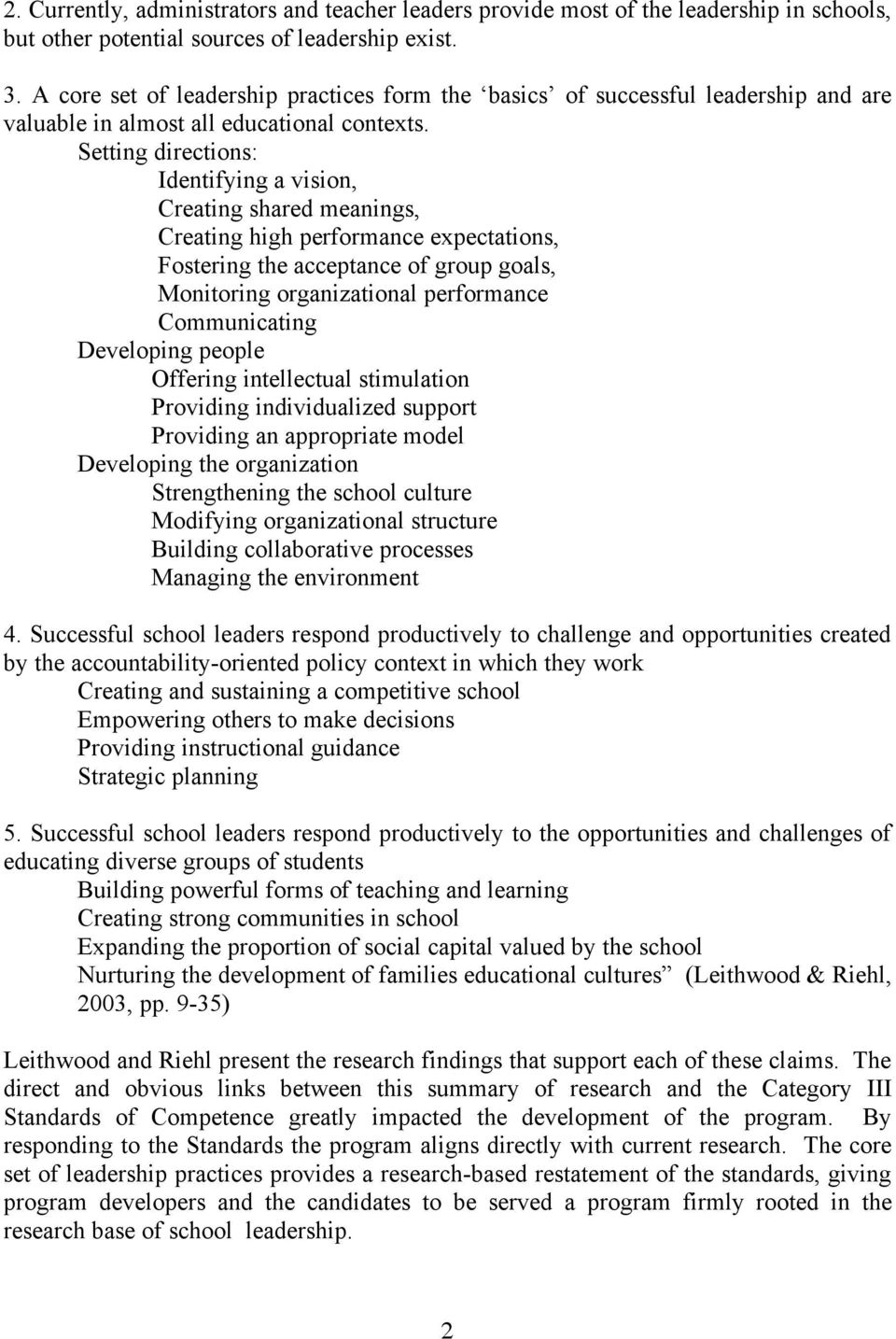
6 Category I: Program Design, Coordination and Curriculum Standard 1: Program Rationale and Design The professional leadership preparation program includes a purposeful, developmental, interrelated sequence of learning experiences some that are carried out in the field and some that occur in non-field settings - that effectively prepare candidates as instructional leaders in a variety of public schools and school districts. The design of the program is based on a sound rationale informed by theory and research aligned with (a) the principles articulated in the Candidate Competence and Performance Standards in Category III, and (b) the principles of various learning theories. The program is designed to provide extensive opportunities for candidates to learn and apply, and includes both formative and summative assessments based on the Candidate Competence and Performance Standards in Category III. Response The Educational Leadership Program at CSUCI has been developed by systematically building on an examination of current research on school leadership, a careful review and application of the Standards of Quality and Effectiveness for Educational Leadership Programs Leading to the Preliminary Administrative Services Credential and a survey of current practice at a variety of universities throughout the United States with special attention to the State of California. In 2000, Division A (Administration) of the American Educational Research Association established a Task Force on Developing Research in Educational Leadership. The initial paper prepared by the Task Force is authored by Kenneth A. Leithwood and Carolyn Riehl and was presented in March, 2003 at the annual meeting of AERA. After a systematic review of quantitative and qualitative research on successful school leadership, the paper focused on the answer to the following question: What is it that leaders do in order to have influence on technical processes within schools and school systems that results in the accomplishment of intended goals? (p. 3). The work of Leithwood and Riehl served as a foundation in the development of the Educational Leadership Program because it provided a current summative analysis of research upon which to build a program for entry level administrators. Using a straightforward definition the authors conclude that school leaders serve two functions: providing direction and exercising influence. Thus it may be said that leaders mobilize and work with others to articulate and achieve shared intentions (p.7). The following research-based conclusions about successful school leadership are directly aligned with the Standards of Candidate Competence and Performance of Category III. In brief, these five summative statements are: 1. Leadership has significant effects on student learning, second only to the effects of the quality of curriculum and teachers instruction. 1

7 2. Currently, administrators and teacher leaders provide most of the leadership in schools, but other potential sources of leadership exist. 3. A core set of leadership practices form the basics of successful leadership and are valuable in almost all educational contexts. Setting directions: Identifying a vision, Creating shared meanings, Creating high performance expectations, Fostering the acceptance of group goals, Monitoring organizational performance Communicating Developing people Offering intellectual stimulation Providing individualized support Providing an appropriate model Developing the organization Strengthening the school culture Modifying organizational structure Building collaborative processes Managing the environment 4. Successful school leaders respond productively to challenge and opportunities created by the accountability-oriented policy context in which they work Creating and sustaining a competitive school Empowering others to make decisions Providing instructional guidance Strategic planning 5. Successful school leaders respond productively to the opportunities and challenges of educating diverse groups of students Building powerful forms of teaching and learning Creating strong communities in school Expanding the proportion of social capital valued by the school Nurturing the development of families educational cultures (Leithwood & Riehl, 2003, pp. 9-35) Leithwood and Riehl present the research findings that support each of these claims. The direct and obvious links between this summary of research and the Category III Standards of Competence greatly impacted the development of the program. By responding to the Standards the program aligns directly with current research. The core set of leadership practices provides a research-based restatement of the standards, giving program developers and the candidates to be served a program firmly rooted in the research base of school leadership. 2
8 Michelle Young, Executive Director of the University Council for Educational Administration provides an agenda to support reform in the preparation of school administrators. (Young & Peterson, 2002). In the article she defines the goal of school leadership development programs and then goes on to present a plan for achieving this goal. Given that there are a variety of programs, most would agree that they underlying goal and orientation of leadership preparation programs is the development of competent and pedagogically oriented leaders committed to the successful education of all children (p. 8). This goal cannot be achieved by any single entity. This will require that the stakeholders come together, seek a mutual and comprehensive understanding of our context and the stakeholders that work within it, build common ground and shared goals, and work collaboratively toward their realization (p. 13). With a clear focus on creating instructional leaders, CSUCI built a program that responds to the needs of its primary stakeholders: the schools of Ventura and Southern Santa Barbara Counties, and then more broadly, the State of California. The partnership of CSUCI and local schools has guided the development of the program and will continue to support and influence the entire program from its conceptualization through the recruitment and selection of students, course delivery, mentoring, field internships, supervision and evaluation (Young & Peterson, 2002, p. 12). To this end, stakeholders from Ventura County School Districts and from the Ventura County Office of Education have been involved in identifying the need for the program, establishing the broad conceptual framework, and then working in partnership with the faculty of CSUCI in developing the courses and establishing the program parameters. The second influence on the program design and development resulted from a survey of current program designs and course syllabi from selected university programs. Using the resources of the Internet, supported by telephone and /or personal interviews, a survey of programs was completed. Universities from throughout the United States included the University of Wisconsin, University of Minnesota, Ohio State University, University of Texas, Rutgers University, Vanderbilt, Harvard and Columbia. Within the State of California, a broad sample of California State University programs was examined on the Internet as was California Lutheran, Claremont Graduate University, and Pepperdine University. The planning process included assistance and support from the Director of the Principals Leadership Institute at UCLA, the Head of the Department of Educational Administration at CSU Fullerton, and the Director of the Principals Leadership Institute at UC Berkeley. The Department Head of Educational Leadership at San Jose State University was also helpful in approving the use of the San Jose State candidate assessment design as a foundation for the CSUCI assessment design. This survey, coupled with shared documents and direct advice, grounded the CSUCI program development in the reality of preparing and delivering a quality educational leadership program. The support included program overview and philosophy, organizational materials, course syllabi, handbooks, and professional guidance. CSUCI wishes to specifically acknowledge the extraordinary professional support of Bruce 3

9 Newlin, UCLA; Louise Adler, CSU Fullerton; Lynda Tredway, UC Berkeley; and Barbara Gottesman, San Jose State University. The Standards of Quality and Effectiveness for Educational Leadership Preparation Programs Leading to the Preliminary Administrative Services Credential serve as the foundation of the CSUCI program from the initial steps of conceptual development to the actual course development. Following approval of the PASC standards in May, 2003, they were then reviewed broadly as a guide for program development. Once the preliminary program plan and course structure was identified, the standards were placed within each course based on course descriptions. Course syllabi developers worked directly from the standards. When the initial course syllabi were completed, a review of the standards was again completed to determine that all standards were addressed in appropriate courses. Course syllabi developers then presented the proposed syllabi to the collective group, identified standard priorities and searched for both overlap and spiral reinforcement. The standards have then guided the program from its initial creation and will continue to define what candidates should know and be able to do upon receiving recommendation for the Preliminary Administrative Services Credential. 1(a) The design of the program contains essential principles that are clearly grounded in a well reasoned rationale, which draws on sound scholarship and theory anchored to the knowledge base of administrator preparation, is articulated clearly, and is evident in the delivery of the program's coursework and fieldwork. Response The essential principles which ground the CSUCI program are summarized in the Key Characteristics of the Educational Leadership Program which were identified by the program development committee and adopted by the Education Faculty of CSUCI. Key Characteristics of the Educational Leadership Program 1. Directly aligned with the Mission of CSUCI --place students at the center of the educational experience --facilitate learning within and across disciplines through integrative approaches --emphasize experiential and service learning --graduate students with multicultural and international perspectives 2. Founded on the Core Values that characterize the entire Education Program --continuous improvement is essential to our lives --collaboration and inclusion are central to our work --service to the university and to the community --teaching all children, regardless of their learning situation is everyone s responsibility --critical reflection and inquiry are an integral part of our professional responsibility 4

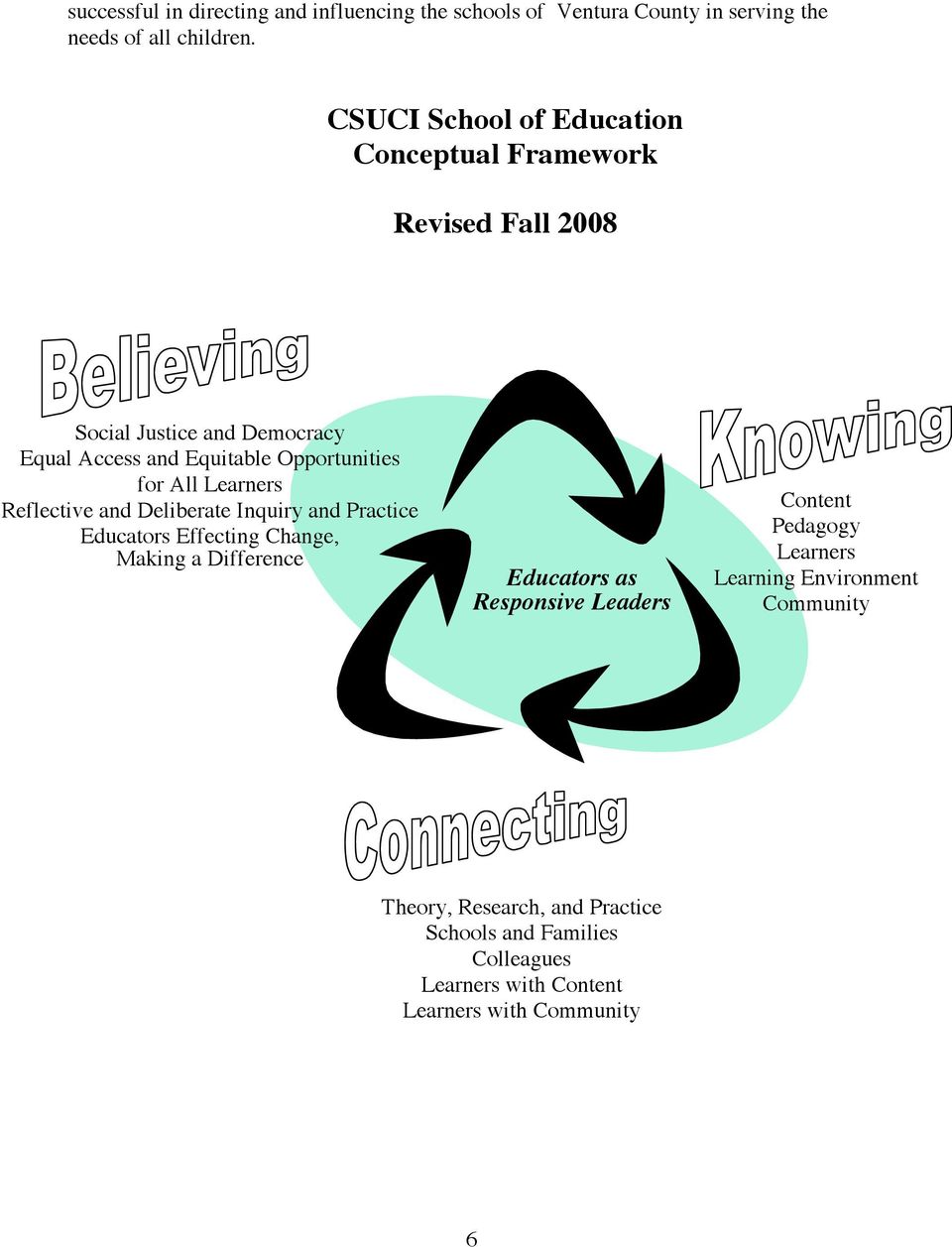
10 --responsibility for acknowledging, affirming, and responding to linguistic, ethnic, and special needs resides with everyone The core values of the School of Education have evolved into the CSU Channel Islands School of Education Conceptual Framework. The educational leadership program is engaged in a continuing process of integrating the Conceptual Framework into all program components. 3. Based on the California Commission on Teacher Credentialing Standards of Quality and Effectiveness for Educational Leadership Programs leading to the Preliminary Administrative Services Credential (CCTC) 4. Built on a Cohort Model --continuous enrollment is the expectation --clearly defined sequence of integrated courses 5. Primary focus is on real world instructional leadership --all aspects of leadership are viewed through the lens of student learning 6. Clearly identified instructional model --standards based in program, content and assessment --adult learning principles --problem-based learning --cooperative learning --constructivist learning theory --application and demonstration of learning --clearly links theory to practice and practice to theory 7. Sustained reflection and personal dialogue on critical issues --culture, race, ethnicity, language, gender, sexual orientation, exceptionality, religion, socioeconomic status --equity, social justice and democracy --internalized personal demands of leadership --personal challenges of the role of the principal 8. Structured field experiences created through partnerships with school districts 9. Site-based action research Masters Culminating Experience 10. Integrated assessment based on clearly defined standards and criteria leading to informed recommendations for the Preliminary Administrative Services Credential Each of the characteristics was carefully developed and contributes to a program that is aligned with the mission and values of CSUCI, focused on the Standards of the Commission and directed at the primary goal, preparing instructional leaders who will be 5

11 successful in directing and influencing the schools of Ventura County in serving the needs of all children. CSUCI School of Education Conceptual Framework Revised Fall 2008 Social Justice and Democracy Equal Access and Equitable Opportunities for All Learners Reflective and Deliberate Inquiry and Practice Educators Effecting Change, Making a Difference Educators as Responsive Leaders Content Pedagogy Learners Learning Environment Community Theory, Research, and Practice Schools and Families Colleagues Learners with Content Learners with Community 6
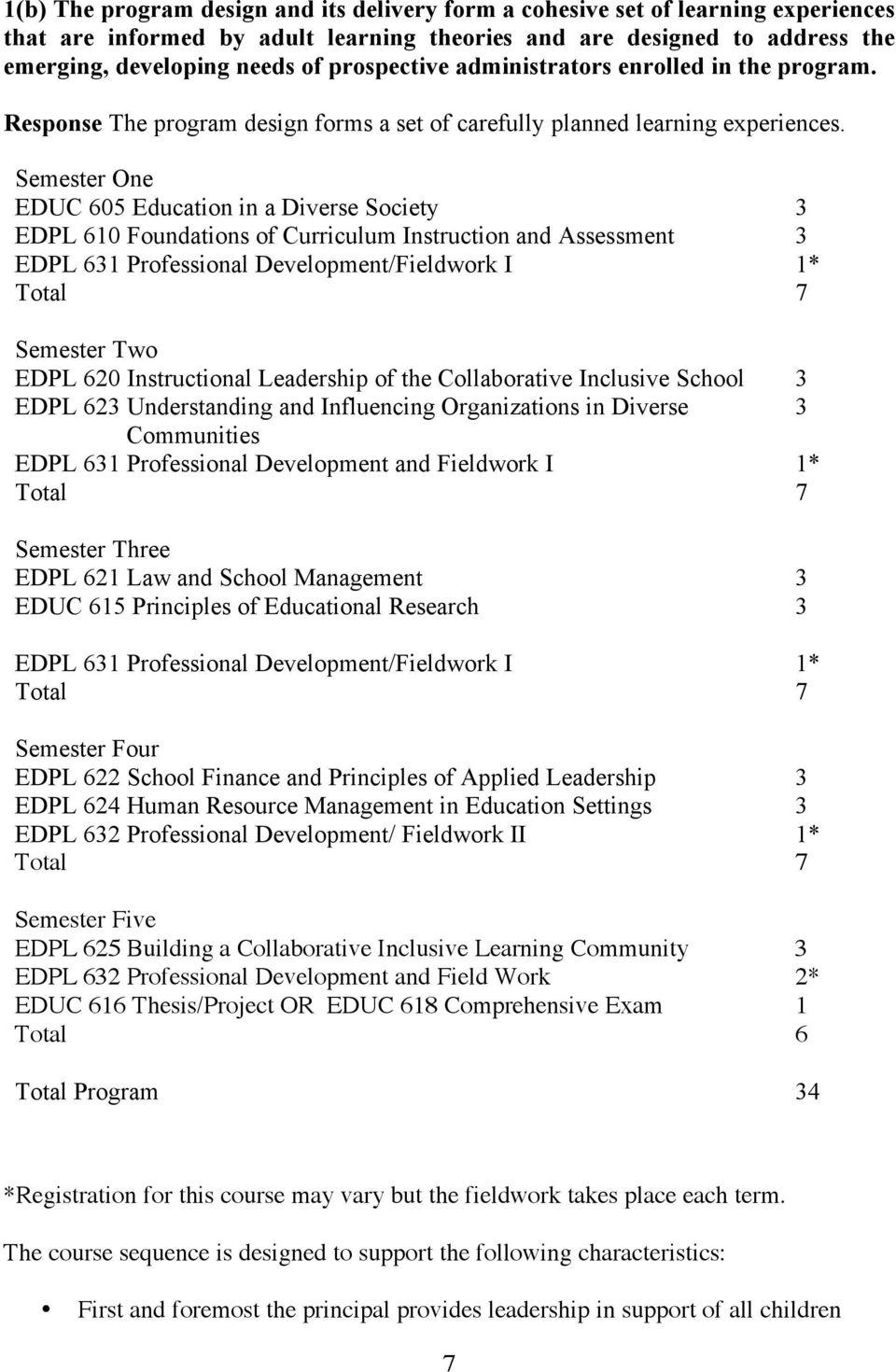
12 1(b) The program design and its delivery form a cohesive set of learning experiences that are informed by adult learning theories and are designed to address the emerging, developing needs of prospective administrators enrolled in the program. Response The program design forms a set of carefully planned learning experiences. Semester One EDUC 605 Education in a Diverse Society 3 EDPL 610 Foundations of Curriculum Instruction and Assessment 3 EDPL 631 Professional Development/Fieldwork I 1* Total 7 Semester Two EDPL 620 Instructional Leadership of the Collaborative Inclusive School 3 EDPL 623 Understanding and Influencing Organizations in Diverse 3 Communities EDPL 631 Professional Development and Fieldwork I 1* Total 7 Semester Three EDPL 621 Law and School Management 3 EDUC 615 Principles of Educational Research 3 EDPL 631 Professional Development/Fieldwork I 1* Total 7 Semester Four EDPL 622 School Finance and Principles of Applied Leadership 3 EDPL 624 Human Resource Management in Education Settings 3 EDPL 632 Professional Development/ Fieldwork II 1* Total 7 Semester Five EDPL 625 Building a Collaborative Inclusive Learning Community 3 EDPL 632 Professional Development and Field Work 2* EDUC 616 Thesis/Project OR EDUC 618 Comprehensive Exam 1 Total 6 Total Program 34 *Registration for this course may vary but the fieldwork takes place each term. The course sequence is designed to support the following characteristics: First and foremost the principal provides leadership in support of all children 7
13 Teaching and learning is the center piece of the program All aspects of leadership are viewed through the lens of student learning Applied action research is integrated into the program Field experiences are linked to the course work of each term On-going formative assessment of progress toward meeting standards Cohort organization supports the work of each candidate and provides an environment of sustained reflection and personal dialogue Course developers were guided by the Principles of Adult Learning adapted from John Goodlad (1990): Adults prefer learning situations which: -Are practical and problem-centered -Promote their positive self-esteem -Integrate new ideas with existing knowledge -Show respect for the individual learner -Capitalize on their experience -Allow choice and self-direction These principles, which are consistent with the mission and values of CSUCI, guide program and staff in all relationships with candidates. In addition, the Key Characteristics of the Educational Leadership Program identify an instructional model that includes the most effective instructional strategies. For example the program builds on the research based design of cooperative learning (Johnson & Johnson, 1982) as well as the innovative approach of problem-based learning, (Bridges, 1992) and thereby links the content of instructional effectiveness with the lived experience of the courses. Candidates will, in fact, use the experience of the classes coupled with their experiences in schools to reflect and deepen their understanding of teaching and learning. 1(c) The program incorporates multi-media technologies to ensure that candidates develop an understanding of the importance, role and uses of technology for instructional support, administrative decision-making and the management of data in schools. Response The program will build on the multi-media technology resources of CSUCI. These resources are identified in the response to Common Standards 2: Resources. Course instructors will demonstrate the use of technology to support instruction and communication within the cohort group. Through field work placements candidates will see the role and uses of technology within a variety of school districts. Within the school districts of Ventura County there is continuum ranging from great access and high levels of use to reduced access and lower levels of use. Candidates in the cohort group will be able to share the experiences of their field placement in the seminars to see the positive benefits of effective use of technology to support instruction, decision-making, data management and communication. 8

14 The following courses will address the use of technology with specific applications: Foundations of Curriculum Instruction and Assessment(EDPL 610): data management, data based decision-making in support of instruction and assessment Instructional Leadership (EDPL 620): uses of technology to support instruction, data based instructional design, and uses of technology to support professional development School Finance and Applied Leadership (EDPL 622): use of technology to support financial planning, budget development and management of resources. Human Resource Management in Education Settings (EDPL 624): use of technology to manage staffing and employment procedures Building Collaborative and Inclusive Schools (EDPL 625): uses of technology (strengths and limitations) in communicating with staff, parents, and the community Principles of Educational Research (EDUC 615): use of library and internet to identify research-based practices. 1(d) The design of the coursework and fieldwork experiences provides each candidate with opportunities to learn about and manage the use of technology for the improvement of the instructional program. Response Building on the multi-media technology resources of CSUCI that are identified in the response to Common Standards 2: Resources, coursework and fieldwork will provide candidates with opportunities to learn about and manage technology for program and instructional improvement. As members of the academic community at CSUCI, candidates and instructors will have direct access to these resources to conduct research using all of the journals, web sites, and databases available through the library at CSUCI. Staff at the CSUCI library and the technology services department provide the support, as needed to orient both instructors and candidates to the wealth of information and the technological tools of the university. As a new university, CSUCI is committed to providing the academic community with a 21 st Century library that integrates technology and electronic resources in support of all its programs. Candidates will be provided opportunities to use the technology of CSUCI in conducting research, preparing presentations, and analyzing data. In conjunction with the teacher education certification programs, candidates will also have access to faculty who are involved in the use of technology to support instruction across a broad range of programs, disciplines, and levels. Included in this resource are 9

15 opportunities to learn about applications with special education programs. The use of technology within the coursework and field work of the program includes the use of Blackboard within specific courses, the use of and chat groups to support the cohort group throughout the entire program, and opportunities to interact with school personnel from a variety of school districts who creating new applications for technology within a variety of school districts. The following courses will address the use of technology to improve instruction: Foundations of Curriculum Instruction and Assessment: technology to support curriculum delivery, instruction and student learning Instructional Leadership of the Principal: developing instructional skills of teachers Building a Collaborative and Inclusive Learning Community: technology to support all learners including assistive technology Principles of Educational Research: library and internet search project on researchbased practices; creation of review of literature. Professional Development and Field Work: presentations on exemplary uses of instructional technology in selected school districts and classrooms 1(e) The program has an organizational structure that provides for coordination of the administrative components of the program that facilitates each candidate s completion of the program. Response The program structure is designed to support each candidate in completing the program within the five terms of the program. The cohort organizational structure provides a social support system that enables each candidate to work collaboratively with colleagues in completing the requirements of the program in a timely manner. The Professional Development and Field Work has been scheduled as a common course that continues throughout the program to support candidates from term to term and to provide a system of formative assessment that assures immediate feedback for each candidate. The instructors of the Professional Development and Field Work Course also serve as advisors for the assigned candidates and are the university supervisors who monitor the progress of each candidate over the course of the program. The Program Coordinator and the instructors for the Professional Development and Field Work Course serve as the summative assessment team who make the final recommendation for a credential. It is a clear expectation that all candidates move through the program in sequence as a member of a cohort. When this is not possible candidates will join a second cohort in future years to complete program requirements. 10
16 1(f) Coursework and field experiences utilize a variety of strategies for professional instruction and provide multiple opportunities for candidates to learn and practice the Candidate Competence and Performance Standards in Category III, including opportunities to observe administrative practices in diverse settings. Response The course development team has specifically designed courses with a variety of instructional strategies all of which are consistent with the instructional model identified in the Key Characteristics of the Educational Leadership Program. In reviewing each course, the program development team reviewed course content as well as instructional strategies. It is the clear intention of the program to model instructional excellence that is aligned with the principles of adult learning outlined above. Consistent with CSUCI policy and practice, courses will be evaluated by candidates at the conclusion of each term to determine the effectiveness of instruction. Modification in course design and instructional assignments will be made based on the feedback of candidates. The presentation of course content related to opportunities to learn and practice the competencies of Category III is demonstrated in the response to Standard 6, where multiple courses are aligned with the content standards. Opportunities to practice and become effective as entry-level administrators are identified in the response Category III Standards The design of the Professional Development and Field Work course which extends over the entire program requires each candidate to self-assess on each candidate competency, share the assessment with the supervising administrator, and then collaboratively work with the supervising administrator to design field experiences and evidence of success that will support the candidate in developing entry level competency. The course syllabus for the Professional Development and Field Work and the Educational Leadership Program Field Work Handbook clearly identify the requirement that each candidate is to participate in field experiences if feasible in at least two different levels (e.g., elementary and middle; or middle and high school). Candidates are to have experience in sites which represent the diversity of the Ventura County Schools. (Educational Leadership Program Field Work Handbook: Conditions for Participation in Field Work) 1(g) For an internship program, the design makes allowance for the fact that interns do not have all of the "theoretical" background desirable for successful service at the beginning of the program. Interns are given multiple, systematic opportunities to combine theory with practice. The program design clearly recognizes the particular needs of interns and provides an array of support systems designed to meet the needs of interns and non-interns enrolled in the program. Response CSUCI is not seeking approval of an internship program leading to the PASC. 1(h) The program design includes planned processes for the comprehensive assessment of individual candidates on all competencies addressed in the program. 11

17 Criteria are established for individual candidate competency and a clear definition of satisfactory completion of the program is established and utilized to make individual recommendations for the Preliminary Administrative Services Credential. The program sponsor ensures that each candidate demonstrates satisfactory mastery of the Candidate Competence and Performance Standards in Category III at a level appropriate for beginning administrators. Response The comprehensive assessment process is built into the design of the program. Candidates will begin to learn about the assessment process during the orientation in the first term of the program. The Professional Development and Field Work course includes the formative assessment component which is directly linked to Category III Standards. This design requires each candidate to complete a self-assessment against all standards, document prior experience, develop a professional development plan, present this plan to the supervising administrator, carry out the professional development plan and assess progress at the conclusion of each term. Candidates integrate competency development from courses at the conclusion of each term using validation from course instructors as the criteria for completed work. The Professional Development Plan is organized around each of the Category III Standards and is used by each candidate as a record of progress toward a positive recommendation for the credential. The Educational Leadership Program Field Work Handbook included in the appendix of this document indicates that the formative assessment process is integrated into the Professional Development and Field Work course. The University faculty member serving in the role of Professional Development and Field Work Supervisor will work collaboratively with the supervising administrator to review each candidate s progress at the end of each term and intervene to assure successful participation in the assessment process. The summative assessment plan for each candidate, outlined in detail in Standard 9, provides for multiple measures of candidate competency all focused on the specific standards The assessment plan includes the following: a documented individual professional development plan jointly managed by the candidate and the supervising administrator and supported by seminars led by the university coordinator. This plan is focused directly on the Category III competencies in Standards and requires preassessment as well as assessment at the conclusion of the program showing growth through planned field experiences. Candidates are required to successfully complete all required courses which have embedded in them the learning opportunities specified in Standard 6 and candidate competencies in Standards A summary within a portfolio of accomplishments that demonstrates competence as an entry level school principal in each of the six competency areas: Vision of Learning, Student Learning and Professional Growth, Organizational Management for Student Learning, Working with Diverse Families and Communities, Personal Ethics and Leadership Capacity, and Political, Social Economic, Legal and Cultural Understanding is required. In this summative document candidates are required to present evidence from field experiences and demonstrate understanding of the competency through written reflection. Candidates are also be assessed, across all areas of competency, by the supervising administrator 12
18 who has worked with the candidate throughout the program. The supervising administrator presents a summary recommendation to the university supervisor assessing competency in all six areas with a final recommendation regarding eligibility for a preliminary administrative services credential. The university supervisor then makes a final recommendation for each candidate. Summative assessment requirements and materials are included in the appendix of this document. 13

19 Standard 2: Program Coordination Each sponsor of an administrative preparation program establishes one or more partnerships that contribute substantively to the quality and effectiveness of the design and implementation of each candidate s preparation. Partnerships address significant aspects of professional preparation. An agreement between the partners is cooperatively established and the terms and agreements of the partnership are binding on both parties with each partner sharing the responsibility for the implementation and success of the program. Response The CSUCI Educational Leadership Program builds on established partnerships of the CSUCI School of Education. From a foundational perspective CSUCI has developed a strong partnership with the Ventura County Office of Education. Working with and through Dr. Chuck Weis, former Ventura County Superintendent, CSUCI established partnerships with individual school districts and with key personnel from the VCOE. This partnership led to the creation of the University Preparatory School, a charter school located within the Pleasant Valley School District that is administered through a strong partnership with Ventura County Schools. The Educational Leadership Program Design Committee included Dr. Howard Hamilton, Superintendent of the Pleasant Valley School District, Dr. Tom McCoy, Principal of Hueneme High School, Oxnard Union High School District, Dr. Denise Danne, Director of Human Resources, Ventura County Office of Education, Linda Ngarupe, Superintendent/Principal of University Preparatory School along with CSUCI faculty members Dr. Lillian Vega-Castaneda, Dr. Merilyn Buchanan, Dr. Maria Denney, Dr. Arlene Miro, and Dr. Joan Karp. The partnership agreement of the CSUCI Educational Leadership Program and the Ventura County Office of Education is included in the appendix of this document and provides the terms and agreements that are binding on all parties to the agreement. 2(a) The sponsor of a professional leadership preparation program establishes one or more intensive partnerships with representatives of schools where candidates engage in program-based fieldwork. The program-based fieldwork component offers opportunities for purposeful involvement in cooperative partnership(s) for the design and delivery of programs by various interest groups such as parent and community organizations, institutions of higher education, professional organizations, county offices of education, educational research centers, business representatives, and other groups. Response The Educational Leadership Program Field Work Handbook defines the goals of the field experience and the expectations for both the school district supervising administrators who serve as mentors and the CSUCI representative who serves as 14
20 coordinator of field experiences. The partnership supports the active involvement of candidates working in partnership with the supervising administrator in completing the learning experiences that are defined in the mutually developed professional development plan. The involvement in a broad range of activities throughout the community is supported by the partnerships that CSUCI maintains throughout Ventura County. As the program grows, additional partnerships will be developed to support the Educational Leadership Program. 2(b) Each partnership includes purposeful, substantive dialogue in which the partners contribute to the structured design of the professional leadership preparation program and monitor its implementation on a continuing basis. Dialogue between partners effectively assists in the identification and resolution of program issues and candidate needs. Response In the development phase of the CSUCI Educational Leadership Program the Program Design Committee established the field experience plan. The work of this committee was reviewed and approved by the education faculty. As a part of the Program Application candidates are required to contact the Human Resource Office of their school district and complete a Notification of Application Form. This form requests that the school district identify an appropriate Supervising Administrator for the candidate who serves as a Leadership Mentor throughout the program. These recommendations are then reviewed by the University Coordinator and the designated school district representative from the Human Resource Office as a part of the admission process. The University Supervisor then meets with each Supervising Administrator to establish a partnership in support of the candidate. At the conclusion of each year the University Supervisor meets with the Supervising Administrator for the candidates to review the fieldwork of the candidates and to identity and resolve program issues. The University Coordinator maintains contact with the Human Resource Directors of the Ventura County schools through attendance at their meetings and also through contacts with them during the recruitment phase of the program. Information meetings on the program are held in the school districts and Human Resource Directors invite teachers from their school districts to the meetings. As each cohort completes the program the University Supervisor seeks evaluative feedback on the program at meetings with each of the Supervising Administrators. Supervising Administrators are also asked to provide written feedback on the program to assist in program improvement. 2(c) Partners establish working relationships, coordinate joint efforts, and rely on each other for contributions to program quality. In discussing program issues, partners value the multiple perspectives of the respective members and draw openly on members knowledge, professional expertise and practical skills. Response CSUCI has established an initial record of strong, positive and respectful partnerships 15
21 with the school districts of Ventura County and with the Ventura County Office of Education. This partnership led to the creation of University Preparatory School as charter school that serves as a professional development school for CSUCI. The school is staffed by outstanding teachers, half of whom are on-leave from districts throughout the county. The Program Design Committee for the Educational Leadership Program has built on this partnership tradition and has defined the key program characteristics, the organizational structure and the course content of the program. The relationships among the partners support the implementation of the program. 2(d) Partners cooperate in developing program policies and reviewing program practices pertaining to the recruitment, selection and advisement of candidates; development of curriculum; delivery of instruction; selection of field sites; design of field experiences; selection and preparation of field experience supervisors; and assessment and verification of administrator competence. Response The Program Design Committee developed all of the program policies pertaining to recruitment, selection, advisement and curriculum development as they prepared the program recommendation designated as the New Certificate Proposal that was presented for review and approval to the School of Education and then to the University Curriculum Committee, the University Senate and the Administration of CSUCI. The University Coordinator working with the Education Director and the faculty continue to address each of the above program components (delivery of instruction, selection, preparation of field experience supervisors, and assessment and verification of administrator competence). The design of field experiences, the selection and preparation of field experiences is a responsibility of the partnership of Ventura County school districts and CSUCI. The Educational Leadership Program Field Work Handbook lays out the responsibilities of the school district Supervising Administrators and the University Supervisor. The assessment design, both formative and summative, includes responsibilities for both members of the partnership. Verification of administrator competence is made by the representative of CSUCI with direct input from the Supervising Administrator who completes a detailed assessment on all candidate performance competencies set forth in Standards and also a summary assessment on each of the broad competencies. Based on the evaluation data program components will be modified to improve program quality. The formative and summative assessment plan for the overall program is defined in Common Standard 4. Building on the design and experience of evaluation of the CSU Channel Islands School of Education, the Educational Leadership Program is evaluated by faculty (including Supervising Administrators and teaching faculty from K-12 school districts), by candidates at the conclusion of each cohort, by graduates at the conclusion of the program and by employers who select and employ the graduates of the program (CSU Channel Islands, PASC Proposal). Through regular contact with the Ventura County Office of Education the Superintendents of Ventura County School Districts, and the committee of Human Resource Directors of the 16
22 Ventura County School Districts, CSU Channel Islands seeks on-going formative assessment of the Educational Leadership Program. The responsibilities for formative assessment of the progress of candidates during the program and summative assessment of candidates at the conclusion of the program are defined in the Educational Leadership Field Work Handbook. Professional Development and Field Work are integrated into the program and are included in each term. The responsibilities of the candidate, the Supervising Administrator and the University Supervisor are defined in the handbook. These responsibilities state that the Supervising Administrator will provide regular feedback to the candidate and to the University Supervisor about the candidates growth and development and issues and concerns. At the conclusion of the program the Supervising Administrator will Assist the university supervisor in assessing the strengths and weaknesses of the Professional Development and Field Work course (Educational Leadership Field Work Handbook). The University Supervisor is responsible to Seek input from each supervising administrator and each candidate to evaluate the field experience in terms of preparing candidates with entrylevel competency for site level administrative positions. The final page of the handbook presents the partnership agreement of the Ventura County Schools and CSU Channel Islands. This agreement list five areas of shared responsibility beginning with the design and implementation of the program and concluding with the annual assessment of the program leading to recommendations to improve the quality of the program. 2(e) Cooperating partners recognize the critical importance of administrator preparation by substantively supporting the costs of cooperation through contributions of sufficient human and fiscal resources. Response The Educational Leadership Program was developed in response to the needs of Ventura County school districts. CSUCI, the Ventura County Superintendent of Schools, and the Ventura County School Superintendents recognize the need for outstanding school leaders who will serve as principals within the schools of the county. Within the limits of very stretched personnel and tight finances, the partners are deeply committed to supporting the Educational Leadership Program. Although the University initially supported the Educational Leadership Program through the Office of Extended Education, state support has now been committed. The school district members of the Program Design Committee have generously given of their time and talent to develop the program and to support its implementation. The Superintendents of the Ventura County Schools recognize the importance of administrator preparation and have not wavered in their willingness to support the program by providing Program Design Committee members, by offering feedback and support during the development of the program and by working in partnership with CSUCI to create and sustain high quality field experiences in the school districts they lead. Each candidate is assigned a Supervising 17
23 Administrator who mentors the candidate throughout the program. This mentorship experience is made possible by the donated time of the Supervising Administrators. 18
24 Standard 3: Development of Professional Perspectives By design, the program facilitates each candidate's development of a professional perspective by providing extensive opportunities to analyze, implement, and reflect on the relationships between theory and practice concerning leadership, teaching, and learning in the context of contemporary school issues in California. The program offers exposure to the essential themes, concepts and skills related to the performance of administrative services, including but not limited to: relationship building; communication skills; the ability to articulate, apply and evaluate theories of leadership; an understanding of and ability to apply, model, and analyze curriculum, instructional strategies, and assessment; an understanding of standards-based accountability systems; and the ability to use data to make decisions regarding program improvement. The program develops each candidate s understanding of how successful resource management affects successful instructional leadership. Response The Educational Leadership Program is explicitly designed to support each candidate in the development of a professional perspective. In a paper prepared for the Task Force for the Development of an Agenda for Future Research on Educational Leadership, Prestine and Nelson conclude that knowing involves active participation in social communities, engagement in meaningful practice, and access to resources that enhance and aid participation ( In Firestone & Riehl 2005 p. 49 ) For this reason the Educational Leadership Program is organized as a tightly structured cohort group that focuses on the development of a professional perspective that integrates theory and practice. The Educational Leadership Program is built on the belief that experience as members of a successful learning community will support the candidates in experiencing the value of such communities and recognizing the conditions that support such a community. Research has identified five common characteristics of successful learning communities: shared values, reflective dialogue, deprivatization of practice, focus on student learning, and collaboration. Using the cohort model the Educational Leadership Program integrates each of these characteristics into policies and practices. Through the common courses and seminars and the structured professional development and field work the candidates participate in a learning community that maintains its focus on developing leadership to support student learning. These are the underlying experiences of the Educational Leadership Program through which the candidates experience and learn to build successful learning communities. Support Within Courses Education in a Diverse Society grounds the program in the context of contemporary school issues in California as the course explores the communities that make up the school districts in which the candidates will work as school leaders. 19
25 Foundations in Curriculum, Instruction, and Assessment directly supports the candidates in reflecting on the relationships between theory and practice concerning leadership, teaching and learning. This course provides candidates with the knowledge and skills needed to apply, model and analyze curriculum with special attention given to the standards-based accountability system being implemented in the schools of California. Candidates develop the data based decision-making skills as they learn to use both qualitative and quantitative data to guide instructional decisions. Principles of Educational Research supports candidates in learning to use data effectively and apply research appropriately to guide instructional decisions. Instructional Leadership of the Collaborative School gives candidates the opportunity to apply the theories of curriculum, instruction, assessment to the real life challenges of providing leadership as a principal charged with building a successful learning community. School Finance and Applied Leadership enables candidate to learn to align resources with student learning priorities. Professional Development and Fieldwork courses which are scheduled throughout the program, strongly support candidates in developing professional perspective with specific focus on the Standards of Candidate Competence and Performance. Students complete a self-assessment on all Standards of Candidate Competence and Performance and then, working with the support and direction of a supervising administrator, design an individualized learning plan to develop competency in each of the standards. The professional development plan integrates learning from course work, field work, and independent study. The professional development and field work plan continues throughout the entire 21 months of the Educational Leadership Program. Students meet in seminars to reflect upon and debrief field work experiences of the members of the cohort group. The university coordinator facilitates each of these seminars and uses the experiences of cohort members to promote the personal examination of stated and implied personal attitudes and expectations about culture, race, ethnicity, language, gender, sexual orientation, exceptionality, religion, and socioeconomic status. These courses provide a base for the cohort group. The program concludes with an assessment that again focuses on eligibility for the credential and also the identification of professional goals to pursue after leaving the program. 3(a) By design, the program builds on and enhances each candidate s understanding of the state-adopted academic content standards for students. Candidates develop an understanding of the nature of instructional leadership and the responsibilities of an administrator with respect to monitoring student performance, including those students with special needs, using a range of indicators; evaluating and supervising instructional faculty and staff; and evaluating, planning for and implementing short- and long-term professional development strategies to improve the overall performance of all students. 20
26 Response Foundations of Curriculum and Instruction provides candidates with an understanding of state-adopted academic content standards and the role of the principal in supporting their successful implementation. Instructional Leadership of the Collaborative Inclusive School enables candidates to develop an understanding of the nature of instructional leadership and the responsibilities of an administrator with respect to monitoring student performance. In this course candidates also develop an understanding of the role of the principal providing leadership for the Special Education program with specific attention to the program decisions that are made within the IEP process. Understanding and Influencing Organizations enables candidates to learn to develop and implement short and long term professional development strategies to improve student performance. Candidates will explore the strategies and tools needed to positively impact the school culture in support of success for all students. Instructional Leadership of the Collaborative Inclusive School and Human Resource Management in Diverse Schools requires candidates to develop the skills needed supervise instructional faculty and staff. Candidates will learn to pre-conference, observe teaching and learning and conduct post-conferences. The Professional Development and Field Work course requires candidates to individually assess their own knowledge and skill related to Standard 11 (Student Learning and Professional Growth), which is directly linked to the content of this standard, and work with the supervising administrator to develop and implement field experiences that align with the competencies identified in the specific elements of Standards 11. 3(b) In the program, the structured design of coursework and fieldwork includes coherent recurring review, discussion and analysis of a broad range of foundational issues and theories and their relationships to professional practices in schools and classrooms. Response The response provided to Standard 6 (6a-6f) with specific reference to courses and field work in the program shows the coherent recurring review and the opportunities for discussion and analysis of the foundations of the program. A review of the matrix of standards placed in courses demonstrates the recurring opportunities for review, discussion, and deepening analysis of the underlying themes of this program. As identified in the Key Characteristics statement, these foundational issues are grounded in the core values and Conceptual Framework of all School of Education programs at CSUCI and in the unique priorities of this leadership program. 21
27 Among these foundation issues are the following: continuous improvement is essential to your life, teaching all children, regardless of their learning situation is everyone s responsibility, critical reflection and inquiry are an integral part of professional responsibility taking responsibility for acknowledging, affirming, and responding to linguistic, ethnic, and special needs resides with everyone. Building on these values is the focus for growing into an understanding of instructional leadership as both a professional and moral imperative of the role and responsibility of the school principal. Peter Hill (2002) identifies the essential knowledge needed by principals. Placing school improvement at the centre of the profession ensures that the job of head (principal) is pedagogically and educationally grounded, and ties directly to the core business of schooling. It requires heads who have a solid knowledge of the learning process and of the conditions under which students learn in the school setting. It also places a premium on knowledge about educational change and school improvement. In short it emphasizes the role of the head as knowledge manager with respect to the core business of the school, namely teaching and learning in a context of change and the ongoing imperative of improvement. (p. 1) This focus on the learning process and the role of the principal as instructional leader is addressed in each course in the program. Even the course in Law and School Management addresses the role of the law in supporting schools that are truly equitable in providing an educational opportunities for all students. The role of Federal and State laws in guiding the decisions of the principal are at their core focused on serving all students through a school community that values and respects each and all learners. The Professional Development and Fieldwork course provides learning opportunities that support the review and reflection upon the foundational themes of the program. The university supervisors for the Professional Development and Field Work course maintain contact with the cohort throughout the program. As identified in the Course Syllabus for Professional Development and Field Work, the seminar content systematically reviews each of the standards of candidate competence. Cohort members share their learning from field experiences and integrate the course work with the specific field work challenges and opportunities. Candidates also develop a deeper understanding of the theory embedded in the standards of competence and the challenges of applying this theory in the daily practice of school administration as revealed through the variety of field experiences within the cohort group. The cohort structure supports candidates taking courses in carefully planned sequence. The initial focus on the learners begins in Education in a Diverse Society. The overview of curriculum, instruction and assessment is provided in the first term of the program. The program then moves on to direct application of the foundational issues 22
28 in the course Instructional Leadership in the Collaborative Inclusive School. The focus on teaching and learning is maintained as candidates explore the role of principal as instructional leaders. In the course Understanding and Influencing Organizations, candidates move on to develop an understanding of the organizational culture of the school and strategies for developing and maintaining a school culture that effectively supports learning for all students. This focus on developing and maintaining a school culture that effectively supports learning for all students continues in the Building a Collaborative and Inclusive School Community. The program plan also supports the integration of action research focused on teaching and learning. Candidates complete research papers in Education in Diverse Society, Foundations of Curriculum Instruction and Assessment, and Understanding and Influencing Organizations. During the Principles of Educational Research candidates select their topics for research and complete their research project over the course of the program using the cohort learning community to support their research on issues that directly involve the work of the school principal. 3(c) As candidates begin professional development, the program encourages them to examine their own leadership practices. Through reflection, analysis, and discussion of these practices, each candidate learns to make informed decisions about teaching, learning and instructional leadership. Response The plan for implementing this standard is embedded in the syllabus for the Professional Development and Field Work Course and in the Educational Leadership Program Fieldwork Handbook which are included in the appendix. Initial review, reflection and analysis on each candidate s current level and experience in leadership is integrated into the Professional Development and Fieldwork course. Each candidate will conduct the review and analysis, share the results with the Supervising Administrator and with the University Supervisor. The findings of this review are used by the candidate, working with the supervising administrator, to develop the professional development plan for the first term. Subsequent reflection, analysis, and discussion of personal performance comprise reviews that are conducted at the end of each term. The Standards of Candidate Competence and Performance become the criteria through which candidates examine their own leadership practices. The Professional Development and Field Work course also provides a forum for candidates to discuss and grow in their understanding of teaching, learning, and instructional leadership. The cohort structure is designed to provide a safe environment in which candidates learn to share experiences as teachers, learners, and as candidates preparing for positions of school leadership. Candidates have the opportunity to participate in a sustained individual relationship with an experienced, highly qualified school administrator, and also to reflect on, analyze and discuss their experiences of the entire cohort group in the 23
29 courses and seminars of the program. 24
30 Standard 4: Equity, Diversity and Access The professional leadership preparation program provides each candidate with an opportunity to examine and reflect upon principles of educational equity and diversity and their implementation in school sites, including access to curriculum content and school practices for all students, teachers, staff, parents or caregivers and community members. The program prepares candidates to provide all students and their parents and guardians equitable access to the school, including the curriculum and other programmatic supports in the school. Through coursework and fieldwork, candidates examine their personal attitudes toward race, gender and socio-economic status; learn about ways to examine and confront issues around race, equity and diversity; and take leadership roles in discussions about equity, diversity and access. Candidates know the protections afforded by Education Code Chapter 587, Statutes of 1999 and learn how to work to ensure educational equity for all members of the school community. The program includes a series of planned experiences in which candidates learn to identify, analyze and minimize personal and institutional bias. Response The Mission of CSU Channel Islands emphasizes the University s commitment to the principles named in Standard 4: California State University Channel Islands Mission Placing students at the center of the educational experience, California State University Channel Islands provides undergraduate and graduate education that facilitates learning within and across disciplines through integrative approaches, emphasizes experiential and service learning, and graduates students with multicultural and international perspectives. The Core Values and the Conceptual Framework of the CSUCI School of Education also communicate our School s devotion to these principles (see response to Common Standard 1, section Core Values and Goals ): Collaboration and inclusion are central to our work Teaching all children, regardless of their learning situation is everyone s responsibility. Critical reflection and inquiry are an integral part of our professional responsibility Responsibility for acknowledging, affirming, and responding to linguistic, ethnic, and special needs resides with everyone. Grounded in the Mission of CSUCI and guided by the Conceptual Framework of the School of Education, the Educational Leadership Program is directly aligned with the expectations set forth in Standard 4. The Program Design Team has been strongly 25
31 influenced by the need of each candidate to reflect upon the principles of educational equity and diversity and their implementation in schools. Implementation of the standard begins with personal reflection, dialogue and what some of our faculty have called Courageous Conversations. Teaching All Children In Crossing Over to Canaan, Gloria Ladson Billings provides a research-based critique of teacher education that easily translates into the challenges facing a program preparing school principals. Today s teachers [principals] walk into urban classrooms [Ventura County schools] with children who represent an incredible range of diversity. Who are the teachers [principals] capable of transcending the labels and categories to support excellence among all students? Haberman calls them star teachers [star principals] and I call them dreamkeepers. (Ladson-Billings, 2001 p. 16) Reflective Practice Ladson-Billings identifies reflective practice as a key strategy for preparing dreamkeepers. If the school principal is to lead a school in which all children are successful, the first step is engage all children and the gifts and challenges they bring to school. Examination of personal attitudes toward culture, race, ethnicity, language, gender, sexual orientation, exceptionality, religion, and socioeconomic status begins in the first term of the program introduced in the course Education in a Diverse Society and continues in each course with special attention within the Professional Development and Fieldwork course that runs throughout the program. This personal journey is not a one-time experience or a discussion but a life-long exploration of equity, diversity and access to educational opportunities. Teacher attitudes and even more so, principal attitudes have a profound impact on the culture of student achievement in the school. In the end, if teachers [principals] believe that students cannot achieve at high levels, that their backgrounds are riddled with deficiencies, and that multicultural education is a frill that cannot help them to learn, the result will be school reform strategies that have little hope for success. On the other hand if teachers [principals] begin by challenging the social inequities that inevitably place some students at a disadvantage over others, if they struggle against institutional policies and practices that are unjust; if they begin with the strengths and talents of students and their families; if they undergo a process of personal transformation based on their own identities and experiences; and finally if they engage colleagues in a collaborative and imaginative encounter to transform their own practices and their schools to achieve equal and high-quality education for all students, then the outcome is certain to be a more positive one than is currently the case. (Nieto, 1999, p. 175) Equity, Diversity and Access Serve as the Foundation of Educational Leadership Program Standard 4 takes the program beyond the narrow definition of learning as primarily defined and measured in summary test scores and creates a deeper moral purpose and 26
32 aligns with the qualities of a principled instructional leader. One cannot have social justice without socially just learning, constructed through the processes and ethic of democratic community. Maxine Greene (1988) captures this optimistic and holistic view of pedagogy grounded in social justice and democratic community when she concludes that being a citizen of the free world is having the capacity to choose, the power to act to attain one s purposes, and the ability to help transform a world lived in common with others (Furman & Shields, 2003, p. 23). This is precisely the challenge of leadership identified in Standard 4. Program Elements for Standard 4: Equity, Diversity and Access 4(a) The program prepares candidates to effectively lead a school site by increasing the knowledge of the diverse constituencies that comprise the extended school community with respect to background experiences, languages, skills and abilities of student populations, including accommodations for students with special needs. Response Education in a Diverse Society (EDUC 605) A sample of objectives for this course shows the following direct alignment: Understanding of the historical experience of major racial, religious, and ethnic groups in American schools and schooling in California Recognize the goals and aspirations of diverse family and community groups Understanding of the intersection of multilingual and multicultural education including sociolinguistics, and intercultural communication as well as their implications for practice; and connection to appropriate learning contexts Knowledge of the relationship between federal, state, and local policy and practice with respect to the role that government policy has in ensuring democratic education for all students including linguistic diversity and special needs students Knowledge of the relationship between federal, state, and local policy and practice with respect to multicultural/multilingual education and the legal implications of serving students with special needs Strategies for articulating and implementing a shared vision for the entire school community that incorporates all students and incorporates equity and diversity Students will prepare a Community Description based on some aspect of cultural diversity. Write beyond the observable to address deeper notions on culture. Given what I have learned about this community, what I can plan for as individual preparing for positions of school leadership? 27
33 The community description assignment is embedded in the course Education in a Diverse Society EDUC 605. The candidate begins this course with an introspection assignment in which they examine their own social and cultural location. They examine their own cultural upbringing in terms of ethnic/racial heritage, religion, family makeup, family traditions, values, relationships, etc. The candidate is then asked to explore her/his personal cultural heritage and how it influences personal values, interaction with others, and how these values and beliefs impact their education, their aspirations and life goals. Candidates examine the cultural issues related to prejudice, social injustice, and privilege. In the second introspection the candidates are asked to describe and analyze their affective response to issues of diversity. Discuss how you feel about the role of culture and schooling, how and why students succeed or fail, victimization of underrepresented populations in schools, affirmative responses to inequity and issues of segregation, integration, and re-segregation on a professional as well as personal level. In class, candidates discuss their introspections, so that all members of the class will develop more insightful perspectives. It is in the context of these introspections that candidates complete the community description assignment. As candidates push beyond the initial observations of culture, they are challenged to form questions about the community. What are the historical, social, ethnic, demographic, political and economic characteristics of this community? How does language impact this community? How is this community perceived by the majority culture and how does the community perceive itself? What beliefs and values are shared in this community? How does this community relate to its school(s)? How do the schools relate to the community? What expectations does school staff have for the children of this community? Is the community culture evident in the school? How does the school value and embrace the community? What dreams and aspirations do parents have for their children? What challenges do students face as they live in both the culture of the community and the culture of the school? Does the school affirm the culture of the students and families of the community? Is upward mobility and economic success a realistic goal for the children of this community? Candidates are challenged to integrate the readings and activities of the course into their description of the community as they formulate questions about the community. Candidates are encouraged to discuss their questions with the professor who guides and supports candidates in framing questions and integrating readings, introspections, and class discussion into the description of the community. In the last section of this assignment candidates are asked to apply their observations and reflections as they respond to the following questions: Given what I have learned in this community study, what challenges will I face as an educational leader? What resources will assist me in meeting the educational needs of this community? How will I need to grow professionally and personally if I am to be an effective educational leader in this community? Foundations of Curriculum Instruction and Assessment (EDPL 610) Translate your vision of teaching and learning into a shared vision that can be implemented and supported by your school community. 28
34 Based on research and class discussions, formulate strategies and present a paper describing how you will implement the shared vision at your site. Building a Collaborative Inclusive Learning Community (EDPL 625) Students participate in a Problem Based Learning Assignment that develops parent involvement. Students use available site data to complete a School Community Profile for a given school site. Students complete a paper using the educational experiences and perspectives of a person different than themselves. 4(b) The program prepares candidates to supervise the application of appropriate pedagogical practices that provide access to the core curriculum and lead to high achievement for all students. Response Foundations of Curriculum and Instruction (EDPL 610) Develop a 3 year plan using site-based multiple measures that describes strategies and methods to improve learning of all students including subgroups. Calibrate student assignments to state content standards and develop a plan for improvement. Develop a curriculum audit with recommendations that leads to increased student learning. Using the collected data, develop programs for staff on differentiated instructional strategies that will be supported in the taught curriculum. Instructional Leadership of the Collaborative Inclusive School (EDPL 620) Students complete a collaborative project designed to implement a standards based instructional plan in either an elementary, middle, or high school. Students research their current school site s academic improvement plan and understand the process through which it was developed; students then author a position paper on how they would redesign the process to include input from all stakeholders, effective implementation, and a monitoring system for the academic improvement plan. Professional Development/Fieldwork I (EDPL 631) Professional Development /Fieldwork II (EDPL 632) Students complete a self-assessment on all Standards of Candidate Competence and Performance and then, working with the support and direction of a supervising administrator, design an individualized learning plan to develop competency in each of the standards. The professional development plan integrates learning from course work, field work, and independent study. The professional development and field work plan continues throughout the entire 21 months of the Educational Leadership Program. 29
35 4(c) The program design includes the study and discussion of the historical and cultural traditions of the major racial, religious and ethnic groups in California society and an examination of effective ways to include cultural traditions and community values in the school curriculum and school activities. Response Education in a Diverse Society (EDUC 605) This standard is addressed as the major focus of the course evident in objectives, readings, assignments and classroom activities. Foundations in Curriculum Instruction and Assessment (EDPL 610) Using the collected data, develop programs for staff on differentiated instructional strategies that will be supported in the taught curriculum. Building a Collaborative Inclusive Learning Community. (EDPL 625) Students research their current school site s academic improvement plan and understand the process through which it was developed; students then author a position paper on how they would redesign the process to include input from all stakeholders, effective implementation, and a monitoring system for the academic improvement plan. The expectations established in the Educational Leadership Program Field Work Handbook require candidates to expand their experiences outside their own school and district. This goal is set forth in the outcomes of the field experience. Field experiences are designed to achieve the following purposes: Enable each candidate to experience a variety of school settings and school levels that are representative of the schools of Ventura County and more broadly the schools of California. To this end, the Supervising Administrator is responsible for using professional contacts to support the candidate in gaining access to a variety of school sites representative of the diversity of Ventura County schools. The program also takes advantage of access to the University Preparatory School. This charter dual language school is operated in partnership with all of the school districts of Ventura County. The students and their families are diverse in background and educational needs. Cohort members interact with the principal and staff of this school and gain an additional experience in supporting their understanding of diversity. This commitment serving all students is reflected throughout the program. For example, in course EDPL 620 Instructional Leadership in a Collaborative/Inclusive School candidates address their personal vision of leadership in the context of personal experience, the impact of poverty on school communities, and the impact of culture, race, ethnicity, language, gender, sexual orientation, exceptionality, religion, and socioeconomic status on the life and school experiences of students. This theme is again reflected in the course syllabus for EDPL 625 Building a Collaborative and Inclusive Learning Community. Candidates examine the challenges and strategies for building collaborative learning communities that serve all students and families. The diverse faculty provide an excellent resource that will impact the experience of candidates in the program. Faculty selected include K-12 practitioners who have current experience in 30
36 leading schools that represent the diversity of California. Their lived experiences bring to the entire cohort the challenges and moral commitment needed to serve all students well. 4(d) The program design is explicit in developing each candidate s ability to recognize historical and philosophical forces that have given rise to institutional practices, such as systemic forms of racism and sexism, that serve to limit students access to academic and social success and to create a safe and equitable school setting that establishes and contributes to the physical, social, emotional and intellectual safety of the diverse constituencies of the extended school community. Response Education in a Diverse Society (EDUC 605) Readers Workshop Leadership Presentation Introspection A: social and cultural and personal locations Introspection B: affective response to issues of diversity Introspection C: implications of what you believe/feel Community Description: candidates begin their exploration of the extended school community as they undertake the community description assignment. Candidates are required to take a tour of a community and reflect on the reality of the community in the context of culture, values, and the lived experiences of community members. Candidates reflect on the demographics and cultures of the community. Once they have created a description of the community they are challenged to reflect on the following question: Given what I have learned about this community, what can I plan for as an educator working in this community? The candidate is then asked to identify specific resources that would assist an educator working in this community. On an individual level in their research papers candidates also pursue the relationship of the extended community to the education of students in our schools. Law and School Management (EDPL 621) The students discuss scenarios of real life issues dealing with campus safety and potential tort liability for both school district and individual employees. Scenarios are reviewed which provide for examination of student deportment as well as EC 4900 which covers suspension, expulsion, and exclusion of students. Candidates gain insight into the impact that civil rights, court decisions, and legislation has had on the organization, management and curriculum of our schools. Schools exist with the broader community and are significantly impacted by the political, social, cultural and economic forces that shape our society. School Finance and Applied Leadership (EDPL 622) A review of the legal and practical implications of the Americans with Disabilities Act as pertains to both students and employees shall be reviewed. Each student is provided a basic review of the role of proper maintenance and operations to maintain a safe and clean learning environment. The concept of supplanting shall be discussed as well as the pros and cons of contracting out for services. Students are exposed to the legal aspects of inappropriate student supervision, such as non certificated supervision, improper 31
37 touching, how to defuse student arguments/fights, non adherence to duty schedules, and staff to student sexual misconduct. Specific examples of legal exposure to specific school districts and personnel in the county shall be reviewed. Each student learns about the relationship between the three legged stool of support for teaching: Teachers, Community and Parents. A focus on the power of parental support will be provided. Specific examples and ideas will be presented on how to incorporate community support in the educational endeavor. The power of the Village in the educational endeavor will be reviewed. Specific and concrete ideas are provided on how to gain parental and community support in the educational process. For example, specific methods for gaining free community school support, focused parental involvement in each child s schooling, etc. Human Resource Management in Education Settings (EDPL 624) Equity/Diversity Assignment Building a Collaborative Inclusive Learning Community. (EDPL 625) Students participate in a Problem Based Learning assignment that develops parent involvement. Students use available site data to complete a School/Community Profile for a given school site. Students complete a paper using the educational experiences and perspective of a person different than themselves. Students make an oral presentation on the components of a successful Safe school plan. Building Collaborative/Inclusive Learning Communities also provides candidates opportunities to address issues related to the extended school community. Candidates are required to complete a School Community Profile. The requirements of this assignment, through a focus on demographic data and interviews give candidates opportunities to address the extended community. The Local Improvement Planning assignment in this course requires candidates to examine an improvement plan from the perspective of all stakeholders. Candidates are then required to integrate the extended school community into the school improvement process. 4(e) The program provides ongoing opportunities for each candidate to systematically examine their stated and implied personal attitudes and expectations about race, ethnicity, culture, sexual orientation, religion and socio-economic status to foster a school environment that creates access to the curriculum and programs of the schools and maintains high expectations for the academic achievement of all participants in all contexts. Response The cohort design of the program was selected to provide the opportunity and environment in which candidates can examine their stated and implied personal attitudes and expectations as specified in this standard. The ability of candidates to assume positions of leadership and create access to the curriculum and programs of the school 32
38 that maintain high expectations is developed through a personal examination of attitudes and expectations and culminates in the application of skills to carefully assess equity and access in a school setting and construct a plan to support the achievement of all students in all aspects of the school program. Through personal exploration, interaction with colleagues, faculty and mentors, in classes and fieldwork, each candidate will address this element. Education in a Diverse Society (EDUC 605) Introspection A: social and cultural and personal locations Introspection B: affective response to issues of diversity Introspection C: implications of what you believe/feel Foundations of Curriculum and Instruction (EDPL 610) Develop a 3 year plan using site-based multiple measures that describes strategies and methods to improve learning of all students including subgroups. Describe universal access to learning strategies that support and enhance student learning. Apply universal access to assistive technology. Professional Development and Field Work (EDPL 631 and 632) Students complete a self-assessment on all Standards of Candidate Competence and Performance and then, working with the support and direction of a supervising administrator, design an individualized learning plan to develop competency in each of the standards. The professional development plan integrates learning from course work, field work, and independent study. The professional development and field work plan continues throughout the entire 21 months of the Educational Leadership Program. Students meet in seminars to reflect upon and debrief field work experiences of the members of the cohort group. The university coordinator facilitates each of these seminars and uses the experiences of cohort members to promote the personal examination of stated and implied personal attitudes and expectations about culture, race, ethnicity, language, gender, sexual orientation, exceptionality, religion, and socioeconomic status. 4(f)The program provides ongoing opportunities for each candidate to systematically examine their stated and implied personal attitudes and expectations related to gender and to develop school policy and curriculum that creates and supports a gender-fair environment within the school community. Response As stated in the response to element 4 (e), the cohort design coupled with the content of the courses supports this element. Education in the Diverse Society (EDUC 605) The learning objectives of this course include: 33
39 Understanding of the meaning (including the causes and effects) of racism, sexism and other forms of bias; knowledge of individual response to these forms of bias. Foundations of Curriculum and ) Instruction (EDPL 610 Develop a 3 year plan using site-based multiple measures that describes strategies and methods to improve learning of all students including subgroups. Describe universal access to learning strategies that support and enhance student learning. Law and School Management (EDPL 621) Students will analyze a range of supreme court cases which have established precedent for state statute and operational policies with which to conduct school business. Students become expert at abstracting court cases into their relevant components. A range of legal issues appropriate to successfully conducting school business will be a focus of the course. Particular emphasis is placed on equal opportunity regardless of differences having to do with culture, race, ethnicity, language, gender, sexual orientation, exceptionality, religion, and socioeconomic status. Landmark court cases in each area shall be reviewed in detail. Legal precedent for a FAPE (Free and Appropriate Education) is reviewed with an eye to assuring that students understand the legal implications of equity for all. Human Resource Management in Education Settings (EDPL 624) Equity/Diversity Assignment School Finance and Applied Leadership (EDPL 622) Students are afforded the opportunity to provide higher level thinking and analysis of specific scenarios with positive critique from both classmates and the instructor. An excerpt from Eye to Eye with Connie Chung dealing with student sexual harassment is used as a springboard to discussion. Building a Collaborative Inclusive Learning Community (EDPL 625) Students complete a paper using the educational experiences and perspective of a person different than themselves. 4(g) The program develops each candidate s capacity to recognize students specific learning needs; develop policy and practices at the school site to ascertain student needs and place students in appropriate learning contexts; collaborate with teachers in developing instructional practices that guarantee full access to the curriculum; and identify and provide resources for all students to have full access to the curriculum and opportunities to engage in extracurricular and co-curricular activities. Response Foundations of Curriculum Instruction and Instruction (EDPL 610) Develop a 3 year plan using site-based multiple measures that describes strategies and methods to improve learning of all students including subgroups. 34
40 Calibrate student assignments to state content standards and develop a plan for improvement. Using the collected data, develop programs for staff on differentiated instructional strategies that will be supported in the taught curriculum. Develop a curriculum audit with recommendations that leads to increased student learning. Describe universal access to learning strategies that support and enhance student learning. Respond to state and national reform efforts that focus on standards movements and high expectations and how they contribute to your shared vision. Instructional Leadership of the Collaborative Inclusive School (EDPL620) Students complete a collaborative project designed to implement a standards based instructional plan in either an elementary, middle, or high school. Students observe classroom instruction for the purpose of evaluating the effectiveness of standards based instruction and the California Standards for the Teaching Profession (CSTP). Students interview teachers they consider to be exemplary to hear their perspective on the role of evaluation, professional development, parent involvement, school culture, and administration. Law and School Management (EDPL621) A range of legal issues appropriate to successful conducting school business is a focus of the course. Particular emphasis is placed on equal opportunity regardless of differences in culture, race, ethnicity, language, gender, sexual orientation, exceptionality, religion, and socioeconomic status. Landmark court cases in each area are reviewed in detail. Legal precedent for a FAPE (Free and Appropriate Education) is reviewed with an eye to assuring that students understand the legal implications of equity for all. Building a Collaborative, Inclusive Learning Community (EDPL 625) Students research their current school site s academic improvement plan and understand the process through which it was developed; students then author a position paper on how they would redesign the process to include input from all stakeholders, effective implementation, and a monitoring system for the academic improvement plan. 4(h) The program develops each candidate s understanding of the legal and financial implications of serving students with special needs. Response This element is first addressed by the prerequisite that each candidate complete advanced coursework or a component of an induction program focusing on Special Education. Law and School Management (EDPL 621) A range of legal issues appropriate to successful conducting school business will be a focus of the course. Particular emphasis is placed on equal 35
41 opportunity regardless of differences in culture, race, ethnicity, language, gender, sexual orientation, exceptionality, religion, and socioeconomic status. Landmark court cases in each area are reviewed in detail. Legal precedent for a FAPE (Free and Appropriate Education) is reviewed with an eye to assuring that students understand the legal implications of equity for all.. In the course Law and School Management candidates review the historical context of Special Education. Building on Brown v. Board of Education, candidates also review the impact of Pennsylvania Association for Retarded Citizens v. Commonwealth of Pennsylvania (1972) and Mills v. Board of Education (1972). Candidates then trace the development of Federal Legislation from 1973 to the present with special attention on Public Law : Education for all Handicapped; Public Law : Individuals with Disabilities Education Act; and Public Law : Americans with Disabilities Act. Candidates then build on this legal and legislative background to explore the administrator s responsibilities in implementing the requirements of special education law including the need to coordinate federal, state, and community resources and services to augment school support services and meet students needs. While the foundation for this work is provided in Law and School Management, it is also enhanced by the field experience requirement that each candidate be actively involved in implementation of special education procedures including IEP conferencing and decision-making. (CSU Channel Islands PASC Proposal, p.168). The importance of the principal s responsibilities is further expanded in the Professional Development and Field Work Seminars. Building a Collaborative, Inclusive Learning Community (EDPL 625) The syllabus for this course has been revised to include a major emphasis on working with students with Special Needs. The course content includes the following major topics: The History and Philosophy of Special Education, the administrator s role in the IEP process and procedures, the offer of Free and Appropriate Education, the most common out of compliance issues, the top 10 list of Don ts in Supervising Special Education, discipline and positive behavioral support and inclusive teaching and learning strategies. 36
42 Standard 5: Role of Schooling in a Democratic Society The professional leadership preparation program provides each candidate with an opportunity to examine the principles of democratic education from a historical and policy perspective. The program prepares each candidate to understand the role of the school in preparing students as future citizens and to identify and analyze the variety of ideas and forces in society that contribute to a democratic society. The program prepares administrators who understand their responsibility in developing and nurturing public support, family participation, community engagement, labor relations and preparing students for the challenges of the future. The program includes the study of how historical and philosophical forces, as well as policy decisions and prevailing practices, have an impact on schooling Response Struggle for a Free and Democratic Society Standard Five: Role of Schooling in a Democratic Society, is directly linked to Standard Four: Equity, Diversity and Access. From its very start, universal public education has been the major support system to maintain a democratic society. Horace Mann could proclaim that The public school is the greatest discovery made by man, but the challenge of living up to the promise of this miracle is evident in the history of schools in our country. This history of American Curriculum chronicled by scholars such as Herbert Kleibard (1995) reveals a path that parallels the search for a truly democratic society in America. The struggle to define the form and content of the curriculum is deeply involved with the growing commitment to educate all students. This struggle, filled with conflicts involving, among other issues, culture, race, ethnicity, language, gender, sexual orientation, exceptionality, religion, socioeconomic status), has been impacted by national study groups, political and labor movements, and Supreme Court Decisions. Candidates in the program explore this history from a policy and historical perspective in the Foundations of Curriculum Instruction and Assessment (EDPL 610) This exploration focuses on the history of the current issues that confront schools today; the struggle for equity, diversity and access to curriculum that in many cases has been only available to the advantaged. Moral leadership of the school principal is essential for the creation of school environments that are effective in preparing students for participation in a democratic society. The connection between moral leadership and learning is made by Furman and Shields (2003): We believe that leading and learning are fundamentally moral activities whose ethical and ideological bases are constructed in and by the community that comes together in each school. Each is dynamic, constantly being re-examined, challenged, and re-constructed taking into 37
43 account changes in social, cultural, economic, and political context within which schooling occurs at a given time and place. To constantly construct deeply democratic and socially just communities requires constant dialogue, as Lisa Delpit asserts To do so takes a very special kind of listening, listening that requires not only open eyes and ears, but open hearts and minds. We do not really see through our eyes or hear through our ears, but through our beliefs. To put our beliefs on hold is to cease to exist as ourselves for a moment and that is not easy. It is painful as well, because it means turning yourself inside out, giving up your own sense of who you are, and being willing to see yourself in the unflattering light of another s angry gaze. It is not easy but it is the only way to learn what it might feel like to be someone else and the only way to start dialogue. (in Furman & Shields, 2003, p. 37 ) Through this dialogue in the Educational Leadership Program, candidates will explore the role of schooling in a democratic society and begin to develop the skills needed to carry this dialogue into the schools that choose them for leadership. 5(a) The program prepares candidates to discuss, debate and articulate the purposes of schooling in a democratic society. Response Education in a Diverse Society (EDUC 605) Community Description Readers Workshop Leadership Presentation Foundations of Curriculum Instruction and Assessment (EDPL 610) Candidates translate their vision of teaching and learning into a shared vision that can be implemented and supported by their school community. Based on research and class discussions, candidates formulate strategies and present a paper describing how they will implement the shared vision at their site. Instructional Leadership of the Collaborative Inclusive School (EDPL 620) Students complete a paper on the purpose of K-12 education. Law and School Management (EDPL 621) A thorough review of relevant statutes and policies, federal, state and local, is provided using a variety of teaching modalities, i.e. thought papers, group scenarios of real life situations, readings, discussion, role playing, etc. Students analyze a range of Supreme Court cases which have established precedent for state statute and operational policies with which to conduct school business. Students become expert at abstracting court cases into their relevant components. School Finance and Applied Leadership (EDPL 622) 38
44 Students read and discuss the politics of education, ranging from the micro-view of local district politics to the macro view of state and national politics. Students learn the power of lobbying local legislators to develop enabling legislation for specific issues. Building a Collaborative Inclusive Learning Community (EDPL 625) Students complete a paper using the educational experiences and perspective of a person different than themselves. Students interview two school board members to better understand their role in school governance and their role as community representatives. Professional Development and Fieldwork (EDPL 631 and 632). The dialogue begun in these courses will continue throughout the program as issues of curriculum, instruction, assessment, school law, finance, human resources and community building are explored in the subsequent courses. 5(b) The program includes opportunities to understand the values and concerns of the diverse communities that constitute a democracy and the importance of involving the greater community in the life of schools. Response Education in a Diverse Society (EDUC 605) Community Description Readers Workshop Leadership Presentation Law and School Management (EDPL 621) A range of legal issues appropriate to successful conducting of school business is a focus of the course. Particular emphasis is placed on equal opportunity regardless of differences in culture, race, ethnicity, language, gender, sexual orientation, exceptionality, religion, and socioeconomic status. Landmark court cases in each area are reviewed in detail. Students are provided the opportunity to interview district and site level practitioners to receive current feedback on the reality of educational leadership. The experience is provided by classroom guests as well as on site interviews. School Finance and Applied Leadership (EDPL 622) Students read and discuss the politics of education, ranging from the micro view of local district politics to the macro view of state and national politics. Students learn of the power of lobbying local legislators to developing enabling legislation for specific issues. Building a Collaborative Inclusive Learning Community (EDPL 625) Students research their current school site s academic improvement plan and understand the process through which it was developed. Students then author a position paper on 39
45 how they would redesign the process to include input from all stakeholders, effective implementation, and a monitoring system for the academic improvement plan. Students participate in a Problem Based Learning assignment that develops parent involvement. 5(c) The program includes opportunities for the candidate to explore the relationship of schools to the school community, governmental entities and community agencies and the role of integrating community service as well as resources for children and families in the school. Response Education in a Diverse Society (EDUC 605) This course includes the following objective: Knowledge of the relationship between federal, state, and local policy and practice with respect to the role that government policy has in ensuring democratic education for all students including linguistic diverse and special needs students. Candidates will be required to complete a Community Description. This assignment includes an exploration and identification of community resources that can supplement the support services of the school in serving the needs of students and families. Candidates will examine the linkages or lack of linkage in the specific communities that they study. Through class sharing candidates will learn to identify community resources that are available to school leaders and the strategies that effective leaders use to build partnerships. Law and School Management (EDPL 621) A thorough review of relevant statutes and policies, federal, state and local, is provided using a variety of teaching modalities, i.e. thought papers, group scenarios of real life situations, readings, discussion, role playing, etc. Students analyze a range of Supreme Court cases which have established precedent for state statute and operational policies with which to conduct school business. Students become expert at abstracting court cases into the relevant components. Candidates learn the legal requirements that are placed on educators to address issues related to neglect, abuse and safety of students and families. Candidates explore the requirements needed to effectively comply with the law and also strategies to truly meet the spirit and intent of the law by working with community agencies (legal and social service) to meet the needs of students. School Finance and Applied Leadership. (EDPL 622) Students read and discuss the politics of education, ranging from the micro-view of local district politics to the macro-view of state and national politics. Specific and concrete ideas are provided on how to gain parental and community support in the educational process. For example, specific methods for gaining free community school support, focused parental involvement in each child s schooling, etc. Specific examples and ideas are presented on how to incorporate community support in the educational endeavor. 40
46 Specific examples are provided on how to establish community partnerships, i.e.: a community vision setting meeting and reciprocal agreements with various community organizations such as Recreation and Parks, City Government, County Government, Chamber of Commerce, Boys and Girl s Club, Law Enforcement, establishing a 501 C(3) Foundation, etc. Building a Collaborative, Inclusive Learning Community (EDPL 625) Students participate in a Problem Based Learning assignment that develops parent involvement. Current federal and state laws require schools to coordinate community resources and services to more effectively meet the needs of students. Two specific examples where this is required is in the areas of mental health and California Children s Services. The program addresses this issue from an instructional leadership perspective in the course Instructional Leadership of the Collaborative Inclusive School. The need to coordinate resources and services for students is again addressed in the course Building a Collaborative, Inclusive Learning Community. The responsibilities of school administrators in providing service to special students populations and building community partnerships to serve the needs of all students are addressed. The Ventura County Office of Education has organized a Special Education Local Planning Area (SELPA) that provides leadership and services to school districts and administrators throughout Ventura County. As a partner with the Educational Leadership Program, the SELPA will work with the candidates in the Professional Development and Field Work Seminar on Special Education Services. The SELPA has developed numerous interagency agreements with community organizations. Candidates are introduced to the concept of interagency agreements and leadership strategies for using agreements as a resource to serve students and families. Candidates are also introduced to the leadership development programs that SELPA offers to current school administrators Candidates study the work of authors such as Lisa Delpit and Linda Darling Hammond and thereby broaden their understanding of the types of services that students and families need to be successful in schools. Candidates develop an understanding of the importance of enlisting local service clubs to provide direct funding to the school for such things as school supplies and clothing (Family Resource Centers), library books (Lion s Clubs), and holiday shopping trips (Rotary Clubs). Candidates also learn to research available social services for students and the skills and strategies needed to advocate for students and their families to receive those services. Through partnership with the Ventura County Homeless Education Program, candidates develop an understanding of the need for on-site after school tutoring and homework support. Candidates also research local non-profit organizations and foundations that fund school projects and learn how develop successful grants to state, county and nonprofit organizations. Building on the course Education in a Diverse Society, candidates also learn to work within and among diverse communities in augmenting services for students. Professional Development and Field Work Courses (EDPL ) These course supplement and enrich the basic course offerings as candidates address the skills needed to support students and their families through a close working relationship with an 41
47 experienced mentor, through specific field work and through seminars that provide opportunities for sharing among cohort members. Candidates recognize that school leaders are responsible for rallying the community in support of students needs. By reaching out to the community, school administrators recognize the importance of their role as servant leaders whose primary focus is creating a broad school community that is committed to meet the needs of all students. Candidates learn they have a moral responsibility to exercise leadership on behalf of the students who are entrusted to their care. Candidates will explore the broad range of leadership expectations of the principal in supporting the needs of students and families. While current state and federal legislation focuses on testing and student learning, effective leaders must learn to work with community resources to address the basic physical, mental, and social needs of students that are prerequisite to success in school. 5(d) The program provides each candidate with an opportunity to understand the relationship between federal, state and local policy and practice with respect to the role that government policy has in ensuring democratic education for all students. Response Education in Diverse Society (EDUC 605) This course includes the following objective: Knowledge of the relationship between federal, state, and local policy and practice with respect to the role that government policy has in ensuring democratic education for all students including linguistic diverse and special needs students. Law and School Management (EDPL 621) A range of legal issues appropriate to successful conducting of school business is a focus of the course. Particular emphasis is placed on equal opportunity regardless of differences in culture, race, ethnicity, language, gender, sexual orientation, exceptionality, religion, and socioeconomic status. Landmark court cases in each area are reviewed in detail. Students analyze a range of Supreme Court cases which have established precedent for state statute and operational policies with which to conduct school business. Students become expert at abstracting court cases into the relevant components. School Finance and Applied Leadership (EDPL 622) Legal precedent for a FAPE (Free and Appropriate Education) is reviewed with an eye to assuring that students understand the legal implications of equity for all. Building a Collaborative and Inclusive Learning Community (EDPL 625) Legal precedent for a FAPE (Free and Appropriate Education) is taught with an eye to assuring that students understand the legal and program implications of equity for all and the role of school leaders in meeting this requirement. This course addresses the essentials of Special Education law and procedures for school administrators. 5(e) The program provides each candidate with an opportunity to (1) learn about federal, state and local laws, policies and practices that ensure appropriate 42
48 accommodations for students with various learning styles and students with disabilities, and (2) understand the role of the site administrator in monitoring and implementing these provisions of law. Response Candidates are required to complete, as a prerequisite, advanced coursework or a component of an induction program focusing on Special Education. Law and School Management, (EDPL 621) A range of legal issues appropriate to successful conducting school business is a focus of the course. Particular emphasis is placed on equal opportunity regardless of differences in culture, race, ethnicity, language, gender, sexual orientation, exceptionality, religion, and socioeconomic status. Landmark court cases in each area are reviewed in detail. Legal precedent for a FAPE (Free and Appropriate Education) is reviewed with an eye to assuring that students understand the legal implications of equity for all. Building a Collaborative Inclusive Learning Community (EDPL 625) The role of the principal in developing an inclusive school in response to the federal, state, and local laws and policies is included in the field experiences linked to this course. The SELPA Director is directly linked to course content and instruction thus linking learning to actual practice with local school districts. Professional Development and Field Work (EDPL 631 and 632) Because of the significant role of the principal in Special Education each candidate is required to have field experiences in the application of Special Education laws, rules and procedures within the context of the school. The relationship of these laws as an application of due process is explored in the context of democratic, inclusive schooling. 5(f) The program provides each candidate with an opportunity to understand labor relations, contract compliance and collective bargaining as it relates to schooling in a democratic society. Response Human Resource Management (EDPL 624) In Basket Activity Principal s Role in Site HR Management Equity/Diversity Assignment Legal Analyses #1, #2 Interest-based Problem Solving Assignment Bargaining Unit Agreement Critique Readings Rebore, Chapters 9, 10 School Finance and Applied Leadership (EDPL 622) 43
49 A thorough discussion of contracts, including collective bargaining agreements, will be explored. Students are also exposed to basic fundamentals of privacy as relates to confidential information and student records. 5(g) The program provides each candidate with an opportunity to understand the role of families and their diverse structures and cultural beliefs as they impact the role of schooling in a democratic society. Response Education in a Diverse Society (EDUC 605) Community Description Readers Workshop Leadership Presentation School Finance and Applied Leadership (EDPL 622) Each student learns about the relationship between the three legged stool of support for teaching: Teachers, Community and Parents. A focus on the power of parental support is provided. The power of the Village in the educational endeavor is reviewed. Specific and concrete ideas are provided on how to gain parental and community support in the educational process. For example, specific methods for gaining free community school support, focused parental involvement in each child s schooling, etc. Building a Collaborative Inclusive Learning Community (EDPL 625) Students participate in a Problem Based Learning assignment that develops parent involvement. Students use available site data to complete a School/Community Profile for a given school site. Professional Development and Field Work (EDPL631 and 632) Candidates are required to become involved in a variety of diverse schools throughout Ventura County during their field experiences. The cohort experience that includes the involvement of teachers from a variety of school districts enriches the content and discussions of each course in the program. 44
50 Standard 6: Opportunities to Learn Instructional Leadership The professional leadership preparation program provides multiple opportunities in the program curriculum for each candidate to learn, practice and reflect on the role of instructional leaders as delineated in the standards of candidate competence and performance in Category III. The role of the instructional leader is central to the functioning of an effective school, and thus the program provides multiple, systematic opportunities for the candidate to connect theory to practice and develop the knowledge, skill and disposition to foster effective teaching in the service of student achievement. The program curriculum prepares each candidate to view all aspects of leadership through the lens of student learning. The program includes comprehensive, systematic formative and summative assessments that address the full range of competencies described in Category III PROGRAM OPPORTUNITIES 6(a) Shared Vision of Learning The program provides an opportunity for the candidate to learn to facilitate the development, articulation, implementation and stewardship of a vision of teaching and learning that is shared and supported by the school community. Education in a Diverse Society (EDUC 605) Course topic: Leadership and visioning in a diverse setting/school wide context Foundations of Curriculum Instruction and Assessment (EDPL 610) Develop a philosophy of teaching and learning for your future site, formulate them into coherent statements that will translate into a vision that is shared and supported by the educational community. Instructional Leadership of the Collaborative Inclusive School (EDPL 620) Students complete a personal leadership story. Students complete a collaborative project designed to implement a standards based instructional plan in either an elementary, middle, or high school. Building a Collaborative Inclusive Learning Community (EDPL 625) Students research their current school site s academic improvement plan and understand the process through which it was developed; Students then author a position paper on how they would redesign the process to include input from all stakeholders, effective implementation, and a monitoring system for the academic improvement plan. Professional Development/Fieldwork I (EDPL 631) Professional Development /Fieldwork II (EDPL 632) Students complete a self-assessment on all Standards of Candidate Competence and Performance and then, working with the support and direction of a supervising 45
51 administrator and university supervisor, design an individualized learning plan to develop competency in each of the standards. The professional development plan integrates learning from course work, field work, and independent study. The professional development and field work plan continues throughout the entire 21 months of the Educational Leadership Program. 6(a)(1) The program provides an opportunity for the candidate to develop and refine a personal vision of education and instruction and provides multiple opportunities for the candidate to engage in reflection, develop ways to engage self and others in reflective activities, and addresses the need for reflection across the program. Education in a Diverse Society (EDUC 605) Introspection A: social and cultural and personal locations Introspection B: affective response to issues of diversity Introspection C: implications of what you believe/feel Readers Workshop Leadership Presentation Foundations of Curriculum Instruction and Assessment (EDPL 610) Translate your vision of teaching and learning into a shared vision that can be implemented and supported by your school community. Instructional Leadership of the Collaborative Inclusive School (EDPL 620) Students complete a personal leadership story Understanding and Influencing Organizations in Diverse Communities (EDPL 623) Readings and Discussions Group Presentation - on selected reading topic School Case Study Leadership Paper Building a Collaborative Inclusive Learning Community (EDPL 625) Students complete a paper using the educational experiences and perspective of a person different than themselves. Professional Development/Fieldwork I (EDPL 631) Professional Development /Fieldwork II (EDPL 632) Students complete a self-assessment on all Standards of Candidate Competence and Performance and then, working with the support and direction of a supervising administrator and university supervisor, design an individualized learning plan to develop competency in each of the standards. The professional development plan integrates learning from course work, field work, and independent study. The professional development and field work plan continues throughout the entire 21 months of the Educational Leadership Program. 46
52 6(a)(2) The program provides an opportunity for the candidate to learn how to develop and implement a shared vision and goals that place student and adult learning at the center of instructional leadership. Education in a Diverse Society (EDUC 605) Introspection C: implications of what you believe/feel Research paper/presentation Foundations of Curriculum Instruction and Assessment (EDPL 610) Based on research and class discussions, formulate strategies and present a paper describing how you will implement the shared vision at your site. Instructional Leadership of the Collaborative Inclusive School (EDPL 620) Students complete a collaborative project designed to implement a standards based instructional plan in either an elementary, middle, or high school. Understanding and Influencing Organizations in Diverse Communities (EDPL 623) Readings and Discussions Group Presentation - on selected reading topic Building a Collaborative Inclusive Learning Community (EDPL 625) Students research their current school site s academic improvement plan and understand the process through which it was developed; Students then author a position paper on how they would redesign the process to include input from all stakeholders, effective implementation, and a monitoring system for the academic improvement plan. Professional Development/Fieldwork I (EDPL 631) Professional Development /Fieldwork II (EDPL 632) Students complete a self-assessment on all Standards of Candidate Competence and Performance and then, working with the support and direction of a supervising administrator, design an individualized learning plan to develop competency in each of the standards. The professional development plan integrates learning from course work, field work, and independent study. The professional development and field work plan continues throughout the entire 21 months of the Educational Leadership Program. 6(a)(3) The program provides an opportunity for the candidate to learn how to establish support, and maintain high expectations and standards for the academic and social development of all students, the performance of staff and the contributions of all adults in the service of the shared vision of the school community. Education in a Diverse Society (EDUC 605) Introspection C: implications of what you believe/feel Research paper/presentation Foundations of Curriculum Instruction and Assessment (EDPL 610) 47
53 Respond to state and national reform efforts that focus on standards movements and high expectations and how they contribute to your shared vision. Instructional Leadership of the Collaborative Inclusive School (EDPL 620) Students complete a paper on the purpose of Pre K 12 education. Understanding and Influencing Organizations in Diverse Communities (EDPL 623) Readings and Discussions Group Presentation - on selected reading topic Building a Collaborative Inclusive Learning Community (EDPL 625) Students research their current school site s academic improvement plan and understand the process through which it was developed; Students then author a position paper on how they would redesign the process to include input from all stakeholders, effective implementation, and a monitoring system for the academic improvement plan. Professional Development/Fieldwork I (EDPL 631) Professional Development /Fieldwork II (EDPL 632) Students complete a self-assessment on all Standards of Candidate Competence and Performance and then, working with the support and direction of a supervising administrator and university supervisor, design an individualized learning plan to develop competency in each of the standards. The professional development plan integrates learning from course work, field work, and independent study. The professional development and field work plan continues throughout the entire 21 months of the Educational Leadership Program. 6(a)(4 )The program provides an opportunity for the candidate to engage in multiple and systematic opportunities to practice various methods of effective communication that support the implementation of the vision of the school community and the infusion of the vision in the instructional program. Education in a Diverse Society (EDUC 605) Introspection B: affective response to issues of diversity Introspection C: implications of what you believe/feel Readers Workshop Leadership Presentation. Research paper/presentation. Instructional Leadership of the Collaborative Inclusive School (EDPL 620) Students complete a collaborative project designed to implement a standards based instructional plan in either an elementary, middle, or high school. Understanding and Influencing Organizations in Diverse Communities (EDPL 623) Readings and Discussions Group Presentation - on selected reading topic Research Paper Presentation of Research paper 48
54 Building a Collaborative Inclusive Learning Community (EDPL 625) Students participate in a Problem Based Learning assignment that develops parent involvement. Professional Development/Fieldwork I (EDPL 631) Professional Development /Fieldwork II (EDPL 632) Students complete a self-assessment on all Standards of Candidate Competence and Performance and then, working with the support and direction of a supervising administrator, design an individualized learning plan to develop competency in each of the standards. The professional development plan integrates learning from course work, field work, and independent study. The professional development and field work plan continues throughout the entire 21 months of the Educational Leadership Program. 6(a)(5) The program provides an opportunity for the candidate to learn and apply strategies for guiding, motivating, delegating, and building consensus among the diverse constituencies in the school and community to develop, articulate, implement and steward a shared vision of teaching and learning. Education in a Diverse Society (EDUC 605) Introspection A: social and cultural and personal locations Introspection B: affective response to issues of diversity Introspection C: implications of what you believe/feel Community Description Readers Workshop Leadership Presentation Research paper/presentation Instructional Leadership of the Collaborative Inclusive School (EDPL 620) Students complete a collaborative project designed to implement a standards based instructional plan in a either elementary, middle, or high school Understanding and Influencing Organizations in Diverse Communities (EDPL 623) Readings and Discussions Group Presentation - on selected reading topic Research Paper Building a Collaborative Inclusive Learning Communities (EDPL 625) Students research their current school site s academic improvement plan and understand the process through which it was developed. Students then author a position paper on how they would redesign the process to include input from all stakeholders, effective implementation, and a monitoring system for the academic improvement plan. Professional Development/Fieldwork I (EDPL 631) Professional Development /Fieldwork II (EDPL 632) Students complete a self-assessment on all Standards of Candidate Competence and Performance and then, working with the support and direction of a supervising 49
55 administrator, design an individualized learning plan to develop competency in each of the standards. The professional development plan integrates learning from course work, field work, and independent study. The professional development and field work plan continues throughout the entire 21 months of the Educational Leadership Program. PROGRAM OPPORTUNITIES 6(b) Culture of Teaching and Learning The program provides an opportunity for the candidate to learn how to advocate, nurture, and sustain a school culture and instructional program that is conducive to student learning and staff professional growth. Coursework and fieldwork focus on the implementation of state adopted academic content standards, frameworks and instructional materials as well as assessment and accountability systems. Education in a Diverse Society (EDUC 605) This course focuses on advocating, nurturing, and sustaining a school culture that supports student achievement for all students. The course outline supports this focus on the culture of teaching and learning in the social context of California schools. Foundations of Curriculum Instruction and Assessment (EDPL 610) Demonstrate use of all California frameworks and standards by alignment of materials and assessment systems including CHSEE and NCLB. Instructional Leadership of the Collaborative Inclusive School (EDPL 620) Students observe classroom instruction for the purpose of evaluating the effectiveness of standards based instruction and the California Standards for the Teaching Profession (CSTP). Understanding and Influencing Organizations in Diverse Communities (EDPL 623) This standard is the major focus of the course. Building a Collaborative Inclusive Learning Community (EDPL 625) Students research their current school site s academic improvement plan and understand the process through which it was developed. Students then author a position paper on how they would redesign the process to include input from all stakeholders, effective implementation, and a monitoring system for the academic improvement plan Human Resource Management in Education Settings (EDPL 624) Induction Candidate Interviews Staff Development Needs Assessment Observation Project Legal Case Analyses Readings/Quiz Rebore, Chapters 1, 2, 6 Professional Development/Fieldwork I (EDPL 631) Professional Development /Fieldwork II (EDPL 632) 50
56 Students complete a self-assessment on all Standards of Candidate Competence and Performance and then, working with the support and direction of a supervising administrator, design an individualized learning plan to develop competency in each of the standards. The professional development plan integrates learning from course work, field work, and independent study. The professional development and field work plan continues throughout the entire 21 months of the Educational Leadership Program. 6(b)(1) The program provides an opportunity for the candidate to apply learning, curricular, and instructional theory to the design, implementation and evaluation of standards-based instruction and assessment programs and lead to the improvement of those programs. Foundations of Curriculum Instruction and Assessment (EDPL 610) Calibrate student assignments to state content standards and develop a plan for improvement. Develop a curriculum audit with recommendations that leads to increased student learning. Instructional Leadership of the Collaborative Inclusive School (EDPL 620) Students complete a collaborative project designed to implement a standards based instructional plan in a either elementary, middle, or high school. The role of the principal in impacting classroom instruction is a major emphasis of this course. Candidates begin by conducting interviews with two teachers they consider to be exemplary. At the core of this interview are three questions: what role has teacher evaluation played in your career, how do you refresh and improve your practice, and what role has administration played in your career as a teacher (CSU Channel Islands. Candidates are then introduced to the California Standards for the Teaching Profession as a guideline for teacher observation. Following in-class preparation candidates observe two different classrooms for a minimum of one hour and complete a summary of the observation as specified in the format for completing the assignment. Building on this assignment candidates address the issues and skills needed for implementing effective classroom practice throughout an additional three classes.. Human Resource Management in Education Settings (EDPL 624) Candidates return to the subject of classroom observation, teacher evaluation and improved teacher performance in EDPL624 Human Resource Management in Education Settings. Candidates develop teaching activities aligned to the California Standards for the Teaching Profession to assist in more effective teacher evaluation (CSU Channel Islands PASC Proposal). Candidates also address issues related to teacher performance and remediation planning in the context of human resources best practice. Building a Collaborative Inclusive Learning Community (EDPL 625) Candidates research their current school site s academic improvement plan and understand the process through which it was developed. Candidates then author a position paper on how they would redesign the process to include input from all 51
57 stakeholders, effective implementation, and a monitoring system for the academic improvement plan. Professional Development/Fieldwork I (EDPL 631) Professional Development /Fieldwork II (EDPL 632) Students complete a self-assessment on all Standards of Candidate Competence and Performance and then, working with the support and direction of a supervising administrator, design an individualized learning plan to develop competency in each of the standards. The professional development plan integrates learning from course work, field work, and independent study. The professional development and field work plan continues throughout the entire 21 months of the Educational Leadership Program. 6(b)(2) The program provides an opportunity for the candidate to become a critical consumer of educational research and to use research and site based data to design, implement, support, evaluate, and improve instructional programs and to drive the professional development of staff. Education in a Diverse Society (EDUC 605) Readers Workshop Leadership Presentation. Research paper/presentation. Foundations of Curriculum Instruction and Assessment (EDPL 610) Develop a curriculum audit with recommendations that leads to increased student learning. Investigate commercial and district programs that assist in managing data; determine which serves your requirements and develop a plan for implementation. Principles of Educational Research (EDUC 615) Candidates read, analyze, and synthesize educational research from a variety of sources. Candidates prepare a research proposal. Masters Project (EDUC 616) Candidates carry out a Master s research project (EDUC 616). Instructional Leadership of the Collaborative Inclusive School (EDPL 620) Students complete a collaborative project designed to implement a standards based instructional plan in a either elementary, middle, or high school Students complete a paper on the purpose of K-12 education. Understanding and Influencing Organizations in Diverse Communities (EDPL 623) Readings and Discussions Group Presentation - on selected reading topic Research Paper Presentation of Research paper Building a Collaborative Inclusive Learning Community (EDPL 625) 52
58 Students research their current school site s academic improvement plan and understand the process through which it was developed. Students then author a position paper on how they would redesign the process to include input from all stakeholders, effective implementation, and a monitoring system for the academic improvement plan. Professional Development/Fieldwork I (EDPL 631) Professional Development /Fieldwork II (EDPL 632) Students complete a self-assessment on all Standards of Candidate Competence and Performance and then, working with the support and direction of a supervising administrator, design an individualized learning plan to develop competency in each of the standards. The professional development plan integrates learning from course work, field work, and independent study. The professional development and field work plan continues throughout the entire 21 months of the Educational Leadership Program. 6(b)(3) The program provides an opportunity for the candidate to study and apply their knowledge of diverse learning styles and differentiated instruction strategies that address the needs of all learners and staff. Education in a Diverse Society (EDUC 605) Introspection C: implications of what you believe/feel Research paper/presentation. Foundations of Curriculum Instruction and Assessment (EDPL 610) Using the collected data, develop programs for staff on differentiated instructional strategies that will be supported in the taught curriculum. Instructional Leadership of the Collaborative Inclusive School (EDPL 620) Students observe classroom instruction for the purpose of evaluating the effectiveness of standards based instruction and the California Standards for the Teaching Profession (CSTP) Understanding and Influencing Organizations in Diverse Communities (EDPL 623) Readings and Discussions Group Presentation - on selected reading topic School Case Study Building a Collaborative Inclusive Learning Community (EDPL 625) Students research their current school site s academic improvement plan and understand the process through which it was developed. Students then author a position paper on how they would redesign the process to include input from all stakeholders, effective implementation, and a monitoring system for the academic improvement plan Professional Development/Fieldwork I (EDPL 631) Professional Development /Fieldwork II (EDPL 632) Students complete a self-assessment on all Standards of Candidate Competence and Performance and then, working with the support and direction of a supervising 53
59 administrator, design an individualized learning plan to develop competency in each of the standards. The professional development plan integrates learning from course work, field work, and independent study. The professional development and field work plan continues throughout the entire 21 months of the Educational Leadership Program. 6(b)(4) The program provides an opportunity for the candidate to use data, including the use of technological applications, and to develop, manage, and evaluate strategies to improve student achievement. Education in a Diverse Society (EDUC 605) Research paper/presentation Foundations of Curriculum Instruction and Assessment (EDPL 610) Compare and contrast at least 3 commercial programs and district programs that assist in managing data and write an implementation plan. Principles of Educational Research (EDUC 615) Candidates demonstrate skills in designing an independent research project. Master s Project (EDUC 616) Candidates complete an independent applied research project. Instructional Leadership of the Collaborative Inclusive School (EDPL 620) Students complete a collaborative project designed to implement a standards based instructional plan in either an elementary, middle, or high school. Understanding and Influencing Organizations in Diverse Communities (EDPL 623) Research Paper Presentation of Research paper Building a Collaborative Inclusive Learning Community (EDPL 625) Students use available site data to complete a School/Community Profile for a given school site. Professional Development/Fieldwork I (EDPL 631) Professional Development /Fieldwork II (EDPL 632) Students complete a self-assessment on all Standards of Candidate Competence and Performance and then, working with the support and direction of a supervising administrator, design an individualized learning plan to develop competency in each of the standards. The professional development plan integrates learning from course work, field work, and independent study. The professional development and field work plan continues throughout the entire 21 months of the Educational Leadership Program. 6(b)(5) The program provides an opportunity for the candidate to learn how to develop cooperatively and guide the ongoing and long-term professional 54
60 development of all staff consistent with the ongoing effort to improve the learning of all students. Instructional Leadership of the Collaborative Inclusive School (EDPL 620) Students complete a paper on the purpose of K-12 education. Understanding and Influencing Organizations in Diverse Communities (EDPL 623) Readings and Discussions Group Presentation - on selected reading topic Human Resource Management in Education Settings (EDPL 624) Staff Development Needs Assessment Adult Learning Brief Paper Readings Rebore, Chapter 6 CSTP Teaching Activity Exercise Building a Collaborative Inclusive Learning Community (EDPL 625) Students research their current school site s academic improvement plan and understand the process through which it was developed. Students then author a position paper on how they would redesign the process to include input from all stakeholders, effective implementation, and a monitoring system for the academic improvement plan Professional Development/Fieldwork I (EDPL 631) Professional Development /Fieldwork II (EDPL 632) Students complete a self-assessment on all Standards of Candidate Competence and Performance and then, working with the support and direction of a supervising administrator, design an individualized learning plan to develop competency in each of the standards. The professional development plan integrates learning from course work, field work, and independent study. The professional development and field work plan continues throughout the entire 21 months of the Educational Leadership Program. 6(b)(6) The program provides an opportunity for the candidate to develop and use skills in shared leadership and decision-making and to engage all members of the school community in the service of student learning. Instructional Leadership of the Collaborative Inclusive School (EDPL 620) Students complete a collaborative project designed to implement a standards based instructional plan in either an elementary, middle, or high school. Understanding and Influencing Organizations in Diverse Communities (EDPL 623) Readings and Discussions Group Presentation - on selected reading topic Building a Collaborative Inclusive Learning Community (EDPL 625) Students participate in a Problem Based Learning assignment that develops parent involvement. 55
61 PROGRAM OPPORTUNITIES 6(c) Management of the School in the Service of Teaching and Learning The program provides an opportunity for the candidate to learn how to ensure the management of the organization, operations and resources for a safe, efficient, and effective learning environment. The program includes the study and application of organizational theory that reflects effective leadership and management concepts and strategies that contribute to student achievement and the professional participation of all adults in the school community. Candidates learn to create collaboration and engagement in the development of the school plan through several course experiences. The skills needed to create collaboration and engagement across a broad spectrum of stakeholders are introduced in the courses Foundations of Curriculum Instruction and Assessment (EDPL610) and then enhanced in the course Instructional Leadership of the Collaborative Inclusive School (EDPL 620). Building on an overview of the nature 0f instructional leadership and a study of what leaders do to direct and influence others, the candidates directly address the skills needed to create collaboration and engagement. Candidates specifically explore the research of Michael Fullan related to facilitating teaching and learning and developing collaboration. Collaboration and engagement are further addressed in depth in the course EDPL 623 Understanding and Influencing Organizations in Diverse Communities. In this course the issues of collaboration and engagement are explored through the lens of organizational theory. Candidates specifically address transformative leadership and organizational development, leadership styles, organizational relationships and motivation, and leading a community toward a shared vision. In the context of school renewal candidates learn to address issues of cooperation, collaboration, and conflict management. The course concludes with review of models of participatory management (CSU Channel Islands. On an applied level, candidates further explore collaboration in the course EDPL 625 Building Collaborative/Inclusive Learning Communities. Using collaboration as a required context for successful schools, this course addresses major issues from the perspective creating collaboration. Candidates examine teacher leadership (including unions and collective bargaining), governance, diversity, parent involvement, school improvement planning, action research, and resource allocation from the perspective of collaboration. Collaboration will also be addressed on an individual candidate level in the Professional Development and Field Work courses as candidates review leadership competencies required by school administrators. Building a Collaborative Inclusive Learning Community (EDPL 625) Students research their current school site s academic improvement plan and understand the process through which it was developed. Students then author a position paper on how they would redesign the process to include input from all stakeholders, effective implementation, and a monitoring system for the academic improvement plan. School Finance and Applied Leadership (EDPL 622) 56
62 Various models of leadership shall be discussed, including Goleman s Emotional Intelligence, Covey s Principle Centered Decision Making, and Bennis s differentiation between Leadership and Management. Understanding and Influencing Organizations in Diverse Communities (EDPL 623) Organizational theory is the major focus of the course evident throughout. Human Resource Management in Education Settings (EDPL 624) Legal Analysis #1 In Basket Activity Principal s Role in Site HR Management Readings/Quiz Rebore, Chapters 1, 2 Professional Development/Fieldwork I (EDPL 631) Professional Development /Fieldwork II (EDPL 632) Students complete a self-assessment on all Standards of Candidate Competence and Performance and then, working with the support and direction of a supervising administrator, design an individualized learning plan to develop competency in each of the standards. The professional development plan integrates learning from course work, field work, and independent study. The professional development and field work plan continues throughout the entire 21 months of the Educational Leadership Program. 6(c)(1) The program provides an opportunity for the candidate to learn and practice effective methods for attracting, inducting, motivating, retaining, and supporting staff and for the monitoring and supervision of certificated and non-certificated faculty and staff. Human Resource Management in Education Settings (EDPL 624) Critiques Job Brochures/Ads Advertising Assignments CSTP Teaching Activity Exercise BTSA Readings Observation Project Evaluation Language/Performance Remediation Plans Assignment Professional Development/Fieldwork I (EDPL 631) Professional Development /Fieldwork II (EDPL 632) Students complete a self-assessment on all Standards of Candidate Competence and Performance and then, working with the support and direction of a supervising administrator, design an individualized learning plan to develop competency in each of the standards. The professional development plan integrates learning from course work, field work, and independent study. The professional development and field work plan continues throughout the entire 21 months of the Educational Leadership Program. 6(c)(2) The program provides an opportunity for the candidate to learn and practice effective methods for working with certificated and classified staff with disabilities. 57
63 School Finance and Applied Leadership (EDPL 622) A review of the legal and practical implications of the Americans with Disabilities Act as pertains to both students and employees shall be reviewed. Human Resource Management in Education Settings (EDPL 624) Legal Case Analyses #1, #2 Readings Rebore, Chapters 2, 10 Equity/Diversity Assignment Professional Development/Fieldwork I (EDPL 631) Professional Development /Fieldwork II (EDPL 632) Students complete a self-assessment on all Standards of Candidate Competence and Performance and then, working with the support and direction of a supervising administrator, design an individualized learning plan to develop competency in each of the standards. The professional development plan integrates learning from course work, field work, and independent study. The professional development and field work plan continues throughout the entire 21 months of the Educational Leadership Program. 6(c)(3) The program provides an opportunity for the candidate to learn how to evaluate the effectiveness of an instructional program through the use of data and accountability systems. Foundations of Curriculum Instruction and Assessment (EDPL 610) Develop a curriculum audit by analyzing the recommended curriculum, the written curriculum, the supported curriculum, the taught curriculum, the assessed curriculum and the learned curriculum. Candidates learn to identify use the types of quantitative data in addressing school needs through a variety of experiences including the use of data associated with NCLB. Specifically candidates learn strategies for Collection of multiple measures of student achievement and distribution of data to increase student learning. Candidates also learn Program evaluation design for school-wide improvement. Included in this work is the selection, interpretation and use of quantitative data in school improvement. Instructional Leadership of the Collaborative Inclusive School (EDPL 620) Students observe classroom instruction for the purpose of evaluating the effectiveness of standards based instruction and the California Standards for the Teaching Profession (CSTP). School Finance and Applied Leadership (EDPL 622) The instructor demonstrates the power of spread sheet programs such as Excel as well as the power of making data driven decisions as relates to program and funding capabilities. Principles of Educational Research (EDUC 615) With a strong focus on action research leading to school improvement, candidates be introduced to quantitative data, statistical studies and data analysis procedures and results in the course EDUC 615 Principles of Educational Research. Candidates also learn to 58
64 collect, analyze, and make recommendations for school improvement through the action research project that is developed in EDUC 615 and completed in EDUC 616. Professional Development/Fieldwork I (EDPL 631) Professional Development /Fieldwork II (EDPL 632) Students complete a self-assessment on all Standards of Candidate Competence and Performance and then, working with the support and direction of a supervising administrator, design an individualized learning plan to develop competency in each of the standards. The professional development plan integrates learning from course work, field work, and independent study. The professional development and field work plan continues throughout the entire 21 months of the Educational Leadership Program. 6(c)(4) The program provides an opportunity for the candidate to apply the principles of effective communication, systems management, organization, problemsolving and collaborative decision-making skills. Instructional Leadership of the Collaborative Inclusive School (EDPL 620) Students complete a collaborative project designed to implement a standards based instructional plan in either an elementary, middle, or high school. The challenges of workload and stress are also addressed in the examination of Personal Vision of Leadership. Candidates specifically confront the challenges of ethical leadership, moral purpose, motivation, commitment and personal health. Building a Collaborative Inclusive Learning Community (EDPL 625 Students research their current school site s academic improvement plan and understand the process through which it was developed. Students then author a position paper on how they would redesign the process to include input from all stakeholders, effective implementation, and a monitoring system for the academic improvement plan. School Finance and Applied Leadership (EDPL 622) Students be provided the opportunity to do critical thinking and communication through scenarios, discussion, and group problem solving. Understanding and Influencing Organizations in Diverse Communities (EDPL 623) Readings and Discussions Group Presentation - on selected reading topic School Case Study Leadership Paper Research Paper Presentation of Research paper Professional Development/Fieldwork I (EDPL 631) Professional Development /Fieldwork II (EDPL 632) Students complete a self-assessment on all Standards of Candidate Competence and Performance and then, working with the support and direction of a supervising 59
65 administrator, design an individualized learning plan to develop competency in each of the standards. The professional development plan integrates learning from course work, field work, and independent study. The professional development and field work plan continues throughout the entire 21 months of the Educational Leadership Program. The challenging workload of the school principal (both breadth and depth) is addressed in several places within the program. The Professional Development and Field Work seminars formally address this in the seminars through reflective insight gained through field work in the program: While not formally stated in the additional seminars, the time and stress management continue to be addressed in the portion of each seminar related to on-going learning from both field and course experiences. 6(c)(5) The program provides an opportunity for the candidate to learn how to set short and long-term goals, particularly with respect to cooperatively developing a site-based plan that is effectively aligned with state and district requirements and systematically links resources to the goals and objectives. Instructional Leadership of the Collaborative Inclusive School (EDPL 620) Students complete a collaborative project designed to implement a standards based instructional plan in either an elementary, middle, or high school. Building a Collaborative Inclusive Learning Community (EDPL 625) Students research their current school site s academic improvement plan and understand the process through which it was developed. Students then author a position paper on how they would redesign the process to include input from all stakeholders, effective implementation, and a monitoring system for the academic improvement plan. School Finance and Applied Leadership (EDPL 622) Students be exposed to the power and process of strategic planning, through a thorough discussion of various models of budget development, including historical or incremental budget development, zero based budgeting (ZBB), planned program budgeting systems (PPBS) and site based budgeting (SBB). Understanding and Influencing Organizations in Diverse Communities (EDPL623) Research Paper Professional Development/Fieldwork I (EDPL 631) Professional Development /Fieldwork II (EDPL 632) Students complete a self-assessment on all Standards of Candidate Competence and Performance and then, working with the support and direction of a supervising administrator and university supervisor, design an individualized learning plan to develop competency in each of the standards. The professional development plan integrates learning from course work, field work, and independent study. The professional development and field work plan continues throughout the entire 21 months of the Educational Leadership Program. 60
66 6(c)(6) The program provides an opportunity for the candidate to develop an understanding of the legal and policy requirements with regard to safety for the purpose of assuring that the school provides a safe, well-maintained and productive environment for learning. Law and School Management (EDPL 621) The students discuss scenarios of real life issues dealing with campus safety and potential tort liability for both school district and individual employees. Professional Development/Fieldwork I (EDPL 631) Professional Development /Fieldwork II (EDPL 632) Students complete a self-assessment on all Standards of Candidate Competence and Performance and then, working with the support and direction of a supervising administrator, design an individualized learning plan to develop competency in each of the standards. The professional development plan integrates learning from course work, field work, and independent study. The professional development and field work plan continues throughout the entire 21 months of the Educational Leadership Program. 6(c)(7) The program provides an opportunity for the candidate to understand and manage legal and contractual agreements and records in ways that foster a professional work environment and secure the privacy and confidentiality of all students, families and staff, including the respective roles of administrators and the unions in these processes. The program recognizes that collaboration is an essential school leadership skill. Bargaining units are a reality in the environment of schools and as such candidates must be prepared to work with bargaining units in pursuing school improvement. Collaboration as a leadership skill is addressed in several courses: EDPL 620 Instructional Leadership of the Collaborative Inclusive School, EDPL 623 Understanding and Influencing Organizations in Diverse Communities, and EDPL School Finance and Principles of Applied Leadership. Instructional Leadership of the Collaborative Inclusive School (EDPL620) Candidates examine the current public education system and the impacts of change on school leadership. Human Resource Management in Education Settings (EDPL 624) Interest-based Problem Solving Assignment Bargaining Unit Agreement Critique Legal Analyses #1,#2 Readings Rebore, Chapter 9 Candidates examine collective Bargaining and two Models for solving problems: positional and interest Based. Building a Collaborative, Inclusive School Community (EDL 625) 61
67 Establishing a collaborative culture (current context, teacher leadership, and professional development. Professional Development/Fieldwork I (EDPL 631) Professional Development /Fieldwork II (EDPL 632) Students complete a self-assessment on all Standards of Candidate Competence and Performance and then, working with the support and direction of a supervising administrator, design an individualized learning plan to develop competency in each of the standards. The professional development plan integrates learning from course work, field work, and independent study. The professional development and field work plan continues throughout the entire 21 months of the Educational Leadership Program. 6(c)(8) The program provides an opportunity for the candidate to examine management with respect to establishing, implementing and maintaining student behavior management systems that demonstrate adherence to equity, legal and policy requirements. Law and School Management (EDPL 621) Scenarios be reviewed which provide for examination of student deportment as well as EC 4900 which covers suspension, expulsion, and exclusion of students. Building a Collaborative, Inclusive Learning Community (EDPL625) Discipline and positive behavior support with a focus on special needs students and the legal requirements of IDEA. Professional Development/Fieldwork I (EDPL 631) Professional Development /Fieldwork II (EDPL 632) Students complete a self-assessment on all Standards of Candidate Competence and Performance and then, working with the support and direction of a supervising administrator, design an individualized learning plan to develop competency in each of the standards. The professional development plan integrates learning from course work, field work, and independent study. The professional development and field work plan continues throughout the entire 21 months of the Educational Leadership Program. 6(c)(9) The program provides an opportunity for the candidate to coordinate and equitably align fiscal, human and material resources with the school planning process in the support of learning of all students and all groups of students. School Finance and Applied Leadership (EDPL 622) Students shall be taught a standard budget development process along with key elements of a budget, including object codes, restricted and unrestricted, categorical, reserve, etc., all aligned with district goals and objectives. Human Resource Management in Education Settings (EDPL 624) Equity/Diversity Assignment In Basket Activity Principal s Role in Site HR Management 62
68 Readings Rebore, Chapters 1, 2 Building a Collaborative Inclusive Learning Community (EDPL 625) Students research their current school site s academic improvement plan and understand the process through which it was developed. Students then author a position paper on how they would redesign the process to include input from all stakeholders, effective implementation, and a monitoring system for the academic improvement plan. Professional Development/Fieldwork I (EDPL 631) Professional Development /Fieldwork II (EDPL 632) Students complete a self-assessment on all Standards of Candidate Competence and Performance and then, working with the support and direction of a supervising administrator, design an individualized learning plan to develop competency in each of the standards. The professional development plan integrates learning from course work, field work, and independent study. The professional development and field work plan continues throughout the entire 21 months of the Educational Leadership Program. PROGRAM OPPORTUNITIES 6(d) Working With Diverse Families And Communities The program provides an opportunity for the candidate to learn how to work effectively with families, caregivers and community members; recognize the goals and aspirations of diverse families; respond to diverse community interests and needs; and mobilize community resources in the service of student achievement. In this regard, the program offers the candidate an opportunity to examine and evaluate their attitudes toward people of different races, cultures, and ethnic backgrounds as well as examine their attitudes toward sexual orientation and individuals with disabilities so they will be able to be an effective leader in a diverse setting and value individuals from different family structures, religions, races, cultures, socio-economic status and ethnic backgrounds, and treat them with fairness and respect. Education in a Diverse Society (EDUC 605) This standard is the major focus of the course evident in objectives, readings, assignments and classroom activities. School Finance and Applied Leadership (EDPL 622) Students shall be exposed to and asked to practice some basic data systems including Excel, SASA and basic web page posting of student assignments. Human Resource Management in Education Settings (EDPL 624) Equity/Diversity Assignment CSTP Teaching Activity Exercise Legal Analyses #1, #2 Readings Rebore, Chapter 2 Building a Collaborative Inclusive Learning Community (EDPL 625) 63
69 Students participate in a Problem Based Learning assignment that develops parent involvement. Professional Development/Fieldwork I (EDPL 631) Professional Development /Fieldwork II (EDPL 632) Students complete a self-assessment on all Standards of Candidate Competence and Performance and then, working with the support and direction of a supervising administrator, design an individualized learning plan to develop competency in each of the standards. The professional development plan integrates learning from course work, field work, and independent study. The professional development and field work plan continues throughout the entire 21 months of the Educational Leadership Program. 6(d)(1) The program provides an opportunity for the candidate to learn how to incorporate family and community expectations in school decision-making and activities. Education in a Diverse Society (EDUC 605) Community Description. Research paper/presentation Understanding and Influencing Organizations in Diverse Communities (EDPL 623) School Case Study Research Paper Building a Collaborative Inclusive Learning Community (EDPL 625) Students participate in a Problem Based Learning assignment that develops parent involvement Professional Development/Fieldwork I (EDPL 631) Professional Development /Fieldwork II (EDPL 632) Students complete a self-assessment on all Standards of Candidate Competence and Performance and then, working with the support and direction of a supervising administrator, design an individualized learning plan to develop competency in each of the standards. The professional development plan integrates learning from course work, field work, and independent study. The professional development and field work plan continues throughout the entire 21 months of the Educational Leadership Program. 6(d)(2) The program provides an opportunity for the candidate to learn how to establish community partnerships that will benefit the students, teachers, families, and school community and be able to mobilize and leverage community resources for the equitable access of all students and groups of students. Education in a Diverse Society (EDUC 605) Readers Workshop Leadership Presentation School Finance and Applied Leadership. (EDPL 622) 64
70 Students discuss the politics of education, ranging from the micro-view of local district politics to the macro-view of state and national politics. Specific and concrete ideas are provided on how to gain parental and community support in the educational process. For example, specific methods for gaining free community school support, focused parental involvement each child s schooling, etc. Specific examples and ideas are presented on how to incorporate community support in the educational endeavor. Specific examples are provided on how to establish community partnerships, i.e.: a community vision setting meeting and reciprocal agreements with various community organizations such as Recreation and Parks, City Government, County Government, Chamber of Commerce, Boys and Girl s Club, Law Enforcement, establishing a 501 C(3) Foundation. Building a Collaborative Inclusive Learning Community (EDPL 625) Students participate in a Problem Based Learning assignment that develops parent involvement. In the course Building a Collaborative Inclusive Learning Community EDPL 625 candidates are required to complete a two-part assignment. In Part I candidates research efforts at their school site to annually create a school-wide plan to improve school achievement. This analysis requires candidates to examine who is involved in the design and the implementation of the school improvement plan. In Part II candidates are then required to author a position paper on how to redesign the process of local improvement planning at the school site to include all stakeholders and to support all students. Candidates address the benefits for including local businesses and also strategies for effectively engaging businesses in the planning and implementation phases of school improvement. Community partnerships with the full spectrum of organizations are explored in this course prior to completion of the assignment. As Local Improvement Plans are shared and discussed in class the benefits and strategies for involving local businesses are explored across a variety of school site plans. Professional Development/Fieldwork I (EDPL 631) Professional Development /Fieldwork II (EDPL 632) Students complete a self-assessment on all Standards of Candidate Competence and Performance and then, working with the support and direction of a supervising administrator, design an individualized learning plan to develop competency in each of the standards. The professional development plan integrates learning from course work, field work, and independent study. The professional development and field work plan continues throughout the entire 21 months of the Educational Leadership Program. 6(d)(3) The program provides an opportunity for the candidate to understand how to facilitate parent involvement and parent education activities that support students success. The program addresses effective parent involvement in hard-to-staff schools and with hard-to-reach parents in the very first course. Education in a Diverse Society (EDUC 605) focuses on effective leadership in working with communities of teachers, students, 65
71 and families and strategies for effectively involving families of diverse cultures in support of their child s educational achievement. Issues of culture, race, ethnicity, language, gender, sexual orientation, exceptionality, religion, and socioeconomic status are addressed in the context of promoting equity and excellence in learning opportunities and social interaction. The assignments, readings, discussions, research paper and presentation are focused on this outcome. Candidates begin by engaging introspections focused on their own social and cultural location and how it influences and how they understand and interact with others. Candidates then explore their affective response to diversity. How they feel about hard-to-staff schools and hard-to reach-parents. What limits do they personally face in working with all students and all families? In the third introspection candidates analyze the implications of what they believe and feel on expectations they have about students and parents. Candidates then move on to address strategies for affirming each student and each family as they learn to affirm the gifts and resources that each family brings to the school community. This personal exploration, completed within the safety and yet challenging environment of the cohort group continues throughout the program. Fostering effective parent involvement and supporting staff in challenging schools is integrated in each course. For example, in EDPL Instructional Leadership of the Collaborative/Inclusive school candidates address their personal vision of leadership and the role of moral purpose in guiding and motivating principals. This issue is immediately followed by a focus on Perspective on Diversity exploring the impact of personal experience and poverty, race, gender, ethnicity, and disability on schools. The role of the principal as a leader in pursuit of social justice is integral to addressing parent and staff involvement in challenging schools. Education in a Diverse Society (EDUC 605) Readers Workshop Leadership Presentation Understanding and Influencing Organizations in Diverse Communities (EDPL 623) School Case Study Leadership Paper Building a Collaborative Inclusive Learning Community (EDPL 625) Students participate in a Problem Based Learning assignment that develops parent involvement. Professional Development/Fieldwork I (EDPL 631) Professional Development /Fieldwork II (EDPL 632) Students complete a self-assessment on all Standards of Candidate Competence and Performance and then, working with the support and direction of a supervising administrator, design an individualized learning plan to develop competency in each of the standards. The professional development plan integrates learning from course work, field work, and independent study. The professional development and field work plan continues throughout the entire 21 months of the Educational Leadership Program. 66
72 6(d)(4) The program provides multiple opportunities for the candidate to learn how to effectively communicate information about the school on a regular and predictable basis through a variety of media and modes. Education in a Diverse Society (EDUC 605) Community Description Readers Workshop Leadership Presentation School Finance and Applied Leadership (EDPL 622) Students are exposed to basic principles of dealing with the media, i.e.: legal rights of the media in the event of a crisis or major news story, dealing with negative publicity after the fact. Understanding and Influencing Organizations in Diverse Communities (EDPL 623) Readings and Discussions Group Presentation - on selected reading topic School Case Study Building a Collaborative Inclusive Learning Community (EDPL 625) Students use available site data to complete a School/Community Profile for a given school site. Professional Development/Fieldwork I (EDPL 631) Professional Development /Fieldwork II (EDPL 632) Students complete a self-assessment on all Standards of Candidate Competence and Performance and then, working with the support and direction of a supervising administrator, design an individualized learning plan to develop competency in each of the standards. The professional development plan integrates learning from course work, field work, and independent study. The professional development and field work plan continues throughout the entire 21 months of the Educational Leadership Program. 6(d)(5) The program provides an opportunity for the candidate to learn about appropriate resources and strategies for addressing language diversity in schools, with particular emphasis on the responsibility to communicate to families whose primary home language is a language other than English. The program addresses successful strategies that are conducive to the success of English learners in several courses. In the course Education in a Diverse Society EDUC 605 candidates begin by examining their personal beliefs and attitudes about diverse learners. Course readings then provide candidates with both theoretical and applied perspectives on successful strategies that support success for English learners. Required texts for this course include the following: The Light in Their Eyes: Creating Multicultural Learning Communities by Sandra Nieto; The Best for our Children: Critical Perspectives on Literacy for Latino Students by J. Halcon and M. De la Luz Reyes and The Skin We Speak: Thoughts on Language and Culture in the Classroom by Lisa Delpit (p. 184). 67
73 Class sessions focus on the following topics: toward affirming diversity: cultural and linguistic competence and perception; learning from students: the home context; and multicultural education: practice through theory, from home to school, bilingual education, and second language acquisition. Education in a Diverse Society (EDUC 605) Readers Workshop Leadership Presentation Foundations of Curriculum Instruction and Assessment (EDPL 610) Includes universal access to the curriculum applying research based differentiated instructional strategies in the classroom. Instructional Leadership of the Collaborative Inclusive School (EDPL 620) Students interview teachers they consider to be exemplary to hear their perspective on the role of evaluation, professional development, parent involvement, school culture, and administration. Building a Collaborative Inclusive Learning Community (EDPL 625) Students complete a paper using the educational experiences and perspective of a person different than themselves. This course addresses the role of the principal in classroom practice from the perspective of the needs of the students and the strategies that will best serve these students. Professional Development/Fieldwork I (EDPL 631) Professional Development /Fieldwork II (EDPL 632) Students complete a self-assessment on all Standards of Candidate Competence and Performance and then, working with the support and direction of a supervising administrator, design an individualized learning plan to develop competency in each of the standards. The professional development plan integrates learning from course work, field work, and independent study. The professional development and field work plan continues throughout the entire 21 months of the Educational Leadership Program. 6(d)(6) The program provides opportunities for each candidate to examine their personal attitudes and actions toward persons of different races, socio-economic status, cultures, religions and ethnic backgrounds as well as their attitudes toward sexual orientation and individuals with disabilities and reflect upon how their attitudes and actions support or diminish the goal to ensure that all students receive equitable access to education. Education in a Diverse Society (EDUC 605) Introspection A: social and cultural and personal locations Introspection B: affective response to issues of diversity Introspection C: implications of what you believe/feel Community Description 68
74 Understanding and Influencing Organizations in Diverse Communities (EDPL 623) Readings and Discussions Group Presentation - on selected reading topic Leadership Paper Building a Collaborative Inclusive Learning Community (EDPL 625) Students complete a paper using the educational experiences and perspective of a person different than themselves. Students explore community resources that serve diverse families and the real-life experiences that these families have in accessing these resources. Professional Development/Fieldwork I (EDPL 631) Professional Development /Fieldwork II (EDPL 632) Students complete a self-assessment on all Standards of Candidate Competence and Performance and then, working with the support and direction of a supervising administrator, design an individualized learning plan to develop competency in each of the standards. The professional development plan integrates learning from course work, field work, and independent study. The professional development and field work plan continues throughout the entire 21 months of the Educational Leadership Program. PROGRAM OPPORTUNITIES 6(e) Personal Ethics and Leadership Capacity. The program provides an opportunity for the candidate to examine, practice and model a personal code of ethics, including protecting the rights and confidentiality of students, staff and families. The program provides an opportunity for the candidate to practice professional leadership capacity, including shared decision-making, problem-solving and conflict management and foster those skills in others. The program provides an opportunity for the candidate to examine site and district responsibilities with regard to students with special needs. The program develops each candidate s ability to effectively act as a spokesperson for the school to the extended school community. The candidate has multiple opportunities to model personal and professional ethics, integrity, justice and fairness and receive feedback from the program and peers; reflect on personal leadership beliefs and practices and recognize their impact and influence on the performance of others; and develop mechanisms for sustaining personal motivation, commitment, energy, and health by learning to balance professional and personal responsibilities. Education in a Diverse Society (EDUC 605) Readers Workshop Introspections A, B,C. Community Description Research paper/presentation Understanding and Influencing Organizations in Diverse Communities (EDPL 623) 69
75 This standard is supported throughout the organizational development course especially in its focus on personal leadership, beliefs and practices. Instructional Leadership of the Collaborative Inclusive School (EDPL 620) Students complete a collaborative project designed to implement a standards based instructional plan in either an elementary, middle, or high school. School Finance and Applied Leadership (EDPL 622) An exploration of the research showing the strong correlation between academic success and consistent, strong parental involvement shall be provided. Human Resource Management in Education Settings (EDPL 624) Legal Analyses #1, #2 CSTP Teaching Activity Exercise Readings Rebore, Chapter 10 Building a Collaborative Inclusive Learning Community (EDPL 625) Students participate in a Problem Based Learning assignment that develops parent involvement. Professional Development/Fieldwork I (EDPL 631) Professional Development /Fieldwork II (EDPL 632) Students are actively involved in a field-based projects designed to address ethics and leadership capabilities. Students, through reflection, analysis and discussion, explore the ethical issues that arise in the course of field work activities. 6(e)(1) The program provides an opportunity for the candidate to engage in decision making, problem-solving, change management, planning, conflict management, and evaluation and reflect upon the learning from these opportunities for practice in course work and field work. Instructional Leadership of the Collaborative Inclusive School (EDPL 620) Students complete a collaborative project designed to implement a standards based instructional plan in either an elementary, middle, or high school. School Finance and Applied Leadership (EDPL 622) Scenarios related to how to deal with change, conflict management, and various high risk decisions are explored. The video the Lunch Date is shown to stimulate discussion. Understanding and Influencing Organizations in Diverse Communities (EDPL 623) Readings and Discussions Group Presentation - on selected reading topic School Case Study Research Paper Presentation of Research paper 70
76 Professional Development/Fieldwork I (EDPL 631) Professional Development /Fieldwork II (EDPL 632) Students complete a self-assessment on all Standards of Candidate Competence and Performance and then, working with the support and direction of a supervising administrator, design an individualized learning plan to develop competency in each of the standards. The professional development plan integrates learning from course work, field work, and independent study. The professional development and field work plan continues throughout the entire 21 months of the Educational Leadership Program. 6(e)(2) The program provides an opportunity for the candidate to learn how to communicate decisions based on relevant data and research about effective teaching and learning, leadership, management practices, equity, and access. Education in a Diverse Society (EDUC 605) Community Description. Research paper/presentation Instructional Leadership of the Collaborative Inclusive School (EDPL 620) Students complete a collaborative project designed to implement a standards based instructional plan in either a elementary, middle, or high school. School Finance and Applied Leadership (EDPL 622) Students are afforded the opportunity to provide higher level thinking and analysis of specific scenarios with positive critique from both classmates and the instructor. An excerpt from Eye to Eye with Connie Chung dealing with student sexual harassment shall be used as a springboard to discussion. Understanding and Influencing Organizations in Diverse Communities (EDPL 623) Research Paper Presentation of Research paper Building a Collaborative Inclusive Learning Community (EDPL 625) Students research their current school site s academic improvement plan and understand the process through which it was developed. Students then author a position paper on how they would redesign the process to include input from all stakeholders, effective implementation, and a monitoring system for the academic improvement plan. Professional Development/Fieldwork I (EDPL 631) Professional Development /Fieldwork II (EDPL 632) Students complete a self-assessment on all Standards of Candidate Competence and Performance and then, working with the support and direction of a supervising administrator, design an individualized learning plan to develop competency in each of the standards. The professional development plan integrates learning from course work, field work, and independent study. The professional development and field work plan continues throughout the entire 21 months of the Educational Leadership Program. 71
77 6(e)(3) The program provides an opportunity for the candidate to learn how to encourage and inspire others to higher levels of performance, commitment, and motivation and to communicate knowledge effectively about the curriculum and its articulation across programs and grade levels to multiple audiences in the school and community. Instructional Leadership of the Collaborative Inclusive School (EDPL 620) Students complete a collaborative project designed to implement a standards based instructional plan in either an elementary, middle, or high school. Building a Collaborative Inclusive Learning Community (EDPL 625) Students participate in a Problem Based Learning assignment that develops parent involvement. Understanding and Influencing Organizations in Diverse Communities (EDPL 623) Readings and Discussions Group Presentation - on selected reading topic Professional Development/Fieldwork I (EDPL 631) Professional Development /Fieldwork II (EDPL 632) Students complete a self-assessment on all Standards of Candidate Competence and Performance and then, working with the support and direction of a supervising administrator, design an individualized learning plan to develop competency in each of the standards. The professional development plan integrates learning from course work, field work, and independent study. The professional development and field work plan continues throughout the entire 21 months of the Educational Leadership Program. 6(e)(4) The program provides an opportunity for the candidate to learn how to utilize technology in the service of fostering effective and timely communication with all members of the school community. School Finance and Applied Leadership (EDPL 622) The pros and cons of a well written district and school website as a communication vehicle shall be demonstrated and explored. Understanding and Influencing Organizations in Diverse Communities (EDPL 623) Readings and Discussions Group Presentation - on selected reading topic Research Paper Presentation of Research paper Building a Collaborative Inclusive Learning Community (EDPL 625) Students participate in a Problem Based Learning assignment that develops parent involvement 72
78 Students use available site data to complete a School/Community Profile for a given school site. Professional Development/Fieldwork I (EDPL 631) Professional Development /Fieldwork II (EDPL 632) Students complete a self-assessment on all Standards of Candidate Competence and Performance and then, working with the support and direction of a supervising administrator, design an individualized learning plan to develop competency in each of the standards. The professional development plan integrates learning from course work, field work, and independent study. The professional development and field work plan continues throughout the entire 21 months of the Educational Leadership Program. PROGRAM OPPORTUNITIES 6(f) Political, Social, Economic, Legal and Cultural Understanding. The program provides an opportunity for the candidate to learn about interconnections between schools and political, societal, economic, legal and cultural influences, and to understand, respond to, and influence the larger political, social, economic, legal and cultural context of schools and leadership. The program content should provide opportunities for the candidate to practice both team leadership and team membership so that the candidate can effectively generate and participate in communication with key decision-makers in the school community. The candidate has an opportunity to learn how to view himself or herself as a leader of a team and as a member of a team by engaging in course work and field work that provides opportunities to both lead and work collaboratively. Education in a Diverse Society (EDUC 605) Community Description Readers Workshop Leadership Presentation Research Paper/presentation Law and School Management (EDPL 621) Opportunities shall be provided for students to assess collaborative leadership through authentic assessment by way of real life scenarios, class projects, class feedback and critique, and guest speakers. A group project shall be required which places the student in a group leadership environment and requires critical thinking and creative problem solving. School Finance and Applied Leadership (EDPL 622) A group project shall provide the student with the opportunity to provide both study and teach leadership and gain an appropriate critique of various components of leadership and motivation. Understanding and Influencing Organizations in Diverse Communities (EDPL 623) The course includes a focus on leadership and team membership and provides 73
79 opportunities to both lead and work collaboratively in class presentations. The Leadership Paper and School Case Study also support this standard. Human Resource Management in Education Settings (EDPL 624) Legal Case Analyses #1, #2 Equity/Diversity Assignment CSTP Teaching Activity Exercise Readings Rebore Chapters 1, 10 Building a Collaborative Inclusive Learning Community (EDPL 625) Students research their current school site s academic improvement plan and understand the process through which it was developed. Students then author a position paper on how they would redesign the process to include input from all stakeholders, effective implementation, and a monitoring system for the academic improvement plan. Professional Development/Fieldwork I (EDPL 631) Professional Development /Fieldwork II (EDPL 632) Students complete a self-assessment on all Standards of Candidate Competence and Performance and then, working with the support and direction of a supervising administrator, design an individualized learning plan to develop competency in each of the standards. The professional development plan integrates learning from course work, field work, and independent study. The professional development and field work plan continues throughout the entire 21 months of the Educational Leadership Program. 6(f)(1) The program provides an opportunity for the candidate to learn about and analyze how a school must operate consistently within the parameters of federal, state, and local laws, policies, regulations, contractual and statutory requirements. Law and School Management (EDPL 621) Students are required to visit a school board meeting to evaluate the function of policy relative to achieving district goals in the operation of a school district. A thorough understanding the Ralph M. Brown Act, as it applies to public meeting laws shall be a focus of review. Building a Collaborative Inclusive Learning Community (EDPL 625) Students make an oral presentation on the components of a successful safe school plan. Students use available site data to complete a School/Community Profile for a given school site. Professional Development/Fieldwork I (EDPL 631) Professional Development /Fieldwork II (EDPL 632) Students complete a self-assessment on all Standards of Candidate Competence and Performance and then, working with the support and direction of a supervising administrator, design an individualized learning plan to develop competency in each of the standards. The professional development plan integrates learning 74
80 from course work, field work, and independent study. The professional development and field work plan continues throughout the entire 21 months of the Educational Leadership Program. 6(f)(2) The program provides an opportunity for each candidate to examine the context within which the school operates, including the school district, employee bargaining units, the school board, and other governmental entities and to understand how the policies from several levels of government influence teaching and learning at the school site. Law and School Management (EDPL 621) Students analyze a range of supreme court cases which have established precedent for state statute and operational poli`cies with which to conduct school business. Students become expert at abstracting court cases into their relevant components. Building a Collaborative Inclusive Learning Community (EDPL 625) Students interview two school board members to better understand their role in school governance and their role as community representatives. Professional Development/Fieldwork I (EDPL 631) Professional Development /Fieldwork II (EDPL 632) Students complete a self-assessment on all Standards of Candidate Competence and Performance and then, working with the support and direction of a supervising administrator, design an individualized learning plan to develop competency in each of the standards. The professional development plan integrates learning from course work, field work, and independent study. The professional development and field work plan continues throughout the entire 21 months of the Educational Leadership Program. 6(f)(3) The program provides opportunities for the candidate to engage in discussions and successfully address authentic, complex school issues, including meeting the needs of students and staff with disabilities, evaluating employees, providing appropriate services in different settings to English learners, ensuring school safety, administering student behavior programs, and addressing harassment. Education in a Diverse Society (EDUC 605) Readers Workshop Leadership Presentation Instructional Leadership of the Collaborative Inclusive School (EDPL 620) Students complete a collaborative project designed to implement a standards based instructional plan in either a elementary, middle, or high school. 75
81 Law and School Management (EDPL 621) A range of legal issues appropriate to successfully conducting school business are a focus of the course. Particular emphasis shall be placed on equal opportunity regardless of differences in culture, race, ethnicity, language, gender, sexual orientation, exceptionality, religion, and socioeconomic status. Landmark court cases in each area shall be reviewed in detail. Understanding and Influencing Organizations in Diverse Communities (EDPL 623) Readings and Discussions Group Presentation - on selected reading topic Human Resource Management in Education Settings (EDPL 624) CSTP Teaching Activity Exercise Equity/Diversity Assignment BTSA Readings Evaluation Language/ Performance Remediation Plans Assignment Legal Case Analyses #1, #2 Building a Collaborative Inclusive Learning Community (EDPL 625) Students make an oral presentation on the components of a successful safe school plan. Professional Development/Fieldwork I (EDPL 631) Professional Development /Fieldwork II (EDPL 632) Students complete a self-assessment on all Standards of Candidate Competence and Performance and then, working with the support and direction of a supervising administrator, design an individualized learning plan to develop competency in each of the standards. The professional development plan integrates learning from course work, field work, and independent study. The professional development and field work plan continues throughout the entire 21 months of the Educational Leadership Program. 6(f)(4) The program provides an opportunity for the candidate to learn about public policies that ensure equitable distribution of resources and support for all groups of students. Education in a Diverse Society (EDUC 605) Readers Workshop Leadership Presentation Law and School Management (EDPL 621) Legal precedent for a FAPE (Free and Appropriate Education) shall be reviewed with an eye to assuring that students understand the legal implications of equity for all. Building a Collaborative Inclusive Learning Community (EDPL 625) Students research their current school site s academic improvement plan and understand the process through which it was developed; Students then author a position paper on 76
82 how they would redesign the process to include input from all stakeholders, effective implementation, and a monitoring system for the academic improvement plan. Professional Development/Fieldwork I (EDPL 631) Professional Development /Fieldwork II (EDPL 632) Students complete a self-assessment on all Standards of Candidate Competence and Performance and then, working with the support and direction of a supervising administrator, design an individualized learning plan to develop competency in each of the standards. The professional development plan integrates learning from course work, field work, and independent study. The professional development and field work plan continues throughout the entire 21 months of the Educational Leadership Program. 6(f)(5) The program provides an opportunity for the candidate to learn how to create a welcoming school environment for the public, be responsive to diverse community and constituent views, and create and facilitate constructive conversations about how to improve student learning and achievement. Education in a Diverse Society (EDUC 605) Readers Workshop Leadership Presentation Research paper/presentation Understanding and Influencing Organizations in Diverse Communities (EDPL 623) Readings and discussions Group presentation of a selected reading topic Research Paper Presentation on Research Paper Building a Collaborative Inclusive Learning Community (EDPL 625) Students participate in a Problem Based Learning assignment that develops parent involvement. Professional Development/Fieldwork I (EDPL 631) Professional Development /Fieldwork II (EDPL 632) Students complete a self-assessment on all Standards of Candidate Competence and Performance and then, working with the support and direction of a supervising administrator, design an individualized learning plan to develop competency in each of the standards. The professional development plan integrates learning from course work, field work, and independent study. The professional development and field work plan continues throughout the entire 21 months of the Educational Leadership Program. 77
83 Category II: Field Experiences in the Standards Standard 7: Nature of Field Experiences In the program of administrator preparation, candidates participate in significant field experiences that are designed to facilitate the application of theoretical concepts in practical settings. Each candidate addresses the major duties and responsibilities authorized by the administrative services credential in a variety of realistic settings. Field experiences include intensive experiences both in the day-today functions of administrators and in longer-term policy design and implementation. Response 7(a) The field experience responsibilities are closely related to the job performance requirements of administrators. Professional Development and Field Work (EDPL 631 and 632) are directly linked to the Standards of Candidate Competence and Performance (10-15) of Category III. The alignment starts with the self-assessment that each candidate completes and then moves into identifying field experiences that support the candidate in developing the competencies that are directly related to the job performance requirements of administrators. The first page of the Educational Leadership Program Field Work Handbook identifies the following purpose: Enable each candidate to address the major duties and responsibilities of the school principal and Enable each candidate to link course content to the real-life work of the school administrator. The quality, both breadth and depth of field experiences, are the responsibility of the partnership of the candidate, the supervising administrator, and the university coordinator. In those circumstances in which the candidate is assigned a limited range of responsibilities the university coordinator will intervene to supplement the field experience of the candidate. The university coordinator will first explore with the supervising administrator opportunities in the school site or nearby sites that could be accessed to provide the candidate with exposure to key responsibilities common to administrator assignments. The university coordinator will then expand the search for field experience opportunities to other sites using the summer school period or break of the candidate to pair the candidate with an administrator in another school site/district. The Educational Leadership Program builds on the partnerships that CSU Channel Islands School of Education has developed with schools and principals throughout Ventura County. The elimination of summer programs in school districts has limited opportunities for students to gain administrative experiences. Through regular overview of the Professional Development and Field Experience program the university coordinator oversees the breadth and depth of the experiences available to candidates in the program and intervene proactively as needed. 78
84 7(b) Linkages are made between the field experiences and the content of coursework in school administration. The Educational Leadership Program Field Work Handbook states the following purpose of field work: Enable each candidate to link the content of course work to the real-life work of school administration. The Professional Development planning process that uses a self-assessment form that is based on the competencies of Category III requires the candidates to link the knowledge and skill from program courses to the record of progress in meeting the competencies. The handbook on p. 8-9 in the section labeled Planning Forms, directs the candidate to integrate learning from course work into the record of achievement of the competencies. The Professional Development and Field Work course is spread out over the entire program providing the opportunity to integrate course work into the field work and seminars of Professional Development and Field Work throughout the entire 21 month program. 7(c) The program provides appropriate, on-site direction to the quality of the field experience assignments, including identification of an on-site and/or school-based mentor. The design and responsibilities for the Professional Development and Field Work course are identified in the Educational Leadership Program Field Work Handbook. School district supervisors serve as the primary mentors for the candidates. The university provides the university supervisor of field work. Working together, the school district supervisor and the university supervisor provide on-site direction to support quality field experiences. The program design also includes a series of seminars (see course description for EDPL 631 and 632) that introduce candidates to the field work and provide forums to support all candidates in their field work. 7(d) Significant, intensive field experiences occur in at least one setting in which the candidate is able to perform a wide range of the typical responsibilities of a full-time administrator. The Educational Leadership Program Fieldwork Handbook and the course syllabi for Professional Development and Field Work (EDPL ) establish the definition of a required intensive field experience in at least one setting. The clock hour requirement of 120 hours (minimal) states that at least 100 of these hours must in one setting in an intensive experience. Candidates are encouraged to go beyond this minimal requirement to enhance skills and to prepare for future leadership opportunities. 7(e) Authentic and significant experiences addressing a variety of school levels and a variety of school settings are required for each candidate, including field experiences, at least one of which involves a site with a diverse school population. 79
85 In the introductory page of the field work handbook the following purpose is identified: Enable each candidate to experience a variety of school settings and school levels that are representative of Ventura County and more broadly, the State of California. The supervising administrators (in the list of responsibilities) are directed to use their professional contacts to support the candidate in gaining access to a variety of school sites representative of the diversity of Ventura County Schools. The common expectations require that candidates develop entry level leadership competency through active involvement in leadership activities with students, parents, and staff representative of the diverse communities of Ventura County. All of the school districts in Ventura County have agreed to participate in supporting the Educational Leadership Program. Within the twenty-one school districts in the county, there are 131 elementary schools, 28 junior high/middle schools, 20 high schools, 22 alternative schools, and 7 charter schools serving 141,260 with 6,673 educators (California Department of Education, 2008). These schools are in urban, suburban, and rural school districts that serve students from a variety of cultural and ethnic groups and include many English learners. Superintendents have all agreed to serve as partners for the program in the context of the Partnership Agreement. Most Superintendents are serving as district representatives for the program while some have delegated this responsibility to administrators in their district office. The Ventura County Office of Education has county-wide partnerships that include diverse school populations. The Educational Leadership Program, following on the experience of the CSU Channel Islands School of Education Program, is actively involved in these partnerships. These include Special Education, School Improvement, services to homeless students, implementation of Federal and State accountability requirements, human resources services, and support for newly hired assistant principals. The first level of partnership is with the district that employs the candidate. Given the diversity within the school districts of Ventura County, this provides access to schools with diverse school populations. However, should the need arise, the Educational Leadership Program is prepared to reach out to schools in neighboring districts. The School of Education program at CSU Channel Islands has developed placements in schools across the county. These schools represent diverse student populations and serve as a resource for the Educational Leadership Program. 7(f) Field experiences include opportunities to deal with long term educational policy issues in the school or district. The common expectations of the field work handbook identify active involvement in dealing with a long-term policy issue at the school or site level as an expectation for all candidates. Standard 15 has three elements that deal with public policy issues. (15b, 15d, 15e). Each candidate self-assesses on these three elements, review the assessment with the supervising administrator and then selects activities or tasks that enable the candidate to develop entry level competency for each of these three elements. Candidates are required to present a summative report progress in meeting all elements of Standards 10-80
86 15 at the conclusion of the program. The supervising administrator also completes an independent assessment on each standard for each candidate. The current NCLB requirements for accountability and school improvement are introduced in EDPL Foundations of Curriculum, Instruction and Assessment. State and national reform movements (NCLB is the major reform movement currently facing schools) are introduced in this course. The course content includes the following: standards based curriculum and instruction and assessment, collection of multiple measures of school performance data, program evaluation design for school improvement, universal access to curriculum, curriculum audit strategies, integration of community resources, and presentation of evaluation and improvement plans are all addressed in the context of the requirements of NCLB. The context of NCLB, changing as it is likely to be, is viewed through the perspective of deeper levels of commitment to school improvement that are sustained through the many political changes that face schools today and tomorrow. Following an introduction to the requirements of NCLB in EDPL 610, the course Instructional Leadership of Collaborative Inclusive School (EDPL 620) deepens the focus on the role of the principal as an instructional leader committed to school improvement. The accountability requirements, including the role of the outside evaluator, is addressed in EDPL 620 Specific California requirements and the requirements of No Child Left Behind are addressed. The specific role and responsibility of the principal in leading school improvement is then tied to the research on successful school leadership. These issues are then translated into principal leadership at the classroom level to impact the quality of student learning. 81
87 Standard 8: Guidance, Assistance and Feedback The program sponsor has an effective system by which the candidate's performance is guided, assisted and evaluated in each field experience. In this system, at least one supervising administrator and at least one program supervisor provide complete, accurate and timely feedback to the candidate. Preliminary Administrative Services Credential Response 8(a) Guidance, assistance, and feedback encompass all of the components of the Standards of Candidate Competence and Performance in Category III which occur in the field experiences. The Educational Leadership Program is built on a cohort model with a university coordinator who works with the cohort group to provide orientation, guidance, assistance, and feedback throughout the program. The Professional Development and Field Work course meets throughout the program and provides a base of support. The Educational Leadership Program Field Work Handbook establishes the framework that provides guidance, assistance and feedback for each candidate throughout the fieldwork experience. Working with representatives of the Ventura County school districts, the university coordinator develops a pool of supervising administrators who are then individually assigned to each candidate. The handbook lays out the responsibilities of the university coordinator and the supervising administrators in supporting each candidate. The responsibilities of the university coordinator provide one piece of a three way partnership. The handbook also identifies responsibilities of the supervising administrator. As a requirement of leadership, the handbook also states clearly that the candidate has a responsibility to be a self-directed learner who actively seeks out guidance, assistance and feedback. Professional Development and Field Work as a course focuses on all of the competencies identified in Standards The self-assessment guides the candidate and the seminars of the course provide continuing opportunities to focus on the competencies. Candidates then schedule a meeting at the school site with the university coordinator and supervising administrator. Expectations for field work are established at this meeting. The university coordinator meets with the cohort group on a monthly basis while classes are in session. Each term candidates provide the university coordinator with written progress reports on field activities that include both completed activities as well as planned activities for the coming term. As needed the university coordinator meets with candidates on an individual basis to review progress reports and plan for future field work activities aligned with the standards. Candidates who have a change in supervising administrator are supported in the transition to a new mentoring relationship. At the conclusion of the program the candidate reviews all competencies, the supervising administrator assesses the candidate on all competencies and makes a summative recommendation to the university coordinator on the performance level of the candidate with respect to the competencies. 82
88 The materials and/or plans for guidance to supervising administrators are addressed in Appendix A: Educational Leadership Program Field Work Handbook. This handbook provides an introduction to the field experience and then lists the specific responsibilities of the candidate, the supervising administrator, and the university coordinator. The handbook clearly recognizes that the supervising administrator is selected because of expertise and willingness to fulfill the critical role of developing future educational leaders. The handbook goes on to recognize the impact of the relationship between the supervising administrator and the university coordinator. A relationship of mutual respect, supportive cooperation, and open communication is needed to provide the candidate with a quality field experience. The university coordinator has responsibility for working with representatives of Ventura County school districts to identify a pool of highly qualified and interested school district administrators and then to provide these supervising administrators with an orientation to the field experience program. 8(b) The support and assessment of each candidate is coordinated effectively between the candidate's supervising administrator(s), program supervisor(s) and the candidate. The plan to coordinate support and assessment of each candidate is presented in the Educational Leadership Program Field Work Handbook. Coordination is supported by the following provisions: Orientation of all candidates to the Professional Development and Field Work course in the introductory seminar Careful selection of supervising administrators Orientation of supervising administrators Visits to each site by the university supervisor each term of the program (fall, spring, summer) Review of the professional development plans at the conclusion of each term by the supervising administrator and the university supervisor The requirement that the university coordinator is accessible and available to the supervising administrator and candidates to respond to issues as they arise Seminars that provide access for all candidates to the university coordinator Annual review of the field work experience by candidates, and supervising administrators to strengthen this important component of the program 8(c) The information given to each candidate about their performance accurately and fully describes strengths and weaknesses and provides constructive suggestions for improvement. The Educational Leadership Program is designed to prepare entry-level administrators. The Professional Development and Field Work course, extending over the entire program, is built on a professional development model that enables the candidate and the supervising administrator to participate in open and honest assessment of the candidate, establish points of evidence to judge strengths and weaknesses, and participate in a goal- 83
89 setting model which supports continued growth over time. The supervising administrator provides the candidate with constructive suggestions for improvement. In preparing the Portfolio candidates write a reflective essay on each standard which includes a personal assessment of knowledge and skills related to the standard as well as plan for continued growth and development. Because this is an entry-level program, the Professional Development and Field Work course concludes with an assessment and the creation of a plan to guide the candidate in reaching the next level of competency in the years which follow completion of the program. The portfolio prepared by the candidate is evaluated by the university supervisor using the assessment plan found in Appendix A of this document. 8(d) The final field experience evaluation is made by the program supervisor with the involvement of the supervising administrator and the candidate. The course syllabus for EDLP 631 and 632 presents the evaluation plan for the field work component of the program. The candidate prepares a portfolio summarizing the professional development and field work experience including a final assessment showing progress on each competency in Standards At the conclusion of the field work the supervising administrator completes an assessment of the candidate on all competencies and presents this assessment with a final evaluation to the university coordinator. The university coordinator uses the information from the candidate and from the supervising administrator coupled with the summative evaluation of the candidate s performance in the seminar to determine a final evaluation for the Professional Development and Field Work course. The summative assessment plan requires the candidate to present three pieces of evidence of performance in each of the six Standards of Candidate Competence and Performance. The candidate is also required to complete a reflection paper on each of the six standards demonstrating understanding of the standard and the ability to apply the standard to the work of the school principal. The university supervisor makes a final recommendation with direct involvement of the supervising administrator and the candidate after a final conference which includes all three parties. 84
90 Category III: Standards of Candidate Competence and Performance Standard 9: Assessment of Candidate Performance Prior to recommending each candidate for a Preliminary Administrative Services Credential, one or more persons responsible for the program determine on the basis of thoroughly documented evidence that each candidate has demonstrated a satisfactory performance on the full range of standards of candidate competence and performance in Standards 10 through 15 of Category III. Satisfactory performance is defined as achieving at least minimal competence as expected for entry-level administrators, and appropriate for the developmental stage of each candidate. During the program, candidates are guided and coached on their performance in relation to the standards of candidate competence and performance using formative assessment processes. Verification of candidate competence is provided by a representative of the program sponsor and at least one district supervisor. Preliminary Administrative Services Credential Response 9(a) By design, candidates are assessed through the use of formative assessments embedded throughout the program and a summative assessment at the program s conclusion. Candidates are informed of the expectations for their performance, guided and coached in the completion of formative assessment tasks that prepare them for summative assessment, and provided timely feedback on their performance in relation to the standards of candidate competence and performance in Category III. At the opening orientation of the Educational Leadership Program candidates are informed of the assessment design of the program. The formative assessment elements include the following: Feedback on the assignments, projects, and exams in each course with a final grade assigned at the conclusion of each course. Candidates are required to maintain a B average with no grade below a C+. Candidates who fall below this requirement may be required to withdraw from the program. Candidates performance in the field is assessed through assignments completed for their Professional Development and Field Work courses (EDPL 631 and EDPL 632). As outlined in the course syllabi for EDPL 631 and EDPL 632 and the field work handbook, candidates receive guidance, support and assistance from the supervising administrator on their competence on each standard. Self-assessment, goal setting, field experience design and review, and feedback from the supervising administrator and the university coordinator are built into these courses. At the conclusion of each term, fall and spring, candidates review progress to date on achieving competence on each standard with the supervising administrator and the 85
91 university supervisor and establish a revised plan for the coming term. Candidates receive a grade of pass, fail, or needs improvement for each term of the course EDPL 631 and EDPL 632 prior to the final term of EDPL 632. Candidates integrate from their course work progress toward meeting the competencies by recording the links between course work and the competencies in their professional development plan. The seminars of the Professional Development and Field Work courses provide opportunities for candidates to receive and offer feedback and suggestions with the members of the cohort as field experiences are shared and standards are explored. 9(b) There is a systematic summative assessment administered by qualified individuals who are knowledgeable about the standards of candidate competence in Category III. Candidates are assessed using documented procedures or instruments that are clear, fair and effective. The summative assessment process is included in the last term of the course EDPL Professional Development and Field Work. This course is overseen by the university coordinator and includes direct input from the supervising administrator. The university coordinator and the supervising administrators are knowledgeable about the standards and work collaboratively in assisting candidates in deepening their understanding of the importance and application of the standards to the work of educational administration. The summative assessment process is outlined in detail in the document entitled Final Assessment Plan included in the appendix to this document. The Final Assessment Plan preparation and presentation of a portfolio includes: 1. Checklist showing completion of program prerequisites and required courses. 2. A self-assessment on Standards of Candidate Competency and Performance showing entry level competency and current competency. 3. Chronology of field work and summary of professional development plan from the courses EDPL 631 and A copy of the completed Supervising Administrators Evaluation Form (see appendix) 5. Completion of summative assessment activity showing evidence of accomplishments that demonstrate competency as an entry level school principal in each of the six competency areas. Candidate is required to provide evidence of learning and experience that demonstrates competency and also prepare a two page reflection paper that demonstrates an understanding of the standard and its application in the work of the school principal. 6. A reflective essay summarizing the strengths of the candidate and areas for continuing growth with a specific professional development plan for the next two years. The candidate then schedules a meeting with the university coordinator to review the contents of the portfolio and to summarize the preparation for the Preliminary Administrative Services Credential. 86
92 Based on a review of the portfolio and the presentation of the candidate, the university coordinator, with direct input from the supervising administrator, makes one of the following recommendations: Pass meeting full expectations and recommended for the Preliminary Administration Services Credential Pass with specific requirements to be completed within a specified timeline Failure with a recommendation to complete EDPL , specific program courses, or major portions thereof. Failure with a recommendation to withdraw from the Educational Leadership Program 9(c) The assessment is administered by the program sponsor and includes at least one program supervisor. The assessment is administered by the university coordinator (representing CSUCI) and includes direct input from the supervising administrator and the university supervisor as outlined in the field work handbook. 9(d) The assessment includes two or more assessment methods such as performance, portfolio, presentation, research project, field-experience journal, work sample, interview, oral examination and written examination. The assessment includes the following: the checklist showing completion of course requirements the portfolio developed in Professional Development and Field Work (EDPL 631 and 632) the field experience journal and self-assessment record over the length of program the assessment on the competencies completed by the supervising administrator three pieces of evidence focused directly on each of the six standards with a reflection paper on each standard the Master Research Project or comprehensive examination 9(e) The systematic procedures that govern the summative assessment include a defensible process and criteria, such as rubrics, for evaluating performance, an appeal process, and a procedure for candidates to repeat portions of the assessment as needed. The process for assessment including the rubric used for assessing the candidate portfolio is outlined above in responses to this standard, is included in the syllabus for EDPL 631 and 632 and in the field experience handbook found in Appendix A. Candidates are presented with the overall assessment plan in the orientation to the program and the 87
93 process is reviewed during each term in the courses 631 and 632. As outlined above and in the syllabus for EDPL 631 and 632 the summative recommendation for the program is one of the following: Pass meeting full expectations and recommended for the Preliminary Administration Services Credential Pass with specific requirements to be completed within a specified timeline Failure with a recommendation to complete EDPL , specific program courses, or major portions thereof. Failure with a recommendation to withdraw from the Educational Leadership Program The summative assessment of the Educational Leadership Program may be appealed to the instructor, and if necessary to the Associate Dean of the School of Education. Final course grades may be appealed to the instructor, then to program coordinator, and if necessary to the University Grade Appeals Committee. The Course Grade Appeals process is outlined in the CSUCI University Catalog. 9(f) One or more persons who are responsible for the program recommend candidates for the Preliminary Administrative Services Credential on the basis of all available information of each candidate s competence and performance. The university coordinator of the Educational Leadership Program makes the final recommendation for the Preliminary Administrative Services Credential using all of the information on the candidate s competence and performance. This information includes: Final grades for all required courses Recommendation of the supervising administrator Portfolio and Professional Development Plan from EDPL 631 and 632 Results from the Final Assessment Recommendation of the university supervisor 9(g) The program sponsor ensures that thorough records of each candidate s performance in the summative assessment are maintained. The record of each candidate s summative assessment is entered into the candidate s file in the Credential Office and is maintained by that unit. 9(h) The program staff periodically evaluates the quality, fairness and effectiveness of assessment practices and uses assessment data as one source of information about the quality of the preparation program. At the conclusion of each cohort group all staff members review the assessment practices and recommend improvements in the program. As outlined in the Educational Leadership Field Work Handbook, each supervising administrator is required to evaluate 88
94 the professional development and field work component of the program. Candidates are also required to complete course evaluations at the end of each term and a final program evaluation at the conclusion of the program. Data from the supervising administrators and the candidates are reviewed by the staff to make program improvements. 9(i) The program includes a clearly specified process for making credential recommendations and verifying that candidates have completed all requirements before recommending them for the credential. The candidate completes the program checklist, providing documentation of each requirement and presents the checklist to the university coordinator. The university coordinator reviews the list, approves if appropriate, and forwards with a recommendation to the Credential Office. The Credential Office completes the final review to determine eligibility to be recommended to the CCTC for the Preliminary Administrative Services Credential. 89
95 Standard 10: Vision of Learning Each candidate is able to promote the success of all students by facilitating the development, articulation, implementation, and stewardship of a vision of learning that is shared and supported by the school community. Response Each candidate prepares a summary assessment that demonstrates competency as an entry level school principal in Standard 10, Vision of Learning. The assessment report requires the candidate to present evidence from course work, from the candidate s current assignment and from field work, which demonstrates knowledge and skills (competency) in meeting the standard. Candidates also complete a two page reflection paper that demonstrates understanding of the standard and the ability to apply the requirements of the standard to the work of the school principal. Candidates are required to integrate the elements of Standard 10 into the summary assessment report. At the conclusion of the program, the supervising administrator completes an independent assessment of the candidate s competency on Standard 10. The candidate, in consultation with the supervising administrator in required to provide specific evidence of activities that demonstrate the ability to practice successful collaboration in the development and implementation of a common vision at the school site level. As a program practice, supervising administrators work closely with candidates to establish a clear understanding of this standard and then identify specific activities that the candidate undertakes at the school level to develop the entry level skills required by this standard. Candidates document their work in this area, present evidence to the supervising administrator and undertake additional activities that support continued growth. This level of work at the site level is supported by the collaborative activities embedded in the courses. Candidates develop and demonstrate their ability to successfully collaborate in the group activities within the courses in addition to the real life experiences embedded in the field work. In the course Education in a Diverse Society (EDUC 605) candidates are required to present salient ideas from an assigned reading, pose 2-3 critical questions, lead a class discussion and relate the reading to the larger class issues. Candidates demonstrate leadership as well as participation skills in the context of major class topics. Candidates are also required to work collaboratively on a research project. Candidates are to identify a problem, issue, question or concern that they wish to examine in relationship to education of students in our schools. This problem identification assignment places candidates in a collaborative environment that focuses on each candidate s vision of learning. Candidates then collaborate on a research question. Following development of a research design candidates seek to answer the research question using interviews with student, teachers, parents, or other relevant sources. Following research presentations, candidates work collaboratively to give and receive peer feedback on their research project. This course is designed to encourage candidates to publicly explore their own personal vision of learning in the context of learning to 90
96 establish and pursue a vision that promotes the success of all students. The collaborative activities of the course challenge candidates to work together in exploring challenging ideas and conducting research on issues that impact the implementation of a vision that supports success for all students. In the course Instructional Leadership of the Collaborative Inclusive School (EDPL 620) candidates are required to work in a group to collaboratively develop plan to implement standards based instruction in either an elementary, middle school, or high school. Using the vision set forth in the California Department of Education Planning Guides. The grading scheme for this course places major emphasis on collaborative activity. In the course Understanding and Influencing Organizations in Diverse Communities (EDPL 623) candidates examine the leadership skills needed to lead a community toward a shared vision. Skills of collaboration, cooperation, and conflict management are examined along with models of participatory management. Candidates work in collaborative research groups to use these very skills that they will be required to apply on much broader setting as a principal. Even those candidates who choose to conduct the research paper independently are required to work within the context of a collaborative group. The course Building a Collaborative Inclusive Learning Community (EDPL 625) has two major collaborative projects. The first involves exploration of the collaboration needed to implement inclusive learning programs for all students. The second project is a problem based learning activity that requires candidates to explore community resources that serve the needs of diverse families. Candidates are evaluated on their ability to collaborate in both of these activities. The Professional Development and Field Work course has as its central focus the relationship that includes the candidate, the supervising administrator, and the university coordinator. Through the design of professional development activities that are carried out in field work candidates are required to demonstrate their ability to exercise leadership through collaboration and participatory leadership. In addition the relationship of candidate and supervising administrator provides the program with the opportunity to evaluate the candidate s ability to work collaboratively with others in a variety of field experiences. The Educational Leadership Program Field Work Handbook lays out specific common expectations that apply to all candidates. These expectations are all focused on activities that provide active involvement in school leadership activities that require collaboration with students, parents and staff in a variety of settings. The ability to demonstrate collaboration on moving issues forward is an integral part of these field work experiences. Finally candidates are required to work collaboratively with their supervising administrator in pre-assessing competency on standards, designing and implementing professional development activities, and assessing progress in gaining competency. The ability to successfully collaborate in this on-going professional relationship provides the program with one more way to support candidates in developing skills needed to collaborate with a professional colleague focused on development of professional competencies. Establishing a level of trust, carrying out professional commitments and assessing professional growth are all skills that support the ability to work in a leadership role in pursuing a vision of learning for all students. 91
97 10(a) Each candidate is able to facilitate the development of a shared vision for the achievement of all students based upon data from multiple measures of student learning and relevant qualitative indicators. EDUC 605 Education in a Diverse Society Develop your personal vision Lead a Reading Discussion/Presentation on what a Vision is, and how you have developed this Vision. EDPL 610 Foundations of Curriculum, Instruction and Assessment Overview of differences and history of state and federal accountability systems SMART goals Marzano s five school level factors impacting student achievement Research on Stevenson, Prairie, Kildeer School Districts and their use of PLCs Final Project EDPL 620 Instructional Leadership of the Collaborative Inclusive School Leadership story: Essay that describes the student s vision of a highly effective learning community. EDPL 623 Understanding and Influencing Organizations in Diverse Communities School issue analysis paper ( big picture ) Identify a problem/issue at your school site and frame it using information from class readings and discussions. Provide and analyze baseline data on this issue. Identify key systemic issues and elements (people, policies, structures, routines etc.) that affect the issue. Link the issue to theory. Describe key stake holders and how you would involve them in the buyin process of recognizing the issue as a problem, and in the long term action plan as a facilitative leader committed to shared decision making write up as a graduate level academic paper. The rubric is provided in class. EDPL 624 Human Resource Management in Education Settings Interviewing, staff development, school culture exercises EDPL 625 Building Collaborative/ Inclusive Learning Communities Lecture/Discussion on expectations for ALL students. Importance of integrating all sub-groups. Universal Design Text The RtI Guide Group Report Topic 10(b) Each candidate is able to articulate and demonstrate strategies for implementing the shared vision so that the entire school community understands and acts on the mission of the school as a standards-based educational system. EDUC 605 Education in a Diverse Society How to implement your vision Lead a Reading Discussion/Presentation on what a Vision is, and how you have developed this Vision. EDPL 610 Foundations of Curriculum, Instruction and Assessment Single School Plan and LEAP creation and alignment EDPL 620 Instructional Leadership of the Collaborative Inclusive School 92
98 Leadership story: Essay that describes the student s vision of a highly effective learning community. EDPL 622 School Finance and Principles of Applied Leadership Instructional Goal/Budget Project Focus on a school goal, develop an instructional program address the goal, develop cost estimates for instructional program, develop a line item budget, timeline and description of the EDPL 623 Understanding and Influencing Organizations in Diverse Communities Action Plan implementation paper ( short term plan ) Develop a short term and a long term action plan that addresses the systematic issues and elements underlying the issue, and include all stake holders. Implement the short term plan on your identified issue, or guide the implementation of that done by others. Collect some data. Write up as a report, the intended audience being the site administrator or school board. You are not graded on whether the issue gets resolved, but rather on the processes of acting as an instructional leader, making data based decisions, facilitating shared decision making, and reflecting on the activity and your learning. The rubric is provided in class. EDPL 624 Human Resource Management in Education Settings Staff development, staff selection and school culture assignments 10(c) Each candidate knows how to leverage and marshal sufficient resources to implement and attain the vision for all students and subgroups of students. EDUC 605 Education in a Diverse Society Strategies to develop and implement your personal school Vision Class discussions, and sharing readings Panel presentation incorporating how you developed your Vision. EDUC 610 Foundations of Curriculum, Instruction and Assessment Data analysis- achievement gap Final project EDPL 620 Instructional Leadership of the Collaborative Inclusive School Group Presentation: Groups create an initial plan for implementing standardsbased instruction in elementary school, middle school, or high school. A 3-5 page description of the plan and presentation. EDPL 622 School Finance and Principles of Applied Leadership EDPL 622 Instructional Goal/ Budget Project EDPL 623 Understanding and Influencing Organizations in Diverse Communities Action Plan Implementation Paper ( short term plan ) (24): Develop a short term and a long term action plan that addresses the systematic issues and elements underlying the issue, and includes all stake holders. Implement the short term plan on your identified issue, or guide the implementation of that done by others. Collect some data. Write up as a report, the intended audience being your site administrator or school board. You are not graded on whether the issue gets resolved or whether data indicates improvement, but rather on the processes of acting as an instructional leader, making data based decisions, facilitating shared 93
99 decision making, and reflecting on the activity and your learning,. The rubric is provided in class. EDPL 624 Human Resource Management in Education Settings All assignments EDPL 625 Building Collaborative/ Inclusive Learning Communities Lecture/Discussion of categorical funding. Discuss all sources of funding and the concept of multi-funding. Group Report Topic 10(d) Each candidate can identify and address barriers to accomplish the vision. EDUC 605 Education in a Diverse Society How to implement your vision Class discussions, and sharing readings EDUC 610 Foundations of Curriculum, Instruction and Assessment Data analysis, achievement gap Final project EDPL 620 Instructional Leadership of the Collaborative Inclusive School Group presentation: Groups create an initial plan for implementing standardsbased instructions in elementary school, middle school, or high school. A 3-5 page description of the plan and presentation. EDPL 623 Understanding and Influencing Organizations in Diverse Communities Action plan implementation paper ( short term plan ) (24): Develop a short term and long term action plan that addresses the systematic issues and elements underlying the issue, and includes all stake holders. Implements the short term plan on your identified issue, or guide the implementation of that done by others. Collect some data. Write up as a report, the intended audience being your site administrator or school board. You are not graded on whether the issue gets resolved or whether data indicates improvement, but rather on the processes of acting as an instructional leader, making data based decisions, facilitating shared decision making, and reflecting on the activity and your learning. Rubric The rubric is provided in class. EDPL 624 Human Resource Management in Education Settings All assignments, especially analysis of bargaining unit agreements EDPL 625 Building Collaborative/ Inclusive Learning Communities Lecture/Discussion on attitudes about special education. Written assignment on feelings/philosophy of special education. 10(e) Each candidate is able to shape school programs, plans, and activities to ensure integration, articulation, and consistency with the vision. EDUC 605 Education in a Diverse Society How to implement your vision Class discussions, and shared readings. Panel presentation incorporating how you developed your vision. EDUC 610 Foundations of Curriculum, Instruction and Assessment 94
100 Specific programs to address achievement gap, increase student learning evaluation process for these programs (PlanDoCheckAct) EDLP 620 Instructional Leadership of the Collaborative Inclusive School Group presentation: Groups create an initial plan for implementing standardsbased instruction in elementary school, middle school, or high school. A 3-5 page description of the plan and presentation. 10(f) Each candidate is able to use the influence of diversity to improve teaching and learning. EDUC 605 Education in a Diverse Society How to implement your vision Class discussions, and shared readings. Panel presentation incorporating how you developed your vision. EDUC 610 Foundations of Curriculum, Instruction and Assessment Differentiation of instruction, motivating students by connecting to their backgrounds and interests. EDPL 620 Instructional Leadership of the Collaborative Inclusive School Class discussions, cases, readings, and reflection, on issues of student and community diversity, achievement gap, and teaching diverse populations. Education Trust and TIMMS report. EDPL 624 Human Resource Management in Education Settings All assignments 95
101 Standard 11: Student Learning and Professional Growth Each candidate is able to promote the success of all students by advocating, nurturing, and sustaining a school culture and instructional program conducive to student learning and staff professional growth. Response Each candidate prepares a summary assessment that demonstrates competency as an entry level school principal in Standard 11, Student Learning and Professional Growth. The assessment report requires the candidate to present evidence from course work, from the candidate s current assignment and from field work, which demonstrates knowledge and skills (competency) in meeting the standard. Candidates also complete a two page reflection paper that demonstrates understanding of the standard and the ability to apply the requirements of the standard to the work of the school principal. Candidates are required to integrate the elements of Standard 11 into the summary assessment report. At the conclusion of the program, the supervising administrator completes an independent assessment of the candidate s competency on Standard (a) Each candidate understands and is able to create an accountability system of teaching and learning based on student learning standards. EDUC 605 Education in a Diverse Society Describe your social and cultural location and how this connects to your students. Cultural History/ introspection EDUC 610 Foundations of Curriculum, Instruction and Assessment Calibration of lessons to grade level standards Supervision and support of teachers to ensure high level quality instruction EDPL 620 Instructional Leadership of the Collaborative Inclusive School Class discussions, cases, readings (Reeves, DuFour, Marzano), and reflections on issues of student and community diversity, achievement gap, and teaching diverse populations. Classroom Observation assignment--- students observe lessons and writes description of practice. EDPL 624 Human Resource Management in Education Settings Evaluation document analysis 11(b) Each candidate is able to use research and site-base data to design, implement, support, evaluate and improve instructional programs and to drive professional development of staff. EDUC 605 Education in a Diverse Society What impact can you have in leading your staff towards improving instruction Critical Research Paper or Critical Curriculum Analysis EDUC 610 Foundations of Curriculum, Instruction and Assessment Use site-based data to design a professional development plan. 96
102 Use classroom observations and walk-throughs to monitor implementation of professional development. EDPL 620 Instructional Leadership of the Collaborative Inclusive School Group presentation: Groups create an initial plan for implementing standardsbased instruction in elementary school, middle school, or high school. A 3-5 page description of the plan and presentation. EDPL 622 School Finance and Principles of Applied Leadership Instructional Goal/ budget project EDPL 623 Understanding and Influencing Organizations in Diverse Communities Action plan implementation paper ( a short term plan ) Develop a short term and long term action plan that addresses the systematic issues and elements underlying the issue, and includes all stake holders. Implements the short term plan on your identified issue, or guide the implementation of that done by others. Collect some data. Write up as a report, the intended audience being your site administrator or school board. You are not graded on whether the issue gets resolved or whether data indicates improvement, but rather on the processes of acting as an instructional leader, making data based decisions, facilitating shared decision making, and reflecting on the activity and your learning. The rubric is provided in class. EDPL 624 Human Resource Management in Education Settings Staff development Assignment EDPL 625 Building Collaborative/ Inclusive Learning Communities For special education students specifically--- discuss the concept of Educational Benefit. Complete Educational Benefit activity/worksheet 11(c) Each candidate utilizes multiple assessment measures to evaluate student learning to drive an ongoing process of inquiry focused on improving the learning of all students and all subgroups of students. EDUC 610 Foundations of Curriculum, Instruction and Assessment Use of qualitative and quantitative data to design individualized learning plans for students Effective intervention techniques Maximizing instructional resources to provide skill based instruction to students Final project: individualized learning plans EDLP 620 Instructional Leadership of the Collaborative Inclusive School Group presentation: Groups create an initial plan for implementing standardsbased instruction in elementary school, middle school, or high school. A 3-5 page description of the plan and presentation. EDLP 624 Human Resource Management in Education Settings Evaluation assignment EDPL 625 Building Collaborative/ Inclusive Learning Communities Lecture/Discussion on multiple assessments including tests designed to assist in determining special education eligibility Group Report Topic 97
103 11(d) Each candidate knows how to shape a culture where high expectations for all students and for all subgroups of students is the core purpose. EDUC 605 Education in a Diverse Society What impact can you have in leading your staff towards improving instruction? Critical Research Paper or Critical Curriculum Analysis Lend a Reading Discussion/Presentation EDUC 610 Foundations of Curriculum, Instruction and Assessment Achievement gap analysis Data team training RtI EdTrust data, research on what schools with challenging population do to raise student achievement Final project- Subgroup analysis EDPL 620 Instructional Leadership of the Collaborative Inclusive School Class discussions, readings, and reflections on issues of student and community diversity, achievement gap, and teaching diverse populations. Fullan, Barth, Tschannan-Moran, and Reeves. EDPL 623 Understanding and Influencing Organizations in Diverse Communities Action plan implementation paper ( a short term plan ) Develop a short term and long term action plan that addresses the systematic issues and elements underlying the issue, and includes all stake holders. Implements the short term plan on your identified issue, or guide the implementation of that done by others. Collect some data. Write up as a report, the intended audience being your site administrator or school board. You are not graded on whether the issue gets resolved or whether data indicates improvement, but rather on the processes of acting as an instructional leader, making data based decisions, facilitating shared decision making, and reflecting on the activity and your learning. Rubric The rubric is provided in class. EDPL 624 Human Resource Management in Education Settings School culture assignment EDPL 625 Building Collaborative/ Inclusive Learning Communities Lecture/Discussion regarding the Role of the Administrator/Leader. Reading from text The RtI Guide. Final Exam Essay Question. 11(e) Each candidate is able to guide and support the long-term professional development of all staff consistent with the ongoing effort to improve the learning of all students relative to state-adopted academic performance standards for students. EDUC 605 Education in a Diverse Society What impact can you have in leading your staff towards improving instruction? Critical Research Paper or Critical Curriculum Analysis Lend a Reading Discussion/Presentation EDUC 610 Foundations of Curriculum, Instruction and Assessment 98
104 Use student assessment data to determine professional development needs of teachers Create a professional development support plan based upon student assessment data EDPL 623 Understanding and Influencing Organizations in Diverse Communities Action plan implementation paper ( a short term plan ) Develop a short term and long term action plan that addresses the systematic issues and elements underlying the issue, and includes all stake holders. Implements the short term plan on your identified issue, or guide the implementation of that done by others. Collect some data. Write up as a report, the intended audience being your site administrator or school board. You are not graded on whether the issue gets resolved or whether data indicates improvement, but rather on the processes of acting as an instructional leader, making data based decisions, facilitating shared decision making, and reflecting on the activity and your learning. The rubric is provided in class. Presentation to peers: in no more than minutes (the time awarded in most faculty meetings), present the highlights of your school issue and/ or action plan and implementation to your peers. Prepare this presentation as you would for a faculty or school board meeting, using visual aids, handouts and other means to engage your audience. EDPL 624 Human Resource Management in Education Settings Staff/development exercises/ assignments EDPL 625 Building Collaborative/ Inclusive Learning Communities Lecture/Discussion on focused staff development tied to schoolwide goals. Focus on staff development for all staff in the area of special education. Demonstrate IRIS staff development modules. Group Report Topic 11f. Each candidate promotes equity, fairness, and respect among all members of the school community. EDUC 605 Education in a Diverse Society What impact can you have in leading your staff towards improving instruction Critical Research Paper or Critical Curriculum Analysis Lend a Reading Discussion/Presentation EDUC 610 Foundations of Curriculum, Instruction and Assessment Principal s support of teacher collaboration EDPL 620 Instructional Leadership of the Collaborative Inclusive School Leadership story: Essay that describes the student s vision of a highly effective learning community. Class discussions, reading, and reflection on issues of equality, achievement gap, and teaching diverse populations. Fullan, Barth, Tschannan-Moran, and Reeves. EDPL 622 School Finance and Principles of Applied Leadership Leadership Scenarios: Students produce two written descriptions of very difficult school site leadership problems they have observed or directly encountered 99
105 focusing on instructional goals, resource allocations decisions, or staff and/or parent interactions. Scenarios are shared in class and discussed in small groups using a problem solving/ decision making outline. Small groups report out on options and ramifications of implementing those origins. Many of the scenarios involve difficult human relations issues. EDPL 624 Human Resource Management in Education Settings Legal analyses 11(g) Each candidate is able to provide opportunities for parents and all other members of the school community to develop and use skills in collaboration, leadership, and shared responsibility. EDUC 605 Education in a Diverse Society What impact can you have in leading your staff towards improving instruction Critical Research Paper or Critical Curriculum Analysis Lend a Reading Discussion/Presentation EDPL 620 Instructional Leadership of the Collaborative Inclusive School Lectures, discussions, readings, and reflections, on issues of equity, partnerships with families. Epstein, Henderson, Comer. EDPL 624 Human Resource Management in Education Settings School culture assignment 11(h) Each candidate knows and is able to support the use of state-adopted learning materials and a wide array of learning strategies to support student learning. EDUC 605 Education in a Diverse Society What impact can you have in leading your students towards improving their learning? Cultural history/ introspection EDUC 610 Foundations of Curriculum, Instruction and Assessment Adoption cycle and process for SBE instructional materials. CISC adoption toolkits- district scan, alignment of power standards to instructional materials EDPL 620 Instructional Leadership of the Collaborative Inclusive School Students base group presentation assignment on state frameworks, e.g. aiming high. EDPL 625 Building Collaborative/ Inclusive Learning Communities Group Report Topic ----State approved researched based intervention programs. 11(i) Each candidate coordinates the design, implementation and evaluation of instructional programs that serve the diverse learning styles and needs of all students and lead in the continual development and improvement of those programs. EDUC 610 Foundations of Curriculum, Instruction and Assessment 100
106 Analyze school wide data to develop programs that increase the student achievement of all and address the achievement gaps of subgroups RtL Blooms Taxonomy Marzano Multiple intelligences Differentiation of instruction-interventions Final project EDPL 620 Instructional Leadership of the Collaborative Inclusive School Group presentation, class discussions, reading, and reflections on issues of student and community diversity, achievement gap, and teaching diverse populations. Fullan, Barth, Tschannan-Moran, and Reeves. EDPL 624 Human Resource Management in Education Settings Evaluation analysis EDPL 625 Building Collaborative/ Inclusive Learning Communities Text RtI Guide Lecture/Discussion on designing appropriate intervention programs for at-risk students Group Report Topic Final Exam Essay Question 11(j) Each candidate utilizes technological tools to manage and evaluate instructional programs and promote and support the use of technology in instruction and learning. EDUC 610 Foundations of Curriculum, Instruction and Assessment Access to online state and local data Use excel to display student assessment data Use student data management systems to analyze data EXCEL, PowerPoint Create PowerPoint presentation on selected book Include excel charts in final project EDPL 620 Instructional Leadership of the Collaborative Inclusive School Exercises in using web sources to find student achievement data 101
107 Standard 12: Organizational Management for Student Learning Each candidate promotes the success of all students by ensuring management of the organization, operations, and resources for a safe, efficient, and effective learning environment. Response Each candidate prepares a summary assessment that demonstrates competency as an entry level school principal in Standard 12, Organizational Management for Student Learning. The assessment report requires the candidate to present evidence from course work, from the candidate s current assignment and from field work, which demonstrates knowledge and skills (competency) in meeting the standard. Candidates also complete a two page reflection paper that demonstrates understanding of the standard and the ability to apply the requirements of the standard to the work of the school principal. Candidates are required to integrate the elements of Standard 12 into the summary assessment report. At the conclusion of the program, the supervising administrator completes an independent assessment of the candidate s competency on Standard (a) Each candidate is able to monitor and supervise faculty and staff at the site, and manage and evaluate the instructional program. EDUC 610 Foundations of Curriculum, Instruction and Assessment Observation tool Using data from student assessments and walk-throughs to support improved student achievement EDPL 620 Instructional Leadership of the Collaborative Inclusive School Class discussions, cases, reading, (Glickman, Wagner), and reflections on issues of instructional leadership and supervision. Evaluation. classroom observation assignment- students observe lessons and write descriptions of practice EDLP 621 Law and School Management Review of human resources laws assessments EDLP 622 School Finance and Principles of Applied Leadership Leadership scenarios EDLP 624 Human Resource Management in Education Settings Evaluation assignments EDPL 625 Building Collaborative/ Inclusive Learning Communities Roles of Site Administrator/Leader Lecture on Evaluating Special Education Programs and supervising special education staff Written Assignment Program Visitation to moderate/severe setting Final Exam Question 102
108 12(b) Each candidate can establish school operations, patterns, and processes that support student learning. EDUC 605 Education in a Diverse Society Create your course of action to create the learning environment you want for your staff and students Critical Research Paper or Critical Curriculum Analysis Lend a Reading Discussion/Presentation EDUC 610 Foundations of Curriculum, Instruction and Assessment Observation tool data to support school wide implementation of professional development Final project EDLP 620 Instructional Leadership of the Collaborative Inclusive School Shadow assignment: students observe instructional leader for ½ day and provide written summary of activities, connecting subject s leadership style with readings. EDLP 624 Human Resource Management in Education Settings School culture assignments 12(c) Each candidate understands and is able to manage legal and contractual policies, agreements and records in ways that foster a professional work environment and secure privacy and confidentiality for all students and staff. EDUC 605 Education in a Diverse Society Be a part of the administration meetings where these situation are dealt with, and discuss your observations and insights in class Critical Research Paper or Critical Curriculum Analysis Lend a Reading Discussion/Presentation EDLP 620 Instructional Leadership of the Collaborative Inclusive School Some case analysis and discussion. Bolman, deal structural frame EDLP 621 Law and School Management All assignments and assessments EDLP 624 Human Resource Management in Education Settings Legal case analyses 12(d) Each candidate demonstrates the ability to coordinate and align fiscal, faculty, staff, volunteer, community and material resources to support the learning of all students and all groups of students. EDUC 610 Foundations of Curriculum, Instruction and Assessment How to align single school plan goals and budget How to use CatWizard (SSC on-line tool) to find funding sources Final project EDPL 620 Instructional Leadership of the Collaborative Inclusive School 103
109 Group presentation: Groups create an initial plan for implementing standardsbased instruction in elementary school, middle school, or high school. A 3-5 page description of the plan and presentation. EDPL 622 School Finance and Principles of Applied Leadership Instructional goal/ budget project EDPL 624 Human Resource Management in Education Settings All assignments 12(e) Each candidate demonstrates the ability to sustain a safe, efficient, clean, well-maintained, and productive school environment that nurtures student learning and supports the professional growth of teachers and support staff. EDUC 610 Foundations of Curriculum, Instruction and Assessment Create sustainable collaborative teacher teams focused on improved student learning EDLP 624 Human Resource Management in Education Settings School culture assignments 12(f) Each candidate is able to utilize the principles of systems management, organizational development, problem solving, and collaborative decision-making techniques fairly and effectively. EDUC 610 Foundations of Curriculum, Instruction and Assessment Multiple opportunities for group work in class to compare readings, analyze data and use case studies to problem solve Class discussions, case analysis, and readings (Senge, Fullan, DuFour). Group presentation EDLP 622 School Finance and Principles of Applied Leadership Leadership scenarios EDLP 623 Understanding and Influencing Organizations in Diverse Communities School issue analysis paper ( big picture ): Identify a problem/issue at your school and frame it using information from class readings and discussions. Provide and analyze baseline data on this issue. Identify key systemic issues and elements (people policies, structure, routines, etc.) that affect the issue. Link the issue to theory. Describe key stake holders and how you would involve them in the buying process of recognizing the issue as a problem. And in the long term action plan as a facilitative leader committed to shared decision making. Write up as a graduate level academic paper. Rubric will be provided in class. EDLP 624 Human Resource Management in Education Settings Interviewing and staff selection assignments 12(g) Each candidate is able to utilize effective and positive nurturing practices in establishing student behavior management systems. EDUC 610 Foundations of Curriculum, Instruction and Assessment Using student behavior data to change school culture 104
110 EDLP 624 Human Resource Management in Education Settings Staff selection and school culture assignments EDPL 625 Building Collaborative/ Inclusive Learning Communities Lecture/Discussion on classroom management, behavior and positive behavior support. Complete Positive Behavior Support Plan Final Exam Question 12(h) Each candidate demonstrates the ability to utilize successful staff recruitment, selection and induction approaches, and understand the collective bargaining process, including the role of administrator and the union. EDLP 620 Instructional Leadership of the Collaborative Inclusive School Class discussions, case analysis, and readings EDLP 621 Law and School Management HR laws assessment and Final Examination questions on HR EDLP 624 Human Resource Management in Education Settings All assignments 12(i) Each candidate is able to effectively evaluate and use a wide range of technologies, including assistive technologies when appropriate, to support instruction and effective school administration. EDUC 610 Foundations of Curriculum, Instruction and Assessment Use of student data management system to evaluate program effectiveness and identify students for intervention and enrichment EDLP 624 Human Resource Management in Education Settings All assignments 12(j) Each candidate is able to effectively use technology to manage multiple types of databases within a school and to use data to improve instruction. EDUC 610 Foundations of Curriculum, Instruction and Assessment Integration of assessment data with CST, CELDT, CAHSEE, CAPA, and CMA results EDLP 624 Human Resource Management in Education Settings All assignments EDPL 625 Building Collaborative/ Inclusive Learning Communities In depth review of computerized IEP Program and the Statewide Special Education Collection software Group Report Topic 105
111 Standard 13: Working with Diverse Families and Communities Each candidate promotes the success of all students by collaborating with families and community members, responding to diverse community interests and needs, and mobilizing community resources. Response Each candidate prepares a summary assessment that demonstrates competency as an entry level school principal in Standard 13, Working with Diverse Families and Communities. The assessment report requires the candidate to present evidence from course work, from the candidate s current assignment and from field work, which demonstrates knowledge and skills (competency) in meeting the standard. Candidates also complete a two page reflection paper that demonstrates understanding of the standard and the ability to apply the requirements of the standard to the work of the school principal. Candidates are required to integrate the elements of Standard 13 into the summary assessment report. At the conclusion of the program, the supervising administrator completes an independent assessment of the candidate s competency on Standard (a) Each candidate is able to incorporate information about family and community expectations into school decision making and activities. EDUC 605 Education in a Diverse Society Your personal impact on your learning community: students, staff, colleagues, and parents Cultural History/Introspection Critical Research Paper or Critical Curriculum Analysis Lead a Reading Discussion/ Presentation EDLP 620 Instructional Leadership of the Collaborative Inclusive School Class discussion, readings, and reflections on issues of equity, family partnerships and working with constituency groups. Comer, Epstein, Henderson EDLP 624 Human Resource Management in Education Settings All assignments, discussions EDPL 625 Building Collaborative/ Inclusive Learning Communities Understanding parents with students with disabilities.. Discuss parent s role in the IEP process Written assignment reflection on this topic. Final Exam Essay Question 13(b) Each candidate recognizes the goals and aspirations of diverse family and community groups. EDUC 605 Education in a Diverse Society Your personal impact on your learning community: students, staff, colleagues, and parents 106
112 Cultural History/Introspection Critical Research Paper or Critical Curriculum Analysis Lead a Reading Discussion/ Presentation EDLP 620 Instructional Leadership of the Collaborative Inclusive School Class discussion, readings, and reflections on issues of equity, family partnerships and working with constituency groups. Comer, Epstein, Henderson EDLP 624 Human Resource Management in Education Settings All assignments, discussions 13(c) Each candidate values diverse community stakeholder groups and treats all with fairness and with respect. EDUC 605 Education in a Diverse Society Your personal impact on your learning community: students, staff, colleagues, and parents Cultural History/Introspection Critical Research Paper or Critical Curriculum Analysis Lead a Reading Discussion/ Presentation EDLP 620 Instructional Leadership of the Collaborative Inclusive School Class discussions and reading- Tshannaen-Moran, Barth EDLP 621 Law and School Management Review, assessments, and final examination on constitutional protections for students and parents EDLP 624 Human Resource Management in Education Settings All assignments, discussions 13(d) Each candidate demonstrates the ability to support the equitable success of all students and all subgroups of students through the mobilization and leveraging of community support services. EDUC 605 Education in a Diverse Society Your personal impact on your learning community: students, staff, colleagues, and parents and outside agencies Cultural History/Introspection Critical Research Paper or Critical Curriculum Analysis Lead a Reading Discussion/ Presentation EDLP 623 Understanding and Influencing Organizations in Diverse Communities Action plan implementation paper ( a short term plan ) Develop a short term and long term action plan that addresses the systematic issues and elements underlying the issue, and includes all stake holders. Implements the short term plan on your identified issue, or guide the implementation of that done by others. Collect some data. Write up as a report, the intended audience being your site administrator or school board. You are not graded on whether the issue gets resolved or whether data indicates improvement, but rather on the processes of acting as an instructional leader, making data based decisions, facilitating shared 107
113 decision making, and reflecting on the activity and your learning. Rubric will be provided in class. EDLP 624 Human Resource Management in Education Settings All assignments, discussions 13(e) Each candidate knows how to strengthen the school through the establishment of community partnerships, business, institutional, and civic partnerships. EDUC 605 Education in a Diverse Society Your personal impact on your learning community: students, staff, colleagues, and parents and vendors Cultural History/Introspection Critical Research Paper or Critical Curriculum Analysis Lead a Reading Discussion/ Presentation EDLP 620 Instructional Leadership of the Collaborative Inclusive School Class discussion, readings, and reflections on issues of equity, family partnerships and working with constituency groups. Comer, Epstein, Henderson EDLP 624 Human Resource Management in Education Settings School culture assignments 13(f) Each candidate is able to effectively communicate information about the school on a regular and predictable basis through a variety of media and modes. EDUC 605 Education in a Diverse Society Your personal impact on your learning community: students, staff, colleagues, and parents Cultural History/Introspection Critical Research Paper or Critical Curriculum Analysis Lead a Reading Discussion/ Presentation EDLP 620 Instructional Leadership of the Collaborative Inclusive School Group presentation Need more in this area EDLP 624 Human Resource Management in Education Settings School culture assignments 13(g) Each candidate is able to facilitate parent involvement and parent education activities that support students success. EDUC 605 Education in a Diverse Society Your personal impact on your learning community: students, staff, colleagues, and parents Cultural History/Introspection Critical Research Paper or Critical Curriculum Analysis Lead a Reading Discussion/ Presentation 108
114 EDLP 620 Instructional Leadership of the Collaborative Inclusive School Class discussions, reading, and reflections on issues of equity, family partnerships and working with constituency groups. Comer, Epstein, Henderson EDLP 624 Human Resource Management in Education Settings School culture assignments EDPL 625 Building Collaborative/ Inclusive Learning Communities Discuss parent s role in the IEP process. Written assignment/reflection on this topic Final Exam Essay Question 109
115 Standard 14: Personal Ethics and Leadership Capacity Each candidate promotes the success of all students by modeling a personal code of ethics and developing professional leadership capacity. Response Each candidate prepares a summary assessment that demonstrates competency as an entry level school principal in Standard 14, Personal Ethics and Leadership Capacity. The assessment report requires the candidate to present evidence from course work, from the candidate s current assignment and from field work, which demonstrates knowledge and skills (competency) in meeting the standard. Candidates also complete a two page reflection paper that demonstrates understanding of the standard and the ability to apply the requirements of the standard to the work of the school principal. Candidates are required to integrate the elements of Standard 14 into the summary assessment report. At the conclusion of the program, the supervising administrator completes an independent assessment of the candidate s competency on Standard (a) Each candidate demonstrates skills in shared decision making, problem solving, change management, planning, conflict management, and evaluation, and fosters and develops those skills in others. EDUC 605 Education in a Diverse Society Your personal impact on your learning community: students, staff, colleagues, and parents Cultural History/Introspection Critical Research Paper or Critical Curriculum Analysis Lead a Reading Discussion/ Presentation EDUC 610 Foundations of Curriculum, Instruction and Assessment Supporting teacher collaboration EDLP 620 Instructional Leadership of the Collaborative Inclusive School Group Presentation, class discussions, reading, and reflections on issues of trust, ethics, authenticity, and conflict management. Fullan, Barth, Tschannan-Moran, and Sergiovanni. Leadership story assignment EDLP 622 School Finance and Principles of Applied Leadership Leadership Scenarios EDLP 623 Understanding and Influencing Organizations in Diverse Communities Action plan implementation paper ( a short term plan ) Develop a short term and long term action plan that addresses the systematic issues and elements underlying the issue, and includes all stake holders. Implements the short term plan on your identified issue, or guide the implementation of that done by others. Collect some data. Write up as a report, the intended audience being your site administrator or school board. You are not graded on whether the issue gets resolved or whether data indicates improvement, but rather on the processes of acting as an instructional leader, making data based decisions, facilitating shared 110
116 decision making, and reflecting on the activity and your learning. Rubric will be provided in class. EDLP 624 Human Resource Management in Education Settings Staff selection 14(b) Each candidate models personal and professional ethics, integrity, justice, and fairness and expects the same behaviors from others. EDUC 605 Education in a Diverse Society Your personal impact on your learning community: students, staff, colleagues, and parents Cultural History/Introspection Critical Research Paper or Critical Curriculum Analysis Lead a Reading Discussion/ Presentation EDLP 620 Instructional Leadership of the Collaborative Inclusive School Group Presentation, class discussions, reading, and reflections on issues of trust, ethics, authenticity, and conflict management. Fullan, Barth, Tschannan-Moran, and Sergiovanni. Leadership story assignment EDLP 621 Law and School Management All lectures, assignments, and assessments EDLP 624 Human Resource Management in Education Settings Staff selection 14(c) Each candidate demonstrates the ability to make and communicate decisions based upon relevant data and research about effective teaching and learning, leadership, management practices, and equity. EDUC 605 Education in a Diverse Society Your personal impact on your learning community: students, staff, colleagues, and parents Cultural History/Introspection Critical Research Paper or Critical Curriculum Analysis Lead a Reading Discussion/ Presentation EDPL 620 Instructional Leadership of the Collaborative Inclusive School Group Presentation EDPL 624 Human Resource Management in Education Settings Staff selection 14(d) Each candidate is able to utilize technology to foster effective and timely communication to all members of the school community. EDUC 610 Foundations of Curriculum, Instruction and Assessment Use excel charts effectively to share data with the community 14(e) Each candidate is able to reflect on personal leadership practices and recognize their impact and influence on the performance of others. 111
117 EDUC 605 Education in a Diverse Society Your personal impact on your learning community: students, staff, colleagues, and parents Cultural History/Introspection Critical Research Paper or Critical Curriculum Analysis Lead a Reading Discussion/ Presentation EDLP 620 Instructional Leadership of the Collaborative Inclusive School Leadership story EDLP 624 Human Resource Management in Education Settings All assignments EDPL 625 Building Collaborative/ Inclusive Learning Communities Role of Administrator/Leader Written reflection on this topic Final Exam Essay Question 14(f) Each candidate demonstrates the ability to encourage and inspire others to higher levels of performance, commitment, and motivation. EDUC 605 Education in a Diverse Society Your personal impact on your learning community: students, staff, colleagues, parents, and vendors Cultural History/Introspection Critical Research Paper or Critical Curriculum Analysis Lead a Reading Discussion/ Presentation EDLP 620 Instructional Leadership of the Collaborative Inclusive School Group Presentation, class discussions, reading, and reflections on issues of trust, ethics, authenticity, and conflict management. Fullan, Barth, Tschannan-Moran, and Sergiovanni. Leadership story assignment. Needs more focus EDLP 624 Human Resource Management in Education Settings All assignments 14(g) Each candidate knows how to sustain personal motivation, commitment, energy, and health by balancing professional and personal responsibilities. EDUC 605 Education in a Diverse Society Self reflection and your impact on those in your learning community Cultural History/Introspection EDLP 620 Instructional Leadership of the Collaborative Inclusive School Needs to be addressed 14(h) Each candidate engages in professional and personal development. EDLP 620 Instructional Leadership of the Collaborative Inclusive School Needs to be addressed EDLP 624 Human Resource Management in Education Settings 112
118 Selection assignments 14(i) Each candidate demonstrates knowledge of the curriculum and the ability to integrate and articulate programs throughout the grades. EDUC 605 Education in a Diverse Society Whole class and small group discussion on current local topics Critical Research Paper or Critical Curriculum Analysis EDLP 620 Instructional Leadership of the Collaborative Inclusive School Group presentation and observation assignments EDLP 624 Human Resource Management in Education Settings Evaluation assignments EDPL 625 Building Collaborative/ Inclusive Learning Communities Classroom Visitation (moderate/severe) written assignment Written review of 3 current articles about special education and/or serving atrisk students. Group Report Topic 14(j) Each candidate knows how to use the influence of a position of leadership to enhance the educational program rather than for personal gain. EDUC 605 Education in a Diverse Society Whole class and small group discussion on current topics related to integrity, and ethical behavior Critical Research Paper or Critical Curriculum Analysis EDPL 620 Instructional Leadership of the Collaborative Inclusive School Class discussions, reading, and reflections on issues of ethics, authenticity and conflict management. Fullan, Barth, Gardner, and Sergiovanni. Leadership Story assignment EDPL 622 School Finance and Principles of Applied Leadership Leadership scenarios EDPL 624 Human Resource Management in Education Settings Selection assignments 14(k) Each candidate protects the rights and confidentiality of students and staff. EDUC 605 Education in a Diverse Society Whole class and small group discussion on current topics related to integrity, and ethical behavior Critical Research Paper or Critical Curriculum Analysis EDPL 620 Instructional Leadership of the Collaborative Inclusive School Class discussions, reading, and reflections on issues of ethics, authenticity and conflict management. Fullan, Barth, Gardner, and Sergiovanni. Leadership Story assignment EDPL 624 Human Resource Management in Education Settings All assignments 113
119 EDPL 625 Building Collaborative/ Inclusive Learning Communities Lecture/Discussion of Legal aspects of special education. Top ten out of compliance issues.. Review the Family Education Rights Privacy Act Written reflection assignment 114
120 Standard 15: Political, Social, Economic, Legal and Cultural Understanding Each candidate promotes the success of all students by understanding, responding to, and influencing the larger political, social, economic, legal, and cultural context. Response Each candidate prepares a summary assessment that demonstrates competency as an entry level school principal in Standard 15, Political, Social, Economic, Legal and Cultural Understanding. The assessment report requires the candidate to present evidence from course work, from the candidate s current assignment and from field work, which demonstrates knowledge and skills (competency) in meeting the standard. Candidates also complete a two page reflection paper that demonstrates understanding of the standard and the ability to apply the requirements of the standard to the work of the school principal. Candidates are required to integrate the elements of Standard 15 into the summary assessment report. At the conclusion of the program, the supervising administrator completes an independent assessment of the candidate s competency on Standard (a) Each candidate understands their role as a leader of a team and is able to clarify the roles and relationships of individuals within the school. EDPL 621 Law and School Management Assessments of the roles and organizational chart for national, state, and local education agencies and influences. EDPL 622 School Finance and Principles of Applied Leadership Leadership scenarios EDPL 623 Understanding and Influencing Organizations in Diverse Communities Interviews: interviews will be conducted with 4 representatives from the school, district office, and local community. The interviewees are to include a grade level chair/ department head, a site administrator, and a community member (i.e. parent, other agency representative, school board member). The goal is to better understand how different and diverse individuals and groups perceive and influence schooling and school issues such as leadership, resource management, communication, power bases, alliances, decision making, conflicts, culture and climate, change and resistance. From data gathered from each audience you will be asked to write and share a reflective summary and analysis of the main issues that emerge, their possible sources and potential impacts and consequences. EDPL 624 Human Resource Management in Education Settings Selection assignment EDPL 625 Building Collaborative/ Inclusive Learning Communities Roles of the Site Administrator/Leader Final Exam Essay Question 115
121 15(b) Each candidate is able to ensure that the school operates consistently within the parameters of federal, state, and local laws, policies, regulations, statutory and fiscal requirements. EDPL 620 Instructional Leadership of the Collaborative Inclusive School Readings and discussions on impact of accountability laws on instructional leadership EDPL 621 Law and School Management All assignments and assessments EDPL 624 Human Resource Management in Education Settings All assignments EDPL 625 Building Collaborative/ Inclusive Learning Communities Lecture/Discussion on the legal and programmatic aspects of special education CDE Compliance monitoring and CDE Disproportionality Reports Group Report Topic 15(c) Each candidate demonstrates responsiveness to diverse community and constituent views and groups and generate support for the school by two-way communication with key decision makers in the school community. EDUC 605 Education in a Diverse Society Whole class and small group discussion on current local topics Cultural History/Introspection Critical Research Paper or Critical Curriculum Analysis Lead a Reading Discussion/ Presentation EDPL 624 Human Resource Management in Education Settings Selection, school culture assignments 15(d) Each candidate knows how to work with the governing board and district and local leaders to influence policies that benefit students and support the improvement of teaching and learning. EDLP 620 Instructional Leadership of the Collaborative Inclusive School Class discussions and case analysis EDLP 621 Law and School Management Assignments regarding the role and authority of school boards 15(e) Each candidate knows how to influence and support public policies that ensure the equitable distribution of resources and support for all the subgroups of students. EDUC 605 Education in a Diverse Society Whole class and small group discussion on current local topics EDLP 621 Law and School Management Knowledge of laws and policies that support equitable resources EDLP 622 School Finance and Principles of Applied Leadership 116
122 Instructional Goal / Budget Project EDLP 624 Human Resource Management in Education Settings Legal assignments EDPL 625 Building Collaborative/ Inclusive Learning Communities Discuss Legislative Advocacy and special education funding 15(f) Each candidate is able to welcome and facilitate constructive conversations about how to improve student learning and achievement. EDUC 605 Education in a Diverse Society Whole class and small group discussion on current local topics Cultural History/ Introspection EDUC 620 Instructional Leadership of the Collaborative Inclusive School Class discussions and case analysis EDPL 625 Building Collaborative/ Inclusive Learning Communities Text The RtI Guide---Developing and Implementing a Model in Your Schools Final Exam Essay Question Group Report Topics (Academic and Behavior) 117
123 References Bridges, E., & ERIC Clearinghouse on Educational Management, E. (1992, January 1). Problem Based Learning for Administrators.. Bridges, E., & Hallinger, P. (1997, January 1). Using Problem-Based Learning to Prepare Educational Leaders. Peabody Journal of Education, 72(2), California Department of Education. (2008). Education: Demographics Unit directory.vcoe.oreg.directory Delpit, L. (1990). The silenced dialogue: power and pedagogy in educating other people s children. Cambridge: Harvard Educational Press. Furman, G. & Shields, C. (2003). How can educational leaders promote and support social justice and democratic community in schools? Paper presented at AERA Annual Meeting. Goodlad, J. (1990). Teachers for our nation s schools. San Francisco: Jossey-Bass Inc. Haberman, M. (1995). Teachers of children in poverty. West Lafayette: Kappa Delta Pi. Haberman, M. (1999). Star principals serving children in poverty. Indianapolis: Kappa Delta Pi. Hill, P. (2002). What head teachers need to know about teaching and learning. National College for School Leadership. Johnson, D.W. & Johnson, R. (1982) Joining together: group theory and group skills. Englewood Cliffs: Prentice Hall. Kleibard, H. (1995). The struggle for the American curriculum. New York: Routledge. Ladson-Billings, G. (2001). Crossing over to cannan. San Francisco: Jossey-Bass Inc. Leithwood, K. A. &Riehl, C. (2003) What we know about successful school leadership. Philadelphia: Laboratory for Student Success, Temple University. Nieto, S. (1999) The light in their eyes. New York: Teachers College Press. Prestine, N. & Neslon B. S How do educational leaders promote successful teaching and learning. In Firestone, W. & Riehl C. (2005) A new agenda for research in educational leadership. New York: Teachers College Press. Young, M.D. & Peterson, G.J. & Short, P.M. (2002). The complexity of substantitve reform: A call for interdependence among key stakeholders. Educational Administrative Quarterly 38 (2),
PROPOSAL TO OFFER A NEW ACADEMIC PROGRAM/ MAJOR IN FALL 2004 (LONG FORM)
 PROPOSAL TO OFFER A NEW ACADEMIC PROGRAM/ MAJOR IN FALL 2004 (LONG FORM) Proposed Name of Degree: Options/ Emphases in the Degree: Specialization: Principals Leadership Faculty Proposing New Program: Joan
APPENDIX A. Level II Handbook
 APPENDIX A Level II Handbook Education Specialist Mild/Moderate Level II Credential Handbook CSUCI California State University Channel Islands Fall 2006 Jill M. Leafstedt Joan Karp Maria Denney Table of
CSU Chico Educational Leadership and Administration Program Summary
 CSU Chico Educational Leadership and Administration Program Summary Program Design The Educational Leadership and Administration Program is located in the School of Education under the leadership of the
Summary of the Assessment Plan for the Educational Leadership and Administration Program
 Summary of the Assessment Plan for the Educational Leadership and Administration Program I. Mission Statement The mission of the Educational Leadership and Administration Program is: to prepare credible
Admissions Guide. Administrative Services Credential Programs
 Admissions Guide Administrative Services Credential Programs Excellence in Educational Leadership Administrative Services (AS) Credential Programs College of Professional Studies School of Education Harry
NEW CREDENTIAL PROGRAM PROPOSAL. 1. Title: Education Specialist Credential: Mild to Moderate Disabilities
 CALIFORNIA STATE UNIVERSITY CHANNEL ISLANDS NEW CREDENTIAL PROGRAM PROPOSAL PROGRAM AREA: SPECIAL EDUCATION 1. Title: Education Specialist Credential: Mild to Moderate Disabilities 2. Objectives: The Objective
The UCSC Master of Arts in Education and Teacher Credential Program Philosophy of the Master of Arts in Education/ Teacher Credential Program
 " The UCSC Master of Arts in Education and Teacher Credential Program prepares teachers for California's underserved students. Through a combination of coursework, classroom placements and research projects,
CALIFORNIA PRELIMINARY ADMINISTRATIVE CREDENTIAL EXAMINATION (CPACE)
 Education Code section 44270.5 allows an examination alternative to the Administrative Services preparation program as long as the examination is aligned with the current Administrative Services Program
Framework and Guidelines for Principal Preparation Programs
 THE FRAMEWORK FOR PRINCIPAL PREPARATION PROGRAM GUIDELINES PENNSYLVANIA DEPARTMENT OF EDUCATION 1 Purpose Of all the educational research conducted over the last 30 years in the search to improve student
Commission on Teacher Credentialing. Education Specialist Clear Program Standards
 Commission on Teacher Credentialing Education Specialist Clear Program Standards Clear (Induction) Program Standards Adopted by the Commission, March 2009 1 Program Standards for the Clear (Induction)
MASTER OF SCIENCE IN EDUCATION AND CERTIFICATION OPTIONS
 Overview MASTER OF SCIENCE IN EDUCATION (INSTRUCTIONAL LEADERSHIP) AND CERTIFICATION OPTIONS Neumann University s graduate program leading to the Master of Science in Education: Instructional Leadership
Internship Manual Educational Specialist (EdS) Florida Gulf Coast University
 Internship Manual Educational Specialist (EdS) Florida Gulf Coast University 2 Table of Contents The College of Education Vision... 3 The College of Education Mission... 3 Purpose of the Internship...
MPH Program Policies and Procedures Manual
 MPH Program Policies and Procedures Manual Curriculum and Advising Academic Advising Academic advisors are appointed by the chairs, in consultation with the MPH Director Curriculum Decisions All changes
MASTER OF SCIENCE IN EDUCATION AND CERTIFICATION OPTIONS
 Overview MASTER OF SCIENCE IN EDUCATION (INSTRUCTIONAL LEADERSHIP) AND CERTIFICATION OPTIONS Neumann University s graduate program leading to the Master of Science in Education: Instructional Leadership
Approved by the Virginia Board of Education on September 27, 2012. Virginia Department of Education P. O. Box 2120 Richmond, Virginia 23218-2120
 Advancing Virginia's Leadership Agenda Guidance Document: Standards and Indicators for School Leaders and Documentation for the Principal of Distinction (Level II) Administration and Supervision Endorsement
Leadership Portfolio
 California State University, Fresno Education Administration Program Developing Your Leadership Portfolio September 2005 Table of Contents What is the Leadership Portfolio?........... 1 Why develop the
Colorado Professional Teaching Standards
 Colorado Professional Teaching Standards Standard I: Teachers demonstrate knowledge of the content they teach a. Teachers provide instruction that is aligned with the Colorado Academic Standards and their
Agenda Items I.1.a.(1) and I.1.a.(2)
 June, 2015 Agenda Items I.1.a.(1) and I.1.a.(2) REQUEST FOR AUTHORIZATION TO IMPLEMENT A DOCTORATE OF EDUCATION DEGREE IN STUDENT AFFAIRS ADMINISTRATION AND LEADERSHIP AT UW-LA CROSSE PREAPARED BY UW-LA
Standards for Advanced Programs in Educational Leadership
 Standards for Advanced Programs in Educational Leadership for Principals, Superintendents, Curriculum Directors, and Supervisors NATIONAL POLICY BOARD FOR EDUCATIONAL ADMINISTRATION Published January,
Master of Library and Information Science (MLIS)
 St. Catherine University 1 Master of Library and Information Science (MLIS) Mission The Master of Library and Information Science (MLIS) program at St. Catherine educates students in the principles, practices
The mission and goal are captured in the following theme: Teachers as learners, collaborators, and leaders facilitating student success.
 Overview of Beliefs and Expectations for Teacher Education Candidates Teacher Education Program School of Education, College of Applied Human Sciences Colorado State University The mission and goal of
TEAC principles and standards for educational leadership programs
 Teacher Education Accreditation Council TEAC principles and standards for educational leadership programs 1.0 QUALITY PRINCIPLE I: Evidence of candidate learning Programs must provide sufficient evidence
12-11-2013 1. Program Coordinator: Dr. Janet R. DeSimone [email protected]
 12-11-2013 1 Graduate Programs in Educational Leadership Overview and Frequently Asked Questions (FAQs) Department of Counseling, Leadership, Literacy and Special Education Lehman College of the City University
The University of Mississippi School of Education
 The University of Mississippi School of Education Master s Degree in Literacy Education Department of Teacher Education Educators as Reflective Professionals Graduate Handbook Revised Fall 2012 1 Table
Committee On Public Secondary Schools. Standards for Accreditation
 Committee On Public Secondary Schools Standards for Accreditation Effective 2011 New England Association of Schools & Colleges 3 Burlington Woods Drive, Suite 100 Burlington, MA 01803 Tel. 781-425-7700
Educational Leadership Advising Handbook: Addendum to the Graduate Handbook
 Educational Leadership Advising Handbook: Addendum to the Graduate Handbook Educational Leadership Program Overview The program consists of ten (10) courses for thirty (30) credit hours. It is a licensure
HANDBOOK FOR THE. Department of Educational Leadership Texas A&M University-Commerce. Effective 2005
 HANDBOOK FOR THE SUPERINTENDENT S CERTIFICATION PROGRAM Department of Educational Leadership Texas A&M University-Commerce Effective 2005 Note: This handbook is subject to change! Updates will be available
Educational Administration
 Graduate School of Education Educational Administration Education Specialist Degree The Education Specialist Degree (Ed.S.) in Educational Administration program is designed for students who already have
Ph.D. Counselor Education and Supervision 2014 2015 Program Guidebook
 Ph.D. Counselor Education and Supervision 2014 2015 Program Guidebook NOTE: 1) This guidebook is subject to change. If it does, students will be notified via email and will be provided with the revised
Masters Comprehensive Exam and Rubric (Rev. July 17, 2014)
 1 Educational Leadership & Policy Studies Masters Comprehensive Exam and Rubric (Rev. July 17, 2014) The comprehensive exam is intended as a final assessment of a student s ability to integrate important
u Field Experience Handbook for Supervising Library Media Teacher or Teacher Librarian
 u Field Experience Handbook for Supervising Library Media Teacher or Teacher Librarian Revised 2010 Dear Supervising Teacher Librarian: Thank you for your willingness to have a student perform fieldwork
Assessment Coordinator: Bill Freese 214 Reid Hall 994 3072
 MSU Departmental Assessment Plan 2009 2010 Department: Education Department Head: Dr. Joanne Erickson Assessment Coordinator: Bill Freese 214 Reid Hall 994 3072 Degrees/Majors/Options Offered by Department
Delivered in an Online Format. Revised November 1, 2014. I. Perspectives
 1 Prospectus of the Ed.D. in Curriculum and Instruction Delivered in an Online Format Revised November 1, 2014 I. Perspectives The online Doctor of Education (Ed.D.) in Curriculum is a graduate degree
Field Education in the 2008 EPAS: Implications for the Field Director s Role Dean Pierce
 Field Education in the 2008 EPAS: Implications for the Field Director s Role Dean Pierce 2008 EPAS Curriculum Features The 2008 EPAS consists of four curriculum features: 1) program mission and goals;
All students are admitted during the summer and begin their coursework in the fall. Students must commit to completing these courses in sequence.
 Department of Special Education Initial Licensure and Added Endorsement the Special Education Generalist Overview and Assessment Plan Purpose for Program Change In the Fall of 2013 the Department of Special
Executive Leadership for Successful Schools
 Program Contact: Susan Korach Email: [email protected] Morgridge Office of Admissions: [email protected] http://www.du.edu/education Executive Leadership for Successful Schools at DPS A Partnership between
GEORGIA STANDARDS FOR THE APPROVAL OF PROFESSIONAL EDUCATION UNITS AND EDUCATOR PREPARATION PROGRAMS
 GEORGIA STANDARDS FOR THE APPROVAL OF PROFESSIONAL EDUCATION UNITS AND EDUCATOR PREPARATION PROGRAMS (Effective 9/01/08) Kelly Henson Executive Secretary Table of Contents Standard 1: Candidate Knowledge,
Literacy Education. Master of Science in Education: Program Overview. Program Highlights
 Master of Science in Education: Literacy Education Program Overview The Ralph C. Wilson, Jr., School of Education offers a Master of Science in Literacy Education. The Literacy Education programs lead
CHAPTER 77 STANDARDS FOR TEACHER INTERN PREPARATION PROGRAMS
 Ch 77, p.1 CHAPTER 77 STANDARDS FOR TEACHER INTERN PREPARATION PROGRAMS 281 77.1(256) General statement. Programs of teacher intern preparation leading to licensure in Iowa are subject to approval by the
TEAC Quality Principles for Educational Leadership
 TEAC Quality Principles for Educational Leadership Faculty members seeking TEAC accreditation for their programs in educational leadership must affirm that their goal is to prepare competent, caring, and
Bachelors of Science in Education (BSED) Middle Childhood Education. School of Education CECH
 Bachelors of Science in Education (BSED) Middle Childhood Education School of Education CECH 2014 Primary Faculty: Emilie M. Camp [email protected] 513-556-0388 I. Program Overview The Middle Childhood
TOOL KIT for RESIDENT EDUCATOR and MENT OR MOVES
 Get to Know My RE Observe Collect Evidence Mentor Moments Reflect Review Respond Tailor Support Provide Provide specific feedback specific Feedback What does my RE need? Practice Habits Of Mind Share Data
Elementary MEd I. The Relationship of the Program with the Unit s Conceptual Framework
 Elementary MEd I. The Relationship of the Program with the Unit s Conceptual Framework Shaping Tomorrow: Ideas to Action The Early Elementary Education program for prospective elementary education candidates
*Performance Expectations, Elements and Indicators
 C o m m o n C o r e o f L e a d i n g : Connecticut School Leadership Standards *Performance Expectations, Elements and Indicators *For further information, visit: http://www.sde.ct.gov/sde/cwp/view.asp?a=2641&q=333900
College of Education Vision and Mission
 1 College of Education Vision and Mission The Mission of the College of Education at New Mexico State University is to serve the people of New Mexico through education, research, extension education, and
Crosswalk of the New Colorado Principal Standards (proposed by State Council on Educator Effectiveness) with the
 Crosswalk of the New Colorado Principal Standards (proposed by State Council on Educator Effectiveness) with the Equivalent in the Performance Based Principal Licensure Standards (current principal standards)
EDUCATION SPECIALIST IN EDUCATIONAL LEADERSHIP
 EDUCATION SPECIALIST IN EDUCATIONAL LEADERSHIP SCHOOL OF EDUCATION 56 Available on the Jackson, Germantown and Hendersonville Campuses; in School Reform available online The purpose of the Education Specialist
HAMPTON UNIVERSITY ONLINE College of Education and Continuing Studies PhD in Educational Management
 Program Overview The accelerated program provides candidates with an opportunity to develop the critical leadership skills and knowledge that are required in today s increasingly complex, diverse, and
Revisioning Graduate Teacher Education in North Carolina Master of Arts in Elementary Education Appalachian State University
 Revisioning Graduate Teacher Education in North Carolina Master of Arts in Elementary Education Appalachian State University A. A description of how the proposed program has been revisioned to reflect
DOCTORAL DEGREE IN EDUCATION. Ed.D. Leadership in Schooling
 DOCTORAL DEGREE IN EDUCATION Ed.D. Leadership in Schooling ADMITTING FOR SUMMER 2016 ONWARDS Ed.D. Leadership in Schooling 42 credits 3-4 years Leadership in Schooling Faculty Michaela Colombo, Associate
Multiple Subjects Program Assessment Plan Spring 2001
 California State University, Sacramento College of Education Multiple Subjects Program Assessment Plan Spring 2001 Contents Multiple Subject Program Group Mission Statement Expected Learning Outcomes (CSTP)
How To Pass A Queens College Course
 Education Unit Assessment Analysis Guide...committed to promoting equity, excellence, and ethics in urban schools and communities 1 Unit Assessment Analysis Guide Introduction Form 1: Education Unit Core
PROPOSAL TO CHANGE THE ACADEMIC MASTER PLAN
 PROPOSAL TO CHANGE THE ACADEMIC MASTER PLAN Proposed Name of Degree: B.A. Degree in Early Childhood Studies Faculty Proposing New Program: Maria K. Denney, Ph.D. & Joan Karp, Ph.D. Review and Approval:
IHE Evidence XXX XXX XXX
 UNA Edited 5/24/2013 Page 1 of 8 IHE Evidence TEAM Comments 290-3-3-.53.01. (1) Rationale. Grounded in the Alabama Standards for Leaders, and building on the knowledge and abilities developed at the Class
MASTER OF ARTS IN TEACHING INTERDISCIPLINARY EARLY CHILDHOOD EDUCATION CERTIFICATION. Birth - Primary 16 KAR 9:080 16 KAR 5:050
 MASTER OF ARTS IN TEACHING INTERDISCIPLINARY EARLY CHILDHOOD EDUCATION CERTIFICATION Birth - Primary 16 AR 9:080 16 AR 5:050 Graduate Catalog: http://www.gradschool.eku.edu/gradcatalog/gc_07_08.php September
OFFICE OF QUALITY PROFESSIONALS AND SPECIAL SCHOOLS Summary of State Board of Education Items February 16-17, 2012
 OFFICE OF QUALITY PROFESSIONALS AND SPECIAL SCHOOLS Summary of State Board of Education Items February 16-17, 2012 EDUCATOR LICENSURE 16. Approval of Request from the Mississippi University for Women for
MASTER OF SCIENCE IN EDUCATION Educational Leadership Technology Online www.hsu.edu
 MASTER OF SCIENCE IN EDUCATION Educational Leadership Technology Online www.hsu.edu The HSU Master of Science in Education (M.S.E.) in educational leadership and technology as well as building level leader
University of California, Irvine Extension Preliminary Administrative Services Credential. Student Handbook
 University of California, Irvine Extension Preliminary Administrative Services Credential Student Handbook 1 Table of Contents Overview Page 3 Program Requirements Page 3 Admission Process Page 3 Quarterly
Master of Arts in Educational Administration, Principal Endorsement Program Course Sequence and Descriptions
 Master of Arts in Educational Administration, Principal Endorsement Program Course Sequence and Descriptions EDU 615 Principal as School Leader (3 credit hours) In this course, candidates will develop
Western Carolina University Program Assessment Plan Program: School Psychology College of Education and Allied Professions
 Western Carolina University Program Assessment Plan Program: School Psychology College of Education and Allied Professions Assessment Plan for 2006-2007 Primary Contact: Candace H. Boan, Ph.D. Associate
THE FRAMEWORK FOR INSTRUCTIONAL COACH ENDORSEMENT GUIDELINES PENNSYLVANIA DEPARTMENT OF EDUCATION
 THE FRAMEWORK FOR INSTRUCTIONAL COACH ENDORSEMENT GUIDELINES PENNSYLVANIA DEPARTMENT OF EDUCATION TABLE OF CONTENTS Definition of an Endorsement Certificate... 3 Introduction to Instructional Coach Endorsement
Educational Leadership and Policy Studies Ritchie Program for School Leaders & Executive Leadership for Successful Schools (ELSS)
 Contact: Susan Korach [email protected] Morgridge Office of Admissions [email protected] Lead in Denver www.leadindenver.com Educational Leadership and Policy Studies Ritchie Program for School Leaders &
HANDBOOK FOR THE POST MASTERS CERTIFICATE PROGRAM FOR LEADERSHIP IN EDUCATION
 1 HANDBOOK FOR THE POST MASTERS CERTIFICATE PROGRAM FOR LEADERSHIP IN EDUCATION CONCEPTUAL FRAMEWORK AT A GLANCE Consistent with our mission to promote quality teaching and learning in P-12 school settings,
Frequency of Assessment. Every three years and at any time of change of mission/philo sophy of the parent institution or the program.
 BSN PROGRAM CCNE Standard I: The mission, philosophy, and expected outcomes of the program are congruent with those of the parent institution, reflect professional nursing standards and guidelines, and
EDUCATIONAL SPECIALIST (Ed.S.) Superintendent Curriculum Leadership Online www.hsu.edu
 EDUCATIONAL SPECIALIST (Ed.S.) Superintendent Curriculum Leadership Online www.hsu.edu To ensure that graduate candidates preparing for senior level educational administration positions or superintendency
OKLAHOMA STATE UNIVERSITY School of Applied Health and Educational Psychology
 OKLAHOMA STATE UNIVERSITY School of Applied Health and Educational Psychology Ph.D. Program in Educational Psychology Program Description for Educational Psychology Option School Mission The mission of
SB 2042 Multiple Subject and Single Subject Preliminary Credential Program Standards
 SB 2042 Multiple Subject and Single Subject Preliminary Credential Program Standards Commission on Teacher Credentialing January 2009 Institutions participating in Program Assessment or a Site Visit in
Alignment of State Standards and Teacher Preparation Program Standards
 Alignment of State Standards and Teacher Preparation Program Standards Hilda Medrano Jaime Curts The University of Texas Pan American (UTPA), at the most southern tip of South Texas is located about 20
HAMPTON UNIVERSITY ONLINE School of Education and Human Development PhD in Educational Management
 Program Overview This accelerated program provides candidates with an opportunity to develop the critical leadership skills and knowledge that are required in today s increasingly complex, diverse, and
Fall 2009 Fall 2010 Fall 2011 Fall 2012 Fall 2013 Enrollment 6 - - - - 1 33 Degrees Awarded 2 - - - - - - 1
 Principalship MED Enrollment and Graduate History Data in PED Fall 2009 Fall 2010 Fall 2011 Fall 2012 Fall 2013 Enrollment 6 - - - - 1 33 Degrees Awarded 2 - - - - - - 1 Program description The Master
Master of Education School Counseling Degree Program
 Advanced Certificate Portfolio Guidelines Master of Education School Counseling Degree Program Revised Spring 2008 Southeastern Oklahoma State University Durant, Oklahoma 1 TABLE OF CONTENTS Introduction...page
University of California, San Diego Extension
 University of California, San Diego Extension Clear Credential Program to Clear a Preliminary Single or Multiple Subject California Teaching Credential Site-Based Mentor Application and Guidelines Revised
DOCTOR OF EDUCATION IN EDUCATIONAL LEADERSHIP AND CERTIFICATION OPTIONS FOR PRINCIPAL K 12 AND SUPERINTENDENT S LETTER OF ELIGIBILITY
 DOCTOR OF EDUCATION IN EDUCATIONAL LEADERSHIP AND CERTIFICATION OPTIONS FOR PRINCIPAL K 12 AND SUPERINTENDENT S LETTER OF ELIGIBILITY Overview The Doctor of Education (Ed.D.) in Educational Leadership
Draft Policy on Graduate Education
 Draft Policy on Graduate Education Preface/Introduction Over the past two decades, the number and types of graduate programs have increased dramatically. In particular, the development of clinical master
PROFESSIONAL COUNSELOR PORTFOLIO I. Introduction
 PROFESSIONAL COUNSELOR PORTFOLIO I. Introduction A professional counselor portfolio is a collection of artifacts and reflective components that demonstrate mastery of program standards as evidenced in
ACS WASC Accreditation Status Determination Worksheet
 ACS WASC Accreditation Status Determination Worksheet How are students achieving? Is the school doing everything possible to support high achievement for all its students? Directions 1. Discuss the evidence
Walden University Catalog
 Walden University Catalog 2005 2006 vii School of Education M.S. in Education The M.S. in Education program is designed to develop educators serving students in K 12 classrooms as scholar-practitioners
NATIONAL ASSOCIATION OF SOCIAL WORKERS
 NATIONAL ASSOCIATION OF SOCIAL WORKERS National Association of Social Workers Gary Bailey, MSW NASW President (2003 2005) Prepared by Continuing Education (CE) Committee Sheryl Brissett-Chapman, EdD,
STUDENT OUTCOMES ASSESSMENT PLAN (SOAP)
 Masters of Arts in Education, Early Childhood Education Option Kremen School of Education and Human Development STUDENT OUTCOMES ASSESSMENT PLAN (SOAP) I. Mission Statement Empower Early Childhood Education
CLINICAL EXPERIENCE HANDBOOK PRINCIPAL PREPARATION PROGRAM
 CLINICAL EXPERIENCE HANDBOOK PRINCIPAL PREPARATION PROGRAM DRAKE UNIVERSITY EDUCATION LEADERSHIP 2 TABLE OF CONTENTS CLINICAL EXPERIENCE HANDBOOK PRINCIPAL PREPARATION PROGRAM DESCRIPTION OF THE CLINICAL
Program Personnel Standards Approval Form. Disciplrne: Nursing. ','J1* )lplll. RTP Committeehair Date i
 Program Personnel Standards Approval Form Disciplrne: Nursing ','J1* )lplll RTP Committeehair Date i Introduction Relationship of Discipline Standards to CSU Channel Islands Program Standards To understand
Master of Arts in Criminal Justice
 Mission The mission of the Curry College Master of Arts in (MACJ) program is to provide students with the intellectual and pragmatic skills needed to become effective leaders, reflective practitioners,
DEPARTMENT OF MARKETING COLLEGE OF BUSINESS ADMINSTRATION POLICY ON REAPPOINTMENT, TENURE, AND PROMOTION (RTP)
 Approved by Academic Affairs May 2010 DEPARTMENT OF MARKETING COLLEGE OF BUSINESS ADMINSTRATION POLICY ON REAPPOINTMENT, TENURE, AND PROMOTION (RTP) I. DEPARTMENT OF MARKETING RTP POLICY A. Preamble B.
Standard 2: The program shall have an explicit philosophical statement and clearly defined knowledge base.
 Council for Standards in Human Service Education National Standards MASTER S DEGREE IN HUMAN SERVICES http://www.cshse.org 2013 (2010, 2009) I. GENERALPROGRAM CHARACTERISTICS A. Institutional Requirements
National Standards. Council for Standards in Human Service Education. http://www.cshse.org 2013 (2010, 1980, 2005, 2009)
 Council for Standards in Human Service Education National Standards BACCALAUREATE DEGREE IN HUMAN SERVICES http://www.cshse.org 2013 (2010, 1980, 2005, 2009) I. GENERAL PROGRAM CHARACTERISTICS A. Institutional
National Standards. Council for Standards in Human Service Education. http://www.cshse.org 2013 (2010, 1980, 2005, 2009)
 Council for Standards in Human Service Education National Standards ASSOCIATE DEGREE IN HUMAN SERVICES http://www.cshse.org 2013 (2010, 1980, 2005, 2009) I. GENERAL PROGRAM CHARACTERISTICS A. Institutional
Unit Plan for Assessing and Improving Student Learning in Degree Programs. Unit: Social Work Date: May 15, 2008 Unit Head Approval:
 Unit Plan for Assessing and Improving Student Learning in Degree Programs Unit: Social Work Date: May 15, 2008 Unit Head Approval: Section 1: Past Assessment Results MSW Program The School of Social Work
SECTION 4: MASTER OF EDUCATION DEGREE
 SECTION 4: MASTER OF EDUCATION DEGREE Beginning with the summer session in 1954, a fifthyear program of teacher education leading to the degree Master of Teaching was instituted at Northwestern Oklahoma
ELPS 606 INTERNSHIP PORTFOLIO PROCEDURES AND REQUIREMENTS UNIVERSITY OF NORTHERN COLORADO COLLEGE OF EDUCATION
 PRINCIPAL INTERNSHIP IN EDUCATIONAL LEADERSHIP INTERNSHIP PORTFOLIO PROCEDURES AND REQUIREMENTS UNIVERSITY OF NORTHERN COLORADO COLLEGE OF EDUCATION DIVISION OF EDUCATIONAL LEADERSHIP AND POLICY STUDIES
Curriculum, Instruction, and Professional Development EDS
 Curriculum, Instruction, and Professional Development EDS Enrollment and Graduate History Fall 2009 Fall 2010 Fall 2011 Fall 2012 Fall 2013 Enrollment * 0 0 0 0 10 Degrees Awarded* 0 0 0 0 0 Program description
Alabama Standards for Instructional Leaders
 Alabama Standards for Instructional Leaders To realize the mission of enhancing school leadership among principals and administrators in Alabama resulting in improved academic achievement for all students,
School Psychologist Graduate Program: Frequently Asked Questions by Applicants
 Brooklyn College of the City University of New York Department of School Psychology, Counseling and Leadership School Psychologist Graduate Program Room 1107 James Hall 2900 Bedford Avenue Brooklyn, New
THE CALIFORNIA STATE UNIVERSITY
 THE CALIFORNIA STATE UNIVERSITY OFFICE OF THE CHANCELLOR BAKERSFIELD December 2, 2011 CHANNEL ISLANDS CHICO M E M O R A N D U M DOMINGUEZ HILLS EAST BAY FRESNO TO: FROM: CSU Presidents Charles B. Reed
Discuss DIVERSITY AND PROFESSIONAL DISPOSITIONS 1 SECTION I CONTEXT
 Discuss DIVERSITY AND PROFESSIONAL DISPOSITIONS 1 SECTION I CONTEXT Provide the following contextual information: 1. Description of any state or institutional policies that may influence the application
School Leadership Concentration
 School Leadership Concentration The School Leadership Concentration (SLC) is designed for aspiring school leaders. Candidates will learn the necessary skills, ranging from financial management to instructional
Program Proposal Master of Social Work Program. (ARC Submission, Feb. 2014)
 Program Proposal Master of Social Work Program (ARC Submission, Feb. 2014) Statement of Proposal: The Social Work Convening Group proposes to institute a Master of Social Work, commencing in the fall 2015
How To Become A Criminal Justice Professional
 Mission The mission of the Curry College Master of Arts in (MACJ) program is to provide students with the intellectual and pragmatic skills needed to become effective leaders, reflective practitioners,