
Child Welfare System: Opportunities to Improve Coordination and Consistency in a Complex System April, 2013
|
|
|
- Barnaby Bruce
- 10 years ago
- Views:
Transcription
1 Child Welfare System: Opportunities to Improve Coordination and Consistency in a Complex System April, 2013 Part I. Introduction and Background The Public Children Services Agencies (PCSAs) are the county-level agencies in charge of child protective services. The agencies provide services for the welfare of children who are abused, neglected or otherwise lack adequate parental support. In cases where the safety of the child is at risk, the PCSA may take custody and place the child in foster care for either the short or long term. Foster care is discussed in further detail later in the report. The PCSAs also provide support for adoption. In Ohio, child protective services are administered by the county and regulated by the state according to requirements in the Ohio Revised Code Chapters 5103 and 5153 and the Ohio Administrative Code Chapter 5101:2. In practice, this leads to a wide diversity in how services are administered. This paper seeks to summarize the child welfare system in Ohio and identify opportunities to improve its operational efficiency. Using existing data and interviews with directors and other people in the county Public Children Services Agencies through the state, this paper explores the breadth of organizational, funding, and operational diversity in Ohio. The primary services provided by the PCSAs can be broadly categorized as investigation, case management, and custody. A family s initial entrance into a PCSA is in the investigation stage. The agency receives reports of suspected abuse and neglect from the community which they are required to investigate. In 2011, Ohio PCSAs investigated a combined 100,804 screened-in (assigned to a caseworker for investigation 1 ) reports of abuse and neglect. 2 A child is considered abused if the caretaker endangers or injures a child; this includes sexual abuse. A child is neglected if abandoned or otherwise not given proper care. 3 If an investigation substantiates maltreatment, a caseworker develops a plan with the family to address the issues that are uncovered. A case plan may refer a family to other agencies, such as mental health boards or developmental disabilities board, depending on what is available in the county. Services provided to a family from another public agency are not paid for by the PCSA. In very serious cases where the child is determined to be in immediate danger, such as in the case of physical or sexual abuse, the county takes custody of the child and places him or her in an appropriate level of care. A child with medical or behavioral problems would need a higher
2 level of care than a child without. Each step of this process is supported by orders from the county juvenile court, though a family can voluntarily follow the recommendations of the PCSA. Depending on the particular case, the PCSA may be given temporary or permanent custody and can assign a level of care appropriate to the child. At the end of 2011, there were 12,188 children in the custody of the county PCSAs. 4 There are different levels of foster care that children are placed into depending on their needs. Traditional foster care is in a licensed family s home. There are multiple levels of foster care depending on a child s individual needs. In the most severe cases, he or she may be placed in a residential or treatment facility that can provide a higher level of care than a foster family can. SACWIS The Statewide Automated Child Welfare Automated System (SACWIS) is used by every county agency to track their cases. All information collected about a case is stored in this system, including the initial report, family history and demographic information, assessment, service provisions, the social worker s case notes, and any additional information about the case. As a statewide system, information about a person or family travels with them if they move, reducing the time and effort required to obtain case information from a former county of residence. Cases in SACWIS are required to use the Comprehensive Assessment & Planning Model Interim Solution (CAPMIS). CAPMIS is a series of standardized tools for risk assessment and case planning, including reunification and permanency. 5 While CAPMIS provides a standard framework for assessment and case planning, it does not dictate interventions or define services. Agency Structure A PCSA can be either a stand-alone agency or combined with the County Department of Job and Family Services (CDJFS). Often, combined agencies also include the County Child Support Enforcement Agencies. If the PCSA is a stand-alone agency, it is governed by a children s services board appointed by the county commissioners. The counties determine the structure, but, in general, smaller counties tend to house their children services in the CDJFS while larger counties have stand-alone agencies. In 2010, the average population of a county with a combined agency was 90,423 while the average population of counties with stand-alone PCSAs was more than twice that, at 218, There are exceptions to this general rule. Hamilton County, the third largest in the state by population, has its PCSA as a part of its CDJFS. Conversely, Adams County, a county with fewer than 30,000 people uses a standalone children services board. 2

3 Table 1: Structure and Funding of County Children s Services Agencies Combined Agency Separate Agency Total Levy No Levy Total Source: PCSAO Factbook, 2013 Poverty In 2010, 16 percent of Ohioans were at or below poverty. The counties poverty rates showed a great deal of variation, ranging from 6 percent in Delaware County to 26 percent in Pike County. The rate of children living at or below poverty was uniformly above that of the state population at large, with a statewide rate of 23 percent. Counties childhood poverty rates ranged from 7 to 37 percent, with Delaware and Pike counties representing the low and high ends, respectively. 7 Funding Sources Combined, the PCSAs spent $850.2 million on child protective services in Individual PCSAs represent a wide range of funding levels. Total spending for the year 2011 ranged from $307,876 in Noble County to $149.4 million in Franklin County. On the basis of per-child in the county, 9 spending ranges from $41.55 to $ per child across the state. Table A-6 summarizes the spending per child in each county. Ohio ranks last in the nation for state spending on child welfare as a proportion of total child welfare spending. 10 The State of Ohio provides just 10 cents of every dollar spent on child protective services, only spending a total of $84.8 million in 2011, mostly from the general revenue fund. The remainder of the funding comes from federal and local sources covering 46 percent and 44 percent, respectively. Federal spending on child welfare comes from a variety of sources. Some are dedicated specifically for child welfare, such as Title IV-B and Title IV-E in the Social Security Act. Others, such as Temporary Assistance for Needy Families (TANF Title IV-A of the Social Security Act), the Social Services Block Grant under Title XX of the Social Security Act, 11 and Medicaid (Title XIX of the Social Security Act) are spent by the state on child welfare programs but are designed for broader purposes. 12 While not spent directly on child welfare programs, children eligible for Title IV-E are automatically eligible for Medicaid coverage. 13 3

4 Table 2: Federal-Source Spending on Children Services (in millions) for FFY 2010 Title IV-E Title XX Other Federal Total Federal Spending Ohio $395.5 $23.8 $65.9 $ % 5% 14% Source: K. DeVooght, M. Fletcher, B. Vaughn, H. Cooper, Federal, State, and Local Spending to Address Child Abuse and Neglect in SFYs 2008 and 2010, June Appendix A2 Title IV-E of the Social Security Act provides the largest portion of federal spending on child welfare in Ohio. In 2010, 82 percent of federal-source spending for child welfare came from Title IV-E. Title IV-E specifies how these funds should be spent. Programs include Adoption Assistance, Foster Care and Guardianship Assistance, Chafee Foster Care Independence Program/Education and Training Vouchers (ETV), and subsidizing the development and maintenance of SACWIS. Except for the Chafee Foster Care, these are open-ended entitlements with no caps, so the state can claim reimbursement for every eligible claim. Funds spent on services, administration and training under each of these areas are distinguished. The federal reimbursement rate for foster care maintenance under Title IV-E is specified by the Federal Medical Assistance Percentage (FMAP), which is percent for Ohio in FFY For other program areas, such as administration and placement or federal subsidy for SACWIS, a federal and state share of the spending is specified in the Social Security Act, with a federal share of 50 percent. Training for staff, foster parents and court personnel who work with IV-E eligible children is reimbursed at 75 percent. Ohio requires the counties to provide all Title IV-E match dollars, the only state in the nation to do so. 14 A foster care placement is eligible for Title IV-E reimbursement if the child would have been considered needy in the home from which he or she was removed based on measures under the former Aid to Families with Dependent Children program that have not been updated since This is an outdated standard for determining poverty and restricts the number of foster families eligible for Title IV-E. States can also apply for Title IV-E waivers, which allow them more flexible access to IV-E funds in order to innovate in how services are provided. The waivers must be cost neutral and include an evaluation at the end of the term they are approved for to determine outcomes. Since 1997, some Ohio counties have participated in a waiver demonstration. The program, called ProtectOHIO, includes 18 participating counties: Ashtabula, Belmont, Clark, Coshocton, Crawford, Fairfield, Franklin, Greene, Hamilton, Hardin, Highland, Lorain, Medina, Muskingum, Portage, Richland, Stark, and Vinton. The goal of ProtectOHIO is to use IV-E funds for interventions to prevent unnecessary removal of children from their homes and to promote permanency. The latest phase of the demonstration was approved in The current interventions being used in the demonstration are Family Team Meetings to jointly make decisions for a child in or at risk of placement and kinship support. 16 4

5 The county PCSA can request the county commissioners place a child welfare property tax levy on the ballot in an election. Whether or not the county has a levy for its children services is a strong indicator for the level of funding of the PCSA. Table 3 summarizes the average spending per child in counties with and without a children services levy. On average a county with a levy spent $372 per child in the county while counties without spent $109 per child. There is a relationship between county size and whether it has a children services levy, with a larger county being more likely to have a levy than a smaller county. Forty five out of Ohio s 88 counties have a levy, including each of the six largest counties in Ohio (Cuyahoga, Franklin, Hamilton, Summit, Montgomery and Lucas). Table 3: Average Spending per Child for Children s Protective Services (based on total child population) by Revenue Source, Levy vs. Non-Levy Counties Federal Revenue per Child* State Revenue per Child* Local Revenue per Child* Total Revenue per Child* State of Ohio (All 88 counties) $147 $31 $139 $317 All Counties without Levies (43 counties, 20% of the child population) All Counties with Levies (45 counties, 80% of the child population) $48 $25 $36 $109 $173 $33 $167 $372 Source: Crystal Ward Allen, Director, Public Children s Services Association of Ohio Testimony to the Ohio House Finance Health and Human Services Subcommittee, March 12, 2013 *This is based on the total child census, not the number of children served in the children s services system. Part II. Foster Care Services and Rates Information gathered through interviews with 14 children s services agencies around the state provided valuable information about service procurement and rate setting for foster care and residential care in Ohio that up to this time has been largely unexplored. Gathering this type of information from agencies around the state is the first step in developing strategies around streamlining and sharing services, since currently these procedures vary so widely based on location. Foster Care Foster care is administered on a county-level basis by the county children s services agency and regulated statewide by the Ohio Department of Job and Family Services (ODJFS). There is a basic level of services that each county agency must provide, but the manner in which foster care services are conducted varies from county to county. In some counties, such as Coshocton and Muskingum, out-of-home placements are done directly by agency staff, while other counties, such as Franklin and Hamilton, contract with a nonprofit organization to provide this 5

6 service. Other counties, such as Cuyahoga and Gallia Counties, utilize both private foster care provider networks and their own foster care families for traditional foster care. Ohio is one of four states in which counties set their own foster care rates; most states set statewide rates. 17 ODJFS sets a window for the per diem paid to maintain a traditional foster care placement which ranges from $10 - $ Some counties have a single set rate, while others have a scale based on the child s age. Families are reimbursed at a higher rate for more intensive foster care placements. This report uses the least intensive level of foster care as a baseline for comparison. The sample of counties polled showed a range of $15 - $20 on the low end in Fairfield County to a maximum of $45 per day in Lorain County for traditional foster care. The counties also determine how many other supports to provide a child. Travel reimbursement, a clothing allowance and a stipend to cover graduation expenses are common but not required. The state sets a maximum for each of these supports. Lorain County does not provide separate supports apart from the per diem. When a county uses a private foster care network for its regular foster care, the county pays that network directly. The per diem and supports for the family are set by the network. Since the rate a provider is reimbursed for services is determined by the individual agreement it has with the county, providers that work across multiple counties may be reimbursed a different rate for identical services by different counties. Likewise, a county that works with multiple providers can pay different rates for the same service from different providers. Table 4: Regular Foster Care Rates for Counties Interviewed County Regular Foster Care Per Diem Range Clermont $ $25.00 Columbiana $25.00 Coshocton $33.00 Cuyahoga $21.68 Fairfield $ $20.00 Franklin Private providers only, $ $35.80, Average $27.74 Gallia $20.00 Hamilton Private providers only Lorain $ $45.00 Montgomery $ $27.18 Muskingum $ $36.00 South Central DJFS* Stark $ $30.00 Summit $ $34.50 Wyandot $ $35.00 *Hocking, Ross and Vinton Counties Source: Interviews with the listed counties 6

7 There is a good deal of variability in the contracts counties use to purchase services. When a county places a child with a private network, it uses two contracts per child, one model contract with the provider and one specific to the child. 19 ODJFS created a statewide model contract for child placement services which is short and relatively straightforward, designed to meet the requirements set in the Ohio Administrative Code. Some counties, such as Wyandot County, use the model as a starting place and individually tailor to their specific needs. Others, such as Summit County, have their own detailed contract. The Ohio Association of Child Caring Agencies (OACCA) has been working on setting uniform contracting standards across the state. 20 The state sets a ceiling on the Title IV-E reimbursable rate for every licensed provider in the state. These are based off the Single Cost Report filled out by the provider every year. The rate reflects the costs of providing services by the individual agencies, so there is much variability in the reimbursement ceilings, even when the agencies are providing similar services. Placements ineligible for Title IV-E reimbursement are not covered by this ceiling, though counties can use these rates as a baseline. Rates paid for equivalent services vary across the state, as do procurement processes. When procuring services from private provider agencies, counties use either a request for proposal (RFP) or receive a quote from an agency and negotiate from there. Even counties that contract directly with their own foster care families use private networks if there is not a family available that can provide the level of care the child requires. Due to the difference in the volume of placements needed, smaller counties generally negotiate individually while the larger counties use RFPs. The largest counties, such as Cuyahoga and Hamilton, use RFPs to procure placement services. A large county like Cuyahoga County generally pays lower rates to providers than smaller counties. 21 Hamilton County participates in a regional RFP along with Clermont, Warren, Butler, Greene, and Montgomery to set rates with providers in the southwest corner of the state. After comparing rates charged to different counties for services, these counties found disparity in the amounts counties were charged for identical services. Smaller counties like Preble were being charged more than the larger counties. There is a RFP process for each service that is provided, as opposed to having one RFP that contains all services that are provided by an individual provider organization. RFPs are used to set the expected rate counties would pay for those services. Among those that negotiate for their rates, counties have different strategies. Some, such as Summit County, state up front what they are willing to pay and it is up to the provider whether to accept the contract. Others more or less accept what the provider quotes. Lorain County decides on the placement location before a price is quoted for the service. Proximity is a factor in the decision for where the child is placed. Since the child welfare case worker needs to 7
8 regularly be in contact with the child, placing a child in out-of-county treatment introduces other costs to the agency, which limits options for small rural counties. Screening procedures and service definitions are not uniform across the state. The manner of screening children into an appropriate level of care is determined by each county. While many counties use a similar tool, (many report basing their process on a tool developed by Cuyahoga County) each can modify it to suit their needs. Thus, an identical case in two different counties could be screened into different levels of care. Currently, there is not a universal standard for how services are defined. Common screening tools and service definitions across the state could help standardize this and ensure different counties still end up paying the same for the same services. Residential Care Residential care facilities provide 24-hour supervision on a short or long-term basis to higherneed children, including children who are emotionally and/or behaviorally disturbed, medically fragile, require special medical treatment, or developmentally disabled. Both ODJFS and the Ohio Department of Mental Health (ODMH) provide regulatory authority for residential care programs. 22 The number of placement days in these types of facilities has been decreasing since the 1990s in favor of providing treatment in the community. 23 Most residential treatment is administered by private providers. All counties, even those that do not contract out foster care placement, do contract out residential and treatment services. Of those counties surveyed, only Muskingum County runs its own residential treatment center and that does not provide residential care for all children in the county who need it. Rate setting for these services is loosely guided by minimum and maximum allowable rates set by ODJFS and the IV-E reimbursable rate; these are used by each county in developing its own contracts with providers. This results in separate contracts with providers for residential care. The number of children placed in out-of-home care has been dropping, especially residential and treatment care. There were 19,066 children in placement at the end of the year in That number dropped by 36 percent, to 12,188 at the end of year In 2005, 31 percent of all placements in the state were in group or residential care. That rate had dropped to 13 percent in Total residential placements decreased 63 percent between 2005 and Meanwhile, the median number of days a child stayed in placement has remained fairly constant, 271 days in 2005 and 274 in Since residential placements are less common than regular foster care and largely provided through private agencies, information about rates are more difficult to acquire. Other Services County PCSAs also routinely contract out services in support of the primary functions of intake, case management, and placement. These services include mental health services, drug testing, fingerprinting, and background checks. 8

9 Often, cases touch other agencies. Multiple surveyed counties report close relationships with their mental health boards, developmental disabilities boards, and juvenile courts. Some county agencies have worked out ways to share services. Montgomery County, for example, has an agreement with the county developmental disabilities board to house and provide care for children while the PCSA maintains custody. Some agencies, such as Coshocton and Summit Counties meet regularly with the other agencies they come in contact with in order to better coordinate services on cases. Part III. Trends There have been efforts to streamline the PCSAs in recent years, a major theme being the merger of agencies and other cross-county collaboration. Defiance and Paulding Counties, while not merging operations, share a director of Job and Family Services and some services across county lines. A Memorandum of Understanding to share the position was approved by the two Boards of County Commissioners, agreeing to share salary and related costs. This is viewed as a first step toward sharing other personnel and services. Effective in January, 2013, the Hocking, Ross, and Vinton County Departments of Job and Family Services merged to become the South Central Department of Job and Family Services. This allows the SCDJFS to share staff, supervisors, and foster care families across the three counties. Levy money is spent only for the county that passed the levy. Ahead of officially transitioning to a single department, Hocking, Ross and Vinton counties eliminated positions as they became vacant. Between July 2010 and December 2011, 19 positions were eliminated; including three children services specific positions. This resulted in savings of $1.2 million in that period. 27 In 2010, Ohio began the process of rolling out differential response statewide. Differential response creates two pathways that a child protection case can take based on the risk to the child a traditional or an alternative response. Ohio began practicing differential response in 2007 with a study in ten Ohio counties: Clark, Fairfield, Franklin, Green, Guernsey, Licking, Lucas, Ross, Trumbull, and Tuscarawas. 28 Traditional response includes an investigation to determine if maltreatment occurred. The alternative response method focuses more on identifying the family s needs but does not require a determination of maltreatment occurrence. Up to 10 counties are added per phase of the expansion. As of February 2013, 58 out of Ohio s 88 counties have implemented differential response. 29 Counties also report an increased emphasis in placing children with kinship caregivers. Kin is defined as a person with a significant relationship with the child, not necessarily a family relationship. Kinship care provides the PCSA with many operational advantages. A kinship caregiver can often receive primary custody of the child, so this practice reduces placement numbers for the county. Additionally, while counties provide the same non-monetary supports to help maintain a kinship placement as they do a traditional foster care arrangement, most counties do not pay a per diem rate to a kinship caregiver. Such arrangements are eligible for 9

10 child-only Ohio Works First (OWF) cash assistance. Data provided by Athens County Department of Job and Family Services showed that 61 percent of OWF cases in September 2012 were child-only. A family can be eligible to receive both foster care payments and OWF. Through the Kinship Permanency Incentive Program, the state provides incentive payments for families caring for kin. This program requires legal custody or guardianship, PCSA approval and placement, and gross income below 300 percent of the Federal Poverty Level (FPL). The manner in which children services are provided in Ohio is diverse. Since they are county administered, PCSAs are distinct from one another in terms of structure, number of children served and funding levels. While SACWIS and CAPMIS provide some uniformity in terms of monitoring and safety and risk assessment across the state, this does not standardize the whole process. How counties procure common services, such as foster care as described in the preceding section, varies from county to county, even though many providers work in several counties. Trends to streamline the children services system include agency combinations and mergers or sharing services. Part IV. Opportunities and Challenges The concluding section of the report looks at opportunities for and challenges of increasing efficiency in the children s services system. Potential opportunities and challenges were approached based on some of the issues with widest variation across the state addressing funding issues (challenges), agency structure (opportunities and challenges), and focusing on a screening tool for levels of care and the impact this would have on the procurement and rate determination process (opportunities and challenges). Opportunities The diversity in contracting and service provision across the state s children services agencies presents both opportunities and challenges in moving forward. Unlike most states, which have consistent systems for determining rates for foster care (either statewide or regionally within the state), and many which have consistent systems of determining levels of care (LOC), Ohio allows individual counties to determine both payment rates and services covered by them. Given this, it is impossible to make reliable comparisons of service levels, quality and cost from county to county, let alone estimate the potential savings or costs that would be associated with bringing consistency to these practices in Ohio. A first step in the direction of addressing this situation would be to assess and then borrow best practices from other states to bring consistency to (1) screening protocols; (2) level of care determinations; and (3) service bundling and rate setting. For example: Maine outlines levels of care that are based on child functioning levels. Children are preliminarily screened at intake into either basic or specialized foster care, and within 90 days of entry into the system, are screened using the level of care determination tool. Daily rates are associated with each level of care. 30 (see Appendix C) 10

11 The Texas Department of Family and Protective Services lays out descriptions of four levels of care and the characteristics of a child that would fall into each of those levels. A minimum daily rate for foster care is assigned to each of the four levels of care. Additionally, the state lays out rates for specialized care and residential treatment. 31 Indiana has four levels of care placements with three different rates for each level based on age ranges: 0-4 years, 5-13 years, and years. Rates are higher for older children. 32 The screening tool used to assign levels of care is the Child and Adolescent Needs and Strengths (CANS) assessment. These rates were determined based on a study by Ball State University using various cost of living factors and demographics. 33 In Oregon, there is a base monthly rate for foster care based on three age ranges. A CANS assessment is completed to determine levels of care for children with more specialized needs, referred to as enhanced supervision. This assessment results in placing the child into one of three levels of care, with an associated rate that is in addition to the monthly base rate. 34 A case study based on Kentucky s use of a level of care screening tool found that children are not harmed by levels of care tools and are more appropriately placed in less restrictive settings. 35 Concurrently, gathering service definitions and rate determination information from Ohio counties, analyzing their variation and statewide and regional patterns, would be a necessary early step to evaluating ways to improve service and assure fiscal accountability. Counties across the state have begun to look at ways to streamline various processes ranging from multi-county total agency mergers to joining together to negotiate rates, as evidenced by information garnered through interviews with 14 agencies in Ohio. The combined agency structure that currently exists in 60 counties has the capacity to promote savings through shared back office functions, and possibly to enhance service coordination for low income families. Other opportunities range from, at a statewide level, developing a common screening tool for determining levels of care for the state to, at the local level, agency mergers or shared services agreements, either across counties or within a county. Such efforts could emulate work in other health and social service systems, as well as initiatives already undertaken within the children s services arena. For example: Collabor8 is an example of cross county collaboration on case intake for public assistance programs. It does not include children s services intake, but is a potential model for other systems including PCSAs. Collabor8 is a project between seven counties to share a common virtual call center: Delaware, Hancock, Knox, Marion, Morrow, Sandusky and Wood. Case workers assigned to the shared call center perform specific assignments on 11

12 cases in real time instead of working a single case to completion. The Collabor8 counties have seen a 30 percent increase in worker productivity due to this program, which translates to saving $1.5 million per year in labor costs. 36 Clermont, Hamilton, Warren, Butler, Greene, and Montgomery Counties have joined together to negotiate rates, a practice that in a decentralized system could serve as a framework for other regions. As noted above, Defiance and Paulding Counties, share a director of Job and Family Services, saving each county about $28,000 annually a reduction of one-third (the combined role increased the salary range from that of the individual agencies). Effective in January, 2013, the Hocking, Ross, and Vinton County Departments of Job and Family Services merged to become the South Central Department of Job and Family Services. This allows them to share staff, supervisors, and foster care families across the three counties. In cases where there are local levies, it is spent only for the county that passed the levy. Ahead of officially transitioning to a single department, these counties eliminated positions as they became vacant. Between July 2010 and December 2011, 19 positions were eliminated, yielding savings of $1.2 million in that period. Challenges The alternative organizational forms for managing children s protective services in Ohio (single agency, combined agency, and other stand-alone county agencies) present a key challenge in moving toward shared and streamlined services. Another challenge is that some counties have significant local funding, often through a dedicated children s services levy, and others do not. Perhaps most importantly, the absence of commonly applied protocols for processing cases, contracting for services, determining how much to pay for services, or collaborating in achieving any of these suggests a chronic absence of a systemic approach to managing the over $850 million spent each year to protect vulnerable Ohio children. Even something as fundamental as developing a common contract for foster care services an effort that the OACCA has been working on for decades has eluded successive administrations in Columbus. These challenges play out in different ways. For example: While sharing services is an opportunity for counties to reduce costs and increase efficiency, the vastly different levels of local funding present complications, among them the limitation on local levy funds covering costs of other counties. State support for child welfare services is minimal compared to local and federal sources, and is not sufficient to address disparities between levy and non-levy funded counties. 12

13 It is likely that a number of Ohio counties and their child welfare professionals do a credible job of protecting children and managing public resources. But, in the absence of consistent standards, protocols, rate setting, procurement and service evaluation and reporting, it is currently impossible to evaluate what improvements would yield the greatest return on current and future spending. For a system of this scale and cost, it would require an investment of significant time and some resources to fully evaluate the current state of the system and develop a path forward. An April, 2013 report from a Foster Care Advisory Group, empaneled by the Attorney General, offers a series of 31 recommendations for improving child welfare services in Ohio. 37 Focusing on improvements such as provision for foster parent participation in court processing, minimum requirements for guardians ad litem, and accountability, the report gives minimal attention to system and financial management, and considerably more attention should be given to at that level. From 2003 to 2005, the Ohio Commission to Reform Medicaid conducted a thorough assessment of that program that made possible a range of reforms spanning the administrations of three Governors. A similarly successful investment in evaluating and charting a course for reforming Ohio s child welfare system, covering programmatic problems, outcomes and accountability, and opportunities for efficiencies, would be of enormous benefit. Principal Authors: Tara Dolansky Matthew Bird Policy Associate Policy Assistant 13

14 Appendix A Table A-1: Agency Structure County Type of Agency County Type of Agency Department of Job and Family Services Children Services Board Separate 14 Department of Job and Family Services Children Services Board Separate ADAMS LICKING ALLEN LOGAN ASHLAND LORAIN ASHTABULA LUCAS ATHENS MADISON AUGLAIZE MAHONING BELMONT MARION BROWN MEDINA BUTLER* MEIGS CARROLL MERCER CHAMPAIGN MIAMI CLARK MONROE CLERMONT MONTGOMERY CLINTON MORGAN COLUMBIANA MORROW COSHOCTON MUSKINGUM CRAWFORD NOBLE CUYAHOGA* OTTAWA DARKE PAULDING DEFIANCE PERRY DELAWARE PICKAWAY ERIE PIKE FAIRFIELD PORTAGE FAYETTE PREBLE FRANKLIN PUTNAM FULTON RICHLAND GALLIA ROSS GEAUGA SANDUSKY GREENE SCIOTO GUERNSEY SENECA HAMILTON SHELBY HANCOCK STARK HARDIN SUMMIT HARRISON TRUMBULL HENRY TUSCARAWAS HIGHLAND UNION HOCKING VAN WERT HOLMES VINTON HURON WARREN* JACKSON WASHINGTON JEFFERSON WAYNE KNOX WILLIAMS LAKE WOOD LAWRENCE WYANDOT STATEWIDE *Cuyahoga Dept Child & Family Srvcs, Butler & Warren Children Services are separate agencies, yet governed by County Commissioners

15 Table A-2: Total and child population and Levy Status County 2010 Census Population Total Child Population Levy? County 2010 Census Population Total Child Population Levy? ADAMS 28,550 7,135 Yes LICKING 166,492 41,125 Yes ALLEN 106,331 25,445 Yes LOGAN 45,858 11,619 Yes ASHLAND 53,139 12,676 No LORAIN 301,356 72,078 Yes ASHTABULA 101,497 24,007 Yes LUCAS 441, ,137 Yes ATHENS 64,757 10,249 Yes MADISON 43,435 9,807 No AUGLAIZE 45,949 11,666 No MAHONING 238,823 51,338 Yes BELMONT 70,400 13,855 Yes MARION 66,501 14,729 Yes BROWN 44,846 11,038 No MEDINA 172,332 43,741 No BUTLER 368,130 92,604 Yes MEIGS 23,770 5,414 No CARROLL 28,836 6,637 No MERCER 40,814 10,773 No CHAMPAIGN 40,097 10,040 Yes MIAMI 102,506 24,768 No CLARK 138,333 32,643 Yes MONROE 14,642 3,147 No CLERMONT 197,363 50,590 Yes MONTGOMERY 535, ,279 Yes CLINTON 42,040 10,262 Yes MORGAN 15,054 3,520 No COLUMBIANA 107,841 23,584 Yes MORROW 34,827 8,993 No COSHOCTON 36,901 8,879 Yes MUSKINGUM 86,074 20,651 Yes CRAWFORD 43,784 10,133 Yes NOBLE 14,645 2,797 No CUYAHOGA 1,280, ,262 Yes OTTAWA 41,428 8,595 No DARKE 52,959 13,213 No PAULDING 19,614 4,938 No DEFIANCE 39,037 9,603 No PERRY 36,058 9,431 Yes DELAWARE 174,214 50,504 No PICKAWAY 55,698 13,157 No ERIE 77,079 17,145 No PIKE 28,709 7,120 Yes AIRFIELD 146,156 38,409 Yes PORTAGE 161,419 33,678 Yes FAYETTE 29,030 7,163 No PREBLE 42,270 10,238 Yes FRANKLIN 1,163, ,542 Yes PUTNAM 34,499 9,200 No FULTON 42,698 11,009 No RICHLAND 124,475 28,019 Yes GALLIA 30,934 7,352 No ROSS 78,064 17,585 Yes GEAUGA 93,389 24,237 Yes SANDUSKY 60,944 14,868 No GREENE 161,573 35,133 Yes SCIOTO 79,499 18,090 Yes GUERNSEY 40,087 9,615 Yes SENECA 56,745 13,368 No HAMILTON 802, ,640 Yes SHELBY 49,423 13,502 No HANCOCK 74,782 17,628 No STARK 375,586 85,986 Yes HARDIN 32,058 7,560 No SUMMIT 541, ,575 Yes HARRISON 15,864 3,472 Yes TRUMBULL 210,312 46,632 Yes HENRY 28,215 7,094 No USCARAWAS 92,582 21,964 No HIGHLAND 43,589 11,092 Yes UNION 52,300 14,250 No HOCKING 29,380 7,005 No VAN WERT 28,744 7,164 No HOLMES 42,366 14,511 No VINTON 13,435 3,335 No HURON 59,626 15,667 No WARREN 212,693 58,475 No JACKSON 33,225 8,155 No ASHINGTON 61,778 12,941 No EFFERSON 69,709 14,054 Yes WAYNE 114,520 29,145 Yes KNOX 60,921 14,701 Yes WILLIAMS 37,642 8,919 No LAKE 230,041 51,026 Yes WOOD 125,488 27,275 Yes LAWRENCE 62,450 14,649 No WYANDOT 22,615 5,501 No STATEWIDE 11,536,504 2,730, Source: 2010 Decennial Census, PCSAO 15

16 Table A-3: Children in Custody and total screened in abuse and neglect reports, 2011 County Children in Custody at end of 2011 Screened in Reports County Children in Custody at end of Screened in Reports ADAMS LICKING 292 1,099 ALLEN LOGAN ASHLAND LORAIN 87 2,673 ASHTABULA LUCAS 461 5,137 ATHENS MADISON AUGLAIZE MAHONING 186 1,447 BELMONT MARION BROWN MEDINA BUTLER 309 2,798 MEIGS CARROLL MERCER CHAMPAIGN MIAMI CLARK 91 1,081 MONROE CLERMONT 299 1,747 MONTGOMERY 689 4,418 CLINTON MORGAN COLUMBIANA MORROW COSHOCTON MUSKINGUM CRAWFORD NOBLE 1 68 CUYAHOGA 1,951 15,523 OTTAWA DARKE PAULDING DEFIANCE PERRY DELAWARE PICKAWAY 8 93 ERIE PIKE FAIRFIELD 185 1,153 PORTAGE 119 1,401 FAYETTE PREBLE FRANKLIN 1,992 13,353 PUTNAM FULTON RICHLAND 45 3,018 GALLIA ROSS GEAUGA SANDUSKY GREENE 87 1,056 SCIOTO GUERNSEY SENECA HAMILTON 1,480 6,556 SHELBY HANCOCK STARK 470 3,107 HARDIN SUMMIT 604 3,985 HARRISON TRUMBULL 163 2,029 HENRY TUSCARAWAS HIGHLAND UNION HOCKING VAN WERT HOLMES VINTON HURON WARREN JACKSON WASHINGTON JEFFERSON WAYNE 120 1,211 KNOX WILLIAMS LAKE 68 1,559 WOOD LAWRENCE 25 1,070 WYANDOT STATEWIDE 12, ,823 Source: PCSAO Factbook, 2013

17 Table A-4: Child welfare spending by source in SFY2011* County Total Federal State Local ADAMS $2,769,616 $822,614 $509,062 $1,437,940 ALLEN $6,641,650 $1,854,570 $580,805 $4,206,275 ASHLAND $1,302,761 $561,895 $356,950 $383,916 ASHTABULA $6,441,697 $2,154,836 $809,288 $3,477,573 ATHENS $7,499,574 $3,249,842 $634,011 $3,615,721 AUGLAIZE $713,910 $314,819 $285,237 $113,854 BELMONT $4,340,740 $1,561,196 $514,337 $2,265,207 BROWN $752,463 $257,285 $357,946 $137,232 BUTLER $26,797,657 $9,030,880 $1,725,561 $16,041,216 CARROLL $673,585 $318,247 $264,559 $90,779 CHAMPAIGN $986,193 $425,491 $246,110 $314,591 CLARK $12,963,472 $6,868,314 $1,321,205 $4,773,953 CLERMONT $10,515,919 $5,420,901 $1,464,972 $3,630,046 CLINTON $2,959,136 $1,497,740 $514,217 $947,179 COLUMBIANA $3,962,105 $1,501,475 $782,581 $1,678,049 COSHOCTON $1,343,663 $640,434 $299,081 $404,148 CRAWFORD $2,323,173 $1,231,372 $374,538 $717,263 CUYAHOGA $127,885,453 $62,072,334 $13,715,123 $52,097,996 DARKE $1,611,874 $818,353 $353,627 $439,894 DEFIANCE $943,789 $407,079 $289,483 $247,227 DELAWARE $4,420,307 $2,114,908 $397,210 $1,908,189 ERIE $2,550,627 $1,014,248 $462,892 $1,073,487 FAIRFIELD $7,065,539 $3,482,191 $790,697 $2,792,651 FAYETTE $711,063 $303,929 $255,181 $151,954 FRANKLIN $149,431,409 $71,725,903 $7,144,080 $70,561,426 FULTON $1,067,690 $468,053 $268,020 $331,616 GALLIA $1,477,783 $582,486 $254,585 $640,712 GEAUGA $4,832,601 $1,262,263 $697,935 $2,872,403 GREENE $8,245,277 $2,914,224 $1,069,771 $4,261,282 GUERNSEY $5,086,115 $2,238,249 $480,327 $2,367,539 HAMILTON $80,724,005 $47,170,198 $6,088,629 $27,465,179 HANCOCK $2,312,313 $1,009,986 $624,350 $677,978 HARDIN $1,050,604 $478,591 $288,216 $283,797 HARRISON $762,243 $238,147 $289,887 $234,209 HENRY $932,088 $461,132 $198,692 $272,264 HIGHLAND $1,629,040 $947,573 $327,511 $353,956 HOCKING $1,914,360 $671,614 $277,289 $965,457 HOLMES $1,412,869 $969,523 $339,379 $103,967 HURON $1,283,534 $561,684 $367,836 $354,013 JACKSON $677,901 $263,089 $221,141 $193,672 JEFFERSON $5,274,628 $2,154,447 $639,381 $2,480,800 KNOX $2,059,773 $706,101 $384,559 $969,113 LAKE $8,323,879 $3,236,138 $1,058,279 $4,029,462 LAWRENCE $1,077,930 $308,647 $472,817 $296,465 LICKING $11,613,711 $6,224,167 $1,209,513 $4,180,031 LOGAN $3,303,938 $1,440,494 $357,317 $1,506,127 LORAIN $17,234,055 $5,924,460 $1,497,273 $9,812,323 LUCAS $50,661,621 $20,286,784 $5,393,885 $24,980,952 17

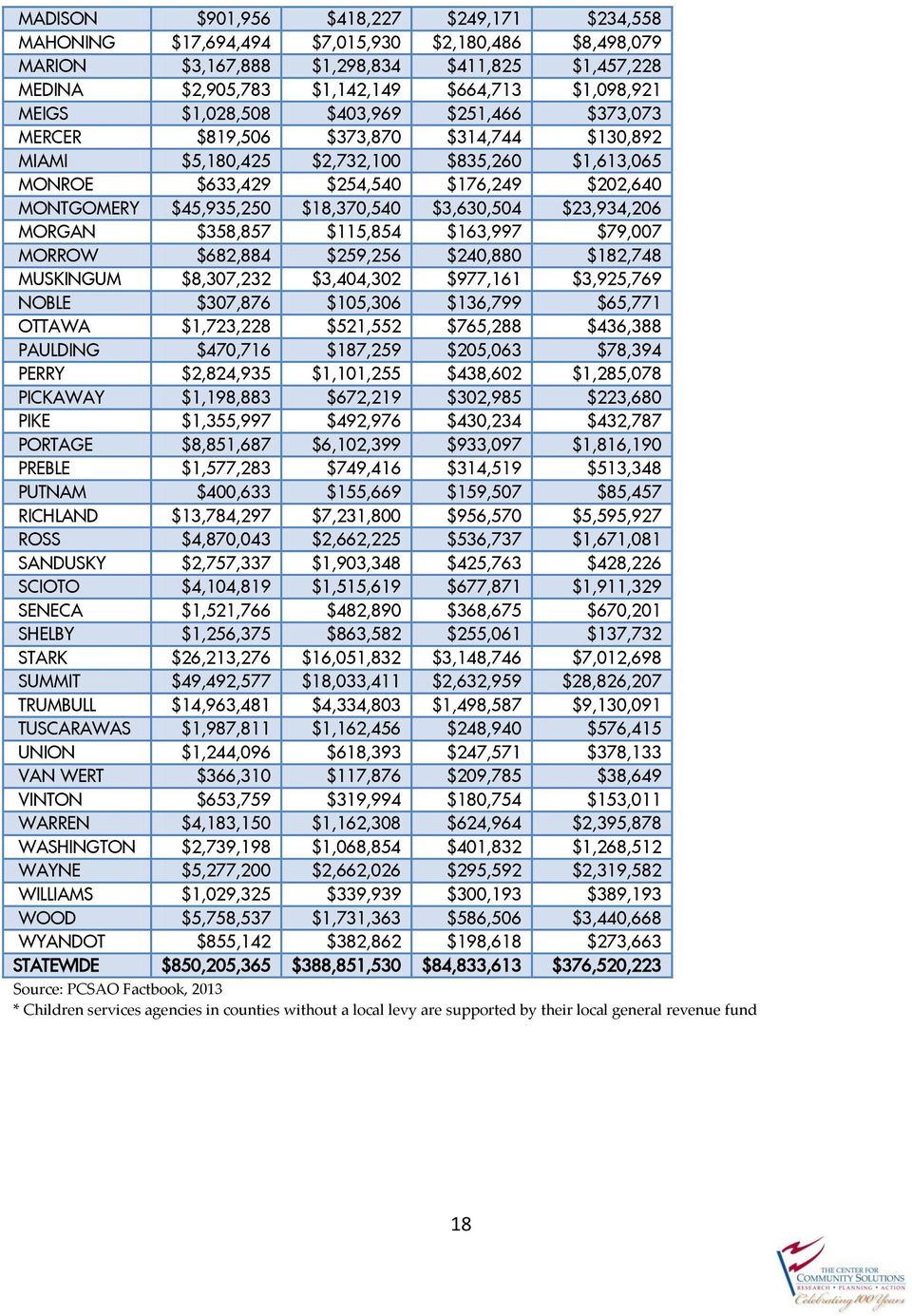
18 MADISON $901,956 $418,227 $249,171 $234,558 MAHONING $17,694,494 $7,015,930 $2,180,486 $8,498,079 MARION $3,167,888 $1,298,834 $411,825 $1,457,228 MEDINA $2,905,783 $1,142,149 $664,713 $1,098,921 MEIGS $1,028,508 $403,969 $251,466 $373,073 MERCER $819,506 $373,870 $314,744 $130,892 MIAMI $5,180,425 $2,732,100 $835,260 $1,613,065 MONROE $633,429 $254,540 $176,249 $202,640 MONTGOMERY $45,935,250 $18,370,540 $3,630,504 $23,934,206 MORGAN $358,857 $115,854 $163,997 $79,007 MORROW $682,884 $259,256 $240,880 $182,748 MUSKINGUM $8,307,232 $3,404,302 $977,161 $3,925,769 NOBLE $307,876 $105,306 $136,799 $65,771 OTTAWA $1,723,228 $521,552 $765,288 $436,388 PAULDING $470,716 $187,259 $205,063 $78,394 PERRY $2,824,935 $1,101,255 $438,602 $1,285,078 PICKAWAY $1,198,883 $672,219 $302,985 $223,680 PIKE $1,355,997 $492,976 $430,234 $432,787 PORTAGE $8,851,687 $6,102,399 $933,097 $1,816,190 PREBLE $1,577,283 $749,416 $314,519 $513,348 PUTNAM $400,633 $155,669 $159,507 $85,457 RICHLAND $13,784,297 $7,231,800 $956,570 $5,595,927 ROSS $4,870,043 $2,662,225 $536,737 $1,671,081 SANDUSKY $2,757,337 $1,903,348 $425,763 $428,226 SCIOTO $4,104,819 $1,515,619 $677,871 $1,911,329 SENECA $1,521,766 $482,890 $368,675 $670,201 SHELBY $1,256,375 $863,582 $255,061 $137,732 STARK $26,213,276 $16,051,832 $3,148,746 $7,012,698 SUMMIT $49,492,577 $18,033,411 $2,632,959 $28,826,207 TRUMBULL $14,963,481 $4,334,803 $1,498,587 $9,130,091 TUSCARAWAS $1,987,811 $1,162,456 $248,940 $576,415 UNION $1,244,096 $618,393 $247,571 $378,133 VAN WERT $366,310 $117,876 $209,785 $38,649 VINTON $653,759 $319,994 $180,754 $153,011 WARREN $4,183,150 $1,162,308 $624,964 $2,395,878 WASHINGTON $2,739,198 $1,068,854 $401,832 $1,268,512 WAYNE $5,277,200 $2,662,026 $295,592 $2,319,582 WILLIAMS $1,029,325 $339,939 $300,193 $389,193 WOOD $5,758,537 $1,731,363 $586,506 $3,440,668 WYANDOT $855,142 $382,862 $198,618 $273,663 STATEWIDE $850,205,365 $388,851,530 $84,833,613 $376,520,223 Source: PCSAO Factbook, 2013 * Children services agencies in counties without a local levy are supported by their local general revenue fund 18
19 Table A-5: Child welfare spending by source in SFY 2011 County Federal State Local County Federal State Local ADAMS 30% 18% 52% LICKING 54% 10% 36% ALLEN 28% 9% 63% LOGAN 44% 11% 46% ASHLAND 43% 27% 29% LORAIN 34% 9% 57% ASHTABULA 33% 13% 54% LUCAS 40% 11% 49% ATHENS 43% 8% 48% MADISON 46% 28% 26% AUGLAIZE 44% 40% 16% MAHONING 40% 12% 48% BELMONT 36% 12% 52% MARION 41% 13% 46% BROWN 34% 48% 18% MEDINA 39% 23% 38% BUTLER 34% 6% 60% MEIGS 39% 24% 36% CARROLL 47% 39% 13% MERCER 46% 38% 16% CHAMPAIGN 43% 25% 32% MIAMI 53% 16% 31% CLARK 53% 10% 37% MONROE 40% 28% 32% CLERMONT 52% 14% 35% MONTGOMERY 40% 8% 52% CLINTON 51% 17% 32% MORGAN 32% 46% 22% COLUMBIANA 38% 20% 42% MORROW 38% 35% 27% COSHOCTON 48% 22% 30% MUSKINGUM 41% 12% 47% CRAWFORD 53% 16% 31% NOBLE 34% 44% 21% CUYAHOGA 49% 11% 41% OTTAWA 30% 44% 25% DARKE 51% 22% 27% PAULDING 40% 44% 17% DEFIANCE 43% 31% 26% PERRY 39% 16% 45% DELAWARE 48% 9% 43% PICKAWAY 56% 25% 19% ERIE 40% 18% 42% PIKE 36% 32% 32% FAIRFIELD 49% 11% 40% PORTAGE 69% 11% 21% FAYETTE 43% 36% 21% PREBLE 48% 20% 33% FRANKLIN 48% 5% 47% PUTNAM 39% 40% 21% FULTON 44% 25% 31% RICHLAND 52% 7% 41% GALLIA 39% 17% 43% ROSS 55% 11% 34% GEAUGA 26% 14% 59% SANDUSKY 69% 15% 16% GREENE 35% 13% 52% SCIOTO 37% 17% 47% GUERNSEY 44% 9% 47% SENECA 32% 24% 44% HAMILTON 58% 8% 34% SHELBY 69% 20% 11% HANCOCK 44% 27% 29% STARK 61% 12% 27% HARDIN 46% 27% 27% SUMMIT 36% 5% 58% HARRISON 31% 38% 31% TRUMBULL 29% 10% 61% HENRY 49% 21% 29% TUSCARAWAS 58% 13% 29% HIGHLAND 58% 20% 22% UNION 50% 20% 30% HOCKING 35% 14% 50% VAN WERT 32% 57% 11% HOLMES 69% 24% 7% VINTON 49% 28% 23% HURON 44% 29% 28% WARREN 28% 15% 57% JACKSON 39% 33% 29% WASHINGTON 39% 15% 46% JEFFERSON 41% 12% 47% WAYNE 50% 6% 44% KNOX 34% 19% 47% WILLIAMS 33% 29% 38% LAKE 39% 13% 48% WOOD 30% 10% 60% LAWRENCE 29% 44% 28% WYANDOT 45% 23% 32% STATEWIDE 46% 10% 44% Source: PCSAO Factbook,

20 Table A-6: Child welfare spending per child in the county population, (based on federal, state and local sources), SFY 2011 County Spending/Child Levy? County Spending/Child Levy? ADAMS $ Yes LICKING $ Yes ALLEN $ Yes LOGAN $ Yes ASHLAND $ No LORAIN $ Yes ASHTABULA $ Yes LUCAS $ Yes ATHENS $ Yes MADISON $91.97 No AUGLAIZE $61.20 No MAHONING $ Yes BELMONT $ Yes MARION $ Yes BROWN $68.17 No MEDINA $66.43 No BUTLER $ Yes MEIGS $ No CARROLL $ No MERCER $76.07 No CHAMPAIGN $98.23 Yes MIAMI $ No CLARK $ Yes MONROE $ No CLERMONT $ Yes MONTGOMERY $ Yes CLINTON $ Yes MORGAN $ No COLUMBIANA $ Yes MORROW $75.94 No COSHOCTON $ Yes MUSKINGUM $ Yes CRAWFORD $ Yes NOBLE $ No CUYAHOGA $ Yes OTTAWA $ No DARKE $ No PAULDING $95.33 No DEFIANCE $98.28 No PERRY $ Yes DELAWARE $87.52 No PICKAWAY $91.12 No ERIE $ No PIKE $ Yes FAIRFIELD $ Yes PORTAGE $ Yes FAYETTE $99.27 No PREBLE $ Yes FRANKLIN $ Yes PUTNAM $43.55 No FULTON $96.98 No RICHLAND $ Yes GALLIA $ No ROSS $ Yes GEAUGA $ Yes SANDUSKY $ No GREENE $ Yes SCIOTO $ Yes GUERNSEY $ Yes SENECA $ No HAMILTON $ Yes SHELBY $93.05 No HANCOCK $ No STARK $ Yes HARDIN $ No SUMMIT $ Yes HARRISON $ Yes TRUMBULL $ Yes HENRY $ No TUSCARAWAS $90.50 No HIGHLAND $ Yes UNION $87.31 No HOCKING $ No VAN WERT $51.13 No HOLMES $97.37 No VINTON $ No HURON $81.93 No WARREN $71.54 No JACKSON $83.13 No WASHINGTON $ No JEFFERSON $ Yes WAYNE $ Yes KNOX $ Yes WILLIAMS $ No LAKE $ Yes WOOD $ Yes LAWRENCE $73.58 No WYANDOT $ No 20 Source: PCSAO Factbook, 2013 and US Census, 2010 Decennial Census

21 Table A-7: Child welfare spending per child in the county population, by source of funding, SFY 2011 County Federal Spending/Child State Spending/Child Local Spending/Child Total Spending/Child ADAMS $ $71.35 $ $ ALLEN $72.89 $22.83 $ $ ASHLAND $44.33 $28.16 $30.29 $ ASHTABULA $89.76 $33.71 $ $ ATHENS $ $61.86 $ $ AUGLAIZE $26.99 $24.45 $9.76 $61.20 BELMONT $ $37.12 $ $ BROWN $23.31 $32.43 $12.43 $68.17 BUTLER $97.52 $18.63 $ $ CARROLL $47.95 $39.86 $13.68 $ CHAMPAIGN $42.38 $24.51 $31.33 $98.23 CLARK $ $40.47 $ $ CLERMONT $ $28.96 $71.75 $ CLINTON $ $50.11 $92.30 $ COLUMBIANA $63.66 $33.18 $71.15 $ COSHOCTON $72.13 $33.68 $45.52 $ CRAWFORD $ $36.96 $70.78 $ CUYAHOGA $ $47.25 $ $ DARKE $61.94 $26.76 $33.29 $ DEFIANCE $42.39 $30.15 $25.74 $98.28 DELAWARE $41.88 $7.86 $37.78 $87.52 ERIE $59.16 $27.00 $62.61 $ FAIRFIELD $90.66 $20.59 $72.71 $ FAYETTE $42.43 $35.62 $21.21 $99.27 FRANKLIN $ $25.65 $ $ FULTON $42.52 $24.35 $30.12 $96.98 GALLIA $79.23 $34.63 $87.15 $ GEAUGA $52.08 $28.80 $ $ GREENE $82.95 $30.45 $ $ GUERNSEY $ $49.96 $ $ HAMILTON $ $32.11 $ $ HANCOCK $57.29 $35.42 $38.46 $ HARDIN $63.31 $38.12 $37.54 $ HARRISON $68.59 $83.49 $67.46 $ HENRY $65.00 $28.01 $38.38 $ HIGHLAND $85.43 $29.53 $31.91 $ HOCKING $95.88 $39.58 $ $ HOLMES $66.81 $23.39 $7.16 $97.37 HURON $35.85 $23.48 $22.60 $81.93 JACKSON $32.26 $27.12 $23.75 $83.13 JEFFERSON $ $45.49 $ $ KNOX $48.03 $26.16 $65.92 $ LAKE $63.42 $20.74 $78.97 $ LAWRENCE $21.07 $32.28 $20.24 $
22 LICKING $ $29.41 $ $ LOGAN $ $30.75 $ $ LORAIN $82.20 $20.77 $ $ LUCAS $ $50.82 $ $ MADISON $42.65 $25.41 $23.92 $91.97 MAHONING $ $42.47 $ $ MARION $88.18 $27.96 $98.94 $ MEDINA $26.11 $15.20 $25.12 $66.43 MEIGS $74.62 $46.45 $68.91 $ MERCER $34.70 $29.22 $12.15 $76.07 MIAMI $ $33.72 $65.13 $ MONROE $80.88 $56.01 $64.39 $ MONTGOMERY $ $29.45 $ $ MORGAN $32.91 $46.59 $22.45 $ MORROW $28.83 $26.79 $20.32 $75.94 MUSKINGUM $ $47.32 $ $ NOBLE $37.65 $48.91 $23.51 $ OTTAWA $60.68 $89.04 $50.77 $ PAULDING $37.92 $41.53 $15.88 $95.33 PERRY $ $46.51 $ $ PICKAWAY $51.09 $23.03 $17.00 $91.12 PIKE $69.24 $60.43 $60.78 $ PORTAGE $ $27.71 $53.93 $ PREBLE $73.20 $30.72 $50.14 $ PUTNAM $16.92 $17.34 $9.29 $43.55 RICHLAND $ $34.14 $ $ ROSS $ $30.52 $95.03 $ SANDUSKY $ $28.64 $28.80 $ SCIOTO $83.78 $37.47 $ $ SENECA $36.12 $27.58 $50.13 $ SHELBY $63.96 $18.89 $10.20 $93.05 STARK $ $36.62 $81.56 $ SUMMIT $ $21.31 $ $ TRUMBULL $92.96 $32.14 $ $ TUSCARAWAS $52.93 $11.33 $26.24 $90.50 UNION $43.40 $17.37 $26.54 $87.31 VAN WERT $16.45 $29.28 $5.39 $51.13 VINTON $95.95 $54.20 $45.88 $ WARREN $19.88 $10.69 $40.97 $71.54 WASHINGTON $82.59 $31.05 $98.02 $ WAYNE $91.34 $10.14 $79.59 $ WILLIAMS $38.11 $33.66 $43.64 $ WOOD $63.48 $21.50 $ $ WYANDOT $69.60 $36.11 $49.75 $ Source: PCSAO Factbook, 2013 and US Census, 2010 Decennial Census 22
23 Appendix B Interview questions - What common services does the department provide? o In-house o Contracted out - Foster care: managed in-house or contracted out? o Process includes foster parent recruitment, training, placement, follow-up visits etc. o If parts of foster care are contracted and some are not, what s this breakout? o Reimbursement to/supports for foster care families - Interaction with other agencies/services: - Current streamlining efforts, increased efficiency/effectiveness, any models to look at? 23
24 Appendix C Example of Level of Care Guidelines: State of Maine, Department of Health and Human Services 38 Levels of Care (LOC) Child Functioning Levels The following levels of care designations are used to determine the reimbursement rate to be paid to the foster parent. A. LOC A- Basic Care - Minimal Needs. This level is for children who have minimal needs and require the type of care offered in a Family Foster Home for Children. "Children with minimal needs" may have occasional episodes of behavioral and/or emotional problems which do not significantly impair the child's interpersonal relationships and ability to function at home or at school. "Children with minimal needs" are expected to function largely at an age appropriate level educationally, socially, physically, medically, developmentally and emotionally. B. LOC B - Basic Care - Mild Needs. This level is for children who have mild needs that require a higher than LOC A-Basic Care level of services in a Family Foster Home. "Children with mild needs" may display the following: minor developmental delays, episodic problems relating with others, infrequent concerns/problems regarding performance in school, limited or short-term mental health treatment needs and stable/routine medical needs. C. LOC C-Treatment Care - Moderate Needs. This level is for children who have moderate needs and require the type of care offered in a Specialized Children's Foster Home. "Children with moderate needs" may display the following: moderate developmental delays, ongoing problems with interpersonal relationships including a history of selfabusive behaviors, and minor episodes of aggression toward others. They may also have ongoing needs for mental health treatment, monitoring of school problems and/or special education needs and/or medical supports. D. LOC D - Treatment Care - High Needs. This level is for children who have high needs that require a higher than LOC C - Treatment Care level of services in a Specialized Foster Home. "Children with high needs" may display the following: significant developmental delays, impulsivity requiring external control, ongoing conflict with others, unresponsiveness to social prompts, need for special education services to address performance and/or behavior issues, slow or no progress in mental health treatment, and may require in-home supports for medical conditions. They may have a history of self-abusive behaviors, including assault on others. E. LOC D - Basic or Treatment Care - Exceptional Medical Care. This level is for medically fragile children in Basic or Treatment Care with a high level of medical need that does or could lead to care in an "intermediate care nursing facility". It is likely that these issues will not moderate and may become more severe over time and require specialized care to support activities of daily living. It must be shown that the Foster Parent has obtained 24
25 the training necessary to meet the medical needs of the child and is directly providing that level of care. Examples of children who meet this criteria include, but are not limited to, children that: require a feeding tube, congenital heart disease/abnormalities requiring surgery and monitoring, weekly to monthly hospital/specialist monitoring, kidney dialysis, severe forms of cancer, and/or severe failure to thrive with long range effects. F. LOC E-Treatment Care - Severe Needs. This level is for children who have severe needs that require a higher than LOC D - Treatment Care level of services in a Specialized Foster Home. "Children with severe needs" may display the following: severe developmental delays, a risk to self or others including deliberate aggression toward others, inability to maintain control in spite of close supervision, chronic/serious medical condition, and poor/no response to mental health treatment. Levels of Care (LOC) Process A. When a child comes into state custody, a preliminary determination is made by the Caseworker of this child's needs. Based upon this preliminary determination, the child will be placed in either a Family Foster Home or a Specialized Foster Home. If the child is placed in a Family Foster Home, the entry reimbursement rate will be LOC A - Basic Care. If a child is placed in a Specialized Foster Home, the entry reimbursement rate will be Level C - Treatment Care. Within 90 days of placement in a Family Foster Home or a Specialized Foster Home, an initial Child Assessment will be done by LOC Reviewers to determine the child's level of need. B. The result of the Child Assessment will indicate the child's Level of Care. C. Children in Basic Care will be reassessed annually to determine if their Level of Care continues to meet their needs. D. Children in Treatment Care will be reassessed by the Contracted Entity every six months to determine if their Level of Care continues to meet their needs. E. A determination may be made by the Department at the time of the initial Child Assessment that an annual reassessment is not needed for children in Basic Care. An annual assessment may not be needed for: Children with chronic medical conditions that will continue to require the same LOC. Children with cognitive limitations that will continue to require services at the same LOC. Children with an authorized LOC of Level A. F. Foster parents for children in Treatment Care may request one Special Review of the Level of Care prior to the scheduled reassessment. The Department may grant the Foster Parent s request if it finds substantial changes in the child s needs were demonstrated or that pertinent information was not available at the time of the previous review. 25
26 Reimbursement Rates LOC A - Basic Care - Minimal Needs. The daily reimbursement rate is $ LOC B - Basic Care -Mild Needs. The daily reimbursement rate is $ LOC C - Treatment Care - Moderate Needs. The daily reimbursement rate is $ LOC D - Treatment Care - High Needs. The daily reimbursement rate is $ LOC D Basic or Treatment Care - Exceptional Medical Care. The daily reimbursement rate is $ LOC E - Treatment Care - Severe Needs. The daily reimbursement rate is $ Review Process A. The Foster Parent and Child Placing Agency will be notified in writing of the result of the Child Assessment. B. If the Foster Parent of a child in Basic Care disagrees with the Child Assessment result, the Foster Parent must submit a request for a review, in writing, within 10 business days of the date of the notice. The Foster Parent must include documentation with the request for a review which supports the Foster Parent's dispute of the Level of Care established by the Child Assessment. Requests for review without documentation may be returned to the Foster Parent by the Department. C. If the Foster Parent of a child in Treatment Care disagrees with the Child Assessment result, the Foster Parent must submit a request for a review by the Contracted Entity through the Child Placing Agency, in writing, within 10 business days of the date of the notice. The request must include documentation with the request for a review which supports the dispute of the Level of Care established by the Child Assessment. Requests for review without documentation may be returned to the Child Placing Agency by Contracted Entity. D. The Foster Parent's written documentation for children in Basic Care will be submitted to the Levels of Care Program Manager for review of the Child Assessment. Written documentation for children in Treatment Care will be submitted via the Child Placing Agency to the Contracted Entity. E. For children in Basic Care, the Department will notify the Foster Parent of the result of the LOC review in writing. F. For children in Treatment Care, the Contracted Entity will notify the Child Placing Agency of the result of the review in writing. G. The result of the review is the end of the internal review process. 1 Seneca County Department of Job and Family Services, Common Children Services Acronyms and Terms, 2 Ohio Department of Job and Family Services, SACWIS/FACSIS data, Ohio Revised Code, and Ohio Department of Job and Family Services, SACWIS/FACSIS data, Ohio Child Welfare Training Program, About CAPMIS, 26
27 6 US Census, Decennial Census, US Census, Decennial Census, PCSAO Factbook 9 Based on the total number of children in the county, not only those that received services from the PCSA. 10 K. DeVooght, M. Fletcher, B. Vaughn, H. Cooper, Federal, State, and Local Spending to Address Child Abuse and Neglect in SFYs 2008 and 2010, June p Title XX of the Social Security Act, authorizes the Social Services Block Grant, a flexible funding source for states and territories to provide social services relevant to their residents. One of the five goals specified by law is to prevent neglect, abuse or exploitation of children and adults. 12 K. DeVooght, M. Fletcher, B. Vaughn, H. Cooper, Federal, State, and Local Spending to Address Child Abuse and Neglect in SFYs 2008 and 2010, June p Ibid, p Ibid, p Ibid, p Profiles of the Title IV-E Child Welfare Waiver Demonstration Projects, p Basic Family Foster Care Maintenance Rates Survey: Summary of Findings. National Association of Public Child Welfare Administrators, p.6. May Family, Children and Adult Services Procedure Letter No Interview with Crystal Ward Allen, 2/1/ Interview with Mario Tonti, 2/21/ Interview with David Dombrosky, Cuyahoga County 22 Ohio Association of Child Caring Agencies, Find a Service-Residential Care 23 Interview with Crystal Ward Allen, 2/1/ SACWIS 25 PCSAO Factbook, 2006, PCSAO Factbook, Hocking-Ross-Vinton Pilot Merger Program, presentation to the County Commissioners Association of Ohio, June 13, Ohio Alternative Response Pilot Project and Final Report of the AIM Team, p LSC Redbook, Analysis of Executive Budget Proposal, Department of Job and Family Services, p Ball State University, Foster Care Cost Survey of Indiana National Association of Counties, Collabor8 Virtual Call Center, Ohio Attorney General, Foster Care Advisory Group Recommendations, April 2013, 38 State of Maine Department of Health and Human Services, Chapter 14 Rules for Levels of Care for Foster Homes 27
Analysis of Proposed Tax Levies for Library Purposes
 Analysis of Proposed Tax Levies for Library Purposes March 2013 Prepared for the Ohio Library Council by Howard Fleeter & Associates 60 East Broad Street, Suite 350 Columbus, Ohio 43215 I. Overview This
Ohio Legislative Service Commission
 Ohio Legislative Service Commission Fiscal Note & Local Impact Statement Todd A. Celmar Bill: Sub. H.B. 1 of the 130th G.A. Date: June 13, 2013 Status: As Passed by the Senate Sponsor: Rep. Derickson and
***Proposed New Rule - June 2, 2016***
 5123:2-9-20 Home and community-based services - money management under the individual options and level one waivers. (A) Purpose This rule defines money management and sets forth provider qualifications,
Ohio PREP Region 6 Quarterly Newsletter
 Ohio PREP Region 6 Quarterly Newsletter October 2015 Inside This Issue What is Ohio PREP 1 Goals of Ohio PREP 1 Agency Success 2 PREP Coalition 3 Upcoming PREP Training Workshops 3 Ohio PREP Regions 4
Communities First Ohio -- Program Summary
 HOUSING FINANCE AGENCY/PROGRAM SPONSOR DESCRIPTION AVAILABLE MARKETS ELIGIBLE LENDERS Port of Greater Cincinnati Development Authority www.communitiesfirstohio.org The CommunitiesFirstOhio program provides
The tangible personal property tax, which applies
 The tangible personal property tax, which applies to property used in business in Ohio, is gradually being phased out as part of a broader series of tax reforms enacted in 2005 by the General Assembly.
To begin your search, click the red button called Click here to search for Nursing Homes.
 NURSING HOME SEARCH To search for a nursing home, either click the link called Nursing Homes (including short-term rehabilitation) or use the red menu bar at the top for Nursing Homes. At any time during
1-237 Adams *Adams $54,253 $0 Assistance Program ADAMS COUNTY TOTAL. $67,320 $24,944 Crime Victim Services 2-056 Allen *Allen Putnam $17,091 $205,346
 2014 Grant Allocations for Web Page 1 File County Counties SVAA VOCA Reach Out Inc. 1-102 Adams *Adams $13,067 $24,944 Adams Co. Prosecutor Victims 1-237 Adams *Adams $54,253 $0 Assistance ADAMS COUNTY
Induced Abortions in Ohio Ohio Department of Health OHIO 2013. An equal opportunity employer/provider
 OHIO 2013 Induced Abortions in Ohio Ohio Department of Health John Kasich, Governor Richard Hodges, Director of Health An equal opportunity employer/provider Induced Abortions in Ohio, 2013 Prepared by:
FORMS 1099-MISC. James Driver Federal, State, and Local Government Specialist [email protected] 859-244-2449
 FORMS 1099-MISC James Driver Federal, State, and Local Government Specialist [email protected] 859-244-2449 1 What is a 1099-MISC information return? Form required to report payments for: Services or,
Metropolitan & Micropolitan Statistical Area Definitions in Ohio Based on 2000 Census Designations**
 Metropolitan & Micropolitan Statistical Area Definitions in Ohio Based on 2000 Census Designations** * Statistical Areas in other states that include Ohio counties **Click on the letters or numbers to
DIVISION OF PAROLE AND COMMUNITY SERVICES Parole Officer Assessment Packet
 DIVISION OF PAROLE AND COMMUNITY SERVICES Parole Officer Assessment Packet Requirements for Employment January 2007 Attached, you will find a map of the seven Adult Parole Authority Regions, the Parole
Ohio Rapid Response Vendor List
 Rapid Response Vendor List AIG Financial Charles Betz 3455 Mill Run Drive, Suite 100 Hilliard Zip 43026 [email protected] Phone (614)376-9205 Transition Center, Peer to Peer Support, Job Fair Counties
Ohio Air Quality 2011
 September 22 Ohio Air Quality 2 Division of Air Pollution Control John R. Kasich, Governor Mary Taylor, Lt. Governor Scott J. Nally, Director Blank Page 46 STATE OF OHIO AIR QUALITY CALENDAR YEAR 2 PREPARED
Table of Contents. List of Figures and Tables
 Table of Contents Acknowledgements... 3 1.0 Executive Summary... 4 2.0 Introduction... 6 3.0 Methodology... 8 4.0 Results... 10 4.1 DS3 Services... 12 4.2 OC3 (155 Mbps) Services... 14 4.3 OC12 (622 Mbps)
Grantee Telephone Program(s) Counties Served
 Grantee Telephone Program(s) Counties Served Adams Co. Chamber of Commerce P.O. Box 398 509 E. Main Street West Union, Ohio 45693 Contact: Deana Swayne [email protected] ACEnet Ventures 94 Columbus
Ohio MHAS - SFY 2015 SAPT BG PASS-THRU GRANTS
 Allen Lima Urban Minority Alcohol Drug Abuse Outreach Program4256C UMADAOP UMADAOP 141,394 Lima-Urban Minority Alcohol Drug Abuse Outreach Prog. Inc. 4221F Womens Treatment 18,364 4224M Circle for Recovery
The RN & APRN Workforce in Ohio
 March 2015 Ohio Action Coalition The RN & APRN Workforce in Ohio An Overview of 2013 Licensure Renewal Data This analysis of the 2013 licensure renewal data was supported by funds from the State Implementation
Locally Funded Services For Seniors: A Description of Levy Programs in Ohio
 Locally Funded Services For Seniors: A Description of Levy Programs in Ohio Michael Payne * Robert Applebaum * Marcus Molea** Doris E. Ross** * Scripps Gerontology Center, Miami University ** The Ohio
Medicare s 5-star rating system
 NOVEMBER 2012 Medicare s 5-star rating system Every year the Centers for Medicare & Medicaid Services (CMS) uses a star system to rate Medicare Advantage plans (with or without drug coverage) and Prescription
MOVING OHIO FORWARD GRANT PROGRAM Demolition Guidelines (Revised 6/21/12)
 MOVING OHIO FORWARD GRANT PROGRAM Demolition Guidelines (Revised 6/21/12) FIRST ROUND Application Submission Deadline: July 2, 2012-5:00 p.m. Grant Award Date: August 1, 2012 Project Completion Date: December
Health insurance is changing
 Health insurance is changing Anthem Blue Cross and Blue Shield is here to help! Your health benefits are changing and we ve got new choices for you. Did you know Anthem is offering Individual plans on
Ohio Occupational Therapy, Physical Therapy, and Athletic Trainers Board. Fiscal Year 2012 Annual Report
 Ohio Occupational Therapy, Physical Therapy, and Athletic Trainers Board Fiscal Year 2012 Annual Report Ohio Occupational Therapy, Physical Therapy, and Athletic Trainers Board 77 South High Street, 16
Office of Criminal Justice Services
 Ashland County Projects 2009-RA-LSS-2401 Ashland County Commissioners Ashland County Sheriff's Office Feb 2013 car grant N 04/01/2013 08/31/2013 $29,986.00 Total Number of Ashland County Projects: 1 Total
Hospital Status as of 6/28/16
 Adena Greenfield Medical Center Adena Health System Greenfield Ross Live Adena Pike Medical Center Adena Health System Waverly Highland Live AdenaRegional Medical Center Adena Health System Chillicothe
State of Ohio Hazard Identification and Risk Analysis (HIRA) Ohio Emergency Management Agency 2855 West Dublin-Granville Road Columbus, Ohio 43235
 State of Ohio Hazard Identification and Risk Analysis (HIRA) Ohio Emergency Management Agency 2855 West Dublin-Granville Road Columbus, Ohio 43235 January 2011 FOREWORD This 2011 edition of the State of
3901-1-48 "Ohio mine subsidence insurance underwriting association" and "mine subsidence insurance fund" plan of operation.
 ACTION: Final DATE: 09/15/2011 12:43 PM 3901-1-48 "Ohio mine subsidence insurance underwriting association" and "mine subsidence insurance fund" plan of operation. (A) Purpose The purpose of this rule
The Self-Sufficiency Standard for ohio 2013
 The Self-Sufficiency Standard for ohio 2013 Prepared for Ohio Association of Community Action Agencies ohio association of community action agencies The Ohio Association of Community Action Agencies (OACAA)
Protecting elderly Ohioans from abuse and neglect Wendy Patton
 Budget Policy May 2014 Protecting elderly Ohioans from abuse and neglect Wendy Patton Ohio needs to do more to protect its growing senior population from abuse. Approval of the $10 million proposed in
FEDERAL FUNDING FOR CHILD WELFARE SERVICES
 FEDERAL FUNDING FOR CHILD WELFARE SERVICES This document describes the varied sources of federal funding to address child welfare services. Funding for child welfare services (i.e. those services that
Employment Discrimination. Rights and Remedies for People With Disabilities
 Employment Discrimination Rights and Remedies for People With Disabilities March 2010 This booklet, written by staff attorneys at Legal Rights Service (LRS), summarizes employment rights protection and
Local Option Income Taxes. Indiana s
 On Local Government Local Option Income Taxes and the Property Tax Caps Larry DeBoer Purdue University October 2013 Indiana s Local Option Income Taxes CAGIT: County Adjusted Gross Income Tax (1973) COIT:
22 nd Annual Report on the Cost of Health Insurance in Ohio s Public Sector
 State Employment Relations Board Research and Training Section 2014 22 nd Annual Report on the Cost of Health Insurance in Ohio s Public Sector SERB Chair W. Craig Zimpher SERB Vice Chair Aaron Schmidt
List of Contract Water and Wastewater Operators
 Name of Company Contact Name Phone Number Fax Number e-mail address Available McGhee's Technical Water Service Holly McGhee 49-886-476 49-886-476 [email protected] B & J Environmental, Josh Goodridge 440-57-59
Indiana Department of Homeland Security July 2007 Statewide Amateur Radio Emergency Communications Test
 8OM 8OM 6 M 40 M 2 M 440 6 M FM ECHO LINK LOCAL NET CHECK-IN S Adams Yes Allen Bartholomew 7 Benton Blackford Boone Brown Carroll Cass Clark Clay Clinton Crawford Daviess Dearborn Decatur Dekalb Delaware
To Strengthen Ohio s Families with Solutions to Temporary Challenges. Ohio Resource Guide for Relatives Caring for Children
 To Strengthen Ohio s Families with Solutions to Temporary Challenges Ohio Resource Guide for Relatives Caring for Children Table of Contents Chapter 1 What is Kinship Care? 5 Are you raising your relatives?
Hospital Franchise Fee 2010 Assessments
 Acuity Specialty - Ohio Valley 189,639.59 Acute Care Specialty @ Altman 114,680.11 Adams County 278,353.72 Adena Regional Medical Center 2,315,063.38 Affinity Medical Center (Doctor's-Stark) 1,242,281.53
CENTRAL OHIO EMERGENCY ALERT SYSTEM
 CENTRAL OHIO EMERGENCY ALERT SYSTEM OPERATIONAL AREA PLAN ADAMS LAWRENCE PIKE JACKSON GALLIA MEIGS VINTON ATHENS WASHINGTON BROWN HIGHLAND HAMILTON PREBLE GREENE MONTGOMERY CLARK MIAMI DARKE ROSS MERCER
Average Illinois 2nd Lowest Cost Silver Plans Cost Less Than Projected $312. Chicago Peoria ASPE-Derived Estimates from CBO
 Rate Levels Rates for benchmark plans are more than 25 percent below U.S. Health and Human Services (HHS) estimates based on Congressional Budget Office (CBO) projections $450 $400 $350 Average Illinois
Exploratory spatial data analysis using Stata
 Exploratory spatial data analysis using Stata Maurizio Pisati Department of Sociology and Social Research University of Milano-Bicocca (Italy) [email protected] 2012 German Stata Users Group meeting
Ohio Broadband Providers By County
 COUNTY PROVIDER Ohio Broadband Providers By County PROVIDER DOING- BUSINESS-AS NAME June 12, 2015 TECHNOLOGY WEBSITE MAXIMUM ADVERTISED DOWNLOAD SPEED (Mbps) MAXIMUM ADVERTISED UPLOAD SPEED (Mbps) Adas
Miami County. County Commissioners: Jack Evans John O Brien Ron Widener. County Department of Job and Family Services Child Support Enforcement Agency
 Miami Commissioners: Jack Evans John O Brien Ron Widener Department of Job and Family Services Child Support Enforcement Agency Carol Morgan, Director 24 North Road 25-A Troy, Ohio 45373-131 CDJFS Phone:
Low Income Weatherization
 September 2013 CUBFacts Low Income Weatherization LOW INCOME WEATHERIZATION PROGRAMS Illinois Home Weatherization Assistance Program (IHWAP) If you meet certain low-income requirements, you may be eligible
Ottawa County. County Commissioners: Steve Arndt James Sass Mark Stahl
 Ottawa Commissioners: Steve Arndt James Sass Mark Stahl Department of Job and Family Services Public Children Services Agency Child Support Enforcement Agency Stephanie Kowal, Director 843 West Route 163,
The Supreme Court of Ohio OhiO COurts statistical summary
 The Supreme Court of Ohio Ohio Courts Statistical summary 2012 Ohio Courts Statistical Summary Maureen O Connor Chief Justice Paul E. Pfeifer Terrence O Donnell Judith Ann Lanzinger Sharon L. Kennedy Judith
School Commander Manual for Peace Officer Basic Training
 School Commander Manual for Peace Officer Basic Training Effective 01/01/2015 Dear Commander, On behalf of the Ohio Peace Officer Training Commission, (OPOTC) I m pleased to provide you with the Ohio Peace
2015 Analysis of Illinois Qualified Health Plans
 2015 Analysis of Illinois Qualified Health Plans Highlights of the 2015 Get Covered Illinois Marketplace Increased Options Number of plans increase from 165 in 2014 to 410 in 2015* - More platinum plan
OHIO BOARD OF REGENTS. Operating Manual for Two-Year Campus Programs
 OHIO BOARD OF REGENTS Updated: April, 1998 BE IT RESOLVED: by the Ohio Board of Regents, upon the recommendation of the Chancellor and with concurrence of the Two-Year Campus Committee of the Ohio Board
2017 ANNUAL PROGRESS AND SERVICES REPORT. Office of Families and Children
 2017 ANNUAL PROGRESS AND SERVICES REPORT Office of Families and Children June 30, 2016 Table of Contents I. General Information 1 II. Update on Assessment of Performance 14 III. Update to the Plan for
Molina Dual Options MyCare Ohio Regional Molina MyCare Ohio Forum
 Molina Dual Options MyCare Ohio Regional Molina MyCare Ohio Forum The Molina Mission Vision Statement Molina Healthcare is an innovative national health care leader, providing quality care and accessible
Evidence of Coverage:
 January 1 December 31, 2015 Evidence of Coverage: Your Medicare Health Benefits and Services and Prescription Drug Coverage as a Member of HealthSpan Medicare Standard (HMO) This booklet gives you the
Adoption Subsidies Guide
 Adoption Subsidies Guide Office for Children and Families Booklet Contents Message to Prospective Adoptive Parents 3 About Adoption Subsidies 4 Federal Adoption Subsidy Programs 4 Federal Adoption Assistance
Accessing IV E Reimbursement for Supervised Independent Living Homes
 Accessing IV E Reimbursement for Supervised Independent Living Homes May 17, 2010 This proposal includes recommendations on how the State of Ohio can draw down federal reimbursement dollars through the
Adoption Subsidies Guide
 Adoption Subsidies Guide Office of Families and Children Booklet Contents Message to Prospective Adoptive Parents 3 About Adoption Subsidies 3 Title IV-E Adoption Assistance Programs 4 Title IV-E Adoption
TRAIL FAQs for All Retirees,Annuitants and Survivors
 STATE TRAIL FAQs for All Retirees,Annuitants and Survivors If I am currently enrolled in TRAIL, do I need to fill out the TRAIL Open Enrollment Form again this year? No. Once you are enrolled in one of