
students can throw the bills away or make a pile of the discarded bills.)
|
|
|
- Aldous Morrison
- 10 years ago
- Views:
Transcription
1 SM2-1: Budget Busters Purpose: Examine current personal money management habits by participating in this activity. Materials: Play money: enough so that each class member can have 10 bills. All bills can be the same denomination, or you can use a variety of bills and vary the cost of the questions. Wastebaskets: place several containers around the room on tables where the money will be thrown away. Students can also make a pile of the discarded bills on their desks. Directions: 1 Give everyone in class 10 bills. You can vary the number of bills to change the length of the exercise. 2 Read a series of questions to which students will respond yes or no. Use the questions listed, or create your own based on the material you are covering in class. 3 Collect one bill each time the student responds with a no answer. (If you are using waste containers, students can throw the bills away or make a pile of the discarded bills.) 4 Debrief the students by asking them about both their successes and failures. This activity can help students realize that they are throwing away or saving real money based on their choices and actions. Questions: 1. I have written down my financial goals. 2. I have a plan for reaching my goals. 3. I have a spending plan for my allowance and any earnings from working for others or for myself. 4. Before spending my paycheck, I review my goals and pay myself first. 5. I plan how I will use the rest of my paycheck before I say yes to any impulse spending. 6. I have a wardrobe plan based on a basic color, styles best suited to my body type, and lifestyle needs. 7. I know how much I can spend on clothing each month/year. 8. I have a budget for snacks and meals eaten away from home. 9. I know how much I can spend each day/week for snacks. 10. I pack a lunch from home to save money and achieve better nutrition. 11. I plan ahead for times of big expenses, such as graduation, yearbooks, proms, and school and community activities so that I ll have the money I need to attend/participate. 12. I take care of my teeth by brushing regularly, getting regular checkups, and cutting out sodas and other sugar-laden products. 13. If I want to make a major purchase ($100 or more), I do comparison shopping to get the best buy for my money. 14. All of my purchases are part of my plan for reaching my goals. SM2-1: Budget Busters pg. 1 of 2

2 SM2-1: Budget Busters continued 15. I plan some money for spending as I please, but only after paying myself first. 16. I choose snacks from the pyramid that contribute to good health. 17. I don t spend my hard-earned cash on junk food. 18. I limit junk food to an occasional treat rather than as an everyday habit. 19. I have an emergency fund set aside equal to at least two months of living expenses. 20. I pay off the entire balance due on my credit cards each month to avoid interest charges. 21. I understand the returned merchandise policy of a store before buying. Merchants are not required to allow returns. 22. I consider the cost of owning and caring for goods before purchase, such as the cost to clean leather and suede, or space to store the item. 23. I know the difference between wants and needs. 24. I know the rate of interest I am receiving on my bank or credit union savings account. 25. I belong to a credit union to reduce transaction costs. 26. I know the blue book values of any used car I might consider before agreeing on a purchase price. 27. I determine the amount I have to spend on a car and secure financing for that amount before selecting a car. 28. I have a wardrobe plan so that I know what I need to add to maximize the clothing already owned. 29. I have a plan for after graduation that includes additional training so that I can get and keep a living wage job. 30. I have determined several goals for my future. 31. I take care with my personal appearance including bathing daily, wearing clean and neat clothes, and keeping clean hands and nails. (What does this cost you in a lifetime if you don t do it?) 32. I can provide one good example of a spending mistake I made that helped me learn an important lesson in money management. 33. I am aware of three or more of my personal strengths. Adapted from the WSU Cooperative Extension Money Management Advisor Manual by Doris Torkelson, M.S., Area Agent, Grays Harbor and Mason Counties ([email protected]). SM2-1: Budget Busters pg. 2 of 2

3 SM2-2: What If? Purpose: Think about the consequences of spending and saving behaviors by predicting how much was saved or spent for each of the following situations. Directions: What if any of the following spending or saving behaviors applied to you? How much would you spend or save? Read each of the What If scenarios below, and calculate the amount saved or spent. Write the amount in the middle column. In the right column, list at least one consequence of the behavior. (The first situation has been completed for you as an example.) What If... (Example)... you incur a late fee of $3 at least twice a month at the video rental store because you return rented video games or movies late? Amount In six months, you would have saved/spent $36. [($3 x 2 times a month) x 6 months = $36] Possible Outcome This is $36 that could have been put into savings or used to rent more movies or video games. Also, this might hurt my reputation as a reliable customer of the rental store.... you saved half of your gift money you received in the last year? In one year, you would have saved/spent $.... you purchased a soda or coffee every weekday after school? In one month, you would have saved/spent $.... you saved 10% of your paychecks (or allowances)?... your cell phone service charged 10 cents for every text message, and you averaged about three text messages a day? In six months, you would have saved/spent $. In the month of April, you would have saved/spent $.... your parents learned that you are eligible for a good student discount of 25% on your automobile insurance premium. The full premium is $350 for three months. In one year, your family would have saved/spent $. Name Date SM2-2: What If? pg. 1 of 1

4 SM2-2: What If? (Instructor) Purpose: Think about the consequences of spending and saving behaviors by predicting how much was saved or spent for each of the following situations. Directions: What if any of the following spending or saving behaviors applied to you? How much would you spend or save? Read each of the What If scenarios below, and calculate the amount saved or spent. Write the amount in the middle column. In the right column, list at least one consequence of the behavior. (The first situation has been completed for you as an example.) What If... (Example)... you incur a late fee of $3 at least twice a month at the video rental store because you return rented video games or movies late? Amount In six months, you would have saved/spent $36. [($3 x 2 times a month) x 6 months = $36] Possible Outcome This is $36 that could have been put into savings or used to rent more movies or video games. Also, this might hurt my reputation as a reliable customer of the rental store.... you saved half of your gift money you received in the last year?... you purchased a soda or coffee every weekday after school? In one year, you would have saved/spent $. (Responses will vary depending on student situations.) In one month, you would have saved/spent $. (Responses will vary depending on student situations.) (Note to instructor: Facilitate a discussion for students to consider potential consequences of the saving or spending behaviors.)... you saved 10% of your paychecks (or allowances)? In six months, you would have saved/spent $. (Responses will vary depending on student situations.)... your cell phone service charged 10 cents for every text message, and you averaged about three text messages a day? In the month of April, you would have saved/spent $9. (10 cents x 3 x 30 days = $9)... your parents learned that you are eligible for a good student discount of 25% on your automobile insurance premium. The full premium is $350 for three months. In one year, your family would have saved/spent $350. ($350 x 4 quarters x.25 = $350) SM2-2: What If? (Instructor) pg. 1 of 1

5 SM2-3: Analyzing a Pay Stub Purpose: When you receive your paycheck, you should examine the attached pay stub to ensure your pay was calculated and disbursed accurately. The pay stub provides details of what you earned and how your pay is divided up for take-home pay, taxes, and any deductions for expenses. Examine the information included on a paycheck stub as you complete this activity. Directions: Tom needs help understanding his pay stub. Please answer the following questions in order to help him out. Blue Wisp Cleaners 123 Main Street Denver, Colorado (123) Employee: Social Security Number: Pay Period: Pay Date: Check Number: Tom Smith to Hours Earnings Regular Overtime Regular Overtime Bonus Other Gross Pay T/P YTD , Deductions Social Security Medicare Federal Withholding State Withholding Pension Other Net Pay T/P YTD Who is Tom s employer? 2. What is the length of the pay period Tom just worked? 3. How many total hours did Tom work during this pay period? 4. What amount per hour does Tom get paid for regular hours worked? 5. Did Tom work any overtime this pay period? If so, how many hours? 6. What amount per hour does Tom get paid for overtime hours worked? 7. What is Tom s gross pay for this pay period? 8. List the type and amount of each payroll deduction for Tom for this pay period. a. b. c. d. 9. What was the total amount of Tom s deductions this pay period? YTD? 10. What is Tom s net pay (take-home pay) for this pay period? 11. What amount has been available for Tom s financial goals year-to-date? Name Date SM2-3: Analyzing a Pay Stub pg. 1 of 1

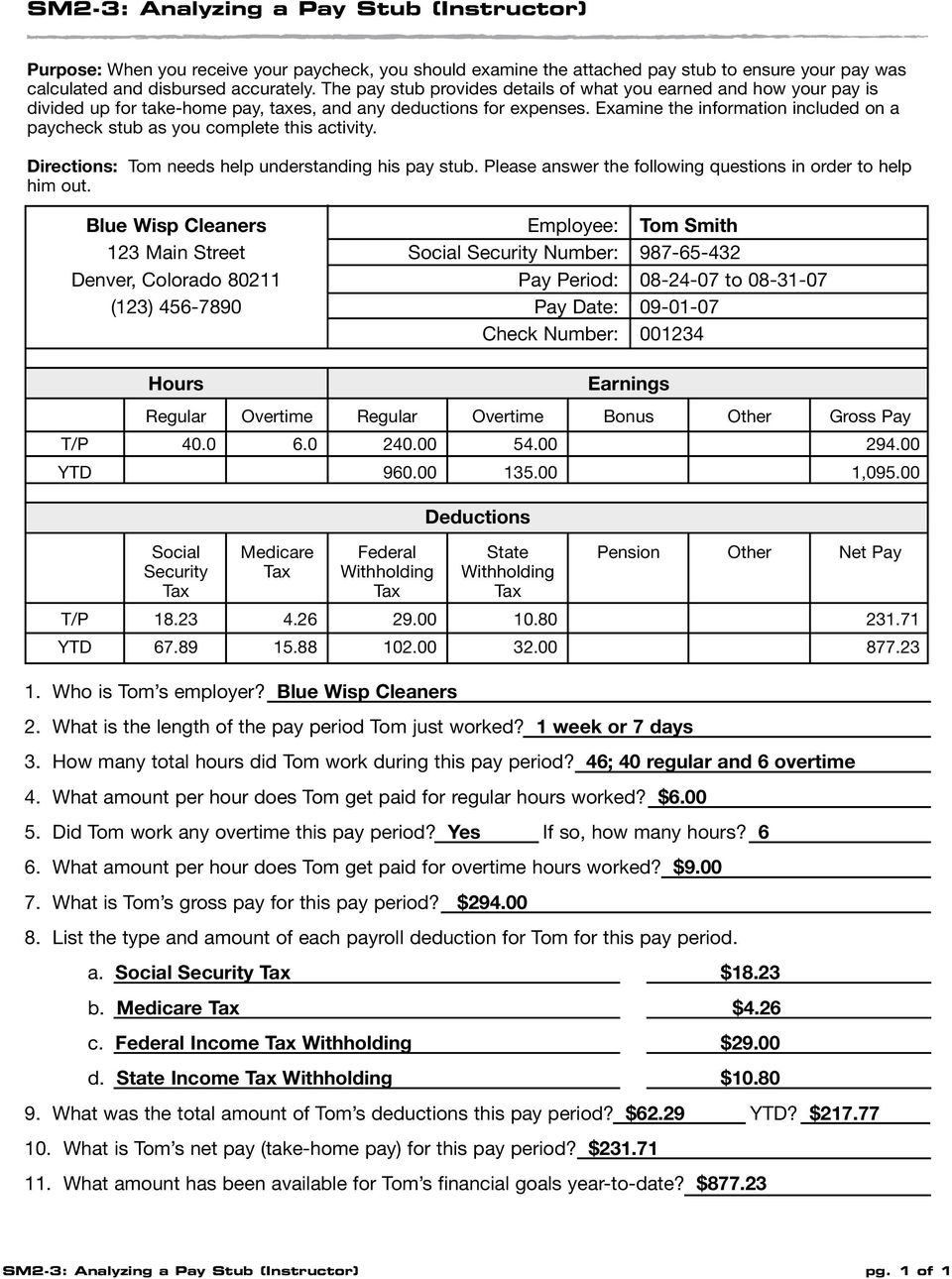
6 SM2-3: Analyzing a Pay Stub (Instructor) Purpose: When you receive your paycheck, you should examine the attached pay stub to ensure your pay was calculated and disbursed accurately. The pay stub provides details of what you earned and how your pay is divided up for take-home pay, taxes, and any deductions for expenses. Examine the information included on a paycheck stub as you complete this activity. Directions: Tom needs help understanding his pay stub. Please answer the following questions in order to help him out. Blue Wisp Cleaners 123 Main Street Denver, Colorado (123) Employee: Social Security Number: Pay Period: Pay Date: Check Number: Tom Smith to Hours Earnings Regular Overtime Regular Overtime Bonus Other Gross Pay T/P YTD , Deductions Social Security Medicare Federal Withholding State Withholding Pension Other Net Pay T/P YTD Who is Tom s employer? Blue Wisp Cleaners 2. What is the length of the pay period Tom just worked? 1 week or 7 days 3. How many total hours did Tom work during this pay period? 46; 40 regular and 6 overtime 4. What amount per hour does Tom get paid for regular hours worked? $ Did Tom work any overtime this pay period? Yes If so, how many hours? 6 6. What amount per hour does Tom get paid for overtime hours worked? $ What is Tom s gross pay for this pay period? $ List the type and amount of each payroll deduction for Tom for this pay period. a. Social Security $18.23 b. Medicare $4.26 c. Federal Income Withholding $29.00 d. State Income Withholding $ What was the total amount of Tom s deductions this pay period? $62.29 YTD? $ What is Tom s net pay (take-home pay) for this pay period? $ What amount has been available for Tom s financial goals year-to-date? $ SM2-3: Analyzing a Pay Stub (Instructor) pg. 1 of 1
7 Assessment 2-2: Evaluation Short Answer (6 pts.): Read each item carefully; then write an answer based on what you learned about creating a personal budget. Each question is worth 2 pts. 1. What are two benefits of tracking your spending habits? a. b. 2. What are two advantages of creating and following a spending plan (budget)? a. b. 3. List two types of financial documents that every person should keep on file. a. b. True/False (10 pts.): Read each statement carefully. Show whether the statement is True (T) or False (F) by writing either T or F. If a statement is false, rewrite the statement to be a true statement. Each question is worth 2 pts. 4. You should follow the same budget as long as necessary to control your spending and to meet your financial goals. 5. A personal budget should be planned for a specific period of time. 6. You can think of P.Y.F. as a bill you owe yourself. 7. The best way to stay on track with your budget is to create the budget with spreadsheet software. 8. Income and spending must balance each other. Score /50 Name Date SM2-4: Assessment 2-2 Evaluation pg. 1 of 4

8 Multiple Choice (10 pts.): Read each item carefully; then select the best answer. Each answer is worth 1 pt. 9. Which one of the following could not be called income? a. An allowance b. A paycheck c. Interest paid on a loan d. Interest received from a savings account 10. What is the purpose of Form W-2? a. To itemize how much money was earned by an employee and how much was withheld and sent to the Internal Revenue Service (IRS) b. To allow the employee to participate in a tax-deferred savings plan c. To document a refund or figure a balance due to the IRS each year d. To allow the employer to withhold federal income taxes from an employee s wages 11. What is the purpose of Form W-4? a. To itemize how much money was earned by an employee and how much was withheld and sent to the Internal Revenue Service (IRS) b. To allow the employee to participate in a tax-deferred savings plan c. To document a refund or figure a balance due to the IRS each year d. To allow the employer to withhold federal income taxes from an employee s wages Use Pete Dixon s pay stub shown here to answer Questions Vick s Videos 123 Adventure Street Dreamland, Colorado Employee: Social Security Number: Pay Period: Pay Date: Check Number: Pete Dixon to Hours Earnings Regular Overtime Regular Overtime Bonus Other Gross Pay T/P YTD , , Deductions Social Security Medicare Federal Withholding State Withholding Pension Other Net Pay T/P YTD What is Pete s gross income for this pay period? a. $ b. $ c. $ d. $1, What is Pete s net income so far this year? a. $ b. $ c. $ d. $1, SM2-4: Assessment 2-2 Evaluation pg. 2 of 4

9 14. How much of this paycheck does Pete have for spending and saving for goals? a. $ b. $ c. $ d. $1, To reach her financial goals, Rhonda has calculated that she needs an additional $25 per week in gross pay. Rhonda can only work 20 hours per week during the school year, so she wants to ask her supervisor for a raise to increase her income. If she currently earns $6.75 per hour, how much should her hourly wage be raised to increase her weekly gross pay by $25? a. 50 cents b. 75 cents c. $1.25 d. $7.75 e. $ How much will Rhonda earn per hour if she does get the raise she wants? a. $6.75 b. $7.25 c. $7.75 d. $ Marcus set a goal to buy a used car in the next few months. He plans to make a $2,500 down payment and has already saved $1,300. If he can save $150 each month for this goal to buy a car, how long will it take him to save the entire $2,500? a. 6 months b. 8 months c. 10 months d. 12 months 18. Lee wants to set up a budget, so he has asked for your help to draft it. He hesitates when you ask him to predict how much income he will have each month because he works more hours per week in the summer than during the school year. What will help him estimate his income for a specific month? a. His W-2 statement from the previous year b. His W-4 form from the previous year c. His pay stub from the previous pay period d. His pay stubs from the past year Matching (5 pts.): Read each statement carefully. Select the term that best matches the statement by writing the letter of the matching term in the blank. Each question is worth 1 pt. 19. Any money you receive such as an allowance or paycheck 20. An amount of money spent to buy something or do something that is the exact same amount every time 21. Taking a certain amount of all money you receive and saving it to be used for spending on longer-term goals 22. Money taken out of a paycheck by an employer to pay for taxes, health insurance, and other payments 23. Take-home pay a. Fixed Expense b. Gross Income c. Income d. P.Y.F e. Payroll Deductions f. Net Income g. Spending & Saving Plan h. Variable Expenses SM2-4: Assessment 2-2 Evaluation pg. 3 of 4

10 Essay (19 pts.): In this unit, you have learned how to build a budget. Use what you have learned to respond to the next three tasks. 24. Do you have a spending and savings plan? In the space below, write down your personal budget to show your plan for spending and saving during the next month. (10 pts.) Budget Tips Did you... Clearly classify your income and expenses Relate your budget to your current financial goals Write legibly Double check your math 25. How will your planned budget relate to your financials goals? In 2 5 complete sentences, explain how your budget will help you achieve your current financial goals. (5 pts.) 26. What do you predict will be different about your budget two years from now? Think about how your income and expenses might increase or decrease. Also consider what types of income and expenses might be removed or added to your budget. In the space below, list at least four things that will be different in your budget two years from now compared with your current budget. (4 pts.) a. b. c. d. SM2-4: Assessment 2-2 Evaluation pg. 4 of 4

11 Assessment 2-2: Evaluation Answer Key Short Answer (6 pts.). Each question is worth 2 pts. 1. Possible responses: Track spending habits to show where money is really going, use the information to create a budget to plan spending, compare to see how well spending habits match financial goals. Award 1 pt. each for up to two responses. [Objective A; pp. 16, 20] 2. Possible responses: Prioritize spending and saving, have money for financial goals, keep from going into debt, have money for wants and needs. Award 1pt. each for up to two responses. [Objective B, pp. 16, 25] 3. Possible responses: checking account statements, savings and investment statements, tax documents, insurance statements, loan and credit card statements, receipts and warranties for major purchases. Award 1 pt. each for up to two responses. [Objective F, pp ] True/False (10 pts.). Each question is worth 2 pts. Award the full 2 pts. for each true response and each false response with an accurate rephrased statement. Award only 1 pt. for a correctly labeled false statement without a correct rewritten statement. 4. False. A spending plan will need to be adjusted as income, expenses, and financial goals change. [Objectives A, H; pp. 16, 25] 5. True. [Objective F, p. 22] 6. True. [Objective E, pp ] 7. False. There are many strategies; use the system that best matches your lifestyle and the technology available to you. Examples of other strategies include the envelope system, the tally system, a checking account register, a spreadsheet (manual or computerized), financial planning software. [Objective G, p. 24] 8. True. [Objectives B, F, H; p. 22] Multiple Choice (10 pts.). Each answer is worth 1 pt. 9. c. Interest paid on a loan [Objective C, p. 17] 10. a. To itemize how much money was earned by an employee and how much was withheld and sent to the Internal Revenue Service (IRS) [Objective G, pp ] 11. d. To allow the employer to withhold federal income taxes from an employee s wages [Objective C, p. 18] 12. b. $ [Objective C, p. 18] 13. c. $ [Objective C, p. 18] 14. a. $ [Objective C, p. 18] 15. c. $1.25 [$25 increase needed / 20 hours = $1.25 per hour increase] [Objective H, p. 25] 16. d. $8.00 [$6.75 current wage + $1.25 increase = $8.00 wage with raise] [Objective H, p. 25] 17. b. 8 months [$2,500 down pymt. $1,300 saved = $1,200 needed/$150 saved monthly = 8 months] [Objective E, pp ] 18. d. His pay stubs from the past year [Objectives C, F; pp. 17, 23] SM2-4: Assessment 2-2 Evaluation (Instructor) pg. 1 of 2
![Award 1 pt. each for up to two responses. [Objective A; pp. 16, 20] 2.](/docs-images/51/13401977/images/page_11.jpg "Possible responses: Prioritize spending and saving, have money for financial goals, keep from going into debt, have money for wants and needs. Award 1pt. each for up to two responses.")
12 Matching (5 pts.) 19. c. Income [Objective C, p. 17] 20. a. Fixed Expense [Objective D, p. 19] 21. d. P.Y.F (Pay Yourself First) [Objective E, p. 20] 22. e. Payroll Deductions [Objectives C, G, pp ] 23. f. Net Income [Objectives C, G, p. 18] Essay (19 pts.) 24. (10 pts.) Student budgets should be organized in a manner similar to the budget on page 22 of the Student Guide. [Objectives B, C, D, E, F, H; p. 22] Award points for the following: 1 pt. = Budget title 2 pts. = List of income with amounts 1 pt. = Correct calculation of total income 2 pts. = List of expenses with amounts 1 pt. = Correct calculation of total expenses 2 pts. = Total Income = Total expenses 1 pt. = Information is legible 25. (5 pts.) [Objectives B, E; pp ] 5 pts.: Complete response should include reference to specific financial goal(s) and explanation of how the savings shown in the budget above will be used for specific financial goals. Sentences are well organized and clearly written with correct grammar, punctuation, and spelling. 3 4 pts.: Response might be lacking specific details about financial goals and how savings will be allocated for goals. Sentences might have minor grammar, punctuation, or spelling errors, but the message is clear. 1 2 pts.: Response lacks reference to financial goals or savings used for goals. Sentences are poorly organized and contain several grammar and spelling errors. 26. (4 pts.) Award 1 pt. for each realistic change that is listed. [Objectives A, F, H; p. 25] SM2-4: Assessment 2-2 Evaluation (Instructor) pg. 2 of 2
![[Objectives B, C, D, E, F, H; p. 22] Award points for the following: 1 pt. = Budget title 2 pts. = List of income with amounts 1 pt. = Correct calculation of total income 2 pts.](/docs-images/51/13401977/images/page_12.jpg "= List of expenses with amounts 1 pt. = Correct calculation of total expenses 2 pts. = Total Income = Total expenses 1 pt. = Information is legible 25. (5 pts.) [Objectives B, E; pp. 20 22] 5 pts.")
Budgeting: Making the Most of Your Money
 ? Did You Know? Almost 60% of millionaires use a budget to manage their money. The Millionaire Next Door: The Surprising Secrets of America s Wealthy. In this unit, you will: Examine your spending habits
Budget Busters: Who s Breaking the Bank?
 Time Required: 15 minutes Budget Busters: Where does all your money go? No matter how much money you earn, a careful budget lets you know exactly what happens to your cash. Below are three different cash
Designing Your Budget
 2 Designing Your Budget Budgeting is needed to get the most mileage out of your income. It is your road map for managing your money. Planning your spending is called Budgeting. Smart investing@your library
SM4-1: Credit Card Application (version 1)
 SM4-1: Credit Card Application (version 1) SM4-1: Credit Card Application (version 1) pg. 1 of 2 SM4-1: Credit Card Application (version 1) continued SM4-1: Credit Card Application (version 1) pg. 2 of
Financial Planning. Introduction. Learning Objectives
 Financial Planning Introduction Financial Planning Learning Objectives Lesson 1 Budgeting: How to Live on Your Own and Not Move Home in a Week Prepare a budget and determine disposable income. Identify
Making and Living Within a Budget
 NORTH DAKOTA PERSONAL FINANCE EDUCATION Making and Living Within a Budget Leader Guide Learner Objectives Students will: Understand how to organize personal fi nances and use a budget to manage cash fl
Personal Finance Unit 1 Chapter 3 2007 Glencoe/McGraw-Hill
 0 Chapter 3 Money Management Strategy What You ll Learn Section 3.1 Discuss the relationship between opportunity costs and money management. Explain the benefits of keeping financial records and documents.
Career & Financial Management High School Financial Planning Program
 Career & Financial Management High School Financial Planning Program MULTIPLE CHOICE 1. When shopping for a loan to buy a car, what question is NOT asked of the lender? a. What is the Interest Rate? c.
Money Management 101 - A Guide to Smart Budgeting
 Summit Branches are conveniently located in Rochester (8), Seneca Falls (1), Buffalo (2), Syracuse (5) and Cortland (2) Money Management 101 - A Guide to Smart Budgeting Presented by The Summit Federal
Creating Your Financial Plan
 Chapter 3 Creating Your Financial Plan Chapter 3 helps you create a spending and savings plan. In Chapter 2 you set your goal and estimated how much you need to save each month and for how long to achieve
NEFE High School Financial Planning Program Unit Two Budgeting: Making the Most of Your Money. Unit 2 - Budgeting: Making the Most of Your Money
 Unit 2 - Budgeting: Making the Most of Your Money What is a Spending Plan A Spending Plan is an outline of your financial values and priorities. It is your Income Expenses = Savings A Spending Plan shows
THE ABC S OF VEHICLE FINANCING CURRICULUM. Counting Your Money
 Counting Your Money Section Objectives Counting your money and managing your money wisely is the most important part of your trip on the road to personal financial success. It is a critical step in achieving
Dimes to Riches Money Management for Teens in Grades 7-12
 Dimes to Riches Money Management for Teens in Grades 7-12 s e e r t n o row g t n s e o yd e n o M t a! h k t n a w b o n a k t u n By now yo Your parents are & Life is getting busy and you need cash for
Effective Strategies for Personal Money Management
 Effective Strategies for Personal Money Management The key to successful money management is developing and following a personal financial plan. Research has shown that people with a financial plan tend
Budgeting: Managing Your Money with a Spending Plan
 Budgeting: Managing Your Money with a Spending Plan Budgeting: Managing Your Money with a Spending Plan Are you making the best use of your money? Do you have a handle on how much comes in each month and
lesson three budgeting your money teacher s guide
 lesson three budgeting your money teacher s guide budgeting your money lesson outline lesson 3 overview I m all out of money, and I won t get paid again until the end of next week! This is a common dilemma
Basics of Budgeting. Ten Steps To Create A Budget. Reviewing:
 Basics of Budgeting Reviewing: Ten Steps to creating a budget How to find where your money is going Tips to stay on course Budget format included Ten Steps To Create A Budget Basics of Budgeting A budget
Lesson Description. Texas Essential Knowledge and Skills (Target standards) Skills (Prerequisite standards) National Standards (Supporting standards)
 Lesson Description This lesson builds on Grade 7, Lesson 1. Students will calculate net income and categorize expenses to create a budget. Percentages for each category will be calculated and analyzed.
SM1-1: SMART Goals for a School Organization/Event
 SM1-1: SMART Goals for a School Organization/Event Purpose: Practice what you have learned about goals to create financial SMART goals for a school organization or school event. Directions: Describe SMART
3Budgeting: Keeping Track of Your Money
 This sample chapter is for review purposes only. Copyright The Goodheart-Willcox Co., Inc. All rights reserved. 3Budgeting: Keeping Track of Your Money Chapter 3 Budgeting: Keeping Track of Your Money
STATE OF VERMONT. Defendant Name V. FINANCIAL AFFIDAVIT (813A) Other: Street Address (if different from Street Address)
 STATE OF VERMONT SUPERIOR COURT Unit Plaintiff Name DOB FAMILY DIVISION Docket No. Defendant Name DOB V. FINANCIAL AFFIDAVIT (813A) I am: Plaintiff Defendant Other: Name Street Address (if different from
TEACHING LIFE SKILLS TO PARENTS PARTICIPANT GUIDE
 TEACHING LIFE SKILLS TO PARENTS PARTICIPANT GUIDE 1632 Da Vinci Court, Davis, CA 95618 Phone: (530) 757-8725 Fax: (530) 752-6910 [email protected] humanservices.ucdavis.edu/academy Section Four: Money
Money Management Basics
 Money Management Basics The feeling that you have control over your finances is one of the greatest satisfactions you can have in life. On the other hand, worrying about digging your way out of debt, or
TRS PERSONAL FINANCE HOMEWORK: Amounts in Actual column are considered PRE-WORK and must be complete BEFORE the TRS seminar
 PERSONAL IN NATURE F.O.U.O. TRS PERSONAL FINANCE HOMEWORK: Amounts in Actual column are considered PRE-WORK and must be complete BEFORE the TRS seminar DATE: Completed budget- due 0730 TUESDAY (Attach
A financial statement captures a person s overall wealth at a specific point in time. In this lesson, students will:
 PROJECT 3 CASH FLOW AND BALANCE SHEETS INSTRUCTOR OVERVIEW Financial statements are compilations of personal financial data that describe an individual s current financial condition. Financial statements
A financial statement captures a person s overall wealth at a specific point in time. In this lesson, students will:
 PROJECT 3 CASH FLOW AND BALANC E SHEETS INSTRUCTOR OVERVIEW Financial statements are compilations of personal financial data that describe an individual s current financial condition. Financial statements
*Note: Fact sheets 1 and 4 have suggested student activities.
 Federal Reserve Bank of Kansas City - http://paycheck.kcfed.org Teacher Introduction The Federal Reserve Bank of Kansas City developed Putting Your Paycheck to Work fact sheets for employees to understand
Study Guide - Final Exam Accounting I
 Study Guide - Final Exam Accounting I True/False Indicate whether the sentence or statement is true or false. 1. Entries in a sales journal affect account balances in both the accounts receivable ledger
Standard 1: The student will describe the importance of earning an income and explain how to manage personal income using a budget.
 STUDENT MODULE 1.2 EARNING AN INCOME PAGE 1 Standard 1: The student will describe the importance of earning an income and explain how to manage personal income using a budget. Income and Taxes Murphy cannot
Step #1: Make a Monthly Spending Plan
 Cutting Back and Keeping Up When Money is Tight When your monthly budget needs a tune-up Whether it s due to a drop in income, a big unexpected expense, or the cost of everyday living overtaking your paycheck,
Slide 2. Income Taxes
 Slide 1 Taxes Income taxes have been a part of American life since 1909 when the 16 th Amendment to the Constitution was ratified. You can t avoid taxes, so you might as well understand how taxes are structured
NEFE High School Financial Planning Program Unit Two Budgeting: Making the Most of Your Money. Unit 4 - Budgeting: Making the Most of Your Money
 Unit 4 - Budgeting: Making the Most of Your Money ? 2-A-1 Chart Recommendations Housing 30% Food 20% Clothing 10% Transportation 10% Savings 10% Misc. 20% 2-A-2 2-B-1 1 2 3 Some Money Facts The average
Standard 1: The student will describe the importance of earning an income and explain how to manage personal income using a budget.
 TEACHER GUIDE 1.2 EARNING AN INCOME PAGE 1 Standard 1: The student will describe the importance of earning an income and explain how to manage personal income using a budget. Income and Taxes Priority
A Plan for the Future: Making a Budget
 A Plan for the Future: Making a Budget LESSON 9: TEACHERS GUIDE Cash. Moola. Cha-Ching. No matter what we call it, we all make, spend and save money. While students may recognize the concepts of working,
Budgeting Entering the Workforce
 Budgeting Entering the Workforce LESSON PREPARATION AND TEACHER INFORMATION Lesson Summary: This lesson is intended for high school students during a forty minute time period. The lesson teaches students
Mapping Your Future Guide to Life after High School SM : Sophomore Year
 Mapping Your Future Guide to Life after High School SM : Sophomore Year Get prepared for life after high school Some people know from an early age exactly what they want to be when they are adults and
$ Set Up a Spending Plan $
 $ Set Up a Spending Plan $ Setting up a spending plan includes: Figuring out your average monthly income Identifying financial goals Keeping track of your average monthly living expenses Figure out your
Your Financial Action Plan 1
 FCS5204 1 Adapted by Josephine Turner and Michael Gutter 2 Overview Families today are faced with a financial puzzle. In addition to stretching their income from one paycheck to the next, they face the
Money Math for Teens. The Emergency Fund
 Money Math for Teens The Emergency Fund This Money Math for Teens lesson is part of a series created by Generation Money, a multimedia financial literacy initiative of the FINRA Investor Education Foundation,
Fun, engaging and effective. Aligned with national financial education and core curriculum requirements.
 Building Your Financial Foundation Adult Level Curriculum - Instructors Guide Fun, engaging and effective. Aligned with national financial education and core curriculum requirements. Lessons on: Credit
Instructions for INCOME AND EXPENSE DECLARATION
 Instructions for INCOME AND EXPENSE DECLARATION This packet is designed to help you complete an Income and Expense Declaration [FL-150] and it includes a blank Income and Expense Declaration. An Income
A Paycheck is a paycheck is a paycheck, right? Wrong!
 Meg Eynon, Vice President 610.644.4569 [email protected] www.thepayrollfactory.com A Paycheck is a paycheck is a paycheck, right? Wrong! Ok so you get a paycheck. It is mailed to you, sent by email or handed
Current liabilities - Obligations that are due within one year. Obligations due beyond that period of time are classified as long-term liabilities.
 Accounting Fundamentals Lesson 8 8.0 Liabilities Current liabilities - Obligations that are due within one year. Obligations due beyond that period of time are classified as long-term liabilities. Current
Accruals and prepayments
 5 Accruals and prepayments this chapter covers... In the last chapter we have looked at the preparation of financial statements or final accounts using the extended trial balance, or spreadsheet, approach.
Grade 11 Essential Mathematics. Unit 2: Managing Your Money
 Name: Grade 11 Essential Mathematics Unit 2: Page 1 of 16 Types of Accounts Banks offer several types of accounts for their customers. The following are the three most popular accounts used for everyday
Money Management Test - MoneyPower
 Money Management Test - MoneyPower Multiple Choice Identify the choice that best completes the statement or answers the question. 1. A person s debt ratio shows the relationship between debt and net worth.
MALIK ACADEMY AND AL BUSTAN PRESCHOOL FINANCIAL AID/REDUCED TUITION PROGRAM
 MALIK ACADEMY AND AL BUSTAN PRESCHOOL FINANCIAL AID/REDUCED TUITION PROGRAM Dear Parent/Guardian: Sending children to private school can be expensive. In order to make our school affordable to as many
Income, Expenses and Budget module
 Income, Expenses and Budget module Trainer s introduction The skills to control your personal income, expenses and budget are the most basic tools that people need in their financial toolkit. But many
Year End Guide 2015. At Your Service.
 Year End Guide 2015 Precision Payroll of America (PPA) would like to take this opportunity to thank you for your business and to wish you a happy holiday season and a prosperous New Year. Please review
Personal. Shaping Up Your Finances
 Personal Shaping Up Your Finances 210.229.1128 MyGenFCU.org 1 Repaying Loans If you are having trouble making a payment on pre-existing loans, consider taking the following steps: Talk to your creditor.
It s Your Paycheck! Glossary of Terms
 Annual percentage rate The percentage cost of credit on an annual basis and the total cost of credit to the consumer. APR combines the interest paid over the life of the loan and all fees that are paid
ARCHDICOESE OF SEATTLE
 ARCHDICOESE OF SEATTLE SECTION C PARISH ACCOUNTING CONCEPTS INDEX I. ACCOUNTING DEFINITIONS 1C - 3C II. RECORD KEEPING JOURNALS 4C - 5C III. GENERAL LEDGER 5C IV. DOUBLE ENTRY ACCOUNTING V. RECEIVABLES,
SOME IDEAS THAT MAY HELP WITH. Credit Problems and How to Get Help
 66308 1083 9/9/04 3:03 PM Page Cov1 SOME IDEAS THAT MAY HELP WITH Credit Problems and How to Get Help 66308 1083 9/9/04 3:03 PM Page Cov2 Table of Contents Do you have a credit problem? 1 Minor credit
Tax Impact of Job Loss
 Tax Impact of Job Loss Facts JOB LOSS CREATES TAX ISSUES The Internal Revenue Service recognizes that the loss of a job may create new tax issues. The IRS provides the following information to assist displaced
Anytime Adviser Checking Account Coach
 Anytime Adviser Checking Account Coach Welcome. This interactive guide coaches you in managing your checking account. You may move from chapter to chapter by selecting headings from the left. Click on
Money Management THEME
 THEME 3 Introduction Money Management Do you know people who handle money carelessly? Lots of seemingly smart people are clueless about where they stand financially. There is Beverly, a professional woman,
The Basics of Building Credit
 The Basics of Building Credit This program was developed to help middle school students learn the basics of building credit. At the end of this lesson, you should know about all of the Key Topics below:»
GENERAL FINANCIAL DISCLOSURE FORM
 MISC THE COOLEY LAW FIRM Shelly Booth Cooley Nevada State Bar No. 8992 10161 Park Run Drive, Suite 150 Las Vegas, Nevada 89145 Telephone: (702) 265-4505/Facsimile: (702) 645-9924 E-mail: [email protected]
INSERT SECTION DAILY EXPENDITURES TRACKING SHEETS EXPENSE WORKSHEET INCOME WORKSHEET
 INSERT SECTION DAILY EXPENDITURES TRACKING SHEETS EXPENSE WORKSHEET INCOME WORKSHEET U N D E R S T A N D I N G M O N E Y A N D C R E D I T R E F E R E N C E G U I D E 17 Record Of Daily Expenditures MONTH
A CONVERSATION ABOUT MONEY. Q. What is a spending plan? 1. Where am I now? 2. Where do I want to be? 3. How will I get there?
 You and Your Money This publication is intended to provide general information only and is not a substitute for legal advice. WHAT S INSIDE SO HOW DO YOU SPEND YOUR MONEY?...2 WHERE AM I NOW?...3 HOW WILL
12-Step Guide to Financial Success
 12-Step Guide to Financial Success Step 1: Be accountable and responsible The first step on the path to financial success is accepting responsibility. You are in control of your financial future, and every
Jump$tart Coalition for Personal Financial Literacy. Goodheart-Willcox Foundations of Personal Finance 2014 by Sally Campbell and Robert Dansby
 Jump$tart Coalition for Personal Financial Literacy correlation of standards with Goodheart-Willcox Foundations of Personal Finance 2014 by Sally Campbell and Robert Dansby This chart correlates the performance
JA ECONOMICS FOR SUCCESS (2012 Version)
 JA ECONOMICS FOR SUCCESS (2012 Version) Important Notes: Reference Working with Students page before teaching. Session 1 When giving directions to students, please provide oral and written explanation
Home Buyer Self Pre-Qualification Workbook
 Home Buyer Self Pre-Qualification Workbook Bethel Community Development Corporation Bethel Community Development Corporation 1525 Michigan Avenue Buffalo, NY 14209 (716) 886-1650, ext 225 Fax: (716) 886-2311
OBJECTIVES. The BIG Idea MONEY MATTERS. How much will it cost to buy, operate, and insure a car? Paying for a Car
 Paying for a Car 4 MONEY MATTERS The BIG Idea How much will it cost to buy, operate, and insure a car? AGENDA Approx. 45 minutes I. Warm Up (5 minutes) II. What Can You Spend? (15 minutes) III. Getting
Personal Finance. Your Money Matters
 Personal Finance Your Money Matters The decision to attend college is one that will create many opportunities for you. What lies ahead of you is full of possibility. While this is cause for excitement,
STUDENT MODULE 8.1 ONLINE SHOPPING AND CREDIT CARDS PAGE 1
 STUDENT MODULE 8.1 ONLINE SHOPPING AND CREDIT CARDS PAGE 1 Standard 8: The student will describe and explain interest, credit cards, and online commerce. Credit Cards: More Than Plastic Austin receives
Unit 4: Taxes. Read this unit including websites. You may want to take your own notes.
 Taxes Read Chapter 4 in the text. Read Chapter 7 of The Financial Checkup. Read this unit including websites. You may want to take your own notes. Are taxes your favorite topic? They are not the favorite
MODULE 1 // SAVE MONEY. START NOW. AMATEUR: AGES 11-14
 MODULE 1 // SAVE MONEY. START NOW. AMATEUR: AGES 11-14 MODULE 1 // FINANCIAL SOCCER PROGRAM Financial Soccer is an educational video game designed to help students learn more about the fundamentals of
Diving Into Spending Plans Grade Level 7-9
 2.15.1 Diving Into Spending Plans Grade Level 7-9 Get Ready to Take Charge of Your Finances Time to complete: 60 minutes National Content Standards Family and Consumer Science Standards: 1.1.6, 2.1.1,
Creating a Personal Financial Plan
 Creating a Personal Financial Plan Overview Setting goals are important and often used to measure success. However, simply setting goals does not ensure you will someday accomplish them. Achieving goals
LWK. Chartered Accountants. Individual Tax Return Checklist
 LWK Pty. Limited ACN 121 288 373 Chartered Accountants Business Advisers and Consultants Business Advisers an Individual Tax Return Checklist This checklist has been prepared by LWK Pty Limited Chartered
AGS Publishing-Consumer Mathematics. Reinforcement activities. Extra practice problems. Group explorations. AGS Publishing-Consumer Mathematics
 SUBJECTS: CONSUMER MATH GRADE LEVEL(S): 12 REVISED: JULY 2007 PHILOSOPHY : This course is designed as a full year course, which will focus on real world methodology and application and will provide students
Online Payroll: Set Up Checklist for Regions Customers
 Getting started with Regions Online Payroll is easy. Our setup process is completely self guided we make it easy! No tutorials or training are required in order to complete setup and run payroll. We even
PROJECT-BASED LEARNING FOR THE PERSONAL FINANCE CLASSROOM
 MAKING FINANCE PERSONAL PROJECT-BASED LEARNING FOR THE PERSONAL FINANCE CLASSROOM BY JULIE KORNEGAY TABLE OF CONTENTS Introduction... 3 Project-Based Learning for the Personal Finance Classroom... 3 Personal
Dealing with a Drop in Income
 Dealing with a Drop in Income February 2009 Peggy Olive, Family Living Agent Richland County UW-Extension 1100 Highway 14 West Richland Center, WI 53581 (608) 647-6148 [email protected] When your
COLLEGE. Going from high school to college. Getting Ready for College CHAPTER 1. Getting organized
 CHAPTER 1 COLLEGE Getting Ready for College Going from high school to college means taking more difficult classes, meeting new people, and setting your own hours. But it also means taking charge of your
lesson nine cars and loans overheads
 lesson nine cars and loans overheads the cost of owning and operating a motor vehicle ownership (fixed) costs: Depreciation (based on purchase price) Interest on loan (if buying on credit) Insurance Registration
Client Start-up Checklist
 Client Start-up Checklist Adding clients to Intuit Online Payroll for Accounting Professionals is easy! Just gather some basic client information listed in step 1, set up your client s payroll account
Building Your Future A Student and Teacher Resource for Financial Literacy Education
 Building Your Future A Student and Teacher Resource for Financial Literacy Education Copyright 2009, 2011 The Actuarial Foundation About This Book Personal finance is part knowledge and part skill and
BEAN BUDGET: A budgeting exercise
 BEAN BUDGET: A budgeting exercise Objective: Help students think about how to make budgeting choices and how to determine spending priorities. Time: 0 minutes Materials: Bean Budget Handout (2-page) Cut
Using Credit to Your Advantage.
 Using Credit to Your Advantage. Topic Overview. The Using Credit To Your Advantage topic will provide participants with all the basic information they need to understand credit what it is and how to make
Denver Tax Group, LLC CHADWICK ELLIOTT 1888 Sherman Street SUITE 650 DENVER, CO 80203 (0) Organizer Mailing Slip
 Denver Tax Group, LLC CHADWICK ELLIOTT Sherman Street SUITE 0 DENVER, CO 00, (0) Organizer Mailing Slip TAX ORGANIZER TO:, FROM: Denver Tax Group, LLC Sherman Street SUITE 0 DENVER CO 00 (0) -0 Enclosed