
IVY TECH COMMUNITY COLLEGE SCHOOL OF NURSING. OVERVIEW AND APPLICATION PROCESS BOOKLET Spring 2015
|
|
|
- Jessie Goodman
- 10 years ago
- Views:
Transcription
1

2 IVY TECH COMMUNITY COLLEGE SCHOOL OF NURSING OVERVIEW AND APPLICATION PROCESS BOOKLET Spring 2015 Non-Discrimination and Equal Opportunity Policy Ivy Tech Community College of Indiana (Ivy Tech) provides open admission, degree credit programs, courses and community service offerings, and student support services for all persons regardless of race, color, creed, national origin, religion, gender, sexual orientation, physical or mental disability, age or veteran status. The College also provides opportunities to students on the same non-discriminatory opportunity basis. Persons who believe they may have been discriminated against should contact the campus affirmative action officer, Human Resources Administrator, or Vice Chancellor for Student Affairs. Ivy Tech Community College of Indiana is an accredited, equal opportunity/affirmative action institution. Booklet Disclaimer This handbook is intended to supply accurate information to the reader. The College reserves the right to change the Program and course requirements; however, every effort will be made to inform students of any program changes. This handbook and its provisions are not in any way a contract between an applicant and the College. Spring 2015 Version Updated 07/01/2014 2

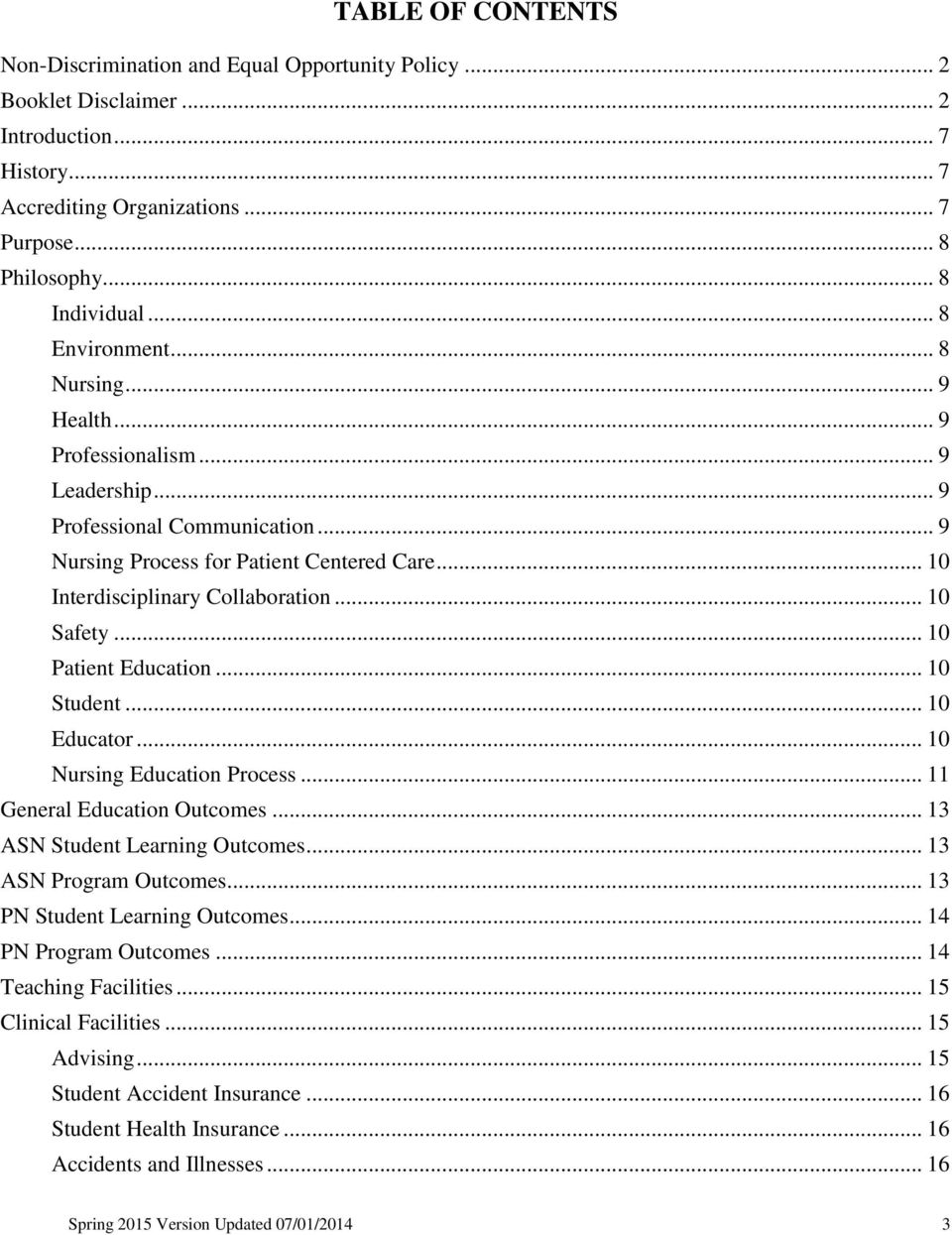
3 TABLE OF CONTENTS Non-Discrimination and Equal Opportunity Policy... 2 Booklet Disclaimer... 2 Introduction... 7 History... 7 Accrediting Organizations... 7 Purpose... 8 Philosophy... 8 Individual... 8 Environment... 8 Nursing... 9 Health... 9 Professionalism... 9 Leadership... 9 Professional Communication... 9 Nursing Process for Patient Centered Care Interdisciplinary Collaboration Safety Patient Education Student Educator Nursing Education Process General Education Outcomes ASN Student Learning Outcomes ASN Program Outcomes PN Student Learning Outcomes PN Program Outcomes Teaching Facilities Clinical Facilities Advising Student Accident Insurance Student Health Insurance Accidents and Illnesses Spring 2015 Version Updated 07/01/2014 3
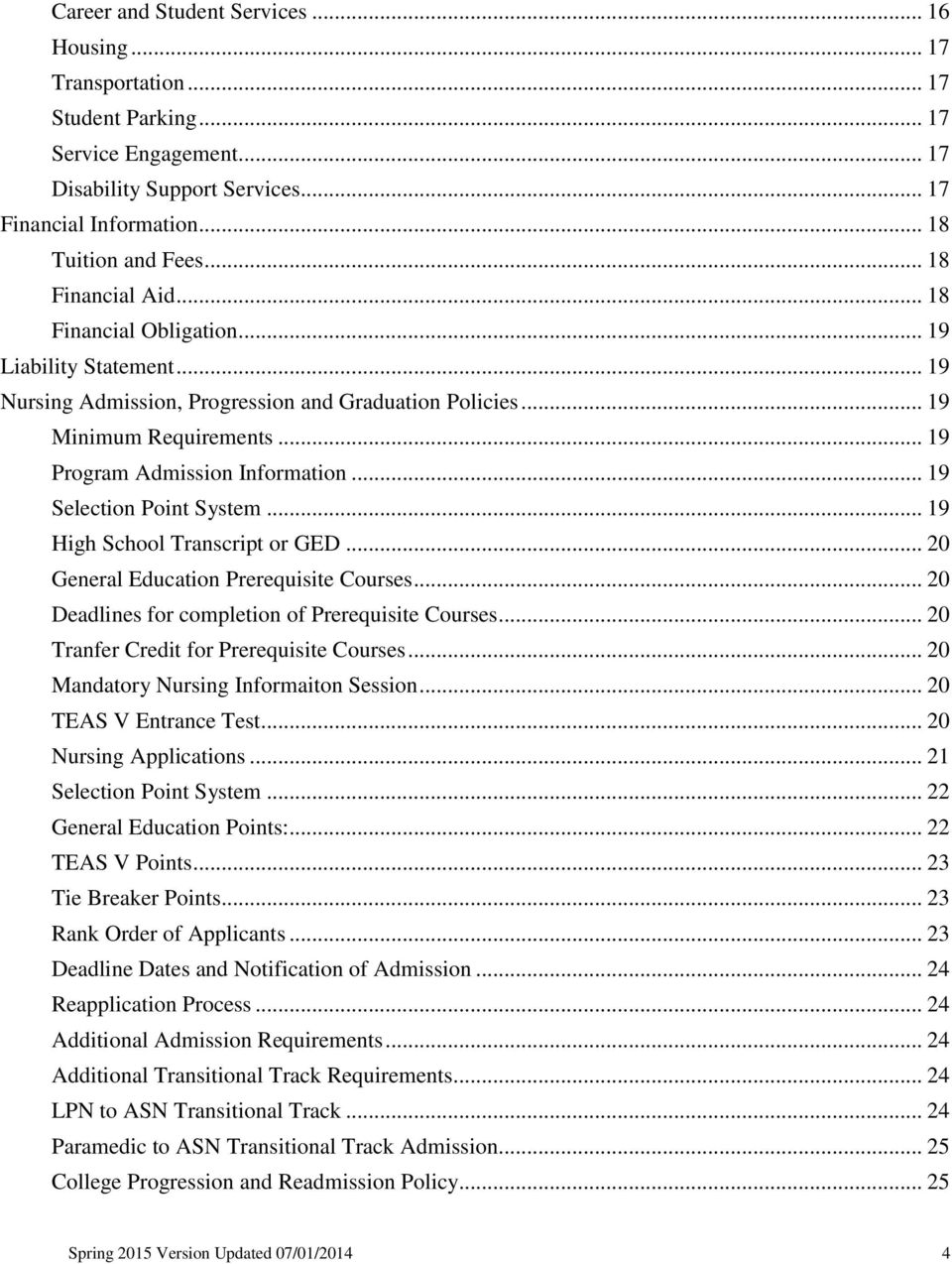
4 Career and Student Services Housing Transportation Student Parking Service Engagement Disability Support Services Financial Information Tuition and Fees Financial Aid Financial Obligation Liability Statement Nursing Admission, Progression and Graduation Policies Minimum Requirements Program Admission Information Selection Point System High School Transcript or GED General Education Prerequisite Courses Deadlines for completion of Prerequisite Courses Tranfer Credit for Prerequisite Courses Mandatory Nursing Informaiton Session TEAS V Entrance Test Nursing Applications Selection Point System General Education Points: TEAS V Points Tie Breaker Points Rank Order of Applicants Deadline Dates and Notification of Admission Reapplication Process Additional Admission Requirements Additional Transitional Track Requirements LPN to ASN Transitional Track Paramedic to ASN Transitional Track Admission College Progression and Readmission Policy Spring 2015 Version Updated 07/01/2014 4
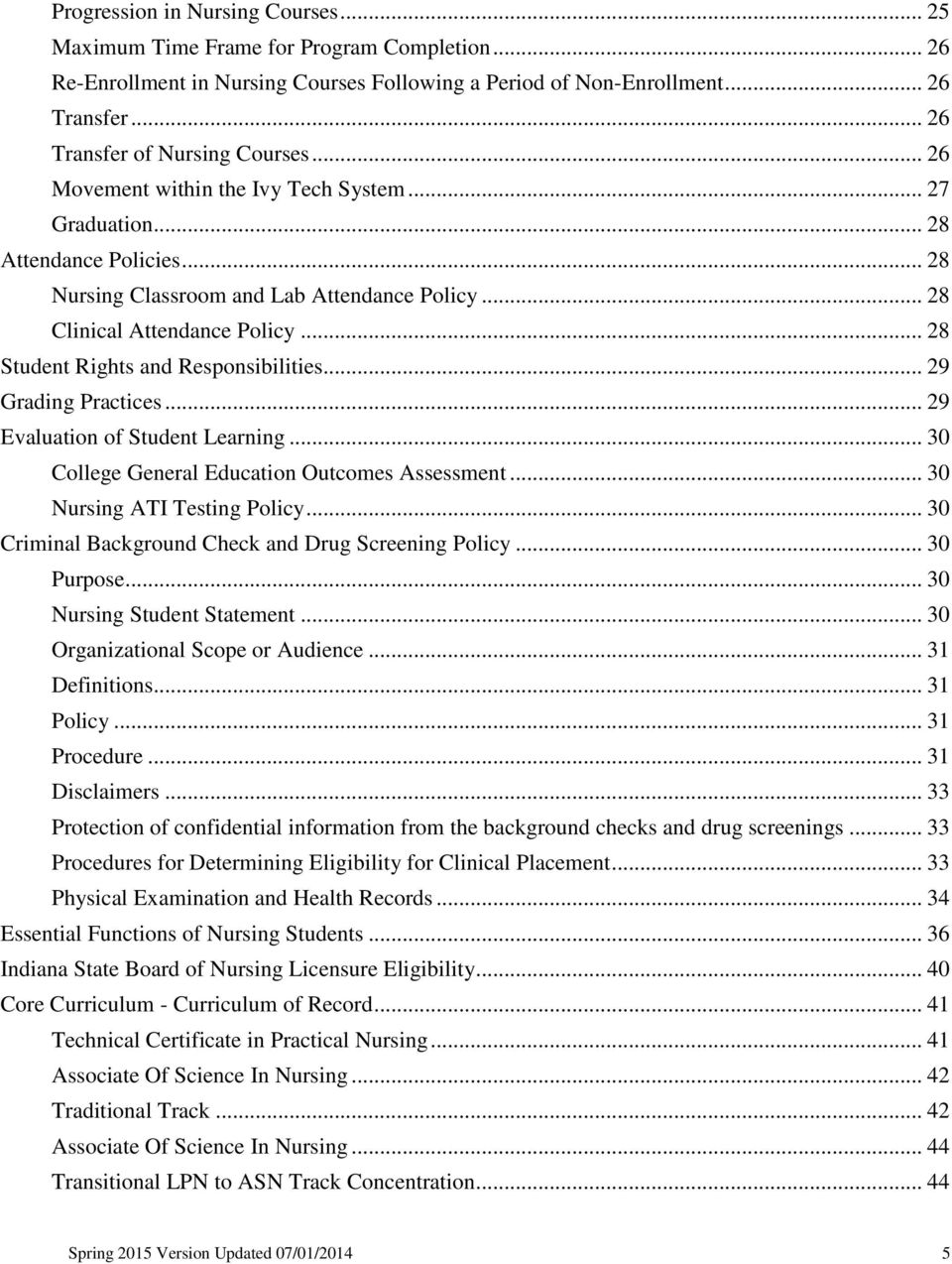
5 Progression in Nursing Courses Maximum Time Frame for Program Completion Re-Enrollment in Nursing Courses Following a Period of Non-Enrollment Transfer Transfer of Nursing Courses Movement within the Ivy Tech System Graduation Attendance Policies Nursing Classroom and Lab Attendance Policy Clinical Attendance Policy Student Rights and Responsibilities Grading Practices Evaluation of Student Learning College General Education Outcomes Assessment Nursing ATI Testing Policy Criminal Background Check and Drug Screening Policy Purpose Nursing Student Statement Organizational Scope or Audience Definitions Policy Procedure Disclaimers Protection of confidential information from the background checks and drug screenings Procedures for Determining Eligibility for Clinical Placement Physical Examination and Health Records Essential Functions of Nursing Students Indiana State Board of Nursing Licensure Eligibility Core Curriculum - Curriculum of Record Technical Certificate in Practical Nursing Associate Of Science In Nursing Traditional Track Associate Of Science In Nursing Transitional LPN to ASN Track Concentration Spring 2015 Version Updated 07/01/2014 5
6 Associate Of Science In Nursing Transitional Paramedic to ASN Track Concentration Nursing Course Contact Hours Practical Nursing Professional Course Hours ASN Traditional Track LPN to ASN Transitional Track Paramedic to ASN Transitional Track General Education Courses Estimated Program Costs Following Admission to the Nursing Program Spring 2015 Version Updated 07/01/2014 6

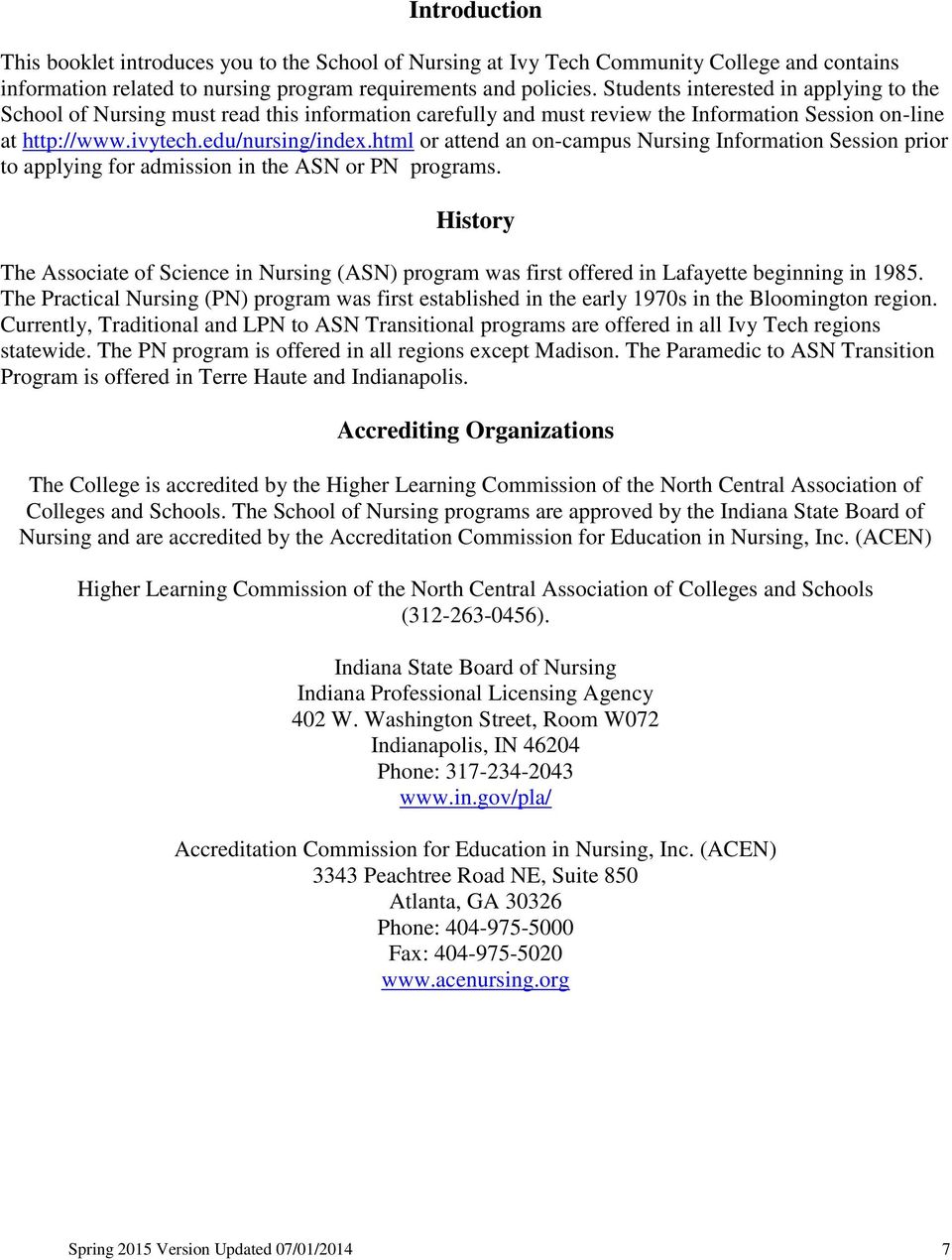
7 Introduction This booklet introduces you to the School of Nursing at Ivy Tech Community College and contains information related to nursing program requirements and policies. Students interested in applying to the School of Nursing must read this information carefully and must review the Information Session on-line at or attend an on-campus Nursing Information Session prior to applying for admission in the ASN or PN programs. History The Associate of Science in Nursing (ASN) program was first offered in Lafayette beginning in The Practical Nursing (PN) program was first established in the early 1970s in the Bloomington region. Currently, Traditional and LPN to ASN Transitional programs are offered in all Ivy Tech regions statewide. The PN program is offered in all regions except Madison. The Paramedic to ASN Transition Program is offered in Terre Haute and Indianapolis. Accrediting Organizations The College is accredited by the Higher Learning Commission of the North Central Association of Colleges and Schools. The School of Nursing programs are approved by the Indiana State Board of Nursing and are accredited by the Accreditation Commission for Education in Nursing, Inc. (ACEN) Higher Learning Commission of the North Central Association of Colleges and Schools ( ). Indiana State Board of Nursing Indiana Professional Licensing Agency 402 W. Washington Street, Room W072 Indianapolis, IN Phone: Accreditation Commission for Education in Nursing, Inc. (ACEN) 3343 Peachtree Road NE, Suite 850 Atlanta, GA Phone: Fax: Spring 2015 Version Updated 07/01/2014 7
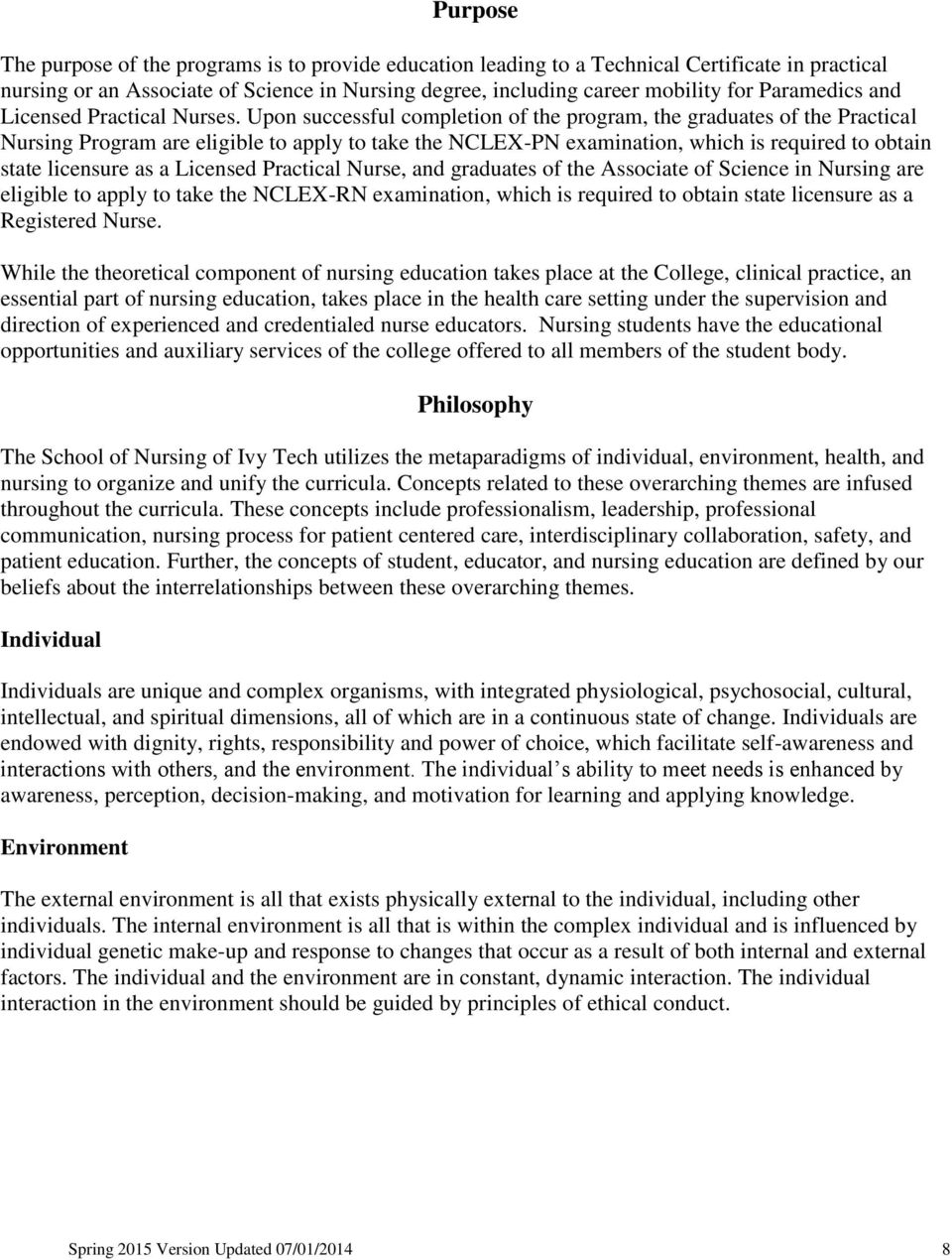
8 Purpose The purpose of the programs is to provide education leading to a Technical Certificate in practical nursing or an Associate of Science in Nursing degree, including career mobility for Paramedics and Licensed Practical Nurses. Upon successful completion of the program, the graduates of the Practical Nursing Program are eligible to apply to take the NCLEX-PN examination, which is required to obtain state licensure as a Licensed Practical Nurse, and graduates of the Associate of Science in Nursing are eligible to apply to take the NCLEX-RN examination, which is required to obtain state licensure as a Registered Nurse. While the theoretical component of nursing education takes place at the College, clinical practice, an essential part of nursing education, takes place in the health care setting under the supervision and direction of experienced and credentialed nurse educators. Nursing students have the educational opportunities and auxiliary services of the college offered to all members of the student body. Philosophy The School of Nursing of Ivy Tech utilizes the metaparadigms of individual, environment, health, and nursing to organize and unify the curricula. Concepts related to these overarching themes are infused throughout the curricula. These concepts include professionalism, leadership, professional communication, nursing process for patient centered care, interdisciplinary collaboration, safety, and patient education. Further, the concepts of student, educator, and nursing education are defined by our beliefs about the interrelationships between these overarching themes. Individual Individuals are unique and complex organisms, with integrated physiological, psychosocial, cultural, intellectual, and spiritual dimensions, all of which are in a continuous state of change. Individuals are endowed with dignity, rights, responsibility and power of choice, which facilitate self-awareness and interactions with others, and the environment. The individual s ability to meet needs is enhanced by awareness, perception, decision-making, and motivation for learning and applying knowledge. Environment The external environment is all that exists physically external to the individual, including other individuals. The internal environment is all that is within the complex individual and is influenced by individual genetic make-up and response to changes that occur as a result of both internal and external factors. The individual and the environment are in constant, dynamic interaction. The individual interaction in the environment should be guided by principles of ethical conduct. Spring 2015 Version Updated 07/01/2014 8
9 Nursing Nursing is an art and science focused on the ethical, culturally competent, and holistic care of an individual. Prevention of illness and the maintenance, promotion and restoration of health, as well as the support of death with dignity are integral to nursing care. The nurse-patient interaction is a purposeful collaboration that requires critical thinking, interpersonal involvement, and communication skills central to the establishment of a caring, therapeutic relationship. The patient is defined as an individual, family, group, or community that is in need of nursing care. The nursing process provides a methodology of progressive scientific problem solving and critical thinking by which the nurse can provide care. Nursing care is delivered in accordance with the role differentiation of the Licensed Practical Nurse and the Registered Nurse in accordance with the Indiana Nurse Practice Act. Health Health is a dynamic state, unique to each individual, relative to the wellness-illness continuum. Health is more than the absence of illness; it is the optimal functioning of the individual physiologically, psychosocially, culturally, intellectually, and spiritually. The individual response to internal and external environmental factors influences awareness, perception, decision-making, and motivation for healthseeking behaviors. Professionalism Professionalism is the accountable and responsible behavior of the nurse that incorporates legal and ethical principles and compliance with standards of nursing practice. Leadership Leadership is the process by which nurses use a set of skills that directs and influences others in the provision of individualized, safe, quality patient care. Leadership activities include delegation and supervision and are guided by the differentiated roles of licensed practical nurses and the registered nurses. Professional Communication Communication in nursing is an interactive process through which there is an exchange of information that may occur verbally, non-verbally, in writing, or through information technology. Those who may be included in this process are the nurse, patient, significant support person(s), other members of the healthcare team, and community agencies. Effective communication demonstrates caring, compassion, and cultural awareness, and is directed toward promoting positive outcomes and establishing a trusting relationship. Therapeutic communication is an interactive verbal and non-verbal process between the nurse and patient that assists the patient to cope with change, develop more satisfying interpersonal relationships, and integrate new knowledge and skills. Spring 2015 Version Updated 07/01/2014 9

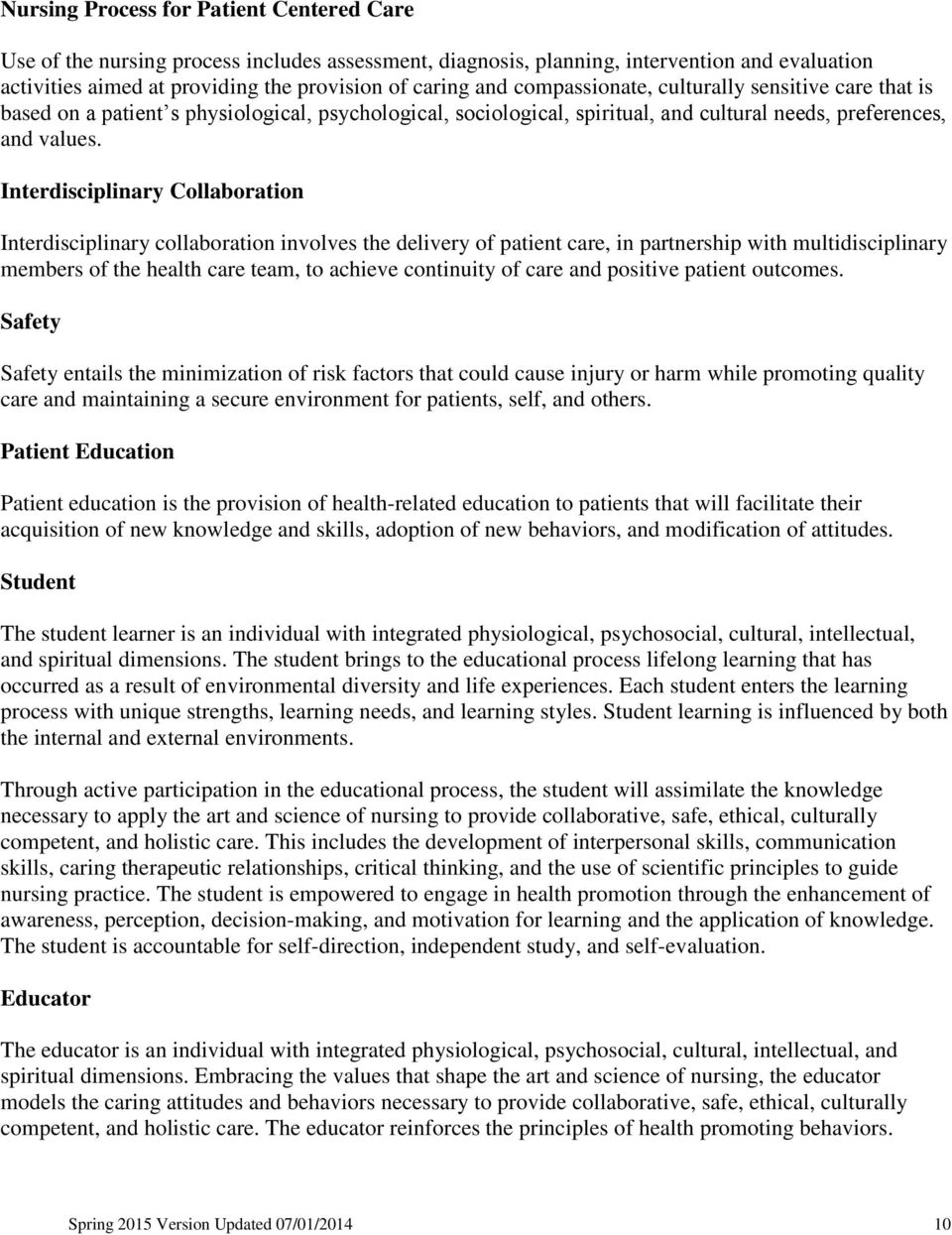
10 Nursing Process for Patient Centered Care Use of the nursing process includes assessment, diagnosis, planning, intervention and evaluation activities aimed at providing the provision of caring and compassionate, culturally sensitive care that is based on a patient s physiological, psychological, sociological, spiritual, and cultural needs, preferences, and values. Interdisciplinary Collaboration Interdisciplinary collaboration involves the delivery of patient care, in partnership with multidisciplinary members of the health care team, to achieve continuity of care and positive patient outcomes. Safety Safety entails the minimization of risk factors that could cause injury or harm while promoting quality care and maintaining a secure environment for patients, self, and others. Patient Education Patient education is the provision of health-related education to patients that will facilitate their acquisition of new knowledge and skills, adoption of new behaviors, and modification of attitudes. Student The student learner is an individual with integrated physiological, psychosocial, cultural, intellectual, and spiritual dimensions. The student brings to the educational process lifelong learning that has occurred as a result of environmental diversity and life experiences. Each student enters the learning process with unique strengths, learning needs, and learning styles. Student learning is influenced by both the internal and external environments. Through active participation in the educational process, the student will assimilate the knowledge necessary to apply the art and science of nursing to provide collaborative, safe, ethical, culturally competent, and holistic care. This includes the development of interpersonal skills, communication skills, caring therapeutic relationships, critical thinking, and the use of scientific principles to guide nursing practice. The student is empowered to engage in health promotion through the enhancement of awareness, perception, decision-making, and motivation for learning and the application of knowledge. The student is accountable for self-direction, independent study, and self-evaluation. Educator The educator is an individual with integrated physiological, psychosocial, cultural, intellectual, and spiritual dimensions. Embracing the values that shape the art and science of nursing, the educator models the caring attitudes and behaviors necessary to provide collaborative, safe, ethical, culturally competent, and holistic care. The educator reinforces the principles of health promoting behaviors. Spring 2015 Version Updated 07/01/
11 The educator creates a learning environment, based upon diverse professional and educational experiences, which provides for differences in individual learning needs. As a facilitator of learning, the educator utilizes a multi-sensory approach in presenting content, encouraging critical thinking and problem solving, promoting independence and self-directed learning. Nursing Education Process The nursing curricula at Ivy Tech are built on the foundation that learning is a dynamic lifelong growth process and that education is ongoing and continuous. Nursing education is a systematic endeavor to facilitate change through knowledge, practice, and experiences proceeding from simple to complex. Furthermore, there must be collaboration among the student, the educator, the College, and the community at large. Learning is facilitated when concepts are presented sequentially to provide continuity and to express coherent relationships. Correlation between theory and practice promotes an optimal learning environment by combining cognitive, affective, and psychomotor components of the desired behavior. The nursing curricula allow the student to determine the career track, which meets his/her individual needs, and provide a seamless transition between paramedic, practical nursing, and associate degree nursing. Nursing education assists the student to grow personally and to demonstrate the attributes of professional responsibility and accountability. Curricular experiences assist students to define the role of both the practical nurse and the associate degree nurse, and provide opportunities for students to acquire and broaden their knowledge base in nursing and interdisciplinary health promotion. The curricula incorporate concepts directed toward promoting, maintaining and restoring health, and supporting death with dignity. The nursing process is included throughout the curricula as the foundation for critical thinking and decision-making. The curricula will prepare graduates for entry-level positions. Role differentiation will be defined throughout the curricula. Complexity of coursework and the expected outcomes will increase sequentially to provide knowledge essential to the specific roles of the licensed practical nurse and the registered nurse as determined by the Indiana Nurse Practice Act. The College is responsible for providing an academic environment and services, which enhance student life and promote personal as well as professional growth. The nursing faculty strives to create an educational culture of respect for dignity, rights, responsibility and power of choice, which facilitates caring interactions between students, educators, the health care team, patients, and significant others. Systematic evaluation of the programs provides a measure of accountability to the student, the College, and the community. Spring 2015 Version Updated 07/01/

12 Nursing Curriculum Committee (2006). Ivy Tech Community College Statewide Faculty Philosophyadapted from Statewide Curriculum Work. Reviewed Spring 2015 Version Updated 07/01/

13 General Education Outcomes The College has identified eight general education outcomes designed to provide students with the tools to be productive, responsible citizens and lifelong learners. The general education outcomes are: 1. Demonstrate critical and creative thinking. 2. Recognize and understand cultural and individual differences, in terms of both contemporary and historical perspectives. 3. Recognize and understand social, political, civic, and environmental responsibilities relative to our society. 4. Apply basic scientific concepts in a variety of settings. 5. Communicate effectively in written, oral and symbolic forms. 6. Exhibit quantitative literacy. 7. Apply ethical reasoning. 8. Demonstrate the acquisition and use of information. ASN Student Learning Outcomes Upon completion of the program, the ASN graduate will be able to: 1. Function within the role of the associate degree nurse, incorporating professional, legal and ethical guidelines, to provide collaborative, safe, culturally competent, and holistic patientcentered care. 2. Analyze data and the relationships of the biological, psychosocial, cultural and spiritual components of patient needs to improve quality and safety of patient care 3. Demonstrate effective use of technology to navigate the electronic health record, communicate with inter-professional teams, and be involved with decision making in the delivery of quality and safe patient care. 4. Integrate current evidence-based practices and critical thinking techniques to develop the patient s plan of care. 5. Utilize communication practices that foster effective collaboration with patients, families and the inter-professional team for planning and delivery of quality patient care. 6. Promote a culture of caring and advocacy that demonstrates respect for individual patient preferences, values, needs and the diversity of the human experience. 7. Assume accountability and responsibility in fulfilling the role of the associate degree nurse, through personal and professional growth, integration of current evidence-based practice and understanding of multiple dimensions of patient-centered care. 8. Provide leadership in a variety of healthcare settings to diverse patient populations. ASN Program Outcomes 1. Program Completion Rate: 70% of Traditional Program students will graduate within 6 semesters, beginning with enrollment in the first nursing (NRSG) course, not including periods of non-continuous enrollment; 70% of Transitional Program students will graduate within 4.5 semesters, beginning with enrollment in the first nursing (NRSG) course, not including periods of non-continuous enrollment. Spring 2015 Version Updated 07/01/

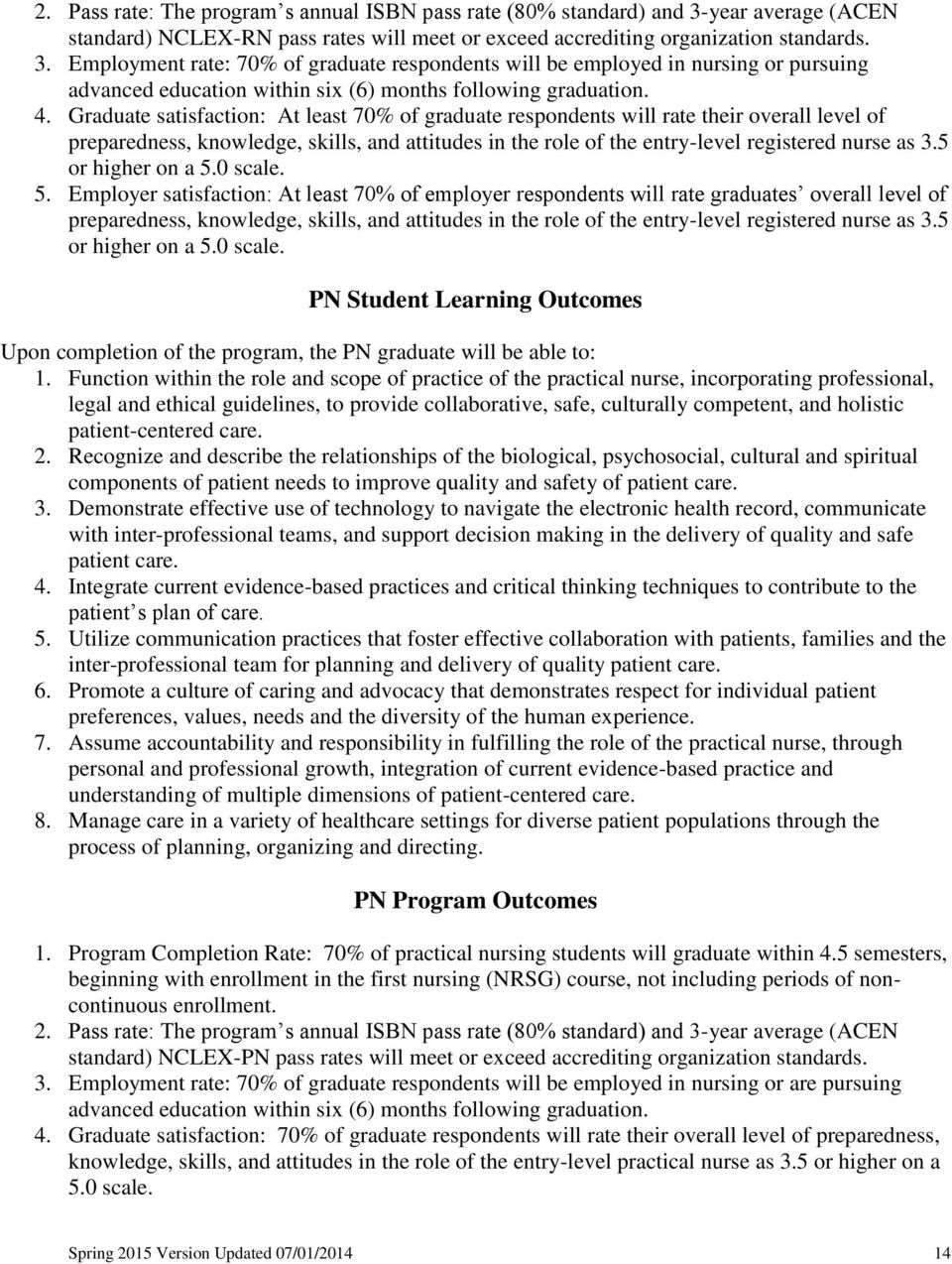
14 2. Pass rate: The program s annual ISBN pass rate (80% standard) and 3-year average (ACEN standard) NCLEX-RN pass rates will meet or exceed accrediting organization standards. 3. Employment rate: 70% of graduate respondents will be employed in nursing or pursuing advanced education within six (6) months following graduation. 4. Graduate satisfaction: At least 70% of graduate respondents will rate their overall level of preparedness, knowledge, skills, and attitudes in the role of the entry-level registered nurse as 3.5 or higher on a 5.0 scale. 5. Employer satisfaction: At least 70% of employer respondents will rate graduates overall level of preparedness, knowledge, skills, and attitudes in the role of the entry-level registered nurse as 3.5 or higher on a 5.0 scale. PN Student Learning Outcomes Upon completion of the program, the PN graduate will be able to: 1. Function within the role and scope of practice of the practical nurse, incorporating professional, legal and ethical guidelines, to provide collaborative, safe, culturally competent, and holistic patient-centered care. 2. Recognize and describe the relationships of the biological, psychosocial, cultural and spiritual components of patient needs to improve quality and safety of patient care. 3. Demonstrate effective use of technology to navigate the electronic health record, communicate with inter-professional teams, and support decision making in the delivery of quality and safe patient care. 4. Integrate current evidence-based practices and critical thinking techniques to contribute to the patient s plan of care. 5. Utilize communication practices that foster effective collaboration with patients, families and the inter-professional team for planning and delivery of quality patient care. 6. Promote a culture of caring and advocacy that demonstrates respect for individual patient preferences, values, needs and the diversity of the human experience. 7. Assume accountability and responsibility in fulfilling the role of the practical nurse, through personal and professional growth, integration of current evidence-based practice and understanding of multiple dimensions of patient-centered care. 8. Manage care in a variety of healthcare settings for diverse patient populations through the process of planning, organizing and directing. PN Program Outcomes 1. Program Completion Rate: 70% of practical nursing students will graduate within 4.5 semesters, beginning with enrollment in the first nursing (NRSG) course, not including periods of noncontinuous enrollment. 2. Pass rate: The program s annual ISBN pass rate (80% standard) and 3-year average (ACEN standard) NCLEX-PN pass rates will meet or exceed accrediting organization standards. 3. Employment rate: 70% of graduate respondents will be employed in nursing or are pursuing advanced education within six (6) months following graduation. 4. Graduate satisfaction: 70% of graduate respondents will rate their overall level of preparedness, knowledge, skills, and attitudes in the role of the entry-level practical nurse as 3.5 or higher on a 5.0 scale. Spring 2015 Version Updated 07/01/
15 5. Employer satisfaction: 70% of employer respondents will rate graduates overall level of preparedness, knowledge, skills, and attitudes in the role of the entry-level practical nurse as 3.5 or higher on a 5.0 scale. Teaching Facilities All facilities and resources of Ivy Tech are available to nursing students. Students are encouraged to use support services available at the home campus, as well as on-line. Instructional support services include among others: tutoring and learning centers, the Ivy Tech Virtual Library, campus libraries, and use of Black Board to enhance course delivery. Clinical Facilities Student clinical experiences are arranged by program faculty and affiliation agreements obtained with clinical agencies. These agreements outline the responsibilities and privileges of both parties. In an off-campus setting, it is the policy of the College that faculty and students shall conform to all policies of the affiliating agency, including drug screenings, criminal background checks, physical examination, immunization records, tuberculosis screening, and certification in basic life support. Advising Student Services Academic Advisors are committed to engaging students in intentional, collaborative, supportive, and meaningful partnerships. Grounded in teaching and learning, Academic Advisors will assist students in achieving their personal, educational, cultural, and career goals while becoming self directed, life-long learners. Academic advising begins with orientation and continues through a series of meetings each semester throughout enrollment at the College. Students are assigned to an academic advisor depending on the student s area of interest and the advisor s area of expertise. Academic advising will help students to: 1. Successfully access and navigate higher education. 2. Clarify life and career goals. 3. Develop goal-oriented educational plans. 4. Interpret academic requirements and select appropriate courses. 5. Access available internal and external resources that enhance their education. 6. Identify other experiences that will enhance their life, educational, and cultural goals. 7. Develop critical thinking, decision-making, and independent learning skills. 8 Evaluate their progress toward career and life goals, degree completion, and transfer. All new students will meet with an academic advisor before registering for classes. An advisor will help you determine which courses to take to earn the degree of your choice. As a continuing student, you will also have access to a faculty advisor who will help you determine which courses to take to complete your degree program. If your goal is to transfer to a four-year college or university, our advisors will help you with that too. Spring 2015 Version Updated 07/01/

16 Student Accident Insurance For students registered in credit courses, the College provides accident insurance in a designated amount for injuries sustained while participating in College-sponsored activities. The activity must take place on College premises or on any premises designated by the College. Students are also covered while traveling to and from College-sponsored activities as a member of a group under College supervision. It is the student s responsibility to report injuries promptly to the instructor or to the Office of Student Affairs. The insurance is for a specified minimum amount of coverage. It is not intended to replace insurance coverage students may already have. Students should review their own coverage. The master insurance policy issued to Ivy Tech is on file at the central administrative office. The description of the hazards insured, benefits and exclusions is controlled by the master policy. Students with questions may contact the regional Office of Student Affairs. Student Health Insurance The College has made arrangements for Ivy Tech students to obtain health insurance. Insurance coverage is purchased directly from the insurance company by the student. Application forms and brochures explaining coverage and rates are available through the Office of Student Affairs during registration periods. Coverages and rates are subject to change. Accidents and Illnesses If a student has an accident on College property the student should report the accident to campus security or the Office of Student Affairs. If a student suffers an accident or illness while attending classes the student should notify the instructor. The College will take the necessary steps to intervene in a medical emergency while the student is on campus. If paramedic services or hospitalization is required the student is financially responsible. If a student is suffering from an illness that makes it impossible to attend classes the student should contact his/her instructors. The College does not provide a health services center. The College supports the Drug Free Schools and Communities Act of Many community agencies are available to assist students seeking counseling or treatment. Please contact the Office of Student Affairs for a listing of community resources. The College conducts a biennial review of the effectiveness of its drug and alcohol abuse prevention programs. This review is available in the Office of Student Affairs. Career and Student Services Career and Student Support Services are available and include the following: Academic Skills Advancement Program Career Services Services College Bookstore Academic Advising Library Disability Support Services Additional career services information may be found at the following: Spring 2015 Version Updated 07/01/

17 Housing Ivy Tech is a commuter college and does not operate residence halls. However, the Office of Student Affairs may be able to respond to questions concerning housing in the community. Ivy Tech accepts no responsibility for locating, approving, or supervising local student housing. Transportation All necessary transportation to clinical experience is the student s responsibility and is not provided by the school. Students are expected to comply with parking designations. Handicapped parking spaces and visitors areas are reserved for those purposes, and vehicles improperly parked in those areas may be ticketed or towed at the owner s expense. Student Parking As part of registration, some campuses require students to register their motor vehicles and obtain a parking sticker. A special permit is required to park in spaces for persons with disabili ties. Stickers are to be displayed in the vehicle while parked on campus, and students may park only in designated student parking areas. Vehicles improperly parked in areas reserved for the disabled, visitors, or others may be towed at the expense of their owners. Service Engagement Ivy Tech students are committed to helping others. Involvement in service is an important aspect of becoming a well-rounded citizen. Service opportunities are available through class room activities, involvement in student organizations, or through regional and College-wide events like Ivy Tech Days of Service. Check with the Student Life Office in your region to learn more about service engagement opportunities. Disability Support Services - Students admitted to the School of Nursing must be capable of fulfilling the Essential Functions of Nursing Students included in the Essential Functions of Nursing Students section of this booklet. The Office of Disability Support Services (DSS) provides assistance to students, who qualify for reasonable accommodation under the Americans with Disabilities Act (ADA), and Sections 504 and 508 of the Rehabilitation Act. Reasonable accommodations may be granted, based upon verification with appropriate documentation, for chronic illnesses, neurological conditions, learning disabilities, psychiatric illnesses, mobility impairments, and other conditions or impairments that limit one or more of life's major activities. Please refer to the College's Documentation Guidelines for specific information on requesting reasonable accommodations. The mission of DSS is to provide access to College programs, services, activities, and facilities for students with disabilities; to provide student advocacy; to encourage the highest levels of academic and personal achievement; and to advocate for an accessible environment for students, faculty, staff, and visitors. An Office of Disability Support Services is located on each of the College's campuses. Spring 2015 Version Updated 07/01/

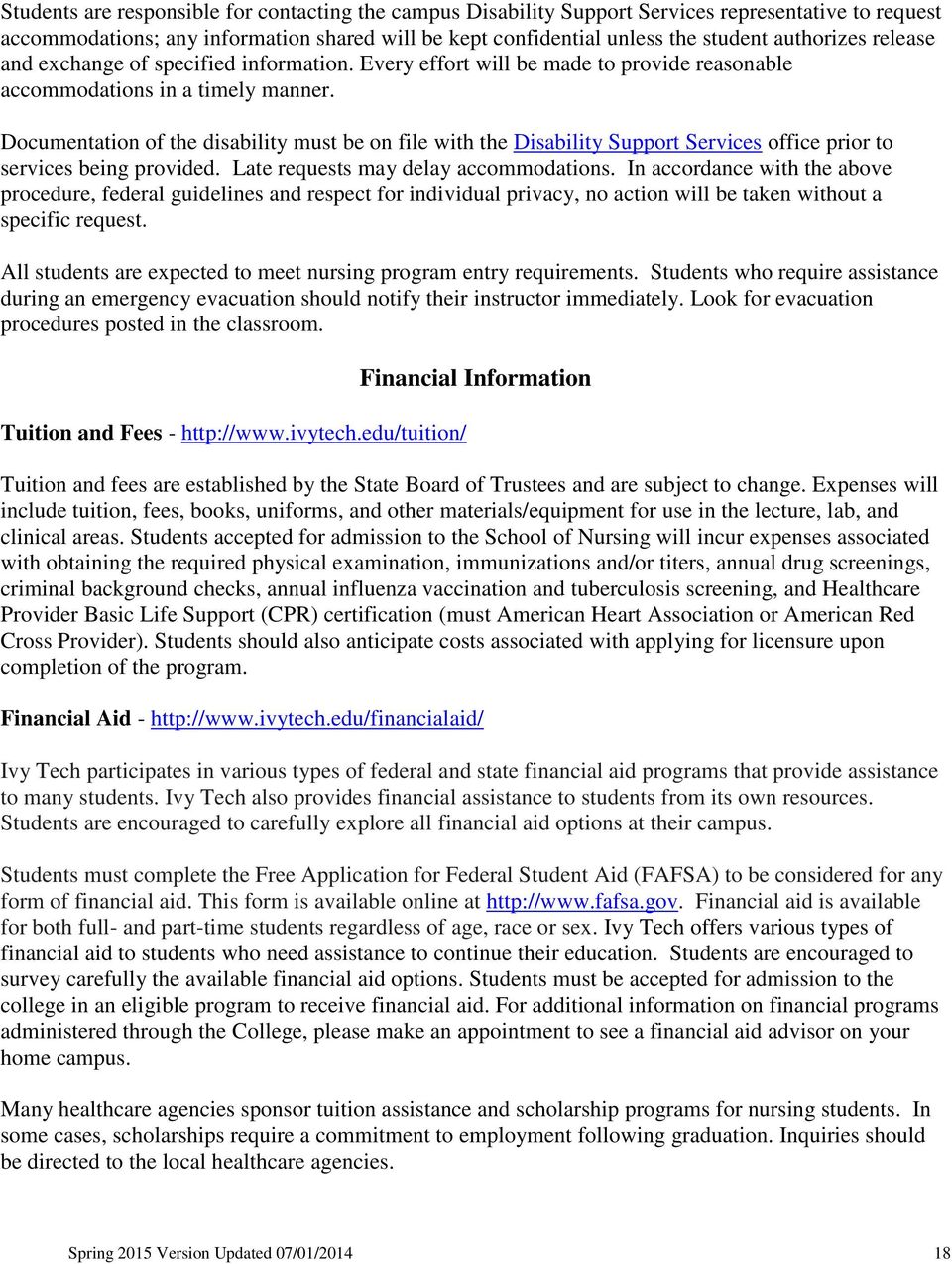
18 Students are responsible for contacting the campus Disability Support Services representative to request accommodations; any information shared will be kept confidential unless the student authorizes release and exchange of specified information. Every effort will be made to provide reasonable accommodations in a timely manner. Documentation of the disability must be on file with the Disability Support Services office prior to services being provided. Late requests may delay accommodations. In accordance with the above procedure, federal guidelines and respect for individual privacy, no action will be taken without a specific request. All students are expected to meet nursing program entry requirements. Students who require assistance during an emergency evacuation should notify their instructor immediately. Look for evacuation procedures posted in the classroom. Tuition and Fees - Financial Information Tuition and fees are established by the State Board of Trustees and are subject to change. Expenses will include tuition, fees, books, uniforms, and other materials/equipment for use in the lecture, lab, and clinical areas. Students accepted for admission to the School of Nursing will incur expenses associated with obtaining the required physical examination, immunizations and/or titers, annual drug screenings, criminal background checks, annual influenza vaccination and tuberculosis screening, and Healthcare Provider Basic Life Support (CPR) certification (must American Heart Association or American Red Cross Provider). Students should also anticipate costs associated with applying for licensure upon completion of the program. Financial Aid - Ivy Tech participates in various types of federal and state financial aid programs that provide assistance to many students. Ivy Tech also provides financial assistance to students from its own resources. Students are encouraged to carefully explore all financial aid options at their campus. Students must complete the Free Application for Federal Student Aid (FAFSA) to be considered for any form of financial aid. This form is available online at Financial aid is available for both full- and part-time students regardless of age, race or sex. Ivy Tech offers various types of financial aid to students who need assistance to continue their education. Students are encouraged to survey carefully the available financial aid options. Students must be accepted for admission to the college in an eligible program to receive financial aid. For additional information on financial programs administered through the College, please make an appointment to see a financial aid advisor on your home campus. Many healthcare agencies sponsor tuition assistance and scholarship programs for nursing students. In some cases, scholarships require a commitment to employment following graduation. Inquiries should be directed to the local healthcare agencies. Spring 2015 Version Updated 07/01/
19 Financial Obligation The Bursar s Office is responsible for the collection of any outstanding obligations to the College. A person with an outstanding account will be denied certain College services. For example, official transcripts may not be obtained, registration forms will not be processed, and diplomas will not be issued until outstanding obligations are resolved. Liability Statement The College maintains Professional Liability insurance that covers the College, students, and instructors of the College with limits in the amount of $1,000,000 per occurrence and $3,000,000 aggregate. This coverage extends to clinical experience at an institution other than the College when it is a part of the College training program. Each student may obtain additional individual liability insurance. This coverage does not apply to employment situations such as externships and summer employment. Nursing Admission, Progression and Graduation Policies The semester of admission to the PN or ASN program is defined as the semester students are enrolled in their first NRSG courses. Application for admission and completion of prerequisite general education courses generally begins several months in advance of the actual semester of admission. Minimum Requirements Applicants to the School of Nursing must first complete requirements for admission to the College. Applicants must be in good academic standing with the College, with a minimum cumulative GPA of 2.0 at the time of application to nursing in order to be considered for admission to the program. Students must remain in good academic standing (GPA or 2.0 or higher) in order to continue in nursing (NRSG) courses. Applicants to the School of Nursing must complete the ACCUPLACER placement exam or have a signed substitution on file in the Registrar s Office. Students must complete all required Academic Skills Advanement courses (OXX), prior to admission to the program (the first semester of NRSG courses). Students must score in the Proficient level or higher on the Assessment Technologies Institute, LLC (ATI) Academic Preparedness Category of the Test of Essential Academic Skills V (TEAS V) to be considered for admission to the PN or ASN programs. o The student s ATI Academic Preparedness Category appears on the TEAS V Score report immediately below the Adjusted Individual Total Score. The Adjusted Individual Total Score will be used only as a tiebreaker. o Students whose ATI Academic Preparedness Category is at the Developmental or Basic level will not be considered for admission. Program Admission Information Selection Point System: The School of Nursing is a limited enrollment program with additional admission requirements beyond admission to the College. A selection point system is used for admission/selection decisions. (Refer to Selection Point System section). Spring 2015 Version Updated 07/01/
20 High School Transcript or GED: Consistent with Indiana State Board of Nursing (ISBN) requirements, a complete high school transcript from a state-approved high school or its equivalent, or a copy of the test scores listing the individual and total GED test scores must be submitted with the application and will be maintained on file in the nursing office. (Refer to Nursing Applications section). General Education Prerequisite Courses: Completion of the following required prerequisite courses with a grade of C or higher: APHY 101 Anatomy and Physiology I ENGL 111 English Composition, and PSYC 101 Introduction to Psychology MATH 123 or higher is a prerequisite course for students admitted to the ASN program only; however, MATH 123 is not included in the selection point system. If selected for admission to a School of Nursing, all prerequisite courses must be completed prior to admission. Although prerequisites are not required to be completed by the application deadline, it is unlikely that applicants who have not completed a prerequisite course will have enough points to be competitive for admission. Deadlines for completion of Prerequisite Courses: In order for prerequisite courses to count toward general education selection points, the courses must be completed by the specific deadlines listed below: Fall admission - completed by the end of previous spring semester Spring admission - completed by the end of the previous summer semester Summer admission - completed by the end of the fall semester. Tranfer Credit for Prerequisite Courses: Prerequisite courses completed at other colleges will only be considered for general education selection points if transfer credit has been awarded and courses appear on the Ivy Tech transcript. Transfer credit must be applied by the deadline dates listed above. It is the applicant s responsibility to ensure that transfer credit has been awarded. Mandatory Nursing Information Session: Students must participate in a Nursing Information Session or complete the on-line Nursing Information Session and submit a signed verification that all preadmission advising activities have been completed. The verification form can be found with the application posted online at or at the regional nursing office. In order to have the most current information, applicants must complete a nursing information session within three (3) months prior to each application period. It is the applicant s responsibility to be aware of the most current requirements and curricula. TEAS V Entrance Test: Completion of all components of the TEAS V Test is required for admission. Information about the TEAS V is available at Study guides are available via campus bookstores and at The TEAS V may be taken up to two (2) times in a two-year period regardless of the testing location. There must be at least thirty (30) days between the test dates for the TEAS V. The student must pay the approved testing fee with each attempt. Exam scores will be valid for two (2) years from the date of the initial TEAS V test. Spring 2015 Version Updated 07/01/

21 o Exception: the only exception to this rule is for graduates of the current PN Program who are applying to the LPN to ASN Program track within 2 years of graduating from the PN program AND who have taken the TEAS V version. If you are a current curriculum PN Program graduate and you graduated within 2 years of the ASN program application deadline date, you may choose to use the TEAS V scores you used for admission to the PN program or you may choose to repeat the TEAS V if you have test attempts left as described above. The TEAS V test must include all four test components to be considered valid: Reading, English, Math, and Science. Partial tests will not be accepted. Applicants who take the TEAS V at schools other than Ivy Tech must contact Assessment Technologies Institute (ATI) to have an official copy submitted directly to the School of Nursing office. Applicants must score at the Proficient level or higher to be considered for admission. TEAS V sub-category scores will be used in the selection point system. (See details in the section titled Selection Point System). Applicants are to submit only one TEAS V score report in the application packet to be considered for determination of minimum eligibility and inclusion of points in the decision score. If the student includes more than one TEAS V score report in the application packet, only the earliest dated attempt will be considered for determination of eligibility and inclusion of points in the decision score. Nursing Applications A completed application must be submitted by the specified deadline date to each program (ASN and/or PN) and region for which application is being made. Applications for each admission period will be accepted no more than three (3) months prior to the application deadline date. May apply to both the ASN and PN programs: Students have the opportunity to apply to each program. o Class selection will be made separately. The ASN program will be selected first and the mail notifications sent. The PN program selection process will follow. o This process will assure that the most qualified individuals are chosen for each program. o Applications for the Traditional ASN program from students who are currently enrolled in the PN program will not be considered. Application Packet: The application packet must include: o Completed application form(s). o Signed verification of completion of pre-admission advising activities (in the application form) o Copy of TEAS V test scores o A complete high school transcript (from a state-approved high school) or its equivalent, or a copy of the GED listing the persons name and total and individual GED test scores. o College transcripts, including Ivy Tech transcript, for general education selection points to be applied. Ivy Tech transcripts may be unofficial copies retrieved by the student online. Copies of CLEP/DANTES results must be submitted with the application. Students must also submit official transcripts to the Registrar s office and transfer credit must be applied to the Ivy Tech transcript in order to be considered for the point system. Spring 2015 Version Updated 07/01/
22 It is the applicant s responsibility to follow up with the Registrar s office to determine if transfer credit has been awarded and applied to the Ivy Tech transcript. If transfer credit has not been posted to the Ivy Tech transcript prior to the application deadline, an OFFICIAL transcript must be submitted with the nursing application packet. If transfer credit has already been applied to the Ivy Tech transcript, the applicant shall submit an unofficial transcript from the other college with the nursing application packet. o Deadline for Submitting Transcripts: The deadline for submitting transcripts from other colleges for consideration of course points is as follows: Fall admission - May 16 Spring admission September 1 Summer admission - February 1. o LPN to ASN Transitional Track applicants: Verification of a current, unencumbered Indiana LPN license LPN to ASN Transitional Track applicants. (See Additional Transitional Track Requirements.) Transcript demonstrating PN degree completion - For graduates of PN programs outside Ivy Tech, an official PN transcript must be submitted. For Ivy Tech PN graduates, an unofficial transcript may be submitted. (See Additional Transitional Track Requirements.) o Paramedic to ASN Transitional Track applicants: Verification of unencumbered Indiana Paramedic (PMT) certification or registration. (See Additional Transitional Track Requirements.) Selection Point System General Education Points: A weighted point system will be used to determine points for the General Education Course component of the selection score points. When multiple course attempts are reported on the transcript(s), the highest earned grade will be used for the selection decision score. This includes courses appearing on transcripts from other schools. Points for courses transferred in from other institutions will be awarded from the grade recorded on the transcript from the other institution. o It is the applicant s responsibility to ensure that the transfer credit has been applied and to provide the transcript from the other institution by the deadline date. Points for verified credit (V) or college credit awarded through High School Advanced Placement, College Level Examination Program (CLEP) International Baccalaureate (IB) and Dantes Subject Standardized Test (DSST), will be awarded as indicated below. o It is the student s responsibility to include a copy of the high school transcript in the nursing application packet. Note: In order for points to apply, students must have taken and passed the AP placement exam and verified credits must appear on the Ivy Tech transcript. Spring 2015 Version Updated 07/01/
23 Course A B C D/F V APHY N/A 101 ENGL PSYC Total General Education Points Possible: 60 TEAS V Points: Once it has been determined that the applicant has met the minimum eligibility requirement, the following weighted system will be used to determine the TEAS V component of the selection score points. Student must score at the Proficient level or higher to have TEAS V scores considered for admission into nursing programs. TEAS V Component Weighted Sub-Test Point Calculation Maximum Points Possible English Subsection % score X Reading Subsection % score X Math Subsection % score X Science Subsection % score X Total TEAS points possible: 100 Tie Breaker Points: (applied in the order listed below) TEAS V Adjusted Individual Total Score TEAS V Science sub-score to the tenths place TEAS V Reading sub-score to the tenths place TEAS V English sub-score to the tenths place Prerequisite courses completed at Ivy Tech Cumulative GPA from the most recent transcript Rank Order of Applicants: General Education points and TEAS V points will be summed for a total selection decision score. Applicants will be rank-ordered by total selection decision score. Applicants having the highest scores will be offered admission to the program according to the number of clinical spots available. If two or more students have identical decision scores, the tiebreaker points will be applied in the order listed above until a difference in decision score occurs. The number of students admitted is determined by availability of clinical resources and may be adjusted without advance notice. Spring 2015 Version Updated 07/01/
24 Deadline Dates and Notification of Admission Start of nursing program Application Deadline ASN & PN Official Verification of Grades from other Colleges Due ASN Acceptance Letters Sent Fall April 1 May 16 May Spring September 1 September 1 September Summer February 1 February 1 February PN Acceptance Letters Sent June October March Completed nursing application packets are due by 4 PM on the deadline date. If the application date falls on a Saturday or Sunday, the application will be due the Monday immediately following the application date listed. Reapplication Process: Students who are not selected for the program must reapply for the next admission cycle. The entire application packet must be resubmitted with each new application. Additional Admission Requirements: A physical examination, proof of immunization status, criminal background check, drug screening, and Basic Life Support for Healthcare Providers certification are required prior to enrollment in the program. Students will be provided with necessary information to complete these activities in the acceptance letter or during a pre-admission orientation session. (Refer to Criminal Background Check and Drug Screening.) Additional Transitional Track Requirements LPN to ASN Transitional Track: The LPN to ASN transition student must complete the steps listed above. In addition, the following must also be completed: The student must maintain a current, unencumbered, Indiana nursing license throughout the program. A copy must be provided to the nursing program with application submission and after each renewal period. Your license will be verified by the School of Nursing. A transcript showing graduation from a PN program must be submitted in the application packet. Applicants who graduated from a PN program other than Ivy Tech must submit an official transcript from the PN program. Ivy Tech PN graduates may submit an unofficial transcript. The same selection decision scoring process listed above will be utilized to rank-order candidates. Verified credit will be awarded for first year entry level ASN nursing courses (NRSG 100, 102, 105, 110, 111, and 115) following successful completion (grade of C or higher) of NRSG 106 Pharmacology for Nursing (if no separate pharmacology course taken in PN program verified credit will be awarded only if student provides documentation of successfully completing a separate, comparable pharmacology course in the PN curriculum), NRSG 122 Introduction to ASN Transition (if more than two years following graduation or an external program graduate), and NRSG 125 LPN Transition to ASN Lab. Spring 2015 Version Updated 07/01/
25 Paramedic to ASN Transitional Track Admission: The Paramedic to ASN transition student must complete the steps listed above. In addition, the following must also be completed: Applicant must maintain a current, unencumbered, Indiana Paramedic certification or registration throughout the program. A copy must be provided to the nursing program with the application for admission and after each certification or registration renewal period. Your certification/registration will be verified by the School of Nursing. The same selection decision scoring process listed above will be utilized to rank-order candidates. Verified credit will be awarded for first year entry-level ASN nursing courses (NRSG 100, 102, 105, 110, 111, and 115) following successful completion (grade of C or higher) of NRSG 122 Introduction to ASN Transition, and NRSG 123 Paramedic Transition to ASN Lab/Clinical. Students applying to the LPN to ASN or Paramedic to ASN transition program tracks must follow the current curriculum of record and are encouraged to meet with their advisor to review their PN and paramedic transcripts. PLEASE REFER TO YOUR HOME CAMPUS SCHOOL OF NURSING FOR SPECIFIC INSTRUCTIONS REGARDING REGISTERING FOR THE TEAS V TEST AND INFORMATION ON WHERE TO RETURN YOUR PROGRAM APPLICATION(S). College Progression and Readmission Policy Please refer to the College Course Catalog for policies related to academic standards and readmission following dismissal from the College for violations of rules of conduct and/or failure to meet and maintain academic standards. Students enrolled in the School of Nursing must be in good academic standing according to College policy. Progression in Nursing Courses: Students who withdraw or do not successfully complete a course with a minimum grade of C in a required program course will not be allowed to progress to any subsequent courses for which that course is a prerequisite until the course is successfully completed with a grade of C or higher. (ISBN 848 IAC ) Students who are admitted to the LPN to ASN Transitional track must maintain a current, unencumbered Indiana LPN license throughout the program. Any student whose license is not current or is encumbered by any pending disciplinary action by the Indiana State Board of Nursing will not be permitted to progress in the program until such time that a current, unencumbered license is regained. Maximum time frame for completion will not be extended due to such circumstances. Students who are admitted to the Paramedic to ASN Transitional track must maintain a current, unencumbered Indiana Paramedic certification or registration throughout the program. Any student whose certification/registration is not current or is encumbered by any pending disciplinary action will not be permitted to progress in the program until such time that a current, unencumbered certification or registration is regained. Maximum time frame for completion will not be extended due to such circumstances. Spring 2015 Version Updated 07/01/
26 Maximum Time Frame for Program Completion The maximum time frame for completion of the Practical Nursing program is four and one half (4.5) semesters from the start of the first nursing course (NRSG) after admission to the School of Nursing, not including periods of non-enrollment. The maximum time frame for completion of the traditional ASN track is six (6) semesters from the start of the first nursing course (NRSG) after admission to the School of Nursing, not including periods of non-enrollment. The maximum time frame for the completion of the LPN-to-ASN and the Paramedic to ASN Transition tracks is four and one half (4.5) semesters from the start of the first nursing course (NRSG) after admission to the School of Nursing, not including periods of non-enrollment. Re-Enrollment in Nursing Courses Following a Period of Non-Enrollment The student must remain in continuous enrollment in technical nursing courses (NRSG). Any student who is not able to maintain continuous enrollment must complete and submit the Application for Nursing Re-enrollment or Transfer Within Ivy Tech form to the School of Nursing Department or Program Chair, or Dean, requesting permission to re-enroll in Nursing (NRSG) courses. The following criteria will be utilized for granting permission to re-enroll in nursing courses: Transfer Re-enrollment will be granted only on a space available basis. If the number of requests for re-enrollment exceeds course space availability, selection will be based on the earliest submission date of the completed Application for Nursing Re-enrollment or Transfer Within Ivy Tech form. A returning student is subject to the program policies in effect at the time of re-enrollment. Students will be held accountable for knowledge and skills learned in previously taken NRSG and general education coursework. It is the student s responsibility to seek remediation as needed prior to resuming progression in the Program. The College encourages articulation between programs offered at each campus and similar programs offered at secondary or post-secondary levels. Please refer to the College Course Catalog or see the Registrar at your home campus for specific information or questions related to transfer of general education credits. Transfer of Nursing Courses: Transfer of a non-ivy Tech student to an Ivy Tech School of Nursing program occurs on a space available basis, only in the 2 nd semester of the program. Positions are not held in advance for possible transfers. Returning Ivy Tech students will have priority admission based on available space. Transfer candidates must provide documentation of transferable prerequisite general education courses: APHY101, PSYC 101, ENGL 111, and MATH 123 or higher (for ASN only). The student must submit course syllabi from the prior nursing and pharmacology courses for evaluation of content and contact hour equivalency to Ivy Tech NRSG 100, NRSG 102, NRSG 105, NRSG 106, and NRSG 115. Equivalency and transferability of courses will be determined by the Dean of Nursing, Department Chair, or Program Chair on a case-by-case basis. Transfer candidates must have completed comparable nursing course-work covering Spring 2015 Version Updated 07/01/
27 fundamentals of nursing, nursing assessment, pathophysiology of health disorders, and a three credit Pharmacology courses taken at a school previously attended. These must be completed with a grade of C or higher prior to admission. Enrollment and successful completion of the pharmacology course does not imply or guarantee admission into either of the nursing programs. To be considered for admission by transfer, the candidate must complete the following steps at least 2 months prior to the semester requested for admission: Complete an Application for Admission to Ivy Tech Have on file in the Ivy Tech's Office of the Registrar, an official copy of the College transcript from the College(s) or University(ies) where prior work was completed. Complete the TEAS V entrance test with scores that meet the established standards. Note: admission requirements for the nursing program are subject to change. The following competencies must be completed: o Comprehensive written exams that cover material presented in NRSG 100, NRSG 102, and NRSG 106. The applicant must score a 75% or better on each exam. o Satisfactorily demonstrate competence of nursing skills as covered in NRSG 115. o Satisfactorily demonstrate math/dosage calculation competencies as covered in NRSG 106. o Any applicable College Test Out fees per credit hour must be paid prior to the test out attempts. Transfer into a nursing program will be determined by rank order of the nursing entrance test scores and points earned based on prerequisite general education course grades. Admission is based on space availability, which may not be known until the end of the semester. In the event of equal rank order scores, applicants with the earliest application date will be admitted. Movement within the Ivy Tech System Movement within the Ivy Tech system is based on the following: Clinical space availability Submission of the Application for Nursing Re-enrollment or Transfer Within Ivy Tech form (available in the regional nursing office) by the student indicating the desire to complete the studies at another Ivy Tech campus Academic standing with a cumulative GPA of 2.0 or higher Movement within a region between the ASN and PN programs is based upon the following: Transfer from the PN to the ASN program, within the same admission cohort, may occur on a space available basis only at the start of the second semester of nursing classes. To be eligible for crossover the student s original decision score must meet the minimum decision score for the cohort that the student will be joining. The Dean or Department/Program Chair will initiate contact with students who are eligible for crossover to offer any available course seats s. Information on crossover openings will not be provided on general inquiry. Crossover students will be rank-ordered by their original admission selection decision score, including tiebreaker points when applicable. Spring 2015 Version Updated 07/01/
28 Graduation The Indiana State Board of Nursing regulations require that all courses in the nursing curriculum must be passed with a minimum grade of C (ISBN 848 IAC ). Please refer to the College ASOM policy for more information regarding graduation requirements at this link: ASOM 4.25 Attendance Policies Regular attendance is expected at scheduled class meetings or other activities assigned as part of a course of instruction. Attendance records are kept by instructors. When personal circumstances make it impossible to attend scheduled classes and activities, the College expects students to confer with instructors in advance. Attendance expectations will be delineated in individual course syllabi. Absences may be considered by instructors in awarding grades. Students who must interrupt their Ivy Tech education to fulfill Reserve and National Guard annual tour requirements should present official military orders to their instructors prior to departure for duty. Students are not excused from completion of the course work and should make arrangements with their instructors to complete all work Nursing Classroom and Lab Attendance Policy Students are expected to attend all lecture and lab sessions. Attendance is necessary to maximize student-learning opportunities. Students who are absent are responsible for missed material. Attendance will be reported for the purpose of financial aid qualification. Clinical Attendance Policy Clinical courses require that the student be present to effectively evaluate successful achievement of clinical course objectives and concepts, as clinical course objectives cannot be accomplished or evaluated outside the clinical setting. There are no make-ups for missed clinical hours. Therefore, regular clinical attendance is mandatory for successful clinical course completion. Clinical attendance policies for the School of Nursing are defined in the Nursing Programs Student Handbook given to students upon admission. Participation in the nursing program for those with physical conditions is a decision between the student and his/her physician. Students are responsible for tracking their own absences/tardiness times. Illness, family deaths, accidents, emergencies, etc. will not be treated as exceptions. Students are encouraged to conserve absences to cover unforeseen occurrences. Students who develop illnesses or conditions involving limited activity must provide a licensed healthcare provider s written statement that they are physically and mentally capable of undertaking the Essential Functions of Nursing Students as outlined in this handbook prior to resuming clinical activities. Students will not be permitted to participate in clinical without a written physician s statement. Spring 2015 Version Updated 07/01/
29 Student Rights and Responsibilities Code Of Student Rights And Responsibilities The student appeal process provides the College an appropriate mechanism to deal with violations of student rules of conduct and conversely allows a student with a disagreement to appeal against a College employee s decision affecting that student. The College encourages students to resolve their complaints informally. The informal appeal procedures are designed to accomplish a quick resolution that is most expeditious and effective. Whenever the informal process does not result in a satisfactory resolution, the College formal appeal procedure is also available. In addition, the grade appeal process provides a mechanism for review when a student believes the final grade he or she received in a course is inaccurate. As with the student appeal process, this procedure encourages students to first attempt to resolve the appeal informally, beginning with the faculty member who issued the course grade. Please refer to the Code of Student Rights and Responsibilities for a full description of appeal procedures. The reputation of the College and the College community depends in large part upon the behavior and academic achievement of its students. Students enrolled at the College are expected to conduct themselves in a mature, dignified, and honorable manner. While enrolled at the College, students are subject to College jurisdiction. The College reserves the right to take disciplinary action against any student whose conduct, in the opinion of College representatives, is not in the best interests of the student, other students, or the College. Students who are disciplined should expect to find their sanctions enforced at all Ivy Tech campuses. All students are expected to abide by the College rules of conduct. Please refer to the Code of Student Rights and Responsibilities found on Campus Connect. Expectations for student behavior in clinical settings are governed by clinical agency affiliation agreements, the American Nurses Association Code of Ethics, and the Indiana Nurse Practice Act and are outlined in the School of Nursing Handbook, given to students upon admission to the School of Nursing. These guidelines are consistent with Ivy Tech policies for student conduct and are subject to the Student Disciplinary System described above. Refer to the School of Nursing Student Handbook for further information. Grading Practices The nursing programs will use the following grading scale: No grades will be rounded A B C D F Spring 2015 Version Updated 07/01/
30 Evaluation of Student Learning College General Education Outcomes Assessment Graduates skills in several general education areas are assessed to determine whether they meet the learning outcomes defined for general education and whether their performance with respect to these outcomes has improved during their period of enrollment at the College. The College uses the Collegiate Assessment of Academic Proficiency (CAAP) exam to identify skills in Math, English, Scientific Inquiry and Critical Thinking. The CAAP is used at many colleges around the country. Each associate degree graduate will take two of the four modules possible. Tests will be given in the capstone course. Capstone courses represent the culminating experiences in the student s program. The College places a strong emphasis on student learning outcomes as a focus for planning and institutional improvement. Students will receive a copy of their CAAP scores; in addition, students who score at or above the national mean will receive a certificate of achievement for each module. Certificates of achievement may be useful to students in building their resume or portfolio. Nursing ATI Testing Policy Ivy Tech School of Nursing utilizes the Assessment Technologies Institute, Inc. Comprehensive Assessment and Review Program (CARP) for nursing students. The CARP was designed to increase student pass rates on the nursing licensing exam and lower program attrition. Used as a comprehensive program, the tools can help students prepare more efficiently, as well as increase confidence and familiarity with content. Criminal Background Check and Drug Screening Policy ASOM 4.14 Purpose Requiring criminal background checks and drug screenings ensures students meet the same standards as health care facility employees. This will also provide consistency for Ivy Tech School of Health Sciences and School of Nursing programs. Health care facilities are obligated to document that any individual authorized to provide such care does not have a criminal history of mistreatment, neglect, violence, defrauding the public, or otherwise taking advantage of another person and has no record of illegal use of pharmaceuticals or use of any illegal substances. Nursing Student Statement: Any convictions or criminal charges (a criminal complaint filed in court by a prosecutor) filed against the student prior to or during enrollment in the nursing program may result in a failure to be approved for required clinical placement assignments and may result in inability to progress through the nursing program. Convictions and criminal charges are reported to the clinical sites, which may or may not allow the student to attend clinicals in their facility depending on the issue in question. Required clinical placements are prerequisites to the completion of any School of Nursing degree. Spring 2015 Version Updated 07/01/
31 Organizational Scope or Audience This policy applies to all students who will have direct patient contact within a health care facility or laboratory, or other setting where health care is provided, as well as students who do not have direct patient contact but engage in practice-based learning within a setting where health care is provided. Definitions Drug Screening: technical analysis of a biological specimen - for example urine, hair, blood, sweat, or oral fluid/saliva - to determine the presence or absence of specified parent drugs or their metabolites. Clinical and Practice-based learning: as applicable to this policy, any course of study in which the student may be assigned to a healthcare or practice laboratory setting to meet course objectives. This includes, but is not limited to, assignment in any setting where a student provides direct patient care or patient care services, has direct contact with patients or their families in an observational role, has access to patients health records, or is performing invasive healthcare procedures in a campus laboratory setting. Policy Criminal background checks and drug screenings will be required for all currently enrolled clinical students and newly admitted students in School of Health Sciences and School of Nursing programs. Completion of a criminal background check and drug screening are required for admission and/or clinical placement in Health and Nursing programs. The criminal background check and drug screening may be done either before enrollment in the professional courses or just prior to the first day of clinical or externship as specified by the program. Additional criminal background checks and/or drug screenings will be required in programs for students enrolled in clinical courses more than 12 months. Students who are enrolled in courses for credit or non-credit, but who are not in a degree-seeking program, may be exempt from the drug testing and background check requirements in this policy. Further, additional or different requirements may apply to students in any program for which rules or regulations external to College policy exist. Students who are not continuously enrolled in a program until completion may be required to complete additional checks upon re-entry to a program or admission to a different program in the School of Health Sciences or School of Nursing. Clinical sites or the College may request additional background checks or drug screenings at their discretion. Students who are denied clinical placement or who are withdrawn from enrollment in a clinical course due to clinical site refusal to accept students with positive findings on criminal background checks or drug screenings, may reapply to the same or different School of Health Sciences or School of Nursing program the next semester, but will need to comply with additional criminal background checks or drug screenings as required. College program admission and progression policies will apply. If a student is denied placement for clinical at one site, up to two more attempts will be made to place the student at other clinical sites if other sites are available. Procedure The student is responsible for completing the online processes and other required paperwork, paying for the criminal background check and drug screening, working with the company providing the criminal Spring 2015 Version Updated 07/01/
32 background check and drug screening for any follow-up information or testing that may be required, and monitoring the results of the criminal background check and drug screening. By participating in the required criminal background check and drug screening, students are giving the College permission to release information as needed to the clinical affiliates. The College will provide clinical sites with an assurance that background checks and drug screenings will be completed for every student. The student, the College, and clinical sites will have access to the secure web-based results. The student will initiate the required background check and drug screening with the company of the College's choice by the due date designated by the program. Students who refuse to comply with the background check and drug screening will not be eligible to enroll in clinical courses, and therefore will not be eligible to enroll, progress, and/or graduate from the program. The background check will include the following elements (additional elements may be added if required by the clinical site): County, state, and federal criminal record searches of all places of principal residences for the past 7 years (or since age 18, if less than 25 years old). Records will be verified against all known names and addresses as revealed on the social security report. National criminal history database that includes 50-state sex offender and Office of Foreign Assets Control (OFAC) List of Specially Designated Nationals (SDN). Office of Inspector General (OIG)/ General Services Administration (GSA) Sanction Reports, United States Treasury, applicable state exclusion list. Social security verification and residency report. Maiden name and alias report. The drug screening will include the following elements (additional elements may be added if required by the clinical site) Note: examples of common names for drugs or illegal substances are listed in parentheses. Marijuana (cannabis, weed, hemp) Cocaine (coke, snow, blow) Opiates (morphine, codeine) Amphetamines and methamphetamines (Ritalin, Ecstasy, speed, meth) Phencyclidine (PCP, angel dust) Propoxyphene (Darvon) Barbiturates (Valium, Librium) Methadone (oxycodone, hydrocodone, Vicodin) Benzodiazepines (Versed, Dalmane, Restoril, Xanax) Methaqualone (Quaalude, Sopor) The student will have access to findings of the criminal background check and drug screening, via the results posted on the secure web site, as required by the Fair Credit and Reporting Act. The student has both the responsibility and the right to challenge any information in the findings that the student believes to be erroneous with the company providing the background check and drug screening. The student is responsible to present documentation of any clarification of the findings to the College, and the College may share that documentation with the clinical site(s). The student may reapply to the same program or another program in the School of Health Sciences or the School of Nursing the next semester. The student will need to complete the criminal background test again if s/he is readmitted. College program admission and progression policies will apply. Spring 2015 Version Updated 07/01/
33 Disclaimers Completion of a criminal background check and drug screening for a Health Sciences or Nursing program does not ensure admission to or continued enrollment in any program. Completion of a criminal background check and drug screening for a Health Sciences or Nursing program does not ensure eligibility for licensure, credentialing, or future employment. Additional criminal background checks and/or drug screenings may be required for licensure, credentialing, or employment. Clinical affiliates can establish more stringent standards for criminal background checks and/or drug screenings than those required by the College, and students will be required to meet those standards. Clinical affiliates can conduct additional background checks and drug screenings (including random drug screenings during clinical) at their discretion. Completion of background checks and/or drug screenings from other vendors, such as those required by current employers of the students, may not be used in lieu of the College requirements. If a student is found to be ineligible for clinical placement at any time during the program, the student will be withdrawn from the clinical course and any co-requisite courses pending resolution of the situation. Protection of confidential information from the background checks and drug screenings Information obtained from the result of student background checks and drug screenings will be treated as confidential information, and protected from unauthorized access. Authorization to view the results will be limited to individuals who make clinical assignments and designated individuals at clinical sites requesting the information for students placed at the sites. Release of the results of criminal background checks and drug screenings to clinical sites is given for the purpose of clinical placement. In the event that a student is prevented from enrolling in and/or completing a clinical course or courses due to the results of the drug screen and/or criminal history background check, a printed copy of the results and a memorandum summarizing the rationale and action(s) taken at that time will be maintained in a secure (locked file cabinet) School of Health Sciences and School of Nursing file for seven (7) years. Procedures for Determining Eligibility for Clinical Placement 1. Eligibility for Clinical Experiences with Affiliating Clinical Agencies Clinical sites have the right to refuse any student for clinical placement. Policy at clinical sites may vary in whether or not students with particular positive findings on the background check will be allowed to attend clinical. In the event there are positive findings on any portion of the criminal background check, a primary clinical site will be notified and requested to make a decision on whether or not the student will be allowed to complete a rotation at the site, in light of the specific positive findings on the criminal background check. If the clinical site will not allow the student to participate in clinical at that site, the program chair will contact up to two additional clinical sites offering the same type of clinical experience, if available, to attempt to place the student. If these attempts do not result in a clinical site placement for the student, the student will be notified that s/he may not enroll in clinical courses and any co-requisite courses. In most cases, this will mean that the student will not be able to progress in the program, and will therefore not be able to complete the courses required for graduation. Spring 2015 Version Updated 07/01/
34 2. Eligibility for Clinical Experiences in Campus-Based Clinical Services Certain School of Health Sciences and School of Nursing programs, including Dental Assisting, Dental Hygiene, and Therapeutic Massage, may offer services to the general public and/or Ivy Tech students and employees in campus-based laboratories or clinics. In these courses, the Criminal Background Check and Drug Screen results will be reviewed by the Program Chair, and a determination will be made on whether or not each student is able to participate in the patient care activities based on the results. Any recommendation by the Program Chair not to allow a student to participate in patient care activities based on the results of the Criminal Background Check or Drug Screen results will be reviewed and approved by the appropriate School of Health Sciences or School of Nursing Deans and the Vice Chancellor for Academic Affairs. Positive Drug Screen Students with any positive result on the drug screen, and not otherwise cleared by the testing company after retesting and/or testing company medical officer review, shall not participate in campus-based direct care activities, including accessing patient health information, providing any type of direct patient care, or assisting another health care worker with patient care. Criminal Background Check Students with any criminal conviction or guilty pleas for the following shall not participate in campus-based patient care activities, including accessing patient health information, providing any type of direct patient care, or assisting another health care worker with patient care: 1. Rape 2. Criminal deviate conduct 3. Exploitation of an endangered adult or a child 4. Failure to report battery, neglect, or exploitation of an endangered adult or a child 5. Theft, if the person s conviction for theft occurred less than ten (10) years before the date of submission by the person of an application for the criminal background check for the purposes of entering or completing an educational program at Ivy Tech 6. Conviction of any crime, which requires registration with any state or national Sexual Offender Registry 7. Aggravated murder 8. Murder 9. Voluntary manslaughter 10. Felonious assault 11. Kidnapping 12. Sexual Battery 13. Aggravated arson 14. Aggravated robbery 15. Aggravated burglary 16. Any misdemeanor or felony drug law conviction Physical Examination and Health Records A physical examination is required prior to enrollment in the program to identify health status and accommodation needs. The student s health care provider must complete a physical assessment to determine if the student is capable of undertaking the Essential Functions of Nursing Students (included on the following pages). Records of current immunization status and tuberculosis screening are required by affiliating clinical institutions and the Indiana State Department of Health. Submission of the health Spring 2015 Version Updated 07/01/
35 records occurs after the student is selected for admission, but prior to the start of the first nursing course. In addition to health records submitted at the time of admission to the School of Nursing, students will be required to keep immunizations and tuberculosis screening current and to provide the School of Nursing with updated health records as necessary throughout their enrollment in the program. Spring 2015 Version Updated 07/01/
36 Essential Functions of Nursing Students Qualified applicants are expected to meet all admission criteria and matriculating students are expected to meet all progression criteria, as well as these essential functions. Students with documented need for accommodations are to meet with the campus Disabilities Support Services Representative. Functional Ability/Category Standard Representative Activity/Attribute Motor Abilities Physical abilities and mobility sufficient to execute gross motor skills, physical endurance, and strength, to provide patient care. Manual Dexterity Demonstrate fine motor skills sufficient for providing safe nursing care. Perceptual/ Sensory Ability Sensory/perceptual ability to monitor and assess patients. Mobility sufficient to carry out patient care procedures such as assisting with ambulation of patients, administering CPR, assisting with turning and lifting patients, providing care in confined spaces, such as treatment room or operating suite. Move within confined spaces, sit and maintain balance, reach above shoulders (e.g., IV poles), and reach below waist. Twist, bend, stoop/squat, move quickly (e.g. response to an emergency), climb (e.g., ladders/stools/stairs), and walk. Push and pull 25 pounds (e.g., position patients), support 25 pounds (e.g., ambulate patient), lift 25 pounds (e.g., pick up a child, transfer a patient), move light object weighing up to 10 pounds, move heavy objects, defend self against combative patient, carry equipment/supplies, use upper body strength (e.g., perform CPR, restrain a patient), and squeeze with hands (e.g., operate fire extinguisher). Motor skills sufficient to handle small equipment, such as insulin syringe and administer medications by all routes, perform tracheotomy suctioning, and insert urinary catheter. Pick up objects with hands, grasp small objects with hands, write with pen or pencil, key/type using computer, pinch/pick or otherwise work with fingers (e.g., manipulate syringe), twist or turn knobs or objects using hands, squeeze with finger(s). Sensory sufficient to hear alarms, auscultatory sounds, and cries for help, etc. Visual acuity (e.g., read calibrations on 1 ml syringe, assess color [e.g., cyanosis, pallor, identify color of body fluids]). Tactile (e.g., palpate pulses, skin temperature, and palpation). Olfactory (e.g., detect smoke or noxious odors) Spring 2015 Version Updated 07/01/
37 Functional Ability/Category Standard Representative Activity/Attribute Behavioral/ Interpersonal/ Emotional Ability to relate to colleagues, staff and patients with honesty, civility, integrity and nondiscrimination. Capacity for development of mature, sensitive and effective therapeutic relationships. Interpersonal abilities sufficient for interaction with individuals, families and groups from various social, emotional, cultural and intellectual backgrounds. Ability to work constructively in stressful and changing environments. Modify behavior in response to constructive criticism. Capacity to demonstrate ethical behavior, including adherence to the professional nursing Code of Ethics for Nurses as identified by the American Nurses Association (ANA). g/mainmenucategories/ethi csstandards/codeofethicsfor Nurses/Code-of-Ethics.pdf Establish rapport with patients and colleagues. Work with teams and workgroups. Emotional skills sufficient to remain calm in an emergency situation. Behavioral skills sufficient to demonstrate the exercise of good judgment and prompt completion of all responsibilities attendant to the diagnosis and care of patients. Adapt rapidly to environmental changes and multiple task demands. Maintain behavioral decorum in stressful situations. Establish therapeutic boundaries, provide patient with emotional support, adapt to changing environment/stress, deal with the unexpected, focus attention on task, control own emotions, perform multiple responsibilities concurrently, respond appropriately. Represents the nursing profession in manner, dress, and behavior. Safe environment for patients, families and coworkers Ability to accurately identify patients. Ability to effectively communicate with other caregivers. Ability to administer medications safely and accurately. Ability to operate equipment safely in the clinical area. Ability to recognize and minimize hazards that could increase healthcare associated infections. Prioritizes tasks to ensure patient safety and standard of care. Maintains adequate concentration and attention in patient care settings. Seeks assistance when clinical situation requires a higher level or expertise/experience. Responds to monitor alarms, emergency signals, call lights from patients, and orders in a rapid and effective manner. Negotiates interpersonal conflict, respects differences in patients, and establishes rapport with co-workers Spring 2015 Version Updated 07/01/
38 Functional Ability/Category Standard Representative Activity/Attribute Ability to recognize and minimize accident hazards in the clinical setting including hazards that contribute to patient, family and coworker falls. Communication Ability to communicate in English with accuracy, clarity and efficiency with patients, their families and other members of the health care team (including spoken and non-verbal communication, such as interpretation of facial expressions, affect and body language). Required communication abilities, including speech, hearing, reading, writing, language skills and computer literacy. Communicate professionally and civilly to the healthcare team including peers, instructors, and preceptors. Cognitive/ Conceptual/ Quantitative Abilities Ability to read and understand written documents in English and solve problems involving measurement, calculation, reasoning, analysis and synthesis. Ability to gather data, to develop a plan of action, establish priorities, monitor, and evaluate treatment plans and modalities. Ability to comprehend threedimensional and spatial relationships. Ability to react effectively in an emergency situation. Demonstrate critical Gives verbal directions to or follows verbal directions from other members of the healthcare team and participates in health care team discussions of patient care. Elicits and records information about health history, current health state and responses to treatment from patients or family members. Conveys information to patients and others as necessary to teach, direct and counsel individuals in an accurate, effective and timely manner. Establishes and maintain effective working relations with patients and co-workers. Recognizes and reports critical patient information to other caregivers. Teaches (e.g., patient/family about health care), explains procedures, gives oral reports (e.g., reports on patient s condition to others), interacts with others (e.g., health care workers), speaks on the telephone, influences people, and directs activities of others. Conveys information through writing (e.g., nursing documentation). Calculates appropriate medication dosage given specific patient parameters. Analyzes and synthesizes data and develops an appropriate plan of care. Collects data, prioritizes needs and anticipates reactions. Comprehends spatial relationships adequate to properly administer injections, starts intravenous lines or assesses wounds of varying depths. Recognizes an emergency situation and responds effectively to safeguard the patient and other caregivers. Transfers knowledge from one situation to another. Accurately processes information on medication labels, and physicians orders, safely monitors equipment calibrations, printed documents, flow sheets, graphic sheets, medication administration Spring 2015 Version Updated 07/01/
39 Functional Ability/Category Standard Representative Activity/Attribute Punctuality/ work habits thinking. Analytical thinking. Ability to adhere to Ivy Tech policies, procedures and requirements as described in the School of Nursing Student Handbook, and course syllabus. Ability to complete classroom, lab, and clinical assignments and submit assignments at the required time. Ability to adhere to classroom and clinical schedules. records, other medical records for patient safety and understands current policies and procedures. Identifies cause-effect relationships, plans/controls activities for others, synthesizes knowledge and skills, sequences information Transfers knowledge from one situation to another, processes information, evaluates outcomes, problem solves, prioritizes tasks, uses long term memory, uses short term memory Reads and understands columns of writing, reads digital displays, reads graphic printouts, calibrates equipment, converts numbers to and/or from metric system, reads graphs, tells time, measures time, counts rates, uses measuring tools, reads measurement marks, adds, subtracts, multiplies, divides whole numbers, computes fractions, uses a calculator, writes number in records. Attends class and clinical assignments punctually. Reads, understands and adheres to all policies related to classroom, lab, and clinical experiences. Contacts the instructor in advance of any absence or late arrival. Understands and completes classroom, lab, and clinical assignments by due date and time. Spring 2015 Version Updated 07/01/
40 Indiana State Board of Nursing Licensure Eligibility Successful completion of the School of Nursing, as described in the Admission, Progression, and Graduation policy, provides eligibility for a student to apply to a state board of nursing to take the licensure examination. The following questions are asked by the Indiana State Board of Nursing (ISBN) in the application to take the examination. Similar questions are found on other state board of nursing applications. If you answer YES to any of these questions, the Indiana State Board of Nursing may deny you to sit for the licensing examination, even if you satisfactorily complete one of the Ivy Tech s Schools of Nursing. It is the student s responsibility to resolve those issues with the Indiana State Board of Nursing at the time of initial application to the Board of Nursing following program completion. (Indiana Code ; Indiana Code ) 1. Has disciplinary action ever been taken regarding any health license, certificate, registration or permit you hold or have held in any state or country? 2. Have you ever been denied a license, certificate, registration or permit to practice as a nurse or any regulated health occupation in any state or country? 3. Except for minor violations of traffic laws resulting in fines, and arrests or convictions that have been expunged by a court, a. Have you ever been arrested; b. Have you ever entered into a prosecutorial diversion or deferment agreement regarding any offense, misdemeanor, or felony in any state; c. Have you ever been convicted of any offense, misdemeanor, or felony in any state; d. Have you ever pled guilty to any offense, misdemeanor, or felony in any state; or e. Have you ever pled nolo contender to any offense, misdemeanor or felony in any state? 4. Have you ever been terminated, reprimanded, disciplined or demoted in the scope of your practice as a nurse or as another health care professional? 5. Have you ever had a malpractice judgment against you or settled any malpractice action? 6. Do you have any condition or impairment (including a history of alcohol or substance abuse) that currently interferes, or if left untreated may interfere, with your ability to practice in a competent and professional manner? Yes No Yes No Yes No Yes No Yes No Yes No Yes No Yes No Yes No Yes No Yes No REPEAT APPLICANTS ONLY: If your answer was Yes to any of the above questions, and your detailed statement was submitted to the State of Indiana with your original application and has not changed, please initial here: You only need to submit additional information if circumstances have changed since you last submitted a detailed statement regarding the above questions. Reprinted from Application for Licensure by Examination for Graduates of U.S. Nursing Schools; state form Retrieved 07/01/13 from Spring 2015 Version Updated 07/01/
41 Core Curriculum - Curriculum of Record Technical Certificate in Practical Nursing Full-Time Sequence Spring 2015 The following suggested sequence includes all course requirements for this degree. You must consult with an academic advisor to determine the recommended sequence for your region. Anderson - Bloomington - Columbus - Evansville - Fort Wayne - Gary - Greencastle - Indianapolis - Kokomo - Lafayette - Logansport - Muncie - Richmond - Sellersburg - South Bend - Terre Haute - Valparaiso - Wabash Semester 1 Pre-requisite Courses G APHY 101 Anatomy and Physiology I 3 G ENGL 111 English Composition 3 IVYT 1XX Student Success Elective 1-3 G PSYC 101 Introduction to Psychology 3 Semester 2 Program Courses Semester 1: 10 NRSG 100 Fundamentals of Nursing 3 NRSG 115 Nursing Lab 3 NRSG 106 Pharmacology for Nursing 3 APHY 102 Anatomy and Physiology II 3 Semester 3 Program Courses Semester 2: 12 NRSG 102 Medical-Surgical Nursing I 3 NRSG 105 Medical-Surgical Nursing I Clinical 2 NRSG 112 Maternal-Child Nursing 3 NRSG 113 Maternal-Child Nursing Clinical 2 Semester 4 Program Courses Semester 3: 10 NRSG 110 Medical Surgical Nursing II 3 NRSG 111 Medical Surgical Nursing II Clinical 2 NRSG 116 Geriatric/Complex Medical Surgical Nursing III for the Practical Nurse 4 NRSG 117 Geriatric/Complex Medical Surgical Nursing III for the Practical Nurse Clinical % NRSG 128 Practice Issues for Practical Nursing 2 G % Symbol Key 2 Semester 4: 13 Total: 45 Courses are pre-requisites for the nursing program and must be completed with a C or higher prior to starting NRSG courses. Please see the Overview and Application Process Booklet for additional admission requirements. All general education courses (APHY 101, APHY 102, ENGL 111, PSYC 101, IVYT 1XX) must be successfully completed with a grade of C or higher prior to taking NRSG 128 in the final semester. Spring 2015 Version Updated 07/01/
42 Core Curriculum - Curriculum of Record Associate Of Science In Nursing Traditional Track Full-Time Sequence Spring 2015 The following suggested sequence includes all course requirements for this degree. You must consult with an academic advisor to determine the recommended sequence for your region. Anderson - Bloomington - Columbus - Evansville - Fort Wayne - Gary - Indianapolis - Kokomo - Lafayette Lawrenceburg - Logansport - Madison Marion Muncie New Castle Peru - Richmond - Sellersburg - South Bend - Terre Haute Valparaiso Semester 1 Pre-requisite Courses G ENGL 111 English Composition 3 G APHY 101 Anatomy and Physiology I 3 IVYT 1XX Student Success Elective 1-3 G MATH 123 or Higher Quantitative Reasoning 3 G PSYC 101 Introduction to Psychology 3 Semester 1: 13 Semester 2 Program Courses NRSG 100 Fundamentals of Nursing 3 NRSG 115 Nursing Lab 3 NRSG 102 Medical-Surgical Nursing I 3 NRSG 105 Medical-Surgical Nursing I Clinical 2 APHY 102 Anatomy and Physiology II 3 Semester 2: 14 Semester 3 Program Courses NRSG 106 Pharmacology for Nursing 3 NRSG 110 Medical-Surgical Nursing II 3 NRSG 111 Medical-Surgical Nursing II Clinical 2 Select 1 Communication Elective COMM 101 Fundamentals of Public Speaking 3 COMM 102 Introduction to Interpersonal Communication 3 Select 1 Science Elective APHY 201 Advanced Human Physiology 4 I BIOL 201 General Microbiology 4 I BIOL 211 Microbiology I 3 I CHEM 101 Introductory Chemistry I 3 I CHEM 111 Chemistry I 4 Semester 3: 14 Semester 4 Program Courses NRSG 126 Mental Health Nursing 2 NRSG 127 Mental Health Nursing Clinical 1 Spring 2015 Version Updated 07/01/
43 NRSG 206 Nursing Care of Childbearing and Childrearing Families 4 NRSG 207 Nursing Care of Childbearing and Childrearing Families Clinical 2 Select 1 Social/Behavioral Science Elective H PSYC 2XX Social/Behavioral Science Elective 3 H SOCI 1XX Social/Behavioral Science Elective 3 Select 1 Science Elective APHY 201 Advanced Human Physiology 4 I BIOL 201 General Microbiology 4 I BIOL 211 Microbiology I 3 I CHEM 101 Introductory Chemistry I 3 I CHEM 111 Chemistry I 4 Semester 5 - Program Courses Semester 4: 15 NRSG 200 Complex Medical-Surgical Nursing for the ASN 3 NRSG 201 Complex Medical Surgical Nursing for the ASN Clinical 4 ^ NRSG 208 Practice Issues for Associate Degree Nursing 2 ^ G H Symbol Key Semester 5: 9 Total: 65 Capstone course: All general education courses (APHY 101, APHY 102, IVYT 1XX, ENGL 111, PSYC 101, MATH 123 or higher, 2 Science electives, Social/Behavioral science elective, and Communication elective) must be completed with a grade of C or higher prior to taking NRSG 208 in the final semester. Courses are pre-requisites for the nursing program and must be completed with a C or higher prior to starting NRSG courses. Please see the Overview and Application Process Booklet for additional admission requirements. May choose from SOCI 111, SOCI 164, PSYC 201, PSYC 205, PSYC 210, PSYC 240, PSYC 253 or PSYC 260 I May not take both CHEM 101 and CHEM 111 or BIOL 201 and BIOL 211. Spring 2015 Version Updated 07/01/
44 Core Curriculum - Curriculum of Record Associate Of Science In Nursing Transitional LPN to ASN Track Concentration Full-Time Sequence Spring 2015 The following suggested sequence includes all course requirements for this degree. You must consult with an academic advisor to determine the recommended sequence for your region. Please schedule an appointment with your nursing advisor to discuss admission requirements and verification of prior credits. Anderson - Bloomington - Columbus - Evansville - Fort Wayne - Gary - Indianapolis - Kokomo - Lafayette - Lawrenceburg - Madison - Marion - Muncie - New Castle - Richmond - Sellersburg - South Bend - Terre Haute Valparaiso SEMESTER 1 Prerequisite Courses G ENGL 111 English Composition 3 IVYT 1XX Student Success Elective 1-3 G APHY 101 Anatomy and Physiology I 3 G MATH 123 or higher Quantitative Reasoning 3 G PSYC 101 Introduction to Psychology 3 Semester 1: 13 SEMESTER 2 Program Courses H NRSG 122 Introduction to ASN Transition 5 NRSG 125 LPN Transition to ASN Lab 1 NRSG 126 Mental Health Nursing 2 NRSG 127 Mental Health Nursing Clinical 1 I NRSG 106 Pharmacology for Nursing 3 APHY 102 Anatomy and Physiology II 3 Select 1 Communication Elective COMM 101 Fundamentals of Public Speaking 3 COMM 102 Introduction to Interpersonal Communication 3 Semester 2: 18 SEMESTER 3 Program Courses NRSG 206 Nursing Care of Childbearing and Childrearing Families 4 NRSG 207 Nursing Care of Childbearing and Childrearing Families Clinical 2 Select 1 Social/Behavioral Science Elective J PSYC 2XX Social/Behavioral Science Elective 3 J SOCI 1XX Social/Behavioral Science Elective 3 Select 2 Science Electives APHY 201 Advanced Human Physiology 4 K BIOL 201 General Microbiology 4 K BIOL 211 Microbiology I 3 K CHEM 101 Introductory Chemistry I 3 K CHEM 111 Chemistry I 4 Spring 2015 Version Updated 07/01/
45 Semester 3: 15 SEMESTER 4 Program Courses NRSG 200 Complex Medical-Surgical Nursing for the ASN 3 NRSG 201 Complex Medical Surgical Nursing for the ASN Clinical 4 ^ NRSG 208 Practice Issues for Associate Degree Nursing 2 Semester 4: 9 Total: 55 Symbol Key G H I J Courses are pre-requisites for the nursing program and must be completed with a C or higher prior to starting NRSG courses. Please see the Overview and Application Process Booklet for additional admission requirements. Not required for Ivy Tech practical nursing graduates who are within 2 years of graduation from the Practical Nursing program Not required if a separate pharmacology course was taken in the PN Program. See nursing advisor for guidance May choose from SOCI 111, SOCI 164, PSYC 201, PSYC 205, PSYC 210, PSYC 240, PSYC 253 or PSYC 260 K May not take both CHEM 101 and CHEM 111 or BIOL 201 and BIOL 211. ^ Capstone course: All general education courses (APHY 101, APHY 102, IVYT 1XX, ENGL 111, PSYC 101, MATH 123 or higher, 2 Science electives, Social/Behavioral science elective, and Communication elective) must be completed with a grade of C or higher prior to taking NRSG 208 in the final semester. Spring 2015 Version Updated 07/01/
46 Core Curriculum - Curriculum of Record Associate Of Science In Nursing Transitional Paramedic to ASN Track Concentration Full-Time Sequence Spring 2015 The following suggested sequence includes all course requirements for this degree. You must consult with an academic advisor to determine the recommended sequence for your region. Indianapolis - Terre Haute Semester 1 Pre-requisite Courses G ENGL 111 English Composition 3 IVYT 1XX Student Success Elective 1-3 G APHY 101 Anatomy and Physiology I 3 G MATH 123 or higher Quantitative Reasoning 3 G PSYC 101 Introduction to Psychology 3 Semester 2 Program Courses Semester 1: 13 NRSG 106 Advanced Pharmacology 3 NRSG 122 Introduction to ASN Transition 5 NRSG 123 Paramedic Transition to ASN Lab 3 APHY 102 Anatomy and Physiology II 3 Select 1 Social/Behavioral Science Elective H PSYC 2XX Social/Behavioral Science Elective 3 H SOCI 1XX Social/Behavioral Science Elective 3 Semester 3 Program Courses Semester 2: 17 NRSG 206 Nursing Care of Childbearing and Childrearing Families 4 NRSG 207 Nursing Care of Childbearing and Childrearing Families Clinical 2 Select 1 Communication Elective COMM 101 Fundamentals of Public Speaking 3 COMM 102 Introduction to Interpersonal Communication 3 Select 2 Science Electives APHY 201 Advanced Human Physiology 4 I BIOL 201 General Microbiology 4 I BIOL 211 Microbiology I 3 I CHEM 101 Introductory Chemistry I 3 I CHEM 111 Chemistry I 4 Semester 4 Program Courses Semester 3: 15 NRSG 200 Complex Medical-Surgical Nursing for the ASN 3 Spring 2015 Version Updated 07/01/
47 NRSG 201 Complex Medical Surgical Nursing for the ASN Clinical 4 NRSG 126 Mental Health Nursing 2 NRSG 127 Mental Health Nursing Clinical 1 ^ NRSG 208 Practice Issues for Associate Degree Nursing 2 Semester 4: 12 Total: 57 Symbol Key Courses are pre-requisites for the nursing program and must be completed with a C or G higher prior to starting NRSG courses. Please see the Overview and Application Process Booklet for additional admission requirements. H May choose from SOCI 111, SOCI 164, PSYC 201, PSYC 205, PSYC 210, PSYC 240, PSYC 253 or PSYC 260 I May not take both CHEM 101 and CHEM 111 or BIOL 201 and BIOL 211. ^ Capstone course: All general education courses (APHY 101, APHY 102, IVYT 1XX, ENGL 111, PSYC 101, MATH 123 or higher, 2 Science electives, Social/Behavioral science elective, and Communication elective) must be completed with a grade of C or higher prior to taking NRSG 208 in the final semester. Spring 2015 Version Updated 07/01/
48 Nursing Course Contact Hours Lecture: 1 credit = 1 contact hr Lab: 1 credit = 2 contact hrs Clinical: 1 credit = 3 contact hrs Practical Nursing Professional Course Hours Total Semester Course Contact Hours No. Course Name Credits Lecture Lab Clinical NRSG 100 Fundamentals of Nursing 3 48 NRSG 102 Medical Surgical Nursing I 3 48 NRSG 105 Medical Surgical Nursing I Clinical 2 96 NRSG 106 Pharmacology for Nursing 3 48 NRSG 110 Medical Surgical Nursing II 3 48 NRSG 111 Medical Surgical Nursing II Clinical 2 96 NRSG 112 Maternal Child Nursing 3 48 NRSG 113 Maternal Child Nursing Clinical 2 96 NRSG 115 Nursing Lab 3 96 NRSG 116 Geriatric/Complex MS III PN 4 64 NRSG 117 Geriatric/Complex MS III PN Clinical 2 96 NRSG 128 Practice Issues for PN Total Hrs ASN Traditional Track Course Total Contact Hours/Semester No. Course Name Credits Lecture Lab Clinical NRSG 100 Fundamentals of Nursing 3 48 NRSG 102 Medical Surgical Nursing I 3 48 NRSG 105 Medical Surgical Nursing I Clinical 2 96 NRSG 106 Pharmacology for Nursing 3 48 NRSG 110 Medical Surgical Nursing II 3 48 NRSG 111 Medical Surgical Nursing II Clinical 2 96 NRSG 115 Nursing Lab 3 96 NRSG 126 Mental Health Nursing 2 32 NRSG 127 Mental Health Nursing Clinical 1 48 NRSG 200 Complex MS for ASN 3 48 NRSG 201 Complex MS for ASN Clinical Nursing Care Childbearing Childrearing NRSG 206 Families 4 64 Nursing Care Childbearing Childrearing Families Clinical 2 96 NRSG 207 NRSG 208 Practice Issues for ASN Total Hrs Spring 2015 Version Updated 07/01/
49 LPN to ASN Transitional Track Course Total Contact Hours/Semester No. Course Name Credits Lecture Lab Clinical *NRSG 122 Introduction to ASN Transition 5 80 NRSG 125 LPN to ASN Transition Lab **NRSG 106 Pharmacology for Nursing 3 48 NRSG 126 Mental Health Nursing 2 32 NRSG 127 Mental Health Nursing Clinical 1 48 NRSG 200 Complex MS for ASN 3 48 NRSG 201 Complex MS for ASN Clinical Nursing Care Childbearing NRSG 206 Childrearing Families 4 64 Nursing Care Childbearing Childrearing Families Clinical 2 96 NRSG 207 NRSG 208 Practice Issues for ASN Total Hrs *Not required for Ivy Tech practical nursing graduates who are within 2 years of graduation from the Practical Nursing program. **Not required if separate pharmacology course was taken in the PN program. Paramedic to ASN Transitional Track Course Total Semester Hours/Semester No. Course Name Credits Lecture Lab Clinical NRSG 122 Introduction to ASN Transition 5 80 NRSG 123 Paramedic to ASN Trans Lab/Clinical NRSG 106 Pharmacology for Nursing 3 48 NRSG 126 Mental Health Nursing 2 32 NRSG 127 Mental Health Nursing Clinical 1 48 NRSG 200 Complex MS for ASN 3 48 NRSG 201 Complex MS for ASN Clinical Nursing Care Childbearing Childrearing NRSG 206 Families 4 64 Nursing Care Childbearing Childrearing Families Clinical 2 96 NRSG 207 NRSG 208 Practice Issues for ASN Total Hrs General Education Courses NURSING COURSE DESCRIPTIONS NOTE: Courses and curriculum are under continual review and revision. For the most current information, please go to Spring 2015 Version Updated 07/01/
50 Estimated Program Costs Following Admission to the Nursing Program Item Tuition *PN Program In state: $131.15/credit hour Out of State: $260.40/credit hour *ASN Traditional Program In state: $131.15/credit hour Out of State: $260.40/credit hour *LPN to ASN Transitional Program In state: $131.15/credit hour Out of State: $260.40/credit hour *Paramedic to ASN Transitional Program In state: $131.15/credit hour Out of State: $260.40/credit hour Technology Fee $60.00/semester $60.00/semester $60.00/semester $60.00/semester ATI Testing Package (CARP) NRSG 128 Course Fee- ATI NCLEX Live Review NRSG 208 Course Fee- ATI NCLEX Live Review $ $ $ $ $ NA NA NA NA $ $ $ Nursing Fee $62.50 per sem $62.50 per sem $62.50 per sem $62.50 per sem Books $2, $3, $3, $3, Physical Exam & Immunizations Variable based on Provider Variable based on Provider Variable based on Provider Variable based on Provider CPR Certification Variable based on Provider Variable based on Provider Variable based on Provider Variable based on Provider Background Check & Drug Screen $99.90 $99.90 $99.90 $99.90 Background Check & Drug Screen Annual Recheck Uniforms and Other Supplies Indiana LPN or RN License (includes NCLEX exam fee, Indiana background check, and license fee) $72.20 $72.20 $72.20 $72.20 $ $ $ $ $ $ $ $ NOTE: ALL COSTS ARE ESTIMATED AND SUBJECT TO CHANGE WITHOUT NOTICE. Spring 2015 Version Updated 07/01/
NURSING INFORMATION SESSION
 NURSING INFORMATION SESSION Ivy Tech Community College Practical Nursing and Associate of Science in Nursing Programs THIS SESSION IS INTENDED TO PROVIDE AN OVERVIEW OF THE NURSING PROGRAMS AT IVY TECH
NURSING INFORMATION SESSION
 NURSING INFORMATION SESSION Ivy Tech Community College School of Nursing Associate of Science and Practical Nursing Programs THIS SESSION IS INTENDED TO PROVIDE AN OVERVIEW OF THE NURSING PROGRAMS AT IVY
RIVERSIDE CITY COLLEGE SCHOOL OF NURSING ASSOCIATE DEGREE PROGRAM FOR REGISTERED NURSING 4800 Magnolia Avenue, Riverside, CA 92506-1299
 RIVERSIDE CITY COLLEGE SCHOOL OF NURSING ASSOCIATE DEGREE PROGRAM FOR REGISTERED NURSING 4800 Magnolia Avenue, Riverside, CA 92506-1299 ADN (RN) INFORMATION SHEET General Information The Associate Degree
Progression to the second year of the nursing program is based upon an average passing grade in nursing courses.
 General Information Treasure Valley Community College offers a nursing curriculum which is accredited by the Oregon State Board of Nursing and the nursing education program is a candidate for accreditation
ADN INFORMATION SHEET
 RIVERSIDE CITY COLLEGE ASSOCIATE IN SCIENCE DEGREE PROGRAM FOR REGISTERED NURSING 4800 Magnolia Avenue, Riverside, CA 92506-1299 Phone: (951) 222-8000 School of Nursing Program Information & Workshop Schedule:
CENTRAL GEORGIA TECHNICAL COLLEGE Macon Campus 3300 Macon Tech Drive, Macon, GA 31206 478-757-3403
 DENTAL ASSISTING CENTRAL GEORGIA TECHNICAL COLLEGE Macon Campus 3300 Macon Tech Drive, Macon, GA 31206 478-757-3403 www.centralgatech.edu DENTAL ASSISTING PROGRAM SELECTION Admission to the college and
Licensed Practical Nurse to Nursing Application
 Licensed Practical Nurse to Nursing Application Admission Information for Summer 2016 and Fall 2016 Associate in Applied Science: Major in Nursing The Associate Degree in Health Science Major in Nursing
Nursing Admission Information
 Nursing Admission Information www.worwic.edu Table of Contents Introduction 3 Accreditation 3 Costs 3 CPN Program 4 Description 4 Admission Requirements 4-5 Drug Testing and Background Checks 5 GPA Admission
PRACTICAL NURSING PROGRAM ADMISSIONS HANDBOOK
 PRACTICAL NURSING PROGRAM ADMISSIONS HANDBOOK CENTRAL GEORGIA TECHNICAL COLLEGE Warner Robins Campus 80 Cohen Walker Drive, Warner Robins, GA 31088 (478)988-6850 Macon Campus 3300 Macon Tech Drive, Macon,
MOUNTAIN EMPIRE COMMUNITY COLLEGE 3441 Mountain Empire Road Big Stone Gap, VA 24219
 MOUNTAIN EMPIRE COMMUNITY COLLEGE 3441 Mountain Empire Road Big Stone Gap, VA 24219 PRACTICAL NURSING (LPN) ON MECC CAMPUS APPLICATION PROCESS 2016 The Mountain Empire Community College Practical Nursing
CERRITOS COLLEGE HEALTH OCCUPATIONS DIVISION ASSOCIATE DEGREE NURSING PROGRAM INFORMATION PACKET www.cerritos.edu/ho
 CERRITOS COLLEGE HEALTH OCCUPATIONS DIVISION ASSOCIATE DEGREE NURSING PROGRAM INFORMATION PACKET www.cerritos.edu/ho DEAR APPLICANT, Thank you for your interest in the Associate Degree Nursing Program,
UNIVERSITY OF NORTH DAKOTA COLLEGE OF NURSING INFORMATION AND APPLICATION TO THE COLLEGE OF NURSING DISTANCE DELIVERY RN TO BSN PROGRAM
 UNIVERSITY OF NORTH DAKOTA COLLEGE OF NURSING INFORMATION AND APPLICATION TO THE COLLEGE OF NURSING DISTANCE DELIVERY RN TO BSN PROGRAM INTRODUCTION The RN/BSN Option is an upper division completion program
McDowell Technical Community College PNE Practical Nursing Education Fall 2016 Class of 2017
 McDowell Technical Community College PNE Practical Nursing Education Fall 2016 Class of 2017 5/15/15 PAC Practical Nursing Education D45660 (Diploma) The Practical Nursing curriculum prepares individuals
Frequently Asked Questions
 NURSING DEPARTMENT Frequently Asked Questions APPLICATION: How do I apply to the nursing program? There are two(2) applications required to apply to the nursing program. First all applicants must apply
ORTHOPEDIC TECHNOLOGY PROGRAM
 ORTHOPEDIC TECHNOLOGY PROGRAM Admission Packet CENTRAL GEORGIA TECHNICAL COLLEGE Macon Campus 3300 Macon Tech Drive Macon, GA 31206 478-757-3403 www.centralgatech.edu Revised June 2015 Introduction Orthopaedic
academic programs Accreditation Program Description Associate of Science Nursing (ASN) Program ASN Program Admission Requirements Career Pathways
 academic programs Nursing DEPARTMENT Associate of Science in Nursing Degree (ASN) (122 Credits) Bachelor of Science in Nursing Degree (RN/BSN) (184 Credits) Program Description The associate and baccalaureate
School of Health Sciences and Professional Studies. Associate Degree Nursing Program. (Registered Nursing)
 Associate Degree Nursing Program P.O. Box 990 Bainbridge, Georgia 39818-0990 (229) 243-4280 (Voice) (229) 243-6417 (FAX) School of Health Sciences and Professional Studies Associate Degree Nursing Program
MT. SAN JACINTO COLLEGE
 MT. SAN JACINTO COLLEGE Menifee Valley Campus 28237 La Piedra Road Menifee, CA 92584 (951) 639 5577 Nursing and Allied Health Unit www.msjc.edu/alliedhealth Associate of Science Degree Registered Nursing
Medical Assisting Program 2015 Application Packet
 Medical Assisting Program 2015 Application Packet The goal of the medical assisting program is to prepare competent, entry-level medical assistants in the cognitive (knowledge), psychomotor (skills), and
LPN to ASN Transition Nursing Program Applicant Information, Instructions, and Acknowledgement Form
 LPN to ASN Transition Nursing Program Applicant Information, Instructions, and Acknowledgement Form LPN To ASN Transition Applicant Information: Last Name: First Name: Middle Initial: Maiden Name: Student
CREDIT NURSING PROGRAMS
 COLLEGE of SOUTHERN MARYLAND CREDIT NURSING PROGRAMS ADMISSIONS BOOKLET TABLE OF CONTENTS General Information 3 Accreditation 4 Required Courses 5 Admission Requirements for 8 PN and ADN Clinical Programs
Associate Degree in Nursing Application
 Associate Degree in Nursing Application Admission Information for Fall 2016 and Spring 2017 Associate in Applied Science: Major in Nursing The Associate Degree in Health Science Major in Nursing (ADN)
As set forth in its Southern Regional Technical College Catalog and Student Handbook, Southern Regional Technical College (SRTC) does not
 As set forth in its Southern Regional Technical College Catalog and Student Handbook, Southern Regional Technical College (SRTC) does not discriminate on the basis of race, color, creed, national or ethnic
El Camino College ADN Nursing Program
 El Camino College ADN Nursing Program Upward Mobility Program (LVN-RN and Transfer Applicants) FILING PERIOD: The El Camino College Nursing Program accepts applications twice a year beginning the third
FBCC/WSC* Dakota Nursing Program Practical Nursing Program
 FBCC/WSC* Dakota Nursing Program Practical Nursing Program Program Purpose The Practical Nursing Curriculum prepares individuals with the knowledge, abilities and skills to provide basic nursing care to
Diman Regional Technical Institute. Practical Nursing Program Admission Policy
 Section I. Introduction Diman Regional Technical Institute Practical Nursing Program Admission Policy The Practical Nursing Program offers a full-time day, part-time day, and part-time evening program.
Associate Degree in Nursing Program Information
 Associate Degree in Nursing Program Information Read through the following presentation to obtain a better understanding of the Associate Degree in Nursing program offered at Mt. San Jacinto College. Mission
College of the Redwoods Health Occupations (707) 476-4214
 College of the Redwoods Health Occupations (707) 476-4214 Revised November 2003 7351 Tompkins Hill Road (707) 476-4419 (Fax) Eureka, CA 95501-9300 www.redwoods.edu.main/dept/ho/index.htm Licensed Vocational
PHARMACY TECHNOLOGY PROGRAM Offered on the Macon Campus Admission Packet Criteria
 PHARMACY TECHNOLOGY PROGRAM Offered on the Macon Campus Admission Packet Criteria CENTRAL GEORGIA TECHNICAL COLLEGE Warner Robins Campus 80 Cohen Walker Drive, Warner Robins, GA 31088 (478)988-6850 Macon
CERRITOS COLLEGE HEALTH OCCUPATIONS DIVISION ASSOCIATE DEGREE NURSING PROGRAM INFORMATION PACKET www.cerritos.edu/ho
 CERRITOS COLLEGE HEALTH OCCUPATIONS DIVISION ASSOCIATE DEGREE NURSING PROGRAM INFORMATION PACKET www.cerritos.edu/ho DEAR APPLICANT: Thank you for your interest in the Associate Degree Nursing Program,
Associate Degree Nursing Program 2014 Admission Brochure
 Associate Degree Nursing Program 2014 Admission Brochure Brunswick Community College PO Box 30 Supply, NC 28462 Lee Brinkley (910) 755-7460 [email protected] 1-800-754-1050 ext. 7460 www.brunswickcc.edu
Lake Washington Institute of Technology FALL 2016 Physical Therapist Assistant AAS Supporting Information for the Application Process
 Lake Washington Institute of Technology FALL 2016 Physical Therapist Assistant AAS Supporting Information for the Application Process INTRODUCTION Admission criteria for the Physical Therapist Assistant
Nursing, Generic Track
 2011-12 See your Career Program Advisor to help you get in the right classes. Nursing, Generic Track Articulated A.S. to B.S. Degree Set Yourself Up for a Great Career There is no career path hotter right
RN- BSN Program Admission and Curriculum. Accreditation Statement. Admission Criteria RN- BSN Program
 RN- BSN Program Admission and Curriculum Accreditation Statement The University of Pikeville RN- BSN program is accredited by the Accreditation Commission for Education in Nursing (ACEN), 4 Peachtree Road
PNE Practical Nursing Education Fall 2013 Class of 2014
 PNE Practical Nursing Education Fall 2013 Class of 2014 Practical Nursing Education D45660 (Diploma) The Practical Nursing curriculum prepares individuals with the knowledge and skills to provide nursing
College of the Redwoods
 College of the Redwoods Health Occupations (707) 476-4214 Revised November 2003 7351 Tompkins Hill Road (707) 476-4419 (Fax) Eureka, CA 95501-9300 www.redwoods.edu/departments/ho/index.htm LVN to RN Career
CARDIOVASCULAR TECHNOLOGY PROGRAM
 CARDIOVASCULAR TECHNOLOGY PROGRAM CENTRAL GEORGIA TECHNICAL COLLEGE Macon Campus 3300 Macon Tech Drive, Macon, GA 31206 478-757-3403 www.centralgatech.edu Effective Fall Semester 2014 / Revised August
PHYSICAL THERAPIST ASSISTANT PROGRAM ADMISSION INFORMATION
 PHYSICAL THERAPIST ASSISTANT PROGRAM ADMISSION INFORMATION 2016 2018 Cohort NOTES Updated August 2015 PTA Program Admission Information Booklet Page 2 TABLE OF CONTENTS Abbreviations... 3 Introduction...
PRACTICAL NURSING 2015 ADMISSION BROCHURE
 PRACTICAL NURSING 2015 ADMISSION BROCHURE Brunswick Community College PO Box 30 Supply, NC 28462 1-800-754-1050 www.brunswickcc.edu For admission information, contact Lee Brinkley [email protected]
RIVERSIDE CITY COLLEGE SCHOOL OF NURSING ASSOCIATE DEGREE PROGRAM FOR REGISTERED NURSING 4800 Magnolia Avenue, Riverside, CA 92506-1299
 RIVERSIDE CITY COLLEGE SCHOOL OF NURSING ASSOCIATE DEGREE PROGRAM FOR REGISTERED NURSING 4800 Magnolia Avenue, Riverside, CA 92506-1299 ADN (RN) ADVANCED PLACEMENT/TRANSFER/30-UNIT OPTION INFORMATION SHEET
Bachelor of Science Degree In Nursing
 Bachelor of Science Degree In Nursing Option for Registered Nurses 2013/2014 Student Handbook On Blackboard at UT Martin Campus and UT Martin Ripley Center Campus Accredited by the Accreditation Commission
The Lakeland Advantage. For more information. Career Opportunities
 Nursing Registered nurses play a critical role in providing quality healthcare services to patients. RNs administer treatments and medications, review the results of diagnostic tests, and assist clients
How To Get A Nursing Degree In New Jersey
 Nurse Education Associate in Applied Science (This page replaces pp. 108-109 of the Academic Bulletin - Revised Feb. 2011) Offered at the Passaic Academic Center, the Nurse Education Program includes both
CERRITOS COLLEGE HEALTH OCCUPATIONS DIVISION ASSOCIATE DEGREE NURSING PROGRAM
 CERRITOS COLLEGE HEALTH OCCUPATIONS DIVISION ASSOCIATE DEGREE NURSING PROGRAM DEAR APPLICANT: Thank you for your interest in the Associate Degree Nursing Program, which leads to eligibility for licensure
NORTH CAROLINA PIEDMONT REGIONALLY INCREASING BACCALAUREATE NURSES NCP RIBN
 NORTH CAROLINA PIEDMONT REGIONALLY INCREASING BACCALAUREATE NURSES NCP RIBN North Carolina A & T State University and Guilford Technical Community College Limited Enrollment Admission and Progression Criteria
Contra Costa College Associate Degree Nursing Program Bulletin Entering Class of 2014
 Contra Costa College Associate Degree Nursing Program Bulletin Entering Class of 2014 General Information The Associate Degree Nursing Program has been graduating nurses since 1960. The program is designed
RADIOLOGIC TECHNOLOGY PROGRAM
 RADIOLOGIC TECHNOLOGY PROGRAM CENTRAL GEORGIA TECHNICAL COLLEGE Warner Robins Campus 80 Cohen Walker Drive, Warner Robins, GA 31088 (478)218-3216 Macon Campus 3300 Macon Tech Drive, Macon, GA 31206 478-757-3552
CARING COMPETENCE. What is an Associate Degree Nursing Program?
 CARING COMPETENCE The nursing faculty at Motlow State Community College (MSCC) is pleased that you are considering applying to the Associate Degree Nursing Program. Motlow College s Nursing Program has
ADMISSION REQUIREMENTS
 Degree: Associate in Applied Science Major: NURSING (ADN5) - Limited Access Program Credit Requirements: 68 semester credit hours Criminal Background Check Required: YES Urine Drug Screening Required:
Nursing Program Information 2014-2015
 Nursing Program Information 2014-2015 Alpena Community College (ACC) offers two program options in nursing; both programs are approved by the Michigan State Board of Nursing. Alpena Community College's
LICENSED PRACTICAL NURSE TO REGISTERED NURSE PROGRAM OPTION CLASS SELECTION CRITERIA
 LICENSED PRACTICAL NURSE TO REGISTERED NURSE PROGRAM OPTION CLASS SELECTION CRITERIA *Criteria effective for the March 2016 application deadline* The Licensed Practical Nurse to Registered Nurse (LPN to
ASSOCIATE DEGREE NURSING PROGRAM
 ASSOCIATE DEGREE NURSING PROGRAM Revised Summer 2010 Nursing is a service to individuals, to families and to the community of man. The individual nurse has scientifically based competencies and skills
Physical Therapist Assistant Program
 Physical Therapist Assistant Program Application and Procedure Packet Admissions Office Olympic College 1600 Chester Ave. Bremerton, WA 98337 360-475-7479 Update on January 30, 2015 Physical Therapist
University of Pikeville Division of Nursing RN- to- BSN Program. Accreditation Statement. Admission Criteria* RN to BSN Program
 University of Pikeville Division of Nursing RN- to- BSN Program Accreditation Statement The University of Pikeville RN- BSN program is a candidate for accreditation by the National League for Nursing Accrediting
SURGICAL TECHNOLOGY PROGRAM
 SURGICAL TECHNOLOGY PROGRAM Admission Packet Criteria A GUIDED PATHWAY TO SUCCESS CENTRAL GEORGIA TECHNICAL COLLEGE Warner Robins Campus 80 Cohen Walker Drive, Warner Robins, GA 31088 (478)988-6850 Macon
Nursing, Generic Track
 2012-13 PROGRAM GUIDE See your Career Program Advisor to help you get into the right classes. Nursing, Generic Track Articulated A.S. to B.S. Degree Set Yourself Up for a Great Career There is no career
COLLEGE OF HEALTH & HUMAN SERVICES
 COLLEGE OF HEALTH AND HUMAN SERVICES 159 COLLEGE OF HEALTH & HUMAN SERVICES Degree Program Dothan Campus Montgomery Campus The College of Health and Human Services provides quality education for professional
GREAT FALLS COLLEGE MSU RESPIRATORY THERAPIST PROGRAM
 GREAT FALLS COLLEGE MSU RESPIRATORY THERAPIST PROGRAM Student Information and Application Packet (Applications are subject to change from year to year) Fall 2015 Updated February 13, 2015 for Fall 2015
Policy and Procedure Manual 2015-2016
 2015-2016 The provisions in this manual are based on Hartnell College policies and services and are subject to change. Material cited does not constitute an irrevocable contract between any applicant or
NURSING. East Mississippi Community College P.O. Box 100 Mayhew, MS 39753 (662) 243-1910 2012-2013 PRACTICAL NURSING ADMISSION REQUIREMENTS
 NURSING East Mississippi Community College P.O. Box 100 Mayhew, MS 39753 (662) 243-1910 2012-2013 PRACTICAL NURSING ADMISSION REQUIREMENTS Disclaimer The content and requirements of this admission packet
CUMBERLAND COUNTY COLLEGE
 CUMBERLAND COUNTY COLLEGE RN Admission Procedure: Completion of a RN Activation Form by February 1. The Activation Form is available on our website at www.cccnj.edu. The following information must be submitted
Each applicant to the Century College Nursing Program must complete the following prior to the application deadline:
 Century College Admissions 2014-2015 Nursing Program Application Advising Review APPLICATION DEADLINES: SPRING 2015: JUNE 1, 2014 FALL 2015: FEBRUARY 1, 2015 New for Fall 2014: MANE member: Minnesota Alliance
CHAPTER SIX STANDARDS FOR NURSING EDUCATION PROGRAMS
 Agency #067.00 CHAPTER SIX STANDARDS FOR NURSING EDUCATION PROGRAMS SECTION I APPROVAL OF PROGRAMS This chapter presents the Standards established by the Arkansas State Board of Nursing for nursing education
ASSOCIATE DEGREE NURSING PROGRAM. LPN to RN Advanced Placement Applicants
 ASSOCIATE DEGREE NURSING PROGRAM LPN to RN Advanced Placement Applicants APPLICATION PACKET FOR ENTRY INTO PROGRAM IN FALL 016 Information sessions on the admissions process will be held on the following
OCCUPATIONAL THERAPY ASSISTANT PROGRAM ADMISSION INFORMATION. EFFECTIVE 2016 2018 Cohort
 OCCUPATIONAL THERAPY ASSISTANT PROGRAM ADMISSION INFORMATION EFFECTIVE 2016 2018 Cohort TABLE OF CONTENTS Abbreviations... 2 Introduction... 3 Contact Information... 3 Occupational Therapy Assistant Program...
Medical Assisting Program 2013 Application Packet
 Medical Assisting Program 2013 Application Packet The goal of the medical assisting program is to prepare competent entry-level medical assistants in the cognitive (knowledge), psychomotor (skills), and
NORTHERN MICHIGAN UNIVERSITY SCHOOL OF NURSING
 NORTHERN MICHIGAN UNIVERSITY SCHOOL OF NURSING Information Packet for the Baccalaureate Nursing Program RN to BSN Track www.nmu.edu/nursing/ Revised may 2014 km/tv University & Nursing Program Information
Accelerated BSN (ABSN) Option for Second Degree Students Spring 2013 NURSING APPLICATION PACKET
 ABSN Spring 2013 Application Packet 1 College of Health and Human Sciences School of Nursing Accelerated BSN (ABSN) Option for Second Degree Students Spring 2013 NURSING APPLICATION PACKET Note: Applications
Newman Division of Nursing www.emporia.edu/nursing
 Newman Division of Nursing www.emporia.edu/nursing RN-to-BSN ADMISSION POLICIES An individual who has completed a nursing program and is licensed in Kansas as a registered nurse (RN) may apply for admission
LPN to ADN Advanced Placement Option Information and Application Packet 2014-2015
 LPN to ADN Advanced Placement Option Information and Application Packet 2014-2015 PROGRAM DESCRIPTION Schoolcraft College offers an advanced placement option for Licensed Practical Nurses (LPNs) who are
Dear Prospective Student:
 Dear Prospective Student: Thank you for your interest in the Physical Therapist Assistant Program at Darton State College. Please note the PTA program has a selective admissions process, therefore due
3. Achieve a grade of C or higher in all required general education courses.
 Associate of Applied Science Nursing Program (A.A.S.) Admission Packet The Nursing program is a course of study leading to an Associate of Applied Science Degree. The program is approved by the Tennessee
NURSING ADVANCED PLACEMENT BRIDGE LPN TO RN TRANSITION PROGRAM PACKET
 NURSING ADVANCED PLACEMENT BRIDGE LPN TO RN TRANSITION PROGRAM PACKET After you have read and studied these procedures, return the application page to: Wytheville Community College Admissions & Records
SURGICAL TECHNOLOGY - CODE A45740
 SURGICAL TECHNOLOGY - CODE A45740 The Surgical Technology curriculum prepares individuals to assist in the care of the surgical patient in the operating room and to function as a member of the surgical
Associate Degree Nursing Admissions Requirements
 Associate Degree Nursing Admissions Requirements Entry Fall 2016 2 HEALTH PROGRAMS ADMISSIONS REQUIREMENTS Below are the general admissions requirements for all health programs followed by the program
VOCATIONAL NURSING INFORMATION SHEET
 RIVERSIDE CITY COLLEGE VOCATIONAL NURSING PROGRAM 4800 Magnolia Avenue, Riverside, CA 92506-1299 Phone: (951) 222-8000 School of Nursing Program Information & Workshop Schedule: (951) 222-8405 Counseling:
SHAWNEE COMMUNITY COLLEGE ULLIN, ILLINOIS 62992 ADMISSION PACKET
 SHAWNEE COMMUNITY COLLEGE ULLIN, ILLINOIS 62992 ADMISSION PACKET LETTER AND ADMISSION PROCEDURE FOR PRACTICAL NURSING PROGRAM. COMPLETED APPLICATIONS FOR THE FALL 2016 PRACTICAL NURSING PROGRAM CAN BE
ASSOCIATE DEGREE NURSING
 SPRING 2017 EVENING PROGRAM ASSOCIATE DEGREE NURSING IMPORTANT ADMISSION INFORMATION AND DEADLINES: Day Associate Degree Nursing Application Deadline: Transcript Deadline: Certification/Licensure Deadline:
Nursing Career Ladder Curriculum Program Information and Application Packet 2014-2015
 Nursing Career Ladder Curriculum Program Information and Application Packet 2014-2015 PROGRAM DESCRIPTION The Nursing Career Ladder Curriculum (NCLC) is designed to improve nursing career mobility and
HEALTH SCIENCES NURSING (NURS) PRACTICAL NURSE DIPLOMA - P.N. LEVEL I ASSOCIATE (IN SCIENCE) DEGREE NURSING LEVEL II 2015 16 PROGRAMS OF STUDY
 NURSING (NURS) PRACTICAL NURSE DIPLOMA - P.N. LEVEL I ASSOCIATE (IN SCIENCE) DEGREE NURSING LEVEL II The Practical Nursing and Associate Degree Nursing programs are accredited by the Accreditation Commission
Nursing Program Outcomes
 The Associate Degree Nursing Program at Thomas Nelson Community College has as its mission to empower students to obtain the knowledge, skills and attitudes necessary to successfully apply for the National
NORTHERN MICHIGAN UNIVERSITY SCHOOL OF NURSING
 NORTHERN MICHIGAN UNIVERSITY SCHOOL OF NURSING Information Packet for the Baccalaureate Nursing Program RN to BSN Track www.nmu.edu/nursing/ Revised may 2015 MC/AS University & Nursing Program Information
Physical Therapist Assistant Program
 Physical Therapist Assistant Program Application and Procedure Packet Admissions Office Olympic College 1600 Chester Ave. Bremerton, WA 98337 360-475-7479 Update on November 13, 2015 Physical Therapist
Practical Nursing Admissions Requirements
 Practical Nursing Admissions Requirements Entry Fall 2016 2 HEALTH PROGRAMS ADMISSIONS REQUIREMENTS Below are the general admissions requirements for all health programs followed by the program specific
Department of Nursing
 Department of Nursing The Department of Nursing offers two undergraduate programs of study leading to the associate degree and the baccalaureate degree. Upon completion of the first two years, the student
University of Pikeville Division of Nursing RN-to-BSN Program. Accreditation Statement
 University of Pikeville Division of Nursing RN-to-BSN Program Accreditation Statement The University of Pikeville RN-BSN completion program is a candidate for accreditation by the National League for Nursing
Associate Degree Nursing Admissions Requirements
 Associate Degree Nursing Admissions Requirements Entry Fall 2016 2 HEALTH PROGRAMS ADMISSIONS REQUIREMENTS Below are the general admissions requirements for all health programs followed by the program
WWCC NURSING STUDENT HANDBOOK 2015-16 ADDENDUM: SECOND-YEAR STUDENTS DURING 2015-16 ACADEMIC YEAR ONLY (Revised 9.16.15) PROGRAM OF LEARNING
 WWCC NURSING STUDENT HANDBOOK 2015-16 ADDENDUM: SECOND-YEAR STUDENTS DURING 2015-16 ACADEMIC YEAR ONLY (Revised 9.16.15) Second-year nursing students during the 2015-16 academic year will be completing
RN PROGRAM PURPOSE INFORMATION
 RN PROGRAM We are pleased to hear of your interest in the field of Nursing and it is our pleasure to send you information about our R.N. Program. It is strongly recommended that you review the college
Practical Nursing Certificate Program (LPN)
 1 Cecil College Nursing Programs Practical Nursing Certificate Program (LPN) The Licensed Practical Nursing (LPN) Program at Cecil College has limited enrollment, competitive admissions, and requires specific
How To Become A Diabetic Nurse
 School of Nursing Doctor of Nursing Practice DNP Program Coordinator: R. Morgan The Doctor of Nursing Practice (DNP) degree at King is designed for nurses seeking a terminal degree in nursing practice.
Practical Nursing Program Information for Applicants
 Practical Nursing Program Information for Applicants The application deadline is May 15, 2015 at noon. The Practical Nursing Program at ASUMH is designed to prepare the student to become a Licensed Practical
Associate of Applied Science in Nursing Degree (ADN) Nursing Applicant Advising Sheet www.ncmich.edu
 Associate of Applied Science in Nursing Degree (ADN) Nursing Applicant Advising Sheet www.ncmich.edu The ADN program has a competitive admission process. Each fall semester 46 students can be admitted
Radiography. Fall 2015 Admissions Information. *** Deadline: June 10, 2015 ***
 Radiography Fall 2015 Admissions Information *** Deadline: June 10, 2015 *** Radiography is a two-year associate s degree. The course of study includes one semester of general education courses and five-semesters
How To Apply To An Aransas Tech University Medical Assisting Program
 ADMISSIONS CRITERIA MEDICAL ASSISTING () PROGRAM 2015 APPLICATION INSTRUCTIONS In order to be considered for admission to the program, each student must meet the following criteria: Eligibility for admission