
Strategies for the Childcare Setting. Presented by: Karen Headlee Allie Munch
|
|
|
- Shannon Phillips
- 10 years ago
- Views:
Transcription
1 Effective Behavior Management Strategies for the Childcare Setting Presented by: Karen Headlee Allie Munch Lee County Extension Dr. Heidi Liss Radunovich

2 Welcome! Introductions Meet the Instructor Meet the Participants

3 What we will cover Why do children misbehave? Components of behavior management Practicing behavior management Techniques for behavior management Common behavior problems

4 Pre-test Please complete this brief pre-test and return it to your instructor r when you are finished.

5 Why do Children Misbehave?

6 Why Children Misbehave One of the most common reasons a child misbehaves is because he or she is not getting a need met. Can you think of some unmet needs that might cause children to behave badly? Nelson & Erwin, 2002

7 4 Reasons for Misbehavior 1. Undue Attention 2. Misguided Power 3. Revenge 4. Assumed Inadequacy (giving up) Nelson & Erwin, 2002

8 4 Reasons for Misbehavior Undue Attention- Children often seek undue attention because they equate attention from adults with caring and love. How might you fix this problem? Look at me! Nelson & Erwin, 2002

9 4 Reasons for Misbehavior Misguided Power- Children need to feel secure; like they are in control of themselves. When control is taken away, they may seek to regain power by purposefully pos u disobeying directives. How might you fix this problem? Nelson & Erwin, 2002

10 4 Reasons for Misbehavior Revenge- If a child believes that he or she has been treated unfairly, revenge will likely be a result. How might you fix this problem? Nelson & Erwin, 2002

11 4 Reasons for Misbehavior Assumed inadequacy- This is the child that supposedly needs help with everything. How might you fix this problem? Nelson & Erwin, 2002

12 Other Causes of Misbehavior Health Problems Poor Nutrition Sleep Disturbances Mental Delays Developmental Disabilities Stress Essa, 2003 Emotional Disturbances Poor Attachment Change Natural Skill Deficits Inappropriate expectations for age/developmental level Family dysfunction/problems

13 Components of Behavior Management

14 What is Behavior Management? Behavior management is all of the actions and conscious inactions to enhance the probability bili people, individually id and in groups, choose behaviors which are personally fulfilling, productive, and socially acceptable (Shea & Bauer, 1987).

15 What is Behavior Management? Bh ld Behavior management includes Behavior modification through: Discipline/Instruction Rewards/Reinforcers Negative Consequences

16 What is Behavior Modification? Behavior modification i is a treatment approach, based on the principles of operant conditioning, i i that replaces undesirable behaviors with more desirable ones through positive ii or negative reinforcement.

17 What is Behavior Modification? Behavior modification includes Behavior modification includes Rewards Social and Tangible reinforcers Negative Consequences Time-out Loss of rewards/reinforcers

18 What is Discipline? Disciplinei is the practice of teaching and enforcing appropriate behavior through correction and guidance.

19 3 Criteria for Effective Is it respectful? Discipline Is it effective long-term? Does it teach valuable life skills for good character? Nelson & Erwin, 2002

20 What is Encouragement? Encouragement is rewarding appropriate child behaviors through words, expressions, actions, and reactions. A form of positive reinforcement, used as a reward/reinforcer Nelson & Erwin, 2002; Sigler & Aamidor, 2005

21 3 Goals of Encouragement 1. To create a sense of belonging. 2. To create a sense of capability through the development of life skills. 3. To instill a sense of social interest. Nelson & Erwin, 2002
22 Practicing Behavior Management
23 Behavior Management Communicating Rules & Expectations Avoid criticism i i and lecturing Avoid yelling Be respectful Explain the reasoning behind the rule Fields & Boesser, 1998; Essa, 2003
24 Behavior Management Understanding Rules & Expectations Utilizing natural consequences Utilizing related consequences Exclusion Deprivation Restitution Fields & Boesser, 1998
25 Behavior Management Exclusion- Removing a child from the rest of the group. Deprivation- Removing the source of misbehavior from the child Removing a reward/reinforcer from the child. Restitution- Allowing a child to make amends for his or her behavior. Fields & Boesser, 1998
26 Behavior Management Understanding Rules & Expectations Have clear teaching goals Have a clear relationship between action and consequence Action Consequence Fields & Boesser, 1998
27 Behavior Management What are appropriate consequences? Complete Selecting Consequences worksheet.
28 Behavior Management Consistency Learning appropriate behavior takes time Apply the same technique each time Apply the same technique to each child Essa, 2003
29 Behavior Management Routines Control for disorganizationi i Create a sense of security and order Can be teaching tools Nelsen & Erwin, 2002
30 Behavior Management Leading by example- be a role model Display positive i interactioni Express your feelings appropriately Promote acceptance and kindness Take responsibility for your actions Find similarities between you and the children Remember- they are always watching! Fields & Boesser, 1998
31 Working with Parents Parent-teacher communication and cooperation Communicate often about everything Encourage two-way communication Build your relationship on trust and respect Be clear about rules and expectations Involve parents in the goal-making and discipline process Nelsen & Erwin, 2002
32 Techniques for Managing Behaviors
33 Developmental Considerations Babies and Toddlers (0-2 years old) Limited communication skills Lower level reasoning Benefit from redirection and reinforcement Time out only for 2 year olds and above (unless there are developmental delays or disabilities)
34 Developmental Considerations Young Children (3-5 years old) Can understand rules and expectations Can better reason between appropriate and inappropriate i behaviors Benefit from behavior modification, discipline, and encouragement Time out for 3-5 year olds
35 Dos: Rewards: Consequences for Appropriate Behavior Make sure that every child knows how to receive a reward Make sure that rewards offered are appropriate for the behavior exemplified Make sure that rewards reinforce specific behaviors and not just intangible notions like being good Make sure the reward is actually rewarding to the child! Essa, 2003; Porter, 1999
36 Don ts: Rewards: Consequences for Rewards: Consequences for Appropriate Behavior Appropriate Behavior Don t use food or candy as a reward Don t substitute necessary activities for rewards (such as toileting privileges or meals/snacks) Essa, 2003; Porter, 1999
37 Discussion Point: Rewards Post rewards (positive consequences) just like you post rules and negative e consequences. ences What sorts of rewards do you use? Essa, 2003; Porter, 1999
38 Consequences for Inappropriate Dos: Behavior Make sure that consequences are as immediate as possible Make sure that consequences are directly related to the inappropriate behavior Make sure that children understand the reason they are receiving the negative consequence Make sure that consequences are appropriate for the age and skill level of the child Essa, 2003; Porter, 1999
39 Consequences for Inappropriate Consequences for Inappropriate Behavior Behavior Don ts: Don t use unrelated/ inappropriate punishment as a consequence Don t take away necessary activities (such as a meal or entire outdoor time) as a form of consequences Essa, 2003; Porter, 1999
40 Dos: Time-Out Give a warning before time-out is used Give a clear request Use a normal tone of voice and be respectful Explain your reasoning Have a specific place for time-out Usually 1 minute per 1 year of age Use a timer Have a more secluded backup area in case of refusal Eyberg, 1988
41 Time-Out Don ts: Don t over-use the technique hi Don t use an excessive amount of time Don t forget to let the child redeem himself/herself (restitution) Don t add extra consequences on top of time-out Eyberg, 1988
42 Encouragement Stop or prevent misbehavior through the encouragement/reinforcement of appropriate behavior. Encouragement should inspire the child- giving them the courage to do the right thing. Encouragement is more about the process than the result: praise effort, even if not successful. Nelsen & Erwin, 2002; Sigler & Aamidor, 2005
43 Encouragement Dos: Do be specific about the behavior bh you are encouraging Do use words, attention, and special time together to encourage Don ts: Don t withhold encouragement from a child because he or she previously misbehaved Nelsen & Erwin, 2002; Sigler & Aamidor, 2005
44 Instruction Children are not born knowing how to behave. Appropriate behaviors must be taught- Through example Through explanation Through praise/encouragement Negative consequences for inappropriate behavior Manners Nelsen & Erwin, 2002
45 Instruction Look at the rules and repeat them routinely. Give special lessons on appropriate behaviors not listed in the rules. Every correction is an opportunity for instruction. Nelsen & Erwin, 2002
46 Discussion What are the behavior management techniques es most often used in your facility? How effective have they been? Complete Behavior Techniques worksheet. How would you handle these scenarios?
47 Common Behavior Problems
48 Hitting Biting Aggressive Problems Throwing Objects Hurting Others What are some likely causes? Essa, 2003
49 Aggressive Problems What might be appropriate steps? Respond immediately Take care of the victim first Remove the aggressor from the area Make sure the aggressor is calm Consider the cause Explain the appropriate form of behavior (Rules) Utilize a consequence Allow restitution Szarkowitz, 2004
50 Antisocial Problems Using Inappropriate Language Name-Calling Cll What are some likely causes? Essa, 2003
51 Antisocial Problems What might be appropriate steps? Give the child a warning, cite class rules Ignore the child who exhibited the bad behavior Remove other children hld from the area, help hl them ignore the words too Focus on another topic or activity ii with ih the other children Encourage/Reinforce when the perpetrator t does not use foul language/name calling Only use a consequence when offense is extreme Essa, 2003
52 Antisocial Problems Non-sharing What are likely l causes? What might be appropriate steps? Make the environment conducive to sharing Teach sharing skills often Encourage/Reinforce sharing behaviors Mediate non-sharing situations: give options, do not scold, do not force Essa, 2003
53 Disruptive Problems Disrupting Group Time Running Aimlessly l Around the Classroom Shouting in the Classroom Dropping Objects to Create Noise What are likely causes? Essa, 2003
54 Disruptive Problems What might be appropriate steps? Give one warning Remove the child from the group Explain the appropriate group time behavior bh (Rules) (Rl Use time-out or another appropriate consequence Encourage/reinforce proper group time behavior Essa, 2003
55 Tearing Books Breaking Toys Destructive Problems Flushing Objects Down the Toilet Wasting Paper Destroying the Work of Others What are likely causes? Essa, 2003
56 Destructive Problems What might be appropriate steps? Prevent destructive problems as much as possible through organization and vigilance Encourage/Reinforce appropriate use of materials Teach impulse control When destruction happens, calm child first Explain appropriate use of materials (Rules) Use time-out or another appropriate consequence Essa, 2003
57 Inappropriate p Expression Excessive Crying Pouting Whining What are some likely causes? Essa, 2003
58 Inappropriate p Expression What might be appropriate steps? Ignore the child who exhibited the bad bd behavior bh Remove other children from the area, help them ignore the behavior too Focus on another topic or activity with the other children Encourage/Reinforce when the child does not cry, pout, or whine Teach the child how to better express his or her needs Essa, 2003
59 Things to Remember Every behavior has a motivation/cause- find it out! Use discipline to teach appropriate behaviors- not just to point out the bad ones. Always explain why the behavior is inappropriate and express your expectations for the appropriate behavior. Match the consequences with the crime. Allow restitution when possible.
60 Conclusion
61 Closing Remarks Summary Questions?
62 Post-test Please take this brief post-test and return it to your instructor r when you are finished.
63 References Essa, E. (2003). A practical guide to solving preschool behavior problems, 5 th edition. Australia: Thomas/Delmar Learning:. Eyberg, S. (1988). Parent-Child Interaction Therapy: Integration of traditional and behavioral concerns. Child & Family Behavior Therapy, 10(1), Fields, M.,& Boesser, C. (1998). Constructive guidance and discipline: Preschool and primary education, 2 nd edition. New Jersey: Prentice Hall. Filcheck, H.A., McNeil, C.B., Greco, L.A., & Bernard, R. S. (2004). Using a whole-class token economy and coaching of teacher skills in a preschool classroom to manage disruptive behavior. Psychology in the Schools, 41, Nelsen, J., & Erwin, C. (2002). Positive discipline for childcare providers: A practical and effective plan for every preschool and daycare program. Roseville, CA: Prima Publishing. Porter, L. (1999). Young children s behavior: Practical approaches for caregivers and teachers. Sydney, Australia: Maclennan & Petty. Sigler, E.,& Aamidor, S. (2005). From positive i reinforcement to positive i behaviors: An everyday guide for the practitioner. i Early Childhood d Education Journal, 32(4), Stewart, B.,& Vargas, J. (1990). Teaching behaviors to infants and toddlers: A manual for caregivers and parents. Springfield, IL: Charles C. Thomas,. Szarkowitz, D. L. (2004). Aggression and young children. Canberra, Australia: National Capital Printing.
EFFECTIVE DISCIPLINE
 PRACTICE GUIDE EFFECTIVE DISCIPLINE CHILD DEVELOPMENT 12 Months-Introduce 15 Months-Reinforce 2 Years-Reinforce FINDING OUTLETS FOR YOUR CHILD S AUTONOMY/TANTRUMS PROBLEM SOLVING A BEHAVIORAL ISSUE NORMAL
The Role of Time-Out in a Comprehensive Approach for Addressing Challenging Behaviors of Preschool Children
 Center on the Social and Emotional Foundations for Early Learning Project funded by the Child Care and Head Start Bureaus in the U.S. Department of Health and Human Services The Role of Time-Out in a Comprehensive
How to set limits on your child s behaviour... and stick to them A guide for parents
 How to set limits on your child s behaviour... and stick to them A guide for parents West Lothian Child and Adolescent Mental Health Services (CAMHS) Introduction Children have to be helped to learn how
Acknowledging Children s Positive Behaviors What Works Brief Series Matt Timm and Sharon Doubet
 Center on the Social and Emotional Foundations for Early Learning Project funded by the Child Care and Head Start Bureaus in the U.S. Department of Health and Human Services Acknowledging Children s Positive
PARENT-CHILD INTERACTION THERAPY
 1 PARENT-CHILD INTERACTION THERAPY Lori Day, Ph.D. & Elizabeth Adams, Ph.D. *A special thanks to PCIT International for some of the content on the following slides. Disruptive Behavior Disorders 2 Most
Sample Behavior Intervention Plan for Child With Attention Deficit Disorder and Conduct Problems
 Sample Behavior Intervention Plan for Child With Attention Deficit Disorder and Conduct Problems for Developed by: Date: This behavior intervention plan has been created to support the goals and objectives
Classical vs. Operant Conditioning
 Classical vs. Operant Conditioning Operant conditioning (R S RF ) A voluntary response (R) is followed by a reinforcing stimulus (S RF ) The voluntary response is more likely to be emitted by the organism.
Building Strong Families
 Building Strong Families How to Discipline by Mary Gosche Adapted January 2000 Further adapted and simplified by Gail Rice, Literacy Specialist, December 2002 equal opportunity/ada institution Table of
The Role of Discipline. In the. Effective Parenting of Children. Max Innes. Parent Education Notes 1
 The Role of Discipline In the Effective Parenting of Children By Max Innes Parent Education Notes 1 Prepared for Parent Support Services of British Columbia, April 2011 Max Innes, Ph.D., RMFT, Clinical
MANAGING BEHAVIOR IN THE CLASSROOM
 MANAGING BEHAVIOR IN THE CLASSROOM Sonja Samek, Ed.S, BCBA District Behavior Analyst Collier County Public Schools OUR ROLE I have come to a frightening conclusion that I am the decisive element in the
Building Strong Families
 Building Strong Families How to Discipline by Mary Gosche, Human Development Specialist Adapted January 2000 Table of Contents What is Discipline?... 1 What is the Difference Between Discipline and Punishment?...
TIME-OUT AS A DISCIPLINE TECHNIQUE
 CENTER FOR EFFECTIVE PARENTING TIME-OUT AS A DISCIPLINE TECHNIQUE critical. Parents should make sure that all other adults who discipline their children use the same technique. The time-out procedure described
Coaching Strategies in CDI & PDI to Match Caregiver Style: The Many PCIT Adventures in Hundred Acre Wood
 Coaching Strategies in CDI & PDI to Match Caregiver Style: The Many PCIT Adventures in Hundred Acre Wood EMMA G IRARD, PSY.D. PRESCHOOL 0-5 PROGRAMS RIVERSIDE COUNTY DEPT OF MENTAL HEALTH 15 TH A N N U
Common Time-Out Mistakes And Problems
 If Your Child Rebels Against Time-Out Time-out Common Time-Out is not expected Mistakes And to work Problems if parents make more than 2 or 3 time-out mistakes. - Lynn Clark 99 Chapter 12 Common Time-Out
Role Plays for Teacher Classroom Management
 Role Plays for Teacher Classroom Management Collaboration, Workshop 1 After Vignette #4 Making connection with quiet child Practice making a connection with a child who is quiet, shy, or sad. Think about
Practical Principles Using Applied Behavior Analysis
 Practical Principles Using Applied Behavior Analysis Annie Baghdayan, PhD, BCBA-D, LBA [email protected] May 28 th, 2014 The Oklahoma Autism Network The Oklahoma Autism Network Established in October
Tips on Building Classroom Procedures and Routines: How to have a well-managed classroom. Teacher Resources
 Teacher Resources Tips on Building Classroom Procedures and Routines: How to have a well-managed classroom Note: The following references and excerpts taken from three sources: 1. How to be an effective
The Georgia Early Care and Education Professional Development Competencies
 Page 1 The Georgia Early Care and Education Professional Development Competencies Early Care and Education Professional School-Age Care Professional Program Administrator Trainer Technical Assistance Provider
Infant/Early Childhood Mental Health 101
 Infant/Early Childhood Mental Health 101 PRESENTATION TO CHILDREN S BEHAVIORAL HEALTH INITIATIVE (CBHI) PROVIDERS BY THE MASSACHUSETTS DEPARTMENT OF MENTAL HEALTH & THE MASSACHUSETTS DEPARTMENT OF EARLY
Positive Behavior Management: Practical Tips for Parents. Jonathan Tarbox, PhD Center for Autism and Related Disorders Temecula, February 2006
 Positive Behavior Management: Practical Tips for Parents Jonathan Tarbox, PhD Center for Autism and Related Disorders Temecula, February 2006 Introductions My name is Jonathan Tarbox I am the co-director
The Hospital Emergency Room. A practical guide for health professionals to meet the needs of individuals with Autism Spectrum Disorders
 m& Au t i s The Hospital Emergency Room A practical guide for health professionals to meet the needs of individuals with Autism Spectrum Disorders Understanding Autism Autism is a lifelong neurological
The Pyramid Model provides guidance for early childhood special education and early intervention personnel, early educators, families, and other
 The Pyramid Model provides guidance for early childhood special education and early intervention personnel, early educators, families, and other professionals on the evidencebased practices for promoting
Contact Information. [email protected] Phone 773-3678
 Contact Information [email protected] Phone 773-3678 Learning Behavior/Changing Behavior Students learn any behavior in the same way they learn to read through instruction/modeling, practice, feedback,
Classroom Management. Pre-K, Kinder, First Grades RGCCISD 2013-2014
 Classroom Management Pre-K, Kinder, First Grades RGCCISD 2013-2014 Classroom Management Classroom management refers to all the things a teacher does to organize students, space, time and materials so that
Smart Horizons/Child Care Aware: alignment of courses with VT Core Knowledge Areas 9-12 www.smarthorizons.org/childcare
 Child/Youth Development Discovery of Math (.1 CEU/1 Early Literacy (.1 CEU/1 Equipment, Activities, and Strategies for Promoting Physical Activity (.1 CEU/1 Learning My A,B,Cs (.3 CEU/3 Learning Through
Children and Money. Allowances and Alternatives Sharon M. Danes, Ph.D. Money Children Receive. Developing A Consistent Parental Approach
 Children and Money Allowances and Alternatives Sharon M. Danes, Ph.D. Everyone has attitudes and feelings about money which are based upon observations and experiences of childhood. How money was handled
Parents dream of the day their child will finally
 To Teach Your Child Responsibility, Give It! Parents dream of the day their child will finally be responsible enough to do things for herself, like getting up and ready for school or doing chores at home.
Position Statement. Corporal Punishment. NASP Position Statement: Corporal Punishment 1
 Position Statement Corporal Punishment The National Association of School Psychologists (NASP) opposes the use of corporal punishment in schools and supports ending its use in all schools. Further, NASP
Time Out for Aggression
 Time Out for Aggression Children Ages 4-8 Years Scenario #1: Child goes to Time Out. Handling Misbehavior Part 2: Vignettes 5-8 You hit. You need to go to (on chair for4-5 minutes) Child calm for last
Whatever the specifics of a plan may be, the following are key principles to make the plan most effective:
 Behavior Management Principles For the ADHD Child What I would like to talk about in the last part of this presentation is on the behavior management principles for the ADHD child. In order to get specific
Psychological Models of Abnormality
 Several Different Models Psychological Models of Abnormality Psychoanalytic Models Learning Models Cognitive Models Psychology 311 Abnormal Psychology Listen to the audio lecture while viewing these slides
Functional Behavioral Assessment and Positive Interventions: What Parents Need to Know
 PHP-79 by Dixie Jordan Functional Behavioral Assessment and Positive Interventions: What Parents Need to Know Many children have inappropriate behaviors that are part of their disability. These behaviors
Behavior & Classroom Management Strategies for Reading Teachers. Chris Borgmeier, Ph.D. Portland State University cborgmei@pdx.
 Behavior & Classroom Management Strategies for Reading Teachers Chris Borgmeier, Ph.D. Portland State University [email protected] (503)725-5469 Agenda Introduction Behavior & Learning Setting up your Students
WHOLE SCHOOL ANTI-BULLYING POLICY
 130 High Road, Buckhurst Hill, Essex IG9 5SD Telephone number: 0208 504 1133 WHOLE SCHOOL ANTI-BULLYING POLICY 1 Persons responsible: The Head Teacher, in consultation with the Directors, the Governing
Bullying. Take Action Against. stealing money. switching seats in the classroom. spreading rumors. pushing & tripping
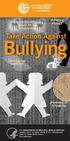 switching seats in the classroom stealing money Take Action Against Bullying spreading rumors pushing & tripping U.S. DEPARTMENT OF HEALTH & HUMAN SERVICES Substance Abuse and Mental Health Services Administration
Providing Support for Special Needs Children By The U.S. Department of Education, Office of Educational Research and Improvement. Posted June 1998.
 Providing Support for Special Needs Children By The U.S. Department of Education, Office of Educational Research and Improvement. Posted June 1998. All children can succeed with the right support. Being
YUMA PROVING GROUND STANDARD OPERATING PROCEDURES (SOP) Child, Youth & School Services (CYSS) Touch Policy
 YUMA PROVING GROUND STANDARD OPERATING PROCEDURES (SOP) Child, Youth & School Services (CYSS) Touch Policy 1. PURPOSE: To provide guidance in the implementation of Touch Policy based on the understanding
EDS CHILDCARE PROVIDER/TEACHER QUESTIONNAIRE (EXTERNAL VERSION) Table of Contents
 EDS CHILDCARE PROVIDER/TEACHER QUESTIONNAIRE (EXTERNAL VERSION) Table of Contents PROVISION OF CHILDCARE (CP)... EDS Teacher 2 POSITIVE BEHAVIORS SCALE (CB)... EDS Teacher 19 CHILD BEHAVIOR CHECKLIST (CA)...
Classroom Behavior Management Plan
 Haffner 1 Classroom Behavior Management Plan Daniel Haffner November 20, 2009 EDUC 348 Haffner 2 Philosophy of Classroom Management Classroom management is a course taught at every teacher college across
Introduction to Healthy Family Dynamics
 Introduction to Parents & Families: Relationships are important to a satisfying life and learning about healthy relationships begins at home. Family provides the foundation for our sense of security and
Fayetteville Technical Community College EARLY CHILDHOOD EDUCATION CENTER STAFF HANDBOOK
 Fayetteville Technical Community College EARLY CHILDHOOD EDUCATION CENTER STAFF HANDBOOK Current Version Originally Published September 2009 Last Revised: October 1, 2009 Proponent: Associate Vice President
ADD/ADHD in the Classroom
 ADD/ADHD in the Classroom TIPS FOR TEACHERS AND PARENTS At any given time, a teacher can expect to have at least one student with ADHD. The impulsive and hyperactive behavior of such students can be distracting
Differential Reinforcement. Things to Do. Select behaviors to be decreased or increased. Set criterion. Monitor the student s performance.
 Definition D ifferential reinforcement is the reinforcement of one form of behavior and not another, or the reinforcement of a response under one condition but not another. Differential reinforcement uses
The Effect of Training on Teachers Knowledge of Effective Classroom Management Strategies in Jos Metropolis
 The Effect of Training on Teachers Knowledge of Effective Classroom Management Strategies in Jos Metropolis Katrina A. Korb, Grace Selzing-Musa, University of Jos, Jos and Swanta Blessing Skinner-Bonat
Things to Do. Overcorrection. Definition
 There are four types of overcorrection procedures: 1. Restitutional overcorrection requires the student to correct the effects of his/her misbehavior by restoring the environment to better than its original
How To Improve A Child'S Learning Experience
 Effective teaching and classroom management is about whole child - and whole school development for knowledge, skills and human values During the past years as an outcome of the UN Study on Violence against
EARLY CHILDHOOD TRANSITION PROCESS
 FALL 2015 EARLY CHILDHOOD TRANSITION PROCESS A guide for helping families of children with special needs prepare for smooth and effective transitions JOHN WHITE STATE SUPERINTENDENT OF EDUCATION Terms
EARLY CHILDHOOD BEHAVIOR INTERVENTION MANUAL. Goals, Objectives, and Intervention Strategies
 EARLY CHILDHOOD BEHAVIOR INTERVENTION MANUAL Goals, Objectives, and Intervention Strategies Stephen B. McCarney Copyright 1992 by Hawthorne Educational Services, Inc. All rights reserved. No part of this
Toilet Training Children with Special Needs
 Toilet Training Children with Special Needs Toilet training can be challenging for parents and children, but especially so if the child has a developmental disability. Unique circumstances and characteristics
Simple things you can do to help your child grow, develop and learn. An introduction to the Minnesota Early Childhood Indicators of Progress.
 EVERY DAY IS A GREAT DAY FOR YOUR CHILD TO LEARN Simple things you can do to help your child grow, develop and learn. An introduction to the Minnesota Early Childhood Indicators of Progress....p.3...p.4...p.5
STATE OF NEW JERSEY DEPARTMENT OF CHILDREN AND FAMILIES OFFICE OF LICENSING/ INSPECTION/VIOLATION REPORT
 Center Name: South Mountain YMCA- Clinton School STATE OF NEW JERSEY DEPARTMENT OF CHILDREN AND FAMILIES OFFICE OF LICENSING/ INSPECTION/VIOLATION REPORT Center ID#: County: Essex Address: 27 Berkshire
Bullying Prevention. When Your Child Is the Victim, the Bully, or the Bystander
 Bullying Prevention When Your Child Is the Victim, the Bully, or the Bystander What Is Bullying? Bullying is not a conflict or a fight. Bullying is physical, verbal, or emotional abuse that is deliberate,
Introduction to Applied Behavior Analysis
 Introduction to Applied Behavior Analysis Glenwood, Inc. Teacher Training 2013 We may have gotten into the teaching profession to teach science, music, or foreign language, but pretty soon we discover
Avondale Elementary School of Fine Arts School wide Discipline Plan
 Avondale Elementary School of Fine Arts School wide Discipline Plan Contents: Behavior Expectations Vision and Belief Statements School wide Discipline Plan Procedures School wide Discipline Plan Weekly
Physical Activity Used as Punishment and/or Behavior Management
 Physical Activity Used as Punishment and/or Behavior Management Position Statement Administering or withholding physical activity as a form of punishment and/or behavior management is an inappropriate
FUNCTIONAL BEHAVIORAL ASSESSMENT
 FUNCTIONAL BEHAVIORAL ASSESSMENT Funded by Safe Schools, Healthy Students and developed at The University of Arizona, College of Education Functional Behavioral Assessment: Online Prevention Module at
A GUIDE TO MAKING CHILD-FOCUSED PARENTING TIME DECISIONS
 A GUIDE TO MAKING CHILD-FOCUSED PARENTING TIME DECISIONS 2 Prepared by The Court Services Advisory Committee of the Maine District Court This booklet is based on information from the Minnesota Supreme
SIGNS AND SYMPTOMS OF CHILD ABUSE AND NEGLECT
 SIGNS AND SYMPTOMS OF CHILD ABUSE AND NEGLECT The warning signs and symptoms of child abuse and neglect vary from child to child. Children have different ways of coping with abuse and the signs often depend
CORE-INFO: Emotional neglect and emotional abuse in pre-school children
 CORE-INFO: Emotional neglect and emotional abuse in pre-school children Introduction This leaflet summarises what is currently known about children aged less than six years who have been emotionally neglected
Emotional/Behavioral Disorders: Understanding the Challenges. Mark D. Nelson. Montana State University Bozeman. Tricia Williamson
 1 Emotional/Behavioral Disorders: Understanding the Challenges Mark D. Nelson Montana State University Bozeman Tricia Williamson Flathead High School Kalispell, Montana Emotional/Behavioral Disorders 2
3Session. Why Do Children Do What They Do? Positive Solutions for Families. The Center on the Social and Emotional Foundations for Early Learning
 Why Do Children Do What They Do? 3Session Positive Solutions for Families The Center on the Social and Emotional Foundations for Early Learning Learner Objectives Suggested Agenda Examine why children
Teaching Children Self-Control
 Teaching Children Self-Control Written by: Hannah Chancellor, SSP ECUSD7 School Psychologist Self-control is the ability to maintain composure in challenging situations or to stop and think before acting.
Presented by the National Resource Center on ADHD
 Presented by the National Resource Center on ADHD Gina Richman, PhD Kristi Phillips, PsyD Child and Family Therapy Clinic The Kennedy Krieger Institute and The Johns Hopkins University School of Medicine
When students do not meet your behavioral expectations but are not exactly breaking the rules and may not deserve an official consequence.
 E-4 Diversify responses to various degrees of misbehavior When you re in the middle of instruction, you may encounter an assortment of misbehavior that varies in degrees of severity and warrants different
PBIS and the Responsive Classroom Approach
 PBIS and the Responsive Classroom Approach Positive Behavioral Interventions and Supports (PBIS), an evidence-based framework for developing positive behavior, is used in schools nationwide to create a
Behavior & Sensory Strategies for Individuals with ASD
 Behavior & Sensory Strategies for Individuals with ASD Kathleen Mo Taylor, OTR/L The Autism Programs Center for Development and Disability University of New Mexico This presentation is made possible, in
CNY Early Childhood Direction Center Bulletin Spring 2004
 CNY Early Childhood Direction Center Bulletin Spring 2004 What s Inside Rethinking Discipline and Behavior Time Out: What Is It? Using Time Out Appropriately An Ounce of Prevention The Low Down on Time
Integrating Therapy into the Classroom
 Individualizing Inclusion in Child Care November 2001 Integrating Therapy into the Classroom R. A. McWilliam Stacy Scott Findings from research: Over time, families who were given a choice between in-
SafeMinistryTraining.com.au Course Notes
 SafeMinistryTraining.com.au Course Notes 1. Introduction Welcome to the Safe Ministry Training course. We all want our churches to be safe places for everyone kids as well as adults. The purpose of this
PEQUEA VALLEY SCHOOL DISTRICT. Curriculum Guide for
 PEQUEA VALLEY SCHOOL DISTRICT Curriculum Guide for Course Child Care & Development Course Number 730 Grade Level 9-12 Course Length (Days) 90 Number Minutes per day: 87 Clock Hours Per Year 130.5 Number
Early Childhood Education
 Early Childhood Education It s where imaginations take flight This photograph and the slogan belong to Los Angeles Universal Preschool. www.fundacionaztecaamerica.org @FAztecAm, Fundacion Azteca America
Early Childhood Education / Course Outcomes
 Early Childhood Education / Course Outcomes Development in Early Childhood CCED102 1. To understand the stages of development from pre- natal to 7/8 years of age in order to have appropriate and reasonable
Professional Requirements & Training for Preschool Teacher. Introduction to Early Childhood Care and Education by Dr.
 Professional Requirements & Training for Preschool Teacher Introduction to Early Childhood Care and Education by Dr. Chiu, Mei-Wen Outline Description of Preschool Teachers How to Become a Preschool Teacher
What is ADHD/ADD and Do I Have It?
 What is ADHD/ADD and Do I Have It? ADHD Definition and Symptoms Adults with ADHD Possible Coexistent Conditions Medications and Treatments Additional Resources Works Cited What is Attention Deficit Hyperactivity
National Center for Mental Health Promotion and Youth Violence Prevention. Positive Behavioral Intervention and Supports Brief
 National Center for Mental Health Promotion and Youth Violence Prevention Positive Behavioral Intervention and Supports Brief Purpose of this Guide School districts around the nation have begun to implement
Using the Second Step: Social-Emotional Skills for Early Learning and Devereux Early Childhood Assessment (DECA-P2) Preschool Program Together
 Using the Second Step: Social-Emotional Skills for Early Learning and Devereux Early Childhood Assessment (DECA-P2) Preschool Program Together The Second Step program and DECA Preschool Program are both
School-Age Child Guidance Technical Assistance Paper #2
 School-Age Child Guidance Technical Assistance Paper #2 School-age Child Guidance High quality out-of-school time programs promote school-age children s emotional and social development as well as their
Promoting Generalization of Positive Behavior Change: Practical Tips for Parents and Professionals
 Promoting Generalization of Positive Behavior Change: Practical Tips for Parents and Professionals Jonathan Tarbox, PhD CARD Distinguished Lecturer Series Center for Autism & Related Disorders, Inc. CARD
An Activity Based Approach to Developing Young Children s Social Emotional Competence
 Activity Based Approach, 111 Book review by Onur Özdemir 1 An Activity Based Approach to Developing Young Children s Social Emotional Competence Jane Squires & Diane Bricker Paul H. Brookes Publishing
Classroom Management Plan
 Miller 1 Classroom Management Plan Michelle Miller EDUC 360 Professor Shipman 3 December, 2009 Miller 2 PHILOSOPHY OF CLASSROOM MANAGEMENT I believe that every student can learn given the right environment,
Blending the World of Special Education With General Education Services
 Blending the World of Special Education With General Education Services 2 Figure 2.1 Provide opportunities for children to work together. Best Practices According to NAEYC and DEC Two professional organizations,
INTO. Guidance on Managing Challenging Behaviour in Schools
 INTO Guidance on Managing Challenging Behaviour in Schools What is challenging behaviour? Challenging behaviour, in the school context, encompasses behaviour that: Interferes with the pupil s own and/or
Behavior-Management Techniques for Safe Schools
 Behavior-Management Techniques for Safe Schools Each new school year brings high hopes, great expectations and challenges for both new and seasoned educators. Th e American Federation of Teachers (AFT)
Effective Classroom Management
 Effective Classroom Management Keys Student behavior won t change until adult behavior changes -- Adults Matter! ALL behavior change is an instructional process -- Instruction Matters! It s all about probability
However, if your child is learning how to use the toilet without problems, there is no need to stop because of these situations.
 Toilet Training Readiness When do I start? Bowel and bladder control is a necessary skill. Teaching your child to use the toilet takes time, understanding, and patience. The important thing to remember
JCCC CONTINUING EDUCATION. Early Childhood Ed. 11 classes to meet your approved in-service hours CONTINUING EDUCATION. Enroll today!
 Early Childhood Ed JCCC CONTINUING EDUCATION 11 classes to meet your approved in-service hours CONTINUING EDUCATION Enroll today! JCCC CONTINUING EDUCATION Early Childhood Ed January-May 2016 Register
How can I help my child with ADHD? Management Strategies for Parents
 How can I help my child with ADHD? Management Strategies for Parents Raising a child with ADHD can be incredibly challenging for any parent Russell Barkley, 2000 The challenge of raising a child with ADHD
Simple things you can do to help get your child ready for kindergarten. An introduction to the Minnesota Early Childhood Indicators of Progress.
 EVERY DAY IS A GREAT DAY FOR YOUR CHILD TO LEARN Simple things you can do to help get your child ready for kindergarten. An introduction to the Minnesota Early Childhood Indicators of Progress....p.3...p.4...p.5...p.6
CCEI Online College Credit Eligible CDA Certificate Family Child Care Program Syllabus
 CCEI Online College Credit Eligible CDA Certificate Family Child Care Program Syllabus Settings: Family Care Program Code: 1103-CDA Program Length: 151 Hours IACET CEU Value: 15.1 CEUs Program Start Date:
PARENT EDUCATION AND EARLY CHILDHOOD PROGRAMMES
 The Consultative Group on Early Childhood Care and Development PARENT EDUCATION AND EARLY CHILDHOOD PROGRAMMES Coordinators' Notebook No. 12, December 1992 by Cassie Landers Consultative Group for Early
Interviewing Child Care Providers: Centers and Daycares
 Interviewing Child Care Providers: Centers and Daycares Program Setup 1) How long has the childcare program been in existence? 2) Is the program licensed? Registered? Accredited by the National Association
Sexual Behavior and Children: When Is It a Problem and What To Do About It
 Sexual Behavior and Children: When Is It a Problem and What To Do About It The Harborview Center for Sexual Assault and Traumatic Stress has services to help families of children with sexual behavior problems.
How To Be A Responsible School
 ST CHARLES R.C VA PRIMARY SCHOOL. A Restorative School Behaviour Policy 2014-16 Policy Author Date Published Date for Review Reviewer M Hulme Jan 2014 Jan 2016 M Hulme Signature of Chair of Governors Date:
CHD 12023T COURSE OUTLINE. Prerequisites: None. Course Description:
 23T Lecture Revised: Fall 2015 CHD 12023T 23TIntroduction to Early Childhood COURSE OUTLINE Prerequisites: None Course Description: This course introduces early childhood development through activities