
M_004 Basic Rigging Safety Lecture
|
|
|
- Howard Cummings
- 10 years ago
- Views:
Transcription
1 M_004 Basic Rigging Safety Lecture Milton J. Shoup III Mechanical Safety Officer University of Rochester Laboratory for Laser Energetics 1 of 101
2 Summary Safety is everyone s business and compliance with safety procedures is MANDATORY If an activity or practice seems unsafe, Stop Work and take the time to address concerns Only designated or qualified personnel may attach loads to an overhead hoist No LLE personnel are qualified or permitted to repair rigging equipment Only approved/rated rigging gear shall be attached to a load hook Load ratings shall never be exceeded It is the riggers responsibility to ensure all components used in a rigging operation meet the required load ratings If a rigger is unable to determine a proper rigging configuration contact ME or an Advanced Rigger for support 2 of 101
3 There are two specific roles in moving materials overhead, hoist operators and riggers The definitions for hoist operators and riggers are as follows; hoist operator: an employee who generally uses an overhead hoist as a tool to assist in the performance of their regular job rigger: At LLE a rigger is responsible for safely attaching payloads to the load hook of a hoist. 3 of 101
4 There are two specific roles in moving material overhead, hoist operators and riggers There are 2 classes of training for Hoist operators Hoist operator for overhead vertical lifting with unpowered horizontal motion Overhead Crane operator for overhead vertical lifting with powered horizontal motion There are 3 classes of training for riggers No training is required for rigging payloads <120 lbs Basic rigger for personnel attaching any loads from lbs to any hoist for a pure vertical lift Advanced rigger for personnel attaching any load >500 lbs to any hoist or any load using multiple load hooks Overhead rigging of material or equipment is to be performed only by designated personnel 4 of 101
5 Basic rigging scope of qualification Basic rigging training qualifies the individuals to use the following equipment; Slings: Synthetic web slings, round and flat Hardware: Hoist rings, eye bolts, shackles, hooks Basic rigging training qualifies the individuals to perform the following activities for payloads up to 500 lbs; Conduct rigging operations Rig payloads for overhead lifts using the equipment listed above Attach payloads to any load hook 5 of 101
6 OSHA Department of Labor (DOL) establishes the rules for overhead hoists The rules for rigging equipment are established in 29 CFR Slings and 29 CFR Rigging equipment for material handling The DOL incorporates additional rules by reference by citing additional standards within the regulations ASME B30 pertains to lifting and material-handling related equipment There are 28 subparts to ASME B30 6 of 101
7 Purpose of the ASME B30 standard The B30 Standard is intended to (a) prevent or minimize injury to workers, and otherwise provide for the protection of life, limb, and property by prescribing safety requirements (b) provide direction to manufacturers, owners, employers, users, and others concerned with, or responsible for, its application (c) guide governments and other regulatory bodies in the development, promulgation, and enforcement of appropriate safety directives 7 of 101
8 Numerous portions of the ASME B30 standard apply to rigging equipment Each of the B30 sections listed below contain requirements on the selection, use, maintenance, and inspection B30.1 Jacks B30.9 Slings B30.10 Hooks B30.20 Below-the-Hook Lifting Devices B30.26 Rigging Hardware This lecture distills the ASME requirements into the policies and practices used at LLE 8 of 101
9 The basic steps for moving a payload 1) Prep work a. Understand the payload b. Select the rigging gear c. Inspect all rigging gear d. Assign responsibilities 2) Attach the rigging gear to the payload 3) Attach payload to a load hook 4) Move the payload 5) Secure the payload 6) Detach the payload from a hook 7) Remove the rigging gear 9 of 101
10 A vital part of your Prep Work is knowing the payload and path of travel Weight Can often be found in notes section of a part drawing Calculations (volume x density) Talk to Mechanical Engineering Center of Gravity Drawings will sometimes denote CG Test lift to determine CG Path of travel Know that destination is clear and ready to accept the payload Insure the path is clear of any obstructions and personnel that will hinder movement 10 of 101
11 Select rated rigging equipment based upon the payload and how it is used Know the load capacity of the overhead hoists and support structures This includes hoist(s), bridges, jibs, or gantries Know the load capacity of rigging hardware used in the rigging operation This includes the shackles, hoist rings, straps, etc. Know how use of the equipment affects the load rating Use only load rated products NEVER exceed the rated load capacity of any piece of rigging equipment 11 of 101
12 Rigging equipment must be inspected prior to each use to ensure that it is safe Hardware Visually inspect all hardware for damage including but not limited to screws, lifting shackles, hoist rings/lifting eyes, etc. Look for thread damage, bent or fractured pieces, intentional or unintentional modifications Slings Visually inspect for damage or fraying Insure load rating tag is on the sling and legible Inspect sewn threads Any rigging equipment that is found to be unsafe must removed from service immediately 12 of 101
13 During Prep activities, personnel assignments and responsibilities are reviewed Hard hat and safety glasses must be worn during all rigging operations Make sure all personnel involved understand the purpose and the nature of the operation Designate specific tasks to individuals as needed Use a ground spotter when lifting loads to upper level areas Post a sentry or barricade to prevent personnel from walking under the payload Insure communication between all parties involved is clear and concise Example Crane operator Moving the load North Rigger Moving the load North aye NEVER leave a suspended load unattended 13 of 101
14 Rated versus non-rated rigging hardware The terms rated and non-rated have specific meaning in the rigging field Load Rated products are engineered with special considerations important to lifting loads with cranes and hoists Non-rated products often look the same, but are not engineered to provide the same design factors and safety features as the load rated versions Never use non-rated products for rigging 14 of 101
15 Definitions angle of loading: the acute angle between horizontal and the leg of the rigging, often referred to as the horizontal angle. designated person: a person selected or assigned by the employer or the employer's representative as being competent to perform specific duties hoist operator: an employee who generally uses an overhead hoist as a tool to assist in the performance of their regular job line pull: the tension load in a rope entering a rigging block. The term pull is commonly used to describe line pull. qualified person: a person who, by possession of a recognized degree in an applicable field, or certificate of professional standing, or who, by extensive knowledge, training, and experience, has successfully demonstrated the ability to solve or resolve problems relating to the subject matter and work. 15 of 101
16 Definitions rated load: the maximum allowable working load established by the rigging hardware manufacturer. The terms "rated capacity" and "working load limit (WLL)" are commonly used to describe rated load. rigger: At LLE a rigger is responsible for safely attaching payloads to the load hook of a hoist. 16 of 101
17 Synthetic slings 17 of 101
18 Synthetic slings are used with three basic hitch styles Sling ratings are specified for each of three basic styles; vertical, choker, and basket For the basket style hitch, the load rating is specified for a 90 sling angle Load 18 of 101
19 Synthetic slings come in two basic Styles Endless Loop ( EN) Eye and Eye (EE) Type 3 Flat eye is the most popular for all three hitch styles Type 4 Twisted eye is more commonly used for choker hitch 19 of 101
20 Only synthetic slings are to be used at LLE Slings are made of either Polyester or Nylon Various widths are available at LLE most are from 1 to 3 wide Information sewn into the sling label includes; Manufacturers' name Serial number Load ratings (per hitch style) Material Length Sling Type Material 20 of 101
21 Synthetic web slings shall be immediately removed from service if any of the following conditions exist Burn Damage from either heat or chemical sources Heat damage may not be obvious Any synthetic sling exposed to temperatures above 150 F must be removed from service 21 of 101
22 Synthetic web slings shall be immediately removed from service if any of the following conditions exist Snags, punctures, tears or cuts The red thread (tattletale) exposed in this example mean the sling must be removed from service. Simply remember Red is dead Broken or worn stitches 22 of 101
23 Synthetic web slings shall be immediately removed from service if any of the following conditions exist 23 of 101
24 In a bridle hitch, two, three, or four single hitches are used together to hoist objects that have lifting lugs or other attachments Bridle hitches can be assembled from individual components (slings, shackles, hooks, etc.) Bridle synthetic slings are permanently assembled units consisting of a number web slings grouped together on a master link Bridle slings typically have 1-4 legs Sling ends can be either eyes or various types of hooks 24 of 101
25 Sling rigging practices using a choker hitch Set the sling angle to >120 for a full load rating Improperly setting the choke can reduce the load rating by as much as 50% Sling Angle Angle of choke, deg Rated Capacity, % Over of 101
26 Sling rigging practices using a basket hitch Remember that basket hitch ratings are for slings at 90 The legs of a basket hitch are typically collected on a single hook A sling angle less than 90 increases the tension (load) in the sling 1000 lbs 1000 lbs 1000 lbs 1000 lbs 1000 lbs 26 of 101
27 Synthetic Sling Do s and Don ts Do s Visually inspect slings for any damage and remove from service if necessary Insure the safety tag is attached, legible, and has all pertinent information Verify load ratings per hitch style Use softeners on sharp corners as necessary Don ts Do not use if any part of sling is damaged Do not use if the safety information is missing or not legible Do not tie slings together Do not use a sling that has been shock loaded (remove it from service) Never exceed the load rating 27 of 101
28 Is this sling safe to use? No the red tattletale is showing 28 of 101
29 The three primary pieces of rigging hardware used at LLE Swivel Hoist rings Eyebolts Shackles 29 of 101
30 Hoist rings 30 of 101
31 Hoist rings have free movement about 2 axes or Degrees of Freedom (DOF) This motion allows the hoist ring to always be aligned with the sling Bail Swivel Never use a hoist ring if the swivel or bail bind, this is an indication of damage 31 of 101
32 Swivel hoist rings are able to accommodate various use angles Load ratings based on: Size Ring size and thread size Material Commonly alloy steel or stainless steel Thread length Longer length usually designed for soft metals (aluminum) Shorter lengths can be used in ferrous metals (steel) Each hoist ring is load tested and comes with a factory certificate Many different types and sizes are available 32 of 101
33 The longer Effective Thread Projection that is approximately twice the thread diameter must be used for a hoist ring threaded into aluminum Frame Size Working Load Limit Torque in Ft-Lbs Effective Thread Projection Length Dimensions HR-125 Stock No. Bolt Size Radius Diameter Weight Each No. (lbs.) A B C D E F G H (lbs.) /2-13 x /2-13 x /8-11 x /8-11 x /4-10 x /4-10 x /4-10 x /4-10 x of 101
34 Hoist ring load ratings and installation torque values are stamped or etched on an installation placard located on top of the hoist ring Use an allen wrench for initial installation of the hoist ring A torque wrench must always be used for proper installation of the hoist ring Never exceed the load rating 34 of 101
35 Hoist ring Do s Visually inspect hoist rings for any damage or corrosion on threads and body Insure the installation placard is attached, if not remove the hoist ring from service Use an allen wrench for initial installation and then a torque wrench for final tightening Make sure the thread engagement is appropriate for the base metal the bolt is being threaded into Approximately 1 times the diameter when threading into steel Approximately 2 times the diameter when threading into aluminum Verify swivel and bail functionality after installation 35 of 101
36 Hoist ring Don ts Do not use if any part of hoist ring is damaged Do not use if placard information if missing or not legible Do not use a hoist ring if it is not tightened to the recommended torque Do not use if the hoist ring does not swivel Do not use washers in between the hoist ring and mounting surface Do not repair, replace, or modify any piece of a hoist ring Do not use if a gap exists between the part being lifted and the hoist ring Do not use a hook larger than the diameter of the hoist ring bail opening Never exceed the load rating of the hoist ring 36 of 101
37 What is the WLL of this hoist ring? Zero, the threaded rod, nut, and washers are clearly not an original bolt 37 of 101
38 Eye bolts 38 of 101
39 Machinery eye bolts are not as versatile as hoist rings Fixed position based upon thread engagement makes them alignment sensitive when pulling at an angle Can accommodate thru hole applications Load ratings are based upon a number of factors Size Ring size and thread size Material Commonly forged from carbon steel or stainless steel (carbon steel and stainless steel have different load ratings for the same size) Use angle Can only be used up to 45 Two different styles and numerous sizes available 39 of 101
40 There are two styles of eye bolts Plain pattern straight vertical pulls only Shoulder pattern angular pulls up to 45 from vertical Shoulder 40 of 101
41 Machinery eye bolts must be used with great care Working load limits for eye bolts are based on a straight vertical pull in a gradually increasing manner Angular pulls will significantly lower working load limits (see Shoulder Pattern) and should be avoided whenever possible If an angular pull is required, a properly seated Shoulder Pattern eye bolt must be used Loads should always be applied to eye bolts in the plane of the eye, not at an angle to this plane Angular pulls must never be more than a 45 pull Diameter and Thread Working Load Limit Straight Pull (X) 45 Pull (Y) Shoulder Only 1/4" /16" /8" /16" /2" /16" /8" /4" /8" " /8" /4" /2" of 101
42 Loads must always be applied to eye bolts in the plane of the eye Side pull in the plane of the eye Sling angle must not exceed 45 Side pull out of the plane of the eye. This configuration must not be used Flat washers may be used under the shoulder to position the plane of the eye 42 of 101
43 Do not reeve slings between attachment points Reeving introduces side pull Although the upper sling angle is 60, the resultant sling angle is 30 For 1 lbf at 60 there is also a 1 lbf lateral load. The resultant load on the eye bolt is 1.73 lbf at lbf 1.73 lbf 1 lbf 43 of 101
44 Eye bolt identification markings Manufacturer and Size Eyebolts are not required to be marked with the WLL or required installation torque. The user must look up this information prior to use Do not use any eye bolt for rigging unless there are clearly legible identification marks 44 of 101
45 All machinery eye bolts are not created equal, they vary between manufacturers A comparison of the same size shouldered eye bolts from two manufacturers shows different WLL Chicago rates the shouldered eye bolt for a side pull up to 45 Although Crosby rates the shouldered eye bolt for a side pull up to 90 (25% of in-line WLL), a maximum of 45 is permitted at LLE The user must look up WLL information prior to use Diameter and Thread Working Load Limit Chicago Straight Pull Crosby Straight Pull 1/4" /16" /8" /16" /2" /16" /8" /4" /8" " /8" /4" /2" of 101
46 Shoulder Nut Eye Bolt Installation for In-Line and Angular Loading A. The threaded shank must protrude through the load sufficiently to allow full engagement of the nut B. If the eye bolt protrudes so far through the load that the nut cannot be tightened securely against the load, use properly sized washers to take up the excess space BETWEEN THE NUT AND THE LOAD 90 C. Place washers or spacers between nut and load so that when the nut is tightened securely, the shoulder is secured flush against the load surface D. Thickness of spacers must exceed this distance between the bottom of the load and the last thread of the eye bolt Pull angle 45 C,D In-line A B 46 of 101
47 Regular Nut & Shoulder Nut Eye Bolt - Installation for In-line Loading with a tapped hole More than one eye bolt diameter of threads, only (1) nut is required Tighten hex nut securely against load One eye bolt diameter of threads or less, use two (2) nuts Tighten hex nut securely against load 47 of 101
48 Regular Nut & Shoulder Nut Eye Bolt - Installation for In-line Loading with a tapped hole Minimum engagement depth is 2 x Diameter One eye bolt diameter of threads or less is not allowed 48 of 101
49 Examples of non-load rated eyebolts that should never be used for rigging welded eye bolt open eye bolt bent eye bolt 49 of 101
50 Machinery eye bolt Do s Visually inspect eyebolts for any damage or corrosion on threads and body Always be sure threads on the shank and receiving holes are clean Insure the eyebolt has proper identification markings Always countersink receiving hole or use washers to seat the shoulder properly Always screw the eye bolt down completely for proper seating Always tighten nuts securely against the load When using blind tapped holes, make sure thread engagement is more than 1.5 times the diameter of the thread in steel and 2.5 times in aluminum 50 of 101
51 Machinery eye bolt Don ts Do not use the eyebolt if it is bent, damaged, or has been modified Do not use if the eyebolt if it does not have proper identification markings Do not use shouldered eyebolts at angles between 45 and 90 degrees to bolt axis Do not repair, replace, or modify an eyebolt Do not use if a gap exists between the part and eyebolt Do not use a hook larger than the diameter of the eyebolt opening Do not use a plain pattern eye bolt for angular pulls Shock loading must be avoided Never machine, grind, or cut an eye bolt Never use eye bolt that shows signs of wear or damage Never use eye bolt if eye or shank is bent or elongated Never exceed the load rating 51 of 101
52 Is this eyebolt safe to use? No, because the shoulder has been damaged 52 of 101
53 Shackles 53 of 101
54 Shackles are used for connecting various pieces of rigging equipment together Used as a connecting link between items Strap to hoist ring or eyebolt Strap to strap Used as single attach point for multiple straps Load rating based on: Size Material Many different types and sizes 54 of 101
55 Examples of shackle usage Strap to diagnostic With multiple straps 55 of 101
56 Round pin shackle Round Pin Shackles can be used in tie down, towing, suspension or lifting applications where the load is strictly applied in-line Round pin shackles should never be used in rigging applications to gather multiple sling legs, or where side loading conditions may occur Round pin shackles are not approved for use at LLE 56 of 101
57 Screw pin shackle Screw Pin Shackles are used in Pick and Place applications. For permanent or long-term installations, Crosby recommends the use of bolt type shackles. Alternatively, the screw pin shall be secured from rotation or loosening. Screw pin shackles can be used for applications involving side-loading circumstances Reduced working load limits are required for sideloading applications While in service, do not allow the screw pin to be rotated by a live line, such as a choker application Screw pin shackles are preferred for use at LLE 57 of 101
58 Bolt-type shackle Bolt-Type Shackles can be used in any application where round pin or screw pin shackles are used In addition, they are recommended for permanent or long term installations and where the load may slide on the shackle pin causing the pin to rotate The bolt-type shackle s secondary securement system, utilizing a nut and cotter, eliminates the requirement to tighten pin before each lift or movement of load Bolt-type shackles must have the cotter pin installed 58 of 101
59 Shackle identification markings Manufacturer (Crosby) 45 mark Working Load Limit ( 4 ¾ T) Size (3/4) 59 of 101
60 Side loading of screw pin and bolt type shackles results in a reduction of the working load limit Angle of Side Load from Vertical In-Line of shackle Adjusted WLL 0 In-Line 100% of Rated WLL 45 from In-Line 70% of Rated WLL 90 from In-Line 50% of Rated WLL In-line In-line load 90 from in-line At LLE shackles are only permitted to be loaded in-line 60 of 101
61 Shackle load ratings are based upon the use angle with multiple straps Shackles symmetrically loaded with two leg slings having a maximum included angle of 120 and can be utilized to full working load limit of the shackle Never exceed a 120 included angle and only use bolt-type or screw-pin shackles of 101
62 Shackle rigging practices for Crosby shackles Point loading of shackle bows is acceptable Point loading of shackle pins is acceptable when the load is reasonably centered on the pin 62 of 101
63 Shackle rigging practices with synthetic slings Folding, bunching, or pinching of synthetic slings can occur when used with shackles Folding, bunching, and pinching of synthetic slings reduces the sling load rating and must be avoided 63 of 101
64 Shackle rigging practices Screw pins shall be fully engaged If designed for a cotter pin, it shall be used and maintained Applied load should be centered in the bow to prevent side loading Multiple sling legs must not be applied to the pin If the shackle is side loaded, the rated load shall be reduced Never have the pin against the live line in a choker. The pin must go through the bow of the sling. 64 of 101
65 Shackle Do s Visually inspect shackles for any damage or wear on ring and pin Insure shackles have proper identification markings Finger tighten the pin into ring of shackle Check for proper fit of the pin into ring Check the load ratings and use according to manufacturer recommendations 65 of 101
66 Shackle Don ts Do not use a shackle if it is bent, damaged, or has been modified Do not use if the shackle does not have proper identification markings Do not use a tool to tighten a shackle pin Do not repair, replace, or modify a shackle Do not use a shackle if the pin has been replaced with a bolt Do not use a hook larger than the diameter of the shackle opening Never exceed the load rating 66 of 101
67 What is the WLL of this shackle? Zero, because the screw pin has been replaced with a bolt 67 of 101
68 What is the WLL of this shackle? Zero, welding changes the strength of the shackle material 68 of 101
69 Never use counterfeit or unknown hardware Rigging hardware must be identifiable with all information clearly legible 69 of 101
70 Hooks Shank hook Swivel hook Eye hook Grab hook Slip hook Sorting hook Sliding choker hook 70 of 101
71 Of the wide variety of hooks that are available, only a few types are used at LLE In general, the only hooks used at LLE are the load hooks attached to hoists The overhead cranes use shank hooks with latches The electric chain hoists use clevis hooks with latches Most rigging situations at LLE do not require any additional hooks. Contact ME for situations where additional hooks may be required Of all of the hooks shown, only the sorting hook may be point loaded. All other types of hooks must not be point loaded. 71 of 101
72 The load hook Always inspect the hook and latch before use Never use a latch that is distorted or bent Always make sure spring will force the latch against the tip of the hook Insure there is no excessive wear in the saddle of the hook Always make sure the hook supports the load. The latch must never support the load Latches are intended to retain loose sling or devices under slack conditions Latches are not intended to be an anti-fouling device Only load the hook in the saddle or bowl within ±45 of vertical Hooks are only to be loaded In-line 72 of 101
73 What is wrong with this picture? Hook too big for eye Point loaded hook Eye bolt not seated 73 of 101
74 Loading the load hook When placing two sling legs in a hook, make sure the angle between the legs is less than 90 and if the hook or load is tilted, nothing bears against the bottom of this latch For two legged slings with angles greater than 90, use an intermediate link such as a master link or bolt type shackle to collect the legs of the slings. The intermediate link can be placed over the hook to provide an in-line load on the hook. This approach must also be used when using slings with three or more legs. Make sure all rigging materials are secured inside the latch area and the latch closes Never point load a hook 74 of 101
75 Hook latches must be closed 75 of 101
76 Are these hooks acceptable for use? No! No!! and No!!! 76 of 101
77 Rigging math θ Load SlingTension CollapseForce Load = # legs sinθ Load = # legs tanθ The sling angle θ is always measured from the horizontal 77 of 101
78 Sling tension in a vertical hitch 10,000 Lbs. of tension on Sling What is the sling tension? 10,000 Lbs. 78 of 101
79 Sling tension in a two leg vertical hitch (basket hitch) 5,000 Lbs. of tension on each Sling What is the sling tension on each leg? 5,000 Lbs. of tension on each Sling 10,000 Lbs. 79 of 101
80 Sling tension in a two leg bridle hitch θ Load Sling tension will increase as the sling angle θ gets smaller 80 of 101
81 Sling tension in a two leg bridle hitch at 60 5,775 lbs. 5,775 lbs. 60 o 60 o 10,000 Lbs. 81 of 101
82 Sling tension in a two leg bridle hitch at 45 7,070 lbs. 7,070 lbs. 45 o 45 o 10,000 Lbs. 82 of 101
83 Sling tension in a two leg bridle hitch at 30 10,000 lbs. 10,000 lbs. 30 o 30 o 10,000 Lbs. Notice that at 30 the tension in the sling is equal to the Load 83 of 101
84 Sling tension in a two leg bridle hitch at 10 28,800 lbs. 28,800 lbs. 10 o 10 o 10,000 Lbs. Notice that at below 30 the tension in the sling is greater than Load 84 of 101
85 Using a sling at any angle other than vertical applies a collapsing force on the load High collapsing forces can lead to load buckling exceeding the pad eye strength of where the hoist attaches to the load Collapsing Force 85 of 101
86 Rigging with a 3 or 4 sling bridle hitches With 3 and 4 leg sling bridle hitches, only 2 legs will likely carry the load while the other two steady (balance) the load Use only 2 legs when calculating the required load rating for rigging equipment Use the smallest sling angle when calculating load rating 86 of 101
87 Checking sling angles with simple geometry L 60 L L For 60 sling angle All sides of the triangle are equal length 45 H For 45 sling angle The base of the triangle is twice the height 2H 2H 30 H For 30 sling angle The height is one-half of the sling length 87 of 101
88 For a two leg bridle hitch the basic rigger should size rigging hardware based on a two leg bridle hitch at 30 Recall Shackles symmetrically loaded with two leg slings having a maximum included angle of 120 can be utilized to the full working load limit of the shackle 10,000 lbs. 30 o 120 o 30 o 10,000 lbs. 10,000 Lbs. Select the sling load rating to be equal or greater than the payload and use a sling angle greater than of 101
89 Basic rigging practices When multiple slings are used on a common hook or bridle; Always use sling angles greater than 30 For sling load calculations use Sling Tension = Load All rigging hardware must satisfy the load rating requirements of the lift to be performed It either meets the load requirements or not (there is no such thing as just over the load capacity) Use single slings between hooks and attachment points on the payload do not reeve slings between attachment points All slings must be straight and free of knots 89 of 101
90 Basic rigging practices continued When more than one wide sling (>1 ) or two narrow slings (1 ) are required, they shall be placed in a shackle or bridle which is then placed on the crane hook CORRECT WRONG 90 of 101
91 Hand signals Posters containing complete hand single information are posted near the overhead bridge cranes Complete knowledge of the hand signals is required for operation of the overhead cranes Complete knowledge of the hand signals is required for all riggers 91 of 101
92 Knowledge of hand signals is required Hand signals are not likely to be needed in most spaces because of close proximity and the use of radios However, all operators must know all of the listed/posted hand signals The hoist operator will only follow hand signals from a designated signalman (usually a rigger) Anyone may call for a stop or an emergency stop and it must be obeyed by the hoist operator 92 of 101
93 Knowledge of these eight hand signals is required 93 of 101
94 Qualified Advanced Riggers Advanced Riggers are available to support Basic Riggers to ensure safe lifting conditions Dan Neyland, Omega XOPS Jeff Rodas, EP XOPS Mark Romanofsky, ME Milt Shoup, ME 94 of 101
95 Summary Safety is everyone s business and compliance with safety procedures is MANDATORY If an activity or practice seems unsafe, Stop Work and take the time to address concerns Only designated or qualified personnel may attach loads to an overhead hoist No LLE personnel are qualified or permitted to repair rigging equipment Only approved/rated rigging gear shall be attached to a load hook Load ratings shall never be exceeded It is the riggers responsibility to ensure all components used in a rigging operation meet the required load ratings If a rigger is unable to determine a proper rigging configuration contact ME or an Advanced Rigger for support 95 of 101
96 Example test questions A payload is being lifted using a vertical hitch with the following components; Plain machinery eye bolt (WLL 2600 lb), synthetic sling (vertical WLL lb), Hoist (1T). What is the maximum payload? 1300 lb 2000 lb 2600 lb lb Not enough information or not safe 2000 lb limited by the hoist 96 of 101
97 Example test questions A payload is being lifted with a sling in basket hitch configuration with the following components; synthetic sling (basket WLL lb), and Hoist (4T). What is the maximum payload? 4000 lb 8000 lb lb Not enough information or not safe Not enough information What is the sling angle? 97 of 101
98 Example test questions A payload is being lifted using a 2 leg bridle hitch assembled with the following individual components; Plain machinery eye bolts (WLL 2600 lb), synthetic slings (vertical WLL 1000 lb), Shackles (WLL 4T), and Hoist (5T). What is the maximum payload? 1000 lb 1300 lb 2600 lb 8000 lb lb Not enough information or not safe Not safe Plain eye bolts can ONLY be used for vertical lifts, no sling angle provided 98 of 101
99 Example test questions A payload is being lifted using a 2 leg bridle hitch assembled with the following individual components; Plain machinery eye bolts (WLL 2600 lb), synthetic slings (vertical WLL 1000 lb), Shackles (WLL 4T), and Hoist (5T). The sling angle is 30. What is the maximum payload? 1000 lb 1300 lb 2600 lb 8000 lb lb Not enough information or not safe Not safe Plain eye bolts can ONLY be used for vertical lifts 99 of 101
100 Example test questions A payload is being lifted using a 2 leg bridle hitch assembled with the following individual components; hoist rings (WLL 5000 lb), synthetic slings (vertical WLL lb), Shackles (WLL 4T), and Hoist (5T). The sling angle is 30. What is the maximum payload? 2500 lb 5000 lb 7500 lb 8000 lb lb Not enough information or not safe Remember that in a 2 leg configuration at 30 the tension in the sling tension is equal to the load 100 of 101
101 Example test questions A payload is being lifted using a 4 leg bridle hitch assembled with the following individual components; hoist rings (WLL 5000 lb), synthetic slings (vertical WLL lb), Shackles (WLL 4T), and Hoist (5T). The sling angle is 30. What is the maximum payload? 2500 lb 5000 lb 7500 lb 8000 lb lb Not enough information or not safe Remember that with a 4 leg bridle hitch the load must be assumed to be only on 2 legs 101 of 101
Owner s Manual Gantry Cranes
 Owner s Manual Gantry Cranes Fixed Height Gantry Crane MODEL NUMBER: SERIAL NUMBER: CAPACITY IN TONS: Telescoping Gantry Crane Bushman AvonTec 262-790-4200, 800338-7810, Fax 262-790-4200 www.bushmanavontec.com
RIGGING HARDWARE ASME B30.26. Addresses detachable lifting hardware for lifting purposes
 RIGGING HARDWARE ASME B30.26 Addresses detachable lifting hardware for lifting purposes Adjustable Hardware (Turnbuckles, Eye nuts, Swivel Hoist Rings and Eyebolts Compression Hardware (Wire Rope Clips
POTENTIAL HEALTH & SAFETY HAZARDS
 Number: OH&S 18.27.1 Revision Date: 2014.01.28 Crane Safety Procedures 1. PURPOSE 1.1. These procedures provide the University requirements for the operation and management of overhead travelling cranes
SAFE HANDLING OF PRECAST CONCRETE PRODUCTS
 SAFE HANDLING OF PRECAST CONCRETE PRODUCTS Safety Handling of Precast Concrete Products The lifting of any precast product requires the use of special equipment and substantial planning and knowledge.
LiftAlloy Chain Slings
 CHAIN SLING BASICS Slings Lift-All chain slings meet or exceed all OSHA, ASME B30.9 and NACM standards and regulations. chain slings, available in 80 for 7/32" and 7/8"- /4" and 00 for 9/32"-3/4", are
WARNING! Failure to follow these inspection procedures can cause personal injury and property damage.
 GARDNER-DENVER TECHNICAL MANUAL CPTEN-136 07/03 Hoist Inspection and Maintenance Guide Inspection Record For: Hoist Model.: Hoist Serial.: WARNING! Failure to follow these inspection procedures can cause
Safe Operating Procedure
 Safe Operating Procedure (Revised 5/14) PERSONAL FALL ARREST SYSTEMS Introduction In 2011, falls to a lower level were the second leading cause of occupational fatalities across all industries, claiming
I BEAM TRACK INSTALLATION
 PDQ 0/700 FESTOON SYSTEM INSTALLATION AND MAINTENANCE INSTRUCTIONS INTRODUCTION The PDQ Festoon System was designed to run on one of three sizes of I-beams: S x., S8 x 8. and S x.. System trolleys must
Owner s Manual & Safety Instructions
 Owner s Manual & Safety Instructions Save This Manual Keep this manual for the safety warnings and precautions, assembly, operating, inspection, maintenance and cleaning procedures. Write the product s
Product Information Report Rigging Techniques
 Overview Chain Slings, Loading Angles and Choking All chain manufacturers publish working load limits for single-chain slings in straight tension and for multiple-legged slings when used at various angles.
OSHA 1910.66 Remove impacted systems and components. Inspect systems prior to use.
 Q: When do I remove my harness from service? A: ANSI (American National Standards Institute) A10.32-2004 states the service life of fall protection equipment manufactured of synthetic fiber shall be 5
Slings Effect of Angle of Lift on a Sling Rated Capacity
 Slings Effect of Angle of Lift on a Sling Rated Capacity Using slings at an angle can become deadly if that angle is not taken into consideration when selecting the sling to be used. The tension on each
SEAT BELT Installation Manual
 SEAT BELT Installation Manual You have purchase a premium set of Simpson Seat Belts. They are designed with attention to detail, just like your entire Simpson safety system. WARNING: THIS ARTICLE IS SOLD
Basic Rigging Workbook
 Basic Rigging Workbook Training and Qualifications Program Office October 13, 2008 - 2 - Table of Contents Determine Task and Job-Site Requirements... 4 Characterize the Load... 7 Specify, Select, and
What should you check for when inspecting a crane before maintenance?
 Crane Maintenance What should you check for when inspecting a crane before maintenance? Lower hoist to unload rope sheaves. Unwind all wire rope from the hoist drum to expose all parts of a rope, making
How To Ensure Safety Of Lifting Equipment
 1 of 12 2 of 12 CONTENTS 1.0 OBJECTIVES... 3 2.0 SCOPE... 3 3.0 DEFINITION OF TERMS... 3 3.2.1 Loose Lifting Tackle... 3 3.2.2 Examination... 4 3.2.3 Inspection... 4 4.0 RESPONSIBILITIES & AUTHORITIES...
SHACKLES The Crosby Group, Inc.
 SHACKLES Angle loads must be applied in the plane of the bow. Never Exceed 120 included angle. Use Bolt Type and Screw Pin Shackles ONLY. Shackles symmetrically loaded with two legs slings having a maximum
STANDARD PRACTICE INSTRUCTION
 STANDARD PRACTICE INSTRUCTION DATE: SUBJECT: Crane Safety Program REGULATORY STANDARD: OSHA 29 CFR 1910.179 Overhead and Gantry Cranes OSHA 29 CFR 1926.550 Cranes and Derricks OSHA 29 CFR 1903.1 (The General
Operating instructions. 3-in. x 6-ft. Anchor Strap for Skyline Horizontal Lifeline
 Reliance Industrial Products, LLC Operating instructions for 3-in. x 6-ft. Anchor Strap for Skyline Horizontal Lifeline Model # 6095 Reliance Industrial Products PO Box 140008 Denver, CO 80214 Ph. (800)
Fall Protection Guidelines
 OCT 2015 1 of 6 Fall Protection Guidelines 1.0 PURPOSE To establish the requirements and procedures to protect employees and other persons conducting work from hazards associated with falling from one
C O N V E Y O R C O M P O N E N T S C H A I N S B E L T S B E A R I N G S
 C O N V E Y O R C O M P O N E N T S C H A I N S B E L T S B E A R I N G S January 2009 Issue 6 Valu Guide Brackets The Ultimate in Adjustability and Cost Savings Valu Guide brackets are part of a family
Slings, Rigging and Lifting Equipment
 A printed or saved copy is an UNCONTROLLED copy. Check that it is the latest available version before use. Title: Number: SLINGS, RIGGING AND LIFTING EQUIPMENT GM-11-038-02 Version Number: 13.0 Date Revised:
Coaxial Cable Installation Accessories
 Installation Instructions Bulletin 37608 Coaxial Cable Installation Accessories Hoisting Grips for Coaxial Cable and Elliptical Waveguide READ ALL WARNINGS AND INSTRUCTIONS BEFORE INSTALLATION Antenna
EMPLOYEE FALL PROTECTION
 EMPLOYEE FALL PROTECTION You can fall from any height and be seriously injured or killed. In the construction industry, as well as any other industry, when falls from heights happen, they are usually very
HYDRAULIC TABLE CART 500-LB.
 HYDRAULIC TABLE CART 500-LB. OWNER S MANUAL WARNING: Read carefully and understand all MACHINE ADJUSTMENT AND OPERATION INSTRUCTIONS before operating. Failure to follow the safety rules and other basic
02805 Printed in China
 LEVER OPERATED CHAIN HOISTS Operating, Maintenance & Parts Manual SERIES 602/603 Manually Lever Operated Chain Hoist Maximum Capacity: Series 602: 550 Pounds (250 Kg.) Series 603: 1100 Pounds (500 Kg.)
Trillium 40 Axis Spring Tensioner Wire Replacement Instructions
 Trillium 40 Axis Spring Tensioner Wire Replacement Instructions 1 Overview The objective is to replace the broken axis spring tensioner wire. This requires the following tasks: 1. Remove the seismometer
Safety Manual For Overhead Crane Operators
 Safety Manual For Overhead Crane Operators Contents Forward ---------------------------------------------------------------1 Qualifications---------------------------------------------------------1 Certification
Super Slider ADJUSTABLE FROM 3.5-12 Model #HD26229
 Super Slider ADJUSTABLE FROM 3.5-12 Model #HD26229 IMPORTANT!!! ALL PERSONS USING THIS EQUIPMENT MUST READ AND UNDERSTAND ALL INSTRUCTIONS. FAILURE TO DO SO MAY RESULT IN SERIOUS INJURY OR DEATH. USERS
POLE MOUNT SYSTEM-3 INSTALLATION
 1 May 2014 POLE MOUNT SYSTEM-3 INSTALLATION The Pole Mount System-3 is an easy to install and flexible system designed to allow ONE SYSTEMS loudspeaker products to be mounted to pole structures. The only
Small Flat Panel Lift Arm FSA-1004 and KSA-1004
 I N S T A L L A T I O N I N S T R U C T I O N S Small Flat Panel Lift Arm FSA-1004 and KSA-1004 The Lift Arm is an accessory that can be used with a broad range of Small Flat Panel Displays. The allows
Wire rope slings, the hazards surrounding
 Recommended loads for wire rope slings Wire rope slings, the hazards surrounding their use, and safety measures or alternatives to avoid injury will be covered in this data sheet. 2. Wire rope made from
VERTICAL / FIXED BEAM CLAMP I-BEAM ANCHOR ADJUSTABLE FROM 4-14 Model # HD26249
 VERTICAL / FIXED BEAM CLAMP I-BEAM ANCHOR ADJUSTABLE FROM 4-14 Model # HD26249 IMPORTANT!!! ALL PERSONS USING THIS EQUIPMENT MUST READ AND UNDERSTAND ALL INSTRUCTIONS. FAILURE TO DO SO MAY RESULT IN SERIOUS
1000-LB. TRAILER JACK OWNER S MANUAL
 1000-LB. TRAILER JACK OWNER S MANUAL WARNING: Read carefully and understand all INSTRUCTIONS before operating. Failure to follow the safety rules and other basic safety precautions may result in serious
RATCHET RELEASE SHACKLE
 RATCHET RELEASE SHACKLE INNOVATIVE PILING EQUIPMENT HYDRAULIC PILING HAMMERS EURO RATCHET RELEASE SHACKLE FOR STEEL ERECTION OPERATORS INSTRUCTIONS & SPARE PARTS LIST EXCAVATOR MOUNTED VIBRATORS EXCAVATOR
Machine Moving. By Norm Berls
 Machine Moving By Norm Berls Machine Moving Sources Metalworking: Sink or Swim by Tom Lipton Google Images Vendor Web Pages YouTube Own experiences Formerly professional riggers and movers moved most heavy
1-800-295-5510 uline.com SPECIFICATIONS
 H-1394, H-1395, H-1396 H-1397, H-3859, H-3860 π GRAVITY CONVEYOR 1-800-295-5510 uline.com SPECIFICATIONS Conveyor Bed Width In (mm) 18, 24, 30 (457, 610, 762) Load Capacity Per Linear Foot (305mm) Lbs
OWNER S MANUAL Table Tennis Table Patent Pending
 OWNER S MANUAL Table Tennis Table Patent Pending Be sure to write your model number and serial number here for future reference. You can find these numbers printed on the bottom of the table. MODEL # T8179
4 in 1 Strength Station
 Revision 0 September 2010 4 in 1 Strength Station Owner s Manual Record Serial Number Here Platinum by Tunturi www.tunturi.com Date www.tunturi.com of Purchase 4 in 1 Strength Station Owner s Manual Instructions
It's large enough to handle most welding job shop projects, yet small enough to make it a worth while home-workshop tool
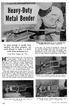 It's large enough to handle most welding job shop projects, yet small enough to make it a worth while home-workshop tool H Craft Print Project No. 272 ERE'S a metal bender that will enable you to bend
Rating when used as a weight carrying hitch without spring bars:
 BOLT-TOGETHER WEIGHT DISTRIBUTING HITCH SYSTEM Rating when used as a weight distributing hitch with spring bars: Part Number 48051 4805 48053 48054 Max Tongue Weight 550 Ibs. 750 Ibs. 1000 Ibs. 1400 lbs.
KEEP FOR FUTURE REFERENCE MRTALP VERTICAL LIFT BAR READ ALL INSTRUCTIONS AND WARNINGS BEFORE USING THIS PRODUCT
 KEEP FOR FUTURE REFERENCE INSTRUCTIONS P.O. Box 368 908 West Main Laurel, MT USA 59044 phone 800-548-7341 phone 406-628-8231 fax 406-628-8354 International Version MODEL NUMBER: LB10VLB MRTALP VERTICAL
Table of Contents WARNING SYMBOLS AND DEFINITIONS
 Table of Contents SAFETY INSTALLATION OPERATION MAINTENANCE Safety... 2 Specifications... 4 Installation... 5 Operation... 8 WARNING SYMBOLS AND DEFINITIONS Maintenance... 9 Parts List and Assembly Diagram...
Working at Heights and Fall Protection
 Standard Operating Procedures Working at Heights and Fall Protection Last Modified: JAN 2013 1 of 6 Working at Heights and Fall Protection I Purpose Serious accidents can result from falls. All employees
DiscPlus DX195 and DX225 Air Disc Brakes
 Revised 11-04 Technical Bulletin Revised 1 Technical 11-04 Bulletin DiscPlus DX195 and DX225 Air Disc Brakes Inspection, Installation and Diagnostics Air Disc Brake Inspection Intervals and Procedures
»Product» Safety Warning
 C1200 Installation Instructions 2007-2016 Chevy/GM 1500 2/4wd 2" Strut Spacer Lift Read and understand all instructions and warnings prior to installation of product and operation of vehicle. Zone Offroad
CHAPTER 13 LOAD HOOKS
 CHAPTER 13 LOAD HOOKS This chapter provides safety standards for the inspection, testing, and maintenance of load hooks installed on cranes or hoists and implements the requirements of ASME B30.10, Chapter
Vehicle Recovery and Towing
 Vehicle Recovery and Towing Guideline (Glove Box Edition) First Published 01-2010 Endsed by #1 Rule: It is always best to call a tow truck! However, if your company permits and equips you to pull out stuck
Lathe Milling Attachment
 Lathe Milling Attachment By L C. MASON BY CLEVERLY stacking cold-rolled flat stock together, T-slots and slide for this lathe milling attachment are made without costly machinery. In fact, only two tools,
TECHNICAL INFORMATION
 TECHNICAL INFORMATION Models No. 2012NB Description 304mm (12") Automatic Thickness Planer CONCEPTION AND MAIN APPLICATIONS * Compact and light weight (27 Kg./59 lbs) automatic thickness planer for easier
OPERATING INSTRUCTIONS FOR
 OPERATING INSTRUCTIONS FOR MEDECO KEY MACHINES FOR MEDECO ORIGINAL, BIAXIAL, MEDECO 3, KEYMARK CLASSIC & KEYMARK X4 PRODUCTS MEDECO HIGH SECURITY LOCKS ASSUMES NO RESPONSIBILITY FOR INJURY OR PROPERTY
758 Heavy-duty Ratchet Guy Wire Cutter
 INSTRUCTION MANUAL 758 Heavy-duty Ratchet Guy Wire Cutter Read and understand all of the instructions and safety information in this manual before operating or servicing this tool. Register this product
INSTALLATION INSTRUCTIONS MULTI-MOUNT KIT Part Number: 75330 Application: Warn HP PowerPlant P/N 71800
 INSTALLATION INSTRUCTIONS MULTI-MOUNT KIT Part Number: 75330 Application: Warn HP PowerPlant P/N 71800 Your safety, and the safety of others, is very important. To help you make informed decisions about
STEADYfast Stabilizer Installation Notes Fifth Wheel and Travel Trailers 11/23/13
 STEADYfast Stabilizer Installation Notes Fifth Wheel and Travel Trailers 11/23/13 (See Supplemental Instructions for trailers with heavy duty round footplates and/or Power Leveling Systems) PHONE SUPPORT
Diameter. Swift Lift Round Recess Plug. Note: The diameter of the narrow recess plug is the same as the diameter of the round recess plug.
 P-5 The P-5 is hot forged from carbon steel. The formed head provis spherical seating that the Lifting Eye engages, while a disc-shaped foot is embedd in the concrete. Due to its being a forged part, the
USER INSTRUCTIONS AND SPECIFICATIONS for use of SAFE APPROACH STANDING SEAM ANCHOR & SAFE APPROACH METAL ROOF SCREW-DOWN ANCHOR
 e) Allow the ring to slide over the end of the clevis pin and push the ring onto the clevis pin when it is centered. USER INSTRUCTIONS AND SPECIFICATIONS for use of SAFE APPROACH STANDING SEAM ANCHOR &
User Instruction Manual Vertical Lifelines and Vertical Lifeline Subsystems
 Instructions for the following series products: User Instruction Manual Vertical Lifelines and Vertical Lifeline Subsystems Vertical Lifelines Vertical Lifeline Subsystems (See back pages for specific
Resharpening Companion
 Resharpening Companion 10950 Correct Angles, Pictures, and Step-By-Step Instructions The Resharpening Companion is meant to be a guide and quick reference to help you resharpen. It is not meant to replace
DeZURIK 3-20" BAW AWWA BUTTERFLY VALVES WITH TRANSFER MOLDED SEAT
 3-20" BAW AWWA BUTTERFLY VALVES WITH TRANSFER MOLDED SEAT Instruction D10386 August 2013 Instructions These instructions provide installation, operation and maintenance information for BAW Butterfly Valves.
Competition 4 & 6 suspension Lift Toyota Landcruiser & nissan patrol
 Competition 4 & 6 suspension Lift Toyota Landcruiser & nissan patrol Competition suspension Product Guidelines Guidelines for sale and recommendation of 4 (100mm) and 6 (150mm) Lifts for Toyota Landcruiser
Operator s Manual EVENTER 20 / 25 Series Lifts
 Operator s Manual EVENTER 20 / 25 Series Lifts May 2013! Before operating this lift, read and understand this Operator s Manual. Become familiar with the potential hazards of this unit. Call SUMNER should
INSTALLATION INSTRUCTIONS COMPETITION SERIES COILOVER SUSPENSION SYSTEM 03+ Scion xb
 INSTALLATION INSTRUCTIONS COMPETITION SERIES COILOVER SUSPENSION SYSTEM 03+ Scion xb NOTE: Progress Technology products should only be installed by a qualified licensed mechanic experienced in the installation
Working Load Limit (lbs.) Wt./Ea. (lbs.) Working Load Limit (lbs.) Wt./Ea. (lbs.) Working Load Limit (lbs.)
 STAINLESS STEEL Swivels Eye & Eye Swivels T316 Size Overall Length Limit SWVLEESS1/4 1/4 2.60 660.13 SWVLEESS5/16 5/16 3.54 1,045.24 SWVLEESS3/8 3/8 4.53 1,925.42 SWVLEESS1/2 1/2 5.75 2,750 1.28 SWVLEESS5/8
Wire Rope Slings SLING LEG OPTIONS WIRE ROPE SLINGS
 SLING LEG OPTIONS Standard End Fitting Combinations To order sling legs, choose the correct size from the tables on the following pages. Determine the length needed and specify the end fittings required
TABLE OF CONTENTS. I. TROUBLESHOOTING... 2 - Section 1.01: Common Problems/Solutions... 2
 BAL Accu-Slide System I. Table of Contents TABLE OF CONTENTS I. TROUBLESHOOTING... 2 - Section 1.01: Common Problems/Solutions... 2 II. GETTING STARTED... 5 - Section 2.01: Tools You Will Need... 5 - Section
COMPUTERIZED SLING CERTIFICATION, RE-CERTIFICATION...
 TABLE OF CONTENTS COMPUTERIZED SLING CERTIFICATION, RE-CERTIFICATION... 3, 4 THE LIFTPRO ASSURANCE OF QUALITY... 5 SLING TAGGING AND TRACKING... 5 Standard Sling Types... 6 Custom Slings Fabricated to
SELF-STEERING AXLE TABLE OF CONTENTS
 SELF-STEERING AXLE TABLE OF CONTENTS Section 1 - Introduction Section 2 - Pre-Installation Check List Section 3 - Ride Height Adjustments Section 4 - Suspension Mount Section 5 - Axle Mount Section 6 -
2100 AD 015 0009 Mirror Elevator Ball Nut Replacement Procedure
 2100 AD 015 0009 Mirror Elevator Ball Nut Replacement Procedure Derek Guenther 1/28/2015 Rev. Purpose The purpose of this document is to describe the procedure necessary to replace one of the ball nuts
Transportation and Lifting of Liquefied Gas Dewars
 Transportation and Lifting of Liquefied Gas Dewars FN000475/OJ 1 Fermilab uses liquefied gasses or cryogenics in various forms around the lab. These liquefied gasses are sometimes transported in large
RZ Guardrail System Installation Manual
 TM RZ Guardrail System Installation Manual RZ Guardrail System Compliance is based on OSHA standards: (Standards - 29 CFR) 1910.23 (e) and (Standards - 29 CFR) 1926.502 (b) Failure to read, understand
SHOP NOTES METAL SHAPER FOR YOUR SHOP
 SHOP NOTES METAL SHAPER FOR YOUR SHOP A METAL SHAPER is indispensable for certain machining operations where flat surfaces must be produced within very close limits, such as machining flats on castings,
ECM-D70T / ECM-D70T1.5
 Elliptical Ceiling Dual Mount for 37 to 50 Flat Panels INSTALLATION INSTRUCTIONS CREATING POSITIVE CUSTOMER EXPERIENCES 9531-041-001-01 Contents ECM-D70T / ECM-D70T1.5 Installation Tools... 3 Parts List...
POLE MOUNT SYSTEM EX-3 INSTALLATION
 May 2014 POLE MOUNT SYSTEM EX-3 INSTALLATION The Pole Mount System EX-3 is an easy to install and flexible system designed to allow ONE SYSTEMS loudspeaker systems to be mounted to pole structures. The
Service Manual Rol-Lift
 R 2000 Service Manual Rol-Lift Series: T and E Developed by Generic Parts Service This manual is intended for basic service and maintenance of the Rol-Lift pallet jack. The pallet jacks you are servicing
MGB Chrome Bumper Conversion
 MGB Chrome Bumper Conversion Installation Instructions For 1974 1/2-1980 MGB This kit requires cutting, welding, and painting. Professional installation recommended. Note: Every MGB body is slightly different
Contents. 1. Foreword 1. 2. Common accidents in lifting operations 2. 3. Legislative requirements and code of practice of lifting operations 2
 Contents 1. Foreword 1 2. Common accidents in lifting operations 2 3. Legislative requirements and code of practice of lifting operations 2 4. People 3 5. Machinery 5 5.1 Cranes 6 5.1.1 Mobile crane 7
Manufactured by: D & K Engineering 15890 Bernardo Center Drive San Diego, CA 92127
 Manufactured by: D & K Engineering 15890 Bernardo Center Drive San Diego, CA 92127 Manufactured for: Bioness Inc 25103 Rye Canyon Loop Valencia, CA 91355 USA Telephone: 800.211.9136 Email: [email protected]
HYDRAULIC LIFT TABLE CART 2200-LB.
 HYDRAULIC LIFT TABLE CART 2200-LB. OWNER S MANUAL WARNING: Read carefully and understand all MACHINE ADJUSTMENT AND OPERATION INSTRUCTIONS before operating. Failure to follow the safety rules and other
INSTRUCTION MANUAL AND PARTS LIST MODEL 14-10
 VERTICAL BAND SAWS INSTRUCTION MANUAL AND PARTS LIST MODEL 1-10 DAKE/PARMA WHEN ORDERING PARTS GIVE COMPLETE SERIAL NUMBER OF MACHINE GIVE PART NUMBER AND NAME GIVE AMOUNT REQUIRED Unless the above data
Rebuild Instructions for 70001 and 70010 Transmission
 Rebuild Instructions for 70001 and 70010 Transmission Brinn, Incorporated 1615 Tech Drive Bay City, MI 48706 Telephone 989.686.8920 Fax 989.686.6520 www.brinninc.com Notice Read all instructions before
For exploded diagram and part number information, refer to the Spare Parts Catalog available on our website at www.rockshox.com.
 For exploded diagram and part number information, refer to the Spare Parts Catalog available on our website at www.rockshox.com. Information contained in this publication is subject to change at anytime
INSTRUCTIONS THOROUGHLY BEFORE BEGINNING***************
 Bill of Materials: RAC0012 Green Wing Aerodynamic Skirt Kit Item Part Number Description Quantity 1 RMC0218 Gen 2 Trailer Skirt Roadside 1 2 RMC0219 Gen 2 Trailer Skirt Curbside 1 3 RMC0041 Trailer Skirt
Hoist Rings. Sizes and Styles for all your Applications and Requirements. HR-125 The Original. SS-125 Stainless Steel. HR-1000 Heavy Lift
 s and Styles for all your Applications and Requirements HR-125 The Origal HR-1000 Heavy Lift SS-125 Staless Steel HR-100 Pivot HR-125C Grade 8 Cha HR-125W Web HR-1200 Side Pull HR-500 Trench Cover English
Assembly and Usage Instructions
 Assembly and Usage Instructions A Product 5885 West Van Horn Tavern Road Columbia, MO 65203 www.caldwellshooting.com Instruction #1001667 Limited Warranty Every Caldwell product is warrantied to be free
Hoisting and Rigging Fundamentals for Riaaers and ODerators. Pendant Control - Components
 Hoisting and Rigging Fundamentals for Riaaers and ODerators Pendant Control - Components TR244C, December 2002 Rev. 5 TABLE OF CONTENTS INTRODUCTION... ii HOISTING AND RIGGING OBJECTIVES... 1 WIRE ROPE
BUILD A TABLETOP LOOM
 BUILD A TABLETOP LOOM From 1" x 2" stock (actual 3/4" x 1"1/2) cut: 4 pieces 15" long 4 pieces 5"1/2 long Use the above to make 2 frames for the front and back of the loom. From 1" x 4" stock (actual 3/4"
AE.MA.ASU.PL.008 Issue 02 Page 2 of 20 INTENTIONALLY BLANK
 Page 2 of 20 INTENTIONALLY BLANK Page 3 of 20 CONTENTS CONTENTS...3 1. INTRODUCTION...5 2. APPLICABLE DOCUMENTS...5 3. OPERATION...6 3.1 General Description...6 3.2 Physical Data...6 3.3 Electrical Bonding...6
By SP Partners, LLC. www.rainbowatticstair.com INSTALLATION GUIDE. Prestige
 By SP Partners, LLC www.rainbowatticstair.com INSTALLATION GUIDE Prestige IMPORTANT READ THIS FIRST Inspect stair for any damage prior to installation. Stair is NOT to be installed while home is under
VEHICLE EQUIPMENT INSTRUCTIONS
 VEHICLE EQUIPMENT INSTRUCTIONS A Table of Contents 1) Ramp and Seats 2) Passenger/Attendant Operation 3) Restraint System City CarShare addenda noted by 1) Ramp and Seats 2 Unfolding Ramp Manual Ramp Operation
LIFT-505. BMF Lift Kit. Yamaha Drive Gas or Electric. Installation Instructions
 LIFT-505 BMF Lift Kit Yamaha Drive Gas or Electric Installation Instructions Contents of LIFT-505 Yamaha Drive BMF Lift Kit: a (1 ea.) BMF A-Arm Assembly b (1 ea.) Driver Side Shock Tower c (1 ea.) Passenger
Horizontal Lifeline. SideWalk Rope. User Instructions. 3M Occupational Health and Environmental Safety. Fall Protection Equipment
 3M Occupational Health and Environmental Safety Fall Protection Equipment SideWalk Rope Horizontal Lifeline User Instructions User Instructions for the 3M TM Side Walk 2-Man Rope Horizontal Lifeline System.
Parts Manual & Service Manual
 Parts Manual & Service Manual Serial Serial Number Range Range Superlift Advantage from serial number 9594-101 to 5501-15094 and from SLA02-15095 to SLA04-25258 Part No. 32283 Rev A6 August 2007 Parts
Savard Labor & Marine Staffing, Inc. Rigging Safety Rev3/14 Rigging Safety
 Rigging Safety The ability to handle materials to move them from one location to another, whether during transit or at the worksite is vital to all segments of industry. Materials must be moved, for example,
Cable Hoist. Operating, Maintenance & Parts Manual. Follow all instructions and warnings for LMCA680. Americrane & Hoist Corp.
 Americrane & Hoist Corp. -800-5-93 Cable Hoist LMCA80 Operating, Maintenance & Parts Manual Cable Hoist Follow all instructions and warnings for inspecting, maintaining and operating this hoist. The use
1 Ton Telescoping Gantry Crane
 1 Ton Telescoping Gantry Crane 41188 Gantry Crane Read this material before using this product. Failure to do so can result in serious injury. SAVE THIS MANUAL. When unpacking, make sure that the product
CONTRACTOR CRANE AWARENESS WEB BASED TRAINING STUDENT GUIDE NCC-CCA-01
 CONTRACTOR CRANE AWARENESS WEB BASED TRAINING STUDENT GUIDE NCC-CCA-01 Naval Facilities Engineering Command Navy Crane Center Norfolk Naval Shipyard, Bldg. 491 Portsmouth, VA 23709-5000 Comm. Phone: 757.967.3803,
Operations and Instruction Manual Might Swivel - Part # 310273 Concrete and Steel Anchorage Connector ANSI Z359.1 10,000 lbs / 44kn
 Safety.. Operations and Instruction Manual Might Swivel - Part # 310273 Concrete and Steel Anchorage Connector ANSI Z359.1 10,000 lbs / 44kn Description: Technical: Zinc plated forged heat treated steel,
-1- SPECIFICATIONS 002085 CONE SETTER PLATFORM ATTACHMENT INDEX
 -1-002085 CONE SETTER PLATFORM ATTACHMENT INDEX I. GENERAL EQUIPMENT : A. Intent Statement B. Cone Setter Platform II. III. 1. Understructure Frame 2. Mounting Components 3. Paint 4. Basket 5. Labels 6.
NONSUCH SPARS Recommended Owner s Maintenance Schedule
 NONSUCH SPARS Recommended Owner s Maintenance Schedule The first Nonsuch masts were designed and produced in 1978 and these prototype spars are standing and functioning today after seven seasons of hard
BUILDINGA 1/10 SCALE FLATBED TRAILER
 VOLUME 1, ISSUE 1 BUILDINGA 1/10 SCALE FLATBED TRAILER BUILT, DESIGNED & WRITTEN BY NATHAN MYERS MATERIALS: FEATURES: While the design was kept simple to allow anyone to be able to build their own trailer,