
FSA. Employee Benefits HANDBOOK. For All FFAS Employees 35-PM SHORT REFERENCE
|
|
|
- Nigel Shaw
- 10 years ago
- Views:
Transcription
1 Ap FSA HANDBOOK Employee Benefits For All FFAS Employees SHORT REFERENCE 35-PM UNITED STATES DEPARTMENT OF AGRICULTURE Farm Service Agency Washington, DC 20250
2 .

3 UNITED STATES DEPARTMENT OF AGRICULTURE Farm Service Agency Washington, DC Employee Benefits 35-PM Amendment 1 Approved by: Acting Deputy Administrator, Management Amendment Transmittal A Reasons for Issuance This handbook has been issued to: establish the following OPM handbooks or guidance as FFAS s official policy documents: Federal Employees Dental/Vision Insurance Program Federal Employees Group Life Insurance Federal Employees Health Benefits Program Flexible Spending Account Long Term Care Insurance Program Retirement Thrift Savings Plan provide policy and processing procedures for Foreign Service retirement, Unemployment Insurance, Professional Liability Insurance, and OWCP. Note: Policy and guidance on benefits has been removed from 22-PM Page 1

4 .

5 Table of Contents Page No. Part 1 Basic Provisions 1 Overview Source of Authority, Coverage, and Related References Responsibilities Forms BAL s (Reserved) Part 2 Retirement 11 Retirement Basics CSRS, CSRS Offset, and FERS Foreign Service Retirement Systems FRB-WEB Retirement Coverage Errors Death Cases (Reserved) Part 3 FEHB Program 61 Overview FEHB Premium Conversion Child Equity Law HSA s FSAP FEHB Premium Payments for Reservists Called to Active Duty Medicare (Reserved) Part 4 FEGLI Program 91 FEGLI (Reserved) Part 5 FLTCIP 101 Overview Long Term Care Partners (Reserved) PM Amend. 1 TC Page 1

6 Table of Contents (Continued) Page No. Part 6 Unemployment Compensation Program 111 Overview Unemployment Compensation Claims Unemployment Compensation Forms Received From State Unemployment Offices Hearing Procedures (Reserved) Part 7 Professional Liability Insurance Program 151 Overview Professional Liability Insurance Reimbursement Employment Designations Reimbursement Applying for Reimbursement Part 8 Workplace Injury and Illness 160 On-the-Job Injuries On-the-Job Inquiries Time and Attendance for On-the-Job Injuries T&TM (Reserved) Part 9 TSP 200 TSP Participation TSP Contributions (Reserved) Part 10 FEDVIP 251 FEDVIP Information Eligibility Enrollment How to Make or Cancel an Enrollment Exhibits 1 Reports, Forms, Abbreviations, and Redelegations of Authority 2 Definitions of Terms Used in This Handbook PM Amend. 1 TC Page 2

7 Part 1 Basic Provisions Par. 1 1 Overview A Purpose This handbook: applies to all FFAS Federal and county employees provides official agency policy references for the following benefits: CSRS, CSRS Offset, and FERS retirement programs FSRDS, FSRDS Offset, and FSPS retirement programs FEHB Program FSAP FEDVIP FEGLI Program FLTCIP TSP provides policy and processing procedures for the following benefit areas: Unemployment Insurance Professional Liability Insurance OWCP notifies employees of benefits and how to apply for benefits provides policy and comprehensive guidance to SPO s on retirement and benefits to ensure accurate, timely, and proper counseling and receipt of benefits PM Amend. 1 Page 1-1
8 1 Overview (Continued) Par. 1 B SPO Contacts This table provides contact information for employee benefits. IF employee is in... FAS FSA and RMA National Office RMA Field Office APFO FSA/RMA Kansas City St. Louis FSA County Office FSA State Office THEN employees SPO contact is FSA... EPB. Kansas City Human Resource Office. Administrative Officer PM Amend. 1 Page 1-2

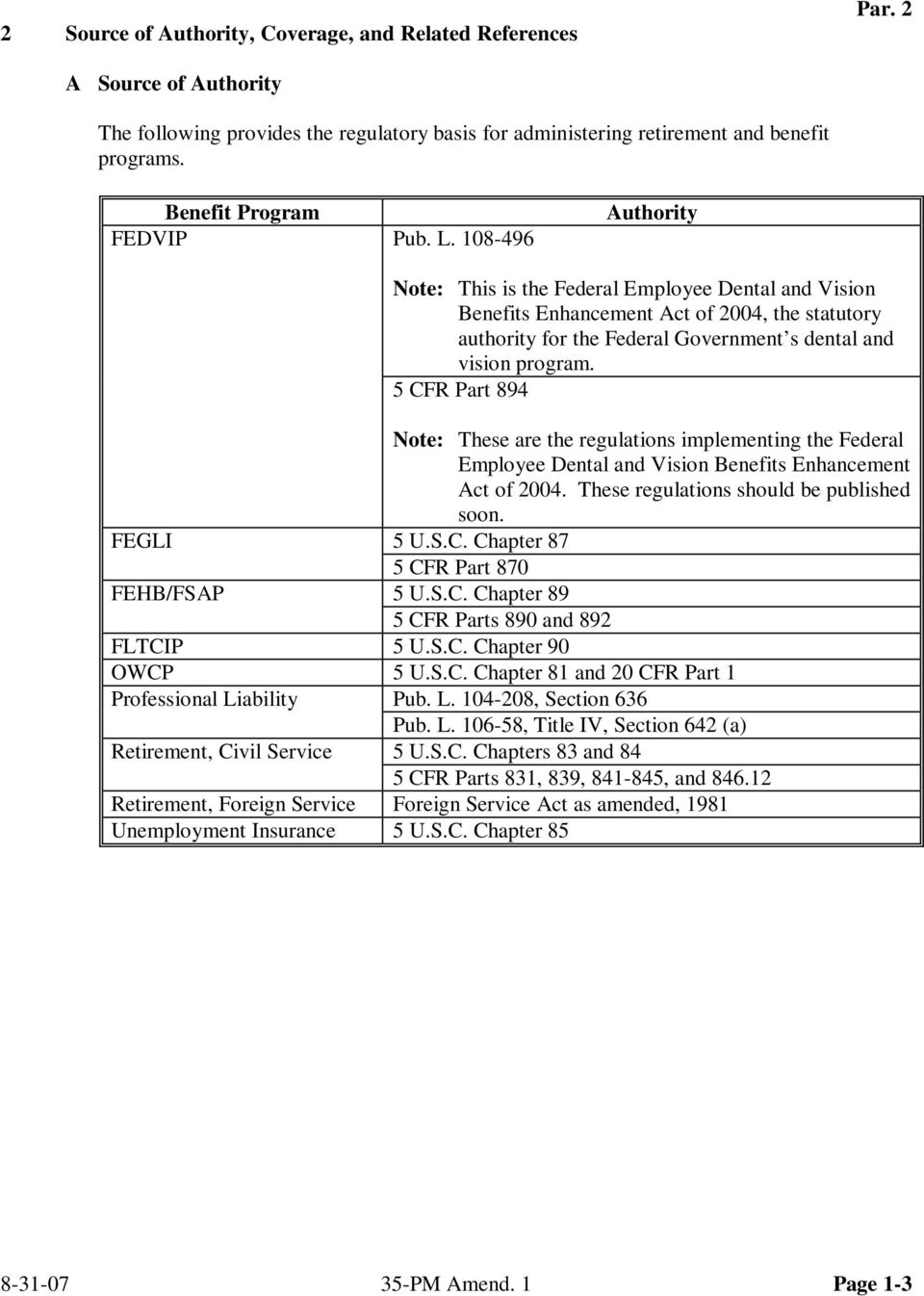
9 2 Source of Authority, Coverage, and Related References Par. 2 A Source of Authority The following provides the regulatory basis for administering retirement and benefit programs. Benefit Program FEDVIP Pub. L Authority Note: This is the Federal Employee Dental and Vision Benefits Enhancement Act of 2004, the statutory authority for the Federal Government s dental and vision program. 5 CFR Part 894 Note: These are the regulations implementing the Federal Employee Dental and Vision Benefits Enhancement Act of These regulations should be published soon. FEGLI 5 U.S.C. Chapter 87 5 CFR Part 870 FEHB/FSAP 5 U.S.C. Chapter 89 5 CFR Parts 890 and 892 FLTCIP 5 U.S.C. Chapter 90 OWCP 5 U.S.C. Chapter 81 and 20 CFR Part 1 Professional Liability Pub. L , Section 636 Pub. L , Title IV, Section 642 (a) Retirement, Civil Service 5 U.S.C. Chapters 83 and 84 5 CFR Parts 831, 839, , and Retirement, Foreign Service Foreign Service Act as amended, 1981 Unemployment Insurance 5 U.S.C. Chapter PM Amend. 1 Page 1-3
10 2 Source of Authority, Coverage, and Related References (Continued) Par. 2 B Related References The following are directly related to this handbook: 27-PM 28-PM Guide to Processing Personnel Actions at NFC Procedures Manual at PM Amend. 1 Page 1-4

11 3 Responsibilities Par. 3 A OPM Responsibilities OPM: has Government-wide responsibility and oversight for benefits administration is responsible for all benefit policies and final benefit determinations. Note: DOL is the authority on unemployment and injury compensation. B EPB Responsibilities EPB shall provide the following to AO s: benefit policy, policy guidance, and/or references that shall be provided to all State and County Office employees benefits processing instructions or references for all benefit programs that shall be provided to all State and County Offices. C State AO Responsibilities State AO s shall: provide benefits guidance to all employees counsel all employees in matters about benefits and retirement assist CED s in providing guidance for newly hired employees for eligible benefits contact EPB for assistance, if necessary. D CED Responsibilities CED s shall: provide overview of benefit programs for eligible employees assist employees in completing enrollment forms in the required timeframes contact State AO for assistance if necessary PM Amend. 1 Page 1-5

12 4 Forms Par. 4 A Reference Electronic versions of the following types of benefit forms may be found at FEGLI OF OPM RI SF. B Other Forms Web Sites The following web sites contain electronic versions of the following types of forms: IRS at SSA at SSA publications at TSP at OWCP can be found at the following web sites: PM Amend. 1 Page 1-6

13 5 BAL s Par. 5 A BENEFITSINFO Online Mailing List 6-10 (Reserved) All AO s and CED s shall subscribe to BENEFITSINFO. BENEFITSINFO provides s, primarily BAL s, to subscribers. While the primary customers for BENEFITSINFO are agency benefits officers, anyone, anywhere can subscribe to BENEFITSINFO. BAL s will be sent to list subscribers automatically. Details on subscribing to the ing list can be found in BAL at PM Amend. 1 Page 1-7

14 .

15 Part 2 Retirement Par Retirement Basics A Vesting and Annuities Employees who have worked for the Federal Government for 5 years and are covered by a retirement system are considered vested and are eligible for retirement benefits. Retirement benefits, known as annuities, are paid on a monthly basis after retirement. Note: To be vested for disability retirement: CSRS, CSRS Offset, FSRDS, and FSRDS Offset employees must work 5 years FERS and FSPS employees must work 18 months. B Service and Age Requirements Employees must work a certain number of years (service requirement) and meet MRA requirements to retire. The types of service and MRA requirements vary by retirement system; however, retirement benefits are fully payable with any of the following: 20 years of creditable service and MRA 50 years (FSPS) 30 years of creditable service and MRA 55 years (CSRS and CSRS Offset) 30 years of creditable service and MRA years (CFERS) 10 years of creditable service and MRA years (up to 57 for employees covered by FERS) (age reduction is applicable) 20 years of creditable service and 60 years of age (CSRS and FSRDS) 5 years of creditable service and 62 years of age (CSRS and FSRDS) PM Amend. 1 Page 2-1

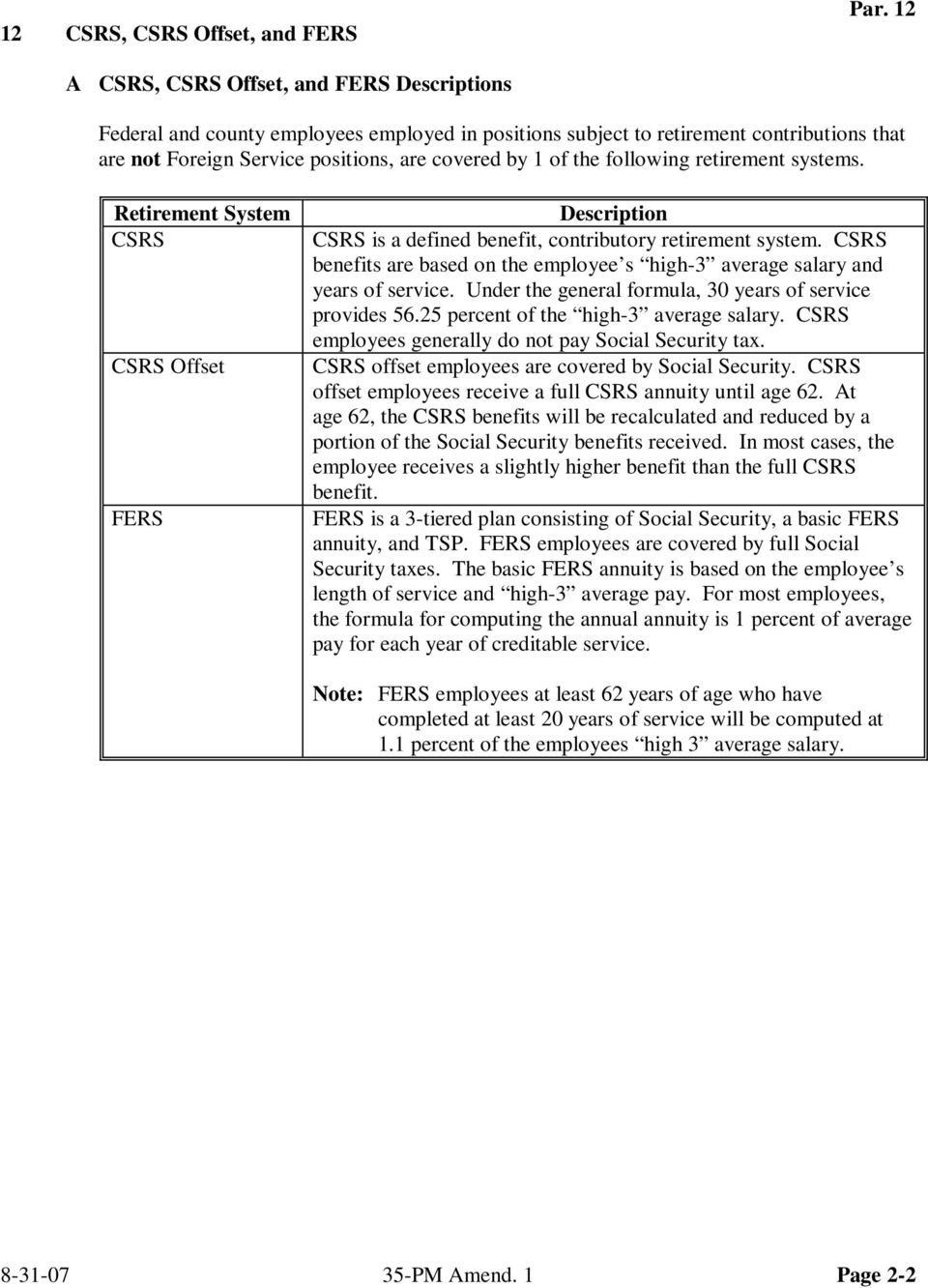
16 12 CSRS, CSRS Offset, and FERS Par. 12 A CSRS, CSRS Offset, and FERS Descriptions Federal and county employees employed in positions subject to retirement contributions that are not Foreign Service positions, are covered by 1 of the following retirement systems. Retirement System CSRS CSRS Offset FERS Description CSRS is a defined benefit, contributory retirement system. CSRS benefits are based on the employee s high-3 average salary and years of service. Under the general formula, 30 years of service provides percent of the high-3 average salary. CSRS employees generally do not pay Social Security tax. CSRS offset employees are covered by Social Security. CSRS offset employees receive a full CSRS annuity until age 62. At age 62, the CSRS benefits will be recalculated and reduced by a portion of the Social Security benefits received. In most cases, the employee receives a slightly higher benefit than the full CSRS benefit. FERS is a 3-tiered plan consisting of Social Security, a basic FERS annuity, and TSP. FERS employees are covered by full Social Security taxes. The basic FERS annuity is based on the employee s length of service and high-3 average pay. For most employees, the formula for computing the annual annuity is 1 percent of average pay for each year of creditable service. Note: FERS employees at least 62 years of age who have completed at least 20 years of service will be computed at 1.1 percent of the employees high 3 average salary PM Amend. 1 Page 2-2
17 12 CSRS, CSRS Offset, and FERS (Continued) Par. 12 B CSRS, CSRS Offset, and FERS Policy This paragraph establishes FSA s official policy and guidance on all CSRS, CSRS Offset, and FERS issues as OPM s CSRS and FERS Handbook for Personnel and Payroll Offices at SPO s shall use OPM s handbook to provide guidance and determine all matters related to the following: administration (unless otherwise noted in this handbook) coverage service credit contributions retirement eligibility computing benefits disability benefits death benefits re-employed annuitants relationship between retirement annuity and compensation for work-related injuries and diseases. C CSRS, CSRS Offset, and FERS Publications Retirement publications: are an easy reference for employees and those providing guidance to employees on benefit programs can be found at Note: State and County Offices shall print publications as needed or maintain a current stock PM Amend. 1 Page 2-3
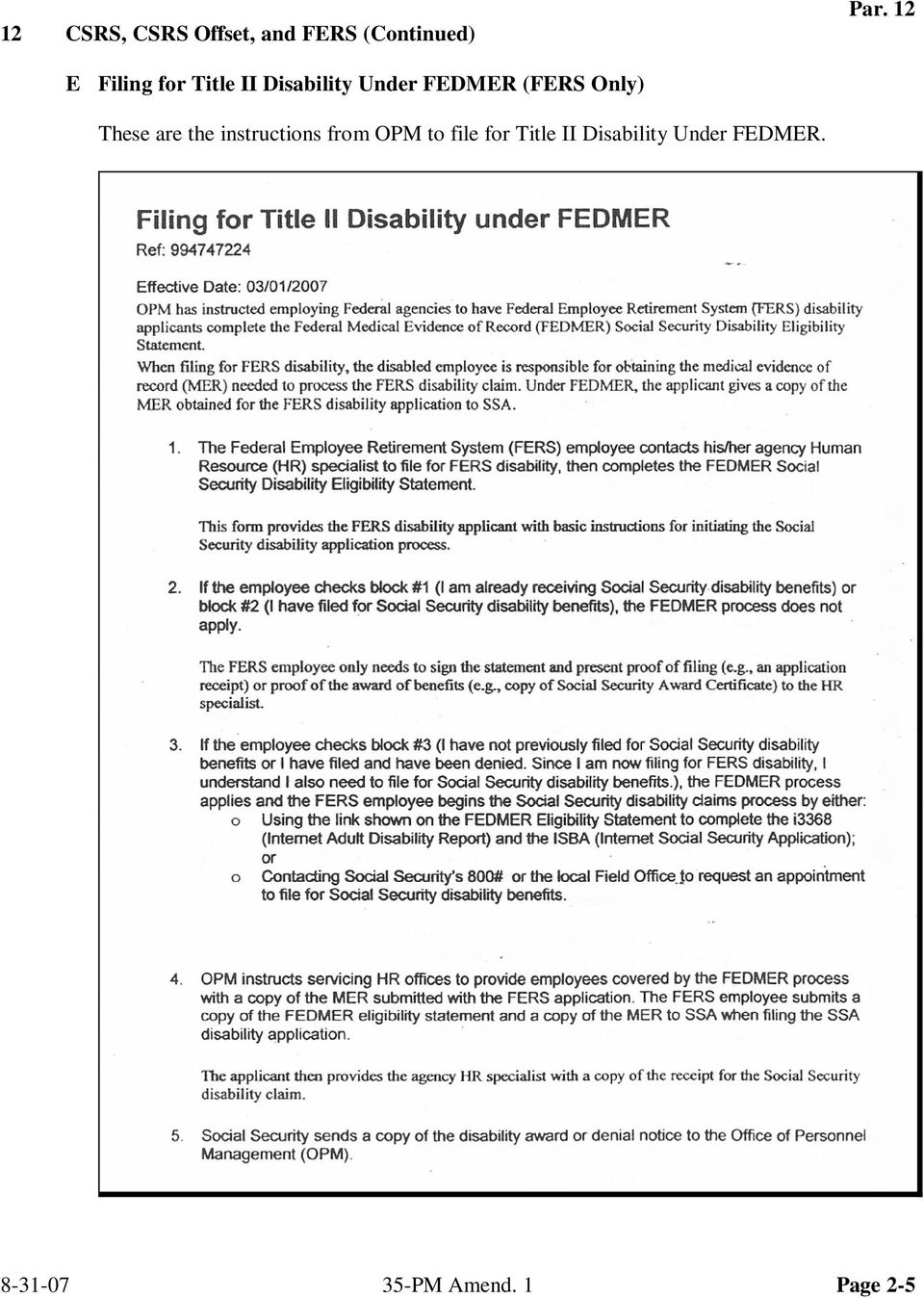
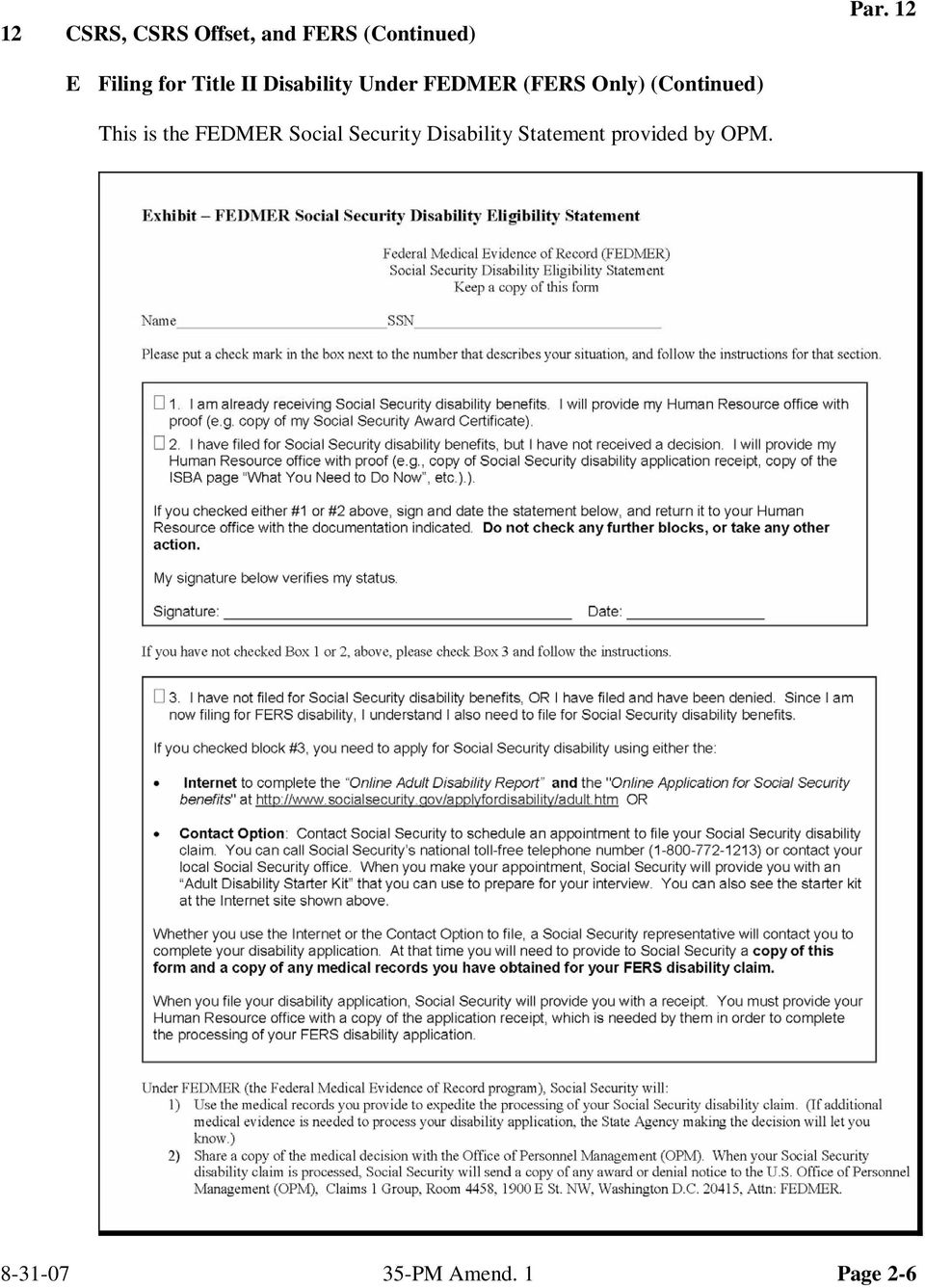
18 12 CSRS, CSRS Offset, and FERS (Continued) Par. 12 D Filing for Disability With FEDMER (FERS Only) OPM instructed agencies to have FERS disability applicants complete FEDMER Social Security Disability Eligibility Statement (see subparagraph E). When filing for FERS disability, disabled employees are responsible for obtaining MER s needed to process the FERS disability claim. Under FEDMER, applicants give a copy of MER s obtained for the FERS disability application to SSA. This table provides the steps for FEDMER. Step Instructions 1 FERS employees contact their SPO to file for FERS disability and then complete the FEDMER Social Security Disability Eligibility Statement (see subparagraph E) that provides FERS disability applicants basic instructions for initiating the SSA disability application process. 2 FERS employees only need to sign the FEDMER Social Security Disability Eligibility Statement and present either of the following to the SPO; proof of: filing, such as an application receipt the award of benefits, such as a copy of Social Security Award Certificate. Note: If employees check blocks 1 or 2, the FEDMER process does not apply. 3 If employees check block 3, the FEDMER process applies and the FERS employee begins the SSA disability claims process by doing either of the following, according to the FEDMER Social Security Disability Eligibility Statement, block 3: using the link shown, complete the Online Adult Disability Report and the Online Application for Social Security benefits contact SSA, to request an appointment to file for disability benefits. 4 OPM instructs SPO s to provide employees covered by the FEDMER process with a copy of the MER submitted with FERS application. FERS disability applicants: submit a copy of the FEDMER Social Security Disability Eligibility Statement and a copy of the MER to SSA when filing the SSA disability application provide SPO a copy of the receipt for SSA disability claim. 5 SSA sends a copy of the disability award or denial notice to OPM PM Amend. 1 Page 2-4

19 12 CSRS, CSRS Offset, and FERS (Continued) Par. 12 E Filing for Title II Disability Under FEDMER (FERS Only) These are the instructions from OPM to file for Title II Disability Under FEDMER PM Amend. 1 Page 2-5
20 12 CSRS, CSRS Offset, and FERS (Continued) Par. 12 E Filing for Title II Disability Under FEDMER (FERS Only) (Continued) This is the FEDMER Social Security Disability Statement provided by OPM PM Amend. 1 Page 2-6
21 13 Foreign Service Retirement Systems Par. 13 A FSRDS, FSRDS Offset, and FSPS Descriptions Foreign Service employees employed in positions subject to retirement contributions are covered by 1 of the following retirement systems. Retirement System FSRDS Description Referred to as the old retirement plan, FSRDS participation is limited to career Foreign Service employees who entered Federal service before January 1, 1984, and have either of the following: been continuously employed by the U.S. Government since December 31, 1983, or before had a break in Federal service of 1 year or less since FSRDS Offset Note: Employees who are enrolled in FSRDS contribute 7.25 percent of their basic pay to FSRDS. Developed during 1984 through 1986 when Congress was devising a plan to put new Foreign Service employees under SSA coverage. Participants in FSRDS Offset are covered by both FSRDS and Social Security. Participation in FSRDS Offset is limited to career Foreign Service employees who had at least 5 years of creditable civilian Federal service before January 1, 1987, and rejoined Federal service since January 1, 1984, after a break of CSRS/FSRDS coverage of more than 1 year. Assistant Secretaries and higher, that did not elect FSPS, who are career Foreign Service employees and had at least 5 years of creditable civilian Federal service before January 1, 1987, and rejoined Federal service since January 1, 1984, after a break of CSRS/FSRDS coverage of more than 1 year are in FSRDS Offset. Notes: Employees who are enrolled in FSRDS Offset contribute 1.05 percent of basic pay up to $90,000 (in 2005) to FSRDS and 6.2 percent of basic pay to Social Security. On all annual income in excess of $90,000, employees contribute 7.25 percent of basic pay to FSRDS. Unless otherwise noted, all references that address FSRDS also apply to FSRDS Offset PM Amend. 1 Page 2-7
22 13 Foreign Service Retirement Systems (Continued) Par. 13 A FSRDS, FSRDS Offset, and FSPS Descriptions (Continued) Retirement System FSPS Description FSPS "new" retirement plan for career Foreign Service employees; all employees covered by FSPS are also covered by Social Security. All Foreign Service employees: hired since January 1, 1984, are covered by FSPS rehired after January 1, 1984, that had less than 5 years of prior civilian service as of December 31, 1986, are covered by FSPS. Employees that receive new appointments can often elect FSPS coverage voluntarily during the first 6 months of the appointment. Employees covered by FSPS pay 1.35 percent of basic pay up to $97,500 (in 2007) to FSPS and 6.2 percent to Social Security. When employee basic pay reaches $90,000, Social Security deductions (except Medicare) end and the employee pays only 1.35 percent of basic pay above that level to FSPS. Employees covered by FSPS are eligible for government contributions to a TSP account. B Online Assistance Foreign Service employees can find information on the following topics at retirement coverage credit for Service age and service requirements for retirement eligibility computation of retirement annuity alternate form of annuity survivor benefits benefits taxation reemployment summary of benefits payable to a former spouse cost-of-living adjustments after retirement. C Applying for Foreign Service Retirement Employees eligible to retire under Foreign Service retirement systems shall contact EPB, Benefits Officer at , for a retirement package. Retirement packages must be received in EPB 90 calendar days before the retirement date PM Amend. 1 Page 2-8
23 14 FRB-WEB Par. 14 A Overview FRB-WEB provides: a calculator that can accessed by employees or SPO s to: compute SCD s provide estimates of current and future retirement benefits for all employees compute deposits and redeposits for prior civilian and military service links to retirement and/or benefit-related forms that are partially pre-filled and can be completed online by employees or SPO s. FRB-WEB is accessed by logging into a dashboard. The web site address for the dashboard is B User ID and Password for FRB-WEB A user ID and password are necessary to access FRB-WEB. State and County Office employees shall request user ID s and passwords from their State s System Administrator, usually the AO or a State Office administrative employee. Note: AO s can request additional authorized users in SPO by contacting Darla Hensley at either of the following: at [email protected] telephone at Requests should include user s name, State Office name, and personnel office identifier numbers to which the user will need access PM Amend. 1 Page 2-9
24 14 FRB-WEB (Continued) Par. 14 C Accessing FRB-WEB Calculator To access FRB-WEB Calculator: log onto FRB-WEB through the USDA dashboard at CLICK Calculate Retirement button on the left menu Note: The Welcome Screen will be displayed that provides links to FRB Introduction and valuable resources, including a User Guide and related retirement web sites. It is highly recommended that users: read FRB Introduction download and study the User Guide. These are helpful tools toward understanding how the retirement calculator works. on the Welcome Screen, CLICK OK and the Specialist Home Page will be displayed. Note: This is where users will choose the employee on which they want to work. D System Administrators System Administrators have authority to assign and reset passwords for employee access to the dashboard for their State s employees. Upon request from employees, System Administrators will create initial passwords that will allow employee access to FRB-WEB. Employees will be required to change the initial password the first time they log onto the dashboard. Each SPO must identify at least 1 System Administrator per State. Note: It is highly recommended that each SPO have an alternate System Administrator PM Amend. 1 Page 2-10
25 14 FRB-WEB (Continued) Par. 14 E SPO Responsibilities SPO s shall: enter the entire service history for each Federal and County Office employee in their State into FRB-WEB (see subparagraph F) enter service history for new hires into FRB-WEB within 30 calendars days of start date verify SCD s Note: If FRB SCD does not agree with the employee s current SCD, determine why and take corrective action. The service history may have been entered incorrectly or the current SCD was previously computed incorrectly. act as administrator for their State and assign passwords and ID s as necessary determine the member or members of their staff to be assigned System Administrator responsibilities PM Amend. 1 Page 2-11
26 14 FRB-WEB (Continued) Par. 14 F Entering Service History FRB software: has retirement rules built in that are used to correctly determine creditable service for retirement purposes applies the retirement rules to show: reductions in service credit reductions in annuity payable for the applicable period type of service entered. Correctly entering service histories provides data for: employees to compare retirement benefits to choose whether or not to pay any deposit or redeposit applicable to employment accurate computations for SCD s for leave reductions-in-force retirements TSP purposes. The service history of each employee can be found in their OPF. SF-50 s or FSA-282 s should be used to obtain dates, types of employment, and work schedules. If intermittent employment is involved, using annual pay status records may be required to document days or hours worked. See the User Guide for details needed to enter service history. Note: See Service Credit Chapters at CSRS and FERS Handbook for Personnel and Payroll Offices and CLICK Service Credit Chapters PM Amend. 1 Page 2-12
27 14 FRB-WEB (Continued) Par. 14 F Entering Service History (Continued) The following provides information to be used when entering an employee s service history into the FRB-WEB calculator. Calculator Fields Type of Service Description/Instruction The service history to be entered includes all types of service that has been determined to be creditable for leave and retirement purposes. Users should enter the start and end dates for each period of service that includes, but is not limited to, the following types of service: active duty military service FSA county employment all Federal government employment Peace Corps volunteer service certain National Guard and Reservist Service certain DC government service. The type of service that should be selected from the drop down menu in the program should reflect the retirement coverage for the period of service being entered. Retirement coverage can be found on SF-50 or FSA-282 and should be 1 of the following: FICA (most temporary appointments) CSRS (most permanent employees before January 1, 1984) CSRS Offset (most permanent employees hired between January 1, 1984, and December 31, 1986, and re-employed CSRS employees) FERS (new hires after January 1, 1984) LWOP (should be selected for periods of leave without pay during the employment) PM Amend. 1 Page 2-13
28 14 FRB-WEB (Continued) Par. 14 F Entering Service History (Continued) Calculator Fields Employee Type Work Schedule Amount/Units Deposit/Redeposit Is Owed Compute Description/Instruction In most instances, employee type will be Regular for FSA employees. Other employee types may rarely be selected when entering Peace Corps volunteer service or military service of a retired military employee. The work schedule of the employee during the period of employment must be entered. This field is especially important if the employee worked an intermittent work schedule or has part-time service after April 7, This field is used to: adjust SCD for intermittent time worked compute correct deposit or redeposit owed for the service prorate the annuity for part-time work schedule. Used when an intermittent or part-time work schedule has been selected from the Work Schedule field. Whenever an employee works an intermittent or part-time work schedule, the days or hours worked must be recorded in this field. The amount represents the number of days or hours worked and the unit represents the way the days or hours were counted, such as total days, total hours, days per week, or hours per week. Check this field whenever an employee has service for which a deposit or redeposit has not been paid to OPM for service in which: no retirement deductions were withheld CSRS retirement deductions were taken and later refunded post-56 military time, if deposit is not paid. Used to compute the amount of the deposit/redeposit or military deposit owed, if the Deposit/Redeposit Is Owed field is checked. See subparagraph H. Military earnings, annual salary, or hourly salary must be entered to compute the amount of deposit or redeposit PM Amend. 1 Page 2-14
29 14 FRB-WEB (Continued) Par. 14 G Contact Information The following table provides contacts for issues related to the FRB-WEB calculator: IF issue is... dashboard access SPO questions user help THEN... State Office System Administrators should contact EPB s Benefits Officer for dashboard access. State and County Office employees should contact their State Office Administrator for an FRB-WEB user ID and password. SPO shall contact ESI support staff by either of the following: at [email protected] telephone at contact either of the following: ESI support staff by either of the following: at [email protected] telephone at FSA, EPB, Benefits Officer at PM Amend. 1 Page 2-15
30 15 Retirement Coverage Errors Par. 15 A Retirement Coverage Errors of Less than 3 Years If a State or County Office discovers a retirement coverage error that lasted less than 3 years, the State Office shall process corrections according to BAL B Retirement Coverage Errors Greater Than 3 Years If a State or County Office discovers a retirement coverage error that lasted longer than 3 years, the State office shall: make of a copy of the employee s OPF forward the employee s OPF to EPB at: USDA/HRD/EPB/Benefits Officers 1400 Independence Avenue SW STOP 0595 Washington DC await correction instructions from EPB Benefits Officer. An employee with a retirement coverage error that lasted longer than 3 years is covered under FERCCA. More information about FERCCA may be found on OPM s web site at PM Amend. 1 Page 2-16
31 16 Death Cases Par. 16 A Reference For information on death-in-service cases, State and County Offices shall use OPM s CSRS and FERS Handbook for Personnel and Payroll Offices, Chapters 70 through 75. B Notifying OPM of a Death-in-Service State and County Offices shall report the death-in-service of an employee, who has a widow or widower who may be eligible for recurring monthly payments under CSRS or FERS, to OPM through either of the following methods: C Reporting Death-in-Service of an Employee With FEGLI Coverage State and County Offices shall report the death of an employee covered by the FEGLI Program at D Establishing and Processing a Death Case Immediately upon learning the official date of death, State and County Offices shall establish a death case in SPPS. Establishing the death case will forward all unpaid salaries and bills to a separate account for the deceased employee. Note: This does not report deaths to FEGLI, but provides forms, etc. needed to process. Upon receiving the completed paperwork from the beneficiaries, State and County Offices shall process the death case according to SPPS, Title 1, Chapter 11, page 25. E Processing Personnel Actions (Reserved) SPO s shall process personnel action, Nature of Action, 350 in Empower PM Amend. 1 Page 2-17
32 .
33 Part 3 FEHB Program Par Overview A Background The FEHB Program: became effective in 1960 is the largest employer-sponsored group health insurance program in the world covers over 9 million Federal employees, retirees, former employees, family members, and former spouses. Federal and county employees are entitled to enroll themselves and any eligible family members, in a health plan offered under the FEHB Program, unless their position is excluded from coverage by law or regulation. If employees meet the requirements, they will be eligible to continue group coverage into retirement. B Reference This Part establishes FSA s official policy and guidance on all FEHB issues as OPM s Federal Employee s Health Benefits Program: A Handbook for Enrollees and Employing Offices that: provides the policies and procedures of the FEHB Program is online at Employees shall use OPM s handbook to determine all matters related to the following: annuitants and compensationers cost of insurance eligibility for health benefits enrollment family members former spouses forms and brochures health plans LWOP and insufficient pay military service table of permissible changes termination, conversion, and temporary continuation of coverage PM Amend. 1 Page 3-1
34 62 FEHB Premium Conversion Par. 62 A Overview Federal employees can use pre-tax dollars to pay health insurance premiums to FEHB Program under FEHB-PC. FEHB-PC: went into effect in October 2000 under Internal Revenue Code, Section 124 uses Federal tax rules to allow employees to deduct their share of health insurance premiums from their taxable income, thereby reducing their taxes information can be found at and BAL at B FEHB-PC Benefits Employees who choose to participate in FEHB-PC have chosen to have their gross salary reduced by the amount of his/her share of their health insurance premium. That reduction is applied by their agency toward their FEHB premiums. Since employees do not receive the amount of the amount of his/her share of their health insurance premium, it will not be considered gross income for tax purposes, so employment taxes are reduced and the employees take home more of their pay. Note: Health insurance premiums that are paid under temporary continuation of coverage are not eligible for FEHB-PC. FEHB-PC occurs on a pre-tax basis; therefore, the money is not subject to Federal, State, or local taxes. Health insurance premiums are not affected; however, paying health insurance premiums pre-tax will make FEHB coverage more affordable. The Government will still pay the Government share of health insurance premiums PM Amend. 1 Page 3-2
35 62 FEHB Premium Conversion (Continued) Par. 62 C Eligibility All Federal and county employees who participate in the FEHB Program are eligible to participate in FEHB-PC. Notes: Employees assigned to international organizations may participate, if the organization agrees to adopt FEHB-PC. Retirees are not eligible to participate in FEHB-PC. D FEHB-PC Participation Employees who have FEHB premiums deducted from their pay will be deemed to have elected FEHB-PC, unless they waive participation. To waive participation in FEHB-PC, employees should complete the Federal Employees Health Benefits Program (FEHB) Premium Conversion Waiver/Election Form at (see subparagraph E) PM Amend. 1 Page 3-3
36 62 FEHB Premium Conversion (Continued) Par. 62 E FEHB-PC Waiver The following shall be used to waive participation in FEHB-PC. This document is available electronically at PM Amend. 1 Page 3-4
37 62 FEHB Premium Conversion (Continued) Par. 62 E FEHB-PC Waiver (Continued) PM Amend. 1 Page 3-5
38 62 FEHB-PC (Continued) Par. 62 F Frequently Asked Questions Go to OPM s web site at for more information on FEHB-PC. G Subsequent Opportunities to Participate or Waive Participation Employees may enroll or waive participation in FEHB-PC: during the annual FEHB open season upon experiencing a QLE such as: birth or adoption of a child death of a dependent divorce marriage or loss of spouse return from unpaid leave of absence significant change in employees or employee spouse s heath coverage. Employees shall submit Federal Employees Health Benefits Program (FEHB) Premium Conversion Waiver/Election Form at to make open season elections/waivers to the submitting office outlined in the annual Federal Employees Health Benefits Open Season Notice PM Amend. 1 Page 3-6
39 63 Child Equity Law Par. 63 A Overview Pub. L requires mandatory self and family coverage for FEHB-eligible employees who do not comply with a court or administrative order to provide health benefits for their children. An employee subject to a court or administrative order must enroll in self and family coverage in a plan that provides full benefits to his/her children in the area where they live or provide documentation that he/she has other health coverage for the children. If the employee does not enroll in an appropriate health plan or provide documentation of other coverage for the children, the agency must enroll the employee for self and family coverage in the Blue Cross and Blue Shield Service Benefit Plan, standard option, enrollment code 105. B Court or Administrative Order Submission The court or administrative order can be submitted by any of the following: custodial parent attorney for the custodial parent State administrative agency. C Court Orders If the court order deals: only with health benefits, it does not have to be certified with life insurance or retirement benefits, it does have to be certified. D Administrative Orders Administrative orders come from State child support agencies. They will not be certified PM Amend. 1 Page 3-7
40 63 Child Equity Law (Continued) Par. 63 E SPO Responsibilities SPO s must review the employee s records to determine whether he/she is eligible for FEHB and, if so, whether he/she is enrolled in a self and family plan that provides full benefits in the location where the children live. If the employee has full coverage, notify whoever sent the court or administrative order. To notify the carrier of the additional family members being covered under the self and family enrollment, send to the carrier, a copy of the: enrollee s SF-2809 court or administrative order. Place the court or administrative order in a blue privacy folder and file in the employee s OPF so SPO will know OPF contains a court or administrative order about health benefits. For more information on the Child Equity Law and processing instructions and procedures, SPO s shall go to both of the following: BAL at BAL at F Receipt of Court or Administrative Orders SPO s must receive the court or administrative order on or after October 30, 2000, for court or administrative orders to be affected by the Child Equity Law. Court or administrative orders submitted before the enactment of Pub. L are not valid PM Amend. 1 Page 3-8
41 64 HSA s Par. 64 A Overview HSA s are tax-sheltered trust accounts that employees own, to pay qualified medical expenses for themselves, their spouse, and their dependents. Employees enroll in high deductible health plans and the health plans determine whether employees are eligible for HSA s or health reimbursement arrangements, based on the information provided. B HSA Features HSA s features include: administration by a trustee/custodian employee owned HSA that is theirs to keep even if they change plans or retire tax-free interest tax-free withdrawals for qualified medical expenses unused funds and interest that are carried over, without limit, from year to year voluntary contributions that are tax-deductible. C HSA Benefits HSA plans may save the employee money through lower premiums, tax savings, and money deposited in their account that can be used to pay the deductible and other out-of-pocket medical expenses in current or future years. D Information on HSA s For more information on HSA s, go to PM Amend. 1 Page 3-9
42 65 FSAP Par. 65 A Overview FSAP s are tax-favored programs that allow employees to set aside pre-tax money from their paychecks to pay for a variety of eligible expenses. Eligible employees may choose to make a voluntary allotment from their salary to FSAP s. Employees: do not pay employment taxes on FSAP allotments shall communicate and enroll directly with the FSAP administrator; SHPS, Inc. FSAP contributions must come from an employee s salary through allotments. Employees who elect to participate may set-aside an annual amount of their salary to be contributed to FSAP. The total amount elected by the employee will then be prorated over the number of pay dates the employee has remaining in the benefit year. Because of the tax advantages of FSAP, IRS has strict guidelines for their use. One of these guidelines is commonly known as the use or lose rule. According to this rule, if an employee has not incurred enough eligible expenses during the benefit year to equal the annual amount contributed to FSAP, the employee loses the balance remaining in the accounts when the benefit year ends. Employees who are unfamiliar with FSAP s benefits and risks are strongly urged to consult with their accountant, tax advisor, or tax preparer before electing FSAP or benefit amount. FSAP contributions do not count toward the IRS yearly maximum non-taxable contribution limit. OPM s FSAP web site: is provides overall program information. Employees can enroll and file claims with SHPS Inc. by either of the following: online at telephone at 877-FSAFEDS ( ) PM Amend. 1 Page 3-10
43 65 FSAP (Continued) Par. 65 B Enrollment Unlike FEHB or FEHB-PC, participation in FSAP is not automatic. Employees must make a voluntary election on an annual basis. If an employee does not make an election during the open enrollment, they will not have FSAP in the new benefit year. Employees will need to make 2 decisions: whether they want to have coverage in 1 or both of the FSAP accounts the annual amount of their FSAP. C Eligibility Any employee eligible for FEHB is eligible to enroll in the FSAP. Employees do not need to be enrolled in FEHB to participate. D Two FSAP Accounts There are 2 FSAP accounts available to eligible employees that allow employees to pay either medical or dependent care expenses using pre-tax dollars. They are: HCFSA DCFSA. Eligible employees may choose to participate in either or both. There are no government contributions to FSAP s. Employees are encouraged to review OPM s Frequently Asked Questions on FSAP at E Open Season FSAP open season coincides with the annual FEHB open season. During the open season, eligible employees may: enroll in 1 or both accounts elect or change the annual amount of FSAP accounts. FSAP s open season is the only time Federal and county employees may enroll in FSAP, outside of a qualified status change PM Amend. 1 Page 3-11
44 65 FSAP (Continued) Par. 65 F Belated Enrollments If an employee is unable to enroll during the open season for reasons beyond his or her control, he or she may enroll within 30 calendar days after open season using the Belated Enrollment Form at Belated enrollments are effective the day after SHPS, Inc., receives the employee s Belated Enrollment Form. G LWOP Employees on LWOP have 2 options: prepay allotments (accelerate deductions so that pay period deductions are larger) freeze flexible spending account (no reimbursements until the end of benefit year or return to pay status). H Benefit Year The benefit year is the period in which eligible expenses must be incurred and reimbursed. Note: Expenses are incurred on date of service, not when the expense is paid PM Amend. 1 Page 3-12
45 65 FSAP (Continued) Par. 65 I Subsequent Opportunities to Enroll After FSAP open season, employees may enroll 31 calendar days before or within 60 calendar days after a qualified status change/qle. These include change in: dependent s eligibility (that is child at 13 not eligible for DCFSA coverage) employment or residence status that affects eligibility for FEHB coverage marital status to include legal separation number of dependents (that is birth or adoption of a child). Note: LWOP is a QLE only if because of military deployment. Annuitants are not eligible to participate in FSAP. Re-employed annuitants are eligible to participate in FSAP. New or newly eligible employees may elect to enroll within 60 calendar days of their appointment. If the new employee s appointment is on or after October 1, he or she must wait until an open season to enroll in FSAP. J Program/Account Costs Administrative costs for the program are paid by the employee s agency. K FSAP Administrator Employees will enroll directly with the FSAP administrator, SHPS, Inc., to participate HCFSA and/or DCFSA directly, by either of the following: online at telephone at 877-FSAFEDS ( ). The enrollment will not be processed or approved by the employee s SPO PM Amend. 1 Page 3-13
46 65 FSAP (Continued) Par. 65 L FSAP Enrollment Termination FSAP enrollment is terminated when the: plan terminates employee ceases to be eligible date the employee s election or deemed election to receive benefits under the plan terminates employee has a qualifying change in status ; see subparagraph 65 I employee separates or retires. Note: Termination in FSAP does not terminate an employee s enrollment in FEHB. M SPO s Role SPO s are a resource for directing employees where to go to get information and answer questions on FSAP. SPO s shall refer employees with questions to SHPS, Inc., by either of the following: online at telephone at 877-FSAFEDS ( ). For specific questions not yet addressed on the web site, SHPS, Inc. may be contacted at [email protected] PM Amend. 1 Page 3-14
47 65 FSAP (Continued) Par. 65 M SPO s Role (Continued) SPO s are not expected to become FSAP experts or to converse knowledgeably with employees about FSAP rules and requirements. Notes: FSAFEDS develops a new brochure for the FSAP program each year. SPO s may obtain copies of these brochures by requesting them from SPO s should see NFC Bulletin, Title 1, 03-4, Flexible Spending Accounts Program for information about FSAP and NFC. Employees who choose to enroll in 1 or both accounts will see the following on their AD-334 once deductions begin: TC 93, Suffix 10, Flexfund DCA for DCFSA TC 93, Suffix 11, Flexfund HCA for HCFSA. N Annual W-2 Statement The total amount deducted for DCFSA and Child Care Tuition Assistance Program will be reflected on W-2, Box 10. Any amount over IRS s limit will be included in W-2, Boxes 1, 3, and 5. HCFSA and pre-tax FEHB deductions under FEHB-PC will be reported in W-2, Box PM Amend. 1 Page 3-15
48 66 FEHB Premium Payments for Reservists Called to Active Duty Par. 66 A Overview FSA, according to Departmental guidance, will participate in the waiver of FEHB premiums of eligible employees. Premiums will be waived up to 24 months while in LWOP status, the maximum amount currently permitted by law. To assist Reserve component members in maintaining affordable healthcare option, OPM and DOD established a policy that encouraged Federal agencies to pay the total FEHB premium for any covered employee who is called to active duty in support of a contingency operation. B Definition of Active Duty for FEHB Waiver Benefit Active duty for FEHB waiver benefit is defined as any Reservist called to active duty under a contingency operation order in support of Operation Enduring Freedom. This includes National Guardsmen called to active duty under U.S.C. Title 10 and Title 32. Note: This definition shall be used for FEHB only. The definition of active duty for service credit and all other benefits remains unchanged PM Amend. 1 Page 3-16
49 66 FEHB Premium Payments for Reservists Called to Active Duty (Continued) Par. 66 C Eligibility The following criteria must be met to be eligible for the waiver program: State and County Office employees enrolled in FEHB, who retain coverage while performing active military duty, elect to incur a debt must be a member of 1 of the following Reserve components of the U.S. Armed Forces: Air Force Air National Guard Army Army National Guard Coast Guard Marine Corps Navy must have been ordered to active duty, voluntarily or involuntarily, for more than 30 calendar days in support of a contingency operation Note: Active duty by the National Guard may be under U.S.C. Title 10 or Title 32. must have been placed on LWOP to perform active duty. D Ineligible Employees Employees who resign to enter active duty are not eligible for this program PM Amend. 1 Page 3-17
50 66 FEHB Premium Payments for Reservists Called to Active Duty (Continued) Par. 66 E Employee Responsibilities Employees must: provide SPO a copy of written orders as proof of qualifying service to active duty in support of a contingency operation Note: Employee must provide name of Commanding Officer to SPO, if needed. provide SPO an SF-52 requesting LWOP for active military duty elect to retain FEHB while serving on active duty by incurring a debt ensure that SPO receives any changes or extensions of military orders notify SPO immediately upon return to civilian service by submitting a return-to-duty SF-52 and discharge papers provide SPO an FEHB premium bill immediately upon receipt. Note: A bill may be generated for premiums upon return-to-pay status. SPO will waive the bill for up to 24 months of active military duty. F State Office Responsibilities The State Office shall: determine whether employees are eligible as outlined in subparagraphs B and C Note: State Offices must contact Commanding Officer, if questions about the orders are in support of Operation Enduring Freedom. give eligible employees the opportunity to elect to retain FEHB and incur a debt process LWOP and return-to-duty actions PM Amend. 1 Page 3-18
51 66 FEHB Premium Payments for Reservists Called to Active Duty (Continued) Par. 66 G Reimbursement for Prior Active Duty Employees who meet the criteria in subparagraph C may be entitled to a refund if they have served active duty in Operation Enduring Freedom. If employees meet criteria in subparagraph C and paid FEHB premiums either during active duty or upon returning, contact SPO for entitlement and refund application procedures. H Beginning of 24-Month LWOP Period The 24-month period begins with the effective date of the order. Whether the employee is: reporting to training using paid leave placed on LWOP to perform active military duty. Note: Using paid leave, either before LWOP or intermittently throughout, does not extend the 24-month period of eligibility for the waiver program. I FEHB Coverage after 24 Months At the end of 24 months, FEHB coverage terminates. Employees get a 31 calendar day extension of coverage during which they can convert to a non-group policy. Employees are not eligible for a temporary continuation of coverage. J 4-Month Rule The 4-month rule does not apply to this program. Employees do not have to be in a 4-month pay status to begin a new 24-month period. Example: An eligible employee may serve on active duty for 19 months, exercise restoration rights, return to civilian duty for 2 weeks, later return to active duty, and continue FEHB for an additional 24 months. K Employee Death While on Active Duty The employee s share of FEHB premiums will be paid through the date of death PM Amend. 1 Page 3-19
52 67 Medicare Par. 67 A Overview Medicare: is a health insurance program for any of the following: individuals age 65 or older certain individuals with disabilities who are under 65 individuals of any age who have permanent kidney failure provides basic protection against the cost of health care, but it does not cover: all medical expenses the cost of most long term care. B Reference This Part establishes FSA s official policy and guidance on all Medicare issues as OPM s Federal Employees Health Benefit Program and Medicare at PM Amend. 1 Page 3-20
53 67 Medicare (Continued) Par. 67 C Further Contacts (Reserved) CMS administers the Medicare program. SSA helps employees enroll in the Medicare program and provides general information. Employees can send their inquiries for consideration to: The Centers for Medicare and Medicaid Services 7500 Security Blvd Baltimore MD Information about CMS is available online at either of the following: For more information, employees can go to any of the following: their local SSA office SSA s web site at Medicare s web site at Employees can call 800-MEDICARE ( ) to speak to a Medicare customer service representative PM Amend. 1 Page 3-21
54 .
55 Part 4 FEGLI Program Par FEGLI A Overview FEGLI provides low cost basic group insurance, standard optional insurance, additional optional insurance, family insurance, and accidental death and dismemberment insurance for eligible Federal and county employees. B Reference (Reserved) This part establishes FSA s official policy and guidance on all FEHB issues at OPM s Federal Employee s Group Life Insurance Program: A Handbook for Employees, Annuitants, Compensationers, and Employing Offices at Employees shall use OPM s handbook to determine all matters related to: annuitants and compensationers assignment claims cost of insurance coverage eligibility living benefits order of precedence and designation of beneficiary records and forms SF-50 equivalents of insurance code table of basic insurance amounts termination and conversion types and amount of insurance PM Amend. 1 Page 4-1
56 .
57 Part 5 FLTCIP Par Overview A FLTCIP Summary In December 2001, OPM contracted with John Hancock and MetLife to provide Long Term Care Insurance. John Hancock and MetLife formed the Long Term Care Partners to administer FLTCIP. FLTCIP provides long term care insurance to help pay for costs of care when employees need help with activities they perform every day, or when they have a severe cognitive impairment, such as Alzheimer s. Over 20 million Federal family members can apply for the insurance offered in LTCIP, which includes Federal and Postal employees and annuitants, active and retired members of the uniformed services, and qualified relatives. FLTCIP provides reimbursement for care costs when unable to perform at least 2 daily living activities for an expected period of at least 90 calendar days or when constant supervision is needed because of a severe cognitive impairment. FLTIP will provide reimbursement based on the benefit options and amounts approved. B FLTCIP Web Sites The following are useful web sites about FLTCIP. An overview of the Federal program at Applications for FLTCIP at Frequently asked questions at Guidance for agency human resources professionals at Premium calculator to find out how much this insurance costs at Who is eligible to apply for this insurance? at PM Amend. 1 Page 5-1
58 101 Overview (Continued) Par. 101 C Advice and Guidance about FLTCIP State and County Offices shall: not advise employees on FLTCIP advantages/disadvantages advise employees on their opportunities and eligibility to enroll only. OPM s web site for FLTCIP is D New Employees New employees or newly eligible employees shall be: given MetLife publication FED00123 at be advised that they have 60 calendar days to enroll from their eligibility date. Employees shall direct all questions and application forms to Long Term Care Partners according to paragraph PM Amend. 1 Page 5-2
59 102 Long Term Care Partners Par. 102 A Program Administrators In December 2001, OPM contracted with John Hancock and MetLife to provide Long Term Care Insurance. John Hancock and MetLife formed the Long Term Care Partners to administer FLTCIP. B Guidance, Advice, and Application Procedures Long Term Care Partners: shall provide employees with advice and guidance about FLTCIP web site is Employees shall go to to: direct all questions about FLTCIP to Long Term Care Partners request FLTCIP application packages apply for FLTCIP (Reserved) PM Amend. 1 Page 5-3
60 .
61 Part 6 Unemployment Compensation Program Par Overview A Unemployment Compensation Unemployment compensation program is designed to provide partial wage replacement income to individuals who are unemployed through no fault of their own and seeking further employment. This concept has been expanded to include persons who voluntarily quit, have been discharged for cause, or no longer desire to be employed. One hundred percent of the cost of unemployment benefits is charged back to the employees State by DOL. B TALX UC express (Formerly Frick Company) USDA has contracted with TALX UC express to manage and administer USDA s unemployment compensation program. TALX UC express s system is continuously updated with FSA s separation and payroll data from NFC. This information allows TALX UC express to respond immediately to unemployment claims. C Contacting TALX UC express Contact TALX UC express at the following: TALX UC express WOODFIELD LN SAINT LOUIS MO telephone at , extension 2267 FAX at PM Amend. 1 Page 6-1
62 112 Unemployment Compensation Claims Par. 112 A How to Report a Separation All Federal and county employee separations must be reported to TALX UC express. AO s and CED s shall report separations according to the following. Step Action 1 Go to UC express web site at 2 In the Client Login/webManager box, type username and password and CLICK Go. Note: If user does not have a username and password, in the upper-right corner of the Client Login/webManager box, CLICK help. On the webmanager Help Screen, CLICK New User?, fill in the following, and CLICK Submit : name company (use agency name) State (use drop-down box) country (use drop-down box) phone service of interest (use drop-down box, as applicable). A TALX representative will contact user with password information. The password can be changed; however, the username is unique to the site. 3 Input data as requested, making sure that the separation is committed at the end. If not, a confirmation will not be received and the separation will not be posted to the system. The following information will be needed: SSN State in which employee worked first day worked last day worked reason for separation. 5 Once completed, a confirmation will be received through within 1 hour. 6 If additional details are required, FAX to TALX UC express according to subparagraph 111 C PM Amend. 1 Page 6-2
63 112 Unemployment Compensation Claims (Continued) Par. 112 B Contested Claims If a claim is contested, TALX UC express will contact AO for detailed information about the contested termination. This information shall be given to TALX UC express at the time of the telephone call. All documentation that supports the termination shall also be forwarded to TALX UC express immediately. DOL has determined that the Privacy Act of 1974 does not pertain to disclosure of wage and separation information for the purpose of adjudication unemployment claims PM Amend. 1 Page 6-3
64 Par Unemployment Compensation Forms Received From State Unemployment Offices A Background State Unemployment Offices should send most of the documents about a claim directly to TALX UC express. However, some States will forward the documents to the work location. B FSA State Office Action State Offices shall call and/or FAX any received unemployment related correspondence or documents to TALX UC express immediately. Following are examples of unemployment related correspondence or documents: ES-931 ES-931A Notice of Determination (form names and numbers vary by State) Notice of Hearings (form names and numbers vary by State). Note: Unemployment related documents have strict time limits in which to respond. These time limits must be observed or employers State could lose appeal rights for contesting benefit payments to undeserving claimants PM Amend. 1 Page 6-4
65 114 Hearing Procedures Par. 114 A Hearings If a claim or decision is appealed, the State Unemployment Office will schedule a hearing before a 3rd party for the FSA State Office and claimant. B TALX UC express Role TALX UC express shall work with the State Office to compile information needed for the hearing and will provide recommendations on necessary witnesses. Before the hearing, TALX UC express representatives will review the former associate s file with the witnesses and prepare them for the hearing. Note: It is imperative the witnesses attend the hearing. If the witnesses fail to appear, unemployment benefits are automatically granted (Reserved) PM Amend. 1 Page 6-5
66 .
67 Part 7 Professional Liability Insurance Program Par Overview A Background Congress passed Pub. L , dated September 30, 1996, permitting Federal agencies to reimburse their management officials and supervisors for 50 percent of the costs of their annual professional liability insurance premium cost. FSA authorized the provisions to eligible non-federal County Office employees. B IRS Tax Treatment Determinations IRS advises that employee reimbursements made under a properly administered Professional Liability Insurance Program may be excluded from gross income under the IRS Code, Section 132(d) and exempt from the withholding and payment of employment taxes. Employees should consult their individual tax advisors for specific information PM Amend. 1 Page 7-1
68 152 Professional Liability Insurance Reimbursement Employee Designations Par. 152 A Active Employees Only active employees are eligible for reimbursement. Note: Separated employees are not eligible for reimbursement. The partial insurance reimbursement is payable to any eligible supervisor or management official acting within the scope of their employment as defined in 5 U.S.C (a)(10) and (a)(11). B Definition of Supervisor and Management Official 5 U.S.C (a)(10) and (a)(11) defines supervisors and management official as follows. A supervisor is an individual employed by an agency having authority in the interest of the agency to hire, direct, assign, promote, reward, transfer, furlough, layoff, recall, suspend, discipline, or remove employees, to adjust their grievances, or to effectively recommend such action, if the exercise of the authority is not merely routine or clerical in nature but requires the consistent exercise of independent judgment. A management official is an individual employed by an agency in a position with duties and responsibilities of which require or authorize the individual to formulate, determine, or influence the policies of the agency. Employees who are not sure whether they meet the definition of supervisor or management official should contact SPO for verification PM Amend. 1 Page 7-2
69 Par Professional Liability Insurance Reimbursement Employee Designations (Continued) C FSA Federal Field Employees The following FSA Federal field positions meet the definition of supervisor or management official and are eligible for reimbursement. SED s DD s Chief, FLP Branch STC members. Some positions, such as AO s, key Program Specialists, and Farm Loan Managers may meet either the supervisory or management official definition. Contact SPO to obtain a determination on a case-by-case basis. Farm Loan Officers do not meet the definition of supervisor or management official and are not eligible for reimbursement. D County Office Non-Federal Employees HRD has determined that CED s and Program Technicians-in-Charge (non-federal positions) are considered supervisory as defined in subparagraph B, and therefore, are eligible for reimbursement. No other non-federal positions meet the definition of supervisor or management official PM Amend. 1 Page 7-3
70 153 Reimbursement Par. 153 A Insurer s Administrative Fees The insurer s administrative fee is considered part of the professional liability insurance premium and may be included for reimbursement. B Retroactive Reimbursement Employees who submit claims after April 30, 2002, for reimbursement of insurance purchased more than 2 years before that date will not be eligible for reimbursement. C Partial Insurance Reimbursement Eligibility The partial insurance reimbursement is payable to any eligible supervisor or management official acting within the scope of their employment as defined in paragraph 152. D Amount of the Premium Reimbursement Agencies are authorized to reimburse eligible employees for 50 percent of the annual total cost of the professional liability insurance PM Amend. 1 Page 7-4
71 154 Applying for Reimbursement Par. 154 A Employee Action Eligible employees may apply for reimbursement by submitting the following: a completed SF-1164 insurance premium statement with acceptable proof of payment, such as a canceled check or insurance statement showing premium payments made in full to the insurer. Employees shall submit the required documentation to SPO no later than the end of the calendar year following the year in which the cost for professional liability insurance is incurred. B SPO s Action SPO shall process reimbursements according to NFC Bulletin PM Amend. 1 Page 7-5
72 .
73 Part 8 Workplace Injury and Illness Par On-the-Job Injuries A Employee Action at Time of Injury Employees shall use the following table when on-the-job injury occurs. Immediate Steps To Be Taken Step Action 1 The employee must notify their supervisor within 24 hours of the date of injury and request an Injury Package. 2 If the supervisor has FAXed the employee CA-16, the employee must take CA-16 during the initial doctor s visit and advise that the visit be billed to DOL s OWCP. Note: CA-16 s are not given for occupational diseases. Important: CA-16 authorizes treatment and is good only for up to 1 week after the date of injury. If more than 1 week has passed since the injury was reported, the supervisor may refuse to issue another CA-16 on the basis that the need for immediate treatment would become apparent in that period of time. Therefore, to avoid problems with the claim, notify the supervisor of any work-related injuries when they occur. In the event of an emergency: seek medical attention immediately do not wait for any forms request that the supervisor send CA-16 and other relevant forms directly to the physician by FAX. 3 Upon receiving the Injury Package, immediately: complete CA-1 or CA-2, whichever is appropriate FAX or hand-deliver CA-1 or CA-2 to the supervisor: within 2 workdays of the date of injury for Occupational Disease, provide date first realized that the disease was job related. When CA-1 or CA-2 is returned, employee shall request a signed copy for employee s records, which includes the completion of the Supervisor s Report. Do not send forms directly to OWCP. Important: OWCP requires receiving CA-1 or CA-2 within 10 workdays of the injury. Failure to comply with these steps could result in a delay in processing the claim and/or in the denial of the claim and/or benefits PM Amend. 1 Page 8-1
74 160 On-the-Job Injuries (Continued) Par. 160 A Employee Action at Time of Injury (Continued) Immediate Steps To Be Taken Step Action 4 Contact the servicing OWCP manager within 3 workdays of delivering CA-1 or CA-2 to the supervisor, to ensure that a completed copy of CA-1 or CA-2 was received. If not, FAX the servicing OWCP manager a copy. 5 Take CA-17, if applicable, and CA-20 from the Injury Package to the initial doctor s visit. Important: Check that the supervisor s portion of CA-17 is complete before giving it to the doctor. If not, ask the supervisor to complete their portion of CA-17 and submit right away. Note: The injured employee must request a complete narrative from their physician written on the physician s letterhead instead. CA-20 will be used for all subsequent visits to the doctor. The supervisor should provide additional CA-20 s as needed. IF the... THEN... employee has already follow-up with the doctor s office within 5 workdays visited the doctor and from the date CA-17 and CA-20 was provided to ensure provided CA-17 and that CA-17 and CA-20 were returned to OWCP and the CA-20 supervisor. If not, request a FAX copy of CA-17 and CA-20 and FAX to the supervisor. doctor recommends physical or occupational therapy doctor recommends surgery or other general medical procedures doctor recommends special medical equipment Important: A medical report is required by OWCP before payment of compensation for loss of wages or permanent disability can be made to injured employees. deliver the Physical & Occupational Therapy Authorization Request Form included in the Injury Package to the doctor. deliver the General Medical & Surgery Authorization Request Form, included in the Injury Package to the doctor. deliver the Durable Medical Equipment Authorization Request Form included in the Injury Package to the doctor PM Amend. 1 Page 8-2
75 160 On-the-Job Injuries (Continued) Par. 160 B Employee Responsibilities Employees shall: return to work as soon as medically cleared call employee s supervisor and timekeeper on a weekly basis to update on all absenteeism relevant to the work-related injury and the status of ability to return to work in a light or full duty status continue to submit medical evidence, CA-20, or doctor s narratives to the supervisor, as requested, for all absences from work because of the work-related injury ensure that copies of all medical documents sent to the supervisor are also received by the servicing OWCP manager at the request of the supervisor, contact the doctor s office billing department to resolve billing errors Important: This is necessary because FECA indicates that the injured employee is the only person with the legal right to contact the doctor by telephone. select a physician that meets the definition of physician under FECA and who must not have been excluded from payment under OWCP Important: Employees who want change physicians after the initial choice must contact OWCP, in writing, for approval and include the reasons for wanting to change. See OWCP Publication CA-810, Chapter 6 and/or the OWCP web site at verify with physician that he/she is an enrolled provider with DOL s OWCP if a bill is received from the doctor, send it directly to the following: U.S. Department of Labor DFEC Central Mailroom PO Box 8300 London KY Note: Be sure to include the claim number on every page sent. If a claim number has not been assigned, contact T&TM to see if a claim number has been assigned. Once a claim number has been assigned, forward the bill to DOL PM Amend. 1 Page 8-3
76 160 On-the-Job Injuries (Continued) Par. 160 C Supervisory Action at Time of Injury Supervisors shall take immediate actions, according to the following, when an injury occurs in their office. IF an employee is injured while in the performance of duty and... the injured employee requires medical treatment for their injury this is their initial visit to the physician THEN the manager/supervisor... must: notify the servicing OWCP manager within 4 work hours of the injury if appropriate, issue CA-16 and provide an Injury Package to the injured employee complete CA-16, Part A within 4 work hours of the injury notification and give it to the injured employee remind the injured employee that they cannot use CA-16 more than 48 hours from injury date there is no time to complete CA-16 the employee delayed reporting the injury several days after the fact did not request medical treatment within 24 hours of the injury the employee delayed reporting the injury for over 3 workdays after the occurrence go to T&TM s web site (see paragraph 163 B), prepare an Injury Package, and give it to the injured employee or person representing the injured employee. may authorize medical treatment by telephone and FAX the completed CA-16 to the medical facility within 48 hours of the call. Retroactive issuance of CA-16 is usually not permitted under other circumstance. may still authorize medical care using CA-16. Agency personnel are encouraged to use discretion in issuing authorizations for medical care under such circumstances, but employees should not be penalized for short delays in reporting injuries. If unsure about what to do, contact T&TM (see subparagraph 163 B). may refuse to issue CA-16, if more than 3 workdays has passed since the injury, on the basis that the need for immediate treatment would become apparent in that period of time. If unsure about what to do, contact T&TM (see subparagraph 163 B). Note: CA-16 shall be issued only once per injury PM Amend. 1 Page 8-4
77 160 On-the-Job Injuries (Continued) Par. 160 C Supervisory Action at Time of Injury (Continued) The following shall be given to the injured employee within 24 hours of the injury notification and upon receiving the Injury Package. A blank CA-1 or CA-2. Note: Do not complete the supervisor s portion before sending to the employee. Before giving Injury Package to the injured employee, if applicable, complete CA-17, side A, which describes the physical requirements of the employee s job and notes the availability of any light or limited duty work. Once completed, give to the employee. Important: CA-17 is used to obtain interim medical reports about the employee s fitness for duty. It may be issued initially with CA-16. A blank CA-20. For Occupational Diseases only, issue the appropriated CA-35 with the following: CA-2 CA-7 CA-7a CA-20 Leave Buy Back Memo Physical and Occupational Therapy Authorization Request Form (see subparagraph H) General Medical and Surgery Authorization Request Form (see subparagraph I) Durable Medical Equipment Authorization Request Form (see subparagraph J) PM Amend. 1 Page 8-5
78 160 On-the-Job Injuries (Continued) Par. 160 C Supervisory Action at Time of Injury (Continued) Once the employee receives the Injury Package, the manager/supervisor shall: counsel the employee about the proper processing of the forms and the implications of not adhering to the forms processing and submission requirements Note: If the employee s claims are approved by DOL, the employee shall bring the case number to their physicians so the medical bills will be paid. inform the employee that for Occupational Diseases there is no COP (see subparagraph G). Notes: If the employee is going to be out because of a disease, the employee shall elect to use annual leave, sick leave, or LWOP from the agency and receive compensation through DOL instead. T&TM will manage the claim so the employee receives their paycheck on time. Request that the injured employee FAX or mail the completed CA-2 and re-emphasize the implications of not adhering to submission requirements in a timely fashion. Upon receiving CA-2, the manager/supervisor must complete the Supervisor s Report portion immediately and FAX to T&TM and mail hard copy (see subparagraph 163 B for FAX and mailing address) PM Amend. 1 Page 8-6
79 160 On-the-Job Injuries (Continued) Par. 160 C Supervisory Action at Time of Injury (Continued) For Traumatic Injuries only, once the employee receives the Injury Package, the manager/supervisor shall: inform the employee of the right to elect COP, annual, or sick leave if time loss will occur because of the traumatic injury advise the employee whether COP will be refused, and if so, whether COP will be terminated Important: The basis for the action must be explained to the employee and the reason for controverting the claim must always be shown on CA-1. follow-up with the injured employee within 48 hours of injury notification to acquire the completed CA-1 contact the injured employee, within 7 calendar days of injury notification, to discuss their ability to return to some form of work, if applicable, and report the findings by documenting the manager/supervisors comments onto the Injured Employee Contact Report, then or FAX the report to the servicing OWCP manager request medical documentation from the injured employee for all absences because of the work-related injury and FAX all correspondence directly to T&TM (see subparagraph 163 B) maintain copies of all time and attendance records reflecting code PM Amend. 1 Page 8-7
80 160 On-the-Job Injuries (Continued) Par. 160 C Supervisory Action at Time of Injury (Continued) IF... there is doubt as to whether the employee s condition is from a work-related injury the injured employee is treated at the agency s medical office after the date of injury the injured employee does not obtain medical care or obtains only agency-sponsored care on the date of injury and no time loss is charged to either leave or COP THEN the supervisor/manager must... indicate their comments on CA-1 and CA-16. add the words first aid to the upper right corner of the CA-1 and submit the completed CA-1 directly to T&TM either by FAX or mail. Important: This rule applies as long as no leave or COP is charged and no medical expenses are incurred. send CA-1 directly to T&TM by either FAX or mail (see subparagraph 163 B). If it appears that the injured employee will remain disabled beyond the 45 calendar day COP period, then the manager/supervisor shall: contact the servicing OWCP manager with any questions about leave options and/or go to T&TM s web site at continue to contact the employee on a weekly basis to discuss their ability to return to some form of work, if applicable, and report the findings by documenting comments onto the Injured Employee Contact Report and FAX or the report to the servicing OWCP manager Note: This must be done until the employee returns to work or OWCP adjudicates the case, whichever comes first PM Amend. 1 Page 8-8
81 160 On-the-Job Injuries (Continued) Par. 160 C Supervisory Action at Time of Injury (Continued) request medical documentation (CA-20 or doctor s narrative) from the employee as often as needed for all absenteeism because of the work-related injury Note: This should be done on a weekly basis until the employee returns to work or OWCP adjudicates the case, whichever comes first. OWCP Publication CA-810, Section D states that the supervisor/manager should supply CA-20 to the employee as often as needed. at the request of the servicing OWCP manager, initiate and complete CA-7, Supervisor s Section 15 workdays before COP ends contact the injured employee to discuss leave options and request that the employee complete CA-7, Employee s Section and return it along with medical evidence within 5 workdays of receipt follow-up with the employee to acquire the completed CA-7 and current medical documentation Note: Upon receiving, complete CA-7, Sections 8 through 15, sign, and FAX; along with the current medical evidence, to the servicing OWCP manager. Place the originals in the mail on the same day. monitor the injured employee s COP usage and CA-20 s for all absenteeism because of the work-related injury PM Amend. 1 Page 8-9
82 160 On-the-Job Injuries (Continued) Par. 160 D Supervisory Action When Employee Returns to Duty The following actions shall be taken when the employee returns to work. Work with Nichole White, Disability Employment Program Manager, at to handle accommodations on return to work from the long term rolls cases. Notify T&TM immediately by telephone (see subparagraph 163 B) when an employee returns to work. Ensure timely claim form submissions and coverage for the injured employees. Note: This specifically relates to timely: acquiring and submitting the completed CA-1 or CA-2 from the injured employee to T&TM (see subparagraph 163 B for contact information) submitting CA-7 to the servicing OWCP manager to ensure that the injured employee receives timely compensation. Important: Upon notification of case adjudication, the manager/supervisor may discontinue the weekly reporting; however, continued contact with the injured employee is still encouraged. The manager/supervisor role will reduce significantly when OWCP adjudicates the case PM Amend. 1 Page 8-10
83 160 On-the-Job Injuries (Continued) Par. 160 E State OWCP Manager Action The State OWCP Manager is usually the AO or a State Office administrative employee. If an employee is injured while in the performance of duty, the designated servicing OWCP Manager shall approve the CA-16. If this is the injured employee s initial visit to the physician, FAX the authorized CA-16 to the manager/supervisor (or medical facility upon notification of a work-related Traumatic Injury). The servicing OWCP manager shall: within 24 hours of receiving an injury notification: FAX the INR to the attention of Victoria Clement, T&TM at Note: INR may also be completed and submitted electronically at telephone T&TM at , if OWCP manager does not receive an INR confirmation receipt within 24 hours of submission within 3 workdays of receiving an injury notification, contact the manager/supervisor to follow-up on the receipt of a completed CA-1 or CA-2 Notes: Request that the supervisor FAX CA-1 or CA-2 directly to T&TM. If any medical documentation on an injury claim is received, FAX and send originals by mail to T&TM (see subparagraph 163 B). within 7 calendar days of receiving an injury notification: contact the supervisor to acquire their written comments about the injured employee s ability to return, if applicable, to some type of work and FAX to T&TM Note: Continue to acquire the Injured Employee Contact Report from the supervisor on a weekly basis, to review the status of the employee's ability to return to any type of work and FAX to T&TM. review the medical evidence to formulate an opinion of whether the employee will or will not return to work within 45 calendar days of the date of injury PM Amend. 1 Page 8-11
84 160 On-the-Job Injuries (Continued) Par. 160 E State OWCP Manager Action (Continued) If it appears that the injured employee will remain disabled beyond the COP 45 calendar day period State OWCP Manager shall: contact the supervisor to initiate CA-7 request that the supervisor inform the employee of their leave options under FECA request that the employee complete CA-7, Sections 1 though 6, once the leave option has been decided Note: The employee should hand-carry or FAX the completed CA-7 and current medical evidence, and CA-20 to their supervisor within 5 workdays. For LBB information, go to contact the supervisor within 5 workdays from the date that CA-7 was initiated and request a FAX copy of the completed CA-7 for State s OWCP Manager review Note: Request that the original and the most recent medical evidence is sent by mail. review CA-7 for completion and FAX CA-7 and the recent medical evidence to T&TM. Note: Upon receipt of the original CA-7, attach any medical documentation and mail to T&TM on the same day of receipt. Contact Victoria Clement, T&TM representative, by telephone or with any inquiries, updates, and/or problems with the claim (see subparagraph 163 B for contact information) PM Amend. 1 Page 8-12
85 160 On-the-Job Injuries (Continued) Par. 160 F SPO s Responsibilities SPO shall: reproduce, download, and maintain copies of injured employee s packages for LBB, prepare CA-7a and CA 7b, FAX to NFC for estimate at Note: After estimate is back from NFC, FAX to T&TM all the following: CA-7 all other CA forms on the case NFC s estimate. work with HRD classification specialist to develop light duty positions advise timekeepers on injury leave policy advise injured employees on OWCP policy and entitlements enter all agency chargeback codes and Occupational Safety & Health Administration site codes on CA-1 and CA-2 before FAXing to T&TM maintain a log with all CA-1 s and CA-2 s sent to T&TM PM Amend. 1 Page 8-13
86 160 On-the-Job Injuries (Continued) Par. 160 G Employee Responsibilities for COP Employee determined to have been injured on-the-job are entitled to COP for 45 calendar days (see subparagraph 162 B for details). The following are the employee s responsibilities for COP. IF... the employee is receiving COP the doctor has returned CA-17 and CA-20 it appears the employee will be disabled beyond the 45 calendar day COP period the employee does not qualify for COP employee will be claiming a schedule award THEN... medical documentation must be provided that supports the workrelated injury to the supervisor within 10 workdays from the date of injury or there is a risk of the COP benefits being terminated. additional medical documentation may be required to be provided to the supervisor during this period of COP. Important: Submitting the initial medical documentation is necessary to continue receiving COP. Failure to do so could result in delays and/or termination of employee s benefits. CA-7 should be completed and returned within 5 workdays. Attach current medical documentation and FAX or hand carry to the supervisor. For LBB information go to complete CA-7 immediately, attach current medical documentation, and FAX or hand-carry to the supervisor. For LBB information go to employee must complete CA-7 and FAX or hand-carry to their supervisor when the doctor determines that they have reached maximum medical improvement. Important: The employee is responsible for the necessary follow-up with the servicing OWCP manager to ensure that CA-7 is received and processed PM Amend. 1 Page 8-14
87 160 On-the-Job Injuries (Continued) Par. 160 H Physical and Occupational Therapy Authorization Request Form PM Amend. 1 Page 8-15
88 160 On-the-Job Injuries (Continued) Par. 160 I General Medical and Surgery Authorization Request Form PM Amend. 1 Page 8-16
89 160 On-the-Job Injuries (Continued) Par. 160 J Durable Medical Equipment Authorization Request Form PM Amend. 1 Page 8-17
90 160 On-the-Job Injuries (Continued) Par. 160 K OWCP Forms All OWCP forms can be obtained at Note: CA-16 s should be obtained from the Beltsville Service Center at SPO s will need to know their customer ID number. To obtain customer ID numbers, call On-the-Job Injury Inquiries A Status of Bills or Claims for Reimbursement Inquiries Inquire about the status of a bill or claim for reimbursement through either of the following: a 24 hour-a-day Interactive Voice Response system at a customer service representative, available Monday through Friday, 8 a.m. to 8 p.m. e.t. at B Claim Inquiries Direct claim inquiries, other than the status of a bill or claim for reimbursement, to Victoria Clement by telephone at Important: A number of statutory provisions (20 CFR 10.16) make it a crime to file a false or fraudulent claim or statement with the government in connection with a claim under FECA, or to wrongfully impede a FECA claim. Administrative proceedings may be initiated under the Program Fraud Civil Remedies Act of 1986, 31 U.S.C , to impose civil penalties and assessments against persons who make, submit, or present, or cause to be made, submitted or presented, false, fictitious, or fraudulent claims or written statements to OWCP in connection with a claim under FECA. For additional information visit T&TM s web site at PM Amend. 1 Page 8-18
91 162 Time and Attendance for On-the-Job Injuries Par. 162 A Payroll Purposes If the employee uses 1/2 day for a medical appointment that is related to the on-the-job injury and then comes into work for the other 1/2 day, the timekeeper must charge: 1/2 day to code 67 (injury leave) 1/2 day shall be coded as regular time. Notes: A medical certificate must be provided. For the purposes of counting the 45 calendar days of COP, the 1/2 day of injury leave is counted as a full day. If the employee uses 1/2 day for a medical appointment that is related to the on-the-job injury and does not return to work that day, a doctor s certificate excusing the employee from work because of total disability/inability to perform duties as a result of the on-the-job injury must be provided. If the employee does not bring a doctor s certificate stating that they are totally disabled, the other 1/2 day will be charge to annual leave, sick leave, LWOP, or AWOL, as applicable. B 45 Calendar Day Period for COP COP is an entitlement and is counted in calendar days including Saturdays, Sundays, and holidays, not workdays. After 45 calendar days have passed, COP ends. A whole COP day is charged even if only 1 hour of COP (code 67-injury leave) is used. After COP ends, the employee may elect to use annual leave, sick leave, or LWOP, if disability continues beyond the 45 calendar days. Notes: If employee s case is disapproved by DOL, COP will have to be changed to annual or sick leave. Timekeepers shall record COP using code PM Amend. 1 Page 8-19
92 163 T&TM Par. 163 A Overview T&TM is FSA s contact with DOL to find claims status, medical documentation, bill and reimbursement inquiries, correspondence, LBB, etc. Any new injury or illness claims reported on CA-1 or CA-2 should be FAXed or mailed directly to T&TM. B Contact Information The following is contact information for T&TM: FAX is , attention Loren Woodson mailing address is: T&T Management Inc. Attn: OWCP 7833 Walker Dr Ste 620 Greenbelt MD web site is telephone to attention Loren Woodson at C OWCP Forms and Information OWCP forms and information can be found at Important: If an employee does not have access to the Internet, the employee shall contact their SPO (Reserved) PM Amend. 1 Page 8-20
93 Part 9 TSP Par TSP Participation A Overview Federal or county employees have the opportunity to participate in TSP. TSP: is a retirement benefit that is offered to U.S. Government employees; similar to 401(k) plans available to many private sector employees provides employee the opportunity to participate in a long-term savings and investment plan. Saving for retirement through TSP provides numerous advantages, including: before-tax contributions and tax-deferred investment earnings automatic payroll deductions low administrative and investment expenses a diversified choice of investment options, including professionally designed lifecycle funds agency contributions, if employee is a FERS employee limited access to their money through loans while the employee is still employed by the Federal Government a portable retirement account that can move with the employee when they retire or leave Federal service a variety of withdrawal options. Employees should read Summary of the Thrift Savings Plan available at PM Amend. 1 Page 9-1
94 200 TSP Participation (Continued) Par. 200 B Employee Contributions Eligible employees may begin making contributions as soon as they submit a TSP-1 to their SPO or enter their request through EPP. Employees may obtain TSP-1 s from the TSP web site at or from their SPO. C Agency Automatic (1%) Contributions All FERS employees receive an agency contribution equal to 1 percent of the employee s basic pay, each pay period, to the employee s TSP account. These contributions are called Agency Automatic (1%) Contributions. Employees do not need to be making employee TSP contributions to receive the Agency Automatic (1%) Contributions; however, new FERS employees, and rehired FERS employees who were not previously eligible for agency contributions, must serve a waiting period (see subparagraph D) before becoming eligible for agency contributions. Agency Automatic (1%) Contributions will not: be taken out of the employee s pay decrease the employee s income for income tax or Social Security purposes. D Vesting Agency Automatic (1%) Contributions are subject to vesting. Employees become vested (entitled to keep) the Agency Automatic (1%) Contributions and any earnings accrued after employees have completed a time-in-service requirement, which is: 3 years for most FERS employees 2 years for FERS employees in Congressional and certain noncareer positions. All Federal and county civilian service counts toward vesting, not just service while employees are TSP participants. The date an employee s vesting period begins is determined by their TSP-SCD. If an employee leaves Government service before satisfying the vesting requirement, the Agency Automatic (1%) Contributions and any earnings accrued will be forfeited to TSP. Note: If an employee dies before separating from service, the employee automatically becomes immediately vested in: their own contributions any earnings accrued any Matching Contributions (see subparagraph E), if received PM Amend. 1 Page 9-2
95 200 TSP Participation (Continued) Par. 200 E Matching Contributions FERS employees receive Matching Contributions from their agency on their regular employee contributions, as soon as they become eligible for Agency Automatic (1%) Contributions. FERS participants receive Matching Contributions on the first 5 percent of pay they contribute each pay period. Note: The first 3 percent of pay that employees contribute will be matched dollar-for-dollar; the next 2 percent will be matched at 50 cents on the dollar. Contributions above 5 percent will not be matched. If an employee stops making regular employee contributions, their Matching Contributions will stop. Matching Contributions: are not taken out of the employees pay do not increase the employee s income for income tax or Social Security purposes. Matching Contributions combined with Agency Automatic (1%) Contribution can add as much as 5 percent of basic pay to employee TSP accounts. Notes: CSRS participants do not receive Matching Contributions. There are no Matching Contributions for catch-up contributions (see subparagraph 201 C) PM Amend. 1 Page 9-3
96 201 TSP Contributions Par. 201 A Individual Funds There are 5 individual funds that employees may elect to put all or a portion of their TSP contributions, as follow. Government Securities Investment (G) Fund The G Fund is invested in short-term U.S. Treasury securities, giving employees the opportunity to earn rates of interest similar to those of long-term Government securities with no risk of loss of principal. Payment of principal and interest is guaranteed by the U.S. Government. Interest on the G Fund has historically outpaced inflation and 90 calendar day Treasury rates. Fixed Income Index Investment (F) Fund The F Fund is invested in a bond index fund that tracks the Lehman Brothers U.S. Aggregate index. This is a broad index representing the U.S. Government, mortgage-backed, corporate, and foreign government sectors of the U.S. bond market. This fund offers the opportunity to earn rates of return that exceed money market fund rates over the long term (particularly during periods of declining interest rates). Common Stock Index Investment (C) Fund The C Fund is invested in a stock index fund that tracks the Standard & Poor's (S&P) 500 stock index. This is a broad market index made up of the stocks of 500 large to medium-sized U.S. companies. It offers the potential to earn high investment returns over the long term. Small Capitalization Stock Index (S) Fund The S Fund is invested in a stock index fund that tracks the Dow-Jones-Wilshire 4500 Completion index. This is a broad market of small and medium-sized U.S. companies that are not included in the S&P 500 index. It offers employees the opportunity to earn potentially higher investment returns over the long term than employees would in the C Fund, but with greater volatility. International Stock Index Investment (I) Fund The I Fund is invested in a stock index fund that tracks the Morgan Stanley Capital International EAFE (Europe, Australasia, international market index, made up of primarily large companies in 21 developed countries. It provides the opportunity to invest in the international market with the potential to earn high investment returns over the long term PM Amend. 1 Page 9-4
97 201 TSP Contributions (Continued) Par. 201 B Lifecycle (L) Funds L Funds: are intended to meet the investment needs of TSP participants with time horizons that fall into 5 different date ranges were designed for TSP by Mercer Investment Consulting, Inc. The asset allocations are based on Mercer Investment Consulting, Inc. s assumptions about future investment returns, inflation, economic growth, and interest rates. Mercer Investment Consulting, Inc. will review these assumptions at least annually and determine whether changes to the allocations are warranted. L 2040, L 2030, L 2020, and L 2010 are for participants with time horizons that fall within the defined date ranges. The asset allocations of these funds are adjusted quarterly, moving to a more conservative mix, gradually approaching the L Income Fund. Between quarterly adjustments, the asset allocation of each fund is maintained through daily rebalancing to that fund s target allocation. When a fund reaches its horizon, it will roll into the L Income Fund and a new fund will be added with a more distant horizon. Example: In 2010, when the L 2010 Fund rolls into the L Income Fund, a new L 2050 Fund will be created. The L Income Fund is designed to produce current income for participants who are already receiving money from their accounts through monthly payments, and for participants who plan to withdraw or begin withdrawing from their account before The asset allocation of the L Income Fund does not change over time; it is maintained through daily rebalancing PM Amend. 1 Page 9-5
98 201 TSP Contributions (Continued) Par. 202 C Catch-Up Contributions Catch-up contributions are payroll deductions that participants who are age 50 or older may be eligible to make in addition to regular employee contributions. These deductions are also taken from before-tax basic pay. To be eligible to make catch-up contributions, employees must already be contributing the maximum amount of employee contributions. Once the employee is eligible, they can begin making catch-up contributions at any time. Catch-up contributions will stop automatically when the employee meets the IRS limit, when the amount of the catch-up contributions elected has been reached, or at the end of the calendar year, whichever comes first. The employee must: make a new election for each calendar year use TSP-1-C to make the election. See TSP Fact Sheet on TSP Catch-Up web site at D TSP Web Site Employees can review their contribution accounts, transfer funds, and download TSP forms and publications from TSP s web site at The web site also has a calculator so that employees can project their future TSP earnings. Employees will need a password to access their TSP accounts online. E TSP Withdrawals See the following TSP Publications on withdrawal options: TSP In-Service Withdrawals at Withdrawing Your TSP After Leaving Federal Service at (Reserved) PM Amend. 1 Page 9-6
99 Part 10 FEDVIP Par FEDVIP Information A Background The Federal Employee Dental and Vision Benefits Enhancement Act, Pub. L , that was signed on December 23, 2004, directed OPM to make supplemental dental and vision benefits available to Federal and county employees, annuitants, and their eligible family members. B SPO Role and Responsibilities FEDVIP is voluntary. SPO s responsibilities are to: help make employees aware of FEDVIP facilitate the efforts of FEDVIP plans and BENEFEDS to provide information to employees direct employees to the appropriate entities to get further information help employees with FEDVIP eligibility questions and help them provide their FEDVIP plan with information on the eligibility of their dependent children in certain circumstances PM Amend. 1 Page 10-1
100 251 FEDVIP Information (Continued) Par. 251 C FEDVIP Versus FEHB FEDVIP and FEHB are entirely separate programs. Some FEHB plans will: continue to offer coverage of some dental and vision services offer non-fehb dental and vision services. FEDVIP provides supplemental dental and vision insurance coverage. Some carriers participate in both FEHB and FEDVIP. Individuals eligible to enroll in both programs can choose to enroll in: FEHB only FEDVIP only both neither. Note: Individuals eligible can choose different enrollment types for each program. Example: Individuals eligible can enroll in self and family coverage under FEHB, but self only coverage under FEDVIP. The following table provides some of the key differences between FEDVIP and FEHB. Issue FEHB FEDVIP Types of Enrollment Self Self and Family Self Self Plus One Premium Conversion (Pre-tax premium payments.) QLE Premium Contributions Enrollment Optional for employees. Not available for annuitants. Includes all events allowed by Internal Revenue Code Section 125 Government contribution toward premiums. Enroll through agency human resources office or retirement system, often through access to a self service system such as Employee Express, EBIS, MyPay, Annuitant Express, etc. Self and Family Required for employees. Not available for annuitants. Limited. No Government contribution; enrollees pay 100 percent of premiums. Enroll through BENEFEDS.com PM Amend. 1 Page 10-2
101 251 FEDVIP Information (Continued) Par. 251 C FEDVIP Versus FEHB (Continued) Issue FEHB FEDVIP Must meet 5-year rule to carry into retirement and generally cannot enroll as an annuitant. Carrying coverage into retirement and enrolling as an annuitant. Disputed claims process. 31 calendar day extension of coverage. Temporary continuation of coverage. Spouse equity coverage. Right to convert to an individual policy. Annuitant cancellation of coverage or suspension of enrollment. Uniform claims review processes among plans. If claim still denied after reconsideration by plan, enrollee may request OPM review. Yes Yes Yes Yes Annuitants can cancel coverage at any time but cannot re-enroll. Annuitants can suspend coverage under certain circumstances. No 5-year rule. Can carry into retirement, if retiring on an immediate annuity including retiring on disability. Can enroll as an annuitant during any open season or because of a QLE. Claim review processes differ among plans. If plan still denies claim after completing all its review procedures, enrollee may request review by independent 3rd party mutually agreed to by the plan and OPM. No OPM review of disputed claims. No No No No Annuitants can only cancel coverage during open season. Annuitants can re-enroll during future open seasons. There is no suspension of coverage PM Amend. 1 Page 10-3
102 251 FEDVIP Information (Continued) Par. 251 D Pre-Existing Conditions and Waiting Periods There is no exclusion for pre-existing conditions for FEDVIP plans. Waiting periods are allowed only for orthodontic services. If a plan has a waiting period, the person receiving the services must be enrolled in the same plan for the entire duration of the waiting period, as specified by the plan. Waiting periods satisfied under FEHB plans or other supplemental dental plans cannot be applied toward FEDVIP plans. E Different Enrollment Types Allowed for Dental Plans and Vision Plans Within FEDVIP, dental insurance plans and vision insurance plans operate completely independently of each another. That means an eligible employee can enroll for dental insurance only, vision insurance only, neither, or both. Employees who enroll in both a dental plan and vision plan and choose Self Plus One coverage for each plan can opt to cover a different dependent in each plan. F Coordination of Benefits Some FEHB plans already cover some dental and vision services. If a FEDVIP enrollee s FEHB plan provides any benefits for dental and vision services, the FEHB plan will be the first payor of any benefits. FEDVIP plans are responsible for coordinating benefits with the primary payor. FEDVIP plans will coordinate: benefit payments with the payment of benefits under other group health benefits coverage enrollees may have and the payment of dental or vision costs under no-fault insurance that pays benefits without regard to fault benefits with other group dental or vision insurance, if that information is provided by enrollees. FEDVIP plans may request that enrollees verify/identify their health insurance plans annually or at the time of service. Note: Enrollees who change FEHB plans during open season after enrolling at BENEFEDS.com should communicate that change in BENEFEDS. Providing FEHB information may reduce enrollees out-of-pocket costs. G Claims Dispute and Resolution Each plan has its own process and timeframe for reviewing disputed claims, which are explained in its FEDVIP brochure. Employees should study this section of the brochure carefully before enrolling. If an employee has completed the plan s claims dispute process and still disagrees with the plan s decision, he or she may request that an independent third party, mutually agreed to by the plan and OPM, review the decision. The decision of the independent third party is final and binding. OPM does not review disputed FEDVIP claims PM Amend. 1 Page 10-4
103 252 Eligibility Par. 252 A Eligible Employees Federal and county are eligible to enroll in FEDVIP if they are eligible to enroll in the FEHB Program. Employees need not be enrolled in FEHB; they just must meet the eligibility to enroll. B Ineligible Employees The list of excluded positions is the same as for FEHB Program. Parents and other relatives not listed in the FEHB Handbook as eligible are not eligible family members, even if they live with and are dependent upon the enrollee. Exceptions: Siblings and parents may be covered under a child survivor annuitant s enrollment, if they are eligible family members of the deceased employee or annuitant. C Annuitants Grandchildren are not eligible family members unless they qualify as foster children. Annuitants are eligible to enroll in FEDVIP, if they retired on an immediate annuity under a federal retirement system. Note: This includes employees enrolled in FEDVIP who retire on a Minimum Retirement Age +10 annuity and elect to postpone receipt of their annuity. These employees lose FEDVIP coverage upon separation from service. However, the annuitant can enroll in FEDVIP within 60 calendar days of when they start receiving their annuity. They do not have to enroll in the same plan, option, or same enrollment type they had when they separated. Individuals who retire for disability under CSRS, FERS, or another retirement system for employees of the Government are also eligible. Note: There is no 5-year rule for continuing coverage into retirement as there is with the FEHB Program. Employees retired on a deferred annuity (such as, they are not eligible for an immediate annuity when they separate from Federal service) are not eligible to enroll in FEDVIP and cannot continue a FEDVIP enrollment into retirement PM Amend. 1 Page 10-5
104 252 Eligibility (Continued) Par. 252 D Compensationers Compensationers are eligible to enroll in FEDVIP or continue FEDVIP enrollment into compensation status. E Survivors Survivors of deceased Federal or county annuitants may be eligible to enroll or continue the enrollment of the deceased. Notes: A member of a family who receives an immediate annuity as the survivor of an employee or a retired employee is eligible to enroll in FEDVIP; the survivor does not have to have been covered under the deceased person s FEDVIP enrollment. If an employee or annuitant enrolled in FEDVIP dies while enrolled in Self Plus One or Self and Family, the enrollment will continue for their eligible family members who become survivor annuitants. A family member, receiving monthly compensation from OWCP as the surviving beneficiary of an employee who dies as a result of illness or injury sustained while in performance of his/her duty, can enroll in FEDVIP or continue the deceased s FEDVIP enrollment PM Amend. 1 Page 10-6
105 252 Eligibility (Continued) Par. 252 H Family Members FEDVIP follows FEHB rules for family member eligibility. Specific guidance is available in the FEHB Handbook at Employees enroll in FEDVIP online at BENEFEDS.com. During the enrollment process, eligible employees self-certify their eligibility for FEDVIP. Employees who elect Self Plus One or Self and Family coverage in FEDVIP, self-certify the eligibility of their dependents. Employees who do not know whether they or their family members are eligible for coverage should check with their SPO for guidance. Note: FEDVIP plans may request that an enrollee provide documentation that confirms a family member s eligibility (such as a marriage certificate or adoption papers), either when an employee initially enrolls or when an enrollee adds a family member to an existing enrollment. If the employee already has approved determination about a child s eligibility under the FEHB Program or the FEGLI Program as a foster child or a child age 22 or over who is incapable of self support because of a mental or physical disability that began before age 22, the enrollee can provide the FEDVIP plan with a copy of that determination. If this determination has not already been made, the enrollee must request that determination from their SPO and then submit a copy to the plan that will make the final determination of eligibility, as required in the law. SPO s shall comply promptly with requests from enrollees for this documentation. FEDVIP plans may accept a physician s statement that a child has a medical condition listed in OPM s FEHB Handbook at and he/she had the condition before reaching age 22, as acceptable documentation that the child is incapable of self support. The physician s statement must specify the diagnosis or condition of the child PM Amend. 1 Page 10-7
106 253 Enrollment Par. 253 A Types of Enrollment There are 3 types of enrollment available under FEDVIP. The following table provides information on the enrollment types. Type of Enrollment Self Only Self Plus One Self and Family Description Covers only the enrolled employee. An eligible employee may enroll in Self Only even though he/she has a family, but the family members are not covered. Covers the enrolled employee or annuitant plus 1 eligible family member. Eligible individuals may enroll in Self Plus One even though they have more than 1 eligible family member, but the additional family members are not covered. The enrollee must specify during the enrollment process which 1 eligible family member he/she wants to cover under a Self Plus One. The enrollee may change the covered family member to another eligible family member during an open season or because of a QLE. Note: Self Plus One is not available under FEHB Program. FEHB law prohibits such a category. Covers the enrolled employee and all eligible family members. Enrollees should list all eligible family members when they enroll through BENEFEDS.com to ensure timely claim payments. All the enrollee s eligible family members are automatically covered, even if the enrollee fails to list all of them when enrolling on BENEFEDS, but claim payments may be delayed for family members who were omitted. B Adding Eligible Family Members An eligible individual may enroll in Self and Family coverage before he/she has any eligible family members. The family member (such as a newborn child or a new spouse) is automatically covered by the Self and Family enrollment from the date he/she becomes a family member. Note: Employees should still add new family members to existing Self and Family enrollments through BENEFEDS to ensure timely payment of claims PM Amend. 1 Page 10-8
107 253 Enrollment (Continued) Par. 253 C Family Member Loses Eligibility For Self Plus One and Self and Family enrollments, when an eligible family member on an existing enrollment loses eligibility and there is at least 1 other eligible family member remaining on the enrollment, the enrollee should remove the ineligible family member through BENEFEDS. Note: Failure to remove ineligible family members does not make them eligible. D Both Husband and Wife Eligible to Enroll If both spouses are eligible for FEDVIP, each may enroll in their own plan. E Dual Enrollments An employee may be enrolled or covered under a FEDVIP dental plan and a separate FEDVIP vision plan at the same time; this is not a dual enrollment. Dual enrollment is when an employee is covered under more than 1 FEDVIP dental enrollment or more than 1 FEDVIP vision enrollment. Generally, dual enrollment is prohibited except when elimination of the dual enrollment would cause a covered person to lose coverage. No enrollee or family member may receive benefits under more than 1 FEDVIP dental enrollment or more than 1 FEDVIP vision enrollment PM Amend. 1 Page 10-9
108 253 Enrollment (Continued) Par. 253 F When Dual Enrollment is Allowed Dual enrollment must be authorized by BENEFEDS and will only be allowed when the enrollee or an eligible family member would otherwise lose coverage. Allowable dual enrollment includes, but is not limited to, the following: when the enrollee and spouse legally separate and both of them retain custody of their children from previous marriages when the enrollee and spouse have children from previous marriages who do not live with them when the enrollee and spouse legally separate and the enrollee or his/her children would lose full dental and/or vision coverage (that is the enrollee moves outside the service area when enrolled in a plan with a geographically restricted service area and the spouse refuses to change health plans; or the spouse refuses to pass along reimbursements for dental and/or vision claims filed) when the enrollee is under age 22, covered by his/her parent s enrollment as a dependent, and becomes a parent. If BENEFEDS authorizes a dual enrollment, the enrollee may be covered and receive benefits only under his/her own enrollment. Note: If the enrollee or a family member receives benefits under more than one plan, it is considered fraud and the enrollee is subject to disciplinary action. G Eliminating a Dual Enrollment If BENEFEDS and/or a FEDVIP plan discover an unauthorized dual enrollment, 1 of the enrollments must be canceled prospectively from the date the dual enrollment was discovered. The premiums paid for the cancelled enrollment will not be refunded to the enrollee. The enrollee is not required to refund any benefits paid under the cancelled enrollment. If the enrollee and spouse are unable to agree on which enrollment to continue, the enrollment of the spouse with a court order to provide coverage for the children will be continued. Otherwise, the 2nd (later) enrollment must be canceled PM Amend. 1 Page 10-10
109 254 How to Make or Cancel An Enrollment Par. 254 A Enrollment Options The following provide the 3 ways for eligible employees/annuitants to enroll or change an enrollment in FEDVIP: online at BENEFEDS.com Note: BENEFEDS.com contains an online tutorial, extensive online help, and a Frequently Asked Questions section to assist enrollees through the enrollment process. by telephone, toll-free at FEDS ( ) or TTY Note: BENEFEDS phone representatives can be reached during the following hours: during open season, 9 a.m. to 9 p.m. e.t., Monday through Friday during the last weekend of open season, 9 a.m. to 9 p.m. e.t., Saturday and Sunday non-open season, 9 a.m. to 7 p.m. e.t., Monday through Friday. by mail to BENEFEDS. Note: Using paper forms will be extremely limited and will be managed by OPM. Employees who do not have online access and are not available during telephone hours should contact their SPO immediately. SPO s should contact OPM by ing [email protected]. Employees cannot enroll in a FEDVIP plan using SF-2809 or through EPP. Before enrolling online at BENEFEDS.com, eligible employees are encouraged to explore available plan options by visiting the BENEFEDS Research Section that contains links to information and tools on OPM s FEDVIP web site, including FEDVIP portion of FEHB Guide, a Plan Comparison Tool, and links to each FEDVIP plan s web site PM Amend. 1 Page 10-11
110 254 How to Make or Cancel An Enrollment (Continued) Par. 254 B How to Enroll There are 2 steps involved in enrolling in FEDVIP online. Step Action 1 Employee must create a BENEFEDS.com account by providing demographic and employment information. 2 Eligible employees/annuitants should compare plans and enroll. Notes: Employees/annuitants who want to enroll in both a dental and vision plan must complete the second part for each plan. BENEFEDS estimates that it will take 20 minutes or less to enroll. Telephone enrollment is very similar to online enrolment. Enrollees will be issued a username that they will use in subsequent calls or online transactions with BENEFEDS. C Eligible Employee Enrollment Eligible employees can enroll at any of the following: during the annual open season Note: FEDVIP open seasons will run concurrently with the open seasons for FEHB and FSAFEDS within 60 calendar days after first becoming eligible as any of the following: a new employee a previously ineligible employee who transferred to a covered position a survivor annuitant, if not already covered under FEDVIP within 60 calendar days after returning to service following a break in service of at least 31 calendar days within 60 calendar days after a QLE that allows enrollment PM Amend. 1 Page 10-12
111 254 How to Make or Cancel An Enrollment (Continued) Par. 254 D Belated Enrollments SPO s cannot extend the open season. The time limit for enrolling or changing an enrollment may be extended for up to 6 months after the individual first becomes eligible, has a QLE, or after the end of open season, if the individual provides evidence to BENEFEDS that he/she was unable to enroll or change enrollment timely for reasons beyond his/her control. SPO s do not make decisions on belated enrollments. BENEFEDS has this responsibility for FEDVIP. If BENEFEDS allows a belated enrollment or change in enrollment, the individual must enroll or change enrollment within 30 calendar days after BENEFEDS notifies him/her. BENEFEDS will allow belated enrollments and changes only in exceptional circumstances. BENEFEDS decisions cannot be appealed. E Enrollment Effective Date BENEFEDS will notify enrollees of the effective date of their coverage. F Canceling Enrollments Enrollees can cancel their enrollment only during the annual open season unless there is a QLE. An eligible family member s coverage ends on the cancellation effective date. G Re-Enrollment Re-enrollment is automatic each year, unless an enrollee chooses to make a change during open season or a plan terminates its participation in FEDVIP PM Amend. 1 Page 10-13
112 255 QLE Opportunities to Change Enrollment Par. 255 A Definition QLE s are events that may allow eligible employees to enroll or change their enrollment, outside of an open season. Since employees pay FEDVIP premiums on a pre-tax basis, OPM must follow IRS rules to determine what events are QLE s. The number and type of permitted QLE s are more limited than in FEHB Program. Note: Rules for QLE s in FEDVIP apply to annuitants as well as employees. Enrollment actions taken must be consistent with QLE. Example: Enrollees can change from Self Only to Self Plus One when QLE is acquiring an eligible family member. Enrollees cannot decrease from Self Plus One to Self Only since that action is not consistent with adding a family member. B Allowable Changes Some QLE s allow enrollment and some QLE s allow changes in enrollment, but no QLE allows every type of enrollment action. Employees making an enrollment change based on experiencing a QLE may later cancel that action, if he/she does so within the time limit allowed for QLE s PM Amend. 1 Page 10-14
113 255 QLE Opportunities to Change Enrollment (Continued) Par. 255 B Allowable Changes (Continued) The following chart summarizes QLE s that permit enrollment changes and changes that can be made outside of open season. QLE that may permit a change in enrollment Acquiring an eligible family member. Losing a covered family member. Losing other dental/vision coverage (eligible or covered person). Moving out of regional plan's service area. Return to pay status from active military duty. Annuity or compensation restored. From Not Enrolled to Enrolled Increase from Self Only to Self Plus One or to Self and Family or from Self Plus One to Self and Family Decrease from Self and Family to Self Plus One or to Self Only or From Self Plus One to Self Only Change From 1 Plan to Cancel Another No Yes No No No No No Yes No No Yes Yes No No No No No No No Yes Yes No No No No Yes No No No No PM Amend. 1 Page 10-15
114 255 QLE Opportunities to Change Enrollment (Continued) Par. 255 C Timeframe for Requesting QLE s The timeframe for requesting QLE changes is from 31 calendar days before to 60 calendar days after the event. An enrolled employee can request a change in his/her enrollment up to 31 calendar days before an event, such as marriage. If an employee changes his/her enrollment in anticipation of a permitted QLE, and that event does not occur, QLE can be cancelled. Exceptions: There is no time limit for a change based on moving from a regional plan s service area. Employees cannot request a new enrollment based on a QLE before QLE occurs; he/she must make the change no later than 60 calendar days after the event PM Amend. 1 Page 10-16
115 Reports, Forms, Abbreviations, and Redelegations of Authority Exhibit 1 Reports None. Forms The following table lists the forms referenced in this handbook. Number Title Display Reference Reference AD-334 Statement of Earnings and Leave 65 CA-1 Federal Employees Notice of Traumatic Injury and 160, 163 Claim for Continuation of Pay/Compensation CA-2 Notice of Occupational Disease and Claim 160, 163 Compensation CA-7 Claim for Compensation on Account of Traumatic 160 Injury or Occupational Disease CA-7A Time Analysis Form 160 CA-16 Authorization for Examination and/or Treatment 160 CA-17 Duty Status Report 160 CA-20 Attending Physicians Report 160 CA-35 Checklist for CA Forms 160 CA-810 Injury Compensation for Federal Employees 160 Publication ES-931 Request for Wage and Separation Information 113 ES-931A Request for Separation Information for Additional 113 Information FED00123 The Federal Long Term Care Program 101 FSA-282 Notice of Personnel Action (for County Employees) 14 SF-50 Notification of Personnel Action 14, 91 SF-52 Request for Personnel Action 66 SF-1164 Claim for Reimbursement for Expenditures on 154 Official Business SF-2809 Health Benefits Registration Form 63, 254 W-2 Wage and Tax Statement PM Amend. 1 Page 1
116 Reports, Forms, Abbreviations, and Redelegations of Authority (Continued) Exhibit 1 Abbreviations Not Listed in 1-CM The following table lists all abbreviations not listed in 1-CM. Approved Abbreviation Term Reference AO administrator officer 3, 5, 14, 112, 152 BAL benefit administration letter 5, 15, 62, 63 BENEFEDS Benefits for the Federal Government BENEFITSINFO Benefits Administration Information Online Mailing List 5 CMS The Centers for Medicare and Medicaid Services 67 COP continuation of pay 160, 162 CSRS Civil Service Retirement System Text DOL Department of Labor 3, 111, 112, 160, 162, 163 EPB Employee Programs Branch 1, 3, ESI Economic Systems, Inc. 14 FECA Federal Employees Compensation Act 160 FEDMER Federal Medical Evidence of Record 12 FEDVIP Federal Employees Dental/Vision Insurance Program 1, 2, 251 FEGLI Federal Employees Group Life Insurance 1, 2, 4, 16, 91, 251 FEHB Federal Employees Health Benefits Text FEHB-PC Federal Employees Health Benefits-Premium Conversion 62, 65 FERCCA Federal Erroneous Retirement Coverage Corrections Act 14 FERS Federal Employees Retirement System 1, 11, 14, 16, 200, 252 FLTCIP Federal Employees Long Term Care Insurance Program 1, 2, 101, 102 FRB Federal Retirement and Benefits 14 FRB-WEB Federal Retirement and Benefits Web-Based Program 14 FSAFEDS Flexible Spending Accounts for the Federal Government 65, 251, 254 FSAP Flexible Spending Account Program 1, 2, 65 FSPS Foreign Service Pension System 1, 11, 13 FSRDS Foreign Service Retirement and Disability System 1, PM Amend. 1 Page 2
117 Reports, Forms, Abbreviations, and Redelegations of Authority (Continued) Exhibit 1 Abbreviations Not Listed in 1-CM (Continued) Approved Abbreviation Term Reference HSA Health Savings Account 64 INR injury notification report 160 LBB leave buy back 160, 163 LWOP leave without pay 13, 61, 65, 66, 160, 162 MER Medical Evidence of Record 12 MRA minimum retirement age 11 OF optional form 4 OPF official personnel folder 14, 15, 63 OWCP Office of Worker s Compensation Program 4, 160, 161, 163, 252 QLE qualifying life event 62, 65, 251, RI retirement and insurance 4 SCD service computation dates 14, 200 SF standard form 4, 13, 63, 66, 91, 154, 254 SPO servicing personnel office Text SPPS Special Payroll Processing System 15 SSA Social Security Administration 4, 13, 67 T&TM T&T Management, Inc. 160, 161, 163 TSP Thrift Savings Plan 1, 4, 12-14, 200, 201 Redelegations of Authority None PM Amend. 1 Page 3
118 .
119 Definitions of Terms Used in This Handbook Exhibit 2 BAL BAL s are used for program administration and provide guidance to agencies on various aspects of benefits administration. Management Official A management official is an individual employed by an agency in a position with duties and responsibilities of which require or authorize the individual to formulate, determine, or influence the policies of the agency. Professional Liability Insurance Professional liability insurance is defined as insurance that provides coverage for the following. Legal liability for damages because injuries to other persons, damage to their property, or other damage or loss to other persons, including the expenses of litigation and settlement, resulting from or arising out of any tortuous act, error, or omission of the covered individual (whether common law, statutory, or constitutional) while in the performance of the individual s official duties as a qualified employee. The cost of legal representation for the covered individual in connection with any administrative of judicial proceeding, including any investigation or disciplinary proceeding, relating to any act, error, or omission of the covered individual while in the performance of the individual s official duties as a qualified employee, and other legal costs and fees relating to any administrative or judicial proceeding. Supervisor A supervisor is an individual employed by an agency having authority in the interest of the agency to hire, direct, assign, promote, reward, transfer, furlough, layoff, recall, suspend, discipline, or remove employees, to adjust their grievances, or to effectively recommend such action, if the exercise of the authority is not merely routine or clerical in nature but requires the consistent exercise of independent judgment. Workday A workday is a business day of the employing agency during which evidence can be submitted to an authorized agency official PM Amend. 1 Page 1
120 .
Planning for Retirement
 Planning for Retirement We at the Army Benefits Center Civilian (ABC-C) understand that retirement is a very important topic and the information contained in this document should not negate your need to
U.S. ARMY NAF EMPLOYEE RETIREMENT PLAN
 U.S. ARMY NAF EMPLOYEE RETIREMENT PLAN March 2014 INTRODUCTION This booklet is published by the U.S. Army NAF Employee Benefits Office. It is intended to provide you with useful information about the U.S.
Department of the Navy Civilian Benefits Center
 Department of the Navy Civilian Benefits Center Information for Newly Hired Employees on Appointments Entitled to Benefits Congratulations on your new job! Pay is only part of the compensation you earn
Court-Ordered Benefits for Former Spouses
 Court-Ordered Benefits for Former Spouses Civil Service Retirement System Federal Employees Retirement System Federal Employees Group Life Insurance Federal Employees Health Benefits RI 84-1 Revised July
7/15/2015. Injured Workers Retirement Options. Objectives. Retirement System Overview
 Injured Workers Retirement Options NICOLE KELSCH WORKERS COMPENSATION PROGRAM MANAGER NORTH FLORIDA/SOUTH GEORGIA VETERANS HEALTH SYSTEM Objectives Identify retirement options to determine eligibility
CIVIL SERVICE RETIREMENT SYSTEM
 CIVIL SERVICE RETIREMENT SYSTEM CSRS ELIGIBILITY TYPES OF RETIREMENT: AGE YEARS OF SERVICE OPTIONAL 55 30** 60 20 62 5 DISABILITY ANY 5 DEFERRED 62 5 EARLY OPTIONAL 50 20* (Agencies must have approval
CSRS Spouse Benefits - Death of an Employee FERS i Chapter 70
 CSRS Spouse Benefits - Death of an Employee FERS i Table of Contents Subchapter 70A CSRS Part 70A1 General Information Section 70A1.1-1 Overview... 1 A. Introduction... 1 B. Topics Covered... 1 C. Organization
2014 Retirement Planning Checklists
 2014 Retirement Planning Checklists www.feddesk.com FREE Federal & Military Guides Since 2002 2014 Retirement Planning Checklists Published by Feddesk.com FREE Federal and Military Guides Since 2002 www.feddesk.com
TSA HRAccess -- Survivor Benefits for Employee Death-in-Service
 The table below provides an overview of the benefits that may be payable or available to beneficiaries when a TSA employee dies. The table is an outline and should be read in conjunction with applicable
Guide To Federal Benefits
 The 2015 Guide To Federal Benefits For Federal Civilian Employees Federal Employees Health Benefits (FEHB) Program p. 8 Federal Employees Dental and Vision Insurance Program (FEDVIP) p. 12 Federal Flexible
Life Events and Your Retirement and Insurance Benefits
 Life Events and Your Retirement and Insurance Benefits (For Employees) United States Retirement and Theodore Roosevelt Building Office of Insurance 1900 E Street, NW Personnel Service Washington, DC 20415-0001
for Work-Related Injuries and Disease Chapter 102 Table of Contents SUBCHAPTER 102A CSRS AND FERS... 1
 CSRS Relationship Between Retirement Annuity and Compensation FERS i Table of Contents SUBCHAPTER 102A CSRS AND FERS... 1 Part 102A1 General Information... 1 Section 100A1.1-1 Overview... 1 A. Introduction...
Applying for Immediate Retirement Under the Federal Employees Retirement System
 Applying for Immediate Retirement Under the Federal Employees Retirement System Do not use this pamphlet, or form SF 3107, FERS Application for Immediate Retirement, if you are applying for a deferred
CSRS Planning and Applying for Retirement FERS i Chapter 40
 CSRS Planning and Applying for Retirement FERS i Table of Contents Subchapter 40A CSRS and FERS Part 40A1 General Information Section 40A1.1-1 Overview... 1 A. Introduction... 1 B. Topics Covered... 2
Retirement Facts 12. Information About Reemployment for CSRS Annuitants
 Retirement Facts 12 Information About Reemployment for CSRS Annuitants This is a non-technical summary of the laws and regulations on the subject. It should not be relied upon as a sole source of information.
Optional FERS Reemployed Annuitant General Summary
 Optional FERS Reemployed Annuitant General Summary SALARY As a reemployed annuitant, your salary is offset by your Federal Employees Retirement System (FERS) annuity payment. To compute salary, use the
Office of Personnel Management
 United States Office of Personnel Management The Federal Government s Human Resources Agency Retirement and Insurance Service Benefits Administration Letter Number: 03-301 Date: January 9, 2003 Subject:
Civil Service Retirement System. Retirement Facts 12. Information About Reemployment for Civil Service Retirement System Annuitants
 CSRS Civil Service Retirement System Retirement Facts 12 Information About Reemployment for Civil Service Retirement System Annuitants United States Office of Personnel Management Retirement and Insurance
EMPLOYEE HANDOUT MILITARY SERVICE AND RETIREMENT
 MILITARY SERVICE AND RETIREMENT Persons First Employed Under the Civil Service Retirement System BEFORE 10-1-82 If You Will Be: Your Choices: Effect on Your Annuity: Eligible for Social Security benefits
Federal Retirement Benefits Checklist for Employee
 Federal Retirement Benefits Checklist for Employee Five Years before Retirement Attend a pre-retirement seminar at your agency, if available. Request a listing of all your verified civilian and military
Checklist for Employees Preparing to Retire
 Checklist for Employees Preparing to Retire Reference: CSRS and FERS Handbook, Section 40B1.1-2 at https://www.opm.gov/retirement-services/publications-forms/csrsfers-handbook/c040.pdf Employee Information
Use this update notice to find out about changes, which were published in the Postal Bulletin, that have occurred since the last printed version.
 Update Notice Handbook EL-502, CSRS Retirement Guide February 2005 Handbook EL-502, CSRS Retirement Guide, was last printed in February 2005. To inform you of changes since that time, we periodically update
Work-Related Injuries and Fatalities What You and Your Family Need to Know About Your Benefits
 Work-Related Injuries and Fatalities What You and Your Family Need to Know About Your Benefits RI 84-2 Revised December 2008 Previous editions are not usable. Additional retirement information and all
FERS Retirement Benefits. Insurance Programs. Thrift Savings Plan. Social Security Benefits. CSRS / FERS Transfer Retirement Benefits
 Retirement Planning for FERS and FERS Transfer Employees FERS Retirement Benefits Insurance Programs Thrift Savings Plan Social Security Benefits CSRS / FERS Transfer Retirement Benefits Financial Planning
Federal Government Benefit Overview Human Resources Divison 303-335-2494 LEAVE ACT
 Federal Government Benefit Overview Human Resources Divison 303-335-2494 LEAVE ACT Bi-weekly accrual of annual leave and sick leave based on accumulated years of federal service maintained within an electronic
Guide To Benefits. For!areer United States Postal Service Employees. The 2015. Key Information Please Read Inside Front Cover. Table of Contents p.
 The 2015 Guide To Benefits For!areer United States Postal Service Employees Key Information Please Read Inside Front Cover Table of Contents p. 1 Federal Employees Health Benefits (FEHB) Program p. 9 Federal
3 FAM 6180 COMPUTATION OF BENEFITS UNDER FSRDS, FSRDS OFFSET AND FSPS
 3 FAM 6180 COMPUTATION OF BENEFITS UNDER FSRDS, FSRDS OFFSET AND FSPS (Office of Origin: HR/RET) 3 FAM 6181 HIGH-THREE AVERAGE SALARY An annuity under the Foreign Service Retirement and Disability System
FEDERAL BENEFITS OPEN SEASON
 FEDERAL BENEFITS OPEN SEASON Information for Employees of the USDA Marketing and Regulatory Programs (APHIS, AMS, & GIPSA) and Natural Resources Conservation Service (NHQ & GA) Open season runs from Monday,
Federal Employees Health Benefits Program. Handbook Contents
 Federal Employees Health Benefits Program (FEHB) A Handbook For Employees, Annuitants, Compensationers, and Employing Offices Handbook Contents Introduction...2 Cost of Insurance...10 Health Plans...24
FERS. Federal Employees Retirement System System. (An Overview of Your Benefits) (An Overview of Your Benefits) Insurance. Office of.
 FERS Federal Employees Retirement System System (An Overview of Your Benefits) (An Overview of Your Benefits) United States Office of Personnel Management Previous edition is usable. Retirement and Insurance
Federal Payments That May be Available to Federal Employees and Their Families When Employees are Injured or Die on the Job
 Federal Payments That May be Available to Federal Employees and Their Families When Employees are Injured or Die on the Job Retirement & Insurance Service Theodore Roosevelt Building 1900 E Street, NW
PORTABILITY OF BENEFITS FOR MOVES BETWEEN CIVIL SERVICE AND NONAPPROPRIATED FUND EMPLOYMENT SYSTEMS
 PORTABILITY OF BENEFITS FOR MOVES BETWEEN CIVIL SERVICE AND NONAPPROPRIATED FUND EMPLOYMENT SYSTEMS REFERENCE GUIDE July 2004 Department of Defense Civilian Personnel Management Service Nonappropriated
Civil Service Retirement System. Retirement Facts 5. Survivor Benefits Under the Civil Service Retirement System
 CSRS Civil Service Retirement System Retirement Facts 5 Survivor Benefits Under the Civil Service Retirement System United States Office of Personnel Management Retirement and Insurance Service The September
2015 Federal Employee s Benefits & Survivor Guide
 Civil Service Retirement System & Civil Service Retirement System Offset 2015 Federal Employee s Benefits & Survivor Guide Benefits & Payroll Liaison Branch Bldg. 31/Rm. B3C23 301 496 4556 TABLE OF CONTENTS
Court-ordered Benefits for Former Spouses Under CSRS, FERS, FEHB, and FEGLI
 Court-ordered Benefits for Former Spouses Under CSRS, FERS, FEHB, and FEGLI The information in this publication is a non-technical summary of the relevant laws and regulations dealing with the subject.
Federal Employee s Retirement System (FERS) Retirement Seminar
 Federal Employee s Retirement System (FERS) Retirement Seminar Learning Objectives Eligibility for Retirement Creditable Service Calculating Your Annuity Disability Retirement Cost of Living Adjustments
District of Columbia Teachers Retirement Plan Summary Plan Description 2007
 District of Columbia Teachers Retirement Plan Summary Plan Description 2007 This booklet is a Summary Plan Description of the benefits provided to you under the District of Columbia Teachers Retirement
Office of Personnel Management
 United States Office of Personnel Management The Federal Government s Human Resources Agency Retirement and Insurance Service Payroll Office Letter Number: P-00-13 Date: July 13, 2000 SUBJECT: FEHB PREMIUM
Retirement Facts 1. Civil Service Retirement System
 CSRS Civil Service Retirement System Retirement Facts 1 Civil Service Retirement System United States Office of Personnel Management Retirement and Insurance Service March 1995 edition is usable RI 83-1
Dear SUSAN SMITH PERSONAL STATISTICS YOUR FEDERAL SURVIVOR BENEFITS
 YOUR FEDERAL SURVIVOR BENEFITS Dear SUSAN SMITH Name: PERSONAL STATISTICS This Explanation of Benefits was prepared as of July 18, 2004 SUSAN SMITH As the survivor of a former Federal employee, you are
Summary of Bene its BENEFITS 9/10
 Summary of Bene its BENEFITS 9/10 Information and data throughout this booklet regarding federal benefits are based on information found at www.opm.gov Civil Service Retirement System (CSRS) CSRS Retirement
Retirement Planning. For. New Employees
 Retirement Planning For New Employees TEL NPS Participant Guide Prepared by Mather Training Center Revised March 2005 How to Interact with the Instructor We encourage you to ask questions and share your
This pamphlet answers questions most frequently asked by Civil Service Retirement System survivor annuitants and their families.
 CSRS Civil Service Retirement System This pamphlet answers questions most frequently asked by Civil Service Retirement System survivor annuitants and their families. O P M United States Office of Personnel
Federal Employees Retirement System. Information for. Disability Annuitants
 FERS Federal Employees Retirement System Information for Disability Annuitants This pamphlet provides information for disability retirees under the Federal Employees Retirement System. For a detailed description
Summary of Benefits FOR FEDERAL EMPLOYEES BENEFITS 3/12
 Summary of Benefits FOR FEDERAL EMPLOYEES BENEFITS 3/12 Information and data throughout this booklet regarding Federal benefits are based on information found at www.opm.gov. TABLE OF CONTENTS Table of
Federal Employees Retirement System. FERS Facts 1. Information for Separating FERS Employees Who Are Not Eligible for an Immediate Annuity
 FERS Federal Employees Retirement System FERS Facts 1 Information for Separating FERS Employees Who Are Not Eligible for an Immediate Annuity United States Office of Personnel Management Retirement and
Applying for Immediate Retirement Under the. Federal Employees. Retirement System
 FERS Federal Employees Retirement System Applying for Immediate Retirement Under the Federal Employees Retirement System This pamphlet is for you if you are currently a Federal employee covered by the
VII. ERRONEOUS FERS COVERAGE EMPLOYEE BELONGS IN SOCIAL SECURITY: ELECTION BETWEEN FERS AND SOCIAL SECURITY
 VII. ERRONEOUS FERS COVERAGE EMPLOYEE BELONGS IN SOCIAL SECURITY: ELECTION BETWEEN FERS AND SOCIAL SECURITY This section is divided into subsections. The titles to the subsections are also the names of
Retirement Eligibility. Annuity Benefits. Survivor Benefits. Credit for Service. Voluntary Contributions. Retirement Application Process
 Civil Service Retirement Benefits Retirement Eligibility Annuity Benefits Survivor Benefits Credit for Service Voluntary Contributions Retirement Application Process CSRS Offset Benefits Civil Service
Your Pension Benefits from The City of Atlanta and The Atlanta Board of Education
 Rev. 12/05 Your Pension Benefits from The City of Atlanta and The Atlanta Board of Education Summary Plan Description for the General Employees Pension Plan Police Officer s Pension Plan Firefighter s
Summary of Benefits Checklist Upon the Death of a Federal Employee FEDERAL EMPLOYEES' GROUP LIFE INSURANCE (FEGLI)
 ATTACHMENT 2 Summary of Benefits Checklist Upon the Death of a Federal Employee The benefits based on the death of a Federal employee applicable to your claim are checked below. Only the items checked
Mandatory Employment Termination Employee Benefit Fact Sheet Revised April 2014 Marine Corps NAF Benefits Programs
 Mandatory Employment Termination Employee Benefit Fact Sheet Revised April 2014 Marine Corps NAF Benefits Programs The purpose of these fact sheets is to provide terminating employees information on the
Important Notice. Lump Sum Benefits Chapter 75
 CSRS FERS Lump Sum Benefits Important Notice On June 26, 2013, the Supreme Court ruled that Section 3 of the Defense of Marriage Act (DOMA) is unconstitutional. As a result of the Supreme Court s decision,
District of Columbia Teachers Retirement Plan
 District of Columbia Teachers Retirement Plan SUMMARY PLAN DESCRIPTION 2012 District of Columbia Teachers Retirement Plan Summary Plan Description This booklet is a Summary Plan Description (SPD) of the
What You and Your Family Need To Know About Your Federal Benefits During an Emergency
 What You and Your Family Need To Know About Your Federal Benefits During an Emergency Federal employees and retirees may contact the Federal Employee and Retiree Emergency Information Center at 1-800-307-8298
Frequently Asked Questions Voluntary Early Retirement Authority (VERA)
 Frequently Asked Questions Voluntary Early Retirement Authority (VERA) 1. What is VERA? VERA is commonly referred to as early out retirement, and that s exactly what this authority does. It expands the
Companion Life Insurance Company. Administrative Guide
 Companion Life Insurance Company Administrative Guide Contents Section.Title About Your Companion Life Administrative Guide I. Online Services II. New Enrollments Who is Eligible for insurance? Processing
. -,". ... -. 1 -.. Understanding Your Retirement Benefits. Making the Right Decisions. r ;.-.. r... - - - Civil Service Retirement System (CSRS) --.
 ..-;r...!!!!!!!!!!!!!!!!!!!!!!!!!!!!!!!!!!!!!!!!!!!!!!!!!!!!!!!!!!!!!!!!!!!!!!!!!!!!!!!!!!!!!!!!!!!!!!!!!!!!!!!!!!!!!!!!!!!!!!!!!!!!!!!!!!!!!!!!!!!!!!!!!!!!!!!!!!!!!!!!!!!!!!!!!!!!!!!!!!!!!!!!!!!!!!!!!!!!!!!!!!!!!!!!!!!!!!!!!!!!!!!!!!!!!!!!!!!!!!!!!!!!!!!!!!!!!!!!!!!!!!!!!!i
Retirement Facts 5. Survivor Benefits Under the Civil Service Retirement System
 Retirement Facts 5 Survivor Benefits Under the Civil Service Retirement System This is a non-technical summary of the laws and regulations on the subject. It should not be relied upon as a sole source
BENEFITS SUMMARY. Physicians (Unit 1)
 BENEFITS SUMMARY Physicians (Unit 1) THE BENEFITS OF WORKING AT THE CSU This summary provides an overview of systemwide benefits generally available to Physician (Unit 1) employees of the California State
BENEFITS SUMMARY. Academic Support (Unit 4)
 BENEFITS SUMMARY Academic Support (Unit 4) THE BENEFITS OF WORKING AT THE CSU This summary provides an overview of systemwide benefits generally available to Academic Support (Unit 4) employees of the
Table of Contents. Change of Address for W-2 and Subsequent Mailings Regarding Your Employment and Benefits 3
 Table of Contents Change of Address for W-2 and Subsequent Mailings Regarding Your Employment and Benefits 3 Property of the U.S. House of Representatives 3 Accrued Leave For Separated Employees 4 Annual
MONTANA TECH EMPLOYEE BENEFITS
 MONTANA TECH EMPLOYEE BENEFITS The following is a summary explanation of the payroll deductions and fringe benefits provided to eligible employees of Montana Tech. A. REQUIRED DEDUCTIONS 1. F.I.C.A. (SOCIAL
2015 Work-Related Injuries & Fatalities
 2015 Work-Related Injuries & Fatalities www.feddesk.com FREE Federal & Military Guides Since 2002 2015 Work-Related Injuries & Fatalities Published by Feddesk.com FREE Federal and Military Guides Since
Federal Employees Group Life Insurance Program
 FEGLI Federal Employees Group Life Insurance Federal Employees Group Life Insurance Program Office of Personnel Management Retirement & Insurance Service RI 76-12 Previous editions are not usable Revised
Prepared by: Benefits and Entitlements Team, September 16, 1997 Updated January 8, 2003 DISABILITY RETIREMENT. A Guide for Human Resources Specialists
 FAS REFERENCE GUIDE Fax-Back #215 216 Prepared by: Benefits and Entitlements Team, September 16, 1997 Updated January 8, 2003 For Additional Information: (703) 696-6301 or DSN 426-6301 Fax: (703) 696-4705
Marine Corps Nonappropriated Fund Pre-Retirement Planning Guide
 Marine Corps Nonappropriated Fund Pre-Retirement Planning Guide For Active Marine Corps Nonappropriated Fund Civilians JANUARY 2015 Table of Contents CONGRATULATIONS!... 1 GROUP RETIREMENT PLAN... 2 ADDITIONAL
District of Columbia Judges. Retirement Plan
 District of Columbia Judges Retirement Plan Summary Plan Description 2008 JUDGES_COV_10-5-08.indd 1 10/6/08 7:27:13 AM Summary Plan Description 2008 This booklet is a Summary Plan Description of the benefits
Life Events and Your Retirement and Insurance Benefits (For Annuitants)
 Life Events and Your Retirement and Insurance Benefits (For Annuitants) Civil Service Retirement System (CSRS) Federal Employees Retirement System (FERS) Table of Contents Page no. How to Reach Us...1
CSRS Alternative Annuity Elections FERS Chapter 53
 CSRS Alternative Annuity Elections FERS i Table of Contents Subchapter 53A CSRS... 1 Part 53A1 General Information... 1 Section 53A1.1-1 Overview... 1 A. Introduction... 1 B. Topics Covered... 1 C. Organization
DEPARTMENTAL DIRECTIVE
 ADMINISTRATIVE COMMUNICATIONS SYSTEM U.S. DEPARTMENT OF EDUCATION DEPARTMENTAL DIRECTIVE OM:3-105 Page 1 of 18 (11/21/2006) Distribution: Approved by: /s/ All Department of Education Employees Michell
Civil Service Retirement System. Retirement Facts 7. Computing Retirement Benefits Under the Civil Service Retirement System
 CSRS Civil Service Retirement System Retirement Facts 7 Computing Retirement Benefits Under the Civil Service Retirement System United States Office of Personnel Management Retirement and Insurance Service
FREQUENTLY ASKED QUESTIONS REDEPOSIT SERVICE
 FREQUENTLY ASKED QUESTIONS REDEPOSIT SERVICE What Is Redeposit Service? As employees, we contribute to either the Civil Service Retirement System (CSRS) or the Federal Employees Retirement System (FERS)
Employee Health Benefits Election Form
 Employee Health Benefits Election Form Form Approved: OMB. 3206-0160 Uses for Standard Form (SF) 2809 Use this form to: Enroll in the FEHB Program; or Elect not to enroll in the FEHB Program (employees
PSE Eligibility for FEHB APWU CDHP Eligibility and Premium Contribution Qualifying Life Event (QLE) How to Enroll Dual Enrollment
 !! Postal Support Employees (PSE): How to Enroll PSE Definition: PSEs are non-career postal employees. As part of the 2011 Collective Bargaining Agreement the APWU has negotiated for PSEs to have access
Federal Employees Health Benefits (FEHB) Facts
 FEHB Federal Employees Health Benefits Federal Employees Health Benefits (FEHB) Facts Information for Federal Civilian Employees on the Federal Employees Health Benefits Program. United States Office of
Basic Life Insurance for Active Employees: $5,000. Your employer pays the premiums for this coverage.
 Section 4: Optional Benefits State of Oregon PEBB offers eligible employees the opportunity to select optional benefits. This section summarizes the following plans. Optional Employee and Spouse or Domestic
Your Life Insurance at a Glance
 FEGLI FEDERAL EMPLOYEES GROUP LIFE INSURANCE Your Life Insurance at a Glance BASIC LIFE Life insurance coverage is equal to your actual rate of annual basic pay rounded up to the next $1,000, plus $2,000,
Overview of Federal Employee Insurance Benefits. Presented by U.S. Office of Personnel Management April 15, 2014
 Overview of Federal Employee Insurance Benefits Presented by U.S. Office of Personnel Management April 15, 2014 Overview 2 Questions? [email protected] at the end of the webcast FEGLI Life Insurance Protect
SUMMARY OF GUIDE CONTENTS... 1 HIGHLIGHTS OF TAX-ADVANTAGED PLANS... 2 EMPLOYEE SALARY REDUCTION PLANS... 5
 This Guide is for informational and educational purposes only. It does not constitute legal advice or a comprehensive guide to issues to be considered by employers in establishing tax-advantaged benefits
ELECTION PERIOD (from effective date of appointment) 60 days. 60 days. (or by October 1 st, whichever occurs first)
 From the Benefits and Entitlements Service Team (BEST) Benefits Summary for New, Rehired, and Transferred Civilian Employees 11 Jan 2012 This brochure applies to new, rehired, and transferred employees
VOLUME 13, CHAPTER 8: NONAPPRORIATED FUND PAYROLL SUMMARY OF MAJOR CHANGES. All changes are denoted by blue font.
 VOLUME 13, CHAPTER 8: NONAPPRORIATED FUND PAYROLL SUMMARY OF MAJOR CHANGES All changes are denoted by blue font. Substantive revisions are denoted by an * symbol preceding the section, paragraph, table,
UNCLASSIFIED (U) U.S. Department of State Foreign Affairs Manual Volume 3 Personnel 3 FAM 3600 BENEFITS
 3 FAM 3600 BENEFITS 3 FAM 3610 FEDERAL EMPLOYEES HEALTH BENEFITS PROGRAM, LONG-TERM CARE INSURANCE, AND FLEXIBLE SPENDING ACCOUNTS (Office of Origin: HR/ER/WLD) 3 FAM 3611 AUTHORITIES a. The legal authorities
EMPLOYEE BENEFITS. 1. REASON FOR ISSUE: To issue Department of Veterans Affairs (VA) policy regarding employee benefits.
 Page 1 of 7 This is the html version of the file http://www1.va.gov/ohrm/directives-handbooks/documents/5009.doc. Google automatically generates html versions of documents as we crawl the web. Department
CSRS Relationship Between Retirement Annuity and Compensation FERS i for Work-Related Injuries and Diseases Chapter 102
 CSRS Relationship Between Retirement Annuity and Compensation FERS i Table of Contents Subchapter 102A CSRS and FERS Part 102A1 General Information Section 102A1.1-1 Overview... 1 A. Introduction... 1
April 2014. Federal Employees Group Life Insurance (FEGLI) Program Handbook
 April 2014 Federal Employees Group Life Insurance (FEGLI) Program Handbook INTRODUCTION What Is FEGLI? FEGLI at a Glance OPM Responsibilities OFEGLI Responsibilities Agency Responsibilities Insured Individual
It's Your Fund - Your Money - Your Choice You can earn up to $2,400 per year
 UFCW Local 1776 and Participating Employers Health and Welfare Fund 3031 B Walton Road, Plymouth Meeting, PA 19462 Phone (610) 941-9400 Fax (610) 941-5325 www.ufcw1776benefitfunds.org [email protected]
How To Know If You Can Get A Health Care Plan When You Turn 26
 Changes to Federal Benefits Eligibility Due to Health Reform Frequently Asked Questions (FAQs) I. Extension of Child Eligibility Until Age 26 Introduction (Questions 1-4) Eligibility (Questions 5-14) Enrollment