
Status of Veterans and Veterans Services in King County
|
|
|
- Alaina Valerie Hodges
- 10 years ago
- Views:
Transcription
1 Status of Veterans and Veterans Services in King County Department of Community and Human Services February 2013 Prepared by: Jon Hoskins, Manager, Community Services Division Performance Measurement and Evaluation Unit
2 Table of Contents Status of Veterans and Veterans Services in King County Executive Summary... i Introduction... 1 Section I: Need... 3 Section II: Services Status Section III: Recommendations for Future Changes Appendices 2012 First Half Performance King County Veterans Services... Appendix 1 Low-Income, Disabled Veterans Served in 2011 by Zip Code... Appendix 2 This report was made possible by financial support of the King County Veterans and Human Services Levy, approved by the citizens of King County in 2011.

3 Status of Veterans and Veterans Services in King County Executive Summary King County is home to at least 127,000 men and women who are current and former active duty members of the U.S. military, Reserves, and the National Guard. Since the 1950s, King County has funded and provided services to indigent, disabled, and/or homeless veterans with funds provided by RCW a dedicated property tax. In November 2005, King County residents passed the King County Veterans and Human Services Levy (VHS Levy) which provided up to $6 million annually. The VHS Levy was renewed in 2011 for the years by overwhelming voter support. The VHS Levy represents the commitment of King County residents to support those who have served and sacrificed for our country. Thanks to the passage of the VHS Levy, this document has been able to be created and there has been a tremendous increase community awareness of veterans in King County. This status report is intended to: Provide current and updated data on demographics, income and health status and needs of King County veterans and their families (Section I). Provide a summary overview of the status of King County funded veterans services, recent performance, and identify lessons learned and recommendations for future improvement (Section II & Attachment A). Summarize larger system findings and recommendations for emerging service strategies and continued evaluation (Section III). Section I: Need describes who the approximately 127,000 veterans in King County are and their challenges. Key observations from Section I include: There are more than 80,000 King County veterans over the age of 55, of which more than 30,000 are between 55 and 64, and not quite at retirement age. There are more than 17,000 low-income veterans living below 200 percent of the federal poverty level, of which more than 5,900 are below 100 percent of the poverty level. There are likely more than 20,000 veterans in King County who have experienced Post- Traumatic Stress Disorder (PTSD), Traumatic Brain Injury (TBI) or Military Sexual Trauma (MST). Based on national trends, there may be as many as 12,000 King County veterans with PTSD reluctant to seek treatment or support. While there are many veterans with disabilities, there are also many thousands who are not disabled, yet are experiencing homelessness, poverty and/or unemployment. Status of Veterans and Veterans Services in King County Executive Summary Page i
4 We expect to see at least one thousand new veterans annually who are returning from Iraq and Afghanistan, many of whom will experience significant transitional challenges due to unemployment and/or serious disabilities. The largest numbers of veterans with disabilities, poverty, and emergency financial needs live in South King County or Seattle. Section II: Services Status describes the status of the King County-funded veterans service system. The most significant observations about King County veterans services include: The seven King County-funded outreach projects are engaging more than 2,700 hard to serve veterans annually and directing them to essential resources and services. King County funded veteran services have been successful at increasing access across the board. However services are only reaching 17 percent of low-income white male veterans, compared to 30 to 64 percent of other groups such as low income women and black male veterans. The VHS Levy has increased service access for South King County veterans, who are now accessing services at parity to their proportion of the County veteran population. Income, housing, and employment assistance are the most frequently needed services by King County Veterans Program (KCVP) clients, the majority of whom are otherwise stable. Financial assistance, coupled with case management, continues to be a key service component and is likely to remain so in this challenging economic environment. VHS Levy funded PTSD counseling services demonstrate high effectiveness and there has been an significant increase in PTSD community education and professional training. The KCVP needs to increase the linkages between the homeless and housing services system to ensure veterans are stable while developing long term self-sufficiency skill and capabilities. Greater coordination is needed for a veteran services system that has grown immensely in size and complexity. Section III: Recommendations for Future Changes include the following recommendations: Create a pathway to stability as a systems model for veterans. Plan a comprehensive, coordinated system for all veterans in need. Improve coordination between the community-based veterans service system and state and federal veterans services. Continue to provide access to financial assistance for indigent and homeless veterans and linkages that promote stability and self-sufficiency. Provide consistent screening for PTSD and TBI in Levy-funded programs. Status of Veterans and Veterans Services in King County Executive Summary
5 Increase attention to meeting the needs of younger veterans. Increase family support strategies. Continue to assess and expand services and increase support for women veterans. Next steps This report is an updated look at the status of veterans in King County. It is intended to be a resource for King County strategic planning and quality improvement. The following are the next steps proposed for follow-up and broader attention by evaluation staff: 1. Continue to assist KCVP to refine its performance management systems and business practices to better match its evolving service model. 2. Conduct further analysis on the service performance and impacts of levy funded subcontracted programs. 3. Support veterans service system integration and coordination efforts. To submit comments on this report, procure copies or find out more about the evaluation of veterans services in King County please contact Jon Hoskins, Manager Performance Measurement and Evaluation Unit, King County Department of Community and Human Services, Community Services Division, 401 Fifth Ave, Suite 500, Seattle, WA , [email protected], or phone This report was prepared by Performance Measurement and Evaluation Unit staff Jon Hoskins and Bill Goldsmith. We would like to acknowledge the editorial and data contributions of: Neil Kilgren, Puget Sound Regional Council Pat Lemus, Department of Community and Human Services (DCHS), Community Services Division (CSD) Laurie Sylla, Systems Performance Evaluation Coordinator for Mental Health Chemical Dependency Services Division (MHCADSD) David Glickman, Quality Consultant, VA Health System Puget Sound Susan Kinne, Epidemiologist, Assessment, Policy Development and Evaluation Unit Public Health-Seattle & King County Marcy Kubbs, DCHS, CSD Glen Beckman, DCHS, CSD, Administrative and Financial Services Program Status of Veterans and Veterans Services in King County Executive Summary

6 Introduction According to the U.S. census, in 2010, King County was home to more than 127,000 men and women who are current and former members of the U.S. military, military reserves and the National Guard who served active duty. Most of these men and women served during the major conflicts of the last 60 years. These conflicts ranged from the Second World War, the Korean and Vietnam Wars, the Gulf War (Desert Storm), the Global War on Terror including Bosnia/Serbia, Iraq, Operation Iraqi Freedom (OIF), and Afghanistan, Operation Enduring Freedom (OEF) as well as a wide range of smaller conflicts and deployments such as Panama, Grenada, Somalia and United Nations (UN) peacekeeping missions. The faces, character, and lasting impacts of service of these veterans in King County are as varied as the wars they fought in. The war experience for tens of thousands of King County veterans occurred over 35 to 65 years ago. These aging veterans either volunteered or were drafted in large numbers sharing a common generational experience. Before the mid 1970 s the active U.S. military numbered in the millions with over 600,000 in theater at a time. Every year we are seeing ever increasing emergence of delayed disabilities among these veterans. Many long term physical and psychological problems have been slow to be diagnosed and now manifest themselves as chronic disability, isolation and homelessness. In addition, many of these veterans are now experiencing the chronic impacts of aging on service-related wounds and disabilities. Since 1990, and especially since 2001, global deployments have created a new population of veterans of the all-volunteer military who are severely affected by changing deployment conditions and new impacts. Over 9,000 King County current active military and Gulf War, Iraq and Afghanistan veterans have been exposed to compounded dangers of exposure to complex toxins, increased sources of trauma, higher survival rates of the severely wounded, and multiple deployments to combat arenas. Included in the new reality is the increased deployment (and redeployment) of reserves and national guards drawn from civilian lives to active duty to augment an ever shrinking full-time active military. There is an increasing awareness of the impacts of military service on the families that care for, or are dependent upon, the soldiers who have served. Community based human services for these veteran populations are not only a way of honoring those who have served their country, but are also a critical component in helping them reintegrate successfully into the civilian community upon discharge from the military. Once detached from the military, veterans and their family members are often on their own to live with the long-term impacts of their service experience. Health care provided by the U.S Department of Veterans Affairs (VA) - Veterans Health Administration through its national VA health care system is available to some degree. Veteran pensions and compensation are available from the VA Veterans Benefits Administration for those who can meet the complex approval process. King County has augmented the VA health care system by providing social services to King County veterans both directly and through sub-contracts with the Washington Department of Veterans Affairs (WDVA). These community based services provide a range of financial and Status of Veterans and Veterans Services in King County Introduction Page 1
7 support services to vulnerable and/or homeless veterans lacking resources. In November 2005, King County residents passed the King County Veterans and Human Services Levy (VHS Levy) that provided over 44 million dollars in services funding through In August of 2011, this levy was renewed for another six years. Levy funded veterans programs served over 21,500 clients (duplicated) through 2011 (and now close to 9,000 veterans and their family members annually). This report has been developed in order to inform the development of strategies and approaches to ensure our King County veterans get their health and human services needs met, and that no King County veterans fall through the cracks. The following report presents what we know about the numbers, current issues and emerging trends of veterans and their families in King County. It is an update of the 2009 report on Status of Veterans in King County. Through the considerable services expansion launched in the first VHS levy ( ) there is increased services coordination and community resources. The primary sources of data used in this status report include: 2010 American Community Survey (ACS) data set; a ACS roll 1 ; literature and internet review, special datasets from VA benefits; VA Puget Sound Health Care System; King County Community Information Line; VHS Levy services and demographic data; and Safe Harbors regional Homeless Management Information System (HMIS), With the passage of the renewed levy, and the development of a new evaluation framework, the evaluation unit staff has prepared a new, updated report on the status of King County veterans and the King County services system. This status report is intended to: Provide current and updated data on demographics, income and health status, and needs of King County veterans and their families (Section I). Provide a summary overview of the status of King County funded veterans services, recent performance, and identify lessons learned and recommendations for future improvement (Section II & Attachment A). Summarize larger system findings and recommendations for emerging service strategies and continued evaluation (Section III). 1 The American Communities Survey (ACS) is an annual update of U.S. Census Statistics. The survey is a sample of households in the community completing a detailed Census Survey. Sophisticated weighting of sample survey results are used to project to a county population as a whole. The confidence interval diminishes significantly when micro subsets (projected numbers in the hundreds) are presented and thus the smaller N results need to be viewed cautiously. Status of Veterans and Veterans Services in King County Introduction Page 2
8 Section I: Need Who Are the Veterans Who Live in King County? Number of Veterans in King County There are an estimated 127,000 veterans in King County. The total number of veterans in King County has been declining for over a decade. The 2010 American Community Survey (ACS) estimated a total population of 127,000 veterans in King County 6.6 percent of the total County population 2 - a decline of 9.2 percent from the 2008 estimate (of 141,000) and a decline of 22 percent from approximately 164,000 total veterans estimated in the 2000 Census. The ending of the U.S. military draft and conversion to an all-volunteer military in the 1970 s substantially changed the number of veterans as well as the makeup of the military. The all-volunteer military veterans (mainly veterans under 55) include a greater proportion of women and increased proportions of veterans of color. Women veterans are three percent of veterans ages and now 14.1 percent of all King County veterans under 35 years of age. The 2010 ACS estimated 117,205 male and 9,984 female veterans in King County. Of these estimates, 2,542 were active military and 2,228 had left active duty within the last year (2009). Women veterans accounted for 6.2 percent of active military and 23 percent of veterans leaving active duty within the prior 12 months. Service Eras of King County Veterans Although declining in numbers due to aging, the significant majority of King County veterans continue to be Vietnam era of service or before. In 2007, slightly more than a third (36%) of all veterans were Vietnam era and a fifth (20.7%) are World War II and Korea Conflict eras. An additional 10 percent were peace time between Korea and Vietnam. From 2007 to 2010, King County veterans from pre-vietnam decreased by over 10,000 veterans, and Vietnam era veterans decreased by approximately 9,000. Simultaneously by 2010, Gulf War era veterans had grown from 19.1 percent of King County veterans to 22.3 percent. Specifically, post 9/11 veterans grew from 10,722 to 13,992 an average increase of 1,000 per year. 2 The 2010 ACS estimate of 127,008 veterans and active duty military personnel has a margin of error of 4,500+ either way. Throughout the status report, the ACS numbers cited are used to demonstrate findings, with the caveat that these are estimates, rather than a precise count. Status of Veterans and Veterans Services in King County Section I: Need Page 3
9 55,000 50,000 45,000 40,000 35,000 30,000 25,000 20,000 15,000 10,000 5,000 0 Comparison Veteran War Eras Gulf 2001 < Gulf Non war era post Viet Nam Vietnam Non war era pre Viet Nam Korea WWII Age and Gender of King County Veterans Populations There are more than 80,000 veterans over the age of 55, of which 30,700 are between 55 and 64 and not quite retirement age. Not surprisingly given the war era and draft, close to two thirds of the 127,000 King County veterans are over 55 years of age. This represents a baby boom like groundswell in need for aging health and human services as these veterans get older. Ages of King County Veterans Male Female 3,910 1, ,957 8,529 30,721 29,487 23,624 24, Status of Veterans and Veterans Services in King County Section I: Need Page 4

10 Health and human services providers are discovering that as these veterans age, a significant number are presenting health and mental health problems that went undiagnosed previously (such as Multiple Sclerosis and cancers related to exposure to Agent Orange, or chemical exposures during Desert Storm). Over 11,000 King County veterans are 34 years of age and younger. Although small in numbers and proportion to the overall population there are high rates of disability and mental health problems (30 40%) related to multiple deployments, exposure to debilitating weaponry, and economically and socially disrupting call ups from civilian life for Reservists and National Guard members. King County women veterans reflect the increasing role women have in the all-volunteer military they are proportionally younger than their male counterparts. The role of women in the military has significantly grown and become more visible since the advent of the all-volunteer military. However, women have always had a role to some degree. In King County there are over 1,800 women veterans who served in World War II and the Korean Conflict eras. On the other hand, over two/thirds of all women veterans are under 54, with close to 3,000 actually under 34. Proportion of Age Group by Gender Male Female 25.7% 11.3% 4.2% 3.3% 3.9% 74.3% 88.7% 95.8% 96.7% 96.1% Status of Veterans and Veterans Services in King County Section I: Need Page 5

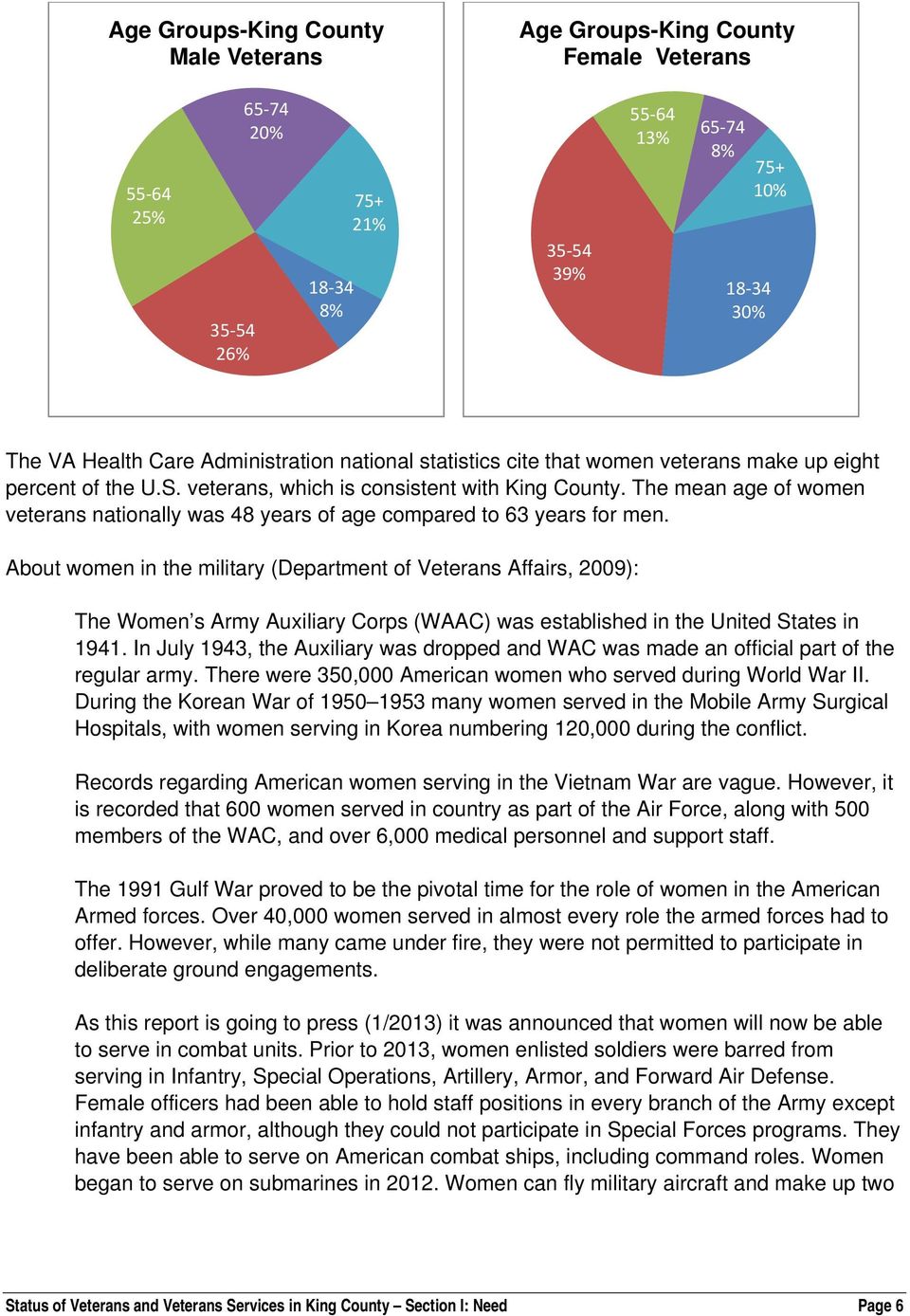
11 Age Groups-King County Male Veterans Age Groups-King County Female Veterans % % % % % % % % % % The VA Health Care Administration national statistics cite that women veterans make up eight percent of the U.S. veterans, which is consistent with King County. The mean age of women veterans nationally was 48 years of age compared to 63 years for men. About women in the military (Department of Veterans Affairs, 2009): The Women s Army Auxiliary Corps (WAAC) was established in the United States in In July 1943, the Auxiliary was dropped and WAC was made an official part of the regular army. There were 350,000 American women who served during World War II. During the Korean War of many women served in the Mobile Army Surgical Hospitals, with women serving in Korea numbering 120,000 during the conflict. Records regarding American women serving in the Vietnam War are vague. However, it is recorded that 600 women served in country as part of the Air Force, along with 500 members of the WAC, and over 6,000 medical personnel and support staff. The 1991 Gulf War proved to be the pivotal time for the role of women in the American Armed forces. Over 40,000 women served in almost every role the armed forces had to offer. However, while many came under fire, they were not permitted to participate in deliberate ground engagements. As this report is going to press (1/2013) it was announced that women will now be able to serve in combat units. Prior to 2013, women enlisted soldiers were barred from serving in Infantry, Special Operations, Artillery, Armor, and Forward Air Defense. Female officers had been able to hold staff positions in every branch of the Army except infantry and armor, although they could not participate in Special Forces programs. They have been able to serve on American combat ships, including command roles. Women began to serve on submarines in Women can fly military aircraft and make up two Status of Veterans and Veterans Services in King County Section I: Need Page 6
12 percent of all pilots in the U.S. Military. As of 2010, there were an estimated 50,000 females serving in Afghanistan and Iraq. Nationwide, women are estimated by the Department of Defense to make up approximately 20 percent of the military force. Women make up about 15 percent of the Army. Race/Ethnicity of King County Veterans Population Overall the proportion of veterans who are veterans of color is somewhere between 16 and 19 percent 3. Race/Ethnicity of King County Veterans White 84.1% Asian/PI American Indian Black Two or More Other Hispanic 4.0% 0.9% 7.4% 2.4% 1.2% 3.2% 0.0% 20.0% 40.0% 60.0% 80.0% 100.0% Younger veteran populations are becoming more diverse up to one quarter of all younger veterans are veterans of color. The proportion of veterans who are persons of color has increased, representing a gradual shift to a more diverse military. Overall older veterans of Vietnam era and earlier are predominately white, with persons of color accounting for only 11.4 percent of the population. Approximately one in four veterans below 55 years of age is a veteran of color. 3 At the lowest estimate 15.9% of all King County veterans are non-white. However we do not know to what degree Hispanic veterans may have overlapped and also declared their race as white. Status of Veterans and Veterans Services in King County Section I: Need Page 7

13 100% Race/Ethnicity of King County Veterans by Age 90% 80% 70% 60% 74.8% 72.6% 84.1% 86.0% 89.1% 50% White Black American Indian Asian/PI Other Two or More Hispanic Race/Ethnicity of King County Veterans by Age Group White 74.8% 72.6% 84.1% 86.0% 89.1% Black 5.1% 9.9% 8.2% 6.4% 4.1% American Indian 4 0.0% 1.6% 0.0% 0.3% 1.6% Asian/PI 7.7% 4.6% 2.8% 3.5% 2.8% Other 3.0% 2.6% 0.8% 0.0% 0.0% Two or More 2.5% 4.6% 1.0% 1.6% 1.3% Hispanic 6.9% 4.0% 3.1% 2.2% 1.1% Household Status of Active Military and Veterans A majority of veterans and active duty military in King County are married and family members are impacted by the effects of their service. The VHS Levy has increased attention to, and support for, the families and dependents of soldiers and veterans. Families of active military and veterans carry the daily burden of support, and are severely impacted by the condition of the veterans who have returned from war. Family impacts include coping with and meeting the needs of aging disabled veterans, economic disruption during multiple deployments, and needing to provide long-term support for traumatized veterans. The need to ensure veterans successfully transition to home life from deployment has only recently entered the national conscience. Families of veterans from earlier wars were more or less on their own to help their partner overcome extreme symptoms of combat-related stress, anxiety, depression and self-absorbed isolation they may experience. 4 The 2010 ACS survey numbers too small to report for certain age categories Status of Veterans and Veterans Services in King County Section I: Need Page 8

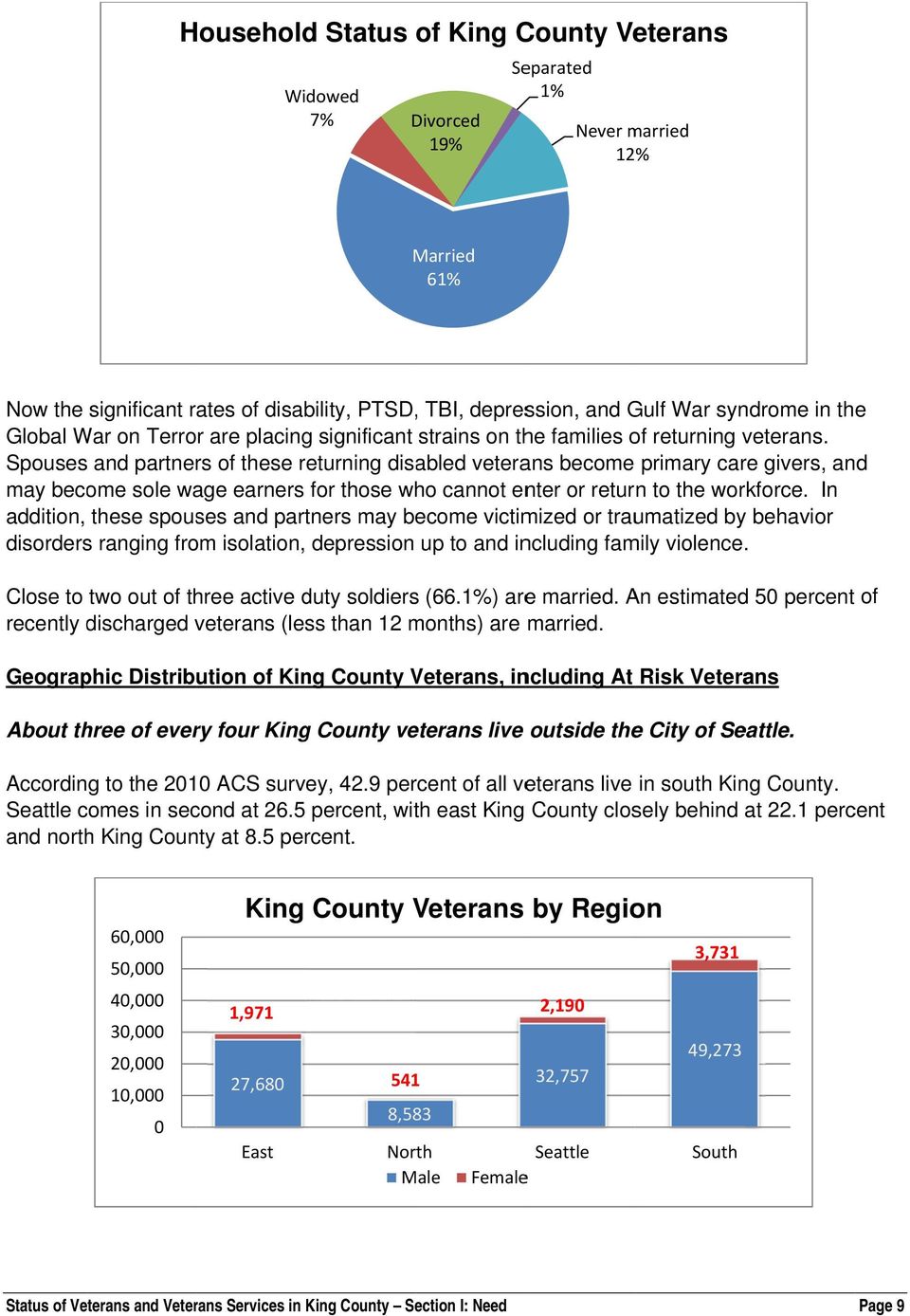
14 Household Status of King County Veterans Separated Widowed 1% 7% Divorced Never married 19% 12% Married 61% Now the significant rates of disability, PTSD, TBI, depression, and Gulf War syndrome in the Global War on Terror are placing significant strains on the families of returning veterans. Spousess and partners of these returning disabled veterans become primary care givers, and may become sole wage earners for those who cannot enter or return to the workforce. In addition, these spouses and partners may become victimized or traumatized by behavior disorderss ranging from isolation, depression up to and ncluding family violence. Close to two out of three active duty soldierss (66.1%) aree married. An estimated 50 percent of recently discharged veterans (less than 12 months) are married. Geographic Distribution of King County Veterans, ncluding At Risk Veterans About three of every four King County veterans live outside the City of Seattle. According to the 2010 ACS survey, 42.9 percent of all veterans live in south King County. Seattle comes in second at 26.5 percent, with east King County closely behind at 22.1 percent and north King County at 8.5 percent. 60,000 50,000 40,000 30,000 20,000 10,000 0 King County Veterans by Region 1,971 27, ,190 32,757 8,583 East North Seattle Male Femalee 3,731 49,273 South Status of Veterans and Veterans Services in King County Section I: Need Page 9
15 Veterans who are disabled or poor live primarily in South King County, followed by Seattle. Data has been provided by the Veterans Benefits Administration on the zip codes of recipients of VA Disability Compensation. Disability Compensation is awarded for service connected disabilities. The majority of veterans receiving compensation live in South King County with especially high concentrations in Kent, Auburn and Federal Way. Data has also been provided by the Veterans Health Administration - Puget Sound Health Care Service System. A map is attached at the end of this report. In 2011, the VA Puget Sound Health Care System had over 28,000 enrollees with King County addresses. These enrollees are predominately low-income, partially or fully disabled and/or without other private health insurance options. Four out of ten VA enrollees are from South King County, and close to three out of ten are from Seattle. Location of Veterans in King County Veterans Receiving VA Disability Compensation 2011Enrollees VA Health System Total Veterans King County REGION East Total % 5, % 28, % North Total % 1, % 10, % Seattle Total 3, % 8, % 33, % South Total 5, % 12, % 54, % Grand Total 13,968 28, ,008 Source: Veterans Administration Benefits Distributions (2011) Source: Veterans Administration Puget Sound Health Care System (2011) Source: 2010 ACS Estimate Income Status of King County Veterans Over 17,000 King County veterans are low-income (below 200% of poverty). In 2010, approximately 4.6 percent of King County veterans lived below poverty (5,800+) and another 9.2 percent (11,500+) lived between 100 and 200 percent of poverty. The combined 13.8 percent of all King County veterans below 200 percent of poverty compares to 22.9 percent of the non-veteran King County populations (heads of households) Annual Household Income Poverty Threshold One person Household Two person Household Three person Household Four Person Household Five Person Household 100% Poverty Threshold $11,139 $14,218 $17,374 $22,314 $26, % Poverty Threshold $22,278 $28,436 $34,748 $44,628 $52,878 Status of Veterans and Veterans Services in King County Section I: Need Page 10

16 A majority of the King County veterans living below poverty are not disabled especially those younger than retirement age. Analysis presented on the chart below shows the age and disability status of King County veterans living below poverty level. Over 60 percent are not disabled, and close to 3,000 nondisabled veterans are under age 65. These veterans would not be likely to have access to VA Compensation or other sources of income such as SSI or Social Security King County Veterans Below 100% Poverty Veterans Veterans Veterans Veterans 65+ with disability without disability A greater proportion of King County veterans of color and women veterans are lower income than White veterans. American Community Survey Data for shows that veterans of color and women of all ethnicities are disproportionately low-income. 5 While 12.9 percent of White veterans are living with household incomes below 200 percent of poverty, veterans of color rates range from a low of 16.3 percent for Asian veterans to highs of 27.4 percent for Black veterans and 28.0 percent for American Indian veterans. Women veterans (all ethnicities combined) experience a 22.6 percent low-income rate. 5 For the purposes of this analysis Low Income is defined as household income below 200% of poverty which is approximately 50% of King County median income. Status of Veterans and Veterans Services in King County Section I: Need Page 11

17 30.0% 25.0% 20.0% 15.0% 10.0% 5.0% 0.0% 12.9% Percent of Low Income by Category % 28.0% 27.4% 21.0% 16.3% 15.0% 15.6% 22.6% 6 ` Disability income In 2011, 13,967 King County veterans were receiving VA Disability Compensation according to VA records. This was an increase of five percent from 2009, and represents approximately 11 percent of the King County veterans population. Disability Compensation is for service related disabilities. King County Veterans 5,000 4,000 3,000 2,000 1,000 0 Veterans Receiving Disability Compensation 4,090 2,386 2,127 1,824 1, , Age Groups Compensation is determined after review by the VA and is based upon a percent of disability estimate. Monthly checks range from a low of $127 per month for 10 percent disability and living alone to a high of $3,285 for a 100 percent disabled veteran with spouse and dependents. The average compensation payment in 2011 for King County veterans was $ Close to half of all veterans receiving compensation are over the age of 60. Over 2,700 recipients are under the age of 40, receiving an average payment of $664 per month ACS roll-up analysis provided by Seattle and King County Public Health Status of Veterans and Veterans Services in King County Section I: Need Page 12

18 In 2011, 1,274 King County veterans were receiving a VA Disability Pension. A VA Disability Pension differs from VA Disability Compensation in that it is means tested and available to wartime veterans who have limited or no income, who are 65 or older, or under 65 and permanently and totally disabled. The 1,274 King County recipients represent a 13.8 percent increase over total 2009 pension recipients. They averaged $ per household and 95 percent were over the age of 50. Employment Status Of the 127,000 King County veterans in the ACS, over 54,000 were not in the labor force in Of those who were, 5,865 were unemployed at the time, and 2,542 were still active duty military. This would give us a local unemployment rate of 8.4 percent for veterans in the job market (5,865 of 69,773). This is less than the 2010 ACS non-veteran population at 9.2 percent (93,054 of 1,014,264) 2010 King County Veterans Employment Status Unemployed 5,865 In Armed Forces 2,542 Not in Labor Force 54,693 Civilian Employed 63,908 Nationally, Hispanic and Black veterans have higher rates of unemployment than Whites, and in some cases, non-veterans of their same race/ethnicity. Nationally according to the Bureau of Labor in 2011, Black veterans had a 43 percent higher rate of unemployment than White veterans (11.2 percent compared to 7.8 percent). Hispanic veterans have a 25 percent higher rate than whites and women of all races have a 16 percent higher rate than white men. Gulf War veterans are especially hard hit, with a higher unemployment rate than non-veterans. Hispanic Gulf War (prior to 2001) veterans are a third more likely to be unemployed than their non-veteran counterparts, with a 17 percent unemployment rate compared to an 11.2 percent Hispanic non-veteran rate. Black Gulf War (post 2001) veterans have a 14.3 percent unemployment rate and women veterans a 12.0 percent rate. Status of Veterans and Veterans Services in King County Section I: Need Page 13

19 Unemployment rates for women veterans of all ethnicities are growing while male veterans are seeing their unemployment rates drop. According to an updated Bureau of Labor report (September 2012) women veterans of all ethnicities had a 9.7 percent unemployment rate in September 2011 compared to 7.9 for all male veterans. In September 2012, the unemployment rate dropped for all male veterans to only 5.9 percent while women veterans unemployment grew to 13.2 percent a 36 percent increase in one year. The overall rate dropped for Gulf War era male veterans from 11.1 percent in September 2011 to eight percent in September Meanwhile, the unemployment rate for Gulf War women veterans grew from 14.7 percent to an astronomical 19.9 percent in the same 12 month period. As of September 2012, the national unemployment rate for Iraq/Afghanistan veterans was 9.7 percent 31 percent higher than the general unemployment rate. In October 2012, the Bureau of Labor Statistics released the unemployment numbers for September. While the national unemployment rate dipped to 7.4 percent, the unemployment rate for Iraq and Afghanistan veterans was 9.7 percent. There are some studies that have shown managers are reluctant to hire OIF/OEF veterans due to the highly publicized stigma of Gulf War mental health problems. (Department of Labor, 2011) Status of Veterans and Veterans Services in King County Section I: Need Page 14

20 Financial Needs among King County Veterans There has been a significant increase in veterans seeking community financial assistance from 2008 to Statistics from the Community Information Line (CIL) show a dramatic increase in requests by veterans for financial assistance referrals from 2008 to In 2008, 1,130 persons (duplicated) identifying themselves as veterans requested referral for financial assistance or housing. In 2011, this number had grown to 1,538 calls (36%). Although financial aid requests are consistently higher from veterans in South King County, requests have dramatically increased over the last three years from those living in East King County. Region of King County 2008 Veteran Community Information Line Requests REGION 2008 Total Veteran Calls Percent of Request by Region 2011 Total Veterans Calls Percent of Request by Region Percent change 2008 to 2011 East Total % % 175.4% North Total % % 194.1% Seattle Total % % 26.1% South Total % % 13.1% Total CIL Requests % 36.1% South King County is home to the largest numbers of veterans in need, followed by Seattle. Call records from the 211 Community Information Line identify caller needs (requests for information), veteran status, ethnicity, and zip code. Call records for 2011 were analyzed for those veterans seeking financial assistance for utilities, holiday assistance, mortgage assistance, permanent housing, transitional housing and emergency shelter for the homeless. There were 1,538 records of veterans or spouses calling for assistance. Using this data as a surrogate measure of need, it appears that South King County is where the largest proportion of veterans in need live regardless of race, ethnicity or gender, followed by Seattle Community Information Line Requests by Region Percent Veterans of Color Requesting Assistance White Veterans Requesting Assistance Unknown Race/Ethnicity East King County 10.1% 17.7% 9.7% North King County 9.9% 9.6% 9.7% Seattle 33.3% 26.3% 37.2% South King County 46.7% 46.4% 43.4% Total 100% 100% 100% 2011 Veteran Callers Status of Veterans and Veterans Services in King County Section I: Need Page 15

21 Service Related Trauma and Disabilities The significant debilitating effects of service in combat zones affect many veterans and their families from all war eras. Post Traumatic Stress Disorder Research is showing rates of PTSD of 15 to 30 percent among veterans who have served in combat zones. The rates suggest that thousands of King County veterans have or are experiencing PTSD to some degree. The symptoms of PTSD can be exhibited for decades following their service and can have devastating effects on the ability of veterans to lead a normal, successful civilian life after service. The PTSD develops when a person witnesses or experiences a traumatic event. Symptoms may not become apparent for months or even years after the event. The PTSD symptoms can include one or more of the following 8 : "flashbacks" about the traumatic event feelings of estrangement or detachment nightmares sleep disturbances impaired functioning occupational instability memory disturbances family discord parenting or marital difficulties suicidal ideation guilt Beginning with the returning veterans from the Vietnam War, communities and social services nationwide began to become aware of the phenomena of Post Traumatic Stress Syndrome (at that time referred to as Post Vietnam syndrome). Although war experience has always had catastrophic effects on the mental health stability of some veterans, the rates and nationwide understanding of PTSD grew substantially beginning in the 1970 s. In the early 1980 s PTSD was named and then defined in the Diagnostic Statistical Manual (DSM) III. A 2007 RAND study on PTSD, TBI, and depression among service personnel showed that a significant number of service personnel are reluctant to disclose injury or symptoms while in the service. Vietnam The National Vietnam Veterans Readjustment Study (NVVRS) was conducted by the U.S. government following a congressional mandate in 1983 to better understand the psychological effect of being in the Vietnam War. Among Vietnam veterans, approximately 15 percent of men and 9 percent of women were found to have PTSD at the time of the study. By 2012, commonly accepted rates cited by the VA are that approximately 30 percent of men and 8 Compilation of numerous reports are available on the VA s source for PTSD treatment and resources. Status of Veterans and Veterans Services in King County Section I: Need Page 16
22 27 percent of women had PTSD at some point in their life following Vietnam. King County has over 50,000 veterans who served during the Vietnam era, which would project as many as 16,500 had PTSD at some time in the last 40 years. Persian Gulf War Although the Persian Gulf War was brief, its impact was no less traumatic than other wars. From the time the Persian Gulf War ended in 1991 to now, veterans have reported a number of physical and mental health problems. Studies examining the mental health of Persian Gulf War veterans have found that rates of PTSD stemming from the war range anywhere from almost 9 percent to approximately 24 percent. According to the 2010 ACS, King County has over 17,000 veterans who served in the Persian Gulf War, which would project between 1,500 and 4,000 veterans with PTSD. Iraq War and Afghanistan The conflicts in Iraq and Afghanistan are ongoing. The full impact the war has had on the mental health of soldiers involved is only now beginning to become understood. In April 2008, the RAND Corporation released the first comprehensive analysis of all branches of the military and experiences in the Iraq/Afghanistan wars. Nearly 20 percent of military service members who have returned from Iraq and Afghanistan 300,000 in all report symptoms of PTSD or major depression, yet only slightly more than half of these have sought treatment. A July 2012 study published in the American Journal of Public Health found 37 percent of OIF/OEF veterans who sought treatment at U.S. health facilities from 2002 to 2008 were diagnosed with PTSD, depression, substance abuse or other mental concerns. The researchers collected data on 289,328 OIF/OEF veterans who sought health care at VA medical centers from 2002 to Of these 106,726 were given mental health care which included 62,929 diagnosed with PTSD and 50,432 diagnosed with depression. The authors noted that this was nearly 37 percent of the veterans in the study. The study found that when the definition was expanded to include diagnoses of mental health disorders or psychosocial behavioral problems such as homelessness, or both, 43 percent of these veterans received these diagnoses. The diagnoses included: 22 percent with PTSD 17 percent with depression 7 percent with alcohol use disorder 3 percent with drug use disorder Many veterans had several of these problems and 29 percent of veterans with mental health problems were diagnosed with two different conditions, and 33 percent were diagnosed with three or more. The Iraq War has been noticeably different from prior wars as soldiers are recalled for three and four deployments to war zones. The impact of multiple deployments is only now beginning to be understood, with anticipation of significant increases in PTSD rates. According to the 2010 ACS, Status of Veterans and Veterans Services in King County Section I: Need Page 17
23 King County has over 10,000 veterans who served since ,250 who left active duty within 12 months of the time of the ACS. Potentially up to 60 percent of all King County veterans that experience PTSD or mental health problems related to their military service will not seek help and will need skilled outreach to overcome resistance to seeking treatment. According to the U.S. Army, only 40 percent of veterans who screen positive for serious emotional problems seek help from a mental health professional (Mental Health Advisory Team IV: Operation Iraqi Freedom, May 2007). Statistics from the RAND Corporation are even higher, finding that only 30 percent of veterans with PTSD or depression seek help from the VA health system (Invisible Wounds of War, 2008). (American Psychological Association, 2012) 9. There could be as many as 25,000 veterans in King County from all eras experiencing PTSD or other mental health issues at some time since discharge (Hoskins, 2012). Therefore, it s reasonable to predict that as many as 12,500+ will not seek treatment from the VA or other community based providers without assistance to overcoming reluctance or institutional barriers. American Indians/Hispanics/Blacks/Asians/Pacific Islander veterans have significantly higher rates of PTSD/Mental Health issues than white veterans, and coupled with reluctance to use military institutions, present additional challenges to ensuring access to services. The National Center for PTSD, U.S. Department of Veterans Affairs presents a comprehensive review of the research on PTSD among ethnic and racial minorities (Loo, 2012) on their website. Lifetime prevalence rates for PTSD were higher among all racial or ethnic minority veterans, except for Japanese Americans, than among Whites. Between 45 percent and 57 percent of the American Indian Vietnam veterans had PTSD for lifetime events, 43 percent of the Blacks suffered from PTSD associated with lifetime events, 39 percent of the Hispanic Vietnam veterans suffered from lifetime PTSD, and 38 percent of Native Hawaiian Vietnam veterans suffered from lifetime PTSD, compared to 24 percent of the Whites and nine percent of the Japanese Americans. Other Asians experienced rates as high as 39 percent. The table below shows that there are likely thousands more women veterans and veterans of color with untreated PTSD or MST who would benefit from being connected to services than are currently reached by the levy or VA services. Service avoidance as a result of PTSD impacts ALL areas of life. Individuals with PTSD not only resist mental health treatment that could benefit them; they are also likely to be unengaged with other services as well, including medical care, rehabilitation, treatment for drug or alcohol abuse, financial benefits, employment support, housing assistance, 9 The APA published a statement of need for mental health professionals to become aware of and increase skills in serving veterans with PTSD on their website, Status of Veterans and Veterans Services in King County Section I: Need Page 18
24 and family support. Untreated PTSD also contributes to high rates of chemical dependency, other behavioral and mental issues, divorce, domestic violence, criminal justice system involvement, homelessness, and economic instability. Estimated Occurrence of PTSD for King County Veterans Veteran Group Estimated King County Population Estimated PTSD/MH issues Rates Military Sexual Trauma Potentially Affected in King County Potentially reluctant to engage in treatment Vietnam 43,961 30% 14,500 8,700+ Gulf War 16, % 1,500-4, ,400 OEF/OIF 13, % 1,500 4, ,400 Women of all races 9,984 20% 22-33% 2,200 3,300 1,300 1, Men of all races 117, % 2,000 3,300 1, Military Sexual Trauma As many as one in three women veterans experienced Military Sexual Trauma (MST) during service. Potentially over 5,000 King County veterans have been affected by MST. The experience of a sexual assault is a widespread problem in the military, often referred to as MST. Studies indicate that around 23 percent to 33 percent of female veterans report experiencing MST. In addition, there is some evidence that women who have experienced MST are at high risk for developing PTSD. One study found that approximately 42 percent of women who had experienced a MST also had PTSD as a result of the MST. Other studies have found that MST was more likely to lead to PTSD than other military or civilian trauma (2012 Veterans Administration) Potentially between 2,000 to 3,300 women veterans in King County are affected. Based on other aforementioned studies of service resistance, as many as 1,800 would be reluctant to seek VA services. This is in addition to women who suffer from military-related PTSD without having suffered from MST. An estimated two to three percent of men have also suffered from MST. Given that there are over 117,000 male veterans in King County, this would project as many as 3,300 male veterans needed treatment and support for MST. Suicides Suicides increased by 26 percent from 2005 to 2007 among United States military veterans. The VA estimated that in 2005, the suicide rate per 100,000 veterans among men ages was 45 per 100,000, but rose to 57 per 100,000 in The U.S. military lost more active service members to suicide than combat last year as the number of troops who took their lives 10 These numbers do not reflect women who experience PTSD absent MST. Women veterans experiencing PTSD alone are reflected among the population estimates by war era. Status of Veterans and Veterans Services in King County Section I: Need Page 19
25 rose to a record high. The 349 active-duty suicides in 2012 underscored the toll a decade of wars has taken on the all-volunteer force and the extent to which the Pentagon continues to grapple with an issue senior leaders have called an epidemic. Military suicides began rising in 2006 and soared to a then-record 310 in 2009 before leveling off. The figure is largely attributed to PTSD, depression, and TBI. It is not clear to what degree suicide is a problem among King County veterans. At the time of publishing this report, the VA revised their 2010 estimates and now project 22 suicides per day among veterans (up from the previous estimates of 18 per day nationwide). According to the VA report most of the veterans who commit suicide are over the age of 50. Caregivers Co-occurring PTSD As more and more caretakers are affected by the injuries to their loved ones, there is increasing evidence that they may also experience the trauma and sense of helplessness of the veteran. These caretakers may be likely candidates to experience PTSD from actual traumatic events such as domestic violence, and to some degree from the sense of helplessness and fear for their families. As cited earlier, two-thirds of the active duty soldiers and half of the recently discharged veterans are married. Gulf War Syndrome (GWS) or Gulf War Illness (GWI) Gulf War Syndrome is an illness reported by combat veterans of the 1991 Persian Gulf War typified by symptoms including immune system disorders and a higher than average rate of birth defects in their offspring. Symptoms attributed to this syndrome have been wide-ranging, including chronic fatigue, loss of muscle control, headaches, dizziness and loss of balance, memory problems, muscle and joint pain, indigestion, skin problems, shortness of breath, and even insulin resistance. Brain cancer deaths, amyotrophic lateral sclerosis (also known as Lou Gehrig's disease) and fibromyalgia are now recognized by the Defense and Veterans Affairs departments as potentially connected to service during the Gulf War. Since the end of the Gulf War, the U.S. Department of Veterans Affairs and the British Ministry of Defense have conducted numerous studies on Gulf War veterans. On November 17, 2008, the federally mandated Research Advisory Committee on Gulf War Veterans' Illnesses produced a 452-page report, indicating that roughly one in four of the 697,000 veterans who served in the first Gulf War are afflicted with the disorder. Exposure to toxic chemicals was identified as the cause of the illness. The report states that scientific evidence leaves no question that Gulf War illness is a real condition with real causes and serious consequences for affected veterans. These soldiers are now in their 40 s and 50 s with the possibility of Gulf War Syndrome affecting and accelerating the health effects of aging. There is a VA sponsored registry created to access to disability benefits due to Gulf War. A medical exam is available. To qualify, the undiagnosed illnesses must have appeared either during active duty in the Southwest Asia Theater of Operations during the Persian Gulf War or at any time since, through December 31, Status of Veterans and Veterans Services in King County Section I: Need Page 20
26 Traumatic Brain Injury The most common causes of TBI are falls, motor vehicle accidents, assaults/blows and explosive blasts (military). Severity ranges from mild, in which there is a brief change in mental state or consciousness, to severe, in which there is an extended period of unconsciousness or amnesia after the injury. Although not life threatening, the long-term effects of even a mild TBI can be serious. Mild TBI, commonly known as a concussion, is one of the most common neurologic disorders. Early mild TBI symptoms may appear subtle, but they can lead to significant, life-long impairment in an individual s ability to function physically, cognitively, and emotionally. Often symptoms of TBI are often unrecognized by the person themselves. In addition, many of the symptoms are a great deal like PTSD leading to misdiagnosis. Common symptoms post-concussion include: Motor and Sensory Symptoms: headaches; dizziness; sensory deficits-visual, vestibular, strength and coordination; seizures; spasticity; irritability; labiality, depression; disinhibition; personality change; sleep disturbances; hydrocephalus; pain; fatigue. Cognitive & Emotional Symptoms: impaired judgment; slower thinking; physical aggression; substance abuse; decreased concentration & focus; poor control over basic physical urges: impulsive/disruptive behavior; no filter on thoughts or actions. According to the New England Journal of Medicine, 15 percent of Iraq soldiers had concussions or other mild traumatic brain injuries while on active duty. Notably, these soldiers were significantly more likely to have PTSD three months after their return home than soldiers without brain injuries. Of soldiers who reported an injury that caused loss of consciousness, 44 percent had PTSD three months after returning home (Hoge et al, 1/31/08). Homelessness Homeless veterans are disproportionally persons of color and homeless women veterans are significantly younger than their male counterparts. Homelessness among veterans has attracted significant local and national attention since In 2011, the Committee to End Homelessness in King County adopted the Five Year Plan to End Homelessness Among Veterans in King County. Locally the demographics collected in the Safe Harbors Homeless Management Information System (HMIS) suggest that percent of homeless single adults are veterans. The Veterans Annual Homelessness Assessment Report (AHAR) submitted to Housing and Urban Development (HUD) identified 1,535 veterans among 9,420 individuals (16.2 percent) served by King County emergency shelters and transitional housing programs. A review of the records for calendar year 2011 from Safe Harbors identified 1,734 veterans (self-report) served by King county shelters and transitional housing. There were 120 women 11 Based on client records from the 2011 federal fiscal year October 1,2010 to September 30, 2011 Status of Veterans and Veterans Services in King County Section I: Need Page 21
27 and 1,603 men. This is close to the same number of veterans identified in the system in 2008 (1,773). Some of the statistics on homeless clients in King County reported as veterans are: The average age of homeless male veterans is 52 and the average age of female veterans is younger at 43 years of age. Overall half of all veterans self-identify as disabled - 49 percent of the men and 53 percent of the women. Close to half of the homeless veterans (both male and female) are persons of color. Race and ethnicity are not significantly different based upon gender. The HMIS collects data on self-report type of disability. Among the 64 women veterans who reported as having a disability and identified the types of disability (multiple answers per client) over 80 percent said they had a mental health disability and over 60 percent had a physical disability. Among the 788 male veterans who report disability, 67 percent cited a physical disability followed by general mental health (64%) and general substance abuse (58%). 90.0% 80.0% 70.0% 60.0% 50.0% 40.0% 30.0% 20.0% 10.0% 0.0% Disability-Homeless Women Vets 2011 Physical Disability SA - General SA - Severe MH - General MH - Severe Chronic Health DD Status of Veterans and Veterans Services in King County Section I: Need Page 22
28 80.0% 70.0% 60.0% 50.0% 40.0% 30.0% 20.0% 10.0% 0.0% Disability-Homeless Vets Men 2011 Physical Disability SA - General SA - Severe MH - General MH - Severe Chronic Health DD Veterans Mental Health System Service Utilization: Rates of Disability and Evidence of Need Of the veterans served by the King County Mental Health system, Black male veterans experience higher rates of incarceration, homelessness, and substance abuse issues. Staff of the Mental Health Chemical Abuse and Dependency Services Division (MHCADSD) conducted a review of 2011 mental health system clients who identified themselves as veterans. Clients included anybody who had any contact with the publically funded mental health system, which would include: outpatient benefits; crisis and commitment services (CCS); psychiatric hospitalizations; specialty programs; and HOPE/PATH outreach. In 2011, the system identified services to 1,291 known veteran clients. As would be expected, men account for the significant majority (84.4%). White veterans accounted for 70.4 percent of clients. Black veterans are the largest non-white race at 20.5 percent of all veteran clients (MHCADSD, 2012). Status of Veterans and Veterans Services in King County Section I: Need Page 23
29 2011 Veteran Clients of King gender Total County Mental Health services Female Male Black Count % within race 12.5% 87.5% 100.0% Asian/Pacific Count Islander % within race 24.3% 75.7% 100.0% White Count % within race 15.4% 84.6% 100.0% MIXED Count % within race 18.0% 82.0% 100.0% American Indian Count % within race 22.2% 77.8% 100.0% OTHER Count % within race 21.9% 78.1% 100.0% Unknown Count % within race 25.0% 75.0% 100.0% Total Count % within race 15.6% 84.4% 100.0% Some of the observations from the review of the 2011 mental health veteran clients included: The overall incarceration rate of veterans served by King County mental health services (King County Jail only) is 12.2 percent, higher than for the broader mental health client population. Male veterans have a higher rate of incarceration than females, with male Black veterans experiencing the highest rate of all: 26 percent of the male Black veterans known to the mental health system had at least one King County jail booking during One in three of all the veterans jailed (32.4 percent) were Black. Substance abuse is high among all mental health subgroups, 44.7 percent overall, higher for men than women and highest for Black males 65 percent of all Black veterans served identified as having a substance abuse issue. Men have a disproportionately high rate of homelessness, with Black male veterans exhibiting the highest rate at 40.3 percent. Criminal Justice System Involvement As a result of a 2011 King County Budget Proviso (Ordinance 16984, King County Adopted 2011 Budget) to report on the feasibility of and plans for implementation of a pilot project providing specialty court services for veterans, several King County departments were involved in discussions that created the impetus for better data collection on tracking individuals with military status across systems in King County. The Department of Adult and Juvenile Detention (DAJD) has altered how they ask about military status and is collecting related data. Public Health s Jail Health Services is also consistently asking about military status and tracking individuals they refer to veteran related reentry services. Status of Veterans and Veterans Services in King County Section I: Need Page 24
30 With the creation of a pilot Veterans Court in King County, even better data will be attained as all veterans, whether they opt-into the specialized court or not, will be tracked. The table below shows the DAJD 2 data for military status collected for Overall, veterans represented two percent (773 persons) of the King County jail population. Veterans Status DAJD 2011 Jail Data Veteran Status Total Veteran Status Yes No Other Yes No Other N N N N N N N January 58 2,334 1,239 3, % 64.28% 34.12% February 60 1, , % 65.45% 32.52% March 59 2,353 1,176 3, % 65.58% 32.78% April 76 2, , % 67.19% 30.45% May 69 2,153 1,042 3, % 65.96% 31.92% June 77 2,250 1,125 3, % 65.18% 32.59% July 49 2,185 1,076 3, % 66.01% 32.51% August 65 2,224 1,020 3, % 67.21% 30.83% September 53 2, , % 68.00% 30.31% October 76 1, , % 64.52% 32.92% November 72 1, , % 67.01% 30.18% December 59 1, , % 68.38% 29.42% Total ,203 12,113 38, % 66.17% 31.80% The Other represents those individuals who were booked into a King County jail but for whom DAJD was not able to collect military status; this represents about one-third of all individuals booked. 12 There is a plan to collecting military status data at the prosecutorial, public defense and court level in the future. This will provide a better overall picture of how many veterans are being seen in our regional King County justice system overall. Data will also be collected on those individuals arrested but not booked into a County jail facility and on those not in custody long enough for military status to be assessed. We expect to improve our understanding through the launch of the new Veterans Criminal Justice Initiative, increased discharge planning and bridge services in These initiatives will improve data collection and veterans screening and coordination at the SCORE facility and four small regional municipal jails, in addition to the Seattle and King County treatment courts and jails. 12 This data was received from DAJD analytical and was run on January 30, 2012 Status of Veterans and Veterans Services in King County Section I: Need Page 25
31 Bibliography Section I American Psychological Association. (2012). The Critical Need for Mental Health Professionals Trained to Treat Post-Traumatic Stress Disorder and Traumatic Brain Injury. APA. DCHS-VHS Levy Staff. (2011). Service Improvement Plan Veterans and Human Services Levy. Department of Labor. (2011) Analysis of Veteran Employment Rates. Department of Veterans Affairs. (2011). Health Care Utilization. Department of Veterans Affairs, Veterans Health Adminstration. (September 2006) Survey of Veteran Enrollees' Health and Reliance Upon VA. Hoskins, Jon. (2012) Status of King County Veterans (draft). Loo, C. M. (2012). PTSD Among Ethnic Minority Veterans. King County Mental Health, Chemical Abuse and Dependencey Services Division. (2012) Mental Health Services Statistics. Status of Veterans and Veterans Services in King County Section I: Need Page 26
32 Section II: Status of King County Veterans Services System King County and our partners are committed to helping vulnerable veterans in need and striving to create a coordinated community based system of care. In King County we are home to a VA Health Services Hospital and the regional VA Benefits Administration. On a community level, the King County Veterans Program (KCVP) has provided financial assistance and other services to veterans with Washington State tax revenues since the 1950 s (RCW). In 2012, the RCW funds are budgeted at $2.7 million. With the passage of the 2006 Veterans and Human Services Levy (VHS), an additional six million annually in new veterans specific funding became available to serve King County s vulnerable veterans populations. From 2006 to 2011, over 24,000 veterans (duplicated) were served by VHS levy and RCW funded projects. Annually there are over 6,600 veterans and 1,200+ spouse clients served by levy and RCW projects. King County s Community Based Veterans Service System: A pathway to Stability and Self-Sufficiency There are four primary goals for a community based veterans services system. These are: 1. Support outreach and engagement of veterans and assist them to identify and secure the benefits and services they deserve. 2. Augment services that the U.S. Department of Veterans Affairs can t provide sufficiently or effectively. 3. Provide community based services such as job skills training, housing, and behavioral health that lead to self-sufficiency. 4. Provide support to veterans and families who are outside of VA eligibility. The overall approach for the community based veterans service system is to create a pathway to stability and self-sufficiency for vulnerable veterans. Self-sufficiency means that veterans will be financially secure, living in independent housing, and fully functioning in life. Conceptually, the pathway for moving clients to self-sufficiency (as reflected on the next page) involves service stages that generally include: Outreach and engaging clients into the service continuum. Assessing clients to determine their service needs and developing a plan to achieve selfsufficiency. Stabilizing clients in crisis to ensure they benefit from the more intensive, long term services that will move them forward on the pathway to self sufficiency. Providing service interventions or treatment to clients that help them overcome personal barriers to achieving the overall goal. Status of Veterans and Veterans Services in King County Section II: Services Status Page 27
33 Self Sufficiency Outreach and Engagement Assessment Case Planning Community Service Providers Stabilization Housing $ Assistance CD Detox Legal Services Interventions PTSD Treatment MH Treatment Job skills Education CD Treatment Secure VA Benefits Health Caree Veterans Administration King County funds a full spectrum of veterans services and regional capacity building activities. In 2012, the annual county investment in veterans services exceeded $10 million. The majority is allocated for outreach, assessment, housing, and stabilization based upon RCW guidelines and levy commitments. Annual County Investments in Veteran Services $3,500,000 $3,000,000 $2,500,000 $2,000,000 $1,500,000 $1,000,000 $500,000 $0 Outreach and Engagement Assessment, Case planning Housing & Stabilization Veterans Employment Veterans Behavioral Health Capacity Building Status of Veterans and Veterans Services in King County Section II: Servicess Status Page 28
34 The Community Based Veterans Services System Appendix One of this report is a performance report on the first half of 2012 for county-funded veterans specific services showing clients and performance targets. The spreadsheet highlights the community services that are designed to meet the unique service needs of veterans, their spouses and dependents. In the first six months of 2012, more than 4,800 clients were seen and 1,900 community professionals trained to better serve veterans. 2,500 Clients and Providers Touched by County-Funded Veterans Services in the First Half of ,000 1,646 1,835 1,957 1,500 1,277 1, Outreach Engagement Assessment, Case planning Housing and Stabilization Employment Behavioral Health Professionals Trained Activity The Continuum of King County Funded Veterans Services Lead Agency* Veterans outreach and engagement services Outreach to veterans of color and women veterans Veteran phone information and referral Homeless veteran street outreach (Veterans Reintegration Project) CSD WDVA Service Outreach through multi-cultural providers to connect veterans of color/ women veterans to benefits and services Veterans phone resources with personal follow-up to ensure linkages Clients First Half 2012 Levy and RCW Annual funding*** 390 $225, $100,000 WDVA Seattle outreach project for homeless veterans 69 $84,000 KCVP - satellite site outreach EER 22 sites providing outreach to underserved geographic areas 357 $266,500 Veterans Incarcerated Program (VIP) Emerging programs for justice involved veterans National Guard military family outreach WDVA Outreach to veterans involved in the regional justice system 69 $150,000 MHCADSD WDVA Veterans assessment, case planning, access to resources KCVP - assessment and case management EER Creating system of regional outreach to justice involved veterans, including veterans Mental Health court and FISH (outreach to homeless mentally ill persons). Outreach to Washington State National Guard families and service members Comprehensive assessment, case planning and linkages to stabilization resources $150,000 $210, $174,000 1,277 $3,259,628 Status of Veterans and Veterans Services in King County Section II: Services Status Page 29
35 Veterans housing and stabilization resources KCVP financial assistance KCVP - contracted shelter and transitional housing services Housing Capital/Housing Support Services Housing Stability Program (HSP) Veterans Legal Assistance Program EER CSD CSD CSD NW Justice Project Veterans employment and job skills training Veteran employment training - Veterans Conservation Corp Homeless veterans employment and training Veterans Aerospace Employment Initiative Emergency financial assistance, coupled with case management to overcome financial instability. Provide homeless veterans shelter while working on longer term solutions Build veterans specific housing Support services in permanent housing/housing Health Outreach Team (HHOT) Rental assistance for veterans facing eviction or formerly homeless and moving into housing 977 $1,100, $558,872 TBD 287 $625,000** $375, $400,000 Pro bono attorney services for veterans 132 $20,000 WDVA Veterans training program in green jobs 67 $125,000 EER EER Comprehensive employment and training for veterans both contracted and provided through Community Connections Comprehensive employment and training services in aerospace job skills and linkages to aerospace jobs 140 $240,000 Began 9/2012 $771,912 Veterans King County Internship Program DHR Veterans PTSD and mental health treatment Contracted PTSD Treatment / Military Sexual Trauma treatment Behavioral health integration for veterans WDVA Public Health Internship opportunities for veterans with King County Community based treatment providers contracted for PTSD/MST services Integrated behavioral health assessment and services for veterans tied to community health clinics Military Family Counseling WDVA Mental health treatment for veterans family members Regional service capacity building Veteran and trauma competency training WDVA Group training for King County service professionals on PTSD, MST and military culture Began 9/2012 $66, $400, $600,000 Begins in 2013 $100,000 1,957 $200,000 *CSD = DCHS Community Services Division, WDVA = Washington Department of Veterans Affairs, EER = Employment and Education Resources Unit (CSD-DCHS), DHR = King County Department of Human Resources, MHCADSD=Mental Health Chemical Abuse Dependency Services Division - DCHS ** Additional annual carryover or unspent funds will be allocated for housing capital. *** Annual estimates based upon 2012/2013 budgets from the VHS Levy Service Improvement Plan (SIP), 2012/2103 Supplemental Levy ordinance, and 2012 RCW budget. King County Veterans Outreach and Engagement services As cited in Section I, there are an estimated 17,000 veterans living under 200 percent of the federal poverty level in King County. Of these about 5,800 are living under 100 percent of the poverty level. King County community-based veterans services reached more than 5,900 veteran clients (small duplication across service categories) in 2011 and more than 900 spouses. The VA-Puget Sound Health Care System reports more than 28,000 enrollees with King County addresses. The enrollees are predominately low-income, disabled and without other private health insurance options. Since the inception of the first levy, a number of outreach and engagement projects have been launched to ensure veterans overcome barriers to services. Special efforts have been made to overcome geographic challenges. Outreach projects have been launched to engage homeless and criminal justice involved veterans, as well as racial and ethnic minorities and women Status of Veterans and Veterans Services in King County Section II: Services Status Page 30
36 veterans. The seven King County outreach and engagement projects are funded annually at $1,359,500. In the first six months of 2012, these projects reached 1,646 clients. A key component of many King County veteran activities is substantial effort to outreach to and engage isolated and/or hard to serve veterans. Many vulnerable people who could benefit from human services do not access them either through lack of knowledge, fear, mistrust, or disinterest. The VHS Levy-funded outreach services bridge this gap by locating, identifying and engaging possible clients using a range of approaches depending upon the particular client characteristics. The primary objectives of outreach are assisting clients with overcoming barriers and linking them with the services and resources that will lead to increased stability and reduced vulnerability. The VHS Levy-funded outreach services may operate independently or be integrated with other services within an organization. When integrated, the outreach offers ready access to the support services offered by the hosting agency. Often housing and employment services are available within integrated organizations. Medical care, transportation, and financial assistance have been linked to outreach as well. King County veterans services have been successful at increasing services utilization by low-income Black veterans. However fewer White and Asian veterans are being served relative to their proportion in the King County low-income veteran populations. Data analysis was conducted to identify service access for women and veterans of color to King County Veterans Levy-funded services 1. The data indicates that Black veterans are finding their way into the King County veteran service system. Extremely small numbers of American Indian, Asian, Hawaiian/Pacific Islander and Hispanic veterans are being served (only 100 to 300 clients in each category out of more than 5,200 total clients). While these numbers are all quite small, they vary greatly as a percent of the target population, ranging from a low of 17.7 percent for Asians to a high of 43.5 percent of Pacific Islanders, and encompassing about a third of Hispanic and American Indian veterans. These numbers include the 904 clients served by the levy outreach initiative to veterans of color and women veterans in Services funded under the VHS Levy Strategy One Increasing Access to Services for Veteran Status of Veterans and Veterans Services in King County Section II: Services Status Page 31
37 70% 60% 50% 40% 30% 20% 10% 0% 2011 VHS Levy Clients as a Percentage of Low-income Veterans 2, % 17.7% 43.5% 33.6% % 1,692 3,000 2, % 34.3% 35.2% 2, % 1,500 1, Comparison levy clients to KC Veterans < 200% poverty 2011 Clients Service Engagement by Veterans Below 200% of Federal Poverty Level Varies by Race Group KC Vets Below 200% 2011 Levy Veterans Service Clients Clients of Levy Services Compared to Veterans Below 200% Poverty White 13,772 2, % Asian % Pacific Islander % American Indian % Black 2,592 1, % Two or more races % Other Race % Hispanic % Women Veterans 2 2, % The VHS Levy evaluators looked at clients served by race and gender. Service numbers of each group were compared to their 2010 Census population poverty estimates to create an estimate of the proportion of low-income veterans that are accessing levy-funded veterans services. The range went from 17.4 percent of all estimated low-income White veterans served to 65.3 percent of all estimated Black veterans served by levy-funded veterans services. 2 Levy veterans services served 814 women in were veterans, 244 spouses of Veterans Status of Veterans and Veterans Services in King County Section II: Services Status Page 32
38 Over the life of the levy geographic access has become much more equitable. In 2006, the King County veterans services were Seattle based. With the advent of the levy, a new KCVP service site was established in Renton and a program of 22 satellite outreach sites was established throughout South and parts of East King County. Veterans Services Clients 2006/ East Rural East Urban North Urban Seattle South Rural South Urban Vashon We do not know what proportion of veterans experiencing PTSD and/or MST are engaging in services. Extrapolating from national estimates, potentially up to 60 percent of all King County veterans experiencing PTSD (approximately 12,500 in King County) or mental health problems related to their military service will not seek help. It is estimated that as many as 1,800 women veterans who experienced military sexual trauma would be reluctant to seek VA services. There are more than 800 homeless veterans on King County streets who report a disability about two-thirds reporting either mental health and/or substance abuse. There are about 1,200 veterans seen in the King County mental health system annually and more than 700 in the King County jail. It is very unclear how many of the 28,000 VA enrollees or 13,000 disability compensation clients are disabled due to PTSD. Outreach programs engaged 2,722 persons in 2011, who were then linked with services, benefits, and housing. There are seven veterans specific outreach projects that have a range of focus, from veterans of color, to homeless veterans, to those in the jail or located in geographically isolated areas. There was a range of success meeting engagement objectives, with 50 to 90 percent of clients connecting with benefits, services, and housing. In most cases the projects were not intended to provide case management, yet some follow-up was expected to ensure client success. The Veterans Phone Resource was especially successful at follow-up and was the only outreach project not targeting a specific veteran sub-population. Status of Veterans and Veterans Services in King County Section II: Services Status Page 33
39 Lessons Learned/Moving Forward with Outreach Efforts Access for veterans living outside Seattle has been improved through locating services in suburban and rural areas. Access to a broader range of services and/or benefits has been increased through establishing new service sites with cooperative relationships with other local service providers. Opening a new services hub in south King County has made services more accessible to veterans and their families. People are accessing the Renton office in growing numbers as it has become more established. Public education and concentrated local outreach lead to more client referrals. Many veterans in outlying areas were unaware that satellite sites had opened locally until KCVP staff members conducted intense networking with local service providers and referral sources. Prompt engagement is important to success. Most veterans were very grateful for the quick responses to their assistance requests. Once families engaged in the needs assessment process, the program s benefits became clearer to them. The levy funded Veterans Phone Resource found that immediate follow-up within a day or two was critical to ensuring successful referrals. Outreach efforts need to increase attention to engaging clients who have experienced PTSD and/or MST. Although as many as 20,000 King County veterans are suffering from PTSD, TBI and/or MST, only several hundred a year are receiving services at King County-funded programs. The VA has recently increased health care resources to address these issues, but is not seeing veterans in numbers indicated by needs assessments. More vigorous outreach is needed to identify and encourage veterans to seek these services. Assessment and Case Planning King County Veterans Program The second step on the pathway to stability and self-sufficiency includes assessment, case planning and linkages to stabilization resources such as housing, employment and financial assistance. The KCVP has been providing financial assistance since its inception. With the implementation of the 2006 VHS Levy, KCVP began to implement a case management program model. The KCVP has implemented a strong self-sufficiency matrix assessment and case planning approach since The program evolution towards comprehensive assessment and access to resources has been further accelerated by the merging of KCVP direct services with King County s Employment and Education Resources (EER) in The evolving program model continues to move towards consolidation and streamlined access to stabilization resources and to intervention and Status of Veterans and Veterans Services in King County Section II: Services Status Page 34
40 treatment services. Experience is showing that some veterans are already stable when first contacted, but many are homeless, in financial need, or without the basics necessary to participate effectively in mental health treatment, substance abuse interventions or employment services. There are more than 20 levy-funded FTEs conducting comprehensive assessments in King County s veterans service system. These staff members screened and assessed more than 1,700 veterans during the first half of Levy funding has significantly expanded assessment and stabilization services to veterans. Originally KCVP offered only financial assistance for veterans. When legislation established the Veterans Relief Fund (VRF) in the 1950 s, financial assistance vouchers were provided by the Posts of the American Legion, Veterans of Foreign Wars and other Veterans Service Organizations (VSO). Controls were minimal and favoritism a big issue. Often veterans had to join a VSO and work at a Post in order to get financial assistance. Databases weren't in use so a veteran could make the rounds from one Post to another collecting assistance from each one. Subsequently, the county established an office to process VRF payments. This office was initially placed under King County Facilities Management. In the early 1980's a job developer was hired followed by an administrative assistant. Finally, in 1985 the King County Veterans Program was established in DCHS and a program manager assigned to manage staff consisting of two employment counselors, a financial screener and a job developer. An advisory board was also established to advise on the new program. King County Veterans Program implements an enhanced case management model to improve success. In its new service model, KCVP s overall objective is to move veterans toward greater selfsufficiency. A thorough assessment, support, financial resources and effective linkage to needed benefits, treatments and resources are the tools used. Comprehensive veterans assessments were conducted more than 1,300 times at KCVP through mid These assessments resulted in more than 9,500 service referrals. In late 2012, KCVP established a new assessment and referral structure to ensure clients get the appropriate support they need through one of three staff teams homelessness, employment and self-sufficiency. The flow chart for these teams is represented by attachment B. In reviewing the self-sufficiency domains, most KCVP clients need intervention in housing, income and employment. A very small percentage of clients are identified as being in legal, substance abuse or mental health crisis. Since mid-2009, all KCVP clients have been thoroughly assessed at intake across ten selfsufficiency domains. Clients are rated on a scale from one to ten on each domain with scores of 0-2 signifying in-crisis and 3-4 considered vulnerable. Clients who score above four are Status of Veterans and Veterans Services in King County Section II: Services Status Page 35
41 considered stable in that domain. The assessment results are used to craft each veteran s service plan. As Chart 5 below shows, KCVP s clients average scores are below stability in three domains housing, employment and income. In all other domains, clients average scores are in the stable range. The legal and substance abuse domains register the greatest stability. As we learn more about the assessments, staff can both identify areas of emphasis and at the same time look to refine and improve the quality of the assessment in the future. For example, mental health and substance abuse scales are largely self-reported. The findings below encourage us to improve our assessment capabilities in those domains in order to ensure they are reliable given what we know about veterans reluctance to disclose either mental health or substance abuse issues. Employment, Income and Housing are Greatest Self- Sufficiency Challenges for KCVP Clients Average scores at intake on 10 point scale with 0 as lowest and "in-crisis" and 10 as highest and "thriving." The KCVP moves one third of its clients to stability. The KCVP s objective is to move clients toward greater stability and ultimately self-sufficiency. In line with the self-sufficiency scores, the housing, employment and income domains are the central focus of KCVP s services. Of the 429 clients with intake and exit self-sufficiency assessments over the past two years, 361 entered KCVP with unstable ratings on the three key domains. Of these, 143 (39.6%) moved to stable or safe ratings. Status of Veterans and Veterans Services in King County Section II: Services Status Page 36
42 Changes in KCVP Clients' Stability Remained Below Stability Moved to Stability 6 Dropped Below Stability 62 Remained Stable King County Veterans Housing and Stabilization Services The total financial amount provided to KCVP clients has significantly increased between 2006 and In 2006, $510,839 was provided to KCVP clients through voucher awards almost entirely from RCW funds. Vouchers are direct payments to vendors on behalf of clients primarily to pay for rent, utilities, and food. In 2007, the total voucher amount awarded was $839,018, a 64 percent increase from This reflects the arrival of VHS Levy funds. The 2007 level was maintained through 2011 when $799,620 was awarded through vouchers. In addition to the vouchers, Safeway cards to purchase food and gas, bus tickets, haircut coupons and Goodwill vouchers add to the financial assistance received by KCVP clients. $1,500,000 Financial Assistance Increased with the Addition of VHS Levy Funds 2,500 $1,000,000 2,000 1,500 Amount $500,000 1, Clients Receiving $ Status of Veterans and Veterans Services in King County Section II: Services Status Page 37
43 Bed nights for homeless veterans in shelters and transitional housing programs increased 44 percent between 2006 and 2011 to 28,301 bed nights. Levy funding increased veteran shelter capacity at The Salvation Army s William Booth House and supported veterans beds at the Compass Housing Alliance s Pioneer Square Men s Program. These resources added to veterans shelter already available at the Compass Housing Alliances Shoreline House and the two Vietnam Veterans Leadership Program transitional programs Bennett House and Burien House. Shelter and transitional housing programs successfully transitioned 43 percent of their clients to more stable housing during the first half of ,000 30,000 25,000 20,000 15,000 10,000 5,000 0 Shelter-Transitional Housing Services Bednights 200 Households Financial assistance, absent case management, is less effective at stabilizing clients than in prior years. In 2009, a follow-up survey showed 71 percent of clients who received financial assistance were subsequently more stable and kept their housing. In 2012, a follow-up survey of 2011 clients receiving rental or mortgage assistance showed only 47 percent retained their housing for six months. Currently, KCVP is becoming more selective in providing housing financial assistance only to clients who will likely keep their housing when coupled with case planning towards longterm stability. Lessons Learned/Moving Forward Assessment, Case Planning, and Stabilization Financial assistance based on thorough client assessment, coupled with case planning, needs to be evaluated for improved long term outcomes. As KCVP increases the comprehensive approach to services, the effectiveness of the model will need to be assessed with client follow-up. Status of Veterans and Veterans Services in King County Section II: Services Status Page 38
44 Financial literacy is a key component in helping low-income veterans effectively stabilize their finances. Most veterans served have some income. A significant number of clients in income crisis are not aware of how to budget and manage their limited income resources. More KCVP clients could benefit from case management than was initially anticipated. New assessment protocols have shown that a majority of KCVP clients face significant housing, income, and/or employment barriers many more than originally anticipated. These barriers to self-sufficiency take time and coordinated services to effectively address. There is a need for veterans legal services. The Northwest Justice Project provides the only legal aid focused entirely on veterans in Washington State. Veteran clients, social workers and other service providers, greatly benefit from this program s assistance. The legal assistance project served more than 170 clients in KCVP is increasing linkages with homeless and housing services. Due to KCVP s integration with EER and their homeless employment project (Career Connections) linked to numerous homeless housing providers, KCVP is enhancing its relationship with these providers on behalf of the homeless veterans they serve (18 percent of all clients in 2011). Veterans Intervention Services and Treatment Access to Benefits and Health Care Depending on their status and situation, King County veterans are eligible for a variety of benefits. Veterans with war-related disabilities may be eligible for Disability Compensation. The VA disability pension is available to wartime veterans who have limited or no income and who are at least 65 years of age, or who are at least 65 and permanently and totally disabled. Older, retired veterans with 20 or more service years are eligible for standard military retirement. Reserves and National Guard may be eligible for the military s TriCare medical services. Some disabled veterans can access the VA for medical benefits. Veterans attending college can receive assistance through the GI Bill. Veterans out of work may be eligible for Unemployment compensation. In 2011, 13,967 King County veterans were receiving VA disability compensation according to VA records. This was an increase of five percent from 2009, and represents approximately 11 percent of the King County veterans population. Many others are likely eligible for this benefit. More than 11,000 King County Veterans are 34 and younger. This group has alarming rates of disability and mental health problems related to multiple deployments, exposure to debilitating weaponry, and disrupting call ups from civilian life for reservists and National Guard members. In 2011, 1,274 King County veterans were receiving a VA disability pension. Two thirds of the Status of Veterans and Veterans Services in King County Section II: Services Status Page 39
45 127,000 King County veterans over 55 years of age, may be eligible for disability or retirement benefits. It is a challenge for many veterans to decipher which benefits they are eligible for and how to secure them. Community based service providers can play a vital role in linking veterans in need to the services they deserve. Providers report that assisting veteran clients to secure VA compensation or pensions takes time and consistent effort. Most providers are unfamiliar with military service and the possible benefits available. They often do not know the access points or processes to apply for benefits. Even veteran service providers have difficulty staying current on benefit regulations. The KCVP had some success in securing financial benefits for veterans. From mid-2009 through mid-2012, KCVP sought to secure financial benefits for 295 clients, typically veteran s disability and retirement benefits. Of these, 210 (71%) were successful in securing those benefits. Lessons Learned/Moving Forward Service providers need more training on veterans benefits, eligibility requirements and application processes. Community service providers received some exposure to veterans benefits through recent trauma and veterans services trainings. But these trainings do not get to sufficient detail regarding eligibility requirements and application procedures. Veteran service providers are much more familiar with veterans benefits. But the benefits system is so complex and changing that they need constant updates on eligibility requirements, too. On-going training on benefits eligibility and access should be provided throughout the county-funded veterans service system. Options such as on-line training should be considered, enhancing the feasibility of training keeping pace with staff turn-over. Veterans Intervention Services and Treatment Employment Veterans Employment Services The national unemployment rate dropped for Gulf War era male veterans from 11.1 percent in September 2011 to eight percent in September Meanwhile, the unemployment rate for Gulf War women veterans grew from 14.7 percent to an astronomical 19.9 percent in the same 12 month period. In the first six months of 2012, almost half of the clients assessed (44.6%) were rated in crisis (score of 2 or below). Another 8.8 percent were rated as vulnerable (below stability). King County first strengthened its veterans employment services in 2007, when KCVP used levy funds to open an office co-located with WorkSource Renton to serve South King County residents. The co-location with WorkSource enabled ready access to employment services for veterans who needed occupational training or job placement. Status of Veterans and Veterans Services in King County Section II: Services Status Page 40
46 Levy funds were also used to establish the Veterans Conservation Corps Program in mid This program provided job placement, employer training, and individual training services in environmental restoration and stewardship for eligible veterans and other military personnel. In 2012, KCVP merged with EER to increase linkages to employment, education and training. King County is expanding its employment services through the Aerospace and Veterans Employment Training Initiative. In September 2012, there was a new KCVP initiative to create veterans employment service hubs throughout King County that link to Aerospace employment. The KCVP will provide $800,000 for the initiative and is coordinating with King County s EER Program to develop a coordinated veterans service hub at WorkSource Renton. Other hubs are being considered. The hubs purpose is to centralize key veterans services and streamline access to employment and other community resources veterans need to stabilize and become more self-sufficient. This initiative brings together resources from the Workforce Development Council (WDC), local community and technical colleges, and the King County VHS Levy to form an aerospace employment and training hub at King County s WorkSource Renton. The focus is on job seekers interested in aerospace related careers, with the emphasis on serving returning veterans. Employment and training services for veterans will also be provided at our community partner location, the YWCA WorkSource Affiliate Downtown. There are two main policy objectives: 1. Create a pipeline of workers with the skills needed by our local aerospace industry. 2. Facilitate veterans access to aerospace industry jobs. Returning veterans need jobs, and many have skills that are transferable to the aerospace industry. The aerospace initiative will offer participants: Personalized career assessment and coaching services Assistance in navigating and accessing training specific to aerospace Direct instruction and coaching in Information Technology (IT) classes and other on-line coursework Assistance navigating the opportunities available in our local aerospace-related industries Potential paid internships. There are other emerging workforce training resources for veterans, such as 1000 Elevate America Information Technology vouchers and related IT instruction that Microsoft provided. The aerospace initiative will align with these efforts. Status of Veterans and Veterans Services in King County Section II: Services Status Page 41
47 Lessons Learned/Moving Forward More employment services are needed to help returning veterans transfer their military skills and training into civilian employment opportunities. The commitment to employment resources is still a small part of the levy activities ($1,203,579 of $10,201,579 annually). Younger returning veterans usually do not have certificates or advanced degrees. In many cases the military is their primary work experience. These factors contribute to their high unemployment rates. Additionally, many of the veterans who were drawn from civilian life by the National Guard and Reserves may not be able to return to their prior jobs due to length of deployment or combat related disabilities. These citizen soldiers will need assistance to redefine their careers. More education of potential employers may also be necessary to combat the disability perception that some are developing in response to the attentions being paid to PTSD, TBI and veteran suicide. Veterans Intervention Services and Treatment Behavioral Health King County funds eighteen sub-contracted PTSD counselors throughout the county that provide approximately 7,000 hours of counseling each year. Additionally, the levy funds integrated behavioral assessment and services through Seattle/King County Department of Public Health serving hundreds of veterans annually in community based settings. The VHS Levy increased contracted PTSD services, providing counseling to nearly 700 veterans experiencing PTSD through 2011, with a demonstrated success rate of 97 percent of clients reducing PTSD symptoms. These services augment PTSD therapy offered by the U.S. Department of Veterans Affairs through the VA Puget Sound Health Care System. The VA services are limited to veterans with doctor certified service-related PTSD and can take considerable time to access. The community PTSD services are also available to spouses and dependents of veterans. KCVP and other service organizations have adjusted their assessment tools to better detect Traumatic Brain Injury (TBI), but treatment capacity is unclear. According to the New England Journal of Medicine, 15 percent of Iraq soldiers had concussions or other mild traumatic brain injuries while on active duty. Traumatic Brain Injury is a medical condition for which medical procedures and therapies are the remedies. The VA has the lead in treating TBI with its medical resources. However, TBI is hard to diagnose and effective treatment modalities are limited and still evolving. King County does not fund any TBI services. The VA is taking the lead on addressing Military Sexual Trauma (MST). While it is widely believed that the rates of MST are underreported in both the military and the VA, studies indicate that around 23 to 33 percent of female veterans report experiencing MST. Male veterans also experience MST, although at lower rates approximately one percent. There is some evidence that women who have experienced MST are at high risk for developing PTSD. Every VA facility has an MST Coordinator who serves as a contact person for MST- Status of Veterans and Veterans Services in King County Section II: Services Status Page 42
48 related issues. The VHS Levy is targeting women veterans who have experienced MST as a high priority population for outreach and engagement services. It s not clear how many veterans are unable or unwilling to access behavioral health treatment. In Section I, there were an estimated 20,000 veterans likely to have experienced PTSD, TBI, or MST. As many as 12,000 of these veterans may be unwilling to seek treatment. However, KCVP is seeing very few veterans who appear to have mental health or chemical dependency issues. We know that there are more than 28,000 VA enrollees in King County and 13,000+ veterans receiving VA disability benefits. We have no way of knowing to what degree the need for behavioral health is being met by the VA. Community behavioral health needs to expand its role in meeting the mental health needs of veterans. As cited earlier numerous veterans are not able to be served by the VA health care system either due to resistance or the lack of VA capacity. The National Council for Behavioral Health is calling for an expanded role for community based mental health providers to pick up the slack (National Council for Behavioral Health, 2012). The council report acknowledges the Executive Order of August 2012 to expand behavioral health capacity in the VA system. However, over 40 percent of discharged OEF/OIF veterans are using community based health care. The report presents findings that demonstrate the need to expand the availability of evidence based mental health care, both to meet capacity demands and as a demonstrated cost savings by avoiding long term systems costs. Using levy funds, King County is funding a new Military Family Counseling program starting in This program will offer counseling and support of veterans and other family members dealing with the stress of military deployment. Lessons Learned/Moving Forward PTSD treatment is effective and essential to enabling traumatized veterans to regain control of their lives. Veterans receiving VHS Levy-funded PTSD counseling have consistently shown improvement rates above 95 percent. With the PTSD under control, veterans can pursue employment opportunities, focus on class work and attend to their families needs. Younger veterans and active military do not immediately access PTSD services upon their return from combat. According to the Department of Defense and the VA it usually takes younger veterans some time to experience or identify the problem and to admit that help is needed. When they do, services will need to be evenly distributed throughout King County as Status of Veterans and Veterans Services in King County Section II: Services Status Page 43
49 demographic studies show PTSD to be more equally dispersed among veterans throughout the county. Academic institutions need assistance in dealing with returning veterans suffering from PTSD. Veterans programs can help community colleges and universities by offering training events and other support. Greater coordination is needed with the VA to ensure that TBI and MST are accessible to King County s veterans. As noted earlier, the VA has the lead on treating TBI and MST. Improved coordination will ensure that KCVP, other veteran serving programs and health programs can link their clients to needed treatment and be a partner in their progress. King County veterans would benefit from improved community based capacity to deliver behavioral health. The significant overload on the regional VA health care system, and increasing attention to a community based care model call for thorough review, support and expansion of access to a range of community based approaches for King County veterans. Resources and Capacity Building Coordination of regional veterans services is largely ad-hoc. The veterans service program components are loosely linked but do not operate as a cohesive system. Experienced community program staff are generally aware of other programs involved with their clients or operating in their area. Referrals are frequently made among veteran serving programs. The KCVP, for instance, frequently refers its clients to the VA for benefits and health care. The WDVA and KCVP have a long history of collaboration at the client and program levels. Thanks to levy funding there is now a veteran-specific phone line that provides basic descriptions and contact information on programs. However, there is no centralized referral system or standardized application process. There are multiple access points through which a veteran can get information on the eligibility requirements, service availability, and intake processes for the many programs available to them. Because the referral system is informal, when experienced workers leave there can be a breakdown in service coordination. New workers don t know who the service gatekeepers are and aren t as familiar with the eligibility requirements or intake processes. Consequently, the degree of cross-program client collaboration ebbs and flows as staff turns over. Seattle King County Veterans Consortium (SKCVC) System coordination and planning across the veterans service system is beginning to catch up to the sudden service expansion that occurred with levy passage and greater federal emphasis on veterans services. There has been on-going, informal communication among the three Status of Veterans and Veterans Services in King County Section II: Services Status Page 44
50 primary veterans service providers VA, KCVP and WDVA since the 1980s. The Seattle-King County Veterans Consortium meets every other month to develop strategies to improve service delivery coordination and to share service opportunities. Members include WDVA, VA and a broad range of community veterans services providers. Usually over 20 service providers attend. Five Year Plan to End Homelessness Among Veterans in King County King County participated in development of the Five Year Plan to End Veterans Homelessness in The plan was developed at the direction of the Funders Group of the Committee to End Homelessness in King County (CEHKC), in alignment with each of the federal, state and local five year plans to end veteran homelessness recently developed by the U.S. Department of Veterans Affairs, United States Interagency Council on Homelessness (USICH), VA Puget Sound Healthcare System (VA), and WDVA. The plan is intended to offer guidance to local policy makers on emerging needs of veterans and their families, challenges our systems face in responding to those needs, and changes needed to align efforts and strengthen veteran supports. King County Veterans Boards Two King County boards monitor and guide veterans services in King County. The King County Veterans Citizen Levy Oversight Board (VCLOB) monitors and reviews the expenditure of the veteran portion of levy proceeds in accordance with the adopted Service Improvement Plan. The longer-standing King County Veterans Advisory Board guides expenditure of the RCW funds. This board encouraged the creation of several veterans programs, including the Veterans Incarcerated Program and the Homeless Veterans Reintegration Program. It continues to guide KCVP s work and monitors the regional veterans service system. Professional Training More than 4,900 hours of community education and professional training were provided on veterans disorders and related issues between 2007 and 2011, increasing regional professional capacity to respond to PTSD. This has resulted in a greater understanding by mainstream service providers of military trauma and the resources available to address it. The training has also sensitized mainstream providers to the existence of veterans and veterans family members among their clientele and strengthened linkages to the array of veterans support services. Information Systems The KCVP improved its program management and client management through the development of a new client information system in The Veterans Information Base Electronic (VIBE) fully automated client tracking, a particularly important feature as KCVP moved from one service site to eleven. The VIBE facilitates case planning and service tracking. It also monitors client progress so that program managers can evaluate service effectiveness. Status of Veterans and Veterans Services in King County Section II: Services Status Page 45
51 Lessons Learned/Moving Forward The increased community and professional PTSD training has increased awareness of veterans and their unique needs. Mainstream providers and other professionals reported a much greater awareness of PTSD and the availability of PTSD treatment services following two Levy-funded trauma conferences. But more education is needed on available resources and how to access them. A well-functioning Management Information System is essential to operating at multiple sites and facilitating coordinated client services. There is no standardized data set or information system for veterans services. While KCVP has greatly enhanced its client information system, it is not used by other providers. The VA has its own proprietary information system that is not accessible to others. The absence of common, shared data makes coordinated client care much more difficult and obscures system-wide client flow and gaps. There needs to be better coordination for a veterans service system that has grown immensely in size and complexity. Some service system coordination exists as described previously. But it is inadequate to target and manage the King County veterans service system as we try to serve over 17,000 low-income and vulnerable clients. Coordination among client level services has been somewhat ad-hoc and lacking consistent pathways to needed services. Systemwide planning is insufficient and there are no system-wide targets or long range community plans 3, as has been done in the homeless housing service system through the Committee to End Homelessness. 3 With the noted exception of the Five Year Plan to End Homelessness Among Veterans in King County. Status of Veterans and Veterans Services in King County Section II: Services Status Page 46
52 Section III: Recommendations for Future Changes The review process/approach has had two areas of focus: a general overview of veterans and their families in King County; and a closer look at VHS Levy funded KCVP direct services and contracted services. The findings and recommendations that follow are intended to identify areas of increased attention for VHS Levy funded veterans service strategies and for the veterans service system as a whole. Recommendations Meeting the Current Needs of King County Veterans and Improving King County Veterans Program and Contracted Services. Based upon the Service Improvement Plan, it was anticipated that mid-course adjustments would be made in the services and strategies funded by the VHS Levy. Given the results of the overall review of the status of veterans in King County and the current KCVP, the following are considerations for moving forward under Strategy 1 Increasing Access to Services. 1. Create a pathway to stability as a system model for veterans. This requires attention to all the components of an effective service system. Support outreach and engagement as a step onto the pathway. Coordinate services through accurate assessment of need, case planning and facilitated linkage among service providers. Provide a full range of service interventions that overcome barriers to stability and self-sufficiency with special attention to accessing veterans benefits and health care where possible and appropriate. 2. Plan a system for all veterans in need. There are two major veteran populations in need. The first is the larger population of lowincome non-disabled veterans who are unemployed or under-employed who need income opportunity. The second population is the severely disabled, returning veterans who, although smaller in number, have significant health and human services need. There is much more comprehensive information on veterans needs and barriers and this should be used to direct future service system development. 3. Improve coordination between the community-based veterans service system and state and federal veterans services-especially around information on who is accessing services. It s known that there are 28,000 King County enrollees in the VA medical system and the King County services system serves 6,900+ annually. What isn t known is whether our most disabled veterans are in fact getting served by the VA system. This makes it difficult to assess the gap in veterans behavioral health and medical services in King County. It is unknown to what degree veterans are being served in both systems and, therefore, it is difficult to coordinate services for shared clients. Status of Veterans and Veteran Services in King County Section III: Recommendations for Future Changes Page 47
53 4. Continue to provide access to financial assistance for indigent and homeless veterans and linkages that promote self-sufficiency. There are more than 1,700 veterans who are homeless annually, including a great many who are affected by PTSD, TBI and mental health issues. There are over 5,800 veterans living below poverty, a majority of whom are not disabled. The KCVP clients rate consistently low in income security and the program provided nearly $1.1 million in financial assistance in The KCVP is one of the few programs offering emergency financial assistance to non-disabled veterans. The KCVP also helped more than 200 veterans to access the disability compensation and retirement pensions that they deserved. These types of assistance are essential in helping low-income veterans stabilize. There are an increasing number of programs serving homeless veterans which are loosely coordinated through Supportive Housing Assistance to Veterans (SHAVETS). Access to housing assistance especially Veterans Affairs Supportive Housing (VASH), Section 8 and Supportive Services for Veterans Families (SSVF) should be more formally coordinated to ensure access. 5. Provide consistent screening for PTSD and TBI in Levy-funded programs. The occurrence of PTSD, TBI, and mental health issues has historically been consistently underestimated and undiagnosed in the veteran health systems and in the community. This is true of older veterans and younger veterans across the board. Research is beginning to demonstrate the interconnectedness of war-related trauma, and challenges related to longterm behavioral and economic stability. The impacts of PTSD and TBI on behavior in the community are seen in the numbers of chronically homeless veterans, and veterans with chemical dependency and mental illness served throughout a variety of service systems. KCVP has already revised its assessment tool to better screen for PTSD and TBI. Where possible, other programs that are funded to meet the needs of veterans should implement consistent screening tools for these issues. This will increase our understanding of the prevalence of PTSD/TBI and ensure appropriate service responses. 6. Increase attention to meeting the needs of younger veterans. Most of the service programs developed over the last 20 years have largely focused on meeting the needs of veterans ages 55 and over. This is appropriate, as they represent twothirds of the King County veteran population. However, numerous studies demonstrate the extraordinarily high levels of very complex disabilities and hardships among younger veterans. Although smaller in total number, younger vets in King County are lower-income, more likely to be people of color, women, and socially isolated from age-group peers and possibly from older veteran populations. Status of Veterans and Veteran Services in King County Section III: Recommendations for Future Changes Page 48
54 The VHS Levy-funded projects could be refined and modified to reach out and engage these veterans and their families in services. It is recommended to expand training programs and outreach to community-based organizations on emerging research on the needs of younger veterans. 7. Increase family support strategies. The economic, social and mental health needs of veterans families and dependents are becoming more complex as they carry the support burden for both the aging veterans and those returning. Children are impacted in unique ways. If currently available veterans service systems are overwhelmed and/or unprepared, family members bear the brunt of unresolved needs. The high deployment rates of the Reserves and National Guard since the Gulf War is disrupting these King County families economic lives and social structures as never before. While in pre-deployment there is uncertainty. During deployment there is risk of isolation and increased family burdens. Upon return there is post deployment re-adjustment. There are new Levy-funded projects designed to improve connectedness to services for families. There may be a need to continue outreach and improving access to services for family members. New initiatives and enhanced services will be evaluated to see if the increased efforts are effective at engaging these vulnerable populations.. 8. Continue to assess and expand services and increased support for women veterans. The KCVP should continue to explore outreach and expansion of services for women veterans. Currently women make up only ten percent of KCVP clients but that is an increase from seven percent only two years ago. In addition, KCVP should increase understanding of the needs of women and dependents to explore appropriate adjustments in services. Next Steps This review was an updated look at the status of veterans in King County and specifically a review of the status of the KCVP. In order to move forward there are a number of steps called for to be implemented. The following are the next steps proposed for follow-up and broader attention. 1. Continue to assist the KCVP to refine its performance measurement systems and business practices to better match its evolving service model (July 2012 June 2013). Evaluation staff will work with and provide resources to implement improvements in business processes, data collection forms, and KCVP s client information system. Status of Veterans and Veteran Services in King County Section III: Recommendations for Future Changes Page 49
55 2. Further analysis of the services and impacts of the sub-contracted programs. (Dec 2012 June 2013) The VHS Levy evaluation team will continue to review Strategy One funded programs that are sub-contracted. The team will collect and analyze data on the work of WDVA in PTSD treatment and support; the Veterans Court, and contracted homeless services. 3. Support veterans service system integration and coordination efforts. (Jan 2013 Dec 2013) Evaluation staff will provide veterans needs data and program performance measurement data to any groups in place or newly formed to improve veterans service system coordination. Status of Veterans and Veteran Services in King County Section III: Recommendations for Future Changes Page 50
56 2012 Status of King County Veterans Report Appendix One APPENDIX ONE
57 Status of Veterans and Veterans Services in King County Appendix One
58 Status of Veterans and Veterans Services in King County Appendix One
59 Status of Veterans and Veterans Services in King County Appendix One
60 Status of Veterans and Veterans Services in King County Appendix One
61 2012 Status of King County Veterans Report Appendix Two APPENDIX TWO
62 98125 Lak e W ashi ngt o Æ ( e & % $ "! í? Ü P:\kcgis\client_services\DCHS\12xxx_VeteransMap\projects\VeteransMap.mxd TC The information included on this map has been compiled by King C ounty staff from a variety of sourc es and is subject to change without notice. King C ounty makes no representations or warranties, express or implied, as to acc uracy, completeness, timeliness, or rights to the use of s uch information. This document is not intended for us e as a survey product. King County shall not be liable for any general, s pecial, indirec t, incidental, or consequential damages including, but not limited to, lost revenues or los t profits resulting from the use or mis use of the information contained on this map. Any sale of this map or information on this map is prohibited ex cept by written permiss ion of King County ç? November 27, ? Total Veterans by Zipcode Low-Income, Disabled Veterans Served by the U.S. Department of Veterans Affairs in æ? $ "! $ b "! ? u? ô? õ? sh Puget Sound mi ma S am? n L ake Æ ã?
Introduction to Veteran Treatment Court
 Justice for Vets Veterans Treatment Court Planning Initiative Introduction to Veteran Treatment Court Developed by: Justice for Vets Justice for Vets, 10 February 2015 The following presentation may not
Five Year Plan to End Homelessness Among Veterans in King County
 Five Year Plan to End Homelessness Among Veterans in King County May 2011 Acknowledgements In an effort to capitalize on the excellent work being done nationally and locally to support the reintegration
Population Reference Bureau and Hopkins Population Center 5 th Annual Symposium on Policy and Health
 Population Reference Bureau and Hopkins Population Center 5 th Annual Symposium on Policy and Health The Effects of Military Deployment on Family Health Oct. 28, 2011 National Press Club, Washington, DC
WHAT IS PTSD? A HANDOUT FROM THE NATIONAL CENTER FOR PTSD BY JESSICA HAMBLEN, PHD
 WHAT IS PTSD? A HANDOUT FROM THE NATIONAL CENTER FOR PTSD BY JESSICA HAMBLEN, PHD Posttraumatic Stress Disorder (PTSD) is an anxiety disorder that can occur following the experience or witnessing of a
Women in the U.S. Military: Growing Share, Distinctive Profile
 1 PEW SOCIAL & DEMOGRAPHIC TRENDS in the U.S. Military: Growing Share, Distinctive Profile By Eileen Patten and Kim Parker The women who serve in today s military differ from the men who serve in a number
Veterans have been served by the various Collaborative Court programs which follow evidence based practices for 16 years
 Orange County Veterans Treatment Court Community Court Superior Court of California 909 N. Main Street Santa Ana, CA 92701 1 MISSION STATEMENT The mission of the Orange County Veterans Treatment Court
Veterans Trauma Courts. Hon. Ronald Crowder District Court Judge 4 th Judicial District of Colorado
 Veterans Trauma Courts Hon. Ronald Crowder District Court Judge 4 th Judicial District of Colorado US Veterans US Population: 308 million Current Active and Reserve: 2.4 million.75% of US Population Total
Orange County Combat Veterans Court. Community Court Superior Court of California 909 N. Main Street Santa Ana, CA 92701
 Orange County Combat Veterans Court Community Court Superior Court of California 909 N. Main Street Santa Ana, CA 92701 1 MISSION STATEMENT The mission of the Orange County Combat Veterans Court is to
SB 114: IMPROVING PRE-TRIAL DIVERSION TO MEET THE UNIQUE NEEDS OF CONNECTICUT S VETERANS
 SB 114: IMPROVING PRE-TRIAL DIVERSION TO MEET THE UNIQUE NEEDS OF CONNECTICUT S VETERANS 1 Prepared for the Connecticut Veterans Legal Center by Kate Cahoy, Jon Fougner, Sofia Nelson, and Eric Parrie,
United States Military Casualty Statistics: Operation Iraqi Freedom and Operation Enduring Freedom
 : Operation Iraqi Freedom and Operation Enduring Freedom Hannah Fischer Information Research Specialist May 4, 2010 Congressional Research Service CRS Report for Congress Prepared for Members and Committees
Responding to the Needs of Justice-Involved Veterans. Mark Mayhew, LCSW VA Justice Outreach Coordinator
 Responding to the Needs of Justice-Involved Veterans Mark Mayhew, LCSW VA Justice Outreach Coordinator There is inherent sympathy for those who sustain damage in defense of country, whether that damage
Post Traumatic Stress Disorder and Substance Abuse. Impacts ALL LEVELS of Leadership
 Post Traumatic Stress Disorder and Substance Abuse Impacts ALL LEVELS of Leadership What IS Post Traumatic Stress Disorder (PTSD) PTSD is an illness which sometimes occurs after a traumatic event such
2014 GLS Grantee Meeting Service Members, Veterans, and Families Learning Collaborative Additional Resources
 2014 GLS Grantee Meeting Service Members, Veterans, and Families Learning Collaborative Additional Resources Below are resources that address suicide prevention for service members, veterans, and their
WELCOME HOME PROJECT: BREAKING THE CYCLE OF RECIDIVISM. By: Keziah Harmon and Arlene Browne
 WELCOME HOME PROJECT: BREAKING THE CYCLE OF RECIDIVISM By: Keziah Harmon and Arlene Browne Presented at: NACSW Convention 2013 October, 2013 Atlanta, GA Welcome Home Project: Breaking the Cycle of Recidivism
THE HONORABLE WILLIAM WINKENWERDER, JR. M.D., M.B.A. ASSISTANT SECRETARY OF DEFENSE FOR HEALTH AFFAIRS BEFORE THE SUBCOMMITTEE ON MILITARY PERSONNEL
 THE HONORABLE WILLIAM WINKENWERDER, JR. M.D., M.B.A. ASSISTANT SECRETARY OF DEFENSE FOR HEALTH AFFAIRS BEFORE THE SUBCOMMITTEE ON MILITARY PERSONNEL ARMED SERVICES COMMITTEE U.S. HOUSE OF REPRESENTATIVES
Use block letters for text and mark appropriate boxes with an X. Complete a separate form for each household member.
 Agency Name: CLARITY HMIS: HUD-COC INTAKE FORM Use block letters for text and mark appropriate boxes with an X. Complete a separate form for each household member. PROGRAM ENTRY DATE [All Clients] - -
Seattle Seniors. A Report prepared by the Seattle Office of Housing --- November 14, 2008
 Seattle Seniors A Demographic Tidal Wave: numbers / needs Affordable Housing: today / looking ahead Strategies: addressing a significant demographic shift A Report prepared by the Seattle Office of Housing
An Attorney s Guide to the Veterans Sentencing Mitigation Statute
 An Attorney s Guide to the Veterans Sentencing Mitigation Statute An Overview John Baker Attorney at Law Baker Williams Law Firm Fighting for Those Who Fought for Us 2785 White Bear Avenue North Suite
Analysis of VA Health Care Utilization Among US Global War on Terrorism (GWOT) Veterans
 Analysis of VA Health Care Utilization Among US Global War on Terrorism (GWOT) Veterans Operation Enduring Freedom Operation Iraqi Freedom VHA Office of Public Health and Environmental Hazards January
FACT SHEET. What is Trauma? TRAUMA-INFORMED CARE FOR WORKING WITH HOMELESS VETERANS
 FACT SHEET TRAUMA-INFORMED CARE FOR WORKING WITH HOMELESS VETERANS According to SAMHSA 1, trauma-informed care includes having a basic understanding of how trauma affects the life of individuals seeking
Estimates of New HIV Infections in the United States
 Estimates of New HIV Infections in the United States Accurately tracking the HIV epidemic is essential to the nation s HIV prevention efforts. Yet monitoring trends in new HIV infections has historically
Population Health: Veterans. Humble Beginnings
 Population Health: Veterans Randy Moore, MSN, RN VA Nursing Academy partnership with UAB SON; Clinical Instructor Humble Beginnings Colonial Period From the beginning, the English colonies in North America
DEPARTMENT OF THE AIR FORCE PRESENTATION TO THE SUBCOMMITTEE ON MILITARY PERSONNEL COMMITTEE ON ARMED SERVICES UNITED STATES HOUSE OF REPRESENTATIVES
 DEPARTMENT OF THE AIR FORCE PRESENTATION TO THE SUBCOMMITTEE ON MILITARY PERSONNEL COMMITTEE ON ARMED SERVICES UNITED STATES HOUSE OF REPRESENTATIVES SUBJECT: SUICIDE PREVENTION STATEMENT OF: LIEUTENANT
Truman National Security Project
 1 Table of Contents Employment/Jobs 3 Education 6 Veterans Affairs Backlog 9 Healthcare 11 Post Traumatic Stress & Traumatic Brain Injuries 15 Preventing Suicide 17 Ending Homelessness 19 Contact Us 21
Serving our College Veterans in a Holistic Manner
 Serving our College Veterans in a Holistic Manner NANCY L. MONTGOMERY RN, MSN, DIRECTOR HEALTH, WELLNESS & VETERANS, IRVINE VALLEY COLLEGE ERIC GARCIA, MS, VETERAN ACADEMIC COUNSELOR, COASTLINE COLLEGE
The Difficult Transition from Military to Civilian Life
 1 By Rich Morin Military service is difficult, demanding and dangerous. But returning to civilian life also poses challenges for the men and women who have served in the armed forces, according to a recent
Undergraduate Degree Completion by Age 25 to 29 for Those Who Enter College 1947 to 2002
 Undergraduate Degree Completion by Age 25 to 29 for Those Who Enter College 1947 to 2002 About half of those who start higher education have completed a bachelor's degree by the ages of 25 to 29 years.
Summary of VA Benefits
 Summary of VA Benefits You are here We are here to help you find your way text Bird & Flags stars & disk SUMMARY OF VA BENEFITS You have sacrificed to keep our country and everything it represents safe.
Summary of VA Benefits
 Summary of VA Benefits You are here We are here to help you find your way text Bird & Flags stars & disk You have sacrificed to keep our country and everything it represents safe. The U.S. Department of
Report of Veterans Arrested and Booked
 Report of Veterans Arrested and Booked into the Travis County Jail A Project of the Veterans Intervention Project Compiled by: Travis County Adult Probation Department Travis County Pretrial Services Travis
The Forgotten Worker: Veteran
 The Forgotten Worker: Veteran Larry Ashley & Meghan Pierce University of Nevada, Las Vegas Veteran Workforce Statistics The unemployment rate of veterans from all eras is 8.7% (Bureau of Labor Statistics,
Analysis of VA Health Care Utilization among Operation Enduring Freedom (OEF), Operation Iraqi Freedom (OIF), and Operation New Dawn (OND) Veterans
 Analysis of VA Health Care Utilization among Operation Enduring Freedom (OEF), Operation Iraqi Freedom (OIF), and Operation New Dawn (OND) Veterans Cumulative from 1 st Qtr FY 2002 through 4th Qtr FY 2011
Pregnancy and Mental Health Care Among Military Veterans
 Pregnancy and Mental Health Care Among Women Veterans Returning from Iraq and Afghanistan Kristin M. Mattocks 12 1,2, Melissa Skanderson 12 1,2, Joseph Goulet 1,2, Sally Haskell 1,2, Elizabeth Yano 3,4,
Suicide, PTSD, and Substance Use Among OEF/OIF Veterans Using VA Health Care: Facts and Figures
 Suicide, PTSD, and Substance Use Among OEF/OIF Veterans Using VA Health Care: Facts and Figures Erin Bagalman Analyst in Health Policy July 18, 2011 Congressional Research Service CRS Report for Congress
Substance Abuse and Mental Health Services Administration Reauthorization
 Substance Abuse and Mental Health Services Administration Reauthorization 111 th Congress Introduction The American Psychological Association (APA) is the largest scientific and professional organization
Educational Attainment of Veterans: 2000 to 2009
 Educational Attainment of Veterans: to 9 January 11 NCVAS National Center for Veterans Analysis and Statistics Data Source and Methods Data for this analysis come from years of the Current Population Survey
Demographic Analysis of the Salt River Pima-Maricopa Indian Community Using 2010 Census and 2010 American Community Survey Estimates
 Demographic Analysis of the Salt River Pima-Maricopa Indian Community Using 2010 Census and 2010 American Community Survey Estimates Completed for: Grants & Contract Office The Salt River Pima-Maricopa
Homeless Count and Characteristics Survey Results. South Plains Homeless Consortium. January 22, 2015
 Number of surveys recorded 263 Number of adults in households 278 Number of children in households 73 Total number of people 351 1. Age Age Median 41.0 2. Gender Male 123 58.3 Female 88 41.7 Transgender
Objective: Provide information regarding 4 Department of Veterans Affairs programs.
 Veterans Benefits Objective: Provide information regarding 4 Department of Veterans Affairs programs. OEF/OIF/OND Case Management Peer Support VA Claims and Benefits Vocational Rehabilitation Structure
How to Identify Military Veterans and Service Members
 How to Identify Military Veterans and Service Members John D. Baker Attorney at Law Baker Williams, LLP Fighting for Those Who Fought for Us 2097 County Road D East Suite C-200 Maplewood, MN 55109 Phone:
Assistance and Support Services for Family Caregivers Deborah Amdur, LCSW, ACSW
 Assistance and Support Services for Family Caregivers Deborah Amdur, LCSW, ACSW Chief Consultant, Care Management & Social Work Caregivers of Veterans 2 *National Alliance for Caregiving (NAC) Study Caregivers
State Guidelines Point in Time and Housing Inventory Count of Homeless Persons. January 2016
 State Guidelines Point in Time and Housing Inventory Count of Homeless Persons January 2016 Contact Information For more information concerning these Guidelines, and the Homelessness Housing and Assistance
Treatment. Race. Adults. Ethnicity. Services. Racial/Ethnic Differences in Mental Health Service Use among Adults. Inpatient Services.
 CHAPTER 1 Introduction Racial/Ethnic Differences in Mental Health Service Use among Adults Treatment Ethnicity Outpatient Services Mental Health Adults Mental Health Care Prevalence Inpatient Services
Statistics on Women in the Justice System. January, 2014
 Statistics on Women in the Justice System January, 2014 All material is available though the web site of the Bureau of Justice Statistics (BJS): http://www.bjs.gov/ unless otherwise cited. Note that correctional
Resources to Support Returning Veterans and Families in Oregon
 Resources to Support Returning Veterans and Families in Oregon VETERAN RESOURCES Center for Women Veterans Health at the Portland VA http://www.portland.va.gov/wvhc.asp 503-402-2852 800-949-1004, Ext.
BENEFITS FOR VETERANS AND THEIR FAMILIES
 BENEFITS FOR VETERANS AND THEIR FAMILIES The United States Department of Veterans Affairs (VA) offers a broad range of services for veterans of all ages. Unfortunately, some services are underused because
The Educational Attainment of Veterans: 2007 Kelly Ann Holder
 The Educational Attainment of Veterans: 2007 Kelly Ann Holder Housing and Household Economic Statistics Division Industry and Occupation Statistics Branch [email protected] 1 Background In 1944,
The goal is to transform data into information, and information into insight. Carly Fiorina
 DEMOGRAPHICS & DATA The goal is to transform data into information, and information into insight. Carly Fiorina 11 MILWAUKEE CITYWIDE POLICY PLAN This chapter presents data and trends in the city s population
U.S. Armed Forces and Veterans
 CB03-FF.04SE April 10, 2003 Quotes and Radio Sound Bites i Special Edition i U.S. Armed Forces and Veterans Active Duty and Reserves 1.4 million The number of active duty men and women in the U.S. armed
Department of Defense: Center for Deployment Psychology
 Department of Defense: Center for Deployment Psychology Educating and Training Psychologists to Meet the Needs of America s Military Personnel and their Families Background As the number and duration of
A Portrait of Seattle s Low-Income Working Population
 A Portrait of Seattle s Low-Income Working Population December 2011 Support provided by the City of Seattle Office of Economic Development 1 INTRODUCTION The Great Recession, now over two years gone, has
2012 Demographics PROFILE OF THE MILITARY COMMUNITY
 2012 Demographics PROFILE OF THE MILITARY COMMUNITY Acknowledgements ACKNOWLEDGEMENTS This report is published by the Office of the Deputy Assistant Secretary of Defense (Military Community and Family
White Paper. Helping Veterans Return: Community, Family, and Job
 White Paper Helping Veterans Return: June 20, 2006 TABLE OF CONTENTS THE NEED...1 IRAQ AND AFGHANISTAN ARE DIFFERENT...1 RETURNING TO A CHANGED WORLD...2 STRATEGIES FOR ACTION...2 Strategy 1: Research
GAO VA MENTAL HEALTH. Number of Veterans Receiving Care, Barriers Faced, and Efforts to Increase Access
 GAO United States Government Accountability Office Report to the Ranking Member, Committee on Veterans Affairs, House of Representatives October 2011 VA MENTAL HEALTH Number of Veterans Receiving Care,
Traffic Crashes: An unintended consequence of war. Karen Cutright, LISW-S Director of New Veteran Services Cincinnati VA
 Traffic Crashes: An unintended consequence of war Karen Cutright, LISW-S Director of New Veteran Services Cincinnati VA LEADING CAUSE OF DEATH Motor Vehicle Accidents are a leading cause of death and disability
Soldiers, Families, and Army Civilians. 12-05 Army Health Care
 Soldiers, Families, and Army Civilians 1 1 1 1 0 1 1-0 Army Health Care High quality health care is a critical aspect of caring for Soldiers and their Families and is imperative for sustaining the Army.
Number, Timing, and Duration of Marriages and Divorces: 2009
 Number, Timing, and Duration of Marriages and Divorces: 2009 Household Economic Studies Issued May 2011 P70-125 INTRODUCTION Marriage and divorce are central to the study of living arrangements and family
ALS in the Military ALS IN THE MILITARY UNEXPECTED CONSEQUENCES OF MILITARY SERVICE. February 4, 2013
 ALS IN THE MILITARY UNEXPECTED CONSEQUENCES OF MILITARY SERVICE February 4, 2013 May 16, 2007 1 INTRODUCTION Seventy years ago, baseball legend Lou Gehrig gave his name to a mysterious and rare disease
In the past decade, women have come to play an increasing
 JOURNAL OF WOMEN S HEALTH Volume 19, Number 4, 2010 ª Mary Ann Liebert, Inc. DOI: 10.1089=jwh.2009.1389 Female Veterans of Iraq and Afghanistan Seeking Care from VA Specialized PTSD Programs: Comparison
Military Social Work
 Military Social Work military social work Invisible Wounds of War The trauma of war is hardly new. But the harrowing after-effects are often greater than many of us can imagine. Prosthetics and scars are
For the 10-year aggregate period 2003 12, domestic violence
 U.S. Department of Justice Office of Justice Programs Bureau of Justice Statistics Special Report APRIL 2014 NCJ 244697 Nonfatal Domestic Violence, 2003 2012 Jennifer L. Truman, Ph.D., and Rachel E. Morgan,
Broome County Community Health Assessment 2013-2017 1 APPENDIX A
 Community Health Assessment 2013-2017 1 APPENDIX A 2 Community Health Assessment 2013-2017 Table of Contents: Appendix A A Community Report Card will be developed based on identified strengths and opportunities
Fairfax-Falls Church Community Services Board
 LOB #267: ADULT RESIDENTIAL TREATMENT SERVICES Purpose Adult Residential Treatment Services provides residential treatment programs for adults with severe substance use disorders and/or co occurring mental
UWM Counseling and Consultation Services Intake Form
 UWM Counseling and Consultation Services Intake Form Dear Student, Date Affix Label Here (Office Use Only) Thank you for giving us the opportunity to better serve you. Please help us by taking a few minutes
2013 Demographics PROFILE OF THE MILITARY COMMUNITY
 2013 Demographics PROFILE OF THE MILITARY COMMUNITY Acknowledgements ACKNOWLEDGEMENTS This report is published by the Office of the Deputy Assistant Secretary of Defense (Military Community and Family
VA Medical Benefits and Eligibility for Combat Veterans & Families. Gary M. Baker Director Health Eligibility Center Atlanta, GA
 VA Medical Benefits and Eligibility for Combat Veterans & Families Gary M. Baker Director Health Eligibility Center Atlanta, GA March 2006 1 Overview Establishing Eligibility Health Service Priority Groups
How To Get A Veterans Affairs Benefit Package
 Emmet County Department of Veterans Affairs 200 Division St., G92 Petoskey, MI 49770 (231) 348-1780 Putting Veterans First A summary of Veterans Affairs Benefits VA pledges to: Treat you with courtesy,
2016 Homeless Count Results Los Angeles County and LA Continuum of Care. Published by: Los Angeles Homeless Services Authority May 4, 2016 1
 2016 Homeless Count Results Los Angeles County and LA Continuum of Care Published by: Los Angeles Homeless Services Authority May 4, 2016 1 Why Do We Count? The Homeless Count seeks to answer key questions
An Equity Profile of the Kansas City Region. Summary. Overview. The Equity Indicators Framework. central to the region s economic success now and
 An Equity Profile of the Kansas City Region PolicyLink and PERE An Equity Profile of the Kansas City Region Summary Overview Across the country, regional planning organizations, community organizations
Behavioral Health Barometer. United States, 2014
 Behavioral Health Barometer United States, 2014 Acknowledgments This report was prepared for the Substance Abuse and Mental Health Services Administration (SAMHSA) by RTI International under contract No.
General Mental Health Issues: Mental Health Statistics
 Mental Health America of Franklin County 2323 W Fifth Ave Suite 160, Columbus, OH 43204 Telephone: (614) 221-1441 Fax: (614) 221-1491 info@mhafcorg wwwmhafcorg General Mental Health Issues: Mental Health
DOMESTIC VIOLENCE AND CHILDREN. A Children s Health Fund Report. January, 2001
 DOMESTIC VIOLENCE AND CHILDREN A Children s Health Fund Report January, 2001 Peter A. Sherman, MD Division of Community Pediatrics The Children s Hospital at Montefiore -1- Introduction Domestic violence
Many veterans and their surviving spouses ask if they can count on pensions
 1 VA Pensions and Benefits: Past, Present, and Future Many veterans and their surviving spouses ask if they can count on pensions from the Department of Veterans Affairs (VA) being available in the years
Traumatic Stress. and Substance Use Problems
 Traumatic Stress and Substance Use Problems The relation between substance use and trauma Research demonstrates a strong link between exposure to traumatic events and substance use problems. Many people
Depression often coexists with other chronic conditions
 Depression A treatable disease PROPORTION OF PATIENTS WHO ARE DEPRESSED, BY CHRONIC CONDITION Diabetes 33% Parkinson s Disease % Recent Stroke % Hospitalized with Cancer 42% Recent Heart Attack 45% SOURCE:
Coming home is an event, as well as a process.
 The Military Cultural Competency Certificate Training Program provided by Home Again has been a great resource for my staff and me - the trainers are very knowledgeable and are able to pass on information
HUMBOLDT COUNTY HOMELESS VETERANS
 HUMBOLDT COUNTY HOMELESS VETERANS SUMMARY The Grand Jury investigated the problem of homeless veterans in Humboldt County. This is an issue which we found complex and daunting to investigate. While the
Medicare Supplemental Coverage in Minnesota
 Medicare Supplemental Coverage in Minnesota December 2002 h ealth e conomics p rogram Health Policy and Systems Compliance Division Minnesota Department of Health Medicare Supplemental Coverage in Minnesota
Massachusetts State Veteran's Benefits
 Massachusetts State Veteran's Benefits The state of Massachusetts provides several veteran benefits. This section offers a brief description of each of the following benefits. Housing Benefits Financial
Selected Socio-Economic Data. Baker County, Florida
 Selected Socio-Economic Data African American and White, Not Hispanic www.fairvote2020.org www.fairdata2000.com 5-Feb-12 C03002. HISPANIC OR LATINO ORIGIN BY RACE - Universe: TOTAL POPULATION Population
Handout: Risk. Predisposing factors in children include: Genetic Influences
 Handout: Risk The more risk factors to which a child is exposed the greater their vulnerability to mental health problems. Risk does not cause mental health problems but it is cumulative and does predispose
LAWYERS SERVING WARRIORS
 Complete, sign and return to: National Veterans Legal Services Program, 1600 K. Street, N.W., Suite 500, Washington, DC 20006-2833; Email: [email protected]; Fax: 202.223-9197 Name: Date of Birth: