
OpenScape Business V1 Installing OpenScape Business S. ide Installation Guide A31003-P3010-J
|
|
|
- Aubrey Webster
- 10 years ago
- Views:
Transcription
1 OpenScape Business V1 Installing OpenScape Business S ide Installation Guide A31003-P3010-J

2 Our Quality and Environmental Management Systems are implemented according to the requirements of the ISO9001 and ISO14001 standards and are certified by an external certification company. Copyright Unify GmbH & Co. KG 03/2014 Hofmannstr. 51, Munich/Germany All rights reserved. Reference No.: A31003-P3010-J The information provided in this document contains merely general descriptions or characteristics of performance which in case of actual use do not always apply as described or which may change as a result of further development of the products. An obligation to provide the respective characteristics shall only exist if expressly agreed in the terms of contract. Availability and technical specifications are subject to change without notice. Unify, OpenScape, OpenStage and HiPath are registered trademarks of Unify GmbH & Co. KG. All other company, brand, product and service names are trademarks or registered trademarks of their respective holders. unify.com

3 Contents Contents 1 Introduction and Important Notes About this Documentation Documentation and Target Groups Types of Topics Display Conventions Initial Installation of OpenScape Business S Prerequisites for the Initial installation Components IP Address Scheme Dial Plan Installing the Communication Software How to Install the Communication Software Function Check with the OpenScape Observer How to Copy OpenScape Observer to the PC How to Start OpenScape Observer from the PC Starting Up How to Start the Initial Installation Wizard System Settings How to Set the Display Logo and the Product Name How to Select the Country Code and the Language for Event Logs Basic Configuration How to Start the Basic Installation Wizard System Phone Numbers and Networking How to Enter the System Phone Numbers for a Point-to-Point connection How to Enter the System Phone Numbers for a Point-to-Multipoint Connection How to Activate or Deactivate Networking Station Data How to Display the Station Data How to Delete all Call Numbers How to Adapt Preconfigured Station Numbers for the Individual Dial Plan How to Import the Station Data from an XML File Internet Telephony How to Configure a Predefined ITSP How to Deactivate Internet Telephony Stations How to Configure IP and SIP Stations Configuring the UC Suite How to Configure the UC Suite Conference Server Settings (only with UC Suite) How to Edit the Conference Server Settings Delivery (Optional) How to Configure the Sending of s Closing Activities How to Enable the Remote Service SSDP How to Activate and Assign the Licenses How to Provision the UC Clients for Installation (only with UC Suite) How to Perform a Data Backup OpenScape Business V1, Installing OpenScape Business S, Installation Guide 3

4 Contents 2.10 Commissioning of IP Phones How to Configure an IP Phone How to Configure a SIP Phone Uninstalling the Communication Software How to Uninstall the Communication Software Used Ports Index OpenScape Business V1, Installing OpenScape Business S, Installation Guide

5 Introduction and Important Notes About this Documentation 1 Introduction and Important Notes This introduction provides you with an overview of the documentation structure. The introduction should assist you in finding information on selected topics faster. 1.1 About this Documentation This document describes the initial installation of the OpenScape Business S softswitch. It is intended for administrators and service technicians. The initial installation of the Linux server, which is necessary for the operation of OpenScape Business S, can be found in the Installation Guide for OpenScape Business V1, Linux Server Documentation and Target Groups The documentation for OpenScape Business is intended for various target groups. Sales and Project Planners Feature Description This document describes all features and is intended for Sales and customers. This document is an extract from the Administrator Documentation. Installation Installing OpenScape Business X3/X5/X8, Service Documentation This document describes the hardware for OpenScape Business X3/X5/X8 (including the hardware installation) and is intended for service technicians. Installing the Linux Server, Installation Guide The document describes how to install Linux on a separate server PC as a platform for the OpenScape Business S Softswitch and the Application Server OpenScape Business UC Booster Server and is intended for administrators. Installing OpenScape Business S, Installation Guide This document describes the initial installation of the software switch OpenScape Business S, including the UC solution UC Suite, and is intended for service technicians. Administration and Service Installing OpenScape Business X3/X5/X8, Service Documentation This document describes the hardware for OpenScape Business X3/X5/X8 (including the hardware installation) and is intended for service technicians. OpenScape Business V1, Installing OpenScape Business S, Installation Guide 5

6 Introduction and Important Notes About this Documentation Administrator Documentation This document describes the installation, configuration, operation, administration and features of OpenScape Business and is intended for administrators. The Administrator documentation is available in the system as online help. Manager E, Administrator Documentation This document describes the configuration of features using Manager E and is intended for administrators. Communications Clients myportal Smart, User Guide This document describes the configuration and operation of the myportal Smart application and is intended for the user. myportal for OpenStage, User Guide This document describes the configuration and operation of myportal for OpenStage and is intended for the user. myportal for Desktop, User Guide This document describes the installation, configuration and operation of the myportal for Desktop application and is intended for the user. myportal for Outlook, User Guide This document describes the installation, configuration and operation of the myportal for Outlook application and is intended for the user. Fax Printer, User Guide This document describes the installation, configuration and operation of Fax Printer and is intended for the user. Mobile Clients myportal for Mobile/Tablet, User Guide This document describes the configuration and operation of myportal for Mobile and is intended for the user. myportal to go User Guide This document describes the configuration and operation of myportal to go for smartphones and is intended for the user. Contact Center Clients myagent, User Guide This document describes the installation, configuration and operation of the myagent application and is intended for the user. myreports, User Guide This document describes the installation, configuration and operation of the myreports application and is intended for the user. Attendants myattendant, User Guide This document describes the installation, configuration and operation of the myattendant attendant console and is intended for the user. 6 OpenScape Business V1, Installing OpenScape Business S, Installation Guide

7 Introduction and Important Notes About this Documentation Types of Topics OpenScape Business Attendant, User Guide This document describes the installation, configuration and operation of the attendant console OpenScape Business Attendant and is intended for the user. Telephone User Interfaces (TUIs) UC Smart Telephone User Interface (TUI), Quick Reference Guide This document describes the phone menus of the voic box (UC Smart) and is intended for the user. UC Suite Telephone User Interface (TUI), Quick Reference Guide This document describes the phone menu of the voic box (UC Suite) and is intended for the user. The types of topics include concepts and tasks: Type of topic Description Concept Task (operating instructions) Explains the "What" and provides an overview of context and background information for specific features, etc. Describes task-oriented application cases (i.e., the "How") step-by-step and assumes familiarity with the associated concepts. Tasks can be identified by the title How to Display Conventions This documentation uses a variety of methods to present different types of information. Type of information Presentation Example User Interface Elements Bold Click on OK. Menu sequence > File > Exit Special emphasis Bold Do not delete Name. Cross-reference text Italics You will find more information in the topicnetwork. OpenScape Business V1, Installing OpenScape Business S, Installation Guide 7
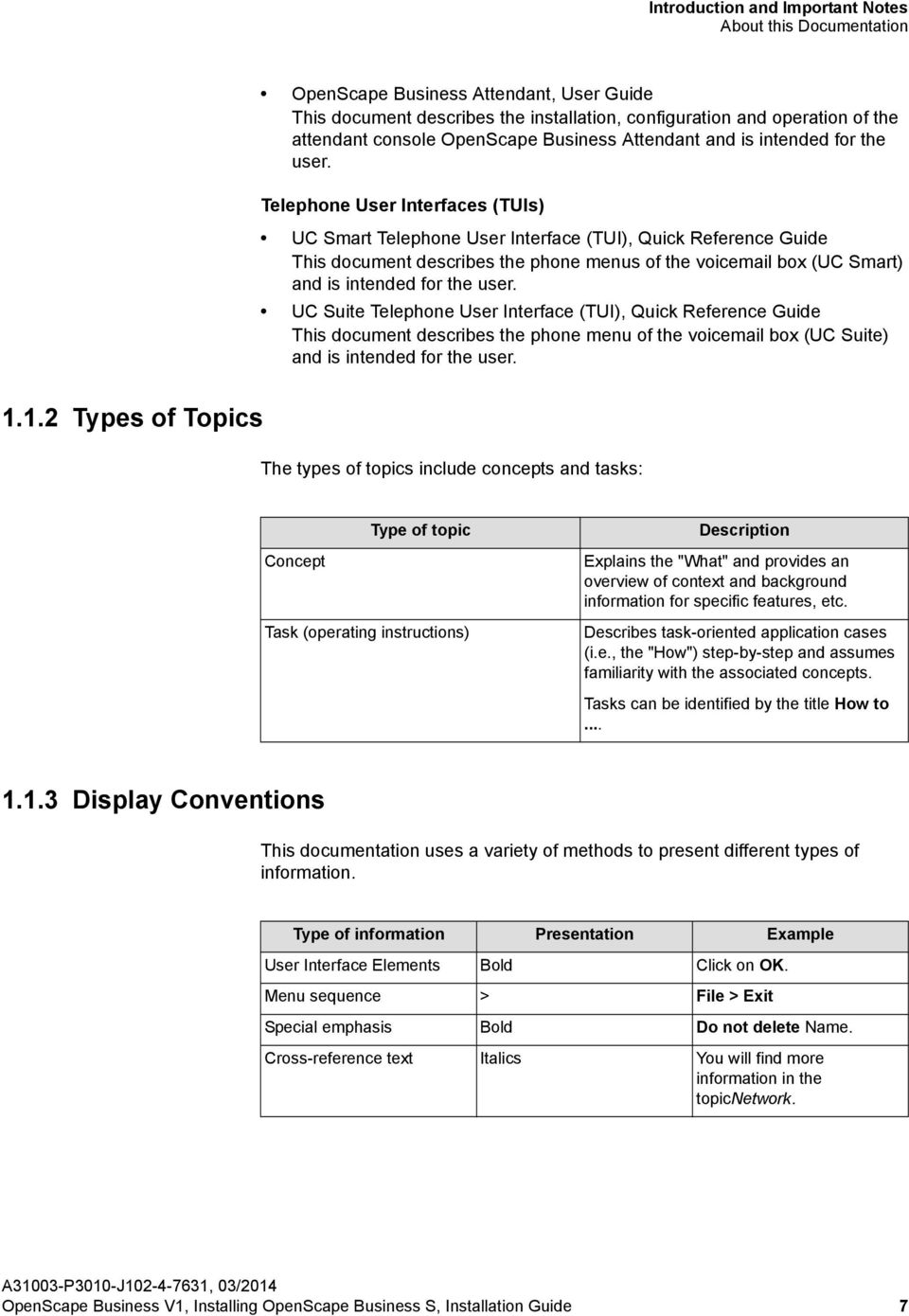
8 Introduction and Important Notes About this Documentation Type of information Presentation Example Output Input Key combination Monospace font, e.g., Courier Monospace font, e.g., Courier Monospace font, e.g., Courier Command not found. Enter LOCAL as the file name. <Ctrl>+<Alt>+<Esc> 8 OpenScape Business V1, Installing OpenScape Business S, Installation Guide

9 Prerequisites for the Initial installation 2 Initial Installation of OpenScape Business S This section describes the initial installation of OpenScape Business S. This includes the integrating the softswitch and related components into the existing customer LAN as well as setting up Internet access for Internet telephony and configuring the connected stations. The initial installation of OpenScape Business S (also referred to as "softswitch" in short) is carried out using the OpenScape Business Assistant administration program (web-based management, also called WBM in short). This section describes the configuration of the most common components. Not all of these components may be used by you. At various point during the initial installation, you can choose between several options or may even have to skip a configuration procedure entirely, depending on which components you use. The detailed administration of any features that are not covered by initial installation is described in the following chapters. Initial installation requires the creation of an IP address scheme and a dial plan. Summary of the most important installation steps: System settings System Phone Numbers and Networking Internet telephony Station configuration Licensing Data backup 2.1 Prerequisites for the Initial installation Meeting the prerequisites for the initial installation ensures the proper operation OpenScape Business S. General Depending on the used hardware (phones,...) and the existing infrastructure, the following general conditions apply: The LAN infrastructure (Internet routers, switches, etc.) is present and usable. The IP phones are connected to the customer LAN. The Linux server required for OpenScape Business S was installed as per the instructions in the OpenScape Business V1 Linux Server Installation Guide, was integrated into the customer LAN, and is ready for use. All licenses required for OpenScape Business S are present (e.g., UC clients, Gate View, Directory Services, etc.). An IP address scheme exists and is known. A dial plan (also called a numbering plan) is present and known. OpenScape Business V1, Installing OpenScape Business S, Installation Guide 9

10 Prerequisites for the Initial installation Software The following software is required for the installation of OpenScape Business S: DVD with the OpenScape Business communication software contains the OpenScape Business communication software. This DVD is included in the delivery package. DVD with Linux operating system SLES 11 SP3 64 bit The Linux DVD may be needed during the installation of the OpenScape Business communication software, since some software packages (RPM) required for the communication software may need to installed later from this DVD. Administration For the initial installation of OpenScape Business S with the OpenScape Business Assistant (WBM), the Linux server or the Admin PC can be used. The WBM is browser-based and is thus independent of the operating system. Web browsers: The following HTML 5-enabled web browsers are supported: Microsoft Internet Explorer Version 10 and later (Admin PC). Mozilla Firefox Version 17 and later (Linux server / Admin PC) If an older version of the Web browser is installed, you will need to install an up-to-date version before you can start the initial installation of the system. Java Runtime Environment 1.6 or higher (Admin PC): If the Admin PC is used for the initial installation, Java Runtime Environment 1.6 or higher must be installed. If an older version of the Java Runtime Environment is installed, you will need to install an up-to-date version before you can start the initial installation. Screen resolution: 1024x768 or higher Firewall When connected to the Internet, a firewall is needed for the Linux server to prevent unauthorized access from outside. After installing Linux, the Linux firewall is enabled. The installer of the communication software adjusts the firewall settings so that the communication software can be operated properly. The ports for the communication software are opened, and all other ports are closed. If an external firewall is used in the network, the Linux firewall must be disabled, and the addresses and ports required for the communication software must be opened (see Used Ports). Internet Access The Server PC must have broadband Internet access for: Security patches and general Linux software updates OpenScape Business requires an Internet connection for: OpenScape Business software updates OpenScape Business features such as Internet telephony, for example 10 OpenScape Business V1, Installing OpenScape Business S, Installation Guide

11 Components OpenScape Business Mobility Clients such as myportal for Mobile, for example Remote Service (SSDP) Server (Optional) OpenScape Business requires access to an server in order to send e- mails. For this purpose, the access data to the server must be entered in OpenScape Business, and the relevant accounts (IP address, URL, login data of the server) must be set up in the server. If the functionality is not used within OpenScape Business, this data need not be entered. Internet Telephony, VoIP (Optional) If Internet telephony is used within OpenScape Business, then OpenScape Business will require broadband access to the Internet and to an Internet Telephony Service Provider (ITSP, SIP Provider) for SIP telephony over the Internet. To do this, the appropriate accounts must be obtained from the ITSP, and the access data for the ITSP (IP address, URL, login data of the SIP Provider) must be set up in OpenScape Business. 2.2 Components The various components of the installation example are described and outlined below. The installation example includes the following components: OpenScape Business S The Linux server with the OpenScape Business S communication software is integrated in the existing customer LAN via its LAN interface. Admin PC The admin PC is also integrated in the existing customer LAN via its LAN interface. IP stations (IP clients) The IP stations (IP system phones, client PCs, WLAN Access Points, etc.) are integrated in the LAN via one or more switches. The IP clients obtain their IP addresses dynamically from an internal DHCP server (DHCP server of the Linux server) or from an external DHCP server (DHCP server of the Internet router, for example). Internet access is configured in the Internet router. OpenScape Business V1, Installing OpenScape Business S, Installation Guide 11

12 IP Address Scheme ITSP LAN Infrastructure incl.: LAN Switch Internet Router DHCP Server OpenScape Business S Client PC IP Phone Admin PC Client PC IP Phone 2.3 IP Address Scheme An IP address scheme is a definition of how the IP addresses are used in the customer LAN. It includes the IP addresses of PCs, servers, Internet routers, IP phones, etc. To provide a better overview of the assignment of IP addresses, an IP address scheme should be created. Example of an IP address scheme with the IP address range x: IP address range Clients through Clients with a fixed IP address Internet router (gateway) 12 OpenScape Business V1, Installing OpenScape Business S, Installation Guide

13 Dial Plan IP address range Server PC (OpenScape Business S) server Clients to Client PCs & IP phones, also the IP address range of the DHCP server; IP addresses are assigned automatically to the clients 2.4 Dial Plan A dial plan is a list of all phone numbers available in the communication system. It comprises internal phone numbers, DID numbers, and group station numbers. Default Dial Plan The internal call numbers are preassigned default values. These values can be adapted to suit individual requirements as needed (e.g., to create individual dial plans). Extract from the default dial plan: Type of call numbers Default call numbers Internal station numbers , User direct inward dialing numbers , Group station numbers Voic call number 71 Announcement Player call number 72 Seizure codes (external codes): Central Office ITSP Call number for conferences Call number for parking 7405 Call number for AutoAttendant Call number for MeetMe conference 7430 Individual Dial Plan An individual dial plan can be imported in the WBM via an XML file during the basic configuration. The XML file contains several tabs. Besides the names and phone numbers of subscribers, the "Stations" tab also includes additional subscriber data such as the subscriber types and addresses of the subscribers. A sample XML file with the appropriate explanations can be found in the WBM under Service Center > Download Center > XML Templates. You can also use OpenScape Business V1, Installing OpenScape Business S, Installation Guide 13

14 Installing the Communication Software the XML file stored there as a template for your data. It can be edited with Microsoft Excel, for example. 2.5 Installing the Communication Software The OpenScape Business communication software is installed on the Linux server using the OpenScape Business DVD. Make sure that the IP addresses and network masks to be configured are appropriate for the customer LAN. DHCP Server A DHCP server automatically assigns a unique IP address to each IP station (IP phones, PCs, etc.) and provides the IP stations with network-specific data such as the IP address of the default gateway, for example. Either an external DHCP server (e.g., the DHCP server of the Internet router or of the communication system) or the DHCP server of the Linux server can be used as a DHCP server. If the DHCP server of the Linux server is used, the external DHCP server must be disabled. The configuration of the Linux DHCP server can be performed during the installation of the OpenScape Business communication software. Virtual Environment The communication software can run in a virtual environment. To do this, the virtualization software (host operating system) must be first installed and configured on the server PC. Linux is then installed as a guest operating system. Within the Linux operating system, the communication software is installed last (see OpenScape Business V1, Linux Server, Installation Guide for more details). Use of snapshots on virtual machines (VM): Snapshots can be a valuable maintenance mechanism, for example, to perform a fast rollback to a predefined operating state of the VM after a mass distribution script has failed. Snapshots cannot be created during normal operation. The current operating state of the virtual machine is frozen while taking a snapshot. Consequently, connected terminals and applications such as IP phones or the UC clients may lose the connection to the server. Snapshots may result in internal server processes losing their synchronization, so the stable operation of the communication system is no longer guaranteed. For this reason, the time required for a server restart should be scheduled within the maintenance window following a snapshot. Previous snapshots should not remain on the production environment during normal operation. Snapshots can be taken during a planned maintenance window or within the framework of the installation. Snapshots are used internally by backup tools such as VDP or VDR. It must be ensured that these backup operations are scheduled outside of business 14 OpenScape Business V1, Installing OpenScape Business S, Installation Guide

15 Installing the Communication Software hours and that the snapshots generated by these tools are deleted at the end of the operation. More information on snapshots can be obtained from the VMware Knowledge Base (KB). A good starting point is the KB article Best practices for virtual machine snapshots in the VMware environment ( kb.vmware.com/kb/ ) How to Install the Communication Software Prerequisites The SLES 11 SP3 64 bit operating system has been correctly installed and started on the Linux server. DVD with OpenScape Business communication software. DVD with the Linux operating system SLES 11 SP3 64 bit for any subsequent installation of software packages (RPM) that may be required. The root access data (user name and password) for logging into the Linux server is available. IMPORTANT: The OpenScape Business communication software overwrites any existing configuration files (e.g., for DHCP, FTP, Samba, Postfix, etc.) during the installation. Step by Step 1) Log into the Linux server with root privileges. 2) Insert the OpenScape Business DVD into the DVD drive. 3) Confirm the message with Run. The "Welcome" window appears. 4) Select the desired setup language (e.g., English) and click Start. The rest of the installation is described here for the English language. 5) Select the desired product from the list and click on Select. A check is performed to determine whether the hardware meets all the requirements for the installation. A warning is displayed for minor shortfalls in meeting the requirements. After confirmation, the installation can then be continued. For severe shortfalls, the installation is canceled automatically. 6) A check is performed to determine whether additional RPM packages need to be installed. If yes, confirm this with Confirm. If this occurs, you will need to switch back to the SLES 11 DVD later. 7) A window with the terms of the license (i.e., the End User License Agreement or EULA) appears. Read the terms of the license and accept the license agreement with Yes. 8) If a DHCP server is already present in the customer LAN (e.g., the DHCP server of the Internet router), stop the configuration of the Linux DHCP server here with No and proceed to step 12 to continue. OpenScape Business V1, Installing OpenScape Business S, Installation Guide 15

16 Installing the Communication Software INFO: In order to ensure that the software of system telephones can be updated automatically even when using an external DHCP server, you have two options: a) The IP address of the Linux server must be entered as the DLS address at each system telephone. b) The network-specific data must be entered at the external DHCP server. The parameters for this can be found under /var/ log/opti.txt. 9) If you want to use the Linux DHCP server, click on Yes to enable and configure the Linux DHCP server. 10) Enter the following values (preset with default values): Default Route: IP address of the default gateway; as a rule, the IP address for the Internet router, e.g., Domain (optional): the domain specified during the Linux installation, e.g., <customer>.com DNS-Server (optional): IP address of the DNS server specified during the Linux installation. If no DNS server is available in the internal network, you can enter the IP address of the Internet router (e.g., ) here. SNTP Server: IP address of the internal or external NTP server. DLS/DLI Server: IP address of DLS server, i.e., the IP address of the Linux server (e.g.: ). Subnet: appropriate subnet for the IP address range, e.g.: Netmask: Subnet mask of the Linux server that was specified during the Linux installation, e.g.: IP range begin and IP range end: IP address range from which the DHCP server may assign IP addresses, e.g.: to ) Click on Continue. 12) After the installation, the Linux operating system needs to be restarted. Select the check box PC Reboot and confirm with Continue. 13) If additional RPM packages need to be installed, you will be prompted to insert the SLES 11 DVD. Insert the DVD and confirm with Continue. Following the successful installation of the RPM packages, reinsert the OpenScape Business DVD and confirm this with Continue, followed by Run. 14) The OpenScape Business communication software is installed. The operating system then automatically performs a restart. 15) After the restart, log in with the user account that was set up earlier during the Linux installation. 16) Right-click on the DVD drive icon on the desktop and select the menu item Eject. Remove the OpenScape Business DVD from the DVD drive. 16 OpenScape Business V1, Installing OpenScape Business S, Installation Guide

17 Function Check with the OpenScape Observer INFO: It takes a few minutes until all components of the OpenScape Business communication software are active. Using the OpenScape Observer, you can check when the OpenScape Business communication software is ready for use. 2.6 Function Check with the OpenScape Observer The OpenScape Observer program can be used to check whether OpenScape Business is operational. OpenScape Observer can be started from the Admin PC or from a client PC in the internal network. To do this, the program must be copied from the Service Center of the WBM to the PC How to Copy OpenScape Observer to the PC Prerequisites Step by Step The OpenScape Business communication software is installed. Java Runtime Environment 1.6 or higher is installed on the PC. 1) Start the web browser on the PC and open the login page of the WBM at the following address: address of the Linux server>, e.g., ) If the browser reports a problem with a security certificate, install the certificate (using the example of Internet Explorer V10). a) Close the web browser. b) Open the web browser with administrator rights by clicking the right mouse button on the web browser icon and selecting the menu item Run as administrator from the context menu. c) Allow the User Account Control. d) Open the login page of the WBM at the following address: address of the Linux server>, e.g., e) Click on Continue to this website. f) Click on the message Certificate Error in the navigation bar of the web browser. g) Click on View Certificates. OpenScape Business V1, Installing OpenScape Business S, Installation Guide 17

18 Function Check with the OpenScape Observer h) Click on Install Certificate (only visible with administrator rights). i) Select the option Local Computer and confirm with Next. j) Select the option Place all certificates in the following store, click Browse and specify Trusted Root Certification Authorities. k) Confirm with OK and then with Next and Finish. l) Confirm the certificate import with OK and close the certificate window OK. m) Close the web browser. n) Start the web browser again (without administrator rights) and open the login page of the WBM at the following address: address of the Linux server>, e.g., ) Click on the language code at the top right and select the language in which the user interface of the WBM is to be displayed from the menu. The Login page will be displayed in the selected language. 4) In the field under Login, enter the default user name for access as an administrator. INFO: If you press the tab key after entering will be added automatically. 5) In the second field under Login, enter the default password administrator for access as an administrator. 6) Click Login. 7) You are prompted to change the default password. a) Reenter the default password administrator in the Password field. b) Enter a new password in the New Password and Confirm New Password fields to protect the system against misuse. Note case usage and the status of the Num key. The password is displayed as a string of asterisks (*). INFO: The password must be at least 8 characters long and include a digit. Make sure that you remember your new password. 8) Click Login. 9) Click on Service Center in the navigation bar. 10) Click in the Software area on the item OpenScape Observer. 11) Save the file OsoObserver.jar on the PC in a directory of your choice. 18 OpenScape Business V1, Installing OpenScape Business S, Installation Guide

19 Starting Up How to Start OpenScape Observer from the PC Prerequisites Step by Step The file OsoObserver.jar is stored on the client PC. 1) Navigate on the PC to the storage path of OpenScape Observer. 2) Double-click on the file OsoObserver.jar. OpenScape Observer opens as a small window in the upper left corner of the screen. 3) Enter the IP address of the Linux server on which the OpenScape Business communication software is installed (e.g., ) in the field of the OpenScape Observer. 4) Click on Connect OSO. 5) Another window opens with the following contents: IP address of the Linux server (in the header) Version number of the installed OpenScape Business communication software Version of the Linux server operating system Utilization of the home partition (HD) and memory (RAM) of the Linux server as a percentage Abbreviation of the installed product (e.g., S for OpenScape Business S and B for the UC Booster Server) 6) In the window you will also be informed about the status of OpenScape Business with an LED display: Red LED: The OpenScape Business system components cannot be started - OpenScape Business is not ready for use Yellow LED: The OpenScape Business system components have started - OpenScape Business is not yet ready for use Green LED: The OpenScape Business system components have started - OpenScape Business is ready for use 2.7 Starting Up The basic settings are made using the Initial Installation wizard of the WBM How to Start the Initial Installation Wizard Prerequisites The WBM has been started. OpenScape Business V1, Installing OpenScape Business S, Installation Guide 19

20 Starting Up Step by Step 1) In the navigation bar, click on Setup. 2) Click on Edit to start the Initial Installation wizard. INFO: If the size of the browser window cannot display the workspace in its entirety at low screen resolutions, a horizontal or vertical scroll bar appears at the sides and can be used to scroll to the required section. Next steps Perform initial installation as described in the following step-by-step instructions. Fields that are not described here are preset for the default scenario and should only be changed if they are not appropriate for your network data. For detailed information, refer to the descriptions provided in the Administrator documentation for the individual wizards System Settings The System Settings window is used to configure the system settings of the communication system. Proceed as follows: 1. Set the display logo and the product name Specify a display text to be displayed on the display of the system phones. Additionally, you can also select the product name. 2. Select the country code and the language to be used for event logs For country initialization to work correctly, you must select the country in which the communication system is operated. In addition, you can select the language in which the event logs (system event logs, errors logs, etc.) are to be stored How to Set the Display Logo and the Product Name Prerequisites You are in the System Settings window. 20 OpenScape Business V1, Installing OpenScape Business S, Installation Guide

21 Starting Up Step by Step Next steps 1) In the Display Logo field, enter a text of your choice (e.g., OS Business S). The text can contain up to 16 characters. Avoid the use of diacritical characters such as umlauts and special characters. 2) Select the desired time product name in the Brand drop-down list. Select the country code and language to be used for the event logs How to Select the Country Code and the Language for Event Logs Prerequisites You are in the System Settings window. Step by Step Next steps 1) In the System Country Code drop-down list, select the country where the communication system is operated. 2) In the Language for Customer Event Log field, enter the language in which the event logs (system event logs, error logs, etc.) are to be output. Start the basic configuration. OpenScape Business V1, Installing OpenScape Business S, Installation Guide 21
22 Basic Configuration 2.8 Basic Configuration The Basic Installation wizard is used for basic configuration. Basic configuration includes the most important settings for operating the communication system How to Start the Basic Installation Wizard Prerequisites Step by Step Next steps The Initial installation has been completed. 1) In the navigation bar, click on Setup. 2) Click on Edit to start the Basic Installation wizard. Perform basic installation as described in the following step-by-step instructions. Fields that are not described here are preset for the default scenario and should only be changed if they are not appropriate for your network data. For detailed information, refer to the descriptions provided in the Administrator documentation for the individual wizards System Phone Numbers and Networking Enter the system phone numbers (PABX number, country and area code, international prefix) in the Overview window and specify whether OpenScape Business is to be networked with other OpenScape Business systems. Proceed as follows: 1. Enter system phone numbers Enter system phone numbers for point-to-point connection Here you enter the system phone number for your point-to-point connection and the country code and area code. The entry of the country code is mandatory for Internet telephony and conference server functionality. The international prefix is preset, depending on the previously dialed country code. Enter system phone numbers for point-to-multipoint connection Here you enter the country code and area code for your point-tomultipoint connection. The entry of the country code is mandatory for Internet telephony and Meet-Me conferences. The international prefix is preset, depending on the previously dialed country code. 22 OpenScape Business V1, Installing OpenScape Business S, Installation Guide
23 Basic Configuration 2. Activate or deactivate networking If OpenScape Business is to be networked with other OpenScape Business systems, networking must be enabled, and OpenScape Business must be assigned a node ID. Every OpenScape Business must have a unique node ID in the network How to Enter the System Phone Numbers for a Point-to-Point connection Prerequisites You have a point-to-point connection. You are in the Summary window. Step by Step Next steps 1) In the Country Code field, enter the country code prefix, e.g., 49 for Germany or 1 for the U.S. 2) Enter the local area code, e.g., 89 for Munich, in the Local area code field. 3) Enter the system phone number of your trunk connection, e.g., 7007 (your connection number), in the PABX number field. 4) Change the International Prefix field only if required. The applicable values for Germany and the United States are 00 and 011, respectively. For international calls, the phone number is preceded by the international prefix and the country code, e.g., " " for calls from Germany to the USA and " " for calls from the USA to Germany. Activate or deactivate networking OpenScape Business V1, Installing OpenScape Business S, Installation Guide 23
24 Basic Configuration How to Enter the System Phone Numbers for a Point-to-Multipoint Connection Prerequisites You have a point-to-multipoint connection. You are in the Summary window. Step by Step Next steps 1) In the Country Code field, enter the country code prefix, e.g., 49 for Germany or 1 for the U.S. 2) Enter the local area code, e.g., 89 for Munich, in the Local area code field. 3) Leave the PABX number field empty. 4) Change the International Prefix field only if required. The applicable values for Germany and the United States are 00 and 011, respectively. For international calls, the phone number is preceded by the international prefix and the country code, e.g., " " for calls from Germany to the USA and " " for calls from the USA to Germany. Activate or deactivate networking How to Activate or Deactivate Networking Prerequisites You are in the Summary window. 24 OpenScape Business V1, Installing OpenScape Business S, Installation Guide
25 Basic Configuration Step by Step Next steps 1) If the communication system is to be networked with other communication systems: a) Select the Network Integration check box. b) In the Node ID field for the communication system, enter a node ID that is unique in the internetwork (digits from 1 through 100 are possible). 2) If the communication system is not to be networked with other communication systems, leave the Network Integration check box disabled. 3) Click on OK & Next. Configure the station data Station Data If necessary, you can configure your own individual dial plan instead of the predefined default dial plan in the Central Functions for Stations window and import additional station data. In an internetwork, the default dial plan must be adapted to the dial plan of the internetwork. The default dial plan contains predefined numbers for different types of stations (IP phones, analog phones,...) and for special functions (Internet telephony, voic box, AutoAttendant,...). The station data includes the internal call numbers, DID numbers and names of the stations. This data and other station data can be imported into the communication system via an XML file in UTF-8 format. INFO: An XML template with the appropriate explanations can be found in the WBM under Service Center > Download Center > CSV Templates. You can enter your data in this template by using Microsoft Excel, for example. OpenScape Business V1, Installing OpenScape Business S, Installation Guide 25
26 Basic Configuration You have the following options: Configure station data without an internetwork Proceed as follows: a) Display the station data You can have all preconfigured station numbers and station data displayed. b) Delete all station numbers (optional) If you use an individual dial plan, you must delete all preconfigured station numbers. c) Adapt preconfigured station numbers for the individual dial plan (optional) If you are using an individual dial plan, you can adapt the preconfigured phone numbers to your own dial plan. d) Import station data from an XML file (optional) You can easily import your individual station numbers including any additional station data via an XML file. Configure station data with an internetwork Proceed as follows: a) Delete all station numbers If the UC Suite is used in an internetwork, a closed numbering plan is required, i.e., all station numbers in the internetwork must be unique. For this reason, any preconfigured station numbers must be deleted and only stations numbers adapted for the internetwork must be used. b) Import station data from an XML file The station numbers adapted for the internetwork and any additional station data can be easily imported via an XML file. This file can contain all stations in the internetwork. During import, only the station numbers and the station data assigned to the previously specified node ID of the communication system will be transferred How to Display the Station Data Prerequisites Step by Step You are in the Central Functions for Stations window. 1) Select the Display stations configuration radio button. 2) Click on Execute function. A list of stations with the preconfigured phone numbers (default dial plan) is displayed. 3) Click on OK. You are taken back to the Central Functions for Stations window. 4) If you do not want to change any station data, click OK & Next. 26 OpenScape Business V1, Installing OpenScape Business S, Installation Guide
27 Basic Configuration How to Delete all Call Numbers Prerequisites Step by Step You are in the Central Functions for Stations window. 1) Enable the radio button Delete all station call numbers. 2) Enable the check box Delete All Call Addresses. 3) Click on Execute function. All preset call numbers are deleted. The Change preconfigured call and functional numbers window then appears. 4) Adjust the codes and special call numbers to suit your preferences, and then click OK. You are taken back to the Central Functions for Stations window. 5) If you do not want to change any further station data, click OK & Next How to Adapt Preconfigured Station Numbers for the Individual Dial Plan Prerequisites Step by Step You are in the Central Functions for Stations window. 1) Enable the radio button Change pre-configured call and functional numbers. 2) Click on Execute function. The Change preconfigured call and functional numbers window appears. OpenScape Business V1, Installing OpenScape Business S, Installation Guide 27
28 Basic Configuration 3) Adjust the preconfigured call numbers to suit your preferences, and then click OK. You are taken back to the Central Functions for Stations window. 4) If you do not want to change any further station data, click OK & Next How to Import the Station Data from an XML File Prerequisites Step by Step You are in the Central Functions for Stations window. An XML file with the entered data is available in UTF-8 format. An XML template can be found under Service Center > Download Center > CSV templates. 1) Enable the radio button Import XML file with station data. 2) Click on Execute function. 3) Use Browse to select the created XML file and click Open. 4) Click OK when finished. The station data is imported. 5) Click on OK & Next Internet Telephony The Provider configuration and activation for Internet telephony window is used to configure Internet telephony. You can configure predefined or new Internet Telephony Service Providers (ITSPs). You can configure one or several accounts for each ITSP. Only four ITSPs may be active at any one time. You have the following options: Configure a predefined ITSP You can use predefined ITSP templates. To do this, the own access data and phone numbers are entered in the template, and this is then activated. 28 OpenScape Business V1, Installing OpenScape Business S, Installation Guide
29 Basic Configuration Configure a new ITSP You can also add and activate a new ITSP. Configuring a new ITSP is seldom required and can be very time-consuming. This option is therefore not described in the initial installation. Detailed information can be found in the chapter Administrator Documentation, Connecting to Service Providers. Disable Internet telephony You can disable Internet telephony. INFO: Configuration examples can be found in the wiki under OSBiz_V1_Configuration_for_ITSP.pdf Assigning the ITSP Phone Numbers In the case of an Internet Telephony Station Connection, the ITSP provides individual numbers such as , , etc. These individual call numbers are then assigned manually as the internal call numbers of the subscribers. In the case of an Internet telephony point-to-point connection, the ITSP provides a call number range, e.g., (+49) to (+49) The call numbers from the range are then assigned manually as the internal call numbers of the subscribers. These two connection types can be combined as appropriate. Alternatively, the ITSP phone numbers can be entered as the DID call numbers of the subscriber for both connection types during the station configuration. The ITSP call numbers thus result from the configured PABX number (e.g., country code 49) and the entered DID numbers in long format. This has advantages for the digit analysis and call management, even in an internetwork. The ITSP connection is thus DID-enabled for another node, for example. A further CO trunk connection via ISDN is only possible to a limited extent in this case (useful for emergency calls, for example). Internal call number Name DID 100 Andreas Richter Susanne Mueller Buddy Miller Juan Martinez Emilio Carrara OpenScape Business V1, Installing OpenScape Business S, Installation Guide 29
30 Basic Configuration How to Configure a Predefined ITSP Prerequisites Step by Step You are in the Provider configuration and activation for Internet Telephony window. The Internet connection is operational. Your ITSP's Internet telephony access data is available (for example, user account, password and Internet telephony numbers). 1) Clear the No call via Internet check box. A country-specific list of the possible ITSPs is displayed. The list contains the predefined ITSPs for the selected country and any already created ITSPs. 2) If you want to change the preset country, select the desired country from the Country specific view drop-down list to display the ITSPs that are available for this country. 3) If required, click Display Status to check which ITSPs have already been activated and which Internet telephony subscribers have already been configured under each ITSP. You can activate a maximum of four ITSPs. Click OK when finished. 4) To configure Internet telephony stations, click Edit in the line associated with the relevant ITSP. 5) Activate the check box Enable Provider. 6) Click on OK & Next. 30 OpenScape Business V1, Installing OpenScape Business S, Installation Guide
31 Basic Configuration 7) Click on Add to configure your ITSP accounts with the corresponding Internet telephony numbers. The fields that will then be displayed are providerspecific. 8) Enter the credentials for your account in the Internet Telephony Station field. You received this data from your ITSP. Depending on the ITSP, different designations are used for this, for example: SIP User, SIP ID, etc. 9) Enter the authorization name in the Authorization name field. You received this data from your ITSP. If you have not received any authorization name, enter the same data you entered under Internet Telephony Station. 10) Enter the password you received from the ITSP in the New Password and Confirm Password fields. Depending on the ITSP, different designations are used for this, for example: Password, SIP Password, etc. 11) Assignment of Internet telephony phone numbers - Option 1: Use public number (DID): the Internet telephony phone numbers of your Internet telephony station connection or Internet telephony point-to-point connection are not entered here during the ITSP configuration, but when the configuring the stations, i.e., the telephones and subscribers (in the DID fields). OpenScape Business V1, Installing OpenScape Business S, Installation Guide 31
32 Basic Configuration a) Select the option field Use public number (DID) in the Call number assignment area. b) Under Default Number, enter the phone number to be used for outgoing calls to subscribers who do not have their own phone number. c) If your ITSP supports the "Mobile Extension (MEX)" feature, enter the MEX number provided by the ITSP (8 positions, digits only) under MEX Number. 12) Assignment of Internet telephony phone numbers - Option 2: Use internal number (Callno) / Single entries: You have an Internet telephony station connection and have received individual call numbers as Internet telephony phone numbers (e.g , ,...). Then assign these single numbers to the internal call numbers of the subscribers. a) Select the option field Use internal number (Callno) / Single entries in the Call number assignment area. 32 OpenScape Business V1, Installing OpenScape Business S, Installation Guide
33 Basic Configuration b) In the Internet Telephony Phone Numbers area, enter one of the Internet telephony phone numbers provided by the ITSP in the field next to the Add button and then click Add. c) To assign further Internet telephony numbers to the account, repeat step b). 13) Assignment of Internet telephony phone numbers - Option 3: Use internal number (Callno) / Range entry: You have an Internet telephony point-to-point connection and have received a call number range as Internet telephony phone numbers (e.g., +49) to (+49) You then assign the call numbers from the call number range as the internal call numbers of the subscribers. a) Select the option field Use internal number (Callno) / Range entry in the Call number assignment area. b) Enter the system phone number under System phone number (prefix). c) Enter the desired DID number range for the Internet telephony station in the 'from' and 'to ' fields after Direct inward dialing band. The range entered by default is ) Click on OK & Next. 15) If you want to configure additional accounts and their associated Internet telephony numbers, repeat steps 7 through ) Click on OK & Next. You will see an overview of which Internet telephony phone numbers are assigned to accounts. 17) Assign one internal station number each to every Internet telephony phone number. This step is not required if you have selected option 1 for the assignment of the Internet telephony phone numbers. In this case, the assignment is made when the configuring the stations (i.e., the telephones and subscribers) in the DID field. OpenScape Business V1, Installing OpenScape Business S, Installation Guide 33
34 Basic Configuration a) To do this, select an internal call number in the appropriate line from the Internal Call Number drop-down list. b) If subscribers without Internet telephony phone numbers or members of a call group are to be allowed to make external calls via the Internet, the radio button Use as PABX number for outgoing calls must be activated. The radio button can be activated for only one single Internet telephony phone number. 18) Click on OK & Next. Here you see again the list of predefined and newly added ITSPs. 19) Click on OK & Next. 20) Enter the upload speed of your Internet connection in the Upstream up to (Kbps) field. Please do not confuse this with the download speed! INFO: The number of simultaneous Internet calls permitted is displayed in the Number of Simultaneous Internet calls field. If the voice quality deteriorates due to the network load, you will need to reduce the number. 21) Click on OK & Next. 22) If you did not activate the full-time circuit when setting up your Internet access, you can now do this here. Without a permanent connection (full-time circuit), you cannot receive calls over the Internet. If the full-time circuit has already been set up, the fields described under a) to c) will not appear. a) Enable the radio button On under Full-Time Circuit. b) In the Forced Disconnect at (hour:min) field, enter the time at which the Internet connection is to be deactivated (e.g., 04:59). c) Click on OK & Next. 23) Enter the special numbers you want in the Dialed digits column. 34 OpenScape Business V1, Installing OpenScape Business S, Installation Guide
35 Basic Configuration The following station number entries are valid: 0 to 9: allowed digits -: Field separator X: Any digit from 0 to 9 N: Any digit from 2 to 9 Z: One or more digits to follow up to the end of dialing C: Simulated dial tone (can be entered up to three times) 24) Use the Dial over Provider column to specify whether the special number should be dialed via ISDN or an ITSP. Only the active ITSP is displayed. INFO: Ensure that emergency numbers can always be dialed. If you want to dial emergency numbers via an Internet Telephony Service Provider, you must make sure that the ITSP supports this feature. 25) Click on OK & Next. The status of your ITSP will be displayed. OpenScape Business V1, Installing OpenScape Business S, Installation Guide 35
36 Basic Configuration The configured ITSPs at which you are already registered are marked in green. The configured ITSPs at which you are not yet registered are marked in orange. 26) Click on Next followed by Finish How to Deactivate Internet Telephony Prerequisites Step by Step You are in the Provider configuration and activation for Internet Telephony window. 1) Leave the No call via Internet check box selected. 2) Click OK & Next twice Stations In the Select a station -... window, you can configure the stations connected to the communication system. Proceed as follows: 1. Configure the IP and SIP stations IP and SIP stations include LAN phones or WLAN phones, for example. 36 OpenScape Business V1, Installing OpenScape Business S, Installation Guide
37 Basic Configuration How to Configure IP and SIP Stations Prerequisites You are in the Select a station - LAN Phones window. A functional wireless LAN network is needed to operate WLAN phones. Step by Step 1) If you want a different direct inward dialing number for the station than the call number, enter a DID number for the station under DID in the row of the desired station: Only for a point-to-point connection: Click in the desired field and type in the DID number using the keyboard. The DID number may also be identical to the internal station number. Only for a point-to-multipoint connection: Select an MSN in the desired field via the drop-down list. The station can be internally reached via the internal station number 101, for example, and externally via the MSN For point-to-point and point-to-multipoint connections: Select the entry xxx - modifiable (xxx is the internal station number) via the drop-down list in the desired field and type in the DID number using the keyboard or select an MSN from the drop-down list. 2) Enter the internal station number for the subscriber under Call No in the appropriate row of the desired subscriber. You can use the preset phone number or assign some other free number. 3) In the row of the desired station, under Name, enter a name in the format Last Name, First Name. INFO: The name can consist of up to 16 characters, but should not include any diacritical characters such as umlauts or special characters. The name specified here will be entered as the Last Name at the UC clients, but can be edited there. OpenScape Business V1, Installing OpenScape Business S, Installation Guide 37
38 Basic Configuration 4) Select the type of IP station (e.g., "System Client" or "SIP Client") from the Type drop-down list in the row of the desired station. 5) If you want to set up a fax box for the subscriber (which can be used with the UC clients myportal for Desktop or myportal for Outlook, for example), proceed as follows: a) In the row of the desired station, in the Fax No. field, enter the desired internal fax number at which the user can receive internal fax messages. b) If you want to configure a DID number for the fax box, enter the desired external fax number under which the subscriber can receive external fax messages in the Fax Direct Inward Dialing field in the row of the desired subscriber. 6) Choose the desired Class of Service group in the row of the desired subscriber from the Class of Service drop-down list. 7) To add the subscriber to a call pickup group, select a call pickup group from the Call pickup group drop-down list in the row of the desired subscriber. 8) Make the settings described under this step only if needed or for a SIP phone: a) Click in the row of the desired station on the pencil icon Edit. b) For SIP phones: If the SIP phone is to be operated in conjunction with a dual-mode mobile phone, enter the dialout prefix followed by the telephone number of the mobile phone (e.g., ) in the Mobility area under Mobile phone number. In addition, select this SIP client from the Web Feature ID drop-down list. (see Administrator Documentation, Mobility). 38 OpenScape Business V1, Installing OpenScape Business S, Installation Guide
39 Basic Configuration c) In the Clip/Lin field, enter a phone number (DID number or MSN) to be displayed at the called party's extension instead of the own phone number in the case of an external call. INFO: This feature must be released by the network provider. d) Select the language for the menu controls on the phone from the Language drop-down list. e) From the Call signaling internal drop-down list, select and assign one of a total of eight possible acoustic call signals for internal calls. The station then will then send the modified ringing tone to other internal stations, thus enabling its calls to be distinguished from other internal stations (default: Ring type 1). f) From the Call signaling external drop-down list, select and assign one of a total of three possible acoustic call signals for external calls (default: Ring type 1). g) Only for SIP phones: Enable the Authentication active check box. h) Only for SIP phones: Enter the authentication password in the Password and Confirm password fields. i) Only for SIP phones: Enter the user ID for the authentication in the SIP User ID / Username field. j) Only for SIP phones: Enter the associated zone for the authentication in the Realm field. k) Click on OK & Next. 9) If you want to configure another IP station, click on Store data and repeat steps 1 through 8. 10) Click on OK & Next. A list of all configured stations appears. This list is effectively a dial plan. 11) If required, click Print to print out the data of the configured stations. 12) Then click OK & Next Configuring the UC Suite You can perform the automatic configuration of the UC solution UC Suite in the Automatic Configuration of the Application Suite window How to Configure the UC Suite Prerequisites You are in the Automatic Configuration of Application Suite window. OpenScape Business V1, Installing OpenScape Business S, Installation Guide 39
40 Basic Configuration Step by Step Click on Execute function. The UC Suite is configured automatically. Once the progress bar shows 100%, click on OK & Next Conference Server Settings (only with UC Suite) The MeetMe Conference settings window can be used to define the call numbers and the dial-in numbers for conferences. INFO: This window appears only if Package with UC Suite... was selected during the application selection in the Initial Installation wizard How to Edit the Conference Server Settings Prerequisites The hardware and software for using the UC Suite are available. You are in the Configure MeetMe Conference window. Step by Step 1) Enter a phone number for the conference in the Phone Number field. 2) Enter the dial-in number for the conference (conference DID) with which subscribers can dial into an existing conference in the Direct inward dialing field. 40 OpenScape Business V1, Installing OpenScape Business S, Installation Guide
41 Basic Configuration 3) Click on OK & Next Delivery (Optional) You can configure the delivery of s in the Configure Forwarding window. These s notify users of voic and fax messages and administrators of system messages. You have the following options: Configuring the Sending of s You can specify an external server via which the s are to be sent by OpenScape Business. Voic s, fax messages and internal system messages can then be sent via this server to one or several different configurable addresses. INFO: Entering the server is important if an with a link to the installation file(s) is to be automatically sent to the users of the UC Suite How to Configure the Sending of s Prerequisites An account with a password exists with an provider, and you know the access data for this account. You are in the Configure Forwarding window. OpenScape Business V1, Installing OpenScape Business S, Installation Guide 41
42 Closing Activities Step by Step 1) Enter the Outgoing mail server (SMTP) for the server to be used for sending s, e.g., smtp.web.de. Ask your provider for the outgoing mail server if required. INFO: Make sure that the name of the outgoing mail server can be resolved. If not, you must start the sending function via Service Center > Forwarding and then enter the IP address of the outgoing mail server instead of its name. 2.9 Closing Activities 2) If a secure connection is required, enable the corresponding check box. If required, check with your provider whether this option needs to be enabled. 3) Enter the User Name of the account, e.g.,: john.doe. 4) Enter the Password for the account and repeat it in the Confirm Password field. 5) Enter the Address, for example: [email protected]. 6) If you want to test the entered settings immediately, proceed as follows: a) Click on Test Connection. b) Under Send to address, enter the address of any box that you can access. The test will be sent to that address. c) Under Subject in the , enter a descriptive text so that you can identify the in your inbox. d) Click on Send Test . The settings are verified, and the e- mail is sent to the specified address. e) Check whether the has arrived in your inbox. f) If the was sent correctly, proceed to the next step. g) If the delivery failed, click Back and correct your settings. 7) Click on OK & Next followed by Finish. The basic installation is finished. Before you perform the backup mentioned in the wizard, you should activate the licenses. After the initial installation and the basic installation with the WBM have been completed, some important settings must still be made for the operation of OpenScape Business. Proceed as follows: 42 OpenScape Business V1, Installing OpenScape Business S, Installation Guide
43 Closing Activities 1. Activate the Remote Service (SSDP) You can provide access to the communication system to authorized service technicians of a Remote Service Partner via the Internet-based platform for remote services (SSDP, Smart Services Delivery Platform). This enables the provision of support when solving administration tasks or performing troubleshooting, for example. Every remote service partner who uses SSDP has a separate partner ID. The preset partner ID "Unify" can be used to activate remote access by authorized service personnel of the manufacturer. For details on configuring SSDP, see the section on Maintenance - Remote Services in the Administrator Documentation. 2. Activate and assign licenses The licenses procured with OpenScape Business must be activated within a period of 30 days. The time period begins the next time you log on to the WBM. After this time period expires, the communication system will only operate in restricted mode. Once the licenses have been activated successfully, they must be assigned to the stations and trunks. System-wide features are enabled automatically upon activation. 3. Provision the UC Clients for installation The UC clients are part of the UC Suite. The installation files for the UC Client are accessible via the WBM and can be made available to the IP stations automatically or manually. In addition, the administrator has the option of performing a silent installation. The silent installation/uninstallation is a command-line based method to automatically install, uninstall or modify UC Suite PC clients on a PC without requiring any further user inputs. For more information, see the section UC Suite - UC Suite Clients in the Administrator Documentation. 4. Perform a data backup All previous changes to OpenScape Business must be backed up. The backup can be stored as a backup set in the internal network, for example How to Enable the Remote Service SSDP Prerequisites Step by Step Internet access and a working DNS configuration exist. The partner ID of your remote service partner is available (preset partner ID: Unify) You are logged on to the WBM with the Advanced profile. 1) Click on Service Center in the navigation bar. 2) Click on Remote Access in the navigation tree. 3) Click on Activation / Deactivation to start the Activation / Deactivation of Service Plugin wizard. 4) Edit the preset partner ID in the Partner ID field if required and click Save. OpenScape Business V1, Installing OpenScape Business S, Installation Guide 43
44 Closing Activities 5) Click on Activate How to Activate and Assign the Licenses Prerequisites Step by Step You are logged on to the WBM with the Advanced profile. You know the LAC (License Authorization Code) for releasing the license and have a user ID and password for accessing the license server. You need Internet access to connect to the license server. 1) Activate license online: a) In the navigation bar, click on Setup. b) In the navigation tree, click Wizards > Basic Installation. c) Click on Edit to start the Licensing wizard. d) Enter the appropriate LAC in the License Authorization Code (LAC) field. e) Select the check box I have the user name and password for the License Server and want to log on. f) Enter the User Name and Password for logging into the License Server. g) Click on OK & Next. The connection to the license server is established, and the licenses are released. 2) Assign licenses to stations: a) Click on License Management in the navigation bar. b) In the navigation tree, navigate to the desired type of subscriber under Local User Licenses >... You will be shown a list of all subscribers of the selected subscriber type. c) In the row of the desired subscriber, select the check box in the User license column (first column with check boxes). 44 OpenScape Business V1, Installing OpenScape Business S, Installation Guide
45 Closing Activities d) Activate the user-oriented licenses in the row of the desired subscriber by selecting the appropriate check boxes. INFO: User-oriented licenses can be assigned to a subscriber only if a station license (user license) was assigned to the subscriber earlier (step c). e) Click on OK & Next. A check is performed to determine whether there are enough licenses for your assignment. If sufficient licenses are available, the licensing of the subscriber is completed. f) If licenses are missing, the errors are indicated by displaying a check box shaded in red. Correct these errors and repeat step e. 3) Assign licenses to trunks: a) In the navigation tree, click CO trunks. The number of trunk licenses purchased will be displayed in the CO trunks area. b) For SIP trunks: In the License demand for number of simultaneous Internet calls in this node area, enter the number of Internet calls that can be conducted simultaneously via an ITSP. c) Click on OK & Next. OpenScape Business V1, Installing OpenScape Business S, Installation Guide 45
46 Closing Activities How to Provision the UC Clients for Installation (only with UC Suite) Prerequisites You are logged on to the WBM with the Advanced profile. The hardware and software for using the UC Suite are available. INFO: Licenses are required to use the UC clients. Step by Step 1) To enable the installation files to be provided automatically to a station, make sure that the following steps have been performed: a) The addresses of the stations and the associated subscriber data must have either been already imported via an XML file or entered later under Setup > UC Suite > User Directory. b) An server must have been specified. INFO: You can also enter an server later under Service Center > Forwarding. All subscribers whose addresses are known receive an with a link to the installation directory of the UC clients and Getting Started Instructions. The installation folder also includes a Readme file with information on installing the software on client PCs. 2) If the required steps for automatic notification are not fulfilled, you can also make the installation files available manually. To do this, proceed as follows: a) Click on Service Center in the navigation bar. b) In the navigation tree, click Download Center. c) Click on the desired UC client in the Software area and save the zipped installation files on a shared network drive. d) Click on the documentation of the desired UC client and save the documentation file on a shared network drive. e) Send the zipped installation files and the documentation file to the users of the UC Suite by or inform the users about the storage location of these files. f) The zip file with the installation files also includes a Readme file. Notify the users that the installation of the UC clients must be performed in accordance with the installation notes in the Readme file. 46 OpenScape Business V1, Installing OpenScape Business S, Installation Guide
47 Commissioning of IP Phones How to Perform a Data Backup Prerequisites You are logged on to the WBM with the Advanced profile. INFO: For more information on backing up data, see Administrator Documentation, Maintenance. Step by Step 1) Click on Backup and Restore in the navigation bar. 2) In the navigation tree, click Backup - Immediate. 3) Enter a comment for the backup set in the Comment field in the Name area so that the backup set can be easily identified if needed later for a restore. Avoid the use of diacritical characters such as umlauts and special characters in your input. 4) Activate the target drive on which the backup set is to be saved (e.g., a network drive) in the Devices area. 5) Click on OK & Next. The progress of the backup process is displayed in a separate window. 6) The backup was successful if the message Backup completed successfully! appears. Click on Finish. 7) This completes the initial startup with WBM. Exit the WBM by right-clicking the Logout link on the top right of the screen and then close the window Commissioning of IP Phones The commissioning of IP phones can be facilitated by the existence of a DHCP server that supplies an IP phone with important (network-specific) data that is needed to log into the communication system. Network-Specific Data In order to log into the communication system, an IP phone requires some network-specific data. This data can be stored in the DHCP server or be entered directly at the IP phone. The advantage of a DHCP server is that all connected IP phones are automatically supplied with the relevant data. The following data is required by the IP phone: IP address of the communication system IP address of DLS server In addition, the IP phone needs its own call number. This must be entered manually when logging in at the phone. OpenScape Business V1, Installing OpenScape Business S, Installation Guide 47
48 Commissioning of IP Phones Registration of SIP Phones For security reasons, it is recommended that SIP phones register at the communication system. To do this, the registration information on the IP phone and the communication system must match. The following data is required for the login: SIP user ID SIP password SIP realm (optional) Use a non-trivial SIP password that complies with the following rules: At least 8 characters At least one uppercase letter (A - Z) At least one lowercase letter (a - z) At least one digit (0-9) At least one special character Use a SIP user ID that does not include the phone number. INFO: More information on configuring SIP telephones can be found at SIP_devices_configuration_examples. Using the Internal DHCP Server If the internal DHCP server of the communication system is used, the networkspecific data will already be stored there. In order to enable an IP phone to register at the communication system, only the specified call number must be entered at the IP phone. In the case of SIP phones, the SIP registration data at the SIP phone and at the communication system must match. Using an External DHCP Server with Network-specific Data If an external DHCP server is used, the network-specific data must be stored there. In order to enable an IP phone to register at the communication system, only the specified call number must be entered at the IP phone. In the case of SIP phones, the SIP registration data at the SIP phone and at the communication system must match. Using an External DHCP Server without Network-specific Data If an external DHCP server in which the network-specific data cannot be stored is used, this must be entered at the IP phone. To enable an IP phone to register at the communication system, the defined call number and IP address of the communication system must be entered at the phone, and the settings for the Deployment Service may need to be changed. In the case of SIP phones, the SIP registration data at the SIP phone and at the communication system must match. 48 OpenScape Business V1, Installing OpenScape Business S, Installation Guide
49 Commissioning of IP Phones How to Configure an IP Phone Prerequisites The IP phone is connected to the internal network and operational. INFO: The sample configuration described here uses an OpenStage 40/60/80 IP system telephone. The same settings must also be made for any other IP phone. For more information, refer to the manual supplied with your IP phone. Step by Step 1) To reach the administration mode of the IP system telephone, press the appropriate key for the Settings/Applications menu on the phone. 2) Scroll through the Settings options until Admin and confirm this with the OK key. 3) Enter administrator password ( by default) and confirm your selection with the OK key. 4) If you are using the DHCP server of the communication system in the internal network, skip the next step. 5) If you are not using the DHCP server of the communication system in the internal network, you will need to enter the IP addresses of the Deployment Server (DLS) and the communication system so that the software of the IP system telephone can be updated automatically. This applies only to IP system telephones. Proceed as follows: a) Scroll to Network and confirm your selection with the OK key. b) Scroll to Update service (DLS) and confirm your selection with the OK key. c) Scroll to DLS address and confirm your selection with the OK key. d) Specify the IP address of the communication system ( by default) as the Deployment Server and confirm your entry with the OK key. e) Scroll to Save & Exit and confirm your selection with the OK key. f) Scroll to IPv4 configuration and confirm your selection with the OK key. g) Scroll to Route (default) and confirm your selection with the OK key. h) Specify the IP address of the communication system ( by default) and confirm your entry with the OK key. i) Scroll to Save & Exit and confirm your selection with the OK key. j) Navigate one menu level back with the Back key. OpenScape Business V1, Installing OpenScape Business S, Installation Guide 49
50 Commissioning of IP Phones 6) Specify the call number of the phone: a) Scroll to System and confirm your selection with the OK key. b) Scroll to Identity and confirm your selection with the OK key. c) Scroll to Terminal number and confirm your selection with the OK key. d) Enter the set phone number (e.g., 120) and confirm your selection with the OK key. e) Scroll to Save & Exit and confirm your selection with the OK key. 7) Navigate one menu level back with the Back key. 8) If the system telephone needs to be restarted due to the changes made, the menu item Restart will appear in the Admin menu. Confirm the Restart with the OK key and then also confirm Yes with the OK key. The system telephone performs a reboot and logs in to the communication system How to Configure a SIP Phone Prerequisites The SIP phone is connected to the customer LAN and operational. INFO: The configuration described here uses an OpenStage 40/ 60/80 SIP system telephone as an example. The same settings must also be made for another SIP phone. For more information, refer to the manual supplied with your SIP phone. Step by Step 1) To reach the administration mode of the SIP system telephone, press the appropriate key for the Settings/Applications menu on the phone. 2) Scroll through the Settings options until Administrator (Admin) and confirm this with the OK key. 3) Enter administrator password ( by default) and confirm your selection with the OK key. 4) If you are using the DHCP server of the communication system in the internal network, skip the next step. 5) If you are not using the DHCP server of the communication system in the internal network, you will need to enter the IP addresses of the Deployment Server (DLS) and the communication system so that the software of the SIP system telephone can be updated automatically. This applies only to SIP system telephones. Proceed as follows: a) Scroll to Network and confirm your selection with the OK key. b) Scroll to Update service (DLS) and confirm your selection with the OK key. 50 OpenScape Business V1, Installing OpenScape Business S, Installation Guide
51 Commissioning of IP Phones c) Scroll to DLS address and confirm your selection with the OK key. d) Specify the IP address of the communication system ( by default) as the Deployment Server and confirm your entry with the OK key. e) Scroll to Save & Exit and confirm your selection with the OK key. f) Scroll to IPv4 configuration and confirm your selection with the OK key. g) Scroll to Route (default) and confirm your selection with the OK key. h) Specify the IP address of the communication system ( by default) and confirm your entry with the OK key. i) Scroll to Save & Exit and confirm your selection with the OK key. j) Navigate one menu level back with the Back key. 6) Specify the SNTP time settings: a) Scroll to Date and time and confirm your selection with the OK key. b) Scroll to Time source and confirm your selection with the OK key. c) Scroll to SNTP IP address and confirm your selection with the OK key. d) Specify the IP address of the communication system ( by default) and confirm your entry with the OK key. e) Scroll to Timezone offset and confirm your selection with the OK key. f) Enter the deviation between the local time and UTC (Universal Time Coordinated) in hours (Germany: 1) and confirm this with the OK button. g) Scroll to Save & Exit and confirm your selection with the OK key. h) Navigate one menu level back with the Back key. 7) Specify the call number of the phone: a) Scroll to System and confirm your selection with the OK key. b) Scroll to Identity and confirm your selection with the OK key. c) Scroll to Terminal number and confirm your selection with the OK key. d) Enter the set phone number (e.g., 120) and confirm your selection with the OK key. e) Scroll to Save & Exit and confirm your selection with the OK key. 8) Specify the SIP authentication data: a) Scroll to Registration and confirm your selection with the OK key. b) Scroll to SIP Session and confirm your selection with the OK key. c) Note the Realm, or enter a new realm (e.g., OSBIZ-SIP), if necessary. d) Note the User ID, or enter a new user ID (e.g., SIP-120), if necessary. e) Specify a Password for registering at the SIP server. f) Scroll to Save & Exit and confirm your selection with the OK key. OpenScape Business V1, Installing OpenScape Business S, Installation Guide 51
52 Uninstalling the Communication Software 9) Use the Back key to go back to the Admin menu. 10) If the system telephone needs to be restarted due to the changes made, the menu item Restart will appear in the Admin menu. Confirm the Restart with the OK key and then also confirm Yes with the OK key. The system telephone performs a reboot and logs in to the communication system Uninstalling the Communication Software The software communication can be uninstalled via a text console How to Uninstall the Communication Software Step by Step 1) Open a terminal (e.g., a GNOME terminal). 2) Enter the command su (for superuser = root) in the shell interface and confirm it by pressing the Enter key. 3) Enter the password for the "root" user in the shell interface and confirm it by pressing the Enter key. 4) Enter the command oso_deinstall.sh in the shell interface and confirm it by pressing the Enter key. Follow the instructions of the uninstallation program Used Ports The OpenScape Business system components use various ports. These ports are always only server ports. Client ports are not taken into account here. INFO: The ports identified with "O" in the list below are optional, i.e., are not permanently open in the firewall (e.g., the TFTP port is open only when Gate View is activated). Description TCP UDP Port number OpenScape Business X UC Booster Card OpenScape Business S UC Booster Server Admin Portal (https) X 443 X X X X CAR Update Registration X X X CAR Update Server X X X CLA X O O O CLA Auto Discovery X X X X 52 OpenScape Business V1, Installing OpenScape Business S, Installation Guide
53 Used Ports Description TCP UDP Port number OpenScape Business X Csta Message Dispatcher (CMD) CSTA Protocol Handler (CPH) CSTA Service Provider (CSP) X 8900 X X X X 7004 X X X 8800 X X X DHCP X 67 X DLI X X X X DLSC X 8084 X X X DNS X X 53 X FTP X 21 O O FTP Passive X 40000:40040 O O Gate View X 8000:8010 O O O HFA X 4060 X X HFA Secure X 4061 X X JSFT X 8771 X X X JSFT X 8772 X X X LAS Cloud Service X 8602 X LDAP server X 389 X X X Manager E X 7000 X MEB SIP X X X NAT traversal (NAT-T) X 4500 X nmbd X 137 X nmbd X 138 X NTP X 123 X UC Booster Card Openfire Admin (https) X 9091 X X X OSO Multisite X 8778 X X X OSO myreports (http) X 8101 X X X OSO Status Server X 8808 X X X OSO User Portal X X 8779 X X X RTP X 29100:30530 X X X X Postgres X 5432 X X X X SIP (server) X X 5060 X X SIP TLS SIPQ (server) X 5061 X X smbd X 139 X smbd X 445 X OpenScape Business S UC Booster Server OpenScape Business V1, Installing OpenScape Business S, Installation Guide 53
54 Used Ports Description TCP UDP Port number OpenScape Business X SNMP (Get/Set) X 161 X X SNMP (traps) X 162 X X SSDP X 3011 X X X STUN Server X 3478 X X X X TFTP X 69 O O O VSL X 8770 X X X Webadmin for Clients X 8803 X X X X Web-based clients (http) X 8801 X X X X Web-based clients (https) X 8802 X X X X XMPP Connection Manager UC Booster Card OpenScape Business S UC Booster Server X 5262 X X X XMPP server X 5269 X X X 54 OpenScape Business V1, Installing OpenScape Business S, Installation Guide
55 Index Index C concept 7 D dial plan 13 Display Conventions 7 I installation 9 Internet Telephony Service Provider (ITSP) 29 IP address scheme 12 J Java Runtime Environment (JRE) 10 L license server (CLS) edit the IP address 44 O operating instructions 7 R remote access enable via Internet access with a fixed IP address 44, 46, 47 T topics, types 7 OpenScape Business V1, Installing OpenScape Business S, Installation Guide 55
Accounting Manager. User Guide A31003-P1030-U114-2-7619
 Accounting Manager User Guide A31003-P1030-U114-2-7619 Our Quality and Environmental Management Systems are implemented according to the requirements of the ISO9001 and ISO14001 standards and are certified
OpenScape Business S Demo
 OpenScape Business S Demo Installation Guide Version: 1.0 04/2014 Product House Product Management OpenScape Business Unify GmbH & Co. KG Contents 1 Introduction 3 1.1 Terms of Use 3 1.2 Preconditions
Documentation OpenScape Business V1 Linux Server
 OpenScape Business V1, Linux Server, Installation Instructions P31003P3010J103017631 04/2013 Siemens Enterprise Communications GmbH & Co. KG. 2013 Documentation OpenScape Business V1 Linux Server Installation
Documentation. OpenScape Office myreports. Communication for the open minded. User Guide A31003-P1000-U104-17-7619
 Documentation OpenScape Office myreports User Guide A31003-P1000-U104-17-7619 Communication for the open minded Siemens Enterprise Communications www.siemens.com/open Our Quality and Environmental Management
Documentation. OpenScape Business V1, TAPI 170 Installation and Configuration. Administrator Documentation P31003-P3010-M102-1-76A9
 Documentation OpenScape Business V1, TAPI 170 Installation and Configuration Administrator Documentation P31003-P3010-M102-1-76A9 Siemens Enterprise Communications www.siemens-enterprise.com Our Quality
Documentation. OpenScape Office V3 myagent. User Guide A31003-P1030-U100-13-7619. Siemens Enterprise Communications www.siemens-enterprise.
 myagent, User Guide P31003P1030U100017619 05/2012 Siemens Enterprise Communications GmbH & Co. KG. 2012 Documentation OpenScape Office V3 myagent User Guide A31003-P1030-U100-13-7619 Siemens Enterprise
OpenScape Office HowTo
 OpenScape Office HowTo We are now Unify. This document references our previous company name; all othercontent is still valid and correct. For further information, please visit unify.com OpenScape Office
USER GUIDE WEB-BASED SYSTEM CONTROL APPLICATION. www.pesa.com August 2014 Phone: 256.726.9200. Publication: 81-9059-0703-0, Rev. C
 USER GUIDE WEB-BASED SYSTEM CONTROL APPLICATION Publication: 81-9059-0703-0, Rev. C www.pesa.com Phone: 256.726.9200 Thank You for Choosing PESA!! We appreciate your confidence in our products. PESA produces
5 Setting up a Contact Center
 contact_center.fm 5 This example describes the setup and configuration of an OpenScape Office Contact Center based on a fictional customer scenario. It is intended to assist you in setting up a customized
OpenScape Business V1
 OpenScape Business V1 Tutorial Internet Telephony Configuration Guide Version 1.2 About Unify Unify is one of the world s leading communications software and services firms, providing integrated communications
Version Date Status Owner. 1.0 2009-02-04 Released for HiPath OpenOffice ME V1 F. Kneissl / K.-W. Weigt
 History of Change Version Date Status Owner 1.0 2009-02-04 Released for HiPath OpenOffice ME V1 F. Kneissl / K.-W. Weigt 1.1 2010-09-01 Update for OpenScape Office MX V2 and hints for Fax F. Kneissl 1.2
estos ECSTA for OpenScape Business 4.0.7.3683
 estos ECSTA for OpenScape Business 4.0.7.3683 1 Introduction... 4 2 Driver Management... 6 3 Supported Telephone Systems... 7 4 UC Booster Platforms... 8 4.1 Configuration and Connection of the UC Booster
SC-T35/SC-T45/SC-T46/SC-T47 ViewSonic Device Manager User Guide
 SC-T35/SC-T45/SC-T46/SC-T47 ViewSonic Device Manager User Guide Copyright and Trademark Statements 2014 ViewSonic Computer Corp. All rights reserved. This document contains proprietary information that
Verizon Remote Access User Guide
 Version 17.12 Last Updated: August 2012 2012 Verizon. All Rights Reserved. The Verizon names and logos and all other names, logos, and slogans identifying Verizon s products and services are trademarks
Backup & Disaster Recovery Appliance User Guide
 Built on the Intel Hybrid Cloud Platform Backup & Disaster Recovery Appliance User Guide Order Number: G68664-001 Rev 1.0 June 22, 2012 Contents Registering the BDR Appliance... 4 Step 1: Register the
Kerio Operator. Getting Started Guide
 Kerio Operator Getting Started Guide 2011 Kerio Technologies. All rights reserved. 1 About Kerio Operator Kerio Operator is a PBX software for small and medium business customers. Kerio Operator is based
ReadyNAS Setup Manual
 ReadyNAS Setup Manual NETGEAR, Inc. 4500 Great America Parkway Santa Clara, CA 95054 USA October 2007 208-10163-01 v1.0 2007 by NETGEAR, Inc. All rights reserved. Trademarks NETGEAR, the NETGEAR logo,
Personal Call Manager User Guide. BCM Business Communications Manager
 Personal Call Manager User Guide BCM Business Communications Manager Document Status: Standard Document Version: 04.01 Document Number: NN40010-104 Date: August 2008 Copyright Nortel Networks 2005 2008
http://docs.trendmicro.com
 Trend Micro Incorporated reserves the right to make changes to this document and to the products described herein without notice. Before installing and using the product, please review the readme files,
Chapter 2 Preparing Your Network
 Chapter 2 Preparing Your Network This document describes how to prepare your network to connect to the Internet through a router and how to verify the readiness of your broadband Internet service from
OpenScape Business V1. Tutorial SIP Endpoint Configuration - OpenScape Desk Phone IP / OpenStage SIP Version 1.2
 OpenScape Business V1 Tutorial SIP Endpoint Configuration - OpenScape Desk Phone IP / OpenStage SIP Version 1.2 About Unify Unify is one of the world s leading communications software and services firms,
BaseManager & BACnet Manager VM Server Configuration Guide
 BaseManager & BACnet Manager VM Server Configuration Guide For Self-Hosted BaseManager & BACnet Manager Servers Deployed as Virtual Machines August 27, 2015 Customer Service 1-866-294-5847 i Baseline Inc.
Core Protection for Virtual Machines 1
 Core Protection for Virtual Machines 1 Comprehensive Threat Protection for Virtual Environments. Installation Guide e Endpoint Security Trend Micro Incorporated reserves the right to make changes to this
MGC WebCommander Web Server Manager
 MGC WebCommander Web Server Manager Installation and Configuration Guide Version 8.0 Copyright 2006 Polycom, Inc. All Rights Reserved Catalog No. DOC2138B Version 8.0 Proprietary and Confidential The information
#!) * & /! $* - 01 $& -$ 2 1 $& -# 32# $- - + $- -*!45 $-
 ! Version Date Status Owner 1.0 2009-11-09 Released 1.1 2010-01-05 Hints for Fax added Provider hints and new layout 1.2 2010-12-17 Additional hints and corrections 1.3 2011-05-19 Updates for new STUN
Sharp Remote Device Manager (SRDM) Server Software Setup Guide
 Sharp Remote Device Manager (SRDM) Server Software Setup Guide This Guide explains how to install the software which is required in order to use Sharp Remote Device Manager (SRDM). SRDM is a web-based
Acronis Backup & Recovery 11.5 Quick Start Guide
 Acronis Backup & Recovery 11.5 Quick Start Guide Applies to the following editions: Advanced Server for Windows Virtual Edition Advanced Server SBS Edition Advanced Workstation Server for Linux Server
Addonics T E C H N O L O G I E S. NAS Adapter. Model: NASU2. 1.0 Key Features
 1.0 Key Features Addonics T E C H N O L O G I E S NAS Adapter Model: NASU2 User Manual Convert any USB 2.0 / 1.1 mass storage device into a Network Attached Storage device Great for adding Addonics Storage
Reporting for Contact Center Setup and Operations Guide. BCM Contact Center
 Reporting for Contact Center Setup and Operations Guide BCM Contact Center Document Number: NN40040-302 Document Status: Standard Document Version: 04.00 Part Code: N0060637 Date: June 2006 Copyright 2005
READYNAS INSTANT STORAGE. Quick Installation Guide
 READYNAS INSTANT STORAGE Quick Installation Guide Table of Contents Step 1 Connect to FrontView Setup Wizard 3 Installing RAIDar on Windows 3 Installing RAIDar on Mac OS X 3 Installing RAIDar on Linux
If you have questions or find errors in the guide, please, contact us under the following e-mail address:
 1. Introduction... 2 2. Remote Access via PPTP... 2 2.1. Configuration of the Astaro Security Gateway... 3 2.2. Configuration of the Remote Client...10 2.2.1. Astaro User Portal: Getting Configuration
SOA Software API Gateway Appliance 7.1.x Administration Guide
 SOA Software API Gateway Appliance 7.1.x Administration Guide Trademarks SOA Software and the SOA Software logo are either trademarks or registered trademarks of SOA Software, Inc. Other product names,
Installing and Configuring vcloud Connector
 Installing and Configuring vcloud Connector vcloud Connector 2.7.0 This document supports the version of each product listed and supports all subsequent versions until the document is replaced by a new
User Guide. CTERA Agent. August 2011 Version 3.0
 User Guide CTERA Agent August 2011 Version 3.0 Copyright 2009-2011 CTERA Networks Ltd. All rights reserved. No part of this document may be reproduced in any form or by any means without written permission
OpenScape Fusion for Microsoft Outlook 2010
 Starting the Program OpenScape Fusion for Microsoft Outlook is an add-in that boots automatically at the start of Microsoft Outlook. At the first start after the installation, however, the Logon: dialog
Upgrading from Call Center Reporting to Reporting for Contact Center. BCM Contact Center
 Upgrading from Call Center Reporting to Reporting for Contact Center BCM Contact Center Document Number: NN40010-400 Document Status: Standard Document Version: 02.00 Date: June 2006 Copyright Nortel Networks
Kerio Operator. Administrator s Guide. Kerio Technologies
 Kerio Operator Administrator s Guide Kerio Technologies 2011 Kerio Technologies s.r.o. All rights reserved. This guide provides detailed description on Kerio Operator, version 1.0. All additional modifications
Virtual Appliance for VMware Server. Getting Started Guide. Revision 2.0.2. Warning and Disclaimer
 Virtual Appliance for VMware Server Getting Started Guide Revision 2.0.2 Warning and Disclaimer This document is designed to provide information about the configuration and installation of the CensorNet
Installing and Configuring vcloud Connector
 Installing and Configuring vcloud Connector vcloud Connector 2.0.0 This document supports the version of each product listed and supports all subsequent versions until the document is replaced by a new
Documentation. HiPath TAPI 120 V2.0 Installation and Configuration. Communication for the open minded. Administrator Documentation
 Documentation HiPath TAPI 120 V2.0 Installation and Configuration Administrator Documentation P31003-H3540-T120-7-76A9, 09/2010 Communication for the open minded Siemens Enterprise Communications www.siemens.com/open
EMC Data Domain Management Center
 EMC Data Domain Management Center Version 1.1 Initial Configuration Guide 302-000-071 REV 04 Copyright 2012-2015 EMC Corporation. All rights reserved. Published in USA. Published June, 2015 EMC believes
Virtual CD v10. Network Management Server Manual. H+H Software GmbH
 Virtual CD v10 Network Management Server Manual H+H Software GmbH Table of Contents Table of Contents Introduction 1 Legal Notices... 2 What Virtual CD NMS can do for you... 3 New Features in Virtual
http://docs.trendmicro.com
 Trend Micro Incorporated reserves the right to make changes to this document and to the products described herein without notice. Before installing and using the product, please review the readme files,
Documentation. myportal for Outlook. User Guide A31003-P3010-U103-15-7619. Siemens Enterprise Communications www.siemens-enterprise.
 myportal for Outlook, User Guide P31003P3010U103017619 01/2013 Siemens Enterprise Communications GmbH & Co. KG. 2013 Documentation myportal for Outlook User Guide A31003-P3010-U103-15-7619 Siemens Enterprise
User Manual. User Manual Version 4.0.0.0
 User Manual User Manual Version 4.0.0.0 I Endpoint Protector Virtual Appliance User Manual Table of Contents 1. Endpoint Protector Virtual Appliance Formats1 1.1. Available Formats of the Virtual Appliance...
Gigabyte Management Console User s Guide (For ASPEED AST 2400 Chipset)
 Gigabyte Management Console User s Guide (For ASPEED AST 2400 Chipset) Version: 1.4 Table of Contents Using Your Gigabyte Management Console... 3 Gigabyte Management Console Key Features and Functions...
F-Secure Messaging Security Gateway. Deployment Guide
 F-Secure Messaging Security Gateway Deployment Guide TOC F-Secure Messaging Security Gateway Contents Chapter 1: Deploying F-Secure Messaging Security Gateway...3 1.1 The typical product deployment model...4
RealPresence Platform Director
 RealPresence CloudAXIS Suite Administrators Guide Software 1.3.1 GETTING STARTED GUIDE Software 2.0 June 2015 3725-66012-001B RealPresence Platform Director Polycom, Inc. 1 RealPresence Platform Director
How To Create An Easybelle History Database On A Microsoft Powerbook 2.5.2 (Windows)
 Introduction EASYLABEL 6 has several new features for saving the history of label formats. This history can include information about when label formats were edited and printed. In order to save this history,
Sage 200 Web Time & Expenses Guide
 Sage 200 Web Time & Expenses Guide Sage (UK) Limited Copyright Statement Sage (UK) Limited, 2006. All rights reserved If this documentation includes advice or information relating to any matter other than
StarWind Virtual SAN Installation and Configuration of Hyper-Converged 2 Nodes with Hyper-V Cluster
 #1 HyperConverged Appliance for SMB and ROBO StarWind Virtual SAN Installation and Configuration of Hyper-Converged 2 Nodes with MARCH 2015 TECHNICAL PAPER Trademarks StarWind, StarWind Software and the
Clearswift SECURE Exchange Gateway Installation & Setup Guide. Version 1.0
 Clearswift SECURE Exchange Gateway Installation & Setup Guide Version 1.0 Copyright Revision 1.0, December, 2013 Published by Clearswift Ltd. 1995 2013 Clearswift Ltd. All rights reserved. The materials
Hillstone StoneOS User Manual Hillstone Unified Intelligence Firewall Installation Manual
 Hillstone StoneOS User Manual Hillstone Unified Intelligence Firewall Installation Manual www.hillstonenet.com Preface Conventions Content This document follows the conventions below: CLI Tip: provides
TANDBERG MANAGEMENT SUITE 10.0
 TANDBERG MANAGEMENT SUITE 10.0 Installation Manual Getting Started D12786 Rev.16 This document is not to be reproduced in whole or in part without permission in writing from: Contents INTRODUCTION 3 REQUIREMENTS
Installing and Using the vnios Trial
 Installing and Using the vnios Trial The vnios Trial is a software package designed for efficient evaluation of the Infoblox vnios appliance platform. Providing the complete suite of DNS, DHCP and IPAM
McAfee SMC Installation Guide 5.7. Security Management Center
 McAfee SMC Installation Guide 5.7 Security Management Center Legal Information The use of the products described in these materials is subject to the then current end-user license agreement, which can
SIP Trunking using Optimum Business Sip Trunk Adaptor and the Zultys MX250 IP PBX
 SIP Trunking using Optimum Business Sip Trunk Adaptor and the Zultys MX250 IP PBX Table of Contents Goal 3 Prerequisites 3 Zultys MX250 Configuration 4 Network Settings 4 Phone Registration and Assignment
PHD Virtual Backup for Hyper-V
 PHD Virtual Backup for Hyper-V version 7.0 Installation & Getting Started Guide Document Release Date: December 18, 2013 www.phdvirtual.com PHDVB v7 for Hyper-V Legal Notices PHD Virtual Backup for Hyper-V
Attix5 Pro Server Edition
 Attix5 Pro Server Edition V7.0.3 User Manual for Linux and Unix operating systems Your guide to protecting data with Attix5 Pro Server Edition. Copyright notice and proprietary information All rights reserved.
AXIS Camera Station Quick Installation Guide
 AXIS Camera Station Quick Installation Guide Copyright Axis Communications AB April 2005 Rev. 3.5 Part Number 23997 1 Table of Contents Regulatory Information.................................. 3 AXIS Camera
HP Intelligent Management Center v7.1 Virtualization Monitor Administrator Guide
 HP Intelligent Management Center v7.1 Virtualization Monitor Administrator Guide Abstract This guide describes the Virtualization Monitor (vmon), an add-on service module of the HP Intelligent Management
XenClient Enterprise Synchronizer Installation Guide
 XenClient Enterprise Synchronizer Installation Guide Version 5.1.0 March 26, 2014 Table of Contents About this Guide...3 Hardware, Software and Browser Requirements...3 BIOS Settings...4 Adding Hyper-V
Admin Guide Virtual Private Server (VPS) MailStreet Hosting Control Panel (CP)
 Admin Guide Virtual Private Server (VPS) MailStreet Hosting Control Panel (CP) DOCUMENT REVISION DATE: September 1, 2009 Virtual Private Server (VPS) Admin Guide / Table of Contents Page 2 of 87 Table
Software Version 5.1 November, 2014. Xerox Device Agent User Guide
 Software Version 5.1 November, 2014 Xerox Device Agent User Guide 2014 Xerox Corporation. All rights reserved. Xerox and Xerox and Design are trademarks of Xerox Corporation in the United States and/or
Upgrading from Call Center Reporting to Reporting for Call Center
 Upgrading from Call Center Reporting to Reporting for Call Center www.nortelnetworks.com 2003 Nortel Networks i Table of Contents Table of Contents Change History...1 How to use this guide...2 Introduction...
Quick Installation Guide
 Quick Installation Guide MegaPBX Version 2.1 Quick Installation Guide v2.1 www.allo.com 2 Table of Contents Initial Setup of MegaPBX... 4 Notification LEDs (On the Front Panel of the Gateway)... 5 Create
c. Securely insert the Ethernet cable from your cable or DSL modem into the Internet port (B) on the WGT634U. Broadband modem
 Start Here Follow these instructions to set up your router. Verify That Basic Requirements Are Met Assure that the following requirements are met: You have your broadband Internet service settings handy.
Installing, Uninstalling, and Upgrading Service Monitor
 CHAPTER 2 Installing, Uninstalling, and Upgrading Service Monitor This section contains the following topics: Preparing to Install Service Monitor, page 2-1 Installing Cisco Unified Service Monitor, page
Virtual Appliance Setup Guide
 The Virtual Appliance includes the same powerful technology and simple Web based user interface found on the Barracuda Web Application Firewall hardware appliance. It is designed for easy deployment on
Windows Server 2008 R2 Initial Configuration Tasks
 Windows Server 2008 R2 Initial Configuration Tasks I am not responsible for your actions or their outcomes, in any way, while reading and/or implementing this tutorial. I will not provide support for the
Interworks. Interworks Cloud Platform Installation Guide
 Interworks Interworks Cloud Platform Installation Guide Published: March, 2014 This document contains information proprietary to Interworks and its receipt or possession does not convey any rights to reproduce,
Avaya IP Office 9.1. Set Up Guide for The IP Office Anywhere Demo Platform
 Avaya IP Office 9.1 Set Up Guide for The IP Office Anywhere Demo Platform Date: February 2015 Version: 2.0 Subject: Avaya IP Office 9.1 Anywhere Demonstration Set Up Guide Regional Availability: Global
Installation and Deployment
 Installation and Deployment Help Documentation This document was auto-created from web content and is subject to change at any time. Copyright (c) 2016 SmarterTools Inc. Installation and Deployment SmarterStats
Trend Micro Incorporated reserves the right to make changes to this document and to the products described herein without notice.
 Trend Micro Incorporated reserves the right to make changes to this document and to the products described herein without notice. Before installing and using the software, please review the readme files,
Cyberoam Virtual Security Appliance - Installation Guide for XenServer. Version 10
 Cyberoam Virtual Security Appliance - Installation Guide for XenServer Version 10 Document Version 10.6.1-01/07/2014 Contents Preface... 4 Base Configuration... 4 Installation Procedure... 4 Cyberoam Virtual
Installing the Microsoft Network Driver Interface
 Installing the Microsoft Network Driver Interface Overview This guide explains how to install the PictureTel Live200 Microsoft Network Driver Interface (NDIS) software you have downloaded from PictureTel's
ReadyNAS Duo Setup Manual
 ReadyNAS Duo Setup Manual NETGEAR, Inc. 4500 Great America Parkway Santa Clara, CA 95054 USA February 2008 208-10215-01 v1.0 2008 by NETGEAR, Inc. All rights reserved. Trademarks NETGEAR, the NETGEAR logo,
http://www.trendmicro.com/download
 Trend Micro Incorporated reserves the right to make changes to this document and to the products described herein without notice. Before installing and using the software, please review the readme files,
Operating System Installation Guidelines
 Operating System Installation Guidelines The following document guides you step-by-step through the process of installing the operating systems so they are properly configured for boot camp. The document
Installing SQL Express. For CribMaster 9.2 and Later
 Installing SQL Express For CribMaster 9.2 and Later CRIBMASTER USER GUIDE Installing SQL Express Document ID: CM9-031-03012012 Copyright CribMaster. 1996, 1997, 1998, 1999, 2000, 2001, 2002, 2003, 2004,
User Manual. Onsight Management Suite Version 5.1. Another Innovation by Librestream
 User Manual Onsight Management Suite Version 5.1 Another Innovation by Librestream Doc #: 400075-06 May 2012 Information in this document is subject to change without notice. Reproduction in any manner
QUANTIFY INSTALLATION GUIDE
 QUANTIFY INSTALLATION GUIDE Thank you for putting your trust in Avontus! This guide reviews the process of installing Quantify software. For Quantify system requirement information, please refer to the
Copyright 2012 Trend Micro Incorporated. All rights reserved.
 Trend Micro Incorporated reserves the right to make changes to this document and to the products described herein without notice. Before installing and using the software, please review the readme files,
vcloud Director User's Guide
 vcloud Director 5.5 This document supports the version of each product listed and supports all subsequent versions until the document is replaced by a new edition. To check for more recent editions of
Xerox 700 Digital Color Press with Integrated Fiery Color Server. Utilities
 Xerox 700 Digital Color Press with Integrated Fiery Color Server Utilities 2008 Electronics for Imaging, Inc. The information in this publication is covered under Legal Notices for this product. 45072726
HOMEROOM SERVER INSTALLATION & NETWORK CONFIGURATION GUIDE
 HOMEROOM SERVER INSTALLATION & NETWORK CONFIGURATION GUIDE Level 1, 61 Davey St Hobart, TAS 7000 T (03) 6165 1555 www.getbusi.com Table of Contents ABOUT THIS MANUAL! 1 SYSTEM REQUIREMENTS! 2 Hardware
Documentation. OpenScape Office V3 myportal for Desktop. User Guide A31003-P1030-U102-13-7619
 myportal for Desktop, User Guide P31003P1030U102017619 05/2012 Siemens Enterprise Communications GmbH & Co. KG. 2012 Documentation OpenScape Office V3 myportal for Desktop User Guide A31003-P1030-U102-13-7619
Installing and Configuring vcenter Support Assistant
 Installing and Configuring vcenter Support Assistant vcenter Support Assistant 5.5 This document supports the version of each product listed and supports all subsequent versions until the document is replaced
Xactimate v.27 Network Installation
 Xactimate v.27 Network Installation Requirements Like all networked software applications, Xactimate Version 27 must be installed on a workstation connected to a network that has been properly set up and
Unify OpenScape Business
 Unify OpenScape Business Your all in one, future proof solution to business communication Benefits Everything you need in one place Full cutting-edge Unified Communication functionality in a single, affordable
Trend Micro Email Encryption Gateway 5
 Trend Micro Email Encryption Gateway 5 Secured by Private Post Quick Installation Guide m Messaging Security Trend Micro Incorporated reserves the right to make changes to this document and to the products
WhatsUp Gold v16.2 Installation and Configuration Guide
 WhatsUp Gold v16.2 Installation and Configuration Guide Contents Installing and Configuring Ipswitch WhatsUp Gold v16.2 using WhatsUp Setup Installing WhatsUp Gold using WhatsUp Setup... 1 Security guidelines
Who has called and whom did I not reach? The Call Journal informs you of this at all times and lets you make contact with a click.
 OPENSCAPE BUSINESS penscape Business OpenScape Business is the modern and future-proof all-in-one solution for Unified Communication & Collaboration, SPECIAlly tailored to the requirements of small and
vrealize Air Compliance OVA Installation and Deployment Guide
 vrealize Air Compliance OVA Installation and Deployment Guide 14 July 2015 vrealize Air Compliance This document supports the version of each product listed and supports all subsequent versions until the
Positron G-320 Business Phone System Setup Guide
 Positron G-320 Business Phone System Setup Guide 5101 Buchan Street, Suite 200 Montreal, Quebec H4P 2R9 Phone: (514)-345-2220 Support: (514)-664-4719 July 2011 Steps Once your Positron G-320 unit hardware
Extreme Control Center, NAC, and Purview Virtual Appliance Installation Guide
 Extreme Control Center, NAC, and Purview Virtual Appliance Installation Guide 9034968 Published April 2016 Copyright 2016 All rights reserved. Legal Notice Extreme Networks, Inc. reserves the right to
Kaseya Server Instal ation User Guide June 6, 2008
 Kaseya Server Installation User Guide June 6, 2008 About Kaseya Kaseya is a global provider of IT automation software for IT Solution Providers and Public and Private Sector IT organizations. Kaseya's
Installation Guide for Pulse on Windows Server 2008R2
 MadCap Software Installation Guide for Pulse on Windows Server 2008R2 Pulse Copyright 2014 MadCap Software. All rights reserved. Information in this document is subject to change without notice. The software
McAfee Asset Manager Console
 Installation Guide McAfee Asset Manager Console Version 6.5 COPYRIGHT Copyright 2012 McAfee, Inc. Do not copy without permission. TRADEMARK ATTRIBUTIONS McAfee, the McAfee logo, McAfee Active Protection,
Software Development Kit (SDK)
 QUICK START GUIDE UC Software 5.3.0 May 2015 3725-49126-001A Software Development Kit (SDK) Polycom, Inc. 1 Copyright 2015, Polycom, Inc. All rights reserved. No part of this document may be reproduced,