
Accounting Changes and Error Corrections
|
|
|
- Morris Caldwell
- 10 years ago
- Views:
Transcription
1 Accounting Changes and Error Corrections 1
2 Accounting Changes and Error Corrections Copyright 2014 by DELTACPE LLC All rights reserved. No part of this course may be reproduced in any form or by any means, without permission in writing from the publisher. The author is not engaged by this text or any accompanying lecture or electronic media in the rendering of legal, tax, accounting, or similar professional services. While the legal, tax, and accounting issues discussed in this material have been reviewed with sources believed to be reliable, concepts discussed can be affected by changes in the law or in the interpretation of such laws since this text was printed. For that reason, the accuracy and completeness of this information and the author's opinions based thereon cannot be guaranteed. In addition, state or local tax laws and procedural rules may have a material impact on the general discussion. As a result, the strategies suggested may not be suitable for every individual. Before taking any action, all references and citations should be checked and updated accordingly. This publication is designed to provide accurate and authoritative information in regard to the subject matter covered. It is sold with the understanding that the publisher is not engaged in rendering legal, accounting, or other professional service. If legal advice or other expert advice is required, the services of a competent professional person should be sought. -From a Declaration of Principles jointly adopted by a committee of the American Bar Association and a Committee of Publishers and Associations. All numerical values in this course are examples subject to change. The current values may vary and may not be valid in the present economic environment. 2

3 Course Description A company s financial statements sometimes report significantly different results from year to year. This may be due to changes in economic circumstances, but it may also be due to changes in accounting methods or corrections of errors in recording past transactions. Changing the accounting method used can have dramatic impact on a company s financial statements. This course covers the accounting, reporting, and disclosures associated with changes in accounting principles (method), estimates, and reporting entities as stipulated in ASC , Accounting Changes and Error Corrections: Overall (FAS-154, Accounting Changes and Error Corrections A Replacement of APB Opinion No. 20 and FASB Statement No. 3). Field of Study Level of Knowledge Prerequisite Advanced Preparation Accounting Basic to Intermediate Basic Accounting None
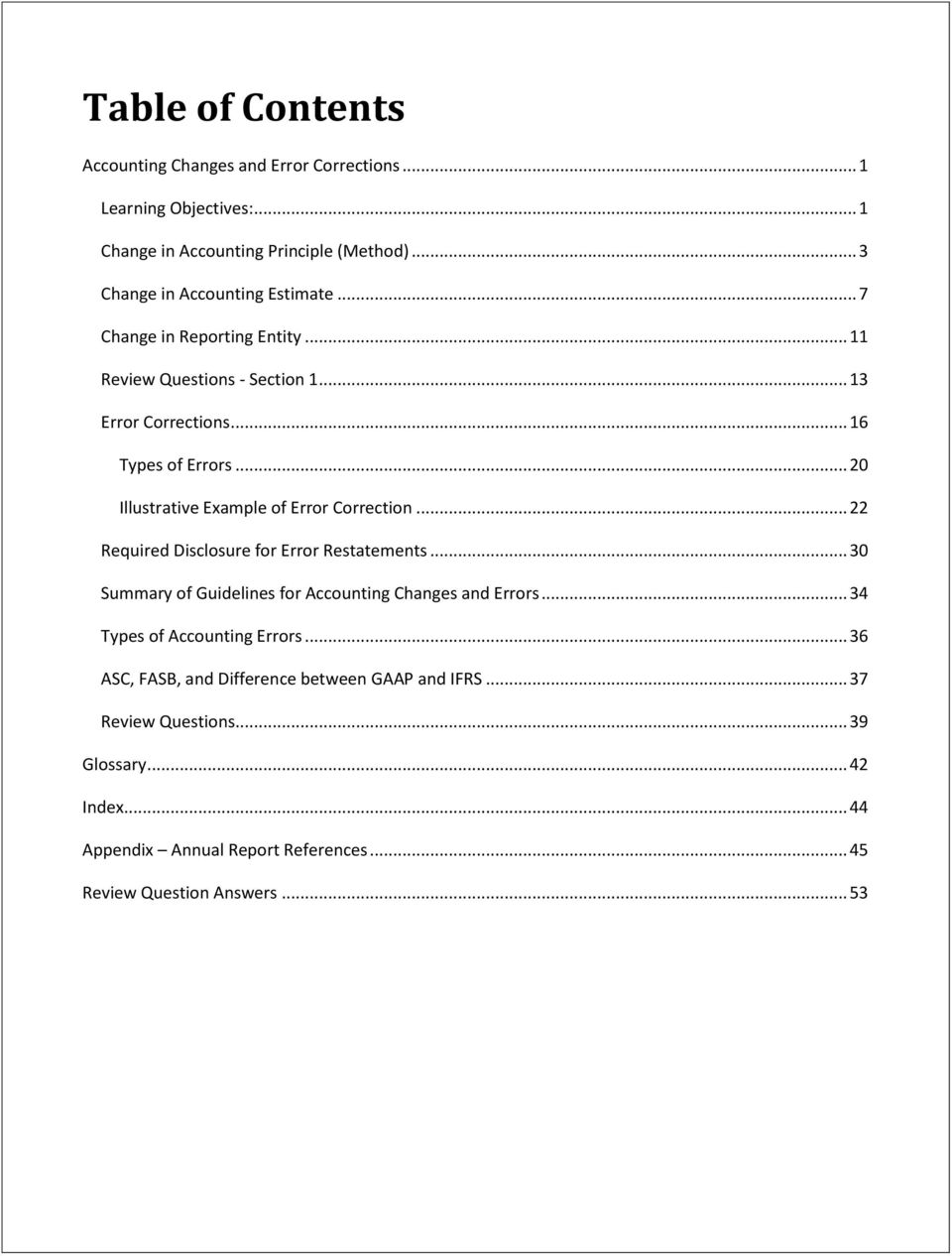
4 Table of Contents Accounting Changes and Error Corrections... 1 Learning Objectives:... 1 Change in Accounting Principle (Method)... 3 Change in Accounting Estimate... 7 Change in Reporting Entity Review Questions - Section Error Corrections Types of Errors Illustrative Example of Error Correction Required Disclosure for Error Restatements Summary of Guidelines for Accounting Changes and Errors Types of Accounting Errors ASC, FASB, and Difference between GAAP and IFRS Review Questions Glossary Index Appendix Annual Report References Review Question Answers... 53
5 Accounting Changes and Error Corrections Learning Objectives: After studying this section you will be able to: 1. Recognize the different types of accounting changes. 2. Identify the accounting changes and disclosures necessary for changes in inventory method 3. Recognize a change in a reporting entity and the effect of a change in accounting estimate. 4. Identify examples of a correction of an error in previous financial statements and analyze the effect of errors. A company s financial statements sometimes report significantly different results from year to year. This may be due to changes in economic circumstances, but it may also be due to changes in accounting methods or corrections of errors in recording past transactions. Changing the accounting method used can have dramatic impact on a company s financial statements. Because of this impact, one can argue that accounting changes detract from the informational characteristics of compatibility and consistency. So why are these accounting changes made? The main reason for these changes can be summarized as follows: 1. Due to changes in economic conditions, companies may need to change methods of accounting to more clearly reflect the current economic situation. 2. A company, as a result of experience or new information, may change its estimates of revenues or expenses for example, the estimate of uncollectable accounts receivable or the estimated service lives of depreciable assets. 1
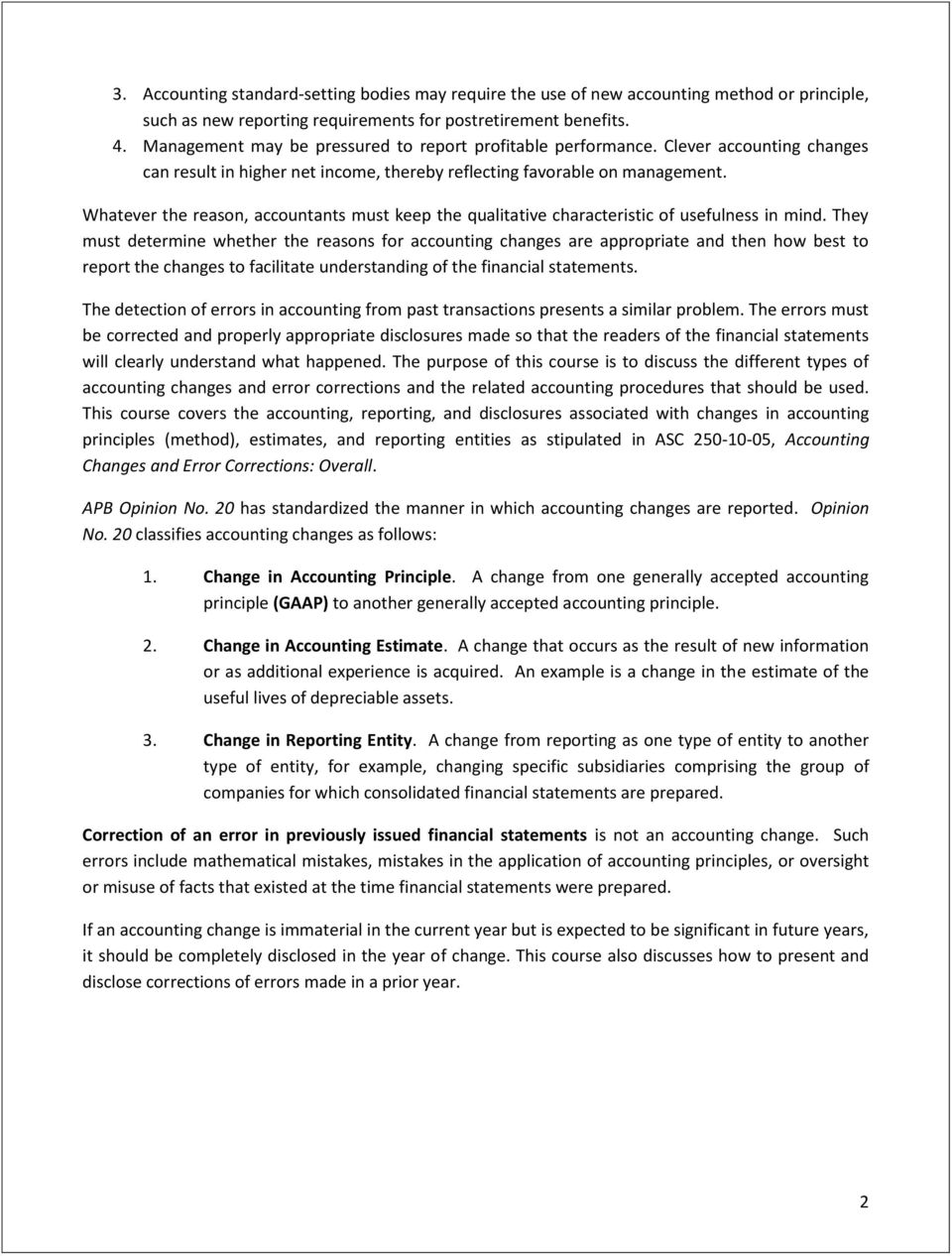
6 3. Accounting standard-setting bodies may require the use of new accounting method or principle, such as new reporting requirements for postretirement benefits. 4. Management may be pressured to report profitable performance. Clever accounting changes can result in higher net income, thereby reflecting favorable on management. Whatever the reason, accountants must keep the qualitative characteristic of usefulness in mind. They must determine whether the reasons for accounting changes are appropriate and then how best to report the changes to facilitate understanding of the financial statements. The detection of errors in accounting from past transactions presents a similar problem. The errors must be corrected and properly appropriate disclosures made so that the readers of the financial statements will clearly understand what happened. The purpose of this course is to discuss the different types of accounting changes and error corrections and the related accounting procedures that should be used. This course covers the accounting, reporting, and disclosures associated with changes in accounting principles (method), estimates, and reporting entities as stipulated in ASC , Accounting Changes and Error Corrections: Overall. APB Opinion No. 20 has standardized the manner in which accounting changes are reported. Opinion No. 20 classifies accounting changes as follows: 1. Change in Accounting Principle. A change from one generally accepted accounting principle (GAAP) to another generally accepted accounting principle. 2. Change in Accounting Estimate. A change that occurs as the result of new information or as additional experience is acquired. An example is a change in the estimate of the useful lives of depreciable assets. 3. Change in Reporting Entity. A change from reporting as one type of entity to another type of entity, for example, changing specific subsidiaries comprising the group of companies for which consolidated financial statements are prepared. Correction of an error in previously issued financial statements is not an accounting change. Such errors include mathematical mistakes, mistakes in the application of accounting principles, or oversight or misuse of facts that existed at the time financial statements were prepared. If an accounting change is immaterial in the current year but is expected to be significant in future years, it should be completely disclosed in the year of change. This course also discusses how to present and disclose corrections of errors made in a prior year. 2
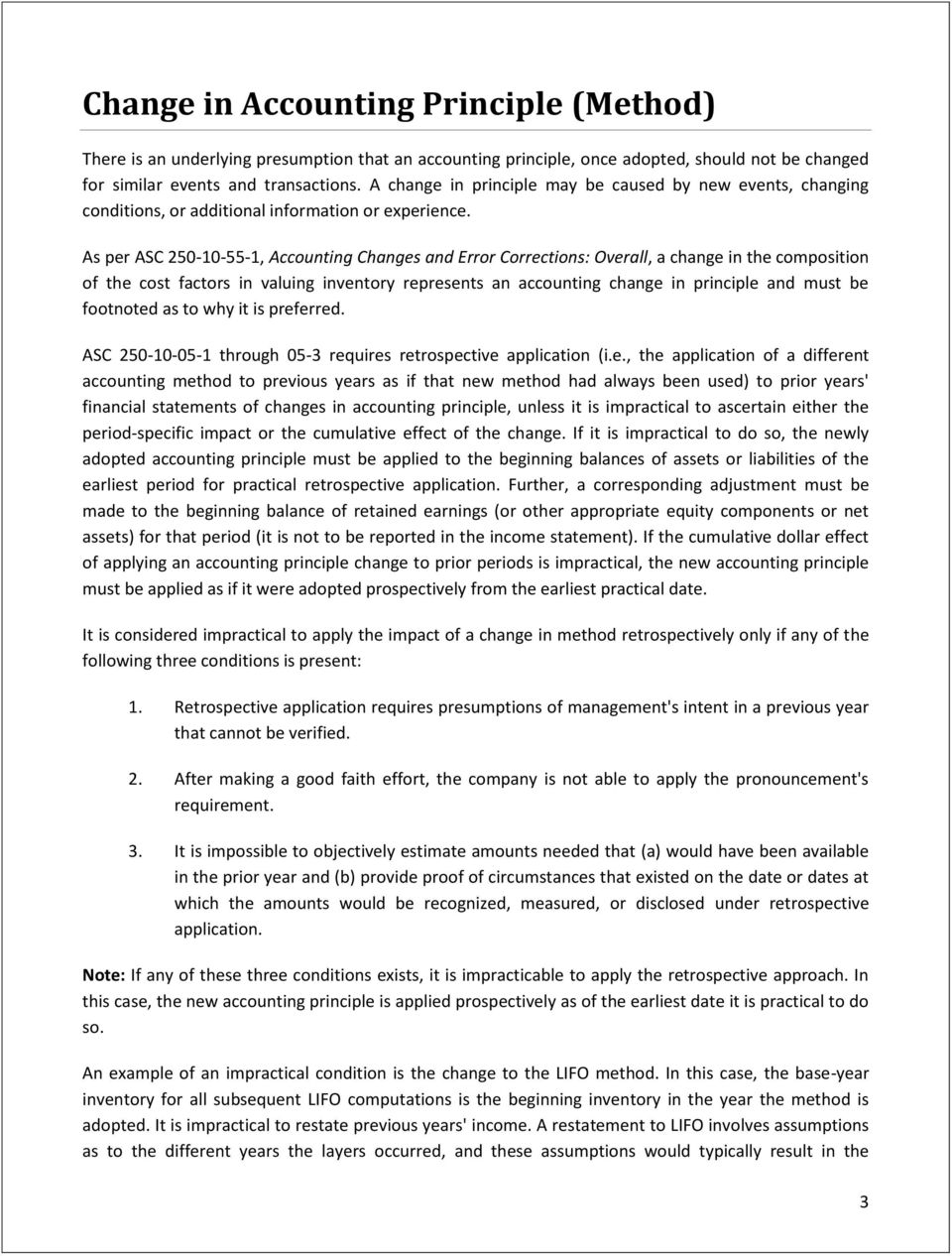
7 Change in Accounting Principle (Method) There is an underlying presumption that an accounting principle, once adopted, should not be changed for similar events and transactions. A change in principle may be caused by new events, changing conditions, or additional information or experience. As per ASC , Accounting Changes and Error Corrections: Overall, a change in the composition of the cost factors in valuing inventory represents an accounting change in principle and must be footnoted as to why it is preferred. ASC through 05-3 requires retrospective application (i.e., the application of a different accounting method to previous years as if that new method had always been used) to prior years' financial statements of changes in accounting principle, unless it is impractical to ascertain either the period-specific impact or the cumulative effect of the change. If it is impractical to do so, the newly adopted accounting principle must be applied to the beginning balances of assets or liabilities of the earliest period for practical retrospective application. Further, a corresponding adjustment must be made to the beginning balance of retained earnings (or other appropriate equity components or net assets) for that period (it is not to be reported in the income statement). If the cumulative dollar effect of applying an accounting principle change to prior periods is impractical, the new accounting principle must be applied as if it were adopted prospectively from the earliest practical date. It is considered impractical to apply the impact of a change in method retrospectively only if any of the following three conditions is present: 1. Retrospective application requires presumptions of management's intent in a previous year that cannot be verified. 2. After making a good faith effort, the company is not able to apply the pronouncement's requirement. 3. It is impossible to objectively estimate amounts needed that (a) would have been available in the prior year and (b) provide proof of circumstances that existed on the date or dates at which the amounts would be recognized, measured, or disclosed under retrospective application. Note: If any of these three conditions exists, it is impracticable to apply the retrospective approach. In this case, the new accounting principle is applied prospectively as of the earliest date it is practical to do so. An example of an impractical condition is the change to the LIFO method. In this case, the base-year inventory for all subsequent LIFO computations is the beginning inventory in the year the method is adopted. It is impractical to restate previous years' income. A restatement to LIFO involves assumptions as to the different years the layers occurred, and these assumptions would typically result in the 3
8 calculation of a number of different earnings figures. The only adjustment required may be to restate the opening inventory to a cost basis from a lower-of-cost-or-market-value approach. Disclosure is thus limited to showing the impact of the change on the results of operations in the year of change. ASC mandates retrospective application to a change in accounting method be restricted to the direct effects of the change (net of tax). An example of a change in principle is switching from the average cost inventory method to the FIFO method. Indirect effects of a change in method are recognized in the year of change. Examples are altering profit-sharing or royalty payments arising from an accounting change. A change in depreciation, depletion, or amortization must be accounted for as a change in estimate affected by a change in principle. The Retained Earnings Statement after a retroactive change for a change in accounting principle follows: Retained earnings 1/1, as previously reported Add: adjustment for the cumulative effect on previous years of applying retrospectively the new accounting method for long-term construction contracts Retained earnings 1/1, as adjusted An example of the retrospective accounting change approach when prior years are presented appears below. EXAMPLE XYZ Construction Company has in previous years used the completed contract method for construction contracts. In 2X12, the company switched to the percentage-of-completion method. The tax rate is 30%. The following information is provided: Year Before-Tax Income from Percentage of Completion Completed Contract Before 2X12 $300,000 $200,000 In 2X12 90,000 80,000 Total at beginning of 2X12 $390,000 $280,000 Total in 2X12 100,000 95,000 The basis for the journal entry to record the change in 2X12 is: Difference Tax (30%) Net of Tax Before 2X12 $100,000 $30,000 $70,000 In 2X12 10,000 3,000 7,000 4

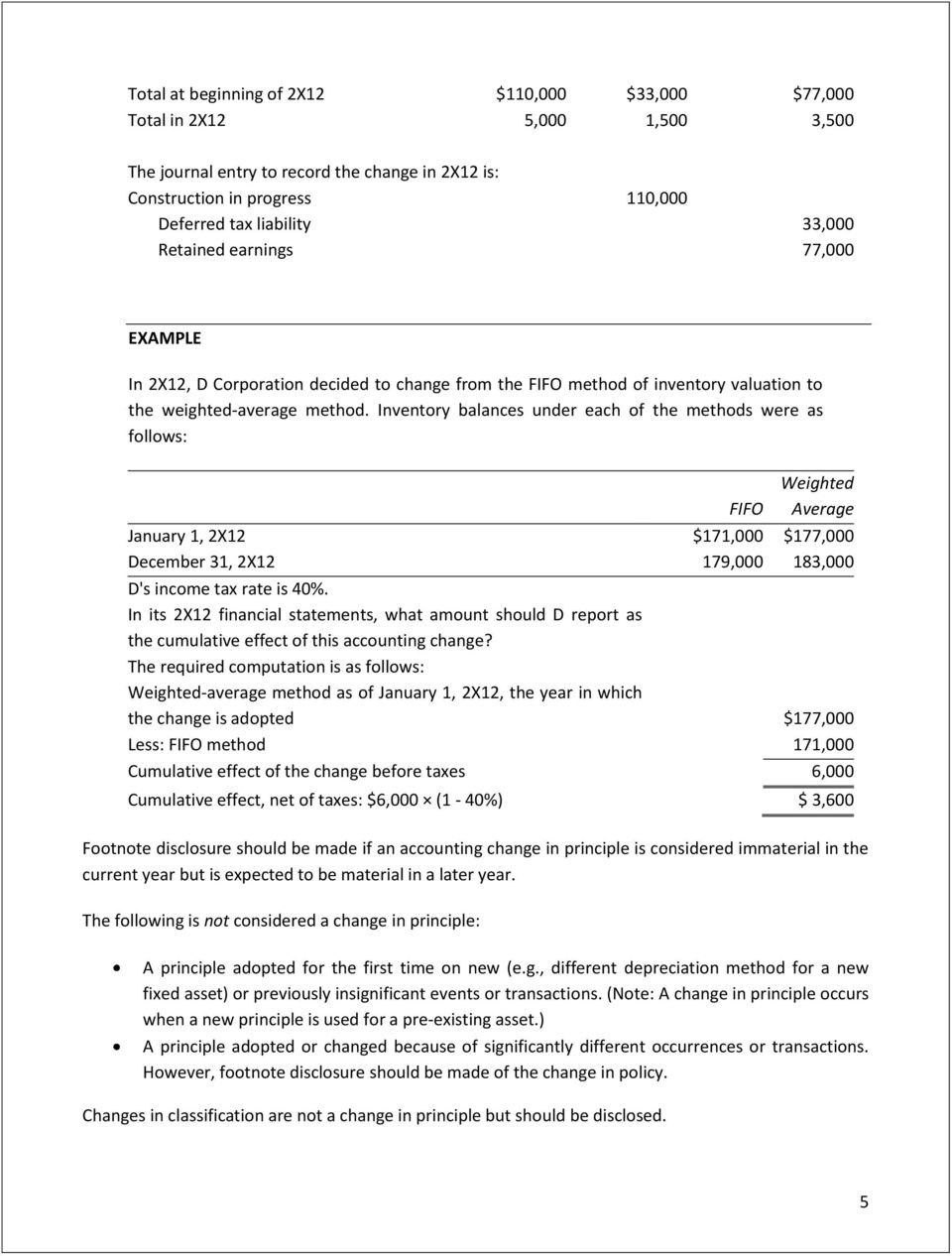
9 Total at beginning of 2X12 $110,000 $33,000 $77,000 Total in 2X12 5,000 1,500 3,500 The journal entry to record the change in 2X12 is: Construction in progress 110,000 Deferred tax liability 33,000 Retained earnings 77,000 EXAMPLE In 2X12, D Corporation decided to change from the FIFO method of inventory valuation to the weighted-average method. Inventory balances under each of the methods were as follows: FIFO Weighted Average January 1, 2X12 $171,000 $177,000 December 31, 2X12 179, ,000 D's income tax rate is 40%. In its 2X12 financial statements, what amount should D report as the cumulative effect of this accounting change? The required computation is as follows: Weighted-average method as of January 1, 2X12, the year in which the change is adopted $177,000 Less: FIFO method 171,000 Cumulative effect of the change before taxes 6,000 Cumulative effect, net of taxes: $6,000 (1-40%) $ 3,600 Footnote disclosure should be made if an accounting change in principle is considered immaterial in the current year but is expected to be material in a later year. The following is not considered a change in principle: A principle adopted for the first time on new (e.g., different depreciation method for a new fixed asset) or previously insignificant events or transactions. (Note: A change in principle occurs when a new principle is used for a pre-existing asset.) A principle adopted or changed because of significantly different occurrences or transactions. However, footnote disclosure should be made of the change in policy. Changes in classification are not a change in principle but should be disclosed. 5
10 Footnote disclosure should be made of the nature and justification for a change in principle, including the reason why the new principle is preferred. Justifiable reasons for a change in principle include the issuance of a new authoritative pronouncement (e.g., FASB statement), a change in tax law, a new AICPA recommended policy (e.g., AICPA statement of position), a change in circumstances of the company, and a change in principle that better conforms to industry practice. However, note that a change in principle solely for income tax purposes is not a change in principle for financial reporting purposes. Other footnote disclosures for a change in accounting principle follow: The new method used. Description of prior-year data that were retrospectively adjusted. The effect of the change on income from continuing operations, net income, and any other affected financial statement line item. Per-share amounts for the current year and for the previous years retrospectively adjusted. The cumulative effect of the change on retained earnings as of the beginning of the earliest period presented. When it is impractical to derive retrospective application to prior years, the reasons it is such and a description of the alternative method used to report the change. In the case of indirect effects of a change in accounting principle, a description of such indirect effects, including the amounts that have been recognized in the current year and the related per-share amounts. Disclosure should also be made of the amount of the total recognized indirect effects and the related per-share amounts for each prior year presented. A change in accounting principle should be recognized by a retroactive adjustment of previous year's financial statements recast with the newly adopted principle. Any cumulative effect of the change for years prior to those presented is recorded as an adjustment to beginning retained earnings of the earliest year presented. Therefore, under the required retrospective approach, the previous years' income numbers are restated under the newly adopted principle in the current year. As a result, comparability exists over the years. APB No. 20, Accounting Changes, requires that most changes in accounting principle be recognized by including the cumulative effect of the change in net income of the period of the change, i.e., no restatement of prior-period financial statements. This procedure conflicts with the concept of consistency or comparability, which requires that similar events be accounted for similarly in successive periods, i.e., requiring restatement of prior-year statements for accounting changes. A transaction that is unusual in nature and infrequent in occurrence in the environment in which the entity operates is classified as an extraordinary item. APB No. 20 requires that the amount of the cumulative effect of an accounting change be reported between the captions "extraordinary items" and "net income." Thus, the following is the order of items to be reported separately in the income statement: income from continuing operations, discontinued operations, extraordinary items, cumulative effect of changes in accounting principle, and net income. 6

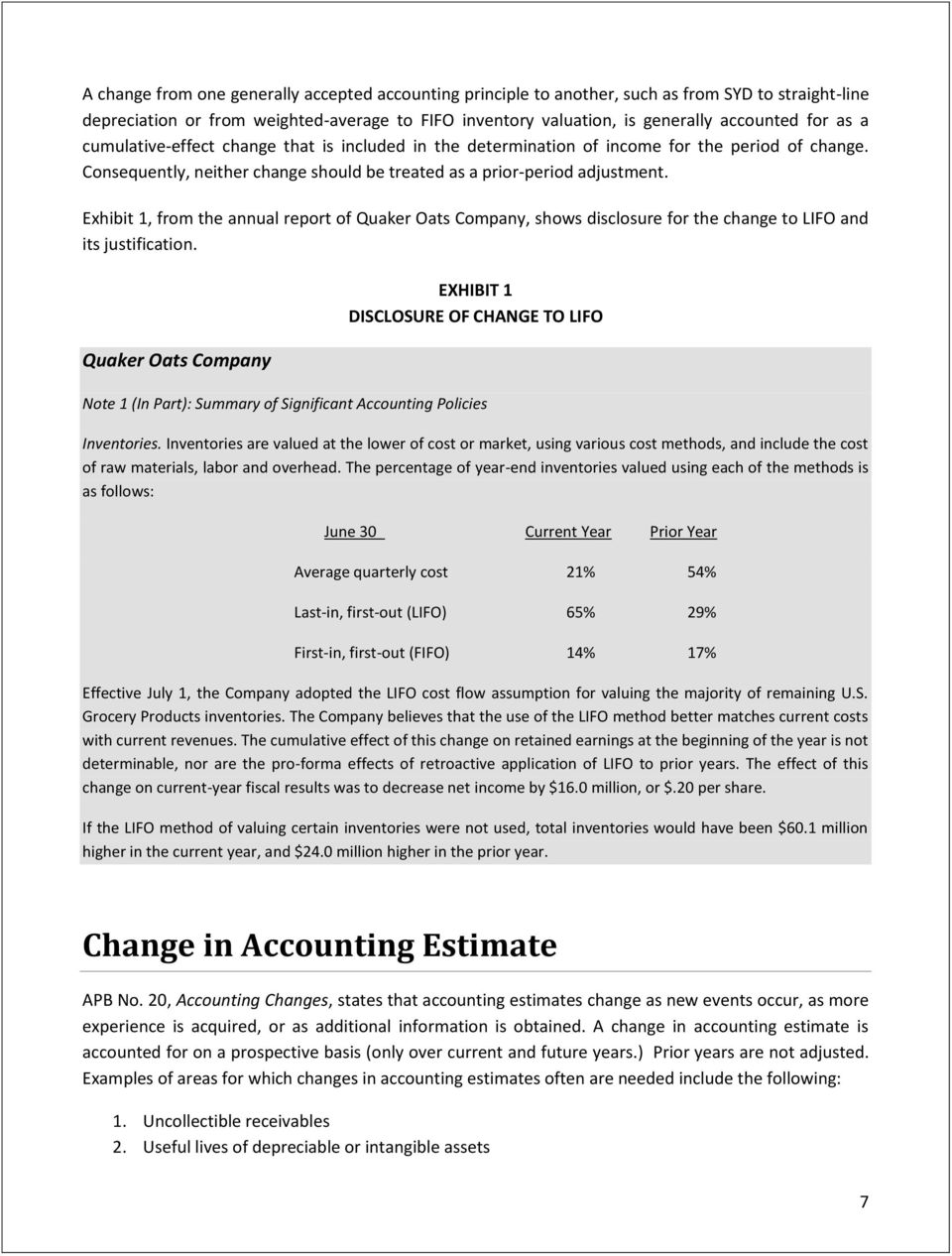
11 A change from one generally accepted accounting principle to another, such as from SYD to straight-line depreciation or from weighted-average to FIFO inventory valuation, is generally accounted for as a cumulative-effect change that is included in the determination of income for the period of change. Consequently, neither change should be treated as a prior-period adjustment. Exhibit 1, from the annual report of Quaker Oats Company, shows disclosure for the change to LIFO and its justification. Quaker Oats Company EXHIBIT 1 DISCLOSURE OF CHANGE TO LIFO Note 1 (In Part): Summary of Significant Accounting Policies Inventories. Inventories are valued at the lower of cost or market, using various cost methods, and include the cost of raw materials, labor and overhead. The percentage of year-end inventories valued using each of the methods is as follows: June 30 Current Year Prior Year Average quarterly cost 21% 54% Last-in, first-out (LIFO) 65% 29% First-in, first-out (FIFO) 14% 17% Effective July 1, the Company adopted the LIFO cost flow assumption for valuing the majority of remaining U.S. Grocery Products inventories. The Company believes that the use of the LIFO method better matches current costs with current revenues. The cumulative effect of this change on retained earnings at the beginning of the year is not determinable, nor are the pro-forma effects of retroactive application of LIFO to prior years. The effect of this change on current-year fiscal results was to decrease net income by $16.0 million, or $.20 per share. If the LIFO method of valuing certain inventories were not used, total inventories would have been $60.1 million higher in the current year, and $24.0 million higher in the prior year. Change in Accounting Estimate APB No. 20, Accounting Changes, states that accounting estimates change as new events occur, as more experience is acquired, or as additional information is obtained. A change in accounting estimate is accounted for on a prospective basis (only over current and future years.) Prior years are not adjusted. Examples of areas for which changes in accounting estimates often are needed include the following: 1. Uncollectible receivables 2. Useful lives of depreciable or intangible assets 7
12 3. Residual values for depreciable assets 4. Warranty obligations 5. Quantities of mineral reserves to be depleted 6. Actuarial assumptions for pensions or other postemployment benefits 7. Number of periods benefited by deferred costs Footnote disclosure should be made of the nature and reasons for the change unless it involves changes in the ordinary course of business (e.g., modifying a bad debt percentage). The impact of the change in estimate on net income and per share earnings should be disclosed if the change will affect future-year results. Exhibit 2 provides examples of disclosure relating to estimates contained in the 2009 annual reports of two companies: H. J. Heinz Company and McDonald's. Even though the companies had different auditors (PricewaterhouseCoopers and Ernst & Young, respectively), it is surprising how similar the note disclosures are. J. HEINZ COMPANY AND SUBSIDIARIES Notes To Consolidated Financial Statements I. Significant Accounting Policies EXHIBIT 2 DISCLOSURE RELATING ESTIMATES Use of Estimates: The preparation of financial statements, in conformity with accounting principles generally accepted in the United States of America, requires management to make estimates and assumptions that affect the reported amounts of assets and liabilities, the disclosure of contingent assets and liabilities at the date of the financial statements, and the reported amounts of revenues and expenses during the reporting period. Actual results could differ from these estimates. MCDONALD'S CORPORATION Summary of Significant Accounting Policies Estimates in financial statements The preparation of financial statements in conformity with accounting principles generally accepted in the U.S. requires management to make estimates and assumptions that affect the amounts reported in the financial statements and accompanying notes. Actual results could differ from those estimates. All changes in estimates should be reflected either in the current period or in current and future periods. No retroactive adjustments or pro forma (as-if) statements are to be prepared for a change in accounting estimate. Changes in estimates are considered to be part of the normal accounting process, not corrections or changes of past periods. However, disclosures such as the ones in Exhibit 3, reported by United Airlines, are useful in helping readers of financial statements understand the impact of changes in estimates. 8

13 EXHIBIT 3 DISCLOSURE OF CHANGE IN ESTIMATE UAL Corporation (the "Company") follows a deferred revenue accounting policy to record the fair value of its Mileage Plus frequent flyer obligation. The Company defers the portion of the sales proceeds of ticketed revenue on United and our alliance partners, as well as revenue associated with mileage sales to third parties, that represents the estimated air transportation fair value of the miles awarded. This deferred revenue is then recognized when the miles are redeemed. Some of these miles will never be redeemed by Mileage Plus members, and the Company recognizes an estimate of revenue from the expected expired miles, which is referred to as breakage, over an estimated redemption period. The Company reviews its breakage estimates annually based upon the latest available information regarding mileage redemption and expiration patterns. During the first quarter of 2010 the Company obtained additional historical data, previously unavailable, which has enabled the Company to refine its breakage estimates. This new data indicates that a larger number of miles than previously estimated are expected to expire. As a result, the Company has changed its estimate of Mileage Plus breakage on a prospective basis, effective beginning in the first quarter of In addition to this change in estimate, the Company is making an improvement to the accounting model for Mileage Plus breakage that is inseparable from the change in estimate. These changes will result in the recognition of approximately $64 million of incremental passenger revenue in the first quarter of 2010, reducing the net amount of revenue that we otherwise would have deferred to future periods. When the effect of a change in accounting principle is inseparable from the effect of a change in estimate, APB No. 20 requires that it be accounted for in the same manner as a change in estimate only. An example of such a change is the change from deferring and amortizing a cost to recording it as an expense when incurred because future benefits of the cost have become doubtful. Because the new method is adopted to recognize a change in estimated future benefits, the effect of the change in principle is inseparable from the change in estimate. APB No. 20 requires that the effect of a change in accounting estimate be accounted for in the period of change if the change affects that period only, or in the period of change and in future periods, if the change affects both. A permanent loss on an asset is not a change in accounting estimate but rather a current-period loss. EXAMPLE In 2X12, ABC Company changed its bad debt estimate based on an aging of accounts receivable, resulting in recording bad debts of $60,000, which is $3,000 less than if a revised estimate was not made. The journal entry is: 9
14 Bad debts 60,000 Allowance for bad debts 60,000 The related footnote would state that ABC Company modified its estimate of uncollectible accounts to reflect better the net realizable value of accounts receivable. The impact of the change in estimate was to increase 2X12 net income by $3,000. EXAMPLE On January 1, 2X09, a fixed asset was purchased costing $50,000 and having an estimated life of 20 years with a salvage value of $2,000. On January 1, 2X12, the estimated life was revised to 14 remaining years with a new salvage value of $2,200. Assuming that the straight-line depreciation method is used, the journal entry on December 31, 2X12, for depreciation expense follows: Depreciation expense 2,900 Accumulated depreciation 2,900 Computation: Book value on 1/1/2X12: Initial cost $50,000 Less: accumulated depreciation ($50,000 - $2,000)/20 years = $2,400 $2,400 3 years depreciated = $7,200 (7,200) Book value $42,800 Depreciation for 2X12: Book value 42,800 Less: new salvage value 2,200 Balance $40,600 Depreciable cost New life = $40, years = $2,900 Exhibit 4, from the annual report of Ampco-Pittsburgh Corporation, disclosure of a change in estimated useful lives. 10

15 EXHIBIT 4 DISCLOSURE OF CHANGE IN ESTIMATED USEFUL LIVES. AMPCO PITTSBURGH CORPORATION Note 11: Change in Accounting Estimate. The Corporation revised its estimate of the useful lives of certain machinery and equipment. Previously, all machinery and equipment, whether new when placed in use or not, were in one class and depreciated over 15 years. The change principally applies to assets purchased new when placed in use. Those lives are now extended to 20 years. These changes were made to better reflect the estimated periods during which such assets will remain in service. The change had the effect of reducing depreciation expense and increasing net income by approximately $991,000 ($.10 per share). Change in Reporting Entity A change in reporting entity refers to preparing financial statements for an entity different from the one reported in previous years. Examples of a change in reporting entity are: A change in the subsidiaries making up consolidated financial statements. Presentation of consolidated or combined statements rather than individual company statements. A change in reporting entity requires the restatement of previous years' financial statements as if both of the previously separate companies were always combined. No more than five years are restated. The restatement is needed for comparative financial purposes and for meaningful historical trends. The impact of the change in reporting entity on income before extraordinary items, net income, and earnings per share is presented for all years. A change in the legal structure of a business is not considered a change in reporting entity. An example is a sole proprietorship becoming a corporation. Further, the purchase or sale of an investee is not a change in reporting entity. A footnote is required on the nature of and reason for the change in reporting entity in the year it is made. Exhibit 5 shows a note disclosing a change in reporting entity, from the annual report of Hewlett- Packard Company. 11

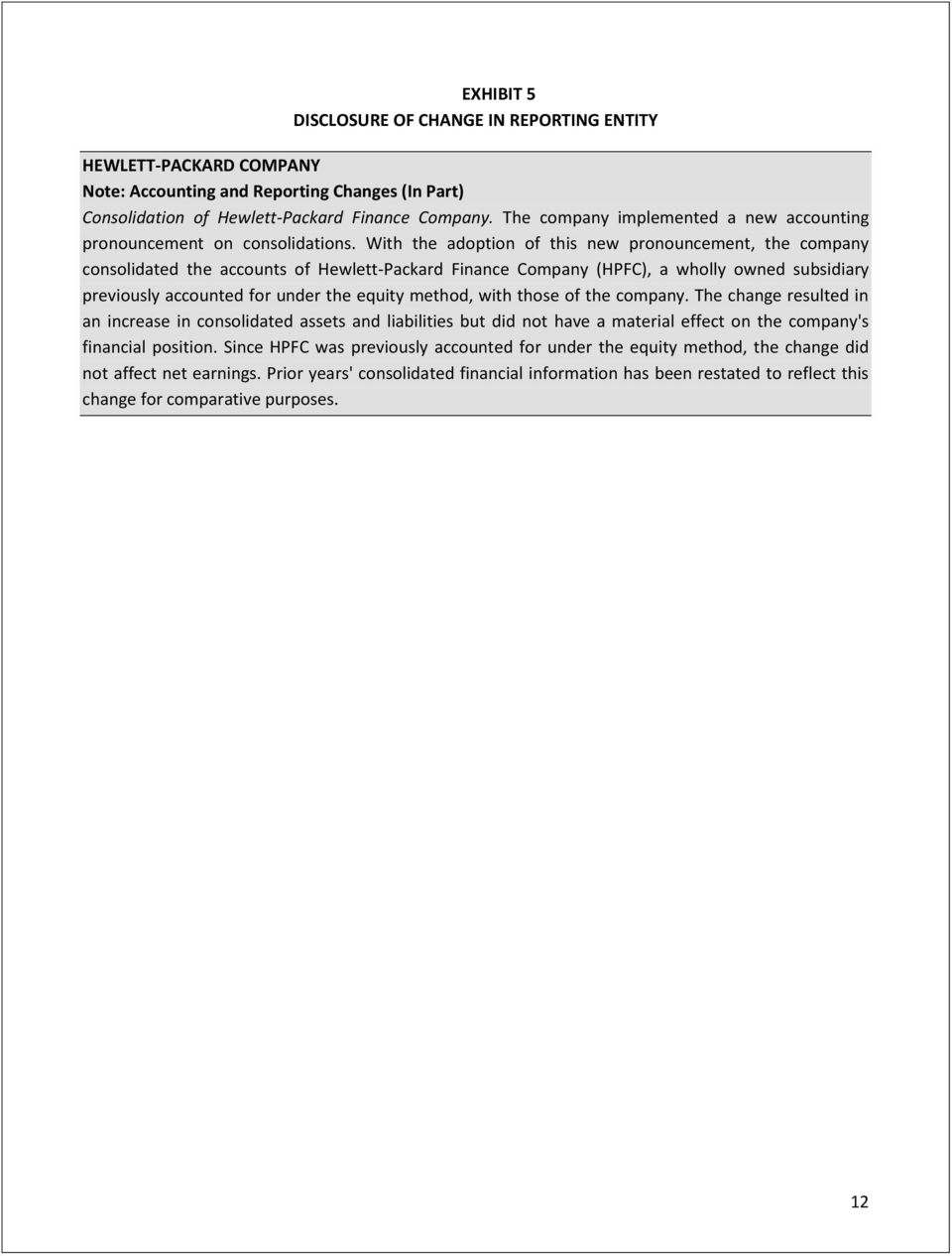
16 EXHIBIT 5 DISCLOSURE OF CHANGE IN REPORTING ENTITY HEWLETT-PACKARD COMPANY Note: Accounting and Reporting Changes (In Part) Consolidation of Hewlett-Packard Finance Company. The company implemented a new accounting pronouncement on consolidations. With the adoption of this new pronouncement, the company consolidated the accounts of Hewlett-Packard Finance Company (HPFC), a wholly owned subsidiary previously accounted for under the equity method, with those of the company. The change resulted in an increase in consolidated assets and liabilities but did not have a material effect on the company's financial position. Since HPFC was previously accounted for under the equity method, the change did not affect net earnings. Prior years' consolidated financial information has been restated to reflect this change for comparative purposes. 12
17 Review Questions - Section 1 1. When a company makes a change in accounting principle, prior-year financial statements are not generally restated to reflect the change. The Accounting Principles Board (APB) decided that this procedure would prevent a dilution of public confidence in financial statements but recognized that this procedure conflicts with the accounting concept of A. Materiality. B. Conservatism. C. Verifiability. D. Comparability. 2. The Poirot Company began operations on January 1 of the year before last and uses the FIFO method in costing its raw material inventory. Management is contemplating a change to the LIFO method and is interested in determining what effect such a change will have on net income. Accordingly, the following information has been developed: Final Inventory Year 1 under FIFO = $240,000 and under LIFO = $200,000. Final Inventory Year 2 under FIFO = $270,000 and under LIFO = $210,000. The Net Income (per FIFO) = $120,000 in Year 1 and $170,000 in Year 2. Based upon the above information, a change to the LIFO method in Year 2 would result in net income for Year 2 of A. $110,000 B. $150,000 C. $170,000 D. $230, A change in the periods benefitted by a deferred cost because additional information has been obtained is A. A correction of an error. B. An accounting change that should be reported by restating the financial statements of all prior periods presented. C. An accounting change that should be reported in the period of change and future periods if the change affects both. D. Not an accounting change. 13

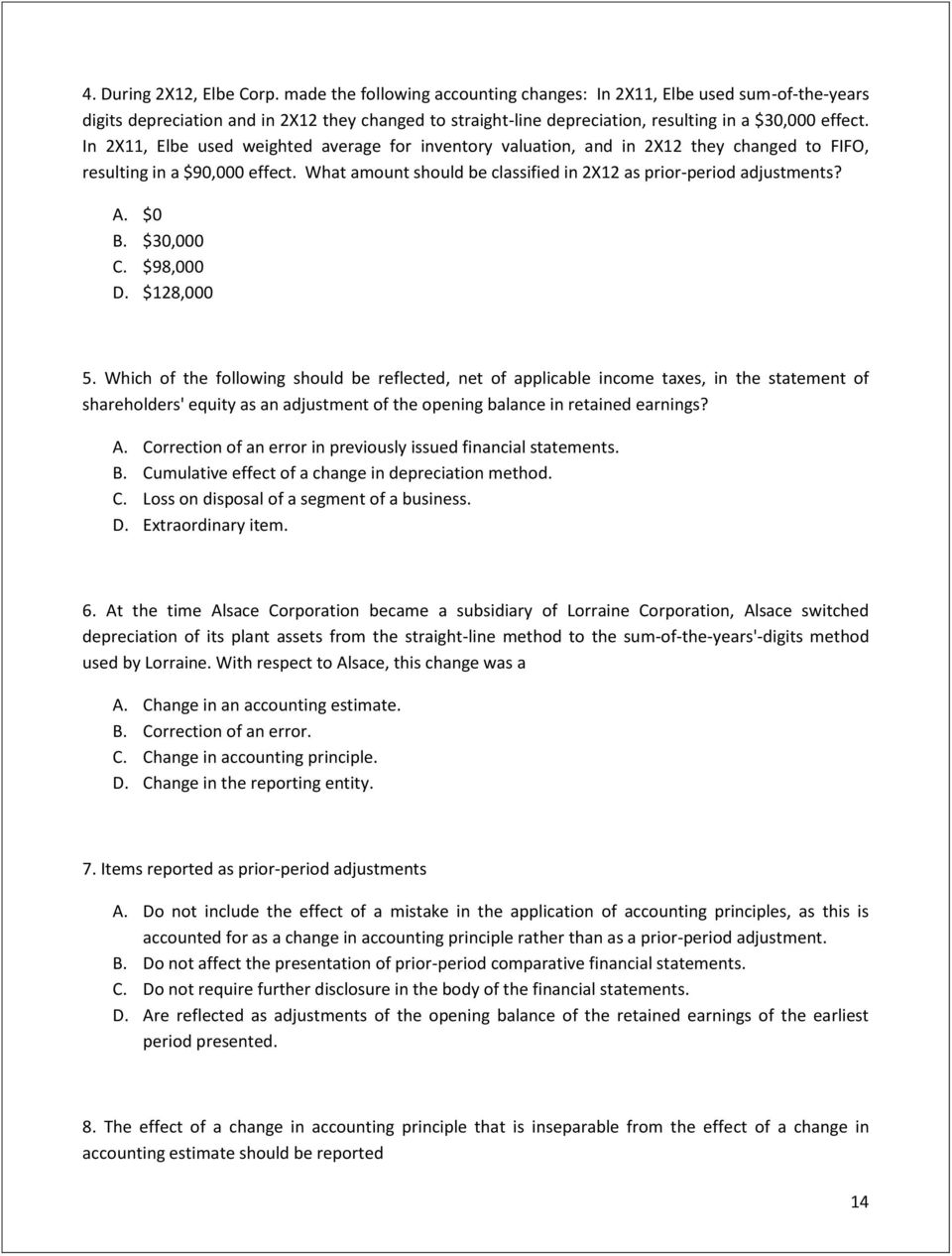
18 4. During 2X12, Elbe Corp. made the following accounting changes: In 2X11, Elbe used sum-of-the-years digits depreciation and in 2X12 they changed to straight-line depreciation, resulting in a $30,000 effect. In 2X11, Elbe used weighted average for inventory valuation, and in 2X12 they changed to FIFO, resulting in a $90,000 effect. What amount should be classified in 2X12 as prior-period adjustments? A. $0 B. $30,000 C. $98,000 D. $128, Which of the following should be reflected, net of applicable income taxes, in the statement of shareholders' equity as an adjustment of the opening balance in retained earnings? A. Correction of an error in previously issued financial statements. B. Cumulative effect of a change in depreciation method. C. Loss on disposal of a segment of a business. D. Extraordinary item. 6. At the time Alsace Corporation became a subsidiary of Lorraine Corporation, Alsace switched depreciation of its plant assets from the straight-line method to the sum-of-the-years'-digits method used by Lorraine. With respect to Alsace, this change was a A. Change in an accounting estimate. B. Correction of an error. C. Change in accounting principle. D. Change in the reporting entity. 7. Items reported as prior-period adjustments A. Do not include the effect of a mistake in the application of accounting principles, as this is accounted for as a change in accounting principle rather than as a prior-period adjustment. B. Do not affect the presentation of prior-period comparative financial statements. C. Do not require further disclosure in the body of the financial statements. D. Are reflected as adjustments of the opening balance of the retained earnings of the earliest period presented. 8. The effect of a change in accounting principle that is inseparable from the effect of a change in accounting estimate should be reported 14
19 A. By restating the financial statements of all prior periods presented. B. As a correction of an error. C. In the period of change and future periods if the change affects both. D. As a separate disclosure after income from continuing operations, in the period of change and future periods if the change affects both. 15

20 Error Corrections A financial statement error can impact the interpretation of the financial statements in the year of the error and in all subsequent years when the error year is used for comparison. For financial reporting purposes, when an error is detected, all financial statements presented for comparative purposes are corrected and restated. For bookkeeping purposes, most errors that go undetected counterbalance over a 2-year period; those errors that impact income and that have not counterbalanced are corrected by making a direct adjustment to retained earnings. Error corrections are not considered accounting changes, but their treatment is specified in ASC 250. ASC covers correction of errors made in a previous year. They are treated for accounting purposes as prior-period adjustments. They should be charged or credited net of tax to retained earnings and reported as an adjustment in the statement of shareholders' equity. It is not included in net income for the current period. Prior-period adjustments adjust the beginning balance of retained earnings for the net of tax effect of the error as follows: Retained earnings 1/1 unadjusted Prior-period adjustments (net of tax) Retained earnings 1/1 adjusted Add: net income Less: dividends Retained earnings 12/31 Errors may arise because of mathematical mistakes, erroneous application of GAAP, or misuse of information existing at the time the financial statements were prepared. Additionally, changing a principle that is not GAAP to one that is GAAP represents an error correction. In ascertaining whether an error is material and therefore reportable, consideration should be given to the significance of each correction on an individual basis and to the aggregate effect of all corrections. An error must be corrected immediately when uncovered. If comparative financial statements are presented, there should be a retroactive adjustment for the error as it impacts previous years. The retroactive adjustment is presented via disclosure of the impact of the adjustment on prior years' earnings and components of net income. Footnote disclosure for error corrections in the year found include the nature and description of the error, financial effect on income before extraordinary items, net income, and related earnings per share amounts. 16

21 EXAMPLE At year-end 2X10, a company omitted the accrual of utilities expense of $3,000, which was paid on January 4, 2X11. The correcting entry on December 31, 2X11 is: Retained earnings 3,000 Utilities expense 3,000 EXAMPLE Drake Company bought Travis Company on January 1, 2X10, recording patents of $80,000. Patents has not been amortized. Amortization is over 20 years. The correcting entry on December 31, 2X12 is: Amortization expense ($80,000/20 years = $4,000 1 year for 20X3) 4,000 Retained earnings 8,000 ($4,000 2 years for 2X10 and 2X11) Patents 12,000 EXAMPLE At the beginning of 2X09, a company purchased machinery for $500,000 with a salvage value of $50,000 and an expected life of 20 years. Straight-line depreciation is used. By mistake, salvage value was not subtracted in arriving at depreciation. The calculations on December 31, 2X12 are: 19X7-19X9 Depreciation taken (incorrect): $500,000/20 years 3 $75,000 Depreciation (correct): ($500,000 - $50,000)/20 years 3 67,500 Difference $ 7,500 The correcting journal entries on December 31, 2X12 are Accumulated depreciation 7,500 Retained earnings 7,500 To correct for error. Depreciation expense 22,500 Accumulated depreciation 22,500 To record depreciation for 2X12. 17
22 EXAMPLE Mills Corporation purchased equipment on January 1, 2X09 for $40,000 with a $5,000 salvage value and a 10-year life. Maintenance expense was charged by mistake. On December 31, 2X12, the error was uncovered before the books were closed. The calculations and correcting entry follow: Depreciation expense equals: ($40,000 - $5,000)/10 years = $3,500 per year Depreciation expense 3,500 Equipment 40,000 Accumulated depreciation ($3,500 4 years) 14,000 Retained earnings ($40,000 - $10,500) * 29,500 * 3,500 3 years (2X09 2X12) = $10,500. EXAMPLE On January 1, 2X11, a six-year advance of $120,000 was received. In error, revenue was recorded for the entire amount. The error was found on December 31, 2X12 before the books were closed. The correcting entry is: Retained earnings ($120,000 - $20,000) 100,000 Revenue (for current year) 20,000 Deferred revenue ($20,000 4 years) 80,000 EXAMPLE If an enterprise changes from the recognition of vacation pay expense from the cash basis to the accrual basis, how should the change be accounted for? In general, a change from an accounting principle that is not generally accepted (accounting for vacation pay expense on the cash basis) to one that is generally accepted (accounting for it on the accrual basis) should be presented as a correction of an error. The following procedures should be followed in this circumstance: The correction should be accounted for as a prior-period adjustment (i.e., an adjustment as of the beginning balance of retained earnings, net of taxes) for the earliest year presented. 18
23 There should be a restatement of all comparative prior financial statements presented so that they now reflect the accounting for vacation pay expense on the accrual basis instead of the cash basis. Footnote disclosure should be made in the financial statements regarding the prior-period adjustment correcting the error, the restatement of the financial statements presented, and the effect of the correction on net income. EXAMPLE If an entity changes from the cash basis of accounting for service contracts to the accrual method, how should the change be treated in the financial statements? This represents another example of a change from an accounting principle that is not generally accepted to one that is generally accepted. It therefore should be accounted for as a correction of an error. As in the previous example, the correction should be handled as a prior-period adjustment, net of taxes, for the earliest year presented of the beginning balance of retained earnings. Restatement of all comparative financial statements presented should also be made as well as proper footnote disclosure of the changes and their effects. EXAMPLE Tessie Company had a retained earnings balance of $800,000 at December 31, 2X11. In September 2X12, Tessie ascertained that insurance premiums of $120,000 covering a fouryear period beginning January 1, 2X11, had been fully paid and fully expensed in 2X11. Tessie has a 40% tax rate. What amount should Tessie report as adjusted beginning retained earnings in its 2X12 statement of retained earnings? The $120,000 of insurance premiums for the four-year period beginning January 1, 2X11, which had been fully paid and expensed, clearly should not have been expensed in total. Because the premiums represented coverage for a four-year period and only one (2X11) had transpired, net income and retained earnings in 2X11 was understated by 3/4 of $120,000 ($90,000), net of taxes. This amount, $90,000, should have been accounted for as an insurance prepayment at the end of 2X11. Thus, a correction (an addition) of $90,000 (100% 40%), or $54,000, is needed to correct the beginning balance of retained earnings in 2X12. Tessie should report $854,000 ($800,000 + $54,000) as its adjusted beginning retained earnings balance in its 2X12 statement of retained earnings. 19
24 Classification errors usually do not affect net income. However, prior years' financial statements issued for comparative purposes should be corrected to present the appropriate classification. Types of Errors There are a number of different kinds of errors. Some errors are discovered in the period in which they are made and are easily corrected. Others may not be discovered currently and are reflected on the financial statements until discovered. Some errors are never discovered; however, the effects of these errors may be counterbalanced in subsequent periods, and after this takes place, account balances are again accurately stated. Errors may be classified as follows: 1. Errors discovered currently in the course of normal accounting procedures. Examples of this type of error are clerical errors, such as an addition error, posting to the wrong account) misstating an account, or omitting an account from the trial balance. These types of errors usually are detected during the regular summarizing process of the accounting cycle and are readily corrected. 2. Errors limited to balance sheet accounts. Examples include debiting Accounts Receivable instead of Notes Receivable, crediting Interest Payable instead of Notes Payable, or crediting Interest Payable instead of Salaries Payable. Another example is not recording the exchange of convertible bonds for stock. Such errors are frequently discovered and corrected in the period in which they are made. When such errors are not found until a subsequent period, corrections must be made at that time and balance sheet data subsequently restated for comparative reporting purposes. 3. Errors limited to income statement accounts. The examples and correcting procedures for this type of error are similar to those in (2). For example, Office Salaries may be debited instead of Sales Salaries. This type of error should be corrected as soon as it is discovered. Even though the error would not affect net income, the misstated accounts should be restated for analysis purposes and comparative reporting. 4. Errors affecting both income statement accounts and balance sheet accounts. Certain errors, when not discovered currently, result in the misstatement of net income and thus affect both the income statement accounts and the balance sheet accounts. The balance sheet accounts are carried into the succeeding period; hence, an error made currently and not detected will affect future earnings. Such errors may be classified into two groups: a. Errors in net income that, when not detected, are automatically counterbalanced in the following fiscal period. Net income amounts on the income statements for two successive periods are inaccurately stated; certain account balances on the balance sheet at the end of the first period are inaccurately stated, but the account balances in the balance sheet at the end of the succeeding period will be accurately stated. In this 20
25 class are errors such as the misstatement of inventories and the omission of adjustments for prepaid and accrued items at the end of the period. b. Errors in net income that, when not detected, are not automatically counterbalanced in the following fiscal period. Account balances on successive balance sheets will be inaccurately stated until such time as entries are made compensating for or correcting the errors. In this class are errors such as the recognition of capital expenditures as expenses and the omission of charges for depreciation and amortization. When errors affecting income are discovered, careful analysis is necessary to determine the required action to correct the account balances. As indicated, most errors will be caught and corrected prior to closing the books. The few material errors not detected until subsequent periods and those that have not already been counterbalanced must be treated as prior-period adjustments. The following sections describe and illustrate the procedures to be applied when error corrections require prior-period adjustments. It is assumed that each of the errors is material. Errors that are discovered usually affect the income tax liability for a prior period. Amended tax returns are usually prepared either to claim a refund or to pay any additional tax assessment. For simplicity, the examples on the following pages and in the exercises and problems at the end of the chapter ignore the income tax effects of errors. 21
26 Illustrative Example of Error Correction Assume that ABC Supply Depot, Inc., began operations at the beginning of 2X11. An auditing firm is engaged for the first time in 2X13. Before the accounts are adjusted and closed for 2X13, the auditor reviews the books and accounts and discovers the errors summarized below. Effects of these errors on the financial statements, before any correcting entries, are indicated as follows: A plus sign (+) indicates an overstatement and a minus sign (-) indicates an understatement. At End of 2X11 Transactions Income Statement Balance Sheet (1) Understatement of merchandise inventory of $1,000 on December 31, 2X11. (2) Failure to record merchandise purchases on account of $850 in 2X11; purchase was recorded in 2X12. (3) Failure to record merchandise sale on account of $1,800 in 2X12. (It is assumed that sales the sales for 2X12 were recognized as revenue in 2X13. Section Net Income Cost of Goods Sold + - Cost of Goods Sold - + Section Retained Earnings Current Assets - - Current Liabilities - + (4) Failure to record accrued sales salaries of $450 on December 31, 2X11; expense was recognized when payment was made. (5) Failure to record prepaid tax of $275 on December 31, 2X11; amount was included in Miscellaneous General Expense. (6) Failure to correct accrued interest on notes receivable of $150 on December 31, 2X11; revenue was recognized when collected in 2X12. (7) Failure to correct unearned service fee of $225 on December 31, 2X12; amount received was included in Miscellaneous Revenue. (8) Failure to record depreciation of delivery equipment. On December 31, 2X11, $1,200. On December 31, 2X12, $1,000. Selling Expense - + General Expense + - Other Revenue - - Selling Expense - + Current Liabilities - + Current Assets - - Current Assets - - Noncurrent Assets + + (9) Incorrectly capitalizing an expenditure for operating expense on January 1, 2X11; depreciation expense of $400 was incorrectly recognized in 2X11 and 2X12. Operating Expense - + Noncurrent Assets
27 Analysis Sheet to Show Effects of Errors on Financial Statements At End of 2X12 At End of 2X13 Transactions Income Statement Balance Sheet Income Statement Balance Sheet (1) (2) Section Net Income Cost of Goods Sold - + Cost of Goods Sold + - Section Retained Earnings Section Net Income Section Retained Earnings (3) Sales - - Accounts Receivable - - Sales + + (4) Selling Expense + - (5) General Expense - + (6) Other Revenue + + (7) Other Revenue + + Current Liabilities - + Other Revenue - - (8) Selling Expense - + Noncurrent Assets + + Noncurrent Assets - + Noncurrent Assets + + Noncurrent Assets + + (9) Operating Expense + - Noncurrent Expense + + Noncurrent Assets + + Each error correction is discussed in the following paragraphs. 23
28 (1) Understatement of Merchandise Inventory: It is discovered that the merchandise inventory as of December 31, 2X11, was understated by $1,000. The effects of the misstatement were as shown below. 2X11 2X12 Income Statement Cost of goods sold overstated (ending inventory too low) Net income understated Cost of goods sold understated (beginning inventory too low) Net income overstated Balance Sheet Assets understated (inventory too low) Retained earnings understated Balance sheet items not affected, retained earnings understatement for 2X11 begin corrected by net income overstatement for 2X12 Because this type of error counterbalances after two years, no correcting entry is required in 2X13. If the error had been discovered in 2X12 instead of 2X13, an entry would have been made to correct the account balances so that operations for 2X12 would be reported accurately. The beginning inventory for 2X12 would have been increased by $1,000, the amount of the asset understatement, and Retained Earnings would have been credited for this amount, representing the income understatement in 2X11. The correcting entry in 2X12 would have been as follows: Merchandise Inventory 1,000 Retained Earnings 1,000 This correcting entry is the same whether the company uses a periodic or a perpetual inventory system. As seen with error (2), the correcting entry is sometimes different, depending on what type of inventory system the company uses. (2) Failure to Record Merchandise Purchases: It is discovered that purchase invoices as of December 28, 2X11, for $850 had not been recorded until 2X12.The goods had been included in the inventory at the end of 2X11. The effects of failure to record the purchases were as shown on page X11 2X12 Income Statement Cost of goods sold overstated (purchases too low) Net income overstated Cost of goods sold overstated (purchases too high) Net income understated Balance Sheet Liabilities understood (accounts payable too low) Retained earnings overstated Balance sheet items not affected, retained earnings overstatement for 2X11 begin corrected by net income understatement for 2X12 24
29 Because this is a counterbalancing error, no correcting entry is required in 2X13. If the error had been discovered in 2X12 instead of 2X13, a correcting entry would have been necessary. In 2X12, Purchases was debited and Accounts Payable was credited for $850 for merchandise acquired in 2X11 and included in the ending inventory of 2X11. Retained Earnings would have to be debited for $850, representing the net income overstatement for 2X11, and Purchases would have to be credited for the same amount to reduce the balance in 2X12. The correcting entry in 2X12, assuming the company uses a periodic inventory system, would have been as follows: Retained Earnings 850 Purchases 850 If the company had used a perpetual system, the incorrect purchase would have been debited directly to Inventory. Accordingly the correcting entry would have been made in 2X12: Retained Earnings 850 Inventory 850 (3) Failure to Record Merchandise Sales: It is discovered that sales on account of $1,800 for the last week of December 2X12 had not been recorded until 2X13. The goods sold were not included in the inventory at the end of 2X12.The effects of the failure to report the revenue in 2X12 follow: Income Statement Balance Sheet 2X12 Revenue understated (sales too low) Assets understated (accounts receivable too low) Net income understated Retained earnings overstated When the error is discovered in 2X13, Sales is debited for $1,800 and Retained Earnings is credited for this amount, representing the net income understatement for 2X12. The following entry is made: Sales 1,800 Retained Earnings 1,800 25
30 (4) Failure to Record Accrued Expense: Accrued sales salaries of $450 as of December 31, 2X11, were overlooked in adjusting the accounts. Sales Salaries is debited for salary payments. The effects of the failure to record the accrued expense of $450 as of December 31, 2X11, were as shown on page X11 2X12 Income Statement Expenses understated (sales salaries too low) Net income overstated Expenses overstated (salaries too high) Net income understated Balance Sheet Liabilities understood (accrued salaries not reported) Retained earnings overstated Balance sheet items not affected, retained earnings overstatement for 2X11 begin corrected by net income understatement for 2X12 No entry is required in 2X13 to correct the accounts for the failure to record the accrued expense at the end of 2X11, the misstatement in 2X11 having been counterbalanced by the misstatement in 2X12. However, if comparative income statements were presented in 2X13, then the amounts reported for sales salaries in 2X11 and 2X12 would be corrected. If the error had been discovered in 2X12, an entry would have been required to correct the accounts for the failure to record the accrued expense at the end of 2X11, if the net income for 2X12 is not to be misstated. If accrued expenses are to be properly recorded at the end of 2X12, Retained Earnings would be debited for $450, representing the net income overstatement for 2X11, and Sales Salaries would be credited for the same amount, representing the amount to be subtracted from salary expenses in 2X12. The correcting entry made in 2X12 follows: Retained Earnings 450 Sales Salaries 450 (5) Failure to Record Prepaid Expense: It is discovered that Miscellaneous General Expense for 2X11 included taxes of $275 that should have been deferred in adjusting the accounts on December 31, 2X11. The effects of the failure to record the prepaid expense were as follows: 2X11 2X12 Income Statement Expenses overstated (miscellaneous general expenses too high) Net income overstated Expenses understated (miscellaneous general expenses too low) Net income understated Balance Sheet Assets understated (prepaid taxes not reported) Retained earnings overstated Balance sheet items not affected, retained earnings understatement for 2X11 begin corrected by net income overstatement for 2X12 26
31 Because this is a counterbalancing error, no entry to correct the accounts is required in 2X13. If the error had been discovered in 2X12 instead of 2X13, a correcting entry would have been necessary. If prepaid taxes had been properly recorded at the end of 2X12, Miscellaneous General Expense would have to be debited for $275, the expense relating to operations of 2X12, and Retained Earnings would have to be credited for the same amount, representing the net income understatement for 2X11. The following correcting entry would have been made in 2X12: Miscellaneous General Expense 275 Retained Earnings 275 (6) Failure to Record Accrued Revenue: Accrued interest on notes receivable of $150 was overlooked in adjusting the accounts on December 31, 2X11.The revenue was recognized when the interest was collectedin2x12. The effects of the failure to record the accrued revenue follow: 2X11 2X12 Income Statement Revenue understated (interest revenue too low) Net income understated Expenses overstated (interest revenue too high) Net income overstated Balance Sheet Assets understated (interest receivable not reported) Retained earnings overstated Balance sheet items not affected, retained earnings understatement for 2X11 begin corrected by net income overstatement for 2X12 Because the balance sheet items at the end of 2X12 were correctly stated, no entry to correct the accounts is required in 2X13. If the error had been discovered in 2X12 instead of 2X13, an entry would have been necessary to correct the account balances. If accrued interest on notes receivable had been properly recorded at the end of 2X12, Interest Revenue would have to be debited for $150, the amount to be subtracted from receipts of 2X12, and Retained Earnings would have to be credited for the same amount, representing the net income understatement for 2X11. The correcting entry in 2X12 would have been as follows: Interest Revenue 150 Retained Earnings 150 (7) Failure to Record Unearned Revenue: Fees of $225 received in advance for miscellaneous services as of December 31, 2X12, were overlooked in adjusting the accounts. Miscellaneous Revenue had been credited when fees were received. The effects of the failure to recognize the unearned revenue of $225 27
32 at the end of 2X12 were as follows: 2X12 Income Statement Revenue overstated (miscellaneous revenue too high) Net income overstated Balance Sheet Liabilities understated (unearned service fees not reported) Retained earnings overstated An entry is required to correct the accounts for the failure to record the unearned revenue at the end of 2X12 if the net income for 2X13 is not to be misstated. If the unearned revenue was properly recorded at the end of 2X13, Retained Earnings would be debited for $225, representing the net income overstatement for 2X12, and Miscellaneous Revenue would be credited for the same amount, representing the revenue that is to be identified with 2X13. The correcting entry follows: Retained Earnings 225 Miscellaneous Revenue 225 (8) Failure to Record Depreciation: Delivery equipment was acquired at the beginning of 2X11 at a cost of $6,000. The equipment has an estimated 5-year life. Its depreciation of $1,200 was overlooked at the end of 2X11 and 2X12. The effects of the failure to record depreciation for 2X11 were as follows: 2X11 2X12 Income Statement Expenses understated (depreciation of delivery equipment too low) Net income understated Expenses not effected Balance Sheet Assets overstated (accumulation depreciation of delivery equipment too low) Retained earnings overstated Assets overstated (accumulated depreciation of delivery equipment too low) Net income overstated Retained earnings overstated It should be observed that the misstatements arising from the failure to record depreciation are not counterbalanced in the succeeding year. Failure to record depreciation for 2X12 affected the statements as follows: 28
33 2X12 Income Statement Expenses understated (depreciation of equipment too low) Net income overstated Balance Sheet Assets overstated (accumulated depreciation of delivery equipment too low) Retained earnings overstated When the omission is recognized, Retained Earnings must be decreased by the net income overstatements of prior years and Accumulated Depreciation must be increased by the depreciation that should have been recorded. The correcting entry in 2X13 for depreciation that should have been recognized for 2X11 and 2X12 is as follows: Retained Earnings 2,400 Accumulated Depreciation Delivery Equipment 2,400 (9) Incorrectly Capitalizing an Expenditure: Operating expenses of $2,000 were paid in cash at the beginning of 2X11. However, the payment was incorrectly recorded as the purchase of equipment. The "equipment" was assumed to have an estimated 5-year life with $0 residual value, and depreciation of $400 was recognized at the end of 2X11 and 2X12.The effects of this incorrect capitalization of an expenditure were as follows: 2X11 2X12 Income Statement Expenses understated (operating expense too low, partially offset by depreciation expenses) Net income overstated Expenses overstated (depreciation too high) Balance Sheet Assets overstated (asset, net of accumulated depreciation, is recorded when there should not be an asset) Retained earnings overstated Assets overstated (asset is still incorrectly recorded, though the net amount is less) Net income understated Retained earnings overstated When the error is discovered, Retained Earnings must be decreased by the net income overstatement of 2X11 (partially offset by the net income understatement in 2X12) and the accounts related to the "equipment" (Equipment and Accumulated Depreciation) must be eliminated. The correcting entry in 2X13 is as follows: 29
34 Retained Earnings 1,200 Accumulated Depreciation Equipment 800 Equipment 2,000 Required Disclosure for Error Restatements If an error (either accidental or intentional in nature) is subsequently discovered that affected a prior period, the nature of the error, its effect on previously issued financial statements, and the effect of its correction on current period's net income and EPS should be disclosed in the period in which the error is corrected. In addition, any comparative financial statements provided must be corrected. An example of the disclosure provided when an error correction is made through a prior-period adjustment is given in Exhibit 6; the error correction (intentional errors in this instance) was made in 2000 by Xerox. Xerox provides extensive disclosure as to the effect of the errors on the income statement and the balance sheet for each year affected. As you read over the businesslike description of the accounting errors uncovered at Xerox, keep in mind that underlying this dry verbiage lie the destroyed careers of many accountants and managers at Xerox who stepped over the earnings management line into the area of earnings misstatement. Between the lines of this note one can also sense the lost trust of Xerox shareholders, customers, suppliers, and regulators. 30
35 EXHIBIT 6 XEROX RESTATEMENT 31
36 32
37 Who Wins from Restatement? When companies report restatements, investors usually lose money. What should investors do if a company misleads them by misstating its financial results? Join other investors in a class-action suit against the company and in some cases, the auditor. Class-action activity has picked up in recent years, and settlements can be large. To find out about class actions, investors can go online to see if they are eligible to join any class actions. Below are some recent examples. Company Settlement Amount Contact for Claim Xerox $670 million Transamerica HomeFirst $ 8 million Tommy Hilfiger Corp. $ 6 million The amounts reported are before attorney's fees, which can range from 15 to 30 percent of the total. Also, investors may owe taxes if the settlement results in a capital gain on the investment. Thus, investors can get back some of the money they lost due to restatements, but they should be prepared to pay an attorney and the government first. Source: Adapted from C. Coolidge, "Lost and Found," Forbes (October 1, 2001), pp ; Accessed on May 10,
38 Summary of Guidelines for Accounting Changes and Errors The summary listed below presents the appropriate accounting procedures applicable to each of the four main categories covered in ASC 250, Accounting Changes and Error Corrections. Naturally, accountants must apply these guidelines with judgment and should seek to provide the most relevant and reliable information possible. Changes in accounting principle Employ the retrospective approach by: a. Changing the financial statements of all prior periods presented. b. Disclosing in the year of the change the effect on net income and earnings per share for all prior periods presented. c. Reporting an adjustment to the beginning retained earnings balance in the statement of retained earnings in the earliest year presented. If impracticable to determine the prior period effect (e.g., change to LIFO): a. Do not change prior years' income. b. Use opening inventory in the year the method is adopted as the base-year inventory for all subsequent LIFO computations. c. Disclose the effect of the change on the current year, and the reasons for omitting the computation of the cumulative effect and pro forma amounts for prior years. Changes in accounting estimate. Employ the current and prospective approach by: a. Reporting current and future financial statements on the new basis. b. Presenting prior period financial statements as previously reported. c. Making no adjustments to current-period opening balances for the effects in prior periods. Changes in reporting entity. Employ the retrospective approach by: 34
39 a. Restating the financial statements of all prior periods presented. b. Disclosing in the year of change the effect on net income and earnings per share data for all prior periods presented. Changes due to error. a. If detected in period error occurred, correct accounts through normal accounting cycle adjustments. b. If detected in a subsequent period, adjust for effect of material errors by making prior-period adjustments directly to Retained Earnings balance for the years affected by those errors. lf the error relates to a year that is not presented in the financial statements, the Retained Earnings balance for the earliest year presented is adjusted. Also correct each item presented in comparative financial statements. c. Once an error is discovered in previously issued financial statements, the nature of the error, its effect on the financial statements, and its effect on the current period's income and EPS should be disclosed. 35
40 Types of Accounting Errors Accounting Category Expense recognition Revenue recognition Misclassification Equity other Type of Restatement Recording expenses in the incorrect period or for an incorrect amount Improper revenue accounting. This category includes instances in which revenue was improperly recognized, questionable revenues were recognized, or any other number of related errors that led to misreported revenue. Misclassifying significant accounting items on the balance sheet, income statement, or statement of cash flows. These include restatements due to misclassification of shortor long-term accounts or those that impact cash flows from operations Improper accounting for EPS, restricted stock, warrants, and other equity instruments Reserves/Contingencies Errors involving accounts receivables bad debts, inventory reserves, income tax allowances, and loss contingencies Long-lived assets Taxes Equity other comprehensive income Inventory Asset impairments of property, plant, and equipment, goodwill, or other related items. Errors involving correction of tax provision, improper treatment of tax liabilities, and other tax-related items Improper accounting for comprehensive income equity transactions including foreign currency items, minimum pension liability adjustments, unrealized gains and losses on certain investments in debt, equity securities, and derivatives. Inventory costing valuations, quantity issues, and cost of sales adjustments Equity stock options Other Improper accounting for employee stock options Any restatement not covered by the listed categories including those related to improper accounting for mergers or acquisitions. Source: T. Baldwin and D. Yoo, ' Restatements Traversing Shaky Ground," Trend Alert, Glass Lewis Sr Co. (June 2, 2005), p
41 ASC, FASB, and Difference between GAAP and IFRS Topic FASB Accounting Standards Codification (ASC) Original FASB Standard Corresponding IASB Standard* Differences between U.S. GAAP and IFRS Change in accounting principle ASC par ASC par. 1-3 FAS No. 154 par APB No. 28 par. 28 IAS 8 par No substantial Differences Change in accounting estimate ASC par ASC par. 4-5 FAS No. 154 par FAS No. 157 par. 20 IAS 8 par No substantial Differences Correction of an error ASC par ASC par FAS No. 154 par FAS No. 16 par APB No. 9 par APB No. 9 par APB No. 28 par. 29 1AS 8 par No substantial Differences * As noted earlier, the IFRS standard addressing accounting and reporting for changes in accounting principles, changes in estimates, and errors is IAS 8 ("Accounting Policies, Changes in Accounting Estimates and Errors"). Various presentation issues related to restatements are addressed in IAS 1 ("Presentation of Financial Statements"). The FASB has issued guidance on changes in accounting principles, changes in estimates, and corrections of errors, which essentially converges U.S. GAAP to IAS 8. One area in which IFRS and GAAP differ is the reporting of error corrections in previously issued financial statements. While both GAAPs require restatement, GAAP is an absolute standard that is, there is no exception to this rule. The accounting for changes in estimates is similar between U.S. GAAP and IFRS. 37
42 Under GAAP and IFRS, if determining the effect of a change in accounting principle is considered impracticable, then a company should report the effect of the change in the period in which it believes it practicable to do so, which may be the current period. Under IFRS, the impracticality exception applies both to changes in accounting principles and to the correction of errors. Under U.S. GAAP, this exception applies only to changes in accounting principle. IAS 8 does not specifically address the accounting and reporting for indirect effects of changes in accounting principles. As indicated in the course, GAAP has detailed guidance on the accounting and reporting of indirect effects. 38
43 Review Questions 9. The correction of an error in the financial statements of a prior period should be reported, net of applicable income taxes, in the current A. Retained earnings statement after net income but before dividends. B. Retained earnings statement as an adjustment of the opening balance. C. Income statement after income from continuing operations and before extraordinary items. D. Income statement after income from continuing operations and after extraordinary items. 10. Which of the following errors could result in an overstatement of both current assets and equity? A. Accrued sales expenses are understated. B. Noncurrent note receivable principal is misclassified as a current asset. C. Annual depreciation on manufacturing machinery is understated. D. Holiday pay expense for administrative employees is misclassified as manufacturing overhead. 11. When reporting a change in accounting principle, A. The change is recognized by including the cumulative effect of the change in the net income of the period of change for all but a few specific cases. B. The change is recognized by retroactively adjusting the financial statements for all but a few specific cases. C. The pro forma effects of retroactive application of the new principle upon income before extraordinary items and net income are not to be disclosed on the face of the income statement or in the notes to the financial statements. D. The reporting requirements are the same as for reporting a change in accounting estimate. 12. The cumulative effect of changing to a new accounting principle should be recorded separately as a component of income after continuing operations for a change from the A. Cash basis of accounting for vacation pay to the accrual basis. B. Straight-line method of depreciation for previously recorded assets to the double-decliningbalance method. C. Presentation of statements of individual companies to their inclusion in consolidated statements. 39
44 D. Completed-contract method of accounting for long-term construction-type contracts to the percentage-of-completion method. 13. Moselle Company has changed its method of depreciation for all fixed assets acquired after the first day of the current fiscal year. All existing fixed assets acquired prior to this date will be depreciated using the original method. How should this change be reported in the current-year financial statements? A. The cumulative effect of the change in method must be reflected in the current year's earnings statement immediately after extraordinary items and the reason(s) for the change in method disclosed in a footnote. B. The financial statements must be restated to give effect to the change in the method of depreciation as if the new method were applied to all of the fixed assets as a group. C. The financial statements must include a description of the nature of the change in method and its effect on earnings before extraordinary items, net earnings, and related per-share amounts. D. No disclosure would be necessary in the current year because the change in method does not affect any depreciation taken on fixed assets in prior periods. 14. Loire Co. has used the FIFO method of inventory valuation since it began operations in 2X10. Loire decided to change to the weighted-average method for determining inventory costs at the beginning of 2X12. The following schedule shows year-end inventory balances under the FIFO and weighted-average methods: FIFO: 2X10 = $90,000, 2X11 = $156,000, 2X12 = $166,000. Weighted Average: 2X10 = $108,000, 2X11 = $142,000, 2X12 = $156,000. What amount, before income taxes, should be reported in the 2X12 income statement as the cumulative effect of the change in accounting principle? A. $10,000 decrease. B. $6,000 decrease. C. $4,000 increase. D. $0 15. Volga Co. included a foreign subsidiary in its 2X12 consolidated financial statements. The subsidiary was acquired in 2X06 and was excluded from previous consolidations. The change was caused by the elimination of foreign currency controls. Including the subsidiary in the 2X12 consolidated financial statements results in an accounting change that should be reported A. By note disclosure only. B. Currently and prospectively. C. Currently with note disclosure of pro forma effects of retroactive application. D. By restating the financial statements of all prior periods presented. 40
45 41
46 Glossary Accounting Change A change in (1) an accounting principle, (2) an accounting estimate, or (3) the reporting entity. The correction of an error in previously issued financial statements is not an accounting change. Change in Accounting Estimate A change that has the effect of adjusting the carrying amount of an existing asset or liability or altering the subsequent accounting for existing or future assets or liabilities. Changes in accounting estimates result from new information. Change In Accounting Estimate effected by a Change in Accounting Principle A change in accounting estimate that is inseparable from the effect of a related change in accounting principle. Change in Accounting Principle A change from one generally accepted accounting principle (GAAP) to another GAAP. Change in Reporting Entity A change from reporting as one type of entity to another type of entity. Counterbalancing errors. Errors that will offset or corrected over two periods. Current adjustments. The cumulative effect of the use of the new method on the financial statements at the beginning of the period is computed and is reported in the current year s income statement as a special item between the captions Extraordinary items and Net income. Direct Effects of a Change in Accounting Principle Those recognized changes in assets or liabilities necessary to effect a change in accounting principle. Error in Previously Issued Financial Statements An error in recognition, measurement, presentation, or disclosure in financial statements resulting from mathematical mistakes, mistakes in the application of GAAP, or oversight or misuse of facts that existed at the time the financial statements were prepared. A change from an accounting principle that is not generally accepted to one that is generally accepted is a correction of an error. Errors Include mathematical mistakes, mistakes in the application of accounting principles, or oversight or misuse of facts that existed at the time financial statements were prepared. Indirect Effects of a Change in Accounting Principle Any changes to current or future cash flows of an entity that result from making a change in accounting principle that is applied retrospectively. Noncounterbalancing errors. Errors that are not offset in the next accounting period. Prospective adjustments. Previously reported results remain; no change is made. Opening balances are not adjusted, and no attempt is made to allocate charges or credits for prior events. 42
47 Restatement The process of revising previously issued financial statements to reflect the correction of an error in those financial statements. Retroactive adjustment. The cumulative effect of the use of the new method on the financial statements at the beginning of the period is computed and the prior years financial statements ate recast on a basis consistent with the newly adopted principle. Retrospective Application The application of a different accounting principle to one or more previously issued financial statements, or to the statement of financial position at the beginning of the current period, as if that principle had always been used, or a change to financial statements of prior accounting periods to present the financial statements of a new reporting entity as if it had existed in those prior years. 43
48 Index Accounting Change, 42, 49 Change in Accounting Estimate, 2, 7, 11, 42 Change in Accounting Principle, 2, 3, 42 Change in Reporting Entity, 2, 11, 12, 42 Counterbalancing errors, 27, 42 Current adjustments, 42 Error in Previously Issued Financial Statements, 42 Noncounterbalancing, 42 Restatement, 19, 31, 33, 36, 43 Retroactive adjustment, 6, 43 Retrospective Application, 4, 43 44
49 Appendix Annual Report References IBM 2008 Annual Report Note B. Accounting Changes New Standards to Be Implemented In December 2008, the FASB issued FASB Staff Position (FSP) financial Accounting Standard (FAS) 132(R)- 1 Employers' Disclosures about Postretirement Benefit Plan Assets. This FSP amends SFAS No. 132(R), Employers' Disclosures about Pensions and Other Postretirement Benefits to require more detailed disclosures about the fair value measurements of employers' plan assets including (a) investment policies and strategies; (b) major categories of plan assets; (c) information about valuation techniques and inputs to those techniques, including the fair value hierarchy classifications (as defined by SFAS No. 157) of the major categories of plan assets; (d) the effects of fair value measurements using significant unobservable inputs (Level 3) on changes in plan assets; and (e) significant concentrations of risk within plan assets. The disclosures required by the FSP will be made in the December 31, 2009 Consolidated Financial Statements. This Statement does not impact the consolidated financial results as it is disclosure-only in nature. In November 2008, the FASB ratified the Emerging Issues Task force (EITF) Issue 08-7, Accounting for Defensive Intangible Assets. A defensive intangible asset is an asset acquired in a business combination or in an asset acquisition that an entity does not intend to actively use. According to the guidance, defensive intangible assets are considered to be a separate unit of account and valued based on their highest and best use from the perspective of an external market participant. EITF 08-7 is effective January 1, The adoption of this EITF issue is not expected to have an impact on the Consolidated Financial Statements. In June 2008, the FASB issued FSP EITF , Determining Whether Instruments Granted in Share-Based Payment Transactions Are Participating Securities, which will become effective in 2009 via retrospective application. Under the FSP, unvested share-based payment awards that contain nonforfeitable rights to dividends or dividend equivalents are participating securities and, therefore, are included in computing earnings per share (EPS) pursuant to the two-class method. The two-class method determines earnings per share for each class of common stock and participating securities according to dividends or dividend equivalents and their respective participation rights in undistributed earnings. Restricted Stock Units (RSUs) granted to employees prior to December 31, 2007 are considered participating securities as they receive non-forfeitable dividend equivalents at the same rate as common stock. RSUs granted after December 31, 2007 do not receive dividend equivalents and are not considered participating securities. The company will adopt the FSP in fiscal year The 45
50 implementation of the FSP is expected to decrease diluted EPS by $0.04 and $0.03 for the years ended December 31, 2008 and December 31, 2007, respectively. Basic EPS is expected to decrease by $0.05 in each of the years ended December 31, 2008 and In March 2008, the FASB issued SFAS No. 161, Disclosures about Derivative Instruments and Hedging Activities an amendment of FASB Statement No SFAS No. 161 expands the current disclosure requirements of SFAS No. 133, Accounting for Derivative Instruments and Hedging Activities, such that entities must now provide enhanced disclosures on a quarterly basis regarding how and why the entity uses derivatives; how derivatives and related hedged items are accounted for under SFAS No. 133 and how derivatives and related hedged items affect the entity's financial position, financial results and cash flow. Pursuant to the transition provisions of the Statement, the company will adopt SFAS No. 161 in fiscal year 2009 and will present the required disclosures in the prescribed format on a prospective basis. This Statement does not impact the consolidated financial results as it is disclosure-only in nature. In February 2008, the FASB issued FSP FAS 157-2, Effective Date of FASB Statement No FSP FAS delayed the effective date of SFAS No. 157 fair Value measurements from 2008 to 2009 for all nonfinancial assets and nonfinancial liabilities, except those that are recognized or disclosed at fair value in the financial statements on a recurring basis (at least annually). The adoption of the provisions of SFAS No. 157 related to nonfinancial assets and nonfinancial liabilities is not expected to have a material impact on the Consolidated Financial Statements. See the Standards Implemented section of this note for a further discussion of SFAS No In December 2007, the FASB issued SFAS No. 160, Noncontrolling Interests in Consolidated Financial Statements an amendment of ARB No. 51. This Statement requires that the noncontrolling interest in the equity of a subsidiary be accounted for and reported as equity, provides revised guidance on the treatment of net income and losses attributable to the noncontrolling interest and changes in ownership interests in a subsidiary and requires additional disclosures that identify and distinguish between the interests of the controlling and noncontrolling owners. Pursuant to the transition provisions of SFAS No. 160, the company will adopt the Statement on January 1, 2009 via retrospective application of the presentation and disclosure requirements. The company does not expect the adoption of this Statement to have a material effect on the Consolidated Financial Statements. In December 2007, the FASB issued SFAS No. 141(R), Business Combinations, which will become effective in 2009 via prospective application to business combinations. This Statement requires that the acquisition method of accounting be applied to a broader set of business combinations, amends the definition of a business combination, provides a definition of a business, requires an acquirer to recognize an acquired business at its fair value at the acquisition date and requires the assets and liabilities assumed in a business combination to be measured and recognized at their fair values as of the acquisition date (with limited exceptions). The company will adopt this Statement in fiscal year 2009 and its effects on future periods will depend on the nature and significance of business combinations subject to this statement. 46
51 Standards Implemented In September 2006, the FASB finalized SFAS No. 157 which became effective January 1, 2008 except as amended by FSP FAS as previously described and FSP FAS and FSP FAS as discussed below. This Statement defines fair value, establishes a framework for measuring fair value and expands disclosures about fair value measurements; however, it does not require any new fair value measurements. On January 1, 2008, the provisions of this Statement were applied prospectively to fair value measurements and disclosures of (a) financial assets and financial liabilities and (b) nonfinancial assets and nonfinancial liabilities which are recognized or disclosed at fair value in the financial statements on a recurring basis (at least annually). The adoption of this Statement did not have a material effect on the Consolidated Financial Statements for fair value measurements made for the year ended December 31, See note D, fair Value, on page 84 for additional information. In February 2008, the FASB issued FSP FAS 157-1, Application of FASB Statement No. 157 to FASB Statement No. 13 and Other Accounting Pronouncements That Address fair Value Measurements for Purposes of Lease Classification or Measurement under Statement 13. FSP FAS removed leasing from the scope of SFAS No In October 2008, the FASB issued FSP FAS 157-3, Determining the fair Value of a financial Asset When the Market for That Asset is Not Active. FSP FAS clarified the application of SFAS 157 in a market that is not active and provided an example to illustrate key considerations in determining the fair value of a financial asset when the market for that financial asset is not active. FSP FAS became effective immediately upon issuance, and its adoption did not have an effect on the Consolidated Financial Statements. In February 2007, the FASB issued SFAS No. 159, The fair Value Option for financial Assets and financial Liabilities, Including an amendment of FASB Statement No. 115, which became effective January 1, SFAS No. 159 permits entities to measure eligible financial assets, financial liabilities and firm commitments at fair value, on an instrument-by-instrument basis, that are otherwise not permitted to be accounted for at fair value under other generally accepted accounting principles. The fair value measurement election is irrevocable and subsequent changes in fair value must be recorded in earnings. The company adopted this Statement as of January 1, 2008 but has not applied the fair value option to any eligible assets or liabilities. Thus, the adoption of this Statement did not affect the Consolidated Financial Statements. In the first quarter of 2007, the company adopted SFAS No. 156, Accounting for Servicing of financial Assets an amendment of FASB Statement No. 140, that provides guidance on accounting for separately recognized servicing assets and servicing liabilities. In accordance with the provisions of SFAS No. 156, separately recognized servicing assets and servicing liabilities must be initially measured at fair value, if practicable. Subsequent to initial recognition, the company may use either the amortization method or the fair value measurement method to account for servicing assets and servicing liabilities within the scope of this Statement. The adoption of this Statement did not have a material effect on the Consolidated Financial Statements. 47
52 On January 1, 2007, the company adopted SFAS No. 155, Accounting for Certain Hybrid financial Instruments an amendment of FASB Statements No. 133 and 140, which permits fair value remeasurement for any hybrid financial instrument that contains an embedded derivative that otherwise would require bifurcation in accordance with the provisions of SFAS No. 133, Accounting for Derivative Instruments and Hedging Activities. The adoption of this Statement did not have a material effect on the Consolidated Financial Statements. The company adopted FASB Interpretation No. 48, Accounting for Uncertainty in Income Taxes an Interpretation of FASB Statement No. 109 (FIN 48) on January 1, FIN 48 clarifies the accounting and reporting for uncertainties in income tax law. This Interpretation prescribes a comprehensive model for the financial statement recognition, measurement, presentation and disclosure of uncertain tax positions taken or expected to be taken in income tax returns. The cumulative effect of adopting FIN 48 was a decrease in tax reserves and an increase of $117 million to the January 1, 2007 retained earnings balance. Effective December 31, 2006, the company adopted SFAS No. 158, Employer's Accounting for Defined Benefit Pension and Other Postretirement Plans, an Amendment of FASB Statements No. 87, 88, 106 and 132(R), which requires the recognition of the funded status of the retirement-related benefit plans in the Consolidated Statement of financial Position and the recognition of the changes in that funded status in the year in which the changes occur through gains and (losses) not affecting retained earnings, net of applicable tax effects. The provisions of SFAS No. 158 were adopted pursuant to the transition provisions therein. The company measures defined benefit plan assets and obligations as of December 31 and SFAS No. 158 did not affect the company's existing valuation practices. The adoption of SFAS No. 158 had a significant non-cash impact on the company's 2006 reported financial position and stockholders' equity, reducing equity by $9.5 billion, net of tax. The adoption of SFAS No. 158 had no impact on the company's existing debt covenants, credit ratings or financial flexibility. In September 2006, the Securities and Exchange Commission (SEC) issued Staff Accounting Bulletin (SAB) No. 108, codified as SAB Topic 1.N, Considering the Effects of Prior Year Misstatements when Quantifying Misstatements in Current Year Financial Statements. SAB No. 108 describes the approach that should be used to quantify the materiality of a misstatement and provides guidance for correcting prior-year errors. The company early adopted SAB No. 108 in the third quarter of 2006 and accordingly, follows SAB No. 108 requirements when quantifying financial statement misstatements. The adoption of SAB No. 108 did not require any changes to the Consolidated Financial Statements. In the third quarter of 2006, the company adopted FSP Fin 46(R)-6, Determining the Variability to Be Considered in Applying FASB Interpretation No. 46(R). FSP FIN No. 46(R)-6 clarifies that the variability to be considered in applying FASB Interpretation 46(R) shall be based on an analysis of the design of the variable interest entity. The adoption of this FSP did not have a material effect on the Consolidated Financial Statements. In the first quarter of 2006, the company adopted SFAS No. 154, Accounting Changes and Error Corrections a replacement of APB No. Opinion No. 20 and FASB Statement No. 3. SFAS No
53 changed the requirements for the accounting for and reporting of a voluntary change in accounting principle. The adoption of this statement did not affect the Consolidated Financial Statements. Beginning January 2006, the company adopted SFAS No. 151, Inventory Costs an amendment of ARB No. 43, Chapter 4. SFAS No. 151 requires certain abnormal expenditures to be recognized as expenses in the current period versus being capitalized in inventory. It also requires that the amount of fixed production overhead allocated to inventory be based on the normal capacity of the production facilities. The adoption of this statement did not have a material effect on the Consolidated Financial Statements. Tyco International 2008 Annual Report 7. Cumulative Effect of Accounting Change During 2006, the Company adopted FIN No. 47, Accounting for Conditional Asset Retirement Obligations an Interpretation of FASB Statement No FIN No. 47 clarifies the timing of liability recognition for legal obligations associated with an asset retirement when the timing and (or) method of settling the obligation are conditional on a future event that may or may not be within the control of the entity and clarifies when an entity would have sufficient information to reasonably estimate the fair value of an asset retirement obligation. FIN No. 47 requires that conditional asset retirement obligations, along with the associated capitalized asset retirement costs, be initially reported at their fair values. Upon adoption, the Company recognized a liability of $32 million for asset retirement obligations and an increase of $10 million in the carrying amount of the related assets, of which $19 million and $5 million are reflected in liabilities and assets of discontinued operations, respectively. The initial recognition resulted in a cumulative effect of accounting change of $14 million after-tax loss ($22 million pre-tax), reflecting the accumulated depreciation and accretion that would have been recognized in prior periods had the provisions of FIN No. 47 been in effect at the time. IBM 2007 Annual Report Note B. Accounting Changes New Standards to Be Implemented In the first quarter of 2006, the company adopted SFAS No. 154, Accounting Changes and Error Corrections a replacement of APB No. Opinion No. 20 and FASB Statement No. 3. SFAS No. 154 changed the requirements for the accounting for and reporting of a voluntary change in accounting principle. The adoption of this statement did not affect the Consolidated Financial Statements in fiscal years 2007 and Its effects on future periods will depend on the nature and significance of any future accounting changes subject to this Statement. 49
54 Microsoft 2003 Annual Report Note 3 Accounting Changes Effective July 1, 2000, we adopted SFAS 133 which establishes accounting and reporting standards for derivative instruments, including certain derivative instruments embedded in other contracts and for hedging activities. The adoption of SFAS 133 on July 1, 2000, resulted in a cumulative pre-tax reduction to income of $560 million ($375 million after-tax) and a cumulative pre-tax reduction to OCI of $112 million ($75 million after-tax). The reduction to income was mostly attributable to a loss of approximately $300 million reclassified from OCI for the time value of options and a loss of approximately $250 million reclassified from OCI for derivatives not designated as hedging instruments. The reduction to OCI was mostly attributable to losses of approximately $670 million on cash flow hedges offset by reclassifications out of OCI of the approximately $300 million loss for the time value of options and the approximately $250 million loss for derivative instruments not designated as hedging instruments. The net derivative losses included in OCI as of July 1, 2000 were reclassified into earnings during the twelve months ended June 30, The change in accounting from the adoption of SFAS 133 did not materially affect net income in Effective July 1, 2001, we adopted SFAS 141, Business Combinations, and SFAS 142. SFAS 141 requires business combinations initiated after June 30, 2001 to be accounted for using the purchase method of accounting. It also specifies the types of acquired intangible assets that are required to be recognized and reported separate from goodwill. SFAS 142 requires that goodwill and certain intangibles no longer be amortized, but instead tested for impairment at least annually. There was no impairment of goodwill upon adoption of SFAS 142. Net income and earnings per share for fiscal 2001 adjusted to exclude amortization expense (net of taxes) is as follows: (In millions, except earnings per share) Year Ended June Net income: Reported net income $7,346 Goodwill amortization 252 Equity method goodwill amortization 26 Adjusted net income $7,624 Basic earnings per share: Reported basic earnings per share $ 0.69 Goodwill amortization 0.02 Equity method goodwill amortization - Adjusted basic earnings per share $
55 Diluted earnings per share: Reported diluted earnings per share $ 0.66 Goodwill amortization 0.02 Equity method goodwill amortization - Smucker's 2003 Annual Report Adjusted diluted earnings per share $ 0.68 Note B: Changes in Accounting Principle Effective May 1, 2002, the Company adopted Statement of Financial Accounting Standards No. 142, Goodwill and Other Intangible Assets (SFAS 142). In accordance with SFAS 142, goodwill and indefinitelived intangible assets are no longer amortized but are reviewed at least annually for impairment. Prior to the adoption of SFAS 142, amortization expense was recorded for goodwill and other intangible assets. The following table sets forth a reconciliation of net income and earnings per share information adjusted for the nonamortization provisions of SFAS 142. Year Ended April 30, (Dollars in thousands, except per share data) Net income, as reported $96,342 $30,851 $27,206 Goodwill and indefinite-lived intangible asset amortization, net of tax benefit - 2,177 2,347 Net income, as adjusted $96,342 $33,028 $29,553 Earnings per common share: Net income, as reported $ 2.04 $ 1.33 $ 1.13 Goodwill and indefinite-lived intangible asset amortization, net of tax benefit Net income, as adjusted $ 2.04 $ 1.43 $ 1.23 Net income, as reported-assuming dilution $ 2.02 $ 1.31 $
56 Goodwill and indefinite-lived intangible asset amortization, net of tax benefit-assuming dilution Net income, as adjusted-assuming dilution $ 2.02 $ 1.41 $ 1.22 In fiscal 2003, the Company completed its initial and annual impairment tests for goodwill, under SFAS 142. These tests confirmed that the fair value of the Company's reporting units exceeds their carrying values, and that no impairment loss needed to be recognized for goodwill during fiscal
57 Review Question Answers Review Questions Section 1 1. When a company makes a change in accounting principle, prior-year financial statements are not generally restated to reflect the change. The Accounting Principles Board (APB) decided that this procedure would prevent a dilution of public confidence in financial statements but recognized that this procedure conflicts with the accounting concept of A. Incorrect. The materiality concept states that accounting information may be ignored if it is not significant enough to affect users' decisions. B. Incorrect. Conservatism is a qualitative characteristic. It is "a prudent reaction to uncertainty to try to ensure that uncertainties and risks inherent in business situations are adequately considered" (SFAC 2). C. Incorrect. Verifiability is a qualitative ingredient of reliability not related to consistency of financial statements. D. Correct. APB No. 20, Accounting Changes, requires that most changes in accounting principle be recognized by including the cumulative effect of the change in net income of the period of the change, i.e., no restatement of prior-period financial statements. This procedure conflicts with the concept of consistency or comparability, which requires that similar events be accounted for similarly in successive periods, i.e., requiring restatement of prior-year statements for accounting changes. 2. The Poirot Company began operations on January 1 of the year before last and uses the FIFO method in costing its raw material inventory. Management is contemplating a change to the LIFO method and is interested in determining what effect such a change will have on net income. Accordingly, the following information has been developed: Final Inventory Year 1 under FIFO = $240,000 and under LIFO = $200,000. Final Inventory Year 2 under FIFO = $270,000 and under LIFO = $210,000. The Net Income (per FIFO) = $120,000 in Year 1 and $170,000 in Year 2. Based upon the above information, a change to the LIFO method in Year 2 would result in net income for Year 2 of A. Correct. In the first year of operations, beginning inventory is the same under FIFO and LIFO. The amount of purchases in any year is also the same. The difference in the first year was that FIFO ending inventory was $40,000 greater ($240,000 FIFO - $200,000 LIFO). Thus, FIFO net income was also $40,000 greater. The difference in income in the second year is equal to the $20,000 difference between the FIFO inventory change and the LIFO inventory change (FIFO: $270,000 - $240,000 = $30,000 change; LIFO: $210,000 - $200,000 = $10,000 change; $30,000-53
58 $10,000 = $20,000 difference). Because a change from FIFO to LIFO will be treated as a cumulative effect-type accounting change, the $170,000 FIFO net income will decrease by $60,000 ($40,000 cumulative effect on beginning retained earnings + $20,000). Net LIFO income will therefore be $110,000 ($170,000 - $60,000). In some cases, the cumulative effect on beginning retained earnings of a change from FIFO to LIFO may not be included in the calculation of net income. The reason is that the cumulative effect may not be determinable (APB No. 20, Accounting Changes). For Poirot, however, this concern does not arise. B. Incorrect. $150,000 incorrectly adds the difference from Year 1 to the net income under LIFO for Year 2. C. C is incorrect because $170,000 is the income for Year 2 under FIFO. D. Incorrect. $230,000 incorrectly adds the difference between LIFO and FIFO to FIFO net income, instead of subtracting the difference from FIFO net income. 3. A change in the periods benefitted by a deferred cost because additional information has been obtained is A. Incorrect. An accounting change based on new information is a change in estimate. B. Incorrect. A change in accounting estimate should be accounted for on a prospective basis. C. Correct. APB No. 20, Accounting Changes, states that accounting estimates change as new events occur, as more experience is acquired, or as additional information is obtained. A change in accounting estimate is accounted for on a prospective basis. Thus, a change in the periods benefitted by a deferred cost because of additional information is an accounting change that should be reported in the period of change, as well as in future periods if the change affects them. D. Incorrect. An accounting change is defined as a change in a principle, an estimate, or the reporting entity. This change is a change in estimate. 4. During 2X12, Elbe Corp. made the following accounting changes: In 2X11, Elbe used sum-of-the-years digits depreciation and in 2X12 they changed to straight-line depreciation, resulting in a $30,000 effect. In 2X11, Elbe used weighted average for inventory valuation, and in 2X12 they changed to FIFO, resulting in a $90,000 effect. What amount should be classified in 2X12 as prior-period adjustments? A. Correct. A change from one generally accepted accounting principle to another, such as from SYD to straight-line depreciation or from weighted-average to FIFO inventory valuation, is generally accounted for as a cumulative-effect change that is included in the determination of income for the period of change. Consequently, neither change should be treated as a priorperiod adjustment. B. Incorrect. $30,000 equals the after-tax effect in 2X12 of the change from SYD to straight-line. C. Incorrect. $98,000 equals the after-tax effect in 2X12 of the change from weighted-average to FIFO. 54
59 D. Incorrect. $128,000 equals the after-tax effect in 2X12 of the changes from SYD to straight-line and weighted-average to FIFO. 5. Which of the following should be reflected, net of applicable income taxes, in the statement of shareholders' equity as an adjustment of the opening balance in retained earnings? A. Correct. According to ASC , the correction of an error occurring in a prior period should be accounted for as a prior-period adjustment. It should be charged or credited net of tax to retained earnings and reported as an adjustment in the statement of shareholders' equity. It is not included in net income for the current period. B. Incorrect. It is an income statement item. C. Incorrect. It is included in net income for the current period. D. Incorrect. It relates to an income statement. 6. At the time Alsace Corporation became a subsidiary of Lorraine Corporation, Alsace switched depreciation of its plant assets from the straight-line method to the sum-of-the-years'-digits method used by Lorraine. With respect to Alsace, this change was a A. Incorrect. No change in an estimate used in the accounting process, e.g., the useful lives of assets, is mentioned. B. Incorrect. An error is an accounting mistake, such as in the application of an accounting principle. C. Correct. A change from one generally accepted accounting principle to another is a change in accounting principle. The term "accounting principle" includes not only accounting principles and practices but also the methods of applying them. D. Incorrect. As long as Alsace continues to report separately, its new status as a subsidiary does not constitute a change in the reporting entity. 7. Items reported as prior-period adjustments A. Incorrect. Accounting errors of any type are corrected by a prior-period adjustment. B. Incorrect. Prior-period adjustment will affect the presentation of prior-period comparative financial statements. C. Incorrect. Prior-period adjustments should be fully disclosed in the notes or elsewhere in the financial statements. D. Correct. Prior-period adjustments are made for the correction of errors. Prior-period adjustments reported in single-period statements are reflected as adjustments of the opening balance of retained earnings. According to APB No. 9, Reporting the Results of Operations, if comparative statements are presented, corresponding adjustments should be made to the 55
60 amounts of net income (and its components) and retained earnings balances (as well as other affected balances) for all periods reported to reflect the retroactive application of the priorperiod adjustments. Such errors do not affect the income statement for the current period. 8. The effect of a change in accounting principle that is inseparable from the effect of a change in accounting estimate should be reported A. Incorrect. Prospective treatment is accorded to a change in principle inseparable from a change in estimate. B. Incorrect. A correction of an error is accounted for as a prior-period adjustment. C. Correct. When the effect of a change in accounting principle is inseparable from the effect of a change in estimate, APB No. 20 requires that it be accounted for in the same manner as a change in estimate only. An example of such a change is the change from deferring and amortizing a cost to recording it as an expense when incurred because future benefits of the cost have become doubtful. Because the new method is adopted to recognize a change in estimated future benefits, the effect of the change in principle is inseparable from the change in estimate. APB No. 20 requires that the effect of a change in accounting estimate be accounted for in the period of change if the change affects that period only, or in the period of change and in future periods, if the change affects both. D. Incorrect. The effect of a change in estimate is not treated as a separate component of the income statement. The effect of the change in estimate is included in the determination of income from continuing operations. Moreover, disclosures about a change in estimate are made in the notes. Review Questions Section 2 9. The correction of an error in the financial statements of a prior period should be reported, net of applicable income taxes, in the current A. Incorrect. The correction of the error should be reported as an adjustment to beginning retained earnings. B. Correct. APB No. 9, Reporting the Results of Operations, as amended by SFAS 16, Prior Period Adjustments, requires that prior-period adjustments of single period statements be reported net of applicable income taxes as changes in the opening balance in the statement of retained earnings of the current period. In comparative financial statements, all prior periods affected by the prior-period adjustment should be restated to reflect the adjustment. C. Incorrect. A prior-period adjustment is reported in the current retained earnings statement. D. Incorrect. A prior-period adjustment is reported in the current retained earnings statement. 56
61 10. Which of the following errors could result in an overstatement of both current assets and equity? A. Incorrect. An understatement of accrued sales would understate equity but would not affect current assets, only current liabilities. B. Incorrect. A misclassification of a noncurrent note receivable as a current asset would not affect equity. C. Incorrect. An understatement of depreciation on equipment would not affect current assets. D. Correct. The classification of holiday pay expense as manufacturing overhead would overstate both current assets and equity. Holiday pay expense for administrative employees should be expensed as incurred. By classifying the expense as manufacturing overhead, inventory (a current asset) is overstated. If this inventory was not sold in the period, ending inventory would be overstated and expenses for the period would be understated. The effect is to overstate current assets, net income, retained earnings, and equity. 11. When reporting a change in accounting principle, A. Correct. In most situations, the cumulative effect of a change in accounting principle on the beginning balance of retained earnings for the period (net of the related tax effect) is included in the net income of the period of change. The cumulative effect is to be reported in a separate section of the income statement after extraordinary items. However, in a few specific cases, such as a change from LIFO, a change from the completed-contract to the percentage-ofcompletion method (or vice versa), a change to or from the full-cost method used in the extractive industries, a change to the equity method of accounting for investments in common stock, or a change in the reporting entity, changes in principle require retroactive restatement of financial statements with full disclosure in the year of the change. B. Incorrect. Most changes are to be reported only in the year of change without retroactive restatement. C. Incorrect. These pro forma effects are required to be disclosed on the face of the income statement. D. Incorrect. A change in estimate is accounted for on a prospective basis that is reported in both the current and future periods. 12. The cumulative effect of changing to a new accounting principle should be recorded separately as a component of income after continuing operations for a change from the A. Incorrect. A change from an accounting principle that is not generally accepted to one that is, such as from the cash basis to the accrual basis for vacation pay, is a correction of an error that should be treated as a prior-period adjustment. 57
62 B. Correct. With certain exceptions, a change from one generally accepted method of accounting to another, such as a change in depreciation methods, should be reported as a cumulativeeffect-type change in accounting principle. The cumulative effect on prior periods' earnings should be reported separately, net of tax, as a component of net income after income from continuing operations, discontinued operations, and extraordinary items. C. Incorrect. A change to consolidated statements is a change in the reporting entity (a special change in accounting principle) and therefore requires restatement of prior-period statements. D. Incorrect. A change in the method of accounting for long-term construction-type contracts is a special change in accounting principle that is reported as a restatement of prior-period statements. 13. Moselle Company has changed its method of depreciation for all fixed assets acquired after the first day of the current fiscal year. All existing fixed assets acquired prior to this date will be depreciated using the original method. How should this change be reported in the current-year financial statements? A. Incorrect. A change in depreciation method for newly acquired assets is a change in accounting principle that does not require a cumulative-effect adjustment. B. Incorrect. A change in depreciation method for newly acquired assets is a change in accounting principle that does not require a restatement of prior periods' statements. C. Correct. When a company has adopted a new accounting principle with respect to assets acquired in the year of change and thereafter but continues to use the old method for assets acquired prior to the year of change, APB 20 requires disclosure of the nature of the change and the effect on income before extraordinary items and net income of the period of the change, together with related per-share amounts. No cumulative-effect adjustment is made because the change in depreciation method does not apply to fixed assets acquired prior to the date of change. D. Incorrect. Disclosure is required when the depreciation method changes even though there is no adjustment required. 14. Loire Co. has used the FIFO method of inventory valuation since it began operations in 2X10. Loire decided to change to the weighted-average method for determining inventory costs at the beginning of 2X12. The following schedule shows year-end inventory balances under the FIFO and weighted-average methods: FIFO: 2X10 = $90,000, 2X11 = $156,000, 2X12 = $166,000. Weighted Average: 2X10 = $108,000, 2X11 = $142,000, 2X12 = $156,000. What amount, before income taxes, should be reported in the 2X12 income statement as the cumulative effect of the change in accounting principle? A. Correct. A change in accounting principle generally requires that the cumulative effect on prior periods' earnings be reported separately in the income statement of the year of the change. In this case, the cumulative effect results from the decrease in ending inventory for 2X11 (beginning inventory for 2X12). Because the effect of the change in ending inventory for one 58
63 period is offset by the effect of the equal change in beginning inventory for the next period, the only scheduled change having an effect on beginning retained earnings for 2X12 is the decrease in the ending inventory for 2X11. This change decreases net income for prior periods by increasing aggregate cost of goods sold by $10,000 ($166,000 - $156,000). Thus, the cumulative effect of the change in accounting principle is a $10,000 decrease. B. Incorrect. A $6,000 decrease results from netting the differences between FIFO and weighted average for each year. C. Incorrect. A $4,000 increase results from netting the differences between FIFO and weighted average for 2X10 and 2X11. D. Incorrect. A cumulative effect of a change in accounting principle must be reported. 15. Volga Co. included a foreign subsidiary in its 2X12 consolidated financial statements. The subsidiary was acquired in 2X06 and was excluded from previous consolidations. The change was caused by the elimination of foreign currency controls. Including the subsidiary in the 2X12 consolidated financial statements results in an accounting change that should be reported A. Incorrect. A change in reporting entity requires the restatement of previous years' financial statements as if both of the previously separate companies were always combined. B. Incorrect. A change in the reporting entity requires retroactive treatment. C. Incorrect. The financial statements of all prior periods presented must be restated for all periods presented. D. Correct. A change in the reporting entity requires retroactive treatment. APB 20 describes the following as changes in the reporting entity: presenting consolidated or combined statements in place of statements of individual companies, changing the specific subsidiaries included in the group for which consolidated statements are presented and changing the companies included in combined statements. The financial statements of all prior periods presented must be restated for all periods presented. 59
64 60
ACCOUNTING CHANGES AND ERROR CORRECTIONS
 Word Search: (Ctrl+F) Index: Internet Explorer - Right click -> Select Show Navigation Pane Buttons. Firefox & Adobe Reader/Acrobat Click on the ribbon on left to bring the Navigation Pane. Google Chrome
CHAPTER 22. Accounting Changes and Error Analysis 4, 6, 7, 8, 9, 12, 13, 15
 CHAPTER 22 Accounting Changes and Error Analysis ASSIGNMENT CLASSIFICATION TABLE (BY TOPIC) Topics 1. Differences between change in principle, change in estimate, change in entity, errors. Questions 4,
Accounting for Changes and Errors
 CHAPTER Accounting for Changes and Errors OBJECTIVES After careful study of this chapter, you will be able to: 1. Identify the types of accounting changes. 2. Explain the methods of disclosing an accounting
Accounting Changes and Error Corrections
 ACCOUNTING CHANGES Types of Accounting Changes 1. Change in accounting principle-change from one generally accepted accounting principle to another. 2. Change in accounting estimate-revision of an estimate
Consolidated Financial Statements. FUJIFILM Holdings Corporation and Subsidiaries. March 31, 2015 with Report of Independent Auditors
 Consolidated Financial Statements FUJIFILM Holdings Corporation and Subsidiaries March 31, 2015 with Report of Independent Auditors Consolidated Financial Statements March 31, 2015 Contents Report of Independent
Statement of Cash Flows: Reporting and Analysis
 Statement of Cash Flows: Reporting and Analysis Statement of Cash Flows: Reporting and Analysis Copyright 2014 by DELTACPE LLC All rights reserved. No part of this course may be reproduced in any form
IPSAS 3 ACCOUNTING POLICIES, CHANGES IN ACCOUNTING ESTIMATES AND ERRORS
 IPSAS 3 ACCOUNTING POLICIES, CHANGES IN ACCOUNTING ESTIMATES AND ERRORS Acknowledgment This International Public Sector Accounting Standard (IPSAS) is drawn primarily from International Accounting Standard
a. $ 65,000. b. $ 80,000. c. $130,000. d. $145,000.
 注 意 1. 本 試 題 卷 共 50 題, 總 分 100 分 第 01-15 題, 每 題 1.75 分, 合 計 26.25 分 ; 第 16-35 題, 每 題 2 分, 合 計 40 分 ; 第 36-50 題, 每 題 2.25 分, 合 計 33.75 答 錯 不 倒 扣 2. 請 將 答 案 按 試 題 題 號, 依 序 填 入 答 案 卡 1.FastForward had cash
Investments and advances... 313,669
 Consolidated Financial Statements of the Company The consolidated balance sheet, statement of income, and statement of equity of the Company are as follows. Please note the Company s consolidated financial
Statement of Financial Accounting Standards No. 25. Statement of Financial Accounting Standards No.25. Business Combinations
 Statement of Financial Accounting Standards No. 25 Statement of Financial Accounting Standards No.25 Business Combinations Revised on 30 November 2006 Translated by Ling-Tai Lynette Chou, Professor (National
Investments and advances... 344,499
 Consolidated Financial Statements of the Company The consolidated balance sheet, statement of income, and statement of equity of the Company are as follows. Please note the Company s consolidated financial
IPSAS 3 ACCOUNTING POLICIES, CHANGES IN ACCOUNTING ESTIMATES AND ERRORS
 IPSAS 3 ACCOUNTING POLICIES, CHANGES IN ACCOUNTING ESTIMATES AND ERRORS Acknowledgment This International Public Sector Accounting Standard (IPSAS) is drawn primarily from International Accounting Standard
PART III. Consolidated Financial Statements of Hitachi, Ltd. and Subsidiaries: Independent Auditors Report 47
 PART III Item 17. Financial Statements Consolidated Financial Statements of Hitachi, Ltd. and Subsidiaries: Schedule: Page Number Independent Auditors Report 47 Consolidated Balance Sheets as of March
Statement of Financial Accounting Standards No. 144
 Statement of Financial Accounting Standards No. 144 FAS144 Status Page FAS144 Summary Accounting for the Impairment or Disposal of Long-Lived Assets August 2001 Financial Accounting Standards Board of
Accounting 500 4A Balance Sheet Page 1
 Accounting 500 4A Balance Sheet Page 1 I. PURPOSE A. The Balance Sheet shows the financial position of the company at a specific point in time (a date) 1. This differs from the Income Statement which measures
Consolidated Balance Sheets March 31, 2001 and 2000
 Financial Statements SEIKAGAKU CORPORATION AND CONSOLIDATED SUBSIDIARIES Consolidated Balance Sheets March 31, 2001 and 2000 Assets Current assets: Cash and cash equivalents... Short-term investments (Note
Intermediate Accounting II, ACCT 3322 Solutions Review Questions, Chapters 19 and 20
 Intermediate Accounting II, ACCT 3322 Solutions Review Questions, Chapters 19 and 20 1. On December 31, 2002, Spencer Company had 500,000 shares of common stock issued and outstanding. Spencer Company
Chapter 21 The Statement of Cash Flows Revisited
 Chapter 21 The Statement of Cash Flows Revisited AACSB assurance of learning standards in accounting and business education require documentation of outcomes assessment. Although schools, departments,
Proposed Statement of Financial Accounting Standards
 FEBRUARY 14, 2001 Financial Accounting Series EXPOSURE DRAFT (Revised) Proposed Statement of Financial Accounting Standards Business Combinations and Intangible Assets Accounting for Goodwill Limited Revision
Principles of Financial Accounting ACC-101-TE. TECEP Test Description
 Principles of Financial Accounting ACC-101-TE TECEP Test Description This TECEP is an introduction to the field of financial accounting. It covers the accounting cycle, merchandising concerns, and financial
Chapter 8 Inventories: Measurement
 Chapter 8 Inventories: Measurement AACSB assurance of learning standards in accounting and business education require documentation of outcomes assessment. Although schools, departments, and faculty may
In the event of a tie, the score on the last ten questions will be used as a tie-breaker.
 NEW YORK STATE ASSOCIATION FUTURE BUSINESS LEADERS OF AMERICA SPRING DISTRICT MEETING ACCOUNTING II 2010 TEST DIRECTIONS 1. Complete the information requested on the answer sheet. PRINT your name on the
ACCOUNTING COMPETENCY EXAM SAMPLE EXAM. 2. The financial statement or statements that pertain to a stated period of time is (are) the:
 ACCOUNTING COMPETENCY EXAM SAMPLE EXAM 1. The accounting process does not include: a. interpreting d. observing b. reporting e. classifying c. purchasing 2. The financial statement or statements that pertain
Illustrative Financial Statements Prepared Using the Financial Reporting Framework for Small- and Medium-Entities
 Illustrative Financial Statements Prepared Using the Financial Reporting Framework for Small- and Medium-Entities Illustrative Financial Statements This component of the toolkit contains sample financial
RAPID REVIEW Chapter Content
 RAPID REVIEW BASIC ACCOUNTING EQUATION (Chapter 2) INVENTORY (Chapters 5 and 6) Basic Equation Assets Owner s Equity Expanded Owner s Owner s Assets Equation = Liabilities Capital Drawing Revenues Debit
IFRS for SMEs IFRS Swiss GAAP FER
 IFRS for SMEs IFRS Swiss GAAP FER Similarities and differences 2009 Edition IFRS for SMEs IFRS Swiss GAAP FER Similarities and differences 2009 Edition This PricewaterhouseCoopers publication is for those
中 原 大 學 95 學 年 度 轉 學 考 招 生 入 學 考 試
 中 原 大 學 95 學 年 度 轉 學 考 招 生 入 學 考 試 7 月 12 日 14:00~15:30 商 學 群 組 二 年 級 科 目 : 會 計 學 ( 共 七 頁 第 一 頁 ) 可 使 用 計 算 機, 惟 僅 限 不 具 可 程 式 及 多 重 記 憶 者 一 MULTIPLE CHOICE QUESTIONS: (50%) 誠 實 是 我 們 珍 視 的 美 德, 我 們 喜
Statement of Financial Accounting Standards No. 142
 Statement of Financial Accounting Standards No. 142 FAS142 Status Page FAS142 Summary Goodwill and Other Intangible Assets June 2001 Financial Accounting Standards Board of the Financial Accounting Foundation
Chapter 10 Schedule M-1 Audit Techniques
 Chapter 10 Schedule M-1 Audit Techniques By Ken Johnson (Central Mountain) And Alta Chesney, (Gulf Coast) and Fred Sanchez (Gulf Coast), Reviewers INTERNAL REVENUE SERVICE TAX EXEMPT AND GOVERNMENT ENTITIES
10-1. Auditing Business Process. Objectives Understand the Auditing of the Enteties Business. Process
 10-1 Auditing Business Process Auditing Business Process Objectives Understand the Auditing of the Enteties Business Process Identify the types of transactions in different Business Process Asses Control
Financial Statements
 Financial Statements Years ended March 31,2002 and 2003 Contents Consolidated Financial Statements...1 Report of Independent Auditors on Consolidated Financial Statements...2 Consolidated Balance Sheets...3
1. Basis of Preparation. 2. Summary of Significant Accounting Policies. Principles of consolidation. (a) Foreign currency translation.
 Nitta Corporation and Subsidiaries Notes to Consolidated Financial Statements March 31, 1. Basis of Preparation The accompanying consolidated financial statements of Nitta Corporation (the Company ) and
Accounting Skills Assessment Practice Exam Page 1 of 10
 NAU ACCOUNTING SKILLS ASSESSMENT PRACTICE EXAM & KEY 1. A company received cash and issued common stock. What was the effect on the accounting equation? Assets Liabilities Stockholders Equity A. + NE +
B Exercises 4-1. (d) Intangible assets. (i) Paid-in capital in excess of par.
 B Exercises E4-1B (Balance Sheet Classifications) Presented below are a number of balance sheet accounts of Castillo Inc. (a) Trading Securities. (h) Warehouse in Process of Construction. (b) Work in Process.
The Kansai Electric Power Company, Incorporated and Subsidiaries
 The Kansai Electric Power Company, Incorporated and Subsidiaries Consolidated Financial Statements for the Years Ended March 31, 2003 and 2002 and for the Six Months Ended September 30, 2003 and 2002 The
Similarities and differences
 www.pwc.ch Similarities and differences IFRS for SMEs IFRS SWISS GAAP FER 2010/11 Edition Some practical examples IFRS for SMEs IFRS SWISS GAAP FER Similarities and differences 2010/11 Edition This PwC
Management Representations
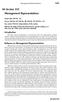 Management Representations 1941 AU Section 333 Management Representations (Supersedes SAS No. 19.) Source: SAS No. 85; SAS No. 89; SAS No. 99; SAS No. 113. See section 9333 for interpretations of this
CHAPTER 3: PREPARING FINANCIAL STATEMENTS
 CHAPTER 3: PREPARING FINANCIAL STATEMENTS I. TIMING AND REPORTING A. The Accounting Period Time period assumption an organization s activities can be divided into specific time periods. Examples: a month,
Accounting Policies, Changes in Accounting Estimates and Errors
 STATUTORY BOARD FINANCIAL REPORTING STANDARD SB-FRS 8 Accounting Policies, Changes in Accounting Estimates and Errors SB-FRS 8 Accounting Policies, Changes in Accounting Estimates and Errors applies to
International Accounting Standard 8 Accounting Policies, Changes in Accounting Estimates and Errors
 International Accounting Standard 8 Accounting Policies, Changes in Accounting Estimates and Errors Objective 1 The objective of this Standard is to prescribe the criteria for selecting and changing accounting
Exam 1 chapters 1-4 Needles 10ed
 Exam 1 chapters 1-4 Needles 10ed Multiple Choice Identify the choice that best completes the statement or answers the question. 1. Which of the following is the most appropriate definition of accounting?
Module 3: Adjusting the accounts, preparing the statements, and completing the accounting cycle
 Page 1 of 27 Module 3: Adjusting the accounts, preparing the statements, and completing the accounting cycle Overview In Module 2 you studied the fundamental steps in recording accounting information by
Multiple-Choice Questions
 True-False 1 Periodic inventory systems provide a greater degree of management control over inventory. 2 In the perpetual inventory system inventory losses must be recoded in the accounts. 3 In a periodic
Financial Statement Analysis: An Introduction
 Financial Statement Analysis: An Introduction 2014 Level I Financial Reporting and Analysis IFT Notes for the CFA exam Contents 1. Introduction... 3 2. Scope of Financial Statement Analysis... 3 3. Major
Analysis and Use of Financial Statements
 Analysis and Use of Financial Statements Copyright 2014 by DELTACPE LLC All rights reserved. No part of this course may be reproduced in any form or by any means, without permission in writing from the
Auditing Accounting Estimates
 Auditing Accounting Estimates 2057 AU Section 342 Auditing Accounting Estimates Source: SAS No. 57; SAS No. 113. See section 9342 for interpretations of this section. Effective for audits of financial
Inventories: Cost Measurement and Flow Assumptions
 CHAPTER Inventories: Cost Measurement and Flow Assumptions OBJECTIVES After careful study of this chapter, you will be able to: 1. Describe how inventory accounts are classified. 2. Explain the uses of
DTS CORPORATION and Consolidated Subsidiaries. Unaudited Quarterly Consolidated Financial Statements for the Three Months Ended June 30, 2008
 DTS CORPORATION and Consolidated Subsidiaries Unaudited Quarterly Consolidated Financial Statements for the Three Months Ended June 30, 2008 DTS CORPORATION and Consolidated Subsidiaries Quarterly Consolidated
A&W Food Services of Canada Inc. Consolidated Financial Statements December 30, 2012 and January 1, 2012 (in thousands of dollars)
 A&W Food Services of Canada Inc. Consolidated Financial Statements December 30, and January 1, (in thousands of dollars) February 12, 2013 Independent Auditor s Report To the Shareholders of A&W Food Services
NOTES TO CONSOLIDATED FINANCIAL STATEMENTS
 NOTES TO CONSOLIDATED FINANCIAL STATEMENTS Japan Airlines Corporation and Consolidated Subsidiaries Japan Airlines System Corporation, the holding company of the JAL group, was renamed Japan Airlines Corporation
Inventories. 2014 Level I Financial Reporting and Analysis. IFT Notes for the CFA exam
 Inventories 2014 Level I Financial Reporting and Analysis IFT Notes for the CFA exam Contents 1. Introduction... 3 2. Cost of Inventories... 3 3. Inventory Valuation Methods... 4 4. Measurement of Inventory
Consolidated Financial Statements. Nippon Unipac Holding and Consolidated Subsidiaries
 Consolidated Financial Statements Nippon Unipac Holding and Consolidated Subsidiaries Period from March 30, 2001 (date inception) to September 30, 2001 Nippon Unipac Holding and Consolidated Subsidiaries
INDEX TO FINANCIAL STATEMENTS. Balance Sheets as of June 30, 2015 and December 31, 2014 (Unaudited) F-2
 INDEX TO FINANCIAL STATEMENTS Page Financial Statements Balance Sheets as of and December 31, 2014 (Unaudited) F-2 Statements of Operations for the three months ended and 2014 (Unaudited) F-3 Statements
Statement of Financial Accounting Standards No. 13
 Statement of Financial Accounting Standards No. 13 FAS13 Status Page FAS13 Summary Accounting for Leases November 1976 Financial Accounting Standards Board of the Financial Accounting Foundation 401 MERRITT
2. The balance in a deferred revenue account represents an amount that is Earned Collected a. Yes Yes b. Yes No c. No Yes d. No No.
 Multiple choice (36%, 2%each): 1. Failure to record the expired amount of prepaid rent expense would not a. understate expense. b. overstate net income. c. overstate owners' equity. d. understate liabilities.
Essentials of Financial Statement Analysis
 Essentials of Financial Statement Analysis An Introduction to Financial Statement Analysis Gregory Mostyn, CPA Worthy and James Publishing www.worthyjames.com Essentials of Financial Statement Analysis
This Executive Summary is part of McGladrey s A Guide to Accounting for Business Combinations and should be read in conjunction with that guide.
 Executive Summary This Executive Summary is part of McGladrey s A Guide to Accounting for Business Combinations and should be read in conjunction with that guide. Introduction The current guidance on accounting
EVERGREEN MARINE CORPORATION FINANCIAL STATEMENTS WITH REPORT OF INDEPENDENT AUDITORS FOR THE YEARS ENDED DECEMBER 31, 2006 AND 2005
 EVERGREEN MARINE CORPORATION FINANCIAL STATEMENTS WITH REPORT OF INDEPENDENT AUDITORS FOR THE YEARS ENDED DECEMBER 31, 2006 AND 2005 The reader is advised that the accompanying financial statements have
ACCOUNTING 105 CONCEPTS REVIEW
 ACCOUNTING 105 CONCEPTS REVIEW A note from the tutors: This handout is designed to help you review important information as you study for your cumulative final exam. While it does cover many important
國 立 體 育 學 院 九 十 六 學 年 度 學 士 班 轉 學 考 試 試 題
 國 立 體 育 學 院 九 十 六 學 年 度 學 士 班 轉 學 考 試 試 題 會 計 學 ( 本 試 題 共 8 頁 ) 注 意 :1 答 案 一 律 寫 在 答 案 卷 上, 否 則 不 予 計 分 2 請 核 對 試 卷 准 考 證 號 碼 與 座 位 號 碼 三 者 是 否 相 符 3 試 卷 彌 封 處 不 得 汚 損 破 壞 4 行 動 電 話 或 呼 叫 器 等 通 訊 器 材 不
CURE INTERNATIONAL, INC.
 FINANCIAL STATEMENTS AND REPORT OF INDEPENDENT CERTIFIED PUBLIC ACCOUNTANTS JUNE 30, 2015 TABLE OF CONTENTS REPORT OF INDEPENDENT CERTIFIED PUBLIC ACCOUNTANTS 1-2 Page FINANCIAL STATEMENTS Statements of
JALUX Inc. and Consolidated Subsidiaries. Notes to Consolidated Financial Statements
 JALUX Inc. and Consolidated Subsidiaries Notes to Consolidated Financial Statements March 31, 2010 1. Summary of Significant Accounting Policies a. Basis of preparation JALUX Inc. (the Company ) and its
Introductory Financial Accounting Course Outline
 Aboriginal Financial Officers Association of Alberta Introductory Financial Accounting Course Outline ACCT 210: INTRODUCTORY FINANCIAL ACCOUNTING I... 1 ACCT 240: INTRODUCTORY FINANCIAL ACCOUNTING II...
SUMITOMO DENSETSU CO., LTD. AND SUBSIDIARIES. Consolidated Financial Statements
 SUMITOMO DENSETSU CO., LTD. AND SUBSIDIARIES Consolidated Financial Statements Report of Independent Public Accountants To the Board of Directors of Sumitomo Densetsu Co., Ltd. : We have audited the consolidated
USA WEIGHTLIFTING, INC. THE U.S. AMATEUR WEIGHTLIFTING FOUNDATION Consolidating Financial Statements & Supplemental Schedules For the Year Ended
 USA WEIGHTLIFTING, INC. THE U.S. AMATEUR WEIGHTLIFTING FOUNDATION Consolidating Financial Statements & Supplemental Schedules For the Year Ended December 31, 2011 1 TABLE OF CONTENTS Independent Auditors'
國 立 體 育 大 學 100 學 年 度 學 士 班 轉 學 考 試 試 題 休 閒 產 業 經 營 學 系 二 年 級 會 計 學 ( 本 試 題 共 8 頁 )
 國 立 體 育 大 學 100 學 年 度 學 士 班 轉 學 考 試 試 題 休 閒 產 業 經 營 學 系 二 年 級 會 計 學 ( 本 試 題 共 8 頁 ) 注 意 : 1. 答 案 一 律 寫 在 答 案 卷 上, 否 則 不 予 計 分 2. 請 核 對 試 卷 准 考 證 號 碼 與 座 位 號 碼 三 者 是 否 相 符 3. 試 卷 彌 封 處 不 得 汚 損 破 壞 4. 行
INTERNATIONAL ACCOUNTING STANDARDS. CIE Guidance for teachers of. 7110 Principles of Accounts and. 0452 Accounting
 www.xtremepapers.com INTERNATIONAL ACCOUNTING STANDARDS CIE Guidance for teachers of 7110 Principles of Accounts and 0452 Accounting 1 CONTENTS Introduction...3 Use of this document... 3 Users of financial
UNIVERSITY OF WATERLOO School of Accounting and Finance
 UNIVERSITY OF WATERLOO School of Accounting and Finance AFM 101 Professor Duane Kennedy Mid-Term Examination Fall 2008 Date and Time: October 16, 2008, 7:15 8:45pm Pages: 16, including cover Name: Student
Accounting principles
 72 Accounting principles The consolidated financial statements are prepared on a basis consistent with generally accepted accounting principles in the Netherlands ( Dutch GAAP ). Historical cost is used
Consolidated financial statements
 Summary of significant accounting policies Basis of preparation DSM s consolidated financial statements have been prepared in accordance with International Financial Reporting Standards (IFRS) as adopted
Condensed Interim Financial Statements Fiscal 2013 First Quarter (Unaudited) For the three months ended July 31, 2012 and 2011
 Condensed Interim Financial Statements Fiscal 2013 First Quarter (Unaudited) CRITICAL OUTCOME TECHNOLOGIES INC Page 2 Condensed Interim Financial Statements Table of Contents Notice of No Audit or Review
The Colleges of the Seneca Financial Statements May 31, 2007 and 2006
 Financial Statements PricewaterhouseCoopers LLP 1100 Bausch & Lomb Place Rochester NY 14604-2705 Telephone (585) 232 4000 Facsimile (585) 454 6594 Report of Independent Auditors To the Board of Trustees
JOHNSON GRADUATE SCHOOL OF MANAGEMENT Cornell University
 JOHNSON GRADUATE SCHOOL OF MANAGEMENT Cornell University Sample Accounting Exemption Exam Questions 1. On July 1, 20D, Allen Company signed a $50,000, one-year, 10 percent note payable. At due date, June
From Net Revenue to Net Income
 The Income Statement: From Net Revenue to Net Income By Z. Joe Lan Article Highlights The income statement shows the revenues, expenses and income recognized over a period of time. Companies use accrual
Please see current textbook prices at www.rcgc.bncollege.com
 BUS 202 INTERMEDIATE ACCOUNTING I SYLLABUS LECTURE HOURS/CREDITS: 3/3 CATALOG DESCRIPTION Prerequisite: BUS 103, CIS 102 and MAT 101 or equivalent This course provides an expanded treatment of theory and
 3 4 5 6 FINANCIAL SECTION Five-Year Summary (Consolidated) TSUKISHIMA KIKAI CO., LTD. and its consolidated subsidiaries Years ended March 31 (Note 1) 2005 2004 2003 2002 2001 2005 For the year: Net sales...
ASPE at a Glance. Standards Included in Topic
 ASPE AT A GLANCE ASPE AT A GLANCE This publication has been compiled to assist users in gaining a high level overview of Accounting Standards for Private Enterprises (ASPE) included in Part II of the CPA
Japan Vilene Company, Ltd. and Subsidiaries
 - 27 - Japan Vilene Company, Ltd. and Subsidiaries Notes to Consolidated Financial Statements Year Ended March 31, 2015 1. BASIS OF PRESENTATION OF CONSOLIDATED FINANCIAL STATEMENTS The accompanying consolidated
Independent Auditor s Report
 Independent Auditor s Report To the Members of the Board of Directors National Insurance Producer Registry Kansas City, Missouri Report on the Financial Statements We have audited the accompanying financial
Reeve Warren Duchac. James M. Reeve. Professor Emeritus of Accounting University of Tennessee, Knoxville
 Reeve Warren Duchac 10e James M. Reeve Professor Emeritus of Accounting University of Tennessee, Knoxville Carl S. Warren Professor Emeritus of Accounting University of Georgia, Athens Jonathan E. Duchac
UNIVERSITY OF DENVER (COLORADO SEMINARY) Financial Statements and OMB A-133 Single Audit Reports. June 30, 2015 and 2014
 Financial Statements and OMB A-133 Single Audit Reports June 30, 2015 and 2014 (With Independent Auditors Report Thereon) Table of Contents Independent Auditors Report 1 Financial Statements Statement
CHAPTER 5. Examining the Balance Sheet and Statement of Cash Flows 2 4, 5 1, 2, 3, 4, 5, 6, 7, 8, 9, 10, 11 12, 13, 14, 15, 16
 CHAPTER 5 Examining the Balance Sheet and Statement of Cash Flows ASSIGNMENT CLASSIFICATION TABLE (BY TOPIC) Topics Questions Brief Exercises Exercises Problems Concepts for Analysis 1. Disclosure principles,
Most economic transactions involve two unrelated entities, although
 139-210.ch04rev.qxd 12/2/03 2:57 PM Page 139 CHAPTER4 INTERCOMPANY TRANSACTIONS LEARNING OBJECTIVES After reading this chapter, you should be able to: Understand the different types of intercompany transactions
APPENDIX D: FASB STATEMENT NO. 123, ACCOUNTING FOR STOCK-BASED COMPENSATION
 APPENDIX D: FASB STATEMENT NO. 123, ACCOUNTING FOR STOCK-BASED COMPENSATION App_D_itc_stock_comp_comparative_analysis.doc 73 Summary This Statement establishes financial accounting and reporting standards
ACC 120 PRINCIPLES OF FINANCIAL ACCOUNTING
 ACC 120 PRINCIPLES OF FINANCIAL ACCOUNTING COURSE DESCRIPTION: Prerequisites ENG 090, and RED 090 or DRE 098; MAT 070 or DMA 010, 020, 030, 040, or satisfactory score on placement test Corequisites: None
CYBERLINK CORP. AND SUBSIDIARIES CONSOLIDATED FINANCIAL STATEMENTS AND REPORT OF INDEPENDENT ACCOUNTANTS DECEMBER 31, 2009 AND 2008
 CYBERLINK CORP. AND SUBSIDIARIES CONSOLIDATED FINANCIAL STATEMENTS AND REPORT OF INDEPENDENT ACCOUNTANTS DECEMBER 31, 2009 AND 2008 For the convenience of readers and for information purpose only, the
HARMONIC DRIVE SYSTEMS INC. AND CONSOLIDATED SUBSIDIARIES CONSOLIDATED FINANCIAL STATEMENTS MARCH 31, 2013
 HARMONIC DRIVE SYSTEMS INC. AND CONSOLIDATED SUBSIDIARIES CONSOLIDATED FINANCIAL STATEMENTS MARCH 31, 2013 HARMONIC DRIVE SYSTEMS INC. AND CONSOLIDATED SUBSIDIARIES CONSOLIDATED BALANCE SHEETS ASSETS
KOREAN AIR LINES CO., LTD. AND SUBSIDIARIES. Consolidated Financial Statements
 Consolidated Financial Statements December 31, 2015 (With Independent Auditors Report Thereon) Contents Page Independent Auditors Report 1 Consolidated Statements of Financial Position 3 Consolidated Statements
NEPAL ACCOUNTING STANDARDS ON CASH FLOW STATEMENTS
 NAS 03 NEPAL ACCOUNTING STANDARDS ON CASH FLOW STATEMENTS CONTENTS Paragraphs OBJECTIVE SCOPE 1-3 BENEFITS OF CASH FLOWS INFORMATION 4-5 DEFINITIONS 6-9 Cash and cash equivalents 7-9 PRESENTATION OF A
Consolidated Financial Statements
 Consolidated Financial Statements For the year ended February 20, 2016 Nitori Holdings Co., Ltd. Consolidated Balance Sheet Nitori Holdings Co., Ltd. and consolidated subsidiaries As at February 20, 2016
Statement of Financial Accounting Standards No. 3
 Statement of Financial Accounting Standards No. 3 FAS3 Status Page FAS3 Summary Reporting Accounting Changes in Interim Financial Statements an amendment of APB Opinion No. 28 December 1974 Financial Accounting
How To Calculate A Trial Balance For A Company
 THE BASIC MODEL The accounting information system is designed to collect and organize data into information that is useful for stakeholders. The Accounting Equation The basic accounting equation is what