
College graduates earn more money than workers with
|
|
|
- Joshua Johns
- 10 years ago
- Views:
Transcription
1 The Financial Value of a Higher Education By Mark Kantrowitz Mark Kantrowitz is the founder and publisher of FinAid.org and author of FastWeb College Gold. Five years have passed since the U.S. Census Bureau published synthetic estimates of work-life earnings by educational attainment. This paper updates those figures with the most recent data from the U.S. Census Bureau s annual Current Population Surveys, and adds net present value analysis of the financial benefit of a college degree to the individual and to the federal government. The added value of a bachelor s degree over a high school diploma or GED has increased to $1.2 million in 2005 from $910,000 in Compared with the average out-of-pocket costs of a college education, this represents a return on investment in excess of 27%. The added value also corresponds to an additional $133,000 in cumulative federal income tax revenue. Accordingly, it would be financially worthwhile for the federal government to replace loans with grants in the financial aid packages of low income students if this yielded at least a 32% increase in the number of low income students graduating with bachelor s degrees. College graduates earn more money than workers with just a high school diploma. In fact, earnings increase with educational attainment, so there is a clear financial benefit to obtaining a higher education. This paper quantifies that financial benefit. The U.S. Census Bureau published a report in July 2002 that contained synthetic estimates of work-life earnings by educational attainment using earnings data from 1997, 1998, and 1999 (Cheeseman Day & Newburger, 2002). Synthetic work-life earnings estimates calculate an average based on a cross-section of annual earnings data by age, as opposed to following a single cohort from the start of the work-life (age 25) to the end (age 64). It estimated that full-time year-round workers with a bachelor s degree would earn nearly $1 million more than individuals with just a high school diploma or GED. Individuals with a doctoral degree earned $1.3 million more than bachelor s degree recipients, and professional degree recipients earned $1 million more than doctoral degree recipients. The 2002 report updated a 1983 report (U.S. Census Bureau, 1983) based on 1979 data and earlier reports that also demonstrated a financial advantage to a college education based on the number of years of school completed (Weitzman, Ono, & Henson, 1968; Henson, Ono, & Thomas, 1970; Henson, Ono, & Thomas, 1974; Salvo & McNeil, 1984). This article uses a similar methodology for computing synthetic work-life estimates by educational attainment using 19
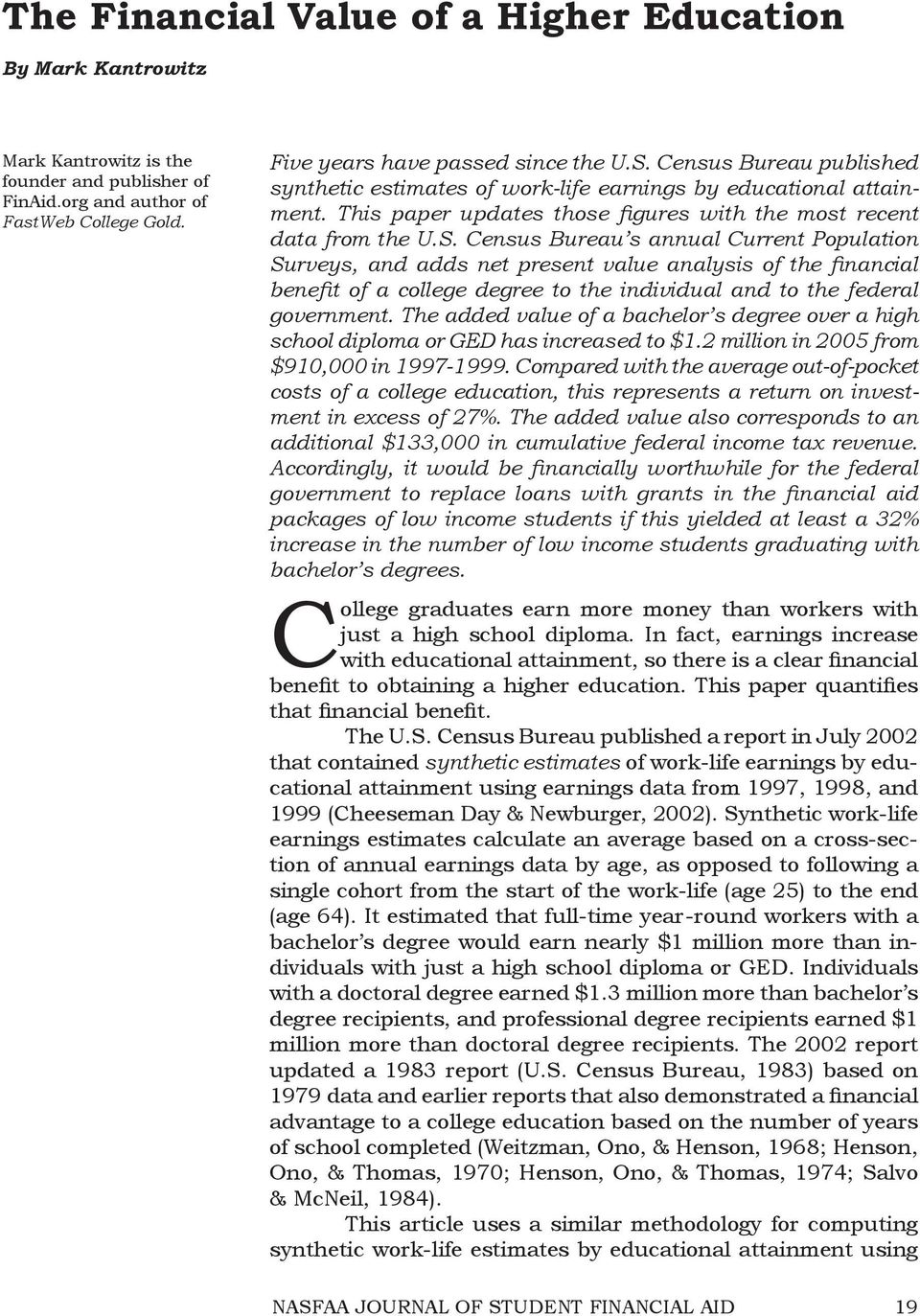
2 2005 mean income data from the 2006 Current Population Survey as published in March 2007 (U.S. Census Bureau, 2007). Mean was used instead of median for comparability with the Census Bureau report s results and because means are better suited for computing return on investment for the population as a whole. The added value of a bachelor s degree over a high school diploma has increased to $1.2 million, a doctoral degree over a bachelor s degree to $1.7 million, and a professional degree over a doctoral degree to $1.2 million, as illustrated in Table 1. Table 1 Financial Advantage of a College Degree (in Current Dollars) Financial Advantage Bachelor s Degree vs. High School Graduate $914,289 $1,181,903 $1,210,760 Doctoral Degree vs. Bachelor s Degree $1,299,137 $1,742,759 $1,707,280 Professional Degree vs. Doctoral Degree $971,541 $1,105,585 $1,163,320 Note figures are in constant 1999 dollars; other figures are in constant 2005 dollars. Adjusting the figures for inflation to obtain constant 2005 dollars would require increasing the figures by 17.2%. 20 VOL. 37, NO. 1, 2007 The methodology calculates a current cross-sectional sum of mean annual income figures for full-time year-round workers ages 25 to 64. Since the income data is clustered into 10-year age cohorts (ages 25 34, 35 44, 45 54, and 55 64), it multiplies each cohort s average by 10 before computing the sum. The column in Table 1 presents an average of three years of data, with the 2003 and 2004 figures adjusted by the Consumer Price Index (CPI-U) to yield constant 2005 dollars, thereby smoothing out some of the year-over-year volatility in the annual figures. This corresponds to the averages reported in the U.S. Census Bureau s July 2002 report. Since the methodology substitutes a cross-sectional sum for a retrospective or prospective case-control analysis, it does not include future salary growth or inflationary adjustments corresponding to an individual s actual earnings trajectory through the various age cohorts. Other limitations include: There may be significant variation in lifetime income due to choice of college major or profession. The assumption of a 40-year work life does not consider the potentially longer work-life for workers who do not pursue a college education. The methodology fails to consider the impact of mortality on work-life and the increases in life expectancy associated with a higher education. The use of full-time year-round earnings data assumes no interruption of the participation in the work-force.

3 The methodology uses mean earnings as opposed to median earnings. Figure 1 illustrates how mean work-life earnings increase with educational level. The financial advantage of a bachelor s degree recipient over a high school graduate grew in part because work-life earnings for college graduates grew at a faster rate than the work-life earnings for individuals without a college degree. Figure 1 Synthetic Work-Life Earnings Estimates for Full-Time Year-Round Workers by Educational Attainment, 2005 Figure 2 Ratio of Average Earnings of Full-Time Year-Round Workers to Average Earnings of High School Graduates by Educational Attainment,

4 Estimate of Work-Life Federal Income Tax Revenue Figure 2 demonstrates the historical growth in the difference in average annual earnings for workers age 18 and above. In 2005, bachelor s degree recipients earned 1.86 times the average earnings for high school graduates and advanced degree recipients earned 2.71 times the average earnings for high school graduates. This compares with 1.86 and 2.76 in 1999, respectively. Using IRS statistics of income data, it is possible to calculate the average federal income tax as a percentage of AGI, as illustrated in Table 2. Table 2 Average Tax as Percentage of AGI AGI Range Tax as a Percentage of AGI $10,000 to $15, % $15,000 to $20, % $20,000 to $25, % $25,000 to $30, % $30,000 to $40, % $40,000 to $50, % $50,000 to $75, % $75,000 to $100, % $100,000 to $200, % Net Present Value Analysis Combining these flat tax rates with the synthetic work-life earnings estimates yields estimates of work-life federal income tax revenue by educational attainment. Figure 3 shows that the federal government earns $132,762 more in work-life income tax revenue for a bachelor s degree recipient as compared with a high school graduate. Doctoral degree recipients yield $301,312 more in income tax revenue than bachelor s degree recipients, and professional degree recipients yield $152,942 more than doctoral degree recipients. Net Present Value (NPV) analysis calculates the current equivalent value of a future stream of values. It represents the amount a disinterested investor would be willing to pay in exchange for the asset that produced those values. While it may sound impressive to talk about a million dollars in additional lifetime earnings, one must recognize that future dollars are worth less than current dollars. Net present value often uses a risk-free rate of return as the discount rate, such as the interest rate on U.S. Treasury bills. This yields the amount which would need to be invested now to yield the future stream of values. This paper uses a discount rate of 4.812%, based on the 30-year Treasury Bond auction of February 8, Shorter 22 VOL. 37, NO. 1, 2007
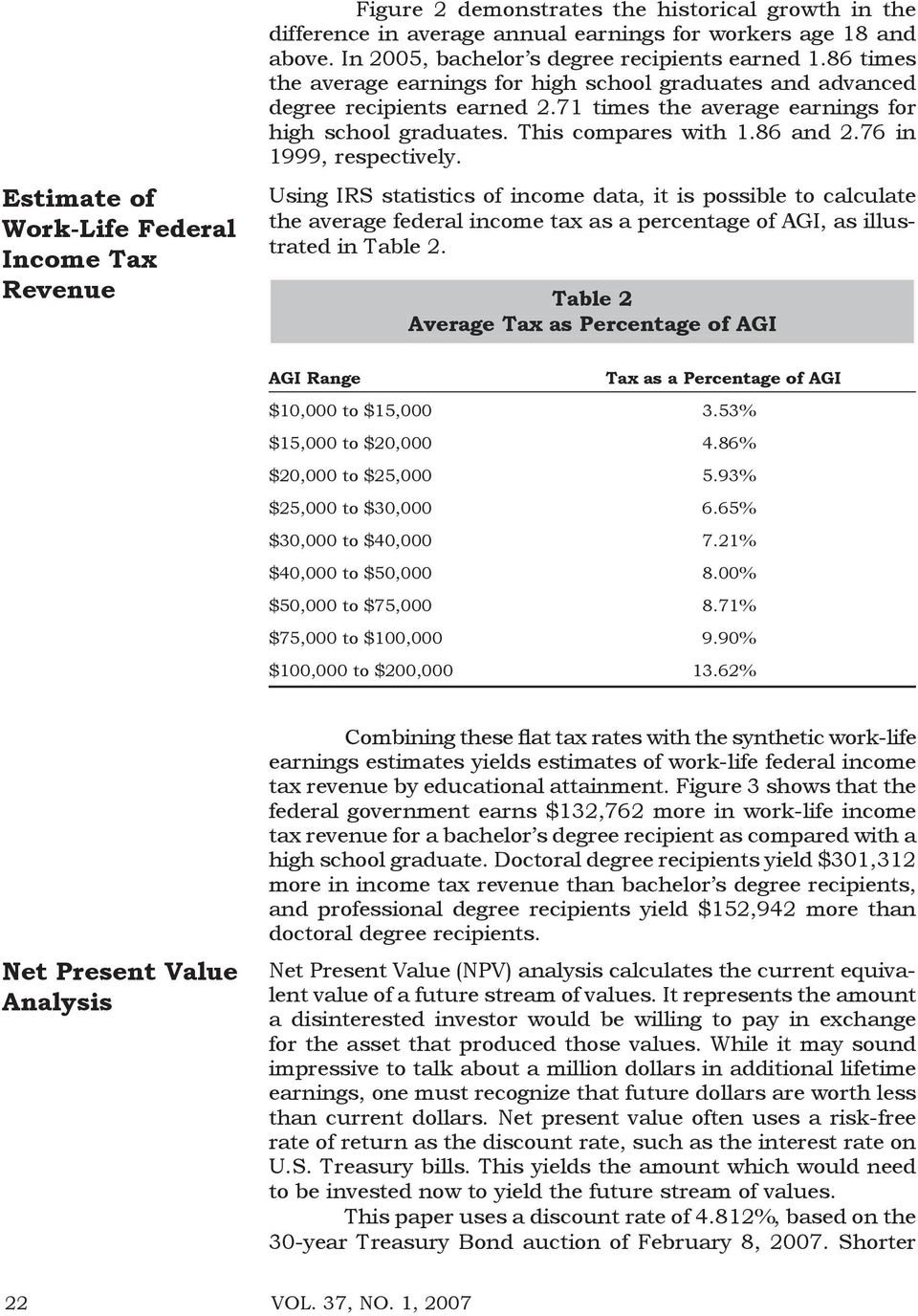
5 Figure 3 Synthetic Work-Life Federal Income Tax Estimates for Full-Time Year-Round Workers by Educational Attainment, 2005 term Treasury bills and notes are within 30 basis points of this discount rate, making it a reasonable choice. U.S. Treasuries are among the lowest risk available financial instruments. Ideally one should use a discount rate that corresponds to the time horizon of each ten year cohort. However, since shorter term treasuries yield a similar discount rate, the potential error from using a single discount rate is minimal. The cumulative discount for each 10-year age range is calculated using the harmonic mean, which may overstate the net present value by as much as 3% because of the uniform weighting of years within each 10-year age range. The harmonic mean is the reciprocal of the arithmetic mean of the reciprocals. It is appropriate to use a harmonic mean in net present value calculations because net present value involves the reciprocal of the cumulative discount rate. The harmonic mean of two numbers x 2xy and y is x+y. It is less than the arithmetic mean and greater than the geometric mean. Since the net present value divides each value by the cumulative discount, the average net present value for a decade of values corresponds roughly to the average of the reciprocals of each year s cumulative discounts, yielding the harmonic mean. Table 3 shows the net present value of the added value of various types of college degrees for both work-life income and federal income tax revenue. Thus a bachelor s degree is a sound investment for a high school graduate if the present cost of attaining the degree is less than about $520,000. Likewise, it is 23

6 Table 3 NPV of Differential Work-Life Income and Federal Income Tax Estimates by Educational Attainment, 2005 Work-Life Federal Added Value Earnings Income Tax Bachelor s Degree vs. High School Graduate $519,261 $56,681 Master s Degree vs. Bachelor s Degree $194,429 $24,735 Doctoral Degree vs. Bachelor s Degree $627,466 $117,425 Professional Degree vs. Doctoral Degree $456,284 $57,498 Comparison With Out-of-Pocket Costs and Federal Student Aid worthwhile for the federal government to invest in federal student aid if the per-student cost is less than about $57,000. To evaluate the quality of an investment in higher education requires comparing the net present value of the investment with the cost to the individual and to the federal government (see Table 4). Cost figures were obtained from the data analysis system of the National Postsecondary Aid Study (NPSAS) conducted by the National Center for Education Statistics at the U.S. Department of Education. The figures are limited to four-year institutions and sum the means for freshman through senior years in college, without inflationary adjustments. Out-of-pocket cost is defined as the student budget (cost of attendance) minus all gift aid, including grants, scholarships, veteran s education benefits and education tax benefits. It represents an estimate of the average student s costs to obtain a college degree. The federal aid and cost figures are limited to students with an adjusted gross income (AGI) of $50,000 or less, as an approximation of the federal costs associated with federal student aid for needy students. Note that total federal aid includes federal education loans, which cost the federal government less than 20 cents per dollar lent. Accordingly, the estimated total federal cost figure conservatively assumes a 20% subsidy rate for education loans. The total federal loans figure includes PLUS loans, which is not included in the total federal aid figure. Table 4 Out-of-Pocket Costs and Federal Student Aid Needy Students (AGI $50,000) Out-of-Pocket Total Total Total Estimated Total Costs Federal Aid Federal Grants Federal Loans Federal Costs Undergraduate $48,038 $20,627 $7,789 $13,299 $10, VOL. 37, NO. 1, 2007

7 Clearly, with a payoff that has a present value of more than ten times the family s investment, an undergraduate education is a worthwhile investment. That s the equivalent of more than a 27% return on investment. Even at 4-year private nonprofit colleges, where the out of pocket costs are $65,121, it still represents a return on investment in excess of 20%. Calculating the return on investment involves solving the following nonlinear equation for R, where R is the return on investment, NPV is the net present value of the future income stream ($519,261), OOPC is the outof-pocket costs ($48,038), D is the discount rate (4.812%), n is the number of years of income (40), and C is an assumed cost of living increase (3%). For values of R above 20% and n = 40, it is reasonable to approximate the left hand side of this equation as R. Federal student aid also represents a wise investment for the federal government, as the income tax revenue has a present value of more than five times the estimated cost of federal student aid. That s the equivalent of nearly a 14% return on investment. Moreover, replacing federal loans with grants would pay for itself if it yielded at least a 32% increase in the number of low income students graduating with bachelor s degrees, assuming a 5% increase in low income student matriculation rates. This percentage threshold is based on the following formula, Conclusion where TR is the federal income tax revenue, C 1 is the current federal cost of financial aid, C 2 is the new federal cost of financial aid, E is the percentage increase in enrollment, and P is the percentage increase in graduation rates. This calculation assumes that the lifetime earnings by educational attainment for students from low income backgrounds mirrors the lifetime earnings for the population as a whole. It does not consider incremental improvements in lifetime earning for students who fall short of obtaining a bachelor s degree. But it also assumes a baseline of some aid as opposed to zero aid. Adjusting work-life estimates for a 3% annual growth in earnings would yield values in Table 3 that are 69% to 84% higher. The return on investment figures for an undergraduate education would increase to 46% for individuals (34% at private nonprofit colleges) and 23% for the federal government assuming tax brackets increase with CPI. The minimum increase in low income graduation rates required to justify replacing federal loans with grants in need-based student aid packages would drop to 15%. The added value of a college education has increased significantly since 1999, with a bachelor s degree now worth more than $2.7 million 25

8 26 VOL. 37, NO. 1, 2007 in mean work-life earnings in current dollars, a master s degree worth more than $3.3 million, a doctoral degree more than $4.4 million, and a professional degree more than $5.6 million. A bachelor s degree clearly represents a worthwhile investment for the student, with a return on investment greater than 27%. The payback period can be as little as four years. Higher education also represents a financially sound investment for the federal government, with a return on investment from increased tax revenues of 14% and a payback period of less than six years. Student aid policy experts have advocated for replacing loans with grants in the financial aid packages of low income students, arguing that this will lead to a significant increase in matriculation and graduation rates. This article demonstrates that such a change will pay for itself if it results in a 32% increase in the number of low income students graduating with bachelor s degrees. Depending on certain reasonable assumptions, the breakeven point may be as low as a 15% increase in graduation rates. (These estimates do not consider increases in lifetime income due to partial progress toward a degree and assume a baseline for comparison of some aid as opposed to zero aid.) The elite colleges who have eliminated loans from the financial aid packages of low income students have obtained greater increases in graduation rates (FinAid.org, 2007). There are several possible areas for future research. The estimates presented in this paper do not account for variations in work-life income according to individual characteristics, such as field of study (major), gender, race and original socio-economic status, and institutional characteristics, such as institutional control (public, private non-profit and private for-profit), Carnegie code, and cost of attendance. Some of these variables, such as gender and race, are already available from the Current Population Survey; most are not. There are a variety of other individual characteristics, such as life expectancy, infant mortality, health, health insurance coverage, crime rates, welfare and public assistance costs, unemployment rates, use of technology, charitable giving, community service and civic participation, that improve with increasing educational attainment (Clinedinst, 2004; Phipps, Santos, & Merisotis, 2005; Institute for Higher Education Policy, 1998; Singh & Siahpush, 2006; Bureau of Labor Statistics, 2007). These non-financial correlates of educational attainment also have an associated financial cost that can be measured in the tens of billions of dollars per year (Campaign for Educational Equity, 2005).
9 References Campaign for Educational Equity. (2005). Fall 2005 symposium on the social costs of inadequate education. New York: Teachers College, Columbia University. Available: Cheeseman Day, J., & Newburger, E. C. (2002, July). The big payoff: Educational attainment and synthetic estimates of work-life earnings, Current Population Reports (pp ). Washington, DC: U.S. Census Bureau. Available: Clinedinst, M. (2004, May). Investing in America s future Why student aid pays off for society and individuals. Washington, DC: Institute for Higher Education Policy. Available: FinAid.org (n.d.). No loans for low income students. Available: Henson, M. F., Ono, M., Thomas, G. A. (1970, March). Annual mean income, lifetime income, and educational attainment of men in the united states, for selected years, 1956 to 1968, Current Population Reports (pp ). Washington, DC: U.S. Census Bureau. Available: Henson, M. F., Ono, M., Thomas, G. A. (1974, March). Annual mean income, lifetime income, and educational attainment of men in the united states, for selected years, 1956 to 1972, Current Population Reports (pp ). Washington, DC: U.S. Census Bureau. Available: Institute for Higher Education Policy. (1998, March). Reaping the benefits: Defining the public and private value of going to college. Washington, DC: author. Available: Phipps, R. A., Santos, J. L, & Merisotis, J. P. (2005, March). Investing in Arizona s future: College access, affordability, and the impact of investment in need-based financial aid. Washington, DC: Institute for Higher Education Policy. Available: Salvo, J. J., & McNeil, J. M. (1984, June). Lifetime work experience and its effect on earnings: Retrospective data from the 1979 Income Survey Development Program, Current Population Reports (pp ). Washington, DC: U.S. Census Bureau. Singh, G. K., & Siahpush, M. (2006). Widening socioeconomic inequalities in U.S. life expectancy, International Journal of Epidemiology 35, Available: U.S. Bureau of Labor Statistics (n.d). Current Population Survey. Available: U. S. Census Bureau. (1983, February). Lifetime earnings estimates for men and women in the United States: 1979, Current Population Reports (pp ). Washington, DC: Author. Available: prod2/popscan/p pdf U.S. Census Bureau (2007, March). Income in 2005 by educational attainment, Current Population Survey (CPS 2006). Washington, DC: Author. Available: cps2006.html U.S. Internal Revenue Service. (2004). Individual income tax returns, selected income and tax items, by size and accumulated size of adjusted gross income. Washington, DC: Author. Available: indtaxstats/article/0,,id=96981,00.html Weitzman, M. S., Ono, M., & Henson, M. F. (1968, August). Annual mean income, lifetime income, and educational attainment of men in the United States, for selected years, 1956 to 1966, Current Population Reports (pp ). Washington, DC: U.S. Census Bureau. Available: 27
The Big Payoff: Educational Attainment and Synthetic Estimates of Work-Life Earnings
 The Big Payoff: Educational Attainment and Synthetic Estimates of Work-Life Earnings Special Studies Issued July 2002 P23-210 Does going to school pay off? Most people think so. Currently, almost 90 percent
EXECUTIVE SUMMARY. Where Value Meets Values: The Economic Impact of Community Colleges
 EXECUTIVE SUMMARY Where Value Meets Values: The Economic Impact of Community Colleges ANALYSIS OF THE ECONOMIC IMPACT & RETURN ON INVESTMENT OF EDUCATION FEBRUARY 2014 EXECUTIVE SUMMARY America s community
Who Graduates with Excessive Student Loan Debt?
 Student Aid Policy Analysis Papers Who Graduates with Excessive Student Loan Debt? www.studentaidpolicy.com/excessive debt/ Mark Kantrowitz President MK Consulting, Inc. December 14, 2015 Executive Summary
Analysis Brief. Trends in Public Higher Education: Enrollment, Prices, Student Aid, Revenues, and Expenditures
 Analysis Brief Trends in Higher Education Series Trends in Public Higher Education: Enrollment, Prices, Student Aid, Revenues, and Expenditures Sandy Baum Senior Fellow, George Washington University Graduate
Characteristics of College Students Who Graduate with No Debt
 Student Aid Policy Analysis Characteristics of College Students Who Graduate EXECUTIVE SUMMARY Mark Kantrowitz Publisher of Fastweb.com and FinAid.org August 24, 2011 About two fifths of undergraduate
Research Report No. 06-2
 Research Report No. 06-2 Washington State Board for Community and Technical Colleges Building Pathways to Success for Low-Skill Adult Students: Lessons for Community College Policy and Practice from a
a topic for a future issue brief, please Minnesota is heading into challenging territory. In the decades
 RESEARCH BRIEF September 2011 Minnesota Educational Needs and Higher Education Finance Policy This is one in a series of research-based briefs prepared by the Minnesota Private College Council for members
STUDENT DEBT MYTHS AND FACTS Second Edition
 STUDENT DEBT MYTHS AND FACTS Second Edition April 2014 The Issue Student loan debt is now approximately $1 trillion, and the delinquency rate for student loans has increased to 10 percent. Critics are
Default Rates by Institution Level vs. Degree Program
 Student Aid Policy Analysis Default Rates by vs. Mark Kantrowitz Publisher of FinAid.org and FastWeb.com July 15, 2010 EXECUTIVE SUMMARY The US Department of Education should consider publishing cohort
Income Sustainability through Educational Attainment
 Journal of Education and Training Studies Vol. 3, No. 1; January 2015 ISSN 2324-805X E-ISSN 2324-8068 Published by Redfame Publishing URL: http://jets.redfame.com Income Sustainability through Educational
A cost-benefit analysis of accounting undergraduate education
 A cost-benefit analysis of accounting undergraduate education ABSTRACT Robert Schadrie St. Norbert College Matthew Van Lanen St. Norbert College Amy Vandenberg St. Norbert College Jason Haen St. Norbert
Student Loans: Do College Students Borrow Too Much (or Not Enough)? Appendix: Data and Methods
 Student Loans: Do College Students Borrow Too Much (or Not Enough)? A. Processing of March CPS Data Appendix: Data and Methods We use the March CPS from the 1964 through 2009 (1963 through 2008 earnings
Trends in Higher Education Series. Education Pays. The Benefits of Higher Education for Individuals and Society. Sandy Baum and Jennifer Ma
 Trends in Higher Education Series Education Pays The Benefits of Higher Education for Individuals and Society 2007 Sandy Baum and Jennifer Ma Executive Summary Students who attend institutions of higher
Undergraduate Debt Causes Pipeline Leakage from Undergraduate School to Graduate and Professional School
 Student Aid Policy Analysis Undergraduate Debt Causes Pipeline Leakage from Undergraduate School to Graduate and Professional School Mark Kantrowitz Publisher of Fastweb.com and FinAid.org November 22,
Which Path? A Roadmap to a Student s Best College. National College Access Network National Conference Mary Nguyen Barry September 16, 2014
 Which Path? A Roadmap to a Student s Best College National College Access Network National Conference Mary Nguyen Barry September 16, 2014 THE EDUCATION TRUST WHO WE ARE The Education Trust works for the
B-286237. September 26, 2000. The Honorable William F. Goodling Chairman, Committee on Education and the Workforce House of Representatives
 United States General Accounting Office Washington, DC 20548 Health, Education, and Human Services Division B-286237 September 26, 2000 The Honorable William F. Goodling Chairman, Committee on Education
Policy Brief June 2010
 Policy Brief June 2010 Pension Tension: Understanding Arizona s Public Employee Retirement Plans The Arizona Chamber Foundation (501(c)3) is a non-partisan, objective educational and research foundation.
Methodology For Calculating Damages in the Victim Compensation Fund
 Methodology For Calculating Damages in the Victim Compensation Fund The calculation of presumed economic loss will generally follow the guidelines established in the original VCF. The Special Master will
The Burden of Borrowing
 The Burden of Borrowing A report on the rising rates of student loan debt The Burden of Borrowing: A Report on the Rising Rates of Student Loan Debt March 2002 By Tracey King and Ellynne Bannon Special
The High Cost of Low Graduation Rates: How Much Does Dropping Out of College Really Cost? Mark Schneider Vice President AIR
 The High Cost of Low Graduation Rates: How Much Does Dropping Out of College Really Cost? Mark Schneider Vice President AIR Lu (Michelle) Yin Researcher AIR August 2011 www.air.org Contents Executive Summary...........................................................
College: A Necessity Priced as a Luxury
 College: A Necessity Priced as a Luxury Six Facts on College and the Middle Class May 2014 A Middle Class Job Does Not Get a Middle Class Life v Today, a middle class job increasingly does not support
NATIONAL STUDENT AID PROFILE: OVERVIEW OF 2015 FEDERAL PROGRAMS
 NATIONAL STUDENT AID PROFILE: OVERVIEW OF 2015 FEDERAL PROGRAMS Published July 2015 Table of Contents Overview... 1 The Federal Pell Grant Program... 4 Campus-Based Aid Programs... 6 The Federal Supplemental
Suggested Citation: Institute for Research on Higher Education. (2016). College Affordability Diagnosis: Florida. Philadelphia, PA: Institute for
 FLORIDA Suggested Citation: Institute for Research on Higher Education. (2016). College Affordability Diagnosis: Florida. Philadelphia, PA: Institute for Research on Higher Education, Graduate School of
Prepared by. Stephen P. A. Brown, PhD Christopher Drury Center for Business and Economic Research College of Business University of Nevada, Las Vegas
 The Value of Education Produced at the University of Nevada, Las Vegas 2011 Prepared by Stephen P. A. Brown, PhD Christopher Drury Center for Business and Economic Research College of Business University
How To Determine The Cost Of College At The Universtarca
 Benchmarks: Measures of College Affordability and Student Aid in North Carolina May 2006 An Update to the Study Published December 2004 The State Education Assistance Authority is pleased to make available
What It s Worth: Field of Training and Economic Status in 2009
 What It s Worth: Field of Training and Economic Status in 2009 Household Economic Studies Issued February 2012 P70-129 INTRODUCTION The relationship between educational attainment and economic outcomes
Student Loan Market Trends Is College Worth It. Presenter: Kelly Savoie, Director Business Development April 2016
 Student Loan Market Trends Is College Worth It Presenter: Kelly Savoie, Director Business Development April 2016 Agenda This presentation is an overview of trends in the industry and the value of a college
Social Security Eligibility and the Labor Supply of Elderly Immigrants. George J. Borjas Harvard University and National Bureau of Economic Research
 Social Security Eligibility and the Labor Supply of Elderly Immigrants George J. Borjas Harvard University and National Bureau of Economic Research Updated for the 9th Annual Joint Conference of the Retirement
HELP Interest Rate Options: Equity and Costs
 HELP Interest Rate Options: Equity and Costs Bruce Chapman and Timothy Higgins July 2014 Abstract This document presents analysis and discussion of the implications of bond indexation on HELP debt. This
Field of Degree and Earnings by Selected Employment Characteristics: 2011
 Field of Degree and Earnings by Selected Employment Characteristics: 0 American Community Survey Briefs By Camille Ryan Issued October 0 ACSBR/-0 INTRODUCTION This brief provides information about the
Where Have All the Good Jobs Gone?
 Where Have All the Good Jobs Gone? John Schmitt and Janelle Jones July 2012 Center for Economic and Policy Research 1611 Connecticut Avenue, NW, Suite 400 Washington, D.C. 20009 202-293-5380 www.cepr.net
Women s Participation in Education and the Workforce. Council of Economic Advisers
 Women s Participation in Education and the Workforce Council of Economic Advisers Updated October 14, 214 Executive Summary Over the past forty years, women have made substantial gains in the workforce
Educational Attainment. Five Key Data Releases From the U.S. Census Bureau
 Educational Attainment Five Key Data Releases From the U.S. Census Bureau 100% 90% 80% 70% Educational Attainment of the Population 25 Years and Older: 2011 30 percent 1% 2% 8% 19% Doctorate degree Professional
FRBSF ECONOMIC LETTER
 FRBSF ECONOMIC LETTER 2014-13 May 5, 2014 Is It Still Worth Going to College? BY MARY C. DALY AND LEILA BENGALI Earning a four-year college degree remains a worthwhile investment for the average student.
Trends in College Spending: 2001 2011
 Trends in College Spending: 2001 2011 A Delta Data Update July 2014 Trends in College Spending: 2001 2011 A Delta Data Update Donna M. Desrochers and Steven Hurlburt 1000 Thomas Jefferson Street NW Washington,
Undergraduate Degree Completion by Age 25 to 29 for Those Who Enter College 1947 to 2002
 Undergraduate Degree Completion by Age 25 to 29 for Those Who Enter College 1947 to 2002 About half of those who start higher education have completed a bachelor's degree by the ages of 25 to 29 years.
Student Debt: Bigger and Bigger. By Heather Boushey. September 2005
 cepr Briefing Paper CENTER FOR ECONOMIC AND POLICY RESEARCH Student Debt: Bigger and Bigger By Heather Boushey September 2005 CENTER FOR ECONOMIC AND POLICY RESEARCH 1611 CONNECTICUT AVE., NW, SUITE 400
The Price of a Science PhD: Variations in Student Debt Levels Across Disciplines and Race/Ethnicity
 Center for Education & Innovation at American Institutes for Research Broadening Participation in Graduate Education Issue Brief May 2013 Kristina L. Zeiser Rita J. Kirshstein Courtney Tanenbaum The Price
New Report on Student-Loan Data Finds Debt Loads Burdensome for Many Graduates
 http://chronicle.com/daily/2002/03/2002030804n.htm (FULL TEXT OF REPORT BEGINS ON PAGE 5) Friday, March 8, 2002 New Report on Student-Loan Data Finds Debt Loads Burdensome for Many Graduates By ALEX P.
Analysis Brief March 2013
 Trends in Higher Education Series College Board Advocacy & Policy Center Analysis Brief March 2013 How Students and Parents Pay for College Kathleen Payea Policy Analyst, The College Board Sandy Baum Senior
ETS s Addressing Achievement Gaps Symposium. Advancing Success for Black Men in College. A Statistical Profile
 ETS s Addressing Achievement Gaps Symposium Advancing Success for Black Men in College A Statistical Profile ETS s Addressing Achievement Gaps Symposium Advancing Success for Black Men in College Co-sponsored
Understanding 529 Plans
 a guide to Understanding 529 Plans A 529 plan is a qualified tuition program to help finance qualified higher education expenses. Table of Contents It Pays to Save for Education...2 Education Costs Outpace
Is College Education Worthwhile?
 Is College Education Worthwhile? Rashida Grant (rmg20) Zachary Easterling (zde) David Nowlin (dwn1) Sylvia Telesz (sat2) Department of Economics The University of Akron Fall 2008 Abstract The rising cost
High School Dropouts in Chicago and Illinois: The Growing Labor Market, Income, Civic, Social and Fiscal Costs of Dropping Out of High School
 High School Dropouts in Chicago and Illinois: The Growing Labor Market, Income, Civic, Social and Fiscal Costs of Dropping Out of High School Prepared by: Andrew Sum Ishwar Khatiwada Joseph McLaughlin
Research Report. Causes of faster-than-inflation increases in college tuition. Mark Kantrowitz Publisher, FinAid. October 10, 2002
 FinAid Page LLC http://www.finaid.org PO Box 81620 412-422-6190 Pittsburgh, PA 15217 412-422-6189 fax Research Report Causes of faster-than-inflation increases in college tuition Mark Kantrowitz Publisher,
Federal Student Loan Debt: 1993 to 2004
 Issue Brief June 2005 Federal Student Loan Debt: 1993 to 2004 University officials, lenders, and policy makers typically monitor annual federal student loan volume (the number of loans made and the total
REPORT. 2014-15 Undergraduate Degree Earners. First-time Graduates and Graduates with Prior Awards
 2014-15 Undergraduate First-time Graduates and Graduates with Prior Awards The total number of undergraduate degree earners has remained nearly constant over the last four years, with 2,804,133 students
USUAL WEEKLY EARNINGS OF WAGE AND SALARY WORKERS FIRST QUARTER 2015
 For release 10:00 a.m. (EDT) Tuesday, April 21, USDL-15-0688 Technical information: (202) 691-6378 [email protected] www.bls.gov/cps Media contact: (202) 691-5902 [email protected] USUAL WEEKLY EARNINGS
Going Nowhere Workers Wages since the Mid-1970s
 Going Nowhere Workers Wages since the Mid-1970s I n the late 1990s, many observers hoped that we had finally broken free of the slow income growth that had bogged down the American middle class for more
HEALTH INSURANCE COVERAGE STATUS. 2009-2013 American Community Survey 5-Year Estimates
 S2701 HEALTH INSURANCE COVERAGE STATUS 2009-2013 American Community Survey 5-Year Estimates Supporting documentation on code lists, subject definitions, data accuracy, and statistical testing can be found
CC.2.1.HS.F.5 -- Essential Choose a level of accuracy appropriate to limitations on measurement when reporting quantities. 1 -- Essential. them.
 Topic: 04-Business Expense Management Know: Understand: Do: CC.2.1.HS.F.5 -- Essential Choose a level of accuracy appropriate to limitations on measurement when reporting quantities. CC.2.2.HS.D.8 -- Essential
Aim High For Higher Education. Edvest: Wisconsin s 529 College Savings Plan
 Aim High For Higher Education Edvest: isconsin s 529 College Savings Plan 3 Aim High for your Child s Future 4 How Edvest orks 5 Edvest Offers Tax Advantages 6 Edvest is Flexible to Use 7 Investment Options
Contact us. Hoa Bui T: + 61 (02) 9335 8938 E: [email protected]. Briallen Cummings T: + 61 (02) 9335 7940 E: [email protected]. www.kpmg.com.
 Contact us Hoa Bui T: + 61 (02) 9335 8938 E: [email protected] Briallen Cummings T: + 61 (02) 9335 7940 E: [email protected] www.kpmg.com.au No reliance This report should not be regarded as suitable
Trends in Higher Education Finance Enrollment Patterns, Student Financial Aid, Net Price, and Completions
 EDUCATION RESEARCH & DATA CENTER www.erdc.wa.gov ERDC Report 2014-07 June 2014 Trends in Higher Education Finance Enrollment Patterns, Student Financial Aid, Net Price, and Completions This study focuses
Finance CHAPTER OUTLINE. 5.1 Interest 5.2 Compound Interest 5.3 Annuities; Sinking Funds 5.4 Present Value of an Annuity; Amortization
 CHAPTER 5 Finance OUTLINE Even though you re in college now, at some time, probably not too far in the future, you will be thinking of buying a house. And, unless you ve won the lottery, you will need
Women, Wages and Work A report prepared by the UNC Charlotte Urban Institute for the Women s Summit April 11, 2011
 A report prepared by the UNC Charlotte Urban Institute for the Women s Summit April 11, 2011 A report prepared for the Women s Summit by the UNC Charlotte Urban Institute 1 Table of Contents Table of Contents...