
(30) Foreign Application Priority Data
|
|
|
- Daniella Wade
- 10 years ago
- Views:
Transcription
1 US A1 (19) United States (12) Patent Application Publication (10) Pub. No.: US 2004/ A1 Lahti et al. (43) Pub. Date: Jan. 22, 2004 (54) SYNCHRONIZATION METHOD (76) Inventors: Jerry Lahti, Budapest (HU); Thomas Keranen, Helsinki (FI) Correspondence Address: WARE FRESSOLA VAN DER SLUYS & ADOLPHSON, LLP BRADFORD GREEN BUILDING MAIN STREET, P O BOX 224 MONROE, CT (US) (21) Appl. No.: 10/297,038 (22) PCT Filed: May 28,2001 (86) PCT No.: PCT/FI01/00508 (30) Foreign Application Priority Data May 29, 2000 (F1) Publication Classi?cation (51) Int. Cl G06F 11/30 (52) Us /201 (57) ABSTRACT The invention relates to methods for managing state infor mation associated With user agents in systems utilizing the Wireless application protocol. According to the invention, the user agent indicates in the header information of a WAP message such as a request to the cookie proxy that the user agent currently has a session having associated state infor mation, When the user agent has received header information indicating the presence of a cookie during the current session. This informs the cookie proxy, that it should con tinue storing the cookies associated With the current session. When the cookie proxy receives for the next time a WAP message Without such indication, it can assume that a new session has started, in Which case the cookie proxy can discard all cookies bound to the previous session unless certain parameters of certain cookies explicitly indicate that they should not he discarded at that moment. Further, in an advantageous embodiment of the invention, the cookie proxy can indicate to the user agent that it has no cookies associated With the current session. The invention allows the syncronization of the user agent and the cookie proxy. W
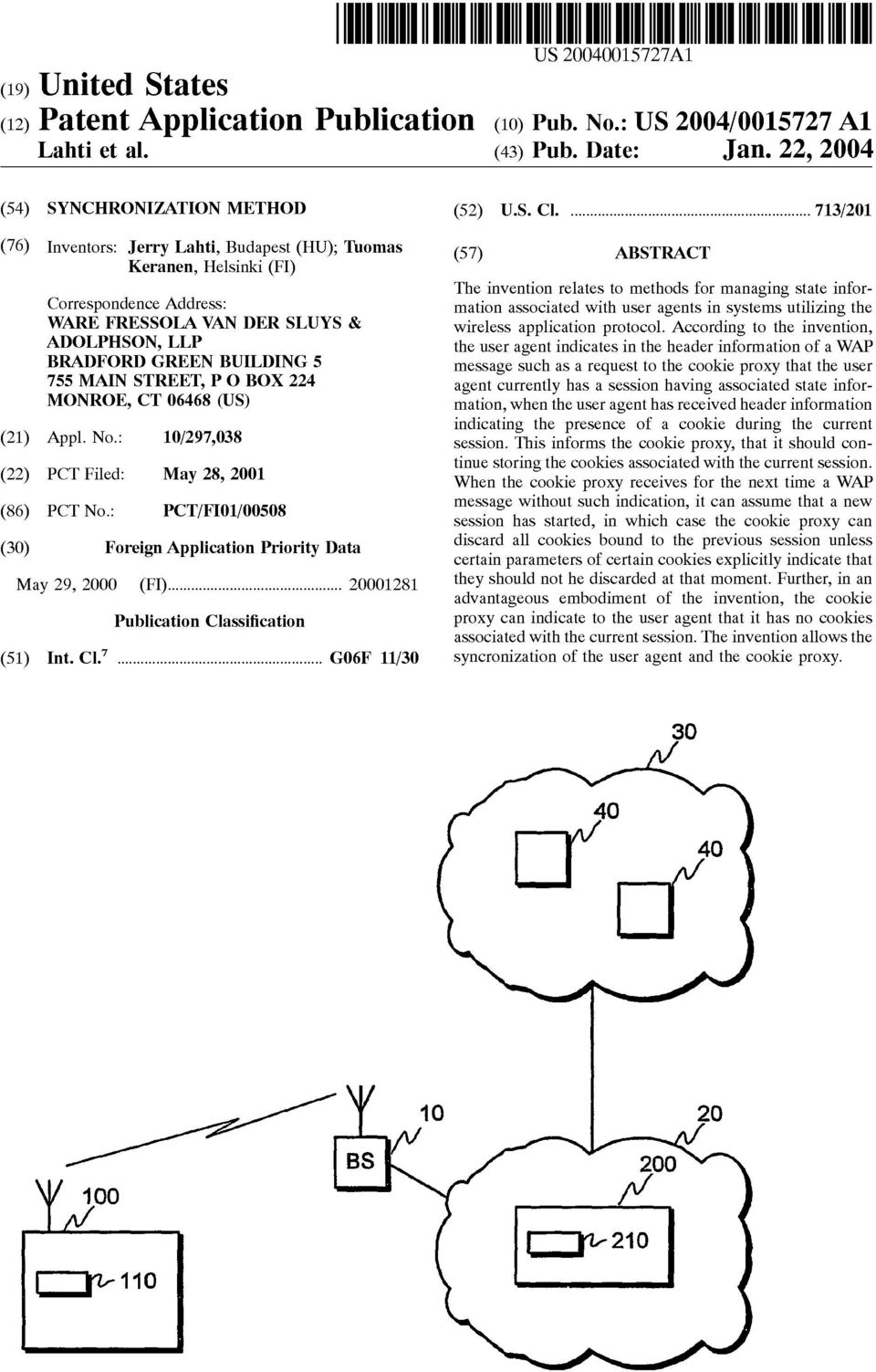
2 Patent Application Publication Jan. 22, 2004 US 2004/ A1 30

3 Jan. 22, 2004 SYNCHRONIZATION METHOD BACKGROUND OF INVENTION [0001] 1. Field of the Invention [0002] The invention relates to methods for managing state information associated With user agents in systems utilizing the Wireless application protocol. Especially, the invention is related to such a method as speci?ed in the preamble of the independent method claim. [0003] 2. Description of Related Art [0004] The following terms and acronyms Will be used throughout the application: [0005] WAP Wireless Application Protocol [0006] HTTP Hypertext Transfer Protocol [0007] WML Wireless Markup Language [0008] Client a device or a software application that initiates a request for a connection With a server [0009] Cookie Proxy an intermediate program that acts as a user agent for the purpose of managing cookies and cookie storage on behalf of other user agents [0010] Origin Server the server, on Which a given resource resides or is to be created, often referred to as a Web server or an HTTP server [0011] Proxy an intermediate program that acts as both a server and a client for the purpose of making requests on behalf of other clients [0012] User a person, Who interacts With a user agent to view, hear or otherwise use a resource [0013] User Agent a user agent is any software or device that interprets WML, WMLScript or other content [0014] On the World Wide Web, the HTTP State Manage ment mechanism stores state information in a?le known as a cookie on the client This mechanism is de?ned in RFC2109. The same mechanism can also be used over the WAP protocols, since HTTP headers are used to convey all state and state manipulation information. RFC2109 de?nes a means Whereby an origin server can request that a small unit of state information i.e. a cookie is stored in the user agent, and included in subsequent requests to the origin server. Avariety of controls are available to the origin server, allowing it to control When the cookie is included in sub sequent requests, When the cookie expires as Well as other state management and transport controls. According to RFC2109 the user agent is responsible for cookie manage ment. [0015] According to the draft speci?cations for WAP HTTP state management at the time of Writing this patent application, a cookie proxy can be used to store manage cookies on behalf of the user agent. Such an approach is described in the patent application WO 99/64967, for example. The advantage of such an approach is the saving of memory capacity and processing capacity in a mobile com munication device, and also to save the resources of the air interface. The cookie proxy is an HTTP proxy or proxy equivalent such as a WAP GateWay that manages cookies on behalf of WAP user agents that do not implement the HTTP state function directly. The cookie proxy is responsible for managing and storing cookies on behalf of the user agents, and modi?es HTTP requests and responses to and from the user agent to implement this function. HoWever, the cookie proxy concept has a problem, Which has not been solved previously. According to RFC2109, some cookies may be bound to the user agent session. Because of this, there should be a method for the cookie proxy to detect When a new session is activated and cookies bound to the previous session should be discarded. This means that the user agent and the cookie proxy must be somehow synchronized. HoWever, the speci?cation drafts existing at the time of Writing of this patent application do not specify any Ways to remedy this problem. SUMMARY OF THE INVENTION [0016] An object of the invention is to realize a method that alleviates the problems of the prior art The objects are reached by arranging an user agent to indicate to the cookie proxy that a cookie associated With the current session has been received by the user agent and/or the cookie proxy. [0017] The method according to the invention is charac terized by that, Which is speci?ed in the characterizing part of the independent method claim. The network element according to the invention is characterized by that, Which is speci?ed in the characterizing part of the independent claim directed to a network element. The mobile communication means according to the invention is characterized by that, Which is speci?ed in the characterizing part of the indepen dent claim directed to a mobile communication means. The software program product for a Wireless application protocol user agent according to the invention is characterized by that, Which is speci?ed in the characterizing part of the independent claim directed to a software program product for a Wireless application protocol user agent. The dependent claims describe further advantageous embodiments of the invention. [0018] According to the invention, the user agent indicates in the header information of a WAP message such as a request to the cookie proxy that the user agent currently has a session having associated state information, When the user agent has received header information indicating the pres ence of a cookie during the current session. This informs the cookie proxy, that it should continue storing the cookies associated With the current session. When the cookie proxy receives for the next time a WAP message Without such indication, it can assume that a new session has started, in Which case the cookie proxy can discard all cookies bound to the previous session unless certain parameters of certain cookies explicitly indicate that they should not be discarded at that moment Further, in an advantageous embodiment of the invention, the cookie proxy can indicate to the user agent that it has no cookies associated With the current session. The invention allows the syncronization of the user agent and the cookie proxy. [0019] Advantageously, the indication can be imple mented by using one of certain values in the X-Wap-Proxy Cookie-header?eld. These certain values can be for example session-has-state and cache-has-state. These values make it possible for the user agent to indicate that it has received at least one X-Wap-Proxy-Set-cookie-header
![Especially, the invention is related to such a method as speci?ed in the preamble of the independent method claim. [0003] 2.](/docs-images/52/12906569/images/page_3.jpg "Description of Related Art [0004] The following terms and acronyms Will be used throughout the application: [0005] WAP Wireless Application Protocol [0006] HTTP Hypertext Transfer Protocol [0007] WML")
4 Jan. 22, 2004 during the current user agent session, in Which case the user agent believes to have one or more cookies handled by the cookie proxy during a particular browsing session. If cookie proxy then receives the same header With plain values session or cache, it should discard all cookies Without Max-age attribute that are related to the user agent ie the cookies bound to the previous browsing session. [0020] Advantageously, the cookie proxy can give the indication to the user agent that it has no cookies associated With the current session by using a speci?c value in a speci?c header?eld. For example, in an advantageous embodiment of the invention, the cookie proxy gives the indication by presenting the value error in the X-Wap Proxy-Set-Cookie header?eld. Preferably, the cookie proxy gives the indication to the user agent in such a case, that the user agent indicates that the current session has associated cookies, but that the cookie proxy does not for any reason have any cookies associated With the session. Such a situ ation can arise for example if the cookie proxy loses the cookies due to an error. The user agent can then inform the user that inconsistent behaviour may occur. BRIEF DESCRIPTION OF THE DRAWING [0021] Various embodiments of the invention Will be described in detail below, by Way of example only, With reference to the accompanying FIG. 1, Which illustrates various embodiments of the invention. DETAILED DESCRIPTION OF THE PREFERRED EMBODIMENTS [0022] A. Embodiments According to a First Aspect of the Invention [0023] According to a?rst aspect of the invention, the X-Wap-Proxy-Cookie header is used to transfer the indica tion of a session having associated cookies from a user agent to a cookie proxy. This header is sent in a WAP message such as a request from the user agent to indicate Whether the Cookie Proxy should store cookies from origin servers or not. X-Wap-Proxy-Cookie header is also used to send status information from user agent to the Cookie Proxy. [0024] According to an advantageous embodiment of the invention, the X-Wap-Proxy-Cookie header may have the values of cache-has-state and session-has-state, in addi tion to previously known values of cache, delete, none, and session. The meanings of these values accord ing to the present exemplary embodiment are described in the following. When the value is cache or cache-has state, the Cookie Proxy caches cookies and sends them to the origin server on behalf of the user agent. User agent appends cache-has-state value instead of cache in case it has received at least one X-Wap-Proxy-Set-Cookie header dur ing the ongoing user agent session. This mechanism enables simple method for synchronization between user agents and Cookie Proxy. On account of this information Cookie Proxy can e.g. detect if the user agent session based cookies from the previous usage time should be discarded. When the value is delete, the Cookie Proxy does not send any cookies to the origin server or store any received cookies. That is, the proxy acts as a?lter and deletes all cookies before they are sent to the user agent If the header is not present, or has a value of none, the proxy passes all HTTP cookie headers through between the user agent and the origin server Without interception. When the value is session, or session-has state, Cookie Proxy and user agent functionalities are combined. If Cookie Proxy receives a response containing a Set-Cookie header from the origin server, it decides the place for cookie storage according to the presence of the Max-Age attribute in the Set-Cookie header. This method can be used to separate session-based cookies from long lived ones. The difference between session and session-has state values is similar to the difference between cache and cache-has-state values, Which is described above. Note that status of the session is bound to the user agent session, Which begins When the user agent starts and ends When it exits. Status is preferably not related to a certain cookie-derived session, but it simply tells if the user agent has cookies managed by the Cookie Proxy during a particular user agent session. [0025] According to an advantageous embodiment of the invention, the cookie proxy server uses the X-Wap-Proxy Set-Cookie header to indicate that it does not have any cookies associated With the current session. This header can be used by the cookie proxy to indicate that one or more cookies Were received in a response from an origin server and stored in the cookie proxy and/or at least one cookie Was sent in the corresponding request. According to the present exemplary embodiment of the invention, the Cookie Proxy uses X-Wap-Proxy-Set-Cookie header to report an errone ous status to the user agent. In the present exemplary embodiment, the XWap-Proxy-Set-Cookie header can have one of at least these two values: state or error. The meaning of these values are described in the following according to an exemplary embodiment of the invention. When value is state, the user-agent is able to detect that a stateful session is in progress. Cookie Proxy sends this header value in a message to the user agent When it receives a Set-Cookie header from the origin server and chooses to manage the cookie. This header is also sent When the Cookie Proxy has added a Cookie header in the related HTTP request. When the value is error, Cookie Proxy has detected a mismatch between the status of the user agent and the Cookie Proxy. Such a situation may arise for example if Cookie Proxy loses the cookies for any reason during a particular user agent session. [0026] B. Embodiments According to a Second Aspect of the Invention [0027] In the following, functionality of a cookie proxy according to preferred embodiments of the invention in certain situations are described. In an advantageous embodi ment of the invention, When Cookie Proxy receives a X-Wap-Cookie-Proxy: cache header, it discards all the current user agent session-based cookies, ie those cookies Which Were sent from the origin server Without a Max-Age attribute. [0028] In an advantageous embodiment of the invention, When cookie proxy receives a X-Wap-Cookie-Proxy: ses sion or a X-Wap-Cookie-Proxy: session-has-state header from an user agent, the cookie proxy includes cookies in the requests to the origin servers. If the Cookie Proxy receives a response containing the Set-Cookie header from the origin
![the previous browsing session. [0020] Advantageously, the cookie proxy can give the indication to the user agent that it has no cookies associated With the current session by using a speci?](/docs-images/52/12906569/images/page_4.jpg "c value in a speci?c header?eld. For example, in an advantageous embodiment of the invention, the cookie proxy gives the indication by presenting the value error in the X-Wap Proxy-Set-Cookie header?")
5 Jan. 22, 2004 server, it decides the place for cookie storage according to the presence of the Max-Age attribute in the Set-Cookie header. If Max-Age attribute is present, the cookie proxy transmits the cookie to the user agent Without interception. OtherWise it is stored by the Cookie Proxy until the cookie proxy receives a subsequent X-Wap-Cookie-Proxy: ses sion or X-Wap-Cookie-Proxy: cache header from the user agent Similarly to X-Wap-Cookie-Proxy: cache header, the X-Wap-Cookie-Proxy: session header effec tively indicates that user agent does not have any cookies bound to the current user agent session and thus all stored cookies Without Max-Age attribute must be discarded. [0029] Advantageously the Cookie Proxy does not per form any -cookie management including storage or?ltering, Without the receipt of an X-Wap-Proxy-Cookie. cache, X-Wap-Proxy-Cookie: cache-has-state, X-Wap-Proxy Cookie: session, or X-Wap-Proxy-Cookie: session-has state header from the user agent, indicating that cookie management is desired. [0030] Advantageously the Cookie Proxy includes X-Wap-Proxy-Set-Cookie: state header in the response to the client, if it has received a cookie in the response from the origin server and chosen to manage it or it has sent a Cookie header in the associated HTTP request Preferably, this header is not sent if neither of the Cookie and Set-Cookie headers Was present in the HTTP request and response, or if the cookie proxy has not cached any cookie information. Advantageously, the Cookie Proxy includes X-Wap-Proxy Set-Cookie: error header in the response if user agent sends status information Which is con?icting With the status recorded by the Cookie Proxy. That is, if a user agent sends a request With X-Wap-Proxy-Cookie: cache-has-state or X-Wap-Proxy-Cookie: session-has-state header, but Cookie Proxy does not have any cookies in storage for this particular user agent [0031] C. Embodiments According to a Third Aspect of the Invention [0032] In the following, functionality of a user agent according to preferred embodiments of the invention in certain situations are described. [0033] According to an advantageous embodiment of the invention, a User agent includes WAP Speci?c HTTP State Management Headers in WAP messages such as requests to utilize Cookie Proxy facilities. Preferably, the user agent comprises means for allowing the user to elect to use either cookie proxy facilities or their own local cookie manage ment or both. [0034] According to an advantageous embodiment of the invention, the user agent sends the X-Wap-Cookie-Proxy: cache-has-state header instead of the X-Wap-Cookie Proxy: cache header and correspondingly the X-Wap Cookie-Proxy: session-has-state header instead of the X-Wap-Cookie-Proxy: session header in case it has received at least one X-Wap-Proxy-Set-Cookie header dur ing the ongoing user agent session. Preferably, the user agent comprises means for notifying the user that inconsistent service behavior may occur as a response to receiving a X-WapProxy-Set-Cookie: error header from the cookie proxy. [0035] D. Embodiments According to Further Aspects of the Invention [0036] In the following, certain aspects of the invention are described. [0037] According to a further aspect of the invention, a method for controlling the handling of cookies by a cookie proxy in a cellular telecommunication system employing the Wireless application protocol is provided According to an advantageous embodiment of the invention, the method comprises at least the step of indicating by an user agent to the cookie proxy that the user agent and/or the cookie proxy has [0038] According to a further aspect of the invention, a network element of a cellular telecommunication system employing the Wireless application protocol is provided. This aspect is illustrated in FIG. 1. According to an advan tageous embodiment of the invention, the network element 200 comprises at least means 210 for controlling storing of cookies, said means for controlling being at least partly controllable by an indication by an user agent to the cookie proxy that the user agent and/or the cookie proxy has FIG. 1 further illustrates a mobile communication means 100, a cellular telecommunication network 20, a base station 10 of the cellular telecommunication network 20, and a second network 30 comprising origin servers 40. The second net Work 30 can be a public data network such as the internet, or for example an internal network of a cellular service provider providing WAP services for the customers of the provider using servers 40 in the internal network. [0039] According to a further aspect of the invention, a mobile communication means for a cellular telecommuni cation system employing the Wireless application protocol is provided. According to an advantageous embodiment of the invention, the mobile communication means comprises at least means 110 for indicating to a cookie proxy that the mobile communication means and/or the cookie proxy has [0040] According to a further aspect of the invention, a software program product for a Wireless application protocol user agent is provided. According to an advantageous embodiment of the invention, the software program product for a Wireless application protocol user agent comprises at least computer program code means for indicating to a cookie proxy that the user agent and/or the cookie proxy has [0041] According to a further aspect of the invention, a software program product for a cookie proxy for Wireless application protocol user agents is provided. According to an advantageous embodiment of the invention, the software program product for a cookie proxy for Wireless application protocol user agents comprises at least computer program code means for controlling storing of cookies, said means for controlling being at least partly controllable by an indication by an user agent to the cookie proxy that the user agent and/or the cookie proxy has received a cookie asso ciated With the current session. [0042] E. Further Considerations [0043] The inventive method allows the WAP HTTP state management to seamlessly ful?ll the semantics of RFC2109.

6 J an. 22, 2004 [0044] In view of the foregoing description it Will be evident to a person skilled in the art that various modi?ca tions may be made Within the scope of the invention. While a preferred embodiment of the invention has been described in detail, it should be apparent that many modi?cations and variations thereto are possible, all of Which fall Within the true spirit and scope of the invention. 1. A method for controlling the handling of cookies by a cookie proxy in a cellular telecommunication system employing the Wireless application protocol, characterized in that the method comprises at least the step of indicating by an user agent to the cookie proxy that the user agent and/or the cookie proxy has received a cookie associated With the current session. 2. A method according to claim 1, Wherein the cookie proxy is informed to continue storing cookies associated With current session or delete cookies bound to the previous session by an indication in a message, Which message received With said indication informs cookie proxy to con tinue storing of cookies associated With the current session, and said message received Without said indication informs the cookie proxy to delete session-bound cookies of the previous session. 3. Amethod according to claim 2, Wherein the cookies not to be deleted are indicated to the proxy by a parameter. 4. A network element of a cellular telecommunication system employing the Wireless application protocol, char acterized in that comprises at least means for controlling storing of cookies, said means for being at least partly controllable by an indication by an user agent to the cookie proxy that the user agent and/or the cookie proxy has 5. A network element according to claim 4, Wherein said means are arranged so that the cookie proxy is informed to continue storing cookies associated With current session or delete cookies bound to the previous session by an indica tion in a message, Which message received With said indi cation informs cookie proxy to continue storing of cookies associated With the current session, and said message received Without said indication informs the cookie proxy to delete session-bound cookies of the previous session. 6. Amobile communication means for a cellular telecom munication system employing the Wireless application pro tocol, characterized in that the mobile communication means comprises at least means for indicating to a cookie proxy that the mobile communication means and/or the cookie proxy has received a cookie associated With the current session. 7. A mobile communication means according to claim 6, Wherein said means are arranged so that the cookie proxy is informed to continue storing cookies associated With current session or delete cookies bound to the previous session by an indication in a message, Which message received With said indication informs cookie proxy to continue storing of cookies associated With the current session, and said mes sage received Without said indication informs the cookie proxy to delete session-bound cookies of the previous ses sion. 8. SoftWare program product for a Wireless application protocol user agent, characterized in that it comprises at least computer program code means for indicating to a cookie proxy that the user agent and/or the cookie proxy has 9. SoftWare program product according to claim 8, Wherein said computer program code means are arranged so that the cookie proxy is informed to continue storing cookies associated With current session or delete cookies bound to the previous session by an indication in a message, Which message received With said indication informs cookie proxy to continue storing of cookies associated With the current session, and said message received Without said indication informs the cookie proxy to delete session-bound cookies of the previous session. 10. SoftWare program product for a cookie proxy for Wireless application protocol user agents, characterized in that it comprises at least computer program code means for controlling storing of cookies, said means for controlling being at least partly controllable by an indication by an user agent to the cookie proxy that the user agent and/or the cookie proxy has received a cookie associated With the current session. 11. SoftWare program product according to claim 10, Wherein said computer program code means are arranged so that the cookie proxy is informed to continue storing cookies associated With current session or delete cookies bound to the previous session by an indication in a message, Which message received With said indication informs cookie proxy to continue storing of cookies associated With the current session, and said message received Without said indication informs the cookie proxy to delete session-bound cookies of the previous session.
HTTP State Management
 HTTP State Management Candidate Version 1.1 27 Feb 2007 Open Mobile Alliance OMA-TS-HTTPSM-V1_1-20070227-C OMA-TS-HTTPSM-V1_1-20070227-C Page 2 (17) Use of this document is subject to all of the terms
(Us) (73) Assignee: Avaya Technology Corp. Je?' McElroy, Columbia, SC (US); (21) Appl. No.: 10/413,024. (22) Filed: Apr. 14, 2003 (57) ABSTRACT
 US 20040202300A1 (19) United States (12) Patent Application Publication (10) Pub. No.: US 2004/0202300 A1 Cooper et al. (43) Pub. Date: Oct. 14, 2004 (54) CALL HANDLING USING NON-SPEECH CUES VIA A PERSONAL
Hay (43) Pub. Date: Oct. 17, 2002
 US 20020152322A1 (19) United States (12) Patent Application Publication (10) Pub. No.: US 2002/0152322 A1 Hay (43) Pub. Date: Oct. 17, 2002 (54) (76) (21) (22) (51) (52) METHOD AND APPARATUS FOR FACILITATING
US 20020072350A1 (19) United States (12) Patent Application Publication (10) Pub. No.: US 2002/0072350 A1 Fukuzato (43) Pub. Date: Jun.
 US 20020072350A1 (19) United States (12) Patent Application Publication (10) Pub. No.: US 20020072350 A1 Fukuzato (43) Pub. Date: Jun. 13, 2002 (54) BACKUP METHOD OF APPLICATIONS OF PORTABLE CELLULAR PHONE
US 20020141557A1 (19) United States (12) Patent Application Publication (10) Pub. No.: US 2002/0141557 A1 STRANDBERG (43) Pub. Date: Oct.
 ---- US 20020141557A1 (19) United States (12) Patent Application Publication (10) Pub. No.: US 2002/0141557 A1 STRANDBERG (43) Pub. Date: (54) SYSTEM AND METHOD FOR PROVIDING AN AUTOMATIC TELEPHONE CALL
/ \33 40 \ / \\ \ \ M / 32. 28f 1. (19) United States (12) Patent Application Publication Lawser et al. NETWORK \ 36. SERVlCE 'NTERNET SERVICE
 (19) United States (12) Patent Application Publication Lawser et al. US 20130336314A1 (10) Pub. N0.: US 2013/0336314 A1 (43) Pub. Date: Dec. 19, 2013 (54) (71) (72) (73) (21) (22) (63) METHOD FOR COMPLETING
l / Normal End, client 1 granted access to " System 1
 US 20110252465A1 (19) United States (12) Patent Application Publication (10) Pub. No.: US 2011/0252465 A1 MILLER et al. (43) Pub. Date: Oct. 13, 2011 (54) (75) (73) (21) (22) (63) (60) SYSTEM AND METHOD
US 20070139188A1 (19) United States (12) Patent Application Publication (10) Pub. No.: US 2007/0139188 A1 Ollis et al. HOME PROCESSOR /\ J\ NETWORK
 US 20070139188A1 (19) United States (12) Patent Application Publication (10) Pub. No.: US 2007/0139188 A1 Ollis et al. (43) Pub. Date: Jun. 21, 2007 (54) (75) (73) (21) (22) METHOD AND APPARATUS FOR COMMUNICATING
US 20090157756Al (19) United States (12) Patent Application Publication (10) Pub. No.: US 2009/0157756 A1 Sanvido (43) Pub. Date: Jun.
 US 20090157756Al (19) United States (12) Patent Application Publication (10) Pub. No.: US 2009/0157756 A1 Sanvido (43) Pub. Date: Jun. 18, 2009 (54) FILE SYSTEM FOR STORING FILES IN Publication Classi?cation
\ \ \ connection connection connection interface interface interface
 US 20140122910A1 (19) United States (12) Patent Application Publication (10) Pub. No.: US 20140122910 A1 Chiu et al. (43) Pub. Date: May 1, 2014 (54) RACK SERVER SYSTEM AND OPERATION Publication Classi?cation
(12) United States Patent (10) Patent N0.: US 8,282,471 B1 Korner (45) Date of Patent: Oct. 9, 2012
 US008282471B1 (12) United States Patent (10) Patent N0.: US 8,282,471 B1 Korner (45) Date of Patent: Oct. 9, 2012 (54) COMPUTER-IMPLEMENTED SPORTS 2011/0003634 A1* 1/2011 Manteris..... 463/25 WAGERING
(12) United States Patent Edelen
 US008285799B2 (12) United States Patent Edelen (10) Patent N0.: (45) Date of Patent: Oct. 9, 2012 (54) QUOTA-BASED ARCHIVING (75) Inventor: James Edelen, Renton, WA (U S) (73) Assignee: Microsoft Corporation,
(71) Applicant: SPEAKWRITE, LLC,Austin, TX (US)
 US 20130304465Al (19) United States (12) Patent Application Publication (10) Pub. No.: US 2013/0304465 A1 Henry et al. (43) Pub. Date: NOV. 14, 2013 (54) METHOD AND SYSTEM FOR AUDIO-VIDEO (52) US. Cl.
software, and perform automatic dialing according to the /*~102
 US 20140105199A1 (19) United States (12) Patent Application Publication (10) Pub. No.: US 2014/0105199 A1 Tian (43) Pub. Date: (54) METHOD AND APPARATUS FOR AUTOMATIC DIALING ACCESS POINTS (71) Applicant:
US 20020174380A1 (19) United States (12) Patent Application Publication (10) Pub. N0.: US 2002/0174380 A1. Mannarsamy (43) Pub. Date: NOV.
 US 20020174380A1 (19) United States (12) Patent Application Publication (10) Pub. N0.: US 2002/0174380 A1 Mannarsamy (43) Pub. Date: NOV. 21, 2002 (54) HELPDESK SYSTEM AND METHOD (52) US. Cl...... 714/25
(43) Pub. Date: Feb. 16, 2012
 US 20120041897A1 (19) United States (12) Patent Application Publication (10) Pub. No.: US 2012/0041897 A1 Teague et al. (43) Pub. Date: (54) (75) (73) (21) (22) (63) MARKET INDICATOR PROCESS AND METHOD
(12) United States Patent (16) Patent N6.= US 6,611,861 B1 Schairer et al. (45) Date of Patent: Aug. 26, 2003
 US006611861B1 (12) United States Patent (16) Patent N6.= Schairer et al. () Date of Patent: Aug. 26, 2003 (54) INTERNET HOSTING AND ACCESS SYSTEM Primary Examiner AyaZ Sheikh AND METHOD Assistant Examiner
US 20070203917A1 (19) United States (12) Patent Application Publication (10) Pub. No.: US 2007/0203917 A1 Du et al. (43) Pub. Date: Aug.
 ' i.. 2. Y. US 20070203917A1 (19) United States (12) Patent Application Publication (10) Pub. No.: US 2007/0203917 A1 Du et al. (43) Pub. Date: (54) COMMUNICATION SYSTEM AND METHOD FOR IMPLEMENTING ONLINE
(12) Unlted States Patent (10) Patent N0.2 US 7,428,664 B2 Sirbu (45) Date of Patent: Sep. 23, 2008
 US007428664B2 (12) Unlted States Patent (10) Patent N0.2 Sirbu (45) Date of Patent: Sep. 23, 2008 (54) PROTOCOL REPLAY SYSTEM 5,287,506 A * 2/1994 Whiteside..... 714/39 6,708,292 B1 * 3/2004 Mangasarian..
US 20120222106Al (19) United States (12) Patent Application Publication (10) Pub. No.: US 2012/0222106 A1 Kuehl (43) Pub. Date: Aug.
 US 20120222106Al (19) United States (12) Patent Application Publication (10) Pub. No.: US 2012/0222106 A1 Kuehl (43) Pub. Date: (54) AUTOMATED HYBRID CONNECTIONS (52) US. Cl...... 726/11 BETWEEN MULTIPLE
(54) METHODS AND SYSTEMS FOR FINDING Publication Classi?cation CONNECTIONS AMONG SUBSCRIBERS TO AN EMAIL CAMPAIGN (51) Int- Cl
 US 201403 79420A1 (19) United States (12) Patent Application Publication (10) Pub. No.: US 2014/0379420 A1 Chestnut et al. (43) Pub. Date: Dec. 25, 2014 (54) METHODS AND SYSTEMS FOR FINDING Publication
(12) United States Patent Wen et a].
![(12) United States Patent Wen et a].](/thumbs/27/10120921.jpg "(12) United States Patent Wen et a].") ' US008719918B2 (12) United States Patent Wen et a]. (10) Patent N0.: () Date of Patent: May 6, 14 (54) (75) (73) (21) (22) (86) (87) () () (51) (52) (58) METHOD AND DEVICE FOR DISTRIBUTED SECURITY CONTROL
' US008719918B2 (12) United States Patent Wen et a]. (10) Patent N0.: () Date of Patent: May 6, 14 (54) (75) (73) (21) (22) (86) (87) () () (51) (52) (58) METHOD AND DEVICE FOR DISTRIBUTED SECURITY CONTROL
US 20130007621A1 (19) United States (12) Patent Application Publication (10) Pub. No.: US 2013/0007621 A1 Warren (43) Pub. Date: Jan.
 US 20130007621A1 (19) United States (12) Patent Application Publication (10) Pub. No.: US 2013/0007621 A1 Warren (43) Pub. Date: Jan. 3, 2013 (54) (76) (21) (22) (51) (52) SYSTEM FOR LEARNING NAMES OF
US 20120215907A1 (19) United States (12) Patent Application Publication (10) Pub. No.: US 2012/0215907 A1 Chung (43) Pub. Date: Aug.
 US 20120215907A1 (19) United States (12) Patent Application Publication (10) Pub. No.: US 2012/0215907 A1 Chung (43) Pub. Date: (54) SYSTEMS AND METHODS FOR (52) US. Cl...... 709/224 SELF-ADJUSTING LOGGING
US 20050027827A1 (19) United States (12) Patent Application Publication (10) Pub. No.: US 2005/0027827 A1 Owhadi et al. (43) Pub. Date: Feb.
 US 20050027827A1 (19) United States (12) Patent Application Publication (10) Pub. No.: US 2005/0027827 A1 Owhadi et al. (43) Pub. Date: Feb. 3, 2005 (54) SYSTEM FOR PROVIDING SUPPORT FOR AN ELECTRONIC
(12) Patent Application Publication (10) Pub. No.: US 2003/0035525 A1 Wu et al. (43) Pub. Date: Feb. 20, 2003
 (19) United States US 20030035525A1 (12) Patent Application Publication (10) Pub. No.: US 2003/0035525 A1 Wu et al. (43) Pub. Date: (54) (76) (21) (22) SYSTEM AND METHOD FOR DISTINGUISHING TELEPHONE NUMBER
(12) United States Patent (10) Patent N0.: US 8,326,445 B2 Baak et al. (45) Date of Patent: Dec. 4, 2012
 US008326445B2 (12) United States Patent (10) Patent N0.: Baak et al. (45) Date of Patent: Dec. 4, 2012 (54) MESSAGE STRING CORRESPONDENCE 2003/0046160 A1 * 3/2003 PaZ-Pujalt et al...... 705/14 2003/0120726
(54) Applicant: (71) (72) Assignee: (73) (21) (22) (60)
 US 20140373140A1 (19) United States (12) Patent Application Publication (10) Pub. No.: US 2014/0373140 A1 Waters, JR. et al. (43) Pub. Date: Dec. 18, 2014 (54) (71) (72) (73) (21) (22) (60) DATA CENTER
(21) (22) (57) ABSTRACT. Appl. No.: 10/752,736
 US 20050147216A1 (19) United States (12) Patent Application Publication (10) Pub. No.: US 2005/0147216 A1 J anakiraman et al. (43) Pub. Date: (54) AUTOMATED METHOD AND SYSTEM FOR INTERACTING WITH TELEPHONE
(51) Int Cl.: H04L 29/06 (2006.01) H04L 12/24 (2006.01)
 (19) (12) EUROPEAN PATENT SPECIFICATION (11) EP 1 231 74 B1 (4) Date of publication and mention of the grant of the patent: 16.03.11 Bulletin 11/11 (1) Int Cl.: H04L 29/06 (06.01) H04L 12/24 (06.01) (21)
US 20140068411A1 (19) United States (12) Patent Application Publication (10) Pub. No.: US 2014/0068411 A1 Ross et al. (43) Pub. Date: Mar.
 US 20140068411A1 (19) United States (12) Patent Application Publication (10) Pub. No.: US 2014/0068411 A1 Ross et al. (43) Pub. Date: Mar. 6, 2014 (54) METHODS AND APPARATUS TO MONITOR Publication Classi?cation
. tlllll,1! 1% 11:11 I.,W/ "-111 // out AIHI/ ) I \\ M10. 1 I! (1' 1L- 1!!! I VEHICLE} I] r20 (TRAFFIC COMPUTER 10 RECEIVING UNIT 41 I \ ")SENSOR
![. tlllll,1! 1% 11:11 I.,W/ -111 // out AIHI/ ) I \\ M10. 1 I! (1' 1L- 1!!! I VEHICLE} I] r20 (TRAFFIC COMPUTER 10 RECEIVING UNIT 41 I \ )SENSOR](/thumbs/32/15591097.jpg ". tlllll,1! 1% 11:11 I.,W/ -111 // out AIHI/ ) I \\ M10. 1 I! (1' 1L- 1!!! I VEHICLE} I] r20 (TRAFFIC COMPUTER 10 RECEIVING UNIT 41 I \ )SENSOR") United States Patent [19] Albrecht et al. US005812069A [11] Patent Number: [] Date of Patent: Sep. 22, 1998 [54] METHOD AND SYSTEM FOR FORECASTING TRAFFIC FLOWS [75] Inventors: UWe Albrecht, Miinchen;
United States Patent [19] Albrecht et al. US005812069A [11] Patent Number: [] Date of Patent: Sep. 22, 1998 [54] METHOD AND SYSTEM FOR FORECASTING TRAFFIC FLOWS [75] Inventors: UWe Albrecht, Miinchen;
US 20130073440A1 (19) United States (12) Patent Application Publication (10) Pub. No.: US 2013/0073440 A1 Chen (57)
 US 20130073440A1 (19) United States (12) Patent Application Publication (10) Pub. No.: US 2013/0073440 A1 Chen (43) Pub. Date: Mar. 21, 2013 (54) PAYROLL SYSTEM AND METHOD Publication Classi?cation (76)
US 20130169877A1 (19) United States (12) Patent Application Publication (10) Pub. N0.: US 2013/0169877 A1 DANG (43) Pub. Date: Jul.
 US 20130169877A1 (19) United States (12) Patent Application Publication (10) Pub. N0.: US 2013/0169877 A1 DANG (43) Pub. Date: Jul. 4, 2013 (54) SUPPLEMENTAL AUDIO AND VISUAL (52) US. Cl. SYSTEM FORA VIDEO
US 20030115149A1 (19) United States (12) Patent Application Publication (10) Pub. No.: US 2003/0115149 A1 Dan et al. (43) Pub. Date: Jun.
 US 20030115149A1 (19) United States (12) Patent Application Publication (10) Pub. No.: US 2003/0115149 A1 Dan et al. (43) Pub. Date: Jun. 19, 2003 (54) ELECTRONIC CONTRACTS WITH PRIMARY AND SPONSORED ROLES
g 0 No 17 Personalize Message 26 > Fig. 5 '2 i 22 2 Approve Message 12 > Fig. 2
 US 20050256764A1 (19) United States (12) Patent Application Publication (10) Pub. No.: US 2005/0256764 A1 Beaumont et al. (43) Pub. Date: Nov. 17, 2005 (54) METHOD AND SYSTEM FOR GENERATING (52) US. Cl......
Levy Processing System 1_Q
 US 20130332350A1 (19) United States (12) Patent Application Publication (10) Pub. No.: US 2013/0332350 A1 Polk (43) Pub. Date: Dec. 12, 2013 (54) SYSTEMS AND METHODS FOR (52) US. Cl. PROCESSINIG LEIES
(12) Patent Application Publication (10) Pub. No.: US 2013/0325512 A1 Kim et al. (43) Pub. Date: Dec. 5, 2013
 (19) United States US 20130325512Al (12) Patent Application Publication (10) Pub. No.: US 2013/0325512 A1 Kim et al. (43) Pub. Date: Dec. 5, 2013 (54) ELECTRONIC MEDICAL RECORD SYSTEM Publication Classi?cation
(12) United States Patent (10) Patent No.: US 8,253,226 B2 Oguri (45) Date of Patent: Aug. 28, 2012
 US008253226B2 (12) United States Patent (10) Patent No.: US 8,253,226 B2 Oguri (45) Date of Patent: Aug. 28, 2012 (54) ELECTRONIC PARTS, AND METHOD FOR (56) References Cited ARRANGING SHIELDING CASE AND
Naylor, Lake OsWego, OR (US) (51) Int_ CL
 US 20100023688A1 (19) United States (12) Patent Application Publication (10) Pub. No.: US 2010/0023688 A1 Crowther et al. (43) Pub. Date: (54) SYMMETRICAL STORAGE ACCESS ON (86) PCT No.: PCT/US2007/001542
US 20020165740A1 (19) United States (12) Patent Application Publication (10) Pub. No.: US 2002/0165740 A1 Saunders (43) Pub. Date: Nov.
 US 20020165740A1 (19) United States (12) Patent Application Publication (10) Pub. No.: US 2002/0165740 A1 Saunders (43) Pub. Date: Nov. 7, 2002 (54) INVESTMENT STYLE LIFE INSURANCE PRODUCT THAT ALLOWS
US 20030108052A1 (19) United States (12) Patent Application Publication (10) Pub. No.: US 2003/0108052 A1 Inoue et al. (43) Pub. Date: Jun.
 US 20030108052A1 (19) United States (12) Patent Application Publication (10) Pub. No.: US 2003/0108052 A1 Inoue et al. (43) Pub. Date: Jun. 12, 2003 (54) SERVER LOAD SHARING SYSTEM (76) Inventors: Rumiko
(12) Ulllted States Patent (10) Patent N0.: US 8,532,017 B2 Ojala et a]. (45) Date of Patent: Sep. 10, 2013
![(12) Ulllted States Patent (10) Patent N0.: US 8,532,017 B2 Ojala et a]. (45) Date of Patent: Sep. 10, 2013](/thumbs/40/20548245.jpg "(12) Ulllted States Patent (10) Patent N0.: US 8,532,017 B2 Ojala et a]. (45) Date of Patent: Sep. 10, 2013") US008532017B2 (12) Ulllted States Patent (10) Patent N0.: US 8,532,017 B2 Ojala et a]. (45) Date of Patent: Sep. 10, 2013 (54) TPC COMMAND SIGNALING IN DL (58) Field of Classi?cation Search CONTROL CHANNEL
US008532017B2 (12) Ulllted States Patent (10) Patent N0.: US 8,532,017 B2 Ojala et a]. (45) Date of Patent: Sep. 10, 2013 (54) TPC COMMAND SIGNALING IN DL (58) Field of Classi?cation Search CONTROL CHANNEL
(12) United States Patent (16) Patent N6.= US 6,198,814 B1 Gill (45) Date of Patent: Mar. 6, 2001
 US006198814B1 (12) United States Patent (16) Patent N6.= Gill (45) Date of Patent: Mar. 6, 2001 (54) SYSTEM AND METHOD FOR ENTERING 5,621,790 * 4/1997 Grossman 6161...... 379/266 CALL OUTCOME RECORDS IN
(12) United States Patent (10) Patent N0.: US 7,068,424 B1 Jennings et al. (45) Date of Patent: Jun. 27, 2006
 US007068424B1 (12) United States Patent (10) Patent N0.: US 7,068,424 B1 Jennings et al. (45) Date of Patent: Jun. 27, 2006 (54) MULTIPLE PULSE GENERATION 6,141,127 A * 10/2000 Boivin et a1...... 398/92
US 201 10264472Al (19) United States (12) Patent Application Publication (10) Pub. N0.: US 201 1/0264472 A1 Mostelac (43) Pub. Date: Oct.
 US 201 10264472Al (19) United States (12) Patent Application Publication (10) Pub. N0.: US 201 1/0264472 A1 Mostelac (43) Pub. Date: Oct. 27, 201 1 (54) DEDUCTIBLE SHIELD (57) ABSTRACT (75) Inventor: Felix
Srimuang (43) Pub. Date: Mar. 27, 2003
 US 20030061087A1 (19) United States (12) Patent Application Publication (10) Pub. No.: US 2003/0061087 A1 Srimuang (43) Pub. Date: Mar. 27, 2003 (54) CALENDAR SCHEDULING OF MULTIPLE PERSONS RESOURCES AND
US 20030110248A1 (19) United States (12) Patent Application Publication (10) Pub. N0.: US 2003/0110248 A1 Ritchc (43) Pub. Date: Jun.
 US 20030110248A1 (19) United States (12) Patent Application Publication (10) Pub. N0.: US 2003/0110248 A1 Ritchc (43) Pub. Date: (54) (76) (21) (22) (51) (52) AUTOMATED SERVICE SUPPORT OF SOFTWARE DISTRIBUTION
US 20140122574A1 (19) United States (12) Patent Application Publication (10) Pub. No.: US 2014/0122574 A1 LEE et al. (43) Pub.
 US 20140122574A1 (19) United States (12) Patent Application Publication (10) Pub. No.: US 2014/0122574 A1 LEE et al. (43) Pub. Date: May 1, 2014 (54) REMOTE MANAGEMENT SYSTEM WITH Publication Classi?cation
(54) SYSTEM AND METHOD FOR RING DELAY (52) US. Cl... 379/252 ON A USER AGENT
 US 20120008761A1 (19) United States (12) Patent Application Publication (10) Pub. N0.: US 2012/0008761 A1 SRIRAGHAVAN et al. (43) Pub. Date: Jan. 12, 2012 (54) SYSTEM AND METHOD FOR RING DELAY (52) US.
United States Patent [191
 United States Patent [191 Fancy [54] REDUNDANT SIGNAL CIRCUIT [75] Inventor: Thomas A. Fancy, Westminster, Mass. [73] Assignee: General Electric Company, Schenectady, NY. [211 Appl. No.: 854,973 [22] Filed:
McGary (43) Pub. Date: Jun. 14, 2007
 US 20070133525Al (19) United States (12) Patent Application Publication (10) Pub. No.: McGary (43) Pub. Date: Jun. 14, 2007 (54) SYSTEM AND METHOD FOR Publication Classi?cation FACILITATING VOIP COMMUNICATIONS