
Data on Recruitment and Not Pursuing a Doctorate - The Real Reasons
|
|
|
- Dora Casey
- 5 years ago
- Views:
Transcription
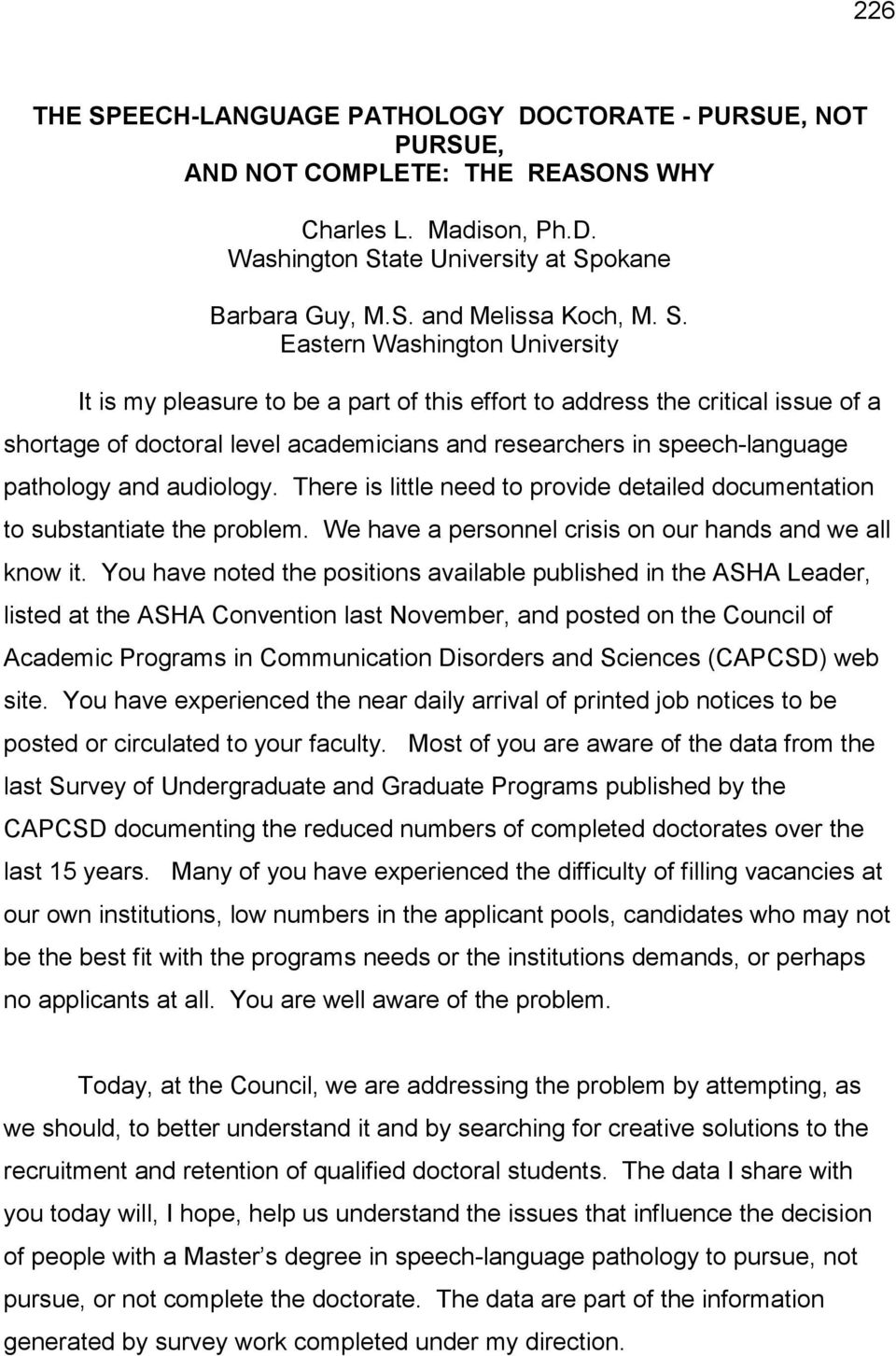
1 226 THE SPEECH-LANGUAGE PATHOLOGY DOCTORATE - PURSUE, NOT PURSUE, AND NOT COMPLETE: THE REASONS WHY Charles L. Madison, Ph.D. Washington State University at Spokane Barbara Guy, M.S. and Melissa Koch, M. S. Eastern Washington University It is my pleasure to be a part of this effort to address the critical issue of a shortage of doctoral level academicians and researchers in speech-language pathology and audiology. There is little need to provide detailed documentation to substantiate the problem. We have a personnel crisis on our hands and we all know it. You have noted the positions available published in the ASHA Leader, listed at the ASHA Convention last November, and posted on the Council of Academic Programs in Communication Disorders and Sciences (CAPCSD) web site. You have experienced the near daily arrival of printed job notices to be posted or circulated to your faculty. Most of you are aware of the data from the last Survey of Undergraduate and Graduate Programs published by the CAPCSD documenting the reduced numbers of completed doctorates over the last 15 years. Many of you have experienced the difficulty of filling vacancies at our own institutions, low numbers in the applicant pools, candidates who may not be the best fit with the programs needs or the institutions demands, or perhaps no applicants at all. You are well aware of the problem. Today, at the Council, we are addressing the problem by attempting, as we should, to better understand it and by searching for creative solutions to the recruitment and retention of qualified doctoral students. The data I share with you today will, I hope, help us understand the issues that influence the decision of people with a Master s degree in speech-language pathology to pursue, not pursue, or not complete the doctorate. The data are part of the information generated by survey work completed under my direction.
2 227 Three hundred eighty-four questionnaires were distributed via mail to speech-language pathologists holding a Master s degree, 64 to each of 6 geographical regions as noted by ASHA. Potential respondents were selected from the ASHA on-line membership directory. Three hundred five questionnaires were returned, and all were usable. This represents a 79% response rate. The questionnaire was organized such that respondents were asked whether they had ever considered pursuing a doctoral degree, whether they had applied to a doctoral program, whether they were accepted, and whether they had actually enrolled. If they had not considered, not applied, or not enrolled, they were asked to select and rank order from a list of possible reasons those that best represented why they had not done so. Those respondents who had enrolled in a doctoral program in speech-language pathology were asked to select and rank order from a list of possible reasons why they choose to pursue the degree. Finally, those who had enrolled in, but not completed the program, were asked to select and rank order from a list of possible reasons why they choose not to or were unable to complete the degree requirements. Not unexpectedly, 94 % (288) of the respondents were female, while 6% (17) were male. As you can see from Table 1, there was an even balance in the number of respondents by geographical region. Table 1. The number and percentage of responses by geographical region. Region Area Number of Percent * Responses 1 Western Southwestern Central Northeastern Southern Mid-Atlantic * = % of total responses rounded to nearest %

3 228 Figure 1 shows the distribution of respondents by work setting. Again, as expected, the largest number of respondents were from the public schools, but hospital/clinic, higher education, and private practice were well represented also. Percent 3% 1% 1% Public Schools (SLP) [33%] Hospital/Clinic (SLP) [21%] 12% 33% Higher Education [15%] Private Practice [14%] 14% Other [12%] 15% 21% Hospital/Clinic (Administration) [3%] Professional Organization [1%] Public Schools (Administration) [1%] Figure. 1 Table 2 shows that 42% (128 of 305) of those who responded to this survey had at one time or another seriously considered getting a doctorate and that 33% of those respondents (42 of 128) actually applied to a program. Further, of those who applied, 98% (40 of 42) were accepted and of those accepted, 93% (37 of 40) enrolled. Table 2. The number and percentage of respondents reporting seriously and not seriously considering getting a doctoral degree, respondents who applied and who did not apply, who were accepted, and who enrolled in doctoral programs Response Number of Percentage Respondents Not seriously considered Seriously considered Applied (42) (33) 1 Did not apply (86) (67) 1 Accepted (40) (98) 2 Enrolled (37) (93) 3 1 = based on 128 who seriously considered obtaining a doctoral degree 2 = based on the 42 who applied to a doctoral program 3 = based on the 40 who were accepted to a doctoral program
![Percent 3% 1% 1% Public Schools (SLP) [33%] Hospital/Clinic (SLP) [21%] 12% 33% Higher Education [15%] Private Practice [14%] 14% Other [12%] 15% 21% Hospital/Clinic (Administration) [3%]](/docs-images/52/12815871/images/page_3.jpg "Professional Organization [1%] Public Schools (Administration) [1%] Figure.")
4 229 The number and percent of those who seriously considered pursuing a doctorate and those who actually enrolled are presented by work setting in Table 3 (on following page). These figures are based on the entire respondent pool (n= 305). As you can see, those who had seriously considered obtaining a doctorate were, on a percentage basis, primarily from hospital/clinic, public schools, and higher education settings. It is clear, however, that those already familiar with higher education were more likely to actually enroll in a doctoral program. The reasons given by respondents for not seriously considering obtaining a doctorate, not applying if they were interested, or for not enrolling if they were accepted are summarized in Table 4 (see following pages). Keep in mind, that respondents were asked to indicate those reasons that applied to them and to rank those that they chose. The lower the mean reported in Table 4, the more important that reason was for their deciding not to pursue a doctoral degree. A variety of personal reasons (i.e., Other), family obligations, lack of research interest, and satisfaction with current position were among the highest ranked reasons why the doctorate was not pursued. The criteria for being accepted to a doctoral program, the influence of significant others, interest in teaching, and available financial support were among the lowest ranked factors. Table 3. The number and percentage of respondents that seriously considered getting a doctoral degree and number and percentage of those that enrolled, by work setting. Employment Setting Public Schools (SLP) Seriously Considered Number Seriously Considered Percentage* Enrolled Number Enrolled Percentage* Public Schools (Administrator ) Hospital/Clinic (SLP)

5 230 Hospital/Clinic (Administator) Higher Education Private Practice Professional Organization Other * percentage of total responses (305) Table 4. Reasons for not pursuing a doctoral degree ranked according to mean (lower mean indicative of increased importance). Reason Number Mean SD* of responses Other Family obligations Lack of research interest Satisfaction with current position Satisfaction with current degree Length of program Cost of program Long hours Distance/ location of program Lack of interest in working higher education Satisfaction with current salary

6 231 Lack of financial support Lack of interest in teaching Spousal/ significant other influence Criteria of getting accepted *SD = Standard Deviation Table 5 (following page) summarizes the reasons given by those respondents who actually enrolled in a doctoral program for doing so. Highest ranked among those reasons were desire for knowledge, research interest, and interest in teaching, while prestige, dissatisfaction with current degree, and the influence of others were lowest ranked as reasons for pursuing a doctorate. Table 5. Reasons for pursuing a doctoral degree ranked according to mean (lower mean indicative of increased importance). Reason Number Mean SD* of responses Desire for knowledge Research interest Other Interest in teaching Wanted better life for family/children Working with a particular scholar Spousal/ significant other influence Dissatisfaction with current position Interest in higher education Making contribution to the discipline

7 232 Future salary possibilities Availability of financial support Dissatisfaction with current degree Prestige and title *SD = Standard Deviation Table 6 (following page) presents the ranking of reasons given by respondents for not completing the doctorate after having enrolled. Here, family considerations, loss of advisor, length of program, and disillusion with research were highly ranked, while loss of financial support, personal treatment in program, and completion of the dissertation were ranked low as reasons for not completing the program. Table 6. Reasons for not continuing a doctoral degree ranked according to mean (lower mean indicative of increased importance). Reason Number Mean SD* of responses Family considerations Loss of advisor Length of program Disillusioned with research Loss of interest Other Cost of program Current job satisfaction Did not complete the dissertation Personal treatment in the programs Loss of financial support *SD = Standard Deviation

8 233 Finally, in Table 7 (following page) I have provided some data from a companion survey that asked faculty at doctoral degree granting programs to indicate in a similar fashion why they thought doctoral students failed to complete their program. The faculty ranked failure to complete the dissertation, difficulty of the program, and family considerations, as those they thought most important. Faculty ranked current job satisfaction, loss of financial support, loss of advisor, and personal treatment as the least important reasons why people did not complete their doctoral programs. Table 7. Reasons given by doctoral faculty for candidates not completing their doctoral program ranked according to mean (lower mean indicative of increased importance). Reason Number Mean SD* of responses Other Did not complete the dissertation Difficulty of program Family considerations Loss of interest Length of program Disillusioned with research Cost of program Personal treatment in the programs Loss of advisor Loss of financial support Current job satisfaction *SD = Standard Deviation

9 234 Summary and Conclusions The present research sought to better our understanding of why people with a Master's degree pursue, do not pursue, or do not complete a doctoral program. The results showed that 42% of the respondents had seriously considered pursuing a doctorate, though only 1/3 of those actually applied for admission. Not surprisingly, personal and family reasons, and lack interest in research and teaching were important reasons for not pursuing a doctorate. The lack of interest in doing research loomed as a significant reason for not pursuing the degree, but lack of interest in teaching did not. Being accepted into a doctoral program was not highly ranked as a factor for those choosing not to pursue a doctoral degree. The data showing that 98% of those who indicated that they applied were accepted into a program also supported this. The reasons people gave for pursuing a doctoral degree were encouraging. The desire for greater knowledge and an interest in research were the highest ranked reasons, and this is as it should be. Because CAPCSD surveys have shown that the number of people completing the doctorate is a particular issue, the data that related to why people did not complete their program were of special interest. Again, family considerations was ranked as an important factor as to why people did not complete their doctoral program, and such factors may be beyond the scope of faculty s ability to help. By contrast, loss of advisor, length of program, and disillusionment with research were also ranked high, and these are areas where a more proactive and sensitive faculty could make a difference. The present data suggest that lack of financial support, personal treatment, and completion of the dissertation were are not major factors preventing doctoral candidates from completing their degree. The present data provide some hints about where our recruiting efforts may be more productive. Those with Master s degrees who are already associated with higher education, probably as clinical supervisors or as teaching

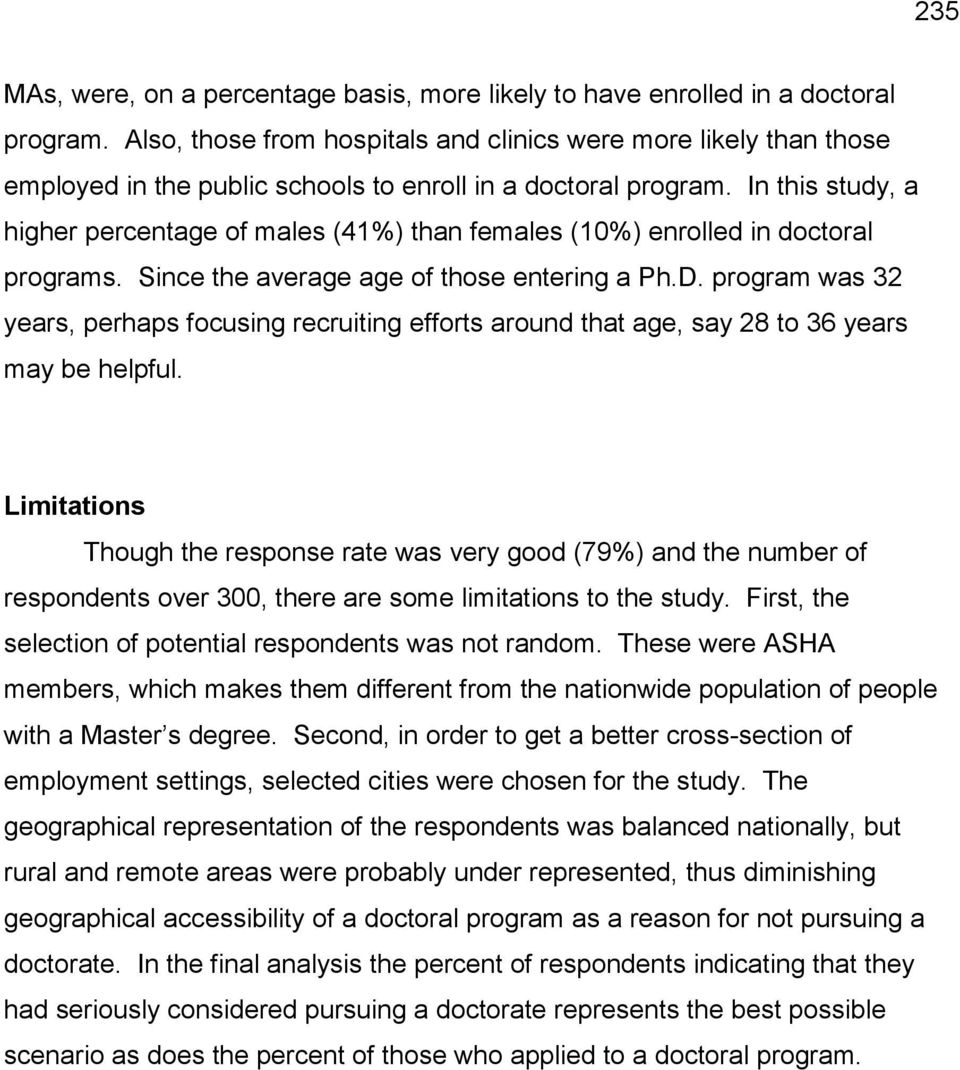
10 235 MAs, were, on a percentage basis, more likely to have enrolled in a doctoral program. Also, those from hospitals and clinics were more likely than those employed in the public schools to enroll in a doctoral program. In this study, a higher percentage of males (41%) than females (10%) enrolled in doctoral programs. Since the average age of those entering a Ph.D. program was 32 years, perhaps focusing recruiting efforts around that age, say 28 to 36 years may be helpful. Limitations Though the response rate was very good (79%) and the number of respondents over 300, there are some limitations to the study. First, the selection of potential respondents was not random. These were ASHA members, which makes them different from the nationwide population of people with a Master s degree. Second, in order to get a better cross-section of employment settings, selected cities were chosen for the study. The geographical representation of the respondents was balanced nationally, but rural and remote areas were probably under represented, thus diminishing geographical accessibility of a doctoral program as a reason for not pursuing a doctorate. In the final analysis the percent of respondents indicating that they had seriously considered pursuing a doctorate represents the best possible scenario as does the percent of those who applied to a doctoral program.
NOTES FROM THE DISCUSSION FOR ISSUE I The Ph.D. Shortage In Communication Sciences And Disorders
 47 NOTES FROM THE DISCUSSION FOR ISSUE I The Ph.D. Shortage In Communication Sciences And Disorders The outcome of the discussions included the following recommended ACTIONS for working through the extending
COUNCIL OF ACADEMIC PROGRAMS IN COMMUNICATION SCIENCES AND DISORDERS 1998-99 NATIONAL SURVEY OF UNDERGRADUATE AND GRADUATE PROGRAMS TABLE OF CONTENTS
 COUNCIL OF ACADEMIC PROGRAMS IN COMMUNICATION SCIENCES AND DISORDERS 1998-99 NATIONAL SURVEY OF UNDERGRADUATE AND GRADUATE PROGRAMS TABLE OF CONTENTS Acknowledgments... Introduction... 1 Program Information...
SPEECH-LANGUAGE PATHOLOGY LONG TERM STRATEGIC PLAN. Updated December, 2014
 SPEECH-LANGUAGE PATHOLOGY LONG TERM STRATEGIC PLAN Updated December, 2014 The School of Education and the Department of Speech Pathology, Educational Counseling and Leadership along with the faculty in
LARGE AND SMALL PROGRAM COLLABORATION OR IS IT ONLY DIFFERENT PROGRAMS? Nancy Creaghead, Ph.D. University of Cincinnati. Examples and Ideas
 LARGE AND SMALL PROGRAM COLLABORATION OR IS IT ONLY DIFFERENT PROGRAMS? Nancy Creaghead, Ph.D. University of Cincinnati Examples and Ideas Encouraging Ph.D. Access: Collaboration between MA and PhD programs
The Survey of Undergraduate and Graduate Programs in Communication. Sciences and Disorders has been conducted since 1982-83. Surveys were conducted in
 Introduction The Survey of Undergraduate and Graduate Programs in Communication Sciences and Disorders has been conducted since 1982-83. Surveys were conducted in 1982-83, 1983-84, 1984-85, 1985-86, 1986-87,
Strategic Vision Faculty and Staff Recruitment and Development
 Strategic Vision Faculty and Staff Recruitment and I. End Result: UAF engages in best practices in recruiting, hiring, evaluating, developing and promoting staff. Objective A: To implement regular staff
REPORT: 2007-08 DEMOGRAPHIC SURVEY OF UNDERGRADUATE AND GRADUATE PROGRAMS IN COMMUNICATION SCIENCES AND DISORDERS
 1 Council of Academic Programs in Communication Sciences & Disorders (CAPCSD) REPORT: 2007-08 DEMOGRAPHIC SURVEY OF UNDERGRADUATE AND GRADUATE PROGRAMS IN COMMUNICATION SCIENCES AND DISORDERS Conducted
Mission/Vision/Strategic Plan Audiology and Speech-Language Sciences 2011-2016
 1 Mission/Vision/Strategic Plan Audiology and Speech-Language Sciences 2011-2016 UNC Mission Statement The University of Northern Colorado shall be a comprehensive baccalaureate and specialized graduate
COLLEGE OF SCIENCES AND HUMANITIES Muncie, Indiana 47306 DEPARTMENT OF SPEECH PATHOLOGY AND AUDIOLOGY Phone: 765-285-8161
 COLLEGE OF SCIENCES AND HUMANITIES Muncie, Indiana 47306 DEPARTMENT OF SPEECH PATHOLOGY AND AUDIOLOGY Phone: 765-285-8161 Dear Prospective Graduate Student: Thank you for your interest in the Ball State
Program Assessment Plan for Speech-Language Pathology Master s Program 2013. Program Goal 1
 Program Plan for Speech-Language Pathology Master s Program 2013 Program Goal 1 The provides students with comprehensive coursework in the discipline of speech-language pathology. group(s) will be assessed?
THE STATE OF ILLINOIS BILL TEXT. Copyright 2006 by State Net(R), All Rights Reserved. 2005 IL S.B. 931 ILLINOIS 94TH GENERAL ASSEMBLY SENATE BILL 931
 THE STATE OF ILLINOIS BILL TEXT Copyright 2006 by State Net(R), All Rights Reserved. 2005 IL S.B. 931 ILLINOIS 94TH GENERAL ASSEMBLY SENATE BILL 931 BILL TRACKING REPORT: 2005 Bill Tracking IL S.B. 931
SCHOOL OF SPEECH-LANGUAGE AND HEARING SCIENCES DOCTORAL PROGRAM GUIDELINES
 Ph.D. Clinical training and CCC/CFY GUIDELINES SCHOOL OF SPEECH-LANGUAGE AND HEARING SCIENCES DOCTORAL PROGRAM GUIDELINES CLINICAL TRAINING THE CERTIFICATE OF CLINICAL COMPETENCE (CCC) THE CLINICAL FELLOWSHIP
Governors State University
 Governors State University Department of Communication Disorders University Park, IL 60484-0975 MHS in Communication Disorders Frequently Asked Questions Fall, 2014 Contents GPA... 2 What GPA is required
Graduate Assistants and Fellowships
 Graduate Assistants and Fellowships The School of Public Health offers Graduate Awards to students who are in good academic standing and demonstrate merit. Students should submit a separate application
Building Academic Program Capacity with Innovative Clinical Education Models
 Building Academic Program Capacity with Innovative Clinical Education Models 2010 ASHA Convention, Philadelphia, PA Friday, November 19, 2010 Academic Program Capacity Building Presenters: Carol Dudding,
Department of Speech-Language Pathology Strategic Plan 2015-2018
 College of Education and Rehabilitation Department of Speech-Language Pathology Strategic Plan 2015-2018 MISSION: To educate and train graduate-level students to become exemplary professionals in speech-language
Speech-Language Pathology Programs Handbook 2015 2016
 Speech-Language Pathology Programs Handbook 2015 2016 Speech-Language Pathology Welcome! Speech-Language Pathology (SLP) offers programs for individuals interested in becoming speech-language pathologists.
Division of Communication Disorders AP4 Strategic Plan (2015-2020)
 AP4 CommDis Strategic Plan 1 Division of Communication Disorders AP4 Strategic Plan (2015-2020) 1. What is the current status of your Academic Unit? a. Constituencies served and constituent needs addressed.
University Recommendations
 University Recommendations I. Perceived Barriers to having an adequate supply of qualified providers: Awareness, Attraction, and Recruitment related to SLP Low salaries for SLPs, especially in rural districts
IHE Graduate Performance Report WESTERN CAROLINA UNIVERSITY
 IHE Graduate Performance Report WESTERN CAROLINA UNIVERSITY 2001-2002 Overview of Master's Program Western s masters program leading to professional education licensure include: MAEd in Comprehensive Education
Strategic Plan 2012-2017. Department of Communication Disorders. Minot State University
 Strategic Plan 2012-2017 Department of Communication Disorders Minot State University Mission of the Department of Communication Disorders The mission of the Department of Communication Disorders is to
AC 2007-829: DEVELOPMENT OF AN ONLINE MASTER'S DEGREE IN TECHNOLOGY MANAGEMENT
 AC 2007-829: DEVELOPMENT OF AN ONLINE MASTER'S DEGREE IN TECHNOLOGY MANAGEMENT Gregory Arbuckle, Western Kentucky University GREGORY ARBUCKLE is currently an Assistant Professor in Technology Management
This is an example of a response to UNC Tomorrow.ECU Tomorrow And the Implications for Academic Degree Program Planning.
 This is an example of a response to UNC Tomorrow.ECU Tomorrow And the Implications for Academic Degree Program Planning. Program planners should review UNC Tomorrow Commission Final Report (December 2007)
OFFICE OF QUALITY PROFESSIONALS AND SPECIAL SCHOOLS Summary of State Board of Education Items April 17-18, 2008
 OFFICE OF QUALITY PROFESSIONALS AND SPECIAL SCHOOLS Summary of State Board of Education Items April 17-18, 2008 EDUCAT LICENSURE 27. Approval to begin the Administrative Procedures Act Process: To Approve
Steve and Clint Marchant Data Based Insights, Inc. on behalf of the ACS Department of Research & Market Insights. March 5, 2015
 Starting Salaries of Chemists And Chemical Engineers: 2014 Analysis of the American Chemical Society's Survey Of New Graduates in Chemistry and Chemical Engineering Steve and Clint Marchant Data Based
PROGRAM APPROVAL: MASTER OF EDUCATION Agenda Item F-4 IN EDUCATION ADMINISTRATION November 13, 2000
 PROGRAM APPROVAL: ACTION MASTER OF EDUCATION Agenda Item F-4 IN EDUCATION ADMINISTRATION November 13, 2000 Recommendation: The staff recommends that the Council change the approval status from provisional
Private Practice Owners and Independent Contractors
 Private Practice Owners and Independent Contractors For additional information, please contact Jeanette Janota, Surveys & Information Team American Speech-Language-Hearing Association Rockville, MD 20850
How To Get A Master S Degree At Duke
 Chapter 8 Master s Programs Contents A. The A.M. and M.S. Programs... 2 B. Time Limits... 3 C. Transfer of Credit... 3 D. Courses Below 500-Level for Master s Degree Credit... 4 E. Retroactive Credit...
Graduate Programs in Engineering
 Graduate Programs in Engineering The College of Engineering offers a Master of Science in Engineering, a Master of Science in Engineering Management and a Ph.D. in Engineering and Applied Sciences, allowing
COUNCIL OF GRADUATE PROGRAMS IN COMMUNICATION SCIENCES AND DISORDERS 1996-97 NATIONAL SURVEY OF UNDERGRADUATE AND GRADUATE PROGRAMS
 COUNCIL OF GRADUATE PROGRAMS IN COMMUNICATION SCIENCES AND DISORDERS 1996-97 NATIONAL SURVEY OF UNDERGRADUATE AND GRADUATE PROGRAMS Conducted by the Information Exchange Committee Linda Petrosino Bowling
Comparison of Job Satisfaction in Occupational Therapy Settings
 COMPARISON OF JOB SATISFACTION IN OCCUPATIONAL THERAPY SETTINGS 293 Comparison of Job Satisfaction in Occupational Therapy Settings Lori Hellickson, Dawn Knapp, and Stephanie Ritter Faculty Sponsor: Peggy
Audiologists. UWW Advisor: Please contact the department of Communication Science & Disorders with your questions. http://www.uww.
 Audiologists What is audiology? An audiologist works with clients who have hearing disorders. The audiologist will do tests, evaluate results, and diagnose the cause of hearing and balance problems, as
Special Survey on Vacant Faculty Positions for Academic Year 2013-2014 (Pennsylvania)
 Special Survey on Vacant Faculty Positions for Academic Year 2013-2014 (Pennsylvania) Yan Li, MA, Research Coordinator Di Fang, PhD, Director of Research and Data Services 2013-2014 Faculty Vacancy Survey
To demonstrate satisfactory performance, graduate students pursuing the M.A. degree will be expected to:
 ACADEMIC REQUIREMENTS The master s program in Speech-Language Pathology is accredited by the Council on Academic Accreditation (CAA) of the ASHA. The Master of Arts is awarded in Speech-Language Pathology.
College of Education Clinical Faculty Appointment and Promotion Criteria Provost Approved 11/11/11
 Introduction: The Clinical Faculty College of Education Clinical Faculty Appointment and Promotion Criteria Provost Approved 11/11/11 In accordance with University guidelines most professional programs
REPORT FALL 2003 SURVEY OF MAINE NURSING EDUCATION PROGRAMS
 REPORT FALL 003 SURVEY OF MAINE NURSING EDUCATION PROGRAMS Prepared by Jane Kirschling, Dean and Professor of Nursing College of Nursing and Health Professions University of Southern Maine [email protected]
GRADUATE SCHOOL. Contributions From: Donald Asher
 GRADUATE SCHOOL Contributions From: Donald Asher Career Development Center York College of Pennsylvania Campbell Hall Room 200 717-815-1452 [email protected] www.ycp.edu/careerdevelopment TABLE
Ph.D. in Communication Sciences and Disorders (Audiology or Speech and Language Pathology), including a joint M.S./Ph.D.
 Ph.D. in Communication Sciences and Disorders (Audiology or Speech and Language Pathology), including a joint M.S./Ph.D. option in SLP Introduction The Doctor of Philosophy (Ph.D.) degree in Communication
Final Report. Strategic Plan to Increase the Student Pipeline and Workforce for PhD Researchers and Faculty Researchers
 Academic Affairs Board December 2013 Final Report Strategic Plan to Increase the Student Pipeline and Workforce for PhD Researchers and Faculty Researchers Malcolm R. McNeil, CCC SLP, PA, Chair Loretta
Otto H. York Department of Chemical, Biological and Pharmaceutical Engineering Ph.D. Program Requirements
 Otto H. York Department of Chemical, Biological and Pharmaceutical Engineering Ph.D. Program Requirements For Students Entering the Program After September, 2015 New Jersey Institute of Technology Newark,
Canadian Association of Speech-Language Pathologists and Audiologists: University Programs in Audiology 2010
 Canadian Association of Speech-Language Pathologists and Audiologists: Programs in Audiology 2010 Final Report December 2010 Canadian Association of Speech-Language Pathologists and Audiologists: Overview
Mississippi Teacher Fellowship Program Application
 Mississippi Teacher Fellowship Program Application Overview In 1998, the Mississippi Legislature passed House Bill 609 which addresses the critical teacher shortage in the state, which Section 13 of this
III. Standards for Accreditation of Graduate Education Programs in Audiology and Speech-Language Pathology
 III. Standards for Accreditation of Graduate Education Programs in Audiology and Speech-Language Pathology Effective January 1, 2008 Introduction The Council on Academic Accreditation in Audiology and
Exploring the Consumer Behavior That Influences. Student College Choice
 11(2004),53-72 Exploring the Consumer Behavior That Influences Student College Choice Cheng-Chuan Shen 1 Abstract This study examined consumer behavior influencing student college choice. The study focused
Standard Operating Procedures School Finance Committee. Policy Section Approved by BOD DATE
 Standard Operating Procedures School Finance Committee Policy Section Approved by BOD DATE I. Policy Below are the required policies associated with the School Finance Committee (SFC). The Policy section
A NEEDS ASSESSMENT FOR GRADUATE PROGRAMS IN EDUCATION FACULTIES
 A NEEDS ASSESSMENT FOR GRADUATE PROGRAMS IN EDUCATION FACULTIES Assist. Prof. Dr. Mustafa Cansiz Artvin Çoruh University Education Faculty Artvin - TURKEY [email protected] Dr. Nurcan Cansiz Atatürk
HIGHER EDUCATION PRACTICE RESEARCH ABSTRACTS
 1750 H Street NW, Suite 200, Washington, DC 20006 P 202.756.2971 F 866.808.6585 www.hanoverresearch.com HIGHER EDUCATION PRACTICE RESEARCH ABSTRACTS January 2012 The following abstracts describe a sampling
Doctoral Programs in Communication Sciences and Disorders
 Website: http://www.ecu.edu/cs-acad/grcat/programcsdi.cfm#audphd Doctoral Programs in Communication Sciences and Disorders The doctoral programs are designed for advanced scholars with interest in communication
Phase I of Alberta Nursing Education Strategy Report and Working Document
 Phase I of Alberta Nursing Education Strategy Report and Working Document Results of a Key Stakeholder Forum November 9, 2005 Funding provided by Alberta Health and Wellness Alberta Nursing Education Administrators
Program Description. Doctorate of Health Sciences to Be Offered by Indiana State University, Terre Haute, IN
 Program Description Doctorate of Health Sciences to Be Offered by Indiana State University, Terre Haute, IN 1. Characteristics of the Program a. Campus(es) Offering Program: Indiana State University, Terre
2.12 DISTANCE EDUCATION OR EXECUTIVE DEGREE PROGRAMS
 Criterion 2.12 DISTANCE EDUCATION OR EXECUTIVE DEGREE PROGRAMS If the school offers degree programs using formats or methods other than students attending regular on-site course sessions spread over a
the Vice Provost for Research/Dean of the Graduate School
 3-10-2009 Research & Graduate School Submission Page 1 Vice Provost for Research And Dean of the Graduate School To the University Community from the Vice Provost for Research/Dean of the Graduate School
1. Number of Degrees Per Year Rolling three-year average of the number of degrees awarded per academic year. Academic Year Average Number of Degrees
 18 Characteristics of Texas Public Doctoral Programs Department of Environmental and Interdisciplinary Sciences Environmental Toxicology PhD program Texas Southern University 1. Number of Degrees Per Year
FINANCIAL AID GRADUATE RESEARCH FELLOWSHIPS AND AWARDS. Graduate Dean's Fellowship
 FINANCIAL AID GRADUATE RESEARCH FELLOWSHIPS AND AWARDS Graduate Dean's Fellowship The Graduate Dean's Fellowship is a prestigious, competitive fellowship which provides advanced graduate students with
Computer Science Strategic Plan: 2010-2013
 Computer Science Strategic Plan: 2010-2013 Goals: GOAL 1: Attract, retain, and support a world-class and diverse faculty, staff, and student population. Maintain the size and quality of the undergraduate
UAF-UAA Joint PhD Program in Clinical-Community Psychology with Rural, Indigenous Emphasis Outcomes Assessment Goals, Objectives, and Benchmarks
 Page 1 of 16 UAF-UAA Joint PhD Program in Clinical-Community Psychology with Rural, Indigenous Emphasis Outcomes Assessment Goals,, and Benchmarks Mission The PhD Program in Clinical-Community Psychology
2010-2015 Strategic Plan Template. Department of Special Education and Child Development 2010-2015 Strategic Plan
 2010-2015 Strategic Plan Template Department of Special Education and Child Development 2010-2015 Strategic Plan I. EXECUTIVE SUMMARY 1-2 pages A. Mission and goals: The mission of the Department Special
ARTICLE I: OBJECTIVE A.
 Psychology Graduate Program Bylaws Administrative Home: Department of Psychology Revised: May 2006; September 2009 Graduate Council s Approval Date: November 2, 2009 ARTICLE I: OBJECTIVE A. Degrees Offered
UT Dallas - 18 Characteristics of Texas Public Schools Program 1. Telecommunications Engineering, CIPcode 14.1004.
 UT Dallas - 18 Characteristics of Texas Public Schools Program 1 Telecommunications Engineering, CIPcode 14.1004.00 Degree awarded PhD Program Web site http://www.te.utdallas.edu/ Measure 1 Number of Degrees
Alabama A&M University. Communicative Sciences and Disorders (CSD) Program
 Alabama A&M University Communicative Sciences and Disorders (CSD) Program CSD ACADEMICS Program Description The Program offers the Master of Science degree in Communication Sciences and Disorders, and
WEST VIRGINIA THE MOUNTAIN STATE. Building Partnerships in WV Personnel Preparation Program Partnerships
 WEST VIRGINIA THE MOUNTAIN STATE Building Partnerships in WV Personnel Preparation Program Partnerships Kathy Hudnall [email protected] Kathy Knighton [email protected] West Virginia Department
Guidelines for Conducting an APR Self-Study
 Academic Program Reviews Guidelines for Conducting a Self-Study [Revised January 2014; available at http://academicplanning.gwu.edu/academic-program-reviews] The self-study is the vital initial element
Career Paths for the CDS Major
 College of Education COMMUNICATION DISORDERS AND SCIENCES (CDS) Advising Handout Career Paths for the CDS Major Speech Language Pathology Speech language pathologists work with individuals with communication
PhD Information Session. Prof. L. Robin Keller Director, Ph.D. Program
 PhD Information Session Prof. L. Robin Keller Director, Ph.D. Program Paths to a Doctorate -After undergraduate degree -After MBA or other Masters degree -Work experience not required Some doctoral programs
COLLEGE OF EDUCATION, HEALTH AND HUMAN SERVICES
 Presidential Brief COLLEGE OF EDUCATION, HEALTH AND HUMAN SERVICES Daniel F. Mahony, Ph.D. Dean B.S., Virginia Tech M.A., West Virginia University Ph.D., The Ohio State University Job Responsibilities:
Rehabilitation Counseling Program Department of Kinesiology and Community Health Evaluation Plan. Discrepancy Evaluation Model
 Department of Kinesiology and Community Health Plan Discrepancy Model The mission of the master s degree program at the University of Illinois Urbana-Champaign is to prepare counselors to facilitate the
Department of Geography
 Texas State University-San Marcos Department of Geography Master of Applied Geography and Master of Science Policies and Procedures Handbook May 2012 Table of Contents I. Purpose, Objectives, and Administration
BYLAWS of the Graduate School of Biomedical Sciences
 BYLAWS of the Graduate School of Biomedical Sciences SECTION 1. Programs of the Graduate School of Biomedical Sciences The Graduate School of Biomedical Sciences (GSBS) of the Texas Tech University Health