
Finance for low-income housing and community development
|
|
|
- Rosalyn Theodora Rice
- 10 years ago
- Views:
Transcription
1 Environment&Urbanization Brief 16 Finance for low-income housing and community development Diana Mitlin SUMMARY: Over the last 15 years, there has been much innovation in finance to support housing and community development for low-income groups even though most governments and official aid agencies have paid little or no attention to this. Most of these schemes had savings as an important component. For some schemes, and for many households, savings is the only source of investment finance, as incomes are too low or uncertain to ensure loan repayments. Many of the largest and most effective financial schemes have been cases where the resources and capabilities of low-income households have combined with the efforts of supporting local NGOs and local governments. Even where local governments lack capacity to provide financial support, they have important roles in allowing improvements in informal settlements, helping allocate land for low-income housing and being flexible in the application of standards. International funding agencies would get a much greater development return on their funding if they developed the capacity to support these kinds of local grassroots local NGO local government partnerships. 1. In addition to the 20 papers on this topic in the October 2007 and April 2008 issues of Environment&Urbanization that are listed on the back page, a further 19 papers on the topic have been published in earlier issues of the journal and these can all be accessed on-line at no charge at These include Ferguson, Bruce and Jesus Navarrete (2003), A financial framework for reducing slums: lessons from experience in Latin America, Environment &Urbanization Vol 15, No 2, October, pages ; also Malhotra, Mohini (2003), Financing her home, one wall at a time, Environment &Urbanization Vol 15, No 2, October, pages ; Frank, Daphne (2004), A market-based housing improvement system for low-income families the Housing Incentive System (SIV) in Ecuador, Environment &Urbanization Vol 16, No 1, April, pages ; Stein, Alfredo with Luis Castillo (2005), Innovative financing for lowincome housing improvement: lessons from programmes in Central America, Environment&Urbanization Vol 17, No 1, April, pages 47 66; and Boonyabancha, Somsook (2005), Baan Mankong; going to scale with slum and squatter upgrading in Thailand, Environment&Urbanization Vol 17, No 1, April, pages I. INTRODUCTION IN MOST URBAN areas in high-income nations and many middle-income nations, good quality, legal housing is expensive. Most of it would not have been built without mortgage finance; middleincome households, and even most upper-income groups, need mortgages in order to buy it, or long-term finance in order to build it. In most cities in Africa, Asia and Latin America, low-income households cannot afford legal housing or good quality housing. They either rent (usually in poor quality overcrowded dwellings) or buy or build in illegal settlements. They cannot get conventional housing finance because their homes are in illegal settlements and they lack the income or formal documentation that housing finance agencies require. However, there has been much innovation in finance to support housing, infrastructure and community development for low-income groups over the last 15 years. 1 Much of this works in informal settlements, supporting negotiations for land tenure security, house construction and improvements, and often improved provision for water and sanitation. Most schemes combine savings, loans and subsidies. During these 15 years: State programmes have become less concerned with direct provision of housing and more interested in working with finance to enable greater choice for beneficiaries. Microfinance for housing became a significant part of the microfinance portfolio of lending opportunities, although mostly for house improvements and extension. Financial deregulation has increased the number of agencies interested in providing mortgage finance in a number of countries, and these are available to a larger section of income groups. Innovative approaches using savings and loans to transform low-income neighbourhoods have demonstrated impact at scale. II. THE THREE KEY SOURCES OF HOUSING FINANCE The role of savings IT IS OFTEN assumed that low-income households cannot save for housing, as all their income is needed for consumption or if they can save, it is only sufficient for community-managed emergency funds or small loans for livelihoods. But many case studies show the importance of savings for shelter investment by low-income groups. Low-income individuals often start savings to provide a fund they can draw on to help cope with emergencies or illness and this develops into savings for housing too. This is especially so if they have a local savings scheme to which they can contribute, This Brief of the October 2007 and April 2008 issues of the journal Environment&Urbanization is based on the editorials from these two issues and draws on the papers therein. (The papers are listed on the back page, with details of how to obtain electronic copies of individual papers or the whole issues). This summary, produced with the support of the Royal Danish Ministry of Foreign Affairs (DANIDA) and the Swedish International Development Cooperation Agency (Sida) allows the journal s main findings to reach a wider audience. Environment&Urbanization Brief 1

2 2. See the paper by Mtafu A Zeleza Manda on Malawi, and Anna Muller and Diana Mitlin on Namibia 3. See the paper by Shaaban A Sheuya 4. See the paper by Arif Hasan listed on the back page; also Hasan, Arif (2006), Orangi Pilot Project; the expansion of work beyond Orangi and the mapping of informal settlements and infrastructure, Environment&Urbanization Vol 18, No 2, October, pages See the paper by Sophie Mills 6. See the paper by Anna Muller and Diana Mitlin listed on the back page. 7. See the paper by Mtafu A Zeleza Manda listed on the back page; also D Cruz, Celine and David Satterthwaite (2005), Building homes, changing official approaches: the work of urban poor federations and their contributions to meeting the Millennium Development Goals in urban areas, Poverty Reduction in Urban Areas Series, Working Paper 16, IIED, London, 80 pages. 8. See the paper by Sophie Mills 9. See the paper by Sarah Stavrakakis with Ruth McLeod and Kulandei Francis listed on the back page. 10. See the paper by Tova Maria Solo 11. See the paper by Allan Cain 12. See the paper by Gilberto M Llanto 13. See the paper by Alfredo Stein and Irene Vance listed on the back page. as in the community-managed savings groups that are the foundation of so many federations of slum and shack dwellers. 2 Savings may support housing improvements outside of any housing programme, as shown by a study in two low-income settlements in Tanzania. 3 Renters and wouldbe owner-occupiers also helped to finance construction with advance rent payments to their landlords (who owned the structures), once settlements became more established. In Pakistan, household savings have financed the development of infrastructure in over 300 predominantly low-income settlements. Here, financing takes place within a technical support programme from the Pakistan NGO, the Orangi Pilot Project Research and Training Institute. This is an example of a financial model that uses domestic savings and has a capacity to go to scale once residents are convinced of its value. 4 One key to its success is keeping down unit costs, so what is provided matches what low-income households can afford. Case studies from South Africa and Namibia also show the benefits of savings programmes some residents choose to finance improvements through savings rather than taking up loans that they may be entitled to. In South Africa, the Kuyasa Fund offers small loans (often placed within the rubric of microfinance) for shelter improvements. Savings is required prior to loan release and 65 per cent of members only use their programme for savings. 5 In Namibia, many households within the Shack Dwellers Federation of Namibia prefer to use savings rather than loans to finance the extension of infrastructure from communal to on-plot facilities (for instance, from community to individual taps and toilets). This avoids the risk of not being able to meet loan repayments for those with low and irregular incomes. 6 In this instance, and also in Malawi, savings is more than simply a means of financing shelter improvements; as in the case of the affiliates of Shack/Slum Dwellers International, community-based savings groups are the core organizing glue, which help individuals save and which hold local organizations together, enabling them to build the trust and confidence needed to identify collective priorities and implement development projects together. 7 Savings is widely acknowledged to offer benefits in other cases, as in the examples of the Kuyasa Fund 8 and IVDP, 9 although the orientation tends to be on the financial rather than the development process, and hence the benefits are less comprehensive. In some countries, it is difficult for low-income individuals and groups to get a bank account. They have to form their own savings institutions because no local bank or other institution will support them. In many low-income areas, there are no banks; and where there are, they often only provide accounts to those with formal employment or proof of income and relatively high incomes and they often have high charges. Not having a bank account implies not only difficulties in saving, but also many other problems and additional costs in making payments (for instance, to utilities or service providers) and in sending and receiving money. 10 Microfinance for house improvements A growing number of microfinance agencies offer small loans for housing improvements. They usually offer finance only to individual households living on land sites with reasonably secure tenure, and they enable dwelling investment that usually entails adding a room, or an improved roof and/or floor, toilets and/or bathrooms. Shelter microfinance emulates many aspects of enterprise-oriented microfinance and is often embedded within the same agencies. In KixiCrédito in Angola, housing finance is offered to those households that have been successful in enterprise borrowing; a second stage is the extension of shelter lending to other specific groups under alternative terms and conditions. 11 The Kuyasa Fund in South Africa offers small loans for housing improvements and expansion; these help low-income households that have already benefited from state intervention through a housing capital subsidy programme that provides a plot with legal tenure, services and an initial dwelling. In both cases, the rapid development of loan programmes illustrates the scale of demand for borrowing for housing within low-income settlements. In the Philippines, there is also this combination of state housing programme and loans for housing improvements. The government programme, Development of Poor Urban Community Sector Project, supports local authorities for site development and improvement with housing loan provision along with microenterprise finance. 12 A comparable model has been implemented in various Central American countries. Here, local authorities coordinate the upgrading of low-income neighbourhoods and a range of local institutions offer loans to households to improve their homes. In some cases these can be combined with state subsidies. In every case these loans blend with family savings and self-help efforts, and this blending has demonstrated its effectiveness in many places, as long as the unit costs of housing and infrastructure construction or improvement are not too high. 13 Group lending for housing A third source of finance for housing is the collective process of group lending. This is generally for more than just housing and includes loans that fund investments in land and infrastructure. In Namibia, the Shack Dwellers Federation and its support NGO, the Namibia Housing Action Group, 2 Environment&Urbanization Brief

3 14. See the paper by Anna Muller and Diana Mitlin listed on the back page. 15. See the paper by Gilberto M Llanto 16. See reference 1, Boonyabancha (2005). See also the ACHR website, See reference 1, Boonyabancha (2005). See also regular updates on the work of CODI available in English from CODI, 912 Nawamin Road, Khet Bang Kapi, Bangkok 10240, Thailand or downloadable from this includes CODI (2008), CODI Update: 50 Community Upgrading Projects, Community Organizations Development Institute, Bangkok, 75 pages. 18. See the paper by Shaaban A Sheuya 19. See reference 4, Hasan (2006). 20. See the paper by Sophie Mills 21. See the paper by Allan Cain 22. See the paper by Tova Maria Solo have developed a model that includes regulatory reform, land purchase from local authorities, the extension of infrastructure provision and dwelling construction. This model is affordable to some of the lowest-income citizens as the housing component of the loan does not have to take place immediately and land and service costs can be paid off first. 14 For the Malawi Federation, a sister to the Namibian Federation, group loans were taken to finance the construction of identical dwelling units for the development of housing on 222 plots in Lilongwe. The political impact of these units has been considerable; the national government was sufficiently impressed by the speed and competence of federation members in their construction that it provided the federation with more than 3,000 housing plots. In most of Lilongwe, where there is no provision for sewers, the loan amounts have also been sufficient to pay for the cost of skyloos (elevated pit latrines). In the Philippines, the Community Mortgage Programme is an example of state support for collective loans. Here, credit for purchasing land is available to groups of low-income households facing eviction from land on which they are illegally settled. 15 In Thailand, an innovative statefinanced programme (the Community Organizations Development Institute) has put in place community networks able to manage many aspects of the development process at a local and city level, as well as providing loans available to communities for supporting upgrading or new house construction. Here, the move in the level of intervention from neighbourhood to city level has been important in enabling finance to be used to transform options for some of the lowest-income and most disadvantaged citizens, and for supporting community organizations and local governments to work collectively to address diverse needs and interests across the city. 16 Citywide networks of community organizations work with local authorities in participatory planning and allocate both subsidy and loan finance. This enables the planning process both to prioritize the settlements most in need of upgrading and to consider how finance can help support local environmental improvements for the benefit of all. 17 III. THE RANGE OF DIFFERENT AGENCIES DRIVING CHANGE THESE THREE DIFFERENT financing strategies for housing savings, microfinance and group lending reflect the differences in local circumstances and in the agencies that are engaged with this process. In some cases, the key agent is the people, managing as best they can as in the case from Tanzania. 18 In Pakistan, for the investments in sanitation and drainage made by communities, the key agent is also the people, but in this case supported by an NGO, the Orangi Pilot Project Research and Training Institute. This NGO provides technical assistance, catalyzing sanitation investments by showing how the unit cost of good quality provision can be brought down to one low-income communities can afford. 19 In the case studies from South Africa and Angola, the key agencies are microfinance providers, which in both cases emerged from the work of conventional urban development NGOs, Development Action Group 20 and Development Workshop. 21 This highlights a tension for NGOs seeking to provide new shelter options for low-income households, because the organizational demands for providing financial services are very different from those for advocacy. In these cases, in Angola and South Africa, two distinct organizations have developed. These experiences suggest that it is difficult to manage a microfinance agency and an advocacyoriented NGO within the same organization. Over time, both organizations have divided into two although, in both cases, the newly created microfinance agencies collaborate closely with their parent. The success of collective loans requires strong local organizations. In the cases noted above, in Malawi, Namibia and the Philippines (Community Mortgage Programme), professional support agencies provide advice on the technical aspects of development and offer other kinds of assistance. In part, this is required because these housing development programmes have to work with local authorities, which means working with all their building, land use and infrastructure regulations. In Malawi and Namibia, the local grassroots organizations are networked through federations that enable them to visit and learn from each other. The formation of federations also helps pressure the government to agree to regulatory reforms that reduce development costs (for instance, smaller plot sizes and less expensive infrastructure requirements). Politicians are reluctant to be seen to ignore the demands of mass movements; and may believe that regulatory reforms are a relatively low-cost route to respond to citizen demands There is little evidence of the commercial sector in these case studies, although in the broader field of microfinance, there is considerable interest shown by formal financial institutions in some Asian and Latin American nations. 22 The growth in experience in microfinance for housing has shown the commercial sector that there is a viable market at least in some nations and cities, which can be served by financial institutions or through their collaboration with microfinance agencies. This is important in supporting many lower-income households with relatively secure tenure of their housing plot to improve their homes, but it does not address the needs of the lowest-income groups who are landless. Environment&Urbanization Brief 3

4 IV. THE ROLE OF THE STATE 23. See the papers by Alfredo Stein and Irene Vance and by Florencia Almansi and Andrea Tammarazio 24. See the papers by Mike Muller and by Nicola Jones, Rosana Vargas and Eliana Villar listed on the back page. 25. See the paper by Marcio M Valenca 26. See the paper by Arif Hasan THE STATE IS rarely the driving force behind shelter finance initiatives but it still has a powerful influence on whether low-income groups can get good quality housing. First, it influences land markets and the possibilities for land tenure regularization in informal settlements. Land regularization and the extension of infrastructure and services to what were previously illegal settlements may provide a very good context for providing loans for upgrading. 23 So too may the allocation of land sites to community organizations formed by the urban poor, as highlighted in the case in Malawi mentioned above. Obviously, this process (and any state-managed resettlement), influences the location of low-income settlements and the degree of spatial and/or social inclusion for such settlements. Second, the state s many rules and regulations regarding land use, infrastructure and buildings, and the ways these are applied, influence housing and land prices and availability, and thus whether lower-income groups can get or build legal housing. The extent and application of regulatory systems influences the scale of illegality associated with shelter provision in informal settlements. In Namibia, far more low-income households were able to take part in official legal housing developments when the Slum Dwellers Federation negotiated lower and more flexible building and infrastructure standards. In Malawi, the low-cost housing required the Malawi Federation to negotiate to get approval for the use of traditional materials. Third, state programmes for services or for social protection may reduce costs or increase incomes, 24 and so increase the amount that low-income households can spend on or save for housing. Any shelter finance project that addresses tenure and service needs has to come to an accommodation with the state, even if microfinance programmes providing individual housing loans for dwelling improvements can avoid this. The state is involved in housing provision in most nations, although the scale and nature of this involvement varies greatly. Even in a very low-income country such as Malawi, there have been a range of government housing policies, although few programmes at scale. The involvement of the state in shelter initiatives reflects the importance of housing to citizen well-being; but the nature of their involvement also reflects the politicization of housing provision as politicians seek to control and gain from the allocation of housing and land tenure. Political elites often manipulate the allocation of housing finance programmes to address their political interests; for instance, housing finance in Brazil under the Collor administration was used to secure political support in Congress. 25 In the Philippines, the inadequacies in conventional state housing programmes have encouraged a shift to more market-oriented strategies following the failure of credit subsidies and high rates of default on government loans. What is evident in many contexts is the lack of state support for programmes oriented towards the lowest-income residents. One key role of the state is to provide the supervisory and regulatory framework for the financial sector. In large part, it was the failure of the state and self-regulatory frameworks that explains the sub-prime crisis in the USA. Loans were given out and sold on in a complex set of financial markets designed to increase the availability of mortgage finance. However, the risks related to such loans were inadequately assessed and/or not fully taken into account. The subsequent problems have been both loan defaults by individual families and related repossession, and the international credit crunch as banks refuse to lend to each other due to fears of bad debt. However, as shown in the papers in these two volumes of Environment&Urbanization, there are many positive experiences where loans have been manageable at the household level and the loan-giving bodies continue to be viable organizations. Given the body of knowledge about successful lending to lowincome households, why haven t governments and international agencies sought to create an appropriate framework of support and regulation? In most urban contexts, shelter finance alone can never address the problems faced by the lowest-income groups because the gap between what they can afford and the cost of the cheapest good quality unit with infrastructure and services is too high. The case studies noted above emphasize the need for an approach that includes opportunities for tenure security, the upgrading of services and the improvement of dwellings. This is clearly seen in the case study from Angola and the dual roles played by KixiCrédito and by Development Workshop, the first providing finance and the second developing new models for land development and lobbying for pro-poor land policies. Another important aspect is a real dialogue between the state and low-income households, so that the limited resources and capacities of each can be combined to maximum effect. For instance, in urban areas in Pakistan, the official bodies responsible for providing water and sanitation were not able to meet needs in informal settlements but with the introduction of a new model by OPP RTI, which provided for a realignment of citizen and state contributions, they have been able to provide the external water pipes, sewers and drains into which communitymanaged and financed internal pipes, sewers and drains can integrate Environment&Urbanization Brief

5 V. INTERNATIONAL FINANCE FOR LOCAL INITIATIVES 27. See the paper by Ian Morris, with Kim Mullard and Malcolm Jack 28. See the paper by Diana Mitlin and David Satterthwaite listed on the back page. 29. For a discussion of this, see the paper by Florencia Almansi and Andrea Tammarazio listed on the back page. VERY FEW OFFICIAL aid agencies support housing finance initiatives. In part, this is because they do not support urban initiatives. But, in part, it is also because of the challenges these agencies face in finding ways to enable flexible locally managed finance to respond to neighbourhood and citylevel initiatives while maintaining the required accountability to the governments that provide their funds. Some international NGOs have long supported housing finance initiatives. For instance, housing finance has been central to the work of the UK-based charity, Homeless International, and it came under pressure to find alternatives to grant finance to allow its funds to increase the scale of their impact. Homeless International has developed guarantee finance to enable organizations in Africa and Asia to obtain loan finance from local banks. It has also developed another financial mechanism to support housing, the Community Led Infrastructure Financing Facility (CLIFF). This is a capital fund provided through Cities Alliance, on which their partner organizations can draw to allow them to increase the scale and scope of their housing initiatives for instance, by providing bridge financing for large redevelopment programmes, or allowing larger, more ambitious upgrading programmes. This was tried first in India, working with the Alliance of the National Slum Dwellers Federation, Mahila Milan and SPARC and this received financial support from the UK Department for International Development and the Swedish International Development Cooperation Agency (Sida). A similar facility is being developed to support low-income housing initiatives in Kenya and the Philippines. 27 Another example of an international fund supporting housing for low-income groups is the International Urban Poor Fund, managed by Shack/Slum Dwellers International/SDI and IIED. This provides small grants throughout the SDI network of slum/shack dwellers federations to catalyze local initiatives in secure land tenure and basic services. It finances urban poor funds that have been set up by national slum/shack dweller federations and supports community-led advocacy to advance grassroots solutions. Its contribution lies as much in the flexibility of the funds and the locally determined allocations as in the scale of its support. Many of the initiatives it funds receive only US$ 20,000 40,000, but the federations make this go much further than conventional development agencies can as it is combined with the resources and capacities of the federation, the locally negotiated support (often from local government) and the care with which the federation uses the funding. 28 VI. CONCLUSIONS IT MIGHT SEEM inappropriate to highlight the importance of shelter finance in low- and middleincome nations, given the crisis in the USA and other nations where large numbers of low-income households cannot repay loans. But this crisis does not suggest that financial markets cannot serve low-income groups or that low-income households cannot manage credit. Rather, it highlights the fact that financial services must take account of the vulnerabilities and limited repayment capacities of low-income households. Financial services for low-income groups need to be developed with these groups as they are best able to assess their repayment capacities and develop effective systems. 29 The design of such services needs to take into account the difficult choices faced by lowincome households in generating savings, as they struggle to balance potential income gains (microenterprise borrowing), expenditure savings, investments in capacities and relationships (education, marriage) and investments in assets (including housing). Financial services need to have the flexibility to support this complexity. The examples given above show how far external funding can go if it can support local processes driven by local organizations that make maximum use of such funding. International agencies could do much more with their monies if they were willing to relinquish more decision-making powers and more financial control to local organizations formed by, and accountable to, the urban poor. The many case studies of schemes that provided low-income groups with access to finance also show impacts that go far beyond what was financed for instance, new community capacities and new relationships between low-income groups and government or financial institutions. Looked at from the other way, external finance, if provided effectively, can multiply and deepen the self-help activities of low-income neighbourhood associations. Environment&Urbanization Brief 5

6 Ordering this Brief, individual papers or Environment&Urbanization To receive this and future Briefs electronically, at no charge (as.pdf files), send your address to For those who are unable to receive the Briefs electronically, printed versions can be ordered (see our address at the bottom of the page). All Briefs can be downloaded at no charge from The two issues of Environment&Urbanization on which this Brief draws can each be purchased for US$ 47; see This website has the full text of all issues of Environment&Urbanization from 1989 to the present and all but the four most recent issues are available at no charge. This site also contains details of how to subscribe to the journal and how to gain access to any of the papers listed below (which may be purchased electronically for US$ 15). It also has details of discounts available to those in low- and middleincome nations. Electronic versions of these papers (in.pdf format) are available at no charge to teaching or training institutions and to NGOs from Africa and low- and middle-income nations in Asia and Latin America; send requests to Contents list of Environment&Urbanization Vol 19, No 2, October 2007 Editorial: Finance for lowincome housing and community development Diana Mitlin Mchenga urban poor housing fund in Malawi Mtafu A Zeleza Manda Housing microfinance in postconflict Angola. Overcoming socioeconomic exclusion through land tenure and access to credit Allan Cain Poor politics poor housing. Policy under the Collor government in Brazil ( ) Márcio Moraes Valença Shelter finance strategies for the poor: Philippines Gilberto M Llanto Securing inclusion: strategies for community empowerment and state redistribution Anna Muller and Diana Mitlin Reconceptualizing housing finance in informal settlements: the case of Dar es Salaam, Tanzania Shaaban A Sheuya The Kuyasa Fund: housing microcredit in South Africa Sophie Mills The growth of financial services provided by Homeless International Ian Morris with Kim Mullard and Malcolm Jack Strategies for grassroots control of international aid Diana Mitlin and David Satterthwaite Feedback An offer of partnership or a promise of conflict in Dharavi, Mumbai? Sheela Patel and Jockin Arputham Informal mechanisms for accessing and securing urban land rights: the case of Kampala, Uganda Emmanuel Nkurunziza An analysis of solid waste generation in a traditional African city: the example of Ogbomoso, Nigeria Afon Abel Flood risk in unplanned settlements in Lusaka Wilma S Nchito Governance and natural disasters: addressing flooding in Saint Louis, Senegal Khady Diagne Participatory city planning in Chhattisgarh: a civil society initiative Khatibullah Sheikh and Shrinivas Rao Contents list of Environment&Urbanization Vol 20, No 1, April 2008 Editorial: Finance for housing, livelihoods and basic services Diana Mitlin The role of housing finance in addressing the needs of the urban poor: lessons from Central America Alfredo Stein and Irene Vance The IVDP credit to the women of Krishnagiri and Dharmapuri Sarah Stavrakakis with Ruth McLeod and Kulandei Francis Financial exclusion in Latin America or the social costs of not banking the urban poor Tova María Solo Free basic water a sustainable instrument for a sustainable future in South Africa Mike Muller Incremental construction: a strategy to facilitate access to housing Margarita Greene and Eduardo Rojas Financing the sanitation programme of the Orangi Pilot Project Research and Training Institute in Pakistan Arif Hasan Mobilizing projects in community organizations with a long-term perspective: neighbourhood credit funds in Buenos Aires, Argentina Florencia Almansi and Andrea Tammarazio Microfinance for community development, poverty alleviation and natural resource management in peri-urban Hubli Dharwad, India Robert M Brook, Karen J Hillyer and G Bhuvaneshwari Cities, Risk, Disasters and Climate Change Climate, climate change and human health in Asian cities Sari Kovats and Rais Akhtar Winners and losers from the 2001 Gujarat earthquake David Sanderson and Anshu Sharma Unjust waters: climate change, flooding and the urban poor in Africa Ian Douglas, Kurshid Alam, MaryAnne Maghenda, Yasmin McDonnell, Louise McLean and Jack Campbell Climate change risk: an adaptation and mitigation agenda for Indian cities Aromar Revi Climate change and coastal cities: the case of Mombasa, Kenya Cynthia Brenda Awuor, Victor Ayo Orindi and Andrew Ochieng Adwera Feedback Plans for Dharavi: negotiating a reconciliation between a statedriven market redevelopment and residents aspirations Sheela Patel and Jockin Arputham Cash transfers to tackle childhood poverty and vulnerability: an analysis of Peru s Juntos programme Nicola Jones, Rosana Vargas and Eliana Villar Human Settlements Programme International Institute for Environment and Development (IIED) 3 Endsleigh Street, London WC1H ODD, UK [email protected] Website: Designed by Smith+Bell / Printed by Russell Press /

Understanding pro-poor housing finance in Malawi
 Human Settlements Working Paper Series Poverty Reduction in Urban Areas - 32 Understanding pro-poor housing finance in Malawi Mtafu A.Z. Manda, Siku Nkhoma and Diana Mitlin June 2011 Author s contact:
Affordable Housing Finance New market development in Africa
 1 Affordable Housing Finance New market development in Africa Kecia Rust Tuesday, 29 May 2012 Housing Finance in Emerging Markets 5 th Global Housing Finance Conference: Providing Shelter Creating Jobs
KixiCasa. Housing MicroFinance. Development Workshop. Housing Finance Workshop for. Wits Business School Johannesburg 3-83
 Development Workshop KixiCasa Housing MicroFinance Rebuilding Angolan communities after conflict presented by Allan Cain at the Housing Finance Workshop for Sub-Saharan Saharan Africa Wits Business School
urban Poverty and Development Agencies
 Reducing urban poverty: constraints on the effectiveness of aid agencies and development banks and some suggestions for change David Satterthwaite David Satterthwaite is director of the Human Settlements
Urban development: promoting jobs, upgrading slums, and developing alternatives to new slum formation 1
 Urban development: promoting jobs, upgrading slums, and developing alternatives to new slum formation 1 The Cities Alliance has reproduced this section of the Millennium Project s Report to the UN Secretary
Hong Kong Declaration on Sustainable Development for Cities
 Hong Kong Declaration on Sustainable Development for Cities 1. We, the representatives of national and local governments, community groups, the scientific community, professional institutions, business,
HOUSING AND LAND RIGHTS NETWORK H a b i t a t I n t e r n a t i o n a l C o a l i t i o n
 HOUSING AND LAND RIGHTS NETWORK H a b i t a t I n t e r n a t i o n a l C o a l i t i o n National Habitat III Parallel-reporting Tool Evaluation of Habitat II Implementation Following the commitments
SECTOR ASSESSMENT (SUMMARY): WATER SUPPLY AND OTHER MUNICIPAL INFRASTRUCTURE AND SERVICES 1. 1. Sector Performance, Problems, and Opportunities
 Country Partnership Strategy: Kyrgyz Republic, 2013 2017 SECTOR ASSESSMENT (SUMMARY): WATER SUPPLY AND OTHER MUNICIPAL INFRASTRUCTURE AND SERVICES 1 Sector Road Map 1. Sector Performance, Problems, and
CDIA Strategy and Action Plan for Pro-poor Urban Infrastructure Development 2011-2012. July 2011 Final Version CDIA
 CDIA Strategy and Action Plan for Pro-poor Urban Infrastructure Development 2011-2012 July 2011 Final Version CDIA Cities Development Initiative for Asia TABLE OF CONTENTS TABLE OF CONTENTS... I ACRONYMS...
DIRECTIONS IN DEVELOPMENT Environment and Sustainable Development. Building Urban Resilience. Principles, Tools, and Practice
 DIRECTIONS IN DEVELOPMENT Environment and Sustainable Development Building Urban Resilience Principles, Tools, and Practice Abhas K. Jha,Todd W. Miner, and Zuzana Stanton-Geddes, Editors Australian THE
Report Nairobi Field Trip. Thursday, 13.09.2012 Nachu Office and UNHabitat Office. NACHU National Cooperative Housing Union
 Report Nairobi Field Trip Thursday, 13.09.2012 Nachu Office and UNHabitat Office NACHU National Cooperative Housing Union National Cooperative Housing Union Ltd 15 Kiambere Road, Off Upper Hill Road P.
Warmer Healthier Homes: A Consultation Paper on a new Fuel Poverty Strategy for Northern Ireland
 Warmer Healthier Homes: A Consultation Paper on a new Fuel Poverty Strategy for Northern Ireland A Response by the Chartered Institute of Housing in Northern Ireland September 2010 The Chartered Institute
Empowerment through decent work and social protection floors
 Empowerment through decent work and social protection floors Vinicius Pinheiro Deputy Director, ILO Office for the UN in New York EGM on Policies and Strategies to Promote the Empowerment of People in
GSDR 2015 Brief SLUM UPGRADING. By Nora Sticzay and Larissa Koch, Wageningen University and Research Centre. Introduction
 GSDR 2015 Brief SLUM UPGRADING By Nora Sticzay and Larissa Koch, Wageningen University and Research Centre Related Sustainable Development Goals Goal 01 End poverty in all its forms everywhere Goal 03
6 th African Microfinance Conference
 6 th African Microfinance Conference Presentation by: Mr. Wilson Twamuhabwa CEO, UGAFODE Microfinance Limited (MDI) President AMFIU- Uganda MFI Network Contact: [email protected] About UGAFODE
An enumeration and mapping of informal settlements in Kisumu, Kenya, implemented by their inhabitants
 An enumeration and mapping of informal settlements in Kisumu, Kenya, implemented by their inhabitants IRENE KARANJA Irene Karanja is a Senior Research and Advocacy Programme Officer at Pamoja Trust, the
HUMAN SETTLEMENTS Programmes and Subsidies
 HUMAN SETTLEMENTS Programmes and Subsidies NORMS & STANDARDS FOR SUSTAINABLE HOUSING DEVELOPMENT The Minister of Housing with effect from 01 April 1999 introduced the National Norms and Standards for
Global South-South Development EXPO 2014
 Global South-South Development EXPO 2014 ILO Solution Forum: Microinsurance Washington DC, 19 November 2014 What do the working poor need? Opportunity: government policy, action Organisation: Co-ops, MFIs,
Reducing Poverty, Improving Lives
 Reducing Poverty, Improving Lives Better Education for Children in Africa: IFC s Unique Combination of Investment and Advisory Services Shows Results The demand for education services is rising at a faster
SUMMARY OF BLUEPRINT ON MASS HOUSING DEVELOPMENT INITIATIVE IN NAMIBIA
 SUMMARY OF BLUEPRINT ON MASS HOUSING DEVELOPMENT INITIATIVE IN NAMIBIA OCTOBER 2013 1 TABLE OF CONTENT: Page Purpose of the Blueprint.. 3 The Housing Context in Namibia 3 Strategic Framework 5 Key Strategic
The Consumer Debt Crisis: What Can Law Schools Do?
 The Consumer Debt Crisis: What Can Law Schools Do? Professor Peggy Maisel Director of the Clinical Program Florida International University College of Law University Park; RDB 1010; Miami, FL 33199 E-mail:
2. SETTLEMENT AND PRODUCTION LAND ACQUISITION GRANT POLICY FRAMEWORK
 2. SETTLEMENT AND PRODUCTION LAND ACQUISITION GRANT POLICY FRAMEWORK Policy overview 1. Introduction The Settlement and Production Land Acquisition Grant (SPLAG) is a grant to provide for both settlement
Financial Solutions for Sending and Keeping All Children in School. A Sustainable and Scalable Blueprint for Marginalized Communities
 Financial Solutions for Sending and Keeping All Children in School A Sustainable and Scalable Blueprint for Marginalized Communities EXECUTIVE SUMMARY Investment in education is one of the few decisive
The Role of Cities in Sustainable Development
 s u s t a i n a b l e d e v e l o p m e n t Insights The Role of Cities in Sustainable Development David Satterthwaite Cities do not enjoy good reputations for development or for ecological sustainability.
A review of social protection experiences in Africa Draft paper by G. Mutangadura
 A review of social protection experiences in Africa Draft paper by G. Mutangadura Introduction Social protection has been defined by the UN in 2001 to be The set of public and private policies and programmes
The Case For Incremental Housing
 Special Issue World Urban Forum 5 March 2010 The Case For Incremental Housing Prepared for Cities Alliance by and Elizabeth Riley of the Development Planning Unit Associates Introduction o ver the last
BRIDGING THE FINANCE GAP IN HOUSING AND INFRASTRUCTURE
 BRIDGING THE FINANCE GAP IN HOUSING AND INFRASTRUCTURE INDIA : SPARC a Case Study By Ruth McLeod January 2000 TABLE OF CONTENTS 1 INTRODUCTION 1 1.1 The Country 1 1.2 The City 2 1.3 The Key Players 3 1.4
INFORMAL BACKYARD RENTAL ACCOMMODATION: A SUMMARY OF ISSUES AND POLICY EMANATING FROM CERTAIN PREVIOUS RESEARCH
 INFORMAL BACKYARD RENTAL ACCOMMODATION: A SUMMARY OF ISSUES AND POLICY EMANATING FROM CERTAIN PREVIOUS RESEARCH SUSAN CAREY 1. Types of backyard rental accommodation Generally, the following three main
Financial education Improving financial skills for prosperity
 Financial education Improving financial skills for prosperity Financial education: key to facing financial instability and decreasing risk Àn investment in knowledge always pays the best interest. Benjamin
Current challenges in delivering social security health insurance
 International Social Security Association Afric ISSA Meeting of Directors of Social Security Organizations in Asia and the Pacific Seoul, Republic of Korea, 9-11 November 2005 Current challenges in delivering
E/CN.6/2011/CRP.7. Gender equality and sustainable development
 18 March 2011 Original: English Commission on the Status of Women Fifty-fifth session 22 February-4 March 2011 Agenda item 3 (b) Follow-up to the Fourth World Conference on Women and to the twenty-third
V. DEVELOPING SUSTAINABLE MICROFINANCE SYSTEMS
 V. DEVELOPING SUSTAINABLE MICROFINANCE SYSTEMS Introduction Ashok Sharma Senior Financial Economist Asian Development Bank While many factors contribute to poverty, its most obvious manifestation is insufficient
How To Improve The Quality Of Life In Lusaka
 Lusaka, from Garden City to Metropolitan: Toward Sustainable African City Regions Norihisa SHIMA (The University of Tokyo) 1. Urbanization in Africa 2. The Case of Lusaka 1. Urbanization and Planning
The Parivartan Slum Upgradation Programme
 The Parivartan Slum Upgradation Programme A Presentation by: Gujarat Mahila Housing SEWA Trust (MHT) Objectives and Partners of The Parivartan Programme Objectives: To improve the basic physical infrastructure
Financing her home, one wall at a time
 MICROFINANCE FOR HOME IMPROVEMENT Financing her home, one wall at a time Mohini Malhotra Mohini Malhotra is advisor to the Sector and Thematic Department of the World Bank Institute (WBI) and has over
2016/17 Budget proposal Integrated Impact Assessment (IIA)
 2016/17 Budget proposal Integrated Impact Assessment (IIA) Informing our approach to fairness Name of proposal Fairer Housing Unit Date of original assessment 20 November 2015 Lead officer Amanda Senior,
STRATEGIES FOR PROVIDING A HOME FOR THE LOW INCOME SEGMENT
 STRATEGIES FOR PROVIDING A HOME FOR THE LOW INCOME SEGMENT Resource Speaker: MR. EDUARDO T. MANICIO Executive Vice President Social Housing Finance Corporation WHO ARE THE LOW-INCOME GROUPS Usually identified
Principles for Sustainable and Inclusive Infrastructure Development
 Principles for Sustainable and Inclusive Infrastructure Development Every infrastructure project entails physical development, as well as development of financial mechanisms and management structures to
Making Homes Affordable Labour s Plan for Housing
 Making Homes Affordable Labour s Plan for Housing Labour Making Homes Affordable.indd 1 10/02/2016 15:47 Every person should have access to good quality, secure, affordable housing, appropriate to their
Immigrants/ethnic minorities
 Immigrants/ethnic minorities Microcredit Foundation Horizonti Innovative approaches for providing sustainable financial services to the Roma community - Republic of Macedonia Objective: provide sustainable
The Bangkok Charter for Health Promotion in a Globalized World
 The Bangkok Charter for Health Promotion in a Globalized World Introduction Scope The Bangkok Charter identifies actions, commitments and pledges required to address the determinants of health in a globalized
Discussion paper. Turning slums around: The case for water and sanitation
 Discussion paper Turning slums around: The case for water and sanitation Written by Timeyin Uwejamomere, Policy Officer Urban Water Supply and Sanitation Services, WaterAid Supported by Henry Northover,
Financing Urbanization
 Commission des finances locales pour le développement Committee on Local Finance for Development Comisión de Financiación Local para el Desarrollo 1. INTRODUCTION Think Piece on Financing Urbanization
SOCIAL PROTECTION BRIEFING NOTE SERIES NUMBER 4. Social protection and economic growth in poor countries
 A DFID practice paper Briefing SOCIAL PROTECTION BRIEFING NOTE SERIES NUMBER 4 Social protection and economic growth in poor countries Summary Introduction DFID s framework for pro-poor growth sets out
Shaping national health financing systems: can micro-banking contribute?
 Shaping national health financing systems: can micro-banking contribute? Varatharajan Durairaj, Sidhartha R. Sinha, David B. Evans and Guy Carrin World Health Report (2010) Background Paper, 22 HEALTH
BACKGROUNDER ON VSLA S
 THE MASTERCARD FOUNDATION BRIEFING NOTE BACKGROUNDER ON VSLA S Community-managed savings-led approaches to financial services for the poor have a long and successful history, particularly in India where
Informal Settlement Upgrading
 Informal Settlement Upgrading Towards an Incremental People Centred Approach The world population, according to UN Habitat (2007) is 6.6 billion. More than 50% of the global population live in cities and
Developing Credit Reporting in Africa: Opportunities and Challenges
 African Finance for the 21 st Century High-Level Seminar organized by the IMF Institute in collaboration with the Joint Africa Institute Tunis, Tunisia, March 4 5, 2008 Session VI: Designing Context-Specific
SECTOR ASSESSMENT (SUMMARY): FINANCE 1. 1. Sector Performance, Problems, and Opportunities
 Country Partnership Strategy: Bangladesh, 2011 2015 SECTOR ASSESSMENT (SUMMARY): FINANCE 1 Sector Road Map 1. Sector Performance, Problems, and Opportunities 1. The finance sector in Bangladesh is diverse,
Terms of Reference for Assessment of the Environment & Natural Resources Sector in Kenya
 Terms of Reference for Assessment of the Environment & Natural Resources Sector in Kenya REF.NO: ACT/ESS/08/2015 1. Background Act Change Transform (Act!) is a leading Kenyan Non-Governmental Organization
CURRICULUM VITAE: ULRIK LUND-SØRENSEN
 CURRICULUM VITAE: ULRIK LUND-SØRENSEN CURRENT POSITION Evaluation Coordinator at the Rockwool Foundation Research Unit Sølvgade 10, 2.tv. DK-1307 Copenhagen K Denmark Tlf: +4533344810 Email: [email protected]
Meeting Urban Development Challenges
 Discussion Draft Meeting Urban Development Challenges Its importance for both growth and poverty calls for a coherent national framework toward urbanization. The objective of such a framework should be
Government mortgage rescue scheme What will it mean for me and my family?
 Government mortgage rescue scheme What will it mean for me and my family? What is mortgage rescue? Mortgage rescue is help that the Government is offering if: you are struggling to keep up with your mortgage
Promoting Access and Affordability in Asia s Housing Finance Markets IFC s Experience
 Promoting Access and Affordability in Asia s Housing Finance Markets IFC s Experience Rachel Freeman IFC Financial Institutions Group Hong Kong September 3, 2015 Housing challenge in Asia Growing populations,
Financial Linkage and Monitoring System for Rural Entrepreneurship Development Programme (REDP) Valerie Fitton-Kane.
 TISES Project Report Financial Linkage and Monitoring System for Rural Entrepreneurship Development Programme (REDP) Valerie Fitton-Kane University of Cambridge 28 August 2008 Project Objectives Primary
Summary. Developing with Jobs
 Do not publish or DiStribute before 00:01 Gmt on tuesday 27 may 2014 Summary Developing with Jobs World of Work Report 2014 Developing with jobs Executive Summary INTERNATIONAL LABOUR ORGANIZATION RESEARCH
What is MicroInsurance?
 What is MicroInsurance? Craig Thorburn Senior Insurance Specialist, The World Bank Policy Advisory Consultant, CGAP [email protected] +1 202 473 4932 or +1 202 470 6012 Skype: craig_thorburn MicroInsurance
Financing sustainable and resilient water and sanitation infrastructure in African cities
 Financing sustainable and resilient water and sanitation infrastructure in African cities The issue The 2015 Addis Ababa Action Agenda recognises the critical need to provide sustainable and resilient
By Alister Steele September 2012
 A New Role for Housing Associations By Alister Steele September 2012 Introduction Housing association s core role is providing housing for those in greatest need underpinned by traditionally high levels
SIERRA LEONE UPDATES FROM THE INSTANBUL PRIORITY AREAS OF ACTION
 SIERRA LEONE UPDATES FROM THE INSTANBUL PRIORITY AREAS OF ACTION 1 OUTLINE OF PRESENTATION Recent Developments Istanbul Priority Areas of Action Poverty Levels Agenda for Prosperity Challenges Conclusion
The Trust. Tenancy Management Policy. Neighbourhood Team. Draft: Final. Effective Date: February 2015. Affected Teams: All
 The Trust Tenancy Management Policy Neighbourhood Team Draft: Final Effective Date: February 2015 Affected Teams: All Peaks & Plains Tenancy Management Policy February 2015 Page 1 of 12 TABLE OF CONTENTS
5-2. Dissemination of Earthquake Risk Reduction and Recovery Preparedness Model Programme
 5-2. Dissemination of Earthquake Risk Reduction and Recovery Preparedness Model Programme 5-2-1. Background Asian Region is the most disaster prone regions in the world. Many countries in the region are
World Health Organization 2009
 World Health Organization 2009 This document is not a formal publication of the World Health Organization (WHO), and all rights are reserved by the Organization. The document may, however, be freely reviewed,
CIVIS. SEWA Bank: Housing Finance in India
 Cities Alliance Cities Without Slums Issue 4iii November, 2002 SEWA Bank: Housing Finance in India Series Introduction From shacks in the shantytowns of Lima, Peru, to tin-roofed mud huts in the slums
Approved by Management Committee 24/03/11 Strategy Document
 ELHA POLICY Date Issued May 2007 Last Revised March 2011 Department Asset Management Title Asset Management Strategy Objective To outline the Association s strategy for managing its assets Responsible
Microfinance Expert, CEO of YOSEFO Finance Chairman of the Board of Directors of Mbinga Community Bank
 A CLKnet FORUM PRESENTATION BY ALTEMIUS MILLINGA Microfinance Expert, CEO of YOSEFO Finance Chairman of the Board of Directors of Mbinga Community Bank 11 th April, 2012 1 Tanzania s Financial Sector Landscape
FINANCING SMALL AND MICRO ENTERPRISES IN AFRICA 2. THE CHARACTERISTICS OF MICROFINANCE ARRANGEMENTS IN AFRICA
 FINANCING SMALL AND MICRO ENTERPRISES IN AFRICA 1. THE ISSUES There is the perception that the demand for finance by small enterprises far exceeds the supply, but recent research in 4 countries shows that
IBIS Global Strategy for Democratic Governance, Citizens Rights and Economic Justice 2012-2017
 1. Introduction IBIS Global Strategy for Democratic Governance, Citizens Rights and Economic Justice 2012-2017 IBIS believes that the direct participation and influence of a well organised, competent and
Long Term Recovery and Rehabilitation. Issues for discussion. Recovery
 Long Term Recovery and Rehabilitation Issues for discussion Recovery The restoration, and improvement where appropriate, of facilities, livelihoods and living conditions of disaster-affected communities,
TERMS OF REFERENCE 1 BACKGROUND. 1.1 About WSUP. 1.2 WSUP s approach to gender
 TERMS OF REFERENCE December 2015 Developing a comprehensive outline of real-life examples and projects to demonstrate the extent to which the specific WASH needs, preferences and rights of women and girls
Dar es Salaam Masterplan 2012 2032 Ministry of Lands, Housing and Human Settlements Development
 Dar es Salaam Masterplan 2012 2032 Ministry of Lands, Housing and Human Settlements Development Roma_22 April 2013 Dodi Moss Happold Group AfriArch QConsult CONTENTS PART I : MAIN REPORT Introduction FIRST
Facilitating Remittances to Help Families and Small Businesses
 G8 ACTION PLAN: APPLYING THE POWER OF ENTREPRENEURSHIP TO THE ERADICATION OF POVERTY The UN Commission on the Private Sector and Development has stressed that poverty alleviation requires a strong private
Slums and informal settlements An evidence-based approach to sustainable upgrading and development
 Slums and informal settlements An evidence-based approach to sustainable upgrading and development 1 billion people currently live in slums, this is set to double over the next 30 years. Slums are a physical
FROM BILLIONS TO TRILLIONS:
 FROM BILLIONS TO TRILLIONS: MDB Contributions to Financing for Development In 2015, the international community is due to agree on a new set of comprehensive and universal sustainable development goals
Expanding the Financial Services Frontier: Lessons From Mobile Phone Banking in Kenya
 Expanding the Financial Services Frontier: Lessons From Mobile Phone Banking in Kenya Mwangi S. Kimenyi Senior Fellow, Africa Growth Initiative at Brookings Njuguna S. Ndung u Governor, Central Bank of
Cabinet Sub Group - Performance Board
 Cabinet Sub Group - Performance Board Part 1 1 November 2012 Item No 4 Subject Purpose Author Ward Summary Fuel Poverty To provide Performance Board with an outline of what constitutes Fuel Poverty and
Allianz Reducing the risks of the poor through microinsurance
 DEDICATED TO MAKING A DIFFERENCE World Business Council for Sustainable Development Case Study 2009 Allianz Reducing the risks of the poor through microinsurance The business case The Allianz Group has
Guiding principles on security of tenure for the urban poor
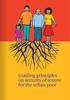 Guiding principles on security of tenure for the urban poor Security of tenure is understood as a set of relationships with respect to housing and land, established through statutory or customary law or
Hart s Older Persons Housing Strategy 2011-14
 Hart s Older Persons Housing Strategy 2011-14 Helping local people find housing solutions Final Version Date: May 2011 Contents Introduction 3 Objective 1: Deliver a choice of good quality housing for
UNHCR Georgia 2010 Operation
 UNHCR Georgia 2010 Operation UNHCR Tbilisi, November 2009 New Budget Structure in UNHCR Four Pillars UNHCR recently adopted a revised budget structure, in line with UNHCR s results framework, which uses
SUBMISSION TO INQUIRY INTO AFFORDABLE HOUSING. Prepared by National Policy Office
 SUBMISSION TO INQUIRY INTO AFFORDABLE HOUSING Prepared by National Policy Office March 2014 COTA Australia Authorised by: Ian Yates AM Chief Executive [email protected] 0418 835 439 Prepared by: Jo Root
Adapting to Climate Change in Urban Areas
 Human Settlements Discussion Paper Series Theme: Climate Change and Cities - 1 Adapting to Climate Change in Urban Areas The possibilities and constraints in low- and middle-income nations David Satterthwaite,
FINANCIAL INCLUSION OF YOUTH
 FINANCIAL INCLUSION OF YOUTH HIGHLIGHTS 2.5 billion - more than half of the world s working adults- are excluded from financial services. This is most acute among low-income populations in emerging and
CONSULTANT - CALL FOR APPLICATIONS: EXPERTS AND TRAINERS ROSTER (UN WOMEN GLOBAL)
 CONSULTANT - CALL FOR APPLICATIONS: EXPERTS AND TRAINERS ROSTER (UN WOMEN GLOBAL) Location : Application Deadline : Type of Contract : Post Level : Languages Required : Duration of Initial Contract : To
Community-managed latrines
 Part of a series of WaterAid technology briefs. Available online at www.wateraid.org/ technologies January 2013 Introduction are technically very similar to individual latrines, except they are larger