
5-2. Dissemination of Earthquake Risk Reduction and Recovery Preparedness Model Programme
|
|
|
- Whitney Armstrong
- 10 years ago
- Views:
Transcription
1 5-2. Dissemination of Earthquake Risk Reduction and Recovery Preparedness Model Programme Background Asian Region is the most disaster prone regions in the world. Many countries in the region are affected by natural disasters like Earthquake, Flood. Landslides, Mudslides, Tsunami and Drought in different scales. The devastating affect of these disasters hindered overall development effort of countries in the region. Governments and populations need to be aware of the risks and take concrete actions to prepare for and militate against the natural disasters affecting their areas. Therefore greater attention by governments, bilateral and multi-lateral donor communities and other stakeholders should be focused on identifying and reducing disaster risks within local communities. Taking into account the negative impact of the natural hazards and disaster in the sub regional development in South Asian, which was seriously damaged by recent Earthquake (Pakistan etc.) and the Indian Ocean Tsunami, South Asian Association for Regional Cooperation (SAARC) has developed risk reduction strategies based on the recommendations of the HFA. In the 13 th SAARC summit, leaders of the region recognize that cooperation among the region for effective disaster preparedness is essential. Japan, being the observer member of the SAARC acknowledges the idea of SAARC and share same perception based on their working experience in the region. The commitment of Japanese government to support SAARC initiatives, particularly on disaster risk reduction and preparedness was re-affirmed in the Japan-SAARC symposium held in Dhaka, Bangladesh on July 31, In this context, the IRP Secretariat developed a model programme to reduce Earthquake Risk and make appropriate preparation for recovery against future large earthquakes. This programme has been submitted to the UNDP/BCPR and authorized as an UNDP Project sponsored by the Government of Japan as the first grand aid project by the government of Japan making effective cooperation of UN agencies Problem-statement The recent incidents of earthquake in Pakistan and India were the wake-up call for the disaster stakeholders of the region for a well coordinated Earthquake risk reduction initiatives for the region. Lack of awareness and poor capacities of the national governments and communities resulted huge damages to these countries. Most of the public buildings (schools, hospitals, community centres, etc..) and private houses in these countries are highly vulnerable to earthquake i which caused significant number of death of schools children and other vulnerable population during last earthquakes. Despite devastating affect of earthquakes in South Asia, limited efforts were undertaken for earthquake preparedness and mitigation to reduce the risk of future disasters. Besides, most of the post disaster recovery initiatives are re-building risks due to inappropriate recovery planning and programmes. Findings from various evaluations ii on earthquake recovery programs re-iterate these observations. There are significant knowledge and policy gaps among recovery stakeholders in the region on enhanced recovery operation. (1) Despite many initiatives, Institutional capacity building (knowledge, facilities, basic equipment) issues are poorly focused at the national and local level. (2) Most of the countries in the region have developed strategies to strengthen the disaster management capacity. These plans are mostly addressed to preparedness and emergency response. Poor focus on post disaster recovery issues. (3) Lack of appropriate disaster specific guidelines for disaster preparedness and mitigation (4) Lack of appropriate construction guidelines and supervision by the competent authorities (Municipalities and Ministry of Urban Development and Housing, etc...) (5) Various post disaster recovery programs, implementing by the government and NGOs are not focusing risk reduction issues which lead to rebuilding of risks for the communities. (6) There is no systematic thought and practice to link post disaster recovery into the disaster management cycle. Post disaster recovery seen as an isolated issue undertaken as and when required basis. 117

2 Rapid urbanization and expansion of settlements need appropriate Risk Reduction measures Purpose of the Programme The recent incidents of earthquake in Pakistan and India were the wake-up call for the disaster stakeholders of the region for a well coordinated Earthquake risk reduction initiatives for the region. Lack of awareness and poor capacities of the national governments and communities resulted huge (1) General approach The project will address earthquake risk reduction and post earthquake recovery preparedness issues in the high risk countries of region. The project seeks to strengthen the capacity of the government institutions and local community on earthquake risk management based on appropriate preparedness, mitigation and post disaster recovery (Build Back Better approach) practice. The project design will adapt TDRM approach promoted by Asian Disaster Reduction Centre to address disaster risk management cycle (Fig ). Project participants will gain experience on the planning and implementation of Earthquake risk reduction strategies based on locally and community defined needs, constraints and proposed solutions. Project will address regional cooperation and coordination through sharing of experience, lessons on best practices among the region. Fig Disaster Risk management Cycle (2) Goal of the Programme To contribute to the process of establishing an earthquake safer community within the country and in the region. 118

3 (3) Purpose of the Programme To strengthen the institutional and community capacity to plan and implement earthquake risk reduction strategies integrating disaster preparedness, mitigation and post disaster recovery for countries exposed to earthquake hazards following regional approach Description of Outputs and Activities The project seeks to support an effective earthquake risk reduction and recovery initiatives, through the following expected core outputs: (1) OUTPUT 1: To support Government and communities of the targeted countries identifying earthquake risks and vulnerability by conducting Earthquake Risks and Vulnerability Assessment 1) Earthquake hazard mapping in projects areas using national and international assessment method. 2) Assess seismic risks and vulnerability of the public constructions (schools, hospitals, etc..) and private housings jointly by local and Japanese technical experts. 3) Review the impact of settlement pattern, and land use practice and options in high risk areas. 4) Review the existing governmental and municipal policies on earthquake preparedness, response and post disaster recovery. 5) Review livelihood and socioeconomic condition in relation to earthquake hazards (2) Output 2 : To support the capacity development of government Institutions and communities living in high risk to adapt and implement earthquake preparedness planning and safe housing practice using appropriate earthquake resistant construction guideline 1) Develop / modify appropriate guidelines for earthquake-resistant building design in collaboration with national, regional and international institutions. Guidelines will elaborate comparatively easyto -adapt and low cost re-enforcement measures for the local builders. It will take in to considerations the country context (culture, topography, use of local materials, etc.) along with regional experiences (best practices). 2) Develop seismic vulnerability evaluation guidelines and tools for private and public buildings (for pre disaster vulnerability and post disaster damage assessment). 3) Delivery of awareness and skill training to construction professionals (government engineers, non government specialist, local masons, etc.) on building vulnerability assessment and earthquake safe construction practice using guidelines and shake table demonstration; 4) Public Education and Awareness (PEA) on earthquake preparedness and safe house construction to the local communities living in high risk areas including school demonstration, exercise, etc.. 5) Implement local level earthquake safe model projects that would be identified using seismic vulnerability and capacity assessment tools and participatory planning process. These projects will follow the earthquake resistant construction guidelines for the implementation. These activities will facilitate the practical demonstration of the field testing guidelines and tools for the government official, local engineers and masons. Examples of model projects include; Provide seismological equipment to measure and monitor earthquake intensity to countries as needed to support capacity building Seismic safe construction/retrofitting of selected public buildings (e.g. schools, hospitals, Community/emergency shelters, etc..) on the high risk areas which do not meet seismic resistant standard 119
4 (3) Output 3: To strengthen the capacity of the Government in disaster recovery preparedness support to ensure enhanced recovery operation in post disaster situation. Hyogo Framework for Action (HFA) recommended systematic incorporation of disaster risk reduction in disaster management cycle where post disaster recovery acknowledged as an integral part. It was emphasized that the enhanced post disaster recovery management help to build safer and better prepared communities for futures disasters. Project will initiate awareness raising program for national disaster practitioners on post disaster recovery issues by lessons learned exercise highlighting the regional good and bad practices. Project will use Recovery Information Kit Learning from Disaster Recovery, produced by International Recovery Platform (IRP) for the awareness raising and policy advocacy for the national and local disaster managers involved in post disaster recovery. Key activities under this component are: 1) Conduct lessons learned exercise on past disasters recovery in high risk countries of the region 2) Development and incorporation of recovery principles and guidelines into National Disaster Management Plan Lessons leaned workshop, seminars and planning exercise will help to build a platform for disaster recovery managers to review the regional and country specific experiences, policies and practices which would lead to modification/incorporation of policies and principles in to the National Disaster Management Plan. (4) Output 4: To support locally appropriate solutions for earthquake risk reduction proposed by individual countries. Programme will support country specific activities that are proposed by countries to address earthquake riskreduction issues. These activities may also compliment existing disaster initiatives of the country and could support national disaster management plan of these countries. Country specific proposals would identify specific solutions for earthquake risk reduction that will be validated during country level inception workshop for the project. Examples of country specific solutions are: 1) Guidelines for earthquake preparedness and mitigation for training/awareness and local planning 2) Establish emergency operations centre (EOC) to support emergency communication, preparedness and awareness for earthquake disaster 3) Establish municipal Disaster Management Authority support disaster preparedness, mitigation and recovery support. 4) Develop comprehensive catalogue/data set of all recorded historical earthquakes in countries and region 5) Establish a modern seismic monitoring network with Seismic Equipment that could accurately and quickly provide critical information about future earthquakes. (5) Output 5: Facilitate sharing and exchange of national and regional information, lessons and best practice for Policy Feedback and advocacy Programme will facilitate regional and national level sharing of lessons, practice and experience on earthquake risk reduction and recovery sharing of experience. It would facilitate countries in incorporating regional and national good practice, lesson to optimize the benefit of the project. Project will establish a regional and national network using the resources of SAARC regional centers (SMRC, SCDM,), NGOs, regional professional organizations, experts in the areas of earthquake risk management for effective sharing of experience, etc. and facilitating technical assistance for the projects. Major activities include; 1) Convene workshops and seminars on project activities would raise awareness amongst policymakers and key development stakeholders to influence development planning at the national and regional level. 120
5 2) Lessons learned from these proposed interventions will be documented to identify models and experiences that can be replicated in other areas. 3) Field visits and exchanges between national and local officials and international institutions will promote the development of mechanisms for two-way flow of information and feedback. (6) Address of cross cutting issues: 1) Gender issues Every phase of the project will address gender issues to ensure the need of women will be met as well as men s. All training curricula will be designed to take account of gender differences. Special focus will be made to identify women participants for training as well as women trainers in a proportion of around 50%. It has been notice that regarding disaster mitigation issues, tie concerns of women were different then those of the men and since their role in the process is quite different, it is sometimes difficult to involve women in some activities, For that, reason, the project will be proactive at identifying capacity development activities that will reach the interest of both genders. 2) Environment : Project will ensure environmental considerations at the every stage of the project implementation. Environmental impact assessment will be done following UN standard EIA process before implementation of structural projects to avoid environmental hazards at the project sites. Project monitoring and reporting system will incorporate environmental monitoring indicators. Project will build the capacity of the local level implementing agencies and officials by providing EIA training. 121

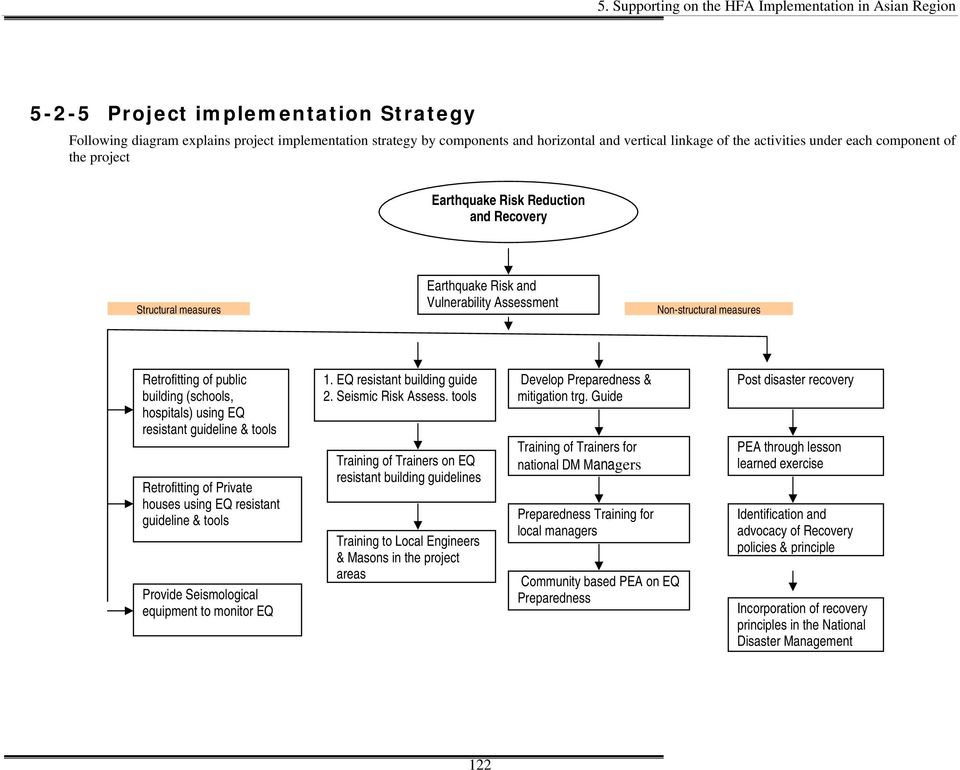
6 5-2-5 Project implementation Strategy Following diagram explains project implementation strategy by components and horizontal and vertical linkage of the activities under each component of the project Earthquake Risk Reduction and Recovery Structural measures Earthquake Risk and Vulnerability Assessment Non-structural measures Retrofitting of public building (schools, hospitals) using EQ resistant guideline & tools Retrofitting of Private houses using EQ resistant guideline & tools Provide Seismological equipment to monitor EQ 1. EQ resistant building guide 2. Seismic Risk Assess. tools Training of Trainers on EQ resistant building guidelines Training to Local Engineers & Masons in the project areas Develop Preparedness & mitigation trg. Guide Training of Trainers for national DM Managers Preparedness Training for local managers Community based PEA on EQ Preparedness Post disaster recovery PEA through lesson learned exercise Identification and advocacy of Recovery policies & principle Incorporation of recovery principles in the National Disaster Management 122
Mainstreaming Disaster Risk Reduction into National and Sectoral Development Process
 Mainstreaming Disaster Risk Reduction into National and Sectoral Development Process Safer Training Health Course Facilities Regional Consultative Committee on Disaster Management (RCC) Training Course
Preliminary Database Good Practices on Recovery (IRP) AND Total Disaster Risk Management (TDRM) Good Practices
 Asian Science and Technology Forum Tsukuba Seminar "International Workshop on Information Platforms for Disaster Reduction" (IPDR Workshop),Tsukuba, Japan, 3-4 October 2007 Preliminary Database Good Practices
Resolution adopted by the General Assembly. [without reference to a Main Committee (A/64/L.43 and Add.1)]
![Resolution adopted by the General Assembly. [without reference to a Main Committee (A/64/L.43 and Add.1)]](/thumbs/26/9256534.jpg "Resolution adopted by the General Assembly. [without reference to a Main Committee (A/64/L.43 and Add.1)]") United Nations A/RES/64/251 General Assembly Distr.: General 30 April 2010 Sixty-fourth session Agenda item 70 (a) Resolution adopted by the General Assembly [without reference to a Main Committee (A/64/L.43
United Nations A/RES/64/251 General Assembly Distr.: General 30 April 2010 Sixty-fourth session Agenda item 70 (a) Resolution adopted by the General Assembly [without reference to a Main Committee (A/64/L.43
Policy, Legislation and Institutional Arrangements:
 Policy, Legislation and Institutional Arrangements: An ADPC Commentary on Innovation and Good Practice in DRR Governance in Asia Presentation by A.J Rego (ADPC) for the Seventh IIASA -DPRI Forum on Integrated
IASC Inter-Agency Standing Committee
 IASC Inter-Agency Standing Committee Global Health Cluster Guidance Note Promotion and Advocacy for Stronger National and Local Capacities in Health Emergency Preparedness and Risk Reduction 1. Background
18-22 January 2005, Kobe, Hyogo, Japan. Building the Resilience of Nations and Communities to Disasters. www.unisdr.org/wcdr
 World Conference on Disaster Reduction 18-22 January 2005, Kobe, Hyogo, Japan Hyogo Framework for Action 2005-2015: Building the Resilience of Nations and Communities to Disasters * www.unisdr.org/wcdr
Long Term Recovery and Rehabilitation. Issues for discussion. Recovery
 Long Term Recovery and Rehabilitation Issues for discussion Recovery The restoration, and improvement where appropriate, of facilities, livelihoods and living conditions of disaster-affected communities,
District Disaster Risk Management Planning
 District Disaster Risk Management Planning GUIDELINES JULY 2007 National Disaster Management Authority 1. Introduction Notifications for establishment of the District Disaster Management Authorities (DDMAs)
Report of the World Conference on Disaster Reduction
 EUR-OPA MAJOR HAZARDS AGREEMENT Strasbourg, 19 April 2005 AP/CAT (2005) 26 Or. E. OPEN PARTIAL AGREEMENT ON THE PREVENTION OF, PROTECTION AGAINST AND ORGANISATION OF RELIEF IN MAJOR NATURAL AND TECHNOLOGICAL
Indonesian National Network on Disaster Resource Partnership (DRP)
 2011/EPWG/WKSP/021 Session 4 Indonesian National Network on Disaster Resource Partnership (DRP) Submitted by: Indonesia Workshop on Private Sector Emergency Preparedness Sendai, Japan 1-3 August 2011 Presentation
FINAL PROJECT REPORT. "Emergency Preparedness and Response Disaster Risk Management" Content. 1. General Project Information
 FINAL PROJECT REPORT "Emergency Preparedness and Response Disaster Risk Management" 1. General Project Information Country, project title, project number, and period Budget originally requested and actually
TERMS of REFERENCE (ToR)
 TERMS of REFERENCE (ToR) Project Name: Building Disaster Resilient Communities in Cambodia ActionAid (Cambodia) - DRR Program OVERALL PURPOSE OF THE CONSULTANCY Undertake an independent research study
Conference Statement:
 Conference Statement: Strengthen Resilient Recovery and Reconstruction in the Post-2015 Framework for Disaster Risk Reduction Preamble: The growing incidence of high-impact disasters has made countries
Centre International de Droit Comparé de l Environnement CIDCE. Comments on the Zero draft of the Post 2015 framework for disaster risk reduction
 Centre International de Droit Comparé de l Environnement CIDCE Comments on the Zero draft of the Post 2015 framework for disaster risk reduction Paragraph n (1,2,3,...), page Comments A. Preambule 5. page
Sustainable Recovery and Reconstruction Framework (SURRF)
 Sustainable Recovery and Reconstruction Framework (SURRF) Presented by Iwan Gunawan, Sr. Disaster Management Adviser, Original Presentation by Saroj Kumar Jha Program Manager Global Facility for Disaster
Improving the Quality of Education and Building Disaster Resilience in Schools A case study of ROTA s project in Nepal and experience of applying the
 Improving the Quality of Education and Building Disaster Resilience in Schools A case study of ROTA s project in Nepal and experience of applying the INEE Minimum Standards I. Overview of Educational Situation
Comprehensive School Safety
 Comprehensive School Safety A global framework in support of The Global Alliance for Disaster Risk Reduction and Resilience in the Education Sector and The Worldwide Initiative for Safe Schools, in preparation
DISASTER MANAGEMENT. Goals To instill an understanding of the disaster management process
 DISASTER MANAGEMENT Goals To instill an understanding of the disaster management process Learning outcomes After completing this session, you will be able to Affirm the usefulness of integrating management
GOVERNMENT OF MALAWI NATIONAL DISASTER RISK MANAGEMENT POLICY
 GOVERNMENT OF MALAWI NATIONAL DISASTER RISK MANAGEMENT POLICY 2015 For further information, contact: The Secretary and Commissioner for Disaster Management Affairs Private Bag 336 Lilongwe 3 Malawi Physical
Learning from Disaster Recovery Ian Davis Visiting Professor, Cranfield, Coventry and Kyoto Universities
 Keynote Speech Learning from Disaster Recovery Ian Davis Visiting Professor, Cranfield, Coventry and Kyoto Universities The farther backward you look, the farther forward you are likely to see Winston
PRESENTERS: BACHELOR OF ARTS- PSYCHOLOGY
 KIBET J. NELLY PRESENTERS: MAGAI N. DORCAS BACHELOR OF ARTS- PSYCHOLOGY DISASTER? A serious disruption of the functioning of a community or society causing widespread human, material, economic or environmental
Implementing National Programs on Community-based Disaster Risk Reduction in high risk communities: Lessons learned, challenges and way ahead
 Implementing National Programs on Community-based Disaster Risk Reduction in high risk communities: Lessons learned, challenges and way ahead An RCC Presentation based on the National Reports on CBDRR
EN 31IC/11/R7 Original: English Adopted
 EN 31IC/11/R7 Original: English Adopted 31st INTERNATIONAL CONFERENCE OF THE RED CROSS AND RED CRESCENT Geneva, Switzerland 28 November 1 December 2011 Strengthening normative frameworks and addressing
UNDP Recovery Activities: Examples from Indonesia and Haiti
 UNDP Recovery Activities: Examples from Indonesia and Haiti Hossein Sarem Kalali, UNDP The Second Expert Group Meeting on the Great East Japan Earthquake Learning from the Mega Tsunami Disaster 16 18 December
Disaster Risk Reduction UNESCO s contribution to a global challenge
 United Nations International Geoscience Programme Disaster Risk Reduction UNESCO s contribution to a global challenge UNESCO and Disaster Risk Reduction UNESCO operates at the interface between natural
The Local Government Self- Assessment Tool. Taking stock, celebrating achievements and planning for DRR in Addis Ababa
 The Local Government Self- Assessment Tool Taking stock, celebrating achievements and planning for DRR in Addis Ababa Background Throughout history, disaster events have disrupted urban life. With more
Ensuring Accountability in Disaster Risk Management and Reconstruction
 Ensuring Accountability in Disaster Risk Management and Reconstruction Date: 08 December 2015 Time: 8.30 am until 4.30 pm Venue: Jaic Hilton Hotel, Colombo, Sri Lanka Organised by SPARC, University of
ASEM Manila Conference on Disaster Risk Reduction and Management. Post- Haiyan A Way Forward Manila, Philippines 04-06 June 2014
 ASEM Manila Conference on Disaster Risk Reduction and Management Post- Haiyan A Way Forward Manila, Philippines 04-06 June 2014 Theme: A Stronger Asia-Europe Partnership to Meet the Challenges of Mega
Islamic Republic of Afghanistan, Post Disaster Need Assessment (PDNA) Training Manual
 Islamic Republic of Afghanistan, Ministry of Rural Rehabilitation and Development (MRRD) Ministry of Rural Rehabilitation & Development Post Disaster Need Assessment (PDNA) Training Manual Social Protection
UNITED NATIONS CHILDREN S FUND
 UNITED NATIONS CHILDREN S FUND Office in Serbia is seeking qualified Consultant for supporting infusion of Disaster Risk Reduction across Education Curriculum for Primary and Secondary Schools in Serbia
REGIONAL CONSULTATIVE COMMITTEE ON DISASTER MANAGEMENT (RCC)
 REGIONAL CONSULTATIVE COMMITTEE ON DISASTER MANAGEMENT (RCC) Regional Consultative Committee on Disaster Management (RCC) RCC MEMBERSHIP The Regional Consultative Committee on Disaster Management (RCC)
How To Manage A Disaster In India
 Institutional Arrangements for Disaster Management in India Prof. N. Vinod Chandra Menon Member National Disaster Management Authority Government of India Features of an Emergency Situation Sense of urgency
Disaster Risk Reduction and Building Resilience to Climate Change Impacts
 Disaster Risk Reduction and Building Resilience to Climate Change Impacts Luna Abu-Swaireh ([email protected]) May 2015 United Nations Office for Disaster Risk Reduction (UNISDR) Droughts Floods Storms
Towards a Post-2015 Framework for Disaster Risk Reduction
 Towards a Post-2015 Framework for Disaster Risk Reduction Introduction 1. The Hyogo Framework for Action 2005-2015 Building the Resilience of Nations and Communities to Disasters (HFA) is the inspiration
KNOWLEDGE MANAGEMENT IN DISASTER RISK REDUCTION
 KNOWLEDGE MANAGEMENT IN DISASTER RISK REDUCTION The Indian Approach Government of India Ministry of Home Affairs National Disaster Management Division The document is prepared by a team comprising of Sujit
EU support for climate training in LDCs: some examples
 EU support for climate training in LDCs: some examples Tony Carritt, EU Art 6 Focal Point First Article 6 Dialogue Bonn, 10-11 June 2013 EU support in context EU is leading provider of official development
TRANSPORT AND RURAL INFRASTRUCTURE. A literature review for the Transport and Rural Infrastructure Project
 TRANSPORT AND RURAL INFRASTRUCTURE A literature review for the Transport and Rural Infrastructure Project Balla, G.S. (2000) Evaluation of Infrastructural Interventions for Rural Poverty Alleviation. UN
Comprehensive School Safety
 Comprehensive School Safety Working towards a global framework for climate-smart disaster risk reduction, bridging development and humanitarian action in the education sector. March 2013 Purpose The past
Joint UN Statement 1 st Preparatory Committee Meeting (PREPCOM) for the Third UN World Conference on Disaster Risk Reduction, 14-15 July 2014, Geneva
 FINAL VERSION Joint UN Statement 1 st Preparatory Committee Meeting (PREPCOM) for the Third UN World Conference on Disaster Risk Reduction, 14-15 July 2014, Geneva PLEASE CHECK AGAINST DELIVERY Excellencies,
ADPC REGIONAL TRAINING COURSES
 ADPC REGIONAL TRAINING COURSES ADPC s Training and Capacity Building Strengths Asian Disaster Preparedness Center (ADPC), the leading training resource in the region continues to address the training needs
Mainstreaming DRR into Development Experiences of the RCC Program on Mainstreaming DRR into Development Policy, Planning and Implementation in Asia
 Regional Consultative Committee on Disaster Management (RCC) Mainstreaming DRR into Development Experiences of the RCC Program on Mainstreaming DRR into Development Policy, Planning and Implementation
CDIA Strategy and Action Plan for Pro-poor Urban Infrastructure Development 2011-2012. July 2011 Final Version CDIA
 CDIA Strategy and Action Plan for Pro-poor Urban Infrastructure Development 2011-2012 July 2011 Final Version CDIA Cities Development Initiative for Asia TABLE OF CONTENTS TABLE OF CONTENTS... I ACRONYMS...
Compilation of Principles and Recommendations on Preparedness from a series of Workshops and Meetings
 Compilation of Principles and Recommendations on Preparedness from a series of Workshops and Meetings Disaster prone countries Advocacy and Awareness Make disaster risk reduction for resilience, including
Guidelines for Conducting a Special Needs
 Guidelines for Conducting a Special Needs Emergency Management Assessment By Shaun Bollig and Kathy Lynn Resource Innovations, University of Oregon Institute for a Sustaianble Environment INTRODUCTION
International Flood Network
 International Flood Network Flood Devastation Increasing Floods are natural phenomena caused by rain, but flood damage is influenced by various social as well as natural factors. The scale and form of
International Workshop on Strategies for Development and Food Security in Mountainous Areas of Central Asia June 6-10, 2005 -- Dushanbe, Tajikistan
 International Workshop on Strategies for Development and Food Security in Mountainous Areas of Central Asia June 6-10, 2005 -- Dushanbe, Tajikistan This document contains a series of recommendations and
Draft Resolution on Science, technology and innovation for development
 Draft Resolution on Science, technology and innovation for development The Economic and Social Council, Recognizing the role of the Commission on Science and Technology for Development as the United Nations
RCC Program on Mainstreaming DRR into Development Policy, Planning and Implementation in Asia
 RCC Program on Mainstreaming DRR into Development Policy, Planning and Implementation in Asia Presentation by Govt. of Philippines and the RCC Secretariat at ADPC at the Global Platform for Disaster Risk
Developing Capacities for Risk Management and Resilience
 Developing Capacities for Risk Management and Resilience Dr. Kishan Khoday Regional Cluster Leader Climate Change & Resilience UNDP Regional Center in Cairo ([email protected]) 0 Context As noted
Karlstad, Sweden. Local progress report on the implementation of the Hyogo Framework for Action (2013-2014)
 Karlstad, Sweden Local progress report on the implementation of the Hyogo Framework for Action (2013-2014) Mayor: Ulf Nyqvist Name of focal point: -Anna -Sjödin Organization: -Karlstad Municipality Title/Position:
Terms of Reference. Food Security. Sector Coordination-Lebanon
 Terms of Reference Food Security Sector Coordination-Lebanon Background Lebanon hosts the largest Syrian refugee population in the region. Since the outset of the influx in 2011, the Government of Lebanon
Overview of the Local Government Self-Assessment Tool for Disaster Resilience
 Overview of the Local Government Self-Assessment Tool for Disaster Resilience Why use the Local Government Self-Assessment Tool? Using the Local Government Self-Assessment Tool will help to set baselines,
ENGINEERING-BASED EARTHQUAKE RISK MANAGEMENT
 ENGINEERING-BASED EARTHQUAKE RISK MANAGEMENT MRP Engineering Newsletter February 2012 The world recently experienced several major earthquakes, which caused severe local impacts and major worldwide repercussions.
Safe and Climate Resilient Cities Lessons learnt (hopefully) from recent works. Federica Ranghieri The World Bank
 Safe and Climate Resilient Cities Lessons learnt (hopefully) from recent works Federica Ranghieri The World Bank 2010 DRM at the World Bank Since 1980, the World Bank has approved more than 500 operations
HEALTH SECTOR DISASTER MANAGEMENT SELF-ASSESSMENT TOOL
 HEALTH SECTOR DISASTER MANAGEMENT SELF-ASSESSMENT TOOL DIPECHO VI Action Plan Strengthening Communities through Safer Health Facilities in the Caribbean February 2009 HEALTH SECTOR SELF-ASSESSMENT TOOL
Disaster Management:Operations technical advice
 Disaster Management:Operations technical advice MAA00040 14 April 2010 This report covers the period 1 January to 31 December 2009. This photo is representational of the vital role of one of the Federation
OUTLINE TERMS OF REFERENCE FOR CONSULTING SERVICES
 A. Introduction OUTLINE TERMS OF REFERENCE FOR CONSULTING SERVICES 1. Interdisciplinary international and national consultants with extensive experience in climate change planning, project planning and
FCCC/SBI/2012/L.44. United Nations
 United Nations FCCC/SBI/2012/L.44 Distr.: Limited 1 December 2012 Original: English Subsidiary Body for Implementation Thirty-seventh session Doha, 26 November to 1 December 2012 Agenda item 10 Approaches
ACTION PROGRAM 2013-2015
 Network of Asian River Basin Organizations () ACTION PROGRAM 2013-2015 Key Result Areas: A. Advocacy, Raising Awareness, and Exchange of Information and Good Practices on Integrated Water Resources Management
Draft conclusions proposed by the Chair. Recommendation of the Subsidiary Body for Implementation
 United Nations FCCC/SBI/2012/L.47 Distr.: Limited 1 December 2012 Original: English Subsidiary Body for Implementation Thirty-seventh session Doha, 26 November to 1 December 2012 Agenda item 14 Article
CASE STUDY. Sending a Message of Accountability: SMS Helps Improve Services after Pakistan Floods
 CASE STUDY Sending a Message of Accountability: SMS Helps Improve Services after Pakistan Floods About FrontlineSMS FrontlineSMS is open-source SMS-messaging software that runs on a laptop connected to
How To Manage A Flood In Mozambique
 Flood Risk Management in Mozambique and Sub-regional Trans-boundary Issues UNFCCC regional expert meeting on loss and damage in Addis Ababa, Ethiopia from 13 to 15 June 2012 Ron Cadribo, UNISDR DRR Advisor,
DISASTER MANAGEMENT SYSTEM IN NEPAL POLICY ISSUES AND SOLUTIONS
 Journal of Risk Analysis and Crisis Response, Vol. 2, No. 3 (November 2012), 166-172 DISASTER MANAGEMENT SYSTEM IN NEPAL POLICY ISSUES AND SOLUTIONS GANGALAL TULADHAR Ph.D. Fellow at the Ehime University,
Emergency Management in Turkey Adil Özdemir
 Adil Özdemir Turkey has been exposed to natural disasters throughout history. The main sources of these natural disasters have been earthquakes, floods, erosion and avalanches. Disaster response policies
Earthquake hazard mapping for community resilience in Japan
 Earthquake hazard mapping for community resilience in Japan -the role of the government- Understanding Risk Forum Focus day session Let s shake your community earthquake hazard mapping approach for community
Disaster Risk Reduction (DRR)
 Disaster Risk Reduction (DRR) A. Introduction 1. In order to address the impacts of the May 12 Wenchuan Earthquake, the Government of China will implement an effective, comprehensive and sustainable recovery
Development and Recovering From Disaster
 Development and Recovering From Disaster [email protected] International Symposium on Disaster Economics 3-5 April 2013, Istanbul Natural Disaster in Turkey Other disasters 4% Avalanche 2% Multiple
HUMANITARIAN. Food 11. Health 4 Shelter 4 Other 7 OECD/DAC
 #094 DENMARK Group 1 PRINCIPLED PARTNERS OFFICIAL DEVELOPMENT ASSISTANCE HRI 2011 Ranking 2nd 0.90% AID of GNI of ODA P4 6.2% US $32 6.95 P5 7.62 7.12 7.49 P3 7.90 P1 5.35 P2 Per person AID DISTRIBUTION
Shifting agendas: response to resilience - The role of the engineer in disaster risk reduction
 Shifting agendas: response to resilience The role of the engineer in disaster risk reduction The Institution of Civil Engineers 9th Brunel International Lecture Series London School of Economics - 4th
Professional online certificate course in Disaster Management
 Online certificate course Professional online certificate course in Disaster Management Course length: 12 months online Course fee: National Societies and IFRC (and TISS alumni) participants $990 USD.
International Training Program 2010 Management of Flood Control and Disaster Mitigation LOGO
 International Training Program 2010 Management of Flood Control and Disaster Mitigation LOGO June 2010 / China Prepared by HOY SEREIVATHANAK REASEY Royal University of Phnom Penh 1 Country Risk Profile
Tsunami Recovery and Restoration in the Maldives Lessons Learned. Marie Saleem and Shahaama A. Sattar
 Tsunami Recovery and Restoration in the Maldives Lessons Learned Marie Saleem and Shahaama A. Sattar Introduction Tsunami left devastating effects on the low lying islands of the Maldives Map.ppt Severely
Anchorage All-Hazard Mitigation Plan October 2004
 EXECUTIVE SUMMARY The Municipality of Anchorage (MOA) is vulnerable to a wide range of natural, technological, and human/societal hazards including earthquakes, avalanches, and hazardous material accidents.
Reconstruction & Renewal of Bhuj City
 Reconstruction & Renewal of Bhuj City The Gujarat Earthquake Experience - Converting Adversity into an Opportunity a presentation by: Rajesh Kishore, CEO, Gujarat State Disaster Management Authority Gujarat,
Utilizing space and GIS for effective disaster risk management -ESCAP's practices in Asia and the Pacific
 Utilizing space and GIS for effective disaster risk management -ESCAP's practices in Asia and the Pacific Mr. Keran Wang Chief, Space Applications Section Information and Communications Technology and
Resolution XII.13. Wetlands and disaster risk reduction
 12 th Meeting of the Conference of the Parties to the Convention on Wetlands (Ramsar, Iran, 1971) Punta del Este, Uruguay, 1-9 June 2015 Resolution XII.13 Wetlands and disaster risk reduction 1. RECALLING
Community-Based Disaster Management
 Chapter 7 Community-Based Disaster Management Community connections are the relationships necessary to develop, implement, and maintain an effective end-to-end early warning system. A multi-hazard warning
Country and Regional Reports on GEOSS-related Activities. Ms. Taniya Koswatta Coordinator, APN Secretariat
 Country and Regional Reports on GEOSS-related Activities Ms. Taniya Koswatta Coordinator, APN Secretariat What is APN An inter-governmental network of 22 countries in the Asia- Pacific to foster global
Mr. Chairman, Mr. President, distinguished Governors, ladies and gentlemen,
 Statement by Mr. Jun AZUMI, Minister of Finance of Japan, at the Forty-Fifth Annual Meeting of the Board of Governors of the Asian Development Bank (Manila, Philippines, May 4, 2012) 1. Introduction Mr.
SYLLABUS OF DIPLOMA IN DISASTER MANAGEMENT (DDM) Semester-I. Semester-II
 SYLLABUS OF DIPLOMA IN DISASTER MANAGEMENT (DDM) For Academic Session 2016-17 Duration: 1 Year Total Credit: 32 Semester-I DDM 01 Introduction to Disaster Management 6 Credit DDM 02 GIS and ICT in Disaster
The Road Map for establishment of an effective EPR system for Health Sector in Afghanistan 8/18/2010
 The Road Map for establishment of an effective EPR system for Health Sector in Afghanistan 8/18/20100 The document has been developed based on the recommendations from the National Workshop on Planning