
Network Security Tutorial
|
|
|
- Cameron Britton Gibbs
- 10 years ago
- Views:
Transcription
1 Network Security Tutorial Contact: TSEC01_v1.0

2 Overview Network Security Fundamentals Security on Different Layers and Attack Mitigation Cryptography and PKI Resource Registration (Whois Database) Virtual Private Networks and IPsec

3 Network Security Fundamentals Network Security Workshop
4 Overview Why We Need Security Definitions and Concepts Access Control Risk vs. Vulnerability Threats and Attack Types
5 Why Security? The Internet was initially designed for connectivity Trust assumed We do more with the Internet nowadays Security protocols are added on top of the TCP/IP Fundamental aspects of information must be protected Confidential data Employee information Business models Protect identity and resources We can t keep ourselves isolated from the Internet Most business communications are done online We provide online services We get services from third-party organizations online
6 Internet Evolution LAN connectivity Application-specific More online content Cloud computing Application/data hosted in the cloud environment Different ways to handle security as the Internet evolves

7 Why Security? Key findings: Hacktivism and vandalism are the common DDoS attack motivation High-bandwidth DDoS attacks are the new normal First-ever IPv6 DDoS attacks are reported Trust issues across geographic boundaries Source: Arbor Networks Worldwide Infrastructure Security Report Volume VII

8 Breach Sources Aggregation Infiltration Exfiltration Source: Trustwave 2012 Global Security Report

9 Types of Security Computer Security generic name for the collection of tools designed to protect data and to thwart hackers Network Security measures to protect data during their transmission Internet Security measures to protect data during their transmission over a collection of interconnected networks
10 Goals of Information Security Confidentiality Integrity Availability prevents unauthorized use or disclosure of information safeguards the accuracy and completeness of information authorized users have reliable and timely access to information SECURITY

11 Access Control The ability to permit or deny the use of an object by a subject. It provides 3 essential services: Authentication (who can login) Authorization (what authorized users can do) Accountability (identifies what a user did)
12 Authentication A means to verify or prove a user s identity The term user may refer to: Person Application or process Machine or device Identification comes before authentication Provide username to establish user s identity To prove identity, a user must present either of the following: What you know (passwords, passphrase, PIN) What you have (token, smart cards, passcodes, RFID) Who you are (biometrics such as fingerprints and iris scan, signature or voice)

13 Examples of Tokens etoken RFID cards Smart Cards Fingerprint scanner

14 Trusted Network Standard defensive-oriented technologies Firewall Intrusion Detection Build TRUST on top of the TCP/IP infrastructure Strong authentication Public Key Infrastructure (PKI)
15 Strong Authentication An absolute requirement Two-factor authentication Passwords (something you know) Tokens (something you have) Examples: Passwords Tokens Tickets Restricted access PINs Biometrics Certificates
16 Two-factor Authentication Requires a user to provide at least two authentication factors to prove his identity something you know Username/userID and password something you have Token using a one-time password (OTP) The OTP is generated using a small electronic device in physical possession of the user Different OTP generated each time and expires after some time An alternative way is through applications installed on your mobile device Multi-factor authentication is also common
17 Authorization Defines the user s rights and permissions on a system Typically done after user has been authenticated Grants a user access to a particular resource and what actions he is permitted to perform on that resource Access criteria based on the level of trust: Roles Groups Location Time Transaction type

18 Authentication vs. Authorization Service Authentication Mechanism Authorization Mechanism Client Authentication simply identifies a party, authorization defines whether they can perform certain action RFC 3552

19 Authorization Concepts Authorization creep When users may possess unnecessarily high access privileges within an organization Default to Zero Start with zero access and build on top of that Need to Know Principle Least privilege; give access only to information that the user absolutely need Access Control Lists List of users allowed to perform particular access to an object (read, write, execute, modify)

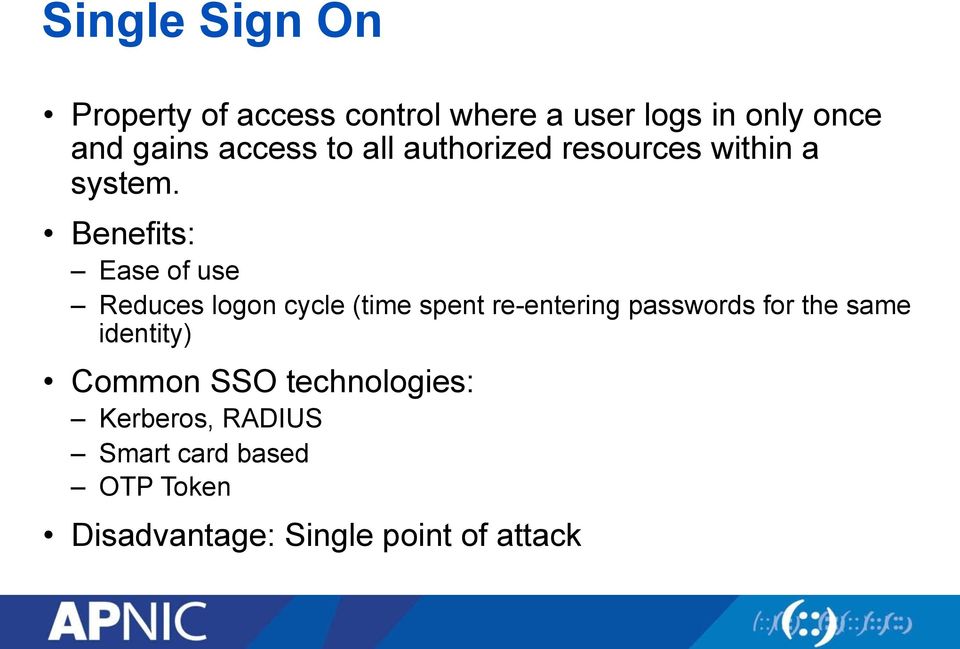
20 Single Sign On Property of access control where a user logs in only once and gains access to all authorized resources within a system. Benefits: Ease of use Reduces logon cycle (time spent re-entering passwords for the same identity) Common SSO technologies: Kerberos, RADIUS Smart card based OTP Token Disadvantage: Single point of attack
21 Types of Access Control Centralized Access Control Radius TACACS+ Diameter Decentralized Access Control Control of access by people who are closer to the resources No method for consistent control
22 Accountability The security goal that generates the requirement for actions of an entity to be traced uniquely to that entity Senders cannot deny sending information Receivers cannot deny receiving it Users cannot deny performing a certain action Supports nonrepudiation, deterrence, fault isolation, intrusion detection and prevention and after-action recovery and legal action Source: NIST Risk Management Guide for Information Technology Systems
23 Integrity Security goal that generates the requirement for protection against either intentional or accidental attempts to violate data integrity Data integrity The property that data has when it has not been altered in an unauthorized manner System integrity The quality that a system has when it performs its intended function in an unimpaired manner, free from unauthorized manipulation Source: NIST Risk Management Guide for Information Technology Systems
24 Risk, Threat and Vulnerability Vulnerability - weakness in a system Risk - likelihood that a particular threat using a particular attack will exploit a particular vulnerability Exploit - taking advantage of a vulnerability Non-repudiation assurance that both parties are involved in the transaction
25 Vulnerability A weakness in security procedures, network design, or implementation that can be exploited to violate a corporate security policy Software bugs Configuration mistakes Network design flaw Lack of encryption Exploit Taking advantage of a vulnerability
26 Threat Any circumstance or event with the potential to cause harm to a networked system. These are some example of threats: Denial of service Attacks make computer resources (e.g., bandwidth, disk space, or CPU time) unavailable to its intended users Unauthorised access Access without permission issues by a rightful owner of devices or networks Impersonation Worms Viruses
27 Risk The possibility that a particular vulnerability will be exploited IT-related risks arise from: Unauthorized (malicious or accidental) disclosure, modification, or destruction of information Unintentional errors or omissions IT disruptions due to natural or man-made disasters Failure to exercise due care and diligence in implementation and operation of the IT system Risk = Threat * Vulnerability (* Impact)
28 Risk Analysis Identification, assessment and reduction of risks to an acceptable level the process of identifying security risks and probability of occurrence, determining their impact, and identifying areas that require protection Three parts: Risk assessment determine the possible risks Risk management evaluating alternatives for mitigating the risk Risk communication presenting this material in an understanble way to decision makers and/or the public
29 Risk Management vs. Cost of Security Risk mitigation The process of selecting appropriate controls to reduce risk to an acceptable level The level of acceptable risk Determined by comparing the risk of security hole exposure to the cost of implementing and enforcing the security policy Trade-offs between safety, cost, and availability
30 Attack Sources Active vs. passive Active involves writing data to the network. It is common to disguise one s address and conceal the identity of the traffic sender Passive involves only reading data on the network. Its purpose is breach of confidentiality. This is possible if: Attacker has gained control of a host in the communication path between two victim machines Attacker has compromised the routing infrastructure to arrange the traffic pass through a compromised machine Active Attacks Denial of Service attacks Spoofing Man in the Middle ARP poisoning Smurf attacks Buffer overflow SQL Injection Passive Attacks Reconnaissance Eavesdropping Port scanning Source: RFC 4778
31 Attack Sources On-path vs. Off-path On-path routers (transmitting datagrams) can read, modify, or remove any datagram transmitted along the path Off-path hosts can transmit datagrams that appear to come from any hosts but cannot necessarily receive datagrams intended for other hosts If attackers want to receive data, they have to put themselves on-path How easy is it to subvert network topology? It is not easy thing to do but, it is not impossible Insider vs. outsider What is definition of perimeter/border? Deliberate attack vs. unintentional event Configuration errors and software bugs are as harmful as a deliberate malicious network attack Source: RFC 4778
32 General Threats Masquerade An entity claims to be another entity Eavesdropping An entity reads information it is not intended to read Authorization violation An entity uses a service or resource it is not intended to use Loss or modification of information Data is being altered or destroyed Denial of communication acts (repudiation) An entity falsely denies its participation in a communication act Forgery of information An entity creates new information in the name of another entity Sabotage Any action that aims to reduce the availability and/or correct functioning of services or systems
33 Reconnaissance Attack Unauthorised users to gather information about the network or system before launching other more serious types of attacks Also called eavesdropping Information gained from this attack is used in subsequent attacks (DoS or DDoS type) Examples of relevant information: Names, address Common practice to use a person s first initial and last name for accounts Practically anything
34 Man-in-the-Middle Attack Active eavesdropping Attacker makes independent connections with victims and relays messages between them, making them believe that they are talking directly to each other overa private connection, when in fact the entire conversation is controlled by the attacker Usually a result of lack of end-to-end authentication Masquerading - an entity claims to be another entity
35 Session Hijacking Exploitation of a valid computer session, to gain unauthorized access to information or services in a computer system. Theft of a magic cookie used to authenticate a user to a remote server (for web developers) Four methods: Session fixation attacker sets a user s session id to one known to him, for example by sending the user an with a link that contains a particular session id. Session sidejacking attacker uses packet sniffing to read network traffic between two parties to steal the session cookie.
36 Denial of Service (DoS) Attack Attempt to make a machine or network resource unavailable to its intended users. Purpose is to temporarily or indefinitely interrupt or suspend services of a host connected to the Internet Methods to carry out this attack may vary Saturating the target with external communications requests (such that it can t respond to legitimate traffic) SERVER OVERLOAD May include malware to max out target resources (such as CPU), trigger errors, or crash the operating system DDoS attacks are more dynamic and comes from a broader range of attackers Examples: SYN flooding, Smurf attacks, Starvation Can be used as a redirection and reconnaissance technique
37 Questions?
38 Layered Security & Attack Mitigation Network Security Workshop
39 Overview Attacks in Different Layers Security Technologies Link-Layer Security Network Layer Security Transport Layer Security Application Layer Security
40 Attacks on Different Layers Application Presentation Session Transport Network Data Link Physical OSI Reference Model Layer 5: SMB, NFS, Socks Layer 2: PPTP, Token Ring Application Layer 7: DNS, DHCP, HTTP, FTP, IMAP, LDAP, NTP, Radius, SSH, SMTP, SNMP, Telnet, TFTP DNS Poisoning, Phishing, SQL injection, Spam/Scam Transport Layer 4: TCP, UDP TCP attacks, Routing attack, SYN flooding, Sniffing Layer 3: IPv4, IPv6, ICMP, Internet IPSec Ping/ICMP Flood Network Access ARP spoofing, MAC flooding TCP/IP Model
41 Layer 2 Attacks ARP Spoofing MAC attacks DHCP attacks VLAN hopping
42 1 ARP Spoofing I want to connect to I don t know the MAC address Wait, I am ! ARP Request BB-BB-BB-BB-BB-BB AA-AA-AA-AA-AA-AA ARP Reply CC-CC-CC-CC-CC-CC Client s ARP Cache already poisoned It will communicate directly to the fake destination I am This is my MAC address DD-DD-DD-DD-DD- DD
43 MAC Flooding Exploits the limitation of all switches fixed CAM table size CAM = Content Addressable memory = stores info on the mapping of individual MAC addresses to physical ports on the switch. Port 1 Port 2 Port 3 Port 4 00:01:23:45:67:A1 x 00:01:23:45:67:B2 x 00:01:23:45:67:C3 x 00:01:23:45:67:D4 x
44 DHCP Attacks DHCP Starvation Attack Broadcasting vast number of DHCP requests with spoofed MAC address simultaneously. DoS attack using DHCP leases Rogue DHCP Server Attacks Server runs out of IP addresses to allocate to valid users Attacker sends many different DHCP requests with many spoofed addresses.
45 DHCP Attack Types Solution: enable DHCP snooping ip dhcp snooping (enable dhcp snooping globally) ip dhcp snooping vlan <vlan-id> (for specific vlans) ip dhcp snooping trust ip dhcp snooping limit rate <rate>
46 Layer 3 Attacks ICMP Ping Flood ICMP Smurf Ping of death
47 1 Ping Flood Internet Attacker Victim Other forms of ICMP attack: - Ping of death - ICMP ping flood Broadcas t Enabled Network
48 Mitigating Sniffing Attacks Avoid using insecure protocols like basic HTTP authentication and telnet. If you have to use an insecure protocol, try tunneling it through something to encrypt the sensitive data. Run ARPwatch. Try running tools like sniffdet and Sentinel to detect network cards in promiscuous mode that may be running sniffing software.
49 Routing Attacks Attempt to poison the routing information Distance Vector Routing Announce 0 distance to all other nodes Blackhole traffic Eavesdrop Link State Routing Can drop links randomly Can claim direct link to any other routers A bit harder to attack than DV BGP attacks ASes can announce arbitrary prefix ASes can alter path
50 TCP Attacks SYN Flood occurs when an attacker sends SYN requests in succession to a target. Causes a host to retain enough state for bogus halfconnections such that there are no resources left to establish new legitimate connections.
51 TCP Attacks Exploits the TCP 3-way handshake Attacker sends a series of SYN packets without replying with the ACK packet Finite queue size for incomplete connections SYN SYN+ACK Attacker ACK? Server (Victim) OPEN CONNECTIONS
52 1 Application Layer Attacks Applications don t authenticate properly Authentication information in clear FTP, Telnet, POP DNS insecurity DNS poisoning DNS zone transfer
53 1 Application Layer Attacks Scripting vulnerabilities Cookie poisoning Buffer overflow Hidden field manipulation Parameter tampering Cross-site scripting SQL injection
54 Application-Layer Attacks Source: Arbor Networks Worldwide Infrastructure Security Report Volume VII
55 Application Layer DDoS: Slowloris Incomplete HTTP requests Properties Low bandwidth Keep sockets alive Only affects certain web servers Doesn t work through load balancers Managed to work around accf_http
56 Web Application Security Risks Injection Cross-Site Scripting Broken authentication and Session Management Insecure Direct Object References Cross-site Request Forgery (CSRF) Insecure Cryptographic Storage Failure to Restrict URL Access Insufficient Transport Layer Protection Unvalidated Redirects and Forwards Source: OWASP Top 10 Application Security Risks, 2010
57 DNS Changer Criminals have learned that if they can control a user s DNS servers, they can control what sites the user connects to the Internet. How: infect computers with a malicious software (malware) This malware changes the user s DNS settings with that of the attacker s DNS servers Points the DNS configuration to DNS resolvers in specific address blocks and use it for their criminal enterprise For more: see the NANOG presentation by Merike
58 Rogue DNS Servers through through through through through through If your computer is configured with one of these DNS servers, it is most likely infected with DNSChanger malware
59 Top DNS Changer Infections By country (as of 11 June, 2012): USA IT IN GB DE By ASNs AS9829 (India) AS3269 () AS7922 () AS3320 () 9250 AS7132 () 6743 More info at
60 DNS Vulnerabilities Corrupting data" Zone administrator 1" Zone file master Impersonating master" 4" Caching forwarder Cache impersonation" Dynamic updates 2" Unauthorized updates" slaves 3" Cache pollution by" Data spoofing" 5" resolver Server protection! Data protection!
61 DNS Cache Poisoning Caching incorrect resource record that did not originate from authoritative DNS sources. Result: connection (web, , network) is redirected to another target (controlled by the attacker)
62 DNS Cache Poisoning 1 I want to access QID=64569 QID=64570 QID=64571 match! (pretending to be the authoritative zone) Client 2 DNS Caching Server QID= Root/GTLD QID= Webserver ( ) ns.example.com
63 DNS Amplification Queries for Root/GTLD DNS Recursive server Compromised Machines (spoofed IP) ns.example.com Victim Server Attacker
64 Common Types of Attack Ping sweeps and port scans - reconnaissance Sniffing capture packet as they travel through the network Man-in-the-middle attack intercepts messages that are intended for a valid device Spoofing - sets up a fake device and trick others to send messages to it Hijacking take control of a session Denial of Service (DoS) and Distributed DoS (DDoS)
65 Wireless Attacks WEP first security mechanism for wireless networks Weaknesses in this protocol were discovered by Fluhrer, Mantin and Shamir, whose attacks became known as FMS attacks Tools were developed to automate WEP cracking Chopping attack were released to crack WEP more effectively and faster Cloud-based WPA cracker
66 Man in the Middle Attacks (Wireless) Creates a fake access point and have clients authenticate to it instead of a legitimate one. Capture traffic to see usernames, passwords, etc that are sent in clear text.
67 Botnet Collection of compromised computers (or bot ) Computers are targeted by malware (malicious software) Once controlled, an attacker can use the compromised computer via standards-based network protocol such as IRC and HTTP How to become a bot: Drive-by downloads (malware) Go to malicious websites (exploits web browser vulnerabilities) Run malicious programs (Trojan) from websites or as attachment
68 Password Cracking Dictionary attacks Guessing passwords using a file of 1M possible password values Ordinary words and people s names Offline dictionary attack when the entire password file has been attacked Use random characters as password with varying upper and lower case, numbers, and symbols Brute-force attacks Checking all possible values until it has been found The resource needed to perform this attack grows exponentially while increasing the key size Social engineering
69 Pharming and Phishing Phishing victims are redirected to a fake website that looks genuine. When the victim supplies his account and password, this can be used by the attacker to the target site Typically uses fraud s with clickable links to fake websites Pharming redirect a website s traffic to another fake site by changing the victim s DNS settings or hosts file
70 Security on Different Layers Application Presentation Session Transport Network Data Link Physical Layer 7: DNS, DHCP, HTTP, FTP, IMAP, LDAP, NTP, Radius, SSH, SMTP, SNMP, Telnet, TFTP DNS HTTPS, Poisoning, DNSSEC, Phishing, PGP, SQL SMIME injection, Spam/Scam Layer 5: SMB, NFS, Socks TCP attacks, TLS, Routing SSL, SSH attack, Layer 4: TCP, UDP Layer 3: IPv4, IPv6, ICMP, IPSec Ping/ICMP IPSec Flood Layer 2: ARP, Token Ring SYN flooding, Sniffing ARP IEEE spoofing, 802.1X, PPP MAC & flooding PPTP
71 Link-Layer Security Layer 2 Forwarding (L2F) Point-to-Point Tunneling Protocol (PPTP) Layer 2 Tunneling Protocol (L2TP)
72 Layer 2 Forwarding Protocol Created by Cisco Systems and replaced by L2TP Permits the tunneling of the link layer High-level Data Link Control (HDLC), async HDLC, or Serial Line Internet Protocol (SLIP) frames of higher-level protocols IP/UDP L2F PPP (Data) Carrier Protocol Encapsulator Protocol Passenger Protocol
73 Point to Point Tunneling Protocol Initiated by Microsoft but later became an informational standard in the IETF (RFC 2637) Client/server architecture that allows PPP to be tunneled through an IP network and decouples functions that exist in current NAS. Connection-oriented
74 Layer 2 Tunneling Protocol Combination of L2F and PPTP Published as RFC 2661 and known as L2TPv2 L2TPv3 provides additional security features and the ability to carry data links other than PPP The two end-points are L2TP Access Concentrator (LAC) or L2TP Network Server (LNS)
75 PPPoE PPP over Ethernet Defined in RFC 2516 A means to encapsulate PPP packets over the Ethernet link layer Mostly used in ADSL environments to provide access control, billing, and type of service on a per-user rather than a per-site basis
76 Transport Layer Security Secure Socket Layer (SSL) Secure Shell Protocol SOCKS Protocol
77 SSL/TLS TLS and SSL encrypts the segments of network connections above the Transport Layer. Versions: SSLv1 designed by Netscape SSLv2 publicly released in 1994; has a number of security flaws; uses RC4 for encryption and MD5 for authentication SSLv3 added support for DSS for authentication and DH for key agreement TLS based on SSLv3; uses DSS for authentication, DH for key agreement, and 3DES for encryption TLS is the IETF standard which succeeded SSL.
78 SSL Handshake SSL Client SSL Server Client initiates SSL connection Server sends digital certificate and selected cipher suite Client sends encrypted shared secret Message encryption and integrity algorithms are negotiated Session keys are generated
79 Advantages of SSL The connection is private Encryption is used after initial handshake to define a secret key Encryption uses symmetric cryptography (DES or RC4) Peer s identity can be authenticated using asmmetric cryptography (RSA or DSS) The connection is reliable Message transport includes message integrity check using a keyed MAC. Secure hash functions (SHA or MD5) are used for MAC computation.
80 Applications Using SSL/TLS Protocol Defined Port Number SSL/TLS Port Number HTTP NNTP LDAP FTP-data FTP-control Telnet IMAP POP SMTP
81 Secure Shell Protocol (SSH) Protocol for secure remote login Provides support for secure remote login, secure file transfer, and secure forwarding of TCP/IP and X Window System traffic Consists of 3 major components: Transport layer protocol (server authentication, confidentiality, integrity) User authentication protocol (authenticates client to the server) Connection protocol (multiplexes the encrypted tunnel into several logical channels)
82 Application Layer Security HTTPS PGP (Pretty Good Privacy) SMIME (Secure Multipurpose Internet Mail Extensions) TSIG and DNSSEC Wireless Encryption - WEP, WPA, WPA2
83 HTTPS Hypertext Transfer Protocol Secure Widely-used, message-oriented communications protocol Connectionless oriented protocol Technically not a protocol in itself, but simply layering HTTP on top of the SSL/TLS protocol Encapsulates data after security properties of the session Not to be confused with S-HTTP Note: A website must use HTTPS everywhere, otherwise it is still vulnerable to some attacks
84 Pretty Good Privacy (PGP) Stands for Pretty Good Privacy, developed by Phil Zimmerman in 1995 PGP is a hybrid cryptosystem combines some of the best features of both conventional and public key cryptography Assumptions: All users are using public key cryptography and have generated private/public key pairs (using RSA or El Gamal) All users also use symmetric key system (DES or Rijndael) Offers authentication, confidentiality, compression, compatibility and segmentation
85 S/MIME Secure Multipurpose Internet Mail Extensions Uses public key certificates conforming to standard X.509 Very similar to PGP
86 Securing the Nameserver Run the most recent version of the DNS software Bind or Unbound Apply the latest patches Hide version Restrict queries Allow-query { acl_match_list; }; Prevent unauthorized zone transfers Allow-transfer { acl_match_list; }; Run BIND with the least privilege (use chroot) Randomize source ports don t use query-source option Secure the box Use TSIG and DNSSEC
87 DNSSEC DNSSEC Domain Name Security Extensions A set of extensions to DNS that provides Origin authentication of DNS data Data integrity Authenticated denial of existence designed to protect against attacks such as DNS cache poisoning. Adds four new resource record types: RRSIG (Resource Record Signature) DNSKEY (DNS Public Key) DS (Delegation Signer) NSEC (Next Secure)
88 Questions?
89 Cryptography Network Security Workshop
90 Overview What is Cryptography? Symmetric Key Cryptography Asymmetric Key Cryptography Block and Stream Cipher Digital Signature and Message Digest
91 Cryptography Cryptography is everywhere German Lorenz cipher machine
92 Cryptography Cryptography deals with creating documents that can be shared secretly over public communication channels Other terms closely associated Cryptanalysis = code breaking Cryptology Kryptos (hidden or secret) and Logos (description) = secret speech / communication combination of cryptography and cryptanalysis Cryptography is a function of plaintext and a cryptographic key C = F(P, k) Notation: Plaintext (P) Ciphertext (C) Cryptographic Key (k)
93 Typical Scenario Alice wants to send a secret message to Bob What are the possible problems? Data can be intercepted What are the ways to intercept this message? How to conceal the message? Encryption
94 Crypto Core Secure key establishment Alice has key (k) Bob has key (k) Secure communication Confidentiality and integrity m Alice has key (k) Bob has key (k) Source: Dan Boneh, Stanford
95 It can do much more Digital Signatures Anonymous communication Anonymous digital cash Spending a digital coin without anyone knowing my identity Buy online anonymously? Elections and private auctions Finding the winner without actually knowing individual votes (privacy) Source: Dan Boneh, Stanford
96 Other uses are also theoretically possible (Crypto magic) Privately outsourcing computation E(query) What did she search for? Alice with search query E(results) Google Zero knowledge (proof of knowledge) I know the factorial of N Proof I know the factorial of N Bob Source: Dan Boneh, Stanford
97 History: Ciphers Substitution cipher involves replacing an alphabet with another character of the same alphabet set Can be mono-alphabetic (single set for substitution) or polyalphabetic system (multiple alphabetic sets) Example: Caesar cipher, a mono-alphabetic system in which each character is replaced by the third character in succession Vigenere cipher, a poly-alphabetic cipher that uses a 26x26 table of characters
98 How to Break a Substitution Cipher UKBYBIPOUZBCUFEEBORUKBYBHOBBRFESPVKBWFOFERVNBCVBZPRUBOFERVNBCVBPCYYFVUFO FEIKNWFRFIKJNUPWRFIPOUNVNIPUBRNCUKBEFWWFDNCHXCYBOHOPYXPUBNCUBOYNRVNIWN CPOJIOFHOPZRVFZIXUBORJRUBZRBCHNCBBONCHRJZSFWNVRJRUBZRPCYZPUKBZPUNVPWPCYVF ZIXUPUNFCPWRVNBCVBRPYYNUNFCPWWJUKBYBIPOUZBCUIPOUNVNIPUBRNCHOPYXPUBNCUB OYNRVNIWNCPOJIOFHOPZRNCRVNBCUNENVVFZIXUNCHPCYVFZIXUPUNFCPWZPUKBZPUNVR (1) Use frequency of the English letters e = 12.7% t = 9.1 % a = 8.1% (2) Use frequency of pairs of letters he, in, an, th In the example, B appeared 36 times, U 33 times, and P 32 times NC appeared 11 times, PU 10 times UKB appeared 6 times Source: Dan Boneh, Stanford
99 Transposition Cipher No letters are replaced, they are just rearranged. Rail Fence Cipher another kind of transposition cipher in which the words are spelled out as if they were a rail fence.
100 History: Rotor Machines ( ) Hebern machine single rotor Enigma rotors
101 Modern Crypto Algorithms specifies the mathematical transformation that is performed on data to encrypt/decrypt Crypto algorithm is NOT proprietary Analyzed by public community to show that there are no serious weaknesses Explicitly designed for encryption
102 Encryption process of transforming plaintext to ciphertext using a cryptographic key Used all around us In Application Layer used in secure , database sessions, and messaging In session layer using Secure Socket Layer (SSL) or Transport Layer Security (TLS) In the Network Layer using protocols such as IPSec Benefits of good encryption algorithm: Resistant to cryptographic attack They support variable and long key lengths and scalability They create an avalanche effect No export or import restrictions
103 Encryption and Decryption Plaintext ENCRYPTION ALGORITHM Ciphertext DECRYPTION ALGORITHM Plaintext Encryption Key Decryption Key
104 Symmetric Key Algorithm Uses a single key to both encrypt and decrypt information Also known as a secret-key algorithm The key must be kept a secret to maintain security This key is also known as a private key Follows the more traditional form of cryptography with key lengths ranging from 40 to 256 bits.
105 Symmetric Encryption Plaintext ENCRYPTION ALGORITHM Ciphertext DECRYPTION ALGORITHM Plaintext Encryption Key Decryption Key Shared Key Shared Key Symmetric Key Cryptography Same shared secret key
106 Symmetric Key Algorithm DES block cipher using shared key encryption, 56-bit 3DES (Triple DES) a block cipher that applies DES three times to each data block AES replacement for DES; it is the current standard RC4 variable-length key, stream cipher (generate stream from key, XOR with data) RC6 Blowfish
107 Symmetric Key Algorithm Symmetric Algorithm DES Triple DES (3DES) AES IDEA RC2 RC4 RC5 RC6 Blowfish Key Size 56-bit keys 112-bit and 168-bit keys 128, 192, and 256-bit keys 128-bit keys 40 and 64-bit keys 1 to 256-bit keys 0 to 2040-bit keys 128, 192, and 256-bit keys 32 to 448-bit keys Note: Longer keys are more difficult to crack, but more computationally expensive.
108 Block and Stream Cipher Block cipher takes a block of bits and encrypts them as a single unit operate on a pre-determined block of bits (one byte, one word, 512 bytes, so forth), mixing key data in with the message data in a variety of different ways. Stream cipher encrypts bits of the message at a time typically bit-wise. They either have a very long key (that eventually repeats) or a reusable key that generates a repeatable but seemingly random string of bits. They perform some operation (typically an exclusive OR) with one of these key bits and one of the message bits.
109 Block Cipher Transforms a fixed-length block of plain text into a block of ciphertext Works with data per block Common block ciphers: DES and 3DES (in ECB and CBC mode) Skipjack Blowfish RSA AES IDEA Secure and Fast Encryption Routing (SAFER)
110 Stream Cipher Use smaller units of plaintext than what are used with block ciphers. Typically work with bits Common stream ciphers: RC4 DES and 3DES (running OFB or CFB mode) Software encryption algorithm (SEAL)
111 Data Encryption Standard (DES) Developed by IBM for the US government in , and approved in Nov Based on Horst Feistel s Lucifer cipher block cipher using shared key encryption, 56-bit key length Block size: 64 bits
112 DES: Illustration 64-bit blocks of input text Plaintext ENCRYPTION ALGORITHM Ciphertext DECRYPTION ALGORITHM Plaintext Encryption Key Decryption Key 56-bit keys + 8 bits parity
113 Triple DES 3DES (Triple DES) a block cipher that applies DES three times to each data block Uses a key bundle comprising of three DES keys (K1, K2, K3), each with 56 bits excluding parity. DES encrypts with K1, decrypts with K2, then encrypts with K3 Disadvantage: very slow C i = E K 3 (D K 2 (E K1 (P i )))
114 3DES: Illustration Plaintext ENCRYPT DECRYPT ENCRYPT Ciphertext Key 1 Key 2 Key 3 Note: If Key1 = Key2 = Key3, this is similar to DES Usually, Key1 = Key3
115 Advanced Encryption Standard (AES) Published in November 2001 Symmetric block cipher Has a fixed block size of 128 bits Has a key size of 128, 192, or 256 bits Based on Rijndael cipher which was developed by Joan Daemen and Vincent Rijmen Better suited for high-throughput, low latency environments
116 Rivest Cipher RC Algorithm RC2 RC4 RC5 RC6 Description Variable key-sized cipher used as a drop in replacement for DES Variable key sized stream cipher; Often used in file encryption and secure communications (SSL) Variable block size and variable key length; uses 64-bit block size; Fast, replacement for DES Block cipher based on RC5, meets AES requirement
117 RC4 Most widely used stream cipher Popularly used in Secure Socket Layer (SSL) and Wired Equivalent Privacy (WEP) protocols Although simple and fast, it is vulnerable and can lead to insecure systems
118 Block Cipher Modes Defines how the block cipher algorithm is applied to the data stream Four Basic Modes Electronic Code Book (ECB) Cipher Block Chaining (CBC) Cipher Feedback (CFB) Output Feedback (OFB)
119 Electronic Codebook (ECB)
120 Ciphertext Block Chaining (CBC) C i = E k (P i C i 1 ),C 0 = IV P i = D k (C i ) C i 1,C 0 = IV
121 Cipher Feedback (CFB) C i = E k (C i 1 ) P i P i = E k (C i 1 ) C i C o = IV
122 Output Feedback (OFB)
123 Selecting a Block Cipher Mode Small amounts of truly random data: ECB Example: randomly generated keying material Other modes can be used but ECB is most efficient Protocols with crypto integrity protection: CBC, CFB, OFB Arbitrary communications with arbitrary data: CBC, CFB Repeated plaintext data is obscured Constantly changing encryption keys defeat differential cryptanalysis attacks
124 Asymmetric Key Algorithm Also called public-key cryptography Keep private key private Anyone can see public key separate keys for encryption and decryption (public and private key pairs) Examples of asymmetric key algorithms: RSA, DSA, Diffie-Hellman, El Gamal, Elliptic Curve and PKCS
125 Asymmetric Encryption Plaintext ENCRYPTION ALGORITHM Ciphertext DECRYPTION ALGORITHM Plaintext Encryption Key Decryption Key Public Key Private Key Asymmetric Key Cryptography Different keys
126 Asymmetric Key Algorithm RSA the first and still most common implementation DSA specified in NIST s Digital Signature Standard (DSS), provides digital signature capability for authentication of messages Diffie-Hellman used for secret key exchange only, and not for authentication or digital signature ElGamal similar to Diffie-Hellman and used for key exchange PKCS set of interoperable standards and guidelines
127 Symmetric vs. Asymmetric Key Symmetric generally fast Same key for both encryption and decryption Asymmetric Can be 1000 times slower Uses two different keys (public and private) Decryption key cannot be calculated from the encryption key Key lengths: 512 to 4096 bits Used in low-volume
128 Hash Functions produces a condensed representation of a message (hashing) The fixed-length output is called the hash or message digest A hash function takes an input message of arbitrary length and outputs fixed-length code. The fixed-length output is called the hash, or the message digest, of the original input message. A form of signature that uniquely represents the data Uses: Verifying file integrity - if the hash changes, it means the data is either compromised or altered in transit. Digitally signing documents Hashing passwords
129 Hash Functions Message Digest (MD) Algorithm Outputs a 128-bit fingerprint of an arbitrary-length input Secure Hash Algorithm (SHA) SHA-1 produces a 160-bit message digest similar to MD5 Widely-used on security applications (TLS, SSL, PGP, SSH, S/MIME, IPsec) SHA-256, SHA-384, SHA-512 are also commonly used, which can produce hash values that are 256, 384, and 512-bits respectively RIPEMD
130 Digital Signature A digital signature is a message appended to a packet The sender encrypts message with own private key instead of encrypting with intended receiver s public key The receiver of the packet uses the sender s public key to verify the signature. Used to prove the identity of the sender and the integrity of the packet
131 Digital Signature Two common public-key digital signature techniques: RSA (Rivest, Shamir, Adelman) DSS (Digital Signature Standard) Successful verification assures: The packet has not been altered The identity of the sender
132 Digital Signature Process 1. Hash the data using one of the supported hashing algorithms (MD5, SHA-1, SHA-256) 2. Encrypt the hashed data using the sender s private key 3. Append the signature (and a copy of the sender s public key) to the end of the data that was signed) DATA MD5/SHA-1 HASH (DATA) PRIVATE KEY DIGITAL SIGNATURE
133 Signature Verification Process 1. Hash the original data using the same hashing algorithm 2. Decrypt the digital signature using the sender s public key. All digital signatures contain a copy of the signer s public key 3. Compare the results of the hashing and the decryption. If the values match then the signature is verified. If the values do not match, then the data or signature was probably modified. DATA MD5/SHA-1 HASH (DATA) MATCH? HASH (DIGITAL SIG)
134 Questions?
135 Public Key Infrastructure Network Security Workshop
136 Overview Public Key Infrastructure Digital Certificates Certificate Authority RPKI Introduction
137 Public Key Infrastructure Framework that builds the network of trust Combines public key cryptography, digital signatures, to ensure confidentiality, integrity, authentication, nonrepudiation, and access control Protects applications that require high level of security
138 Functions of a PKI Registration Initialization Certification Key pair recovery Key generation Key update Cross-certification Revocation
139 Public Key Infrastructure Source:
140 Components of a PKI Certificate authority The trusted third party Trusted by both the owner of the certificate and the party relying upon the certificate. Validation authority Registration authority For big CAs, a separate RA might be necessary to take some work off the CA Identity verification and registration of the entity applying for a certificate Central directory
141 Certificates Public key certificates bind public key values to subjects A trusted certificate authority (CA) verifies the subject s identity and digitally sign each certificate Validates Has a limited valid lifetime Can be used using untrusted communications and can be cached in unsecured storage Because client can independently check the certificate s signature Certificate is NOT equal to signature It is implemented using signature Certificates are static If there are changes, it has to be re-issued
142 Digital Certificate Digital certificate basic element of PKI; secure credential that identifies the owner Also called public key certificate
143 Digital Certificate deals with the problem of Binding a public key to an entity A major legal issue related to ecommerce A digital certificate contains: User s public key User s ID Other information e.g. validity period Certificate examples: X509 (standard) PGP (Pretty Good Privacy) Certificate Authority (CA) creates and digitally signs certificates
144 Digital Certificate To obtain a digital certificate, Alice must: Make a certificate signing request to the CA Alice sends to CA: Her identifier IdA Her public key KA_PUB Additional information CA returns Alice s digital certificate, cryptographically binding her identity to public key: CertA = {IDA, KA_PUB, info, SigCA(IDA,KA_PUB,info)}
145 X.509 An ITU-T standard for a public key infrastructure (PKI) and Privilege Management Infrastructure (PMI) Assumes a strict hierarchical system of Certificate Authorities (CAs) RFC 1422 basis of X.509-based PKI Current version X.509v3 provides a common baseline for the Internet Structure of a Certificate, certificate revocation (CRLs)
146 X.509 Certificate Usage Fetch certificate Fetch certificate revocation list (CRL) Check the certificate against the CRL Check signature using the certificate Certificate Check CRL Check Signature
147 Every certificate contains Body of the certificate Version number, serial number, names of the issuer and subject Public key associated with the subject Expiration date (not before, not after) Extensions for additional tributes Signature algorithm Used by the CA to sign the certificate Signature Created by applying the certificate body as input to a one-way hash function. The output value is encrypted with the CA s private key to form the signature value
148 Certificate Authority Issuer and signer of the certificate Trusted (Third) Party Based on trust model Who to trust? Types: Enterprise CA Individual CA (PGP) Global CA (such as VeriSign) Functions: Enrolls and Validates Subscribers Issues and Manages Certificates Manages Revocation and Renewal of Certificates Establishes Policies & Procedures
149 Certificate Revocation Lists CA periodically publishes a data structure called a certificate revocation list (CRL). Described in X.509 standard. Each revoked certificate is identified in a CRL by its serial number. CRL might be distributed by posting at known Web URL or from CA s own X.500 directory entry.
150 Questions?
151 Resource Registration Network Security Workshop
152 Resource Registration As part of your membership agreement with APNIC, all Members are required to register their resources in the APNIC database. First allocation/assignment, APNIC will create: Inetnum or inet6num object Autnum object (if you received an ASN) Maintainer object (to protect your data) Role object Members must keep records up to date: Whenever there is a change in contacts When new resources are received When resources are sub-allocated or assigned
153 What is the APNIC Database? Public network management database Operated by Internet Registries Public data only (For private data, please see Privacy of customer assignment module) Tracks network resources IP addresses, ASNs, Reverse Domains, Routing policies Records administrative information Contact information (persons/roles) Authorization
154 Whois Database Query - Clients Standard whois client Included with many Unix distributions RIPE extended whois client Query via the APNIC website Query clients MS Windows etc
155 Object Types OBJECT PURPOSE person contact persons role contact groups/roles inetnum IPv4 addresses Inet6num IPv6 addresses aut-num Autonomous System number domain reverse domains route prefixes being announced mntner (maintainer) data protection mnt-irt Incident Response Team
156 Database Object An object is a set of attributes and values Each attribute of an object Has a value Has a specific syntax Is mandatory or optional Is single or multi-valued Some attributes are Primary (unique) keys Lookup keys for queries Inverse keys for queries Object templates illustrate this structure
157 Inter-Related Objects mntner: MAINT-WF-EX Data protection inetnum: admin-c: EC196-AP tech-c: ZU3-AP mnt-by: MAINT-WF-EX IPv4 addresses person/role: nic-hdl: EC196- AP Contact info person/role: nic-hdl: ZU3- AP Contact info
158 New Members If you are receiving your first allocation or assignment, APNIC will create the following objects for you: role object inetnum or inet6num object maintainer object (to protect your data) aut-num object (if you received an ASN) Information is taken from your application for resources and membership
159 Inetnum / Inet6num Objects Contains IP allocation and assignment information APNIC creates an inetnum (or inet6num) object for each allocation or assignment they make to the Member All members must create inetnum (or inet6num) objects for each sub-allocation or assignment they make to customers
160 Whois Inet6num Example
161 Person Object Represents a contact person for an organization Every Member must have at least one contact person registered Large organizations often have several contacts for different purposes Is referenced in other objects Has a nic-hdl Eg. EC17-AP
162 What is a nic-hdl? Unique identifier for a person or role Represents a person or role object Referenced in objects for contact details (inetnum, aut-num, domain ) format: <XXXX-AP> Eg: EC196-AP Person: Eric Chu address: ExampleNet Service Provider address: Level 1 33 Park Road Milton address: Wallis and Futuna Islands country: WF phone: fax-no: [email protected] nic-hdl: EC196-AP mnt-by: MAINT-WF-EX changed: [email protected] source: APNIC
163 Role Object Represents a group of contact persons for an organization Eases administration Can be referenced in other objects instead of the person objects for individuals Also has a nic-hdl Eg. HM20-AP NOC Role Admin Role
164 How a Role Object Works Role Object is used instead of a Person Object as a reference in other objects If a contact leaves the organization: New Person Object is created The nic-hdl of the new contact replaces nic-hdl of the old person in the Role Object Old Person Object is deleted This means only a single replacement is required instead of many
165 Replacing Contacts in the DB - Using Person Objects E. Chu is leaving my organization. A. Nagali is replacing him. 1. Create a Person Object for new contact (E. Chu) 2. Find all objects containing old contact (E. Chu) 3. Update all objects, replacing old contact (EC196-AP) with new contact (AN3-AP) 4. Delete old contact s (EC196- AP) Person Object person: EC196-AP person: AN3-AP inetnum: AN3-AP inetnum: AN3-AP inetnum: AN3-AP
166 Replacing Contacts in the DB Using a Role Object E. Chu is leaving my organization. A. Nagali is replacing him. 1. Create a Person Object for new contact (A. Nagali) 2. Replace old contact (EC196- AP) with new contact (AN3-AP) in Role Object 3. Delete old contact s Person Object. My Role Object contains all contact info, that is referenced in all my objects. Person: EC196-AP role: KX17-AP AN3-AP AB1-AP CD2-AP EIPA-91-AP person: AN3-AP No need to update any other objects! inetnum: EIPA91-AP inetnum: EIPA91-AP inetnum: EIPA91-AP
167 Whois - Role vs Person Objects
168 IRT Object Incident Response Team (IRT) Dedicated abuse handling teams (not netops) Implemented in Nov 2010 through Prop-079 Abuse contact information Mandatory object reference in inetnum, inet6num, and autnum objects
169 IRT Object Why provide abuse contact Dedicated contacts or team that specifically resolve computer security incidents Efficient and accurate response Stops the tech-c and admin-c from getting abuse reports Shared response to address abuse
170 Database Protection - Maintainers protects other objects in the APNIC Whois Database used to prevent unauthorized persons from changing the details in whois Multiple levels of maintainers exist in a hierarchical manner Maint-by Maint-lower Applied to any object created directly below that maintainer object
171 Database Protection Authorisation mnt-by references as maintainer object Can be found in all database objects mnt-by should be used with every object Authentication Updates to an object must pass the authentication rule specified by its maintainer Authentication methods (using auth attribute) Crypt-PW PGP GNUPG MD5
172 Database Protection Maintainer Object
173 Maintainer Hierarchy Diagram Allocated to APNIC Maint-by can only be changed by IANA Allocated to Member Maint-by can only be changed by APNIC Sub-allocated to Customer Maint-by can only be changed by Members
174 Customer Privacy Privacy issues Concerns about publication of customer information Increasing government concern APNIC legal risk Legal responsibility for accuracy and advice Damages incurred by maintaining inaccurate personal data Customer data is hard to maintain Customer assignment registration is still mandatory
175 What Needs to be Visible?
176 RPKI Resource Public Key Infrastructure verify the authenticity of data that has been digitally signed by the originator of the data Based on the X.509 certificate format (RFC5280) and extended by RFC3779 RPKI is in the process of standardization through the Secure Inter-Domain Routing (SIDR) working group.
177 X.509 Certificate Ext
178 Resource Certification RIRs have been developing a new service for their members APNIC has now launched Resource Certification for the AP region The goal is to improves the security of inter-domain routing and augmenting the information published in the APNIC Whois Database
179 Terminologies Resource holders include: Regional Internet Registries (RIRs) Local Internet Registries (LIRs) Internet Service Providers (ISPs) End-user organizations Internet resources are: IPv4 and IPv6 address blocks Autonomous System (AS) numbers
180 Resource Certification Benefits Routing information corresponds to properly delegated address resources Resource Certification gives resource holders proof that they hold certain resources Resource holders can attest to those resources when distributing them Resource Certification is a highly robust means of preventing the injection of false information into the Internet's routing system.
181 Resource Public Key Infrastructure RPKI hierarchy is based on the administrative resource allocation hierarchy IANA à RIRs à LIRs à end-users Main components: Trust anchors ROAs validators
182 Route Origin Attestations (ROAs) allow entities to verify that an autonomous system (AS) has been given permission by an IP address block holder to advertise routes to one or more prefixes within that block. We call this mechanism a Route Origin Attestation (ROA). The certificate holder uses their private key to sign an ROA for specific IP address blocks to be routed by a specific AS, and this can be tested and verified by the public key, and the certificate hierarchy. Example: the ROA might state the following: "ISP 4 permits AS to originate a route for the prefix /24
183 More Info on RPKI RPKI Origin Validation, Randy Bush Securing BGP with BGPsec, Geoff Huston and Randy Bush
184 Questions?
185 IP Security (IPSec) Network Security Workshop
186 Overview Introduction to VPN IPSec Fundamentals Tunnel and Transport Mode IPSec Architecture and Components of IPSec Internet Key Exchange Configuring IPSec for IPv4 and IPv6
187 Virtual Private Network Creates a secure tunnel over a public network Client to firewall Router to router Firewall to firewall Uses the Internet as the public backbone to access a secure private network Remote employees can access their office network Two types: Remote access Site-to-site VPN
188 Virtual Private Network There are three basic types of VPN: Remote access VPNs or virtual private dial-up networks (VPDNs) Site-to-site VPN, where multiple fixed sites are connected over a public network i.e. Internet Point-to-Point VPN, these are also referred to as "leased-line VPNs. Two or more networks are connected using a dedicated line from an ISP. These lines can be packet or circuit switched. For example, T1's, Metro Ethernet, DS3, ATM or something else
189 VPN Implementations Hardware Usually a VPN-type router Pros: highest network throughput, plug and play, dual purpose Cons: cost and lack of flexibility Software Ideal for two end-points in different organisations Pros: flexible, and low relative cost Cons: lack of efficiency, more labor training required, lower productivity; higher labor costs Firewall Pros: cost effective, tri-purpose, hardens the operating system Cons: still relatively costly
190 VPN Protocols PPTP (Point-to-Point tunneling Protocol) Developed by Microsoft to secure dial-up connections Operates in the data-link layer L2F (Layer 2 Forwarding Protocol) Developed by Cisco Similar as PPTP L2TP (Layer 2 Tunneling Protocol) IETF standard Combines the functionality of PPTP and L2F IPSec (Internet Protocol Security) Open standard for VPN implementation Operates on the network layer
191 Advantages of VPN Cheaper connection Use the Internet connection instead of a private lease line Scalability Flexibility of growth Efficiency with broadband technology Availability Available everywhere there is an Internet connection
192 Disadvantages of VPN VPNs require an in-depth understanding of public network security issues and proper deployment precautions Availability and performance depends on factors largely outside of their control VPNs need to accommodate protocols other than IP and existing internal network technology
193 IPsec Provides Layer 3 security (RFC 2401) Transparent to applications (no need for integrated IPSec support) A set of protocols and algorithms used to secure IP data at the network layer Combines different components: Security associations (SA) Authentication headers (AH) Encapsulating security payload (ESP) Internet Key Exchange (IKE) A security context for the VPN tunnel is established via the ISAKMP
194 IPsec Standards RFC 4301 The IP Security Architecture Defines the original IPsec architecture and elements common to both AH and ESP RFC 4302 Defines authentication headers (AH) RFC 4303 Defines the Encapsulating Security Payload (ESP) RFC 2408 ISAKMP RFC 5996 IKE v2 (Sept 2010) RFC 4835 Cryptographic algorithm implementation for ESP and AH
195 Benefits of IPsec Confidentiality By encrypting data Integrity Routers at each end of a tunnel calculates the checksum or hash value of the data Authentication Signatures and certificates All these while still maintaining the ability to route through existing IP networks IPsec is designed to provide interoperable, high quality, cryptographicallybased security for IPv4 and IPv6 - (RFC 2401)
196 Benefits of IPsec Data integrity and source authentication Data signed by sender and signature is verified by the recipient Modification of data can be detected by signature verification Because signature is based on a shared secret, it gives source authentication Anti-replay protection Optional; the sender must provide it but the recipient may ignore Key management IKE session negotiation and establishment Sessions are rekeyed or deleted automatically Secret keys are securely established and authenticated Remote peer is authenticated through varying options
197 Different Layers of Encryption Application Layer SSL, PGP, SSH, HTTPS Source Destination Network Layer - IPSec Link Layer Encryption
198 IPsec Modes Tunnel Mode Entire IP packet is encrypted and becomes the data component of a new (and larger) IP packet. Frequently used in an IPsec site-to-site VPN Transport Mode IPSec header is inserted into the IP packet No new packet is created Works well in networks where increasing a packet s size could cause an issue Frequently used for remote-access VPNs
199 Tunnel vs. Transport Mode IPsec IP Header TCP Header Payload Without IPSec IP Header IPsec Header TCP Header Payload Transport Mode IPSec New IP Header IPsec Header IP Header TCP Header Payload Tunnel Mode IPSec
200 IPsec Architecture AH Authentication Header IPSec Security Policy ESP Encapsulating Security Payload IKE The Internet Key Exchange
201 Security Associations (SA) A collection of parameters required to establish a secure session Uniquely identified by three parameters consisting of Security Parameter Index (SPI) IP destination address Security protocol (AH or ESP) identifier An SA is unidirectional Two SAs required for a bidirectional communication A single SA can be used for AH or ESP, but not both must create two (or more) SAs for each direction if using both AH and ESP
202 Security Associations INTERNET A Security Association (SA) Defines: - communicating parties [aka selectors ] - security services used to protect traffic [AH / ESP] - cryptographic algorithm used - cipher key length - lifetime of key
203 Security Parameter Index (SPI) A unique 32-bit identification number that is part of the Security Association (SA) It enables the receiving system to select the SA under which a received packet will be processed. Has only local significance, defined by the creator of the SA. Carried in the ESP or AH header When an ESP/AH packet is received, the SPI is used to look up all of the crypto parameters
204 How to Set Up SA Manually Sometimes referred to as manual keying You configure on each node: Participating nodes (I.e. traffic selectors) AH and/or ESP [tunnel or transport] Cryptographic algorithm and key Automatically Using IKE (Internet Key Exchange)
205 ISAKMP Internet Security Association and Key Management Protocol Used for establishing Security Associations (SA) and cryptographic keys Only provides the framework for authentication and key exchange, but key exchange is independent Key exchange protocols Internet Key Exchange (IKE) and Kerberized Internet Negotiation of Keys (KINK)
206 Selectors Defines when to create an SA and what the SA will be used for Classifies the type of traffic requiring IPsec protection and the kind of protection to be applied. Elements of a selector: Source IP address Destination IP address Protocol (TCP or UDP) Upper layer protocol Example: use ESP with NULL encryption and HMAC-SHA1 for routing updates, but use ESP with 3DES and SHA-1 for telnet and TFTP access for a router
207 Authentication Header (AH) Provides source authentication and data integrity Protection against source spoofing and replay attacks Authentication is applied to the entire packet, with the mutable fields in the IP header zeroed out If both AH and ESP are applied to a packet, AH follows ESP Operates on top of IP using protocol 51 In IPv4, AH protects the payload and all header fields except mutable fields and IP options (such as IPSec option)
208 AH Header Format Next Header Payload Length Reserved Security Parameter Index (SPI) Sequence Number Authentication Data [ Integrity Check Value (ICV) ] Next Header (8 bits): indicates which upper layer protocol is protected (UDP, TCP, ESP) Payload Length (8 bits): size of AH in 32-bit longwords, minus 2 Reserved (16 bits): for future use; must be set to all zeroes for now SPI (32 bits): arbitrary 32-bit number that specifies to the receiving device which security association is being used (security protocols, algorithms, keys, times, addresses, etc) Sequence Number (32 bits): start at 1 and must never repeat. It is always set but receiver may choose to ignore this field Authentication Data: ICV is a digital signature over the packet and it varies in length depending on the algorithm used (SHA-1, MD5)
209 Encapsulating Security Payload (ESP) Uses IP protocol 50 Provides all that is offered by AH, plus data confidentiality It uses symmetric key encryption Must encrypt and/or authenticate in each packet Encryption occurs before authentication Authentication is applied to data in the IPsec header as well as the data contained as payload
210 ESP Header Format Security Parameter Index (SPI) Sequence Number ENCRYPTED Initialization Vector (IV) Payload Data (Variable) Padding (0-255 bytes) Padding Length Authentication Data (ICV) Next Header SPI: arbitrary 32-bit number that specifies SA to the receiving device Seq #: start at 1 and must never repeat; receiver may choose to ignore IV: used to initialize CBC mode of an encryption algorithm Payload Data: encrypted IP header, TCP or UDP header and data Padding: used for encryption algorithms which operate in CBC mode Padding Length: number of bytes added to the data stream (may be 0) Next Header: the type of protocol from the original header which appears in the encrypted part of the packet Authentication Header: ICV is a digital signature over the packet and it varies in length depending on the algorithm used (SHA-1, MD5)
211 Packet Format Alteration for AH Transport Mode Authentication Header Without AH Original IP Header TCP/UDP Data With AH Original IP Header AH Header TCP/UDP Data Authenticated except for mutable fields in IP header ToS TTL Header Checksum Offset Flags
212 Packet Format Alteration for ESP Transport Mode Encapsulating Security Payload Before applying ESP: Original IP Header TCP/UDP Data After applying ESP: Original IP Header ESP Header TCP/UDP Data ESP Trailer ESP Authentication Encrypted Authenticated
213 Packet Format Alteration for AH Tunnel Mode Authentication Header Before applying AH: Original IP Header TCP/UDP Data After applying AH: New IP Header AH Header Original IP Header Data Authenticated except for mutable fields in new IP header ToS TTL Header Checksum Offset Flags
214 Packet Format Alteration for ESP Tunnel Mode Encapsulating Security Payload Before applying ESP: Original IP Header TCP/UDP Data After applying ESP: New IP Header ESP Header Original IP Header TCP/UDP Data ESP Trailer ESP Authentication Encrypted Authenticated
215 Internet Key Exchange (IKE) An IPSec component used for performing mutual authentication and establishing and maintaining Security Associations. (RFC 5996) Typically used for establishing IPSec sessions A key exchange mechanism Five variations of an IKE negotiation: Two modes (aggressive and main modes) Three authentication methods (pre-shared, public key encryption, and public key signature) Uses UDP port 500
216 IKE Modes Mode Main mode Aggressive Mode Quick Mode Description Three exchanges of information between IPsec peers. Initiator sends one or more proposals to the other peer (responder) Responder selects a proposal Achieves same result as main mode using only 3 packets First packet sent by initiator containing all info to establish SA Second packet by responder with all security parameters selected Third packet finalizes authentication of the ISAKMP session Negotiates the parameters for the IPsec session. Entire negotiation occurs within the protection of ISAKMP session
217 Internet Key Exchange (IKE) Phase I Establish a secure channel (ISAKMP SA) Using either main mode or aggressive mode Authenticate computer identity using certificates or pre-shared secret Phase II Establishes a secure channel between computers intended for the transmission of data (IPsec SA) Using quick mode
218 Overview of IKE 1 Traffic which needs to be protected IPsec Peer 2 IKE Phase 1 IPsec Peer Secure communication channel 3 IKE Phase 2 IPsec Tunnel 4 Secured traffic exchange
219 ISAKMP Header Format Initiator Cookie Responder Cookie Next Payload Major Version Minor Version Exchange Type Flags Message ID Total Length of Message
220 ISAKMP Message Format ISAKMP HEADER Next Payload Reserved Payload Length Payload Next Payload Reserved Payload Length Payload Next Payload: 1byte; identifier for next payload in message. If it is the last payload It will be set to 0 Reserved: 1byte; set to 0 Payload Length: 2 bytes; length of payload (in bytes) including the header Payload: The actual payload data
221 IKE Phase 1 (Main Mode) Main mode negotiates an ISAKMP SA which will be used to create IPsec SAs Three steps SA negotiation (encryption algorithm, hash algorithm, authentication method, which DF group to use) Do a Diffie-Hellman exchange Provide authentication information Authenticate the peer
222 IKE Phase 1 (Main Mode) Initiator 3 Compute DH shared secret and derive keying material Responder Internet 1 Negotiate IKE Policy IKE Message 1 (SA proposal) IKE Message 2 (accepted SA) 2 Authenticated DH Exchange IKE Message 3 (DH public value, nonce) IKE Message 4 (DH public value, nonce) 4 Protect IKE Peer Identity IKE Message 5 (Authentication material, ID) IKE Message 6 (Authentication material, ID) (Encrypted)
223 IKE Phase 1 (Aggressive Mode) Uses 3 (vs 6) messages to establish IKE SA No denial of service protection Does not have identity protection Optional exchange and not widely implemented
224 IKE Phase 2 (Quick Mode) All traffic is encrypted using the ISAKMP Security Association Each quick mode negotiation results in two IPsec Security Associations (one inbound, one outbound) Creates/refreshes keys
225 IKE Phase 2 (Quick Mode) 4 Validate message Compute keying material Initiator Responder Internet Message 1 (authentication/keying material and SA proposal) 2 Validate message 1 6 Validate message 3 Message 2 (authentication/keying material and accepted SA) 3 5 Message 3 (hash for proof of integrity/authentication)
226 IPSec Best Practices Use IPsec to provide integrity in addition to encryption Use ESP option Use strong encryption algorithms AES instead of DES Use a good hashing algorithm SHA instead of MD5 Reduce the lifetime of the Security Association (SA) by enabling Perfect Forward Secrecy (PFS) Increases processor burden so do this only if data is highly sensitive
227 Configuring IPSec Step 1: Configure the IKE Phase 1 Policy (ISAKMP Policy) crypto isakmp policy [priority] Step 2: Set the ISAKMP Identity crypto isakmp identity {ipaddress hostname} Step 3: Configure the IPSec transfer set crypto ipsec transform-set transform-set-name <transform1> <transform2> mode [tunnel transport] crypto ipsec security-association lifetime seconds seconds
228 Configuring IPSec Step 5: Creating map with name Crypto map crypto-map-name seq-num ipsec-isakmp Match address access-list-id Set peer [ipaddress hostname] Set transform-set transform-set-name Set security-association lifetime seconds seconds Set pfs [group1 group2] Step 6: Apply the IPsec Policy to an Interface Crypto map crypto-map-name local-address interfaceid
229 IPSec Layout Encrypted session Public Network R1 R2
230 Router Configuration crypto isakmp policy 1 authentication pre-share encryption aes hash sha group 5 crypto isakmp key Training123 address ! crypto ipsec transform-set ESP-AES-SHA esp-aes esp-sha-hmac! crypto map LAB-VPN 10 ipsec-isakmp match address 101 set transform-set ESP-AES-SHA set peer Phase 1 SA Phase 2 SA Encryption and authentication
231 Router Configuration int fa 0/1 crypto map LAB-VPN Exit! Apply to an outbound interface access-list 101 permit ip Define interesting VPN traffic
232 Questions?
233 Thank You! End of Workshop
Network Security Fundamentals
 APNIC elearning: Network Security Fundamentals 27 November 2013 04:30 pm Brisbane Time (GMT+10) Introduction Presenter Sheryl Hermoso Training Officer [email protected] Specialties: Network Security IPv6
APNIC elearning: Network Security Fundamentals. 20 March 2013 10:30 pm Brisbane Time (GMT+10)
 APNIC elearning: Network Security Fundamentals 20 March 2013 10:30 pm Brisbane Time (GMT+10) Introduction Presenter/s Nurul Islam Roman Senior Training Specialist [email protected] Specialties: Routing &
Internet and Network Security Fundamentals
 Internet and Network Security Fundamentals Presenters Champika Wijayatunga Training Manager, APNIC [email protected] Overview Network Security Basics Security Issues, Threats and Attacks Cryptography
Network Security Workshop
 Network Security Workshop Contact: [email protected] WSEC01_v1.0 Overview Network Security Fundamentals Security on Different Layers and Attack Mitigation Cryptography and PKI Device and Infrastructure
Security. Contents. S-72.3240 Wireless Personal, Local, Metropolitan, and Wide Area Networks 1
 Contents Security requirements Public key cryptography Key agreement/transport schemes Man-in-the-middle attack vulnerability Encryption. digital signature, hash, certification Complete security solutions
7 Network Security. 7.1 Introduction 7.2 Improving the Security 7.3 Internet Security Framework. 7.5 Absolute Security?
 7 Network Security 7.1 Introduction 7.2 Improving the Security 7.3 Internet Security Framework 7.4 Firewalls 7.5 Absolute Security? 7.1 Introduction Security of Communications data transport e.g. risk
How To Understand And Understand The Security Of A Key Infrastructure
 Security+ Guide to Network Security Fundamentals, Third Edition Chapter 12 Applying Cryptography Objectives Define digital certificates List the various types of digital certificates and how they are used
CS5008: Internet Computing
 CS5008: Internet Computing Lecture 22: Internet Security A. O Riordan, 2009, latest revision 2015 Internet Security When a computer connects to the Internet and begins communicating with others, it is
Chapter 10. Network Security
 Chapter 10 Network Security 10.1. Chapter 10: Outline 10.1 INTRODUCTION 10.2 CONFIDENTIALITY 10.3 OTHER ASPECTS OF SECURITY 10.4 INTERNET SECURITY 10.5 FIREWALLS 10.2 Chapter 10: Objective We introduce
IT Networks & Security CERT Luncheon Series: Cryptography
 IT Networks & Security CERT Luncheon Series: Cryptography Presented by Addam Schroll, IT Security & Privacy Analyst 1 Outline History Terms & Definitions Symmetric and Asymmetric Algorithms Hashing PKI
Security vulnerabilities in the Internet and possible solutions
 Security vulnerabilities in the Internet and possible solutions 1. Introduction The foundation of today's Internet is the TCP/IP protocol suite. Since the time when these specifications were finished in
Overview. SSL Cryptography Overview CHAPTER 1
 CHAPTER 1 Note The information in this chapter applies to both the ACE module and the ACE appliance unless otherwise noted. The features in this chapter apply to IPv4 and IPv6 unless otherwise noted. Secure
EXAM questions for the course TTM4135 - Information Security May 2013. Part 1
 EXAM questions for the course TTM4135 - Information Security May 2013 Part 1 This part consists of 5 questions all from one common topic. The number of maximal points for every correctly answered question
Lecture 9 - Network Security TDTS41-2006 (ht1)
 Lecture 9 - Network Security TDTS41-2006 (ht1) Prof. Dr. Christoph Schuba Linköpings University/IDA [email protected] Reading: Office hours: [Hal05] 10.1-10.2.3; 10.2.5-10.7.1; 10.8.1 9-10am on Oct. 4+5,
CS 356 Lecture 27 Internet Security Protocols. Spring 2013
 CS 356 Lecture 27 Internet Security Protocols Spring 2013 Review Chapter 1: Basic Concepts and Terminology Chapter 2: Basic Cryptographic Tools Chapter 3 User Authentication Chapter 4 Access Control Lists
a) Encryption is enabled on the access point. b) The conference room network is on a separate virtual local area network (VLAN)
 MIS5206 Week 12 Your Name Date 1. Which significant risk is introduced by running the file transfer protocol (FTP) service on a server in a demilitarized zone (DMZ)? a) User from within could send a file
APNIC elearning: IPSec Basics. Contact: [email protected]. esec03_v1.0
 APNIC elearning: IPSec Basics Contact: [email protected] esec03_v1.0 Overview Virtual Private Networks What is IPsec? Benefits of IPsec Tunnel and Transport Mode IPsec Architecture Security Associations
Overview of Network Security The need for network security Desirable security properties Common vulnerabilities Security policy designs
 Overview of Network Security The need for network security Desirable security properties Common vulnerabilities Security policy designs Why Network Security? Keep the bad guys out. (1) Closed networks
Client Server Registration Protocol
 Client Server Registration Protocol The Client-Server protocol involves these following steps: 1. Login 2. Discovery phase User (Alice or Bob) has K s Server (S) has hash[pw A ].The passwords hashes are
VPN SECURITY. February 2008. The Government of the Hong Kong Special Administrative Region
 VPN SECURITY February 2008 The Government of the Hong Kong Special Administrative Region The contents of this document remain the property of, and may not be reproduced in whole or in part without the
E-Commerce Security. The Client-Side Vulnerabilities. Securing the Data Transaction LECTURE 7 (SECURITY)
 E-Commerce Security An e-commerce security system has four fronts: LECTURE 7 (SECURITY) Web Client Security Data Transport Security Web Server Security Operating System Security A safe e-commerce system
Content Teaching Academy at James Madison University
 Content Teaching Academy at James Madison University 1 2 The Battle Field: Computers, LANs & Internetworks 3 Definitions Computer Security - generic name for the collection of tools designed to protect
INF3510 Information Security University of Oslo Spring 2011. Lecture 9 Communication Security. Audun Jøsang
 INF3510 Information Security University of Oslo Spring 2011 Lecture 9 Communication Security Audun Jøsang Outline Network security concepts Communication security Perimeter security Protocol architecture
12/3/08. Security in Wireless LANs and Mobile Networks. Wireless Magnifies Exposure Vulnerability. Mobility Makes it Difficult to Establish Trust
 Security in Wireless LANs and Mobile Networks Wireless Magnifies Exposure Vulnerability Information going across the wireless link is exposed to anyone within radio range RF may extend beyond a room or
SY0-201. system so that an unauthorized individual can take over an authorized session, or to disrupt service to authorized users.
 system so that an unauthorized individual can take over an authorized session, or to disrupt service to authorized users. From a high-level standpoint, attacks on computer systems and networks can be grouped
Network Access Security. Lesson 10
 Network Access Security Lesson 10 Objectives Exam Objective Matrix Technology Skill Covered Exam Objective Exam Objective Number Firewalls Given a scenario, install and configure routers and switches.
Security + Certification (ITSY 1076) Syllabus
 Security + Certification (ITSY 1076) Syllabus Course: ITSY 1076 Security+ 40 hours Course Description: This course is targeted toward an Information Technology (IT) professional who has networking and
Today s Topics SSL/TLS. Certification Authorities VPN. Server Certificates Client Certificates. Trust Registration Authorities
 SSL/TLS Today s Topics Server Certificates Client Certificates Certification Authorities Trust Registration Authorities VPN IPSec Client tunnels LAN-to-LAN tunnels Secure Sockets Layer Secure Sockets Layer
Chapter 17. Transport-Level Security
 Chapter 17 Transport-Level Security Web Security Considerations The World Wide Web is fundamentally a client/server application running over the Internet and TCP/IP intranets The following characteristics
Chapter 7 Transport-Level Security
 Cryptography and Network Security Chapter 7 Transport-Level Security Lectured by Nguyễn Đức Thái Outline Web Security Issues Security Socket Layer (SSL) Transport Layer Security (TLS) HTTPS Secure Shell
Cornerstones of Security
 Internet Security Cornerstones of Security Authenticity the sender (either client or server) of a message is who he, she or it claims to be Privacy the contents of a message are secret and only known to
CS 665: Computer System Security. Network Security. Usage environment. Sources of vulnerabilities. Information Assurance Module
 CS 665: Computer System Security Network Security Bojan Cukic Lane Department of Computer Science and Electrical Engineering West Virginia University 1 Usage environment Anonymity Automation, minimal human
Transport Level Security
 Transport Level Security Overview Raj Jain Washington University in Saint Louis Saint Louis, MO 63130 [email protected] Audio/Video recordings of this lecture are available at: http://www.cse.wustl.edu/~jain/cse571-14/
Network Security [2] Plain text Encryption algorithm Public and private key pair Cipher text Decryption algorithm. See next slide
![Network Security [2] Plain text Encryption algorithm Public and private key pair Cipher text Decryption algorithm. See next slide](/thumbs/24/4351346.jpg "Network Security [2] Plain text Encryption algorithm Public and private key pair Cipher text Decryption algorithm. See next slide") Network Security [2] Public Key Encryption Also used in message authentication & key distribution Based on mathematical algorithms, not only on operations over bit patterns (as conventional) => much overhead
Network Security [2] Public Key Encryption Also used in message authentication & key distribution Based on mathematical algorithms, not only on operations over bit patterns (as conventional) => much overhead
EUCIP - IT Administrator. Module 5 IT Security. Version 2.0
 EUCIP - IT Administrator Module 5 IT Security Version 2.0 Module 5 Goals Module 5 Module 5, IT Security, requires the candidate to be familiar with the various ways of protecting data both in a single
Outline. INF3510 Information Security. Lecture 10: Communications Security. Communication Security Analogy. Network Security Concepts
 Outline INF3510 Information Security Lecture 10: Communications Security Network security concepts Communication security Perimeter security Protocol architecture and security services Example security
Lecture 10: Communications Security
 INF3510 Information Security Lecture 10: Communications Security Audun Jøsang University of Oslo Spring 2015 Outline Network security concepts Communication security Perimeter security Protocol architecture
General Network Security
 4 CHAPTER FOUR General Network Security Objectives This chapter covers the following Cisco-specific objectives for the Identify security threats to a network and describe general methods to mitigate those
Network Security. Tampere Seminar 23rd October 2008. Overview Switch Security Firewalls Conclusion
 Network Security Tampere Seminar 23rd October 2008 1 Copyright 2008 Hirschmann 2008 Hirschmann Automation and and Control GmbH. Contents Overview Switch Security Firewalls Conclusion 2 Copyright 2008 Hirschmann
COSC 472 Network Security
 COSC 472 Network Security Instructor: Dr. Enyue (Annie) Lu Office hours: http://faculty.salisbury.edu/~ealu/schedule.htm Office room: HS114 Email: [email protected] Course information: http://faculty.salisbury.edu/~ealu/cosc472/cosc472.html
CRYPTOGRAPHY IN NETWORK SECURITY
 ELE548 Research Essays CRYPTOGRAPHY IN NETWORK SECURITY AUTHOR: SHENGLI LI INSTRUCTOR: DR. JIEN-CHUNG LO Date: March 5, 1999 Computer network brings lots of great benefits and convenience to us. We can
Chapter 8. Cryptography Symmetric-Key Algorithms. Digital Signatures Management of Public Keys Communication Security Authentication Protocols
 Network Security Chapter 8 Cryptography Symmetric-Key Algorithms Public-Key Algorithms Digital Signatures Management of Public Keys Communication Security Authentication Protocols Email Security Web Security
INTERNET SECURITY: FIREWALLS AND BEYOND. Mehernosh H. Amroli 4-25-2002
 INTERNET SECURITY: FIREWALLS AND BEYOND Mehernosh H. Amroli 4-25-2002 Preview History of Internet Firewall Technology Internet Layer Security Transport Layer Security Application Layer Security Before
Certified Ethical Hacker Exam 312-50 Version Comparison. Version Comparison
 CEHv8 vs CEHv7 CEHv7 CEHv8 19 Modules 20 Modules 90 Labs 110 Labs 1700 Slides 1770 Slides Updated information as per the latest developments with a proper flow Classroom friendly with diagrammatic representation
Network Security: Introduction
 Network Security: Introduction 1. Network security models 2. Vulnerabilities, threats and attacks 3. Basic types of attacks 4. Managing network security 1. Network security models Security Security has
Overview of CSS SSL. SSL Cryptography Overview CHAPTER
 CHAPTER 1 Secure Sockets Layer (SSL) is an application-level protocol that provides encryption technology for the Internet, ensuring secure transactions such as the transmission of credit card numbers
Overview. Securing TCP/IP. Introduction to TCP/IP (cont d) Introduction to TCP/IP
 Overview Securing TCP/IP Chapter 6 TCP/IP Open Systems Interconnection Model Anatomy of a Packet Internet Protocol Security (IPSec) Web Security (HTTP over TLS, Secure-HTTP) Lecturer: Pei-yih Ting 1 2
IINS Implementing Cisco Network Security 3.0 (IINS)
 IINS Implementing Cisco Network Security 3.0 (IINS) COURSE OVERVIEW: Implementing Cisco Network Security (IINS) v3.0 is a 5-day instructor-led course focusing on security principles and technologies, using
20-CS-6053-00X Network Security Spring, 2014. An Introduction To. Network Security. Week 1. January 7
 20-CS-6053-00X Network Security Spring, 2014 An Introduction To Network Security Week 1 January 7 Attacks Criminal: fraud, scams, destruction; IP, ID, brand theft Privacy: surveillance, databases, traffic
Topics in Network Security
 Topics in Network Security Jem Berkes MASc. ECE, University of Waterloo B.Sc. ECE, University of Manitoba www.berkes.ca February, 2009 Ver. 2 In this presentation Wi-Fi security (802.11) Protecting insecure
Högskolan i Halmstad Sektionen för Informationsvetenskap, Data- Och Elektroteknik (IDÉ) Ola Lundh. Name (in block letters) :
 Högskolan i Halmstad Sektionen för Informationsvetenskap, Data- Och Elektroteknik (IDÉ) Ola Lundh Written Exam in Network Security ANSWERS May 28, 2009. Allowed aid: Writing material. Name (in block letters)
642 552 Securing Cisco Network Devices (SND)
 642 552 Securing Cisco Network Devices (SND) Course Number: 642 552 Length: 1 Day(s) Course Overview This course is part of the training for the Cisco Certified Security Professional, Cisco Firewall Specialist,
Lecture Objectives. Lecture 8 Mobile Networks: Security in Wireless LANs and Mobile Networks. Agenda. References
 Lecture Objectives Wireless Networks and Mobile Systems Lecture 8 Mobile Networks: Security in Wireless LANs and Mobile Networks Introduce security vulnerabilities and defenses Describe security functions
CPS 590.5 Computer Security Lecture 9: Introduction to Network Security. Xiaowei Yang [email protected]
 CPS 590.5 Computer Security Lecture 9: Introduction to Network Security Xiaowei Yang [email protected] Previous lectures Worm Fast worm design Today Network security Cryptography building blocks Existing
JK0 015 CompTIA E2C Security+ (2008 Edition) Exam
 JK0 015 CompTIA E2C Security+ (2008 Edition) Exam Version 4.1 QUESTION NO: 1 Which of the following devices would be used to gain access to a secure network without affecting network connectivity? A. Router
Authentication applications Kerberos X.509 Authentication services E mail security IP security Web security
 UNIT 4 SECURITY PRACTICE Authentication applications Kerberos X.509 Authentication services E mail security IP security Web security Slides Courtesy of William Stallings, Cryptography & Network Security,
Network Security and Firewall 1
 Department/program: Networking Course Code: CPT 224 Contact Hours: 96 Subject/Course WEB Access & Network Security: Theoretical: 2 Hours/week Year Two Semester: Two Prerequisite: NET304 Practical: 4 Hours/week
Site to Site Virtual Private Networks (VPNs):
 Site to Site Virtual Private Networks Programme NPFIT DOCUMENT RECORD ID KEY Sub-Prog / Project Information Governance NPFIT-FNT-TO-IG-GPG-0002.01 Prog. Director Mark Ferrar Owner Tim Davis Version 1.0
2. From a control perspective, the PRIMARY objective of classifying information assets is to:
 MIS5206 Week 13 Your Name Date 1. When conducting a penetration test of an organization's internal network, which of the following approaches would BEST enable the conductor of the test to remain undetected
Case Study for Layer 3 Authentication and Encryption
 CHAPTER 2 Case Study for Layer 3 Authentication and Encryption This chapter explains the basic tasks for configuring a multi-service, extranet Virtual Private Network (VPN) between a Cisco Secure VPN Client
Other VPNs TLS/SSL, PPTP, L2TP. Advanced Computer Networks SS2005 Jürgen Häuselhofer
 Other VPNs TLS/SSL, PPTP, L2TP Advanced Computer Networks SS2005 Jürgen Häuselhofer Overview Introduction to VPNs Why using VPNs What are VPNs VPN technologies... TLS/SSL Layer 2 VPNs (PPTP, L2TP, L2TP/IPSec)
CCNA Security 1.1 Instructional Resource
 CCNA Security 1.1 Instructional Resource Chapter 8 Implementing Virtual Private Networks 2012 Cisco and/or its affiliates. All rights reserved. 1 Describe the purpose and types of VPNs and define where
How To Encrypt Data With Encryption
 USING ENCRYPTION TO PROTECT SENSITIVE INFORMATION Commonwealth Office of Technology Security Month Seminars Alternate Title? Boy, am I surprised. The Entrust guy who has mentioned PKI during every Security
SCP - Strategic Infrastructure Security
 SCP - Strategic Infrastructure Security Lesson 1 - Cryptogaphy and Data Security Cryptogaphy and Data Security History of Cryptography The number lock analogy Cryptography Terminology Caesar and Character
Security Goals Services
 1 2 Lecture #8 2008 Freedom from danger, risk, etc.; safety. Something that secures or makes safe; protection; defense. Precautions taken to guard against crime, attack, sabotage, espionage, etc. An assurance;
Security Protocols HTTPS/ DNSSEC TLS. Internet (IPSEC) Network (802.1x) Application (HTTP,DNS) Transport (TCP/UDP) Transport (TCP/UDP) Internet (IP)
 Security Protocols Security Protocols Necessary to communicate securely across untrusted network Provide integrity, confidentiality, authenticity of communications Based on previously discussed cryptographic
E-commerce. Security. Learning objectives. Internet Security Issues: Overview. Managing Risk-1. Managing Risk-2. Computer Security Classifications
 Learning objectives E-commerce Security Threats and Protection Mechanisms. This lecture covers internet security issues and discusses their impact on an e-commerce. Nov 19, 2004 www.dcs.bbk.ac.uk/~gmagoulas/teaching.html
Domain 6.0: Network Security
 ExamForce.com CompTIA Network+ N10-004 Study Guide 1 Domain 6.0: Network Security Chapter 6 6.1 Explain the function of hardware and software security devices Network based firewall, Host based firewall
Information Security Basic Concepts
 Information Security Basic Concepts 1 What is security in general Security is about protecting assets from damage or harm Focuses on all types of assets Example: your body, possessions, the environment,
Chapter 5. Data Communication And Internet Technology
 Chapter 5 Data Communication And Internet Technology Purpose Understand the fundamental networking concepts Agenda Network Concepts Communication Protocol TCP/IP-OSI Architecture Network Types LAN WAN
: Network Security. Name of Staff: Anusha Linda Kostka Department : MSc SE/CT/IT
 Subject Code Department Semester : Network Security : XCS593 : MSc SE : Nineth Name of Staff: Anusha Linda Kostka Department : MSc SE/CT/IT Part A (2 marks) 1. What are the various layers of an OSI reference
IPv6 SECURITY. May 2011. The Government of the Hong Kong Special Administrative Region
 IPv6 SECURITY May 2011 The Government of the Hong Kong Special Administrative Region The contents of this document remain the property of, and may not be reproduced in whole or in part without the express
13 Virtual Private Networks 13.1 Point-to-Point Protocol (PPP) 13.2 Layer 2/3/4 VPNs 13.3 Multi-Protocol Label Switching 13.4 IPsec Transport Mode
 13 Virtual Private Networks 13.1 Point-to-Point Protocol (PPP) PPP-based remote access using dial-in PPP encryption control protocol (ECP) PPP extensible authentication protocol (EAP) 13.2 Layer 2/3/4
VPN. Date: 4/15/2004 By: Heena Patel Email:[email protected]
 VPN Date: 4/15/2004 By: Heena Patel Email:[email protected] What is VPN? A VPN (virtual private network) is a private data network that uses public telecommunicating infrastructure (Internet), maintaining
Secure Socket Layer. Introduction Overview of SSL What SSL is Useful For
 Secure Socket Layer Secure Socket Layer Introduction Overview of SSL What SSL is Useful For Introduction Secure Socket Layer (SSL) Industry-standard method for protecting web communications. - Data encryption
Description: Objective: Attending students will learn:
 Course: Introduction to Cyber Security Duration: 5 Day Hands-On Lab & Lecture Course Price: $ 3,495.00 Description: In 2014 the world has continued to watch as breach after breach results in millions of
Application Note: Onsight Device VPN Configuration V1.1
 Application Note: Onsight Device VPN Configuration V1.1 Table of Contents OVERVIEW 2 1 SUPPORTED VPN TYPES 2 1.1 OD VPN CLIENT 2 1.2 SUPPORTED PROTOCOLS AND CONFIGURATION 2 2 OD VPN CONFIGURATION 2 2.1
Network Security 網 路 安 全. Lecture 1 February 20, 2012 洪 國 寶
 Network Security 網 路 安 全 Lecture 1 February 20, 2012 洪 國 寶 1 Outline Course information Motivation Introduction to security Basic network concepts Network security models Outline of the course 2 Course
WEB Security & SET. Outline. Web Security Considerations. Web Security Considerations. Secure Socket Layer (SSL) and Transport Layer Security (TLS)
 Outline WEB Security & SET (Chapter 19 & Stalling Chapter 7) Web Security Considerations Secure Socket Layer (SSL) and Transport Layer Security (TLS) Secure Electronic Transaction (SET) Web Security Considerations
Part III-b. Universität Klagenfurt - IWAS Multimedia Kommunikation (VK) M. Euchner; Mai 2001. Siemens AG 2001, ICN M NT
 Part III-b Contents Part III-b Secure Applications and Security Protocols Practical Security Measures Internet Security IPSEC, IKE SSL/TLS Virtual Private Networks Firewall Kerberos SET Security Measures
Security (II) ISO 7498-2: Security Architecture of OSI Reference Model. Outline. Course Outline: Fundamental Topics. EE5723/EE4723 Spring 2012
 Course Outline: Fundamental Topics System View of Network Security Network Security Model Security Threat Model & Security Services Model Overview of Network Security Security Basis: Cryptography Secret
Network Security. Abusayeed Saifullah. CS 5600 Computer Networks. These slides are adapted from Kurose and Ross 8-1
 Network Security Abusayeed Saifullah CS 5600 Computer Networks These slides are adapted from Kurose and Ross 8-1 roadmap 1 What is network security? 2 Principles of cryptography 3 Message integrity, authentication
Implementing Cisco IOS Network Security
 Implementing Cisco IOS Network Security IINS v3.0; 5 Days, Instructor-led Course Description Implementing Cisco Network Security (IINS) v3.0 is a 5-day instructor-led course focusing on security principles
Part I. Universität Klagenfurt - IWAS Multimedia Kommunikation (VK) M. Euchner; Mai 2001. Siemens AG 2001, ICN M NT
 Part I Contents Part I Introduction to Information Security Definition of Crypto Cryptographic Objectives Security Threats and Attacks The process Security Security Services Cryptography Cryptography (code
What is network security?
 Network security Network Security Srinidhi Varadarajan Foundations: what is security? cryptography authentication message integrity key distribution and certification Security in practice: application
Network Concepts. IT 4823 Information Security Concepts and Administration. The Network Environment. Resilience. Network Topology. Transmission Media
 IT 4823 Information Security Concepts and Administration March 17 Network Threats Notice: This session is being recorded. Happy 50 th, Vanguard II March 17, 1958 R.I.P. John Backus March 17, 2007 Copyright
Firewalls, Tunnels, and Network Intrusion Detection
 Firewalls, Tunnels, and Network Intrusion Detection 1 Part 1: Firewall as a Technique to create a virtual security wall separating your organization from the wild west of the public internet 2 1 Firewalls
Chapter 8 Security Pt 2
 Chapter 8 Security Pt 2 IC322 Fall 2014 Computer Networking: A Top Down Approach 6 th edition Jim Kurose, Keith Ross Addison-Wesley March 2012 All material copyright 1996-2012 J.F Kurose and K.W. Ross,
Chapter 11 Security+ Guide to Network Security Fundamentals, Third Edition Basic Cryptography
 Chapter 11 Security+ Guide to Network Security Fundamentals, Third Edition Basic Cryptography What Is Steganography? Steganography Process of hiding the existence of the data within another file Example:
Network Security #10. Overview. Encryption Authentication Message integrity Key distribution & Certificates Secure Socket Layer (SSL) IPsec
 Network Security #10 Parts modified from Computer Networking: A Top Down Approach Featuring the Internet, 2nd edition. Jim Kurose, Keith Ross, Addison-Wesley, 2002. 1 Overview Encryption Authentication
Protocol Rollback and Network Security
 CSE 484 / CSE M 584 (Spring 2012) Protocol Rollback and Network Security Tadayoshi Kohno Thanks to Dan Boneh, Dieter Gollmann, Dan Halperin, John Manferdelli, John Mitchell, Vitaly Shmatikov, Bennet Yee,
Chapter 4: Security of the architecture, and lower layer security (network security) 1
 Chapter 4: Security of the architecture, and lower layer security (network security) 1 Outline Security of the architecture Access control Lower layer security Data link layer VPN access Wireless access
Firewalls, Tunnels, and Network Intrusion Detection. Firewalls
 Firewalls, Tunnels, and Network Intrusion Detection 1 Firewalls A firewall is an integrated collection of security measures designed to prevent unauthorized electronic access to a networked computer system.
(d-5273) CCIE Security v3.0 Written Exam Topics
 (d-5273) CCIE Security v3.0 Written Exam Topics CCIE Security v3.0 Written Exam Topics The topic areas listed are general guidelines for the type of content that is likely to appear on the exam. Please
Security. Friends and Enemies. Overview Plaintext Cryptography functions. Secret Key (DES) Symmetric Key
 Friends and Enemies Security Outline Encryption lgorithms Protocols Message Integrity Protocols Key Distribution Firewalls Figure 7.1 goes here ob, lice want to communicate securely Trudy, the intruder
Introduction to Network Security. 1. Introduction. And People Eager to Take Advantage of the Vulnerabilities
 TÜBİTAK Ulusal Elektronik ve Kriptoloji Araştırma Enstitüsü Introduction to Network Security (Revisit an Historical 12 year old Presentation) Prof. Dr. Halûk Gümüşkaya Why Security? Three primary reasons
Communication Systems 16 th lecture. Chair of Communication Systems Department of Applied Sciences University of Freiburg 2009
 16 th lecture Chair of Communication Systems Department of Applied Sciences University of Freiburg 2009 1 25 Organization Welcome to the New Year! Reminder: Structure of Communication Systems lectures
CTS2134 Introduction to Networking. Module 8.4 8.7 Network Security
 CTS2134 Introduction to Networking Module 8.4 8.7 Network Security Switch Security: VLANs A virtual LAN (VLAN) is a logical grouping of computers based on a switch port. VLAN membership is configured by
https://elearn.zdresearch.com https://training.zdresearch.com/course/pentesting
 https://elearn.zdresearch.com https://training.zdresearch.com/course/pentesting Chapter 1 1. Introducing Penetration Testing 1.1 What is penetration testing 1.2 Different types of test 1.2.1 External Tests