
CESSNA 182 Training Manual
|
|
|
- Arron McDonald
- 10 years ago
- Views:
Transcription
1 CESSNA 182 Training Manual By Oleg Roud and Danielle Bruckert Red Sky Ventures and Memel CATS 2006 Second Edition 2011 by D. Bruckert & O. Roud 2006 Page 1

2 Published by Red Sky Ventures and Memel CATS CreateSpace Paperback ISBN-13: CreateSpace Paperback ISBN-10: Lulu Paperback - ISBN First Edition 2008, This Edition 2011 More information about these books and online orders available at: Other aircraft presently available in the Cessna Training Manual series are: Cessna 152, Cessna 172, Cessna 206, Cessna 210. D Bruckert [email protected] PO Box Windhoek, Namibia Red Sky Ventures Contact the Authors: O Roud [email protected] PO Box Windhoek, Namibia Memel CATS COPYRIGHT & DISCLAIMER All rights reserved. No part of this manual may be reproduced for commercial use in any form or by any means without the prior written permission of the authors. This Training Manual is intended to supplement information you receive from your flight instructor during your type conversion training. It should be used for training and reference use only, and is not part of the Civil Aviation Authority or FAA approved Aircraft Operating Manual or Pilot's Operating Handbook. While every effort has been made to ensure completeness and accuracy, should any conflict arise between this training manual and other operating handbooks, the approved aircraft flight manuals or pilot's operating handbook should be used as final reference. Information in this document is subject to change without notice and does not represent a commitment on the part of the authors, nor is it a complete and accurate specification of this product. The authors cannot accept responsibility of any kind from the use of this material. ACKNOWLEDGEMENTS: Peter Hartmann, Aviation Center, Windhoek: Supply of technical information, maintenance manuals and CD's for authors research Brenda Whittaker, Auckland New Zealand: Editor, Non Technical Note: ENGLISH SPELLING has been used in this text, which differs slightly from that used by Cessna. Differences in spelling have no bearing on interpretation. by D. Bruckert & O. Roud 2006 Page 2

3 Table of Contents Terminology...6 Conversion Factors...9 Useful Formulas...9 Pilot's Operating Handbook Information...10 Introduction...12 History...12 Development of the C Models and Differences...13 AIRCRAFT TECHNICAL INFORMATION...25 General...25 Airframe...26 Doors...27 Flight Controls...29 Elevator...29 Ailerons...29 Rudder...30 Trim...35 Flaps...37 Landing Gear...42 Shock Absorption...43 Brakes...48 Towing...50 Engine & Engine Controls...51 Throttle...52 Pitch Control...53 Mixture...54 Engine Gauges...60 Induction System and Carb. Heat...62 Oil System...63 Ignition System...65 Cooling System...67 Fuel System...69 Fuel Selector...69 Fuel Tanks and Fuel Caps...70 Fuel Measuring and Indication...70 Priming System...71 Fuel Venting...72 Fuel Drains...72 Auxiliary Pump (C182S and C182T fuel injected only)...73 Operation with Low Fuel Levels...74 Electrical System...77 Battery...77 Power Supply...78 External Power...78 Electrical Equipment...79 by D. Bruckert & O. Roud 2006 Page 3

4 System Protection and Distribution...79 Electric System Schematic...81 Flight Instruments and Associated Systems...83 Vacuum System...83 Pitot-Static System...85 Stall Warning System...87 Ancillary Systems...87 Lighting System...87 Cabin Heating and Ventilating System...88 Avionics...89 FLIGHT OPERATIONS...91 Note on C182 POH...91 NORMAL PROCEDURES...92 Pre-Flight Check...92 Passenger Brief...98 Starting and Warm-up Engine Run-up Pre Takeoff Vital Actions Takeoff After Takeoff Climb Cruise Descent Approach and Landing Balked Landing (Go Around) After Landing Checks Taxi and Shutdown Circuit Pattern Engine Handling Note on Checks and Checklists ABNORMAL AND EMERGENCY PROCEDURES General Emergency During Takeoff Gliding and Forced Landing Engine Fire Electrical Fire Landing Gear Emergencies (RG model) Stalling and Spinning Rough Running Engine Magneto Faults Spark Plug Faults Engine Driven Fuel Pump Failure (Fuel Injected Models) Excessive Fuel Vapour (Fuel Injection Models) Abnormal Oil Pressure or Temperature PERFORMANCE SPECIFICATIONS Performance Graphs Weight and Balance GROUND PLANNING by D. Bruckert & O. Roud 2006 Page 4

5 Navigation Planning Cruise Performance Fuel Planning Worksheet Weight and Balance Calculation Loading Worksheet Takeoff and Landing Performance Planning REVIEW QUESTIONS by D. Bruckert & O. Roud 2006 Page 5

6 Terminology Airspeed KIAS KCAS KTAS Va Vfe Vno Vne Knots Indicated Airspeed Knots Calibrated Airspeed Knots True Airspeed Maximum Manoeuvering Speed Maximum Flap Extended Speed Maximum Structural Cruising Speed Never Exceed Speed Speed in knots as indicated on the airspeed indicator. KIAS corrected for instrument error. Note this error is often negligible and CAS may be omitted from calculations. KCAS corrected for density (altitude and temperature) error. The maximum speed for full or abrupt control inputs. The highest speed permitted with flap extended. Indicated by the top of the white arc. Sometimes referred to as Normal operating range Should not be exceeded except in smooth conditions and only with caution. Indicated by the green arc. Maximum speed permitted, exceeding will cause structural damage. Indicated by the upper red line. Vs Stall Speed The minimum speed before loss of control in the normal cruise configuration. Indicated by the bottom of the green arc. Sometimes referred to as minimum steady flight speed. Vso Vx Vy Vref Vr Stall Speed Landing Configuration Best Angle of Climb Speed Best Rate of Climb Speed Reference Speed The minimum speed before loss of control in the landing configuration, at the most forward C of G*. Indicated by the bottom of the white arc. The speed which results in the maximum gain in altitude for a given horizontal distance. The speed which results in the maximum gain in altitude for a given time, indicated by the maximum rate of climb for the conditions on the VSI. The minimum safe approach speed, calculated as 1.3 x Vso. Rotation Speed The speed which rotation should be initiated. Vat Barrier Speed The speed nominated to reach before the 50ft barrier or on reaching 50ft above the runway. Maximum Demonstrated Crosswind The maximum demonstrated crosswind during testing. *forward centre of gravity gives a higher stall speed and so is used for certification by D. Bruckert & O. Roud 2006 Page 6

7 Meteorological Terms OAT IOAT Outside Air Temperature Indicated Outside Air Temperature Standard Temperature Pressure Altitude Density Altitude Engine Terms BHP RPM Brake Horse Power Revolutions per Minute Static RPM Weight and Balance Terms C of G Arm (moment arm) Centre of Gravity Centre of Gravity Limit Free outside air temperature, or indicated outside air temperature corrected for gauge, position and ram air errors. Temperature indicated on the temperature gauge. The temperature in the International Standard atmosphere for the associated level, and is 15 degrees Celsius at sea level decreased by two degrees every 1000ft. The altitude in the International Standard Atmosphere with a sea level. pressure of 1013 and a standard reduction of 1mb per 30ft. Pressure Altitude would be observed with the altimeter subscale set to The altitude that the prevailing density would occur in the International Standard Atmosphere, and can be found by correcting Pressure Altitude for temperature deviations. The power developed by the engine (actual power available will have some transmission losses). Engine drive and propeller speed. The maximum RPM obtained during stationery full throttle operation The horizontal distance in inches from reference datum line to the centre of gravity of the item. The point about which an aeroplane would balance if it were possible to suspend it at that point. It is the mass centre of the aeroplane, or the theoretical point at which entire weight of the aeroplane is assumed to be concentrated. It may be expressed in percent of MAC (mean aerodynamic chord) or in inches from the reference datum. The specified forward and aft point beyond which the CG must not be located. The forward limit defines the controllability of aircraft and aft limits stability of the aircraft. by D. Bruckert & O. Roud 2006 Page 7

8 MZFW BEW SEW OEW MRW Datum (reference datum) Moment Maximum Zero Fuel Weight Basic Empty Weight Standard Empty Weight Operating Empty Weight Payload Maximum Ramp Weight MTOW Maximum Takeoff Weight MLW Other AFM POH Maximum Landing Weight Aircraft Flight Manual Pilot's Operating Handbook Pilot Information Manual An imaginary vertical plane or line from which all measurements of arm are taken. The datum is established by the manufacturer. The product of the weight of an item multiplied by its arm and expressed in inch-pounds. The total moment is the weight of the aeroplane multiplied by distance between the datum and the CG. The maximum permissible weight to prevent exceeding the wing bending limits. This limit is not always applicable for aircraft with small fuel loads. The weight of an empty aeroplane, including permanently installed equipment, fixed ballast, full oil and unusable fuel, and is that specified on the aircraft mass and balance documentation for each individual aircraft. The basic empty weight of a standard aeroplane, specified in the POH, and is an average weight given for performance considerations and calculations. The weight of the aircraft with crew, unusable fuel, and operational items (galley etc). The weight the aircraft can carry with the pilot and fuel on board. The maximum weight for ramp maneouvering, the maximum takeoff weight plus additional fuel for start taxi and runup. The maximum permissible takeoff weight and sometimes called the maximum all up weight, landing weight is normally lower as allows for burn off and carries shock loads on touchdown. Maximum permissible weight for landing. Sometimes this is the same as the takeoff weight for smaller aircraft. These terms are inter-changeable and refer to the approved manufacturers handbook. Cessna most often uses the term Pilot's Operating Handbook, early manuals were called Owners Manual and legal texts often use the term AFM. A Pilot Information Manual is a new term, coined to refer to a POH or AFM which is not issued to a specific aircraft. by D. Bruckert & O. Roud 2006 Page 8

9 Conversion Factors lbs to kg 1kg =2.204lbs kgs to lbs 1lb =.454kgs USG to lt 1USG = 3.785Lt lt to USG 1lt = 0.264USG lt to Imp Gal 1lt = 0.22 Imp G Imp.Gal to lt 1Imp G = 4.55lt nm to km 1nm = 1.852km km to nm 1km = 0.54nm nm to St.m to ft 1nm = 1.15stm 1nm = 6080ft St.m to nm to ft 1 st.m = 0.87nm 1 st.m =5280ft feet to meters 1 FT = m meters to feet 1 m = FT inches to cm 1 inch = 2.54cm cm to inches 1cm = Hpa(mb) to Hg 1mb = Hg to Hpa (mb) 1 = 33.8mb AVGAS FUEL Volume / weight SG = 0.72 Litres Lt/kg kgs Litres lbs/lts Lbs Wind Component per 10kts of Wind deg kts Useful Formulas Celsius (C) to Fahrenheit (F) C = 5/9 x(f-32), F = Cx9/5+32 Pressure altitude (PA)PA = Altitude AMSL + 30 x (QNH-1013) Standard Temperature (ST) Memory aid Subscale up/down altitude up/down ST = 15 2 x PA/1000 ie. 2 degrees cooler per 1000ft altitude Density altitude (DA) DA = PA +(-) 120ft/deg above (below) ST Specific Gravity i.e. 120Ft higher for every degree hotter than standard SG x volume in litres = weight in kgs by D. Bruckert & O. Roud 2006 Page 9

10 One in 60 rule Rate 1 Turn Radius Rate 1 Turn Bank Angle (Rule of Thumb) 1 degree of arc 1nm at a radius of 60nm i.e degrees of arc approximately equal length of arc at a radius of 60nm R = GS/60/π GS/20 Degrees of Bank G/S/10+7 Percent to fpm fpm % x G/S Or fpm = % x G/S x Percent to Degrees TANGENT (degrees in radians) x100 = Gradient in % INVERSE TANGENT (gradient in %/100) = Angle in Radians Degrees to Radians Approximate Cosine factors for angle in degrees Gust factor (Rule of Thumb) Degrees x π / 180 = radians Cosine 60 = 0.5 (HWC); Sine (XWC) Cosine = Sine (HWC&XWC) Cosine (HWC); Sine 30 = 0.5 (XWC) Memory Aid = Think about the sides of the triangle made from the wind vector and the forward/aft and side components to determine which factor to use. Vat = Vref+1/2HWC + Gust eg. Wind 20kts gusting 25 at 30 degrees to Runway: Vat = Vref +0.5x18+5 = Vref+14, If the Vref is 65kts, Vat should be = 79kts Pilot's Operating Handbook Information The approved manufacturer's handbook, normally termed Pilot's Operating Handbook (POH), Aircraft Flight Manual (AFM), or Owners Manual, is issued to a specific model and serial number, and includes all applicable supplements and modifications. It is legally required to be on board the aircraft during flight, and is the master document for all flight information. In 1975, the US General Aviation Manufacturer's Association introduced the 'GAMA Specification No. 1' format for the 'Pilot's Operating Handbook' (POH). This format was later adopted by ICAO in their Guidance Document 9516 in 1991, and is now required for all newly certified light aircraft by ICAO member states. Most light aircraft listed as built in 1976 or later, have provided Pilot's Operating Handbooks (POHs) in this format. by D. Bruckert & O. Roud 2006 Page 10

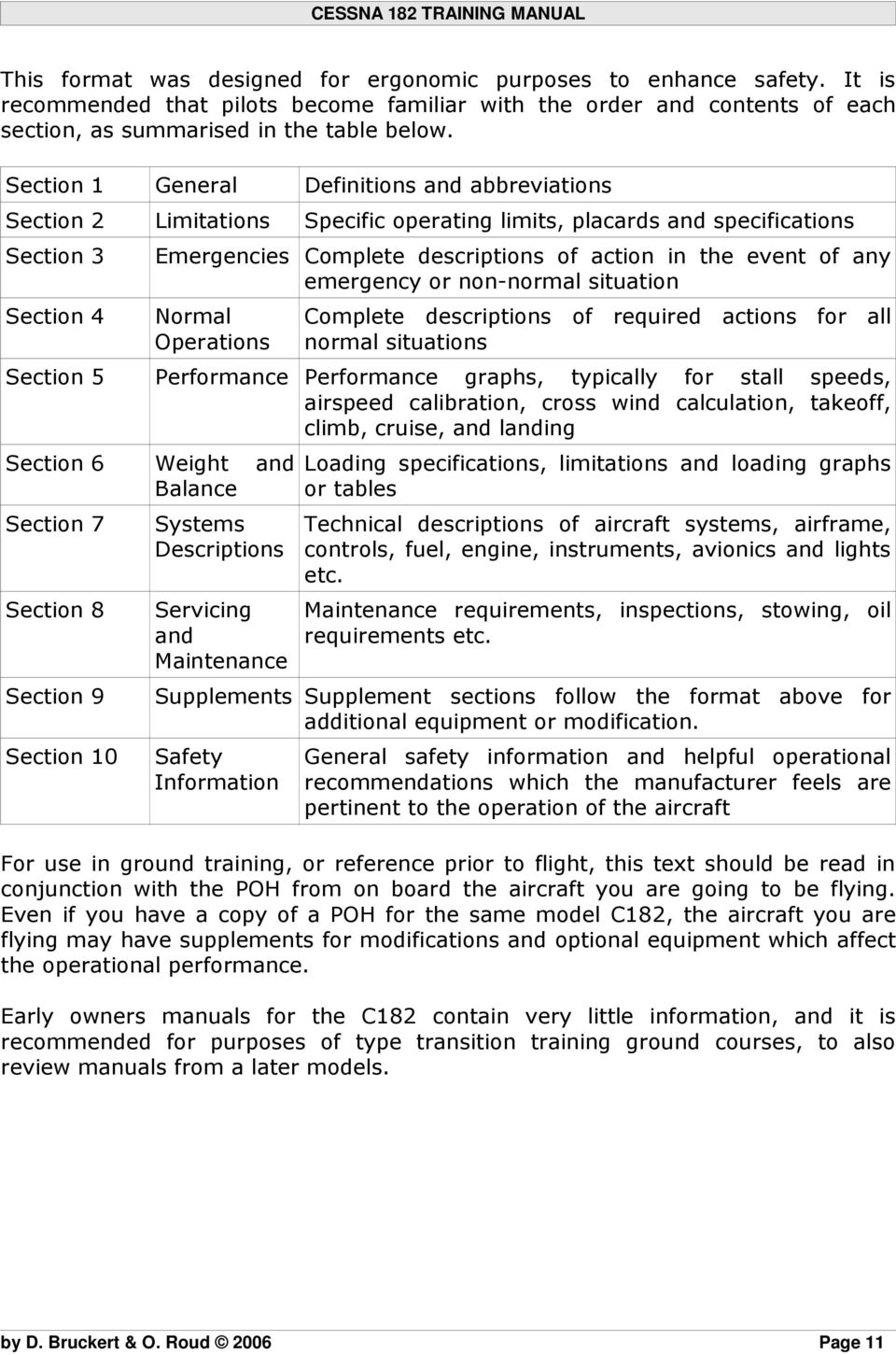
11 This format was designed for ergonomic purposes to enhance safety. It is recommended that pilots become familiar with the order and contents of each section, as summarised in the table below. Section 1 General Definitions and abbreviations Section 2 Limitations Specific operating limits, placards and specifications Section 3 Section 4 Section 5 Section 6 Section 7 Section 8 Section 9 Section 10 Emergencies Complete descriptions of action in the event of any emergency or non-normal situation Normal Operations Complete descriptions of required actions for all normal situations Performance Performance graphs, typically for stall speeds, airspeed calibration, cross wind calculation, takeoff, climb, cruise, and landing Weight and Balance Systems Descriptions Servicing and Maintenance Loading specifications, limitations and loading graphs or tables Technical descriptions of aircraft systems, airframe, controls, fuel, engine, instruments, avionics and lights etc. Maintenance requirements, inspections, stowing, oil requirements etc. Supplements Supplement sections follow the format above for additional equipment or modification. Safety Information General safety information and helpful operational recommendations which the manufacturer feels are pertinent to the operation of the aircraft For use in ground training, or reference prior to flight, this text should be read in conjunction with the POH from on board the aircraft you are going to be flying. Even if you have a copy of a POH for the same model C182, the aircraft you are flying may have supplements for modifications and optional equipment which affect the operational performance. Early owners manuals for the C182 contain very little information, and it is recommended for purposes of type transition training ground courses, to also review manuals from a later models. by D. Bruckert & O. Roud 2006 Page 11
12 Introduction This training manual provides technical and operational descriptions for the Cessna 182 aircraft. The information is intended as an instructional aid to assist with conversion training in conjunction with an approved training organisation and the POH from the aircraft you will be flying. The text is arranged according to standard training syllabi for ease of use and assimilation with training programs, rather than following the order of a POH which is designed for ergonomic reference and in-flight use. This material does not supersede, nor is it meant to substitute any of the manufacturer s operation manuals. The material presented has been prepared from the basic design data obtained in the pilot's operating handbook and from operational experience. History The Cessna aircraft company has a long and rich history. Founder Clyde Cessna built his first aeroplane in 1911, and taught himself to fly it! He went on to build a number of innovative aeroplanes, including several race and award winning designs. In 1934, Clyde's nephew, Dwane Wallace, fresh out of college, took over as head of the company. During the depression years Dwane acted as everything from floor sweeper to CEO, even personally flying company planes in air races (several of which he won!). Under Wallace's leadership, the Cessna Aircraft Company eventually became the most successful general aviation company of all time. Development of the C182 Due to it's versatility, load, and range, the Cessna 182 is one of the most popular 4 seat light aircraft in the private and recreational market. Approximately 23,000 C182s have been built to date, with the C182 still in production at the time of writing. The production began in 1965, spanning 50 years with a brief break between 1987 and It is the second most popular Cessna built, after the Cessna 172 which dominates the training market. The C182 began it's life as the tricycle conversion of the popular C180 tail wheel model, the first model very nearly resembling a C180 with the tail wheel removed. The name Skylane was first given to the C182A with deluxe options, and became the standard name later. Major changes to the airframe were made with the C182C and C182E, both bringing about the transformation in appearance to the resemble by D. Bruckert & O. Roud 2006 Page 12

13 the modern day shape. Further changes throughout the series were mainly related to improvements in structure, systems, and fittings. The Cessna 182 can be one of the safest and most rewarding aircraft that you may fly, providing you receive proper training, know the aircraft well, and operate according to the manufacturers recommendations. In this respect, make sure you understand the systems thouroughly, abide by the limitations, and never attempt to operate on or near the boundary of the aircraft's or your own limitation. Models and Differences As detailed on the previous page, the Cessna 182 model had a number of type variants during its production history. Additionally there are a number of postmanufacture modifications available for the airframe, instruments/avionics equipment and electrics. Speeds often vary between models by one or two knots, sometimes more for significant type variants. Whenever maximum performance is required the speeds will also vary with weight, and density altitude. For simplification the speeds have been provided for the model C182 Skylane, which was produced in the largest numbers. by D. Bruckert & O. Roud 2006 Page 13

14 All speeds have been converted to knots and rounded up to the nearest 5kts. Generally multiple provision of figures can lead to confusion for memory items and this application is safer for practical use during conversion training. During practical training reference should be made to the flight manual of the aeroplane you will be flying to ensure that the limitations applicable for that aeroplane are adhered to. Likewise when flying different models it should always be remembered that MAUW, flap limitations, engine limitations and speeds may vary from model to model. Before flying different models, particularly if maximum performance is required, the AFM should be consulted to verify differences. Model History We provide the following information to outline significant differences from an operational perspective. A detailed history is provided in the table following and in subsequent chapters. C182 The early model C182 had the same fuselage as the C180 ( straight back ), without the rear window. The main operational differences of the C182 are summarised here: manual flap lever and the limitation of 100mph (87kts) for all flap selections lower maximum all up weight (2550lbs) Various minor airframe changes were made to gradually bring about the more commonly known version of the C182 including: C182A Weight increased to 2650lbs; C182C Third window on cabin, swept tail; C182E Wrap around rear window, re-profiled cowlings, improved fairings, electric flaps, weight increased to 2800lbs, flap limits increased to 110mph (95kts), optional 8-USGal fuel tanks; The addition of the rear window, and swept tail, and later cowling and fairing modifications were mainly responsible for the present appearance of the C182. C182L Preselect flap control, first 10 degrees increased to 160mph (140kts); C182N Maximum takeoff weight increased to 2950lbs; C182P Tubular steel undercarriage increasing landing weight to 2950lbs, enlarged fin; C182Q Maximum rpm reduced to 2400 with O-470U designed for 100/130 fuel, vernier mixture control standard, electrical system changed to 28V and bladder tanks replaced with integral tanks with a higher standard fuel capacity of 88USGal; by D. Bruckert & O. Roud 2006 Page 14

15 C182R Takeoff weight increased to 3100, 20 degrees flap limit increased to 120kts; C182S Fuel injection, first 10 degrees increased to 100kts, annunciator panel, or optional G1000 avionics; C182T G1000 avionics now standard equipment. Major performance options were offered in the late 1970's including: C182RG (R182), Retractable version of the Skylane, improved speed but added responsibility. T182RG and T182, hp turbo charged version, service ceiling 20,000 (with oxygen!), added power, added maintenance, increase in MAUW to 3100lbs. When Cessna resumed production of it's single engine range in the 90's, a new and improved C182S was available. C182S, C182T, T182T 1997 on If you are lucky enough to find one of these it is really a dream to operate. After the recovery from public liability suits and the 80's recession, the C182 received upgraded systems and equipment to produce the same proven design with the latest accessories and support. Significant differences include: IO540 fuel injected engine, providing 230hp at 2400rpm; Full IFR avionics as standard installation including auto pilot; Warning and caution annunciator panel indications or optional G1000 avionics suite; The S and T have slightly lower load carrying capacity than earlier models due mainly to avionics installations, and the fuel injected system, although alleviating carburettor problems, can be quite complicated for the inexperienced pilot and differences training is highly recommended. Reims F182 Like all Reims productions we have to admit this model is also an excellent version. Only 169 aircraft were produced. Significant differences include: Lower stall speeds, similar to STOL equipped C182s; Slightly higher cruise speeds; Different airframe manufacturing processes. Robertson STOL kits Additions of Robertson STOL Kits (Sierra Industries) to the C182 produce remarkable short field performance and stall speeds that approach that of a 152, however without any significant increase drag in the cruise. It is an impressive by D. Bruckert & O. Roud 2006 Page 15

16 modification, however must be taken carefully if you wish to use it to its limits. Care should be taken at low speed where operating near the wrong side of the drag curve, particularly when at MAUW and with high density altitudes. Model History Versus Serial Number Model Name Year Starting Serial Number Significant Changes C lbs maximum weight, Continental 0470-L engine developing 230hp at 2600rpm, 14V electrical system. C182A Skylane for deluxe version only lbs maximum weight, increase from 60 to 65USgal fuel capacity, useable fuel remains at 55USgal. Some minor improvements to the airframe and fittings including modified instrument panel layout. Electrical fuel gagues and low voltage warning light standard C182B Cowl flaps added. Skylane name introduced for deluxe model. Exhaust moved for improved cooling, rudder linkages changed to bungee type, and improved instrument lighting. C182C Tail fin and rudder changed to a swept tail shape and third cabin side window added on each side. Flush caps replaced with standard raised grip fuel caps. Minor interior changes including plastic control wheel grip, and major changes to fuselage and cowling designs to improve maintenance. by D. Bruckert & O. Roud 2006 Page 16

17 Model Name Year Starting Serial Number Significant Changes C182D * The last of the 'straight back' models. The instrument panel layout improved, with the artificial horizon in a more direct line of sight from the left seat. Cowling fastenings changed to quick release type. Pull starter replaced by key starter. by D. Bruckert & O. Roud 2006 Page 17

18 Model Name Year Starting Serial Number Significant Changes C182E Maximum weight increased to 2800lbs Optional 84 USG tank (80 USG useable) Cut down rear fuselage and added "omni-vision" wraparound rear window, flap limit increased on all stages from 100mph to 110mph (95kts), manual flap replaced by electric flap with a toggle switch and indicator. Pull contactor master switch change to a rocker type. Engine changed to 0470-R. C182F C182 or Skylane Optional autopilot available. Improved overhead instrument lighting. C182G One piece rear window fitted, aft cabin windows enlarged. C182H Pointed spinner replaces rounded shape. Horizontal stabiliser and elevator width increased. One piece front windshield. C182J Rotary door latches fitted, larger cowl access panel provided for easier maintenance. by D. Bruckert & O. Roud 2006 Page 18

19 Model Name Year Starting Serial Number Significant Changes C182K An alternator replaces the generator for electrical power supply. C182L Flap toggle switch replaced by a preselect lever and floating arm indicator, flap limiting speed on first 10 degrees increased to 160mph (140kts). AH moved to central position, to resemble later more ergonomic instrument panel configurations. Sump fuel stainer control moved from instrument panel to beside oil dipstick. A182J Argentine 1966 A Argentinian built C182. A182K C A A182L 1968 A on C182M C182 or Generator output increased to 60 Amps. C182N Skylane Maximum takeoff weight increased to 2950lbs, landing weight remains 2800lbs. Split rocker master switch installed to isolate battery from alternator. C182N Shoulder harnesses standard in front seats, 80lbs baggage permitted in aft compartment, total still 120lbs. C182P C182 or Skylane Flat spring steel main landing gear struts replaced with tubular steel. Landing weight increased to 2950lbs to match takeoff weight. Baggage in aft compartment now total 200lbs (120 in forward part and 80 in aft part of compartment). Landing lights shifted from wing to nose cowling. Engine gauge markings relabelled with arcs for improved ergonomics. High voltage sensor and 'High Voltage' warning light replaces the generator warning light Factory installed avionics upgraded from 100 channel to 200 channel Door handles now close flush with armrest in locked position. by D. Bruckert & O. Roud 2006 Page 19

20 Model Name Year Starting Serial Number C182 Skylane only F182P Reims 1976 F F Significant Changes Engine changed to O-470-S. Improved cowling and fairing design increases reported cruise speed approximately 5kts. Lower profile glareshield Airspeed indicator changed from mph to kts, flap limit placards converted from 110mph to 95kts. Optional electric trim. Built by Reims in France A182M Argentine 1969 Not assigned Argentinian models. A182N C A A A182N 1971 Not assigned A182N 1972 Not assigned A182N AMC A A A182N C182Q Skylane or Skylane II Not assigned C182Q & C182Q Changed to Avgas 100/130 engine design with Continental O-470-U, developing 230hp at 2400rpm, maximum rpm reduced primarily for noise, but also a reported improved climb performance. Vernier mixture control now standard. Electrical system changed from 14 to 28 Volts, battery capacity 24V, or 15.5 amp-hr. Engine configured for Avgas 100LL/100. Avionics master switch installed. Window latch redesigned to sit flush with window indent. Integral fuel tank replaces bladder tank and capacity increased to 92USgal, 88USgal usable. Alternator control unit changed to integral unit, and 'HIGH VOLTAGE' warning light relabelled 'LOW VOLTAGE'. by D. Bruckert & O. Roud 2006 Page 20

21 Model Name Year Starting Serial Number C182Q , F182P Reims/ Cessna Skylane/II 1977 F F F182Q F Skylane 1978 F F F182Q F Skylane II 1979 F F F182Q 1980 F F C182R /T182 R182/ TR182 Skylane or Turbo Skylane/ Skylane II or Turbo Skylane II/ Skylane or Turbo Skylane -With Value Group A Skylane RG & Significant Changes New audio panel with marker beacons. A pull type alternator circuit breaker fitted. Built by Reims in France. Maximum weight increased to 3100lbs for takeoff, landing weight remains 2950lbs. Introduction of optional turbocharged engine with designator T182. Door latch redesigned to include an upper latching pin Low Vacuum warning light fitted, flap speed for 20 degrees increased to 120kts Rear shoulder harnesses standard R R Retractable version and turbo retractable version, with Lycoming O- 540-J3C5D, 235hp at 2400rpm. Note 1: Unlike most Cessna's which have the suffic RG to designate retractable, Cessna termed the retractable version of the Cessna 182 R182, unfortunately this is easily confused with the C182R and also can be confused with terminology used to designate the C172 military and Hawk XP version - R172 which is not retractable. In this text the term C182RG has been used to refer to the retractable version to avoid confusion. by D. Bruckert & O. Roud 2006 Page 21
22 Model Name Year Starting Serial Number 182S Skylane T Skylane 2001 on T182T Skylane TC 2001 on Significant Changes Engine changed to Lycoming IO-540- AB1A5, fuel injected, 230hp at 2400rpm, dual vacuum system, annunciator panel or optional G1000 avionics. Maximum ramp weight increased to 3110Lbs, takeoff and landing remain unchanged. First 10 degrees flap limit increased to 100kts Minor modifications to engine cowling, wheel fairings and step. G1000 avionics now standard equipment. T Lycoming TIO540-AK1A, turbo, fuel injected, 235hp at 2400rpm, 4 place oxygen system. Note 2: The designator T182/TR182 was given to models from 1978 on which were fitted with a turbocharger, again this should not be confused with the later design C182T which is normally aspirated. Common Modifications Table There are over 500 STCs on the C182, it would not be useful to list them all here. This table attempts to identify a few of the more commonly used and more widely beneficial modifications available. TYPE Any Any Any NAME and MANUFACTURER Air Research Technology Inc STOL kit Ski's/Floats (Various) Flight Bonus speed kit (available from Horton STOLcraft) Drag reduction kits (Various) DIFFERENCES and FEATURES Increases weight to 2950, useful on older models, extends the wing by 37 inches, which also increases performance. C182s (unlike the less suitable C172) unfortunately never had a factory float plane option available, however a number of STC's are available for full conversion to seaplane operation. Reported to improve cruise speed 12-18kts. Various normally involving speed fairings to reduce form drag, there are various drag reduction kits available to improve cruise speeds. by D. Bruckert & O. Roud 2006 Page 22
23 TYPE NAME and MANUFACTURER Engine Modifications, (Various) DIFFERENCES and FEATURES Various engine refits are available, the most common being the IO470, IO520, and IO550 engines, for improved performance. All these also being fuel injected, additionally address carburettor and carb-ice issues. Any Horton STOL Tip and wing surface modifications to permit lower stall speed, take-off and landing speeds and thus lower distances. Any Robertson STOL Increased lift, more speed, added stability, and lower stall speed, take-off and landing speeds and distances. Any Vortex Generators (Micro Aerodynamics) Reduction in surface drag and induced drag, improving boundary layer adherence, and decreasing stall speed, improved performance. Note: All manufacturers of performance related modifications will have full information available on the increases projected from the kit, in terms of speed, takeoff and landing, fuel burn, and climb enhancements. It is recommended that these figures be reviewed carefully in terms of desire attributes. Aircraft fitted with performance modifications must have POH supplements indicating difference these supplements must referred to in the relevant main sections of the POH where applicable. Any Any engines only Low Fuel Warning System, O & N Aircraft Modifications Warns when fuel remaining is less than approximately 7USGal for older models (restarts have a low fuel warning system). Fuel Cap Monarch Air Umbrella style fuel caps which fix problems with leaks, predominantly occurring in older flush mounted caps, (available for most Cessna types) Autogas modification, Various Engine modification to permit operation on autogas (available to engines were certified for operation with 80/87 octane, 1976 and prior). There is an increased tendency for carb icing and fuel vaporisation, and a slight power reduction, but Autogas can provide much lower costs and convenience in many countries by D. Bruckert & O. Roud 2006 Page 23
24 CESSNA 182 TRAINING MANUAL Early Model Straight-back/no Swept Tail C182 C182RG Skylane with Rear Window by D. Bruckert & O. Roud 2006 Page 24
25 AIRCRAFT TECHNICAL INFORMATION General The Cessna 182 aeroplane is a single engine, four seat, high wing monoplane aircraft, equipped with tricycle landing gear, and is designed for general utility purposes. by D. Bruckert & O. Roud 2006 Page 25
26 Airframe The airframe is a conventional design similar to other Cessna aircraft you may have flown (for example the C152, C172). The construction is a semi-monocoque type consisting of formed sheet metal bulkheads, stringers and stressed skin. Semi-monocoque construction is a light framework covered by skin that carries much of the stress. It is a combination of the best features of a strut-type structure, in which the internal framework carries almost all of the stress, and the pure monocoque where all stress is carried by the skin. The fuselage forms the main body of the aircraft to which the wings, tail section and undercarriage are attached. The main structural features are: Front and rear carry through spars for wing attachment; A bulkhead and forgings for landing gear attachment; A bulkhead and attaching plates for strut mounting; Four stringers for engine mounting attached to the forward door posts. The wings are all metal, semi-cantilever type with struts spanning the inner section of the wing. The wings contain either bladder or integral ie. non bladder type fuel tanks depending on the model as detailed in the picture below. by D. Bruckert & O. Roud 2006 Page 26
27 Engine & Engine Controls The aeroplane is powered by a flat 6 cylinder horizontally opposed piston engine. C182 models prior to 1977 are equipped with the 230hp Continental Series (L, R, S), carburettor equipped, normally aspirated engine, producing at sea level maximum continuous power of 230hp at 2600rpm. The C182Q was fitted with a Continental O-470-U developing 230hp at 2400rpm, with the change to 100 Octane Avgas (100/130, and later 100LL/100). The R182 (Skylane RG) retractable version was fitted with a Lycoming O-540 (J,L), developing 235hp at 2400rpm. After beginning production in 1996 later models were fitted with fuel injected Lycoming IO-540-A engine, developing 230hp at 2400rpm. The propeller is a two-bladed, constant speed, aluminium alloy McCauley propeller. The propeller is approximately 2m (6'10 metres) in diameter. Optional three blade installations are available for some models. by D. Bruckert & O. Roud 2006 Page 51
28 Engine Controls The engine control and monitoring consists of: Throttle control; Propeller pitch control; Mixture control; Carb. Heat selector; Fuel flow indicators (Fuel injected models C182S on); Engine monitoring gauges: Manifold pressure gauge; Tachometer; Oil temperature and pressure; Cylinder Head Temperature; Annunciator panel (C182S); Some optional equipment includes: Carburettor heat indicator; Exhaust Gas Temperature; Individual cylinder CHT/EGT indicators; G1000 engine instrumentation (C182S on). Throttle Engine power is controlled by a throttle, located on the lower centre portion of the instrument panel. The throttle controls a throttle valve (or butterfly) an oval metal disc pivoted on a central spindle that is perpendicular to the axis of the carburettor s manifold. The closed position of the valve is when the disc is rotated to an angle of about 70 to the axis of the manifold, preventing all but enough fuel/air for idling to pass through the manifold. When the valve is rotated to a position parallel to the axis of the manifold it offers very little restriction to airflow. This is the fully open position of the valve providing maximum fuel/air mixture to the manifold. The picture below shows a carburettor in the open and closed positions of the throttle butterfly. Throttle in Open Position Throttle in Closed Position by D. Bruckert & O. Roud 2006 Page 52
29 Fuel System Fuel is supplied to the engine from two wing fuel tanks. The approximate usable fuel capacity in the C182 series is: C182 to C182D - 55 US gallon (225 litres) standard bladder wing tanks; C182E to C182Q - 60 US gallon (225 litres) standard bladder wing tanks; C182E-C182Q - 75 or 80 US gallon (285 or 300 litres) optional long range bladder wing tanks. C182Q on - 88 US gallon (330 litres) standard integral tanks From these tanks, fuel flows by gravity feed through to the four position fuel shutoff valve and the fuel strainer, manual primer to the carburettor. The amount of fuel we can put into fuel tanks is limited by the volume of the tanks, and therefore usable fuel is always provided in volume, such as gallons and litres. However, the carburettor and engine are only sensitive to the mass of fuel, and not to the volume. The engine will consume a certain mass (lbs or kgs) of fuel per hour. Fuel has a wide variation in specific gravity (weight of fuel per volume) mostly depending on temperature and type of fuel. For practical purposes the specific gravity of Avgas is taken as 0.72 kgs/lt or 6 lbs/us gallon, but in reality this figure is only accurate for a limited range of temperatures, the density at -40 C is 0.77 kgs/lt 6.40 lbs/us gallon and thereafter decreases by approximately 0.5% per 5 C (9 F) increase in temperature. The change in density can have a noticeable affect when fueling, tanks subjected to a temperature change after being filled can be found overflowing or not quite full, depending on whether there was an increase or decrease in temperature. The variations in specific gravity of fuel will have a significant effect on the mass of fuel in the tanks for a specific volume, and therefore also on the range and endurance. For these reasons it is of vital importance to always include a contingency calculation when working out the fuel required. Fuel Selector The fuel valve is located on the floor of the cockpit between the pilot and co-pilot seats. The valve has four positions: LEFT, BOTH, RIGHT and OFF. With the valve in the BOTH position, fuel flows from both left and right tanks, through a strainer to the carburettor. The BOTH position must be selected for takeoff and landing as this ensures the fuel supply is not interrupted if one tank sump is uncovered during manoeuvring. by D. Bruckert & O. Roud 2006 Page 69
30 LEFT or RIGHT may be selected during level flight to restore imbalances. Uneven draining normally occurs regardless of aircraft balance because of the venting system, more fuel being used from the vented tank, see more below on fuel venting. When parked the fuel should be selected to OFF or the lower tank. If the fuel is left on BOTH fuel will drain by gravity through the fuel selector or vent line to the lower tank resulting in imbalance, and a possible loss of fuel, see more below under fuel vents. Fuel Tanks and Fuel Caps Some of the early model C182's, 1978 and earlier, are fitted with bladder tanks. That is the tank consists of a rubber bladder, glued fitted inside with wing, instead of the later integral type, which are a solid construction and incorporated into the wing structure. The disadvantage with bladder tanks it they have a tendency to develop wrinkles and trap water in folds as the glue perishes with time. If this occurs even though the tanks have been drained there may be still water present. Shaking the wings to ensure water is dislodged from creases and draining again after settling is recommended, especially if the aeroplane has been standing outside overnight in moist or wet weather. Bladder tanks are also subject to perishing over time, and may develop leaks evident by coloured stains from the fuel dye (blue or green) around the wing root, or small pieces of black rubber may appear in the fuel sample. These symptoms can also be caused by dislodged or perishing fuel drain seals. Both situations need to be checked out by an approved maintenance organisation. The models are additionally more susceptible to moisture intake due to their retaining the original flush style fuel caps. These caps have a small indent where water may collect and seep through the vent. Although these caps were originally fitted by Cessna, it is recommended they are replaced with the umbrella style caps which are lease susceptible to fuel leakage, and many aircraft have had them replaced. Be aware if you are operating an aircraft with the flush type of cap fitted, especially if the aircraft has been standing or subject to wet conditions. Fuel Measuring and Indication Fuel quantity is measured by two float-type fuel quantity transmitters (one in each tank), and indicated by two electrically-operated fuel quantity indicators on the lower left portion of the instrument panel. The full position of float produces a minimum resistance through transmitter, permitting maximum current flow through the fuel quantity indicator and maximum pointer deflection. by D. Bruckert & O. Roud 2006 Page 70
31 NORMAL PROCEDURES Pre-Flight Check The preflight inspection should be done in anticlockwise direction as indicated in the flight manual, beginning with the interior inspection. (1) Cabin Ensure the required documents (certificate of airworthiness, maintenance release, radio license, weight and balance, flight folio, flight manual, and any other flight specific) are on board and valid. Perform a visual inspection of the panel from right to left to ensure all instruments and equipment are in order. If night flight is planned ensure internal lights are operational. by D. Bruckert & O. Roud 2006 Page 92
32 Exterior Inspection Visually check the aircraft for general condition during the walk-around inspection, ensuring all surfaces are sound and no signs of structural damage, worked rivets, missing screws, lock wires or loose connections. If night flight is planned ensure all required lights are operational and crew torch is carried by each crew member. (2) Tail Section Check top, bottom, and side surfaces for any damage, balance weights secure. Rudder, elevator, and elevator trim secure and undamaged, linkages free, full and free movement of control. Linkage and turnbuckles secure, free of obstruction, lock wires in place. Elevator and horn balance weights secure. Beacon, aerials and rear navigation light undamaged and secure. (3) Right Wing Check top, bottom, and side surfaces for any damage. Ensure flap does not retract if pushed, flap rollers allow small amount of play in down position. Check for damage to surface and flap tracks, freedom of operating linkage and security of all fastenings. Check for damage to aileron surface and security of all hinges, lock-wires and flutter weights. Check condition, security and colour of navigation light. Check condition and security of fairing and strut. by D. Bruckert & O. Roud 2006 Page 95
33 Check static vent clear and free of any blockage (dual fitted). Check for security, condition of strut and tyre. Check tyre for wear, cuts, bruises, and slippage. Recommended tyre pressure should be maintained. Remember, that any drop in temperature of air inside a tyre causes a corresponding drop in air pressure. Check for security, condition of hydraulic lines, disc brake and all nuts. Use sampler cup and drain a small quantity of fuel from tank sump quick-drain valve to check for water, sediment and proper fuel grade. Check top and bottom wing surfaces for any damage or accumulations on wing. Ice or excessive dirt must be removed before flight. Ensure all aerials are secure and undamaged. Check the desired fuel level visually using a suitable calibrated dipstick. After checking the fuel. Ensure that fuel cap is secure. For the type illustrated the ridge should be parallel to the axis of flight. by D. Bruckert & O. Roud 2006 Page 96
34 CESSNA 182 TRAINING MANUAL (4) Nose Check propeller and spinner for nicks and security. Ensure propeller blades and spinner cover is secure. When engine is cold the propeller may be turned through to assist with pre-start lubrication. Always treat the propeller as live. Check condition and cleanliness of landing light (on some models may be on left wing). Check condition and security of air filter, air filter should be clear of any dust or other foreign matter. Visually check exhaust for signs of wear, on first flight or is engine is cool check exhaust is secure. Check nose gear of operating linkages, security and state of shimmy damper, and oleo for proper extension and damping. Check cowl flaps for rigidity and operation. Check security of nuts and split pins, the state and inflation of tyre, and state of wheel fairing. Open inspection cover, check oil level. Minimum oil 9 quarts (see oil system). Check oil cap secure through nose cowl opening. Before the first flight of the day and after each refueling, pull out fuel strainer to check the fuel sample. Check strainer drain closed. Check the security and condition of the engine cowling. (5) Differences on the Left Side Check all required items as described on the right wing, and additionally: Check static vent clear and free of any blockage (dual fitted). Remove the pitot tube cover, and check the pitot tube for cleanliness, security and clear opening passage. Check the fuel tank vent for security and clear opening passage. by D. Bruckert & O. Roud 2006 Page 97
35 PERFORMANCE SPECIFICATIONS Performance figures given at MAUW and speeds in KIAS unless specified otherwise. Figures provided are averages and rounded to the safer side, they may not correspond to the exact figures for your particular model. Structural Limitations Gross weight (take-off and landing) Maximum landing weight Standard empty weight Max Baggage allowance in aft compartment 2500lbs lbs 2500lbs -2950lbs 1620lbs-1880lbs 120lbs Flight load factor (flaps up) +3.8g 1.52g Flight load factor (flaps down) +3.5g 0 Engine Specifications Engine (Lycoming O-470 series) power 230 BHP at 2600 rpm Oil capacity 12Qts maximum, 9Qts minimum, 10 for normal operations* *Engineers recommendation to operate on the low side of the minimum oil requirements. Fuel Usable fuel Standard tanks 56 USG (225 litres) Long range tanks Wet Wing 75 USG (300 litres) 88 USG (300 litres) Tyre Pressures Main wheel tyre pressure Nose wheel tyre pressure 42 psi 49 psi Maximum Speeds Never Exceed Speed, (Vne) Maximum structural cruise speed (Vno)* 167kts (193mph) (top red line) 140kts (160mph) (top of green arc) Maximum demonstrated crosswind component** Maximum maneuvering speed (Va) 15kts 111kts (128mph) *May not be exceeded unless in smooth air conditions **May not apply to early models by D. Bruckert & O. Roud 2006 Page 135
36 An example of a navigation worksheet is shown below. FM TO Alt Temp W/V IAS TAS Trk T V Trk M G/S Dist EET TOTALS Note: a flight log will only contain the information needed in flight, typically magnetic track, distance, elapsed time, wind velocity and altitude. Cruise Performance The next step in ground planning after completion of the navigation log or determination of the flight time, is to calculate the fuel required. How much load you can carry is dependent on the required fuel. On the following page you will find example of CRUISE PERFORMANCE table from a C182 POH (Figure 5-4). The table is a sample only and should be not used for flight planing. For the flight we will use an outside temperature of 20ºC above standard temperature, or -1 degrees Celsius at 7500ft. At 65% power setting, using 2300rpm and 21 manifold pressure, for this particular model of C182, we obtain 135kts (156mph) and a fuel consumption of 12.2 gallons per hour. Using the conversion factors given in the beginning of this manual 1USG = 3.785Lt, we will in theory achieve 46 litres per hour fuel consumption. This figure is however in ideal conditions with the engine and airframe producing exactly the performance it achieved during testing. To allow for power variations in climb and provide a more conservative approach a block figure of 55 litres per hour and 125kts may be used for planning purposes. Using this figure for a 1.5 hour of flight we will require 82.5 litres of fuel. by D. Bruckert & O. Roud 2006 Page 139
The following information is an exert from THE CESSNA 182 TRAINING MANUAL, Oleg Roud and Danielle Bruckert
 The following information is an exert from THE CESSNA 182 TRAINING MANUAL, Oleg Roud and Danielle Bruckert Model History We provide the following information to outline significant differences from an
Multi Engine Oral Exam Questions
 Multi Engine Oral Exam Questions 1. What are the requirements for a multi-engine rating? 2. What is the max rated horse power at sea level? At 12,000 msl? 3. What is the rated engine speed? 4. What is
MULTI-ENGINE PISTON AEROPLANE ENDORSEMENT ENGINEERING, DATA AND PERFORMANCE QUESTIONNAIRE
 CAAP 5.23-1(1): Multi-engine Aeroplane Operations and Training 117 APPENDIX D TO CAAP 5.23-1(1) MULTI-ENGINE PISTON AEROPLANE ENDORSEMENT ENGINEERING, DATA AND PERFORMANCE QUESTIONNAIRE FOR (Aeroplane
FLYBLOCKTIME PA-28-140/160 Aircraft Type Checkout and Currency Quiz. NOTE: There may be one or more correct answers to each question.
 FLYBLOCKTIME PA-28-140/160 Aircraft Type Checkout and Currency Quiz Pilot s Name Date NOTE: There may be one or more correct answers to each question. 1 ) The engine in a PA-28-140/160 is a A. Continental
MULTI-ENGINE PISTON AEROPLANE ENDORSEMENT
 MULTI-ENGINE PISTON AEROPLANE ENDORSEMENT ENGINEERING, DATA AND PERFORMANCE QUESTIONNAIRE FOR---------------------------------------------------------------------------------------------------------- (Aeroplane
SINGLE ENGINE PISTON AEROPLANE ENDORSEMENT
 SINGLE ENGINE PISTON AEROPLANE ENDORSEMENT ENGINEERING, DATA AND PERFORMANCE QUESTIONNAIRE FOR (Aeroplane make and model) Version 1 August 1996 Name: Endorsed by: (Signature/Name) ARN: ARN Satisfactorily
Lancair Legacy Annual Condition Inspection Checklist
 Lancair Legacy Annual Condition Inspection Checklist Performed by: Completion Date: Complete Maintenance/Inspection Item Comments Pre-Inspection Research AD and Service bulletins Inspect entire airframe
MULTI-ENGINE TURBO-PROP AEROPLANE ENDORSEMENT
 MULTI-ENGINE TURBO-PROP AEROPLANE ENDORSEMENT ENGINEERING, DATA AND PERFORMANCE QUESTIONNAIRE FOR (Aeroplane make & model) Version 1 -August 1996 Name: ARN. Endorser: ARN: (Signature/Name) 1 The endorsement
MULTI-ENGINE TURBO-PROP AEROLANE ENDORSEMENT
 CAAP 5.23-1(1): Multi-engine Aeroplane Operations and Training 133 Appendix E to CAAP 5.23-1(1) MULTI-ENGINE TURBO-PROP AEROLANE ENDORSEMENT ENGINEERING, DATA AND PERFORMANCE QUESTIONNAIRE FOR (Aeroplane
SINGLE ENGINE TURBO-PROP AEROPLANE ENDORSEMENT
 SINGLE ENGINE TURBO-PROP AEROPLANE ENDORSEMENT ENGINEERING, DATA AND PERFORMANCE QUESTIONNAIRE FOR (Aeroplane make & model) Version 1-31 August 1996 Name: Endorser: (Signature/Name) Satisfactorily Completed
TYPE CERTIFICATE DATA SHEET Nº EA-2011T03 Type Certificate Holder: COSTRUZIONI AERONAUTICHE TECNAM S.r.l. Via Tasso, 478 80127 - Napoli Italy
 TYPE CERTIFICATE DATA SHEET Nº EA-2011T03 Type Certificate Holder: COSTRUZIONI AERONAUTICHE TECNAM S.r.l. Via Tasso, 478 80127 - Napoli Italy EA-2011T03-02 Sheet 01 TECNAM P2006T 04 May 2012 This data
AIRCRAFT GENERAL www.theaviatornetwork.com GTM 1.1 2005 1-30-05 CONTENTS
 www.theaviatornetwork.com GTM 1.1 CONTENTS INTRODUCTION... 1.2 GENERAL AIRPLANE... 1.2 Fuselage... 1.2 Wing... 1.2 Tail... 1.2 PROPELLER TIP CLEARANCE... 1.2 LANDING GEAR STRUT EXTENSION (NORMAL)... 1.2
File Number MDRA C20 MANUAL of PROCEDURES for INSPECTION of COMPOSITE AMATEUR-BUILT AIRCRAFT, INSPECTION AND TECHNICAL INFORMATION RECORD
 File Number MDRA C20 MANUAL of PROCEDURES for INSPECTION of COMPOSITE AMATEUR-BUILT AIRCRAFT, INSPECTION AND TECHNICAL INFORMATION RECORD GENERAL Section 1.4 FINAL INSPECTION 1. Have all re-inspection
This is the third of a series of Atlantic Sun Airways CAT B pilot procedures and checklists for our fleet. Use them with good judgment.
 This is the third of a series of Atlantic Sun Airways CAT B pilot procedures and checklists for our fleet. Use them with good judgment. Dimensions: Span 107 ft 10 in Length 147 ft 10 in Height 29ft 7 in
MODULE 11B. PISTON AEROPLANE AERODYNAMICS, STRUCTURES AND SYSTEMS
 MODULE 11B. PISTON AEROPLANE AERODYNAMICS, STRUCTURES AND SYSTEMS Note: The scope of this Module should reflect the technology of aeroplanes pertinent to the A2 and B1.2 subcategory. 11.1 Theory of Flight
European Aviation Safety Agency
 TCDS No.: R.010 MBBBK117 Page 1 of 53 European Aviation Safety Agency EASA TYPECERTIFICATE DATA SHEET No. R.010 for MBBBK117 Type Certificate Holder AIRBUS HELICOPTERS DEUTSCHLAND GmbH Industriestrasse
Cessna 172SP & NAV III Maneuvers Checklist
 Cessna 172SP & NAV III Maneuvers Checklist Introduction Power Settings This document is intended to introduce to you the standard method of performing maneuvers in Sunair Aviation s Cessna 172SP and NAV
European Aviation Safety Agency
 TCDS No.: EASA.IM.A.348 Gulfstream G280 Page 1 of 14 European Aviation Safety Agency EASA TYPE-CERTIFICATE DATA SHEET No. EASA.IM.A.348 for Gulfstream G280 Type Certificate Holder: GULFSTREAM AEROSPACE
NOTICE. Dec 2/96 CESSNA AIRCRAFT COMPANY ORIGINAL ISSUE - 2 DECEMBER 1996
 NOTICE AT THE TIME OF ISSUANCE, THIS INFORMATION MANUAL WAS AN EXACT DUPLICATE OF THE OFFICIAL PILOT'S OPERATING HANDBOOK AND FAA APPROVED AIRPLANE FLIGHT MANUAL AND IS TO BE USED FOR GENERAL PURPOSES
Exam questions for obtaining aircraft licenses and ratings
 Exam questions for obtaining aircraft licenses and ratings Subject: PPL (A) Flight performance and planning Revision 1 07.10.2009. Period of validity: 01 January 2010 th - 31 December 2010 th Belgrade
2013 Airborne Aviation Pty Ltd www.airborne-aviation.com.au
 Aircraft Information Booklet Cessna 182T VH-SDN Last revised: 11 November 2013 2013 Airborne Aviation Pty Ltd www.airborne-aviation.com.au THIS PAGE INTENTIONALLY LEFT BLANK Contents Aircraft Overview
Municipal Airport 1410 Arizona Place S.W. Orange City, IA 51041-7453. www.angelaircraft.com [email protected] 712.737.3344
 Municipal Airport 1410 Arizona Place S.W. Orange City, IA 51041-7453 www.angelaircraft.com [email protected] 712.737.3344 PERFORMANCE SPECIFICATIONS POWERPLANT PROPELLER Lycoming IO-540 300 HP @2700
This is the fourth of a series of Atlantic Sun Airways CAT B pilot procedures and checklists for our fleet. Use them with good judgment.
 This is the fourth of a series of Atlantic Sun Airways CAT B pilot procedures and checklists for our fleet. Use them with good judgment. Dimensions: Wing Span: 112 ft 7 in Length: 129 ft 6 in Height: 41
Aviation Supplies & Academics, Inc. 7005 132nd Place SE Newcastle, Washington 98059-3153 www.asa2fly.com
 The Pilot s Manual 1: Flight School Aviation Supplies & Academics, Inc. 7005 132nd Place SE Newcastle, Washington 98059-3153 www.asa2fly.com Originally published by Aviation Theory Centre 1990 1993. Fourth
General Characteristics
 This is the third of a series of Atlantic Sun Airways CAT C pilot procedures and checklists for our fleet. Use them with good judgment. Note, the start procedures may vary from FS9 Panel to Panel. However
CUB CRAFTERS, INC. CC11-160 PILOT S OPERATING HANDBOOK AND FLIGHT TRAINING SUPPLEMENT
 CUB CRAFTERS CUB CRAFTERS, INC. PILOT S OPERATING HANDBOOK AND FLIGHT TRAINING SUPPLEMENT Airplane Serial Number: Airplane Registration Number: This airplane is approved as a special light-sport category
The SeaRey - An Introduction
 The SeaRey - An Introduction Welcome to the beautiful Progressive Aerodyne SeaRey. The SeaRey is a very special aircraft. Created by a small team of engineers the SeaRey is perhaps the ultimate kit built
Sport Aviation Specialties
 Sport Aviation Specialties 2707 NW Cedar Brook, Lee s Summit, MO 64081, 816-838-6235, www.sportaviationspecialties.com WEIGHT & BALANCE FOR ELSA In certificating light-sport aircraft and conducting ELSA
BOMBARDIER CRJ700. Bombardier CRJ700 Aircraft Reference
 Bombardier CRJ700 Aircraft Reference V 1 Takeoff Decision Speed, dry runway 50,000 lbs, (flaps 8) 144 KIAS 50,000 lbs, (flaps 20) 134 KIAS V R Rotation Speed, dry runway 50,000 lbs, (flaps 8) 144 KIAS
TYPE CERTIFICATE DATA SHEET
 No Revision Aircraft Date VA502 7 SB7L-235 SB7L-360 SB7L-360A SB7L-360A2 5 May 2016 TYPE CERTIFICATE DATA SHEET This data sheet, which is part of Type Certificate No. VA502, Issue 4, lists the conditions
King Air C90A. Speeds (KIAS)
 King Air C90A Speeds (KIAS) V MCA 90 V SSE 97 V X 101 V Y 111 V XSE 100 V YSE 107 V A 169 V REF 100 V MO 208 V FE 178 35% 137 100% V LE 156 129 Retraction only Other 95 Balked landing climb 125 Glide 161
Oral Preparation Questions
 Oral Preparation Questions The oral section of the practical test is the time when you need to demonstrate your understanding of the various tasks listed in the practical test standards and the factors
CIRRUS AIRPLANE MAINTENANCE MANUAL
 UNSCHEDULED MAINTENANCE CHECKS 1. DESCRIPTION The following describes those maintenance checks and inspections on the aircraft which are dictated by special or unusual conditions which are not related
NIFA NATIONAL SAFECON
 NIFA NATIONAL SAFECON 2007 Manual Flight Computer Accuracy Explanations Note to competitor: This will offer some basic help in solving the problems on the test. There is often more than one way to correctly
Airglas, Inc. MANUAL NO. GLH3000-105-AHSA. MODEL GLH3000 Ski Kit Actuated by Wipaire, Inc. Amphibious Float Hydraulic System
 Airglas, Inc. Amphibious hydraulic system addendum to Instructions for Continued Airworthiness Including Installation, Maintenance and Service Instructions MANUAL NO. GLH3000-105-AHSA MODEL GLH3000 Ski
European Aviation Safety Agency
 TCDS No.: IM.R.133 Restricted Page 1 of 12 European Aviation Safety Agency EASA TYPE-CERTIFICATE DATA SHEET No. IM.R.133 for Kamov Ka-32A11BC Type Certificate Holder Kamov Company Moscow Russian Federation
LANDING GEAR & BRAKES www.theaviatornetwork.com GTM 14.1 2005 1-30-05 CONTENTS INTRODUCTION... 14.2
 www.theaviatornetwork.com GTM 14.1 CONTENTS INTRODUCTION... 14.2 GENERAL... 14.2 MAIN LANDING GEAR... 14.2 Landing Gear Latch Lever and Handle... 14.2 Landing Gear Pressure Gauge... 14.2 Landing Gear Warning
European Aviation Safety Agency: Ottoplatz 1, D-50679 Cologne, Germany - easa.europa.eu
 EASA.A.412 Description: Language: TCDS: Product type: Manufacturer/TC Holder: A.412 Tecnam P92 English EASA.A.412 Aircraft (CS-25, CS-22, CS-23, CS-VLA, CS-LSA) TECNAM Costruzioni Aeronautiche European
PRELIMINARY REPORT AVIATION
 Location/Time Most Critical Injury: Investigated By: NTSB Nearest City/Place Zip Code Local Time Time Zone Orange MA 01364 2115 EDT Aircraft Information Registration Number Aircraft Manufacturer Model/Series
Light Sport West Standard Flight Training Procedures for N110GX (Remos GX, 100 H.P.)
 Light Sport West Standard Flight Training Procedures for N110GX (Remos GX, 100 H.P.) Welcome to Light Sport West! Thank you for giving us the opportunity to provide all of your flight training needs. Our
Nomad WINGS FLAP OPERATING LIMITATIONS
 WINGS FLAP OPERATING LIMITATIONS 1. PLANNING INFORMATION A. Effectivity (1) Aircraft affected: N22 Series line sequence numbers 1 to 9, 11 to 29, 31, 33, 35, 37, 39 to 41, 43, 45, 47 to 59, 63, 65 to 70,
CIVIL AVIATION AUTHORITY OF THE CZECH REPUBLIC
 CIVIL AVIATION AUTHORITY OF THE CZECH REPUBLIC 62 001 - L 200 D Revision 3 Aircraft Industries, a.s. L 200 D 05.09.2005 TYPE CERTIFICATE DATA SHEET No. 62 001 - L 200 D This data sheet which is a part
031 AIRCRAFT MASS & BALANCE. G LONGHURST 1999 All Rights Reserved Worldwide
 031 AIRCRAFT MASS & BALANCE G LONGHURST 1999 All Rights Reserved Worldwide COPYRIGHT All rights reserved. No part of this publication may be reproduced, stored in a retrieval system, or transmitted, in
DEPARTMENT OF TRANSPORTATION FEDERAL AVIATION ADMINISTRATION
 DEPARTMENT OF TRANSPORTATION FEDERAL AVIATION ADMINISTRATION 3A12 Revision 77 CESSNA 172 172I 172A 172K 172B 172L 172C 172M 172D 172N 172E 172P 172F (USAF T-41A) 172Q 172G 172R 172H (USAF T-41A) 172S June
The Dramatic Effects of Pitot-Static System Blockages and Failures. References... 51
 The Dramatic Effects of Pitot-Static System Blockages and Failures by Luiz Roberto Monteiro de Oliveira. Table of Contents I II III IV V VI Introduction.1 Pitot Static Instruments..3 Blockage Scenarios
CESSNA 172 CHECKLIST TAXI PRE-EXTERNAL CHECKS. 1. Lights - As required 2. Brakes - CHECK 3. Rolling Instruments Check - L/R
 CESSNA 172 CHECKLIST PRE-EXTERNAL CHECKS TAXI 1. Wing & Engine covers - REMOVED 2. Control lock - REMOVED 3. Trim Check - Full Movement 4. Master - BATTERY ONLY - On 5. Flaps - Down to 20 Degrees 6. Lights
Aircraft (CS-25, CS-22, CS-23, CS-VLA, CS-LSA) ALENIA AERMACCHI
 EASA.A.586 Description: Language: TCDS: Product type: Manufacturer/TC Holder: A.586 Alenia English EASA.A.586 Aircraft (CS-25, CS-22, CS-23, CS-VLA, CS-LSA) ALENIA AERMACCHI European Aviation Safety Agency:
Cherokee Archer II Pilot s Operating Handbook
 Cherokee Archer II Pilot s Operating Handbook Cherokee Archer II PA-28-181 Handbook Part No. 761 624 New Piper Aircraft And The Notre Dame Pilot Initiative Partners in Aviation Education Not to be used
Assessment Specifications for Remotely Piloted Aircraft Systems, Class 1 AS-RPAS1
 AMC Civil Aviation Authority The Netherlands Assessment Specifications for Remotely Piloted Aircraft Systems, Class 1 AS-RPAS1 Version 1.1 1 December 2014-1 - CONTENTS (general layout) AS RPAS1 REMOTELY
Compiled by Matt Zagoren
 The information provided in this document is to be used during simulated flight only and is not intended to be used in real life. Attention VA's - you may post this file on your site for download. Please
This section includes performance data on the King Air B200. Information consists of:
 King Air B200 POH Pilot's Operating Handbook: This section includes performance data on the King Air B200. Information consists of: 1. Critical Airspeeds 2. Operating NOTAMS 3. Fuel Loading Formula Checklists:
S-Tec System Thirty Autopilot
 Cirrus Design Section 9 Pilot s Operating Handbook and FAA Approved Airplane Flight Manual Supplement for S-Tec System Thirty Autopilot When the S-Tec System Thirty Autopilot is installed in the Cirrus
Page 1 of 12. Tecnam P2002 EASAA. Via Tasso, 478 80127 Napoli ITALIA P20022
 TCDS A.006 Tecnam P2002 Page 1 of 12 European Aviation Safety Agency EASAA TYPE-CERTIFICATE DATA SHEET EASA.A..006 P20022 Type Certificate Holder: Costruzioni Aeronautiche TECNAM S.r.l. Via Tasso, 478
Katana EP. Specifications. 301 sq in / 19.4 sq dm. * Specifications are subject to change without notice.*
 INSTRUCTION MANUAL Katana EP Outrunner Motor Requires: -channel radio w/ micro servos, 0A Brushless ESC, 3 cells.v 00mAh Li-Po battery & charger. Wing Span Wing Area Flying Weight Fuselage Length HIGH
Super King Air 200. Speeds (KIAS)
 Super King Air 200 Speeds (KIAS) V MCA 86 V SSE 104 V X 100 V Y 125 V XSE 115 V YSE 121 V A 181 V REF 103 132 with no flap V MO 260 270 for old models M MO 0,52 0,48 for old models V FE 200 40% 146 100%
CHAPTER 11 MARKING AND PLACARDS
 CHAPTER 11 MARKING AND PLACARDS P/N 135A-970-100 Chapter 11 REVISION E Page 1 of 38 Copyright 2010 All rights reserved. The information contained herein is proprietary to Liberty Aerospace, Incorporated.
2014 NIFA CRM Contestant Briefing Guide San Diego, California
 2014 NIFA CRM Contestant Briefing Guide San Diego, California Region 2 SAFECON 2014 November 12 15 This document supports the 2014 NIFA Collegiate Cockpit Resource Management Simulation and is not for
Aircraft (CS-25, CS-22, CS-23, CS-VLA, CS-LSA) AERO AT Sp.z.o.o
 EASA.A.021 Description: Language: TCDS: Product type: Manufacturer/TC Holder: A.021 Aero AT-3 R100 English EASA.A.021 Aircraft (CS-25, CS-22, CS-23, CS-VLA, CS-LSA) AERO AT Sp.z.o.o European Aviation Safety
Cessna Skyhawk II / 100. Performance Assessment
 Cessna Skyhawk II / 100 Performance Assessment Prepared by John McIver B.Eng.(Aero) Temporal Images 23rd January 2003 http://www.temporal.com.au Cessna Skyhawk II/100 (172) Performance Assessment 1. Introduction
Assembly and Operating Manual Nano warbirds FW 190 Specification: *Length: 18 1/2"(470mm) *Wing Span: 21 7/10"(550mm)
 Assembly and Operating Manual Nano warbirds FW 190 Specification: *Length: 18 1/2"(470mm) *Wing Span: 21 7/10"(550mm) *Flying Weight: 6 1/2 oz (185g) Dear customer, Congratulations on your choice of a
1/5 PIPER J-3 CUB. Before commencing assembly,please read these instructions thoroughly. Wing Span:84. 0 in / 2130 mm
 INSTRUCTION MANUAL Before commencing assembly,please read these instructions thoroughly. 1/5 PIPER J-3 CUB 1/5 PIPER J-3 CUB Wing Span:8. 0 in / 130 mm Wing Area:968 sq in / 6. 5 sq dm Flying Weight:8.
FLIGHT TRAINING (AEROPLANE) BASED ON JAR FCL - PPL(A) FLIGHT INSTRUCTION Syllabus
 FLIGHT TRAINING (AEROPLANE) BASED ON JAR FCL - PPL(A) FLIGHT INSTRUCTION Syllabus for MARSPOLAR, DUBAI UAE Exercise 1 Familiarisation with the aeroplane characteristics of the aeroplane cockpit layout
Revision Number Revision Date Insertion Date/Initials 1 st Ed. Feb 01, 00 2 nd Ed. Jun 24, 02 3rd Ed. Feb 15, 07
 List of Effective Pages * Asterisk indicates pages changed, added, or deleted by current revision. Retain this record in front of handbook. Upon receipt of a Record of Revisions revision, insert changes
FLIGHT CONTROLS 1. GENERAL 2. MAIN COMPONENTS AND SUBSYSTEMS ROLL CONTROL. Smartcockpit.com BOEING 737 SYSTEMS REVIEW Page 1
 Smartcockpit.com BOEING 737 SYSTEMS REVIEW Page 1 FLIGHT CONTROLS 1. GENERAL The primary flight controls, ailerons, elevators and rudders, are hydraulically powered. Hydraulic power is provided from hydraulic
FLY SYNTHESIS STORCH HS-CL
 STORCH HS-CL MAINTENANCE MANUAL (ALID FOR ROTAX 912 UL AND JABIRU 2200 ENGINES) 00 28/05/07 New manual issue Num. Date Description Issued erify Approvation REISION The FlySynthesis s.r.l. it reserves him
(AUS, NZL, UK, GER, RUS, SA, USA,
 Supermarine Aircraft Pty Ltd Supermarine Aircraft Kits Supermarine Aircraft has been in business for the last seventeen years selling our spitfire kits and in the last seven years Engines. We have sold
NIFA REGIONAL SAFECON 2006 Manual Flight Computer Accuracy Explanations
 NIFA REGIONAL SAFECON 2006 Manual Flight Computer Accuracy Explanations Note to competitor: This will offer some basic help in solving the problems on the test. There is often more than one way to correctly
Instruction Manual Specification:
 Instruction Manual Specification: Wingspan: 1855mm (73 ) Length: 1970mm (77.5 ) Weight: 7.5-9Kg (Approx.) Radio: 6+ Channel (Required) Turbine: 50-100N (5-10Kg) (Recommended) Introduction Congratulations
Wynn s Extended Care
 Wynn s Extended Care Every car deserves to receive the very best care... especially yours. How Do You Keep Your Reliable Transportation Reliable? Count on Wynn s Because Wynn s has been caring for cars
Turbocharger system components, servicing
 21-1 Turbocharger system components, servicing Engine codes: AAZ, 1Z, AHU Observe rules of cleanliness Page 21-10 Turbocharger hoses and lines, connecting Page 21-11 WARNING! Do not re-use any fasteners
The most exciting benefit of the GENESIS Conversion, by D Shannon is that it comes with a Maximum Gross Take-off Weight of 4000 lb.
 Webster s Dictionary defines the word Genesis as forming, combining form meaning origination, creation, formation, evolution. In short, we have combined a number of our existing Bonanza modifications to
This file contains the full script of the corresponding video, published on YouTube. November 2014: http://youtu.be/wbu6x0hsnby
 This file contains the full script of the corresponding video, published on YouTube. November 2014: http://youtu.be/wbu6x0hsnby Background papers and links to formal FAA and EASA Aviation Regulations and
Approval for the issue of a Permit to Fly
 AIRWORTHINESS APPROVAL NOTE NO: 20330 APPLICANT: Charles Church (Spitfires) Ltd AIRCRAFT TYPE: Hispano HA1112 M1L REGISTRATION NO: G-HUNN CONSTRUCTOR'S NO: 235 Approval for the issue of a Permit to Fly
Certification Specifications for Large Rotorcraft CS-29
 European Aviation Safety Agency Certification Specifications for Large Rotorcraft CS-29 11 December 2012 CS-29 CONTENTS (general layout) CS 29 LARGE ROTORCRAFT BOOK 1 CERTIFICATION SPECIFICATIONS SUBPART
Fire Pump Plan Review March 2010
 Fire Pump Plan Review March 2010 Date of Review: / / Permit Number: Business/Building Name: Address of Project: Designer Name: Designer s Phone: Contractor: Contractor s Phone: Occupancy Classification:
Build and Fly the Fokker D- 8
 Details are carefully carried out. Note movable controls The high wing gives it unusual stability Build and Fly the Fokker D- 8 Complete Data From Which You Can Build a Successful Model of a Famous German
Class 5 to 7 Truck and Bus Hydraulic Brake System
 Class 5 to 7 Truck and Bus Hydraulic Brake System Diagnostic Guide 1st Edition * 5+0 Important Service tes The information in this publication was current at the time of printing. The information presented
CDS TROUBLESHOOTING SECTION I. VACUUM. 1.0. Weak vacuum at wand. Gauge reads normal (10hg to 14hg)
 CDS TROUBLESHOOTING SECTION I. VACUUM 1.0. Weak vacuum at wand. Gauge reads normal (10hg to 14hg) 1.1. Clogged hoses or wand tube. Disconnect hoses and carefully check for an obstruction. 1.2. Excessive
Chapter 2. Basic Airplane Anatomy. 2008 Delmar, Cengage Learning
 Chapter 2 Basic Airplane Anatomy Objectives Identify components of basic aircraft anatomy Understand aircraft size and weight categories List different types and examples of General aviation aircraft Military
301.7D. Mini Hydraulic Excavator
 301.7D Mini Hydraulic Excavator Engine Weights Gross Power (ISO 14396) 17.9 kw 24.3 hp Operating Weight with Canopy 1610 kg 3,550 lb Net Power 13.2 kw 17.7 hp Operating Weight with Cab 1720 kg 3,792 lb
McCAULEY FULL FEATHERING CONSTANT SPEED PROPELLER GOVERNING SYSTEM. Professor Von Kliptip Answers Your Questions About The
 Professor Von Kliptip Answers Your Questions About The McCAULEY FULL FEATHERING CONSTANT SPEED PROPELLER GOVERNING SYSTEM FOR COUNTERWEIGHTED PRESSURE-TO- DECREASE PITCH PROPELLERS ON RECIPROCATING ENGINES
VARIABLE STABILITY FLIGHT OPERATIONS MANUAL
 SPACE INSTITUTE VARIABLE STABILITY FLIGHT OPERATIONS MANUAL Prepared by the Aviation Systems and Flight Research Department September 2004 Index 1.1 General Description...1 1.2 Variable Stability System...5
Cessna Grand Caravan Pilot s Technical Examination
 Cessna Grand Caravan Pilot s Technical Examination Version 1.0 2003-05-13 Candidate Name Licence class Private/Commercial/ATP Examiner Licence number Name Licence number Capacity Centre Date 200 -- --
European Aviation Safety Agency: Ottoplatz 1, D-50679 Cologne, Germany - easa.europa.eu
 EASA.A.527 Description: Language: TCDS: Product type: Manufacturer/TC Holder: A.527 AQUILA AT01 English EASA.A.527 Aircraft (CS-25, CS-22, CS-23, CS-VLA, CS-LSA) AQUILA Aviation GmbH European Aviation
Technical data. Assembly: Introduction. Before starting construction. Equipment needed. Glider or Electro Glider?
 Palio pro S2084 Technical data Wing span: Lenght: Weight: Wing area: Wing loading: El. Motor/ no. of cells: Controls: Introduction 2150 mm 1150 mm 1120 g 1860 g 42 dm2 27 g/dm2 44 g/dm2 600 / 7-8 cells
Specifications. *Specifications are subject to change without notice.*
 INSTRUCTION MANUAL Extra 300 EP (0) 50W Motor System Requires : -channel radio w/ mini servos, Outrunner Motor KM37810, w/ Propeller Adaptor HW3010, 0A Brushless ESC with 11x8E proepller, cells 1.8V 300mAh
2009 Annual Inspection Airframe Logbook Entry
 2009 Annual Inspection Airframe Logbook Entry N724MC Cessna 150L 150-72198 5,528.4 Engine Lycoming O-320-A2B RL-22173-27A 2,115.9 965.9 Propeller McCauley 1C172/TM-7456 E 8764 (Position) (Make and Model)
AIRCRAFT PERFORMANCE Pressure Altitude And Density Altitude
 Performance- Page 67 AIRCRAFT PERFORMANCE Pressure Altitude And Density Altitude Pressure altitude is indicated altitude corrected for nonstandard pressure. It is determined by setting 29.92 in the altimeter
AVIATION OCCURRENCE REPORT A98W0192 ENGINE FAILURE
 Transportation Safety Board of Canada Bureau de la sécurité des transports du Canada AVIATION OCCURRENCE REPORT A98W0192 ENGINE FAILURE MARTINAIR HOLLAND N.V. BOEING 767-300 PH-MCI CALGARY INTERNATIONAL
LYCOMING OPERATOR S MANUAL SECTION 3 OPERATING INSTRUCTIONS
 LYCOMING OPERATOR S MANUAL SECTION 3 Page General... 3-1 Prestarting Items of Maintenance... 3-1 Starting Procedures... 3-1 Cold Weather Starting... 3-3 Ground Running and Warm-Up... 3-3 Ground Check...
CENTRE EST AERONAUTIQUE
 Identification : Aeroplane Type DR 1050M1 Sicile Record Serial No 579 Engine : Type Continental 0200A Serial No 20R-077 Propeller : Type Ratier FH 110-R Serial No 26 Registration : G-BAEE Flight Manual
PILOT OPERATING HANDBOOK
 ZODIAC 601XL / 601XLi / 650LS / 650LSi SLSA CONTINENTAL 0-200 100 H.P. PILOT OPERATING HANDBOOK REGISTRATION: SERIAL NUMBER: AMD Original date of issue: November 2009 Revision 2 March 2010 PILOT OPERATING
MOBILE FIRE - RESCUE DEPARTMENT FIRE CODE ADMINISTRATION
 MOBILE FIRE - RESCUE DEPARTMENT FIRE CODE ADMINISTRATION Fire Pump Plan Review 2009 International Fire Code and NFPA 20 Date of Review / / BLD201 - Project Address: Project Name: Contractor s Business
Pilot operating handbook. And. Flight operating supplement. AEROPRO + EuroFOX Aviation. EuroFOX
 ` AEROPRO, Production of UL Planes Dlha 126, 949 07 NITRA Slovakia www.aeropro.sk Pilot operating handbook And Flight operating supplement AEROPRO + EuroFOX Aviation EuroFOX The aircraft design has been
TOYOTA ELECTRONIC TRANSMISSION CHECKS & DIAGNOSIS
 Checks and Adjustments The transmission requires regular maintenance intervals if it is to continue to operate without failure. As we discussed in previous sections, transmission fluid loses certain properties
FUEL. Fuel is contained in three tanks located within the wings and wing center section.
 Smartcockpit.com BOEING 737 SYSTEMS REVIEW Page 1 FUEL 1. GENERAL Fuel is contained in three tanks located within the wings and wing center section. There a 3 tanks : Main tanks No. 1 and No. 2 are integral
European Aviation Safety Agency
 TCDS EASA.A.151 AIRBUS A350 Page 1/14 European Aviation Safety Agency EASA TYPE-CERTIFICATE DATA SHEET No. EASA.A.151 AIRBUS A350 Type Certificate Holder: AIRBUS S.A.S. 1 Rond-point Maurice Bellonte 31707
AVIATION SCIENCE LESSON 6: FUEL PUMPS AND FUEL SYSTEMS. Paul Ladegard, Alan Dick
 AVIATION SCIENCE LESSON 6: FUEL PUMPS AND FUEL SYSTEMS Teachers: Paul Ladegard, Alan Dick Subject: Aviation Science Grades: Secondary Duration of Lesson: 5-6 Hours Subjects: Technology, Science Learning
32:(5#5$7,1* 4833#USP283#+] 4;33#USP293#+] 3ULPH 10.4 kva, 8.3 kw 12.9 kva, 10.3 kw 6WDQGE\ 11.3 kva, 9 kw 14.4 kva, 11.5 kw
![32:(5#5$7,1* 4833#USP283#+] 4;33#USP293#+] 3ULPH 10.4 kva, 8.3 kw 12.9 kva, 10.3 kw 6WDQGE\ 11.3 kva, 9 kw 14.4 kva, 11.5 kw](/thumbs/33/15930623.jpg "32:(5#5$7,1* 4833#USP283#+] 4;33#USP293#+] 3ULPH 10.4 kva, 8.3 kw 12.9 kva, 10.3 kw 6WDQGE\ 11.3 kva, 9 kw 14.4 kva, 11.5 kw") ,QGXVWULDO#*HQHUDWRU 32:(5#5$7,1* 4833#USP283#+] 4;33#USP293#+] 3ULPH 10.4 kva, 8.3 kw 12.9 kva, 10.3 kw 6WDQGE\ 11.3 kva, 9 kw 14.4 kva, 11.5 kw Generator set consisting of engine and alternator mounted
,QGXVWULDO#*HQHUDWRU 32:(5#5$7,1* 4833#USP283#+] 4;33#USP293#+] 3ULPH 10.4 kva, 8.3 kw 12.9 kva, 10.3 kw 6WDQGE\ 11.3 kva, 9 kw 14.4 kva, 11.5 kw Generator set consisting of engine and alternator mounted