
DNS: Domain Name System
|
|
|
- Jeffry Harrell
- 10 years ago
- Views:
Transcription
1 DNS: Domain Name System CMPSCI 491G: Computer Networking Lab V. Arun Slides adapted from Liebeherr & Zarki, Kurose & Ross, Kermani

2 DNS: domain name system people: many identifiers: SSN, name, passport # Internet hosts, routers: IP address (32 bit) - used for addressing datagrams name, e.g., - used by humans Q: how to map between IP address and name, and vice versa? Domain Name System: v distributed database implemented in hierarchy of many name servers v application-layer protocol: hosts, name servers communicate to resolve names à addresses note: core Internet function, implemented as applicationlayer protocol complexity at network s edge Application Layer 2-2

3 DNS: services, structure DNS services v Resolution hostname à IP address v Aliasing canonical, alias names mail server aliasing v Load balancing with replicated web servers: many addresses map to one name why not centralize DNS? v single point of failure v traffic volume v distant centralized database v maintenance doesn t scale! Application Layer 2-3

4 Before there was DNS.. there was the HOSTS.TXT file Before DNS (until 1985), name resolution was done by FTP ing a single file (hosts.txt) from a central server. Names in hosts.txt are not structured. hosts.txt still works on most operating systems. It can be used to define local names.

5 Design principle of DNS DNS naming system based on a hierarchical and logical tree structure called domain namespace. An organization obtains authority for parts of the name space, and can add additional layers of the hierarchy Names of hosts can be assigned without regard of location on a link layer network, IP network or autonomous system In practice, allocation of the domain names generally follows the allocation of IP address, e.g., All hosts with network prefix /16 have domain name suffix umass.edu All hosts on network /24 are in the School of Computer Science at UMass Amherst.

6 DNS Name hierarchy DNS hierarchy can be represented by a tree Root and top-level domains are administered by an Internet central name registration authority (ICANN) org edu. (root) gov com Top-level Domains Below top-level domain, administration of name space is delegated to organizations Each organization can delegate further uci.edu math.toronto.edu toronto.edu ece.toronto.edu Managed by UofT Managed by ECE Dept. neon.ece.toronto.edu

7 Domain name system Each node in the DNS tree represents a DNS name Each branch below a node is a DNS domain. DNS domain can contain hosts or other domains (subdomains). edu virginia.edu Example: DNS domains are., edu, virginia.edu, cs.virginia.edu cs.virginia.edu neon.cs.virginia.edu

8 Top-level domains Three types of top-level domains: Organizational: 3-character code indicates the function of the organization Used primarily within the US Examples: gov, mil, edu, org, com, net Geographical: 2-character country or region code Examples: us, va, jp, de Expanded top-level domains (gtlds) Essentially arbitrary TLDs Reverse domains: A special domain (in-addr.arpa) used for IP address-to-name mapping

9 Organizational top-level domains com edu gov int mil net org Commercial organizations Educational institutions Government institutions International organizations U.S. military institutions Networking organizations Non-profit organizations

10 Hierarchy of name servers The resolution of the hierarchical name space is done by a hierarchy of name servers root server Each server is responsible (authoritative) for a contiguous portion of the DNS namespace, called a zone. org server edu server gov server com server Zone is a part of the subtree DNS server answers queries about hosts in its zone uci.edu server.virginia.edu server cs.virginia.edu server

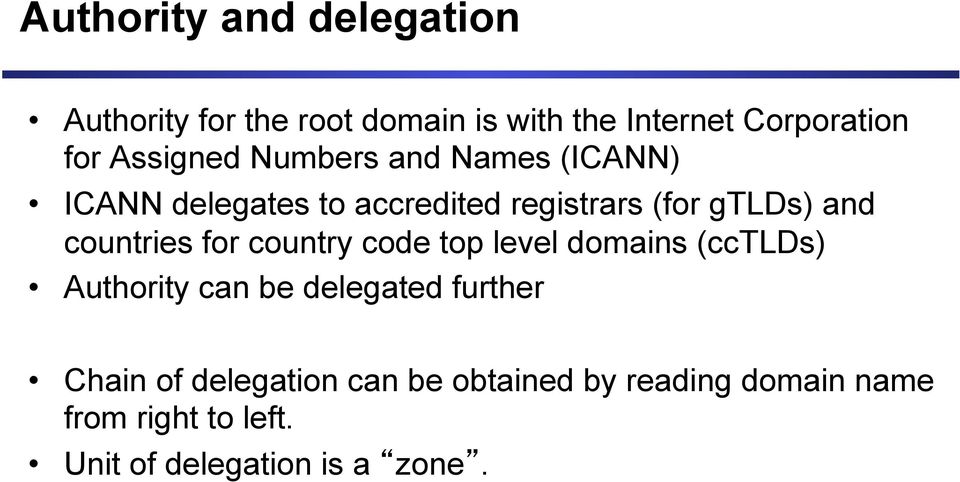
11 Authority and delegation Authority for the root domain is with the Internet Corporation for Assigned Numbers and Names (ICANN) ICANN delegates to accredited registrars (for gtlds) and countries for country code top level domains (cctlds) Authority can be delegated further Chain of delegation can be obtained by reading domain name from right to left. Unit of delegation is a zone.
12 DNS domain and zones Each zone is anchored at a specific domain node, but zones are not domains. A DNS domain is a branch of the namespace A zone is a portion of the DNS namespace generally stored in a file (could consist of multiple nodes) Zone. (root).edu.uci.edu math.virginia.edu.virginia.edu cs.virginia.edu A server can divide part of its zone and delegate it to other servers Zone and domain Domain

13 Primary and secondary name servers For each zone, there must be a primary name server and a secondary name server The primary server (master server) maintains a zone file which has information about the zone. Updates are made to the primary server The secondary server copies data stored at the primary server. Adding a host: When a new host is added ( gold.cs.virginia.edu ) to a zone, the administrator adds the IP information on the host (IP address and name) to a configuration file on the primary server

14 DNS resolution: distributed, hierarchical Top-level domain servers Root DNS Servers com DNS servers org DNS servers edu DNS servers yahoo.com DNS servers amazon.com DNS servers Authoritative name servers pbs.org DNS servers poly.edu umass.edu DNS servers DNS servers client wants IP for 1 st approx: v client queries root server to find.com TLD DNS server v client queries.com TLD DNS server for amazon.com auth server v client queries amazon.com DNS auth server to get IP address for Application Layer 2-14

15 DNS: root name servers v contacted when no info about top-level or auth server v root name server can: return top-level or auth name server address or contact auth server and return final resolved address e. NASA Mt View, CA f. Internet Software C. Palo Alto, CA (and 48 other sites) c. Cogent, Herndon, VA (5 other sites) d. U Maryland College Park, MD h. ARL Aberdeen, MD j. Verisign, Dulles VA (69 other sites ) a. Verisign, Los Angeles CA (5 other sites) b. USC-ISI Marina del Rey, CA l. ICANN Los Angeles, CA (41 other sites) g. US DoD Columbus, OH (5 other sites) k. RIPE London (17 other sites) i. Netnod, Stockholm (37 other sites) m. WIDE Tokyo (5 other sites) 13 root name servers worldwide Application Layer 2-15

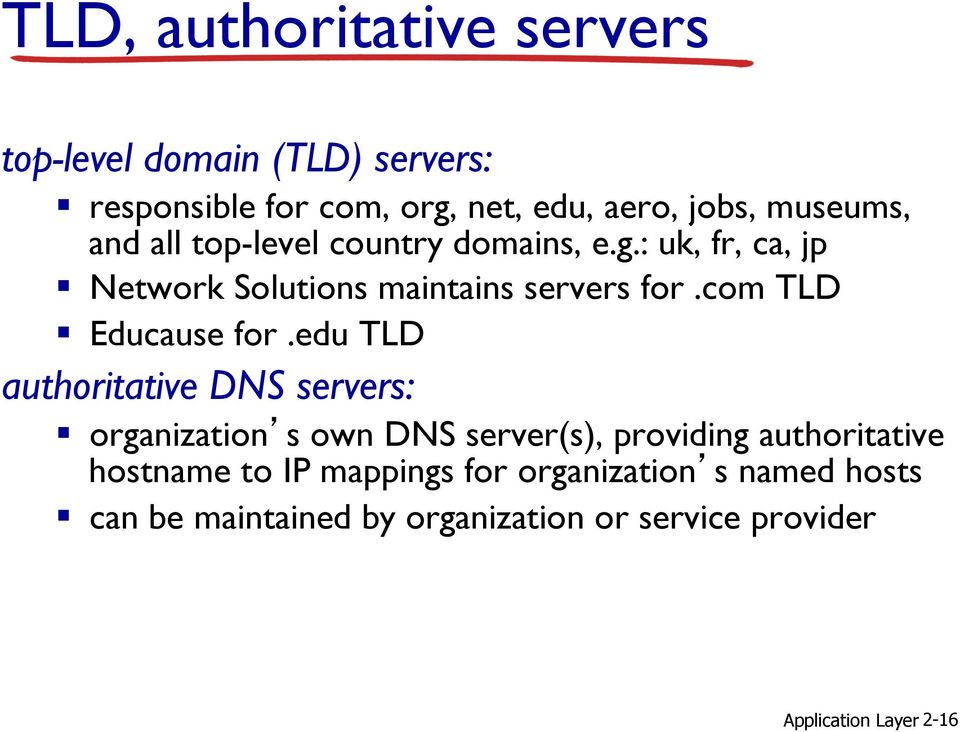
16 TLD, authoritative servers top-level domain (TLD) servers: responsible for com, org, net, edu, aero, jobs, museums, and all top-level country domains, e.g.: uk, fr, ca, jp Network Solutions maintains servers for.com TLD Educause for.edu TLD authoritative DNS servers: organization s own DNS server(s), providing authoritative hostname to IP mappings for organization s named hosts can be maintained by organization or service provider Application Layer 2-16
17 Local DNS name server v does not strictly belong to hierarchy v deployed by ISP (residential, company, university) also called default name server v acts as proxy between host and DNS hierarchy has local cache of recent name-to-address translation pairs (but may be out of date!) Application Layer 2-17

18 DNS name resolution example root DNS server v host at cis.poly.edu wants IP address for gaia.cs.umass.edu TLD DNS server iterated query: v contacted server replies with name of server to contact v I don t know this name, but ask this server local DNS server dns.poly.edu 1 8 requesting host cis.poly.edu 7 6 authoritative DNS server dns.cs.umass.edu gaia.cs.umass.edu Application Layer 2-18

19 DNS name resolution example root DNS server recursive query: v puts burden of name resolution on contacted name server local DNS server dns.poly.edu 5 4 TLD DNS server v heavy load at upper levels of hierarchy? 1 8 requesting host cis.poly.edu authoritative DNS server dns.cs.umass.edu gaia.cs.umass.edu Application Layer 2-19

20 DNS: caching, updating records v any name server can cache learned mappings cache entries timeout (disappear) after some time (TTL) TLD servers typically cached in local name servers, so root name servers not often visited v cached entries may be out-of-date (best effort name-to-address translation!) if name host changes IP address, may not be known Internet-wide until all TTLs expire v update/notify mechanisms proposed IETF standard RFC 2136 Application Layer 2-20

21 DNS records DNS: distributed db storing resource records (RR) RR format: (name, value, type, ttl) type=a name is hostname value is IP address type=ns name is domain (e.g., foo.com) value is hostname of authoritative name server for this domain type=cname name is alias name for some canonical (the real) name is really servereast.backup2.ibm.com value is canonical name type=mx value is name of mailserver associated with name Application Layer 2-21
22 DNS protocol, messages v query and reply messages, both with same message format 2 bytes 2 bytes msg header v v identification: 16 bit # for query, reply to query uses same # flags: query or reply recursion desired recursion available reply is authoritative identification flags # questions # answer RRs # authority RRs # additional RRs questions (variable # of questions) answers (variable # of RRs) authority (variable # of RRs) additional info (variable # of RRs) Application Layer 2-22
23 DNS protocol, messages 2 bytes 2 bytes identification # questions flags # answer RRs name, type fields for a query RRs in response to query records for authoritative servers additional helpful info that may be used # authority RRs # additional RRs questions (variable # of questions) answers (variable # of RRs) authority (variable # of RRs) additional info (variable # of RRs) Application Layer 2-23
24 Inserting records into DNS v example: new startup Network Utopia v register name networkuptopia.com at DNS registrar (e.g., Network Solutions) provide names, IP addresses of authoritative name server (primary and secondary) registrar inserts two RRs into.com TLD server: (networkutopia.com, dns1.networkutopia.com, NS) (dns1.networkutopia.com, , A) v create authoritative server type A record for type MX record for networkutopia.com Application Layer 2-24
25 Resource Records Resource records are stored in configuration files (zone files) at name servers. Example resource records for a zone: db.mylab.com $TTL mylab.com. IN SOA PC4.mylab.com. hostmaster.mylab.com. ( 1 ; serial ; refresh 7200 ; retry ; expire ; ttl ) ; mylab.com. IN NS PC4.mylab.com. ; localhost A PC4.mylab.com. A PC3.mylab.com. A PC2.mylab.com. A PC1.mylab.com. A
26 Resource Records db.mylab.com $TTL mylab.com. IN SOA PC4.mylab.com. hostmaster.mylab.com. ( 1 ; serial ; refresh 7200 ; retry ; expire ; ttl ) ; mylab.com. IN NS PC4.mylab.com. ; localhost A PC4.mylab.com. A PC3.mylab.com. A PC2.mylab.com. A PC1.mylab.com. A Max. age of cached data in seconds * Start of authority (SOA) record. Means: This name server is authoritative for the zone Mylab.com * PC4.mylab.com is the name server * [email protected] is the address of the person in charge Name server (NS) record. One entry for each authoritative name server Address (A) records. One entry for each hostaddress
27 Lab 7 (DHCP/NAT) review
28 Exercise 1(B) ConfiguraEon: Router2(config)#ip nat inside source static PC4% route add net netmask gw Which ping works and why? PC3% ping c PC3% ping c Router1% ping c Router1% ping c PC4% ping c PC4% ping c NAT Table on Router2 Router2#show ip nat translations Pro Inside global Inside local Outside local Outside global
29 Exercise 1(B) ConfiguraEon: Router2(config)#ip nat inside source static PC4% route add net netmask gw Which ping works and why? PC3% ping c PC3% ping c Router1% ping c Router1% ping c PC4% ping c PC4% ping c NAT Table on Router2 Router2#show ip nat translations Pro Inside global Inside local Outside local Outside global
30 Exercise 1(B) ConfiguraEon: Router2(config)#ip nat inside source static Router2(config)#ip nat inside source static Router2(config)#ip nat inside source static Which ping works and why? PC3% ping c PC3% ping c Router1% ping c Router1% ping c PC4% ping c PC4% ping c NAT Table on Router2 Router2#show ip nat translations Pro Inside global Inside local Outside local Outside global
31 Exercise 1(B) ConfiguraEon: Router2(config)#ip nat inside source static Router2(config)#ip nat inside source static Router2(config)#ip nat inside source static Which ping works and why? PC3% ping c PC3% ping c Router1% ping c Router1% ping c PC4% ping c PC4% ping c NAT Table on Router2 Router2#show ip nat translations Pro Inside global Inside local Outside local Outside global
32 Exercise 1(B) Show IP source/desenaeon addresses before/aoer Router2 PC3% ping c Before Router2: Src: ( ), Dst: ( ) AOer Router2: Src: ( ), Dst: ( ) NAT Table on Router2 Router2#show ip nat translations Pro Inside global Inside local Outside local Outside global
33 Exercise 1(C)- NAT/PAT/Masquerade telnet commands; which one successful? PC1% telnet (Router1) PC1% telnet (PC4) Router1# telnet (PC1) Router1# (PC4) PC4: telnet (PC3) 33
34 Exercise 1(C)- NAT/PAT/Masquerade telnet commands; which one successful? PC1% telnet (Router1) PC1% telnet (PC4) Router1# telnet (PC1) Router1# (PC4) PC4: telnet (PC3) 34
35 Exercise 1(C)- NAT & telnet PC1% telnet (PC4) Before translaeon (PC2) Internet Protocol Source: Destination: Transmission Control Protocol Source port: Destination port: telnet (23) Sequence number: AOer translaeon (PC2) Internet Protocol Source: Destination: Transmission Control Protocol Source port: Destination port: telnet (23) Sequence number:
36 Exercise 1(C)- PAT & ICMP (ping) Ping (ICMP) does not use port number IdenEficaEon is used to help with NAT PC1% ping (PC4) Internet Protocol, Src Addr: , Dst Addr: Identification: 0x0000 Protocol: ICMP (0x01) Source: Destination: Internet Protocol, Src Addr: , Dst Addr: Identification: 0x0000 Protocol: ICMP (0x01) Source: Destination:
37 Exercise 1(D)- NAT & FTP n FTP uses 2 ports Control conneceon, port 21 Data conneceon port 20 n No problem with NAT & control conneceon. n For data conneceon, the server inieates a conneceon from its port 20 to a (random) port on client Causes problem with NAT Only client can inieate conneceon n PASSIVE mode solves this problem 37
38 Exercise 1(D)- NAT & FTP PC3% ftp (PC2) 38
How To Map Between Ip Address And Name On A Domain Name System (Dns)
 Computer Networks: Domain Name Service (DNS) CS 3516 D- term 2013 Instructor: Krishna Venkatasubramanian Quiz 2 DNS: domain name system people: many identifiers: SSN, name, passport # Internet hosts, routers:
Domain Name System (or Service) (DNS) Computer Networks Term B10
 Domain Name System (or Service) (DNS) Computer Networks Term B10 DNS Outline DNS Hierarchial Structure Root Name Servers Top-Level Domain Servers Authoritative Name Servers Local Name Server Caching and
DNS: Domain Name System
 DNS: Domain Name System People: many identifiers: SSN, name, passport # Internet hosts, routers: IP address (32 bit) - used for addressing datagrams name, e.g., ww.yahoo.com - used by humans Q: map between
Chapter 2 Application Layer
 Chapter 2 Application Layer A note on the use of these ppt slides: We re making these slides freely available to all (faculty, students, readers). They re in PowerPoint form so you see the animations;
Domain Name System Richard T. B. Ma
 Domain Name System Richard T. B. Ma School of Computing National University of Singapore CS 3103: Compute Networks and Protocols Names Vs. Addresses Names are easier for human to remember www.comp.nus.edu.sg
CS 43: Computer Networks Naming and DNS. Kevin Webb Swarthmore College September 17, 2015
 CS 43: Computer Networks Naming and DNS Kevin Webb Swarthmore College September 17, 2015 Agenda Identifiers and addressing Domain Name System History Query sequences Record types Load balancing Recall:
internet technologies and standards
 Institute of Telecommunications Warsaw University of Technology 2015 internet technologies and standards Piotr Gajowniczek Andrzej Bąk Michał Jarociński Internet application layer the email service The
DATA COMMUNICATOIN NETWORKING
 DATA COMMUNICATOIN NETWORKING Instructor: Ouldooz Baghban Karimi Course Book: Computer Networking, A Top-Down Approach By: Kurose, Ross Introduction Course Overview Basics of Computer Networks Internet
The Application Layer: DNS
 Recap SMTP and email The Application Layer: DNS Smith College, CSC 9 Sept 9, 0 q SMTP process (with handshaking) and message format q Role of user agent access protocols q Port Numbers (can google this)
CMPE 80N: Introduction to Networking and the Internet
 CMPE 80N: Introduction to Networking and the Internet Katia Obraczka Computer Engineering UCSC Baskin Engineering Lecture 10 CMPE 80N Fall'10 1 Announcements Forum assignment #2 posted. Due Nov. 5 th.
DNS and P2P File Sharing
 Computer Networks DNS and P2P File Sharing Based on Computer Networking, 4 th Edition by Kurose and Ross DNS: Domain Name System People: many identifiers: SSN, name, passport # Internet hosts, routers:
Domain Name System (DNS)
 Domain Name System (DNS) Instructor: Anirban Mahanti Office: ICT 745 Email: [email protected] Class Location: ICT 121 Lectures: MWF 12:00 12:50 Notes derived from Computer Networking: A Top Down
Domain Name System (DNS) RFC 1034 RFC 1035 http://www.ietf.org
 Domain Name System (DNS) RFC 1034 RFC 1035 http://www.ietf.org TCP/IP Protocol Suite Application Layer DHCP DNS SNMP HTTP SMTP POP Transport Layer UDP TCP ICMP IGMP Network Layer IP Link Layer ARP ARP
CS 355. Computer Networking. Wei Lu, Ph.D., P.Eng.
 CS 355 Computer Networking Wei Lu, Ph.D., P.Eng. Chapter 2: Application Layer Overview: Principles of network applications? Introduction to Wireshark Web and HTTP FTP Electronic Mail: SMTP, POP3, IMAP
Domain Name System DNS
 CE443 Computer Networks Domain Name System DNS Behnam Momeni Computer Engineering Department Sharif University of Technology Acknowledgments: Lecture slides are from Computer networks course thought by
Names vs. Addresses. Flat vs. Hierarchical Space. Domain Name System (DNS) Computer Networks. Lecture 5: Domain Name System
 Names vs. Addresses Computer Networks Lecture 5: Domain Name System Names are easier for human to remember www.umich.edu vs. 141.213.4.4 Addresses can be changed without changing names move www.umich.edu
DNS Domain Name System
 DNS Domain Name System Domain names and IP addresses People prefer to use easy-to-remember names instead of IP addresses Domain names are alphanumeric names for IP addresses e.g., neon.cs.virginia.edu,
Naming and the DNS. Focus. How do we name hosts etc.? Application Presentation Topics. Session Domain Name System (DNS) Email/URLs
 Naming and the DNS Focus How do we name hosts etc.? Application Presentation Topics Session Domain Name System (DNS) Email/URLs Transport Network Data Link Physical Ldns.1 Names and Addresses 43 name address
NET0183 Networks and Communications
 NET0183 Networks and Communications Lecture 25 DNS Domain Name System 8/25/2009 1 NET0183 Networks and Communications by Dr Andy Brooks DNS is a distributed database implemented in a hierarchy of many
Application Layer. Abusayeed Saifullah. CS 5600 Computer Networks. These slides are adapted from Kurose and Ross
 Application Layer Abusayeed Saifullah CS 5600 Computer Networks These slides are adapted from Kurose and Ross Web caches (proxy server) goal: satisfy client request without involving origin server v user
Ch 6: Networking Services: NAT, DHCP, DNS, Multicasting
 Ch 6: Networking Services: NAT, DHCP, DNS, Multicasting Magda El Zarki Prof. of CS Univ. of CA, Irvine Email: [email protected] http: www.ics.uci.edu/~magda Overivew of NAT NAT: Network Address Translation
Domain Name System (DNS)
 Chapter 18 CSC465 Computer Networks Spring 2004 Dr. J. Harrison These slides are based on the text TCP/IP Protocol Suite (2 nd Edition) Domain Name System (DNS) CONTENTS NAME SPACE DOMAIN NAME SPACE DISTRIBUTION
FTP: the file transfer protocol
 File Transfer: FTP FTP: the file transfer protocol at host FTP interface FTP client local file system file transfer FTP remote file system transfer file to/from remote host client/ model client: side that
DNS. Spring 2016 CS 438 Staff 1
 DNS Spring 2016 CS 438 Staff 1 Host Names vs. IP addresses Host names Mnemonic name appreciated by humans Variable length, full alphabet of characters Provide little (if any) information about physical
Domain Name System (DNS) Reading: Section in Chapter 9
 Domain Name System (DNS) Reading: Section in Chapter 9 RFC 1034, STD 13 Name Syntax and rules for delegating authority over names Specify implementation of a distributed system that maps names to addresses
Ch 6: Networking Services: NAT, DHCP, DNS, Multicasting, NTP
 Ch 6: Networking Services: NAT, DHCP, DNS, Multicasting, NTP Magda El Zarki Prof. of CS Univ. of CA, Irvine Email: [email protected] http: www.ics.uci.edu/~magda Network Address Translation - NAT Private
DNS Domain Name System
 Domain Name System DNS Domain Name System The domain name system is usually used to translate a host name into an IP address Domain names comprise a hierarchy so that names are unique, yet easy to remember.
CS 348: Computer Networks. - DNS; 22 nd Oct 2012. Instructor: Sridhar Iyer IIT Bombay
 CS 348: Computer Networks - DNS; 22 nd Oct 2012 Instructor: Sridhar Iyer IIT Bombay Domain Name System Map between host names and IP addresses People: many identifiers: name, Passport #, Internet hosts:
2.5 DNS The Internet s Directory Service
 130 CHAPTER 2 APPLICATION LAYER e-mail is also provided by Google, Yahoo!, as well as just about every major university and corporation. With this service, the user agent is an ordinary Web browser, and
DNS and electronic mail. DNS purposes
 DNS and electronic mail Section 9.1.3 in the textbook DNS purposes Originally purpose was to translate hostnames into IP addresses www.csd. is easier to remember than 129.100.23.247 Lets us do load balancing
Lecture 2 CS 3311. An example of a middleware service: DNS Domain Name System
 Lecture 2 CS 3311 An example of a middleware service: DNS Domain Name System The problem Networked computers have names and IP addresses. Applications use names; IP uses for routing purposes IP addresses.
Chapter 2: outline. 2.6 P2P applications 2.7 socket programming with UDP and TCP
 Chapter 2: outline 2.1 principles of network applications app architectures app requirements 2.2 Web and HTTP 2.3 FTP 2.4 electronic mail SMTP, POP3, IMAP 2.5 DNS 2.6 P2P applications 2.7 socket programming
Internet-Praktikum I Lab 3: DNS
 Kommunikationsnetze Internet-Praktikum I Lab 3: DNS Mark Schmidt, Andreas Stockmayer Sommersemester 2015 kn.inf.uni-tuebingen.de Motivation for the DNS Problem IP addresses hard to remember for humans
Motivation. Domain Name System (DNS) Flat Namespace. Hierarchical Namespace
 Motivation Domain Name System (DNS) IP addresses hard to remember Meaningful names easier to use Assign names to IP addresses Name resolution map names to IP addresses when needed Namespace set of all
Computer Networks & Security 2014/2015
 Computer Networks & Security 2014/2015 IP Protocol Stack & Application Layer (02a) Security and Embedded Networked Systems time Protocols A human analogy All Internet communication is governed by protocols!
CSE/ISE 311: Systems Administra5on Networking 2
 Networking 2 Por$ons courtesy Ellen Liu Outline IP address alloca$on NAT (Network address transla$on) Rou$ng configura$on DHCP (Dynamic host configura$on protocol) DNS (Domain name system) 16-2 IP Address
C 1. Last Time. CSE 486/586 Distributed Systems Domain Name System. Review: Causal Ordering. Review: Causally Ordered Multicast.
 Last Time CSE 46/6 Distributed Systems Domain Name System Two multicast algorithms for total ordering Sequencer ISIS Multicast for causal ordering Uses vector timestamps Steve Ko Computer Sciences and
3. The Domain Name Service
 3. The Domain Name Service n Overview and high level design n Typical operation and the role of caching n Contents of DNS Resource Records n Basic message formats n Configuring/updating Resource Records
DNS: Domain Names. DNS: Domain Name System. DNS: Root name servers. DNS name servers
 DNS: Domain Name System DNS: Domain Names People: many identifiers: SSN, name, Passport # Internet hosts, routers: Always: IP address (32 bit) - used for addressing datagrams Often: name, e.g., nifc14.wsu.edu
Network programming, DNS, and NAT. Copyright University of Illinois CS 241 Staff 1
 Network programming, DNS, and NAT Copyright University of Illinois CS 241 Staff 1 Today Network programming tips Domain name system Network Address Translation Bonus slides (for your reference) Timers
Application-layer protocols
 Application layer Goals: Conceptual aspects of network application protocols Client server paradigm Service models Learn about protocols by examining popular application-level protocols HTTP DNS Application-layer
Resilient Networking. Overview of DNS Known attacks on DNS Denial-of-Service Cache Poisoning. Securing DNS Split-Split-DNS DNSSEC.
 Resilient Networking 6: Attacks on DNS Overview of DNS Known attacks on DNS Denial-of-Service Cache Poisoning Securing DNS Split-Split-DNS DNSSEC SoSe 2014 Fachbereich Informatik Telecooperation Group
Application Protocols in the TCP/IP Reference Model
 Application Protocols in the TCP/IP Reference Model File Transfer E-Mail Network Management WWW Virtual Terminal Name Service File Transfer HTTP FTP Telnet SMTP DNS SNMP TFTP Internet protocols TCP UDP
Application Protocols in the TCP/IP Reference Model. Application Protocols in the TCP/IP Reference Model. DNS - Concept. DNS - Domain Name System
 Application Protocols in the TCP/IP Reference Model Application Protocols in the TCP/IP Reference Model File Transfer E-Mail Network Management Protocols of the application layer are common communication
Chapter 23 The Domain Name System (DNS)
 CSC521 Communication Protocols 網 路 通 訊 協 定 Chapter 23 The Domain Name System (DNS) 吳 俊 興 國 立 高 雄 大 學 資 訊 工 程 學 系 Outline 1. Introduction 2. Names For Machines 3. Flat Namespace 4. Hierarchical Names 5.
FTP: the file transfer protocol
 FTP: the file transfer protocol at host FTP interface FTP client local file system file transfer FTP remote file system transfer file to/from remote host client/ model client: side that initiates transfer
CS640: Computer Networks. Naming /ETC/HOSTS
 CS640: Computer Networks Aditya Akella Lecture 17 Naming and the DNS Naming Need naming to identify resources Once identified, resource must be located How to name resource? Naming hierarchy How do we
THE DOMAIN NAME SYSTEM DNS
 Announcements THE DOMAIN NAME SYSTEM DNS Internet Protocols CSC / ECE 573 Fall, 2005 N. C. State University copyright 2005 Douglas S. Reeves 2 Today s Lecture I. Names vs. Addresses II. III. IV. The Namespace
HW2 Grade. CS585: Applications. Traditional Applications SMTP SMTP HTTP 11/10/2009
 HW2 Grade 70 60 CS585: Applications 50 40 30 20 0 0 2 3 4 5 6 7 8 9 0234567892022223242526272829303323334353637383940442 CS585\CS485\ECE440 Fall 2009 Traditional Applications SMTP Simple Mail Transfer
Applications & Application-Layer Protocols: The Domain Name System and Peerto-Peer
 CPSC 360 Network Programming Applications & Application-Layer Protocols: The Domain Name System and Peerto-Peer Systems Michele Weigle Department of Computer Science Clemson University [email protected]
The Domain Name System
 The Domain Name System Mark Handley) UCL Computer Science CS 3035/GZ01 Today 1. The Domain Name System (DNS) 2. A Brief Word on DNS Security A name indicates what we seek. An address indicates where it
Computer Networks: Domain Name System
 Computer Networks: Domain Name System Domain Name System The domain name system (DNS) is an application-layer protocol for mapping domain names to IP addresses DNS www.example.com 208.77.188.166 http://www.example.com
Names & Addresses. Names & Addresses. Names vs. Addresses. Identity. Names vs. Addresses. CS 194: Distributed Systems: Naming
 Names & Addresses CS 9: Distributed Systems: Naming Computer Science Division Department of Electrical Engineering and Computer Sciences University of California, Berkeley Berkeley, CA 970-77 What is a?
The Domain Name System (DNS)
 The Domain Name System (DNS) Columbus, OH 43210 [email protected] http://www.cis.ohio-state.edu/~jain/ 24-1 Overview Naming hierarchy hierarchy Name resolution Other information in name servers 24-2
Understanding DNS (the Domain Name System)
 Understanding DNS (the Domain Name System) A white paper by Incognito Software January, 2007 2007 Incognito Software Inc. All rights reserved. Understanding DNS (the Domain Name System) Introduction...2
DNS records. RR format: (name, value, type, TTL) Type=NS
 DNS records RR format: (name, value, type, TTL) Type=A name is hostname value is IP address Type=NS name is domain (e.g. foo.com) value is hostname of authoritative name server for this domain Type=CNAME
Distributed Systems. 09. Naming. Paul Krzyzanowski. Rutgers University. Fall 2015
 Distributed Systems 09. Naming Paul Krzyzanowski Rutgers University Fall 2015 October 7, 2015 2014-2015 Paul Krzyzanowski 1 Naming things Naming: map names to objects Helps with using, sharing, and communicating
Introduction to the Domain Name System
 CHAPTER 14 The Domain Name System (DNS) handles the growing number of Internet users. DNS translates names, such as www.cisco.com, into IP addresses, such as 192.168.40.0 (or the more extended IPv6 addresses),
CS3600 SYSTEMS AND NETWORKS
 CS3600 SYSTEMS AND NETWORKS FALL 2011 Lecture 19: DNS Prof. Alan Mislove ([email protected]) Slides used with permissions from Edward W. Knightly, T. S. Eugene Ng, Ion Stoica, Hui Zhang Human Involvement
DNS : Domain Name System
 1/30 DNS : Domain Name System Surasak Sanguanpong [email protected] http://www...ac.th/~nguan Last updated: May 24, 1999 Outline 2/30 DNS basic name space name resolution process protocol configurations Why
Domain Name System (DNS) Fundamentals
 Domain Name System (DNS) Fundamentals Mike Jager Network Startup Resource Center [email protected] These materials are licensed under the Creative Commons Attribution-NonCommercial 4.0 International
Introduction to DNS CHAPTER 5. In This Chapter
 297 CHAPTER 5 Introduction to DNS Domain Name System (DNS) enables you to use hierarchical, friendly names to easily locate computers and other resources on an IP network. The following sections describe
Lecture 5: Network Attacks I. Course Admin
 Lecture 5: Network Attacks I CS 336/536: Computer Network Security Fall 2013 Nitesh Saxena Adopted from previous lectures by Keith Ross Course Admin HW/Lab 1 Due Coming Monday 11am Lab sessions are active
Application Protocols in the TCP/IP Reference Model. Application Protocols in the TCP/IP Reference Model. DNS - Domain Name System
 Application Protocols in the TCP/IP Reference Model Application Protocols in the TCP/IP Reference Model File Transfer E-Mail Network Management Protocols of the application layer are common communication
- Domain Name System -
 1 Name Resolution - Domain Name System - Name resolution systems provide the translation between alphanumeric names and numerical addresses, alleviating the need for users and administrators to memorize
Introduction to Network Operating Systems
 As mentioned earlier, different layers of the protocol stack use different kinds of addresses. We can now see that the Transport Layer (TCP) uses port addresses to route data to the correct process, the
Domain Name Servers. Domain Types WWW host names. Internet Names. COMP476 Networked Computer Systems. Domain Name Servers
 Domain Name Servers COMP76 Networked Computer Systems Internet Names Hierarchical starting from the right host.subnet.organization.type Names are case insensitive and can be in either upper or lower case.
ECE 4321 Computer Networks. Network Programming
 ECE 4321 Computer Networks Network Programming Name Space System.Net Domain Name System (DNS) To resolve computer naming Host database is split up and distributed among multiple systems on the Internet
The Domain Name System (DNS)
 The Domain Name System (DNS) Each Internet host is assigned a host name and an IP address Host names are structured character strings, e.g., www.cs.iastate.edu IP addresses are 32 bit integers, e.g., 129.186.3.6
Computer Networks Prof. S. Ghosh Department of Computer Science and Engineering Indian Institute of Technology, Kharagpur Lecture - 34 DNS & Directory
 Computer Networks Prof. S. Ghosh Department of Computer Science and Engineering Indian Institute of Technology, Kharagpur Lecture - 34 DNS & Directory Good day. Today we will take up two topics, DNS and
416 Distributed Systems. Feb 24, 2016 DNS and CDNs
 416 Distributed Systems Feb 24, 2016 DNS and CDNs Outline DNS Design Content Distribution Networks 2 Naming How do we efficiently locate resources? DNS: name à IP address Challenge How do we scale this
HTG XROADS NETWORKS. Network Appliance How To Guide: DNS Delegation. How To Guide
 HTG X XROADS NETWORKS Network Appliance How To Guide: DNS Delegation How To Guide DNS Delegation (The Simple Redundancy Solution) The key requirement when performing DNS based network redundancy and load
The Domain Name System
 The Domain Name System 3035/GZ01 Networked Systems Kyle Jamieson Lecture 10 Department of Computer Science University College London Today 1. The Domain Name System (DNS) 2. DNS security: Cache poisoning
INTERNET DOMAIN NAME SYSTEM
 INTERNET DOMAIN NAME SYSTEM http://www.tutorialspoint.com/internet_technologies/internet_domain_name_system.htm Copyright tutorialspoint.com Overview When DNS was not into existence, one had to download
Domain Name System (DNS)
 Lab Objectives Domain Name System (DNS) Acquiring skills related to the Domain Name System (DNS) functions Practical studying of DNS protocol in the process of its functioning Background Information DNS
Domain Name System (DNS) Omer F. Rana. Networks and Data Communications 1
 Domain Name System (DNS) Omer F. Rana Networks and Data Communications 1 What is a DNS Each institution on the internet has a host that runs a process called a Domain Name Server (also DNS!) It is not
Part 5 DNS Security. SAST01 An Introduction to Information Security 2015-09-21. Martin Hell Department of Electrical and Information Technology
 SAST01 An Introduction to Information Security Part 5 DNS Security Martin Hell Department of Electrical and Information Technology How DNS works Amplification attacks Cache poisoning attacks DNSSEC 1 2
DNS. Computer networks - Administration 1DV202. fredag 30 mars 12
 DNS Computer networks - Administration 1DV202 DNS History Who needs DNS? The DNS namespace How DNS works The DNS database The BIND software Server and client configuration The history of DNS RFC 882 and
DNS: Domain Name System
 DNS: Domain Name System People: many identifiers: SSN, name, passport # Internet hosts, routers: IP address (32 bit) - used for addressing datagrams name, e.g., ww.yahoo.com - used by humans Q: map between
CS244A Review Session Routing and DNS
 CS244A Review Session Routing and DNS January 18, 2008 Peter Pawlowski Slides derived from: Justin Pettit (2007) Matt Falkenhagen (2006) Yashar Ganjali (2005) Guido Appenzeller (2002) Announcements PA
Domain Name System (DNS) Session-1: Fundamentals. Ayitey Bulley [email protected]
 Domain Name System (DNS) Session-1: Fundamentals Ayitey Bulley [email protected] Computers use IP addresses. Why do we need names? Names are easier for people to remember Computers may be moved between
The Domain Name System
 DNS " This is the means by which we can convert names like news.bbc.co.uk into IP addresses like 212.59.226.30 " Purely for the benefit of human users: we can remember numbers (e.g., telephone numbers),
19 Domain Name System (DNS)
 CHAPTER 9 Domain Name System (DNS) I n this chapter, we discuss the second application program, Domain Name System (DNS). DNS is a client/server application program used to help other application programs.
CS3250 Distributed Systems
 CS3250 Distributed Systems Lecture 4 More on Network Addresses Domain Name System DNS Human beings (apart from network administrators and hackers) rarely use IP addresses even in their human-readable dotted
Types of hypertext. Hypertext documents can either be 1.Static 2.Dynamic
 Hypertext Hypertext is text displayed on a computer or other electronic device with references (hyperlinks) to other text that the reader can immediately access, usually by a mouse click or key press sequence.
Internetworking with TCP/IP Unit 10. Domain Name System
 Unit 10 Domain Name System Structure 10.1 Introduction 10.2 Fully Qualified Domain Names (FQDNs) Generic Domains Country Domains 10.3 Mapping domain names to IP addresses 10.4 Mapping IP Addresses to Domain