
DNS: Domain Names. DNS: Domain Name System. DNS: Root name servers. DNS name servers
|
|
|
- Cornelius Terry
- 10 years ago
- Views:
Transcription
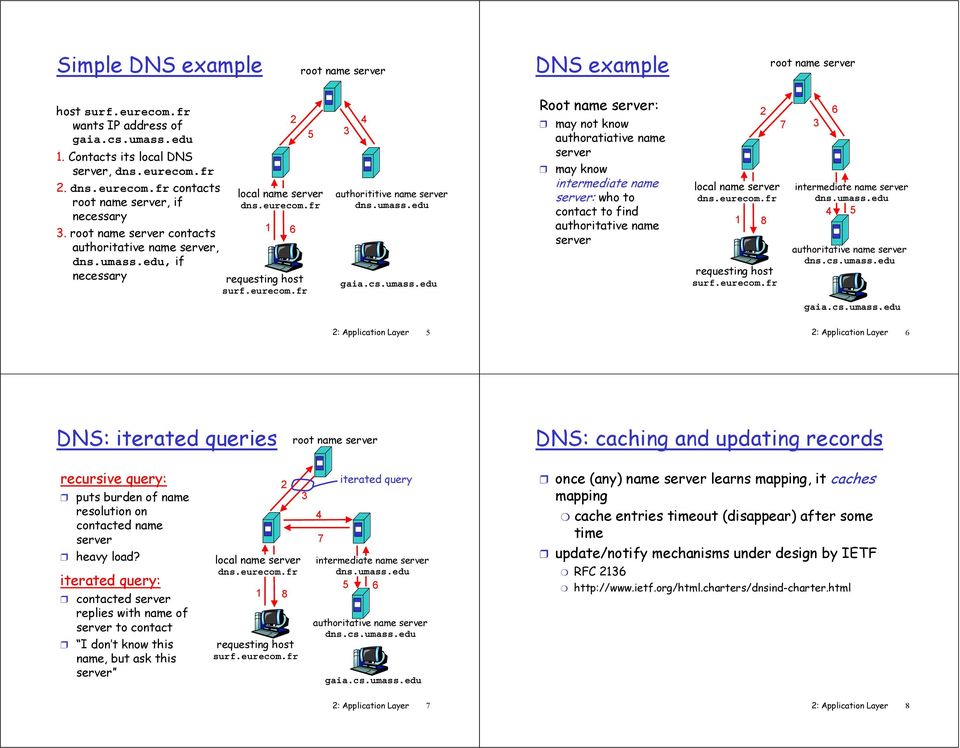
1 DNS: Domain Name System DNS: Domain Names People: many identifiers: SSN, name, Passport # Internet hosts, routers: Always: IP address (32 bit) - used for addressing datagrams Often: name, e.g., nifc14.wsu.edu - used by humans Q: How do we map between names and IP addresses? A: Domain Name System (DNS): distributed database implemented in hierarchy of many name servers application-layer protocol hosts, name servers communicate to resolve names (name/address translation) note: this is a core Internet function implemented as application-layer protocol complexity at network s edge Names are hierarchical Each suffix corresponds to a zone. edu. wsu.edu. eecs.wsu.edu. Each zone has at least two authoritative servers Top-level domains edu. com. mil. us. uk. fr. 2: Application Layer 1 2: Application Layer 2 DNS name servers DNS: Root name servers no server has all nameto-ip address mappings s: each ISP, company has local (default) name server host DNS query first goes to authoritative name server: for a host: stores that host s IP address, name can perform name to address translation for that host s name Why not centralize DNS? single point of failure traffic volume distant centralized database maintenance doesn t scale! contacted by local name server that can not resolve name root name server: contacts authoritative name server if name mapping not known gets mapping returns mapping to ~ dozen root name servers worldwide 2: Application Layer 3 2: Application Layer 4

2 Simple DNS example root name server DNS example root name server host surf.eurecom.fr wants IP address of 1. Contacts its local DNS server, dns.eurecom.fr 2. dns.eurecom.fr contacts root name server, if necessary 3. root name server contacts authoritative name server, dns.umass.edu, if necessary dns.eurecom.fr requesting host surf.eurecom.fr authorititive name server dns.umass.edu Root name server: may not know authoratiative name server may know intermediate name server: who to contact to find authoritative name server dns.eurecom.fr requesting host surf.eurecom.fr intermediate name server dns.umass.edu 4 5 authoritative name server dns.cs.umass.edu 2: Application Layer 5 2: Application Layer 6 DNS: iterated queries root name server DNS: caching and updating records recursive query: puts burden of name resolution on contacted name server heavy load? iterated query: contacted server replies with name of server to contact I don t know this name, but ask this server dns.eurecom.fr requesting host surf.eurecom.fr iterated query intermediate name server dns.umass.edu 5 6 authoritative name server dns.cs.umass.edu once (any) name server learns mapping, it caches mapping cache entries timeout (disappear) after some time update/notify mechanisms under design by IETF RFC : Application Layer 7 2: Application Layer 8
3 DNS records DNS: distributed db storing resource records (RR) Type=A name is hostname Type=NS RR format: (name, value, type,ttl) value is IP address name is domain (e.g. foo.com) value is IP address of authoritative name server for this domain Type=CNAME name is an alias name for some cannonical (the real) name value is cannonical name Type=MX value is hostname of mailserver associated with name 2: Application Layer 9 DNS protocol, messages DNS protocol : query and reply messages, both with same message format msg header identification: 16 bit # for query, reply to query uses same # flags: query or reply recursion desired recursion available reply is authoritative 2: Application Layer 10 DNS protocol, messages Example: Java client (TCP) Name, type fields for a query class TCPClient RRs in reponse to query records for authoritative servers additional helpful info that may be used input stream client socket, connect to server output stream attached public static void main(string argv[]) throws Exception String sentence; String modifiedsentence; BufferedReader infromuser = new BufferedReader(new InputStreamReader(System.in)); Socket clientsocket = new Socket("hostname", 6789); DataOutputStream outtoserver = new DataOutputStream(clientSocket.getOutputStream()); 2: Application Layer 11 2: Application Layer 12
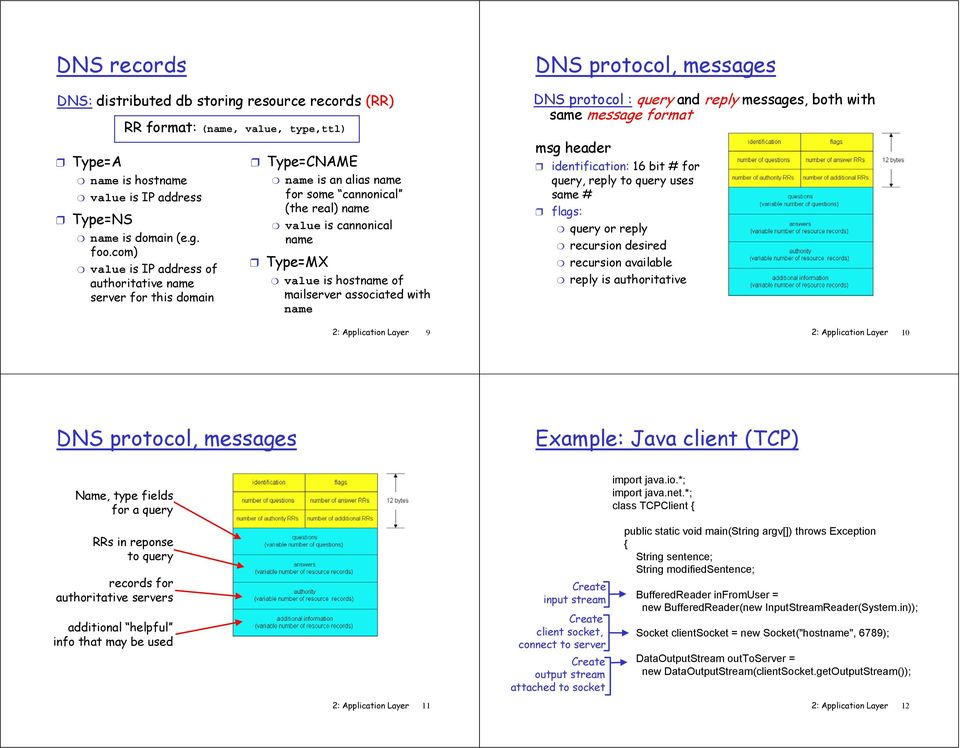
4 Example: Java client (TCP), cont. Example: Java server (TCP) input stream attached Send line to server Read line from server BufferedReader infromserver = new BufferedReader(new InputStreamReader(clientSocket.getInputStream())); sentence = infromuser.readline(); outtoserver.writebytes(sentence + '\n'); modifiedsentence = infromserver.readline(); System.out.println("FROM SERVER: " + modifiedsentence); clientsocket.close(); welcoming socket at port 6789 Wait, on welcoming socket for contact by client input stream, attached class TCPServer public static void main(string argv[]) throws Exception String clientsentence; String capitalizedsentence; ServerSocket welcomesocket = new ServerSocket(6789); while(true) Socket connectionsocket = welcomesocket.accept(); BufferedReader infromclient = new BufferedReader(new InputStreamReader(connectionSocket.getInputStream())); 2: Application Layer 13 2: Application Layer 14 Example: Java server (TCP), cont Example: Java client (UDP) output stream, attached Read in line from socket Write out line DataOutputStream outtoclient = new DataOutputStream(connectionSocket.getOutputStream()); clientsentence = infromclient.readline(); capitalizedsentence = clientsentence.touppercase() + '\n'; outtoclient.writebytes(capitalizedsentence); End of while loop, loop back and wait for another client connection input stream client socket Translate hostname to IP address using DNS class UDPClient public static void main(string args[]) throws Exception BufferedReader infromuser = new BufferedReader(new InputStreamReader(System.in)); DatagramSocket clientsocket = new DatagramSocket(); InetAddress IPAddress = InetAddress.getByName("hostname"); byte[] senddata = new byte[1024]; byte[] receivedata = new byte[1024]; String sentence = infromuser.readline(); senddata = sentence.getbytes(); 2: Application Layer 15 2: Application Layer 16

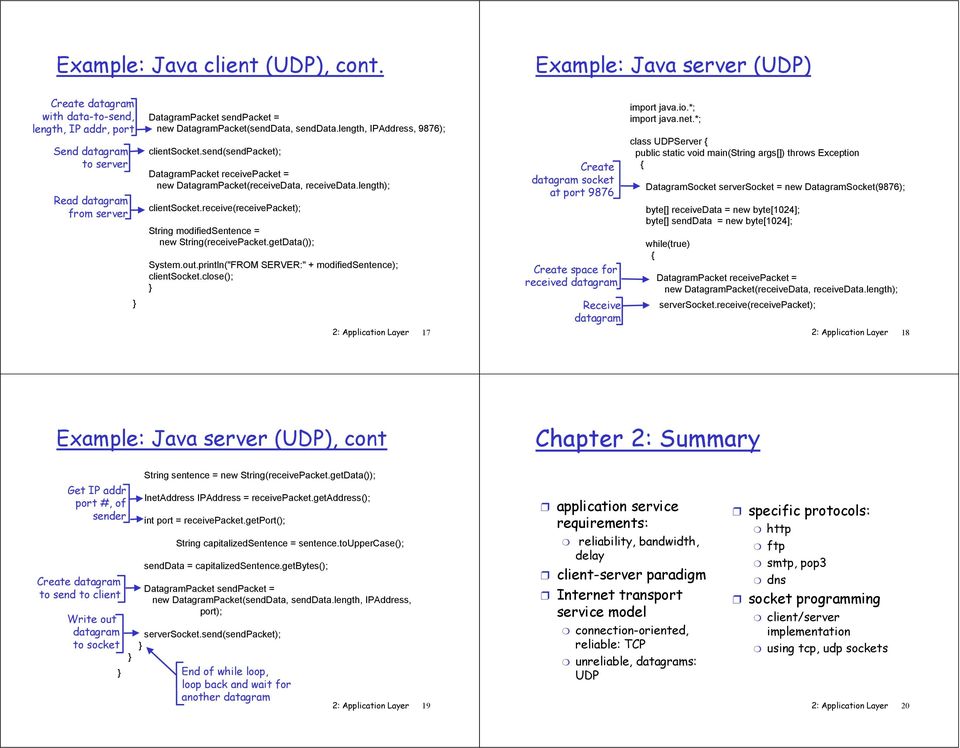
5 Example: Java client (UDP), cont. Example: Java server (UDP) datagram with data-to-send, length, IP addr, port Send datagram to server Read datagram from server DatagramPacket sendpacket = new DatagramPacket(sendData, senddata.length, IPAddress, 9876); clientsocket.send(sendpacket); DatagramPacket receivepacket = new DatagramPacket(receiveData, receivedata.length); clientsocket.receive(receivepacket); String modifiedsentence = new String(receivePacket.getData()); System.out.println("FROM SERVER:" + modifiedsentence); clientsocket.close(); 2: Application Layer 17 datagram socket at port 9876 space for received datagram Receive datagram class UDPServer public static void main(string args[]) throws Exception DatagramSocket serversocket = new DatagramSocket(9876); byte[] receivedata = new byte[1024]; byte[] senddata = new byte[1024]; while(true) DatagramPacket receivepacket = new DatagramPacket(receiveData, receivedata.length); serversocket.receive(receivepacket); 2: Application Layer 18 Example: Java server (UDP), cont Chapter 2: Summary Get IP addr port #, of sender datagram to send to client Write out datagram String sentence = new String(receivePacket.getData()); InetAddress IPAddress = receivepacket.getaddress(); int port = receivepacket.getport(); String capitalizedsentence = sentence.touppercase(); senddata = capitalizedsentence.getbytes(); DatagramPacket sendpacket = new DatagramPacket(sendData, senddata.length, IPAddress, port); serversocket.send(sendpacket); End of while loop, loop back and wait for another datagram 2: Application Layer 19 application service requirements: reliability, bandwidth, delay client-server paradigm Internet transport service model connection-oriented, reliable: TCP unreliable, datagrams: UDP specific protocols: http ftp smtp, pop3 dns socket programming client/server implementation using tcp, udp sockets 2: Application Layer 20
6 Chapter 2: Summary Most importantly: learned about protocols typical request/reply message exchange: client requests info or service server responds with data, status code message formats: headers: fields giving info about data data: info being communicated control vs. data msgs in-based, out-of-band centralized vs. decentralized stateless vs. stateful reliable vs. unreliable msg transfer complexity at network edge security: authentication 2: Application Layer 21

Network Programming using sockets
 Network Programming using sockets TCP/IP layers Layers Message Application Transport Internet Network interface Messages (UDP) or Streams (TCP) UDP or TCP packets IP datagrams Network-specific frames Underlying
Data Communication & Networks G22.2262-001
 Data Communication & Networks G22.2262-001 Session 10 - Main Theme Java Sockets Dr. Jean-Claude Franchitti New York University Computer Science Department Courant Institute of Mathematical Sciences 1 Agenda
Socket programming. Socket Programming. Languages and Platforms. Sockets. Rohan Murty Hitesh Ballani. Last Modified: 2/8/2004 8:30:45 AM
 Socket Programming Rohan Murty Hitesh Ballani Last Modified: 2/8/2004 8:30:45 AM Slides adapted from Prof. Matthews slides from 2003SP Socket programming Goal: learn how to build client/server application
Goal: learn how to build client/server application that communicate using sockets. An interface between application and network
 Socket programming Goal: learn how to build client/server application that communicate using sockets Socket API introduced in BSD4.1 UNIX, 1981 explicitly created, used, released by apps client/server
Chapter 2: Application layer
 Chapter 2: Application layer 2.1 Principles of network applications 2.2 Web and HTTP 2.3 FTP 2.4 Electronic Mail SMTP, POP3, IMAP 2.5 DNS 2.6 P2P applications 2: Application Layer 1 Some network apps e-mail
Domain Name System (DNS)
 Domain Name System (DNS) Instructor: Anirban Mahanti Office: ICT 745 Email: [email protected] Class Location: ICT 121 Lectures: MWF 12:00 12:50 Notes derived from Computer Networking: A Top Down
Application-layer protocols
 Application layer Goals: Conceptual aspects of network application protocols Client server paradigm Service models Learn about protocols by examining popular application-level protocols HTTP DNS Application-layer
Java Network. Slides prepared by : Farzana Rahman
 Java Network Programming 1 Important Java Packages java.net java.io java.rmi java.security java.lang TCP/IP networking I/O streams & utilities Remote Method Invocation Security policies Threading classes
Data Communications & Networks. Session 2 Main Theme Application Layer. Dr. Jean-Claude Franchitti
 Data Communications & Networks Session 2 Main Theme Application Layer Dr. Jean-Claude Franchitti New York University Computer Science Department Courant Institute of Mathematical Sciences Adapted from
Chapter 2 Application Layer
 Chapter 2 Application Layer A note on the use of these ppt slides: We re making these slides freely available to all (faculty, students, readers). They re in PowerPoint form so you see the animations;
CS 348: Computer Networks. - DNS; 22 nd Oct 2012. Instructor: Sridhar Iyer IIT Bombay
 CS 348: Computer Networks - DNS; 22 nd Oct 2012 Instructor: Sridhar Iyer IIT Bombay Domain Name System Map between host names and IP addresses People: many identifiers: name, Passport #, Internet hosts:
DNS: Domain Name System
 DNS: Domain Name System People: many identifiers: SSN, name, passport # Internet hosts, routers: IP address (32 bit) - used for addressing datagrams name, e.g., ww.yahoo.com - used by humans Q: map between
Domain Name System (or Service) (DNS) Computer Networks Term B10
 Domain Name System (or Service) (DNS) Computer Networks Term B10 DNS Outline DNS Hierarchial Structure Root Name Servers Top-Level Domain Servers Authoritative Name Servers Local Name Server Caching and
Domain Name System Richard T. B. Ma
 Domain Name System Richard T. B. Ma School of Computing National University of Singapore CS 3103: Compute Networks and Protocols Names Vs. Addresses Names are easier for human to remember www.comp.nus.edu.sg
Domain Name System (DNS) RFC 1034 RFC 1035 http://www.ietf.org
 Domain Name System (DNS) RFC 1034 RFC 1035 http://www.ietf.org TCP/IP Protocol Suite Application Layer DHCP DNS SNMP HTTP SMTP POP Transport Layer UDP TCP ICMP IGMP Network Layer IP Link Layer ARP ARP
Domain Name System (DNS)
 Chapter 18 CSC465 Computer Networks Spring 2004 Dr. J. Harrison These slides are based on the text TCP/IP Protocol Suite (2 nd Edition) Domain Name System (DNS) CONTENTS NAME SPACE DOMAIN NAME SPACE DISTRIBUTION
DATA COMMUNICATOIN NETWORKING
 DATA COMMUNICATOIN NETWORKING Instructor: Ouldooz Baghban Karimi Course Book: Computer Networking, A Top-Down Approach By: Kurose, Ross Introduction Course Overview Basics of Computer Networks Internet
NET0183 Networks and Communications
 NET0183 Networks and Communications Lecture 25 DNS Domain Name System 8/25/2009 1 NET0183 Networks and Communications by Dr Andy Brooks DNS is a distributed database implemented in a hierarchy of many
How To Map Between Ip Address And Name On A Domain Name System (Dns)
 Computer Networks: Domain Name Service (DNS) CS 3516 D- term 2013 Instructor: Krishna Venkatasubramanian Quiz 2 DNS: domain name system people: many identifiers: SSN, name, passport # Internet hosts, routers:
CMPE 80N: Introduction to Networking and the Internet
 CMPE 80N: Introduction to Networking and the Internet Katia Obraczka Computer Engineering UCSC Baskin Engineering Lecture 10 CMPE 80N Fall'10 1 Announcements Forum assignment #2 posted. Due Nov. 5 th.
Overview of Computer Networks
 Overview of Computer Networks Client-Server Transaction Client process 4. Client processes response 1. Client sends request 3. Server sends response Server process 2. Server processes request Resource
FTP: the file transfer protocol
 FTP: the file transfer protocol at host FTP interface FTP client local file system file transfer FTP remote file system transfer file to/from remote host client/ model client: side that initiates transfer
The Application Layer: DNS
 Recap SMTP and email The Application Layer: DNS Smith College, CSC 9 Sept 9, 0 q SMTP process (with handshaking) and message format q Role of user agent access protocols q Port Numbers (can google this)
String sentence = new String(receivePacket.getData()); InetAddress IPAddress = receivepacket.getaddress(); int port = receivepacket.
 164 CHAPTER 2 APPLICATION LAYER connection requests, as done in TCPServer.java. If multiple clients access this application, they will all send their packets into this single door, serversocket. String
DNS and P2P File Sharing
 Computer Networks DNS and P2P File Sharing Based on Computer Networking, 4 th Edition by Kurose and Ross DNS: Domain Name System People: many identifiers: SSN, name, passport # Internet hosts, routers:
Internet Applications & Socket Programming
 Roskilde University - Department of Computer Science E-mail: [email protected] [email protected] [email protected] Internet Applications & Socket Programming Niels Christian Juul [email protected] 5 th lecture on Networks
internet technologies and standards
 Institute of Telecommunications Warsaw University of Technology 2015 internet technologies and standards Piotr Gajowniczek Andrzej Bąk Michał Jarociński Internet application layer the email service The
Chapter 2: outline. 2.6 P2P applications 2.7 socket programming with UDP and TCP
 Chapter 2: outline 2.1 principles of network applications app architectures app requirements 2.2 Web and HTTP 2.3 FTP 2.4 electronic mail SMTP, POP3, IMAP 2.5 DNS 2.6 P2P applications 2.7 socket programming
CS 355. Computer Networking. Wei Lu, Ph.D., P.Eng.
 CS 355 Computer Networking Wei Lu, Ph.D., P.Eng. Chapter 2: Application Layer Overview: Principles of network applications? Introduction to Wireshark Web and HTTP FTP Electronic Mail: SMTP, POP3, IMAP
DNS: Domain Name System
 DNS: Domain Name System CMPSCI 491G: Computer Networking Lab V. Arun Slides adapted from Liebeherr & Zarki, Kurose & Ross, Kermani DNS: domain name system people: many identifiers: SSN, name, passport
Domain Name System (DNS) Omer F. Rana. Networks and Data Communications 1
 Domain Name System (DNS) Omer F. Rana Networks and Data Communications 1 What is a DNS Each institution on the internet has a host that runs a process called a Domain Name Server (also DNS!) It is not
CS 43: Computer Networks Naming and DNS. Kevin Webb Swarthmore College September 17, 2015
 CS 43: Computer Networks Naming and DNS Kevin Webb Swarthmore College September 17, 2015 Agenda Identifiers and addressing Domain Name System History Query sequences Record types Load balancing Recall:
Names & Addresses. Names & Addresses. Names vs. Addresses. Identity. Names vs. Addresses. CS 194: Distributed Systems: Naming
 Names & Addresses CS 9: Distributed Systems: Naming Computer Science Division Department of Electrical Engineering and Computer Sciences University of California, Berkeley Berkeley, CA 970-77 What is a?
CS640: Computer Networks. Naming /ETC/HOSTS
 CS640: Computer Networks Aditya Akella Lecture 17 Naming and the DNS Naming Need naming to identify resources Once identified, resource must be located How to name resource? Naming hierarchy How do we
Computer Networks & Security 2014/2015
 Computer Networks & Security 2014/2015 IP Protocol Stack & Application Layer (02a) Security and Embedded Networked Systems time Protocols A human analogy All Internet communication is governed by protocols!
Ch 6: Networking Services: NAT, DHCP, DNS, Multicasting
 Ch 6: Networking Services: NAT, DHCP, DNS, Multicasting Magda El Zarki Prof. of CS Univ. of CA, Irvine Email: [email protected] http: www.ics.uci.edu/~magda Overivew of NAT NAT: Network Address Translation
Domain Name System DNS
 CE443 Computer Networks Domain Name System DNS Behnam Momeni Computer Engineering Department Sharif University of Technology Acknowledgments: Lecture slides are from Computer networks course thought by
Applications & Application-Layer Protocols: The Domain Name System and Peerto-Peer
 CPSC 360 Network Programming Applications & Application-Layer Protocols: The Domain Name System and Peerto-Peer Systems Michele Weigle Department of Computer Science Clemson University [email protected]
Lecture 2 CS 3311. An example of a middleware service: DNS Domain Name System
 Lecture 2 CS 3311 An example of a middleware service: DNS Domain Name System The problem Networked computers have names and IP addresses. Applications use names; IP uses for routing purposes IP addresses.
Names vs. Addresses. Flat vs. Hierarchical Space. Domain Name System (DNS) Computer Networks. Lecture 5: Domain Name System
 Names vs. Addresses Computer Networks Lecture 5: Domain Name System Names are easier for human to remember www.umich.edu vs. 141.213.4.4 Addresses can be changed without changing names move www.umich.edu
Ch 6: Networking Services: NAT, DHCP, DNS, Multicasting, NTP
 Ch 6: Networking Services: NAT, DHCP, DNS, Multicasting, NTP Magda El Zarki Prof. of CS Univ. of CA, Irvine Email: [email protected] http: www.ics.uci.edu/~magda Network Address Translation - NAT Private
Network Layers. CSC358 - Introduction to Computer Networks
 Network Layers Goal Understand how application processes set up a connection and exchange messages. Understand how addresses are determined Data Exchange Between Application Processes TCP Connection-Setup
Computer Networks 1 (Mạng Máy Tính 1) Lectured by: Dr. Phạm Trần Vũ MEng. Nguyễn CaoĐạt
 Computer Networks 1 (Mạng Máy Tính 1) Lectured by: Dr. Phạm Trần Vũ MEng. Nguyễn CaoĐạt 1 Lecture 10: Application Layer 2 Application Layer Where our applications are running Using services provided by
FTP: the file transfer protocol
 File Transfer: FTP FTP: the file transfer protocol at host FTP interface FTP client local file system file transfer FTP remote file system transfer file to/from remote host client/ model client: side that
Socket Programming. Announcement. Lectures moved to
 Announcement Lectures moved to 150 GSPP, public policy building, right opposite Cory Hall on Hearst. Effective Jan 31 i.e. next Tuesday Socket Programming Nikhil Shetty GSI, EECS122 Spring 2006 1 Outline
416 Distributed Systems. Feb 24, 2016 DNS and CDNs
 416 Distributed Systems Feb 24, 2016 DNS and CDNs Outline DNS Design Content Distribution Networks 2 Naming How do we efficiently locate resources? DNS: name à IP address Challenge How do we scale this
Naming and the DNS. Focus. How do we name hosts etc.? Application Presentation Topics. Session Domain Name System (DNS) Email/URLs
 Naming and the DNS Focus How do we name hosts etc.? Application Presentation Topics Session Domain Name System (DNS) Email/URLs Transport Network Data Link Physical Ldns.1 Names and Addresses 43 name address
DNS Domain Name System
 Domain Name System DNS Domain Name System The domain name system is usually used to translate a host name into an IP address Domain names comprise a hierarchy so that names are unique, yet easy to remember.
Transport layer protocols. Message destination: Socket +Port. Asynchronous vs. Synchronous. Operations of Request-Reply. Sockets
 Transport layer protocols Interprocess communication Synchronous and asynchronous comm. Message destination Reliability Ordering Client Server Lecture 15: Operating Systems and Networks Behzad Bordbar
Application. Transport. Network. Data Link. Physical. Network Layers. Goal
 Layers Goal Understand how application processes set up a connection and exchange messages. Understand how addresses are determined 1 2 Data Exchange Between Processes TCP Connection-Setup Between Processes
CS3600 SYSTEMS AND NETWORKS
 CS3600 SYSTEMS AND NETWORKS FALL 2011 Lecture 19: DNS Prof. Alan Mislove ([email protected]) Slides used with permissions from Edward W. Knightly, T. S. Eugene Ng, Ion Stoica, Hui Zhang Human Involvement
Internet-Praktikum I Lab 3: DNS
 Kommunikationsnetze Internet-Praktikum I Lab 3: DNS Mark Schmidt, Andreas Stockmayer Sommersemester 2015 kn.inf.uni-tuebingen.de Motivation for the DNS Problem IP addresses hard to remember for humans
1 Introduction: Network Applications
 1 Introduction: Network Applications Some Network Apps E-mail Web Instant messaging Remote login P2P file sharing Multi-user network games Streaming stored video clips Internet telephone Real-time video
3. The Domain Name Service
 3. The Domain Name Service n Overview and high level design n Typical operation and the role of caching n Contents of DNS Resource Records n Basic message formats n Configuring/updating Resource Records
DNS. Spring 2016 CS 438 Staff 1
 DNS Spring 2016 CS 438 Staff 1 Host Names vs. IP addresses Host names Mnemonic name appreciated by humans Variable length, full alphabet of characters Provide little (if any) information about physical
Network Communication
 Network Communication Outline Sockets Datagrams TCP/IP Client-Server model OSI Model Sockets Endpoint for bidirectional communication between two machines. To connect with each other, each of the client
Application Layer. Abusayeed Saifullah. CS 5600 Computer Networks. These slides are adapted from Kurose and Ross
 Application Layer Abusayeed Saifullah CS 5600 Computer Networks These slides are adapted from Kurose and Ross Web caches (proxy server) goal: satisfy client request without involving origin server v user
loss-tolerant and time sensitive loss-intolerant and time sensitive loss-intolerant and time insensitive
 CS326e Quiz 5 The first correct 10 answers will be worth 1 point each. Each subsequent correct answer will be worth 0.2 points. Circle the correct answer. UTEID The transfer of an html file from one host
The exam has 110 possible points, 10 of which are extra credit. There is a Word Bank on Page 8. Pages 7-8 can be removed from the exam.
 CS326e Spring 2014 Midterm Exam Name SOLUTIONS UTEID The exam has 110 possible points, 10 of which are extra credit. There is a Word Bank on Page 8. Pages 7-8 can be removed from the exam. 1. [4 Points]
2.5 DNS The Internet s Directory Service
 130 CHAPTER 2 APPLICATION LAYER e-mail is also provided by Google, Yahoo!, as well as just about every major university and corporation. With this service, the user agent is an ordinary Web browser, and
Division of Informatics, University of Edinburgh
 CS1Bh Lecture Note 20 Client/server computing A modern computing environment consists of not just one computer, but several. When designing such an arrangement of computers it might at first seem that
Motivation. Domain Name System (DNS) Flat Namespace. Hierarchical Namespace
 Motivation Domain Name System (DNS) IP addresses hard to remember Meaningful names easier to use Assign names to IP addresses Name resolution map names to IP addresses when needed Namespace set of all
Domain Name System (DNS) Reading: Section in Chapter 9
 Domain Name System (DNS) Reading: Section in Chapter 9 RFC 1034, STD 13 Name Syntax and rules for delegating authority over names Specify implementation of a distributed system that maps names to addresses
SSC - Communication and Networking Java Socket Programming (II)
 SSC - Communication and Networking Java Socket Programming (II) Shan He School for Computational Science University of Birmingham Module 06-19321: SSC Outline Outline of Topics Multicast in Java User Datagram
Lecture 5: Network Attacks I. Course Admin
 Lecture 5: Network Attacks I CS 336/536: Computer Network Security Fall 2013 Nitesh Saxena Adopted from previous lectures by Keith Ross Course Admin HW/Lab 1 Due Coming Monday 11am Lab sessions are active
Computer Networks Prof. S. Ghosh Department of Computer Science and Engineering Indian Institute of Technology, Kharagpur Lecture - 34 DNS & Directory
 Computer Networks Prof. S. Ghosh Department of Computer Science and Engineering Indian Institute of Technology, Kharagpur Lecture - 34 DNS & Directory Good day. Today we will take up two topics, DNS and
DNS and electronic mail. DNS purposes
 DNS and electronic mail Section 9.1.3 in the textbook DNS purposes Originally purpose was to translate hostnames into IP addresses www.csd. is easier to remember than 129.100.23.247 Lets us do load balancing
Chapter 25 Domain Name System. 25.1 Copyright The McGraw-Hill Companies, Inc. Permission required for reproduction or display.
 Chapter 25 Domain Name System 25.1 Copyright The McGraw-Hill Companies, Inc. Permission required for reproduction or display. 25.2 Figure 25.1 Example of using the DNS service 25-1 NAME SPACE To be unambiguous,
Socket UDP. H. Fauconnier 1-1. M2-Internet Java
 Socket UDP H. Fauconnier 1-1 M2-Internet Java UDP H. Fauconnier M2-Internet Java 2 Socket programming with UDP UDP: no connection between client and server no handshaking sender explicitly attaches IP
Introduction to Computer Networks
 Introduction to Computer Networks Chen Yu Indiana University Basic Building Blocks for Computer Networks Nodes PC, server, special-purpose hardware, sensors Switches Links: Twisted pair, coaxial cable,
Chapter 23 The Domain Name System (DNS)
 CSC521 Communication Protocols 網 路 通 訊 協 定 Chapter 23 The Domain Name System (DNS) 吳 俊 興 國 立 高 雄 大 學 資 訊 工 程 學 系 Outline 1. Introduction 2. Names For Machines 3. Flat Namespace 4. Hierarchical Names 5.
HW2 Grade. CS585: Applications. Traditional Applications SMTP SMTP HTTP 11/10/2009
 HW2 Grade 70 60 CS585: Applications 50 40 30 20 0 0 2 3 4 5 6 7 8 9 0234567892022223242526272829303323334353637383940442 CS585\CS485\ECE440 Fall 2009 Traditional Applications SMTP Simple Mail Transfer
Learning Outcomes. Networking. Sockets. TCP/IP Networks. Hostnames and DNS TCP/IP
 CP4044 Lecture 7 1 Networking Learning Outcomes To understand basic network terminology To be able to communicate using Telnet To be aware of some common network services To be able to implement client
The Domain Name System
 The Domain Name System Antonio Carzaniga Faculty of Informatics University of Lugano October 9, 2012 2005 2007 Antonio Carzaniga 1 IP addresses and host names Outline DNS architecture DNS process DNS requests/replies
Abstract Stream Socket Service
 COM 362 Computer Networks I Lec 2: Applicatin Layer: TCP/UDP Socket Programming 1. Principles of Networks Applications 2. TCP Socket Programming 3. UDP Socket Programming Prof. Dr. Halûk Gümüşkaya [email protected]
Lesson: All About Sockets
 All About Sockets http://java.sun.com/docs/books/tutorial/networking/sockets/index.html Page 1 sur 1 The Java TM Tutorial Start of Tutorial > Start of Trail Trail: Custom Networking Lesson: All About Sockets
Distributed Systems. 09. Naming. Paul Krzyzanowski. Rutgers University. Fall 2015
 Distributed Systems 09. Naming Paul Krzyzanowski Rutgers University Fall 2015 October 7, 2015 2014-2015 Paul Krzyzanowski 1 Naming things Naming: map names to objects Helps with using, sharing, and communicating
Review of Networking Basics. Yao Wang Polytechnic University, Brooklyn, NY11201 [email protected]
 Review of Networking Basics Yao Wang Polytechnic University, Brooklyn, NY11201 [email protected] These slides are extracted from the slides made by authors of the book (J. F. Kurose and K. Ross), available
Mail User Agent Project
 Mail User Agent Project Tom Kelliher, CS 325 100 points, due May 4, 2011 Introduction (From Kurose & Ross, 4th ed.) In this project you will implement a mail user agent (MUA) that sends mail to other users.
The Application Layer. CS158a Chris Pollett May 9, 2007.
 The Application Layer CS158a Chris Pollett May 9, 2007. Outline DNS E-mail More on HTTP The Domain Name System (DNS) To refer to a process on the internet we need to give an IP address and a port. These
The Domain Name System (DNS)
 The Domain Name System (DNS) Each Internet host is assigned a host name and an IP address Host names are structured character strings, e.g., www.cs.iastate.edu IP addresses are 32 bit integers, e.g., 129.186.3.6
How do I get to www.randomsite.com?
 Networking Primer* *caveat: this is just a brief and incomplete introduction to networking to help students without a networking background learn Network Security. How do I get to www.randomsite.com? Local
INTERNET DOMAIN NAME SYSTEM
 INTERNET DOMAIN NAME SYSTEM http://www.tutorialspoint.com/internet_technologies/internet_domain_name_system.htm Copyright tutorialspoint.com Overview When DNS was not into existence, one had to download
Introduction to TCP/IP
 Introduction to TCP/IP Raj Jain The Ohio State University Columbus, OH 43210 Nayna Networks Milpitas, CA 95035 Email: [email protected] http://www.cis.ohio-state.edu/~jain/ 1 Overview! Internetworking Protocol
Transport Layer Services Mul9plexing/Demul9plexing. Transport Layer Services
 Computer Networks Mul9plexing/Demul9plexing Transport services and protocols provide logical communica+on between app processes running on different hosts protocols run in end systems send side: breaks
DNS : Domain Name System
 1/30 DNS : Domain Name System Surasak Sanguanpong [email protected] http://www...ac.th/~nguan Last updated: May 24, 1999 Outline 2/30 DNS basic name space name resolution process protocol configurations Why
Introduction to the Domain Name System
 CHAPTER 14 The Domain Name System (DNS) handles the growing number of Internet users. DNS translates names, such as www.cisco.com, into IP addresses, such as 192.168.40.0 (or the more extended IPv6 addresses),