
DNS Domain Name System
|
|
|
- Bernard Wilkins
- 10 years ago
- Views:
Transcription
1 Domain Name System

2 DNS Domain Name System The domain name system is usually used to translate a host name into an IP address Domain names comprise a hierarchy so that names are unique, yet easy to remember.
3 DNS introduction People: many identifiers: SSN, name, passport # Internet hosts, routers: IP address (32 bit) - used for addressing datagrams name, e.g., cs.pub.ro by humans Map between IP addresses and name? Domain Name System: distributed database implemented in hierarchy of many name servers application-layer protocol host, routers, name servers to communicate to resolve names (address/name translation) Note: core Internet function, implemented as application-layer protocol Complexity at network s edge

4 In The Beginning... Early host database was a text file Operational nightmare! Rate of change in file was growing exponentially NIC staff overwhelmed Everyone copied it (nightly!) to get current version Network overwhelmed Many opportunities for errors And we experienced many of them Fate sharing model wrong Affected parties couldn t change database

5 DNS begining. there was the HOSTS.TXT file Before DNS (until 1985), the name-to-ip address was done by downloading a single file (hosts.txt) from a central server with FTP Names in hosts.txt are not structured. The hosts.txt file still works on most operating systems. It can be used to define local names. /etc/hosts [Unix] c:\windows\system32\drivers\etc\hosts [Windows] A centrally-maintained file, distributed to all hosts on the Internet

6 hosts.txt doesn't scale Huge file Needs frequent copying to ALL hosts Consistency Always out-of-date Name uniqueness Single point of administration
7 Naming How do we efficiently locate resources? DNS: name -> IP address Challenge How do we scale these to the wide area?
8 Obvious Solutions Why not centralize DNS? Single point of failure Traffic volume Distant centralized database Single point of update Why not use /etc/hosts? Original Name to Address Mapping Flat namespace /etc/hosts SRI kept main copy Downloaded regularly Count of hosts was increasing: machine per domain -> machine per user Many more downloads Many more updates

9 Domain Name System Goals Basically a wide-area distributed database Scalability Decentralized maintenance Robustness Global scope Names mean the same thing everywhere Don t need Atomicity Strong consistency
10 The domain name system was born (Paul Mockapetris, RFC1034/1035) DNS is a Distributed Database for holding name to IP address (and other) information Distributed: Shares the administration Shares the load Robustness and performance through: Replication Caching A critical piece of Internet infrastructure

11 Conceptually, programmers can view the DNS database as a collection of millions of host entry structures: /* DNS host entry structure */ struct hostent { char *h_name; /* official domain name of host */ char **h_aliases; /* null-terminated array of domain names */ int h_addrtype; /* host address type (AF_INET) */ Int h_length; /* length of an address, in bytes */ char **h_addr_list; /* null-terminated array of in_addr structs */ }; in_addr is a struct consisting of 4-byte IP address Functions for retrieving host entries from DNS: gethostbyname: query key is a DNS host name. gethostbyaddr: query key is an IP address.

12 Host name structure Each host name is made up of a sequence of labels separated by periods. Each label can be up to 63 characters The total name can be at most 255 characters. Alphanumeric characters a-z, A-Z, 0-9 and - Examples: pub.ro cs.pub.ro The most important element of address is on the right (TLD top level domain)

13 Domain Name Space Label Each label can be up to 63 characters Domain Name Sequence of the labels separated by dots

14 Domain name space Children of the node have different labels

15 Domain names and labels

16 DNS Name hierarchy DNS hierarchy can be represented by a tree Root and top-level domains are administered by an Internet central name registration authority (ICANN) Below top-level domain, administration of name space is delegated to organizations Each organization can delegate further Managed by Univ T Managed by ECE Dept.

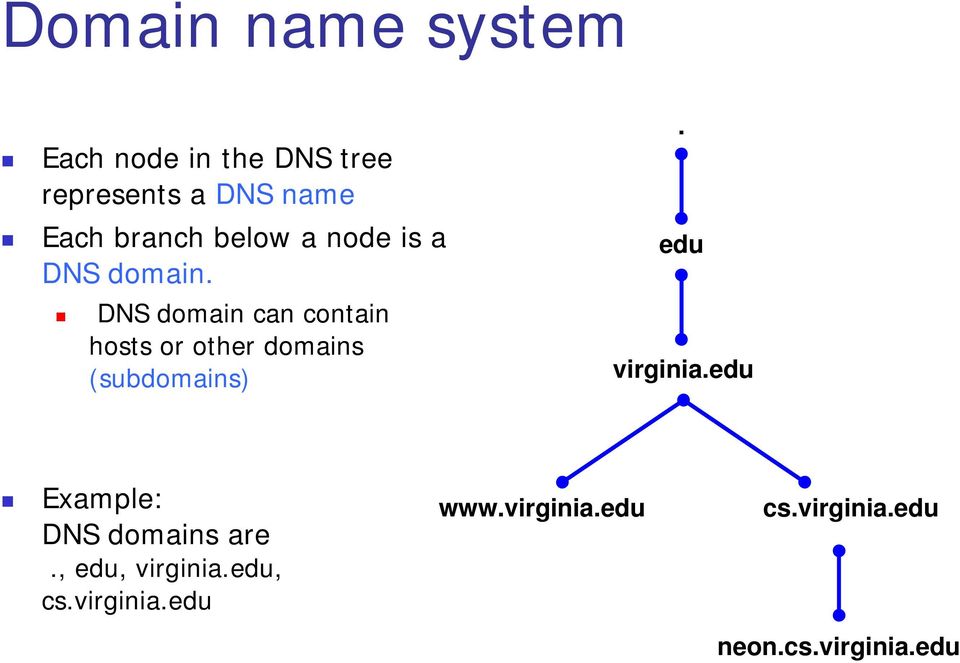
17 Domain name system Each node in the DNS tree represents a DNS name Each branch below a node is a DNS domain. DNS domain can contain hosts or other domains (subdomains). edu virginia.edu Example: DNS domains are., edu, virginia.edu, cs.virginia.edu cs.virginia.edu neon.cs.virginia.edu
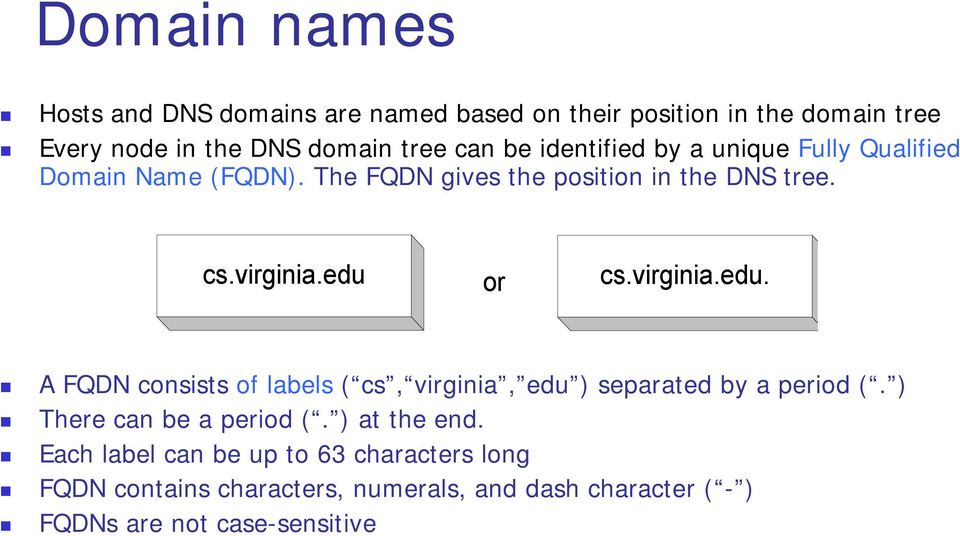
18 Domain names Hosts and DNS domains are named based on their position in the domain tree Every node in the DNS domain tree can be identified by a unique Fully Qualified Domain Name (FQDN). The FQDN gives the position in the DNS tree. A FQDN consists of labels ( cs, virginia, edu ) separated by a period (. ) There can be a period (. ) at the end. Each label can be up to 63 characters long FQDN contains characters, numerals, and dash character ( - ) FQDNs are not case-sensitive
19 DNS Messages Header Question Section Answer Section Authoritative Section Additional Information Section

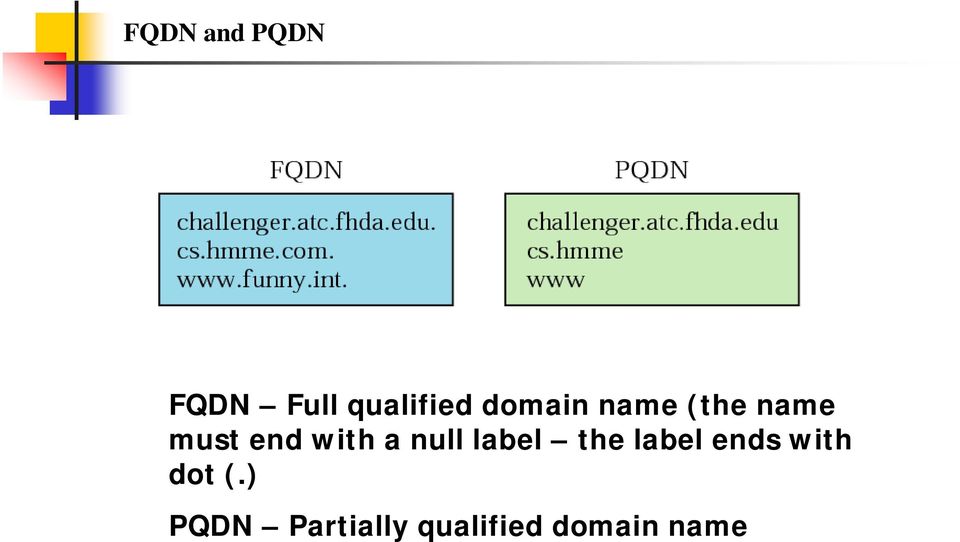
20 FQDN and PQDN FQDN Full qualified domain name (the name must end with a null label the label ends with dot (.) PQDN Partially qualified domain name
21 Domains The domain name for a host is the sequence of labels that lead from the host (leaf node in the naming tree) to the top of the worldwide naming tree. Contains resource records and sub-domains Some resource records point to authoritative server for subdomains / zones A domain is a subtree of the worldwide naming tree.
22 Distribution of Name Spaces Hierarchy of Name Servers Zone Root Server Primary and Secondary Servers
23 Hierarchy of name servers
24 Zones and domains Its records are held in a database ( zonefile ) and served from an authoritative name server Zone refers to all the resource records in a domain but not its sub domains
25 A primary server loads all information from the disk file; The secondary server loads all information from the primary server.
26 DNS In The Internet Generic Domain Country Domain Inverse Domain
27 Top-level domains Three types of top-level domains: Organizational: 3-character code indicates the function of the organization Used primarily within the US Examples: gov, mil, edu, org, com, net Geographical: 2-character country or region code Examples: ro, us, va, jp, de Reverse domains: A special domain (in-addr.arpa) used for IP address-to-name mapping There are more than 200 top-level domains.
28 DNS in the Internet
29 Generic domains
30 Generic domain labels Label Description com Commercial organizations edu Educational institutions gov int mil net org Government institutions International organizations Military groups Network support centers Nonprofit organizations
31 New generic domain labels Label Description aero Airlines and aerospace companies biz Businesses or firms (similar to com) coop info museum name pro Cooperative business organizations Information service providers Museums and other nonprofit organizations Personal names (individuals) Professional individual organizations
32 Country domains
33 Inverse domain
34 Using the DNS A Domain Name (like is the KEY to look up information The result is one or more RESOURCE RECORDS (RRs) There are different RRs for different types of information You can ask for the specific type you want, or ask for "any" RRs associated with the domain name
35 What is a resource record? A domain contains resource records Resource records are analogous to files Classified into types Some of the important types are SOA, NS, A, CNAME and MX Normally defines in zone files
36 Commonly seen RRs A (address): map hostname to IP address PTR (pointer): map IP address to name MX (mail exchanger): where to deliver mail for user@domain CNAME (canonical name): map alternative hostname to real hostname TXT (text): any descriptive text NS (name server), SOA (start of authority): used for delegation and management of the DNS itself
37 The Address record The A Record One or more normally defines a host Contains an IPv4 Address (the address computers use to uniquely identify each other on the internet) Eg. The record: www A In the ausregistry.com.au domain, defines the host uniquely identifiable as to be reachable at the IPv4 Address
38 The CNAME Record A CNAME defines an alias The alias will then be resolved, if another CNAME is encountered then the process continues until an A record is found Eg. The record: search CNAME In the ausregistry.com.au domain, defines the name uniquely identifiable as search.ausregistry.com.au to be and alias to
39 The MX Record An MX record defines the mail servers for a particular domain Mail exchange records hold the name of hosts, and their priorities, able to deliver mail for the domain. Eg. The record: ausregistry.com.au MX 10 mail In the ausregistry.com.au domain, defines the host mail to be the priority 10 mail server for the ausregistry.com.au domain
40 The NS Record An NS record defines the authoritative Name servers for the domain. The Name Server records also define the name servers of children domains Eg. The record: internal NS ns1.hosting.com.au. In the ausregistry.com.au domain, defines the host ns1.hosting.com.au to be a name sever for the internal.ausregistry.com.au sub-domain
41 What is a Delegation? Delegation refers to the act of putting NS (name server) records in a domain name delegating control of a sub-domain to another entity This entity then has the ability to control the resource records in this sub-domain and delegate further children domains to other entities. Eg. IANA (Internet Assigned Numbers Authority) delegating control of a country code domain to the country.
42 DNS is a Client-Server application Requests and responses are normally sent in UDP packets, port 53 Occasionally uses TCP, port 53 for very large requests, e.g. zone transfer from master to slave TCP/53 must NOT be filtered. McGraw-Hill The McGraw-Hill Companies, Inc., 2004
43 Resolution Resolver Mapping Names to Addresses Mapping Addresses to Names Recursive Resolution Iterative Resolution Caching
44 DNS Distributed Database There is one primary server for a domain, and typically a number of secondary servers containing replicated databases. rpi.edu DNS server rpi.edu DNS DB Authoritative rpi.edu rpi.edu DNS rpi.edu DNS DB DNS DB DB Replicas
45 There are three roles involved in DNS Application e.g. web browser Resolver Caching Nameserver Authoritative Nameserver RESOLVER Takes request from application, formats it into UDP packet, sends to cache CACHING NAMESERVER Returns the answer if already known Otherwise searches for an authoritative server which has the information Caches the result for future queries Also known as RECURSIVE nameserver AUTHORITATIVE NAMESERVER Contains the actual information put into the DNS by the domain owner
46 DNS Clients A DNS client is called a resolver. A call to gethostbyname()is handled by a resolver (typically part of the client). Most Unix workstations have the file /etc/resolv.conf that contains the local domain and the addresses of DNS servers for that domain.
47 Recursive / Iterative resolution Name address Resolution mapping a name to an address or an address to a name
48 Query and response messages Header format
Hostnames. HOSTS.TXT was a bottleneck. Once there was HOSTS.TXT. CSCE515 Computer Network Programming. Hierarchical Organization of DNS
 Hostnames CSCE 515: Computer Network Programming ------ Address Conversion Function and DNS RFC 1034, RFC 1035 Wenyuan Xu http://www.cse..edu/~wyxu/ce515f07.html Department of Computer Science and Engineering
CS640: Computer Networks. Naming /ETC/HOSTS
 CS640: Computer Networks Aditya Akella Lecture 17 Naming and the DNS Naming Need naming to identify resources Once identified, resource must be located How to name resource? Naming hierarchy How do we
Motivation. Domain Name System (DNS) Flat Namespace. Hierarchical Namespace
 Motivation Domain Name System (DNS) IP addresses hard to remember Meaningful names easier to use Assign names to IP addresses Name resolution map names to IP addresses when needed Namespace set of all
DNS Domain Name System
 DNS Domain Name System Domain names and IP addresses People prefer to use easy-to-remember names instead of IP addresses Domain names are alphanumeric names for IP addresses e.g., neon.cs.virginia.edu,
Domain Name System (DNS) Fundamentals
 Domain Name System (DNS) Fundamentals Mike Jager Network Startup Resource Center [email protected] These materials are licensed under the Creative Commons Attribution-NonCommercial 4.0 International
Lecture 2 CS 3311. An example of a middleware service: DNS Domain Name System
 Lecture 2 CS 3311 An example of a middleware service: DNS Domain Name System The problem Networked computers have names and IP addresses. Applications use names; IP uses for routing purposes IP addresses.
Domain Name System Richard T. B. Ma
 Domain Name System Richard T. B. Ma School of Computing National University of Singapore CS 3103: Compute Networks and Protocols Names Vs. Addresses Names are easier for human to remember www.comp.nus.edu.sg
19 Domain Name System (DNS)
 CHAPTER 9 Domain Name System (DNS) I n this chapter, we discuss the second application program, Domain Name System (DNS). DNS is a client/server application program used to help other application programs.
Domain Name System (DNS) Session-1: Fundamentals. Ayitey Bulley [email protected]
 Domain Name System (DNS) Session-1: Fundamentals Ayitey Bulley [email protected] Computers use IP addresses. Why do we need names? Names are easier for people to remember Computers may be moved between
DNS: Domain Name System
 DNS: Domain Name System CMPSCI 491G: Computer Networking Lab V. Arun Slides adapted from Liebeherr & Zarki, Kurose & Ross, Kermani DNS: domain name system people: many identifiers: SSN, name, passport
CS3600 SYSTEMS AND NETWORKS
 CS3600 SYSTEMS AND NETWORKS FALL 2011 Lecture 19: DNS Prof. Alan Mislove ([email protected]) Slides used with permissions from Edward W. Knightly, T. S. Eugene Ng, Ion Stoica, Hui Zhang Human Involvement
Computer Networks Prof. S. Ghosh Department of Computer Science and Engineering Indian Institute of Technology, Kharagpur Lecture - 34 DNS & Directory
 Computer Networks Prof. S. Ghosh Department of Computer Science and Engineering Indian Institute of Technology, Kharagpur Lecture - 34 DNS & Directory Good day. Today we will take up two topics, DNS and
CS 348: Computer Networks. - DNS; 22 nd Oct 2012. Instructor: Sridhar Iyer IIT Bombay
 CS 348: Computer Networks - DNS; 22 nd Oct 2012 Instructor: Sridhar Iyer IIT Bombay Domain Name System Map between host names and IP addresses People: many identifiers: name, Passport #, Internet hosts:
Domain Name System (DNS)
 Chapter 18 CSC465 Computer Networks Spring 2004 Dr. J. Harrison These slides are based on the text TCP/IP Protocol Suite (2 nd Edition) Domain Name System (DNS) CONTENTS NAME SPACE DOMAIN NAME SPACE DISTRIBUTION
DNS : Domain Name System
 1/30 DNS : Domain Name System Surasak Sanguanpong [email protected] http://www...ac.th/~nguan Last updated: May 24, 1999 Outline 2/30 DNS basic name space name resolution process protocol configurations Why
Application Protocols in the TCP/IP Reference Model
 Application Protocols in the TCP/IP Reference Model File Transfer E-Mail Network Management WWW Virtual Terminal Name Service File Transfer HTTP FTP Telnet SMTP DNS SNMP TFTP Internet protocols TCP UDP
Chapter 25 Domain Name System. 25.1 Copyright The McGraw-Hill Companies, Inc. Permission required for reproduction or display.
 Chapter 25 Domain Name System 25.1 Copyright The McGraw-Hill Companies, Inc. Permission required for reproduction or display. 25.2 Figure 25.1 Example of using the DNS service 25-1 NAME SPACE To be unambiguous,
THE DOMAIN NAME SYSTEM DNS
 Announcements THE DOMAIN NAME SYSTEM DNS Internet Protocols CSC / ECE 573 Fall, 2005 N. C. State University copyright 2005 Douglas S. Reeves 2 Today s Lecture I. Names vs. Addresses II. III. IV. The Namespace
Application Protocols in the TCP/IP Reference Model. Application Protocols in the TCP/IP Reference Model. DNS - Concept. DNS - Domain Name System
 Application Protocols in the TCP/IP Reference Model Application Protocols in the TCP/IP Reference Model File Transfer E-Mail Network Management Protocols of the application layer are common communication
Introduction to the Domain Name System
 CHAPTER 14 The Domain Name System (DNS) handles the growing number of Internet users. DNS translates names, such as www.cisco.com, into IP addresses, such as 192.168.40.0 (or the more extended IPv6 addresses),
Internetworking with TCP/IP Unit 10. Domain Name System
 Unit 10 Domain Name System Structure 10.1 Introduction 10.2 Fully Qualified Domain Names (FQDNs) Generic Domains Country Domains 10.3 Mapping domain names to IP addresses 10.4 Mapping IP Addresses to Domain
Elementary Name and Address Conversions
 Elementary Name and Address Conversions Domain name system gethostbyname Function RES_USE_INET6 resolver option gethostbyname2 Function and IPv6 support gethostbyaddr Function uname and gethostname Functions
The Domain Name System (DNS)
 The Domain Name System (DNS) Columbus, OH 43210 [email protected] http://www.cis.ohio-state.edu/~jain/ 24-1 Overview Naming hierarchy hierarchy Name resolution Other information in name servers 24-2
Names vs. Addresses. Flat vs. Hierarchical Space. Domain Name System (DNS) Computer Networks. Lecture 5: Domain Name System
 Names vs. Addresses Computer Networks Lecture 5: Domain Name System Names are easier for human to remember www.umich.edu vs. 141.213.4.4 Addresses can be changed without changing names move www.umich.edu
CS3250 Distributed Systems
 CS3250 Distributed Systems Lecture 4 More on Network Addresses Domain Name System DNS Human beings (apart from network administrators and hackers) rarely use IP addresses even in their human-readable dotted
Domain Name System (DNS) RFC 1034 RFC 1035 http://www.ietf.org
 Domain Name System (DNS) RFC 1034 RFC 1035 http://www.ietf.org TCP/IP Protocol Suite Application Layer DHCP DNS SNMP HTTP SMTP POP Transport Layer UDP TCP ICMP IGMP Network Layer IP Link Layer ARP ARP
Domain Name System DNS
 CE443 Computer Networks Domain Name System DNS Behnam Momeni Computer Engineering Department Sharif University of Technology Acknowledgments: Lecture slides are from Computer networks course thought by
Distributed Systems. 09. Naming. Paul Krzyzanowski. Rutgers University. Fall 2015
 Distributed Systems 09. Naming Paul Krzyzanowski Rutgers University Fall 2015 October 7, 2015 2014-2015 Paul Krzyzanowski 1 Naming things Naming: map names to objects Helps with using, sharing, and communicating
ECE 4321 Computer Networks. Network Programming
 ECE 4321 Computer Networks Network Programming Name Space System.Net Domain Name System (DNS) To resolve computer naming Host database is split up and distributed among multiple systems on the Internet
CS 355. Computer Networking. Wei Lu, Ph.D., P.Eng.
 CS 355 Computer Networking Wei Lu, Ph.D., P.Eng. Chapter 2: Application Layer Overview: Principles of network applications? Introduction to Wireshark Web and HTTP FTP Electronic Mail: SMTP, POP3, IMAP
The Domain Name System
 DNS " This is the means by which we can convert names like news.bbc.co.uk into IP addresses like 212.59.226.30 " Purely for the benefit of human users: we can remember numbers (e.g., telephone numbers),
Domain Name System (or Service) (DNS) Computer Networks Term B10
 Domain Name System (or Service) (DNS) Computer Networks Term B10 DNS Outline DNS Hierarchial Structure Root Name Servers Top-Level Domain Servers Authoritative Name Servers Local Name Server Caching and
Understanding DNS (the Domain Name System)
 Understanding DNS (the Domain Name System) A white paper by Incognito Software January, 2007 2007 Incognito Software Inc. All rights reserved. Understanding DNS (the Domain Name System) Introduction...2
- Domain Name System -
 1 Name Resolution - Domain Name System - Name resolution systems provide the translation between alphanumeric names and numerical addresses, alleviating the need for users and administrators to memorize
1. Domain Name System
 1.1 Domain Name System (DNS) 1. Domain Name System To identify an entity, the Internet uses the IP address, which uniquely identifies the connection of a host to the Internet. However, people prefer to
Introduction to DNS CHAPTER 5. In This Chapter
 297 CHAPTER 5 Introduction to DNS Domain Name System (DNS) enables you to use hierarchical, friendly names to easily locate computers and other resources on an IP network. The following sections describe
Application-layer protocols
 Application layer Goals: Conceptual aspects of network application protocols Client server paradigm Service models Learn about protocols by examining popular application-level protocols HTTP DNS Application-layer
DNS. Computer networks - Administration 1DV202. fredag 30 mars 12
 DNS Computer networks - Administration 1DV202 DNS History Who needs DNS? The DNS namespace How DNS works The DNS database The BIND software Server and client configuration The history of DNS RFC 882 and
DNS: Domain Name System
 DNS: Domain Name System People: many identifiers: SSN, name, passport # Internet hosts, routers: IP address (32 bit) - used for addressing datagrams name, e.g., ww.yahoo.com - used by humans Q: map between
Internet-Praktikum I Lab 3: DNS
 Kommunikationsnetze Internet-Praktikum I Lab 3: DNS Mark Schmidt, Andreas Stockmayer Sommersemester 2015 kn.inf.uni-tuebingen.de Motivation for the DNS Problem IP addresses hard to remember for humans
Domain Name System. DNS is an example of a large scale client-server application. Copyright 2014 Jim Martin
 Domain Name System: DNS Objective: map names to IP addresses (i.e., high level names to low level names) Original namespace was flat, didn t scale.. Hierarchical naming permits decentralization by delegating
DNS. The Root Name Servers. DNS Hierarchy. Computer System Security and Management SMD139. Root name server. .se name server. .
 Computer System Security and Management SMD139 Lecture 5: Domain Name System Peter A. Jonsson DNS Translation of Hostnames to IP addresses Hierarchical distributed database DNS Hierarchy The Root Name
How To Map Between Ip Address And Name On A Domain Name System (Dns)
 Computer Networks: Domain Name Service (DNS) CS 3516 D- term 2013 Instructor: Krishna Venkatasubramanian Quiz 2 DNS: domain name system people: many identifiers: SSN, name, passport # Internet hosts, routers:
Understand Names Resolution
 Understand Names Resolution Lesson Overview In this lesson, you will learn about: Domain name resolution Name resolution process steps DNS WINS Anticipatory Set 1. List the host name of 4 of your favorite
Domain Name System. Heng Sovannarith [email protected]
 Domain Name System Heng Sovannarith [email protected] Introduc:on to DNS Domain Name System is a distributed database system that can be serve as the founda:on for name resolu:on in a TCP/IP Network.
Applications & Application-Layer Protocols: The Domain Name System and Peerto-Peer
 CPSC 360 Network Programming Applications & Application-Layer Protocols: The Domain Name System and Peerto-Peer Systems Michele Weigle Department of Computer Science Clemson University [email protected]
Chapter 2 Application Layer
 Chapter 2 Application Layer A note on the use of these ppt slides: We re making these slides freely available to all (faculty, students, readers). They re in PowerPoint form so you see the animations;
Domain Name System Submitted in partial fulfillment of the requirement for the award of degree of Computer Science
 A Seminar report On Domain Name System Submitted in partial fulfillment of the requirement for the award of degree of Computer Science SUBMITTED TO: www.studymafia.org SUBMITTED BY: www.studymafia.org
DNS. Computer Networks. Seminar 12
 DNS Computer Networks Seminar 12 DNS Introduction (Domain Name System) Naming system used in Internet Translate domain names to IP addresses and back Communication works on UDP (port 53), large requests/responses
The Domain Name System (DNS)
 The Domain Name System (DNS) Each Internet host is assigned a host name and an IP address Host names are structured character strings, e.g., www.cs.iastate.edu IP addresses are 32 bit integers, e.g., 129.186.3.6
NET0183 Networks and Communications
 NET0183 Networks and Communications Lecture 25 DNS Domain Name System 8/25/2009 1 NET0183 Networks and Communications by Dr Andy Brooks DNS is a distributed database implemented in a hierarchy of many
Domain Name System (DNS)
 Lab Objectives Domain Name System (DNS) Acquiring skills related to the Domain Name System (DNS) functions Practical studying of DNS protocol in the process of its functioning Background Information DNS
Chapter 23 The Domain Name System (DNS)
 CSC521 Communication Protocols 網 路 通 訊 協 定 Chapter 23 The Domain Name System (DNS) 吳 俊 興 國 立 高 雄 大 學 資 訊 工 程 學 系 Outline 1. Introduction 2. Names For Machines 3. Flat Namespace 4. Hierarchical Names 5.
CS 43: Computer Networks Naming and DNS. Kevin Webb Swarthmore College September 17, 2015
 CS 43: Computer Networks Naming and DNS Kevin Webb Swarthmore College September 17, 2015 Agenda Identifiers and addressing Domain Name System History Query sequences Record types Load balancing Recall:
416 Distributed Systems. Feb 24, 2016 DNS and CDNs
 416 Distributed Systems Feb 24, 2016 DNS and CDNs Outline DNS Design Content Distribution Networks 2 Naming How do we efficiently locate resources? DNS: name à IP address Challenge How do we scale this
The Domain Name System
 The Domain Name System Antonio Carzaniga Faculty of Informatics University of Lugano October 9, 2012 2005 2007 Antonio Carzaniga 1 IP addresses and host names Outline DNS architecture DNS process DNS requests/replies
Elementary Name and Address. Conversions
 Elementary Name and Address Domain name system Conversions gethostbyname Function RES_USE_INET6 resolver option gethostbyname2 Function and IPv6 support gethostbyaddr Function uname and gethostname Functions
Computer Networks: Domain Name System
 Computer Networks: Domain Name System Domain Name System The domain name system (DNS) is an application-layer protocol for mapping domain names to IP addresses DNS www.example.com 208.77.188.166 http://www.example.com
INTERNET DOMAIN NAME SYSTEM
 INTERNET DOMAIN NAME SYSTEM http://www.tutorialspoint.com/internet_technologies/internet_domain_name_system.htm Copyright tutorialspoint.com Overview When DNS was not into existence, one had to download
Application Protocols in the TCP/IP Reference Model. Application Protocols in the TCP/IP Reference Model. DNS - Domain Name System
 Application Protocols in the TCP/IP Reference Model Application Protocols in the TCP/IP Reference Model File Transfer E-Mail Network Management Protocols of the application layer are common communication
Domain Name System (DNS) Reading: Section in Chapter 9
 Domain Name System (DNS) Reading: Section in Chapter 9 RFC 1034, STD 13 Name Syntax and rules for delegating authority over names Specify implementation of a distributed system that maps names to addresses
DNS Basics. DNS Basics
 DNS Basics 1 A quick introduction to the Domain Name System (DNS). Shows the basic purpose of DNS, hierarchy of domain names, and an example of how the DNS protocol is used. There are many details of DNS
The Application Layer: DNS
 Recap SMTP and email The Application Layer: DNS Smith College, CSC 9 Sept 9, 0 q SMTP process (with handshaking) and message format q Role of user agent access protocols q Port Numbers (can google this)
Forouzan: Chapter 17. Domain Name System (DNS)
 Forouzan: Chapter 17 Domain Name System (DNS) Domain Name System (DNS) Need System to map name to an IP address and vice versa We have used a host file in our Linux laboratory. Not feasible for the entire
Introduction to Network Operating Systems
 As mentioned earlier, different layers of the protocol stack use different kinds of addresses. We can now see that the Transport Layer (TCP) uses port addresses to route data to the correct process, the
DNS - Domain Name System
 DNS - Domain Name System TCP/IP class 1 outline introduction naming scheme protocol format record types how it works reverse lookup implementation - named config files summary - futures 2 bibliography
Naming and the DNS. Focus. How do we name hosts etc.? Application Presentation Topics. Session Domain Name System (DNS) Email/URLs
 Naming and the DNS Focus How do we name hosts etc.? Application Presentation Topics Session Domain Name System (DNS) Email/URLs Transport Network Data Link Physical Ldns.1 Names and Addresses 43 name address
Application-layer Protocols
 Application-layer Protocols Based on Notes by D. Hollinger Based on UNIX Network Programming, Stevens, Chapter 9 Also Java Network Programming and Distributed Computing, Chapter 3,8 Also Online Java Tutorial,
DATA COMMUNICATOIN NETWORKING
 DATA COMMUNICATOIN NETWORKING Instructor: Ouldooz Baghban Karimi Course Book: Computer Networking, A Top-Down Approach By: Kurose, Ross Introduction Course Overview Basics of Computer Networks Internet
Domain Name Server. Training Division National Informatics Centre New Delhi
 Domain Name Server Training Division National Informatics Centre New Delhi Domain Name Service (DNS) I. History of DNS II. DNS structure and its components III. Functioning of DNS IV. Possible Configurations
Use Domain Name System and IP Version 6
 Use Domain Name System and IP Version 6 What You Will Learn The introduction of IP Version 6 (IPv6) into an enterprise environment requires some changes both in the provisioned Domain Name System (DNS)
Domain Name System (DNS)
 Domain Name System (DNS) Instructor: Anirban Mahanti Office: ICT 745 Email: [email protected] Class Location: ICT 121 Lectures: MWF 12:00 12:50 Notes derived from Computer Networking: A Top Down
Teldat Router. DNS Client
 Teldat Router DNS Client Doc. DM723-I Rev. 10.00 March, 2003 INDEX Chapter 1 Domain Name System...1 1. Introduction...2 2. Resolution of domains...3 2.1. Domain names resolver functionality...4 2.2. Functionality
DNS & IPv6. Agenda 4/14/2009. MENOG4, 8-9 April 2009. Raed Al-Fayez SaudiNIC CITC [email protected], www.nic.net.sa. DNS & IPv6.
 DNS & IPv6 MENOG4, 8-9 April 2009 Raed Al-Fayez SaudiNIC CITC [email protected], www.nic.net.sa Agenda DNS & IPv6 Introduction What s next? SaudiNIC & IPv6 About SaudiNIC How a cctld Registry supports
Applications and Services. DNS (Domain Name System)
 Applications and Services DNS (Domain Name Service) File Transfer Protocol (FTP) Simple Mail Transfer Protocol (SMTP) Malathi Veeraraghavan Distributed database used to: DNS (Domain Name System) map between
Introduction to DNS and Application Issues related to DNS. Kirk Farquhar
 Introduction to DNS and Application Issues related to DNS Kirk Farquhar 1 Content What is DNS? How it all works Setting up your domain Creating your nameserver files The Resolver Testing Firewall configuration
Part 5 DNS Security. SAST01 An Introduction to Information Security 2015-09-21. Martin Hell Department of Electrical and Information Technology
 SAST01 An Introduction to Information Security Part 5 DNS Security Martin Hell Department of Electrical and Information Technology How DNS works Amplification attacks Cache poisoning attacks DNSSEC 1 2
Domain Name Service (DNS) Training Division, NIC New Delhi
 Domain Name Service (DNS) Training Division, NIC New Delhi Domain Name Service (DNS) I. History of DNS II. DNS structure and its components III. Functioning of DNS IV. Replicating DNS V. Dynamic update
The Application Layer. CS158a Chris Pollett May 9, 2007.
 The Application Layer CS158a Chris Pollett May 9, 2007. Outline DNS E-mail More on HTTP The Domain Name System (DNS) To refer to a process on the internet we need to give an IP address and a port. These
The Domain Name System: An Integral Part of the Internet. By Keiko Ishioka
 The Domain Name System: An Integral Part of the Internet By Keiko Ishioka The Domain Name System (otherwise known as the Domain Name Server system) (DNS) is a distributed database that is accessed by anyone
Basic DNS Course. Module 1. DNS Theory. Ron Aitchison ZYTRAX, Inc. Page 1 of 24
 Basic DNS Course Module 1 Ron Aitchison ZYTRAX, Inc. Page 1 of 24 The following are the slides used in this Module of the course. Some but not all slides have additional notes that you may find useful.
IP addresses have hierarchy (network & subnet) Internet names (FQDNs) also have hierarchy. and of course there can be sub-sub-!!
 The Domain Hierarchy IP addresses have hierarchy (network & subnet) Internet names (FQDNs) also have hierarchy the general form for a fully qualified name is and of course there can be sub-sub-!! -sub-domains
Section 1 Overview... 4. Section 2 Home... 5
 ecogent User Guide 2012 Cogent Communications, Inc. All rights reserved. Every effort has been made to ensure that the information in this User Guide is accurate. Information in this document is subject
The Use of DNS Resource Records
 International Journal of Advances in Electrical and Electronics Engineering 230 Available online at www.ijaeee.com & www.sestindia.org/volume-ijaeee/ ISSN: 2319-1112 Simar Preet Singh Systems Engineer,
Agenda. Network Services. Domain Names. Domain Name. Domain Names Domain Name System Internationalized Domain Names. Domain Names & DNS
 Agenda Network Services Domain Names & DNS Domain Names Domain Name System Internationalized Domain Names Johann Oberleitner SS 2006 Domain Names Naming of Resources Problems of Internet's IP focus IP
Overview of Computer Networks
 Overview of Computer Networks Client-Server Transaction Client process 4. Client processes response 1. Client sends request 3. Server sends response Server process 2. Server processes request Resource
DNS. Spring 2016 CS 438 Staff 1
 DNS Spring 2016 CS 438 Staff 1 Host Names vs. IP addresses Host names Mnemonic name appreciated by humans Variable length, full alphabet of characters Provide little (if any) information about physical
Names & Addresses. Names & Addresses. Names vs. Addresses. Identity. Names vs. Addresses. CS 194: Distributed Systems: Naming
 Names & Addresses CS 9: Distributed Systems: Naming Computer Science Division Department of Electrical Engineering and Computer Sciences University of California, Berkeley Berkeley, CA 970-77 What is a?
Copyright 2012 http://itfreetraining.com
 In order to find resources on the network, computers need a system to look up the location of resources. This video looks at the DNS records that contain information about resources and services on the
DNS and P2P File Sharing
 Computer Networks DNS and P2P File Sharing Based on Computer Networking, 4 th Edition by Kurose and Ross DNS: Domain Name System People: many identifiers: SSN, name, passport # Internet hosts, routers:
3. The Domain Name Service
 3. The Domain Name Service n Overview and high level design n Typical operation and the role of caching n Contents of DNS Resource Records n Basic message formats n Configuring/updating Resource Records
Domain Name Servers. Domain Types WWW host names. Internet Names. COMP476 Networked Computer Systems. Domain Name Servers
 Domain Name Servers COMP76 Networked Computer Systems Internet Names Hierarchical starting from the right host.subnet.organization.type Names are case insensitive and can be in either upper or lower case.
HTG XROADS NETWORKS. Network Appliance How To Guide: EdgeDNS. How To Guide
 HTG X XROADS NETWORKS Network Appliance How To Guide: EdgeDNS How To Guide V 3. 2 E D G E N E T W O R K A P P L I A N C E How To Guide EdgeDNS XRoads Networks 17165 Von Karman Suite 112 888-9-XROADS V