
Credential Templates Republic of India
|
|
|
- Norma Douglas
- 10 years ago
- Views:
Transcription
1 Credential Templates Republic of India International Qualifications Assessment Service (IQAS), Government of Alberta TABLE OF CONTENTS Secondary School Certificate... 2 Higher Secondary School Certificate... 7 University-Level Certificates and Diplomas Technical-Professional Certificates and Diplomas Bachelor s Degree (3 years) Bachelor s Degree (4 years) Bachelor of Education (B.Ed) and Master of Education (M.Ed) Bachelor s Degree Medicine and Dentistry Bachelor of Law(s) (LLB or BL) Master s Degree (3+2 years) Master s Degree (4+1.5/2 years) Postgraduate Certificates and Diplomas Master of Philosophy (M.Phil) Doctor of Philosophy (Ph.D. or D.Phil) Page 1 of 61
2 Country: INDIA (Republic of India) Secondary School Certificate Date Entered: Oct 2007 Category: Secondary Credential Actual Name: Secondary School Certificate Credential Alternate Actual Name(s): All India Secondary School Certificate Delhi Secondary School Certificate Matriculation Examination Indian Certificate of Secondary Education Secondary School Leaving Certificate Secondary School Examination Anglo-Indian High School Examination Certificate Note: These are just examples and do not constitute a complete list of (lower) secondary level credentials. Some of the names may no longer be current. Credential English Name: Credential Alternate English Name(s): Time Period Credential Offered: Current Issuing Body: Three All India Boards: Central Board of Secondary Education (CBSE) Council for the Indian School Certificate Examinations (CISCE) National Institute of Open Schooling (NIOS) State Boards of Secondary Education ( Admission Requirements: Graduation from elementary/upper primary school (representing 8 years of schooling) Program Description: Ten-year combined primary and lower secondary education program (current structure) (Lower) secondary schools in India provide two years of general education. Upon completion of secondary education, students receive a certificate by passing an external examination given by either the State Board of Secondary Education or one of the three All-India boards. Provides Access to in the Home Country: Page 2 of 61

3 Employment Admission into higher secondary school and further vocational and technical training Placement Recommendations: The placement recommendations in the following published references were considered in the formulation of IQAS recommendations. IERF (International Educational Research Foundation): New Country Index, Ten Speed Press, 2004 (US) PIER (Projects for International Education Research): The Admission and Academic Placement of Students from South Asia: Bangladesh, India, Pakistan, and Sri Lanka, 1986 (US) UK NARIC National Recognition Information Centre for the United Kingdom, International Comparisons. IQAS Recommendations: Generally compares to the completion of Grade 10. Course Equivalencies: Grade 10 level courses. IQAS Rationale: Program Description Secondary education (also called lower secondary or high school) is not compulsory. In most states it lasts two years from Class 9 to Class 10 following the completion of elementary school (Class 8) and represents 10 years of schooling (8+2). Some older certificates represent the completion of 11 years of schooling (9+2). The curriculum includes subjects such as languages, math, science, and the arts. Secondary school teachers generally hold a one-year postgraduate Bachelor of Education (B.Ed), with entry based on completion of a first bachelor s degree. The following table shows the subjects and time allocations for secondary education as recommended by the Ishwarbhai Patel Committee in The committee indicated that the scheme was illustrative only, leaving it to the state boards to decide whether to make some subjects compulsory and others elective. Secondary (Classes 8/9-10) Subjects, 1977 Subjects Hours (per week) Page 3 of 61

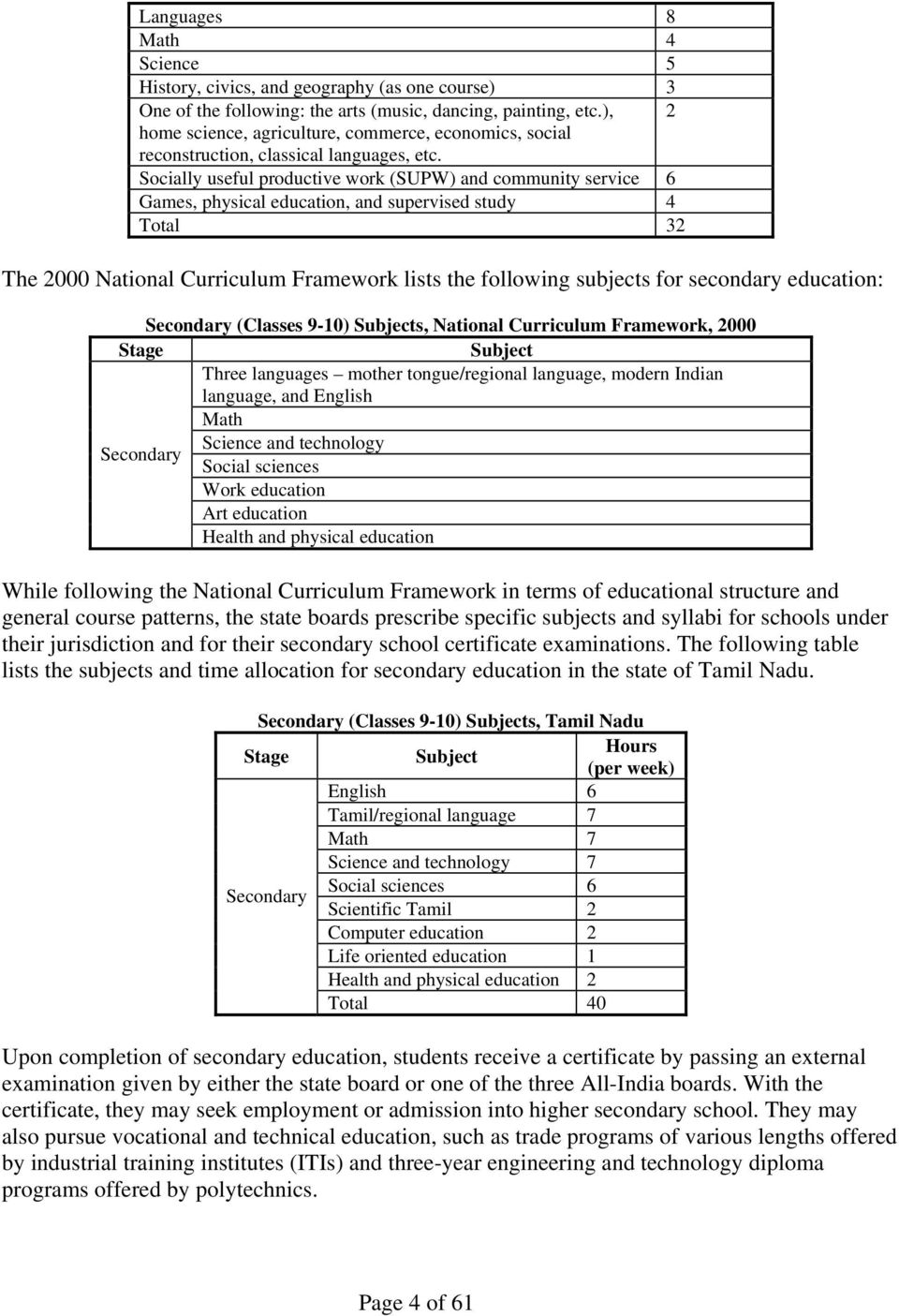
4 Languages 8 Math 4 Science 5 History, civics, and geography (as one course) 3 One of the following: the arts (music, dancing, painting, etc.), 2 home science, agriculture, commerce, economics, social reconstruction, classical languages, etc. Socially useful productive work (SUPW) and community service 6 Games, physical education, and supervised study 4 Total 32 The 2000 National Curriculum Framework lists the following subjects for secondary education: Secondary (Classes 9-10) Subjects, National Curriculum Framework, 2000 Stage Subject Three languages mother tongue/regional language, modern Indian language, and English Math Science and technology Secondary Social sciences Work education Art education Health and physical education While following the National Curriculum Framework in terms of educational structure and general course patterns, the state boards prescribe specific subjects and syllabi for schools under their jurisdiction and for their secondary school certificate examinations. The following table lists the subjects and time allocation for secondary education in the state of Tamil Nadu. Secondary (Classes 9-10) Subjects, Tamil Nadu Stage Subject Hours (per week) English 6 Tamil/regional language 7 Math 7 Science and technology 7 Secondary Social sciences 6 Scientific Tamil 2 Computer education 2 Life oriented education 1 Health and physical education 2 Total 40 Upon completion of secondary education, students receive a certificate by passing an external examination given by either the state board or one of the three All-India boards. With the certificate, they may seek employment or admission into higher secondary school. They may also pursue vocational and technical education, such as trade programs of various lengths offered by industrial training institutes (ITIs) and three-year engineering and technology diploma programs offered by polytechnics. Page 4 of 61
5 Conclusion Secondary education in the Republic of India requires graduation from elementary school for admission and takes two years to complete, representing a total of 10 years of schooling. Earlier programs in some states may have represented a total of 11 years of schooling. Upon completion of their study, students must sit external examinations administered by the State Board of Secondary Education or one of the three All-India Boards to receive the Secondary School Certificate or equivalent. The certificate allows an individual to seek employment or admission into higher secondary school, industrial training institute (ITI) or polytechnic. Based on the above information and placement recommendations of other evaluation resources, IQAS compares the Secondary School Certificate or equivalent (from the current structure) to the completion of Grade 10. Grading: The percentage system is predominantly used. The Indian system is low marking, and the minimum pass mark generally ranges between 30 and 35%. Grades above 80% are rarely awarded. Grading scales adopted by the state boards and the three All India boards vary and may have changed over time. A common grading scale at the secondary and higher secondary levels is given below: School Education Grading Scale Mark (%) Descriptor First Class or First Division Second Class or Second Division Third Class, Third Division or Pass <35 Fail The Central Board of Secondary Education (CBSE) puts all the candidates who passed the Class 10 or Class 12 examination in a ranking order to award the grades. The top 0.1% of candidates will receive Merit Certificates. The minimum pass mark for each subject is 33%. CBSE Grading Scale Grade Mark (%) Description A1 Top 1/8 of passed candidates A2 Next 1/8 of passed candidates B1 Next 1/8 of passed candidates B2 Next 1/8 of passed candidates C1 Next 1/8 of passed candidates C2 Next 1/8 of passed candidates D1 Next 1/8 of passed candidates D2 Next 1/8 of passed candidates E <33 Fail The Council for the Indian School Certificate Examinations (CISCE) adopts a nine-point scale. Grades 1-6 indicate pass with credit, with 1-2 as very good. Grades 7-8 indicate pass, and grade 9 failure. The minimum pass mark for each subject is 40%. CISCE Grading Scale Page 5 of 61

6 Grade Descriptor Pass with Credit Pass 8 9 Failure Page 6 of 61

7 Country: INDIA (Republic of India) Higher Secondary School Certificate Date Entered: Oct 2007 Category: Secondary Credential Actual Name: Higher Secondary School Certificate Credential Alternate Actual Name(s): All India Senior School Certificate Delhi Senior School Certificate (All India) Higher Secondary Examination Part II Indian School Certificate Senior Secondary Certificate Higher Secondary Certificate Pre-University Examination Intermediate Examination Note: These are just examples and do not constitute a complete list of higher secondary level credentials. Some of the names may no longer be current. Credential English Name: Credential Alternate English Name(s): Time Period Credential Offered: Current Issuing Body: Three All India Boards: Central Board of Secondary Education (CBSE) Council for the Indian School Certificate Examinations (CISCE) National Institute of Open Schooling (NIOS) State Boards of Higher Secondary Education ( Admission Requirements: Secondary School Certificate or equivalent Program Description: Two-year higher/senior secondary education program (current structure) Higher/senior secondary schools in India provide two years of education in the academic or vocational stream. Upon completion of higher secondary education, students receive a certificate by passing an external examination given by either the State Board of Secondary Education or one of the three All-India boards. Page 7 of 61

8 Provides Access to in the Home Country: Employment Admission into university and other postsecondary programs such as further vocational and technical training Placement Recommendations: The placement recommendations in the following published references were considered in the formulation of IQAS recommendations. IERF (International Educational Research Foundation): New Country Index, Ten Speed Press, 2004 (US) PIER (Projects for International Education Research): The Admission and Academic Placement of Students from South Asia: Bangladesh, India, Pakistan, and Sri Lanka, 1986 (US) UK NARIC National Recognition Information Centre for the United Kingdom, International Comparisons. IQAS Recommendations: Generally compares to the completion of Grade 12. Course Equivalencies: 30-level (Grade 12) courses. IQAS Rationale: Program Description Higher secondary (also called senior secondary) education lasts two years from Class 11 to Class 12. It is divided into the academic/general stream, which prepares students for higher education, and the vocational stream, which prepares students for employment and may lead to further education in vocational and technical fields. More than 90 percent of students choose the academic stream, which is often divided into subject groups such as science, arts, and commerce. Earlier higher secondary programs in some states may have represented a total of 11 years of schooling. Higher secondary education is provided mostly by schools and also by some colleges. Senior secondary school teachers generally hold a one-year postgraduate Bachelor of Education degree, with entry based on completion of a first bachelor degree, plus a master s degree. The National Review Committee on Higher Secondary Education of 1978 recommends the Page 8 of 61

9 following course pattern for both the academic and vocational streams: Higher Secondary (Classes 11-12) Subjects, 1978 Subject Time Allocation Languages 15% Socially useful productive work (SUPW) 15% Electives 70% The 2000 National Curriculum Framework prescribes the following course groups for higher secondary education. In the academic stream, foundation and elective courses should take up about 40% and 60% of instructional time respectively. In the vocational stream, language, general foundation courses and health and physical education take up about 30% of instructional time, with the remaining 70% devoted to vocational electives. Higher Secondary (Classes 11-12) Subjects, National Curriculum Framework, 2000 Stream Subject Foundation Language and literature Courses Work education (compulsory) Health and physical education, games, and sports Choose three of the subjects provided by the relevant state or All-India boards: Modern Indian languages and their literature, Sanskrit and its Academic literature, classical languages and their literature, English (academic and specialised), other foreign languages, physics, chemistry, biology, Electives mathematics, computer science, geology, political science, geography, economics, history, sociology, psychology, philosophy, fine arts, sculpture, instrumental music, vocal music, home science, accountancy, business studies, engineering drawing, etc. Vocational Language (compulsory) General Foundation Courses General studies, entrepreneurship development, environmental education, rural development, and information and communication technology Health and Physical Education (compulsory) Vocational Electives Choose from a large number of subjects based on local needs, employment opportunities, students interest, and the geographical location of the school. A number of courses for developing specific competencies may be chosen for each broad area of study such as agriculture, engineering and technology, business and commerce, home science, health and paramedical services, and humanities. While following the National Curriculum Framework in terms of educational structure and general course patterns, the state boards prescribe specific subjects and syllabi for schools under their jurisdiction and for their higher secondary certificate examinations. In some states, students in Classes opt for a subject group such as science, arts and commerce. The following tables give examples of higher secondary subjects of three states, Andhra Pradesh, Madhya Pradesh, and Tamil Nadu. The information is obtained from the official websites of educational authorities of these states; please refer to the websites for further details. Group English Second Languages Higher Secondary (Intermediate) Subjects, Andhra Pradesh Subject Telugu, Hindi, Sanskrit, Urdu, Arabic, French, Tamil, Kannada, Oriya and Marathi Page 9 of 61

10 Optional Subjects Modern Language Subjects Group Group A Language Group B Diversified Subjects Group C Mathematics, physics, chemistry, botany, zoology, commerce, economics, civics, history, psychology, public administration, logic, sociology, geography and geology English, Telugu, Hindi and Urdu Higher Secondary Subjects, Madhya Pradesh Subject First language Second language Humanities group: history, geography, political science, languages, etc. Science group: physics, chemistry, biology, higher math, agriculture, etc. Commerce group: elements of commerce & management, bookkeeping General education courses & accountancy, computer application, business math, etc. Agriculture group: elements of science & math useful for agriculture, crop production & horticulture, etc. Fine arts group: drawing and painting, still life and paint making, history of Indian art and world art, etc. Home science group: home management & nutrition, mother-craft, health & hygiene, elements of science, etc. Vocational courses Socially useful productive work (SUPW) or vocational training of a trade Physical education or National Cadet Cores/National Social Service/ Boy Scout & Girl Guide or co-curricular & other activities Part I Language Group Part II English Part III Optional Subjects (Students choose a combination of four subjects for the higher secondary examination.) Higher Secondary Subjects, Tamil Nadu Subject Tamil, Hindi, Kannada, Telugu, Malayalam, Urdu, Gujarati, Sanskrit, Arabic, Persian, French, German, and Latin Math, physics, chemistry, biology-zoology, biology-botany, history, geography, accountancy, commerce, economics, etc. Upon completion of higher secondary education, students take an external examination administered by either the state board or one of the All-India boards. The higher secondary education certificates may lead to employment and admission into university programs. The names of the higher secondary education certificates vary across the states and over time, and some older certificates issued before the implementation of the 10+2 structure may represent 11 years of schooling. Conclusion Higher/senior secondary education in the Republic of India requires a Secondary School Certificate or equivalent for admission and takes two years to complete, representing a total of 12 years of schooling. Upon completion of their study, students must sit external examinations administered by the State Board of Higher Secondary Education or one of the three All-India Boards to receive the Higher Secondary School Certificate or equivalent. The certificate allows an individual to seek employment or admission into universities. Based on the above information and placement recommendations of other evaluation resources, IQAS compares the Higher Page 10 of 61

11 Secondary School Certificate or equivalent from the Republic of India to the completion of Grade 12.* * The comparison also applies to some earlier higher secondary school certificates that represented 11 years of schooling. This is based on the following factors: Such certificates were exit credentials representing the completion of higher secondary school; Such certificates gave access to university programs; When a state switched from the 11-year to the 12-year system, students who graduated from the 11-year system were eligible for admission into university programs without additional upgrading; Students from a state with the 11-year system were eligible for admission, without additional upgrading, into university programs in another state that had the 12-year system. Grading: The percentage system is predominantly used. The Indian system is low marking, and the minimum pass mark generally ranges between 30 and 35%. Grades above 80% are rarely awarded. Grading scales adopted by the state boards and the three All India boards vary and may have changed over time. A common grading scale at the secondary and higher secondary levels is given below: School Education Grading Scale Mark (%) Descriptor First Class or First Division Second Class or Second Division Third Class, Third Division or Pass <35 Fail The Central Board of Secondary Education (CBSE) puts all the candidates who passed the Class 10 or Class 12 examination in a ranking order to award the grades. The top 0.1% of candidates will receive Merit Certificates. The minimum pass mark for each subject is 33%. CBSE Grading Scale Grade Mark (%) Description A1 Top 1/8 of passed candidates A2 Next 1/8 of passed candidates B1 Next 1/8 of passed candidates B2 Next 1/8 of passed candidates C1 Next 1/8 of passed candidates C2 Next 1/8 of passed candidates D1 Next 1/8 of passed candidates D2 Next 1/8 of passed candidates E <33 Fail The Council for the Indian School Certificate Examinations (CISCE) adopts a nine-point scale. Grades 1-6 indicate pass with credit, with 1-2 as very good. Grades 7-8 indicate pass, and grade 9 failure. The minimum pass mark for each subject is 40%. Page 11 of 61

12 CISCE Grading Scale Grade Descriptor Pass with Credit Pass 8 9 Failure For more information on Indian grading scales, please refer to the chapter Grading Scale in International Education Guide: Republic of India. Page 12 of 61

13 Country: INDIA (Republic of India) University-Level Certificates and Diplomas Date Entered: Oct 2007 Category: University Credential Actual Name: University-level Certificates and Diplomas Credential Alternate Actual Name(s): Certificate in xxx Diploma in xxx Post Diploma in xxx Advanced Diploma in xxx Note: The above names are just examples and do not constitute a complete list of such programs. Credential English Name: Credential Alternate English Name(s): Time Period Credential Offered: Current Issuing Body: Universities and university-level institutions Admission Requirements: Certificates/diplomas: Higher Secondary School Certificate or equivalent (usually representing 12 years of schooling) Post diplomas: Completion of a university-level diploma Program Description: University certificate/diploma program [usually one year, though length varies from six months to three years] Provides Access to in the Home Country: Employment Further education Advanced standing or credit transfer may be awarded for admission into undergraduate programs Placement Recommendations: The placement recommendations in the following published references were considered in the formulation of IQAS recommendations. IERF (International Educational Research Foundation): New Country Index, Ten Speed Page 13 of 61

14 Press, 2004 (US) PIER (Projects for International Education Research): The Admission and Academic Placement of Students from South Asia: Bangladesh, India, Pakistan, and Sri Lanka, 1986 (US) IQAS Recommendations: A university-level Certificate or Diploma generally compares to the completion of a postsecondary Certificate/Diploma with a focus in xxx. Or assessed individually, depending on admission requirements, fulltime duration of study and general content of the program. IQAS Rationale: Program Description This credential template applies to certificate and diploma programs provided by universities and university-level institutions. Entry is normally based on the completion of higher secondary school (Class 12), though post diploma and advanced diploma programs require a previous diploma, usually in the same field of study, for admission. Length of study varies from six months to three years. Typical fields of study include foreign languages, fine arts, business, and management. Many certificate/diploma courses are vocational in nature and do not give access to further education. However, in some cases, certificate/diploma holders may be admitted into a bachelor s degree program with advanced standing. Other than universities, a lot of institutions also offer certificate/diploma programs. For example, three-year diplomas in a range of engineering and technological fields, with entry usually based on the completion of secondary school, are available at polytechnics. Certificate and diploma courses in nursing and midwifery are mostly offered at institutions attached to hospitals. Please refer to other credential templates for more information. Conclusion Certificate/diploma programs involve six months to three years of fulltime study, with entry usually based on the completion of higher secondary school. The certificate/diploma allows an individual to seek employment and, in some cases, admission into a bachelor s degree program with advanced standing. Based on the above information and placement recommendations of other evaluation resources, IQAS compares the university-issued certificate/diploma from the Republic of India to the completion of a postsecondary Certificate/Diploma with a focus in xxx (or assessed individually, depending on admission requirements, fulltime duration of study and general content of the program). Grading: Most bachelor s and master s degrees are classified into divisions or classes based on the marks Page 14 of 61

15 students obtain in the major examinations at the end of each year or semester. Other programs such as certificates, diplomas and research-based degrees (M.Phil and Ph.D) are usually awarded without classification. Grading scale varies from institution to institution. The Indian system is low marking, with minimum pass mark generally ranging between 33 and 40%, though some institutions or programs adopt a 50% pass. Students who have failed in one or more subjects in a major examination but who have achieved institution-designated minimum marks (e.g. 25%) in the aggregate may be allowed to proceed with their study and make up the failed subjects at a subsequent examination. The following table shows a common grading scale along with conversion to Alberta grades. Higher Education Grading Scale Indian Marks (%) Descriptor IQAS (%) First Class/Division Second Class/Division Third Class/Division <33 Fail <50 For more information on Indian grading scales, please refer to the chapter Grading Scale in Country Education Profile: Republic of India. Page 15 of 61

16 Date Entered: Oct 2007 Country: INDIA (Republic of India) Technical-Professional Certificates and Diplomas Category: Technical/Professional/Vocational Credential Actual Name: Technical-Professional Certificates and Diplomas Credential Alternate Actual Name(s): Diploma in Computer Science and Engineering Diploma in Engineering Diploma in Hotel Management (and Catering Technology) Diploma in Management Diploma in Modern Office Practice Diploma in Pharmacy Diploma in Radiation Technology Diploma in Medical Laboratory Technology Diploma in Rehabilitation Therapy Note: The above names are just examples and do not constitute a complete list of such programs. Credential English Name: Credential Alternate English Name(s): Time Period Credential Offered: Current Issuing Body: State Boards of Technical Education Admission Requirements: [Diploma in Engineering (in most states)/pharmacy (pre-1994)]: Secondary School Certificate or equivalent (10 years of schooling) [Diploma in Engineering (in a few states)/hotel Management (and Catering Technology)/Management/Medical laboratory Technology/Modern Office Practice/Pharmacy (1994-)]: Higher Secondary School Certificate or equivalent (12 years of schooling) Program Description: Three-year (or two-year, etc.) diploma program Provides Access to in the Home Country: Employment Further education Page 16 of 61

17 Advanced standing or credit transfer may be awarded for admission into undergraduate programs. Placement Recommendations: The placement recommendations in the following published references were considered in the formulation of IQAS recommendations. IERF (International Educational Research Foundation): New Country Index, Ten Speed Press, 2004 (US) NOOSR (National Office of Overseas Skills Recognition). Country Education Profiles Online: PIER (Projects for International Education Research): The Admission and Academic Placement of Students from South Asia: Bangladesh, India, Pakistan, and Sri Lanka, 1986 (US) UK NARIC National Recognition Information Centre for the United Kingdom, International Comparisons. IQAS Recommendations: Diplomas A Diploma (2-3 years duration) requiring 10+2 for admission generally compares to the completion of a postsecondary Diploma. A Diploma (at least 3 years duration) requiring 10 years of secondary school for admission generally compares to the completion of postsecondary Certificate. A Diploma (2 years or less duration) requiring 10 years of secondary school for admission generally compares to the completion of Grade Twelve including xx years of vocational training in xxx. [Note: Engineering technology diplomas should be awarded by the State Boards of Technical Education.] Diploma Programs in Pharmacy A Diploma in Pharmacy (D. Pharm.) [awarded prior to 1994] generally compares to the completion of a postsecondary Pharmacy Technician Certificate. A Diploma in Pharmacy (D. Pharm.) [awarded in or after 1994] generally compares to the completion of a postsecondary Pharmacy Technician Diploma. Certificates Certificates are assessed individually, depending on admission requirements, fulltime duration of Page 17 of 61

18 study and general content of the program. IQAS Rationale: Program Description Technical education at the sub-degree level, mainly conducted by polytechnics, includes diploma/certificate programs in a wide range of fields under the purview of the AICTE, such as engineering and technology, architecture, computer applications, applied arts and craft, and pharmacy. The AICTE provides a broad framework of norms and standards for polytechnic education regarding program structure, facilities, human and financial resources, etc. However, program structure and entry requirements may vary from state to state. Diploma courses generally last two to three years, with entry based on the completion of Secondary School (Class 10) or Higher Secondary School (Class 12). They aim to train supervised technicians and other middle level technical personnel for a range of professional duties. Successful completion of the programs leads to a diploma awarded by the State Board/Council of Technical Education. Certificate courses are one year, six months, or even shorter in duration. Following is a description of some of the common diploma programs. The diploma in engineering and technology generally involves three years of fulltime study, with entry based on the completion of Class 10. Examples of exceptions: Rajasthan requires Class 12 for admission. In Assam and Tamil Nadu, applicants may enter a three-year program after Class 10 or two-year program after Class 12. In addition to three-year fulltime programs, part-time programs lasting up to four years through evening school or distance learning are also available for students already in the workforce. Some fulltime courses are available in the sandwich pattern, which incorporates industrial training between semesters and lasts three and a half to four years. Holders of the diploma in engineering and technology may seek employment, e.g. by undertaking a one-year technician apprentice training through the Apprenticeship Training Scheme. They can also pursue further education at universities or through professional associations such as the Institution of Engineers India (IEI). Some universities allow them lateral entry into the second year/third semester of a Bachelor of Engineering (BE/B.Engg.) or Bachelor of Technology (B.Tech.) program in the same field. The Diploma in Hotel Management and Catering Technology involves three years of fulltime study following the completion of Class 12. The program is available at some polytechnics and 24 affiliated institutions of the National Council for Hotel Management and Catering Technology. The Diploma in Modern Office Practice involves three years of fulltime study, including six months of industrial training, following the completion of Class 12. As prescribed by the Pharmacy Council of India (PCI), the Diploma in Pharmacy (D.Pharm.) involves two years of fulltime study followed by 500 hours of practical training. Entry is based Page 18 of 61

19 on the completion of higher secondary school (Class 12) with Physics, Chemistry, Biology or Math as required subjects. The entry requirement of Class 12, as per PCI education regulations of 1991, applies to pharmacy students graduating in 1994 or later. Previous programs required Class 10 for admission. D.Pharm. holders may register with the state pharmacy council to stock, sell, and dispense medicine according to doctor s prescription. They may be admitted directly into the second year of the four-year Bachelor of Pharmacy (B.Pharm.) program but must pass the first year subjects that are not covered in the diploma program. In Canada, examples of comparable sub-degree programs in pharmacy include the one-year Pharmacy Technician Certificate and two-year Pharmacy Technician Diploma, both requiring Grade 12 for admission. Conclusion Technical-professional diploma programs generally involve two to three years of fulltime study, with entry based on the completion of Class 10 or Class 12. They provide access to employment and, in some cases, advanced standing for admission into undergraduate programs. In Canada, postsecondary certificate and diploma programs require Grade 12 for admission, with diploma programs generally involving at least two years of fulltime study and certificate programs less than two years; they provide access to employment and possible transfer of credit for admission into undergraduate programs. Based on the above information and placement recommendations of other evaluation resources, IQAS compares the technical-professional certificate/diploma to: Diplomas A Diploma (2-3 years duration) requiring 10+2 for admission generally compares to the completion of a postsecondary Diploma. A Diploma (at least 3 years duration) requiring 10 years of secondary school for admission generally compares to the completion of postsecondary Certificate. A Diploma (2 years or less duration) requiring 10 years of secondary school for admission generally compares to the completion of Grade Twelve including xx years of vocational training in xxx. [Note: Engineering technology diplomas should be awarded by the State Boards of Technical Education.] Diploma Programs in Pharmacy A Diploma in Pharmacy (D. Pharm.) [awarded prior to 1994] generally compares to the completion of a postsecondary Pharmacy Technician Certificate. A Diploma in Pharmacy (D. Pharm.) [awarded in or after 1994] generally compares to the completion of a postsecondary Pharmacy Technician Diploma. Certificates Certificates are assessed individually, depending on admission requirements, fulltime duration of study and general content of the program. Grading: Page 19 of 61

20 Most bachelor s and master s degrees are classified into divisions or classes based on the marks students obtain in the major examinations at the end of each year or semester. Other programs such as certificates, diplomas and research-based degrees (M.Phil and Ph.D) are usually awarded without classification. Grading scale varies from institution to institution. The Indian system is low marking, with minimum pass mark generally ranging between 33 and 40%, though some institutions or programs adopt a 50% pass. Students who have failed in one or more subjects in a major examination but who have achieved institution-designated minimum marks (e.g. 25%) in the aggregate may be allowed to proceed with their study and make up the failed subjects at a subsequent examination. The following table shows a common grading scale along with conversion to Alberta grades. Higher Education Grading Scale Indian Marks (%) Descriptor IQAS (%) First Class/Division Second Class/Division Third Class/Division <33 Fail <50 For more information on Indian grading scales, please refer to the chapter Grading Scale in International Education Guide: Republic of India. Page 20 of 61

21 Country: INDIA (Republic of India) Bachelor s Degree (3 years) Date Entered: Oct 2007 Category: University Credential Actual Name: Bachelor s Degree (3 years) Credential Alternate Actual Name(s): Bachelor of Arts (BA) Bachelor of Commerce (B.Com) Bachelor of Science (B.Sc.) Note: These are the most common three-year bachelor s degrees and do not constitute a complete list of such programs. Credential English Name: Credential Alternate English Name(s): Time Period Credential Offered: Current Issuing Body: Universities and university-level institutions Admission Requirements: Higher Secondary School Certificate or equivalent (usually representing 12 years of schooling) Program Description: Three-year undergraduate degree program Provides Access to in the Home Country: Employment Admission into university graduate programs, postgraduate bachelor s degree programs, diploma programs and professional programs Placement Recommendations: The placement recommendations in the following published references were considered in the formulation of IQAS recommendations. IERF (International Educational Research Foundation): New Country Index, Ten Speed Press, 2004 (US) NOOSR (National Office of Overseas Skills Recognition). Country Education Profiles Online: Page 21 of 61
22 PIER (Projects for International Education Research): The Admission and Academic Placement of Students from South Asia: Bangladesh, India, Pakistan, and Sri Lanka, 1986 (US) UK NARIC National Recognition Information Centre for the United Kingdom, International Comparisons. IQAS Recommendations: Generally compares to the completion of a three-year Bachelor s degree (Arts/Commerce/Science). IQAS Rationale: Program Description From independence in 1947 to the early 1970s, undergraduate education in most states represented a total of 14 years of schooling. Until 1960, a bachelor s degree usually involved two years of fulltime study following 10 years of schooling and two years of intermediate study. From then on to the early 1970s, most states adopted the system, with 11 years of schooling (10 years of school education plus one year of higher secondary or pre-university study) followed by a three-year bachelor s degree. The current system, with 12 years of school education followed by a three-year bachelor s degree, evolved in the 1970s and was implemented across the country, with some exceptions, in the late 1980s. One such exception was the two-year pass bachelor s degrees in arts, science and commerce offered by a number of universities in the state of West Bengal until the academic year. These two-year pass degrees do not give access to further education in master s degree programs. The most common three-year bachelor s degrees are the Bachelors of Arts (BA), Bachelor of Science (B.Sc.) and Bachelor of Commerce (B.Com). The courses are usually listed as papers, for which the students must attend a number of lecture hours per week and pass the annual examinations. The BA, B.Sc. and B.Com are usually offered as pass or general degrees, though some universities offer honours or special bachelor degrees. Honours or special programs do not involve a longer duration of study but have more academic depth and tend to attract high performing students. They are either similar to the pass degree with a few additional papers, or designed as a separate course that emphasizes specialization in the chosen subject. Annual examinations are usually conducted by universities at the end of the academic year, between March and May. Internal assessment by the colleges accounts for a small percentage of the total marks. Minimum pass mark is normally 33-35%. Students who have failed some papers in a given year but who have achieved a minimum mark designated by the university (e.g. 25% in the aggregate) may be allowed to proceed to the next year of study but must make up the failed papers in the following annual examination. Page 22 of 61
23 One can study for a bachelor s degree on a part-time basis or externally through distance learning programs, and sit the annual examinations as an external or private candidate. Universities usually prescribe a time limit (e.g. seven years) in which students must complete all coursework and pass the examinations to qualify for the award of the degree. After completing a bachelor s degree, students may pursue further education in master s degree, postgraduate bachelor s degree (e.g. Bachelor of Education), or postgraduate certificate or diploma programs. In addition to the BA, B.Sc. and B.Com, several other bachelor s degrees also involve three years of fulltime study. Examples include Bachelor of Business Administration (BBA), Bachelor of Business Management (BBM), Bachelor of Computer Applications (BCA), and Bachelor of Physical Education (BPE). After completing a bachelor s degree programs, students receive degree certificates and marks sheets (also known as marks card, marks certificate, statement of marks, etc.). Format of the documents may vary depending on the issuing body and time period. Documents are usually issued in English, English and Hindi, or English and a regional language (e.g. Bengali, Punjabi, Tamil, etc.). Universities issue the degrees, regardless of whether the program is conducted by a university department or an affiliated college. If the program is conducted by an autonomous college, the name of the college also appears on the degree certificate. Marks sheets are normally issued by universities. Marks sheets issued by autonomous colleges are also acceptable. Conclusion The three-year bachelor s degree (BA, B.Com or B.Sc.) requires a Higher Secondary School Certificate or equivalent (generally representing 12 years of schooling) for admission. The degree allows an individual to seek employment or admission into master s degree, postgraduate bachelor s degree, postgraduate diploma, and professional programs. Based on the above information and placement recommendations of other evaluation resources, IQAS compares the three-year Bachelor s degree from the Republic of India to the completion of a three-year Bachelor s degree (Arts/Commerce/Science). Grading: Most bachelor s and master s degrees are classified into divisions or classes based on the marks students obtain in the major examinations at the end of each year or semester. Grading scale varies from institution to institution. The Indian system is low marking, with minimum pass mark generally ranging between 33 and 40%, though some institutions or programs adopt a 50% pass. Students who have failed in one or more subjects in a major examination but who have achieved institution-designated minimum marks (e.g. 25%) in the aggregate may be allowed to proceed with their study and make up the failed subjects at a subsequent examination. The following table shows a common grading scale along with conversion to Alberta grades. Indian Marks (%) Descriptor IQAS (%) First Class/Division Second Class/Division 74 Page 23 of 61
24 Third Class/Division <33 Fail <50 For more information on Indian grading scales, please refer to the chapter Grading Scale in International Education Guide: Republic of India. Page 24 of 61
25 Country: INDIA (Republic of India) Bachelor s Degree (4 years) Date Entered: Oct 2007 Category: University Credential Actual Name: Bachelor s Degree (4 years) Credential Alternate Actual Name(s): Bachelor of Engineering/Technology (BE or B.Engg./B.Tech.)/Bachelor of Science in Engineering (B.Sc. Engg.) Bachelor of Pharmacy (B.Pharm.) Bachelor of Science in Agriculture (B.Sc. Agri.) Bachelor of Science in Horticulture (B.Sc. Hort.) Note: These are examples of the four-year bachelor s degrees and do not constitute a complete list of such programs. Credential English Name: Credential Alternate English Name(s): Time Period Credential Offered: Current Issuing Body: Universities and university-level institutions Admission Requirements: Higher Secondary School Certificate or equivalent such as Pre-University Examination, etc. (usually representing 12 years of schooling) with required courses (e.g. Math, Physics, Chemistry for programs in engineering and technology) Program Description: Four-year undergraduate degree program Provides Access to in the Home Country: Employment Admission into university graduate programs, postgraduate bachelor s degree and diploma programs Placement Recommendations: The placement recommendations in the following published references were considered in Page 25 of 61
26 the formulation of IQAS recommendations. IERF (International Educational Research Foundation): New Country Index, Ten Speed Press, 2004 (US) NOOSR (National Office of Overseas Skills Recognition). Country Education Profiles Online: PIER (Projects for International Education Research): The Admission and Academic Placement of Students from South Asia: Bangladesh, India, Pakistan, and Sri Lanka, 1986 (US) UK NARIC National Recognition Information Centre for the United Kingdom, International Comparisons. IQAS Recommendations: Generally compares to the completion of a four-year Bachelor degree with a focus in xxx. IQAS Rationale: Program Description The system, first introduced in the 1970s, has been implemented in most of the country since the late 1980s. This represents 10 years of elementary and secondary education + 2 years of higher/senior secondary education + 3 years of undergraduate education (general bachelor s degree). While a general bachelor s degree such as Bachelor of Arts, Bachelor of Science and Bachelor of Commerce involves three years of fulltime study, there are a lot of four-year bachelor s degrees offered in specialized and professional fields. Entry is based on the completion of higher secondary education with certain required subjects as designated by the program, e.g. physics, chemistry and mathematics for engineering courses. Some applicants may hold a first bachelor s degree. Most programs involve four years of fulltime study. The Bachelor of Physiotherapy (BPT) may be three and a half years or four and a half years, including a six-month clinical internship. Engineering and Technology Bachelor s degrees in engineering and technology such as Bachelor of Engineering (BE or B.Engg.), Bachelor of Technology (B.Tech.), Bachelor of Science in Engineering (B.Sc. Engg.) and Bachelor of Science in Technology (B.Sc. Tech.) involve four years of fulltime study. Entry is based on the completion of higher secondary school, with physics, chemistry and mathematics as required subjects. Holders of three-year diplomas in engineering and technology or a general B.Sc. may be allowed lateral entry into the second year/third semester of the program. Students take about ten courses each semester, including both theoretical subjects and their lab components. They participate in practical training starting from the third year and must complete a major project in the last semester. A minimum of about credits are required Page 26 of 61
27 for the awarding of the degree. The AICTE prescribes the following course structure for the BE/B.Tech. degree: General 5-10% Basic science 15-25% Engineering sciences and technical arts 15-25% Professional subjects 55-65% The seven Indian Institutes of Technology (IITs), designated as Institutions of National Importance by the Government of India, have an international reputation for offering high quality undergraduate and graduate programs in engineering and technology. Indian Institute of Technology, Guwahati Indian Institute of Technology, Delhi Indian Institute of Technology, Bombay (Mumbai) Indian Institute of Technology, Madras (Chennai) Indian Institute of Technology, Kanpur Indian Institute of Technology, Roorkee Indian Institute of Technology, Kharagpur Agriculture Bachelor s and graduate degree programs in agriculture are available at over 100 institutions, including non-agricultural institutions and 45 central and state agricultural universities and agricultural research institutes (deemed universities). The US has played an important role in helping India establish a system of agricultural universities, which tend to show strong American influence such as adoption of the credit system. Agricultural universities are mostly nonaffiliating. A bachelor s degree in agriculture and related disciplines involves four years of fulltime study. Examples include Bachelor of Science in Agriculture (B.Sc. Agri.), Bachelor of Agriculture (B.Agri.), Bachelor of Science in Horticulture (B.Sc. Hort.), Bachelor of Science in Sericulture (B.Sc. Sericulture), and Bachelor of Technology in Agricultural Engineering (B.Tech. Agri. E.). The Bachelor of Veterinary Science and Animal Husbandry (B.V.Sc. & A.H) involves five years of fulltime study. Total credits required for four-year programs range between 140 and 180, and there is also great variation of credit distribution among different disciplines. In 2000 the Agricultural Education Division of the Indian Council of Agricultural Research published a model curriculum for undergraduate program in agriculture that prescribes a minimum of 161 credits, including physical education but excluding the regional language course. The content of the model curriculum must be followed, allowing 25% regional variation. Conclusion The four-year bachelor s degree, offered in specialized and professional fields, requires a Higher Secondary School Certificate or equivalent (generally representing 12 years of schooling) with relevant subjects for admission. The degree allows an individual to seek employment or admission into professional master s degree, after degree, and postgraduate diploma programs. Based on the above information and placement recommendations of other evaluation resources, IQAS compares the four-year Bachelor s degree to the completion of a four-year Bachelor degree. Page 27 of 61
28 Grading: Most bachelor s and master s degrees are classified into divisions or classes based on the marks students obtain in the major examinations at the end of each year or semester. Grading scale varies from institution to institution. The Indian system is low marking, with minimum pass mark generally ranging between 33 and 40%, though some institutions or programs adopt a 50% pass. Students who have failed in one or more subjects in a major examination but who have achieved institution-designated minimum marks (e.g. 25%) in the aggregate may be allowed to proceed with their study and make up the failed subjects at a subsequent examination. The following table shows a common grading scale along with conversion to Alberta grades. Higher Education Grading Scale Indian Marks (%) Descriptor IQAS (%) First Class/Division Second Class/Division Third Class/Division <33 Fail <50 A number of institutions such as the Indian Institutes of Technology (IITs), the central and state agricultural universities, and Jawaharlal Nehru University adopt a 10-point system. The grading scale may vary from institution to institution. The points can be converted to letter grades and are sometimes divided into divisions or classes. Grading Scale, Indian Institute of Technology, Delhi Grade Point Letter Grade Description 10 A Outstanding 9 A- Excellent 8 B Very Good 7 B- Good 6 C Average 5 C- Below Average 4 D Marginal 2 E Poor 0 F Very Poor For more information on Indian grading scales, please refer to the chapter Grading Scale in International Education Guide: Republic of India. Page 28 of 61
29 Date Entered: Oct 2007 Country: INDIA (Republic of India) Bachelor of Education (B.Ed) and Master of Education (M.Ed) Category: University-level teaching credentials Credential Actual Name: Bachelor of Education (B.Ed) Master of Education (M.Ed) Credential Alternate Actual Name(s): Bachelor of Elementary Education (B.El.Ed) Note: This is just an example of possible alternative names for the B.Ed. Credential English Name: Credential Alternate English Name(s): Time Period Credential Offered: Current Issuing Body: Universities and university-level institutions Admission Requirements: B.Ed (1 year): Bachelor s degree (e.g. BA, B.Com, or B.Sc.) B.Ed (4 years): Higher Secondary School Certificate or equivalent (usually representing 12 years of schooling) M.Ed (1 year): B.Ed M.Ed (2-year integrated): Bachelor s degree (e.g. BA, B.Com, or B.Sc.) Program Description: B.Ed (1-year): One-year university after-degree program B.Ed (4-year): Four-year undergraduate degree program M.Ed (1-year): One-year university graduate degree program M.Ed (2-year integrated): Two-year university graduate degree program Provides Access to in the Home Country: Employment A B.Ed is required for teaching at both (lower) secondary and higher secondary schools. Higher secondary school teachers must also hold a master s degree (M.Ed, MA, M.Com, or M.Sc.). Admission into university graduate degree programs A B.Ed is required for admission into the one-year M.Ed program. An M.Ed holder may apply for admission into doctoral programs such as Ph.D. in Education. Placement Recommendations: Page 29 of 61
30 The placement recommendations in the following published references were considered in the formulation of IQAS recommendations. IERF (International Educational Research Foundation): New Country Index, Ten Speed Press, 2004 (US) NOOSR (National Office of Overseas Skills Recognition). Country Education Profiles Online: PIER (Projects for International Education Research): The Admission and Academic Placement of Students from South Asia: Bangladesh, India, Pakistan, and Sri Lanka, 1986 (US) UK NARIC National Recognition Information Centre for the United Kingdom, International Comparisons. IQAS Recommendations: B.Ed (1 year): Generally compares to the completion of a one-year Bachelor of Education afterdegree. B.Ed (4 years): Generally compares to the completion of a four-year Bachelor of Education degree. M.Ed: Generally compares to the completion of a one-year Master s degree in Education. IQAS Rationale: Program Description: B.Ed A Bachelor of Education (B.Ed), in the form of a one-year postgraduate bachelor s degree (Indian terminology for after-degree) or four-year integrated degree, is required for teaching at (lower) secondary (Classes 9-10) and higher secondary (Classes 11-12) schools. Higher secondary school teachers must also hold a master s degree (e.g. M.Ed, MA, M.Com, or M.Sc.). There is no separate professional certification process for teachers in the Republic of India. B.Ed programs are offered at universities and five Regional Institutes of Education (RIEs), which are university-affiliated. The B.Ed is usually earned as a one-year postgraduate bachelor s degree, with entry based on the completion of a first bachelor s degree (e.g. BA, B.Sc. or B.Com). One may also obtain a B.Ed after completing the first year of a two-year Master of Education (M.Ed) program. According to NCTE (National Council for Teacher Education) regulations, the postgraduate B.Ed in Secondary Education involves one year of fulltime study, including 150 days of instruction plus at least 30 days of internship, following the completion of a bachelor s or master s degree with at least 45% marks. Where the postgraduate B.Ed is offered through correspondence or other distance learning mode, the length of study is usually two years. Page 30 of 61
31 Institutions currently offer the same B.Ed program for training secondary and higher secondary teachers. The most recent Curriculum Framework for Teacher Education (2006) proposes separate curricula for secondary teacher education and higher secondary teacher education, which is further divided into the academic and vocational streams. NCTE also envisages increasing the duration of the postgraduate B.Ed. program from one year to two years of fulltime study. The B.Ed may also be earned as a four-year integrated course, with entry based on the completion of higher secondary school (Class 12). The minimum qualification for teaching at elementary schools (Classes 1-8) is a two-year certificate/diploma following the completion of higher secondary school. However, elementary teacher education at the university level is also available through the one-year postgraduate B.Ed with specialization in elementary education or the newer four-year integrated Bachelor of Elementary Education (B.El.Ed). According to NCTE regulations, the integrated Bachelor of Elementary Education (B.El.Ed) involves four years of fulltime study, including 16 weeks of internship in the fourth year, following the completion of Class 12 with at least 50% marks. Program Description: M.Ed The Master of Education (M.Ed) requires one year of fulltime study following the completion of a B.Ed, or two years of fulltime study following the completion of a bachelor s degree (e.g. BA, B.Sc., or B.Com). The completion of the first year of the two-year M.Ed program leads to the award of a postgraduate B.Ed. According to NCTE regulations, the M.Ed program involves one year of fulltime study following the completion of the B.Ed with at least 55% marks. There shall be at least 180 working days, including internship and four weeks of field visit for dissertation. Only university departments and institutions offering B.Ed programs are eligible to run the M.Ed program. Twoyear part-time M.Ed programs for in-service teachers and educational administrators with at least two years of related work experience are also offered by some university departments and Institutes of Advanced Studies in Education (IASEs), which are university-affiliated. Conclusion The one-year B.Ed, with entry based on the completion of a first bachelor s degree, and the fouryear B.Ed, with entry based on the completion of higher secondary school, represent at least four years of university study following the completion of school education (12 years). The B.Ed allows an individual to teach at (lower) secondary schools and is also a prerequisite for teaching at higher secondary schools. It also gives access to further education in M.Ed programs. Based on the above information and placement recommendations of other evaluation resources, IQAS compares the B.Ed (1 year) to the completion of a one-year Bachelor of Education afterdegree, and the B.Ed (4 years) to the completion of a four-year Bachelor of Education degree, Page 31 of 61
32 The one-year M.Ed, with entry based on the completion of a B.Ed, and the two-year M.Ed, with entry based on the completion of a first bachelor s degree, represent at least five years of university study following the completion of school education (12 years). An individual must have an M.Ed, or a B.Ed plus a master s degree (e.g. MA, M.Com or M.Sc.), in order to teach at higher secondary schools. An M.Ed also gives access to further education in doctoral programs. Based on the above information and placement recommendations of other evaluation resources, IQAS compares the M.Ed to the completion of a one-year Master s degree in Education. Grading: Most bachelor s and master s degrees are classified into divisions or classes based on the marks students obtain in the major examinations at the end of each year or semester. Grading scale varies from institution to institution. The Indian system is low marking, with minimum pass mark generally ranging between 33 and 40%, though some institutions or programs adopt a 50% pass. Students who have failed in one or more subjects in a major examination but who have achieved institution-designated minimum marks (e.g. 25%) in the aggregate may be allowed to proceed with their study and make up the failed subjects at a subsequent examination. The following table shows a common grading scale along with conversion to Alberta grades. Higher Education Grading Scale Indian Marks (%) Descriptor IQAS (%) First Class/Division Second Class/Division Third Class/Division <33 Fail <50 For more information on Indian grading scales, please refer to the chapter Grading Scale in Country Education Profile: Republic of India. Page 32 of 61
33 Country: INDIA (Republic of India) Bachelor s Degree Medicine and Dentistry Date Entered: Oct 2007 Category: University Credential Actual Name: Bachelor s Degree Medicine and Dentistry Credential Alternate Actual Name(s): Bachelor of Medicine and Bachelor of Surgery (MBBS/BMBS) Bachelor of Ayurvedic Medicine and Surgery (BAMS) Bachelor of Dental Surgery (BDS) Bachelor of Veterinary Medicine and Animal Husbandry (B.V.Sc. & A.H.) Note: These are examples of bachelor s degrees in medicine and dentistry and do not constitute a complete list of such programs. Credential English Name: Credential Alternate English Name(s): Time Period Credential Offered: Current Issuing Body: Universities and university-level institutions Admission Requirements: 1. Higher Secondary School Certificate or equivalent (usually representing 12 years of schooling) with required courses (Physics, Chemistry and Biology), or Pre-Professional Certificate 2. Entrance examinations Program Description: MBBS: Five-and-one-half-year professional university degree program, including a one-year clinical internship BAMS: Five-and-one-half-year professional university degree program, including a sixmonth/one-year clinical internship BDS: Five-year professional university degree program, including a one-year clinical internship B.V.Sc. & A.H.: Five-year professional university degree program, including a six-month clinical internship Provides Access to in the Home Country: Employment A bachelor s degree in medicine and surgery/ayurvedic medicine and Page 33 of 61
34 surgery/dentistry/veterinary medicine and animal husbandry allows an individual to register with the appropriate council and practice professionally. Admission into professional graduate programs Placement Recommendations: The placement recommendations in the following published references were considered in the formulation of IQAS recommendations. IERF (International Educational Research Foundation): New Country Index, Ten Speed Press, 2004 (US) NOOSR (National Office of Overseas Skills Recognition). Country Education Profiles Online: PIER (Projects for International Education Research): The Admission and Academic Placement of Students from South Asia: Bangladesh, India, Pakistan, and Sri Lanka, 1986 (US) UK NARIC National Recognition Information Centre for the United Kingdom, International Comparisons. IQAS Recommendations: MBBS/BMBS: Generally compares to the completion of a first professional university degree in medicine. Note: Medical degrees in India generally involve four-and-one-half years of continuous theoretical study in the Faculty of Medicine, followed by one year of clinical internship. In Canada, medical degrees generally require at least two years of pre-professional study in science followed by four years of professional medical studies. BAMS: Generally compares to the completion of a Bachelor s degree with a focus in Ayurvedic medicine. BDS: Generally compares to the completion of a first professional university degree in dentistry. Note: Dentistry degrees in India generally involve four years of continuous theoretical study in the Faculty of Dentistry, followed by one year of clinical internship. In Canada, dentistry degrees generally require at least two years of pre-professional study in science followed by four years of professional dentistry studies. B.V.Sc. & A.H.: Generally compares to the completion of a first professional university degree in veterinary medicine. Note: Degrees in veterinary medicine in India generally involve four and one half years of continuous theoretical study in the Faculty of Veterinary Medicine, followed by six months of clinical internship. In Canada, degrees in veterinary medicine generally require at least two years of pre-professional study in science followed by four years of professional studies in Page 34 of 61
35 veterinary medicine. IQAS Rationale: Program Description The Bachelor of Medicine/Bachelor of Surgery (MBBS or BMBS) programs last five and a half years, including a one-year internship. Applicants must pass the higher secondary certificate examination with Physics, Chemistry, Biology and English as required subjects. Those lacking the required subjects may attend a one-year pre-medical course provided by a medical or science college. Applicants must also sit a separate pre-medical examination, such as the All-India Pre- Medical/Pre-Dental Entrance Examination (AIPMT), conducted by CBSE (Central Board of Secondary Education) for admission into MBBS or BDS courses at central and state medical and dental colleges except in the states of Andhra Pradesh and Jammu & Kashmir. The Medical Council of India prescribes the structure and time allocation for medical courses. MBBS coursework lasts four and a half years or nine semesters, divided into three phases. The first phase (1 st to 2 nd semesters) consists of pre-clinical subjects such as anatomy, physiology, and biochemistry. The second phase (3 rd to 5 th semesters) consists of para-clinical subjects such as pathology, pharmacology and microbiology, and clinical subjects. The third phase (6 th to 9 th semesters) is the continuation of clinical subjects, including medicine and its allied specialties, surgery and its allied specialties, obstetrics, gynaecology and community medicine. A total of three examinations are held: 1 st professional examination (2 nd semester), 2 nd professional examination (5 th semester), 3 rd professional examination part I (7 th semester), and 3 rd professional examination part II (9 th semester). After passing the last part of the professional examination, students must undergo a 12-month compulsory rotational internship to be eligible for the award of the MBBS degree and full registration with the medical council to practice professionally. In order to become a specialist or medical teacher, one must pursue further study in postgraduate medical programs. Postgraduate diplomas in medicine approved by the Indian Medical Council involve two years of fulltime study following the completion of a Bachelor of Medicine/Bachelor of Surgery (MBBS or BMBS). Students can choose from 28 fields of specialization such as clinical pathology, obstetrics & gynaecology, ophthalmology, orthopaedics, paediatrics, psychiatry, and radio therapy. The Doctor of Medicine (M.D.) and Master of Surgery (M.S.) both involve three years of fulltime study following the completion of a Bachelor of Medicine/Bachelor of Surgery (MBBS or BMBS). Holders of a postgraduate diploma in medicine in the same area of specialization receive one year s advanced standing. Students enrolled in the M.D. program can choose from 29 fields of specialization such as geriatrics, pathology, paediatrics, and radio therapy. Students enrolled in the M.S. program can choose from five fields of specialization including otorhinolaryngology, general surgery, ophthalmology, orthopaedics, and obstetrics & gynaecology. The Doctor of Medicine (D.M.) program involves three years of fulltime study following the completion of an M.D. Students can choose from 12 fields of specialization such as cardiology, Page 35 of 61
36 immunology, medical oncology and neurology. The Master of Chirurgie (M.Ch.) program involves three years of fulltime study following the completion of an M.S. (or an M.D. in some cases). Students can choose from ten fields of specialization such as cardiovascular and thoracic surgery, urology, neurosurgery, and surgical oncology. The Bachelor of Dental Surgery (BDS) involves five years of fulltime study, including a oneyear internship. Individuals with an MBBS may be able to complete the program in three years. The Dental Council of India prescribes the curriculum structure, syllabi, and examination scheme for the BDS program. Students take a professional examination at the end of each of the first four years. These are known as the 1 st, 2 nd, 3 rd and final BDS examinations. After passing the final BDS examination, students must undergo a one-year rotating internship. The BDS degree entitles an individual to work in general dental practice. Postgraduate study is required for specialization. There are extensive programs for teaching the Indian systems of medicine (Ayurveda, Siddha, and Unani Tibb) at both undergraduate and graduate levels. The Central Council of Indian Medicine advises the central government on matters relating to the recognition of such programs and prescribes the curricula and syllabi. Many institutions offer the Ayurvedacharya, or Bachelor of Ayurvedic Medicine and Surgery (BAMS) degree, which involves five and a half years of fulltime study, including a clinical internship of 6 or 12 months. BAMS holders may have their names entered in the Central Register of Indian Medicine and are entitled to practice Indian medicine in any part of India according to their qualifications. The Bachelor of Veterinary Science and Animal Husbandry (B.V.Sc. & A.H.) is the minimum educational qualification to become a veterinary doctor. The Veterinary Council of India (VCI), a statutory body established under the Ministry of Agriculture, prescribes the program structure and syllabus for the B.V.Sc. & A.H. The program involves five years of fulltime study, including a six-month internship, with a total of 188 credits. Earlier programs may have been four and a half years. Entry is based on the completion of higher secondary school or equivalent with Physics, Chemistry and Biology. After completing both coursework and internship, students are eligible for the award of the B.V.Sc. & A.H. degree and full registration with the VCI or state veterinary council to practice as a veterinary doctor. Postgraduate programs such as the two-year Master of Veterinary Science (M.V.Sc.) provide options of specialization. Conclusion Admission into the Bachelor of Medicine and Bachelor of Surgery (MBBS/BMBS), Bachelor of Ayurvedic Medicine and Surgery (BAMS), Bachelor of Dental Surgery (BDS) and Bachelor of Veterinary Science and Animal Husbandry (B.V.Sc. & A.H.) programs requires Higher Secondary School Certificate or equivalent with Physics, Chemistry and Biology, plus entrance examinations. The length of the programs is five or five and a half years, including a clinical internship. The degrees allow individuals to enter professional practice in medicine/ Indian medicine/dentistry/veterinary medicine. Based on the above information and placement recommendations of other evaluation resources, IQAS compares the MBBS/BMBS, BDS and B.V.Sc. & A.H. to the completion of a first professional university degree in medicine/dentistry/veterinary medicine. A note is appended to highlight the differences from comparable Canadian programs. The BAMS is compared to the completion of Bachelor s degree with a focus in Ayurvedic medicine. Page 36 of 61
37 Grading: Most bachelor s and master s degrees are classified into divisions or classes based on the marks students obtain in the major examinations at the end of each year or semester. Grading scale varies from institution to institution. The Indian system is low marking, with minimum pass mark generally ranging between 33 and 40%, though some institutions or programs adopt a 50% pass. Students who have failed in one or more subjects in a major examination but who have achieved institution-designated minimum marks (e.g. 25%) in the aggregate may be allowed to proceed with their study and make up the failed subjects at a subsequent examination. The following table shows a common grading scale along with conversion to Alberta grades. Higher Education Grading Scale Indian Marks (%) Descriptor IQAS (%) First Class/Division Second Class/Division Third Class/Division <33 Fail <50 For more information on Indian grading scales, please refer to the chapter Grading Scale in International Education Guide: Republic of India. Page 37 of 61
38 Country: INDIA (Republic of India) Bachelor of Law(s) (LLB or BL) Date Entered: Oct 2007 Category: University Credential Actual Name: Bachelor of Law(s) (LLB or BL) Credential Alternate Actual Name(s): Bachelor of Law(s) (Special/Professional) Bachelor of Law(s) (General/Academic) Bachelor of Law(s) (integrated program) Note: These are examples of the Bachelor of Law(s) degrees and do not constitute a complete list of such programs. Credential English Name: Credential Alternate English Name(s): Time Period Credential Offered: Current Issuing Body: Universities Admission Requirements: LLB (Special/Professional) and LLB (General/Academic): Completion of a first bachelor s degree (e.g. BA, B.Com or B.Sc.) LLB (integrated program): Completion of higher secondary school (generally representing 12 years of schooling) Program Description: LLB (Special/Professional): Three-year university after-degree program LLB (General/Academic): Two-year university after-degree program LLB (integrated program): Five-year undergraduate degree program Provides Access to in the Home Country: Employment An LLB (Special/Professional or integrated program) holder may apply to the Bar Council of India to practice law as an Advocate. An LLB (General/Academic) holder may work in an allied legal profession. Admission into university graduate degree programs An LLB (Special/Professional or integrated program) holder may seek admission into two-year Master of Law(s) (LLM) programs. Placement Recommendations: The placement recommendations in the following published references were considered in the formulation of IQAS recommendations. Page 38 of 61
39 IERF (International Educational Research Foundation): New Country Index, Ten Speed Press, 2004 (US) NOOSR (National Office of Overseas Skills Recognition). Country Education Profiles Online: UK NARIC National Recognition Information Centre for the United Kingdom, International Comparisons. IQAS Recommendations: LLB (Special/Professional): Generally compares to the completion of a first professional university degree in law (as practiced in the Republic of India). LLB (General/Academic): Generally compares to the completion of a two-year Bachelor s afterdegree with a focus in law (as practiced in the Republic of India). Note: In India, the LLB (Academic/General) does not give access to professional practice as a lawyer or admission into university graduate degree programs in law (LLM). It allows an individual to work in an allied legal profession. LLB (integrated program): Generally compares to the completion of a first professional university degree in law (as practiced in the Republic of India), preceded by two years of prerequisite university study. IQAS Rationale: The Bar Council of India (BCI) maintains a list of approved law colleges that provide law education in the form of either the newer five-year integrated program or the traditional threeyear postgraduate bachelor s degree, or both. The postgraduate Bachelor of Law or Bachelor of Laws (LLB/BL) involves three years of fulltime study after a first bachelor s degree. According to BCI rules, a three-year LLB (Special/Professional) program must include the following: I. 21 Compulsory Courses 1. Jurisprudence 2. Contract-I(General Principle of Contract-Section 1-75 and Specific Relief) 3. Contract-II (Indian Contract Act, Indian Partnership Act, Sale of Goods Act and other Specific contracts) 4. Tort and Consumer Protection Laws 5. Family Law-I 6. Family Law-II 7. Law of Crimes 8. Criminal Procedure Code, Juvenile Justice Act and Probation of Offenders Act. 9. Constitutional Law Page 39 of 61
40 10. Property Law including Transfer of Property Act and Easement Act 11. Law of Evidence 12. Civil Procedure Code and Limitation Act 13. Legal Language/Legal Writing including General English 14. Administrative Law 15. Company Law 16. Human Rights and International Law 17. Arbitration, Conciliation and Alternate Dispute Resolution Systems 18. Environmental Law including laws for the protection of the wild life and other living creatures including animal welfare 19. Labour Law. 20. Interpretation of Statutes 21. Land Laws including ceiling and any other local laws II. No less than three subjects chosen from the following: 1. International Economic Law 2. Bankruptcy Laws 3. Taxation Laws 4. Comparative Law/Legal History 5. Insurance Law 6. Conflict of Laws 7. Banking law including Negotiable Instruments Act 8. Investment and Security Law 9. Trusts, Equity and Fiduciary Relationships 10. Criminology and Penology 11. Air and space Law 12. Law and Medicine 13. Women and Law and Law Relating to Child/Law, Poverty and Development 14. Intellectual Property Law 15. Maritime Law 16. III. Six months of practical training including the following compulsory papers: 1. Moot Court, Pre-Trail Preparations and Participation in Trial proceedings 2. Drafting, Pleading and Conveyancing 3. Professional Ethics, Accountancy for Lawyers and Bar Bench Relations 4. Public Interest Lawyering, Legal Aid and Para Legal Services After completing the three-year LLB, students may apply to the Bar Council of India to practice law as Advocates. They may also seek admission into two-year Master of Law(s) (LLM) programs. Some universities offer a two-year LLB (General/Academic), which does not give access to professional practice or admission into two-year LLM programs; graduates may seek employment in the allied legal professions. Students enrolled in a three-year LLB may choose to exit the program after two years with an LLB (General/Academic). Page 40 of 61
41 The Bachelor of Law or Bachelor of Laws (LLB/BL) integrated program lasts five years, including two years of pre-law study (part I) followed by three years of professional training in law (part II). Applicants who have already completed a first bachelor s degree (e.g. BA, B.Sc. or B.Com) may be admitted into part II of the five-year integrated program. According to BCI rules, part II of the program is identical to the three-year LLB; part I should include the following 6 compulsory subjects: 1. General English - 2 Papers (Part I and Part II) 2. Political Science - 3 Papers (Part I, Part II and Part III) 3. Economics - 1 Paper 4. Sociology - 1 Paper 5. History - 1 Paper 6. History of Courts, Legislature and Legal Profession in India - 1 Paper After completing the five-year integrated LLB program, students may apply to the Bar Council of India to practice law as Advocates. They may also seek admission into two-year Master of Law(s) (LLM) programs. According to BCI rules, students who have completed part I of the five-year integrated program are eligible to enrol in the final year of a three-year Bachelor s degree (e.g. BA, B.Com or B.Sc.), and those who have completed the first three years of the five-year integrated program may receive a degree such as BA (Law) by passing the relevant university examinations. This enables some law colleges to offer combined integrated degrees such as a combined Bachelor of Arts and Bachelor of Law(s) (BA & LLB/BL), a combined Bachelor of Business Administration and Bachelor of Law(s) (BBA & LLB/BL), or a combined Bachelor of Science and Bachelor of Law(s) (B.Sc. & LLB/BL). Conclusion The LLB (Special/Professional) involves three years of professional studies in law, with entry based on a first bachelor s degree (e.g. BA, B.Com or B.Sc.). This is similar in structure to LLB programs in Canada, which generally require at least two or three years of university study (though most applicants already hold a bachelor s degree), followed by three years of professional studies in law. An LLB (Special/Professional) holder may apply to the Bar Council of India to practice law as Advocates and may also seek admission into two-year Master of Law(s) (LLM) programs. Based on the above information and placement recommendations of other evaluation resources, IQAS compares the LLB (Special/Professional) to the completion of a first professional university degree in law (as practiced in the Republic of India). The LLB (integrated program) involves three years of professional studies in law, preceded by two years of prerequisite university study. An LLB (integrated program) holder may apply to the Bar Council of India to practice law as Advocates and may also seek admission into two-year Master of Law(s) (LLM) programs. Based on the above information and placement recommendations of other evaluation resources, IQAS compares the LLB (integrated program) to the completion of a first professional university degree in law (as practiced in the Republic of India), preceded by two years of prerequisite university study. The LLB (General/Academic) involves two years of professional studies in law, with entry based Page 41 of 61
42 on a first bachelor s degree (e.g. BA, B.Com or B.Sc.). An LLB (General/Academic) holder may work in an allied legal profession but cannot practice professionally as a lawyer or seek admission into two-year LLM programs. Based on the above information and placement recommendations of other evaluation resources, IQAS compares the LLB (General/Academic) to the completion of a two-year Bachelor s after-degree with a focus in law (as practiced in the Republic of India). Grading: Most bachelor s and master s degrees are classified into divisions or classes based on the marks students obtain in the major examinations at the end of each year or semester. Grading scale varies from institution to institution. The Indian system is low marking, with minimum pass mark generally ranging between 33 and 40%, though some institutions or programs adopt a 50% pass. Students who have failed in one or more subjects in a major examination but who have achieved institution-designated minimum marks (e.g. 25%) in the aggregate may be allowed to proceed with their study and make up the failed subjects at a subsequent examination. The following table shows a common grading scale along with conversion to Alberta grades. Higher Education Grading Scale Indian Marks (%) Descriptor IQAS (%) First Class/Division Second Class/Division Third Class/Division <33 Fail <50 For more information on Indian grading scales, please refer to the chapter Grading Scale in International Education Guide: Republic of India. Page 42 of 61
43 Country: INDIA (Republic of India) Master s Degree (3+2 years) Date Entered: Oct 2007 Category: University Credential Actual Name: Master s Degree (3+2 years) Note: Two-year master s degrees that require a four-year bachelor s degree for admission are assessed differently. Credential Alternate Actual Name(s): Master of Arts (MA) Master of Commerce (M.Com) Master of Science (M.Sc.) Note: These are the most common two-year master s degrees following a three-year bachelor s degree and do not constitute a complete list of such programs. Credential English Name: Credential Alternate English Name(s): Time Period Credential Offered: Current Issuing Body: Universities and university-level institutions Admission Requirements: Three-year bachelor s degree (e.g. BA, B.Com or B.Sc.) Program Description: Two-year university graduate degree program Provides Access to in the Home Country: Employment Admission into Master of Philosophy (M.Phil) and doctoral programs Placement Recommendations: The placement recommendations in the following published references were considered in the formulation of IQAS recommendations. IERF (International Educational Research Foundation): New Country Index, Ten Speed Press, 2004 (US) Page 43 of 61
44 NOOSR (National Office of Overseas Skills Recognition). Country Education Profiles Online: PIER (Projects for International Education Research): The Admission and Academic Placement of Students from South Asia: Bangladesh, India, Pakistan, and Sri Lanka, 1986 (US) UK NARIC National Recognition Information Centre for the United Kingdom, International Comparisons. IQAS Recommendations: A Master s degree (following the completion of a three-year Bachelor s degree) generally compares to the completion of a one-year Master s degree with a focus in xxx. Note: The first-year study of a two-year Master s degree (following the completion of a threeyear Bachelor s degree) is considered to be at an undergraduate level. IQAS Rationale: Program Description Master s degrees in Arts, Commerce and Science (MA, M.Com, and M.Sc.) involve two years of fulltime study, with entry based on the completion of a three-year bachelor s degree, usually in the same field (BA, B.Com, or B.Sc.). The area of specialization is often noted for MA and M.Sc. degrees, such as MA (English), MA (Linguistics), M.Sc. (Computer Science), and M.Sc. (Electronics). Universities may set minimum marks for admission, e.g. 50% in the aggregate on the Indian scale from a bachelor s (honours) degree, and require applicants to write an entrance examination. MA, M.Com and M.Sc. programs usually consist of coursework only, with no thesis requirement. Examinations are held at the end of each year, generally known as Previous/Part I (at the end of the first year) and Final/Part II (at the end of second year). Students may be allowed to reappear in the examinations in one or more courses either to make up for failed subjects or for the improvement of marks. One can study for a master s degree on a part-time basis or externally through distance learning programs. Universities usually prescribe a time limit (e.g. four years) in which students must complete all coursework and pass the examinations to qualify for the award of the degree. In recent years five-year integrated master s degrees, sometimes called bachelor and master dual degree programs, are available in a variety of disciplines such as MA, M.Com, M.Sc. and M.Tech. Entry is based on the completion of higher secondary education (Class 12). Students may have the option to exit the program with a bachelor s degree after three years. The MA, M.Com or M.Sc. degree allows an individual to apply for admission into Master of Philosophy (M.Phil) programs. While some doctoral programs require an M.Phil for admission, Page 44 of 61
45 others admit MA, M.Com or M.Sc. degree holders. Conclusion The two-year master s degree (MA, M.Com or M.Sc.) requires a three-year bachelor s degree (e. g. BA, B.Com or B.Sc.) for admission, representing a total of five years of postsecondary education in the current structure. In Canada, a four-year bachelor s degree, or a three-year bachelor s degree plus at least one year of additional university study, is required for admission into a master s degree program, which involves one to two years of fulltime study. The MA, M.Com or M.Sc. degree allows an individual to seek employment or admission into M.Phil and doctoral programs. Based on the above information and placement recommendations of other evaluation resources, IQAS compares the two-year master s degree from the Republic of India, in combination with the previous three-year bachelor s degree, to the completion of a four-year Bachelor s degree and a one-year Master s degree. Grading: Most bachelor s and master s degrees are classified into divisions or classes based on the marks students obtain in the major examinations at the end of each year or semester. Grading scale varies from institution to institution. The Indian system is low marking, with minimum pass mark generally ranging between 33 and 40%, though some institutions or programs adopt a 50% pass. Students who have failed in one or more subjects in a major examination but who have achieved institution-designated minimum marks (e.g. 25%) in the aggregate may be allowed to proceed with their study and make up the failed subjects at a subsequent examination. The following table shows a common grading scale along with conversion to Alberta grades. Indian Marks (%) Descriptor IQAS (%) First Class/Division Second Class/Division Third Class/Division <33 Fail <50 For more information on Indian grading scales, please refer to the chapter Grading Scale in International Education Guide: Republic of India. Page 45 of 61
46 Country: INDIA (Republic of India) Master s Degree (4+1.5/2 years) Date Entered: Oct 2007 Category: University Credential Actual Name: Master s Degree (4+1.5/2 years) Note: Two-year master s degrees that require a three-year bachelor s degree for admission are assessed differently. Refer to the separate Master s Degree (3+2) template. Credential Alternate Actual Name(s): Master of Agriculture (M.Agri.) Master of Science in Agriculture (M.Sc. Agri.) Master of Science in Agronomy Master of Engineering (ME/M.Engg.) Master of Technology (M.Tech.) Master of Science in Engineering (M.Sc. Engg.) Master of Computer Science and Engineering (M.C.S.E.) Master of Pharmacy (M.Pharm.) Note: These are just a few examples of twoyear (or one-and-a-half-year) master s degrees following a four-year bachelor s degree and do not constitute a complete list of such programs. Credential English Name: Credential Alternate English Name(s): Time Period Credential Offered: Current Issuing Body: Universities and university-level institutions Admission Requirements: Four-year bachelor s degree in same or related field (e.g. Bachelor of Engineering, Bachelor of Technology, Bachelor of Science in Engineering, Bachelor of Agriculture, Bachelor of Science in Agriculture, Bachelor of Pharmacy, etc.), or Master s degree in a related field (e.g. Master of Science degree following the completion of a three-year Bachelor of Science degree) Program Description: Two-year (or one-and-a-half-year) university graduate degree program Page 46 of 61
47 Provides Access to in the Home Country: Employment Admission into Master of Philosophy (M.Phil) and doctoral programs Placement Recommendations: The placement recommendations in the following published references were considered in the formulation of IQAS recommendations. IERF (International Educational Research Foundation): New Country Index, Ten Speed Press, 2004 (US) NOOSR (National Office of Overseas Skills Recognition). Country Education Profiles Online: PIER (Projects for International Education Research): The Admission and Academic Placement of Students from South Asia: Bangladesh, India, Pakistan, and Sri Lanka, 1986 (US) UK NARIC National Recognition Information Centre for the United Kingdom, International Comparisons. IQAS Recommendations: A Master s degree generally compares to the completion of a Master s degree with a focus in xxx. IQAS Rationale: Program Description Master s degrees in a range of specialized and professional fields such as engineering, technology, agriculture, and pharmacy involve one and a half or two years of fulltime study. Entry is usually based on the completion of a four-year bachelor s degree in the same or a related field; alternatively, some eligible applicants hold a Master of Science degree following the completion of a three-year bachelor s degree. Universities set minimum marks for admission, e.g. 60% in the aggregate on the Indian scale from a four-year bachelor s degree, and require applicants to write an entrance examination. The master s degree (4+1.5/2) allows an individual to apply for admission into Master of Philosophy (M.Phil) and doctoral programs in the same or related field of study. The area of specialization may be noted in the name of the degree, e.g. Master of Engineering in Civil Engineering, Master of Engineering in Computer Technology and Applications, Master of Technology in Computer Science and Engineering, and Master of Agriculture in Soil Science. Following is a description of some of the master s degree (4+1.5/2) programs. Page 47 of 61
48 The Master of Engineering (ME or M.Engg.), Master of Technology (M.Tech.) and Master of Science in Engineering (M.Sc. Engg.) involve one and a half or two years of fulltime study, or up to four years of part-time study. Entry is based on the completion of a BE/B.Tech. or M.Sc. in the same or a related field. Examinations are conducted at the end of each semester. In addition to coursework, students have to complete a major research project. Following is a sample program structure for the Master of Technology (M.Tech.): Program Structure: Master of Technology in Microwave Electronics, University of Delhi Entry Requirements: M.Sc. Electronics or M.Sc. Physics with specialization in electronics and at least 60% marks, or BE Electrical/Electronics/Electronics and Communication/Instrumentation Engineering with at least 60% marks, plus entrance examination. Duration: 4 semesters (2 years) of fulltime study Grading: The minimum pass mark is 40% for each paper, and 50% in the aggregate for each semester and for the major project. Students who have successfully completed the program are classified according to their marks in the aggregate from the four semesters: First Division with Distinction: 75% or more First Division: 60% or more but less than 75% Second Division: All others Course No. Course Name Mark Semester I 1.1 Electromagnetic Theory and Transmission Lines Microwave and MM-Wave Planar Transmission Lines Microwave Measurement Techniques and Industrial Microwaves Microwave Devices Microwave Measurements Laboratory 100 Subtotal 500 Semester II 2.1 Microwave Passive Components Antenna Theory and Techniques Communication theory and Wave Propagation Computational Electromagnetics Computational Laboratory 100 Subtotal 500 Semester III 3.1 Microwave Active Circuits Communication Systems Microwave Integrated Circuits (CAD, Fabrication and Measurement) 200 Subtotal 400 Semester IV 4.1 Major Project (six months duration) 400 Total 1800 Master s degrees in agriculture such as Master of Agriculture (M.Agri.) and Master of Science in Agriculture (M.Sc.Agri.) involve two years of fulltime study following a bachelor s degree in agriculture. Agricultural programs in India generally adopt the American-style credit system. The Indian Council of Agricultural Research (ICAR) prescribes a minimum of 35 credits of coursework and 15 credits of thesis for Master s degrees in agriculture. The Master of Pharmacy (M.Pharm.) involves two years of fulltime study consisting of both coursework and the completion and defence of a thesis. Entry is based on a four-year Bachelor of Pharmacy (B.Pharm.) with minimum marks (e.g. 50%) and an entrance examination. The Page 48 of 61
49 M.Pharm. offers various specializations, such as pharmaceutics, pharmacognosy, pharmacology, pharmaceutical chemistry, etc. Conclusion The Master s degree (4+1.5/2) requires a four-year bachelor s degree or M.Sc. in the same or a related field for admission. In Canada, a master s degree program involves one to two years of fulltime study, with entry based on a four-year bachelor s degree, or a three-year bachelor s degree plus at least one year of additional university study. The Master s degree (4+1.5/2) allows an individual to seek employment or admission into M.Phil and doctoral programs. Based on the above information and placement recommendations of other evaluation resources, IQAS compares the master s degree (4+1.5/2) to the completion of a Master s degree with a focus in xxx. Grading: Most bachelor s and master s degrees are classified into divisions or classes based on the marks students obtain in the major examinations at the end of each year or semester. Grading scale varies from institution to institution. The Indian system is low marking, with minimum pass mark generally ranging between 33 and 40%, though some institutions or programs adopt a 50% pass. Students who have failed in one or more subjects in a major examination but who have achieved institution-designated minimum marks (e.g. 25%) in the aggregate may be allowed to proceed with their study and make up the failed subjects at a subsequent examination. The following table shows a common grading scale along with conversion to Alberta grades. Indian Marks (%) Descriptor IQAS (%) First Class/Division Second Class/Division Third Class/Division <33 Fail <50 Agricultural universities generally adopt the 10-point system prescribed by the Indian Council of Agricultural Research. For more information on Indian grading scales, please refer to the chapter Grading Scale in International Education Guide: Republic of India. Page 49 of 61
50 Country: INDIA (Republic of India) Postgraduate Certificates and Diplomas Date Entered: Aug 2007 Category: University-level and other accredited postgraduate certificate and diploma programs Credential Actual Name: Postgraduate Certificate Postgraduate Diploma Credential Alternate Actual Name(s): Postgraduate Certificate in xxx Postgraduate Diploma in xxx Certificate in xxx Diploma in xxx Note: These are just examples of names for postgraduate certificates and diplomas and may not constitute a complete list of possible terminology. Credential English Name: Credential Alternate English Name(s): Time Period Credential Offered: Current Issuing Body: Universities, university-level institutions and other institutions with appropriate program accreditation Admission Requirements: Bachelor s degree (3 or 4 years) Program Description: postgraduate certificate or diploma program [usually one year but length may vary from six months to two years] Provides Access to in the Home Country: Employment Further education (e.g. admission into university graduate degree programs) Placement Recommendations from outside Canada: The placement recommendations in the following published references were considered in the formulation of IQAS recommendations. Page 50 of 61
51 IERF (International Educational Research Foundation): New Country Index, Ten Speed Press, 2004 (US) NOOSR (National Office of Overseas Skills Recognition). Country Education Profiles Online: PIER (Projects for International Education Research): The Admission and Academic Placement of Students from South Asia: Bangladesh, India, Pakistan, and Sri Lanka, 1986 (US) UK NARIC National Recognition Information Centre for the United Kingdom, International Comparisons. IQAS Placement Recommendations Postgraduate Certificate or Diploma from university-level institutions or institutions with appropriate program accreditation (such as AICTE) [Four years of university-level study in total] Generally compares to the completion of a four-year Bachelor s degree [More than four year of university-level study in total] Generally compares to the completion of a Graduate Certificate or Diploma. [Shorter programs are generally compared to certificates while longer programs can be compared to diplomas.] Programs that involve less than four years of university-level study in total are assessed individually. Postgraduate Diploma in Management (PGDM) from 32 institutions whose PGDM is equated with MBA by the Association of Indian Universities (AIU) [See the list on next page] Generally compares to the completion of a Master of Business Administration (MBA) degree. Postgraduate Diploma in Medicine approved by the Indian Medical Council Generally compares to the completion of xx years of postgraduate training in a medical specialization (e.g. ophthalmology, etc.). IQAS Rationale: General Program Description Postgraduate diploma programs generally require one to two years of fulltime study, with entry based on the completion of a bachelor s degree (three or four years) and, in some cases, a specified period of work experience. Postgraduate certificate programs have similar entry requirements but are shorter in duration, usually from six months to less than two years. Postgraduate certificate and diploma programs provide advanced training in a range of technical Page 51 of 61
52 and specialized fields. Many of the fields fall under the purview of the AICTE (All India Council for Technical Education): Engineering & Technology Management Computer Applications Architecture & Town Planning Pharmacy Hotel Management & Catering Technology Applied Arts and Craft Management is one of the most popular fields for postgraduate certificates and diplomas. Such programs cover a wide range of management areas including general management, financial management, human resource management, international management, etc. They last one, one and a half, or two years fulltime or up to three years on a part-time basis. Entry is based on a bachelor s degree in any discipline, though some specialized programs such as Postgraduate Diploma in Agricultural Business Management (PGDABM) and Postgraduate Diploma in Materials Management (PGDMM) require a bachelor s degree in a related area of specialization. Postgraduate certificate and diploma programs are available at universities, university-affiliated colleges, private institutes, and professional associations. Institutions offering programs in technical fields must have AICTE approval, which ensures minimum standards have been met. AICTE also grants program-level accreditation, through its National Board of Accreditation (NBA). NBA accreditation is voluntary and indicates quality among peers. The NBA website ( contains a list of over 1,000 accredited programs. Many postgraduate diplomas are for employment purposes and do not provide advanced standing for further academic studies. Two exceptions, the postgraduate diplomas in medicine approved by the Indian Medical Council, and postgraduate diplomas in management (PGDM) offered by 32 institutions the prestigious Indian Institutes of Management (IIMs), are described below. Programs in medicine approved by the Indian Medical Council Postgraduate diplomas in medicine approved by the Indian Medical Council involve two years of fulltime study following the completion of a Bachelor of Medicine/Bachelor of Surgery (MBBS or BMBS). Students can choose from 28 fields of specialization such as clinical pathology, obstetrics & gynaecology, ophthalmology, orthopaedics, paediatrics, psychiatry, and radio therapy. Holders of a postgraduate diploma receive one year s advanced standing when admitted to the three-year Doctor of Medicine (M.D.) or Master of Surgery (M.S.) program in the same area of specialization. Management programs from 32 institutions whose PGDM is equated with MBA by the Association of Indian Universities (AIU) The Association of Indian Universities (AIU) provides a list of 32 institutions (including the prestigious Indian Institutes of Management) whose two-year Postgraduate Diploma in Management (PGDM) has been equated with MBA degree for the purpose of admission into doctoral-level management programs: Page 52 of 61
53 1. Amity Business School, Noida (UP) 2. Amrita Institute of Management, Coimbatore 3. Centre for Management Development, Modinagar (UP) 4. Fore School of Business Management, New Delhi 5. Graduate School of Business Administration, Noida (UP) 6. Indian Institutes of Management, Ahmedabad 7. Indian Institutes of Management, Lucknow 8. Indian Institutes of Management, Indore 9. Indian Institutes of Management, Bangalore 10. Indian Institutes of Management, Kolkata 11. Indian Institutes of Management, Kozhikode 12. Indian Institute of Health Management, Jaipur 13. Institute of Public Enterprise, Hyderabad 14. Institute of Management Technology, Ghaziabad 15. Institute of Technology & Science, Mohan Ngr, Ghaziabad 16. Institute for Integrated Learning in Management (IILM), N. Delhi 17. Indian Institute of Forest Management, Bhopal 18. Institute of Rural Management, Anand 19. Institute of Finance and International Management, Bangalore 20. Institute of Management Studies, Ghaziabad 21. International Management Institute, New Delhi 22. Jagan Institute of Management Studies, Delhi 23. Loyala Institute of Business Administration, Chennai 24. Management Development Institute, Gurgaon 25. Narsee Monjee Institute of Management Studies, Mumbai 26. NIILM Centre for Management Studies, New Delhi 27. School of Communication & Management Studies, Cochin 28. S P Jain Institute of Management & Research, Mumbai 29. T A Pai Management Institute, Manipal 30. Vaikunth Mehta National Institute of Cooperative Mgt, Pune 31. Xavier Institute of Management, Bhubaneswar 32. Xavier Labour Relations Institute, Jamshedpur Conclusion Postgraduate certificate and diploma programs involve six months to two years of fulltime study, with entry usually based on the completion of a bachelor s degree in any discipline. Some programs require a bachelor s degree in the same field of study for admission. The certificate/diploma allows an individual to seek employment and, in some cases, admission into a master s degree program with advanced standing. In comparison, graduate certificate/diploma programs in Canada generally involves at least six months of fulltime study, with entry based on the completion of a four-year bachelor s degree. Based on the above information and placement recommendations of other evaluation resources, IQAS compares the postgraduate certificate/diploma, in combination with the previous bachelor s degree, to: Postgraduate Certificate or Diploma from university-level institution or institutions with appropriate program accreditation (such as AICTE) Page 53 of 61
54 [Four years of university-level study in total] Generally compares to the completion of a four-year Bachelor s degree [More than four year of university-level study in total] Generally compares to the completion of a Graduate Certificate or Diploma. [shorter programs are generally compared to certificates while longer programs can be compared to diplomas] Programs that involve less than four years of university-level study in total are assessed individually. Postgraduate Diplomas in Management (PGDM) offered at 32 institutions on the AIU list involve two years of fulltime study, with entry based on the completion of a bachelor s degree. This translates into a minimum of five years (3+2) of postsecondary study in total. The PGDM, equated with MBA by the AIU, allows an individual to seek employment and admission into doctoral-level programs in management. In comparison, MBA programs in Canada usually involves at least one year of fulltime study, with entry based on the completion of a four-year bachelor s degree. Based on the above information and placement recommendations of other evaluation resources, IQAS compares the Postgraduate Diploma in Management (PGDM) from the 32 institutions on the AIU list to the completion of a Master of Business Administration (MBA) degree. Postgraduate diplomas in medicine approved by the Indian Medical Council involve two years of fulltime study following the completion of a Bachelor of Medicine/Bachelor of Surgery (MBBS or BMBS). Students can choose from 28 fields of specialization. IQAS compares the Postgraduate Diploma in Medicine approved by the Indian Medical Council to the completion of years of postgraduate training in a medical specialization (e.g. ophthalmology etc.). Grading: Most bachelor s and master s degrees are classified into divisions or classes based on the marks students obtain in the major examinations at the end of each year or semester. Other programs such as certificates, diplomas and research-based degrees (M.Phil and Ph.D.) are usually awarded without classification. Grading scale varies from institution to institution. The Indian system is low marking, with minimum pass mark generally ranging between 33 and 40%, though some institutions or programs adopt a 50% pass. Students who have failed in one or more subjects in a major examination but who have achieved institution-designated minimum marks (e.g. 25%) in the aggregate may be allowed to proceed with their study and make up the failed subjects at a subsequent examination. The following table shows a common grading scale along with conversion to Alberta grades. Higher Education Grading Scale Indian Marks (%) Descriptor IQAS (%) First Class/Division Page 54 of 61
55 Second Class/Division Third Class/Division <33 Fail <50 For more information on Indian grading scales, please refer to the chapter Grading Scale in International Education Guide: Republic of India. Page 55 of 61
56 Country: INDIA (Republic of India) Master of Philosophy (M.Phil) Date Entered: Oct 2007 Category: University Credential Actual Name: Master of Philosophy (M.Phil) Credential Alternate Actual Name(s): M.Phil in Chemistry M.Phil in Commerce M.Phil in Computer Science M.Phil in Economics M.Phil in English M.Phil in Library Science M.Phil in Population Studies M.Phil in Sociology M.Phil in Statistics M.Phil in Zoology Note: These are just examples of possible majors of master of philosophy degrees and do not constitute a complete list of such programs. Credential English Name: Credential Alternate English Name(s): Time Period Credential Offered: Current Issuing Body: Universities and university-level institutions Admission Requirements: Master s degree Program Description: One-year (or one-and-one-half-year, two-year) university graduate degree program Provides Access to in the Home Country: Employment Admission to doctoral programs Placement Recommendations: The placement recommendations in the following published references were considered in the formulation of IQAS recommendations. Page 56 of 61
57 IERF (International Educational Research Foundation): New Country Index, Ten Speed Press, 2004 (US) NOOSR (National Office of Overseas Skills Recognition). Country Education Profiles Online: PIER (Projects for International Education Research): The Admission and Academic Placement of Students from South Asia: Bangladesh, India, Pakistan, and Sri Lanka, 1986 (US) UK NARIC National Recognition Information Centre for the United Kingdom, International Comparisons. IQAS Recommendations: A Master of Philosophy (M.Phil) degree [in combination with the previous Master s degree] generally compares to the completion of a two-year Master s degree with a focus in xxx. Or assessed individually. IQAS Rationale: Program Description The Master of Philosophy (M.Phil) is a pre-doctoral research degree that involves one to two years of fulltime study, with entry based on the completion of a master s degree in at least the Second Division/Class. Some M.Phil programs consist mainly of directed research leading to the completion of a thesis, while others require substantial coursework. Following are a couple of sample program structures for M.Phil: Sample Program Structure: M.Phil in Statistics, University of Delhi (a central university) Duration: One year of fulltime study Entry requirements: First or second high class Master degree in statistics M.Phil Part I (six months): Choose three from ten courses (with each course worth 100 marks): 1. Stochastic Processes 2. Applied Probability Models 3. Design of Experiments 4. Design and Inference in Survey 5. Bayesian Inference 6. Order Statistics 7. Bio-Statistics 8. Multivariate Analysis 9. Non-Parametric Methods 10. Reliability and Life Testing M.Phil Part II (six months): Write a dissertation pertaining to one of the three courses completed in Part I. (Written dissertation: 150 marks; viva voce: 50 marks.) Page 57 of 61
58 Sample Program Structure: M.Phil (English Literature), Jamia Millia Islamia (a central university) Duration: One and a half years (three semesters) of fulltime study Entry requirements: Minimum 55% marks in MA (English) Semester I (1) Research Methodology (Compulsory) (2) MP 1: Introduction to Literary Theory (Compulsory) (3) Choose any one of the following courses: MP 2: Renaissance Studies MP 3: Life, Literature and Thought in the Eighteenth Century MP 4: Texts of Modernism MP 5: Continental Fiction MP 6: Indian Writing in English MP 7: Theory and Practice of Translation MP 8: Seminar I (a flexible course based on teachers academic interests) Semester II: Choose any two of the following courses: MP 9: Shakespeare MP 10: Life, Literature and Thought in the Nineteenth Century MP 11: Twentieth Century Fiction/Poetry MP 12: Australian/Canadian Literature MP 13: Twentieth Century American Literature MP 14: Indian Literatures in English Translation MP 15: English in India MP 16: Colonial Discourse Theory MP 17: Readings in Theory MP 18: Semiotics MP 19: Texts of Popular Culture MP 20: Seminar II (a flexible course based on teachers academic interests) Semester III: Dissertation The M.Phil degree gives access to employment such as lectureship at a higher education institution, and admission to doctoral programs. Some institutions require an M.Phil for entry into their doctoral programs. An M.Phil holder may complete a Ph.D. program in a minimum of two years, compared with three or more years for a master s degree holder. Conclusion The M.Phil program requires a master s degree for admission and involves at least one year of fulltime study consisting of coursework, directed research and the completion of a thesis. It represents a total of six or more years of postsecondary study. In comparison, master s degrees in Canada involve one to two years of fulltime study following the completion of a four-year bachelor s degree, or a total of five to six years of postsecondary study. The M.Phil degree gives access to further education in doctoral programs. Based on the above information and placement recommendations of other evaluation resources, IQAS compares the M.Phil degree from the Republic of India, in combination with the preceding Master s degree, to the completion of a two-year Master s degree. Page 58 of 61
59 Grading: Most bachelor s and master s degrees are classified into divisions or classes based on the marks students obtain in the major examinations at the end of each year or semester. Research-based degrees such as M.Phil and Ph.D. are usually awarded without classification. Grading scale varies from institution to institution. The Indian system is low marking, with minimum pass mark generally ranging between 33 and 40%, though some institutions or programs adopt a 50% pass. Students who have failed in one or more subjects in a major examination but who have achieved institution-designated minimum marks (e.g. 25%) in the aggregate may be allowed to proceed with their study and make up the failed subjects at a subsequent examination. The following table shows a common grading scale along with conversion to Alberta grades. Higher Education Grading Scale Indian Marks (%) Descriptor IQAS (%) First Class/Division Second Class/Division Third Class/Division <33 Fail <50 For more information on Indian grading scales, please refer to the chapter Grading Scale in International Education Guide: Republic of India. Page 59 of 61
60 Country: INDIA (Republic of India) Doctor of Philosophy (Ph.D. or D.Phil) Date Entered: Oct 2007 Category: University Credential Actual Name: Doctor of Philosophy (Ph.D. or D.Phil) Credential Alternate Actual Name(s): Credential English Name: Credential Alternate English Name(s): Time Period Credential Offered: Current Issuing Body: Universities and university-level institutions Admission Requirements: Master s degree (e.g. MA, M.Com and M.Sc.) or Master of Philosophy (M.Phil) Program Description: Advanced research-based graduate degree program Provides Access to in the Home Country: Employment Post-doctoral studies Placement Recommendations: The placement recommendations in the following published references were considered in the formulation of IQAS recommendations. IERF (International Educational Research Foundation): New Country Index, Ten Speed Press, 2004 (US) NOOSR (National Office of Overseas Skills Recognition). Country Education Profiles Online: PIER (Projects for International Education Research): The Admission and Academic Placement of Students from South Asia: Bangladesh, India, Pakistan, and Sri Lanka, 1986 (US) UK NARIC National Recognition Information Centre for the United Kingdom, International Comparisons. Page 60 of 61
61 IQAS Recommendations: A Doctor of Philosophy degree generally compares to the completion of a Doctor of Philosophy (Ph.D.) degree. The scope and quality of the research can only be determined by an expert in the field. IQAS Rationale: Program Description The Doctor of Philosophy (Ph.D. or D.Phil.) involves at least two years of fulltime study following the M.Phil or three or more years following a master s degree, and is normally completed within five years after registration. Entry is based on the completion of a master s degree with minimum marks (e.g. 55%), and applicants may be asked to take a qualifying test such as the National Educational Test (NET) conducted by the University Grants Commission (UGC). Some programs require applicants to hold an M.Phil or prescribe additional coursework in research methodology for those who do not have the M.Phil. Ph.D. study consists mainly of research, though some programs include substantial coursework. Students must complete a substantial thesis based on original research and undergo evaluation and oral examination by a board of examiners. Following is a sample Ph.D. program structure: Program Structure, Ph.D. in International Studies, Jamia Millia Islamia (a central university) Duration: Ten semesters. The candidate shall submit the thesis not earlier than two years and not later than five years from the date of registration. Entry Requirements: Minimum 55% marks in M.Phil, and an interview. Individuals with MA who have done high quality research may also apply. Coursework: Students with MA must complete one compulsory course and one optional course in the first two semesters. Students with M.Phil are exempted from coursework. Conclusion Doctor of Philosophy (Ph.D. or D.Phil) programs in the Republic of India require applicants to have an M.Phil or a master s degree with minimum marks (e.g. 55% on the Indian scale) and pass an entrance exam and/or an interview. They usually require three or more years of fulltime study consisting mainly of the completion and defence of a dissertation. A Ph.D. gives an individual access to academic, research and other employment opportunities as well as postdoctoral studies. Based on the above information and the placement recommendations of other evaluation resources, IQAS compares the Doctor of Philosophy (Ph.D. or D.Phil) to the completion of a Doctor of Philosophy (Ph.D.) degree, with a recommendation that the scope and quality of the research can only be determined by an expert in the field. Page 61 of 61
Credential Templates, People s Republic of China. International Qualifications Assessment Service (IQAS), Alberta Advanced Education
 Table of Contents Credential Templates, People s Republic of China Certificate of Graduation from Senior Secondary School... 2 General Senior Secondary Unified Graduation Examination... 11 Certificate
SAMPLE. Uganda. Uganda. Ugandan Credentials. IERF Recommendations. Entrance Requirements. of Study. Primary. Secondary
 Uganda Language of Instruction: Documents Issued in: Documents Issued by: School Year: Compulsory Schooling: Length of School: Ugandan s Primary Primary (School) Leaving Secondary Uganda Junior Technical
Credential Templates - Islamic Republic of Pakistan
 Credential Templates - Islamic Republic of Pakistan International Qualifications Assessment Service (IQAS), Government of Alberta TABLE OF CONTENTS Secondary School Certificate...2 Higher Secondary Certificate...12
INDIA. 90% average 85% average 80% average. 75% average (National Board) ISC (National Board) 90% average 85% average 80% average.
 Qualifications Guide Undergraduate INDIA Year 12 / 10+2 Board AAA AAB ABB BBB CBSE 90% average 85% average 80% average. 75% average (National Board) ISC (National Board) 90% average 85% average 80% average.
How To Get A Dutch Degree
 Education system India The Indian education system described and compared with the Dutch system This document provides information about the education system of India. It also includes the Dutch comparison
PG ADMISSION 2014-2015. Post Graduate Courses open for admission in the University:
 PG ADMISSION 2014-2015 Online registration for admission to various 2 years Post-graduate/Master s Courses under the different Faculties/Departments of University of Kalyani, Nadia District, West Bengal,
Credential Templates Federal Republic of Nigeria
 Credential Templates Federal Republic of Nigeria International Qualifications Assessment Service (IQAS), Government of Alberta Senior School Certificate... 2 National Diploma... 5 Higher National Diploma...
LIST OF MASTERS DEGREE PROGRAMMES BEING OFFERED BY THE UNIVERSITY DEPARTMENTS AND THE ELIGIBILITY CONDITIONS
 LIST OF MASTERS DEGREE PROGRAMMES BEING OFFERED BY THE UNIVERSITY DEPARTMENTS AND THE ELIGIBILITY CONDITIONS Sl. No Masters programme Department Eligibility Conditions 1. M.A. Ancient History and Ancient
Credential Templates, Republic of the Philippines TABLE OF CONTENTS
 Credential Templates, Republic of the Philippines International Qualifications Assessment Service (IQAS), Government of Alberta TABLE OF CONTENTS High School Diploma 2 Certificate/Diploma (Post-secondary)
GURU NANAK DEV UNIVERSITY, AMRITSAR
 1 2 3 4 1 GURU NANAK DEV UNIVERSITY, AMRITSAR Eligibility Criteria for Courses being offered in Colleges/ for Private Students and under Capacity Enhancement Programme Session 2013-14 Sr. No. A Courses
Eligibility for Admission to B.A. / B.Sc. / B.com. / B.Com.(C.A.) / B.Lit.
 4. B.Sc Environmental Science Medium: English / Tamil Course code: 5027 Course Duration : 3 Years (Non-Semester System) Eligibility: Higher Secondary (+2) Pass with Physics / Chemistry / Biology as one
A. Bachelor of Arts Degree
 A. Bachelor of Arts Degree The University offers a Major or Honours programme within the Bachelor of Arts Degree. Both programmes have the following basic requirements: 1. Successful completion of 120
Indian Education. The Institute of Chartered Accountants of India
 A Review of Indian Education and The Institute of Chartered Accountants of India with Recommendations by Ravi Kallur, Ph.D., William Paver, Ph.D., and Robert Watkins, M.A. Contents I. Educational Ladder
SYRIA: Educational Profile
 Special Report from World Education Services SYRIA: Educational Profile A Guide to Place Refugee Students in Canadian Schools wes.org/ca [email protected] Table of Contents Country Facts...1 Education
Eligibility for Admission to B.A. / B.Sc. / B.com. / B.Com.(C.A.) / B.Lit.
 4. B.Sc Zoology Medium: English / Tamil Course code: 5026 Course Duration : 3 Years (Non-Semester System) Eligibility: Higher Secondary (+2) Pass with Zoology or Biology or any other examination accepted
UNIVERSITY OF CANTERBURY Bachelor of Science with Honours
 1 UNIVERSITY OF CANTERBURY Bachelor of Science with Honours 2005 Calendar, pp 341 344 Section A 1. Purpose of Proposal To replace the existing four-year Bachelor of Science with Honours, (BSc(Hons)), undergraduate
EDUCATION IN SAUDI ARABIA
 EDUCATION IN SAUDI ARABIA Presented by Ari Mihael Assistant Director World Education Services February 12, 2015 Agenda PART I: Introduction PART II: Education System of Saudi Arabia PART III: Sample Credentials
14. B.Sc. (Tourism & Hospitality Management) Medium: English Course code: 5035
 14. B.Sc. (Tourism & Hospitality ) Medium: English Course code: 5035 i) Eligibility: a. A pass in (10, +2) Higher Secondary Examinations, conducted by Board of Higher Secondary Education, Tamilnadu Government
Papers with Examination Codes I Year II Year III Year UHMC01 1. Food Production UHMC08 1 1. Food & Beverage
 4. B.Sc. (Hotel Management and Catering Science) Medium: English Course code: 5028 Eligibility: A pass in (10+2) Higher Secondary Examinations, conducted by Board of Higher Secondary Education, Tamil Nadu
METHOD OF APPOINTMENT AND QUALIFICATIONS OF TEACHERS AND NON - TEACHING STAFF IN AIDED HIGHER SECONDARY SCHOOLS
 354 1[ METHOD OF APPOINTMENT AND QUALIFICATIONS OF TEACHERS AND NON - TEACHING STAFF IN AIDED HIGHER SECONDARY SCHOOLS 1. Definitions:- For the purpose of this chapter, unless the context otherwise requires,-
COURSES OFFERED FOR INTERNATIONAL STUDENTS
 COURSES OFFERED FOR INTERNATIONAL STUDENTS Information pertaining to the courses offered by Acharya Nagarjuna University: Acharya Nagarjuna University, a state university established in 1976, has been
ADMISSION OF FOREIGN NATIONALS:
 COURSES OF STUDY AND ELIGIBILITY REQUIREMENTS ADMISSION OF FOREIGN NATIONALS: Applications of Foreign Nationals nominated by the Govt. of India under scholarship scheme and self-financing Foreign Nationals
SUBJECT COMBINATIONS AVAILABLE IN VARIOUS FACULTIES/AFFILIATED COLLEGES
 SUBJECT COMBINATIONS AVAILABLE IN VARIOUS FACULTIES/AFFILIATED COLLEGES I. UNDER FACULTY OF ARTS A. FACULTY OF ARTS Select any one combination from. No. 1 to 21 from the following subject combination chart.
No.F.54(a)/KVP /2015-16/ Dated :09.02.16
 KENDRIYA VIDYALAYA, PICKET, SECUNDERABAD TEL/FAX:040-27846099, 040-27844964 PHONE NO. :040-27846099, 040-27844964 E-mail: [email protected] Website: kvpicket.ap.nic School No.06045 Affiliation No.100002
 The above provision is extended to all the Under Graduate, Post Graduate Courses & Diplomas. This provision shall also be extended for subsequent semesters. 4. Assignments In courses involving project
PUNJAB TECHNICAL UNIVERSITY, JALANDHAR Eligibility Criteria Session 2013-14
 Sr Course Duration No of Course 1. B.Tech. 1 st Year 4 year/ 8 Sem 2. B.Tech. 1 st Year Bio- Technology 4 year/ 8 Sem 3. B.Tech. 2 nd Year 3 year / 6 sem 4. B.Arch. 5 year / 10 semester Qualification All
TAMIL NADU STATE COUNCIL FOR HIGHER EDUCATION. Distance Education Programmes offered by Tamil Nadu State Universities
 TAMIL NADU STATE COUNCIL FOR HIGHER EDUCATION Distance Education Programmes offered by Tamil Nadu State Universities December 2004 Distance Education Programmes offered by Tamil Nadu State Universities
BABASAHEB BHIMRAO AMBEDKAR UNIVERSITY
 WEBSITE VERSION BABASAHEB BHIMRAO AMBEDKAR UNIVERSITY (A Central University) LUCKNOW INFORMATION BROCHURE FOR ONLINE ADMISSION 15-16 Vidya Vihar, Raibareilly Road Lucknow-2225 www.bbau.ac.in Reservation
PROGRAMMES OFFERED AND ELIGIBILITY
 PROGRAMMES OFFERED AND ELIGIBILITY CENTRAL UNIVERSITIES COMMON ENTRANCE TEST (CUCET)-2012 Admission to Integrated, PG&Research Programmes incentral Universities of Bihar(www.cub.ac.in), Jammu (www.cujammu.in)
EDUCATION ACT (CAP. 327)
 Legal Notice 24 of 2006 - Malta Government Gazette No. 17,874-3 February 2006 Amended by: Legal Notice 80 of 2007 Malta Government Gazette No. 18,058 30 March 2007 Legal Notice 222 of 2008 Malta Government
DIVISION OF ACADEMIC AFFAIRS
 UNIVERSITY OF EDUCATION, WINNEBA DIVISION OF ACADEMIC AFFAIRS PROGRAMMES 2014/2015 ACADEMIC YEAR Applications are invited from qualified applicants for admission into the following Postgraduate programmes
REGULATIONS GOVERNING ONE YEAR BACHELOR OF EDUCATION (B.ED.) DEGREE PROGRAMME
 REGULATIONS GOVERNING ONE YEAR BACHELOR OF EDUCATION (B.ED.) DEGREE PROGRAMME Preamble: (Framed under Section 44 (1) (c) of the KSU Act 2000) The Bachelor of Education (B.Ed.) degree programme offered
ACADEMIC PROGRAMMES AND ELIGIBILITY ENTRY LEVEL
 UG PROGRAMMES ACADEMIC PROGRAMMES AND NAME OF THE DEGREES AND COURSES B. Tech. Civil Mechanical Mechanical (Automobiles) Electrical & Electronics Electronics & Communication Computer Science & DURAT ION
Admission schedule 2015-16
 Departments (GNDU Campus) Architecture Biotechnology Botanical and Environmental Sciences Chemistry Course Admission schedule 2015-16 On line Application Date Date of Entrance Test Time of Entrance Test
BANKURA CHRISTIAN COLLEGE
 BANKURA CHRISTIAN COLLEGE INFORMATION SHEET FOR APPLICANTS FOR ADMISSION TO 1ST YEAR DEGREE COURSE (HONOURS & PASS) SESSION :: 2015 16 1. Admission to 1st Year Honours & Pass (Science & Arts) Courses will
5.1 Minimum Educational Qualifications. Level - I - For becoming Teacher for Classes I-V : Primary Teacher (PRT)
 ELIGIBILITY All individuals who posses minimum educational qualifications etc. as delineated in the service rules relating to the teachers of all the three levels (available on the website of the School
LIST OF GRADUATE, POST GRADUATE, DIPLOMA, CERTIFICATE, M. PHIL
 LIST OF GRADUATE, POST GRADUATE, DIPLOMA, CERTIFICATE, M. PHIL and CTORAL PROGRAMMES WITH HEAD AND SUBJECTS Offered at Gujarat University for Foreign / NRIs and PIO Students Sr. No. Heads 1 Bachelor of
THE UNIVERSITY OF GOROKA PROGRAMS ON OFFER IN 2016
 THE UNIVERSITY OF GOROKA PROGRAMS ON OFFER IN 2016 ADMISSIONS CRITERIA A. POSTGRADUATE STUDY PROGRAMS AND ENTRY REQUIREMENTS DOCTORAL PROGRAMS 1. Doctor of Philosophy 3 4 years The University of Goroka
OFFICE OF THE ACADEMIC REGISTRAR DIPLOMA HOLDERS AVENUE ADMISSION REQUIREMENTS, 2011/2012 ACADEMIC YEAR
 MAKERERE UNIVERSITY P.O.Box 7062 Kampala-Uganda Tel: +256-41-532752/530231/5302232 Cables: MAKUNIKA Fax: +256-41 533640/541068 Email: [email protected] OFFICE OF THE ACADEMIC REGISTRAR DIPLOMA HOLDERS
COLLEGE OF SOCIAL SCIENCES
 Calendar 2011-12 COLLEGE OF SOCIAL SCIENCES HEAD OF COLLEGE: Professor Anne Anderson Dean of Graduate Studies: Dr Ralf St Clair Dean of Learning & Teaching: Professor Tom Guthrie DATES OF SEMESTERS Semester
POLICIES, ADMINISTRATIVE PROCEDURES AND GUIDELINES ADMISSION POLICY PART ONE: ADMISSION POLICY AS FROM 2009
 POLICIES, ADMINISTRATIVE PROCEDURES AND GUIDELINES 1. INTRODUCTION ADMISSION POLICY PART ONE: ADMISSION POLICY AS FROM 2009 The University of the Western Cape has been at the forefront of South Africa
Science Education in the United Kingdom
 Page 1 of 5 Science Education in the United Kingdom Keith R. F. Elliott Introduction T H E E D U C AT I O N S Y S T E M in the United Kingdom for students beyond the age of sixteen is more specialized
DEGREE AND DIPLOMA PROGRAMS
 DEGREE AND DIPLOMA PROGRAMS There are more than 600 major fields of study in foreign universities at various degree levels - Associate's (2 years), Bachelor's (4 years), Master's (2 years), and Doctoral/Ph.D.
Koroška cesta 160 2000 Maribor, Slovenia
 Koroška cesta 160 2000 Maribor, Slovenia UNIVERSITY OF MARIBOR FACULTY OF EDUCATION Koroška cesta 160, 2000 Maribor Phone: 02 22 93 600, fax: 02 22 93 760 http://www.pef.um.si/ Detailed information: Natalija
UNIVERSITY OF EDUCATION, WINNEBA
 UNIVERSITY OF EDUCATION, WINNEBA UNIVERSITY OF EDUCATION, WINNEBA DIVISION OF ACADEMIC AFFAIRS PROGRAMMES 2013/2014 ACADEMIC YEAR Applications are invited from qualified applicants for admission into the
A) Courses at Punjabi University, Patiala Campus
 COURSES OFFERED BY PUNJABI UNIVERSITY, PATIALA A) Courses at Punjabi University, Patiala Campus 1) Courses after Graduation 2) Courses after 10+2 3) Lateral Entry 4) Postgraduate Diploma Courses 5) Diploma
TAMIL NADU STATE COUNCIL FOR HIGHER EDUCATION CHENNAI 600 005
 TAMIL NADU STATE COUNCIL FOR HIGHER EDUCATION CHENNAI 600 005 REGULATION AND CURRICULUM FRAMEWORK FOR DEGREE OF BACHELOR OF EDUCATION (B.Ed.) AND FOR DEGREE OF MASTER OF EDUCATION (M.Ed.) JANUARY 2008
Courses and fees. Postgraduate Coursework Degrees. 14 www.jcu.edu.au. 2015 Tuition Fee (per year) English Band Level. Mid-Year Intake.
 s and fees Postgraduate Coursework Degrees Course DOCTORATES BY COURSEwork Doctor of Clinical Dentistry [see p.32] $42,000 3 C,E Yes 3c Bachelor of Dental Surgery or equivalent registrable dental qualification
 328 NORTH-EASTERH HILL UNIVERSITY REGULATIONS RC-12 ON SUBJECT COMBINATION,CLASSW ORK,ETC.FOR THE THREE YEARS INTEGRATED DEGREE COURSES IN ARTS,SCIENCE,HOME SCIENCE AND COMMERCE (Under Ordinance OC 8)
FACULTY OF RURAL DEVELOPMENT & BUSINESS MANAGEMENT
 FACULTY OF RURAL DEVELOPMENT & BUSINESS MANAGEMENT To develop management professionals for rural development and business sector. To develop professionals in the area of small business and agri-business
HINDU COLLEGE: DELHI. Second Admission List 2012-2013
 HINDU COLLEGE: DELHI Second Admission List 2012-2013 Non-Science Courses (Valid only for admissions on 29 June, 30 June and 2 July, 2012 from 10 AM to 1 PM on each day.) Cut off Point for Admission S.No
Country profile: Nigeria
 Country profile: Nigeria Background As of mid 2008, Nigeria s population is estimated at 138 million, split primarily between Muslims (50 percent) and Christians (40 percent). Muslims constitute the majority
LAGOS STATE UNIVERSITY, OJO POSTGRADUATE SCHOOL www.lasu.edu.ng E-mail: [email protected]
 LAGOS STATE UNIVERSITY, OJO POSTGRADUATE SCHOOL www.lasu.edu.ng E-mail: [email protected] ADVERTISEMENT FOR ADMISSION INTO POSTGRADUATE PROGRAMMES FOR THE 2016/2017 ACADEMIC SESSION The Postgraduate
approval of the University Court, has the power to make regulations on any matters in order to give effect to these instruments.
 Undergraduate Senate Regulations 2014-15 1. COURT RESOLUTIONS The University has the power to confer degrees under the various Court Ordinances and Resolutions detailed below. The full text of each can
FACULTY RULES FACULTY OF COMMERCE
 FACULTY RULES FACULTY OF COMMERCE General Information Bachelor of Business Science The degree of Bachelor of Business Science is a four-year career-focused degree premised on the application of quantitative
UNIVERSITY OF MALTA. 1. Preamble
 UNIVERSITY OF MALTA Faculty of Medicine and Surgery Assessment Criteria for Applicants with Overseas Qualifications for the M.D. Course starting in October 2014 (including some annotations for the M.D.
Diploma Supplement, 2007/08
 Diploma Supplement, 2007/08 The Diploma Supplement issued by Northumbria University follows the model developed by the European Commission, Council of Europe and UNESCO/CEPES. The purpose of the supplement
Pakistan Qualification Framework
 Pakistan Qualification Framework Higher Education commission Islamabad Pakistan Introduction: The Pakistan Qualification Framework is considered as mechanism for classification of the qualifications on
INFORMATION BULLETIN RECOGNITION OF QUALIFICATIONS & EQUIVALENCE OF DEGREES
 INFORMATION BULLETIN 2009 RECOGNITION OF QUALIFICATIONS & EQUIVALENCE OF DEGREES ASSOCIATION OF INDIAN UNIVERSITIES 16 COMRADE INDRAJIT GUPTA MARG NEW DELHI 110 002 0 AN INTRODUCTION : The Inter University
SUBJECTS REQUIRED FOR DIFFERENT DEGREE COURSES. Linking A Level subjects to your degree choice
 SUBJECTS REQUIRED FOR DIFFERENT DEGREE COURSES Linking A Level subjects to your degree choice You will see here the A level subjects, which are most commonly essential requirements for different degree
UNIVERSITY OF WYOMING MASTER LIST OF DEGREES AND MAJORS as authorized by the Trustees May 2015 Prepared by the Office of Academic Affairs
 UNIVERSITY OF WYOMING MASTER LIST OF DEGREES AND MAJORS as authorized by the Trustees May 2015 Prepared by the Office of Academic Affairs By way of explanation, the degree title is listed in bold italics
COLLEGE OF ARTS AND SCIENCES
 COLLEGE OF ARTS AND SCIENCES 77 COLLEGE OF ARTS AND SCIENCES 217 VARNER HALL (248) 370-2140 Fax: (248) 370-4280 Dean: David J. Downing Office of the Dean: William A. Macauley, associate dean; Mary A. Papazian,
The University of Vermont: Degrees Awarded by Degree Program, 2007-8
 Degree Programs: Bachelor's Degrees Degree College or School # 2007-08 Degrees AIS: Asian Studies BA College of Arts and Sciences 10 AIS: European Studies BA College of Arts and Sciences 3 AIS: Latin America
NOIDA INTERNATIONAL UNIVERSITY INTERNATIONAL FEE STRUCTURE 2011-2012 SCHOOL OF BUSINESS MANAGMENT UG/PG. 2 Years PG 3500 7000 14000
 S. NO. PROGRAMME DURATION MBA (Dual Specialisation), Marketing, Finance, HR, Production & Operations Management, International Business NOIDA INTERNATIONAL UNIVERSITY INTERNATIONAL FEE STRUCTURE 0-0 SCHOOL
UNIVERSITY OF GHANA, LEGON
 UNIVERSITY OF GHANA, LEGON Admissions website address: http://admission.ug.edu.gh UNDERGRADUATE ADMISSIONS FOR THE 2014-2015 ACADEMIC YEAR 1 The University of Ghana announces for the information of the
POSTGRADUATE PROGRAMMES. DEGREES v DIPLOMAS. Faculty of Science
 POSTGRADUATE PROGRAMMES DEGREES v DIPLOMAS Faculty of Science BACCALAUREUS TECHNOLOGIAE (BTech) Name of programme BTech (Biotechnology) 119 BTech (Food Technology) 119 BACCALAUREUS SCIENTIAE CUM HONORIBUS
S.N.D.T. WOMEN S UNIVERSITY LIST OF COURSES AVAILABLE (2008-2009) Faculty Level Name of Course Eligibility criteria Duration Intake
 S.N.D.T. WOMEN S UNIVERSITY LIST OF COURSES AVAILABLE (2008-2009) Faculty Level Name of Course Eligibility criteria Duration Intake Faculty of Certificate Arts Business Communication Skills Contemporary
- 196 - FACULTY OF FINE ART
 - 196 - FACULTY OF FINE ART Sr.No. Name of the courses Ordinance No. 1. Bachelor of Fine Art (B.F.A.) (Applied Art) (Revised) Degree Course MINIMUM ADMISSION REQUIREMENTS Duration Circular No. O.5296 Eligibility
Minimum. Wkplc Fndns Precal overall average
 MATH equirements for Post-Secondary By Profession *If there is an, it means that it is possible to get into the program with any of these courses *If there is an, it means this course is strongly recommended
Academic Programmes and CDC Facilities during visit. @ Mody University
 Academic Programmes and CDC Facilities during visit @ Mody University The Career Development Centre, Mody University, Lakshmangarh, invites recruiters to participate in the Campus Recruitment Programme
New Health Science Courses
 New Health Science Courses The University of Western Sydney is introducing a new set of flexible health science courses in 2010. The new approach responds to the demand for healthcare professionals, especially
PROGRAM MINIMUM REQUIREMENTS FEES-Tuition fees - paid per Semester, Functional fees - paid per annum
 MBARARA UNIVERSITY OF SCIENCE AND TECHNOLOGY The Academic Registrar's Office P. O. Box 1410, Mbarara, Tel: 256-0485-420785, Fax: 256-0485- 420782 E-mail: [email protected] Applications are invited from eligible
The Education System of Israel. Tara Schumacher Coordinator of Outreach Temple University Graduate School AACRAO Orlando Conference 2008
 The Education System of Israel Tara Schumacher Coordinator of Outreach Temple University Graduate School AACRAO Orlando Conference 2008 Israel Education System Israel Education System Country Overview
Awards of the University of Portsmouth. September 2015
 Awards of the University of Portsmouth September 2015 Document title Awards of the University of Portsmouth September 2015 Document author and department George Allison, Assistant Registrar, Quality Management
NATIONAL UNIVERSITY OF SCIENCE AND TECHNOLOGY
 NATIONAL UNIVERSITY OF SCIENCE AND TECHNOLOGY 1.0 ADMISSION BY NORMAL ENTRY AND BY SPECIAL ENTRY INTO UNDERGRADUATE CONVENTIONAL AND PARALLEL DEGREE PROGRAMMES FOR THE 2015/2016 ACADEMIC YEAR 1.1 Applications
How To Get A Post Graduate Merit Scholarship
 REVISED GUIDELINES FOR POST GRADUATE MERIT SCHOLARSHIP SCHEME FOR UNIVERSITY RANK HOLDERS AT UNDER GRADUATE LEVEL APPLICABLE UNIVERSITY GRANTS COMMISSION BAHADUR SHAH ZAFAR MARG NEW DELHI 110 002 Website
Kenyatta University. School of Applied Human Sciences. School of Applied Human Sciences
 Kenyatta University 1 Introduction The School of Applied was established in December 2007, from departments previously in the School of Health Sciences and the School of Environmental Studies and Human
UNIVERSITY OF BENIN BENIN CITY, NIGERIA ADMISSION INTO PART-TIME DEGREE PROGRAMMES OF THE UNIVERSITY OF BENIN 2013/2014 SESSION
 UNIVERSITY OF BENIN BENIN CITY, NIGERIA ADMISSION INTO PART-TIME DEGREE S OF THE UNIVERSITY OF BENIN 2013/2014 SESSION INTRODUCTION Applications are invited from suitable qualified candidates for admission
Equivalente ISCED. Ex Aree disciplinari ERASMUS. Descrizione aree disciplinari ERASMUS. Descrizione ISCED97
 Ex Aree disciplinari Descrizione 97 01.0 Agricultural Sciences 62 Agriculture, forestry and fishery 01.1 Agriculture 620 Agriculture, forestry and fishery (broad programmes) 01.2 Agricultural Economics
(i) Department of Animal Science The Department offers M.Sc. and Ph.D Programmes with specialization in:
 AVAILABLE HIGHER DEGREE PROGRAMMES MASTER AND DOCTOR OF PHILOSOPHY DEGREE PROGRAMMES (A) FACULTY OF AGRICULTURE (i) Department of Animal Science The Department offers M.Sc. and Ph.D Programmes with specialization
Annexure -I A. Program Cadre Qualification Experience
 Annexure -I A Qualification and Experience and Eligibility criteria for all programs coming under purview of AICTE and as per AICTE Norms given in APPROVAL PROCESS HAND BOOK 2011-12, of AICTE / University
Last Date 15th June? 2011
 CONFIRM PASSOUT GRADUATION IN ONE YEAR B.A,M.A,B.con,M.com,BBA,MBA,BCA,MCA,B.ED,M.ED,B.TECH,M.TECH,B.FARMA, M.FARMA,POLYTECHNIC DIPLOMA IN ANY TRADE,ITI IN ANY TRADEDIPLOMA IN YOGA,DIPLOMA IN NURSING,
Section B. FACULTY OF COMPUTER APPLICATIONS SPECIFIC REGULATIONS APPLICABLE TO THE DEGREES OF B.C.A., M.C.A. and M.Phil. (COMPUTER APPLICATIONS)
 Section B FACULTY OF COMPUTER APPLICATIONS SPECIFIC REGULATIONS APPLICABLE TO THE DEGREES OF B.C.A., M.C.A. and M.Phil. (COMPUTER APPLICATIONS) 30.0 PROGRAMMES OFFERED, CODE AND DURATION S. No Faculty
Academic Principles and Regulations. Section A3: Definition of University Awards. August 2015
 Academic Principles and Regulations Section A3: Definition of University Awards August 2015 Approved June 2002; Amended June 2003, July 2004, July 2005, May 200, July 2007, May 2008, July 2009, November
Demographics for Pakistan. GDP (by PPP method): US$347.3 billion Currency (inc code): Pakistani Rupee (PKR)
 Pakistan Demographics for Pakistan Population: 162,419,946 (July 2005 est.) GDP (by PPP method): US$347.3 billion Currency (inc code): Pakistani Rupee (PKR) Language(s): Punjabi, Sindhi, Siraiki, Pashtu,
APPLICATION FOR ADMISSION INTO FULL TIME AND PART-TIME POSTGRADUATE PROGRAMMES FOR 2013/2014 ACADEMIC SESSION
 1 OBAFEMI AWOLOWO UNIVERSITY, ILE-IFE THE POSTGRADUATE COLLEGE E-mail: pgcollege @ oauife.edu.ng Postgraduate Website: http://www.oauife.edu.ng/pgcollege Online Application Website:http://apply.oaunetque.com.
College of Liberal Arts. Dr. Christina Murphy, Dean Dr. Samuel L. Dameron, Associate Dean www.marshall.edu/cola [email protected]
 College of Liberal Arts Dr. Christina Murphy, Dean Dr. Samuel L. Dameron, Associate Dean www.marshall.edu/cola [email protected] MISSION OF THE COLLEGE The College of Liberal Arts is committed to excellence
Arts and Social Sciences Bachelor of Arts 511200 Students must have achieved Band 5 or
 Flexible Entry Scheme Criteria Faculties listed below may admit applicants with ATARs, or ATAR equivalents, up to five points below the advertised ATAR cut-off for specified courses if applicants meet
THE OPEN UNIVERSITY OF SRI LANKA BACHELOR OF EDUCATION IN SPECIAL NEEDS EDUCATION DEGREE PROGRAMME GENERAL INFORMATION 2014/2015
 THE OPEN UNIVERSITY OF SRI LANKA BACHELOR OF EDUCATION IN SPECIAL NEEDS EDUCATION DEGREE PROGRAMME GENERAL INFORMATION 2014/2015 Department of Special Needs Education Faculty of Education The Open University
LIST OF NEW COURSES-2015-16. B.P.T. (Bachelor of Physio Therapy). B.O.T. (Bachelor of Occupational Therapy).
 LIST OF NEW COURSES-- Sr. No. Name of the courses Ordinance No. Eligibility Duration Circular No. 1 Master in Fine Arts degree course in Movement Science O.6156 B.F.A. B.P.A. (Dance or M.F.A. M.P.A. Dance).
Assumed Knowledge and Special Entry Requirements (as referenced in clause 49 of the Coursework Policy 2014)
 Assumed Knowledge and Special Entry Requirements (as referenced in clause 49 of the Coursework Policy 2014) Agriculture and Environment Course Assumed Knowledge Recommended Bachelor of Environmental Systems
INSTITUTE OF DISTANCE AND OPEN LEARNING (IDOL)
 - 249 - INSTITUTE OF DISTANCE AND OPEN LEARNING (IDOL) Sr.No. Name of the courses Ordinance No. 1. B.A. (History, Political Sc, Sociology, Economics, Psychology, Commerce, Education, English, Marathi,
SECTION II. Academic Ordinances
 SECTION II Academic Ordinances Academic Ordinances Doctor of Philosophy (Ph.D.) (Chapter XXV (A)) 1. A candidate will be eligible for admission to a course of study leading to the Degree of Doctor of Philosophy
2.0.0 PAY SCALES, PAY FIXATION FORMULA AND AGE OF SUPERANNUATION, ETC.
 ANNEXURE UGC REGULATIONS ON MINIMUM QUALIFICATIONS FOR APPOINTMENT OF TEACHERS AND OTHER ACADEMIC STAFF IN UNIVERSITIES AND COLLEGES AND MEASURES FOR THE MAINTENANCE OF STANDARDS IN HIGHER EDUCATION, 2010
LAGOS STATE UNIVERSITY, OJO
 LAGOS STATE UNIVERSITY, OJO POSTGRADUATE SCHOOL www.lasu.edu.ng E-mail: [email protected] ADVERTISEMENT FOR ADMISSION INTO PROGRAMMES FOR 2013/2014 ACADEMIC SESSION The Postgraduate School invites
FACULTY OF COMMERCE. All 3 components of the NBT must be written: AL, QL and Mathematics. AL & QL scores of Intermediate
 FACULTY OF COMMERCE Degree with Streams Bachelor of Business Science specialising in: Finance Finance with Accounting Marketing Organisational Psychology Quantitative Management Financial Accounting: General
U. P. TECHNICAL UNIVERSITY Ordinances for Bachelor of Technology Programmes [Approved by Academic Council in its meeting dated 6 th Nov.
 U. P. TECHNICAL UNIVERSITY Ordinances for Bachelor of Technology Programmes [Approved by Academic Council in its meeting dated 6 th Nov. 2004 and by 1. Admission Executive Council in its meeting dated
Faculty of Agricultural, Life & Environmental Sciences (ALES)
 Faculty of Agricultural, Life & Environmental Sciences (ALES) Eligible admission subjects are grouped into one of these three categories: Humanities Fine Arts Sciences (Literature and Composition); Languages