
Rules for doctoral education at Karolinska Institutet. Ref 1-133/2013
|
|
|
- Ira Bryant
- 10 years ago
- Views:
Transcription
1 Rules for doctoral education at Karolinska Institutet Ref 1-133/2013

2 Introduction Doctoral education is regulated by the Higher Education Ordinance and complemented by Karolinska Institutet. This document is a compilation of the national and of the local regulations decided by KI. This document is updated according to existing regulations. The prevailing version is always published on Karolinska Institutet's website, Also visit Karolinska Institutet's website for practical information. For general information about doctoral education, please visit the Swedish Higher Education Authority's websites (english.uk-ambetet.se and This document replaces earlier version of Rules for doctoral education, ref.: 5431/ This is a translation of the Swedish version. In the event of any discrepancy, the Swedish version of this document has preferential interpretation. Relevant chapters from the Higher Education Ordinance are cited in this document. Please take a look at the Swedish Higher Education Authority's website (english.uk-ambetet.se) for the latest version of the Ordinance. v
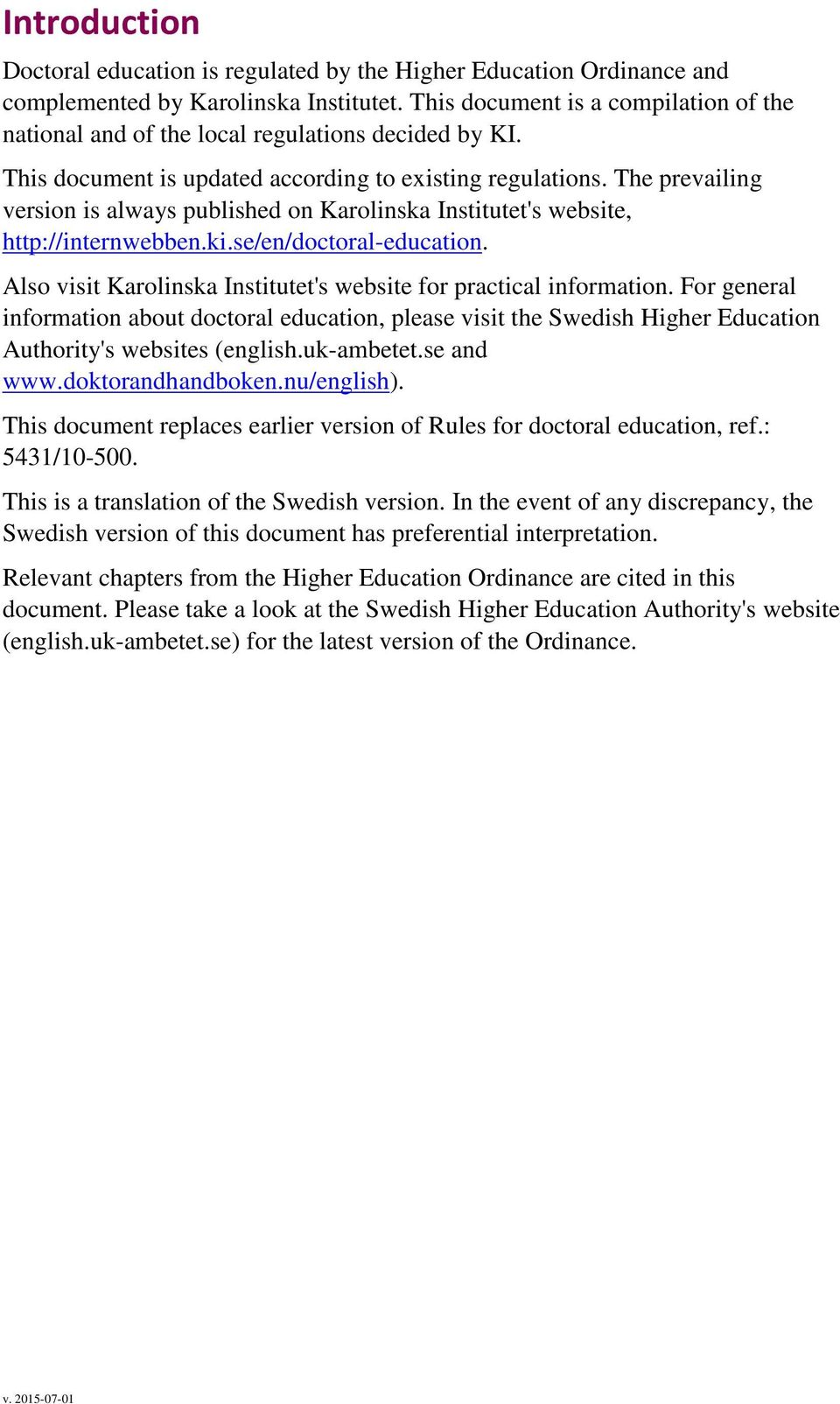
3 Updates Date Section Update Decision This whole chapter has been updated according to the new admissions regulation. 2.3 Specification of requirements for advertisement of doctoral positions. 3.4 General selection criteria for courses have been changed. 8.1 New regulations with regard to doctoral grants. Established by the Board of Karolinska Institutet 03/12/2013, ref /2013 FUS 06/11/2013, ref. no /2013 FUS 06/05/2013 ref. no /2013 Vice-Chancellor's decision, ref. no / Half-time summary. FUS , Minor revision in text regarding examination board (point 2 and 8) The examination board should not make any decisions at the pre-review, only assess if the thesis has enough quality. 8.1 Note that doctoral grants will not be available after 1 July New scholarship regulations: complementary scholarships for doctoral students. 9.3 Reference to new document regarding rules for withdrawing of resources for doctoral students The section on provisional regulations for entry requirements is removed. The regulation is not applicable anymore. FUS , 9 FUS , 10 Vice-Chancellor decision, ref. no 1-15/2015 Vice-Chancellor decision, ref. no 1-125/2014 Vice-Chancellor decision, ref. no 1-434/2014 Higher Education Ordinance
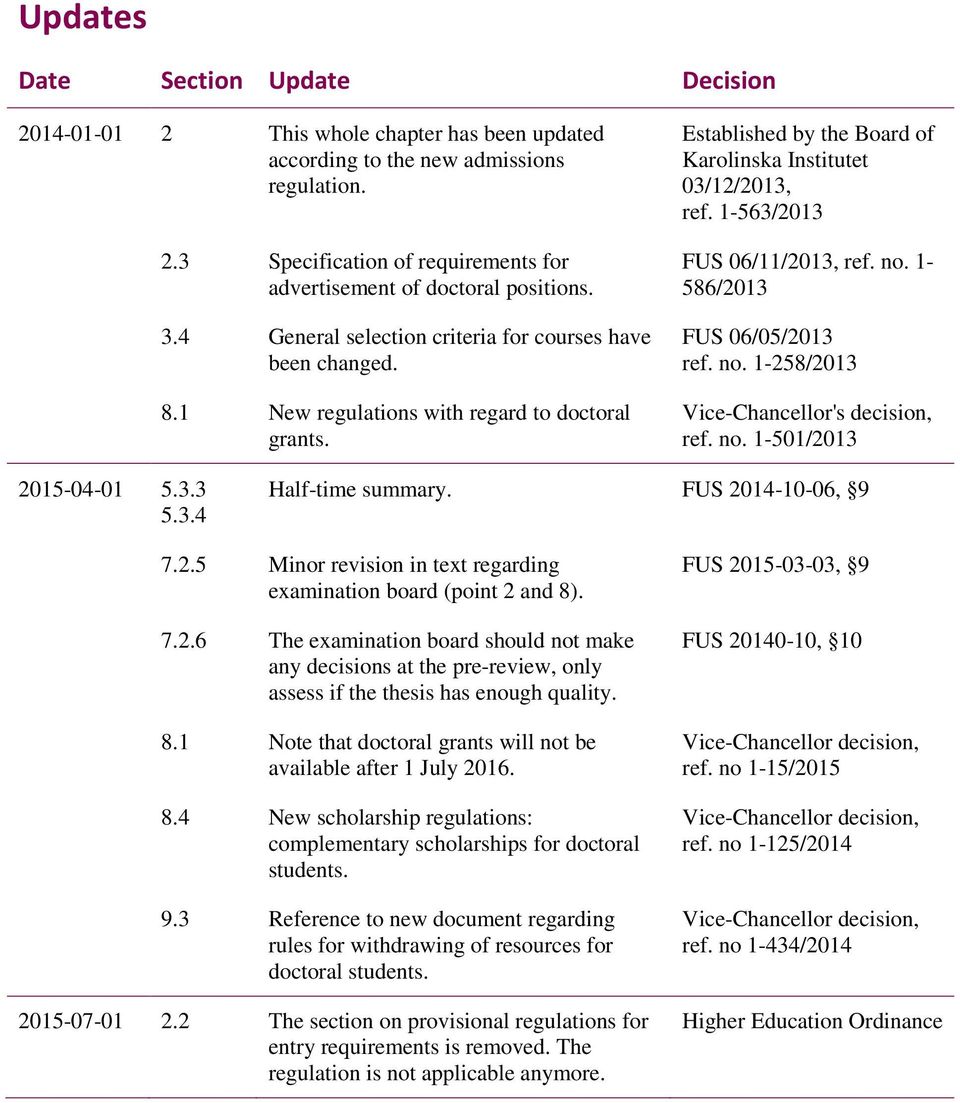
4 Contents 1 DOCTORAL EDUCATION AT KAROLINSKA INSTITUTET Aim Objectives An overview 8 2 ADMISSION TO DOCTORAL EDUCATION Admissions regulations Entry requirements Advertising of doctoral positions Selection Admission Admissions Board Application for admission to doctoral education Admissions seminar Admission with licentiate degree as the objective Decision on admission to doctoral education Study documentation 15 3 DOCTORAL COURSES Syllabus Entry requirements Credit transfer Admission to doctoral courses Examination and registration of credits Evaluation of doctoral courses 17 4 GENERAL SYLLABUS Medical science Changing subject to medical science 18 5 INDIVIDUAL STUDY PLAN External mentor Annual follow-up Half-time review 21 6 SUPERVISION Supervisor training Conflict of interest as a result of family ties Duties of the principal supervisor Duties of the co-supervisor Supervisors obligations Changing supervisors 25 7 EXAMINATION Public defence application Doctoral degree Licentiate degree Degree Certificate and Diploma Supplement 34 8 STUDY FUNDING Doctoral grant and employment as assistant Employment of doctoral students 36

5 8.3 Other types of appointment Scholarship regulations 37 9 DEALING WITH PROBLEMS, WITHDRAWING RESOURCES AND EXPULSION The Doctoral Students' Ombudsman Dealing with problems Withdrawing a doctoral student s resources Expulsion 39

6 1 Doctoral Education at Karolinska Institutet Karolinska Institutet's (KI) mission is to contribute to the improvement of human health through education and research. KI strives to carry out high quality, innovative research with the highest possible international impact. This commitment shall also permeate doctoral education. 1.1 Aim The aim of doctoral education at KI is to advance knowledge in the subject of medical science and contribute to societal development within this field. Doctoral education should, therefore, provide a broad base and prepare students for research and other work, both within academia and in society as a whole. After taking a licentiate degree or doctorate, our graduates may continue their careers within research, as combined researchers and teachers in higher education, as managers with research expertise in industry or healthcare, as scientific journalists or consultants, etc. 1.2 Objectives After completing their doctoral education at KI, our graduates will possess a high general expertise in medical science and scientific methodology, as well as cutting edge scientific expertise in the research area covered by their thesis. Detailed objectives for doctorates and licentiate degrees are described in the Higher Education Ordinance (2006:1053). 5
7 Objectives for the doctoral degree Higher Education Ordinance Appendix 2 - Qualifications ordinance Knowledge and understanding For the doctoral degree, the doctoral student shall - demonstrate broad knowledge and systematic understanding of the research field as well as advanced and up-to-date specialised knowledge in a limited area of this field, and - demonstrate familiarity with research methodology in general and the methods of the specific field of research in particular. Competence and skills For the doctoral degree, the doctoral student shall - demonstrate the capacity for scholarly analysis and synthesis as well as review and assess new and complex phenomena, problems and situations autonomously and critically, - demonstrate the ability to identify and formulate problems with scholarly precision critically, autonomously and creatively, and to plan and use appropriate methods to undertake research and other qualified tasks within predetermined time frames and to review and evaluate such work, - demonstrate through a dissertation the ability to make a significant contribution to the formation of knowledge through their own research, - demonstrate the ability in both national and international contexts to present and discuss research and research findings authoritatively in speech and writing and in dialogue with the academic community and society in general, - demonstrate the ability to identify the need for further knowledge, and - demonstrate the capacity to contribute to social development and support the learning of others both through research and education and in some other qualified professional capacity. Judgement and approach For the doctoral degree, the doctoral student shall - demonstrate intellectual autonomy and disciplinary rectitude as well as the ability to make assessments of research ethics, and - demonstrate specialised insight into the possibilities and limitations of research, its role in society and the responsibility of the individual for how it is used. 6

8 Objectives for the licentiate degree Higher Education Ordinance Appendix 2 - Qualifications ordinance Knowledge and understanding For a licentiate degree, the doctoral student shall - demonstrate knowledge and understanding in the field of research including current specialist knowledge in a limited area of this field as well as specialised knowledge of research methodology in general and the methods of the specific field of research in particular. Competence and skills For a licentiate degree, the doctoral student shall - demonstrate the ability to identify and formulate problems with scholarly precision critically, autonomously and creatively, and plan and use appropriate methods to undertake a limited piece of research and other qualified tasks within predetermined time frames in order to contribute to the formation of knowledge as well as to evaluate this work, - demonstrate the ability in both national and international contexts to present and discuss research and research findings in speech and writing and in dialogue with the academic community and society in general, and - demonstrate the skills required to participate autonomously in research and development work and to work autonomously in some other qualified capacity. Judgement and approach For a licentiate degree, the doctoral student shall - demonstrate the ability to make assessments of ethical aspects of their own research - demonstrate insight into the possibilities and limitations of research, its role in society and the responsibility of the individual for how it is used, and - demonstrate the ability to identify the personal need for further knowledge and take responsibility for their ongoing learning. 7
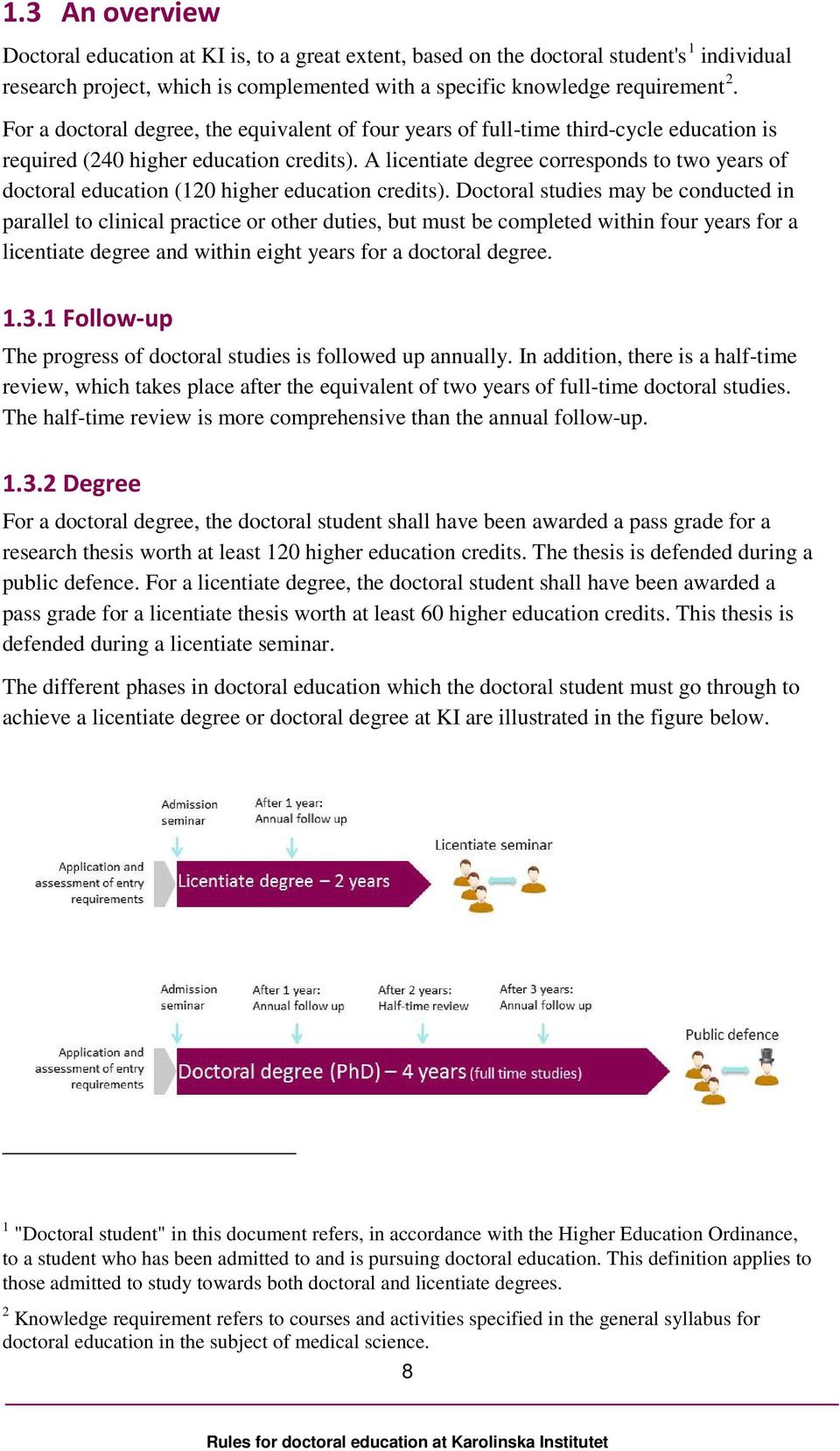
9 1.3 An overview Doctoral education at KI is, to a great extent, based on the doctoral student's 1 individual research project, which is complemented with a specific knowledge requirement 2. For a doctoral degree, the equivalent of four years of full-time third-cycle education is required (240 higher education credits). A licentiate degree corresponds to two years of doctoral education (120 higher education credits). Doctoral studies may be conducted in parallel to clinical practice or other duties, but must be completed within four years for a licentiate degree and within eight years for a doctoral degree Follow-up The progress of doctoral studies is followed up annually. In addition, there is a half-time review, which takes place after the equivalent of two years of full-time doctoral studies. The half-time review is more comprehensive than the annual follow-up Degree For a doctoral degree, the doctoral student shall have been awarded a pass grade for a research thesis worth at least 120 higher education credits. The thesis is defended during a public defence. For a licentiate degree, the doctoral student shall have been awarded a pass grade for a licentiate thesis worth at least 60 higher education credits. This thesis is defended during a licentiate seminar. The different phases in doctoral education which the doctoral student must go through to achieve a licentiate degree or doctoral degree at KI are illustrated in the figure below. 1 "Doctoral student" in this document refers, in accordance with the Higher Education Ordinance, to a student who has been admitted to and is pursuing doctoral education. This definition applies to those admitted to study towards both doctoral and licentiate degrees. 2 Knowledge requirement refers to courses and activities specified in the general syllabus for doctoral education in the subject of medical science. 8
10 2 Admission to Doctoral Education 2.1 Admissions regulations Higher Education Ordinance, Chapter 6 Section 3. Students shall be provided with study and career guidance. The higher education institution shall ensure that those intending to begin a course or study programme have access to any necessary information about it. The higher education institution shall also ensure that the admissions regulations are available. The admissions regulations comprise the rules that apply at the higher education institution to applications, entry requirements, selection, and admissions, as well as how decisions are made and how these decisions may be appealed. The admissions procedure shall have the same overall structure in all departments at KI. The Board of Karolinska Institutet has established admissions regulations which describe the general framework of the admissions procedure (ref.no /2013). 2.2 Entry requirements In order to be admitted to doctoral education, the potential doctoral student must meet the general and specific entry requirements. Assessment of qualifications is conducted by administrators at the University Administration. The decision concerning fulfilment of entry requirements must be attached to the application for admission to doctoral education General entry requirements Higher Education Ordinance, Chapter 7 Section 39. A person meets the general entry requirements for doctoral education if they: 1. have been awarded a second-cycle qualification, 2. have satisfied the requirements for courses comprising at least 240 credits, of which at least 60 credits were awarded in the second-cycle, or 3. have acquired substantially equivalent knowledge in some other way, either in Sweden or abroad. The higher education institution may permit an exemption from the general entry requirements for an individual applicant if there are special grounds. A decision on the general entry requirements must be attached to the application for admission to doctoral education. Form 1: Application for scrutiny of the general entry requirements Specific entry requirements Higher Education Ordinance, Chapter 7 Section 40. The specific entry requirements laid down shall be necessary in order for the student to be able to benefit from the course or study programme. These requirements may comprise 1. knowledge from one or more higher education courses and study programmes or corresponding courses and study programmes, 9

11 2. specific professional or vocational experience, and 3. requisite language skills or other conditions determined by the course or study programme. To be eligible for doctoral education at KI, the student must have knowledge of the English language equivalent to a pass grade at English B/English 6. Applicants who fulfil the general entry requirements (in accordance with Chapter 7, Section 39, points 1 and 2 above) as a result of academic education in an educational institution in one of the Nordic countries are judged to have fulfilled this requirement. For other equivalence assessments, the Association of Swedish Higher Education (SUHF) assessment handbooks for Swedish and foreign preparatory educational apply. Other entry requirements related to any specific doctoral position are set by the head of the department. 2.3 Advertising of doctoral positions Higher Education Ordinance, Chapter 7 Section 37. Questions relating to admission are dealt with by the higher education institution. Those who wish to be admitted to a doctoral course or study programme shall apply within the time and in the manner prescribed by the higher education institution. When a higher education institution intends to admit one or more doctoral students, information shall be provided by the higher education institution through advertising or some equivalent method. Information need not, however, be provided 1. when admitting a doctoral student who is to complete the course or study programme within the framework of employment by an employer other than the higher education institution 2. when admitting a doctoral student who has previously begun doctoral studies at another higher education institution, or 3. if there are similar special grounds. All doctoral positions at KI must be advertised. Exceptions from the required advertisement may be allowed in accordance with Chapter 7, Section 37 of the Higher Education Ordinance (see above). At KI, special reasons in accordance with point three may be a position for which the doctoral student has already been selected in a competitive recruitment process. Before advertising a position, the head of department (or delegated equivalent) must approve the commencement of recruitment for the position. When advertised, positions must: be advertised via the KI recruitment system be advertised at a suitable time, and for an application period which is recommended, as a rule, to last for three weeks or longer the position must be advertised in Swedish and/or English. The choice of advertising language depends on the tasks involved in the position. 10
12 2.4 Selection Selection from amongst the applicants will take place on the following grounds: documented knowledge of the subject that is of significance to the research area analytical expertise other documented knowledge/experience which may be of significance for doctoral education in the subject. A combined assessment of the applicants qualifications and suitability will be conducted. 2.5 Admission Higher Education Ordinance, Chapter 7 Section 34. The number of doctoral students admitted to doctoral courses and study programmes may not exceed the number that can be offered supervision and otherwise acceptable conditions for study and whose studies are funded pursuant to Section 36. Section 35. The requirements for admission to doctoral courses and study programmes are that the applicant 1. meets the general and specific entry requirements that the higher education institution may have prescribed, and 2. is considered in other respects to have the ability required to benefit from the course or study programme. At KI, admission of doctoral students to doctoral courses and study programmes is delegated to the Head of Department where the doctoral student will be registered 3. Each department shall appoint a Director of doctoral education, who has been assigned the tasks to prepare cases for admission and coordinate doctoral education in the department. In order for applicants to be admitted to doctoral education at KI, there is a requirement, aside from the general and specific entry requirements, for them to have an individual study plan, a realistic funding plan, satisfactory supervision and an environment which promotes doctoral education of the highest quality. If the applicant plans to pursue doctoral education in parallel with employment within another organisation, e.g. Stockholm County Council, there is a requirement that the head of the organisation approve the individual study plan. This means that the time proposed in the individual study plan should be set aside for doctoral education. Departments who do not follow the regulations governing doctoral education which are applicable at KI may be subject to restrictions on their right to admit doctoral students. KI s ethical regulations and guidelines shall be adhered to at all times while pursuing doctoral education. 3 See Arbets- och delegationsordningen för Styrelsen för forskarutbildning (Work and Delegation Ordinance for the Board of Doctoral Education). 11
13 2.6 Admissions Board According to the admissions regulations, each department must have an Admissions Board. The Admissions Board is responsible for preparing cases, organising and evaluating the admissions seminar, as well as submitting a proposal for a decision on admissions that serves as a guide for the Head of Department. The Admissions Board shall have the following composition: the department's Director of doctoral education (chairperson) at least three faculty representatives at least one representative who is a doctoral student. If necessary, for example if the syllabus' specialisation lies outside the expertise of the board, another expert may be co-opted. The mandate period for the board s ordinary members should be at least three years and the board shall convene at least once per term. The meetings and proposals for decision by the Admissions Board must be documented. 2.7 Application for admission to doctoral education The application for admission to doctoral education shall be addressed to the Admissions Board of the relevant department. The application shall be submitted to the Admissions Board in good time prior to the board meeting, and must include the following: Form 2: Application for admission to doctoral education with the following appendices: proof that the applicant fulfils the general and specific entry requirements (see Section 2.2) individual study plan with appendices (see Section 5). 2.8 Admissions seminar The Admissions Board will call the applicant to an admissions seminar. Date and details about the department's admissions seminars shall be advertised internally at KI. The admissions seminar will be held in English by the applicant and must contain the following elements: background, structure and aim of the research project, which is planned in the individual study plan timetable the learning objectives, which shall be fulfilled description of how the suggested supervisors are expected to contribute to the doctoral student s education 12

14 presentation of funding plan. The principal supervisor, and, if possible, co-supervisor(s) and mentor, shall be present and may express their opinions during the admissions seminar, but will not participate in the decision of the Admissions Board. 2.9 Admission with licentiate degree as the objective Doctoral students shall, as a rule, be admitted with a doctoral degree as their objective. Only those who are professionally active and who would like to complement or deepen their knowledge in a field of research and only wish to take a licentiate degree may be accepted with a licentiate degree as their objective Decision on admission to doctoral education Before a decision on admission is taken, the Admissions Board shall assess the following factors: Doctoral educational environment whether there is an environment that promotes doctoral education of the highest quality (see the guidelines below) The research project the quality of the project the feasibility of the project whether the requirement for ethical permits has been taken into account Individual study plan if the proposed courses and the content of the study plan, in general, are relevant and sufficiently extensive in relation to the learning objectives and the requirements of the general syllabus timetable funding plan Applicant whether the applicant s knowledge of the English language is sufficient in order to benefit from doctoral education in an international perspective whether the applicant is familiar with what doctoral education at KI involves the applicant s ability to benefit from the education, based on the overall information in the application and information gained during the admissions seminar. Supervision whether the proposed principal supervisor has the means to assist with good, professional supervision 13
15 whether the proposed co-supervisor(s) will be able to contribute the relevant complementary expertise. The Admissions Board's assessment will result in one of the following: A recommendation that the Head of Department admit the doctoral student. A proposal that the individual study plan be revised (which may then be reconsidered). A recommendation that the Head of Department reject the application. The Head of Department takes the final decision on whether to admit the applicant or reject the application 4. When deciding on admissions, the Head of Department must also approve the individual study plan (see Section 5). The decision of the Head of Department cannot be appealed. A rejection does not prevent a new application for admission being submitted. In conjunction with admission, a doctoral student shall show a valid identification document Guidelines for assessment of the study and work environment Are there opportunities for contacts with other doctoral students and researchers, e.g. through networking activities, seminars etc.? Is there support available for the doctoral student's studies, e.g. in the form of postdocs, statisticians, biomedical analysts and other researchers? Are there opportunities for international exchange/contacts? Have alternative ways to achieve the objectives been described, should those outlined not lead to success? What previous experience of supervision does the supervisory group have, i.e. the principal and co-supervisors? Presence of the supervisors in the group - full or part-time, the same physical workplace, etc.? How many doctoral students are currently being supervised? How well described is the supervisory approach? How will the supervision of the proposed doctoral project be organised (in which way will the various competencies of the supervisors be utilised in the project)? 4 See Arbets- och delegationsordning för Styrelsen för forskarutbildning (Work and Delegation Ordinance for the Board of Doctoral Education). 14

16 2.11 Study documentation Ladok KI uses a computerised system for documenting studies, called Ladok. The register is local and contains details of all of KI's bachelor's, master's and doctoral students, as well as their activities and results. For further information see Studieadministrativa regler med Ladok som systemstöd vid Karolinska Institutet (regulations governing administration of studies with Ladok, only in Swedish). Certain details are submitted onwards to Statistics Sweden, the Swedish Higher Education Authority, the Swedish Council for Higher Education, and the Ministry of Education and Research. Regulations governing how the register shall be used can be found in "Ordinance on reporting of studies etc. at universities and higher educational establishments" (SFS 1993:1153). The right to obtain excerpts from the register is regulated by the Personal Data Act (SFS 1998:204). The information in Ladok is public, in accordance with the same regulations that apply to public documents held by governmental agencies. If a doctoral student has a protected address, they must contact the administrator responsible for Ladok at KI to come to an agreement about how mail should be managed while they are studying Ladok online At KI, all doctoral students can, themselves, view their own registrations and results, take out certificates of their registrations and results, change their telephone number and update their address Reporting of activities Each term, doctoral students must report their activities and financial support to their department, and this information will be registered in Ladok. Activities refer, here, to the proportion of equivalent full-time involvement that a doctoral student has devoted to their doctoral education. The activities are reported in per cent (proportion of equivalent fulltime commitment) One file for each doctoral student For each doctoral student, all relevant documents concerning their doctoral education shall be collected in a file and kept at the department. 15
17 3 Doctoral Courses Higher Education Ordinance, Chapter 6 Scope, credit transfer, study subject Section 6. If a student at a higher education institution in Sweden has successfully completed a higher education course or study programme, they are entitled to transfer the credits awarded for a course or study programme at another higher education institution. This does not apply, however, if there is a substantial difference between these courses or study programmes. The same applies to students who have successfully completed a course or study programme 1. at a university or other higher education institution in Denmark, Finland, Iceland or Norway or a signatory to the Council of Europe's Convention of 11 April 1997 on the Recognition of Qualifications concerning Higher Education in the European Region, or 2. at the Nordic School of Public Health. Section 7. A student is entitled to transfer credits from a course or study programme other than that laid down in Section 6 if the nature and extent of the knowledge and skills cited by the student are such that they correspond, on the whole, to the course or study programme for which the credits are to be recognised. A student may also be given credit for equivalent knowledge and skills acquired in a vocational or professional capacity. Section 8. The higher education institution shall assess whether credits can be awarded for the prior course or study programme or professional or vocational experience. Credits may only be awarded to those who are students unless otherwise provided by statute or ordinance. 3.1 Syllabus All doctoral courses at KI must have an established syllabus. The establishment of a syllabus (and course credits) is carried out by the Board of Doctoral Education. 3.2 Entry requirements Doctoral courses at KI are primarily intended for doctoral students. Other applicants may be accepted if there are sufficient places. 3.3 Credit transfer A student admitted to doctoral education at KI may also transfer credits from an approved doctoral course at another university or higher education institution. Knowledge and skills acquired through professional activities may also be considered for credit transfer. The credits from courses taken within the framework of a licentiate degree may be transferred to a subsequent doctoral degree, which has the same specialisation. The Head of Department may delegate decisions about credit transferral to the Director of doctoral education 5. Decisions about the transfer of credits may be appealed via the Higher Education Appeals Board 6. 5 See Arbets- och delegationsordning för Styrelsen för forskarutbildning (Work and Delegation Ordinance for the Board of Doctoral Education). 16
18 Form 13: Application for credit transfer 3.4 Admission to doctoral courses Course organisers are responsible for the selection and admission of applicants. For admission to doctoral courses, the following general selection criteria must be followed: 1. doctoral students at KI (doctoral students in collaborative programmes are considered KI doctoral students) 2. post docs at KI 3. doctoral students at other universities (in Sweden or abroad) 4. other applicants. 3.5 Examination and registration of credits Examination of doctoral courses is performed at an individual level. The person responsible for the course is also the examiner, or another impartial examiner appointed by the course responsible. An examiner should have defended his/her thesis. The course organiser and the department's study administrator are responsible for reporting and registration of approved course credits in Ladok. For course participants not admitted to doctoral education at KI a specific permission to take doctoral courses should be documented in Ladok. After passing the examination a course certificate can be issued from Ladok Evaluation of doctoral courses Higher Education Ordinance, Chapter 1 course evaluations Section 14. Higher education institutions shall enable students who are participating in or have completed a course to express their experiences of and views about the course through a course evaluation to be organised by the higher education institution. The higher education institution shall collate the course evaluations and provide information about their results and any actions prompted by the course evaluations. The results shall be made available to the students. All courses shall be evaluated in a way which allows the evaluation to address objective questions, such as whether course objectives were met, the execution and organisation of the course, and the teachers' and doctoral students' contributions. KI's template for doctoral course evaluation must be used for the evaluation of doctoral courses at KI. 6 See Higher Education Ordinance, Chapter 12, Section 2, Paragraph 3, as well as the website of the Higher Education Appeals Board: 7 Please see Studieadministrativa regler med Ladok som systemstöd (ref no 1-187/2014) 17

19 Course evaluations shall be used for the continuous development of the courses. Course evaluations are followed-up and feedback is provided to the Board of Doctoral Education. Course evaluations must be made available for past and future participants. 4 General syllabus Higher Education Ordinance, Chapter 6 Section 2. The extent of a course or study programme shall be denoted by credits, with full-time study during a normal academic year of 40 weeks corresponding to 60 credits. Section 25. A university or higher education institution entitled to award doctoral qualifications shall determine the subjects in which doctoral courses and programmes may be offered. Section 26. For each subject in which doctoral courses or study programmes are offered, a general syllabus is required. Section 27. A general syllabus shall indicate the following: the main content of the study programme, specific entry requirements and any other regulations required. The doctoral students shall complete their doctoral education following the course requirements specified in the general syllabus for which they have been admitted. 4.1 Medical science There are four different general syllabi for doctoral education in the subject of medical science at KI: General syllabus for doctoral students admitted from 1 July 2013, ref. no /2013 General syllabus for doctoral students admitted from , ref. no. 1993/ General syllabus for doctoral students admitted from 01/07/2007 to 30/06/2009, ref. no. 197/ General syllabus for doctoral students admitted from 01/07/2006 to 30/06/2007, ref. no. 197/ Changing subject to medical science For doctoral students admitted before 01/03/2006, it is possible to change the subject of doctoral education to medical science. In such a case, there should also be a revision of the individual study plan so that a complete doctoral education can be fulfilled in accordance with the intentions of the "General Syllabus for Medical Science" and the 8 Revised in accordance with the new Higher Education Ordinance (1993:100) which came into force on 1 January 2011, ref. no. 6570/

20 "Regulations Governing Doctoral Education at Karolinska Institutet". The change of subject of doctoral education shall be administrated and documented by the Admissions Board at the doctoral student s department and must be approved by the Head of Department. Form 14: Application to change study subject/department 5 Individual study plan Higher education ordinance Chapter 6 Individual study plan Section 29. An individual study plan shall be drawn up for each doctoral student. This study plan shall contain the undertakings made by the doctoral student and the higher education institution and a timetable for the doctoral student's study programme. The study plan shall be adopted after consultation with the doctoral student and their supervisors. The individual study plan shall be reviewed regularly and amended by the higher education institution, to the extent required after consultation with the doctoral student and their supervisors. The period of study may only be extended if there are special grounds for doing so. Such grounds may comprise leave of absence because of illness, leave of absence for service in the defence forces or an elected position in a trade union or student organisation, or parental leave. The content of the individual study plan governs the specialisation which applies to each doctoral student in their doctoral education. The individual study plan shall be approved by the Head of Department following a recommendation by the Admissions Board as described above (see Chapter 2). The individual study plan shall include the following information: the doctoral student's CV (as an appendix) the intended degree (doctoral or licentiate degree) title of the individual study plan research plan learning objectives for doctoral education description of studies that require ethical approval, as well as information on existing ethical approval and those that need to be applied for according to the planned research project description of the supervision timetable potential mentor if the doctoral student plans to teach, this must be stipulated funding plan for the entire period, including a plan for the student's financial support and an indication of the sources of funding to be used (as an appendix). 19
21 The individual study plan shall be approved in its entirety by the applicant as well as all potential supervisors before submission of the application for admission to doctoral education. If another party is planned to be responsible for part of the financing, this party must also approve the study plan. If the doctoral student plans to conduct other activities in parallel with their doctoral education, e.g., working for Stockholm County Council, the head of this organisation or equivalent must sign the individual study plan. Form 3: Individual study plan 5.1 External mentor As a complement to the supervisor, an independent person shall be appointed to act as mentor to the doctoral student during the doctoral education. The external mentor may be from the university, county council, industry or another sector of society. The external mentor should provide support to the doctoral student with regard to advice from an independent person concerning issues such as career planning, contacts outside KI, or other types of advice. The mentor will be appointed following a proposal by the doctoral student, within a year of their admission, and shall be stated in the individual study plan. 5.2 Annual follow-up The individual study plan and the student's progress in the doctoral education must be followed-up in writing once a year at the request of the department's Director of doctoral education. The report shall be signed by the doctoral student and supervisor, and shall contain the following information: completed elements in accordance with the plan an update on the research project or credit-generating elements that are planned an update of the planned timetable or funding plan other parts of the current individual study plan that are to be revised. The department's Director of doctoral education will review the report and (upon instructions of the Head of Department 9 ) decide on the potential minor changes to the individual study plan. Minor changes may reflect, for example, changes concerning courses. Examples of more substantial changes which require decision by the Head of Department include changes of the supervisory group. 9 See Arbets- och delegationsordning för Styrelsen för forskarutbildning (Work and Delegation Ordinance for the Board of Doctoral Education). 20
22 The first annual follow-up shall, aside from the written report, also be offered as a meeting with the department's Director of doctoral education. This can take place individually or in a group containing all of those recently admitted to the department. The aim is to identify any possible uncertainty, to ensure that the doctoral education is proceeding according to plan, and to establish contact between the Director of doctoral education and the doctoral student. For doctoral education leading to a doctoral degree, an extended annual follow-up shall take place half-way through the studies, a so-called half-time review (see below). A completed annual follow-up shall be registered in Ladok. Form 4: Annual follow-up 5.3 Half-time review The half-time review shall be carried out for each doctoral student planning to take a doctoral degree. The principal supervisor and the doctoral student are responsible for, and will take the initiative in, conducting the half-time review When? The review shall, if there are no special circumstances, take place following the equivalent of two years of full-time doctoral education. Furthermore, the student must have completed at least 7.5 higher education credits of general scientific courses, including 1.5 higher education credits in statistics and 1.5 higher education credits in research ethics 10. The time for the half-time review is not dependent on the number of manuscripts or published articles Board After proposal by the supervisor, the Head of Department will appoint a board consisting of three researchers with adequate knowledge of the subject, and who are independent from the project and have obtained a doctoral degree. The board, together with the supervisors and the doctoral student, shall assess the prospects of the project leading to a doctoral degree, and propose any necessary changes to the individual study plan Half-time summary Ahead of the half-time review, the doctoral student shall write a half-time summary comprising: a literature review of the research field a status report of the research project 10 This applies to doctoral students admitted to "Medical Science". 21
23 a status report on the progress the student is making towards his/her individual learning outcomes a plan for the remaining of his/her doctoral studies his/her reflection on ethical considerations Documents The supervisors and the doctoral student ensure that the board receives the documents in time, well in advance of the half-time seminar. These documents are: half-time summary (see 5.3.3) the doctoral student's individual study plan ethical approval(s) excerpt from Ladok publications and manuscripts, if any Seminar The half-time review consists of a seminar, and a follow-up meeting. The seminar consists of a presentation held by the doctoral student in English. The presentation shall summarise results and further planning of the doctoral education in relation to the doctoral student s individual study plan. The half-time seminar shall be public and advertised internally at KI Follow-up meeting After the half-time seminar, the board meets with the supervisors and the doctoral student and, if possible, the mentor, to review the progress. Together with the doctoral student, the supervisors and the mentor the following shall be discussed: plans for the remaining educational activities the structure of the supervision ethical matters The assessment by the board The following factors will be assessed, based on the individual study plan: courses and other elements for which credits are awarded the level of activity the quality of the research project progress towards the learning objectives of the doctoral education the doctoral student's general knowledge within the field, as well as project specific knowledge 22
24 the doctoral student's knowledge of scientific method in general, as well as knowledge of methods in the specific area of research the doctoral student's basic understanding of scientific thinking the doctoral student's ability to present, analyse and evaluate the results of their research the doctoral student s development towards independence ethical approval(s). When the half-time review is completed, the protocol will be written up, and signed by all board members. The protocol is submitted to the Head of Department/Director of doctoral education. Form 5: Protocol at the half-time review Following the half-time review A completed half-time review shall be registered in Ladok and the protocol kept in the doctoral student s file. Should there be remarks or proposals for changes to the current plan, the written synthesis from the half-time review shall apply as a revision of the individual study plan. Revisions to the individual study plan are approved by the department's Director of doctoral education (on the instructions of the Head of Department 11 ) Exceptions Half-time reviews, completed at KI, are mandatory for those who wish to conduct a doctoral dissertation. However, exceptions are made for those doctoral students who hold a previous licentiate degree within the same subject area. 6 Supervision Higher Education Ordinance, Chapter 6 Supervision Section 28. At least two supervisors shall be appointed for each doctoral student. One of them shall be nominated as the principal supervisor. Doctoral students are entitled to supervision during their studies, unless the President has decided otherwise by virtue of Section 30. A doctoral student who so requests shall be allowed to change supervisor. In each individual case prior to deciding on the supervisors, the Head of Department must make a collected assessment of the proposed supervisory group. For each doctoral student, 11 See Arbets- och delegationsordning för Styrelsen för forskarutbildning (Work and Delegation Ordinance for the Board of Doctoral Education). 23
25 at least one of the supervisors must be an associate professor (docent) or a professor the principal supervisor (under normal circumstances) must be active at KI at least one of the supervisors, preferably the principal supervisor, must be active in the department to which the doctoral student is admitted. A doctoral degree is required for a person to be appointed as supervisor. All supervisors shall be thoroughly familiar with KI's regulations governing doctoral education. Even though a doctoral student may only be registered at one department, the student may benefit from taking place in more than one department and with supervisors from more than one department. An agreement shall be made, in conjunction with admission, concerning how supervision and activities will be organised and divided between the supervisors. This shall also be specified in the individual study plan. 6.1 Supervisor training The principal supervisor must have completed research supervisor training which has been arranged according to the instructions of the Board of Doctoral Education, or have equivalent expertise Equivalent expertise Those who have equivalent expertise have been principal supervisors for doctoral students who have graduated with doctoral degrees from, for example, a university in one of the Nordic countries or another country which has comparable doctoral education have taken part of another research supervisor training which is approved by the Board of Doctoral education. All principal supervisors, including those who have equivalent expertise, must undertake the "online course for research supervisors", arranged according to instructions from the Board of Doctoral Education. 6.2 Conflict of interest as a result of family ties Doctoral students may not be related to their supervisors, and cases in which there is a relationship between supervisors who are part of the doctoral student's supervisory group, should be avoided. In cases where there is a relationship between supervisors, specific justification must be provided in the individual study plan. 6.3 Duties of the principal supervisor The principal supervisor shall have the overall responsibility for supervision when it comes to the planning and execution of the research project. The principal supervisor also 24
26 has, together with the doctoral student, a responsibility to ensure that the doctoral courses and other elements that are specified in the general syllabus and individual study plan, are completed. The principal supervisor shall work to ensure that the annual follow-up, as well as the half-time review and defence of thesis, or licentiate degree, are planned and implemented. The principal supervisor is responsible for ensuring that the funding plan in the individual study plan is drawn up and revised. 6.4 Duties of the co-supervisor A co-supervisor is primarily responsible for providing complementary scientific expertise to the project. The role of the co-supervisor shall be clearly stated in the individual study plan. 6.5 Supervisors obligations Supervisors at KI shall have a professional approach to doctoral education. This means that a supervisor shall take responsibility for ensuring that planned and implemented doctoral education is of good quality and has a realistic scope in relation to the doctoral student s individual study plan. The supervisor shall be thoroughly familiar with the regulations and conditions of doctoral education. The supervisor shall be available for the doctoral student, be clear and consistent in their supervision, and critically review the results achieved. Supervisors shall always work to ensure equality of treatment, by clearly working against all forms of discrimination and harassment. 6.6 Changing supervisors A doctoral student has, according to the Higher Education Ordinance, the right to change supervisors. An application to change supervisors will necessitate the revision of the individual study plan, and must be requested using the specific form provided by the department s Director of doctoral education. A change of supervisor must be approved by the Head of Department, after which the change shall be registered in Ladok. Form 15: Changing supervisors 25
27 7 Examination Higher Education Ordinance, Chapter 6 Examination Section 32. Examinations that form part of doctoral courses and study programmes shall be assessed in accordance with the grading system prescribed by the higher education institution. The grade shall be determined by a teacher specifically nominated by the higher education institution (the examiner). Section 33. The qualification descriptions of doctoral degrees indicate that an approved doctoral thesis, amongst other things, is required for the award of these degrees. The doctoral thesis shall be presented and defended orally in public. A faculty examiner (opponent) shall be appointed for this presentation. Section 34. At least one of those participating in the grading of a doctoral thesis shall be someone who does not have a post at the higher education institution awarding the degree. Section 35. A higher education institution may issue regulations on the grading system to be used and on public defences and grading in other respects. 7.1 Public defence application To ensure the highest possible quality of theses from KI, and to verify that all elements of the doctoral education have been completed prior to the examination, an application for examination shall be submitted to the Dissertation Committee in accordance with the instructions on the website: The Dissertation Committee shall ensure that the examination regulations are adhered to 12. The Dissertation Committee checks: that the thesis fulfils the formal requirements of the Higher Education Ordinance and KI that the study plan has been adhered to that the ethical guidelines have been adhered to. The Dissertation Committee appoints the Examination Board, and also the opponent in the case of a doctoral thesis defence decides the date and place for the licentiate seminar or thesis defence. Incomplete information regarding ethical approval may result in further investigation concerning suspicion of irregularities. Further practical information about the application may be found on KI's internal website. Form 6: Licentiate seminar application 12 See Arbets- och delegationsordning för Styrelsen för forskarutbildning (Work and Delegation Ordinance for the Board of Doctoral Education). 26
28 Form 9: Public defence application 7.2 Doctoral degree The examination for a doctoral degree may be carried out following the equivalent of four years full-time doctoral education (240 higher education credits). For a doctoral student to receive a doctoral degree from KI, they are required to have: been admitted to doctoral education at KI completed at least half of their doctoral education at KI (as evidenced by their KI departmental affiliation in the articles included in the thesis) conducted their half-time review at KI, or have a licentiate degree within the same subject area fulfilled the knowledge requirements for a doctoral degree in accordance with the general syllabus to which the doctoral student was admitted written a doctoral thesis that has been awarded a pass conducted a public defence of their doctoral thesis that has been awarded a pass. At KI, the following doctoral degrees are awarded: Medicine doktorsexamen, Filosofie doktorsexamen, Teknologie doktorsexamen, and Odontologie doktorsexamen. In English all doctoral degrees have the title "Doctor of Philosophy", which is abbreviated to "Ph.D." Time and place of the examination The examination shall take place during the established public defence term. The examination shall be held at a venue and in such a way that students and employees of KI are easily able to participate Compilation thesis Most theses from KI are compilation theses, based on a number of separate original papers (not reviews). One of the constituent papers can be a systematic survey article, for example a meta-analysis. The requirement for such an article is that is creates new knowledge. At least half of the constituent papers which are included in the compilation thesis must have been accepted for publication in a peer-reviewed journal. The number of constituent papers in a compilation thesis varies, but they must have a scope and quality that in total, in the opinion of the Examination Board, is equivalent to four years of full-time doctoral education. The doctoral student's contribution to the constituent papers must be clearly identified. A doctoral student admitted to KI must indicate the department at KI as their address on each scientific article they publish. The constituent papers that are included in a compilation thesis shall be introduced and discussed in the thesis in the form of a 27
29 comprehensive summary. Preliminary results that are not part of any paper, but which the doctoral student wishes to include in the thesis, may be presented in the summary. The part of the summary that relates to the thesis' research field from an international perspective may, if the doctoral student so wishes, be written in the form of a review, in which case it may be written with the intent to publish and may then be included in the thesis as a separate part. If this solution is chosen, which may be a method of confirming the doctoral student s contribution in a thesis based on a larger collaborative project, or when there are only a few papers, the doctoral student shall either be the first author, or the only author of the review Monograph thesis A doctoral thesis may also be presented in the form of a monograph thesis. Special rules of review then apply: 1. A draft of the monograph is submitted together with the application for public defence of the thesis, along with suggestions for two expert reviewers, one active at KI and one external. 2. The reviewers read through the work and write a report similar to the referee reports of scientific journals. The report will result in a statement on the quality and scope of the thesis. The report is administered by the Dissertation Committee. 3. The doctoral student is invited to submit a response to the report and, if necessary, a revised version of the monograph, in which the changes are clearly marked. 4. The thesis is then submitted in the regular way to the members of the Examination Board, together with the reviewers' detailed written reports. Following the recommendation by the board members that the thesis shall be defended in a public defence, the work is submitted for printing Opponent The opponent shall be a researcher who must hold a doctoral degree (exceptions may be made for very well qualified professors), who is an expert in the field of the project, and who is unbiased with respect to the doctoral student, the supervisors and the project. The role of the opponent is to critically review all parts of the thesis, both the comprehensive summary and the constituent papers, and to discuss these in detail with the respondent 13 during the thesis defence. The opponent is to highlight the strengths and weaknesses in the thesis in a discussion with the respondent, in which the respondent shall also have the opportunity to demonstrate knowledge obtained. This discussion shall 13 The "respondent" refers to the doctoral student who is defending the thesis to gain a degree. 28
30 cover both technical and practical details, and how the results of the thesis may be viewed in a broader context Examination Board for doctoral degrees The following apply to Examination Boards at public defences: The Examination Board shall comprise three members (if there are special reasons, such as a doctoral thesis being of a pronounced interdisciplinary character, the number of members on the Examination Board may be increased to five). One of the members shall be designated as the coordinator. The coordinator shall not belong to the same department as the doctoral student, the principal supervisor or any of the co-supervisors. All of the members of the Examination Board must be associate professors (docent) or professors. All of the members must be experts in the field of the project. The combined expertise of the Examination Board shall cover the entire content of the thesis. The members of the Examination Board must be independent of and unbiased in relation to the doctoral student, the supervisors and the project. If possible, at least one member of the Examination Board shall have been a member of the board at the doctoral student s half-time review. Only one of the members may belong to the same department as the doctoral student (or the principal supervisor, in cases when the principal supervisor is in a different department as the doctoral student). At least one member shall come from another university than the doctoral student, principal supervisor and co-supervisors Preliminary review Before the thesis is submitted for printing, the Examination Board shall conduct a preliminary review of the thesis in order to assess if the quality of its constituent papers is of a sufficiently high standard for a PhD. In the event of disagreement, the matter is decided by the majority opinion, even if all members of the board are expected to comment in its pronouncement. If the Examination Board deems the quality of a thesis to be insufficient, the student is recommended to postpone the defence of his/her thesis. On the first such occasion, the student is entitled to further supervision and educational resources for an additional six months over and above the original study schedule in order that the he/she may have the opportunity to improve the quality of his/her work. 29
31 7.2.7 Graphic rules A thesis from KI must follow KI's regulation regarding visual identity (graphic style) Information and templates regarding thesis design and structure can be found on the website: internwebben.ki.se/en/defend-your-thesis Public notification "nailing" A doctoral student shall publish the thesis by a notification process known as "nailing". Before nailing, a faculty representative, appointed by the Board of Doctoral Education, shall approve the thesis for distribution. The nailing process consists of the following elements: The faculty representative checks that the thesis complies with the content of the public defence application, in which case they endorse it with the words "må spikas" ("May be nailed"). The thesis is thus approved as the basis for a public defence/licentiate seminar. The thesis is also to be digitally "nailed" in the KI thesis database, no later than three weeks prior to its public defence. There is an obligation to provide a set number of copies to KI's library in either Solna or Huddinge. When the above tasks have been completed, the doctoral student receives a nail and piece of string, which they are to use to nail the signed thesis to the designated place in KI's library in either Solna or Huddinge. On the same day as the thesis is nailed, a copy of the thesis shall be sent to the opponent, the Examination Board, and the chairperson for the public defence (disputationsordförande). Publication of the thesis also takes place through distribution by the doctoral student, the department, and by the Communications and Public Relations Office at KI notifying the media of new research from KI via press releases Public defence The doctoral thesis shall be presented and defended orally in public. The public defence is led by a public defence chairperson. A member of KI faculty who has a doctoral degree is appointed chairperson. It is not recommended that the chairperson be one of the supervisors The public defence shall be public and preferably held in English, but Swedish is also acceptable. If the proceedings are very long, the chairperson may suspend them for a break. Under no circumstances may the defence proceedings be concluded until all opposition and discussions from the opponent, the Examination Board members and the auditorium have been dealt with. Public defence proceedings: 30
32 1. The chairperson will open proceedings and present the respondent, the title of the thesis to be defended, the opponent and the Examination Board 2. The respondent gives notice of any corrections to the thesis and may, if necessary, distribute a list of errata 3. The opponent or the respondent is invited to present a brief popular scientific introduction to the thesis and the field dealt with by the research. 4. The respondent or the opponent presents the main results and conclusions of the thesis. 5. The opponent discusses the thesis with the respondent, comments on its strengths and weaknesses, and poses questions which the respondent must answer to the best of their ability 6. The chairperson invites the Examination Board to pose questions 7. The chairperson invites the audience to pose questions 8. The chairperson concludes proceedings If the opponent is unable to attend, the public defence may proceed with the Examination Board taking on the role of the opponent. If one of the Examination Board's members is not present at the public defence, the chairperson must contact the Dissertation Committee administrator at the university administration so that a new member can be appointed. There must be three Examination Board members present for the public defence to proceed Examination Board meeting following the public defence Following the public defence, the Examination Board is called to an immediate meeting to decide on the grade. The Examination Board appoints a chairperson from amongst themselves. The Examination Board meeting is comprised of two parts: 1. In the first part, the public defence chairperson, supervisors and the opponent are present. The respondent's performance is then discussed by the Examination Board. 2. In the second part of the meeting, only members of the Examination Board are present. The grade and the written justification for this are confirmed, after which the minutes are written up and signed. If there are any remarks made during the public defence which were so extraordinary that the Examination Board considers it necessary to undertake specific investigations or consultations before a decision can be made, the Examination Board should adjourn the meeting. The adjournment must be short, two weeks at most. 31
33 Grade The Examination Board shall assess the thesis and its public defence with regard to: the respondent's presentation of the thesis at the public defence, including the discussion with the opponent, and the ability to answer questions and discuss the significance of the results within the field of research the quality of the comprehensive summary the scientific content of the constituent papers the fulfilment of the objectives of the doctoral degree. Against the background of this assessment, the Examination Board comes to a decision to award a grade of either pass or fail. The decision of the majority applies. A single member may dissent from the Examination Board's decision on the grade, in which case specific justification must be given. The Examination Board must provide a written justification when awarding a fail. The doctoral student will then has the opportunity to, at a later date, re-apply for a public defence of their thesis. However, there is no obligation on the part of supervisors, the department or KI, to cover the additional costs that result from a renewed defence of thesis, or to support the doctoral student after a failed doctoral examination beyond the expiry of the existing appointment. An Examination Board that so wishes may justify or comment on a grade of pass in writing, e.g., if the board agrees that the defence and content of the doctoral thesis were of an exceptionally high quality. Form 11: Transcript of public defence 7.3 Licentiate degree The examination for a licentiate degree may be carried out following the equivalent of two years full-time doctoral studies (120 higher education credits). For a doctoral student to receive a licentiate degree from KI, they are required to have: been admitted to doctoral education at KI completed at least half of their doctoral education at KI (as evidenced by their KI departmental affiliation in the articles which in the thesis) fulfilled the knowledge requirements for a licentiate degree in accordance with the general syllabus to which the doctoral student was admitted written a licentiate thesis that has been awarded a pass defended the licentiate thesis at a licentiate seminar which has been awarded a pass. After the award of a licentiate degree, the doctoral student will have completed their doctoral education at KI. It is possible, however, to subsequently apply for admission to further doctoral studies with the aim of obtaining a doctoral degree. 32
34 7.3.1 Time and place of the examination Same rules apply as for doctoral degree, see Licentiate thesis A licentiate thesis is normally written in the form of a summary and discussion of separate constituent papers, a compilation thesis. A licentiate thesis may, alternatively, be presented in the form of a monograph. For a licentiate thesis to be considered a compilation thesis, at least one of the constituent papers must have been accepted for publication in a peer-reviewed journal. A licentiate thesis that is based on constituent papers in the form of a manuscripts, where none of the constituent papers have been accepted for publishing, will be treated as a monograph thesis. In which case, special review regulations apply, see Examination Board for licentiate degrees A special Examination Board, but no opponent, is appointed to assess a licentiate thesis and seminar. The same regulations apply to the Examination Board for licentiate degrees as apply to those for doctoral degrees, see Preliminary review The regulations regarding preliminary review in the case of licentiate degrees are the same as apply in the case of doctoral degrees, see Graphic rules The graphical rules for licentiate theses are the same as for doctoral theses, see Public notification "nailing" The regulations governing the nailing process for licentiate theses are the same as for doctoral theses, see Licentiate seminar The respondent will, during the public licentiate seminar, describe the research project which constitutes the basis for the licentiate thesis, including its background, methods, results and conclusions. Following the seminar, the Examination Board will pose questions in order to assure themselves that the respondent has achieved the objectives described in the study plan. Others in the audience will also be given an opportunity to ask questions The Examination Board meeting The regulations governing the Examination Board meeting for licentiate degrees are the same as for doctoral degrees, see
35 7.3.9 Grade The Examination Board will assess: the respondent s licentiate seminar and answers to questions the quality of the comprehensive summary in the licentiate thesis the scientific content the fulfilment of the objectives of the licentiate degree. Against the background of this assessment, the Examination Board comes to a decision to award a grade of either pass or fail. The decision of the majority applies. A single member may dissent from the Examination Board's decision on the grade, in which case, specific justification must be given. The Examination Board must provide a written justification when awarding a fail, and the doctoral student will have the opportunity to, at a later date, re-apply to defend their licentiate thesis in order to achieve a licentiate degree. However, there is no obligation on the part of supervisors, the department or KI to support the doctoral student financially after a failed licentiate examination beyond the expiry of the existing appointment. An Examination Board that so wishes may justify a grade of pass in writing, for example if the board agrees that the defence and contents of the licentiate thesis were of an exceptionally high quality. Form 8: Transcript licentiate degree seminar Differences between the licentiate examination and the half-time review Differences between the licentiate examination and half-time review: the licentiate degree comes with an academic title "Degree of Licentiate of Medical Science" a preliminary review must take place in advance of a licentiate examination the licentiate examination is based on a licentiate thesis (for a half-time review, a short summary is sufficient) the licentiate thesis is "nailed" the licentiate degree means that the student has completed their doctoral education at KI. This is not the case for the half-time review. 7.4 Degree Certificate and Diploma Supplement Higher Education Ordinance, Chapter 6 Degree certificate Section 9. A student who fulfils the requirements for the award of a qualification shall, upon request, be provided with a certificate. Section 10. On the certificate, the university shall indicate 34
36 1. the title of the qualification, 2. the cycle (level) in which it was awarded, 3. whether the qualification forms part of a joint degree, as laid down in Chapter 1, Section 17 of the Higher Education Act, 4. the first (bachelor's) and second-cycle (master's) courses taken for award of the qualification, and 5. the higher education institution at which the courses set out in item 4, or corresponding third-cycle courses and programmes, have been completed. A translation of the title of the qualification to one or several languages may be included on the certificate. Section 10a. A certificate shall be accompanied by 1. a diploma supplement that describes the study programme and its place in the educational system. The Swedish Council for Higher Education may give notification of further provisions about what the supplements listed in the first paragraph must contain. Section 11. If a certificate is awarded for a study programme undertaken at more than one higher education institution, it shall be awarded by the institution at which the student completed the programme. This does not apply, however, if the higher education institutions involved have reached some other agreement or the higher education institutions shall jointly issue a joint degree pursuant to Chapter 1, Section 17 of the Higher Education Act. Joint degrees are regulated in Chapter 6, Section 11a-f of the Higher Education Ordinance Degree certificate Every student who is awarded a pass for a licentiate or doctoral degree at KI will upon request receive a degree certificate. This degree certificate is the official document that proves the degree has been obtained. The degree certificate can only be issued in one original. If the original is lost, the University Administration can only supply a copy. For other regulations, please see "Examensregler för utbildning på forskarnivå vid Karolinska Institutet", ref. no. 2276/ Diploma Supplement A Diploma Supplement is attached to all degree certificates for doctoral and licentiate degrees provided by KI. This describes the education and its place in the educational system. The supplement is in English and is supplied free of charge to the student. 8 Study funding Higher Education Ordinance, Chapter 7 Admission to doctoral education General regulations Section 34. The number of doctoral students admitted to doctoral courses and study programmes may not exceed the number that can be offered supervision and otherwise acceptable conditions for study and whose studies are funded pursuant to Section 36. Section 36. A higher education institution may only admit applicants to doctoral courses and study programmes that are employed as doctoral students or awarded doctoral grants. The higher education institution may, however, admit applicants who have some other form of funding for their studies, if it considers that the funding can be guaranteed throughout the entire period of study and that the applicants can devote enough time to their studies to enable their completion, within four years in the case of a licentiate degree or eight years in the case of a doctoral degree. 35
37 It is the responsibility of the Head of Department to assess whether a doctoral student, upon admission, can be ensured financial support during the entire period of their doctoral education. 8.1 Doctoral grant and employment as assistant Please note, from 1 July 2016 doctoral grants will no longer be available for financing doctoral students at Karolinska Insitutet. The use of doctoral grants is regulated in the Doctoral Grants Ordinance (SFS 1995:938), which specifies that a doctoral grant may be paid out at no less than 50 per cent of a full grant. At KI, doctoral students may be given a doctoral grant for a maximum of 12 months, regardless of whether the student has been accepted for a licentiate or doctoral degree. The doctoral grant may be combined with a fixed-term employment as an assistant (Higher Education Ordinance, Chapter 5, Sections 8 12). Such an employment may include teaching and other department service, at a scope of no more than 20 per cent alongside the full-time doctoral studies. For other details, refer to the ordinance in question. 8.2 Employment of doctoral students Employment as a doctoral student (i.e., doctoral studentship ) is regulated in Chapter 5, Sections 1-7 of the Higher Education Ordinance. After an application, a person receiving a doctoral grant must be employed on a doctoral studentship no later than when their education period, according to the individual study plan, is down to the equivalent of three years' full-time studies. All doctoral students admitted in 2013 who have been given a doctoral grant must be offered a doctoral studentship no later than 1 January Within the scope of a doctoral studentship, the student may participate in teaching and other department duties up to 20 per cent. Time spent on teaching and other department duties during the doctoral studentship must be compensated by an equivalent extension of the period of doctoral education, if this is necessary to obtain a degree. 8.3 Other types of appointment Doctoral education may be combined with other types of employment or appointment at another employer, e.g. in healthcare or industry. This should be made clear in the individual study plan. In some cases, this can involve assistance in funding or even the provision of time for their doctoral education. This is permitted, provided that the ethical rules and guidelines of KI are adhered to, and that the process of doctoral education, as 36
38 specified in the general syllabus and the individual study plan, is not hindered as a result of restrictions that stem from requirements associated with the other form of funding. 8.4 Scholarship regulations At KI there are doctoral students who are wholly or partially funded through external scholarships (e.g. within the scope of international collaborative agreements). In cases where the external scholarship does not meet the stipulated minimum level of support for doctoral students 14, the student should be offered a complementary income, for example through a complementary scholarship. Following conditions apply for complementary scholarships: 15 The recipient is admitted to doctoral education at KI. The recipient has an external scholarship covering at least 50% of the minimum levels of support for doctoral students at KI. The scholarship may be set up over four years or for as long as the external scholarship extend. The scholarship may not be combined with any form of employment at KI. Following conditions apply to all scholarships: Scholarships may only be set up with funds from external funding sources that in written have approved the use of the funds for the payment of scholarships. Governmental funding cannot be used. Scholarships may not be given to a person who, within a two-year period prior to the first scholarship payment, has received a salary or remuneration from KI. No other scholarships than complementary scholarships and external scholarships are allowed for doctoral students at KI. 14 The minimum level of support is calculated every year and is available at KI intrawebb (Doctoral education >Study funding>external scholarships). Until 30/ the level is based on one year doctoral grant and three years doctoral student employment (the lowest levels in the stipulated income for doctoral student employees) minus taxes. From 1 July 2016 the level is based on four years employment. 15 Scholarship regulations at Karolinska Institutet, ref. no: 1-125/
39 9 Dealing with problems, withdrawing resources and expulsion 9.1 The Doctoral Students' Ombudsman The Doctoral Students' Ombudsman at KI is an independent expert, employed by the student union with the task of supporting doctoral students who need help during the time they are studying. The Doctoral Students' Ombudsman also operates as a representative for doctoral students in conflicts with the department. Cases handled by the Doctoral Students' Ombudsman are confidential. 9.2 Dealing with problems Employer and educational responsibility for a doctoral student is delegated to the Head of Department/departmental level. Consequently, the Head of Department, the department's Director of doctoral education, and the Head of Administration or HR Manager, must always be contacted first and as early as possible. The Doctoral Students' Ombudsman, the Faculty Office or Human Resources Office can be contacted for advice, but the responsibility for dealing with issues, in most cases, rests with the department. Some types of case are, however, dealt with in specific regulations: Reports of (suspected) discrimination or/and harassment (parts of the Discrimination Act). Reports of (suspected) cheating, plagiarism etc. (case sent to the Disciplinary Committee, Higher Education Ordinance, Chapter 10, and KI's guidelines for the management of cheating). Reports of (suspected) cheating/fraud in research. Withdrawal of resources from the doctoral student (Vice-chancellor's decision, Higher Education Ordinance, Chapter 6, Section 30). If the department, supervisor(s) or student think that the matter needs to be discussed or reviewed by an expert outside of the department, either party may request the help of the Board of Doctoral Education, once the relevant people at the department have been informed. The case is then prepared by the Faculty Office and the decision is made by the Dean of doctoral education. The case may also be submitted to the Board of Doctoral Education and/or referred to the Vice-chancellor. 9.3 Withdrawing a doctoral student s resources Higher Education Ordinance, Chapter 6 Right to supervision and other resources Section 30. If a doctoral student substantially neglects their undertakings as specified in the individual study plan, the President shall decide whether the doctoral student will no longer be entitled to supervision and 38
40 other educational resources. Before such a decision is made, the doctoral student and the supervisors shall be given an opportunity to submit statements. The case shall be considered on the basis of their reports and any other records available. The assessment shall take into account whether the higher education institution has fulfilled its own undertakings in accordance with the individual study plan. The decision should be set out in writing and include justification. Resources may not be withdrawn for any period during which the doctoral student has been employed as a doctoral student or is receiving a doctoral grant. Section 31. If study resources have been withdrawn pursuant to Section 30, the doctoral student may, on application to the President, recover his or her entitlement to supervision and other resources. The doctoral student must then demonstrate convincingly, by presenting prospective study results of considerable quality and scope, or in some other way, that they can fulfil their remaining commitments as stipulated in the individual study plan. Section 36. The President may not delegate decisions pursuant to Sections 30 & 31. If a doctoral student seriously neglects their commitments, as described in the individual study plan, the Vice-chancellor is empowered by Chapter 6, Section 30 of the Higher Education Ordinance to decide whether or not they are entitled to further supervision and other resources necessary for doctoral education. The decision is taken upon receipt of a report from the relevant Head of Department. Before a decision to withdraw resources is taken, the student and their supervisors will be given an opportunity to submit statements. The student is entitled, according to the Higher Education Ordinance, to have their right to supervision and other resources restored if proof can be provided of good forthcoming study results. See Rules and instructions: withdrawal of resources for doctoral student at KI, ref.no 1-434/ Expulsion Higher Education Act, Chapter 4 Section 6 The Government may issue regulations on the expulsion of students until further notice in cases where the student 1. suffers from a mental disorder, 2. abuses alcohol or drugs, or 3. has been found guilty of a serious crime. A further condition for expulsion is when a palpable risk is deemed to exist wherein, as a result of the circumstances set out in 1-3 above, the student may harm another person or damage valuable property during her or his studies. 39
General Syllabus for Third Cycle Studies for the Degree of Doctor in Systematic Theology
 GENERAL SYLLABUS 15 January 2014 Reg. no U 2014/44 1 Centre for Theology and Religious Studies Systematic Theology General Syllabus for Third Cycle Studies for the Degree of Doctor in Systematic Theology
Scope of the programme. Objectives of programme. Approved 2012-02-28 Dnr FAK 2011/555 Humanities and Social Sciences
 Approved 2012-02-28 Dnr FAK 2011/555 Humanities and Social Sciences Third-cycle (postgraduate research) training programmes are regulated in the Higher Education Act: the Higher Education Ordinance and
General syllabus for third-cycle courses and study programmes in
 ÖREBRO UNIVERSITY This is a translation of a Swedish document. In the event of a discrepancy, the Swedishlanguage version shall prevail. General syllabus for third-cycle courses and study programmes in
General syllabus for third-cycle courses and study programmes in
 ÖREBRO UNIVERSITY This is a translation of a Swedish document. In the event of a discrepancy, the Swedish-language version shall prevail. General syllabus for third-cycle courses and study programmes in
General Syllabus for Third Cycle Studies for the Degree of
 GENERAL SYLLABUS 1 10 December 2015 Reg. no U 2015/469 Centre for Theology and Religious Studies Philosophy of Religion and Ethics General Syllabus for Third Cycle Studies for the Degree of Doctor in Philosophy
General Syllabus for Third-Cycle Studies in Business Administration Leading to a Degree of Doctor, 240 Higher Education Credits
 Ref U 2014/ 800 General Syllabus for Third-Cycle Studies in Business Administration Leading to a Degree of Doctor, 240 Higher Education Credits Department of Business Administration Ratified by the Faculty
General Syllabus for Third Cycle Studies for the Degree of Doctor in Cognitive Science
 GENERAL SYLLABUS 21 March 2013 Reg. no HT 2013/50 1 Department of Philosophy Cognitive Science General Syllabus for Third Cycle Studies for the Degree of Doctor in Cognitive Science This syllabus was approved
General Syllabus for Research Studies in
 ÖREBRO UNIVERSITY General Syllabus for Research Studies in SPORT SCIENCE Idrottsvetenskap This syllabus was approved by the Faculty Board of Medicine and Health on 3 February 2012 (reg. no. CF 62-69/2012)
General Syllabus for Doctoral (third- cycle) Education in Research on Arts Education at the University of Gothenburg
 Reg. nr. U 2014/280 General Syllabus for Doctoral (third- cycle) Education in Research on Arts Education at the University of Gothenburg 1. Decision Regulations regarding doctoral (third- cycle) education
General syllabus for third-cycle studies in environmental science
 Faculty of Science and Technology Umeå University, 901 87 Umeå Telephone: +46 (0) 90-786 50 00 www.teknat.umu.se Ref. No. FS 4.1.1-597-14 Date 24/04/2014 Page 1 (5) General syllabus for third-cycle studies
Curriculum for Doctoral Studies in Business Administration at Karlstad University
 HS 2014/499 Faculty of Arts and Social Sciences Curriculum for Doctoral Studies in Business Administration at Karlstad University 1. Curriculum Approval The curriculum was approved by the Faculty Board
General syllabus for third-cycle studies in Biomedical Engineering TEBMEF00
 1 Faculty of Engineering, LTH General syllabus for third-cycle studies in Biomedical Engineering TEBMEF00 The syllabus was approved by the Board of the Faculty of Engineering/LTH 16 May 2014. 1. Subject
General syllabus for third-cycle courses and study programmes in
 ÖREBRO UNIVERSITY This is a translation of a Swedish document. In the event of a discrepancy, the Swedishlanguage version shall prevail. General syllabus for third-cycle courses and study programmes in
General Syllabus for Industrial Economics and Organisations at Mälardalen University
 1 Reg.No. MDH 1.1-23-/14 General Syllabus for Industrial Economics and Organisations at Mälardalen University Valid for all doctoral students admitted to the third-cycle subject area after 16 December
General Syllabus for Third Cycle Studies in Music Education Leading to a Doctor of Philosophy
 1 Faculty of Fine and Performing Arts, Malmö General Syllabus for Third Cycle Studies in Music Education Leading to a Doctor of Philosophy 1. Programme details Programme and specialisation: Third cycle
General Syllabus for Doctoral Studies in Sociological Demography, 240 Higher Education Credits
 1 (9) General Syllabus for Doctoral Studies in Sociological Demography, 240 Higher Education Credits This syllabus for doctoral studies/third cycle studies in sociological demography was approved by the
GENERAL SYLLABUS FOR PHD STUDIES IN BUSINESS ADMINISTRATION
 1 (9) 2014-06-27 GENERAL SYLLABUS FOR PHD STUDIES IN BUSINESS ADMINISTRATION (this is a translation of the original document in Swedish 1 ) 120 and 240 higher education credits 1. Subject description The
General study syllabus for a Licentiate of Laws Degree in Criminal Law at the Department of Law
 U 2013/548 General study syllabus for a Licentiate of Laws Degree in Criminal Law at the Department of Law Higher education credits: The third-cycle studies for a Degree of Licentiate correspond to studies
How To Get A Phd In Science
 Date of ratification 2013-01-31 Dnr FAK 2012/628 Faculty Board School of Business and Economics Third-cycle studies at Linnaeus University are regulated in the Higher Education Act and the Higher Education
Curriculum for Doctoral Studies in. Political Science
 Faculty of Social and Life Sciences Curriculum for Doctoral Studies in Political Science Approved by the Faculty Board of Social and Life Sciences on 4 June 2008 (Reg.no. FAK3 2008/131) and is valid from
Curriculum for postgraduate studies in Micro-data Analysis
 Curriculum for postgraduate studies in Micro-data Analysis Beslut: FuN 2012-10-01 Revidering: FuN 2012-12-04 Dnr: DUC 2012/1533/90 Gäller fr.o.m.: 2012-10-01 Ansvarig för uppdatering: Studierektor för
How To Complete A Third Cycle Programme In Business Administration
 1 14 September 2012 Reg. No EHL 2012/99 - Department of Business Administration Third-Cycle Studies in Business Administration for the Degree of Doctor at Lund University This syllabus was adopted by the
General Syllabus for Computer Science and Engineering at Mälardalen University
 Reg. No. 3.1.3-2015/0358 General Syllabus for Computer Science and Engineering at Mälardalen University Valid for all doctoral students admitted to the third-cycle subject from 17 March 2015 onwards. Doctoral
Curriculum for Doctoral Studies in. Computer Science. at Karlstad University
 Faculty of Economic Sciences, Communication and IT Curriculum for Doctoral Studies in Computer Science at Karlstad University Approved by the Faculty Board of Economic Sciences, Communication and IT on
Curriculum for Doctoral Studies in. Nursing
 Karlstad University Faculty of Social and Life Sciences Curriculum for Doctoral Studies in Nursing Approved by the Faculty Board of Social and Life Sciences on 14 June 2007 (Reg.no. FAK3 2007/218) and
General study plan for postgraduate studies in computer science
 Malmö University/Faculty of Technology and Society Per Jönsson, director of postgraduate studies 04-06-2014 ref TS 69-2014/223 General study plan for postgraduate studies in computer science Computer Science
Curriculum for Doctoral Studies in. Social Work
 Karlstad University Faculty of Social and Life Sciences Curriculum for Doctoral Studies in Social Work Approved by the Faculty Board of Social and Life Sciences on 28 August 2008 (Reg.no. FAK3 2008/155).
General syllabus for third-cycle studies in Electrical Engineering TEEITF00
 1 Faculty of Engineering/LTH General syllabus for third-cycle studies in Electrical Engineering TEEITF00 The syllabus was approved by the Board of the Faculty of Engineering/LTH 22 March 2013 and most
General study programme for third level studies in social work, 240 higher education credits
 General study programme for third level studies in social work, 240 higher education credits The curriculum was ratified by the Board of the Faculty of Social Sciences at the University of Gothenburg on
General study programme for third level studies in library and information science, 240 higher education credits
 Information science Dnr 962-10-63 General study programme for third level studies in library and information science, 240 higher education credits The curriculum was ratified by the Research and Education
Curriculum for Doctoral Studies in. Public Health Sciences
 Karlstad University Faculty of Social and Life Sciences Curriculum for Doctoral Studies in Public Health Sciences Approved by the Faculty Board of Social and Life Sciences on 14 June 2007 (Reg.no. FAK3
General Study Plan for Doctoral Studies in Business Administration
 UMEÅ UNIVERSITY Faculty of Social Sciences GENERAL STUDY PLAN 2008-03-31 Doc. No. 512-1904-07 General Study Plan for Doctoral Studies in Business Administration Establishment: The general study plan was
General syllabus for thirdcycle/doctoral. the subject of Medical Science (Ref no. 3-749/2013) As of 1 July 2013.
 General syllabus for thirdcycle/doctoral education in the subject of Medical Science (Ref no. 3-749/2013) As of 1 July 2013. 2 General syllabus for doctoral education in the subject of Medical Science
General Syllabus for Ph.D. Studies in Political Science at Stockholm University (this is a translation of the original document in Swedish)
 General Syllabus for Ph.D. Studies in Political Science at Stockholm University (this is a translation of the original document in Swedish) Adopted by the Faculty of Social Sciences on 3 April 2012, Revised
GENERAL SYLLABUS FOR POST-GRADUATE STUDIES IN PSYCHOLOGY 240 UNIVERSITY CREDIT POINTS; Ph.D. or 120 UNIVERSITY CREDIT POINTS; Licentiate
 1(7) GENERAL SYLLABUS FOR POST-GRADUATE STUDIES IN PSYCHOLOGY 240 UNIVERSITY CREDIT POINTS; Ph.D. or 120 UNIVERSITY CREDIT POINTS; Licentiate The program of post-graduate studies at the Department of Psychology
Biomedical Science. General Syllabus for Postgraduate Research Training Programme in Biomedical Science
 Biomedical Science General Syllabus for Postgraduate Research Training Programme in Biomedical Science The syllabus was approved by the Faculty Board, Faculty of Health and Society, Malmö University on
demonstrate familiarity with scientific method in general and the specific research field s method in particular.
 General study programme for third level studies in public administration, 240 higher education credits The study programme was ratified by the Board of the Faculty of Social Sciences at the University
General Study Plan for the PhD programme in Education
 1 (12) Dnr SU FV-3.2.5-3954-15 Faculty of Social Sciences Department of Education General Study Plan for the PhD programme in Education Allmän studieplan för utbildning på forskarnivå i pedagogik 1. Decision
Degree Regulations of the Aalto University School of Engineering
 Degree Regulations of the Aalto University School of Engineering Approved by the Academic Committee for Engineering on 6 June 2011 (Amended 20 August 2012 and 5 November 2012) Chapter 1 General provisions
Rules for the PhD Programme at the Graduate School, Arts
 Rules for the PhD Programme at the Graduate School, Arts Table Of Contents 1. Purpose, structure, etc.... 1 1.1. Purpose... 1 1.2. Organisation... 1 2. Admission etc. to the PhD programme... 2 2.1. The
Degree regulations of the School of Electrical Engineering
 Degree regulations of the School of Electrical Engineering Approved by the Academic Committee for Electrical Engineering on 7 June 2011. I General provisions Section 1 Mission As a unit defined in Section
Master s Programme in International and European Relations
 Syllabus Master s Programme in International and European Relations 120 Credits Introduction The Master s Programme in International and European Relations is a two year, full-time study programme that
Syllabus Master s Programme in Child Studies (60/120 credits)
 Syllabus Master s Programme in Child Studies (60/120 credits) Aim The objective of the United Nation s Convention on the Rights of the Child is to protect children, a group considered particularly vulnerable,
GENERAL SYLLABUS FOR PhD PROGRAM IN SOCIAL ANTHROPOLOGY, STOCKHOLM UNIVERSITY *
 GENERAL SYLLABUS FOR PhD PROGRAM IN SOCIAL ANTHROPOLOGY, STOCKHOLM UNIVERSITY * 1. Program objectives The new degree ordinance requirements for the PhD degree are as follows: To obtain a PhD, the doctoral
Regulations concerning the philosophiae doctor degree (PhD) at the Norwegian University of Science and Technology (NTNU)
 Regulations concerning the philosophiae doctor degree (PhD) at the Norwegian University of Science and Technology (NTNU) Passed by the Board of NTNU on 7 December 2005 in accordance with the Act of 1 April
GUIDELINES GUIDELINES FOR EMPLOYMENT AND PROMOTION OF TEACHERS AT UNIVERSITY WEST
 1 (25) decision by Vice-Chancellor, 26/03/2012 Ref. no. 2012/231 A 21 FOR EMPLOYMENT AND PROMOTION OF TEACHERS AT UNIVERSITY WEST The university's employment regulations specify the rules applied when
Syllabus Master s Programme in Public Health Sciences
 Syllabus Master s Programme in Public Health 4FH11 Established by the Board of Higher Education, 22 November 2006 Confirmed by the Board of Higher Education, 9 November 2010 Revised by the Board of Higher
REGULATIONS FOR THE PHILOSOPHIAE DOCTOR DEGREE (PHD) AT THE NORWEGIAN UNIVERSITY OF SCIENCE AND TECHNOLOGY (NTNU) 1
 REGULATIONS FOR THE PHILOSOPHIAE DOCTOR DEGREE (PHD) AT THE NORWEGIAN UNIVERSITY OF SCIENCE AND TECHNOLOGY (NTNU) 1 Passed by the Board of NTNU on 23 January 2012 under the provisions of the Act of 1 April
A. Master of Science Programme (120 credits) in Global Studies (Masterprogram i globala studier)
 Dnr U 2015/278 Faculty of Social Sciences A. Master of Science Programme (120 credits) in Global Studies (Masterprogram i globala studier) Credits: 120 higher education credits Cycle: Second cycle Programme
REGULATION 5.1 HIGHER DOCTORATES, THE DOCTORAL DEGREE (RESEARCH), THE DOCTORAL DEGREE (PROFESSIONAL) AND THE MASTERS DEGREE (RESEARCH)
 REGULATION 5.1 HIGHER DOCTORATES, THE DOCTORAL DEGREE (RESEARCH), THE DOCTORAL DEGREE (PROFESSIONAL) AND THE MASTERS DEGREE (RESEARCH) PART A GENERAL PART B HIGHER DOCTORATES PART B THE SCHEDULE PART C
DEGREE REGULATIONS FOR HANKEN SCHOOL OF ECONOMICS
 DEGREE REGULATIONS FOR HANKEN SCHOOL OF ECONOMICS These degree regulations were approved by the Board of Hanken School of Economics on 16 April 2015. They replace earlier versions of the Degree Regulations
International Master's Programme in Ecotechnology and Sustainable Development, 120 higher education credits
 1 (7) Programme Syllabus: International Master's Programme in Ecotechnology and Sustainable Development, 120 higher education credits General data Code Cycle Ref no NEKAA Second cycle MIUN 2006/1394 Credits
THE ROYAL INSTITUTE OF ART'S PROGRAMME SYLLABUS FOR THE PROGRAMME IN. FINE ARTS (300 ECTS credits)
 THE ROYAL INSTITUTE OF ART'S PROGRAMME SYLLABUS FOR THE PROGRAMME IN FINE ARTS (300 ECTS credits) The main structure of the Programme Every student's artistic process is unique, and therefore the programme
Rules and regulations for Postgraduate Studies. at the University of Gothenburg
 Rules and regulations for Postgraduate Studies at the University of Gothenburg Ratified by the Vice Chancellor June 2008 Index Foreword...5 Ethics and democratic values...6 Introduction...6 General and
A. Master of Science Programme (120 credits) in Social Studies of Gender (Masterprogram i genusstudier)
 Dnr U 2015/278 Faculty of Social Sciences A. Master of Science Programme (120 credits) in Social Studies of Gender (Masterprogram i genusstudier) Credits: 120 higher education credits Cycle: Second cycle
Degree regulations of the School of Electrical Engineering
 Degree regulations of the School of Electrical Engineering Approved by the Academic Committee for Electrical Engineering on 17 June 2013. (Amendments up to 4 November 2013 and 18 May 2015 included) I General
Policy and guidelines for the PhD education at Umeå Institute of Design
 Umeå Institute of Design Umeå University Approved by Department Board 201111012 Policy and guidelines for the PhD education at Umeå Institute of Design This document gathers local guidelines and practices
Curriculum for the PhD programme at the Faculty of Law, University of Copenhagen
 Curriculum for the PhD programme at the Faculty of Law, University of Copenhagen Considered at the PhD Study Committee meetings on 22 and 31 January 2008 Approved by the Dean on 7 February 2008 Issued
How To Get A Phd In K.U.Leuven
 New Doctorate Framework Regulations Article 1. These regulations describe the general procedures for the doctoral programmes within the Biomedical Sciences Group which lead to the following degrees: -
The PhD programme in Economics and Business at NBMU School of Economics and Business. The programme consists of the following programme options:
 1 ECONOMICS AND BUSINESS The Regulations for the Degree of Philosophiae Doctor (PhD) at the Norwegian University of Life Sciences apply for the PhD education. The regulations concern the objectives of,
Regulations for the Philosophiae Doctor (Ph.D.) degree
 Regulations for the Philosophiae Doctor (Ph.D.) degree Adopted by the Executive Board of the Norwegian School of Economics and Business Administration on 26 April 2007. Changes adopted by the Executive
RESEARCH DEGREE REGULATIONS
 RESEARCH DEGREE REGULATIONS These regulations apply to programmes of study leading to the award of Master of Philosophy and Doctor of Philosophy, including the Doctor of Philosophy awarded on the basis
Regulations on Degrees and the Protection of Students Rights at the University of Helsinki
 Regulations on Degrees and the Protection of Students Rights at the University of Helsinki The key provisions relating to the Regulations on Degrees and the Protection of Students Rights are the Universities
A. Master of Science Programme (120 credits) in Development Studies (Masterprogram i utvecklingsstudier)
 Dnr U 2015/278 Faculty of Social Sciences A. Master of Science Programme (120 credits) in Development Studies (Masterprogram i utvecklingsstudier) Credits: 120 higher education credits Cycle: Second cycle
REGULATION 5.1 HIGHER DOCTORATES, THE DEGREE OF DOCTOR OF PHILOSOPHY, PROFESSIONAL DOCTORATES AND MASTERS DEGREES BY RESEARCH
 REGULATION 5.1 HIGHER DOCTORATES, THE DEGREE OF DOCTOR OF PHILOSOPHY, PROFESSIONAL DOCTORATES AND MASTERS DEGREES BY RESEARCH PART A GENERAL PART B HIGHER DOCTORATES PART B THE SCHEDULE PART C THE DEGREE
Programme syllabus for the Master s programme in Religious Studies and Theology
 Programme syllabus for the Master s programme in Religious Studies and Theology 1. Programme details Title of the programme Title of the programme in Swedish Main field Specialisations Master s programme
HEALTH AND ENVIRONMENTAL ECONOMICS, 60 HIGHER EDUCATION CREDITS
 SWEDISH BUSINESS SCHOOL AT ÖREBRO UNIVERSITY Programme Syllabus 1 Reg. no. CF 52-547/2009 Page 1 (7) HEALTH AND ENVIRONMENTAL ECONOMICS, 60 HIGHER EDUCATION CREDITS Programmet hälso- och miljöekonomi,
Syllabus for the Third Cycle Programme for the degree of Doctor in Research Policy at Lund University
 13 April 2007 Reg No EHL 2006/67 Research policy institute Syllabus for the Third Cycle Programme for the degree of Doctor in Research Policy at Lund University The syllabus for the Programme for the degree
Master of Science in Finance
 1 Programme Syllabus for Master of Science in Finance 120 higher education credits Second Cycle Established by the Faculty Board of the School of Business, Economics and Law, University of Gothenburg,
PROGRAMME OF STUDY. The PhD programme in Plant Sciences, at the Department of Plant Sciences. MAIN OBJECTIVES
 1 PLANT SCIENCES The Regulations for the Degree of Philosophiae Doctor (PhD) at the Norwegian University of Life Sciences apply for the PhD education. The regulations concern the objectives of, responsibility
Programme description for PhD Programme in Educational Sciences for Teacher Education (180 ECTS credits) at Oslo and Akershus University College of
 Programme description for PhD Programme in Educational Sciences for Teacher Education (180 ECTS credits) at Oslo and Akershus University College of Applied Sciences Approved by the Oslo and Akershus University
Translation of Subject Curriculum (Study Plan) for Third-cycle (PhD) Education. Chemistry with specialization in Chemical Physics.
 Translation of Subject Curriculum (Study Plan) for Third-cycle (PhD) Education Chemistry with specialization in Chemical Physics Swedish title: Kemi med inriktning mot Kemisk fysik TNKEMI10 Swedish curriculum
The degree is governed by
 DOCTORAL DEGREE PHILOSOPHIAE DOCTOR (PhD) AT THE FACULTY OF MEDICINE AND DENTISTRY 1 Approved by the Board of the Faculty of Medicine and Dentistry on 9 April 2008 The degree is governed by Regulations
Curriculum for The Master of Science in Economics and Business Administration (cand.merc.)
 Curriculum for The Master of Science in Economics and Business Administration (cand.merc.) Esbjerg, Kolding, Odense, Sønderborg 2009, 1 of 21 This curriculum has been prepared under powers conferred by
Programme Syllabus for the Horticultural Management: Gardening and Horticultural Production - Bachelor s Programme, 180 credits
 Programme Syllabus for the Horticultural Management: Gardening and Horticultural Production - Bachelor s Programme, 180 credits 1. Decision The Board of the Swedish University of Agricultural Sciences
Bachelor of Science in Social Work, 210 credits (SGSOC)
 PROGRAMME SYLLABUS 1 (8) Reg. no S2012/206 School of Social Work Bachelor of Science in Social Work, 210 (SGSOC) The syllabus for the Bachelor of Science programme in Social Work was approved by the Board
PhD Degree Programme in Business, Economics and Statistics and Doctoral Degree Programme in Business, Economics and Statistics
 PhD Degree Programme in Business, Economics and Statistics and Doctoral Degree Programme in Business, Economics and Statistics Faculty of Business, Economics and Statistics Brünner Straße 72 A-1210 Vienna
Regulation on doctoral studies at the Agricultural University of Iceland
 Regulation on doctoral studies at the Agricultural University of Iceland Art. 1. Terms and scope. This Regulation refers to the doctoral studies at the Agricultural University of Iceland which is carried
The aims, organising and good practices of doctoral training at the University of Tampere
 The aims, organising and good practices of doctoral training at the University of Adopted by the Rector on 14 December 2015 (Rector s decision D/1461/401.03/2015) The recommendation contained in this document
Rules governing masters studies at the Reykjavík University School of Law
 Rules governing masters studies at the Reykjavík University School of Law Article 1 Masters Degree in Law The Reykjavík University School of Law confers the academic title of Master of Legal Studies (
Regulations for the PhD programme in Teaching and Teacher Education
 Regulations for the PhD programme in Teaching and Teacher Education This English translation is for information only. For all legal purposes the original document in Norwegian is the authoritative version.
Third-cycle research education
 Approved by the Faculty Council of the Faculty of Behavioural Sciences Standing orders concerning third-cycle research degrees at the Faculty of Behavioural Sciences of the University of Helsinki Third-cycle
International Business Management, 180 credits
 Programme Syllabus Sida 1 av 6 Programme code: SEV25 International Business Management, 180 credits This is a translation of the original programme syllabus in Swedish, which was ratified by the Faculty
General regulations regarding PhD education in the subject TECHNOLOGY
 LTJ Faculty General regulations regarding PhD education in the subject TECHNOLOGY Purpose and objectives The aim of the education is to acquaint the PhD student with the general scientific tools and research
Call for Applicants (Non-Greek Nationals) PROGRAMME 2014-2015 DOCTORAL/POSTDOCTORAL RESEARCH IN GREECE
 HELLENIC REPUBLIC MINISTRY OF EDUCATION & RELIGIOUS AFFAIRS ------ STATE SCHOLARSHIPS FOUNDATION (Ι.Κ.Υ.) DIRECTORATE FOR SPECIAL PROGRAMMES, INTERNATIONAL SCHOLARSHIPS UNIT FOR FOREIGNERS AND CULTURAL
Evaluation of Candidates for Norwegian Doctoral Degrees
 Evaluation of Candidates for Norwegian Doctoral Degrees Guidelines for the evaluation of candidates for doctoral degrees at the University of Tromsø Recommended by the Norwegian Association of Higher education
Master s Programme in International Administration and Global Governance
 Programme syllabus for the Master s Programme in International Administration and Global Governance 120 higher education credits Second Cycle Confirmed by the Faculty Board of Social Sciences 2015-05-11
Fields of study within doctoral degree programmes in natural science: Biology Resource Management Biotechnology
 Supplementary provisions to the regulations for the degree PhD at the University of Tromsø - PhD programme in natural and social sciences at the Faculty of Biosciences, Fisheries and Economics Adopted
1 Applicability of these regulations
 Regulations governing the degree of Philosophiae Doctor (PhD) at Hedmark University College Approved by the University College Board on 16 December 2009 pursuant to Section 3-3 of the Norwegian Act relating