
Child Care Services. Child Care Centres. Regulations, Policies and Standards
|
|
|
- Earl Bryant
- 10 years ago
- Views:
Transcription
1 Child Care Services Child Care Centres Regulations, Policies and Standards March 2007

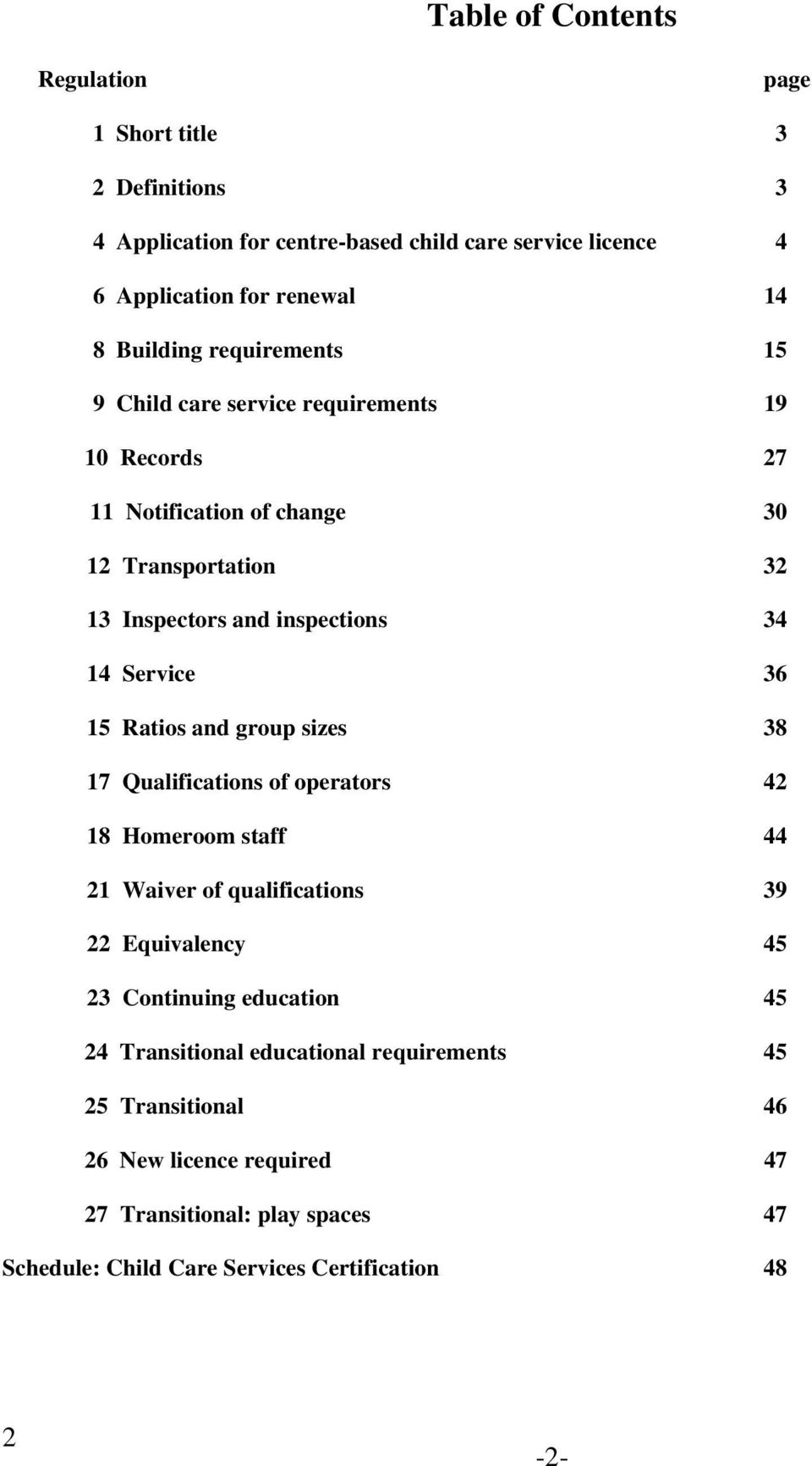
2 Table of Contents Regulation page 1 Short title 3 2 Definitions 3 4 Application for centre-based child care service licence 4 6 Application for renewal 14 8 Building requirements 15 9 Child care service requirements Records Notification of change Transportation Inspectors and inspections Service Ratios and group sizes Qualifications of operators Homeroom staff Waiver of qualifications Equivalency Continuing education Transitional educational requirements Transitional New licence required Transitional: play spaces 47 Schedule: Child Care Services Certification
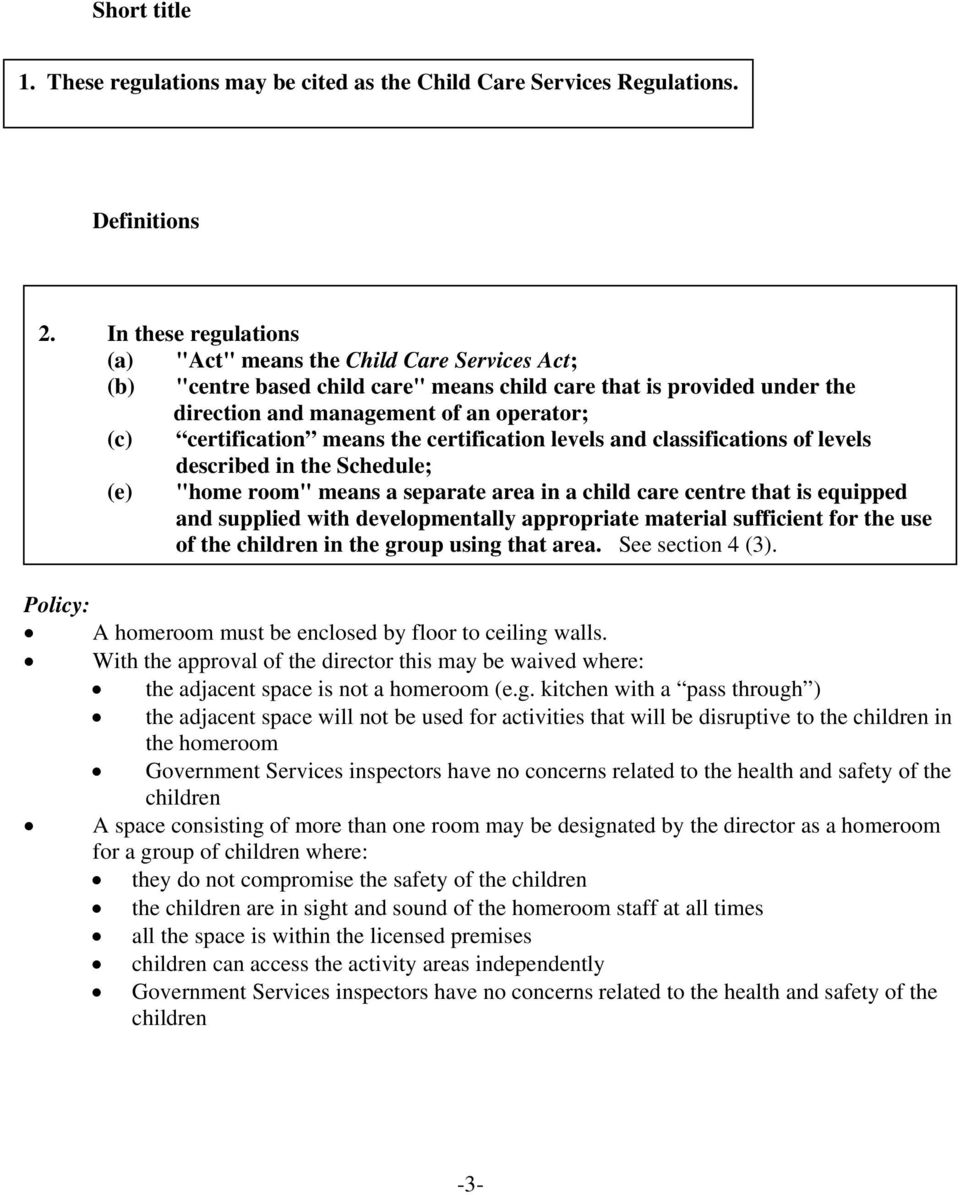
3 Short title 1. These regulations may be cited as the Child Care Services Regulations. Definitions 2. In these regulations (a) "Act" means the Child Care Services Act; (b) "centre based child care" means child care that is provided under the direction and management of an operator; (c) certification means the certification levels and classifications of levels described in the Schedule; (e) "home room" means a separate area in a child care centre that is equipped and supplied with developmentally appropriate material sufficient for the use of the children in the group using that area. See section 4 (3). A homeroom must be enclosed by floor to ceiling walls. With the approval of the director this may be waived where: the adjacent space is not a homeroom (e.g. kitchen with a pass through ) the adjacent space will not be used for activities that will be disruptive to the children in the homeroom Government Services inspectors have no concerns related to the health and safety of the children A space consisting of more than one room may be designated by the director as a homeroom for a group of children where: they do not compromise the safety of the children the children are in sight and sound of the homeroom staff at all times all the space is within the licensed premises children can access the activity areas independently Government Services inspectors have no concerns related to the health and safety of the children -3-
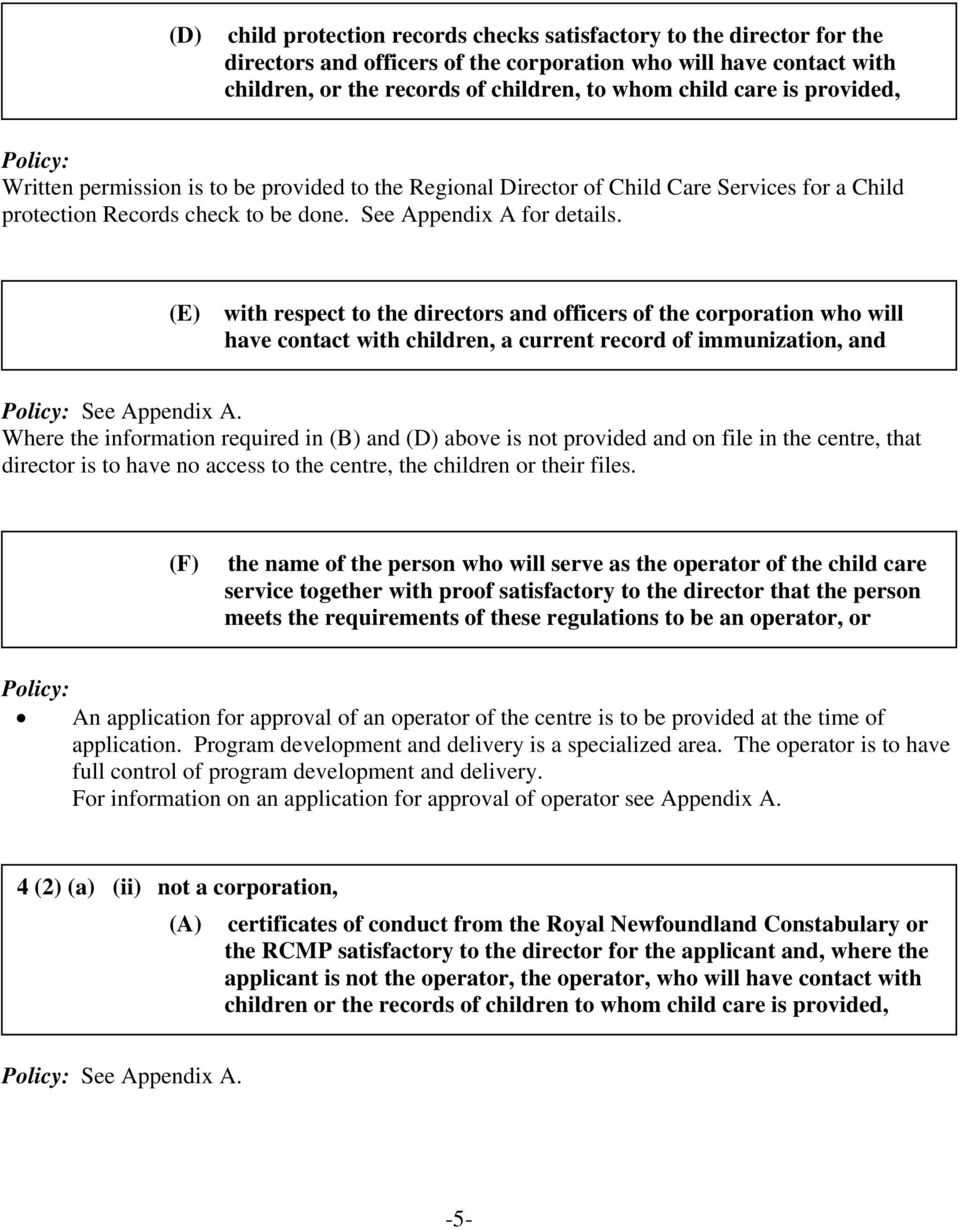
4 Application for centre based child care service licence 4. (1) A person who applies under subsection 7(1) of the Act for a licence to operate a centre based child care service shall do so on the form provided for the purpose by the director. The information for licensing will be provided by the applicant in the format determined by the Regional Director of Child Care Services. 4. (2) An application for a licence referred to in subsection(1) shall be accompanied by the following documentation and information in support of the application: (a) where the applicant is (i) a corporation, (A) proof of incorporation, See Appendix C for information on the licensing process. A copy of the Certificate of Incorporation to be provided. (B) certificates of conduct from the Royal Newfoundland Constabulary or the RCMP satisfactory to the director for the directors and officers of the corporation who will have contact with children or the records of children to whom child care is provided, See Appendix A. (C) 3 references each satisfactory to the director for the directors and officers of the corporation who will have contact with children or the records of children to whom child care is provided, Section (C) repealed. -4-

5 (D) child protection records checks satisfactory to the director for the directors and officers of the corporation who will have contact with children, or the records of children, to whom child care is provided, Written permission is to be provided to the Regional Director of Child Care Services for a Child protection Records check to be done. See Appendix A for details. (E) with respect to the directors and officers of the corporation who will have contact with children, a current record of immunization, and See Appendix A. Where the information required in (B) and (D) above is not provided and on file in the centre, that director is to have no access to the centre, the children or their files. (F) the name of the person who will serve as the operator of the child care service together with proof satisfactory to the director that the person meets the requirements of these regulations to be an operator, or An application for approval of an operator of the centre is to be provided at the time of application. Program development and delivery is a specialized area. The operator is to have full control of program development and delivery. For information on an application for approval of operator see Appendix A. 4 (2) (a) (ii) not a corporation, (A) certificates of conduct from the Royal Newfoundland Constabulary or the RCMP satisfactory to the director for the applicant and, where the applicant is not the operator, the operator, who will have contact with children or the records of children to whom child care is provided, See Appendix A. -5-
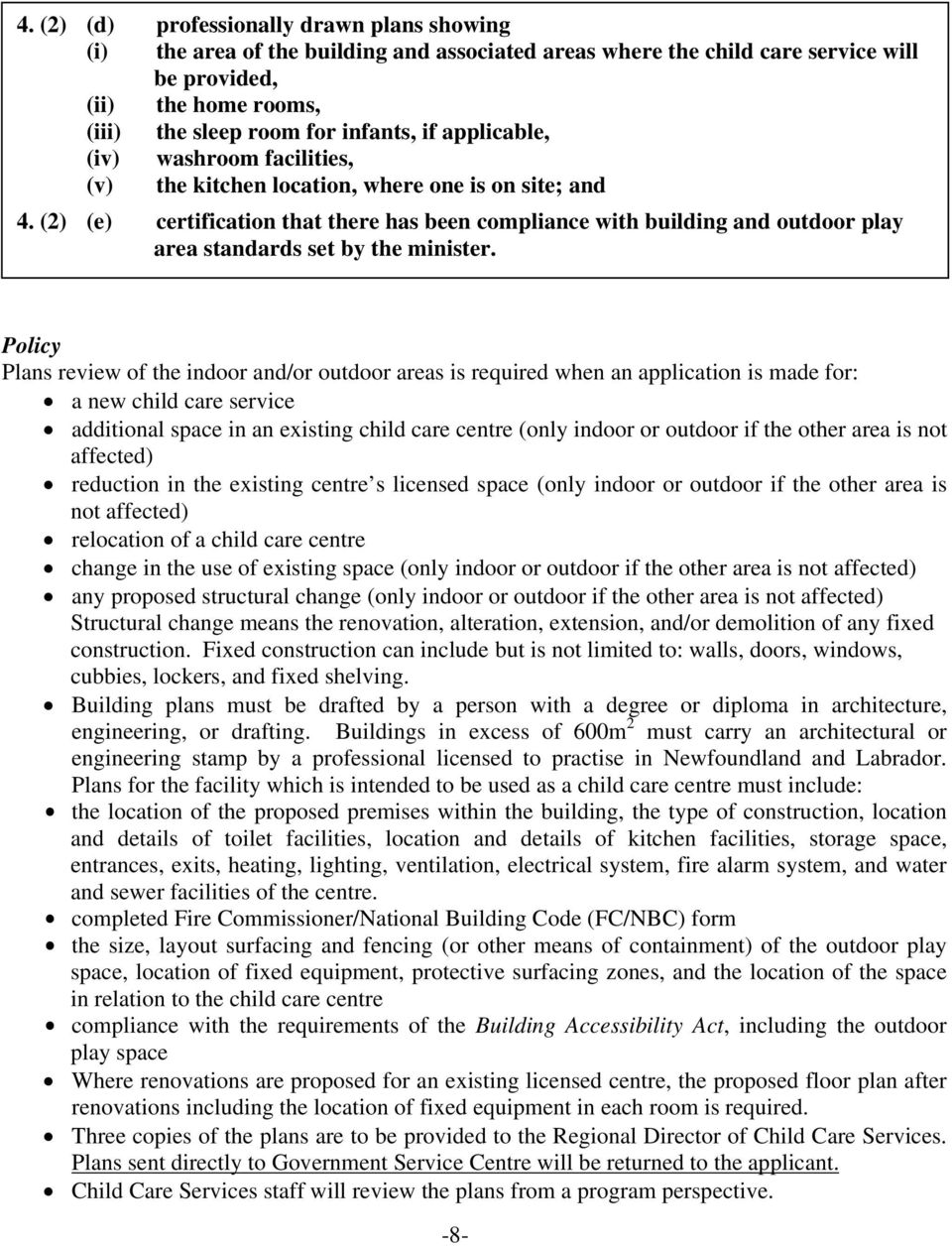
6 (B) 3 references each satisfactory to the director for the applicant and, where the applicant is not the operator, the operator, who will have contact with children or records of children to whom child care is provided, Section (B) repealed. (C) child protection records checks satisfactory to the director for the applicant and, where the applicant is not the operator, the operator, who will have contact with children, or the records of children, to whom child care is provided, See Appendix A. (D) proof that the applicant, where the applicant is the operator, meets the educational and other requirements of these regulations, See Appendix A. (E) a current record of immunization for the applicant and, where the applicant is not the operator, the operator, See Appendix A. (F) with respect to an applicant, and where the applicant is not the operator, the operator, who will be directly involved in caring for children, evidence that he or she has a current first aid certificate from an organization recognized by the minister as being qualified to give the certificate, See Appendix A. -6-

7 (G) the name of the person who will serve as the operator if different from the applicant together with proof satisfactory to the director that the person meets the requirements of these regulations to be an operator; Where the applicant is an individual, the above information is to be provided by the applicant. An application for approval of operator is to accompany the application. Program development and delivery is a specialized area. The operator is to have full control of program development and delivery. The proposed operator may be the applicant if the applicant is qualified. An application for approval of an operator of the centre is to be provided at the time of application. For information on an application for approval of operator see Appendix A. 4. (2) (b) proof of necessary municipal approvals; See Appendix A. 4. (2) (c) proof of having obtained $1 million commercial general liability insurance or its equivalent or a statement from an insurer of an intention to provide the insurance; and See Appendix A. -7-

8 4. (2) (d) professionally drawn plans showing (i) the area of the building and associated areas where the child care service will be provided, (ii) the home rooms, (iii) the sleep room for infants, if applicable, (iv) washroom facilities, (v) the kitchen location, where one is on site; and 4. (2) (e) certification that there has been compliance with building and outdoor play area standards set by the minister. Policy Plans review of the indoor and/or outdoor areas is required when an application is made for: a new child care service additional space in an existing child care centre (only indoor or outdoor if the other area is not affected) reduction in the existing centre s licensed space (only indoor or outdoor if the other area is not affected) relocation of a child care centre change in the use of existing space (only indoor or outdoor if the other area is not affected) any proposed structural change (only indoor or outdoor if the other area is not affected) Structural change means the renovation, alteration, extension, and/or demolition of any fixed construction. Fixed construction can include but is not limited to: walls, doors, windows, cubbies, lockers, and fixed shelving. Building plans must be drafted by a person with a degree or diploma in architecture, engineering, or drafting. Buildings in excess of 600m 2 must carry an architectural or engineering stamp by a professional licensed to practise in Newfoundland and Labrador. Plans for the facility which is intended to be used as a child care centre must include: $ the location of the proposed premises within the building, the type of construction, location and details of toilet facilities, location and details of kitchen facilities, storage space, entrances, exits, heating, lighting, ventilation, electrical system, fire alarm system, and water and sewer facilities of the centre. $ completed Fire Commissioner/National Building Code (FC/NBC) form $ the size, layout surfacing and fencing (or other means of containment) of the outdoor play space, location of fixed equipment, protective surfacing zones, and the location of the space in relation to the child care centre $ compliance with the requirements of the Building Accessibility Act, including the outdoor play space Where renovations are proposed for an existing licensed centre, the proposed floor plan after renovations including the location of fixed equipment in each room is required. Three copies of the plans are to be provided to the Regional Director of Child Care Services. Plans sent directly to Government Service Centre will be returned to the applicant. Child Care Services staff will review the plans from a program perspective. -8-
9 Where there are concerns from this perspective, they will be discussed and resolved with the applicant(proposed) licensee. Child Care Services staff will forward the plans to Government Services for approval with an accompanying letter indicating there are no issues from a program perspective and that plans review may proceed. For new licences Government Services inspectors will provide a maximum capacity for each homeroom and the outside play area. where application is made to change the area of the indoor or outdoor play spaces, Government Services inspectors will provide maximum capacity for any area affected by the proposed change. 4. (3) An application for a licence referred to in subsection (1) shall be accompanied by a program prepared in accordance with the program policy approved by the minister and containing information respecting (a) the principles on which the program has been developed; (b) equipment; (c) room arrangements; (d) the outdoor play area; (e) the daily routine; (f) play materials description; and (g) policies on how children will be oriented to the service, on health and safety issues, on parental involvement, on the guidance of children's behaviour, on transportation of children, on outings for children and admission to and departure from the service. A description of the program is required as part of the application for a child care centre licence. The Program Submission form provides the outline. The program is the content of the service that is being offered and is a critically important component of a licence application. See Standards for Early Childhood Programs in Centre-Based Child Care, and/or Centre-Based Infant Care: Guide to Program Standards.. Program development is a specialized area. The program is to be prepared by the (proposed) operator of the centre or by someone holding the qualifications to operate the centre. See Regulation 17 (1) (a) (b). The proposed program will be assessed by the Child Care Services Consultant. Where there are issues these will be resolved prior to the application proceeding through discussion with the person who prepared the program description. The Child Care Services Consultant will provide a recommendation for approval as part of the application package. All staff who are part of the staff-child ratio shall be provided with a current copy of the approved program submission. -9-

10 Field Trips Definition A field trip is an integral part of the planned program that takes place away from the licensed premises. The vast majority of the child s day and week is spent at the centre. Television Viewing There shall be no television in infant rooms or homerooms licensed to include care for two year olds. The program or film being viewed must be developmentally appropriate and directly related to a current interest being expressed by a group of children. Viewing the program or film must be one of a variety of choices of activity for the children. Children will not be encouraged to watch rather than be involved in other activities. Staff will view with the children, extend their understanding and promote discussion on the program or film. 4. (4) A licensee shall ensure, as a condition of retaining its licence, that its employees (a) who will have contact with the records of children in a child care service satisfy the requirements imposed on directors and officers under subsection (2); The following information must be kept on file at the centre on all employees who may have access to the children or their records: certificate of conduct from the Royal Newfoundland Constabulary or the RCMP. See Appendix A. child protection records checks. See Appendix A.. 4. (4) (b) who will have contact with children but not be directly involved in caring for them, in addition to meeting the requirements of paragraph (a), provide a current record of immunization; and Employees who are not part of the staff-child ratio but who have contact with the children shall have on file at the centre: the information listed in subsection 4 (4) (a) immediately above. See Appendix A. record of immunization. -10-

11 4. (4) (c) who will be directly involved in caring for children, in addition to meeting the requirements of paragraphs (a) and (b), provide evidence that they have a current first aid certificate from an organization recognized by the minister as being qualified to give the certificate. All those who are part of the staff-child ratio shall have a current first aid certificate from an approved organization. See Appendix A. the certificate shall be kept on file at the centre. 4. (5) A person who is not an employee of a licensee but who, as a result of an education or training program, or as a result of an assistance program, (a) may have contact with the records of children in a child care service; (b) may have contact with children but will not be directly involved in caring for children; or (c) is directly involved in caring for children shall comply with paragraph (4)(a), (b) or (c) as if the person were an employee of the licensee. Where there are persons on site who are not staff and not part of the staff:child ratio but are involved with the children or may have access to the children s records, they shall: work under the close supervision of the staff of the homeroom. The staff of the homeroom are fully responsible for the care of the children. provide: certificate of conduct from the Royal Newfoundland Constabulary or the RCMP. See Appendix A. written permission for child protection records checks. See Appendix A. This section does not apply to parents who are not part of the staff-child ratio. Where a parent is part of the staff-child ratio, s/he shall comply with all requirements for staff. -11-
12 4. (6) It is a condition of the continuance of a licence referred to in subsection (1) (a) that a licensee shall not make any changes to its directors or officers who have contact with children, or the records of children, in the child care centre without the prior approval of the director; and This information is to be provided immediately upon the Director being appointed. No director of an incorporated company holding a licence to provide child care shall have access to children or their records until the Regional Director of Child Care Services has been provided with required documentation and in his/her opinion the documentation is satisfactory. 4. (6) (b) that all modifications and changes made to areas of the building and associated areas where child care is provided have the prior approval of a director. No licensee shall proceed to develop or renovate licensed child care centre premises until the Regional Director of Child Care Services provides approval to proceed. His/her decision will be based on written reports with respect to fire/life safety, environmental health and accessibility issued by the appropriate inspectors. 4. (7) The appointment by a licensee of an operator is subject to the prior approval of the director. An application for approval of operator shall accompany the application for licensing. See Appendix A. An application for approval of operator is to be made to the director prior to him/her taking up the position. See Appendix A. -12-

13 4. (8) A licence to provide centre-based child care may be issued for up to 3 years. The Regional Director of Child Care Services shall determine the term for which the licence is to be issued. Normally an initial licence will be for no more than six months. In no case shall it be for longer than three years from the date of issuance. Where a centre is closed voluntarily for a time frame other than that indicated on the application for licensing the licensee shall: inform the director immediately of the date of closure inform the director minimally two weeks prior to the date of re-opening not provide care to children until any inspections required by the director are satisfactorily completed. -13-

14 Application for renewal 6. (1) An application for a renewal or variation of a licence shall be on the form provided by the director for the purpose and shall be accompanied by the documentation referred to in the form. (2) An application for a renewal of a licence shall be made not later than 60 days prior to the expiry of the current licence, but an application for a variation may be made at any time. It is the licensees responsibility to provide the application in a timely manner. If an application for renewal is not received at the Regional Child Care Services Office minimally 60 days prior to the date of renewal, there may not be sufficient time to avoid a break in the continuity of the licence resulting in the centre being closed until the processing is completed and a renewal approved. Where a person has applied to operate an additional child care centre, the Regional Director of Child Care Services shall review all existing licences held by that licensee and shall review that person s history of compliance with the Act, Regulations and terms and conditions imposed under a violation order or other corrective action. An additional licence to operate a child care service or expand an existing licence will not be approved until all outstanding issues related to existing licences have been resolved. A licence to operate an additional centre shall not be issued if: a licence of the applicant has been suspended or revoked a violation order has been issued to that applicant during the existing licensing term and the applicant has not complied with that order within the required time the applicant or another corporation or operation of which he or she is in control or is the owner or operator has consistently not complied with the Child Care Services Act and Regulations regardless of if violation orders have been issued. Where a satisfactory report from fire/life safety and environmental health inspectors has been received within twelve months of the expiration date of the licence, this report may be accepted. Notwithstanding this provision, the director may require a more recent report where there are any concerns regarding potential risks to the health and safety of the children. -14-
15 Building requirements 8. (1) A child care service (a) shall, if it is centre based, (i) be located in premises which are not more than one floor above the ground floor and a home room for the care of children aged birth to 24 months shall be at grade level, A centre will not be licensed if it is to be located more than one floor above direct egress to the outside. A room for infants will not be licensed if it does not have access to the outside on the same level as the room. The access must be barrier free. (ii) have a home room for each group of children attending that centre with floor space of not less than 3.3 square metres per child in that home room, excluding fixed equipment, The capacity for which that room is licensed is calculated based on the above and the ages of the children to be provided with care in that room. The infant sleep room and toilet are not included in the calculation. No homeroom shall be smaller than that which will accommodate five children. Calculation for floor space shall not include areas designed for entrance and egress such as entrance halls and stair landings. (iii) have a separate sleep room directly accessible to the home room of children aged from birth to 24 months, There is to be a door and a window between the homeroom and sleep room. The window is to allow all children to be viewed from minimally 75% of the infant homeroom. -15-
16 (iv) provide diapering stations if licensed for children not of school age, See Standards and Guidelines for Health in Child Care Settings. (v) provide washroom facilities which are available for the exclusive use of that child care service and which meet the requirements of the National Building Code (Canada), Washrooms shall be safe, sanitary and appropriate for the intended use. The child care centre shall not share washroom facilities with any other persons. Where the washrooms are outside the licensed space: no public access is to be permitted during the hours of operation of the child care centre. The washrooms are to be easily accessed by the children and the children are to be supervised to and from the washroom. The type of supervision is to be appropriate to the age(s) of the children in attendance. Prior to approving the application for a licence, the director must be satisfied that these arrangements do not place children at risk. The requirement for washroom facilities for a licensed capacity of 1 to 11 children is 1 toilet, for 12 to 25 children 2 toilets, and for 25 to 60 children 3 toilets. A minimum of one of the facilities must meet accessibility requirements. The facilities provided in an infant home room are in addition to these requirements. Wherever school-age children are accommodated there will be either individual washrooms available or separate multi-cubicle washrooms for female and male children. School-age programs in school facilities may access existing school toilet facilities. Each homeroom for children 0-24 months shall have a sink and toilet facilities. These shall be enclosed in such a way as to be inaccessible by the children. It is recommended that when centres are being designed, consideration be given to providing the appropriate number of toilets per home room for the number of children in that home room. -16-
17 (vi) if it operates more than 4 hours a session, have access to an outdoor play area on-site, surfaced, enclosed, of a size and equipped in the manner determined by the minister, and (vii) if it operates for 4 or fewer hours a session, have access to an outdoor play area which, if it is on-site, shall conform to the requirements of subparagraph (vi), but if it is not on-site, which is safe and appropriate for the purpose, in the opinion of a director; Requirements for outdoor play areas are contained in Outdoor Play Area Standards Manual and Standards and Guidelines for Health in Child Care Settings. Where the outdoor play area is on site, it shall be for the exclusive use of the children enrolled in the centre during the hours of operation. A separate outdoor play area is to be in place for children 0-24 months. Regulation 8 (2) A building or part of a building that has been approved for the operation of a centre shall not be used for any other purpose during the hours of operation of the service. The licensed space is to be dedicated to providing child care as approved by the Regional Director of Child Care Services during the licensed hours of operation. Regulation 8 (3) Where more than one centre based child care service is operated from a building, each service shall fulfil all the requirements of these regulations as if it alone operated from the building. each centre is licensed as a separate entity and should operate as such there may be a shared office, kitchen and staffroom as they are not requirements of these regulations. -17-
18 Regulation 8 (4) Where an application is made for a licence by a person who was licensed under the Day Care and Homemaker Services Act on June 4, 1999, the person shall comply with the relevant health and life safety standards applicable to that person s application immediately before that date, subject to safety and other standards which the Provincial Director may impose. Centres licensed prior to June 1, 1999 may continue to meet the building, fire and electric and other codes that were in effect prior to June 1, 1999 unless these standards are now considered to have the potential to pose risk to children or others. -18-
19 Child care service requirements Regulation 9 (1) A child care service Regulation 9 (1) (a) shall have a telephone that is in working order; There shall be access to an open telephone line at all times of operation in the licensed child care centre. Each centre shall have its own dedicated line. Infant rooms shall have a phone. Regulation 9 (1) (b) shall have a first aid kit which meets the requirements of the Standards and Guidelines for Health in Child Care Settings approved by the minister See Standards and Guidelines for Health in Child Care Settings. The first aid kit shall be readily available. A pocket first aid kit shall be taken on all children s outings away from the child care centre and when children are in the outside play space Regulation 9 (1) (c) shall provide and maintain safe play materials, furniture and equipment which is developmentally appropriate and sufficient for the children cared for in the service in conformity with standards established under the Hazardous Products Act (Canada); The licensee shall provide play materials and equipment: in sufficient quantity to support all activity areas for the number of children enrolled of a type suitable for each age group accommodated made of safe materials, be of sound structure and in good repair. materials which may pose choking hazards for children under age four, particularly in mixed age groupings is to be given particular attention. See Standards for Early Childhood Programs in Centre-Based Child Care, Centre-Based Infant Care: Guide to Program Standards and/or Centre-Based Infant Care: Guide to Program Standards. -19-

20 Regulation 9 (1) (d) shall not allow the use of baby walkers or infant or older children jumping apparatus; Equipment such as baby walkers, baby jumpers and trampolines are significant causes of injury to children and are not permitted to be on the premises of licensed child care centres. Neither shall they be used by the children when they are off site on a field trip. Regulation 9 (1) (e) where it is necessary to administer prescription medication to a child, shall first obtain the written permission of a parent or guardian of the child for the administration of the medication; Regulation 9 (1) (f) shall administer a non-prescription medication to a child only as directed by a physician, dentist or nurse practitioner, but a person providing care to a child in a child care service may administer feverreducing medication to the child with the prior, written consent of the parent or guardian of the child; For policies and procedures related to administration of medication see Standards and Guidelines for Health In Child Care Settings. Written authorization from a physician, dentist or nurse practitioner must be provided by the parent or guardian prior to any non-prescription medication being administered. In the event of a sudden increase in a child s temperature: steps may be taken to reduce the risk to the child. This is only to be done when absolutely necessary, and in no case should it occur on a regular basis. Written permission must be obtained from a parent or guardian prior to any medication being administered. For the purposes of this section, this should be done at the time of enrolment. Every reasonable effort should be made to contact the parent/guardian prior to administering. Parents/guardians are to be contacted and informed immediately if it has been necessary to administer such fever-reducing medication and the parents were not able to be contacted prior to its administration. Notwithstanding the above, acetylsalicylic acid (ASA or aspirin) is NOT to be administered to children without written authorization from a physician. -20-

21 Regulation 9 (1) (g) shall keep medication to be administered to a child in a safe, secure and appropriate place as well as the records pertaining to the administration of the medication; See Standards and Guidelines for Health In Child Care Settings. Records of medication administration shall be kept on file at the child care centre. Regulation 9 (1) (h) shall ensure a child being cared for in the child care service is appropriately supervised at all times; Children are not to be left unsupervised at any time by those identified as part of the staffchild ratio in the centre. One on one workers employed to provide support to child(ren) with special needs are not considered to be part of the staff to child ratio. if a one on one worker leaves the centre with the child: written permission to do so from the child s parent must be in the child s file the one on one worker must sign the child out upon leaving the licensed premises and sign the child in upon returning. Supervision of children: younger than seven years means in sight and hearing of centre staff at all times. However, the centre must provide space in the centre where children can have respite from the stimulation of the room. children seven years and older may be flexible as they engage in independent quiet activities. At all times the supervising staff shall ensure that these children: $ can be heard by staff $ are always in the licensed space $ are visually checked on regularly $ are aware of emergency evacuation procedures Each group of children will have consistent care provided by the same early childhood educator for the major portions of the day. In infant rooms, equipment such as change tables, high chairs, mobile furniture, and shelving shall be located such that infants are in view at all times. $ Parents/guardians must be informed of all outings and permission slips obtained. Blanket permission may be obtained for outings of very short duration such as walks in the neighbourhood with the regular staff. Longer outings or outings which include persons who are not part of the staff must have permission slips for each event. -21-
22 Regulation 9 (1) (i) shall not permit a child to leave the child care service premises with a person who is not that child s parent or legal guardian without the written consent of that parent or legal guardian; Parental consent forms to identify adults into whose custody the child may be released in the absence of the parent/guardian shall be kept in the child s file. No child shall be released without written consent. Electronic written consent (e.g. , fax) may be used in emergency situations with written permission to be obtained and placed on file as soon as possible thereafter. For the purposes of this section, in the case of parental separation/divorce, the child s parent is considered to be the custodial parent. Regulation 9 (1) (j) shall carry out a monthly fire and emergency evacuation drill from the premises in which that child care service is operated; A plan specific to the evacuation of any children 0-24 months must be developed. Every month a fire/emergency drill for all children in the centre will be carried out and logged. The log book will be signed by two staff members where more than one staff is on-site. It will contain the: date of the drill time of the drill number of children age range of the children in attendance at that time the number of staff present and time taken to evacuate the premises. The building will be evacuated and the children mustered at the location previously identified for that purpose. Where the weather is sufficiently severe to preclude this, the children may be mustered immediately inside the exit. Care should be taken to ensure that the timing of the drill does not consistently occur at a time when a particular group of children is not in attendance, e.g., those who attend part time. The operator of a centre-based child care centre shall assign duties to staff specific to emergency evacuation procedures. These shall be in writing. Information to assist in the development of this plan is available at local Fire Departments. Specific duties and specific procedures respecting emergency evacuation shall be posted in a conspicuous place in each location where child care is provided. All licensed child care facilities should submit a floor plan to the local fire department. The licensee shall ensure that each staff person in the child care centre is knowledgeable about the use of fire extinguishers. -22-
23 Emergency numbers and other emergency information shall be listed in a prominent place beside each telephone. These include telephone numbers for: hospital fire department police ambulance taxi poison control any others that may be needed in a specific community or for situations requiring it for a particular child, for example a child who has severe allergies. It is essential that the daily register be accurate at all times and that it be removed during the drill or emergency. This is the record to ensure that no children are left behind, that emergency personnel know which children remain in the building during an emergency and that emergency personnel are not put in jeopardy searching the premises for a child who is not in fact in attendance. It also provides emergency contact information. Regulation 9 (1) (k) shall provide meals to children in accordance with the requirements of the Canada Food Guide to Healthy Eating; See Standards and Guidelines for Health in Child Care Centres. Water is to be available to children at all times. Menus are to be prepared under the supervision of a person knowledgeable in nutritional needs and eating habits of young children. Menus are to be: prepared at least one week in advance posted in a conspicuous for the information of parents kept on file in the centre for minimally one year and available for inspection any necessary substitutions are to be of equivalent nutritional value and noted on the posted menu Best practice indicates that the centre should provide meals and snacks to provide children with information on good nutrition in a meaningful context. Where meals and/or snacks are provided by parent the licensee shall provide them with the centre s policy on nutrition have a variety of nutritious food on-site to supplement food provided by parents if necessary where a child is in attendance prior to 7:30a.m., breakfast shall be provided. where a child is in attendance after 5:30, supper shall be provided unless the parent requests otherwise in all cases if a child is in attendance after 6:30, supper shall be provided -23-
24 (l) shall prepare food and ensure food handling and food handling facilities are in accordance with the requirements of the Standards and Guidelines for Health in Child Care Settings Manual approved by the minister; See Standards and Guidelines for Health in Child Care Centre. No staff with any symptoms of vomiting or diarrhea shall handle food proper hand washing is to be observed at all times by both adults and children food is to be properly stored to prevent contamination the food preparation area and diapering/toileting area are to be physically separate the food preparation area is not to be used for any other purpose food preparation utensils are to be used for that purpose and not used in activity area or for cleaning purposes whenever possible, staff shall be designated for food preparation and shall not change diapers for that day help children understand the need for food safety e.g. not sharing cups or other utensils. Regulation 9 (1) (m) shall ensure a child sleeps, is fed and offered food appropriate to the child s stage of development and individual capability; See Standards and Guidelines for Health in Child Care Centres; Standards for Early Childhood Programs in Centre-Based Child Care; Centre-Based Infant Care: Guide to Program Standards; and/or Centre-Based Infant Care: Guide to Program Standards. Regulation 9 (1) (o) shall where a child becomes seriously ill, injured or dies while in the care of a child care service immediately notify a parent, guardian or other person named under paragraph 10(1 )( c) and the director of that illness, injury or death and the notification shall be given by the license for that child care service, the operator, provider or an agency which supervises that child care service; When serious injury, major illness, death or communicable disease occurs or any other serious incident (e.g., a child leaving the centre unobserved) the licensee, operator, or duly appointed staff member must: $ secure immediate medical or emergency assistance if necessary give immediate notice to the parent/guardian. give immediate notice to the regional Child Care Services staff and submit a copy -24-
25 of the Incident/Injury Report form. See Standards and Guidelines for Health in Child Care Settings for information regarding this form. in the case of communicable disease, all such incidents must be reported immediately to the Medical Officer of Health or Public Health/Community Health Nurse. The child care centre shall have an emergency plan in place to meet the above requirements, including staff responsibilities, emergency transportation, and arrangements for replacement personnel if necessary. Upon employment, staff are to be informed of the emergency plan, including the role of each staff member. The plan is to be reviewed on a regular basis. Injury/Incident Reports See Standards and Guidelines for Health in Child Care Settings for forms and procedures. Incident/Injury reports will be kept up-to-date and on-site at the child care centre. Incidents are minor physical occurrences requiring minimal first aid or any concerns regarding the health and safety of a child or children. Where there is any doubt as to whether an incident should be reported, the incident shall be recorded and reported. A report will be filed where: there may be a negative effect on a child (for example, a blow to the head) where a parent is likely to have concern (for example, a bite from another child) where a question may be raised in the future about the matter (for example, more frequent bruising than normal for the developmental stage of the child). In addition a report shall be filed immediately with the region where: there is injury to the child that requires more than simple first aid (for example a broken bone) a child becomes seriously ill (for example, a convulsion) there is an incident that put a child at risk (for example, a child leaving the centre unobserved) there is an incidence of communicable disease. In this instance the Public Health nurse shall also be informed. Suspected child abuse: All persons have duty to report known or suspected abuse of a child under the Child, Youth and family Services Act (1998). This applies to all those in a centre having contact with the child. It is critical that the appropriate policies and procedures are followed in such situations. These are laid out in detail in Standards and Guidelines for Health in Child Care Settings. -25-
26 Regulation 9 (1) (p) shall, where a child care service is operated by one person, have the services of a second person who is more than 18 years of age immediately available in case of an emergency: and If that person is qualified as an operator and the required documentation is on file at the centre, s/he may provide care to the children. If that is not the situation s/he shall immediately contact the parents to pick up their children. Regulation 9 (1) (q) shall implement the program approved for that child care service at the time of being licensed. Regulation 9 (2) notwithstanding paragraph (q), a program may be changed with the prior approval of the director. The program that was approved at the time of licensing is that which is to be delivered to the children Where major changes are intended, prior to their implementation, they must be: developed by the approved operator a copy provided to the Regional Child Care Services Consultant recommended for approval by the Child Care Services Consultant to the Director. Regulation 9 (3) A centre-based child care service may only provide child care between the hours of 6:30a.m. and 8:30p.m. the application for licensing shall state the hours of opening within the hours stated above no child shall be on-site outside these hours -26-
27 Records Regulation 10 (1) A child care service shall keep and maintain records with respect to each child at the child care service, including (a) the name, address and date of birth of each child; (b) the name, home and work address and telephone number of the parent or guardian of the child; (c) the name, address, and telephone number of a person other than the parent or guardian who may be contacted in the case of an emergency; (d) the date of the child s admission into the child care service; (e) the date of the child s departure from the child care service; (f) the name and address and telephone number of the child's physician; (g) a daily register maintained by a person designated for the purpose or child care provider indicating the date of birth of each child and the time of arrival and departure of each child from the child care services premises; (h) a current health record; (i) an administration of medications record; and (j) an injury and incident report and (k) the other records required to be kept by the Standards and Guidelines for Health in Child Care Settings Manual. No child shall be admitted to the child care centre until information required in sections 10 (2) (a), (b), (c), (f) and (h) above are on file. Every child enrolled shall have this information kept in a separate file, located in a secure cabinet on the licensed premises. Licensees shall keep information concerning a child or the child s family strictly confidential. This information shall be provided only to members of staff of the centre who are part of the staff-child ratio for that room and/or those who require it to provide appropriate care to the child. The Regional Director of Child Care Services or his/her designate is to be provided with the information identified above immediately upon request. The child care centre must maintain a written, daily register: available to inspectors at all times listing the names, birth dates and emergency contact information of all children registered at the centre and their attendance/absence. a register is a book that can be easily removed from the centre in the event of emergency evacuation. A daily sign-in/sign-out sheet with each child s date of birth indicating the times of arrival and departure will be kept. The parent or other adult shall sign the sheet at the -27-
28 time of the child s arrival and the time of the child s departure from the service. Parental consent forms to cover medical emergency care and transportation, and field trips/outings are to be kept in each child s file. If a child is not immunized, the parent or guardian shall be made aware, in writing, that if there is an outbreak of the particular illness that the child has not been immunized against, the Public Health / Community Health Nurse may exclude him/her from the child care centre for the duration of the outbreak. Regulation 10 (2) A child care service shall keep and maintain at that service s operating location, and an agency, at the office of that agency, (a) the most recent fire and health inspection report of the premises where that child care service is located; (c) copies of violation orders and reports of corrective action notices for the current licence period. (d) information required to be provided by these regulations about child care operators, providers, employees and other persons. Fire, Life Safety, and Environmental Health inspections are completed annually by Government Services Centre inspectors and copies of these reports are to be kept on site and available for parents/guardians and inspectors. Inspections may occur more frequently when a concern has been identified. Copies of violation and corrective action notices are to be kept on site and posted beside the licence in a prominent place for the information of parents/guardians and inspectors. The order is to be in place minimally 30 days and longer if the Director so decides. All staff information required by these regulations is to be kept in an individual staff file at the centre in which s/he is employed. Regulation 10 (3) The records required to be kept by a child care service by this section shall be retained on file at the premises of the child care service or agency to which it relates and that information shall be made available to an inspector upon his or her request for that information. Files are to be: readily accessible to inspectors upon request kept in a secure cabinet available only to those who require it to provide appropriate care to the child. -28-
29 Regulation 10 (4) The parent of a child shall have access to the records of his or her child referred to in paragraphs (1) (a) to (k) and records referred to in paragraphs 2 (a) to (c) upon request. Parents must be provided with access to the information required by the regulations on his or her child immediately upon request. Parents must be provided with access to the most recent fire life safety and environmental health reports; and any and all violation orders issued within the current licensing period immediately upon request. Regulation 10 (5) A person shall not destroy, alter, deface or obliterate an employee, child or other record referred to in this section. All registers relating to the attendance of children at a child care centre shall be kept in a secure cabinet. The register must be kept indefinitely. Registers must not be altered in any way without the prior written consent of the Regional Director of Child Care Services. In the event of closure of a child care centre, all registers belonging to that centre shall be sent to the regional office for Child Care Services. -29-
30 Notification of Change Regulation 11 (1) A child care service and an agency shall notify, in writing, a parent or guardian of a child in a service (a) of a variation, suspension or cancellation of a licence or approval applicable to that child care service; (b) of the closure or sale of a child care service or agency, not fewer than 2 weeks before that closure or sale, where possible; For (a) and (b) above: It is the responsibility of the licensee to provide a letter to parents to inform them of changes to the licence in order that parents may make informed decisions on their child care arrangements. (c) as soon as is practicable after becoming aware of the commencement of an investigation by a director of child, youth and family services, the Royal Newfoundland Constabulary or the Royal Canadian Mounted Police into a matter involving a child cared for in the child care service and an employee or other person associated with the child care service, unless the constabulary, police or director of child, youth and family services directs otherwise and It is the responsibility of the licensee to provide a letter to parents to inform them of such an investigation in order that parents may make informed decisions on their child care arrangements. (d) of conditions imposed upon the renewal of a licence, if considered appropriate by the director. Every parent shall be provided with a copy of the varied licence with conditions and any other documents accompanying the licence. A copy of these documents shall be posted on the Parent Bulletin Board in a conspicuous place for the duration of the licence. -30-
31 Regulation 11 (3) Where notice is given under this section, confirmation of the notice shall be given to the director. Confirmation shall be in the form that the Regional Director of Child Care Services requires. It may be a copy of the documentation sent to parents, written conformation from parents that the documents have been provided or other means. -31-
32 Transportation Regulation 12 (1) Where children are being transported on or behalf of a child care service, in addition to the driver a person 16 years of age or older shall accompany the children where more than: (a) 8 children entitled to attend school are being transported; (b) 4 children between the ages of 24 and 69 months are being transported ; or (c) 3 children less than 24 months are being transported. (2) Where the children being transported belong to more than one of the age groups referred to in paragraphs (1) (a) to (c) the age of the youngest child determines which of the ratios set by paragraphs (1) (a) to (c) applies. All staff with any responsibility for transportation of children shall be knowledgeable of: the Highway Traffic Act appropriate use of child restraint systems safe use of airbags when young children are being transported any other information relevant to the safe transportation of children. Where a centre uses any vehicle, including vehicles belonging to staff to transport children, TX plates are required The licensee shall ensure that the necessary vehicle insurance is in place. All terrain vehicles are not to be used to transport children. When on field trips where transportation is an element (e.g. sleigh ride, canoeing) it is the licensee s responsibility to ensure that: the children are safe parents are aware that the trip includes such a mode of transportation Regulation 12 (3) notwithstanding subsection (1) or (2) where a child is being transported on a vehicle or sled or on a device commonly known as a komatik, the child shall be accompanied by a person 18 years or older, in addition to the driver, who shall have the child in sight at all times. Where regular transportation of children is to be by snowmobile or komatik/sled: prior permission is to be obtained from the director. This is normally done as part of the application process. Helmets designed for use with snowmobiles are to be worn by children months while riding in snowmobiles or komatiks/sleds. The helmet shall fit securely and be unable to slip backwards exposing the forehead or forwards -32-
33 exposing the neck. For children age months the helmet shall weigh no more than three pounds. Snowmobiles are to be driven at a speed consistent with the type of terrain and with regard to the ages of the children being transported are to used to transport only children who are able to walk. Komatik/sleds A staff member is to be seated in the komatik while children are being transported. infants and toddlers are to be held securely by an adult when being transported by komatik komatiks/sleds are to be padded Regulation 12 (4) notwithstanding subsection (1) (2) or (3) a child shall not be left unattended. The person monitoring the children shall be responsible for supervision while the engine is switched on regardless of whether the vehicle is in motion. At other times the licensee shall assign responsibility to either the driver or the monitor (e.g. who will accompany the children to and from the vehicle). The driver is responsible for the children until the child is accepted by an adult in the child s home or a staff member at the centre. No child shall be left unattended in a vehicle at any time. Arrangements shall be made to ensure school age children are not put at risk when being picked up or delivered to school premises. This includes supervision and accessing or leaving the vehicle. Regulation 12 (5) Where children in a child care service are being walked to an outside activity away from the child care service premises, there shall be a sufficient supervision to ensure that those children are safely and properly escorted to, from and at that activity. There shall be sufficient adults accompanying the children to allow all children to be reached immediately in potentially hazardous situations e.g., walking along highways, high traffic areas, danger from water. This may require more than the legislated staff to child ratio. An appropriate mode of transport such as a stroller shall be provided where infants are being walked to another outdoor location. The mode of transport shall meet CSA standards. Infant slings are not permitted. -33-
34 Inspectors and Inspections Regulation 13 (1) A child care service and an agency shall be inspected by an inspector at least once a year. Government Service inspections: Child care centres shall have fire/life safety and environmental health inspections at least once a year by relevant staff from Government Service Centre. This may be more frequent if concerns are noted. The resulting written reports shall be kept on file at the centre. It is the responsibility of the licensee to ensure these inspections are scheduled annually. Child Care Services inspections: Regional Child Care Services staff shall complete an assessment of the centre at least once a year. This may done during one visit or at times throughout the year but all aspects of the centre shall be inspected over each twelve month period. Inspections shall be more often than once a year where there are concerns. The resulting reports are to be kept on file at the child care centre. The licensee shall have an opportunity to comment on the report in writing. Child Care Services staff shall visit centres regularly (monthly wherever possible) to provide support and advice. They are available upon request to provide information, support, advice and/or direction. Regulation 13 (2) An inspector may enter into an agency at any time or a child care service premises at any time the children are being provided with care on those premises. An inspector may enter the premises at any time during the hours the centre is licensed to operate. The visit may be announced or unannounced. Where a visit requires that the operator be available for discussion, every effort will be made to arrange a time that is convenient to both parties. -34-
35 Regulation 13 (4) An inspector shall report annually on each child care service and agency licensed by a Director to that director. Annual fire/life safety, environmental health and Child Care Services inspections shall be provided to the Regional Director in the format that the Director may require. -35-
36 Service Regulation 14 (1) A violation order or notice of a decision made under subsection 10 (2) of the Act shall be personally served on a licensee or operator of a child care service. (2) Notwithstanding subsection (1), where personal service cannot be effected, service may be made by registered mail to the last known address of the licensee or child care service. All requirements of the legislation must be followed in order to maintain a licence. It is the licensee s responsibility to be knowledgeable of the requirements. The Regional Director of Child Care Services has the responsibility of establishing requirements to provide an environment that will re-establish the level of service to an acceptable level. It is the responsibility of Child Care Services staff to initiate corrective action if there is been non-compliance with the Child Care Services Act and Regulations. This may include: verbal notice to the operator or license to bring the matter to their attention issuance of a violation order which is formal written notification that a violation has occurred, the remedy required and the time line for compliance. suspension or revoking of the licence. These measures are dependent on an assessment of potential risk (immediate or longterm) to children and/or the history of compliance by the licensee. 14 (3) A notification required to be given in writing may be personally served or sent by regular mail to the last known address of the person requiring notice. The violation order, suspension letter or letter revoking the licence is served upon the licensee. Served means delivered by hand to the licensee by Regional Child Care Services staff whenever possible. Where this cannot be done in a timely manner, it will be sent by registered mail to the last known address of the licensee. -36-
37 Ratios and group sizes Regulation 15 (1) The following ratios of staff to children and child group sizes shall apply with respect to Group Child Care Centres: Age of Child Staff to Child Ratio Maximum Group Size 0 to 24 months 1 staff to 3 children 6 children 24 to 36 months 1 staff to 5 children 10 children 36 to 69 months 1 staff to 8 children 16 children 57 to 84 months and 1 staff to 12 children 24 children attending school 84 to 155 months 1 staff to 15 children 30 children (2) In a child care centre (a) children aged from birth to 12 months shall not be included in a mixed age group; and (b) notwithstanding subsection (1), in a group of children made up of more than one category of age group as set out in subsection (1), commonly known as a mixed age group of children, (i) where the group consists of children who are more than 12 months and less than 69 months of age, the age of the youngest child shall determine the child to staff ratio and group size. (ii) where a group consists of children ages 24 to 84 months, the maximum group size shall be 14 with an adult to child ratio of one to 7, but the group shall not comprise more than 4 children ages 24 to 36 months. (iii) where the group consists of children age 36 to 155 months, the maximum group size shall be 16 with an adult to child ratio of one to 8, but the group shall not comprise more than four children ages months, and (iv) where the group consists of children ages months, the maximum group size shall be 30 with an adult to child ratio of of one to 15, but the group shall not comprise more than 12 children age months who are entitled to attend school. Where children less than 24 months are included in a mixed group, the requirements for infant care must be met. The age ranges of each homeroom shall be determined at the time of licensing. The group size and ratio of the homeroom being visited must be maintained at the level for which the homeroom was licensed. Notwithstanding the requirement to maintain group sizes and ratios, children may attend other homerooms for brief periods of time if it is in the child s best interest to do so. The operator is responsible for justifying that this is in the child s best interest. -37-
38 Regulation 15 (3) The mixed age grouping required by subsection (2) does not apply during the first hour or the last hour of operation of a child care service where the children are 24 months or older and there are no more than 5 children in attendance. This section does not apply to infants (children 0-24 months). They are not included in the mixed age group of 5 children. Where the children are over the age of 24 months; the number of children in the centre (excluding infants) has dropped to 5; and no more children are scheduled to attend in the last hour of operation of the centre, these children may be cared for in one homeroom by one staff member. The staff member is to have minimally Entry Level Child Care Services certification in Preschool where none of the children are of an age to attend school, Schoolage where the children are of school age or both categories where there are both Preschool and Schoolage children in the group. Materials and activities are to be provided appropriate to the ages of the children in attendance. Services of a second person are to be immediately available [see Regulation 9 (1) (p)] Regulation 15 (4) For the purpose of determining ratio under subsection (1) or (2), a child who continues to be placed in an age group beyond, or is moved before, the birthday at which he or she would ordinarily move to another age group because a period of transition is in the best interests of the child, shall be considered as belonging to that age group for a maximum of three months. This section is in place to meet the needs of the children either who are moving to a new room and a transition is planned or moving a child to an older grouping because the child s developmental stage indicates it is in the best interests of the child. This section is not to be used to maximize enrolment in a centre. This section applies only to children who have been in attendance at the centre for at least three months. Provision for transition to new room A child making a transition to a new homeroom because he or she is soon to be of an age for that room may be included in the new homeroom for gradually increasing lengths of time until the transition is complete under the following conditions: the child will be considered to be within the age range for that room for the purpose of determining group size and ratio the maximum group size for the room will not be exceeded. -38-
39 the staff-child ratio will be maintained a record of the child s times in the new room will be kept in the child s file Child moving to older age group or remaining in younger age group. A child who is of an age to move to an older grouping but the developmental stage of the child may allow for his/her best interests to be served in a younger group of children may remain with the younger group for a maximum of three months past the age range for that room and a child who is not yet of an age to move to an older age grouping but the developmental stage of the child indicates it is in the child s best interests to be included in an older age grouping may do so for a maximum of three months under the following conditions: no more than four children outside the age grouping for the room may be enrolled at any one time parent of the child outside the age range for the room must give written permission for the move and that permission will be kept in the child s file a transition plan shall be kept in the file of each child including: developmental profile of the child s including social, emotional, language, intellectual and physical developmental stage with supporting documentation. rationale for the change timeline for the child s transition to the new room written permission from parents for the move to occur where a child remains in a younger age grouping or moves to an older age grouping, that will be the consistent homeroom for the child. Regulation (15) (5): A person who provides child care at a child care service shall be 18 years of age or older. Only those 18 years or older may be part of the staff-child ratio or have any responsibility for children (e.g. bus driver). The staff has responsibility for any actions the person under 18 years may take in relation to the care and education of the children Any person under 18 years of age having contact with a child shall do so under the strict supervision of a person considered to be part of the staff to child ratio. Regulation (15) (6): When calculating staff to child ratios, only staff who are actually supervising children shall be considered. Only staff who are in the room and available to the children are considered to be part of the required staff-child ratio. When off site staff shall be immediately available to the children. -39-
40 One on One workers and Enhanced Staff to Child Ratio One on one workers providing support to a child with special needs in order that the child be included in the regular programming of the centre is not considered to be part of the staff to child ratio. This does not apply to additional staff employed as part of the enhanced staff to child ratio initiative. Where funding is provided to enhance the staff to child ratio, the enhanced ratio must be in place at all times the child(ren) is/are in attendance. Failure to do so will result in a Violation Order being issued. Regulation (15) (7) Notwithstanding subsection (1), a child care service licensed and operating under the Day Care and Homemaker Services Act on the day the Act came into force may have a ratio of one staff person to 6 children for a maximum group size of 12, for children age 24 to 36 months. this provision may remain in place until there is a change in licensee at which time the ratio and group size shall be as required under subsection (1) above. -40-
41 Qualifications of Operators Regulation 17 (1) A centre-based child care shall have an operator who directs and manages the operation of that service and an operator shall have (a) not less than a Level 2 certification in the age range classifications referred to in Schedule A for which the child care centre is licensed; and (b) 2 or more years of work experience in a licensed child care centre. Regulation 17 (2): One of the years of work experience referred to in paragraph (1)(b) may be in an unlicensed setting with school aged children. Every licensed centre must have an operator approved by the Regional Director of Child Care Services prior to taking up the position. Managing the programming of a child care centre is a specialized area. The approved operator is responsible for the quality of the services provided to children. Note: For information on applying for approval of operator see Appendix A # 1. The operator: must hold Level 2 Child Care Services Certification for the age groupings of the children for which the centre is licensed and have two years experience. is responsible for the program planning and delivery shall be on site during the main program hours is to be available to provide professional support and direction to other staff on program issues as needed may be off-site for a maximum of one hour of their scheduled workday on matters related to the business of the centre, or as outlined below as a temporary absence. This does not include breaks as required by Labour Standards. Absence of the approved operator. Where the absence is expected to be for: more than six weeks, a replacement, fully qualified operator must be approved by the Regional Director of Child Care Services more than a week but less than six weeks (e.g. short term illness, vacation), the Regional Director of Child Care Services must be informed immediately and the name of the replacement provided. The replacement need not have the academic qualifications and experience required for operator. Less than a week or during the operating hours for business related to his/her position in the centre (e.g. to attend ISSP meetings, the hours outside his/her shift), the licensee will appoint a replacement and all staff in the centre will be informed. The replacement need not have the academic qualifications and experience required for operator. -41-
42 Experience Minimally one year of the required two years of experience shall be in licensed child care. Applicants who have experience in positions where the duties are similar to those in licensed child care centres, for example family resource centres, may apply to the Regional Director of Child Care Services in their region to have their experience considered as equivalent. The onus is on the applicant to demonstrate equivalency. The applicant will provide necessary documentation to support their case. This documentation is to be signed by the previous employer and include: $ job description $ place of employment $ length of employment Where one of the years of work experience is with schoolage children: the group must be of more than six schoolage children excluding the applicant s own children a work day of four hours or longer and responsibility for, and involvement with, the daily activities/routine of the children. -42-
43 Homeroom Staff Regulation 18 (1) A home room shall have a person known as the lead staff person and that lead staff person shall have not less than a Level 1 certification in the age range classifications of the children cared for in that room and not less than one year of work experience in one of the classification(s). Staff are responsible for renewing their certification. It is the licensee s responsibility to employ staff who have the necessary certification. Where the licensee can demonstrate by current public advertising that there is no one who meets the legislated requirements, the best qualified candidate can be proposed. This does not apply to new licenses. Policies are the same as for operator. See above. Regulation 18 (2) A person employed in a child care centre who is considered to be a part of the ratio of staff to children referred to in section 15 or 25 and who is not the lead staff person, shall have not less than an entry level certification in the age range classification of the children cared for the home room to which that person is assigned and in the event there are infants in the home room a level one certification in infant care is required. The staff referred to in this section shall have an Entry Level Child Care Services Certificate for the classification(s) of ages of the children in the homeroom. and references, certificate of conduct, first aid and immunization record as described above. Infant homerooms No person who is part of the staff to child ratio for children 0-24 months shall have less than level I Child Care Services Certification in Infant Care. Every effort shall be made to have additional staff with Child Care Services Certification in Infant Care on staff to cover for staff breaks and lunches. In exceptional circumstances, a person with no such certification may be considered part of the staff to child ratio in infant homerooms under the following conditions: at least one person with Child Care Services Certification in infant care shall be in the infant homeroom at all times the substitute will have minimally Level I Child Care Services Certification in Preschool. the substitute will work under the strict supervision of the qualified staff person the homeroom will have the full complement of qualified staff for no less than 80% of the hours the infant homeroom is open. records of the staffing schedule for the room, will be kept and immediately available for inspection. -43-
44 Waiver of qualifications Regulation 21 (1) The educational and work experience contained in sections 17 to 19 may be waived by a director where the director is satisfied that persons who meet the qualifications cannot be reasonably obtained by the child care service in the area in which the service is operated. (2) In seeking a waiver of a director under subsection (1), a licensee shall provide the director with (a) a copy of the advertisement seeking qualified applicants; (b)the reasons why a person with suitable qualifications cannot be reasonably obtained and why the licensee has selected another person; (c) the conditions agreed to by the person fulfilling the required qualifications; and (d) the conditions for satisfying the educational requirements contained in subsection 17 to 19. (3) A director may approve a person referred to in subsection (2) or may approve the person subject to conditions the director may set. Where no fully qualified candidate is available the licensee may request a lesser qualified candidate. In addition to the documentation listed in Appendix A #1, the licensee shall include with the application for approval of operator: $ a copy of an advertisement for the position in a major newspaper $ a letter which: $ lists each candidate with each person s academic qualifications and experience $ identifies the proposed operator and summarizes the reasons for the selection $ written agreement from the candidate that s/he will up-grade to the required level and give a time frame for this to be accomplished. The licensee will keep evidence of the person s record of up-grading in the operator s staff file and make it available to Regional Child Care Services staff upon request. where the person is not upgrading and there is no explanation satisfactory to the director, the approval shall be cancelled. the director may impose additional conditions where required to ensure the applicant will meet requirements and in a reasonable time frame. $ Where a candidate is approved and does not meet the requirements for certification or experience, the approval will be for a limited period of time. -44-
45 Equivalency Regulation 22. Notwithstanding sections 17 to 20, the provincial director may determine a combination of education and experience as equivalent to the certification levels described in the Schedule. The Registrar of Child Care Services certification shall provide a written summary of the qualifications and experience and provide a recommendation to the provincial director regarding the level and category of certification to be assigned. Continuing Education Regulation 23. In order to keep a certification valid, the holder of that certification shall complete not less than 30 hours of professional development training or continuing education every 3 years. See Certification Policy Manual obtainable from the Association of Early Childhood Educators of Newfoundland and Labrador. Transitional education requirements Regulation 24. Notwithstanding sections 17 to 20, a person approved as a group supervisor of a day care licensed under The Day Care and Homemaker Services Act for 10 or more years immediately before June 1999 shall be considered to hold the certification required of an operator under these regulations. no certification will be awarded the ten years may be in more than one child care centre if there is no break in service. -45-
46 Transitional Regulation 25. A day care centre licensed under the Day Care and Homemaker Services Act whose licence was in force on June 4, 1999 and that had on that day an enrolment of children who were: (a) more than 36 months and less than 69 months with more than 16 children in a group may continue with that group to a maximum of 24 children with a ratio of one staff person to 8 children. (b) more than 24 months and less than 69 months, who do not attend school, and with more than 10 children in a mixed age group, may continue with that group to a maximum of 15 children with a ratio of one staff person to 5 children; (c) a group comprising more than 10 children between the ages of 24 and 155 months may continue with that age group to a maximum of 16 children, but the adult to child ratio shall be one to 8, no more than 4 children shall be between 24 and 36 months and no more than 4 children shall be between the 84 to 155 months; and (d)a group comprising more than 16 children who were between the the ages of 36 and 155 months may continue with that age group to a maximum of 24 children but the adult to child ratio shall be one to 8 and no more than 4 children shall be 84 to 155 months. the above age groupings and ratios are permitted only for centres who were licensed under the Day Care and Homemaker Services Act unless section 26 comes into force the lead staff in the room is to have minimally level I Child Care Services Certification in the age groups for which the room is licensed other staff comprising the staff-child ratio are to have minimally Entry Level Child Care Services Certification in the age groups for which the room is licensed. -46-
47 New licence required Regulation 26. Where a child care centre referred to in subsection 15 (7) or section 25 changes its location, capacity, physical structure or age range of children, that child care service shall apply for a new licence under the Act. where minor changes are made and there is no potential for a negative impact on the care provided to the children, the director may approve the change without the loss of transitional status. A change in age range due to the licensee no longer wishing to provide care to 4 twoyear-olds in a mixed age grouping does not result in a loss of transitional status. A new licence is required where there is: $ a change of location $ an increase in capacity a major change to the structure, impacting the home room or groupings of the children an increase in age range that results in new groupings of children. Transitional: play spaces Regulation 27. A child care service licensed on the coming into force of these regulations that has an existing play space adjacent to the building where the service is provided that is unable to meet the space requirements for an outdoor play space imposed by these regulations may be exempted where the director is satisfied that the service's program contains compensatory measures that adequately address the deficiency. The licensee shall provide a written plan that meets the needs for outdoor play of all the children able to be enrolled in the centre. This may include off-site activities if the space to be used meets the requirements for outdoor play as per Outdoor Play Area Standards Manual and Standards. Changes as outlined in regulation 26 (above) results in loss of transitional status. -47-
48 Schedule Child Care Service Certification Classification Entry Level Level One Level Two Level Three Level Four Preschool School-Age Infant Preschool Orientation Course (PSOC) School-age Orientation Course (SACCOC) No entry Level for Infant Child Care Services Certification Early Childhood Education (ECE) Certificate ECE Certificate plus SACCOC or related postsecondary certificate plus PSOC and SACCOC ECE certificate plus infant child care orientation course (ICCOC) ECE diploma ECE diploma plus SACCOC or related postsecondary diploma plus PSOC and SACCOC ECE diploma plus ICCOC ECE diploma plus post-diploma specialization or ECE certificate plus related university degree preschool or school age level 2 plus postdiploma school age child care specialization or an Education degree plus SACCOC or related university degree plus PSOC and SACCOC ECE diploma plus post-diploma infanttoddler specialization or related university degree plus ECE certificate plus ICCOC university degree in ECE or University degree plus ECE diploma Family Child Care Family Child Care Orientation Course (FCCOC) Post-secondary Certificate in family child care or ECE certificate plus FCCOC Family Child Care Level I plus ECE certificate or ECE diploma plus FCCOC Family child care certificate plus ECE diploma or Family home child care level 1 plus related university degree -48-
49 APPENDICES APPENDIX A: APPENDIX B: APPENDIX C: APPENDIX D: Licensing documentation requirements Application for licence. Forms Manuals For Centre-Based Child Care Services available from regional Child Care Services offices and on-line. -49-
50 APPENDIX A Licensing Documentation Requirements 1. Approval of Operator 2. First Aid Certificates 3. Certificates of Conduct 4. Child Protection Records Check 5. Records of Immunization 6. Municipal Approval 7. Insurance -50-
51 1. Approval of Operator The application consists of: a completed application form copy of Child Care Services Certificate as required by Regulation 17 (1) (a). current First Aid Certificate from an approved organization. permission to conduct a Child Protection Records Check Certificate of Conduct record of immunization. 2. First Aid Certificates These shall be: from an organization approved by the Province to issue First Aid Certificates. Currently, these are Canadian Red Cross and St. John Ambulance. kept in the employee s file at the centre current at all times. Where there is no expiry date on the certificate, it shall be no more than three years old. If no class has been available to allow renewal of an expired certificate, the Regional Director of Child Care Services shall be provided in writing with: the date of the last opportunity to access the class the reason the person did not avail of that opportunity the date of the next scheduled class and a letter from the organization approved to issue first aid certificates, on the letterhead of the organization and signed by an employee of the organization confirming enrolment. If the Regional Director of Child Care Services is not satisfied that reasonable efforts have been made to maintain a current First Aid certificate, further action may be taken. 3. Certificates of Conduct These are to be: dated no later than 30 days prior to the application for licensing. Where the person is moving from one centre to another with no break in service, the existing Certificate of Conduct may be used. replaced after a six month break in service up-dated every three years be for all jurisdictions in which the applicant has resided in the past ten years kept on file at the child care centre. Where the Certificate of Conduct indicates an offence, the licensee shall inform the Regional Director of Child Care Services and request the Court Record from the applicant. This will be provided to the Director of Child Care Services for assessment. 4. Child Protection Records Check The applicant provides written permission for a Child Protection Records check to be done. -51-
52 Any involvement will be assessed. The assessment is based on: the type of involvement the seriousness of the involvement related to the safety of children the number of incidents and the dates on which they occurred the date of the most recent involvement any other factors that, in the professional opinion of the Regional Director of Child Care Services may be relevant. A letter will then be provided to the applicant indicating the director is of the opinion that: there is no involvement with Child Youth and Family Services that may be a threat to children or that the director is unable to provide such a letter. This letter is part of the application for employment at the centre. The letter to be kept in the person s file at the child care centre. The check to be renewed every three years 5. Records of Immunization: The record of immunization is to be kept in the staff person s file at the child care centre. If immunization is incomplete or cannot be confirmed, a note to this effect is to be on file at the centre. This is for the information of Public Health should there be an outbreak of communicable disease. If a person is not immunized or if the status is unknown, that person may be excluded from the centre for the duration of an outbreak of communicable disease. The licensee shall so inform any staff to whom this applies prior to employment. 6. Municipal Approval A licence to operate a child care centre will not be provided if it conflicts with any bylaws of the municipality in which it is proposed to be located. Where the proposed centre is to be located in a community with a municipal council, a letter is required from the municipality stating that operation of a child care centre in the proposed location does not conflict with any regulation, by-law or ordinance of the city, town or municipality. 7. Insurance Proof of purchase of minimally $1,000,000 commercial general liability insurance or equivalent is required to be in place at all times. Many licensees prefer to carry more coverage for their protection. Where no valid insurance is found to be in place, the centre shall immediately cease to provide care to children until proof of insurance is provided to the Regional Director of Child Care Services. Where the application is for an initial licence, a letter of intent from the insurance company is sufficient to accompany the application. However, children shall not be on site until proof of valid insurance has been provided to the Regional Director of Child Care Services. -52-
53 All policies must include the following statement: In the event of any endorsements, renewal and/or cancellation, notification must be given to the Provincial Director of Child Care Services, P.O. Box 8700, St. John s, NF A1B 4J6. Her Majesty the Queen, as represented by the Minister of Health and Community Services, must be an additional insured with respect to the operation of (identify the child care centre or child care home). In order for a policy to be determined as equivalent, a licensee must first submit a copy of the insurance documents to the Regional Director. Determination will then be made regarding equivalency. Where no valid insurance is found to be in place the centre shall immediately cease to provide care to children until proof of insurance is received by the director. -53-
54 APPENDIX B Application For Licence. -54-
55 All child care centres must be licensed by the Director of Child Care Services in the Regional Health Authority and thereafter to maintain the minimal standards required to provide quality care to children. It is strongly recommended that prior to beginning an application, the applicant contact their Regional Child Care Services office. These are located in St. John s, Harbour Grace, Grand Falls, Corner Brook and Happy Valley-Goose Bay. The Regional Child Care Services Consultants and Social Workers are available to provide support, advice and guidance throughout the licensing process. The staff of the Regional Child Care Services offices will provide the appropriate policy and procedures documents for preparation of a particular type of centre and age group of children A package of information is compiled by the applicant and provided to the Regional Director of Child Care Services. Assistance from the staff is available at all stages of the application. The application for an initial licence comprises: completed application form Information on the proposed licensee: Individual name mailing address, address and telephone number Certificate of Conduct written permission to conduct a Child Protection Records check statement describing the capacity in which the applicant will be involved with the child care centre. Incorporated Company name, mailing address, address and telephone number of the business office of the company names and titles of the Executive Officers of the company the capacity in which any officers of the company will be associated with the child care centre The following on each member of the Executive, and any board member or company employee (other than those who work directly in the child care centre) who may be in the centre while the children are present and/or who will have access to the children s files: Certificate of Conduct. See Appendix A. written permission to conduct a Child Protection Records check. See Appendix A. immunization record of those who may have access to the children or their records. See Appendix A. -55-
56 School Board, School Council, Municipal Council or an organization operated by a board duly appointed by the Lieutenant-Governor in Council. All officers who may be in the centre while the children are present and/or who will have access to the children s files names Certificate of Conduct. See Appendix A. written permission to conduct a Child Protection Records check. See Appendix A. immunization record of any who may have access to the children. See Appendix A. statement describing the capacity in which any officers will be associated with the child care centre A copy of the Certificate of Incorporation if the board is a body corporate. It should indicate that the group is currently incorporated. See Appendix A. Note: The name of the group on the Certificate of Incorporation and the application form should be identical. Three copies of plans of the interior and exterior areas of the proposed centre with FC/NBC and accessibility forms. Letter of approval from the municipality. Insurance policy or letter of intent from an insurance company. Complete program submission approved by the Child Care Services Consultant. Written statement of the capacity in which the licensee will be associated with the centre. Information on the Operator Current Level 2 Child Care Services Certificate(s) in the age group classifications for which the centre is seeking a licence. information on experience for operator and lead staff First Aid Certificate. See Appendix A. Immunization record. See Appendix A. Certificate of Conduct. See Appendix A. written permission to perform a Child Protection Records Check. See Appendix A. -56-
57 APPENDIX C Forms -57-
58 The following information must be provided on the relevant form. Please note that there may be variations from region to region. Application for Licensing: Type of licence: initial renewal expansion varied e.g. change in age range Name of applicant (Note: this is the name in which the licence will be issued and the applicant will have the legal responsibility for the service provided). The applicant may be: an individual a company an incorporated non-profit group. This includes entities such as schools and churches. Name by which the centre will be known. This is the name that will appear on the licence. Mailing address: Address to which mail should be directed. Telephone number. Other contact information e.g. cell phone, e mail address, fax number. Location of Centre. This may be different than the mailing address. Number of homerooms and age range for each. Signature. The form must be signed by the applicant if the case of an individual. Where it is an incorporated group or company it must be signed by a person with legal authority to sign such documents. Program Submission This is a critically important document. It sets out everything the child will experience in the child care centre. It must recognize the developmental stages of the children to be enrolled and how to their future development will be supported. It is a specialized field and requires a person knowledgeable in early childhood education to complete it. Name of centre Licensee/Operator Location Hours of operation Prepared by Date Submitted Statement of Philosophy Policies for Guiding Children s Behaviour Orientation of children and families -58-
59 Operator s schedule Description of observations Enrollment and inclusion of children with special needs Description of program planning Description of documentation. Daily schedule for each homeroom Policies re meal times Policies re. free play Policies re field trips Room arrangement. List of activity areas and play materials Outdoor play: Plan of area Polices re program planning Policies re. safety. Application for Approval of Operator Name of centre Location. Name of proposed operator. Child Care Services Certification level(s) and category(ies). First Aid Certificate expiry date. List of experience in licensed child care. Permission for a Child Protection Records Check to be done. Signed and dated by the proposed operator and licensee. -59-
60 APPENDIX D Manuals For Centre-Based Child Care Services -60-
61 Available on-line at or from Regional Child Care Services offices in St.John s, Harbour Grace, Grand Falls, Corner Brook and Happy Valley-Goose Bay. Standards for Early Childhood Programs in Centre-Based Child Care. Centre-Based Infant Care: Guide to Program Standards. Outdoor Play Area Standards Manual. Standards and Guidelines for Health in Child Care Settings. Program manual for schoolage children in centre-based care (in preparation, not yet available). -61-
CHILD CARE LICENSING REGULATION
 Province of Alberta CHILD CARE LICENSING ACT CHILD CARE LICENSING REGULATION Alberta Regulation 143/2008 With amendments up to and including Alberta Regulation 62/2013 Office Consolidation Published by
PLEASE NOTE. For more information concerning the history of these regulations, please see the Table of Regulations.
 PLEASE NOTE This document, prepared by the Legislative Counsel Office, is an office consolidation of this regulation, current to November 8, 2005. It is intended for information and reference purposes
Best Practices Licensing Manual for Early Learning and Child Care Centres. Manitoba Child Care Program Manitoba Family Services and Housing
 Best Practices Licensing Manual for Early Learning and Child Care Centres Manitoba Child Care Program Manitoba Family Services and Housing TABLE OF CONTENTS I General Information Purpose and Organization
Orientation Package. for. Prospective Child Care Operators
 MINISTRY OF EDUCATION CHILD CARE LICENSING IN ONTARIO Orientation Package for Prospective Child Care Operators October 2014 TABLE OF CONTENTS Introduction 4 Child Care in Ontario 5 Ontario s Ministry of
SUMMARY OF LICENSING STANDARDS FOR DAY CARE CENTERS
 SUMMARY OF LICENSING STANDARDS FOR DAY CARE CENTERS Illinois Department of Children & Family Services Introduction The Department of Children and Family Services (DCFS) is responsible for licensing day
STATE OF NEW JERSEY DEPARTMENT OF CHILDREN AND FAMILIES OFFICE OF LICENSING/ INSPECTION/VIOLATION REPORT
 Center Name: South Mountain YMCA- Clinton School STATE OF NEW JERSEY DEPARTMENT OF CHILDREN AND FAMILIES OFFICE OF LICENSING/ INSPECTION/VIOLATION REPORT Center ID#: County: Essex Address: 27 Berkshire
Child Care Regulations in Florida
 Child Care Regulations in Florida Overview A summary of child care regulations in Florida. Types of care that must be licensed Types of care that must be registered Types of care that may operate without
Child Care Regulations in New Mexico
 Child Care Regulations in New Mexico Overview A summary of child care regulations in New Mexico. New Mexico Aim High Star Rating Child Care System Types of care that must be licensed Types of care that
STATE OF NEW JERSEY DEPARTMENT OF CHILDREN AND FAMILIES OFFICE OF LICENSING/ INSPECTION/VIOLATION REPORT
 Center Name: Medford Methodist Pre-Kindergarten School STATE OF NEW JERSEY DEPARTMENT OF CHILDREN AND FAMILIES OFFICE OF LICENSING/ INSPECTION/VIOLATION REPORT Center ID#: County: Burlington Address: 2
Chapter 10: TRANSPORTATION SAFETY
 Chapter 10: TRANSPORTATION SAFETY Purpose Of These Requirements Transporting children in child care is a high risk activity. Child care operators, staff, and parents need to be aware that transporting
Maniilaq Association Employment & Training P.O. Box 256 Kotzebue, AK 99752 1-800-478-3312 Ext: 7021 Fax: 1-866-832-9350 scholarships@maniilaq.
 Maniilaq Association Employment & Training P.O. Box 256 Kotzebue, AK 99752 1-800-478-3312 Ext: 7021 Fax: 1-866-832-9350 [email protected] We will not process applications without a background report,
Rules Regulating Child Care Centers
 Rules Regulating Child Care Centers 7.702 RULES REGULATING CHILD CARE CENTERS (LESS THAN 24-HOUR CARE) All child care centers must comply with the "General Rules for Child Care Facilities" as well as the
Education and Care Services National Regulations 2011 EXPLANATORY STATEMENT
 Education and Care Services National Regulations 2011 EXPLANATORY STATEMENT Background National Quality Framework 1. The Council of Australian Governments (COAG) released a consultation Regulation Impact
National Quality Standard Assessment and Rating Instrument
 National Quality Assessment and Rating Instrument April 2012 Copyright The details of the relevant licence conditions are available on the Creative Commons website (accessible using the links provided)
Understanding. the Child Day Care. Regulations. A Handbook for Early Childhood Programs
 Understanding the Child Day Care Regulations A Handbook for Early Childhood Programs Section 9 Daily Program Requirements Regulation 24 The Daily Program 46 Understanding the Child Day Care Regulations
Child Care Regulations in Nevada
 Child Care Regulations in Nevada Overview A summary of child care regulations in Nevada. Types of care that must be licensed Types of care that may operate without a license Subsidized child care Whom
Children s Services Regulation 2004
 New South Wales Children s Services Regulation 2004 under the Children and Young Persons (Care and Protection) Act 1998 Her Excellency the Governor, with the advice of the Executive Council, has made the
GROUP DAY CARE and SCHOOL AGE CHILD CARE PROGRAMS
 GROUP DAY CARE and SCHOOL AGE CHILD CARE PROGRAMS SECTION 102 CMR 7.00: STANDARDS FOR THE LICENSURE OR APPROVAL OF GROUP DAY CARE AND SCHOOL AGE CHILD CARE PROGRAMS 7.01: Introduction 7.02: Definitions
INSPECTION OUTCOME REPORT
 Ref: I 05a Information on Service DCYA Ref. No Name of Service: 09lk0021 Nead Na Nog Address of Service: South Liberties G.A.A Club, Raheen, Ballyneety, Co Limerick Date of Issue of Report: 22/05/2013
Description of the Regulation/Section
 SELECTED NATIONAL REGULATIONS & SECTIONS OF THE NATIONAL LAW Topic Public liability insurance Classes of persons granted supervisor certificate without application Responsible persons required to be present
Investing in our future NATIONAL STANDARDS FOR UNDER EIGHTS DAY CARE AND CHILDMINDING. Childminding
 Investing in our future NATIONAL STANDARDS FOR UNDER EIGHTS DAY CARE AND CHILDMINDING Childminding Introduction The Government is committed to promoting the welfare and development of all our young children.
Compliance Counts Understanding NC Child Care Laws & Regulations
 Compliance Counts Understanding NC Child Care Laws & Regulations 1 when it comes to child care, parents have a lot to consider. It helps to start with the basics. That means understanding the child care
INCIDENT, INJURY, TRAUMA AND ILLNESS POLICY
 INCIDENT, INJURY, TRAUMA AND ILLNESS POLICY Mandatory Quality Area 2 Policy Statement is committed to: providing a safe and healthy environment for all children, staff, volunteers, students on placement
North Dakota Department of Human Services Early Childhood Services Division
 North Dakota Department of Human Services Early Childhood Services Division Welcome to North Dakota s Child Care Center Licensing Orientation Consider: Are you organized? Operating a successful child care
The New Regulations. the really simple guide to. For NSW centre-based early education and care services. NOVEMBER 2011
 the really simple guide to NOVEMBER 2011 The New Regulations (The Education and Care Services National Regulations) For NSW centre-based early education and care services. The Education and Care Services
Best Practices Licensing Manual for Family and Group Child Care Homes. Manitoba Early Learning and Child Care
 Best Practices Licensing Manual for Family and Group Child Care Homes Manitoba Early Learning and Child Care Best Practices Licensing Manual for Family and Group Child Care Homes Manitoba Early Learning
FAMILY ADULT DAY CARE CERTIFICATION STANDARDS CHECKLIST
 DEPARTMENT OF HEALTH SERVICES Division of Quality Assurance F-62611 (Rev. 07/08) STATE OF WISCONSIN FAMILY ADULT DAY CARE CERTIFICATION STANDARDS CHECKLIST NOTE: These standards apply when adult day care
The Best Practices for Managing Early Childhood Learning Centers and Playgrounds on Campus
 The Best Practices for Managing Early Childhood Learning Centers and Playgrounds on Campus Marsh Risk Consulting 44 Whippany Road P.O. Box 1966 Morristown, NJ 07962-1966 July 2011 The Best Practices for
Incident, Injury, Trauma and Illness
 Incident Injury, Trauma and Illness Policy RATIONALE The health and safety of children in education and care services is the responsibility of all approved providers and educators. Policies and procedures
TIPS FOR CHOOSING A CHILDCARE PROGRAM
 TIPS FOR CHOOSING A CHILDCARE PROGRAM www.childhealthonline.org Copyright 2006 Locating a Childcare Program Begin your search by calling your local experts your child care resource and referral (CCR&R)
Licence Chapter 639 Special Transportation Services
 Licence Special Transportation Services 639.1.1 Citation Chapter Index Article - 1 Short Title Article 2 - Interpretation 639.2.1 Accessible vehicle - defined 639.2.2 City - defined 639.2.3 Clerk - defined
Child Care Center Renewal Checklist SAMPLE REMOVE THIS COVER AND INSERT UNDER EACH SET FOR WRITING BOARD
 Child Care Center Renewal Checklist REMOVE THIS COVER AND INSERT UNDER EACH SET FOR WRITING BOARD Oregon Department of Education Early Learning Division Office of Child Care www.childcareinoregon.org CRT-122A
6Gx13-5D-1.021. Welfare SCHOOL HEALTH SERVICES PROGRAM
 Welfare SCHOOL HEALTH SERVICES PROGRAM The Florida School Health Services Act of 1974 authorized the development and implementation of the School Health Services Plan which is a joint responsibility of
Child Care Regulations in Colorado
 Child Care Regulations in Colorado Overview A summary of child care regulations in Colorado. Types of care that must be licensed Types of care that may operate without a license Age-group definitions Subsidized
ARTICLE 8. ASSISTED LIVING FACILITIES
 Section R9-10-801. R9-10-802. R9-10-803. R9-10-804. R9-10-805. R9-10-806. R9-10-807. R9-10-808. R9-10-809. R9-10-810. R9-10-811. R9-10-812. R9-10-813. R9-10-814. R9-10-815. R9-10-816. R9-10-817. R9-10-818.
NEW HAMPSHIRE. Downloaded January 2011 HE P 803.08 NURSING HOME REQUIREMENTS FOR ORGANIZATIONAL CHANGES.
 NEW HAMPSHIRE Downloaded January 2011 HE P 803.08 NURSING HOME REQUIREMENTS FOR ORGANIZATIONAL CHANGES. (a) The nursing home shall provide the department with written notice at least 30 days prior to changes
E arly C hildhood E ducation
 Child's Last Name, First Name: Grade: The Seven Hills School E arly C hildhood E ducation State Mandated Documentation Instructions and Forms Dear Parents: Enclosed you will find the paperwork required
ARTICLE 7. BEHAVIORAL HEALTH RESIDENTIAL FACILITIES
 Section R9-10-701. R9-10-702. R9-10-703. R9-10-704. R9-10-705. R9-10-706. R9-10-707. R9-10-708. R9-10-709. R9-10-710. R9-10-711. R9-10-712. R9-10-713. R9-10-714. R9-10-715. R9-10-716. R9-10-717. R9-10-718.
TABLE OF CONTENTS PREFACE. Chapter 1: GETTING STARTED. Overview of Child Care in North Carolina. How to Use this Handbook
 Overview of Child Care in North Carolina TABLE OF CONTENTS PREFACE i How to Use this Handbook Chapter 1: GETTING STARTED Available Resources to Get Started 1.1 Mandatory Prelicensing Workshop 1.2 Application
Education and Care Services National Regulations
 Education and Care Services National Regulations under the Education and Care Services National Law The Ministerial Council for Education, Early Childhood Development and Youth Affairs has made the following
How To Ensure A Child Care Provider Meets The 14 National Standards
 Full day care National standards for under 8s day care and childminding Full day care Introduction The Government is committed to promoting the welfare and development of all our young children. Good
Guide for family day carers Responsibilities under the Children s Services Act 1996 and the Children s Services Regulations 2009
 Guide for family day carers Responsibilities under the Children s Services Act 1996 and the Children s Services Regulations 2009 Please note: The Web version of this guide has been specifically designed
Guide to Assessment and Rating for Regulatory Authorities
 Guide to Assessment and Rating for Regulatory Authorities January 2013 Copyright The details of the relevant licence conditions are available on the Creative Commons website (accessible using the links
LONG-TERM CARE ACCOMMODATION STANDARDS AND CHECKLIST
 LOG-TERM CARE ACCOMMODATIO STADARDS AD CHECKLIST The accommodation standards provide the standards for voluntary, public, and private organizations operating long-term care accommodations. The standards
NURSING HOMES OPERATION REGULATION
 Province of Alberta NURSING HOMES ACT NURSING HOMES OPERATION REGULATION Alberta Regulation 258/1985 With amendments up to and including Alberta Regulation 164/2015 Office Consolidation Published by Alberta
Child Care Licensing and Accreditation
 Matching the needs of your child and your own needs with the childcare available is a time-consuming process. It often takes extra time and effort to find high quality care. This section can help you to
REGISTRATION PROCESS FOR PROSPECTIVE SESSIONAL AND FULL DAY CARE PROVIDERS - GUIDANCE DOCUMENT
 REGISTRATION PROCESS FOR PROSPECTIVE SESSIONAL AND FULL DAY CARE PROVIDERS - GUIDANCE DOCUMENT The Children (NI) Order 1995 states the main purposes of registration are as follows: To protect Children
Policy & Procedures Manual
 SACC (SCHOOL AGE CHILD CARE) Policy & Procedures Manual Bureau of Child Care Division of Family Resources 1 Effective 7/16/10 TABLE OF CONTENTS STATE OF INDIANA Family and Social Service Administration
KEEPING SAFE WHEN OUT AND ABOUT
 SECTION 8 KEEPING SAFE WHEN OUT AND ABOUT Planning an Event Staffing Forms Safety Equipment Transport a. Responsibility of Organisers b. Consent c. The Driver d. Seat Belts in Cars e. Vehicle and Insurance
Section 504 Plan (pg 1 of 8)
 Section 504 Plan (pg 1 of 8) of Birth School Today s Section 504 Plan for: Disability: Diabetes School Year: Grade: Homeroom Teacher: Bus Number: Background Objectives The student has type diabetes. Diabetes
SUPERVISION STAFF TO CHILD RATIOS AND GROUP SIZES
 SUPERVISION STAFF TO CHILD RATIOS AND GROUP SIZES SUPERVISION Section 8(1) Every licensee shall ensure that children attending the child care centre are supervised at all times. Section 8(1.1) The licensee
EARLY CHILDHOOD EDUCATION CENTER ENROLLMENT FORM
 EARLY CHILDHOOD EDUCATION CENTER ENROLLMENT FORM 55 PA CODE CHAPTERS 3270 123 & 181 (C): 3280 123 & 181 (C): 3290 123 & 181 (C) CHILD S FIRST NAME MIDDLE NAME LAST NAME BIRTH DATE START DATE WITHDRAWAL
DEPARTMENT OF HUMAN SERVICES SENIORS AND PEOPLE WITH DISABILITIES DIVISION OREGON ADMINISTRATIVE RULES CHAPTER 411 DIVISION 66
 DEPARTMENT OF HUMAN SERVICES SENIORS AND PEOPLE WITH DISABILITIES DIVISION OREGON ADMINISTRATIVE RULES CHAPTER 411 DIVISION 66 REGISTRATION AND CERTIFICATION STANDARDS FOR ADULT DAY SERVICES PROGRAMS Table
Child Care Regulations in Washington State
 Child Care Regulations in Washington State Overview A summary of child care regulations in Washington State. Types of care that must be licensed Types of care that may operate without a license Age-group
ARTICLE 3. BEHAVIORAL HEALTH INPATIENT FACILITIES
 Section R9-10-301. R9-10-302. R9-10-303. R9-10-304. R9-10-305. R9-10-306. R9-10-307. R9-10-308. R9-10-309. R9-10-310. R9-10-311. R9-10-312. R9-10-313. R9-10-314. R9-10-315. R9-10-316. R9-10-317. R9-10-318.
105 CMR: DEPARTMENT OF PUBLIC HEALTH 105 CMR 210.000: THE ADMINISTRATION OF PRESCRIPTION MEDICATIONS IN PUBLIC AND PRIVATE SCHOOLS
 105 CMR 210.000: THE ADMINISTRATION OF PRESCRIPTION MEDICATIONS IN PUBLIC AND PRIVATE SCHOOLS Section 210.001: Purpose 210.002: Definitions 210.003: Policies Governing the Administration of Prescription
Tips for Choosing an Early Care and Education Program
 Tips for Choosing an Early Care and Education Program www.childhealthonline.org Part of the HIP on Health series Locating an Early Care and Education (ECE) Program Many high quality programs have waiting
Electronic Health Record Sharing System Bill. Contents. Part 1. Preliminary. 1. Short title and commencement... C1203. 2. Interpretation...
 C1193 Electronic Health Record Sharing System Bill Contents Clause Page Part 1 Preliminary 1. Short title and commencement... C1203 2. Interpretation... C1203 3. Substitute decision maker... C1213 4. Ordinance
STATUTORY INSTRUMENTS. S.I. No. of 2016 CHILD CARE ACT 1991 (EARLY YEARS SERVICES) REGULATIONS 2016
 STATUTORY INSTRUMENTS. S.I. No. of 2016 CHILD CARE ACT 1991 (EARLY YEARS SERVICES) REGULATIONS 2016 2 S.I. No. of 2016 CHILD CARE ACT 1991 (EARLY YEARS SERVICES) REGULATIONS 2016 Regulation 1. Title and
MINNESOTA. Downloaded January 2011
 4658.00 (GENERAL) MINNESOTA Downloaded January 2011 4658.0015 COMPLIANCE WITH REGULATIONS AND STANDARDS. A nursing home must operate and provide services in compliance with all applicable federal, state,
Civil Service Conciliation and Arbitration Scheme General Council Report 1332
 Civil Service Conciliation and Arbitration Scheme General Council Report 1332 (Meeting/s of 29 April 1998) Claim that the Safety Health and Welfare at Work (General Application) Regulations, 1993 be implemented
RULES FOR CERTIFIED CHILD CARE CENTERS
 RULES FOR CERTIFIED CHILD CARE CENTERS Oregon Employment Department Child Care Division 503-947-1400 1-800-556-6616 CRT-132 01/01/11 WorkSource Oregon Employment Department Child Care Division www.childcareinoregon.org
Child Care Regulations in Oregon
 Child Care Regulations in Oregon Overview A summary of child care regulations in Oregon. Types of care that must be certified Types of care that must be registered Types of care that may operate without
WATERVLIET CIVIC CENTER BEFORE & AFTER SCHOOL PROGRAM SCHOOL-AGE CHILD CARE PROGRAM 2015-2016 APPLICATION. D.O.B. SEX: GRADE (in Sept.
 WATERVLIET CIVIC CENTER BEFORE & AFTER SCHOOL PROGRAM SCHOOL-AGE CHILD CARE PROGRAM 2015-2016 APPLICATION CHILD NAME: ADDRESS: CITY: D.O.B. SEX: GRADE (in Sept. 2015): MOTHER S NAME: ADDRESS: CITY: STATE:
The Credit Reporting Act
 1 CREDIT REPORTING c. C-43.2 The Credit Reporting Act being Chapter C-43.2 of The Statutes of Saskatchewan, 2004 (effective March 1, 2005). NOTE: This consolidation is not official. Amendments have been
PART 3: RIGHTS AND RESPONSIBILITIES
 PART 3: RIGHTS AND RESPONSIBILITIES When program required OCCUPATIONAL HEALTH AND SAFETY PROGRAMS 3.1 (1) An occupational health and safety program as outlined in section 3.3 must be initiated and maintained
Child Care Licensing Regulation. Information Package
 Child Care Licensing Regulation Information Package CHILD CARE LICENSING REGULATION: AN INTRODUCTION The adoption of the new Child Care Licensing Regulation (CCLR) is an important milestone for community
PROVIDER-PARENT/GUARDIAN CHILD CARE CONTRACT
 PROVIDER-PARENT/GUARDIAN CHILD CARE CONTRACT Welcome! I m glad you have decided to enroll your child in my family daycare. (You are welcome to contact 4-C certification, who I am certified through (271-9181)
Fayetteville Technical Community College EARLY CHILDHOOD EDUCATION CENTER STAFF HANDBOOK
 Fayetteville Technical Community College EARLY CHILDHOOD EDUCATION CENTER STAFF HANDBOOK Current Version Originally Published September 2009 Last Revised: October 1, 2009 Proponent: Associate Vice President
ADULT FOSTER HOME INSPECTION REPORT SECTION Y N P NA PLAN/DATE OF CORRECTION
 ADULT FOSTER HOME INSPECTION REPORT 11-148-15 CARE OF FOSTER RESIDENT: The number of foster adults cared for does not exceed two, unless allowed under 321.11.2, HRS. 11-148-16 RECORD: (a) & (b)(1) A current
VIRGIN ISLANDS PRIVATE SECURITY INDUSTRY ACT, 2007 ARRANGEMENT OF SECTIONS PRELIMINARY PART I LICENSING
 No. 10 of 2007 VIRGIN ISLANDS PRIVATE SECURITY INDUSTRY ACT, 2007 ARRANGEMENT OF SECTIONS Section 1. Short title and commencement. 2. Interpretation. 3. Disapplication of Cap. 200. PRELIMINARY PART I LICENSING
Childs Name: Service:
 Childs Name: Service: Long Day Care Enrolment Form Updated January 2015 CHILD S DETAILS Childs First Name: Surname: Child s Residential Address: Child s CRN number call centrelink if you do not have one,
Family Child Care Assistants: A Guide for Educators
 Family Child Care Assistants: A Guide for Educators EEC regulations require that Licensed Family Child Care Educators only allow approved caregivers to participate in the care of Family Child Care children.
22 CCR 101205. 101205. Denial of License.
 22 CCR 101205 101205. Denial of License. (a) Except as specified in Section 101181, which provides for issuance of a provisional license based upon substantial compliance, the Department shall deny an
How To Ensure Safety At A School
 NQF Package NEW Contents Table OSHC Instructions We ve made three improvements to your NQF Package Contents Table: Included a snapshot of National Regulation 168 and where these policies are located (Green
MINIMUM STANDARDS OF OPERATION FOR ALZHEIMER S DISEASE/DEMENTIA CARE UNIT: GENERAL ALZHEIMER S DISEASE/DEMENTIA CARE UNIT
 MINIMUM STANDARDS OF OPERATION FOR ALZHEIMER S DISEASE/DEMENTIA CARE UNIT: GENERAL ALZHEIMER S DISEASE/DEMENTIA CARE UNIT Title 15: Mississippi State Department of Health Part 3: Office of Health Protection
Department. The Department of Education of the Commonwealth of Massachusetts.
 603 CMR 3.00: PRIVATE OCCUPATIONAL SCHOOLS Section 3.01: Definitions 3.02: General Provisions 3.03: Application Process 3.04: Registered Schools 3.05: Sales Representatives 3.06: Surety Requirement 3.07:
A not-for profit organization
 A not-for profit organization EARLY CHILDHOOD DEVELOPMENT is a critical function on Prince Edward Island, recently given added recognition through the renaming of the Provincial Department of Education
Administrative Procedure
 Durham Catholic District School Board The Board Administrative Procedure Title: Use of Service Dogs by Students in Schools Procedure #: AP434-7 Administrative Area: Policy Reference: Operations Accessibility
Education and Care Services National Regulations
 New South Wales Education and Care Services National Regulations under the Children (Education and Care Services) National Law (NSW) Status information Currency of version Current version for 1 June 2014
Application to become an Education Queensland International Homestay Provider
 Application to become an Education Queensland International Homestay Provider Part A: HOMESTAY FAMILY PROFILE (to be completed by the Homestay Family) 1. PERSONAL DETAILS Name Occupation Permanent Resident
CONSTRUCTION FIRE SAFETY PLANNING GUIDELINES
 CONSTRUCTION FIRE SAFETY PLANNING GUIDELINES Review the following information pertaining to Construction Fire Safety Planning: B.C. Building Code Sections 8.1 up to and including Subsection 8.2.3 B.C.
ADMINISTRATION OF MEDICATIONS POLICY
 Policy 6.007. ADMINISTRATION OF MEDICATIONS POLICY It is the policy of Cooperative Educational Services (C.E.S.) that students who require any medications to be administered during school hours, including
CITY OF HOUSTON HIGH-RISE OFFICE BUILDING FIRE SAFETY PLAN
 CITY OF HOUSTON HIGH-RISE OFFICE BUILDING FIRE SAFETY PLAN DATE PROPERTY MANAGER ADDRESS Houston, TX _(Zip Code)_ PHONE NUMBER LIFE SAFETY IS THE GOAL OF THIS PLAN. ALL DUTIES CALLED FOR HEREIN SHOULD
26-39-101. Title. This chapter is known as the "Utah Child Care Licensing Act."
 26-39-101. Title. This chapter is known as the "Utah Child Care Licensing Act." Enacted by Chapter 196, 1997 General Session 26-39-102. Definitions. As used in this chapter: (1) "Advisory committee" means
South Carolina Child Care Services. Child Care Emergency Plan Template
 South Carolina Child Care Services Child Care Emergency Plan Template South Carolina Department of Social Services regulations require child care facilities to have a plan in place that addresses emergency
It is hereby notified that the President has assented to the following Act which is hereby published for general information:-
 PRESIDENT'S OFFICE No. 967. 14 June 1996 NO. 29 OF 1996: MINE HEALTH AND SAFETY ACT, 1996. It is hereby notified that the President has assented to the following Act which is hereby published for general
PLUM BOROUGH SCHOOL DISTRICT
 No. 141 SECTION: PUPILS ( PLUM BOROUGH SCHOOL DISTRICT TITLE: CHILD DEVELOPMENT LABORATORY - HIGH SCHOOL PRESCHOOL ADOPTED: October 26, 2004 REVISED: 141. CHILD DEVELOPMENT LABORATORY - HIGH SCHOOL PRESCHOOL
ORDINANCE RELATIVE TO FALSE ALARMS
 ORDINANCE RELATIVE TO FALSE ALARMS BE IT ORDAINED by the Municipal Council of the City of Attleboro as follows: That Section 15-3 Alarm Regulations of Chapter 15 Police, of the Revised Ordinances of the