
The following guide to food establishment design is
|
|
|
- Beverly Melton
- 10 years ago
- Views:
Transcription
1 PART 2, Suggested Guide to Food Establishment Design determining the extent of necessary hand contact by food preparation workers during the preparation and serving stages; ensuring that all food items are maintained at proper time and temperatures throughout these processes until service. INTRODUCTION The following guide to food establishment design is provided to assist you in selecting the proper equipment to meet the needs of your business. An excellent way to begin a self-assessment of your needs is to first determine the menu you plan to provide your customers, and then to utilize this menu to list the specific steps in the food preparation process for each menu item. This process generally includes: defining whether specific food items are potentially hazardous; determining how food items are received into your facility; deciding the storage method and length of time food items are to be stored prior to preparation; reviewing how foods are to be prepared (e.g., cooked to order, as opposed to prepared in advance of order), including an assessment of necessary cooking, cooling, and holding methods; Keeping these specific needs in mind as you read the various sections of this guide will allow you to design an equipment layout that will meet your needs, as well as the requirements of applicable regulations. Food must be obtained from approved sources that comply with all laws relating to food and food labeling. The use of food prepared in any place that is not operated under the jurisdiction of an appropriate regulatory agency and that does not have a current permit or license to operate from that agency, if required, is prohibited. 16

2 Equipment that complies with the design and construction standards of the National Sanitation Foundation (NSF) is acceptable. The NSF Manual on Sanitation Aspects of Installation of Food Service Equipment is an excellent reference. Adequate facilities must be provided to promote good hygienic practices, sanitary food handling and to minimize the potential of cross contamination between finished and raw products. Provision of separate areas designed to segregate food handling operations involving raw and ready-to-eat products greatly reduces the possibility of cross contamination. A separate food preparation sink, for washing raw fruits and vegetables, if these items are served, is suggested. Where the use of portable chopping boards is planned, they may be colored, coded or labeled for specific use. All food on display, during service or while being held, should be adequately protected from contamination by the use of packaging, serving line, storage or salad bar protector devices, sneeze guards and display cases, or by other effective and acceptable means. Where frozen desserts are being portioned and dispensed, running water dipping wells should be provided for the inuse storage of dispensing utensils, e.g. ice cream scoops. FOOD SERVICE EQUIPMENT Between uses, food dispensing utensils should be stored in the food with the handle extended out of the food, or clean and dry, or in a dipper well with running water at an adequate velocity and volume to cleanse them during intervals between intermittent use. Equipment, including food preparation tables, ice makers and ice storage equipment should not be located under exposed or unprotected sewer lines, open stairwells or other sources of contamination. The following outlines some of the equipment installation requirements and recommendations to insure proper spacing and sealing to allow for adequate and easy cleaning: Whenever possible, equipment should be mounted on castors or wheels to facilitate easy moving, cleaning and provide a flexibility of operation. Wheeled equipment requiring utility services may be provided with easily accessible quick-disconnects or the utility service lines may be flexible and of sufficient length to permit movement of the equipment for cleaning. Local fire safety and building codes should be checked to ensure that such installations do not present a conflict. Floor-Mounted Equipment Floor-mounted equipment not mounted on wheels or castors should be: Sealed to the floor around the entire perimeter of the equipment (the sealing compound should be pliable but not gummy or sticky, non-shrinking, retain elasticity and provide a water and vermin-tight seal); or Elevated on legs to provide at least a 6 inch clearance between the floor and equipment; or Installed on a smooth, nonabsorbent, masonry base. Masonry bases and curbs may be coved at the junction of the platform and the floor to facilitate easy cleaning and prevent insect harborage. Spaces between the masonry base and the equipment should be sealed. Spacing between and behind equipment should be sufficient to permit cleaning. The following separations may prove adequate: When the distance to be cleaned is less than 2 feet in depth, the width of the clear unobstructed space should not be less than 6 inches; When the distance to be cleaned is greater than 2 feet but less than 4 feet in depth, the width of the clear unobstructed space should be at least 8 inches; When the distance to be cleaned is greater than 4 feet but less than 6 feet in depth, the width of the clear unobstructed space should be at least 12 inches; 17

3 When the distance to be cleaned is greater than 6 feet in depth, the width of clear un- obstructed space should be at least 18 inches. If the equipment butts against a wall it should be joined to the wall and sealed in a manner to prevent liquid waste, dust and debris from collecting between the wall and the equipment. When equipment is butted together or spreader plates are used, the resultant joint should be effected in a manner to prevent the accumulation of spillage and debris therein and to facilitate cleaning. Unobstructed aisles and working spaces should be provided of sufficient width to permit employees to perform their duties readily without contamination of food or food-contact surfaces by clothing or personal contact. All utility and service lines and openings through the floor should be sealed adequately. Exposed vertical and horizontal pipes and lines are best kept to a minimum. The installation of exposed horizontal utility lines and pipes on the floor is not recommended. Any insulation materials used on utility pipes or lines in the food preparation or dishwashing areas must be smooth, non-absorbent and easy to clean. Switch boxes, electrical control panels, wall mounted cabinets, etc., when installed in areas subject to splash from necessary cleaning operations, food preparation, or utensil or equipment washing, should be watertight and washable. Table Mounted Equipment Table mounted equipment may be: Sealed to the table or counter; or Elevated on legs to provide at least a 4 inch clearance between the table or counter and equipment, and installed to facilitate cleaning; or Easily movable. Hot-Holding and Reheating Equipment Hot holding equipment must be capable of maintaining the internal temperature of potentially hazardous foods at 140 F or above during service, display or holding periods. Reheating equipment must be capable of raising the internal temperature of potentially hazardous foods to at least 165 F within 2 hours. Metal stem-type, numerically scaled, indicating thermometers accurate to + or 2 F are required to monitor temperatures. Refrigeration Equipment, Sizing and Design Refrigeration facilities should be adequate to provide for the proper storage, transportation, display, service and rapid cooling of potentially hazardous foods. Specific refrigeration needs should be based upon the menu, number of meals, frequency of delivery, and time of preparation in advance of service, a rapid cooling device capable of cooling potentially hazardous foods from 140 F to 41 F within 4 hours is recommended. The capacity of the rapid cooling units should be sufficient to accommodate the volume of food required to be cooled to 41 F within 4 hours. Point-of-use refrigerators should be provided at work stations for operations requiring preparation and handling of potentially hazardous foods which would otherwise be kept unrefrigerated for 2 or more hours. Refrigeration units, unless designed for such use, should not be located directly adjacent to cooking equipment or other high heat producing equipment which may tax the cooling system s operation. Additional Recommendations for Refrigerated Storage Units All walk-in units may be constructed and installed in accordance with NSF standards, the NSF Manual on Sanitation Aspects of Installation of Food Service Equipment and the NSF reference guide, entitled Sanitation Aspects of Food Service facility Plan Preparation and Review. Shelving for walk-ins that are approved by NSF for use under standard #7 (for refrigeration use) is acceptable. In units used to rapidly cool potentially hazardous foods, the recommended vertical space between shelves is a minimum of 6 inches. Interior finishes approved by NSF for use in walk-in and reach-in refrigeration units would be acceptable except for 18

4 galvanized metal which is not recommended because of its tendency to rust. All refrigeration units should have numerically scaled thermometers accurate to + or 2 F with the temperatures sensing unit located to measure air temperature in the warmest part of the unit. If the walk-in floors are waterflushed for cleaning, or receive the discharge of liquid waste or excessive water from melted ice, the floors should be quarry tile or its equivalent with silicone or epoxy impregnated grout, have an integrally coved base, and be sloped to a suitably trapped floor drain. Walk-in units should contain candescent vapor-proof lamps providing a minimum 20 ft. candles of light. Walk-in units should have condensate waste draining into the sewage system via an air break located outside the unit. HYGIENE Hand Washing Facilities Provide a separate hand washing sink, dispensed hand soap, hand drying device or disposable towels, and waste receptacle for each food preparation area, utensil washing area and toilet room. The use of a common sink for food preparation or for washing equipment and/or utensils as well for hand washing is not a recommended practice. Each hand washing sink should be provided with hot and cold running water preferably tempered by means of a mixing valve or a combination faucet. It is recommended that any selfclosing or metering faucet should be designed to provide a flow of water for at least 15 seconds without the need to reactivate the faucet. Ware Washing Manual Facilities For manual washing and sanitizing of utensils, a stainless steel sink with no fewer than three compartments should be provided. A two compartment sink may find application in the washing and sanitizing of bar glassware. In these cases an electrical brush device should be used in conjunction with a combination detergent-sanitizer in the sink compartment used for washing utensils. The sink compartments must be large enough to accommodate the largest piece of equipment or utensil to be cleaned and each compartment should be supplied with adequate hot and cold potable running water. PRE-RINSE Approved Method for Hand-Washing Dishes and Utensils DRAIN SCRAPE WASH RINSE SANITIZE Scrape and Pre-Rinse with warm water from a spray type nozzle all dishes and utensils promptly before food can dry on them. This step keeps the wash water free of large food particles; loosens dried-on foods; reduces stains on dishes; saves detergent. ;; ;;; ;; ;; ; Wash in first compartment with warm water at F using a good washing compound, brush and elbow grease. Washing compound does not sanitize utensils. Rinse utensils in second compartment by immersion in clean, warm water. Washing compound is rinsed off. Change the rinse water frequently. Do not rinse dishes in dirty water. Sanitize utensils in third compartment by use of hot water or a chemical sanitizer. Rinse utensils Drain and Air Dry. Do not towel dry. Toweling re-contaminiates utensils. Store utensils, glasses and cups (inverted) in a clean dry place. making use of a long-handled wire basket, in clean hot water at a temperature of at least 170 for no less than 1 /2 minute. Auxiliary heat is necessary. An alternate method is utensil immersion for a least one minute in a sanitizing solution containing at least 50 ppm available chlorine at a temperature of at least 75 19

5 In the case of equipment too large to be sanitized by immersion, but in which steam can be confined, treatment with culinary quality steam is acceptable to achieve sanitization. The swabbing of fixed equipment with a solution of at least twice the concentration required for that sanitizing solution when used for immersion is also acceptable. Mechanical Facilities A commercial dishwashing machine approved by NSF under Standard #3 should be provided. The installation and required appurtenances should be in conformance with NSF Standard #34, the NSF Manual on Sanitation Aspects of installation of Food Service Equipment, and applicable code requirements. Among the specific requirements for installation of machines that use chemicals to achieve sanitization are the following: The chemical sanitizing feeder should be approved for use with the specific make and model of the machine in question. A visual flow indicator is suggested to facilitate monitoring of the operation of the sanitizing agent feeder. Other indicating devices such as audible alarms may also be used. The flow indicating devices should be installed so as to be easily viewed by the operator. General Adequate facilities should be provided for pre-flushing or prescraping equipment and utensils. A floor drain is recommended in the immediate vicinity of the washing area and any area where wet pots, utensils and equipment are air drying. Thermometers and appropriate chemical test kits should be available and used to monitor water temperatures and chemical concentrations. Drying Facilities Adequate facilities must be provided to air dry washed utensils and equipment. Adequately sized drain boards, or easily moveable dish tables, fabricated in conformance with NSF standards and separate for soiled and cleaned utensils should be provided. The drain boards and dish tables should be pitched a minimum of 1/8 inch per foot and drainage directed into a sink so as to prevent contamination of other areas of the dish table or drain board. Drain boards may generally be at least 36 inches to 48 inches long and 30 inches wide. Determining Hot Water Supply Requirements The hot water supply should be sufficient to satisfy the continuous and peak hot water demands of the establishment. For purposes of estimating the hot water generating capability, assume a supply temperature requirement of 115 F to each fixture and 180 F to mechanical dishwashing machines. Hot water for hand washing should not exceed 115 F. Hot water for mechanical dishwashers should be 140 F 165 F for washing and 180 F for sanitizing. The water temperature for manual hot water sanitization should be at least 170 F. Toilet Facilities Toilet facilities should be installed according to local plumbing ordinances. They should be conveniently located and should be accessible to employees and/or patrons at all times. All food service establishments with a seating capacity of 20 or more except those in operation on or before December 5, 1977 must provide appropriately identified and maintained toilet facilities for their patrons. Suitable public notice of any such alternate facility must be conspicuously posted within the food establishment. Employee toilet facilities may be used by patrons only if they do not pass through a food preparation or utensil washing area to access them and there are separate facilities for each sex. Toilet rooms should be completely enclosed and have tight fitting, self-closing, solid doors. They should be vented to the outside by an operable, screened window or mechanical device. Fixtures should be designed to be easily cleanable. 20

6 Finish Schedule The table on the following page provides some acceptable finishes for floors, walls and ceiling, by area. Floors SURFACE FINISHES All floor coverings in food preparation, food storage, utensil-washing areas and walk-in refrigeration units, dressing rooms, toilet rooms and vestibules must be smooth, non-absorbent, easily cleanable and durable. Approved antislip floor covering may be used in high traffic areas only. Coving at base junctures should be compatible to both wall and floor covering and provide at least 1/4 inch radius. Properly installed, trapped floor drains should be provided in floors that are water flushed for cleaning or that receive discharges of water or other fluid waste from equipment or in areas where pressure spray methods for cleaning equipment are used. Floors should be sloped to drain at least 1 /8 inch per foot. Grouting should be nonabsorbent and may be impregnated with epoxy, silicone or polyurethane. Acceptable Finishes All walk-in refrigeration units, both with prefabricated floors and without, should be installed according to the NSF Special Consideration regarding Instal-lation of Walk-in Refrigerators and Storage Freezers. Walls The walls including non-support partitions, wall coverings and ceilings of walk-in refrigerating units, food preparation areas, equipment washing and utensil-washing areas, toilet rooms and vestibules should be light-colored, smooth, nonabsorbent and easily cleanable. Studs, joists and rafters should not be exposed in walk-in refrigerating units, food preparation areas, equipment-washing areas, toilet rooms and vestibules. Where permitted they must be finished to provide an easily cleanable surface. AREA FLOOR WALL CEILING Kitchen Quarry tile; poured Stainless steel, Fiberboard plastic coated, seamless concrete aluminum, FRP Board, metal clad, drywall with epoxy tile with approved grout surface, plastic laminated panels Food Prep and Same as above, plus Same as above Same as above Ware-washing approved wall panels, drywall taped epoxy, blocked filled and epoxy paint glazed surface Dry storage Same as above, plus Same as above Same as above sealed concrete, commercial grade vinyl tiles Serving Same as above Same as above Same as above Toilet Room Quarry tile, poured Same as above Same as above seamless concrete Janitor Closet Quarry tile, poured Same as above Same as above seamless concrete Walk-ins Quarry tile, Aluminum, Aluminum, aluminum, stainless steel, tile stainless steel stainless steel with approved grout 21

7 Glazed surfaces could be of glazed block, brick or ceramic tile. If these surfaces are to be used, they should be applied with epoxy, silicone or a polyurethane grouting. Concrete block, if used, should be rendered non-porous and smooth by the application of an approved block, if used, should be rendered non-porous and smooth by the application of an approved block filler followed by the application of an epoxytype covering. All mortar joints should be only slightly tooled and suitably finished to render them easily cleanable. Plastic laminated panels may find applications. Joint finishes should be compatible with the wall structure. Voids should be eliminated at joints. Ceilings Finishes should be light-colored, smooth, non-absorbent and easily cleanable. Acoustical material free of porous perforations, smooth and durable enough to be washed with a cloth or sponge may be used, provided ventilation is adequate to minimize soiling. 22

8 PLUMBING CONNECTIONS Plumbing and Cross Connections Plumbing must be sized and installed according to applicable codes. There should be no cross connection between the potable water supply and any nonpotable or questionable water supply. Where non-potable water systems are permitted for purposes such as air conditioning and fire protection, the nonpotable water must not contact food, potable water or equipment that contacts food or utensils directly or indirectly. The piping of any non-potable water system should be clearly identified so that it is readily distinguishable from piping that carries potable water. Submerged Inlet Protection The potable water system must be installed to preclude the possibility of back-flow. Devices should be installed and maintained to protect against backflow and back siphonage at all fixtures and equipment unless an air gap is provided. The air gap, when used, must be at least twice the diameter of the water supply inlet, but not less than 1 inch, and exist between the water supply inlet and the fixture s flood-level rim. Fixtures and equipment requiring back siphonage protection include: Dipper wells Sinks Steam tables Water closets Potato peelers Hose connections Dishwashers Ice machines Urinals Garbage grinders Drains Indirect Waste There should be no direct connection between the sewage system and any drains originating from equipment in which food or food utensils are placed. An unobstructed vertical air space between the lowest opening of the fixture drain and the flood-level rim of the receiving receptacle or drain opening must be provided. The air break for the indirect waste shall be provided by terminating the open end of the pipe at least 1 inch above the flood rim level of the receiving fixture or receptacle. Unidirectional check valves or equivalent devices are not acceptable for this purpose. Indirect sewer connections should be located within 2 feet of the equipment which it is intended to protect and on the inlet side of the grease interceptor and p trap. Fixtures and equipment requiring indirect waste connections include: Food preparation and ware-washing sinks; Refrigerators and freezers; Ice makers and storage bins; Steam tables and kettles; Dipper wells. Air Gap A grease interceptor should be installed in the waste line leading from pot sinks, floor drains receiving waste from soup or stock kettles, food scrap sinks, scullery sinks and the scraper section of commercial dishwashers to prevent grease from entering the drainage system. Interceptors should remove an average of at least 90% of the grease or other extractable matter in the waste water and should conform to the requirements of the New York City Department of Environmental Protection, Industrial Waste Control Section. Flood Level Rim Indirect Waste Connections Open Waste 23

9 OTHER CONSIDERATIONS Insect and Rodent Control Openings to the outside should be effectively protected against the entrance of rodents. Outside openings should be protected against the entrance of insects by the installation of tightfitting self-closing doors, windows, self-closing serving windows at drive-throughs, screening, controlled air currents, vestibules or by other means. Screen doors should be selfclosing and screens for windows, doors, sky-lights, transoms, intake and exhaust air ducts and other openings to the outside should be tight-fitting and free of breaks. Screening material should not be less than sixteen mesh to the inch. Loading docks and delivery doors should be provided with effective air curtains or vestibules with self-closing doors to preclude the entrance of insects. Any opening between the floor and bottom of outer doors should be protected with rodentproof material. Lighting Permanently fixed artificial light sources should be installed to provide at least 30 foot candles of light on all food preparation surfaces and at equipment or utensil-washing work levels. All other areas, including dining areas during cleaning operations, should be provided with at least 20 foot candles at 30 inches from the floor. Shielding such as plastic shields, plastic sleeves with end caps, shatterproof bulbs and/or other approved devices should be provided for all artificial lighting fixtures located over, by, or within food storage, preparation, service and display facilities. Sheilding should also be provided where utensils and equipment are cleaned and stored, particularly where they may be exposed to extremes in temperature variation. Heat lamps, where used, should be protected against breakage by a shield surrounding and extending beyond the bulb, leaving only the face of the bulb exposed. Ventilation All establishments shall be adequately ventilated to prevent excessive heat, steam, condensation, vapors, odors, smoke and fumes. Ventilation to the outside air must comply with applicable law and regulation and must not create a nuisance or unlawful emission. Intake and exhaust ducts must be constructed and maintained to prevent dust, dirt or other contaminants from entering the establishment. Mechanical ventilation must be installed in rooms where odors, vapors or fumes originate. Ventilation hoods and devices must be constructed and installed to prevent grease or condensation from collecting on walls or ceilings and from dripping into food or onto foodcontact surfaces. All hoods should meet NSF Standard #2 requirements and be designed, constructed and installed in conformance with the National Fire Protection Association Bulletin #96. NOTE: The installation and operation of ventilation systems is regulated by the NYC Department of Buildings, the NYC Fire Department and the NYC Department of Environmental Protection. For additional information regarding these installations and other requirements, including ventilation hoods, ducts and fire suppression systems (ANSUL), you should contact these agencies. Cooking equipment ventilation hoods and devices should be designed and installed to prevent grease or condensation from collecting on walls, ceilings, and fire suppression supply piping, and from dripping onto food or food contact surfaces. Make-up air intakes should be screened (bird screen) and filtered to prevent the entrance of dust, dirt, insects and other contaminating material. Where the introduction of make-up air will cause condensation, drafting or interfere with the exhaust or vapor capture efficiency of the hood, the make-up air should be tempered. A tempered make-up air system may be required if the exhaust is greater than 1,500 cfm. The installation of fire suppression system supply piping in the unfiltered air space in exhaust hoods should be limited to vertical runs to minimize 24

10 grease collection. Exposed piping must be cleanable. Hot water sanitizing dishwashing machines should be provided with adequate ventilation that is sized according to the manufacturer s specifications. Utility Facility At least one utility sink or curbed cleaning facility with a floor drain should be provided for cleaning mops and for the disposal of mop water or similar liquid wastes. Storage The dry storage space required depends upon the menu, number of meals, quantities purchased and frequency of delivery. Storerooms should be located adjacent to food preparation areas and convenient to receiving. Ideally, the storeroom should be free of un-insulated steam and water pipes, water heaters, transformers, refrigeration condensing units, steam generators or other heat producing equipment. The area should be well ventilated and maintained at 50 F to 70 F. Shelving may be constructed of suitably finished wood but preferably of non-corrosive metal or plastic. Approved food containers with tight fitting covers and scoops should be used for storing and dispensing bulk items or broken lots. Food containers should not be stored under exposed or unprotected sewer lines. Items should be spaced from walls sufficiently and raised at least 6 inches above the floor to allow for adequate maintenance and inspection of the facility. Storage facilities should be provided to store cleaned and sanitized utensils and equipment at adequate heights above the floor protected from splash, dust, overhead plumbing or other contamination, on fixed shelves or in enclosed cabinets. Poisonous and toxic materials should be stored in areas designated for such use and for no other purpose, or in a storage area outside the food, equipment and utensil storage area. Bactericides and cleaning compounds should never be stored with insecticides, rodenticides, or other poisonous materials. Insecticides and rodenticides should be kept in their original containers. Dressing Room and Lockers Rooms or areas separate from food preparation, storage or service areas, and separate from utensil washing or storage areas, should be provided if employees routinely change clothes within the establishment. Lockers or other suitable storage facilities should be located in dressing areas for employees to store their personal belongings. Garbage Storage Garbage and waste grease should be placed in durable, easily cleanable, watertight, nonabsorbent, rodent- and insectproof containers with tight fitting lids. An area for storage of these containers and facilities for their cleaning should also be provided. 25

New or Remodeled Food Service Establishment Checklist**
 ToTo Protect and Promote the Health and the Environment of the People of Kittitas County New or Remodeled Food Service Establishment Checklist** **Some items may not be required for limited food service
TARRANT COUNTY PUBLIC HEALTH DEPARTMENT 817-321-4960 fax 817-321-4961 FOOD ESTABLISHMENT REVIEW APPLICATION
 TARRANT COUNTY PUBLIC HEALTH DEPARTMENT 817-321-4960 fax 817-321-4961 FOOD ESTABLISHMENT REVIEW APPLICATION Date: NEW REMODEL Name of Establishment: Category: Restaurant Institution Daycare Retail Market
GUIDELINE FOR THE DESIGN, CONSTRUCTION AND RECONSTRUCTION OF A FOOD HANDLING ESTABLISHMENT
 GUIDELINE FOR THE DESIGN, CONSTRUCTION AND RECONSTRUCTION OF A FOOD HANDLING ESTABLISHMENT This guideline provides general information to anyone proposing to construct a new food handling establishment,
Guidelines for New or Remodeled Food and Drink Establishments
 Guidelines for New or Remodeled Food and Drink Establishments Section I. Plans and Permit Applications New: Before construction of a fixed food and drink establishment, you must apply for a Food Establishment
Montgomery County Health Department Mobile Food Guidelines. Definitions
 Montgomery County Health Department Mobile Food Guidelines Definitions Commissary A permitted food establishment to which a mobile unit returns on a daily basis for such tasks as discarding liquid and/or
SINKS / DISHMACHINES. Food Preparation Sink
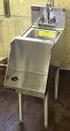 ENVIRONMENTAL HEALTH DIVISION 2120 Diamond Blvd., Suite 200 Concord, CA 94520 Phone: (925) 692-2500 Fax: (925) 692-2505 www.cchealth.org/eh/ SINKS / DISHMACHINES Food Preparation Sink A separate stainless
SOUTH CAROLINA. Downloaded January 2011
 SOUTH CAROLINA Downloaded January 2011 1401. General (II) B. When meals are catered to a facility, such meals shall be obtained from a meal service establishment graded by the Department, pursuant to R.61
General Information on Starting a Restaurant Business in Alabama
 General Information on Starting a Restaurant Business in Alabama This information is intended to give a general idea and overview of Health Department construction requirements for starting a retail food
FOOD ESTABLISHMENT REQUIREMENTS
 FOOD ESTABLISHMENT REQUIREMENTS 1. Three-compartment sink with dual drainboards A sink with at least three compartments shall be provided for manually washing, rinsing and sanitizing equipment. And shall
STARTING A FOOD BUSINESS GUIDE
 STARTING A FOOD BUSINESS A HELPFUL GUIDE To assist those who are planning to open a food business in Columbus or Worthington Developed by the Food Protection Program at Columbus Public Health Updated April
FOOD ESTABLISHMENT PERMIT APPLICATION FOR NEW, REMODEL OR CHANGE OF OWNERSHIP
 Health & Community Services San Juan County P.O. Box 607 145 Rhone, Friday Harbor, WA 98250 Phone: (360) 378-4474 Fax: (360) 378-7036 FOOD ESTABLISHMENT PERMIT APPLICATION FOR NEW, REMODEL OR CHANGE OF
SANITATION AND PEST CONTROL INSPECTION REPORT INSPECTOR: BUSINESS NAME:
 SANITATION AND PEST CONTROL INSPECTION REPORT INSPECTOR: BUSINESS NAME: A. EXTERIOR AREAS 1. Evidence of pest activity 2. Pest harborage 3. Adequate garbage handling 4. Adequate garbage container design
Article 11 Laundry and Dry Cleaning
 Article 11 Laundry and Dry Cleaning 41101. General Provisions. 41102. Construction Permit. 41103. Sanitary Permit. 41104. Materials and Construction of Physical Facilities. 41105. Sanitary Facilities Plumbing.
FLOOR MATERIALS FOR RETAIL FOOD FACILITIES
 FLOOR MATERIALS FOR RETAIL FOOD FACILITIES General Appropriate floor, wall, and ceiling finishes promote good sanitation. Sanitation is an important component of public health protection. Disease outbreaks
Chapter 5 Water, Plumbing, and Waste
 Chapter 5 Water, Plumbing, and Waste Parts 5-1 WATER 5-2 PLUMBING SYSTEM 5-3 MOBILE WATER TANK AND MOBILE FOOD ESTABLISHMENT WATER TANK 5-4 SEWAGE, OTHER LIQUID WASTE, AND RAINWATER 5-5 REFUSE, RECYCLABLES,
PLAN REVIEW AND APPROVAL FOR FOOD ESTABLISHMENTS PLUMBING REQUIREMENTS FOR FOOD ESTABLISHMENT PREMISES
 PLAN REVIEW AND APPROVAL FOR FOOD ESTABLISHMENTS PLUMBING REQUIREMENTS FOR FOOD ESTABLISHMENT PREMISES Health Systems Protection Rev. 07/2006 35-05-20/06/07/18 OFFICE OF FOOD PROTECTION 417 FEDERAL ST
Florida s Cottage Food Industry and Beyond
 Florida s Cottage Food Industry and Beyond The 2012 Educational Program Committee is pleased to share conference educational materials with you under the condition that they are used without alteration
FORT WORTH CODE COMPLIANCE DEPARTMENT CONSUMER HEALTH DIVISION PLAN REVIEW FOR FOOD ESTABLISHMENTS & PERMITTING REQUIREMENTS
 FORT WORTH CODE COMPLIANCE DEPARTMENT CONSUMER HEALTH DIVISION PLAN REVIEW FOR FOOD ESTABLISHMENTS & PERMITTING REQUIREMENTS Section 16-114 Submission of Plans: When a food establishment is newly constructed
APPLICATION FOR FITOUT OR PLAN ASSESSMENT UNDER THE FOOD ACT 2001
 Health Protection Service Howard Florey Centenary House, 25 Mulley Street, Holder ACT 2611 Locked Bag 5005, Weston Creek ACT 2611 Phone: (02) 6205 1700 Fax: (02) 6205 1705 Website: www.health.act.gov.au
Plumbing Code in Commercial Kitchens. NH BOA May 9, 2012
 Plumbing Code in Commercial Kitchens NH BOA May 9, 2012 Main Topics Grease Interceptors Indirect Waste Receptors Cleaning Chemical Dispensers Thermal Expansion IPC - Chapter 10 Traps Interceptors Separators
Subpart 1. Installation. All plumbing systems must be. installed and tested according to this chapter and chapter 4715,
 4658.4500 PLUMBING SYSTEMS; NEW CONSTRUCTION. Subpart 1. Installation. All plumbing systems must be installed and tested according to this chapter and chapter 4715, the Minnesota Plumbing Code. Subp. 2.
Chapter 8 Water and Sewage Systems
 Chapter 8 Water and Sewage Systems Proper sanitary controls pertaining to the water supply system and sewage and liquid waste disposal systems are necessary in all types of food establishments to prevent
Plumbing Code Sections For Commercial Food Facilities
 Plumbing Code Sections For Commercial Food Facilities SCOPE The following list of requirements summarizes the plumbing issues that are commonly addressed in commercial retail food facilities by health
MISSISSIPPI. Downloaded January 2011
 MISSISSIPPI Downloaded January 2011 101.08 Dietitian. The term dietitian shall mean a person who is licensed as a dietitian in the State of Mississippi, or a Registered Dietitian exempted from licensure
CALIFORNIA PLAN CHECK GUIDE FOR RETAIL FOOD FACILITIES
 CALIFORNIA PLAN CHECK GUIDE FOR RETAIL FOOD FACILITIES Solano County Department of Resource Management Environmental Health Division 675 Texas St., Ste. 5500 Fairfield, CA 94533 Revised March 2010 TABLE
Plumbing Code in Commercial Kitchens
 Plumbing Code in Commercial Kitchens City of Concord Code Administration 225-8580 Dan Clark Plumbing Inspector Tedd Evans, Chief Building Inspector Code References from the 2009 edition of the International
PLUMBING & CROSS-CONNECTION CONTROL
 PLUMBING & CROSS-CONNECTION CONTROL. MODULE 4 VII. Typical Retail Food Service Cross-Connections VIII. Air Gaps and Air Breaks for Drains and Waste IX. Grease Interceptors VII. TYPICAL RETAIL FOOD SERVICE
Note: Not all sections may be applicable to every establishment. Contact above Reg. Agency if you have questions.
 SF 35 Rev. 6/2009 West Virginia Department of Health and Human Resources Bureau for Public Health Office of Environmental Health Services Public Health Sanitation Division FOOD ESTABLISHMENT PLAN REVIEW
BUCKS COUNTY DEPARTMENT OF HEALTH PLAN REVIEW APPLICATION FOR FOOD FACILITIES
 BUCKS COUNTY DEPARTMENT OF HEALTH PLAN REVIEW APPLICATION FOR FOOD FACILITIES GENERAL INFORMATION: The Bucks County Department of Health Rules and Regulations for Conducting and Operating Food Facilities
Brian Coppock, Regional Compliance Officer. Office of Statewide Health Planning and Development Facilities Development Division
 Brian Coppock, Regional Compliance Officer Office of Statewide Health Planning and Development Facilities Development Division CHAPTER 6 WATER SUPPLY AND DISTRIBUTION 601.0 Hot and Cold Water Required.
SAFE HEALTHY CHILDREN A Health and Safety Manual for Childcare Providers
 TABLE OF CONTENTS Chapter 7: Food Storage and Preparation Safe Food: Food Storage and Preparation 7.1 Requirements of the Day Nurseries Act... 7.2 Recommendations of the Medical Officer of Health... 7.2
GUIDELINES FOR OPERATORS OF MOBILE FOOD BUSINESSES: DESIGN, CONSTRUCTION
 Southern Drive, Busselton WA 6280 All Correspondence to: The Chief Executive Officer, Locked Bag 1, Busselton WA 6280 Ph: (08) 9781 0444 Fax: (08) 9752 4958 Email: [email protected] Web: www.busselton.wa.gov.au
Important Information for Vendors at Temporary Events
 Important Information for Vendors at Temporary Events As a food vendor, you are responsible for ensuring that your operation complies with the Colorado Retail Food Establishment Rules and Regulations.
Plumbing Installations. A homeowner guide to the City of Winnipeg plumbing requirements for a single-family dwelling
 Plumbing Installations A homeowner guide to the City of Winnipeg plumbing requirements for a single-family dwelling February 2001 contents General Information 3 Inspection 4 New Drain and Vent Installations
Element D Services Plumbing
 PART 1 - GENERAL 1.01 OVERVIEW A. This section addresses domestic cold, hot and hot water return distribution systems within and to five feet beyond building perimeter. PART 2 - DESIGN CRITERIA 2.01 GENERAL
02.11 Food and Nutrition Services
 02.11 Purpose Audience To assure proper and safe food handling, storage, and preparation. All Department of employees. Personnel The following guidelines shall be used to monitor proper and safe food handling,
A GUIDE TO OPENING A FOOD PREMISES
 A GUIDE TO OPENING A FOOD PREMISES Introduction Everyone who intends to operate a food premises must notify the health unit where their business will be located. The protection of food is an important
FOG PRETREATMENT INFORMATION. New London Public Utilities F.O.G. Program 120 Broad Street New London, CT 06320
 FOG PRETREATMENT INFORMATION 1 New London Public Utilities F.O.G. Program 120 Broad Street New London, CT 06320 Kathryn Willis Program Coordinator Phone: 860-447-5222 Introduction This information package
TYPICAL FIRE SAFETY INSPECTION VIOLATIONS
 TYPICAL FIRE SAFETY INSPECTION VIOLATIONS The following is a list of typical violations often found by inspectors and a generic solution. You can use this list to improve the safety of your facility, to
Plumbing Installations A homeowner guide to the City of Winnipeg plumbing requirements for a single-family dwelling
 PLANNING, PROPERTY AND DEVELOPMENT DEPARTMENT Plumbing Installations A homeowner guide to the City of Winnipeg plumbing requirements for a single-family dwelling October 2014 contents General Information
PUBLIC RESTROOMS, DESIGN INTENT
 PUBLIC RESTROOMS, DESIGN INTENT 1.01 STRUCTURAL A. Where feasible, metal stud partitions will be constructed on a 6 high concrete curb. 1.02 MECHANICAL A. Restrooms will have a minimum of 15 air changes
Hygiene Standards for all Food Businesses
 Hygiene Standards for all Food Businesses Food hygiene laws are not simply a list of rules. They are intended to let food business operators assess the risks to food safety in their business and apply
MY HOME IN A HOUSING BLOCK A GUIDE FOR RESIDENTS
 MY HOME IN A HOUSING BLOCK A GUIDE FOR RESIDENTS -KESKUSTA One half of Finns live in housing blocks, which is a safe and comfortable way to live. Welcome a board! Buildings and the Finnish climate There
CITY OF GOLDEN DEPARTMENT OF PUBLIC WORKS, ENVIRONMENTAL SERVICES DIVISION
 CITY OF GOLDEN DEPARTMENT OF PUBLIC WORKS, ENVIRONMENTAL SERVICES DIVISION Grease, So What's the Problem? Does your facility produce grease? All commercial cooking facilities generate Fats, Oil, and Grease
Standard Requirements for Cold Store Licence IMPORTANT
 Standard Requirements for Cold Store Licence IMPORTANT The permission of the Building Authority must be obtained for any structural or drainage alterations. It is the applicant's responsibility to seek
ARTICLE 32-02 SANITATION CHAPTER 32-02-01 RULES OF SANITATION
 Chapter 32-02-01 Rules of Sanitation ARTICLE 32-02 SANITATION CHAPTER 32-02-01 RULES OF SANITATION Section 32-02-01-01 Rules Posted 32-02-01-02 Space Dimensions and Requirements 32-02-01-03 Lighting -
Low risk includes facilities that sell or give away non potentially hazardous food in original manufacturer packaging and do not offer samples.
 Planning, Building &Environmental Services 1195 Third Street, Suite 210 Napa, CA 94559 www.co.napa.ca.us Main: (707) 253-4471 Fax: (707) 253-4545 PERMIT APPLICATION AND REQUIREMENTS FOR FOOD VENDORS AT
CONSTRUCTION PLAN APPROVAL PROCEDURES FOR FOOD FACILITIES
 COUNTY OF RIVERSIDE DEPARTMENT OF ENVIRONMENTAL HEALTH CONSTRUCTION PLAN APPROVAL PROCEDURES FOR FOOD FACILITIES FLOOR PLAN Rev. (9/13-H) TABLE OF CONTENTS Cover Sheet 1 Environmental Health Offices 3
TEMPORARY EVENT APPLICATION
 www.camdencounty.com TEMPORARY EVENT APPLICATION Dear Special Event Participant: Enclosed is a copy of the Requirements for Temporary Food Service Operation and Special Event Fact Sheet. To obtain approval
Food Protection Program 2 North Meridian Street Indianapolis, IN 46204 http://www.in.gov/isdh/regsvcs/foodprot/index.htm.
 Food Protection Program 2 North Meridian Street Indianapolis, IN 46204 http://www.in.gov/isdh/regsvcs/foodprot/index.htm Sewage Backup For the purpose of this Emergency Action Plan (EAP), a sewage backup
Facility Self Evaluation Report
 Facility Self Evaluation Report Facility Name: Registration Number Location: Date of Inspection Process Type (Check all that are applicable) Fresh Frozen /Semi-Preserved Salt/Dried Ready-to-eat Pickled,
Permit Application for Mobile Food Truck
 Date Received / / Office Use Only By: Date Approved / / By: Comp # Element Type: Entered By: Annual Permit Fee: Check #: Receipt #: AMANDA #: Permit Application for Mobile Food Truck NOTE: This application
Top 10+ Mistakes of DWV plumbing design
 Top 10+ Mistakes of DWV plumbing design Listed below are the some of the most frequently missed items, noticed by our inspectors, at plumbing rough-in when non-plumbers attempt plumbing design. Most of
Minimum Housing and Health Standards
 APPENDIX M.O. 57/2012 Minimum Housing and Health Standards Original version July 20, 1999. Revisions to Part lll, Housing Premises, sections 3 and 4, June 30, 2012 (all revisions are bolded and underlined).
SOUTH CAROLINA DEPARTMENT OF AGRICULTURE FOOD SAFETY DIVISION GUIDELINES FOR FOOD PROCESSORS (REVISED)
 SOUTH CAROLINA DEPARTMENT OF AGRICULTURE FOOD SAFETY DIVISION GUIDELINES FOR FOOD PROCESSORS 2013 (REVISED) SOUTH CAROLINA DEPARTMENT OF AGRICULTURE PRODUCT TO PRODUCTION GETTING STARTED FROM SCRATCH If
Residential Plumbing BCN 1058
 Residential Plumbing BCN 1058 CHAPTER 7 Plumbing Fixtures and Sizing the Drain, Waste, and Vent System MICHAEL KNOTEK 74 Plumbing Fixtures and Sizing the Drain, Waste, and Vent System PLUMBING FIXTURES
#9. EFFECTIVE CLEANING, MAINTENANCE, AND PEST CONTROL PROGRAMS FOR YOUR HACCP PLAN
 #9. EFFECTIVE CLEANING, MAINTENANCE, AND PEST CONTROL PROGRAMS FOR YOUR HACCP PLAN by O. Peter Snyder, Jr., Ph.D. Hospitality Institute of Technology and Management In past articles, I have discussed supplier
Table of Contents. Introduction... 1. Personal Hygiene... 2. Temperature Control... 5. Cross-contamination... 6. Cleaning and Sanitizing...
 Table of Contents Introduction... 1 Food Handler Certification Program... 1 Personal Hygiene... 2 Temperature Control... 5 Cross-contamination... 6 Cleaning and Sanitizing... 6 Dishwashing... 7 Food Storage...
KITCHEN AND BATH REMODELING BUILDING PERMIT REQUIREMENTS
 St. Louis County Department of Public Works Division of Code Enforcement KITCHEN AND BATH REMODELING BUILDING PERMIT REQUIREMENTS This guideline is intended to provide the homeowner/contractor with the
Grease Trap Maintenance, Procedures and Cleaning Logs
 SAWS Grease Reduction Program Grease Trap Maintenance, Procedures and Cleaning Logs Don t Feed the Grease Monster Best Management Practices for Commercial Food and Restaurant Facilities Train kitchen staff
FOOD SERVICE FACILITIES Best Management Practices Stormwater Management Program City of Bluff City P.O. Box 70, Bluff City, TN 37618 423-538-7144
 FOOD SERVICE FACILITIES Best Management Practices Stormwater Management Program City of Bluff City P.O. Box 70, Bluff City, TN 37618 423-538-7144 This document may be printed and used for reference by
MARICOPA COUNTY ENVIRONMENTAL HEALTH CODE
 MARICOPA COUNTY ENVIRONMENTAL HEALTH CODE CHAPTER II SEWAGE AND WASTES SECTION 6 CHEMICAL TOILETS, PORTABLE RESTROOM UNITS, PORTABLE WASTE HOLDING TANKS REGULATION 1. Definitions a. "Chemical toilet" means
This handout is a guide only and does not contain all of the requirements of the Minnesota State Building Code or city ordinances.
 Basement Finishing Guide Community Development Department Building Inspections Division 5200 85 th Avenue North / Brooklyn Park, MN 55443 Phone: (763) 488-6379 / Fax: (763) 493-8171 6/15 www.brooklynpark.org
SPACE TYPE: LABORATORY (WET) FOR CHEMISTRY AND BIOLOGY
 SPACE TYPE: LABORATORY (WET) FOR CHEMISTRY AND BIOLOGY Construction Criteria The unit costs for (Wet) space types are based on the construction quality and design features in the following table. This
A GUIDE TO AVA FOOD FACTORY GRADING SYSTEM
 A GUIDE TO AVA FOOD FACTORY GRADING SYSTEM Introduction The main objective of the Food Factory Grading System is to ensure that the food manufacturers observe good manufacturing practices so as to produce
Guide to Care and Maintenance
 Village of Mount Prospect Guide to Care and Maintenance of Your Apartment Sponsored ed by: y: Village of Mount Prospect Envir nvironmental Health Division with the assistance of The Concerened ened Owners
CHAPTER 26 PLUMBING CODE
 CHAPTER 26 PLUMBING CODE 26.01 PLUMBING CODE The Illinois Plumbing Code as promulgated by the Illinois Department of Public Health at 77 Illinois Administrative Code, Part 890, is hereby adopted as the
Guidelines for Food Premises Design and Equipment
 Guidelines for Food Premises Design and Equipment For further information, please contact:- Health Services Department 44 Turnham Avenue, Rosanna 3084 Telephone: 9457 9965 / 9457 9964 Facsimile: 9499 9475
HEALTH FACILITY CHECKLIST SECTION 1226 [OSHPD 3] CLINICS 1226.6 PRIMARY CARE CLINICS
![HEALTH FACILITY CHECKLIST SECTION 1226 [OSHPD 3] CLINICS 1226.6 PRIMARY CARE CLINICS](/thumbs/39/20230946.jpg "HEALTH FACILITY CHECKLIST SECTION 1226 [OSHPD 3] CLINICS 1226.6 PRIMARY CARE CLINICS") Compliance Checklist: [OSHPD 3] Primary Care Clinics Page 1 of 7 HEALTH FACILITY CHECKLIST SECTION 1226 [OSHPD 3] CLINICS 1226.6 PRIMARY CARE CLINICS Primary Care Clinics are Health Facilities licensed
Compliance Checklist: [OSHPD 3] Primary Care Clinics Page 1 of 7 HEALTH FACILITY CHECKLIST SECTION 1226 [OSHPD 3] CLINICS 1226.6 PRIMARY CARE CLINICS Primary Care Clinics are Health Facilities licensed
STANDARD OPERATING PROCEDURE S (SOP S) FOR HAZARDOUS ANALYSIS CRITICAL CONTROL POINT (HACCP) PLANS
 STANDARD OPERATING PROCEDURE S (SOP S) FOR HAZARDOUS ANALYSIS CRITICAL CONTROL POINT (HACCP) PLANS RECEIVING: All food must be from approved sources. Foods must be wholesome and not adulterated. No home-prepared
Clean Water: Supply side potable water, not wastewater. Gray Water/Sewage: Wastewater originating from a drain (sink, toilet, urinal).
 Procedures for Emergency Responses to Flooding and Building Water Intrusion PURPOSE: To establish uniform, sanitary, and systematic procedures for responding to flooding and water intrusion emergencies.
Guideline on Emergency Action Plans for Food Establishments: Sewage Backup
 Guideline on Emergency Action Plans for Food Establishments: Sewage Backup A sewage backup refers to the overflow of sewage from equipment or plumbing facilities within a food establishment. A sewage backup
DIVISION 00 - PROCUREMENT AND CONTRACTING REQUIREMENTS
 DIVISION 00 - PROCUREMENT AND CONTRACTING REQUIREMENTS NOTICE TO BIDDERS BID FORM INSTRUCTIONS TO BIDDERS CONTRACTOR S BID FOR PUBLIC WORK - FORM 96 MINORITY AND WOMEN S BUSINESS ENTERPRISE PARTICIPATION
Bath Planning Guidelines With Access Standards
 Bath Planning Guidelines With s 1: Door/Entry The clear opening of a doorway should be at least 32. This would require a minimum 2-10 door. If the existing structure precludes changing the opening then
R432. Health, Health Systems Improvement, Licensing. R432-5. Nursing Facility Construction. R432-5-1. Legal Authority. R432-5-2. Purpose.
 R432. Health, Health Systems Improvement, Licensing. R432-5. Nursing Facility Construction. R432-5-1. Legal Authority. This rule is promulgated pursuant to Title 26, Chapter 21. R432-5-2. Purpose. The
REQUIREMENTS FOR TRADE SHOWS
 REQUIREMENTS FOR TRADE SHOWS All Trade Show Booth operators who give out food samples must be approved before the event and licensed by Regina Qu Appelle Health Region prior to opening. Food sold for immediate
RHODE ISLAND. Downloaded 01.15.11
 Housekeeping/Laundry/Maintenance Section 35.0 Housekeeping RHODE ISLAND Downloaded 01.15.11 35.1 A full time employee of the facility shall be designated responsible for housekeeping services, supervision
FACILITIES DESIGN ASSESSMENT AND PERMITTING QUESTIONNAIRE: (For use by all food risk categories 1-3 or higher)
 FACILITIES DESIGN ASSESSMENT AND PERMITTING QUESTIONNAIRE: (For use by all food risk categories 1-3 or higher) TO BE COMPLETED BY THE OWNER/OPERATOR AND SUBMITTED TO THE SNHD ENVIRONMENTAL HEALTH DIVISION
RRIO Checklist. Use of checklist: Definitions: Limitations
 CITY OF SEATTLE RENTAL REGISTRATION AND INSPECTION ORDINANCE (RRIO) RRIO Checklist Use of checklist: Property owners will use the RRIO Checklist to confirm that their rental housing properties and units
Requirements for Special Event Food Vendors
 Niagara Region PUBLIC HEALTH Requirements for Special Event Food Vendors Please be advised that it is the responsibility of each Special Event Food Vendor to be aware of and in full compliance with the
CHAPTER 9 VENTS. copper drainage tube Type DWV, Schedule 40 plastic piping, or borosilicate glass.
 CHAPTER 9 VENTS 901 GENERAL 901.1 Scope The provisions of this chapter shall govern the materials, design, construction, and installation of vents. 901.2 Protection of Trap Seals The protection of trap
FIRE SAFETY SELF-INSPECTION FORM FOR CULTURAL INSTITUTIONS. 1. All Floors (inspect from top floor to basement): Yes No
 General Inspection FIRE SAFETY SELF-INSPECTION FORM FOR CULTURAL INSTITUTIONS 1. All Floors (inspect from top floor to basement): Yes are fire exits and directional signs properly illuminated? is the emergency
1.2 How Does FOG Affect You?. 2 1.3 The City of Huntington Beach FOG Control Program.. 2
 Contents SECTION 1.0 What is FOG?.... 2 1.2 How Does FOG Affect You?. 2 1.3 The City of Huntington Beach FOG Control Program.. 2 SECTION 2.0 HOW TO ACHIEVE COMPLIANCE WITH THE FOOD SERVICE ESTABLISMENT
Inspection Item COMMENTS
 APPENDIX 9 AFFORDABLE HOUSING PROGRAM INSPECTION CHECKLIST Participating Jurisdiction: Homeowner Name: Assisted Property Address: Date of Physical Inspection of Property: Total Square Footage of Property:
Mobile Food Vending Units
 Mobile Food Vending Units FOOD HANDLING PERMIT Before starting the operation of a mobile food vending unit, outside of a special event, the operator must hold a valid food handling permit issued by Alberta
2010 Residential Water Heater Replacement Check List
 2010 Residential Water Heater Replacement Check List The intent of this check list is to provide installers a general reference for the enforcement of code requirements in the Greater San Diego Area. This
Temporary Food Service
 Public Health Inspection Services Community Health Head Office Frontier Mall 11427 Railway Ave. East NORTH BATTLEFORD, SK. S9A 1E9 Tel: (306)446-6400 Fax: (306)446-6018 Temporary Food Service Food Vendor
U.S. Department of Housing and Urban Development Office of Public and Indian Housing. A Good Place to Live!
 U.S. Department of Housing and Urban Development Office of Public and Indian Housing A Good Place to Live! Introduction Having a good place to live is important. Through your Public Housing Agency (or
3. It is recommended that the water supply into the facility can be obtained from two (2) separate water lines if possible.
 PART VIII SANITATION AND MEDICAL WASTE 132 SANITATION 132.01 Water Supply. 1. If at all possible, all water shall be obtained from a public water supply. If not possible to obtain water from a public water