
Campbellsport School District Art and Design Performance Standards and Benchmarks
|
|
|
- Amice Cook
- 10 years ago
- Views:
Transcription
1 CSD Performance Standards for Art and Design describe what Campbellsport School District students will know and be able to do within this subject area. Each CSD performance standard is aligned to one or more corresponding content standards within the Wisconsin Model Academic Standards (WMAS) for Art and Design. Each grade level has a set of skill and information benchmarks based on these performance standards in Art and Design. As students progress through the district s curriculum, their performance of skills and their demonstration of knowledge within the content area will become more complex and sophisticated. *Covered only in High School Elective Courses CSD Performance Standard 1 Understands and applies media, techniques, and processes related to the visual arts (WMAS Art and Design Doing Visual Design/Production, Art and Design Communicating Visual Communication/Expression & Visual Media/Technology, Art and Design Understanding Personal/Social Development) CSD Performance Standard 2 Knows how to use structures (e.g., sensory qualities, organizational principles, expressive features) and functions of art (WMAS Art and Design Doing Practical Applications, Art and Design Communicating Visual Communication/Expression, Art and Design Thinking Visual Thinking, Art and Design Creating Visual Imagination) CSD Performance Standard 3 Knows a range of subject matter, symbols, and potential ideas in the visual arts (WMAS Art and Design Knowing Visual Memory/Knowledge, Art and Design Understanding Personal/Social Development, Art and Design Creating Making Connections) CSD Performance Standard 4 Understands the visual arts in relation to history and cultures (WMAS Art and Design Knowing Art/Design History, Citizenship and Environment, Art and Design Thinking Visual Thinking, Art and Design Understanding Personal/Social Development & Cultural Understanding, Art and Design Creating Making Connections) CSD Performance Standard 5 Knows a range of arts and communication works from various (WMAS Art and Design Communicating Visual Communication/ Expression, Art and Design Thinking Art Criticism, Art and Design Understanding Personal/Social Development & Cultural Understanding, Art and Design Creating Making Connections) CSD Performance Standard 6 Understands connections among the various art forms and other disciplines (WMAS Art and Design Creating Making Connections)

2 *CSD Performance Standard 7 Understands the principles, processes, and products associated with arts and communication media (WMAS Art and Design Communicating Visual Communication/Expression) *CSD Performance Standard 8 Uses critical and creative thinking in various arts and communication settings (WMAS Art and Design Communicating Visual Communication/Expression) *CSD Performance Standard 9 Knows a range of arts and communication works from various (WMAS Art and Design Understanding Cultural Understanding)
3 Key to this Document: CSD Performance Standards (in bold) describe what students should know and be able to do within a subject area. Each CSD performance standard is aligned to a corresponding content standard within the Wisconsin Model Academic Standards (WMAS) for that subject area. Benchmarks (with ID label) describe knowledge and skills targeted for a specific grade level within that Performance standard. First and Second Grade CSD Performance Standard 1 Understands and applies media, techniques, and processes related to the visual arts ART Knows the differences between art materials (e.g., paint, clay, wood, videotape), techniques (e.g., overlapping, shading, varying size or color), and processes (e.g., addition and subtraction in sculpture, casting and constructing in making jewelry) ART Knows how different materials, techniques, and processes cause different responses from the viewer ART Knows how different media (e.g., oil, watercolor, stone, metal), techniques, and processes are used to communicate ideas, experiences, and stories ART Uses art materials and tools in a safe and responsible manner CSD Performance Standard 2 Knows how to use structures (e.g., sensory qualities, organizational principles, expressive features) and functions of art ART Knows the differences among visual characteristics (e.g., color, texture) and purposes of art (e.g., to convey ideas) ART Understands how different compositional, expressive features (e.g., evoking joy, sadness, anger), and organizational principles (e.g., repetition, balance, emphasis, contrast, unity) cause different responses ART Uses visual structures and functions of art to communicate ideas CSD Performance Standard 3 Knows a range of subject matter, symbols, and potential ideas in the visual arts ART Selects prospective ideas (e.g., formulated thoughts, opinions, concepts) for works of art ART Knows how subject matter, symbols, and ideas are used to communicate meaning CSD Performance Standard 4 Understands the visual arts in relation to history and cultures ART Knows how history, culture, and the visual arts can influence each other
4 CSD Performance Standard 5 Knows a range of arts and communication works from various ART Knows how people s experiences (e.g., cultural background, human needs) can influence the development of specific artworks ART Understands that specific artworks can elicit different responses ART Knows various purposes for creating works of visual art CSD Performance Standard 6 Understands connections among the various art forms and other disciplines ART Knows how ideas (e.g., sibling rivalry, respect) and emotions (e.g., sadness, anger) are expressed in the various art forms
5 Key to this Document: CSD Performance Standards (in bold) describe what students should know and be able to do within a subject area. Each CSD performance standard is aligned to a corresponding content standard within the Wisconsin Model Academic Standards (WMAS) for that subject area. Benchmarks (with ID label) describe knowledge and skills targeted for a specific grade level within that Performance standard. Third and Fourth Grade CSD Performance Standard 1 Understands and applies media, techniques, and processes related to the visual arts ART Experiments with a variety of color, textures, and shapes ART Creates three-dimensional structures and arrangements using concrete materials or manipulatives (e.g., blocks) ART Uses a variety of basic art materials (e.g., paints, crayons, clay, pencils) to create works of art and express ideas and feelings ART Knows the names of a basic of colors CSD Performance Standard 2 Knows how to use structures (e.g., sensory qualities, organizational principles, expressive features) and functions of art ART Knows the differences among visual characteristics (e.g., color, texture) and purposes of art (e.g., to convey ideas) ART Understands how different compositional, expressive features (e.g., evoking joy, sadness, anger), and organizational principles (e.g., repetition, balance, emphasis, contrast, unity) cause different responses ART Uses visual structures and functions of art to communicate ideas CSD Performance Standard 3 Knows a range of subject matter, symbols, and potential ideas in the visual arts ART Selects prospective ideas (e.g., formulated thoughts, opinions, concepts) for works of art ART Knows how subject matter, symbols, and ideas are used to communicate meaning ART Knows how symbols are used to communicate meaning CSD Performance Standard 4 Understands the visual arts in relation to history and cultures ART Knows how history, culture, and the visual arts can influence each other
6 CSD Performance Standard 5 Knows a range of arts and communication works from various ART Understands that specific artworks can elicit different responses ART Knows how people s experiences (e.g., cultural background, human needs) can influence the development of specific artworks ART Knows various purposes for creating works of visual art CSD Performance Standard 6 Understands connections among the various art forms and other disciplines ART Knows the similarities and differences in the meanings of common terms used in the various arts (e.g., form, line, contrast)
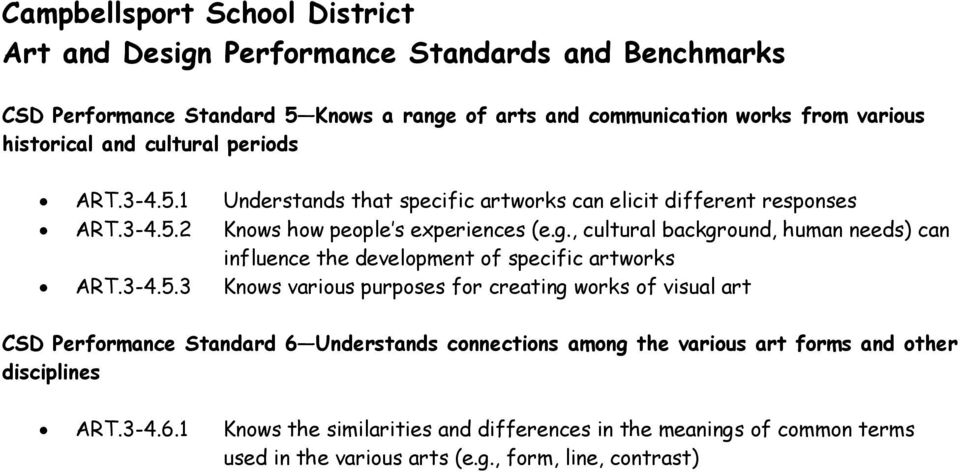
7 Key to this Document: CSD Performance Standards (in bold) describe what students should know and be able to do within a subject area. Each CSD performance standard is aligned to a corresponding content standard within the Wisconsin Model Academic Standards (WMAS) for that subject area. Benchmarks (with ID label) describe knowledge and skills targeted for a specific grade level within that Performance standard. Fifth and Sixth Grade CSD Performance Standard 1 Understands and applies media, techniques, and processes related to the visual arts ART Knows how the qualities and characteristics of art media, techniques, and processes can be used to enhance communication of experiences and ideas CSD Performance Standard 2 Knows how to use structures (e.g., sensory qualities, organizational principles, expressive features) and functions of art ART Knows how to use structures (e.g., sensory qualities, organizational principles, expressive features) and functions of art CSD Performance Standard 3 Knows a range of subject matter, symbols, and potential ideas in the visual arts ART Knows how visual, spatial, and temporal concepts integrate with content to communicate intended meaning in one s artworks ART Knows different subjects, themes, and symbols (through context, value, and aesthetics) which convey intended meaning in artworks CSD Performance Standard 4 Understands the visual arts in relation to history and cultures ART Understands how factors of time and place (e.g., climate, resources, ideas, technology) influence visual, spatial, or temporal characteristics that give meaning or function to a work of art CSD Performance Standard 5 Knows a range of arts and communication works from various ART Distinguishes among multiple purposes for creating works of art ART Understands possible contemporary and historic meanings in specific artworks ART Understands how one s own artworks, as well as artworks from various eras and cultures, may elicit a variety of responses
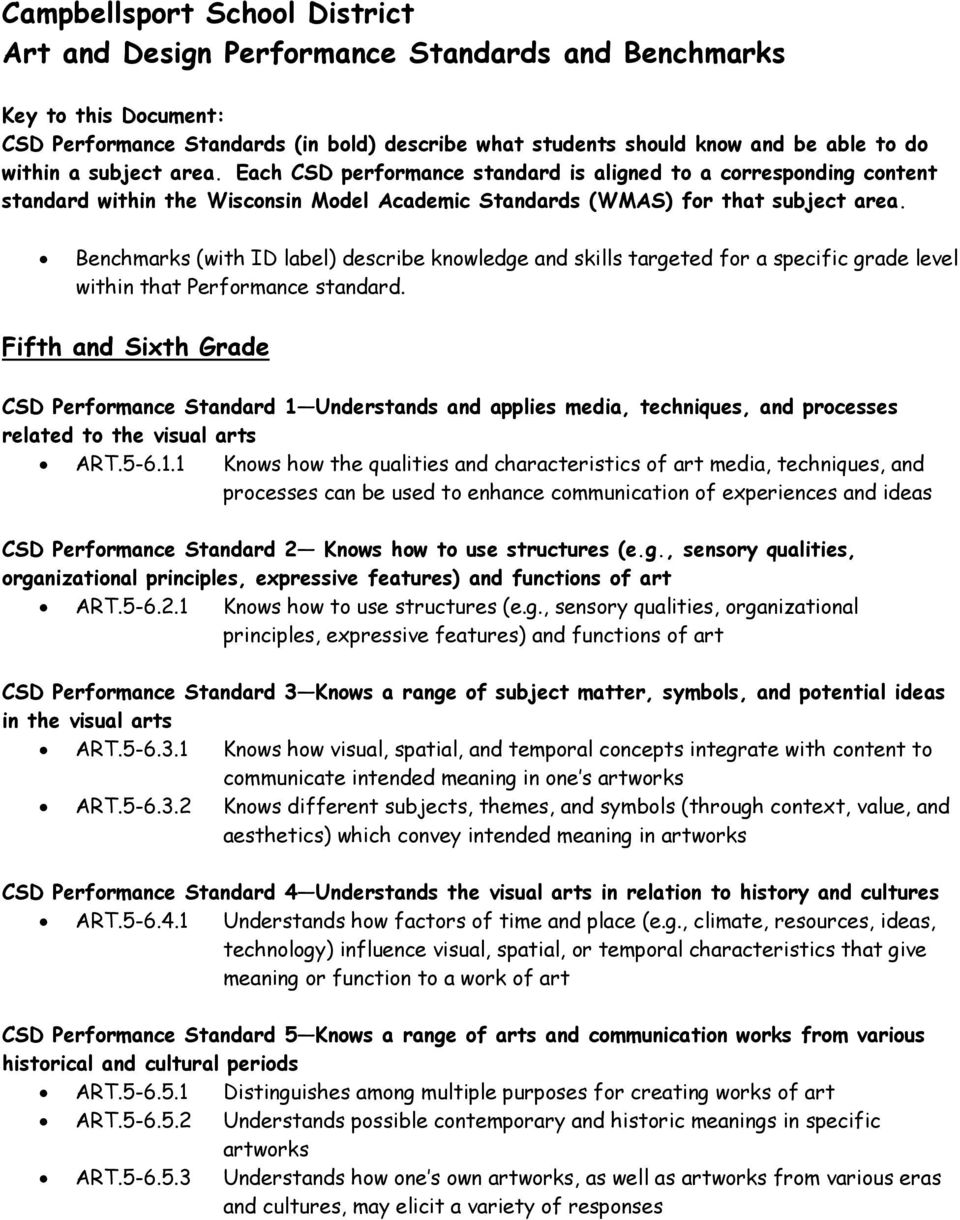
8 CSD Performance Standard 6 Understands connections among the various art forms and other disciplines ART Knows how visual, aural, oral, and kinetic elements are used in the various art forms ART Understands how the characteristic materials of various arts (e.g., sound in music, visual stimuli in visual arts, movement in dance, human interrelationships in theatre) are used to transform similar events, scenes, emotions, or ideas into distinct works of art ART Knows ways in which the principles and subject matter of other disciplines taught in the school are interrelated with those of the arts (e.g., pattern in the arts and in science

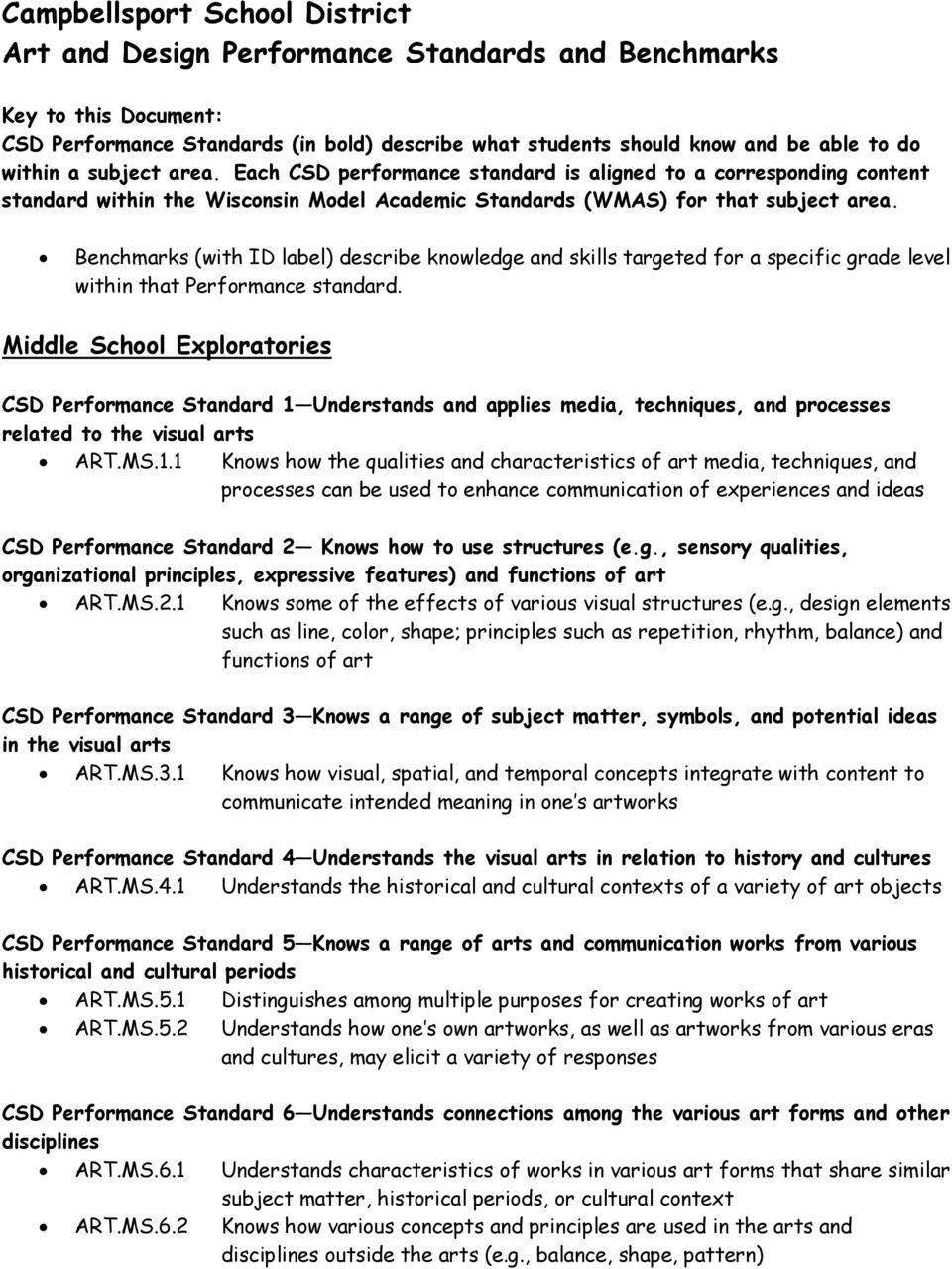
9 Key to this Document: CSD Performance Standards (in bold) describe what students should know and be able to do within a subject area. Each CSD performance standard is aligned to a corresponding content standard within the Wisconsin Model Academic Standards (WMAS) for that subject area. Benchmarks (with ID label) describe knowledge and skills targeted for a specific grade level within that Performance standard. Middle School Exploratories CSD Performance Standard 1 Understands and applies media, techniques, and processes related to the visual arts ART.MS.1.1 Knows how the qualities and characteristics of art media, techniques, and processes can be used to enhance communication of experiences and ideas CSD Performance Standard 2 Knows how to use structures (e.g., sensory qualities, organizational principles, expressive features) and functions of art ART.MS.2.1 Knows some of the effects of various visual structures (e.g., design elements such as line, color, shape; principles such as repetition, rhythm, balance) and functions of art CSD Performance Standard 3 Knows a range of subject matter, symbols, and potential ideas in the visual arts ART.MS.3.1 Knows how visual, spatial, and temporal concepts integrate with content to communicate intended meaning in one s artworks CSD Performance Standard 4 Understands the visual arts in relation to history and cultures ART.MS.4.1 Understands the historical and cultural contexts of a variety of art objects CSD Performance Standard 5 Knows a range of arts and communication works from various ART.MS.5.1 Distinguishes among multiple purposes for creating works of art ART.MS.5.2 Understands how one s own artworks, as well as artworks from various eras and cultures, may elicit a variety of responses CSD Performance Standard 6 Understands connections among the various art forms and other disciplines ART.MS.6.1 Understands characteristics of works in various art forms that share similar subject matter, historical periods, or cultural context ART.MS.6.2 Knows how various concepts and principles are used in the arts and disciplines outside the arts (e.g., balance, shape, pattern)
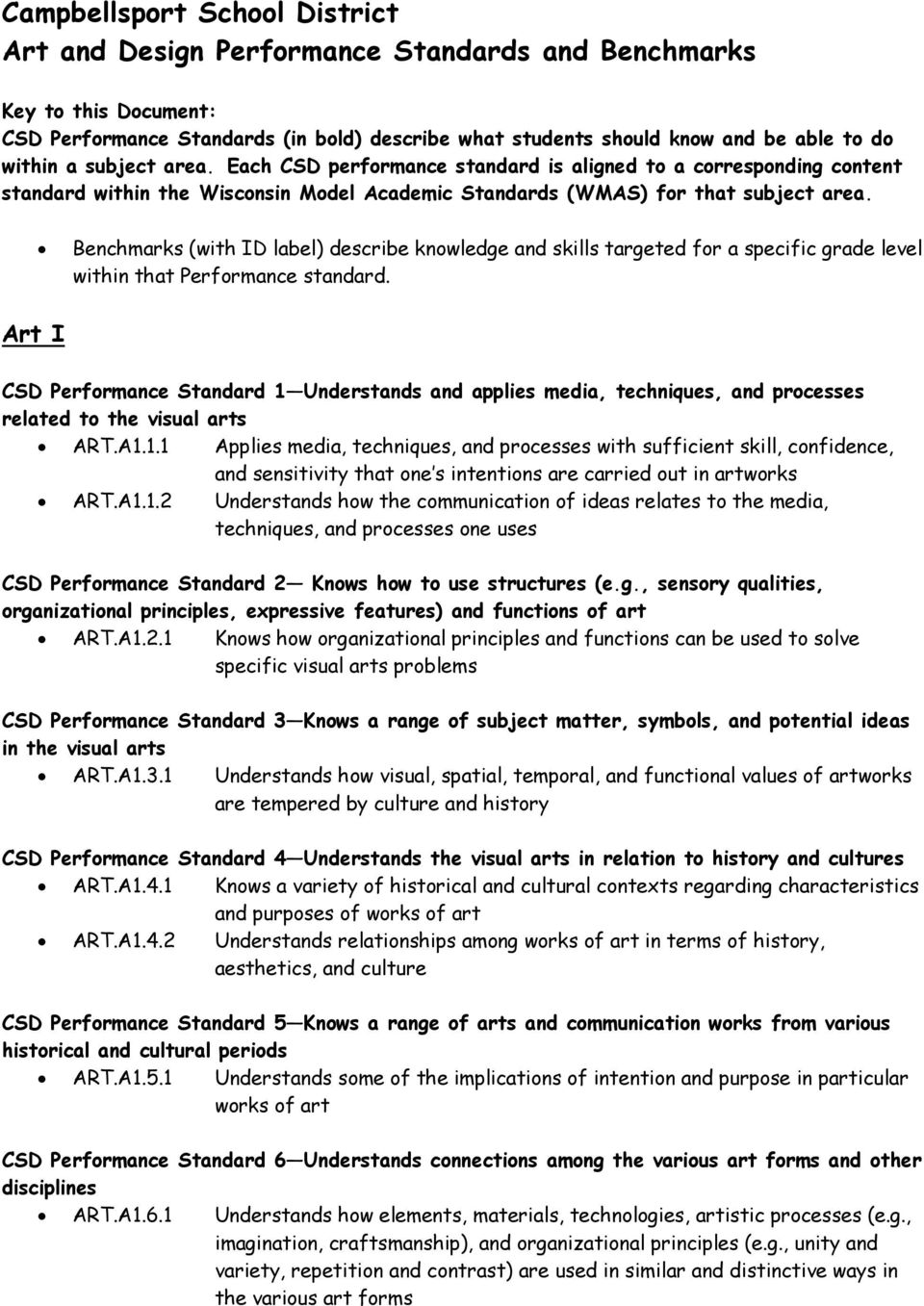
10 Key to this Document: CSD Performance Standards (in bold) describe what students should know and be able to do within a subject area. Each CSD performance standard is aligned to a corresponding content standard within the Wisconsin Model Academic Standards (WMAS) for that subject area. Benchmarks (with ID label) describe knowledge and skills targeted for a specific grade level within that Performance standard. Art I CSD Performance Standard 1 Understands and applies media, techniques, and processes related to the visual arts ART.A1.1.1 Applies media, techniques, and processes with sufficient skill, confidence, and sensitivity that one s intentions are carried out in artworks ART.A1.1.2 Understands how the communication of ideas relates to the media, techniques, and processes one uses CSD Performance Standard 2 Knows how to use structures (e.g., sensory qualities, organizational principles, expressive features) and functions of art ART.A1.2.1 Knows how organizational principles and functions can be used to solve specific visual arts problems CSD Performance Standard 3 Knows a range of subject matter, symbols, and potential ideas in the visual arts ART.A1.3.1 Understands how visual, spatial, temporal, and functional values of artworks are tempered by culture and history CSD Performance Standard 4 Understands the visual arts in relation to history and cultures ART.A1.4.1 Knows a variety of historical and cultural contexts regarding characteristics and purposes of works of art ART.A1.4.2 Understands relationships among works of art in terms of history, aesthetics, and culture CSD Performance Standard 5 Knows a range of arts and communication works from various ART.A1.5.1 Understands some of the implications of intention and purpose in particular works of art CSD Performance Standard 6 Understands connections among the various art forms and other disciplines ART.A1.6.1 Understands how elements, materials, technologies, artistic processes (e.g., imagination, craftsmanship), and organizational principles (e.g., unity and variety, repetition and contrast) are used in similar and distinctive ways in the various art forms
11 CSD Performance Standard 7 Understands the principles, processes, and products associated with arts and communication media Not addressed in Art I CSD Performance Standard 8 Uses critical and creative thinking in various arts and communication settings ART.A1.8.1 Understands how personal experience can influence interpretations of different art forms CSD Performance Standard 9 Knows a range of arts and communication works from various Not addressed in Art I

12 Key to this Document: CSD Performance Standards (in bold) describe what students should know and be able to do within a subject area. Each CSD performance standard is aligned to a corresponding content standard within the Wisconsin Model Academic Standards (WMAS) for that subject area. Benchmarks (with ID label) describe knowledge and skills targeted for a specific grade level within that Performance standard. Art 2D CSD Performance Standard 1 Understands and applies media, techniques, and processes related to the visual arts ART.A2D.1.1 Applies media, techniques, and processes with sufficient skill, confidence, and sensitivity that one s intentions are carried out in artworks ART.A2D.1.2 Understands how the communication of ideas relates to the media, techniques, and processes one uses CSD Performance Standard 2 Knows how to use structures (e.g., sensory qualities, organizational principles, expressive features) and functions of art ART.A2D.2.1 Understands the effectiveness of various artworks in terms of organizational structures and functions ART.A2D.2.2 Knows how organizational principles and functions can be used to solve specific visual arts problems CSD Performance Standard 3 Knows a range of subject matter, symbols, and potential ideas in the visual arts ART.A2D.3.1 Understands how visual, spatial, temporal, and functional values of artworks are tempered by culture and history ART.A2D.3.2 Applies various subjects, symbols, and ideas in one's artworks CSD Performance Standard 4 Understands the visual arts in relation to history and cultures ART.A2D.4.1 Knows how history, culture, and the visual arts can influence each other CSD Performance Standard 5 Knows a range of arts and communication works from various ART.A2D.5.1 Distinguishes among multiple purposes for creating works of art ART.A2D.5.2 Understands how one s own artworks, as well as artworks from various eras and cultures, may elicit a variety of responses ART.A2D.5.3 Understands how various interpretations can be used to understand and evaluate works of visual art

13 CSD Performance Standard 6 Understands connections among the various art forms and other disciplines ART.A2D.6.1 Knows the similarities and differences in the meanings of common terms used in the various arts (e.g., form, line, contrast) ART.A2D.6.2 Knows how various concepts and principles are used in the arts and disciplines outside the arts (e.g., balance, shape, pattern) CSD Performance Standard 7 Understands the principles, processes, and products associated with arts and communication media ART.A2D.7.1 Knows skills and techniques used in the commercial arts (e.g., basic drawings, basic design, lettering, typography, layout and design, mechanics, printmaking, illustration, interior decorating, fashion design and display, photography, sign painting, portfolio, graphic design, technical drawing, screen printing, commercial photography) ART.A2D.7.2 Understands how the elements, materials, technologies, artistic processes (e.g., imagination, craftsmanship) and organizational principles (e.g. unity and variety, repetition and contrast) are used in similar and distinctive ways in various art forms CSD Performance Standard 8 Uses critical and creative thinking in various arts and communication settings ART.A2D.8.1 Understands specific principles and techniques used to solve problems in various art forms (e.g., using the elements of art and principles of design to solve specific art problems; using the design process to address design problems; using the elements of music and theory to resolve problems associated with music composition) ART.A2D.8.2 Uses personal experiences to create original artistic, musical, and dramatic products (e.g., composing music in distinct styles for voice and instruments; improvising harmonizing parts, rhythmic and melodic variation; constructing original scripts; creating different types of visual arts including jewelry, ceramics, sculpture, drawings, and paintings) ART.A2D.8.3 Understands the role of criticism and revision in the arts and communication ART.A2D.8.4 Understands how personal experience can influence interpretations of different art forms

14 CSD Performance Standard 9 Knows a range of arts and communication works from various ART.A2D.9.1 Knows the cultural and historical context of various art forms (e.g., events during the stylistic movements in theatre, including realism, romanticism, absurdism, Greek, Roman, English Renaissance, contemporary, and modern; events from major periods associated with music, including Renaissance, Baroque, Classic, Romantic, contemporary; the role of dance in the development of different cultures) ART.A2D.9.2 Knows the cross-cultural relationships among art objects, motifs, designs, and themes of separate societies (e.g., treatment of similar themes in drama of different genres and styles from various cultures and historical periods) ART.A2D.9.3 Knows art forms that reflect cultural elements of the local community (e.g., folk art, utilitarian objects, community environment (landscape and architecture), works of local professional artists and craftsmen)
15 Key to this Document: CSD Performance Standards (in bold) describe what students should know and be able to do within a subject area. Each CSD performance standard is aligned to a corresponding content standard within the Wisconsin Model Academic Standards (WMAS) for that subject area. Benchmarks (with ID label) describe knowledge and skills targeted for a specific grade level within that Performance standard. Art 3D CSD Performance Standard 1 Understands and applies media, techniques, and processes related to the visual arts ART.A3D.1.1 Applies media, techniques, and processes with sufficient skill, confidence, and sensitivity that one s intentions are carried out in artworks ART.A3D.1.2 Understands how the communication of ideas relates to the media, techniques, and processes one uses CSD Performance Standard 2 Knows how to use structures (e.g., sensory qualities, organizational principles, expressive features) and functions of art ART.A3D.2.1 Understands the effectiveness of various artworks in terms of organizational structures and functions ART.A3D.2.2 Knows how organizational principles and functions can be used to solve specific visual arts problems CSD Performance Standard 3 Knows a range of subject matter, symbols, and potential ideas in the visual arts ART.A3D.3.1 Understands how visual, spatial, temporal, and functional values of artworks are tempered by culture and history ART.A3D.3.2 Applies various subjects, symbols, and ideas in one's artworks CSD Performance Standard 4 Understands the visual arts in relation to history and cultures ART.A3D.4.1 Knows how history, culture, and the visual arts can influence each other CSD Performance Standard 5 Knows a range of arts and communication works from various ART.A3D.5.1 Distinguishes among multiple purposes for creating works of art ART.A3D.5.2 Understands how one s own artworks, as well as artworks from various eras and cultures, may elicit a variety of responses ART.A3D.5.3 Understands how various interpretations can be used to understand and evaluate works of visual art
16 CSD Performance Standard 6 Understands connections among the various art forms and other disciplines ART.A3D.6.1 Knows the similarities and differences in the meanings of common terms used in the various arts (e.g., form, line, contrast) ART.A3D.6.2 Knows how various concepts and principles are used in the arts and disciplines outside the arts (e.g., balance, shape, pattern) CSD Performance Standard 7 Understands the principles, processes, and products associated with arts and communication media ART.A3D.7.1 Knows skills and techniques used in the commercial arts (e.g., basic drawings, basic design, lettering, typography, layout and design, mechanics, printmaking, illustration, interior decorating, fashion design and display, photography, sign painting, portfolio, graphic design, technical drawing, screen printing, commercial photography) ART.A3D.7.2 Understands how the elements, materials, technologies, artistic processes (e.g., imagination, craftsmanship) and organizational principles (e.g. unity and variety, repetition and contrast) are used in similar and distinctive ways in various art forms CSD Performance Standard 8 Uses critical and creative thinking in various arts and communication settings ART.A3D.8.1 Understands specific principles and techniques used to solve problems in various art forms (e.g., using the elements of art and principles of design to solve specific art problems; using the design process to address design problems; using the elements of music and theory to resolve problems associated with music composition) ART.A3D.8.2 Uses personal experiences to create original artistic, musical, and dramatic products (e.g., composing music in distinct styles for voice and instruments; improvising harmonizing parts, rhythmic and melodic variation; constructing original scripts; creating different types of visual arts including jewelry, ceramics, sculpture, drawings, and paintings) ART.A3D.8.3 Understands the role of criticism and revision in the arts and communication ART.A3D.8.4 Understands how personal experience can influence interpretations of different art forms
17 CSD Performance Standard 9 Knows a range of arts and communication works from various ART.A3D.9.1 Knows the cultural and historical context of various art forms (e.g., events during the stylistic movements in theatre, including realism, romanticism, absurdism, Greek, Roman, English Renaissance, contemporary, and modern; events from major periods associated with music, including Renaissance, Baroque, Classic, Romantic, contemporary; the role of dance in the development of different cultures) ART.A3D.9.2 Knows the cross-cultural relationships among art objects, motifs, designs, and themes of separate societies (e.g., treatment of similar themes in drama of different genres and styles from various cultures and historical periods) ART.A3D.9.3 Knows art forms that reflect cultural elements of the local community (e.g., folk art, utilitarian objects, community environment (landscape and architecture), works of local professional artists and craftsmen)

18 Key to this Document: CSD Performance Standards (in bold) describe what students should know and be able to do within a subject area. Each CSD performance standard is aligned to a corresponding content standard within the Wisconsin Model Academic Standards (WMAS) for that subject area. Benchmarks (with ID label) describe knowledge and skills targeted for a specific grade level within that Performance standard. Art IV CSD Performance Standard 1 Understands and applies media, techniques, and processes related to the visual arts ART.A4.1.1 Applies media, techniques, and processes with sufficient skill, confidence, and sensitivity that one s intentions are carried out in artworks ART.A4.1.2 Understands how the communication of ideas relates to the media, techniques, and processes one uses CSD Performance Standard 2 Knows how to use structures (e.g., sensory qualities, organizational principles, expressive features) and functions of art ART.A4.2.1 Understands the effectiveness of various artworks in terms of organizational structures and functions ART.A4.2.2 Knows how organizational principles and functions can be used to solve specific visual arts problems CSD Performance Standard 3 Knows a range of subject matter, symbols, and potential ideas in the visual arts ART.A4.3.1 Understands how visual, spatial, temporal, and functional values of artworks are tempered by culture and history ART.A4.3.2 Applies various subjects, symbols, and ideas in one's artworks CSD Performance Standard 4 Understands the visual arts in relation to history and cultures ART.A4.4.1 Knows how history, culture, and the visual arts can influence each other CSD Performance Standard 5 Knows a range of arts and communication works from various ART.A4.5.1 Distinguishes among multiple purposes for creating works of art ART.A4.5.2 Understands how one s own artworks, as well as artworks from various eras and cultures, may elicit a variety of responses ART.A4.5.3 Understands how various interpretations can be used to understand and evaluate works of visual art
19 CSD Performance Standard 6 Understands connections among the various art forms and other disciplines ART.A4.6.1 Knows the similarities and differences in the meanings of common terms used in the various arts (e.g., form, line, contrast) ART.A4.6.2 Knows how various concepts and principles are used in the arts and disciplines outside the arts (e.g., balance, shape, pattern) CSD Performance Standard 7 Understands the principles, processes, and products associated with arts and communication media ART.A4.7.1 Knows skills and techniques used in the commercial arts (e.g., basic drawings, basic design, lettering, typography, layout and design, mechanics, printmaking, illustration, interior decorating, fashion design and display, photography, sign painting, portfolio, graphic design, technical drawing, screen printing, commercial photography) ART.A4.7.2 Understands how the elements, materials, technologies, artistic processes (e.g., imagination, craftsmanship) and organizational principles (e.g. unity and variety, repetition and contrast) are used in similar and distinctive ways in various art forms CSD Performance Standard 8 Uses critical and creative thinking in various arts and communication settings ART.A4.8.1 Understands specific principles and techniques used to solve problems in various art forms (e.g., using the elements of art and principles of design to solve specific art problems; using the design process to address design problems; using the elements of music and theory to resolve problems associated with music composition) ART.A4.8.2 Uses personal experiences to create original artistic, musical, and dramatic products (e.g., composing music in distinct styles for voice and instruments; improvising harmonizing parts, rhythmic and melodic variation; constructing original scripts; creating different types of visual arts including jewelry, ceramics, sculpture, drawings, and paintings) ART.A4.8.3 Understands the role of criticism and revision in the arts and communication ART.A4.8.4 Understands how personal experience can influence interpretations of different art forms
20 CSD Performance Standard 9 Knows a range of arts and communication works from various ART.A4.9.1 Knows the cultural and historical context of various art forms (e.g., events during the stylistic movements in theatre, including realism, romanticism, absurdism, Greek, Roman, English Renaissance, contemporary, and modern; events from major periods associated with music, including Renaissance, Baroque, Classic, Romantic, contemporary; the role of dance in the development of different cultures) ART.A4.9.2 Knows the cross-cultural relationships among art objects, motifs, designs, and themes of separate societies (e.g., treatment of similar themes in drama of different genres and styles from various cultures and historical periods) ART.A4.9.3 Knows art forms that reflect cultural elements of the local community (e.g., folk art, utilitarian objects, community environment (landscape and architecture), works of local professional artists and craftsmen)
MMSD 6-12 th Grade Level Visual Arts Standards
 MMSD 6-12 th Grade Level Visual Arts Standards The Madison Metropolitan School District does not discriminate in its education programs, related activities (including School-Community Recreation) and employment
PROGRAM FOR LICENSING ASSESSMENTS FOR COLORADO EDUCATORS (PLACE ) OBJECTIVES FIELD 028: ART
 PROGRAM FOR LICENSING ASSESSMENTS FOR COLORADO EDUCATORS (PLACE ) OBJECTIVES Subareas Art Materials and Processes Composition and Unity Art and Culture ART MATERIALS AND PROCESSES Identify techniques,
Chapter 117. Texas Essential Knowledge and Skills for Fine Arts. Subchapter C. High School, Adopted 2013
 High School, Adopted 2013 117.C. Chapter 117. Texas Essential Knowledge and Skills for Fine Arts Subchapter C. High School, Adopted 2013 Statutory Authority: The provisions of this Subchapter C issued
HOWARD COUNTY PUBLIC SCHOOLS MUSIC TECHNOLOGY
 HOWARD COUNTY PUBLIC SCHOOLS MUSIC TECHNOLOGY GOALS AND OBJECTIVES GOAL I: PERCEIVING, PERFORMING, AND RESPONDING: AESTHETICS The student will demonstrate the ability to perceive, perform, and respond
Davis Publications Communicating Through Graphic Design 2010 correlated to Oklahoma s Visual Art Standards High School with Media Arts
 with Media Arts VISUAL ART Standard 1: Language of Visual Art: Presenting The student will identify and communicate using a variety of visual art terms. 1. Compare and contrast works which are similar
Minnesota Academic Standards
 Minnesota Academic Standards Arts K-12 2008 The proposed revised standards in this document were drafted during the 2007-2008 school year. These standards are currently proceeding through the administrative
Mount Laurel Township Schools Visual & Performing Arts Curriculum Grades Pre-K-8. Adopted by the Mount Laurel Board of Education on August 25, 2009
 Mount Laurel Township Schools Visual & Performing Arts Curriculum Grades Pre-K-8 Adopted by the Mount Laurel Board of Education on August 25, 2009 Contents in this Curriculum (Art) Pre-K Curriculum Kindergarten
ACALANES UNION HIGH SCHOOL DISTRICT Adopted: 3/2/05 Visual and Performing Arts Subject Area COURSE TITLE: Digital Design 1
 ACALANES UNION HIGH SCHOOL DISTRICT Adopted: 3/2/05 Visual and Performing Arts Subject Area COURSE TITLE: Digital Design 1 COURSE CODE: V0981e GRADE LEVEL: Grades 9-12 COURSE LENGTH: PREREQUISITE: CREDIT:
APPENDIX: Student Growth Scoring Guide
 TN Fine Arts Growth Measures System APPENDIX: Student Growth Scoring Guide FRAMEWORK The Fine Arts Student Growth Framework has four state standards categories: Perform, Create, Respond, and Connect. These
2012 VISUAL ART STANDARDS GRADES K-1-2
 COGNITIVE & K Critical and Creative Thinking: Students combine and apply artistic and reasoning skills to imagine, create, realize and refine artworks in conventional and innovative ways. The student will
VAPA (Visual Arts) VISUAL ARTS
 VISUAL ARTS VAPA (Visual Arts) ART 1-2 This course will introduce the student to the various ways of producing artistic pieces in the areas of drawing, design, color, painting, three-dimensional, and printmaking.
TExES Art EC 12 (178) Test at a Glance
 TExES Art EC 12 (178) Test at a Glance See the test preparation manual for complete information about the test along with sample questions, study tips and preparation resources. Test Name Art EC 12 Test
The National Arts Education Standards: Curriculum Standards <http://artsedge.kennedy-center.org/teach/standards/standards.cfm>
 Discipline-Based Art Education: Theoretical Curriculum Model Discipline-Based Art Education (DBAE) is an approach to arts education developed and formalized in the early 1980s by the Getty Center for Arts
Course Description Graphic Design Department
 Course Description Graphic Design Department Free drawing : 1021705 / 3 Credit Hours This course introduces the student to basic drawing skills and techniques. The emphasis is on traditional approaches
How To Learn Art At A Junior High
 Summit Public Schools Summit, New Jersey Grade Level 4: Content Area: Visual Arts Curriculum Course Description: The fourth grade visual art curriculum provides experiences for students to explore their
Maryland State Department of Education VISUAL ARTS GLOSSARY
 Maryland State Department of Education VISUAL ARTS GLOSSARY Aesthetic Qualities or experience derived from or based upon the senses and how they are affected or stimulated; from the Greek word meaning
Chapter 117. Texas Essential Knowledge and Skills for Fine Arts. Subchapter E. Middle School, Adopted 2013
 Middle School, Adopted 2013 117.E. Chapter 117. Texas Essential Knowledge and Skills for Fine Arts Subchapter E. Middle School, Adopted 2013 Statutory Authority: The provisions of this Subchapter E issued
Neshannock Township School District Curriculum Overview Computer Graphics Plan Course of Study
 Neshannock Township School District Curriculum Overview Computer Graphics Plan Course of Study Course Objectives: Materials: Knowledge Base: Grading Procedure and Assessments: Curriculum Alignment: Course
Chapter 117. Texas Essential Knowledge and Skills for Fine Arts. Subchapter D. Elementary, Adopted 2013
 Elementary, Adopted 2013 117.D. Chapter 117. Texas Essential Knowledge and Skills for Fine Arts Subchapter D. Elementary, Adopted 2013 Statutory Authority: The provisions of this Subchapter D issued under
THE VISUAL ARTS Head of Department: Dawn Clarke
 THE VISUAL ARTS Head of Department: Dawn Clarke Year 7 VISUAL ARTS - Core Subject One Term This is a general art program where students will explore aspects from the following practical areas; painting,
Master of Arts and Master of Fine Arts Art: M.A., M.F.A.
 Master of Arts and Master of Fine Arts Art: M.A., M.F.A. Program Description The Division of Fine and Performing Arts offers the Master of Arts and Master of Fine Arts degrees in Studio Art. The Master
DRAFT Proposed Revisions Texas Essential Knowledge and Skills (TEKS) Fine Arts, High School Art
 Proposed Revisions Texas Essential Knowledge and Skills (TEKS) Fine Arts, High School Art Prepared by the State Board of Education (SBOE) TEKS Review Committees First Draft, These draft proposed revisions
Contextual Relevancy
 North Carolina s Kindergarten Visual Arts Note on Numbering/Strands: V - Visual Literacy, CX Contextual Relevancy, CR Critical Response Visual Literacy K.V.1 Use the language of visual arts to communicate
appalachian state university bfa graphic design Candidacy Portfolio Review
 portfolio materials» intro. to graphic design all projects & process book» typography i all projects & process book» three drawings» two works from non-graphic design courses (one of which must be 3d)»
VISUAL AND PERFORMING ARTS
 VISUAL AND PERFORMING ARTS Visual Arts In Visual Arts a wide range of coursework is designed to develop an understanding of art, art history, art production, and creative problem solving. The courses are
PRESCHOOL ART EDUCATION PROGRAM
 PRESCHOOL ART EDUCATION PROGRAM PROGRAM RECOMMENDATIONS This program is currently not offered by the art department. It is our recommendation that the following model be adopted and taught by certified
Rhode Island Arts Grade Span Expectations K-12 Visual Arts & Design
 About the Rhode Island K-12 Grade Span Expectations in the Arts Rhode Island Arts Grade Span Expectations K-12 The document, the Rhode Island K-12 Grade Span Expectations in the Arts, has been developed
New Jersey Core Curriculum Content Standards for Visual and Performing Arts INTRODUCTION
 Content Area Standard Strand By the end of grade P 2 New Jersey Core Curriculum Content Standards for Visual and Performing Arts INTRODUCTION Visual and Performing Arts 1.4 Aesthetic Responses & Critique
Bangor School Department Grades 9-Diploma Visual Arts Standards
 Bangor School Department Grades 9-Diploma Visual Arts Standards A. Disciplinary Literacy Visual Arts: Students show literacy in the art discipline by understanding and demonstrating concepts, skills, terminology,
GRADE 5 VISUAL ARTS CURRICULUM GUIDE
 GRADE 5 VISUAL ARTS CURRICULUM GUIDE Seminole County Public Schools Curriculum Services Department 2003 SEMINOLE COUNTY PUBLIC SCHOOLS 400 East Lake Mary Boulevard Sanford, Florida 32773-7127 THE SCHOOL
COURSE TITLE: Elementary Art (Grades 1 5) PREREQUISITE:
 Elementary Art (Grades 1 5) The Loudoun County Public Schools Elementary Art Education Program is a sequential curriculum, developing interaction between each student s creative expressions and their appreciation
ART ART BACHELOR OF ARTS (BA) College of Arts, Letters & Education STUDIO ART MAJOR (75 CREDITS) Student Learning Outcomes students will:
 College of Arts, Letters & Education Greg DuMonthier, Chair 140 Art Bldg. 509.359.2494 BA BAE BFA Minor Faculty: T. Askman, N. Hathaway, B. Miller, E. Nappa, G. DuMonthier. UNDERGRADUATE PROGRAMS The Department
Visual Arts. Madison Public Schools Madison, Connecticut
 Visual Arts Madison Public Schools Madison, Connecticut Dear Interested Reader: The following document is the Madison Public Schools Visual Arts Curriculum Guide If you plan to use the whole or any parts
TAMALPAIS UNION HIGH SCHOOL DISTRICT Larkspur, California. GRAPHIC DESIGN (Beginning)
 TAMALPAIS UNION HIGH SCHOOL DISTRICT Larkspur, California Course of Study GRAPHIC DESIGN (Beginning) I. INTRODUCTION Beginning Graphic Design is a one-semester Fine Arts elective course intended for students
Music Standards of Learning
 Music Standards of Learning for Virginia Public Schools Board of Education Commonwealth of Virginia April 2006 Music Standards of Learning for Virginia Public Schools Adopted in April 2006 by the Board
by Learning Area Achievement Objectives The New Zealand Curriculum Set of 8 charts
 The New Zealand Curriculum Achievement Objectives by Learning Area Set of 8 charts Published for the Ministry of Education by Learning Media Limited, Box 3293, Wellington, New Zealand. www.learningmedia.co.nz
ART A. PROGRAM RATIONALE AND PHILOSOPHY
 ART A. PROGRAM RATIONALE AND PHILOSOPHY Art education is concerned with the organization of visual material. A primary reliance upon visual experience gives an emphasis that sets it apart from the performing
National Standards for Music Education
 National Standards for Music Education 1. Singing, alone and with others, a varied repertoire of music. 2. Performing on instruments, alone and with others, a varied repertoire of music. 3. Improvising
ART. Art. Art Computer Graphic Art Photography
 Art Art Computer Graphic Art Photography 93 CERTIFICATE OF ACHIEVEMENT Computer Graphic Art Certificate of Achievement The program is designed to prepare students for entry level positions in various graphic
WWHS Visual Arts Program Tips
 WWHS Visual Arts Program Tips Visualize a school that has a passion for the arts and the academics and you will see Walt Whitman HS. We offer a wide range of visual art experiences and the Art Department
Standard 1: Learn and develop skills and meet technical demands unique to dance, music, theatre/drama and visual arts.
 ART CONTENT STANDARDS FOR VISUAL ARTS Grades K-5 Note: Each standard requires the application of the elements of art and principles of design. Strand: Visual Arts Standard 1: Learn and develop skills and
2012 Music Standards GRADES K-1-2
 Students will: Personal Choice and Vision: Students construct and solve problems of personal relevance and interest when expressing themselves through A. Demonstrate how musical elements communicate meaning
SCHEME OF SYLLABUS FOR GRAPHIC DESIGN CLASSES XI AND XII
 SCHEME OF SYLLABUS FOR GRAPHIC DESIGN CLASSES XI AND XII INTRODUCTION Graphic design is the creative planning and execution of visual communication. One learns to create a combination of shapes and forms,
VISUAL ARTS VOCABULARY
 VISUAL ARTS VOCABULARY Abstract Artwork in which the subject matter is stated in a brief, simplified manner; little or no attempt is made to represent images realistically, and objects are often simplified
K-12 Visual Arts Unpacked Content
 This document is designed to help North Carolina educators teach the Essential Standards (Standard Course of Study). NCDPI staff are continually updating and improving these tools to better serve teachers.
Optical Illusions/Op Art Pattern Unit Plan 11
 Content Area: VISUAL ARTS MANCHESTER TOWNSHIP SCHOOL DISTRICT CURRICULUM Course Title: Visual Art I Grade Level:9 12 Optical Illusions/Op Art Pattern Unit Plan 11 2 Weeks Date Created: 4/19/12 Board Approved
The Art Institute of Philadelphia Catalog Addendum GAME ART & DESIGN
 The Art Institute of Philadelphia Catalog Addendum GAME ART & DESIGN See AiPrograms.info for program duration, tuition, fees, and other costs, median debt, federal salary data, alumni success, and other
Visual Arts Scope and Sequence
 ART PRODUCTION Visual Arts Scope and Sequence LINE Recognize lines and line characteristics in the environment I R R R Identify and explore tools that make lines (pencils, crayons, markers, paint brushes)
General Music K-2 Primary Elementary Grades
 The following General K-8 alignment with Iowa Core was developed to provide guidance with the 21 st Century Universal Constructs: Critical Thinking, Effective Communication, Creativity, Collaboration,
ART/VCDMA PORTFOLIO TIPS
 ART/VCDMA PORTFOLIO TIPS What is a portfolio? A portfolio represents your skills as an artist, including craftsmanship, technique, creativity, and the ability to communicate visual ideas. High school seniors
How To Learn Art
 Spring 2009 Falmouth Public Schools School: FALMOUTH HIGH SCHOOL Content Area: Visual Art Grade Level: 3-4 WHAT IS IT WE WANT ALL STUDENTS TO KNOW OR BE ABLE TO DO? Description of course The Art Program
Education for the Arts
 Education for the Arts Course Brochure 2013-2014 find your voice. Mission Statement The mission of Education for the Arts is to enhance arts education for all students in Kalamazoo County making dance,
Art-ART (ART) Courses. Colorado State University 1
 Colorado State University 1 Art-ART (ART) Courses ART 100 Introduction to the Visual Arts (GT-AH1) Credits: Exploration of the development of visual arts. Additional Information: Arts & Humanities 3B,
Course Title: Introduction to Video Game Design Board Approval Date: 4/15/13 Credit / Hours: 0.5credit
 Course Title: Introduction to Video Game Design Board Approval Date: 4/15/13 Credit / Hours: 0.5credit Course Description: Introduction to Video Game Design focuses on mastery of the PA Academic Standards
Arts High & Arts Middle School Programs
 MIDDLESEX COUNTY 2015-2016 Class Catalogue & Applications Arts High & Arts Middle School Programs The Award-Winning Arts Education Programs for Gifted and Talented Students Open to Public, Private & Home
INTERIOR DESIGN. Total Credits: 70 Studio Credits: 46 Academic Credits: 24. SEMESTER I Credits: 18 Studio Credits: 12 Academic Credits: 6
 DELAWARE COLLEGE OF ART AND DESIGN 600 N MARKET ST WILMINGTON DELAWARE 19801 302.622.8000 INTERIOR DESIGN Total Credits: 70 Studio Credits: 46 Academic Credits: 24 SEMESTER I Drawing I 3 2D Design I: Black
In Year 9 students must study some subjects (compulsory subjects) and can choose other subjects (optional subjects).
 Year 9 Subject Guide In Year 9 students must study some subjects (compulsory subjects) and can choose other subjects (optional subjects). Compulsory Subjects Students must study English / ESOL (English
Arts High & Arts Middle School Programs
 MIDDLESEX COUNTY 2014-2015 Class Catalogue & Applications Arts High & Arts Middle School Programs The Award-Winning Arts Education Programs for Gifted and Talented Students Open to Public, Private & Home
Overview... 2. Basic Design Studio A (MCD1330)... 3. Visual Arts Studio A (MCD1340)... 3. Drawing A (MCD1270)... 4
 Unit guide Diploma of Art & Design Contents Overview... 2 Basic Design Studio A (MCD1330)... 3 Visual Arts Studio A (MCD1340)... 3 Drawing A (MCD1270)... 4 Art and Design Theory A (MCD1280)... 4 Basic
Keywords for the study of Junior Cert art
 able abstract acrylic activity aesthetic/aesthetics analyze ancient animation applied arch arches architect architectural architecture art art process artist artistic artists arts artwork artworks assemble
Faculty Dr. Arafat Al-Naim, Dr. Rania Fawzi, Dr. Mohamed Galib, Dr. Majed Kamal Eldeen, Dr. Mohamed Sedeeq, Moh d Musa (M.A.)
 Graphic Design Department The Graphic Design Department at Zarqa University is committed to provide a high quality Design education and teaching new media skills. The Department offers a four-year bachelor
A R T D E P A R T M E N T: VISUAL ARTS AND THEATRE
 A R T D E P A R T M E N T: VISUAL ARTS AND THEATRE Welcome to the Monroe-Woodbury High School Visual Arts and Theatre Department. Our program is designed to awaken and unleash creativity. The diverse coursework
Degree Type Bachelor of Fine Arts (BFA) Degree Title Art
 Degree Type Bachelor of Fine Arts (BFA) Degree Title Art Focus: Graphic Design A Bachelor of Fine Arts with Graphic Design Concentration at UTRGV prepares students for serious professional work in the
Art Programs. Art Associate in Arts Degree*
 Art Programs The Art Department offers both an Associate in Arts Degree and Certificates of Achievement programs. Various required and elective courses focus on individual creative development and provide
Art (ART) Contact the Art Department for further information. (760) 744-1150, ext. 2302 Office: D-14
 Architecture-Art ARCH 202 Introduction to Revit Architecture (3) Preparation of basic 3D architectural information models and (BIM). Manipulation for preparation of individual architectural working drawings,
FINE ARTS: ART, DRAMA, MUSIC
 FINE ARTS: ART, DRAMA, MUSIC ART F56150 Introduction to 2-Dimensional Art (1 st Semester Only) 9, 10, 11, 12 F56160 Introduction to 2-Dimensional Art (Any Semester) 9, 10, 11, 12 F56000 Ceramics I 9, 10,
How To Learn To Be A Creative Artist
 Grades 9 12 Visual Arts Introduction Building on the educational outcomes of Visual Arts in elementary and middle school education, high school art prepares students for personal development in the arts,
A-H 106 RENAISSANCE THROUGH MODERN ART. (3) Historical development of Western art and architecture from the fourteenth century through the present.
 101 INTRODUCTION TO VISUAL STUDIES. (3) The course introduces students to the concepts and techniques of visual literacy. It explores a full spectrum of man-made visual forms encountered by contemporary
2003 Mississippi Visual and Performing Arts Framework VISUAL ARTS
 VISUAL ARTS Behind the daily storm of conflict and crisis, the artist continues the quiet work of the centuries, building bridges of experience between peoples, reminding man of the universality of his
Visual and Performing Arts Subject Template (Required Information needed to prepare for course submission)
 Visual and Performing Arts Subject Template (Required Information needed to prepare for course submission) Course Purpose: What is the purpose of this course? Please provide a brief description of the
Wallingford Public Schools - HIGH SCHOOL COURSE OUTLINE
 Wallingford Public Schools - HIGH SCHOOL COURSE OUTLINE Course Title: Art Foundations Course Number: 5213 Department: Art Grade(s): 9-12 Level(s): Academic Credit: 1 Course Description Art Foundations
Prepared by: Stanton Community Schools
 Prepared by: Stanton Community Schools Facilitated by: Michael J. Sieh, Superintendent, Stanton Community Schools Table of Contents ACKNOWLEDGEMENTS... 3 DISTRICT MISSION STATEMENT... 4 GOALS... 4 ART
Garfield Public Schools Fine & Practical Arts Curriculum Intro to Digital Photography and Computer Art
 Garfield Public Schools Fine & Practical Arts Curriculum Intro to Digital Photography and Computer Art (Half-Year) 2.5 Credits Course This is an introductory-level course for the use of digital cameras
HIGH SCHOOL COURSE OUTLINE
 OFFICE OF CURRICULUM, INSTRUCTION AND PROFESSIONAL DEVELOPMENT HIGH SCHOOL COURSE OUTLINE Department Visual/Performing Arts Course Title Digital Art & Imaging Course Code 1046 Grade Level 9-12 Course Length
Paxton-Buckley-Loda Instructional Curriculum Articulation and Alignment
 Paxton-Buckley-Loda Instructional Curriculum Articulation and Alignment Early Elementary Kindergarten through Second Grade Fine Arts State Goal 25: The students will be able to know the language of the
SUN PRAIRIE AREA SCHOOL DISTRICT COURSE POWER STANDARDS. Curriculum Area: Art Course Length: Semester
 SUN PRAIRIE AREA SCHOOL DISTRICT COURSE POWER STANDARDS Course Title: Graphic Design Curriculum Area: Art Course Length: Semester Credit Status: Elective Date submitted: 8/06 Expected Student Results/
Fine Arts at Collin College
 Associate of Arts Degree in Art - 60 Credit Hours Department Chair: Carter Scaggs SCC-A249 972.881.5867 Academic Advisors: John Ciccia SCC-G148 972.881.5563 Torrey West PRC-F132 972.377.1513 The Visual
The Certificate Programs
 The Certificate Programs The Certificate Programs are designed to offer students the opportunity to develop, following a complete learning path, their potential individual creativity, artistic talent and
DIABLO VALLEY COLLEGE CATALOG 2015-2016
 ART ART Michael Almaguer, Dean Applied and Fine Arts Division Business and Foreign Language Building, Room 204 Possible career opportunities Career options include professions engaged in creating works
PROGRAM FOR LICENSING ASSESSMENTS FOR COLORADO EDUCATORS (PLACE ) OBJECTIVES FIELD 030: DRAMA
 PROGRAM FOR LICENSING ASSESSMENTS FOR COLORADO EDUCATORS (PLACE ) OBJECTIVES Subareas History of Theatre and Dramatic Literature Principles of Dramatic Literature and Theatre Theatrical Preparation and
Portfolio Procedures Manual
 CSET California Subject Examinations for Teachers PORTFOLIO REQUIREMENTS Please read carefully Portfolio Procedures Manual ART SUBTEST II IMPORTANT NOTE: Subtest II requires the submission at the test
School District of the Chathams Curriculum Profile
 Program of Study: Fine Arts Course Title: Drawing Grade Level: 9-12 PURPOSE/ COURSE DESCRIPTION School District of the Chathams Curriculum Profile Drawing focuses on black and white or monochromatic rendering
KY Valid Course List
 KY Valid Course List Kentucky Uniform Academic Course Codes 704 KAR 3:540 states the following: Section 1. (1) Local districts and schools shall use uniform academic course codes, listed and described
Studio Art. Introduction and Course Outline
 Studio Art Introduction and Course Outline PACE High School An Independent Ohio Community School Welcome to the Studio Art course. During this semester you will learn to use the basic materials and techniques
Art Programs. Art Associate in Arts Degree
 Art Programs The Art Department offers both an Associate in Arts Degree and Certificates of Achievement programs. Various required and elective courses focus on individual creative development and provide
HACKETTSTOWN, NEW JERSEY. Computer Animation Grades 10-12 CURRICULUM GUIDE FINAL DRAFT. July 2014
 HACKETTSTOWN, NEW JERSEY Computer Animation Grades 10-12 CURRICULUM GUIDE FINAL DRAFT July 2014 Mr. David C. Mango, Superintendent Ms. Nadia Inskeep, Director of Curriculum & Instruction Developed by:
South Brunswick School District
 South Brunswick School District Parent Guide to Visual Arts Curriculum Aligned to NJCCCS: August 2012 District Mission The South Brunswick School District will prepare students to be lifelong learners,
Photography (ART221, 222, 225, 226) Curriculum Guide
 Photography (ART221, 222, 225, 226) Curriculum Guide December, 2014 Visual Arts Curriculum, Instruction, and Assessment 2323 Grand Avenue Des Moines, Iowa 50312 P: 515-242-7619 visualarts.dmschools.org
ART. Degrees Offered. Master's Degree Programs (M.A./M.S.) 176 Art. the following sequences, which have additional specified requirements.
 176 Art ART 119 Center for the Visual Arts, (309) 438-5621 FineArts.IllinoisState.edu/art School Director: Anthony Crowley. Office: 119 Center for the Visual Arts. Graduate Faculty: D. Barroqueiro, W.
Wallingford Public Schools - HIGH SCHOOL COURSE OUTLINE. Department: Art Grade(s): 10-12
 Wallingford Public Schools - HIGH SCHOOL COURSE OUTLINE Course Title: Digital Art Photography Course Number: Department: Art Grade(s): 10-12 Level(s): Academic Credit: ½ Course Description Digital Photography
ADVANCED PLACEMENT ART HISTORY 1: PREHISTORIC GOTHIC
 ART DEPARTMENT Arts & Business, Management Health Engineering/Manufacturing Human Natural Resources Communications Marketing & Technology Science & Industrial Technology Services & Agriscience VPAA Meets
Why is it important to do use your hands and traditional tools to create simple designs before jumping on to the computer?
 Intro to Graphic Design Essential Questions Unit 1: Traditional Tools Why is it important to sketch your ideas away from the computer instead of sketching on the computer and believing your solution is
Roselle Public Schools Visual & Performing Arts Curriculum Units of Study K-12. Unit Length: 2 weeks. New Jersey Core Curriculum Content Standards
 Unit/Chapter Title: Unit 1 Shape Unit Length: 2 weeks Course/Grade: Visual Art Grade 8 Interdisciplinary Connection: Language Arts Unit Overview: In this unit, students will learn how to use highlights
BACHELORS DEGREE PROGRAMMES
 BACHELORS DEGREE PROGRAMMES Bachelor of Fashion and Textiles Design.The programme focuses on the training and developing a creative fashion and textile mind. High levels of practical experience are gained
Responding to Arts Expressions
 Responding to Arts Expressions Supporting Arts Education September 2009 Introduction........................................................................2 Classroom Climate.................................................................2