
Centrally Managed Donor Funds and facilities to promote business engagement
|
|
|
- Ambrose Austin
- 10 years ago
- Views:
Transcription


1 January 2014 Report Centrally Managed Donor Funds and facilities to promote business engagement Alberto Francesco Lemma and Karen Ellis 20 centrally managed bilateral donor funds for business engagement reviewed. Evaluation documents available for 8 funds. Objectives include promotion of general business competitiveness, more targeted inclusive business or CSR models or both. Some European facilities have specific focus on linking domestic companies with business opportunities in developing countries. Three main types of assistance are provided by these funds and facilities: grant (usually matching) funds, technical assistance and partnership broking. Other issues include: target company scale; levels of management decentralisation; integration with wider market interventions Shaping policy for development odi.org
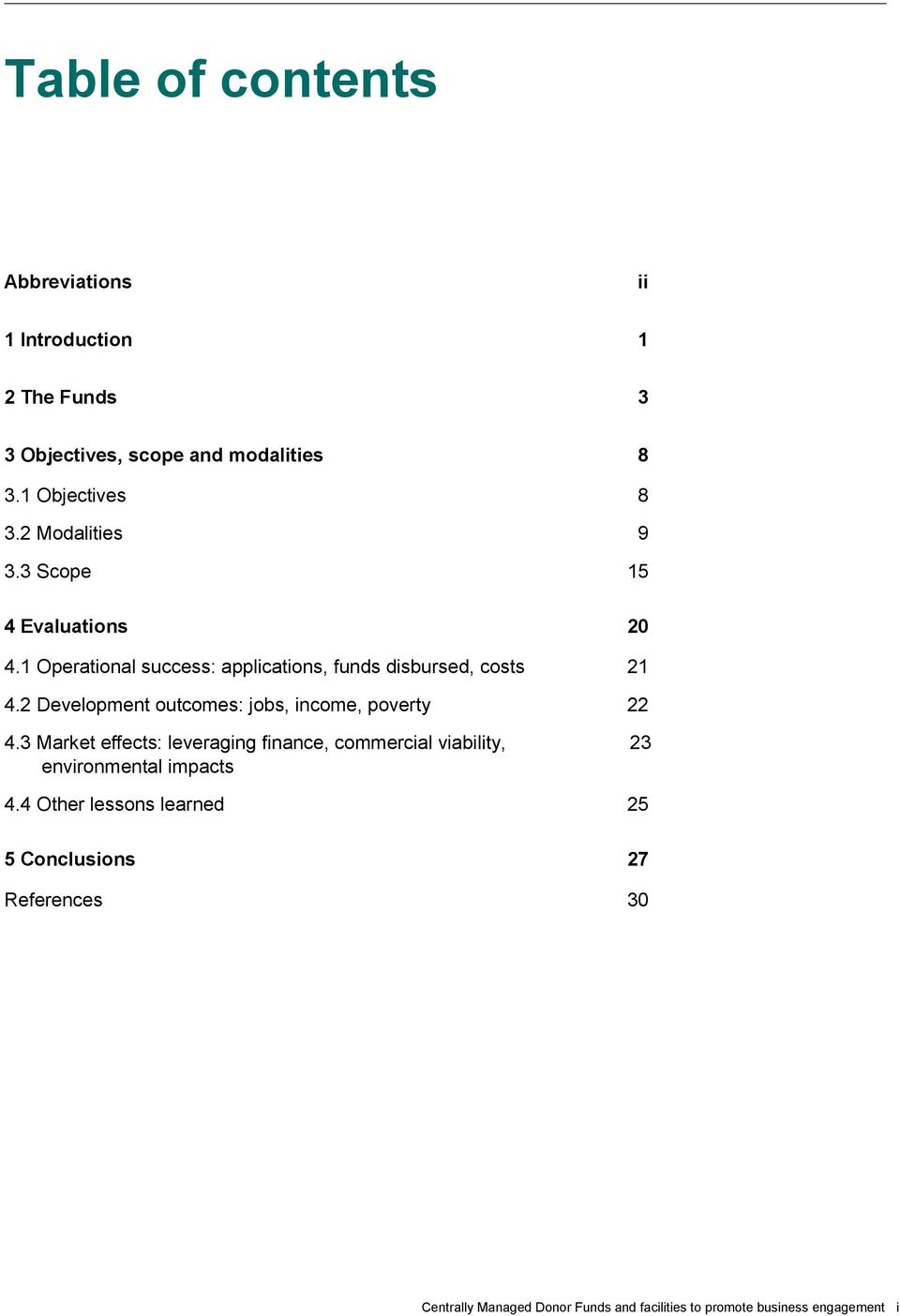
2 Table of contents Abbreviations ii 1 Introduction 1 2 The Funds 3 3 Objectives, scope and modalities Objectives Modalities Scope 15 4 Evaluations Operational success: applications, funds disbursed, costs Development outcomes: jobs, income, poverty Market effects: leveraging finance, commercial viability, 23 environmental impacts 4.4 Other lessons learned 25 5 Conclusions 27 References 30 Centrally Managed Donor Funds and facilities to promote business engagement i
3 Abbreviations ADA AECF AMC AusAid BIF BOP BP BPP BMP BMZ CCPS CMDF CSO CSR DAC DANIDA DCED DCMF DFI DFID EC ECFPSEA EITI EU FRICH GAVI GDA GEC GIZ/GTZ IAP IDA IDH IFC Austrian Development Agency DFID s Africa Enterprise Challenge Fund Advance Market Commitments Australian Agency for International Development Business Innovation Facility Bottom Of the Pyramid Business Partnerships Business Partnership Programme Business Matchmaking Programme German Federal Ministry for Economic Cooperation and Development GIZ s Centre for Cooperation with the Private Sector Centrally Managed Donor Fund Civil Society Organisations Corporate Social Responsibility OCED s Development Co-operation Directorate Danish International Development Agency Donor Committee for Enterprise Development Netherlands MFA Development Cooperation Matchmaking Facility Development Finance Institution The UK s Department for International Development European Commission (of the EU) AusAid s Enterprise Challenge Fund for the Pacific and South East Asia Extractives Industry Transparency Initiative European Union DFID s Food Retail Industry Challenge Fund Global Alliance for Vaccines and Immunisation Global Development Alliance (USAID) DFID s Girl s Education Challenge (Fund) The German Society for International Cooperation SIDA s Innovation Against Poverty Facility World Bank s International Development Association Netherland s Sustainable Trade Initiative International Finance Corporation Centrally Managed Donor Funds and facilities to promote business engagement ii

4 ILO LIC MDG MFA MNE NGO NORAD ODA OECD PPDP PPP PSD PSI RAGS SIDA UN UNGC UNIDO USAID WB International Labour Organisation Low Income Country Millennium Development Goals Netherlands Ministry of Foreign Affairs Multi-National Enterprise Non-Governmental Organisations Norwegian Agency for Development Cooperation Official Development Assistance Organisation for Economic Co-operation and Development SIDA s Public Private Development Partnership (programme) Public-Private Partnership Private Sector Development MFA s Private Sector Initiative DFID s Responsible and Accountable Garment Sector Challenge Fund Swedish International Development Cooperation Agency United Nations UN Global Compact UN Industrial Development Organisation United States Agency for International Development World Bank Centrally Managed Donor Funds and facilities to promote business engagement iii

5 1 Introduction The potential benefit of engaging with business in order to achieve development objectives has long been recognised by donor organisations. It is an issue being given particular emphasis now by many donors, as a result of changing consensus on the effectiveness of different aid delivery mechanisms, as well as overall government budgetary constraints. The reasons that donors have sought to engage with business were summarised in a previous ODI paper (Smith, 2013) as follows: Business activities already impinge hugely and unavoidably on poor peoples lives in both positive and negative ways. Not engaging with business clearly reduces the scope and efficacy of donor efforts to tackle poverty. Donors may try to influence business to modify their activities both to mitigate negative impacts and to accentuate positive impacts on the development outcomes that donors seek to bring about. Multi-national companies in particular, may also enjoy a scale and reach which can be leveraged to carry out activities or provide products which can impact a very large number of people. Particularly in an environment of increasing constraints on public development assistance, there is an increasing awareness that private sector capital may be mobilised for investment to achieve development aims. This capital may be broadly philanthropic - funds allocated to meet corporate social responsibility objectives, or may be a firm s core business capital. Private sector financial resources dwarf sources of development assistance and significant opportunities exist to leverage how private capital is invested to optimise development impact. Due to the discipline of competing in the market, it is recognised that valuable resources have been developed within the private sector in terms of management expertise and processes to improve operational efficiency. Donors may seek to harness these strengths by engaging with business, or encourage public and civil society organisations to learn from, or adopt, such practices. Businesses often develop, own or sell specialised technology which can make a vital contribution to development and which is not available elsewhere e.g. pharmaceutical companies vaccine research and development, or private sector computerised mapping technology that may be vital to disaster risk reduction efforts. The business community inevitably plays some role in national and local governance and has a political significance that donors may seek to influence or promote as an alternative or independent voice in national debate. Centrally Managed Donor Funds and facilities to promote business engagement 1
6 For public donor organisations that have traditionally provided funding through governments or civil society organisations, the issue of how to introduce the idea and practice of business engagement throughout their organisations but in a way which is sensitive to, and consistent with, decentralised decision making, has proved challenging. One common response has been to launch initiatives managed centrally to promote business engagement usually a fund or facility of some kind. This paper reviews a number of these centrally managed donor funds and facilities (CMDFFs), that are either currently existing or recently closed, and discusses their objectives and modus operandi, as well as lessons learnt in relation to their implementation. The study will focus on facilities that provide grants, technical assistance, information, training, publicity, reputational capital and similar support but will not include facilities offering financial instruments such as debt, equity investment or similar. Section two will describe the funds covered in this review. Section three will analyse the objectives, scope and modalities of these funds and facilities. Section four will examine evidence from available evaluations of these funds, while Section five will discuss some issues that should usefully be considered by donors when thinking about business engagement funds and facilities. Centrally Managed Donor Funds and facilities to promote business engagement 2
7 2 The Funds In this section we provide a brief description of each of the centrally managed donor funds and facilities reviewed for this paper. Austrian Development Agency s (ADA) Business Partnership Programme (BPP) g/austria.html Aims to promote private sector development in developing countries by promoting linkages with businesses in European countries, and providing grants, know-how and contacts. Africa Enterprise Challenge Fund (AECF) Provides match funding grants and interest free loans to businesses who wish to implement innovative, commercially viable projects in Africa, which will have a broad developmental impact on the rural poor. It focuses on agriculture, financial services, renewable energy and technologies for adapting to climate change. AusAid Enterprise Challenge Fund for the Pacific and South-East Asia (ECFPSEA) Provided match funding grants to support projects offering innovative solutions to address market failures and stimulate long-term inclusive pro-poor economic growth. BMZ developpp.de PP/index.html Provides match funding grants to companies operating abroad to support projects which are in line with, and will contribute to the goals of Germany s development policy, and can demonstrate a clear development outcome. EU companies, or developing country companies with a minimum 25% European ownership, are eligible. Compete Carribean Provides technical assistance grants and investment funding to support productive development policies, business climate reforms, clustering initiatives and Small and Medium Size Enterprise (SME) development activities in the Caribbean region. It Centrally Managed Donor Funds and facilities to promote business engagement 3

8 includes components undertaking private sector impact studies and identifying constraints to PSD, as well as an Enterprise Innovation Challenge Fund which provides grant funding to entrepreneurs with innovative project ideas and to clustering initiatives i.e. a group of firms with an innovative business idea which will have direct benefits for all parties involved. DANIDA Business Partnerships Provides financial support for the preparation and implementation of commercially oriented partnerships between Danish companies and local partners, including companies, civil society organisations or local authorities, in order to mitigate some of the risks inherent to the pursuit of new business opportunities in developing countries. Danida Business Partnerships focuses on transfer of knowhow and technology from Danish companies to local partners. It aims to promote jobs, competitiveness and improved CSR in developing countries, and help Danish companies to engage in new markets, achieving cost savings and improved access to raw materials. DFID s Responsible & Accountable Garment Sector Challenge Fund (RAGS) Provides grants on a match funding basis to companies, non-governmental organisation (NGOs) and/or trade unions that commit to demonstrating sustainable improvements in the working conditions of garment workers in countries in Asia and Sub-Saharan Africa supplying the UK market. The objective of the project is to make responsible and ethical production the norm in the garment manufacturing sector supplying the UK. DFID Business Innovation Facility (BIF): Promotes the development and uptake of inclusive business models by companies in developing countries, by providing advisory support (e.g. on business planning, value chain analysis etc.), facilitation, brokering partnerships, signposting to other sources of support, and sharing the cost of consultancy support. It also runs a practitioner hub which is aimed at facilitating knowledge flows between its members. DFID Food Retail Industry Challenge Fund: Aims to connect African food producers to European markets, and increase European imports of Africa food products. It provides grants to businesses to support new ideas that connect African farmers with global retailers through innovative business partnerships. It helps to remove blockages to market access and raise awareness amongst European consumers about the positive development impact of their purchases. FinnPartnership: Centrally Managed Donor Funds and facilities to promote business engagement 4

9 The programme provides financial support to Finnish companies and other organisations for the planning, development and training components of projects that are aimed at establishing commercial activities in developing countries or projects that aim to increase imports of products from developing countries, and promote positive development impacts. GIZ Center for Cooperation with the Private Sector (CCPS) Supports corporate social responsibility (CSR) initiatives (designed to improve the socioeconomic and environmental outcomes of business activity) led by the private sector in targeted countries, builds the capacity of wider civil society to engage on CSR issues, and convenes business and other stakeholders to promote dialogue and collaboration on CSR issues. It supports concept development and functions as a neutral facilitator, bringing in technical expertise and helping to develop capacity. IDH The Sustainable Trade Initiative (Netherlands) Aims to accelerate and scale-up trade linkages with developing countries by building coalitions of companies, civil society organizations, governments and other stakeholders to promote transformation within particular markets. The prospects for a particular market are first assessed by IDH and existing barriers to development identified, and then private companies and other stakeholders are approached with a view to developing a collaborative programme to address the constraints. Match funding grants can be provided to private partners, with a view to developing innovative strategies and transformative supply chain models that address difficult social and environmental challenges. Dutch Ministry of Foreign Affairs, PPP Facility for Sustainable Entrepreneurship and Food Security Provides match funding grants to support projects which encourage private sector innovation and investment to improve food security. Open to both multi-national and local businesses in 60 developing countries, and also to multi-stakeholder partnership projects. Projects may promote improvements in the investment climate, or overcome specific constraints, and must help improve food production, access to food, and / or the functioning of food markets. Dutch Ministry for Development Cooperation, Private Sector Investment Programme (PSI) Provides match funding grants that support innovative investment projects in developing countries which involve a partnership between a local and foreign firm (not necessarily Dutch) in one of the target countries, and which are expected to result in positive development impacts and further investments after the project has ended. Centrally Managed Donor Funds and facilities to promote business engagement 5

10 Dutch Ministry of Economic Affairs, and Ministry of Foreign Affairs: The Development Cooperation Matchmaking Facility Targets developing country companies who can apply to be put in touch with Dutch businesses, in order to promote joint investments. A challenge fund which supports innovative, commercial business ideas that will benefit the poor, by developing and scaling-up inclusive business models. The Fund aims to help private actors to enter developing markets in a sustainable way, by providing financial support to high risk business ideas that cannot obtain funding elsewhere. SIDA Public-Private Partnership Development Programme (PPPDP) mainid=3487&printfileid=3487&filex= Promotes a method of engagement whereby public and private sectors make a joint investment in a project implemented by a third party (e.g. a local Government ministry or NGO). SIDA provides match funding grants and expertise concerning development cooperation-related issues, but the private partner must drive the project. Larger firms are the target group. The aim is to encourage the private sector to pro-actively create business ventures that improve conditions for people in poverty, by creating new economic opportunities, and promoting the inclusion of the poor in value chains etc. NORAD Application-Based Support for Private Sector Actors Provides grants to businesses to support feasibility studies, pilot testing, and training for local employees, in order to promote private investment and the establishment of new businesses in developing countries. NORAD Business Matchmaking Programme SIDA Innovations Against Poverty (IAP) Matchmaking-Program/#.UtV6kBqYZ88 Aims to establish sustainable and profitable business ventures between Norwegian and developing country companies, and reduce poverty through increased employment and company profits. Norwegian companies are assisted in the process of identifying suitable developing country partners in target countries, funding for travel to visit the potential local partner, feasibility studies, training of local employees, and through support for investment in environmental protection. Centrally Managed Donor Funds and facilities to promote business engagement 6

11 USAID Global Development Alliance A model for promoting public private partnerships which align business interests and capabilities with global development objectives to produce cost-effective, scalable and sustainable programs. The partnerships are co-designed, co-funded and co-managed between the partners so that risks, responsibilities and rewards are equally shared amongst them. There is no standard model for these partnerships, but in developing them, USAID can offer its country presence and relationships with government; technical expertise across industries and sectors; network of development partners; convening and coordinating power to catalyse, promote and facilitate the development of partnerships; funding; and credibility and goodwill. Centrally Managed Donor Funds and facilities to promote business engagement 7

12 3 Objectives, scope and modalities 3.1 Objectives The funds reviewed for this paper aimed at promoting one or more of the following objectives: The development of new businesses in developing countries (e.g. Finnpartnership). New investments by existing businesses (e.g. the Dutch Private Sector Investment Programme). Partnerships between developing and developed country businesses (e.g. DANIDA Business Partnerships). Strengthening trade relationships and opportunities (e.g. IDH Sustainable Trade Initiative). The development and adoption of inclusive business models: those which create jobs for poor people, integrate local farmers and entrepreneurs in international supply chains, or provide goods and services to low-income consumers (e.g. DFID s Business Innovation Facility). Promoting CSR activities that will improve the socioeconomic and environmental impacts of existing business operations (e.g. GIZ Centre for Cooperation with the Private Sector). Innovation to tackle a specific development problem defined by the donor (e.g. the Dutch PPP Facility for Sustainable Entrepreneurship and Food Security). The first four of these encompass more general enterprise development objectives, seeking to create private sector growth and development, trade, job creation and income generation. The final three objectives in this list focus more on influencing the type of growth generated by businesses in order to have a more focused impact on poverty alleviation - through inclusive business models or corporate social responsibility. Promoting more inclusive business models is one way to promote enhanced development impact. This can be through the adaptation of existing business models in ways that enhance development impacts e.g. by using locally sourced products rather than imports as inputs to the production process, thus creating new sources of demand for local suppliers, or by training local staff rather than bringing employees in from abroad. Or it can be through the creation of new products which better meet the needs of poor consumers. The cost implications and commercial Centrally Managed Donor Funds and facilities to promote business engagement 8
13 viability of these approaches may be initially unclear, hence the need for donor support for initial testing. Supporting CSR initiatives is an alternative way of encouraging improved development outcomes from existing business activity. While the GIZ CCSCP is the only scheme reviewed which explicitly states its support of CSR initiatives, in practice it is likely that other CMDFFs support CSR activities by businesses. Promoting ethical business practices and good labour standards is a key part of the CSR agenda, thus DFID s RAGS initiative also fits within this category. There are many examples of business CSR activities which are undertaken in partnership with donors, though most of these are not implemented through centrally managed donor programmes specifically. In contrast with inclusive business approaches which focus on improving the development impact of core business activities, CSR activities are considered by many to be somewhat separate from core business activities, being managed out of a separate department within the business, for reputational reasons rather than commercial ones, and thus of less potential impact than efforts to improve the development impact of core business activities. However, GIZ s vision integrates the two more closely, noting that there is often a strong commercial business case for good practice in terms of environmental and socioeconomic outcomes, as it is a key part of a risk management strategy, helping to maintain good labour relations and a licence to operate in the host country, and to secure sustainable sources of supply of raw materials etc. Indeed, as natural resource scarcity increases over time, and the sustainability of business operations also faces increasing scrutiny, the business case for CSR is likely to grow. 3.2 Modalities The types of assistance offered to companies through these centrally managed donor funds can be divided into three broad categories: funding, brokering partnerships, and technical assistance. However, many CMDFFs combine elements from more than one of these categories within the package they offer Funding This can be made available for a wide range of different purposes. Many schemes provide grants to support specific investments by businesses. This is often provided as match funding, requiring an equal contribution by the private company. Some schemes specify what the funding should be used for e.g. feasibility studies or pilot testing of new products, or to pay for consultants or technical assistance. Some fund the exploratory stages of a new partnership between developed and developing country businesses, or fund the training of local employees in developing countries. Some provide funds to support reforms to the investment climate as part of a wider partnership, and some provide funding for activities by third parties, such as NGOs or local government, which will support a particular business partnership project (e.g. SIDA Public-Private Partnership Development Programme). The rationale for funding of particular investments is not always clearly specified, and seems to vary. One possible rationale is that the private sector provides a more efficient delivery mechanism for achieving particular development goals and that by leveraging donor funding through partnership with the private sector, better value for money is being achieved. In that situation, there would be a case to Centrally Managed Donor Funds and facilities to promote business engagement 9
14 provide a subsidy to business activity that will facilitate enhanced development impact and to provide this funding on an ongoing basis. However, for most CMDFFs, the rationale is to provide seed funding to test out a new and innovative business idea, partnership or business model that will, if successful, deliver development gains as well as being commercially viable but which might otherwise be deemed too risky to try by the business itself. This may be due to market failures such as lack of information or capital market failures creating a shortage of finance. Sometimes, though, the rationale is not specified in economic terms by donors. The objective is to share the risks of these innovative projects, with the expectation that funding will not be provided on an ongoing basis. If the approach is proven to be commercially successful, it will continue to be implemented on a commercial basis, without the need for ongoing donor subsidy. CMDFFs that provide funding to share risks SIDA Innovations Against Poverty: The programme focuses on small companies that may have innovative ideas but do not have the resources to act upon them. SIDAs aim is to stimulate development that would not have taken place if left to the private sector alone, due to perceived initial commercial risk or uncertain market opportunities. FinnPartnership: The programme provides financial support for the planning, development and training components of projects that are aimed at establishing commercial activities in developing countries or projects that aim to import products from developing countries. The programme aims to reduce risk by funding initial investment research that may not have been independently undertaken by companies. DFID FRICH: The Food Retail Innovation Challenge Fund provides money to create innovative ways to increase the amount of food exported from Africa into the EU. The fund aims to support new ideas that can help connect African farmers with global retailers as well as remove blocks to market access Compete Caribbean: The challenge fund includes an innovation window which provides financial support to innovative and risky business ideas. Innovative ideas need to have the potential to be commercially sustainable and positively impact livelihoods. In order to ensure that the project is potentially commercially viable by the partner business itself, and to assess the quality of the proposal, most CMDFFs provide only match funding, whereby the private partner is expected to bear a portion of the costs itself (usually a minimum of 50%). CDMFFs are not the only type of donor instrument available for sharing or mitigating risk. Others include loan guarantees or advance market commitments, such as those used by the GAVI alliance to promote research and development of vaccines against diseases prevalent in low income countries. There are also some CMDFFs which provide pure grants that do not require partners to match the funds they provide. Sometimes these are provided in addition to a match funding component, perhaps for a specific activity, such as supporting market research, or scoping out the feasibility of partnership ventures. Centrally Managed Donor Funds and facilities to promote business engagement 10
15 Most CMDFFs which provide funding use a competitive application process, with one or more specific funding windows (timeframes in which the funding applications must be submitted) and with a pre-defined maximum total budget. Selection criteria vary for each fund but usually incorporate an assessment of both the potential development impact and potential commercial viability. Some CMDFFs use a non-competitive process for allocating funding, with decisions dependent on specific eligibility criteria. Table 1: Funding Partnership Programme Maximum Funding % Maximum Funding Amount Notes SIDA IAP 50% 20,000 / 200,000 The facility provides two types of grants: the first is the small grants facility that provides up to 20,000 whilst the second is the large grants facility that provides up to 200,000. The application process for the grants is competitive and grants are awarded to the best business plans that meet IAPs criteria. SIDA PPDP 50% Unspecified It is expected that the majority of funding will be covered by the private sector partners. SIDA funding is meant to be additional to the business venture and have clear benefits for poor people. BMZ DeveloPPP 50% Unspecified Private and public contributions need to be complementary. Funding is only available where the private sector partner would not have otherwise carried out the project. DANIDA BPP 50% US$ 800,000 May provide up to US$ 1,960,000 for projects in multiple countries or, exceptionally, for bigger projects. Netherlands MFA - PPP Facility for Sustainable Entrepreneurship and Food Security - 10 million The facility follows a competitive process where companies submit business ideas that will directly improve food security for the poor. Minimum funding starts at 1 million. Netherlands MFA Private Sector Investment Programme 50% 1,5 million The programme acts a co-financier, providing a minimum of 250,000 FinnPartnership 50% 200,000 / 400,000 ADA BPP 50% 200,000 Project support is maintained for up to three years. NORAD Matchmaking 50% / 80% The grant provides up to 80% of project costs for Centrally Managed Donor Funds and facilities to promote business engagement 11

16 Partnership Programme Maximum Funding % Maximum Funding Amount Notes Programme projects that deal with environmental protection. USAID GDA 50% Variable The GDA uses a 1:1 leveraging system, where USAID provides 50% of funding (either in cash or in-kind) for the partnership, it is unclear what the ceiling for funding is (if any exists). Challenge Funds DFID RAGS 50% 250,000 RAGS operate a matching grant system where participating members need to match the grant received by the RAGS fund. Minimum funding is 50,000. DFID AECF 50% US$ 1,500,00 Minimum funding is US$ 250,000. Funding is provided subject to participating companies being able to produce at least 2 years of audited accounts. DFID GEC unspecified 2,000,000 Minimum funding is 250,000. Funding is made available to the most innovative, effective and well evaluated pilot projects. Compete Caribbean 50% US$ 500,000 The challenge fund uses a competitive funding process which provides (non-refundable) grants to winning applicants. The fund offers a minimum of US$ 100,000. Applicant firms must be able to match (applicant firms can also contribute more than the fund s contribution). Projects are implemented by the winning firms and the challenge fund disburses grants as the project achieves pre-arranged milestones. AusAid ECFPSEA 50% AU $ 1.5 million The fund follows a competitive grant allocation process that awards a minimum funding is AU$ 100,000 Pure Grants ADA Partnership Programme - 20,000 Help partners carry out feasability studies for partnership activities DFID Ethiopian Competitveness Facility - $300,000 (maximum) Provides a mixture of grants and matching grants i.e. the facility may provide the majority of funding for any competitveness enhancement activity but it also expects the local partner to contribute a part of the expenses. Centrally Managed Donor Funds and facilities to promote business engagement 12

17 Partnership Programme Maximum Funding % Maximum Funding Amount Notes Netherlands MFA Matchmaking Facility - 5,000 A grant is made available the applicant firm in the host country in order to hire Dutch consultants to help explore and define any cooperation with Dutch companies The inherently risky nature of this approach raises questions about how many projects must turn out to be commercially successful in order for the programme portfolio as a whole to be considered successful, and offering good value for money. If all or most projects turn out to be commercially viable, this perhaps suggests that only projects with a very high probability of success are being selected for funding. This in turn might imply that these projects or investments might have gone ahead anyway without donor funding and that insufficient risks are being taken by the fund. On the other hand, if most projects fail, or wind up after the funding is removed, this is unlikely to be providing good value for money. Getting the balance right is important, but difficult, and must be considered carefully in the design of the programme and assessment criteria applied to funding applicants. The issue is complicated by the fact that this kind of approach is sometimes criticised as using taxpayers money in a way that ends up contributing to business profits rather than helping the poor. Thus it is important to have in place a methodology to assess and demonstrate additionality - that the investment would not have gone ahead without donor funding as well as its development impact. If such funding is succeeding in its goal of helping to identify new products and business models that provide both development gains and commercial viability, it should result in replication by other businesses, and scale-up of the ideas once their viability has been demonstrated. In turn, this should yield the wider, systemic change that is often ultimately sought. However, from the evaluation studies reviewed, there is little evidence of this occurring as yet. Different approaches to the issue of market distortion are observed within different CMDFFs. Some actively aim to improve the commercial effectiveness of their implementing partners, boosting their performance so they can compete more successfully with other market players which arguably constitutes a market distortion. Other CMDFFs however, state specifically that implementing partners should not gain any competitive advantage from the partnership activities e.g. ADA s BPP, SIDA s PPDP and IAP, DFIDs BIF and BMZ s developpp. Thus there seem to be some disagreement, or perhaps confusion, about the issue of market distortion. Those CMDFFs that provide funding to support specific reforms to the investment climate, to assist in the development of a wider business partnership, or that fund activities by third parties such as NGOs or local government, can perhaps be justified relatively more easily. The private sector cannot reasonably be asked to fund these kinds of activities given that the benefits derived may accrue not only to the firm itself but also to its direct competitors. Centrally Managed Donor Funds and facilities to promote business engagement 13
18 3.2.2 Partnership brokering Some donors provide a form of matchmaking facility, or access to an international network of contacts in developing countries which can make connections between potential business partners. Some provide practical (as well as financial) assistance to support the exploratory stages of a potential business partnership (e.g. NORAD s business matchmaking programme). Some promote the transfer of know-how and technology between developed and developing country businesses (e.g. Danida Business Partnerships). Some donors take a more proactive approach to designing programmes, involving, convening and coordinating multiple stakeholders to tackle specific issues that are constraining business activity and private sector development (e.g. IDH Sustainable Trade Initiative). The basic rationale for most matchmaking facilities is the lack of information or contacts, or the cost of obtaining information or contacts, which hampers investment in developing countries by companies in developed countries, or indeed hampers investment by developing countries enterprises seeking developed country investors or trading partners. CDMFs may be involved in the identification of sources of finance for companies and finding potential investors and partners for companies. In some cases, donors ask developed country companies to share their knowledge and expertise by sending over technical experts or carrying out training courses for partners in developing countries. And sometimes donors link developing country companies to other stakeholders, such as research organisations, or universities, to help develop or test new products. Sometimes donors can play a wider, coordinating role, which facilitates a more joined up approach to developing a market. For example, IDH focuses on strengthening agricultural value chains, which involve a number of actors, including private companies, government, market institutions and research institutes, and facilitates collaborating between the various players. Within USAID s GDA initiative, partnerships are brokered partly with the aim of mobilising funds from business to increase the scale or reach of a project or mobilising expertise and human resources from business, to build skills in developing countries, or help implement projects. One of the main aims of the DANIDA BPP is to improve developing country enterprise competitiveness through skills and technology transfers from Danish enterprises Technical assistance Donors offer to provide businesses with a range of different types of assistance and know how. Some donor schemes provide technical know-how, advisory support, (e.g. on business planning, value chain analysis etc.), or access to a network of expert consultants. Some provide technical expertise to support processes of dialogue and collaboration between businesses (in addition to convening that dialogue). Some provide signposting to other sources of support, or facilitate lesson learning and knowledge sharing. Some initiatives build the capacity of wider civil society to engage effectively with business. Some donors offer their presence in developing countries and relationships with government as assets that can help to support a partnership. Some undertake awareness raising activities with consumers (e.g. about certification schemes), or lend profile, credibility and legitimacy to business activities that promote development goals. Centrally Managed Donor Funds and facilities to promote business engagement 14
19 CDMFFs might offer to provide information on the investment climate, and to diagnose any constraints. They might draw on their knowledge of the economic and cultural context, or of market institutions in developing countries, to help inform developed country businesses that may be less familiar with these contexts. They may help companies to develop and implement inclusive business models or CSR initiatives by drawing on their knowledge of development objectives and constraints. For example, SIDA s PPDPP aims to proactively engage the private sector in order to help them commit to investing in developing countries. Programme activities include: pilot projects, technical assistance, training and capacity building, and investments in facilities, such as infrastructure, linked to a business venture. DFID s Business Innovation Facility aims to promote the development and use of inclusive business models by companies in developing countries, and amongst other things provides consultancy services to support business planning and value chain analysis, and runs a practitioner hub aimed at facilitating knowledge flows between its member companies. CDMFFs may also work to build capacity and improve the commercial success of developing country enterprises - where they may lack managerial expertise or entrepreneurial skills for example - in order to promote private sector development and support the creation of livelihoods. 3.3 Scope Some CMDFFs aim to engage or support developing country companies directly, while others are aimed at encouraging or helping companies from developed countries to invest in developing countries. Many are open to companies from either developed or developing countries. Many of them specify that the activities of partner companies should be in line with the donors s development objectives in order for them to be eligible for support, though how this is assessed is not always specified. Most schemes require companies to apply for assistance or funding, from which they select those they will support, often using a competitive process, as discussed above. However, a few, such as IDH s Sustainable Trade Initiative, and USAID s Global Development Alliance, take a more proactive role in identifying and engaging suitable businesses as partners to achieve their development objectives Sector A few CMDFFs target a particular industry or economic sector e.g. DFID s RAGS scheme which targets the garment industry. Others specify a number of sectors that they consider to be priorities e.g. DFID s African Enterprise Challenge Fund, which supports companies involved in agriculture, agribusiness, renewable energy, adaptation to climate change and access to information and financial services. Others are open to applicants from any industry. It seems that CMDFFs that are operated as challenge funds are more likely to have a particular sectoral focus, perhaps because they are by definition aimed at tackling a specific problem or challenge. Centrally Managed Donor Funds and facilities to promote business engagement 15

20 Table 2: Sectoral focus CMDF Specified Sector Focus ADA BPP None AECF None in general but the AECF has opened windows for renewable energy, climate adaptation and agribusiness. AusAid ECFPSEA Projects clustered in Agriculture, Renewable Energy, Financial Services and Tourism BMZ DeveloPPP None Compete Caribbean None DANIDA BPs Limited DFID BIF None DFID RAGS Garment Sector DFID GEC Education DFID FRICH Food production industry Finnpartnership None GIZ CCPS None IDH Agriculture & Tourism NORAD BMP Unknown Netherlands MFA DCMF None UNIDO BP Each BP focuses on a particular Sector SIDA IAP None SIDA PPDP None In some cases, particular sectors are excluded from funding for ethical reasons e.g. SIDA s IAP does not provide money to companies in the arms, tobacco or Centrally Managed Donor Funds and facilities to promote business engagement 16

21 gambling sectors and the AusAid ECFPSEA was closed to alcohol, weapons and tobacco producers Company size and experience Donors are keen that companies have the means and resources to commit for the long term and to continue the activities after the donor exits the partnership. Some funds therefore require business partners to have a strong track record, such as several years of annual accounts that can be scrutinized (e.g. SIDA s PPPDP). Some specify that they are seeking private partners that can commit to long-term projects e.g. ADA s business partnership criteria specific that member organisations need to engage in long-term investments within their partner countries. For similar reasons, some schemes target companies which are large enough to be able to sustain them once the donor cooperation ends. However, other CMDFFs are more willing or indeed specifically aim to support small firms or young firms e.g. Compete Caribbean, ADA s BPP, the Dutch PSI programme etc. Minimum and maximum investment sizes specified for matching grants also help to determine the size of company that is likely to be attracted to a particular scheme, and these vary considerably. Some schemes support individual firms, some support the creation of partnerships between two firms, while others will support groups or clusters of firms that are collaborating to tackle a particular issue. Some support even wider partnerships and collaboration between firms and other stakeholders such as local governments, trade unions and NGOs Geography Country eligibility also varies widely between CMDFFs, with some open to all developing countries and others only open to a limited number of countries. The rationale for this choice may be linked to a donor s particular priority countries, to where donors think they have the necessary presence or expertise to implement CMDFF related activities, or to the particular goals of the CDMFF (e.g. DFID s FRICH is targeted at countries with many poor farmers). Table 3: Target countries Programme Country Coverage ADA BPP All developing countries (Using OECD/DAC categorisation) AECF Anywhere in Africa AusAid ECFPSEA 9 countries in the South-East Asia & Pacific regions BMZ DeveloPPP OECD/DAC countries BMZ Africa Facility Cameroon, Ghana, Kenya, Mozambique, South Africa, Tunisia, Uganda and Zambia Centrally Managed Donor Funds and facilities to promote business engagement 17
22 Compete Carribean Carribean Countries DANIDA BPP Bangladesh, Benin, Bhutan, Bolivia, Burkina Faso, China, Egypt, Ghana, Kenya, Mali, Mozambique, Nepal, Nicaragua, South Africa, Tanzania, Uganda, Vietnam, and Zambia. DFID BIF Bangladesh, India, Malawi, Nigeria and Zambia DFID FRICH Countries North of South Africa and South of the Sahara FinnPartnership OECD/DAC Countries Netherlands MFA PPP Facility 60 middle & low income countries Netherlands MFA PSI Unclear but covers Africa, Asia, Latin America, Middle East and E. Europe Netherlands MFA Matchmaking Facility 40 developing countries NORAD BMP India, Sri Lanka, Vietnam, Bangladesh & South Africa SIDA PPDP SIDA Partner Countries SIDA IAP SIDA Partner Countries Promoting domestic business interests A few donor schemes specifically target their own national businesses, and some have explicit goals that include the promotion of their own national business interests in addition to development goals (e.g. one of the aims of DANIDA Business Partnerships is to help Danish companies to engage in new markets, achieving cost savings and improved access to raw materials). According to Callan & Davies (2013), even those agencies that do not explicitly aim to work with or benefit domestic businesses, tend to more commonly partner with companies that are based in their own country. This may be because they know them better, or are culturally similar, or because proximity helps to reduce communication and transactions costs, or it could be that it enhances the capacity to influence local companies and play to home strengths. This kind of approach can help to promote political palatability in the donor country, where aid is seen to be linked to domestic economic goals. However, this approach can also be seen as distortionary and sub-optimal from an economic viewpoint. Supporting or effectively subsidising engagement with businesses from a particular developed country creates artificial incentives for partnerships with Centrally Managed Donor Funds and facilities to promote business engagement 18
23 those businesses that might not otherwise be the best businesses to work with from the point of view of the developing country. A similar argument is made against tied aid, where donor funding is made contingent on the purchase of the donor country s products or services. This is about promoting developed country exports to developing countries an approach which is discouraged by the OECD Development Assistance Committee and the Paris Declaration on Aid Effectiveness, and which some countries, such as the UK, have ruled out in law. However, it is not clear that any donors are currently aiming to promote their own domestic exports through CMDFFs in quite this way. From this point of view, some CMDFFs are seen as a way to help domestic companies compete, at the national level, for access to contracts and relationships with developing country businesses and to establish a market presence in countries in which fast growth can be expected to generate potentially lucrative new sources of demand in future. The DANIDA Business Partnerships programme comes closest to specifying these kinds of factors as a clear rationale, as mentioned above, although recent speeches in the UK also reflect this kind of sentiment Centrally Managed Donor Funds and facilities to promote business engagement 19
24 4 Evaluations The evaluation reports available for review for this section were as follows: AusAid ECFPSEA Independent Progress Review of 2011 and the Progress Report of 2012 FinnPartnerships s Evaluation Report of 2012 DFID s BIF Strategic Review 2013 ADA BP Evaluation 2009 NORAD Business Related Assistance Evaluation (includes its matchmaking services) of 2010 USAID GDA Evaluation of 2008 Netherlands PSI Evaluation 2009 SIDA IAP Analysis (2013) It was, therefore, possible to review evaluations for slightly more than a third of the CMDFs. Evaluations of the others proved hard to find. Four of the evaluations reviewed have been carried out externally. FinnPartnership s evaluation was carried out by KPGM and the BIF strategic review was carried out by the Springfield Centre, whilst the rest have been carried out by the donor themselves. The limited number of available evaluations and differences in the design of CMDFFs reviewed and evaluation methods adopted make it difficult to generalise results about which approaches work better than others. However, it is possible to build up a broad picture of how evaluations of CMDFFs are being conducted. Most of the evaluations reviewed have shown that the programmes have had positive effects. However, the question arises as to how these evaluations measure success. Three broad types of indicators can be identified: 1. First there are those that measure operational success, such as: The number of applications made (total and successful) to the programme. The amount of funds disbursed by the CMDFF. The cost of running the programme. These types of indicators are likely to be the easiest to collect, but are not good indicators of the overall impact of the programme. 2. Then there are those that look at development outcomes, common indicators including: Centrally Managed Donor Funds and facilities to promote business engagement 20
25 Number of jobs created by the CMDFF activities. Number of poor people which are beneficiaries from the project. Changes in income as a result of the programme. 3. The third type of indicators measure the market effects, or partnership effects e.g. how much private sector activity has been leveraged, or what changes in business behaviour have been achieved. Indicators include: The amount of funds contributed by private partners The commercial viability of the projects implemented The environmental impacts of the projects It is notoriously difficult to produce robust evaluations of donor activities which provide strong evidence of impact, causation and clear attribution to the programme in question. This is perhaps particularly challenging with regard to market related interventions, where the intervention will be affected by market dynamics and thus it is hard to establish a clear counterfactual. Few evaluations attempt to do this thoroughly, given the time and resource costs involved and many rely on anecdotal evidence gleaned from interviews with participating firms and other beneficiaries. Many evaluations are based almost entirely on self-reported project progress reports, with indicators mainly at the level of activities and outputs rather than outcomes or impacts. Assessing systemic or transformational impacts is even more difficult. This is discussed further below. 4.1 Operational success: applications, funds disbursed, costs Most of the CMDFF evaluations give a breakdown on the number of applicants that they have received, often breaking down the types of applicants (i.e. big or small companies), the sectors that they work in and the countries that they operate in (e.g. the IAP (2013), the AusAid ECF and the BIF (2012)). Such reporting is purely informational and the evaluations do not seem to make explicit value judgements based on these factors. Instead value is assessed in terms of the total number of successful applications made to the CMDFF programmes. The issue of high administration and management costs and limited staff capacity appears across multiple evaluation documents. It is clear that CMDFFs for business engagement require quite a high degree of management and administration for a given amount of aid disbursed, relative to other types of spending. This kind of facility is thus sometimes criticised for being an inefficient use of aid money (in contrast to the expectation that it is an effective use of aid funding because it leverages additional private funding). For example, FinnPartnership s evaluation (KPMG, 2011) highlights burdensome administration costs reducing the amount of disbursed grants, stating that costs are relatively high if compared to actual monetary support provided by the programme. There is also sometimes a lack of capacity amongst donor staff to engage effectively with business. Where this slows things down, it can create dissatisfaction and ultimately disengagement among business partners. For example, the Finnpartnership evaluation notes that the facility is short on staff and does not employ permanent staff in the programme. This has meant that there has been a high turnaround of junior Finnpartnership staff. But a lack of donor agency staff with sufficient knowledge to engage effectively with business is a common Centrally Managed Donor Funds and facilities to promote business engagement 21
26 finding more broadly. The ADA evaluation cites the outsourcing of implementation as a key reason for the success of the programme. However, this may be at odds with integration of the programme into the donor s wider development goals. The BIF (2013) evaluation notes that: BIF has increasingly recognised the need for a strategic focus and has started to reflect this in its country operations, responding to the need for consistency with DFID country programmes and the value of strengthened, contextually informed project identification and development. (p.1). The 2013 BIF strategic review states that: BIF's monitoring and results measurement system is exhaustive and of high quality. The consistency and quality (verifiability) of raw data (including baselines) being captured, however, is weak and reliant on data provided by recipients and this undermines the efficacy of those initial results and impact data already generated. This challenge can be expected to increase with respect to long-term transformational impacts beyond individual firms which can be ill-defined and not systematically monitored and/or captured. Significantly less emphasis has been placed on country-level business-to-business and sector-focused lessons and learning outputs that would address more directly the needs of sector/market-level audiences who, arguably, would have more immediate capacity and incentive to drive business model up-take, scale-up and wider market transformation. The prevailing BIF model can and does contribute indirectly to transformational (systemic) change but is neither designed nor equipped to target system change directly and, arguably, by not defining and tracking systemic change goals is not able to credibly attribute to itself changes to which it may have contributed. (p.2). Thus, one of the options put forward for the future of BIF is to: embed BIF 2 as an instrument within a strategic, country-specific intervention framework to strengthen its systemic impact. This model would target sector and/or thematic priorities and be more closely integrated with the wider DFID country programmes. The model implies a more decentralised decision-making structure with the central function focusing on governance and specific learning outputs and exchange. In collaboration with other projects and initiatives, this model would seek to leverage a wider array of instruments and tactics to target and support firmlevel innovation with the potential to stimulate transformational, systemic change. This model offers the greatest potential to leverage BIF in contributing toward lasting, systemic change and from which to generate greatest learning around the wider, systemic constraints facing pro-poor business innovation. The model implies a more decentralised management structure and enhanced level of coordination at country-level. (p.2). 4.2 Development outcomes: jobs, income, poverty Most of the CMDFF evaluations state that they have been effective in creating jobs e.g. the NORAD evaluation (NORAD, 2010) and the AusAid ECFPSEA (both the 2011 and 2012 evaluations) find positive employment effects. How these employment improvements are measured differs. For example, the FinnPartnership evaluation relies on increases in employee numbers as reported by partner companies, whereas the AusAid evaluation (Coffey, 2012) looks at the total number of jobs created by ECFPSEA activities, and the BIF evaluation looks at both reported results and estimated future growth in employment numbers. Centrally Managed Donor Funds and facilities to promote business engagement 22
27 In the Dutch PSI evaluation (2010), indicators of development impact include: job creation, an increase in income, knowledge transfer and establishing linkages with local small and medium-sized companies, contribution to the business climate dialogue, and strengthening of the local private sector. Findings for the success of the project portfolio were as follows: Based on the field study, we estimate that of all projects approved and completed, 57% resulted in a lasting enterprise seven to ten years after the approval date. The surviving companies visited have seen an average increase of 31% in employment after the project completion date. The multiplier for follow-up investment varies between 0 and 20. The effects beyond the individual projects such as SME linkages, catalytic effects on the sector and the contribution to the business climate dialogue were limited. (pp. II). Most CMDFF evaluations state that they have had a positive impact on reducing poverty. ADA s BP evaluation has stated that its value chain strengthening programme has had a strong impact on poverty reduction (but does not explain how this has occurred). The FinnPartnership evaluation states that it has reduced poverty but does not explain how this has been measured. The AusAid ECFPSEA evaluation estimates the number of poor people that it has impacted using a multiplier system. However, the NORAD evaluation (2010) states that there is no clear evidence on how its activities impact poverty due to a lack of evidence on causal linkages. Income effects are also somewhat unclear, with most evaluations relying on information about income changes as reported by partner businesses, and with those evaluations that do discuss income effects claiming a generally positive outcome but not identifying clear causal links. The BIF evaluation looks at the positive effects of BIF activities at the bottom of the pyramid and tries to assess the number of poor people (i.e. consumers) that are affected by its activities (Ashley, 2012). The AusAid ECFPSEA 2012 evaluation also looks at how its processes have increased access to goods and services for the poor. The ECFPSEA, BIF and IAP assessments also consider gender impacts. The evaluations again point to overall positive livelihood benefits but do not necessarily provide much detail on how these results have been measured. 4.3 Market effects: leveraging finance, commercial viability, environmental impacts Most evaluations state that commercial viability of many projects has been positive, though the approach varies according to the evaluation systems. But in most cases no quantifiable evidence is provided demonstrating commercial success. This is perhaps because most evaluations are aggregating results. The 2009 ADA review provides a short description of commercial viability across its portfolio as a whole, rather than showing a breakdown of each project s assessment. Finnpartnership s evaluation states that it has succeeded in reaching its goal of helping participating companies establish sustainable commercial business activities with their developing country partners, and that partners see the programme as an important and complementary instrument for new partnerships in these markets. Statements like these could be based largely on anecdotal evidence gleaned from interviews with participating firms. Centrally Managed Donor Funds and facilities to promote business engagement 23
28 Some CMDFFs measure the amount of private funding that they have leveraged. For example, the IAP evaluation (2013) states that it has provided about 30% of total funds for projects undertaken, with the private sector providing the rest. Others question the amount of private capital that is really put at risk. The BIF evaluation (2013) notes that: The predominance (and nature) of in-kind cost-share arrangements obscure determination of the true level of 'risk' commitment amongst business recipients. The significant number of recipient projects that receive other donor support indicates variable motivations and willingness and/or capacity amongst some beneficiaries to invest in (and thus scale) their own projects. (pp. 1). Measurement and reporting on environmental outcomes seems fairly limited. BIF s reporting on environmental outcomes shows positive results but is mainly based on qualitative assessments rather than physical/quantitative measures. The 2012 AusAid ECFPSEA evaluation takes a more qualitative approach to the environmental benefits of its projects, breaking down the benefits at a project-byproject level and briefly describing what these are. The sustainability of impacts (beyond the life of the project) is hard to assess without ongoing monitoring. However, some of the evaluations have commented on this aspect. For example, the ADA evaluation found that projects relating to supply chain development were more likely to have sustainable, ongoing impacts, than those which involved the provision of consulting services or technical assistance for a particular issue, reflecting the fact that specific, standalone interventions are by themselves unlikely to make a significant difference to generate real change in market outcomes. Multiple barriers need to be tackled in concert to have a real impact. One issue that arose in several evaluations was the need to get the balance right in terms of assessment of development benefits, and commercial viability, of potential projects. The Dutch PSI evaluation (2010) states that the assessment of the development impact was not as rigorous as the assessment of the partners and the business plans, and that development impact could therefore be improved through improved assessment procedures. They also note that: The monitoring of results relies too much on the principle of trust, which is not appropriate when problems arise that affect the key results upon which the payments depend, such as employment and turnover targets. Here we suggest reviewing whether the targets set in the contract reflect the ambitions in the business plans and whether companies receiving subsidies should not be requested to submit an audited account for the final year of the project, so that results can be verified independently. (pp. v). David Elliot s call (Elliot, 2013) for more rigorous evaluation of the impact of Challenge Funds has wider relevance for all centrally managed donor funds. He suggests greater clarity would be helpful in terms of setting out: the rationale of the funds and the barriers which they will address; additionality in terms of grant outcomes; and the impact of challenge fund investments on a company s future attitudes to risk and on the behaviour of other companies in the sector. These issues are summarised as follows: Rationale: confirming that a coherent economic rationale (rather than simply relevance) exists across its many and varied challenge funds. Centrally Managed Donor Funds and facilities to promote business engagement 24
29 Results (output additionality): what these actually are, both during the grant (particularly when the grant is used as a direct transactional subsidy), and beyond the grant. Recurrence (behavioural additionality): were these grants actually transformational in any way, if not, could they be, if used more programmatically, or are they simply a convenient source of one-off grant funding to those well versed in accessing grant funding. 4.4 Other lessons learned Fragmentation across many countries and sectors also has disadvantages. The Finnpartnership evaluation noted that: In 2011 the programme included projects in 62 countries. In 2011 the programme was implemented in 21 sectors, which can also be considered a big number. The small average support sums combined with fragmentation reduces the administrative effectiveness of the programme. It also contributes to the difficulty of measuring the effectiveness of these activities in achieving development impacts. (pp. 5). The Finnpartnership evaluation also noted that: a passive IT based matchmaking service does not provide for an efficient matchmaking process when it is operated as a separate stand-alone tool. Active marketing in the form of business seminars, promotion and use of established contact networks is needed in order to increase the efficiency of the matchmaking process. The Finnpartnership evaluation also derived lessons in terms of the size of target firms required to maximise uptake: An inevitable overall conclusion to be drawn from the evaluation results is that the interest among Finnish companies towards the markets in developing countries is relatively low and the ambition level of their projects could be improved. The program should consider raising the funding percentage of bigger companies with sufficient management, know-how and administrative capacity in order to encourage them to enter the poorest countries and especially Finland s long-term partner countries. (pp. 6). In contrast, the evaluation of the NORAD matchmaking programme suggests a greater degree of success, saying that the scheme had mobilized around 600 Norwegian SMEs to explore business cooperation and investment opportunities in the target countries. The implementing agencies have provided effective services, triggered by an innovative sub-contracting mechanism by Norad using performance-based remuneration. (pp. xix). The NORAD evaluation finds that the application based support programme works well in combination with the matchmaking programme, as the programmes are mutually reinforcing. However, it states that the scheme has: a too liberal policy framework (allowing cases of corporate welfare to occur), partly due to lack of an effective monitoring mechanism by Norad for follow-up on adherence to agreements and assessing development results. (pp. xix). They Centrally Managed Donor Funds and facilities to promote business engagement 25
30 conclude they need to screen applicant firms more carefully, to ensure additionality and weed out those simply aiming to access funds for no additional effort, and to monitor impacts more carefully over time. Similarly, the NORAD evaluation notes that a factor for success has been the provision of a comprehensive package of instruments, from exploration to loans, rather than individual interventions. They also note that: Organizations which are allowed to develop professionalism on its own terms with a limited mandate create value for money in PSD, while fluid administrative structures with a multitude of functions result in less value. (pp. xxi). The NORAD evaluation also notes a lack of systemic impacts and concludes: if Norwegian PSD support is to have a noticeable impact on poverty beyond local communities, it must be much stronger in creating leverage from funds and allow for scaling up. (pp. xxi) and conclude they need to look at different implementation models such as challenge funds to see if they can help achieve wider impacts. Centrally Managed Donor Funds and facilities to promote business engagement 26
31 5 Conclusions In place of drawing more prescriptive conclusions about business engagement donor funds and their design features, the aim of this section is to highlight some of the issues that should be weighed if the establishment or design of a centrally managed fund is under consideration. Promoting competitiveness or inclusive business? The review of various donor-business partnerships has identified two main approaches: commercial enhancement (i.e. creating links, knowledge/technology transfer etc.) and more directive pro-poor business development (i.e. inclusive business models, CSR). Often, both agendas are adopted in tandem within the fund and act as guiding principles e.g. BMZ s DeveloPPP. A few funds focus on one aspect over the other: DFID s Business Innovation Facility, for example, focuses only on inclusive business practices. Promoting both inclusive business practices and commercial effectiveness are not mutually exclusive. In fact, commercial viability is central to any inclusive business. However, it is important to establish clarity on which approaches are adopted and therefore how the fund aims to achieve its objectives. Challenge Fund or more open-ended fund? In terms of objectives and types of assistance provided, there is limited difference between a Challenge Fund and a more open fund or facility for business engagement. The Challenge Fund methodology, however, does provide a structured approach which has advantages in terms of transparency of procedures and criteria and the independence of the selection process. By defining the challenge to be addressed, the methodology also does provide opportunities for a clear presentation of the rationale for the fund and the barriers which the fund will address. As described, above, this level of clarity has not always been achieved in practice but there is, at least, a clear body of lessons learned and best practice that has developed around Challenge Fund methodology upon which donors can easily draw. Centralised or decentralised? Though this is clearly a review of centrally managed business engagement funds, the question arises as to whether such initiatives may be better managed by country offices or whether there is some form of hybrid structure which can combine the benefits of both. Centrally managed funds clearly allow for wider geographical (global) scope, more comprehensive engagement with multinational companies and can be useful in terms of focusing on export markets of developing countries (e.g. through initiatives with Western retail sectors). A number of evaluations, however, have remarked that central management can lead to dilution of impact and difficulties in mobilising management expertise relevant to the varied contexts in which companies operate. The logistical question of how to carry out effective due diligence and monitoring and evaluation on a global scale also has to be addressed. Of the CDMFs that were reviewed, two (the Dutch PSI programme and the Centrally Managed Donor Funds and facilities to promote business engagement 27
32 NORAD BMP) were clearly devolved (i.e. handled by country offices). DFID s Business Innovation Facility is centrally managed but focuses on a limited number of selected countries. In these countries, national field managers play an important role in project identification, due diligence and monitoring. One of the key findings of the BIF evaluation was the critical role of the national field managers and the extent to which the strength of these national operations determined the success or otherwise of BIF implementation on the ground. This is a clear lesson for other centrally managed funds. Should domestic business interests be promoted? A large number of European business engagement funds promote linkages specifically between domestically domiciled companies and companies in developing countries. The rationale is largely to make government spending on overseas development more palatable politically to the domestic electorate and business community. On the positive side, such partnership programmes encourage investment by shouldering risks that domestic companies would not otherwise be prepared to face, especially when investing in what are seen to be new or risky markets. These partnership programmes also tend to target national small and medium enterprises which may not otherwise have the financial capacity to invest in emerging markets. If the fund is focussing on developmental outcomes, however, targeting home companies clearly introduces a distortion that jeopardises effectiveness from an economic perspective. Such targeting creates artificial incentives for partnerships with those businesses that might not otherwise be the best businesses to work with from the point of view of the developing country. Seen purely from the perspective of developing country partners, there is little rationale or benefit from donors engaging exclusively through domestically domiciled companies. Large or small companies? Whilst some CMDFs are focussed on helping SMEs, the majority do not discriminate partners based on their size. Rigorous evidence on the relative effectiveness of engagement with larger or smaller companies is not available. Anecdotal evidence suggests that, in practical terms, larger companies are better equipped, in terms of staff and resources, to engage with donors (write proposals, host due diligence visits, carry out monitoring and evaluation etc.) and also much more likely to be able to make required co-investments from company resources. There are also advantages in terms of reduced transaction costs from the donor when dealing with a smaller number of large companies compared with a larger number of small companies. On other other hand, anecdotal evidence also points to problems in partnership with larger companies that can arise in terms of securing internal buy-in from senior management of the company and the time that this can take. Demonstrating the additionality of donor support may also be more difficult in partnerships with larger companies. Decisionmaking on the size of companies that donor funds target can also coloured by more ideological considerations of the relative development impact of small versus large business. This issue lies outside the scope of this report and will depend very much on perspectives of the donor organisation in question and the sectors in which engagement is sought. It is noticeable, however, from the review of centrally manged funds that, other aspects being equal, preference is usually expressed for engagment with larger scale companies. Centrally Managed Donor Funds and facilities to promote business engagement 28
33 Finance only? Three main types of assistance provided by business engagement funds have been identified in this review: finance, technical assistance and business linkages. Development debates sometimes focus on trying to prioritise needs for finance over knowledge, skills or contacts or the necessity or otherwise of providing a combined package of support to companies. In reality, it is not possible to generalise as the needs of business will vary considerably between sectors, markets and over time. It is important, however, for donor funds to inform decision making on the types and combinations of support to be provided through careful analysis of the nature of constraints faced by businesses in the markets targeted. Integration with wider market issues One of the clear features of the centrally managed donor funds that have been reviewed is their focus on engagement with individual companies but difficulties in integrating these activities with efforts to address wider market issues that may constrain the companies involved: regulation and government policy; land, labour and capital market issues; markets for related services etc. This issue may be reflected in similar difficulties experienced in integrating centrally managed business engagement funds with donors own structures for planning and delivering development programmes in country. This issue has been identified in the review of DFID s Business Innovation Facility. It has led to an attempt to focus the next phase of the facility s activities on particular sectors in which deeper market analysis can be conducted and the range of interventions widened from a focus only on direct engagement with companies towards a wider making markets work for the poor approach. Other donors will also need to consider whether business engagement activities are best contained within a specialist, centrally managed facility, or integrated in a more sector and country specific approach where direct engagement with companies forms part of a wider programme of market intervention. Centrally Managed Donor Funds and facilities to promote business engagement 29
34 References Ashley, C. (2012) Can BIF report jobs and BOP income created per from DFID? If not, why not? Blog Piece at: AusAid (2012) Sustainable Economic Development Private sector development Thematic Strategy August 2012 AusAid, October 2012 Australian Government DFD (2013) Commonwealth GrantGuidelines: Second Edition Financial Management Guidance No. 3, June 2013 BIF (2012) Spotlight on Inclusive Business: What is Inclusive Business?, Business Innovation Facility BMZ (2011) Forms of Development Cooperation Involving the Private sector Callan, M & Davies, R. (2013) When business meets aid: analysing public-private partnerships for international development ANU, Development Policy Centre, Discussion Paper 28, April 2013 Coffey (2012a) Enterprise Challenge Fudn for the Pacific and South East Asia: A Report on the outcomes of the ECF portfolio assessment for 2012 Prepared for AusAid, August 2012 DAI (2008) Evaluating Global Development Alliance: An Analysis of USAIDs Public Private Partnerships for Development DAI for the USAID GDA Office, October, 2010 DFID (2008) Private Sector Development Strategy: Prosperity for all: making markets work. EC (2003) Guidelines for European Commission Support to Private Sector Development Elliot (2013) Exploding the myth of challenge funds a start at least ; Springfield Centre blog. Estrup, J. (2009) Aid, Paris and the Private Sector: How to Square the Circle DIIS Working Paper 2009:17 Heinrich, M. (2012) Partnerships and Inclusive Business An Overview of Current Work of DCED Member Agencies Originally compiled in 2010 and updated in 2012 Heinrich, M. (2013) Donor Partnerships with Business for Private Sector Development: What Can We Learn from Experience? DCED, March 2013 IDH (2013) IDG International Corporate Responsibility Policy, January 2013 Karamchandani, A. & Koh, H. (2013) Goods, Services and Jobs for the Poor in Enterprising Solutions: The Role of the Private Sector in Eradicating Global Poverty The 2013 Brookings Blum Roundtable Policy Briefs Centrally Managed Donor Funds and facilities to promote business engagement 30
35 Kindornay, S. Higgins, K. & Olender, M. (2013) Models for Trade-Related Private Sector Partnerships for Development North-South Institute 2013 Kindornay, S. & Reilly-King, F. (2013) Investing in the Business of Development: Bilateral Donor Approaches to Engaging the Private Sector North-South Institute 2013 KPMG (2012) Evaluation of the Finnpartnership Programme KPMG for the Ministry of Foreign Affairs of Finland, October 2012 Lemma, A. (2013) Low Carbon Equals Low Cost? The Case of Kenya and Cambodia ODI Opinion, March 2013 Nelson, J (2010) The Private Sector and Aid Effectiveness: Towards New Models of Engagement The 2010 Brookings Blum Roundtable Policy Briefs NORAD (2010) Evaluation of Norwegian Business-Related Assistance Main Report Devfin Advisers AV, May 2010 NSI (2013) Investing in the Business of Development: Bilateral Donor Approaches to engaging the Private Sector North South Institute and CCIC, 2013 Oakeley, R. Stewart, T. & Taylor, B. (2013) Report on the Strategic Review of the Business Innovation Facility (BIF) Operating Model for Delivering Market System Change The Springfield Centre, March 2013 Ryan, M. Richardson, S. & Voutier, P. (2012) Business in Development Study 2012 Accenture, September 2012 SIDA (2012) SIDA s Business for Development Program Update January 2012 SIDA (2012a) SIDA IAP Factsheet SIDA (2013) Public Private Development Partnerships: Collaboration with the Private Sector, SIDA SIDA (2013a) Innovations Against Poverty Analysis of Cycle 3 February 2013 Smith, W (2013) How Donors Engage with Business ODI Report, July 2013 Stuart, J.B. Walker, J.T. Minzner, A. (2011) A Critical review of Partnership Capacity and Effectiveness: Moving from theory to Evidence Abt Associates, December 2011 TFBV (2010) Evaluation PSOM/PSI and MMF Triodos Facet BV for the Netherlands Ministry of Foreign Affairs DDE, July 2010 TLC (2011) Enterprise Challenge Fund for the Pacific and South-East Asia (ECF) Independent Progress Report Triple Line Consulting for AusAid, November 2011 World Bank (2002) Private Sector Development Strategy Directions for the World Bank Group WTO (2006) World Trade Report 2006 World Trade Organisation Centrally Managed Donor Funds and facilities to promote business engagement 31
36 ODI is the UK s leading independent think tank on international development and humanitarian issues. Our mission is to inspire and inform policy and practice which lead to the reduction of poverty, the alleviation of suffering and the achievement of sustainable livelihoods. We do this by locking together high-quality applied research, practical policy advice and policyfocused dissemination and debate. We work with partners in the public and private sectors, in both developing and developed countries. Readers are encouraged to reproduce material from ODI Reports for their own publications, as long as they are not being sold commercially. As copyright holder, ODI requests due acknowledgement and a copy of the publication. For online use, we ask readers to link to the original resource on the ODI website. The views presented in this paper are those of the author(s) and do not necessarily represent the views of ODI. Overseas Development Institute This work is licensed under a Creative Commons Attribution-NonCommercial Licence (CC BY-NC 3.0). ISSN: Overseas Development Institute 203 Blackfriars Road London SE1 8NJ Tel +44 (0) Fax +44 (0)
Challenge funds as private sector development tools: progress and potential 1
 Challenge funds as private sector development tools: progress and potential 1 In recent years, challenge funds have emerged as an innovative way to engage the private sector to promote pro-poor economic
The BMZ initiative for an International Tax Compact. Keynote speech, held at the International Tax Compact Workshop (Brussels, 25-26 January 2010)
 Dr. Ulla Mikota Deputy Director General German Federal Ministry for Economic Cooperation and Development (BMZ) The BMZ initiative for an International Tax Compact Keynote speech, held at the International
ETI PERSPECTIVE 2020: A FIVE YEAR STRATEGY
 ETI PERSPECTIVE 2020: A FIVE YEAR STRATEGY Introduction This document is the final and Board approved version of ETI s strategic directions based on the ETI Board meeting discussion of 12 th March 2015.
A proposal for measures under Norwegian foreign and international development policy to combat the global health workforce crisis
 A proposal for measures under Norwegian foreign and international development policy to combat the global health workforce crisis Report by the workgroup headed by the Ministry of Foreign Affairs, with
A COLLABORATIVE FRAMEWORK FOR GUIDING POST-MFA ACTIONS. MFA Forum
 FOR GUIDING POST-MFA ACTIONS MFA Forum March 2005 CONTENTS The Context... 1 The MFA Forum... 1 The Need for Action... 2 Shared Responsibilities... 3 Overarching Principles... 5 The Roles of Individual
G20 DEVELOPMENT WORKING GROUP G20 INCLUSIVE BUSINESS FRAMEWORK
 G20 DEVELOPMENT WORKING GROUP G20 INCLUSIVE BUSINESS FRAMEWORK G20 INCLUSIVE BUSINESS FRAMEWORK A framework that defines inclusive business, sets out recommendations to enable inclusive business, and proposes
THE MASTERCARD FOUNDATION: RURAL AND AGRICULTURAL FINANCE STRATEGY
 THE MASTERCARD FOUNDATION: RURAL AND AGRICULTURAL FINANCE STRATEGY SEPTEMBER 2015 The MasterCard Foundation works with visionary organizations to provide greater access to education, skills training and
Session 6: Budget Support
 Session 6: Budget Support Paper 6.1 - Introductory Paper on Budget Support [1] Introduction Budget support has become an increasingly important instrument of development assistance. It has not only received
The Education for All Fast Track Initiative
 The Education for All Fast Track Initiative Desmond Bermingham Introduction The Education for All Fast Track Initiative (FTI) is a global partnership to help low income countries to achieve the education
THE PRIVATE INFRASTRUCTURE DEVELOPMENT GROUP TECHNICAL ASSISTANCE FACILITY STATEMENT OF POLICIES AND PROCEDURES. Amended July 2008
 THE PRIVATE INFRASTRUCTURE DEVELOPMENT GROUP TECHNICAL ASSISTANCE FACILITY STATEMENT OF POLICIES AND PROCEDURES Amended July 2008 1. Introduction 1.1 By an exchange of letters dated December 2001 and January
The Ministry of Economic Affairs chairs the National Contact Point (NCP). Chairman and board: Advisory members NCP Secretariat:
 National Contact Point, The Netherlands Annual Report 2008 (June 2007- May 2008) Institutional Arrangements The Ministry of Economic Affairs chairs the National Contact Point (NCP). Ministry of Economic
British Council Zambia Shaping our Future Conference (26 & 27 March 2013) Ways of Growing SME Innovation and Finance
 British Council Zambia Shaping our Future Conference (26 & 27 March 2013) Ways of Growing SME Innovation and Finance Presenter: Mr.Trevor Simumba, MD Sub-Saharan Consulting Group Zambia Limited Sub-Saharan
Supporting Governments in Improving Access through Health Financing: Policy Perspectives of GIZ & the Framework of Providing for Health (P4H)
 Supporting Governments in Improving Access through Health Financing: Policy Perspectives of GIZ & the Framework of Providing for Health (P4H) Jenni Kehler GIZ Deutsche Gesellschaft für Internationale Zusammenarbeit
EU support for climate training in LDCs: some examples
 EU support for climate training in LDCs: some examples Tony Carritt, EU Art 6 Focal Point First Article 6 Dialogue Bonn, 10-11 June 2013 EU support in context EU is leading provider of official development
E: Business support and access to finance
 E: Business support and access to finance 41 The North East Local Enterprise Partnership area benefits from a committed workforce, a good business environment and a competitive cost base. However, the
Reducing Poverty, Improving Lives
 Reducing Poverty, Improving Lives Better Education for Children in Africa: IFC s Unique Combination of Investment and Advisory Services Shows Results The demand for education services is rising at a faster
DEVELOPING WORLD HEALTH PARTNERSHIPS DIRECTORY
 DEVELOPING WORLD HEALTH PARTNERSHIPS DIRECTORY OVER 250 HEALTH PARTNERSHIPS THAT MAKE A DIFFERENCE TO PEOPLE S LIVES The global health community needs to overcome both new and current challenges in the
GLOBAL ALLIANCE FOR CLIMATE-SMART AGRICULTURE (GACSA)
 GLOBAL ALLIANCE FOR CLIMATE-SMART AGRICULTURE (GACSA) FRAMEWORK DOCUMENT Version 01 :: 1 September 2014 I Vision 1. In today s world there is enough food produced for all to be well-fed, but one person
ACCESS TO FINANCE RWANDA (AFR)
 ACCESS TO FINANCE RWANDA (AFR) RECRUITMENT OF A TECHNICAL DIRECTOR - (Re- Advertised) 1. BACKGROUND Over the past ten years the UK s Department for International Development (DFID) has worked with other
Grants and Business Opportunities for Renewable Energy & Energy Efficiency Projects
 Grants and Business Opportunities for Renewable Energy & Energy Efficiency Projects Fred Eklund, Portfolio Manager EEP S&EA in brief The overall objective of the Programme is to reduce poverty through
A review of social protection experiences in Africa Draft paper by G. Mutangadura
 A review of social protection experiences in Africa Draft paper by G. Mutangadura Introduction Social protection has been defined by the UN in 2001 to be The set of public and private policies and programmes
Section 8 Funding Options and Support Services
 Resources are not unlimited and it is therefore extremely important that the resources be spent on the most important projects. Prioritising projects makes implementation easier as it is possible to start
How to Design and Update School Feeding Programs
 CHAPTER 7 How to Design and Update School Feeding Programs Previous chapters highlight the need to improve the design of new school feeding programs and to revisit existing programs with a view toward
This note provides additional information to understand the Debt Relief statistics reported in the GPEX Tables.
 Technical Note 3 Debt Relief This note provides additional information to understand the Debt Relief statistics reported in the GPEX Tables. Introduction 1. Debt is a major development issue. There is
FAST FACTS Realizing Africa s Wealth - Building Inclusive Businesses for Shared Prosperity
 FAST FACTS Realizing Africa s Wealth - Building Inclusive Businesses for Shared Prosperity Inclusive business creates profits and unleashes potential Sub-Saharan Africa has a total population of about
GOVERNANCE AND CIVIL SOCIETY
 PARTNERS FOR CHANGE GOVERNANCE AND CIVIL SOCIETY SUB-SAHARAN AFRICA PARTNERS FOR CHANGE GOVERNANCE AND CIVIL SOCIETY PARTNERS FOR CHANGE The British Council is committed to building engagement and trust
The Best Available Charitable Option
 Acumen Fund Concepts The Best Available Charitable Option Acumen Fund Metrics Team January 2007 Measuring Social Returns Social venture investing, 1 almost by definition, believes that there have to be
Ministerie van Toerisme, Economische Zaken, Verkeer en Telecommunicatie Ministry of Tourism, Economic Affairs, Transport and Telecommunication
 SME Policy Framework for St. Maarten May, 2014 Department of Economic Affairs, Transportation & P. 1 of 16 TABLE OF CONTENTS 1. Introduction 2. SME Developments in St. Maarten 2.1 Definition 2.2 Government
Progress report: Artisanal and Small-scale Mining over the last 10 years. Presented by Assheton Stewart Carter SVP Global Engagement Pact
 Progress report: Artisanal and Small-scale Mining over the last 10 years Presented by Assheton Stewart Carter SVP Global Engagement Pact Objectives To give a sense of where progress has been made in the
TAXATION AND AID FOR DOMESTIC RESOURCE MOBILIZATION (D.R.M.) AID: HELPING OR HARMING DOMESTIC RESOURCE MOBILIZATION IN AFRICA
 TAXATION AND AID FOR DOMESTIC RESOURCE MOBILIZATION (D.R.M.) AID: HELPING OR HARMING DOMESTIC RESOURCE MOBILIZATION IN AFRICA My presentation deals with i. Definition and Importance of Domestic Resource
The future agenda for development cooperation: voices of Dutch society
 The future agenda for development cooperation: voices of Dutch society Contribution prepared for the High Level Panel on the Post 2015 development agenda - March 2013 Prepared by NCDO, in cooperation with
Effective Debt Management. Improving Debt Management Practices Worldwide
 Effective Debt Management Improving Debt Management Practices Worldwide Effective debt management is essential for economic development. As countries develop they confront increasing challenges in managing
STRATEGIC POLICY FORUM ON DIGITAL ENTREPRENEURSHIP. Fuelling Digital Entrepreneurship in Europe. Background paper
 EUROPEAN COMMISSION ENTERPRISE AND INDUSTRY DIRECTORATE-GENERAL Service Industries Key Enabling Technologies and Digital Economy Introduction STRATEGIC POLICY FORUM ON DIGITAL ENTREPRENEURSHIP Fuelling
VALUE CHAIN DEVELOPMENT Training activities & Tools
 VALUE CHAIN DEVELOPMENT Training activities & Tools VALUE CHAIN DEVELOPMENT Overview The question is thus not if, but how to integrate in value chains in a way that allows for incorporation of a growing
THE CLIMATE TECHNOLOGY PROGRAM Accelerating Climate Innovation in Developing Countries
 THE CLIMATE TECHNOLOGY PROGRAM Accelerating Climate Innovation in Developing Countries The key to solving the problem of climate change will be innovation Bill Gates Climate Innovation Centers will help
A Three Year Investigation into the Triple Bottom Line Performance of Small and Micro Social and Environmental Enterprises in Developing Countries
 A Three Year Investigation into the Triple Bottom Line Performance of Small and Micro Social and Environmental Enterprises in Developing Countries Synopsis Prepared for the SEED Initiative by: Heather
Building Partnerships for Aid Effectiveness. 1. Introduction
 Building Partnerships for Aid Effectiveness 1. Introduction I would like to begin by expressing my gratitude to the Ugandan National Academy of Sciences for according me the honour of addressing this important
Country Ownership of Policy Reforms and Aid Effectiveness: The Challenge of Enhancing the Policy Space for Developing Countries in Aid Relationships
 Country Ownership of Policy Reforms and Aid Effectiveness: The Challenge of Enhancing the Policy Space for Developing Countries in Aid Relationships Statement by Louis Kasekende, Chief Economist, African
Having undertaken a general discussion on the basis of Report IV, Small and medium-sized enterprises and decent and productive employment creation,
 International Labour Conference Provisional Record 104th Session, Geneva, June 2015 11-1 Fourth item on the agenda: Small and medium-sized enterprises and decent and productive employment creation Reports
new challenges and how its delivery can be improved in order to maximise its impact in the future.
 Contribution of the Kent, Greater Essex and East Sussex Local Enterprise Partnership to the consultation on the conclusions of the Fifth Cohesion Report on Economic, social and territorial cohesion: the
igd IMPACT PRACTICAL, BUSINESS-DRIVEN IMPACT MEASUREMENT AGRIBUSINESS // 2014
 igd IMPACT PRACTICAL, BUSINESS-DRIVEN IMPACT MEASUREMENT AGRIBUSINESS // 2014 igdimpact SECTOR FRAMEWORK igdimpact igdimpact is the Initiative for Global Development s (IGD) practical, business-oriented
PLAN OF ACTION PARTNERSHIP FOR SUSTAINABLE TEXTILES
 PLAN OF ACTION PARTNERSHIP FOR SUSTAINABLE TEXTILES CONTENTS A. PREAMBLE 3 B. Objectives 5 C. Implementation strategy 6 D. Cooperation structures 8 E. Conditions of participation 9 ANNEX 13 A. PREAMBLE
Rural Sanitation Supply Chains and Finance
 VietnmandVietman Rural Sanitation Supply Chains and Finance Vietnam, female masons in Dien Bien, 2011 Photo Aidan Dockery/SNV PROGRESS BRIEF March 2012 Why Rural Sanitation Supply Chains and Finance? Access
Private Sector Development: The European Commission Perspective
 Private Sector Development: The European Commission Perspective Antti Karhunen, Head of Unit "Private framework development, trade and regional integration", European Commission Helsinki, October 2, 2015
Sustainability in Global Supply Chains Information and Guidance for Companies
 Sustainability in Global Supply Chains Information and Guidance for Companies econsense Discussion Paper Publisher/Editor: econsense Forum for Sustainable Development of German Business Oberwallstraße
ANNEX III TO FINAL REPORT EVALUATION OF NPT AND NICHE
 Ministry of Foreign Affairs of the Netherlands Final Report May 2012 ANNEX III TO FINAL REPORT EVALUATION OF NPT AND NICHE EVALUATION OF NPT AND NICHE Contact Person: Lennart Raetzell Manager T +49 30
JOB DESCRIPTION RESULTS MEASUREMENT CO-ORDINATOR, FSD AFRICA
 JOB DESCRIPTION RESULTS MEASUREMENT CO-ORDINATOR, FSD AFRICA SUMMARY FSD Africa is looking to recruit a motivated, team-orientated, high-achiever with significant experience of monitoring and results measurement
CASE STORY ON GENDER DIMENSION OF AID FOR TRADE. Banking on Women Pays Off: Creating Opportunities for Women Entrepreneurs
 CASE STORY ON GENDER DIMENSION OF AID FOR TRADE Banking on Women Pays Off: Creating Opportunities for Women Entrepreneurs Banking on Women Pays Off Creating Opportunities for Women Entrepreneurs International
EXECUTIVE SUMMARY. EU Multi Stakeholder Forum on Corporate Social Responsibility 3-4 February, 2015 Brussels, Belgium
 EXECUTIVE SUMMARY EU Multi Stakeholder Forum on Corporate Social Responsibility 3-4 February, 2015 Brussels, Belgium The Multi Stakeholder Forum on Corporate Social Responsibility (CSR) was held in Brussels
Common Understanding - The role of the IMF in the Poorest Countries
 ECONOMIC AND FINANCIAL COMMITTEE Brussels, 2 September 2002 EFC/ECFIN/352/02 Common Understanding - The role of the IMF in the Poorest Countries The main objective of the IMF is to promote macro-economic
SOCIAL PROTECTION BRIEFING NOTE SERIES NUMBER 4. Social protection and economic growth in poor countries
 A DFID practice paper Briefing SOCIAL PROTECTION BRIEFING NOTE SERIES NUMBER 4 Social protection and economic growth in poor countries Summary Introduction DFID s framework for pro-poor growth sets out
Facilitating Remittances to Help Families and Small Businesses
 G8 ACTION PLAN: APPLYING THE POWER OF ENTREPRENEURSHIP TO THE ERADICATION OF POVERTY The UN Commission on the Private Sector and Development has stressed that poverty alleviation requires a strong private
Philanthropic Foundations Actual versus Potential Role in International Development Assistance 1
 Philanthropic Foundations Actual versus Potential Role in International Development Assistance 1 The role of private philanthropic foundations in the international development agenda has been drawing significant
EU Regional Blending Facilities and Private Sector Investments
 EU Regional Blending Facilities and Private Sector Investments Innovative Development Finance Workshop Margareta McConnell 8 May 2015 EU Regional Blending Facilities 2 Potential Sources of Private Finance
EARSC Views on the. Procurement of the Copernicus Services
 EARSC Views on the Procurement of the Copernicus Services EARSC, the European Association of Remote Sensing Companies represents the Earth Observation geoinformation services sector in Europe. Today EARSC
How To Make A Green Economy A Profitable Business Recipebook
 Dubai PAGE Conference Parallel Session Report on Fiscal policy and finance Investing in a green transition 1. Background In the run-up to the United Nations Conference on Sustainable Development (Rio+20)
UNDP Business Call to Action & Drishtee Skill Development Center
 ANDE Metrics from the Ground Up 2015 Data in Action: Updates from the Field UNDP Business Call to Action & Drishtee Skill Development Center 23 June 2015 Agenda 1. Overview of Business Call to Action 2.
For a Green Economy Tomorrow, Private Sector Development Today will Tip the Scales!
 DCED Green Growth Working Group For a Green Economy Tomorrow, Private Sector Development Today will Tip the Scales! The Rio+20 summit in June 2012 will further substantiate the concept of sustainable development
Institute for Health Metrics and Evaluation (IHME) aidinfo use case. DevelopmentInitiatives
 Institute for Health Metrics and Evaluation (IHME) aidinfo use case DevelopmentInitiatives Institute for Health Metrics and Evaluation (IHME) aidinfo use case Contents Executive summary... 3 Background...
POSITION DESCRIPTION COUNTRY DIRECTOR, CHILDFUND MYANMAR
 POSITION DESCRIPTION Position Title: Department: Location: Employment Status: COUNTRY DIRECTOR, CHILDFUND MYANMAR Program Yangon, Myanmar Full-time, Initial 3 year fixed-term agreement, with option to
BUSINESS INCUBATOR PROCESS: A POLICY TOOL FOR ENTREPRENEURSHIP AND ENTERPRISE DEVELOPMENT IN A KNOWLEDGE BASED ECONOMY
 BUSINESS INCUBATOR PROCESS: A POLICY TOOL FOR ENTREPRENEURSHIP AND ENTERPRISE DEVELOPMENT IN A KNOWLEDGE BASED ECONOMY Arthur Bayhan Chief Executive Officer Competitiveness Support Fund This paper has
Towards 2017 Better Work Phase III Strategy
 Towards 2017 Better Work Phase III Strategy Towards 2017 Better Work Phase III Strategy Promoting Good Working Conditions Across the International Garment Industry Problem Analysis Sixty million workers
FINANCE FOR CLEAN ENERGY
 Inputs to the Secretary General s Report to the 68 th General Assembly: Development, Transfer & Dissemination of Clean and Environmentally Sound Technologies It is with pleasure for UN Capital Development
How To Work For The International Life Saving Federation
 World Water Safety INTERNATIONAL LIFE SAVING FEDERATION Gemeenteplein 26 3010 Leuven Belgium Tel: (32.16) 89.60.60 Fax: (32.16) 89.70.70 E-mail: [email protected] - Web: www.ilsf.org LIFESAVING POSITION
Using Country Public Financial Management Systems. A Practitioner s Guide
 Using Country Public Financial Management Systems A Practitioner s Guide Acknowledgements Using Country Public Financial Management Systems: A Practitioner s Guide was commissioned by the Task Force on
Preparing for Scaled-up Climate Financing: New Business Opportunities for Green Growth
 SUMMARY WORKSHOP REPORT Preparing for Scaled-up Climate Financing: New Business Opportunities for Green Growth An Asia Low Emission Development Strategies (LEDS) Partnership Workshop on Financing for Green
Striving for Good Governance in Africa
 Striving for Good Governance in Africa This presentation will: Introduce the ECA project Measuring and Monitoring Progress towards good governance in Africa Present a synopsis of the Africa Governance
Governing Body 310th Session, Geneva, March 2011 TC FOR DECISION
 INTERNATIONAL LABOUR OFFICE Governing Body 310th Session, Geneva, March 2011 Committee on Technical Cooperation GB.310/TC/1 TC FOR DECISION FIRST ITEM ON THE AGENDA Operational strategies for capacity
HUMANITARIAN. Food 11. Health 4 Shelter 4 Other 7 OECD/DAC
 #094 DENMARK Group 1 PRINCIPLED PARTNERS OFFICIAL DEVELOPMENT ASSISTANCE HRI 2011 Ranking 2nd 0.90% AID of GNI of ODA P4 6.2% US $32 6.95 P5 7.62 7.12 7.49 P3 7.90 P1 5.35 P2 Per person AID DISTRIBUTION
Innovative Financing for Development: Scalable Business Models that Produce Economic, Social and Environmental Outcomes
 Innovative Financing for Development: Scalable Business Models that Produce Economic, Social and Environmental Outcomes Landscape Overview for the Leading Group Expert s Workshop Paris, June 19 th, 2014
Co-operatives for Europe: Moving forward together
 Co-operatives for Europe: Moving forward together 3 In Finland, 75% of the population are members of a co-operative enterprise. In Belgium, when you enter a pharmacy, there is a 1 in 5 chance that you
Executive Board of the United Nations Entity for Gender Equality and the Empowerment of Women
 United Nations UNW/2015/CRP.8 Executive Board of the United Nations Entity for Gender Equality and the of Women Distr.: Limited 23 April 2015 Original: English Annual session of 2015 30 June - 2 July 2015
1. Title: Support for International Development Research
 Ministry of Foreign Affairs TAS File no.: 104.C.110.b. Internal Grant Committee Meeting 2 April 2014 Agenda Item no.: 2 1. Title: Support for International Development Research 2. Partners: African Economic
Education for All An Achievable Vision
 Education for All An Achievable Vision Education for All Education is a fundamental human right. It provides children, youth and adults with the power to reflect, make choices and enjoy a better life.
Scaling Up Nutrition (SUN) Movement Strategy [2012-2015]
![Scaling Up Nutrition (SUN) Movement Strategy [2012-2015]](/thumbs/27/12344538.jpg "Scaling Up Nutrition (SUN) Movement Strategy [2012-2015]") Scaling Up Nutrition (SUN) Movement Strategy [2012-2015] September 2012 Table of Contents Synopsis... 3 A: SUN Movement Vision and Goals... 4 B: Strategic Approaches and Objectives... 4 C: Principles of
Scaling Up Nutrition (SUN) Movement Strategy [2012-2015] September 2012 Table of Contents Synopsis... 3 A: SUN Movement Vision and Goals... 4 B: Strategic Approaches and Objectives... 4 C: Principles of
How To Help The World Coffee Sector
 ICC 105 19 Rev. 1 16 October 2012 Original: English E International Coffee Council 109 th Session 24 28 September 2012 London, United Kingdom Strategic action plan for the International Coffee Organization
Assets & Market Access (AMA) Innovation Lab. Tara Steinmetz, Assistant Director Feed the Future Innovation Labs Partners Meeting April 21, 2015
 Assets & Market Access (AMA) Innovation Lab Tara Steinmetz, Assistant Director Feed the Future Innovation Labs Partners Meeting April 21, 2015 Countries with Current AMA Innovation Lab Projects AMERICAS
Rwanda. Strategy for Sweden s development cooperation with 2015 2019 MFA
 MINISTRY FOR FOREIGN AFFAIRS, SWEDEN UTRIKESDEPARTEMENTET Strategy for Sweden s development cooperation with Rwanda 2015 2019 MFA 103 39 Stockholm Telephone: +46 8 405 10 00, Web site: www.ud.se Cover:
BioSynergy: Access to renewable energy and inclusive business promotion with sustainable biofuels in isolated communities of the Peruvian Amazon
 CASE STUDY 60 BioSynergy: Access to renewable energy and inclusive business promotion with sustainable biofuels in isolated communities of the Peruvian Amazon Authors/advisor names: Martijn Veen, Abel
ENTERPRISE DEVELOPMENT STRATEGY Small- and Medium-Sized Enterprises. I. Introduction
 ENTERPRISE DEVELOPMENT STRATEGY Small- and Medium-Sized Enterprises I. Introduction I.1 Current Challenge: Most countries in the region are undergoing reforms that are opening their economies to greater
Global South-South Development EXPO 2014
 Global South-South Development EXPO 2014 ILO Solution Forum: Microinsurance Washington DC, 19 November 2014 What do the working poor need? Opportunity: government policy, action Organisation: Co-ops, MFIs,
Secured Transactions and Collateral Registries Program
 Secured Transactions and Collateral Registries Program Access to Finance, IFC Amman, Jordan, June 25, 2013 Alejandro Alvarez de la Campa Global Product Leader STCR OUTLINE 1. Definition of Secured Transactions
Government Resolution on Corporate Social Responsibility
 Government Resolution on Corporate Social Responsibility In line with the Government Programme issued in June 2011, the Government supports projects that strengthen international standards and guidelines
Swiss Contributions to Human Resources for Health Development in Low- and Middle- Income Countries
 Swiss Contributions to Human Resources for Health Development in Low- and Middle- Income Countries Swiss TPH / SCIH Swiss Contributions to HRH Development in Low- and Middle- Income Countries Editorial
How To Help The World
 The World We Want A North-East Asian Youth Vision This Declaration was handed to His Excellency Kim Sung-hwan, Minister of Foreign Affairs and Trade of the Republic of Korea, in Seoul on 9 th of January
Cottage, Small and Medium Industry Policy of The Kingdom of Bhutan, 2012. Royal Government of Bhutan
 Cottage, Small and Medium Industry Policy of The Kingdom of Bhutan, 2012 Royal Government of Bhutan i ii i ii iii iv Table of Contents 1. Introduction 1 2. Vision 2 3. Mission 2 4. Objectives 2 5. Context