
Ground Water Level Monitoring Survey Results
|
|
|
- Norah Mathews
- 10 years ago
- Views:
Transcription
1 Ground Water Level Monitoring Survey Results Alabama...2 Arizona...6 Arkansas...10 California...14 Colorado...18 Connecticut...22 Delaware-1 (Delaware Department of Agriculture)...24 Delaware-2 (Delaware Geological Survey)...28 Florida-1 (Florida Department of Environmental Protection)...32 Florida-2 (Southwest Florida Water Management District)...36 Georgia...40 Hawaii...44 Illinois...48 Indiana...52 Kansas...56 Louisiana...60 Maine...64 Maryland...66 Massachusetts...70 Minnesota...74 Mississippi...78 Missouri...82 Montana...86 Nebraska...90 Nevada...94 New Hampshire...98 New Jersey New York North Carolina North Dakota Ohio -1 (Ohio Dept of Natural Resources, Division of Water) Ohio-2 (Miami Conservancy District) Oklahoma Oregon Rhode Island South Carolina South Dakota Texas Utah Vermont Virginia 1 (Virginia Department of Environmental Quality) Virginia-2 (Virginia Department of Environmental Quality) Washington Wisconsin Wyoming...173

2 1. For what state, do your responses apply? Alabama 2. Please consider throughout the survey that (1) the interest is in identifying monitoring networks that are NOT targeted to known contaminated sites, e.g. Superfund sites and (2) the term "regional" is meant to refer to monitoring networks that cover large, multi-county areas within a state. Given points 1 and 2, does your state have: (check all that apply) A state-wide ground water level monitoring network 3. Please select one from the following list. Then answer questions 4 through 24 based on the specific network you selected. If you are responsible for both a state-wide and regional ground water level monitoring network and do not have time to take the survey twice to cover both, we ask that you complete the survey for the state-wide network. State-wide ground water level monitoring network 4. Please indicate whether the existing state-wide/regional ground water level monitoring network IS INTENDED TO provide ground water level data to answer the following questions: (check all that apply) How effective are ground water management programs in managing ground water withdrawals? What are the trends in ground water levels over time? What are the effects of drought/climate change? How/why do ground water levels change over time? What is the current background (ambient) ground water level condition? What are the impacts to ground water levels due to over-pumping of aquifers? 5. Please indicate whether the existing state-wide/regional ground water level monitoring network COULD BE USED to answer the following questions: (check all that apply) How effective are ground water management programs in managing ground water withdrawals? What are the trends in ground water levels over time? What are the effects of drought/climate change? How/why do ground water levels change over time? What is the current background (ambient) ground water level condition? What are the impacts to ground water levels due to over-pumping of aquifers? 6. Who manages the state-wide/regional ground water level monitoring network? (check all that apply) State Geological Survey 7. How is the state-wide/regional ground water level monitoring network funded? Mostly state and/or county and/or local government funds 8. Is the state-wide/regional ground water level monitoring network designed based on: (check all that apply) Aquifer based 2

3 9. What wells or other observation points are used for the state-wide/regional ground water level monitoring network? (check all that apply) Dedicated water level monitoring wells Domestic wells or other private wells Irrigation wells Public water supply wells Springs 10. (NOTE: Questions are designed to determine the number of wells or observation points in your network, the frequency of measurement, and the length of available historic record. Please respond with that in mind.) Responses for TOTAL WELLS OR OBSERVATION POINTS IN YOUR NETWORK: Responses for WELLS OR OBSERVATION POINTS MEASURED AT LEAST ONCE PER YEAR: 450 with at least 5 years of measurements Responses for WELLS OR OBSERVATION POINTS MEASURED AT LEAST TWICE PER YEAR (SEMI-ANNUAL): Responses for WELLS OR OBSERVATION POINTS MEASURED AT LEAST 4 TIMES PER YEAR (QUARTERLY): Responses for WELLS OR OBSERVATION POINTS MEASURED AT LEAST MONTHLY:

4 15. Responses for WELLS OR OBSERVATION POINTS MEASURED AT LEAST WEEKLY: Response for WELLS OR OBSERVATION POINTS MEASURED AT LEAST DAILY (INSTRUMENTED): Responses for WELLS OR OBSERVATION POINTS MEASURED AT LEAST DAILY, AND AVAILABLE IN "REAL TIME": Who collects ground water level data for the state-wide/regional ground water level monitoring network? (check all that apply) State government employees 19. What information is typically available for wells or observation points in the state-wide/regional ground water level monitoring network? (check all that apply) Well number/name County code Latitude/Longitude Owner Driller Aquifer code Land surface elevation Method of measuring elevation Date drilled Well type Well depth Source of depth Type of pump Type of power for the pump Primary water use Water level available Measuring point information Construction method Completion method Depth of open or screened interval Casing depths Casing diameter 20. The written Standard Operating Procedures (SOP's) used for FIELD DATA COLLECTION for the state-wide/regional ground water level monitoring network were developed by: (check all that apply) U.S. Geological Survey 21. The written Standard Operating Procedures (SOP's) used for DATA MANAGEMENT AND STORAGE for the state-wide/regional ground water level monitoring network were developed by: (check all that apply) State government 4

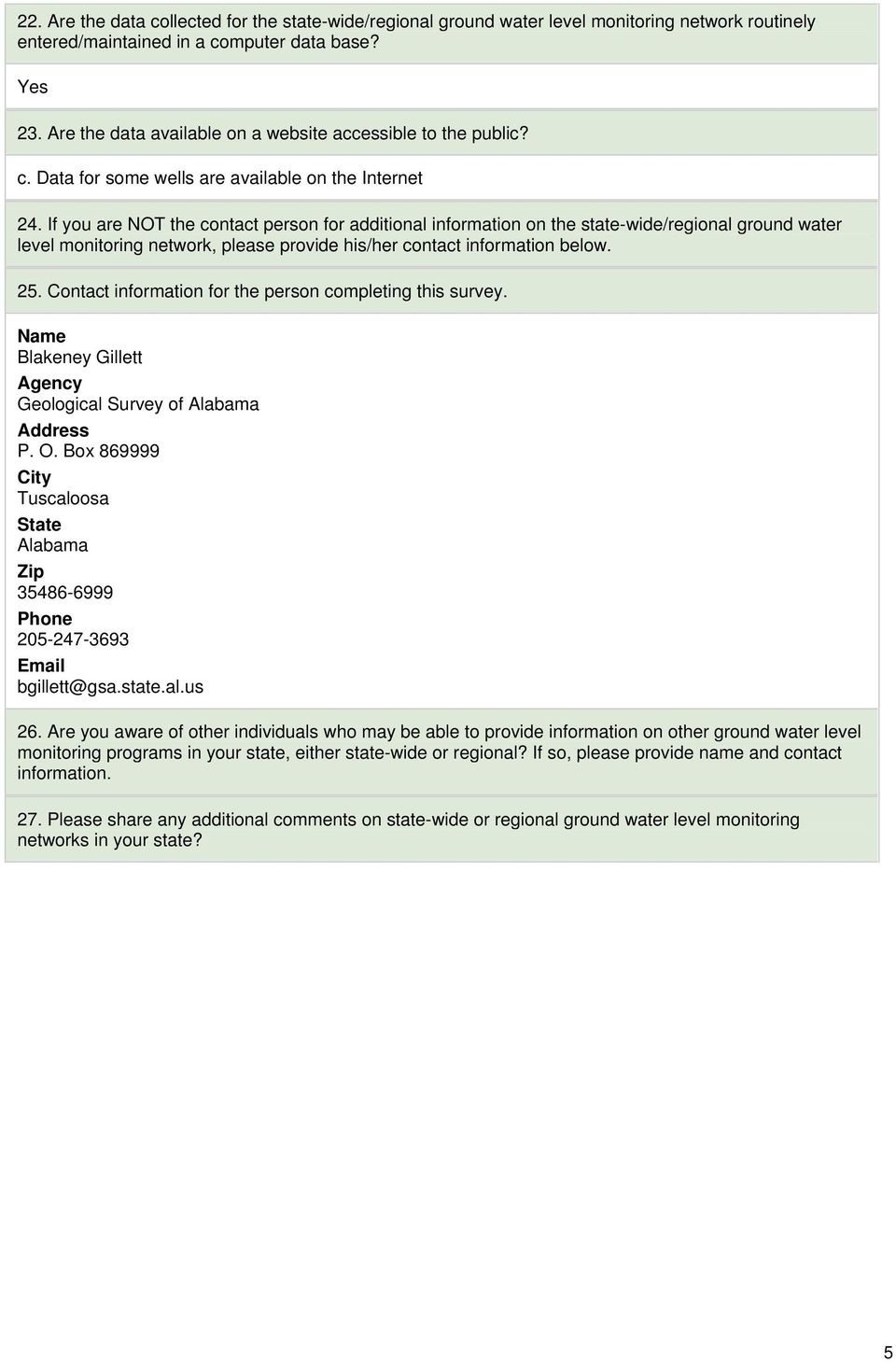
5 22. Are the data collected for the state-wide/regional ground water level monitoring network routinely entered/maintained in a computer data base? Yes 23. Are the data available on a website accessible to the public? c. Data for some wells are available on the Internet 24. If you are NOT the contact person for additional information on the state-wide/regional ground water level monitoring network, please provide his/her contact information below. 25. Contact information for the person completing this survey. Name Blakeney Gillett Agency Geological Survey of Alabama Address P. O. Box City Tuscaloosa State Alabama Zip Phone [email protected] 26. Are you aware of other individuals who may be able to provide information on other ground water level monitoring programs in your state, either state-wide or regional? If so, please provide name and contact information. 27. Please share any additional comments on state-wide or regional ground water level monitoring networks in your state? 5
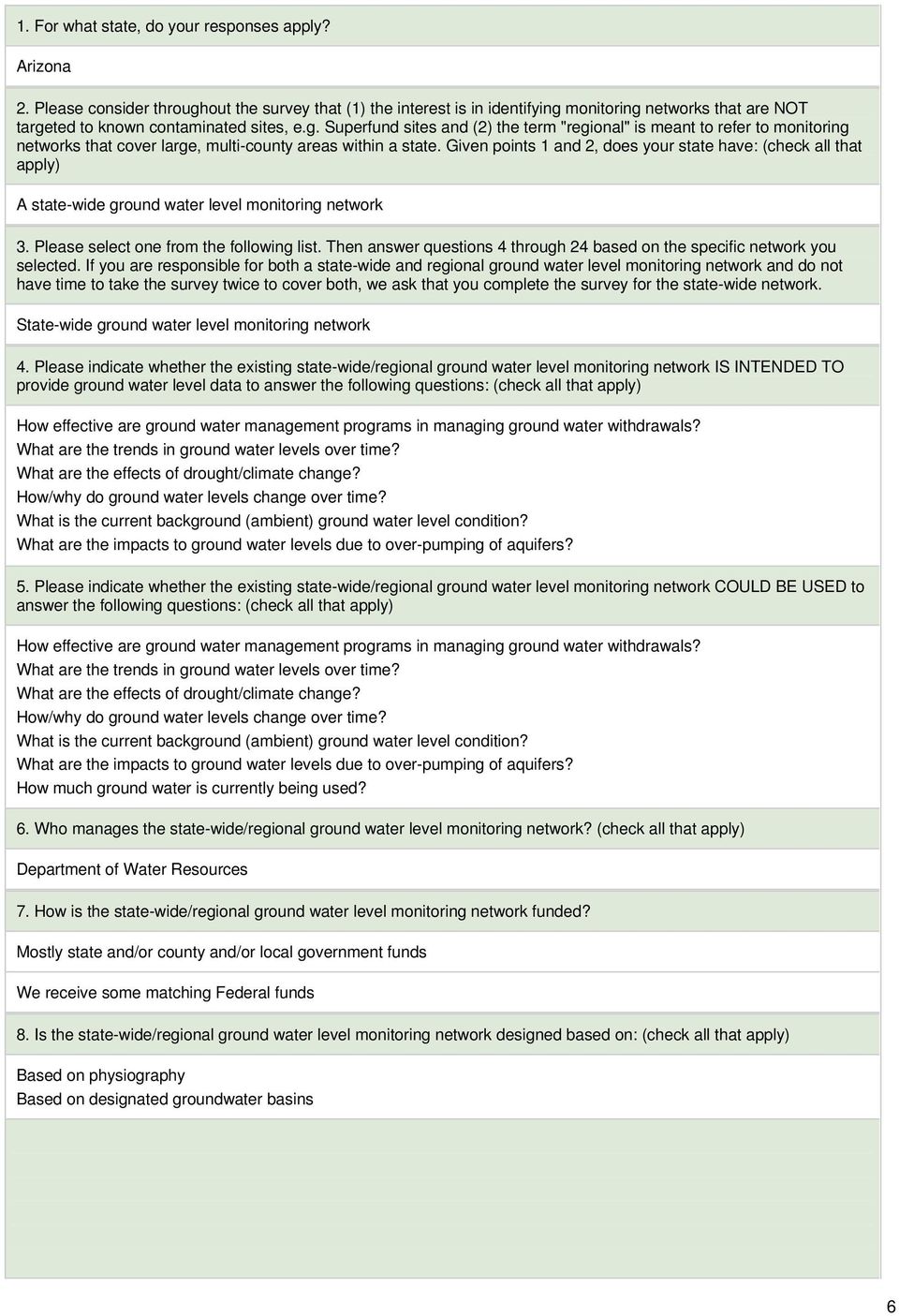
6 1. For what state, do your responses apply? Arizona 2. Please consider throughout the survey that (1) the interest is in identifying monitoring networks that are NOT targeted to known contaminated sites, e.g. Superfund sites and (2) the term "regional" is meant to refer to monitoring networks that cover large, multi-county areas within a state. Given points 1 and 2, does your state have: (check all that apply) A state-wide ground water level monitoring network 3. Please select one from the following list. Then answer questions 4 through 24 based on the specific network you selected. If you are responsible for both a state-wide and regional ground water level monitoring network and do not have time to take the survey twice to cover both, we ask that you complete the survey for the state-wide network. State-wide ground water level monitoring network 4. Please indicate whether the existing state-wide/regional ground water level monitoring network IS INTENDED TO provide ground water level data to answer the following questions: (check all that apply) How effective are ground water management programs in managing ground water withdrawals? What are the trends in ground water levels over time? What are the effects of drought/climate change? How/why do ground water levels change over time? What is the current background (ambient) ground water level condition? What are the impacts to ground water levels due to over-pumping of aquifers? 5. Please indicate whether the existing state-wide/regional ground water level monitoring network COULD BE USED to answer the following questions: (check all that apply) How effective are ground water management programs in managing ground water withdrawals? What are the trends in ground water levels over time? What are the effects of drought/climate change? How/why do ground water levels change over time? What is the current background (ambient) ground water level condition? What are the impacts to ground water levels due to over-pumping of aquifers? How much ground water is currently being used? 6. Who manages the state-wide/regional ground water level monitoring network? (check all that apply) Department of Water Resources 7. How is the state-wide/regional ground water level monitoring network funded? Mostly state and/or county and/or local government funds We receive some matching Federal funds 8. Is the state-wide/regional ground water level monitoring network designed based on: (check all that apply) Based on physiography Based on designated groundwater basins 6
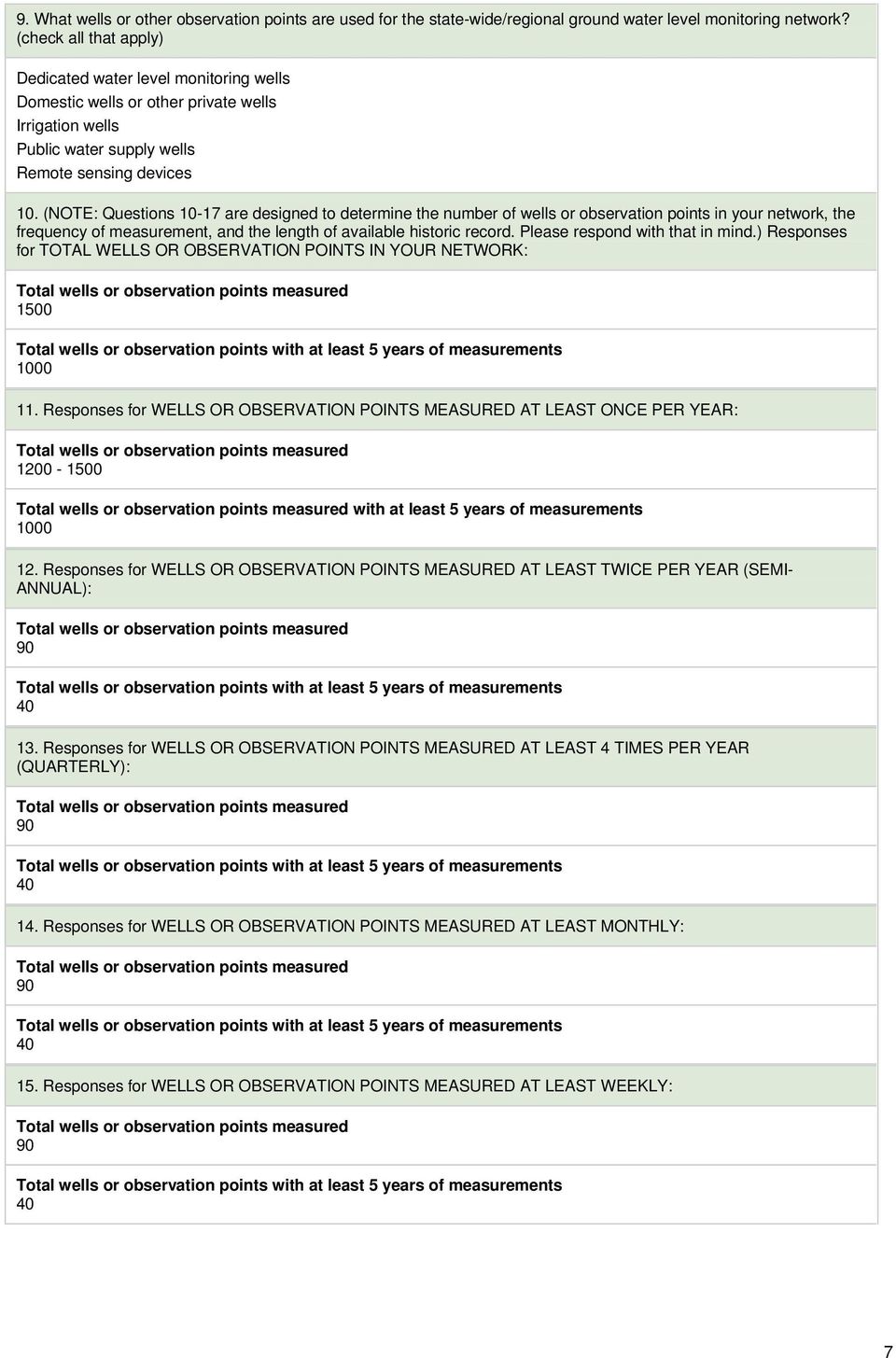
7 9. What wells or other observation points are used for the state-wide/regional ground water level monitoring network? (check all that apply) Dedicated water level monitoring wells Domestic wells or other private wells Irrigation wells Public water supply wells Remote sensing devices 10. (NOTE: Questions are designed to determine the number of wells or observation points in your network, the frequency of measurement, and the length of available historic record. Please respond with that in mind.) Responses for TOTAL WELLS OR OBSERVATION POINTS IN YOUR NETWORK: Responses for WELLS OR OBSERVATION POINTS MEASURED AT LEAST ONCE PER YEAR: with at least 5 years of measurements Responses for WELLS OR OBSERVATION POINTS MEASURED AT LEAST TWICE PER YEAR (SEMI- ANNUAL): Responses for WELLS OR OBSERVATION POINTS MEASURED AT LEAST 4 TIMES PER YEAR (QUARTERLY): Responses for WELLS OR OBSERVATION POINTS MEASURED AT LEAST MONTHLY: Responses for WELLS OR OBSERVATION POINTS MEASURED AT LEAST WEEKLY:
8 16. Response for WELLS OR OBSERVATION POINTS MEASURED AT LEAST DAILY (INSTRUMENTED): Responses for WELLS OR OBSERVATION POINTS MEASURED AT LEAST DAILY, AND AVAILABLE IN "REAL TIME": Who collects ground water level data for the state-wide/regional ground water level monitoring network? (check all that apply) State government employees 19. What information is typically available for wells or observation points in the state-wide/regional ground water level monitoring network? (check all that apply) Well number/name County code Latitude/Longitude Source of coordinates Owner Driller Land surface elevation Method of measuring elevation User code Date drilled Well type Well depth Source of depth Type of pump Type of power for the pump Pump horsepower Primary water use Secondary water use Tertiary water use Water level available Water quality available Measuring point information Well log available Construction method Completion method Screen material Depth of open or screened interval Casing material Casing depths Casing diameter 20. The written Standard Operating Procedures (SOP's) used for FIELD DATA COLLECTION for the statewide/regional ground water level monitoring network were developed by: (check all that apply) State government U.S. Geological Survey 21. The written Standard Operating Procedures (SOP's) used for DATA MANAGEMENT AND STORAGE for the statewide/regional ground water level monitoring network were developed by: (check all that apply) State government 22. Are the data collected for the state-wide/regional ground water level monitoring network routinely entered/maintained in a computer data base? Yes 8

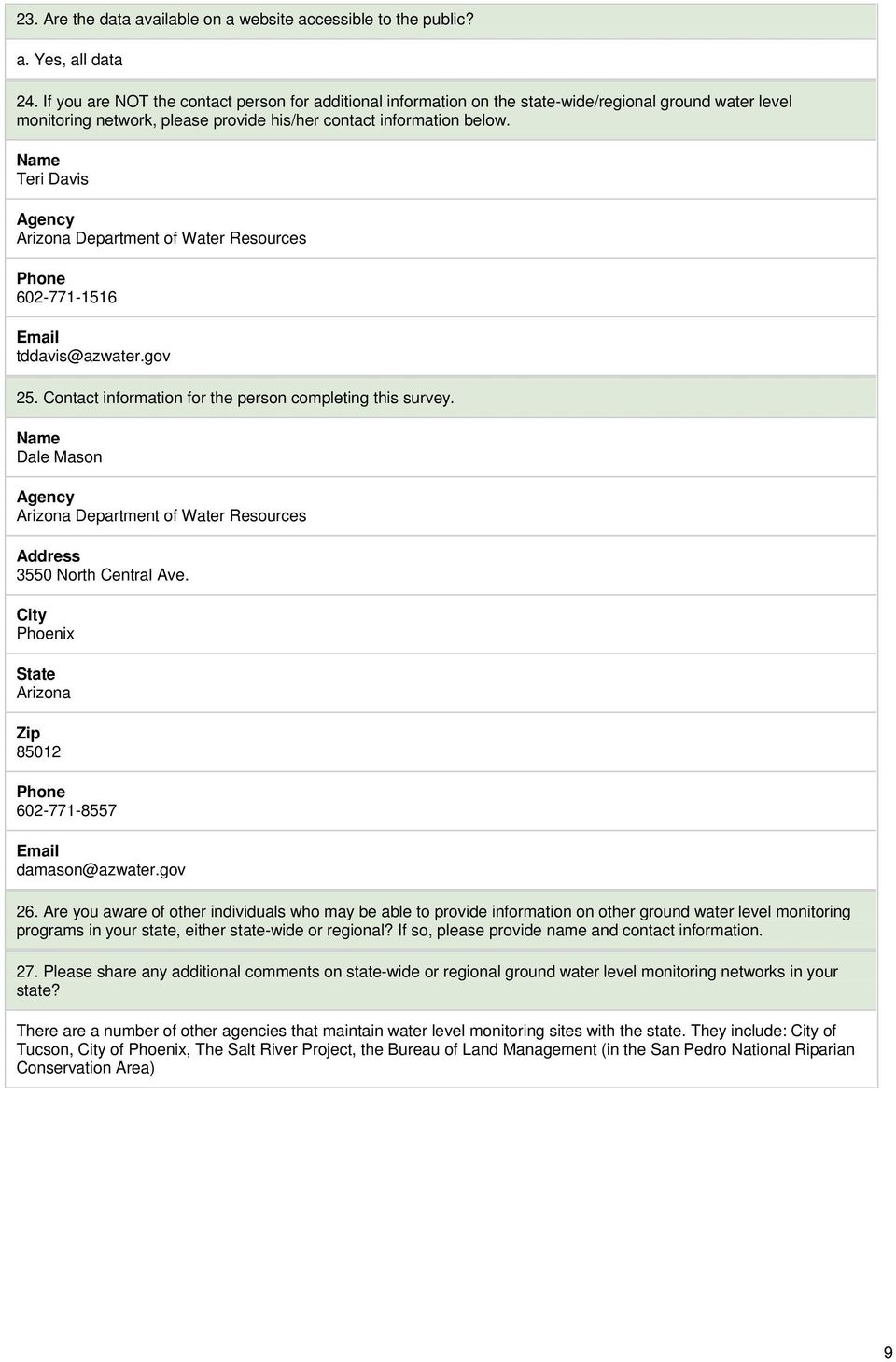
9 23. Are the data available on a website accessible to the public? a. Yes, all data 24. If you are NOT the contact person for additional information on the state-wide/regional ground water level monitoring network, please provide his/her contact information below. Name Teri Davis Agency Arizona Department of Water Resources Phone [email protected] 25. Contact information for the person completing this survey. Name Dale Mason Agency Arizona Department of Water Resources Address 3550 North Central Ave. City Phoenix State Arizona Zip Phone [email protected] 26. Are you aware of other individuals who may be able to provide information on other ground water level monitoring programs in your state, either state-wide or regional? If so, please provide name and contact information. 27. Please share any additional comments on state-wide or regional ground water level monitoring networks in your state? There are a number of other agencies that maintain water level monitoring sites with the state. They include: City of Tucson, City of Phoenix, The Salt River Project, the Bureau of Land Management (in the San Pedro National Riparian Conservation Area) 9
10 1. For what state, do your responses apply? Arkansas 2. Please consider throughout the survey that (1) the interest is in identifying monitoring networks that are NOT targeted to known contaminated sites, e.g. Superfund sites and (2) the term "regional" is meant to refer to monitoring networks that cover large, multi-county areas within a state. Given points 1 and 2, does your state have: (check all that apply) A state-wide ground water level monitoring network One or more regional (large, multi-county area within the state) ground water level monitoring networks An interstate ground water level monitoring network, a portion of which is in the state 3. Please select one from the following list. Then answer questions 4 through 24 based on the specific network you selected. If you are responsible for both a state-wide and regional ground water level monitoring network and do not have time to take the survey twice to cover both, we ask that you complete the survey for the state-wide network. State-wide ground water level monitoring network 4. Please indicate whether the existing state-wide/regional ground water level monitoring network IS INTENDED TO provide ground water level data to answer the following questions: (check all that apply) What are the trends in ground water levels over time? How/why do ground water levels change over time? What is the current background (ambient) ground water level condition? What are the impacts to ground water levels due to over-pumping of aquifers? How much ground water is currently being used? 5. Please indicate whether the existing state-wide/regional ground water level monitoring network COULD BE USED to answer the following questions: (check all that apply) What are the trends in ground water levels over time? What are the effects of drought/climate change? How/why do ground water levels change over time? What is the current background (ambient) ground water level condition? What are the impacts to ground water levels due to over-pumping of aquifers? How much ground water is currently being used? 6. Who manages the state-wide/regional ground water level monitoring network? (check all that apply) Department of Natural Resources Also, USGS and NRCS 10

11 7. How is the state-wide/regional ground water level monitoring network funded? About federal and state 8. Is the state-wide/regional ground water level monitoring network designed based on: (check all that apply) Aquifer based 9. What wells or other observation points are used for the state-wide/regional ground water level monitoring network? (check all that apply) Dedicated water level monitoring wells Domestic wells or other private wells Irrigation wells Public water supply wells Springs industrial wells 10. (NOTE: Questions are designed to determine the number of wells or observation points in your network, the frequency of measurement, and the length of available historic record. Please respond with that in mind.) Responses for TOTAL WELLS OR OBSERVATION POINTS IN YOUR NETWORK: Responses for WELLS OR OBSERVATION POINTS MEASURED AT LEAST ONCE PER YEAR: 1100 with at least 5 years of measurements Responses for WELLS OR OBSERVATION POINTS MEASURED AT LEAST TWICE PER YEAR (SEMI-ANNUAL): Responses for WELLS OR OBSERVATION POINTS MEASURED AT LEAST 4 TIMES PER YEAR (QUARTERLY):
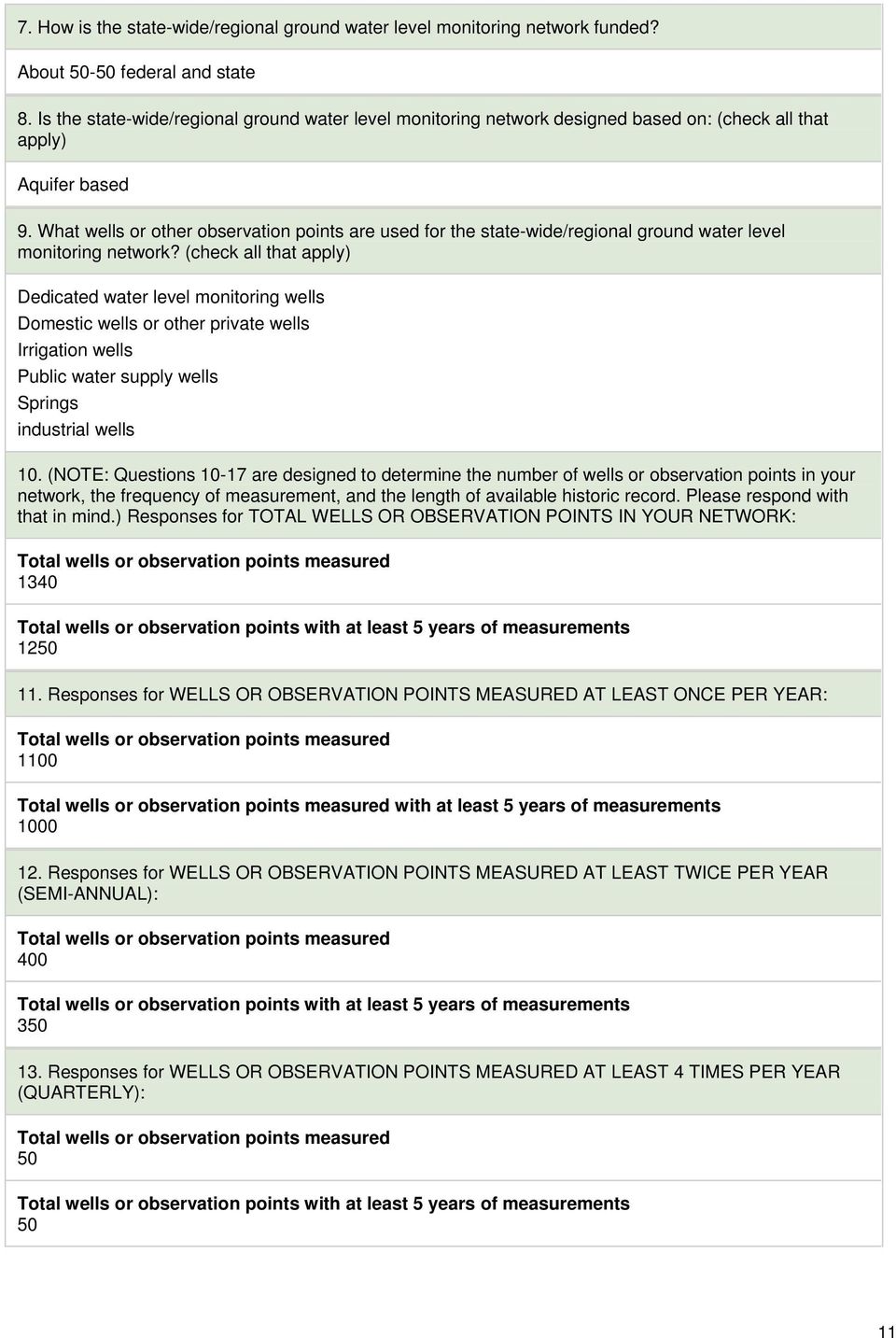
12 14. Responses for WELLS OR OBSERVATION POINTS MEASURED AT LEAST MONTHLY: Responses for WELLS OR OBSERVATION POINTS MEASURED AT LEAST WEEKLY: Response for WELLS OR OBSERVATION POINTS MEASURED AT LEAST DAILY (INSTRUMENTED): Responses for WELLS OR OBSERVATION POINTS MEASURED AT LEAST DAILY, AND AVAILABLE IN "REAL TIME": Who collects ground water level data for the state-wide/regional ground water level monitoring network? (check all that apply) State government employees USGS staff NRCS employees 19. What information is typically available for wells or observation points in the state-wide/regional ground water level monitoring network? (check all that apply) Well number/name County code Latitude/Longitude Source of coordinates Aquifer code Land surface elevation Method of measuring elevation Well type Well depth Source of depth Water level available Water quality available Casing depths 20. The written Standard Operating Procedures (SOP's) used for FIELD DATA COLLECTION for the state-wide/regional ground water level monitoring network were developed by: (check all that apply) U.S. Geological Survey 12
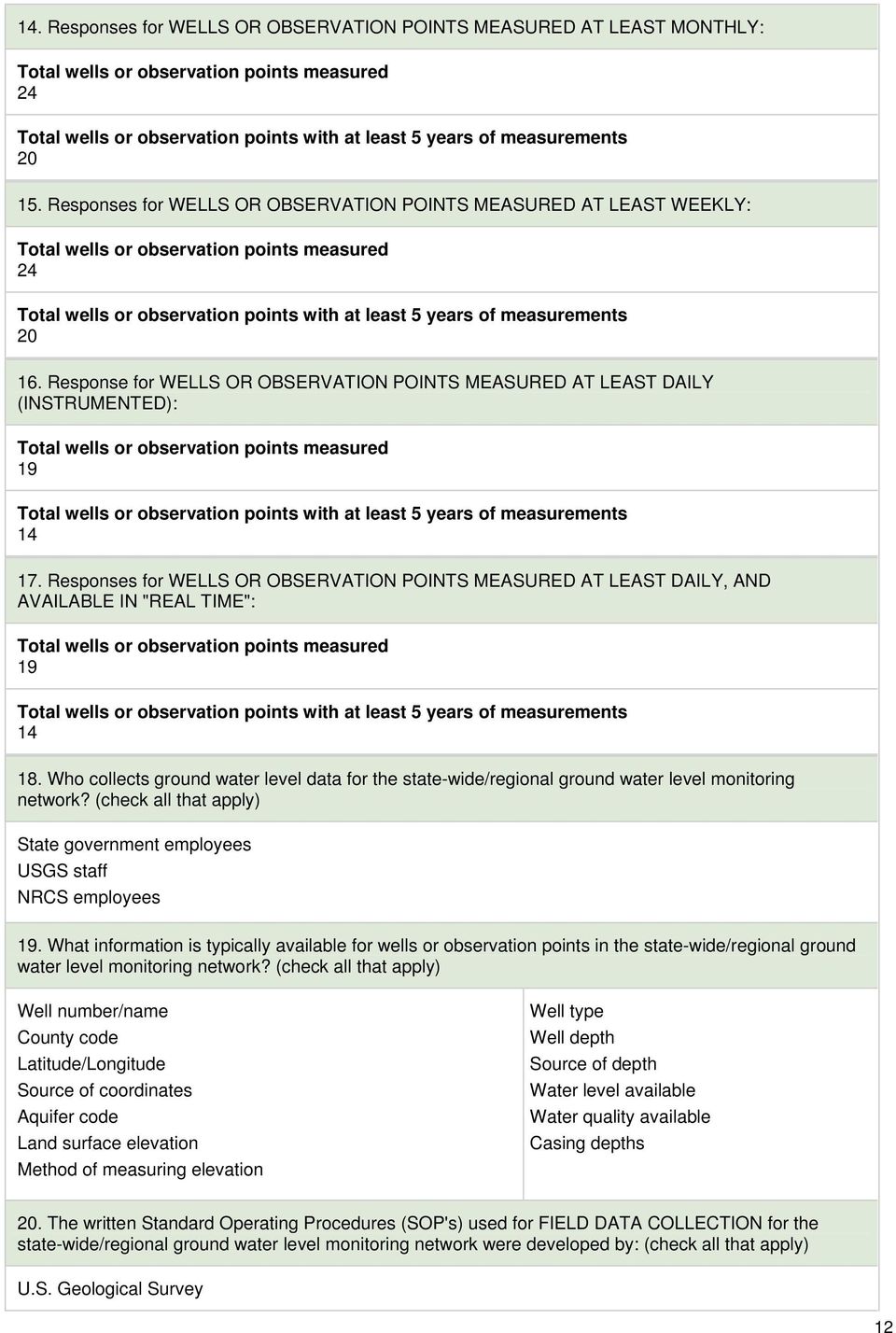
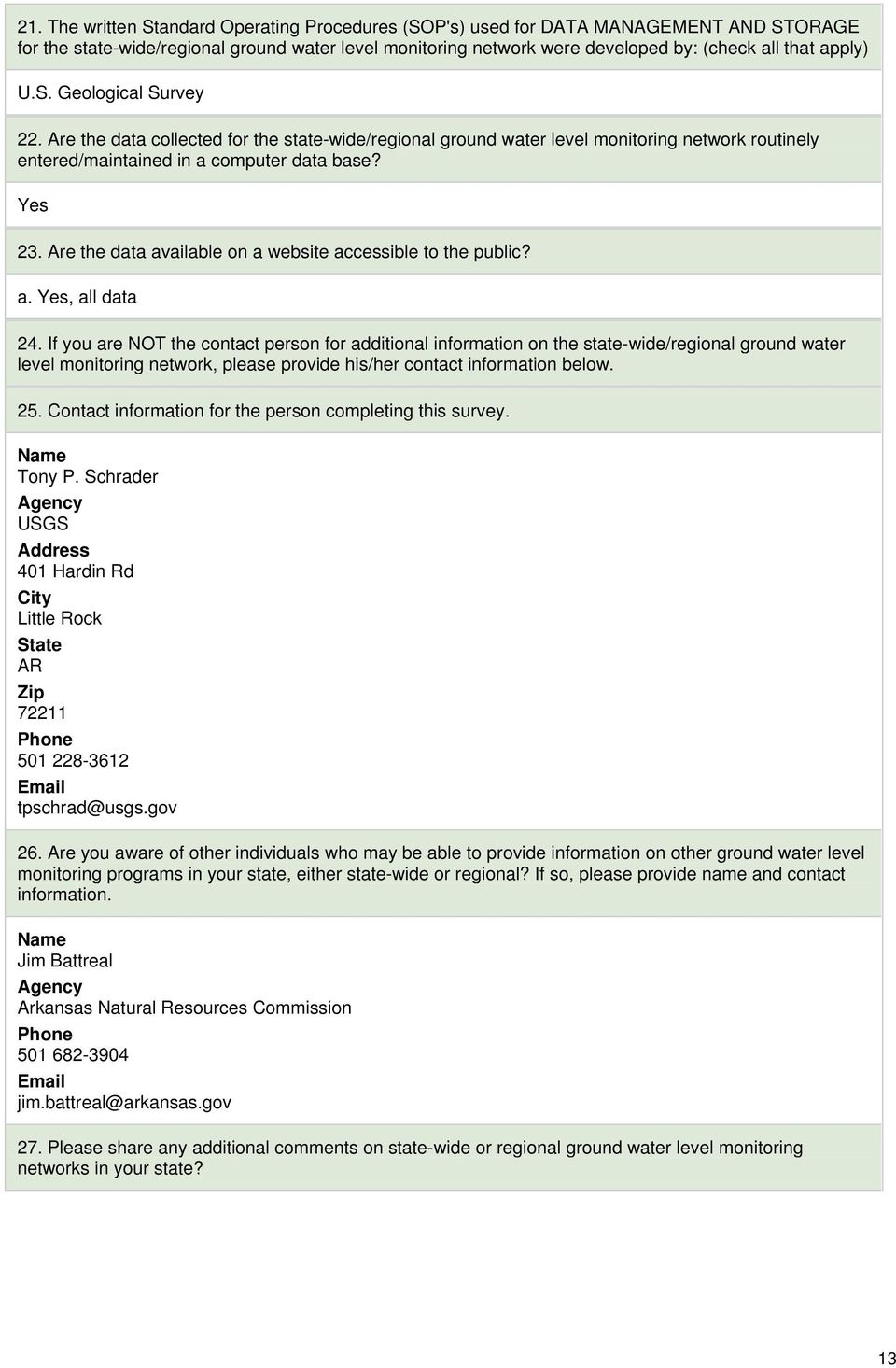
13 21. The written Standard Operating Procedures (SOP's) used for DATA MANAGEMENT AND STORAGE for the state-wide/regional ground water level monitoring network were developed by: (check all that apply) U.S. Geological Survey 22. Are the data collected for the state-wide/regional ground water level monitoring network routinely entered/maintained in a computer data base? Yes 23. Are the data available on a website accessible to the public? a. Yes, all data 24. If you are NOT the contact person for additional information on the state-wide/regional ground water level monitoring network, please provide his/her contact information below. 25. Contact information for the person completing this survey. Name Tony P. Schrader Agency USGS Address 401 Hardin Rd City Little Rock State AR Zip Phone [email protected] 26. Are you aware of other individuals who may be able to provide information on other ground water level monitoring programs in your state, either state-wide or regional? If so, please provide name and contact information. Name Jim Battreal Agency Arkansas Natural Resources Commission Phone [email protected] 27. Please share any additional comments on state-wide or regional ground water level monitoring networks in your state? 13
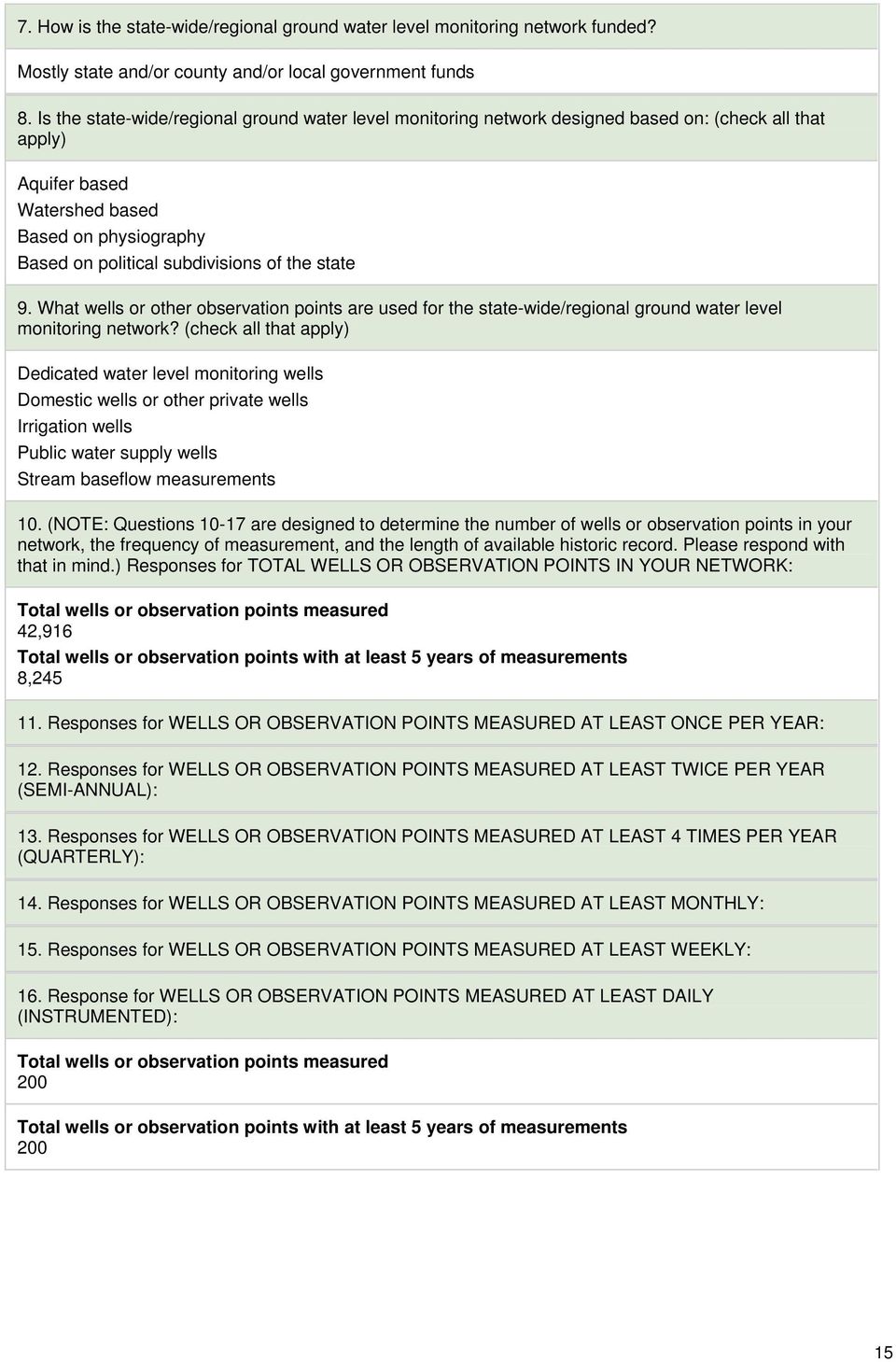
14 1. For what state, do your responses apply? California 2. Please consider throughout the survey that (1) the interest is in identifying monitoring networks that are NOT targeted to known contaminated sites, e.g. Superfund sites and (2) the term "regional" is meant to refer to monitoring networks that cover large, multi-county areas within a state. Given points 1 and 2, does your state have: (check all that apply) A state-wide ground water level monitoring network One or more regional (large, multi-county area within the state) ground water level monitoring networks One or more regional (large, multi-county area within the state) ground water level monitoring networks are being considered for development An interstate ground water level monitoring network, a portion of which is in the state 3. Please select one from the following list. Then answer questions 4 through 24 based on the specific network you selected. If you are responsible for both a state-wide and regional ground water level monitoring network and do not have time to take the survey twice to cover both, we ask that you complete the survey for the state-wide network. State-wide ground water level monitoring network 4. Please indicate whether the existing state-wide/regional ground water level monitoring network IS INTENDED TO provide ground water level data to answer the following questions: (check all that apply) How effective are ground water management programs in managing ground water withdrawals? What are the trends in ground water levels over time? What are the effects of drought/climate change? How/why do ground water levels change over time? What is the current background (ambient) ground water level condition? What are the impacts to ground water levels due to over-pumping of aquifers? What is the ground water quantity contribution to surface water, and vice versa? What type(s) of uses (e.g. domestic, irrigation, livestock, industrial, etc.) is ground water suitable for? land subsidence due to gw withdrawal 5. Please indicate whether the existing state-wide/regional ground water level monitoring network COULD BE USED to answer the following questions: (check all that apply) How effective are ground water management programs in managing ground water withdrawals? What are the trends in ground water levels over time? What are the effects of drought/climate change? How/why do ground water levels change over time? What is the current background (ambient) ground water level condition? What are the impacts to ground water levels due to over-pumping of aquifers? What is the age of ground water within an aquifer? What is the ground water quantity contribution to surface water, and vice versa? What type(s) of uses (e.g. domestic, irrigation, livestock, industrial, etc.) is ground water suitable for? How much ground water is currently being used? 6. Who manages the state-wide/regional ground water level monitoring network? (check all that apply) Department of Water Resources Regional or local government agency 14

15 7. How is the state-wide/regional ground water level monitoring network funded? Mostly state and/or county and/or local government funds 8. Is the state-wide/regional ground water level monitoring network designed based on: (check all that apply) Aquifer based Watershed based Based on physiography Based on political subdivisions of the state 9. What wells or other observation points are used for the state-wide/regional ground water level monitoring network? (check all that apply) Dedicated water level monitoring wells Domestic wells or other private wells Irrigation wells Public water supply wells Stream baseflow measurements 10. (NOTE: Questions are designed to determine the number of wells or observation points in your network, the frequency of measurement, and the length of available historic record. Please respond with that in mind.) Responses for TOTAL WELLS OR OBSERVATION POINTS IN YOUR NETWORK: 42,916 8, Responses for WELLS OR OBSERVATION POINTS MEASURED AT LEAST ONCE PER YEAR: 12. Responses for WELLS OR OBSERVATION POINTS MEASURED AT LEAST TWICE PER YEAR (SEMI-ANNUAL): 13. Responses for WELLS OR OBSERVATION POINTS MEASURED AT LEAST 4 TIMES PER YEAR (QUARTERLY): 14. Responses for WELLS OR OBSERVATION POINTS MEASURED AT LEAST MONTHLY: 15. Responses for WELLS OR OBSERVATION POINTS MEASURED AT LEAST WEEKLY: 16. Response for WELLS OR OBSERVATION POINTS MEASURED AT LEAST DAILY (INSTRUMENTED):
16 17. Responses for WELLS OR OBSERVATION POINTS MEASURED AT LEAST DAILY, AND AVAILABLE IN "REAL TIME": Who collects ground water level data for the state-wide/regional ground water level monitoring network? (check all that apply) State government employees Regional or local government employees Water providers USGS staff 19. What information is typically available for wells or observation points in the state-wide/regional ground water level monitoring network? (check all that apply) Well number/name County code Latitude/Longitude Source of coordinates Owner Driller Land surface elevation Method of measuring elevation Date drilled Well type Well depth Source of depth Type of pump Type of power for the pump Primary water use Water level available Water quality available Measuring point information Well log available Construction method Completion method Screen material Depth of open or screened interval Casing material Casing depths Casing diameter not all info available for all wells 20. The written Standard Operating Procedures (SOP's) used for FIELD DATA COLLECTION for the state-wide/regional ground water level monitoring network were developed by: (check all that apply) No written SOP's for data collection 21. The written Standard Operating Procedures (SOP's) used for DATA MANAGEMENT AND STORAGE for the state-wide/regional ground water level monitoring network were developed by: (check all that apply) No written SOP's for data management and storage 22. Are the data collected for the state-wide/regional ground water level monitoring network routinely entered/maintained in a computer data base? Yes Some 23. Are the data available on a website accessible to the public? c. Data for some wells are available on the Internet 16

17 24. If you are NOT the contact person for additional information on the state-wide/regional ground water level monitoring network, please provide his/her contact information below. 25. Contact information for the person completing this survey. Name Eric Senter Agency California Department of Water Resources Address PO Box City Sacramento State CA Zip Phone Are you aware of other individuals who may be able to provide information on other ground water level monitoring programs in your state, either state-wide or regional? If so, please provide name and contact information. 27. Please share any additional comments on state-wide or regional ground water level monitoring networks in your state? We don't track the measurement frequency of wells, so no response to questions Might be able to query the DB to figure this out if it were really important - let me know. 17

18 1. For what state, do your responses apply? Colorado 2. Please consider throughout the survey that (1) the interest is in identifying monitoring networks that are NOT targeted to known contaminated sites, e.g. Superfund sites and (2) the term "regional" is meant to refer to monitoring networks that cover large, multi-county areas within a state. Given points 1 and 2, does your state have: (check all that apply) No state-wide ground water level monitoring network One or more regional (large, multi-county area within the state) ground water level monitoring networks 3. Please select one from the following list. Then answer questions 4 through 24 based on the specific network you selected. If you are responsible for both a state-wide and regional ground water level monitoring network and do not have time to take the survey twice to cover both, we ask that you complete the survey for the state-wide network. Regional (large, multi-county area within the state) ground water level monitoring network 4. Please indicate whether the existing state-wide/regional ground water level monitoring network IS INTENDED TO provide ground water level data to answer the following questions: (check all that apply) How effective are ground water management programs in managing ground water withdrawals? What are the trends in ground water levels over time? What are the effects of drought/climate change? What is the current background (ambient) ground water level condition? 5. Please indicate whether the existing state-wide/regional ground water level monitoring network COULD BE USED to answer the following questions: (check all that apply) How effective are ground water management programs in managing ground water withdrawals? What are the trends in ground water levels over time? What are the effects of drought/climate change? How/why do ground water levels change over time? What is the current background (ambient) ground water level condition? What are the impacts to ground water levels due to over-pumping of aquifers? What is the ground water quantity contribution to surface water, and vice versa? 6. Who manages the state-wide/regional ground water level monitoring network? (check all that apply) State Engineer's Office 7. How is the state-wide/regional ground water level monitoring network funded? Mostly state and/or county and/or local government funds 8. Is the state-wide/regional ground water level monitoring network designed based on: (check all that apply) Aquifer based Watershed based 18

19 9. What wells or other observation points are used for the state-wide/regional ground water level monitoring network? (check all that apply) Dedicated water level monitoring wells Domestic wells or other private wells Irrigation wells Public water supply wells Former oil and gas production wells 10. (NOTE: Questions are designed to determine the number of wells or observation points in your network, the frequency of measurement, and the length of available historic record. Please respond with that in mind.) Responses for TOTAL WELLS OR OBSERVATION POINTS IN YOUR NETWORK: Responses for WELLS OR OBSERVATION POINTS MEASURED AT LEAST ONCE PER YEAR: 1200 with at least 5 years of measurements Responses for WELLS OR OBSERVATION POINTS MEASURED AT LEAST TWICE PER YEAR (SEMI-ANNUAL): Responses for WELLS OR OBSERVATION POINTS MEASURED AT LEAST 4 TIMES PER YEAR (QUARTERLY): Responses for WELLS OR OBSERVATION POINTS MEASURED AT LEAST MONTHLY:

20 15. Responses for WELLS OR OBSERVATION POINTS MEASURED AT LEAST WEEKLY: Response for WELLS OR OBSERVATION POINTS MEASURED AT LEAST DAILY (INSTRUMENTED): Responses for WELLS OR OBSERVATION POINTS MEASURED AT LEAST DAILY, AND AVAILABLE IN "REAL TIME": Who collects ground water level data for the state-wide/regional ground water level monitoring network? (check all that apply) State government employees Regional or local government employees Water providers USGS staff Groundwater Management Districts 19. What information is typically available for wells or observation points in the state-wide/regional ground water level monitoring network? (check all that apply) Well number/name County code Latitude/Longitude Source of coordinates Owner Aquifer code Land surface elevation Well depth Water level available Measuring point information 20. The written Standard Operating Procedures (SOP's) used for FIELD DATA COLLECTION for the state-wide/regional ground water level monitoring network were developed by: (check all that apply) No written SOP's for data collection 21. The written Standard Operating Procedures (SOP's) used for DATA MANAGEMENT AND STORAGE for the state-wide/regional ground water level monitoring network were developed by: (check all that apply) No written SOP's for data management and storage 20
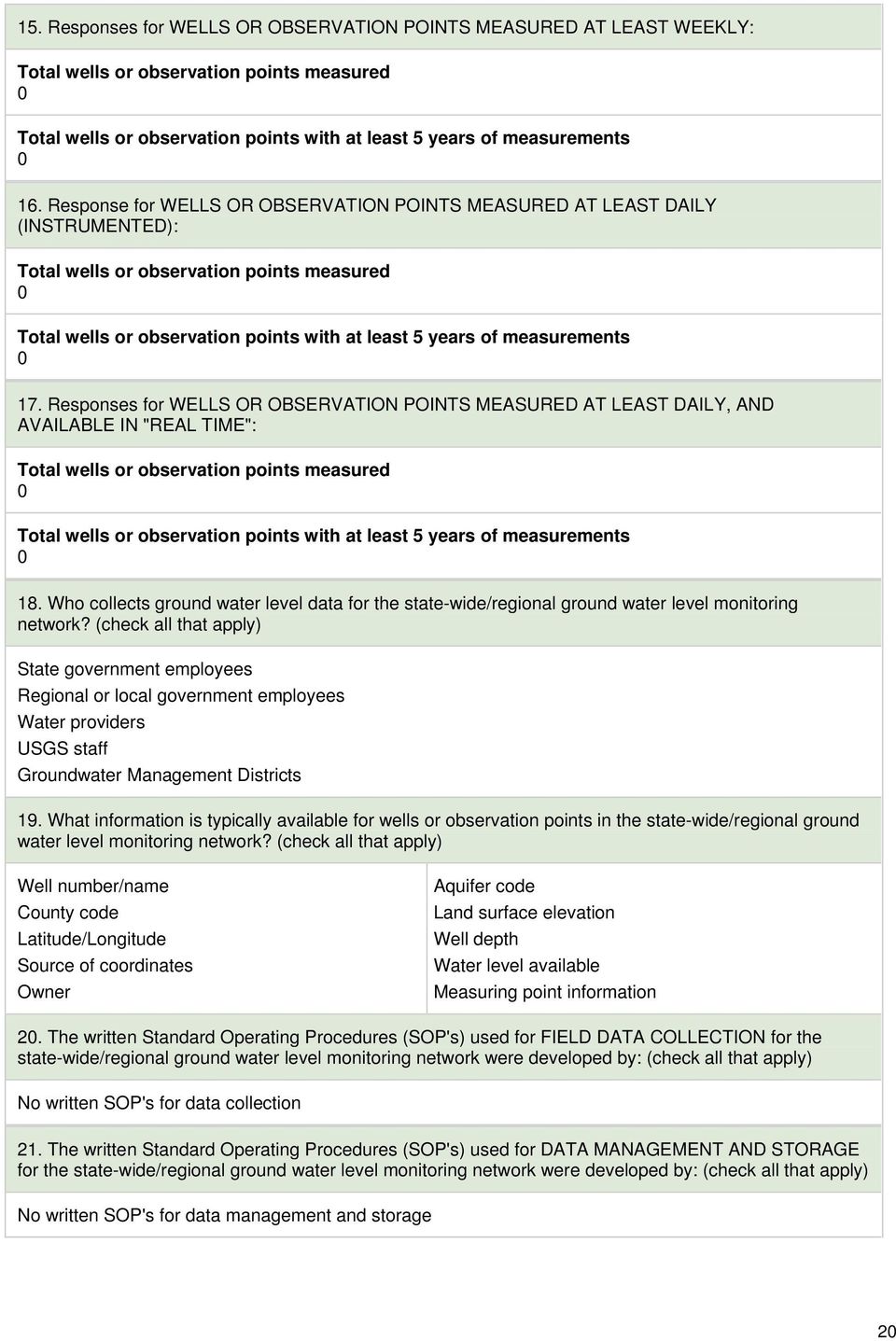
21 22. Are the data collected for the state-wide/regional ground water level monitoring network routinely entered/maintained in a computer data base? Yes 23. Are the data available on a website accessible to the public? a. Yes, all data 24. If you are NOT the contact person for additional information on the state-wide/regional ground water level monitoring network, please provide his/her contact information below. 25. Contact information for the person completing this survey. Name Michael Schaubs Agency Division of Water Resources-Office of State Engine Address 1313 Sherman Street Room 818 City Denver State Colorado Zip Phone [email protected] 26. Are you aware of other individuals who may be able to provide information on other ground water level monitoring programs in your state, either state-wide or regional? If so, please provide name and contact information. 27. Please share any additional comments on state-wide or regional ground water level monitoring networks in your state? 21
22 1. For what state, do your responses apply? Connecticut 2. Please consider throughout the survey that (1) the interest is in identifying monitoring networks that are NOT targeted to known contaminated sites, e.g. Superfund sites and (2) the term "regional" is meant to refer to monitoring networks that cover large, multi-county areas within a state. Given points 1 and 2, does your state have: (check all that apply) No state-wide ground water level monitoring network 3. Please select one from the following list. Then answer questions 4 through 24 based on the specific network you selected. If you are responsible for both a state-wide and regional ground water level monitoring network and do not have time to take the survey twice to cover both, we ask that you complete the survey for the state-wide network. Other, please specify No program 4. Please indicate whether the existing state-wide/regional ground water level monitoring network IS INTENDED TO provide ground water level data to answer the following questions: (check all that apply) No program 5. Please indicate whether the existing state-wide/regional ground water level monitoring network COULD BE USED to answer the following questions: (check all that apply) No program 6. Who manages the state-wide/regional ground water level monitoring network? (check all that apply) No state-wide/regional ground water level monitoring network 7. How is the state-wide/regional ground water level monitoring network funded? No state-wide/regional ground water level monitoring network 8. Is the state-wide/regional ground water level monitoring network designed based on: (check all that apply) No state-wide/regional ground water level network 9. What wells or other observation points are used for the state-wide/regional ground water level monitoring network? (check all that apply) No state-wide/regional ground water level monitoring network 10. (NOTE: Questions are designed to determine the number of wells or observation points in your network, the frequency of measurement, and the length of available historic record. Please respond with that in mind.) Responses for TOTAL WELLS OR OBSERVATION POINTS IN YOUR NETWORK: 11. Responses for WELLS OR OBSERVATION POINTS MEASURED AT LEAST ONCE PER YEAR: 12. Responses for WELLS OR OBSERVATION POINTS MEASURED AT LEAST TWICE PER YEAR (SEMI-ANNUAL): 22
23 13. Responses for WELLS OR OBSERVATION POINTS MEASURED AT LEAST 4 TIMES PER YEAR (QUARTERLY): 14. Responses for WELLS OR OBSERVATION POINTS MEASURED AT LEAST MONTHLY: 15. Responses for WELLS OR OBSERVATION POINTS MEASURED AT LEAST WEEKLY: 16. Response for WELLS OR OBSERVATION POINTS MEASURED AT LEAST DAILY (INSTRUMENTED): 17. Responses for WELLS OR OBSERVATION POINTS MEASURED AT LEAST DAILY, AND AVAILABLE IN "REAL TIME": 18. Who collects ground water level data for the state-wide/regional ground water level monitoring network? (check all that apply) No state-wide/regional ground water level monitoring network 19. What information is typically available for wells or observation points in the state-wide/regional ground water level monitoring network? (check all that apply) No state-wide/regional ground water level monitoring program 20. The written Standard Operating Procedures (SOP's) used for FIELD DATA COLLECTION for the state-wide/regional ground water level monitoring network were developed by: (check all that apply) No state-wide/regional ground water level monitoring network 21. The written Standard Operating Procedures (SOP's) used for DATA MANAGEMENT AND STORAGE for the state-wide/regional ground water level monitoring network were developed by: (check all that apply) No state-wide/regional ground water level monitoring network 22. Are the data collected for the state-wide/regional ground water level monitoring network routinely entered/maintained in a computer data base? No state-wide/regional ground water level monitoring network 23. Are the data available on a website accessible to the public? e. No state-wide/regional ground water level monitoring network 24. If you are NOT the contact person for additional information on the state-wide/regional ground water level monitoring network, please provide his/her contact information below. 25. Contact information for the person completing this survey. 26. Are you aware of other individuals who may be able to provide information on other ground water level monitoring programs in your state, either state-wide or regional? If so, please provide name and contact information. 27. Please share any additional comments on state-wide or regional ground water level monitoring networks in your state? Information provide by Corinne Fitting with Connecticut Department of Environmental Protection 23
24 1. For what state, do your responses apply? Delaware-1 (Delaware Department of Agriculture) 2. Please consider throughout the survey that (1) the interest is in identifying monitoring networks that are NOT targeted to known contaminated sites, e.g. Superfund sites and (2) the term "regional" is meant to refer to monitoring networks that cover large, multi-county areas within a state. Given points 1 and 2, does your state have: (check all that apply) A state-wide ground water level monitoring network 3. Please select one from the following list. Then answer questions 4 through 24 based on the specific network you selected. If you are responsible for both a state-wide and regional ground water level monitoring network and do not have time to take the survey twice to cover both, we ask that you complete the survey for the state-wide network. State-wide ground water level monitoring network 4. Please indicate whether the existing state-wide/regional ground water level monitoring network IS INTENDED TO provide ground water level data to answer the following questions: (check all that apply) What are the trends in ground water levels over time? What is the current background (ambient) ground water level condition? 5. Please indicate whether the existing state-wide/regional ground water level monitoring network COULD BE USED to answer the following questions: (check all that apply) What are the trends in ground water levels over time? What are the effects of drought/climate change? How/why do ground water levels change over time? What is the current background (ambient) ground water level condition? 6. Who manages the state-wide/regional ground water level monitoring network? (check all that apply) State Geological Survey Department of Agriculture 7. How is the state-wide/regional ground water level monitoring network funded? Mostly federal funds 8. Is the state-wide/regional ground water level monitoring network designed based on: (check all that apply) Aquifer based 9. What wells or other observation points are used for the state-wide/regional ground water level monitoring network? (check all that apply) Dedicated water level monitoring wells 24
25 10. (NOTE: Questions are designed to determine the number of wells or observation points in your network, the frequency of measurement, and the length of available historic record. Please respond with that in mind.) Responses for TOTAL WELLS OR OBSERVATION POINTS IN YOUR NETWORK: Responses for WELLS OR OBSERVATION POINTS MEASURED AT LEAST ONCE PER YEAR: 102 with at least 5 years of measurements Responses for WELLS OR OBSERVATION POINTS MEASURED AT LEAST TWICE PER YEAR (SEMI-ANNUAL): Responses for WELLS OR OBSERVATION POINTS MEASURED AT LEAST 4 TIMES PER YEAR (QUARTERLY): Responses for WELLS OR OBSERVATION POINTS MEASURED AT LEAST MONTHLY: Responses for WELLS OR OBSERVATION POINTS MEASURED AT LEAST WEEKLY:
26 16. Response for WELLS OR OBSERVATION POINTS MEASURED AT LEAST DAILY (INSTRUMENTED): Responses for WELLS OR OBSERVATION POINTS MEASURED AT LEAST DAILY, AND AVAILABLE IN "REAL TIME": Who collects ground water level data for the state-wide/regional ground water level monitoring network? (check all that apply) State government employees 19. What information is typically available for wells or observation points in the state-wide/regional ground water level monitoring network? (check all that apply) Well number/name County code Latitude/Longitude Aquifer code Land surface elevation Date drilled Well type Well depth Water level available Water quality available Depth of open or screened interval Casing diameter 20. The written Standard Operating Procedures (SOP's) used for FIELD DATA COLLECTION for the state-wide/regional ground water level monitoring network were developed by: (check all that apply) State government 21. The written Standard Operating Procedures (SOP's) used for DATA MANAGEMENT AND STORAGE for the state-wide/regional ground water level monitoring network were developed by: (check all that apply) Do not know 22. Are the data collected for the state-wide/regional ground water level monitoring network routinely entered/maintained in a computer data base? Yes 23. Are the data available on a website accessible to the public? If you are NOT the contact person for additional information on the state-wide/regional ground water level monitoring network, please provide his/her contact information below. 26
27 25. Contact information for the person completing this survey. Name Laura Mensch Agency Delaware Department of Agriculture Address 2320 South DuPont Hwy. City Dover State Delaware Zip Phone Are you aware of other individuals who may be able to provide information on other ground water level monitoring programs in your state, either state-wide or regional? If so, please provide name and contact information. Name Scott Andres Agency Delaware Geological Survey Phone Please share any additional comments on state-wide or regional ground water level monitoring networks in your state? The Delaware Department of Agriculture (DDA) maintains a network of dedicated monitoring wells, used mainly for monitoring for pesticide residues. Water levels are taken quarterly for almost all wells. The DDA's network is not the sole well network for the state, however; the network maintained by the Delaware Geological Survey is probably more comprehensive, as I believe some wells have real time water level sensors in place. Also, a note about the website containing the water level information from the network: the data are no longer being updated (most current year is 2003). Hopefully this will change and we will be able to post all the current data. 27
28 1. For what state, do your responses apply? Delaware-2 (Delaware Geological Survey) 2. Please consider throughout the survey that (1) the interest is in identifying monitoring networks that are NOT targeted to known contaminated sites, e.g. Superfund sites and (2) the term "regional" is meant to refer to monitoring networks that cover large, multi-county areas within a state. Given points 1 and 2, does your state have: (check all that apply) A state-wide ground water level monitoring network 3. Please select one from the following list. Then answer questions 4 through 24 based on the specific network you selected. If you are responsible for both a state-wide and regional ground water level monitoring network and do not have time to take the survey twice to cover both, we ask that you complete the survey for the state-wide network. State-wide ground water level monitoring network 4. Please indicate whether the existing state-wide/regional ground water level monitoring network IS INTENDED TO provide ground water level data to answer the following questions: (check all that apply) What are the trends in ground water levels over time? What are the effects of drought/climate change? How/why do ground water levels change over time? What is the current background (ambient) ground water level condition? What are the impacts to ground water levels due to over-pumping of aquifers? What is the ground water quantity contribution to surface water, and vice versa? 5. Please indicate whether the existing state-wide/regional ground water level monitoring network COULD BE USED to answer the following questions: (check all that apply) How effective are ground water management programs in managing ground water withdrawals? What are the trends in ground water levels over time? What are the effects of drought/climate change? How/why do ground water levels change over time? What is the current background (ambient) ground water level condition? What are the impacts to ground water levels due to over-pumping of aquifers? What is the age of ground water within an aquifer? What is the ground water quantity contribution to surface water, and vice versa? How much ground water is currently being used? Support flow model development, calib., valid. 6. Who manages the state-wide/regional ground water level monitoring network? (check all that apply) State Geological Survey 7. How is the state-wide/regional ground water level monitoring network funded? Mostly state and/or county and/or local government funds 28
29 8. Is the state-wide/regional ground water level monitoring network designed based on: (check all that apply) Aquifer based Watershed based Based on physiography Based on political subdivisions of the state 9. What wells or other observation points are used for the state-wide/regional ground water level monitoring network? (check all that apply) Dedicated water level monitoring wells Stream baseflow measurements Unused water quality monitoring wells Former public water supply wells (pumps removed 10. (NOTE: Questions are designed to determine the number of wells or observation points in your network, the frequency of measurement, and the length of available historic record. Please respond with that in mind.) Responses for TOTAL WELLS OR OBSERVATION POINTS IN YOUR NETWORK: Responses for WELLS OR OBSERVATION POINTS MEASURED AT LEAST ONCE PER YEAR: 85 with at least 5 years of measurements Responses for WELLS OR OBSERVATION POINTS MEASURED AT LEAST TWICE PER YEAR (SEMI-ANNUAL): Responses for WELLS OR OBSERVATION POINTS MEASURED AT LEAST 4 TIMES PER YEAR (QUARTERLY): Responses for WELLS OR OBSERVATION POINTS MEASURED AT LEAST MONTHLY:
30 15. Responses for WELLS OR OBSERVATION POINTS MEASURED AT LEAST WEEKLY: Response for WELLS OR OBSERVATION POINTS MEASURED AT LEAST DAILY (INSTRUMENTED): Responses for WELLS OR OBSERVATION POINTS MEASURED AT LEAST DAILY, AND AVAILABLE IN "REAL TIME": Who collects ground water level data for the state-wide/regional ground water level monitoring network? (check all that apply) State government employees 19. What information is typically available for wells or observation points in the state-wide/regional ground water level monitoring network? (check all that apply) Well number/name County code Latitude/Longitude Source of coordinates Owner Driller Aquifer code Land surface elevation Method of measuring elevation User code Date drilled Land use in the area Weather/climate at time of sampling Well type Well depth Source of depth Primary water use Water level available Water quality available Measuring point information Well log available Construction method Completion method Screen material Depth of open or screened interval Casing material Casing depths Casing diameter geophys log, site notes, site photo 20. The written Standard Operating Procedures (SOP's) used for FIELD DATA COLLECTION for the state-wide/regional ground water level monitoring network were developed by: (check all that apply) State government U.S. Geological Survey 30
31 21. The written Standard Operating Procedures (SOP's) used for DATA MANAGEMENT AND STORAGE for the state-wide/regional ground water level monitoring network were developed by: (check all that apply) State government U.S. Geological Survey 22. Are the data collected for the state-wide/regional ground water level monitoring network routinely entered/maintained in a computer data base? Yes 23. Are the data available on a website accessible to the public? c. Data for some wells are available on the Internet 24. If you are NOT the contact person for additional information on the state-wide/regional ground water level monitoring network, please provide his/her contact information below. 25. Contact information for the person completing this survey. Name A. Scott Andres Agency Delaware Geological Survey Address University of Delaware City Newark State DE Zip Phone [email protected] 26. Are you aware of other individuals who may be able to provide information on other ground water level monitoring programs in your state, either state-wide or regional? If so, please provide name and contact information. 27. Please share any additional comments on state-wide or regional ground water level monitoring networks in your state? USGS has virtually abandoned the gw level monitoring network for DE and have stopped accepting state provided data for inclusion in NWIS and hence, all USGS research efforts. 31
32 1. For what state, do your responses apply? Florida-1 (Florida Department of Environmental Protection) 2. Please consider throughout the survey that (1) the interest is in identifying monitoring networks that are NOT targeted to known contaminated sites, e.g. Superfund sites and (2) the term "regional" is meant to refer to monitoring networks that cover large, multi-county areas within a state. Given points 1 and 2, does your state have: (check all that apply) A state-wide ground water level monitoring network One or more regional (large, multi-county area within the state) ground water level monitoring networks 3. Please select one from the following list. Then answer questions 4 through 24 based on the specific network you selected. If you are responsible for both a state-wide and regional ground water level monitoring network and do not have time to take the survey twice to cover both, we ask that you complete the survey for the state-wide network. State-wide ground water level monitoring network 4. Please indicate whether the existing state-wide/regional ground water level monitoring network IS INTENDED TO provide ground water level data to answer the following questions: (check all that apply) What are the trends in ground water levels over time? 5. Please indicate whether the existing state-wide/regional ground water level monitoring network COULD BE USED to answer the following questions: (check all that apply) What are the trends in ground water levels over time? What are the effects of drought/climate change? How/why do ground water levels change over time? What is the current background (ambient) ground water level condition? 6. Who manages the state-wide/regional ground water level monitoring network? (check all that apply) Department of Environmental Protection/Environmental Quality 7. How is the state-wide/regional ground water level monitoring network funded? Mostly state and/or county and/or local government funds 8. Is the state-wide/regional ground water level monitoring network designed based on: (check all that apply) Aquifer based Watershed based 9. What wells or other observation points are used for the state-wide/regional ground water level monitoring network? (check all that apply) Dedicated water level monitoring wells Domestic wells or other private wells Public water supply wells Unused water quality monitoring wells 32
33 10. (NOTE: Questions are designed to determine the number of wells or observation points in your network, the frequency of measurement, and the length of available historic record. Please respond with that in mind.) Responses for TOTAL WELLS OR OBSERVATION POINTS IN YOUR NETWORK: Responses for WELLS OR OBSERVATION POINTS MEASURED AT LEAST ONCE PER YEAR: 46 with at least 5 years of measurements Responses for WELLS OR OBSERVATION POINTS MEASURED AT LEAST TWICE PER YEAR (SEMI-ANNUAL): Responses for WELLS OR OBSERVATION POINTS MEASURED AT LEAST 4 TIMES PER YEAR (QUARTERLY): Responses for WELLS OR OBSERVATION POINTS MEASURED AT LEAST MONTHLY: Responses for WELLS OR OBSERVATION POINTS MEASURED AT LEAST WEEKLY: Response for WELLS OR OBSERVATION POINTS MEASURED AT LEAST DAILY (INSTRUMENTED):
34 17. Responses for WELLS OR OBSERVATION POINTS MEASURED AT LEAST DAILY, AND AVAILABLE IN "REAL TIME": Who collects ground water level data for the state-wide/regional ground water level monitoring network? (check all that apply) State government employees Regional or local government employees 19. What information is typically available for wells or observation points in the state-wide/regional ground water level monitoring network? (check all that apply) Well number/name County code Latitude/Longitude Source of coordinates Owner Land surface elevation Method of measuring elevation Land use in the area Well type Well depth Type of pump Water quality available Measuring point information Casing material Casing depths Casing diameter 20. The written Standard Operating Procedures (SOP's) used for FIELD DATA COLLECTION for the state-wide/regional ground water level monitoring network were developed by: (check all that apply) State government 21. The written Standard Operating Procedures (SOP's) used for DATA MANAGEMENT AND STORAGE for the state-wide/regional ground water level monitoring network were developed by: (check all that apply) State government 22. Are the data collected for the state-wide/regional ground water level monitoring network routinely entered/maintained in a computer data base? Yes 23. Are the data available on a website accessible to the public? c. Data for some wells are available on the Internet 24. If you are NOT the contact person for additional information on the state-wide/regional ground water level monitoring network, please provide his/her contact information below. 34
35 25. Contact information for the person completing this survey. Name Gail Sloane Agency Florida Department of Environmental Protection Address 2600 Blair Stone Road MS Are you aware of other individuals who may be able to provide information on other ground water level monitoring programs in your state, either state-wide or regional? If so, please provide name and contact information. Name? Agency USGS 27. Please share any additional comments on state-wide or regional ground water level monitoring networks in your state? USGS probably has a network. I do not have that information. 35
36 1. For what state, do your responses apply? Florida-2 (Southwest Florida Water Management District) 2. Please consider throughout the survey that (1) the interest is in identifying monitoring networks that are NOT targeted to known contaminated sites, e.g. Superfund sites and (2) the term "regional" is meant to refer to monitoring networks that cover large, multi-county areas within a state. Given points 1 and 2, does your state have: (check all that apply) One or more regional (large, multi-county area within the state) ground water level monitoring networks 3. Please select one from the following list. Then answer questions 4 through 24 based on the specific network you selected. If you are responsible for both a state-wide and regional ground water level monitoring network and do not have time to take the survey twice to cover both, we ask that you complete the survey for the state-wide network. Regional (large, multi-county area within the state) ground water level monitoring network 4. Please indicate whether the existing state-wide/regional ground water level monitoring network IS INTENDED TO provide ground water level data to answer the following questions: (check all that apply) How effective are ground water management programs in managing ground water withdrawals? What are the trends in ground water levels over time? What are the effects of drought/climate change? How/why do ground water levels change over time? What is the current background (ambient) ground water level condition? What are the impacts to ground water levels due to over-pumping of aquifers? 5. Please indicate whether the existing state-wide/regional ground water level monitoring network COULD BE USED to answer the following questions: (check all that apply) How effective are ground water management programs in managing ground water withdrawals? What are the trends in ground water levels over time? What are the effects of drought/climate change? How/why do ground water levels change over time? What is the current background (ambient) ground water level condition? What are the impacts to ground water levels due to over-pumping of aquifers? What is the age of ground water within an aquifer? What is the ground water quantity contribution to surface water, and vice versa? What type(s) of uses (e.g. domestic, irrigation, livestock, industrial, etc.) is ground water suitable for? 6. Who manages the state-wide/regional ground water level monitoring network? (check all that apply) Regional or local government agency 7. How is the state-wide/regional ground water level monitoring network funded? Mostly state and/or county and/or local government funds 8. Is the state-wide/regional ground water level monitoring network designed based on: (check all that apply) Based on political subdivisions of the state 36
37 9. What wells or other observation points are used for the state-wide/regional ground water level monitoring network? (check all that apply) Dedicated water level monitoring wells 10. (NOTE: Questions are designed to determine the number of wells or observation points in your network, the frequency of measurement, and the length of available historic record. Please respond with that in mind.) Responses for TOTAL WELLS OR OBSERVATION POINTS IN YOUR NETWORK: Responses for WELLS OR OBSERVATION POINTS MEASURED AT LEAST ONCE PER YEAR: 1337 with at least 5 years of measurements Responses for WELLS OR OBSERVATION POINTS MEASURED AT LEAST TWICE PER YEAR (SEMI-ANNUAL): Responses for WELLS OR OBSERVATION POINTS MEASURED AT LEAST 4 TIMES PER YEAR (QUARTERLY): Responses for WELLS OR OBSERVATION POINTS MEASURED AT LEAST MONTHLY: Responses for WELLS OR OBSERVATION POINTS MEASURED AT LEAST WEEKLY:
38 16. Response for WELLS OR OBSERVATION POINTS MEASURED AT LEAST DAILY (INSTRUMENTED): Responses for WELLS OR OBSERVATION POINTS MEASURED AT LEAST DAILY, AND AVAILABLE IN "REAL TIME": Who collects ground water level data for the state-wide/regional ground water level monitoring network? (check all that apply) Regional or local government employees USGS staff 19. What information is typically available for wells or observation points in the state-wide/regional ground water level monitoring network? (check all that apply) Well number/name County code Latitude/Longitude Source of coordinates Aquifer code Land surface elevation Land use in the area Well depth Water level available Water quality available Well log available Screen material Depth of open or screened interval Casing material Casing depths Casing diameter 20. The written Standard Operating Procedures (SOP's) used for FIELD DATA COLLECTION for the state-wide/regional ground water level monitoring network were developed by: (check all that apply) Regional or local government 21. The written Standard Operating Procedures (SOP's) used for DATA MANAGEMENT AND STORAGE for the state-wide/regional ground water level monitoring network were developed by: (check all that apply) Regional or local government 22. Are the data collected for the state-wide/regional ground water level monitoring network routinely entered/maintained in a computer data base? Yes 23. Are the data available on a website accessible to the public? a. Yes, all data 38
39 24. If you are NOT the contact person for additional information on the state-wide/regional ground water level monitoring network, please provide his/her contact information below. 25. Contact information for the person completing this survey. Name Granville Kinsman Agency Southwest Florida Water Management District Address 2379 Broad Street City Brooksville State Florida Zip Are you aware of other individuals who may be able to provide information on other ground water level monitoring programs in your state, either state-wide or regional? If so, please provide name and contact information. Name Richard Kane; Leroy Pearman Agency USGS 27. Please share any additional comments on state-wide or regional ground water level monitoring networks in your state? 39
40 1. For what state, do your responses apply? Georgia 2. Please consider throughout the survey that (1) the interest is in identifying monitoring networks that are NOT targeted to known contaminated sites, e.g. Superfund sites and (2) the term "regional" is meant to refer to monitoring networks that cover large, multi-county areas within a state. Given points 1 and 2, does your state have: (check all that apply) A state-wide ground water level monitoring network 3. Please select one from the following list. Then answer questions 4 through 24 based on the specific network you selected. If you are responsible for both a state-wide and regional ground water level monitoring network and do not have time to take the survey twice to cover both, we ask that you complete the survey for the state-wide network. State-wide ground water level monitoring network 4. Please indicate whether the existing state-wide/regional ground water level monitoring network IS INTENDED TO provide ground water level data to answer the following questions: (check all that apply) How effective are ground water management programs in managing ground water withdrawals? What are the trends in ground water levels over time? What are the effects of drought/climate change? How/why do ground water levels change over time? What is the current background (ambient) ground water level condition? What are the impacts to ground water levels due to over-pumping of aquifers? 5. Please indicate whether the existing state-wide/regional ground water level monitoring network COULD BE USED to answer the following questions: (check all that apply) How effective are ground water management programs in managing ground water withdrawals? What are the trends in ground water levels over time? What are the effects of drought/climate change? How/why do ground water levels change over time? What is the current background (ambient) ground water level condition? What are the impacts to ground water levels due to over-pumping of aquifers? What is the age of ground water within an aquifer? 6. Who manages the state-wide/regional ground water level monitoring network? (check all that apply) U.S. Geological Survey, Dept. Interior 7. How is the state-wide/regional ground water level monitoring network funded? Federal, State, and local funds 8. Is the state-wide/regional ground water level monitoring network designed based on: (check all that apply) Aquifer based 40
41 9. What wells or other observation points are used for the state-wide/regional ground water level monitoring network? (check all that apply) Dedicated water level monitoring wells Domestic wells or other private wells Irrigation wells Public water supply wells 10. (NOTE: Questions are designed to determine the number of wells or observation points in your network, the frequency of measurement, and the length of available historic record. Please respond with that in mind.) Responses for TOTAL WELLS OR OBSERVATION POINTS IN YOUR NETWORK: 180 continuous recorders; 150 annual 371 historical continuous recorders 11. Responses for WELLS OR OBSERVATION POINTS MEASURED AT LEAST ONCE PER YEAR: about 150 annually with at least 5 years of measurements about 150 annually 12. Responses for WELLS OR OBSERVATION POINTS MEASURED AT LEAST TWICE PER YEAR (SEMI-ANNUAL): Responses for WELLS OR OBSERVATION POINTS MEASURED AT LEAST 4 TIMES PER YEAR (QUARTERLY): 14. Responses for WELLS OR OBSERVATION POINTS MEASURED AT LEAST MONTHLY: 180 continuous sites are measured every 2 months 180 continuous sites are measured every 2 months 15. Responses for WELLS OR OBSERVATION POINTS MEASURED AT LEAST WEEKLY: 16. Response for WELLS OR OBSERVATION POINTS MEASURED AT LEAST DAILY (INSTRUMENTED):
42 17. Responses for WELLS OR OBSERVATION POINTS MEASURED AT LEAST DAILY, AND AVAILABLE IN "REAL TIME": Who collects ground water level data for the state-wide/regional ground water level monitoring network? (check all that apply) USGS staff 19. What information is typically available for wells or observation points in the state-wide/regional ground water level monitoring network? (check all that apply) Well number/name County code Latitude/Longitude Source of coordinates Owner Driller Aquifer code Land surface elevation Method of measuring elevation Date drilled Well type Well depth Source of depth Type of pump Primary water use Water level available Water quality available Measuring point information Well log available Construction method Completion method Screen material Depth of open or screened interval Casing material Casing depths Casing diameter 20. The written Standard Operating Procedures (SOP's) used for FIELD DATA COLLECTION for the state-wide/regional ground water level monitoring network were developed by: (check all that apply) U.S. Geological Survey 21. The written Standard Operating Procedures (SOP's) used for DATA MANAGEMENT AND STORAGE for the state-wide/regional ground water level monitoring network were developed by: (check all that apply) U.S. Geological Survey 22. Are the data collected for the state-wide/regional ground water level monitoring network routinely entered/maintained in a computer data base? Yes 23. Are the data available on a website accessible to the public? a. Yes, all data 24. If you are NOT the contact person for additional information on the state-wide/regional ground water level monitoring network, please provide his/her contact information below. 42
43 25. Contact information for the person completing this survey. Name Michael F. Peck Agency U.S. Geological Survey Address 3039 Amwiler RD., Suite 130 City Atlanta State Georgia Zip Phone Are you aware of other individuals who may be able to provide information on other ground water level monitoring programs in your state, either state-wide or regional? If so, please provide name and contact information. 27. Please share any additional comments on state-wide or regional ground water level monitoring networks in your state? The number of wells measured annually is variable. The continuous monitoring network changes annually also. 43
44 1. For what state, do your responses apply? Hawaii 2. Please consider throughout the survey that (1) the interest is in identifying monitoring networks that are NOT targeted to known contaminated sites, e.g. Superfund sites and (2) the term "regional" is meant to refer to monitoring networks that cover large, multi-county areas within a state. Given points 1 and 2, does your state have: (check all that apply) A state-wide ground water level monitoring network 3. Please select one from the following list. Then answer questions 4 through 24 based on the specific network you selected. If you are responsible for both a state-wide and regional ground water level monitoring network and do not have time to take the survey twice to cover both, we ask that you complete the survey for the state-wide network. State-wide ground water level monitoring network 4. Please indicate whether the existing state-wide/regional ground water level monitoring network IS INTENDED TO provide ground water level data to answer the following questions: (check all that apply) What are the trends in ground water levels over time? 5. Please indicate whether the existing state-wide/regional ground water level monitoring network COULD BE USED to answer the following questions: (check all that apply) What are the trends in ground water levels over time? What are the effects of drought/climate change? How/why do ground water levels change over time? What is the current background (ambient) ground water level condition? 6. Who manages the state-wide/regional ground water level monitoring network? (check all that apply) Department of Natural Resources 7. How is the state-wide/regional ground water level monitoring network funded? About federal and state 8. Is the state-wide/regional ground water level monitoring network designed based on: (check all that apply) Aquifer based Based on physiography 44
45 9. What wells or other observation points are used for the state-wide/regional ground water level monitoring network? (check all that apply) Dedicated water level monitoring wells Domestic wells or other private wells Public water supply wells 10. (NOTE: Questions are designed to determine the number of wells or observation points in your network, the frequency of measurement, and the length of available historic record. Please respond with that in mind.) Responses for TOTAL WELLS OR OBSERVATION POINTS IN YOUR NETWORK: approximately 55 approximately Responses for WELLS OR OBSERVATION POINTS MEASURED AT LEAST ONCE PER YEAR: 12. Responses for WELLS OR OBSERVATION POINTS MEASURED AT LEAST TWICE PER YEAR (SEMI-ANNUAL): 13. Responses for WELLS OR OBSERVATION POINTS MEASURED AT LEAST 4 TIMES PER YEAR (QUARTERLY): approx 55 approx Responses for WELLS OR OBSERVATION POINTS MEASURED AT LEAST MONTHLY: 15. Responses for WELLS OR OBSERVATION POINTS MEASURED AT LEAST WEEKLY: 16. Response for WELLS OR OBSERVATION POINTS MEASURED AT LEAST DAILY (INSTRUMENTED): 17. Responses for WELLS OR OBSERVATION POINTS MEASURED AT LEAST DAILY, AND AVAILABLE IN "REAL TIME": 18. Who collects ground water level data for the state-wide/regional ground water level monitoring network? (check all that apply) State government employees USGS staff 45
46 19. What information is typically available for wells or observation points in the state-wide/regional ground water level monitoring network? (check all that apply) Well number/name County code Latitude/Longitude Owner Driller Aquifer code Land surface elevation Method of measuring elevation Date drilled Well type Well depth Source of depth Type of pump Type of power for the pump Pump horsepower Primary water use Water level available Well log available Construction method Completion method Screen material Depth of open or screened interval Casing material Casing depths Casing diameter 20. The written Standard Operating Procedures (SOP's) used for FIELD DATA COLLECTION for the state-wide/regional ground water level monitoring network were developed by: (check all that apply) No written SOP's for data collection 21. The written Standard Operating Procedures (SOP's) used for DATA MANAGEMENT AND STORAGE for the state-wide/regional ground water level monitoring network were developed by: (check all that apply) No written SOP's for data management and storage 22. Are the data collected for the state-wide/regional ground water level monitoring network routinely entered/maintained in a computer data base? No Data is maintained in Excel spreadsheets by well 23. Are the data available on a website accessible to the public? c. Data for some wells are available on the Internet Data not published on web available on request 24. If you are NOT the contact person for additional information on the state-wide/regional ground water level monitoring network, please provide his/her contact information below. 46
47 25. Contact information for the person completing this survey. Name Diane England Agency Commission on Water Resource Management Address 1151 Punchbowl Street Rm 227 City Honolulu State HI Zip Phone Are you aware of other individuals who may be able to provide information on other ground water level monitoring programs in your state, either state-wide or regional? If so, please provide name and contact information. 27. Please share any additional comments on state-wide or regional ground water level monitoring networks in your state? 47
48 1. For what state, do your responses apply? Illinois 2. Please consider throughout the survey that (1) the interest is in identifying monitoring networks that are NOT targeted to known contaminated sites, e.g. Superfund sites and (2) the term "regional" is meant to refer to monitoring networks that cover large, multi-county areas within a state. Given points 1 and 2, does your state have: (check all that apply) A state-wide ground water level monitoring network One or more regional (large, multi-county area within the state) ground water level monitoring networks 3. Please select one from the following list. Then answer questions 4 through 24 based on the specific network you selected. If you are responsible for both a state-wide and regional ground water level monitoring network and do not have time to take the survey twice to cover both, we ask that you complete the survey for the state-wide network. Regional (large, multi-county area within the state) ground water level monitoring network 4. Please indicate whether the existing state-wide/regional ground water level monitoring network IS INTENDED TO provide ground water level data to answer the following questions: (check all that apply) What are the trends in ground water levels over time? How/why do ground water levels change over time? What is the current background (ambient) ground water level condition? What are the impacts to ground water levels due to over-pumping of aquifers? What is the ground water quantity contribution to surface water, and vice versa? How much ground water is currently being used? What is the long-term aquifer yield? 5. Please indicate whether the existing state-wide/regional ground water level monitoring network COULD BE USED to answer the following questions: (check all that apply) How effective are ground water management programs in managing ground water withdrawals? What are the trends in ground water levels over time? What are the effects of drought/climate change? How/why do ground water levels change over time? What is the current background (ambient) ground water level condition? What are the impacts to ground water levels due to over-pumping of aquifers? What is the ground water quantity contribution to surface water, and vice versa? 6. Who manages the state-wide/regional ground water level monitoring network? (check all that apply) Department of Natural Resources State Water Survey within Illinois DNR 7. How is the state-wide/regional ground water level monitoring network funded? Mostly state and/or county and/or local government funds 48
49 8. Is the state-wide/regional ground water level monitoring network designed based on: (check all that apply) Aquifer based 9. What wells or other observation points are used for the state-wide/regional ground water level monitoring network? (check all that apply) Dedicated water level monitoring wells Domestic wells or other private wells Irrigation wells Public water supply wells Stream baseflow measurements 10. (NOTE: Questions are designed to determine the number of wells or observation points in your network, the frequency of measurement, and the length of available historic record. Please respond with that in mind.) Responses for TOTAL WELLS OR OBSERVATION POINTS IN YOUR NETWORK: Responses for WELLS OR OBSERVATION POINTS MEASURED AT LEAST ONCE PER YEAR: ~100 with at least 5 years of measurements ~ Responses for WELLS OR OBSERVATION POINTS MEASURED AT LEAST TWICE PER YEAR (SEMI-ANNUAL): ~100 ~ Responses for WELLS OR OBSERVATION POINTS MEASURED AT LEAST 4 TIMES PER YEAR (QUARTERLY): ~50 ~50 49
50 14. Responses for WELLS OR OBSERVATION POINTS MEASURED AT LEAST MONTHLY: ~50 ~ Responses for WELLS OR OBSERVATION POINTS MEASURED AT LEAST WEEKLY: maybe Response for WELLS OR OBSERVATION POINTS MEASURED AT LEAST DAILY (INSTRUMENTED): maybe Responses for WELLS OR OBSERVATION POINTS MEASURED AT LEAST DAILY, AND AVAILABLE IN "REAL TIME": Who collects ground water level data for the state-wide/regional ground water level monitoring network? (check all that apply) State government employees 19. What information is typically available for wells or observation points in the state-wide/regional ground water level monitoring network? (check all that apply) Well number/name County code Latitude/Longitude Source of coordinates Owner Aquifer code Land surface elevation Method of measuring elevation Date drilled Well type Well depth Primary water use Water level available Measuring point information Well log available Construction method Completion method Screen material Depth of open or screened interval Casing material Casing depths Casing diameter 50
51 20. The written Standard Operating Procedures (SOP's) used for FIELD DATA COLLECTION for the state-wide/regional ground water level monitoring network were developed by: (check all that apply) State government American Society for Testing and Materials (ASTM) 21. The written Standard Operating Procedures (SOP's) used for DATA MANAGEMENT AND STORAGE for the state-wide/regional ground water level monitoring network were developed by: (check all that apply) No written SOP's for data management and storage 22. Are the data collected for the state-wide/regional ground water level monitoring network routinely entered/maintained in a computer data base? Yes 23. Are the data available on a website accessible to the public? b. No 24. If you are NOT the contact person for additional information on the state-wide/regional ground water level monitoring network, please provide his/her contact information below. 25. Contact information for the person completing this survey. Name Allen Wehrmann Agency Illinois State Water Survey Address 2204 Griffith Drive City Champaign State IL Zip Phone [email protected] 26. Are you aware of other individuals who may be able to provide information on other ground water level monitoring programs in your state, either state-wide or regional? If so, please provide name and contact information. 27. Please share any additional comments on state-wide or regional ground water level monitoring networks in your state? We operate several networks for different aquifer systems, and these operate on different monitoring schedules, etc. So, it is difficult to give one answer to your questions regarding observation frequency, for example. A deep bedrock network may be used once in 5 years, while other networks collect data on a monthly basis. Others are more sporadic, depending on projects. We are working on making much of this information available on the Web, but it is not yet ready. 51
52 1. For what state, do your responses apply? Indiana 2. Please consider throughout the survey that (1) the interest is in identifying monitoring networks that are NOT targeted to known contaminated sites, e.g. Superfund sites and (2) the term "regional" is meant to refer to monitoring networks that cover large, multi-county areas within a state. Given points 1 and 2, does your state have: (check all that apply) A state-wide ground water level monitoring network There were one or more regional (large, multi-county area within the state) ground water level monitoring networks in the past, but they are no longer active 3. Please select one from the following list. Then answer questions 4 through 24 based on the specific network you selected. If you are responsible for both a state-wide and regional ground water level monitoring network and do not have time to take the survey twice to cover both, we ask that you complete the survey for the state-wide network. State-wide ground water level monitoring network 4. Please indicate whether the existing state-wide/regional ground water level monitoring network IS INTENDED TO provide ground water level data to answer the following questions: (check all that apply) How effective are ground water management programs in managing ground water withdrawals? What are the trends in ground water levels over time? What are the effects of drought/climate change? How/why do ground water levels change over time? What is the current background (ambient) ground water level condition? What are the impacts to ground water levels due to over-pumping of aquifers? 5. Please indicate whether the existing state-wide/regional ground water level monitoring network COULD BE USED to answer the following questions: (check all that apply) 6. Who manages the state-wide/regional ground water level monitoring network? (check all that apply) United States Geological Survey (USGS) 7. How is the state-wide/regional ground water level monitoring network funded? About federal and state 8. Is the state-wide/regional ground water level monitoring network designed based on: (check all that apply) Aquifer based Watershed based 9. What wells or other observation points are used for the state-wide/regional ground water level monitoring network? (check all that apply) Dedicated water level monitoring wells 52
53 10. (NOTE: Questions are designed to determine the number of wells or observation points in your network, the frequency of measurement, and the length of available historic record. Please respond with that in mind.) Responses for TOTAL WELLS OR OBSERVATION POINTS IN YOUR NETWORK: Responses for WELLS OR OBSERVATION POINTS MEASURED AT LEAST ONCE PER YEAR: 50 with at least 5 years of measurements Responses for WELLS OR OBSERVATION POINTS MEASURED AT LEAST TWICE PER YEAR (SEMI-ANNUAL): Responses for WELLS OR OBSERVATION POINTS MEASURED AT LEAST 4 TIMES PER YEAR (QUARTERLY): Responses for WELLS OR OBSERVATION POINTS MEASURED AT LEAST MONTHLY: Responses for WELLS OR OBSERVATION POINTS MEASURED AT LEAST WEEKLY:
54 16. Response for WELLS OR OBSERVATION POINTS MEASURED AT LEAST DAILY (INSTRUMENTED): Responses for WELLS OR OBSERVATION POINTS MEASURED AT LEAST DAILY, AND AVAILABLE IN "REAL TIME": Who collects ground water level data for the state-wide/regional ground water level monitoring network? (check all that apply) State government employees USGS staff 19. What information is typically available for wells or observation points in the state-wide/regional ground water level monitoring network? (check all that apply) Well number/name County code Latitude/Longitude Source of coordinates Owner Driller Aquifer code Land surface elevation Method of measuring elevation Date drilled Well type Well depth Measuring point information Well log available Construction method Completion method Screen material Depth of open or screened interval Casing material Casing depths Casing diameter 20. The written Standard Operating Procedures (SOP's) used for FIELD DATA COLLECTION for the state-wide/regional ground water level monitoring network were developed by: (check all that apply) U.S. Geological Survey Do not know 21. The written Standard Operating Procedures (SOP's) used for DATA MANAGEMENT AND STORAGE for the state-wide/regional ground water level monitoring network were developed by: (check all that apply) U.S. Geological Survey Do not know 54
55 22. Are the data collected for the state-wide/regional ground water level monitoring network routinely entered/maintained in a computer data base? Yes 23. Are the data available on a website accessible to the public? c. Data for some wells are available on the Internet d. Data are available, but access is restricted to certain people 24. If you are NOT the contact person for additional information on the state-wide/regional ground water level monitoring network, please provide his/her contact information below. 25. Contact information for the person completing this survey. Name Mark Basch Agency Indiana Department of Natural Resources Address 402 West Washington Street, Room W 264 City Indianapolis State Indiana Zip Phone (317) [email protected] 26. Are you aware of other individuals who may be able to provide information on other ground water level monitoring programs in your state, either state-wide or regional? If so, please provide name and contact information. Name Debbie Majors Agency Unites States Geological Survey Phone (317) Please share any additional comments on state-wide or regional ground water level monitoring networks in your state? 55
56 1. For what state, do your responses apply? Kansas 2. Please consider throughout the survey that (1) the interest is in identifying monitoring networks that are NOT targeted to known contaminated sites, e.g. Superfund sites and (2) the term "regional" is meant to refer to monitoring networks that cover large, multi-county areas within a state. Given points 1 and 2, does your state have: (check all that apply) One or more regional (large, multi-county area within the state) ground water level monitoring networks 3. Please select one from the following list. Then answer questions 4 through 24 based on the specific network you selected. If you are responsible for both a state-wide and regional ground water level monitoring network and do not have time to take the survey twice to cover both, we ask that you complete the survey for the state-wide network. Regional (large, multi-county area within the state) ground water level monitoring network 4. Please indicate whether the existing state-wide/regional ground water level monitoring network IS INTENDED TO provide ground water level data to answer the following questions: (check all that apply) What are the trends in ground water levels over time? What are the effects of drought/climate change? How/why do ground water levels change over time? What is the current background (ambient) ground water level condition? What are the impacts to ground water levels due to over-pumping of aquifers? How much ground water is currently being used? 5. Please indicate whether the existing state-wide/regional ground water level monitoring network COULD BE USED to answer the following questions: (check all that apply) How effective are ground water management programs in managing ground water withdrawals? What are the trends in ground water levels over time? What are the effects of drought/climate change? How/why do ground water levels change over time? What is the current background (ambient) ground water level condition? What are the impacts to ground water levels due to over-pumping of aquifers? What is the ground water quantity contribution to surface water, and vice versa? How much ground water is currently being used? 6. Who manages the state-wide/regional ground water level monitoring network? (check all that apply) Department of Water Resources State Geological Survey 7. How is the state-wide/regional ground water level monitoring network funded? Mostly state and/or county and/or local government funds 8. Is the state-wide/regional ground water level monitoring network designed based on: (check all that apply) Aquifer based 56
57 9. What wells or other observation points are used for the state-wide/regional ground water level monitoring network? (check all that apply) Dedicated water level monitoring wells Domestic wells or other private wells Irrigation wells 10. (NOTE: Questions are designed to determine the number of wells or observation points in your network, the frequency of measurement, and the length of available historic record. Please respond with that in mind.) Responses for TOTAL WELLS OR OBSERVATION POINTS IN YOUR NETWORK: Responses for WELLS OR OBSERVATION POINTS MEASURED AT LEAST ONCE PER YEAR: 1400 with at least 5 years of measurements Responses for WELLS OR OBSERVATION POINTS MEASURED AT LEAST TWICE PER YEAR (SEMI-ANNUAL): ~100 ~ Responses for WELLS OR OBSERVATION POINTS MEASURED AT LEAST 4 TIMES PER YEAR (QUARTERLY): ~300 ~ Responses for WELLS OR OBSERVATION POINTS MEASURED AT LEAST MONTHLY: ~20 ~20 57
58 15. Responses for WELLS OR OBSERVATION POINTS MEASURED AT LEAST WEEKLY: Response for WELLS OR OBSERVATION POINTS MEASURED AT LEAST DAILY (INSTRUMENTED): Responses for WELLS OR OBSERVATION POINTS MEASURED AT LEAST DAILY, AND AVAILABLE IN "REAL TIME": Who collects ground water level data for the state-wide/regional ground water level monitoring network? (check all that apply) State government employees Regional or local government employees USGS staff 19. What information is typically available for wells or observation points in the state-wide/regional ground water level monitoring network? (check all that apply) Well number/name County code Latitude/Longitude Source of coordinates Owner Driller Aquifer code Land surface elevation Method of measuring elevation Date drilled Well type Well depth Source of depth Primary water use Secondary water use Tertiary water use Water level available Measuring point information Well log available Construction method Completion method Screen material Depth of open or screened interval Casing material Casing depths Casing diameter 58
59 20. The written Standard Operating Procedures (SOP's) used for FIELD DATA COLLECTION for the state-wide/regional ground water level monitoring network were developed by: (check all that apply) No written SOP's for data collection 21. The written Standard Operating Procedures (SOP's) used for DATA MANAGEMENT AND STORAGE for the state-wide/regional ground water level monitoring network were developed by: (check all that apply) No written SOP's for data management and storage 22. Are the data collected for the state-wide/regional ground water level monitoring network routinely entered/maintained in a computer data base? Yes 23. Are the data available on a website accessible to the public? a. Yes, all data If you are NOT the contact person for additional information on the state-wide/regional ground water level monitoring network, please provide his/her contact information below. 25. Contact information for the person completing this survey. Name Brownie Wilson Agency Kansas Geological Survey Address 1930 Constant Ave City Lawrence State KS Zip Phone [email protected] 26. Are you aware of other individuals who may be able to provide information on other ground water level monitoring programs in your state, either state-wide or regional? If so, please provide name and contact information. 27. Please share any additional comments on state-wide or regional ground water level monitoring networks in your state? 59
60 1. For what state, do your responses apply? Louisiana 2. Please consider throughout the survey that (1) the interest is in identifying monitoring networks that are NOT targeted to known contaminated sites, e.g. Superfund sites and (2) the term "regional" is meant to refer to monitoring networks that cover large, multi-county areas within a state. Given points 1 and 2, does your state have: (check all that apply) A state-wide ground water level monitoring network One or more regional (large, multi-county area within the state) ground water level monitoring networks 3. Please select one from the following list. Then answer questions 4 through 24 based on the specific network you selected. If you are responsible for both a state-wide and regional ground water level monitoring network and do not have time to take the survey twice to cover both, we ask that you complete the survey for the state-wide network. State-wide ground water level monitoring network 4. Please indicate whether the existing state-wide/regional ground water level monitoring network IS INTENDED TO provide ground water level data to answer the following questions: (check all that apply) What are the trends in ground water levels over time? How/why do ground water levels change over time? What is the current background (ambient) ground water level condition? 5. Please indicate whether the existing state-wide/regional ground water level monitoring network COULD BE USED to answer the following questions: (check all that apply) How effective are ground water management programs in managing ground water withdrawals? What are the trends in ground water levels over time? What are the effects of drought/climate change? How/why do ground water levels change over time? What is the current background (ambient) ground water level condition? What are the impacts to ground water levels due to over-pumping of aquifers? What is the ground water quantity contribution to surface water, and vice versa? 6. Who manages the state-wide/regional ground water level monitoring network? (check all that apply) USGS La Water Science Center and La. DOTD 7. How is the state-wide/regional ground water level monitoring network funded? About federal and state 8. Is the state-wide/regional ground water level monitoring network designed based on: (check all that apply) Aquifer based 60
61 9. What wells or other observation points are used for the state-wide/regional ground water level monitoring network? (check all that apply) Dedicated water level monitoring wells Domestic wells or other private wells Irrigation wells Public water supply wells 10. (NOTE: Questions are designed to determine the number of wells or observation points in your network, the frequency of measurement, and the length of available historic record. Please respond with that in mind.) Responses for TOTAL WELLS OR OBSERVATION POINTS IN YOUR NETWORK: Responses for WELLS OR OBSERVATION POINTS MEASURED AT LEAST ONCE PER YEAR: 280 with at least 5 years of measurements Responses for WELLS OR OBSERVATION POINTS MEASURED AT LEAST TWICE PER YEAR (SEMI-ANNUAL): Responses for WELLS OR OBSERVATION POINTS MEASURED AT LEAST 4 TIMES PER YEAR (QUARTERLY): Responses for WELLS OR OBSERVATION POINTS MEASURED AT LEAST MONTHLY:
62 15. Responses for WELLS OR OBSERVATION POINTS MEASURED AT LEAST WEEKLY: Response for WELLS OR OBSERVATION POINTS MEASURED AT LEAST DAILY (INSTRUMENTED): Responses for WELLS OR OBSERVATION POINTS MEASURED AT LEAST DAILY, AND AVAILABLE IN "REAL TIME": Who collects ground water level data for the state-wide/regional ground water level monitoring network? (check all that apply) USGS staff 19. What information is typically available for wells or observation points in the state-wide/regional ground water level monitoring network? (check all that apply) Well number/name County code Latitude/Longitude Owner Driller Aquifer code Land surface elevation Method of measuring elevation User code Date drilled Well type Well depth Source of depth Type of pump Type of power for the pump Pump horsepower Primary water use Secondary water use Water level available Water quality available Measuring point information Well log available Construction method Completion method Screen material Depth of open or screened interval Casing material Casing depths Casing diameter 20. The written Standard Operating Procedures (SOP's) used for FIELD DATA COLLECTION for the state-wide/regional ground water level monitoring network were developed by: (check all that apply) U.S. Geological Survey 62
63 21. The written Standard Operating Procedures (SOP's) used for DATA MANAGEMENT AND STORAGE for the state-wide/regional ground water level monitoring network were developed by: (check all that apply) U.S. Geological Survey 22. Are the data collected for the state-wide/regional ground water level monitoring network routinely entered/maintained in a computer data base? Yes 23. Are the data available on a website accessible to the public? a. Yes, all data 24. If you are NOT the contact person for additional information on the state-wide/regional ground water level monitoring network, please provide his/her contact information below. Name Dave Walters Agency USGS Phone (3120) [email protected] 25. Contact information for the person completing this survey. Name Dan Tomaszewski Agency USGS Address 3535 S. Sherwood Blvd. Ste 120 City BR State La Zip Phone [email protected] 26. Are you aware of other individuals who may be able to provide information on other ground water level monitoring programs in your state, either state-wide or regional? If so, please provide name and contact information. 27. Please share any additional comments on state-wide or regional ground water level monitoring networks in your state? 63
64 1. For what state, do your responses apply? Maine 2. Please consider throughout the survey that (1) the interest is in identifying monitoring networks that are NOT targeted to known contaminated sites, e.g. Superfund sites and (2) the term "regional" is meant to refer to monitoring networks that cover large, multi-county areas within a state. Given points 1 and 2, does your state have: (check all that apply) No state-wide ground water level monitoring network 3. Please select one from the following list. Then answer questions 4 through 24 based on the specific network you selected. If you are responsible for both a state-wide and regional ground water level monitoring network and do not have time to take the survey twice to cover both, we ask that you complete the survey for the state-wide network. Other, please specify No statewide program 4. Please indicate whether the existing state-wide/regional ground water level monitoring network IS INTENDED TO provide ground water level data to answer the following questions: (check all that apply) No statewide program 5. Please indicate whether the existing state-wide/regional ground water level monitoring network COULD BE USED to answer the following questions: (check all that apply) No statewide program 6. Who manages the state-wide/regional ground water level monitoring network? (check all that apply) No state-wide/regional ground water level monitoring network 7. How is the state-wide/regional ground water level monitoring network funded? No state-wide/regional ground water level monitoring network 8. Is the state-wide/regional ground water level monitoring network designed based on: (check all that apply) No state-wide/regional ground water level network 9. What wells or other observation points are used for the state-wide/regional ground water level monitoring network? (check all that apply) No state-wide/regional ground water level monitoring network 10. (NOTE: Questions are designed to determine the number of wells or observation points in your network, the frequency of measurement, and the length of available historic record. Please respond with that in mind.) Responses for TOTAL WELLS OR OBSERVATION POINTS IN YOUR NETWORK: 11. Responses for WELLS OR OBSERVATION POINTS MEASURED AT LEAST ONCE PER YEAR: 12. Responses for WELLS OR OBSERVATION POINTS MEASURED AT LEAST TWICE PER YEAR (SEMI-ANNUAL): 64
65 13. Responses for WELLS OR OBSERVATION POINTS MEASURED AT LEAST 4 TIMES PER YEAR (QUARTERLY): 14. Responses for WELLS OR OBSERVATION POINTS MEASURED AT LEAST MONTHLY: 15. Responses for WELLS OR OBSERVATION POINTS MEASURED AT LEAST WEEKLY: 16. Response for WELLS OR OBSERVATION POINTS MEASURED AT LEAST DAILY (INSTRUMENTED): 17. Responses for WELLS OR OBSERVATION POINTS MEASURED AT LEAST DAILY, AND AVAILABLE IN "REAL TIME": 18. Who collects ground water level data for the state-wide/regional ground water level monitoring network? (check all that apply) No state-wide/regional ground water level monitoring network 19. What information is typically available for wells or observation points in the state-wide/regional ground water level monitoring network? (check all that apply) No state-wide/regional ground water level monitoring program 20. The written Standard Operating Procedures (SOP's) used for FIELD DATA COLLECTION for the state-wide/regional ground water level monitoring network were developed by: (check all that apply) No state-wide/regional ground water level monitoring network 21. The written Standard Operating Procedures (SOP's) used for DATA MANAGEMENT AND STORAGE for the state-wide/regional ground water level monitoring network were developed by: (check all that apply) No state-wide/regional ground water level monitoring network 22. Are the data collected for the state-wide/regional ground water level monitoring network routinely entered/maintained in a computer data base? No state-wide/regional ground water level monitoring network 23. Are the data available on a website accessible to the public? e. No state-wide/regional ground water level monitoring network 24. If you are NOT the contact person for additional information on the state-wide/regional ground water level monitoring network, please provide his/her contact information below. 25. Contact information for the person completing this survey. 26. Are you aware of other individuals who may be able to provide information on other ground water level monitoring programs in your state, either state-wide or regional? If so, please provide name and contact information. 27. Please share any additional comments on state-wide or regional ground water level monitoring networks in your state? No statewide program per Marc Loiselle, Maine Geological Survey and Bill Cunningham, USGS 65
66 1. For what state, do your responses apply? Maryland 2. Please consider throughout the survey that (1) the interest is in identifying monitoring networks that are NOT targeted to known contaminated sites, e.g. Superfund sites and (2) the term "regional" is meant to refer to monitoring networks that cover large, multi-county areas within a state. Given points 1 and 2, does your state have: (check all that apply) A state-wide ground water level monitoring network One or more regional (large, multi-county area within the state) ground water level monitoring networks 3. Please select one from the following list. Then answer questions 4 through 24 based on the specific network you selected. If you are responsible for both a state-wide and regional ground water level monitoring network and do not have time to take the survey twice to cover both, we ask that you complete the survey for the state-wide network. State-wide ground water level monitoring network 4. Please indicate whether the existing state-wide/regional ground water level monitoring network IS INTENDED TO provide ground water level data to answer the following questions: (check all that apply) What are the trends in ground water levels over time? What are the effects of drought/climate change? How/why do ground water levels change over time? What is the current background (ambient) ground water level condition? What are the impacts to ground water levels due to over-pumping of aquifers? 5. Please indicate whether the existing state-wide/regional ground water level monitoring network COULD BE USED to answer the following questions: (check all that apply) How effective are ground water management programs in managing ground water withdrawals? What are the trends in ground water levels over time? What are the effects of drought/climate change? How/why do ground water levels change over time? What is the current background (ambient) ground water level condition? What are the impacts to ground water levels due to over-pumping of aquifers? What is the age of ground water within an aquifer? 6. Who manages the state-wide/regional ground water level monitoring network? (check all that apply) Department of Natural Resources State Geological Survey US Geological survey 7. How is the state-wide/regional ground water level monitoring network funded? About federal and state 66
67 8. Is the state-wide/regional ground water level monitoring network designed based on: (check all that apply) Aquifer based 9. What wells or other observation points are used for the state-wide/regional ground water level monitoring network? (check all that apply) Dedicated water level monitoring wells Public water supply wells 10. (NOTE: Questions are designed to determine the number of wells or observation points in your network, the frequency of measurement, and the length of available historic record. Please respond with that in mind.) Responses for TOTAL WELLS OR OBSERVATION POINTS IN YOUR NETWORK: (est.) 11. Responses for WELLS OR OBSERVATION POINTS MEASURED AT LEAST ONCE PER YEAR: 149 with at least 5 years of measurements 140 (est) 12. Responses for WELLS OR OBSERVATION POINTS MEASURED AT LEAST TWICE PER YEAR (SEMI-ANNUAL): (est) 13. Responses for WELLS OR OBSERVATION POINTS MEASURED AT LEAST 4 TIMES PER YEAR (QUARTERLY): Responses for WELLS OR OBSERVATION POINTS MEASURED AT LEAST MONTHLY: Responses for WELLS OR OBSERVATION POINTS MEASURED AT LEAST WEEKLY: 5 (recorders) 67
68 16. Response for WELLS OR OBSERVATION POINTS MEASURED AT LEAST DAILY (INSTRUMENTED): 5 (recorders) 17. Responses for WELLS OR OBSERVATION POINTS MEASURED AT LEAST DAILY, AND AVAILABLE IN "REAL TIME": Who collects ground water level data for the state-wide/regional ground water level monitoring network? (check all that apply) State government employees USGS staff 19. What information is typically available for wells or observation points in the state-wide/regional ground water level monitoring network? (check all that apply) Well number/name County code Latitude/Longitude Owner Driller Aquifer code Land surface elevation User code Date drilled Well type Well depth Primary water use Water level available Water quality available Measuring point information Well log available Construction method Completion method Screen material Depth of open or screened interval Casing material Casing depths Casing diameter 20. The written Standard Operating Procedures (SOP's) used for FIELD DATA COLLECTION for the state-wide/regional ground water level monitoring network were developed by: (check all that apply) State government U.S. Geological Survey 21. The written Standard Operating Procedures (SOP's) used for DATA MANAGEMENT AND STORAGE for the state-wide/regional ground water level monitoring network were developed by: (check all that apply) U.S. Geological Survey 22. Are the data collected for the state-wide/regional ground water level monitoring network routinely entered/maintained in a computer data base? Yes 23. Are the data available on a website accessible to the public? a. Yes, all data 68
69 24. If you are NOT the contact person for additional information on the state-wide/regional ground water level monitoring network, please provide his/her contact information below. Name Ed Doheny Agency US Geological Survey Phone Contact information for the person completing this survey. Name David Bolton Agency Maryland Geological Survey Address 2300 St. Paul Street City Baltimore State MD Zip Are you aware of other individuals who may be able to provide information on other ground water level monitoring programs in your state, either state-wide or regional? If so, please provide name and contact information. 27. Please share any additional comments on state-wide or regional ground water level monitoring networks in your state? 69
70 1. For what state, do your responses apply? Massachusetts 2. Please consider throughout the survey that (1) the interest is in identifying monitoring networks that are NOT targeted to known contaminated sites, e.g. Superfund sites and (2) the term "regional" is meant to refer to monitoring networks that cover large, multi-county areas within a state. Given points 1 and 2, does your state have: (check all that apply) A state-wide ground water level monitoring network 3. Please select one from the following list. Then answer questions 4 through 24 based on the specific network you selected. If you are responsible for both a state-wide and regional ground water level monitoring network and do not have time to take the survey twice to cover both, we ask that you complete the survey for the state-wide network. State-wide ground water level monitoring network 4. Please indicate whether the existing state-wide/regional ground water level monitoring network IS INTENDED TO provide ground water level data to answer the following questions: (check all that apply) What are the trends in ground water levels over time? What are the effects of drought/climate change? What is the current background (ambient) ground water level condition? What are the impacts to ground water levels due to over-pumping of aquifers? 5. Please indicate whether the existing state-wide/regional ground water level monitoring network COULD BE USED to answer the following questions: (check all that apply) How effective are ground water management programs in managing ground water withdrawals? What are the trends in ground water levels over time? What are the effects of drought/climate change? What is the current background (ambient) ground water level condition? What are the impacts to ground water levels due to over-pumping of aquifers? What is the ground water quantity contribution to surface water, and vice versa? 6. Who manages the state-wide/regional ground water level monitoring network? (check all that apply) U. S. Geological Survey 7. How is the state-wide/regional ground water level monitoring network funded? Mostly state and/or county and/or local government funds 8. Is the state-wide/regional ground water level monitoring network designed based on: (check all that apply) Aquifer based Watershed based Based on physiography 70
71 9. What wells or other observation points are used for the state-wide/regional ground water level monitoring network? (check all that apply) Dedicated water level monitoring wells 10. (NOTE: Questions are designed to determine the number of wells or observation points in your network, the frequency of measurement, and the length of available historic record. Please respond with that in mind.) Responses for TOTAL WELLS OR OBSERVATION POINTS IN YOUR NETWORK: Responses for WELLS OR OBSERVATION POINTS MEASURED AT LEAST ONCE PER YEAR: 92 with at least 5 years of measurements Responses for WELLS OR OBSERVATION POINTS MEASURED AT LEAST TWICE PER YEAR (SEMI-ANNUAL): Responses for WELLS OR OBSERVATION POINTS MEASURED AT LEAST 4 TIMES PER YEAR (QUARTERLY): Responses for WELLS OR OBSERVATION POINTS MEASURED AT LEAST MONTHLY: Responses for WELLS OR OBSERVATION POINTS MEASURED AT LEAST WEEKLY:
72 16. Response for WELLS OR OBSERVATION POINTS MEASURED AT LEAST DAILY (INSTRUMENTED): Responses for WELLS OR OBSERVATION POINTS MEASURED AT LEAST DAILY, AND AVAILABLE IN "REAL TIME": Who collects ground water level data for the state-wide/regional ground water level monitoring network? (check all that apply) Regional or local government employees USGS staff 19. What information is typically available for wells or observation points in the state-wide/regional ground water level monitoring network? (check all that apply) Well number/name Latitude/Longitude Aquifer code Land surface elevation Water level available 20. The written Standard Operating Procedures (SOP's) used for FIELD DATA COLLECTION for the state-wide/regional ground water level monitoring network were developed by: (check all that apply) U.S. Geological Survey 21. The written Standard Operating Procedures (SOP's) used for DATA MANAGEMENT AND STORAGE for the state-wide/regional ground water level monitoring network were developed by: (check all that apply) U.S. Geological Survey 22. Are the data collected for the state-wide/regional ground water level monitoring network routinely entered/maintained in a computer data base? Yes 23. Are the data available on a website accessible to the public? a. Yes, all data 24. If you are NOT the contact person for additional information on the state-wide/regional ground water level monitoring network, please provide his/her contact information below. 72
73 25. Contact information for the person completing this survey. Name Roy Socolow Agency USGS Address 10 Bearfoot Road City Northborough State MA Zip Phone Are you aware of other individuals who may be able to provide information on other ground water level monitoring programs in your state, either state-wide or regional? If so, please provide name and contact information. 27. Please share any additional comments on state-wide or regional ground water level monitoring networks in your state? The MA state-wide monitoring network has been in operation since
74 1. For what state, do your responses apply? Minnesota 2. Please consider throughout the survey that (1) the interest is in identifying monitoring networks that are NOT targeted to known contaminated sites, e.g. Superfund sites and (2) the term "regional" is meant to refer to monitoring networks that cover large, multi-county areas within a state. Given points 1 and 2, does your state have: (check all that apply) A state-wide ground water level monitoring network A state-wide ground water level monitoring network is being considered for development One or more regional (large, multi-county area within the state) ground water level monitoring networks are being considered for development 3. Please select one from the following list. Then answer questions 4 through 24 based on the specific network you selected. If you are responsible for both a state-wide and regional ground water level monitoring network and do not have time to take the survey twice to cover both, we ask that you complete the survey for the state-wide network. State-wide ground water level monitoring network 4. Please indicate whether the existing state-wide/regional ground water level monitoring network IS INTENDED TO provide ground water level data to answer the following questions: (check all that apply) What are the trends in ground water levels over time? What are the effects of drought/climate change? How/why do ground water levels change over time? What is the current background (ambient) ground water level condition? What are the impacts to ground water levels due to over-pumping of aquifers? How much ground water is currently being used? 5. Please indicate whether the existing state-wide/regional ground water level monitoring network COULD BE USED to answer the following questions: (check all that apply) How effective are ground water management programs in managing ground water withdrawals? What is the ground water quantity contribution to surface water, and vice versa? 6. Who manages the state-wide/regional ground water level monitoring network? (check all that apply) Department of Natural Resources 7. How is the state-wide/regional ground water level monitoring network funded? Mostly state and/or county and/or local government funds 8. Is the state-wide/regional ground water level monitoring network designed based on: (check all that apply) Aquifer based Based on physiography 74
75 9. What wells or other observation points are used for the state-wide/regional ground water level monitoring network? (check all that apply) Dedicated water level monitoring wells Domestic wells or other private wells Irrigation wells 10. (NOTE: Questions are designed to determine the number of wells or observation points in your network, the frequency of measurement, and the length of available historic record. Please respond with that in mind.) Responses for TOTAL WELLS OR OBSERVATION POINTS IN YOUR NETWORK: Responses for WELLS OR OBSERVATION POINTS MEASURED AT LEAST ONCE PER YEAR: 750 with at least 5 years of measurements Responses for WELLS OR OBSERVATION POINTS MEASURED AT LEAST TWICE PER YEAR (SEMI-ANNUAL): Responses for WELLS OR OBSERVATION POINTS MEASURED AT LEAST 4 TIMES PER YEAR (QUARTERLY): Responses for WELLS OR OBSERVATION POINTS MEASURED AT LEAST MONTHLY:
76 15. Responses for WELLS OR OBSERVATION POINTS MEASURED AT LEAST WEEKLY: Response for WELLS OR OBSERVATION POINTS MEASURED AT LEAST DAILY (INSTRUMENTED): Responses for WELLS OR OBSERVATION POINTS MEASURED AT LEAST DAILY, AND AVAILABLE IN "REAL TIME": Who collects ground water level data for the state-wide/regional ground water level monitoring network? (check all that apply) State government employees Regional or local government employees USGS staff 19. What information is typically available for wells or observation points in the state-wide/regional ground water level monitoring network? (check all that apply) Well number/name County code Source of coordinates Owner Driller Aquifer code Land surface elevation Method of measuring elevation Date drilled Well type Well depth Source of depth Water level available Measuring point information Well log available Construction method Screen material Depth of open or screened interval Casing material Casing depths Casing diameter 20. The written Standard Operating Procedures (SOP's) used for FIELD DATA COLLECTION for the state-wide/regional ground water level monitoring network were developed by: (check all that apply) No written SOP's for data collection 76
77 21. The written Standard Operating Procedures (SOP's) used for DATA MANAGEMENT AND STORAGE for the state-wide/regional ground water level monitoring network were developed by: (check all that apply) No written SOP's for data management and storage 22. Are the data collected for the state-wide/regional ground water level monitoring network routinely entered/maintained in a computer data base? Yes 23. Are the data available on a website accessible to the public? a. Yes, all data 24. If you are NOT the contact person for additional information on the state-wide/regional ground water level monitoring network, please provide his/her contact information below. Name Dr. Jeanette Leete Agency MN DNR Waters Phone [email protected] 25. Contact information for the person completing this survey. Name Tom Gullett Agency MN DNR Waters Address 500 Lafayette Rd City St. Paul State MN Zip Phone [email protected] 26. Are you aware of other individuals who may be able to provide information on other ground water level monitoring programs in your state, either state-wide or regional? If so, please provide name and contact information. Name Mike Liljegren Agency MN DNR Waters Phone [email protected] 27. Please share any additional comments on state-wide or regional ground water level monitoring networks in your state? 77
78 1. For what state, do your responses apply? Mississippi 2. Please consider throughout the survey that (1) the interest is in identifying monitoring networks that are NOT targeted to known contaminated sites, e.g. Superfund sites and (2) the term "regional" is meant to refer to monitoring networks that cover large, multi-county areas within a state. Given points 1 and 2, does your state have: (check all that apply) A state-wide ground water level monitoring network Aquifer specific monitoring networks. 3. Please select one from the following list. Then answer questions 4 through 24 based on the specific network you selected. If you are responsible for both a state-wide and regional ground water level monitoring network and do not have time to take the survey twice to cover both, we ask that you complete the survey for the state-wide network. State-wide ground water level monitoring network 4. Please indicate whether the existing state-wide/regional ground water level monitoring network IS INTENDED TO provide ground water level data to answer the following questions: (check all that apply) What are the trends in ground water levels over time? How/why do ground water levels change over time? What is the current background (ambient) ground water level condition? How much ground water is currently being used? 5. Please indicate whether the existing state-wide/regional ground water level monitoring network COULD BE USED to answer the following questions: (check all that apply) What are the trends in ground water levels over time? What are the effects of drought/climate change? How/why do ground water levels change over time? What is the current background (ambient) ground water level condition? What are the impacts to ground water levels due to over-pumping of aquifers? 6. Who manages the state-wide/regional ground water level monitoring network? (check all that apply) Department of Environmental Protection/Environmental Quality 7. How is the state-wide/regional ground water level monitoring network funded? Mostly state and/or county and/or local government funds 8. Is the state-wide/regional ground water level monitoring network designed based on: (check all that apply) Aquifer based 78
79 9. What wells or other observation points are used for the state-wide/regional ground water level monitoring network? (check all that apply) Dedicated water level monitoring wells Domestic wells or other private wells Irrigation wells Public water supply wells 10. (NOTE: Questions are designed to determine the number of wells or observation points in your network, the frequency of measurement, and the length of available historic record. Please respond with that in mind.) Responses for TOTAL WELLS OR OBSERVATION POINTS IN YOUR NETWORK: 11. Responses for WELLS OR OBSERVATION POINTS MEASURED AT LEAST ONCE PER YEAR: 2202 with at least 5 years of measurements Responses for WELLS OR OBSERVATION POINTS MEASURED AT LEAST TWICE PER YEAR (SEMI-ANNUAL): Responses for WELLS OR OBSERVATION POINTS MEASURED AT LEAST 4 TIMES PER YEAR (QUARTERLY): N/A N/A 14. Responses for WELLS OR OBSERVATION POINTS MEASURED AT LEAST MONTHLY: None None 15. Responses for WELLS OR OBSERVATION POINTS MEASURED AT LEAST WEEKLY: None None 79
80 16. Response for WELLS OR OBSERVATION POINTS MEASURED AT LEAST DAILY (INSTRUMENTED): Only as needed for short-duration investigations. No on-going studies. 17. Responses for WELLS OR OBSERVATION POINTS MEASURED AT LEAST DAILY, AND AVAILABLE IN "REAL TIME": None None 18. Who collects ground water level data for the state-wide/regional ground water level monitoring network? (check all that apply) State government employees Water management district employees 19. What information is typically available for wells or observation points in the state-wide/regional ground water level monitoring network? (check all that apply) Well number/name County code Latitude/Longitude Source of coordinates Owner Driller Aquifer code Land surface elevation User code Date drilled Well type Well depth Primary water use Water level available Measuring point information Well log available Construction method Completion method Screen material Depth of open or screened interval Casing material Casing depths Casing diameter 20. The written Standard Operating Procedures (SOP's) used for FIELD DATA COLLECTION for the state-wide/regional ground water level monitoring network were developed by: (check all that apply) State government 21. The written Standard Operating Procedures (SOP's) used for DATA MANAGEMENT AND STORAGE for the state-wide/regional ground water level monitoring network were developed by: (check all that apply) No written SOP's for data management and storage 22. Are the data collected for the state-wide/regional ground water level monitoring network routinely entered/maintained in a computer data base? Yes 80
81 23. Are the data available on a website accessible to the public? b. No 24. If you are NOT the contact person for additional information on the state-wide/regional ground water level monitoring network, please provide his/her contact information below. 25. Contact information for the person completing this survey. Name James L. (Jamie) Crawford Agency Mississippi DEQ Address P.O. Box City Jackson State MS Zip Phone [email protected] 26. Are you aware of other individuals who may be able to provide information on other ground water level monitoring programs in your state, either state-wide or regional? If so, please provide name and contact information. Name Shedd Landreth Agency Mississippi DEQ Phone [email protected] 27. Please share any additional comments on state-wide or regional ground water level monitoring networks in your state? Our groundwater level monitoring is primarily used to complete aquifer-specific potentiometric surface maps on either a 5-year or 10-year frequency. 81
82 1. For what state, do your responses apply? Missouri 2. Please consider throughout the survey that (1) the interest is in identifying monitoring networks that are NOT targeted to known contaminated sites, e.g. Superfund sites and (2) the term "regional" is meant to refer to monitoring networks that cover large, multi-county areas within a state. Given points 1 and 2, does your state have: (check all that apply) A state-wide ground water level monitoring network 3. Please select one from the following list. Then answer questions 4 through 24 based on the specific network you selected. If you are responsible for both a state-wide and regional ground water level monitoring network and do not have time to take the survey twice to cover both, we ask that you complete the survey for the state-wide network. State-wide ground water level monitoring network 4. Please indicate whether the existing state-wide/regional ground water level monitoring network IS INTENDED TO provide ground water level data to answer the following questions: (check all that apply) What are the trends in ground water levels over time? What are the effects of drought/climate change? How/why do ground water levels change over time? What is the current background (ambient) ground water level condition? What are the impacts to ground water levels due to over-pumping of aquifers? What is the ground water quantity contribution to surface water, and vice versa? How much ground water is currently being used? 5. Please indicate whether the existing state-wide/regional ground water level monitoring network COULD BE USED to answer the following questions: (check all that apply) How effective are ground water management programs in managing ground water withdrawals? What are the trends in ground water levels over time? What are the effects of drought/climate change? How/why do ground water levels change over time? What is the current background (ambient) ground water level condition? What are the impacts to ground water levels due to over-pumping of aquifers? What is the ground water quantity contribution to surface water, and vice versa? How much ground water is currently being used? 6. Who manages the state-wide/regional ground water level monitoring network? (check all that apply) Department of Natural Resources 7. How is the state-wide/regional ground water level monitoring network funded? Mostly state and/or county and/or local government funds 8. Is the state-wide/regional ground water level monitoring network designed based on: (check all that apply) Aquifer based Based on physiography 82
83 9. What wells or other observation points are used for the state-wide/regional ground water level monitoring network? (check all that apply) Dedicated water level monitoring wells 10. (NOTE: Questions are designed to determine the number of wells or observation points in your network, the frequency of measurement, and the length of available historic record. Please respond with that in mind.) Responses for TOTAL WELLS OR OBSERVATION POINTS IN YOUR NETWORK: Responses for WELLS OR OBSERVATION POINTS MEASURED AT LEAST ONCE PER YEAR: 101 with at least 5 years of measurements Responses for WELLS OR OBSERVATION POINTS MEASURED AT LEAST TWICE PER YEAR (SEMI-ANNUAL): Responses for WELLS OR OBSERVATION POINTS MEASURED AT LEAST 4 TIMES PER YEAR (QUARTERLY): Responses for WELLS OR OBSERVATION POINTS MEASURED AT LEAST MONTHLY: Responses for WELLS OR OBSERVATION POINTS MEASURED AT LEAST WEEKLY:
84 16. Response for WELLS OR OBSERVATION POINTS MEASURED AT LEAST DAILY (INSTRUMENTED): Responses for WELLS OR OBSERVATION POINTS MEASURED AT LEAST DAILY, AND AVAILABLE IN "REAL TIME": Who collects ground water level data for the state-wide/regional ground water level monitoring network? (check all that apply) State government employees 19. What information is typically available for wells or observation points in the state-wide/regional ground water level monitoring network? (check all that apply) Well number/name County code Latitude/Longitude Owner Aquifer code Land surface elevation Date drilled Well type Well depth Water level available Measuring point information Well log available Completion method Screen material Depth of open or screened interval Casing material Casing depths Casing diameter 20. The written Standard Operating Procedures (SOP's) used for FIELD DATA COLLECTION for the state-wide/regional ground water level monitoring network were developed by: (check all that apply) No written SOP's for data collection 21. The written Standard Operating Procedures (SOP's) used for DATA MANAGEMENT AND STORAGE for the state-wide/regional ground water level monitoring network were developed by: (check all that apply) U.S. Geological Survey 22. Are the data collected for the state-wide/regional ground water level monitoring network routinely entered/maintained in a computer data base? Yes 23. Are the data available on a website accessible to the public? a. Yes, all data 84
85 24. If you are NOT the contact person for additional information on the state-wide/regional ground water level monitoring network, please provide his/her contact information below. 25. Contact information for the person completing this survey. Name James E. Vandike Agency Missouri Department of Natural Resources, Water Resources Center Address P.O. Box 250 City Rolla State MO Zip Phone Are you aware of other individuals who may be able to provide information on other ground water level monitoring programs in your state, either state-wide or regional? If so, please provide name and contact information. 27. Please share any additional comments on state-wide or regional ground water level monitoring networks in your state? 85
86 1. For what state, do your responses apply? Montana 2. Please consider throughout the survey that (1) the interest is in identifying monitoring networks that are NOT targeted to known contaminated sites, e.g. Superfund sites and (2) the term "regional" is meant to refer to monitoring networks that cover large, multi-county areas within a state. Given points 1 and 2, does your state have: (check all that apply) A state-wide ground water level monitoring network 3. Please select one from the following list. Then answer questions 4 through 24 based on the specific network you selected. If you are responsible for both a state-wide and regional ground water level monitoring network and do not have time to take the survey twice to cover both, we ask that you complete the survey for the state-wide network. State-wide ground water level monitoring network 4. Please indicate whether the existing state-wide/regional ground water level monitoring network IS INTENDED TO provide ground water level data to answer the following questions: (check all that apply) How effective are ground water management programs in managing ground water withdrawals? What are the trends in ground water levels over time? What are the effects of drought/climate change? How/why do ground water levels change over time? What is the current background (ambient) ground water level condition? What are the impacts to ground water levels due to over-pumping of aquifers? 5. Please indicate whether the existing state-wide/regional ground water level monitoring network COULD BE USED to answer the following questions: (check all that apply) How effective are ground water management programs in managing ground water withdrawals? What are the trends in ground water levels over time? What are the effects of drought/climate change? How/why do ground water levels change over time? What is the current background (ambient) ground water level condition? What are the impacts to ground water levels due to over-pumping of aquifers? What is the age of ground water within an aquifer? What is the ground water quantity contribution to surface water, and vice versa? 6. Who manages the state-wide/regional ground water level monitoring network? (check all that apply) State Geological Survey 7. How is the state-wide/regional ground water level monitoring network funded? Mostly state and/or county and/or local government funds 8. Is the state-wide/regional ground water level monitoring network designed based on: (check all that apply) Aquifer based some local targeted areas 86
87 9. What wells or other observation points are used for the state-wide/regional ground water level monitoring network? (check all that apply) Dedicated water level monitoring wells Domestic wells or other private wells Irrigation wells Unused water quality monitoring wells 10. (NOTE: Questions are designed to determine the number of wells or observation points in your network, the frequency of measurement, and the length of available historic record. Please respond with that in mind.) Responses for TOTAL WELLS OR OBSERVATION POINTS IN YOUR NETWORK: Responses for WELLS OR OBSERVATION POINTS MEASURED AT LEAST ONCE PER YEAR: 0 with at least 5 years of measurements Responses for WELLS OR OBSERVATION POINTS MEASURED AT LEAST TWICE PER YEAR (SEMI-ANNUAL): Responses for WELLS OR OBSERVATION POINTS MEASURED AT LEAST 4 TIMES PER YEAR (QUARTERLY): Responses for WELLS OR OBSERVATION POINTS MEASURED AT LEAST MONTHLY:
88 15. Responses for WELLS OR OBSERVATION POINTS MEASURED AT LEAST WEEKLY: Response for WELLS OR OBSERVATION POINTS MEASURED AT LEAST DAILY (INSTRUMENTED): Responses for WELLS OR OBSERVATION POINTS MEASURED AT LEAST DAILY, AND AVAILABLE IN "REAL TIME": Who collects ground water level data for the state-wide/regional ground water level monitoring network? (check all that apply) State government employees Regional or local government employees 19. What information is typically available for wells or observation points in the state-wide/regional ground water level monitoring network? (check all that apply) Well number/name County code Latitude/Longitude Source of coordinates Owner Driller Aquifer code Land surface elevation Method of measuring elevation Date drilled Well type Well depth Source of depth Primary water use Secondary water use Tertiary water use Water level available Water quality available Measuring point information Well log available Construction method Completion method Screen material Depth of open or screened interval Casing material Casing depths Casing diameter 20. The written Standard Operating Procedures (SOP's) used for FIELD DATA COLLECTION for the state-wide/regional ground water level monitoring network were developed by: (check all that apply) State government 88
89 21. The written Standard Operating Procedures (SOP's) used for DATA MANAGEMENT AND STORAGE for the state-wide/regional ground water level monitoring network were developed by: (check all that apply) data stored in ground-water information center 22. Are the data collected for the state-wide/regional ground water level monitoring network routinely entered/maintained in a computer data base? Yes 23. Are the data available on a website accessible to the public? a. Yes, all data If you are NOT the contact person for additional information on the state-wide/regional ground water level monitoring network, please provide his/her contact information below. 25. Contact information for the person completing this survey. Name Tom Patton Agency Montana Bureau of Mines and Geology Address 1300 W. Park Street City Butte State Montana Zip Phone [email protected] 26. Are you aware of other individuals who may be able to provide information on other ground water level monitoring programs in your state, either state-wide or regional? If so, please provide name and contact information. 27. Please share any additional comments on state-wide or regional ground water level monitoring networks in your state? There are some other mbmg projects that operate "regional" more targeted networks. Information from those efforts is also available from 89
90 1. For what state, do your responses apply? Nebraska 2. Please consider throughout the survey that (1) the interest is in identifying monitoring networks that are NOT targeted to known contaminated sites, e.g. Superfund sites and (2) the term "regional" is meant to refer to monitoring networks that cover large, multi-county areas within a state. Given points 1 and 2, does your state have: (check all that apply) A state-wide ground water level monitoring network One or more regional (large, multi-county area within the state) ground water level monitoring networks An interstate ground water level monitoring network, a portion of which is in the state 3. Please select one from the following list. Then answer questions 4 through 24 based on the specific network you selected. If you are responsible for both a state-wide and regional ground water level monitoring network and do not have time to take the survey twice to cover both, we ask that you complete the survey for the state-wide network. State-wide ground water level monitoring network 4. Please indicate whether the existing state-wide/regional ground water level monitoring network IS INTENDED TO provide ground water level data to answer the following questions: (check all that apply) How effective are ground water management programs in managing ground water withdrawals? What are the trends in ground water levels over time? What is the current background (ambient) ground water level condition? 5. Please indicate whether the existing state-wide/regional ground water level monitoring network COULD BE USED to answer the following questions: (check all that apply) How effective are ground water management programs in managing ground water withdrawals? What are the trends in ground water levels over time? What are the effects of drought/climate change? How/why do ground water levels change over time? What is the current background (ambient) ground water level condition? What are the impacts to ground water levels due to over-pumping of aquifers? What is the age of ground water within an aquifer? 6. Who manages the state-wide/regional ground water level monitoring network? (check all that apply) State Geological Survey 7. How is the state-wide/regional ground water level monitoring network funded? Mostly state and/or county and/or local government funds 8. Is the state-wide/regional ground water level monitoring network designed based on: (check all that apply) Based on political subdivisions of the state 90
91 9. What wells or other observation points are used for the state-wide/regional ground water level monitoring network? (check all that apply) Dedicated water level monitoring wells Domestic wells or other private wells Irrigation wells Unused water quality monitoring wells 10. (NOTE: Questions are designed to determine the number of wells or observation points in your network, the frequency of measurement, and the length of available historic record. Please respond with that in mind.) Responses for TOTAL WELLS OR OBSERVATION POINTS IN YOUR NETWORK: Responses for WELLS OR OBSERVATION POINTS MEASURED AT LEAST ONCE PER YEAR: 5600 with at least 5 years of measurements Responses for WELLS OR OBSERVATION POINTS MEASURED AT LEAST TWICE PER YEAR (SEMI-ANNUAL): Responses for WELLS OR OBSERVATION POINTS MEASURED AT LEAST 4 TIMES PER YEAR (QUARTERLY): Responses for WELLS OR OBSERVATION POINTS MEASURED AT LEAST MONTHLY:
92 15. Responses for WELLS OR OBSERVATION POINTS MEASURED AT LEAST WEEKLY: Response for WELLS OR OBSERVATION POINTS MEASURED AT LEAST DAILY (INSTRUMENTED): Responses for WELLS OR OBSERVATION POINTS MEASURED AT LEAST DAILY, AND AVAILABLE IN "REAL TIME": Who collects ground water level data for the state-wide/regional ground water level monitoring network? (check all that apply) State government employees Regional or local government employees USGS staff 19. What information is typically available for wells or observation points in the state-wide/regional ground water level monitoring network? (check all that apply) County code Latitude/Longitude Source of coordinates Well type Well depth Water level available 20. The written Standard Operating Procedures (SOP's) used for FIELD DATA COLLECTION for the state-wide/regional ground water level monitoring network were developed by: (check all that apply) State government Regional or local government U.S. Geological Survey 92
93 21. The written Standard Operating Procedures (SOP's) used for DATA MANAGEMENT AND STORAGE for the state-wide/regional ground water level monitoring network were developed by: (check all that apply) No written SOP's for data management and storage 22. Are the data collected for the state-wide/regional ground water level monitoring network routinely entered/maintained in a computer data base? Yes 23. Are the data available on a website accessible to the public? c. Data for some wells are available on the Internet 24. If you are NOT the contact person for additional information on the state-wide/regional ground water level monitoring network, please provide his/her contact information below. 25. Contact information for the person completing this survey. Name Mark Burbach Agency University of Nebraska-Lincoln Address 3310 Holdrege St City Lincoln State NE Zip Phone [email protected] 26. Are you aware of other individuals who may be able to provide information on other ground water level monitoring programs in your state, either state-wide or regional? If so, please provide name and contact information. Name Virginia McGuire Agency US Geological Survey Phone (402) [email protected] 27. Please share any additional comments on state-wide or regional ground water level monitoring networks in your state? The Nebraska network is a collaboration of 26 local, state, and federal agencies. The total number of wells in our network reflects the contribution of all collaborators who typically report spring water-level data to the network. The number of wells measured annually reflects data from all collaborators. The number of wells measured more frequently (e.g. monthly) only reflect those monitored by the University of Nebraska. Many of the other agencies also monitor wells on a monthly or more frequent basis. Those agencies can be contacted separately for frequently collected data. 93
94 1. For what state, do your responses apply? Nevada 2. Please consider throughout the survey that (1) the interest is in identifying monitoring networks that are NOT targeted to known contaminated sites, e.g. Superfund sites and (2) the term "regional" is meant to refer to monitoring networks that cover large, multi-county areas within a state. Given points 1 and 2, does your state have: (check all that apply) A state-wide ground water level monitoring network One or more regional (large, multi-county area within the state) ground water level monitoring networks 3. Please select one from the following list. Then answer questions 4 through 24 based on the specific network you selected. If you are responsible for both a state-wide and regional ground water level monitoring network and do not have time to take the survey twice to cover both, we ask that you complete the survey for the state-wide network. State-wide ground water level monitoring network 4. Please indicate whether the existing state-wide/regional ground water level monitoring network IS INTENDED TO provide ground water level data to answer the following questions: (check all that apply) How effective are ground water management programs in managing ground water withdrawals? What are the trends in ground water levels over time? What are the effects of drought/climate change? How/why do ground water levels change over time? What is the current background (ambient) ground water level condition? What are the impacts to ground water levels due to over-pumping of aquifers? 5. Please indicate whether the existing state-wide/regional ground water level monitoring network COULD BE USED to answer the following questions: (check all that apply) How effective are ground water management programs in managing ground water withdrawals? What are the trends in ground water levels over time? What are the effects of drought/climate change? How/why do ground water levels change over time? What is the current background (ambient) ground water level condition? What are the impacts to ground water levels due to over-pumping of aquifers? 6. Who manages the state-wide/regional ground water level monitoring network? (check all that apply) State Engineer's Office U. S. Geological Survey 7. How is the state-wide/regional ground water level monitoring network funded? Mostly state and/or county and/or local government funds Some federal funding assoc. with JFA networks 94
95 8. Is the state-wide/regional ground water level monitoring network designed based on: (check all that apply) Aquifer based Watershed based Based on physiography 9. What wells or other observation points are used for the state-wide/regional ground water level monitoring network? (check all that apply) Dedicated water level monitoring wells Irrigation wells Springs Stream baseflow measurements Use of domestic wells in networks is discouraged 10. (NOTE: Questions are designed to determine the number of wells or observation points in your network, the frequency of measurement, and the length of available historic record. Please respond with that in mind.) Responses for TOTAL WELLS OR OBSERVATION POINTS IN YOUR NETWORK: Responses for WELLS OR OBSERVATION POINTS MEASURED AT LEAST ONCE PER YEAR: 1397 with at least 5 years of measurements Responses for WELLS OR OBSERVATION POINTS MEASURED AT LEAST TWICE PER YEAR (SEMI-ANNUAL): Responses for WELLS OR OBSERVATION POINTS MEASURED AT LEAST 4 TIMES PER YEAR (QUARTERLY):
96 14. Responses for WELLS OR OBSERVATION POINTS MEASURED AT LEAST MONTHLY: Responses for WELLS OR OBSERVATION POINTS MEASURED AT LEAST WEEKLY: Response for WELLS OR OBSERVATION POINTS MEASURED AT LEAST DAILY (INSTRUMENTED): Responses for WELLS OR OBSERVATION POINTS MEASURED AT LEAST DAILY, AND AVAILABLE IN "REAL TIME": Who collects ground water level data for the state-wide/regional ground water level monitoring network? (check all that apply) State government employees USGS staff 19. What information is typically available for wells or observation points in the state-wide/regional ground water level monitoring network? (check all that apply) Well number/name County code Latitude/Longitude Source of coordinates Owner Aquifer code Land surface elevation Method of measuring elevation Well depth Well log available 20. The written Standard Operating Procedures (SOP's) used for FIELD DATA COLLECTION for the state-wide/regional ground water level monitoring network were developed by: (check all that apply) U.S. Geological Survey For those stations within the USGS networks 96
97 21. The written Standard Operating Procedures (SOP's) used for DATA MANAGEMENT AND STORAGE for the state-wide/regional ground water level monitoring network were developed by: (check all that apply) U.S. Geological Survey For those stations within the USGS networks 22. Are the data collected for the state-wide/regional ground water level monitoring network routinely entered/maintained in a computer data base? Yes 23. Are the data available on a website accessible to the public? a. Yes, all data Website availability is not 100% 24. If you are NOT the contact person for additional information on the state-wide/regional ground water level monitoring network, please provide his/her contact information below. 25. Contact information for the person completing this survey. Name Matthew Dillon Agency Nevada Division of Water Resources Address 901 S. Stewart Street City Carson City State Nevada Zip Phone [email protected] 26. Are you aware of other individuals who may be able to provide information on other ground water level monitoring programs in your state, either state-wide or regional? If so, please provide name and contact information. Name Kerry Garcia Agency U.S. Geological Survey Phone Please share any additional comments on state-wide or regional ground water level monitoring networks in your state? Making data available over the web is a relatively new venture for NDWR. Though not all data collected is on-line, the vast majority are accessible via our website 97
98 1. For what state, do your responses apply? New Hampshire 2. Please consider throughout the survey that (1) the interest is in identifying monitoring networks that are NOT targeted to known contaminated sites, e.g. Superfund sites and (2) the term "regional" is meant to refer to monitoring networks that cover large, multi-county areas within a state. Given points 1 and 2, does your state have: (check all that apply) A state-wide ground water level monitoring network A state-wide ground water level monitoring network is being considered for development One or more regional (large, multi-county area within the state) ground water level monitoring networks are being considered for development 3. Please select one from the following list. Then answer questions 4 through 24 based on the specific network you selected. If you are responsible for both a state-wide and regional ground water level monitoring network and do not have time to take the survey twice to cover both, we ask that you complete the survey for the state-wide network. State-wide ground water level monitoring network 4. Please indicate whether the existing state-wide/regional ground water level monitoring network IS INTENDED TO provide ground water level data to answer the following questions: (check all that apply) How effective are ground water management programs in managing ground water withdrawals? What are the trends in ground water levels over time? What are the effects of drought/climate change? What is the current background (ambient) ground water level condition? What is the ground water quantity contribution to surface water, and vice versa? 5. Please indicate whether the existing state-wide/regional ground water level monitoring network COULD BE USED to answer the following questions: (check all that apply) What are the trends in ground water levels over time? What are the effects of drought/climate change? What is the current background (ambient) ground water level condition? What are the impacts to ground water levels due to over-pumping of aquifers? What is the ground water quantity contribution to surface water, and vice versa? 6. Who manages the state-wide/regional ground water level monitoring network? (check all that apply) State Geological Survey 7. How is the state-wide/regional ground water level monitoring network funded? Mostly state and/or county and/or local government funds Our network is about 90%state/10%federal (USGS) 8. Is the state-wide/regional ground water level monitoring network designed based on: (check all that apply) Aquifer based 98
99 9. What wells or other observation points are used for the state-wide/regional ground water level monitoring network? (check all that apply) Dedicated water level monitoring wells Unused water quality monitoring wells 10. (NOTE: Questions are designed to determine the number of wells or observation points in your network, the frequency of measurement, and the length of available historic record. Please respond with that in mind.) Responses for TOTAL WELLS OR OBSERVATION POINTS IN YOUR NETWORK: Responses for WELLS OR OBSERVATION POINTS MEASURED AT LEAST ONCE PER YEAR: 27 with at least 5 years of measurements Responses for WELLS OR OBSERVATION POINTS MEASURED AT LEAST TWICE PER YEAR (SEMI-ANNUAL): Responses for WELLS OR OBSERVATION POINTS MEASURED AT LEAST 4 TIMES PER YEAR (QUARTERLY): Responses for WELLS OR OBSERVATION POINTS MEASURED AT LEAST MONTHLY: Responses for WELLS OR OBSERVATION POINTS MEASURED AT LEAST WEEKLY: 1 99
100 16. Response for WELLS OR OBSERVATION POINTS MEASURED AT LEAST DAILY (INSTRUMENTED): Responses for WELLS OR OBSERVATION POINTS MEASURED AT LEAST DAILY, AND AVAILABLE IN "REAL TIME": Who collects ground water level data for the state-wide/regional ground water level monitoring network? (check all that apply) State government employees Volunteers USGS staff 19. What information is typically available for wells or observation points in the state-wide/regional ground water level monitoring network? (check all that apply) Well number/name Latitude/Longitude Source of coordinates Driller Aquifer code Land surface elevation Date drilled Well type Well depth Source of depth Water level available Measuring point information Well log available Construction method Completion method Screen material Depth of open or screened interval Casing material Casing depths Casing diameter 20. The written Standard Operating Procedures (SOP's) used for FIELD DATA COLLECTION for the state-wide/regional ground water level monitoring network were developed by: (check all that apply) State government U.S. EPA 21. The written Standard Operating Procedures (SOP's) used for DATA MANAGEMENT AND STORAGE for the state-wide/regional ground water level monitoring network were developed by: (check all that apply) State government 22. Are the data collected for the state-wide/regional ground water level monitoring network routinely entered/maintained in a computer data base? Yes 23. Are the data available on a website accessible to the public? a. Yes, all data 100
101 24. If you are NOT the contact person for additional information on the state-wide/regional ground water level monitoring network, please provide his/her contact information below. 25. Contact information for the person completing this survey. Name David Wunsch Agency NH Geological Survey/NHDES Address 29 Hazen Drive City Concord State NH Zip Phone Are you aware of other individuals who may be able to provide information on other ground water level monitoring programs in your state, either state-wide or regional? If so, please provide name and contact information. 27. Please share any additional comments on state-wide or regional ground water level monitoring networks in your state? NH Geological Survey manages the data collection, QA/QC, well maintenance of the network We share the data with USGS, who posts the data on their website. 101
102 1. For what state, do your responses apply? New Jersey 2. Please consider throughout the survey that (1) the interest is in identifying monitoring networks that are NOT targeted to known contaminated sites, e.g. Superfund sites and (2) the term "regional" is meant to refer to monitoring networks that cover large, multi-county areas within a state. Given points 1 and 2, does your state have: (check all that apply) A state-wide ground water level monitoring network 3. Please select one from the following list. Then answer questions 4 through 24 based on the specific network you selected. If you are responsible for both a state-wide and regional ground water level monitoring network and do not have time to take the survey twice to cover both, we ask that you complete the survey for the state-wide network. State-wide ground water level monitoring network 4. Please indicate whether the existing state-wide/regional ground water level monitoring network IS INTENDED TO provide ground water level data to answer the following questions: (check all that apply) How effective are ground water management programs in managing ground water withdrawals? What are the trends in ground water levels over time? What are the effects of drought/climate change? How/why do ground water levels change over time? What is the current background (ambient) ground water level condition? What are the impacts to ground water levels due to over-pumping of aquifers? last 4 bullets covered by other data systems 5. Please indicate whether the existing state-wide/regional ground water level monitoring network COULD BE USED to answer the following questions: (check all that apply) How effective are ground water management programs in managing ground water withdrawals? What are the trends in ground water levels over time? What are the effects of drought/climate change? How/why do ground water levels change over time? What is the current background (ambient) ground water level condition? What are the impacts to ground water levels due to over-pumping of aquifers? last 4 bullets require other info /systems 6. Who manages the state-wide/regional ground water level monitoring network? (check all that apply) Department of Environmental Protection/Environmental Quality State Geological Survey 7. How is the state-wide/regional ground water level monitoring network funded? Mostly state and/or county and/or local government funds 102
103 8. Is the state-wide/regional ground water level monitoring network designed based on: (check all that apply) Aquifer based Watershed based 9. What wells or other observation points are used for the state-wide/regional ground water level monitoring network? (check all that apply) Dedicated water level monitoring wells 10. (NOTE: Questions are designed to determine the number of wells or observation points in your network, the frequency of measurement, and the length of available historic record. Please respond with that in mind.) Responses for TOTAL WELLS OR OBSERVATION POINTS IN YOUR NETWORK: Responses for WELLS OR OBSERVATION POINTS MEASURED AT LEAST ONCE PER YEAR: 217 with at least 5 years of measurements Responses for WELLS OR OBSERVATION POINTS MEASURED AT LEAST TWICE PER YEAR (SEMI-ANNUAL): Responses for WELLS OR OBSERVATION POINTS MEASURED AT LEAST 4 TIMES PER YEAR (QUARTERLY): Responses for WELLS OR OBSERVATION POINTS MEASURED AT LEAST MONTHLY:
104 15. Responses for WELLS OR OBSERVATION POINTS MEASURED AT LEAST WEEKLY: Response for WELLS OR OBSERVATION POINTS MEASURED AT LEAST DAILY (INSTRUMENTED): Responses for WELLS OR OBSERVATION POINTS MEASURED AT LEAST DAILY, AND AVAILABLE IN "REAL TIME": Who collects ground water level data for the state-wide/regional ground water level monitoring network? (check all that apply) USGS staff 19. What information is typically available for wells or observation points in the state-wide/regional ground water level monitoring network? (check all that apply) Well number/name County code Latitude/Longitude Source of coordinates Owner Driller Aquifer code Land surface elevation Method of measuring elevation User code Date drilled Land use in the area Weather/climate at time of sampling Well type Well depth Source of depth Water level available Measuring point information Well log available Construction method Completion method Screen material Depth of open or screened interval Casing material Casing depths Casing diameter 20. The written Standard Operating Procedures (SOP's) used for FIELD DATA COLLECTION for the state-wide/regional ground water level monitoring network were developed by: (check all that apply) U.S. Geological Survey 104
105 21. The written Standard Operating Procedures (SOP's) used for DATA MANAGEMENT AND STORAGE for the state-wide/regional ground water level monitoring network were developed by: (check all that apply) U.S. Geological Survey 22. Are the data collected for the state-wide/regional ground water level monitoring network routinely entered/maintained in a computer data base? Yes 23. Are the data available on a website accessible to the public? a. Yes, all data //nj.usgs.gov/gw/ 24. If you are NOT the contact person for additional information on the state-wide/regional ground water level monitoring network, please provide his/her contact information below. 25. Contact information for the person completing this survey. Name Karl W. Muessig Agency NJ Geological Survey Address PO Box 427 City Trenton State NJ Zip Phone [email protected] 26. Are you aware of other individuals who may be able to provide information on other ground water level monitoring programs in your state, either state-wide or regional? If so, please provide name and contact information. 27. Please share any additional comments on state-wide or regional ground water level monitoring networks in your state? As in stream gaging, additional federal funding of this monitoring network is needed to provide a 50/50 match under the water cooperative program 105
106 1. For what state, do your responses apply? New York 2. Please consider throughout the survey that (1) the interest is in identifying monitoring networks that are NOT targeted to known contaminated sites, e.g. Superfund sites and (2) the term "regional" is meant to refer to monitoring networks that cover large, multi-county areas within a state. Given points 1 and 2, does your state have: (check all that apply) A state-wide ground water level monitoring network One or more regional (large, multi-county area within the state) ground water level monitoring networks Some county-wide or smaller GW level networks. 3. Please select one from the following list. Then answer questions 4 through 24 based on the specific network you selected. If you are responsible for both a state-wide and regional ground water level monitoring network and do not have time to take the survey twice to cover both, we ask that you complete the survey for the state-wide network. State-wide ground water level monitoring network 4. Please indicate whether the existing state-wide/regional ground water level monitoring network IS INTENDED TO provide ground water level data to answer the following questions: (check all that apply) What are the trends in ground water levels over time? What are the effects of drought/climate change? How/why do ground water levels change over time? What is the current background (ambient) ground water level condition? 5. Please indicate whether the existing state-wide/regional ground water level monitoring network COULD BE USED to answer the following questions: (check all that apply) 6. Who manages the state-wide/regional ground water level monitoring network? (check all that apply) Department of Environmental Protection/Environmental Quality USGS 7. How is the state-wide/regional ground water level monitoring network funded? Mostly state and/or county and/or local government funds 30% USGS 8. Is the state-wide/regional ground water level monitoring network designed based on: (check all that apply) Watershed based Based on physiography Based on political subdivisions of the state 106
107 9. What wells or other observation points are used for the state-wide/regional ground water level monitoring network? (check all that apply) Dedicated water level monitoring wells 10. (NOTE: Questions are designed to determine the number of wells or observation points in your network, the frequency of measurement, and the length of available historic record. Please respond with that in mind.) Responses for TOTAL WELLS OR OBSERVATION POINTS IN YOUR NETWORK: Responses for WELLS OR OBSERVATION POINTS MEASURED AT LEAST ONCE PER YEAR: 50 with at least 5 years of measurements Responses for WELLS OR OBSERVATION POINTS MEASURED AT LEAST TWICE PER YEAR (SEMI-ANNUAL): Responses for WELLS OR OBSERVATION POINTS MEASURED AT LEAST 4 TIMES PER YEAR (QUARTERLY): Responses for WELLS OR OBSERVATION POINTS MEASURED AT LEAST MONTHLY: Responses for WELLS OR OBSERVATION POINTS MEASURED AT LEAST WEEKLY: Get the info from Get the info from 107
108 16. Response for WELLS OR OBSERVATION POINTS MEASURED AT LEAST DAILY (INSTRUMENTED): Get the info from Get the info from Responses for WELLS OR OBSERVATION POINTS MEASURED AT LEAST DAILY, AND AVAILABLE IN "REAL TIME": Get the info from Get the info from Who collects ground water level data for the state-wide/regional ground water level monitoring network? (check all that apply) USGS staff 19. What information is typically available for wells or observation points in the state-wide/regional ground water level monitoring network? (check all that apply) Well number/name County code Latitude/Longitude Source of coordinates Owner Aquifer code Land surface elevation Method of measuring elevation Date drilled Well type Well depth Water level available Measuring point information Well log available Construction method Completion method Screen material Depth of open or screened interval Casing material Casing depths Casing diameter Not all info above is available for all wells! 20. The written Standard Operating Procedures (SOP's) used for FIELD DATA COLLECTION for the state-wide/regional ground water level monitoring network were developed by: (check all that apply) Do not know 21. The written Standard Operating Procedures (SOP's) used for DATA MANAGEMENT AND STORAGE for the state-wide/regional ground water level monitoring network were developed by: (check all that apply) Do not know 22. Are the data collected for the state-wide/regional ground water level monitoring network routinely entered/maintained in a computer data base? Yes 23. Are the data available on a website accessible to the public? a. Yes, all data 108
109 24. If you are NOT the contact person for additional information on the state-wide/regional ground water level monitoring network, please provide his/her contact information below. 25. Contact information for the person completing this survey. Name same 26. Are you aware of other individuals who may be able to provide information on other ground water level monitoring programs in your state, either state-wide or regional? If so, please provide name and contact information. Name John Williams Agency USGS Phone Please share any additional comments on state-wide or regional ground water level monitoring networks in your state? This survey took quite a while to fill out and would have taken longer had I investigated questions 15, 16, 17 instead of just showing you where you could find the data. 109
110 1. For what state, do your responses apply? North Carolina 2. Please consider throughout the survey that (1) the interest is in identifying monitoring networks that are NOT targeted to known contaminated sites, e.g. Superfund sites and (2) the term "regional" is meant to refer to monitoring networks that cover large, multi-county areas within a state. Given points 1 and 2, does your state have: (check all that apply) A state-wide ground water level monitoring network 3. Please select one from the following list. Then answer questions 4 through 24 based on the specific network you selected. If you are responsible for both a state-wide and regional ground water level monitoring network and do not have time to take the survey twice to cover both, we ask that you complete the survey for the state-wide network. State-wide ground water level monitoring network 4. Please indicate whether the existing state-wide/regional ground water level monitoring network IS INTENDED TO provide ground water level data to answer the following questions: (check all that apply) How effective are ground water management programs in managing ground water withdrawals? What are the trends in ground water levels over time? What are the effects of drought/climate change? How/why do ground water levels change over time? What is the current background (ambient) ground water level condition? What are the impacts to ground water levels due to over-pumping of aquifers? What type(s) of uses (e.g. domestic, irrigation, livestock, industrial, etc.) is ground water suitable for? How much ground water is currently being used? Assess saltwater intrusion in coastal plain aq 5. Please indicate whether the existing state-wide/regional ground water level monitoring network COULD BE USED to answer the following questions: (check all that apply) How effective are ground water management programs in managing ground water withdrawals? What are the trends in ground water levels over time? What are the effects of drought/climate change? How/why do ground water levels change over time? What is the current background (ambient) ground water level condition? What are the impacts to ground water levels due to over-pumping of aquifers? What type(s) of uses (e.g. domestic, irrigation, livestock, industrial, etc.) is ground water suitable for? How much ground water is currently being used? 6. Who manages the state-wide/regional ground water level monitoring network? (check all that apply) Department of Natural Resources 7. How is the state-wide/regional ground water level monitoring network funded? Mostly state and/or county and/or local government funds 110
111 8. Is the state-wide/regional ground water level monitoring network designed based on: (check all that apply) Aquifer based 9. What wells or other observation points are used for the state-wide/regional ground water level monitoring network? (check all that apply) Dedicated water level monitoring wells Unused water quality monitoring wells 10. (NOTE: Questions are designed to determine the number of wells or observation points in your network, the frequency of measurement, and the length of available historic record. Please respond with that in mind.) Responses for TOTAL WELLS OR OBSERVATION POINTS IN YOUR NETWORK: 548 wells ~ Responses for WELLS OR OBSERVATION POINTS MEASURED AT LEAST ONCE PER YEAR: 548 with at least 5 years of measurements ~ Responses for WELLS OR OBSERVATION POINTS MEASURED AT LEAST TWICE PER YEAR (SEMI-ANNUAL): 548 ~ Responses for WELLS OR OBSERVATION POINTS MEASURED AT LEAST 4 TIMES PER YEAR (QUARTERLY): 548 ~ Responses for WELLS OR OBSERVATION POINTS MEASURED AT LEAST MONTHLY: 247 unsure 111
112 15. Responses for WELLS OR OBSERVATION POINTS MEASURED AT LEAST WEEKLY: 247 unsure 16. Response for WELLS OR OBSERVATION POINTS MEASURED AT LEAST DAILY (INSTRUMENTED): 248 unsure 17. Responses for WELLS OR OBSERVATION POINTS MEASURED AT LEAST DAILY, AND AVAILABLE IN "REAL TIME": Who collects ground water level data for the state-wide/regional ground water level monitoring network? (check all that apply) State government employees 19. What information is typically available for wells or observation points in the state-wide/regional ground water level monitoring network? (check all that apply) Well number/name County code Latitude/Longitude Source of coordinates Aquifer code Land surface elevation Date drilled Well type Well depth Source of depth Water level available Well log available Construction method Completion method Screen material Depth of open or screened interval Casing material Casing depths Casing diameter 20. The written Standard Operating Procedures (SOP's) used for FIELD DATA COLLECTION for the state-wide/regional ground water level monitoring network were developed by: (check all that apply) State government 21. The written Standard Operating Procedures (SOP's) used for DATA MANAGEMENT AND STORAGE for the state-wide/regional ground water level monitoring network were developed by: (check all that apply) State government 112
113 22. Are the data collected for the state-wide/regional ground water level monitoring network routinely entered/maintained in a computer data base? Yes 23. Are the data available on a website accessible to the public? a. Yes, all data 24. If you are NOT the contact person for additional information on the state-wide/regional ground water level monitoring network, please provide his/her contact information below. Name Keith Robertson Agency NCDENR-Division of Water Resources Phone [email protected] 25. Contact information for the person completing this survey. Name Keith Robertson Agency NCDENR-Division of Water Resources Address 2503-G Neuse Blvd City New Bern State NC Zip Phone [email protected] 26. Are you aware of other individuals who may be able to provide information on other ground water level monitoring programs in your state, either state-wide or regional? If so, please provide name and contact information. 27. Please share any additional comments on state-wide or regional ground water level monitoring networks in your state? Of the 548 wells within the network, presently 247 are fitted with data loggers (either float-type or pressure transducer) programmed to measure water levels once per hour, every day. 113
114 1. For what state, do your responses apply? North Dakota 2. Please consider throughout the survey that (1) the interest is in identifying monitoring networks that are NOT targeted to known contaminated sites, e.g. Superfund sites and (2) the term "regional" is meant to refer to monitoring networks that cover large, multi-county areas within a state. Given points 1 and 2, does your state have: (check all that apply) A state-wide ground water level monitoring network One or more regional (large, multi-county area within the state) ground water level monitoring networks 3. Please select one from the following list. Then answer questions 4 through 24 based on the specific network you selected. If you are responsible for both a state-wide and regional ground water level monitoring network and do not have time to take the survey twice to cover both, we ask that you complete the survey for the state-wide network. Regional (large, multi-county area within the state) ground water level monitoring network 4. Please indicate whether the existing state-wide/regional ground water level monitoring network IS INTENDED TO provide ground water level data to answer the following questions: (check all that apply) How effective are ground water management programs in managing ground water withdrawals? What are the trends in ground water levels over time? What are the effects of drought/climate change? How/why do ground water levels change over time? What is the current background (ambient) ground water level condition? What are the impacts to ground water levels due to over-pumping of aquifers? What is the age of ground water within an aquifer? What is the ground water quantity contribution to surface water, and vice versa? What type(s) of uses (e.g. domestic, irrigation, livestock, industrial, etc.) is ground water suitable for? How much ground water is currently being used? 5. Please indicate whether the existing state-wide/regional ground water level monitoring network COULD BE USED to answer the following questions: (check all that apply) How effective are ground water management programs in managing ground water withdrawals? What are the trends in ground water levels over time? What are the effects of drought/climate change? How/why do ground water levels change over time? What is the current background (ambient) ground water level condition? What are the impacts to ground water levels due to over-pumping of aquifers? What is the age of ground water within an aquifer? What is the ground water quantity contribution to surface water, and vice versa? What type(s) of uses (e.g. domestic, irrigation, livestock, industrial, etc.) is ground water suitable for? How much ground water is currently being used? 6. Who manages the state-wide/regional ground water level monitoring network? (check all that apply) State Engineer's Office 114
115 7. How is the state-wide/regional ground water level monitoring network funded? Mostly state and/or county and/or local government funds 8. Is the state-wide/regional ground water level monitoring network designed based on: (check all that apply) Aquifer based 9. What wells or other observation points are used for the state-wide/regional ground water level monitoring network? (check all that apply) Dedicated water level monitoring wells Domestic wells or other private wells Irrigation wells Public water supply wells Remote sensing devices Springs Stream baseflow measurements 10. (NOTE: Questions are designed to determine the number of wells or observation points in your network, the frequency of measurement, and the length of available historic record. Please respond with that in mind.) Responses for TOTAL WELLS OR OBSERVATION POINTS IN YOUR NETWORK: 3,800 3, Responses for WELLS OR OBSERVATION POINTS MEASURED AT LEAST ONCE PER YEAR: 495 with at least 5 years of measurements Responses for WELLS OR OBSERVATION POINTS MEASURED AT LEAST TWICE PER YEAR (SEMI-ANNUAL): Responses for WELLS OR OBSERVATION POINTS MEASURED AT LEAST 4 TIMES PER YEAR (QUARTERLY):
116 14. Responses for WELLS OR OBSERVATION POINTS MEASURED AT LEAST MONTHLY: Responses for WELLS OR OBSERVATION POINTS MEASURED AT LEAST WEEKLY: Response for WELLS OR OBSERVATION POINTS MEASURED AT LEAST DAILY (INSTRUMENTED): Responses for WELLS OR OBSERVATION POINTS MEASURED AT LEAST DAILY, AND AVAILABLE IN "REAL TIME": Who collects ground water level data for the state-wide/regional ground water level monitoring network? (check all that apply) State government employees 19. What information is typically available for wells or observation points in the state-wide/regional ground water level monitoring network? (check all that apply) Well number/name County code Latitude/Longitude Source of coordinates Owner Driller Aquifer code Land surface elevation Method of measuring elevation User code Date drilled Well type Well depth Source of depth Primary water use Water level available Water quality available Measuring point information Well log available Construction method Completion method Screen material Depth of open or screened interval Casing material Casing depths Casing diameter 116
117 20. The written Standard Operating Procedures (SOP's) used for FIELD DATA COLLECTION for the state-wide/regional ground water level monitoring network were developed by: (check all that apply) State government 21. The written Standard Operating Procedures (SOP's) used for DATA MANAGEMENT AND STORAGE for the state-wide/regional ground water level monitoring network were developed by: (check all that apply) State government 22. Are the data collected for the state-wide/regional ground water level monitoring network routinely entered/maintained in a computer data base? Yes 23. Are the data available on a website accessible to the public? a. Yes, all data 24. If you are NOT the contact person for additional information on the state-wide/regional ground water level monitoring network, please provide his/her contact information below. 25. Contact information for the person completing this survey. 26. Are you aware of other individuals who may be able to provide information on other ground water level monitoring programs in your state, either state-wide or regional? If so, please provide name and contact information. Name Chris Bader Agency State Water Commission Phone [email protected] 27. Please share any additional comments on state-wide or regional ground water level monitoring networks in your state? 117
118 1. For what state, do your responses apply? Ohio -1 (Ohio Dept of Natural Resources, Division of Water) 2. Please consider throughout the survey that (1) the interest is in identifying monitoring networks that are NOT targeted to known contaminated sites, e.g. Superfund sites and (2) the term "regional" is meant to refer to monitoring networks that cover large, multi-county areas within a state. Given points 1 and 2, does your state have: (check all that apply) A state-wide ground water level monitoring network One or more regional (large, multi-county area within the state) ground water level monitoring networks 3. Please select one from the following list. Then answer questions 4 through 24 based on the specific network you selected. If you are responsible for both a state-wide and regional ground water level monitoring network and do not have time to take the survey twice to cover both, we ask that you complete the survey for the state-wide network. State-wide ground water level monitoring network 4. Please indicate whether the existing state-wide/regional ground water level monitoring network IS INTENDED TO provide ground water level data to answer the following questions: (check all that apply) What are the trends in ground water levels over time? What are the effects of drought/climate change? How/why do ground water levels change over time? What is the current background (ambient) ground water level condition? What are the impacts to ground water levels due to over-pumping of aquifers? 5. Please indicate whether the existing state-wide/regional ground water level monitoring network COULD BE USED to answer the following questions: (check all that apply) What are the trends in ground water levels over time? What are the effects of drought/climate change? How/why do ground water levels change over time? What is the current background (ambient) ground water level condition? What are the impacts to ground water levels due to over-pumping of aquifers? What is the ground water quantity contribution to surface water, and vice versa? 6. Who manages the state-wide/regional ground water level monitoring network? (check all that apply) Department of Natural Resources 7. How is the state-wide/regional ground water level monitoring network funded? Mostly state and/or county and/or local government funds 8. Is the state-wide/regional ground water level monitoring network designed based on: (check all that apply) Aquifer based 9. What wells or other observation points are used for the state-wide/regional ground water level monitoring network? (check all that apply) Dedicated water level monitoring wells 118
119 10. (NOTE: Questions are designed to determine the number of wells or observation points in your network, the frequency of measurement, and the length of available historic record. Please respond with that in mind.) Responses for TOTAL WELLS OR OBSERVATION POINTS IN YOUR NETWORK: Responses for WELLS OR OBSERVATION POINTS MEASURED AT LEAST ONCE PER YEAR: 12. Responses for WELLS OR OBSERVATION POINTS MEASURED AT LEAST TWICE PER YEAR (SEMI-ANNUAL): Responses for WELLS OR OBSERVATION POINTS MEASURED AT LEAST 4 TIMES PER YEAR (QUARTERLY): 14. Responses for WELLS OR OBSERVATION POINTS MEASURED AT LEAST MONTHLY: 15. Responses for WELLS OR OBSERVATION POINTS MEASURED AT LEAST WEEKLY: 16. Response for WELLS OR OBSERVATION POINTS MEASURED AT LEAST DAILY (INSTRUMENTED): Responses for WELLS OR OBSERVATION POINTS MEASURED AT LEAST DAILY, AND AVAILABLE IN "REAL TIME": Who collects ground water level data for the state-wide/regional ground water level monitoring network? (check all that apply) State government employees 119
120 19. What information is typically available for wells or observation points in the state-wide/regional ground water level monitoring network? (check all that apply) Well number/name County code Latitude/Longitude Owner Land surface elevation Method of measuring elevation Date drilled Well type Well depth Source of depth Water level available Water quality available Measuring point information Well log available Construction method Completion method Depth of open or screened interval Casing material Casing depths Casing diameter 20. The written Standard Operating Procedures (SOP's) used for FIELD DATA COLLECTION for the state-wide/regional ground water level monitoring network were developed by: (check all that apply) State government 21. The written Standard Operating Procedures (SOP's) used for DATA MANAGEMENT AND STORAGE for the state-wide/regional ground water level monitoring network were developed by: (check all that apply) No written SOP's for data management and storage 22. Are the data collected for the state-wide/regional ground water level monitoring network routinely entered/maintained in a computer data base? Yes 23. Are the data available on a website accessible to the public? a. Yes, all data 24. If you are NOT the contact person for additional information on the state-wide/regional ground water level monitoring network, please provide his/her contact information below. 25. Contact information for the person completing this survey. Name David H. Cashell Agency Ohio Dept of Natural Resources, Division of Water Address 2045 Morse Rd, Bldg. B-1 City Columbus State OH Zip Phone [email protected] 120
121 26. Are you aware of other individuals who may be able to provide information on other ground water level monitoring programs in your state, either state-wide or regional? If so, please provide name and contact information. Name Michael P. Ekberg Agency Miami Conservancy Dist. Phone x Please share any additional comments on state-wide or regional ground water level monitoring networks in your state? 121
122 1. For what state, do your responses apply? Ohio-2 (Miami Conservancy District) 2. Please consider throughout the survey that (1) the interest is in identifying monitoring networks that are NOT targeted to known contaminated sites, e.g. Superfund sites and (2) the term "regional" is meant to refer to monitoring networks that cover large, multi-county areas within a state. Given points 1 and 2, does your state have: (check all that apply) A state-wide ground water level monitoring network One or more regional (large, multi-county area within the state) ground water level monitoring networks 3. Please select one from the following list. Then answer questions 4 through 24 based on the specific network you selected. If you are responsible for both a state-wide and regional ground water level monitoring network and do not have time to take the survey twice to cover both, we ask that you complete the survey for the state-wide network. Regional (large, multi-county area within the state) ground water level monitoring network 4. Please indicate whether the existing state-wide/regional ground water level monitoring network IS INTENDED TO provide ground water level data to answer the following questions: (check all that apply) What are the trends in ground water levels over time? What are the effects of drought/climate change? How/why do ground water levels change over time? What is the current background (ambient) ground water level condition? What are the impacts to ground water levels due to over-pumping of aquifers? What is the ground water quantity contribution to surface water, and vice versa? 5. Please indicate whether the existing state-wide/regional ground water level monitoring network COULD BE USED to answer the following questions: (check all that apply) How effective are ground water management programs in managing ground water withdrawals? What are the trends in ground water levels over time? What are the effects of drought/climate change? How/why do ground water levels change over time? What is the current background (ambient) ground water level condition? What are the impacts to ground water levels due to over-pumping of aquifers? What is the ground water quantity contribution to surface water, and vice versa? 6. Who manages the state-wide/regional ground water level monitoring network? (check all that apply) Regional or local government agency 7. How is the state-wide/regional ground water level monitoring network funded? Mostly state and/or county and/or local government funds 8. Is the state-wide/regional ground water level monitoring network designed based on: (check all that apply) Watershed based 122
123 9. What wells or other observation points are used for the state-wide/regional ground water level monitoring network? (check all that apply) Dedicated water level monitoring wells Domestic wells or other private wells Stream baseflow measurements 10. (NOTE: Questions are designed to determine the number of wells or observation points in your network, the frequency of measurement, and the length of available historic record. Please respond with that in mind.) Responses for TOTAL WELLS OR OBSERVATION POINTS IN YOUR NETWORK: Responses for WELLS OR OBSERVATION POINTS MEASURED AT LEAST ONCE PER YEAR: 77 with at least 5 years of measurements Responses for WELLS OR OBSERVATION POINTS MEASURED AT LEAST TWICE PER YEAR (SEMI-ANNUAL): Responses for WELLS OR OBSERVATION POINTS MEASURED AT LEAST 4 TIMES PER YEAR (QUARTERLY): Responses for WELLS OR OBSERVATION POINTS MEASURED AT LEAST MONTHLY:
124 15. Responses for WELLS OR OBSERVATION POINTS MEASURED AT LEAST WEEKLY: Response for WELLS OR OBSERVATION POINTS MEASURED AT LEAST DAILY (INSTRUMENTED): Responses for WELLS OR OBSERVATION POINTS MEASURED AT LEAST DAILY, AND AVAILABLE IN "REAL TIME": Who collects ground water level data for the state-wide/regional ground water level monitoring network? (check all that apply) Regional or local government employees 19. What information is typically available for wells or observation points in the state-wide/regional ground water level monitoring network? (check all that apply) Well number/name County code Latitude/Longitude Source of coordinates Owner Aquifer code Land surface elevation Method of measuring elevation Date drilled Well type Well depth Water level available Measuring point information Well log available Screen material Depth of open or screened interval Casing material Casing depths Casing diameter 20. The written Standard Operating Procedures (SOP's) used for FIELD DATA COLLECTION for the state-wide/regional ground water level monitoring network were developed by: (check all that apply) Regional or local government 21. The written Standard Operating Procedures (SOP's) used for DATA MANAGEMENT AND STORAGE for the state-wide/regional ground water level monitoring network were developed by: (check all that apply) Regional or local government 124
125 22. Are the data collected for the state-wide/regional ground water level monitoring network routinely entered/maintained in a computer data base? Yes 23. Are the data available on a website accessible to the public? a. Yes, all data 24. If you are NOT the contact person for additional information on the state-wide/regional ground water level monitoring network, please provide his/her contact information below. 25. Contact information for the person completing this survey. Name Mike Ekberg Agency Miami Conservancy District Address 38 E Monument Ave City Dayton State Ohio Zip Phone ext [email protected] 26. Are you aware of other individuals who may be able to provide information on other ground water level monitoring programs in your state, either state-wide or regional? If so, please provide name and contact information. 27. Please share any additional comments on state-wide or regional ground water level monitoring networks in your state? 125
126 1. For what state, do your responses apply? Oklahoma 2. Please consider throughout the survey that (1) the interest is in identifying monitoring networks that are NOT targeted to known contaminated sites, e.g. Superfund sites and (2) the term "regional" is meant to refer to monitoring networks that cover large, multi-county areas within a state. Given points 1 and 2, does your state have: (check all that apply) A state-wide ground water level monitoring network 3. Please select one from the following list. Then answer questions 4 through 24 based on the specific network you selected. If you are responsible for both a state-wide and regional ground water level monitoring network and do not have time to take the survey twice to cover both, we ask that you complete the survey for the state-wide network. State-wide ground water level monitoring network 4. Please indicate whether the existing state-wide/regional ground water level monitoring network IS INTENDED TO provide ground water level data to answer the following questions: (check all that apply) What are the trends in ground water levels over time? How/why do ground water levels change over time? What is the current background (ambient) ground water level condition? What are the impacts to ground water levels due to over-pumping of aquifers? 5. Please indicate whether the existing state-wide/regional ground water level monitoring network COULD BE USED to answer the following questions: (check all that apply) How/why do ground water levels change over time? What is the current background (ambient) ground water level condition? 6. Who manages the state-wide/regional ground water level monitoring network? (check all that apply) Department of Water Resources 7. How is the state-wide/regional ground water level monitoring network funded? Unfunded 8. Is the state-wide/regional ground water level monitoring network designed based on: (check all that apply) Aquifer based 126
127 9. What wells or other observation points are used for the state-wide/regional ground water level monitoring network? (check all that apply) Domestic wells or other private wells Irrigation wells Public water supply wells Industrial/Oil & Gas Site Water Supply Wells 10. (NOTE: Questions are designed to determine the number of wells or observation points in your network, the frequency of measurement, and the length of available historic record. Please respond with that in mind.) Responses for TOTAL WELLS OR OBSERVATION POINTS IN YOUR NETWORK: Responses for WELLS OR OBSERVATION POINTS MEASURED AT LEAST ONCE PER YEAR: 503 with at least 5 years of measurements Responses for WELLS OR OBSERVATION POINTS MEASURED AT LEAST TWICE PER YEAR (SEMI-ANNUAL): Responses for WELLS OR OBSERVATION POINTS MEASURED AT LEAST 4 TIMES PER YEAR (QUARTERLY): Responses for WELLS OR OBSERVATION POINTS MEASURED AT LEAST MONTHLY:
128 15. Responses for WELLS OR OBSERVATION POINTS MEASURED AT LEAST WEEKLY: Response for WELLS OR OBSERVATION POINTS MEASURED AT LEAST DAILY (INSTRUMENTED): Responses for WELLS OR OBSERVATION POINTS MEASURED AT LEAST DAILY, AND AVAILABLE IN "REAL TIME": Who collects ground water level data for the state-wide/regional ground water level monitoring network? (check all that apply) State government employees 19. What information is typically available for wells or observation points in the state-wide/regional ground water level monitoring network? (check all that apply) Well number/name County code Latitude/Longitude Source of coordinates Owner Driller Aquifer code Land surface elevation Method of measuring elevation Date drilled Well type Well depth Source of depth Type of pump Type of power for the pump Primary water use Water level available Measuring point information Well log available Construction method Completion method Depth of open or screened interval Casing material Casing depths Casing diameter 20. The written Standard Operating Procedures (SOP's) used for FIELD DATA COLLECTION for the state-wide/regional ground water level monitoring network were developed by: (check all that apply) State government U.S. Geological Survey 128
129 21. The written Standard Operating Procedures (SOP's) used for DATA MANAGEMENT AND STORAGE for the state-wide/regional ground water level monitoring network were developed by: (check all that apply) No written SOP's for data management and storage 22. Are the data collected for the state-wide/regional ground water level monitoring network routinely entered/maintained in a computer data base? Yes 23. Are the data available on a website accessible to the public? d. Data are available, but access is restricted to certain people 24. If you are NOT the contact person for additional information on the state-wide/regional ground water level monitoring network, please provide his/her contact information below. 25. Contact information for the person completing this survey. Name Mark Belden Agency OK Water Resources Board Address 3800 N. Classen Blvd. City Oklahoma City State OK Zip Phone [email protected] 26. Are you aware of other individuals who may be able to provide information on other ground water level monitoring programs in your state, either state-wide or regional? If so, please provide name and contact information. 27. Please share any additional comments on state-wide or regional ground water level monitoring networks in your state? The state-wide network targets major bedrock alluvium and terrace aquifers in OK. Wells are measured once per year (January-March) No dedicated funding source exists to collect data or maintain the data base but the work gets done. However, since a peak of around 1,300 monitoring wells in the late 1970s, the network for a variety of reasons has shrunk to ~500 wells. 129
130 1. For what state, do your responses apply? Oregon 2. Please consider throughout the survey that (1) the interest is in identifying monitoring networks that are NOT targeted to known contaminated sites, e.g. Superfund sites and (2) the term "regional" is meant to refer to monitoring networks that cover large, multi-county areas within a state. Given points 1 and 2, does your state have: (check all that apply) One or more regional (large, multi-county area within the state) ground water level monitoring networks 3. Please select one from the following list. Then answer questions 4 through 24 based on the specific network you selected. If you are responsible for both a state-wide and regional ground water level monitoring network and do not have time to take the survey twice to cover both, we ask that you complete the survey for the state-wide network. Regional (large, multi-county area within the state) ground water level monitoring network 4. Please indicate whether the existing state-wide/regional ground water level monitoring network IS INTENDED TO provide ground water level data to answer the following questions: (check all that apply) What are the trends in ground water levels over time? What are the effects of drought/climate change? How/why do ground water levels change over time? What is the current background (ambient) ground water level condition? 5. Please indicate whether the existing state-wide/regional ground water level monitoring network COULD BE USED to answer the following questions: (check all that apply) What are the trends in ground water levels over time? What are the effects of drought/climate change? How/why do ground water levels change over time? What is the current background (ambient) ground water level condition? 6. Who manages the state-wide/regional ground water level monitoring network? (check all that apply) U.S. Geological Survey 7. How is the state-wide/regional ground water level monitoring network funded? 100% Federal 8. Is the state-wide/regional ground water level monitoring network designed based on: (check all that apply) Climate response only, area coverage 9. What wells or other observation points are used for the state-wide/regional ground water level monitoring network? (check all that apply) Dedicated water level monitoring wells Domestic wells or other private wells 130
131 10. (NOTE: Questions are designed to determine the number of wells or observation points in your network, the frequency of measurement, and the length of available historic record. Please respond with that in mind.) Responses for TOTAL WELLS OR OBSERVATION POINTS IN YOUR NETWORK: Responses for WELLS OR OBSERVATION POINTS MEASURED AT LEAST ONCE PER YEAR: 8 with at least 5 years of measurements Responses for WELLS OR OBSERVATION POINTS MEASURED AT LEAST TWICE PER YEAR (SEMI-ANNUAL): Responses for WELLS OR OBSERVATION POINTS MEASURED AT LEAST 4 TIMES PER YEAR (QUARTERLY): Responses for WELLS OR OBSERVATION POINTS MEASURED AT LEAST MONTHLY: Responses for WELLS OR OBSERVATION POINTS MEASURED AT LEAST WEEKLY:
132 16. Response for WELLS OR OBSERVATION POINTS MEASURED AT LEAST DAILY (INSTRUMENTED): Responses for WELLS OR OBSERVATION POINTS MEASURED AT LEAST DAILY, AND AVAILABLE IN "REAL TIME": Who collects ground water level data for the state-wide/regional ground water level monitoring network? (check all that apply) State government employees USGS staff 19. What information is typically available for wells or observation points in the state-wide/regional ground water level monitoring network? (check all that apply) Well number/name County code Latitude/Longitude Source of coordinates Owner Driller Aquifer code Land surface elevation Method of measuring elevation Date drilled Well type Well depth Source of depth Primary water use Water level available Water quality available Measuring point information Well log available Construction method Completion method Screen material Depth of open or screened interval Casing material Casing depths Casing diameter 20. The written Standard Operating Procedures (SOP's) used for FIELD DATA COLLECTION for the state-wide/regional ground water level monitoring network were developed by: (check all that apply) State government U.S. Geological Survey 21. The written Standard Operating Procedures (SOP's) used for DATA MANAGEMENT AND STORAGE for the state-wide/regional ground water level monitoring network were developed by: (check all that apply) U.S. Geological Survey 132
133 22. Are the data collected for the state-wide/regional ground water level monitoring network routinely entered/maintained in a computer data base? Yes 23. Are the data available on a website accessible to the public? a. Yes, all data 24. If you are NOT the contact person for additional information on the state-wide/regional ground water level monitoring network, please provide his/her contact information below. 25. Contact information for the person completing this survey. Name David Morgan Agency U.S. Geological Survey Address 2130 SW 5th Ave City Portland State OR Zip Phone [email protected] 26. Are you aware of other individuals who may be able to provide information on other ground water level monitoring programs in your state, either state-wide or regional? If so, please provide name and contact information. 27. Please share any additional comments on state-wide or regional ground water level monitoring networks in your state? 133
134 1. For what state, do your responses apply? Rhode Island 2. Please consider throughout the survey that (1) the interest is in identifying monitoring networks that are NOT targeted to known contaminated sites, e.g. Superfund sites and (2) the term "regional" is meant to refer to monitoring networks that cover large, multi-county areas within a state. Given points 1 and 2, does your state have: (check all that apply) One or more regional (large, multi-county area within the state) ground water level monitoring networks 3. Please select one from the following list. Then answer questions 4 through 24 based on the specific network you selected. If you are responsible for both a state-wide and regional ground water level monitoring network and do not have time to take the survey twice to cover both, we ask that you complete the survey for the state-wide network. Regional (large, multi-county area within the state) ground water level monitoring network 4. Please indicate whether the existing state-wide/regional ground water level monitoring network IS INTENDED TO provide ground water level data to answer the following questions: (check all that apply) What are the trends in ground water levels over time? How/why do ground water levels change over time? What is the current background (ambient) ground water level condition? Water table measurement to establish seasonal high 5. Please indicate whether the existing state-wide/regional ground water level monitoring network COULD BE USED to answer the following questions: (check all that apply) What are the trends in ground water levels over time? What are the effects of drought/climate change? How/why do ground water levels change over time? What is the current background (ambient) ground water level condition? 6. Who manages the state-wide/regional ground water level monitoring network? (check all that apply) Department of Water Resources 7. How is the state-wide/regional ground water level monitoring network funded? Mostly state and/or county and/or local government funds 8. Is the state-wide/regional ground water level monitoring network designed based on: (check all that apply) Soil types 9. What wells or other observation points are used for the state-wide/regional ground water level monitoring network? (check all that apply) Dedicated water level monitoring wells 134
135 10. (NOTE: Questions are designed to determine the number of wells or observation points in your network, the frequency of measurement, and the length of available historic record. Please respond with that in mind.) Responses for TOTAL WELLS OR OBSERVATION POINTS IN YOUR NETWORK: Responses for WELLS OR OBSERVATION POINTS MEASURED AT LEAST ONCE PER YEAR: with at least 5 years of measurements Responses for WELLS OR OBSERVATION POINTS MEASURED AT LEAST TWICE PER YEAR (SEMI-ANNUAL): Responses for WELLS OR OBSERVATION POINTS MEASURED AT LEAST 4 TIMES PER YEAR (QUARTERLY): Responses for WELLS OR OBSERVATION POINTS MEASURED AT LEAST MONTHLY: Responses for WELLS OR OBSERVATION POINTS MEASURED AT LEAST WEEKLY: None 16. Response for WELLS OR OBSERVATION POINTS MEASURED AT LEAST DAILY (INSTRUMENTED): None 17. Responses for WELLS OR OBSERVATION POINTS MEASURED AT LEAST DAILY, AND AVAILABLE IN "REAL TIME": None 18. Who collects ground water level data for the state-wide/regional ground water level monitoring network? (check all that apply) State government employees 135
136 19. What information is typically available for wells or observation points in the state-wide/regional ground water level monitoring network? (check all that apply) Well number/name Owner Well depth Water level available Construction method 20. The written Standard Operating Procedures (SOP's) used for FIELD DATA COLLECTION for the state-wide/regional ground water level monitoring network were developed by: (check all that apply) No written SOP's for data collection 21. The written Standard Operating Procedures (SOP's) used for DATA MANAGEMENT AND STORAGE for the state-wide/regional ground water level monitoring network were developed by: (check all that apply) No written SOP's for data management and storage 22. Are the data collected for the state-wide/regional ground water level monitoring network routinely entered/maintained in a computer data base? Yes 23. Are the data available on a website accessible to the public? c. Data for some wells are available on the Internet If you are NOT the contact person for additional information on the state-wide/regional ground water level monitoring network, please provide his/her contact information below. 25. Contact information for the person completing this survey. Name Theodore Peters Agency RIDEM Address 235 Promenade St City Providence State RI Zip Phone [email protected] 136
137 26. Are you aware of other individuals who may be able to provide information on other ground water level monitoring programs in your state, either state-wide or regional? If so, please provide name and contact information. 27. Please share any additional comments on state-wide or regional ground water level monitoring networks in your state? 137
138 1. For what state, do your responses apply? South Carolina 2. Please consider throughout the survey that (1) the interest is in identifying monitoring networks that are NOT targeted to known contaminated sites, e.g. Superfund sites and (2) the term "regional" is meant to refer to monitoring networks that cover large, multi-county areas within a state. Given points 1 and 2, does your state have: (check all that apply) A state-wide ground water level monitoring network A state-wide ground water level monitoring network is being considered for development One or more regional (large, multi-county area within the state) ground water level monitoring networks One or more regional (large, multi-county area within the state) ground water level monitoring networks are being considered for development An interstate ground water level monitoring network, a portion of which is in the state 3. Please select one from the following list. Then answer questions 4 through 24 based on the specific network you selected. If you are responsible for both a state-wide and regional ground water level monitoring network and do not have time to take the survey twice to cover both, we ask that you complete the survey for the state-wide network. State-wide ground water level monitoring network 4. Please indicate whether the existing state-wide/regional ground water level monitoring network IS INTENDED TO provide ground water level data to answer the following questions: (check all that apply) How effective are ground water management programs in managing ground water withdrawals? What are the trends in ground water levels over time? What are the effects of drought/climate change? How/why do ground water levels change over time? What is the current background (ambient) ground water level condition? What are the impacts to ground water levels due to over-pumping of aquifers? 5. Please indicate whether the existing state-wide/regional ground water level monitoring network COULD BE USED to answer the following questions: (check all that apply) How effective are ground water management programs in managing ground water withdrawals? What are the trends in ground water levels over time? What are the effects of drought/climate change? How/why do ground water levels change over time? What is the current background (ambient) ground water level condition? What are the impacts to ground water levels due to over-pumping of aquifers? What is the age of ground water within an aquifer? What type(s) of uses (e.g. domestic, irrigation, livestock, industrial, etc.) is ground water suitable for? 6. Who manages the state-wide/regional ground water level monitoring network? (check all that apply) Department of Natural Resources 138
139 7. How is the state-wide/regional ground water level monitoring network funded? Mostly state and/or county and/or local government funds 8. Is the state-wide/regional ground water level monitoring network designed based on: (check all that apply) Aquifer based 9. What wells or other observation points are used for the state-wide/regional ground water level monitoring network? (check all that apply) Dedicated water level monitoring wells 10. (NOTE: Questions are designed to determine the number of wells or observation points in your network, the frequency of measurement, and the length of available historic record. Please respond with that in mind.) Responses for TOTAL WELLS OR OBSERVATION POINTS IN YOUR NETWORK: Responses for WELLS OR OBSERVATION POINTS MEASURED AT LEAST ONCE PER YEAR: 135 with at least 5 years of measurements Responses for WELLS OR OBSERVATION POINTS MEASURED AT LEAST TWICE PER YEAR (SEMI-ANNUAL): Responses for WELLS OR OBSERVATION POINTS MEASURED AT LEAST 4 TIMES PER YEAR (QUARTERLY): Responses for WELLS OR OBSERVATION POINTS MEASURED AT LEAST MONTHLY: 15. Responses for WELLS OR OBSERVATION POINTS MEASURED AT LEAST WEEKLY: 139
140 16. Response for WELLS OR OBSERVATION POINTS MEASURED AT LEAST DAILY (INSTRUMENTED): Responses for WELLS OR OBSERVATION POINTS MEASURED AT LEAST DAILY, AND AVAILABLE IN "REAL TIME": Who collects ground water level data for the state-wide/regional ground water level monitoring network? (check all that apply) State government employees 19. What information is typically available for wells or observation points in the state-wide/regional ground water level monitoring network? (check all that apply) Well number/name County code Latitude/Longitude Source of coordinates Owner Driller Land surface elevation Method of measuring elevation Date drilled Well type Well depth Water level available Measuring point information Well log available Construction method Completion method Depth of open or screened interval Casing material Casing depths Casing diameter 20. The written Standard Operating Procedures (SOP's) used for FIELD DATA COLLECTION for the state-wide/regional ground water level monitoring network were developed by: (check all that apply) State government U.S. Geological Survey 21. The written Standard Operating Procedures (SOP's) used for DATA MANAGEMENT AND STORAGE for the state-wide/regional ground water level monitoring network were developed by: (check all that apply) State government 22. Are the data collected for the state-wide/regional ground water level monitoring network routinely entered/maintained in a computer data base? Yes 140
141 23. Are the data available on a website accessible to the public? c. Data for some wells are available on the Internet 24. If you are NOT the contact person for additional information on the state-wide/regional ground water level monitoring network, please provide his/her contact information below. Name Karen Agerton Phone [email protected] 25. Contact information for the person completing this survey. Name Karen Agerton Address 1000 Assembly Street City Columbia State SC Zip Phone [email protected] 26. Are you aware of other individuals who may be able to provide information on other ground water level monitoring programs in your state, either state-wide or regional? If so, please provide name and contact information. 27. Please share any additional comments on state-wide or regional ground water level monitoring networks in your state? 141
142 1. For what state, do your responses apply? South Dakota 2. Please consider throughout the survey that (1) the interest is in identifying monitoring networks that are NOT targeted to known contaminated sites, e.g. Superfund sites and (2) the term "regional" is meant to refer to monitoring networks that cover large, multi-county areas within a state. Given points 1 and 2, does your state have: (check all that apply) A state-wide ground water level monitoring network 3. Please select one from the following list. Then answer questions 4 through 24 based on the specific network you selected. If you are responsible for both a state-wide and regional ground water level monitoring network and do not have time to take the survey twice to cover both, we ask that you complete the survey for the state-wide network. State-wide ground water level monitoring network 4. Please indicate whether the existing state-wide/regional ground water level monitoring network IS INTENDED TO provide ground water level data to answer the following questions: (check all that apply) How effective are ground water management programs in managing ground water withdrawals? What are the trends in ground water levels over time? What are the effects of drought/climate change? How/why do ground water levels change over time? What is the current background (ambient) ground water level condition? How much ground water is currently being used? 5. Please indicate whether the existing state-wide/regional ground water level monitoring network COULD BE USED to answer the following questions: (check all that apply) How effective are ground water management programs in managing ground water withdrawals? What are the trends in ground water levels over time? What are the effects of drought/climate change? How/why do ground water levels change over time? What is the current background (ambient) ground water level condition? What are the impacts to ground water levels due to over-pumping of aquifers? What is the age of ground water within an aquifer? What type(s) of uses (e.g. domestic, irrigation, livestock, industrial, etc.) is ground water suitable for? How much ground water is currently being used? 6. Who manages the state-wide/regional ground water level monitoring network? (check all that apply) Department of Environment and Natural Resources 7. How is the state-wide/regional ground water level monitoring network funded? Mostly state and/or county and/or local government funds 8. Is the state-wide/regional ground water level monitoring network designed based on: (check all that apply) Aquifer based 142
143 9. What wells or other observation points are used for the state-wide/regional ground water level monitoring network? (check all that apply) Dedicated water level monitoring wells 10. (NOTE: Questions are designed to determine the number of wells or observation points in your network, the frequency of measurement, and the length of available historic record. Please respond with that in mind.) Responses for TOTAL WELLS OR OBSERVATION POINTS IN YOUR NETWORK: Responses for WELLS OR OBSERVATION POINTS MEASURED AT LEAST ONCE PER YEAR: 1639 with at least 5 years of measurements Responses for WELLS OR OBSERVATION POINTS MEASURED AT LEAST TWICE PER YEAR (SEMI-ANNUAL): Responses for WELLS OR OBSERVATION POINTS MEASURED AT LEAST 4 TIMES PER YEAR (QUARTERLY): Responses for WELLS OR OBSERVATION POINTS MEASURED AT LEAST MONTHLY: Responses for WELLS OR OBSERVATION POINTS MEASURED AT LEAST WEEKLY:
144 16. Response for WELLS OR OBSERVATION POINTS MEASURED AT LEAST DAILY (INSTRUMENTED): Responses for WELLS OR OBSERVATION POINTS MEASURED AT LEAST DAILY, AND AVAILABLE IN "REAL TIME": Who collects ground water level data for the state-wide/regional ground water level monitoring network? (check all that apply) State government employees 19. What information is typically available for wells or observation points in the state-wide/regional ground water level monitoring network? (check all that apply) Well number/name Latitude/Longitude Owner Driller Aquifer code Land surface elevation Date drilled Well type Well depth Water level available Water quality available Measuring point information Well log available Construction method Completion method Screen material Depth of open or screened interval Casing material Casing depths Casing diameter 20. The written Standard Operating Procedures (SOP's) used for FIELD DATA COLLECTION for the state-wide/regional ground water level monitoring network were developed by: (check all that apply) No written SOP's for data collection 21. The written Standard Operating Procedures (SOP's) used for DATA MANAGEMENT AND STORAGE for the state-wide/regional ground water level monitoring network were developed by: (check all that apply) No written SOP's for data management and storage 22. Are the data collected for the state-wide/regional ground water level monitoring network routinely entered/maintained in a computer data base? Yes 23. Are the data available on a website accessible to the public? b. No 144
145 24. If you are NOT the contact person for additional information on the state-wide/regional ground water level monitoring network, please provide his/her contact information below. 25. Contact information for the person completing this survey. Name Ken Buhler Agency SD Dept. Environment and Natural Resources Address 523 E Capitol Ave City Pierre State SD Zip Phone (605) [email protected] 26. Are you aware of other individuals who may be able to provide information on other ground water level monitoring programs in your state, either state-wide or regional? If so, please provide name and contact information. 27. Please share any additional comments on state-wide or regional ground water level monitoring networks in your state? 145
146 1. For what state, do your responses apply? Texas 2. Please consider throughout the survey that (1) the interest is in identifying monitoring networks that are NOT targeted to known contaminated sites, e.g. Superfund sites and (2) the term "regional" is meant to refer to monitoring networks that cover large, multi-county areas within a state. Given points 1 and 2, does your state have: (check all that apply) A state-wide ground water level monitoring network One or more regional (large, multi-county area within the state) ground water level monitoring networks 3. Please select one from the following list. Then answer questions 4 through 24 based on the specific network you selected. If you are responsible for both a state-wide and regional ground water level monitoring network and do not have time to take the survey twice to cover both, we ask that you complete the survey for the state-wide network. State-wide ground water level monitoring network 4. Please indicate whether the existing state-wide/regional ground water level monitoring network IS INTENDED TO provide ground water level data to answer the following questions: (check all that apply) What are the trends in ground water levels over time? How/why do ground water levels change over time? What is the current background (ambient) ground water level condition? 5. Please indicate whether the existing state-wide/regional ground water level monitoring network COULD BE USED to answer the following questions: (check all that apply) What are the trends in ground water levels over time? How/why do ground water levels change over time? What is the current background (ambient) ground water level condition? 6. Who manages the state-wide/regional ground water level monitoring network? (check all that apply) Texas Water Development Board 7. How is the state-wide/regional ground water level monitoring network funded? Mostly state and/or county and/or local government funds 8. Is the state-wide/regional ground water level monitoring network designed based on: (check all that apply) Aquifer based Based on political subdivisions of the state amount of pumpage per aquifer per county 146
147 9. What wells or other observation points are used for the state-wide/regional ground water level monitoring network? (check all that apply) Domestic wells or other private wells Irrigation wells Public water supply wells Unused water quality monitoring wells 10. (NOTE: Questions are designed to determine the number of wells or observation points in your network, the frequency of measurement, and the length of available historic record. Please respond with that in mind.) Responses for TOTAL WELLS OR OBSERVATION POINTS IN YOUR NETWORK: about 8,000 85% 11. Responses for WELLS OR OBSERVATION POINTS MEASURED AT LEAST ONCE PER YEAR: 6000 with at least 5 years of measurements 85% 12. Responses for WELLS OR OBSERVATION POINTS MEASURED AT LEAST TWICE PER YEAR (SEMI-ANNUAL): % 13. Responses for WELLS OR OBSERVATION POINTS MEASURED AT LEAST 4 TIMES PER YEAR (QUARTERLY): % 14. Responses for WELLS OR OBSERVATION POINTS MEASURED AT LEAST MONTHLY: % 147
148 15. Responses for WELLS OR OBSERVATION POINTS MEASURED AT LEAST WEEKLY: % 16. Response for WELLS OR OBSERVATION POINTS MEASURED AT LEAST DAILY (INSTRUMENTED): same 110 as in no % 17. Responses for WELLS OR OBSERVATION POINTS MEASURED AT LEAST DAILY, AND AVAILABLE IN "REAL TIME": 91 95% 18. Who collects ground water level data for the state-wide/regional ground water level monitoring network? (check all that apply) State government employees Regional or local government employees Water providers USGS staff GCDs 19. What information is typically available for wells or observation points in the state-wide/regional ground water level monitoring network? (check all that apply) Well number/name County code Latitude/Longitude Source of coordinates Owner Driller Aquifer code Land surface elevation Method of measuring elevation User code Date drilled Well type Well depth Source of depth Type of pump Type of power for the pump Pump horsepower Primary water use Secondary water use Water level available Water quality available Measuring point information Well log available Construction method Completion method Screen material Depth of open or screened interval Casing material Casing depths Casing diameter we're beginning to take photos 148
149 20. The written Standard Operating Procedures (SOP's) used for FIELD DATA COLLECTION for the state-wide/regional ground water level monitoring network were developed by: (check all that apply) State government 21. The written Standard Operating Procedures (SOP's) used for DATA MANAGEMENT AND STORAGE for the state-wide/regional ground water level monitoring network were developed by: (check all that apply) State government 22. Are the data collected for the state-wide/regional ground water level monitoring network routinely entered/maintained in a computer data base? Yes 23. Are the data available on a website accessible to the public? a. Yes, all data 24. If you are NOT the contact person for additional information on the state-wide/regional ground water level monitoring network, please provide his/her contact information below. 25. Contact information for the person completing this survey. Name Janie Hopkins Agency Texas Water Development Board Address PO Box City Austin State Texas Zip Phone [email protected] 26. Are you aware of other individuals who may be able to provide information on other ground water level monitoring programs in your state, either state-wide or regional? If so, please provide name and contact information. Name Dana Barbie Agency US Geol. Sur. Phone [email protected] 27. Please share any additional comments on state-wide or regional ground water level monitoring networks in your state? The TWDB encourages groundwater conservation districts to measure and send us their data. We provide informal training when we are in their counties, and we've conducted two workshops that have included data collection, particularly emphasizing their abilities to take over our observation well measuring and to measure more wells and more frequently than we do. As the districts begin to figure things out, they are generally able to take over, but not always. We had about 15 districts giving us data in 1997; now we have more than
150 1. For what state, do your responses apply? Utah 2. Please consider throughout the survey that (1) the interest is in identifying monitoring networks that are NOT targeted to known contaminated sites, e.g. Superfund sites and (2) the term "regional" is meant to refer to monitoring networks that cover large, multi-county areas within a state. Given points 1 and 2, does your state have: (check all that apply) 3. Please select one from the following list. Then answer questions 4 through 24 based on the specific network you selected. If you are responsible for both a state-wide and regional ground water level monitoring network and do not have time to take the survey twice to cover both, we ask that you complete the survey for the state-wide network. 4. Please indicate whether the existing state-wide/regional ground water level monitoring network IS INTENDED TO provide ground water level data to answer the following questions: (check all that apply) 5. Please indicate whether the existing state-wide/regional ground water level monitoring network COULD BE USED to answer the following questions: (check all that apply) 6. Who manages the state-wide/regional ground water level monitoring network? (check all that apply) 7. How is the state-wide/regional ground water level monitoring network funded? 8. Is the state-wide/regional ground water level monitoring network designed based on: (check all that apply) 9. What wells or other observation points are used for the state-wide/regional ground water level monitoring network? (check all that apply) 10. (NOTE: Questions are designed to determine the number of wells or observation points in your network, the frequency of measurement, and the length of available historic record. Please respond with that in mind.) Responses for TOTAL WELLS OR OBSERVATION POINTS IN YOUR NETWORK: 11. Responses for WELLS OR OBSERVATION POINTS MEASURED AT LEAST ONCE PER YEAR: 12. Responses for WELLS OR OBSERVATION POINTS MEASURED AT LEAST TWICE PER YEAR (SEMI-ANNUAL): 13. Responses for WELLS OR OBSERVATION POINTS MEASURED AT LEAST 4 TIMES PER YEAR (QUARTERLY): 14. Responses for WELLS OR OBSERVATION POINTS MEASURED AT LEAST MONTHLY: 15. Responses for WELLS OR OBSERVATION POINTS MEASURED AT LEAST WEEKLY: 16. Response for WELLS OR OBSERVATION POINTS MEASURED AT LEAST DAILY (INSTRUMENTED): 17. Responses for WELLS OR OBSERVATION POINTS MEASURED AT LEAST DAILY, AND AVAILABLE IN "REAL TIME": 18. Who collects ground water level data for the state-wide/regional ground water level monitoring network? (check all that apply) 150
151 19. What information is typically available for wells or observation points in the state-wide/regional ground water level monitoring network? (check all that apply) 20. The written Standard Operating Procedures (SOP's) used for FIELD DATA COLLECTION for the state-wide/regional ground water level monitoring network were developed by: (check all that apply) 21. The written Standard Operating Procedures (SOP's) used for DATA MANAGEMENT AND STORAGE for the state-wide/regional ground water level monitoring network were developed by: (check all that apply) 22. Are the data collected for the state-wide/regional ground water level monitoring network routinely entered/maintained in a computer data base? 23. Are the data available on a website accessible to the public? 24. If you are NOT the contact person for additional information on the state-wide/regional ground water level monitoring network, please provide his/her contact information below. 25. Contact information for the person completing this survey. Name Bill Schlotthauer Address PO Box City Salt Lake City State Utah Zip Phone [email protected] 26. Are you aware of other individuals who may be able to provide information on other ground water level monitoring programs in your state, either state-wide or regional? If so, please provide name and contact information. 27. Please share any additional comments on state-wide or regional ground water level monitoring networks in your state? All of our monitoring is contracted out to the US Geological Survey and the Utah Department of Agriculture and Food. 151
152 1. For what state, do your responses apply? Vermont 2. Please consider throughout the survey that (1) the interest is in identifying monitoring networks that are NOT targeted to known contaminated sites, e.g. Superfund sites and (2) the term "regional" is meant to refer to monitoring networks that cover large, multi-county areas within a state. Given points 1 and 2, does your state have: (check all that apply) No state-wide ground water level monitoring network USGS maintains some (<12) wells 3. Please select one from the following list. Then answer questions 4 through 24 based on the specific network you selected. If you are responsible for both a state-wide and regional ground water level monitoring network and do not have time to take the survey twice to cover both, we ask that you complete the survey for the state-wide network. Other, please specify No state wide network 4. Please indicate whether the existing state-wide/regional ground water level monitoring network IS INTENDED TO provide ground water level data to answer the following questions: (check all that apply) No state wide network 5. Please indicate whether the existing state-wide/regional ground water level monitoring network COULD BE USED to answer the following questions: (check all that apply) No state wide network 6. Who manages the state-wide/regional ground water level monitoring network? (check all that apply) No state-wide/regional ground water level monitoring network 7. How is the state-wide/regional ground water level monitoring network funded? No state-wide/regional ground water level monitoring network 8. Is the state-wide/regional ground water level monitoring network designed based on: (check all that apply) No state-wide/regional ground water level network 9. What wells or other observation points are used for the state-wide/regional ground water level monitoring network? (check all that apply) No state-wide/regional ground water level monitoring network 10. (NOTE: Questions are designed to determine the number of wells or observation points in your network, the frequency of measurement, and the length of available historic record. Please respond with that in mind.) Responses for TOTAL WELLS OR OBSERVATION POINTS IN YOUR NETWORK: See USGS for info 152
153 11. Responses for WELLS OR OBSERVATION POINTS MEASURED AT LEAST ONCE PER YEAR: See USGS for info 12. Responses for WELLS OR OBSERVATION POINTS MEASURED AT LEAST TWICE PER YEAR (SEMI-ANNUAL): See usgs for info 13. Responses for WELLS OR OBSERVATION POINTS MEASURED AT LEAST 4 TIMES PER YEAR (QUARTERLY): 14. Responses for WELLS OR OBSERVATION POINTS MEASURED AT LEAST MONTHLY: 15. Responses for WELLS OR OBSERVATION POINTS MEASURED AT LEAST WEEKLY: 16. Response for WELLS OR OBSERVATION POINTS MEASURED AT LEAST DAILY (INSTRUMENTED): 17. Responses for WELLS OR OBSERVATION POINTS MEASURED AT LEAST DAILY, AND AVAILABLE IN "REAL TIME": 18. Who collects ground water level data for the state-wide/regional ground water level monitoring network? (check all that apply) USGS staff No state-wide/regional ground water level monitoring network 19. What information is typically available for wells or observation points in the state-wide/regional ground water level monitoring network? (check all that apply) See USGS for info 20. The written Standard Operating Procedures (SOP's) used for FIELD DATA COLLECTION for the state-wide/regional ground water level monitoring network were developed by: (check all that apply) No state-wide/regional ground water level monitoring network See USGS for info 21. The written Standard Operating Procedures (SOP's) used for DATA MANAGEMENT AND STORAGE for the state-wide/regional ground water level monitoring network were developed by: (check all that apply) No state-wide/regional ground water level monitoring network 22. Are the data collected for the state-wide/regional ground water level monitoring network routinely entered/maintained in a computer data base? No state-wide/regional ground water level monitoring network 23. Are the data available on a website accessible to the public? e. No state-wide/regional ground water level monitoring network 153
154 24. If you are NOT the contact person for additional information on the state-wide/regional ground water level monitoring network, please provide his/her contact information below. Name USGS 25. Contact information for the person completing this survey. Name Rodney I. Pingree Agency Agency of Natural Resources Address 103 South Main Street City Waterbury State Vermont Zip Phone Are you aware of other individuals who may be able to provide information on other ground water level monitoring programs in your state, either state-wide or regional? If so, please provide name and contact information. Name Laurence Becker Agency State Geologist 27. Please share any additional comments on state-wide or regional ground water level monitoring networks in your state? 154
155 1. For what state, do your responses apply? Virginia 1 (Virginia Department of Environmental Quality) 2. Please consider throughout the survey that (1) the interest is in identifying monitoring networks that are NOT targeted to known contaminated sites, e.g. Superfund sites and (2) the term "regional" is meant to refer to monitoring networks that cover large, multi-county areas within a state. Given points 1 and 2, does your state have: (check all that apply) A state-wide ground water level monitoring network One or more regional (large, multi-county area within the state) ground water level monitoring networks 3. Please select one from the following list. Then answer questions 4 through 24 based on the specific network you selected. If you are responsible for both a state-wide and regional ground water level monitoring network and do not have time to take the survey twice to cover both, we ask that you complete the survey for the state-wide network. State-wide ground water level monitoring network 4. Please indicate whether the existing state-wide/regional ground water level monitoring network IS INTENDED TO provide ground water level data to answer the following questions: (check all that apply) How effective are ground water management programs in managing ground water withdrawals? What are the trends in ground water levels over time? What are the effects of drought/climate change? How/why do ground water levels change over time? What is the current background (ambient) ground water level condition? What are the impacts to ground water levels due to over-pumping of aquifers? What is the ground water quantity contribution to surface water, and vice versa? How much ground water is currently being used? Teleseismic effects of earthquakes 5. Please indicate whether the existing state-wide/regional ground water level monitoring network COULD BE USED to answer the following questions: (check all that apply) How effective are ground water management programs in managing ground water withdrawals? What are the trends in ground water levels over time? What are the effects of drought/climate change? How/why do ground water levels change over time? What is the current background (ambient) ground water level condition? What are the impacts to ground water levels due to over-pumping of aquifers? What is the ground water quantity contribution to surface water, and vice versa? How much ground water is currently being used? Why do some wells respond to quakes in certain are 155
156 6. Who manages the state-wide/regional ground water level monitoring network? (check all that apply) Department of Environmental Protection/Environmental Quality USGS 7. How is the state-wide/regional ground water level monitoring network funded? About federal and state 8. Is the state-wide/regional ground water level monitoring network designed based on: (check all that apply) Aquifer based Watershed based Based on political subdivisions of the state 9. What wells or other observation points are used for the state-wide/regional ground water level monitoring network? (check all that apply) Dedicated water level monitoring wells Domestic wells or other private wells Springs Stream baseflow measurements 10. (NOTE: Questions are designed to determine the number of wells or observation points in your network, the frequency of measurement, and the length of available historic record. Please respond with that in mind.) Responses for TOTAL WELLS OR OBSERVATION POINTS IN YOUR NETWORK: Responses for WELLS OR OBSERVATION POINTS MEASURED AT LEAST ONCE PER YEAR: 403 with at least 5 years of measurements
157 12. Responses for WELLS OR OBSERVATION POINTS MEASURED AT LEAST TWICE PER YEAR (SEMI-ANNUAL): Responses for WELLS OR OBSERVATION POINTS MEASURED AT LEAST 4 TIMES PER YEAR (QUARTERLY): Responses for WELLS OR OBSERVATION POINTS MEASURED AT LEAST MONTHLY: Responses for WELLS OR OBSERVATION POINTS MEASURED AT LEAST WEEKLY: Response for WELLS OR OBSERVATION POINTS MEASURED AT LEAST DAILY (INSTRUMENTED): Responses for WELLS OR OBSERVATION POINTS MEASURED AT LEAST DAILY, AND AVAILABLE IN "REAL TIME": Who collects ground water level data for the state-wide/regional ground water level monitoring network? (check all that apply) State government employees USGS staff 157
158 19. What information is typically available for wells or observation points in the state-wide/regional ground water level monitoring network? (check all that apply) Well number/name County code Latitude/Longitude Source of coordinates Owner Driller Aquifer code Land surface elevation Method of measuring elevation Date drilled Well type Well depth Source of depth Type of pump Type of power for the pump Pump horsepower Primary water use Water level available Water quality available Measuring point information Well log available Construction method Completion method Screen material Depth of open or screened interval Casing material Casing depths Casing diameter 20. The written Standard Operating Procedures (SOP's) used for FIELD DATA COLLECTION for the state-wide/regional ground water level monitoring network were developed by: (check all that apply) U.S. Geological Survey 21. The written Standard Operating Procedures (SOP's) used for DATA MANAGEMENT AND STORAGE for the state-wide/regional ground water level monitoring network were developed by: (check all that apply) U.S. Geological Survey 22. Are the data collected for the state-wide/regional ground water level monitoring network routinely entered/maintained in a computer data base? Yes 23. Are the data available on a website accessible to the public? c. Data for some wells are available on the Internet 24. If you are NOT the contact person for additional information on the state-wide/regional ground water level monitoring network, please provide his/her contact information below. 158
159 25. Contact information for the person completing this survey. Name Brad White Agency Virginia Department of Environmental Quality Address 900 Natural Resources Drive City Charlottesville State VA Zip Phone Are you aware of other individuals who may be able to provide information on other ground water level monitoring programs in your state, either state-wide or regional? If so, please provide name and contact information. 27. Please share any additional comments on state-wide or regional ground water level monitoring networks in your state? 159
160 1. For what state, do your responses apply? Virginia-2 (Virginia Department of Environmental Quality) 2. Please consider throughout the survey that (1) the interest is in identifying monitoring networks that are NOT targeted to known contaminated sites, e.g. Superfund sites and (2) the term "regional" is meant to refer to monitoring networks that cover large, multi-county areas within a state. Given points 1 and 2, does your state have: (check all that apply) A state-wide ground water level monitoring network One or more regional (large, multi-county area within the state) ground water level monitoring networks 3. Please select one from the following list. Then answer questions 4 through 24 based on the specific network you selected. If you are responsible for both a state-wide and regional ground water level monitoring network and do not have time to take the survey twice to cover both, we ask that you complete the survey for the state-wide network. State-wide ground water level monitoring network 4. Please indicate whether the existing state-wide/regional ground water level monitoring network IS INTENDED TO provide ground water level data to answer the following questions: (check all that apply) How effective are ground water management programs in managing ground water withdrawals? What are the trends in ground water levels over time? What are the effects of drought/climate change? How/why do ground water levels change over time? What is the current background (ambient) ground water level condition? What are the impacts to ground water levels due to over-pumping of aquifers? What is the ground water quantity contribution to surface water, and vice versa? How much ground water is currently being used? 5. Please indicate whether the existing state-wide/regional ground water level monitoring network COULD BE USED to answer the following questions: (check all that apply) How effective are ground water management programs in managing ground water withdrawals? What are the trends in ground water levels over time? What are the effects of drought/climate change? How/why do ground water levels change over time? What is the current background (ambient) ground water level condition? What are the impacts to ground water levels due to over-pumping of aquifers? What is the ground water quantity contribution to surface water, and vice versa? How much ground water is currently being used? 6. Who manages the state-wide/regional ground water level monitoring network? (check all that apply) Department of Environmental Protection/Environmental Quality USGS, Virginia Water Science Center 7. How is the state-wide/regional ground water level monitoring network funded? About federal and state 160
161 8. Is the state-wide/regional ground water level monitoring network designed based on: (check all that apply) Aquifer based Based on political subdivisions of the state 9. What wells or other observation points are used for the state-wide/regional ground water level monitoring network? (check all that apply) Dedicated water level monitoring wells Springs Stream baseflow measurements 10. (NOTE: Questions are designed to determine the number of wells or observation points in your network, the frequency of measurement, and the length of available historic record. Please respond with that in mind.) Responses for TOTAL WELLS OR OBSERVATION POINTS IN YOUR NETWORK: 404 active wells in the network 667 includes active and inactive wells 11. Responses for WELLS OR OBSERVATION POINTS MEASURED AT LEAST ONCE PER YEAR: 404 with at least 5 years of measurements Responses for WELLS OR OBSERVATION POINTS MEASURED AT LEAST TWICE PER YEAR (SEMI-ANNUAL): Responses for WELLS OR OBSERVATION POINTS MEASURED AT LEAST 4 TIMES PER YEAR (QUARTERLY): Responses for WELLS OR OBSERVATION POINTS MEASURED AT LEAST MONTHLY:
162 15. Responses for WELLS OR OBSERVATION POINTS MEASURED AT LEAST WEEKLY: Response for WELLS OR OBSERVATION POINTS MEASURED AT LEAST DAILY (INSTRUMENTED): Responses for WELLS OR OBSERVATION POINTS MEASURED AT LEAST DAILY, AND AVAILABLE IN "REAL TIME": Who collects ground water level data for the state-wide/regional ground water level monitoring network? (check all that apply) State government employees USGS staff 19. What information is typically available for wells or observation points in the state-wide/regional ground water level monitoring network? (check all that apply) Well number/name County code Latitude/Longitude Source of coordinates Owner Driller Aquifer code Land surface elevation Method of measuring elevation User code Date drilled Well type Well depth Source of depth Type of pump Type of power for the pump Pump horsepower Primary water use Water level available Water quality available Measuring point information Well log available Construction method Completion method Screen material Depth of open or screened interval Casing material Casing depths Casing diameter 162
163 20. The written Standard Operating Procedures (SOP's) used for FIELD DATA COLLECTION for the state-wide/regional ground water level monitoring network were developed by: (check all that apply) U.S. Geological Survey 21. The written Standard Operating Procedures (SOP's) used for DATA MANAGEMENT AND STORAGE for the state-wide/regional ground water level monitoring network were developed by: (check all that apply) U.S. Geological Survey 22. Are the data collected for the state-wide/regional ground water level monitoring network routinely entered/maintained in a computer data base? Yes 23. Are the data available on a website accessible to the public? c. Data for some wells are available on the Internet 24. If you are NOT the contact person for additional information on the state-wide/regional ground water level monitoring network, please provide his/her contact information below. 25. Contact information for the person completing this survey. Name T. Scott Bruce Agency Virginia Department of Environmental Quality Address PO box 1105 City Richmond State Virginia Zip Phone [email protected] 26. Are you aware of other individuals who may be able to provide information on other ground water level monitoring programs in your state, either state-wide or regional? If so, please provide name and contact information. 27. Please share any additional comments on state-wide or regional ground water level monitoring networks in your state? 163
164 1. For what state, do your responses apply? Washington 2. Please consider throughout the survey that (1) the interest is in identifying monitoring networks that are NOT targeted to known contaminated sites, e.g. Superfund sites and (2) the term "regional" is meant to refer to monitoring networks that cover large, multi-county areas within a state. Given points 1 and 2, does your state have: (check all that apply) A state-wide ground water level monitoring network is being considered for development No state-wide ground water level monitoring network One or more regional (large, multi-county area within the state) ground water level monitoring networks An interstate ground water level monitoring network, a portion of which is in the state 3. Please select one from the following list. Then answer questions 4 through 24 based on the specific network you selected. If you are responsible for both a state-wide and regional ground water level monitoring network and do not have time to take the survey twice to cover both, we ask that you complete the survey for the state-wide network. Other, please specify several regional networks, not state-wide 4. Please indicate whether the existing state-wide/regional ground water level monitoring network IS INTENDED TO provide ground water level data to answer the following questions: (check all that apply) How effective are ground water management programs in managing ground water withdrawals? What are the trends in ground water levels over time? What are the effects of drought/climate change? How/why do ground water levels change over time? What is the current background (ambient) ground water level condition? What are the impacts to ground water levels due to over-pumping of aquifers? What is the ground water quantity contribution to surface water, and vice versa? 5. Please indicate whether the existing state-wide/regional ground water level monitoring network COULD BE USED to answer the following questions: (check all that apply) How effective are ground water management programs in managing ground water withdrawals? What are the trends in ground water levels over time? What are the effects of drought/climate change? How/why do ground water levels change over time? What is the current background (ambient) ground water level condition? What is the ground water quantity contribution to surface water, and vice versa? What type(s) of uses (e.g. domestic, irrigation, livestock, industrial, etc.) is ground water suitable for? How much ground water is currently being used? potential for seawater intrusion 6. Who manages the state-wide/regional ground water level monitoring network? (check all that apply) Department of Water Resources Regional or local government agency 164
165 7. How is the state-wide/regional ground water level monitoring network funded? Mostly state and/or county and/or local government funds 8. Is the state-wide/regional ground water level monitoring network designed based on: (check all that apply) Aquifer based Watershed based Based on physiography 9. What wells or other observation points are used for the state-wide/regional ground water level monitoring network? (check all that apply) Dedicated water level monitoring wells Domestic wells or other private wells Irrigation wells Public water supply wells Stream baseflow measurements Unused water quality monitoring wells 10. (NOTE: Questions are designed to determine the number of wells or observation points in your network, the frequency of measurement, and the length of available historic record. Please respond with that in mind.) Responses for TOTAL WELLS OR OBSERVATION POINTS IN YOUR NETWORK: around 1000 around Responses for WELLS OR OBSERVATION POINTS MEASURED AT LEAST ONCE PER YEAR: around 750 with at least 5 years of measurements around Responses for WELLS OR OBSERVATION POINTS MEASURED AT LEAST TWICE PER YEAR (SEMI-ANNUAL): around 500 around Responses for WELLS OR OBSERVATION POINTS MEASURED AT LEAST 4 TIMES PER YEAR (QUARTERLY): around 250 around
166 14. Responses for WELLS OR OBSERVATION POINTS MEASURED AT LEAST MONTHLY: a few hundred not many 15. Responses for WELLS OR OBSERVATION POINTS MEASURED AT LEAST WEEKLY: maybe 100 not many 16. Response for WELLS OR OBSERVATION POINTS MEASURED AT LEAST DAILY (INSTRUMENTED): maybe 100 not many 17. Responses for WELLS OR OBSERVATION POINTS MEASURED AT LEAST DAILY, AND AVAILABLE IN "REAL TIME": Who collects ground water level data for the state-wide/regional ground water level monitoring network? (check all that apply) State government employees Regional or local government employees Water providers USGS staff 19. What information is typically available for wells or observation points in the state-wide/regional ground water level monitoring network? (check all that apply) Well number/name County code Latitude/Longitude Source of coordinates Owner Driller Land surface elevation Method of measuring elevation Date drilled Well type Well depth Source of depth Primary water use Water level available Measuring point information Well log available Construction method Completion method Screen material Depth of open or screened interval Casing material Casing depths Casing diameter 166
167 20. The written Standard Operating Procedures (SOP's) used for FIELD DATA COLLECTION for the state-wide/regional ground water level monitoring network were developed by: (check all that apply) State government U.S. Geological Survey Under development by the state 21. The written Standard Operating Procedures (SOP's) used for DATA MANAGEMENT AND STORAGE for the state-wide/regional ground water level monitoring network were developed by: (check all that apply) State government U.S. Geological Survey Under development by the state 22. Are the data collected for the state-wide/regional ground water level monitoring network routinely entered/maintained in a computer data base? Some 167
168 23. Are the data available on a website accessible to the public? c. Data for some wells are available on the Internet 24. If you are NOT the contact person for additional information on the state-wide/regional ground water level monitoring network, please provide his/her contact information below. 25. Contact information for the person completing this survey. Name Dave Nazy Agency Washington Department of ecology Address PO Box City Olympia State Washington Zip Phone [email protected] 26. Are you aware of other individuals who may be able to provide information on other ground water level monitoring programs in your state, either state-wide or regional? If so, please provide name and contact information. 27. Please share any additional comments on state-wide or regional ground water level monitoring networks in your state? Currently we hare working to patch together and standardize our groundwater level monitoring efforts. Currently several different individuals in various locations are collecting data. This is why I can't give exact numbers to the questions above. We hope to be evaluating current monitoring efforts in Washington over the next year and a half for the purpose of designing and implementing a more formal state-wide program. 168
169 1. For what state, do your responses apply? Wisconsin 2. Please consider throughout the survey that (1) the interest is in identifying monitoring networks that are NOT targeted to known contaminated sites, e.g. Superfund sites and (2) the term "regional" is meant to refer to monitoring networks that cover large, multi-county areas within a state. Given points 1 and 2, does your state have: (check all that apply) A state-wide ground water level monitoring network 3. Please select one from the following list. Then answer questions 4 through 24 based on the specific network you selected. If you are responsible for both a state-wide and regional ground water level monitoring network and do not have time to take the survey twice to cover both, we ask that you complete the survey for the state-wide network. State-wide ground water level monitoring network 4. Please indicate whether the existing state-wide/regional ground water level monitoring network IS INTENDED TO provide ground water level data to answer the following questions: (check all that apply) How effective are ground water management programs in managing ground water withdrawals? What are the trends in ground water levels over time? What are the effects of drought/climate change? What is the current background (ambient) ground water level condition? 5. Please indicate whether the existing state-wide/regional ground water level monitoring network COULD BE USED to answer the following questions: (check all that apply) How effective are ground water management programs in managing ground water withdrawals? What are the trends in ground water levels over time? What are the effects of drought/climate change? How/why do ground water levels change over time? What is the current background (ambient) ground water level condition? What are the impacts to ground water levels due to over-pumping of aquifers? 6. Who manages the state-wide/regional ground water level monitoring network? (check all that apply) State Geological Survey USGS 7. How is the state-wide/regional ground water level monitoring network funded? About federal and state 8. Is the state-wide/regional ground water level monitoring network designed based on: (check all that apply) Aquifer based Based on political subdivisions of the state 169
170 9. What wells or other observation points are used for the state-wide/regional ground water level monitoring network? (check all that apply) Dedicated water level monitoring wells Domestic wells or other private wells Springs 10. (NOTE: Questions are designed to determine the number of wells or observation points in your network, the frequency of measurement, and the length of available historic record. Please respond with that in mind.) Responses for TOTAL WELLS OR OBSERVATION POINTS IN YOUR NETWORK: Responses for WELLS OR OBSERVATION POINTS MEASURED AT LEAST ONCE PER YEAR: 120 with at least 5 years of measurements Responses for WELLS OR OBSERVATION POINTS MEASURED AT LEAST TWICE PER YEAR (SEMI-ANNUAL): Responses for WELLS OR OBSERVATION POINTS MEASURED AT LEAST 4 TIMES PER YEAR (QUARTERLY): 14. Responses for WELLS OR OBSERVATION POINTS MEASURED AT LEAST MONTHLY: 15. Responses for WELLS OR OBSERVATION POINTS MEASURED AT LEAST WEEKLY: 16. Response for WELLS OR OBSERVATION POINTS MEASURED AT LEAST DAILY (INSTRUMENTED):
171 17. Responses for WELLS OR OBSERVATION POINTS MEASURED AT LEAST DAILY, AND AVAILABLE IN "REAL TIME": Who collects ground water level data for the state-wide/regional ground water level monitoring network? (check all that apply) State government employees Volunteers USGS staff 19. What information is typically available for wells or observation points in the state-wide/regional ground water level monitoring network? (check all that apply) Well number/name County code Latitude/Longitude Source of coordinates Owner Driller Aquifer code Land surface elevation Method of measuring elevation User code Date drilled Well type Well depth Well log available Construction method Depth of open or screened interval Casing material Casing depths Casing diameter 20. The written Standard Operating Procedures (SOP's) used for FIELD DATA COLLECTION for the state-wide/regional ground water level monitoring network were developed by: (check all that apply) U.S. Geological Survey 21. The written Standard Operating Procedures (SOP's) used for DATA MANAGEMENT AND STORAGE for the state-wide/regional ground water level monitoring network were developed by: (check all that apply) State government U.S. Geological Survey 22. Are the data collected for the state-wide/regional ground water level monitoring network routinely entered/maintained in a computer data base? Yes 23. Are the data available on a website accessible to the public? a. Yes, all data 171
172 24. If you are NOT the contact person for additional information on the state-wide/regional ground water level monitoring network, please provide his/her contact information below. 25. Contact information for the person completing this survey. Name Ken Bradbury Agency Wisconsin Geological Survey Address 3817 Mineral Point Road City Madison State WI Zip Phone Are you aware of other individuals who may be able to provide information on other ground water level monitoring programs in your state, either state-wide or regional? If so, please provide name and contact information. 27. Please share any additional comments on state-wide or regional ground water level monitoring networks in your state? 172
173 1. For what state, do your responses apply? Wyoming 2. Please consider throughout the survey that (1) the interest is in identifying monitoring networks that are NOT targeted to known contaminated sites, e.g. Superfund sites and (2) the term "regional" is meant to refer to monitoring networks that cover large, multi-county areas within a state. Given points 1 and 2, does your state have: (check all that apply) A state-wide ground water level monitoring network 3. Please select one from the following list. Then answer questions 4 through 24 based on the specific network you selected. If you are responsible for both a state-wide and regional ground water level monitoring network and do not have time to take the survey twice to cover both, we ask that you complete the survey for the state-wide network. State-wide ground water level monitoring network 4. Please indicate whether the existing state-wide/regional ground water level monitoring network IS INTENDED TO provide ground water level data to answer the following questions: (check all that apply) What are the trends in ground water levels over time? What are the effects of drought/climate change? How/why do ground water levels change over time? What is the current background (ambient) ground water level condition? What are the impacts to ground water levels due to over-pumping of aquifers? What is the age of ground water within an aquifer? 5. Please indicate whether the existing state-wide/regional ground water level monitoring network COULD BE USED to answer the following questions: (check all that apply) How effective are ground water management programs in managing ground water withdrawals? What are the trends in ground water levels over time? What are the effects of drought/climate change? How/why do ground water levels change over time? What is the current background (ambient) ground water level condition? What are the impacts to ground water levels due to over-pumping of aquifers? What is the age of ground water within an aquifer? 6. Who manages the state-wide/regional ground water level monitoring network? (check all that apply) State Engineer's Office USGS 7. How is the state-wide/regional ground water level monitoring network funded? Mostly state and/or county and/or local government funds 8. Is the state-wide/regional ground water level monitoring network designed based on: (check all that apply) depends on particular units within the statewide p 173
174 9. What wells or other observation points are used for the state-wide/regional ground water level monitoring network? (check all that apply) Dedicated water level monitoring wells Domestic wells or other private wells Irrigation wells Public water supply wells 10. (NOTE: Questions are designed to determine the number of wells or observation points in your network, the frequency of measurement, and the length of available historic record. Please respond with that in mind.) Responses for TOTAL WELLS OR OBSERVATION POINTS IN YOUR NETWORK: approx. 250 approx Responses for WELLS OR OBSERVATION POINTS MEASURED AT LEAST ONCE PER YEAR: approx 200 with at least 5 years of measurements approx Responses for WELLS OR OBSERVATION POINTS MEASURED AT LEAST TWICE PER YEAR (SEMI-ANNUAL): approx 200 approx Responses for WELLS OR OBSERVATION POINTS MEASURED AT LEAST 4 TIMES PER YEAR (QUARTERLY): approx 200 approx Responses for WELLS OR OBSERVATION POINTS MEASURED AT LEAST MONTHLY: approx 150 approx
175 15. Responses for WELLS OR OBSERVATION POINTS MEASURED AT LEAST WEEKLY: approx 150 approx Response for WELLS OR OBSERVATION POINTS MEASURED AT LEAST DAILY (INSTRUMENTED): approx 150 approx Responses for WELLS OR OBSERVATION POINTS MEASURED AT LEAST DAILY, AND AVAILABLE IN "REAL TIME": Who collects ground water level data for the state-wide/regional ground water level monitoring network? (check all that apply) State government employees USGS staff 19. What information is typically available for wells or observation points in the state-wide/regional ground water level monitoring network? (check all that apply) Well number/name Latitude/Longitude Source of coordinates Owner Aquifer code Land surface elevation Method of measuring elevation Date drilled Well type Well depth Source of depth Type of pump Type of power for the pump Pump horsepower Primary water use Water level available Measuring point information Well log available Construction method Completion method Screen material Depth of open or screened interval Casing material Casing depths Casing diameter 175
176 20. The written Standard Operating Procedures (SOP's) used for FIELD DATA COLLECTION for the state-wide/regional ground water level monitoring network were developed by: (check all that apply) Under development by the state working with USGS for cooperative program SOP 21. The written Standard Operating Procedures (SOP's) used for DATA MANAGEMENT AND STORAGE for the state-wide/regional ground water level monitoring network were developed by: (check all that apply) State government U.S. Geological Survey 22. Are the data collected for the state-wide/regional ground water level monitoring network routinely entered/maintained in a computer data base? Yes 23. Are the data available on a website accessible to the public? c. Data for some wells are available on the Internet 24. If you are NOT the contact person for additional information on the state-wide/regional ground water level monitoring network, please provide his/her contact information below. Name Jeremy Manley Agency Wyoming State Engineer's Office Phone [email protected] 25. Contact information for the person completing this survey. Name Jeremy Manley Agency Wyoming State Engineer's Office Address Herschler Building 4E City Cheyenne State WY Zip Phone [email protected]. 176
177 26. Are you aware of other individuals who may be able to provide information on other ground water level monitoring programs in your state, either state-wide or regional? If so, please provide name and contact information. Name Kirk Miller Supervisory Hydrologist Agency USGS, Wyoming District Phone (307) Please share any additional comments on state-wide or regional ground water level monitoring networks in your state? Lack of funding has created issues with maintenance and rehabilitation of ground water monitoring sites. This has occurred for both cooperative and non-cooperative sites. Contribution of funding sources for USGS cooperative funding ahs also been decreased, resulting in a larger portion of the funding coming from the states. 177
Public School Teacher Experience Distribution. Public School Teacher Experience Distribution
 Public School Teacher Experience Distribution Lower Quartile Median Upper Quartile Mode Alabama Percent of Teachers FY Public School Teacher Experience Distribution Lower Quartile Median Upper Quartile
Three-Year Moving Averages by States % Home Internet Access
 Three-Year Moving Averages by States % Home Internet Access Alabama Alaska Arizona Arkansas California Colorado Connecticut Delaware Florida Georgia Hawaii Idaho Illinois Indiana Iowa Kansas Kentucky Louisiana
Impacts of Sequestration on the States
 Impacts of Sequestration on the States Alabama Alabama will lose about $230,000 in Justice Assistance Grants that support law STOP Violence Against Women Program: Alabama could lose up to $102,000 in funds
Workers Compensation State Guidelines & Availability
 ALABAMA Alabama State Specific Release Form Control\Release Forms_pdf\Alabama 1-2 Weeks ALASKA ARIZONA Arizona State Specific Release Form Control\Release Forms_pdf\Arizona 7-8 Weeks by mail By Mail ARKANSAS
NON-RESIDENT INDEPENDENT, PUBLIC, AND COMPANY ADJUSTER LICENSING CHECKLIST
 NON-RESIDENT INDEPENDENT, PUBLIC, AND COMPANY ADJUSTER LICENSING CHECKLIST ** Utilize this list to determine whether or not a non-resident applicant may waive the Oklahoma examination or become licensed
MAINE (Augusta) Maryland (Annapolis) MICHIGAN (Lansing) MINNESOTA (St. Paul) MISSISSIPPI (Jackson) MISSOURI (Jefferson City) MONTANA (Helena)
 HAWAII () IDAHO () Illinois () MAINE () Maryland () MASSACHUSETTS () NEBRASKA () NEVADA (Carson ) NEW HAMPSHIRE () OHIO () OKLAHOMA ( ) OREGON () TEXAS () UTAH ( ) VERMONT () ALABAMA () COLORADO () INDIANA
Chex Systems, Inc. does not currently charge a fee to place, lift or remove a freeze; however, we reserve the right to apply the following fees:
 Chex Systems, Inc. does not currently charge a fee to place, lift or remove a freeze; however, we reserve the right to apply the following fees: Security Freeze Table AA, AP and AE Military addresses*
High Risk Health Pools and Plans by State
 High Risk Health Pools and Plans by State State Program Contact Alabama Alabama Health 1-866-833-3375 Insurance Plan 1-334-263-8311 http://www.alseib.org/healthinsurance/ahip/ Alaska Alaska Comprehensive
Englishinusa.com Positions in MSN under different search terms.
 Englishinusa.com Positions in MSN under different search terms. Search Term Position 1 Accent Reduction Programs in USA 1 2 American English for Business Students 1 3 American English for Graduate Students
BUSINESS DEVELOPMENT OUTCOMES
 BUSINESS DEVELOPMENT OUTCOMES Small Business Ownership Description Total number of employer firms and self-employment in the state per 100 people in the labor force, 2003. Explanation Business ownership
American C.E. Requirements
 American C.E. Requirements Alaska Board of Nursing Two of the following: 30 contact hours 30 hours of professional nursing activities 320 hours of nursing employment Arizona State Board of Nursing Arkansas
State Pest Control/Pesticide Application Laws & Regulations. As Compiled by NPMA, as of December 2011
 State Pest Control/Pesticide Application Laws & As Compiled by NPMA, as of December 2011 Alabama http://alabamaadministrativecode.state.al.us/docs/agr/mcword10agr9.pdf Alabama Pest Control Alaska http://dec.alaska.gov/commish/regulations/pdfs/18%20aac%2090.pdf
Licensure Resources by State
 Licensure Resources by State Alabama Alabama State Board of Social Work Examiners http://socialwork.alabama.gov/ Alaska Alaska Board of Social Work Examiners http://commerce.state.ak.us/dnn/cbpl/professionallicensing/socialworkexaminers.as
Net-Temps Job Distribution Network
 Net-Temps Job Distribution Network The Net-Temps Job Distribution Network is a group of 25,000 employment-related websites with a local, regional, national, industry and niche focus. Net-Temps customers'
State Tax Information
 State Tax Information The information contained in this document is not intended or written as specific legal or tax advice and may not be relied on for purposes of avoiding any state tax penalties. Neither
I have been asked to pose the following questions to the list serve regarding disaster recovery plans
 Topic: Question by: : Disaster Recovery Plan Scott W. Anderson Nevada Date: November 19, 2012 Manitoba Corporations Canada Alabama Alaska Arizona Arkansas California Colorado Connecticut Delaware District
State-Specific Annuity Suitability Requirements
 Alabama Alaska Arizona Arkansas California Colorado Connecticut Delaware District of Columbia Effective 10/16/11: Producers holding a life line of authority on or before 10/16/11 who sell or wish to sell
NAIC ANNUITY TRAINING Regulations By State
 Select a state below to display the current regulation and requirements, or continue to scroll down. Light grey text signifies states that have not adopted an annuity training program. Alabama Illinois
STATE-SPECIFIC ANNUITY SUITABILITY REQUIREMENTS
 Alabama Alaska Arizona Arkansas California This jurisdiction has pending annuity training legislation/regulation Annuity Training Requirement Currently Effective Initial 8-Hour Annuity Training Requirement:
State Specific Annuity Suitability Requirements updated 10/10/11
 Alabama Alaska Ai Arizona Arkansas California This jurisdiction has pending annuity training legislation/regulation Initial 8 Hour Annuity Training Requirement: Prior to selling annuities in California,
Data show key role for community colleges in 4-year
 Page 1 of 7 (https://www.insidehighered.com) Data show key role for community colleges in 4-year degree production Submitted by Doug Lederman on September 10, 2012-3:00am The notion that community colleges
State Tax Information
 State Tax Information The information contained in this document is not intended or written as specific legal or tax advice and may not be relied on for purposes of avoiding any state tax penalties. Neither
State by State Summary of Nurses Allowed to Perform Conservative Sharp Debridement
 State by State Summary of Nurses Allowed to Perform Conservative Sharp Debridement THE FOLLOWING ARE ONLY GENERAL SUMMARIES OF THE PRACTICE ACTS EACH STATE HAS REGARDING CONSERVATIVE SHARP DEBRIDEMENT
Real Progress in Food Code Adoption
 Real Progress in Food Code Adoption August 27, 2013 The Association of Food and Drug Officials (AFDO), under contract to the Food and Drug Administration, is gathering data on the progress of FDA Food
Real Progress in Food Code Adoption
 Real Progress in Food Code Adoption The Association of Food and Drug Officials (AFDO), under contract to the Food and Drug Administration, is gathering data on the progress of FDA Food Code adoptions by
Supplier Business Continuity Survey - Update Page 1
 Supplier Business Continuity Survey - Update Page 1 Supplier Business Continuity Survey A response is required for every question General Information Supplier Name: JCI Supplier Number: Supplier Facility
What to Know About State CPA Reciprocity Rules. John Gillett, PhD, CPA Chair, Department of Accounting Bradley University, Peoria, IL
 What to Know About State CPA Reciprocity Rules Paul Swanson, MBA, CPA Instructor of Accounting John Gillett, PhD, CPA Chair, Department of Accounting Kevin Berry, PhD, Assistant Professor of Accounting
Schedule B DS1 & DS3 Service
 Schedule B DS1 & DS3 Service SCHEDULE B Private Line Data Services DS1 & DS3 Service... 2 DS-1 Local Access Channel... 2 DS-1 Local Access Channel, New Jersey... 2 DS-1 Local Access Channel, Out-of-State...
********************
 THE SURETY & FIDELITY ASSOCIATION OF AMERICA 1101 Connecticut Avenue, N.W., Suite 800 Washington, D. C. 20036 Phone: (202) 463-0600 Fax: (202) 463-0606 Web page: www.surety.org APPLICATION Application
In-state Tuition & Fees at Flagship Universities by State 2014-15 Rank School State In-state Tuition & Fees Penn State University Park Pennsylvania 1
 In-state Tuition & Fees at Flagship Universities by State 2014-15 Rank School State In-state Tuition & Fees Penn State University Park Pennsylvania 1 $18,464 New New Hampshire 2 Hampshire $16,552 3 Vermont
NAIC Annuity Suitability Requirements by State
 NAIC Annuity Suitability Requirements by Specific Alabama Alaska 10/16/2011 TBD Arizona Arkansas If you obtained a life insurance license prior to 10/16/11, you must complete the NAIC course by 4/16/12.
List of State Residual Insurance Market Entities and State Workers Compensation Funds
 List of State Residual Insurance Market Entities and State Workers Compensation Funds On November 26, 2002, President Bush signed into law the Terrorism Risk Insurance Act of 2002 (Public Law 107-297,
NOTICE OF PROTECTION PROVIDED BY [STATE] LIFE AND HEALTH INSURANCE GUARANTY ASSOCIATION
![NOTICE OF PROTECTION PROVIDED BY [STATE] LIFE AND HEALTH INSURANCE GUARANTY ASSOCIATION](/thumbs/25/5402451.jpg "NOTICE OF PROTECTION PROVIDED BY [STATE] LIFE AND HEALTH INSURANCE GUARANTY ASSOCIATION") NOTICE OF PROTECTION PROVIDED BY This notice provides a brief summary of the [STATE] Life and Health Insurance Guaranty Association (the Association) and the protection it provides for policyholders. This
NOTICE OF PROTECTION PROVIDED BY This notice provides a brief summary of the [STATE] Life and Health Insurance Guaranty Association (the Association) and the protection it provides for policyholders. This
Attachment A. Program approval is aligned to NCATE and is outcomes/performance based
 Attachment A The following table provides information on student teaching requirements across several states. There are several models for these requirements; minimum number of weeks, number of required
NAIC Annuity Suitability Requirements by State
 NAIC Annuity Suitability Requirements by Specific Alabama Alaska 10/16/2011 TBD Arizona Arkansas If you obtained a life insurance license prior to 10/16/11, you must complete the NAIC course by 4/16/12.
SECTION 109 HOST STATE LOAN-TO-DEPOSIT RATIOS. The Board of Governors of the Federal Reserve System (Board), the Federal Deposit
 SECTION 109 HOST STATE LOAN-TO-DEPOSIT RATIOS The Board of Governors of the Federal Reserve System (Board), the Federal Deposit Insurance Corporation (FDIC), and the Office of the Comptroller of the Currency
Current State Regulations
 Current State Regulations Alabama: Enacted in 1996, the state of Alabama requires all licensed massage therapists to * A minimum of 650 classroom hours at an accredited school approved by the state of
STATE DATA CENTER. District of Columbia MONTHLY BRIEF
 District of Columbia STATE DATA CENTER MONTHLY BRIEF N o v e m b e r 2 0 1 2 District Residents Health Insurance Coverage 2000-2010 By Minwuyelet Azimeraw Joy Phillips, Ph.D. This report is based on data
July 2012 (1) States With Negative Growth 22 States With Positive Growth 25
 Respondent Coverage: 100% July 2012 Current Month Current Month New England 9.5% Connecticut -3.3% Maine 3.6% Massachusetts 24.1% New Hampshire -0.1% Rhode Island 13.3% Vermont -0.3% Middle Atlantic -3.5%
Use of "Mail Box" service. Date: April 6, 2015. [Use of Mail Box Service] [April 6, 2015]
![Use of Mail Box service. Date: April 6, 2015. [Use of Mail Box Service] [April 6, 2015]](/thumbs/26/8624083.jpg "Use of Mail Box service. Date: April 6, 2015. [Use of Mail Box Service] [April 6, 2015]") Topic: Question by: : Use of "Mail Box" service Kathy M. Sachs Kansas Date: April 6, 2015 Manitoba Corporations Canada Alabama Alaska Arizona Arkansas California Colorado Connecticut Delaware District
Topic: Question by: : Use of "Mail Box" service Kathy M. Sachs Kansas Date: April 6, 2015 Manitoba Corporations Canada Alabama Alaska Arizona Arkansas California Colorado Connecticut Delaware District
SECTION 109 HOST STATE LOAN-TO-DEPOSIT RATIOS. or branches outside of its home state primarily for the purpose of deposit production.
 SECTION 109 HOST STATE LOAN-TO-DEPOSIT RATIOS The Board of Governors of the Federal Reserve System, the Federal Deposit Insurance Corporation, and the Office of the Comptroller of the Currency (the agencies)
GOVERNMENT-FINANCED EMPLOYMENT AND THE REAL PRIVATE SECTOR IN THE 50 STATES
 GOVERNMENT-FINANCED EMPLOYMENT AND THE REAL PRIVATE SECTOR IN THE 50 STATES BY KEITH HALL AND ROBERT GREENE November 25, 2013 www.mercatus.org 0.7 2.4 4.2 FEDERAL CONTRACT FUNDED PRIVATE-SECTOR JOBS AS
2014 INCOME EARNED BY STATE INFORMATION
 BY STATE INFORMATION This information is being provided to assist in your 2014 tax preparations. The information is also mailed to applicable Columbia fund non-corporate shareholders with their year-end
We do require the name and mailing address of each person forming the LLC.
 Topic: LLC Managers/Members Question by: Jeff Harvey : Idaho Date: March 7, 2012 Manitoba Corporations Canada Alabama Alaska Arizona Arkansas California Colorado Arizona requires that member-managed LLCs
STATISTICAL BRIEF #273
 STATISTICAL BRIEF #273 December 29 Employer-Sponsored Health Insurance for Employees of State and Local Governments, by Census Division, 28 Beth Levin Crimmel, M.S. Introduction Employees of state and
$7.5 appropriation $6.5 2011 2012 2013 2014 2015 2016. Preschool Development Grants
 School Readiness: High-Quality Early Learning Head Start $10.5 $9.5 $10.1 +$1.5 +17.7% $8.5 $7.5 +$2.1 +27.0% $6.5 for fiscal year 2010 Included in the budget is $1.078 billion to ensure that every Head
Low-Profit Limited Liability Company (L3C) Date: July 29, 2013. [Low-Profit Limited Liability Company (L3C)] [July 29, 2013]
![Low-Profit Limited Liability Company (L3C) Date: July 29, 2013. [Low-Profit Limited Liability Company (L3C)] [July 29, 2013]](/thumbs/27/11522934.jpg "Low-Profit Limited Liability Company (L3C) Date: July 29, 2013. [Low-Profit Limited Liability Company (L3C)] [July 29, 2013]") Topic: Question by: : Low-Profit Limited Liability Company (L3C) Kevin Rayburn, Esq., MBA Tennessee Date: July 29, 2013 Manitoba Corporations Canada Alabama Alaska Arizona Arkansas California Colorado
Topic: Question by: : Low-Profit Limited Liability Company (L3C) Kevin Rayburn, Esq., MBA Tennessee Date: July 29, 2013 Manitoba Corporations Canada Alabama Alaska Arizona Arkansas California Colorado
Recruitment and Retention Resources By State List
 Recruitment and Retention Resources By State List Alabama $5,000 rural physician tax credit o http://codes.lp.findlaw.com/alcode/40/18/4a/40-18-132 o http://adph.org/ruralhealth/index.asp?id=882 Area Health
Overview of School Choice Policies
 Overview of School Choice Policies Tonette Salazar, Director of State Relations Micah Wixom, Policy Analyst CSG West Education Committee July 29, 2015 Who we are The essential, indispensable member of
LPSC Renewable Energy Pilot y RFPs issued by Utility Companies by Order of Commission, November 2010
 Renewable Energy LPSC Renewable Energy Pilot y RFPs issued by Utility Companies by Order of Commission, November 2010 y Searching for various forms of renewable energy and their actual cost in Louisiana
Census Data on Uninsured Women and Children September 2009
 March of Dimes Foundation Office of Government Affairs 1146 19 th Street, NW, 6 th Floor Washington, DC 20036 Telephone (202) 659-1800 Fax (202) 296-2964 marchofdimes.com nacersano.org Census Data on Uninsured
(In effect as of January 1, 2004*) TABLE 5a. MEDICAL BENEFITS PROVIDED BY WORKERS' COMPENSATION STATUTES FECA LHWCA
 (In effect as of January 1, 2004*) TABLE 5a. MEDICAL BENEFITS PROVIDED BY WORKERS' COMPENSATION STATUTES Full Medical Benefits** Alabama Indiana Nebraska South Carolina Alaska Iowa Nevada South Dakota
COMPARE NEBRASKA S BUSINESS CLIMATE TO OTHER STATES. Selected Business Costs for Each State. Workers Compensation Rates
 COMPARE NEBRASKA S BUSINESS CLIMATE TO OTHER STATES Selected Business Costs for Each State Workers Compensation Rates Unemployment Insurance Costs Electricity Rates Gas Rates Average Hourly Earnings in
Exploring the Impact of the RAC Program on Hospitals Nationwide
 Exploring the Impact of the RAC Program on Hospitals Nationwide Overview of AHA RACTrac Survey Results, 4 th Quarter 2010 For complete report go to: http://www.aha.org/aha/issues/rac/ractrac.html Agenda
The Obama Administration and Community Health Centers
 The Obama Administration and Community Health Centers Community health centers are a critical source of health care for millions of Americans particularly those in underserved communities. Thanks primarily
recovery: Projections of Jobs and Education Requirements Through 2020 June 2013
 recovery: Projections of Jobs and Requirements Through June 2013 Projections of Jobs and Requirements Through This report projects education requirements linked to forecasted job growth by state and the
Q1 2009 Homeowner Confidence Survey. May 14, 2009
 Q1 2009 Homeowner Confidence Survey Results May 14, 2009 The Zillow Homeowner Confidence Survey is fielded quarterly to determine the confidence level of American homeowners when it comes to the value
States Ranked by Alcohol Tax Rates: Beer (as of March 2009) Ranking State Beer Tax (per gallon)
 States Ranked by Alcohol Tax Rates: Beer (as of March 2009) Ranking State Beer Tax (per gallon) Sales Tax Applied 1 Wyoming $0.02 4% 2 4 8 10 Missouri $0.06 4.225% Wisconsin $0.06 5% Colorado $0.08 2.9%
A/B MAC Jurisdiction 1 Original Medicare Claims Processor
 A/B MAC Jurisdiction 1 Jurisdiction 1 - American Samoa, California, Guam, Hawaii, Nevada and Northern Mariana Islands Total Number of Fee-For-Service Beneficiaries: 3,141,183 (as of Total Number of Beneficiaries
State Government Subsidies for Retirement Plans Sponsored by Local Governments. National Conference of State Legislatures, January 2010
 Government Subsidies for Retirement Plans Sponsored by Local Governments National Conference of State Legislatures, January 2010 In many states, city and county governments, independent school districts,
Question for the filing office of Texas, Re: the Texas LLC act. Professor Daniel S. Kleinberger. William Mitchell College of Law, Minnesota
 Topic: Question by: : Question for the filing office of Texas, Re: the Texas LLC act Professor Daniel S. Kleinberger William Mitchell College of Law, Minnesota Date: March 18, 2012 Manitoba Corporations
THE 2013 HPS SALARY SURVEY
 THE 2013 HPS SALARY SURVEY Stephen L. Bump Introduction The 2013 Health Physics Society (HPS) survey data was collected by having health physicists (HPs) submit their responses to survey questions on a
IRS Request for Assistance re New EIN and True Owner. Question by: Sarah Steinbeck on behalf of Leslie Reynolds. Date: 5 August 2010
 Topic: IRS Request for Assistance re New EIN and True Owner Question by: Sarah Steinbeck on behalf of Leslie Reynolds Jurisdiction: Colorado/NASS Date: 5 August 2010 Jurisdiction Question(s) Have you spoken
US Department of Health and Human Services Exclusion Program. Thomas Sowinski Special Agent in Charge/ Reviewing Official
 US Department of Health and Human Services Exclusion Program Thomas Sowinski Special Agent in Charge/ Reviewing Official Overview Authority to exclude individuals and entities from Federal Health Care
Full Medical Benefits**
 (In effect as of January 1, 2006*) TABLE 5a. MEDICAL BENEFITS PROVIDED BY WORKERS' COMPENSATION STATUTES Full Medical Benefits** Alabama Indiana Nebraska South Carolina Alaska Iowa Nevada South Dakota
Acceptable Certificates from States other than New York
 Alabama 2 2 Professional Educator Certificate 5 Years Teacher Yes Professional Educator Certificate 5 Years Support Services Yes Alaska 2 Regular Certificate, Type A 5 Years, renewable Teacher Yes At least
Please contact [email protected] if you have any questions regarding this survey.
 1. Which of the following best describes your position within the company? - CEO/owner - Partner/senior executive - Professional (consultant, legal, medical, architect) - Finance/accounting/purchasing
LLC Domestications. Date: March 23, 2015. [LLC Domestication] [March 23, 2015]
![LLC Domestications. Date: March 23, 2015. [LLC Domestication] [March 23, 2015]](/thumbs/27/9699692.jpg "LLC Domestications. Date: March 23, 2015. [LLC Domestication] [March 23, 2015]") Topic: Question by: : LLC Domestications Earl B. Weaver, Jr. Illinois Date: March 23, 2015 Manitoba Corporations Canada Alabama Alaska Arizona Alabama has removed the term domestication from our Code for
Topic: Question by: : LLC Domestications Earl B. Weaver, Jr. Illinois Date: March 23, 2015 Manitoba Corporations Canada Alabama Alaska Arizona Alabama has removed the term domestication from our Code for
NCSL Capitol Security Survey (2009 2010)
 NCSL Capitol Security Survey (2009 2010) 1. Please list your state Alabama 2 3% Alaska 1 2% Arizona 0 0% Arkansas 1 2% California 1 2% Colorado 3 5% Connecticut 0 0% Delaware 1 2% Florida 1 2% Georgia
County - $0.55/$500 - $.75/$500 depending on +/- 2 million population 0.11% - 0.15% Minnesota
 22-Apr-13 State Deed Transfer and Mortgage Tax Rates, 2012 Alabama State Tax Description Transfer Fee Rate Deeds $0.50/$500 0.10% Mortgages $0.15/$100 0.15% Alaska Arizona $2 fee per deed or contract Flat
LLC Member/Manager Disclosure Question by: Cathy Beaudoin. Jurisdiction. Date: 01 March 2011. LLC Member/Manager Disclosure 2011 March 01
 Topic: LLC Member/Manager Disclosure Question by: Cathy Beaudoin : Maine Date: 01 March 2011 Manitoba Corporations Canada Alabama Alaska Arizona Arkansas California Our statement of information (aka annual
Nurse Aide Training Requirements, 2011
 Nurse Aide Training Requirements, 2011 Background Federal legislation (Omnibus Budget Reconciliation Act of 1987) and associated regulations (42 CFR 483.152) require that Medicare- and Medicaid-certified
Registered Nurses in Wyoming Fact Sheet Prepared for Statewide Nursing Summit University of Wyoming - June 18, 2004
 Data Prepared by 307.473.3837 [email protected] Publications Relevant to Data Presented Glover, W. (2003), Nursing in Wyoming Part III. Wyoming Labor Force Trends. April 2003,, Research & Planning,
2015 National Utilization and Compensation Survey Report. Section 3 Billing Rates. Based on Data Collected: 4 th Quarter 2014
 2015 National Utilization and Compensation Survey Report Section 3 Billing s Based on Data Collected: 4 th Quarter Copyright 2015 Reproduction of this report or portions thereof without express written
Consent to Appointment as Registered Agent
 Consent to Appointment as Registered Agent This form is used by the person or business entity that agrees to act as the registered agent for a limited liability company. Every person or business entity
Fuel Taxes: December 2012. A State-by-State Comparison
 Fuel Taxes: A -by- Comparison December 2012 The 18th Amendment to the Washington Constitution dedicates motor fuel tax collections to highway purposes. Strategic Planning and Finance Number of s Fuel
OPT Extension Application Process 11/22/2010
 OPT Extension Application Process 11/22/2010 Step One: Request an I-20 recommending OPT Extension from Designated School Officer (DSO) (Pi-Shin [email protected] or Bill [email protected] or Jessie [email protected])
STATISTICAL BRIEF #435
 STATISTICAL BRIEF #435 April 2014 Premiums and Employee Contributions for Employer-Sponsored Health Insurance: Private versus Public Sector, 2012 Karen E. Davis, MA Introduction Employer-sponsored health
Prepared by : Michael R. Fowlkes CBP / Fraudulent Document Officer San Ysidro Port of Entry 720 E. San Ysidro Blvd. San Ysidro, CA 92173 (619)
 Prepared by : Michael R. Fowlkes CBP / Fraudulent Document Officer San Ysidro Port of Entry 720 E. San Ysidro Blvd. San Ysidro, CA 92173 (619) 662-7342 Social Security Facts: The Social Security act was
Nurse Aide Training Requirements, October 2014
 Nurse Aide Training Requirements, October 2014 Background Federal legislation (Omnibus Budget Reconciliation Act of 1987) and associated regulations (42 CFR 483.152) require that Medicare- and Medicaid-certified
Sample/Excerpts ONLY Not Full Report
 Sample/Excerpts ONLY Not Full Report Contents at a Glance CONTENTS AT A GLANCE... 2 HOME AUTOMATION USA MARKET... 4 DESCRIPTION... 4 KEY BENEFITS... 4 KEYWORDS... 4 REGION-BASED HOME AUTOMATION MARKET
FELONY DUI SYNOPSIS. 46 states have felony DUI. Charts 1 and 2 detail the felony threshold for each of the 46 states analyzed.
 FELONY DUI SYNOPSIS The information in the following charts was compiled by examining the felony DUI laws in all 50 sates and the District of Columbia. The analysis focuses on the felony DUI threshold,
State Individual Income Taxes: Treatment of Select Itemized Deductions, 2006
 State Individual Income Taxes: Treatment of Select Itemized Deductions, 2006 State Federal Income Tax State General Sales Tax State Personal Property Tax Interest Expenses Medical Expenses Charitable Contributions
THE 2012 HPS SALARY SURVEY
 THE 2012 HPS SALARY SURVEY Gary Lauten Introduction The 2012 Health Physics Society (HPS) survey data was collected by having health physicists (HPs) submit their responses to survey questions on a webbased
Verizon Wireless Ranks Highest in Wireless Network Quality Performance in Five Regions; AT&T Ranks Highest in One Region
 Reports: Tablet and Mobile Broadband Devices Generate Increased Data Quality Issues as Usage Patterns and Customer Expectations Impact Problem Incidence Ranks Highest in Wireless Network Quality Performance
Forestry Reading Room
 University of Arkansas School of Law Division of Agriculture www.nationalaglawcenter.com Forestry Reading Room Compilation of State Forestry Organizations Rusty W. Rumley Staff Attorney and Nastasya Knyazhishcheva
14-Sep-15 State and Local Tax Deduction by State, Tax Year 2013
 14-Sep-15 State and Local Tax Deduction by State, Tax Year 2013 (millions) deduction in state dollars) claimed (dollars) taxes paid [1] state AGI United States 44.2 100.0 30.2 507.7 100.0 11,483 100.0
Liquor Wine Beer Other taxes
 6-Feb-5 State Alcohol Excise Tax Rates 205 State Tax Rate ($ per gallon) Sales tax applied? Liquor Wine Beer Tax Rate Sales tax Tax Rate Sales tax ($ per gallon) applied? ($ per gallon) applied? Alabama
Question by: Karon Beyer. Date: March 28, 2012. [LLC Question] [2012-03-29]
![Question by: Karon Beyer. Date: March 28, 2012. [LLC Question] [2012-03-29]](/thumbs/39/18786001.jpg "Question by: Karon Beyer. Date: March 28, 2012. [LLC Question] [2012-03-29]") Topic: LLC Question Question by: Karon Beyer : Florida Date: March 28, 2012 Manitoba Corporations Canada Alabama Alaska Arizona Arkansas California Colorado Arizona uses "manager" or "member," but not
Topic: LLC Question Question by: Karon Beyer : Florida Date: March 28, 2012 Manitoba Corporations Canada Alabama Alaska Arizona Arkansas California Colorado Arizona uses "manager" or "member," but not
PUBLIC HOUSING AUTHORITY COMPENSATION
 PUBLIC HOUSING AUTHORITY COMPENSATION Background After concerns were raised about the level of compensation being paid to some public housing authority (PHA) leaders, in August 2011 HUD reached out to
Connecticut s Insurance Industry: Economic Impacts & Contributions
 Connecticut s Insurance Industry: Economic Impacts & Contributions Prepared by: Connecticut Economic Resource Center, Inc. December 2006 2006 Insure Connecticut s Future, Connecticut Insurance and Financial
J.D. Power Reports: Strong Network Quality Performance Is Key to Higher Customer Retention for Wireless Carriers
 Kw J.D. Power Reports: Strong Network Quality Performance Is Key to Higher Customer Retention for Wireless Carriers Ranks Highest in Wireless Network Quality Performance in All Six Regions WESTLAKE VILLAGE,
Internet Prescribing Summary
 Internet Prescribing Summary, Minnesota,,, South Dakota and Wisconsin (July 2011) Advancements in medicine and technology have transformed the way health care is delivered to patients. However, laws governing
Compulsory Auto Insurance and Financial Responsibility Laws State Reporting Programs
 NATIONAL CONFERENCE OF STATE LEGISLATURES EMPLOYMENT AND INSURANCE PROGRAM Compulsory Auto Insurance and Laws State Reporting Programs 1 Alabama 32-7-6 32-7A-6 2000 32-7A-7 32-7A-7 Alaska 28.20 28.22.011
22 States do not provide access to Chapter 9 Bankruptcy
 22 States do not provide access to Chapter 9 Bankruptcy -Georgia explicitly denies access to municipal bankruptcy. (GA Code 36 80-5) States with No Statutes: Alaska Delaware Hawaii Indiana Kansas Maine
State Tax of Social Security Income. State Tax of Pension Income. State
 State Taxation of Retirement Income The following chart shows generally which states tax retirement income, including and pension States shaded indicate they do not tax these forms of retirement State