
RESIDENTIAL ENVIRONMENT OF THE ELDERLY PEOPLE IN SPAIN. TOWARDS A MUNICIPAL CATEGORIZATION*
|
|
|
- Audra Hopkins
- 10 years ago
- Views:
Transcription
1 Boletín de la A.G.E. Residential N.º 43 environment , págs. of the elderly people in Spain. Towards a municipal categorization RESIDENTIAL ENVIRONMENT OF THE ELDERLY PEOPLE IN SPAIN. TOWARDS A MUNICIPAL CATEGORIZATION* Fermina Rojo Pérez 1, Gloria Fernández-Mayoralas 1, Vicente Rodríguez Rodríguez 1, María Eugenia Prieto Flores 1, José Manuel Rojo Abuín 2 1 Institute of Economics and Geography, Spanish Council for Scientific Research, Madrid 2 Laboratory of Statistical Analysis, Institute of Economics and Geography, Spanish Council for Scientific Research, Madrid INTRODUCTION In developed societies the population ages as a sign of demographic maturity, with biological time being associated with better living conditions and the population living longer (Sancho, 2005). One of the essential reference points of this ageing process in better conditions is having a home, as a space for physical, emotional, family and social relationships (Rojo et al., 2002), adapted to the needs and desires of the residents (Harrison, 2004; Bratt, 2002) and through which the adult finds the maximum satisfaction value for living (Phillips, 2005). In addition, the home acquires contents for the person by being situated in a larger area (district and local community), with physical and social characteristics that do not belong to their exclusive domain but which are of public or general use and necessary for maintaining the resident s identity and well-being (Fernández-Mayoralas et al., 2004). In this context, life satisfaction is related to what is obtained from the use and enjoyment of the home and its environment, influenced by elderly people s life cycle and the degree to which their expectations are fulfilled. This paper aims to assess elderly people s living conditions in Spain and check whether there are any differences in the quality and satisfaction with the residential environment based on personal, residential and habitat size factors, taking the municipal area as the geographical context. SOURCES OF ANALYSIS AND METHODOLOGY Assessing the residential environment s objective and subjective aspects entails using indicators that include the measurement of the physical aspects of the place in which the person lives and residents perceptions of their living space. This dual approach forms part of 369

2 Fermina Rojo, Gloria Fernández, Vicente Rodríguez, María Eugenia Prieto and José Manuel Rojo the analytical baggage of life satisfaction and quality studies. Their relationships are studied in the bibliography and discussions over their importance and pre-eminence are commonplace in scientific forums. Furthermore, people s sociodemographic characteristics (age, gender, household, health, income, etc.) are habitual factors that help to assess the suitability of the home and urban environment, especially among the elderly. All are instruments necessary for a multivariate analysis of the complex functioning of human behaviour in the geographic and social environment. Based on the 2001 Population and Housing Census ( jsp), objective and subjective information was applied to sociodemographic characteristics, the household, amenities, characteristics and evaluation of the residential environment; this information was measured on a metric scale for people aged 65 or over living in their main family home, with the municipality (8,108 cases) being the study area. To achieve the proposed objectives, a descriptive analysis was firstly produced from the interpretation of contingency tables. The typology of Spanish municipalities according to their size, sociodemographic characteristics of the elderly population and quality of residential space was profiled by applying multivariate statistical techniques. A Factor Analysis (FA) was therefore carried out with the sociodemographic information and residential characteristics in order to examine the relationships between the vast number of variables, considered simultaneously, and condense its information into a reduced set of non-correlated factors, with minimum loss of this information. The factor scores for each main component in each municipality are the basis for the non-hierarchical Cluster Analysis (CA), which aims to determine similarities between municipalities to group together those with similar profiles in the same cluster, as well as obtain maximum heterogeneity with municipals of other clusters. The results of this classification were validated using Discriminant Analysis (DA). With the previous results, a Multiple Correspondence Analysis (MCA) was finally applied to check the relative hypothesis to the existence of sociodemographic differences and quality of the residential environment according to the municipality s size. ELDERLY PEOPLE IN SPAIN: SOCIODEMOGRAPHIC AND RESIDENTIAL PROFILE According to the 2001 census, 17% of the Spanish population is aged 65 or over, with 98% of this amount living in their main family home, i.e. ageing at home. The most prominent sociodemographic characteristics are the number of very elderly (43% are 75 or over), number of women (almost 6 out of every 10 are women), number of widows or widowers (31%), low educational level (44% have no education) and predominance of pensioners (76%). The high number of widows/widowers and single people explains the significant proportion of elderly people living alone (20%), an aspect which mainly affects women and the very oldest. However, the predominant household has 2 people. Despite the fact that the proportion of old people living in rural municipalities is almost double that those in urban areas (28% vs. 15%), 7 out of every 10 old persons live in municipalities with more than 10,000 inhabitants. In this geographical context, more than half the population aged 65 or over does not live where they were born, being urban areas that have the most non-native population, including foreigners, with a predominance of men and younger elderly. 370

3 Residential environment of the elderly people in Spain. Towards a municipal categorization With regard to the characteristics and quality of the residential environment, most elderly people live in relatively new homes, in buildings with less than four floors and own their house (87%). Nine out of every ten have basic infrastructures in dwellings, while all 40% of this population also benefits from other installations such as central heating, hot water or gas. However, other services such as a lift, garage or concierge are only available to smaller numbers (29%, 19% or 7% respectively). In addition, most elderly people are not significantly aware of exterior problems that negatively affect their home. The most typical problems include lack of green spaces, lack of street cleaning and existence of outside noises, mentioned by 34%, 28% and 26% of residents respectively. In smaller percentages are problems such as crime or vandalism in the area (20%), pollution (17%) and poor communications (12%). Generally speaking, men benefit from more favourable residential conditions than women, being the last ones more likely to mention problems related to the negative impact of outside public space. The younger elderly enjoy better objective residential conditions (property, modernity, facilities); however, with regard to the influence of the environment on perceived problems in the home, the old-old are more satisfied than the young-old. All the residential aspects considered are closely related to the residential area and location of the home, as a result of which habitat size-related differences observed are significant. Consequently, residents in rural areas have larger (but older) homes in lower, more accessible buildings, but with fewer amenities. Furthermore, these rural residents notice fewer problems in their homes resulting from the area where they live, as a result of which, it is only problems related to the lack of a bathroom or toilet inside the house and poor external communications that proportionally exceed elderly residents in urban areas. SOCIODEMOGRAPHIC AND RESIDENTIAL LATENT STRUCTURES The FA on sociodemographic variables (percentage of elderly, gender, marital status, relationship between birthplace and residents, level of education, relationship with activity) offers a factor solution that explains 71% of the total cumulative variance in 6 factors: diversity of origin, femininity and widowhood, low level of education, pensioners vs. retired people, marital status and finally foreigner status and a high level of education. With regard to the residential structure, variables related to the size of the house, household, type of occupancy, amenities in the home and building, age, number of floors in building and perception of problems in residential environment were selected. This set of variables can be broken down into 12 components (71% of the cumulative variance): building height, infrastructures, satisfaction with environment, large households, type of occupancy in building, home and building amenities, small houses, mediumsize houses, accessibility in building, average age of the house, recent build and communications in the area. Having obtained the matrix of underlying relationships between the variables from the two previous factor analyses, 18 components were produced; the factor scores for each municipality in each factor make up the database for classifying Spanish municipalities according to sociodemographic and residential profiles based on the CA. 371

4 Fermina Rojo, Gloria Fernández, Vicente Rodríguez, María Eugenia Prieto and José Manuel Rojo EXISTENCE OF UNIFORM MUNICIPAL GROUPS The CA on sociodemographic variables defines 6 homogeneous groups of municipalities (table 4), with 97.4% of the cases correctly classified (according to the DA validation). When observing the score of each component in each cluster, the importance of the diversity of origin and foreigner status factors in each of them were deduced, obtaining values way above or way below the average, depending on the case. Cluster 2 groups together municipalities where a highly proportion of elderly people born abroad reside, with very high education levels and a marital status of separated or divorced (foreigner status factor with a very high positive score). Cluster 4 is close to the above cluster in terms of foreign population presence, but it also has a native or national population (born in a different municipality and province in the same or different autonomous region). In any case, it is a population with a medium or high level of education and lower ageing rate than the above group. Cluster 5 is defined by the high level of national people but born outside the municipality of residence, a lower ageing rate, second degree education level, a mostly married population with few single people, in accordance with the lower ageing rate. The rest of the clusters are characterised by a strong presence of elderly people born in the same municipality of residence, having a high ageing rate and not having been in secondary or higher education, as indicated by the negative scores of the foreigner status and medium/high education level factor. The classification of municipalities according to residential factors (table 5) shows 7 clusters and was validated through DA, indicating that 96% of cases are correctly classified. The most numerous clusters are 4, 3 and 6. The first includes elderly people in individual households but living in medium to large houses, of average age and recent build, with an ownership type of occupancy and low level of amenities. Cluster 3 is characterised by houses and buildings with heating, a garage and telephone lines, and an average height building. Group 6 includes municipalities with a predominance of residents in large, relatively old houses. The rest of the clusters make up less than 22% of municipalities in total. The residential profile of cluster 7 is highlighted by the small house size (although households are individual) and lack of basic amenities (heating, telephone lines etc) and comfort. Cluster 5 includes elderly people in individual household and rental housing lacking basic amenities, although they are of recent build. Cluster 1 includes large size households and Cluster 2 is defined by the old people with a low perception of their environment resulting from the negative impact of the exterior with regard to the perception of different problems. DISCOVERING THE RELATIONSHIPS BETWEEN SOCIODEMOGRAPHIC AND RESIDENTIAL PATTERNS ACCORDING TO HABITAT SIZE The relationship of Spanish municipalities according to their ageing and residential environment was studied using MCA, by associating categories that report the group of belonging with each set of clusters (6 sociodemographic profile clusters and 7 on the characteristics and quality of the residential environment), as well as the size of the 372

5 Residential environment of the elderly people in Spain. Towards a municipal categorization municipality of residence. This model has been interpreted taking into account the retained dimensions and contribution of each variable in each dimension (table 6). The solution obtained shows two dimensions that jointly account for almost 59% of the variance (67% for the first dimension and 50% for the second). The distribution over the two dimensions map (figure 1) shows that the residential profile and the size of municipality describes a V-shaped silhouette, indicating its spreading over both dimensions and its high degree of discrimination. The sociodemographic profile lies close from the origin and positions itself especially on the first retained dimension, with less variability over dimension 2 and also a relatively smaller power of discrimination. With regard to the relationships of the categories on the spatial map, different patterns commented on below can be differentiated, starting with the description along the upper left vertex of the map (i.e. coordinates 6.00, 5.00). a) Municipal type away from the centre of the Cartesian map (indicates a low frequency of cases) is defined around medium and large size open municipalities with high residential quality of the private area which contrasts with a low satisfaction with the exterior or public environment. Due to the large size of inhabitants, municipalities would be associated with general sociodemographic profiles. b) Municipal pattern with older non-native population, medium and high education level and married marital status. It would also include a foreign population with the highest education level and people with a separated-divorced marital status. The ageing rate is below the average at this age and the municipal size is between 20,001 and 50,000 inhabitants; the residential environment is of high quality. c) Small urban municipalities (10,001 to 20,000 inhabitants) and medium-sized (2,001 to 10,000 inhabitants), associated, on the one hand, with a sociodemographic profile characterised by a very high proportion of foreign elderly people, a high level of education and divorced-separated people above the national average, and, on the other, includes a high portion of native elderly people with a high ageing rate and low-level of education. From the residential point of view, the municipalities in this group are associated with high quality homes and buildings of a medium height. d) There is a series of categories with positive scores in dimension 1 and negative scores in dimension 2 centrally positioned in the map. These are rural municipalities between 501 and 2000 inhabitants with a high percentage of old people and indigenous population with a low level of education that receive retirement or widow s pensions. They live in very small or single households and in medium size or small houses, lacking basic facilities in both houses and buildings. From this it could be possible to infer a certain relationship between living alone in old age and lower quality homes. However, it should be remembered that the most common type of occupancy is ownership, through which the population can achieve a sense of «ontological security» in their daily lives (Dupuis and Thorns, 1998), since ownership would give confidence against any uncertainty in terms of a value of change or use and adaptation to personal circumstances. e) The rest of the categories, positioned on the positive part of the x and y axes, are associated with the smallest municipalities (up to 500 inhabitants) and with a high 373

6 Fermina Rojo, Gloria Fernández, Vicente Rodríguez, María Eugenia Prieto and José Manuel Rojo ageing rate. These are native elderly people with no more than a primary level of education who receive widows or orphanage pensions. They live in single households and very old, large homes with a low level of amenities and type of tenure other than ownership. These characteristics lead to the conclusion that people in these municipalities live in unsuitable homes as they lack amenities and are not appropriate to the reduced size of household (single). Classification of the municipalities according to the previous typology can be seen in the municipal scale map in figure 2. The general guidelines on the distribution of the municipal groups in Spain adapt to well-defined geographical facts. On the one hand, urban municipalities as either provincial or regional capitals or metropolitan areas (Madrid, Barcelona and Basque capitals, as well as other smaller metropolitan areas in Seville, Vigo, Oviedo-Gijón, etc.) appear clearly represented. A second group of municipalities with a notable degree of urbanisation is located in certain sections along coastal areas, with an urban economy based on tourism and services, especially in the Valencia section (including the city Valencia and its metropolitan area, continuing towards Murcia and the Malaga coast). The largest territory is made up of municipalities where relative ageing is highest and demographic and residential contrasts with urban areas are more evident: small northern municipalities; central mountain regions (Iberian sierras, both Mesetas ); municipalities situated in the middle of the southern peninsular (except some mountain populations in the Alpujarras in Almeria and Granada or the northern sierras of Alicante); scattered Galician population drift to medium-sized municipalities. FUTURE RESEARCH As with many other aspects related to the elderly population in Spain, studying residential satisfaction as a quality of life component opens many other lines of enquiry which have not been sufficiently explored yet. Apart from the conclusions provided in this research, it is currently possible to identify three aspects that require closer attention. Undoubtedly the concepts of public space/private space within the framework of quality and satisfaction with the residential environment should be explored further, as well as validating the system of objective-subjective quality indicators in the residential environment looking at home (as an interior or private space) and district and local community (as public space) components, with both Spanish research contributions necessary for the international scientific debate. These issues should also be reflected on to adapt research to develop social policies focused on maintaining the elderly person in their preferred living environment, either by adapting the private and public physical space, standardising home help or providing other sorts of help which benefits them. Just as important finally is exploring the debate on house vs. home and residential environment conditions for elderly people as essential elements that affect the valuation of disability detection instruments and provision of help to overcome this problem in the personal, family and local community environment. 374

Demographics of Atlanta, Georgia:
 Demographics of Atlanta, Georgia: A Visual Analysis of the 2000 and 2010 Census Data 36-315 Final Project Rachel Cohen, Kathryn McKeough, Minnar Xie & David Zimmerman Ethnicities of Atlanta Figure 1: From
Spanish Regional Accounts. Base 2010. Regional Gross Domestic Product. Year 2014 Income accounts of the household sector.
 27 March 2015 Spanish Regional Accounts. Base 2010 Regional Gross Domestic Product. Year 2014 Income accounts of the household sector. 2010-2012 series Main results Regional Gross Domestic Product. Year
Chapter 3: Property Wealth, Wealth in Great Britain 2010-12
 Chapter 3: Property Wealth, Wealth in Great Britain 2010-12 Coverage: GB Date: 15 May 2014 Geographical Area: GB Theme: Economy Key Points Aggregate net property wealth for all private households in Great
The relationship between mental wellbeing and financial management among older people
 The relationship between mental wellbeing and financial management among older people An analysis using the third wave of Understanding Society January 2014 www.pfrc.bris.ac.uk www.ilcuk.org.uk A working
National Survey of Canadian High School Teacher-Coaches Provincial Report: Alberta
 1 National Survey of Canadian High School Teacher-Coaches Provincial Report: Alberta Prepared by: Martin Camiré Ph.D. and Colin J. Deal M.A. School of Human Kinetics, University of Ottawa For: Alberta
Statistical appendix. A.1 Introduction
 A Statistical appendix A.1 Introduction This appendix contains contextual information to assist the interpretation of the performance indicators presented in the Report. The following four key factors
SELECTED POPULATION PROFILE IN THE UNITED STATES. 2013 American Community Survey 1-Year Estimates
 S0201 SELECTED POPULATION PROFILE IN THE UNITED STATES 2013 American Community Survey 1-Year Estimates Supporting documentation on code lists, subject definitions, data accuracy, and statistical testing
This briefing is divided into themes, where possible 2001 data is provided for comparison.
 Information Action 2011 Census Second Release December 2012 Consultation The Office for National Statistics (ONS) has now begun the Second Release of outputs from the 2011 Census at local authority level.
Municipal Human Settlement Demand Profile
 Municipal Human Settlement Demand Profile Witzenberg Local Municipality 2015 As at 5 June 2015 Table of Contents Witzenberg Local Municipality... 1 2015... 1 Introduction... 1 Definitions... 1 Housing...
The Ariel/Schwab Black Investor Survey:
 The Ariel/Schwab Black Investor Survey: Saving and Investing Among Higher Income and Americans Ariel Investments, LLC and The Charles Schwab Corporation are non-affiliated entities, but co-sponsor the
NEW APPROACHES IN TOURISM MANAGEMENT: THE INNOVATIVE BUSINESS GROUP PROGRAMME IN SPAIN
 Boletín de la New Asociación approaches de Geógrafos in tourism Españoles management: N.º 66 the - 2014, innovative págs. business 521-527 group programme in Spain I.S.S.N.: 0212-9426 NEW APPROACHES IN
Segmentation, Targeting, Positioning in Financial Services Markets
 Athens University of Economics and Business Segmentation, Targeting, Positioning in Financial Services Markets Paulina Papastathopoulou, Ph.D. Lecturer in Marketing Department of Marketing and Communications
QuickStats About Auckland Region
 QuickStats About Population/ Dwellings Number of people counted Total population 1,303,068 people usually live in. This is an increase of 144,177 people, or 12.4 percent, since the 2001 Census. Its population
Accessibility of education as a social problem (differentiation of access to higher education and population s attitude towards it)
 Accessibility of education as a social problem (differentiation of access to higher education and population s attitude towards it) Project team: G.A.Cherednichenko (Project Director), E.D.Voznesenskaya,
Analysis of Employee Contracts that do not Guarantee a Minimum Number of Hours
 Analysis of Employee Contracts that do not Guarantee a Minimum Number of Hours Coverage: GB Date: 30 April 2014 Geographical Area: GB Theme: Labour Market 1. Summary There is no legal definition of zero-hours
The Financial Services Trust Index: A Pilot Study. Christine T Ennew. Financial Services Research Forum. University of Nottingham
 The Financial Services Trust Index: A Pilot Study Christine T Ennew Harjit Sekhon Financial Services Research Forum University of Nottingham The Financial Services Trust Index: A Pilot Study Executive
Overview of the regulation and the management of housing policies (Opportunities to use private rental stock for social purpose?
 Overview of the regulation and the management of housing policies (Opportunities to use private rental stock for social purpose?) ESTONIA Ave Hussar, mag iur University of Tartu Faculty of Law Emerging
Central Statistics Private Bag X44 Pretoria 0001. 274 Schoeman Street Pretoria
 Central Statistics Central Statistics Private Bag X44 Pretoria 0001 274 Schoeman Street Pretoria Users enquiries: (012) 310-8600 Fax: (012) 310-8500 Main switchboard: (012) 310-8911 E-mail: CSS website:
Full report - Women in the labour market
 Full report - Women in the labour market Coverage: UK Date: 25 September 2013 Geographical Area: UK Theme: Labour Market Key points The key points are: Rising employment for women and falling employment
Study of International Employee Benefits Trends. United Kingdom
 Study of International Employee Benefits Trends United Kingdom From its core to its outer edges a flower s petals transition from tight and unyielding to open and inviting. So goes the current state of
ECONOMIC RELATIONS BETWEEN SPAIN AND MEXICO: THE ROLE OF INDUSTRIAL SMES 1
 ARTICLES Boletín de la A.G.E. N.º Economic 45-2007, relations págs. 375-378 between Spain and Mexico: the role of industrial SMEs ECONOMIC RELATIONS BETWEEN SPAIN AND MEXICO: THE ROLE OF INDUSTRIAL SMES
STATISTICA. Clustering Techniques. Case Study: Defining Clusters of Shopping Center Patrons. and
 Clustering Techniques and STATISTICA Case Study: Defining Clusters of Shopping Center Patrons STATISTICA Solutions for Business Intelligence, Data Mining, Quality Control, and Web-based Analytics Table
Saskatchewan Small Business Profile 2015
 Saskatchewan Small Business Profile 2015 October 2015 Ministry of the Economy Performance and Strategic Initiatives Division economy.gov.sk.ca Table of Contents INTRODUCTION... 1 KEY FACTS... 3 1. SMALL
Women, Retirement and Advisors. Concerned About Meeting Retirement Expectations, Female Boomers Seek Expert Advice
 Women, Retirement and Advisors Concerned About Meeting Retirement Expectations, Female Boomers Seek Expert Advice September 2011 About the Insured Retirement Institute: The Insured Retirement Institute
The trend of Vietnamese household size in recent years
 2011 International Conference on Humanities, Society and Culture IPEDR Vol.20 (2011) (2011) IACSIT Press, Singapore The trend of Vietnamese household size in recent years Nguyen, Thanh Binh 1 Free University
CHAPTER 4 DATA ANALYSIS AND INTERPRETATION
 47 CHAPTER 4 DATA ANALYSIS AND INTERPRETATION 4.1 INTRODUCTION The methodology described in the previous chapter provided the baseline for datagathering. In this chapter, the presentation of data is systematically
Working Beyond Retirement-Age
 Working Beyond Retirement-Age Kelly A. Holder and Sandra L. Clark U.S. Census Bureau Housing and Household Economics Division Labor Force Statistics Branch Presented at the American Sociological Association
The Effects of Demographics on Consumer Perceptions of Identity Theft in Rural and Urban Settings
 The Effects of Demographics on Consumer Perceptions of Identity Theft in Rural and Urban Settings Axton Betz, Ph.D. Student, Iowa State University 1 Identity theft is a serious crime in which an individual
CRM Forum Resources http://www.crm-forum.com
 CRM Forum Resources http://www.crm-forum.com BEHAVIOURAL SEGMENTATION SYSTEMS - A Perspective Author: Brian Birkhead Copyright Brian Birkhead January 1999 Copyright Brian Birkhead, 1999. Supplied by The
Quality of life in the Spanish workplace
 Quality of life in the Spanish workplace Introduction Satisfaction in the workplace Work environment Work organisation Training and career development Job mobility Work-life balance Trends over the period
Pan-European opinion poll on occupational safety and health
 PRESS KIT Pan-European opinion poll on occupational safety and health Results across 36 European countries Press kit Conducted by Ipsos MORI Social Research Institute at the request of the European Agency
OVERVIEW OF CURRENT SCHOOL ADMINISTRATORS
 Chapter Three OVERVIEW OF CURRENT SCHOOL ADMINISTRATORS The first step in understanding the careers of school administrators is to describe the numbers and characteristics of those currently filling these
Measuring Women Status And Gender Statistics in Cambodia Through the Surveys and Census
 Global Forum on Gender Statistics 27 29 March 2012, Dead Sea, Jordan Measuring Women Status And Gender Statistics in Cambodia Through the Surveys and Census By Mrs. Hang Lina, Deputy Director General National
Profiles and Data Analysis. 5.1 Introduction
 Profiles and Data Analysis PROFILES AND DATA ANALYSIS 5.1 Introduction The survey of consumers numbering 617, spread across the three geographical areas, of the state of Kerala, who have given information
Air Travel Market Segments A New England Case Study
 PAPER Air Travel Market Segments A New England Case Study EVELYN ADDANTE MarketSense INTRODUCTION The 1995 American Travel Survey (ATS) is the first comprehensive survey of longdistance travel patterns
Nursing Homes in China: Now and the Future
 IAGG/WHO/SFGG Workshop - June 4th & 5th, 2010, Toulouse, France Identification of the main relevant domains for clinical research & quality of care in nursing homes Nursing Homes in China: Now and the
Characterization Study of the Infomediary Sector
 Characterization Study of the Infomediary Sector June, 2011 PREPARED BY: A team of professionals from the Ministry of Territorial Policy and Public Administration, the State Secretariat of Telecommunications
Current demographic trends are to lead Spain to lose one tenth of its population in the coming 40 years
 19 November 2012 Population Projections for 2012 Current demographic trends are to lead Spain to lose one tenth of its population in the coming 40 years From 2018 onwards, there will be more deaths than
COMPARISONS OF CUSTOMER LOYALTY: PUBLIC & PRIVATE INSURANCE COMPANIES.
 277 CHAPTER VI COMPARISONS OF CUSTOMER LOYALTY: PUBLIC & PRIVATE INSURANCE COMPANIES. This chapter contains a full discussion of customer loyalty comparisons between private and public insurance companies
Adult Education Survey 2006, European comparison
 Education 2009 Adult Education Survey 2006, European comparison Adults in the Nordic countries actively participate in education and training Persons aged 25 to 64 who live in the Nordic countries (Finland,
ALCOHOL CONSUMPTION, LIFE COURSE TRANSITIONS AND HEALTH IN LATER LIFE
 ALCOHOL CONSUMPTION, LIFE COURSE TRANSITIONS AND HEALTH IN LATER LIFE Clare Holdsworth 1, Marina Mendonça 1, Martin Frisher 1 Nicola Shelton 2, Hynek Pikhart 2 and Cesar de Oliveira 2 1 Keele University
2.1 Net enrolment ratio in primary education
 2.1 Net enrolment ratio in primary education GOAL AND TARGET ADDRESSED Goal 2: Achieve universal primary education Target 2.A: Ensure that, by 2015, children everywhere, boys and girls alike, will be able
Public Utilities Commission Commercial Survey
 Public Utilities Commission Commercial Survey Prepared for: Public Utilities Commission Focus Groups Surveys Public Opinion Polling, Portland, Maine 04101 Telephone: 207-772-4011 Fax: 207-772-7027 www.criticalinsights.com
PUBLIC EMPLOYMENT IN SPAIN
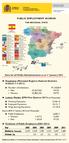 SECRETARIAT OF STATE FOR THE CIVIL SERVICE GENERAL DIRECTORATE OF CIVIL SERVICE PUBLIC EMPLOYMENT IN SPAIN THE REGIONAL STATE NSI 1-1-2010 SPAIN 505,990 km 2 47,021,031 Inhab. Andalusia 87,599 km 2 8,370,975
General scheme Human Resources & Settlement Structure
 General scheme Human Resources & Settlement Structure Julia SPIRIDONOVA Bulgaria Donauregionen Final Conference HUMAN RESOURCES General Population Data Total population: 20 millions Romania - 37% Bulgaria
2015 Ticketing Software Satisfaction Survey
 Arts Management & Technology Laboratory 2015 Ticketing Software Satisfaction Survey Dr. Brett Ashley Crawford, Danielle Gewurz, Stewart Urist, Kristen Sorek West, Christine Sajewski June 2015 A Research
An update on the level and distribution of retirement savings
 ASFA Research and Resource Centre An update on the level and distribution of retirement savings Ross Clare Director of Research March 2014 The Association of Superannuation Funds of Australia Limited (ASFA)
Can Equity Release Mechanisms fund long term care costs? Desmond Le Grys
 2001 Health Care Conference Can Equity Release Mechanisms fund long term care costs? Desmond Le Grys 1 Introduction 1.1 Scope This paper attempts to explain why equity release products have rarely been
International Retirement Security Survey
 International Retirement Security Survey July 00 (Copyright 00 by AARP. All rights reserved.) www.harrisinteractive.com [email protected] Table of Contents I. Background and Objectives II. III.
Full-Time Poor and Low Income Workers: Demographic Characteristics and Trends in Health Insurance Coverage, 1996 97 to 2005 06
 MEPS Chartbook No. 18 Medical Expenditure Panel Survey Full-Time Poor and Low Income Workers: Demographic Characteristics and Trends in Health Insurance Coverage, 1996 97 to 2005 06 Agency for Healthcare
Social Security: Vital to Retirement Security for 35 Million Women and Men
 IWPR Publication #D487 March 2010 Social Security: Vital to Retirement Security for 35 Million Women and Men Jeff Hayes, Heidi Hartmann, and Sunhwa Lee This Briefing Paper examines major sources of income
Boomer Expectations for Retirement 2014: Fourth Annual Report on the Retirement Preparedness of the Boomer Generation
 Boomer Expectations for Retirement 214: Fourth Annual Report on the Retirement Preparedness of the Boomer Generation April 214 About the Insured Retirement Institute: The Insured Retirement Institute (IRI)
Online Shoppers 2011
 Online Shoppers 2011 Dennis Fromholzer, Ph.D. CRM Associates Boulder, CO 80303 303-938-8788 www.crmassoc.com The Internet has emerged as a new marketplace and a primary medium for reaching and influencing
Population Figures at 1 January 2014 Migration Statistics 2013 Provisional data
 30 June 2014 Population Figures at 1 January 2014 Migration Statistics 2013 Provisional data Main results The population of Spain decreases by 220,130 persons in 2013, standing at 46,507,760 inhabitants
Around 15,500 Kirklees residents in their 60s are working and are likely to retire from work in the next few years.
 Retirement Headlines Around 15,500 Kirklees residents in their 60s are working and are likely to retire from work in the next few years. Experience of retirement varies with differing levels of access
1934-36. United States
 1934 36 United States Trends identified in earlier decades, such as the aging and urbanization of the U.S. population, continued into the 19s. In 19, the population exceeded 122 million, a gain of 16.1
RETAIL FINANCIAL SERVICES
 Special Eurobarometer 373 RETAIL FINANCIAL SERVICES REPORT Fieldwork: September 211 Publication: April 212 This survey has been requested by the European Commission, Directorate-General Internal Market
Tourism survey for Spanish residents (ETR/FAMILITUR) Q2 2015
 28 September 2015 Tourism survey for Spanish residents (ETR/FAMILITUR) Q2 2015 In the second quarter of 2015 Spanish residents made 46.8 million trips. 50.8% were for leisure, 34.6% to visit family or
The Non-English Speaking Population in Hawaii
 Data Report 2011 The Non-English Speaking Population in Hawaii Introduction The report examines social, economic and demographic characteristics of people in Hawaii who speak language other than English
Patient Experiences with Acute Inpatient Hospital Care in British Columbia, 2011/12. Michael A. Murray PhD
 Patient Experiences with Acute Inpatient Hospital Care in British Columbia, 2011/12 Michael A. Murray PhD Dec 7, 2012 Table of Contents TABLE OF CONTENTS... 2 TABLE OF FIGURES... 4 ACKNOWLEDGEMENTS...
Financial literacy. Australians understanding money
 Financial literacy Australians understanding money Financial literacy Australians understanding money Commonwealth of Australia 2007 ISBN: 0 642 74410 6 This work is copyright. Apart from any use as permitted
What is well-located land? Spatializing the city for Outcome 8 delivery
 7 What is well-located land? Spatializing the city for Outcome 8 delivery Introduction The release of the National Development Plan (NDP 2010 2011) has increased South Africa s focus on spatial planning.
JOB SATISFACTION AMONG TEACHERS OF PRIVATE AND GOVERNMENT SCHOOL: A COMPARATIVE ANALYSIS
 JOB SATISFACTION AMONG TEACHERS OF PRIVATE AND GOVERNMENT SCHOOL: A COMPARATIVE ANALYSIS TILAK RAJ*; LALITA** *ASSOCIATE PROFESSOR, DEPARTMANT OF COMMERCE, M.D.U., ROHTAK **RESEARCH SCHOLAR, DEPARTMENT
A Comparative Study of Reverse Mortgages: Evidence from Puerto Rico and United States
 A Comparative Study of Reverse Mortgages: Evidence from Puerto Rico and United States Research proposal by: Rogelio J. Cardona, Ph.D., CPA, Esq., Assistant Professor, Accounting Department Karen C. Castro-González,
For the 10-year aggregate period 2003 12, domestic violence
 U.S. Department of Justice Office of Justice Programs Bureau of Justice Statistics Special Report APRIL 2014 NCJ 244697 Nonfatal Domestic Violence, 2003 2012 Jennifer L. Truman, Ph.D., and Rachel E. Morgan,
Producing official statistics via voluntary surveys the National Household Survey in Canada. Marc. Hamel*
 Proceedings 59th ISI World Statistics Congress, 25-30 August 2013, Hong Kong (Session STS034) p.1762 Producing official statistics via voluntary surveys the National Household Survey in Canada Marc. Hamel*
Disparities in Access and Use of Skilled Nursing Services by Income and Racial-Ethnic Status in California
 Disparities in Access and Use of Skilled Nursing Services by Income and Racial-Ethnic Status in California Vivian Y. Wu Background Concerns about Disparities in Long-Term Care Services The baby boomer
Exploratory Spatial Data Analysis
 Exploratory Spatial Data Analysis Part II Dynamically Linked Views 1 Contents Introduction: why to use non-cartographic data displays Display linking by object highlighting Dynamic Query Object classification
Demographic Analysis of the Salt River Pima-Maricopa Indian Community Using 2010 Census and 2010 American Community Survey Estimates
 Demographic Analysis of the Salt River Pima-Maricopa Indian Community Using 2010 Census and 2010 American Community Survey Estimates Completed for: Grants & Contract Office The Salt River Pima-Maricopa
Summary Report. Department of Innovation, Industry, Science and Research. Industry and Small Business Policy Division
 Summary Report Department of Innovation, Industry, Science and Research Industry and Small Business Policy Division Small Business Dispute Resolution June 2010 DIISR Small Business Dispute Resolution Research
Retention of Nursing and Allied Health Professionals in Rural and Remote Australia summary report
 Retention of Nursing and Allied Health Professionals in Rural and Remote Australia summary report March 2014 1 Health Workforce Australia. This work is copyright. It may be reproduced in whole or part
FIRST-TIME HOMEBUYERS: UPDATE FROM THE 2005 AMERICAN HOUSING SURVEY
 FIRST-TIME HOMEBUYERS: UPDATE FROM THE 2005 AMERICAN HOUSING SURVEY In 2005, there were nearly 75 million homeowning households in the United States, representing nearly 69 percent of all households. During
ANALYZING THE CONSUMER PROFILING FOR IMPROVING EFFORTS OF INTEGRATED MARKETING COMMUNICATION
 Olimpia OANCEA Mihaela DIACONU Amalia DUŢU University of Pitesti ANALYZING THE CONSUMER PROFILING FOR IMPROVING EFFORTS OF INTEGRATED MARKETING COMMUNICATION Empirical studies Keywords Market segmentation
August 2014. Industry Report: SolarBusinessServices. Solar Businesses in Australia. Prepared for: Rec Agents Association
 August 2014 Prepared by: Industry Report: SolarBusinessServices Prepared for: Solar Businesses in Australia Rec Agents Association P a g e 1 RAA Industry Report Solar Businesses in Australia Final 2014
Clearer rules for international couples frequently asked questions
 Clearer rules for international couples frequently asked questions Why does the EU need to act to help international couples? There are around 122 million marriages in the EU, of which around 16 million
The ageing of the ethnic minority populations of England and Wales: findings from the 2011 census
 The ageing of the ethnic minority populations of England and Wales: findings from the 2011 census A briefing paper from the Centre for Policy on Ageing June 2013 The Centre for Policy on Ageing was set
THE COLLEGE OF THE BAHAMAS SCHOOL OF CHEMISTRY, ENVIRONMENTAL & LIFE SCIENCES
 THE COLLEGE OF THE BAHAMAS SCHOOL OF CHEMISTRY, ENVIRONMENTAL & LIFE SCIENCES OVERVIEW The world around us abounds in great examples of the principles of science. Our lives are affected daily by developments
Trends in Gun Ownership in the United States, 1972-2014
 GENERAL SOCIAL SURVEY FINAL REPORT Trends in Gun Ownership in the United States, 1972-2014 MARCH 2015 PRESENTED BY: NORC at the University of Chicago 55 East Monroe Street 30th Floor Chicago, IL 60603
Wealthy Consumers and Real Estate
 Wealthy Consumers and Real Estate Custom Research for Coldwell Banker Previews International Table of Contents Topic Slide # Research Notes and Methodology 3 Key Findings 7 Survey Results Real Estate Profile
Development Type - Retirement Accommodation
 Retirement Accommodation Introduction Australia has an ageing population and by 2056 up to one quarter of Australia s population will be aged 65 or older. Australia's population, like that of most developed
Secrets to Small Business Success
 Secrets to Small Business Success Small business owners are often looking for ways to increase their bottom line. To help entrepreneurs increase their revenues, this report closely examines the small firms
SELECTED SOCIAL CHARACTERISTICS IN THE UNITED STATES. 2012 American Community Survey 1-Year Estimates
 DP02 SELECTED SOCIAL CHARACTERISTICS IN THE UNITED STATES 2012 American Community Survey 1-Year Estimates Supporting documentation on code lists, subject definitions, data accuracy, and statistical testing
Brand New Belongings Survey
 Brand New Belongings Survey Methodology The Brand New Belongings Study was conducted online from May 21 to May 29, 2013. Respondents were comprised of 1,005 U.S. adults aged 18+ who have a homeowners insurance