
Statement of Recommended Practice. Financial Statements of Authorised Funds
|
|
|
- Raymond Marshall
- 10 years ago
- Views:
Transcription
1 Statement of Recommended Practice Financial Statements of Authorised Funds

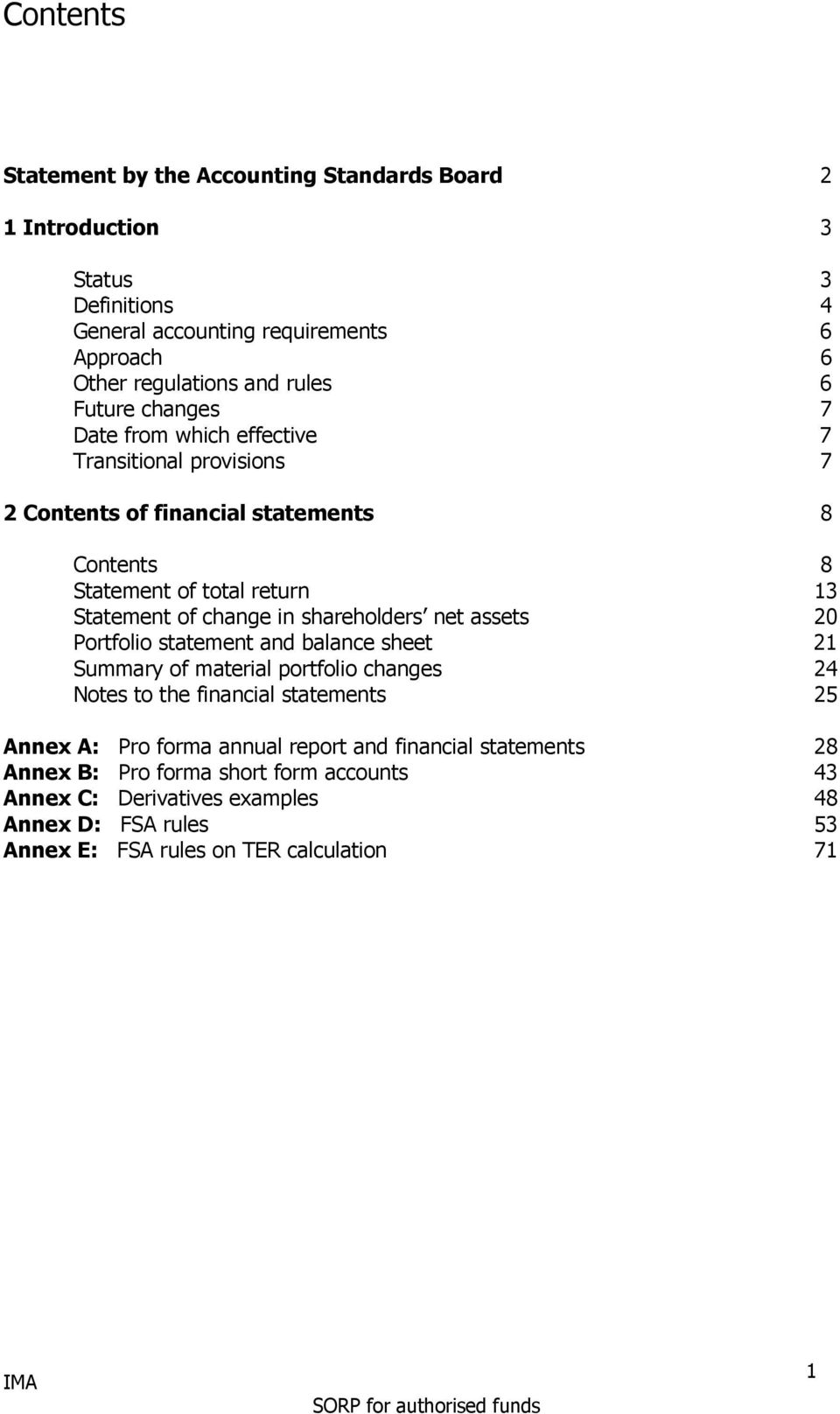
2 Contents Statement by the Accounting Standards Board 2 1 Introduction 3 Status 3 Definitions 4 General accounting requirements 6 Approach 6 Other regulations and rules 6 Future changes 7 Date from which effective 7 Transitional provisions 7 2 Contents of financial statements 8 Contents 8 Statement of total return 13 Statement of change in shareholders net assets 20 Portfolio statement and balance sheet 21 Summary of material portfolio changes 24 Notes to the financial statements 25 Annex A: Pro forma annual report and financial statements 28 Annex B: Pro forma short form accounts 43 Annex C: Derivatives examples 48 Annex D: FSA rules 53 Annex E: FSA rules on TER calculation 71 SORP for authorised funds 1
3 Statement by the Accounting Standards Board The aims of the Accounting Standards Board (the ASB) are to establish and improve standards of financial accounting and reporting, for the benefit of users, preparers, and auditors of financial information. To this end, the ASB issues accounting standards that are primarily applicable to general purpose company financial statements. In particular industries or sectors, further guidance may be required in order to implement accounting standards effectively. This guidance is issued, in the form of Statements of Recommended Practice (SORPs), by bodies recognised for the purpose by the ASB. The Investment Management Association () has confirmed that it shares the ASB s aims of advancing and maintaining standards of financial reporting in the public interest and has been recognised by the ASB for the purpose of issuing SORPs. As a condition of recognition, the has agreed to follow the ASB s code of practice for bodies recognised for issuing SORPs. The code of practice sets out procedures to be followed in the development of SORPs. These procedures do not include a comprehensive review of the proposed SORP by the ASB, but a review of limited scope is performed. On the basis of its review, the ASB has concluded that the SORP has been developed in accordance with the ASB s code of practice and does not appear to contain any fundamental points of principle that are unacceptable in the context of present accounting practice or to conflict with an accounting standard or the ASB s plans for future standards. December 2005 SORP for authorised funds 2
4 1 Introduction Status 1.1 This SORP, issued by, supersedes the previous SORP for authorised funds (authorised unit trusts (AUT) and open ended investment companies (OEIC)), setting out recommendations for the preparation of financial statements for unitholders of all authorised funds. Notwithstanding that a SORP describes recommended practice, compliance with this SORP is required by the Financial Services Authority s (FSA s) Collective Investment Schemes (CIS) Sourcebook and New Collective Investment Schemes (COLL) Sourcebook The Accounting Standards Board ("the ASB") has approved for the purposes of issuing recognised SORPs for authorised funds. This arrangement requires to follow the ASB's code of practice for the production and issuing of SORPs. 1.3 This code of practice provides the framework to be followed by for the development of SORPs, but does not entail a detailed examination of the proposed SORP by the ASB. However, a review of limited scope is performed. 1.4 Under Part III of the OEIC Regulations the directors of an investment company with variable capital (ICVC) are responsible for the preparation of the company's annual and half-yearly reports. In addition, under Chapter 10 of the CIS Sourcebook or Chapter 4 of the COLL Sourcebook, the authorised corporate director (ACD) of the company is responsible for ensuring that the contents of each report comply with FSA rules. 1.5 Under Chapter 10 of the CIS Sourcebook or under Chapters 4 and 8 of the COLL Sourcebook, the manager of an AUT is responsible for the preparation of the AUT s annual and half-yearly reports. 1.6 The recommendations of this SORP have been arrived at after consideration of the Statements of Standard Accounting Practice ( SSAPs ) and Financial Reporting Standards ( FRSs ) issued before 31 March This SORP complies with International Financial Reporting Standards (IFRS) only to the extent that UK GAAP has converged with IFRS through FRSs and only to the extent that those FRSs are a requirement for authorised funds. The presentation aspects of FRS 25 became a requirement for authorised funds at 1 January However, the disclosure requirements of FRS 25 will have to be complied with only when 1 The CIS Sourcebook in 10.3 and the COLL Sourcebook which has been in effect since 1 April 2004 refers to the SORP in and By 12 February 2007 all authorised funds must comply with the COLL Sourcebook. SORP for authorised funds 3

5 FRS 26 is adopted by the SORP or becomes a requirement for authorised funds. Whilst to be consistent with FRS 26, this SORP introduces the use of bid valuations instead of mid, the SORP does not adopt FRS 26 as there are concerns relating to the impact of FRS 23 which must also be complied with when FRS 26 is adopted. Currently, the ASB is proposing that FRS 26 should apply to authorised funds from 1 January Definitions 1.7 The following definitions shall apply in this SORP. Authorised Corporate Director (ACD) The director of an ICVC that is the authorised corporate director of the ICVC in accordance with CIS Sourcebook 7.2.1R (The directors) and COLL Sourcebook 6.5.3R (Appointment of an ACD). Authorised fund An Investment Company with Variable Capital (ICVC) or an Authorised Unit Trust scheme (AUT). Authorised Unit Trust (AUT) As defined in section 237(3) of the Financial Services and Markets Act 2000 (Other definitions), a unit trust scheme which is authorised for the purposes of the Act by an authorisation order. CIS Sourcebook and COLL Sourcebook FSA rules relating to authorised funds. See Annex D for relevant extracts. Depositary The person to whom is entrusted the safekeeping of all of the scheme property of an ICVC and who has been appointed for this purpose in accordance with Regulation 5 (Safekeeping of scheme property by depositary) of and Schedule 1 (Depositaries) to the OEIC Regulations. Derivative financial instrument ( Derivative ) A derivative is a financial instrument or other contract with all three of the following characteristics: (a) (b) its value changes in response to the change in a specified interest rate, financial instrument price, commodity price, foreign exchange rate, index of prices or rates, credit rating or credit index, or other variable, provided in the case of a non-financial variable that the variable is not specific to a party to the contract (sometimes called the underlying ); it requires no initial net investment or an initial net investment that is smaller than would be required for other types of contracts that would be expected to have a similar response to changes in market factors; and SORP for authorised funds 4
6 (c) it is settled at a future date. Typical examples of derivatives are futures, forwards swap and option contracts. More comprehensive guidance is contained in FRS 26 paragraphs AG 9 AG 12. Effective yield Effective yield is an income calculation that takes account of amortisation of any discount or premium on the purchase price over the remaining life of the security. The calculation uses the effective interest method as defined in FRS 26, paragraph 9 with guidance in paragraphs AG 5 AG 8. Instrument constituting the scheme (a) In relation to an ICVC, the instrument of incorporation; (b) In relation to an AUT, the trust deed. Investment Company with Variable Capital (ICVC) A body incorporated under the OEIC Regulations. Manager The firm that is the manager of an AUT in accordance with the trust deed. Market value For non-derivative securities, it is the fair value which generally is the bid market value. For futures, it is the unrealised gain or loss at the balance sheet date as this represents the cost of closing out the contract at that date. For call or put option purchased or written on any short position, it is the price to close out the contract at the balance sheet date. OEIC Regulations The Open Ended Investment Companies Regulations 2001 (SI 2001/1228). Trustee In accordance with section 237(2) of the Financial Services and Markets Act 2000 (Other definitions), the person holding the property in question on trust for the participants of a unit trust scheme. Unit a) In relation to an AUT, a unit representing the rights or interests of the unitholders in the AUT. b) In relation to an ICVC, a share in the ICVC. The term unit, and derivations thereof, have been used throughout this SORP for SORP for authorised funds 5
7 the sake of simplicity. This should not preclude an ICVC from using the term share or shareholder in situations where it is more appropriate. Unitholder The holder of a unit in an AUT or a share in an ICVC. Value at Risk (VAR) VAR is the expected loss of portfolio over a specified time period for a set level of probability. Zero dividend preference shares Preference shares which carry no entitlement to dividends but the right, on a fixed date or on any earlier redemption, to the repayment of capital and a premium in priority to any capital payment to the holders of ordinary shares. General accounting requirements 1.8 Financial statements should comply with SSAPs, FRSs and Urgent Issue Task Force (UITF) Abstracts. Appropriate disclosure of the accounting policies should be made in the notes to the financial statements. Examples of the accounting policies required are covered in Part II of this SORP. Taken together, these should ensure that the financial statements provide a true and fair view. Approach 1.9 Explanatory background has been included within the text and all the information about an individual topic can be found in one place. The whole of this statement including the annexes is therefore recommended practice. Other regulations and rules 1.10 The recommendations of this SORP should be read in conjunction with ASB s Explanatory Foreword to SORPs, any rules and regulations relating to authorised funds that are in force, and the law relating to these matters. Again, compliance with this SORP is required by FSA rules 2. In accordance with FRS 18 Accounting policies paragraphs 58 to 61, an authorised fund s financial statements should state the title of this SORP and whether its financial statements have been prepared in accordance with it. In the event of a departure from the SORP, the authorised fund should give a brief description of how the treatment adopted departs from the recommended practice set out in the SORP, which should include: (a) the reasons why the director(s) or manager judge the treatment adopted to be more appropriate to the particular circumstances of the authorised fund; and 2 See footnote to paragraph 1.1. SORP for authorised funds 6

8 (b) details of any disclosures recommended by the SORP that have not been provided, and the reasons why they have not been provided For the sake of completeness, this SORP includes the requirements of the OEIC Regulations and FSA rules covering the contents of annual and half-yearly reports to unitholders. The director(s) or the manager are responsible for preparing the reports, and for ensuring that the full financial statements give a true and fair view of the position at the end of the period, and the net income for the period. Future changes 1.12 Where requirements change as a result of changed regulations, legislation, product changes or the publication of FRSs, the implications for this SORP may be dealt with by guidance until such time as the SORP itself is revised. The will keep this SORP under regular review, in accordance with the ASB s code for SORPs, and will amend it from time to time in the light of developments, for example when it becomes clearer how IFRS will affect authorised funds. Pending such changes being issued, accounts must be prepared on the basis of accounting standards and UITF Abstracts issued after publication of this SORP, from their effective date. Date from which effective 1.13 Apart from paragraph 2.32 relating to bond income on an effective yield basis, the recommendations of this SORP will be applicable for accounting periods beginning on or after 1 January However, it should be noted that the FRS 25 presentation requirements became effective for accounting periods beginning on or after 1 January In order to allow sufficient preparation time, the requirements of paragraph 2.32 relating to bond yields will be expected for accounting periods beginning on or after 1 January Earlier compliance is encouraged. Transitional provisions 1.15 Restatement of prior year comparatives is not required in respect of changes required by the SORP relating to bid valuations and effective yield. If comparatives are not restated, preparers of reports should: a) apply the existing accounting policies to the comparative information; b) disclose this fact together with the basis used to prepare this information; and c) disclose the nature of the main adjustments that would make the information comply with the new requirements, but these adjustments need not be quantified. SORP for authorised funds 7

9 2 Contents of financial statements Contents Annual reports and accounts of the fund 2.1 The annual report to unitholders should contain the audited financial statements, a statement of net asset value per unit, the number of units of each class in issue, a comparative table and the information required to be disclosed by Chapter 10 of the CIS Sourcebook or Chapters 4 and 8 of the COLL Sourcebook. It should also contain the investment report together with reports of the auditor and depositary or trustee. Statements of responsibilities of each of the auditor, ACD or manager, and depositary or trustee should also be included. Special requirements relating to umbrella funds are also set out in Chapter 10 of the CIS Sourcebook and Chapter 4 of the COLL Sourcebook, which require each report of the fund to be signed by the ACD or manager (see paragraph 2.10). 2.2 In relation to ICVCs, if there are other directors, the ACD and at least one other director must sign the report on behalf of the Board. Regulation 66(3) of the OEIC Regulations requires the director(s) to lay copies of the annual report before the company in general meeting where the companies hold general meetings. Content of the financial statements 2.3 The audited annual financial statements should contain appropriate information on the transactions of the fund during the accounting period, and on the amount and disposition of the fund s assets and liabilities at the end of the period. 2.4 This information should be presented in the form of: a statement of total return a statement of change in shareholders net assets a portfolio statement a balance sheet a summary of material portfolio changes a statement of the material accounting policies used in preparing the financial statements further details in notes to the financial statements SORP for authorised funds 8
10 a distribution table Comparative figures should be given for the previous period for all items in the statement of total return, statement of change in shareholders net assets, balance sheet, and the notes to each, and for sector percentage totals in the portfolio statement. In the portfolio statement, comparatives at security level would be unhelpful, and FRS 28 paragraph 11 allows non-disclosure of these details. 2.5 If a fund meets the criteria of the special exemptions in the revised FRS 1, a cash flow statement is not required. Paragraph 5(d) of the revised FRS 1 is most likely to apply. This grants exemption to open ended investment funds that meet all the following conditions: i) substantially all of the entity s investments are highly liquid; ii) substantially all of the entity s investments are carried at market value; iii) the entity provides a statement of change in net assets. When funds use derivatives extensively, consideration should be given to whether the liquidity condition continues to be met. 2.6 Pro forma financial statements that meet the recommendations set out above are included in Annex A. The pro forma is a minimum recommendation and, although the order of the statements is not prescribed, it is recommended that the headings used within the statements be adhered to in the order shown. Additional disclosure is recommended to reflect any special circumstances and to ensure that the financial statements show a true and fair view. Half-yearly reports and accounts of the fund 2.7 The half-yearly report to unitholders should contain the half-yearly financial statements, a statement of the net asset value per unit, and the number of units of each class in issue. It should also contain the investment report and the information required to be disclosed by Chapter 10 of the CIS Sourcebook or Chapter 4 of the COLL Sourcebook. The report should be signed by the director or manager in accordance with Chapter 10 of the CIS Sourcebook or Chapter 4 of the COLL Sourcebook. The half-yearly financial statements, which are not required to be audited, should be prepared using the same accounting policies and format as the annual financial statements (although this does not preclude preparers from making a change of accounting policy in the half-yearly financial statements) and include the following items: a statement of total return a statement of change in shareholders net assets SORP for authorised funds 9

11 a portfolio statement a balance sheet a summary of material portfolio changes a statement of the material accounting policies used in preparing the financial statements further details in notes to the financial statements a distribution table (if appropriate) 2.8 Comparative figures should be given for all items in the statement of total return, statement of change in shareholders net assets and balance sheet, and the notes to each, and for sector percentage totals in the portfolio statement. They should be the equivalent figures for the same half-yearly period in the previous year for the statement of total return, but the last audited figures (i.e. at the end of the last full accounting period) for the other statements. Comparative figures are not required at security level in the portfolio statement. Short form accounts in reports of the fund 2.9 If using the CIS sourcebook, at the discretion of the director(s) or manager, short form accounts may be sent or supplied to unitholders for any period instead of the full accounts specified in paragraphs 2.1 and 2.7. If so, it must be made clear when such accounts are sent or supplied that unitholders are entitled to apply for and receive the full accounts. The information shown in short form accounts may be limited to give unitholders a clear and simple picture of the performance of their investment over the period. The short form accounts should be designed to give the average unitholder a clear simplified picture of first the total return and amount distributed or accumulated, and the amount taken out by way of expenses and, second, of where his funds were invested Every annual and half-yearly report to unitholders containing short form accounts should include a statement of the net asset value per unit and the information required to be disclosed by Chapter 10 of the CIS Sourcebook, in a form appropriate for short form accounts. The director s or manager s report included in a report containing short form accounts should cover everything required by Chapter 10 of the CIS Sourcebook, though not necessarily in the same amount of detail. In addition, a report that relates to an annual accounting period should include a comparative table, giving the same information as required by Chapter 10 of the CIS Sourcebook for reports containing the full accounts. It should also contain the report of the depositary or trustee, and a copy of the auditor s statement on the short form accounts. The reports, including the short form accounts should be signed by the director(s) or manager, as set out in SORP for authorised funds 10
12 paragraphs 2.1 and 2.2. Statements of responsibilities of each of the ACD or manager, auditor and depositary or trustee should also be included as appropriate Reports to unitholders containing short form accounts must form a separate stand-alone document that does not include any extraneous material. Short form accounts should contain the following items (with comparatives on the same basis as for the full accounts): a statement of total return a statement of change in shareholders net assets a statement of investments and other assets a distribution table 2.12 Pro forma short form accounts that meet the recommendations set out above are included in Annex B. The pro forma is a recommendation and although the order of statements is not prescribed, headings used within the statements should be adhered to in the order shown. It is not intended that notes to the financial statements will be included but additional disclosure is recommended where there is a need to reflect any special circumstances There are no provisions within the COLL Sourcebook for short form accounts. Short reports 2.14 The COLL Sourcebook Chapter 4 introduces Short Reports as the default reporting. This is a consumer focused six monthly document and should not be confused with short form accounts. Where Short Reports are issued following the COLL Sourcebook reporting requirements, short form accounts must not be produced. For funds operating under the CIS Sourcebook, where the manager or the director(s) do not elect to produce Short Reports, short form accounts may still be produced and made available until 12 February Short report requirements are detailed in Chapter 4 of the COLL Sourcebook. The information provided in the Short Reports must be consistent with long reports All retail funds operating under the COLL Sourcebook must produce short reports, which must be provided to investors. The long form reports and accounts must be provided to investors upon request Qualified Investment Schemes (QIS) operating under the COLL Sourcebook do not have to produce Short Reports but must produce long form report and accounts which must be provided upon request (COLL chapter 8.3.5). SORP for authorised funds 11

13 Reports and accounts of umbrella funds 2.17 The annual and half yearly report to unitholders of an umbrella fund should contain reports and accounts relating to each of its sub-funds, prepared in the reporting currency of the fund, together with the other information set out in paragraphs 2.3 and 2.7, as appropriate. The reports should also contain the other information specifically required by Chapter 10 of the CIS Sourcebook or Chapter 4 of the COLL Sourcebook for sub-funds. An aggregation of the accounts of each sub-fund must also be prepared, together with the additional information specifically required by Chapter 10 of the CIS Sourcebook or Chapter 4 of the COLL Sourcebook for an umbrella fund. The aggregated financial statements should comprise: a statement of total return a statement of change in shareholders net assets a balance sheet a statement of the material accounting policies used in preparing the financial statements appropriate notes to the aggregated financial statements 2.18 If the fund is operating under the CIS Sourcebook, the director(s) or manager can elect to send to unitholders a report on the relevant sub-fund only. This is currently not an option under the COLL Sourcebook. Where only sub-fund reports are provided, a report on the umbrella fund as a whole must be made available to unitholders on request. Chapter 10 of the CIS Sourcebook also permits the director(s) or manager to elect to produce short form accounts in reports sent to unitholders of umbrella funds. Where this is the case, copies of the report containing the full accounts of the umbrella fund as a whole (which include the full accounts for each sub-fund) must be made available to unitholders on request. Funds or sub-funds with different unit classes 2.19 Where there are different unit classes, the investments of the fund or sub-fund remain as one pool, and are not separately allocated to unit classes. Where there is a different charging structure for each class, such differences will be reflected in the price of each unit class and the proportion of the pool of investments attributable to each class. The prices will determine the amount receivable or payable by the fund or sub-fund in respect of issues and cancellations of units, but these amounts need not be analysed by class in the statement of change in shareholders net assets. The share of the fund s or sub-fund s net assets, the net asset value of each unit in each class (at the SORP for authorised funds 12

14 beginning and end of the period) and the distributions attributable to each class should be included in the accounts. The different rights and terms attaching to each unit class, including the rights on winding-up and the policy for allocating taxation and distributable income, should be summarised in the notes to the accounts. Statement of total return 2.20 A statement of total return should be prepared. This will set out the total return, comprising net investment gains or losses together with net income after tax, and will then identify that part of the total return that is to be distributed in accordance with FSA rules The statement of total return should show, with corresponding figures for the preceding equivalent period: Net gains/losses on investments during the period Other gains/losses Net income/expense after taxation for the period showing separately income, total expenses, interest costs and the tax charge Total return for the period before distributions Distributions Change in net assets attributable to unitholders 2.22 As Annex A shows, the statement of total return incorporates investment gains/losses and income after tax, showing the various components separately and distributions The headings used in paragraph 2.21 are summary components only, to keep the principal statement clear and simple. The main components should be analysed in more detail in notes to the financial statements, in particular, the net gains/losses on investments, other gains/losses, and net income/expense after taxation, examples of which are also at Annex A. Net gains/losses on investments 2.24 The investment gains/losses should be analysed in the notes to show the gains from derivatives, FX contracts and other investments. Any special dividends regarded as capital in nature (see paragraph 2.39) should be included within gains. Any movement on zero dividend preference shares, which are generally issued at a discount to compensate the investor for the lack of dividend, should SORP for authorised funds 13
15 be included within net gains/losses on investments. Other gains/losses 2.25 Other gains/losses should be explained (in the notes if not on the face of the statement) and may include such items as gains/losses on back-to-back loans, gains/losses on forward foreign exchange contracts, and other currency movements relating to capital items other than investments. Gains/losses on forward foreign exchange contracts relating to investments are included within net gains/losses on investments (see paragraph 2.24). Net income/expense after taxation 2.26 The net income/expense after taxation should show income, total expenses and taxation, with details of these individual components given in the notes. An example of recommended disclosure is at Annex A. Total return for the period 2.27 Where there is a material difference between net income after taxation shown in the statement of total return and the amount distributed, an explanation of the difference should be included in the notes. It is expected that the director s or manager s report will explain the investment strategy, the result of which has led to this material difference. Derivatives 2.28 The treatment of derivatives in the balance sheet is dealt with under portfolio statement, paragraphs 2.71 to For the purposes of the statement of total return, the inclusion of gains or losses from derivative products in net gains or losses on investments or in net income before taxation will depend upon the nature of the transaction. Where positions are undertaken to protect or enhance capital return, the gains or losses should be dealt with in gains or losses on investments; where they are for generating or protecting income, the costs or income should be dealt with in net income before taxation. Therefore, both motives and circumstances in the use of derivatives are important in determining whether items should be treated as income or capital. If, for example, the direct impact of entering a derivative transaction is to decrease the value of the existing income of the fund, the costs and revenues and any other impact associated with that transaction should be matched and therefore be taken against income. If appropriate, other indicators of motive should be considered in order to establish what the motive was. Examples of accounting for different derivatives are given at Annex C. Income from equities SORP for authorised funds 14

16 2.29 Income from equities should be accounted for when it is earned. In the case of quoted equity investments, and non-equity shares, the income should be regarded as earned when the security is quoted ex-dividend (i.e. when the price quoted falls to reflect the value of the dividend concerned). In the case of unquoted equity investments, income should be regarded as earned when the dividend is declared, and the amount at which the investments are shown in the portfolio statement will need to reflect any such income. Dividends received should be stated net of irrecoverable tax credits Application of the accruals concept means that a return (whether in respect of dividends, in respect of redemption, or otherwise) on a non-equity share (such as a preference share) should, in principle, be recognised as income and accrued on a time-apportionment basis. However, because of the practical difficulties arising from the requirement to undertake daily valuations for pricing purposes (such as the lack of availability of pricing information that achieves an accurate allocation between capital and income for these shares), this is impractical for authorised funds. Therefore, income from non-equity shares should be recognised on the same basis as equities. This paragraph does not apply to zero dividend preference shares, the treatment for which is stated in paragraph Interest and income on other securities 2.31 Interest and income on other securities should be recognised as earned. To achieve this, accrued interest purchased and sold on interest-bearing securities should be excluded from the capital cost of these securities and dealt with as part of the income of the scheme For accounting periods beginning on or after 1 January 2007, income should be accounted for on an effective yield basis, irrespective of the level of discount or premium, and it should be calculated with reference to the purchase price. Any movement in the fair value at balance sheet date not accounted for through amortisation of the discount or premium must be shown as a capital gain/loss When this requirement is first being implemented, in the possible event that amortised purchase prices cannot be obtained without undue cost and effort, a suitable alternative basis of calculation should be agreed and appropriately disclosed. Debt securities issued at a discount or premium 2.34 For accounting periods beginning before 1 January 2007, in the case of investments in debt securities issued at a significant discount or premium to the maturity value, the total income arising on such securities, taking into account the amortisation of such a discount or premium, should be spread over the life of the security on an appropriate basis, having regard to applicable accounting standards. A discount or premium is significant if greater than the lower of: SORP for authorised funds 15
17 x% of the redemption price, where x is equal to half the number of years of the issue term; 15% of the redemption price. Income recognition 2.35 If it is expected that income receivable at the balance sheet date will not be received, a provision should be made for the relevant amount. Deduction of tax 2.36 In cases where income is received after the deduction of withholding tax, the income should be shown gross of taxation, and the tax consequences should be shown within the tax charge. Scrip dividends 2.37 For certain securities, the holder may elect to receive a dividend in the form of shares rather than cash. In most cases, the value of the shares to be received will approximate to the amount of the cash dividend (an ordinary scrip dividend), any small difference being attributable to the movement of the share price between the dividend declaration and the shares being quoted ex dividend. In a few cases, an enhancement may be offered such that the value of the shares significantly exceeds the cash dividend (an enhanced scrip dividend) In the case of an ordinary scrip dividend, the whole amount should be recognised as income, on the basis of the market value of the shares on the date they are quoted ex dividend. In the case of an enhanced scrip dividend, the value of the enhancement, calculated as the amount by which the total market value of the shares on the date they are quoted ex dividend exceeds the cash dividend, should be treated as capital. Scrip dividends may not need to form part of the distribution, and the fund s distribution policy for this item should be stated, i.e. that the ordinary element of scrip dividends is treated as income but does/does not form part of the distribution. If the ordinary element of scrip dividends does not form part of the distribution, a statement that the distribution is in accordance with the CIS sourcebook should be disclosed. Special dividends, share buy-backs and additional share issues 2.39 Whether a special dividend, share buy-back or additional share issue is income or capital by nature depends very much on the facts of each particular case. For example, it is likely that where the receipt of a special dividend results in a significant reduction in the capital value of the holding, then the special dividend should be regarded as capital in nature so as to ensure that the matching principle is applied to gains and losses. Otherwise, the special dividends should SORP for authorised funds 16
18 be regarded as income. Underwriting commission 2.40 Underwriting commission should be taken to income and be recognised when the issue takes place, except where the fund is required to take up all or some of the shares underwritten, in which case an appropriate proportion of the commission received should be deducted from the cost of those shares. Stock lending 2.41 Any fees arising from stock lending should be recognised as income on an accruals basis Unless disclosed elsewhere within the report, there should be a note in the accounts disclosing the gross amount and any fees that have been paid to arrive at the net stock lending income amount. Expenses 2.43 To facilitate comparability between funds, all expenses, including interest on borrowing (other than the direct costs of purchase and sale of investments, for example commission, and stamp duty reserve tax arising on sales and repurchases of units in the company), should be charged against income, regardless of any alternative treatment that may be permitted in determining the distribution. To the extent that such expenses can be borne ultimately by capital, the distribution will reflect this, and be higher than the net income as disclosed in the financial statements. Expenses should be analysed to show those payable to the ACD or manager, the depositary or trustee, related parties and third parties Where there is directly or indirectly any fee sharing between the manager, the depositary or an affiliate of either, this must be disclosed with the relevant details. Performance fees 2.45 Where performance fees are charged, the basis of the charge should be disclosed Performance fees should be accrued in accordance with accounting standards and, in the first instance, charged against income. Where all or part is offset against capital for distribution purposes, the basis for the determination of such amounts should be disclosed Where there are known circumstances that may affect future performance fees, for instance a high water mark, this information should be disclosed. SORP for authorised funds 17
19 Guaranteed funds 2.48 Where a premium is paid to a third party(ies) for a guarantee, the accounting treatment follows the nature of the transaction. Where a third party(ies) guarantee to protect investments, the gains or losses should be dealt with in gains or losses on investments; where it guarantees to protect income, the costs or income should be dealt with in net income before taxation. Where the nature of the guarantee is to limit or cap the expenses of the fund, any receipt from the third party(ies) should be shown as a deduction against expenses rather than income. Any such deduction should be disclosed in the notes. The cost of the premium should be recognised in the statement of total return over the period to which the guarantee relates. The treatment of any recoveries from third parties follows the treatment of the premium. Because there will be instances where professional judgement will be required and other factors might have to be taken into account (for example the ability of third parties to honour their guarantees), there should be sufficient narrative disclosure to enable the user properly to understand the nature of the receipt. Taxation 2.49 The following items should be separately identified within the notes to the financial statements together with any other material components of the tax charge: UK corporation tax Overseas taxation Double tax relief Overseas tax credits Deferred tax Adjustments in respect of previous periods 2.50 In general, the tax accounting treatment should follow that of the principal amount, with charges or reliefs allocated using the marginal basis. Under the marginal basis, tax charges or reliefs are allocated to capital or income to the extent that there remains a liability to corporation tax after relief has been made for all expenses attributed directly to the income and capital accounts. In calculating how much tax relief should be allocated, revenue expenses are matched first against taxable income arising in the revenue account, and tax deductible capital expenses are matched first against taxable income arising in the capital account. Tax relief should be allocated to the capital account only to the extent that expenses in the capital account (if any remain after offsetting these expenses against taxable income in the capital account) are required to reduce or eliminate taxable profits. Similarly, tax relief should be allocated only to the revenue account to the extent that expenses in the revenue account (if any SORP for authorised funds 18
20 remain after offsetting these expenses against taxable income in the revenue account) are required to eliminate taxable profits. The fact that a fund is not in an overall taxpaying position is not, in itself, a reason not to allocate tax relief on expenses For example, a fund with 100 of taxable income and 120 of relievable expenses, 50 of which are offset to capital, would take full relief for the 70 of expenses borne by income before allocating relief of 6 (being 100 less 70 = 30 at 20%) to the capital account. Overseas taxation 2.52 Overseas withholding tax suffered net of expected recoveries under any relevant double tax treaty, to the extent that a valid claim is or is expected to be made, should be separately disclosed in the financial statements. In addition, there may be a large amount of overseas taxation recoverable under double tax treaties. There may often be a significant time lag between the receipt of the overseas dividend net of taxation and the receipt of the tax refund. Whether the distribution should assume that all tax claims would be recovered in full will depend on the circumstances and recovery experience in respect of the investments and territories involved. If provision is considered necessary, owing to significant uncertainty as to receipt, this should be deducted from the amount receivable and disclosed as part of overseas taxation. The estimated expense of recovering the taxation should also be provided for and included within expenses. Interest distributions 2.53 Where an authorised fund opts to pay an interest distribution, the amount paid out or invested in respect of accumulation units is allowed as a deduction against the fund s taxable profit for the period. In effect, where all such income is paid out or invested in respect of accumulation units, there should be no charge to tax within the fund in respect of that income. However, except where an interest distribution is paid gross to unitholders, it will nevertheless be a responsibility of the fund to deduct income tax at source at the appropriate rate on payment of the interest distribution to the unitholder. Withholding tax on interest distributions should be shown within other creditors and not as part of the fund s liability to corporation tax, since it will be settled from amounts transferred to the distribution account. Deferred taxation 2.54 There may be timing differences between the accounting treatment of certain items and their taxation. Because it is important to maintain equity in entitlements between accounting periods, deferred taxation should be provided on all temporary timing differences (that are not specifically exempted by FRS 19 paragraphs 9-33) that have originated but not reversed by the balance sheet date. Details of any deferred tax assets and liabilities should be given in the SORP for authorised funds 19

21 notes to the financial statements in accordance with FRS 19 Deferred tax. Value added tax (VAT) 2.55 The VAT recovery position will vary from fund to fund. As for all other items in the financial statements, the recovery of VAT should be accounted for on an accruals basis. Irrecoverable VAT should be included as part of the relevant cost. Distributions 2.56 Details of the type of distribution being paid should be given in the notes to the accounts. Irrespective of the type of distribution, under FRS 25, units in a trust or shares in an OEIC are not treated as equity. Therefore, all distributions made are shown in the statement of total return under the heading of finance costs. Statement of change in shareholders net assets 2.57 The statement of change in shareholders net assets should summarise the movements in the total value of the fund This statement reconciles the changes in net assets during the period in summary form. It draws on the statement of total return for the net increase/decrease in assets attributable to the investment activities and shows the extent to which the fund has grown or contracted as a result of the issue or cancellation of units. An example of this statement is given at Annex A The statement of change in shareholders net assets should be presented on the same page of the financial statements as the statement of total return, thereby providing unitholders, on one page, with a summary of the principal features of the fund s results for the period. Dilution levy 2.60 Any dilution levy charged (in the case of issue and sale of units) or deducted (in the case of redemption and cancellation) should be shown separately. Stamp Duty Reserve Tax (SDRT) 2.61 SDRT arising as a result of redemptions of units in the fund should be shown separately where the cost is borne by the fund. Portfolio statement and balance sheet 2.62 The reports to unitholders must include a balance sheet, which includes all assets and liabilities, and a portfolio statement, which shows the disposition of a fund s investment portfolio. SORP for authorised funds 20
22 Portfolio statement Investments in securities valuation 2.63 Investments of the fund should be stated at market value at the balance sheet date Investments should always be valued to exclude any element of accrued income. The value of overseas securities should be translated into the reporting currency at exchange rates prevailing at the balance sheet date. Where, in view of exceptional circumstances, for example the suspension of the market, the last quoted price is not used, the notes should describe clearly the basis of valuation and the reasoning behind it The accounting system used for valuing the investments for financial statements purposes at the period end will normally be the same as that used for valuation purposes. Where daily valuations are produced for the purposes of pricing, it is acceptable to use that valuation of the property of the fund for the purposes of the financial statements, rather than perform an additional valuation, provided that the valuation point is sufficiently near to the close of business on the balance sheet date, such that any distortion arising from price movements or as a result of subsequent deals is clearly immaterial. The precise valuation point should be disclosed in the notes to the financial statements For most funds, the determination of the market value of the portfolio should be reasonably straightforward, since the values are readily available through published sources. However, in certain situations, the value of a security may not be readily determinable, as will often be the case where the investment is not an approved security within the meaning of FSA rules. Where the value cannot be readily determined, the securities should be stated at the director s or manager s valuation, arrived at in accordance with the fund s instrument constituting the scheme. The notes to the financial statements should include adequate details about the basis of the valuation, including the identity of those who carried out the valuation and a statement on how the valuation was reached. This statement should make it clear that the intention of the valuation was to estimate market value. Investment in securities presentation 2.67 For each holding in the portfolio, the percentage of the value of the fund or subfund property that the holding represents should be shown. The percentage should also be shown for each category of holding in the property of the fund or sub-fund, in addition to the individual holdings. These categories should be the most appropriate in the light of the investment policy of the fund, for example economic, geographical or by currency. A suggested format for the portfolio SORP for authorised funds 21
23 statement is set out at Annex A In addition, if a fund invests in more than one class of asset (for example, bonds and equities) and asset class is not a category used in presenting the portfolio statement, the split between each asset class must be made clear at the foot of the portfolio statement. Such an analysis is not recommended for an asset class if that asset class represents less than 5% of the fund s value. For example: Market value % 000s Bonds 25, Equities 9, Portfolio of investments 35, For bond funds, where credit rating is not a category used in presenting the portfolio statement, the listing of bonds should be in sectoral categories, similar to the way that the analysis is performed for equities. Where this is the case, there should also be an analysis at the foot of the portfolio statement showing the investments in bonds in credit rating blocks unless licence agreements with credit rating agencies do not permit publication of this information in reports. For example: Rating block Market value 000s AAA 5,987 AAB 10,000 CCC 7,000 Unrated 3,000 Total bonds 25,987 Equities 9,865 Portfolio of investments 35, The portfolio statement should distinguish between those securities admitted to official stock exchange listing, and traded on or under the rules of an eligible securities market, and those that are unapproved. Derivatives 2.71 This statement sets out the general principles that should be followed. As a principle, derivatives should be accounted for in the same way as any other investment (see paragraph 2.28) Interest received or paid relating to margin deposits must be separately disclosed. SORP for authorised funds 22
24 2.73 Derivatives should be included in the balance sheet and portfolio statement at market value. The portfolio statement should not net positive market values against negative market values. However, aggregation of derivatives of the same asset type and terms is permitted Recommended disclosures for the notes to the accounts are described in sections 2.93 to Investment in units in another collective investment scheme 2.75 Where a fund invests in another collective investment scheme, the following valuation bases should apply: For collective investment schemes managed or operated by the ACD or manager or an associate of the ACD or manager, holdings should be valued at cancellation price for dual priced funds and at the single price for single priced funds. For collective investment schemes operated by other management groups, holdings should be valued at bid price for dual priced funds and at the single price for single priced funds. Valuation should take into account any agreed rate of redemption charge Where the units are held in an accumulation form, the accumulation of income relating to the holding should be recognised in the income account, including any withholding taxes but excluding tax credits In accordance with FSA rules, equalisation on distributions received may be passed through to unitholders in their distribution rather than being deducted from the cost of the investment. The equalisation policy adopted should be disclosed within the accounting policies. Immovable property 2.78 Immovable property should be valued at open market value An open market value for each immovable property in the fund should be commissioned from the Standing Independent Valuer of the fund to support the balance sheet carrying values (COLL 5 sets out the valuation rules) The value of each individual property need not be shown in the portfolio statement. Rather, properties may be aggregated in bands, each of which represents not more than 5% of the total value of immovable properties. Details of individual properties should be given within each band, but the actual valuation figure for each property need not be shown. SORP for authorised funds 23
25 2.81 The name and qualifications of the valuer should be given by way of note to the financial statements, together with details of the basis of valuation of the properties. Balance sheet Stock lending activities 2.82 Securities lent should be included in the financial statements, and no account should be taken of any collateral held. In order that the unitholder is aware of the extent to which the fund s securities are the subject of stock lending arrangements, disclosure should be given in a note to the financial statements of the aggregate value of securities on loan at the balance sheet date, and the nature and value of collateral held in respect thereof analysed by asset class. Securities awaiting settlement 2.83 Purchases and sales of investments should be accounted for on the trade date. Balances owing to and due from brokers in respect of these trades should be separately disclosed in the balance sheet under debtors and creditors. Balances due to and from the same broker shall be netted only where required by FRS 25 Financial Instruments: Disclosure and Presentation. Borrowings 2.84 Funds are permitted to borrow only in accordance with Chapter 5 of the CIS Sourcebook or Chapters 5 and 8 of the COLL Sourcebook. Where a foreign currency borrowing is entered into to hedge the value of an investment denominated in that currency, a deposit is required to be held to match such borrowing. Back-to-back loans should be shown separately, in order to give an indication of the total value of the portfolio for which the currency risk has been hedged. The deposits against which such loans were made should also be shown separately from other cash and deposit balances, because they are not available for investment. The required information on interest rate risk should be given in the portfolio statement or in the notes to the accounts (see 2.93). Summary of material portfolio changes 2.85 Details of significant changes in the disposition of the assets of the fund should be provided The summary of material portfolio changes should identify the value of purchases or sales of a security exceeding 2% of the net assets of the fund or sub-fund at the start of the period (or, for the first period, 2% of the fund at the end of the period). In any event, at a minimum, the 20 largest purchases and 20 largest sales must be shown. SORP for authorised funds 24
26 2.87 To provide information about the extent of investment activity, the total cost of purchases and net proceeds from sales of investments during the period should be disclosed. Notes to the financial statements 2.88 The notes should include the accounting policies used, together with any other information that is required for the accounts to give a true and fair view. Contingent liabilities and commitments 2.89 FRS 12 Provisions, contingent liabilities and contingent assets sets out when a provision should be recognised, and distinguishes between provisions and contingent liabilities. A provision should be recognised when the entity has a present obligation (legal or constructive) as a result of a past event, it is probable that a transfer of economic benefits will be required to settle the obligation, and a reliable estimation can be made of the amount of the obligation. Contingent liabilities are defined in FRS Where, for example, an entity has a possible obligation to subscribe for shares pursuant to an underwriting, placing or similar agreement, and the existence of that obligation will be confirmed only by the occurrence of one or more future events not wholly within the entity s control, the aggregate possible underwriting commitments should be disclosed as a contingent liability. A fund may have a possible obligation under a placing agreement that is contingent on certain resolutions being passed by the issuing company, which are events not wholly within the fund s control. Where placing agreement resolutions have not been passed at the balance sheet date, the fund s aggregate commitment under the placing should be disclosed as a contingent liability A fund may have a contingent liability with respect to partly paid shares, nil paid shares and warrants. Even though it may be intended to sell these shares before the calls become due, a possible obligation exists, and the aggregate commitment should be disclosed as a contingent liability for partly paid shares, nil paid shares and warrants. Related party transactions 2.92 Transactions and balances with related parties should be set out in the accounts, as required by FRS 8 Related party disclosures. The director(s) or manager should identify the related parties. Related parties will include, in the case of an ICVC, the ACD, and in the case of an AUT, the manager and trustee, and may include parties by reason of their relationship with the ACD, manager or trustee. Material unitholders will be related parties to the extent that they are in a position to control the company, and disclosure should be given in accordance SORP for authorised funds 25
27 with FRS 8. Disclosure of other material unitholders may also be desirable. Material dealing in the units and investments of the fund carried out with or through related parties should also be disclosed. Derivatives and other financial instruments Disclosure of objectives, policies, and strategies 2.93 Part C of FRS 13 Derivatives and other Financial Instruments: Disclosures requires funds to discuss the risks that arise in connection with financial instruments and to describe how those risks are managed. For funds, these risks will typically include credit risk, interest rate risk, currency risk, liquidity risk and market price risk The main narrative disclosure required by FRS 13 is an explanation of the role that financial instruments have had during the period in creating or changing the risk a fund faces in its activities. This should include an explanation of the objectives and policies for holding financial instruments and the strategies for achieving those objectives that have been followed during the period. Numerical disclosures 2.95 FRS 13 also requires funds to provide certain numerical disclosures about their exposure to interest rate risk, currency risk, liquidity risk and market price risk; about their hedging activities; and about the fair value of financial instruments that they hold. The FRS provides certain exemptions from the disclosures for assets and liabilities within its definition of short-term debtors and creditors The required information for the numerical disclosure for interest rate risk should be set out in the notes. When calculating the weighted average interest rate the redemption yield basis should be used Currency risks will relate to funds with exposure to foreign currencies, where they will arise both on the portfolio of investments and on cash, debtors, and creditors. The required numerical information on the currency risk exposures should be incorporated in the notes and based on the fund s net exposure FRS 13 also requires the fair value of all financial instruments to be disclosed. For investments, this requirement will be met by stating them in the accounts at bid-market value. Fair values will need to be disclosed for other financial instruments, including debtors and creditors Notes to the accounts should contain sufficient information to aid understanding of the use of derivatives and other financial instruments. The disclosures should be as detailed as necessary to communicate the relevant information of the potential impact on the fund through the use of all derivatives in the portfolio. SORP for authorised funds 26
28 Sensitivity analysis showing the impact of market changes on the fund should be shown unless the use of these instruments is not significant. Where the use of derivatives is extensive and complex, it may also be appropriate to show value at risk. Where sensitivity or value at risk is not shown, there should be a disclosure stating that the fund holds no derivatives that could impact the fund significantly Margins paid to or receivable from brokers and other counter parties should be recorded as cash within the net asset statement and separately identified in a note to the accounts. Disclosure in umbrella schemes The numerical disclosures recommended by paragraphs 2.95 to above should be included in the accounts of each sub-fund of an umbrella scheme. The aggregated accounts should provide the narrative disclosure recommended by paragraphs 2.93 and 2.94, together with a cross-reference to the numerical disclosures contained in the sub-fund accounts. Where sub-fund accounts are sent to unitholders separately, they should include the narrative as well as the numerical disclosure. SORP for authorised funds 27
29 ANNEX A Typical Open Ended Investment Company Annual Report and Financial Statements 31 December 2005 The figures included in this pro forma report are provided for illustrative purposes only. This example applies equally to the annual report and financial statements of a typical authorised unit trust although differences in terminology used should arise from the differences in structure between a trust and a company. For information, pages two and three of this Annex include equivalent disclosures for authorised unit trusts. Annex A 28
30 Open Ended Investment Companies Authorised Unit Trusts AUTHORISED CORPORATE DIRECTOR MANAGER OTHER DIRECTORS DIRECTORS OF THE AUTHORISED CORPORATE DIRECTOR (OPTIONAL) DIRECTORS OF THE MANAGER (OPTIONAL) INVESTMENT ADVISER INVESTMENT ADVISER DEPOSITARY TRUSTEE REGISTRARS REGISTRARS STANDING INDEPENDENT VALUER (FOR PROPERTY FUNDS) STANDING INDEPENDENT VALUER (FOR PROPERTY FUNDS) AUDITORS AUDITORS Annex A 29
31 CONTENTS Open Ended Investment Companies Authorised Unit Trusts DIRECTORS REPORT * AUTHORISED CORPORATE DIRECTOR S INVESTMENT REPORT* NET ASSET VALUE PER SHARE AND COMPARATIVE TABLE * TOTAL EXPENSE RATIOS** MANAGER S INVESTMENT REPORT* NET ASSET VALUE PER UNIT AND COMPARATIVE TABLE * TOTAL EXPENSE RATIOS** AUTHORISED STATUS * AUTHORISED STATUS * STATEMENT OF AUTHORISED CORPORATE DIRECTOR S RESPONSIBILITIES* STATEMENT OF DEPOSITARY S RESPONSIBILITIES * STATEMENT OF MANAGER S RESPONSIBILITIES* STATEMENT OF TRUSTEE S RESPONSIBILITIES * DEPOSITARY S REPORT * TRUSTEE S REPORT * CERTIFICATION OF ACCOUNTS BY DIRECTORS* CERTIFICATION OF ACCOUNTS BY DIRECTORS OF MANAGER* AUDITOR S REPORT * AUDITOR S REPORT * FINANCIAL STATEMENTS Statement of total return Statement of change in shareholders net assets Portfolio statement Balance sheet Summary of material portfolio changes Notes to the financial statements Distribution table FINANCIAL STATEMENTS Statement of total return Statement of change in shareholders net assets Portfolio statement Balance sheet Summary of material portfolio changes Notes to the financial statements Distribution table *Specimen wording not provided, as either this is dealt with by the Regulations or each reporting entity will have its own specific standard wording. ** For all funds sold to retail investors, TER calculation as described in COB 6 Annex 2 should be shown with comparatives in annual and interim reports for each unit/share class as part of the performance information. TERs shown in interim reports should relate to the relevant period on a consistent basis with short reports. Annex A 30
32 Statement of total return For the period (specify) ended 31 December Notes Net gains/(losses) on investments during the period 2 8,525 (2,325) Other gains/(losses) (100) Income Expenses 5 (581) (555) Finance costs: Interest 7 (7) 0 Net income/(expense) before taxation Taxation 6 (78) (63) Net income/(expense) after taxation Total return before distributions 9,013 (2,181) Finance costs: Distributions 7 (289) (261) Change in net assets attributable to shareholders 8,724 (2,442) Statement of change in shareholders' net assets For the period (specify) ended 31 December Notes Net assets at the start of the period 43,106 44,366 Movement due to sales / repurchases of shares Amounts receivable on issue of shares 3,703 2,718 Less: Amounts payable on cancellation of (5,002) (1,638) shares (1,299) 1,080 Dilution levy charged Stamp duty reserve tax (3) 0 Change in net assets attributable to 8,724 (2,442) shareholders (see statement of total return above) Retained distribution on accumulation shares Unclaimed distributions 0 0 Other items (specify) 0 0 Net assets at the end of the period 50,650 43,106 Annex A 31
33 Portfolio statement As at 31 December 2005 Holding or nominal value of positions at 31 December Market value Percentage of total 000 net assets JAPAN (25.64%, %) Japan A 17, Japan B* 25, [etc - list all securities] 12, Total Japan 12, % UNITED KINGDOM (26.75%, %) BP futures (10,000) (5) (0.01) RBS March 2006 puts (purchased) 10, RBS March 2006 puts (written) (10,000) (5) (0.01) FTSE 100 March futures UK B 6, [etc - list all securities] 12, Total UK 13, UNITED STATES (40.94%, %) Microsoft Feb calls 100, (purchased) Microsoft Feb 2006 calls (written) 100, USA B 60, [etc - list all securities] 20, Total USA 20, OTHER COUNTRIES (3.33%, %) [etc - list all securities] 1, Portfolio of investments ** 48, Net other assets 1, Net assets 50, * Not an approved security ** Including derivative liabilities Annex A 32
34 Balance sheet As at 31 December Notes ASSETS Portfolio of investments 48,968 40,495 Debtors Deposits matching currency loans Cash and bank balances 9 2,518 3,726 Total other assets 3,518 4,316 Total assets 52,486 44,811 LIABILITIES Derivative liabilities (10) (0) Creditors 10 (906) (1,120) Bank overdrafts (50) (95) Currency loans matched by deposits (770) (390) Distribution payable on income shares (100) (100) Total other liabilities (1,826) (1,705) Total liabilities (1,836) (1,705) Net assets attributable to shareholders 50,650 43,106 Summary of material portfolio changes For the period (specify) ended 31 December 2005 Purchases Cost Note Sales Proceeds Total for the period 9, Total for the period 9,328 Annex A 33
35 Notes to the financial statements as at 31 December ACCOUNTING POLICIES (1) Basis of accounting The financial statements have been prepared under the historical cost basis, as modified by the revaluation of investments, and in accordance with the Statement of Recommended Practice for Authorised Funds issued by the [in month/year]. (2) Recognition of income (3) Treatment of stock dividends (4) Treatment of expenses (including management expenses and performance fees) (5) Allocation of income and expense to multiple share classes (6) Taxation/deferred taxation (7) Distribution policy (8) Basis of valuation of investments (9) Exchange rates (10) Set up costs 2. NET GAINS / (LOSSES) ON INVESTMENTS The net gains / (losses) on investments during the period comprise: Non-derivative securities 8,604 (2,271) Derivative contracts 0 0 Forward currency contracts (79) (54) Net gains / (losses) on investments 8,525 (2,325) Annex A 34
36 3. OTHER GAINS/(LOSSES) Other gains/(losses) comprise: Net gains/(losses) on back-to-back loans 83 (67) Other currency gains/(losses) 117 (33) Other (specify) - - Other gains/ (losses) 200 (100) 4. INCOME UK dividends Overseas dividends Scrip dividends Interest on debt securities Bank interest Underwriting commission Other (specify) - - Total income EXPENSES Payable to the Authorised Corporate Director, associates of the Authorised Corporate Director and agents of either or them: Authorised Corporate Director s periodic charge Registration fees 10 - Safe custody fees - - Other (specify) Payable to depositary, associates of the depositary, and agents of either of them: Depositary s fees Handling charges - - Registration fees - 7 Safe custody fees Other (specify) Other expenses FSA fee 1 1 Audit fee 6 5 Registration fees 0 0 Other (specify) Total expenses Annex A 35
37 6. TAXATION a) Analysis of charge in year Corporation tax 16 3 Double tax relief (16) (3) Overseas tax Adjustments in respect of prior periods 3 (3) Total current tax (note 6b) Deferred tax - origination and reversal of timing differences 0 (2) Total taxation Corporation tax has been provided at a rate of 20% (2004:20%) b) Factors affecting current tax charge for year The tax assessed for the period is higher than the standard rate of corporation tax in the UK for an open ended investment company (20%). The differences are explained below: Net income before taxation Corporation tax at 20% Effects of: Income not subject to taxation (57) (58) Expenses not deductible for tax purposes Utilisation of excess management expenses Tax deductible interest distributions Higher tax rates on overseas earnings Adjustments in respect of previous periods 3 (3) Current tax charge for year (note 6a) c) Deferred tax Provision at start of year 9 11 Deferred tax charge in the year 0 (2) Provision at end of year 9 9 Annex A 36
38 When a fund has surplus management expenses, this SORP recommends the following disclosure to satisfy the requirements of FRS 19. At the period end, there is a potential deferred tax asset of x (prior year y) in relation to surplus management expenses and excess unutilised foreign tax available for double taxation relief. It is unlikely the fund will generate sufficient taxable profits in the future to utilise these amounts and therefore no deferred tax asset has been recognised in the year or the prior year. When a fund has significant excess unutilised foreign tax, a note following the format of that set out above explaining the quantum of any potential deferred tax asset attributable should be added. 7. FINANCE COSTS Distributions and interest The distributions take account of income received on the creation of shares and income deducted on cancellation of shares, and comprise: Interim Final Add: Income deducted on cancellation of shares 17 7 Deduct: Income received on issue of shares (9) (13) Net distribution for the period Interest 7 0 Total finance costs Details of the distribution per share are set out in the distribution table on page 42. Where the net distribution for the period is materially different to the net income / (expense) after taxation this should be explained in the distribution note using narrative or numeric disclosures. For example, this would arise where expenses are offset against capital in arriving at the amount to be distributed. 8. DEBTORS Amounts receivable for issue of shares Sales awaiting settlement Accrued income Other debtors 9 7 Total debtors Annex A 37
39 9. CASH AND BANK BALANCES Amount held at futures clearing houses and brokers Cash and bank balances 2,018 3,556 Total cash and bank balances 2,518 3, CREDITORS Amount payable for cancellation of shares Purchases awaiting settlement Accrued expenses Deferred taxation 9 9 Total creditors 906 1, RELATED PARTY TRANSACTIONS ABC limited, as authorised corporate director (ACD), is a related party, and acts as principal in respect of all transactions of shares in the company. The aggregate monies received through issue and paid on cancellation are disclosed in the statement of change in shareholders net assets. Any amounts due to or from ABC Limited at the end of the accounting period that are not disclosed in notes 8 and 10 should be disclosed here. Amounts payable to ABC Limited in respect of fund administration and registration services are disclosed in Note SHARE CLASSES The company currently has two share classes; Class 1 (Retail) and Class 2 (Institutional). The annual management charge on each share class is as follows: Class 1: 1.50% Class 2: 1.00% The net asset value of each share class, the net asset value per share, and the number of shares in each class are given in the comparative table on page xx. The distribution per share class is given in the distribution table on page 42. Both classes have the same rights on winding up. 13. DERIVATIVES AND OTHER FINANCIAL INSTRUMENTS The analysis and tables provided below refer to the narrative disclosure on Derivatives and other financial instrument risks on page 26. Currency exposures A substantial proportion of the net assets of the company are denominated in currencies other than sterling, with the effect that the balance sheet and total return can be significantly affected by currency movements. Annex A 38
40 Currency Net foreign currency assets 2005 Monetary Nonmonetary Total exposures exposures Net foreign currency assets 2004 Monetary Nonmonetary Total exposures exposures US Dollar ,735 20, ,691 15,691 Japanese Yen 25 12,897 13, ,592 11,592 Euro Australian Dollar Other Interest rate risk profile of financial assets and financial liabilities. The interest rate risk profile of the company s financial assets and liabilities at 31 December 2005 was: Currency Floating Rate Fixed Rate Financial assets Total financial assets financial assets not carrying interest US Dollar ,735 21,055 Japanese Yen ,987 13,582 Euro Australian Dollar Other UK Sterling 2,598 1,175 12,375 16, US Dollar ,691 15,691 Japanese Yen ,592 11,982 Euro Australian Dollar Other UK Sterling 3, ,773 15,624 Paragraphs [2.93] and [2.94] describe what should be covered by the narrative disclosure in the report, but no specific example is given here. Currency Floating Rate financial liabilities Financial liabilities not carrying interest Total US Dollar Japanese Yen UK Sterling 50 1,006 1, Japanese Yen UK Sterling 95 1,220 1,315 Annex A 39
41 Currency 2005 Fixed rate financial assets Weighted average interest rate Weighted average period for which rate is fixed UK Sterling 5% 8.10 years Currency 2004 UK Sterling 6% 9.02 years There are no material amounts of non interest-bearing financial assets, other than equities, which do not have maturity dates. The floating rate financial assets and liabilities comprise: Sterling denominated bank balances and overdrafts that bear interest at rates based on the six month LIBOR, and US Dollar and Japanese deposits and loans that bear interest at rates based on the rate set by the Federal Reserve plus 200 basis points. Fair value of financial assets and financial liabilities There is no material difference between the value of the financial assets and liabilities, as shown in the balance sheet, and their fair value. Derivatives and other financial instruments Narrative disclosure (see paragraph 2.93 and 2.94) Due to the use of derivatives, the percentage movements in the value of the fund will be different from percentage movements in the markets. The impact upon the fund of different market movements is illustrated below (show as appropriate, see paragraph 2.99). The markets and or securities for which a sensitivity analysis would be required will depend on the exposures of each fund. Where the fund is invested in different markets it may be appropriate to illustrate this for each market. Where sensitivity or value at risk is not shown, there should be a disclosure stating that the fund holds no derivatives that could impact the fund significantly. Annex A 40
42 14. PORTFOLIO TRANSACTION COSTS Analysis of total purchase costs 000 Purchases in period before transaction costs 9,137 Commissions 100 Taxes 46 Other costs specify - Total purchase costs 146 Gross purchases total 9,283 Analysis of total sale costs Gross sales before transaction costs 9,420 Commissions (92) Other costs specify Total sale costs - (92) Total sales net of transaction costs 9,328 Annex A 41
43 Distribution table* For the period (specify) ended 31 December 2005 Group 1: shares purchased prior to 1 July 2005 Group 2: shares purchased on or after 1 July 2005 Gross income (interest distributions only) Income tax (interest distributions only) Net income Equalisation Distribution payable Distribution payable pence per share pence per share pence per share pence per share pence per share pence per share Income shares Group 1 x x X x x X Group 2 x x X x x X Accumulation shares Group 1 x x X x x X Group 2 x x X x x X * Where the company or sub-fund has different share classes, a separate table will be required for each class. May be no tax in the case of interest distributions paid gross to shareholders Annex A 42
44 ANNEX B Typical Open Ended Investment Company Short form accounts 31 December 2005 The figures included in this pro forma report are provided for illustrative purposes only. This example applies equally to the annual report and financial statements of a typical authorised unit trust although differences in terminology used should arise from the differences in structure between a trust and a company. For information, pages two and three of this Annex include equivalent disclosures for authorised unit trusts. 43 Annex B
45 Open Ended Investment Companies Authorised Unit Trusts AUTHORISED CORPORATE DIRECTOR MANAGER DIRECTORS OF THE AUTHORISED CORPORATE DIRECTOR (OPTIONAL) DIRECTORS OF THE MANAGER (OPTIONAL) INVESTMENT ADVISER INVESTMENT ADVISER DEPOSITARY TRUSTEE REGISTRARS REGISTRARS STANDING INDEPENDENT VALUER (FOR PROPERTY FUNDS) STANDING INDEPENDENT VALUER (FOR PROPERTY FUNDS) AUDITORS AUDITORS 44 Annex B
46 CONTENTS Open Ended Investment Companies Authorised Unit Trusts DIRECTORS REPORT * AUTHORISED CORPORATE DIRECTOR S INVESTMENT REPORT* NET ASSET VALUE PER SHARE AND COMPARATIVE TABLE * MANAGER S INVESTMENT REPORT* NET ASSET VALUE PER UNIT AND COMPARATIVE TABLE * AUTHORISED STATUS * AUTHORISED STATUS * STATEMENT OF AUTHORISED CORPORATE DIRECTOR S RESPONSIBILITIES* STATEMENT OF DEPOSITARY S RESPONSIBILITIES * STATEMENT OF MANAGER S RESPONSIBILITIES* STATEMENT OF TRUSTEE S RESPONSIBILITIES * DEPOSITARY S REPORT * TRUSTEE S REPORT * CERTIFICATION OF ACCOUNTS BY DIRECTORS* CERTIFICATION OF ACCOUNTS BY DIRECTORS OF MANAGER* AUDITOR S STATEMENT * AUDITOR S STATEMENT * FINANCIAL STATEMENTS Statement of total return Statement of change in shareholders net assets Statement of investments and other assets Distribution table FINANCIAL STATEMENTS Statement of total return Statement of change in shareholders net assets Statement of investments and other assets Distribution table *Specimen wording not provided, as either this is dealt with by the Regulations or each reporting entity will have its own specific standard wording. 45 Annex B
47 Statement of total return For the period (specify) ended 31 December Net gains/(losses) on investments during the period 8,525 (2,325) Other gains/(losses) 200 (100) Income Expenses (581) (555) Finance costs: Interest (7) 0 Net income/(expense) before taxation Taxation (78) (63) Net income/(expense) after taxation Total return before distributions 9,013 (2,181) Finance costs: Distributions (289) (261) Change in net assets attributable to shareholders 8,724 (2,442) Statement of change in shareholders' net assets For the period (specify) ended 31 December Net assets at the start of the period 43,106 44,366 Movement due to sales / repurchases of shares Amounts receivable on issue of shares 3,703 2,718 Less: Amounts payable on cancellation of shares (5,002) (1,638) (1,299) 1,080 Dilution levy charged Stamp duty reserve tax (3) 0 Change in net assets attributable to shareholders 8,724 (2,442) Retained distribution on accumulation shares Unclaimed distribution 0 0 Other items (specify) 0 0 Net assets at the end of the period 50,650 43, Annex B
48 Statement of investments and other assets at 31 December % 000 % Investments USA equities 20, , UK equities 13, , Japanese equities 12, , Other countries 1, , Total investments 48, , Net current assets/(liabilities) Uncommitted cash 2, , Net debtors/(creditors) (776) (1.53) (1,020) (2.36) Total net current assets/(liabilities) 1, , Net assets 50, , Distribution table* For the period (specify) ended 31 December 2005 Group 1: shares purchased prior to 1 July 2005 Group 2: shares purchased on or after 1 July 2005 Gross income (interest distributions only) Income tax (interest distributions only) Net income Equalisation Distribution payable Distribution payable Income shares pence per pence per pence per pence per pence per pence per share share share share share share Group 1 x x x x x x Group 2 x x x x x x Accumulation shares Group 1 x x x x x x Group 2 x x x x x x * Where the company or sub-fund has different share classes, a separate table will be required for each class. May be no tax in the case of interest distributions paid gross to shareholders 47 Annex B
49 Annex C Derivatives Examples Background The purpose of the examples in this Annex is both to help clarify the accounting for derivatives and as the examples will not cover all possible uses of derivatives, to provide guidance on the application of the main principles to derivatives. Buying or selling a future creates an obligation. Contracts for differences (CFDs) and Swaps are in this respect very similar to futures. The position with regard to options is different from futures. In considering derivatives it is essential to establish whether the derivative creates an obligation or a right to the fund. Buying options Buying a call option gives the buyer the right but not an obligation to buy the underlying security at a specified price (strike price) at a specified time. The specified time may be a range of dates (American) rather than a specific day (European). Buying a put option gives the buyer the right but not obligation to sell the underlying security at a specified price (strike price) at a specified time. The specified time may be a range of dates (American) rather than a specific day (European). When buying a call or a put option the maximum cost is known at the time of entering the transaction. It is simply the cost of the option. Writing options Writing a call option creates an obligation on the seller of the option. The writer, if required by the buyer, must deliver the underlying securities at the strike price at the specified time. Whether he delivers by buying on the market at the higher price or selling his existing stock does not change the nature of the obligation. The writer of the option receives a premium at the time of writing the option. He will not receive further benefit from writing the call option. Similarly, writing a put option creates an obligation on the writer. He must buy from the buyer of the option at the strike price at the specified time should the buyer choose to exercise his option. Example 1 Going short on a BP shares with futures Event 1 12 January 2005 Fund goes short 10,000 BP futures at 2.00 on 12 January 2005 Deposits 1,000 with clearing house Accounting entries at 12 January 2005 are DR Clearing House 1,000 CR Bank 1,000 At this stage there is no net statement of total return or balance sheet impact. Event 2 - year end 31 December 2005 BP shares have gone up to 2.50 (i.e. market moves against the fund s short position) If it were to crystallise the open position of 10,000 x 2.00, - the fund would have to buy 10,000 x 2.50 resulting in a net unrealised loss of 5,000 (10,000 x 50p). Assume money with the clearing house is topped up with 5,000 accordingly. The accounting entries to reflect the unrealised losses are 48 Annex C
50 DR Unrealised gains/losses 5,000 CR Investments 5,000 The accounting entries for cash would be: DR Clearing House 5,000 CR Bank 5,000 This 5,000 with the clearing house belongs to the fund. At this stage, it is a deposit and not a realised loss. The statement of total return will therefore reflect the 5,000 unrealised loss either on the income line or as a part of net gains/losses on investments. Whether the unrealised gains or losses on derivatives are treated as revenue or capital will depend on the motives and circumstances of the derivative transaction. The balance sheet and portfolio statement will both reflect the 5,000 reduction in the value of the investments. Example 2 Going long on an index with futures Event 1 1 April 2005 The fund buys 100 FTSE-100 March futures. At 10 per point the value of this exposure is 100 x 10 x 4,700 = 4,700,000. On the same date the fund deposits 4,700 with the relevant clearing house. The accounting entries are DR Clearing House 4,700 CR Bank 4,700 Event 2 year end 31 December 2005 The FTSE100 index has moved to 5,000 If at this balance sheet date the fund were to crystallise the open futures contract, it would have to sell the index (100 x 10 x 5000) totalling 5,000,000, thus there is an unrealised gain of 300,000 (100 x 10 x300) The accounting entries to reflect the position are: DR Investments 300,000 CR Unrealised gains/losses 300,000 The statement of total return will therefore reflect the 300,000 unrealised gain either on the Income line or as a part of net gains/losses on investments. Whether the unrealised gains or losses on derivatives are treated as revenue or capital will depend on the motives and circumstances of the derivative transaction. The balance sheet and portfolio statement will both reflect the 300,000 unrealised increase in the value of the investments. 49 Annex C
51 Example 3 Purchase Microsoft Traded Call Options (American style) Event 1 1 July 2005 Microsoft shares are quoted at $17.00 and the fund manager thinks Microsoft shares will increase substantially but does not intend to increase the actual investment in its shares but wants to gear the fund s exposure to any upward movement. As a result, he has purchased 100,000 February 2006 US$20.00 call options. The options are quoted at US$5.00 valuing the holding at US$500,000 or 250,000 (assume exchange rate of 2:1). The fund has purchased the right to increase its exposure to Microsoft should it find this attractive at a future date. The accounting entries are DR Investments 250,000 CR Bank 250,000 Event 2 Year end 31 December 2005 The shares in Microsoft have been going down and at the balance sheet date were valued $ At the same time, the value of the call options is now $1.00. The choices available to the manager at this date are: a) Exercise the option b) Do nothing and let the option run c) Sell the option to close the position Clearly, nobody would exercise the option to buy the shares at US$20.00 when they can be purchased on the open market at US$ For both choice (b) and (c), the market value, i.e. the price at which the position could be closed, is the same 50,000 ($1 /2 x 100,000). This is the amount to be shown on the balance sheet and the portfolio statement. There is an unrealised loss on the option of 200,000 (4 /2 x 100,000). This must be shown on the statement of total return. Whether it is against revenue or as part of gains and losses on investments will depend on the motives and the circumstances of the transaction. Example 4 Purchase RBS Traded Put Options (American style) Event 1-30 September 2005 RBS shares are trading at 6.50 and the fund manager believes that over the next 6 months the shares will go down. He decides to buy 10,000 contracts of March puts at a price of 30 pence per contract. Cost 3,000 (0.3 x 10,000) The accounting entries are: DR Investments 3,000 CR Bank 3,000 Event 2 year end 31 December 2005 The shares of RBS have gone down to 5.00 and the price of the March puts is now 90 pence. The choices available to the manager at this date are: 50 Annex C
52 a) Do nothing and let the option run b) Exercise the option and sell the options at 5.50 c) Sell the options at 90 pence The fund has not yet exercised the option to sell and it may never do so, therefore it has not changed its exposure to RBS at the balance sheet date. The market value of the option at balance sheet date is 9,000 ( 0.90 x 10,000); this must be reflected on both the balance sheet and the portfolio statement. The statement of total return must show the unrealised gain of 6,000. Whether this is shown against revenue or gains and losses on investments will depend on the motives and the circumstances of the transaction. Example 5 - Write the Microsoft call options used in example 3 Event 1 1 July 2005 The fund receives a 5,000 premium for writing 100,000 February 2006 Microsoft calls at strike price of $20.00 Accounting entries DR Bank 5,000 CR Statement of total return 3,750 (5000 x 6/8) CR Deferred income 1,250 (5,000 x 2/8) This reflects that the premium received should be apportioned over the life of the option. Writing of options can be to enhance revenue, in which case it would be shown against revenue on the statement of total return. Event 2 year end 31 December 2005 As the price of the Microsoft shares have gone down, the buyer is not going to exercise his option to buy the shares at the strike price. However, at the balance sheet date there is still an obligation that if required to, the fund would have to sell 100,000 Microsoft at $20.00exchange rate assumption is 2:1. In the statement of total return 3,750 of the premium received is shown against revenue or as a gain on investments depending on the motives and the circumstances of the transaction. The value to be shown on the balance sheet is the deferred income/asset balance ( 1,250). However, there is nothing to be shown on the portfolio statement. This is also a contingent liability at the year-end and must therefore also be disclosed as such. Example 6 Write the RBS Puts from example 4 Event 1 30 September 2005 The fund receives a 2,000 premium for writing 10,000 RBS March 2006 puts at a strike price of DR Bank 2,000 CR Statement of Total Return 1,000 CR Deferred Income 1, Annex C
53 This reflects the apportionment of the premium received over the life of the option. Event 2 - year end 31 December 2005 As the price of RBS shares has gone down to 5.00, there is the possibility that the fund may be asked to meet its obligation to buy 10,000 RBS at 5.50 The statement of total return should show 1,000 of the premium received as revenue or as gain on investments, depending on the motives and circumstances balance relating to the transaction. There is also 1,000 of deferred income/asset to be shown on the balance sheet. The balance sheet and the portfolio statement should also show the unrealised loss at the balance sheet date on the underlying security, i.e. 5,000 (0.50 x 10,000). This is also a contingent liability at the year-end and must therefore also be disclosed as such. 52 Annex C
54 ANNEX D THE OPEN-ENDED INVESTMENT COMPANIES REGULATIONS 2001 PART III CORPORATE CODE REPORTS 66. Reports: preparation (1) The directors of an open-ended investment company must - (a) prepare a report ("annual report") for each annual accounting period of the company; and (b) subject to paragraph (2), prepare a report ("half-yearly report") for each half-yearly accounting period of the company. (2) Where a company's first annual accounting period is a period of less than 12 months, a half-yearly report need not be prepared for any part of that period. (3) The directors of a company must lay copies of the annual report before the company in general meeting where general meetings are held. (4) Nothing in this regulation or in regulation 67 prejudices the generality of regulation 6(1). (5) In this regulation any reference to annual and half-yearly accounting periods of a company is a reference to those periods as determined in relation to that company in accordance with FSA rules. 67. Reports: accounts (1) The annual report of an open-ended investment company must, in respect of the annual accounting period to which it relates, contain accounts of the company. (2) The company's auditors must make a report to the company's shareholders in respect of the accounts of the company contained in its annual report. (3) A copy of the auditor's report must form part of the company's annual report. 68. Reports: voluntary revision (1) If it appears to the directors of an open-ended investment company that any annual report of the company did not comply with the requirements of these Regulations or FSA rules, they may prepare a revised annual report. (2) Where copies of the previous report have been laid before the company in general meeting or delivered to the Authority, the revisions must be confined to - (a) the correction of anything in the previous report which did not comply with the requirements of these Regulations or FSA rules; and (b) the making of any necessary consequential alterations. 53 Annex D
55 CIS The Collective Investment Schemes Sourcebook Chapter 10 Report and Accounts 10.1 Introduction Application R This section applies to authorised fund managers, depositaries, directors of an ICVC and auditors. Application: Guidance G The persons to whom each rule and guidance in this chapter applies are stated either at the beginning of the rule or guidance or at the beginning of the section that contains the rule or guidance. Purpose G In line with Principle 7 (Communication with clients), this chapter requires directors of ICVCs and managers of AUTs to prepare annual and half-yearly reports to holders and prospective holders, containing up-to-date and good quality information on the progress of the authorised fund s investments, their costs, expenses and other related financial information. Contents of this Chapter G (1) This chapter covers the contents of reports on authorised funds, including the annual reports of the depositary and of the auditor, and builds upon the requirements in CIS 9 (Income), which provides how the annual accounting periods and half-yearly accounting periods are to be determined. (2) This chapter requires the accounts contained in the annual and half-yearly reports to comply with the SORP. (3) Finally, this chapter permits, in specified circumstances, the accounts contained in an annual or half-yearly report to be in a short form. However, this does not discharge the directors of an ICVC or the manager from preparing reports with full accounts Preparation of annual and half-yearly reports Preparation by the manager of an AUT of annual and half-yearly reports R (1) This rule (CIS R) applies to a manager of an AUT. (2) The manager must, in relation to each annual accounting period and half-yearly accounting period, prepare a report in respect of the period concerned. (3) Where an AUT s first annual accounting period is a period of less than 12 months, a half-yearly report need not be prepared for any part of that period. 54 Annex D
56 Preparation by the directors of an ICVC of annual and half-yearly reports G (1) This guidance (CIS G) applies to the directors of an ICVC. (2) Requirements for the preparation of annual and half-yearly reports are contained in the OEIC regulations. Those regulations make the directors of an ICVC responsible for the preparation of annual and half-yearly reports on the ICVC (see regulation 66 (Reports: preparation)). A half-yearly report need not be prepared where an ICVC s first annual accounting period is less than 12 months. (3) The OEIC regulations (regulation 66 Reports: preparation), regulation 67 (Reports: accounts) and regulation 68 (Reports: voluntary revision) also contain a number of other requirements relating to reports and accounts of an ICVC. These include, for example, requirements that: (a) the directors must lay copies of the annual report before the ICVC in general meeting; and (b) every annual report is to contain accounts of the ICVC and a report by the auditor to the ICVC s shareholders Contents of annual and half-yearly reports Application R This section (CIS 10.3) applies to the directors of an ICVC (for a report on an ICVC) and to the manager (for a report on an AUT), except CIS R (Duty of the ACD), which applies only to the ACD. Explanation G This section sets out the contents of each annual and half-yearly report. It sets the scene for CIS 10.4 (Information to be included in annual and half-yearly reports). That section outlines some more detailed information, which must be included in reports on authorised funds. In particular, it distinguishes between requirements to be included in reports on umbrella schemes and reports on other categories of authorised funds. Annual reports R (1) An annual report on an authorised fund other than an umbrella scheme must contain: (a) full accounts for the annual accounting period which must, subject to the rules in this chapter, include all the matters required to be included in them by the SORP. Accordingly, references to those accounts (and to short form accounts mentioned in CIS R) are not to be construed to relate only to the balance sheet and the statement of total return; (b) the information required to comply with CIS R and CIS R (Comparative table); (c) (for an annual report on an ICVC) the report of the depositary referred to in CIS R (Report of the depositary of an ICVC) or (for an annual report on an AUT) the report of the trustee referred to in CIS R (Report of the trustee of an AUT); and (d) the report of the auditor referred to in CIS R (Report of the auditor). 55 Annex D
57 (2) An annual report on an umbrella scheme must contain: (a) reports relating to each of its sub-funds which must, so far as practicable, contain the accounts and the information that would be required by (1)(a) and (1)(b) if each sub-fund were a separate authorised fund; (b) an aggregation of the accounts required by (a); and (c) except as contained in a report relating to a sub-fund in accordance with (a): (i) the information referred to in (1)(b); (ii) (for an annual report on an ICVC) the report of the depositary referred to in CIS R (Report of the depositary of an ICVC) or (for an annual report on an AUT) the report of the trustee referred to in CIS R (Report of the trustee of an AUT); and (iii) the report of the auditor referred to in CIS R (Report of the auditor). (3) An annual report relating to a sub-fund which is not part of a report under (2) must contain: (a) so far as practicable, the accounts and the information that would be required by (1)(a) and (1)(b) if the sub-fund were a separate authorised fund; (b) the copy report relating to the umbrella scheme referred to in (2)(c)(ii); and (c) the report of the auditor referred to in CIS R (Report of the auditor). (4) The directors of an ICVC or the manager of an AUT must ensure that the accounts referred to in (1)(a), (2)(a) and (3)(a) give a true and fair view of the net income and the net gains or losses on the scheme property of the authorised fund or, in the case of (2)(a) and (3)(a), sub-fund, for the annual accounting period in question and the financial position of the authorised fund or sub-fund as at the end of that period. Half-yearly reports R (1) A half-yearly report on an authorised fund, other than an umbrella scheme must contain: (a) full accounts for the half-yearly accounting period which must, subject to the rules in this chapter, consist of the matters required by the SORP; and(b) the information required to comply with CIS R; (2) A half-yearly report on an umbrella scheme must contain: (a) reports relating to each of its sub-funds which must, so far as practicable, contain the accounts and information that would be required by (1) if each sub-fund were a separate authorised fund; and (b) an aggregation of the accounts required by (a) and, except as contained in a report relating to a sub-fund in accordance with (a), the information required to comply with CIS R. (3) A half-yearly report relating to a sub-fund which is not part of a report under (2) must contain so far as practicable the accounts and information that would be required by (1) if the sub-fund were a separate authorised fund. 56 Annex D
58 Signing of reports R (1) Each report on an ICVC (other than a report prepared under CIS R(2)(a) and CIS R(2)(a)) must be signed by the ACD, or, if there is more than one director of the ICVC, must, following approval of the report by the board of directors, be signed on behalf of the board of directors of the ICVC by the ACD and at least one other director. (2) Each report on an AUT (other than a report prepared in accordance with CIS R(2)(a) or CIS R(2)(a)) must be signed by two directors of the manager or, if the manager has only one director, by that director. Short form accounts in reports R (1) If the directors of an ICVC or the manager of an AUT so determine, the accounts contained in a report sent or supplied to each holder in accordance with CIS R (2) and (3) may be short form accounts except to the extent that, in respect of any particular accounting period, a holder (or for joint holders, the first named) has requested that a report containing the full accounts of the authorised fund or umbrella scheme be sent or supplied to him. (2) An annual report that contains short form accounts in accordance with (1) must contain: (a) the statement and any report required under CIS R (Report of the directors or report of the manager: short form accounts); and (b) the auditor s statement required under CIS R instead of the report of the auditor referred to in CIS R, unless the latter is qualified, in which case the annual report must contain both. (3) Short-form accounts must comply with the relevant requirements of the SORP. (4) Accounts to be included in a report to be published or offered in accordance with CIS R (Publication of reports), CIS R (Reports to be offered to purchasers of units) or CIS R (Publication of availability of reports and prospectus) may only be short form accounts to the extent permitted by (1), (2) and (3). Duty of the ACD R The ACD must ensure that each annual and half-yearly report (including any accounts to be contained in it) complies with CIS R (Annual reports), CIS R (Halfyearly reports), CIS R (Signing of reports) and (where applicable) with CIS R (Short form accounts in reports). 57 Annex D
59 10.4 Information to be included in annual and half-yearly reports Application R This section (CIS 10.4) applies to the directors of an ICVC (for a report on an ICVC) or to the manager (for report on an AUT), except: (1) CIS R (Report of the depositary of an ICVC) which applies only to the depositary of an ICVC; (2) CIS R (Report of the trustee of an AUT) which applies only to the trustee of an AUT; and (3) CIS R (Report of the auditor) and CIS R (Auditor s statement relating to short form accounts) which apply to the auditors of the authorised fund, appointed in accordance with paragraph (4) of Schedule 5 of the OEIC regulations (for an ICVC) or appointed under CIS 7.8.5R (for an AUT). Report of the directors of an ICVC or report of the manager of an AUT R The matters set out in (1)-(16) must be included in each report of the directors (for a report on an ICVC) and in each report of the manager (for a report on an AUT), except where otherwise indicated: (1) the names and addresses of: (a) the authorised fund manager; (b) the depositary; (c) the registrar; (d) any investment adviser; (e) the auditor; and (f) for a property scheme, the standing independent valuer; (2) (for a report of the directors), the names of any directors other than the ACD; (3) a statement that: (a) (for a report of the manager) the AUT is an authorised unit trust scheme under section 243 of the Act (Authorisation orders); or (b) (for a report of the directors) the ICVC is an investment company with variable capital under regulation 12 (Authorisation) of the OEIC regulations; (4) (for a report of the directors) a statement that the shareholders of the ICVC are not liable for the debts of the ICVC; (5) a statement as to which of the categories of authorised fund in CIS 2.1.4R (Constitution) the authorised fund belongs; (6) the investment objectives of the authorised fund; (7) the ICVC s (for a report of the directors) or manager s ( for a report of the manager) policy for achieving those objectives; (8) a review of the ICVC s (for a report of the directors) or manager s (for a report of the manager) investment activities during the period to which the report relates; 58 Annex D
60 (9) where the directors of an ICVC or the manager of an AUT have determined that the accounts contained in the report should be short form accounts, a statement that a report containing the full accounts is available on request; (10) particulars of any significant change in the prospectus made since the date of the last report; (11) particulars of any significant change in the instrument constituting the scheme made since the date of the last report; (12) a statement of any sub-division or consolidation of units which has been effected during the period to which the report relates (but, for an ICVC, other than any as between smaller and larger denomination shares effected under CIS 2.5.2G (Characteristics of larger and smaller denomination shares)); (13) any other significant information which would enable holders to make an informed judgement on the development of the activities of the authorised fund during this period and the results of those activities as at the end of that period; (14) for a report of the directors included in a report on an umbrella scheme (prepared in accordance with CIS R(2) or CIS R(2)), a statement to the effect that, as a sub-fund is not a legal entity, if the assets attributable to any sub-fund were insufficient to meet the liabilities attributable to it, the shortfall might have to be met out of the assets attributable to one or more other sub-funds of the ICVC; and (15) for a report on a sub-fund, prepared in accordance with CIS R(3) or CIS R(3), which is not part of a report on the umbrella scheme of which the subfund is part: (a) a statement whether the auditor s report on the annual accounts of the umbrella scheme for the period in question was unqualified or qualified and, if it was qualified, that report in full together with any further material needed to understand the qualification; (b) a statement that a report relating to the umbrella scheme as a whole is available from the authorised fund manager on request; and (c) a statement equivalent to that required by (14) making it clear that the shortfall, or part of it, might have to be met out of the sub-fund to which the report relates. (16) In the case of a UCITS scheme which invests a substantial proportion of its assets in other collective investment schemes, a statement as to the maximum proportion of management fees charged to the scheme itself and to other collective investment schemes in which that scheme invests. Report of the directors or report of the manager: umbrella schemes R For a report on an umbrella scheme prepared in accordance with CIS R(2) or CIS R(2): (1) the information required by CIS R(1)-(13) must be given in respect of each sub-fund if it would vary from that given in respect of the umbrella scheme as a whole; and (2) CIS R(5) applies as if it required a statement in respect of each sub-fund that it has investment powers equivalent to those of an authorised fund of a stated category under CIS 2.1.4R (Constitution). 59 Annex D
61 Report of the directors or report of the manager: short form accounts R A report of the directors of an ICVC or a report of the manager of an AUT containing short form accounts for any annual accounting period must: (1) state whether the report of the auditor on the full accounts was unqualified or qualified and, if it was qualified, contain a copy of that report in full together with any further material needed to understand the qualification; and (2) state whether the report of the auditor contained a statement under (3), (4) or (5) of CIS R and, if so, set out the statement or statements in full. Comparative table R Each report of the directors of an ICVC or each report of the manager of an AUT must contain a comparative table which must set out: (1) a performance record over the last five calendar years, or if the authorised fund has not been in existence during the whole of that period, over the whole period in which it has been in existence, showing: (a) the highest and the lowest price (or, for dual-priced AUTs, the highest sale price and lowest redemption price) of a unit of each class in issue during each of those years; and (b) the net income distributed (or, for accumulation units, allocated) for a unit of each class in issue during each of those years, taking account of any sub-division or consolidation of units that occurred during that period; (2) as at the end of each of the last three annual accounting periods (or all of the authorised fund s annual accounting periods, if less than three): (a) the total net asset value of the scheme property at the end of each of those years; (b) the net asset value per unit of each class; and (c) (i) (for a report of the directors) the number of units of each class in issue; or (ii) (for a report of the manager) the number of units of each class in existence or treated as in existence; (3) if, in the period covered by the table: (a) the authorised fund has been the subject of any event (such as a scheme of arrangement) having a material effect on the size of the authorised fund, but excluding any issue or cancellation of units for cash; or (b) there have been changes in the investment objectives of the authorised fund; an indication, related in the body of the table to the relevant year in the table, of the date of the event or change in the investment objectives and a brief description of its nature; and (4) for an umbrella scheme, the information required by (1) to (3) for each sub-fund of the umbrella scheme, instead of the information for the umbrella scheme as a whole. 60 Annex D
62 Report of the depositary of an ICVC R (1) The depositary must make an annual report to shareholders which must be delivered to the directors in good time to enable its inclusion in the annual report. (2) That report must contain: (a) a description, which may be in summary form, of the duties of the depositary under CIS 7.4.1R (General duties of the depositary) and in respect of the safekeeping of the scheme property; (b) a statement whether, in any material respect,: (i) the issue, sale, redemption and cancellation, and calculation of the price of the ICVC s shares and the application of the ICVC s income, have not been carried out in accordance with the rules in this sourcebook and, where applicable, the OEIC regulations and the instrument of incorporation of the ICVC; (ii) the investment and borrowing powers and restrictions applicable to the ICVC have been exceeded. Report of the trustee of an AUT R (1) The trustee must enquire into the conduct of the manager in the management of the AUT in each annual accounting period and must report on that conduct to the unitholders. That report must be delivered to the manager in good time to enable its inclusion in the annual report. (2) The report of the trustee must state whether in the trustee s opinion the manager has managed the AUT in that period: (a) in accordance with the investment and borrowing powers and restrictions applicable to the AUT; and (b) otherwise in accordance with the provisions of the trust deed and the rules in this sourcebook. (3) If the manager has not done so, the trustee s report must describe any material failures and the steps which the trustee has taken as a result of those failures. Report of the auditor R The report of the auditor to the holders on the accounts of the authorised fund, or on the aggregated accounts of the umbrella scheme (or for a report prepared for the purposes of CIS R(3), on the accounts of the sub-fund) must state: (1) whether, in the auditor s opinion, the accounts have been properly prepared in accordance with the SORP, the rules in this sourcebook, and the instrument constituting the scheme; (2) whether, in the auditor s opinion the accounts give a true and fair view of the net income and the net gains or losses on the scheme property of the authorised fund (or, as the case may be the scheme property attributable to the sub-fund) for the annual accounting period in question and the financial position of the authorised fund or subfund as at the end of that period; 61 Annex D
63 (3) if the auditor is of the opinion that proper accounting records for the authorised fund (or, as the case may be, sub-fund) have not been kept or that the accounts are not in agreement with those records, that fact; (4) if the auditor has not been given all the information and explanations which, to the best of his knowledge and belief, are necessary for the purposes of his audit, that fact; and (5) if the auditor is of the opinion that the information given in the report of the directors or in the report of the manager for that period is inconsistent with the accounts, that fact. Auditor s statement relating to short form accounts R In relation to short form accounts for any annual accounting period, the auditor must state whether, in the auditor s opinion, the short-form accounts are: (1) consistent with the full accounts; (2) prepared in accordance with: (a) the SORP so far as they relate to short form accounts; and (b) the rules in this sourcebook and the instrument constituting the scheme Publication and availability of annual and half-yearly reports Application R (1) CIS R(1), (2), (4)-(6) and CIS R R apply to an authorised fund manager; and (2) CIS R(3) applies to the directors of an ICVC (for an ICVC) or to the manager (for an AUT). Publication of reports R (1) The authorised fund manager must, within four months after the end of each annual accounting period and within two months after the end of each half-yearly accounting period respectively, publish the annual report and half-yearly report in accordance with (2) and (4). (2) (a) The authorised fund manager must, subject to (3) provide free of charge: (i) a copy of each annual report and each half-yearly report to each holder (or to the first named of joint holders) entered in or entitled to be entered in the register at the close of business on the last day of the relevant accounting period or half-yearly accounting period; and (ii) a copy of the report to each holder of bearer units at his request. (b) A report relating to an umbrella scheme to be provided under (a)(i) or (ii) need not contain an aggregation of the accounts relating to each sub-fund, but such information must be sent, free of charge, to any holder who requests it. 62 Annex D
64 (3) For an umbrella scheme, if the directors of the ICVC or manager so determine for any accounting period, the reports provided to holders in accordance with (2) may be the reports complying with CIS R(3) or CIS R(3) (as the case may be) relating to the respective sub-fund to which their unitholdings relate. However, if requested to do so by any holder in respect of any particular accounting period, the authorised fund manager must provide to that holder (or, for joint holders, the first named), a report complying with CIS R(2) or CIS R(2) (as the case may be). (4) The authorised fund manager must make available the most recent annual report (and, if more recent, the most recent half-yearly report) on the authorised fund in English prepared under CIS R (Annual reports) and CIS R (Half-yearly reports) for inspection by the public free of charge during ordinary office hours at a place specified for the purpose in the most recently published prospectus. (5) The authorised fund manager must also make the reports referred to in (4) available for the same purpose at a place designated by it in each EEA State other than the United Kingdom in which it markets units in the authorised fund, in English and in at least one of that other EEA State s official languages. (6) The authorised fund manager must provide a copy of each annual report and halfyearly report, any report sent or supplied in accordance with (3) and any report containing short form accounts on publication to the FSA. Reports to be offered to purchasers of units R (1) Neither the ICVC nor the authorised fund manager shall effect any issue or sale of units to any person in the United Kingdom until it has offered that person free of charge a copy in English of the most recent annual report of the authorised fund and (if more recent) the most recent half-yearly report on the authorised fund before the conclusion of that sale. (2) Neither the ICVC nor the authorised fund manager shall effect any issue or sale of units to any person in the territory of a EEA State other than the United Kingdom until it has offered that person free of charge a copy, in an official language of that EEA State, of the most recent annual report on the authorised fund and (if more recent) the most recent half-yearly report on the authorised fund before the conclusion of that sale. Publication of availability of reports and prospectus R (1) The authorised fund manager must, with every publication of prices in a UK newspaper under CIS 4.4.8R (Publications of prices) or CIS R (Publications of prices), publish a statement that a copy of the most recent annual report or half-yearly report and prospectus is available free of charge to anyone who requests the ICVC or the authorised fund manager for it. (2) It will be sufficient compliance with (1) if one of the pages in which the authorised fund manager publishes prices in the newspaper carries the statement there required in relation to all, or any relevant category of, the collective investment schemes referred to in those pages. 63 Annex D
65 The New Collective Investment Schemes Sourcebook (COLL) 4.5 Reports and accounts Application R The rules and guidance in this section apply to an authorised fund manager, a depositary and any other director of an ICVC. Explanation G In order to provide the unitholders with regular and relevant information about the progress of the authorised fund, the authorised fund manager must: (1) prepare a short report and a long report half-yearly and annually; (2) send the short report to all unitholders; and (3) make the long report available to unitholders on request. Preparation of long and short reports R (1) The authorised fund manager must for each annual accounting period and half-yearly accounting period, prepare a short report and a long report for a scheme. (2) For a scheme which is an umbrella, the authorised fund manager must prepare a short report for each sub-fund but this is not necessary for the umbrella as a whole. (3) Where the first annual accounting period of a scheme is less than 12 months, a halfyearly report need not be prepared. (4) The first annual accounting period of a scheme must begin: (a) on the first day of any period of initial offer; or (b) in any other case, on the date of the relevant authorisation order. ICVC requirements G (1) The OEIC Regulations contain requirements for the preparation of annual and half-yearly reports and make the directors of an ICVC responsible for the preparation of annual and half-yearly reports on the ICVC. (2) Regulations 66 (Reports: preparation), 67 (Reports: accounts) and 68 (Reports: voluntary revision) of the OEIC Regulations also contain a number of other requirements relating to reports and accounts of an ICVC. Contents of a short report R (1) The short report for an authorised fund, or for a scheme which is an umbrella, its sub-fund, must contain for the relevant period: (a) the name of the scheme or sub-fund, its stated investment objectives and policy for achieving those objectives, a brief assessment of its risk profile and the name and address of the authorised fund manager; (b) a review of the scheme or sub-fund's investment activities and investment performance during the period; (c) a performance record consistent with COLL R(1) (Comparative table) so as to enable a unitholder to put into context the results of the investment activities of the scheme during the period; 64 Annex D
66 (d) sufficient information to enable unitholders to form a view on where the portfolio is invested at the end of the period and the extent to which that has changed over the period; (e) any other significant information which would reasonably enable unitholders to make an informed judgement on the activities of the scheme or sub-fund during the period and the results of those activities at the end of the period; and (f) a statement that the latest long report is available on request. (2) The authorised fund manager must take reasonable steps to ensure that the short report is structured and written in such a way that it can be easily understood by the average investor. (3) The short report must form a separate stand-alone document which must not include any extraneous material. (4) The inclusion in a single document of the short reports of more than one of an authorised fund manager's schemes with the same accounting periods, or of more than one sub-fund in an umbrella, is not a contravention of (3) if each such report is discrete and easily identifiable. (5) The authorised fund manager must ensure that the information given in the short report is consistent with the long report for the relevant accounting period prepared under COLL 4.5.7R (Contents of the annual long report) or COLL 4.5.8R (Contents of the half-yearly long report). Significant information to be contained in the short report G For the purpose of COLL 4.5.5R(1)(d) and (e) the authorised fund manager should consider including the following as sufficient and significant information: (1) particulars of any fundamental change to the scheme which required unitholder approval by meeting during the period; (2) particulars of any significant change to the operation of the scheme requiring prenotification, but this need only be given if the change impacts on the unitholders ability to make an informed judgement on the activities of the scheme; (3) particulars of any other developments in relation to the investment policy of the scheme or the instruments used by it during the period; (4) the total expense ratio at the end of the period; (5) particulars of any qualification of the reports of the auditor and depositary; and (6) particulars of any income or distribution relating to the period. Contents of the annual long report R (1) An annual long report on an authorised fund, other than a scheme which is an umbrella, must contain: (a) the full accounts for the annual accounting period which must be prepared in accordance with the requirements of the SORP; (b) the report of the authorised fund manager in accordance with COLL 4.5.9R (Authorised fund manager s report); (c) the comparative table in accordance with COLL R (Comparative table); (d) the report of the depositary in accordance with COLL R (Report of the depositary); and (e) the report of the auditor in accordance with COLL R (Report of the auditor). 65 Annex D
67 (2) An annual long report on a scheme which is an umbrella must contain: (a) for each sub-fund: (i) the full accounts for the annual accounting period which must be prepared in accordance with the requirements of the SORP; (ii) the report of the authorised fund manager in accordance with COLL 4.5.9R; and (iii) the comparative table in accordance with COLL R; (b) the aggregation of the accounts required by (a)(i) for each subfund; (c) the report of the depositary in accordance with COLL R; and (d) the report of the auditor in accordance with COLL R. (3) The directors of an ICVC or the manager of an AUT must ensure that the accounts referred to in (1)(a) and (2)(a) give a true and fair view of the net income and the net gains and the losses on the scheme property of the authorised fund, or, in the case of (2)(a), the sub-fund, for the annual accounting period in question and the financial position of the authorised fund or sub-fund as at the end of that period. Contents of the half-yearly long report R (1) A half-yearly long report on an authorised fund, other than for a scheme which is an umbrella, must contain: (a) the full accounts for the half-yearly accounting period which must be prepared in accordance with the requirements of the SORP; and (b) the report of the authorised fund manager in accordance with COLL 4.5.9R (Authorised fund manager s report). (2) A half-yearly long report on a scheme which is an umbrella must contain: (a) for each sub-fund: (i) full accounts for the annual accounting period which must be prepared in accordance with the requirements of the SORP; and (ii) the report of the authorised fund manager in accordance with COLL 4.5.9R; and (b) the aggregation of the accounts in (a)(i) for each sub-fund. Authorised fund manager s report R The matters set out in (1) to (12) must be included in any authorised fund manager s report, except where otherwise indicated: (1) the names and addresses of : (a) the authorised fund manager; (b) the depositary; (c) the registrar; (d) any investment adviser; (e) the auditor; and (f) for a scheme which invests in immovables, the standing independent valuer; (2) (for an ICVC), the names of any directors other than the ACD; (3) a statement of the authorised status of the scheme; (4) (for an ICVC) a statement that the unitholders of the ICVC are not liable for the debts of the ICVC; 66 Annex D
68 (5) the investment objectives of the authorised fund; (6) the policy for achieving those objectives; (7) a review of the investment activities during the period to which the report relates; (8) particulars of any fundamental changes in accordance with COLL 4.3.4R (Fundamental change requiring prior approval by meeting) made since the date of the last report; (9) particulars of any significant changes which have occurred in accordance with COLL 4.3.6R (Significant change requiring prevent notification) since the date of the last report; (10) any other information which would enable unitholders to make an informed judgement on the development of the activities of the authorised fund during this period and the results of those activities as at the end of that period; (11) for a report on an umbrella prepared in accordance with COLL 4.5.7R or COLL 4.5.8R: (a) a statement to the effect that, as a sub-fund is not a legal entity, if the assets attributable to any sub-fund were insufficient to meet the liabilities attributable to it, the shortfall might have to be met out of the assets attributable to one or more other subfunds of the ICVC; and (b) information required by (1) to (10) must be given for each subfund, if it would vary from that given in respect of the umbrella as a whole; and (12) for a UCITS scheme which invests a substantial proportion of its assets in other schemes, a statement as to the maximum proportion of management fees charged to the scheme itself and to other schemes in which that scheme invests. Comparative table R The comparative table required by COLL 4.5.7R(1)(c) (Contents of the annual long report) must set out: (1) a performance record over the last five calendar years, or if the authorised fund has not been in existence during the whole of that period, over the whole period in which it has been in existence, showing: (a) the highest and the lowest price of a unit of each class in issue during each of those years; and (b) the net income distributed (or, for accumulation units, allocated) for a unit of each class in issue during each of those years, taking account of any sub-division or consolidation of units that occurred during that period; (2) as at the end of each of the last three annual accounting periods (or all of the authorised fund's annual accounting periods, if less than three): (a) the total net asset value of the scheme property at the end of each of those years; (b) the net asset value per unit of each class; and (c) (i) (for a report of the directors of an ICVC) the number of units of each class in issue; or (ii) (for a report of the manager of an AUT) the number of units of each class in existence or treated as in existence; and (3) if, in the period covered by the table: (a) the authorised fund has been the subject of any event (such as a scheme of arrangement) having a material effect on the size of the authorised fund, but excluding any issue or cancellation of units for cash; or 67 Annex D
69 (b) there have been changes in the investment objectives of the authorised fund; an indication, related in the body of the table to the relevant year in the table, of the date of the event or change in the investment objectives and a brief description of its nature. Report of the depositary R (1) The depositary must make an annual report to unitholders which must be included in the annual report. (2) The annual report must contain: (a) a description, which may be in summary form, of the duties of the depositary under COLL 6.6.4R (General duties of the depositary) and in respect of the safekeeping of the scheme property; and (b) a statement whether, in any material respect: (i) the issue, sale, redemption and cancellation, and calculation of the price of the units and the application of the authorised fund s income, have not been carried out in accordance with the rules in this sourcebook and, where applicable, the OEIC Regulations and the instrument constituting the scheme; and (ii) the investment and borrowing powers and restrictions applicable to the authorised fund have been exceeded. Report of the auditor R The authorised fund manager must ensure that the report of the auditor to the unitholders must include a statement: (1) whether, in the auditor s opinion, the accounts have been properly prepared in accordance with the SORP, the rules in this sourcebook, and the instrument constituting the scheme; (2) whether, in the auditor s opinion, the accounts give a true and fair view of the net income and the net gains or losses of the scheme property of the authorised fund (or, as the case may be, the scheme property attributable to the sub-fund) for the annual accounting period in question and the financial position of the authorised fund or subfund as at the end of that period; (3) whether the auditor is of the opinion that proper accounting records for the authorised fund (or, as the case may be, sub-fund) have not been kept or whether the accounts are not in agreement with those records; (4) whether the auditor has been given all the information and explanations which, to the best of his knowledge and belief, are necessary for the purposes of his audit; and (5) whether the auditor is of the opinion that the information given in the report of the directors or in the report of the authorised fund manager for that period is consistent with the accounts. Provision of short report R (1) The authorised fund manager must, within four months after the end of each annual accounting period and within two months after the end of each half-yearly accounting period, respectively provide free of charge the short report in accordance with (2). 68 Annex D
70 (2) The authorised fund manager must send a copy of the report : (a) to each unitholder (or to the first named of joint unitholders) entered in or entitled to be entered in the register at the close of business on the last day of the relevant accounting period; and (b) to each unitholder of bearer units at his request. (3) Unitholders in a scheme which is an umbrella must be provided with a report relating to the particular sub-fund in which they hold unit subject to providing the long report on the umbrella on request in accordance with COLL R(2)(a). Publication and availability of annual and half-yearly long report R (1) The authorised fund manager must, within four months after the end of each annual accounting period and two months after the end of each half-yearly accounting period respectively, make available and publish the long report prepared in accordance with COLL 4.5.7R (Contents of the annual long report) or COLL 4.5.8R (Contents of the half-yearly long report). (2) The reports referred to in (1) must: (a) be supplied free of charge to unitholders who request it; (b) be available in English, for inspection by the public free of charge during ordinary office hours at a place specified; (c) for a UCITS scheme, be available for inspection by the public at a place designated by the authorised fund manager in each EEA State other than the United Kingdom in which units in the authorised fund are marketed, in English and in at least one of that other EEA State's official languages; and (d) be sent to the FSA. 69 Annex D
71 The New Collective Investment Schemes Sourcebook (COLL) 8 Qualified investor schemes Report and accounts 8.3.5R (1) The authorised fund manager must prepare a report in respect of each annual accounting period and half-yearly accounting period. (2) The first annual accounting period must begin: (a) on the first day of any period of initial offer; or (b) in any other case, on the date of the relevant authorisation order. (3) The authorised fund manager must within a reasonable time after the end of each relevant accounting period, publish the annual report and half-yearly report and provide a copy free of charge on request to any unitholder. (4) The authorised fund manager must comply with the requirements of the SORP. (5) The authorised fund manager must provide free of charge on the request of a purchaser of units a copy of the latest annual or half-yearly report before the conclusion of that sale. (6) The authorised fund manager must provide a copy of each annual and half-yearly report to the FSA. 70 Annex D
72 COB 6 Annex 2 1 COB 6 Annex 2R Notes: 1. This Annex sets out the requirements in relation to the TER. It reproduces, and adapts where appropriate for the purposes of COB 6, Annex 1 to Commission Recommendation (2004/384/EC), amplifying Schedule C (Contents of the simplified prospectus) to the Management Company Directive (2004/107/EC). 2. The non-exhaustive typology of calculation bases referred to in paragraph 2(b) below reflects the diversity of recent commercial practice across Member States (at the end of 2003) and should not be interpreted as a general validation of the compliance of any individual agreement or commission with the provisions of the Handbook. Total expense ratio (TER) 1. Definition of the TER The total expense ratio (TER) of a simplified prospectus scheme is the ratio of the scheme's total operating costs to its average net assets calculated according to paragraph Included/excluded costs (a) The total operating costs are all the expenses which come in deduction of a simplified prospectus scheme's assets. These costs are usually shown in a scheme's statement of operation for the relevant fiscal period. They are assessed on an 'all taxes included' basis, which means that the gross value of expenses should be used. (b) Total operating costs include any legitimate expenses of the simplified prospectus scheme, whatever their basis of calculation (e.g. flat-fee, assetbased, transaction-based? see note 2 above), such as: - management costs including performance fees; - administration costs; - fees linked to depositary duties; - audit fees; - payments to shareholder services providers including payments to the simplified prospectus scheme's transfer agent and payments to brokerdealers that are record owners of the scheme's shares and that provide subaccounting services for the beneficial owners of the scheme's shares; - payments to lawyers; - any distribution or unit cancellation costs charged to the scheme; - registration fees, regulatory fees and similar charges; - any additional remuneration of the management company (or any other party) corresponding to certain fee-sharing agreements in accordance with paragraph 4 below. (c) The total operating costs do not include: - transaction costs which are costs incurred by a simplified prospectus scheme in connection with transactions on its portfolio. They include brokerage fees, 71 Annex E
73 taxes and linked charges and the market impact of the transaction taking into account the remuneration of the broker and the liquidity of the concerned assets; - interest on borrowing; - payments incurred because of financial derivative instruments; - entry/exit commissions or any other fees paid directly by the investor; - soft commissions in accordance with paragraph Calculation method and disclosure (a) The TER is calculated at least once a year on an ex post basis, generally with reference to the fiscal year of the simplified prospectus scheme. For specific purposes it may also be calculated for other time periods. The simplified prospectus should in any case include a clear reference to an information source (e.g. the scheme's website) where the investor may obtain previous years'/periods' TER figures. (b) The average net assets must be calculated using figures that are based on the scheme's net assets at each calculation of the net asset value (NAV), e.g. daily NAVs where this is the normal frequency of NAV calculation as approved by the simplified prospectus scheme's competent authorities. Further circumstances or events which could lead to misleading figures have equally to be taken into consideration. Tax relief should not be taken into account. The calculation method of the TER must be validated by the simplified prospectus scheme's auditors and/or competent authorities. 4. Fee-sharing agreements and soft commissions It regularly results from fee-sharing agreements on expenses that are generally not included in the TER, that the management company or another party is actually meeting, in all or in part, operating costs that should normally be included in the TER. They should therefore be taken into account when calculating the TER, by adding to the total operating costs any remuneration of the management company (or another party) that derives from such fee-sharing agreements. There is no need to take into account fee-sharing arrangements on expenses that are already in the scope of the TER. Soft commissions should also be left outside the scope of the TER. Thus: - the remuneration of a management company through a fee-sharing agreement with a broker on transaction costs and with other fund management companies in the case of funds of funds (if this remuneration has not already been taken into account in the synthetic TER (see paragraph 6 below) or through other costs already charged to the fund and therefore directly included into the TER) should anyway be taken into account in the TER, - conversely, the remuneration of a management company through a feesharing agreement with a scheme (except when this remuneration falls under the scope of the specific fund-of-fund case covered in the previous indent) should not be taken into account. 5. Performance fees: Performance fees should be included in the TER and should also be disclosed separately as a percentage of the average net asset value. 6. Simplified prospectus scheme investing in UCITS scheme or in non-ucits scheme: When a simplified prospectus scheme invests at least 10% of its net asset value in UCITS schemes or in schemes that are not UCITS schemes which publish a TER in accordance with this Annex, a synthetic TER corresponding to that 72 Annex E
74 investment should be disclosed. The synthetic TER is equal to the ratio of: - the simplified prospectus scheme's total operating costs expressed by its TER and all the costs borne by the scheme through holdings in underlying funds (i.e. those expressed by the TER of the underlying funds weighted on the basis of the simplified prospectus scheme's investment proportion), plus the subscription and redemption fees of these underlying funds, divided by - the average net assets of the scheme. As mentioned in the previous subparagraph, subscription fees and redemption fees of the underlying funds should be included in the TER. Subscription and redemption fees may not be charged when the underlying funds belong to the same group in accordance with Article 24 (3) of the UCITS Directive. When any of the underlying schemes that are not UCITS schemes does not publish a TER in accordance with this Annex, disclosure of costs should be adapted in the following way: - the impossibility of calculating the synthetic TER for that fraction of the investment must be disclosed, - the maximum proportion of management fees charged to the underlying fund(s) must be disclosed in the simplified prospectus, - a synthetic figure of total expected costs must be disclosed, by calculating: - a truncated synthetic TER incorporating the TER of each of those underlying funds for which the TER is calculated according to this Annex, weighted on the basis of the simplified prospectus scheme investment proportion, and - by adding, for each of the other underlying funds, the subscription and redemption fees plus the best available maximum estimate of TER-eligible costs. This should include the maximum management fee and the last available performance fee for that fund, weighted on the basis of the simplified prospectus scheme's investment proportion. 7. Umbrella funds/multiclass funds: In the case of umbrella funds, the TER should be calculated for each sub-fund. If, in the case of multiclass funds, the TER differs between different share classes, a separate TER should be calculated and disclosed for each share class. Furthermore, in keeping with the principle of equality among investors, where there are differences in fees and expenses across classes, these different fees/expenses should be disclosed separately in the simplified prospectus. An additional statement should indicate that the objective criteria (e.g. the amount of subscription), on which these differences are based, are available in the full prospectus. 73 Annex E
Statement of Recommended Practice
 Statement of Recommended Practice Financial Statements of Authorised Funds November 2008 Contents Statement by the Accounting Standards Board... 1 1. Introduction... 2 Objective...2 Scope...3 Date from
Statement of Recommended Practice. Financial Statements of. Authorised Funds
 Statement of Recommended Practice Financial Statements of Authorised Funds October 2010 Contents Statement by the Accounting Standards Board... 1 1. Introduction... 2 Objective... 2 Scope... 3 Date from
Statement of Recommended Practice. Financial Statements of. UK Authorised Funds
 Statement of Recommended Practice Financial Statements of UK Authorised Funds May 2014 Contents Statement by the Financial Reporting Council... 1 1. Introduction... 2 Objective... 2 Scope... 3 Date from
Global Value Fund Limited A.B.N. 90 168 653 521. Appendix 4E - Preliminary Financial Report for the year ended 30 June 2015
 A.B.N. 90 168 653 521 Appendix 4E - Preliminary Financial Report for the year ended 30 June 2015 Appendix 4E - Preliminary Financial Report For the year ended 30 June 2015 Preliminary Report This preliminary
Accounting and Reporting Policy FRS 102. Staff Education Note 1 Cash flow statements
 Staff Education Note 1: Cash flow Statements Accounting and Reporting Policy FRS 102 Staff Education Note 1 Cash flow statements Disclaimer This Education Note has been prepared by FRC staff for the convenience
THREADNEEDLE INVESTMENT FUNDS ICVC
 AUDITED ANNUAL REPORT AND FINANCIAL STATEMENTS THREADNEEDLE INVESTMENT FUNDS ICVC MARCH 2015 THREADNEEDLE INVESTMENT FUNDS ICVC COLUMBIATHREADNEEDLE.COM Contents Company Information*... 3 Director s Report*...
Notes on the parent company financial statements
 316 Financial statements Prudential plc Annual Report 2012 Notes on the parent company financial statements 1 Nature of operations Prudential plc (the Company) is a parent holding company. The Company
BetaShares Geared U.S. Equity Fund - Currency Hedged (hedge fund) ASX code: GGUS
 BetaShares Geared U.S. Equity Fund - Currency Hedged (hedge fund) ASX code: GGUS ARSN 602 666 615 Annual Financial Report for the period 10 November 2014 to 30 June 2015 BetaShares Geared U.S. Equity Fund
Alliance Trust Investment Funds ICVC Report & Accounts
 Alliance Trust Investment Funds ICVC Report & Accounts For the period 1 January 2013 to 31 December 2013 www.alliancetrustinvestments.com Contents Alliance Trust Investment Funds ICVC Management and Administration
F&C Investment Funds ICVC Annual Report and Audited Financial Statements For the year ended: 30.04.2015
 F&C Investment Funds ICVC Annual Report and Audited Financial Statements For the year ended: 30.04.2015 F&C Investment Funds ICVC Contents Page 1 Directory 2 Company Information* 3 Statement of Authorised
Transition to International Financial Reporting Standards
 Transition to International Financial Reporting Standards Topps Tiles Plc In accordance with IFRS 1, First-time adoption of International Financial Reporting Standards ( IFRS ), Topps Tiles Plc, ( Topps
Abbey plc ( Abbey or the Company ) Interim Statement for the six months ended 31 October 2007
 Abbey plc ( Abbey or the Company ) Interim Statement for the six months ended 31 October 2007 The Board of Abbey plc reports a profit before taxation of 18.20m which compares with a profit of 22.57m for
Indian Accounting Standard (Ind AS) 7 Statement of Cash Flows
 Contents Indian Accounting Standard (Ind AS) 7 Statement of Cash Flows Paragraphs OBJECTIVE SCOPE 1 3 BENEFITS OF CASH FLOW INFORMATION 4 5 DEFINITIONS 6 9 Cash and cash equivalents 7 9 PRESENTATION OF
Accounting and Reporting Policy FRS 102. Staff Education Note 14 Credit unions - Illustrative financial statements
 Accounting and Reporting Policy FRS 102 Staff Education Note 14 Credit unions - Illustrative financial statements Disclaimer This Education Note has been prepared by FRC staff for the convenience of users
TCS Financial Solutions Australia (Holdings) Pty Limited. ABN 61 003 653 549 Financial Statements for the year ended 31 March 2015
 TCS Financial Solutions Australia (Holdings) Pty Limited ABN 61 003 653 549 Financial Statements for the year ended 31 March 2015 Contents Page Directors' report 3 Statement of profit or loss and other
NEPAL ACCOUNTING STANDARDS ON CASH FLOW STATEMENTS
 NAS 03 NEPAL ACCOUNTING STANDARDS ON CASH FLOW STATEMENTS CONTENTS Paragraphs OBJECTIVE SCOPE 1-3 BENEFITS OF CASH FLOWS INFORMATION 4-5 DEFINITIONS 6-9 Cash and cash equivalents 7-9 PRESENTATION OF A
Statement of Cash Flows
 HKAS 7 Revised February November 2014 Hong Kong Accounting Standard 7 Statement of Cash Flows HKAS 7 COPYRIGHT Copyright 2014 Hong Kong Institute of Certified Public Accountants This Hong Kong Financial
G8 Education Limited ABN: 95 123 828 553. Accounting Policies
 G8 Education Limited ABN: 95 123 828 553 Accounting Policies Table of Contents Note 1: Summary of significant accounting policies... 3 (a) Basis of preparation... 3 (b) Principles of consolidation... 3
Sri Lanka Accounting Standard-LKAS 7. Statement of Cash Flows
 Sri Lanka Accounting Standard-LKAS 7 Statement of Cash Flows CONTENTS SRI LANKA ACCOUNTING STANDARD-LKAS 7 STATEMENT OF CASH FLOWS paragraphs OBJECTIVE SCOPE 1 3 BENEFITS OF CASH FLOW INFORMATION 4 5 DEFINITIONS
FRS1 FINANCIAL REPORTING STANDARDS ACCOUNTING STANDARDS BOARD OCTOBER 1996 FRS 1 (REVISED 1996)
 ACCOUNTING STANDARDS BOARD OCTOBER 1996 FRS 1 (REVISED 1996) Financial Reporting Standard 1 (Revised 1996) is set out in paragraphs 1-50. The Statement of Standard Accounting Practice set out in paragraphs
ACCOUNTING STANDARDS BOARD OCTOBER 1998 FRS 14 FINANCIAL REPORTING STANDARD EARNINGS ACCOUNTING STANDARDS BOARD
 ACCOUNTING STANDARDS BOARD OCTOBER 1998 FRS 14 14 EARNINGS FINANCIAL REPORTING STANDARD PER SHARE ACCOUNTING STANDARDS BOARD Financial Reporting Standard 14 Earnings per Share is issued by the Accounting
Deloitte GAAP 2014: FRS 102 - Volume B (UK Series)
 Deloitte GAAP 2014: UK Reporting - FRS 102 - Volume B (UK Series) Chapter B7: Free postage when you order online www.lexisnexis.co.uk/store or call 0845 370 1234 B7 Contents 1 Introduction 211 2 Scope
Thames Water Utilities Cayman Finance Limited. Annual report and voluntary financial statements for the year ended 31 March 2009
 Thames Water Utilities Cayman Finance Limited Annual report and voluntary financial statements for the year ended 31 March Registered no: MC-187772 (Cayman Islands) Thames Water Utilities Cayman Finance
Cash Flow Statements
 Compiled Accounting Standard AASB 107 Cash Flow Statements This compiled Standard applies to annual reporting periods beginning on or after 1 July 2007. Early application is permitted. It incorporates
International Accounting Standard 7 Statement of cash flows *
 International Accounting Standard 7 Statement of cash flows * Objective Information about the cash flows of an entity is useful in providing users of financial statements with a basis to assess the ability
The statements are presented in pounds sterling and have been prepared under IFRS using the historical cost convention.
 Note 1 to the financial information Basis of accounting ITE Group Plc is a UK listed company and together with its subsidiary operations is hereafter referred to as the Company. The Company is required
Statement of Cash Flows
 STATUTORY BOARD FINANCIAL REPORTING STANDARD SB-FRS 7 Statement of Cash Flows This version of SB-FRS 7 does not include amendments that are effective for annual periods beginning after 1 January 2014.
SPECIALIST INVESTMENT FUNDS ICVC
 AUDITED ANNUAL REPORT AND FINANCIAL STATEMENTS THREADNEEDLE SPECIALIST INVESTMENT FUNDS ICVC APRIL 2015 THREADNEEDLE SPECIALIST INVESTMENT FUNDS ICVC COLUMBIATHREADNEEDLE.COM Contents Company Information*
Section N: Cambridge University Endowment Fund: Reports and financial statements to 30 June 2013. Cambridge University Endowment Fund
 Section N: Cambridge University Endowment Fund: Reports and financial statements to 30 June 2013 Cambridge University Endowment Fund Reports and financial statements 30 June 2013 IMPORTANT NOTICE The Cambridge
Roche Capital Market Ltd Financial Statements 2012
 R Roche Capital Market Ltd Financial Statements 2012 1 Roche Capital Market Ltd - Financial Statements 2012 Roche Capital Market Ltd, Financial Statements Reference numbers indicate corresponding Notes
Authorised Funds: A Regulatory Guide
 Authorised Funds: A Regulatory Guide March 2012 INTRODUCTION This is a document designed for use by investors who are considering investment in a UK authorised fund and who wish to understand in more detail
SSAP 24 STATEMENT OF STANDARD ACCOUNTING PRACTICE 24 ACCOUNTING FOR INVESTMENTS IN SECURITIES
 SSAP 24 STATEMENT OF STANDARD ACCOUNTING PRACTICE 24 ACCOUNTING FOR INVESTMENTS IN SECURITIES (Issued April 1999) The standards, which have been set in bold italic type, should be read in the context of
Australian Ethical World Trust ARSN 123 618 520. Annual Financial Report for the year ended 30 June 2013
 ARSN 123 618 520 Annual Financial Report for the year ended 30 June 2013 (AEWT) Annual Financial Report for the year ended 30 June 2013 Contents Page Directors' Report 1 Statement of Profit or Loss and
EXPLANATORY NOTES. 1. Summary of accounting policies
 1. Summary of accounting policies Reporting Entity Taranaki Regional Council is a regional local authority governed by the Local Government Act 2002. The Taranaki Regional Council group (TRC) consists
HOLLY SPRINGS INVESTMENTS LIMITED HALF YEAR REPORT FOR THE SIX MONTHS ENDED 30 SEPTEMBER 2008 CONTENTS STATEMENT OF FINANCIAL PERFORMANCE 1
 HALF YEAR REPORT FOR THE SIX MONTHS ENDED 30 SEPTEMBER 2008 CONTENTS PAGES STATEMENT OF FINANCIAL PERFORMANCE 1 STATEMENT OF MOVEMENTS IN EQUITY 2 STATEMENT OF FINANCIAL POSITION 4-4 STATEMENT OF CASH
How To Write A Financial Statement
 ACCOUNTING STANDARDS BOARD JUNE 2008 FRSSE (EFFECTIVE APRIL 2008) FINANCIAL REPORTING STANDARD FOR SMALLER ENTITIES (EFFECTIVE APRIL 2008) FINANCIAL REPORTING STANDARD ACCOUNTING STANDARDS BOARD Financial
ACCOUNTING STANDARDS BOARD SEPTEMBER 1998 FRS 13 FINANCIAL REPORTING STANDARD DERIVATIVES AND OTHER DISCLOSURES ACCOUNTING STANDARDS BOARD
 ACCOUNTING STANDARDS BOARD SEPTEMBER 1998 FRS 13 13 DERIVATIVES AND OTHER FINANCIAL REPORTING STANDARD FINANCIAL INSTRUMENTS: DISCLOSURES ACCOUNTING STANDARDS BOARD Financial Reporting Standard 13 Derivatives
Series of Shares B, B-6, E, F, F-6, O B, E, F, O O A, B
 No securities regulatory authority has expressed an opinion about these securities and it is an offence to claim otherwise. The Funds and their securities offered under this Annual Information Form are
FRS 102 LIMITED. Example Financial Statements For the year ended 31 December 2015
 Example Financial Statements Introduction These illustrative financial statements are an example of a group and parent company financial statements prepared for the first time in accordance with FRS 102
Volex Group plc. Transition to International Financial Reporting Standards Supporting document for 2 October 2005 Interim Statement. 1.
 Volex Group plc Transition to International Financial Reporting Standards Supporting document for 2 October 2005 Interim Statement 1. Introduction The consolidated financial statements of Volex Group plc
Macquarie High Yield Bond Fund. ARSN 094 159 501 Annual report - 30 June 2014
 ARSN 094 159 501 Annual report - 30 June 2014 ARSN 094 159 501 Annual report - 30 June 2014 Contents Page Directors' Report 1 Auditor's Independence Declaration 4 Statement of Comprehensive Income 5 Statement
Roche Capital Market Ltd Financial Statements 2009
 R Roche Capital Market Ltd Financial Statements 2009 1 Roche Capital Market Ltd, Financial Statements Reference numbers indicate corresponding Notes to the Financial Statements. Roche Capital Market Ltd,
FINANCIAL STATEMENTS. BNZ Cash PIE and BNZ Term PIE
 FINANCIAL STATEMENTS BNZ Cash PIE and BNZ Term PIE Financial Statements for the year ended Directory The Manager BNZ Investment Services Limited Level 4 80 Queen Street Auckland 1010 Private Bag 92208
Roche Capital Market Ltd Financial Statements 2014
 Roche Capital Market Ltd Financial Statements 2014 1 Roche Capital Market Ltd - Financial Statements 2014 Roche Capital Market Ltd, Financial Statements Roche Capital Market Ltd, statement of comprehensive
AIFMD investor information document Temple Bar Investment Trust PLC
 AIFMD investor information document Temple Bar Investment Trust PLC Temple Bar Investment Trust PLC (the Company ) was incorporated in 1926 with the registered number 214601. The Company carries on business
PRACTICE NOTE 22 THE AUDITORS CONSIDERATION OF FRS 17 RETIREMENT BENEFITS DEFINED BENEFIT SCHEMES
 PRACTICE NOTE 22 THE AUDITORS CONSIDERATION OF FRS 17 RETIREMENT BENEFITS DEFINED BENEFIT SCHEMES Contents Introduction Background The audit approach Ethical issues Planning considerations Communication
Financial Statements of Investment Trust Companies and Venture Capital Trusts
 The Association of Investment Companies Statement of Recommended Practice: Financial Statements of Investment Trust Companies and Venture Capital Trusts Issued January 2009 THE ASSOCIATION OF INVESTMENT
International Financial Reporting Standard 7. Financial Instruments: Disclosures
 International Financial Reporting Standard 7 Financial Instruments: Disclosures INTERNATIONAL FINANCIAL REPORTING STANDARD AUGUST 2005 International Financial Reporting Standard 7 Financial Instruments:
First State Investments ICVC
 First State Investments ICVC Annual Report 31 July 2015 Contents Page No. 1 Authorised Corporate Director's report* 1 Information about the Company* 1 Changes to the prospectus and instrument of incorporation
QUICK GUIDE TO ISAs 2014/2015
 INDIVIDUAL SAVINGS ACCOUNTS 2014/2015 An Individual Savings Account (ISA) is not an investment in its own right rather it is a type of account that can be used to undertake tax-advantageous investment.
Large Company Limited. Report and Accounts. 31 December 2009
 Registered number 123456 Large Company Limited Report and Accounts 31 December 2009 Report and accounts Contents Page Company information 1 Directors' report 2 Statement of directors' responsibilities
Financial Reporting Standard for Smaller Entities (effective January 2015)
 Standard Accounting and Reporting Financial Reporting Council July 2013 Financial Reporting Standard for Smaller Entities (effective January 2015) The FRC is responsible for promoting high quality corporate
FRS 14 FINANCIAL REPORTING STANDARDS CONTENTS. Paragraph
 ACCOUNTING STANDARDS BOARD OCTOBER 1998 CONTENTS SUMMARY Paragraph Objective 1 Definitions 2 Scope 3-8 Measurement: Basic earnings per share 9-26 Earnings basic 10-13 Number of shares basic 14-26 Bonus
Macquarie High Yield Bond Fund. ARSN 094 159 501 Annual report - 30 June 2015
 ARSN 094 159 501 Annual report - 30 June 2015 ARSN 094 159 501 Annual report - 30 June 2015 Contents Page Directors' Report 1 Auditor's Independence Declaration 4 Statement of Comprehensive Income 5 Statement
International Accounting Standard 32 Financial Instruments: Presentation
 EC staff consolidated version as of 21 June 2012, EN EU IAS 32 FOR INFORMATION PURPOSES ONLY International Accounting Standard 32 Financial Instruments: Presentation Objective 1 [Deleted] 2 The objective
Report and Non-Statutory Accounts
 Report and Non-Statutory Accounts 31 December Registered No CR - 117363 Cayman Islands Registered office: PO Box 309 GT, Ugland House, South Church Street, George Town, Grand Cayman, Cayman Islands Report
Chapter 7 GENERAL ACCOUNTANTS REPORTS AND PRO FORMA FINANCIAL INFORMATION. When required
 Chapter 7 GENERAL ACCOUNTANTS REPORTS AND PRO FORMA FINANCIAL INFORMATION When required 7.01 This Chapter sets out the detailed requirements for accountants reports on the profits and losses, assets and
The Scottish Investment Trust PLC
 The Scottish Investment Trust PLC INVESTOR DISCLOSURE DOCUMENT This document is issued by SIT Savings Limited (the Manager ) as alternative investment fund manager for The Scottish Investment Trust PLC
ACCOUNTING STANDARDS BOARD NOVEMBER 2000 FRS 17 STANDARD FINANCIAL REPORTING ACCOUNTING STANDARDS BOARD
 ACCOUNTING STANDARDS BOARD NOVEMBER 2000 FRS 17 17 RETIREMENT BENEFITS FINANCIAL REPORTING STANDARD ACCOUNTING STANDARDS BOARD Financial Reporting Standard 17 Retirement Benefits is issued by the Accounting
ALLIANCE TRUST INVESTMENT FUNDS ICVC PROSPECTUS. 17 December 2015. Prepared in accordance with the Collective Investment Scheme Sourcebook
 ALLIANCE TRUST INVESTMENT FUNDS ICVC PROSPECTUS 17 December 2015 Prepared in accordance with the Collective Investment Scheme Sourcebook TABLE OF CONTENTS IMPORTANT INFORMATION... 1 DEFINITIONS... 2 1.
The consolidated financial statements of
 Our 2014 financial statements The consolidated financial statements of plc and its subsidiaries (the Group) for the year ended 31 December 2014 have been prepared in accordance with International Financial
New UK GAAP FRS 102 Impact & Key Differences
 New UK GAAP FRS 102 Impact & Key Differences Disclaimer This guide is intended for companies and their directors. The guide contains a summary of key differences based on current interpretation and should
Accountant s Tax Guide
 Accountant s Tax Guide For the year ended 30 June 2010 Macquarie Wrap Macquarie Adviser Services Tax policies and general assumptions The purpose of the Accountants Tax Guide (the Guide) is to provide
United Kingdom Taxation
 United Kingdom Taxation FUNDS AND FUND MANAGEMENT 2010 3.1 Taxation of funds Authorized open-ended mutual funds in the United Kingdom are organized as authorized unit trusts (AUTs) or open-ended investment
CONSOLIDATED PROFIT AND LOSS ACCOUNT For the six months ended June 30, 2002
 CONSOLIDATED PROFIT AND LOSS ACCOUNT For the six months ended June 30, 2002 Unaudited Unaudited Note Turnover 2 5,576 5,803 Other net losses (1) (39) 5,575 5,764 Direct costs and operating expenses (1,910)
Illustrative financial statements: investment funds. International Financial Reporting Standards March 2010
 Illustrative financial statements: investment funds International Financial Reporting Standards About this publication These illustrative financial statements have been produced by the KPMG International
ISA and Investment Funds Key Features
 ISA and Investment Funds Key Features From Standard Life through Standard Life Client Management This is an important document. Please read it and keep for future reference. The Financial Conduct Authority
Nufarm Finance (NZ) Limited Annual Report For the year ended 31 July 2013
 Nufarm Finance (NZ) Limited Annual Report For the year ended 31 July 2013 NUFARM FINANCE (NZ) LIMITED 1 Contents 2 Directors report 3 Company directory 4 Corporate governance 5-6 Auditor s report 7 Statement
Financial Instruments: Disclosures
 STATUTORY BOARD SB-FRS 107 FINANCIAL REPORTING STANDARD Financial Instruments: Disclosures This version of the Statutory Board Financial Reporting Standard does not include amendments that are effective
NAS 09 NEPAL ACCOUNTING STANDARDS ON INCOME TAXES
 NAS 09 NEPAL ACCOUNTING STANDARDS ON INCOME TAXES CONTENTS Paragraphs OBJECTIVE SCOPE 1-4 DEFINITIONS 5-11 Tax Base 7-11 RECOGNITION OF CURRENT TAX LIABILITIES AND CURRENT TAX ASSETS 12-14 RECOGNITION
M&G HIGH INCOME INVESTMENT TRUST P.L.C
 This document is issued by M&G Securities Limited as the alternative investment fund manager (AIFM) of M&G High Income Investment Trust PLC (the "Company") solely in order to make certain information available
Acal plc. Accounting policies March 2006
 Acal plc Accounting policies March 2006 Basis of preparation The consolidated financial statements of Acal plc and all its subsidiaries have been prepared in accordance with International Financial Reporting
Similarities and differences*
 Investment Management & Real Estate Similarities and differences* Global Reporting Revolution June 2007 *connectedthinking Contents How to use this publication 01 Summary of Similarities and Difference
SUPPLEMENT Davy Strategic Global Equity Fund
 Davy Funds p.l.c. An open-ended umbrella investment company with variable capital and segregated liability between sub-funds incorporated with limited liability in Ireland under the Companies Acts 1963
ACCOUNTING STANDARDS BOARD DECEMBER 2000 FRS 18 FINANCIAL REPORTING STANDARD ACCOUNTING STANDARDS BOARD
 ACCOUNTING STANDARDS BOARD DECEMBER 2000 FRS 18 18 ACCOUNTING POLICIES FINANCIAL REPORTING STANDARD ACCOUNTING STANDARDS BOARD Financial Reporting Standard 18 Accounting Policies is issued by the Accounting
UBS Investment Funds ICVC Annual Report and Accounts. For the year ended 31 December 2014
 UBS Investment Funds ICVC Annual Report and Accounts For the year ended 31 December 2014 Contents Introduction and Authorised Corporate Directors report 2 Statement of the Depositary s responsibilities
IPSAS 2 CASH FLOW STATEMENTS
 IPSAS 2 CASH FLOW STATEMENTS Acknowledgment This International Public Sector Accounting Standard (IPSAS) is drawn primarily from International Accounting Standard (IAS) 7, Cash Flow Statements published
HSBC Life (UK) Limited Statement of Principles and Practices for Unit-Linked Business
 HSBC Life (UK) Limited Statement of Principles and Practices for Unit-Linked Business Copyright HSBC Life (UK) Limited 2012. All Rights Reserved No part of this publication may be reproduced, stored in
INCOME TAX : THE TREATMENT OF GAINS AND LOSSES ON FOREIGN EXCHANGE TRANSACTIONS IN TERMS OF SECTION 24I OF THE INCOME TAX ACT, 1962 (the Act)
 REPUBLIC OF SOUTH AFRICA SOUTH AFRICAN REVENUE SERVICE PRACTICE NOTE : NO. 4 DATE : 8 MARCH 1999 INCOME TAX : THE TREATMENT OF GAINS AND LOSSES ON FOREIGN EXCHANGE TRANSACTIONS IN TERMS OF SECTION 24I
CHAPTER 16 INVESTMENT ENTITIES
 CHAPTER 16 INVESTMENT ENTITIES Introduction 16.1 This Chapter sets out the requirements for the listing of the securities of investment entities, which include investment companies, unit trusts, closed-end
Registered No 992726 PRUDENTIAL PENSIONS LIMITED. Annual Report and Financial Statements for the year ended 31 December 2010
 Registered No 992726 PRUDENTIAL PENSIONS LIMITED Annual Report and Financial Statements for the year ended 31 December 2010 Incorporated and registered in England and Wales. Registered No. 992726. Registered
ACCOUNTING STANDARDS BOARD DECEMBER 2004 FRS 27 27LIFE ASSURANCE STANDARD FINANCIAL REPORTING ACCOUNTING STANDARDS BOARD
 ACCOUNTING STANDARDS BOARD DECEMBER 2004 FRS 27 27LIFE ASSURANCE FINANCIAL REPORTING STANDARD ACCOUNTING STANDARDS BOARD Financial Reporting Standard 27 'Life Assurance' is issued by the Accounting Standards
Unicorn Investment Funds. Open-Ended Investment Company. Supplementary Information Document
 Unicorn Investment Funds Open-Ended Investment Company Supplementary Information Document This document is dated 29 June 2015 Issued by Unicorn Asset Management Limited (Unicorn) Unicorn is authorised
IFrS. Disclosure checklist. July 2011. kpmg.com/ifrs
 IFrS Disclosure checklist July 2011 kpmg.com/ifrs Contents What s new? 1 1. General presentation 2 1.1 Presentation of financial statements 2 1.2 Changes in equity 12 1.3 Statement of cash flows 13 1.4
SAGICOR FINANCIAL CORPORATION
 Interim Financial Statements Nine-months ended September 30, 2015 FINANCIAL RESULTS FOR THE CHAIRMAN S REVIEW The Sagicor Group recorded net income from continuing operations of US $60.4 million for the
Merrion Investment Trust (the Trust ) Merrion Technology Fund Series II SUPPLEMENT TO PROSPECTUS
 Merrion Investment Trust (the Trust ) An umbrella unit trust authorised pursuant to the Unit Trusts Act 1990 Merrion Technology Fund Series II (the Sub-Fund ) SUPPLEMENT TO PROSPECTUS 30 September 2015
Wellington Management Portfolios (Australia) - Global Contrarian Equity Portfolio
 Wellington Management Portfolios (Australia) - Global Contrarian Equity Portfolio ARSN 129 581 675 Annual report - 30 June 2015 ARSN 129 581 675 Annual report - 30 June 2015 Contents Page Directors' Report
NOTES TO THE UK GAAP PARENT COMPANY FINANCIAL STATEMENTS FOR THE YEAR ENDED 31 DECEMBER 2008
 1. SIGNIFICANT ACCOUNTING POLICIES BASIS OF PREPARATION The Company s fi nancial statements are prepared on the historical cost basis, except for derivative fi nancial instruments which are stated at their
PERPETUAL AUSTRALIAN SHARE FUND
 PERPETUAL AUSTRALIAN SHARE FUND Annual Financial Report 30 June 2013 ARSN 093 183 165 Perpetual Investment Management Limited ABN 18 000 866 535 AFSL 234426 ARSN 093 183 165 Annual Financial Report - 30
IRAS e-tax Guide INCOME TAX IMPLICATIONS ARISING FROM THE ADOPTION OF FRS 39 FINANCIAL INSTRUMENTS: RECOGNITION & MEASUREMENT
 IRAS e-tax Guide INCOME TAX IMPLICATIONS ARISING FROM THE ADOPTION OF FRS 39 FINANCIAL INSTRUMENTS: RECOGNITION & MEASUREMENT Published by Inland Revenue Authority of Singapore Revised on 16 Mar 2015 First
Financial Services Authority. Guide to Client Money for General Insurance Intermediaries
 Financial Services Authority Guide to Client Money for General Insurance Intermediaries March 2007 Contents Introduction 3 Part 1 Making arrangements to hold client money 1.1 What is client money? 4 1.2
IFRS IN PRACTICE. IAS 7 Statement of Cash Flows
 IFRS IN PRACTICE IAS 7 Statement of Cash Flows 2 IFRS IN PRACTICE - IAS 7 STATEMENT OF CASH FLOWS TABLE OF CONTENTS 1. Introduction 3 2. Definition of cash and cash equivalents 4 2.1. Demand deposits 4
Financial Instruments: Disclosures
 Compiled Accounting Standard AASB 7 Financial Instruments: Disclosures This compiled Standard applies to annual reporting periods beginning on or after 1 July 2007 but before 1 January 2009 that end on
AMP CAPITAL BALANCED GROWTH FUND ARSN 089 594 623 DIRECTORS' REPORT AND FINANCIAL REPORT FOR THE FINANCIAL YEAR ENDED 31 DECEMBER 2015
 ARSN 089 594 623 DIRECTORS' REPORT AND FINANCIAL REPORT AMP Capital Funds Management Limited 33 Alfred Street, Sydney, NSW 2000 ACN 159 557 721 TABLE OF CONTENTS Page Directors' Report 1-2 Auditor's Independence