
Frisco Independent School District last updated 01/12/15
|
|
|
- Bernard Greene
- 10 years ago
- Views:
Transcription
1 1

2 Frisco ISD Mission Statement Our mission is know every student by name and need. Belief System Education is a shared responsibility of students, school, home and community. With that as an essential principle, we believe that: Every person can learn. Each person is ultimately responsible for his/her own learning. Learning is lifelong and unlimited. Each person is unique. Everyone has equal inherent worth and deserves to be treated with respect and dignity. Everyone needs challenge and encouragement. Imagination and creativity are vital. Integrity is essential. A safe and orderly environment is necessary for learning. Meaningful relationships have profound lifelong impact. There is always room for improvement. INTRODUCTION The Course Catalog has been developed to provide important information for students and their parents. It will assist you in making wise, informed decisions concerning programs and course choices throughout your high school years. The Course Guide lists the courses that our high schools generally make available to students. However, it should be noted that not all of the courses listed are scheduled every year and also that not all courses are offered at every high school. Since it is not economically feasible to schedule classes in which only a few students enroll, the class may not be offered for the current school-year. Sufficient numbers of student requests for specific courses then become the determining factor as to whether or not a course is scheduled. Please refer to the counseling office at your respective high school for a list of available course offerings. If a course is listed in the Prerequisite section, students must successfully pass the prerequisite course before enrolling in the identified course. All course offerings are subject to change. Funding levels and student interest may affect whether or not an offering is available DISCRIMINATION DISCLAIMER does not discriminate on the basis of race, religion, color, national origin, sex or disability in providing education or providing access to benefits of education services, activities, and programs, including career and technology programs, in accordance with Title VI of the Civil Rights Act of 1964 as amended; Title IX of the Education Amendments of 1972; Section 504 of the Rehabilitation Act of 1973, as amended; and Title II of the Americans with Disabilities Act. At the time this document went to print the Texas State Board of Education and Texas Education Agency had not made final decisions on all aspects of the New Graduation Plans and the Endorsements. This document will be updated as more information becomes available. 2
3 TABLE OF CONTENTS COURSE OFFERINGS... 4 Graduation Plans for Senior Class of 2018 and Beyond Graduation Plans for Senior Class of FISD Endorsement Pathways English Language Arts Course Offerings Mathematics Course Offerings Science Course Offerings Social Studies Course Offerings Fine Arts Course Offerings: Art, Music, Theatre, Choir, Dance Languages Other Than English Course Offerings Health and Physical Education Course Offerings...25 Teen Leadership and Academic Decathlon Course Offerings Local Elective Course Offerings...26 Independent Study and Mentorship Program...26 Competitive Sports Information...26 Transition Courses...27 CAREER AND TECHNICAL INFORMATION...28 CTE Courses and Articulated College Credit FISD Endorsement Pathways CTE COURSE OFFERINGS Agriculture, Food & Natural Sciences Course Offerings Architecture & Construction Arts, A/V Technology & Communication Course Offerings...35 Business, Management & Administration...36 Computer Science...36 Education & Training Course Offerings Finance Course Offerings...37 Government and Public Administration Health Science Technology Course Offerings...38 Hospitality & Tourism Course Offerings Information Technology Course Offerings Law, Public Safety, Corrections & Security Course Offerings...40 Marketing, Sales & Services Course Offerings Science, Technology, Engineering & Mathematics Course Offerings...41 PROJECT LEAD THE WAY (PLTW)...41 Project Lead the Way Course Offerings Dual Credit - Collin College
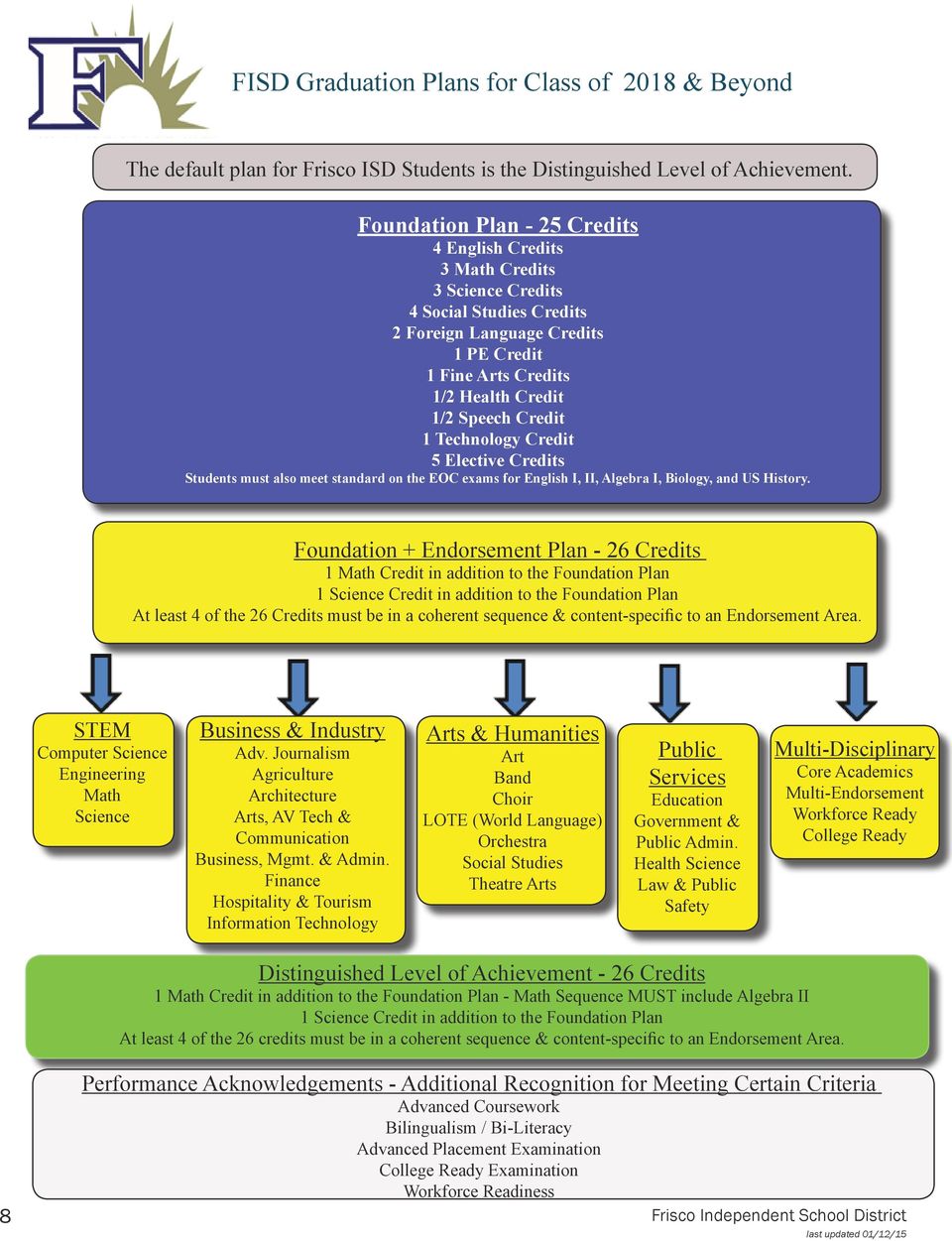
4 Graduation Plans for Senior Class of 2018 and Beyond House Bill 5 was signed into law in the summer of 2013 and one of its provisions was to change high school graduation plans for all students who enter high school during the school year and thereafter. The bill provides more flexibility for high school students to pursue either higher education or a career. Generally speaking, House Bill 5 established a single graduation plan, the Foundation High School Program (FHSP). Students will also have the opportunity to build on the FHSP by earning Endorsements, Performance Acknowledgements, and a Distinguished Level of Achievement. Students will need to declare their preferred endorsement area, in writing, by the beginning of their 9th grade year. Students will be able to change their endorsement at any time. An endorsement is basically an opportunity for students to select a major during their high school career. An endorsement can be earned by taking additional courses in Career and Technical Education (CTE) or by taking additional non-cte courses specified within the endorsement requirements. The endorsement areas are: Arts & Humanities Business & Industry Multidisciplinary Public Service Science, Technology, Engineering & Math (STEM) NOTE: To earn the STEM endorsement students MUST take Algebra II, Chemistry & Physics in concert with other Foundation + Endorsement Program requirements FISD offers courses to meet endorsements in all areas. There are specific course requirements in the foundation curriculum based on the Endorsement selected. A comparison of course requirements by endorsement area may be found later in this guide. A student may elect to graduate without an endorsement under the high school foundation plan with school administrator approval after the student s sophomore year. The student and the student s parent or guardian must be advised by the school counselor of the benefits of graduating with one or more endorsement and the student s parent or guardian must file written permission with the high school allowing the student to graduate without an endorsement. It is important to note that the Texas Legislature is meeting in the spring of 2015 and there may be additional clarification from the state and the Texas Education Agency. That information will be incorporated into this guide when available. Therefore contents in this guide are subject to change according to changes from either entity and the most recent information will be posted in this document or on the FISD website. The default plan for all FISD students beginning with the class of 2018 will be the Distinguished Level of Achievement. More specific information about the graduation plans and the endorsements may be found at: 4
5 Foundation High School Plan (25 credits) This option is the minimum graduation plan available and replaces the current Minimum High School Program. However, it is not available until after the completion of the sophomore year. Changing to this graduation plan will require parent and administrative approval in writing. Parents and students need to understand graduating on this plan may not meet college or university entrance requirements. Foundation + Endorsement Plan (26 credits) This graduation plan replaces the previous Recommended High School Program. Endorsements are described in detail in the Frisco ISD Graduation Guide for the Class of 2018 & Beyond available at: This guide includes: core course requirements by endorsement, sample four-year graduation plans, and Frisco ISD course offerings by endorsement. The curriculum requirements for earning an endorsement require a student to meet and exceed the Foundation Plan and successfully completing the following: The curriculum requirements for one or more Endorsement(s) to include a coherent sequence of courses that are content specific to the chosen endorsement Additional coursework to include: Four credits in mathematics Four credits in approved science courses Distinguished Level of Achievement Plan (26 credits) The Distinguished Level of Achievement (DLA) replaces the current Distinguished Achievement Plan as the highest graduation plan in the state of Texas for students entering high school in This is the default graduation plan for Frisco ISD students. In order to be considered for Top Ten Percent Automatic Admission in Texas Public Universities, graduates MUST earn a Distinguished Level of Achievement diploma. A student may earn a Distinguished Level of Achievement by successfully completing the curriculum requirements that meet and exceed the Foundation Plan and successfully completing the following: The curriculum requirements for one or more Endorsement(s) to include a coherent sequence of courses that are content specific to the chosen endorsement Additional coursework to include: Four credits in mathematics, including Algebra II Four credits in approved science courses The primary difference between the Foundation + Endorsement Program and the DLA is the requirement that Algebra II must be one of the four credits in mathematics 5
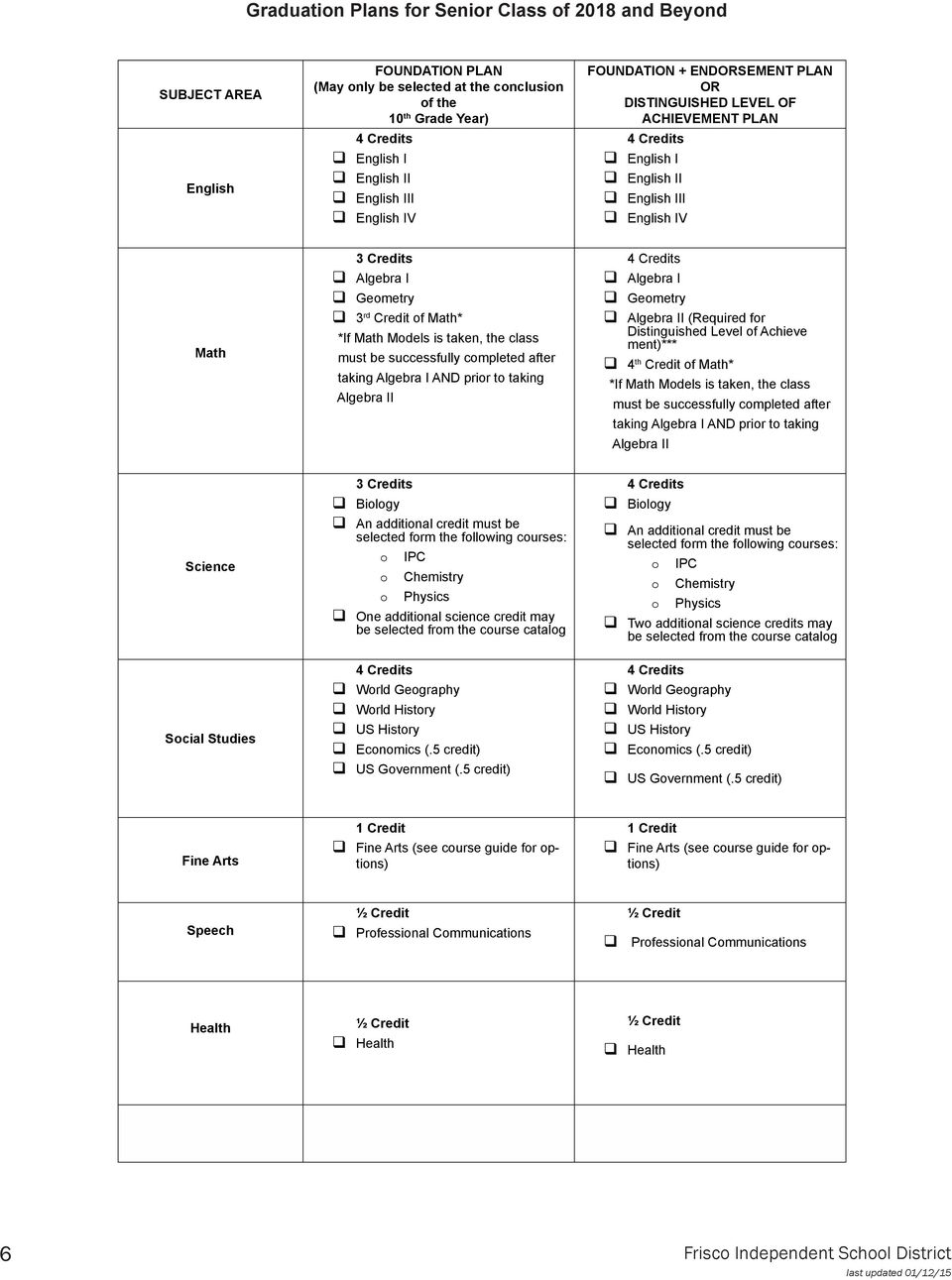
6 Graduation Plans for Senior Class of 2018 and Beyond SUBJECT AREA English FOUNDATION PLAN (May only be selected at the conclusion of the 10 th Grade Year) 4 Credits English I English II English III English IV FOUNDATION + ENDORSEMENT PLAN OR DISTINGUISHED LEVEL OF ACHIEVEMENT PLAN 4 Credits English I English II English III English IV Math 3 Credits Algebra I Geometry 3 rd Credit of Math* *If Math Models is taken, the class must be successfully completed after taking Algebra I AND prior to taking Algebra II 4 Credits Algebra I Geometry Algebra II (Required for Distinguished Level of Achieve ment)*** 4 th Credit of Math* *If Math Models is taken, the class must be successfully completed after taking Algebra I AND prior to taking Algebra II Science Social Studies 3 Credits Biology An additional credit must be selected form the following courses: o IPC o Chemistry o Physics One additional science credit may be selected from the course catalog 4 Credits World Geography World History US History Economics (.5 credit) US Government (.5 credit) 4 Credits Biology An additional credit must be selected form the following courses: o IPC o Chemistry o Physics Two additional science credits may be selected from the course catalog 4 Credits World Geography World History US History Economics (.5 credit) US Government (.5 credit) Fine Arts 1 Credit Fine Arts (see course guide for options) 1 Credit Fine Arts (see course guide for options) Speech ½ Credit Professional Communications ½ Credit Professional Communications Health ½ Credit Health ½ Credit Health 6
7 Graduation Plans for Senior Class of 2018 and Beyond SUBJECT AREA FOUNDATION PLAN (May only be selected at the conclusion of the 10 th Grade Year) FOUNDATION + ENDORSEMENT PLAN OR DISTINGUISHED LEVEL OF ACHIEVEMENT PLAN Foreign Language 2 Credits from the same Language Spanish French Chinese American Sign Language 2 Credits from the same Language Spanish French Chinese American Sign Language Physical Education 1 Credit Physical Education (see course guide for options) 1 Credit Physical Education (see course guide for options) Technology Applications 1 Credit Technology Applications (see course guide for options) 1 Credit Technology Applications (see course guide for options) Electives 5.0 credits (see course guide for options) 4.0 credits (see course guide for options) TOTAL 25 CREDITS 26 CREDITS (4 credits must be in a coherent sequence and content specific to an endorsement area Please see the Endorsement Section of this guide) 7



8 FISD Graduation Plans for Class of 2018 & Beyond The default plan for Frisco ISD Students is the Distinguished Level of Achievement. Foundation Plan - 25 Credits 4 English Credits 3 Math Credits 3 Science Credits 4 Social Studies Credits 2 Foreign Language Credits 1 PE Credit 1 Fine Arts Credits 1/2 Health Credit 1/2 Speech Credit 1 Technology Credit 5 Elective Credits Students must also meet standard on the EOC exams for English I, II, Algebra I, Biology, and US History. Foundation + Endorsement Plan - 26 Credits 1 Math Credit in addition to the Foundation Plan 1 Science Credit in addition to the Foundation Plan At least 4 of the 26 Credits must be in a coherent sequence & content-specific to an Endorsement Area. STEM Computer Science Engineering Math Science Business & Industry Adv. Journalism Agriculture Architecture Arts, AV Tech & Communication Business, Mgmt. & Admin. Finance Hospitality & Tourism Information Technology Arts & Humanities Art Band Choir LOTE (World Language) Orchestra Social Studies Theatre Arts Public Services Education Government & Public Admin. Health Science Law & Public Safety Multi-Disciplinary Core Academics Multi-Endorsement Workforce Ready College Ready Distinguished Level of Achievement - 26 Credits 1 Math Credit in addition to the Foundation Plan - Math Sequence MUST include Algebra II 1 Science Credit in addition to the Foundation Plan At least 4 of the 26 credits must be in a coherent sequence & content-specific to an Endorsement Area. 8 Performance Acknowledgements - Additional Recognition for Meeting Certain Criteria Advanced Coursework Bilingualism / Bi-Literacy Advanced Placement Examination College Ready Examination Workforce Readiness
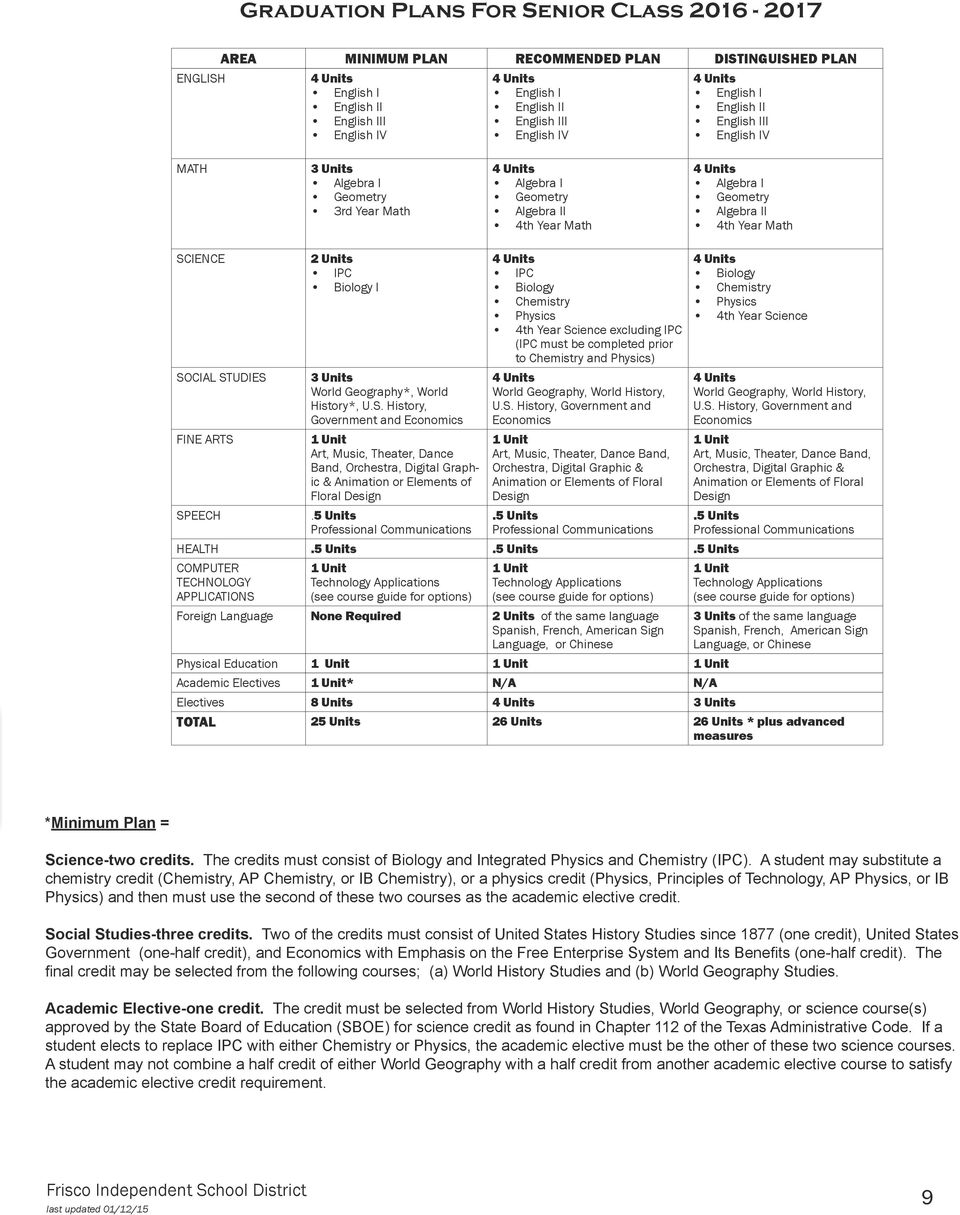
9 Graduation Plans For Senior Class ENGLISH AREA MINIMUM PLAN RECOMMENDED PLAN DISTINGUISHED PLAN 4 Units English I English II English III English IV 4 Units English I English II English III English IV 4 Units English I English II English III English IV MATH 3 Units Algebra I Geometry 3rd Year Math 4 Units Algebra I Geometry Algebra II 4th Year Math 4 Units Algebra I Geometry Algebra II 4th Year Math SCIENCE SOCIAL STUDIES FINE ARTS SPEECH 2 Units IPC Biology I 3 Units World Geography*, World History*, U.S. History, Government and Economics 1 Unit Art, Music, Theater, Dance Band, Orchestra, Digital Graphic & Animation or Elements of Floral Design.5 Units Professional Communications 4 Units IPC Biology Chemistry Physics 4th Year Science excluding IPC (IPC must be completed prior to Chemistry and Physics) 4 Units World Geography, World History, U.S. History, Government and Economics 1 Unit Art, Music, Theater, Dance Band, Orchestra, Digital Graphic & Animation or Elements of Floral Design.5 Units Professional Communications HEALTH.5 Units.5 Units.5 Units COMPUTER TECHNOLOGY APPLICATIONS 1 Unit Technology Applications (see course guide for options) 1 Unit Technology Applications (see course guide for options) Foreign Language None Required 2 Units of the same language Spanish, French, American Sign Language, or Chinese Physical Education 1 Unit 1 Unit 1 Unit Academic Electives 1 Unit* N/A N/A Electives 8 Units 4 Units 3 Units 4 Units Biology Chemistry Physics 4th Year Science 4 Units World Geography, World History, U.S. History, Government and Economics 1 Unit Art, Music, Theater, Dance Band, Orchestra, Digital Graphic & Animation or Elements of Floral Design.5 Units Professional Communications 1 Unit Technology Applications (see course guide for options) 3 Units of the same language Spanish, French, American Sign Language, or Chinese TOTAL 25 Units 26 Units 26 Units * plus advanced measures *Minimum Plan = Science-two credits. The credits must consist of Biology and Integrated Physics and Chemistry (IPC). A student may substitute a chemistry credit (Chemistry, AP Chemistry, or IB Chemistry), or a physics credit (Physics, Principles of Technology, AP Physics, or IB Physics) and then must use the second of these two courses as the academic elective credit. Social Studies-three credits. Two of the credits must consist of United States History Studies since 1877 (one credit), United States Government (one-half credit), and Economics with Emphasis on the Free Enterprise System and Its Benefits (one-half credit). The final credit may be selected from the following courses; (a) World History Studies and (b) World Geography Studies. Academic Elective-one credit. The credit must be selected from World History Studies, World Geography, or science course(s) approved by the State Board of Education (SBOE) for science credit as found in Chapter 112 of the Texas Administrative Code. If a student elects to replace IPC with either Chemistry or Physics, the academic elective must be the other of these two science courses. A student may not combine a half credit of either World Geography with a half credit from another academic elective course to satisfy the academic elective credit requirement. 9
10 FISD Endorsement Pathways* 1 st Course in Sequence 2 nd Course in Sequence 3 rd Course in Sequence 4 th Course in Sequence ARTS & HUMANITIES ENDORSEMENT -Unless noted, this endorsement can be earned with 4 credits in a coherent sequence. Please view the FISD Course Catalog for prerequisites and other specifics. Fine Arts - Art Art 1 PAP Art 1 (Class of 2018 & Beyond) Digital Graphics & Animation - Fine Arts Credit Art 2 AP Art Drawing Art 2 Ceramics Art 3 AP Art 2D or 3D AP Art Drawing Art 4 AP Art 3D AP Art History Fine Arts - Dance Dance 1 Dance 2 Dance 3 Dance 4 Language Spanish 1 French 1 ASL 1 Chinese 1 Spanish 2 or PAP Spanish 2 French 2 or PAP French 2 ASL 2 Chinese 2 Spanish 3 or PAP Spanish 3 French 3 or PAP French 3 ASL 3 Chinese 3 AP Spanish 4 AP French 4 ASL 4 Chinese 4 Fine Arts - Music Band 1 Orchestra 1 Choir 1 Band 2 Orchestra 2 Choir 2 Band 3 Orchestra 3 Choir 3 Band 4 Orchestra 4 Choir 4 Social Studies Students must earn 5 total credits in Social Studies World Geography World History AP Human Geography AP World History GT Humanities II / AP World History US History or AP US History Psychology (1/2) or AP Psychology (1/2) or Sociology (1/2) AP European History US Government (1/2) or AP US Government (1/2) Economics (1/2) or AP Economics (1/2) Dual Credit US. Govt. (1/2) & Dual Credit Economics (1/2) Fine Arts - Theatre Theatre Arts 1 Tech Theater 1 Theatre Arts 2 / Theatre Production 1 Tech Theater 2 Theatre Arts 3 / Theatre Production 2 Tech Theater 3 Theatre Arts 4 / Theatre Production 3 Tech Theater 4 BUSINESS & INDUSTRY ENDORSEMENT -Unless noted, this endorsement can be earned with 4 credits in a coherent sequence. Please view the FISD Course Catalog for prerequisites and other specifics. Advanced Journalism Journalism or Photojournalism Broadcast 1 Debate 1 Yearbook 1 Broadcast 2 Debate 2 Yearbook 2 Broadcast 3 Debate 3 Yearbook 3 Video Technology Adv Public Speaking Agriculture, Food & Natural Resources Animal Science Companion Animal Mgmt (Small Animal) (1/2) Horse Production (Equine Science (1/2) Livestock Production (Large Animal Mgmt) (1/2) Wildlife, Fisheries, & Eco Mgmt (1/2) Business Information Management 1 CTEC Veterinary Medical Applications CTEC Practicum in Veterinary Medical Applications (2) CTEC Advanced Practicum in Veterinary Medical Applications (2) CTEC Adv. Animal Science Science Credit Agriculture, Food & Natural Resources Horticulture & Landscape Design Survey of Agriculture, Food & Natural Res (1/2) CTEC Horticulture Science (1/2) CTEC Landscape & Turf Grass Mgmt (1/2) Elements of Floral Design - Fine Arts Credit Business Information Management 1 CTEC Adv Horticulture & Floral Design CTEC Adv Plant &Soil Science - Science Credit Agriculture, Food & Natural Resource - Ag Mechanics Agricultural Mechanics & Metal Technologies CTEC Ag Facilities Design & Fabrication Survey of Ag, Food & Natural Res (1/2) CTEC Agricultural Power Systems Intro to Ag Mechanics & Metal Technology (1/2) Business Information Management 1 CTEC Practicum in Ag Facilities Design & Fabrication (2) CTEC Adv Practicum in Ag Facilities Design & Fabrication (2) 10

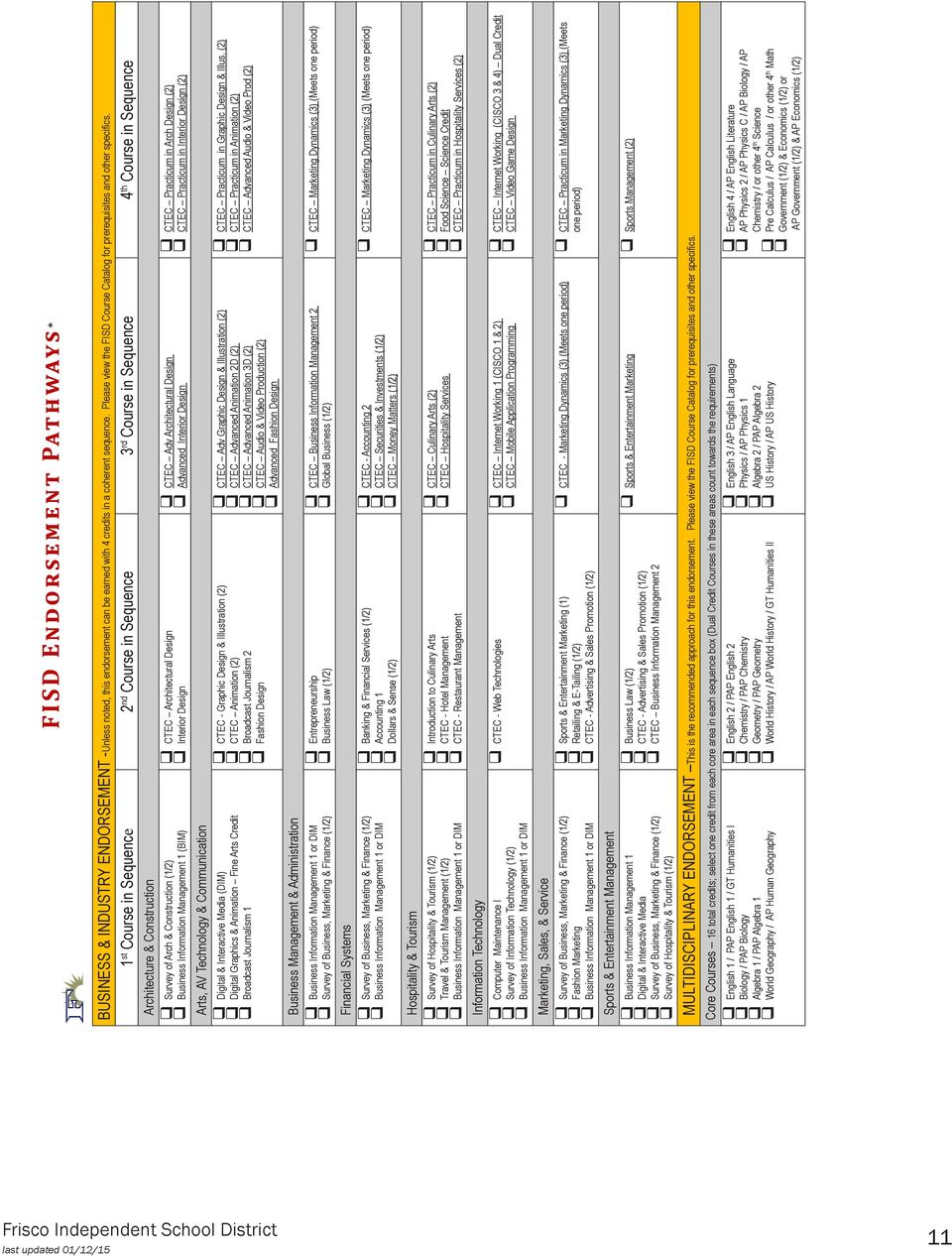
11 FISD Endorsement Pathways* BUSINESS & INDUSTRY ENDORSEMENT -Unless noted, this endorsement can be earned with 4 credits in a coherent sequence. Please view the FISD Course Catalog for prerequisites and other specifics. 1 st Course in Sequence 2 nd Course in Sequence 3 rd Course in Sequence 4 th Course in Sequence Architecture & Construction Survey of Arch & Construction (1/2) Business Information Management 1 (BIM) CTEC Architectural Design Interior Design CTEC Adv Architectural Design Advanced Interior Design CTEC Practicum in Arch Design (2) CTEC Practicum in Interior Design (2) Arts, AV Technology & Communication Digital & Interactive Media (DIM) Digital Graphics & Animation Fine Arts Credit Broadcast Journalism 1 CTEC - Graphic Design & Illustration (2) CTEC Animation (2) Broadcast Journalism 2 Fashion Design CTEC Adv Graphic Design & Illustration (2) CTEC Advanced Animation 2D (2) CTEC Advanced Animation 3D (2) CTEC Audio & Video Production (2) Advanced Fashion Design CTEC Practicum in Graphic Design & Illus. (2) CTEC Practicum in Animation (2) CTEC Advanced Audio & Video Prod (2) Business Management & Administration Business Information Management 1 or DIM Survey of Business, Marketing & Finance (1/2) Entrepreneurship Business Law (1/2) CTEC Business Information Management 2 Global Business (1/2) CTEC Marketing Dynamics (3) (Meets one period) Financial Systems Survey of Business, Marketing & Finance (1/2) Business Information Management 1 or DIM Banking & Financial Services (1/2) Accounting 1 Dollars & Sense (1/2) CTEC - Accounting 2 CTEC Securities & Investments (1/2) CTEC Money Matters (1/2) CTEC Marketing Dynamics (3) (Meets one period) Hospitality & Tourism Survey of Hospitality & Tourism (1/2) Travel & Tourism Management (1/2) Business Information Management 1 or DIM Introduction to Culinary Arts CTEC - Hotel Management CTEC - Restaurant Management CTEC Culinary Arts (2) CTEC Hospitality Services CTEC Practicum in Culinary Arts (2) Food Science Science Credit CTEC Practicum in Hospitality Services (2) Information Technology Computer Maintenance I Survey of Information Technology (1/2) Business Information Management 1 or DIM CTEC - Web Technologies CTEC Internet Working 1 (CISCO 1 & 2) CTEC Mobile Application Programming CTEC Internet Working (CISCO 3 & 4) Dual Credit CTEC Video Game Design Marketing, Sales, & Service Survey of Business, Marketing & Finance (1/2) Fashion Marketing Business Information Management 1 or DIM Sports & Entertainment Marketing (1) Retailing & E-Tailing (1/2) CTEC - Advertising & Sales Promotion (1/2) CTEC - Marketing Dynamics (3) (Meets one period) CTEC Practicum in Marketing Dynamics (3) (Meets one period) Sports & Entertainment Management Business Information Management 1 Digital & Interactive Media Survey of Business, Marketing & Finance (1/2) Survey of Hospitality & Tourism (1/2) Business Law (1/2) CTEC - Advertising & Sales Promotion (1/2) CTEC Business Information Management 2 Sports & Entertainment Marketing Sports Management (2) MULTIDISCIPLINARY ENDORSEMENT This is the recommended approach for this endorsement. Please view the FISD Course Catalog for prerequisites and other specifics. Core Courses 16 total credits; select one credit from each core area in each sequence box (Dual Credit Courses in these areas count towards the requirements) English 1 / PAP English 1 / GT Humanities I Biology / PAP Biology Algebra 1 / PAP Algebra 1 World Geography / AP Human Geography English 2 / PAP English 2 Chemistry / PAP Chemistry Geometry / PAP Geometry World History / AP World History / GT Humanities II English 3 / AP English Language Physics / AP Physics 1 Algebra 2 / PAP Algebra 2 US History / AP US History English 4 / AP English Literature AP Physics 2 / AP Physics C / AP Biology / AP Chemistry / or other 4 th Science Pre Calculus / AP Calculus / or other 4 th Math Government (1/2) & Economics (1/2) or AP Government (1/2) & AP Economics (1/2) 11
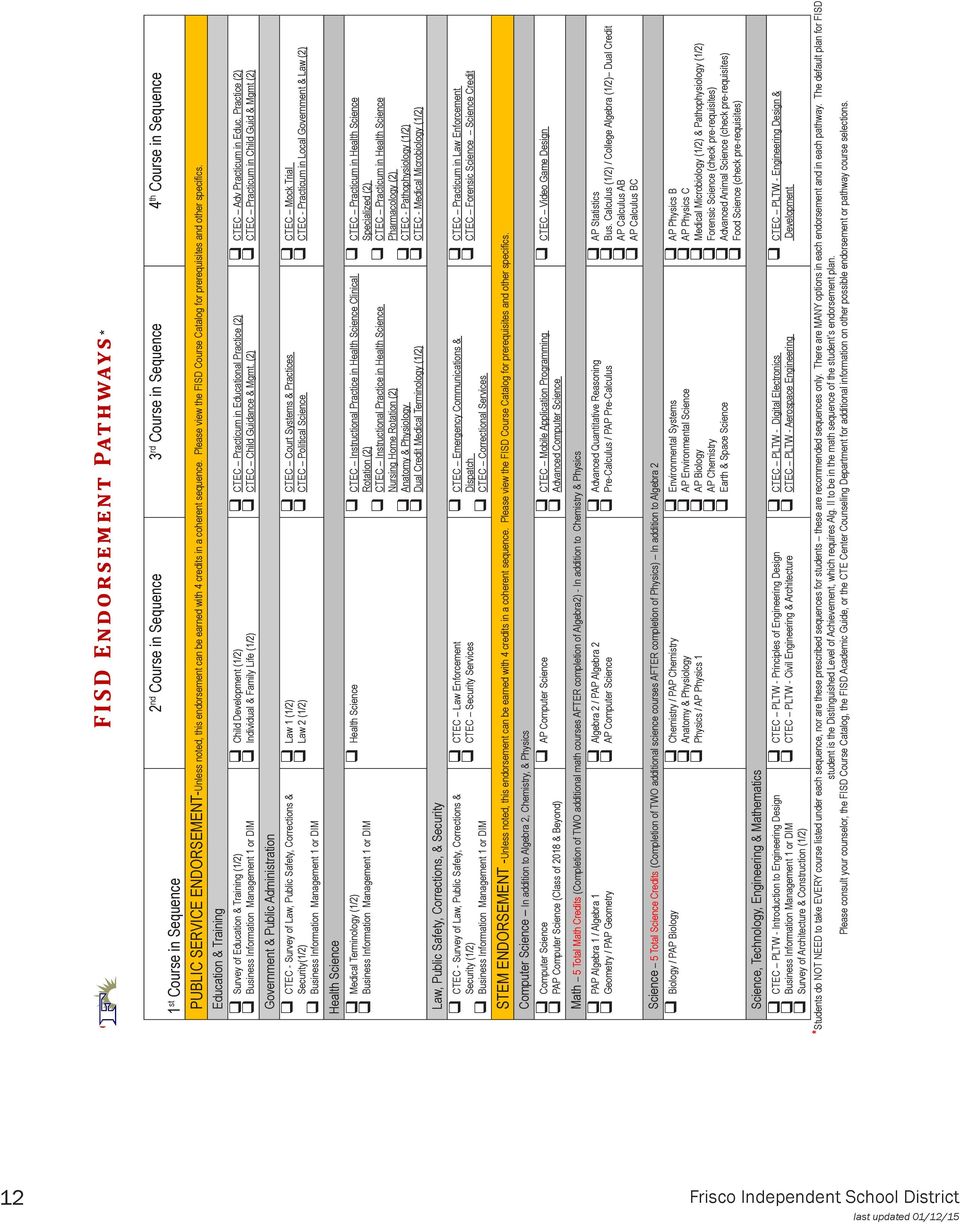
12 FISD Endorsement Pathways* 2 nd Course in Sequence 3 rd Course in Sequence 4 th Course in Sequence 1 st Course in Sequence PUBLIC SERVICE ENDORSEMENT-Unless noted, this endorsement can be earned with 4 credits in a coherent sequence. Please view the FISD Course Catalog for prerequisites and other specifics. Education & Training Survey of Education & Training (1/2) Business Information Management 1 or DIM Child Development (1/2) Individual & Family Life (1/2) CTEC Practicum in Educational Practice (2) CTEC Child Guidance & Mgmt. (2) CTEC Adv Practicum in Educ. Practice (2) CTEC Practicum in Child Guid & Mgmt (2) Government & Public Administration CTEC - Survey of Law, Public Safety, Corrections & Security(1/2) Business Information Management 1 or DIM Law 1 (1/2) Law 2 (1/2) CTEC Court Systems & Practices CTEC Political Science CTEC Mock Trial CTEC - Practicum in Local Government & Law (2) Health Science Medical Terminology (1/2) Business Information Management 1 or DIM Health Science CTEC Instructional Practice in Health Science Clinical Rotation (2) CTEC Instructional Practice in Health Science Nursing Home Rotation (2) Anatomy & Physiology Dual Credit Medical Terminology (1/2) CTEC Practicum in Health Science Specialized (2) CTEC Practicum in Health Science Pharmacology (2) CTEC - Pathophysiology (1/2) CTEC - Medical Microbiology (1/2) Law, Public Safety, Corrections, & Security CTEC - Survey of Law, Public Safety, Corrections & Security (1/2) Business Information Management 1 or DIM CTEC Law Enforcement CTEC Security Services CTEC Emergency Communications & Dispatch CTEC Correctional Services STEM ENDORSEMENT -Unless noted, this endorsement can be earned with 4 credits in a coherent sequence. Please view the FISD Course Catalog for prerequisites and other specifics. CTEC Practicum in Law Enforcement CTEC Forensic Science Science Credit Computer Science In addition to Algebra 2, Chemistry, & Physics Computer Science PAP Computer Science (Class of 2018 & Beyond) AP Computer Science CTEC Mobile Application Programming Advanced Computer Science CTEC Video Game Design Math 5 Total Math Credits (Completion of TWO additional math courses AFTER completion of Algebra2) - In addition to Chemistry & Physics PAP Algebra 1 / Algebra 1 Algebra 2 / PAP Algebra 2 Geometry / PAP Geometry AP Computer Science Advanced Quantitative Reasoning Pre-Calculus / PAP Pre-Calculus AP Statistics Bus. Calculus (1/2) / College Algebra (1/2) Dual Credit AP Calculus AB AP Calculus BC Science 5 Total Science Credits (Completion of TWO additional science courses AFTER completion of Physics) In addition to Algebra 2 Biology / PAP Biology Chemistry / PAP Chemistry Anatomy & Physiology Physics / AP Physics 1 Environmental Systems AP Environmental Science AP Biology AP Chemistry Earth & Space Science AP Physics B AP Physics C Medical Microbiology (1/2) & Pathophysiology (1/2) Forensic Science (check pre-requisites) Advanced Animal Science (check pre-requisites) Food Science (check pre-requisites) Science, Technology, Engineering & Mathematics CTEC PLTW - Introduction to Engineering Design Business Information Management 1 or DIM Survey of Architecture & Construction (1/2) CTEC PLTW - Principles of Engineering Design CTEC PLTW - Civil Engineering & Architecture CTEC PLTW - Digital Electronics CTEC PLTW - Aerospace Engineering CTEC PLTW - Engineering Design & Development *Students do NOT NEED to take EVERY course listed under each sequence, nor are these prescribed sequences for students these are recommended sequences only. There are MANY options in each endorsement and in each pathway. The default plan for FISD student is the Distinguished Level of Achievement, which requires Alg. II to be in the math sequence of the student s endorsement plan. Please consult your counselor, the FISD Course Catalog, the FISD Academic Guide, or the CTE Center Counseling Department for additional information on other possible endorsement or pathway course selections. 12
13 English Language Arts Courses Summer Reading List: Please see your respective high school counseling office to receive a copy of this information or visit your high school website. Summer reading is required for Pre AP and AP English courses. English I - (1 credit) 9th grade In English I, students strengthen skills in reading analysis and communication. Students read and write on a daily basis, engaging in activities that build on existing skills as they comprehend and analyze text, write in multiple modes, research, listen, and speak. This course focuses on literature that highlights the theme of Coming of Age. Building on their knowledge of literary elements in traditional literary genres, students study the relationship between narrative voice and style, while also analyzing literary and stylistic elements in film and literature. They develop persuasive writing skills by using rhetorical appeals. Performance and oral interpretation of literature build students speaking and listening skills. Research continues to play an important role as students evaluate social, cultural, and historical influences on texts. Through the use of multiple learning and instructional strategies, students acquire not only the knowledge they need but also the confidence in their own abilities to learn and to communicate effectively in real-world situations. This course will require an End of Course Exam for any student enrolled from the freshman class of and beyond. Pre AP English I - (1 credit) 9th grade Pre-AP English I engages students in learning all the essential knowledge and skills of English I while providing greater depth. This enhanced curriculum builds the tools necessary to succeed in AP Language and Literature classes. Summer reading is required as it provides an avenue for Pre-AP students to both activate academic skills during the summer and to launch academic progress at the beginning of the school year. Independent reading in Pre-AP courses is structured to support students interaction with a text through the application of close reading analysis with Pre-AP and AP reading strategies, leading to an ability to independently analyze any new text. Students are confronted with increasingly challenging texts, both classic and contemporary, fiction and nonfiction. Students are challenged by complex writing tasks in persuasion, argumentation, literary analysis, and synthesis in order to build capacity to write effectively in these rhetorical modes. With exposure to AP strategies, prompts, nonfiction texts, and varied writing tasks, students will exit the program equipped with the kind of higher-order thinking skills, knowledge, and behaviors necessary to be successful in AP classes and post-secondary education. This course will require an End of Course Exam for any student enrolled from the freshman class of and beyond. Principles English I 9th grade This course is based on the English I TEKS with modifications implemented to meet the needs of the students. This course will require an End of Course Exam for any student enrolled from the freshman class of and beyond. COURSE OFFERINGS strategies, leading to an ability to independently analyze any new text. Students are confronted with increasingly challenging texts, both classic and contemporary, fiction and nonfiction. Students are challenged by complex writing tasks in persuasion, argumentation, literary analysis, and synthesis in order to build capacity to write effectively in these rhetorical modes. With exposure to AP strategies, prompts, nonfiction texts, and varied writing tasks, students will exit the program equipped with the kind of higher-order thinking skills, knowledge, and behaviors necessary to be successful in AP classes and post-secondary education. This course will require an End of Course Exam for any student enrolled from the freshman class of and beyond. Principles English II 10th grade This course is based on the English II TEKS with modifications implemented to meet the needs of the students. This course will require an End of Course Exam for any student enrolled from the freshman class of and beyond. Applied English II 10th grade This course is based on the prerequisite skills of the English II TEKS. Students in this course are exposed to the essence of the TEKS. Students in this course will demonstrate performance objectives that may include real life applications of the gradelevel TEKS as appropriate to the student s abilities and needs. This course will require an End of Course Exam for any student enrolled from the freshman class of and beyond. English III - (1 credit) 11th grade In English III, students strengthen skills in reading analysis and communication. Students read and write on a daily basis, engaging in activities that build on existing skills as they comprehend and analyze text, write in multiple modes, research, listen, and speak. This course focuses on American fiction and nonfiction, using literary and other texts to present the iconic idea of the American Dream. Students research historical and contemporary texts as they articulate the origins and impact of the ideas and realities of the American Dream on life today and on personal thinking. Students are expected to articulate personal convictions and propose solutions to social issues. Writing in a variety of modes - personal essays, opinions and editorials, credos, reflective self-evaluation, speeches, dramatic scripts, surveys, literary analysis, and research projects - students expand their skills in communicating well through written language. Through the use of multiple learning and instructional strategies, students acquire not only the knowledge they need but also the confidence in their own abilities to learn and to communicate effectively in real-world situations. Principles English III 11th grade This course is based on the English III TEKS with modifications implemented to meet the needs of the students. Applied English 1 9th grade This course is based on the prerequisite skills of the English I TEKS. Students in this course are exposed to the essence of the TEKS. Students in this course will demonstrate performance objectives that may include real life applications of the grade-level TEKS as appropriate to the student s abilities and needs. This course will require an End of Course Exam for any student enrolled from the freshman class of and beyond. English II - (1 credit) 10th grade In English II, students strengthen skills in reading analysis and communication. Students read and write on a daily basis, engaging in activities that build on existing skills as they comprehend and analyze text, write in multiple modes, research, listen, and speak. This course focuses on the concept of culture and community, and examines how these influences shape identity and perspective. Students read and analyze works of world literature, with emphasis on analysis of how stylistic choices and rhetorical elements shape tone in persuasive and argumentative texts, both print and non-print. Students deconstruct writing prompts and write a synthesis essay that incorporates perspectives from multiple sources. Students develop their independent learning skills as they respond to opportunities for self-evaluation. Through the use of multiple learning and instructional strategies, students acquire not only the knowledge they need but also the confidence in their own abilities to learn and to communicate effectively in real-world situations. This course will require an End of Course Exam for any student enrolled from the freshman class of and beyond. Pre AP English II - (1 credit) 10th grade Pre-AP English II engages students in learning all the essential knowledge and skills of English II while providing greater depth. This enhanced curriculum continues to build the tools necessary to succeed in AP Language and Literature classes. Summer reading is required as it provides an avenue for Pre-AP students to both activate academic skills during the summer and to launch academic progress at the beginning of the school year. Independent reading in Pre-AP courses is structured to support students interaction with a text through the application of close reading analysis with Pre-AP and AP reading Applied English III 11th grade This course is based on the prerequisite skills of the English III TEKS. Students in this course are exposed to the essence of the TEKS. Students in this course will demonstrate performance objectives that may include real life applications of the gradelevel TEKS as appropriate to the student s abilities and needs. AP Language and Composition 11th grade (Junior English) (1 credit) The AP English Language and Composition course aligns to an introductory collegelevel rhetoric and writing curriculum, which requires students to develop evidence-based analytic and argumentative essays that proceed through several stages or drafts. Students evaluate, synthesize, and cite research to support their arguments. Throughout the course, students develop a personal style by making appropriate grammatical choices. Additionally, students read and analyze the rhetorical elements and their effects in non-fiction texts, including graphic images as forms of text, from many disciplines and historical periods. This prepares students for the Advanced Placement Exam which may earn the student college credit. Summer reading is required. English IV - (1 credit) In English IV, students strengthen skills in reading analysis and communication. Students read and write on a daily basis, engaging in activities that build on existing skills as they comprehend and analyze text, write in multiple modes, research, listen, and speak. This course capitalizes on the confidence and expertise students have gained as interpreters and analyzers of texts by introducing them to multiple lenses through which to view text. Students are asked to broaden their understanding and their interpretive skills by thinking deeply about themes and ideas from multiple perspectives. Using Historical, Cultural, Feminist, Marxist, and Archetypal Criticism, students learn to view texts through some of the filters that result in multiple interpretations of the same text or media story. Students apply the theories of criticism to their own reading and interpretation of both fiction and nonfiction texts. Through the use of multiple learning and instructional strategies, students acquire not only the knowledge they need but also the confidence in their own abilities to learn and to communicate effectively in real-world situations. 13
14 Principles English IV This course is based on the English IV TEKS with modifications implemented to meet the needs of the students. Applied English IV This course is based on the prerequisite skills of the English IV TEKS. Students in this course are exposed to the essence of the TEKS. Students in this course will demonstrate performance objectives that may include real life applications of the gradelevel TEKS as appropriate to the student s abilities and needs. AP Literature and Composition (Senior English) - (1 credit) The AP English Literature and Composition course aligns to an introductory collegelevel literary analysis course. The course engages students in the close reading and critical analysis of imaginative literature to deepen their understanding of the ways writers use language to provide both meaning and pleasure. As they read, students consider a work s structure, style, and themes, as well as its use of figurative language, imagery, symbolism, and tone. Writing assignments include expository, analytical, and argumentative essays that require students to analyze and interpret literary works. This course prepares students for the Advanced Placement Exam which may earn the student college credit. Summer reading is required. College Co-Enrollment English IV - (1 credit) Prerequisite: Must meet eligibility requirements College Co-Enrollment English IV is taught on-campus at the Collin County Community College Preston Ridge Campus. The class incorporates the essential elements of the high school course with a more accelerated college instructional format. Tuition is paid by the student and class meets twice a week. Transportation is not provided. Both high school and college credit is obtained by passing. Students must pass THEA to enroll in this course. Please note that this course is taught by college professors not FISD staff. Taking college classes while still in high school requires a heightened sense of responsibility and maturity. Failing college English will keep a student from graduating from high school. College Readiness for English Language Arts and Reading Prerequisite: Counselor Recommendation The purpose of the College Readiness English Language Arts and Reading course is to provide high school students an opportunity to gain and demonstrate the necessary college readiness skills to be successful in collegelevel, credit-bearing courses without the need for remedial or developmental coursework. This course is designed for students whose English coursework, End of Course examinations in English, and college readiness examination scores indicate that a student is not ready to perform entry-level college coursework in composition and literature. The performance-based course integrates basic academic reading skills and basic writing skills and is designed to develop students critical reading and academic writing skills through extensive instruction emphasizing skills in vocabulary, grammar, comprehension, paragraph elements, essay structure, and critical analysis. Students will demonstrate comprehension of varied texts through written responses, progressing from advanced paragraphs to well-developed, academic essays. The course fulfills TSI requirements for reading and writing. Entry into this course requires counselor recommendation, and may count for the fourth English Language Arts credit if the student is enrolled in the Foundation Graduation Plan. English for Speakers of other Languages 9th ESOL I (1 credit) Prerequisite: Language Proficiency Placement Test, LPAC Recommendation English for Speakers of Other Languages I (ESOL I) is designed for beginning to intermediate fluency level students coping with a new language and a new culture. Basic skills are introduced in a simple, easy to- understand framework helping to bridge the gap between ESOL and other academic subjects. ESOL provides opportunities for students to practice listening, speaking, reading and writing skills as they develop independence and confidence in the use of English. The course includes the study of phonics, vocabulary, grammar, reading, and writing. English for Speakers of other Languages 9th ESOL II - (1 credit) Prerequisite: Language Proficiency Placement Test, LPAC Recommendation English for Speakers of Other Languages II (ESOL II) is designed for intermediate to advanced fluency level students transitioning between basic skills instruction in ESOL I and grade level Sheltered English. Curriculum for ESOL II incorporates intensive academic vocabulary instruction while also linking literary concepts from ENG II to adapted ESOL texts. The course UPDs are in alignment with those of ENG II, while instruction will also integrate literary concepts from ENG I and introduce literary terms from ENG III. 14 Independent Study in English I (1 credit) (PEIMS: ) Independent Study in English II (1 credit) (PEIMS: ) 9th 11th grade 9th 11th grade Independent Study in English III (1 credit) 9th 11th grade (PEIMS: ) Prerequisite: LPAC recommendation Enrollment is limited to LEP identified students in 9th-11th grades who are at the Beginner-Advanced High language proficiency levels in language acquisition. The course provides additional language arts support for limited English proficient students. Placement will be determined through language proficiency tests and LPAC recommendations. Independent Study in English IV Practical Writing (1 credit) (PEIMS: ) Prerequisite: LPAC recommendation Enrollment is limited to LEP identified students in who are at the Beginner- Advanced High language proficiency levels in language acquisition. The course provides additional language arts support for limited English proficient students. Placement will be determined through language proficiency tests and LPAC recommendations. Reading I, II, III (1/2 or 1 credit) Reading is a one or two semester course for those students who struggle with basic reading competencies. Emphasis is placed on using specific reading strategies to increase skills in comprehension, vocabulary development, fluency, and reference usage. Instruction is differentiated and tailored to the individual needs of each student. The model includes experiences in whole and small group instruction, independent reading, and technology-based learning. This course is intended for remediation in reading. Professional Communications (Speech) (1/2 credit) Professional Communications (Speech) is designed to build and enhance student communication skills in both a social and professional context. These skills include nonverbal, listening, group communication, presentation, and product development. Students in Professional Communications class will also learn the skills needed to be successful in the business world, such as resume writing, job interviewing protocol, and professional etiquette. Students will also develop an understanding of business structure and the process of product creation and design. This course provides practical application and hands-on experience, which aim to help students develop the necessary communication skills to be productive, successful, and positive contributors to our global society. This course is required for graduation. Debate I-III - (1 credit) Prerequisite: Instructor Approval The major objective of Debate class is to train and develop students in the art of argumentation to compete in Speech Tournaments. Students have the opportunity to earn awards, as well as membership in the Forensics Honor Society, the National Forensic League (NFL). The course develops skills in argumentation, persuasion, research, audience analysis, and other life skills. Tournament participation (5-8 tournaments a year) is required. Students in Advanced Debate courses will use the course as a Tournament Prep class. Debate is a year long course. Students may earn up to 3 state credits for debate. Oral Interpretation - (1 credit) Prerequisite: Instructor Approval Oral Interpretation is an intensive speech and performance course in which students study the oral reading of a literary text as a communication art. Students will choose and analyze literature from many genres and prepare dynamic performances of selections in preparation for tournament competition in NFL, TFA, and UIL Interpretive speaking events. Tournament participation (5-8 tournaments a year) is required, and NFL Honor Society membership is available. Students in Advanced Oral Interp courses will use the course as a tournament prep class. Course credit: one is preferred, but students may register by semester. Students may take this course for up to three credits. Advanced Public Speaking - (1/2-1 credit) 10th - Prerequisite: Communication Applications Advanced Public Speaking develops and refines platform-speaking skills. The main objective is training students to effectively distinguish and use extemporaneous speaking in the classroom, in social situations, in the workplace and as competitors in UIL and TFA extemporaneous speaking events. Although the emphasis will be on training for academic competitions, direct life applications of these skills are the primary goal. Prerequisites: one semester of Communications Applications. Course credit: one is preferred, but students may register by semester. Students may take this course for 3 credits.

15 Practical Writing Skills - (1/2 credit) 9th This study of writing allows high school students to earn credit while developing skills necessary for composing written documents with a deeper knowledge of the functions of the language. This course emphasizes skill in the use of conventions and mechanics of written English, the appropriate and effective application of English grammar, and the effective use of vocabulary. Students are expected to understand the recursive nature of the writing process. Evaluation of students own writing as well as the writing of others ensures that students completing this course are able to analyze and evaluate their writing. This course is intended for remediation in writing. Creative and Imaginative Writing - (1/2 credit) 10th Creative Writing focuses on the writing process. The forms and standards of writing are addressed in a varied format. Many pre-writing techniques will be used including multi-media, discussion reading, journal and personal experience. Writing for comedy, persuasion, drama and narration will be included in this class. This class is an excellent preparation for cross-curriculum writing. This course may substitute for one-half credit of the English IV course for those students on the Minimum High School Graduation Program (TAC (b)(1)(b)). GT Humanities I / Pre-AP English I - ( 1 credit) Prerequisite: Identification / Selection as Gifted/Talented 9th grade GT Humanities II / AP World History - ( 1 credit) 10th grade Prerequisite: Identification / Selection as Gifted/Talented and GT Humanities I (to be offered in ) GT Humanities I / Pre-AP English I and GT Humanities II / AP World History are courses that provide gifted students with opportunities not available through regular or advanced classes. The courses combine Pre-AP English I with AP World History in a two-year interdisciplinary spiral. The basic content is a historical study of the commonalities of the fine arts, including literature, the visual arts, architecture, and music. Students will learn and practice the craft of writing through various products, including AP style writing. Literature from a variety of world traditions will also be a key focus. Beginning in , ninth and tenth grade students will sit in the same class while earning credit in separate courses; ninth graders will earn Pre-AP English I credit while tenth graders earn AP World History credit. At the conclusion of GT Humanities II, students can sit for the AP World History exam to possibly earn college credit. GT Humanities does NOT fulfill the fine arts requirement for graduation and is not recognized as a fine arts course by TEA. Journalism I - (1 credit) Journalism I is an elective and serves as a preliminary course for students interested in serving on the yearbook or newspaper staff. The course covers all aspects of journalism including media law, ethics and responsibilities, interviewing, journalism writing styles, photojournalism, and layout and design of publications. Students requesting this course should have a strong interest in writing. This course may substitute for the English 4 credit for those students on the Minimum High School Graduation Program (TAC (b)(1)(b)). This course may count as a technology applications course. Newspaper I - (1 credit) 10th - Prerequisite: Photojournalism or Journalism & Instructor Approval Students will continue to learn media law, ethics and responsibilities, as well as apply developed skills of journalistic writing and opinion writing for a variety of audiences. Students will extend practice of principles of interviewing, news evaluation and information gathering. Students will add to and continue to practice skills of reporting, writing and editing in a variety of journalistic styles. They will utilize knowledge and principles of publishing and design, learn economics of publishing, and serve as reporters for the school newspaper. Student will prepare copy and layouts, sell and design advertisements, and select illustrations and photographs for publication, as well as assume editorial leadership roles on the staff. Students enrolled in this class will be responsible for producing the school s newspaper. This course may qualify as either an elective or technology credit towards graduation, not both, beginning with the class of Advanced Journalism/Newspaper II-III 10th (1 credit) Prerequisite: Newspaper I and Instructor Approval (application required) Students in Advanced Journalism/Newspaper will be responsible for producing the school s newspaper. This hands-on course will make use of the advanced features of Adobe InDesign and Photoshop, both powerful publishing tools used by professionals. This course may qualify as either an elective credit or technology credit towards graduation, not both, beginning with the class of Yearbook I - (1 credit) 10th Prerequisite: Photojournalism or Journalism & Instructor Approval Yearbook is a course that specifically addresses the multifaceted needs of the yearbook student by introducing him/her to all phases of yearbook production. In this course ten units of study will be explored. They include: audience and function, theme development, section development, reporting and writing, headlines, photos and captions, design, graphics. money matters and distribution. Student performanceoriented activities will be required as part of each unit. These activities have been formulated to not only reinforce the theory of yearbook journalism, but to actually promote the production of the current yearbook. Students enrolled in this course will be responsible for producing the school s yearbook. This course may qualify as either an elective or technology credit towards graduation, not both, beginning with the class of Advanced Journalism/Yearbook II-III 10th (1 credit) Prerequisite: Yearbook I and Instructor Approval (application required) Advanced Journalism/Yearbook is a course that specifically addresses the multifaceted needs of the yearbook student by introducing him/her to all phases of yearbook production. In this course ten units of study will be explored. They are as follows: audience & function, theme development, section development, reporting & writing, headlines, photos & captions, design, graphics & money matters distribution. Student performance-oriented activities will be required as part of each unit. These activities have been formulated to not only reinforce the theory of yearbook journalism, but to actually promote the production of the current yearbook. Students enrolled in this course will be responsible for producing the school s yearbook and will use the software programs Adobe InDesign and Photoshop, both powerful publishing tools used by professionals. This course may qualify as either an elective credit or technology credit towards graduation, not both, beginning with the class of Independent Study in Journalism 10th (1/2-1 credit) Prerequisite: At least one year on publication staff and Instructor Approval Students enrolled in this course will have the opportunity to refine and enhance their journalistic skills through research of self-selected topics, plan, organize and prepare a project to be presented to the teacher or school through a school-sponsored publication. Photojournalism - (1 credit) Photojournalism I is an elective where students learn photographic history, composition elements, media ethics, and explore digital camera techniques through a variety of projects. Photographic selection based on composition elements and camera techniques for presentation will be emphasized. Photojournalism I is a recommended prerequisite for students interested in applying for the yearbook staff. Students should expect to spend a minimum of $60-$75 per semester for supplies and materials, excluding a camera. It would be to the student s advantage to have a personal camera for use in class and at home. This course may count as a technology applications course. Broadcast Journalism I - (1 credit) Broadcast I is an elective and may serve as a preliminary course for students interested in serving as a member of the broadcast staff. Students in Broadcast I will learn the basics of TV production. They will learn about the history of broadcast journalism, story types, story idea development and writing in broadcast style. Students will also learn about video camera techniques, basic shooting of video, basic video editing, etc... They will assist in the live announcements and TV broadcast. This course may qualify as either an elective or technology credit towards graduation, not both, beginning with the class of A materials fee may be required for this course. Broadcast Journalism II - (1 credit) 10th Prerequisite: Broadcast Journalism I and Teacher Recommendation Students in Broadcast II will produce daily radio announcements, and will work with the broadcast team. Students will also assist with campus and district-wide projects. Instruction includes operation of different types of cameras, mastery of audio techniques, set lighting, electronic editing, script writing, direction, production, and special effects. This course may qualify as either an elective or technology credit towards graduation, not both, beginning with the class of A materials fee may be required for this course. Broadcast Journalism III - (1 credit) 10th Prerequisite: Broadcast Journalism II and Teacher Recommendation Students in Broadcast III will produce the weekly TV newscast. Students will serve as the production crew and act as news anchors for the show. Students will assist with campus and district-wide projects. Instruction includes operation of different types of cameras, mastery of audio techniques, set lighting, electronic editing, script writing, direction, production, and special effects. A materials fee may be required for this course. 15
16 Radio Broadcast I (1 Credit) 11th Prerequisite: Broadcast Journalism I This innovative course will introduce students to the world of radio production, including commercial production, news and sports writing, audio editing, personality, and radio programming. Students will create and air radio programming for an internet-based campus radio station, which will include music, news, sports. Sports Broadcasting I - (1 credit) 11th Prerequisite: Broadcast I or II Students enrolled in this course will demonstrate their knowledge gained from Intro to Sports Broadcasting and Sports Broadcasting Marketing and Graphics and use it in a practical aspect in which they will produce, shoot, and report LIVE games from Memorial Stadium as well as various other sporting locations around the district according to the season. Students will also produce packaged stories to show on the FISD channel along with the Frisco Student Sports Network website. Students will serve as crew on FSSN sports broadcasts. This course provides hands-on learning opportunities for students and serves as a primer for progression in the sports broadcasting tract. Sports Broadcasting II - (2 credits) 11th Prerequisite: Sports Broadcasting Students will serve as crew on FSSN sports broadcasts. This course provides hands-on learning opportunities for students. Students enrolled in this course will demonstrate their knowledge gained from Intro to Sports Broadcasting, Sports Broadcasting Marketing and Graphics, and Sports Broadcasting I and use it in a practical aspect in which they will produce, shoot, and report LIVE games from Memorial Stadium as well as various other sporting locations around the district according to the season (i.e. football/basketball/track/baseball/etc.). Students will also produce packaged stories to show on the FISD channel along with the Frisco Student Sports Network website. Video Technology- (1 credit) 10th Prerequisite: Broadcast Journalism II or Teacher Recommendation Students in Video Tech will produce television commercials, PSA s, short films and assist with campus, district-wide and community projects. Instruction includes operation of different types of cameras, mastery of audio techniques, film production, script writing, production and special effects. This course is considered a Technology Applications course beginning with the class of Mathematics Courses All math classes use TI-84+ graphing calculators during instruction while students are in the classroom. Because calculators must remain in the classrooms, students are encouraged to purchase their own calculator for use at home. Algebra I - (1 credit) 9th grade Prerequisite: 8th Grade Math Algebra I students will work with functional relationships and problem solving in real situations, including, but not limited to the following: table building, coordinate graphing, equation writing and solving, operations on polynomials, factoring, exponents, and real number computation. This course will require an End of Course Exam for any student enrolled from the freshman class of and beyond. Principles Algebra I This course is based on the Algebra I TEKS with modifications implemented to meet the needs of the students. This course will require an End of Course Exam for any student enrolled from the freshman class of and beyond. Applied Algebra 1 This course is based on the prerequisite skills of the Algebra I TEKS. Students in this course are exposed to the essence of the TEKS. Students in this course will demonstrate performance objectives that may include real life applications of the grade-level TEKS as appropriate to the student s abilities and needs. This course will require an End of Course Exam for any student enrolled from the freshman class of and beyond. Pre-AP Algebra I - (1 credit) 9th grade Prerequisite: 8th Grade Math or Pre-AP 8th Grade Math Pre-AP Algebra I students will expand on concepts covered in regular Algebra I with an intense focus on high level application, problem solving, and higher order thinking processes. Students will also develop strategies that prepare them for future Advanced Placement math courses. Algebra II - (1 credit) Prerequisite: Algebra I or Pre-AP Algebra I Algebra II expands on the skills learned in Algebra I to prepare students for either Pre- Calculus or Advanced Quantitative Reasoning. This course is taught with a functional approach which gives students a sound foundation for either technical or non-technical degrees in college. Algebra II will include skills associated with linear, quadratic, polynomial, rational, exponential, and logarithmic, cubic, and absolute value functions. Algebra II students will also study attributes of these functions and their inverses as well as complex numbers. Pre-AP Algebra II (1 credit) Prerequisite: Algebra I or Pre-AP Algebra I Pre-AP Algebra II expands on the concepts covered in regular Algebra II with an intense focus on high level application, problem solving, and higher order thinking processes. This course will prepare students for Pre-Calculus, Pre-AP Pre-Calculus, or Advanced Quantitative Reasoning. Pre-AP Algebra II is taught with a functional approach which gives students a sound foundation for either technical or non-technical degrees in college. Pre-AP Algebra II will include deep study of the same topics found in regular Algebra II. Students will also develop strategies that prepare them for future Advanced Placement math courses. Geometry - (1 credit) Prerequisite: Algebra I or Pre-AP Algebra I Geometry is a required course that provides for students the study of shapes and figures in our environment through the use of Algebra I. Geometry will include the following areas of study: deductive and inductive reasoning, lines and angles, triangles, parallel lines, quadrilaterals, area, polygons, circles, and geometric solids. Students will also become familiar with the historical development and usefulness of formal mathematical structure through geometric proof. Students will also problem solve using area and volume, trigonometry, probability, and similarity. Pre-AP Geometry - (1 credit) Prerequisite: Algebra I or Pre-AP Algebra I Pre-AP Geometry covers the same topics of regular geometry with an intense focus on problem solving, formal proof, logic, and application. Students must have a strong background in algebra and be very comfortable solving equations, working with variables, solving systems of equations, and factoring quadratics. Pre-AP Geometry will include deep study of the same topics found in regular Geometry. Students will also develop strategies that prepare them for future Advanced Placement math courses. Principles Geometry This course is based on the Geometry TEKS with modifications implemented to meet the needs of the students. Applied Geometry This course is based on the prerequisite skills of the Geometry TEKS. Students in this course are exposed to the essence of the TEKS. Students in this course will demonstrate performance objectives that may include real life applications of the gradelevel TEKS as appropriate to the student s abilities and needs. Mathematical Models with Applications (MMA) - (1 credit) 10th- Prerequisite: Algebra I The primary purpose of this course is to use mathematics as a tool to model real world phenomena in science, finance, music, and art. The finance content will include growth models (investments, insurance, and retirement) as well as pay-off models (automobile loans and home loans). Some geometry and algebra I concepts will also be covered. This course will count as a third mathematics credit if taken prior to Algebra II. Principles Mathematical Models with Applications (MMA) This course is based on the Mathematical Models with Applications TEKS with modifications implemented to meet the needs of the students. Applied Mathematical Models with Applications (MMA) This course is based on the prerequisite skills of the Mathematical Models with Applications TEKS. Students in this course are exposed to the essence of the TEKS. Students in this course will demonstrate performance objectives that may include real life applications of the grade-level TEKS as appropriate to the student s abilities and needs. Applied Math 4 This course is based on the prerequisite skills of all math course TEKS. Students in this course are exposed to the essence of the TEKS. Students in this course will demonstrate performance objectives that may include real life applications of the gradelevel TEKS as appropriate to the student s abilities and needs. Mathematics Lab (1/2 to 1 credit) Prerequisite: Teacher recommendation Mathematics lab is for students who have entered high school before the school year and are working to pass the TAKS test. The content of this course will be comprised of instructional units centered around the TAKS objectives and will provide
17 a rich, supportive curriculum to assist students in mastering foundation concepts. Emphasis on problem-solving and applications of mathematics will be included. This course will not count toward required mathematics credits for graduation, but students will receive a local elective credit. Students who fail the math TAKS the previous year will be assigned to the appropriate lab for additional content support. Advanced Quantitative Reasoning - (1 credit) 11th- Prerequisite: Geometry and Algebra II Advanced Quantitative Reasoning is a mathematics course for high school juniors and/ or seniors that follows Algebra I, Geometry, and Algebra II. This course is a rigorous mathematics class for students who intend to major in non-technical fields of study upon entering college. The course offers student activities in a range of applied contexts and helps students develop college and career readiness skills such as collaborating, conducting research, and making presentations. AQR students will study numeric and algebraic reasoning through weighted averages, proportion, combinatorics, voting and selection process, as well as, cause-an-effect functions, growth or decay models, and logistics. Students will analyze models for expenditures, amortization tables, and various types of loans and investments. Students will gain understanding of probability and statistical reasoning by determining validity and usefulness of statistical data. This course serves as an alternative to Pre-Calculus. Students who have successfully passed Pre-Calculus are not eligible to take Advanced Quantitative Reasoning. Pre-Calculus- (1 credit) Prerequisite: Geometry or Pre-AP Geometry and Algebra II or Pre-AP Algebra II Pre-Calculus is a detailed study of the following functions: linear, quadratic, polynomial, rational, exponential, logarithmic, and trigonometric. This course also covers sequences, series, vectors, and introductory parametric functions. This course meets the minimum prerequisite requirement for AP Calculus AB. This course is not recommended as a prerequisite for AP Calculus BC. 10th- Pre-AP Pre-Calculus - (1 credit) 10th Prerequisite: Geometry or Pre-AP Geometry and Algebra II or Pre-AP Algebra II Pre-AP Pre-Calculus expands on the concepts covered in regular Pre-Calculus. This course is fast paced and students will require excellent algebraic and problem solving skills to be successful in this course. Students will also develop strategies that prepare them for AP Calculus AB or AP Calculus BC. Students successful in Pre-AP Pre-Calculus must be organized, committed, and eager to persevere due to the fast paced, abstract nature of the course. This course is the recommended prerequisite requirement for either AP Calculus AB or AP Calculus BC. AP Calculus AB - (1 credit) 11th - Prerequisite: Pre-Calculus or Pre-AP Pre-Calculus AP Calculus AB covers advanced mathematical topics including elementary differential and integral calculus. AP Calculus AB is approximately equivalent to a one-semester calculus course at the college level. This course is designed to prepare students for the College Board Advanced Placement Exam. AP Calculus AB is not a prerequisite to AP Calculus BC. AP Calculus AB is a college level course. AP Calculus BC - (1 credit) 11th - Prerequisite: Pre-AP Pre Calculus AP Calculus BC covers advanced mathematical topics including elementary differential and integral calculus and their applications with polar, parametric, and vector functions. Additionally, applications of integral function, logistic models, polynomial approximations, and advanced sequences and series will be studied. AP Calculus BC is approximately equivalent to a two-semester calculus course at the college level. This course is designed to prepare students for the College Board Placement Exam. This course can be taken in lieu of AP Calculus AB. AP Calculus BC is a college level course. AP Statistics - (1 credit) 11th - Prerequisite: Algebra II or PAP Algebra II AP Statistics exposes students to four broad conceptual themes: exploring data, planning a study, anticipating patterns, and statistical inference. Students should have excellent algebraic and problem solving skills. Extensive use of the graphing calculator to study statistical applications is emphasized. This course is a college level course and is designed to prepare students for the College Board Placement Exam. AP Statistics is a college level course. College Algebra - (1/2 credit) 11th - Prerequisite: Algebra II and meet eligibility requirements This course meets twice a week at Collin County Community College for one semester. College Algebra is a study of relations and functions including polynomial, rational, exponential, logarithmic, and special functions. Other topics include complex numbers, systems of equations, and inequalities, theory of equations, progressions, the binomial theorem, proofs, and applications. Students are responsible for all transportation, books, fees, and tuition at the college and must pass TTSI (Texas Success Initiative Assessment) to enroll. This course may qualify as 1/2 of the 4th math credit. Calculus for Business 11th - and Economics - (1/2 credit) Prerequisite: Algebra II and meet eligibility requirements This course meets twice a week at Collin County Community College for one semester. Calculus for Business and Economics I provides an introductory study of the business applications of calculus. Topics include limits, rates of change, differentiation, graphing and optimization, integration, and selected applications of calculus and business. Although this course does not have a corresponding College Board Advanced Placement Exam, it is a college course designed for students who plan to major in business in college. This is a dual credit course and upon completion, the student can receive 3 hours of college credit for this course. Students are responsible for all transportation, books, fees, and tuition at the college and must pass TSI (Texas Success Initiative Assessment) to enroll. This course may qualify as 1/2 of the 4th math credit. College Readiness for Mathematics Prerequisite: Counselor Recommendation and Foundational HS Program The purpose of the College Readiness Mathematics course is to provide high school students an opportunity to gain and demonstrate the necessary college readiness skills in mathematics to be successful in college-level, credit-bearing courses without the need for remedial or developmental coursework. This course is designed for 12th grade students whose coursework, End of Course examination in Algebra I, and college readiness examination scores indicate that a student is not ready to perform entry-level college coursework in mathematics. This course focuses on the study of relations and functions, inequalities, and algebraic expressions and equations including linear, polynomial, radical, and rational functions. Students will use these functions to model, interpret, and justify mathematical ideas and concepts using multiple representations. Entry into this course requires counselor recommendation and student enrollment into the Foundation Graduation Plan. Science Courses Students are advised to be aware of the math course prerequisites and co-requisites for certain science courses. IPC will count as a science credit if completed prior to chemistry and physics. Advanced Animal Science (1 credit) Prerequisite: 2 of 4 courses - Equine Science, Large Animal Management, Companion Animal Management, or Wildlife Fisheries & Ecology Management To be prepared for careers in the field of animal science, students need to attain academic skills and knowledge, acquire knowledge and skills related to animal systems, and develop knowledge and skills regarding career opportunities, entry requirements, and industry standards. To prepare for success, students need opportunities to learn, reinforce, apply, and transfer their knowledge and skills in a variety of settings. This course examines the interrelatedness of human, scientific, and technological dimensions of livestock production. Instruction is designed to allow for the application of scientific and technological aspects of animal science through field and laboratory experiences. This course may count as a science credit. Advanced Plant and Soil Science (CTEC) (1 credit) Prerequisite: Advanced Horticulture & Floral Design This course provides a way of learning about the natural world. Students should know how plant and soil science has influenced a vast body of knowledge, that there are still applications to be discovered, and that plant and soil science is the basis for many other fields of science. Investigations, laboratory practices, and field exercises will be used to develop an understanding of current plant and soil science. This course is designed to prepare students for careers in the food and fiber industry. Students will learn, reinforce, apply, and transfer their knowledge in a scientific setting. Materials fee may be required for this course. This course may count as a science credit. Food Science (1 credit) Prerequisite: Biology and Chemistry In Food Science students conduct laboratory and field investigations, use scientific methods during investigations, and make informed decisions using critical thinking and scientific problem solving. Food Science is the study of the nature of foods, the causes of deterioration, the principles underlying food processing, and the improvement of foods for the consuming public. Materials fee may be required for this course. This course may count as a science credit. Forensic Science (CTEC) (1 credit) Prerequisite: Law Enforcement, Security Services, or Correctional Services Forensic Science is a course that uses a structured and scientific approach to the investigation of crimes of assault, abuse and neglect, domestic violence, accidental death, homicide, and the psychology of criminal behavior. Students will learn terminology and investigative procedures related to crime scene, questioning, interviewing, criminal behavior characteristics, truth detection, and scientific procedures used to solve crimes. Using scientific methods, students will collect and analyze 17
18 evidence through case studies and simulated crime scenes such as fingerprint analysis, ballistics, and blood spatter analysis. Students will learn the history, legal aspects, and career options for forensic science. This course may count as a science credit. Integrated Physics and Chemistry (IPC) 9th - 10th grade (1 credit) Integrated Physics and Chemistry is a survey lab course that reinforces the foundational knowledge required for all subsequent physical science courses. Students conduct laboratory and field investigations, use scientific methods during investigation, and make informed decisions using critical thinking and scientific problem solving. This course integrates the disciplines of physics and chemistry in the following topics: force, motion, energy, and matter. Principles IPC This course addresses the IPC TEKS but contains extensive modifications as documented in each student s Individualized Education Program (IEP). Applied IPC This course is based on the prerequisite skills of the IPC TEKS. Students in this course are exposed to the essence of the TEKS. Students in this course will demonstrate performance objectives that may include real life applications of the grade-level TEKS as appropriate to the student s abilities and needs. Biology - (1 credit) 9th - 11th grade Biology is a course designed around the study of living things. This course emphasizes a variety of topics such as functions of cells and viruses; growth and development of organisms; cells, tissues and organs; nucleic acids and genetics; biological evolution; taxonomy; metabolism and energy transfers in living organisms; ecosystems; living systems; homeostasis; ecosystems; and plants and the environment. Manipulative laboratory skills, skills in acquiring data, classification skills in ordering and sequencing data, oral and written communication skills, along with career exploration will be stressed in this course. This course will require an End of Course Exam for any student enrolled from the freshman class of & beyond. Principles of Biology This course is based on the Biology TEKS but contains extensive modifications as documented in each student s Individualized Education Program (IEP). This course will require an End of Course Exam for any student enrolled from the freshman class of and beyond. Applied Biology This course is based on the prerequisite skills of the Biology TEKS. Students in this course are exposed to the essence of the TEKS. Students in this course will demonstrate performance objectives that may include real life applications of the gradelevel TEKS as appropriate to the student s abilities and needs. This course will require an End of Course Exam for any student enrolled from the freshman class of and beyond. Pre-AP Biology - (1 credit) 9th - 11th grade This course extends the biology concepts and TEKS with an emphasis on preparing students to take AP Biology. Pre-AP Biology will be a lab-oriented course designed for students exhibiting advanced achievement levels in the biological sciences. This course shall exceed the content and depth of a standard Biology course both in the classroom and laboratory experiences. Pre-AP Biology will strive for higher levels of learning; creative thinking, and critical evaluation tenets such as analyzing, synthesizing, and formulating logical conclusions. This course will require an End of Course Exam for any student enrolled from the freshman class of and beyond. AP Biology - (1 credit) 11th Prerequisite: Biology, Chemistry, or Teacher Recommendation AP Biology is a course designed to be the equivalent of a college-level biology course. This course will provide students with the framework, factual knowledge and analytical skills necessary to deal with the rapidly changing science of biology. This course emphasizes topics such as microbiology, biochemistry, genetics, evolution, organisms and their environment and includes extensive biological laboratory experiences. This course is intended to prepare students to take the AP Biology exam in order to earn college course credit depending on exam score. Students may complete an independent research project. Additional contact time outside the normal school may be required. This is a college level course. Chemistry - (1 credit) 10th - Prerequisite: One unit of high school science and Algebra I Co-requisite: Geometry This course emphasizes a variety of topics that include: characteristics of matter, energy transformations during physical and chemical changes; atomic structure; the periodic table of elements; behavior of gases; bonding; nuclear fusion and nuclear fission; oxidation-reduction; chemical equations; solutes; properties of solutions; acids 18 and bases; and stoichiometric relationships. Chemistry is a course that is oriented toward college preparation and is grounded in a laboratory approach to the study of the matter. Manipulative laboratory skills, skills in acquiring data, classification skills in ordering and sequencing data, oral and written communication skills, along with career exploration will be stressed in this course. Semesters must be completed in sequence (1st then 2nd). Principles of Chemistry Prerequisite: One unit of high school science and Algebra I / Committee Recommendation Co-requisite: Geometry This course is based on the Chemistry TEKS but contains extensive modifications as documented in each student s Individualized Education Program (IEP). Applied Chemistry This course is based on the prerequisite skills of the chemistry TEKS. Students in this course are exposed to the essence of the TEKS. Students in this course will demonstrate performance objectives that may include real life applications of the gradelevel TEKS as appropriate to the student s abilities and needs. Pre-AP Chemistry - (1 credit) 10th - Prerequisite: One unit of high school science and Geometry Co-requisite: Algebra II - recommended This course extends the chemistry concepts and TEKS with an emphasis on preparing students to take AP Chemistry Pre-AP Chemistry will be a lab-oriented course designed for students exhibiting advanced achievement levels in the chemical sciences. This course shall exceed the content and depth of a standard Chemistry course both in the classroom and laboratory experiences. Pre-AP Chemistry will strive for higher levels of learning; creative thinking, and critical evaluation tenets such as analyzing, synthesizing, and formulating logical conclusions AP Chemistry - (1 credit) 11th Prerequisite: Chemistry & Algebra II, or Teacher Recommendation AP Chemistry is a course designed to cover material found in the college level general chemistry course and is for the college-bound science/engineering/preveterinary/premedical/pre-dental student. This course incorporates a more extensive quantitative understanding of the physical principles of chemistry. Major topics include electrochemistry, kinetics, thermodynamics and equilibrium. Advanced laboratory investigations involving independent data analysis are a major part of this course. This course is intended to prepare students to take the AP Chemistry exam in order to earn college course credit depending on exam score. Students may complete an independent research project. Additional contact time outside the normal school may be required. This is a college level course. Physics - (1 credit) Prerequisite: Algebra I Co-requisite: Geometry (required) / Algebra II (recommended) Physics is designed to provide a laboratory-oriented approach to the study of matter and energy. The course provides for the development of understanding of the physical laws and devices that govern the world around us. Topics of study include motion, forces, energy, momentum, thermodynamics, waves, and modern physics. This course emphasizes the use of mathematics to solve problems. AP Physics 1 - (1 credit) Prerequisite: Geometry Co-requisite: Algebra II (required) / Pre-Calculus (recommended) AP Physics 1 is equivalent to the first semester of a typical introductory, algebra-based college physics course. Topics of study include Newtonian mechanics (including rotational motion); work, energy, and power; mechanical waves and sound; and introductory, simple circuits. Emphasis is placed on student-centered, inquiry-based instructional practices to develop scientific critical thinking and reasoning skills. After taking AP Physics 1, students may choose to continue their study of physics in either AP Physics 2 or AP Physics C. This course is intended to prepare students to take the AP Physics 1 exam in order to earn college course credit depending on exam score. Additional contact time outside the normal school day may be required. This is a college level course. (Students who have completed PAP Physics are not allowed to take AP Physics 1.) AP Physics 2 - (1 credit) 10th - Prerequisite: Physics Co-requisite: Pre-Calculus AP Physics 2 is equivalent to the second semester of a typical introductory, algebrabased college physics course. Topics of study include fluids, thermodynamics, electricity, magnetism, optics, and topics in modern physics. Emphasis is placed on student-centered, inquiry-based instructional practices to develop scientific critical thinking and reasoning skills. This course continues to develop a foundation in physics for students interested in the life sciences, pre-medicine, and some applied sciences. This course is intended to prepare students to take the AP Physics 2 exam in order to earn college course credit depending on exam score. Additional contact time outside the normal school day may be required. This is a college level course.
19 AP Physics C - (1 credit) 10th Prerequisite: Physics and Pre-Calculus Co-requisite: AP Calculus (AB or BC) AP Physics C is a calculus-based physics course that ordinarily forms the first and second semesters of the college sequence for students majoring in the physical sciences or engineering. Topics of study include kinematics, dynamics, energy, momentum, rotation, gravitation, oscillation, electric force and field, electric circuits, magnetic force and fields, and electromagnetic induction. Methods of calculus are used wherever appropriate in formulating physical principles and in applying them to physical problems. In addition to developing conceptual understanding, strong emphasis is placed on critical thinking and reasoning skills. This course is intended to prepare students to take the AP Physics C: Mechanics and AP Physics C: Electricity and Magnetism exams in order to earn college course credit depending on exam scores. Additional contact time outside the normal school day may be required. This is a college level course. Environmental Systems - (1 credit) 11th Prerequisite: Biology and IPC or Chemistry Environmental Systems is a course in which students study a variety of topics that include: biotic and abiotic factors in habitats; ecosystems and biomes; interrelationships among resources and an environmental system; sources and flow of energy though an environmental system; relationships between carrying capacity and changes in populations and ecosystems; and changes in environments. Students will conduct field and laboratory investigations, use scientific methods during investigations, and make informed decisions using critical thinking and scientific problem solving. Principles of Environmental Systems Prerequisite: Biology and IPC or Chemistry/Committee Recommendation This course is based on the Environmental Systems TEKS but contains extensive modifications as documented in each student s Individualized Education Program (IEP). Applied Environmental Systems This course is based on the prerequisite skills of the Environmental Systems TEKS. Students in this course are exposed to the essence of the TEKS. Students in this course will demonstrate performance objectives that may include real life applications of the grade-level TEKS as appropriate to the student s abilities and needs. AP Environmental Science - (1 credit) 11th Prerequisite: Biology, Chemistry and Algebra I AP Environmental Science (APES) is a lab-based, interdisciplinary science course equivalent to a college level introductory environmental science course. The goal of APES is to provide students with the scientific principles, concepts, and methodologies required to understand the interrelationships of the natural world, to identify and analyze environmental problems both natural and man-made, to evaluate the relative risks associated with these problems, and to examine alternative solutions. This course is intended to prepare students to take the APES exam in order to earn college course credit depending on exam score. Students may complete an independent research project. Additional contact time outside the normal school day may be required. This is a college level course. Aquatics - (1 credit) 10th - Prerequisite: Biology Aquatic science is the study a variety of topics that include: roles of cycles in an aquatic ecosystem; geologic and fluid dynamics; components of aquatic ecosystems, fresh, salt and estuary; relationships among aquatic habitats and ecosystems; changes within aquatic habitats and environments; and the origin and use of water in a watershed. It is a course in which students conduct field and laboratory investigations, use scientific methods during investigations, and make informed decisions using critical thinking and scientific problem solving. Principles of Aquatics Prerequisite: Biology / Committee Recommendation This course is based on the Aquatics TEKS but contains extensive modifications as documented in each student s Individualized Education Program (IEP). Applied Aquatics This course is based on the prerequisite skills of the Aquatics TEKS. Students in this course are exposed to the essence of the TEKS. Students in this course will demonstrate performance objectives that may include real life applications of the gradelevel TEKS as appropriate to the student s abilities and needs. Anatomy and Physiology - (1 credit) 10th Prerequisite: Biology Co-Requisite: Chemistry AAnatomy and Physiology is a college preparatory and a laboratory-oriented course that will provide opportunities for the student to observe anatomical structures and examine physiological systems. Acquiring, classifying, and sequencing data; experiences in oral and written communication; and career explorations are skills that will be addressed in this course. Students in this course may choose to take courses in Health Science Technology. This course may count as the 4th science credit in the recommended and DAP graduation plans. Medical Microbiology - (1/2 credit) (CTEC) 11th - Other 1/2 credit from Pathophysiology to count for 4th science credit Prerequisite: Biology, Chemistry, Anatomy and Physiology Medical Microbiology is a college preparatory and laboratory-oriented course that will provide opportunities for the student to identify and culture microorganisms that are of interest in the medical field. The student will learn lab techniques for working safely with microorganisms and will investigate the physiological effects of various microorganisms on the human body. The course is intended to provide high school exposure to microbiology concepts for the student who is particularly interested in a health-related career track or for the student who is interested in the biological sciences. This course may count as 1/2 of the 4th science credit in the recommended and DAP graduation plans. Pathophysiology - (1/2 credit) (CTEC) 11th - Other 1/2 credit from Medical Microbiology to count for 4th science credit Prerequisite: Biology, Chemistry, Anatomy and Physiology Pathophysiology is a college preparatory and laboratory-oriented course that will provide opportunities for the student to study the nature of disease, its causes, and the various affects diseases have on the human body. The student will apply proper lab techniques to the study of healthy and diseased tissue and be able to recognize samples of each. The course is intended for the student who is particularly interested in a health-related career track or for the student who is interested in the biological sciences. This course may count as 1/2 of the 4th science credit in the recommended and DAP graduation plans. Earth and Space Science - (1 credit) 11th - Prerequisite: Three units of science and three units of math (3rd and 4th science credits may be taken concurrently) Earth and Space Science (ESS) is a capstone course that builds on prior scientific knowledge and skills to provide high schools students an understanding of the Earth System. This course focuses on three major science concepts: the Earth in Space and Time, Solid Earth, and Fluid Earth. These concepts would normally be found as topics among the sciences of geology, oceanography, meteorology, cosmology, and astronomy. In ESS, students will apply and integrate the science concepts and principals learned in previous grades, examine authentic situations that extend beyond the boundaries of the classroom. Students will engage in acquiring, processing, and analyzing scientific data and build upon reading, writing, research, and quantitative skills learned in previous science courses. Social Studies and Economics Courses World Geography - (1 credit) 9th grade World Geography is the study of the earth, its regions, and the people who live in these regions. Students will study topography, weather, and climate of each region as well as the languages, customs, and ways of living of the people who inhabit these regions. In addition, the interaction of people with the environment and with each other will be studied. Students will become familiar with the relative locations of the world s continents, oceans, and countries and will learn to use maps, charts, graphs, and other methods of research used by geographers. Principles World Geography - (1 credit) This course is based on the World Geography TEKS with modifications implemented to meet the needs of the students. Applied World Geography - (1 credit) This course is based on the prerequisite skills of the World Geography TEKS. Students in this course are exposed to the essence of the TEKS. Students in this course will demonstrate performance objectives that may include real life applications of the gradelevel TEKS as appropriate to the student s abilities and needs. AP Human Geography - (1 credit) 9th grade Prerequisite: none This course is designed to introduce students to the patterns and processes of the earth, its regions, and its people. In examining how people have interacted with the earth over time, students will examine concepts such as culture, population, political organization, cities, agriculture and land use, as well as industrialization and economic development. They also learn about the methods and tools geographers use in their science and practice. Students taking this course should have strong reading and writing skills. Upon completion of this course, interested students will also be eligible to take the national AP examination in May to earn college credit. World History Studies - (1 credit) 10th grade World History aims both to discover general knowledge about the development and diffusion of civilization and to foster an appreciation that such knowledge is vitally important to understanding our modern era. This course aims to develop students 19
20 historical understanding, broaden their perspective on world affairs and sharpen their critical thinking skills. Principles World History - (1 credit) This course is based on the World History TEKS with modifications implemented to meet the needs of the students. Applied World History - (1 credit) This course is based on the prerequisite skills of the World History TEKS. Students in this course are exposed to the essence of the TEKS. Students in this course will demonstrate performance objectives that may include real life applications of the gradelevel TEKS as appropriate to the student s abilities and needs. AP World History - (1 credit) 10th grade AP World History is designed to develop greater understanding of the evolution of global processes and contacts in interactions with different types of human societies. It highlights the nature of continuity and change over time and offers global coverage of Africa, the Americas, Asia and Europe. The course stresses the linkages between people and states formed through trade, the resultant migration of people and ideas, the mobilizations of mass society, revolutions, and the impact of technology upon humankind. This college level course will be both rigorous and rewarding and is open to all high school students who are motivated and willing to do advanced work. It moves rapidly and covers a lot of ground but teaches students skills needed to critically read, take notes and write historical essays. Interested students would be eligible to take the AP examination in May to qualify to earn college credit. T GT Humanities I / Pre-AP English I - ( 1 credit) Prerequisite: Identification / Selection as Gifted/Talented 20 9th grade GT Humanities II / AP World History - ( 1 credit) 10th grade Prerequisite: Identification / Selection as Gifted/Talented and GT Humanities I (to be offered in ) GT Humanities I / Pre-AP English I and GT Humanities II / AP World History are courses that provide gifted students with opportunities not available through regular or advanced classes. The courses combine Pre-AP English I with AP World History in a two-year interdisciplinary spiral. The basic content is a historical study of the commonalities of the fine arts, including literature, the visual arts, architecture, and music. Students will learn and practice the craft of writing through various products, including AP style writing. Literature from a variety of world traditions will also be a key focus. Beginning in , ninth and tenth grade students will sit in the same class while earning credit in separate courses; ninth graders will earn Pre-AP English I credit while tenth graders earn AP World History credit. At the conclusion of GT Humanities II, students can sit for the AP World History exam to possibly earn college credit. GT Humanities does NOT fulfill the fine arts requirement for graduation and is not recognized as a fine arts course by TEA. United States History - (1 credit) 11th grade United States History covers the period after Reconstruction to the present and will include the following: emergence of the United States as a world power, the economic development and growth of the United States, and the social and cultural development of the United States. This course will require an End of Course Exam for any student enrolled from the freshman class of and beyond. Principles of U.S. History - (1 credit) This course is based on the US History TEKS with modifications implemented to meet the needs of the students. This course will require an End of Course Exam for any student enrolled from the freshman class of and beyond. Applied U.S. History - (1 credit) This course is based on the prerequisite skills of the US History TEKS. Students in this course are exposed to the essence of the TEKS. Students in this course will demonstrate performance objectives that may include real life applications of the gradelevel TEKS as appropriate to the student s abilities and needs. This course will require an End of Course Exam for any student enrolled from the freshman class of AP U.S. History - (1 credit) 11th grade AP United States History is a college level course designed to give students the opportunity to study the history and development of the United States in a more indepth manner than regular United States History. The program prepares students for intermediate and advanced college courses by making demands upon them equivalent to those made by full-year introductory college courses. The content for this course emphasizes the Colonial-Revolutionary War Period, Constitutional Period, the Age of Jackson, the Civil War and Reconstruction, the Progressive Era, the New Deal, and the emergence of America as a world power after World War II. Students will learn to assess historical materials -- their relevance to a given interpretive problem, reliability and their importance -- and to weigh the evidence and interpretations presented in historical scholarship. Great emphasis is placed on the intellectual, cultural and socioeconomic history of the United States. Students will also study and analyze the politics and diplomacy of this country. Students will have the opportunity to take the Advanced Placement Exam upon completion of the course. This course fulfills the graduation requirement of U.S. History. This course covers the 11th grade standards (TEKS) in a different timeframe and sequence then on-level U.S. History. Students are strongly encouraged to complete both semesters of AP U.S. History. Students that move from this course to on-level U.S. History during or at the semester will have gaps in coverage of 11th grade standards (TEKS) potentially impacting preparedness for TAKS or End of Course Test. This course will require an End of Course Exam for any student enrolled from the freshman class of and beyond. U.S. Government - (1/2 credit) United States Government provides an opportunity for students to study foundations of the United States political system, development of the United States governmental system, the structure and functions of the United States government, and the role of decision-making in civic affairs. Principles Government - (1/2 credit) This course is based on the Government TEKS with modifications implemented to meet the needs of the students. Applied Government - (1/2 credit) This course is based on the prerequisite skills of the Government TEKS. Students in this course are exposed to the essence of the TEKS. Students in this course will demonstrate performance objectives that may include real life applications of the gradelevel TEKS as appropriate to the student s abilities and needs. Economics (emphasis on free enterprise) - (1/2 credit) Economics with Emphasis on the Free Enterprise System and Its Benefits emphasizes the American free enterprise system, government in the American economic system, American economic system and international economic relations, consumer economics, and social studies attitudes, values, and skills for citizenship. Principles Economics - (1/2 credit) This course is based on the Economics TEKS with modifications implemented to meet the needs of the students. Applied Economics - (1/2 credit) This course is based on the prerequisite skills of the Economics TEKS. Students in this course are exposed to the essence of the TEKS. Students in this course will demonstrate performance objectives that may include real life applications of the gradelevel TEKS as appropriate to the student s abilities and needs. AP U.S. Government - (1/2 credit) AP United States Government is a course designed to give students an analytical perspective on government and politics in the United States. This course covers the constitutional foundations, political beliefs and behaviors, political parties and interest groups that make up the US government. All areas of the federal government Congress, the presidency, bureaucracy, judiciary and civil liberties and civil rights are studied. This course involves both the study of general concepts used to interpret US politics and the analysis of specific case studies. It also requires familiarity with the various institutions, groups, beliefs and ideas that constitute US political reality. Students will have the opportunity to take the AP exam upon completion of this course. This is a college level course. AP European History - (1 credit) 11th - AP European History is a course designed to provide opportunities for students to study the history and development of European cultures and ideas in an in-depth manner. The program prepares students for intermediate and advanced college courses by making demands upon them equivalent to those made by full-year introductory college courses. Significant emphasis is given to questions in intellectual-cultural and social-economic history, as well as to those in the more traditional political-diplomatic sphere. Students are expected to demonstrate knowledge of basic chronology and major events and trends from the High Renaissance to the present. In addition to understanding the principal themes in European history, the students will develop their ability to analyze historical events, to assess historical materials, and to weigh the evidence and interpretations presented in historical scholarship. Students will have the opportunity to take the Advanced Placement Exam upon completion of the course. This is an elective course and cannot be substituted for the graduation requirement of World History. This is a college level course. AP Macroeconomics - (1/2 credit) Rising interest rates, unemployment, taxes, government spending, saving, investing,

21 the global economy, all of these topics are included in the study of Macroeconomics. If you want to know how the government affects the economy and how the economy will affect your future, then you need to take this course. Students will have the opportunity to take the Advanced Placement exam upon completion of this course. This challenging, but fun course fulfills the graduation requirements of Economics. This is a college level course. Law I: History of Law - (1/2 credit) 10th - This course covers Origins and Purpose of Law and Theory and Origins of Constitutional Thought. The course introduces students to the foundations of governmental functions and career opportunities within the United States. Students will examine governmental documents such as the United States Constitution and the Bill of Rights. The course also provides a basic introduction to civil and criminal trial procedures at the state and federal levels. This course will provide a knowledge base for students interested in governmental law or the law profession and supports AcDec and Mock Trial. This course includes online curriculum. Course may be offered at the home campus or at the CTEC. Law II: Civil Law and Criminal Law 10th (1/2 credit) Prerequisite: Law I This course provides a more in-depth study and expansion on topics such as civil rights, law enforcement, political activism, the role of media in modern law, and the foundations of governmental functions and career opportunities within the United States. Students will examine governmental documents such as the United States Constitution and the Bill of Rights as a basis for Torts. The course also provides a more thorough study of civil and criminal trial procedures and allows for the participation in Mock Trials of historical and more recent importance.course may be offered at the home campus or at the CTEC. Mock Trial (CTEC) (1 credit) 10th- Prerequisite: Prerequisite: Law I This course is designed to foster a better understanding of the civil and criminal trial process through simulation and the study of actual as well as fictitious crimes. Students will simulate every level or trial from opening/closing arguments, direct questioning, jury participation and sentencing. College Co-Enrollment Economics - (1/2 credit) Prerequisite: Must meet eligibility requirements College Co-Enrollment Economics with Emphasis on the Free Enterprise System and Its Benefits is designed for students showing an advanced aptitude for the study of social studies and/or business. It undertakes an in-depth study of the capitalistic system and its purposes, functions, and results. This course meets for one semester at the Collin County Community College - Preston Ridge Campus. The student must pass THEA, apply for admission and pay for tuition, books and fees. Please note that this course is taught by college professors not FISD staff. Taking college classes while still in high school requires a heightened sense of responsibility and maturity. Failing college Economics WILL keep a student from graduating from high school. College Co-Enrollment U.S. Government (1/2 credit) Prerequisite: Meet eligibility requirements College Co-Enrollment United States Government taught on-campus at the Collin Community College Preston Ridge Campus, incorporates the essential elements of the high school course with a more accelerated college instruction format. Tuition is paid by the student and the class meets for one semester. Joint high school and college credit is obtained by passing. The student must pass THEA and apply for admission. Transportation is not provided. Please note that this course is taught by college professors not FISD staff. Taking college classes while still in high school requires a heightened sense of responsibility and maturity. Failing college government WILL keep a student from graduating from high school. Sociology - (1/2 credit) 10th - Sociology is an upper-level academic elective. The understanding of sociology as the scientific and systematic study of human behavior observed through patterns will be accomplished using the following methods: textbook reading, mastering sociological concepts and definitions, participating in class discussions, teacher lecturing, role playing, and small group activities. Students should be self motivated and comfortable in participating in classroom discussions. Students will be required to research a current social problem and present findings. Psychology - (1/2 credit) 10th - Psychology encompasses broad areas of study about human behavior and it enables the students to better understand themselves and others. The goal of this course is to create active intellectual and emotional involvement by the student, not only in learning about the science of psychology, but in life as well. It is a one semester elective course. AP Psychology - (1/2 credit) 11th - Advanced Placement Psychology is a one-semester college-level course that addresses such questions as it surveys the field of psychology from research into human behavior to the application of its findings in treatment. The course itself will have a theoretical and a practical emphasis. On the theoretical side, you will gain knowledge of psychological concepts and principles. On the practical side, you will be expected to demonstrate how these ideas can be applied in everyday matters of human activity. This requires not only a thorough understanding of the material beyond textbook definitions, but an active participation in class discussions and activities. AP Human Geography - (1/2 credit) Prerequisite: none This l course is designed to introduce students to the patterns and processes of the earth, its regions, and its people. In examining how people have interacted with the earth over time, students will examine concepts such as culture, population, political organization, cities, agriculture and land use, as well as industrialization and economic development. They also learn about the methods and tools geographers use in their science and practice. Students taking this course should have strong reading and writing skills. interested students will also be eligible to take the national AP examination in May to earn college credit. Fine Arts Courses Art Art I - (1 credit) Art I is an introductory course in which students will learn how to use the elements and principles of art to create a variety of two and three dimensional art (art production). Media explored will include but will not be limited to, drawing, painting, printmaking, sculpture, ceramics, and fibers. Students will also be introduced to the historical and cultural influences on art (art history). They will explore the philosophical nature of art (aesthetics) and students will learn to make critical judgments about art (art criticism). Art 1 is a yearlong course in which first semester skills are needed to be successful in semester two. Students are required to purchase a specific list of supplies costing approximately $30-$45. Supplies must be purchased during the first 2 weeks of school to remain in the class. Pre AP Art I - (1 credit) Entering 9th grade in or after Pre Advanced Placement Art I may be substituted for Art I. Art I curriculum will be covered however students will be required to produce work at a more advanced level both in quality and quantity. This course is designed specifically to challenge the student that has had 2-3 years of middle school art credit and / or is intending to pursue the more rigorous AP Studio Art classes. Students will learn what will be expected of them for the AP Portfolio Examination. Students are required to purchase a specific list of supplies costing approximately $40-$45. Supplies must be purchased during the first 2 weeks of school to remain in the class. Art II - (1 credit) 10th - Prerequisite: Art I - Pre AP Art I Art II offers instruction in a variety of media and techniques and builds on the skills and information learned in Art I. Emphasis is on skill building and creative problem solving however, art history, aesthetics, and art criticism will also be addressed. Art II is an intensive yearlong course in basic drawing, design, and painting with some three dimensional work designed to challenge the students who are planning to take advanced art classes. First semester skills are needed to be successful in semester two. Students are required to purchase a specific list of supplies costing approximately $45-$55. Supplies must be purchased during the first 2 weeks of school to remain in the class. Art II Ceramics - (1 credit) 10th - Prerequisite: Art I - Pre AP Art 1 This accelerated course in ceramic techniques will address the history of ceramics, modeling, molding, casting, carving construction and assemblage. This course will also cover throwing on the wheel, kiln firing, primitive firing, glaze chemistry and surface design. Further, exhibition, portfolio development, and development of a series or collection of ceramic work related to central concept will be a goal. Students are required to purchase a specific list of supplies or pay a supply fee costing approximately $35-$40. Supplies must be purchased during the first 2 weeks of school emain in the class. Art III-IV - (1 credit) 11th - Prerequisite: Art II/III Art III and IV are intensive yearlong courses that continue instruction in a variety of media and techniques and are designed for the student who is seriously interested in the practical experience of art. Emphasis is on skill building and creative problem solving however, art history, aesthetics, and art criticism will also be addressed. The course is oriented toward exhibitions and competitions and the development of individual artistic strengths and interests. Emphasis is on skill building and creative problem solving however, art history, aesthetics, and art criticism will also be addressed. First semester skills are needed to be successful in semester two. Students are required to purchase a specific list of supplies costing approximately $
22 Supplies must be purchased during the first 2 weeks of school to remain in the class. AP Studio Art-Drawing - (1 credit) 10th - Prerequisite: Art II - Pre AP I recommended Advanced Placement Studio Art is a college level drawing portfolio class designed for students who are seriously interested in the practical experience of art. This College Board Program provides the only national standard for performance in the visual arts that allows students to earn college credit and/or advanced placement while still in high school. First year AP Art students prepare a Drawing Portfolio. The portfolio requires actual examples and digital images of student artwork within a three-section structure of quality, concentration and breadth. Students are required to purchase a specific list of supplies costing approximately $50-60, and a $25 matting fee. Additional supply cost may also be incurred. Supplies for AP will overlap with students enrolled in Art II, III, and IV. Supplies must be purchased during the first 2 weeks of school to remain in the class. Matting fees must be returned by the end of the first six weeks. If possible, students should take AP Art with a regular Art class. AP students are given the opportunity to submit a portfolio exam to the College Board for college credit. AP Art History - (1 credit) 10th (World, European or U. S. History recommended) AP Art History is a year long college level course designed to introduce students to the rich traditions of western and non-european architecture, sculpture, painting and other art forms. Through factual knowledge, exploration of aesthetic principles and comparative criticism students strive to interpret and evaluate the visual communication of past ages and distant cultures while gaining insight into the motivation, inspiration and environment of each era. AP students are given the opportunity to take the College Board exam for college credit. AP Studio Art 2D- Design - (1 credit) 10th - Prerequisites: Pre AP Art I or Art II recommended Advanced Placement Studio Art Design portfolios are designed for students who are seriously interested in the practical experience of art. This College Board Program provides the only national standard for performance in the visual arts that allows students to earn college credit and/or advanced placement while still in high school. First year AP Art Design students take AP Art 2D Design and second year AP Art Design students take AP Art- 3-D Design. Both portfolios require actual examples and slides of student artwork within a three-section structure of quality, concentration and breadth. Students are required to purchase a specific list of supplies costing approximately $50-60 and a $25 matting fee. Additional supply costs may also be incurred. Supplies for AP Art will overlap with the students enrolled in Art III and IV. Supplies must be purchased during the first 2 weeks of school to remain in the class. Slide fees must be returned by the end of the first 6 weeks. If possible, students should take AP Art with a regular Art III/IV class. AP students are given the opportunity to submit a portfolio exam to the College Board for college credit. AP Studio Art 3D- Design - (1 credit) 11th - Prerequisites: AP Studio Art 2D Design recommended) Advanced Placement Studio Art Design portfolios are designed for students who are seriously interested in the practical experience of art. This College Board Program provides the only national standard for performance in the visual arts that allows students to earn college credit and/or advanced placement while still in high school. First year AP Art Design students take AP Art 2D Design and second year AP Art Design students take AP Art- 3-D Design. Both portfolios require actual examples and slides of student artwork within a three-section structure of quality, concentration and breadth. Students are required to purchase a specific list of supplies costing approximately $50-60 and a matting fee of $25. Additional supply costs may also be incurred. Supplies for AP Art will overlap with the students enrolled in Art III and IV. Elements of Floral Design (1 credit) 10th Prerequisite: none To be prepared for careers in floral design, students need to attain academic skills and knowledge as well as technical knowledge and skills related to horticultural systems and develop knowledge and skills regarding career opportunities, entry requirements, and industry expectations. To prepare for success, students need opportunities to learn, reinforce, apply and transfer their knowledge and skills and technologies in a variety of settings. This course is designed to develop students ability to identify and demonstrate the principles and techniques related to floral design as well as develop an understanding of the management of floral enterprises. Through the analysis of artistic floral styles and historical periods, students develop respect for the traditions and contributions of diverse cultures. Students respond to and analyze floral designs, thus contributing to the development of lifelong skills of making informed judgments and evaluations. Materials fee required for this course. May count as a fine arts credit. 22 Music Band - (1 credit) Prerequisite: Teacher recommendation Band is a rigorous, full year course concentrating on the continued development of fundamental wind and percussion skills. The rehearsal and performance schedules are demanding, including outside-of-school practices, football games, pep rallies, contests, sectionals, and concerts. Participating in fall marching band allows students to waive ½ credit of the required P.E. credits. Additional expenses for supplies will be incurred. Students enrolling in any band course are required to participate in marching band. Special exceptions to this may only be considered in extenuating health related circumstances and must be discussed directly with the program director and campus principal or their designee for consideration. A balanced focus on both individual and ensemble development occurs throughout both semesters. Instrumental Ensemble Band - (1 credit) 9th - Prerequisite: Teacher recommendation Instrumental ensemble is a full year course that serves as the double block for band courses. The concentration of this course is a continuation of the curricular development happening in the band program. Exceptions to the Instrumental Ensemble course expectation must be discussed with the band director and campus principal or designee. Jazz Band - (1/2 credit) Prerequisite: Audition and teacher recommendation Jazz Band will include a small ensemble to study and perform jazz and popular music. This class meets before or after school during spring semester only. Music Theory - (1 credit) Prerequisite: Application Music Theory I is a composition-based study of the mechanics of music. There is intensive instruction in use of music software in the Music Theory Computer Lab. The course also introduces students to elementary piano skills and ear training. AP Music Theory - (1 credit) 10th - Prerequisite: Music Theory I and teacher recommendation AP Music Theory is a composition-based course in the advanced study of music. This college level course implements detailed notation, terminology, the reading and writing skills of harmony, analysis, aural skills, and sight singing. Instrumental Ensemble Orchestra - (1 credit) 9th - Prerequisite: Teacher Recommendation Instrumental ensemble is a full year course that serves as the double block for orchestra courses on campuses where offered. Please check with the program director to see if this option is available at the campus where you are assigned. The concentration of this course is a continuation of the curricular development happening in the orchestra program. Exceptions to the Instrumental Ensemble course expectation must be discussed with the orchestra director and campus principal or designee. Orchestra - (1 credit) 9th - Prerequisite: Teacher recommendation Orchestra is a rigorous, full year course concentrating on the continued development of string performance skills The rehearsal and performance schedules are demanding, including outside of school practices, contests, sectionals, and concerts. Additional expenses for supplies will be incurred. A balanced focus on both individual and ensemble development occurs throughout both semesters. Choir- (1 credit) 9th - Choir is a rigorous, full year course concentrating on the continued development of vocal performance skills The rehearsal and performance schedules are demanding, including out side of school practices, contests, sectionals, and concerts. Additional expenses for supplies will be incurred. A balanced focus on both individual and ensemble development occurs throughout both semesters. Vocal Ensemble Choir - (1 credit) 9th - Prerequisite: Teacher Recommendation Choral Vocal ensemble is a full year course dedicated to developing individual and Vocal Ensemble skills. Much of the curriculum focuses on basic fundamental skills of ensemble singing and improving small ensemble performance technique. Class time will be spent developing a repertoire for Vocal Small ensemble and/or Chamber performance. Additional class time may be spent on All-State Etudes, Solos and advanced vocal literature, with the experience of singing three- and four-part harmony. Requirements include, but are not limited to, performances in two concerts during the fall semester and two performances during the spring semester. Theatre Arts Theatre Arts I - (1 credit) Theatre Arts I general areas of study include but are not exclusive to the following: performance skills of improvisation, pantomime, mime, voice and diction, stage movement and acting. Additional areas explored are history of the theatre and careers in theatre. Technical aspects discussed are design concepts of lighting, sound, scenery, props, makeup, costumes and publicity. Students will be involved in many performance projects each grading period and written and visual projects throughout the year. Students are required to purchase a specific list of supplies totaling approximately $35. Intermediate Theatre Arts I - (1 credit) Prerequisite: Middle School Theatre and teacher recommendation Intermediate Theatre Arts I may be substituted for Theatre Arts I. It is an intensive course in acting styles, stage composition, voice and diction, script analysis, theatre history, and technical theatre designed to challenge the student having 2-3 years of middle school theatre arts credit. Students Frisco will Independent be involved in many School performance District
23 projects each grading period and written and involved visual projects throughout the year. Application forms are available through the counselor s office and the high school and middle school theatre arts teachers. Theatre Arts II - (1 credit) 10th - Prerequisite: Theatre Arts I Theatre Arts II is a continuation of Theatre Arts I with special emphasis on advanced acting styles and techniques and critical analysis of scripts and characters. Students will also continue their study of improvisation as it enhances character analysis, pantomime, mime, voice and diction, audition techniques and production techniques. Theatre Arts III - IV - (1 credit) 11th Prerequisite: Theatre Arts II and teacher recommendation Areas of study in Theatre Arts III and IV rotate each year so that all are covered by end of the 4th year and include such as contemporary and classical acting styles and techniques, exploration and analysis of representative plays from each period of history, history of film, puppetry, dance and masked theatre, playwriting and other specialize production techniques. All students will be involved in many performances, written and visual projects throughout the year. This class is designed for the student who wishes to seriously study and apply the theory of acting. Primarily students enrolled in this class are the same ones who comprise a large percentage of the acting companies of the departmental productions. Technical Theatre I - (1 credit) Prerequisite: Theatre Arts I or Interview with Instructor Technical Theatre I general areas of study include, but are not exclusive to the following: principles of costume, make-up, scenery, lighting and sound design and application, and general stagecraft skills. Additional areas explored are history of the theatre and careers in the theatre. Students will be involved in many design projects in each grading period and written projects and tests throughout the year. Students in Technical Theatre I are also required to attend all campus theatre productions and complete 10 lab hours in the first semester, outside of the school day. Students are required to purchase a specific list of supplies totaling approximately $35. Intermediate Technical Theatre I - (1 credit) Prerequisite: MS Theatre Arts and teacher recommendation Intermediate Technical Theatre I may be substituted for Technical Theatre Arts I. It is an intensive course in theatrical design and application, stage management, stagecraft, technical script analysis, and theatre history designed to challenge the students having 2-3 years of middle school theatre arts credit. Students will be involved in many design projects in each grading period, and written projects and tests throughout the year. Students in Intermediate Technical Theatre I are required to attend all campus theatre productions and complete 12 lab hours in the first semester, outside of the school day. Students are required to purchase a specific list of supplies totaling approximately $35. Application forms are available through the counselor s office and the high school and middle school theatre arts teachers. Technical Theatre II -(1 credit) 10th - Prerequisite: Technical Theatre I and teacher recommendation Technical Theatre II is a continuation of Technical Theatre I with special emphasis on advanced theatre design, moderate to advanced stage craft skills, and stage management. Students will also continue their study of script analysis and begin working on period styles and architecture of specific time periods. Students will begin creating a portfolio of their design work. Students in Technical Theatre II are required to attend all campus theatre productions and complete 15 lab hours in the first semester, outside of the school day. Students are required to purchase a specific list of supplies totaling approximately $40. Technical Theatre III-IV - (1 credit) 11th - Prerequisite: Technical Theatre II and teacher recommendation Areas of study in Technical Theatre III-IV include advanced stagecraft and design implementation. Emphasis will be placed on lab work, creation of technical theatre portfolio, leadership skills and exploration and analysis of play styles and history of architecture and costuming. All students will be involved in many projects, both written and visual, throughout the year. This class is designed for the student who wishes to seriously study and apply the theory of stage design. Primarily students enrolled in this class are the same ones who comprise a large percentage of the technical crews of the departmental productions. Students in Technical Theatre III-IV are required to attend all campus theatre productions and complete 20 lab hours in the first semester, outside of the school day. Students are required to purchase a specific list of supplies totaling approximately $50. Theatre Production I - (1 credit) 10th - Prerequisite: Theatre 1 or Technical Theatre I, Audition A full year course for advanced theatre students that explores various production aspects of the art of Theatre. This class is largely project based and may require production hours outside of class as a component of the student s grade. The specifics of this course vary from campus to campus, so please see your school s theatre director for more information. Dance Dance I - Fundamentals - (1 credit) Dance Fundamentals is a yearlong course offered for fine arts credit. Students participate actively in the learning of fundamental dance skills. Various disciplines of dance are explored including jazz, ballet/lyrical and modern dance. Students engage in the training of basic dance skills, choreographic projects, video studies and dance history. This class is for the student with no prior dance training. This course involves both anaerobic and aerobic activity. The students are required to wear appropriate and approved dance attire and dance shoes. Purchase of dance attire is the responsibility of the student. Students may earn a fine arts credit and P.E. substitution credit for this course. UIL athletes may not take this course, due to UIL regulations. Dance II - Technique - (1 credit) 10th Prerequisite: Dance I Students in Dance Technique will earn fine arts credit and for this yearlong course. Various disciplines of dance are explored including jazz, ballet/lyrical and modern dance with the focus on the technical mastery of basic to intermediate skills. Students engage in choreographic projects, video studies and dance history. This course involves both anaerobic and aerobic activity. The students are required to wear appropriate dance attire and dance shoes. Purchase of dance attire is the responsibility of the student. Dance III - Intermediate - (1 credit) 11th - Prerequisite: Dance II and Instructor Approval Students in Intermediate Dance will earn fine arts credit for this yearlong course. Various disciplines of dance are explored including jazz/hip-hop, ballet/lyrical and modern/ stylized dance with the focus on the technical mastery and performance of intermediate to semi-advanced skills. Students engage in intense choreographic projects, video studies and dance history. This class is for the student with adequate formal training. This course involves both anaerobic and aerobic activity. The students are required to wear appropriate dance attire and dance shoes. Purchase of dance attire is the responsibility of the student. Dance IV - Advanced - (1 credit) Prerequisite: Dance III and Instructor Approval Students in Advanced Dance will earn fine arts credit and for this yearlong course. Various disciplines of dance are explored including jazz/hip-hop, ballet/lyrical and modern/stylized dance with the focus on the technical mastery and performance of advanced skills. Students engage in intense choreographic projects, video studies, dance history and peer instruction. This class is for the student with highly developed dance skills. This course involves both anaerobic and aerobic activity. The students are required to wear appropriate dance attire and dance shoes. Purchase of dance attire is the responsibility of the student. Dance Team Training - (1 credit) 9th - 11th grade Students in Dance Team Training will earn fine arts credit for this yearlong course. This course prepares the student to audition for Dance Team. Students will work on flexibility, muscular strength and endurance and technical skills training through precision and stylized dance. This course involves both anaerobic and aerobic activity. The students are required to wear appropriate dance attire and dance shoes. Students will perform in the Spring Dance Concert. Students may earn a fine arts credit and P.E. substitution credit for this course. P.E. substitution will be awarded for fall semester only. Performing Dance Team - (1 credit) Prerequisite: Audition Tryouts by Judges Dance Team - To enroll in this class, the student must have been selected a member of the team during spring try-outs. Students will earn fine arts credit for this year long class. During the fall semester students will work on flexibility, anaerobic and aerobic activity, muscular strength and endurance, and technical skills training through precision dance in preparation for football halftime performances, pep rallies and special performances. During the spring semester, students will focus on dance as an art, exploring movement in various forms of dance and preparing for competition and show performances. Many practice hours in addition to the school day are required for membership. (Students will incur some expenses for uniforms, supplies, etc.) Students may earn a fine arts credit and P.E. substitution credit for this course. P.E. substitution will be awarded for fall semester only. Color Guard (1 credit) Color Guard emphasizes precision marching rifle and flag performances. This is a performance class where the basics of movement, dance and use of equipment are taught. The skills of Color Guard are developed in this course as the guard performs with the Marching Band in the fall and as an independent unit in the spring. Students will earn a fine arts credit and P.E. substitution credit. The PE substitution credit will be awarded for fall semester only. Additional expenses may be incurred with the purchase of uniforms and supplies. 23
24 24 Languages Other Than English Courses Spanish I - (1 credit) Prerequisite: none Spanish I is an introduction to the target language and culture. In this course, students are able to acquire and discover the language through reading, listening, writing, and speaking activities while gaining proficiency. Students begin to make comparisons and connections between the culture and practices of the language. The focus of this course is developing a novice-mid proficiency. The majority of this course is held in the target language. Spanish II - (1 credit) Prerequisite: Spanish I Spanish II continues to introduce the target language and culture. In this course, students are able to expand on their acquisition and discovery of the language through reading, listening, writing, and speaking activities while gaining proficiency. Students make further comparisons and connections between the culture and practices of the language. The focus of this course is developing novice-high proficiency. The majority of this course is held in the target language. Spanish II Pre-AP - (1 credit) Prerequisite: Spanish I Spanish II Pre-AP provides the opportunity for a more in-depth discovery of the target language and culture. In this course, students continue to build upon their proficiency while beginning to develop language skills necessary to be successful on the AP exam. Students make more in-depth comparisons and connections between the culture and practices of the language. The focus of this course is developing intermediate proficiency. The majority of this course is held in the target language. Spanish III (1 credit) 10th Prerequisite: Spanish II Spanish III starts a higher-level of study in the language. This course will expand basic vocabulary while exploring the language, literature, and culture in depth. In this course, students will improve their listening, reading, speaking, and writing skills while connecting to relevant topics of study. The focus of this course is developing intermediate-low proficiency. The majority of this course is held in the target language. Spanish III Pre-AP (1 credit) 10th Prerequisite: Spanish II (highly recommend Spanish II Pre-AP) Spanish III Pre-AP prepares students to take Spanish IV AP. This course focuses on delivery of content through thematic units while expanding on relevant vocabulary and refining the accuracy of expression by knowing the components of language. This course begins to incorporate the 6 AP themes within the units of study and makes connections between the themes and real-world applications. The focus of this course is developing intermediate-mid proficiency. This course is held in the target language. Spanish IV AP (1 credit) 10th Prerequisite: Spanish III (highly recommend Spanish III Pre-AP) Spanish IV AP prepares students to sit for the Spanish Language and Culture Advanced Placement Exam. Students demonstrate an understanding of the target culture, incorporate interdisciplinary topics, make cultural comparisons, and communicate in a variety of settings. Using current events, global viewpoints and cultural literature, integrated resources, and content-based instruction, students will develop an increased awareness in the products, practices, and perspectives of the Spanish/French speaking world. The focus of this course is developing intermediatehigh/advanced proficiency. This course is held in the target language. (This is a college level course) Spanish V AP (1 credit) 11th Prerequisite: Level IV AP Spanish V AP prepares students to sit for the Spanish Literature Advanced Placement Exam. Students are introduced to Peninsular and Latin American literature. Students will be expected to focus on literary, poetry, and text analysis, and be able to explicate diverse genres of literature as well as wide variety types of discourse. The expanded timeline will enable students to trace the history of Spanish prose from Don Juan Manuel to modern times. This course prepares the student to take the Spanish Literature Advanced Placement Exam. The focus of this course is developing intermediate-high/advanced proficiency. This course is held in the target language. (This is a college level course) Spanish for Spanish Speakers (1 credit) Prerequisite: Oral proficiency skills/teacher recommendation Spanish for Spanish speakers is designed for students who already demonstrate oral proficiency in their native language and need to focus on improving literacy skills in reading or writing. Students will continue their study of complex grammatical structures and Hispanic culture world-wide. Opportunities to promote cultural pride and awareness for themselves and their peers through a variety of projects will be provided. Students will be able to move to an appropriate level of Spanish III the following year and continue to advanced levels of language study if they wish. This course is equivalent to Spanish II credit. Students may take a CBE for Spanish I credit. French I - (1 credit) Prerequisite: none French I is an introduction to the target language and culture. In this course, students are able to acquire and discover the language through reading, listening, writing, and speaking activities while gaining proficiency. Students begin to make comparisons and connections between the culture and practices of the language. The focus of this course is developing a novice-mid proficiency. The majority of this course is held in the target language. French II - (1 credit) Prerequisite: French I French II continues to introduce the target language and culture. In this course, students are able to expand on their acquisition and discovery of the language through reading, listening, writing, and speaking activities while gaining proficiency. Students make further comparisons and connections between the culture and practices of the language. The focus of this course is developing novice-high proficiency. The majority of this course is held in the target language. French II Pre-AP - (1 credit) Prerequisite: French I French II Pre-AP provides the opportunity for a more in-depth discovery of the target language and culture. In this course, students continue to build upon their proficiency while beginning to develop language skills necessary to be successful on the AP exam. Students make more in-depth comparisons and connections between the culture and practices of the language. The focus of this course is developing intermediate proficiency. The majority of this course is held in the target language. French III (1 credit) 10th Prerequisite: French II French III starts a higher-level of study in the language. This course will expand basic vocabulary while exploring the language, literature, and culture in depth. In this course, students will improve their listening, reading, speaking, and writing skills while connecting to relevant topics of study. The focus of this course is developing intermediate-low proficiency. The majority of this course is held in the target language. French III Pre-AP (1 credit) 10th Prerequisite: French II (highly recommend French II Pre-AP) French III Pre-AP prepares students to take French IV AP. This course focuses on delivery of content through thematic units while expanding on relevant vocabulary and refining the accuracy of expression by knowing the components of language. This course begins to incorporate the 6 AP themes within the units of study and makes connections between the themes and real-world applications. The focus of this course is developing intermediate-mid proficiency. This course is held in the target language. French IV AP (1 credit) 10th Prerequisite: French III (highly recommend French III Pre-AP) French IV AP prepares students to sit for the French Language and Culture Advanced Placement Exam. Students demonstrate an understanding of the target culture, incorporate interdisciplinary topics, make cultural comparisons, and communicate in a variety of settings. Using current events, global viewpoints and cultural literature, integrated resources, and content-based instruction, students will develop an increased awareness in the products, practices, and perspectives of the Spanish/French speaking world. The focus of this course is developing intermediate-high/advanced proficiency. This course is held in the target language. (This is a college level course) Chinese I - (1 credit) Prerequisite: none Chinese I is offered in an on-line format during the school day. Students build a basic foundation of Chinese language and culture. Class time is dedicated to interactive activities allowing students to acquire skills in speaking, listening, reading, and writing. Through multimedia teaching materials and activities, students are introduced to many aspects of Chinese culture. The on-line learning platform utilized for this course helps students maximize their learning and practice experience. This course will be held at each campus. The offering of this course is subject to confirmed student enrollment. Chinese II - (1 credit) 10th Prerequisite: Chinese I Chinese II is offered in an on-line format during the school day. Students continue to build a basic foundation of Chinese language and culture. Class time is dedicated to interactive activities allowing students to acquire skills in speaking, listening, reading, and writing. Through multimedia teaching materials and activities, students are introduced to many aspects of Chinese culture. The on-line learning platform utilized for this course helps students maximize their learning and practice experience. This course will be held at each campus. The offering of this course is subject to confirmed student enrollment. Chinese III Pre-AP - (1 credit) 10th Prerequisite: Chinese II Chinese III Pre-AP is offered in an on-line format during the school day. Students continue to build a basic foundation of Chinese language and culture. Class time is dedicated to interactive activities allowing students to acquire skills in speaking, listening, reading, and writing. Through multimedia teaching materials and activities, students are introduced to many aspects of Chinese culture. The on-line learning platform utilized for this course helps students maximize their learning and practice
25 experience. This course will be held at each campus. The offering of this course is subject to confirmed student enrollment. American Sign Language I - (1 credit) Prerequisites: none ASL I introduces students to the language and culture of the Deaf. In this course, students will build their receptive and expressive communicative foundation. The focus of this course is developing a novice-mid proficiency. This course is conducted in ASL (without voice) a significant amount of time. Due to class size restrictions, this course is only offered for students needing to earn LOTE credit for graduation. American Sign Language II - (1 credit) 10th Prerequisites: ASL I ASL II continues to introduce the language and culture of the Deaf. In this course, students continue to develop their expressive and receptive communicative abilities. Students will gain a deeper appreciation and understanding of American Deaf Culture. The focus of this course is developing a novice-high proficiency. This course is conducted in ASL (without voice) a significant amount of time. Due to class size restrictions, this course is only offered for students needing to earn LOTE credit for graduation. American Sign Language III - (1 credit) 11th Prerequisites: ASL II ASL III is offered in an on-line format during the school day. The on-line learning platform utilized for this course helps students maximize their learning and practice experience. This course will be held at each campus. The offering of this course is subject to confirmed student enrollment. This course will be phased out and will only be offered through American Sign Language IV - (1 credit) Prerequisites: ASL III ASL IV is offered in an on-line format during the school day. The on-line learning platform utilized for this course helps students maximize their learning and practice experience. This course will be held at each campus. The offering of this course is subject to confirmed student enrollment. This course will be phased out and will only be offered through Health and Physical Education Courses Physical Education Requirements Uniforms may be required. Credit may not be earned for a PE course more than once and no more than four substitutions may be earned through any combination of allowable substitutions. See your counselor for more detailed information on courses that qualify for PE credit The substitution activities of drill team, cheerleading, color guard* and marching band may be awarded one P.E. credit toward graduation that may satisfy the physical education credit requirement. (*through participation in the extracurricular activity of marching band) Foundations of Personal Fitness 9th - (1/2-1 credit) Personal Fitness is a course that teaches foundations of personal fitness. There are activities and discussion as they relate to physical education. Topics taught: Importance of P.E., Safety, Cardiovascular, Flexibility, Body Composition, Nutrition and Weight lifting. Aerobic Fitness I and II 9th - (1/2-1 credit) Students will learn how to become aerobically fit in an effort to lead healthy lifestyles. Students will have the opportunity to progress through 8 levels of fitness during their high school career. Fitness components from nutrition, stretching, jogging, fit walking, heart rate monitoring, motivation and support are some of the topics that will be covered. Individual Sports/Team Sports I and II 9th - (1/2-1 credit) Individual Sports is a course that teaches lifetime individual fitness activities. Students participating in Individual Sports will receive instruction in table tennis, badminton, golf, bowling, weight lifting, swimming, walking/running, Frisbee, etc... Team Sports is a course that teaches intramural/fitness for life. Students participating in Team Sports will receive instruction in of flag football, basketball, volleyball, soccer, hockey, softball, Frisbee football, etc. Weight Lifting 9th - Conditioning I and II - (1/2-1 credit) Weightlifting and conditioning is a course designed to teach a variety of weight training. Partner s PE - (1/2-1 credit) 10th - Prerequisite: Application Partner s PE can substitute for one of the other PE classes. Students are paired with physically challenged students in a physical education class and serve as helpers and mentors to their partner. An application is required. Student Athletic Trainer - (1 credit) 10th - Prerequisite: Application Student athletic training is a full year class that involves hands-on experience on the field and in the training room. This class is designed for students interested in fields such as athletic training, physical therapy, or medicine. This class will involve practice and game coverage, first aid and emergency care, and team travel. An application is required. In addition, all trainers must complete one year of the sports medicine class. Sports Medicine - (1 credit) 10th - Prerequisite: Trainer Application Sports Medicine is a full year course and is designed for students interested in fields such as athletic training, physical therapy, or medicine. The course includes class work and practical hands-on application in the following areas: prevention, treatment, and rehabilitation of sports injuries, taping and wrapping of injuries, first aid/cpr, and emergency procedures. The course also offers practical experiences with local sports medicine specialists. Student athletic training duties are mandatory. Adventure/Outdoor Education (1 credit) 9th - Prerequisite: none Students enrolled in adventure/outdoor education are expected to develop competency in Adventure/Outdoor Education activities that provide opportunities for enjoyment and challenge. Emphasis is placed upon student selection of activities that also promote a respect for the environment and that can be enjoyed for a lifetime. Adventure/ Outdoor Education includes activities such as archery, backpacking, camping, hiking, fishing, orienteering, hunter education, and boater safety. This course includes field experiences aligned with these recreational pursuits. Knowledge of The National Parks Association, Endangered Species Information, Boating Safety and Hunting Safety are a part of the curriculum. This course will require student fees for the Hunter Education and Boater Certification portions of the courses through TPWD. Health Education - (1/2 credit) Health Education stresses concepts and skills that foster individual personal health and safety, health-related concepts and skills that invoke interaction between individuals and health-related concepts and skills that affect the well-being of people collectively. Teen Leadership and Academic Decathlon Teen Leadership I - (1/2 credit) 9th - This is a one semester, Texas Education Agency approved, state elective for ninth through twelfth graders. Teen Leadership provides a leadership development curriculum designed to provide young people with essential life skills. It is a dynamic experience, which empowers teens to be the leaders of tomorrow through highly interactive activities conducted by a specially trained teacher. The class activities revolve around lessons in: goal setting, developing relationships, public speaking, positive self-concept, principle-centered decision-making, creative problem-solving, listening and affirming skills, actions of personal responsibility and conflict resolution skills. Teen Leadership II - (1/2 credit) 10th Prerequisite: Teen Leadership I at the high school level and application Teen Leadership II is a highly interactive course that provides continued leadership development. A major focus will be on student-led service-based projects. Students will plan, organize and implement activities that can be done during the regular class time. These projects will be conducted throughout the semester at various organizations within the Frisco community. Through these service-based activities, students will be able to practice and apply the leadership skills that they have learned. (Only juniors and seniors may take Teen Leadership I and II during the same school year.) Academic Decathlon - (1 credit) 9th 11th grade Prerequisite: Application and instructor approval This course provides students with in-class preparation for the Academic Decathlon competition. Academic Decathlon is a nationwide competition that occurs in the spring semester. The course provides for a systematic preparation of each student for participation in the ten decathlon events: science, social studies, economics, mathematics, fine arts, language and literature, essay, interview, speech, and Super Quiz. Nine members of the class will be chosen in December to be a part of the competitive team. These nine will consist of three A-average students, three B-average students and three C-average students. The other members will either compete at the Octathlon level (only for freshmen and sophomores), or play 25
26 a supportive role after that time. The course will be weighted on the 5.5 grade point scale starting with the freshmen class of Students that take this course for three years will earn local credit for the third year. Students should be aware that the practice and competition schedules are very demanding and include summer practices and after school commitments. Student Congress - (1 Credit) 10th Prerequisite: Application for officers and student council members This course provides an opportunity to study, practice, and develop group and individual leadership and organizational skills. These skills include, but are not limited to: decision making, problem solving, communication, leadership roles and civic responsibility. This course takes a hands-on lab oriented approach to leadership training by involving students in participatory leadership through activities and projects. Local Elective Courses Student Technology Work Program 11th (1 credit) Prerequisite: Currently enrolled in Internet Working II and teacher approval This course will incorporate students in repairing and maintaining hardware /software for the computers around the district. This class is limited to 3-5 students. Each student must go through an application process. Competitive Sports Information FISD offers the following competitive sports: Football Girls Volleyball Tennis Golf Softball Track Powerlifting Basketball (boys and girls) Wrestling (boys and girls) Soccer (boys and girls) Swimming & Diving Baseball Cross Country IMPORTANT!! Students are allowed to sign up for any sport of their choosing. However, you must make the team in order to stay in the class. Athletic cuts are typically made the first few weeks of each semester. Those students who do not make the team will have to have a schedule change. Underclassmen who do not make the team will be transferred to a physical education class. Other students will be given their choice of elective classes that are still OPEN. Academic Study Advancement Program 9th 11th grade ASAP (1/2 local credit) Prerequisite: Instructor Approval The mission of this course is to provide students with the necessary academic skills to help them are successfully transition into the 9th through s, so they might achieve their academic potential. The course is intended for all students and presents them with skills and techniques that can dramatically help them do better in school. This course is not designed or intended solely for low performing or at risk students. The primary goals of this class are: (1) to teach students how to think and use Higher Order Thinking Skills; (2) teach foundation academic study skills that are necessary to become successful, and that so many entering students today seem to be lacking; (3) to help students become more confident and discover that they can achieve beyond their present level. PSAT TEAM - (1/2 local credit) 11th grade Recommendation: by Qualifying Score The PSAT Team is an intensive educational experience that prepares students for the PSAT administered in October of the Junior year. The rigorous instruction is designed to improve both verbal and quantitative test scores. An integral component of this course is attendance at a 20-hour summer seminar and four Saturday sessions preceding the October PSAT administration. This course is GPA exempt and the final grade will be reported as pass/fail. PSAT CLASS - (1/2 local credit) 11th grade The PSAT Class is open to those Juniors who want to develop their verbal and quantitative skills in preparation for the October PSAT. Students can expect a demanding course of study and may be required to attend a 20-hour summer seminar and four Saturday sessions preceding the October PSAT administration. Purchase of the SAT Study Guide is recommended. This course is GPA exempt and the final grade will be reported as pass/fail. SAT/ACT PREP. CLASS - (1/2 local credit) 10th The SAT Prep. Class is available to any Junior or Senior who wants help preparing for the SAT. Test taking skills and specific test items are emphasized for both the verbal and quantitative sub-tests. An ACT component will also be included. Purchase of the SAT Study Guide is recommended. This course is GPA exempt and the final grade will be reported as pass/fail. Independent Study and Mentorship Program Independent Study and Mentorship Program 11th (1 credit) Prerequisite: Application Process Students focus their study on a topic of their choice. They develop a research portfolio that has a collection of resources including interviews and observations with people who work in their chosen topic field. Students work on time management, communication, goal setting, and presentation skills in this academically rigorous course. Students work with mentors at their place of business to gain real world experience. They will work with their mentor to create a product related to their topic. Students give progressively longer speech presentations and will give a formal presentation of their product and mentorship in May. See the counseling office for more information. 26
27 TRANSITION COURSES These courses are provided to students in order to fulfill the transition requirement for vocational experiences. These classes emphasize pre-vocational skill development, job-related skills and community participation. Occupational Preparation I - Occupational Preparation I is a transition course designed to provide students with opportunities in career exploration, vocational interest experiences, and integrated career development activities based on post-secondary goals. This course involves career preparatory curriculum, programs, and activities that align with labor market trends and specific job requirements. With the guidance of school and community professionals, students will use a career planning process (i.e., assessments, evaluations, career portfolios, etc.) based on career goals, interests, and abilities. Occupational Preparation II - 10th Prerequisite: Occupational Prep I / Committee Recommendation Occupational Preparation II is a transition course designed to provide students opportunities to organize and select career based experience based on their career interests, goals, and present skills. Students will have multiple opportunities to develop traditional job preparation skills through job-readiness curricula and training. Within the Occupational II Preparation course, students will participate in various on-the-job training experiences, including community service, specifically linked to school credit and/or program content. Students will demonstrate appropriate job-seeking and maintenance skills. Students must secure a minimum of ten hours per week of community based volunteer or paid employment. Vocational Adjustment Course I - 11th (minimum age of 16) Prerequisites: Occupational Preparation I and Occupational Preparation II / Committee Recommendation Vocational Adjustment Course I is a transition educational experience that provides students with meaningful school based and community based work experiences based on his/her individualized post-secondary vocational goals. The Vocational Adjustment Course I program targets student s future goal planning and adult world transitions. Students participate in quality work experiences that are offered to them prior to exiting school (i.e., apprenticeships, mentoring, paid and unpaid employment, service learning, school-based enterprises, on-the job training, and internships). Student must maintain a minimum of fifteen hours per week of paid employment. Vocational Adjustment Course II - (minimum age of 16) Prerequisites: Vocational Adjustment Course / Committee Recommendation Vocational Adjustment Course II is an intensive vocational experience that provides preparatory activities that lead to student s acquisition of employability and technical skills, knowledge, and behaviors based on his/her individualized post-secondary vocational goals. Students will practice self-management and responsible decision-making that reflects appropriate work-based choices. Students will demonstrate independent advocacy, interpersonal, and vocational skills. Youth is independent/interdependent at job site, maintaining appropriate time-management skills, behaviors, and communication skills. Students must secure a minimum of fifteen hours per week of competitive paid employment. Step Beyond Prerequisites: High School graduation credits complete / Committee Recommendation The Step Beyond (18+) Program provides specific hours of support, individually determined, resulting in the student attaining employment, developing personal care and safety skills, volunteering, and accessing community resources. Instructional activities are developed based on person-centered planning and reflect transitional outcomes leading to the student s individualized post-secondary goals in the areas of education and training, independent living, and vocational skills. Student instruction is engaged within a variety of environments, including community based recreation and leisure, work sites, public transportation, and adult learning institutes. Instruction emphasizes skills supporting communication, socialization, personal management, vocational, personal care, safety, self-advocacy, interpersonal, and self-help which ultimately lead to independent adult life skills and employment. SPECIAL EDUCATION Students experiencing difficulties in school may be referred for services in special education. Before a student can receive special education and/or related services for the first time, an initial evaluation must be conducted. Decisions regarding the provision of special education services are made by an Admission, Review, and Dismissal (ARD)committee. If a student is determined to be eligible for services in accordance with the Texas Education Agency guidelines, an individualized education plan is developed. Instruction that is designed to meet a student s unique educational needs may be provided in a variety of settings. Instructional settings may include (a) general education classroom with accommodations, (b) general education classroom with support, (c) resource classroom, (d) selfcontained classroom, or (e) a separate campus. Related services necessary for the student to benefit from special education may also be provided. 27
28 Career and Technical Education Mission & Purpose of Career and Technical Education The mission of Career and Technical Education is to prepare students to succeed in high demand occupations within the 21st century s competitive global economy and to provide students with the academic skills necessary to continue their education in post-secondary schools. Career and Technical Education can help students explore their potential and establish future career goals. Students can use the Career Programs of Study to choose courses that interest them. Students do not need to take every course listed under each grade level as there are many options within each program. Career & Technical Education Center (CTEC) The Frisco ISD CTE Center houses advanced CTE courses for Frisco ISD high school students. Students will remain on their home campus for all of their coursework with the exception of the courses designated as (CTEC). The Frisco ISD CTE Center will allow students to explore post-secondary and career options at an increased academic level with a relevant, industry-standard learning experience. Many of the courses offered at the Frisco ISD CTE Center meet the requirements of the Advanced Measures component of the Distinguished Achievement Program and offer articulated college credit. The Frisco ISD CTE Center allows a student to pursue an interest rather than make a life-long commitment. This allows an opportunity for students to choose courses that truly interest them, providing a meaningful connection to the curriculum and school. Classes at the Frisco ISD CTE Center may have fees associated with them for lab materials, supplies, student organization costs, and industrystandard or professional examinations. Frisco ISD will provide transportation to and from the CTE Center during the instructional day. At times, CTE Center courses may conflict with non-academic activities on the home campus. Students will be expected to remain in their academic classes at the CTE Center. CTE Center students are also expected to maintain good attendance, behavior and grades. Courses designated with CTEC may be offered at the Frisco ISD CTE Center. The Frisco ISD CTE Career Programs of Study are available at: or by contacting the Frisco ISD CTE Department at Due to limitations in some field site placements, the competitive nature of the programs, completing the pre-requisites do not guarantee a position in some of the advanced CTE Courses offered at the CTE Center. CTE Courses and Articulated College Credit The intent of offering articulated college credit is to provide the student with academic and workplace skills that will allow the individual to successfully enter post-secondary education, the job market, or the military. All students, including special populations, and non-traditional populations, have equal access to all of these programs of study. Articulated college credit encourages high skill attainment in both academic and technical areas and utilizes technology in the classroom. Frisco ISD articulated courses with Collin College, Grayson County Community College and through statewide articulation agreements, or other college articulation agreements. These courses can provide college credit if the student meets specific criteria. Students who enroll in these courses, and earn a B or higher, may receive college credit if they enroll and successfully complete six hours at the participating institution within 24 months of high school graduation. Students should see their counselor for additional requirements and information. The following courses are approved articulated courses and may be considered for the Distinguished Achievement Program (DAP). This listing is subject to change. Please see the Career & Technical Education website for the most up-to-date listing. Accounting I Computer Maintenance Law Enforcement Advanced Animation Correctional Services Marketing Dynamics Advanced Architectural Design Culinary Arts I Medical Terminology Advertising & Sales Promotion Digital & Interactive Media Practicum in Educational Practice Animation Graphic Design & Illustration Practicum in Graphic Design & Illustration Architectural Design Health Science Practicum in Marketing Dynamics Business Information Management I Internetnetworking I (CISCO 1 & 2) Survey of Hospitality & Tourism Child Development Internetnetworking II (CISCO 3 & 4) Survey of Law Child Guidance Intro to Culinary Arts Touch System Data Entry 28
29 Classes that may count (as credit or as a waiver) for FISD Graduation Credit towards Technology : Business Information Management I Digital & Interactive Media Digital Graphics & Animation Web Technologies Computer Science Introduction to Engineering Design Architectural Design Yearbook Newspaper Computer Maintenance Journalism*beginning school year Broadcast Journalism Photojournalism *beginning school year Pre-AP Computer Science CTE Classes that may count (as credit or as a waiver) for FISD Graduation Credit as a 4th Science Credit in the RHSP & DAP HSP & the Foundation Graduation Plans: Medical Microbiology (1/2 Credit) - please read prerequisite information Pathophysiology (1/2 Credit) - please read prerequisite information Food Science Forensic Science- please read prerequisite information Advanced Animal Science - please read prerequisite information Advanced Plant & Soil Science- please read prerequisite information CTE Classes that may count (as credit or as a waiver) for FISD Graduation Credit towards Fine Arts & the Foundation Graduation Plans: Digital Graphics & Animation Elements of Floral Design CTE Classes that may count (as credit or as a waiver) for FISD Graduation Credit as a 4th Math Credit in the RHSP & DAP HSP & the Foundation Graduation Plans: AP Computer Science CTE Classes that may count (as credit or as a waiver) for FISD Graduation Credit towards Health & the Foundation Graduation Plans: Health Science Technology please read prerequisite information The charts on p are the same pathways FISD developed to meet the Foundation Graduation Plan Endorsement Requirements as listed on p The charts also contain the current CTE pathways that have been in place since 2006 for all students in Frisco ISD high schools. offers career and technical education programs listed in this document. Admission to these programs is based on grade level, age appropriateness, interest, class space availability, and aptitude. It is the policy of Frisco ISD not to discriminate on the basis of race, color, national origin, sex or handicap in its vocational programs, services or activities as required by Title VI of the Civil Rights Act of 1964, as amended; Title IX of the Education Amendments of 1972; and Section 504 of the Rehabilitation Act of 1973, as amended. 29
30 FISD Endorsement Pathways* 1 st Course in Sequence 2 nd Course in Sequence 3 rd Course in Sequence 4 th Course in Sequence ARTS & HUMANITIES ENDORSEMENT -Unless noted, this endorsement can be earned with 4 credits in a coherent sequence. Please view the FISD Course Catalog for prerequisites and other specifics. Fine Arts - Art Art 1 PAP Art 1 (Class of 2018 & Beyond) Digital Graphics & Animation - Fine Arts Credit Art 2 AP Art Drawing Art 2 Ceramics Art 3 AP Art 2D or 3D AP Art Drawing Art 4 AP Art 3D AP Art History Fine Arts - Dance Dance 1 Dance 2 Dance 3 Dance 4 Language Spanish 1 French 1 ASL 1 Chinese 1 Spanish 2 or PAP Spanish 2 French 2 or PAP French 2 ASL 2 Chinese 2 Spanish 3 or PAP Spanish 3 French 3 or PAP French 3 ASL 3 Chinese 3 AP Spanish 4 AP French 4 ASL 4 Chinese 4 Fine Arts - Music Band 1 Orchestra 1 Choir 1 Band 2 Orchestra 2 Choir 2 Band 3 Orchestra 3 Choir 3 Band 4 Orchestra 4 Choir 4 Social Studies Students must earn 5 total credits in Social Studies World Geography World History AP Human Geography AP World History GT Humanities II / AP World History US History or AP US History Psychology (1/2) or AP Psychology (1/2) or Sociology (1/2) AP European History US Government (1/2) or AP US Government (1/2) Economics (1/2) or AP Economics (1/2) Dual Credit US. Govt. (1/2) & Dual Credit Economics (1/2) Fine Arts - Theatre Theatre Arts 1 Tech Theater 1 Theatre Arts 2 / Theatre Production 1 Tech Theater 2 Theatre Arts 3 / Theatre Production 2 Tech Theater 3 Theatre Arts 4 / Theatre Production 3 Tech Theater 4 BUSINESS & INDUSTRY ENDORSEMENT -Unless noted, this endorsement can be earned with 4 credits in a coherent sequence. Please view the FISD Course Catalog for prerequisites and other specifics. Advanced Journalism Journalism or Photojournalism Broadcast 1 Debate 1 Yearbook 1 Broadcast 2 Debate 2 Yearbook 2 Broadcast 3 Debate 3 Yearbook 3 Video Technology Adv Public Speaking Agriculture, Food & Natural Resources Animal Science Companion Animal Mgmt (Small Animal) (1/2) Horse Production (Equine Science (1/2) Livestock Production (Large Animal Mgmt) (1/2) Wildlife, Fisheries, & Eco Mgmt (1/2) Business Information Management 1 CTEC Veterinary Medical Applications CTEC Practicum in Veterinary Medical Applications (2) CTEC Advanced Practicum in Veterinary Medical Applications (2) CTEC Adv. Animal Science Science Credit Agriculture, Food & Natural Resources Horticulture & Landscape Design Survey of Agriculture, Food & Natural Res (1/2) CTEC Horticulture Science (1/2) CTEC Landscape & Turf Grass Mgmt (1/2) Elements of Floral Design - Fine Arts Credit Business Information Management 1 CTEC Adv Horticulture & Floral Design CTEC Adv Plant &Soil Science - Science Credit Agriculture, Food & Natural Resource - Ag Mechanics Agricultural Mechanics & Metal Technologies CTEC Ag Facilities Design & Fabrication Survey of Ag, Food & Natural Res (1/2) CTEC Agricultural Power Systems Intro to Ag Mechanics & Metal Technology (1/2) Business Information Management 1 CTEC Practicum in Ag Facilities Design & Fabrication (2) CTEC Adv Practicum in Ag Facilities Design & Fabrication (2) 30
31 FISD Endorsement Pathways* BUSINESS & INDUSTRY ENDORSEMENT -Unless noted, this endorsement can be earned with 4 credits in a coherent sequence. Please view the FISD Course Catalog for prerequisites and other specifics. 1 st Course in Sequence 2 nd Course in Sequence 3 rd Course in Sequence 4 th Course in Sequence Architecture & Construction Survey of Arch & Construction (1/2) Business Information Management 1 (BIM) CTEC Architectural Design Interior Design CTEC Adv Architectural Design Advanced Interior Design CTEC Practicum in Arch Design (2) CTEC Practicum in Interior Design (2) Arts, AV Technology & Communication Digital & Interactive Media (DIM) Digital Graphics & Animation Fine Arts Credit Broadcast Journalism 1 CTEC - Graphic Design & Illustration (2) CTEC Animation (2) Broadcast Journalism 2 Fashion Design CTEC Adv Graphic Design & Illustration (2) CTEC Advanced Animation 2D (2) CTEC Advanced Animation 3D (2) CTEC Audio & Video Production (2) Advanced Fashion Design CTEC Practicum in Graphic Design & Illus. (2) CTEC Practicum in Animation (2) CTEC Advanced Audio & Video Prod (2) Business Management & Administration Business Information Management 1 or DIM Survey of Business, Marketing & Finance (1/2) Entrepreneurship Business Law (1/2) CTEC Business Information Management 2 Global Business (1/2) CTEC Marketing Dynamics (3) (Meets one period) Financial Systems Survey of Business, Marketing & Finance (1/2) Business Information Management 1 or DIM Banking & Financial Services (1/2) Accounting 1 Dollars & Sense (1/2) CTEC - Accounting 2 CTEC Securities & Investments (1/2) CTEC Money Matters (1/2) CTEC Marketing Dynamics (3) (Meets one period) Hospitality & Tourism Survey of Hospitality & Tourism (1/2) Travel & Tourism Management (1/2) Business Information Management 1 or DIM Introduction to Culinary Arts CTEC - Hotel Management CTEC - Restaurant Management CTEC Culinary Arts (2) CTEC Hospitality Services CTEC Practicum in Culinary Arts (2) Food Science Science Credit CTEC Practicum in Hospitality Services (2) Information Technology Computer Maintenance I Survey of Information Technology (1/2) Business Information Management 1 or DIM CTEC - Web Technologies CTEC Internet Working 1 (CISCO 1 & 2) CTEC Mobile Application Programming CTEC Internet Working (CISCO 3 & 4) Dual Credit CTEC Video Game Design Marketing, Sales, & Service Survey of Business, Marketing & Finance (1/2) Fashion Marketing Business Information Management 1 or DIM Sports & Entertainment Marketing (1) Retailing & E-Tailing (1/2) CTEC - Advertising & Sales Promotion (1/2) CTEC - Marketing Dynamics (3) (Meets one period) CTEC Practicum in Marketing Dynamics (3) (Meets one period) Sports & Entertainment Management Business Information Management 1 Digital & Interactive Media Survey of Business, Marketing & Finance (1/2) Survey of Hospitality & Tourism (1/2) Business Law (1/2) CTEC - Advertising & Sales Promotion (1/2) CTEC Business Information Management 2 Sports & Entertainment Marketing Sports Management (2) MULTIDISCIPLINARY ENDORSEMENT This is the recommended approach for this endorsement. Please view the FISD Course Catalog for prerequisites and other specifics. Core Courses 16 total credits; select one credit from each core area in each sequence box (Dual Credit Courses in these areas count towards the requirements) English 1 / PAP English 1 / GT Humanities I Biology / PAP Biology Algebra 1 / PAP Algebra 1 World Geography / AP Human Geography English 2 / PAP English 2 Chemistry / PAP Chemistry Geometry / PAP Geometry World History / AP World History / GT Humanities II English 3 / AP English Language Physics / AP Physics 1 Algebra 2 / PAP Algebra 2 US History / AP US History English 4 / AP English Literature AP Physics 2 / AP Physics C / AP Biology / AP Chemistry / or other 4 th Science Pre Calculus / AP Calculus / or other 4 th Math Government (1/2) & Economics (1/2) or AP Government (1/2) & AP Economics (1/2) 31

32 FISD Endorsement Pathways* 2 nd Course in Sequence 3 rd Course in Sequence 4 th Course in Sequence 1 st Course in Sequence PUBLIC SERVICE ENDORSEMENT-Unless noted, this endorsement can be earned with 4 credits in a coherent sequence. Please view the FISD Course Catalog for prerequisites and other specifics. Education & Training Survey of Education & Training (1/2) Business Information Management 1 or DIM Child Development (1/2) Individual & Family Life (1/2) CTEC Practicum in Educational Practice (2) CTEC Child Guidance & Mgmt. (2) CTEC Adv Practicum in Educ. Practice (2) CTEC Practicum in Child Guid & Mgmt (2) Government & Public Administration CTEC - Survey of Law, Public Safety, Corrections & Security(1/2) Business Information Management 1 or DIM Law 1 (1/2) Law 2 (1/2) CTEC Court Systems & Practices CTEC Political Science CTEC Mock Trial CTEC - Practicum in Local Government & Law (2) Health Science Medical Terminology (1/2) Business Information Management 1 or DIM Health Science CTEC Instructional Practice in Health Science Clinical Rotation (2) CTEC Instructional Practice in Health Science Nursing Home Rotation (2) Anatomy & Physiology Dual Credit Medical Terminology (1/2) CTEC Practicum in Health Science Specialized (2) CTEC Practicum in Health Science Pharmacology (2) CTEC - Pathophysiology (1/2) CTEC - Medical Microbiology (1/2) Law, Public Safety, Corrections, & Security CTEC - Survey of Law, Public Safety, Corrections & Security (1/2) Business Information Management 1 or DIM CTEC Law Enforcement CTEC Security Services CTEC Emergency Communications & Dispatch CTEC Correctional Services STEM ENDORSEMENT -Unless noted, this endorsement can be earned with 4 credits in a coherent sequence. Please view the FISD Course Catalog for prerequisites and other specifics. CTEC Practicum in Law Enforcement CTEC Forensic Science Science Credit Computer Science In addition to Algebra 2, Chemistry, & Physics Computer Science PAP Computer Science (Class of 2018 & Beyond) AP Computer Science CTEC Mobile Application Programming Advanced Computer Science CTEC Video Game Design Math 5 Total Math Credits (Completion of TWO additional math courses AFTER completion of Algebra2) - In addition to Chemistry & Physics PAP Algebra 1 / Algebra 1 Algebra 2 / PAP Algebra 2 Geometry / PAP Geometry AP Computer Science Advanced Quantitative Reasoning Pre-Calculus / PAP Pre-Calculus AP Statistics Bus. Calculus (1/2) / College Algebra (1/2) Dual Credit AP Calculus AB AP Calculus BC Science 5 Total Science Credits (Completion of TWO additional science courses AFTER completion of Physics) In addition to Algebra 2 Biology / PAP Biology Chemistry / PAP Chemistry Anatomy & Physiology Physics / AP Physics 1 Environmental Systems AP Environmental Science AP Biology AP Chemistry Earth & Space Science AP Physics B AP Physics C Medical Microbiology (1/2) & Pathophysiology (1/2) Forensic Science (check pre-requisites) Advanced Animal Science (check pre-requisites) Food Science (check pre-requisites) Science, Technology, Engineering & Mathematics CTEC PLTW - Introduction to Engineering Design Business Information Management 1 or DIM Survey of Architecture & Construction (1/2) CTEC PLTW - Principles of Engineering Design CTEC PLTW - Civil Engineering & Architecture CTEC PLTW - Digital Electronics CTEC PLTW - Aerospace Engineering CTEC PLTW - Engineering Design & Development *Students do NOT NEED to take EVERY course listed under each sequence, nor are these prescribed sequences for students these are recommended sequences only. There are MANY options in each endorsement and in each pathway. The default plan for FISD student is the Distinguished Level of Achievement, which requires Alg. II to be in the math sequence of the student s endorsement plan. Please consult your counselor, the FISD Course Catalog, the FISD Academic Guide, or the CTE Center Counseling Department for additional information on other possible endorsement or pathway course selections. 32
33 Agriculture, Food & Natural Sciences Advanced Animal Science (1 credit) Prerequisite: 2 of 4 courses - Equine Science, Large Animal Management, Companion Animal Management, or Wildlife Fisheries & Ecology Management To be prepared for careers in the field of animal science, students need to attain academic skills and knowledge, acquire knowledge and skills related to animal systems, and develop knowledge and skills regarding career opportunities, entry requirements, and industry standards. To prepare for success, students need opportunities to learn, reinforce, apply, and transfer their knowledge and skills in a variety of settings. This course examines the interrelatedness of human, scientific, and technological dimensions of livestock production. Instruction is designed to allow for the application of scientific and technological aspects of animal science through field and laboratory experiences. This course may count as a science credit. Advanced Horticulture and Floral Design 11th - (CTEC) (1 credit) Prerequisite: Elements of Floral Design or Horticulture Science The practicum course is a paid or unpaid capstone experience for students participating in a coherent sequence of career and technical education courses in the Agriculture, Food, and Natural Resources cluster. The practicum is designed to give students supervised practical application of knowledge and skills. Practicum experiences can occur in a variety of locations appropriate to the nature and level of experiences such as employment, independent study, internships, assistantships, mentorships, or laboratories. To be prepared for careers in agriculture, food, and natural resources, students must acquire technical knowledge in the discipline as well as apply academic skills in mathematics. Students should apply knowledge and skills related to mathematics, including algebra, geometry, and data analysis in the context of agriculture, food, and natural resources. To prepare for success, students are afforded opportunities to reinforce, apply, and transfer their knowledge and skills related to mathematics in a variety of contexts. Materials fee may be required for this course. Advanced Plant and Soil Science (CTEC) (1 credit) Prerequisite: Advanced Horticulture & Floral Design This course provides a way of learning about the natural world. Students should know how plant and soil science has influenced a vast body of knowledge, that there are still applications to be discovered, and that plant and soil science is the basis for many other fields of science. Investigations, laboratory practices, and field exercises will be used to develop an understanding of current plant and soil science. This course is designed to prepare students for careers in the food and fiber industry. Students will learn, reinforce, apply, and transfer their knowledge in a scientific setting. Materials fee may be required for this course. This course may count as a science credit. Advanced Practicum in Agriculture Facilities Design & Fabrication (Level 3) (CTEC) (2 credits) Prerequisite: Practicum in Agriculture Facilities Design & Fabrication The practicum course is a paid or unpaid capstone experience for students participating in a coherent sequence of career and technical education courses in the Agriculture, Food, and Natural Resources cluster. The practicum is designed to give students supervised practical application of knowledge and skills. Practicum experiences can occur in a variety of locations appropriate to the nature and level of experiences such as employment, independent study, internships, assistantships, mentorships, or laboratories. To be prepared for careers in agriculture, food, and natural resources, students must acquire technical knowledge in the discipline as well as apply academic skills in mathematics. Students should apply knowledge and skills related to mathematics, including algebra, geometry, and data analysis in the context of agriculture, food, and natural resources. To prepare for success, students are afforded opportunities to reinforce, apply, and transfer their knowledge and skills related to mathematics in a variety of contexts. Materials fee may be required for this course. Advanced Practicum in Veterinary Medical Applications (Level 3) (CTEC) (2 credits) Prerequisite: Practicum in Veterinary Medical Applications The practicum course is a paid or unpaid capstone experience for students participating in a coherent sequence of career and technical education courses in the Agriculture, Food, and Natural Resources cluster. The practicum is designed to give students supervised practical application of knowledge and skills. Practicum experiences can occur in a variety of locations appropriate to the nature and level of experiences such as employment, independent study, internships, assistantships, mentorships, or laboratories. To be prepared for careers in agriculture, food, and natural resources, students must acquire technical knowledge in the discipline as well as apply academic skills in mathematics. Students should apply knowledge and skills related to mathematics, including algebra, geometry, and data analysis in the context of agriculture, food, and natural resources. To prepare for success, students are afforded opportunities to reinforce, apply, and transfer their knowledge and skills related to mathematics in a variety of contexts. Students must provide their own transportation to and from off-campus site. Agriculture Facilities Design 10th and Fabrication (Level 1) (CTEC) (1 credit) Prerequisite: Agricultural Mechanics & Metal Technologies TTo be prepared for careers in mechanized agriculture and technical systems, students attain knowledge and skills related to agricultural facilities design and fabrication. Students explore career opportunities, entry requirements, and industry expectations. To prepare for success, students reinforce, apply, and transfer their academic knowledge and technical skills in a variety of settings. Agricultural Mechanics & 9th Metal Technologies (1 credit) To be prepared for careers in agricultural power, structural, and technical systems, students need to attain academic skills and knowledge; acquire technical knowledge and skills related to power, structural, and technical agricultural systems and the industry; and develop knowledge and skills regarding career opportunities, entry requirements, industry certifications, and industry expectations. To prepare for success, students need opportunities to learn, reinforce, apply, and transfer knowledge and skills and technologies in a variety of settings. This course is designed to develop an understanding of agricultural mechanics as it relates to safety and skills in tool operation, electrical wiring, plumbing, carpentry, fencing, concrete, and metal working techniques. Agricultural Power Systems 10th (CTEC) (1 credit) Prerequisite: Agricultural Mechanics & Metal Technologies To be prepared for careers in agricultural power, structural, and technical systems, students should attain academic skills and knowledge; acquire technical knowledge and skills related to power, structural, and technical agricultural systems and the workplace; and develop knowledge and skills regarding career opportunities, entry requirements, industry certifications, and industry expectations. To prepare for success, students should have opportunities to learn, reinforce, apply, and transfer their knowledge and technical skills in a variety of settings. This course is designed to develop an understanding of power and control systems as related to energy sources, small and large power systems, and agricultural machinery. Companion Animal Mgt (Small Animal Mgt) 9th (1/2 credit) To be prepared for careers in the field of animal science, students need to enhance academic knowledge and skills, acquire knowledge and skills related to animal systems, and develop knowledge and skills regarding career opportunities, entry requirements, and industry expectations. To prepare for success, students need opportunities to learn, reinforce, apply, and transfer knowledge and skills in a variety of settings. Suggested small animals which may be included in the course of study include, but are not limited to, small mammals, amphibians, reptiles, avian, dogs, and cats. Elements of Floral Design (1 credit) 10th Prerequisite: none To be prepared for careers in floral design, students need to attain academic skills and knowledge as well as technical knowledge and skills related to horticultural systems and develop knowledge and skills regarding career opportunities, entry requirements, and industry expectations. To prepare for success, students need opportunities to learn, reinforce, apply and transfer their knowledge and skills and technologies in a variety of settings. This course is designed to develop students ability to identify and demonstrate the principles and techniques related to floral design as well as develop an understanding of the management of floral enterprises. Through the analysis of artistic floral styles and historical periods, students develop respect for the traditions and contributions of diverse cultures. Students respond to and analyze floral designs, thus contributing to the development of lifelong skills of making informed judgments and evaluations. Materials fee is required for this course. This course may count as a fine arts credit. Equine Science (Horse Production) 10th (1/2 credit) Prerequisite: none To be prepared for careers in the field of animal science, students need to enhance academic knowledge and skills, acquire knowledge and skills related to animal systems, and develop knowledge and skills regarding career opportunities, entry requirements, and industry expectations. To prepare for success, students need opportunities to learn, reinforce, apply, and transfer their knowledge and skills in a variety of settings. Suggested animals which may be included in the course of study include, but are not limited to, horses, donkeys, and mules. Horticulture Science (Plant Production) 9th (CTEC) (1/2 credit) To be prepared for careers in horticultural systems, students need to attain academic skills and knowledge, acquire technical knowledge and skills related to horticulture and the workplace, and develop knowledge and skills regarding career opportunities, entry requirements, and industry expectations. To prepare for success, students need 33
34 opportunities to learn, reinforce, apply, and transfer knowledge and skills in a variety of settings. This course is designed to develop an understanding of common horticultural management practices as they relate to food and ornamental plant production. Materials fee may be required for this course. Introduction to Ag. Mechanics & 9th Metal Technologies (1/2 credit) To be prepared for skills necessary for mastery of welding, agricultural power, structural, and technical systems, students need to attain academic skills and knowledge necessary to be proficient in basic metal working and wood working skills. This course will briefly go over safety, basic operation of power tools, woodworking tools, and metal working tools. Landscape Design and 9th Turf Grass Management (CTEC) (1/2 credit) To be prepared for careers in horticultural systems, students need to attain academic skills and knowledge, acquire technical knowledge and skills related to horticultural systems and the workplace, and develop knowledge and skills regarding career opportunities, entry requirements, and industry expectations. To prepare for success, students need opportunities to learn, reinforce, apply, and transfer their knowledge and skills and technologies in a variety of settings. This course is designed to develop an understanding of landscape and turf grass management techniques and practices. Large Animal Management 9th (1/2 credit) To be prepared for careers in the field of animal science, students need to attain academic skills and knowledge, acquire knowledge and skills related to animal systems and the workplace, and develop knowledge and skills regarding career opportunities, entry requirements, and industry expectations. To prepare for success, students need opportunities to learn, reinforce, apply, and transfer their knowledge and skills in a variety of settings. Animal species to be addressed in this course may include, but are not limited to, beef cattle, dairy cattle, swine, sheep, goats, and poultry. Practicum in Ag Facilites Design 11th and Fabrication (Level 2) (CTEC) (2 credits) Prerequisite: Agricultural Facilities Design & Fabrication or Ag Power Systems The practicum course is a paid or unpaid capstone experience for students participating in a coherent sequence of career and technical education courses in the Agriculture, Food, and Natural Resources cluster. The practicum is designed to give students supervised practical application of knowledge and skills. Practicum experiences can occur in a variety of locations appropriate to the nature and level of experiences such as employment, independent study, internships, assistantships, mentorships, or laboratories. To be prepared for careers in agriculture, food, and natural resources, students must acquire technical knowledge in the discipline as well as apply academic skills in mathematics. Students should apply knowledge and skills related to mathematics, including algebra, geometry, and data analysis in the context of agriculture, food, and natural resources. To prepare for success, students are afforded opportunities to reinforce, apply, and transfer their knowledge and skills related to mathematics in a variety of contexts. Practicum in Veterinary Medical 11th Applications (Level 2) (CTEC) (2 credits) Prerequisite: Veterinary Medical Applications, Application Required The practicum course is a double blocked, unpaid capstone experience for students participating in a coherent sequence of career and technical education courses in the Veterinarian Medical area of the Agriculture, Food, and Natural Resources cluster. Required prerequisite is Veterinary Medical Applications (Level 1). The practicum is designed to give students supervised practical application of knowledge and skills in the Veterinarian Medical Field. Practicum experiences occur in a Veterinarian Clinic under the supervision of a Licensed Veterinarian and their staff. To be prepared for careers in the Veterinarian field, students must acquire technical knowledge in the discipline as well as apply academic skills in mathematics and science. After completion of this course, students will be able to take the Texas Veterinarian Medical Association level 1 Certified Veterinarian Assistant test and become certified. Students must provide their own transportation to and from off-campus site. Survey of Agriculture, Food, and 9th 10th grade Natural Resources (1/2 credit) To be prepared for careers in agriculture, food, and natural resources, students must attain academic skills and knowledge in agriculture. This course allows students to develop knowledge and skills regarding career opportunities, personal development, globalization, industry standards, details, practices, and expectations. To prepare for success, students need to have opportunities to learn, reinforce, experience, apply, and transfer their knowledge and skills in a variety of settings. 34 Veterinary Medical Applications (Level 1) 10th (CTEC) (1 credit) Prerequisite: 2 of 4 courses-equine Science, Large Animal Management, Companion Animal Management, or Wildlife, Fisheries and Ecology Management To be prepared for careers in the field of animal science, students need to attain academic skills and knowledge, acquire technical knowledge and skills related to animal systems and the workplace, and develop knowledge and skills regarding career opportunities, entry requirements, and industry expectations. To prepare for success, students need opportunities to learn, reinforce, apply, and transfer knowledge and skills and technologies in a variety of settings. Topics covered in this course include, but are not limited to, veterinary practices as they relate to both large and small animal species. Wildlife, Fisheries, & Ecology Management 9th (1/2 credit) To be prepared for careers in natural resource systems, students need to attain academic skills and knowledge, acquire technical knowledge and skills related to natural resources, and develop knowledge and skills regarding career opportunities, entry requirements, and industry expectations. To prepare for success, students need opportunities to learn, reinforce, apply, and transfer their knowledge and skills in a variety of settings. This course examines the management of game and non-game wildlife species, fish, and aqua crops and their ecological needs as related to current agricultural practices. Architecture & Construction Advanced Architectural Design 11th (CTEC) (1 credit) Prerequisite: Architectural Design In Advanced Architectural Design, students gain advanced knowledge and skills specific to those needed to enter a career in architecture and construction or prepare a foundation toward a postsecondary degree in architecture, construction science, drafting, interior design, and landscape architecture. Advanced Architectural design includes the advanced knowledge of the design, design history, techniques, and tools related to the production of drawings, renderings, and scaled models for commercial or residential architectural purposes. Advanced Interior Design (1 credit) 11th Prerequisite: Interior Design Advanced Interior Design is a technical laboratory course that includes the knowledge of the employability characteristics, principles, processes, technologies, communication, tools, equipment, and materials related to interior spatial design. Materials fee required for this course. Architectural Design (CTEC) (1 credit) 10th Prerequisite: Survey of Architecture and Construction In Architectural Design, students gain knowledge and skills specific to those needed to enter a career in architecture and construction or prepare a foundation toward a postsecondary degree in architecture, construction science, drafting, interior design, and landscape architecture. Architectural design includes the knowledge of the design, design history, techniques, and tools related to the production of drawings, renderings, and scaled models for commercial or residential architectural purposes. This course may count as a technology applications. Interior Design (1 credit) 10th Interior Design is a technical course that addresses psychological, physiological, and sociological needs of individuals by enhancing the environments in which they live and work. Individuals use knowledge and skills related to interior and exterior environments, construction, and furnishings to make wise consumer decisions, increase productivity, and compete in industry. Materials fee may be required for this course. Practicum in Architectural Design (CTEC) (2 credits) Prerequisite: Advanced Architectural Design This course is an occupationally specific course designed to provide technical instruction in architectural design. Safety and career opportunities are included in addition to work ethics and architectural design study. Survey of Architecture and Construction 9th (1/2 credit) This course provides an overview to the various fields of architecture, interior design, construction science, and construction technology. Achieving proficiency in decision making and problem solving is an essential skill for career planning and lifelong learning. Students use self-knowledge, educational, and career information to set and achieve realistic career and educational goals. Job-specific, skilled training can be provided through the use of training modules to identify career goals in trade and industry areas. Safety and career opportunities are included, in addition to work ethics
35 and job-related study in the classroom such as communications; problem solving and critical thinking; Information Technology Applications; systems; safety, health, and environmental; leadership and teamwork; ethics and legal responsibilities; employability and career development; technical skills; introduction to hand tools; introduction to power tools; basic rigging; and reading technical drawings. Arts, A/V Technology & Communication Advanced Animation 2D (CTEC) (2 credits) 11th- Prerequisite: Animation Students will utilize skills learned in the prerequisite Animation course to further their knowledge in 2 dimensional animation techniques. This advanced level course will delve deeper into 2D software, and the students will learn concepts of how to create traditional hand drawn animation. The students will create an animation short project using their 2D animation skills to add to their portfolio. Software will include Adobe Flash, Adobe Photoshop, and Final Cut Pro. Advanced Animation 3D (CTEC) (2 credits) 11th- Prerequisite: Animation Students will utilize skills learned in the prerequisite Animation course to further their knowledge in 3 dimensional animation techniques. Creating an animation short, they will develop new characters, and enhance their skills in storyboarding, modeling, rigging and animating to add to their portfolio. Software will include Adobe Flash, Adobe Photoshop, Final Cut Pro, and Autodesk 3D Maya. Advanced Audio and Video Production (CTEC)(2 credits) Prerequisite: Audio/Video Production Students study the role of media as a tool within academic, social, and democratic processes as they influence tastes, behavior, purchasing, and voting decisions. Students will examine the historical development of different mass media and related technologies and personalities. Students will plan, produce, present, and evaluate media messages. They will develop ways to improve media and formulate guidelines for using media effectively to achieve governmental, societal, and cultural goals. Careers in audio and video technology and film production span all aspects of the audio/ video communications industry. Within this context, in addition to developing advanced knowledge and skills needed for success in the Arts, Audio/Video Technology, and Communications career cluster, students will be expected to develop an advanced understanding of the industry with a focus on pre-production, production, and postproduction activities. This course may be implemented in an advanced audio format or an advanced format, including both audio and video. Materials fee may be required for this course. Students must provide their own transportation to story assignment locations. Advanced Fashion Design (1 credits) 11th Prerequisite: Fashion Design Careers in fashion span all aspects of the textile and apparel industries. Within this context, in addition to developing advanced knowledge and skills needed for success in the Arts, Audio/Video Technology, and Communications career cluster, students will be expected to develop an advanced understanding of fashion, with emphasis on design and production. Advanced Graphic Design & Illustration 11th (CTEC) (2 credits) Prerequisite: Graphic Design & Illustration The course expands on Graphic Design & Illustration including advanced skills in image editing and vector graphic software focusing on original creation and design of computer graphics for use as ornamentation, illustration, and advertising. Students are expected to interpret, evaluate and justify design decisions. Instruction is projectbased and students will develop advanced technical skills needed for success in visual communication industries. Software focus is in Adobe Photoshop and Adobe Illustrator. Materials fee may be required for this course. Animation (CTEC) (2 credits) 10th Prerequisite: Digital Graphics and Animation, Art Recommended Animation is a continuation of the material learned in the digital graphics and animation coursework and focuses on Maya, a 3-D industry standard advanced software. Students taking this course should have a desire to learn storyboarding, 3-D modeling, and texturing and rigging. Careers in animation span all aspects of motion graphics. Within this context, in addition to developing technical knowledge and skills needed for success in the Arts, Audio/Video Technology, and Communications career cluster, students will be expected to develop an understanding of the history and techniques of the animation industry. Audio and Video Production 11th (CTEC) (2 credits) Prerequisite: Broadcast Journalism II In an industry standard HDTV studio, students study the role of media as a tool within academic, social, and democratic processes as they influence tastes, behavior, purchasing, and voting decisions. Students will examine the historical development of different mass media and related technologies and personalities. Students will plan, produce, present and evaluate media messages. They will develop ways to improve media and formulate guidelines for using media effectively to achieve governmental, societal, and cultural goals. Careers in audio and video technology and film production span all aspects of the audio/video communications industry. Within this context, in addition to developing technical knowledge and skills needed for success in the Arts, Audio/Video Technology, and Communications career cluster, students will be expected to develop an understanding of the industry with a focus on pre-production, production, and post-production audio and video activities. Materials fee may be required for this course. Students may be required to occasionally provide their own transportation to story assignment locations. Digital and Interactive Media (1 credit) 9th Designing and creating multimedia projects for today s technology-driven society. The knowledge and skills acquired in this creative and engaging course will enable students to successfully create digital graphics, animations, video and audio projects. Examples of projects created are magazine covers, posters, advertisements, GIF s (or similar animations), radio commercials and a digital video. The following software (or similar application) may be utilized: Photoshop, InDesign, Audacity or Garageband, Dreamweaver and Adobe Premiere Elements or imovie. This course may qualify as a technology applications credit. Digital Graphics and Animation (1 credit) 9th In this first level course, students will explore the basic principles, concepts and methodologies of 2D and 3D animation. Students will create an original character with modeling clay. This character concept will be incorporated into their projects using the various software applications Adobe Photoshop, Adobe Flash, and Autodesk Maya. Materials fee may be required for this course. This course may qualify as a fine arts credit. This course may qualify as a technology applications credit. Fashion Design (1 credit) 10th This course will address careers in fashion that span all aspects of the textile and apparel industries. Within this context, in addition to developing technical knowledge and skills needed for success, the course prepares individuals to understand the psychological aspects of clothing and textiles, and introduces the student to: basic clothing construction techniques, clothing care and maintenance, design principles, textile information, and clothing consumerism. Additionally, the students will be expected to develop an understanding of fashion and the textile and apparel industries. Materials fee required for this course. Graphic Design and Illustration 10th (CTEC) (2 credits) Prerequisite: Digital & Interactive Media In this course students will explore the creation of 2D computer graphics with an emphasis on the visual communication process, basic terminology and principles and elements of design. Industry standard software is utilized for creation of raster and vector based graphics. Through project-based learning, students will develop the knowledge and skills to produce projects such as posters, brochures, flyers and other various graphic design materials. The student is required to apply technical skills for efficiency and is expected to employ planning and time-management skills to complete work task. A basic working knowledge of Adobe Photoshop is required for this course per the prerequisite. Materials fee may be required for this course. Practicum in Graphic Design & Illustration (CTEC)(2 credits) Prerequisite: Advanced Graphic Design and Illustration, Passing Score on the Adobe Certified Associate Exam in Visual Communications, Application & Portfolio Review Required This is the final course in the Graphic Design & Illustration pathway. Students will be expected to demonstrate & deliver a technical understanding of the graphic design industry with a focus on skill proficiency. Instruction may be delivered through lab-based classroom experiences or career preparation opportunities (field site). Additional focus will be placed on professional communication strategies and ethical decision making in regards to graphic design careers. Software focus is the Adobe Creative Design Suite Photoshop, Illustrator and InDesign. Materials fee may be required for this course. Students must provide their own transportation to and from the off-campus field site. Fingerprint and/or background check may be required based on field site. Business, Management & Administration Business Information Management I 9th (1 credit) Students implement personal and interpersonal skills to strengthen individual performance in the workplace and in society. Students apply technical skills to, create word-processing documents, develop spreadsheets, formulate databases, as well as create and animate electronic presentations using Microsoft s Office - software. These skills will assist students in making a successful transition to the postsecondary education and the workforce. This course may count as a technology applications credit. 35
36 Business Information Management II 10th (CTEC) (1 credit) Prerequisite: Business Information Management I Students apply advanced technical skills to create advanced word-processing documents, develop advanced spreadsheets, formulate advanced databases for use within corporate or small business inventory purposes, as well as create and animate advanced electronic presentations using Microsoft s Office software. Students will have the option to become certified as a Microsoft Office Specialist (exam fee will apply). Business Law (1/2 credit) 10th Students analyze the social responsibility of business and industry regarding issues relating to the legal environment, business ethics, torts, contracts, negotiable financial instruments, personal property, sales, warranties, business organizations, concept of agency and employment, and real property. Students apply technical skills to address the legal, managerial, marketing, financial, ethical, and international dimensions of business to make appropriate business decisions. Entrepreneurship (1 credit) 10th Students will gain the knowledge and skills needed to begin and operate a business. The primary focus of the course is to help students understand the process of analyzing a business opportunity, preparing a business plan, determining feasibility of an idea using research, and developing a plan to organize and promote the business and its products and services. In addition, students understand the capital required, the return on investment desired, and the potential for profit.. Global Business (1/2 credit) 11th Students apply technical skills to address global business in applications of emerging technologies. Students develop a foundation in the economic, financial, technological, international, social, and ethical aspects of business to become competent consumers, employees, and entrepreneurs. Students enhance reading, writing, computing, communication, and reasoning skills and apply them to the business environment. Survey of Business, Marketing, 9th and Finance (1/2 credit) Students gain knowledge and skills in economies and private enterprise systems, the impact of global business, marketing of goods and services, advertising, and product pricing. Students analyze the sales process and financial management principles including a basic understanding of credit and consumer economics. This course allows students to reinforce, apply, and transfer academic knowledge and skills to a variety of interesting and relevant activities, problems and settings in business, marketing, and finance. Touch System Data Entry (1/2 credit) 9th Students apply technical skills to address business applications of emerging technologies. Students enhance reading, writing, computing, communication, and reasoning skills and apply them to the business environment. Students will need to apply touch system data entry for production of business documents. Computer Science Computer Science (1 credit) 9th Prerequisite: Geometry or concurrent enrollment This is a beginner s level approach to computer programming using the JAVA language. No previous knowledge of programming is necessary. Students will develop and apply algorithms to solve real-world problems. Programming concepts will be taught using structured programming techniques such as data types, program input/ output, if statements, loops, arrays, and lists. Object-oriented programming will also be introduced. Other topics include debugging, hardware components, and social implications of computer systems. Upon completion of this course, the student will have created software programs using computer science programming concepts. This course may count as a Technology Applications course. Pre-AP Computer Science (1 credit) Entering 9th grade in or after Prerequisite: Geometry or concurrent enrollment Pre-AP CS covers the same topics as on-level CS but in greater depth and rigor. No previous knowledge of programming is necessary; however students need excellent reasoning abilities and problem solving skills. Object-oriented concepts will receive more emphasis. This course is designed as a preparation for programming at the college level. This course may count as a Technology Applications course. Advanced Computer Science (1 credit) 11th Prerequisite: AP Computer Science This course continues the study of computer programming using Java. Students must have mastered the topics in AP CS. This mastery is needed for CS3 s study of classic data structures including linked lists, stacks, queues, trees, heaps, priority queues, and their application to algorithms such as quick sort and heap sort. Students will also be introduced to graph theory and extend their knowledge of recursive algorithms. Other topics may be included, such as advanced GUI techniques, multi-threaded programs, networked applications, and number theory. AP Computer Science (1 credit) 10th Prerequisite: Computer Science or PAP Computer Science This course continues the study of computer programming using the Java language. Object oriented programming and class design will be studied in depth. Topics include 2D arrays, searching and sorting algorithms, and recursion. Social and ethical ramifications of computer in society will also be addressed. Programming assignments will, in general, be more extensive, and include the use of case studies. This course is intended for students who want to pursue careers in computer science, mathematics, engineering, or science. This college level course prepares students for the Advanced Placement Computer Science A Exam. This course may qualify as a fourth mathematics credit towards graduation. Education & Training Advanced Practicum in Educational Practice (Level 2) (CTEC) (2 credits) Prerequisite: Practicum in Education Practice, Application Required Practicum in Education and Training is a field-based internship that provides students background knowledge of the school aged child and adolescent development principles as well as principles of effective teaching and training practices. Students in the course work under the joint direction and supervision of both a teacher with knowledge of early childhood education and exemplary educators in direct instructional roles with elementary-, middle school-, and high school-aged students. Students learn to plan and direct individualized instruction and group activities, prepare instructional materials, assist with record keeping, make physical arrangements, and complete other responsibilities of classroom teachers, trainers, paraprofessionals, or other educational personnel. Supply list and fees required. Fingerprint and/or background checks may be required. Students must provide their own transportation to and from the off-campus field sites. Child Development (1/2 credit) 10th This technical laboratory course addresses knowledge and skills related to child growth and development from prenatal through school-age children, equipping students with child development skills. Students use these skills to promote the wellbeing and healthy development of children and investigate careers related to the care and education of children. Students are encouraged to participate in extended learning experiences such as career and technical student organizations and other leadership or extracurricular organizations. Child Guidance and Management (Level 1) 11th (CTEC) (2 credits) Prerequisite: Survey of Education & Training AND Child Development, Application Required This laboratory course addresses the knowledge and skills related to child growth and guidance equipping students to develop positive relationships with children and effective caregiver skills. Students use these skills to promote the well-being and healthy development of children, strengthen a culturally diverse society, and pursue careers related to the care, guidance, and education of children, including those with special needs. Students are encouraged to participate in extended learning experiences such as career and technical student organizations and other leadership or extracurricular organizations. Supply list and fees required. A TB test is required, and fingerprint and/or background checks may be required. Students must provide their own transportation to and from the off-campus field sites. Individual and Family Life (1/2 credit) 10th This course examines how the relationships between individuals and among family members significantly affect the quality of life. Students use knowledge and skills in family studies and human development to enhance personal development, foster quality relationships, promote wellness of family members, manage multiple adult roles, and pursue careers related to counseling and mental health services.students are encouraged to participate in extended learning experiences such as career and technical student organizations and other leadership or extracurricular organizations. 36
37 Practicum in Child Guidance & Management (Level 2) (CTEC) (2 credits) Prerequisite: Child Guidance and Management, Application Required This practicum provides occupationally specific training and focuses on early childhood development and services. Content is designed to meet the occupational preparation needs and interests of students and based upon the knowledge and skills selected from two or more courses in a coherent sequence in the education & training cluster as well as the essential knowledge and skills for communication, critical thinking, problem solving, formation technology, ethical and legal responsibilities, leadership, teamwork, and entrepreneurship. Instruction is delivered through school-based laboratory training and is a non-paid, hands-on, work-based learning course. Students are encouraged to participate in extended learning experiences such as career and technical student organizations and other leadership or extracurricular organizations. Supply list and fees required. A TB test is required, and fingerprint and/or background checks may be required. Students must provide their own transportation to and from the off-campus field sites. Practicum in Educational Practice 11th (Level 1) (CTEC) (2 credits) Prerequisite: Survey of Education & Training AND Child Development, Application Required Instructional Practices in Education and Training is a field-based internship that provides students with background knowledge of child and adolescent development as well as principles of effective teaching and training practices. Students work under the joint direction and supervision of both a teacher with knowledge of early childhood education and exemplary educators or trainers in direct instructional roles with elementary, middle school- and high school-aged students. Students learn to plan and direct individualized instruction and group activities, prepare instructional materials, develop materials for educational environments, assist with record keeping, and complete other responsibilities of teachers, trainers, paraprofessionals, or other educational personnel. Supply list and fees required. Fingerprint and/or background checks may be required. Students must provide their own transportation to and from the offcampus field sites. Survey of Education and Training 9th (1/2 credit) This course is designed to introduce learners to the various careers available within the education and training career cluster. Students use self-knowledge and educational and career information to analyze various careers within the education and training career cluster. Students will also gain an understanding of the basic knowledge and skills essential to careers within the education and training career cluster. Students will develop a graduation plan that leads to a specific career choice in the student s interest area. Finance Accounting I (1 credit) 10th Students investigate the field of accounting, including how it is impacted by industry standards as well as economic, financial, technological, international, social, legal, and ethical factors. Students reflect on this knowledge as they engage in the process of recording, classifying, summarizing, analyzing, and communicating accounting information. Students formulate and interpret financial information for use in management decision making. Materials fee will be required for this course. Accounting II (CTEC) (1 credit) 11th Prerequisite: Accounting I Students continue the investigation of the field of accounting, including how it is impacted by industry standards as well as economic, financial, technological, international, social, legal, and ethical factors. Students reflect on this knowledge as they engage in various managerial and cost accounting activities. Students formulate and interpret financial information for use in management decision making. Students practice appropriate journalizing skills, and are introduced to Peachtree accounting software that will prepare them for conducting accounting business in the workforce. Materials fee may be required for this course. Banking and Financial Services (1/2 credit) 10th Students develop knowledge and skills in the economical, financial, technological, international, social, and ethical aspects of banking to become competent consumers, employees, and entrepreneurs. Students incorporate a broad base of knowledge that includes the operations, sales, and management of banking institutions to gain a complete understanding of how banks function within society. Dollars and Sense (1/2 credit) 10th Dollars and Sense focuses on consumer practices and responsibilities, the money management process, decision-making skills, impact of technology, and preparation for human services careers. Students are encouraged to participate in career and technical student organizations and other leadership organizations. Money Matters (CTEC) (1/2 credit) 11th Students will investigate money management from a personal financial perceptive. Students apply critical-thinking skills to analyze financial options based on current and projected economic factors. Students will gain knowledge and skills necessary to establish short-term and long-term financial goals. Students will examine various methods of achieving short-term and long-term financial goals through several means such as investing, tax planning, asset allocating, risk management, retirement planning, and estate planning. Materials fee may be required for this course. Securities and Investments 11th (CTEC) (1/2 credit) Students will understand the laws and regulations to manage business operations and transactions in the securities and investments industries. Students will discuss strategies for selecting investments and understand factors that must be considered when investing. Students will explore exams and certifications required to sell securities and other financial products as well as demonstrate an understanding of proper business etiquette. Materials fee may be required for this course. Government & Public Administration Court Systems and Practices (CTEC) 11th (1 credit) Court Systems and Practices is an overview of the federal and state court systems. The course identifies the roles of judicial officers and the trial processes from pretrial to sentencing and examines the types and rules of evidence. Emphasis is placed on constitutional laws for criminal procedures such as search and seizure, stop and frisk, and interrogation. Law I: History of Law (CTEC) (1/2 credit) 10th This course covers the Philosophical Origins & Purpose of Law and influences on Constitutional Thought. The course introduces students to the foundations of government and then focuses on the state and federal Judiciary System within the United States. Students will examine governmental documents such as the United States Constitution and the Bill of Rights. The course also provides an introduction to Constitutional Case Law. This course will provide a knowledge base for students interested in governmental law or the law profession and supports AcDec and Mock Trial. This course includes online curriculum. Law II: Civil Law and Criminal Law (CTEC) 10th (1/2 credit) Prerequisite: Law I This course provides a more in-depth study of topics such as civil rights, criminal law, juvenile justice, torts, consumer law, family law, political activism, the role of media in modern law, and career opportunities within the United States legal system. Students will examine documents such as the United States Constitution, the Bill of Rights, federal statutes, and unique state statutes. The course also provides a more thorough study of civil and criminal trial procedures and allows for the participation in Mock Trials of historical and more recent importance. Mock Trial (CTEC) (1 credit) 11th This course is designed to foster a better understanding of the civil and criminal trial process through simulation and the study of actual as well as fictitious crimes. Students will simulate every level or trial from opening/closing arguments, direct questioning, jury participation and sentencing. Repeat enrollment not permitted. Lab fee required. Political Science I (CTEC) (1 credit) 11th Prerequisite: Law I or Court Systems This course will familiarize the student with political and legal theory through the study of international governmental systems, as well as the United States court system; governmental systems; public policies; and political processes, systems, and behaviors. Practicum in Local Government and Law 11th (CTEC) (2 credits) Prerequisite: Political Science OR Court Systems OR Mock Trial, Application & Curricula Vitae Required The practicum course is an unpaid capstone experience for students participating in a coherent sequence of courses in the Government and Public Administration cluster. Students concurrently learn advanced concepts of political science, criminal, and civil law in the classroom setting. In addition, students will apply technical skills pertaining to government and public administration in a direct mentorship by individuals in professional settings such as government, public management and administration, criminal and civil litigation, municipal planning, foreign service, revenue, taxation, and regulation. Materials fee may be required for this course. Students must provide their own transportation to and from the off-campus field site. Fingerprint and/or background check may be required based on field site. 37
38 38 Health Science Technology Health Science (Level 1) (1 credit) 10th Prerequisite: Biology and Medical Terminology This course explores the health care industry and requirements for entry to health careers. The content relates to the organization of health care, patient relationships, working environments, and ethical and legal responsibilities of the health care worker. To pursue a career in the health science industry, students should recognize, learn to reason, think critically, make decisions, solve problems, and communicate effectively. Students should recognize that quality health care depends on the ability to work well with others. Materials fee may be required for this course. Instructional Practice in Health Science - 11th CLINICAL ROTATION (CTEC) (2 credits) (Level 2) Prerequisite: Health Science, Application Required This course is designed to give students practical application of previously studied knowledge and skills. The first part of the course is spent in intensive training of skills and theory needed to pass the Certified Nurse Aide exam. The remainder of the course is spent on practicum experiences in a variety of health related locations during a CLINICAL rotation. To pursue a career in the health science industry, students should learn to reason, think critically, make decisions, solve problems, and communicate effectively. Students should recognize that quality health care depends on the ability to work well with others. The health science industry is comprised of diagnostic, therapeutic, health informatics, support services, and biotechnology research and development systems that function individually and collaboratively to provide comprehensive health care. Students should identify the employment opportunities, technology, and safety requirements of each system. Students are expected to apply the knowledge and skills necessary to pursue a health science career through further education and employment. Professional integrity in the health science industry is dependent on acceptance of ethical and legal responsibilities. Students are expected to employ their ethical and legal responsibilities and limitations and understand the implications of their actions. A TB test is required for this course. Materials fee may be required for this course. Materials fee ranging from $125-$150 required for this course. Students must provide their own transportation to and from off-campus site. Instructional Practice in Health Science - 11th NURSING HOME ROTATION (CTEC) (2 credits) (Level 2) Prerequisite: Health Science, Application Required This course is designed to give students practical application of previously studied knowledge and skills. The course concentrates on intensive training of skills and theory needed to pass the Certified Nurse Aide exam at the end of the program. Students will be given the opportunity to participate in a practicum experience through a NURSING HOME rotation. To pursue a career in the health science industry, students should learn to reason, think critically, make decisions, solve problems, and communicate effectively. Students should recognize that quality health care depends on the ability to work well with others. The health science industry is comprised of diagnostic, therapeutic, health informatics, support services, and biotechnology research and development systems that function individually and collaboratively to provide comprehensive health care. Students should identify the employment opportunities, technology, and safety requirements of each system. Students are expected to apply the knowledge and skills necessary to pursue a health science career through further education and employment. Professional integrity in the health science industry is dependent on acceptance of ethical and legal responsibilities. Students are expected to employ their ethical and legal responsibilities and limitations and understand the implications of their actions A TB test is required for this course. Materials fee may be required for this course. Materials fee ranging from $125-$150 required for this course. Students must provide their own transportation to and from off-campus site. Medical Microbiology - (1/2 credit) (CTEC) 11th - Other 1/2 credit from Pathophysiology to count for 4th science credit Prerequisite: Anatomy and Physiology Medical Microbiology is a college preparatory and laboratory-oriented course that will provide opportunities for the student to identify and culture microorganisms that are of interest in the medical field. The student will learn lab techniques for working safely with microorganisms and will investigate the physiological effects of various microorganisms on the human body. The course is intended to provide high school exposure to microbiology concepts for the student who is particularly interested in a health-related career track or for the student who is interested in the biological sciences. This course may count as 1/2 of the 4th science credit. Materials fee may be required for this course. Medical Terminology (1/2 credit) 9th This course is designed to introduce students to the structure of medical terms, including prefixes, suffixes, word roots, combining forms, and singular and plural forms, plus medical abbreviations and acronyms. The course allows students to achieve comprehension of medical vocabulary appropriate to medical procedures, human anatomy and physiology, and pathophysiology. Pathophysiology - (1/2 credit) (CTEC) 11th - Other 1/2 credit from Medical Microbiology to count for 4th science credit Prerequisite: Biology, Chemistry, Anatomy and Physiology Pathophysiology is a college preparatory and laboratory-oriented course that will provide opportunities for the student to study the nature of disease, its causes, and the various affects diseases have on the human body. The student will apply proper lab techniques to the study of healthy and diseased tissue and be able to recognize samples of each. The course is intended for the student who is particularly interested in a health-related career track or for the student who is interested in the biological sciences. This course may qualify as 1/2 of the 4th science credit. Materials fee may be required for this course. Practicum in Health Science-Pharmacology (Level 2) (CTEC) (1 credit) Prerequisite: Health Science, Application Required This course will equip students with knowledge, technical skills, and work habits required for an entry-level position in the pharmacy field or related area. They will develop an understanding of pharmaceutics and its impact on the health care industry. Students will be given Sterile Products (IV) training prior to completion of the course and are eligible to sit for the National Sterile Products (IV). In addition, students will have the opportunity to sit for the Pharmacy Technician Certification Exam (PTCE) once they successfully complete the course and graduate. A drug screening, TB testing and Flu vaccine is required for this course. Materials fee will be required for this course. Students must provide their own transportation to and from off-campus site. Practicum in Health Science-Specialized Rotation (Level 3) (CTEC) (2 credits) Prerequisite: Instructional Practices in Health Science, Application Required This course is an occupationally specific course designed to give students practical application of previously studied knowledge and skills for certification or licensure in an allied health career. Students continue development of clinical skills, including earning an Electrocardiogram Technical Certification. This course prepares students for employment in hospitals or other health care settings under the supervision of registered nurses or physicians. To pursue a career in the health science industry, students should learn to reason, think critically, make decisions, solve problems, and communicate effectively. Students should recognize that quality health care depends on the ability to work well with others. Professional integrity in the health science industry is dependent on acceptance of ethical and legal responsibilities. Students are expected to employ their ethical and legal responsibilities and limitations and understand the implications of their actions. A TB test, flu shot and drug screening is required for this course. Materials fee required for this course. Students must provide their own transportation to and from off-campus site. Hospitality and Tourism Culinary Arts (Level 1) 11th (CTEC) (2 credits) Prerequisite: Introduction to Culinary Arts - Application Required Culinary Arts begins with the fundamentals and principles of the art of cooking and the science of baking and includes management and production skills and techniques. Students can pursue a Texas culinary specialist certification or any other appropriate industry certification. This course offers direct hands-on experience and instruction in Back of House restaurant operations as well as catering opportunities. Students are encouraged to participate in extended learning experiences such as career and technical student organizations and other leadership or extracurricular organizations. Materials fee may be required for this course. Food Science (1 credit) Prerequisite: Biology and Chemistry In Food Science students conduct laboratory and field investigations, use scientific methods during investigations, and make informed decisions using critical thinking and scientific problem solving. Food Science is the study of the nature of foods, the causes of deterioration, the principles underlying food processing, and the improvement of foods for the consuming public. This is a course designed to help students understand and integrate the knowledge, skills and practices of the Food Science industry through the application of the biochemistry of food and nutrition. Materials fee may be required for this course. This course may count as a science credit. Hospitality Services (CTEC) (1 credits) 11th Prerequisite: Hotel Management or Restaurant Management Hospitality Services provides students the opportunity to learn more about careers in the hospitality industry including hotels, restaurants, and hospitality venues. In addition to classroom instruction, students will gain real-world experience by job shadowing during the year at a local hotel. Students will learn first-hand about the operations of a hotel by working with hotel professionals in the following departments: front desk, food & beverage, maintenance, housekeeping and accounting. Hospitality Services students will have the opportunity to earn nationally recognized industry certification(s). This
39 course will focus on employability skills, communications skills and professionalism. Students are encouraged to participate in DECA at the CTE Center and/or homecampus. Course fee required for Certified Tourism Ambassador Certification. Hotel Management (CTEC) (1 credit) 10th Prerequisite: Survey of Hospitality & Tourism or Travel & Tourism Management Students will study the lodging industry including hotels and resorts and will gain insight into different departments within a hotel such as front desk, food and beverage, housekeeping, maintenance, human resources, and accounting. Students will learn about the daily operations of a well-managed hotel. Hotel Management students will plan and design their own hotel guest room collaborating with the CTEC Architecture class. Students will have the opportunity to earn nationally recognized industry certification(s). Students are encouraged to participate in DECA at the CTE Center and/or home-campus. Introduction to Culinary Arts (1 credit) 10th This course is designed to introduce students to fundamentals of nutrition, wellness as well as basic food preparation including fundamental methods and concepts in the culinary arts in which laboratory practice will parallel class work. Additional topics covered include: food safety & sanitation and principles of lifetime nutrition & wellness. Students will have the opportunity to participate in related career and technical organizations & educational study trips as well as explore career opportunities and pathways in the Hospitality & Tourism Program of Study. During this full year course, students will have the opportunity to pursue a national food safety certification (ServSafe Kitchen Manager Certification). This introductory course is eligible to be articulated for college credit for qualifying students. Materials fee will be required for this course. Practicum in Culinary Arts (Level 2) (CTEC) (2 credits) Prerequisite: Culinary Arts This course is a unique practicum that provides occupationally specific opportunities for students to participate in a learning experience that combines classroom instruction with actual business and industry career experiences. Practicum in Culinary Arts integrates academic and career and technical education; provides more interdisciplinary instruction; and supports strong partnerships among schools, businesses, and community institutions with the goal of preparing students with a variety of skills in a fast-changing workplace. Students are taught employability skills, which include job-specific skills applicable to their training plan, job interview techniques, communication skills, financial and budget activities, human relations, and portfolio development. Practicum in Culinary Arts is relevant and rigorous, supports student application of academic standards, and effectively prepares students for college and career success. This course offers hands-on experience and instruction in both Front of the House and Back of the House restaurant operations as well as catering opportunities. Students are encouraged to participate in extended learning experiences such as career and technical student organizations and other leadership or extracurricular organizations. Materials fee may be required for this course. Practicum in Hospitality Services (CTEC) (2 Credits) Prerequisite: Hospitality Services ( ) Introduction to Culinary Arts Practicum in Hospitality Services is the 2nd year program for students interested in a hospitality industry internship. The course allows opportunities for students to learn through both classroom instruction and interning at a local hotel or other hospitalityrelated business. Students will develop employability skills, job-specific skills related to individual training plan, communication skills, and career portfolio development. The goal of the program is to prepare hospitality students with a variety of skills for a fastpaced workplace as well as prepare students for post-secondary and career success. Students will have the opportunity to participate in DECA at the CTE Center and/or home-campus. Students must provide their own transportation to and from field sites. Restaurant Management 10th (CTEC) (1 credit) Prerequisite: Survey of Hospitality & Tourism or Travel & Tourism Management Students will learn about the exciting, fast-paced food & beverage industry. During the year, Restaurant Management students will plan and develop their own restaurant concept while collaborating with other CTE Center classes including Web Design, Architecture and Graphic Design & Illustration. Students will gain insight into the daily operations of a well-managed restaurant. The course will offer a variety of learning opportunities including classroom instruction, hands-on instruction and project-based learning. Students will also participate in an observation rotation at Studio 08, the CTE Center student-run restaurant and deli. Students will have the opportunity to earn nationally recognized industry certification(s). Students are encouraged to participate in DECA at the CTE Center and/or home-campus. Survey of Hospitality and Tourism 9th (1/2 credit) The hospitality and tourism industry encompasses lodging; travel and tourism; recreation, amusements, attractions, and resorts; and restaurants and food beverage service. The hospitality and tourism industry maintains the largest national employment base in the private sector. Students use knowledge and skills that meet industry standards to function effectively in various positions within this multifaceted industry. Students are encouraged to participate in extended learning experiences such as career and technical student organizations and other leadership or extracurricular organizations. Travel and Tourism Management 9th (1/2 credit) This course incorporates management principles and procedures of the travel and tourism industry as well as destination geography, airlines, international travel, cruising, travel by rail, lodging, recreation, amusements, attractions, and resorts. Employment qualifications and opportunities are also included in this course. Students are encouraged to participate in extended learning experiences such as career and technical student organizations and other leadership or extracurricular organizations.. Information Technology Advanced Computer Science (1 credit) 11th Prerequisite: AP Computer Science This course continues the study of computer programming using Java. Students must have mastered the topics in AP CS. This mastery is needed for CS3 s study of classic data structures including linked lists, stacks, queues, trees, heaps, priority queues, and their application to algorithms such as quick sort and heap sort. Students will also be introduced to graph theory and extend their knowledge of recursive algorithms. Other topics may be included, such as advanced GUI techniques, multi-threaded programs, networked applications, and number theory. AP Computer Science (1 credit) 10th Prerequisite: Computer Science or PAP Computer Science This course continues the study of computer programming using the Java language. Object oriented programming and class design will be studied in depth. Topics include 2D arrays, searching and sorting algorithms, and recursion. Social and ethical ramifications of computer in society will also be addressed. Programming assignments will, in general, be more extensive, and include the use of case studies. This course is intended for students who want to pursue careers in computer science, mathematics, engineering, or science. This college level course prepares students for the Advanced Placement Computer Science A Exam. This course may qualify as a fourth mathematics credit towards graduation. Computer Maintenance (1 credit) 9th Prerequisite: Algebra I Students acquire principles of computer maintenance, including electrical and electronic theory, computer hardware principles, and broad level components related to the installation, diagnosis, service, and repair of computer systems. The computer maintenance curriculum offers a hands-on, career-oriented learning experience with an emphasis on practical activities to help students develop fundamental computer and career skills. Computer Maintenance helps students prepare for entry level career opportunities and the Comp TIA A+ Certification, which helps students to differentiate themselves in the marketplace and advance their careers. This course may count as a Technology Applications course. Computer Science (1 credit) 9th Prerequisite: Geometry or concurrent enrollment This is a beginner s level approach to computer programming using the JAVA language. No previous knowledge of programming is necessary. Students will develop and apply algorithms to solve real-world problems. Programming concepts will be taught using structured programming techniques such as data types, program input/ output, if statements, loops, arrays, and lists. Object-oriented programming will also be introduced. Other topics include debugging, hardware components, and social implications of computer systems. Upon completion of this course, the student will have created software programs using computer science programming concepts. This course may count as a Technology Applications course. Internetworking I 11th CISCO I and II (CTEC) (1 credit) Prerequisite: Computer Maintenance recommended This course will provide the students with basic networking terminology and models, CISCO software commands, and configuration of routing protocols and IPv4 and IPv6 addresses. This is the first year of a two-year program. After the first year, the student will be prepared to take the exam to become a CISCO Certified Entry Networking Technician (CCENT). This class cannot be used as the required technology applications credit. 39
40 Internetworking II CISCO III and IV (CTEC) (1 credit) DUAL CREDIT Prerequisite: Internet Working I (full year), passing score on CISCO I and II exam CISCO III and IV will provide the students with the knowledge of how to configure CISCO routers and switches and setup LAN/WAN networks. This is the second year of a two-year program. After the second semester of this class, the students will be prepared to take the CISCO Certified Network Associate (CCNA) exam. This class cannot be used as the required technology applications credit. Mobile Application Programming 11th (CTEC) (1 credit) Prerequisite: Computer Science or AP Computer Science (recommended) Students acquire knowledge of object-oriented programming techniques and concepts appropriate to developing executable programs for mobile devices and creating appropriate documentation. Students analyze the social responsibility of business and industry regarding the significant issues relating to the environment, ethics, health, safety, and diversity in society and in the workplace as it relates to computer programming. Students will work independently and in teams on independent projects for most of the year. Objective C programming will be utilized for developing programs for mobile devices such as the iphone, itouch, and ipad. Pre-AP Computer Science (1 credit) Entering 9th grade in or after Prerequisite: Geometry or concurrent enrollment Pre-AP CS covers the same topics as on-level CS but in greater depth and rigor. No previous knowledge of programming is necessary; however students need excellent reasoning abilities and problem solving skills. Object-oriented concepts will receive more emphasis. This course is designed as a preparation for programming at the college level. This course may count as a Technology Applications course. Survey of Information Technology 9th (1/2 credit) Students develop computer literacy skills to adapt to emerging technologies used in the global marketplace. Students implement personal and interpersonal skills to prepare for a rapidly evolving workplace environment. Students enhance reading, writing, computing, communication, and reasoning skills and apply them to the information technology environment. Video Game Design 10th (CTEC) (1 credit) Prerequisite: Computer Science or AP Computer Science This course is an introduction to game design concepts and computer skills needed to develop video games. Computer programming topics include game state and the game loop, level design, basic display and interaction of on-screen objects, user interface design, 2D side scrolling techniques, 2.5D programming, and an introduction to 3D programming. Students will program the C# language in the Visual Studio environment. Our primary game platform will be the PC; some students may program for other platforms. Design topics will include story, mechanics & dynamics, chance, strategy, and balance. Multiple team projects will expose students to the challenges of working in teams and develop interpersonal skills. Web Technologies (1 credit) 10th Prerequisite: Business Information Management I, Digital Graphics and Animation, or Digital and Interactive Media Through the study of web technologies and design, students learn to make informed decisions and apply the decisions to the field of information technology. The knowledge and skills acquired and practiced will enable students to successfully perform and interact in a technology-driven society. Students will learn the abilities to be able to use digital media to plan, design, build, and maintain effective communications. The goal of this class will be for students to gain certification from Adobe Digital Media in software such as Flash and Dreamweaver (exam fee will apply). Course is project based and students must be self- motivated and willing to put in the time and effort necessary to complete projects. This course may qualify as a technology applications credit. Law, Public Safety, Corrections & Security Correctional Services (CTEC) (1 credit) 11th Prerequisite: Security Services or Law Enforcement In Correctional Services, students prepare for certification required for employment as a correctional officer. The student will learn the role and responsibilities of a correctional officer; discuss relevant rules, regulations, and laws; and discuss defensive tactics, restraint techniques, and first aid procedures as used in the correctional setting. The student will analyze rehabilitation and alternatives to institutionalization. Emergency Communications & Dispatch 11th (CTEC) (1 credit) Prerequisite: Prerequisite: Emergency Communications & Dispatch, Correctional Services, or Law Enforcement, Application Required The Emergency Telecommunications Course is designed to introduce students to the exciting and challenging field of Emergency Telecommunications. The course covers the roles and responsibilities of emergency telecommunicators, emergency telecommunication technologies, telecommunication essentials, call management, call classification (police, fire and medical), disaster preparedness and readiness for ETCs, radios and radio broadcast procedures, legal aspects of public safety communication, quality assurance/ quality improvement, and dispatch stress. Forensic Science (CTEC) (1 credit) Prerequisite: Law Enforcement, Security Services, or Correctional Services Forensic Science is a course that uses a structured and scientific approach to the investigation of crimes of assault, abuse and neglect, domestic violence, accidental death, homicide, and the psychology of criminal behavior. Students will learn terminology and investigative procedures related to crime scene, questioning, interviewing, criminal behavior characteristics, truth detection, and scientific procedures used to solve crimes. Using scientific methods, students will collect and analyze evidence through case studies and simulated crime scenes such as fingerprint analysis, ballistics, and blood spatter analysis. Students will learn the history, legal aspects, and career options for forensic science. This course may count as a science credit. Law Enforcement (CTEC) (1 credit) 10th Prerequisite: Survey of Law, Public Safety, Corrections, and Security Law Enforcement I is an overview of the history, organization, and functions of local, state, and federal law enforcement. This course includes the role of constitutional law, the United States legal system, criminal law, law enforcement terminology, and the classification and elements of crime. Practicum in Law Enforcement (CTEC) (1 credit) Prerequisite: Emergency Communications & Dispatch OR Correctional Services OR Court Systems & Practices The Practicum is designed to give students supervised practical application of previously studied knowledge and skills. Practicum experiences can occur in a variety of locations in an internship environment setting; appropriate to the nature and level of experience of the student. Students must provide their own transportation to and from off-campus site. Security Services (CTEC) (1 credit) 10th Prerequisite: Survey of Law, Public Safety, Corrections, and Security Security Services provides the knowledge and skills necessary to prepare for certification in security services. The course provides an overview of security elements and types of organizations with a focus on security measures used to protect lives, property, and proprietary information. Survey of Law, Public Safety, 9th Corrections, and Security (CTEC) (1/2 credit) This course introduces students to professions in law enforcement, security, corrections, and fire and emergency management services. Students will examine the roles and responsibilities of police, courts, corrections, private security, and protective agencies of fire and emergency services. The course provides students with an overview of the skills necessary for careers in law enforcement, fire service, security, and corrections. Marketing, Sales & Services Advertising and Sales Promotion 10th (CTEC) (1/2 credit) Advertising and Sales Promotion is designed as a comprehensive introduction to the principles and practices of advertising. Students will gain knowledge of techniques used in current advertising, including print, broadcast, and digital media. The course explores the social, ethical, and legal issues of advertising, historical influences, strategies, and media decision processes as well as integrated marketing communications. The course provides an overview of how communication tools can be used to reach target audiences and increase consumer knowledge. The curriculum will present embedded DECA principles and project-based learning that will give the students the opportunity to apply newly acquired marketing skills in real world situations. 40
41 Entrepreneurship (1 credit) 10th Students will gain the knowledge and skills needed to become an entrepreneur. Students will learn the principles necessary to begin and operate a business. The primary focus of the course is to help students understand the process of analyzing a business opportunity, preparing a business plan, determining feasibility of an idea using research, and developing a plan to organize and promote the business and its products and services. In addition, students understand the capital required, the return on investment desired, and the potential for profit. The curriculum will present embedded DECA principles and project-based learning that will give the students the opportunity to apply newly acquired marketing skills in real world situations. Fashion Marketing (1 credit) 9th Fashion Marketing is designed to provide students with knowledge of the various business functions in the fashion industry. Students in Fashion Marketing will gain a working knowledge of promotion, textiles, merchandising, mathematics, selling, visual merchandising, and career opportunities. The curriculum will present embedded DECA principles and project-based learning that will give the students the opportunity to apply newly acquired marketing skills in real world situations. Materials fee may be required for this course. Marketing Dynamics 11th (CTEC & Home Campus) (3 credits) Marketing Work-Based Learning (Level 1) Prerequisite: Application Required Marketing is a series of dynamic activities that focus on the customer to generate a profitable exchange. Through approved course required employment, students gain knowledge and skills that help them to be proficient in one or more of the marketing functional areas associated with distribution, financing, marketing information management, pricing, product planning, promotion, purchasing, risk management, and selling skills. Skills learned in class are then applied to the student s paid job. The curriculum will present embedded DECA principles and project-based learning that will give the students the opportunity to apply newly acquired marketing skills in real world situations. DECA membership fee is required for this course. Students must provide their own transportation to and from off-campus career preparation site. Practicum in Marketing Dynamics (CTEC) (3 credits) Marketing Work-Based Learning (Level 2) Prerequisite: Marketing Dynamics, Application Required Through approved course required employment, students gain knowledge and skills that help them become proficient in one or more of the marketing functional areas. Students will illustrate appropriate management and research skills to create the marketing mix. This course covers technology, communication, and customer-service skills. The practicum is designed to give students supervised practical application of previously studied knowledge and skills. Practicum experiences can occur in a variety of locations appropriate to the nature and level of experience. The practicum course is a paid career experience for students participating in a coherent sequence of career and technical education courses in marketing education. The curriculum will present embedded DECA principles and project-based learning that will give the students the opportunity to apply newly acquired marketing skills in real world situations. DECA membership fee is required for this course. Students must provide their own transportation to and from off-campus site. Retailing and E-tailing (1/2 credit) 10th Students will have the opportunity to develop skills that involve electronic media techniques necessary for a business to compete in a global economy. Students will coordinate online and off-line marketing. Students will demonstrate critical-thinking skills using decision-making models, case studies, various technologies, and business scenarios. The curriculum will present embedded DECA principles and project-based learning that will give the students the opportunity to apply newly acquired marketing skills in real world situations. Sports and Entertainment Marketing 10th (1 credit) This course will provide students with a thorough understanding of the marketing concepts and theories that apply to sports and sporting events and entertainment. The areas this course will cover include basic marketing, target marketing and segmentation, sponsorship, event marketing, promotions, sponsorship proposals, and implementation of sports and entertainment marketing plans. This course will also provide students an opportunity to develop promotional plans, sponsorship proposals, endorsement contracts, sports and entertainment marketing plans, and evaluation and management techniques. The curriculum will present embedded DECA principles and project-based learning that will give the students the opportunity to apply newly acquired marketing skills in real world situations. Sports Management (2 Credits) 11th Prerequisite: Sports & Entertainment Marketing; Application Required The Sports Management course is an Internship Program for second year Sports & Entertainment Marketing students who are serious about pursuing a career in sports and/or entertainment fields. Work experience will consist of an unpaid internship with one or more businesses over the course of the school year. Possible areas of work include but are not limited to: Ticket Sales, Customer Service, Facility and Event Operations, Social Media and Web Development, Public Relations and Communications, Athletic Training Center Operations and Marketing Sales and Service. In addition to the internship experience, time will also provide enrichment opportunities including guest speakers, class and virtual instruction, and on-site visits to venues in Frisco and the Dallas/Fort Worth area pertaining to sports and entertainment. Since students in this class will be functioning directly in a sports/entertainment environment, it is important that they have excellent communication, computer, reading and writing skills. DECA membership fee is required for this course. Students must provide their own transportation to and from off-campus internship site. Survey of Business, Marketing, 9th and Finance (1/2 credit) In Survey of Business, Marketing, and Finance, students gain knowledge and skills in economies and private enterprise systems, the impact of global business, marketing of goods and services, advertising, and product pricing. Students analyze the sales process and financial management principles. This course allows students to reinforce, apply, and transfer academic knowledge and skills to a variety of interesting and relevant activities, problems and settings in business, marketing, and finance. Materials fee may be required for this course. Science, Technology, Engineering & Mathematics Project Lead The Way Pre-Engineering Program (PLTW) Students may begin the four year program in the 9th grade, with principal approval, or later, but must follow the Pre-Engineering Program of Study for the training and education to be the most effective. PLTW - Aerospace Engineering 11th (CTEC) (1 credit) Prerequisite: Full Principles of Engineering Credit Aerospace Engineering (AE) is a course that will expose students to the world of aeronautics, flight, and engineering. Lessons will engage students in engineering design problems related to aerospace information systems, astronautics, rocketry, propulsion, the physics of space science, space life sciences, the biology of space science, principles of Aeronautics, structures and materials, and systems engineering. Students design intelligent vehicles and learn about documenting their project, solving problems, and communicating their solutions to their peers and members of the professional community. This course is a portion of the FISD Pre-Engineering Program that is associated with Project Lead the Way curriculum that can lead to university credit. Materials fee may be required for this course. PLTW - Civil Engineering & Architecture 10th (CTEC) (1 credit) Prerequisite: Full Introduction to Engineering Design Credit Civil Engineering and Architecture (CEA) is a course that is structured to enable all students to have a variety of experiences that will provide an overview of both fields. Students work in teams, exploring hands-on projects and activities to learn the characteristics of civil engineering and architecture. In addition, students use Rivet, which is a state of the art 3D design software package from Autodesk, to help them design solutions to solve their major course project. This course is a portion of the FISD Pre-Engineering Program that is associated with Project Lead the Way curriculum that can lead to university credit. Materials fee may be required for this course. PLTW - Digital Electronics 11th (CTEC) (1 credit) Prerequisite: Full Introduction to Principles of Engineering Design Credit Digital Electronics (DE) is the study of electronic circuits that are used to process and control digital signals. The major focus of the DE course is to expose students to the design process of combinational and sequential logic design, teamwork, communication methods, engineering standards, and technical documentation. Students will analyze, design and build digital electronic circuits. This course is a portion of the FISD Pre- Engineering Program that is associated with Project Lead the Way curriculum that can lead to university credit. Materials fee may be required for this course. 41
42 PLTW - Engineering Design and Development (CTEC) (1 credit) Prerequisite: Full Principles of Engineering credit and 3rd PLTW course or concurrently taking 3rd PLTW course Engineering Design and Development (EDD) is a research course that requires students to formulate the solution to an open-ended engineering question. With a community mentor and skills gained in their previous courses, students create written reports on their applications, defend the reports, and submit them to a panel of outside reviewers at the end of the school year. This course is a portion of the FISD Pre- Engineering Program that is associated with Project Lead the Way curriculum that can lead to university credit. Materials fee may be required for this course. PLTW - Introduction to Engineering 9th Design (CTEC) (1 credit) Prerequisite: Full Algebra I Credit Introduction to Engineering Design (IED) is a high school level course that is appropriate for any high school students who are interested in design and engineering. The major focus of the IED course is to expose students to design process, research and analysis, teamwork, communication methods, global and human impacts, engineering standards, and technical documentation. IED gives students the opportunity to develop skills and understanding of course concepts through activity-, project-, and problem-based learning. Students will develop problem-solving skills and apply their knowledge of research and design to create solutions to various challenges that increase in difficulty throughout the course. In addition, students use Inventor, which is a state of the art 3D design software package from Autodesk, to help them design solutions to solve proposed problems. Students will also learn how to document their work, and communicate their solutions to their peers and members of the professional community. This course is a portion of the FISD Pre-Engineering Program that is associated with Project Lead the Way curriculum that can lead to university credit. Materials fee may be required for this course. This course may qualify as a technology applications credit. PLTW - Principles of Engineering 10th (CTEC) (1 credit) Prerequisite: Full Introduction to Engineering Design Credit Principles of Engineering (POE) is a course that helps students understand the field of engineering/engineering technology. Exploring various technology systems and manufacturing processes that will help students learn how engineers and technicians use math, science and technology in an engineering problem-solving process to benefit people. The course also includes concerns about social and political consequences of technological change. This course is a portion of the FISD Pre-Engineering Program that is associated with Project Lead the Way curriculum that can lead to university credit. Materials fee may be required for this course. 42
43 Dual Credit - Collin College AC Circuits - Electronics 3 (1/2 credit) 11th A study of the fundamentals of alternating current including series and parallel AC circuits, phasors, capacitive and inductive networks, transformers, and resonance. Lab required. 4 credit hours. College Engineering (1/2 credit) 11th Introduction to engineering as a discipline and a profession. Includes instruction in the application of mathematical and scientific principles to the solution of practical problems for the benefit of society. 4credit hours. DC Circuits - Electronics 1 (1/2 credit) 11th A study of the fundamentals of direct current including Ohm s law, Kirchoff s laws and circuit analysis techniques. Emphasis on circuit analysis of resistive networks and DC measurements. Lab required. 4 credit hours. Internetworking II CISCO III and IV (CTEC) (1 credit) DUAL CREDIT Prerequisite: Internet Working I (full year), passing score on CISCO I and II exam CISCO III and IV will provide the students with the knowledge of how to configure CISCO routers and switches and setup LAN/WAN networks. This is the second year of a two-year program. After the second semester of this class, the students will be prepared to take the CISCO Certified Network Associate (CCNA) exam. This class cannot be used as the required technology applications credit. Health Science Dual Credit Program Students taking dual credit courses in health science will be required to meet all admission and program requirements from Collin College which may include a diagnostic test, CPR certification, personal interview, drug test, criminal history check. HITT 1305 Medical Terminology I 11th (ONLINE) FISD Prerequisite: Health Science Study of medical terms through word origin and structure. Introduction to abbreviations and symbols, surgical and diagnostic procedures, and medical specialties. 3 credit hours HPRS 1271 Introduction to the 11th Healthcare System (ONLINE) FISD Prerequisite: Health Science An overview of roles of various members of the healthcare system and their educational requirements, and issues affecting the delivery of healthcare. Additional concepts explored include the healthcare system, the continuum of care, levels of care, length of stay, healthcare providers, legal and ethical aspects of healthcare, reimbursement, healthcare policy determination and health insurance and managed care. 2 credit hours These courses may assist students in achieving an MSAA Award at Collin College. Students must take the full sequence of courses to receive the award. FISD will add additional classes in the future that are included in the sequence of courses. See Collin College catalog for more information. Marketable Skills Achievement Awards Marketable Skills Achievement Awards (MSAA) are nine to 14 credit hour awards that add to the student s marketability or make the student eligible for immediate employment. These awards are also designed as a stepping stone toward earning certificates or the AAS degree. MSAA Emergency Medical Services Professions (EMT) MSAA Patient Care Technician MSAA Health Professions - Certified Nurse Assistant Track & Phlebotomy Track MSAA Electrocardiography 43
WAKELAND HIGH SCHOOL & FISD ENDORSEMENT GUIDE
 WAKELAND HIGH SCHOOL FISD ENDORSEMENT GUIDE The Distinguished Level of Achievement (DLA) graduation plan is the FISD default graduation plan. The core of this plan is also known as the 4 x 4 where students
Frisco Independent School District last updated 03/26/12
 1 Frisco ISD Mission Statement By providing a unique learning environment that maximizes student opportunity and invests in meaningful relationships, the mission of the is to partner with parents and community
SCIENCE, TECHNOLOGY, ENGINEERING & MATHEMATICS (STEM) ENDORSEMENT A STEM
 SCIENCE, TECHNOLOGY, ENGINEERING & MATHEMATICS (STEM) ENDORSEMENT A STEM endorsement can be earned by completing the foundation program general endorsement requirements including algebra II, chemistry,
House Bill 5 and High School Graduation Requirements
 House Bill 5 and High School Graduation Requirements Foundation High School Program HB 5 gives the SBOE decision-making authority in a number of areas related to the new high school graduation requirements.
School Guidelines, 2015-2016 Graduation Requirements
 DISTINGUISHED LEVEL OF English Language Arts* Four Credits English I, II, III, and an advanced course. The fourth credit of English may be satisfied by: English IV, English Research/Technical Writing,
Texas Private High School Certification. Admission to a Texas Public University Top 10 Percent Scholarship
 Texas Private High School Certification Admission to a Texas Public University Top 10 Percent Scholarship UPDATED 4-2014 - EFFECTIVE FALL 2014 Certification of Course Completion Equivalent BACKGROUND INFORMATION
Godley High School Class of 2019 Course Selection Guide
 Godley High School Class of 09 Course Selection Guide 0-06 Plan for the future because that s where you are going to spend the rest of your life. ~Mark Twain~ TO THE STUDENTS Students: This Course Catalog
TEXAS STATE BOARD OF EDUCATION
 TEXAS STATE BOARD OF EDUCATION CAPITOL OFFICE: TEXAS EDUCATION AGENCY 1701 N. CONGRESS AVENUE 512.463.9007 (O) 512.936.4319 (F) [email protected] DISTRICT OFFICE: P.O. BOX 276406 SAN ANTONIO,
2015-2016 Endorsement Course Selection Worksheet (Endorsement Flow Charts may be viewed on LCISD Home Page under HB5 icon)
 2015-2016 Endsement Course Selection Wksheet (Endsement Flow Charts may be viewed on LCISD Home Page under HB5 icon) Arts and Humanities Endsements 4 credits in SAME Language 1 st year LOTE 2 nd year same
SEVEN LAKES HIGH SCHOOL. Course Selection Process
 SEVEN LAKES HIGH SCHOOL Course Selection Process CALENDAR: SLHS COURSE SELECTION PROCESS Jan 30: Feb.4: Students receive course selection information during Spartan time. Completed course selection worksheet
HB5 Foundation High School Programs
 HB5 Foundation High School Programs Foundation High School Program 22 Credits 4 English Credits: English I, II, III, one advanced English course 3 Math Credits: Algebra I, Geometry, one credit in any authorized
Smithson Valley High School. Class of 2018
 Smithson Valley High School Class of 2018 Class Organization Freshman- 1 st year of enrollment Sophomore- 2 nd year + 5 credits Junior- 3 rd year + 10 credits Senior- 4 th year + 18 credits STAAREnd Of
ELLISON HIGH SCHOOL 2015-2016 Registration Sheet
 ELLISON HIGH SCHOOL 2015-2016 Registration Sheet GUIDANCE: Milton Amundson; Juli Fischer; Heather Moore; Crystal Morris; Sarah Noteboom; Amy Picot; TyAnna Virdell Last Name First Name I.D.# Address 2015-2016
Heritage High School Home of the Coyotes. Class of 2015 Registration for Senior Classes
 Heritage High School Home of the Coyotes Class of 2015 Registration for Senior Classes Your Four-Year Plan! Last year during registration, you should have completed your course selections for senior year!
Engaging Families: Answering K-12 Family Questions About College To Career Readiness
 Engaging Families: Answering K-12 Family Questions About College To Career Readiness AUGUST 12, 2015 1 Key Topic Endorsements/ New Grad Plans/ 2015 Legislative Update Career Exploration Advanced Academics
Graduation Toolkit. Texas Education Agency. Foundation High School Program. Information for Planning Your High School Years & Beyond
 Texas Education Agency Graduation Toolkit Information for Planning Your High School Years & Beyond including information about the new Foundation High School Program Overview Benefits Choices Checklists
Texas Private High School Certification. TEXAS Grant Admission to a Texas Public University Top 10 Percent Scholarship
 Texas Private High School Certification TEXAS Grant Admission to a Texas Public University Top 10 Percent Scholarship UPDATED 06/2014 - EFFECTIVE FALL 2013 Certification of Course Completion Equivalent
Public Services Endorsement
 STEM Business/Industry Public Services Arts/Humanities Multidisciplinary English II (EOC) English II (EOC) English II(EOC) English II(EOC) English II (EOC) Algebra II Chemistry Physics 5 Additional/ Electives
TEACHER ASSIGNMENT CHART
 TEACHER ASSIGNMENT CHART TABLE OF CONTENTS PART I REQUIREMENTS FOR ASSIGNMENT OF TEACHERS PREKINDERGARTEN-GRADE 6 GRADES 6-8 ELECTIVES, DISCIPLINARY COURSES, LOCAL CREDIT COURSES, AND INNOVATIVE COURSES,
Agriculture, Foods & Natural Resources Plans: Ag Mechanic
 Agriculture, Foods & Natural Resources Plans: Ag Mechanic Career Goal: Chief Executive, Teacher, Environmental Engineer, Farmer, Welder, Conservation Scientist. s Name: 5 LOTE I 5 LOTE II 6 PE 6 Fine Arts
Minimum College Admission Standards (Revised 09/2014) College Academic Distribution Requirements
 English Distribution Requirements (CADR) Meeting the CADRs, if taken in high school Meeting the CADRs through college coursework College Academic Distribution Requirements (CADRs) coursework NOTE: Previous
Computer Science in Texas High Schools
 Computer Science in Texas High Schools Hal Speed Austin Affiliate TRC Computer Science Network Training 16 January 2015 Recent Grad s Take on CS Software is everywhere Computer science teaches you how
CURRICULUM FRAMEWORK,
 ` CURRICULUM FRAMEWORK, SCHOOLS OF STUDY, AND MAJORS SMAJORS Wando High School 1000 Warrior Way Mount Pleasant, South Carolina 29466 (843) 881-8200 www.wandohigh.com Sherry M. Eppelsheimer, Interim Principal
Endorsements Frequently Asked Questions
 Endorsements Frequently Asked Questions General 1. Does every student have to graduate with an endorsement? No. A student may opt to graduate Foundation High School Program only without an endorsement
FULTON COUNTY BOARD OF EDUCATION
 FULTON COUNTY BOARD OF EDUCATION Alpharetta High School 3595 Webb Bridge Road, Alpharetta, GA 30005 Phone: 470-254-7640 FAX: 470-254-7653 http://school.fultonschools.org/hs/alpharetta Home of the Raiders
Vidor High School Four-Year Graduation Plan and Course Description Catalog Beginning with Freshmen 2014-2015
 Vidor High School Four-Year Graduation Plan and Description Catalog Beginning with Freshmen 2014-2015 2 Dear Parents: It is time once again at Vidor High School for your child to select the courses he/she
LEWISVILLE ISD 2015-2016 HIGH SCHOOL COURSE DESCRIPTION GUIDE
 LEWISVILLE ISD 2015-2016 HIGH SCHOOL COURSE DESCRIPTION GUIDE Flower Mound High School FMHS 9 th Grade Campus Hebron High School HHS 9 th Grade Campus Lewisville High School LHS Harmon 9 th /10 th Grade
Section 4 GRADUATION AND DEGREE REqUIREMENTS
 Section 4 GRADUATION and DEGREE Requirements 42 Catalog Rights marin.edu Catalog Rights The catalog sets forth graduation requirements for achieving an associate degree, and these requirements may change
Click on link below to go to the pathway document.
 Click on link below to go to the pathway document. AGRICULTURE, FOOD, & NATURAL RESOURCES Veterinary Technology Pathway Horticulture Landscape Design Pathway Ag Mechanics Pathway ARCHITECTURE & CONSTRUCTION
Graduation Plans Students who entered 9 th grade before the 2014-2015 school year
 Graduation Plans Students who entered 9 th grade before the 2014-2015 school year All students should plan to graduate on the Recommended or Distinguished Achievement Program. Students should take rigorous
Graduation Toolkit. Graduation Program - Overview. Distinguished Level of Achievement - Benefits. Texas High School Diploma - Steps
 Texas Education Agency Graduation Toolkit Graduation Program - Overview Distinguished Level of Achievement - Benefits Texas High School Diploma - Steps Endorsements - Choices Graduation Program - Checklists
Aledo High School. Don R. Daniel Ninth Grade Campus. 2015-2016 Course Description Book
 Aledo High School Don R. Daniel Ninth Grade Campus 2015-2016 Course Description Book Table of Contents (Click on page number to jump to that page) GENERAL INFORMATION... 5 STUDENT LOAD... 5 JUNIOR AND
CURRICULUM FRAMEWORK,
 ` CURRICULUM FRAMEWORK, SCHOOLS OF STUDY, AND MAJORS SMAJORS Wando High School 1000 Warrior Way Mount Pleasant, South Carolina29466 (843) 881-8200 www.wandohigh.com Lucy G. Beckham, Principal 2014-2015
Class of 2018 and Beyond Registration and Graduation Planning Guide
 Business & Industry Agricultural Architecture and Interior Architecture - Dual Credit Audio Video Production Automotive - Dual Credit Business Management Culinary Arts Fashion Finance Graphic Information
ASSIGNMENT OF PUBLIC SCHOOL PERSONNEL PART II REQUIREMENTS FOR TEACHERS ASSIGNED TO CAREER AND TECHNICAL EDUCATION ASSIGNMENTS
 ASSIGNMENT OF PUBLIC SCHOOL PERSONNEL PART II REQUIREMENTS FOR TEACHERS ASSIGNED TO CAREER AND TECHNICAL EDUCATION 46 CAREER DEVELOPMENT Career Preparation I 1 Career Preparation II 1 Problems and Solutions
COURSE SELECTION PROCESS
 COURSE SELECTION PROCESS Franklin Central High School Our vision is to have the most sought after graduates by colleges, universities, and the world of work! Diploma Options Class of 2016+ Core 40 Requirements
NISD High School Course Selection 2016-2017
 NISD High School Course Selection 2016-2017 Northside ISD: Texas Recognized District TEA Gold Star District for College Readiness Please be advised that this Course Catalog is contingent on future decisions
t^iqebo=`eofpqf^k=^`^abjv=
 t^iqebo=`eofpqf^k=^`^abjv= FOUR YEAR CURRICULUM REQUIREMENTS AND ELECTIVES - 2015-2016 Revised 3/11/15 The following requirements have been adopted in order to ensure that our students are prepared for
SOUTH DAKOTA OPPORTUNITY SCHOLARSHIP
 1 APPROVED COURSES 4 UNITS OF ENGLISH English s that Meet the SD Opportunity Scholarship Criteria (s with major emphasis upon grammar, composition, or literary analysis. One year of debate instruction
Humble ISD Career and Technology Course Flow Charts
 Humble ISD Career and Technology Course Flow Charts 1 Humble ISD CTE Flow Charts-Revised 5.15.15 Middle School Courses... 3 Agriculture... 4 Architecture & Construction... 5 Arts and AV... 6 Business...
GT Humanities I & II in Frisco ISD Information and FAQs
 GT Humanities I & II in Frisco ISD Information and FAQs GT Humanities I will be offered in Frisco ISD beginning in the 2015-2016 school year and will begin with 9 th graders who are identified as gifted
Agriculture, Food and Natural Resources
 Courses not offered at NBHS NGC or NBHS will be marked out. Some whole career clusters offered by the state are not available at NBHS NGC or NBHS; these are listed at the end as other types of careers
IAC Ch 13, p.1. b. Oral communication.
 IAC Ch 13, p.1 282 13.28 (272) Minimum content requirements for teaching endorsements. 13.28(1) Agriculture. 5-12. Completion of 24 semester credit hours in agriculture and agriculture education to include:
CURRICULUM. Texas Association of School Administrators
 HB 5 Aycock Accountability, Assessment, and Curriculum Requirements Due to the dense content of HB 5, the following summary is organized into four broad categories: (1) curriculum, (2) assessment, (3)
FAIRFIELD HIGH SCHOOL ACADEMIC HANDBOOK
 FAIRFIELD HIGH SCHOOL ACADEMIC HANDBOOK It is the policy of Fairfield High School not to discriminate on the basis of race, color, national origin, sex, age, or handicap in all courses and programs as
GRADUATION REQUIREMENTS
 GRADUATION REQUIREMENTS The Virginia Board of Education of the Commonwealth of Virginia establishes graduation requirements for all Virginia public schools. The Board of Education of the Chesapeake Public
Chapter 130. Texas Essential Knowledge and Skills for Career and Technical Education. Subchapter A. Agriculture, Food, and Natural Resources
 Chapter 130. Texas Essential Knowledge and Skills for Career and Technical Education Subchapter A. Agriculture, Food, and Natural Resources 130.1. Implementation of Texas Essential Knowledge and Skills
2015-2016 NATICK HIGH SCHOOL COURSE SEQUENCES. WELLNESS DEPARTMENT Grade 9 Grade 10 Grade 11 Grade 12 Physical Education 24
 Freshman Fitness 14 2015-2016 NATICK HIGH SCHOOL COURSE SEQUENCES WELLNESS DEPARTMENT Physical Education 24 Health 31 Awake Personal Fitness 14 Group Fitness 34 Recreational Activities for Life 34 Team
NORTH EAST ISD HIGH SCHOOL COURSE CATALOG 2014 2015
 Robert E Lee HS Douglas MacArthur HS Winston Churchill HS International School of the Americas NORTH EAST ISD HIGH SCHOOL COURSE CATALOG 2014 2015 Theodore Roosevelt HS James Madison HS Ronald Reagan HS
The major in Journalism or Mass Communications
 Journalism and Mass Communications The major in Journalism or Mass Communications is designed to prepare students for entry-level positions in reporting, digital media, public relations, photography, web
INDIANA S NEW HIGH SCHOOL COURSE AND CREDIT REQUIREMENTS
 Updated 6/15/06 Indiana State Board of Education FREQUENTLY ASKED QUESTIONS REGARDING INDIANA S NEW HIGH SCHOOL COURSE AND CREDIT REQUIREMENTS June 2006 TABLE OF CONTENTS General Information and Brief
Course Offering & Description Guide 2015-2016
 Course Offering & Description Guide 2015-2016 1 Course Offering & Description Guide 10100V ENGLISH I... 4 10200V ENGLISH II... 4 10300V ENGLISH III... 4 10340V ENGLISH III HONORS... 4 10400V ENGLISH IV...
FuelEd ONLINE COURSES. Course Catalog 2015 2016
 FuelEd ONLINE COURSES Course Catalog 2015 2016 Middle School Course List / 2015 2016 Language Arts Grade 6 Language Arts Grade 7 Language Arts Grade 8 Language Arts Math Algebra Fundamentals of Geometry
CONCURRENT ENROLLMENT LOS ANGELES COMMUNITY COLLEGE DISTRICT ARTICULATION AGREEMENT
 CONCURRENT ENROLLMENT LOS ANGELES COMMUNITY COLLEGE DISTRICT ARTICULATION AGREEMENT *Course titles and descriptions may vary among campuses. The community college course must align with the high school
Somerset Virtual Academy COURSE CATALOG 2015-2016
 Somerset Virtual Academy COURSE CATALOG 2015-2016 Somerset Virtual Academy provides the following services and benefits to its students: ACCESS: Full access to an extremely diverse, fully-accredited course
Course Selection for 2016-17
 Course Selection for 2016-17 You can access Course Planner through the district website www.slcs.us select South Lyon East High School. The link Career Cruising/Course Planner is under Career Cruising
High School Curriculum Certification Admission to a Texas Public University OR Top 10 Percent Scholarship OR TEXAS Grant
 High School Curriculum Certification Admission to a Texas Public University OR Top 10 Percent Scholarship OR TEXAS Grant UPDATED 11 26 09 EFFECTIVE FALL 2009 Certification of Course Completion Equivalent
2014 2015 FuelEd Online Courses High School Course List
 FuelEd Online Courses High School Course List STANDARD FOUNDATIONS STANDARD FOUNDATIONS LANGUAGE ARTS Grammar and Composition English I English II English III English IV English Language English Literature
Class of 2018 Graduation Requirements
 8 th Grade Parent Orientation January 23, 2014 Class of 2018 Graduation Requirements Language Arts Core Credits 4 Science Core Credits 4 Mathematics Core Credits 4 Social Studies Core Credits 4 World Language
NORTH EAST ISD HIGH SCHOOL COURSE CATALOG 2015 2016
 Robert E Lee HS Douglas MacArthur HS Winston Churchill HS International School of the Americas NORTH EAST ISD HIGH SCHOOL COURSE CATALOG 2015 2016 Theodore Roosevelt HS James Madison HS Ronald Reagan HS
Health Science Public Service Endorsement
 Health Science Public Service Endorsement Within the Health Science tract students will be provided the opportunity to develop a greater understanding and gain certification(s) in the science of health
Communications and Composition Contact Person: Dr. Sara Sliter-Hays
 Communications and Composition Contact Person: Dr. Sara Sliter-Hays Drawing on both the rich humanistic and Jesuit traditions of Rhetoric, the Communications and Composition Department prepares students
High School Certification Office of Admissions & Recruitment
 Out of State Applicants Admission to a Texas Public University EFFECTIVE FALL 2009 Certification of Course Completion Equivalent to Recommended High School Program BACKGROUND INFORMATION The Texas Legislature
Graduation Requirements
 Senior Registration Graduation Requirements College Entrance Requirements Course Offerings TITLE A-G YR SEM 1 SEM 2 GR TITLE A-G YR SEM 1 SEM 2 GR ART ENGLISH Draw ing/painting + Y 0154 1154 9-12 English
Houghton Lake High School Requirements for Graduation
 4+2 High School and College Course Sequence for Cardiac Sonography Houghton Lake High School Requirements for Graduation Freshman Sophomore Junior Senior English English English English U. S. History Civics
2015 Texas Career Education Winter Conference Dr. Linda Anderson Brett Gage Ceci Rachels Allison Vinson. Birdville Independent School District
 2015 Texas Career Education Winter Conference Dr. Linda Anderson Brett Gage Ceci Rachels Allison Vinson Birdville Independent School District Birdville Independent School District 6125 East Belknap Street
2014 2015 FuelEd Online Courses High School Course List
 FuelEd Online Courses High School Course List STANDARD AP FOUNDATIONS CREDIT RECOVERY ELECTIVE STANDARD AP FOUNDATIONS CREDIT RECOVERY ELECTIVE LANGUAGE ARTS Grammar and Composition English I English II
EDEN PRAIRIE HIGH SCHOOL REGISTRATION GUIDE. 2015-2016 School Year
 EDEN PRAIRIE HIGH SCHOOL REGISTRATION GUIDE 2015-2016 School Year INTRODUCTION This registration packet and the annual Course Offerings Guide have been prepared to assist students with making important
R470, General Education, Common Course Numbering, Lower-Division Pre- Major Requirements, Transfer of Credits, and Credit by Examination
 R470, General Education, Common Course Numbering, Lower-Division Pre- Major Requirements, Transfer of Credits, and Credit by Examination R470-1. Purpose: To assure reciprocity and consistency in the structure
CTE Course Crosswalk
 TAC Chapter 127. Career and Technical Education Subchapter A. Middle School 2010 2017 Exploring Careers College and Career Readiness Career Portals Investigating Careers Subchapter B. High School Problems
Morningside College----Northeast Community College 2014-2015 Transfer Guide
 Morningside College----Northeast Community College 2014-2015 Transfer Guide The transfer guide is designed to help Northeast Community Colleges students who wish to transfer to Morningside College identify
ONLINE up in the library February 27 28 during THEOLOGY class. This is only 3 weeks away!!
 Sophomore Year You will request sophomore classes ONLINE up in the library on Thursday or Friday, February 27 or 28 during THEOLOGY class. This is only 3 weeks away!! Registration Fee Reserves your spot
WELCOME TO WASHINGTON HIGH SCHOOL
 WELCOME TO WASHINGTON HIGH SCHOOL CLASS OF 2019 [email protected] remember to update parent email info 1 Choices Are you ready for all of the choices that you have to make? The things you do in high
BERKMAR HIGH SCHOOL. Freshmen Elective Choices
 BERKMAR HIGH SCHOOL Freshmen Elective Choices 2011-2012 TABLE OF CONTENTS HEALTH & PHYSICAL EDUCATION 2 Introduction to Health 2 Intro to Lifetime Fitness LANGUAGES 3 French 3 Latin 3 Spanish 3 Spanish
INTERNATIONAL BACCALAUREATE MAGNET PROGRAM
 INTERNATIONAL BACCALAUREATE MAGNET PROGRAM Course Selection Guidelines for 2015-2016 Grades 10-12 Richard Montgomery High School 1 MAGNET COURSE SEQUENCE Grade 9 Grade 10 Grade 11 Grade 12 English Magnet
SCHEDULING PRESENTATION
 SCHEDULING PRESENTATION Class of 2017 Credits Earn 1 credit for every semester class you pass. Passing is a D- Should have 20 by end of soph. year to be on track for Core 40 Need to make up credits? Summer
Boonville R-I High School. Senior Enrollment Presentation
 Boonville R-I High School Senior Enrollment Presentation Enrollment Form Unit of Credit Course Selection Teacher Approval Teacher Comments Communication Arts Elective Elective Elective Elective Elective
Pope High School Inspiring students to achieve extraordinary success!
 Pope High School Inspiring students to achieve extraordinary success! Career Academies at Pope High School Pope STEM Academy, Technology, Engineering & Math Pope Culinary Arts Academy Pope Globalization
Earning College Credit in High School Katy ISD offers three methods by which students may obtain college credit while in high school.
 Earning in High School Katy ISD offers three methods by which students may obtain college credit while in high school. The Advanced Placement Program (page 18) The Program (page 19) Articulated Credit
Business Administration
 Business Administration Award: Associate of Arts & Sciences Length: 4 Semesters Purpose: The curriculum is designed for the student who plans to complete a baccalaureate degree program. The transfer institution
Categories of Study: Curriculum Goals and Requirements
 Philosophy and Requirements Educational Goals The purpose of the UT Martin undergraduate educational experience is to prepare all students for the opportunities and challenges of a dynamic world. The combination
Wylie ISD Career Experiences #Ihaveaplanwisd
 Wylie ISD Career Experiences #Ihaveaplanwisd Does your student have a plan? Understanding the requirements for high school and how to earn an endorsement are critical for creating a 4 year plan for high
Belton ISD Secondary Course Planning Guide 2016-2017
 Belton ISD Secondary Course Planning Guide 2016-2017 Belton High School 600 Lake Road Belton, TX 76513 254.215.2200 Belton New Tech High School @ Waskow 320 N. Blair Belton, TX 76513 254.215.2500 Lake
Programming and Software Development. Networking Systems
 Interactive Media Business Information Management I Grades 9-12 (Business Cluster) Digital & Interactive Media Grades 10-12 Web Technologies Programming and Software Development Programming Grades 10-12
Foundation + Endorsement = Distinguished Level of Achievement
 What does this mean for my learner? A learner entering Grade 9 in the 2014-2015 school year and thereafter shall enroll in the courses necessary to complete the curriculum requirements for the Foundation
DEPARTMENT OF HUMANITIES AND FINE ARTS
 Department of Humanities and Fine Arts / 87 DEPARTMENT OF HUMANITIES AND FINE ARTS THE BACHELOR OF ARTS DEGREE IN ENGLISH The goal of the English and Communication program is to help students develop the
THE WORLD IS YOUR CLASSROOM.
 THE WORLD IS YOUR CLASSROOM. GO AHEAD. WHAT IS FLVS? Florida Virtual School (FLVS ) is a fully accredited public school district with an established history of successfully educating students. An award-winning,
8 th Grade Parent Meeting
 8 th Grade Parent Meeting Indiana s Graduation Requirements (Class of 2016 & Beyond) Rigorous Preparation Core 40 with Academic Honors Core 40 Core 40 with Technical Honors Postsecondary Success College
Art. Basic Art II. 2-D Mixed Media. Painting Drawing Digital Photography. Metal Smithing. Advanced Workshop
 Art Basic Art I Graphic Design Basic Art II Ceramics Jewelry & Metal Smithing Painting Drawing Digital Photography 2-D Mixed Media Textiles Sculpture Advanced Workshop Business Computer Applications Introduction
SUNCOAST COMMUNITY HIGH SCHOOL Four Year Plans 2013-2014
 SUNCOAST COMMUNITY HIGH SCHOOL Four Year Plans 2013-2014 Computer Science Academy (CS) (2/25/13) AP English Literature and Composition Dual Enrollment English or English 4 Honors AP World History or AP
EDEN PRAIRIE HIGH SCHOOL REGISTRATION GUIDE for the 2013-2014 School Year
 EDEN PRAIRIE HIGH SCHOOL REGISTRATION GUIDE for the 2013-2014 School Year Class of 2015/2016/2017 INTRODUCTION This registration packet and the annual Course Offerings Guide have been prepared to assist
COLLEGE & CAREER. PATHWAYS Endorsement Guide 2015-16
 COLLEGE & CAREER PATHWAYS Endorsement Guide 2015-16 H EST.1996 CONNALLY S Connally High School Administration Daniel Garcia, Principal Sheila Reed, Associate Principal John Edwards, Assistant Principal
COURSE DESCRIPTION GUIDE HIGH SCHOOL GRADES 10-12 MESQUITE INDEPENDENT SCHOOL DISTRICT
 COURSE DESCRIPTION GUIDE HIGH SCHOOL GRADES 10-12 MESQUITE INDEPENDENT SCHOOL DISTRICT 2014-2015 High School Course Description Guide Grades 10 through 12 Linda Henrie, Ed.D. Superintendent of Schools
Online Courses 2015-16
 Online Courses 2015-16 MATH Algebra I Algebra I emphasizes the importance of algebra in everyday life through hundreds of real-world examples. Assessments are designed to ensure that your understanding