
Lab Characterizing Network Applications
|
|
|
- Fay Chapman
- 10 years ago
- Views:
Transcription
1 Lab Characterizing Network Applications Objective Device Designation Device Name Address Subnet Mask Discovery Server Business Services R1 FC-CPE-1 Fa0/ Fa0/ S1 FC-ASW-1 PC1 Host Configure NetFlow to observe how the traffic flows. Expected Results and Success Criteria Before starting this lab, read through the tasks that you are expected to perform. What do you expect the result of performing these tasks will be? All contents are Copyright Cisco Systems, Inc. All rights reserved. This document is Cisco Public Information. Page 1 of 6

2 How is an understanding of traffic flow useful in network design and in network administration? Background / Preparation Cisco IOS can include a feature called NetFlow that provides information about network users, network applications, peak usage times, and traffic routing. NetFlow can provide the following services: Network traffic accounting Usage-based network billing Network planning Security Denial of Service monitoring capabilities Network monitoring Cisco routers that have the NetFlow feature enabled generate NetFlow records. These details can be viewed using show commands or exported from the router and collected using a NetFlow collector. Although initially implemented by Cisco, NetFlow is emerging as an IETF standard: Internet Protocol Flow Information export (IPFIX). See RFC 3954 at NetFlow defines a data flow as a unidirectional sequence of packets that includes all of the following five values: 1. Source IP address 2. Destination IP address 3. Source TCP port 4. Destination TCP port 5. IP protocol In this lab, you will observe the results of configuring NetFlow. In later labs, you will see how the state of data flows across the current network can be established so that a network upgrade can be planned and implemented. Step 1: Cable and configure the current network a. Connect and configure the devices in accordance with the topology and configuration given. For this lab, a PC workstation can substitute for a Discovery Server. b. Ping between Host 1 and Discovery Server to confirm network connectivity. Troubleshoot and establish connectivity if the pings fail. Step 2: Configure NetFlow on the interfaces NetFlow is configured to monitor data flows in or out of specific router interfaces. Ingress captures traffic that is being received by the interface. Egress captures traffic that is being transmitted by the interface. In this lab, the traffic will be monitored on both router interfaces and in both directions from within the console session. a. From the global configuration mode, issue the following commands: FC-CPE-1(config)#interface fastethernet 0/0 FC-CPE-1(config-if)#ip flow? All contents are Copyright Cisco Systems, Inc. All rights reserved. This document is Cisco Public Information. Page 2 of 6
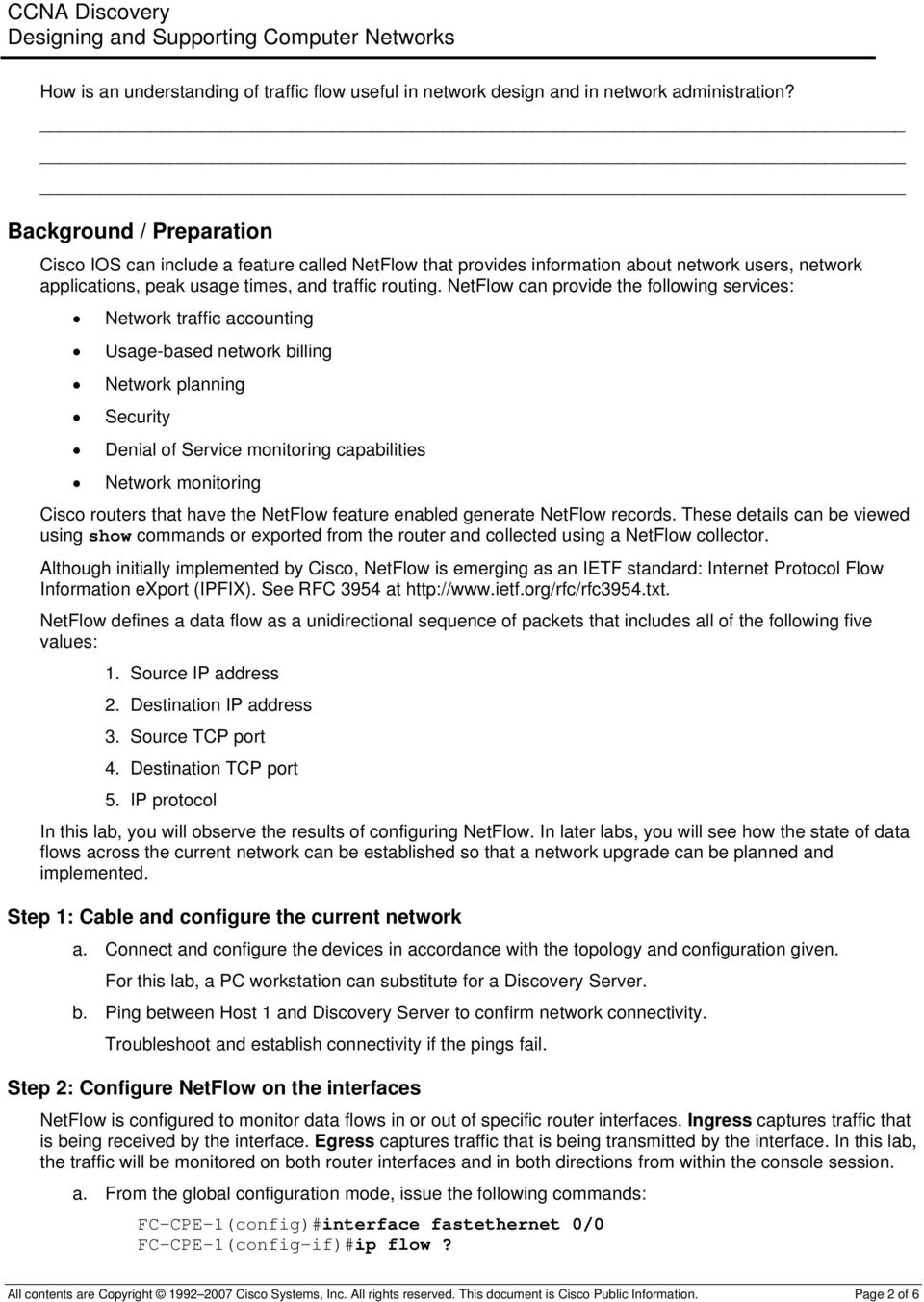
3 Note the two options available: Which option captures traffic that is being received by the interface? Which option captures traffic that is being transmitted by the interface? b. Complete the NetFlow configuration. FC-CPE-1(config-if)#ip flow egress FC-CPE-1(config-if)#ip flow ingress FC-CPE-1(config-if)#interface fastethernet 0/1 FC-CPE-1(config-if)#ip flow ingress FC-CPE-1(config-if)#ip flow egress FC-CPE-1(config-if)#exit FC-CPE-1(config)#end Step 3: Verify the NetFlow configuration a. From the privileged EXEC mode, issue the show running-config command. For each FastEthernet interface, what statement from the running-configuration denotes that NetFlow is configured? interface FastEthernet0/0: interface FastEthernet0/1: b. From the privileged EXEC mode, issue the command: FC-CPE-1#show ip flow? Note the three options available: FC-CPE-1#show ip flow interface FastEthernet0/0 ip flow ingress ip flow egress FastEthernet0/1 ip flow ingress ip flow egress Confirm that the output shown above is displayed. Troubleshoot your configuration if this output is not displayed. Step 4: Create network data traffic a. The captured data flow can be examined using the show ip cache flow command issued from the privileged EXEC mode. FC-CPE-1#show ip cache flow All contents are Copyright Cisco Systems, Inc. All rights reserved. This document is Cisco Public Information. Page 3 of 6

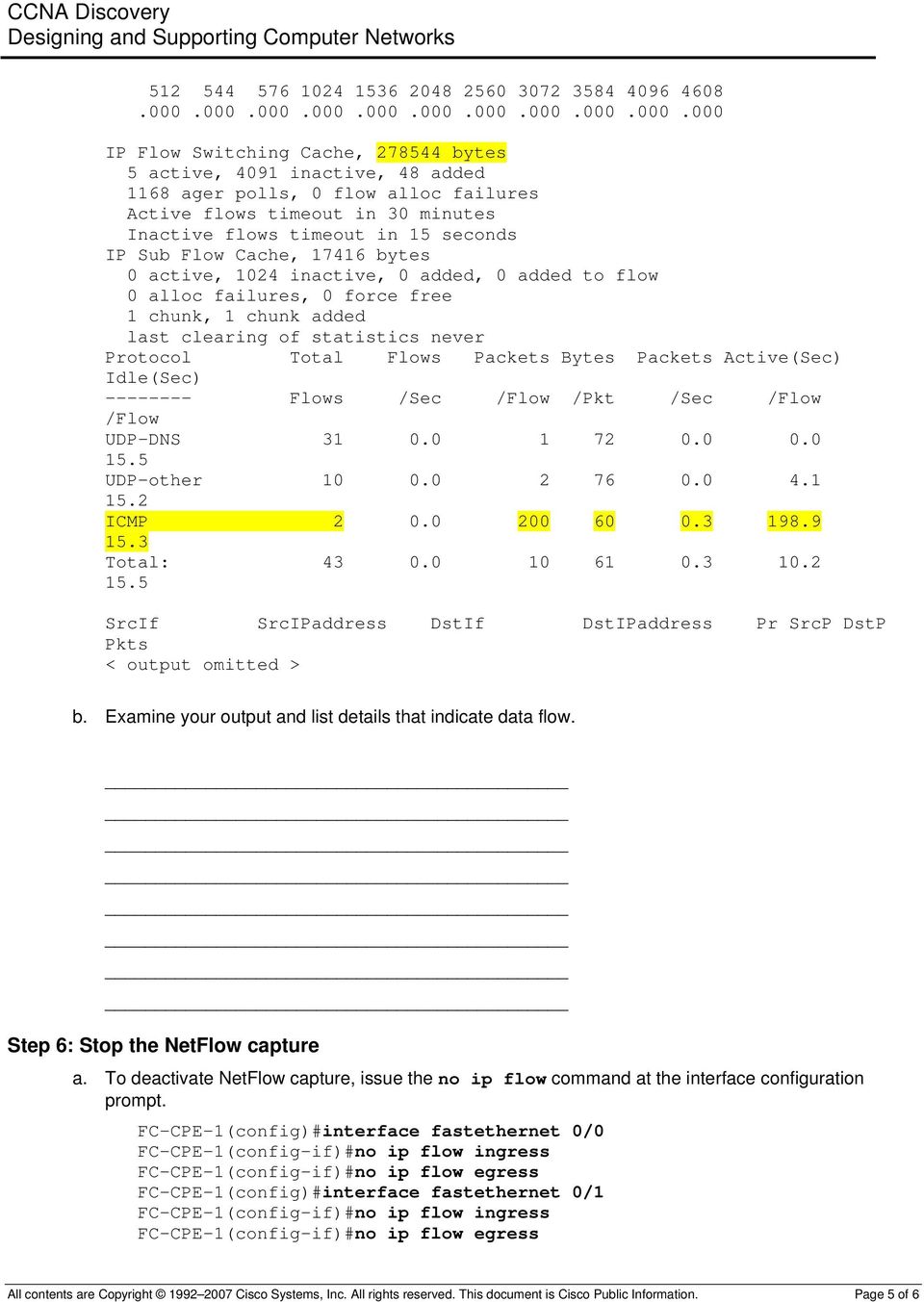
4 Issuing this command before any data traffic has flowed should produce output similar to the example shown here. IP packet size distribution (0 total packets): IP Flow Switching Cache, 0 bytes 0 active, 0 inactive, 0 added 0 ager polls, 0 flow alloc failures Active flows timeout in 30 minutes Inactive flows timeout in 15 seconds last clearing of statistics never Protocol Total Flows Packets Bytes Packets Active(Sec) Idle(Sec) Flows /Sec /Flow /Pkt /Sec /Flow /Flow SrcIf SrcIPaddress DstIf DstIPaddress Pr SrcP DstP Pkts b. List the seven highlighted column headings and consider what use this information may be in characterizing the network. c. To ensure that flow cache statistics are reset, from privileged EXEC mode issue the command: FC-CPE-1# clear ip flow stats d. Ping the Business Server from Host 1 to generate a data flow. From the command line of Host 1, issue the command ping n 200 Step 5: View the data flows a. At the conclusion of the data flow, the details of the flow can be viewed. From privileged EXEC mode, issue the command: FC-CPE-1#show ip cache flow Output similar to that shown below will be displayed. Some values and details may be different in your lab. IP packet size distribution (464 total packets): All contents are Copyright Cisco Systems, Inc. All rights reserved. This document is Cisco Public Information. Page 4 of 6

5 IP Flow Switching Cache, bytes 5 active, 4091 inactive, 48 added 1168 ager polls, 0 flow alloc failures Active flows timeout in 30 minutes Inactive flows timeout in 15 seconds IP Sub Flow Cache, bytes 0 active, 1024 inactive, 0 added, 0 added to flow 0 alloc failures, 0 force free 1 chunk, 1 chunk added last clearing of statistics never Protocol Total Flows Packets Bytes Packets Active(Sec) Idle(Sec) Flows /Sec /Flow /Pkt /Sec /Flow /Flow UDP-DNS UDP-other ICMP Total: SrcIf SrcIPaddress DstIf DstIPaddress Pr SrcP DstP Pkts < output omitted > b. Examine your output and list details that indicate data flow. Step 6: Stop the NetFlow capture a. To deactivate NetFlow capture, issue the no ip flow command at the interface configuration prompt. FC-CPE-1(config)#interface fastethernet 0/0 FC-CPE-1(config-if)#no ip flow ingress FC-CPE-1(config-if)#no ip flow egress FC-CPE-1(config)#interface fastethernet 0/1 FC-CPE-1(config-if)#no ip flow ingress FC-CPE-1(config-if)#no ip flow egress All contents are Copyright Cisco Systems, Inc. All rights reserved. This document is Cisco Public Information. Page 5 of 6
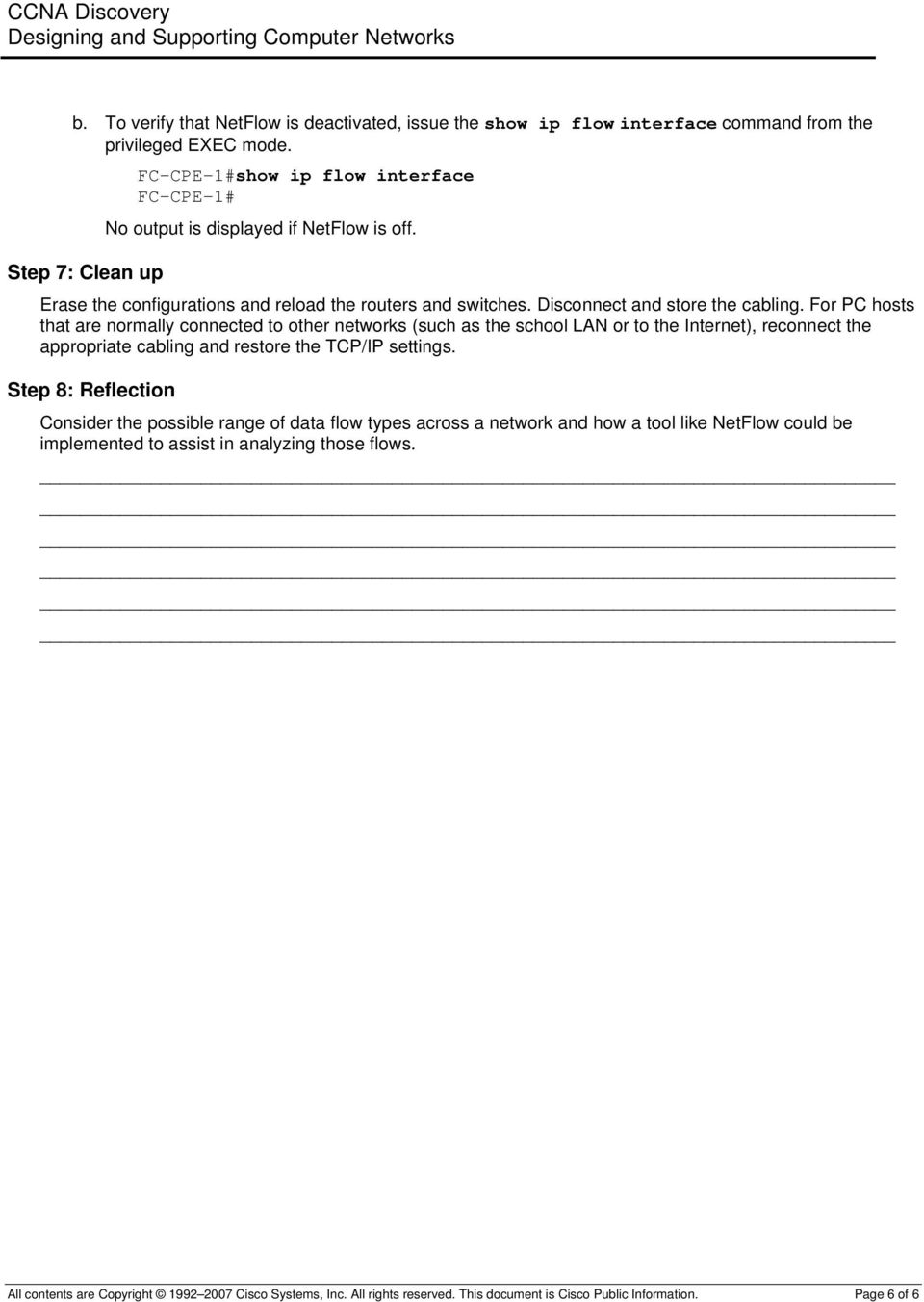
6 b. To verify that NetFlow is deactivated, issue the show ip flow interface command from the privileged EXEC mode. FC-CPE-1#show ip flow interface FC-CPE-1# No output is displayed if NetFlow is off. Step 7: Clean up Erase the configurations and reload the routers and switches. Disconnect and store the cabling. For PC hosts that are normally connected to other networks (such as the school LAN or to the Internet), reconnect the appropriate cabling and restore the TCP/IP settings. Step 8: Reflection Consider the possible range of data flow types across a network and how a tool like NetFlow could be implemented to assist in analyzing those flows. All contents are Copyright Cisco Systems, Inc. All rights reserved. This document is Cisco Public Information. Page 6 of 6
Lab 4.5.2 Diagramming Intranet Traffic Flows
 Lab 4.5.2 Diagramming Intranet Traffic Flows Objective Device Designation Device Name Address Subnet Mask Discovery Server Business Services 172.17.1.1 255.255.0.0 R1 FC-CPE-1 Fa0/1 172.17.0.1 Fa0/0 10.0.0.1
Lab 4.5.4 Diagramming External Traffic Flows
 Lab 4.5.4 Diagramming External Traffic Flows Device Designation Device Name Address Subnet Mask Discovery Server Business Services 172.17.1.1 255.255.0.0 R1 R2 R3 FC-CPE-1 FC-CPE-2 ISP Fa0/1 172.17.0.1
Enabling and Monitoring NetFlow on Subinterfaces
 Enabling and Monitoring NetFlow on Subinterfaces This module contains instructions for enabling and monitoring NetFlow on a router subinterface or a Versatile Interface Processor (VIP) controller interface.
Lab 4.2.3 Analyzing Network Traffic
 Lab 4.2.3 Analyzing Network Traffic Objective Device Designation Device Name Address Subnet Mask Discovery Server Network Services 172.17.1.1 255.255.0.0 R1 FC-CPE-1 Fa0/1 172.17.0.1 Fa0/0 10.0.0.1 255.255.0.0
Getting Started with Configuring Cisco IOS NetFlow and NetFlow Data Export
 Getting Started with Configuring Cisco IOS NetFlow and NetFlow Data Export Last Updated: November 28, 2011 This module contains the minimum amount of information about and instructions necessary for configuring
LAB II: Securing The Data Path and Routing Infrastructure
 LAB II: Securing The Data Path and Routing Infrastructure 8. Create Packet Filters a. Create a packet filter which will deny packets that have obviously bogus IP source addresses but permit everything
Netflow Overview. PacNOG 6 Nadi, Fiji
 Netflow Overview PacNOG 6 Nadi, Fiji Agenda Netflow What it is and how it works Uses and Applications Vendor Configurations/ Implementation Cisco and Juniper Flow-tools Architectural issues Software, tools
Lab 4.5.3 Diagramming Traffic Flows to and from Remote Sites
 Lab 4.5.3 Diagramming Traffic Flows to and from Remote Sites Objective Device Designation Device Name Address Subnet Mask Discovery Server Business Services 172.17.1.1 255.255.0.0 R1 R2 R3 FC-CPE-1 FC-CPE-2
Network Management & Monitoring
 Network Management & Monitoring NetFlow Overview These materials are licensed under the Creative Commons Attribution-Noncommercial 3.0 Unported license (http://creativecommons.org/licenses/by-nc/3.0/)
http://www.cisco.com/en/us/products//hw/switches/ps4324/index.html http://www.cisco.com/en/us/products/ps6350/index.html
 CHAPTER 54 Supervisor Engine 6-E and Catalyst 4900M chassis do not support Netflow; it is only supported on Supervisor Engine IV, Supervisor Engine V, Supervisor Engine V-10GE, or WS-F4531. This chapter
Lab 5.5.3 Developing ACLs to Implement Firewall Rule Sets
 Lab 5.5.3 Developing ACLs to Implement Firewall Rule Sets All contents are Copyright 1992 2007 Cisco Systems, Inc. All rights reserved. This document is Cisco Public Information. Page 1 of 8 Device Interface
CISCO IOS NETFLOW AND SECURITY
 CISCO IOS NETFLOW AND SECURITY INTERNET TECHNOLOGIES DIVISION FEBRUARY 2005 1 Cisco IOS NetFlow NetFlow is a standard for acquiring IP network and operational data Benefits Understand the impact of network
Lab 3.1.2 Creating a Logical Network Diagram
 Lab 3.1.2 Creating a Logical Network Diagram Objectives Use router and switch commands to obtain information about an existing network. Use Cisco Network Assistant to obtain information about an existing
Lab 7.2.9 Load Balancing Across Multiple Paths
 Lab 7.2.9 Load Balancing Across Multiple Paths Objective Configure Load balance across multiple paths. Observe the load balancing process. Background/Preparation Cable a network similar to the one in the
Net-flow. PacNOG 6 Nadi, Fiji
 Net-flow PacNOG 6 Nadi, Fiji Agenda Netflow What it is and how it works Uses and Applications Vendor Configurations/ Implementation Cisco and Juniper Flow-tools Architectural issues Software, tools etc
Lab 4.2.4 Advanced Telnet Operations
 Lab 4.2.4 Advanced Telnet Operations Objective Use the telnet command to remotely access other routers. Verify that the application layer between the source and the destination is working properly. Suspend
TEIN2 Measurement and Monitoring Workshop Netflow. [email protected]
 TEIN2 Measurement and Monitoring Workshop Netflow [email protected] Passive Measurements - Netflow Netflow Setting up Netflow on a router Using Netflow Establishing exports Configuring a collector
OBJECTIVES This paper examines how NetFlow is implemented on logical interfaces. Logical interfaces can be divided into two groups:
 Configuration Guide NetFlow on Logical Interfaces: Frame Relay, Asynchronous Transfer Mode, Inter-Switch Link, 802.1q, Multilink Point to Point Protocol, General Routing Encapsulation, Layer 2 Tunneling
Lab 1.2.3 Review of Basic Router Configuration with RIP. Objective. Background / Preparation. General Configuration Tips
 Lab 1.2.3 Review of Basic Router Configuration with RIP Objective Cable and configure workstations and routers Setup IP addressing scheme using Class B networks Configure Routing Information Protocol (RIP)
LAB Configuring NAT. Objective. Background/Preparation
 LAB Configuring NAT Objective Configure a router to use network address translation (NAT) to convert internal IP addresses, typically private addresses, into outside public addresses. Configure static
3.1 Connecting to a Router and Basic Configuration
 3.1 Connecting to a Router and Basic Configuration Objective This lab will focus on the ability to connect a PC to a router in order to establish a console session and observe the user interface. A console
Note: This case study utilizes Packet Tracer. Please see the Chapter 5 Packet Tracer file located in Supplemental Materials.
 Note: This case study utilizes Packet Tracer. Please see the Chapter 5 Packet Tracer file located in Supplemental Materials. CHAPTER 5 OBJECTIVES Configure a router with an initial configuration. Use the
Catalyst 6500/6000 Switches NetFlow Configuration and Troubleshooting
 Catalyst 6500/6000 Switches NetFlow Configuration and Troubleshooting Document ID: 70974 Introduction Prerequisites Requirements Components Used Conventions Background Information Configure Network Diagram
Lab 3.8.3 Configure Cisco IOS Firewall CBAC on a Cisco Router
 Lab 3.8.3 Configure Cisco IOS Firewall CBAC on a Cisco Router Objective Scenario Topology Estimated Time: 35 minutes Number of Team Members: Two teams with four students per team In this lab exercise,
NetFlow Subinterface Support
 NetFlow Subinterface Support Feature History Release Modification 12.2(14)S This feature was introduced. 12.2(15)T This feature was integrated into Cisco IOS Release 12.2 T. This document describes the
Tutorial: Options for Blackhole and Discard Routing. Joseph M. Soricelli Wayne Gustavus NANOG 32, Reston, Virginia
 Tutorial: Options for Blackhole and Discard Routing Joseph M. Soricelli Wayne Gustavus NANOG 32, Reston, Virginia Caveats and Assumptions The views presented here are those of the authors and they do not
Lab 3.5.1: Basic VLAN Configuration (Instructor Version)
 (Instructor Version) Topology Diagram Addressing Table Device (Hostname) Interface IP Address Subnet Mask Default Gateway S1 VLAN 99 172.17.99.11 255.255.255.0 N/A S2 VLAN 99 172.17.99.12 255.255.255.0
NetFlow Aggregation. Feature Overview. Aggregation Cache Schemes
 NetFlow Aggregation This document describes the Cisco IOS NetFlow Aggregation feature, which allows Cisco NetFlow users to summarize NetFlow export data on an IOS router before the data is exported to
Router Lab Reference Guide
 Router Lab Reference Guide 1 PURPOSE AND GOALS The routing lab allows testing different IP-related protocols and solutions in a close to live environment. You can learn how to configure Cisco routers and
Lab 8.4.3a Managing Cisco IOS Images with TFTP
 Lab 8.4.3a Managing Cisco IOS Images with TFTP Host Device Name Interface IP Address Subnet Mask R1 R1 Fast Ethernet 0/0 172.17.0.1 255.255.0.0 Objectives Analyze the Cisco IOS image and router flash memory.
Device Interface IP Address Subnet Mask Default Gateway
 Felix Rohrer Topology Diagram Addressing Table Device Interface IP Address Subnet Mask Default Gateway S1 VLAN 99 192.168.99.11 255.255.255.0 192.168.99.1 S2 VLAN 99 192.168.99.12 255.255.255.0 192.168.99.1
Lab 2.3.3 Configure Intrusion Prevention on the PIX Security Appliance
 Lab 2.3.3 Configure Intrusion Prevention on the PIX Security Appliance Objective Scenario Topology In this lab exercise, the students will complete the following tasks: Configure the use of Cisco Intrusion
Lab: Basic Router Configuration
 Topology Diagram Addressing Table Device Interface IP Address Subnet Mask Def. Gateway R1 Fa0/0 192.168.1.1 255.255.255.0 N/A S0/0/0 192.168.2.1 255.255.255.0 N/A R2 Fa0/0 192.168.3.1 255.255.255.0 N/A
Configuring SNMP and using the NetFlow MIB to Monitor NetFlow Data
 Configuring SNMP and using the NetFlow MIB to Monitor NetFlow Data NetFlow is a technology that provides highly granular per-flow statistics on traffic in a Cisco router. The NetFlow MIB feature provides
NetFlow v9 Export Format
 NetFlow v9 Export Format With this release, NetFlow can export data in NetFlow v9 (version 9) export format. This format is flexible and extensible, which provides the versatility needed to support new
Network Operations and Network Management
 Network Operations and Network Management By Aftab A. Siddiqui [email protected] Overview Network Management Network Operations Centre Network Monitoring Systems and Tools Network Management Protocol
Connect the Host to attach to Fast Ethernet switch port Fa0/2. Configure the host as shown in the topology diagram above.
 Lab 1.2.2 Capturing and Analyzing Network Traffic Host Name IP Address Fa0/0 Subnet Mask IP Address S0/0/0 Subnet Mask Default Gateway RouterA 172.17.0.1 255.255.0.0 192.168.1.1 (DCE) 255.255.255.0 N/A
Skills Assessment Student Training Exam
 Skills Assessment Student Training Exam Topology Assessment Objectives Part 1: Initialize Devices (8 points, 5 minutes) Part 2: Configure Device Basic Settings (28 points, 30 minutes) Part 3: Configure
Lab 8.3.13 Configure Cisco IOS Firewall CBAC
 Lab 8.3.13 Configure Cisco IOS Firewall CBAC Objective Scenario Topology In this lab, the students will complete the following tasks: Configure a simple firewall including CBAC using the Security Device
Chapter 8 Lab B: Configuring a Remote Access VPN Server and Client
 Chapter 8 Lab B: Configuring a Remote Access VPN Server and Client Topology Note: ISR G2 devices have Gigabit Ethernet interfaces instead of FastEthernet Interfaces. All contents are Copyright 1992 2012
Procedure: You can find the problem sheet on Drive D: of the lab PCs. Part 1: Router & Switch
 University of Jordan Faculty of Engineering & Technology Computer Engineering Department Computer Networks Laboratory 907528 Lab. 2 Network Devices & Packet Tracer Objectives 1. To become familiar with
Introduction to Cisco IOS Flexible NetFlow
 Introduction to Cisco IOS Flexible NetFlow Last updated: September 2008 The next-generation in flow technology allowing optimization of the network infrastructure, reducing operation costs, improving capacity
Lab 5.3.9b Managing Router Configuration Files Using TFTP
 Lab 5.3.9b Managing Router Configuration Files Using TFTP Device Host Name Interface IP Address Subnet Mask R1 R1 Fast Ethernet 0/0 172.17.0.1 255.255.0.0 Objectives Download and install TFTP server software.
Chapter 2 Lab 2-2, Configuring EtherChannel Instructor Version
 Chapter 2 Lab 2-2, Configuring EtherChannel Instructor Version Topology Objective Background Configure EtherChannel. Four switches have just been installed. The distribution layer switches are Catalyst
LAB THREE STATIC ROUTING
 LAB THREE STATIC ROUTING In this lab you will work with four different network topologies. The topology for Parts 1-4 is shown in Figure 3.1. These parts address router configuration on Linux PCs and a
Chapter 3 Using Maintenance & Troubleshooting Tools & Applications Objectives
 Using Maintenance & Troubleshooting Tools & Applications Objectives Describe & utilise Cisco IOS diagnostic tools. Explain the need for specialist tools in the troubleshooting process. Configure software
GLBP - Gateway Load Balancing Protocol
 GLBP - Gateway Load Balancing Protocol Gateway Load Balancing Protocol (GLBP) protects data traffic from a failed router or circuit, like Hot Standby Router Protocol (HSRP) and Virtual Router Redundancy
Configuring NetFlow and NetFlow Data Export
 This module contains information about and instructions for configuring NetFlow to capture and export network traffic data. NetFlow capture and export are performed independently on each internetworking
Network Monitoring and Management NetFlow Overview
 Network Monitoring and Management NetFlow Overview These materials are licensed under the Creative Commons Attribution-Noncommercial 3.0 Unported license (http://creativecommons.org/licenses/by-nc/3.0/)
PT Activity: Configure Cisco Routers for Syslog, NTP, and SSH Operations
 PT Activity: Configure Cisco Routers for Syslog, NTP, and SSH Operations Instructor Version Topology Diagram Addressing Table Device Interface IP Address Subnet Mask Default Gateway Switch Port R1 FA0/1
Lab 8.4.2 Configuring Access Policies and DMZ Settings
 Lab 8.4.2 Configuring Access Policies and DMZ Settings Objectives Log in to a multi-function device and view security settings. Set up Internet access policies based on IP address and application. Set
CCNA Access List Sim
 1 P a g e CCNA Access List Sim Question An administrator is trying to ping and telnet from Switch to Router with the results shown below: Switch> Switch> ping 10.4.4.3 Type escape sequence to abort. Sending
Lab 5.3.8 Configuring PAT with SDM and Static NAT using Cisco IOS Commands
 Lab 5.3.8 Configuring PAT with SDM and Static NAT using Cisco IOS Commands Device Host Name Interface IP Address Subnet Mask R1 CustomerRouter Serial 0/0/0 (DTE) 209.165.200.225 255.255.255.224 Fast Ethernet
Configuring NetFlow-lite
 CHAPTER 55 Note NetFlow-lite is only supported on Catalyst 4948E Ethernet Switch. This chapter describes how to configure NetFlow-lite on the Catalyst 4948E switch. NetFlow-lite provides traffic monitoring
Configuring Flexible NetFlow
 CHAPTER 62 Note Flexible NetFlow is only supported on Supervisor Engine 7-E, Supervisor Engine 7L-E, and Catalyst 4500X. Flow is defined as a unique set of key fields attributes, which might include fields
Lab 7.2.9 Load Balancing Across Multiple Paths Instructor Version 2500
 Lab 7.2.9 Load Balancing Across Multiple Paths Instructor Version 2500 Objective onfigure Load balance across multiple paths. Observe the load balancing process. Background/Preparation able a network similar
NetFlow-Lite offers network administrators and engineers the following capabilities:
 Solution Overview Cisco NetFlow-Lite Introduction As networks become more complex and organizations enable more applications, traffic patterns become more diverse and unpredictable. Organizations require
Lab - Using IOS CLI with Switch MAC Address Tables
 Topology Addressing Table Objectives Device Interface IP Address Subnet Mask Default Gateway R1 G0/1 192.168.1.1 255.255.255.0 N/A S1 VLAN 1 192.168.1.11 255.255.255.0 192.168.1.1 S2 VLAN 1 192.168.1.12
http://computernetworkingnotes.com/ccna-study-guide/cisco-ios-naming-convention-explainedwith-examples.html
 IOS is the most critical part of any cisco device. We should always keep a backup copy of IOS to deal with any unwanted situation. In this article I will explain the backup and restore process of IOS in
Configure ISDN Backup and VPN Connection
 Case Study 2 Configure ISDN Backup and VPN Connection Cisco Networking Academy Program CCNP 2: Remote Access v3.1 Objectives In this case study, the following concepts are covered: AAA authentication Multipoint
Lab 5.3.5 Configuring Basic Router Settings with the Cisco IOS CLI
 Lab 5.3.5 Configuring Basic Router Settings with the Cisco IOS CLI Device Host Name Interface IP address Subnet mask R1 R1 Serial 0/0/0 (DCE) 172.17.0.1 255.255.0.0 FastEthernet 0/0 172.16.0.1 255.255.0.0
Configuring NetFlow Secure Event Logging (NSEL)
 73 CHAPTER This chapter describes how to configure NSEL, a security logging mechanism that is built on NetFlow Version 9 technology, and how to handle events and syslog messages through NSEL. The chapter
Cisco IOS Flexible NetFlow Technology
 Cisco IOS Flexible NetFlow Technology Last Updated: December 2008 The Challenge: The ability to characterize IP traffic and understand the origin, the traffic destination, the time of day, the application
Lab 2 - Basic Router Configuration
 CS326 Fall 2001 Room: PAI 5.48 Name: Lab 2 - Basic Router Configuration In this lab you will learn: the various configuration modes of Cisco 2621 routers how to set up IP addresses for such routers how
Viete, čo robia Vaši užívatelia na sieti? Roman Tuchyňa, CSA
 Viete, čo robia Vaši užívatelia na sieti? Roman Tuchyňa, CSA What is ReporterAnalyzer? ReporterAnalyzer gives network professionals insight into how application traffic is impacting network performance.
1 Basic Configuration of Cisco 2600 Router. Basic Configuration Cisco 2600 Router
 1 Basic Configuration of Cisco 2600 Router Basic Configuration Cisco 2600 Router I decided to incorporate the Cisco 2600 into my previously designed network. This would give me two seperate broadcast domains
Lab 3 Routing Information Protocol (RIPv1) on a Cisco Router Network
 Lab 3 Routing Information Protocol (RIPv1) on a Cisco Router Network CMPE 150 Fall 2005 Introduction Today you are going to be thrown into using Cisco s Internetwork Operating System (IOS) to configure
1 PC to WX64 direction connection with crossover cable or hub/switch
 1 PC to WX64 direction connection with crossover cable or hub/switch If a network is not available, or if it is desired to keep the WX64 and PC(s) completely separated from other computers, a simple network
Enabling NetFlow and NetFlow Data Export (NDE) on Cisco Catalyst Switches
 Enabling NetFlow and NetFlow Data Export (NDE) on Cisco Catalyst Switches Revised 2/1/2007 Introduction...2 Requirements...2 Catalyst 4500 Series...2 Enabling NetFlow...2 Configuring a NetFlow Destination...3
Firewall Load Balancing
 CHAPTER 6 This chapter describes the (FWLB) feature. It includes the following sections: FWLB Overview, page 6-1 FWLB Features, page 6-2 FWLB Configuration Tasks, page 6-3 Monitoring and Maintaining FWLB,
Configuring NetFlow Switching
 Configuring NetFlow Switching This chapter describes how to configure NetFlow switching. For a complete description of NetFlow commands used in this chapter, refer to the Cisco IOS Switching s chapter
Applicazioni Telematiche
 Angelo Coiro Laboratorio Applicazioni Telematiche L emulatore Packet Tracer Packet Tracer Cisco Packet Tracer is an academic software that allows to emulate Cisco devices Packet Tracer can be used for
Cisco IOS NetFlow Command Reference
 July 2011 Americas Headquarters Cisco Systems, Inc. 170 West Tasman Drive San Jose, CA 95134-1706 USA http://www.cisco.com Tel: 408 526-4000 800 553-NETS (6387) Fax: 408 527-0883 THE SPECIFICATIONS AND
Configuring Static and Dynamic NAT Simultaneously
 Configuring Static and Dynamic NAT Simultaneously Document ID: 13778 Contents Introduction Prerequisites Requirements Components Used Conventions Configuring NAT Related Information Introduction In some
Sample Configuration Using the ip nat outside source static
 Sample Configuration Using the ip nat outside source static Table of Contents Sample Configuration Using the ip nat outside source static Command...1 Introduction...1 Before You Begin...1 Conventions...1
Lab 1.4.1 Introductory Lab 1 - Getting Started and Building Start.txt
 Lab 1.4.1 Introductory Lab 1 - Getting Started and Building Start.txt Objective This lab may introduce new CCNP lab equipment and certain IOS features. This introductory activity also describes how to
Flow Monitor for WhatsUp Gold v16.2 User Guide
 Flow Monitor for WhatsUp Gold v16.2 User Guide Contents Table of Contents Flow Monitor Overview Welcome to WhatsUp Gold Flow Monitor... 1 What is Flow Monitor?... 2 How does Flow Monitor work?... 2 System
Lab 2.3.2 Configuring OSPF with Loopback Addresses
 Lab 2.3.2 Configuring OSPF with Loopback Addresses Objective Configure routers with a Class C IP addressing scheme. Observe the election process for designated routers (DR) and backup designated routers
CHAPTER 1 WhatsUp Flow Monitor Overview. CHAPTER 2 Configuring WhatsUp Flow Monitor. CHAPTER 3 Navigating WhatsUp Flow Monitor
 Contents CHAPTER 1 WhatsUp Flow Monitor Overview What is Flow Monitor?... 1 How does Flow Monitor work?... 2 Supported versions... 2 System requirements... 2 CHAPTER 2 Configuring WhatsUp Flow Monitor
Lab 5.3.5 Configuring Basic Router Settings with the Cisco IOS CLI
 Lab 5.3.5 Configuring Basic Router Settings with the Cisco IOS CLI Device Host Name Interface IP Address Subnet Mask R1 R1 Serial 0/0/0 (DCE) 172.17.0.1 255.255.0.0 FastEthernet 0/0 172.16.0.1 255.255.0.0
Configuring NetFlow Secure Event Logging (NSEL)
 75 CHAPTER This chapter describes how to configure NSEL, a security logging mechanism that is built on NetFlow Version 9 technology, and how to handle events and syslog messages through NSEL. The chapter
Lab 4.1.4 Creating a Network Map using CDP Instructor Version 2500
 Lab 4.1.4 Creating a Network Map using CDP Instructor Version 2500 Objective Use Cisco Discovery Protocol (CDP) commands to get information about neighboring network devices. Background/Preparation CDP
CCNA Discovery 4.1.3 Working at a Small to Medium Business or ISP Student Packet Tracer Lab Manual
 4.1.3 Working at a Small to Medium Business or ISP Student Packet Tracer Lab Manual This document is exclusive property of Cisco Systems, In Permission is granted to print and copy this document for non-commercial
Lab 8.4.3b Managing Cisco IOS images with ROMMON and TFTP
 Lab 8.4.3b Managing Cisco IOS images with ROMMON and TFTP Host Device Name Interface IP Address Subnet Mask R1 R1 Fast Ethernet 0/0 172.17.0.1 255.255.0.0 Objectives Analyze the Cisco IOS image and router
Lab 4.4.8a Configure a Cisco GRE over IPSec Tunnel using SDM
 Lab 4.4.8a Configure a Cisco GRE over IPSec Tunnel using SDM Objective Scenario Topology In this lab, the students will complete the following tasks: Prepare to configure Virtual Private Network (VPN)
Lab 5.2.5 Configure IOS Firewall IDS
 Lab 5.2.5 Configure IOS Firewall IDS Objective Scenario Topology: Estimated Time: 15 minutes Number of Team Members: Two teams with four students per team. In this lab, the student will learn how to perform
HTGR- Netflow. or, how to know what your network really did without going broke
 HTGR- Netflow or, how to know what your network really did without going broke Michael W. Lucas [email protected] GKN Driveline North America, Inc. Copyright 2007 Michael W. Lucas slide 1 What
Introduction to Netflow
 Introduction to Netflow Mike Jager Network Startup Resource Center [email protected] These materials are licensed under the Creative Commons Attribution-NonCommercial 4.0 International license (http://creativecommons.org/licenses/by-nc/4.0/)
PT Activity 8.1.2: Network Discovery and Documentation Topology Diagram
 Topology Diagram All contents are Copyright 1992 2007 Cisco Systems, Inc. All rights reserved. This document is Cisco Public Information. Page 1 of 6 Addressing Table Device Interface IP Address Subnet
School of Information Technology and Engineering (SITE) CEG 4395: Computer Network Management. Lab 4: Remote Monitoring (RMON) Operations
 School of Information Technology and Engineering (SITE) CEG 4395: Computer Network Management Lab 4: Remote Monitoring (RMON) Operations Objective To become familiar with basic RMON operations, alarms,
NetStream (Integrated) Technology White Paper HUAWEI TECHNOLOGIES CO., LTD. Issue 01. Date 2012-9-6
 (Integrated) Technology White Paper Issue 01 Date 2012-9-6 HUAWEI TECHNOLOGIES CO., LTD. 2012. All rights reserved. No part of this document may be reproduced or transmitted in any form or by any means
Configuring Port Security
 CHAPTER 62 This chapter describes how to configure the port security feature. For complete syntax and usage information for the commands used in this chapter, see the Cisco IOS Master List, at this URL:
Flow Monitor for WhatsUp Gold v16.1 User Guide
 Flow Monitor for WhatsUp Gold v16.1 User Guide Contents Table of Contents Flow Monitor Overview Welcome to WhatsUp Gold Flow Monitor... 1 What is Flow Monitor?... 2 How does Flow Monitor work?... 2 System
Configuring a Leased Line
 CHAPTER 4 Configuring a Leased Line The configuration in this chapter describes how to configure a Cisco 1700 router for IP and IPX over a synchronous serial line. Before You Begin The configuration in
Lab 5.3.7 Configuring DHCP with SDM and the Cisco IOS CLI
 Lab 5.3.7 Configuring DHCP with SDM and the Cisco IOS CLI Device Host Name Interface IP Address Subnet Mask R1 Customer Serial 0/0/1 (DTE) 209.165.200.225 255.255.255.224 Fast Ethernet 0/0 192.168.1.1
Pre-lab and In-class Laboratory Exercise 10 (L10)
 ECE/CS 4984: Wireless Networks and Mobile Systems Pre-lab and In-class Laboratory Exercise 10 (L10) Part I Objectives and Lab Materials Objective The objectives of this lab are to: Familiarize students
Netflow, Flow-tools tutorial
 Netflow, Flow-tools tutorial Gaurab Raj Upadhaya Agenda Agenda bashing Do you want to see the labs, or want to discuss issues Netflow What it is and how it works Uses and Applications Vendor Configurations/
CS 326e F2002 Lab 1. Basic Network Setup & Ethereal Time: 2 hrs
 CS 326e F2002 Lab 1. Basic Network Setup & Ethereal Time: 2 hrs Tasks: 1 (10 min) Verify that TCP/IP is installed on each of the computers 2 (10 min) Connect the computers together via a switch 3 (10 min)
Lab 8.5.3 Configuring the PIX Firewall as a DHCP Server
 Lab 8.5.3 Configuring the PIX Firewall as a DHCP Server Objective Scenario Estimated Time: 15 minutes Number of Team Members: Two teams with four students per team. In this lab, students will learn the
WhatsUpGold. v15.0. Flow Monitor User Guide
 WhatsUpGold v15.0 Flow Monitor User Guide Contents CHAPTER 1 Flow Monitor Overview Welcome to WhatsUp Gold Flow Monitor... 1 What is Flow Monitor?... 2 How does Flow Monitor work?... 2 System requirements...