
Electricity Distribution Business Pricing Methodology for Prices Effective 1 April March 2015
|
|
|
- Lambert Barker
- 10 years ago
- Views:
Transcription
1 Electricity Distribution Business Pricing Methodology for Prices Effective 1 April March 2015 Page 1 of 40

2 1 Table of contents 1 Table of contents Introduction Summary of 2015 pricing methodology Pricing considerations Pricing decisions Target revenue Consumer groups Tariff structure prices Consistency with the Electricity Authority s pricing principles Glossary...38 Appendix: Electra s prices effective 1 April Page 2 of 40

3 2 Introduction The purpose of this document is to describe Electra Limited s ( Electra ) approach to setting electricity distribution prices from 1 April Electra owns and operates the local electricity distribution network in the Kapiti and Horowhenua regions. The network distributes some 402 Gigawatt hours (GWh) of electricity each year from the national grid to approximately 42,900 consumers. Load on the network is mainly comprised of domestic and small commercial connections, concentrated in the main towns along the coast, with larger commercial loads centred on Paraparaumu and Levin. Electra is owned by its consumers through the Electra Trust, which appoints Directors and holds all of the shares on behalf of the consumers connected to the network. Page 3 of 40

4 3 Summary of 2015 pricing methodology 3.1 Approach to setting prices Electra resets it prices at 1 April each year for the forthcoming pricing year. Our annual pricing review cycle is illustrated as follows: Pricing Considerations Network Costs Consumer Regulation Funding Growth Review Pricing Objectives & Strategy Publish & Monitor Set Target Revenue Calculate Tariffs Review Pricing Structures Review pricing considerations: We have reviewed the key pricing considerations influencing our pricing decisions (See Section 4) Review pricing objectives and strategy: We have reviewed our pricing objectives and strategy (See Section 5) Set target revenue: We have calculated our target revenue to be recovered through prices (See Section 6) Review pricing structures: We have reviewed and confirmed our four consumer groups and various tariff options (see Section 7-8) Page 4 of 40

5 Calculate tariffs: We have calculated tariffs (see section 9) which will recover our target revenue. In this respect we have considered: o o o pricing structures the cost of supplying different consumer groups expected connections and consumption over the pricing period. Publish and monitor: Our pricing methodology is updated and published on our website. This ensures that our approach to determining tariffs is transparently disclosed, consistent with regulatory requirements (see section 10). 3.2 Changes to pricing in 2015 The new prices that apply from 1 April 2015 are set out in the appendix with 2014 prices provided for comparison purposes. Additional detail is provided in section 9. Figure 1 summarises the key changes to be introduced from 1 April Figure 1: Changes to the pricing methodology in 2015 Change Impact on consumers Prices reset to recover 2015/16 target revenue Aggregate prices increased to reflect a 2% increase in Electra s costs Standard Industrial daily fixed charge increased Daily fixed charge increased from 80c/day to 90 c/day per ICP. Anytime and peak time prices increased relative to off-peak and controlled prices, to incentivise more efficient use of network capacity Anytime, Day and Peak use kwh rates increased under the Anytime, Night/Day, Triple Saver, and Standard Industrial tariff options. Managed, Off-peak, Night, Super Thrifty and Thrifty charges unchanged. New distributed generation (DG) export tariff introduced for those exporting electricity on to network. Tariff set at zero at this time, hence no impact on consumers. Purpose is to monitor uptake of DG. The content and structure of the methodology statement updated to improve readability. To provide greater understanding of how we set our prices. Page 5 of 40

6 4 Pricing considerations 4.1 Network characteristics The network supplies a relatively compact geographic area of around 1700 square kilometres, with connections concentrated along the coast, in order to supply a number of towns from Paekakariki to Foxton. Paraparaumu and Levin are the largest of these towns. Electra receives supply from the national grid from two Transpower Grid Exit Points (GXPs). Electra s northern area (Horowhenua) takes 33kV supply at the Mangahao GXP. The southern area (Kapiti) takes 33kV supply at the Paraparaumu GXP. While Transpower does not permit continuous connection between these GXPs, load is transferred between north and south to meet operational requirements. The two regions are therefore treated as one network for pricing purposes. The network faces capacity constraints at these two GXPs, which are being addressed by the following upgrades: The Paraparaumu GXP feed has been upgraded to a 220kV supply and capacity increased from 60MVA to 120MVA as part of Transpower s project to accommodate the new Transmission Gully highway. The capacity of the Mangahao GXP will be upgraded as part of Transpower s lifecycle replacement programme (scheduled for 2017/18). The upgrade to the Paraparaumu GXP is expected to be cost neutral to Electra over the life of the asset, as part of an arrangement between Electra and Transpower. However, any additional Transpower charges associated with Mangahao, as well as costs associated with our own corresponding network investments, will need to be recovered from consumers unless utilisation of existing capacity on the network can be reduced. A meshed 33kV sub-transmission network extends from the two GXPs to the main population centres (see map in page 3). This feeder network supplies 11kV distribution circuits that extend radially, with extensive meshing in urban areas. This is stepped down to the 400V low voltage network, which supplies all but a handful of consumers who take supply at 11kV. Page 6 of 40

7 4.2 Cost drivers We have considered the relevant drivers of costs that we are seeking to recover, in order to inform our decisions on consumer groupings, tariff structures, and the level of charges. 90% of our costs are associated with directly investing in, maintaining and operating the network, as well as receiving supply from Transpower s network (see breakdown of target revenue in Section 6.1). The remaining 10% is associated with general management and administration. The key cost drivers relevant to setting prices are therefore weighted heavily towards investment in, and operation of, the network. Key cost drivers associated with investing in and operating the network include: the engineered capacity of the network (measured in kva); the length of circuit required to supply consumers (measured in kms); the number of consumer connections (measured in ICPs); and consumer specific asset use. Figure 2: Key network statistics Consumer numbers 42,908 Total circuit length (km) 2,263 Consumer density (ICPs/km) 18.6 Zone substation installed firm capacity (MVA) 189 Maximum demand (MW) 93 Utilisation of installed firm capacity (%) 59 Energy conveyed (GWh) 402 Energy density (kwh/icp) 9,572 Source: 2014 Information Disclosures Page 7 of 40

8 4.2.1 Network capacity The network is designed and operated to meet forecast electricity demand up to an engineered peak and at a level of service consistent with consumers expectations. As demand reaches system limits, Electra must consider further investments in network capacity to meet demand. Consumer usage of the available network capacity is therefore a key driver of existing and future network costs Circuit length The length of circuit required to transmit electricity from the GXP supply point to the demand base is a key driver of network investment costs. Consumers who are further from the main supply areas create relatively higher costs for Electra. In practice, the network is relatively compact and extensive meshing of the distribution network in urban centres makes it difficult to distinguish line length for a particular consumer or group of consumers (i.e. due to the difficulty in tracking electrical flows). It is potentially more practical to measure the relative length of the sub-transmission and distribution feeder network required to supply different demand regions. While a demarcation could conceivably be made between rural and urban consumers on this basis, such a pricing approach is inconsistent with our strong community focus and consumer ownership. It is also potentially at odds with government policy intentions with regards to electricity pricing in rural areas. Therefore, while circuit length is a relevant cost driver we have not factored this into our pricing design Consumer connections New connections, and upgrades to connections, drive asset-related and ongoing operations and maintenance costs. Electra s network extension policy requires consumers to pay for connection related asset costs upfront. Each new connection also creates operating and maintenance costs, including network operations and planning, fault restoration, maintenance and general administration costs. New connections therefore increase operating costs over time, which must be reflected in prices Asset usage Network costs that directly relate to one consumer or group of consumers are identified and recovered from those parties where practical. This aligns recoupment of costs with the Page 8 of 40

9 beneficiary of those assets. The provision of street-lighting and community lighting is a service category that has specific assets identifiable to a dedicated group of consumers. In 2013 we considered whether consumer specific asset use could be better reflected in our pricing methodology. In particular, use of high and low voltage assets and dedicated equipment (i.e. transformers) were considered. We concluded that there is very little variation in asset utilisation within our consumer base (e.g. less than 0.1% of consumers directly connect to 11kV feeders). For those consumers that require dedicated equipment this is generally dealt with as part of our network extension policy, rather than through pricing. We therefore consider that there is little benefit in dedicated asset pricing, with the exception of street-lighting and community lighting Summary of key cost drivers applicable to pricing The key cost drivers recognised in our pricing methodology are: Network capacity New or upgraded connections Dedicated street light or community lighting asset use. 4.3 Consumer considerations Consumer ownership Electra is owned by its consumers through the Electra Trust. Consumer trust ownership means that surpluses not required for the operation and development of the business are returned to consumers via electricity sales discounts on their electricity accounts Consumer profiles Electra s pricing structures are focussed towards the mass market because the consumer base is dominated by small loads. Domestic and small commercial users represent approximately 98% of connections and over 80% of maximum demand. As a result, Electra has the lowest average use per connection of all New Zealand electricity distribution businesses (ie 9,572kWhs per connection versus the industry average of 15,967kWh). Page 9 of 40

10 Mass market connections are low voltage, typically 60 Amp single phase or 40 Amp three phase. Our analysis suggests these consumers have a typical residential demand profile which peaks in the morning and early evenings. Our pricing must also cater for several hundred large commercial loads. In contrast to the mass market, most large commercial loads have TOU metering, and much higher levels of annual consumption (ranging from 40,000kWh to more than 3GWh). They also have distinct demand behaviours: many have flat demand across the standard working day, whereas others vary by time of day and season. From a cost driver perspective, large consumers have higher capacity connections and utilise a greater proportion of the installed network capacity relative to the average mass market connection Consumer feedback In December 2014, we undertook a survey of our consumers in order to better understand their views on prices, quality of supply, and consumption patterns. We surveyed 300 consumers (both residential and commercial). Feedback received included: 98% of respondents believed that Electra provides a reliable service (up from 72% in 2012), with 78% believing that faults were fixed quickly. 44% believed that charges were reasonable. While the improvement in reliability is pleasing, Electra is working hard to keep prices affordable, with this year s price increase matching cost inflation expectations. The survey also highlighted increasing use of energy efficient products, which is expected to continue to exert downward pressure on consumption. In the short-term, falling consumption means variable prices per kwh will increase in order to recover our annual target revenue. The survey also highlighted reasonable interest from consumers in alternative forms of energy supply, with 2% of respondents indicating they had installed solar photovoltaic (PV) supply and 18% suggesting they were considering it. The installation of PV creates both commercial and operational challenges and opportunities for the network, which we need to better understand. Accordingly, we intend to more proactively monitor uptake of small scale DG (including PV) and analyse the potential network impacts. Page 10 of 40
11 Figure 3: Consumer survey results % of respondents that Use energy efficient light bulbs Use a heat pump Domestic 78% 84% 89% Commercial 54% 61% 72% Domestic 27% 32% 35% Commercial 30% 30% 33% 4.4 Regulatory considerations Electra s network is a natural monopoly : That is, it is considered more economically efficient for one network to supply all consumers, due to economies of scale. Accordingly, Electra is not directly exposed to competitive forces that drive markets to deliver improved efficiency and services. Legislators typically regulate such businesses to ensure price and quality outcomes consistent with competitive markets. However, consumer ownership provides the necessary incentives to ensure Electra delivers an efficient and reliable service to its consumers (who are also its owners) at fair prices. This was formally recognised in 2008 when Electra was exempted from price and quality regulations applying to electricity distribution networks under Part 4 of the Commerce Act 1986, as administered by the Commerce Commission. While exempt from direct price and quality control, Electra is subject to regulatory oversight in the form of information disclosure regulation. This pricing methodology is required to be disclosed under the Commerce Commission s Information Disclosure Determination. As part of these requirements we must describe the extent to which our pricing methodology is consistent with the Electricity Authority s distribution pricing principles (see Section 10). These principles provide guidance on economic concepts and market considerations which are applicable for setting efficient network prices. Electra must also comply with the following regulations that affect pricing: The Electricity (Low Fixed Charges Tariff Options for Domestic Consumers) Regulations 2004 (LFC Regulations): These require Electra to offer a tariff option Page 11 of 40

12 to domestic consumers (using less than 8,000kWh per annum) that has a fixed daily tariff not exceeding 15 cents. The Electricity Industry Participation Code, Part 6 - pricing of distributed generation (Part 6): Any charges applying to distributed generation (DG) connections must not exceed the incremental costs of connecting this DG to the network, including any avoided costs. The Electricity Industry Participation Code, Part 12A: Electra must consult with retailers on any changes to pricing structures. 4.5 Network extensions policy In addition to distribution prices, consumers are required to fully fund the cost of their own connection assets, at the time of connection. Connection assets include additional 11kV and 400V power lines and cables and transformers required to provide the electrical load and quality of supply sought by consumers. Where these assets are vested with Electra, then we will pay for ongoing maintenance and operations of the assets. We may also provide a refund to consumers where the required asset upgrade exceeds the consumer s requirements. For the avoidance of doubt, distribution prices do not seek to recover connection costs paid for by consumers under our network extension policy. Further information on our network extension policy can be found on our website at: upgrade_policy_disclosure.pdf Page 12 of 40
13 5 Pricing decisions This section sets out our key pricing decisions, including our pricing objectives and strategy. 5.1 Pricing objectives Electra s pricing objectives, which guide our pricing decisions, include: Consideration and compliance with all regulatory requirements relating to pricing: as discussed 4.4 Transparency and simplicity for consumers and retailers: It is important that consumers understand how prices are set and how changes to prices impact on their electricity costs. Gaining buy-in from retailers is also crucial given consumers deal primarily with their retailer, and to ensure that price signals are appropriately passed on to consumers via retail prices. Fairness between consumers and retailers: As a consumer owned business, fairness in pricing is particularly important. One tangible example of this is that we do not explicitly seek to differentiate between consumers based on whether they are domestic or commercial, rural or urban, but rather we focus on use of the network and the extent to which consumers create costs for the network. Encouragement for consumers to shift load away from peak periods and to use assets efficiently: Electra s primary obligation is to build and maintain its network to meet the peak demands of its consumers. Any deferral of investment in network capacity is beneficial to all consumers if it can be managed without compromising service delivery. Over the longer term, we recognise the importance of the efficient use of energy and encourage behaviours that reduce peak demand. Pricing is one tool that can be used to incentivise such outcomes. Cost recovery: Prices must recover our costs in order for Electra to remain commercially sustainable. Page 13 of 40

14 Pricing review In 2013 Electra completed a detailed review of the effectiveness of our current pricing structures. As part of this review we assessed the consistency of our prices with the EA s pricing principles. We also built a cost of supply model to: Understand the alignment between prices and implied cost allocations; and Test new tariff options and structures. The key conclusions of this review were: Existing prices broadly align with implied cost allocations to consumer groups. Existing consumer groups and tariff structures are effective in meeting Electra s pricing objectives, subject to the following refinements: o o o a new standard industrial tariff option should be split out from the current Triple Saver tariff option. This would be targeted at larger time of use (TOU) consumers using more than 40,000kWh per annum. This tariff is similar in structure to the Triple Saver tariff but with a higher fixed charge component, off-set by reduced variable charges. This better reflects the higher proportion of fixed costs incurred in providing services to this group. the Triple Saver tariff should be repositioned as a mass market TOU tariff option, which will complement the eventual deployment of smart metering technology on the network. peak time charges should be increased to further incentivise efficient use of existing network capacity. The standard industrial tariff was introduced on 1 April 2013 and peak time prices have progressively been raised on 1 April 2014 and 1 April Pricing strategy Our pricing strategy for the next five years is to: Monitor and encourage uptake of the standard industrial tariff option; Refine pricing in response to consumer feedback and use; Page 14 of 40

15 Any price increases required to meet annual target revenue requirements will be applied to peak time or anytime tariffs. This will increase the differential between peak and non-peak tariffs, in order to better signal the benefits of reducing consumption during peak periods. This helps to avoid further expenditure on network reinforcement; Monitor the deployment of mass-market smart meters on the network and investigate, where necessary, potential TOU tariff options that can make use of this technology. We plan to reposition the Triple Saver tariff to a mass market tariff which gives consumers more choice. As part of this we plan to: o o Progressively increase the Triple Saver price (this commenced in the 2013/14 pricing year) to maintain relativity with other mass market options. To avoid price shocks, the Peak component of Triple Saver will need to increase by around 15% per annum (3-5% of the final retail bill) for the next two years while the Off Peak and Night components remain unchanged. Encourage the larger Triple Saver consumers to move to the Standard Industrial tariff given the pricing advantages available to this group on consumers. Monitor the consistency of prices against cost of supply model outputs. This strategy, largely based on our 2013 pricing review, applies at the time of publication of this methodology. However, we note that in 2015 we plan to undertake a further comprehensive review of Electra s pricing strategy to determine whether there are further refinements to our strategy that can be made. Any changes will be communicated in our next pricing methodology. Page 15 of 40

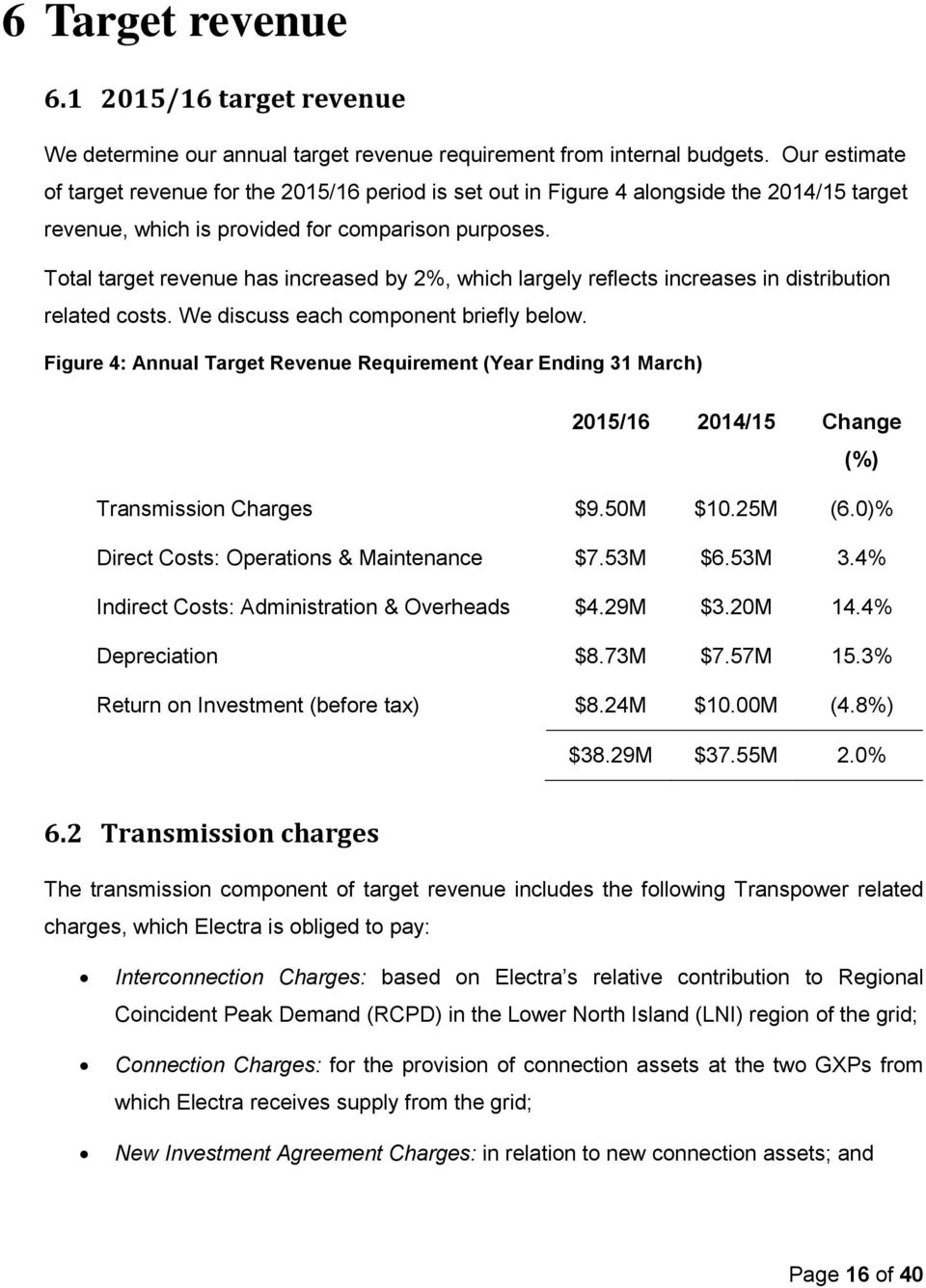
16 6 Target revenue /16 target revenue We determine our annual target revenue requirement from internal budgets. Our estimate of target revenue for the 2015/16 period is set out in Figure 4 alongside the 2014/15 target revenue, which is provided for comparison purposes. Total target revenue has increased by 2%, which largely reflects increases in distribution related costs. We discuss each component briefly below. Figure 4: Annual Target Revenue Requirement (Year Ending 31 March) 2015/ /15 Change (%) Transmission Charges $9.50M $10.25M (6.0)% Direct Costs: Operations & Maintenance $7.53M $6.53M 3.4% Indirect Costs: Administration & Overheads $4.29M $3.20M 14.4% Depreciation $8.73M $7.57M 15.3% Return on Investment (before tax) $8.24M $10.00M (4.8%) $38.29M $37.55M 2.0% 6.2 Transmission charges The transmission component of target revenue includes the following Transpower related charges, which Electra is obliged to pay: Interconnection Charges: based on Electra s relative contribution to Regional Coincident Peak Demand (RCPD) in the Lower North Island (LNI) region of the grid; Connection Charges: for the provision of connection assets at the two GXPs from which Electra receives supply from the grid; New Investment Agreement Charges: in relation to new connection assets; and Page 16 of 40
17 Notional Avoided Cost of Transmission (ACOT): The Mangahao Grid Exit Point (GXP) is shared with the Mangahao hydro scheme. Electra is responsible for paying all Transpower connection charges associated with the Mangahao GXP but our consumers share any avoided Transpower interconnection charges that result from the generator reducing Regional Coincident Peak Demand at this GXP. This arrangement is not a specific cost but is implicitly recognised in the connection and interconnection charges. Transpower also calculates rental rebates and returns these to distributors over the pricing year. As these are not known at the time of setting prices, Electra estimates the rebates on an annual basis and includes this credit in the transmission revenue requirement. Any additional rental rebates received above this estimate are returned to consumers through sales discounts, whereas Electra carries the risk of any deficit. 6.3 Operating costs Operating costs associated with providing electricity distribution services can be classified as direct costs, associated with maintenance and operation of the network, and indirect costs, associated with administration and overheads: Maintenance & Operating Costs: Forecast maintenance and operating costs are sourced from Electra s ten year Asset Management Plan (AMP) forecasts. The target revenue requirement for the forthcoming pricing year reflects the first year of this forecast. Administration & Overheads: These are costs incurred in running the distribution business activities of Electra. They comprise general management, finance, office services and other administrative costs and are sourced from budgets. They also include regulatory compliance costs and industry levies. 6.4 Capital charges Capital charges reflect a return of the capital investment Electra has made in the network (i.e. annual depreciation) and a target return on that investment (gross of tax). These charges are derived from the total value of the distribution business assets, depreciation rates and target rates of return. Page 17 of 40

18 7 Consumer groups The basis for the consumer groupings we have adopted in our 2015 pricing methodology is unchanged from last year. Our four consumer groups are: Small Medium Large Lighting. We established these consumer groupings in our 2013 pricing review after testing our key pricing considerations, objectives and strategy (see Section 5). Consistent with the distinction identified between mass market and large commercial consumer loads (as discussed in Section 4.3.2), we have adopted a small group and a large group. Large consumers are defined as users with TOU meters using more than 40,000kWh per annum. We considered further disaggregation of the small and large consumer groups but decided against this primarily for simplicity, because: The small number of large consumers, coupled with the diversity of demand and end user types within this group did not justify further disaggregation. Breaking up the small consumer group would have created further complexity in complying with the LFC regulations. Currently, we charge the legislated 15 cents per day fixed charge to all consumers in the small consumer group. However, a medium consumer group is temporarily being recognised as we transition large Triple Saver consumers to the standard industrial tariff (a large consumer group). This group currently includes both small (25,000-40,000kWh per annum) and large consumers (>40,000kWh per annum). The Triple Saver tariff will move to the small consumer group when large consumers have transitioned across. As described in Section 4.2.4, we have also identified street lighting and community lighting as a separate consumer group. This recognises that these connections use dedicated assets (i.e. streetlight circuits) and have unique demand profiles (i.e. at night). There are no non-standard consumer groups (i.e. defined as applying to less than 4 connections) connected to the network. Page 18 of 40
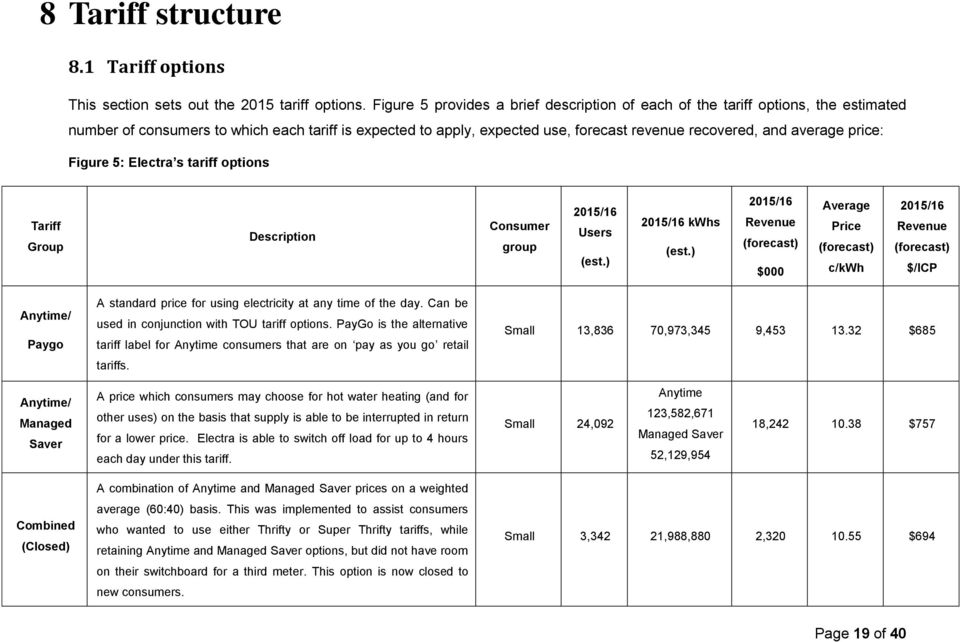
19 8 Tariff structure 8.1 Tariff options This section sets out the 2015 tariff options. Figure 5 provides a brief description of each of the tariff options, the estimated number of consumers to which each tariff is expected to apply, expected use, forecast revenue recovered, and average price: Figure 5: Electra s tariff options Tariff Group Description Consumer group 2015/16 Users (est.) 2015/16 kwhs (est.) 2015/16 Revenue (forecast) $000 Average Price (forecast) c/kwh 2015/16 Revenue (forecast) $/ICP Anytime/ Paygo A standard price for using electricity at any time of the day. Can be used in conjunction with TOU tariff options. PayGo is the alternative tariff label for Anytime consumers that are on pay as you go retail tariffs. Small 13,836 70,973,345 9, $685 Anytime/ Managed Saver A price which consumers may choose for hot water heating (and for other uses) on the basis that supply is able to be interrupted in return for a lower price. Electra is able to switch off load for up to 4 hours each day under this tariff. Small 24,092 Anytime 123,582,671 Managed Saver 52,129,954 18, $757 Combined (Closed) A combination of Anytime and Managed Saver prices on a weighted average (60:40) basis. This was implemented to assist consumers who wanted to use either Thrifty or Super Thrifty tariffs, while retaining Anytime and Managed Saver options, but did not have room on their switchboard for a third meter. This option is now closed to new consumers. Small 3,342 21,988,880 2, $694 Page 19 of 40
20 Tariff Group Description Consumer group 2015/16 Users (est.) 2015/16 kwhs (est.) 2015/16 Revenue (forecast) $000 Average Price (forecast) c/kwh 2015/16 Revenue (forecast) $/ICP For continuous electricity supply at two time of use prices: Night/Day an night time rate set for the 10 hours between 21:00 and 7:00; and a peak-rate during the day. Small 1,602 Night: 4,612,392 Day: 7,502,128 1, $701 Super Thrifty A night rate between 23:00 and 7:00 reflecting the large amount of available capacity on the network at this time. Designed for hot water, storage heating or under floor heating loads. Anytime rates apply outside these times. This does not function as a standalone option and must be used in conjunction with another price option. Small 651 1,007, NA NA Thrifty As for Super Thrifty with the addition of an afternoon heating boost. Small 2,003 3,971, NA NA A three rate (peak, off-peak and night) TOU option currently targeted towards medium-sized commercial consumers with the ability to move load or otherwise take advantage of price signals. Triple Saver From 1 April 2011, Electra limited the triple saver option to new connections with annual consumption in excess of 25,000kWh. Existing consumers who have elected this tariff can continue to use it. Medium ,456,768 2, $5,230 Page 20 of 40
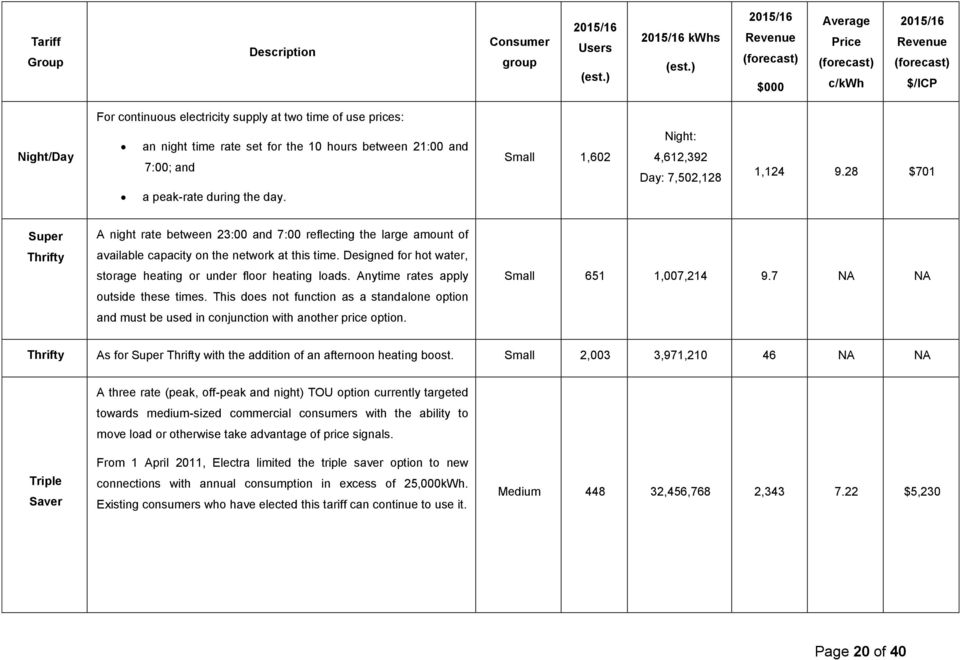
21 Tariff Group Description Consumer group 2015/16 Users (est.) 2015/16 kwhs (est.) 2015/16 Revenue (forecast) $000 Average Price (forecast) c/kwh 2015/16 Revenue (forecast) $/ICP Standard Industrial A three rate (peak, off-peak and night) TOU option which differs from the Triple Saver tariff by higher fixed and lower variable charges. It is targeted at larger commercial consumers by rewarding those able to move load away from peak, or otherwise take advantage of price signals. Large ,981,287 4, $19,700 Export For those that are generating electricity and exporting some or all of this. For monitoring purposes only. For monitoring only 151 unknown $0 0 0 Street Lighting For connection and management of street lights. Lighting NA 3,181, NA Community Lighting For connection and management of community lighting (e.g. sports fields, shop verandas). Lighting NA 478, NA Total 43, ,865,978 38, $879 Page 21 of 40
22 All tariff groups are charged a variable tariff and a fixed daily charge. Fixed and variable tariffs are separated between distribution and transmission components, which seek to recover distribution and transmission costs, respectively. Specific tariffs in both the small, medium and large consumer groups incorporate signals which incentivise consumers to move their consumption off-peak and to offer up interruptible load. This aligns our pricing incentives to the key capacity utilisation cost driver and our GXP capacity constraints. Each tariff option has been specified to achieve certain objectives. However, we are reliant on electricity retailers to fairly reflect our prices in their retail tariffs Variable charges A variable tariff based on kwh consumption is applied to all tariff groups. While a charge based on each consumer s relative share of coincident maximum demand would align more closely with the utilisation of network capacity, a consumption charge is preferred because: there is a lack of ubiquitous half-hourly TOU metering across the small consumer group; it aligns with existing retail pricing structures, which are predominantly based on volumetric charges; and it aligns with the LFC regulations. Despite this, several of our tariff options are designed to incentivise efficient use of our existing network capacity by setting higher variable prices at peak periods and lower prices during the shoulders and off peak periods. Moreover our Triple Saver TOU tariff will be available within the next two years to be utilised by retailers for any small consumer with a smart meter. Figure 6 illustrates our TOU tariff options and TOU periods. Figure 7 illustrates how these pricing periods align to our typical daily load profile. Page 22 of 40
23 0:00 1:00 2:00 3:00 4:00 5:00 6:00 7:00 8:00 9:00 10:00 11:00 12:00 13:00 14:00 15:00 16:00 17:00 18:00 19:00 20:00 21:00 22:00 23:00 Figure 6:TOU tariff options TOU Tariff Super Thrifty Thrifty Night/Day Triple Saver and Standard Industrial TOU Periods Off-peak rate from Other times charged at the Managed Saver or Combined rates Off-peak rate from Boost from Other times charged at the Managed Saver or Combined rates Night rate from Day rate from Night rate from Peak rate from & Off-peak rates from and Figure 7: TOU periods and typical daily load profile (illustrative) Pricing vs Load Load Anytime Day Night Peak Off Peak Night Time of Day Controlled load tariffs are also offered, such as the Managed Saver or Combined tariffs. These allow us to disconnect load for up to four hours a day, typically during times of network congestion or in order to allow us to restore network faults. Page 23 of 40
24 A variable charge is levied on street lighting and community lighting consumers. This recognises network capacity use as well as the use of dedicated assets such as street lighting circuits and poles. Other consumers are charged the Anytime tariff (often in combination with controlled load tariff options). Anytime consumers account for 86% of connections and almost 50% of consumption. The Anytime tariff is the highest variable tariff which recognises that these consumers are able to use the network at any time without constraint Fixed charges A fixed daily charge is applied to all consumers. We consider that a fixed charge appropriately recognises: investments in existing network capacity; per connection cost drivers; our need for revenue stability; and the LFC regulations. Given the majority of our consumers are domestic consumers which are eligible for the low fixed charge option, we opted to apply the 15 cent per day fixed charge to all small and medium consumers. A fixed daily charge of 90 cents is included in the Standard Industrial tariff. This charge better reflects the fixed costs attributable to these consumers Transmission charges Electra on-charges Transpower s charges on a cost-recovery basis. Fixed and variable transmission tariffs are set to recover transmission costs using forecasts of consumption and connections. This accommodates the different charges relating to off peak and peak pricing. Any over-recovery of transmission charges is returned to consumers through the sales discount. Any under-recovery is borne by Electra. A 10 cent supply charge for transmission services is applied to all consumers, except Standard Industrial who are charged 20 cents per day. Page 24 of 40
25 8.1.4 Power factor charges We reserve the option to apply an additional charge where a commercial consumer has a power factor materially below 0.95 lagging. The charge will be based on a multiplier of 2% of the monthly total network charges for every 0.01 power factor below 0.95 lagging. This charge allows us to signal the need for improvements in power factors with the ultimate goal of avoiding unnecessary network reinforcement. 8.2 Non-standard pricing We currently do not have any non-standard pricing arrangements. We will assess any requests for non-standard pricing as required. 8.3 Distributed generation (DG) Electra has 151 DG sites connected to its network (0.004% of connections). All but two of these are small sites (less than 5kW) supplying at 400V. We use standard charging for import meters and do not charge for distributing exported energy. We have introduced an export tariff which would potentially enable us to do this. Currently, it is set at zero cents per kwh. This has been introduced to help us monitor uptake of DG on the network. We currently do not make direct payments to DG for ACOT. Avoided costs are recognised by not charging generators for injection into the network. We believe this approach is consistent with the incremental cost pricing principle under Part 6 of the Electricity Industry Participation Code. The Mangahao power station near Shannon is notionally embedded for transmission purposes, but is not connected to our network and does not use distribution services. We are responsible for paying all connection charges associated with the Mangahao GXP but our consumers share in the avoided Transpower charges that result from the generator reducing peak grid demand at this GXP. ACOT is therefore implicitly recognised in this arrangement. Page 25 of 40
26 8.4 Discount Electra has previously credited consumers with a discount each year on a discretionary basis. In 2015/16 we have posted this discount in our pricing schedule so that consumers have greater transparency and certainty over their total net electricity costs. The sales discount will be credited to the consumer connected to each metered supply point (ICP) on 31 January The value of the discount will be $50.00 plus 11.5% of each connection s total fixed and variable line and transmission charges for the previous twelve months. Page 26 of 40
27 prices 9.1 Changes to pricing Figure 8 sets out our prices and the proportion of the target revenue expected to be recovered from each tariff in the 2015/16 pricing year. It compares these to 2014 prices. The share of target revenue sought from each tariff is not materially different to that recovered in 2014/15 Figure 8: 2015 Total Line Charges (excluding GST) Tariff option units Time period From 1 April 2015 (c/unit) % 2015/16 revenue (Forecast) 1 April 2014 to 31 March 2015 (c/unit) % 2014/15 revenue (Actual) 2015 price change Anytime/Paygo kwh % % +3.45% Managed Saver kwh % % NC Combined kwh % % +5.06% Night/Day kwh Night % % NC kwh Day % % +5.28% Super Thrifty kwh % % NC Thrifty kwh % % NC Street lighting kwh % % +4.45% Community Lighting kwh % % +4.91% Triple Saver - LFC 1 kwh Night % % NC kwh Off Peak % % NC kwh Peak % % % Standard Industrial 1 kwh Night % % NC kwh Off Peak % % NC kwh Peak % % +0.96% Supply charge ICP % % NC Supply charge (SI) ICP % % % Note: 1 revenue based on estimated uptake of the new Standard Industrial tariff option. 2 prices effective 1 April please refer to Appendix on page 39 for full pricing schedule Page 27 of 40
28 The key decisions underlying our 2015 prices are: Maintain existing pricing structures, with the exception of a new zero charged export price; Maintain the 15 cent fixed daily charge for all small and medium consumer groups, compliant with the LFC regulations; Increase Standard Industrial fixed daily charge by 10 cents per day to better incentivise uptake of this tariff option; Increase Anytime, peak, day, street lighting and community lighting variable tariffs to recover the distribution and transmission target revenue not expected to be recovered through fixed charges; Incentivise more efficient use of network capacity during periods of network congestion by: o o o increasing Peak and Day use tariffs on the Combined Triple Saver, Standard Industrial and Day/Night tariff options; maintaining off-peak and night use tariffs on the Triple Saver, Standard Industrial and Day/Night tariff options; and maintaining the Thrifty and Super Thrifty tariffs. Encourage consumers to offer more controllable load by maintaining Managed Saver while increasing the Anytime tariff; and Test the resulting expected tariff revenues for each consumer group against cost of supply model outputs. 9.2 Price increases for average consumers The table below shows how the average consumer in each consumer group is affected by our 2015 price changes. Page 28 of 40
29 Figure 9: Impact on average consumer (total line charges) Tariff Category Average 2015/ /15 $ Annual % Annual Annual annual annual Change Change consumption lines lines (kwh) charges charges Anytime only/paygo 5,130 $685 $664 +$ % Anytime/Managed Saver 7,293 $757 $737 +$ % Triple Saver 72,448 $4,894 $4,495 +$ % Standard Industrial 358,660 $19,490 $19,308 +$ % Street Lighting (70W fitting) and Community Lighting 356 $34 $33 +$ % Notes: 1. The Anytime/Managed Saver combination is based on the Electricity Authority standard comparison for those consumers with electric water heating. Approximately 55% of Electra s consumers use this option. 2. Average annual consumption figures based on Electra analysis 3. Annual consumption is split between peak, off-peak, and night for the Standard Industrial and Triple Saver tariffs in line with the average across these consumers. 9.3 Testing of prices against cost allocations In 2012 we developed a cost of supply model which allocates target revenue to consumer groups and tariffs, based on cost allocators which reflect network cost drivers. The outputs of this model inform our pricing decisions, however the model does not explicitly set tariffs. Rather the model: tests whether prices are consistent with implied cost allocations to consumer groups and tariffs; Page 29 of 40
30 tests whether there are cost differences between small and large consumer groups; and tests alternative approaches to setting fixed and variable charges. This year we have compared the model outputs against expected revenue to be recovered from each consumer group to determine to what extent prices align with implied allocations of target revenue. The model allocates the various components of target revenue using cost allocators that are consistent with our cost drivers, as follows: Figure 10: Allocators applied in cost allocation model Cost category Cost allocator Rationale Return on investment, network depreciation, direct costs, rates A composite allocator is created by allocating regulatory asset base values to consumer groups as follows: Connection assets: ICPs Streetlight assets: directly attributed to streetlight lighting The main cost driver for core network assets is utilisation of installed capacity weighted by the value of that capacity. Streetlight assets are directly attributable to the lighting consumer group, whereas connection assets are associated with number of connections. All other assets: Coincident maximum demand Transmission costs Coincident maximum demand This recognises that Transpower charges are based on providing supply capacity, determined by the capacity of the GXP and core grid assets. Indirect costs, depreciation on nonsystem fixed assets A 50:50 weighting of ICPs and kwhs This weighting recognises that larger consumers create relatively higher costs per connection. Figure 11 compares the proportion of revenue expected to be recovered from each consumer group relative to implied cost allocations. Page 30 of 40
31 Figure 11: Cost allocations and revenues Prices for the small consumer group could increase slightly to recover costs allocated to this group, whereas the medium and large consumer groups could reduce slightly. These refinements are relatively insignificant and we are satisfied that prices broadly align with costs. In reaching this conclusion, we note that cost of supply model outputs will vary year on year in response to changes in inputs. Explicitly aligning prices to the cost of supply model therefore can result in price volatility. Page 31 of 40
32 10 Consistency with the Electricity Authority s pricing principles This section describes the extent to which our pricing methodology is consistent with the Electricity Authority s pricing principles. (a) Prices are to signal the economic costs of service provision by: (i) being subsidy free, that is, equal to or greater than the incremental costs and being less or equal to standalone costs, except where subsidies arise from compliance with legislation and/or other regulation This principle sets out that prices are subsidy free where they fall within the range of incremental cost and stand alone cost, as illustrated by the following equation. Incremental Cost Prices Stand Alone Cost Incremental Cost We interpret incremental cost to mean the additional cost incurred in connecting one more consumer to the network. This is likely to comprise connection costs, any costs associated with reinforcing the network in relation to that connection, as well as additional administration, operating and maintenance costs. As already discussed, we ensure prices are greater than incremental capital costs through our network extensions policy. Accordingly, distribution prices will exceed incremental asset costs. Other incremental costs (e.g. operating and maintenance) resulting from a new connection are recovered through distribution prices. As highlighted in the previous section, our cost of supply modelling reveals that costs are being apportioned broadly consistent with implied cost allocations based on the cost drivers we have identified. As such, we would not expect prices to exceed incremental operating costs. However, our analysis suggests that on average over the last ten years a new connection contributed to a $193 per annum real increase in operating expenditure. We note a new Anytime consumer would need to consume only 1,100kWh in a year for prices to fall below incremental cost (i.e. based on the 15 cent per day fixed charge and existing Anytime prices). Such low levels of consumption are unusual, suggesting prices Page 32 of 40
33 are unlikely to fall below incremental cost. This also highlights that the 15 cent per day fixed charge at very low levels of consumption is likely to create cross-subsidisation. The option of a higher fixed charge for the Standard Industrial tariff goes some way to resolve this issue for larger connections. Stand alone cost We interpret stand alone cost to mean the cost to provide similar distribution services to a consumer (or group of consumers) on a stand-alone basis, either from a stand alone network or alternative energy supply. In practice, it is difficult to estimate the costs associated with a hypothetical stand alone network that would be required to service one consumer group. However, at a conceptual level, we would expect to apply the same network configuration in order to supply each sub-group of consumers on a stand-alone basis. This is because our consumers are generally uniformly spread across our relatively compact and meshed network. While the engineered capacities of standalone networks could be optimised for smaller consumer groups, we would not expect this to offset the loss of scale efficiencies that result. The fact that expected revenue recovered from consumer groups aligns to implied cost allocations provides further evidence that prices are unlikely to exceed stand alone costs. This is an expected outcome where cost allocators are linked to key cost driver relationships (i.e. utilisation of demand and new connections) and where dedicated assets are assigned directly to consumer groups that use those assets (i.e. street light circuits and connections). Improvements in PV and battery storage mean it is also now possible for small consumers to disconnect from the network (albeit with a lower security of supply). However, such solutions do not appear to be economic when compared to distribution based supply. A relatively small 8kWh/day stand alone system can cost in excess of $50,000 to install, excluding maintenance and regular battery replacement costs. Larger systems cost much more. Our analysis suggests that the stand alone cost of off-grid solar solutions, in ideal circumstances, is in excess of 80c c/kWh 1. This 1 Assumes replacement of batteries every 10 years; 50%-100% usage of the 8kWh capacity each day over a 25 year period, and funding based on a mortgage rate of 6%. Page 33 of 40
34 significantly exceeds the average 7-13c/kWh charge Electra s consumers pay (see figure 5), as well as the average final delivered price residential consumers pay on Electra s network of 26.3c/kWh 2. Despite this, we are monitoring uptake of solar closely, given the rapidly falling technology costs and consumer interest expressed in consumer surveys. Rural/urban cross-subsidy A cross subsidy could potentially arise from not explicitly recognising circuit length as a cost driver in prices. As discussed earlier, the only discernable cross-subsidy that is likely to arise in relation to circuit length is between rural and urban consumers. While consumers in urban areas could be subsidising rural consumers due to relatively higher connection density, we do not consider disaggregating rural and urban consumers for pricing purposes is beneficial for the following reasons: Rural circuits, poles, and equipment are used by urban consumers as electricity may flow through sub-transmission and distribution circuits to urban centres. Our network area is relatively compact so rural areas are close to urban areas. Electra does not differentiate service quality by location. Network reliability standards are based on the aggregated load for all consumers supplied by the relevant section of the network. Fault response times are similar for rural and urban connections because all connections are located within 30 minutes drive of a depot. The Electricity Industry Act 2010 includes provisions for regulations to be applied to distributors that would limit price increases in rural areas. (ii) having regard, to the extent practicable, to the level of available service capacity We group consumers into small, medium and large consumer groups because they use service capacity differently. Lighting is also a separate consumer group in recognition of the specific demand profile of this group. By offering differential prices for peak/off-peak and day/night loads, we reward consumers (through lower prices) that limit consumption during times of network 2 Ministry of Business Innovation and Employment, Quarterly Survey of Domestic Electricity Prices, 15 Nov 2014 Page 34 of 40
35 congestion. Similarly, our controlled tariff option rewards consumers that offer up interruptible load. We have recently focused on increasing the peak/day price signal to encourage consumers to move consumption to off-peak periods. (iii) and having regard to the extent practicable, the impact of additional usage on future investment costs It has always been our objective to use prices to signal the costs of meeting peak demand and to encourage consumers to consider the benefits of moving demand away from peak periods. We recognise that consumption based charges provide a limited price signal regarding the impact of additional usage on future investment costs. However, higher peak time variable charges coupled with low charges during off-peak and shoulder periods (for example, under the Day/Night, Triple Saver, Standard Industrial tariffs, Thrifty and Super Thrifty tariff options) provide strong pricing signals to consumers of the long-term benefits of moving consumption away from peak periods. Furthermore, Anytime charges are relatively high recognising that those consumers are unconstrained in their use of network capacity. The controlled rate for hot water heating (under the Managed and Controlled tariff options) also rewards consumers that offer up interruptible load. In recent years, we have increased peak charges, relative to off-peak charges, and controlled charges in order to increase the incentives to reduce peak-time demand. (b) Where prices based on efficient incremental costs would under recover allowed revenues, the shortfall is made up by prices being set in a manner that has regard to consumers demand responsiveness, to the extent practicable. This principle promotes pricing based on a consumers willingness to pay. All mass market consumers on our network are offered exactly the same tariff options and consumers select their pricing plan. We consider that the provision of a range of tariff choices aligns with competitive markets and is one of the best ways of aligning prices to consumer willingness to pay. For example, selection of time of use or controlled and uncontrolled tariffs reveals a consumer s willingness to pay relative to the quality of supply that they are willing to accept. Page 35 of 40
36 TOU based charges also reveal willingness to pay. For instance peak time prices incentivise consumers with a low willingness to pay to shift demand off peak. (c) Provided prices satisfy (a) (i), prices are responsive to the requirements and circumstances of consumers in order to (i) discourage uneconomic bypass Our current pricing methodology combined with the nature of our consumer base has not resulted in any uneconomic bypass of the network. We estimate that a constant load greater than 5MW and closer than 2km to a GXP would be required to make bypass cheaper than our existing prices. We do not have any connections which meet these criteria. At that level of load, system bypass would not only be economic but probably appropriate for the customer. We remain open to discussing alternative pricing arrangements with large consumers that are presented with bypass opportunities. (ii) allow negotiation to better reflect the economic value of services and enable consumers to make price/quality trade-offs or non standard arrangements for services We have no non-standard pricing arrangements. In reality, the nature of our consumer base does not justify non-standard terms. Requests for specific levels of service (e.g. the provision of dedicated equipment) are typically dealt with under our network extensions policy. This policy gives consumers the discretion to select the assets and hence quality of supply that meet their requirements, with incremental asset costs met by the beneficiary. We recover the cost of maintaining the asset through our normal revenue stream. (iii) where network economics warrant, and to the extent practicable, encourage investment in transmission and distribution alternatives (e.g. distributed generation or demand response) and technology innovation. Our Managed, Thrifty, and Super Thrifty tariff options provide incentives to consumers to invest in night store equipment and controllable hot water cylinders. This effectively Page 36 of 40
37 provides for a consumer demand response that reduces usage during times of network congestion. DG is not charged for distribution services. This encourages connection of DG, consistent with Part 6 of the Electricity Industry Participation Code. However, we will continue to review the impact of DG uptake on the network through the Export tariff. The GXP sharing arrangement with Mangahao hydro scheme, which is notionally embedded in our network, acknowledges this plant as a transmission alternative. In return, our consumers share in transmission cost savings arising from local generation. This contractual arrangement is an example of a transmission alternative that lowers prices to consumers. (d) Development of prices is transparent, promotes price stability and certainty for consumers, and changes to prices have regard to the impact on stakeholders We have considered feedback on our 2013/14 pricing methodology as part of the Electricity Authority s review and have revised this document in order to improve the transparency of our pricing method. We also regularly review the structure of this document to improve it. We have transitioned price increases over multiple years to avoid price shock. For example, increasing the content of Triple Saver over a number of years. (e) Development of prices should have regard to the impact of transaction costs on retailers, consumers and other stakeholders and should be economically equivalent across retailers. Our relatively simple pricing structure ensures low transaction costs for all. We have a bias toward tariff simplicity which minimises transaction costs for retailers. All retailers operating on Electra s network pay the same prices. All consumers are able to remain on their current tariff option or choose another more suited to their needs. Page 37 of 40
38 11 Glossary We have sought to present our pricing methodology using standard industry terminology and to include sufficient information to enable pricing decisions to be readily understood by consumers. This glossary is provided for the convenience of the reader. 2015/16 The year starting 1 April and ending on 31 March. ACOT AMP Coincident Maximum Demand (CMD): Commerce Commission Electricity Authority (EA) GXP ICP Information Disclosure Determination kva: Avoided Cost of Transmission: The difference between actual transmission costs and theoretical transmission costs if certain mitigation (e.g. Distributed Generation) is not present. Asset Management Plan: A record of the company s plans to manage the network to provide a specified level of service. Relative demand (typically expressed in kws or kva) of a particular consumer or consumer group at the GXP system peak (i.e. as measured by system maximum demand). Responsible for the economic regulation of electricity distribution businesses as provided for under Part 4 of the Commerce Act Responsible for regulation of the electricity market as provided for under the Electricity Industry Act Grid Exit Point: The point at which Electra s network is deemed to connect to Transpower s transmission network. Installation Control Point: A point of connection on a local network which the distributor nominates as the point at which a retailer will be deemed to supply electricity to consumers (i.e. a consumer connection point). As set out in the Commerce Commission s Electricity Distribution Information Disclosure Determination 2012, issued 1 October 2012 (Decision No. NZCC22). Kilo Volt-Amp: Measure of apparent electrical power usage at a point in time. Page 38 of 40
39 kwh Low fixed charge regulations Kilowatt hours: Measure of real electrical power usage per hour. As set out in the Electricity (Low Fixed Tariff Option for Domestic Consumers) Regulations These require Electra to make a tariff option available for domestic consumers who have annual usage less than 8,000kWhs. Prices must be set such that the fixed daily charge does not exceed 15 cents (excl GST) and consumers should be no worse off under this tariff option at 8,000kWhs relative to other tariffs. Power Factor The ratio of real power (e.g. kws) to apparent power (e.g. kva) is considered normal on our network. RCPD Sub-transmission System Maximum Demand Target revenue requirement TOU Transpower Regional Coincident Peak Demand: Transpower calculates its interconnection charge for each GXP by its relative share of RCPD. A power line that transports or delivers electricity at 33kV on Electra s network. Aggregate peak demand for the network, being the coincident maximum sum of GXP demand and embedded generation output. The revenue that we estimate needs to be recovered through prices over the pricing year in order to recover Electra s costs of investing in and operating the network. Time of Use: Refers to tariff options that rely on meters that measure consumption by time of use. Transpower New Zealand Limited: The owner and operator of the national electricity transmission network. Transpower delivers electricity from generators to distribution networks and large direct connect consumers around the country. Page 39 of 40
40 Appendix: Electra s prices effective 1 April 2015 Electricity Network Charges Kapiti Coast and Horowhenua: Effective 1 April 2015 Electra owns and operates the electricity lines and distribution assets in the Kapiti-Horowhenua region. Electra invoices these charges to Electricity Retailers, who then include these in your regular electricity bill. Electra Electricity Network Charges from 1 April 2015 compared to existing prices (excluding GST) Users Price Price Price Option Time Line Function Transmission Total (Est) Code Option Component Zone On cents / unit cents / unit cents / unit Existing New Existing New Existing New 37,669 A Anytime / PayGo All ,997 M Managed Saver As required ,295 C Combined (closed) As required N Super Thrifty ,123 B Thrifty DN Night / Day Night DN Day TS Triple Saver Night TS Peak TS Off peak EX Export All U Street Lighting Timetable U Community Lighting Timetable SI Standard Industrial Night SI Peak SI Off peak ,391 F Supply Charge cents/day S Supply Charge - Standard Industrial cents/day Power Factor Charge This applies to commercial consumers. Where the power factor is less than 0.95 Electra reserves the right to impose a power factor charge. The charge will be based on a multiplier of 2% of the monthly total Network charges for every 0.01 power factor below 0.95 lagging. Combined Option The Combined option is no longer available except to existing users. Existing users must have electric hot water which, if required, is able to be controlled by Electra, plus either a Thrifty or Super Thrifty meter. Triple Saver Option The Triple saver option is only available to consumers using more than 25,000kWh per year. Export For those who are be generating electricity on their premises and exporting some or all of this into Electra's distribution network. Sales Discount A Sales Discount will be credited to the current consumer at each metered supply point (ICP) at the discount date of 31 January The discount will be $50.00 plus 11.5% of the ICP's total fixed and variable Line and Transmission charges for the previous twelve months Network Losses Loss Factor Code Loss Factor Network Losses 6.6% Page 40 of 40
41
Electricity Distribution Business. Pricing Methodology
 Electricity Distribution Business Pricing Methodology Effective 1 April 2015 1. GLOSSARY Commerce Commission (Commission) EDB Electricity Authority (EA) Responsible for the regulation of EDBs as provided
DISCLOSURE OF ELECTRICITY PRICING METHODOLOGY PURSUANT TO REQUIREMENT 22 OF THE ELECTRICITY INFORMATION DISCLOSURE REQUIREMENTS 2004
 DISCLOSURE OF ELECTRICITY PRICING METHODOLOGY PURSUANT TO REQUIREMENT 22 OF THE ELECTRICITY INFORMATION DISCLOSURE REQUIREMENTS 2004 Effective 1 April 2010 TABLE OF CONTENTS 1 INTRODUCTION... 1 2 DESCRIPTION
Committee on the Northern Territory s Energy Future. Electricity Pricing Options. Submission from Power and Water Corporation
 Committee on the Northern Territory s Energy Future Electricity Pricing Options Submission from Power and Water Corporation October 2014 Power and Water Corporation 1. INTRODUCTION On 21 August 2014, the
Powerco Limited Pricing Guide 2015 ANNUAL REPORT 2015
 ANNUAL REPORT 2015 PRICING GUIDE 2015 1 CONTENTS Introduction Page 03 Who we are Page 04 The Electricity Industry Page 05 Our Pricing Policy Page 08 How Powerco Performs Page 10 Pricing Methodology Page
Network Price List and Explanatory Notes
 Essential Energy Network Price List (Excluding GST) Effective 1 July 2014 Tariff Code Obsolete tariffs on same rate Description Network Energy Energy Energy Energy Energy Energy Energy Peak Shoulder OffPeak
Pricing Methodology Electricity Distribution Network
 Pricing Methodology Electricity Distribution Network Effective from 1 April 2015 Pursuant to: Electricity Distribution Information Disclosure Determination 2012, and; Distribution Pricing Principles and
Economic Concepts for Pricing Electricity Network Services A Report for the Australian Energy Market Commission
 Economic Concepts for Pricing Electricity Network Services A Report for the Australian Energy Market Commission 21 July 2014 Project Team Adrian Kemp Oliver Nunn Martin Chow Stephanie Gainger NERA Economic
2014 Residential Electricity Price Trends
 FINAL REPORT 2014 Residential Electricity Price Trends To COAG Energy Council 5 December 2014 Reference: EPR0040 2014 Residential Price Trends Inquiries Australian Energy Market Commission PO Box A2449
NORTHERN IRELAND ELECTRICITY Ltd STATEMENT OF CHARGES FOR USE OF. THE NORTHERN IRELAND ELECTRICITY Ltd ELECTRICITY DISTRIBUTION SYSTEM
 NORTHERN IRELAND ELECTRICITY Ltd STATEMENT OF CHARGES FOR USE OF THE NORTHERN IRELAND ELECTRICITY Ltd ELECTRICITY DISTRIBUTION SYSTEM BY AUTHORISED PERSONS Effective from 1 October 2011 to 30 September
Rule change request. 18 September 2013
 Reform of the distribution network pricing arrangements under the National Electricity Rules to provide better guidance for setting, and consulting on, cost-reflective distribution network pricing structures
POWER NETWORKS. 2014-15 Electricity Network Tariffs and Charges and Future Price Trends
 POWER NETWORKS 2014-15 Electricity Network Tariffs and Charges and Future Price Trends August 2014 Power and Water Corporation Table of Contents 1 Business Characteristics... 3 2 2014 Network Price Determination...
COMPLIANCE REVIEW OF 2006/07 ASSET MANAGEMENT PLAN. Top Energy Limited
 PB ASSOCIATES COMPLIANCE REVIEW OF 2006/07 ASSET MANAGEMENT PLAN Prepared for PB Associates Quality System: Document Identifier : 153162 Top Energy Final Report Revision : 2 Report Status : Final Date
ESB Networks Response. ERGEG Consultation. Voltage Quality Regulation in Europe
 NETWORKS ESB Networks Response to ERGEG Consultation on Voltage Quality Regulation in Europe Date: 22 February 2007 Distribution System Operator ESB Networks Page 1 of 12 Contents 1.0 INTRODUCTION...3
Solar Power Frequently Asked Questions
 General information about solar power 1. How do I get solar power? Solar Power Frequently Asked Questions Many companies install solar power systems including some electricity retailers. It is worth comparing
Clean Energy Council submission to Queensland Competition Authority Regulated Retail Electricity Prices for 2014-15 Interim Consultation Paper
 Clean Energy Council submission to Queensland Competition Authority Regulated Retail Electricity Prices for 2014-15 Interim Consultation Paper Executive Summary The Clean Energy Council (CEC) supports
Ausgrid Network Pricing Proposal For the Financial Year Ending June 2013. May 2012
 Ausgrid Network Pricing Proposal For the Financial Year Ending June 2013 May 2012 Table of Contents PART 1 APPROACH TO PRICE SETTING 1. INTRODUCTION AND OVERVIEW... 4 2. BACKGROUND... 6 3. PRICING METHODOLOGY...
SUBMISSION TO THE QUEENSLAND PRODUCTIVITY COMMISSION ISSUES PAPER ON SOLAR FEED IN PRICING IN QUEENSLAND
 SUBMISSION TO THE QUEENSLAND PRODUCTIVITY COMMISSION ISSUES PAPER ON SOLAR FEED IN PRICING IN QUEENSLAND ui CHAMBER OF COMMERCE AND INDUSTRY QUEENSLAND SUBMISSION 23 November 2015 1 CONTENTS 1.0 OVERVIEW...3
NOTES ON AURORA LINE CHARGES FOR NETWORK DESIGNERS, CONSULTANTS AND ELECTRICAL CONTRACTORS
 ov 26 OTES O AURORA LIE CHARGES FOR ETWORK DESIGERS, COSULTATS AD ELECTRICAL COTRACTORS 1. PURPOSE AD SCOPE OF THIS DOCUMET This document provides general advice for personnel involved in the alteration
Western Australian Feed-In Tariff Discussion Paper
 Western Australian Feed-In Tariff Discussion Paper OVERVIEW In September 2008, the incoming State Government announced its intention to introduce a feed-in tariff as part of the Liberal Plan for Environmental
Contact comments on the TSW Consulting Ltd report Mass Market Load Control its use and its potential use
 Contact comments on the TSW Consulting Ltd report Mass Market Load Control its use and its potential use Energy efficiency benefits The report states that: [load control] has to be achieved without increasing
Network Price List (excludes GST)
 Network Price List (excludes GST) Effective from 1 July 2007 Monthly Monthly Monthly Network Network Network Energy Rates Step Rates Demand Capacity Capacity Price Network Price DLF Access Rates Rates
Pass Through Costs for Business Electricity Customers from 1 st October 2015
 Pass Through Costs for Business Electricity Customers from 1 st October 2015 DOCUMENT TYPE: Information Note REFERENCE: CER 15/226 DATE PUBLISHED: 22 nd September 2015 The Commission for Energy Regulation,
Principles of Distribution charging:
 Principles of Distribution charging: Electricity networks Introduction A three-stage approach involves the following steps: 1. The analysis and quantification of costs. The cost concept that is relevant
NETWORK PRICE LIST 2014/2015. Effective 1 July 2014
 NETWORK PRICE LIST 2014/2015 Effective 1 July 2014 Document Amendment History Version No. Publication Date Comments 1.0 17 June 2014 AER Approved Pricing 2.0 15 July 2014 Updated Substation and Transformer
Pricing Methodology 1. 1 July 2009 to 30 June 2014. April 2010
 Pricing Methodology 1 1 July 2009 to 30 June 2014 April 2010 1 TransGrid s Pricing Methodology as approved by the Australian Energy Regulator ( AER ). This document outlines the pricing methodology that
Electricity Price Comparison. Namibia Manufacturers Association (NMA)
 Electricity Price Comparison December 2012 Submitted to: Namibia Manufacturers Association (NMA) P O Box 20810 Windhoek Namibia Tel +264 (0)61 233206 Fax +264 (0)61 233360 Submitted by: EMCON (Pty) Ltd
SP Energy Networks 2015 2023 Business Plan
 Environmental Discretionary Reward Scheme 1 SP Energy Networks 2015 2023 Business Plan Executive summary SP Distribution Ltd SP Manweb plc July 2013 RIIO ED1 Business Plan 2015 to 2023 2 A Message from
BC Hydro. Electric Distribution System Cost of Service Study
 BC Hydro Electric Distribution System Reimer Consulting Group Inc. Arnie Reimer May 7, 2010 Table of Contents 1. Executive Summary... 3 2. BC Hydro Electric Distribution System... 4 2.1. General Description...
AusNet Electricity Services Pty Ltd. Tariff Structure Statement 2017-20
 AusNet Electricity Services Pty Ltd Submitted: 26 October 2015 About AusNet Services AusNet Services is a major energy network business that owns and operates key regulated electricity transmission and
Tasmanian Transmission Revenue Proposal
 Tasmanian Transmission Revenue Proposal An overview for Tasmanian electricity consumers Regulatory control period 1 July 2014 30 June 2019 Tasmanian Networks Pty Ltd About TasNetworks We are Tasmania s
For the purpose of this Schedule the following words and phrases shall have the same meanings as assigned to them herein:
 SCHEDULE OF STANDARD PRICES FOR ESKOM TARIFFS 1 APRIL 2014 TO 31 MARCH 2015 FOR NON-LOCAL AUTHORITY SUPPLIES, AND 1 JULY 2014 TO 30 JUNE 2015 FOR LOCAL AUTHORITY SUPPLIES 1. Standard prices The standard
November 2013. www.apvi.org.au. Background
 APVI Response to the Australian Energy regulator s Issues Paper on Regulation of alternative energy sellers under the National Energy retail Law, Oct 2013 November 2013 Background The Australian Energy
Pricing Policy Statement - Excluded Retail Services. Introduction. Description of Excluded Services. Excluded Retail Services Offered in 2014/15
 Pricing Policy Statement - Excluded Retail Services Introduction SA Water s Water and Sewerage Retail Services: 2013-14 to 2015-16 Revenue Determination (ESCOSA, 2013, Section 2.2) requires SA Water to
2017 19 TasNetworks Regulatory Proposal Expenditure Forecasting Methodology
 2017 19 TasNetworks Regulatory Proposal Expenditure Forecasting Methodology Version Number 1 26 June 2015 Tasmanian Networks Pty Ltd (ACN 167 357 299) Table of contents 1 Introduction... 1 2 Meeting our
TEC Capital Asset Management Standard January 2011
 TEC Capital Asset Management Standard January 2011 TEC Capital Asset Management Standard Tertiary Education Commission January 2011 0 Table of contents Introduction 2 Capital Asset Management 3 Defining
The Virtual Power Station - achieving dispatchable generation from small scale solar
 The Virtual Power Station - achieving dispatchable generation from small scale solar John K Ward, Tim Moore, Stephen Lindsay CSIRO Energy Technology, Newcastle, NSW 24 Australia Keywords: forecasting,
Attachment 20.27 SA Power Networks: Network Program Deliverability Strategy
 Attachment 20.27 SA Power Networks: Network Program Deliverability Strategy Network Program Deliverability Strategy 2015-20 Regulatory Control Period SA Power Networks www.sapowernetworks.com.au Internal
ELECTRICITY PRICING METHODOLOGY 2013
 ELECTRICITY PRICING METHODOLOGY 2013 EFFECTIVE 1 APRIL 2013 DISCLOSED IN ACCORDANCE WITH SECTION 2.4.1 OF THE ELECTRICITY DISTRIBUTION INFORMATION DISCLOSURE DETERMINATION 2012 CONTENTS PAGE 1. Definitions...
FIXED CHARGE: This is a cost that goes towards making the service available, including
 ELECTRICITY BILL COMPONENTS FIXED CHARGE: This is a cost that goes towards making the service available, including installation and maintenance of poles, power lines and equipment, and 24-hour customer
Gas transport tariffs calculation
 Ad Hoc Expert Facility under the INOGATE project Support to Energy Market Integration and Sustainable Energy in the NIS (SEMISE) Gas transport tariffs calculation 1 TABLE OF CONTENTS 1. INTRODUCTION...
Submission to the Queensland Department of Energy and Water Supply
 Submission to the Queensland Department of Energy and Water Supply The 30-year electricity strategy December, 2013 1 Cotton Australia Cotton Australia is the key representative body for the Australian
2013 Residential Electricity Price Trends
 FINAL REPORT 2013 Residential Electricity Price Trends 13 December 2013 Reference: EPR0036 Final Report Inquiries Australian Energy Market Commission PO Box A2449 Sydney South NSW 1235 E: [email protected]
APRIL 2014 ELECTRICITY PRICES AND NETWORK COSTS
 APRIL 2014 ELECTRICITY PRICES AND NETWORK COSTS 1 WHAT MAKES UP THE RETAIL ELECTRICITY BILL? Retail electricity bills are made up of a number of components: Wholesale costs reflecting electricity generation
SA Power Networks Network Tariffs - Residential APPLIES TO USAGE FROM 1 JULY 2015
 SA Power Networks Network Tariffs - Residential Low Voltage Residential - Single Rate DUOS excl TUOS excl PV JSO excl Total excl Total incl Block 1 Usage Rate $/kwh First 333.3 kwh/mth 0.0745 0.0300 0.0130
STATEMENT OF CHARGING METHODOLOGY FOR USE OF ELECTRICITY NORTH WEST LIMITED S ELECTRICITY DISTRIBUTION NETWORK
 STATEMENT OF CHARGING METHODOLOGY FOR USE OF ELECTRICITY NORTH WEST LIMITED S ELECTRICITY DISTRIBUTION NETWORK This statement is effective from 1 April 2010 This statement is approved by the Gas and Electricity
Energex. Statement of expected price trends. 1 July 2014 to 30 June 2015. -1-2014/15 Statement of expected price trends
 Energex Statement of expected price trends 1 July 2014 to 30 June 2015-1- 2014/15 Statement of expected price trends Version control Version Date Description 1.0 16 June 2013 Published on Energex s website
2006 Report. of the. Optimised Deprival Valuation of Transpower s System Fixed Assets. as at 30 June 2006
 T R A N S P O W E R N E W Z E A L A N D L I M I T E D 2006 Report of the Optimised Deprival Valuation of Transpower s System Fixed Assets as at 30 June 2006 Prepared by Transpower New Zealand Limited Reviewed
9.1 Draft Revenue and financing policy
 1. Policy purpose and overview The purpose of the Revenue and financing policy is to provide predictability and certainty about sources and levels of funding available to the council. It explains the rationale
Daily Daily Network Network Network Energy Rates Step Rates Capacity. Price Rates Rates
 Excludes GST Effective from 1 July 2010 Tariff Class Daily Daily Network Network Network Energy Rates Step Rates Capacity Capacity Price Rates Rates No. Network Price DLF Access Non-ToU Time of Use (ToU)
ELECTRICITY PRICING INFORMATION. This list shows the terms that appear on electricity bills and what they mean:
 ELECTRICITY PRICING INFORMATION GLOSSARY OF BILLING TERMS: The Government of Ontario requires all electricity distributors to issue standardized bills to their low- volume consumers, such as residential
Realising the benefits of smart meters for consumers and industry
 Realising the benefits of smart meters for consumers and industry ERAA smart meter Working Paper 1 Suite 3, Level 5, 189 Kent Street Sydney NSW 2000 T (02) 8241 1800 E [email protected] www.eraa.com.au
Net Energy Metering and the Future of Distributed Generation
 Net Energy Metering and the Future of Distributed Generation Vishal C. Patel, P.E. Manager - Distribution Resource Interconnections April 28, 2015 What is Net Energy Metering (NEM)? NEM is a tariffed program
For the purpose of this Schedule the following words and phrases shall have the same meanings as assigned to them herein:
 SCHEDULE OF STANDARD PRICES FOR ESKOM TARIFFS 1 APRIL 2013 TO 31 MARCH 2014 FOR NON-LOCAL AUTHORITY SUPPLIES AND 1 JULY 2013 TO 30 June 2014 FOR LOCAL AUTHORITY SUPPLIES 1. STANDARD PRICES The standard
FACT SHEET. NEM fast facts:
 (NEM) operates on one of the world s longest interconnected power systems, stretching from Port Douglas in Queensland to Port Lincoln in South Australia and across the Bass Strait to Tasmania a distance
Determination of 2010 Transmission Allowed Revenue and Use of System Tariffs
 Determination of 2010 Transmission Allowed Revenue and Use of System Tariffs DOCUMENT TYPE: REFERENCE: DATE PUBLISHED: QUERIES TO: Determination Paper CER/09/140 2 September 2009 Jamie Burke ([email protected])
Energy Price Fact Sheet
 Tariff 20 - ERG69764RS Small Business Electricity Ergon Single rate Regulated offer 01-Jul-2015 Tariff 20 Business General Supply 1st July to 30th June All consumption. Anytime All consumption 22.481 cents
Review of the Energy Savings Scheme. Position Paper
 Review of the Energy Savings Scheme Position Paper October 2015 Contents Executive summary... 3 Energy Savings Scheme Review Report package... 3 Expanding to gas... 3 Target, penalties and duration...
ActewAGL Distribution Submission to the Australian Energy Regulator for the period 2016-2021
 CONSUMER SUMMARY ActewAGL Distribution Submission to the Australian Energy Regulator for the period 2016-2021 The Gas Network - Our 5 Year Plan Inside Our 2016-21 Plan What makes up your gas bill? Our
European Distribution System Operators for Smart Grids. Position paper on Electric Vehicles Charging Infrastructure
 European Distribution System Operators for Smart Grids Position paper on Electric Vehicles Charging Infrastructure European Distribution System Operators for Smart Grids Position paper on ELECTRIC VEHICLES
Review of Salt River Project s Proposed Residential Customer Generation Price Plan. Prepared for Salt River Project
 Review of Salt River Project s Proposed Residential Customer Generation Price Plan Prepared for Salt River Project December 31, 2014 Project Team Amparo Nieto Vice President About NERA Economic Consulting
Harmonisation of electricity generation transmission tariffs. A EURELECTRIC contribution to ACER s scoping exercise
 Harmonisation of electricity generation transmission tariffs A EURELECTRIC contribution to ACER s scoping exercise December 2015 EURELECTRIC is the voice of the electricity industry in Europe. We speak
Secure, affordable and efficient electricity for business in Western Australia.
 Secure, affordable and efficient electricity for business in Western Australia. September 2012 Chamber of Commerce and Industry of Western Australia Contents Executive summary 3 Next steps for electricity
TAMPA ELECTRIC COMPANY UNDOCKETED: SOLAR ENERGY IN FLORIDA STAFF S REQUEST FOR COMMENTS INTRODUCTION PAGE 1 OF 1 FILED: JUNE 23, 2015.
 INTRODUCTION PAGE 1 OF 1 Introduction Solar power is an important part of Florida s energy future and can provide a number of benefits to Florida and its citizens by generating power without emissions
Western Australia and the Northern Territory are not connected to the NEM, primarily due to the distance between networks.
 Australia has one of the world s longest alternating current (AC) systems, stretching from Port Douglas in Queensland to Port Lincoln in South Australia and across the Bass Strait to Tasmania a distance
16 West Coast Regional Plan
 16 West Coast Regional Plan 16.1 Regional overview 16.2 West Coast transmission system 16.3 West Coast demand 16.4 West Coast generation 16.5 West Coast significant maintenance work 16.6 Future West Coast
South African Distribution Code
 South African Distribution Code Glossary and Definitions Version 6.0 July 2014 This document is approved by the National Energy Regulator of South Africa (NERSA) Issued by: RSA Grid Code Secretariat Contact:
Queensland s Unsustainable Electricity Pricing Methodology
 Queensland s Unsustainable Electricity Pricing Methodology Submission to the QCA and Queensland Government in relation to the 2011-12 BRCI Electricity Price Determination 10 February 2011 Page 1 of 12
SA Power Networks Planning for Solar PV? Customer information guide to network connected solar PV inverter systems
 SA Power Networks Planning for Solar PV? Customer information guide to network connected solar PV inverter systems Contents Introduction 3 How solar PV power systems work 4 Solar modules 5 Is solar power
ENERGY ADVISORY COMMITTEE. Electricity Market Review : Electricity Tariff
 ENERGY ADVISORY COMMITTEE Electricity Market Review : Electricity Tariff The Issue To review the different tariff structures and tariff setting processes being adopted in the electricity supply industry,
Smart Grid, Smart City
 Smart Grid, Smart City National Cost Benefit Assessment 27 November, 2014 Smart Energy Forum Newcastle Institute for Energy and Resources Bob Bosler, Senior Consultant, Energeia Ranelle Cliff, Senior Project
CANEGROWERS submission to the 30-year electricity strategy
 Submission addressed to: Department of Energy and Water Supply Sent by email: [email protected] CANEGROWERS submission to the 30-year electricity strategy Summary In this submission measures
ENERGY SAVINGS ACTION PLAN 2014 2018
 Environment Unit ENERGY SAVINGS ACTION PLAN 2014 2018 LISA MILLER ENVIRONMENT MANAGER JOHN HAZELTON ENERGY & WATER SUSTAINABILITY PROJECTS ENGINEER FACILITIES MANAGEMENT DIVISION MAY 2014 APPROVED BY:
European Distribution System Operators for Smart Grids
 European Distribution System Operators for Smart Grids Integrating electricity storage in distribution grids May 2016 Introduction Since the start of mass-electrification, the electricity industry has
TRANSMISSION SERVICE RATE SCHEDULE Effective from 1 April 2015
 TRANSMISSION SERVICE RATE SCHEDULE Effective from 1 April 2015 A SERVICE CONNECTION CHARGES Note : All charges in this Schedule are exclusive of GST. 1 Service Connection This includes cables, associated
Office of the Rail Access Regulator. Contents
 1 A Brief Comparison of the WA Rail Access Code approach to calculating ceiling cost with the conventional Depreciated Optimised Replacement Cost methodology 18 July 2002 Contents 1. Purpose Of Paper 2.
TARIFF AND GOVERNANCE ASSESSMENT
 Power System Expansion and Efficiency Improvement Investment Program (RRP BAN 42378) A. Tariff Assessment 1. Introduction TARIFF AND GOVERNANCE ASSESSMENT 1. Electricity tariffs in Bangladesh are unbundled
Submission to the Queensland Competition Authority. Regulated Retail Electricity Prices 2013-14 Transitional Issues & Cost Components and Other Issues
 Submission to the Queensland Competition Authority Transitional Issues & Cost Components and Other Issues January 2013 Queensland Farmers Federation Ltd. A.C.N. 055 764 488 A.B.N. 44 055 764 488 PO Box
Electricity Tariff Structure Review: Alternative Tariff Structures. A Consultation Paper
 Electricity Tariff Structure Review: Alternative Tariff Structures A Consultation Paper CER/04/239 July 1 st 2004 SUMMARY Since 2000, the Commission has reviewed customer tariff levels on an annual basis.
Welcome to Ergon Energy Retail
 Welcome to Ergon Energy Retail Effective from 1 July 2015 1 A guide to managing your electricity Thanks for choosing Ergon Energy Retail. We re here to provide you with great service and support your retail
Network Pricing and Enabling Metering Analysis. Prepared by ENERGEIA for the Energy Networks Association
 Network Pricing and Enabling Metering Analysis Prepared by ENERGEIA for the Energy Networks Association November 2014 Executive Summary Rising electricity bills across the country over the past five years
National Electricity Amendment (Network Support Payments and Avoided TUoS for Embedded Generators) Rule 2011
 RULE DETERMINATION National Electricity Amendment (Network Support Payments and Avoided TUoS for Embedded Generators) Rule 2011 Commissioners Pierce Henderson Spalding 22 December 2011 JOHN PIERCE Chairman
NBF. Electrical. www.nbfelectrical.com.au WHY GO SOLAR? NBF ELECTRICAL EXPLAINS WHY
 Electrical NBF www.nbfelectrical.com.au WHY GO SOLAR? NBF ELECTRICAL EXPLAINS WHY contact NBF Electrical Nathan Fielke Mobile: 0433 145 587 Fax: (08) 8346 4044 ABN 75 536 121 682 CEC A3966385 PGE197475
UNDERSTANDING ENERGY BILLS & TARRIFS
 UNDERSTANDING ENERGY BILLS & TARRIFS as part of the Energy Efficiency Information Grants Program Reading and understanding your energy and gas bills is a good first step to help you to identify where you
A new electricity market for Northern Ireland and Ireland from 2016 - Integrated Single Electricity Market (I-SEM)
 A new electricity market for Northern Ireland and Ireland from 2016 - Integrated Single Electricity Market (I-SEM) Non-technical summary High level design Draft Decision Paper SEM -14-047 June 2014 1 INTRODUCTION
Electricity & Gas Retail Markets Annual Report 2014
 Electricity & Gas Retail Markets Annual Report 2014 DOCUMENT TYPE: REFERENCE: Information Paper CER/15/15112 DATE PUBLISHED: June 2015 QUERIES TO: [email protected] The Commission for Energy Regulation, The
Revenue and Financing Policy
 Revenue and Financing Policy The Revenue and Financing Policy explains how the Council funds each activity it is involved in and why. Council provides a number of distinct activities and services to its
Stephen Harrison Manager Revenue. Multinet Gas 2015. October 2014. Multinet Gas 2015 Annual Tariff Report FINAL
 Multinet Gas 2015 Annual Tariff Report Stephen Harrison Manager Revenue Multinet Gas October 2014 Multinet Gas 2015 Annual Tariff Report FINAL 1 Table of Contents 1 Executive Summary... 4 2 Introduction...