
Electricity & Gas Retail Markets Annual Report 2014
|
|
|
- Martin Riley
- 9 years ago
- Views:
Transcription
1 Electricity & Gas Retail Markets Annual Report 2014 DOCUMENT TYPE: REFERENCE: Information Paper CER/15/15112 DATE PUBLISHED: June 2015 QUERIES TO: The Commission for Energy Regulation, The Exchange, Belgard Square North, Tallaght, Dublin 24.
2 Executive Summary The purpose of this paper is to provide industry and interested stakeholders with relevant information on the developments of competition in the electricity and gas retail markets in 2014, with a particular focus on Q The following sets out some of the key messages contained in this report. Key Messages: There was a new market entrant in the domestic sector in Q (Energia up to 3.2% market share by Q4). Electric Ireland retains the largest domestic electricity market share (by customer numbers and MWhs), though below threshold at which it was deregulated. Market shares in the business sectors for both electricity and gas have become more dispersed over time. While Electric Ireland s market share increased in all business segments in 2014, it is still below the price deregulation threshold 1. There has been a growth in pre-pay options in electricity with both financial hardship and lifestyle choice meters being offered. Market entry of lifestyle choice prepayment providers PrePayPower and Pinergy was in 2012 and 2013 respectively. In 2014, EI began offering a pre-payment option also (as did SSE before subsequently exiting the segment). The Domestic gas sector was price deregulated in July All segments of the electricity and gas markets are now deregulated which means all suppliers are free to set their own prices. Electricity and gas markets maintained high levels of customer switching at an average rate of 14% and 17% respectively. The electricity switching rate was higher than in Group switching schemes were observed for the first time in 2014, with One Big Switch offering customers a discounted Bord Gáis Energy tariff. New product and pricing options were introduced in 2014, including cashback, fixed price plans, etc. This suggests that competition intensified in the domestic markets in Following a reduction in wholesale energy prices, Electric Ireland introduced a reduction of 2% in its domestic retail tariffs in November 2014; other suppliers followed in early Maximum savings available of 313 were available for customers switching from the standard dual fuel tariff to a discounted tariff 2. At the end of 2014, it was cheaper for a typical customer on a discounted plan to purchase gas and electricity from separate suppliers rather than avail of a dual fuel offer from one supplier. A moratorium on disconnections was in place from the beginning of 2014 until 20 th February This was followed by the introduction of an industry 1 60% market share (MWhs) with rebranding. 2 Excluding limited term offers and cashbacks. 2
3 voluntary code on disconnections which saw most suppliers committing to never disconnecting an engaging customer. Overall, the rate of disconnections in 2014 was 32% lower than in 2013, with a rate of 8.9 disconnections per 10,000 domestic customers in electricity and 10.4 per 10,000 in gas in Q The CER considers that competition is continuing to develop in electricity and gas markets, and that energy customers have a range of choices in terms of supplier, payment options and price plans. The CER will continue to monitor the electricity and gas retail markets throughout 2015 to ensure that competition develops and final customers benefit. The CER published a decision paper on a new market monitoring framework in July The CER is in the process of implementing this new framework and data on new indicators may be published in upcoming quarterly retail reports. During 2015 the CER will also continue to monitor and to enforce supplier compliance with the minimum service requirements set out in the Supplier Handbook. Related to this, the CER will undertake a review of the Supplier Handbook to ensure that it meets the needs of customers. This review will take into account the findings of the Consumer Survey 2015, that has been published alongside this report, and the findings of the CER s audit of suppliers compliance with the code of practice on disconnections and marketing and signup that was undertaken in CER/15/087, Audit of Compliance with the Code of Practice on Disconnections and Code of Practice on Marketing and Sign Up for the Domestic Sector. 3
4 Table of Contents 1.0 Introduction The Commission for Energy Regulation Objective of Report Energy Market Structure and Developments Introduction Active Suppliers and New Entrants Market Developments Market Share Consumption & Customer Numbers Introduction Electricity Market Overall Trends in Retail Electricity Domestic Electricity Market Small-Sized Business Electricity Market Medium-Sized Business Electricity Market Large Energy Users (LEUs) Gas Market Overall Trends in Retail Gas Domestic Gas Market Industrial and Commercial (IC) Gas Market Fuel Variation Tariff (FVT) Gas Market Regulated Tariff Formula (RTF) Summary - Market Share Customer Switching and New Registrations Introduction Electricity Market Switching & New Registrations Total Switching Switching by Customer Category Net Switching by Supplier New Registrations Gas Market Switching & New Registrations Total Switching Switching by Customer Category Net Switching by Supplier New Registrations Summary Customer Switching Competition and Price Deregulation Introduction Price Deregulation in Electricity Price Deregulation in Gas Summary Electricity and Gas Retail Prices Introduction Disaggregation of Prices in Ireland Supplier Prices in Ireland Analysis of Average Electricity and Gas Prices Summary - Prices Customer Protection, Debt and Disconnections Introduction
5 7.2 Debt Flagging Pay as You Go Meters PAYG Disconnections for Non-Payment of Account Disconnections Total Disconnections Vacant premises proxy Disconnections Electricity Market Disconnections Gas Market Summary - Customer Debt and Disconnections Conclusion & Next Steps Conclusion Market Monitoring Next steps Appendix A Electricity Market Data Tables Appendix B - Gas Market Data Tables
6 1.0 Introduction 1.1 The Commission for Energy Regulation The Commission for Energy Regulation (CER) is Ireland s independent energy and water regulator. The CER was established in 1999 and now has a wide range of economic, customer protection and safety responsibilities in energy. The CER is also the regulator of Ireland s public water and wastewater system. The CER s primary economic responsibilities in energy cover electricity generation, electricity and gas networks, and electricity and gas supply activities. As part of its role, the CER jointly regulates the all-island wholesale Single Electricity Market (SEM) with the Utility Regulator in Belfast. The SEM is governed by a decisionmaking body known as the SEM Committee, consisting of the CER, the Utility Regulator and an independent member. The overall aim of the CER s economic role is to protect the interests of energy customers. The CER has an important related function in customer protection by resolving complaints that customers have with energy companies. The CER s core focus in safety is to protect lives and property across a range of areas in the energy sector. This includes safety regulation of electrical contractors, gas installers and gas pipelines. In addition the CER is the safety regulator of upstream petroleum safety extraction and exploration activities, including on-shore and off-shore gas and oil. In 2014 the CER was appointed as Ireland's economic regulator of the Irish public water and wastewater sector. Further information on the CER s role and relevant legislation can be found on the CER s website at Objective of Report The purpose of this paper is to provide industry and interested stakeholders with relevant information on the developments of competition in the electricity and gas retail markets in the year 2014, with a particular focus on Q4. This report analyses trends in a number of key indicators: consumption, customer numbers, switching, pay-as-you-go meters, debt flagging, disconnections and prices. It also outlines the key developments in the market. The primary sources of data in this report are: Meter Registration System Operator (MRSO), ESB Networks and Gas Point Registration Operator (GPRO), Gas Networks Ireland (GNI). Published alongside this report is the 2015 Consumer Survey. The Annual Consumer Survey is an essential element of the CERs market monitoring activity and examines consumer s attitudes and experience in domestic and SME gas and electricity markets. The 2015 survey repeated the structure from surveys in 2011 to 2014 to facilitate trend analysis and included a number of new questions. Both reports are published simultaneously to provide a complete picture, qualitative and quantitative, of market activities. 6
7 2.0 Energy Market Structure and Developments 2.1 Introduction This section contains information on the structure of the electricity and gas retail markets. The main market segments and the suppliers operating in each are identified. The key market developments since market opening are outlined. 2.2 Active Suppliers and New Entrants There were 7 active suppliers in the electricity retail business and domestic markets 4 in There were 7 active suppliers in the gas retail business and domestic markets 5. In 2014, Energia entered the domestic electricity and gas markets. The main suppliers in the electricity and gas retail markets in 2014 are identified in the following table. Electricity Electricity Non- Gas Domestic Gas Non-Domestic Domestic Domestic Bord Gáis Energy Bord Gáis Energy Bord Gáis Energy Bord Gáis Energy Electric Ireland Electric Ireland Electric Ireland Electric Ireland Energia Energia Energia Energia Pinergy SSE Airtricity Flogas Flogas PrePayPower Vayu SSE Airtricity Gazprom SSE Airtricity SSE Airtricity Vayu Table 2.1 Suppliers Serving the Retail Electricity and Gas Markets in SSE Airtricity, Bord Gáis Energy, Electric Ireland, Energia, Pinergy, Pre Pay Power and Vayu. 5 SSE Airtricity, Bord Gáis Energy, Electric Ireland, Energia, Flogas, Gazprom and Vayu. 7
8 2.3 Market Developments The following table outlines some the key developments in the electricity and gas retail markets over time. Year Electricity Gas 2005 February: Full market opening. Open to competition Single Electricity Market developed. July: Full market opening. Open to competition Airtricity enters domestic electricity market February: Bord Gáis Energy enters domestic electricity market October: Business market segments deregulated April: Domestic market segment deregulated October: Debt flagging process introduced. October: New PAYG meters for financial hardship introduced January: Prepaypower enters domestic market with supplier-led lifestyle choice prepayment model. March: First price comparison website, Bonkers, accredited by CER. July: Supplier Handbook published, outlining minimum service levels that suppliers must provide customers with. October: Harmonised retail systems between NI & RoI May: Second price comparison website, USwitch 6, accredited by CER. July: Pinergy enters domestic market with supplier-led lifestyle choice prepayment model January: Energia enters domestic electricity market. Flogas enters domestic gas market. PAYG meters for financial hardship & lifestyle choice introduced. May: Airtricity enters domestic gas market. April: Electric Ireland enters domestic gas market. October: Business market segments deregulated. October: Debt flagging process introduced. March: First price comparison website, Bonkers, accredited by CER. July: Supplier Handbook published, outlining minimum service levels that suppliers must provide customers with. October: Harmonised retail systems between NI & RoI. April: Decision on criteria for the deregulation of domestic gas. May: Second price comparison website, USwitch, accredited by CER. January: Energia enters domestic gas market. July: BGE price deregulated in the domestic market. Table 2.2 Timeline of Key Retail Market Developments There were a number of developments during 2014 that have had positive implications on the level of competition and transparency in the electricity and gas markets. 6 Reaccredited as Switcher.ie in
9 In July 2014, CER made a decision to remove price regulation in the domestic gas market. This meant that since July, Bord Gáis Energy has been free to set its own prices in the domestic market. All other suppliers continue to set their own prices. All energy markets are now price deregulated in Ireland. In electricity, the market for supplier-led lifestyle choice prepayment, where the customer pays for a prepayment device that is installed by the supplier, expanded with Electric Ireland now offering such a product 7. This development increases the choice that is available to customers and has a positive knock-on effect on competition in the market. In July 2014, the CER published a decision, Market Monitoring in the Electricity and Gas Retail Markets, which outlines the CER s decision on a new market monitoring framework. The new framework identifies all the indicators that the CER will collect from networks and suppliers in order to comply with the EU 3 rd package and so that the CER has effective oversight of the retail markets to ensure that competition continues to develop and that customers are protected. 7 PrePayPower and Pinergy also operate in this space. 9
10 3.0 Market Share Consumption & Customer Numbers 3.1 Introduction This section contains market share data for the main electricity and gas suppliers in Ireland. Data is presented in terms of actual customer numbers and consumption (MWhs/GWhs) for Q as well as showing the change in percentage share since the same quarter in the previous year. 3.2 Electricity Market The electricity market is comprised of four different market segments covering different DUoS groups (distribution use of system groups or DGs) 8 : Domestic market this covers the residential/household end of the market and is measured by DG 1 urban residential customers and DG 2 rural residential customers that have a connection to the low voltage network. Small-sized business market measured by DG 5 with a connection to a low voltage non-maximum demand. Medium-sized business market measured by DG3 and 4 (unmetered public lighting & other unmetered connections) and DG6 (low voltage maximum demand). Large energy users (LEU) market measured by DG7 (medium voltage), DG8 (38kV), DG9 (38kV), DG10 (110kV network) and TCON (those connected to the electricity transmission system). The electricity market comprises some very large players and some very small players. Those that have at least a 1% MWh share are reported separately in a specific market. It is worth noting that, in electricity, the others category in some segments includes data on some suppliers that are not necessarily active in the electricity retail market, i.e. they are self-suppliers, or they only have very few sites. The activity of these companies generally does not have a significant impact on the overall data. However, some suppliers not active in the retail market may have only one/two sites but may generate a relatively high proportion of MWhs within the Others category Overall Trends in Retail Electricity Overall, in the electricity market, total customer numbers in the full year 2014 was 2,236,317 and total consumption was 24,135,358 MWhs. This represented an increase of +0.1% and a decrease of -0.3% respectively compared to A DUoS charge is a fee that ESB Networks charges to electricity suppliers for use of the electricity distribution system. The amount of DUoS that ESBN charges a supplier for each customer depends on which DUoS Group a customer is classified as, which is based on several factors including the voltage a premises is connected at, the type of meter installed, or if electricity is exported. Source: ESB Networks. 10
11 Customer Numbers Electricity Market Q Q Q Q % change between 2013 and 2014 Domestic Market 2,020,089 2,021,536 2,022,796 2,024,382 2,024, % Small Business 186, , , , , % Medium Business 24,541 24,595 24,686 24,742 24, % LEU 1,691 1,708 1,706 1,712 1, % Total Market 2,232,813 2,233,792 2,234,845 2,236,317 2,236, % Table 3.1 Retail Electricity Market, Customer Numbers 2014 There was a consistent increase in total customers in electricity in each quarter of These increases were driven by increases in customers in the domestic, medium business and LEU segments, of +0.2%, +0.8% and +1.4% respectively. Customer numbers declined between 2013 and 2014 in the small business market segment. Consumption, MWhs Electricity Market Q Q Q Q % change between 2013 and 2014 Domestic Market 2,371,148 1,890,753 1,777,161 2,222,735 8,261, % Small Business 993, , , ,658 3,590, % Medium Business 1,040, , ,492 1,054,762 4,060, % LEU 1,947,762 2,032,347 2,119,677 2,122,574 8,222, % Total Market 6,352,975 5,728,468 5,703,186 6,350,729 24,135, % Table 3.2 Retail Electricity Market, Consumption (MWhs) 2014 Total consumption declined compared to 2013, driven by decreases in consumption in the domestic, small business and medium business segments. In the domestic market, consumption peaked in Q1 and was at its lowest in Q3. Forecast numbers for customers and consumption can be found in Appendix A. Figures for actual consumption (kwh) per customer are outlined in the following table: Domestic Market Urban Rural Actual Consumption per customer, kwhs 2014 % change between 2013 and ,081 3,904 4, % -3.27% -2.67% Small Business 19, % Medium Business 164, % LEU 4,802, % Table 3.3 Retail Electricity Market, Consumption (kwhs) per Customer Not seasonally adjusted. 11
12 3.2.2 Domestic Electricity Market Overall, in the domestic electricity market, total customer numbers in Q was 2,024,382 and total consumption was 2,222,735 MWhs. These represented an increase of +0.2% and a decline of -2.8% respectively compared to the same period in The following table shows the breakdown of customer numbers and MWhs by supplier: Domestic Electricity Market Actual figures Q Market share Q % change in market share between Q & Q Cust Nos MWhs Cust Nos MWhs Cust Nos MWhs Electric Ireland 1,248,194 1,251, % 56.31% -1.15% -0.89% SSE Airtricity 338, , % 19.45% -1.78% -2.57% Bord Gáis Energy 277, , % 15.67% -0.96% -1.10% PrePayPower 94, , % 4.63% +1.36% +1.53% Energia 49,284 71, % 3.20% - - Others 16,418 16, % 0.73% - - Total Domestic 2,024,382 2,222, % 100% Table 3.4 Domestic Electricity Retail Market Customer Nos. & MWhs, Q Table 3.4 and the figures below show the market share in terms of customer numbers and MWhs for the fourth quarter of 2014 in the domestic sector. Electric Ireland retains the highest share of customers (61.66%) and MWhs (56.31%) in the domestic electricity market; however its share has declined compared to Q SSE Airtricity continues to have the second highest share but its share has also declined compared to Q (-2.57% in terms of MWhs). Bord Gáis Energy has also experienced a decline in its market share of both customer numbers and MWhs since Q PrePayPower s share increased in 2014 and new market entrant Energia now has a share of consumption of 3.2%. 4.68% 2.43% 0.81% 4.63% 3.20% 0.73% 13.69% Electric Ireland SSE Airtricity 15.67% Bord Gáis Energy PrePayPower Energia 16.73% 61.66% Others 19.45% 56.31% Figure 3.1 Customer numbers share, domestic electricity market, Q Figure 3.2 Consumption (MWhs) share, domestic electricity market, Q Figures 3.3 and 3.4 below show the domestic market share trends in terms of customer numbers and MWhs from Q to Q Since full deregulation, 10 In 2013 Energia was not reported separately in the Retail Market Repots as it was not operating in the domestic market and so had a market share of MWhs of less than 1%. Therefore a comparison with 2013 is not included. 12
13 Electric Ireland s market share of customer numbers has remained relatively stable. Over the same period Bord Gáis Energy s share has reduced. Figure 3.3 Domestic electricity customer number market share trend over time Figure 3.4 Domestic electricity consumption market share trend over time Small-Sized Business Electricity Market Overall, in the small-sized business electricity market, total customer numbers in Q was 185,481 and total consumption was 950,658 MWhs. These represented decreases of -0.8% and -1.1% respectively compared to the same period in The following table shows the breakdown of customer numbers and MWhs by supplier: Small Business Electricity Market Actual figures Q Market share Q % change in market share between Q & Q Cust Nos MWhs Cust Nos MWhs Cust Nos MWhs Electric Ireland 90, , % 39.75% +0.34% +2.90% SSE Airtricity 36, , % 19.25% +1.50% -0.27% Bord Gáis Energy 17,475 88, % 9.30% +0.32% +0.45% Energia 39, , % 31.07% -2.25% -3.28% Others 460 5, % 0.63% +0.09% +0.20% Total 185, , % 100% Table 3.5 Small-Sized Business Electricity Retail Market Customer Nos. & MWhs, Q
14 Table 3.5 and the figures below show the market share in terms of customer numbers and MWhs for the fourth quarter of 2014 in the small business market. Electric Ireland maintains the largest share of customers and MWhs in the small business market (49.06% and 39.75% respectively). Electric Ireland has gained market share of customer numbers and MWhs compared to Q (+0.34% and +2.9%). Energia continues to lose market share while Bord Gáis Energy increased customer number and MWhs market share since Q % 0.25% 9.30% 0.63% Electric Ireland 19.79% Energia 19.25% 39.75% SSE Airtricity Bord Gáis Energy Others 49.06% 21.48% Figure 3.5 Customer numbers share, smallsized business electricity market, Q % Figure 3.6 Consumption (MWhs) share, smallsized business electricity market, Q Figures 3.7 and 3.8 below show the market share trend in terms of customer numbers and MWhs from Q to Q Since the business market was fully deregulated in October 2010, Energia initially increased its share of customer numbers and MWh but experienced a decline more recently. The charts show that when the market was price deregulated, Electric Ireland initially decreased market share but its share has increased over the past two years. Figure 3.7 Small business electricity customer number market share trend over time 14
15 Figure 3.8 Small business electricity consumption market share trend over time Medium-Sized Business Electricity Market Overall, in the medium-sized business electricity market total customer numbers in Q was 24,742 and total consumption was 1,054,762 MWhs. These represented an increase of +0.8% in customers but a decline of -0.6% in MWhs compared to the same period in The following table shows the breakdown of customer numbers and MWhs by supplier: Medium Business Electricity Market Actual figures Q Market share Q % change in market share between Q & Q Cust Nos MWhs Cust Nos MWhs Cust Nos MWhs Electric Ireland 15, , % 35.76% +1.07% +2.31% SSE Airtricity 2, , % 18.80% -0.15% -2.52% Bord Gáis Energy , % 7.51% -0.24% -0.03% Vayu , % 2.19% +0.16% +0.40% Energia 5, , % 35.47% -0.85% -0.12% Others 36 2, % 0.28% +0.01% -0.04% Total 24,742 1,054, % 100% Tables 3.6 Medium-sized Business Electricity Retail Market Customer Nos. & MWhs, Q The table above and the figures below show the market share in terms of customer numbers and MWhs for the fourth quarter of Electric Ireland continues to have the highest share of customer numbers and now also has the highest share of MWhs (Energia had the highest MWhs share in Q4 2013). Energia experienced a decline in share of MWhs compared to the same period in 2013 (by -0.12%). Electric Ireland and Vayu experienced increases in share in both customers and MWhs compared to Q Both SSE Airtricity and Bord Gáis Energy s market shares of MWhs and customers declined since Q
16 11.54% 3.80% 0.15% 0.69% Electric Ireland Energia 18.80% 7.51% 2.19% 0.28% 35.76% SSE Airtricity 22.13% Bord Gáis Energy Vayu 61.70% Others 35.47% Figure 3.9 Customer numbers share, medium-sized business electricity market, Q Figure 3.10 Consumption share, medium-sized business electricity market, Q Figures 3.11 and 3.12 below show the market share trend in terms of customer numbers and MWhs from Q to Q When the business market was fully price deregulated in October 2010, Electric Ireland experienced declines in share of MWhs and customer numbers for a number of years. However, Electric Ireland s share increased throughout 2013 and 2014 (but with a recent small decline between Q3 and Q4 2014). Bord Gáis Energy experienced declines in share over time, while SSE Airtricity s share increased in the first few years since price deregulation but declined in Figure 3.11 Medium business electricity customer number market share trend over time 16
17 Figure 3.12 Medium business electricity consumption market share trend over time Large Energy Users (LEUs) Overall, in the LEU electricity market total customer numbers in Q was 1,712 and total consumption was 2,122,574 MWhs. These represented increases of 1.4% and 6.0% respectively compared to Q The following table shows the breakdown of customer numbers and MWhs by supplier: LEU Electricity Market Actual figures Q Market share Q % change in market share between Q & Q Cust Nos MWhs Cust Nos MWhs Cust Nos MWhs Electric Ireland , % 41.59% -1.83% +0.24% SSE Airtricity , % 23.58% +0.64% +1.47% Bord Gáis Energy , % 10.69% +0.28% +0.28% Energia , % 16.15% +1.17% -0.67% Vayu 88 67, % 3.17% +0.82% -0.01% Others , % 4.82% -1.08% -1.31% Total 1,712 2,122, % 100% Tables 3.7 LEU Electricity Retail Market Customer Nos. & MWhs, Q The table above and the figures below show the market share in terms of customer numbers and MWhs for the fourth quarter of Market share is more diversified in the LEU market than any other electricity market segment. Nevertheless, Electric Ireland continues to have the largest market share in both customers and MWhs and experienced an increase in MWhs share compared to Q Bord Gáis Energy and SSE Airtricity experienced gains in share, while Energia and Vayu lost market share of MWhs. 17
18 9.81% 5.14% 1.29% 42.99% Electric Ireland Energia 10.69% 3.17% 4.82% 41.59% SSE Airtricity Bord Gáis Energy 22.43% Vayu Others 23.58% 18.34% 16.15% Figure 3.13 Customer numbers share, LEU market, Q Figure 3.14 Consumption (MWhs) share, LEU market, Q Figures 3.15 and 3.16 below show the market share trends in terms of customer numbers and MWhs from Q to Q SSE Airtricity has experienced large gains in share of MWhs and customers over time. While Bord Gáis Energy has gained share recently, it has lost market share over time since Figure 3.15 LEU Customer number market share trend over time 18
19 Figure 3.16 LEU Consumption market share trend over time 3.3 Gas Market The gas market is reported as four different market segments: Domestic market this represents non-daily metered (NDM) residential customers. Industrial and commercial (IC) market represents businesses with a supply point capacity of below 3,750kWh and consumption level below 73,000kWh. Fuel variation tariff (FVT) market NDM gas customers with a supply point capacity of above 3,750kWh and consumption level above 73,000kWh. Regulated tariff formula (RTF) market annual consumption of between 5.5GWhs and 264 GWhs. This section contains the market share data for all gas suppliers. Data is presented in terms of actual customer numbers and consumption (GWhs) for Q as well as showing the change in percentage share since the previous quarter. The gas consumption (GWhs) figures used are cumulative figures from the beginning of 2014 and the data is statistically derived from NDM allocations data Overall Trends in Retail Gas Overall, in the gas market, total customer numbers were 665,187 and total consumption was 19,150 GWhs. This represented increases of +0.8% and +9% respectively compared to Customer Numbers Gas Market Q Q Q Q % change between 2013 and 2014 Domestic Market 635, , , , , % IC 23,081 23,132 23,208 23,366 23, % FVT 1,762 1,771 1,767 1,814 1, % RTF % Total Gas Market 660, , , , , % Table 3.8 Retail Gas Market, Customer Numbers
20 Total customers in gas increased between 2013 and The number of customers in most market segments increased in the same period, except in the RTF market. Consumption increased by +9% between 2013 and 2014 which is explained by a significant increase in RTF consumption, of +11.2%. Forecasted consumption figures are in Appendix 2. Consumption, GWhs Gas Market 2014 % change between 2013 and 2014 Domestic Market 6, % IC 1, % FVT 2, % RTF 6, % Total Gas Market 19,150 +9% Table 3.9 Retail Gas Market, Consumption (GWhs) 2014 Data on actual consumption per customer is outlined in the table below. The data shows that consumption decreased on a per customer basis in most segments, except the RTF segment. Actual Consumption per customer, kwhs 2014 % change between 2013 and 2014 Domestic Market 10, % IC 73, % FVT 1,203, % RTF 25,832, % Table 3.10 Retail Gas Market, Consumption (kwhs) per Customer Domestic Gas Market Overall, in the domestic gas market total customer numbers in Q was 639,762 and total consumption in 2014 was 6,900 GWhs. These represented an increase of +0.8% in customer numbers compared to Q4 2013, and a -11.7% reduction in GWhs compared to The following table shows the breakdown of customer numbers and GWhs by supplier: Domestic Gas Market Bord Gáis Energy Actual figures Q Market share Q % change in market share between Q & Q Cust Nos GWhs Cust Nos GWhs Cust Nos GWhs 332,840 3, % 53.68% -5.17% -6.73% SSE Airtricity 106,206 1, % 17.68% -0.72% -0.18% Electric Ireland 145,225 1, % 21.48% +2.40% +4.95% Flogas 30, % 5.39% -0.28% +0.20% Energia 24, % 1.77% Total Domestic 639,762 6, % 100% Table 3.11 Domestic Retail Gas Market, Market Shares, Q
21 The table above and the figures below show the market share in terms of customer numbers and GWhs for the fourth quarter of Bord Gáis Energy continues to have the largest market share in both customer numbers and consumption in the domestic market at 52.03% and 53.68% respectively. However, its share is declining with a 5.17% decline in customer numbers since Q Electric Ireland continued to significantly increase its share of customer numbers and GWhs. Energia entered the domestic market in January 2014 and had a 3.84% market share in Q SSE Airtricity lost market share since Q % 3.84% 16.60% 5.39% 1.77% 17.68% 22.70% SSE Airtricity Bord Gáis Energy Electric Ireland Flogas Energia 21.48% 52.03% Figure 3.17 Customer Numbers, Domestic Gas Market, Q % Figure 3.18 Consumption, GWhs, Domestic Gas Market, Q Figures 3.19 and 3.20 below show the market share trends in terms of customer numbers and GWhs from Q to Q The charts show that there has been a significant change in Bord Gáis Energy s share over time and that market share across suppliers has become more distributed. Figure 3.19 Domestic Gas Customer number market share trend over time 21
22 Figure 3.20 Domestic Gas Consumption market share trend over time Industrial and Commercial (IC) Gas Market Overall, in the IC gas market, total customer numbers in Q was 23,366 and total consumption was 1,724 GWhs. Customer numbers increased by +1.8% since 2013 and consumption declined by -2.4%. The following table shows the breakdown of customer numbers and GWhs by supplier: IC Gas Market Actual figures Q Market share Q % change in market share between Q & Q Cust Nos GWhs Cust Nos GWhs Cust Nos GWhs Bord Gáis Energy 9, % 30.80% -2.85% -4.14% SSE Airtricity 2, % 12.47% +0.70% +3.75% Electric Ireland 1, % 6.55% +0.69% +3.16% Flogas 5, % 29.76% -0.41% -1.10% Energia 4, % 17.23% +1.94% -1.18% Vayu % 3.19% -0.07% -0.49% Total IC 23,366 1, % 100% Table 3.12 IC Retail Gas Market, Market Shares, Q The table above and figures below show the market share in terms of customer numbers and GWhs for the fourth quarter of Bord Gáis Energy has the highest share of GWhs and customers in the IC market; however, its share continues to decrease (with a decline of 2.85% in customers compared to Q4 2013). Flogas is the second largest supplier in the domestic market with a 25% share of customers, however, its market share has declined in the past year (by -0.41%). Electric Ireland and SSE Airtricity both continued to experienced increases in shares of customer numbers and GWhs since Q
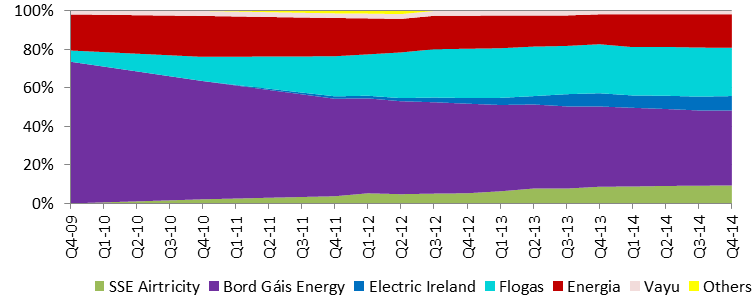
23 17.51% 1.66% 9.36% 17.23% 3.19% 12.47% SSE Airtricity Bord Gáis Energy Electric Ireland Flogas 25.05% 38.85% Energia Vayu 29.76% 30.80% 7.56% Figure 3.21 Customer Numbers, IC Gas Market, Q Figure 3.22 Consumption, GWhs, IC Gas Market, Q Figures 3.23 and 3.24 below show the market share trends in terms of customer numbers and GWhs from Q to Q Market shares have changed significantly over time. 6.55% Figure 3.23 IC Gas Customer number market share trend over time Figure 3.24 IC Gas Consumption market share trend over time 23
24 3.3.4 Fuel Variation Tariff (FVT) Gas Market 11 Overall, in the FVT gas market, total customer numbers in Q was 1,814 and total consumption was 2,183 GWhs. These represented an increase of +3.2% in customer numbers compared to Q4 2013, and a -2.9% decrease in GWhs since The following table shows the breakdown of customer numbers and GWhs by supplier and the change in market share in the year since Q FVT Gas Market Bord Gáis Energy SSE Airtricity Actual figures Q Market share Q % change in market share between Q & Q Cust Nos GWhs Cust Nos GWhs Cust Nos GWhs % 28.22% -2.56% -2.74% % 13.33% +1.69% +5.06% Flogas % 28.63% +0.40% +3.01% Energia % 12.05% +0.21% -4.46% Vayu % 17.27% -0.27% -1.19% Electric Ireland % 0.50% - - Total FVT 1,814 2, % 100% Table 3.13 FVT Retail Gas Market, Market Shares, Q The table above and figures below show the market share in terms of customer numbers and GWhs for the fourth quarter of Bord Gáis Energy has the highest share of customer numbers and Flogas has the highest share of GWhs in the FVT market. Similar to the IC and domestic markets, Bord Gáis Energy s share has continued to decline since Q Vayu also experienced a decline in the past year. SSE Airtricity and Flogas both gained in the FVT market since Q % 1.27% 18.03% 17.27% 0.50% 13.33% 12.73% SSE Airtricity Bord Gáis Energy 12.05% Flogas Energia Vayu 24.42% 28.11% Electric Ireland 28.63% 28.22% Figure 3.25 Customer Numbers, FVT Gas Market Segment, Q Figure 3.26 Consumption, GWhs, FVT Gas Market Segment, Q There are no longer regulated business tariffs; however, the reporting structure has been maintained for consistency and to allow for comparison. 24
25 Figures 3.27 and 3.28 below show the market share trends in terms of customer numbers and GWhs from Q to Q Bord Gáis Energy s market share has declined significantly and market share in the FVT segment has become more distributed over time. Figure 3.27 FVT Gas Customer number market share trend over time Figure 3.28 FVT Gas Consumption market share trend over time Regulated Tariff Formula (RTF) 12 Overall, in the RTF gas market, total customer numbers in Q was 245 and total consumption was 6,329 GWhs. These represented a decline of over -1.6% in customer numbers compared to Q4 2013, and a +11.2% increase in GWhs since The following table shows the breakdown of customer numbers and GWhs by supplier and in percentage change in market share in the year since Q There are no longer regulated business tariffs, however, the reporting structure has been maintained for consistency and to allow for comparison. 25
26 RTF Gas Market Actual figures Q Market share Q % change in market share between Q & Q Cust Nos GWhs Cust Nos GWhs Cust Nos GWhs Bord Gáis Energy 53 1, % 19.96% +0.75% +2.33% SSE Airtricity 38 1, % 15.88% -0.55% +0.50% Electric Ireland % 13.16% +2.97% +8.05% Gazprom 12 1, % 17.03% -0.32% -2.30% Energia 70 1, % 18.08% -1.55% -4.66% Vayu % 15.78% -1.71% -4.00% Other % 0.11% +0.41% +0.08% Total RTF 245 6, % 100% Table 3.14 RTF Retail Gas Market, Market Shares, Q The table above and figures below show the market share in terms of customer numbers and GWhs for the fourth quarter of Energia has the largest share of customers and Bord Gáis Energy has the largest share of GWhs in the RTF market. Electric Ireland and Bord Gáis Energy experienced increases in market share since Q (with Electric Ireland experiencing the highest increase in the year). The market shares of Vayu, Energia and Gazprom declined in the year % 0.82% 15.51% 15.78% 0.11% 15.88% SSE Airtricity 18.08% Bord Gáis Energy Electric Ireland 21.63% Gazprom Energia Vayu Other 19.96% 28.57% 4.90% 9.80% Figure 3.29 Customer Numbers, RTF Gas Market Segment Q % 13.16% Figure 3.30 Consumption, GWhs, RTF Gas Market Segment Q Figures 3.31 and 3.32 below show the market share trends in terms of customer numbers and GWhs from Q to Q The figures show that the market shares have become more dispersed over time with more suppliers actively participating in the market. 26
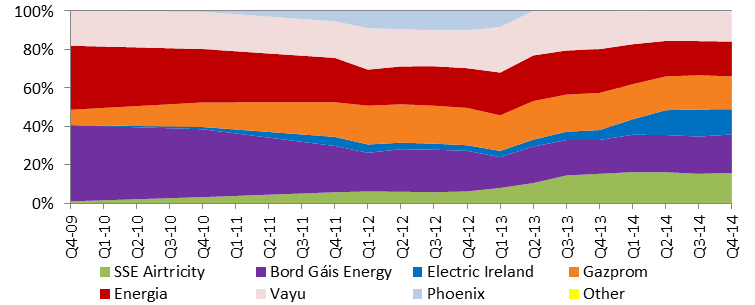
27 Figure 3.31 RTF Gas Customer number market share trend over time Figure 3.32 RTF Gas Consumption market share trend over time 3.4 Summary - Market Share In electricity, Electric Ireland is the largest supplier in terms of customers and MWhs across all segments. While Electric Ireland s market share (MWhs) has increased across all segments, it remains below the threshold at which it was price deregulated. Its market share in the domestic electricity market is 56.3%. PrePayPower s share in the domestic market increased in 2014 by 1.5%. Energia has lost market share in all business segments compared to Q but has gained relatively significantly in its first year of operation in the domestic market segment (market share of 3.2% at the end of 2014). In gas, Bord Gáis Energy remained the largest supplier in terms of customers and consumption in the domestic, industrial and commercial (IC) and FVT eligible 13 markets. In the RTF eligible 14 market, Energia is the largest supplier. The domestic gas market was the only market segment still subject to price regulation in early 13 Fuel variation tariff. There are no longer regulated business tariffs; however, the reporting structure has been maintained for consistency and to allow for comparison. 14 Regulated tariff formula. There are no longer regulated business tariffs, however, the reporting structure has been maintained for consistency and to allow for comparison. 27
28 2014. As all criteria to deregulate the gas market were deemed to be met, the domestic gas market was price deregulated on 1 st July 2014 which means that Bord Gáis Energy no longer has to seek approval from the CER to introduce domestic gas price changes. At the end of 2014, Bord Gáis Energy s market share in domestic gas was 52% representing a 5.2% reduction in market share compared to Electric Ireland gained market share in domestic gas by 2.4%, representing an increase in its market activity in the dual fuel area. New market entrant, Energia, gained significantly in the domestic gas market and had a market share of 3.8% in December The CER will continue to monitor both markets to ensure that competition is growing and continues to be promoted. 28
29 4.0 Customer Switching and New Registrations 4.1 Introduction This section contains data on customer switching activity with a breakdown of supplier switches in the relevant markets. Data on new registrations is also examined. Registrations represent the total number of sites that were connected in a period 15. Switching refers to the action where a customer changes from one supplier to another. It is measured by the number of completed switches in a period (not the number of switching requests). There is a free and easy switching process in place in Ireland which facilitates customers that wish to switch their supplier. Switching information is critically important in monitoring the effectiveness of market opening, the level of customer engagement in the market and the choices available to customers. It is important to note that this data measures the total number of switches completed in a given period. It does not report separately the number of unique switches and the number of repeat switches. 4.2 Electricity Market Switching & New Registrations This section analyses the level and trend in switching and new registrations in the electricity market by supplier and customer category Total Switching The total number of switches completed in the electricity market in 2014 was 312,477. This represented an increase in the total number since 2013 of +17.4%. 88% of the total number of switches in 2014 were in the domestic market. Switching remained above the 20,000 level per month throughout Figure 4.1 Total Switching in Electricity, January 2009-December New registration data may include a small number of sites that were reconnected/ reregistered in addition to sites that are new to the system. Switching data does not include new registrations. 29
30 The switching rate is measured by calculating the proportion of total customers that switched in the period. The average number of customers for the year is calculated from the quarterly customer numbers data. The average switching rate in electricity in 2014 was 14%, which represents a higher proportion to that in 2013 (which was almost 12%). This rate compares well internationally and is indicative of an active market. 16 Total Electricity Market Total number of switches 454, , , , , ,477 Switching rate 21% 21% 15% 11% 12% 14% Table 4.1 Total Switching in Electricity Switching by Customer Category The domestic market made up 88% of total switching in electricity in The figures below analyse the trend in switching across all market segments and show that the trend varies quite significantly across segments. In the domestic market, the number of switches in 2014 was 20.6% higher than in Figure 4.2 demonstrates how domestic switching peaked in the first six months of 2009 following the entry of Bord Gáis Energy and SSE Airtricity in the domestic market. Domestic electricity monthly switching was consistently higher in 2014 than in the previous two years. In 2014, April saw the highest level of switching which was influenced by the introduction of the first group switching scheme offered to domestic customers. 17 Figure 4.2 Domestic Electricity Switching In the small business market, the level of switching varied across the year with a peak in November. 16 According to the VaasaETT description of levels of switching. 17 One Big Switch. 30
31 Figure 4.3 Small Business Electricity Switching Switching in both the medium-sized business and LEU markets also varied across the year. Switching in the business sectors is more volatile than in the domestic sector and this reflects seasonal and contractual influences. Contract renewal dates in the LEU sector generally take place around October and January and this explains some of the differences in levels across the year. Figure 4.4 Medium Business Electricity Switching Figure 4.5 LEU Electricity Switching The average switching rates in the domestic, small business, medium business and LEU market segments were 14%, 18%, 13% and 11% respectively. By international comparison, all of these rates are relatively high. In comparison to 2013, there was an increase in the switching rate in the domestic segment, and rates in other segments remained relatively consistent. Electricity by Segment Domestic Small Business Medium Business Total number of switches, ,559 33,581 3, % change in total switching % -1.6% -6.3% -8.4% Switching rate, % 18% 13% 11% Table 4.2 Switching in Electricity by Market Segment, 2014 LEU 31
32 4.2.3 Net Switching by Supplier Net switching represents the net gain or loss in customer numbers experienced by supplier. It is estimated by the gain in customers less the loss in customers experienced by the supplier. The data shows that Electric Ireland and Bord Gáis Energy consistently experienced net losses in customer numbers each quarter in 2014, correlating with the reduction in domestic market share. SSE Airtricity experienced an overall loss in Energia entered the domestic market in January 2014 and experienced the highest net gain in the full year (+38,855). PrePayPower and the others category also gained in 2014 (by +27,316 and +8,608 respectively). Figure 4.6 Net Switching in Electricity by Supplier, January 2010-December 2014 The table below outlines the net switching levels across suppliers over time. SSE Airtricity experienced the highest net loss in customers (of -31,557 customers) in However, Electric Ireland and Bord Gáis Energy also experienced net losses (of -25,279 and -17,942). Electricity Net Switching Electric Ireland Energia SSE Airtricity Bord Gáis Energy PrePayPower Others Q ,582 +1,987-6, ,816 +2,137 Q ,427 +6,777-9,136-3,565 +8,877 +1,474 Q , ,284-13, ,655 +1,346 Q , ,706-10,134-7,478 +7,543 +3,175 Q ,386 +5,088 +1,218-6,773 +2,241 +2, ,175 +4,089 +3,696-32, ,558 +8, , ,855-31,557-17, ,316 +8,608 Table 4.3 Net Switching in Electricity by Supplier, Q Q New Registrations New registrations in electricity are situations where a customer has a new connection or has moved into a site,which has been de-energised for at least 3 32
33 months and has remained vacant during the three month period 18. New registrations in electricity increased by 16% compared to There were 17,305 new registrations in total in Figure 4.7 New Electricity Registrations over time by supplier, January 2010-December 2014 Electric Ireland continues to be the supplier associated with the majority of new registrations in electricity. Electric Ireland s share of new registrations was 86% of total registrations (compared to 84% in 2013). Electricity New Registrations Others PrePayPower Bord Gáis Energy SSE Airtricity Energia Electric Ireland Total Q ,013 3,584 Q ,768 3,848 Q ,909 4,730 Q ,225 5, , ,915 17,305 % share % 0.80% 4.93% 7.44% 2.34% 84.33% 100% % share % 0.79% 5.69% 7.55% 2.91% 86.19% 100% Table 4.4 New Registrations in Electricity by Supplier, Q Q Gas Market Switching & New Registrations This section analyses the levels and trends in switching and new registrations across suppliers in the gas market, as well as providing information on switching by customer segment. 18 ESB Networks. Sites normally remained registered to a supplier for 3 months after they are deenergised. 33
34 4.3.1 Total Switching The total number of switches completed in the gas market in 2014 was 109,750. This represented a decrease in the total number compared to 2013 of -6.2%. 97% of the total number of switches in 2014 were in the domestic market. Figure 4.8 Total Switching in Gas by Supplier, January 2010-December 2014 The switching rate is measured by calculating the proportion of total customers that switched in the period. The switching rate in gas in 2014 was almost 17%. This represented a lower proportion to that in 2013 (which had a rate of approximately 18%). By international comparison the gas market is still considered a very active market with regard to switching. Total Gas Market Total number of 93, , , , ,750 switches Switching rate 15% 17% 17% 18% 17% Table 4.5 Total Switching in Gas Switching by Customer Category The domestic market makes up 97% of total switching in gas. The figures below analyse the trend in switching across the domestic and IC gas market segments. The trend varies quite significantly across segments. In the domestic market, the total number of switches in 2014 was 106,108 and there was an overall downward trend in switching per month throughout the year. In the IC market, total switches were 3,642 and the level of switching varied significantly across the year. 34
35 Figure 4.9 Switching in the Domestic Gas Sector Figure 4.10 Switching in the IC Gas Sector The switching rates in the domestic market was almost 17% and in the IC market the rate was almost 16%. Total switching has decreased in both market segments compared to Gas Market Segment Domestic IC Total number of switches, ,108 3,642 % change in total switching % -23.9% Switching rate, % 15.7% Table 4.6 Switching in Gas by Market Segment in Net Switching by Supplier The data shows that, similar to the case in 2013 and the experience in electricity, Bord Gáis Energy consistently experienced a net loss in customer numbers in Electric Ireland has experienced a net gain since it entered the domestic market in 35
36 March 2011 and it continued to experience significant net gains in gas throughout SSE Airtricity experienced net losses throughout Figure 4.11 Net Switching in Gas by Supplier, January 2010-December 2014 The table below outlines the net switching levels across suppliers in Bord Gáis Energy experienced the highest net loss in customers (of -35,430 customers), lower than its net loss in Energia experienced the highest net gain (of +24,687) and Electric Ireland also gained (+17,081 customers). Other suppliers experienced net losses in the year. SSE Airtricity Bord Gáis Energy Electric Ireland Energia Flogas Gazprom Vayu Q , , Q ,325 +5,625 +2, Q ,521-9,867 +5,550 +5, Q ,009-10,034 +3,812 +9,615-1, Q ,204 +2,094 +6, ,099-56, , , ,265-35, , ,687-2, Table 4.7 Net Switching in Gas by Supplier, Q Q New Registrations New gas registrations are defined by GNI as the situation where a new meter is fitted or a meter is unlocked at sites where there is no supplier registered 19. The figure 19 A registration unlock is where the site has been locked for greater than 18 months and there has been no consumption since the lock was carried out and no customer registered. 36
37 below shows the trend in new registrations by supplier since January New registrations in gas have increased by +7% compared to There were 7,501 new registrations in total in Figure 4.12 New Registrations in Gas by Supplier, January 2010-December 2014 Bord Gáis Energy continues to be the supplier associated with the majority (64.7%) of new registrations in the gas market. However, Bord Gáis Energy s share of new registrations was 2.9% less than its share in Gas New Registrations SSE Airtricity Bord Gáis Energy Electric Ireland Flogas Energia Vayu Total Q , ,490 Q , ,650 Q , ,732 Q , , ,850 1, ,501 % share % 67.56% 14.52% 8.38% 0.63% 0.26% 100% % share % 64.66% 15.36% 9.53% 2.52% 0.29% 100% Table 4.8 New Registrations in Gas by Supplier, Q Q Summary Customer Switching Switching is continuing in both the electricity and gas markets and switching rates are above 10% in both markets. Under the VaasaETT description of the levels of switching, the electricity and gas markets are considered active and Ireland ranks well globally in terms of switching rates. The total number of switches completed in the electricity market in 2014 was 312,477. This represented an increase in the total number since 2013 of +17%. The 37
38 total number of switches complete in the gas market in 2014 was 109,750. This represented a reduction in the total number since 2013 of -6.2%. Switches in the domestic market made up 88% and 96% of total switching in electricity and gas respectively. Energia, the newest supplier in the domestic markets, experienced the highest net gain in customers in both electricity and gas in Bord Gáis Energy experienced the highest net loss in the gas market and SSE Airtriicty had the largest net loss in electricity. 38
39 5.0 Competition and Price Deregulation 5.1 Introduction The CER is responsible for the promotion and monitoring of competition in the electricity and gas retail markets. The CER has overseen the liberalisation and the full market opening of both the electricity and gas markets. The introduction and growth in competition in both markets has reduced the necessity for the CER to regulate the prices of the incumbent suppliers in each market (i.e. Bord Gáis Energy in gas and ESB Customer Supply in electricity, now Electric Ireland). For each market segment in electricity and gas the CER identified the various conditions that must be met in order for price deregulation to take place. These conditions are measured using the metrics contained in retail market reports (market share and switching). With the continued development of competition, all retail markets are price deregulated with the domestic gas market being the most recently deregulated in July All suppliers, including the incumbent gas and electricity suppliers, are free to set their own prices. The incumbent suppliers no longer have to seek approval from the CER of potential price changes. 5.2 Price Deregulation in Electricity All market segments in electricity are price deregulated. Business markets were price deregulated in October 2010 and the domestic market was deregulated in April The following were the criteria for price deregulation in the domestic electricity market: At least 3 suppliers active in the market; A minimum of 2 independent suppliers, each of which has at least 10% share of load (GWhs) in the market; Switching rates greater than 10%; Deregulation at market share of 60% conditional on ESB removing the ESB brand. In Q4 2014, Electric Ireland s market share (MWh), at 56.31% in the domestic market, was still below the threshold of 60% which was set out in the electricity Roadmap. Electric Ireland s share of MWhs in the domestic market reduced in 2014 compared to 2013 (when it had a 57.2% share). There continues to be two independent suppliers with over 10% market share which satisfies the market share criteria. The final condition set out was that domestic switching rates had to be above 10%. The rate in the domestic continues to meet this criterion. At 14% the switching rate in the domestic market remains above 10% and is higher than the rate in Price Deregulation in Gas The gas business markets were fully deregulated in October The domestic NDM retail gas market was price deregulated on 1 st July CER/14/117 Domestic Gas Market Deregulation Decision. 39
40 The following were the criteria for price deregulation in the domestic gas market: At least 3 suppliers, of which two are non-bord Gáis Energy suppliers; Each non-bord Gáis Energy supplier has a market share is in excess of 10%; Customer switching rates in excess of 10% per year; Threshold for deregulation is 60% (customers) with rebranding of its retail business and without rebranding the threshold is 55%. In Q4 2014, Bord Gáis Energy s domestic market share (customer numbers), at 52.03%, was lower than in July 2014 (when it was price deregulated). Bord Gáis Energy s share of customers in the domestic market continuously reduced in There continues to be two non-bord Gáis Energy suppliers with over 10% market share which satisfies the market share criteria. The final condition set out was that domestic switching rates had to be above 10%. The rate in the domestic continues to meet this criterion. At 16.7% the switching rate in the domestic market remains above 10%. 5.4 Summary The domestic gas market was price deregulated on 1 st July All electricity and gas markets are now price deregulated. The CER commits to continue to monitor all electricity and gas market segments and, as outlined in the NDM gas decision paper 21, should it feel that customers are not benefiting from deregulation of any market, the CER will take action to improve matters. 21 CER/13/096, Review of the NDM Retail Gas Market. 40
41 6.0 Electricity and Gas Retail Prices 6.1 Introduction Open and competitive energy markets will result in competitive energy prices. However, there are many factors to consider in analysing trends and levels of prices in Ireland. Specific market conditions may result in a large proportion of price changes to be outside of the control of (or external to) suppliers/other stakeholders in Ireland. Notwithstanding these external factors, it is important to ensure that prices are competitive and set in a transparent way for customers. This section outlines the components of end user price and identifies the recent trend in energy prices in Ireland. 6.2 Disaggregation of Prices in Ireland Energy prices in Ireland are made up of a number of different components, each driven by differing factors. Prices are based on costs incurred by a supplier in serving its customer base. The following diagram indicates the key components that comprise retail energy prices in Ireland and the key external/internal factors that impact on each component: DRIVERS Cost of distribution and transmission DRIVERS costs faced by supplier in supplying energy: labour Profits Network costs Supply costs Irish Energy Prices DRIVERS Public service obligation Carbon tax VAT rate Government Policy Wholesale costs DRIVERS energy costs (including impact of exchange rates) capacity costs market operator cost Figure 6.1 Composition of Energy Prices It is important to note that each component affects prices to a different degree and the proportionate impact is not equal across factors. A significant factor affecting energy prices in Ireland is the change in global gas prices given Ireland s dependence on fossil fuels and the knock on impact that this 41
42 has on energy prices in Ireland. The high reliance of Ireland on imported fossil fuels, in particular gas 22, for electricity generation results in Ireland having a high exposure to currency fluctuations. Variations in global prices are outside the control of suppliers/other stakeholders in Ireland and result in Irish-based energy supply companies to develop hedging strategies that allow them to minimise the impact of sudden global energy price shifts. Of all the costs that are likely to comprise a final price, suppliers must charge their customers the PSO levy 23, carbon tax and VAT. They may, however, choose to either absorb or charge the remaining costs to their customers. Nonetheless, the final prices will be primarily influenced by energy costs. Of the other charges there are a number of these which are regulated and approved annually (network charges, certain generation-related charges in electricity, PSO in electricity). These regulated costs are necessary in order for networks and other market operators to recoup the cost of generating, transmitting and distributing electricity, and suppliers are required to pay these annually. Changes to these charges generally come into effect on the 1 st October annually (electricity capacity charges are updated on 1 st January). While it is the decision of each supplier whether or not to pass through such costs to final customers, it is likely that most suppliers pass through all such costs. These costs, with the addition of the applicable taxes, are referred to as Pass Through Costs The CER has responsibility for regulating network prices in Ireland. The CER directs and carries out annual reviews of the charges for access to and use of the electricity and gas distribution systems. The CER also reviews the costs incurred by ESB and GNI in developing, maintaining and operating the system. These charges are ultimately passed onto customers. The CER in conjunction with the NIAUR (Northern Ireland Authority for Utility Regulation) 24 have jointly regulated the all-island wholesale electricity market, which is known as the SEM (Single Electricity Market), since The SEM includes a centralised gross pool (or spot) market which is fully liquid and electricity is bought and sold through a market clearing mechanism. Suppliers purchasing energy from the pool pay the system marginal price for each trading period. The RAs publish quarterly reports that show changes in fuel and carbon prices which provide transparency to the market. Eurostat publishes data on average end user prices. These average end user prices are given for 5 consumption bands in the domestic and for 6 bands in the Industrial and commercial markets (see here for more details). The dominant consumption band for the domestic market in Ireland is DD and that for the industrial and commercial market is IB. The following charts break down the average electricity prices for these dominant consumption bands into (i) energy and supply charges,(ii) network charges and (iii) taxes and levies. They are presented as a % of the euro cent average end user price for the given consumption band. 22 Oil prices do not significantly impact on retail prices. 23 The Public Service Obligation Levy (PSO) is charged on all electricity customers and designed to support the national policy objectives of security of supply, the use of indigenous fuels (i.e. peat) and the use of renewable energy sources in electricity generation 24 Together referred to as the Regulatory Authorities/RAs. 42

43 Figure 6.2 Disaggregated Domestic Electricity Price, Band DD, S Figure 6.3 Disaggregated Industrial & Commercial Electricity Price, Band IB, S Indicative data from Eurostat shows that energy and supply costs comprise a significant proportion of the average Irish domestic and non-domestic electricity price in comparison with other EU countries (of 56% for domestic and 65% for nondomestic prices). Taxes and levies in Ireland account for one of the smallest proportions of final price in the EU. 6.3 Supplier Prices in Ireland The electricity and gas markets in Ireland are fully price deregulated, therefore the CER no longer regulates electricity or gas prices in the domestic or business 25 Source: Eurostat. 26 Source: Eurostat. 43
44 markets. Prior to price deregulation, the incumbent electricity supplier, ESB Customer Supply (now Electric Ireland), and the incumbent gas supplier, Bord Gáis Energy, had to apply to the CER if they were proposing changes to tariffs. All suppliers, including incumbent suppliers, can now set their own prices. There are a large number of tariff plans available to domestic and business customers that are provided by electricity and gas suppliers in Ireland. These plans offer customers different tariffs comprised of standing and unit charges (and in some instances daily service charges). Suppliers can also offer different rates depending on payment or billing method (e.g. paperless, online, direct debit etc.). All suppliers are required to publish details of the tariff plans that are available to domestic customers. Suppliers of businesses often provide bespoke plans to their business customers and information on such plans is generally not published by suppliers. In 2014, four suppliers operated in both the domestic electricity and gas markets (SSE Airtricity Bord Gáis Energy, Electric Ireland and Energia), and all actively promoted bundled dual fuel offers with price discounts for domestic customers that avail of both services from the same supplier saw a significant change in terms of the options available to customers. Such options ranged from: exclusive deals, limited term sign-up discounted offers, cashback/credit offers, fixed price plans, energy efficiency services, loyalty programmes, etc. These developments had a positive impact on competition in the markets with an increase in the number of options available to customers and an increase in electricity switching. With regard to changes in domestic electricity and gas prices, at the beginning of 2014 a number of suppliers introduced price increases ranging between 1.7% and 3.5%. In November 2014, Electric Ireland was the first supplier to announce an electricity price reduction (-2%, to reflect reducing wholesale prices). In early 2015, all other suppliers also introduced price reductions in gas (ranging from -2.5% to - 4%) and electricity (ranging from -2% to -4%). These changes in price were primarily driven by significant reductions in wholesale prices over the past year. While the wholesale price reduction was higher than the actual reductions announced by suppliers, this is somewhat explained by the fact that suppliers buy ahead at fixed price contracts (hedging) to provide greater retail price stability and so changes in price may only feed through to retail prices at a later stage. The following table outlines the price change announcements by each supplier over the past number of years. These changes relate to the changes to the standard tariff of each supplier 27. The level of reductions varied by supplier. 27 Discounted tariffs are generally presented as discounts off the standard tariff so any change to the standard plan will have a knock on impact on discounted plans. 44
45 Price changes 2012/13 change 2013/14 change 2014/15 change Change Electricity Gas Electricity Gas 28 Electricity Gas SSE Airtricity +4.70% +8.50% +3.5% 29 +2% -2% 30-4% 31 Bord Gáis Energy +4.80% +8.50% +2.2% % % % 35 Electric Ireland +5.90% +8.50% +1.7% 36 +2% -2% % 38 Flogas Na % Na +1.95% 39 Na -3% 40 Pinergy Na Na +1.7% 41 Na -2% 42 Na PrePayPower Na Na +1.7% 43 Na -4% 44 Na Energia 45 Na Na Na Na - - Table 6.1 Supplier Domestic Price Change Announcements 46 Tables 6.2 and 6.3 identify the annual average bill per supplier (for both standard plans and discounted plans) in domestic electricity, gas and dual fuel segments in In order for a customer to accurately compare prices, the comparison of the annual average bill (using typical consumption values of 5,300kWhs in electricity and 13,800kWhs in gas) across suppliers is the best measure. The estimates in table 6.2 do not include cashback, limited term or exclusive offers. The figures in the table represent average bills at the end of 2014 so do not take into account the subsequent price changes announced by suppliers (table 6.1). Supplier Credit customers - Standard Electricity Annual Average Domestic Urban 24hr Electricity Bill, 2014 Credit customers - Direct PAYG supplier debit & online billing discount plan led lifestyle choice offers (yr 1) SSE Airtricity 1,271 1,126 Na Bord Gáis 1,217 1,118 Na Energy Electric Ireland 1,211 1,061 1, Energia 1,253 1,100 Na Pinergy Na Na 1, PrePayPower Na Na 1, Table 6.2 Annual Average Urban 24hr Domestic Electricity Bill per Supplier, Dec-14, including PSO, VAT & supplier service charges as applicable, typical consumption of 5,300kWh 28 All applied in October Applied in November Applied on 1 st April 2015 on both the unit rate and standing charge. 31 Applied on 1 st April 2015 on both the unit rate and standing charge. 32 Applied in March Increase due to wholesale price changes & weakened Euro. 33 Regulated price change. 34 Applied on 16 th March 2015 on the unit rate. 35 Applied on 16 th March 2015 on the unit rate. 36 Applied in January 2014 along with PSO increase resulting in +3.5% increase. 37 Average across domestic customers, applied on 17 th November Applied on 1 st April 2015, average price decrease. 39 Flogas introduced a second price increase of +1.45% on 1 st May Applied on 1 st April 2015 on the unit rate. 41 Tied to EI tariff. 42 Tied to EI tariff. 43 Prepaypower prices were tied to EI tariffs until November Average change, applied on 31 st March Energia was not active in the domestic electricity and gas markets until January Source: supplier websites and price comparison websites. 47 Includes additional daily supplier prepayment service charge. 48 Includes additional daily supplier prepayment service charge. 49 Includes additional daily supplier prepayment service charge. 45
46 Table 6.2 above shows that Electric Ireland had the cheapest tariffs for electricity customers. The price spread between the highest and the lowest average annual bill for customers on the standard plan was 60 for credit customers, 65 for customers on discounted plan and 92 for lifestyle choice PAYG customers. It is important to note that this data does not include cashbacks or limited term offers that may have been available at the time. Lifestyle choice PAYG customers in 2014 could have paid between 11% and 13% more than credit standard plan customers, primarily because of the additional supplier service charge. However, customers see other benefits of PAYG including that it would make it easier for them to manage their consumption and the money they spend on electricity while also avoiding unexpectedly large bills. Savings of up to 210 could have been made by customers switching from a standard plan to a direct debt/online billing discounted plan. The following table shows the average annual bill for domestic gas customers. Annual Average Domestic Gas Bill, 2014 Supplier Standard Gas Direct debit & online billing discount plan SSE Airtricity Bord Gáis Energy Electric Ireland Energia Flogas Table 6.3 Annual Average Domestic Gas Bill per Supplier in December 2014, including Carbon Tax and VAT, based on typical annual consumpiton of 13,800kWh in gas In gas, SSE Airtricity and Electric Ireland had the lowest standard tariffs and Flogas offered the cheapest discounted tariff to customers in December Gas customers switching from the standard plan to a discounted plan could have saved up to 140 per year. The following table shows the average annual bill for domestic dual fuel customers. Annual Average Domestic Dual Fuel Bill, 2014 Supplier Standard Dual Fuel Direct debit & online billing discount plan SSE Airtricity 2,257 2,056 Bord Gáis Energy 2,210 2,027 Electric Ireland 2,189 1,970 Energia 2,232 1,944 Table 6.4 Annual Average Domestic Dual Fuel Bill per Supplier in December 2014, including Carbon Tax, PSO and VAT where applicable, based on typical annual consumpiton of 13,800kWh in gas and 5,300kWh in electricity In the dual fuel sub segment, Electric Ireland had the lowest standard dual fuel tariff and new market entrant Energia had the lowest tariff for customers on discounted plans. A customer switching from the standard dual fuel tariff to a discounted tariff could have saved up to 313 annually in At the end of 2014, it was cheaper for a typical customer on a discounted plan to purchase gas and electricity from separate suppliers rather than avail of a dual fuel offer from one supplier. Price comparison websites are useful tools for customers to compare prices across suppliers. CER has an accreditation framework which reviews the energy price comparison service provided by websites and only accredits if the site meets defined standards for accuracy, transparency and reliability. There are two accredited price comparison websites: and 46
47 6.4 Analysis of Average Electricity and Gas Prices The following outlines published SEAI data on average energy prices in Ireland 50, and S data is taken from the Eurostat website. Trends in S2 (July-December) This section examines the current level and trend in energy prices in Ireland and in comparison with EU prices. Data is currently reported by SEAI 52 twice yearly and latest data (July-December 2014, S2 2014) is examined here. The SEAI is responsible for collecting, collating and reporting data on prices on Ireland s behalf. Figure 6.4 Irish Domestic Electricity Prices Relative to EU Average, including all taxes (market share of band) Domestic electricity prices are above the EU average in most consumption bands (except band DE). Average price has increased in the dominant consumption band, DD, since S and is higher than the EU average. Average price for consumption band DD in Ireland is only slightly higher than the Euro area average SEAI, Electricity and Gas Prices in Ireland 2 nd Semester (July-December) This section references SEAI data and extracted the S data from the Eurostat website. 52 Sustainable Energy Authority of Ireland (SEAI). 53 Euro area refers to the average of prices in all countries with the Euro. 47
48 Figure 6.5 Irish Business Electricity Prices Relative to EU Average, excluding VAT (market share of band) In S average price for business electricity customers in Ireland for the band which accounts for the highest consumption (band IB with a 30.9% consumption share) was lower than the same period in The average price for band IB was higher than the EU and Euro area averages. Figure 6.6 Irish Domestic Gas Prices Relative to EU Average, including all taxes (market share of band) In S the average price of domestic gas in Ireland for the band which accounts for the highest consumption (band D2 with a 91.9% consumption share) was above the EU average; but remained below the Euro area average price. 48
49 Figure 6.7 Irish Business Gas Prices Relative to EU Average, excluding VAT (market share of band) In terms of Irish business gas prices, average prices in Ireland for the dominant consumption band (I4) were below both the EU and the Euro area average prices. 6.5 Summary - Prices Energy prices are made up of a number of different components network costs, wholesale costs, supply and retail costs and other factors that are driven by Government policy such as PSO levy, VAT rate and carbon tax. Energy and supply costs comprise a large proportion of final price in Ireland in comparison to other EU countries. A significant share of this is accounted for by fossil fuel costs, gas in particular. All suppliers are required to publish details of the tariff plans that are available to domestic customers. Customers switching from a standard plan to a discounted plan continue to make the highest savings. At the end of 2014, large savings were available in the market. As an example, a customer switching from the standard dual fuel tariff to a discounted tariff could have saved up to 313 annually (excluding any cashback and limited term offers). At the end of 2014, it was cheaper for a typical customer on a discounted plan to purchase gas and electricity from separate suppliers rather than avail of a dual fuel offer from one supplier. In 2014, price related competition intensified in the electricity and gas markets with the introduction of a range of new innovative offers from suppliers. In terms of price changes, towards the end of 2014, one supplier introduced a price reduction for domestic electricity customers. All suppliers announced electricity and gas reductions in early
50 7.0 Customer Protection, Debt and Disconnections 7.1 Introduction It is the CER s statutory obligation to ensure a high standard of protection for final customers in the electricity and gas markets. In compliance with the CERs Code of Practice on Disconnections, suppliers must ensure that disconnection is always the last resort. The Supplier Handbook sets out the minimum service levels that electricity and gas suppliers must provide to their customers; including in the areas of disconnections and PAYG meters. In dealing with customers that are in arrears, suppliers must take a number of steps prior to disconnecting a property. The disconnection of a customer s energy supply should always be the last resort and all suppliers are required to offer a payment plan and a PAYG to customers in arrears in advance of proceeding to disconnect. Suppliers must also facilitate a customer that wishes to nominate a third party to represent them. 54 This section outlines the trends in debt flagging, PAYG installs and disconnections in Debt Flagging Debt flagging was introduced in light of on-going concerns from energy suppliers and consumer organisations that in the current economic climate, customer and industry debt levels are being exacerbated by some customers changing supplier in order to avoid paying their arrears or to avoid disconnection. This practice of debt hopping is considered to raise costs for energy suppliers, and consequently for all consumers, and further compounds an individual s debt situation making it more difficult to manage in the long run. Where a customer requests to change to a new supplier, the customer s existing supplier has the facility to inform the new supplier if the customer has an outstanding debt, above the industry thresholds approved by the CER (see table 7.3). The new supplier can then choose whether to proceed with or to cancel the change of supplier (CoS) request where this flag has been raised. The debt flagging process has been in place since October 2011 and the CER monitors the use of the debt flagging facility by both losing and gaining suppliers on an on-going basis. The table below shows the number of debt flagged change of supplier requests that were raised in the electricity market in There were 4,792 debt flags raised on change of supplier requests in the electricity market in 2014 (-24.5% less than in 2013), corresponding on average to 1.55% of all change of supplier requests. Approximately 30.1% of debt flagged change of supplier requests were cancelled by the new supplier in 2014 which is significantly higher than the proportion cancelled in 2013 (18.8%). 54 e.g. money advisor including MABS, a recognised charity or Social Welfare Representative. 50
51 Electricity Debt Flags Total Debt Flags Debt Flagged CoS requests as % Total CoS 55 % of Debt Flagged CoS Requests Cancelled by New Supplier Jan % 19.4% Feb % 27.7% Mar % 23.9% Apr % 30.1% May % 29.3% Jun % 27.9% Jul % 35.2% Aug % 29.8% Sept % 28.6% Oct % 36.2% Nov % 37.6% Dec % 38.2% ,792 Average 1.55% 30.1% Table 7.1 Debt Flagging in Electricity, January 2014-December 2014 The table below shows the total number of debt flags raised in the gas market in There were 985 debt flags raised in the gas market in 2014 (corresponding to 0.9% of completed gas switches) which represented a decrease of -23.8% compared to 2013). Over 43% of gas debt flagged CoS requests were cancelled (i.e. the switch request was not accepted) by the new supplier in Gas Debt Flags Total Debt Flags Debt Flagged CoS requests as % Total CoS 56 % of Debt Flagged CoS Requests Cancelled by New Supplier Jan % 55.0% Feb % 47.9% Mar % 50.9% Apr % 50.7% May % 47.8% Jun % 35.5% Jul % 45.9% Aug % 44.9% Sept % 42.0% Oct % 44.3% Nov % 30.4% Dec % 38.4% % 43.7% Table 7.2 Debt Flagging in Gas, January 2014-December 2014 The thresholds for debt flagging from 1 st July are as follows: Market Sector Domestic Small Business & Unmetered Supply Medium Sized Business Debt Flagging Threshold 225 for > 60 days from due 600 for > 30 days from due 1,200 for > 30 days from due Table 7.3 Debt Flagging Thresholds from 1 st July 2013 In May 2014, the CER issued a consultation on Debt Flagging and Debt Transfer (CER/14/119) which proposed changes to industry systems/processes to facilitate 55 This data is based on the number of debt flags raised as a proportion of switching requests. 56 This data is based on the number of debt flags raised as a proportion of completed switches. 57 CER13/135 Debt Flagging Review. 51
52 the repayment of debt after a PAYG customer changes supplier. The CER is currently undertaking work with industry in the area of debt management. 7.3 Pay as You Go Meters PAYG This section looks at the trend in the installation of PAYG meters. The requirements set out in the Codes of Practice ensure that fair and robust customer processes are in place. Suppliers are required to offer customers in financial hardship a PAYG meter in the domestic electricity and gas markets prior to taking steps to disconnect. The CER has been working with industry to facilitate the rollout of electricity and gas PAYG meters free of charge for customers experiencing financial hardship. Currently Bord Gáis Energy, Electric Ireland, Energia, Flogas and SSE Airtricity provide PAYG meters for financial hardship in the electricity and gas domestic markets. A number of suppliers also offer lifestyle choice prepayment options in the electricity sector (Electric Ireland, Pinergy and PrePayPower). However the model offered by these suppliers is different as they provide the PAYG unit directly to the customer so that it acts as a budget controller in series with the existing meter. The lifestyle choice prepayment meter is therefore an asset of the supplier rather than the ESBN. In addition, the models provided by such suppliers require customers to pay additional daily service charges (that customers in difficulty availing of free PAYG do not incur). In gas, GNI provides all the PAYG meters. If a customer wishes to avail of a lifestyle choice meter in gas they can purchase such from GNI through their supplier. ESB Networks and GNI are responsible for installing PAYG meters free of charge for customers in financial difficulty at the request of suppliers (on foot of a customer agreeing to the installation of a meter). The table below shows that there were 21,234 electricity PAYG meters installed in 2014 (with 4,064 installed in Q4). This represents a 20% reduction in the number of PAYG meters installed when compared to PAYG Meters Electricity PAYG Q Q Q Q Q Q Q Q ,303 7,323 7,336 6,629 5,075 5,975 6,120 4,064 Cumulative total of Network provided PAYG meters installed 75,541 (including 12,292Token meters) Gas 58 4,369 6,680 4,192 3,278 2,478 3,193 2,597 1,750 93,399 PAYG Table 7.4 PAYG Meter Installations Electricity and Gas, Q Q In gas there were 10,018 prepayment meters installed in 2014 which represented a 46% decline compared to the number installed in Of these, 87.9% were installed for reasons of financial hardship. Some 1,750 prepayment meters were installed in Q4 2014, of which 82.6% were installed for financial hardship reasons. This proportion represents a reduction on the percentage that were installed for 58 Financial hardship and lifestyle choice. 52
53 financial hardship in the previous quarter (90%). The following chart shows the trend per quarter in the number of PAYG meters installed for financial hardship reasons. Figure 7.1 Electricity & Gas Financial Hardship PAYG Meters installed, Q Q Figure 7.1 shows that in electricity the number of PAYG installations grew between Q1 and Q but declined from Q With regard to the number of PAYG installs per supplier, the following tables show the installation rate per supplier (measured by the number of installs divided by the number of customers). Electricity Rate Bord Gáis Energy Electric Ireland Energia SSE Airtricity Q % 0.31% 0.49% Q % 0.25% 0.47% Q % 0.24% na 0.30% Q % 0.29% 0.39% Q % 0.33% 0.32% Q % 0.24% 0.01% % Table 7.5 Electricity PAYG installation rate compared to customer base, Q Q In electricity, Electric Ireland had the highest PAYG installation rates in Q Gas Rate Bord Gáis Energy Q % 0.15% Electric Ireland Energia Flogas SSE Airtricity 0.67% 0.65% Q % 0.12% 0.58% 0.56% na Q % 0.24% 0.41% 0.66% Q % 0.22% 0.39% 0.45% Q % 0.15% 0.00% 0.23% 0.26% Table 7.6 Gas PAYG installation rate (financial hardship) compared to customer base, Q Q In gas, Bord Gáis Energy and SSE Airtricity had the highest PAYG installation rate in Q Energia entered the domestic electricity and gas markets in
54 The CER continues to work with industry to promote the rollout of PAYG and customer education on the benefits of PAYG meters for managing payments and arrears. 7.4 Disconnections for Non-Payment of Account The disconnection/ deenergisations of a customer s energy supply should always be the last resort and all suppliers are required to offer a payment plan and prepayment solution to customers in advance of proceeding to disconnect. In early 2014 the CER, in conjunction with industry and the Department of Communications, Energy and Natural Resources, reviewed the market processes to ascertain if more could be done in further reducing disconnections (e.g. by increasing uptake of PAYG). While this work was ongoing the CER imposed a moratorium on the disconnections, which was lifted on 20 th February While the CER monitors disconnections on an ongoing basis, the CER moved to monthly publication of disconnections data in March The CER s work in the area of compliance and in undertaking audits of compliance continues alongside the monitoring of disconnections. In May 2014, a voluntary agreement was introduced by most energy suppliers which saw them committing to never disconnect an engaging customer. This section analyses trends in disconnections in both electricity and gas Disconnections Total Disconnections of customers for non-payment of account (NPA) declined significantly in 2014 compared to 2013 by 30% in electricity and 36% in gas. Total NPA Disconnections Electricity 17,794 17,441 12,391 8,731 Gas 4,560 7,558 6,279 3,998 Table 7.7 Total (domestic & business) Electricity & Gas NPA Disconnections, There are various reasons for this decline including the work that was undertaken by all stakeholders in early 2014 that reviewed the market processes, and also the voluntary agreement introduced by most energy suppliers which saw them committing to never disconnect an engaging customer. 54
55 Figure 7.2 Domestic Electricity NPA Disconnections and Electricity PAYG Installs, Q Q In gas and electricity, there are a higher number of PAYG meters being installed for reasons of financial hardship than disconnections. While this is the case, the difference in electricity is greater. A possible reason for this is that some customers may choose to disconnect gas at certain times during the year, due to seasonality. Figure 7.3 Domestic Gas NPA Disconnections and Gas PAYG Installs (financial hardship), Q Q
56 7.4.2 Disconnections Vacant premises proxy Anecdotal evidence suggests that a significant number of disconnected properties are in fact vacant. The following section examines proxy data on the level of vacant premises in electricity and gas. Electricity Each month the CER receives proxy data on vacant premises from ESBN. This data provides an estimate of the number of reenergised 60 sites within five weeks of disconnection. Those sites that remain disconnected are assumed to be vacant. Figure 7.4 shows the trend in disconnections and shows the impact of adjusting the number of disconnections with installed PAYG meters and also taking out the impact of vacant premises. The chart clearly indicates that without a PAYG system, disconnections would be significantly higher. In addition, it can be seen that when proxy figures for vacant sites are removed, disconnections are significantly less. On average, in 2014 over 44% of disconnected domestic sites remain disconnected after 5 weeks. It is assumed that these sites are vacant. Figure 7.4 Domestic Disconnections in Electricity adjusting for PAYG & Vacant Premises 2014 Note: Caution must be taken in interpreting the vacant premises data as estimated figures are used. Gas Figure 7.5 shows the trend in disconnections and shows the impact of adjusting the number of disconnections with installed PAYG meters and also taking out the impact of vacant premises. The chart indicates that without a PAYG system, disconnections would be higher. In addition, similar to the case in electricity it can be seen that when proxy figures for vacant sites are removed, disconnections are less. On average, over 44% of gas sites (credit locks) that were disconnected in the January to June period in 2014 remained disconnected after 6 months of the date of disconnection 61. It is assumed that these sites are vacant. This is a greater proportion than estimated in 2013, when 35% were assumed vacant. 60 Sites may be reenergised with a different supplier. 61 There is a longer time period used to measure disconnected vacant sites in gas because some gas customers may choose to disconnect gas as it is less of a necessity at particular times of the year (e.g. during the summer). 56
57 Figure 7.5 Domestic Gas Disconnections adjusting for PAYG & Vacant Premises Jan-Jun 2014 Note: Caution must be taken in interpreting the vacant premises data as estimated figures are used Disconnections Electricity Market CER receives data on electricity disconnections that were completed for nonpayment of account reasons on a monthly basis from ESBN 62. This section analyses the data on validated electricity non-payment of account (NPA) disconnections 63. Electricity disconnections have declined in the full year 2014 since 2013, by almost 30%. Electric Ireland continues to complete the majority of NPA disconnections; however, its NPA disconnections continue to decline. Disconnections of other suppliers have also declined in Domestic NPA disconnections made up 83.7% of the total NPA disconnections in Electric Ireland SSE Airtricity Bord Gáis Energy PrePay Power 64 % in the domestic market Electricity Total Disconnections Energia Total Q , , % Q , , % Q ,732 1, , % Q , , % Q , % Q , , % Q , , % Q , , % % Change Q4-45.5% -23.4% -41.4% % -32.6% 2013-Q ,844 3,635 2, , % ,378 1,961 1, , % % Change % -46.1% -40.6% % -29.5% Table 7.8 Total Electricity Disconnections by Supplier, Q Q This data has been validated by suppliers in advance of publication and therefore may differ to the data contained in the monthly disconnection reports, which is not validated. 63 NPA can cover customers in arrears that have been disconnected because they cannot pay due to financial hardship or disconnected customers who choose not to pay debt. Currently such customers cannot be distinguished in the data. This NPA data does not include data on self-disconnections. This data includes disconnections of PAYG customers due to fraud/theft. 64 PrePayPower states that, as a prepay supplier, it only disconnects in situations where they suspect a site of being vacant or in instances of fraud based on an analysis of vend and consumption data. 57
58 Domestic NPA disconnections (table below) have decreased in 2014 compared to the full year 2013, by 27.8%. All suppliers reduced the number of domestic disconnections in the period by between 22% and 50%. Electricity Domestic Disconnection Electric Ireland SSE Airtricity Bord Gáis Energy PrePay Power 65 Energia Total Domestic Q ,016 Q ,312 Q , ,020 Q , ,774 Q ,176 Q , ,418 Q ,910 Q , ,806 % Change Q Q % -28.7% -38.8% % ,072 3,111 1, , ,947 1,546 1, ,310 % Change % -50.3% -37.3% % Table 7.9 Domestic Electricity Disconnections by Supplier, Q Q A more relevant measure of comparing disconnection levels between suppliers is their disconnection rate per 10,000 customers. This takes into account the customer numbers of the suppliers and is an accurate measure of disconnection intensity per supplier. The disconnection rate of all suppliers (where data is available) reduced compared to Q PrePayPower states that, as a prepay supplier, it only disconnects in situations where they suspect a site of being vacant or in instances of fraud based on an analysis of vend and consumption data. 58
59 Electricity Domestic Disconnection Rate Electric Ireland SSE Airtricity Bord Gáis Energy Q Q Q PrePayPower 66 Energia Q Q Q Q Q % Change Q Q % -21.3% -34.6% - - Figure 7.6 & Table 7.10 Domestic Electricity Disconnections per 10,000 Customers Disconnections Gas Market There are three types of disconnections in gas: credit locks, disconnect meters (DMs) and street isolations (CTSRs) 67. This section only focuses on the disconnections that were undertaken for NPA reasons 68. In 2014, total disconnections (domestic and non-domestic) in gas were 3,998, and were up to 36% lower than the number in There were decreases in disconnections of customers of Bord Gáis Energy, SSE Airtricity, Flogas and Energia in the period. However, disconnections of customers of Electric Ireland increased in the full year 2014 compared to PrePayPower states that, as a prepay supplier, it only disconnects in situations where they suspect a site of being vacant or in instances of fraud based on an analysis of vend and consumption data. 67 The CER receives separate data reports on all three from GNI. To determine the disconnections that were completed for non-payment of account reasons (NPA), the CER assumes all credit locks were completed for NPA reasons and sends each supplier the GPRNs that relate to their DMs and CTSRs so that the supplier can identify the remaining NPA disconnections. The CER then add together all the CLs and the NPA identified DMs and CTSRs to derive an estimate for total gas NPA disconnections. 68 This data has been validated by suppliers in advance of publication and therefore may differ to the unvalidated data contained in the monthly disconnection reports. 59
60 Total Gas Bord Gáis Energy SSE Airtricity Flogas Energia Electric Ireland Total % in the domestic market Q % Q , , % Q , , % Q % Q % Q , , % Q , % Q % % Change Q Q % -40.2% +84.3% +50.0% +93.0% -26.6% ,053 1, , % , , % % Change % -57.8% -61.9% -24.5% % -36.3% Table 7.11 Total Gas Disconnections by Supplier, Q Q Domestic gas NPA disconnections made up over 95% of total disconnections in 2014, and declined by up 35% compared to 2013 (see table 7.12). Domestic Gas Disconnections Bord Gáis Energy SSE Airtricity Flogas Electric Ireland Energia Total Domestic Q Q , ,038 Q , ,203 Q Q Q , ,656 Q Q % Change Q Q % -40.2% +91.1% % % ,819 1, , , ,816 % Change % -57.5% -62.5% % % Table 7.12 Domestic Gas Disconnections by supplier, Q Q In analysing the disconnection levels of suppliers, it is important to examine disconnections as a proportion of customer numbers to determine the intensity of disconnections by supplier. The table below shows the domestic disconnection rate per 10,000 customers per supplier over time. 60
61 Domestic Gas Disconnection Rate Bord Gáis Energy SSE Airtricity Flogas Electric Ireland Q Q Q Q Q Q Energia Q Q % Change Q Q % -38.1% % +77.5% - Figure 7.7 & Table 7.13 Domestic Gas Disconnections per 10,000 Customers, Q Q Summary - Customer Debt and Disconnections Debt flagging has been in operation in the retail market since October In % of switches in the electricity markets were debt flagged, while 0.9% of switches were debt flagged in the gas markets. PAYG meters continue to be installed, however there were lower numbers of PAYG meters installed in 2014 in both electricity and gas compared to 2013, in line with a reduction in disconnections. Electricity and gas disconnections for non-payment of account are monitored on an ongoing basis by CER. Total disconnections in 2014 were 8,731 in electricity and 3,998 in gas. Estimated data shows that approximately 44% of the domestic sites in electricity and gas that were disconnected were suspect vacant. Total electricity and gas disconnections have declined since 2013, by almost 30% in electricity and 35% in gas. There were declines in the number of domestic disconnections in both electricity and gas, with reductions in electricity disconnections across all suppliers compared to In gas, disconnections of domestic customers of most suppliers declined but Electric Ireland disconnections increased. Electric Ireland attribute the increase in disconnections to the date of their market entry in the domestic gas 61
62 market, the continuing increase in customer numbers and the fact that relatively new customers who are in difficulty are only reaching the disconnection stage now. There are various reasons for the decline in disconnections including the work that was undertaken by all stakeholders in early 2014 that reviewed the market processes, the move to monthly reporting of disconnections by CER and also the voluntary agreement introduced by most energy suppliers which saw them committing to never disconnect an engaging customer. A number of other actions have been taken to ensure that disconnections continue to be minimised. Suppliers can only pass on 50% of the charge for a disconnection or reconnection for reason of non-payment to a customer experiencing financial hardship. There continues to be stringent obligations on suppliers to make disconnections the last resort. In April 2015 the CER published an audit 69 of supplier s compliance with the code of practice on domestic disconnections and on the code of practice on marketing and signup. While much has been achieved, the CER is of the view that disconnections can reduce further. The CER will continue to monitor trends in disconnections at supplier level and will continue to promote measures that support customers in difficulty. 69 CER 15/087, Audit of Compliance with the Code of Practice on Disconnections and Code of Practice on Marketing and Sign Up for the Domestic Market, April
63 8.0 Conclusion & Next Steps 8.1 Conclusion Competition continued to develop in the electricity and gas retail markets in Energia entered the domestic electricity and domestic gas markets in January, and the CER published a decision to price deregulate the domestic gas market in July In electricity, Electric Ireland is the largest supplier in terms of customers and MWhs across all segments. While Electric Irelands market share (MWhs) has increased across all segments, it remains below the threshold at which it was price deregulated. Its market share in the domestic electricity market is 56.3%. Lifestyle choice repayment providers continued to gain market share in Energia has lost market share in all business segments compared to Q but has gained relatively significantly in its first year of operation in the domestic market segment. In gas, Bord Gáis Energy remains the largest supplier in terms of customers and consumption in domestic, IC and FVT markets. In the RTF market Energia has the highest GWhs and customer number share. The domestic gas market was the only market segment still subject to price regulation in early As all criteria to deregulate the gas market were deemed to be met, a decision paper CER/14/117 NDM Domestic Gas Market Deregulation Decision was published in May 2014 which outlined the CER s decision with regard to the deregulation of the domestic retail gas market. The domestic gas market was deregulated on 01 st July The CER commits to continue to monitor all electricity and gas market segments and should it feel that customers are not benefiting from deregulation of any market, the CER will take action to improve matters. Switching is continuing in both the electricity and gas markets and switching rates are above 10% in both markets, and Ireland ranks well globally in terms of switching rates. The total number of switches completed in the electricity market in 2014 was 312,477. This represented an increase in the total number since 2013 of +17%. The total number of switches complete in the gas market in 2014 was 106,108. This represented a reduction in the total number since 2013 of -6.2%. Energia, the newest supplier in the domestic markets, experienced the highest net gain in customers in both electricity and gas in Bord Gáis Energy experienced the highest net loss in the gas market and SSE Airtriicty had the largest net loss in electricity. In relation to energy prices, all suppliers are required to publish details of the tariff plans that are available to domestic customers. In 2014, price related competition intensified in the electricity and gas markets with the introduction of a range of new innovative offers from suppliers. While the number of PAYG meters installed for financial hardship declined in 2014, disconnections of customers also declined significantly. Estimated data shows that approximately 44% of the domestic sites in electricity and gas that were disconnected were suspect vacant. There are various reasons for this decline including the work that was undertaken by all stakeholders in early 2014 that reviewed the market processes, the move to monthly reporting of disconnections by 63
64 CER and also the voluntary agreement introduced by most energy suppliers which saw them committing to never disconnect an engaging customer. The CER continues to promote the early intervention by suppliers to encourage customer engagement and uptake of payment plans and PAYG meters and to continue to ensure that the disconnection of a customer is treated as a last resort. The CER continues to work with industry to determine what further actions can be taken to limit the level of disconnections. 8.2 Market Monitoring Next steps Next Retail Market Report The CER will continue to monitor the electricity and gas retail markets throughout The next retail markets report will cover Q Reporting Period Publication date Q August 2015 Q November 2015 Q February 2016 Q May 2016 Monthly market monitoring reports on switching and on domestic disconnections will continue to be published. New Market Monitoring Framework The CER published a decision on a new market monitoring framework in July This paper outlined the CER s decision in relation to the indicators to be collected from stakeholders on an ongoing basis as part of a new market monitoring framework. The CER is working with stakeholders on the implementation of this framework. The CER is also considering its internal processes in relation to the management of this requirement and also regarding the integration of new indicators into the CERs published reports. As part of implementation, the CER will introduce such indicators into its quarterly reports on a phased basis. Supplier Compliance During 2015 the CER will also continue to monitor and to enforce supplier compliance with the minimum service requirements set out in the Supplier Handbook. Related to this, the CER will undertake a review of the Supplier Handbook to ensure that it meets the needs of customers. This review will take into account the findings of the Consumer Survey 2015, that has been published alongside this report, and the findings of the CER s audit of suppliers compliance with the code of practice on disconnections and marketing and signup that was undertaken in CER/15/087, Audit of Compliance with the Code of Practice on Disconnections and Code of Practice on Marketing and Sign Up for the Domestic Sector. 64
65 Appendix A Electricity Market Data Tables Groups Type DG1 Urban Domestic 883, , , ,811 1,054,865 1,262,034 1,332,956 1,367,757 1,382,608 1,388,249 1,388,130 1,386,836 1,385,768 1,389,619 DG2 Rural Domestic 626, , , , , , , , , , , , , ,763 DG3+DG4 Public Light, Misc 4,883 5,322 5,681 6,175 6,662 6,487 9,147 10,004 10,437 10,908 11,194 11,383 11,626 11,840 DG5 LV Non MD 159, , , , , , , , , , , , , ,481 DG6 LV MD 8,687 8,472 8,289 8,682 9,903 11,098 12,221 13,226 13,416 13,303 13,175 13,007 12,929 12,902 DG7 MV ,056 1,203 1,271 1,349 1,413 1,444 1,468 1,491 1,502 1,523 1,538 DG8 38kV Looped DG9 38kV Tailed DG10 110kV Network DG1-2 Total Domestic 1,510,095 1,564,001 1,629,346 1,704,572 1,786,113 1,870,576 1,943,643 1,989,456 2,011,558 2,019,965 2,022,806 2,021,455 2,020,074 2,024,382 DG3-6 Total LV Non Dom 173, , , , , , , , , , , , , ,223 DG7-10 Total MV & HV ,038 1,094 1,263 1,339 1,420 1,494 1,525 1,551 1,583 1,598 1,621 1,642 Total 1,684,095 1,741,836 1,810,341 1,892,522 1,979,934 2,070,380 2,151,286 2,203,724 2,227,521 2,237,232 2,239,507 2,237,130 2,233,316 2,236,247 Table A1 Distribution Customer Numbers, electricity Group Type DG1 Urban Domestic 3, , , , , , , , , , , , , , ,582 5,411 DG2 Rural Domestic 2, , , , , , , , , , , , , , ,908 2,831 DG3+DG4 Public Light, Misc DG5 LV Non MD 2, , , , , , , , , , , , , , ,625 3,567 DG6 LV Max Demand 2, , , , , , , , , , , , , , ,834 3,785 DG7 MV 3, , , , , , , , , , , , , , ,982 4,979 DG8+DG9 38kV DG10 110kV Network DG1-2 Total Domestic 6, , , , , , , , , , , , , , ,491 8,242 DG3-6 Total LV Non Dom 5, , , , , , , , , , , , , , ,736 7,634 DG7-10 Total MV & HV 4, , , , , , , , , , , , , , ,133 6,276 Total 16,783 17,811 18,826 19,372 20,080 20,800 21,747 22,902 23,456 24,043 22,955 23,062 22,635 22,352 22,359 22,152 Table A2 Distribution Annual Sales GWhs (at customer meter point), electricity Source: ESB Networks. 65
66 Group Type DG1 Urban Domestic DG2 Rural Domestic DG3+DG 4 Public Light, Misc DG5 LV Non MD DG6 LV MD DG7 MV 4, , , , , , , , , , , , , , DG8+DG 9 38kV 19,971 20,519 21,261 21,459 13,732 13,049 12,181 10, , , , ,369 19, , DG10 110kV Network 8, , , , , , , , , , ,229 54, , DG1-2 Total Domestic Total LV Non DG3-6 Dom DG7-10 Total MV & HV 5, , , , , , , , , , , , , , Total Table A3 Distribution Annual Consumption, MWhs/ Customer (at customer meter point), electricity Group Type DG1 Urban Domestic 1,395,660 1,402,661 1,411,791 1,423,323 1,438,150 1,454,831 1,471,511 DG2 Rural Domestic 637, , , , , , ,171 DG3+DG4 Public Light, Misc 11,899 12,018 12,168 12,351 12,598 12,850 13,107 DG5 LV Non MD 186, , , , , , ,328 DG6 LV MD 12,967 13,096 13,260 13,459 13,728 14,003 14,283 DG7 MV 1,561 1,592 1,632 1,673 1,715 1,758 1,802 DG8 38kV Looped DG9 38kV Tailed DG10 110kV Network DG1-2 Total Domestic 2,033,182 2,043,382 2,056,682 2,073,482 2,095,082 2,119,382 2,143,682 DG3-6 Total LV Non Dom 211, , , , , , ,718 DG7-10 Total MV & HV 1,665 1,696 1,736 1,777 1,819 1,862 1,906 Total 2,246,121 2,258,465 2,274,472 2,294,554 2,320,582 2,349,398 2,378,305 Table A4 Distribution Customer Number Forecast Source: ESB Networks 66
67 Group Type DG1 24Hr 4,385 4,372 4,342 4,337 4,346 4,374 4,378 DG1 Dual Tariff - Day DG1 Dual Tariff - Night DG1 Urban Domestic 5,479 5,462 5,426 5,419 5,430 5,465 5,470 DG2 24Hr 2,260 2,253 2,238 2,235 2,240 2,254 2,256 DG2 Dual Tariff - Day DG2 Dual Tariff - Night DG2 Rural Domestic 2,867 2,858 2,839 2,835 2,841 2,860 2,862 Public Light, DG3+DG4 Misc DG5 24Hr 1,512 1,536 1,556 1,585 1,624 1,668 1,704 DG5 Dual Tariff - Day 1,345 1,366 1,384 1,409 1,444 1,483 1,515 DG5 Dual Tariff - Night DG5 LV Non MD 3,608 3,665 3,713 3,782 3,874 3,979 4,065 Day 2,757 2,801 2,837 2,890 2,961 3,041 3,107 Night 1,071 1,088 1,102 1,123 1,150 1,181 1,207 DG6 LV MD 3,828 3,889 3,939 4,013 4,111 4,222 4,313 Day 3,420 3,529 3,619 3,722 3,827 3,947 4,047 Night 1,683 1,737 1,781 1,832 1,884 1,942 1,992 DG7 MV 5,102 5,266 5,401 5,554 5,711 5,889 6,039 Day Night DG8 38kV Looped Day Night DG9 38kV Tailed Day Night DG10 110kV Network DG1-2 Total Domestic 8,346 8,320 8,264 8,233 8,209 8,221 8,186 DG3-6 Total LV Non Dom 7,722 7,844 7,946 8,085 8,263 8,467 8,629 DG7-10 Total MV & HV 6,431 7,025 7,970 8,938 9,912 10,912 11,489 Total Distribution 22,498 23,189 24,181 25,257 26,383 27,599 28,304 Table A5 Distribution Consumption Forecast , GWh Source: ESB Networks 67
68 Appendix B - Gas Market Data Tables 71 Unit 2004/ / / / / / / / /13 Power GWh/y 25,630 29,775 34,688 37,758 36,007 39,338 35,432 29,864 28,156 25,323 I/C GWh/y 11,127 10,352 10,486 10,507 10,415 10,499 12,021 13,244 13,700 13,076 Domestic GWh/y 7,757 8,149 7,716 8,239 8,312 8,492 8,340 7,326 8,216 6,906 Total Irish GWh/y 44,514 48,276 52,890 56,504 54,734 58,239 55,726 50,435 50,072 45,305 Figure B1 Historic Irish Gas Demand 72 Unit 2014/ / / / / / / / /23 Power GWh/y 27,200 26,500 26,000 25,800 26,100 25,700 26,700 26,000 25,400 I/C GWh/y 14,400 14,700 14,900 15,100 15,300 15,600 15,700 15,800 15,900 Domestic GWh/y 7,300 7,200 7,100 7,000 6,900 6,700 6,600 6,500 6,400 Total Irish 65,700 64,700 66,000 64,700 64,900 64,400 64,800 65,100 64,900 GWh/y 73 Figure B2 Forecast Irish Gas Demand 71 Source: Gaslink, Network Development Plan Gas demand is summarised by Gas Year, i.e. the period from 1 October to the following 30 September. 73 Discrepancies between the total and the sum of Power, I/C and Res can be attributed to own use. 68
Electricity & Gas Retail Markets Annual Report 2013
 Electricity & Gas Retail Markets Annual Report 2013 DOCUMENT TYPE: REFERENCE: Information Paper CER/14/134 DATE PUBLISHED: 25 th June 2014 QUERIES TO: Adrienne Costello [email protected] The Commission
Pass Through Costs for Business Electricity Customers from 1 st October 2015
 Pass Through Costs for Business Electricity Customers from 1 st October 2015 DOCUMENT TYPE: Information Note REFERENCE: CER 15/226 DATE PUBLISHED: 22 nd September 2015 The Commission for Energy Regulation,
Bord Gáis Energy Fuel Variation Tariff (FVT) Fixed Rate Charge Review
 Bord Gáis Energy Fuel Variation Tariff (FVT) Fixed Rate Charge Review DOCUMENT TYPE: REFERENCE: Decision Paper CER/11/048 PUBLISHED: 24 th March 2011 The Commission for Energy Regulation, The Exchange,
Domestic Customer Tariff Breakdown - RoI Note this is approximate due to tariff and consumption variations
 Guide to Electricity price formation in Ireland and Northern Ireland The numbers The average household consumes 4,300 kwh 1 of electricity per annum in Ireland and 4,100 in Northern Ireland. At an average
BGE/BG/FVTT/1010. Business Natural Gas Tariff guide October 2011
 BGE/BG/FVTT/1010 Business Natural Gas Tariff guide October 2011 Guide to Business Gas Tariffs from Bord Gáis Energy Introduction and background Bord Gáis Energy assigns business customers a tariff based
gasnetworks.ie Methodology for forecasting gas demand
 gasnetworks.ie Methodology for forecasting gas demand 1 Contents 1 Introduction 2 1.1 Scope of the report 3 1.2 Use and publication of the forecasts 4 1.3 Structure of the document 5 2 Conceptual background
Water Charges Plan Decision Paper (Executive Summary)
 Water Charges Plan Decision Paper (Executive Summary) DOCUMENT TYPE: REFERENCE: DATE PUBLISHED: QUERIES TO: Decision Paper CER/14/746 30 September 2014 [email protected] The Commission for Energy
Global Settlement the Residual Meter Volume Interval Proportion
 Global Settlement the Residual Meter Volume Interval Proportion DOCUMENT Consultation Paper TYPE: REFERENCE: CER 11/079 DATE PUBLISHED: CLOSING DATE: RESPONSES TO: 29 th April 2011 26 th May 2011 [email protected]
Extension of the Registered Gas Installer Scheme to include Non-Domestic Gas Works Consultation Document
 Extension of the Registered Gas Installer Scheme to include Non-Domestic Gas Works Consultation Document DOCUMENT TYPE: REFERENCE: DATE PUBLISHED: CLOSING DATE: RESPONSES TO: Consultation Document CER/14/425
Changes in regulated electricity prices from 1 July 2012
 Independent Pricing and Regulatory Tribunal FACT SHEET Changes in regulated electricity prices from 1 July 2012 Based on Final Determination, 13 June 2012 The Independent Pricing and Regulatory Tribunal
Competition in British business energy supply markets An independent assessment for
 Date: August 2015 Competition in British business energy supply markets An independent assessment for Prepared by: Anna Moss, Robert Buckley Cornwall Energy About Cornwall Energy Cornwall Energy s team
Irish Green Building Conference 2015
 Irish Green Building Conference 2015 Electric Ireland challenges and opportunities from the National Energy Efficiency Obligation scheme 1 Electric Ireland Vision Be the Number 1 energy supplier in delivery
Views and Experiences of Electricity and Gas Customers in Northern Ireland
 Views and Experiences of Electricity and Gas Customers in Northern Ireland www.socialmarketresearch.co.uk 1 EXECUTIVE SUMMARY In December 2010, the Utility Regulator (UR) commissioned Social Market Research
Consultation: Electricity and Gas Retail Supply Price Controls 2017 (SPC 17) Date: 08/12/2015 Contact: Andy McClenaghan Our Reference: 2405 PD20010
 Consultation: Electricity and Gas Retail Supply Price Controls 2017 (SPC 17) Date: 08/12/2015 Contact: Andy McClenaghan Our Reference: 2405 PD20010 The Consumer Council welcomes the opportunity to respond
Cost-Benefit Analysis (CBA) for a National Gas Smart Metering Rollout in Ireland
 Cost-Benefit Analysis (CBA) for a National Gas Smart Metering Rollout in Ireland DOCUMENT TYPE: REFERENCE: DATE PUBLISHED: Information Paper CER11180c 11 th October 2011 The Commission for Energy Regulation,
Conditions means the standard terms and conditions set out in this document;
 October 2014 Conditions of Supply for Electricity SME Business Customers These are our terms and conditions which are applicable to Commercial Customers with tariffs in Duos Group DG1, DG2, DG 5 or DG
Welcome to residential gas and electricity. bordgaisenergy.ie BGE/DF/WP/T&C/0215
 Welcome to residential gas and electricity bordgaisenergy.ie BGE/DF/WP/T&C/0215 Conditions of Supply Dual Fuel Product Fixed Term Contract These are our terms and conditions of supply for our Dual Fuel
GMARG forum. Ashling Hotel Dublin. Thursday 20 August 2015. Minutes of Meeting. Participants:
 GMARG forum Ashling Hotel Dublin Thursday 20 August 2015 Minutes of Meeting Participants: Name Company Name Company Brian Mullins GNI (Market Operations) Margaret O Shaughnessy Energia Ken Galloway GNI
Determination of 2010 Transmission Allowed Revenue and Use of System Tariffs
 Determination of 2010 Transmission Allowed Revenue and Use of System Tariffs DOCUMENT TYPE: REFERENCE: DATE PUBLISHED: QUERIES TO: Determination Paper CER/09/140 2 September 2009 Jamie Burke ([email protected])
August 2000. A Review of the Development of Competition in the Industrial and Commercial Gas Supply Market
 August 2000 A Review of the Development of Competition in the Industrial and Commercial Gas Supply Market Executive summary This document explains the conclusions of Ofgem s 1999 review of the development
ENERGY ADVISORY COMMITTEE. Electricity Market Review : Electricity Tariff
 ENERGY ADVISORY COMMITTEE Electricity Market Review : Electricity Tariff The Issue To review the different tariff structures and tariff setting processes being adopted in the electricity supply industry,
Flogas Natural Gas. Codes of Practice. www.flogasnaturalgas.ie
 Flogas Natural Gas Codes of Practice Billing Billing Procedure Flogas will issue your bills bi-monthly within 7 working days of receipt of meter read information (actual or estimated) from the Network
POWER NETWORKS. 2014-15 Electricity Network Tariffs and Charges and Future Price Trends
 POWER NETWORKS 2014-15 Electricity Network Tariffs and Charges and Future Price Trends August 2014 Power and Water Corporation Table of Contents 1 Business Characteristics... 3 2 2014 Network Price Determination...
Smart meters: Removing regulatory barriers and maintaining consumer safety for a market-led roll out of smart meters in New South Wales
 Smart meters: Removing regulatory barriers and maintaining consumer safety for a market-led roll out of smart meters in New South Wales The NSW Government is committed to a voluntary, market-led roll out
Committee on the Northern Territory s Energy Future. Electricity Pricing Options. Submission from Power and Water Corporation
 Committee on the Northern Territory s Energy Future Electricity Pricing Options Submission from Power and Water Corporation October 2014 Power and Water Corporation 1. INTRODUCTION On 21 August 2014, the
CER Consultation regarding Customer Protection in the Deregulated Electricity Market
 CER Consultation regarding Customer Protection in the Deregulated Electricity Market The National Consumer Agency (NCA) welcomes the opportunity to comment on the Commission for Energy Regulation s (CER)
NERA Analysis of Energy Supplier Margins
 7 December 2009 NERA Analysis of Energy Supplier Margins By Graham Shuttleworth Even though wholesale energy prices have fallen recently, gas and electricity suppliers are earning very little margin on
Domestic Energy Prices: Data sources and methodology
 Domestic Energy Prices: Data sources and methodology 1. Introduction 1.1 Background Domestic Energy Prices Statistics Domestic price statistics provide important information for monitoring the energy market.
How To Understand The Price Variances In The European Energy Market
 Electricity Prices: Data and Comparisons Information Paper 26 March 2013 1 Contents Table 1. Foreword...3 2. Executive Summary...5 3. Introduction...7 3.1. Purpose of the paper... 7 3.2. Background...
ESB Energy Solutions Clanwilliam House, Clanwilliam Court, Lower Mount Street, Dublin 2.
 Sean Mac an Bhaird, Commission for Energy Regulation, The Exchange, Belgard Square North, Tallaght, Dublin 24. 4 th February 2011 ESB Energy Solutions - Response to Consultation CER10-241 Customer Protection
Review of the Energy Savings Scheme. Position Paper
 Review of the Energy Savings Scheme Position Paper October 2015 Contents Executive summary... 3 Energy Savings Scheme Review Report package... 3 Expanding to gas... 3 Target, penalties and duration...
Review of the Irish Electricity Trading Arrangements
 Review of the Irish Electricity Trading Arrangements Notification of Industry Forum on the 21 st November 2002 12 th November 2002 CER/02/200 Introduction The market for electricity was opened to 28% of
Australian Energy Market Commission
 Australian Energy Market Commission Level 6, 201 Elizabeth Street Sydney NSW 2000 PO Box A2449, Sydney South NSW 1235 P 02 8296 7800 F 02 8296 7899 E [email protected] ABN 49 236 270 144 www.aemc.gov.au
COMMISSION FOR ENERGY REGULATION
 PROPOSED NATIONAL ROLLOUT OF ELECTRICITY AND GAS SMART METERING (CER11191) AIRTRICITY RESPONSE TO COMMISSION FOR ENERGY REGULATION 13DECEMBER2011 INTRODUCTION Airtricity welcomes the opportunity to comment
Competition in British household energy supply markets
 Date: October 2014 Competition in British household energy supply markets An independent assessment Prepared by: Robert Buckley, Anna Moss Cornwall Energy About Cornwall Energy Cornwall Energy s team of
2014 Residential Electricity Price Trends
 FINAL REPORT 2014 Residential Electricity Price Trends To COAG Energy Council 5 December 2014 Reference: EPR0040 2014 Residential Price Trends Inquiries Australian Energy Market Commission PO Box A2449
International comparison of electricity and gas prices for commerce and industry
 International comparison of electricity and gas prices for commerce and industry FINAL REPORT ON A STUDY PREPARED FOR CREG October 2011 Frontier Economics Ltd, London. October 2011 Frontier Economics
Electricity and Natural Gas Supplier Handbook CER12081
 Electricity and Natural Gas Supplier Handbook CER12081 2012 1 Table of Contents 1. Introduction... 5 2. Application... 6 3. Approval Process... 6 4. Suppliers Customer Charter... 9 2 4.1 General... 9 4.2
Business Process Design Team Level 2 Process Diagram
 Business Process Design Team Level 2 Process Diagram SUBJECT : Customer Switching Scenario 2 Title: Dual fuel prepayment domestic customer with SMETS2 metering TOM Ref: tom_v2_final_17112015_0 Author Phil
Power NI: tariff methodology
 Research and Information Service Paper 12/14 23 September 213 NIAR 640-13 Aidan Stennett Power NI: tariff methodology 1 Introduction The following paper supplements Northern Ireland Assembly Research and
Case No COMP/M.7228 - CENTRICA/ BORD GAIS ENERGY
 EN Case No COMP/M.7228 - CENTRICA/ BORD GAIS ENERGY Only the English text is available and authentic. REGULATION (EC) No 139/2004 MERGER PROCEDURE Article 6(1)(b) NON-OPPOSITION Date: 13/06/2014 In electronic
NORTHERN IRELAND ELECTRICITY Ltd STATEMENT OF CHARGES FOR USE OF. THE NORTHERN IRELAND ELECTRICITY Ltd ELECTRICITY DISTRIBUTION SYSTEM
 NORTHERN IRELAND ELECTRICITY Ltd STATEMENT OF CHARGES FOR USE OF THE NORTHERN IRELAND ELECTRICITY Ltd ELECTRICITY DISTRIBUTION SYSTEM BY AUTHORISED PERSONS Effective from 1 October 2011 to 30 September
Scorecard - Oakville Hydro Electricity Distribution Inc.
 Scorecard - Oakville Hydro Electricity Distribution Inc. 9/24/215 Performance Outcomes Performance Categories Measures 21 211 212 213 214 Trend Industry Distributor Target Customer Focus Services are provided
SINGAPORE S ELECTRICITY MARKET AFTER REFORM. Timeline of Market Reform in Singapore s Electricity Market
 SINGAPORE S ELECTRICITY MARKET AFTER REFORM Timeline of Market Reform in Singapore s Electricity Market Sole Electricity Provider Public Utilities Board Public Utilities Board (PUB) has been the sole provider
Date: 13 September 2013. Dear Colleague. Decision: New typical domestic consumption values
 To all retail energy market participants, price comparison websites, consumer groups and other interested parties Direct Dial: 020 7901 1846 Email: [email protected] Date: 13 September 2013
ELECTRICITY PRICING INFORMATION. This list shows the terms that appear on electricity bills and what they mean:
 ELECTRICITY PRICING INFORMATION GLOSSARY OF BILLING TERMS: The Government of Ontario requires all electricity distributors to issue standardized bills to their low- volume consumers, such as residential
Code of Conduct for Marketing Retail Energy in Victoria
 Code of Conduct for Marketing Retail Energy in Victoria January 2009 TABLE OF CONTENTS Page INTRODUCTION...1 1. MARKETING REPRESENTATIVES - TRAINING...3 2. CONTACT WITH CONSUMERS...4 2.1 Personal contact...4
DISCLOSURE NOTES. How the accounts are presented. Generation
 DISCLOSURE NOTES As a result of changes in SSE s management and reporting structure in 2011/12 and in the interests of improved transparency, SSE s financial statements for the year ending March 2012 were
Standard terms and conditions
 Standard terms and conditions For small and medium enterprises (SMEs) including micro businesses. Effective from 31 March 2014 Helping our customers. We re on it. 1 Contents Section 1 Taking over premises
Welcome to natural gas for your home
 Welcome to natural gas for your home bordgaisenergy.ie BGE/RG/WP/T&C/0215 Conditions of Supply for Gas Residential Customers These are our standard conditions approved by the Commission for Energy Regulation.
Chapter 3 Objective: Meet Customer Expectations
 Chapter 3 Objective: Meet Customer Expectations 13 Irish Water Water Services Strategic Plan Our Strategic Aim Establish both Customer Trust and a Reputation for Excellent Service Introduction Irish Water
Additional Services Charges
 50 Additional Services Charges 1 Additional Services Charges Irish Water has developed a proposed scheme of charges in line with anticipated Customer requests. The following proposed charges are to be
ESB Networks Ltd Statement of Charges
 ESB Networks Ltd Statement of Charges Revision Date: 9/2014 Revision No.: 11 Document No: DOC-101209-AXR Issued by: ESB NETWORKS LTD Approved by : CER Effective Date: 01/10/2014 Commercial and Renewable
Inquiry into Business Electricity Tariffs in Northern Ireland
 Inquiry into Business Electricity Tariffs in Northern Ireland A Report by the Utility Regulator March 2010 Table of Contents Executive Summary... 3 Glossary... 6 1 Introduction and Background... 7 1.1
The Retail Electricity Market
 The Retail Electricity Market Technology Retail Market Design Service Page 1 Introduction The following presentation is a brief description of the technology behind the Market Design and how it works on
Standard conditions of electricity supply licence
 Gas and Electricity Markets Authority ELECTRICITY ACT 1989 Standard conditions of electricity supply licence SECTION A: STANDARD CONDITIONS FOR ALL SUPPLIERS Standard conditions 1 to 6: General arrangements
1. Introduction. 2. Background
 Comparative Domestic Cost of Gas v Oil Report May 2013 1 1. Introduction The cost of energy remains a key concern for consumers; since 2009 the average annual price of home heating oil (oil) has increased
Standard conditions of electricity supply licence
 Gas and Electricity Markets Authority ELECTRICITY ACT 1989 Standard conditions of electricity supply licence SECTION A: STANDARD CONDITIONS FOR ALL SUPPLIERS General arrangements 1. Definitions for standard
Bills made easy The Consumer Council s guide to utility bills. The Consumer Council
 Bills made easy The Consumer Council s guide to utility bills The Consumer Council Introduction The Consumer Council has statutory powers to represent consumers in the areas of electricity, natural gas
Business in Ireland. Published by the Stationery Office, Dublin, Ireland. Available from:
 An Phríomh-Oifig Staidrimh Central Statistics Office Business in Ireland 2012 Published by the Stationery Office, Dublin, Ireland. Available from: Central Statistics Office, Information Section, Skehard
Price developments on the EU retail markets for electricity and gas 1998 2011
 Price developments on the EU retail markets for electricity and gas 1998 2011 The Market Observatory for Energy has analysed price developments on the retail markets for electricity and natural gas (domestic
How To Understand The Energy Market In The Britain
 The United Kingdom Key issues Further investment in the UK electricity network infrastructure and generation is needed for delivery of 2020 targets. In particular, greater interconnection is needed. Successive
Blue NRG Terms and Conditions Solar Feed in tariff customers (Victoria)
 PREAMBLE These terms and conditions are annexed as an addendum to your market retail contract between you and us. This contract addendum concerns the sale of energy from a small renewable energy generation
Secure, affordable and efficient electricity for business in Western Australia.
 Secure, affordable and efficient electricity for business in Western Australia. September 2012 Chamber of Commerce and Industry of Western Australia Contents Executive summary 3 Next steps for electricity
Code of Practice on Pay As You Go Metering
 COPOPAYGM0914 Residential Code of Practice on Pay As You Go Metering electricireland.ie Ireland s energy 22657_EI_COP_PAYG-Metering_Cust_A4.indd 1 18/09/2014 15:40 This Code of Practice outlines services
DISCLOSURE OF ELECTRICITY PRICING METHODOLOGY PURSUANT TO REQUIREMENT 22 OF THE ELECTRICITY INFORMATION DISCLOSURE REQUIREMENTS 2004
 DISCLOSURE OF ELECTRICITY PRICING METHODOLOGY PURSUANT TO REQUIREMENT 22 OF THE ELECTRICITY INFORMATION DISCLOSURE REQUIREMENTS 2004 Effective 1 April 2010 TABLE OF CONTENTS 1 INTRODUCTION... 1 2 DESCRIPTION
JASPERS Networking Platform. Training on general State Aid issues in infrastructure projects CASE STUDY
 JASPERS Networking Platform Training on general State Aid issues in infrastructure projects CASE STUDY The national authorities of an EU Member State are designing four investment programmes which will
Business natural gas Fuel Variation Tariff guide October 2010
 Business natural gas Fuel Variation Tariff guide October 2010 BGE/BG/FVTT/1010 1 Bord Gáis Energy Fuel Variation Tariff Guide www.bordgaisenergy.ie If you need help or advice please contact us: Business
A new electricity market for Northern Ireland and Ireland from 2016 - Integrated Single Electricity Market (I-SEM)
 A new electricity market for Northern Ireland and Ireland from 2016 - Integrated Single Electricity Market (I-SEM) Non-technical summary High level design Draft Decision Paper SEM -14-047 June 2014 1 INTRODUCTION
20th February 2015 ScottishPower Standard Domestic Tariff. Prices. Your domestic gas and electricity pricing information
 20th February 2015 ScottishPower Standard Domestic Tariff Prices Your domestic gas and electricity pricing information How to find your electricity supply area See what supply area you are in by using
Skyrocketing Electricity Cost in Denmark
 1 Skyrocketing Electricity Cost in Denmark There is a lot of evidence that electricity for households is more expensive in Denmark than anywhere else in the EU. However, most of the household price is