
A secondary analysis of primary care survey data to explore differences in response by ethnicity.
|
|
|
- Brook Bruce
- 10 years ago
- Views:
Transcription
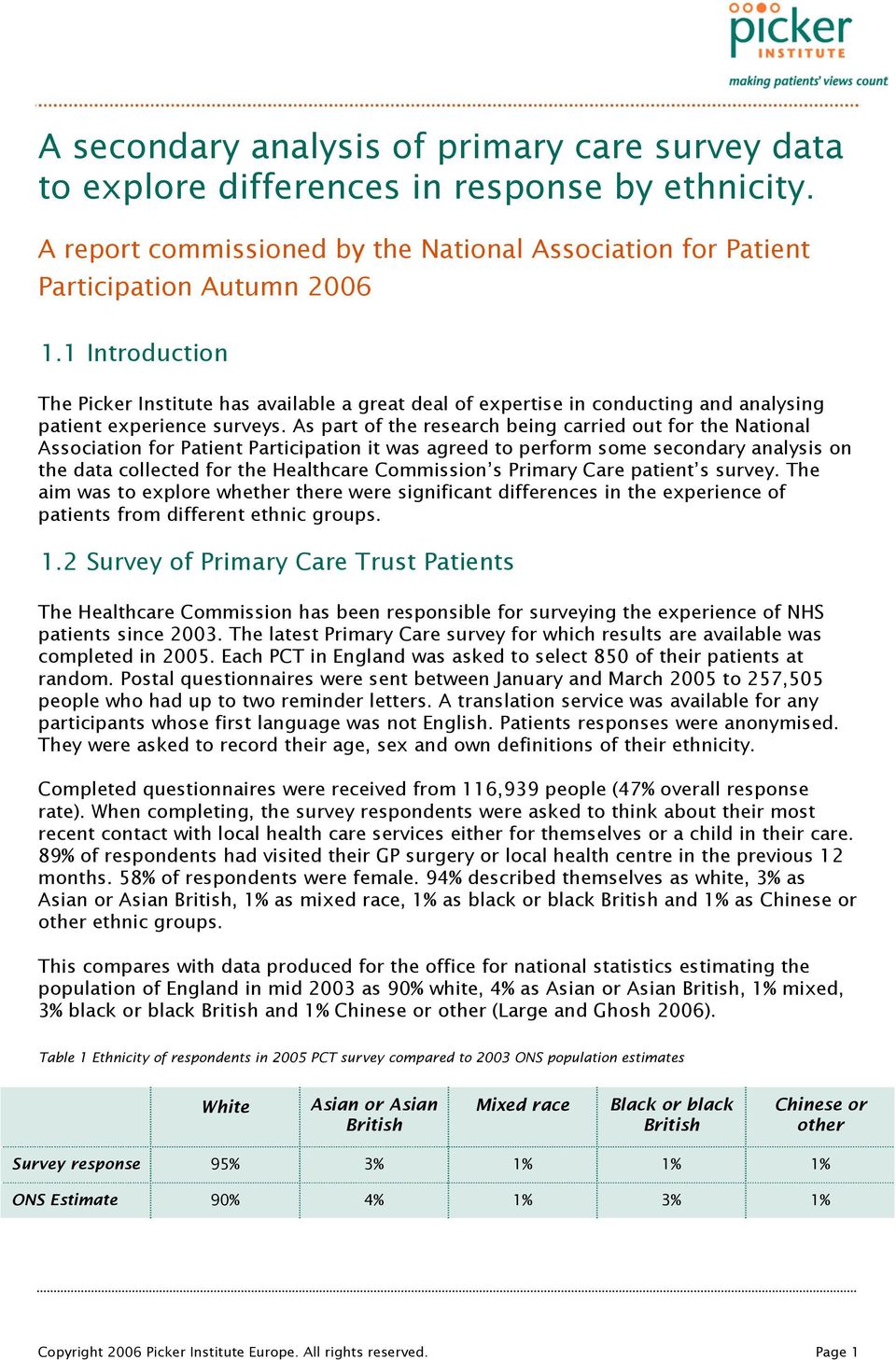
1 A secondary analysis of primary care survey data to explore differences in response by ethnicity. A report commissioned by the National Association for Patient Participation Autumn Introduction The Picker Institute has available a great deal of expertise in conducting and analysing patient experience surveys. As part of the research being carried out for the National Association for Patient Participation it was agreed to perform some secondary analysis on the data collected for the Healthcare Commission s Primary Care patient s survey. The aim was to explore whether there were significant differences in the experience of patients from different ethnic groups. 1.2 Survey of Primary Care Trust Patients The Healthcare Commission has been responsible for surveying the experience of NHS patients since The latest Primary Care survey for which results are available was completed in Each PCT in England was asked to select 850 of their patients at random. Postal questionnaires were sent between January and March 2005 to 257,505 people who had up to two reminder letters. A translation service was available for any participants whose first language was not English. Patients responses were anonymised. They were asked to record their age, sex and own definitions of their ethnicity. Completed questionnaires were received from 116,939 people (47% overall response rate). When completing, the survey respondents were asked to think about their most recent contact with local health care services either for themselves or a child in their care. 89% of respondents had visited their GP surgery or local health centre in the previous 12 months. 58% of respondents were female. 94% described themselves as white, 3% as Asian or Asian, 1% as mixed race, 1% as black or black and 1% as Chinese or other ethnic groups. This compares with data produced for the office for national statistics estimating the population of England in mid 2003 as 90% white, 4% as Asian or Asian, 1% mixed, 3% black or black and 1% Chinese or other (Large and Ghosh 2006). Table 1 Ethnicity of respondents in 2005 PCT survey compared to 2003 ONS population estimates White Asian or Asian Mixed race Black or black Chinese or other Survey response 95% 3% 1% 1% 1% ONS Estimate 90% 4% 1% 3% 1% Copyright 2006 Picker Institute Europe. All rights reserved. Page 1
2 The phenomenon of a reduced response from minority ethnic communities to surveys is one that is well recognised by researchers. Ethnic minority response rates to general population surveys are lower than Whites. This will be due to a range of possible factors including language problems and cultural barriers as well as issues around respondent enumen and identification (for example it is probable that many people whose immign status is contentious do not appear on official lists). Whilst the disparities are perhaps striking the response rates for this survey are very similar in their profile to almost every other survey of this kind. Whether or not the ethnic minority sample is representative, comparisons can still be made between the responses of different ethnic groups about their primary care healthcare experience. 1.3 Dataset The data used in this analysis was from the 2005 PCT survey (N=116,939 on a 47% response rate). The questionnaire consisted of a set of 48 core questions about 8 dimensions of the patient s experience of Primary Healthcare. A large sample size, from a national survey of all PCT s allows robust examination of differences between sub groups. Sub group effects such as differences between ethnic groups may not be demonstrable with limited data from a single PCT Methodology for our secondary analysis From the completed questionnaires ethnicity was coded as White, Mixed, Asian, Black, and Chinese/other. Age was derived from date of birth and categorised in to 5 age bands. The proportion in each category was calculated and compared using a chi 2 test. A further analysis was performed using age and sex adjusted logistic regression to calculate the likelihood of less than ideal experience of primary care. Each categorical question was transformed into a binary outcome, with 0 reflecting an ideal outcome and 1 less than ideal outcome. The white group was the reference group against which the odds of a less than ideal experience for each ethnic group was compared. The results of the secondary analysis are expressed in terms of the odds s (OR). These compare the proportion of minority ethnic respondents reporting a poor or very poor experience to the proportion of white people reporting a poor or very poor experience. Patient experience of healthcare varies significantly with age and a little by sex. In very broad terms in most surveys older people report better patient experience than younger people. Further, ethnic groups differ in their age profile compared to majority white group, for example Asians have a younger age profile than the white population. It s therefore important to take into account such differences when comparing ethnic minority healthcare experience with the majority White group. As such both unadjusted and age, sex adjusted OR s with 95% confidence intervals are reported. 1.5 Headline results from survey as published 89% of respondents had visited the doctors within the previous 12 months. Three quarters (76%) felt they had been seen as soon as necessary. Copyright 2006 Picker Institute Europe. All rights reserved. Page 2

3 A similar proportion (74%) reported that they had been seen within the governments 48 hour waiting time target. Six percent of people said that they were often deterred from going to the doctors because of the opening hours, a further 15% said they were sometimes put off. 72% of respondents rated their practice or health centre as very clean. 92% recorded that their doctor treated them with dignity and respect, 76% had trust and confidence in their doctor. Three quarters of people received answers that they could understand when they had questions for their doctor. 59% of patients felt they were involved in decisions as much as they wanted to be about their medication and 86% felt they had enough information about how to take their medication. WAITING TIMES All ethnic minority groups were more likely to report that that they had to wait for more than one or two days for an appointment than their white counterparts. Asian and Asian respondents were 1.56 times as likely as white patients to report this (95% CI 1.42 to 1.70). All minority ethnic groups were more likely to report that they would have preferred to see the doctor either a bit or a lot sooner than white patients. Asian/Asian patients were 3.39 (CI 3.11 to 3.69) times as likely to report this as their counterparts, black/black patients 1.83 (95% CI 1.61 to 2.07) and Chinese/Other 2.19 (95% CI 1.81 to 2.64) There was little difference between ethnic groups on the question whether they wished that somebody had told them how long they would have to wait in the waiting room suggesting that all patients would want to know how long they had to wait. SEEING THE DOCTOR All minority ethnic groups expressed the sentiment that they wished to be more involved than they were in decisions about care and treatment than white patients. This was an issue that was particularly marked before the effects of differing age and sex profiles were removed. Having adjusted for age and sex Asian and Asian people were still 1.99 times more likely (95% CI 1.84 to 2.16) to express the desire to be more involved than their white counterparts, Chinese/other patients were 1.9 times (95% CI 1.58 to 2.29) as likely to feel that way. Black/black patients were 1.48 times (95% CI 1.32 to 1.66) as likely. All minority ethnic groups were more likely to report that their doctor had not explained the reasons for any treatment in a way that they could understand. Chinese/other patients were twice as likely (OR % CI 1.65 to 2.41) to express this sentiment than the majority white population. Asian/Asian patients responded in a similar way (OR % CI 1.82 to 2.15). On the question of getting answers they could understand when they had questions for the doctor, ethnic minority groups had a less positive experience than white people. In particular Asian/Asian patients (OR % CI 1.56 to 1.85) and Chinese/other patients (OR % CI 1.43 to 2.11) recorded a poorer experience. Copyright 2006 Picker Institute Europe. All rights reserved. Page 3
4 On the question about having trust and confidence in the doctor there were again some disparities. Chinese/other patients were twice as likely (OR % CI ) and Asian/Asian patients were one and half times as likely (OR % CI ) to answer to some extent or no than were white patients. A key question for the research work that Picker does is Did the doctor treat you with respect and dignity? Chinese/other patients were three times as likely as white patients (OR % CI 2.44 to 3.81) to answer only some of the time or no. The figure for Asian/Asian is nearly as stark (OR % CI 2.09 to 2.58) and for black/black patients is 1.52 (95% CI 1.29 to 1.81) MEDICINES MANAGEMENT There were also some ethnic minority differences in responses to the question Were you as involved as much as you wanted to be in decisions about the best medicines for you? Chinese/other (OR % CI 1.48 to 2.41), Asian/Asian (OR to 1.82) and black/black (OR to 1.73) patients all indicated that they had not been involved in decisions about the best medicines for them as much as when compared white respondents. On the question about information about how to use the medicine Asian/Asian patients (OR % CI ) and Chinese/other patients (OR % CI ) were much more likely than white patients to report that they would have liked some more (or any) information about how to use their medication. OTHER PROFESSIONALS FROM A HEALTH CENTRE On the question about whether the patients felt that they had been treated with dignity and respect by a health professional other than a doctor, there were positive response as with the question about doctors overall. However a significant minority of patients felt there was room for improvement. In particular the Asian/ Asian group were over 2 times more likely to report that they had not or only some of the time been treated with respect and dignity. Table 2. of reporting being treated with respect and dignity by ethnicity Unadjusted results Results adjusted for sex and age White Mixed Asian/Asian Black/black Chinese /Other THE ENVIRONMENT Copyright 2006 Picker Institute Europe. All rights reserved. Page 4

5 The question In your opinion how clean is the surgery/health centre? is interesting for us. This may indicate differing perceptions of cleanliness. Usually older people report better satisfaction with the levels of cleanliness. This is a good example of how adjusting for age and sex shows a reduction in the OR s in perceptions of cleanliness in all groups.. Table 3. Perceptions of GP surgery cleanliness by ethnicity Unadjusted results Results adjusted for sex and age White Mixed Asian/Asian Black/black Chinese /Other However, it shows that patients from all ethnic minority groups were more likely to perceive a lack of cleanliness in the surgery than white patients. It is nearly three times as likely in the case of Asian/Asian and Chinese/other patients. OPENING HOURS This again is interesting; from Asian/Asian patients were twice as white patients to have been often or sometimes been put off from going to their doctors/health centre because of difficulties with GP surgery opening hours. (OR % CI 1.95 to 2.27). Similarly, for Chinese/other respondents (OR % CI 1.34 to 1.88). (Some PCTs asked a further question about whether patients, if there were to be extended opening hours, would prefer them to be in the morning, the evening or the weekend. For the reasons explained earlier, the number responding to these optional questions are fewer. In this data there are strong indications that ethnic minority groups preferred weekend opening though claims for statistical significant differences still need to be examined. 1.6 Conclusions There are real differences in the perceived primary health care experience of ethnic minority patients that are not just due to differences in age and sex. It is certainly worth primary care organisations and patient groups being aware of these when planning and delivering services. It will be important to be sensitive to these differences at an organisational and a patient level. 1.7 References Large P and Ghosh K Estimates of the population by ethnic 2006 ONS group for areas within England Copyright 2006 Picker Institute Europe. All rights reserved. Page 5

Patient survey report 2008. Category C Ambulance Service User Survey 2008 North East Ambulance Service NHS Trust
 Patient survey report 2008 Category C Ambulance Service User Survey 2008 The national Category C Ambulance Service User Survey 2008 was designed, developed and co-ordinated by the Acute Surveys Co-ordination
PPG & Survey Results Report 2014/15
 PPG & Survey Results Report 2014/15 Patient Reference Group The patient group comprises 25 members Distribution Details Attendance Gender Ethnicity Age Survey Results Patient Satisfaction Survey 2014/15
Outpatient Survey 2011
 THE ROYAL BOURNEMOUTH AND CHRISTCHURCH HOSPITALS NHS FOUNDATION TRUST FINAL REPORT NOVEMBER 0 Copyright 0 Picker Institute Europe. All rights reserved. Trust ID: RDZ UKOUT0/09 Contacting Picker Institute
UNIVERSITY MEDICAL CENTRE PATIENT PARTICIPATION GROUP ANNUAL REPORT & ACTION PLAN 2012-13
 UNIVERSITY MEDICAL CENTRE PATIENT PARTICIPATION GROUP ANNUAL REPORT & ACTION PLAN 2012-13 Introduction & Recruitment of the Patient Participation Group Review on how and why the Patient group was established:
The cleanliness of the surgery scored highly with over 95% of respondents rating it as either very good or good.
 The Manor Surgery Patient Satisfaction Survey 2013-2014 There were 372 respondents to the Patient Survey questionnaire. The gender of the respondents to the questionnaire was 64.25% female and 35.75% male.
JSNA Factsheet Template Tower Hamlets Joint Strategic Needs Assessment 2010 2011
 JSNA Factsheet Template Tower Hamlets Joint Strategic Needs Assessment 2010 2011. Executive Summary This fact sheet considers breast cancer, with a particular emphasis on breast screening and raising awareness
Standard Reporting Template
 Standard Reporting Template Practice Name: Lockswood Surgery Practice Code: J 82174 NHS England (Wessex) 2014/15 Patient Participation Enhanced Service Reporting Template Signed on behalf of practice:
1-In the past 12 months, how many times have you seen a doctor at your Surgery?
 DR RABIE & PARTNERS KIDSGROVE MEDICAL CENTRE SURVEY AND VIRTUAL PPG REPORT FOR 2014 to 2015 At the beginning of March 2015, we conducted our yearly patient survey, both in house and via the virtual PPG
62 BATTLE ROAD ERITH, KENT DA8 1BJ TEL: 01322 432997 Fax: 01322 442324 DR K S NANDRA
 62 BATTLE ROAD ERITH, KENT DA8 1BJ TEL: 01322 432997 Fax: 01322 442324 DR K S NANDRA Patient Participation Group Report March 2013 The Bulbanks Medical Centre Patient Participation Group currently has
2. Incidence, prevalence and duration of breastfeeding
 2. Incidence, prevalence and duration of breastfeeding Key Findings Mothers in the UK are breastfeeding their babies for longer with one in three mothers still breastfeeding at six months in 2010 compared
Patient satisfaction survey
 Please answer the questions by ticking the box next to your answer. Section A: The triage system 1. Are you aware of the triage system? (If no, please move onto Section B) Yes No 2. What do you feel is
Patient Participation Directed Enhanced Service. Watling Vale Medical Centre K82076. April 2013 to March 2014
 Patient Participation Directed Enhanced Service Watling Vale Medical Centre K82076 April 2013 to March 2014 Background and Introduction to Watling vale Medical Centre Opening Hours Monday to Friday 8am
The Hammersmith Surgery - Patient participation Survey year 3. Registered number of patients: 9528. Practice Profile:-
 The Hammersmith Surgery - Patient participation Survey year 3 Registered number of patients: 9528 Practice Profile:- The practice serves a diverse mix of local residents, some of whom have lived in the
East of England Ambulance Service NHS Trust. Patient Transport Service Patient Experience Report: Hinchingbrooke Health Care NHS Trust
 East of England Ambulance Service NHS Trust Patient Transport Service Patient Experience Report: Hinchingbrooke Health Care NHS Trust Author: Laura Mann, Patient Experience Analyst Data Period: 23 rd to
PATIENT PARTICIPATION GROUP REPORT ON OVERTON PARK SURGERY S PATIENT SURVEY CONDUCTED IN JANUARY 2012
 PATIENT PARTICIPATION GROUP REPORT ON OVERTON PARK SURGERY S PATIENT SURVEY CONDUCTED IN JANUARY 2012 PROFILE OF GROUP MEMBERS There were eight Group members at the time the survey was carried out. Their
Standard Reporting Template
 Standard Reporting Template Practice Name: Southernhay House Surgery Practice Code: L83058 Devon, Cornwall and Isles of Scilly Area Team 2014/15 Patient Participation Enhanced Service Reporting Template
Analysis of Employee Contracts that do not Guarantee a Minimum Number of Hours
 Analysis of Employee Contracts that do not Guarantee a Minimum Number of Hours Coverage: GB Date: 30 April 2014 Geographical Area: GB Theme: Labour Market 1. Summary There is no legal definition of zero-hours
HEALTH & WELL-BEING: AN EMPLOYER S PERSPECTIVE
 HEALTH & WELL-BEING: AN EMPLOYER S PERSPECTIVE Introduction Organisations provide employee benefits for a variety of different reasons. For some, it s to reward employees. For others, it s to keep up with
GP Patient Survey Your Doctor, Your Experience, Your Say
 To: GP Practices Chief Executives of Primary Care Trusts Dear Colleague GP Patient Survey Your Doctor, Your Experience, Your Say This letter confirms arrangements for delivery of the 2008 GP Patient Survey.
Annex D: Standard Reporting Template
 Annex D: Standard Reporting Template Practice Name: Dr Pidsley & Partners, Bridge Surgery Practice Code: M83042 Shropshire and Staffordshire Area Team 2014/15 Patient Participation Enhanced Service Reporting
Health Status, Health Insurance, and Medical Services Utilization: 2010 Household Economic Studies
 Health Status, Health Insurance, and Medical Services Utilization: 2010 Household Economic Studies Current Population Reports By Brett O Hara and Kyle Caswell Issued July 2013 P70-133RV INTRODUCTION The
HMRC Tax Credits Error and Fraud Additional Capacity Trial. Customer Experience Survey Report on Findings. HM Revenue and Customs Research Report 306
 HMRC Tax Credits Error and Fraud Additional Capacity Trial Customer Experience Survey Report on Findings HM Revenue and Customs Research Report 306 TNS BMRB February2014 Crown Copyright 2014 JN119315 Disclaimer
Understanding patient access to online GP services
 Understanding patient access to online GP services Summary The shift to digital GP services provides important opportunities for people to take greater control over their health and care and to reduce
Time to Act Urgent Care and A&E: the patient perspective
 Time to Act Urgent Care and A&E: the patient perspective May 2015 Executive Summary The NHS aims to put patients at the centre of everything that it does. Indeed, the NHS Constitution provides rights to
APPENDIX ONE: SUMMARY TABLE OF SURVEY FINDINGS AND ACTIONS TAKEN ANNUAL PATIENT AND PUBLIC SURVEY 2013: SUMMARY OF KEY FINDINGS
 APPENDIX ONE: SUMMARY TABLE OF SURVEY FINDINGS AND ACTIONS TAKEN ANNUAL PATIENT AND PUBLIC SURVEY 2013: SUMMARY OF KEY FINDINGS Topic Finding Action taken/planned Awareness of the GDC Unprompted awareness
Ipswich and Suffolk Council for Racial Equality. Experience of health care services in Suffolk: Black and Minority Ethnic (BME) residents speak out
 Ipswich and Suffolk Council for Racial Equality Experience of health care services in Suffolk: Black and Minority Ethnic (BME) residents speak out Sandy Phagura, Researcher August 2007 Contents 1. Background
Patient Satisfaction Survey May 2014. Nurses, Healthcare assistant and Phlebotomist
 Patient Satisfaction Survey May Nurses, Healthcare assistant and Phlebotomist N: Hannah Holland / Patient Satisfaction Survey - / Patient Satisfaction Survey May Nurses . In the past, how many times have
2014/15 Patient Participation Enhanced Service Reporting
 Practice Name: PLANE TREES GROUP PRACTICE 2014/15 Patient Participation Enhanced Service Reporting 1. Prerequisite of Enhanced Service Develop/Maintain a Patient Participation Group (PPG) Does the Practice
Drs Beales, Crowley, Strachan & Navamani North Road Surgery, 77 North Road, Kew, Richmond, TW9 4HQ www.northroadsurgery.nhs.uk
 24th March 2013 Drs Beales, Crowley, Strachan & Navamani North Road Surgery, 77 North Road, Kew, Richmond, TW9 4HQ www.northroadsurgery.nhs.uk Introduction North Road Surgery This report summarises the
Mental Health Acute Inpatient Service Users Survey Questionnaire
 Mental Health Acute Inpatient Service Users Survey Questionnaire What is the survey about? This survey is about your recent stay in hospital for your mental health. Who should complete the questionnaire?
Profile of the members of the PRG
 Profile of the members of the PRG Thornaby and Barwick Medical Group 2014 Local Participation Report (The data and information contained within this report is gathered from and relates to Thornaby & Barwick
Appendix C. Logistic regression analysis
 Appendix C. Logistic regression analysis Summary Logistic regression analysis was undertaken in order to explore the factors associated with breastfeeding initiation and prevalence at two and six weeks.
Birmingham GP SURVEY REPORT. Griffins Brook Medical Centre 119 Griffins Brook Lane, Birmingham B30 1QN
 Birmingham GP SURVEY REPORT Griffins Brook Medical Centre 119 Griffins Brook Lane, Birmingham B30 1QN Contents 1 2 3 4 5 6 7 Foreward & Background The Process Griffins Brook Medical Centre Patients Survey
Sleaford Medical Group Local Patient Participation Report 2012/13
 A description of the profile of the members of the PPG Sleaford Medical Group Local Patient Participation Report 2012/13 There are currently 33 patient members of the Sleaford Medical Group (SMG) Patient
Stour Access System: a new way to manage GP appointments Better for GPs, better for patients, better all-round
 12:56 Page 1 Stour Access System: a new way to manage GP appointments Better for GPs, better for patients, better all-round Take control of your time, improve the flow of patients, improve access and whats
Annex D: Standard Reporting Template
 Annex D: Standard Reporting Template Practice Name: Dr Hill and Partners Practice Code: B81042 North Yorkshire and Humber Area Team 2014/15 Patient Participation Enhanced Service Reporting Template Signed
Patient Experiences with Acute Inpatient Hospital Care in British Columbia, 2011/12. Michael A. Murray PhD
 Patient Experiences with Acute Inpatient Hospital Care in British Columbia, 2011/12 Michael A. Murray PhD Dec 7, 2012 Table of Contents TABLE OF CONTENTS... 2 TABLE OF FIGURES... 4 ACKNOWLEDGEMENTS...
Conducting a Tenant Satisfaction Survey Key Issues
 Conducting a Tenant Satisfaction Survey Key Issues Produced by PPCR Associates 2 Introduction I have set out below the major key issues which we would normally include in a tender for conducting a resident
Evaluation of a Primary Care Dermatology Service: final report
 Evaluation of a Primary Care Dermatology Service: final report Report for the National Co-ordinating Centre for NHS Service Delivery and Organisation R&D (NCCSDO) December 2005 prepared by Chris Salisbury*
The Menzies-Nous Australian Health Survey 2012
 The Menzies-Nous Australian Health Survey 2012 Report 23 October 2012 Bold ideas Engaging people Influential, enduring solutions This page is intentionally blank. Nous Group n o usgro u p. c o m. a u i
The Marlborough Medical Practice Patient Participation Group (PPG) Survey 2015 RESULTS
 The Marlborough Medical Practice Patient Participation Group (PPG) Survey 2015 RESULTS Introduction The PPG Survey was carried out to allow patients and their carers to feedback on key aspects of the service
PATIENT PARTICIPATION DES 2012 to 2013
 PATIENT PARTICIPATION DES 2012 to 2013 The New Medical Centre F82021 23 March 2013 Dr Edison, Dr Ola and Dr Akwenuke 264 Brentwood Road Heath Park Romford Essex RM2 5SU Introduction This report summarises
Bristol, North Somerset, Somerset and South Gloucestershire Area Team 2014/15 Patient Participation Enhanced Service
 Bristol, North Somerset, Somerset and South Gloucestershire Area Team 2014/15 Patient Participation Enhanced Service Practice Name: St George Health Centre Practice Code: L81062 Signed on behalf of practice:
Figure 1.1 Percentage of persons without health insurance coverage: all ages, United States, 1997-2001
 Figure 1.1 Percentage of persons without health insurance coverage: all ages, United States, 1997-2001 DATA SOURCE: Family Core component of the 1997-2001 National Health Interview Surveys. The estimate
Patient participation report, March 2012
 Patient Reference Group Report and Action Plan March 2012 Patient participation report, March 2012 Our newly formed Patient Reference Group (PRG) includes five patient representatives from a cross section
HEALTHWATCH AND NHS COMPLAINTS ADVOCACY AN UPDATE ON THE IMPLEMENTATION OF SERVICES IN BEXLEY
 HEALTH OVERVIEW AND SCRUTINY COMMITTEE 7 APRIL 2014 HEALTHWATCH AND NHS COMPLAINTS ADVOCACY AN UPDATE ON THE IMPLEMENTATION OF SERVICES IN BEXLEY 1. INTRODUCTION The Health & Social Care Act 2012 transferred
GP Patient Survey Your doctor, your experience, your say
 GP Patient Survey Your doctor, your experience, your say Guidance 2007/08 for strategic health authorities, primary care trusts and GP practices Introduction 1. This document provides guidance on this
Ifield Medical Practice Local Patient Participation Report
 Ifield Medical Practice Local Patient Participation Report March 2013 Practice Profile Ifield Medical Practice currently has a list size of just under 10,000 patients with the following profile: Gender
Public and Private Sector Earnings - March 2014
 Public and Private Sector Earnings - March 2014 Coverage: UK Date: 10 March 2014 Geographical Area: Region Theme: Labour Market Theme: Government Key Points Average pay levels vary between the public and
Disparities in Realized Access: Patterns of Health Services Utilization by Insurance Status among Children with Asthma in Puerto Rico
 Disparities in Realized Access: Patterns of Health Services Utilization by Insurance Status among Children with Asthma in Puerto Rico Ruth Ríos-Motta, PhD, José A. Capriles-Quirós, MD, MPH, MHSA, Mario
SILLOTH GROUP MEDICAL PRACTICE PATIENT SURVEY/PPG REPORT 2014-15. http://www.sillothgroupmedicalpractice.nhs.uk
 SILLOTH GROUP MEDICAL PRACTICE PATIENT SURVEY/PPG REPORT 2014-15 http://www.sillothgroupmedicalpractice.nhs.uk Please follow the link above to access the results of our patient survey for 2014-2015 We
Childcare and early years survey of parents 2014 to 2015
 Childcare and early years survey of parents 2014 to 2015 March 2016 Tom Huskinson, Sylvie Hobden, Dominic Oliver, Jennifer Keyes, Mandy Littlewood, Julia Pye, and Sarah Tipping Contents Executive Summary...
Make up of a Modern Day Coach. Skills, Experience & Motivations
 Make up of a Modern Day Coach Skills, Experience & Motivations Introducing the research... As the world s largest training organisation for coaches, the coaching academy has developed a reputation for
Summary of Malago Surgery Patient Satisfaction Survey
 Summary of Malago Surgery Patient Satisfaction Survey Introduction Malago Surgery conducted a Patient Satisfaction Survey during February and March 2013. Questionnaires were made available to all patients
Beyond 2011: Population Coverage Survey Field Test 2013 December 2013
 Beyond 2011 Beyond 2011: Population Coverage Survey Field Test 2013 December 2013 Background The Beyond 2011 Programme in the Office for National Statistics (ONS) is currently reviewing options for taking
The importance of nurse leadership in securing quality, safety and patient experience in CCGs
 Briefing note: July 2012 The importance of nurse leadership in securing quality, safety and patient experience in CCGs Introduction For the NHS to meet the challenges ahead, decisions about health services
Complaints Annual Report
 Complaints Annual Report 1 st April 31 st March 2011 Date: May 2011 Prepared by: Martin Emery, Head of Patient Experience Sue Hardy, Director of Nursing 1 1. Introduction This report provides information
2011 Census: Cultural diversity in Kent
 Business Intelligence Statistical Bulletin January 2013 2011 Census: Cultural diversity in Kent Related documents 2011 Census results 2011 Census release timetable Equality & diversity The Office for National
BriefingPaper. The access/relationship trade off: how important is continuity of primary care to patients and their carers?
 CONTINUITY OF CARE SEPTEMBER 2006 BriefingPaper The access/relationship trade off: how important is continuity of primary care to patients and their carers? Key messages Patients want both quick access
Just under a fifth of full time 16-18 year olds (19.4%) were aged 18 at the beginning of the 2012/13 academic year.
 Analysis of 18 Year in FE Colleges RCU ref. Analysis of 18 Year olds in FE Colleges 1. Introduction This report has been prepared by RCU to support the AoC s response to the recent proposal by EFA to cut
BRITISH DERMATOLOGICAL NURSING GROUP
 Nurse Led systemic monitoring clinics guidance on setting up this service Introduction Nurse led systemic monitoring clinics are an innovative approach to improving care delivery and maintaining both a