
Treating Opioid Dependence with Suboxone
|
|
|
- Buddy Melton
- 10 years ago
- Views:
Transcription
1 SCSU10606_HCP_Mono_13.qxd 12/13/06 3:20 PM Page a A PRACTICAL GUIDE FOR HEALTHCARE PROFESSIONALS Treating Opioid Dependence with Suboxone

2 SCSU10606_HCP_Mono_13.qxd 12/13/06 3:20 PM Page b

3 SCSU10606_HCP_Mono_13.qxd 12/13/06 3:20 PM Page 1 Treating Opioid Dependence with Suboxone > Table of Contents Part 1 > An Introduction to Suboxone > 3 Part 2 > The Pharmacology and Pharmacokinetics of Suboxone > 5 Part 3 > Clinical Safety and Efficacy of Suboxone > 11 Part 4 > Managing Patients on Suboxone > 17 Part 5 > Minimizing Risk With Suboxone > 23 Part 6 > Learning Assessment > 31 Part 7 > References > 37 Part 8 > Appendices > 41 Appendix 1 > Opioid Dependency and Withdrawal > 41 Appendix 2 > Psychosocial Therapies > 47 Appendix 3 > Quick Reference Sheets > 50

4 SCSU10606_HCP_Mono_13.qxd 12/13/06 3:20 PM Page 2

5 SCSU10606_HCP_Mono_13.qxd 12/13/06 3:20 PM Page 3 Part 1 > An Introduction to Suboxone > Introduction Suboxone is a sublingual tablet, containing buprenorphine hydrochloride and naloxone (as naloxone hydrochloride dihydrate) in a 4:1 ratio. Two strengths are available: buprenorphine 2 mg/naloxone 0.5 mg and buprenorphine 8 mg/naloxone 2 mg. Suboxone is a Schedule III psychotropic substance according to the WHO classification scheme. > Introduction > Take-home Messages FIGURE 1.1 > THE TWO APPROVED DOSAGE STRENGTHS OF SUBOXONE buprenorphine 2 mg/naloxone 0.5 mg buprenorphine 8 mg/naloxone 2 mg Suboxone is indicated for the treatment of opioid drug dependence, within a framework of medical, social, and psychological treatment. Suboxone was developed in order to deliver the same efficacy and safety as Subutex (buprenorphine HCl), while reducing the potential for misuse. Lower potential for misuse may allow earlier graduation to take-home therapy, increasing access to treatment for more patients. When taken appropriately, Suboxone delivers the same performance as an equivalent dose of Subutex, since naloxone, an opioid antagonist, has poor bioavailability when administered by the sublingual route. However, if misused intravenously by some opioid-dependent patients, the antagonist effects of naloxone become apparent. The 4:1 buprenorphine-to-naloxone ratio was found to contain sufficient naloxone to produce antagonistic effects following intravenous administration, while not impairing the effectiveness of buprenorphine when the mixture is taken sublingually. [Mendelson 2003] Treatment is intended for use in adults and adolescents over age 15 years who have agreed to be treated for opioid dependence. [SmPC] Take-home Messages Suboxone is a new treatment for opioid dependency, containing buprenorphine hydrochloride and naloxone hydrochloride dihydrate in a single tablet. Suboxone was developed in order to deliver the same efficacy and safety as Subutex, while reducing the potential for buprenorphine misuse. Lower potential for misuse may allow earlier graduation to take-home therapy, increasing access to treatment for more patients. 3

6 SCSU10606_HCP_Mono_13.qxd 12/13/06 3:20 PM Page 4

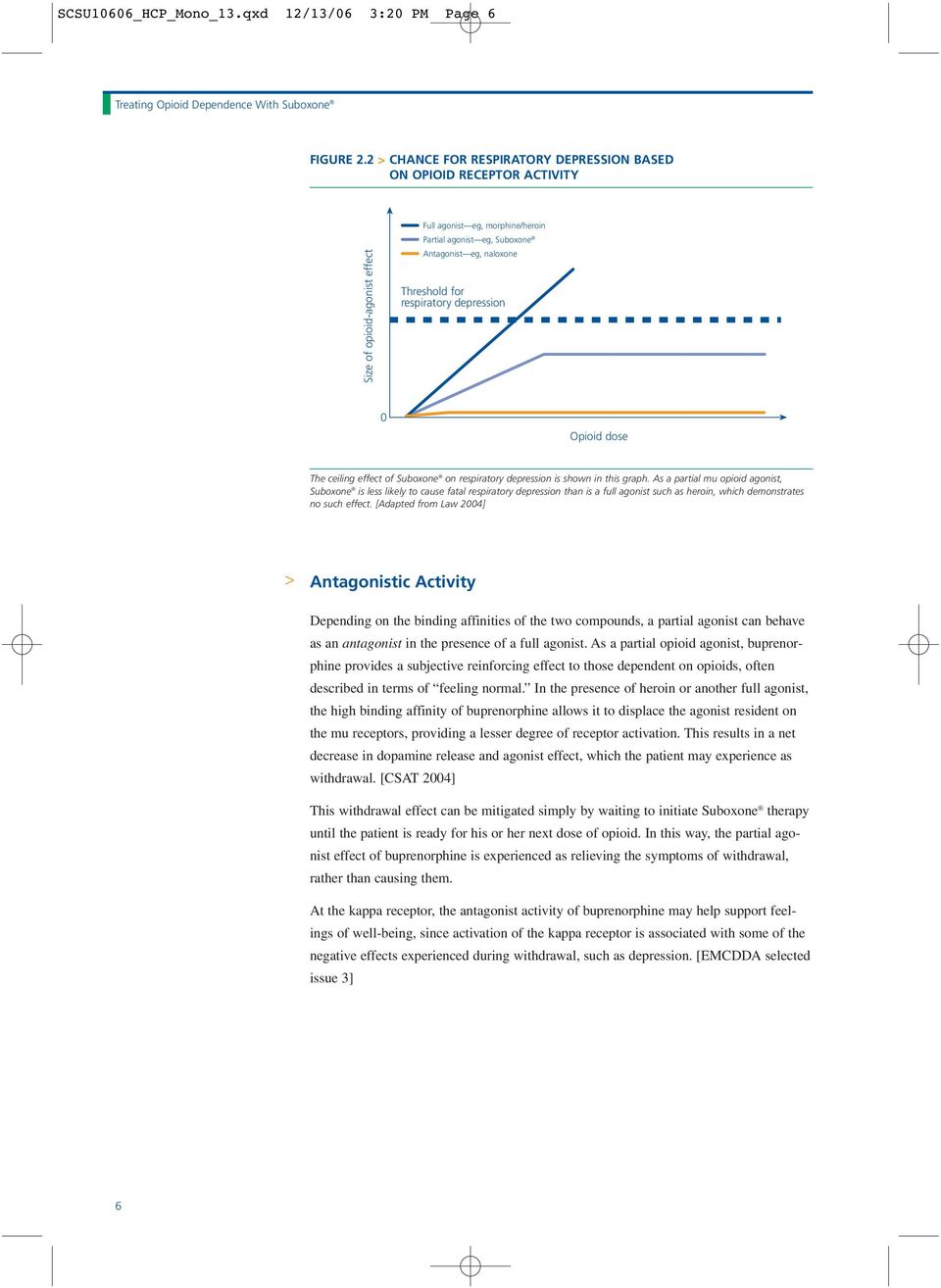
7 SCSU10606_HCP_Mono_13.qxd 12/13/06 3:20 PM Page 5 Part 2 > The Pharmacology and Pharmacokinetics of Suboxone > Buprenorphine: A Safe Ceiling Buprenorphine is a partial mu opioid agonist. It is also sometimes called a mixed agonistantagonist because it has partial activity at the mu receptor and antagonist activity at the kappa receptor. Whereas activation of a receptor by a full agonist like heroin or methadone produces the maximal release of dopamine, buprenorphine activates the same receptor to a lesser degree, inciting lower dopamine release. In addition, buprenorphine has a very high binding affinity for the mu receptor, which allows buprenorphine to displace most other opioids that may be in residence on the receptor (Figure 2.1). > Buprenorphine: A Safe Ceiling > Antagonistic Activity > The Role of Naloxone > Pharmacokinetics > Take-home Messages FIGURE 2.1 > EFFECTS OF FULL AND PARTIAL AGONISTS Representative effects of heroin (left), versus the partial opioid agonist buprenorphine (right). Dopamine release is reduced with buprenorphine, despite a higher binding affinity for the mu receptor. Red = receptor, yellow = full agonist; green = buprenorphine Although buprenorphine has a high affinity for the mu opioid receptor, its intrinsic activity is low. Hence, the dose-related agonist effects of buprenorphine reach a maximum, unlike those effects caused by heroin or another full opioid agonist, and do not continue to increase linearly with increasing doses of the drug. This phenomenon is known as the ceiling effect. [Johnson 2003] One consequence of the ceiling effect is that an overdose of buprenorphine is less likely to cause fatal respiratory depression than is an overdose of a full mu opioid agonist (see Figure 2.2). [Johnson 2003] This characteristic safety feature can be compromised by the concomitant misuse of CNS depressants such as benzodiazepines, alcohol, or other opioids, or when buprenorphine is not used according to prescribing information. [SmPC] 5

8 SCSU10606_HCP_Mono_13.qxd 12/13/06 3:20 PM Page 6 Treating Opioid Dependence With Suboxone FIGURE 2.2 > CHANCE FOR RESPIRATORY DEPRESSION BASED ON OPIOID RECEPTOR ACTIVITY Full agonist eg, morphine/heroin Size of opioid-agonist effect Partial agonist eg, Suboxone Antagonist eg, naloxone Threshold for respiratory depression 0 Opioid dose The ceiling effect of Suboxone on respiratory depression is shown in this graph. As a partial mu opioid agonist, Suboxone is less likely to cause fatal respiratory depression than is a full agonist such as heroin, which demonstrates no such effect. [Adapted from Law 2004] > Antagonistic Activity Depending on the binding affinities of the two compounds, a partial agonist can behave as an antagonist in the presence of a full agonist. As a partial opioid agonist, buprenorphine provides a subjective reinforcing effect to those dependent on opioids, often described in terms of feeling normal. In the presence of heroin or another full agonist, the high binding affinity of buprenorphine allows it to displace the agonist resident on the mu receptors, providing a lesser degree of receptor activation. This results in a net decrease in dopamine release and agonist effect, which the patient may experience as withdrawal. [CSAT 2004] This withdrawal effect can be mitigated simply by waiting to initiate Suboxone therapy until the patient is ready for his or her next dose of opioid. In this way, the partial agonist effect of buprenorphine is experienced as relieving the symptoms of withdrawal, rather than causing them. At the kappa receptor, the antagonist activity of buprenorphine may help support feelings of well-being, since activation of the kappa receptor is associated with some of the negative effects experienced during withdrawal, such as depression. [EMCDDA selected issue 3] 6
9 SCSU10606_HCP_Mono_13.qxd 12/13/06 3:20 PM Page 7 Part 2 > The Pharmacology and Pharmacokinetics of Suboxone > The Role of Naloxone Suboxone has been formulated with both naloxone and buprenorphine in order to deter the misuse of buprenorphine by injection. Naloxone is a full antagonist at the mu opioid receptors. As noted above, naloxone exhibits little or no pharmacologic effect when taken sublingually or orally by patients experiencing opioid withdrawal; this is due both to its poor sublingual absorption and extensive first-pass metabolism. However, if taken parenterally by opioid-dependent patients, naloxone precipitates opioid withdrawal, which is unpleasant and dysphoric (Figure 2.3). [Stoller 2001] The addition of naloxone circumvents some dependent persons ability to experience buprenorphine-induced euphoria via the intravenous route. Administration of naloxone through the nasal mucosa can also precipitate withdrawal in opioid-dependent individuals, suggesting that snorting Suboxone is likely to result in a naloxone-like effect in heroin users. [Loimer 1994] FIGURE 2.3 > MEAN PEAK SCORES BY VAS FOR SUBLINGUAL AND INJECTED BUPRENORPHINE/NALOXONE IN OPIOID-DEPENDENT PATIENTS 60 Mean peak score on visual analog scales Injection Sublingual * * P<0.05 P< /0.25 2/0.5 4/1.0 8/2.0 16/4.0 Buprenorphine/naloxone Mean peak scores by VAS of perceived bad effects for Suboxone when administered as indicated (sublingual, orange bar) and misused (injection, blue bar) in opioid-dependent patients. [Stoller 2001] Thus, if the patient has a full opioid agonist, such as heroin, bound to receptors at the time of misuse, the naloxone component will dislodge that opioid from the receptors. [Johnson 2003] 7

10 SCSU10606_HCP_Mono_13.qxd 12/13/06 3:20 PM Page 8 Treating Opioid Dependence With Suboxone > Pharmacokinetics [SmPC] Absorption/bioavailability Plasma levels of buprenorphine increase with the sublingual dose of Suboxone. Peak plasma concentrations are achieved 90 minutes after sublingual administration. Both the C max and AUC of buprenorphine increased with the increase in dose, although the increase was less than dose-proportional. Table 2.1 > PHARMACOKINETICS OF SUBOXONE Pharmacokinetic Parameter Suboxone 4 mg Suboxone 8 mg Suboxone 16 mg C max ng/ml 1.84 (39) 3.0 (51) 5.95 (38) AUC 0-48 hour ng/ml (35) (43) (33) The absorption of buprenorphine is followed by a rapid distribution phase (distribution half-life 2-5 hours). The addition of naloxone does not significantly alter the pharmacokinetic profile of buprenorphine (Figure 2.4). Whereas a wide inter-patient variability has been noted in the sublingual absorption of buprenorphine, intra-patient variability is low. Therefore, once the optimal dose is reached within a particular patient, bi-directional titration is predictable. FIGURE 2.4 > TIME COURSE OF BUPRENORPHINE PLASMA LEVELS AFTER ADMINISTRATION OF SUBUTEX AND SUBOXONE TABLETS. Buprenorphine Plasma Level (ng/ml) Suboxone Subutex Time (min) The difference between the two curves is not significant. [Strain 2004] 8

11 SCSU10606_HCP_Mono_13.qxd 12/13/06 3:20 PM Page 9 Part 2 > The Pharmacology and Pharmacokinetics of Suboxone Naloxone does not affect the pharmacokinetics of buprenorphine. Following oral administration, naloxone is barely detectable in plasma; following sublingual administration of Suboxone, plasma naloxone concentrations are low and decline rapidly. Metabolism and elimination Buprenorphine is metabolized by the liver through CYP3A4-mediated N-dealkylation and glucuronidation. Naloxone is primarily metabolized by glucuronidation. Buprenorphine is primarily excreted in the feces (70%), with the remainder excreted in the urine. Naloxone is primarily excreted in the urine. Dosage should be clinically titrated in patients with moderate to severe hepatic impairment. Patients with impaired hepatic function such as those with hepatitis B or C should be monitored during buprenorphine therapy using liver function tests. Methadone is known to interact with HIV antiretroviral therapy but less is known about buprenorphine s interaction with antiretroviral agents. In principle, protease inhibitors that inhibit CYP3A4 may lead to increased plasma concentrations of buprenorphine. [SmPC] Take-home Messages Suboxone is a partial mu opioid agonist. It is effective in suppressing the symptoms of opioid withdrawal, whereas its characteristic ceiling effect provides a lower risk for fatal respiratory depression than occurs with full agonists. Its naloxone component will not precipitate withdrawal if Suboxone is taken sublingually. However, when injected, the naloxone component will cause withdrawal in some opioiddependent patients, as it will dislodge and replace any full agonists, such as heroin, bound to mu receptors at the time of misuse. Since the bioavailability of naloxone by the intranasal route is excellent, the naloxone component of Suboxone may likely cause withdrawal if Suboxone is snorted. 9

12 SCSU10606_HCP_Mono_13.qxd 12/13/06 3:20 PM Page 10

13 SCSU10606_HCP_Mono_13.qxd 12/13/06 3:20 PM Page 11 Part 3 > Clinical Safety and Efficacy of Suboxone The safety and efficacy of Suboxone are the same as Subutex, and have been demonstrated in key clinical trials. The pivotal study was a two-phase multicenter trial of 326 patients designed to evaluate the efficacy and safety of Suboxone in an office-based setting. During phase I, the patients were randomized to one of three groups in a doubleblind, double-dummy fashion, receiving Suboxone (buprenorphine 16 mg and naloxone 4 mg), Subutex (16 mg), or placebo daily for 4 weeks. Patients had to return to the clinic each day, and received individual counseling for up to 1 hour each week. > Suboxone Plus Medical Management > Take-home Messages This was followed by a 48-week open-label safety phase, wherein patients were provided with up to 10 days dosing of Suboxone (up to 24 mg/6 mg buprenorphine/naloxone daily) at a time. [Fudala 2003] Overall, during phase I, the percentage of urine samples negative for opioids was significantly greater in the two groups of patients receiving buprenorphine than in those receiving placebo, at 17.8% for those receiving Suboxone, 20.7% for those receiving buprenorphine alone, and 5.8% for the placebo group (P<.001). Figure 3.1 shows the percentage of samples negative for opioids, cocaine, and benzodiazepines for treated patients when data from both phases of the study were combined. FIGURE 3.1 > PERCENTAGE OF URINE SAMPLES NEGATIVE FOR OPIATES, COCAINE, OR BENZODIAZEPINES AMONG SUBJECTS WHO RECEIVED SUBOXONE (52 WEEKS) 100 Urine Samples Negative for Drugs (%) Benzodiazepines Cocaine Opiates Weeks No. of Samples Tested For cocaine or benzodiazepines For opiates Patients in the buprenorphine groups also reported significantly less craving for opioids when compared with those receiving placebo (P<.001) (Figure 3.2). [Fudala 2003] 11

14 SCSU10606_HCP_Mono_13.qxd 12/13/06 3:20 PM Page 12 Treating Opioid Dependence With Suboxone FIGURE 3.2 > MEAN SCORES FOR OPIATE CRAVINGS 100 Buprenorphine-naloxone Buprenorphine alone Placebo Score Weeks For each of the 4 study weeks, the mean scores for opiate craving in the combined-treatment and buprenorphine groups were significantly lower than those in the placebo group (P<0.001 for both comparisons each week). Adverse events occurring in at least 5% of patients are listed in Table 3.1. [Fudala 2003] No deaths occurred during the course of the study. TABLE 3.1 > ADVERSE EVENTS REPORTED BY AT LEAST 5% OF PARTICIPANTS* Adverse Event Buprenorphine and Naloxone (N=107) Buprenorphine Alone (N=103) Placebo (N=107) P Value Headache 39 (36.4) 30 (29.1) 24 (22.4) 0.08 Withdrawal syndrome 27 (25.2) 19 (18.4) 40 (37.4) Pain 24 (22.4) 19 (18.4) 20 (18.7) 0.74 Insomnia 15 (14.0) 22 (21.4) 17 (15.9) 0.37 Nausea 16 (15.0) 14 (13.6) 12 (11.2) 0.73 Sweating 15 (14.0) 13 (12.6) 11 (10.3) 0.70 Abdominal pain 12 (11.2) 12 (11.7) 7 (6.5) 0.37 Rhinitis 5 (4.7) 10 (9.7) 14 (13.1) 0.09 Diarrhea 4 (3.7) 5 (4.9) 16 (15.0) Infection 6 (5.6) 12 (11.7) 7 (6.5) 0.24 Chills 8 (7.5) 8 (7.8) 8 (7.5) 1.0 Constipation 13 (12.1) 8 (7.8) 3 (2.8) 0.03 Back pain 4 (3.7) 8 (7.8) 12 (11.2) 0.12 Vasodilation or flushing 10 (9.3) 4 (3.9) 7 (6.5) 0.28 Vomiting 8 (7.5) 8 (7.8) 5 (4.7) 0.66 Weakness 7 (6.5) 5 (4.9) 7 (6.5) 0.87 * Data were unavailable for two of the subjects in each group. P values are for the overall comparison among the three groups. 12

15 SCSU10606_HCP_Mono_13.qxd 12/13/06 3:20 PM Page 13 Part 3 > Clinical Safety and Efficacy of Suboxone The investigators concluded that Suboxone was safe and effective in reducing the use of and craving for opioids in these patients when administered in an office-based setting. > Suboxone Plus Medical Management Suboxone is designed for use by physicians as a prescription therapy. Because it is well established that counseling can improve the results obtained with medication alone, the outcomes provided by three different management scenarios were compared in 166 opioid-dependent patients who had completed the induction and stabilisation stages of treatment with Suboxone. Patients were randomly assigned to: Standard medical management and once-weekly medication dispensing, with the patient taking Suboxone at home 6 days per week; Standard medical management and thrice-weekly medication dispensing, with the patient taking Suboxone at home 4 days per week, but for no more than 2 consecutive days; Enhanced medical management and thrice-weekly medication dispensing. The duration of administration for all three groups was 24 weeks. Standard management consisted of one 20-minute counseling session per week from a primary care nurse with no previous experience treating addiction, using information provided in a manual. Enhanced medical management consisted of a similar counseling session but of 45 minutes duration, and patients also met with a physician monthly for approximately 20 minutes. [Fiellin 2006] Treatment success was similar in patients taking the once-weekly dosing when compared with those receiving their medication three times per week (Table 3.2). Overall, the mean self-reported frequency of opioid use decreased from 5.3 days at baseline to about 0.4 during maintenance. About 40% of urine specimens were opioid-negative and about 43% of patients in each group remained in the study after 24 weeks. [Fiellin 2006] 13

16 SCSU10606_HCP_Mono_13.qxd 12/13/06 3:20 PM Page 14 Treating Opioid Dependence With Suboxone TABLE 3.2 > OUTCOMES FOR OPIOID-DEPENDENT PATIENTS RECEIVING SUBOXONE IN PRIMARY CARE* Outcome Standard Medical Management and Once-Weekly Medication Dispensing (N=54) Standard Medical Management and Thrice-Weekly Medication Dispensing (N=56) Enhanced Medical Management and Thrice-Weekly Dispensing (N=56) P Value Primary Opioidnegative urine specimens % 0.82 Mean % CI Maximum duration of continuous abstinence from illicit opioids wk 0.54 Mean % CI Secondary Days of the study completed 0.72 Mean % CI Patients who met criteria for protective transfer no. (%) 6 (11) 5 (9) 2 (4) 0.32 Cocainenegative urine specimens % 0.79 Mean % CI Treatment satisfaction score 0.04 Mean % CI Days adherent to buprenorphinenaloxone % 0.87 Mean % CI * CI denotes confidence interval. Study completion was defined as not meeting the criteria for protective transfer, not missing medication for more than 7 days, or not missing three or more counseling sessions. 14

17 SCSU10606_HCP_Mono_13.qxd 12/13/06 3:20 PM Page 15 Part 3 > Clinical Safety and Efficacy of Suboxone This study demonstrated that, with proper medical management, once-weekly dispensing of Suboxone was sufficient to produce a retention rate of >40% for 6 months. Take-home Messages Clinical trials have shown that Suboxone is as safe and effective as Subutex in the treatment of opioid dependency. The formulation appears to be well suited for use by physicians treating opioiddependent patients in the community. 15

18 SCSU10606_HCP_Mono_13.qxd 12/13/06 3:20 PM Page 16

19 SCSU10606_HCP_Mono_13.qxd 12/13/06 3:20 PM Page 17 Part 4 > Managing Patients on Suboxone > Treatment Principles and Challenges The fundamental principles of treating drug dependency have been widely evaluated; they are summarized in Table 4.1. Psychosocial therapy and pharmacotherapy form the two mainstays of therapy, and are often combined to achieve the best results. Psychosocial therapy entails various forms of individual or group therapy and counseling, designed to both help patients complete their course of pharmacotherapy, and to establish behavioral patterns that will allow them to maintain their abstinence. For an overview of the approaches to psychosocial therapy, please see Appendix 2. > Treatment Principles and Challenges > Pharmacotherapy With Suboxone > Maintenance Versus Withdrawal > Suboxone Dependency > Take-home Messages TABLE 4.1 > FUNDAMENTAL PRINCIPLES IN THE TREATMENT OF DRUG DEPENDENCY [NIDA 1999] Treatment must be accessible and available. Treatment interventions, setting, and services need to be tailored to patients specific needs. Treatment should also address factors contributing to the drug use, such as other medical, social, psychological, and legal problems. During treatment a patient may require other services, such as medical, legal, social, and vocational rehabilitation services. Treatment should last for an adequate period of time. Most patients require approximately 3 months of treatment in order to see significant improvement or progress. Measures should be undertaken to ensure that patients remain in treatment and do not leave prematurely. Behavioral/counseling therapies are critical components of the treatment process. Pharmacologic therapy, especially in combination with psychosocial therapy, has been proven to help opioid drug addicts stabilise their lives and reduce drug use. Patients with concomitant mental disorders should receive treatment for these underlying disorders as well. Medical detoxification must be followed by some type of maintenance or stabilisation treatment to change long-term drug use. Treatment does not need to be voluntary in order to be effective. Mandatory treatment (through employer or criminal justice system) can improve rates of treatment entry, retention, and success. Patients should be monitored during treatment for continuing drug use. Incentives for drug-free urine samples may help increase compliance. Treatment programs should also encompass therapy for concomitant infections such as HIV and hepatitis C. 17

20 SCSU10606_HCP_Mono_13.qxd 12/13/06 3:20 PM Page 18 Treating Opioid Dependence With Suboxone > Pharmacotherapy With Suboxone Suboxone therapy can be divided into four phases induction, stabilisation, maintenance, and medically supervised withdrawal, which together comprise one treatment episode. Phase 1: Induction The goal of induction is to safely suppress opioid withdrawal as quickly as possible with adequate doses of Suboxone ; rapid induction procedures help to retain patients on therapy. [Doran 2005] Regardless of whether the patient has been taking short-acting (eg, heroin) or long-acting (eg, methadone) opioids, patients cannot begin their induction to Suboxone until they are experiencing mild to moderate withdrawal symptoms. Induction is complete when the patient has received a therapeutic dose of Suboxone. How to Proceed: Do not initiate Suboxone therapy until you observe the patient in mild to moderate opioid withdrawal. Be sure that you discuss this with your patient before you initiate Suboxone therapy. Short-acting opioids. For patients taking heroin or other short-acting opioids, the first dose of Suboxone should be taken when signs of withdrawal appear, but not less than 6 hours after the patient last used their drug. Long-acting opioids. For patients converting from methadone therapy or other long-acting opioids, the first dose of Suboxone should be taken when signs of withdrawal appear, but not less than 24 hours after the patient last used methadone. The dose of methadone must be reduced to a maximum of 30 mg/day before beginning Suboxone therapy. [SmPC] Transfers from higher methadone doses have also been accomplished, [DiPetta 2005] but consultation with another provider who has experience doing such higher dose transfers may be helpful. If the patient experiences any ongoing withdrawal symptoms during the transition from methadone to Suboxone, limited amounts of ancillary non-opioid medications (eg, clonidine, loperamide, sleep aid, NSAID, etc) can be safely provided for symptomatic relief. For more information about transitioning patients from methadone to Suboxone, see the section in Part 5 on Switching Therapies. 18

21 SCSU10606_HCP_Mono_13.qxd 12/13/06 3:20 PM Page 19 Part 4 > Managing Patients on Suboxone TABLE 4.2 > SUBOXONE INDUCTION SCHEDULE Day 1 Initial dose 2-4 mg Day 2 Day 3 onwards Additional dose to be given depending on patient s requirements Titrate upwards in steps of 2-8 mg according to patient s requirements Continue to increase dose progressive according to patient s requirements in steps of 2-8 mg 2-4 mg Up to 24 mg Up to 24 mg Initial dosing. The recommended initial dose is one to two tablets of Suboxone administered sublingually, delivering a maximum of 8 mg of buprenorphine on day 1. The maximum single daily dose of buprenorphine after day 1 is 24 mg. As demonstrated by the pivotal clinical trial, patients were safely initiated at a level of 8 mg of buprenorphine on day 1, and raised to a dose of 16 mg on day 2. [Fudala 2003] The safety and efficacy of this induction dose using Suboxone have been confirmed in a subsequent trial. [Amass 2004] The most important thing the physician can do to ensure a successful induction phase is to plan to induce rapidly, match the pace of induction to the individual patient s needs, and titrate doses according to the clinical response, with frequent review. Precipitated withdrawal. As with Subutex, if Suboxone therapy is initiated too soon after an individual s last dose of opioid, it may cause the onset of withdrawal symptoms. This precipitated withdrawal occurs because buprenorphine has a high affinity for the opioid receptors and will displace any full opioid agonist from the receptor. The lower intrinsic activity of Suboxone results in a reduction of opioid activity, which is experienced by patients as symptoms of withdrawal. As noted previously, precipitated withdrawal can be mitigated simply by waiting to initiate Suboxone therapy until the patient is ready for his or her next dose of opioid. In this way, the partial agonist effect of buprenorphine is experienced as relieving the symptoms of withdrawal, rather than causing them. Phase 2: Stabilisation During stabilisation, the patient s Suboxone dose is fine-tuned. The objective is to find the dose necessary to keep the patient comfortable and in treatment. Stabilisation can last anywhere from a week to several weeks. How to Proceed: The dose of Suboxone should be increased progressively according to the clinical effect on the individual patient and should not exceed a maximum single daily dose of 24 mg. The dosage is titrated according to reassessment of the clinical and psychological status of the patient and should be made in steps of 2-8 mg. [SmPC] 19
22 SCSU10606_HCP_Mono_13.qxd 12/13/06 3:20 PM Page 20 Treating Opioid Dependence With Suboxone Phase 3: Maintenance The goals of Suboxone maintenance are to prevent opioid withdrawal symptoms, suppress opioid cravings, decrease the use of self-administered opioids, and address the goals of rehabilitation with each patient. The maintenance phase can last from months to years, up to a lifetime, depending on the individual. How to Proceed: During the initiation of treatment, daily dispensing of buprenorphine is recommended. After stabilisation, a reliable patient may be given a supply of Suboxone sufficient for several days of treatment. It is recommended that the amount of Suboxone be limited according to local requirements. [SmPC] Less than daily dosing. After a satisfactory stabilisation has been achieved the frequency of Suboxone dosing may be decreased to dosing every other day at twice the individually titrated daily dose. For example, a patient stabilised to receive a daily dose of 8 mg may be given 16 mg on alternate days, with no dose on the intervening days. However, the dose given on any one day should not exceed 24 mg. In some patients, after a satisfactory stabilisation has been achieved, the frequency of Suboxone dosing may be decreased to 3 times a week (for example on Monday, Wednesday, and Friday). The dose on Monday and Wednesday should be twice the individually titrated daily dose, and the dose on Friday should be three times the individually titrated daily dose, with no dose on the intervening days. However, the dose given on any one day should not exceed 24 mg. Patients requiring a titrated daily dose >8 mg/day may not find this regimen adequate. [SmPC] Efficacy is not compromised using these alternative dosing schedules, with outcomes at least equivalent to those obtained with standard daily regimens. [Amass 2000, Amass 2001] Phase 4: Medically supervised withdrawal In this phase, the Suboxone dose is tapered. Patients may proceed directly to this phase from stabilisation; however, maintenance is usually encouraged, because it is associated with a higher likelihood of treatment success. [CSAT 2004, Kakko 2003] Mild withdrawal symptoms are possible as the Suboxone dose declines. Patients may elect to discontinue their taper and return to maintenance at any time. How to Proceed: The availability of Suboxone in doses of 2 mg and 8 mg allows for a downward titration of dosage; in some favourable cases, treatment may be discontinued. For patients who may require a lower buprenorphine dose, Subutex 0.4 mg sublingual tablets may be used. Patients should be monitored following termination of treatment because of the potential for relapse. [SmPC] 20
23 SCSU10606_HCP_Mono_13.qxd 12/13/06 3:20 PM Page 21 Part 4 > Managing Patients on Suboxone > Maintenance Versus Withdrawal As noted above, maintenance therapy is often recommended over withdrawal, as it has a higher likelihood of success. This stance is well illustrated in a study of 40 opioiddependent individuals who were randomly assigned to receive buprenorphine 16 mg/day for 12 months (at least 6 months of supervised daily administration with possible takehome doses thereafter) or a tapered 6-day regimen of buprenorphine followed by placebo (supervised daily administration). [Kakko 2003] All patients participated in cognitive-behavioral group therapy, had weekly individual counseling sessions, and submitted urine samples thrice weekly. [Kakko 2003] After 1 year, 75% of the buprenorphine group remained on protocol, compared with none of the patients in the placebo group (P = , see Figure 4.1). Nearly 75% of urine samples from the buprenorphine group were drug-free, indicating a low incidence of illicit drug use. [Kakko 2003] In addition, the authors reported a significantly reduced survival among the placebo patients, four of whom died during the course of the study. No deaths were recorded in the maintenance group (20% vs 0%, Cox s regression P = 0.015). [Kakko 2003] FIGURE 4.1 > KAPLAN-MEIER CURVE OF PATIENTS REMAINING IN THERAPY THROUGHOUT THE COURSE OF THE STUDY [KAKKO 2003] Number remaining in treatment Control Buprenorphine P= Time from randomization (days) Number at risk
24 SCSU10606_HCP_Mono_13.qxd 12/13/06 3:20 PM Page 22 Treating Opioid Dependence With Suboxone > Suboxone Dependency Chronic administration of Suboxone produces physical dependence of the opioid type. [Suboxone Pharmacists FAQ 2005] However, the physical withdrawal symptoms following discontinuation are reported to be mild to moderate, possibly because buprenorphine is a partial mu opioid agonist, with a lesser euphoric effect than heroin or another full agonist. In addition, it dissociates slowly from opioid receptors, thereby decreasing the intensity and delaying the onset of withdrawal symptoms. Take-home Messages It is important to begin dosing Suboxone only after the effects of the patient s last dose of opioid have begun to wane; this requires at least a 6-hour interval in patients taking short-acting opioids like heroin, but may extend beyond 24 hours in patients taking long-acting preparations or converting from methadone maintenance. Patients should be titrated to the target maintenance dose as quickly as possible, because rapid induction procedures help to retain patients on therapy. Patients have been safely started at a level of 8 mg of buprenorphine on day 1; the dose is titrated according to the patient s status in daily steps of 2-8 mg up to a maximum single daily dose of 24 mg. Once the target dose is achieved, dosing schedules of every 2 or 3 days may be implemented with no reduction in efficacy; take-home doses may also be supplied, subject to local regulations. Long-term therapy is recommended, however selected patients may choose to undergo full withdrawal of therapy under a physician s guidance. Such patients may be returned to maintenance therapy at any time. 22
25 SCSU10606_HCP_Mono_13.qxd 12/13/06 3:20 PM Page 23 Part 5 > Minimizing Risk With Suboxone > Misuse/Diversion of Suboxone Diversion refers to the introduction of buprenorphine into the illicit market either by patients or by individuals who obtain the medicinal product through theft from patients or pharmacies. This diversion may lead to new addicts using buprenorphine as the primary drug of abuse, with the risks of overdose, spread of blood-borne viral infections, respiratory depression, and hepatic injury; the risk of overdose is particularly acute in those concomitantly abusing alcohol or other CNS depressants, such as benzodiazepines. Because the naloxone in the combination tablet precipitates sudden withdrawal in individuals dependent on heroin, methadone, or other full agonists, Suboxone is less likely to be diverted for intravenous use. Nevertheless, misuse of both Subutex and Suboxone has been reported. In a survey of attendees at a Helsinki needle exchange program, buprenorphine was the most frequently used IV drug for 73% of respondents. More than 75% had used IV buprenorphine to self-treat addiction or withdrawal. Many had also misused Suboxone by injection but 80% of those who did reported having a bad experience. [Alho in press] > Misuse/Diversion of Suboxone > Counseling > Managing Overdose > Use of Suboxone With CNS Depressants > Use of Suboxone With Cytochrome P450-active Substances > Use of Suboxone in Patients With Hepatic Impairment > Reduced Risk of Hepatitis, HIV > The Pregnant Patient > Switching Therapies > Common Side Effects > Take-home Messages In the event that Suboxone is misused by injection, it is less likely than a full agonist to cause serious respiratory depression due to the ceiling effect of buprenorphine on respiratory depression. In cases of intravenous misuse, local reactions, sometimes septic, and potentially serious acute hepatitis have been reported. Suboxone should be stored in a secure area, out of the sight and reach of children. In the case of suspected ingestion by a child, emergency treatment should be administered following the guidelines listed in the section Managing Overdose on page 25. TABLE 5.1 > MINIMIZING RISK WITH SUBOXONE Dose adequately Provide patients with access to counseling Clinicians should monitor the patient s progress during therapy All serious or severe adverse events should be reported to the appropriate local agency Depending on local regulations, takeaways should be allowed with evidence of clinical stabilization and compliance If diversion or misuse is suspected: - Restrict takeaways - The physician should revisit the treatment plan with the patient to develop a treatment plan that will encourage compliance Urine drug screening may be helpful in assessing compliance Store supplies securely Be sure that patients store their Suboxone out of the reach of children In the event of overdose, or of suspected ingestion by a child, implement symptomatic treatment of respiratory depression and standard intensive care measures Use with care in patients with hepatic impairment Benzodiazepines may be used in selected patients treated with Suboxone. However, misuse of this combination has resulted in death due to respiratory depression. Therefore, dosages must be limited and the combination avoided in cases where there is a risk of misuse Do not use in pregnant patients, or allow breast feeding during use Report suspected incidents of diversion to local drug-enforcement agency Alert your Schering-Plough Field Representative to suspected incidents of diversion 23
26 SCSU10606_HCP_Mono_13.qxd 12/13/06 3:20 PM Page 24 Treating Opioid Dependence With Suboxone Underdosing may initiate misuse The risk of serious undesirable effects such as overdose or noncompliance is greater if a patient is underdosed with Suboxone and attempts to self-medicate withdrawal symptoms with opioids, alcohol, or other sedative-hypnotics, particularly benzodiazepines. In fact, subtherapeutic dosing of Suboxone is a common reason for misuse. Therefore, it is recommended that dosing be individually titrated for each patient and that maintenance dosing be kept at an adequate level to prevent withdrawal symptoms. This adequate dosing level was examined in a study of seven heroin-dependent volunteers. [Comer 2005] The effects of maintenance therapy with sublingual Suboxone at doses of 2/0.5, 8/2, and 32/8 mg were measured against the reinforcing and subjective effects of intranasal heroin at 0, 12.5, 25, 50, and 100 mg. During the 6-week test period, subjects were first stabilized on the dose of Suboxone needed to block the occurrence of withdrawal effects, and were then offered their choice of a dose of intranasal heroin or its cash equivalent, a $20 bill. Patients taking the higher doses of Suboxone (32/8 mg and 8/2 mg) were found to be more likely to accept the $20 than were those receiving the lower dose. The authors then explored the percentage of receptors that were inactivated by Suboxone at each dose level. Analysis of heroin dose-response curves indicated that Suboxone reduced the fraction of receptors available for agonist interaction in a dosedependent manner. After a dose of 2/0.5 mg buprenorphine/naloxone treatment, 21%- 31% of the receptor population remained available for agonist interaction; this rate dropped to 11%-22% after the 8/2 dose and 6%-12% after the 32/8 dose, suggesting that 80%-90% of mu receptors need to be inactivated to significantly reduce the effects of heroin. [Comer 2005] Therefore, when misuse of Suboxone is suspected or detected, the physician must engage the patient to develop a treatment plan that will encourage him or her to maintain compliance with the prescribed protocol. This treatment plan should combine adequate doses of Suboxone along with appropriate counseling for that patient. Urine testing may also be implemented as a method to monitor the patient s compliance with therapy. > Counseling As mentioned above, psychosocial therapies play a central role in motivating patients to initiate and remain compliant with pharmacologic treatment and in preventing relapse. As one of the two cornerstones of therapy, many drug treatment programs mandate that patients receive concomitant psychosocial counseling as a requirement for treatment. An overview of the approaches to psychosocial therapy is available in Appendix 2. 24
27 SCSU10606_HCP_Mono_13.qxd 12/13/06 3:20 PM Page 25 Part 5 > Minimizing Risk With Suboxone > Managing Overdose In the event of Suboxone overdose, general supportive measures should be instituted, including close monitoring of respiratory and cardiac status of the patient. The major symptom requiring intervention is respiratory depression, which could lead to respiratory arrest and death. If the patient vomits, care must be taken to prevent aspiration of the vomitus. Symptomatic treatment of respiratory depression, and standard intensive care measures, should be implemented. A patent airway and assisted or controlled ventilation must be assured. The patient should be transferred to an environment within which full resuscitation facilities are available. Use of an opioid antagonist (ie, naloxone) is recommended, despite the modest effect it may have in reversing the respiratory symptoms of buprenorphine compared with its effects on full agonist opioid agents. The long duration of action of Suboxone should be taken into consideration when determining the length of treatment and medical surveillance needed to reverse the effects of an overdose. > Use of Suboxone With CNS Depressants Suboxone should not be taken together with alcoholic drinks or medications containing alcohol, as alcohol increases the sedative effect of buprenorphine. Suboxone may cause drowsiness, dizziness, or impaired thinking, particularly when taken together with alcohol. Suboxone should be used with caution when coadministered with CNS depressants, other opioid derivatives (eg, methadone, analgesics, and antitussives), certain antidepressants, sedative H 1 -receptor antagonists, barbiturates, anxiolytics other than benzodiazepines, neuroleptics, clonidine, and related substances these combinations increase CNS depression. The reduced level of alertness can make driving and using machines hazardous. The use of Suboxone with benzodiazepines may result in death due to respiratory depression of central origin. Therefore, dosages must be limited and this combination must be avoided in cases where there is a risk of misuse. Studies have shown that the benzodiazepine diazepam may significantly alter the response to opioid treatment with methadone or buprenorphine. [Lintzeris 2006] 25
28 SCSU10606_HCP_Mono_13.qxd 12/13/06 3:20 PM Page 26 Treating Opioid Dependence With Suboxone > Use of Suboxone With Cytochrome P450-active Substances An interaction study of buprenorphine with ketoconazole, a potent inhibitor of CYP3A4, resulted in increased C max and AUC of buprenorphine (approximately 70% and 50%, respectively) and, to a lesser extent, of norbuprenorphine. Patients receiving Suboxone should be closely monitored, and may require dose reduction if combined with potent CYP3A4 inhibitors (eg, protease inhibitors like ritonavir, nelfinavir, or indinavir or azole antifungals such as ketoconazole or itraconazole). It is also recommended that patients receiving Suboxone should be closely monitored if inducers (eg, phenobarbital, carbamazepine, phenytoin, rifampicin) are coadministered. > Use of Suboxone in Patients With Hepatic Impairment The effect of hepatic impairment on the pharmacokinetics of buprenorphine and naloxone is unknown. Since both active substances are extensively metabolized, the plasma levels will be expected to be higher in patients with moderate and severe hepatic impairment. It is not known whether both active substances are affected to the same extent. As Suboxone pharmacokinetics may be altered in patients with hepatic insufficiency, lower initial doses and careful dose titration in patients with mild to moderate hepatic impairment are recommended. Cases of acute hepatic injury have been reported in opioid-dependent individuals both in clinical trials and in postmarketing adverse event reports. The spectrum of abnormalities ranges from transient asymptomatic elevations in hepatic transaminases to case reports of hepatic failure, hepatic necrosis, hepatorenal syndrome, and hepatic encephalopathy. In many cases the presence of pre-existing liver enzyme abnormalities, infection with hepatitis B or hepatitis C virus, concomitant use of other potentially hepatotoxic medicines, and ongoing injecting drug use may have a causative or contributory role. These underlying factors must be taken into consideration before prescribing Suboxone and during treatment. When a hepatic event is suspected, further biological and etiological evaluation is required. Depending upon the findings, the medicinal product may be discontinued cautiously so as to prevent withdrawal symptoms and to prevent a return to illicit drug use. If the treatment is continued, hepatic function should be monitored closely. In cases of intravenous misuse, potentially serious acute hepatitis has been reported. Baseline liver function tests and documentation of viral hepatitis status is recommended prior to commencing therapy. Patients who are positive for viral hepatitis, taking concomitant medicinal products, or have existing liver dysfunction are at risk of accelerated liver injury. Regular monitoring of liver function is recommended. 26
29 SCSU10606_HCP_Mono_13.qxd 12/13/06 3:20 PM Page 27 Part 5 > Minimizing Risk With Suboxone > Reduced Risk of Hepatitis, HIV Since office-based Suboxone therapy can expand access to treatment for patients who may not enroll in methadone clinics, it may also facilitate earlier access to treatment for patients who have contracted viruses such as hepatitis C and HIV, and may even help to aid in the prevention of these diseases, as up to 60% of new cases of HCV and 25% of new HIV cases occur in those who abuse injection drugs. [Sullivan 2004] Providers caring for patients with a history of intravenous drug use must be aware of the management of these diseases and make efforts to integrate appropriate medical care with their treatment of substance abuse. > The Pregnant Patient Suboxone should not be used during pregnancy. However, it is important that pregnant opioid-dependent patients continue to receive comprehensive medical care during their pregnancy. If it is the prescriber s opinion that therapy in pregnancy is required, the use of buprenorphine (Subutex ) or methadone may be considered according to local regulations. [SmPC] In case pregnancy occurs while on Suboxone treatment, the mother and the unborn child should be closely monitored and switched to buprenorphine (Subutex ) or methadone if further treatment is required. Women taking Suboxone should not breast feed. Breast feeding while on Subutex or methadone is safe and acceptable and should be considered according to local regulations. > Switching Therapies Subutex. Patients may be easily switched from Subutex to Suboxone. The transition can be made by simply changing the patient to the corresponding equivalent dose; for example, a patient taking 16 mg of Subutex daily should be given a 16/4 mg dose of Suboxone. [Johnson 2003] Methadone. Patients may be switched from methadone to Suboxone. Transfer from methadone to buprenorphine may be appropriate when: side effects of methadone are intolerable the patient wishes to change, perhaps in anticipation of using buprenorphine the patient has not done well on methadone In patients being treated in a specialist center, the switch should be coordinated with that center up to the point of the switch. The patient should be instructed on how to take a sublingual tablet and given information about induction. The first dose of Suboxone should be taken when signs of withdrawal appear, but not less than 24 hours after the patient last used methadone. 27
30 SCSU10606_HCP_Mono_13.qxd 12/13/06 3:20 PM Page 28 Treating Opioid Dependence With Suboxone The dose of methadone must be reduced to a maximum of 30 mg/day before beginning Suboxone therapy. [SmPC] Transfers from higher methadone doses have also been accomplished, [DiPetta 2005] but consultation with another provider who has experience doing such higher dose transfers may be helpful. If the patient experiences any ongoing withdrawal symptoms during the transition from methadone to Suboxone, limited amounts of ancillary non-opioid medications (eg, clonidine, loperamide, sleep aid, NSAID, etc) can be safely provided for symptomatic relief. > Common Side Effects The most common treatment-related undesirable effects reported during clinical trials with Suboxone were those related to withdrawal symptoms (eg, abdominal pain, diarrhoea, muscle aches, anxiety, sweating). [SmPC] In the pivotal clinical study of Suboxone, 342 of 472 patients (72.5%) reported treatment-related adverse reactions. These reactions are listed in Table 5.2 by system organ class and frequency (very common [>1/10], common [>1/100, <1/10], uncommon [>1/1,000 to 1/100]). Within each frequency grouping, undesirable effects are presented in order of decreasing seriousness. Clinicians should report all serious or severe adverse events associated with Suboxone therapy to the appropriate local agency. 28
31 SCSU10606_HCP_Mono_13.qxd 12/13/06 3:20 PM Page 29 Part 5 > Minimizing Risk With Suboxone Table 5.2 > TREATMENT-RELATED UNDESIRABLE EFFECTS REPORTED IN THE PIVOTAL CLINICAL STUDY OF SUBOXONE ( 0.1% OF SUBOXONE - TREATED PATIENTS) [SMPC] System Organ Class Frequency Very Common Common Uncommon Infections and infestations Infection Vaginitis Blood and lymphatic system disorders Anaemia, thrombocytopenia, leucopenia, lymphadenopathy, leucocytosis Immune system disorders Allergic reaction Metabolism and nutrition disorders Peripheral oedema, weight decreased Hyperglycaemia, hyperlipemia, hypoglycaemia Psychiatric disorders Anxiety, nervousness, depression, libido decreased, thinking abnormal Drug dependence, amnesia, hostility, speech disorder, depersonalization, abnormal dream, apathy, euphoria Nervous system disorders Insomnia Somnolence, dizziness, paresthesia, hypertonia Convulsion, agitation, tremor, hyperkinesia Eye disorders Lacrimation disorder, amblyopia Miosis, conjunctivitis Cardiac disorders Myocardial infarction, angina pectoris, palpitation, tachycardia, bradycardia Vascular disorders Vasodilation, hypertension, migraine Hypotension, heat stroke Respiratory, thoracic, and mediastinal disorders Rhinitis, pharyngitis, cough increased Dyspnoea, asthma, yawn Gastrointestinal disorders Constipation, nausea Vomiting, dyspepsia, diarrhoea, anorexia, flatulence Ulcerative stomatitis, tongue discolouration Hepatobiliary disorders Liver function abnormal 29
32 SCSU10606_HCP_Mono_13.qxd 12/13/06 3:20 PM Page 30 Treating Opioid Dependence With Suboxone Table 5.2 > TREATMENT-RELATED UNDESIRABLE EFFECTS (CONT D) System Organ Class Frequency Very Common Common Uncommon Skin and subcutaneous tissue disorders Sweating Rash, pruritus, urticaria Exfoliative dermatitis, acne, skin nodule, alopecia, dry skin Musculoskeletal, connective tissue, and bone disorders Arthralgia, myalgia, leg cramps Arthritis Renal and urinary disorders Albuminuria, urine abnormality Haematuria, kidney calculus, increased creatinine, urinary tract infection, dysuria, urinary retention Reproductive system and breast disorders Impotence, amenorrhoea, abnormal ejaculation, menorrhagia, metrorrhagia General disorders Withdrawal syndrome, headache Asthenia, fever, flu syndrome, malaise, accidental injury, chills, chest pain, abdominal pain, back pain, pain Injury, poisoning, and procedural complications Hypothermia Take-home Messages Despite the addition of the naloxone component, diversion and misuse of Suboxone has been documented. One common factor associated with the misuse of Suboxone is subtherapeutic dosing. Patients should receive sufficient doses to suppress withdrawal symptoms and craving. Suboxone should be used with great caution in patients taking CNS depressants such as benzodiazepines since the combined misuse of the two agents can lead to serious respiratory depression and profound CNS depression. Suboxone should not be used in pregnant patients, and women taking Suboxone therapy should not breast feed. 30
33 SCSU10606_HCP_Mono_13.qxd 12/13/06 3:20 PM Page 31 Part 6 > Learning Assessment 1. Treatment of opioid dependence a. Is best achieved using pharmacotherapy b. Is best achieved using psychologic counseling c. Is best achieved using a combination of pharmacotherapy and psychologic therapy d. Can be achieved quickly with pharmacotherapy alone 2. Buprenorphine is a: a. Full agonist b. Partial antagonist c. Partial agonist d. Full antagonist 3. Naloxone is a: a. Full agonist b. Partial antagonist c. Partial agonist d. Full antagonist 4. Heroin is a: a. Full agonist b. Partial antagonist c. Partial agonist d. Full antagonist 5. During Suboxone therapy, the goals of the phase are to prevent opioid withdrawal symptoms, suppress opioid cravings, and greatly attenuate the use of self-administered opioids. a. Induction b. Stabilisation c. Maintenance d. Withdrawal 31
34 SCSU10606_HCP_Mono_13.qxd 12/13/06 3:20 PM Page 32 Treating Opioid Dependence With Suboxone 6. The appropriate dose level of opioid agonist for long-term maintenance therapy is determined during which phase of pharmacotherapy? a. Induction b. Stabilisation c. Maintenance d. Withdrawal 7. What happens when a person takes Suboxone sublingually? a. Nothing b. Opioid withdrawal is diminished with concurrent naloxone effects c. Opioid withdrawal is heightened with diminished naloxone effects d. Opioid withdrawal is diminished with no naloxone effects 8. What happens when an opioid-dependent person takes Suboxone intravenously? a. Nothing b. Opioid withdrawal is heightened with concurrent naloxone effects c. Opioid withdrawal is heightened with diminished naloxone effects d. Opioid withdrawal is diminished with no naloxone effects 9. If a patient uses opioids intravenously, he or she is at greater risk for: a. Hepatitis b. HIV c. Neither d. Both 10. Which of the following is (are) preferred for induction? a. Subutex b. Suboxone c. Naloxone d. A or B 32
35 SCSU10606_HCP_Mono_13.qxd 12/13/06 3:20 PM Page 33 Part 6 > Learning Assessment 11. Which of the following is (are) preferred medication for maintenance treatment? a. Subutex b. Naloxone c. Suboxone d. Any of the above 12. Which of the following agents may interact with Suboxone? a. Phenytoin b. Indinavir c. Ketoconazole d. All of the above 13. Suboxone contains buprenorphine and naloxone in a fixed ratio of: a. 1:4 b. 4:1 c. 8:1 d. 1:8 14. The maximum daily dose of buprenorphine as Suboxone is: a. 4 mg b. 16 mg c. 24 mg d. 8 mg 15. If a patient is taking buprenorphine during pregnancy, every effort should be made to do all but which of the following: a. Prevent fetal withdrawal b. Prevent maternal withdrawal c. Encourage tapers d. Encourage regular and adequate dosing 33
36 SCSU10606_HCP_Mono_13.qxd 12/13/06 3:20 PM Page 34 Treating Opioid Dependence With Suboxone 16. In the pivotal Suboxone study, the most common side effect among those in the Suboxone group was: a. Headache b. Withdrawal syndrome c. Nausea d. Insomnia 17. In the pivotal Suboxone study, the most common side effect among those in the placebo group was: a. Headache b. Withdrawal syndrome c. Nausea d. Insomnia 18. Which is not true of naloxone? a. It has good oral bioavailability. b. It is an opioid antagonist. c. Its duration of action is 1 to 4 hours. d. It immediately reverses the respiratory depressive effects of full opioid agonists. 19. The physical withdrawal symptoms following discontinuation of Suboxone are: a. Severe, because buprenorphine is a full opioid agonist b. Mild to moderate, because buprenorphine is a partial mu opioid agonist c. Nonexistent, because its maximal (ceiling) effect is less than that of a full mu opioid agonist d. Mild to moderate, because buprenorphine dissociates quickly from the opioid receptors 20. Benzodiazepines should be used with caution in patients taking Suboxone because: a. Serious respiratory depression may occur. b. Benzodiazepines can be addictive. c. These agents can cause serious CNS depression. d. All of the above 34
37 SCSU10606_HCP_Mono_13.qxd 12/13/06 3:20 PM Page 35 Part 6 > Learning Assessment 21. Suboxone may be administered: a. In a physician s office b. As double doses every other day c. On a 3-day-per-week schedule (3 days at the office, remaining days at home) d. All of the above 22. Before switching a patient from methadone to buprenorphine treatment, the dose of methadone should be: a. Decreased to 30 mg/day b. Decreased to <30 mg/day c. Discontinued immediately d. Maintained at the existing dose 23. Which of the following statements is true: a. Suboxone is indicated for use in pregnancy. b. No cases of Suboxone diversion have been reported. c. Proper medical management may enable patients to pick up their Suboxone therapy just once each week. d. Patients cannot become dependent on Suboxone. 24. Which of the following statements is false: a. Women taking Suboxone should not breast feed. b. Office-based Suboxone administration may reduce an individual s chance of contracting HCV. c. Underdosing Suboxone may be associated with misuse. d. 60% of patients injecting Suboxone reported having a bad experience. 25. In the event of Suboxone overdose, which of the following should not be implemented? a. Respiratory and cardiac monitoring b. Symptomatic treatment of respiratory depression c. Use of an opioid antagonist d. None of the above 35
38 SCSU10606_HCP_Mono_13.qxd 12/13/06 3:20 PM Page 36
39 SCSU10606_HCP_Mono_13.qxd 12/13/06 3:20 PM Page 37 Part 7 > References Alho H, Sinclair D, Vuori E, Holopainen A. Abuse liability of buprenorphine-naloxone tablets in untreated IV drug users. Drug Alcohol Depend. [in press]. Amass L, Kamien JB, Mikulich SK. Efficacy of daily and alternate-day dosing regimens with the combination buprenorphine-naloxone tablet. Drug Alcohol Depend. 2000;58: Amass L, Kamien JB, Mikulich SK. Thrice-weekly supervised dosing with the combination buprenorphine-naloxone tablet is preferred to daily supervised dosing by opioid-dependent humans. Drug Alcohol Depend. 2001;61: Amass L, Ling W, Freese TE, et al. Bringing buprenorphine-naloxone detoxification to community treatment providers: the NIDA Clinical Trials Network field experience. Am J Addict. 2004;13(suppl 1):S42-S66. American Academy of Pain Medicine, American Pain Society, American Society of Addiction Medicine. Definitions related to the use of opioids for the treatment of pain Available at: Accessed November 4, American Psychiatric Association. Diagnostic and Statistical Manual of Mental Disorders. Fourth Edition. Washington, DC: American Psychiatric Association; Azrin N. Toward a solution: a critique. J Applied Behav Analysis. 1978;11:175. Beers MH, Porter RS, Jones TV, Kaplan JL, Berkwits M, eds. Drug use and dependence. In: The Merck Manual of Diagnosis and Therapy. 18th ed. Whitehouse Station, NJ; Merck Research Laboratories; 2006: Bond C, LaForge KS, Tian M, et al. Single-nucleotide polymorphism in the human mu opioid receptor gene alters beta-endorphin binding and activity: possible implications for opiate addiction. Proc Natl Acad Sci USA. 1998;95: Camí J, Farré M. Mechanisms of disease: drug addiction. N Engl J Med. 2003;349: Center for Substance Abuse Treatment (CSAT). Clinical Guidelines for the Use of Buprenorphine in the Treatment of Opioid Addiction. Treatment Improvement Protocol (TIP) Series 40. DHHS Publication No. (SMA) Rockville, MD: Substance Abuse and Mental Health Services Administration, Comer SD, Walker EA, Collins ED. Buprenorphine/naloxone reduces the reinforcing and subjective effects of heroin in heroin-dependent volunteers. Psychopharmacology. 2005;181:
40 SCSU10606_HCP_Mono_13.qxd 12/13/06 3:20 PM Page 38 Treating Opioid Dependence With Suboxone Di Petta G, Leonardi C. Buprenorphine high-dose, broad spectrum, long-term treatment: a new clinical approach to opiate alkaloid dependency. Heroin Add & Rel Clin Probl. 2005;7: Doran C, Holmes J, Ladewig D, Ling W. Buprenorphine induction and stabilisation in the treatment of opiate dependence. Heroin Add & Rel Clin Probl. 2005;7:7-18. European Monitoring Centre for Drugs and Drug Addiction. Annual Report 2005: Selected Issues. Luxembourg: Office for Official Publications of the European Communities, Fiellin DA, Pantalon MV, Chawarski MC, et al. Counseling plus buprenorphine-naloxone maintenance therapy for opioid dependence. N Engl J Med. 2006;355: Fudala PJ, Bridge TP, Herbert S, et al. Office-based treatment of opiate addiction with a sublingual-tablet formulation of buprenorphine and naloxone. N Engl J Med. 2003;349: Higgins ST, Bedney AJ, Bickel WK, Foerg FE, Donham R, Badger GJ. Incentives improve outcome in outpatient behavioral treatment of cocaine dependence. Arch Gen Psychiatry. 1994;51: Johnson RE, Strain EC, Amass L. Buprenorphine: how to use it right. Drug Alcohol Depend. 2003;70(2 Suppl):S59-S77. Kakko J, Svanborg KD, Kreek MJ, Heilig M. 1-year retention and social function after buprenorphine-assisted relapse prevention treatment for heroin dependence in Sweden: a randomised, placebo-controlled trial. Lancet. 2003;361: Kosten TR, George TP. The neurobiology of opioid dependence: implications for treatment. Sci Pract Perspect. 2002;1: Law FD, Myles JS, Daglish MRC, Nutt DJ. The clinical use of buprenorphine in opiate addiction: evidence and practice. Acta Neuropsychiatrica. 2004;16: Lintzeris N, Mitchell TB, Bond A, Nestor L, Strang J. Interactions on mixing diazepam with methadone or buprenorphine in maintenance patients. J Clin Psychopharmacol. 2006;26: Loimer N, Hofmann P, Chaudhry HR. Nasal administration of naloxone is as effective as the intravenous route in opiate addicts. Int J Addict. 1994;29: Mac Donald D, Obert JL. A new combination treatment for opiate dependence: office based buprenorphine and matrix relapse prevention education Available at: Marlatt GA. Cue exposure and relapse prevention in the treatment of addictive behaviors. Addict Behav. 1990;15:
41 SCSU10606_HCP_Mono_13.qxd 12/13/06 3:20 PM Page 39 Part 7 > References Martino S, Carroll K, Kostas D, Perkins J, Rounsaville B. Dual Diagnosis Motivational Interviewing: a modification of Motivational Interviewing for substance-abusing patients with psychotic disorders. J Subst Abuse Treat. 2002;23: Mendelson J, Jones RT. Clinical and pharmacological evaluation of buprenorphine and naloxone combinations: why the 4:1 ratio for treatment? Drug Alcohol Depend. 2003;70:S29-S37. National Institute on Drug Abuse. Treatment Approaches for Drug Addiction. Bethesda, MD: National Institutes of Health; Available at: Accessed October 19, O Brien CP. Drug addiction and drug abuse. In: Hardman JG, Limbird LE, eds. Goodman & Gilman s The Pharmacological Basis of Therapeutics. Ninth Edition. New York: McGraw-Hill; Rawson RA, Shoptaw SJ, Obert JL, et al. An intensive outpatient approach for cocaine abuse treatment: the matrix model. J Subst Abuse Treat. 1995;12: Stoller KB, Bigelow GE, Walsh SL, Strain EC. Effects of buprenorphine/naloxone in opioid-dependent humans. Psychopharmacology. 2001;154: Strain EC, Moody DE, Stoller KB, Walsh SL, Bigelow GE. Relative bioavailability of different buprenorphine formulations under chronic dosing conditions. Drug Alcohol Depend. 2004;74: Suboxone Summary of Product Characteristics. Suboxone Pharmacists Frequently Asked Questions. Available at: Accessed October 27, Sullivan LE, Fiellin DA. Hepatitis C and HIV infections: implications for clinical care in injection drug users. Am J Addict. 2004;13:
42 SCSU10606_HCP_Mono_13.qxd 12/13/06 3:20 PM Page 40
43 SCSU10606_HCP_Mono_13.qxd 12/13/06 3:20 PM Page 41 Part 8 > Appendices Appendix 1 > Opioid Dependency and Withdrawal > Opioid Dependency Opioid dependence is defined in the fourth edition of the Diagnostic and Statistical Manual of Mental Disorders (DSM-IV) as a maladaptive pattern of substance use, leading to clinically significant impairment or distress. This pattern is manifested by at least three of the following criteria occurring at any time in the same 12-month period: Tolerance, defined as the need for markedly increased amounts of the substance to achieve the desired effect, or a markedly diminished effect with continued use of the same amount of substance; Withdrawal, manifested by either characteristic withdrawal symptoms for the substance or relief of withdrawal symptoms with opioid administration; The use of the substance in larger amounts or over a longer period than was intended; Unsuccessful efforts to reduce or control substance use; Considerable time spent in substance acquisition, use, or recovery; Important social, occupational, or recreational activities are given up or reduced because of substance use. Substance dependence should not be confused with physical dependence, which can develop even with therapeutic drug use. Physical dependence refers to the state that develops as a result of the adaptive responses to repeated drug use it is also a natural response by the body to repeated administration of a drug. It is defined as a state of adaptation that is manifested by a drug class-specific withdrawal syndrome that can be produced by abrupt cessation, rapid dose reduction, decreasing blood level of the drug, and/or administration of an antagonist. [AAPM 2001] The DSM-IV requires that the clinician specify substance dependence with or without physiological or physical dependence (manifested by evidence of tolerance or withdrawal) in any diagnostic evaluation. 41
44 SCSU10606_HCP_Mono_13.qxd 12/13/06 3:20 PM Page 42 Treating Opioid Dependence With Suboxone > Opioid Receptors Opioid receptors, which can bind both endogenous and synthetic opioids, are found in various regions of the CNS but are clustered in the following areas: Thalamus, brainstem, and spinal cord regions involved in the pain signaling pathway Ventral tegmental area, nucleus accumbens, and prefrontal cortex regions involved in the reward pathway Amygdala area of the brain influencing arousal and emotional states FIGURE A1.A > THE LOCATION OF BRAIN STRUCTURES INVOLVED IN THE REWARD PATHWAY Cerebrum Prefrontal cortex Ventricles Ventral tegmental area (mesolimbicdopamine system) Nucleus accumbens Brain stem Cerebellum Five opioid receptor subtypes are currently recognized: mu, kappa, delta, sigma, and epsilon. These receptor subtypes have a particular distribution in the CNS. Mu receptors are found in the thalamus and areas of the brainstem, whereas kappa receptors are found primarily in the spinal cord. Delta receptors are found primarily in the limbic system and are associated with analgesia and the reinforcing properties of opioid drugs. Sigma and epsilon receptors have not been studied in depth. The natural ligands for the mu, kappa, and delta receptors are the endogenous opioid peptides the endorphins, dynorphins, and enkephalins. These peptides, produced in the CNS, have a variety of functions, the most important of which is providing analgesia during intense physical activity, trauma, or fight-or-flight situations, in which pain sensation may be detrimental to survival. 42
45 SCSU10606_HCP_Mono_13.qxd 12/13/06 3:20 PM Page 43 Part 8 > Appendices > Mechanism of Opioid Intoxication Opioid intoxication begins when exogenous opioids enter the circulation either after oral or intranasal administration or parenteral injection. They are then carried to the brain where they attach to mu opioid receptors, the primary target for morphine, methadone, fentanyl, heroin, and other agents. [Kosten 2002] Whether opioids are induced naturally or intentionally, binding at the mu receptors stimulates release of dopamine into the nucleus accumbens the region of the brain involved in motivation and reward. In the person using opioids excessively, the increased dopamine activity in the nucleus accumbens is initially associated with the euphoria and other pleasurable sensations characteristic of opioid intoxication. [Kosten 2002, Camí 2003] However, this repeated artificially induced stimulation by exogenous opioids leads to desensitization of the mu receptors. Therefore, increasingly higher doses of opioids are needed to stimulate the receptors into releasing enough dopamine to produce the intoxicating effect. Clinical observations have suggested that individuals have varied sensitivity to opioids, suggesting potential variability in the receptor protein and gene. [Bond 1998] Thus, certain individuals may be genetically predisposed to opioid dependency. > The Range of Tolerance As discussed above, tolerance is a biological phenomenon in which there is a reduced response to a drug after repeated use. Tolerance develops when higher and higher doses are required to produce the same effect that was initially obtained at a lower dose. [O Brien 1996] In Figure A1.b, development of tolerance is illustrated by the rightward shift of the dose-response curve, such that higher doses are required to produce similar response. [O Brien 1996] FIGURE A1.B > TOLERANCE SHIFTS THE DOSE-RESPONSE CURVE RIGHTWARD Relative Effect Sensitization Tolerance Dose Adapted from: O Brien CP. Drug addiction and drug abuse. In: Hardman JG, Limbird LE, eds. Goodman & Gilman s The Pharmacological Basis of Therapeutics. Ninth Edition. New York: McGraw-Hill;
46 SCSU10606_HCP_Mono_13.qxd 12/13/06 3:20 PM Page 44 Treating Opioid Dependence With Suboxone Tolerance to certain drug effects may develop more quickly than tolerance to other effects. For example, heroin users may rapidly develop tolerance to the euphoric effects of the opioid. However, tolerance to heroin s effects on gastrointestinal motility, respiratory depression, and blood pressure develop much more slowly. It is for this reason that heroin overdoses can be fatal. The heroin abuser may inject very high doses of drug that fail to produce euphoria (due to tolerance) but that can cause fatal respiratory depression. [O Brien 1996] Pharmacodynamic tolerance refers to adaptive changes that take place on the receptor level such that a response to a drug is reduced. For example, drug-induced changes in receptor density or efficiency of receptor coupling to signal transduction pathways can result in a reduced response to a drug. [O Brien 1996] The highly addictive nature of opioids, for example, can be explained by the drug-induced changes to the adenylate cyclase signal transduction pathways. FIGURE A1.C > EFFECT OF OPIOIDS ON ADENYLATE CYCLASE ACTIVITY Morphine External Opioid receptor Cell membrane G protein Adenylate cyclase ATP Cyclic AMP Internal Cell firing The mechanism of tolerance and physical dependence with opioid use is based on cellular adaptive responses that occur with repeated administration of opioids. This adaptive response is associated with changes in second messenger systems related to Ca+2 influx, adenylate cyclase inhibition, and G-protein synthesis. Opioid binding causes inhibition of the camp cell-signaling pathway; however, with chronic opioid use, a cellular adaptive response occurs, causing an upregulation in adenylate cyclase and hence camp levels. When opioids are then discontinued and camp inhibition is released, the increased concentrations of adenylate cyclase result in overproduction of camp, which is associated with dysphoria, nausea, vomiting, and myalgia, the classic symptoms of opioid withdrawal. 44
47 SCSU10606_HCP_Mono_13.qxd 12/13/06 3:20 PM Page 45 Part 8 > Appendices Cross-tolerance refers to the phenomenon in which tolerance to one drug in a given class confers tolerance to other drugs with the same structure and mechanism. [O Brien 1996] For example, users of heroin are also tolerant to other opioid drugs. Cross-tolerance in heroin users allows for detoxification through the use of other opioid drugs. During detoxification, the illicit drug is replaced by a prescription opioid medication and gradually the doses are reduced until the patient is weaned from the prescription drug. > Opioid Withdrawal As mentioned, repeated use of an opioid causes mu receptors to become desensitized or tolerant the first sign of physical dependence and higher doses of the opioid are needed to produce the intended effect. [Kosten 2002] Chronic use of escalating doses intensifies this physical dependence and alters the brain so that it functions more or less normally when opioids are present and abnormally when they are not. [Kosten 2002] The main characteristic of physical dependence is the emergence of opioid-specific withdrawal symptoms when opioid levels decline in the blood and, in turn, throughout the central nervous system. Declining opioid concentrations in the brain suggest that when opioid molecules leave the mu receptors, they are less likely to be replaced by other opioid molecules. The increasing number of unoccupied mu receptors corresponds to an overall decline in opioid-induced activity. This decline in opioid-induced activity upsets the neurobiological balance that developed to accommodate chronic use of exogenous opioids. [Kosten 2002, Camí 2003] Most notably, the brain releases excessive norepinephrine, a neurotransmitter which is involved in arousal and regulation of blood pressure, sleep, and mood, and which the patient experiences as clinical symptoms of opioid withdrawal. [Kosten 2002, Camí 2003] Opioid cravings may also be present at this time, although such cravings often occur independently of the opioid withdrawal syndrome. Other neurochemical imbalances, such as low dopamine levels, are also thought to contribute to opioid withdrawal syndrome. [Camí 2003] Opioid withdrawal is unpleasant and dysphoric. Signs and symptoms of opioid withdrawal include yawning, sweating, lacrimation, rhinorrhea, anxiety, restlessness, insomnia, dilated pupils, piloerection, chills, tachycardia, hypertension, nausea/vomiting, abdominal cramping, diarrhea, and muscle aches and pains. [Beers 2006] Because these withdrawal symptoms are so uncomfortable, the person tends to seek more opioids to make him or her feel better. This drug-seeking behavior is called addiction. 45
48 SCSU10606_HCP_Mono_13.qxd 12/13/06 3:20 PM Page 46 Treating Opioid Dependence With Suboxone Take-home Messages Opioids, when taken habitually, disrupt the normal functioning of the brain and create an artificial reward system that the person experiences as euphoria. As the brain adapts to receiving opioids, the ability of the person to experience euphoria decreases unless more and more opioid is taken. The result is a physical dependence on opioids with a subsequent drug-seeking behavior pattern, which is commonly known as addiction. 46
49 SCSU10606_HCP_Mono_13.qxd 12/13/06 3:20 PM Page 47 Part 8 > Appendices Appendix 2 > Psychosocial Therapies Psychosocial therapies can play a central role in motivating patients to initiate and remain compliant with pharmacologic treatment and in preventing relapse. In fact, many drug treatment programs require patients to receive psychosocial counseling. > Relapse Prevention One of the biggest hurdles with the treatment of drug dependency is the high occurrence of relapse, even after extended periods of abstinence. Relapse prevention is a cognitive behavioral therapy that is designed to teach patients strategies to help maintain abstinence. Some of these strategies include recognizing craving, identifying high-risk situations, and developing coping skills to manage or avoid such situations. Relapse prevention focuses on real-life situations that patients are likely to encounter, as well as on appropriate responses. [Marlatt 1990] > Individualized Drug Counseling This approach focuses directly on reducing or stopping drug use; the focus is on shortterm behavioral goals. Counseling can also address other areas of the patient s life, such as employment status and family or social relationships, and helps the patients develop coping skills and tools for achieving and maintaining abstinence. This approach also encourages participation in 12-step self-help programs and includes referrals to any other needed services. Studies have found that patients receiving counseling in addition to pharmacologic maintenance therapy had greater reductions in opioid use than patients who received pharmacologic therapy alone. [NIDA 1999] > Motivational Enhancement Therapy This is a counseling approach that strives to motivate patients to initiate a behavior change by helping them resolve uncertainties about stopping drug use and starting treatment. It involves an initial assessment session, followed by 2 to 4 individual treatment sessions with a therapist. The sessions focus on such issues as motivation for change and coping strategies for high-risk situations. They also monitor changes that have already been achieved. The goal of this approach is to induce rapid and internally motivated changes in patients rather than guiding them through the recovery process step by step. [Martino 2002] 47
50 SCSU10606_HCP_Mono_13.qxd 12/13/06 3:20 PM Page 48 Treating Opioid Dependence With Suboxone > Supportive Expressive Psychotherapy This approach is a time-limited focused psychotherapy that helps patients explore the role of drugs in their problematic feelings and behaviors and how they can solve those problems without using drugs. It was developed primarily for those dependent on heroin or cocaine and has two main components: supportive techniques that help patients feel comfortable in discussing their personal experiences and expressive techniques that help patients identify and address interpersonal relationship issues. Supportive expressive psychotherapy has been shown to be particularly useful in improving outcomes of patients on methadone therapy who also have concomitant psychiatric problems. [NIDA 1999] > The Matrix Model The matrix model is a comprehensive treatment approach based on other tested treatment approaches, such as relapse prevention, family and group therapies, drug education, and participation in self-help programs. This approach engages patients in treatment and helps them achieve abstinence through a variety of components. For example, patients receive information related to the basis of addiction and relapse, counseling from a trained therapist, information on self-help programs, and monitoring for drug use by urine testing. Information for and inclusion of the patient s family in the treatment process is also provided. This approach emphasizes a positive relationship between patient and therapist to motivate the patient to remain in treatment. To this end, the relationship between patient and therapist should be realistic, encouraging, and nonconfrontational. Several projects have demonstrated that the matrix model can lead to statistically significant reductions in drug and alcohol use and high-risk sexual behaviors associated with HIV transmission as well as with improvements in other measures. [Rawson 1995] This comprehensive psychosocial treatment approach can also be expanded to include pharmacotherapy. Studies found that pharmacologic therapy with Suboxone combined with outpatient therapy according to the matrix model was more effective in retaining patients on treatment and reducing opioid use than Suboxone combined with counseling at a physician s office or at a methadone clinic. [Mac Donald 2003] 48
51 SCSU10606_HCP_Mono_13.qxd 12/13/06 3:20 PM Page 49 Part 8 > Appendices > Community Reinforcement Approach The community reinforcement approach is an intense, 24-week program developed primarily for treating cocaine dependence. It aims to achieve abstinence from drugs long enough for patients to learn new life skills that can help sustain abstinence. Counseling focuses on improving family relationships, teaching skills to minimize drug use, providing vocational counseling, and developing new recreational activities and social networks. Urine tests are conducted several times a week to determine abstinence from drugs; for drug-free urine samples, clients receive vouchers as a reward that can be exchanged for retail goods, with the value of the vouchers increasing with duration of abstinence. This approach has been used successfully in outpatient dextoxification of opioid-dependent adults. [Azrin 1978] A related approach is voucher-based reinforcement therapy, which also rewards patients with vouchers that can be exchanged for goods and services every time their urine samples are drug-free. [Higgins 1994] Take-home Messages A wide range of psychosocial interventions have been developed to help patients remain compliant with their treatment regimen. All patients should be encouraged to find the approach that is the most successful for them. 49
52 SCSU10606_HCP_Mono_13.qxd 12/13/06 3:20 PM Page 50 Treating Opioid Dependence With Suboxone Appendix 3 > Quick Reference Sheets The following reference sheets have been designed for easy photocopying 50
53 SCSU10606_HCP_Mono_13.qxd 12/13/06 3:20 PM Page 51 How to Initiate Suboxone Therapy Before initiating Suboxone therapy, observe that the patient is in mild to moderate opioid withdrawal At least 6 hours since last dose of short-acting opioids At least 24 hours since last dose of long-acting opioids For patients converting from methadone therapy Methadone dose must be reduced to a maximum of 30 mg/day before beginning Suboxone [SmPC] Transfers from higher methadone doses have also been accomplished (consult with an experienced provider if necessary) Begin patients at a level of 8 mg of buprenorphine on day 1 in a single or divided dose [Fudala 2003, Amass 2004] Suboxone dose should be increased progressively according to the clinical effect on the individual patient Should not exceed maximum single daily dose of 24 mg Dosage is titrated according to reassessment of the clinical and psychological status of the patient and should be made in steps of 2-8 mg [SmPC] SUBOXONE INDUCTION SCHEDULE Day 1 Initial dose 2-4 mg Day 2 Day 3 onwards Additional dose to be given depending on patient s requirements Titrate upwards in steps of 2-8 mg according to patient s requirements Continue to increase dose progressive according to patient s requirements in steps of 2-8 mg 2-4 mg Up to 24 mg Up to 24 mg
54 SCSU10606_HCP_Mono_13.qxd 12/13/06 3:20 PM Page 52 Strategies to Prevent the Diversion and Misuse of Buprenorphine Dose adequately Provide patients with access to counseling Clinicians should monitor the patient s progress during therapy All serious or severe adverse events should be reported to the appropriate local agency Depending on local regulations, takeaways should be allowed with evidence of clinical stabilization and compliance If diversion or misuse is suspected: Restrict takeaways The physician should revisit the treatment plan with the patient to develop a treatment plan that will encourage compliance Urine drug screening may be helpful in assessing compliance Store supplies securely Be sure that patients store their Suboxone out of the reach of children In the event of overdose, or of suspected ingestion by a child, implement symptomatic treatment of respiratory depression and standard intensive care measures Use with care in patients with hepatic impairment Benzodiazepines may be used in selected patients treated with Suboxone. However, misuse of this combination has resulted in death due to respiratory depression. Therefore, dosages must be limited and the combination avoided in cases where there is a risk of misuse Do not use in pregnant patients, or allow breast feeding during use Report suspected incidents of diversion to local drug-enforcement agency Alert your Schering-Plough Field Representative to suspected incidents of diversion
55 SCSU10606_HCP_Mono_13.qxd 12/13/06 3:20 PM Page 53 Patient Scenarios with Suboxone Therapy SCENARIO #1 Patient injected heroin earlier and is now in mild withdrawal. He takes Suboxone sublingually, as directed. > Result The buprenorphine in Suboxone is able to bind to the unoccupied receptors, producing a therapeutic effect on this patient. The patient will have relief from his withdrawal symptoms. Since Suboxone was taken sublingually, the naloxone has no effect of its own. It does not inhibit the effect of the buprenorphine. It has no blocking effect on future opioid use. SCENARIO #2 Patient is stabilized on Subutex, and is switched to Suboxone therapy at the same dose, which is taken sublingually as directed. > Result The buprenorphine in Suboxone therapy acts just like the buprenorphine in Subutex. Patient remains stabilized on therapy. Since the patient has taken Suboxone sublingually, as directed, the naloxone has no effect. SCENARIO #3 SCENARIO #3 The opioid receptors of a non-dependent person are vacant. He obtains Suboxone and takes it sublingually. > Result The patient will feel some euphoric effect, depending on how much was ingested. However, since buprenorphine is a partial agonist, there is a ceiling effect, and the euphoria will plateau. If this person never used an opioid before, he might vomit. The buprenorphine in Suboxone can cause physical dependence with continued use. Since this person took Suboxone sublingually, the naloxone has no effect of its own. It does not inhibit the effect of the buprenorphine. SCENARIO #4 Patient is compliant with her Suboxone regimen. She injects heroin while stabilized on Suboxone. > Result The patient might feel mild euphoria, or no effect at all. If the patient is on the correct dose of Suboxone, 80%-90% of her opioid receptors would be occupied by buprenorphine. In this case, the heroin would have no effect. If the patient is on a suboptimal dose of Suboxone, the heroin would bind to vacant receptors, and the patient would feel mild euphoria. Since the patient is stabilized and taking Suboxone sublingually, as directed, the naloxone has no effect on its own. It does not inhibit the effect of the buprenorphine. It does not block the heroin.
56 SCSU10606_HCP_Mono_13.qxd 12/13/06 3:20 PM Page 54 SCENARIO #5 Patient is stabilized on Suboxone. She injects one 8 mg/2 mg tablet of Suboxone. > Result The patient might feel some euphoric effect, if anything at all. If the patient has been prescribed, and is taking the correct dose of Suboxone, the injecting will have no effect. That is because the buprenorphine from the therapeutic dose of sublingual Suboxone will be bound to 80%-90% of her opioid receptors. If the patient is on a suboptimal dose of Suboxone taken sublingually, the injected buprenorphine would bind to the vacant receptors and the patient might feel some euphoria. But, since buprenorphine is a partial agonist, there is a ceiling effect, and the euphoria would plateau. Since this patient is stabilized on Suboxone, the naloxone would not have a clinical effect in this case. This is due to the high binding affinity of buprenorphine to the opioid receptors. SCENARIO #6 Patient is stabilized on methadone substitution therapy. He injects Suboxone. > Result Since methadone, like heroin, is a full agonist, he will get severely sick. The patient will experience strong withdrawal symptoms. Both the buprenorphine and the naloxone will attack the receptors, kicking off the methadone. Methadone s long plasma half-life (up to 36 hours) means its adverse interaction with buprenorphine lasts longer for the patient than if the opioid on the receptors had been heroin. Since he misused Suboxone by injecting it, the naloxone will be completely active, get to the receptors quickly, and displace the methadone. SCENARIO #7 Patient is a regular heroin user. He takes Suboxone sublingually within a few hours of having injected heroin. > Result He is going to get really sick. Buprenorphine has a high binding affinity. It will displace the heroin on the receptors. Since he took Suboxone sublingually, the naloxone will not have an effect on its own. It does not inhibit the effect of the buprenorphine. It does not block any heroin use. SCENARIO #8 Patient is a regular heroin user. She injects Suboxone. > Result The patient will experience a full-blown antagonist effect. She will be really sick. Since the Suboxone was misused (injected), both the buprenorphine and the naloxone attack the heroin on the receptors, kicking it off. The patient will have severe withdrawal. In this case, the naxolone will be completely active, get to the receptors quickly, and dislodge the heroin.
57 SCSU10606_HCP_Mono_13.qxd 12/13/06 3:20 PM Page 55 Treating Opioid Dependency With Suboxone Learning Assessment Answer Key 1. c. Is best achieved using a combination of pharmacotherapy and psychologic therapy. 2. c. Partial agonist 3. d. Full antagonist 4. a. Full agonist 5. c. Maintenance 6. b. Stabilisation 7. d. Opioid withdrawal is diminished with no naloxone effects 8. b. Opioid withdrawal is heightened with concurrent naloxone effects 9. d. Both (Hepatitis and HIV) 10. d. A (Subutex ) or B (Suboxone ) 11. c. Suboxone 12. d. All of the above (Phenytoin, Indinavir, Ketoconazole) 13. b. 4:1 14. c. 24 mg 15. c. Encourage tapers 16. a. Headache 17. b. Withdrawal syndrome 18. a. It has good oral bioavailability. 19. b. Mild to moderate because buprenorphine is a partial mu opioid agonist 20. d. All of the above (Serious respiratory depression may occur, benzodiazepines can be addictive, these agents can cause serious CNS depression) 21. d. All of the above. [In a physician s office, as double doses every other day, on a 3- day-per-week schedule (3 days at the office, remaining days at home)] 22. b. Decreased to <30 mg/day 23. c. Proper medical management may enable patients to pick up their Suboxone therapy just once each week 24. d. 60% of patients injecting Suboxone reported having a bad experience. 25. d. None of the above 55
58 SCSU10606_HCP_Mono_13.qxd 12/13/06 3:20 PM Page 56 Treating Opioid Dependence With Suboxone 56
59 SCSU10606_HCP_Mono_13.qxd 12/13/06 3:20 PM Page 57
60 SCSU10606_HCP_Mono_13.qxd 12/13/06 3:20 PM Page 58 Copyright 2006, Schering-Plough Corporation, Kenilworth, NJ All rights reserved. 12/06
Prior Authorization Guideline
 Prior Authorization Guideline Guideline: CSD - Suboxone Therapeutic Class: Central Nervous System Agents Therapeutic Sub-Class: Analgesics and Antipyretics (Opiate Partial Agonists) Client: County of San
Treatment of Opioid Dependence with Buprenorphine/Naloxone (Suboxone )
 Treatment of Opioid Dependence with Buprenorphine/Naloxone (Suboxone ) Elinore F. McCance-Katz, M.D., Ph.D. Professor and Chair, Addiction Psychiatry Virginia Commonwealth University Neurobiology of Opiate
Information for Pharmacists
 Page 43 by 42 CFR part 2. A general authorization for the release of medical or other information is NOT sufficient for this purpose. Information for Pharmacists SUBOXONE (buprenorphine HCl/naloxone HCl
SUBOXONE for Opioid Addiction Medication Assisted Therapy. Dr. Jennifer Melamed MBChB, ABAM, CISAM, CCSAM
 N SUBOXONE for Opioid Addiction Medication Assisted Therapy Dr. Jennifer Melamed MBChB, ABAM, CISAM, CCSAM CONTENTS Part 1 Introduction to N SUBOXONE Part 2 Pharmacology of N SUBOXONE Part 3 Pharmacokinetics
Substitution Therapy for Opioid Dependence The Role of Suboxone. Mandy Manak, MD, ABAM, CCSAM Methadone 101-Hospitalist Workshop, October 3, 2015
 Substitution Therapy for Opioid Dependence The Role of Suboxone Mandy Manak, MD, ABAM, CCSAM Methadone 101-Hospitalist Workshop, October 3, 2015 Objectives Recognize the options available in treating opioid
COMMUNITY BUPRENORPHINE PRESCRIBING IN OPIATE DEPENDENCE
 COMMUNITY BUPRENORPHINE PRESCRIBING IN OPIATE DEPENDENCE INTRODUCTION High dose sublingual buprenorphine (Subutex) tablets are available in the following strengths 0.4 mg, 2 mg, and 8 mg. Suboxone tablets,
Adjunctive psychosocial intervention. Conditions requiring dose reduction. Immediate, peak plasma concentration is reached within 1 hour.
 Shared Care Guideline for Prescription and monitoring of Naltrexone Hydrochloride in alcohol dependence Author(s)/Originator(s): (please state author name and department) Dr Daly - Consultant Psychiatrist,
Naltrexone Shared Care Guideline for the treatment of alcohol dependence and opioid dependance
 Naltrexone Shared Care Guideline for the treatment of alcohol dependence and opioid dependance Introduction Indication/Licensing information: Naltrexone is licensed for use as an additional therapy, within
BUPRENORPHINE: A GUIDE FOR NURSES
 BUPRENORPHINE: A GUIDE FOR NURSES Technical Assistance Publication (TAP) Series 30 U.S. DEPARTMENT OF HEALTH AND HUMAN SERVICES Substance Abuse and Mental Health Services Administration Center for Substance
Joanna L. Starrels. 2 ND YEAR RESEARCH ELECTIVE RESIDENT S JOURNAL Volume VIII, 2003-2004. A. Study Purpose and Rationale
 Outpatient Treatment of Opiate Dependence with Sublingual Buprenorphine/Naloxone versus Methadone Maintenance: a Randomized Trial of Alternative Treatments in Real Life Settings Joanna L. Starrels A. Study
KAP Keys. For Physicians. Based on TIP 40 Clinical Guidelines for the Use of Buprenorphine in the Treatment. of Opioid Addiction
 Clinical Guidelines for the Use of Buprenorphine in the Treatment of Opioid Addiction Knowledge Application Program KAP Keys For Physicians Based on TIP 40 Clinical Guidelines for the Use of Buprenorphine
Care Management Council submission date: August 2013. Contact Information
 Clinical Practice Approval Form Clinical Practice Title: Acute use of Buprenorphine for the Treatment of Opioid Dependence and Detoxification Type of Review: New Clinical Practice Revisions of Existing
Integrating Medication- Assisted Treatment (MAT) for Opioid Use Disorders into Behavioral and Physical Healthcare Settings
 Integrating Medication- Assisted Treatment (MAT) for Opioid Use Disorders into Behavioral and Physical Healthcare Settings All-Ohio Conference 3/27/2015 Christina M. Delos Reyes, MD Medical Consultant,
Program Assistance Letter
 Program Assistance Letter DOCUMENT NUMBER: 2004-01 DATE: December 5, 2003 DOCUMENT TITLE: Use of Buprenorphine in Health Center Substance Abuse Treatment Programs TO: All Bureau of Primary Health Care
Considerations in Medication Assisted Treatment of Opiate Dependence. Stephen A. Wyatt, D.O. Dept. of Psychiatry Middlesex Hospital Middletown, CT
 Considerations in Medication Assisted Treatment of Opiate Dependence Stephen A. Wyatt, D.O. Dept. of Psychiatry Middlesex Hospital Middletown, CT Disclosures Speaker Panels- None Grant recipient - SAMHSA
Update on Buprenorphine: Induction and Ongoing Care
 Update on Buprenorphine: Induction and Ongoing Care Elizabeth F. Howell, M.D., DFAPA, FASAM Department of Psychiatry, University of Utah School of Medicine North Carolina Addiction Medicine Conference
Core Safety Profile. Pharmaceutical form(s)/strength: 50mg tablets IE/H/PSUR/0028/002 Date of FAR: 17.07.2013
 Core Safety Profile Active substance: Naltrexone Hydrochloride Pharmaceutical form(s)/strength: 50mg tablets P-RMS: IE/H/PSUR/0028/002 Date of FAR: 17.07.2013 4.2 Posology and method of administration
Use of Buprenorphine in the Treatment of Opioid Addiction
 Use of Buprenorphine in the Treatment of Opioid Addiction Multiple Choice Identify the choice that best completes the statement or answers the question. 1. Executive Summary Which of the following is an
Abstral Prescriber and Pharmacist Guide
 Abstral Prescriber and Pharmacist Guide fentanyl citrate sublingual tablets Introduction The Abstral Prescriber and Pharmacist Guide is designed to support healthcare professionals in the diagnosis of
OFFICE-BASED BUPRENORPHINE THERAPY FOR OPIOID DEPENDENCE:
 OFFICE-BASED BUPRENORPHINE THERAPY FOR OPIOID DEPENDENCE: IMPORTANT INFORMATION FOR PRESCRIBERS BUPRENORPHINE-CONTAINING TRANSMUCOSAL PRODUCTS I. INTRODUCTION The purpose of this brochure is to provide
Dosing Guide. For Optimal Management of Opioid Dependence
 Dosing Guide For Optimal Management of Opioid Dependence KEY POINTS The goal of induction is to safely suppress opioid withdrawal as rapidly as possible with adequate doses of Suboxone (buprenorphine HCl/naloxone
Medications Used in the Treatment of Addiction Developed by Randall Webber, MPH. Alcohol Withdrawal
 Medications Used in the Treatment of Addiction Developed by Randall Webber, MPH Alcohol Withdrawal MEDICATION Long/intermediateacting benzodiazepines (e.g., chlordiazepoxide/ Librium, diazepam/valium)
Guidelines for Titration onto Buprenorphine in Opioid Dependence
 NHS Fife Community Health Partnership Addiction Services Guidelines for Titration onto Buprenorphine in Opioid Dependence Intranet Procedure No. A7 Author Dr L. Cockayne Copy No 1 Reviewer Lead Clinician
 Medication-Assisted Treatment (MAT) & What It Means Long-Term Gary K. Byrd., M.Ed., MAC, CCS, CAMS Methadone is the Gold Standard for treatment of chronic heroin addiction Gary Byrd 2015 1 Gary Byrd 2015
Buprenorphine: what is it & why use it?
 Buprenorphine: what is it & why use it? Dr Nicholas Lintzeris, MBBS, PhD, FAChAM Locum Consultant, Oaks Resource Centre, SLAM National Addiction Centre, Institute of Psychiatry Overview of presentation
MEDICATION ASSISTED TREATMENT FOR OPIOID ADDICTION
 MEDICATION ASSISTED TREATMENT FOR OPIOID ADDICTION Mark Fisher Program Administrator State Opioid Treatment Adminstrator Kentucky Division of Behavioral Health OBJECTIVES Learn about types of opioids and
MEDICATIONS USED IN THE MANAGEMENT OF SUBSTANCE USE DISORDERS
 MEDIATIONS USED IN THE MANAGEMENT OF SUBSTANE USE DISORDERS Opioid Agonist Therapy (OAT) for Opioid Dependence Methadone (Dolophine, Methadose) Specialty consultation advised. Titrate carefully, consider
1. According to recent US national estimates, which of the following substances is associated
 1 Chapter 36. Substance-Related, Self-Assessment Questions 1. According to recent US national estimates, which of the following substances is associated with the highest incidence of new drug initiates
How To Treat Anorexic Addiction With Medication Assisted Treatment
 Medication Assisted Treatment for Opioid Addiction Tanya Hiser, MS, LPC Premier Care of Wisconsin, LLC October 21, 2015 How Did We Get Here? Civil War veterans and women 19th Century physicians cautious
One example: Chapman and Huygens, 1988, British Journal of Addiction
 This is a fact in the treatment of alcohol and drug abuse: Patients who do well in treatment do well in any treatment and patients who do badly in treatment do badly in any treatment. One example: Chapman
Section Editor Andrew J Saxon, MD
 Official reprint from UpToDate www.uptodate.com 2015 UpToDate Pharmacotherapy for opioid use disorder Author Eric Strain, MD Section Editor Andrew J Saxon, MD Deputy Editor Richard Hermann, MD All topics
OPIOIDS. Petros Levounis, MD, MA Chair Department of Psychiatry Rutgers New Jersey Medical School
 OPIOIDS Petros Levounis, MD, MA Chair Department of Psychiatry Rutgers New Jersey Medical School Rutgers New Jersey Medical School Fundamentals of Addiction Medicine Summer Series Newark, NJ July 24, 2013
Opioid Treatment Services, Office-Based Opioid Treatment
 Optum 1 By United Behavioral Health U.S. Behavioral Health Plan, California Doing Business as OptumHealth Behavioral Solutions of California ( OHBS-CA ) 2015 Level of Care Guidelines Opioid Treatment Services,
OVERVIEW OF MEDICATION ASSISTED TREATMENT
 Sarah Akerman MD Assistant Professor of Psychiatry Director of Addiction Services Geisel School of Medicine/Dartmouth-Hitchcock Medical Center OVERVIEW OF MEDICATION ASSISTED TREATMENT Conflicts of Interest
VIVITROL (EXTENDED-RELEASE INJECTABLE NALTREXONE) MEDICAL PROTOCOL AND PROCEDURES
 VIVITROL (EXTENDED-RELEASE INJECTABLE NALTREXONE) MEDICAL PROTOCOL AND PROCEDURES INTRODUCTION This is the protocol and procedures to administer VIVITROL (extended-release naltrexone injection, or XR-NTX)
Guidelines for the Prescribing, Supply and Administration of Methadone and Buprenorphine on Transfer of Care
 Hull & East Riding Prescribing Committee Guidelines for the Prescribing, Supply and Administration of Methadone and Buprenorphine on Transfer of Care 1. BACKGROUND Patients who are physically dependent
Elements for a public summary. VI.2.1 Overview of disease epidemiology. VI.2.2 Summary of treatment benefits
 VI.2 Elements for a public summary VI.2.1 Overview of disease epidemiology Pain is one of the most common reasons for a patient to seek medical attention. Moderate or severe intensity pain can be acute
Share the important information in this Medication Guide with members of your household.
 MEDICATION GUIDE BUPRENORPHINE (BUE-pre-NOR-feen) Sublingual Tablets, CIII IMPORTANT: Keep buprenorphine sublingual tablets in a secure place away from children. Accidental use by a child is a medical
Assessment and Management of Opioid, Benzodiazepine, and Sedative-Hypnotic Withdrawal
 Assessment and Management of Opioid, Benzodiazepine, and Sedative-Hypnotic Withdrawal Roger Cicala, M. D. Assistant Medical Director Tennessee Physician s Wellness Program Step 1 Don t 1 It is legal in
MEDICALLY SUPERVISED OPIATE WITHDRAWAL FOR THE DEPENDENT PATIENT. An Outpatient Model
 MEDICALLY SUPERVISED OPIATE WITHDRAWAL FOR THE DEPENDENT PATIENT An Outpatient Model OBJECTIVE TO PRESENT A PROTOCOL FOR THE EVALUATION AND TREATMENT OF PATIENTS WHO ARE CHEMICALLY DEPENDENT ON OR SEVERLY
EPIDEMIOLOGY OF OPIATE USE
 Opiate Dependence EPIDEMIOLOGY OF OPIATE USE Difficult to estimate true extent of opiate dependence Based on National Survey of Health and Mental Well Being: 1.2% sample used opiates in last 12 months
Frequently Asked Questions (FAQ s): Medication-Assisted Treatment for Opiate Addiction
 Frequently Asked Questions (FAQ s): Medication-Assisted Treatment for Opiate Addiction March 3, 2008 By: David Rinaldo, Ph.D., Managing Partner, The Avisa Group In this FAQ What medications are currently
Heroin. How is Heroin Abused? What Other Adverse Effects Does Heroin Have on Health? How Does Heroin Affect the Brain?
 Heroin Heroin is a synthetic opiate drug that is highly addictive. It is made from morphine, a naturally occurring substance extracted from the seed pod of the Asian opium poppy plant. Heroin usually appears
Like cocaine, heroin is a drug that is illegal in some areas of the world. Heroin is highly addictive.
 Heroin Introduction Heroin is a powerful drug that affects the brain. People who use it can form a strong addiction. Addiction is when a drug user can t stop taking a drug, even when he or she wants to.
Heroin. How Is Heroin Abused? How Does Heroin Affect the Brain? What Other Adverse Effects Does Heroin Have on Health?
 Heroin Heroin is an opiate drug that is synthesized from morphine, a naturally occurring substance extracted from the seed pod of the Asian opium poppy plant. Heroin usually appears as a white or brown
BUPRENORPHINE: A GUIDE FOR NURSES
 BUPRENORPHINE: A GUIDE FOR NURSES Technical Assistance Publication (TAP) Series 30 U.S. DEPARTMENT OF HEALTH AND HUMAN SERVICES Substance Abuse and Mental Health Services Administration Center for Substance
Opioid Dependence Treatment with Buprenorphine/Naloxone: An Overview for Pharmacists and Physicians
 Opioid Dependence Treatment with Buprenorphine/Naloxone: An Overview for Pharmacists and Physicians Phyllis A. Grauer, PharmD, CGP, CPE Clinical Pharmacist Legislation Passed Enabling Office Based Treatment
Treatment and Interventions for Opioid Addictions: Challenges From the Medical Director s Perspective
 Treatment and Interventions for Opioid Addictions: Challenges From the Medical Director s Perspective Dale K. Adair, MD Medical Director/Chief Psychiatric Officer OMHSAS 1 Treatment and Interventions for
Tufts Health Care Institute Program on Opioid Risk Management Pharmacotherapy for Prescription Opioid Addiction: Implications for Pain Management
 Tufts Health Care Institute Program on Opioid Risk Management Pharmacotherapy for Prescription Opioid Addiction: Implications for Pain Management June 10 and 11, 2011 Executive Summary Introduction Opioid
INITIATING ORAL AUBAGIO (teriflunomide) THERAPY
 FOR YOUR PATIENTS WITH RELAPSING FORMS OF MS INITIATING ORAL AUBAGIO (teriflunomide) THERAPY WARNING: HEPATOTOXICITY AND RISK OF TERATOGENICITY Severe liver injury including fatal liver failure has been
Opioids Research to Practice
 Opioids Research to Practice CRIT Program May 2011 Daniel P. Alford, MD, MPH Associate Professor of Medicine Boston University School of Medicine Boston Medical Center 32 yo female brought in after heroin
Minimum Insurance Benefits for Patients with Opioid Use Disorder The Opioid Use Disorder Epidemic: The Evidence for Opioid Treatment:
 Minimum Insurance Benefits for Patients with Opioid Use Disorder By David Kan, MD and Tauheed Zaman, MD Adopted by the California Society of Addiction Medicine Committee on Opioids and the California Society
A G U I D E F O R U S E R S N a l t r e x o n e U
 A GUIDE FOR USERS UNaltrexone abstinence not using a particular drug; being drug-free. opioid antagonist a drug which blocks the effects of opioid drugs. dependence the drug has become central to a person
Co-morbid physical disorders e.g. HIV, hepatitis C, diabetes, hypertension. Medical students will gain knowledge in
 1.0 Introduction Medications are used in the treatment of drug, alcohol and nicotine dependence to manage withdrawal during detoxification, stabilisation and substitution as well as for relapse prevention,
The Federation of State Medical Boards 2013 Model Guidelines for Opioid Addiction Treatment in the Medical Office
 The Federation of State Medical Boards 2013 Model Guidelines for Opioid Addiction Treatment in the Medical Office Adopted April 2013 for Consideration by State Medical Boards 2002 FSMB Model Guidelines
Death in the Suburbs: How Prescription Painkillers and Heroin Have Changed Treatment and Recovery
 Death in the Suburbs: How Prescription Painkillers and Heroin Have Changed Treatment and Recovery Marvin D. Seppala, MD Chief Medical Officer Hazelden Betty Ford Foundation This product is supported by
Naloxone Hydrochloride Injection PRODUCT INFORMATION
 Naloxone Hydrochloride Injection PRODUCT INFORMATION DESCRIPTION Naloxone hydrochloride is 17-allyl-4,5α-epoxy-3,14-dihydroxymorphinan-6-one hydrochloride; C 19 H 21 NO 4.HCl. It is an off-white powder
CLINICAL POLICY Department: Medical Management Document Name: Vivitrol Reference Number: NH.PHAR.96 Effective Date: 03/12
 Page: 1 of 7 IMPORTANT REMINDER This Clinical Policy has been developed by appropriately experienced and licensed health care professionals based on a thorough review and consideration of generally accepted
Heroin. How Is Heroin Abused? How Does Heroin Affect the Brain? What Other Adverse Effects Does Heroin Have on Health?
 Heroin Heroin is an opiate drug that is synthesized from morphine, a naturally occurring substance extracted from the seed pod of the Asian opium poppy plant. Heroin usually appears as a white or brown
What is Addiction and How Do We Treat It? Roger D. Weiss, M.D. Professor of Psychiatry, Harvard Medical School Clinical Director, Alcohol and Drug
 What is Addiction and How Do We Treat It? Roger D. Weiss, M.D. Professor of Psychiatry, Harvard Medical School Clinical Director, Alcohol and Drug Abuse Treatment Program, McLean Hospital, Belmont, MA
Prior Authorization Guideline
 Prior Authorization Guideline Guideline: PDP IBT Inj - Vivitrol Therapeutic Class: Central Nervous System Agents Therapeutic Sub-Class: Opiate Antagonist Client: 2007 PDP IBT Inj Approval Date: 2/20/2007
SCOTTISH PRISON SERVICE DRUG MISUSE AND DEPENDENCE OPERATIONAL GUIDANCE
 SCOTTISH PRISON SERVICE DRUG MISUSE AND DEPENDENCE OPERATIONAL GUIDANCE 1 P a g e The following Operational Guidance Manual has been prepared with input from both community and prison addictions specialists
Treatment of opioid use disorders
 Treatment of opioid use disorders Gerardo Gonzalez, MD Associate Professor of Psychiatry Director, Division of Addiction Psychiatry Disclosures I have no financial conflicts to disclose I will review evidence
Maintenance of abstinence in alcohol dependence
 Shared Care Guideline for Prescription and monitoring of Acamprosate Calcium Author(s)/Originator(s): (please state author name and department) Dr Daly - Consultant Psychiatrist, Alcohol Services Dr Donnelly
Update and Review of Medication Assisted Treatments
 Update and Review of Medication Assisted Treatments for Opiate and Alcohol Use Disorders Richard N. Whitney, MD Medical Director Addiction Services Shepherd Hill Newark, Ohio Medication Assisted Treatment
IN THE GENERAL ASSEMBLY STATE OF. Ensuring Access to Medication Assisted Treatment Act
 IN THE GENERAL ASSEMBLY STATE OF Ensuring Access to Medication Assisted Treatment Act 1 Be it enacted by the People of the State of Assembly:, represented in the General 1 1 1 1 Section 1. Title. This
Medication for the Treatment of Alcohol Use Disorder. Pocket Guide
 Medication for the Treatment of Alcohol Use Disorder Pocket Guide Medications are underused in the treatment of alcohol use disorder. According to the National Survey on Drug Use and Health, of the estimated
Opioid Analgesics. Week 19
 Opioid Analgesics Week 19 Analgesic Vocabulary Analgesia Narcotic Opiate Opioid Agonist Antagonist Narcotic Analgesics Controlled substances Opioid analgesics derived from poppy Opiates include morphine,
Substance Abuse Treatment. Naltrexone for Extended-Release Injectable Suspension for Treatment of Alcohol Dependence
 Spring 2007 Volume 6 Issue 1 ADVISORY News for the Treatment Field Naltrexone for Extended-Release Injectable Suspension for Treatment of Alcohol Dependence What is naltrexone for extendedrelease injectable
Neurobiology and Treatment of Opioid Dependence. Nebraska MAT Training September 29, 2011
 Neurobiology and Treatment of Opioid Dependence Nebraska MAT Training September 29, 2011 Top 5 primary illegal drugs for persons age 18 29 entering treatment, % 30 25 20 15 10 Heroin or Prescription Opioids
Opioid Prescribing for Chronic Pain: Guidelines for Marin County Clinicians
 Opioid Prescribing for Chronic Pain: Guidelines for Marin County Clinicians Although prescription pain medications are intended to improve the lives of people with pain, their increased use and misuse
Opioid Addiction and Methadone: Myths and Misconceptions. Nicole Nakatsu WRHA Practice Development Pharmacist
 Opioid Addiction and Methadone: Myths and Misconceptions Nicole Nakatsu WRHA Practice Development Pharmacist Learning Objectives By the end of this presentation you should be able to: Understand how opioids
Opioids Research to Practice
 Opioids Research to Practice CRIT/FIT 2015 May 2015 Daniel P. Alford, MD, MPH, FACP, FASAM Associate Professor of Medicine Assistant Dean, Continuing Medical Education Director, Clinical Addiction Research
The ABCs of Medication Assisted Treatment
 The ABCs of Medication Assisted Treatment J E F F R E Y Q U A M M E, E X E C U T I V E D I R E C T O R C O N N E C T I C U T C E R T I F I C A T I O N B O A R D The ABCs of Medication Assisted Treatment
Drugs for Alcohol Dependence: Clinical Guidance and Three Way Agreement
 Drugs for Alcohol Dependence: Clinical Guidance and Three Way Agreement for County Durham In partnership with the GP, the client, and the County Durham Drug and Alcohol Service December 2015 Version 1.0
Office-based Treatment of Opioid Dependence with Buprenorphine
 Office-based Treatment of Opioid Dependence with Buprenorphine David A. Fiellin, M.D Professor of Medicine, Investigative Medicine and Public Health Yale University School of Medicine Dr. Fiellin s Disclosures
Medication-Assisted Treatment for Opioid Addiction
 Medication-Assisted Treatment for Opioid Addiction This document contains a general discussion of medications approved by the U.S. Food and Drug Administration (FDA) for use in the treatment of opioid
methadonefact.qxd 8/11/01 2:05 PM Page 1 INFORMATION Advantages of methadone treatment DEPRESSANT Methadone maintenance Pregnancy METHADONE
 methadonefact.qxd 8/11/01 2:05 PM Page 1 INFORMATION Advantages of methadone treatment 10 DEPRESSANT Methadone maintenance Pregnancy METHADONE methadonefact.qxd 8/11/01 2:05 PM Page 2 WHAT IS METHADONE
UNIT VIII NARCOTIC ANALGESIA
 UNIT VIII NARCOTIC ANALGESIA Objective Review the definitions of Analgesic, Narcotic and Antagonistic. List characteristics of Opioid analgesics in terms of mechanism of action, indications for use and
In 2010, approximately 8 million Americans 18 years and older were dependent on alcohol.
 Vivitrol Pilot Study: SEMCA/Treatment Providers Collaborative Efforts with the treatment of Opioid Dependent Clients Hakeem Lumumba, PhD, CAADC SEMCA Scott Schadel, MSW, LMSW, CAADC HEGIRA PROGRAMS, INC.
Berkshire West CCGs Alcohol Treatment Pathway for Nalmefene (Selincro) Primary Care Guidance
 Berkshire West CCGs Alcohol Treatment Pathway for Nalmefene (Selincro) Primary Care Guidance Nalmefene (trade name Selincro) was given approval by NICE in November 2014 and should be available to use with
Treatment Approaches for Drug Addiction
 Treatment Approaches for Drug Addiction [NOTE: This is a fact sheet covering research findings on effective treatment approaches for drug abuse and addiction. If you are seeking treatment, please call
Naloxone treatment of opioid overdose
 Naloxone treatment of opioid overdose Opioids Chemicals that act in the brain to relieve pain, often use to suppress cough, treat addiction, and provide comfort After prolonged use of opioids, increasing
How To Use Naltrexone Safely And Effectively
 Naltrexone And Alcoholism Treatment Treatment Improvement Protocol (TIP) Series 28 Executive Summary and Recommendations Psychosocial treatments for alcoholism have been shown to increase abstinence rates
Using Buprenorphine in an Opioid Treatment Program
 Using Buprenorphine in an Opioid Treatment Program Thomas E. Freese, PhD Director of Training, UCLA Integrated Substance Abuse Programs Director, Pacific Southwest Addiction Technology Transfer Center
New York State Office of Alcoholism & Substance Abuse Services Addiction Services for Prevention, Treatment, Recovery
 New York State Office of Alcoholism & Substance Abuse Services Addiction Services for Prevention, Treatment, Recovery USING THE 48 HOUR OBSERVATION BED USING THE 48 HOUR OBSERVATION BED Detoxification
THE BASICS. Community Based Medically Assisted Alcohol Withdrawal. World Health Organisation 2011. The Issues 5/18/2011. RCGP Conference May 2011
 RCGP Conference May 2011 Community Based Medically Assisted Alcohol Withdrawal THE BASICS An option for consideration World Health Organisation 2011 Alcohol is the world s third largest risk factor for
CONTROLLED SUBSTANCE CONTRACT
 CONTROLLED SUBSTANCE CONTRACT The purpose of this contract is to protect my access to controlled substances and to protect our ability to prescribe for you. The long-term use of substances such as opiates
It is important that you tell your family and the people closest to you of this increased sensitivity to opioids and the risk of overdose.
 MEDICATION GUIDE VIVITROL (viv-i-trol) (naltrexone for extended-release injectable suspension) Read this Medication Guide before you start receiving VIVITROL injections and each time you receive an injection.
NHS FORTH VALLEY. Guidance on Alcohol Dependence: Maintenance of Abstinence. Contact: Valerie Kippen Area Drug & Therapeutics Committee
 NHS FORTH VALLEY Guidance on Alcohol Dependence: Maintenance of Abstinence Approved 06/09/2012 Version 5.0 Date of First Issue February 2008 Review Date 06/09/2014 Current Issue Date 26/11/2012 EQIA Yes
This controlled document shall not be copied in part or whole without the express permission of the author or the author s representative.
 This document can be made available in large print and other formats and languages, upon request. Please call NHS Grampian Corporate Communications on 01224 551116 or 01224 552245. This controlled document