
How To Rank A Homeless Ren
|
|
|
- Aldous Montgomery
- 5 years ago
- Views:
Transcription
1 America s Youngest Outcasts A Report Card on November

2

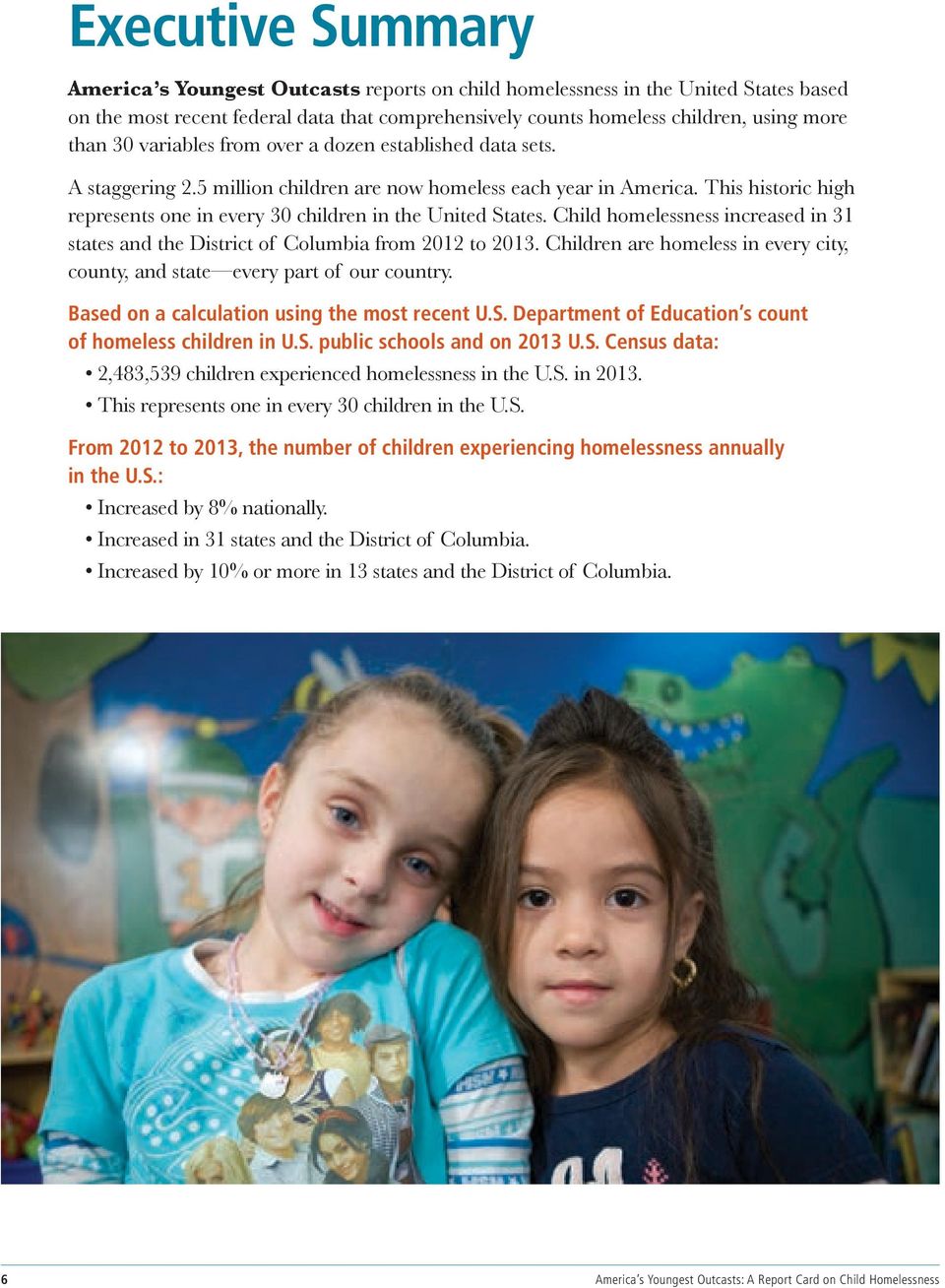
3 America s Youngest Outcasts A Report Card on THE NATIONAL CENTER ON Family for every child, a chance A practice area of AIR s Health and Social Development Program Written by: Ellen L. Bassuk, MD Carmela J. DeCandia, PsyD Corey Anne Beach Fred Berman, MSE
4 iv America s Youngest Outcasts: A Report Card on

5 Table of Contents Executive Summary...6 I. Introduction...9 II. America s Youngest Outcasts...11 a. Counting ren Who Are Homeless...11 B. Report Findings National Prevalence of State Ranking Individual State Reports...23 III. Causes of...74 a. High Rates of and Family Poverty...74 b. Lack of Affordable...74 c. Continuing Impacts of the Great Recession...75 D. Racial/Ethnic Disparities Among People experiencing...77 E. Challenges of Single Parenting...78 F. The Role of Trauma Mothers and Trauma ren and Trauma...81 IV. Preventing and Ending...84 a. The Federal Response...84 B. An Effective Response to Provide Safe and Affordable Offer Education and Employment Opportunities Conduct Comprehensive Assessments of All Family Members Provide Trauma Informed Care Prevent, Identify, and Treat Major Depression in Mothers Provide Parenting Supports Provide Developmentally Appropriate Services for ren in Transition Develop and Fund a Comprehensive Research Agenda...94 V. Conclusion...96 Appendix A: Methodology...98 Appendix B: References and Data Sources America s Youngest Outcasts 1
6 Editor s Note: As mandated by the federal McKinney-Vento Act, Local Education Agencies identify and count the number of homeless children in public schools annually. The numbers are reported by school year (e.g., the count is from the fall and spring semester of a single school year). To simplify our data presentation, we refer to the school year as 2011, the school year as 2012, and the school year as Data from 2013 became available from the U.S. Department of Education in September 2014, and are the most recent data. 2 America s Youngest Outcasts: A Report Card on

7 Dedication From the staff of The National Center on Family : We dedicate this report to Ellen L. Bassuk, M.D. for her steadfast efforts over twenty-five years to give a voice to children who otherwise would be invisible and forgotten. America s Youngest Outcasts 3
8 Acknowledgements This report has been a collaborative effort among many partners. We extend our deep appreciation to the Oak Foundation and to the Marie C. and Joseph C. Wilson Foundation, which provided financial support for this project, and to Cheryl Joan Vince of American Institutes for Research for her support of this report. Special thanks to Rachael Kenney of the Center for Social Innovation for her thorough work on data analysis; Jeannine Owens of Gliddon Owens Design for making our pages come to life; the publication team at American Institutes for Research for their production support; and to Scott Martin of Jorley Media for making this report available on our website John Soares and Ren Haoyuan took the photographs that appear in the report. Many of the families and children in the photographs participated because they want this story to be told. We are humbled by their strength, awed by their resilience, and thankful for lending their images to shine a light on family homelessness. This report was written by Ellen Bassuk, Carmela DeCandia, Corey Beach, and Fred Berman of The National Center on Family at AIR. We are grateful for the support of all our colleagues at The National Center, especially Christina Murphy, Natalie Coupe, and John Romano. We also appreciate the contributions of Rachel E. Latta, Tien Ung, and Jeff Olivet from the Center for Social Innovation. We thank John Kellogg for his determined efforts to make this report possible. The National Center on Family at AIR, Jones Road, Suite 1, Waltham, MA Photo Credits: John Soares ( Ren Haoyuan Design: Jeannine Owens ( We encourage you to use the information in the report, and ask that you cite it as follows: America s Youngest Outcasts: A Report Card on. (2014). Waltham, MA: The National Center on Family at American Institutes for Research. 4 America s Youngest Outcasts: A Report Card on
9 America s Youngest Outcasts 5

10 Executive Summary America s Youngest Outcasts reports on child homelessness in the United States based on the most recent federal data that comprehensively counts homeless children, using more than 30 variables from over a dozen established data sets. A staggering 2.5 million children are now homeless each year in America. This historic high represents one in every 30 children in the United States. homelessness increased in 31 states and the District of Columbia from 2012 to ren are homeless in every city, county, and state every part of our country. Based on a calculation using the most recent U.S. Department of Education s count of homeless children in U.S. public schools and on 2013 U.S. Census data: 2,483,539 children experienced homelessness in the U.S. in This represents one in every 30 children in the U.S. From 2012 to 2013, the number of children experiencing homelessness annually in the U.S.: Increased by 8% nationally. Increased in 31 states and the District of Columbia. Increased by 10% or more in 13 states and the District of Columbia. 6 America s Youngest Outcasts: A Report Card on
11 Major causes of homelessness for children in the U.S. include: (1) the nation s high poverty rate; (2) lack of affordable housing across the nation; (3) continuing impacts of the Great Recession; (4) racial disparities; (5) the challenges of single parenting; and (6) the ways in which traumatic experiences, especially domestic violence, precede and prolong homelessness for families. The impact of homelessness on the children, especially young children, is devastating and may lead to changes in brain architecture that can interfere with learning, emotional selfregulation, cognitive skills, and social relationships. The unrelenting stress experienced by the parents, most of whom are women parenting alone, may contribute to residential instability, unemployment, ineffective parenting, and poor health. Effective responses to child homelessness must include: Safe affordable housing. Education and employment opportunities. Comprehensive needs assessments of all family members. Services that incorporate trauma-informed care. Attention to identification, prevention, and treatment of major depression in mothers. Parenting supports for mothers. Research to identify evidence-based programs and services. ren are resilient and can recover from homelessness, but time is precious in their young lives. Services for children must be provided as soon as families enter emergency shelter or housing so that weeks and months critical to their development are not lost forever. Essential services must follow children into their permanent housing. The federal government has made concerted efforts to reduce homelessness among chronically homeless individuals and veterans, and these efforts have shown significant progress. ren and families have not received the same attention and their numbers are growing. Without decisive action and the allocation of sufficient resources, the nation will fail to reach the stated federal goal of ending family homelessness by 2020, and child homelessness may result in a permanent Third World in America. America s Youngest Outcasts 7

12 8 America s Youngest Outcasts: A Report Card on

13 I. Introduction Family and child homelessness surfaced as a significant social problem in the United States in the mid-1980s. Since then, the number of homeless families with children has steadily increased (Burt, 1992), now constituting 37% of the overall homeless population (U.S. Department of and Urban Development (HUD), 2014). In the most recent school year reported (2013), the U.S. Department of Education s (ED) count of homeless children in the nation s public schools finds more than 1.2 million public school children are homeless (National Center for Homeless Education (NCHE), 2014) an historic high for our nation. This number is even more dramatic since it is superimposed on increases in public school children who are homeless in both 2011 and 2012 (NCHE, 2013). The 2014 HUD Point-in- Time (PIT) count reported that 216,261 family members were literally homeless on a single night in January, and almost 60% of these were children under the age of 18 (HUD, 2014). The causes and consequences of child homelessness have been the focus of research for almost 30 years (Buckner, 2008). Buckner (2008) described several waves of research the first was primarily descriptive and was spearheaded by The National Center on Family s 1990 Worcester Family Research Project (Bassuk et al., 1996) which provided an in-depth look at the stark realities of family homelessness. The study found that the vast majority of families were composed of single mothers with two young children, often under the age of six. The families tended to be residentially unstable, moving frequently and often living in substandard housing and dangerous neighborhoods. With low levels of education, many of the mothers were unable to find jobs that paid livable wages. Without transportation or adequate child care, they struggled to protect and support their children. A shockingly high number of homeless mothers experienced interpersonal and family violence often witnessed or directly experienced by their children. Not surprisingly, many of the mothers had high rates of major depressive disorders, post trauma responses, and anxiety disorders, interfering with their capacity to support their children. How did these factors impact their children? ren experiencing homelessness were more often hungry, sick, and worried where their next meal and bed would come from; they wondered if they would have a roof over their heads at night and what would happen to their families. ren often developed more slowly. Many struggled in school, missing days, repeating grades, and even dropping out of school entirely. Buckner (2008) described a second wave of more methodologically sophisticated research (e.g., consistent definitions, larger samples, comparison groups). Some of the findings about the impact of homelessness confirmed earlier research (e.g., see Weinreb, Buckner, Williams, & Nicholson, 2006 a 10-year follow-up of the Worcester Family Research Project), while other findings were inconsistent. In general, these studies compared homeless children to lowincome housed children and to normative data (community and clinical samples). To explain the inconsistencies, researchers suggested a continuum of risk, with homeless children generally having more problems. Masten (2011) reported striking variability within homeless America s Youngest Outcasts 9
14 populations, both in the degree of risk and also the level of competence. She described moderators and mediators of risk and resilience, and suggested shifting from a deficit-oriented approach to a strengths-based competence model. Research has continued to document the mental health needs of homeless children. A recent systematic review and meta-analysis based on the literature to date summarized the mental health needs of homeless children. The authors found that 10% to 26% of homeless preschool children had mental health problems requiring clinical evaluation. This increased to 24% to 40% among homeless school age children two to four times the rate of poor children in a similar age range (Bassuk, Richard & Tsertsvadze, 2014 in review). In light of these findings, any solution to child homelessness must account for high levels of stress experienced by these children, and their frequent exposure to violence and its mental health consequences. ren experiencing homelessness are among the most invisible and neglected individuals in our nation. Despite their ever-growing number, homeless children have no voice and no constituency. Without a bed to call their own, they have lost safety, privacy, and the comforts of home, as well as friends, pets, possessions, reassuring routines, and community. These losses combine to create a life-altering experience that inflicts profound and lasting scars. For over 25 years, The National Center on Family has conducted research to document the reality of these children s experiences with the hope that we can mobilize the political will to improve the lives of these children. This report continues our commitment. America s Youngest Outcasts is modeled on two previous reports by The National Center on Family, the first based on 2006 data and the second on 2010 data. This report examines the current state of child homelessness in 50 states and the District of Columbia. The report focuses on four domains in the states: (1) extent of the problem; (2) well-being of the children; (3) risks for family homelessness; and (4) the policy response. Within each domain, each state is ed and then an overall is computed based on a composite of the domains. The total number of homeless children in America is calculated to indicate the scope of this problem nationally using Department of Education (ED) data on homeless children in public schools combined with U.S. Census data. We also discuss promising responses for preventing and ending child homelessness. 10 America s Youngest Outcasts: A Report Card on
15 II. America s Youngest Outcasts A. Counting ren Who Are Homeless Defining Accurately counting homeless children in the United State must start with a comprehensive definition of child homelessness. Since passage of the McKinney-Vento Homeless Assistance Act in 1987, various reauthorization bills have refined and expanded the federal definition of homelessness, yet a unified federal definition is not yet in place. Different definitions used by different federal agencies create confusion in states, cities, agencies, and the public regarding estimates of homeless populations and eligibility for services and housing. For example, the HUD definition of homelessness is narrower than those used by the Departments of Education (ED), Health and Human Services (HHS), Labor, Justice, and Agriculture. HUD focuses primarily on homeless people on the streets, in shelters, in vehicles, or in other places not meant for human habitation. This narrower definition is used for the annual HUD Point-in-Time (PIT) count, first administered in 2007, to assess the number of sheltered and unsheltered persons on a single night in January in cities and towns across the nation. The PIT count offers an important snapshot of homelessness on a given night at one point in the year, with a particular focus on individuals. However, it does not adequately estimate the number of individuals and family members who experience homelessness through the course of a year especially children. The HUD definition was broadened by the 2009 Homeless Emergency Assistance and Rapid Transition to (HEARTH) Act to include people fleeing domestic violence as well as some children and youth considered homeless under other federal definitions. The HEARTH Act recognized a broader scope of children who are homeless who qualified under certain sections of the Runaway and Homeless Youth Act, Head Start Act, Violence Against Women Act, Public Health Service Act, Food and Nutrition Act, and the McKinney-Vento Act (HUD, 2011). Despite this expanded definition, these groups are difficult to identify and count using HUD s single-night PIT approach. Using its narrower definition of homeless and its single-night PIT counting method, HUD reported a decrease in unsheltered family homelessness in 2014 and an increase in sheltered families (HUD, 2014). However, this count does not include homeless families and children living in doubled-up situations with relatives or friends a number estimated at 75% America s Youngest Outcasts 11
16 of homeless children nationally (United States Interagency Council on (USICH), 2014a). Families who are doubled-up often have strong incentive not to disclose their doubledup status, since it may put the primary tenant of the apartment at risk of eviction due to lease violation and school districts typically try to verify the addresses of the attending children. The HUD PIT count also does not accurately count homeless children living in motels, hotels, trailer parks, camping grounds, or similar settings. HUD s restricted definition of homelessness that underlies its approach to counting homeless population is absent from the list of 16 definitions of Definitions of A definition of homelessness similar to the McKinney-Vento definition below is used by ED and many other federal agencies serving homeless children, including U.S. Departments of Health and Human Services, Labor, Justice, and Agriculture. 1. McKinney-Vento Definition (United States Congress, 2009): General definition of homeless individuals include any individual or family (1) lacking a fixed, regular, and adequate nighttime residence; (2) living in a residence that is a public or private place not designed for human beings (e.g., car, park, abandoned buildings); (3) living in a shelter providing temporary living arrangements (including hotels and motels), congregate shelters and transitional housing; (4) an individual who resided in a shelter or place not meant for human habitation and who is exiting an institution where he or she temporarily resided; (5) an individual or family who (A) will imminently lose their housing, including housing they own, rent, or live in without paying rent, are sharing with others and rooms in hotels or motels not paid for by Federal, State, or local government programs for low-income individuals or by charitable organizations, as evidenced by (i) a court order resulting from an eviction action that notifies the individual or family that they must leave within 14 days; (ii) the individual or family having a primary nighttime residence that is a room in a hotel or motel and where they lack the resources necessary to reside there for more than 14 days; or (iii) credible evidence indicating that the owner or renter of the housing will not allow the individual or family to stay for more than 14 days, and any oral statement from an individual or family seeking homeless assistance that is found to be credible shall be considered credible evidence for purposes of this clause; (B) has no subsequent residence identified; and (C) lacks the resources or support networks needed to obtain other permanent housing; and (6) unaccompanied youth and homeless families with children and youth defined as homeless under other Federal statutes who (A) have experienced a long-term period without living independently in permanent housing, (B) have 12 America s Youngest Outcasts: A Report Card on

17 terms offered on page 2 of the 2014 PIT report to the U.S. Congress (HUD, 2014). Each year, the HUD PIT count leaves hundred of thousands of homeless children in the U.S. uncounted and invisible to policymakers and the public. The more inclusive definitions of homelessness embraced by many federal agencies serving children including ED, HHS, and U.S. Departments of Labor, Justice, and Agriculture offer a more complete picture of the reality of child homelessness in America. This report uses the experienced persistent instability as measured by frequent moves over such period, and (C) can be expected to continue in such status for an extended period of time because of chronic disabilities, chronic physical health or mental health conditions, substance addiction, histories of domestic violence or childhood abuse, the presence of a child or youth with a disability, or multiple barriers to employment. Notwithstanding any other provision of this section, the Secretary shall consider to be homeless any individual or family who is fleeing, or is attempting to flee, domestic violence, dating violence, sexual assault, stalking, or other dangerous or life-threatening conditions in the individual s or family s current housing situation, including where the health and safety of children are jeopardized, and who have no other residence and lack the resources or support networks to obtain other permanent housing. 2. U.S. Department of and Urban Development (HUD): According to its Final Rule on Homeless Emergency Assistance and Rapid Transition to : Defining Homeless (Federal Register, 2011), HUD uses a definition of homelessness for service eligibility that includes: (1) individuals and families who lack a fixed, regular, and adequate nighttime residence, including those who reside in an emergency shelter or a place not meant for human habitation or who are exiting an institution where they temporarily resided; (2) individuals and families who will imminently lose their primary nighttime residence; (3) unaccompanied youth and families with children and youth defined as homeless under other federal statutes; and (4) individuals and families fleeing violence against the individual or a family member. These categories and various related definitions are spelled out in greater specificity by HUD regulations that went into effect in January HUD has stated in the Federal Register (Vol. 76, No. 233 / Monday, December 5, 2011 / Rules and Regulations) that it understands that its definition of homelessness continues to exclude vulnerable populations. Nevertheless, this definition is the basis for the HUD PIT count reported annually to the U.S. Congress and public as official HUD data on U.S. homeless populations. America s Youngest Outcasts 13

18 McKinney-Vento definition of child homelessness and ED s annual school-based count of students who are homeless as the basis from which to estimate the number of homeless children in the U.S. B. Report Findings Based on a calculation using the most recent U.S. Department of Education s count of homeless children in U.S. public schools and on 2013 U.S. Census data: 2,483,539 children experienced homelessness in the U.S. in This represents one in every 30 children in the U.S. From 2012 to 2013, the number of children experiencing homelessness annually in the U.S.: Increased by 8% nationally. Increased in 31 states and the District of Columbia. Increased by 10% or more in 13 states and the District of Columbia. Although significant progress has been made over the past decade in reducing homelessness among chronically homeless individuals and veterans, the number of homeless children in the U.S. has grown over this same period to reach an historic high. 1. National Prevalence of Prevalence of in the United States Based on 2013 data released in September 2014 by the U.S. Department of Education, combined with an estimate of younger non-school aged homeless children in the U.S., the number of children experiencing homelessness annually is 2,483,539 or 2.5 million children, an historic high. Using U.S. Census estimates of the total population of children under 18 years in 2013, this represents one in every 30 children. 1 National Trends in homelessness surfaced in the U.S. as a major social problem in the mid-1980s. Before that time, families and children were rarely homeless in significant numbers except during the Great Depression. Since that time, the number has continued to climb (Bassuk, 2010). Data from three editions of America s Youngest Outcasts document a steady increase in the number of children experiencing homelessness. While there have been improvements in counting homeless children over this period, these do not explain the recent increased in number. 1 See Methodology in Appendix A. 14 America s Youngest Outcasts: A Report Card on
19 In the fall of 2005, families and children living in the Gulf States fled Hurricanes Katrina and Rita, leading to a massive evacuation and driving the number of homeless children to 1.5 million. Over the next two years as families relocated, the number decreased in most of the states impacted by the hurricanes, reducing the number of homeless children to 1.2 million in As the nation and our homeless children recovered from Hurricanes Katrina and Rita, a new storm was brewing: a recession that destabilized the nation s economy far worse than the hurricanes had displaced children and families. In the wake of the Great Recession, the number of children lacking homes each year rose from 1.2 in 2007 to 1.6 million in Now, the number has climbed to 2.5 million children an alarming increase that should draw the attention of our nation s leaders and mobilize a call to action. Rise In Number of Homeless ren 1 in 50 ren homeless annually 1.5M (1,555,360) 1 in 45 ren homeless annually 1.6M (1,609,607) 1 in 30 ren homeless annually 2.5M (2,483,539) America s Youngest Outcasts 15

20 Counting Homeless ren The McKinney-Vento Homeless Assistance Act, the first significant federal response to homelessness, was signed into law in 1987 and most recently reauthorized in 2009 as The Homeless Emergency Assistance and Rapid Transition to (HEARTH) Act. Under this law, funds are made available for local school districts to hire McKinney-Vento School Liaisons who coordinate services for homeless children attending public school and count homeless students in their districts, reporting these data to the U.S. Department of Education. The McKinney Vento School Liaisons count of homeless school-age children uses the following definition of homelessness: children and youth who lack a fixed, regular, and adequate nighttime residence, and children living doubled-up with relatives or friends due to loss of housing or economic hardship estimated at 75% of homeless children nationally (USICH, 2014a) and those living in motels, hotels, trailer parks, camping grounds, cars, parks, public spaces, abandoned buildings, substandard housing, bus or train stations, or similar settings (Samuels, Shinn, & Buckner, 2010). All 50 states and the District of Columbia take part in the annual McKinney-Vento count, although a small percentage of school districts do not report numbers. However, the count is increasingly accurate as the number of school districts participating in the McKinney-Vento count of homeless students has increased from 77% in 2007 to 94% in 2012 (NCHE, 2009, 2013). The numbers reported by the McKinney Vento School Liaisons are likely an undercount of homeless children attending public schools. Some families keep their homelessness a secret from friends and school officials to avoid the stigma and embarrassment of being homeless. Also, some school districts do not report a count, and some children do not attend school. What about younger homeless children who do not attend school? The age distribution of homeless children in the U.S. is estimated at 51% under age 6; 34% age 6 to 12; and 15% age 13 to 17 years (Samuels et al., 2010; HUD, 2009). Thus, about half of homeless children in America are not yet school age. A complete count of homeless children in America from 0 to 17 years is made by adding the number of homeless children under the age of 6 to the McKinney-Vento K-12 count. 16 America s Youngest Outcasts: A Report Card on
21 2. State Ranking: 1 to 50 State Composite Score Each state is assigned a of 1 (best) to 50 (worst) based on a state composite score that reflects each state s overall performance across four domains: 1) Extent of (adjusted for state population) 2) Well-Being 3) Risk for 4) State Policy and Planning Efforts Each state received a score for each of the four domains. These are summed to compute the state s composite score to produce the overall state of 1 to Composite State Rank State Score MINNESOTA 1 NEBRASKA 2 massachusetts 3 IOWA 4 NEW JERSEY 5 VERMONT 6 NEW HAMPSHIRE 7 PENNSYLVANIA 8 HAWAII 9 MAINE 10 MARYLAND 11 CONNECTICUT 12 WYOMING 13 RTH DAKOTA 14 VIRGINIA 15 MONTANA 16 SOUTH DAKOTA 17 WISCONSIN 18 RHODE ISLAND 19 WASHINGTON 20 UTAH 21 KANSAS 22 ALASKA 23 idaho 24 ILLIIS 25 State Score OREGON 26 OHIO 27 COLORADO 28 RTH CAROLINA 29 INDIANA 30 MISSOURI 31 WEST VIRGINIA 32 FLORIDA 33 DELAWARE 34 NEW YORK 35 SOUTH CAROLINA 36 MICHIGAN 37 LOUISIANA 38 TEXAS 39 GEORGIA 40 TENNESSEE 41 KENTUCKY 42 OKLAHOMA 43 NEVADA 44 ARIZONA 45 NEW MEXICO 46 ARKANSAS 47 CALIFORNIA 48 MISSISSIPPI 49 alabama 50 STATE RANKS: 1=Best, 50=Worst Top 10 Composite Score 1. Minnesota 2. Nebraska 3. Massachusetts 4. Iowa 5. New Jersey 6. Vermont 7. New Hampshire 8. Pennsylvania 9. Hawaii 10. maine Bottom 10 Composite Score 41. Tennessee 42. Kentucky 43. oklahoma 44. Nevada 45. arizona 46. New Mexico 47. arkansas 48. california 49. mississippi 50. alabama 2 See Methodology in Appendix A. America s Youngest Outcasts 17
22 2013 Extent of STATE RANKS: 1=Best, 50=Worst State Score CONNECTICUT 1 NEW JERSEY 2 RHODE ISLAND 3 NEBRASKA 4 PENNSYLVANIA 5 HAWAII 6 WYOMING 7 MAINE 8 VERMONT 9 SOUTH DAKOTA 10 OHIO 11 MINNESOTA 12 IOWA 13 VIRGINIA 14 TENNESSEE 15 INDIANA 16 SOUTH CAROLINA 17 massachusetts 18 MARYLAND 19 MONTANA 20 RTH CAROLINA 21 NEW HAMPSHIRE 22 WISCONSIN 23 KANSAS 24 RTH DAKOTA 25 State Score TEXAS 26 idaho 27 GEORGIA 28 ARKANSAS 29 ILLIIS 30 MICHIGAN 31 UTAH 32 FLORIDA 33 MISSISSIPPI 34 LOUISIANA 35 NEVADA 36 COLORADO 37 MISSOURI 38 DELAWARE 39 WASHINGTON 40 ARIZONA 41 WEST VIRGINIA 42 ALASKA 43 NEW MEXICO 44 OREGON 45 OKLAHOMA 46 alabama 47 CALIFORNIA 48 NEW YORK 49 KENTUCKY 50 Top 10 Extent Score 1. Connecticut 2. New Jersey 3. rhode Island 4. Nebraska 5. Pennsylvania 6. Hawaii 7. Wyoming 8. Maine 9. Vermont 10. south Dakota Bottom 10 Extent Score 41. arizona 42. west Virginia 43. alaska 44. New Mexico 45. oregon 46. oklahoma 47. alabama 48. california 49. New York 50. Kentucky 18 America s Youngest Outcasts: A Report Card on
23 2013 Well-Being STATE RANKS: 1=Best, 50=Worst State Score UTAH 1 NEW JERSEY 2 WYOMING 3 idaho 4 NEW HAMPSHIRE 5 massachusetts 6 MINNESOTA 7 ALASKA 8 ILLIIS 9 WISCONSIN 10 WASHINGTON 11 MARYLAND 12 SOUTH DAKOTA 13 NEBRASKA 14 NEW YORK 15 IOWA 16 VIRGINIA 17 MONTANA 18 FLORIDA 19 HAWAII 20 COLORADO 21 PENNSYLVANIA 22 RTH DAKOTA 23 KANSAS 24 OREGON 25 State Score DELAWARE 26 CONNECTICUT 27 MAINE 28 VERMONT 29 NEVADA 30 CALIFORNIA 31 RTH CAROLINA 32 TEXAS 33 WEST VIRGINIA 34 SOUTH CAROLINA 35 INDIANA 36 NEW MEXICO 37 MISSOURI 38 LOUISIANA 39 ARIZONA 40 MICHIGAN 41 KENTUCKY 42 GEORGIA 43 OKLAHOMA 44 RHODE ISLAND 45 OHIO 46 ARKANSAS 47 MISSISSIPPI 48 alabama 49 TENNESSEE 50 Top 10 Well-Being Score 1. Utah 2. New Jersey 3. Wyoming 4. Idaho 5. New Hampshire 6. Massachusetts 7. Minnesota 8. Alaska 9. Illinois 10. wisconsin Bottom 10 Well-Being Score 41. michigan 42. Kentucky 43. georgia 44. oklahoma 45. rhode Island 46. ohio 47. arkansas 48. mississippi 49. alabama 50. Tennessee America s Youngest Outcasts 19
24 2013 Risk for STATE RANKS: 1=Best, 50=Worst State Score VERMONT 1 MINNESOTA 2 NEW HAMPSHIRE 3 RTH DAKOTA 4 WYOMING 5 NEBRASKA 6 IOWA 7 WISCONSIN 8 massachusetts 9 ALASKA 10 PENNSYLVANIA 11 SOUTH DAKOTA 12 KANSAS 13 MAINE 14 MONTANA 15 CONNECTICUT 16 VIRGINIA 17 HAWAII 18 UTAH 19 NEW JERSEY 20 MARYLAND 21 idaho 22 DELAWARE 23 NEW YORK 24 WASHINGTON 25 State Score WEST VIRGINIA 26 MISSOURI 27 OREGON 28 RHODE ISLAND 29 MICHIGAN 30 ILLIIS 31 COLORADO 32 OHIO 33 OKLAHOMA 34 RTH CAROLINA 35 KENTUCKY 36 TENNESSEE 37 INDIANA 38 CALIFORNIA 39 TEXAS 40 ARKANSAS 41 FLORIDA 42 NEVADA 43 NEW MEXICO 44 alabama 45 MISSISSIPPI 46 LOUISIANA 47 SOUTH CAROLINA 48 GEORGIA 49 ARIZONA 50 Top 10 Risk Score 1. Vermont 2. Minnesota 3. New Hampshire 4. North Dakota 5. Wyoming 6. Nebraska 7. Iowa 8. Wisconsin 9. Massachusetts 10. alaska Bottom 10 Risk Score 41. arkansas 42. Florida 43. Nevada 44. New Mexico 45. alabama 46. mississippi 47. louisiana 48. south Carolina 49. georgia 50. arizona 20 America s Youngest Outcasts: A Report Card on
25 2013 State Policy and Planning STATE RANKS: 1=Best, 50=Worst State Score IOWA 1 massachusetts 2 RHODE ISLAND 3 MINNESOTA 4 MAINE 5 VERMONT 6 MARYLAND 7 HAWAII 8 NEBRASKA 9 WASHINGTON 10 OREGON 11 LOUISIANA 12 PENNSYLVANIA 13 RTH DAKOTA 14 NEW HAMPSHIRE 15 MONTANA 16 CONNECTICUT 17 NEW JERSEY 18 VIRGINIA 19 KENTUCKY 20 MISSOURI 21 OHIO 22 COLORADO 23 GEORGIA 24 WEST VIRGINIA 25 State Score OKLAHOMA 26 ARIZONA 27 MICHIGAN 28 ILLIIS 29 SOUTH CAROLINA 30 INDIANA 31 RTH CAROLINA 32 KANSAS 33 FLORIDA 34 ALASKA 35 UTAH 36 WISCONSIN 37 NEW MEXICO 38 TEXAS 39 DELAWARE 40 NEW YORK 41 SOUTH DAKOTA 42 MISSISSIPPI 43 alabama 44 idaho 45 TENNESSEE 46 NEVADA 47 ARKANSAS 48 CALIFORNIA 49 WYOMING 50 Top 10 Policy Score 1. Iowa 2. Massachusetts 3. rhode Island 4. Minnesota 5. Maine 6. Vermont 7. Maryland 8. Hawaii 9. Nebraska 10. washington Bottom 10 Policy Score 41. New York 42. south Dakota 43. mississippi 44. alabama 45. idaho 46. Tennessee 47. Nevada 48. arkansas 49. california 50. wyoming America s Youngest Outcasts 21
26 22 America s Youngest Outcasts: A Report Card on
27 Alabama Composite State Rank 50 STATE RANKS: 1=Best, 50=Worst Homeless ren Extent of 37,816 35,239 59, Risk for Home Foreclosure Rank ren in Poverty % 4.1% ren without health insurance % 39.2 Female-headed Household Birth rate per 1,000 teens Well-Being 49 $7.25/hr State Minimum Wage $13.34/hr Income needed for 2-BR apartment 19% Households paying more than 50% of income for rent Health Problems of ren Below 100% Poverty 20% 19% 11% One or more chronic conditions Food Security Asthma Households with very low food security ADD/ADHD 7% 85% Eligible households participating in SNAP State Policy and Planning Units for Homeless Families Emergency Shelter State Trust Fund Transitional 44 Permanent Supportive Education Proficiency: Reading and Math (NAEP 4th & 8th Grade/ren Eligible for School Lunch) 18% 17% State Planning Efforts Is there an active state Interagency Council on (ICH)? Is there a State plan that includes children and families? 13% 8% Blueprint Towards a Ten-Year Plan to End in Alabama mentions children and families. 4th Grade 8th Grade For the complete report, please visit: America s Youngest Outcasts 23

28 Alaska Composite State Rank 23 STATE RANKS: 1=Best, 50=Worst Homeless ren Extent of 8,849 9,006 8, Risk for Home Foreclosure Rank ren in Poverty % 13.9% ren without health insurance % 34.5 Female-headed Household Birth rate per 1,000 teens Well-Being 8 $7.75/hr State Minimum Wage $21.37/hr Income needed for 2-BR apartment 16% Households paying more than 50% of income for rent Health Problems of ren Below 100% Poverty 11% 5% 4% One or more chronic conditions Food Security Asthma Households with very low food security ADD/ADHD 4% 68% Eligible households participating in SNAP State Policy and Planning Units for Homeless Families Emergency Shelter State Trust Fund Transitional 35 Permanent Supportive Education Proficiency: Reading and Math (NAEP 4th & 8th Grade/ren Eligible for School Lunch) 15% 22% 17% 19% State Planning Efforts Is there an active state Interagency Council on (ICH)? Is there a State plan that includes children and families? The 10 Year Plan to End Long Term in Alaska includes an extensive focus on children and families. 4th Grade 8th Grade For the complete report, please visit: 24 America s Youngest Outcasts: A Report Card on
29 Arizona Composite State Rank 45 STATE RANKS: 1=Best, 50=Worst Homeless ren Extent of 63,182 63, ,616 Risk for Home Foreclosure Rank ren in Poverty % 13.2% ren without health insurance % 37.4 Female-headed Household Birth rate per 1,000 teens Well-Being 40 $7.80/hr State Minimum Wage $17.19/hr Income needed for 2-BR apartment 25% Households paying more than 50% of income for rent Health Problems of ren Below 100% Poverty 14% 10% 7% One or more chronic conditions Food Security Asthma Households with very low food security ADD/ADHD 6% 79% Eligible households participating in SNAP State Policy and Planning Units for Homeless Families Emergency Shelter State Trust Fund Transitional 27 Permanent Supportive Education Proficiency: Reading and Math (NAEP 4th & 8th Grade/ren Eligible for School Lunch) 15% 26% State Planning Efforts Is there an active state Interagency Council on (ICH)? Is there a State plan that includes children and families? 16% 18% Ending : Arizona Plan to End includes an extensive focus on children and families. yes yes 4th Grade 8th Grade For the complete report, please visit: America s Youngest Outcasts 25
30 Arkansas Composite State Rank 47 STATE RANKS: 1=Best, 50=Worst Homeless ren Extent of 21,704 19,492 19, Risk for Home Foreclosure Rank ren in Poverty % 5.9% ren without health insurance % 45.7 Female-headed Household Birth rate per 1,000 teens Well-Being 47 $7.25/hr State Minimum Wage $12.76/hr Income needed for 2-BR apartment 19% Households paying more than 50% of income for rent Health Problems of ren Below 100% Poverty 20% 13% 15% One or more chronic conditions Food Security Asthma Households with very low food security ADD/ADHD 8% 74% Eligible households participating in SNAP State Policy and Planning Units for Homeless Families Emergency Shelter State Trust Fund Transitional 48 Permanent Supportive Education Proficiency: Reading and Math (NAEP 4th & 8th Grade/ren Eligible for School Lunch) 22% 28% State Planning Efforts no no Is there an active state Interagency Council on (ICH)? Is there a State plan that includes children and families? 20% 16% As of 2013, no statewide planning efforts had taken place in Arkansas. 4th Grade 8th Grade For the complete report, please visit: 26 America s Youngest Outcasts: A Report Card on

31 California Composite State Rank 48 STATE RANKS: 1=Best, 50=Worst Homeless ren Extent of 526, , , Risk for Home Foreclosure Rank ren in Poverty % 7.9% ren without health insurance % 26.5 Female-headed Household Birth rate per 1,000 teens Well-Being 31 $8.00/hr State Minimum Wage $25.78/hr Income needed for 2-BR apartment 34% Households paying more than 50% of income for rent Health Problems of ren Below 100% Poverty 13% 6% 4% One or more chronic conditions Food Security Asthma Households with very low food security ADD/ADHD 6% 57% Eligible households participating in SNAP State Policy and Planning Units for Homeless Families 1,650 4,602 5,064 Emergency Shelter State Trust Fund Transitional 49 Permanent Supportive Education Proficiency: Reading and Math (NAEP 4th & 8th Grade/ren Eligible for School Lunch) State Planning Efforts Is there an active state Interagency Council on (ICH)? Is there a State plan that includes children and families? 15% 19% 17% 15% 2010 Governor s Ten Year Chronic Action Plan mentions children and families. 4th Grade 8th Grade For the complete report, please visit: America s Youngest Outcasts 27
32 Colorado Composite State Rank 28 STATE RANKS: 1=Best, 50=Worst Homeless ren Extent of 39,629 45,922 44, Risk for Home Foreclosure Rank ren in Poverty % 8.8% ren without health insurance % 25.4 Female-headed Household Birth rate per 1,000 teens Well-Being 21 $7.78/hr State Minimum Wage $17.26/hr Income needed for 2-BR apartment 23% Households paying more than 50% of income for rent Health Problems of ren Below 100% Poverty 13% 13% 2% One or more chronic conditions Food Security Asthma Households with very low food security ADD/ADHD 6% 66% Eligible households participating in SNAP State Policy and Planning Units for Homeless Families Emergency Shelter State Trust Fund Transitional 23 Permanent Supportive Education Proficiency: Reading and Math (NAEP 4th & 8th Grade/ren Eligible for School Lunch) 30% 21% 22% 23% State Planning Efforts Is there an active state Interagency Council on (ICH)? Is there a State plan that includes children and families? Pathways Home Colorado mentions children and families. 4th Grade 8th Grade For the complete report, please visit: 28 America s Youngest Outcasts: A Report Card on
33 Connecticut Composite State Rank 12 STATE RANKS: 1=Best, 50=Worst Homeless ren Extent of 5, ,512 5, Risk for Home Foreclosure Rank Female-headed Household ren in Poverty ren without health insurance Birth rate per 1,000 teens % 3.8% 7.1% 15.1 Well-Being 27 $8.25/hr State Minimum Wage $23.22/hr Income needed for 2-BR apartment 24% Households paying more than 50% of income for rent Health Problems of ren Below 100% Poverty 16% 13% One or more chronic conditions Food Security Asthma Households with very low food security 8% ADD/ADHD 5% 85% Eligible households participating in SNAP State Policy and Planning Units for Homeless Families Emergency Shelter State Trust Fund Transitional 17 Permanent Supportive Education Proficiency: Reading and Math (NAEP 4th & 8th Grade/ren Eligible for School Lunch) 19% 20% 23% 16% State Planning Efforts Is there an active state Interagency Council on (ICH)? Is there a State plan that includes children and families? As of 2013, no statewide planning efforts had taken place in Connecticut. 4th Grade 8th Grade For the complete report, please visit: America s Youngest Outcasts 29
34 Composite State Rank Delaware 34 STATE RANKS: 1=Best, 50=Worst Homeless ren Extent of 7, ,533 7, Risk for Home Foreclosure Rank Female-headed Household ren in Poverty ren without health insurance Birth rate per 1,000 teens % 3.5% 7.6% 25 Well-Being 26 $7.25/hr State Minimum Wage $20.63/hr Income needed for 2-BR apartment 21% Households paying more than 50% of income for rent Health Problems of ren Below 100% Poverty 19% 16% 11% One or more chronic conditions Food Security Asthma Households with very low food security ADD/ADHD 5% 85% Eligible households participating in SNAP State Policy and Planning Units for Homeless Families Emergency Shelter State Trust Fund Transitional 40 Permanent Supportive Education Proficiency: Reading and Math (NAEP 4th & 8th Grade/ren Eligible for School Lunch) 25% 27% 20% 18% State Planning Efforts Is there an active state Interagency Council on (ICH)? Is there a State plan that includes children and families? As of 2013, no statewide planning efforts have taken place in Delaware that focus on children and families. 4th Grade 8th Grade For the complete report, please visit: 30 America s Youngest Outcasts 2013 State Report on
35 District of Columbia STATE RANKS: 1=Best, 50=Worst Homeless ren Extent of 5,384 5,071 6,506 26% ren in Poverty Risk for 7.9% Female-headed Household 1.7% ren without health insurance Well-Being $8.25/hr State Minimum Wage $27.15/hr Income needed for 2-BR apartment 24% Households paying more than 50% of income for rent Health Problems of ren Below 100% Poverty 17% 21% 11% One or more chronic conditions Food Security Asthma Households with very low food security ADD/ADHD 5% 99% Eligible households participating in SNAP State Policy and Planning Units for Homeless Families Emergency Shelter State Trust Fund Transitional Permanent Supportive Education Proficiency: Reading and Math (NAEP 4th & 8th Grade/ren Eligible for School Lunch) State Planning Efforts Is there an active state Interagency Council on (ICH)? Is there a State plan that includes children and families? 13% 17% 10% 12% Homeless No More: A Strategy for Ending in Washington, D.C. by 2014 includes an extensive focus on children and families. 4th Grade 8th Grade For the complete report, please visit: The National Center on Family 31

36 Florida STATE RANKS: 1=Best, 50=Worst Extent of 139,667 Homeless ren 111, , Risk for Home Foreclosure Rank ren in Poverty Composite State Rank % 10.9% ren without health insurance % 28 Female-headed Household Birth rate per 1,000 teens Well-Being 19 $7.79/hr State Minimum Wage $19.14/hr Income needed for 2-BR apartment 32% Households paying more than 50% of income for rent Health Problems of ren Below 100% Poverty 15% 13% 9% One or more chronic conditions Food Security Asthma Households with very low food security ADD/ADHD 6% 82% Eligible households participating in SNAP State Policy and Planning Units for Homeless Families 1,005 2,087 2,219 Emergency Shelter State Trust Fund Transitional 34 Permanent Supportive Education Proficiency: Reading and Math (NAEP 4th & 8th Grade/ren Eligible for School Lunch) 27% 28% State Planning Efforts Is there an active state Interagency Council on (ICH)? Is there a State plan that includes children and families? 23% 20% The Florida Council on report to the Governor mentions children and families. 4th Grade 8th Grade For the complete report, please visit: 32 America s Youngest Outcasts: A Report Card on
37 Georgia Composite State Rank 40 STATE RANKS: 1=Best, 50=Worst Homeless ren Extent of 73,953 63,818 68, Risk for Home Foreclosure Rank ren in Poverty % 8.8% ren without health insurance % 33.8 Female-headed Household Birth rate per 1,000 teens Well-Being 43 $7.25/hr State Minimum Wage $15.28/hr Income needed for 2-BR apartment 26% Households paying more than 50% of income for rent Health Problems of ren Below 100% Poverty 17% 16% 11% One or more chronic conditions Food Security Asthma Households with very low food security ADD/ADHD 7% 83% Eligible households participating in SNAP State Policy and Planning Units for Homeless Families ,220 Emergency Shelter State Trust Fund Transitional 24 Permanent Supportive Education Proficiency: Reading and Math (NAEP 4th & 8th Grade/ren Eligible for School Lunch) 21% 25% 20% 17% The Georgia Interagency Homeless Coordination Council FY 2013 Homeless Action Plan includes an extensive focus on children and families. State Planning Efforts Is there an active state Interagency Council on (ICH)? Is there a State plan that includes children and families? 4th Grade 8th Grade For the complete report, please visit: America s Youngest Outcasts 33
38 Hawaii STATE RANKS: 1=Best, 50=Worst Homeless ren Extent of 4, ,947 4, Risk for Home Foreclosure Rank Composite State Rank 9 Female-headed Household ren in Poverty ren without health insurance Birth rate per 1,000 teens % 3.5% 5.2% 28.1 Well-Being 20 $7.25/hr State Minimum Wage $32.14/hr Income needed for 2-BR apartment 31% Households paying more than 50% of income for rent Health Problems of ren Below 100% Poverty 17% 11% 4% One or more chronic conditions Food Security Asthma Households with very low food security ADD/ADHD 6% 61% Eligible households participating in SNAP State Policy and Planning Units for Homeless Families Emergency Shelter State Trust Fund Transitional 8 Permanent Supportive Education Proficiency: Reading and Math (NAEP 4th & 8th Grade/ren Eligible for School Lunch) 33% State Planning Efforts Is there an active state Interagency Council on (ICH)? Is there a State plan that includes children and families? 17% 20% 24% The Plan to End in Hawaii includes an extensive focus on children and families. 4th Grade 8th Grade For the complete report, please visit: 34 America s Youngest Outcasts: A Report Card on

39 Idaho Composite State Rank 24 STATE RANKS: 1=Best, 50=Worst Homeless ren Extent of 9, ,337 12, Risk for Home Foreclosure Rank Female-headed Household ren in Poverty ren without health insurance Birth rate per 1,000 teens % 8.5% 5.9% 28.3 Well-Being 4 $7.25/hr State Minimum Wage $13.24/hr Income needed for 2-BR apartment 20% Households paying more than 50% of income for rent Health Problems of ren Below 100% Poverty 10% 6% 10% One or more chronic conditions Food Security Asthma Households with very low food security ADD/ADHD 5% 85% Eligible households participating in SNAP State Policy and Planning Units for Homeless Families Emergency Shelter State Trust Fund Transitional 45 Permanent Supportive Education Proficiency: Reading and Math (NAEP 4th & 8th Grade/ren Eligible for School Lunch) 22% 29% 27% 25% State Planning Efforts Is there an active state Interagency Council on (ICH)? Is there a State plan that includes children and families? Idaho s Action Plan to Reduce mentions children and families. 4th Grade 8th Grade For the complete report, please visit: America s Youngest Outcasts 35
40 Illinois Composite State Rank 25 STATE RANKS: 1=Best, 50=Worst Homeless ren Extent of 98,212 75,443 83, Risk for Home Foreclosure Rank ren in Poverty % 3.3% ren without health insurance % 27.9 Female-headed Household Birth rate per 1,000 teens Well-Being 9 $8.25/hr State Minimum Wage $17.02/hr Income needed for 2-BR apartment 25% Households paying more than 50% of income for rent Health Problems of ren Below 100% Poverty 12% 8% 6% One or more chronic conditions Food Security Asthma Households with very low food security ADD/ADHD 5% 84% Eligible households participating in SNAP State Policy and Planning Units for Homeless Families 430 1,529 1,487 Emergency Shelter State Trust Fund Transitional 29 Permanent Supportive Education Proficiency: Reading and Math (NAEP 4th & 8th Grade/ren Eligible for School Lunch) 16% 22% State Planning Efforts Is there an active state Interagency Council on (ICH)? Is there a State plan that includes children and families? 20% 18% As of 2013, no statewide planning efforts had taken place in Illinois. 4th Grade 8th Grade For the complete report, please visit: 36 America s Youngest Outcasts: A Report Card on
41 Indiana Composite State Rank 30 STATE RANKS: 1=Best, 50=Worst Homeless ren Extent of 27,127 30,098 31, Risk for Home Foreclosure Rank ren in Poverty % 8.4% ren without health insurance % 33 Female-headed Household Birth rate per 1,000 teens Well-Being 36 $7.25/hr State Minimum Wage $13.81/hr Income needed for 2-BR apartment 18% Households paying more than 50% of income for rent Health Problems of ren Below 100% Poverty 18% 15% 17% One or more chronic conditions Food Security Asthma Households with very low food security ADD/ADHD 6% 71% Eligible households participating in SNAP State Policy and Planning Units for Homeless Families Emergency Shelter State Trust Fund Transitional 31 Permanent Supportive Education Proficiency: Reading and Math (NAEP 4th & 8th Grade/ren Eligible for School Lunch) 37% State Planning Efforts Is there an active state Interagency Council on (ICH)? Is there a State plan that includes children and families? 25% 4th Grade 22% 23% As of 2013, no statewide planning efforts had taken place in Indiana. 8th Grade For the complete report, please visit: America s Youngest Outcasts 37
42 Iowa Composite State Rank 4 STATE RANKS: 1=Best, 50=Worst Homeless ren Extent of 13,939 14,612 13, Risk for 31 16% 4% Home Foreclosure Rank ren in Poverty 7 ren without health insurance % 24.1 Female-headed Household Birth rate per 1,000 teens Well-Being 16 $7.25/hr State Minimum Wage $12.97/hr Income needed for 2-BR apartment 13% Households paying more than 50% of income for rent Health Problems of ren Below 100% Poverty 15% 4% 21% One or more chronic conditions Food Security Asthma Households with very low food security ADD/ADHD 5% 87% Eligible households participating in SNAP State Policy and Planning Units for Homeless Families Emergency Shelter State Trust Fund Transitional 1 Permanent Supportive Education Proficiency: Reading and Math (NAEP 4th & 8th Grade/ren Eligible for School Lunch) 23% 28% 21% 19% State Planning Efforts Is there an active state Interagency Council on (ICH)? Is there a State plan that includes children and families? The 2004 State of Iowa Accessing Mainstream Resources Action Plan includes an extensive focus on children and families. 4th Grade 8th Grade For the complete report, please visit: 38 America s Youngest Outcasts: A Report Card on
43 Kansas Composite State Rank 22 STATE RANKS: 1=Best, 50=Worst Homeless ren Extent of 17,861 18,008 18, Risk for Home Foreclosure Rank ren in Poverty % 6.6% ren without health insurance % 34.1 Female-headed Household Birth rate per 1,000 teens Well-Being 24 $7.25/hr State Minimum Wage $13.69/hr Income needed for 2-BR apartment 16% Households paying more than 50% of income for rent Health Problems of ren Below 100% Poverty 14% 12% 16% One or more chronic conditions Food Security Asthma Households with very low food security ADD/ADHD 6% 69% Eligible households participating in SNAP State Policy and Planning Units for Homeless Families Emergency Shelter State Trust Fund Transitional 33 Permanent Supportive Education Proficiency: Reading and Math (NAEP 4th & 8th Grade/ren Eligible for School Lunch) 22% 33% State Planning Efforts Is there an active state Interagency Council on (ICH)? Is there a State plan that includes children and families? 22% 24% As of 2013, no statewide planning efforts had taken place in Kansas. 4th Grade 8th Grade For the complete report, please visit: America s Youngest Outcasts 39
44 Kentucky Composite State Rank 42 STATE RANKS: 1=Best, 50=Worst Homeless ren Extent of 67,704 70,090 66, Risk for Home Foreclosure Rank ren in Poverty % 5.5% ren without health insurance % 41.5 Female-headed Household Birth rate per 1,000 teens Well-Being 42 $7.25/hr State Minimum Wage $12.71/hr Income needed for 2-BR apartment 17% Households paying more than 50% of income for rent Health Problems of ren Below 100% Poverty 16% 16% 22% One or more chronic conditions Food Security Asthma Households with very low food security ADD/ADHD 6% 90% Eligible households participating in SNAP State Policy and Planning Units for Homeless Families Emergency Shelter State Trust Fund Transitional 20 Permanent Supportive Education Proficiency: Reading and Math (NAEP 4th & 8th Grade/ren Eligible for School Lunch) 28% 23% 25% 16% State Planning Efforts Is there an active state Interagency Council on (ICH)? Is there a State plan that includes children and families? Steps Towards Ending : Kentucky s Ten Year Plan to End mentions children and families. 4th Grade 8th Grade For the complete report, please visit: 40 America s Youngest Outcasts: A Report Card on
45 Louisiana Composite State Rank 38 STATE RANKS: 1=Best, 50=Worst Homeless ren Extent of 44, ,378 39, Risk for Home Foreclosure Rank Female-headed Household ren in Poverty ren without health insurance Birth rate per 1,000 teens % 5.3% 9.3% 43.1 Well-Being 39 $7.25/hr State Minimum Wage $15.27/hr Income needed for 2-BR apartment 22% Households paying more than 50% of income for rent Health Problems of ren Below 100% Poverty 18% 17% 13% One or more chronic conditions Food Security Asthma Households with very low food security ADD/ADHD 5% 77% Eligible households participating in SNAP State Policy and Planning Units for Homeless Families Emergency Shelter State Trust Fund Transitional 12 Permanent Supportive Education Proficiency: Reading and Math (NAEP 4th & 8th Grade/ren Eligible for School Lunch) State Planning Efforts Is there an active state Interagency Council on (ICH)? Is there a State plan that includes children and families? 15% 19% 16% 14% State of Louisiana Ten Year Plan to End : The Road to Supportive mentions children and families. 4th Grade 8th Grade For the complete report, please visit: America s Youngest Outcasts 41
46 Maine Composite State Rank 10 STATE RANKS: 1=Best, 50=Worst Homeless ren Extent of 2, ,220 4, Risk for Home Foreclosure Rank Female-headed Household ren in Poverty ren without health insurance Birth rate per 1,000 teens % 4.6% 6% 19.4 Well-Being 28 $7.50/hr State Minimum Wage $16.31/hr Income needed for 2-BR apartment 21% Households paying more than 50% of income for rent Health Problems of ren Below 100% Poverty 16% 8% 13% One or more chronic conditions Food Security Asthma Households with very low food security ADD/ADHD 7% 100% Eligible households participating in SNAP State Policy and Planning Units for Homeless Families Emergency Shelter State Trust Fund Transitional 5 Permanent Supportive Education Proficiency: Reading and Math (NAEP 4th & 8th Grade/ren Eligible for School Lunch) 24% 32% 28% 24% State Planning Efforts Is there an active state Interagency Council on (ICH)? Is there a State plan that includes children and families? Maine s Plan to End & Prevent includes an extensive focus on children and families. 4th Grade 8th Grade For the complete report, please visit: 42 America s Youngest Outcasts: A Report Card on
47 Maryland Composite State Rank 11 STATE RANKS: 1=Best, 50=Worst Homeless ren Extent of 27,288 28,398 30, Risk for Home Foreclosure Rank ren in Poverty % 3.8% ren without health insurance % 22.1 Female-headed Household Birth rate per 1,000 teens Well-Being 12 $7.25/hr State Minimum Wage $24.47/hr Income needed for 2-BR apartment 22% Households paying more than 50% of income for rent Health Problems of ren Below 100% Poverty 14% 11% 11% One or more chronic conditions Food Security Asthma Households with very low food security ADD/ADHD 5% 81% Eligible households participating in SNAP State Policy and Planning Units for Homeless Families ,248 Emergency Shelter State Trust Fund Transitional 7 Permanent Supportive Education Proficiency: Reading and Math (NAEP 4th & 8th Grade/ren Eligible for School Lunch) 24% 24% 24% 20% State Planning Efforts Is there an active state Interagency Council on (ICH)? Is there a State plan that includes children and families? Maryland s 10-Year Plan to End includes an extensive focus on children and families. 4th Grade 8th Grade For the complete report, please visit: America s Youngest Outcasts 43
48 Massachusetts Composite State Rank 3 STATE RANKS: 1=Best, 50=Worst Homeless ren Extent of 28,363 30,059 31, Risk for Home Foreclosure Rank ren in Poverty % 1.4% ren without health insurance % 14.1 Female-headed Household Birth rate per 1,000 teens Well-Being 6 $8.00/hr State Minimum Wage $24.05/hr Income needed for 2-BR apartment 24% Households paying more than 50% of income for rent Health Problems of ren Below 100% Poverty 14% 19% 12% One or more chronic conditions Food Security Asthma Households with very low food security ADD/ADHD 4% 88% Eligible households participating in SNAP State Policy and Planning Units for Homeless Families 2,414 1,929 1,255 Emergency Shelter State Trust Fund Transitional 2 Permanent Supportive Education Proficiency: Reading and Math (NAEP 4th & 8th Grade/ren Eligible for School Lunch) 35% 28% 31% 25% State Planning Efforts Is there an active state Interagency Council on (ICH)? Is there a State plan that includes children and families? The Report of the Massachusetts Commission to End includes an extensive focus on children and families. 4th Grade 8th Grade For the complete report, please visit: 44 America s Youngest Outcasts: A Report Card on
49 Michigan Composite State Rank 37 STATE RANKS: 1=Best, 50=Worst Homeless ren Extent of 87,178 77,465 61, Risk for Home Foreclosure Rank ren in Poverty % 4.0% ren without health insurance % 26.3 Female-headed Household Birth rate per 1,000 teens Well-Being 41 $7.40/hr State Minimum Wage $14.77/hr Income needed for 2-BR apartment 22% Households paying more than 50% of income for rent Health Problems of ren Below 100% Poverty 15% 15% 14% One or more chronic conditions Food Security Asthma Households with very low food security ADD/ADHD 5% 99% Eligible households participating in SNAP State Policy and Planning Units for Homeless Families 644 1,065 1,313 Emergency Shelter State Trust Fund Transitional 28 Permanent Supportive Education Proficiency: Reading and Math (NAEP 4th & 8th Grade/ren Eligible for School Lunch) State Planning Efforts Is there an active state Interagency Council on (ICH)? Is there a State plan that includes children and families? 16% Michigan s 10-Year Plan to End mentions children and families. 4th Grade 8th Grade For the complete report, please visit: America s Youngest Outcasts 45

50 Minnesota Composite State Rank 1 STATE RANKS: 1=Best, 50=Worst Homeless ren Extent of 22, , , Risk for Home Foreclosure Rank Female-headed Household ren in Poverty ren without health insurance Birth rate per 1,000 teens % 5.4% 5.9% 18.5 Well-Being 7 $7.25/hr State Minimum Wage $16.08/hr Income needed for 2-BR apartment 17% Households paying more than 50% of income for rent Health Problems of ren Below 100% Poverty 13% 13% 13% One or more chronic conditions Food Security Asthma Households with very low food security ADD/ADHD 5% 77% Eligible households participating in SNAP State Policy and Planning Units for Homeless Families ,743 Emergency Shelter State Trust Fund Transitional 4 Permanent Supportive Education Proficiency: Reading and Math (NAEP 4th & 8th Grade/ren Eligible for School Lunch) 37% 23% 22% 25% State Planning Efforts Is there an active state Interagency Council on (ICH)? Is there a State plan that includes children and families? Heading Home: Minnesota s Plan to Prevent and End includes an extensive focus on children and families. 4th Grade 8th Grade For the complete report, please visit: 46 America s Youngest Outcasts: A Report Card on
51 Mississippi Composite State Rank 49 STATE RANKS: 1=Best, 50=Worst Homeless ren Extent of 20, ,196 26, Risk for Home Foreclosure Rank Female-headed Household ren in Poverty ren without health insurance Birth rate per 1,000 teens % 7.3% 10% 46.1 Well-Being 48 $7.25/hr State Minimum Wage $13.41/hr Income needed for 2-BR apartment 23% Households paying more than 50% of income for rent Health Problems of ren Below 100% Poverty 20% 16% 9% One or more chronic conditions Food Security Asthma Households with very low food security ADD/ADHD 7% 79% Eligible households participating in SNAP State Policy and Planning Units for Homeless Families Emergency Shelter State Trust Fund Transitional 43 Permanent Supportive Education Proficiency: Reading and Math (NAEP 4th & 8th Grade/ren Eligible for School Lunch) State Planning Efforts Is there an active state Interagency Council on (ICH)? Is there a State plan that includes children and families? 15% 18% 14% 15% The Mississippi Interagency Council on was recently established. 4th Grade 8th Grade For the complete report, please visit: America s Youngest Outcasts 47
52 Missouri Composite State Rank 31 STATE RANKS: 1=Best, 50=Worst Homeless ren Extent of 39,998 49,100 53, Risk for Home Foreclosure Rank ren in Poverty % 7.0% ren without health insurance % 32.2 Female-headed Household Birth rate per 1,000 teens Well-Being 38 $7.35/hr State Minimum Wage $14.07/hr Income needed for 2-BR apartment 18% Households paying more than 50% of income for rent Health Problems of ren Below 100% Poverty 23% 15% 6% One or more chronic conditions Food Security Asthma Households with very low food security ADD/ADHD 8% 91% Eligible households participating in SNAP State Policy and Planning Units for Homeless Families ,103 Emergency Shelter State Trust Fund Transitional 21 Permanent Supportive Education Proficiency: Reading and Math (NAEP 4th & 8th Grade/ren Eligible for School Lunch) 23% 25% 23% 18% State Planning Efforts Is there an active state Interagency Council on (ICH)? Is there a State plan that includes children and families? Ending in Missouri mentions children and families. 4th Grade 8th Grade For the complete report, please visit: 48 America s Youngest Outcasts: A Report Card on
53 Montana Composite State Rank 16 STATE RANKS: 1=Best, 50=Worst Homeless ren Extent of 3, ,576 5, Risk for Home Foreclosure Rank Female-headed Household ren in Poverty ren without health insurance Birth rate per 1,000 teens % 11.1% 5.4% 28.8 Well-Being 18 $7.80/hr State Minimum Wage $13.39/hr Income needed for 2-BR apartment 17% Households paying more than 50% of income for rent Health Problems of ren Below 100% Poverty 17% 9% 12% One or more chronic conditions Food Security Asthma Households with very low food security ADD/ADHD 6% 75% Eligible households participating in SNAP State Policy and Planning Units for Homeless Families Emergency Shelter State Trust Fund Transitional 16 Permanent Supportive Education Proficiency: Reading and Math (NAEP 4th & 8th Grade/ren Eligible for School Lunch) 31% 27% 26% 22% State Planning Efforts Is there an active state Interagency Council on (ICH)? Is there a State plan that includes children and families? No Longer Homeless in Montana: A report on the State of and a Ten Year Plan to End It includes a focus on children and families. 4th Grade 8th Grade For the complete report, please visit: America s Youngest Outcasts 49
54 Nebraska Composite State Rank 2 STATE RANKS: 1=Best, 50=Worst Homeless ren Extent of 5,337 6,120 6, Risk for 7 18% 6% Home Foreclosure Rank ren in Poverty 6.2% 26.8 Female-headed Household ren without health insurance Birth rate per 1,000 teens 6 Well-Being 14 $7.25/hr State Minimum Wage $13.99/hr Income needed for 2-BR apartment 14% Households paying more than 50% of income for rent Health Problems of ren Below 100% Poverty 13% 10% 6% One or more chronic conditions Food Security Asthma Households with very low food security ADD/ADHD 5% 69% Eligible households participating in SNAP State Policy and Planning Units for Homeless Families Emergency Shelter State Trust Fund Transitional 9 Permanent Supportive Education Proficiency: Reading and Math (NAEP 4th & 8th Grade/ren Eligible for School Lunch) 23% 27% 22% 20% State Planning Efforts Is there an active state Interagency Council on (ICH)? Is there a State plan that includes children and families? Completing the Journey: Nebraska s Action Plan for People Experiencing Chronic mentions children and families. 4th Grade 8th Grade For the complete report, please visit: 50 America s Youngest Outcasts: A Report Card on
55 Nevada Composite State Rank 44 STATE RANKS: 1=Best, 50=Worst Homeless ren Extent of 18,649 20,657 23, Risk for Home Foreclosure Rank Female-headed Household ren in Poverty ren without health insurance Birth rate per 1,000 teens % 16.6% 7% 33.4 Well-Being 30 $8.25/hr State Minimum Wage $19.69/hr Income needed for 2-BR apartment 29% Households paying more than 50% of income for rent Health Problems of ren Below 100% Poverty 13% 9% 5% One or more chronic conditions Food Security Asthma Households with very low food security ADD/ADHD 7% 69% Eligible households participating in SNAP State Policy and Planning Units for Homeless Families Emergency Shelter State Trust Fund Transitional 47 Permanent Supportive Education Proficiency: Reading and Math (NAEP 4th & 8th Grade/ren Eligible for School Lunch) 25% 22% 17% 18% State Planning Efforts Is there an active state Interagency Council on (ICH)? Is there a State plan that includes children and families? The Nevada Interagency Council on was recently established. 4th Grade 8th Grade For the complete report, please visit: America s Youngest Outcasts 51
56 New Hampshire Composite State Rank 7 STATE RANKS: 1=Best, 50=Worst Homeless ren Extent of 6, ,616 6, Risk for 27 15% 4% Home Foreclosure Rank ren in Poverty 5.7% 13.8 Female-headed Household ren without health insurance Birth rate per 1,000 teens 3 Well-Being 5 $7.25/hr State Minimum Wage $20.47/hr Income needed for 2-BR apartment 18% Households paying more than 50% of income for rent Health Problems of ren Below 100% Poverty 16% 13% One or more chronic conditions Food Security Asthma Households with very low food security 21% ADD/ADHD 4% 78% Eligible households participating in SNAP State Policy and Planning Units for Homeless Families Emergency Shelter State Trust Fund Transitional 15 Permanent Supportive Education Proficiency: Reading and Math (NAEP 4th & 8th Grade/ren Eligible for School Lunch) 38% 24% 25% 27% State Planning Efforts Is there an active state Interagency Council on (ICH)? Is there a State plan that includes children and families? A Home for Everyone: New Hampshire s Ten Year Plan to End mentions children and families. 4th Grade 8th Grade For the complete report, please visit: 52 America s Youngest Outcasts: A Report Card on
57 New Jersey STATE RANKS: 1=Best, 50=Worst Homeless ren Extent of 10, ,549 16, Risk for Home Foreclosure Rank Female-headed Household ren in Poverty Composite State Rank 5 ren without health insurance Birth rate per 1,000 teens % 5.1% 6.6% 16.7 Well-Being 2 $7.25/hr State Minimum Wage $24.84/hr Income needed for 2-BR apartment 32% Households paying more than 50% of income for rent Health Problems of ren Below 100% Poverty 13% 12% 5% One or more chronic conditions Food Security Asthma Households with very low food security ADD/ADHD 5% 67% Eligible households participating in SNAP State Policy and Planning Units for Homeless Families Emergency Shelter State Trust Fund Transitional 18 Permanent Supportive Education Proficiency: Reading and Math (NAEP 4th & 8th Grade/ren Eligible for School Lunch) 22% 28% 26% 28% State Planning Efforts Is there an active state Interagency Council on (ICH)? Is there a State plan that includes children and families? The New Jersey Interagency Council on was recently established. 4th Grade 8th Grade For the complete report, please visit: America s Youngest Outcasts 53
58 New Mexico STATE RANKS: 1=Best, 50=Worst Homeless ren Extent of 21,396 25,622 22, Composite State Rank 46 Risk for 30 29% 8% Home Foreclosure Rank ren in Poverty 44 ren without health insurance % 47.5 Female-headed Household Birth rate per 1,000 teens Well-Being 37 $7.50/hr State Minimum Wage $14.42/hr Income needed for 2-BR apartment 23% Households paying more than 50% of income for rent Health Problems of ren Below 100% Poverty 13% 8% 7% One or more chronic conditions Food Security Asthma Households with very low food security ADD/ADHD 6% 86% Eligible households participating in SNAP State Policy and Planning Units for Homeless Families Emergency Shelter State Trust Fund Transitional 38 Permanent Supportive Education Proficiency: Reading and Math (NAEP 4th & 8th Grade/ren Eligible for School Lunch) 24% 15% 16% 16% State Planning Efforts Is there an active state Interagency Council on (ICH)? Is there a State plan that includes children and families? As of 2013, no statewide planning efforts have taken place in New Mexico that focus on children and families. 4th Grade 8th Grade For the complete report, please visit: 54 America s Youngest Outcasts: A Report Card on

59 New York Composite State Rank 35 STATE RANKS: 1=Best, 50=Worst Homeless ren Extent of 258, , , Risk for Home Foreclosure Rank Female-headed Household ren in Poverty ren without health insurance Birth rate per 1,000 teens % 3.9% 7.5% 19.7 Well-Being 15 $7.25/hr State Minimum Wage $25.25/hr Income needed for 2-BR apartment 30% Households paying more than 50% of income for rent Health Problems of ren Below 100% Poverty 17% 14% 6% One or more chronic conditions Food Security Asthma Households with very low food security ADD/ADHD 5% 79% Eligible households participating in SNAP State Policy and Planning Units for Homeless Families 12,630 1,945 3,636 Emergency Shelter State Trust Fund Transitional 41 Permanent Supportive Education Proficiency: Reading and Math (NAEP 4th & 8th Grade/ren Eligible for School Lunch) 23% 26% 21% 19% State Planning Efforts Is there an active state Interagency Council on (ICH)? Is there a State plan that includes children and families? As of 2013, no statewide planning efforts had taken place in New York. 4th Grade 8th Grade For the complete report, please visit: America s Youngest Outcasts 55
60 North Carolina STATE RANKS: 1=Best, 50=Worst Homeless ren Extent of 36,539 55,890 55, Risk for Home Foreclosure Rank Female-headed Household ren in Poverty Composite State Rank 29 ren without health insurance Birth rate per 1,000 teens % 7.6% 7.8% 31.8 Well-Being 32 $7.25/hr State Minimum Wage $14.17/hr Income needed for 2-BR apartment 21% Households paying more than 50% of income for rent Health Problems of ren Below 100% Poverty 15% 12% 13% One or more chronic conditions Food Security Asthma Households with very low food security ADD/ADHD 6% 83% Eligible households participating in SNAP State Policy and Planning Units for Homeless Families Emergency Shelter State Trust Fund Transitional 32 Permanent Supportive Education Proficiency: Reading and Math (NAEP 4th & 8th Grade/ren Eligible for School Lunch) 29% 22% 19% 23% State Planning Efforts Is there an active state Interagency Council on (ICH)? Is there a State plan that includes children and families? The North Carolina Interagency Council on was recently established. 4th Grade 8th Grade For the complete report, please visit: 56 America s Youngest Outcasts: A Report Card on
61 North Dakota Composite State Rank 14 STATE RANKS: 1=Best, 50=Worst Homeless ren Extent of 1, ,506 4, Risk for Home Foreclosure Rank Female-headed Household ren in Poverty ren without health insurance Birth rate per 1,000 teens % 6.9% 5.2% 26.5 Well-Being 23 $7.25/hr State Minimum Wage $12.06/hr Income needed for 2-BR apartment 12% Households paying more than 50% of income for rent Health Problems of ren Below 100% Poverty 20% 17% 17% One or more chronic conditions Food Security Asthma Households with very low food security ADD/ADHD 3% 75% Eligible households participating in SNAP State Policy and Planning Units for Homeless Families Emergency Shelter State Trust Fund Transitional 14 Permanent Supportive Education Proficiency: Reading and Math (NAEP 4th & 8th Grade/ren Eligible for School Lunch) 32% 22% 18% 23% State Planning Efforts Is there an active state Interagency Council on (ICH)? Is there a State plan that includes children and families? the Homeless: North Dakota s 10-Year Plan to End Long Term mentions children and families. 4th Grade 8th Grade For the complete report, please visit: America s Youngest Outcasts 57
62 Ohio STATE RANKS: 1=Best, 50=Worst Homeless ren Extent of 43,159 48,698 47, Risk for Home Foreclosure Rank Female-headed Household Composite State Rank 27 ren in Poverty ren without health insurance Birth rate per 1,000 teens % 5.3% 7.5% 29.8 Well-Being 46 $7.85/hr State Minimum Wage $13.79/hr Income needed for 2-BR apartment 19% Households paying more than 50% of income for rent Health Problems of ren Below 100% Poverty 21% 14% 12% One or more chronic conditions Food Security Asthma Households with very low food security ADD/ADHD 7% 85% Eligible households participating in SNAP State Policy and Planning Units for Homeless Families 785 1,426 1,822 Emergency Shelter State Trust Fund Transitional 22 Permanent Supportive Education Proficiency: Reading and Math (NAEP 4th & 8th Grade/ren Eligible for School Lunch) 28% 20% 22% 21% State Planning Efforts Is there an active state Interagency Council on (ICH)? Is there a State plan that includes children and families? As of 2013, no statewide planning efforts had taken place in Ohio. 4th Grade 8th Grade For the complete report, please visit: 58 America s Youngest Outcasts: A Report Card on
63 Oklahoma Composite State Rank 43 STATE RANKS: 1=Best, 50=Worst Homeless ren Extent of 33,384 40,747 43, Risk for Home Foreclosure Rank ren in Poverty % 10.1% ren without health insurance % 47.3 Female-headed Household Birth rate per 1,000 teens Well-Being 44 $7.25/hr State Minimum Wage $13.18/hr Income needed for 2-BR apartment 17% Households paying more than 50% of income for rent Health Problems of ren Below 100% Poverty 15% 13% 13% One or more chronic conditions Food Security Asthma Households with very low food security ADD/ADHD 7% 85% Eligible households participating in SNAP State Policy and Planning Units for Homeless Families Emergency Shelter State Trust Fund Transitional 26 Permanent Supportive Education Proficiency: Reading and Math (NAEP 4th & 8th Grade/ren Eligible for School Lunch) State Planning Efforts Is there an active state Interagency Council on (ICH)? Is there a State plan that includes children and families? 21% 26% 20% 15% Oklahoma s Ten Year Plan to End mentions children and families. 4th Grade 8th Grade For the complete report, please visit: America s Youngest Outcasts 59
64 Oregon Composite State Rank 26 STATE RANKS: 1=Best, 50=Worst Homeless ren Extent of 41,929 41,498 38, Risk for Home Foreclosure Rank ren in Poverty % 6.4% ren without health insurance % 23.8 Female-headed Household Birth rate per 1,000 teens Well-Being 25 $8.95/hr State Minimum Wage $16.00/hr Income needed for 2-BR apartment 26% Households paying more than 50% of income for rent Health Problems of ren Below 100% Poverty 13% 8% 9% One or more chronic conditions Food Security Asthma Households with very low food security ADD/ADHD 6% 100% Eligible households participating in SNAP State Policy and Planning Units for Homeless Families Emergency Shelter State Trust Fund Transitional 11 Permanent Supportive Education Proficiency: Reading and Math (NAEP 4th & 8th Grade/ren Eligible for School Lunch) State Planning Efforts Is there an active state Interagency Council on (ICH)? Is there a State plan that includes children and families? 21% 27% 23% 20% A Home for Hope: A 10-Year Plan to End in Oregon includes an extensive focus on children and families. 4th Grade 8th Grade For the complete report, please visit: 60 America s Youngest Outcasts: A Report Card on
65 Pennsylvania Composite State Rank 8 STATE RANKS: 1=Best, 50=Worst Homeless ren Extent of 36,584 39,673 38,196 5 Risk for Home Foreclosure Rank ren in Poverty % 5.1% ren without health insurance % 23.7 Female-headed Household Birth rate per 1,000 teens Well-Being 22 $7.25/hr State Minimum Wage $17.21/hr Income needed for 2-BR apartment 18% Households paying more than 50% of income for rent Health Problems of ren Below 100% Poverty 14% 14% 17% One or more chronic conditions Food Security Asthma Households with very low food security ADD/ADHD 5% 84% Eligible households participating in SNAP State Policy and Planning Units for Homeless Families 1,077 1,877 2,083 Emergency Shelter State Trust Fund Transitional 13 Permanent Supportive Education Proficiency: Reading and Math (NAEP 4th & 8th Grade/ren Eligible for School Lunch) 23% 27% 25% 23% State Planning Efforts Is there an active state Interagency Council on (ICH)? Is there a State plan that includes children and families? Agenda for Ending in Pennsylvania mentions children and families. 4th Grade 8th Grade For the complete report, please visit: America s Youngest Outcasts 61
66 Rhode Island Composite State Rank 19 STATE RANKS: 1=Best, 50=Worst Homeless ren Extent of 1, ,984 1, Risk for Home Foreclosure Rank Female-headed Household ren in Poverty ren without health insurance Birth rate per 1,000 teens % 4.5% 7.7% 19.9 Well-Being 45 $7.75/hr State Minimum Wage $18.18/hr Income needed for 2-BR apartment 25% Households paying more than 50% of income for rent Health Problems of ren Below 100% Poverty 18% 16% 15% One or more chronic conditions Food Security Asthma Households with very low food security ADD/ADHD 6% 82% Eligible households participating in SNAP State Policy and Planning Units for Homeless Families Emergency Shelter State Trust Fund Transitional 3 Permanent Supportive Education Proficiency: Reading and Math (NAEP 4th & 8th Grade/ren Eligible for School Lunch) State Planning Efforts Is there an active state Interagency Council on (ICH)? Is there a State plan that includes children and families? 19% 25% 20% 16% Opening Doors Rhode Island: Strategic Plan to Prevent and End includes an extensive focus on children and families. 4th Grade 8th Grade For the complete report, please visit: 62 America s Youngest Outcasts: A Report Card on
67 South Carolina STATE RANKS: 1=Best, 50=Worst Homeless ren Extent of 21, ,741 22, Risk for Home Foreclosure Rank Female-headed Household ren in Poverty Composite State Rank 36 ren without health insurance Birth rate per 1,000 teens % 8.3% 8.4% 36.6 Well-Being 35 $7.25/hr State Minimum Wage $14.34/hr Income needed for 2-BR apartment 22% Households paying more than 50% of income for rent Health Problems of ren Below 100% Poverty 17% 10% 12% One or more chronic conditions Food Security Asthma Households with very low food security ADD/ADHD 5% 80% Eligible households participating in SNAP State Policy and Planning Units for Homeless Families Emergency Shelter State Trust Fund Transitional 30 Permanent Supportive Education Proficiency: Reading and Math (NAEP 4th & 8th Grade/ren Eligible for School Lunch) 17% 22% 17% 17% State Planning Efforts Is there an active state Interagency Council on (ICH)? Is there a State plan that includes children and families? Blueprint to End in South Carolina includes an extensive focus on children and families. 4th Grade 8th Grade For the complete report, please visit: America s Youngest Outcasts 63
68 South Dakota Composite State Rank 17 STATE RANKS: 1=Best, 50=Worst Homeless ren Extent of 3, ,994 3, Risk for Home Foreclosure Rank Female-headed Household ren in Poverty ren without health insurance Birth rate per 1,000 teens % 5.8% 6.2% 33.3 Well-Being 13 $7.25/hr State Minimum Wage $12.82/hr Income needed for 2-BR apartment 9% Households paying more than 50% of income for rent Health Problems of ren Below 100% Poverty 7% 8% 10% One or more chronic conditions Food Security Asthma Households with very low food security ADD/ADHD 5% 79% Eligible households participating in SNAP State Policy and Planning Units for Homeless Families Emergency Shelter State Trust Fund Transitional 42 Permanent Supportive Education Proficiency: Reading and Math (NAEP 4th & 8th Grade/ren Eligible for School Lunch) 18% 25% 24% 22% State Planning Efforts Is there an active state Interagency Council on (ICH)? Is there a State plan that includes children and families? As of 2013, no statewide planning efforts had taken place in South Dakota. 4th Grade 8th Grade For the complete report, please visit: 64 America s Youngest Outcasts: A Report Card on
69 Tennessee Composite State Rank 41 STATE RANKS: 1=Best, 50=Worst Homeless ren Extent of 27, ,365 28, Risk for Home Foreclosure Rank Female-headed Household ren in Poverty ren without health insurance Birth rate per 1,000 teens % 5.7% 7.5% 38.5 Well-Being 50 $7.25/hr State Minimum Wage $13.84/hr Income needed for 2-BR apartment 20% Households paying more than 50% of income for rent Health Problems of ren Below 100% Poverty 21% 16% 17% One or more chronic conditions Food Security Asthma Households with very low food security ADD/ADHD 7% 95% Eligible households participating in SNAP State Policy and Planning Units for Homeless Families Emergency Shelter State Trust Fund Transitional 46 Permanent Supportive Education Proficiency: Reading and Math (NAEP 4th & 8th Grade/ren Eligible for School Lunch) State Planning Efforts Is there an active state Interagency Council on (ICH)? Is there a State plan that includes children and families? 18% 24% 22% 15% As of 2013, no statewide planning efforts had taken place in Tennessee. 4th Grade 8th Grade For the complete report, please visit: America s Youngest Outcasts 65

70 Texas Composite State Rank 39 STATE RANKS: 1=Best, 50=Worst Extent of 190,018 Homeless ren 159, , Risk for Home Foreclosure Rank ren in Poverty % 12.4% ren without health insurance % 44.4 Female-headed Household Birth rate per 1,000 teens Well-Being 33 $7.25/hr State Minimum Wage $16.67/hr Income needed for 2-BR apartment 21% Households paying more than 50% of income for rent Health Problems of ren Below 100% Poverty 14% 10% 7% One or more chronic conditions Food Security Asthma Households with very low food security ADD/ADHD 6% 72% Eligible households participating in SNAP State Policy and Planning Units for Homeless Families 1,388 1,795 2,106 Emergency Shelter State Trust Fund Transitional 39 Permanent Supportive Education Proficiency: Reading and Math (NAEP 4th & 8th Grade/ren Eligible for School Lunch) 28% 17% 19% 26% State Planning Efforts Is there an active state Interagency Council on (ICH)? Is there a State plan that includes children and families? The Texas Interagency Council for the Homeless Annual Report and Pathways Home Addendum 2012 mentions children and families. 4th Grade 8th Grade For the complete report, please visit: 66 America s Youngest Outcasts: A Report Card on
71 Utah STATE RANKS: 1=Best, 50=Worst Homeless ren Extent of 46, ,543 30, Risk for Home Foreclosure Rank Female-headed Household Composite State Rank 21 ren in Poverty ren without health insurance Birth rate per 1,000 teens % 10.1% 5.5% 23.3 Well-Being 1 $7.25/hr State Minimum Wage $14.94/hr Income needed for 2-BR apartment 20% Households paying more than 50% of income for rent Health Problems of ren Below 100% Poverty 12% 8% 5% One or more chronic conditions Food Security Asthma Households with very low food security ADD/ADHD 5% 79% Eligible households participating in SNAP State Policy and Planning Units for Homeless Families Emergency Shelter State Trust Fund Transitional 36 Permanent Supportive Education Proficiency: Reading and Math (NAEP 4th & 8th Grade/ren Eligible for School Lunch) 24% 30% 26% 21% State Planning Efforts Is there an active state Interagency Council on (ICH)? Is there a State plan that includes children and families? Utah s Ten-Year Strategic Action Plan to End Chronic mentions children and families. 4th Grade 8th Grade For the complete report, please visit: America s Youngest Outcasts 67
72 Vermont Composite State Rank 6 STATE RANKS: 1=Best, 50=Worst Homeless ren Extent of 1, ,363 2, Risk for Home Foreclosure Rank Female-headed Household ren in Poverty ren without health insurance Birth rate per 1,000 teens % 2.8% 6% 16.3 Well-Being 29 $8.60/hr State Minimum Wage $18.53/hr Income needed for 2-BR apartment 19% Households paying more than 50% of income for rent Health Problems of ren Below 100% Poverty 18% 15% 22% One or more chronic conditions Food Security Asthma Households with very low food security ADD/ADHD 6% 97% Eligible households participating in SNAP State Policy and Planning Units for Homeless Families Emergency Shelter State Trust Fund Transitional 6 Permanent Supportive Education Proficiency: Reading and Math (NAEP 4th & 8th Grade/ren Eligible for School Lunch) 35% 26% 28% 27% State Planning Efforts Is there an active state Interagency Council on (ICH)? Is there a State plan that includes children and families? Vermont s Plan to End mentions children and families. 4th Grade 8th Grade For the complete report, please visit: 68 America s Youngest Outcasts: A Report Card on
73 Virginia STATE RANKS: 1=Best, 50=Worst Homeless ren Extent of 32, ,488 35, Risk for Home Foreclosure Rank Female-headed Household ren in Poverty Composite State Rank 15 ren without health insurance Birth rate per 1,000 teens % 5.6% 6.7% 22.9 Well-Being 17 $7.25/hr State Minimum Wage $20.72/hr Income needed for 2-BR apartment 21% Households paying more than 50% of income for rent Health Problems of ren Below 100% Poverty 13% 12% 13% One or more chronic conditions Food Security Asthma Households with very low food security ADD/ADHD 3% 79% Eligible households participating in SNAP State Policy and Planning Units for Homeless Families Emergency Shelter State Trust Fund Transitional 19 Permanent Supportive Education Proficiency: Reading and Math (NAEP 4th & 8th Grade/ren Eligible for School Lunch) State Planning Efforts Is there an active state Interagency Council on (ICH)? Is there a State plan that includes children and families? 21% 25% 18% 17% The Virginia Homeless Outcomes Advisory Committee 2010 Report and Recommendations mentions children and families. 4th Grade 8th Grade For the complete report, please visit: America s Youngest Outcasts 69
74 Washington Composite State Rank 20 STATE RANKS: 1=Best, 50=Worst Homeless ren Extent of 51,208 54,590 61, Risk for Home Foreclosure Rank ren in Poverty % 5.8% ren without health insurance % 23.4 Female-headed Household Birth rate per 1,000 teens Well-Being 11 $9.19/hr State Minimum Wage $18.58/hr Income needed for 2-BR apartment 22% Households paying more than 50% of income for rent Health Problems of ren Below 100% Poverty 12% 7% 11% One or more chronic conditions Food Security Asthma Households with very low food security ADD/ADHD 6% 100% Eligible households participating in SNAP State Policy and Planning Units for Homeless Families 840 3, Emergency Shelter State Trust Fund Transitional 10 Permanent Supportive Education Proficiency: Reading and Math (NAEP 4th & 8th Grade/ren Eligible for School Lunch) 30% 26% 26% 23% State Planning Efforts Is there an active state Interagency Council on (ICH)? Is there a State plan that includes children and families? The Ten-Year Homeless Plan: 2010 Annual Report mentions children and families. 4th Grade 8th Grade For the complete report, please visit: 70 America s Youngest Outcasts: A Report Card on
75 West Virginia STATE RANKS: 1=Best, 50=Worst Homeless ren Extent of 12, ,522 16, Risk for Home Foreclosure Rank Female-headed Household Composite State Rank 32 ren in Poverty ren without health insurance Birth rate per 1,000 teens % 3.9% 5.7% 44.1 Well-Being 34 $7.25/hr State Minimum Wage $12.35/hr Income needed for 2-BR apartment 17% Households paying more than 50% of income for rent Health Problems of ren Below 100% Poverty 19% 13% 15% One or more chronic conditions Food Security Asthma Households with very low food security ADD/ADHD 5% 86% Eligible households participating in SNAP State Policy and Planning Units for Homeless Families Emergency Shelter State Trust Fund Transitional 25 Permanent Supportive Education Proficiency: Reading and Math (NAEP 4th & 8th Grade/ren Eligible for School Lunch) 24% 30% 18% 15% State Planning Efforts Is there an active state Interagency Council on (ICH)? Is there a State plan that includes children and families? The West Virginia Interagency Council on is preparing a new state plan to end homelessness. 4th Grade 8th Grade For the complete report, please visit: America s Youngest Outcasts 71
76 Wisconsin Composite State Rank 18 STATE RANKS: 1=Best, 50=Worst Homeless ren Extent of 25, ,653 32, Risk for Home Foreclosure Rank Female-headed Household ren in Poverty ren without health insurance Birth rate per 1,000 teens % 4.7% 6.4% 21.9 Well-Being 10 $7.25/hr State Minimum Wage $14.67/hr Income needed for 2-BR apartment 19% Households paying more than 50% of income for rent Health Problems of ren Below 100% Poverty 9% 17% 10% One or more chronic conditions Food Security Asthma Households with very low food security ADD/ADHD 5% 89% Eligible households participating in SNAP State Policy and Planning Units for Homeless Families Emergency Shelter State Trust Fund Transitional 37 Permanent Supportive Education Proficiency: Reading and Math (NAEP 4th & 8th Grade/ren Eligible for School Lunch) 28% 20% 22% 24% State Planning Efforts Is there an active state Interagency Council on (ICH)? Is there a State plan that includes children and families? As of 2013, no statewide planning efforts had taken place in Wisconsin. 4th Grade 8th Grade For the complete report, please visit: 72 America s Youngest Outcasts: A Report Card on
77 Wyoming Composite State Rank 13 STATE RANKS: 1=Best, 50=Worst Homeless ren Extent of 1, ,394 2, Risk for Home Foreclosure Rank Female-headed Household ren in Poverty ren without health insurance Birth rate per 1,000 teens % 9.3% 5.6% 34.7 Well-Being 3 $7.25/hr State Minimum Wage $14.84/hr Income needed for 2-BR apartment 14% Households paying more than 50% of income for rent Health Problems of ren Below 100% Poverty 12% 3% 8% One or more chronic conditions Food Security Asthma Households with very low food security ADD/ADHD 5% 57% Eligible households participating in SNAP State Policy and Planning Units for Homeless Families Emergency Shelter State Trust Fund Transitional 50 Permanent Supportive Education Proficiency: Reading and Math (NAEP 4th & 8th Grade/ren Eligible for School Lunch) 35% 24% 26% 26% State Planning Efforts Is there an active state Interagency Council on (ICH)? Is there a State plan that includes children and families? As of 2013, no statewide planning efforts had taken place in Wyoming. 4th Grade 8th Grade For the complete report, please visit: America s Youngest Outcasts 73
78 III. Causes of The major causes of homelessness for children in the U.S. involve both structural and individual factors, including: (1) the nation s persistently high rates of poverty for families; (2) a lack of affordable housing across the nation; (3) continuing impacts of the Great Recession; (4) racial disparities in homelessness; (5) the challenges of single parenting; and (6) the ways in which traumatic experiences, especially domestic violence, precede and prolong homelessness for families. Together, these factors can push the most vulnerable families out of stable housing onto a path to homelessness (Bassuk, 2010; Bassuk et al., 1996). A. High Rates of and Family Poverty The very large number of children living in poverty in the U.S. set the stage for child homelessness. More than 45 million people were estimated to be living at or below the federal poverty rate in 2013 a number that remained unchanged from the previous year s estimate. This translates into an income of $19,530 for a family of three and to $23,550 for a family of four. For the first time since 2000, the poverty rate for children under 18 years declined from 21.8% in 2012 to 19.9% in 2013 (United States Census Bureau, 2013a). An estimated 20 million Americans account for the poorest of the poor people living at 50% or less of the federal poverty level. Comprising about 7% of the U.S. population, this group had an income of $5,570 for an individual and $11,157 for a family of four (Hayden, 2011) resulting in a weekly family budget of about $215. Poverty rates are highest for families headed by single women, particularly if they are Black or Hispanic. In 2010, 32% percent of households headed by single women were poor, compared to 16% percent of households headed by single men and 6% of married-couple households (National Poverty Center, 2010). About 22% of all children in the U.S, or about 16 million children, are among the nation s poorest families (Jiang, Ekono, & Skinner, 2014). While children account for 24% of the U.S. population, they represent 34% of all people living in poverty (Jiang et al., 2014). B. Lack of Affordable Finding affordable housing is impossible for a great number of low-income families. In the U.S., for every 100 extremely low-income households seeking to rent housing, there are just 30 available affordable units (National Low Income Coalition (NLIHC), 2013a). Households on waiting lists for housing assistance have a median wait time of two years (Leopold, 2012). In a 2013 county-by-county analysis of wages and 74 America s Youngest Outcasts: A Report Card on
79 rental costs, the NLIHC calculated that in no state can an individual working a typical 40-hour work week at the minimum wage afford a two-bedroom apartment for his or her family. The onebedroom housing wage also exceeds the federal minimum wage in each state across the country (NLIHC, 2013b). The availability of public housing and publicly funded housing subsidies has dwindled in recent years. Between the mid-1990s and 2010, about 200,000 public housing units were demolished, of which only 50,000 were replaced with new public housing units. Another 57,000 former public housing families were provided with vouchers instead of a public housing replacement unit, but that only stiffened competition for the more limited supply of affordable housing (NLIHC, 2013c). The Choice Voucher (HCV) program HUD s largest rental assistance program has also experienced cutbacks. The HCV program assists more than 2.1 million households, 79% of which have extremely low incomes (at or below 30% of the area median income); the national average income of a recipient household is $13,033. Because families tend to hold onto their vouchers, the ability to assist new families typically depends upon the availability of new vouchers, which must be congressionally authorized. Congress approved no new vouchers in FY03, FY04, FY05, FY06 or FY07. More recently, funding was appropriated for a small number of new vouchers (up to 17,000 per year), many of which were reserved for special populations (mostly for homeless veterans under the HUD-VASH program) but this has not kept pace with the general need. As of 2011, only one in four households eligible for housing vouchers received any federal rental assistance; 2013 sequester-mandated budget reductions reduced available vouchers by 70,000, which were partially restored in the FY14 budget (NLIHC, 2013c). Families who become homeless tend to be living in very precarious economic circumstances prior to their homelessness. A single event such as the loss of a job, an illness, injury, a large household bill, loss of a car or day care can topple a vulnerable family into homelessness. in shelters or on the streets is often preceded by multiple moves that include doubling-up repeatedly with relatives and friends (Hayes, Zonneville, & Bassuk, 2013). C. Continuing Impacts of the Great Recession The 2007 recession represented the deepest downturn in the labor market in the postwar era (Elsby, Hobijn, & Sahin, 2010). Similar to the severe recessions of and , the Great Recession lasted longer, involved above-average decreases in the GDP, decreased consumer spending, and led to widespread long-term unemployment (Knotek & Terry, 2009). In , when the housing bubble burst and housing prices plummeted, many families found themselves unable to meet mortgage payments, resulting in large number of foreclosures and increased rates of personal bankruptcy. According to the Center for Responsible Lending (2010), approximately six million families lost their homes to foreclosures. This figure may rise to 12 to America s Youngest Outcasts 75
80 15 million before the housing market regains balance (Gilderbloom, Anaker, Squires, Hanka, & Ambrosius, 2011). Individuals and families with subprime mortgages many of whom were low-income and minority borrowers were among those at greatest risk of housing foreclosures (Crandall, 2008). Anecdotal reports from around the country indicated that many families doubled-up, while others became homeless and turned to emergency shelter (Kingsley, Smith, & Price, 2009; National Coalition for the Homeless, 2009a). An Urban Institute study documenting the impact of the housing crisis found that food stamp caseloads increased by nearly 20% in 2008 in the states hardest hit by foreclosures (e.g., Nevada, California, Arizona, Florida) (Kingsley et al., 2009). Among the housing impacts of the recession, higher-income renters who could no longer afford their housing or were evicted due to foreclosures joined the growing pool of low-income renters to compete for a shrinking number of affordable units. This led to an affordable housing supply gap (Joint Center for Studies, 2013) that pushed many more low-income renters into doubling-up with relatives or friends. Between 2008 and 2010, the number of multiple families living together increased by at least 12% (Mykta & Macartney, 2011). According to the American Survey (AHS), the number of renters with worst case housing needs 3 increased by more than 20% between 2007 and 2009 (from 5.9 to 7.1 million) the highest jump in any two year period since Although every low-income group was affected, families with children represented the highest proportion of those with worst case housing needs (Steffen et al., 2011). These families are among the most vulnerable to becoming homeless. Recovery from the Great Recession has gone backwards for many low-income families. A 2014 bulletin from the U.S. Federal Reserve reports: Families at the bottom of the income distribution experienced ongoing substantial declines in average real incomes between 2010 and 2013, continuing the trend observed between the 2007 and 2010 surveys. Families at the bottom of the income distribution also saw continued substantial declines in real net worth between 2010 and 2013 (Board of Governors of the Federal Reserve System, 2014). Chair of the Federal Reserve Board of Governors Janet L. Yellen noted that the distribution of income and wealth in the U.S. has been widening to a greater extent than in most developed 3 Worst case housing needs refers to households that do not receive government housing assistance, spend more than 50% of their income on rent, or who live in severely inadequate conditions. 76 America s Youngest Outcasts: A Report Card on
81 countries. At a conference at the Federal Reserve Bank of Boston in October 2014, she stated: The past several decades have seen the most sustained rise in inequality since the 19th century income and wealth inequality are near their highest levels in the past hundred years, much higher than the average during that time span and probably higher than for much of American history before then After adjusting for inflation, the average income of the top 5 percent of households grew by 38 percent from 1989 to By comparison, the average real income of the other 95 percent of households grew less than 10 percent. Income inequality narrowed slightly during the Great Recession, as income fell more for those at the top than for others, but resumed widening in the recovery, and by 2013 it had nearly returned to the pre-recession peak (Yellen, 2014). In 2009, the American Recovery and Reinvestment Act allocated $1.5 billion nationally for homelessness prevention and rapid rehousing. The program began in 2009 and ended in This salutary but short-term federal investment helped to reduce homelessness in chronically homeless and veteran populations. It may also have softened the blow the Great Recession delivered to children and families facing homelessness, even though the overall number of homeless children has continued to rise. D. Racial / Ethnic Disparities Among People Experiencing Individuals and families who are minorities comprise a disproportionate percentage of the homeless population (U.S. Conference of Mayors, 2006). Nearly 60% of shelter residents are minorities. They are 1.5 times more likely to be homeless, with African Americans three times more likely (HUD, 2012) when compared to the overall US population. Although Blacks comprise 12.5% of the U.S. population, they make up 38% of those in shelter (HUD, 2012). Nearly one-quarter of all Black families live in poverty a rate three times greater than the White population; yet Black shelter use was seven times higher than for White families (Institute for ren, Poverty and (ICPH), 2012). According to Metraux and Culhane (1999), Black children under five years of age were 29 times more likely than White children to be in emergency shelter. Racial disparities seen in many areas of American life may be made worse by institutional racism a term first coined by Stokely Carmichael and Charles Hamilton (1967); it describes systemic forms of discrimination against Blacks beyond transgressions experienced at the individual level. They argued for the existence of racist practice embedded within the infrastructure and workings of social institutions that resulted in the preservation of White dominance and the promotion of racial inequality (Carmichael, 1967). Jones (1972) later defined institutional racism as: those established laws, customs, and practices, which systematically reflected and produced racial inequalities in American society. If racist consequences accrue to institutional laws, customs, or practices, the institution is racist whether or not the individuals maintaining those practices have racist intentions (Jones, 1972, p.131). America s Youngest Outcasts 77
82 While there remains ongoing debate about the nature of institutional racism as well as the mechanisms underlying racism at the institutional level (Mason, 1982; Phillips, 2011; Williams, 1985), scholars generally agree that the presence of racial disparities across multiple systems, such as housing, education, employment, and health, implicate structurally rooted racial discrimination or prejudice (Chapman, Kaatz, & Carnes, 2013; Gee, 2002; Mendez, Hogan, & Cohane, 2014; Peek et al., 2010; Phillips, 2011; Rugh & Massey, 2010). Williams (1985) critically analyzed varying definitions of institutional racism and identified four key points (p. 325): a) Production of racial inequality in a wide range of institutions by the normal processes of their operation. b) Irrelevance of the intentions of the personnel involved. c) Historical development of racial exclusion and oppression. (d) Interrelationships between institutions, resulting in the cumulative nature of the inequalities. Research into the phenomenon of homelessness, its root causes, and the individuals and families at highest risk for homelessness illustrates how homelessness exemplifies the four criteria Williams associated with institutional racism (Williams, 1985). The literature provides strong evidence that each of these conditions are perpetuated and sustained by racial discrimination and economic segregation in fiscal policies and macro practice (U.S. Conference of Mayors, 2008). Other research highlights the ways in which interrelationships among institutions converge to create a systemic matrix of oppression that contributes to the cumulative experience of inequalities that become risk markers or covariates of homelessness (Witte, 2012). Research from the fields of public health, child welfare, and criminal justice have documented how social determinants such as racism, oppression, and poverty have led to the disproportionate representation of racial and ethnic minorities in these systems (Alexander, 2012; Bartholet, 2011; Brewer & Heitzeg, 2008; Krieger, 2002; Roberts, 2003; Wilkinson & Marmot, 2003). E. Challenges of Single Parenting The poverty rate for single-mother families in 2013 was 39.6%, nearly five times more than the rate (7.6%) for married-couple families (National Women s Law Center, 2013). The median income for families led by a single mother in 2012 was $25,493, one third the median for married couple families ($81,455). Half had an annual income less than $25,000 (US Census Bureau, 2013b). Only one third of single mothers receive any child support (Population Reference Bureau, 2013), and the average amount these mothers receive is about $400 a month (Congressional Research Service, 2013). Some single mothers survive with the help of kin and non-kin supports, but with the lack of safe affordable housing, explosion in violence and drug abuse, collapse of institutional supports in many inner-city neighborhoods, and lack of education and flexible jobs that pay livable wages, they find themselves isolated and in desperate circumstances. Against this backdrop, it is not 78 America s Youngest Outcasts: A Report Card on
83 surprising that most homeless families in the U.S. are headed by female single parents (Bassuk et al, 1996; Weinreb, 2006; Hayes et al, 2013). Parenting alone, homeless mothers have sole childrearing, homemaking, and breadwinning responsibilities. Yet they have little place in the labor market (Bassuk, 1995). Single homeless mothers, notably those with young children, have little income, are un/underemployed, and often have high debt accumulation (Swick & Williams, 2010). Without adequate education, job skills, childcare and transportation, they are unable to enter the workforce, become self-sufficient and support their families. Some have worked sporadically at low-paying service jobs that pay minimum wage, but many have never worked (Hayes et al, 2013). Combined with limited social supports and unaddressed mental health issues, homeless single mothers face difficulties in meeting their children s basic needs (Swick & Williams, 2010). The problems they experience reflect those of low-income women and are further compounded for women of color (Bassuk, 1995). F. The Role of Trauma Traumatic stress experienced by mothers often contributes to the circumstances that lead to a family s economic and social collapse (Bassuk et al., 1996; Browne & Bassuk, 1997; Guarino & Bassuk, 2010; Hayes et al., 2013). Traumatic stress occurs outside the realm of usual experiences; America s Youngest Outcasts 79
84 is associated with actual or threatened death, serious injury, or sexual violence (American Psychiatric Association, 2013); invokes feelings of terror, helplessness, powerlessness, and loss of control (Herman, 1992). An event becomes traumatic when it overwhelms the neurophysiological system for coping with stress and leaves people feeling unsafe, vulnerable, and out of control (Macy, Behar, Paulson, Delman, & Schmid, 2004). These experiences, whether real or perceived, threaten one s life and/or bodily integrity, invoke intense feelings of helplessness, powerlessness, and/or terror and, in the absence of protective supports, can have lasting and devastating effects on an individual s physical, mental and spiritual health (American Psychological Association, 2008; SAMHSA, 2014; DeCandia, Guarino, & Clervil, 2014). Among homeless families, traumatic stresses such as interpersonal and community violence are prevalent and perhaps the rule rather than the exception. Many homeless mothers and children suffer from its devastating consequences for the rest of their lives. These experiences profoundly impact a mother s ability to become residentially stable, find jobs that pay livable wages, form trusting relationships, parent effectively, and have good long-term health outcomes. Based on their research, Buckner et al. (2004) concluded that exposure to violence in any of its various manifestations appears to be one of the most detrimental experiences a child can have (p.420). 1. Mothers and Trauma Homeless women are at two to four times greater risk of experiencing any type of violence when compared with all women in the United States (Jasinski, Wesley, Mustaine, & Wright, 2005). Multiple studies have documented that more than 90% of mothers experiencing homelessness have been exposed to at least one severe traumatic stress (Bassuk et al., 1996; Hayes et al., 2013), and compared to the general female population are more frequently assaulted by caretakers, partners, relatives, or friends (Bassuk et al., 1996; Browne, 1993; Browne & Bassuk, 1997; Hayes et al., 2013; Perlman, Cowan, Gewirtz, Haskett, & Stokes, 2012; Stainbrook, 2006; Weinreb et al., 2006; Weitzman, Knickman, & Shinn, 1992; Williams & Hall, 2009). The Worcester Family Research Project (WFRP) reported that as children, 66% of homeless mothers experienced physical violence by a childhood caretaker or other household member, and 43% were sexually molested generally before the age of 12. As adults, nearly two-thirds of the overall sample had been severely physically assaulted by an intimate partner with more than one-quarter requiring medical treatment (Bassuk et al., 1996). A recent study of homeless families in three types of housing programs (Hayes et al., 2013) found that 93% of mothers experienced at least one trauma and 81% experienced multiple traumatic events. Seventy-nine percent experienced trauma in childhood, 82% in adulthood, and 91% in both adulthood and childhood. Violent victimization was the most common traumatic experience; 70% reported being physically assaulted by a family member or someone they knew and approximately half had been sexually assaulted. Not surprisingly, the mental health consequences among mothers are profound. They suffer disproportionately from major 80 America s Youngest Outcasts: A Report Card on
85 depressive disorders, post-traumatic stress disorder, and various anxiety disorders. Many selfmedicate their distress with various substances (Bassuk et al., 1996; Hayes et al., 2013). Between 20% to 50% of women experiencing homelessness cite intimate partner violence (IPV) as the primary cause of their homelessness (ICPH, 2002; U. S. Conference of Mayors, 2011). Among homeless women, childhood abuse is the most significant risk factor for experiencing IPV as an adult (Jasinski et al., 2005). Prior to experiencing homelessness, women report that the lack of stable housing is a primary reason for remaining in violent relationships. Studies in two Midwestern states found that approximately 45% of homeless women reported staying in a violent relationship for up to two years because of lack of alternative housing (Wilder Research Center, 2004a; 2004b). Women experiencing IPV are four times more likely to report housing instability than women who are not (Pavao, Alvarez, Baumrind, Induni, & Kimerling, 2007). Economic abuse, which is defined as efforts to control an individual s ability to acquire, access, and maintain economic resources, poses a serious threat to women s economic stability (Adams, Sullivan, Bybee, & Greeson, 2008; Postmus, Plummer, McMahon, Murshid, & Kim, 2012). Specifically, economic abuse can lead to high debt-to-income ratios, poor credit and rental histories, lack of savings or access to bank accounts, and difficulty maintaining stable employment (Reif & Kushner, 2000). All these factors make it more difficult for a woman leaving a violent relationship to find stable housing, thus increasing the risk of homelessness. IPV also affects children. Experiencing poverty and homelessness increases children s exposure to IPV by 75%, with the greatest risk for children under the age of six (ICPH, 2010). The social, behavioral, cognitive, and academic consequences of witnessing IPV as a child have been well documented (Holt, Buckley, & Whelan, 2008; Margolin & Gordis, 2000; McDonald, Jouriles, Briggs-Gowan, Rosenfield, & Carter, 2007). Mothers experiencing homelessness and IPV report disruption in the quality of interactions with their children and difficulty parenting. In addition, children manifest behavioral and medical problems (Gewirtz, DeGarmo, Plowman, August, & Realmuto, 2009). Despite the need for support and services, the combined effects of poverty, homelessness, and behavioral and medical issues can pose serious barriers to accessing traditional care, leaving many women without adequate help (Ponce, Lawless, & Rowe, 2014). 2. ren and Trauma Epidemiological studies of Adverse hood Experiences (ACE) (Felitti et al., 1998; Center on the Developing at Harvard University, 2010; Felitti & Anda, 2010; Shonkoff et al., 2012a, 2012b; Shonkoff & Phillips, 2000; van der Kolk, Roth, Pelcovitz, Sunday, & Spinazzola, 2005) provide compelling evidence of the long-term devastating impact of early trauma. When infants, children, and adolescents are exposed to neglectful, threatening, frightening, harmful, and traumatic experiences, they are at greater risk for poor behavioral and medical outcomes as adults. The ACE studies demonstrated the progression from early adverse experiences to social, emotional, and cognitive impairments; to adolescent risk behaviors; to adult diseases, America s Youngest Outcasts 81
86 disability, and social problems; and finally to premature death (Koplan & Chard, 2014; Felliti et al., 1998; Felliti & Anda, 2010). These experiences are more likely to be associated with factors such as poverty, food insecurity, and homelessness as well as unsafe communities, unstable home environments, and family separations. The impact of adverse early life experiences on young children especially those without adequate parental and other supports is especially devastating. Jack Shonkoff, at the Center for the Developing, describes how experiencing stress is an important part of healthy development. Activation of the stress response produces a wide range of physiological reactions that prepare the body to deal with threat. However, when these responses remain activated at high levels for significant periods of time, without adequate caretaking and supportive relationships to help calm them, toxic stress results. This can impair the development of neural connections, especially in the areas of the brain dedicated to higher-order skills (Center on the Developing at Harvard University, 2014). Early traumatic experiences can have profound effects on the brain architecture of young children that lead to altered brain size and structure leading to impaired cognitive skills, memory, emotional self-regulation, behavioral problems, coping, and social relationships (Shonkoff et al., 2012a; Center on the Developing at Harvard University, 2009; Cohen, Perel, DeBellis, Friedman, & Putnam, 2002; National Scientific Council on the Developing, 2005; Putnam, Olafson, Boat, & Pearl, 2006; Perry, 2001; Perry, Pollard, Blakeley, Baker, & Vigiliante, 1996; Saxe, Ellis, & Kaplow, 2006). Brains are Built Over Time, From the Bottom Up As Jack Shonkoff has described, The basic architecture of the brain is constructed through an ongoing process that begins before birth and continues into adulthood. Simpler neural connections and skills form first, followed by more complex circuits and skills. In the first few years of life, 700 to 1,000 new neural connections form every second. After this period of rapid proliferation, connections are reduced through a process called pruning, which allows brain circuits to become more efficient. The impact of experiences on brain development is greatest during these years for better or for worse. It is easier and less costly, writes Shonkoff, to form strong brain circuits during the early years than it is to intervene or fix them later. Brains never stop developing it is never too late to build new neural circuits but in establishing a strong foundation for brain architecture, earlier is better. Research on traumatic life experiences and their impact on the child s developing brain make a strong case for the critical importance of prevention and early intervention in the lives of extremely poor and homeless children (Center on the Developing at Harvard University, 2014). 82 America s Youngest Outcasts: A Report Card on
87 Research has demonstrated that a majority of American children have been exposed to traumatic stress. In community samples, more than one out of four school-age children report experiencing a traumatic event by age 16 (American Psychological Association (APA), 2008; National Traumatic Stress Network, 2008). The risk and prevalence is even higher for children living in poverty (U.S. Census Bureau, 2011; DePanfilis, 2006; Buka, Stichick, Birdthistle, & Earls, 2001; Finkelhor, Ormrod, Turner, & Hamby, 2005; Buckner et al., 2004; Bassuk, 2010). Buckner et al. (2004) reported that American children were often exposed to violence, especially those living in low-income neighborhoods or in families plagued by domestic violence. Although research on witnessing violence is more limited than direct victimization, the impact is similar. ren develop both internalizing (e.g., depression, anxiety, somatization) and externalizing symptoms (e.g., acting out behaviors, delinquency) that may lead to impairments in their learning, behavior, and social relationships, as well as long-term medical problems. ren experiencing homelessness face additional risks associated with residential instability, hunger insecurity, and often unremitting stress. These children commonly witnessed violence in their family and community, and are frequently separated from primary caregivers. Without the comfort, responsiveness, support, structure, and guidance from their caretakers during times of stress, these children are likely to feel less safe and to manifest more symptoms (Herbers et al., 2014) documented that homeless children who experienced positive parenting were more likely to have fewer trauma symptoms and behavioral problems. America s Youngest Outcasts 83
88 IV. Preventing and Ending A. The Federal Response With leadership from the White House, the United States Interagency Council on (USICH) consisting of 19 federal agencies provides strategic direction for federal efforts to prevent and end homelessness. In 2010, USICH published Opening Doors: Federal Strategic Plan to Prevent and End, the first comprehensive national strategy to prevent and end homelessness. Updated periodically, this policy document reviews the general state of homelessness within the context of the federal government s response, which targets specific homeless populations, including chronically homeless individuals, veterans, and families. Opening Doors 2013 reported a 15.7% reduction in the number of chronically homeless individuals between , and a 24% decrease in veteran homelessness over the same time period (USICH, 2014a). These numbers were updated in October 2014, based on HUD s annual Pointin-Time (PIT) count, to report a further decline of 3% in chronically homeless individuals and 11% in veteran homelessness (HUD, 2014). During the last decade, funding for housing and other supports was specifically targeted to chronically homeless individuals during the (George W.) Bush Administration, and to homeless veterans during the Obama Administration. Opening Doors 2013 also reported progress toward reducing homelessness among families. This was updated by HUD in October 2014 to report an overall reduction in family homelessness from 2010 to 2014 of 10.6%, although these numbers also indicated an underlying increase in sheltered families from 2013 to 2014 (HUD, 2014). This assessment of federal progress on family homelessness by USICH and HUD relies on the HUD Point-in-Time counting method that may be suitable for estimating chronically homeless individuals and homeless veterans but is not effective for accurately counting homeless children. 4 The HUD PIT count excludes hundreds of thousands of homeless children each year because it does not count homeless children living doubled-up with relatives or friends estimated at 75% of homeless children nationally (USICH, 2014a). The HUD count also misses homeless children living in motels, hotels, trailer parks, camping grounds, or similar settings if those households are not included in the Continuum of Care s Homeless Management Information System. Neither does the HUD PIT methodology account for those who enter and exit homelessness over the course of the year but who are not homeless on the night of the count. Data trends using the more comprehensive ED McKinney- Vento school-based count of homeless children show a significant rise in child homelessness over this same time period. In February 2014, the USICH and federal partners released Family Connection a plan to address family homelessness (USICH, 2014c). Defined broadly as no family will be without shelter, and homelessness will be a rare and brief occurrence four key strategies were identified 4 See page 11 for discussion. 84 America s Youngest Outcasts: A Report Card on
89 including: (1) developing a centralized or coordinated entry system with the capacity to assess needs and connect families to targeted prevention assistance and temporary shelter as needed; (2) ensuring tailored interventions and assistance appropriate to the needs of families; (3) helping families connect to mainstream resources (e.g., benefits, employment, community-based services) needed to sustain housing, achieve stability, and improve linkages to mainstream systems; and (4) developing and building upon evidence-based practices for serving families experiencing and at-risk of experiencing homelessness. Trauma-informed care in every intervention was highlighted among the list of practices to break the trauma cycle and lead to safety and stability for families. B. An Effective Response to, and educational and employment supports are critical components of any plan to end family homelessness. In addition, universal screening and supports, targeted services and prevention-oriented approaches within the housing and homeless systems serving families and children are needed to address the high prevalence of trauma, PTSD, and depression among homeless mothers, and the elevated risk for developmental, learning, and mental health issues among homeless children (Bassuk et al., 1996; Bassuk, Weinreb, Dawson, Perloff, & Buckner, 1997; Hayes et al., 2013). This is especially important since limitations exist in access, availability, and quality of available care in mainstream services causing many families to fall through the cracks (Foa, Keane, Friedman, & Cohen, 2008; Schottenbauer, Glass, Arnkoff, Tendick, & Gray, 2008; Hayes & DeCandia, 2012; Stagman & Cooper, 2010; Shipman & Taussig, 2009). Areas to develop include: conducting comprehensive assessments; addressing trauma; universal screening and treatment for maternal depression; providing parent-centered programming; and meeting the developmental needs of children. programs and other agencies serving homeless families should directly provide the best practices discussed below. 5 Since the majority of families are headed by women alone, these practices are discussed for use with mothers, but pertain to two-parent families and father-headed families as well. 1. Provide Safe Affordable The provision of safe and secure housing is essential and must be the first response to child homelessness, but for many families it is not sufficient to ensure ongoing residential stability, self-support, and well-being of family members (Bassuk & Geller, 2006). An effective response requires that housing be combined with selected supports and services tailored to the needs of family members (Bassuk, DeCandia, Tsertsvadze & Richard, 2014; Bassuk & Geller, 2006). 5 Adapted with permission from An Effective Response to, Bassuk, E. et al., September America s Youngest Outcasts 85
90 First first and rapid re-housing are designed to help homeless households access housing as quickly as possible. USICH describes housing first as an approach that offers permanent, affordable housing as quickly as possible for individuals and families experiencing homelessness, and then provides the supportive services and connections to the community-based supports people need to keep their housing and avoid returning to homelessness (USICH, 2014b). The variation in housing first and rapid re-housing approaches stem from differing interpretations of the model. For example, programs may construe as quickly as possible to mean: As soon as medical or behavioral health crises are stabilized. As soon as eligibility for program assistance is established. As soon as viable sources of financial support for food, utilities, housing, and other essentials are in place. As soon as appropriate sources of post-placement support services are identified and engaged. As soon as housing leased or operated by the program becomes available. As soon as the household is able to identify and lease housing they can afford, and want to live in, that meets programmatic requirements, and the owner is willing to rent to them. Similarly, programs may interpret supportive services and connections to the community-based supports differently. The program may: Limit rental assistance to six or twelve or 24 months, or limit the time that supportive services are provided. Determine the scope, magnitude, and availability of supportive services, or the needs the program can address, and the types of participants it can serve. For example: Scattered site programs in rural settings might provide case management by phone or electronically. Meetings with case managers or program staff might be scheduled on a weekly, semi-weekly, or monthly basis, or might be arranged by request of the participant. Some programs may provide a rich array of clinical and non-clinical supportive services; other programs may operate in a very constrained service environment. Some programs may define success as reducing participants dependence on government assistance or services; other programs may maximize client participation in public benefits and community services. Some programs focus services on the adult head of household, and see the parent as the gatekeeper in identifying and addressing the needs of the children; other programs see children as full-fledged program clients. Apart from the idea that stability occurs when a family has obtained their own housing and has access to case management, there are few set rules about what constitutes the necessary elements of housing first or rapid re-housing. However, one-size-fits-all is not a meaningful framework for responding to the wide range of needs among families experiencing homelessness. To succeed in housing, families with more extensive needs may require more assistance. 86 America s Youngest Outcasts: A Report Card on
91 There is consensus among experts that: (1) housing vouchers improve housing outcomes for homeless families; and (2) services (e.g., case management and other supports) contribute to stability and other desirable well-being outcomes, including keeping families together (Bassuk et al., 2014; Bassuk & Geller, 2006; Shinn & Baumohl, 1999; Shinn et al., 1998; Wong, Culhane, & Kuhn, 1997; Weitzman & Berry, 1994). However, the lack of a strong evidence-base for housing and services for homeless families has interfered with the development of a comprehensive plan to end family homelessness (Bassuk et al., 2014; Herbers & Cultuli, 2014). 2. Offer Education and Employment Opportunities The National Transitional Jobs Network (NTJN) reported significant barriers to employment for low-income single parents experiencing homelessness (National Transitional Jobs Network (NTJN), 2012). Limited education and employment histories and lack of job skills (Zlotnick, Robertson, & Lahiff, 1999), combined with unreliable childcare arrangements (Wood & Paulsell, 2000), are risk factors for unemployment among single parents with young children. Mothers of families who are homeless may have little place in the current labor market. They are often poorly educated, have few job skills, and may have limited experience in securing and maintaining employment. Some mothers have worked sporadically at service jobs that pay minimum wage, but many have never worked at all. America s Youngest Outcasts 87
92 These women have an urgent need for income. Programs that seek to stabilize homeless families in housing must also address educational issues, job training, and workplace skills, as well as childcare and transportation that are required for a single mother to hold a job. Programs may also need to provide supplemental income to provide a livable wage for mothers who are working part-time or only receiving minimum wage. NTJN suggests that employment programs for homeless families should provide skills training and placement in local industries that offer immediate entry level jobs with flexible schedules and career ladders, alongside family life skills to help families achieve self-sufficiency (NTJN, 2012). 3. Conduct Comprehensive Needs Assessments of All Family Members With implementation of the Affordable Care Act (ACA), greater possibilities exist to ensure homeless families have access to needed health and mental health care. In addition, as directed in HUD s Continuum of Care (CoC) Interim Rule 2012, CoCs are required to have a coordinated intake, assessment, and referral system (or centralized or coordinated assessment ) that determines the level of risk and identifies needs of those seeking services, but this assessment generally focuses solely on housing and income issues. To link families with housing and services, comprehensive assessments of all family members are required; information beyond housing and income must be gathered including mothers exposure to trauma, health and mental health issues, and the children s needs. Various brief standardized assessment tools are widely available. These include standardized screeners for depression (Bassuk & Beardslee, 2014; NRC & IOM, 2009a), trauma (U.S. Department of Veterans Affairs, 2014), and child development (Squires & Bricker, 2009), and easy-to-use assessment tools for child development (Moodie, Daneri, Goldhagen, Halle, Green & LaMonte, 2014). Incorporating comprehensive assessment into the intake process in all homeless and housing programs serving families and children will ensure that needs are accurately identified, and services delivered as early as possible, addressing urgent needs, redressing known health disparities, and building families resiliency. 4. Provide Trauma-Informed Care To respond to the extremely high prevalence of exposure to traumatic stress (including domestic violence) and its mental health consequences especially major depression, post-traumatic stress disorder, and substance use all agencies should provide trauma-informed care a strengthsbased organizational approach in which all services are provided through the lens of trauma. Trauma-informed care is a universal framework that requires changes to the practices, policies, and cultures of an entire organization, so all staff have the awareness, knowledge and skills needed to support anyone who has experienced trauma (Hopper, Bassuk, & Olivet, 2010; SAMHSA, 2014). This approach is grounded in an understanding of and responsiveness to the devastating impact of traumatic stress and post-trauma reactions. Establishing trusting, 88 America s Youngest Outcasts: A Report Card on
93 supportive relationships is the linchpin of trauma-informed care: preventing re-traumatization and creating opportunities for survivors to develop a sense of safety, control, and self-efficacy all of which increase the likelihood of achieving residential stability and becoming self-supporting (Guarino, Soares, Konnath, Clervil, & Bassuk, 2009; Guarino, 2014; Hopper et al., 2010). In addition, some programs will have the capacity and resources to provide trauma-specific services to directly address trauma-related symptoms and PTSD (SAMHSA 2014). Various empirically supported treatment interventions are effective in treating PTSD in children, adolescents, and adults (Cohen, Mannarino & Deblinger, 2006; Harris, 1998; Morrissey, Ellis, & Gatz, 2005; Najavits, 2004). Two interventions with a substantial evidence base include Trauma Focused-Cognitive Behavioral Therapy (TF-CBT) (Cohen et al., 2006) and -Parent Psychotherapy (CPP) (Lieberman, Van Horn, & Ippen, 2005; Lieberman, Ghosh Ippen, & Van Horn, 2006). Both are relevant for adaptation and use with homeless families. 5. Prevent, Identify and Treat Major Depression in Mothers Lifetime rates of depression among mothers who are homeless range from 45% to 85% (Bassuk et al., 1996; Bassuk, Buckner, Perloff, & Bassuk, 1998; Weinreb et al., 2006), compared to 12% of women from all socioeconomic groups (Grote, Zuckoff, Swartz, Bledsoe, & Geibel, 2007; Kessler et al., 2003). It is a pressing public health problem and the most common psychiatric disorder affecting homeless mothers. Depression can significantly interfere with obtaining and maintaining housing and services that families need. Lack of access to critical services limits the opportunity for mothers to become self-sufficient and fully support their children. The impact of maternal depression on children is profound (NRC &IOM, 2009a, 2009b). ren living with a depressed parent have poorer medical, mental health and educational outcomes (Center on the Developing at Harvard University, 2009; Knitzer, Theberge, & Johnson, 2008; NRC & IOM, 2009a). Early detection and treatment can prevent worse health outcomes for mothers and protect children from the detrimental impact of their parent s illness. Brief screening instruments are widely available (Bassuk & Beardslee, 2014, NRC & IOM, 2009a); once screened, if depression is identified, providers can ensure that mothers receive treatment. Depression adds to a mother s difficulty parenting effectively and may compromise her children s growth, development, and school readiness (Knitzer et al., 2008). Poverty seems to be a broad-scale enhancer of risk in relation to depression in mothers, but when controlling for socioeconomic status, maternal depression alone predicted greater adverse outcomes among children (Goodman, Miller, & West-Olatunji, 2011; Kiernan & Huerta, 2008; Riley et al., 2009; Reinherz, Giaconia, Hauf, Wasserman, & Paradis, 2000; Nomura, Wickramaratne, Warner, Mufson, & Weissman, 2002). When mothers are treated for depression (e.g., medication, psychotherapies, behavioral interventions), their children develop fewer emotional and behavioral problems (NRC & IOM, 2009a; Weissman et al., 2006). America s Youngest Outcasts 89
94 Parenting Interventions for Homeless Families A child s healthy development starts with the ability of the primary caregiver to provide a safe, secure, and nurturing environment (Shonkoff, 2012a & 2012b). One of the strongest influences on child well-being is the health of the parent-child relationship (Masten & Coatsworth, 1998; Perlman et al., 2012), Mothers and fathers who are emotionally available, use sensitive caregiving, refrain from harsh discipline, and use appropriate monitoring tend to have children who are more competent and resilient. Parenting is a challenging task even for the best-resourced families; for homeless families parenting presents unique challenges. Homeless parents have higher than average rates of chronic medical conditions (Weinreb et al., 2006), histories of untreated trauma, mental health challenges (Bassuk & Beardslee, 2014; Arangua, Andersen & Gelberg, 2005; Caton et al, 2005; Lee et al., 2010; Perlman et al., 2012; Shinn & Weitzman, 1996), lack adequate education and job skills (Bassuk et al., 1997), and may have limited role models for positive parenting (Swick & Williams, 2010). Extreme poverty, loss of predictable routines, fragmented social supports, and the multiple demands of the shelter system can disrupt the parentchild relationship, interfering with normal development and school readiness. Depression is one of the strongest predictors of poor parenting and child maladjustment (Bassuk & Beardslee, 2014; Center on the Developing at Harvard University, 2009, 2010; Foster, Garber, & Durlak, 2008; NRC & IOM, 2009a; Shonkoff & Meisels, 2000; Shonkoff & Phillips, 2000) and is associated with delinquency and risky behavior (Campbell, Morgan-Lopez, Cox, & McLoyd, 2009; Kim-Cohen, Moffitt, Taylor, Pawlby, & Caspi, 2005). A parent experiencing homelessness who is also clinically depressed faces even more challenges (Perlman et al., 2012). Among poor and homeless mothers, the prevalence of clinical depression is four to seven times greater than women in the general population (Bassuk & Beardslee, 2014; Bassuk et al., 1998; Grote et al., 2007; Kessler et al., 2003; Weinreb et al., 2006). Homeless parents have low self-efficacy, often feeling that they do not have control over their life situations or that they can make things better for their children (Gewirtz et al., 2009). While significant adversity during childhood can result in negative life-long developmental trajectories, a robust evidence base indicates that strategies focused on improving parenting capacities can mitigate some of these outcomes (Kim-Spoon, Haskett, Longo, & Nice, 2012; Shonkoff et al., 2012a & 2012b; NRC & IOM, 2009a). Studies (Danseco & Holden, 1998; Gewirtz et al., 2009) indicate that homeless parents who were more positive, less coercive, and better problem-solvers have children with fewer adjustment problems. In addition, 90 America s Youngest Outcasts: A Report Card on
95 Herbers et al. (2011) found that the quality of homeless mothers parenting was a mediator between cumulative risks and children s academic functioning. Thus, positive parenting is an essential strategy for improving child outcomes (Gewirtz, 2007; Gewirtz et al., 2009). Training staff to promote positive parenting and to create a parent-centered family shelter or housing program is essential. Although implementing evidence-based parenting interventions and creating parent-centered organizational practices are not currently the norm in homeless and housing programs, they represent a cost-effective approach to supporting homeless families and children. Below we describe three promising models. Parenting Through Change (PTC) is an evidence-based program that has been implemented in shelters. PTC targets five parenting practices: skill encouragement, problem-solving, limit setting, monitoring, and positive involvement. PTC has been modified and tested for homeless families in an emergency domestic violence shelter setting (Gewirtz & Taylor, 2009) and supportive housing agencies (Gewirtz, 2007). Preliminary outcome data indicate high retention rates and positive satisfaction for participants. Family Care Curriculum (FCC) is a strengthsbased six-week program for women with children who are living in emergency and transitional housing (Sheller & Hudson, 2010). This intervention integrates best practice knowledge from four frameworks including: Effective Black Parenting, trauma-informed care, attachment theory, and self-care. FCC has been piloted in seven shelters in a large, northeastern city. Parents become more sensitive and receptive to their children s needs by learning what they and their children are thinking, feeling, and needing leading to sustained behavioral changes. Family Talk (Beardslee et al., 1998) is another promising preventive intervention for families experiencing homelessness and parental depression. Though not yet formally adapted for this population, Family Talk improves parental responsiveness and skills, two protective factors known to support resilience and promote wellness for children. Family Talk received high ratings from the Substance Abuse and Mental Health Services Administration s (SAMHSA) National Registry of Evidence-based Programs and Practices (2006) because of its adaptability (D Angelo et al., 2009) across a wide range of economically, culturally, and linguistically diverse mental health and nonclinical community based settings (Beardslee, Gladstone, Wright, & Cooper, 2003; Beardslee, Wright, Gladstone, & Forbes, 2008; Beardslee, Avery, Ayoub & Watts, 2009; Beardslee, Ayoub, Avery, Watts, & O Carroll, 2010; Beardslee et al., 2011; Beardslee, Solantaus, Morgan, Gladstone, & Kowalenko, 2012; D Angelo et al., 2009; Podorefsky, McDonald-Dowdell, & Beardslee, 2001). It is well-suited to address the needs of homeless families. America s Youngest Outcasts 91
96 All homeless mothers should be screened for major depression and its co-occurring disorders (especially PTSD, substance use, and anxiety). In addition, homeless programs should provide preventive (e.g., parenting supports) and therapeutic interventions. Programs benefitting depressed parents and their children include center-based, developmentally oriented daycare/ child care, and home visitation. Additionally, some promising preventive interventions for low-income families with parental depression are especially relevant to families experiencing homelessness and can result in better outcomes (NRC & IOM, 2009b). 6. Provide Parenting Supports Like most mothers, homeless mothers love their children and would do anything to support them. However, given the extreme stress experienced by these women, it is not surprising that studies have documented that they tend to provide less structure and stimulation, are less warm toward their children, and tend to use coercive disciplinary practices compared to housed mothers (Lindsey, 1998; Koblinsky, Morgan, and Anderson, 1997; Torquati, 2002). Many systematic studies of parenting supports for low-income mothers have shown promising outcomes that include strengthening of the parent-child relationship; improved children s adjustment and functioning; improved parenting practices; mothers greater knowledge of child development; and decreased prevalence of maternal depression (NRC & IOM, 2009b). The 92 America s Youngest Outcasts: A Report Card on
97 evidence base describing the effectiveness of these programs for homeless families residing in supportive housing is beginning to emerge, and the outcomes are promising (Gewirtz et al., 2009; Perlman et al., 2012). Although parenting programs are part of the solution to family homelessness, they should not constitute the sole response. Treatment is essential for mothers with significant symptoms of depression, PTSD, and substance use. Since most mental health disorders have their roots in childhood and youth with an estimated 14-20% affected in any given year (NRC & IOM, 2009a) prevention and treatment of depression and its co-occurring disorders is essential and effective. 7. Provide Developmentally Appropriate Services for ren in Transition Most children living in shelter or other transitional environments have a history of exposure to trauma and many have experienced other family disruptions. In addition, almost half of all children who are homeless are below the age of six years a period marked by significant brain development. Given recent findings about the effects of toxic stress on brain architecture in children, it is imperative that these children s needs are identified and addressed. Universal screening of homeless children birth-to-five is essential to identify possible developmental problems when treatment or interventions can be most effective, preventing worsening problems with age (American Academy of Pediatrics, 2001). Agencies should formally assess all children, and provide them with developmentally appropriate programs that are familyoriented. For example, A Parent-Completed, Monitoring System (Bricker et al, 2008; Squires & Bricker, 2009) is a comprehensive and easy-to-use scale designed to identify the needs of infants and young children who may be struggling with developmental delays or disabilities. Use of this scale has been effective in shelter and home visitation. ren who manifest serious emotional, behavioral, and developmental problems should be appropriately referred for clinical evaluation and treatment. Some suffer from depression, attachment disorders, and attention difficulties that require therapeutic interventions beyond the capacity of housing and homeless service providers. Treatment should be long-term and available to families through their transition into permanent housing. Mothers need to be screened for depression, trauma and its mental health consequences, and substance use. At the same time, the program should ensure adequate parenting supports. Parent support should focus on identifying trauma triggers, treating post-trauma responses, and helping parents be more attuned and responsive to the needs of their children rather than primarily emphasizing techniques to foster better behavior. Healthy development across the lifespan depends on stability and flexibility, both in adulthood and in childhood (Shonkoff & Phillips, 2000). For children, stability comes from secure caregiver relationships and from environments that ensure safety, routines, predictable activities, and strategies to address transitions. All programs serving homeless children should be trauma-informed, ensure that staff members are knowledgeable about child development, America s Youngest Outcasts 93
98 attachment, and the impact of traumatic stress, and incorporate child-friendly programming and play spaces to support resiliency. 8. Develop and Fund a Comprehensive Research Agenda is not solely about the lack of housing but also indicates critical disconnection from community services and supports. With implementation of the Affordable Care Act and more focus on parity for mental health issues, more attention is being paid to the intersection of homelessness, housing, and health care (including primary and behavioral health). Solutions to family homelessness must reflect our understanding that housing is essential but not sufficient to address homelessness. must be combined with services and supports. A recent systematic review (Bassuk et al., 2014) found that there are currently no evidence-based program models or practices to address family homelessness. This represents a tremendous gap in the field. In the absence of sound research, policies are not data driven and run the risk of being informed more by myth, ideology, and bias than fact. The potential consequences for families and generations of children are profound. Currently, our knowledge of evidence-based interventions that lead to positive outcomes remains limited. Various promising practices have emerged but consensus has not been reached about the appropriate mix of housing models and services/supports that ensure positive outcomes for different subgroups of families. Programs that do provide services tend to apply evidencebased practices from other fields (e.g., child welfare). Few have been rigorously tested and their implementation requires longer-term investments in training and supervision a challenge for programs that tend to have limited resources. In addition, other gaps in the literature exist about the characteristics and needs of various subgroups of the homeless population. Many unanswered questions remain: Do families receiving a housing subsidy and services do better than those that only receive a subsidy? What types and mix of services will help families achieve residential stability and other desirable outcomes? How can we best match different subgroups of families with appropriate housing and services? More research is needed that uses randomized designs, specifically describes the type, amount, and intensity of services, and defines the needs of various subgroups of families and children. In addition, studies must follow families long enough to establish whether they have achieved residential stability. In addition to housing outcomes, studies must address self-sufficiency and the well-being of all family members including the children (Bassuk & Geller, 2006). The HUD Family Option Study (see page 95) is one of the first randomized controlled trials investigating the impact of various interventions on homeless families. 94 America s Youngest Outcasts: A Report Card on
99 HUD Family Options Study: Understanding Impacts of and Service Interventions for Homeless Families The Family Options Study, supported by the U.S. Department of and Urban Development (HUD), is the first randomized controlled trial investigating the impact of four interventions for homeless families in 12 communities. A total of 2,307 families enrolled between September 2010 and January 2012 were randomly assigned to each of four study interventions: Permanent housing subsidy (SUB), usually Choice Vouchers. Project-based transitional housing (PBTH) that offers temporary housing up to 24 months in agency-controlled housing with intensive support services. Community-based rapid rehousing (CBRR) that provides temporary rental assistance for 2 to 6 months paired with housing-focused case management. Usual care (UC) in the emergency shelter system with an average stay of 30 to 90 days. Outcomes examined in the study included: Residential stability Self-sufficiency Family preservation and reunification Adult well-being well-being subgroups of families experiencing homelessness compared to others with the goal of determining which type of housing and services works best for which families. At enrollment in the study, a typical family had one to two children with most children less than 6 years old. Eighty-three percent of the families were not working, but for those who were, the median annual income was $12,000. Two-thirds of the families had a prior episode of homelessness. Twenty-two percent of adult participants had symptoms of post-traumatic stress disorder (PTSD), and almost half had experiences of domestic violence. Within the past year, 14% had reported drug use, and 11% had problems with alcohol use. The HUD Family Options Study Interim Report (6/20/14) described the study design and baseline characteristics of the families, but did not report on outcomes. The impacts of interventions and their relative costs are scheduled to be reported in 2014 (HUD, 2013b). The study investigated whether particular interventions are more effective for some America s Youngest Outcasts 95
100 V. Conclusion It is unacceptable that 2.5 million children one out of every 30 children experience homelessness in the United States annually. The number has increased steadily over the last few decades and will not lessen until our nation pays attention to this issue, and makes it an immediate priority. We have reduced homelessness among chronically homeless individuals and veterans by targeting additional resources in the form of housing and critical supports. It is now time to include children and families in this effort. The solution to child homelessness starts with agreeing as a nation that children living doubled-up in basements and attics with relatives and friends are homeless and need our help. The next step is to ensure an adequate supply of safe, affordable housing combined with essential services. To remain housed, mothers need employment opportunities that provide adequate income; this necessitates education, job training, transportation, and childcare. Universal screening of all homeless family members is critical to understand a family s needs beyond housing, and to set realistic goals. When the proper mix of supports and services for each family is determined, services must incorporate a family-oriented, trauma-informed approach. Further research is needed to understand what mix of housing and services is most effective for which families and children. In this report, we have described the bleak reality of child homelessness in America. We have also presented the solution. If we continue to look away, this problem will grow worse, and the long-term costs to our society will dwarf the costs of making this issue a priority now. We must mobilize a comprehensive response and pay attention to the millions of children in this country who have no home to call their own or another generation of children will be permanently marginalized and lost. 96 America s Youngest Outcasts: A Report Card on
101 America s Youngest Outcasts 97
102 Appendix A: Methodology Introduction America s Youngest Outcasts describes the status of child homelessness in the United States. To determine this status, we investigated four domains for each state: (1) Extent of (adjusted for population size); (2) Well-Being; (3) Risk for ; and (4) State Policy and Planning Efforts. Within each domain, a score of 1 through 50 was computed. The score from each domain was then summed to compute each state s composite score which reflects the state s overall performance across all four domains. The four domains and the overall composite score are based on the most recent federal data that comprehensively counts homeless children and 32 variables from over a dozen established data sets. Assessing the status of homeless children in each domain was challenging. Most national data sets have no specific measures of homelessness, residential status, or housing stability, nor variables about the number, characteristics, and needs of homeless children. To adjust for the limitations in existing data sets, we used various proxy measures that are described in detail below. The timeframes of various data sources relating to the status of homeless children are inconsistent, presenting another challenge. National data sets are not always available on an annual basis. We used the most recent available data and the most comprehensive data sets. Composite Score for Each State This report captures the complexity of child homelessness. Each state has been assigned an overall score (1=best, 50=worst) based on a composite score of the four domains described below. To arrive at the composite score, each state was first scored on: Extent of (percent of homeless children out of all children in the state). Well-Being (food security, health, and education). Risk Factors for (factors related to generosity of benefits, housing market factors, household structure, and extreme poverty). State Policy and Planning Efforts (policies related to health, income, and housing, as well as levels of planning to end child and family homelessness). State scores on extent of child homelessness, child well-being, risk for child homelessness, and state policy and planning efforts were then summed. The composite score was based on the sum of these four domain scores. In cases where there were ties between states, the state with the lower percent of homeless children was assigned the better score. Limitations The limitations of individual data sources are discussed below. The use of a scoring based on the selected domains and factors provides a profile that has various limitations. 98 America s Youngest Outcasts: A Report Card on
103 District of Columbia The District of Columbia was not included in the 50-state. In this report, we include a one-page description of the status of homeless children in the District that also contains information from all four domains. The Four Domains 1. Extent of This domain reports the number of homeless children in each state. Data Sources U.S. Department of Education McKinney-Vento 2013 Educational Data, United States (U.S.) Census Bureau 2013 Population Estimates Program: Annual Population Estimates for Selected Age Groups by Sex. Variable(s) Number of children identified as homeless and enrolled in local school districts in public schools in the state over the course of an academic year. Number of children under the age of 18. These data are homeless specific. The federal McKinney-Vento Homeless Assistance Act, Title X, Part C, of the No Left Behind Act of 2001 requires that all State Education Agencies and/or Local Education Agencies (LEAs commonly referred to as school districts) collect and submit information to the U.S. Department of Education about the number of homeless children who were identified as homeless and enrolled in all local school districts in the state over the course of an academic year (NCHE, 2011) using the McKinney-Vento definition of child homelessness. 6 For ing purposes, we examined data collected by the U.S. Department of Education (ED) in 2013 indicating the number of students experiencing homelessness who were enrolled in school. We used the same datasets for 2011 and 2012 for comparison purposes. The enrolled student ED data include children ages 3-5 enrolled in public schools in LEAs, but it does not include children under the age of 3. To adjust for this, we subtracted the number of homeless children ages 3 to 5 who were enrolled in public school from the total number of homeless children enrolled in each state to find the K -12 total. Because the most current research estimates that 51% of the total number of homeless children are under the age of 6 (Samuels, Shinn & Buckner, 2010; HUD, 2009), the ED count of K-12 homeless children represents 49% of the total number of homeless children. From this, we used a ratio to calculate the 6 See Definitions of on page 12. America s Youngest Outcasts 99
104 total number of homeless children in each state; this includes an estimate of the number of homeless children under the age of 6 (number of K-12 homeless children x 100 / 49 = total number of homeless children). To estimate the number of homeless children under the age of 6, we subtracted the number of K-12 homeless children from the total number of homeless children. To calculate the percentage of homeless children in each state, we divided the total number of homeless children in each state by the total number of children under the age of 18 in each state as reported by the U.S. Census Bureau. We then ed the states from 1 to 50 based on the percent of children who are homeless (1=best, 50=worst). It is important to note that homeless children are present in all states; states with the better ings have a smaller percentage of homeless children compared to the total state child population. We completed the following calculations to determine: (1) the total number of homeless children nationally; and (2) the ratio of homeless children compared to the overall number of children in the US. Research indicates that 51% of the nation s homeless children are under the age of 6 years (Samuels, Shinn & Buckner, 2010; HUD, 2009). Thus, the McKinney-Vento count of K-12 homeless children represents 49% of the total number of homeless children in the U.S. From this, we calculated 100% of U.S. homeless children in 2013: 1,216,934 x 100 / 49 = 2,483,539. This total includes 1,216,934 homeless children in K-12, plus 1,266,605 homeless children not in K-12 under age 6. According to the U.S. Census, there were 73,585,872 children under 18 years of age in The finding that one in 30 children was homeless in 2013 was calculated by dividing the total number of homeless children in the U.S. in 2013 (2,483,539) by the total number of children under 18 in 2013 (73,585,872): 2,483,539 / 73,585,872 = = in 100 = 1 in 30 (29.6). Limitations The ED McKinney-Vento data are the only dataset that comprehensively assesses the number of homeless children by state. We used McKinney-Vento data on homeless children and youth because public schools are the only institutions legally responsible for identifying and serving children experiencing homelessness. The ED data used in this report only includes children enrolled in school and identified by school personnel. Therefore, this report does not include homeless and unaccompanied children and youth who are not in school, or who are in school, but whose homeless status is unknown to school personnel (NCHE, 2013). It is likely that ED numbers are an undercount in many states. Although all school districts are required to identify homeless children who are enrolled, not all school districts report complete data sets for transmission to the federal government. For state trends over time, we used McKinney-Vento data from 2011, 2012, and During 2012, an estimated 94% of LEAs 100 America s Youngest Outcasts: A Report Card on
105 submitted data (NCHE, 2013). If less than 100% of LEAs reported the number of homeless children in 2013, then our composite number is likely an undercount. Our estimates for the total number of homeless children in each state and the number of homeless children under age 6 are estimates based on the number of K-12 children reported by ED. Given current data sets, however, it is the best data available nationally. Although approximations are used, it is still important to include young children in the report since they comprise 51% of the population of homeless children (Samuels, Shinn & Buckner, 2010; HUD, 2009). Since children under the age of 6 are at a critical stage of brain development and may be highly vulnerable to early adversity (Center on the Developing at Harvard University, 2010), early identification becomes critical to preventing potentially devastating and costly future outcomes. ren in rural areas are among the most hidden homeless children and may not be fully represented in this report, further contributing to an undercount. Rural areas remain home to an estimated 9% of homeless people (Post, 2002). The rate of homelessness in some rural areas may be greater than that of large cities (Lawrence, 1995; Post, 2002). Poverty is a significant contributor to homelessness. In 2005, 15% of rural Americans were living in poverty (Jensen, 2006). Rural housing may further obscure the scope of the problem. Limited availability of and access to shelters and services (National Alliance to End, 2010; Aron & Fitchen, 1996) increase the likelihood that homeless people living in rural areas are doubling-up with relatives and friends (National Coalition for the Homeless, 2009b). 2. Well-Being The Well-Being Domain examines characteristics associated with general child well-being and is comprised of the following sub-domains: food security, health, and education. To construct the score for the Well-Being Domain, each variable within the sub-domains was ed on a scale of 1 to 50. The Well-Being Domain score was created by adding together each of the three subdomain scores and ing these from 1 to 50. a. Food Security Data Source U.S. Department of Agriculture (USDA), Household Food Security in the United States in In 2012, USDA surveyed a representative sample of 43,942 U.S. households to assess food security. Approximately half of the questions asked in the survey were specific to households that included children age Variable(s) Percentage of households with very low food security. Food security is defined as assured access for every person to enough nutritious food to sustain an active and healthy life including food availability (adequate food supply); food access (people America s Youngest Outcasts 101
106 can get to food); and appropriate food use (the absorption of essential nutrients) (Bread for the World Institute, 2006). USDA provides the percentage of households with very low food security. Very low food security is defined as households that experience food insecurity with hunger, and report multiple indications of reduced food intake and disrupted eating patterns due to inadequate resources for food (Coleman-Jensen, Nord, & Singh, 2013). For this report, we used this percentage to generate how many households out of 100 have very low food security. An assumption is made that very low food security rates disproportionately affect families that experience homelessness. Below are some example questions that the USDA uses to assess food security. Adult respondents are asked the following about the last 12 months: Did you ever eat less than you felt you should because there wasn t enough money for food? Were you ever hungry, but didn t eat, because there wasn t enough money for food? Did you lose weight because there wasn t enough money for food? Did you or other adults in your household ever not eat for a whole day because there wasn t enough money for food? Were the children ever hungry but you just couldn t afford more food? In 2010, the national average for very low food security (having experienced hunger) was 5.6% (Coleman-Jensen, Nord, Andrews, & Carlson, 2011). In 2012, this remained constant at 5.6% (Coleman-Jensen, Nord, & Singh, 2013). Limitations The annual Current Population Survey Food Security Supplement is conducted by sampling and screening residential addresses. If families are residing in shelters, hotels/motels, or are doubled-up with families or friends, they are not included in the sampling frame. The very low food security rates are reported as direct percentages and are not specific to families that are experiencing homelessness. It is likely that the actual rate of very low food security among the population of homeless children is underestimated. A possible source of reporting bias is a household respondent s unwillingness to disclose their level of food insecurity. In the case of households that have children, it is possible that parents might not be willing to disclose food insecurity that affects their children for fear of stigma, embarrassment, or other consequences (e.g., fear of losing children to the child welfare system). b. Health Data Source and Adolescent Health Measurement Initiative, National Center of Health Statistics, National Survey of ren s Health, The National Survey of ren s Health (NSCH) is conducted by the National Center of 102 America s Youngest Outcasts: A Report Card on
107 Health Statistics at the Centers for Disease Control and sponsored by the federal Maternal and Health Bureau, U.S. Department of Health and Human Services. It assesses prevalence of physical, emotional, and behavioral child health factors. From , a total of 95,677 interviews were completed nationally for children 0-17 years old (The and Adolescent Health Measurement Initiative, 2012). Telephone numbers were randomly sampled, (with one child under 18 years randomly selected as the interview subject). The respondent was an adult in the household who had the most knowledge about the child s health. Variables How many children have one or more current chronic health conditions from a list of 18 conditions? How many children currently have asthma? How many children currently have Attention Deficit Disorder/Attention Deficit Hyperactivity Disorder? Proxy 0-99% of the Federal Poverty Level. Within the NSCH, there are no data on homelessness although there is information about the Federal Poverty Level. The U.S. Census Bureau is responsible for calculating poverty thresholds each year used to determine the number of Americans living in poverty. The U.S. Department of Health and Human Services creates the Guidelines as a simplified version of these thresholds and uses it for administrative purposes such as calculating eligibility for various federal programs (U.S. Department of Health and Human Services, 2013). Limitations To enhance the representativeness of the NSCH sample, results were weighted to adjust for various potential biases such as geographic diversity, area home ownership levels, and race/ethnicity. Survey biases were determined to have a small impact on estimates, but the nonresponse adjustment to the weights reduced the magnitude of those biases. c. Education Data Source National Assessment of Educational Progress (NAEP), The NAEP is conducted periodically among students in grades 4, 8, and 12 to gauge the state, regional, and national academic performance of selected subjects. NAEP testing is also conducted to determine long-term trends by assessing samples of students at ages 9, 13, or 17 years. Academic areas assessed include mathematics, reading, science, writing, the arts, civics, economics, geography, and U.S. history (National Center for Education Statistics (NCES), 2013). Each state uses the same tests each year, allowing for a common metric across states and continuous documentation of student progress. America s Youngest Outcasts 103
108 Possible scores include the following (NCES, 2013): Below Basic students who do not achieve even partial mastery score. At or Above Basic partial mastery of prerequisite knowledge and skills fundamental for proficient work. At or Above Proficient demonstrates competency over challenging subject matter, including subject-matter knowledge, application of such knowledge to real-world situations, and analytical skills appropriate to the subject matter. Advanced superior performance at grade assessed. National assessments include a representative probability sample of public and private schools in 22 geographic sampling units and an additional randomly selected sample of 72 geographic units. The number of schools and students vary from year to year (NCES, 2011). An average state sample includes 2,500 students across 100 public schools. Schools with similar characteristics such as physical location, extent of minority enrollment, state-based achievement scores, and median income are stratified within each state to improve reliability (NCES, 2011). NAEP also identifies students who have disabilities or are English language learners and may require special accommodations to participate (NCES, 2011). The McKinney-Vento Homeless Assistance Act requires that states ensure that homeless children have access to a free, appropriate public education and that school districts provide data to the federal government. While states collect and report proficiency levels for the McKinney- Vento educational data, these data are not comparable because states develop their own assessments and gauge proficiency by their own standards. There is no standardized test used for McKinney-Vento educational data (NCHE, 2013). As such, we used National Assessment of Educational Progress (NAEP) scores to generate proficiency rates. Variables ren scoring proficient or higher in 4th grade reading. ren scoring proficient or higher in 8th grade reading. ren scoring proficient or higher in 4th grade math. ren scoring proficient or higher in 8th grade math. Proxy National School Lunch Program eligibility. While there are no residential status questions, NAEP collects information about eligibility for the U.S. Department of Agriculture s National School Lunch Program (NSLP). NSLP provides reduced priced meals to children between 130%-185% of the FPL and free meals to students below 130% of the FPL (U.S. Department of Agriculture (USDA), 2012). Students who meet the McKinney-Vento Act definition of homelessness are automatically enrolled into the NSLP without an application (USDA, 2014). Therefore, students eligible for the NSLP represent a conservative estimate of children who are homeless. 104 America s Youngest Outcasts: A Report Card on
109 Limitations While the National School Lunch Program (NSLP) provides an adequate proxy for children who are homeless, NSLP data may overestimate proficiency. Various circumstantial factors may impact whether or not homeless children, or a representative sample of eligible children, were assessed. For example, high mobility rates mean that homeless children may not have been in school on the testing day; these children may also have been absent for other reasons not related to homelessness. 3. Risk for The Risk for Domain assesses various structural determinants of homelessness in each state. Family homelessness is used as a proxy for child homelessness because the Report Card focuses on children who are members of homeless families and does not include unaccompanied youth. Often when thinking about predictors of homelessness, we focus on factors related to individual vulnerability, such as the recent birth of a child or parental hospitalization for a mental health or substance use problem. However, individual factors only tell us who is more likely to be affected by various structural factors that contribute to losing one s home. Structural factors describe the why of homelessness, not the who. Therefore, we have developed this domain to focus on the structural determinants of family homelessness and have included factors such as poverty, household structure, housing market factors, and generosity of benefits. However, the impact of unique state or regional characteristics and events (e.g., natural disasters, local context) is not directly captured. Variables within each sub-domain were ed and states were scored according to quintile (1 point for the top fifth; up to 5 points for the bottom fifth). All s within each sub-domain were averaged to compute an overall sub-domain score between 1 and 5, then all four subdomain scores were added together to create an overall score from 4 to 20. Scores were assigned based on the quintile to adjust for some of the random variation in measurement. When quintile scores were assigned, total index scores were calculated by taking the average score within each sub-domain. The four sub-domain scores were then added together to create an overall index score for each state. Higher scores indicate the presence of greater risk for homelessness (max score = 20). With different years of data, it is difficult to determine which events are causes and which are outcomes. Some factors, such as poverty, may be weighted more heavily than other factors. a. Poverty Data Source U.S. Census Bureau 2012 American Community Survey. Variable Population at less than 50% of the Federal Poverty Level. America s Youngest Outcasts 105
110 Poverty is represented by a single variable the rate of extreme poverty (the percentage of households with incomes at 50% or below the Federal Poverty Level (FPL). Of all the state descriptors that we considered, extreme poverty is one of the strongest predictors of family homelessness. Limitations Questions remain about whether or not the Federal Poverty Level accurately reflects the current economic environment, is set at an appropriate level, and whether it is a reliable measure (Cathuen & Fass, 2008). b. Household Structure Household structure is comprised of two variables: female-headed households and teen births. These two variables are included because they focus on families who are especially vulnerable to an economic catastrophe. The majority of homeless households are headed by women alone with young children (HUD, 2010; Rog & Buckner, 2007). In general, most female-headed households do not become homeless. However, these households are more vulnerable to events such as the loss of a job or the serious illness of a child. Single mothers are often only one catastrophe away from homelessness since they are solely responsible for wage earning, child care, and homemaking. For women with children who have a limited education and job skills, the options for survival are often only low-paying service-sector jobs with inflexible hours and inadequate benefits. Younger families headed by mothers aged have unique needs based on their age and stage of development. They tend to have fewer social supports and limited tenancy histories, are three times more likely to have experienced earlier family separations and have been in foster care, and experience homelessness on average at least ten years earlier than their older counterparts (Vaulton, n.d., DeCandia, 2012a, DeCandia, 2012b). Teens who become pregnant and homeless lack the education, income, family supports, and resources of older parents and represent a high risk group (Thompson, et al., 2008). Teen birth rates across states were thus included in this report as well. 1) Female Headed Households Data Source United States Census Bureau, Variable(s) Percentage of households headed by a woman alone with no husband present, with own children under 18 years. Limitations The major limitation of the female-headed households variable is that the data used in this report are not divided by the level of poverty. If we used data based on female-headed 106 America s Youngest Outcasts: A Report Card on
111 households at or below 50% of the poverty level, this would better capture the experience of families experiencing homelessness. 2) Teen Birth Rates Data Source Centers for Disease Control, Variable(s) Teen birth rate per 1,000. Limitations Similar to female-headed households, we were unable to control for teen birth rates for women living at or below 50% of the poverty level. c. Market The housing market domain represents the supply side of the equation: How much housing is available for families at the low end of the economic ladder? 1) Extreme Need Data Source Center for Policy, Variable(s) Percentage of households that are severely housing burdened (paying 50% or more of income for rent). Severe housing burden is defined by the U.S. Department of and Urban Development (HUD) as paying 50% or more of income for rent or living in substandard housing (Steffen et al., 2011). Severe housing burden is a strong predictor of family homelessness because it includes the group that may be one expense away from eviction or is living in substandard housing. Limitations Only 3% of households with worst case housing needs are accounted for by substandard housing alone (Steffen et al., 2011). The household data also do not focus on families; a household can be an individual or adults without children (Center for Policy, 2013). The Center for Policy Report focuses on housing affordability for working households. For the purpose of this report, working households are those that report household members working at least 20 hours per week, on average, and earning no more than 120 percent of the median income (AMI) in their area. This may not capture the over 40% of homeless adults who are employed in fulltime or more than one part-time job, yet are still homeless (Long, Rio, & Rosen, 2007). America s Youngest Outcasts 107
112 2) Home Foreclosures Data Source RealtyTrac, Variable(s) State by households in foreclosure (1=best; 50 = worst). Foreclosure rates are an indicator of diminished housing stock and households that may be struggling financially. In many locales, foreclosures lead to the eviction of vulnerable tenants and are associated with rising rates of homelessness. Limitations Typically, when we talk about households we are speaking about family units, or groups of people who are living together. In the case of foreclosure data, a household is a dwelling. While foreclosure rates are indicators of housing availability and potential homelessness, these rates do not capture the precarious housing situations of families who are living on the streets, in shelters, or those who move from one doubled-up situation to another. Also, it is unclear whether foreclosure rates reflect housing situations or the recent and continuing mortgage crisis. Many homes currently under foreclosure were purchased as investment properties and were not occupied. Because the RealtyTrac data refer to a household as a dwelling and not a person or group of people, these numbers likely overrepresent the impact of the foreclosure on homelessness. In addition, less attention has been paid to foreclosures impacting renters that affect lower-income households (ICPH, 2011); the foreclosure data do not focus specifically on dwellings that were used for rental properties. d. Generosity of Benefits The final risk factor, generosity of benefits, describes the income side of the affordable housing equation. When rent exceeds income, people cannot afford to maintain their housing. For those with extremely low incomes, public benefits are essential for keeping this equation balanced. This domain is made up of four variables: use of Federal Care Vouchers; ratio of Temporary Assistance for Needy Families (TANF) benefit to a state s Fair Market Rent (FMR); rate of children who lack insurance; and participation in Supplement Nutrition Assistance Program (SNAP). Each of these variables represents resources that help buffer the impact of poverty. care vouchers enable people to work. SNAP helps cover the cost of food so that wages can be dedicated to other essentials such as rent. Although children tend to have relatively low health care expenditures, without routine care, a small problem can become an emergency, leading to missed work and costly expenditures. Finally, the ratio of TANF benefit to the Fair Market Rent is an indicator of whether public benefits are sufficient to pay rent. 108 America s Youngest Outcasts: A Report Card on
113 1) Ratio of TANF to Fair Market Rent Data Source Urban Institute, Welfare Rules Databook: State TANF Policies as of July National Low Income Coalition (Fair Market Rent), Variable(s) Percentage of TANF necessary to pay fair market rent. Calculated as FMR for a two bedroom apartment/tanf maximum allotment for a family of three. In the majority of states, there is one TANF maximum allotment. However, in three states (California, Massachusetts, and Wisconsin), there are two different possible TANF maximum allotments. In California and Massachusetts, the difference is for exempt and non-exempt participants. In Wisconsin, the difference is between W-2 Transition and Community Service Jobs. For these states, we averaged the two amounts and used this amount for the state maximum allotment. Limitations Averaging the two possible amounts for California, Massachusetts, and Wisconsin may not accurately capture the maximum TANF allotment. For California and Massachusetts, non-exempt means that someone in the household must be working; therefore, the TANF amount does not accurately represent the total income for the household. FMR varies widely from community to community; FMR in Boston is much higher than FMR in Western Massachusetts. Therefore, the state level FMR is not a perfect measure for the cost of living throughout the state. 2) Use of Federal Care Vouchers Data Source United States Census 2012 American Community Survey 1-Year Estimates (number of children, percent of children in poverty). U.S. Department of Health and Human Services Administration of ren and Families (number of child care vouchers), Variable(s) Percentage of children in poverty served by Federal Care Vouchers. Calculated as average monthly number of children served by Federal Care Vouchers/ (total number of children * % children under 18 years living below the poverty level in 2012). Limitations Federal Care Voucher data are reported as a monthly average. We were unable to determine how many unduplicated children received a child care voucher at some point during the year. The Care and Development Fund (CCDF) is a federal program that provides America s Youngest Outcasts 109
114 child care assistance to low-income families (US Department of Health and Human Services, 2012). care assistance is granted by the CCDF to states and each state determines its own eligibility guidelines. This does not allow us to determine how many vouchers actually went to children who were homeless or children who were living below 50% of the FPL. 3) Participation in SNAP Data Source U.S. Department of Agriculture Food and Nutrition Service and Mathematica Policy Research, Variable(s) Estimates of SNAP Participation Rates in Limitations Participation in SNAP is reported by the U.S. Department of Agriculture as a number derived from a regression analysis. SNAP is available for individuals and households that meet certain resource and income tests. There are additional requirements regarding employment status and for those who are elderly, disabled, or immigrants. We were unable to determine SNAP participation for families with children, or, more specifically, families who are homeless or living at or below 50 percent of the FPL, separate from individuals and other households; the participation rates include all of those who are eligible. 4) Percentage of ren Who Lack Insurance Data Sources U.S. Census Bureau, Variables Health Insurance Coverage Status and Type of Coverage by State ren Under 18: 2012 American Community Survey 1-Year Estimates (percent uninsured). We used U.S. Census Bureau data (Health Insurance Coverage Status and Type of Coverage by State ren Under 18: 2012 American Community Survey 1-Year Estimates) to report the percentage of children who are uninsured. We then ed each state based on this figure (1=best, 50=worst). In the cases where there were ties between states, the state with the lower percent of homeless children was assigned the better. Limitations The data reported are not specifically for children who are homeless, although it is highly likely that homeless children are included in these data sets. In addition, because of a lack of data, we do not address access to physical, mental, and dental health providers. 110 America s Youngest Outcasts: A Report Card on
115 4. Policy and Planning Efforts The State Policy and Planning Efforts Domain examines current policies and activities related to housing, income, health, and planning. To construct the score for this domain, data were collected for each sub-domain to determine a score (see below for more detailed information). Each state was then ed on a scale of 1 to 50 based on their scores in each factor. The overall was created by adding the s for housing, income, and health plus the planning factor score, and then ing the states for this domain based on the total number from 1 to 50 (1=best, 50=worst). If there were ties between states, the state with the lower percent of homeless children was assigned the better. a. Data Sources U.S. Department of and Urban Development s Continuum of Care Homeless Assistance Programs Inventory Count Report, Center for Community Change s Trust Fund Project, Variables Number of Emergency Shelter Family Units (HUD). Transitional Family Units (HUD). Permanent Supportive Family Units (HUD). Existence of State Trust Funds (Center for Community Change). Based on the above sources, we reported the number of family units in each state. We summed these numbers to determine total family units or capacity in each state. We calculated an estimate of the number of homeless families in the state by dividing the total number of homeless children (using data from the Extent domain) by two because the average homeless family is comprised of two children (Burt & Aron, 2000; HUD, 2010). We then calculated the total capacity as a percentage of need (total number of homeless families/total number of family units). To determine the score, each state was ed based on total capacity as a percentage of need; states were also scored better for existing state Trust Funds. The score was then used to the states from 1-50 (1=best, 50=worst). If there were ties between states, the state with the lower percent of homeless children was assigned the better. Limitations HUD s Continuum of Care (CoC) data are the most complete data set available to determine the number of family units, but do not include units that are not part of the CoC. For example, if a local community or faith-based group runs an emergency shelter, but does not contribute data to the COC about the people served by that shelter, these shelter units and the people served in them are not reported in this data set. We did not include data on the existence of county or locally-based Trust Funds. America s Youngest Outcasts 111
116 b. Income Data Sources National Low-Income Coalition Out of Reach Report, The Hatcher Group Tax Credits for Working Families Online Resource Center, Variables State Minimum Wage (National Low Income Coalition). Wage for a two-bedroom at FMR (National Low Income Coalition). State Earned Income Tax Credit (Hatcher Group). We compared the minimum wage to the housing wage for a two-bedroom unit at Fair Market Rent (FMR) through a simple calculation: [(Minimum wage / wage) x 100] to find the percent earned compared to what is needed to afford a two-bedroom unit at FMR in each state. For example, if the minimum wage is $5.00 and the housing wage for a two-bedroom at fair market rent is $10.00, then a worker is only earning 50 percent of what he/she needs to cover rent each month. We used the FMR for a two-bedroom unit based on the assumption that it is the smallest and therefore least expensive housing option for a family experiencing homelessness. We then ed each state based on the percent earned compared to what is needed to afford a two-bedroom unit at FMR. We collected information about the State Earned Income Tax Credit (EITC) for each state, including whether or not the state EITC is refundable. State EITC helps offset state and local taxes for low-wage workers. A refundable EITC (size of credit exceeds amount of state income tax owed and difference is provided in the form of a refund check) is most helpful to low-income families (The Hatcher Group, 2014). States that have EITCs and states whose EITC s are refundable were scored better. All sub-domain scores were added together for each state to compute the overall Income score. The Income score was then used to the states from 1-50 (1=best, 50=worst). If there were ties between states, the state with the lower percent of homeless children was assigned the better. Limitations Data on minimum wage is used as an estimate of what a homeless family might earn. The federal minimum wage was last increased in July 2009 to $7.25/hour (United States Department of Labor, 2013). State Earned Income Tax Credits, while important, do not provide families with ongoing income support. Rather, families are more likely to receive one lump sum payment. Although the State EITCs do contribute to lifting families out of poverty, the amount varies by state and may not be enough to make a substantial difference in the family s economic situation. 112 America s Youngest Outcasts: A Report Card on
117 c. Health Data Sources U.S. Census Bureau, Variables Health Insurance Coverage Status and Type of Coverage by State ren Under 18: 2012 American Community Survey 1-Year Estimates (percent uninsured). We used U.S. Census Bureau data (Health Insurance Coverage Status and Type of Coverage by State ren Under 18: 2012 American Community Survey 1-Year Estimates) to report the percentage of children who are uninsured. We then ed each state based on this figure (1=best, 50=worst). In the cases where there were ties between states, the state with the lower percent of homeless children was assigned the better. Limitations The data reported are not specifically for children who are homeless, although it is highly likely that homeless children are included in these data sets. In addition, because of a lack of data, we do not address access to physical, mental, and dental health providers. d. Planning Data Sources Existing state websites and documentation of established statewide Interagency Councils on. Existing state-supported plans to end homelessness, reports, and other relevant documents from each state. Variables Active Interagency Council on. State Plan to End. State Plan Mentions ren and Families. State Plan Focuses on ren and Families. Planning Stage for Developing a State Plan. Many states have created Interagency Councils on (ICH) and engaged in planning efforts to end homelessness within a set timeframe. For each state, we reviewed the status of the ICH. We tried to determine whether it is active or not (in existence) and whether associated state-supported planning efforts were in existence. We conducted internet searches using key search terms such as the state name plus interagency council, homeless, homelessness, ten-year plan. We examined existing state plans to end homelessness, state reports on homelessness, policy academy documents, and Interagency Council reports available online for each state. We documented any mention of children and families in the America s Youngest Outcasts 113
118 plans and reports. For states where information was not readily found online, we called the ICH representatives or other key state employees to ensure that we had the most accurate information. We then classified each state s planning efforts according to the following categories: Extensive Planning indicates that the state has an active Interagency Council on and has created a comprehensive state plan to end homelessness that includes an extensive focus on children and families. Moderate Planning indicates that the state has an active Interagency Council on and has created a state plan to end homelessness, or a similar statewide plan/report that includes some mention of children and families. Or, moderate planning indicates that the state has an inactive Interagency Council on, but has created a state plan to end homelessness, or a similar statewide plan/report, that includes a strong focus on children and families. Early Stages of Planning indicates that the state has recently established an Interagency Council on, and has not created a state plan to end homelessness or is now in the process of creating a state plan to end homelessness. Or, early stages of planning indicates that a state has an Interagency Council on (not necessarily recently established) that is currently updating its plan to end homelessness to include a focus on children and families. Inadequate Planning indicates a state has an inactive Interagency Council on and no statewide plan to end homelessness or has an inactive Interagency Council on and its statewide plan to end homelessness does not focus on children and families. Or, inadequate planning indicates a state has an active Interagency Council on but no plan to end homelessness or has an active Interagency Council on but its statewide plan does not mention children or families. Each state was scored based on whether they received a classification of Extensive, Moderate, Early, or Inadequate. Within the Inadequate classification, we assigned two different sets of scores: (1) states that have no Interagency Council and no state plan to end homelessness, and (2) all other states scored as Inadequate. Limitations Our examination of planning efforts was limited to written materials we found online that were produced by states about their state planning and Interagency Council work. In addition, our focus was on planning initiated by state agencies, state legislatures, and the governor s office. It does not include the important work being done by community-based organizations around the country, unless these organizations were also involved in state-initiated planning or Interagency Council efforts. 114 America s Youngest Outcasts: A Report Card on
119 America s Youngest Outcasts 115
120 Appendix B: References and Data Sources References Adams, A. E., Sullivan, C. M., Bybee, D. I., & Greeson, M. R. (2008). Development of the scale of economic abuse. Violence Against Women, 14, Alexander, M. (2012). The new Jim Crow: Mass incarceration in the age of color-blindness. New York, NY: The New Press. American Academy of Pediatrics, Committee on ren with Disabilities. (2001). Developmental surveillance and screening of infants and young children. Pediatrics, 108(1), American Psychological Association. (2008). APA presidential task force on posttraumatic stress disorder and trauma in children and adolescents. Washington, DC: Author. American Psychiatric Association. (2013). Diagnostic and Statistical Manual of Mental Disorders (5th ed.). Arlington, VA: American Psychiatric Publishing. Arangua, L., Andersen, R., & Gelberg, L. (2005). The health circumstances of homeless women in the United States. International Journal of Mental Health, 34, Aron, L. Y., & Fitchen, J. M. (1996). Rural homelessness: A Synopsis. In J. Baumohl (Ed.), Homeless in America (pp ). Washington, DC: Oryx. Bartholet, E. (2011). Race and child welfare: Disproportionality, disparity, discrimination: Re-assessing the facts, re-thinking the policy options. Retrieved October 23, 2014 from edu/faculty/bartholet/rdconceptpaper---final.pdf Bassuk, E. L. (1995). Lives in jeopardy: The plight of homeless women. In C. V. Willie, P. P. Rieker, & B. Brown (Eds.), Mental health: Racism and Sexism (pp ). University of Pittsburgh Press. Bassuk, E. L. (2010). Ending child homelessness in America. American Journal of Orthopsychiatry, 80, doi: /j x Bassuk, E. L. & Beardslee, W. (2014). Depression in homeless mothers: Addressing an unrecognized public health issue. American Journal of Orthopsychiatry, 84(1), Bassuk, E. L., Buckner, J.C., Perloff, J. N., & Bassuk, S. S. (1998). Prevalence of mental health and substance use disorders among homeless and low-income housed mothers. American Journal of Psychiatry, 155(11), Bassuk, E. L., DeCandia, C. J., Tsertsvadze, A., & Richard, M. K. (2014). The effectiveness of housing interventions and housing and service interventions on ending family homelessness: A systematic review. American Journal of Orthopsychiatry, 84(5), Bassuk, E. L., & Geller, S. (2006). The role of housing and services in ending family homelessness. Policy Debate, 17, Bassuk, E. L., Richard, M., & Tsertsvadze, A. (2014 in review). The prevalence of mental illness in homeless children: A systematic review and meta-analysis. Journal of the American Academy of and Adolescent Psychiatry. Bassuk, E. L., Weinreb, L. F., Dawson, R., Perloff, J. N., & Buckner, J. C. (1997). Determinants of behavior in homeless and low-income housed preschool children. Pediatrics, 100, Bassuk, E. L., Weinreb, L., John, C. B., Browne, A., Salomon, A., & Bassuk, S. S. (1996). The characteristics and needs of sheltered homeless and low-income housed mothers. Journal of the American Medical Association, 276, Beardslee, W. R., Avery, M. W., Ayoub, C., & Watts, C. L. (2009). Family connections: Helping early head start/head start staff and parents address mental health challenges. Zero to Three (J), 29(6), Beardslee, W. R., Ayoub, C., Avery, M. W., Watts, C. L., & O Carroll, K. L. (2010). Family connections: An approach for strengthening early care systems in facing depression and adversity. American Journal of Orthopsychiatry, 80(4), Beardslee, W. R., Gladstone, T. R., Wright, E. J., & Cooper, A. B. (2003). A family-based approach to the prevention of depressive symptoms in children at risk: Evidence of parental and child change. Pediatrics, 112(2), Beardslee, W. R., Paez-Soto, A., Herrera-Amighetti, L. D., Montero, F., Herrera, H. C., Llerena-Quinn, R., & Alvarado, M. D. (2011). Adaptation of a preventive intervention approach to strengthen families facing adversities, especially depression. Costa Rica: Initial systems approaches and a case example. International Journal of Mental Health Promotion, 13(2), Beardslee, W. R., Solantaus, T. S., Morgan, B. S., Gladstone, T. R., & Kowalenko, N. M. (2012). Preventive interventions for children of parents with depression: International perspectives. Medical Journal of Australia, 196(7), 23. Beardslee, W. R., Swatling, S., Hoke, L., Rothberg, P. C., van de Velde, P., Focht, L., & Podorefsky, D. (1998). From cognitive information to a shared meaning: Healing principles in preventive intervention. Psychiatry, 61(2), Beardslee, W. R., Wright, E. J., Gladstone, T. R. G, & Forbes, P. (2008). Long-term effects from a randomized trial of two public health preventive interventions for parental depression. Journal of Family Psychology, 21, Board of Governors of the Federal Reserve System. (September 2014). Changes in US family finances from 2010 to 2013: Evidence from the survey of consumer finances. Federal Reserve Bulletin, Vol. 100, No. 4, Washington, DC. Bread for the World Institute. (2006). Frontline issues in nutrition assistance: Hunger report Washington, DC: Author. Brewer, R. M., & Heitzeg, N. A. (2008). The racialization of crime and punishment criminal justice, color-blind racism, and the political economy of the prison industrial complex. American Behavioral Scientist, 51(5), Bricker, D., Allen, D, Clifford, J, Pretti-Frontczak, K., Slentz, K., & Squires, J. (2008). The relationship between the Ages & Stages Questionnaires (ASQ) and the Assessment, Evaluation, and Programming System for Infants and ren (AEPS ) (EMRG White Paper No. 1). Eugene, OR: Early Intervention Management and Research Group (EMRG). 116 America s Youngest Outcasts: A Report Card on
121 Browne, A. (1993) Family violence and homelessness: The relevance of trauma histories in the lives of homeless women. Special Section: Homeless women: Economic and social issues. American Journal of Orthopsychiatry, 63(3), Browne, A., & Bassuk, S. S. (1997). Intimate violence in the lives of homeless and housed women: Prevalence and patterns in an ethnically diverse sample. American Journal of Orthopsychiatry, 67(2), Buckner, J. (2008). Understanding the impact of homelessness on children challenges and future research directions. American Behavioral Scientist, 51(6), Buckner, J. C., Beardslee, W. R., & Bassuk, E. L. (2004). Exposure to violence and low-income children s health: Direct, moderated, and mediated relations. American Journal of Orthopsychiatry, 74, Buka, S. L., Stichick, T. L., Birdthistle, I., & Earls, F. J. (2001). Youth exposure to violence: Prevalence, risks, and consequences. American Journal of Orthopsychiatry, 71(3), Burt, M. (1992). Over the edge: The growth of homelessness in the 1980s. New York: Russell Sage Foundation. Burt, M., & Aron, L. Y. (2000). America s homeless II: Populations and services. Washington, DC: The Urban Institute. Campbell, S. B., Morgan-Lopez, A. A., Cox, M. J., & McLoyd, V. C. (2009). A latent class analysis of maternal depressive symptoms over 12 years and offspring adjustment in adolescence. Journal of Abnormal Psychology, 118(3), 479. Carmichael, S. (1967). Black power: The politics of liberation in America. New York: Random House LLC. Caton, C. L. M., Dominguez, B., Schanzer, B., Hasin D. S., Shrout, P. E., Felix, A., McQuistion, H., Opler, L. A., & Hsu, E. (2005). Risk factors for long-term homelessness: Findings from a longitudinal study of firsttime homeless single adults. American Journal of Public Health, 95, Cauthen, N., & Fass, S. (2008). Measuring poverty in the United States. New York: National Center for ren in Poverty. Columbia University, Mailman School of Public Health. Center for Policy. (2013). landscape 2013: An Annual Look at the Affordability Challenges of America s Working Households. Retrieved from Landscape2013.pdf Center for Responsible Lending. (2010). Snapshot of a foreclosure crisis. Retrieved from Center on the Developing at Harvard University. (2009). Maternal depression can undermine the development of young children (Working paper No. 8). Cambridge, MA: Harvard University. Retrieved from Center on the Developing at Harvard University. (2010). The foundations of lifelong health are built in early childhood. Cambridge, MA: Harvard University. Center on the Developing at Harvard University. (2014). Key concepts: Brain architecture. Retrieved from harvard.edu/key_concepts/brain_architecture/ Chapman, E. N., Kaatz, A., & Carnes, M. (2013). Physicians and implicit bias: How doctors may unwittingly perpetuate health care disparities. Journal of General iinternal Medicine, 28(11), and Adolescent Health Measurement Initiative. (2012). Fast facts: 2011/12 National Survey of ren s Health. Data Resources Center, supported by Cooperative Agreement 1-U59-MC from the U.S. Department of Health and Human Services, Health Resources and Services Administration (HRSA), Maternal and Health Bureau (MCHB). Retrieved from drc/ fast-facts.pdf Cohen, J. A., Mannarino, A. P., & Deblinger, E. (2006). Treating trauma and traumatic grief in children and adolescents. New York, NY: Guildford. Cohen, J. A., Perel, J. M., DeBellis, M. D., Friedman, M. J., & Putnam, F. W. (2002). Treating traumatized children: clinical implications of the psychobiology of posttraumatic stress disorder. Trauma, Violence, & Abuse, 3(2), Coleman-Jensen, A., Nord, M., Andrews, M., & Carlson, S. (2011). Household food security in the United States in Washington, DC: U. S. Department of Agriculture. Coleman-Jensen, A., Nord, M., & Singh, A. (2013). Household food security in the United States in 2012 (ERR-155). Washington, DC: U.S. Department of Agriculture, Economic Research Service. Retrieved from Congressional Research Service (2013). support: An overview of Census Bureau data on recipients. Washington, DC. Retrieved from: Crandall, J. (2008). Subprime mortgage crisis: Impact, causes and solutions for low-income borrowers. Lexington, VA: Washington and Lee University. D Angelo, E. J., Llerena-Quinn, R., Shapiro, R., Colon, F., Rodriguez, P., Gallagher, K., & Beardslee, W. R. (2009). Adaptation of the preventive intervention program for depression for use with predominantly lowincome Latino families. Family Process, 48(2), Danseco, E. R., & Holden, E. W. (1998). Are there different types of homeless families? A typology of homeless families based on cluster analysis. Family Relations, DeCandia, C. J. (2012a). Evaluating programs: Strategies and tools for providers serving homeless families. Needham, MA: The National Center on Family. DeCandia, C. J. (2012b). Meeting the needs of young families experiencing homelessness: A guide for service providers and program administrators. Needham, MA: The National Center on Family. DeCandia, C. J., Guarino, K., Clervil. R. (2014). Trauma-informed care and trauma-specific services: A comprehensive approach to trauma intervention. Waltham, MA: The National Center on Family at the American Institutes for Research. America s Youngest Outcasts 117
122 DePanfilis, D. (2006). neglect: A guide for prevention, assessment, and intervention. Washington, DC: Office on Abuse and Neglect: ren s Bureau. Elsby, M. W. L., Hobijn, B., & Sahin, A. (2010). The labor market in the Great Recession. Brookings Papers on Economic Activity, Economic Studies Program, The Brookings Institution, vol. 41(1) (Spring), Federal Register. (2011). Federal Register / Vol. 76, No. 233 / Monday, December 5, 2011 / Rules and Regulations. info/resources/documents/hearth_homelessdefinition_finalrule.pdf Felitti, V. J., & Anda, R. F. (2010). The relationship of adverse childhood experiences to adult health, well-being, social function, and health care. In R. Lanius, E. Vermetten, & C. Pain (Eds.), The effects of early life trauma on health and disease: The hidden epidemic. New York, NY: Cambridge University Press. Felitti, V. J., Anda, R. F., Nordenberg, D., Wiliamson, D. F., Spitz, A. M., Edwards, V., Koss, M. P., & Marks, J. S. (1998). Relationship of childhood abuse and household dysfunction to many of the leading causes of deaths in adults: The Adverse hood Experiences (ACE) Study. American Journal of Preventive Medicine, 14(4), Finkelhor, D., Ormrod, R. K., Turner, H. A., & Hamby, S. L. (2005). The victimization of children and youth: A comprehensive, national survey. Maltreatment, 10(1), Foa, E. B., Keane, T. M., Friedman, M. J., & Cohen, J. A. (Eds.). (2008). Effective treatments for PTSD: Practice guidelines from the International Society for Traumatic Stress Studies (2nd Ed.). New York: The Guilford Press. Foster, C. J. E., Garber, J., & Durlak, J. A. (2008). Current and past maternal depression, maternal interaction behaviors, and children s externalizing and internalizing symptoms. Journal of Abnormal Psychology, 36(4), Gee, G. C. (2002). A multilevel analysis of the relationship between institutional and individual racial discrimination and health status. American Journal of Public Health, 92(4), Gewirtz, A. H. (2007). Promoting children s mental health in family supportive housing: a community-university partnership for formerly homeless children and families. Journal of Primary Prevention, 28, Gewirtz, A. H., DeGarmo, D. S., Plowman, E. J., August, G. G., & Realmuto, G. (2009). Parenting, parental mental health, and child functioning in families residing in supportive housing. American Journal of Orthopsychiatry, 79(3), Gewirtz, A., & Taylor, T. (2009). Participation of homeless and abused women in a parent training program: Science and practice converge in a battered women s shelter. Community Participation and empowerment, Gilderbloom, J., Anaker, K., Squires, G., Hanka, M., & Ambrosius, J. (2011). Why foreclosure rates in African American neighborhoods are so high: Looking at the real reasons. ERSA Conference Papers (No. ersa11p1597). European Regional Science Association. Goodman, R. D., Miller, M. D., & West-Olatunji, C. A. (2011). Traumatic stress, socioeconomic status, and academic achievement among primary school students. Psychological Trauma: Theory, Research, Practice, and Policy. Advance online publication. doi: / a Grote, N. K., Zuckoff, A., Swartz, H., Bledsoe, S. E., & Geibel, S. (2007). Engaging women who are depressed and economically disadvantaged in mental health treatment. Social Work, 52, doi: / sw/ Guarino, K. (2014). Trauma-informed care for families experiencing homelessness. In M. E. Haskett, S. Perlman, & B. A. Cowan (Eds.), Supporting families experiencing homelessness: Current practices and future directions (pp ). New York, NY: Springer Publishing. Guarino, K., & Bassuk, E. (2010). Working with families experiencing homelessness: Understanding trauma and its impact. Zero to Three, 30(3), Guarino, K., Soares, P., Konnath, K., Clervil, R., and Bassuk, E. (2009). Trauma-informed organizational toolkit for homeless services. Rockville, MD: Center for Mental Health Services, Substance Abuse and Mental Health Services Administration, and the Daniels Fund, the National Traumatic Stress Network, and the W. K. Kellogg Foundation. Retrieved from media/90.pdf Harris, M. (1998). Trauma recovery and empowerment. New York: The Free Press Hayden, E. (2011). There are far more Americans living in poverty now. The Atlantic Wire. Retrieved from national/2011/11/there-are-more-poorer-americans-nows/44487/ Hayes, M., & DeCandia, C. J. (2012). The SHIFT study: A cost analysis of housing and services for families. Needham, MA: National Center on Family. Hayes, M., Zonneville, M., & Bassuk, E. (2013). The SHIFT Study final report: Service and housing interventions for families in transition. Newton, MA: National Center on Family. Herbers, J., & Cultuli, J.J. (2014). Programs for homeless children and youth: A critical review of the evidence. In M. Haskett, S. Perlman, & B. Cowan (Eds.)., Supporting homeless families: Current practices and future directions. New York, NY: Springer Publishing Company. Herbers, J. E., Cutuli, J. J., Lafavor, T. L., Vrieze, D., & Leibel, C. (2011). Direct and indirect effects of parenting on the academic functioning of young homeless children. Early Education and Development, 22(1), Herbers, J. E., Cutuli, J. J., Monn, A. R., Narayan, A. J., & Masten, A. S. (2014). Trauma, adversity, and parent-child relationships among young children experiencing homelessness. Journal of Abnormal Psychology. doi: /s Herman, J. (1992). Trauma and recovery. New York, NY: Basic Books. Holt, S., Buckley, H., & Whelan, S. (2008). The impact of exposure to violence on children and young people: A review of the literature. Abuse & Neglect, 32, Hopper, E. K., Bassuk, E. L., & Olivet, J. (2010). Shelter from the storm: Trauma-informed care in homeless service settings. The Open Health Services and Policy Journal, 3, America s Youngest Outcasts: A Report Card on
123 Institute for ren, Poverty & (ICPH). (2002). The hidden migration: Why New York City shelters are overflowing with families. New York, NY: Author. Institute for ren, Poverty & (ICPH). (2010). Exposure to intimate partner violence among poor children experiencing homelessness and poverty. New York, NY: Author. Institute for ren, Poverty & (ICPH). (2011). Foreclosures and homelessness: Understanding the connection. New York, NY: Author. Retrieved from asp?page=16&report=103&pg=87 Institute for ren and Poverty & (ICPH). (2012). Intergenerational disparities experienced by homeless black families. New York, NY: Author. Retrieved from: filelibrary/icph_homeless%20black%20families.pdf Jasinski, J., Wesely, J. K., Mustaine, E., & Wright, J. D. (2005). The experience of violence in the lives of homeless women. Washington, DC: National Institute of Justice. Jensen, L. (2006). At the razor s edge: Building hope for America s rural poor. Rural Realities, 1, pg. 1-18, Jiang, Y., Ekono, M., & Skinner, C. (2014). Basic facts about lowincome children: ren under 6 years, New York, NY: National Center for ren in Poverty. Retrieved from: publications/pub_1088.html. Joint Center for Studies of Harvard University, Harvard Graduate School of Design, Harvard Kennedy School. (2013). America s rental housing: Evolving markets and needs. Retrieved from rental_housing_2013_1_0.pdf Jones. J. M. (1972). Prejudice and racism. Reading, MA: Addison- Wesley. Kessler, R. C., Berglund, P., Demler, O., Jin, R., Koretz, D., Merikangas, K. R.,... Wang, P. S. (2003). The epidemiology of major depressive disorder: Results from the National Comorbidity Survey replication (NCSR). JAMA, 289, doi: /jama Kiernan, K. E., and Huerta, M. C. (2008), Economic deprivation, maternal depression, parenting and children s cognitive and emotional development in early childhood. The British Journal of Sociology, 59, doi: /j x Kim-Cohen, J., Moffitt, T. E., Taylor, A., Pawlby, S. J., & Caspi, A. (2005). Maternal depression and children s antisocial behavior: nature and nurture effects. Archives of General Psychiatry, 62(2), Kim-Spoon, J., Haskett, M. E., Longo, G. S., & Nice, R. (2012). Longitudinal study of self-regulation, positive parenting, and adjustment problems among physically abused children. Abuse & Neglect, 36(2), Kingsley, G. T., Smith, R., & Price, D. (2009). The impacts of foreclosures on families and communities. Report prepared for the Open Society. Washington, DC: The Urban Institute. Knitzer, J., Theberge, S., & Johnson, K. (2008). Reducing maternal depression and its impact on young children: Toward a responsive early childhood policy framework. New York, NY: National Center for ren in Poverty. Knotek, E. S., & Terry, S. (2009). How will unemployment fare following the recession? Economic Review, 3, Koblinsky, S. A., Morgan, K. M., & Anderson, E. A. (1997). African- American homeless and low-income housed mothers: Comparison of parenting practices. American Journal of Orthopsychiatry, 67, Koplan, C., & Chard, A. (2014). Adverse early life experiences as a social determinant of mental health. Psychiatric Annals, 44, doi:http//dx.doi.org / Krieger, N. (2002). Does racism harm health? Did child abuse exist before 1962? On explicit questions, critical science, and current controversies: An ecosocial perspective. American Journal of Public Health, 93(2), Lawrence, M. (1995). Rural homelessness: A geography without a geography. Journal of Rural Studies, 11(3), Lee, S. S., August, G. J., Gewirtz, A. H., Klimes-Dougan, B., Bloomquist, M. L., & Realmuto, G. M. (2010). Identifying unmet mental health needs in children of formerly homeless mothers living in a supportive housing community sector of care. Journal of Abnormal Psychology, 38, Leopold, J. (2012). The housing needs of rental assistance applicants. Cityscape, 14(2), Retrieved from portal/periodicals/cityscpe/vol14num2/cityscape_july2012_housing_ needs.pdf Lieberman, A. F., Ghosh Ippen, C., Van Horn, P. (2006). -parent psychotherapy: 6-month follow-up of a randomized controlled trial. Journal of the American Academy of and Adolescent Psychiatry, 45(8): Lieberman, A. F., Van Horn, P., & Ippen, C. G. (2005). Toward evidencebased treatment: -parent psychotherapy with preschoolers exposed to marital violence. Journal of the American Academy of & Adolescent Psychiatry, 44(12), Lindsey, E. W. (1998). The impact of homelessness and shelter life on family relationships. Family Relations, 47, Long, D., Rio, J., & Rosen, J. (2007). Employment and income supports for homeless people. National Symposium on Research. Retrieved from long/. Macy, R. D., Behar, L. B., Paulson, R., Delman, J., & Schmid, L. (2004). Community based acute post-traumatic stress management: A description and evaluation of a psychosocial intervention continuum. Harvard Review of Psychiatry, 12(4), Margolin, G., & Gordis, E. B. (2000). The effect of family and community violence on children. Annual Review of Psychology 51, Mason, D. (1982). After Scarman: A note on the concept of institutional racism. Journal of Ethnic and Migration studies, 10(1), Masten, A. S. (2011). Resilience in children threatened by extreme adversity: Frameworks for research, practice, and translational synergy. Development and Psychopathology, 23(2), 493. America s Youngest Outcasts 119
124 Masten, A.S., & Coatsworth, J.D. (1998). The development of competence in favorable and unfavorable environments: Lessons from successful children. American Psychologist, 53, McDonald, R., Jouriles, E. N., Briggs-Gowan, M. J. Rosenfield, D., & Carter, A. S. (2007). Violence toward a family member, angry adult conflict, and child adjustment difficulties: Relations in families with 1- to 3-year-old children. Journal of Family Psychology 21, Mendez, D. D., Hogan, V. K., & Culhane, J. F. (2014). Institutional racism, neighborhood factors, stress, and preterm birth. Ethnicity & Health, 19(5), Metraux, S., & Culhane, D. (1999). Family dynamics, housing and reoccurring homelessness among women in New York City homeless shelters. Journal of Family Issues, 20, Moodie, S., Daneri, P., Goldhagen, S., Halle, T., Green, K., & LaMonte, L. (2014). Early childhood developmental screening: A compendium of measures for children ages birth to five (OPRE Report ). Washington, DC: Office of Planning, Research and Evaluation, Administration for ren and Families, U.S. Department of Health and Human Services. Morrissey, J. P., Ellis, A. R., & Gatz, M. (2005). Outcomes for women with co-occurring disorders and trauma: Program and person-level effects. Journal of Substance Abuse Treatment, 28, Mykta, L., & Macartney, S. (2011).The effects of recession on household composition: doubling up and economic well-being (SEHSD Working Paper Number ) (Prepared for Population Association of America Annual Meeting, Washington, D.C., March 31 April 2, 2011). Retrieved from: publications/recession-effects.doc. Najavits, L. (2004). Implementing Seeking Safety therapy for PTSD and substance abuse: Clinical guidelines. Alcoholism Treatment Quarterly, 22(1), National Alliance to End. (2010). Fact sheet: Rural homelessness. Washington, DC: Author. Retrieved from endhomelessness.org/library/entry/fact-sheet-rural-homelessness National Center for Education Statistics (NCES). (2011). How the samples of schools and students are selected for the main assessments (state and national). Washington, DC: Institute of Education Sciences. Retrieved from aspx National Center for Education Statistics (NCES). (2013). National Assessment of Education Progress (NAEP): NAEP overview. Washington, DC: Institute of Education Sciences. Retrieved from National Center for Homeless Education (NCHE). (2009). Education for Homeless ren and Youths Program: Analysis of data. Greensboro, NC: Author. Retrieved from data_comp_04-07.pdf National Center for Homeless Education (NCHE). (2011). Education for Homeless ren and Youth Program: Data collection summary. Greensboro, NC: Author. Retrieved from downloads/data_comp_ pdf National Center for Homeless Education (NCHE). (2013). Education for Homeless ren and Youths Program data collection summary. Greensboro, NC: Author. Retrieved from downloads/data-comp pdf National Center for Homeless Education (NCHE). (2014). Education for homeless children and youth consolidated state performance report data. Greensboro, NC: Author. Retrieved from nche/downloads/data-comp pdf National Traumatic Stress Network (NCTN) Schools Committee. (2008). trauma toolkit for educators. Los Angeles, CA, & Durham, NC: Author. National Coalition for the Homeless. (2009a). Foreclosure to homelessness: The forgotten victims of the subprime crisis. Washington, DC: Author. Retrieved from org/factsheets/foreclosure.html National Coalition for the Homeless. (2009b). Rural homelessness. Washington, DC: Author. Retrieved from: org/factsheets/rural.html National Low Income Coalition (NLIHC). (2013a). spotlight: America s affordable housing shortage, and how to end it. Washington, DC: Author. National Low Income Coalition (NLIHC). (2013b). Out of Reach Washington, DC: Author. Retrieved from oor/2013 National Low Income Coalition (NLIHC). (2013c). Advocates guide. Washington, DC: Author. Retrieved from default/files/2014-advocates-guide.pdf National Poverty Center. (2010). Poverty in the United States: Frequently asked questions. Ann Arbor, MI: The University of Michigan. Retrieved from National Scientific Council on the Developing. (2005). Excessive stress disrupts the architecture of the developing brain: Working paper no. 3. Retrieved from National Transitional Jobs Network (NTJN). (2012). Populations experiencing homelessness: Diverse barriers to employment and how to address them. Chicago, IL: Author. Retrieved from heartlandalliance.org/ntjn/ntjn-weh-populations pdf National Research Council and Institute of Medicine (NRC & IOM). (2009a). Depression in parents, parenting, and children: Opportunities to improve identification, treatment, and prevention. Committee on Depression, Parenting Practices, and the Healthy Development of ren. Board on ren, Youth, and Families. Division of Behavioral and Social Sciences and Education. Washington, DC: National Academies Press. National Research Council and Institutes of Medicine (NRC & IOM). (2009b). Preventing mental, emotional, and behavioral disorders among young people: Progress and possibilities. Committee on Prevention of Mental Disorders and Substance Abuse Among ren, Youth, and Young Adults: Research Advances and Promising Interventions. O Connell, M.E., Boat, T., & Warner, K.E. (Eds). Board on ren, Youth, and Families, Division of Behavioral and Social Sciences and Education. Washington, DC: The National Academies Press. 120 America s Youngest Outcasts: A Report Card on
125 National Women s Law Center. (2013). National snapshot: Poverty among women & families. Retrieved from default/files/pdfs/povertysnapshot2013.pdf Nomura, Y., Wickramaratne, P. J., Warner, V., Mufson, L., & Weissman, M. M. (2002). Family discord, parental depression, and psychopathology in offspring: Ten-year follow-up. Journal of the American Academy of & Adolescent Psychiatry, 41, doi: / Pavao, J., Alvarez, J., Baumrind, N., Induni, M., & Kimerling, R. (2007). Intimate partner violence and housing instability. American Journal of Preventative Medicine, 32(2), Peek, M. E., Odoms-Young, A., Quinn, M. T., Gorawara-Bhat, R., Wilson, S. C., & Chin, M. H. (2010). Racism in healthcare: Its relationship to shared decision-making and health disparities: A response to Bradby. Social Science & Medicine, 71(1), Perlman, S., Cowan, B., Gewirtz, A., Haskett, M., & Stokes, L. (2012). Promoting positive parenting in the context of homelessness. American Journal of Orthopsychiatry, 82(3), Perry, B. D. (2001). The neurodevelopmental impact of violence in childhood. In D. Schetky & E. Benedek (Eds.), Textbook of child and adolescent forensic psychiatry (pp ). Washington, DC: American Psychiatric Press. Perry, B., Pollard, R., Blakeley, T., Baker, W., & Vigiliante, D. (1996). hood trauma, the neurobiology of adaptation and use-dependent development of the brain: How states becomes traits. Infant Mental Health Journal, 16(4), Phillips, C. (2011). Institutional racism and ethnic inequalities: an expanded multilevel framework. Journal of Social Policy, 40(1), Podorefsky, D. L., McDonald-Dowdell, M., & Beardslee, W. R. (2001). Adaptation of preventive interventions for a low-income, culturally diverse community. Journal of the American Academy of & Adolescent Psychiatry, 40(8), Ponce, A. N., Lawless, M. S., & Rowe, M. (2014)., behavioral health disorders, and intimate partner violence: Barriers to services for women. Community Mental Health Journal, 50(7), Population Reference Bureau. (2013). Analysis of data from the U.S. Census Bureau, current population survey: 1990 through Washington, DC: Author. Post, P. A. (2002). Hard to reach: Rural homelessness & health care. Nashville, TN: National Healthcare for the Homeless Council. Postmus, J. L., Plummer, S. B., McMahon, S., Murshid, N. S., & Kim, M. S. (2012). Understanding economic abuse in the lives of survivors. Journal of Interpersonal Violence, 27, Putnam, F., Olafson, E., Boat, B., Pearl, E. (2006). CARE curriculum guide. Trauma Treatment Training Center, Cincinnati ren s Hospital Medical Center. Reif, S., & Kushner, L. (2000). Subsidized housing and unique needs of domestic violence victims. Clearing House Review. Chicago, IL: National Center on Poverty Law. Reinherz, H. Z., Giaconia, R. M., Hauf, A. M. C., Wasserman, M. S., & Paradis, A. D. (2000). General and specific childhood risk factors for depression and drug disorders by early adulthood. Journal of the American Academy of & Adolescent Psychiatry, 39, doi: / Riley, A. W., Coiro, M. J., Broitman, M., Colantuoni, E., Hurley, K., Bandeen-Roche, K., & Miranda, J. (2009). Mental health of children of low-income depressed mothers: Influences of parenting, family environment, and raters, Psychiatric Services, 60, doi: /appi.ps Roberts, D. (2003). Shattered bonds: The color of child welfare. New York, NY: Basic Civitas Books. Rog, D. J. & Buckner, J. C. (2007). Toward understanding homelessness: The 2007 National Symposium on Research. In D. Dennis, G. Locke, & J. Khadduri (Eds.). Cambridge, MA: Abt. Associates. Rugh, J. S., & Massey, D. S. (2010). Racial segregation and the American foreclosure crisis. American Sociological Review, 75(5), Substance Abuse and Mental Health Services Administration (SAMHSA). (2014). Trauma-informed care in behavioral health services. Treatment Improvement Protocol (TIP) Series 57. HHS Publication No. (SMA) Rockville, MD: Substance Abuse and Mental Health Services Administration. Substance Abuse and Mental Health Services Administration (SAMHSA) National Registry of Evidence-based Programs and Practices. (2006). Clinician-based cognitive psychoeducational intervention for families. Retrieved from gov/viewintervention.aspx?id=156 Samuels, J., Shinn, M., & Buckner, J. C. (2010). Homeless children: Update on research, policy, programs, and opportunities. Washington, DC: Office of the Assistant Secretary for Planning and Evaluation, U.S. Department of Health and Human Services. Saxe, G. N., Ellis, B. H., & Kaplow, J. B. (2006). Collaborative treatment of traumatized children and teens: The trauma systems therapy approach. New York: Guilford. Schottenbauer, M. A., Glass, C. R., Arnkoff, D.B., Tendick, V., & Gray, S. H. (2008). Nonresponse and dropout rates in outcome studies on PTSD: Review and methodological considerations. Psychiatry: Interpersonal and Biological Processes, 71(2), Sheller, S., & Hudson, K. (2010). The family care curriculum. Philadelphia: Authors. Shinn, M., & Baumohol, J. (1999). Rethinking the prevention of homelessness. In L. B. Fosburg and D. L. Dennis (Eds.), Practical lessons: The 1998 National Symposium on Research. Washington, DC: US Department of and Urban Development and US Department of Health and Human Services. Shinn, M. & Weitzman, B. C. (1996). Homeless families are different. In Baumohl, J. (Ed.). in America. (pp ). Phoenix, AZ: Oryz Press. Shinn, M., Weitzman, B. C., Stojanovic, D., Knickman, J. R., Jimenez, L., & Duchon, L. (1998). Predictors of homelessness among families in New York City: From shelter request to housing stability. America s Youngest Outcasts 121
126 American Journal of Public Health, 88, doi: / AJPH Shipman, K., & Taussig, H. (2009). Mental health treatment of child abuse and neglect: The promise of evidence-based practice. Pediatric Clinics of North America, 56(2), Shonkoff, J. P., Garner, A. S., & The Committee on Psychosocial Aspects of and Family Health, Committee on Early hood, Adoption, and Dependent Care; and Section on Developmental and Behavioral Pediatrics. (2012a). The lifelong effects of early childhood adversity and toxic stress. Pediatrics, 129, Shonkoff, J. P., Garner, A. S., & The Committee on Psychosocial Aspects of and Family Health, Committee on Early hood, Adoption, and Dependent Care; and Section on Developmental and Behavioral Pediatrics. (2012b). Early childhood adversity, toxic stress, and the role of the pediatrician: Translating developmental science into lifelong health. Pediatrics, 129, Shonkoff, J. P., & Meisels, S. J. (Eds.). (2000). Handbook of early childhood intervention. New York, NY: Cambridge University Press. Shonkoff, J., & Phillips, D. A. (Eds.). (2000). From neurons to neighborhoods: The science of early childhood development. Washington, DC: National Academies Press. Squires, J., & Bricker, D. (2009). Ages & stages questionnaires, Third Edition (ASQ-3). Baltimore, MD: Brookes Publishing. brookespublishing.com/store/books/squires-asqse/ Stagman, S. M., & Cooper, J. L. (2010). ren s mental health: What every policymaker should know. New York, NY: National Center for ren in Poverty. Stainbrook, K. A. (2006). Similarities in the characteristics and needs of women with children in homeless family and domestic violence shelters. Families in Society, 87(1), Steffen, B. L., Fudge, K., Martin, M. Souza, M. T., Vandenbroucke, D. A., & Yao, Y. D. (2011). Worst case housing needs 2011: Report to Congress. Washington, DC: U.S. Department of and Urban Development, Office of Policy Development and Research. Swick, K. J., & Williams, R. (2010). The voices of single parent mothers who are homeless: Implications for early childhood professionals. Early hood Education Journal, 38(1), Thompson, S. J., Bender, K. A., Lewis, C. M., & Watkins, R. (2008). Runaway and pregnant: Risk factors associated with pregnancy in a national sample of runaway/homeless female adolescents. Journal of Adolescent Health,43(2), Torquati, J. C. (2002). Personal and social resources as predictors of parenting in homeless shelters. Journal of Family Issues, 23, U.S. Census Bureau. (2011). State and county QuickFacts. Washington, DC: Author. Retrieved from states/00000.html. U.S. Census Bureau. (2013a). Poverty: 2013 Highlights. Washington, DC: Author. Retrieved from poverty/about/overview/ US Census Bureau. (2013b). Table F10. Presence of ren Under 18 Years Old by Type of Family. Washington, DC: Author. Retrieved from: U.S. Congress. (2009). The McKinney-Vento Homeless Assistance Act as amended by S. 896 The Homeless Emergency Assistance and Rapid Transition to (HEARTH) Act of 2009; SEC [42 USC 11302]. Retrieved from documents/s896_hearthact.pdf U.S. Conference of Mayors. (2006). Hunger and homelessness survey: A status report on hung and homelessness in America s Cities: A 23-city survey. Washington, DC: Author. Retrieved from usmayors.org/hungersurvey/2006/report06.pdf U.S. Conference of Mayors. (2008). Hunger and homelessness survey: A status report on hunger and homelessness in America s cities: A 25-city survey. Washington, DC: Author. Retrieved from hungerhomelessnessreport_ pdf U.S. Conference of Mayors. (2011). Hunger and homelessness survey: A status report on hunger and homelessness in American cities: A 29-city survey. Washington, DC: Author. Retrieved from usmayors.org/pressreleases/uploads/2011-hhreport.pdf U.S. Department of Agriculture (USDA). (2012). Supplemental Nutrition Assistance Program, Administrative review requirements. Washington, DC: Author. Retrieved from 23/pdf/ pdf U.S. Department of Agriculture (USDA). (2014). Eligibility manual for school meals: Determining and verifying eligibility. Washington, DC: Author. Retrieved from EliMan.pdf U.S. Department of Health and Human Services (HHS). (2012). care and development fund. Washington, DC: Author. Retrieved from U.S. Department of Health and Human Services (HHS). (2013) poverty guidelines. Washington, DC: Author. Retrieved from aspe.hhs.gov/poverty/13poverty.cfm U.S. Department of and Urban Development (HUD). (2009). The 2008 annual homeless assessment report to Congress. Washington, DC: Author. Retrieved from portal//publications/pdf/4thhomelessassessmentreport.pdf US. Department of and Urban Development (HUD). (2010). The 2010 annual homeless assessment report to Congress. Washington, DC: Author. Retrieved from info/resources/documents/2010homelessassessmentreport.pdf U.S. Department of and Urban Development (HUD). (2011). Homeless emergency assistance and rapid transition to housing: Defining homelessness. Washington, DC: Author. Retrieved from: HomelessDefinition_FinalRule.pdf U.S. Department of and Urban Development (HUD). (2012). The 2012 annual homeless assessment report to Congress: Volume 2 Estimates of homelessness in the U.S. Washington, DC: Author. Retrieved from ahar-volume-2-estimates-of-homelessness-in-the-us/ 122 America s Youngest Outcasts: A Report Card on
127 U.S. Department of and Urban Development (HUD). (2013b). Interim report, Family Options Study. Washington, DC: Author. U.S. Department of and Urban Development (HUD). (2014). The 2014 point-in-time estimates of homelessness. The 2014 Annual Homeless Assessment Report to Congress, Vol 1. Washington, DC: Author. U.S. Department of Labor. (2013). Wage and hour division: Questions and answers about the minimum wage. Washington, DC: Author. Retrieved from U. S. Department of Veterans Affairs, National Center on PTSD. (2014). PTSD history and overview. Retrieved from professional/ptsd-overview/ptsd-overview.asp U.S. Interagency Council on (USICH). (2014a). Opening doors: Federal strategic plan to prevent and end homelessness Update Washington, DC: Author. U.S. Interagency Council on (USICH). (2014b). first. Washington, DC: Author. Retrieved from resources/solutions/explore/housing_first/ U.S. Interagency Council on (USICH). (2014c). Family Connection. Washington, DC: Author. Retrieved from: population/families/family-connection van der Kolk, B. A., Roth, S., Pelcovitz, D., Sunday, S., & Spinazzola, J. (2005). Disorders of extreme stress: The empirical foundation of a complex adaptation to trauma. Journal of Traumatic Stress, 18, Vaulton, W. A. (n.d.). The Worcester family research project. Unpublished analysis. Weinreb, L. F., Buckner, J. C., Williams, V., & Nicholson, J. (2006). A comparison of the health and mental health status of homeless mothers in Worcester, Massachusetts: 1993 and American Journal of Public Health, 96(8), Weissman, M. M., Pilowsky, D. J., Wickramaratne, P. J., Talati, A., Wisniewski, S. R., Fava, M., & Rush, A. J. (2006). Remissions in maternal depression and child psychopathology: A STAR*D-child report. JAMA, 295, doi: /jama Weitzman, B., & Berry, C. (1994). Formerly homeless families and the transition to permanent housing: High risk families and the role of intensive case management services. Final report to the Edna McConnell Clark Foundation. New York: The Health Research Program. Robert F. Wagner Graduate School of Public Health Service, New York University. Weitzman, B. C., Knickman, J. R., & Shinn, M. (1992). Predictors of shelter use among low-income families: Psychiatric history, substance abuse, and victimization. American Journal of Public Health, 82(11), Wilder Research Center. (2004a). Homeless adults and their children in Fargo, North Dakota, and Moorhead, Minnesota: Regional survey of persons without permanent shelter. St. Paul, MN: Amherst H. Wilder Foundation. Wilder Research Center. (2004b). Homeless in Minnesota St. Paul, MN: Amherst H. Wilder Foundation. Wilkinson, R., & Marmot, M. (Eds.) (2003). Social determinants of health: The solid facts. Denmark: World Health Organization. Williams, J. (1985). Redefining institutional racism. Ethnic and Racial Studies, 8(3), Williams, J. K., & Hall, J. A. (2009). Stress and traumatic stress: How do past events influence current traumatic stress among mothers experiencing homelessness? Social Work Research, 33(4), Witte, P. (2012). The state of homelessness in America 2012 (2nd ed.). Washington, DC: National Alliance to End. Wong, Y. I., Culhane, D., & Kuhn, R. (1997) Predictors of exit and reentry among family shelter users in NYC. Social Service Review, 71, Wood, R., & Paulsell, D. (2000). Promoting employment retention among TANF recipients: Lessons from the GAPS Initiative. Princeton, NJ: Mathematica Policy Research, Inc. Yellen, J. L. (2014). Perspectives on inequality and opportunity from the Survey of Consumer Finances. Conference on Economic Opportunity and Inequality, Federal Reserve Bank of Boston, October 17, 2014, Boston, MA. Zlotnick, C., Robertson, M. J., & Lahiff, M. (1999). Getting off the streets: Economic resources and residential exits from homelessness. Journal of Community Psychology, 27(2), Methodology Data Sources Center for Community Change s Trust Fund Project. (2013). State housing trust funds Washington, DC: Author. Retrieved from: State-HTFunds-Date-Admin-2013.pdf Center for Policy. (2013). landscape 2013: An Annual Look at the Affordability Challenges of America s Working Households. Retrieved from Landscape2013.pdf Centers for Disease Control. (2012). Number of births to females age by state: Atlanta, GA: Author. Retrieved from: pdf and Adolescent Health Measurement Initiative. (2012). 2011/12 National Survey of ren s Health. Data Resources Center, supported by Cooperative Agreement 1-U59-MC from the U.S. Department of Health and Human Services, Health Resources and Services Administration (HRSA), Maternal and Health Bureau (MCHB). Retrieved from Coleman-Jensen, A., Nord, M., & Singh, A. (2013). Household food security in the United States in 2012 (ERR-155). Washington, DC: U.S. Department of Agriculture, Economic Research Service. Retrieved from The Hatcher Group. (2013). Tax credits for working families: Earned income tax credit. Bethesda, MD: Author. Retrieved from: taxcreditsforworkingfamilies.org/earned-income-tax-credit/states-witheitcs/ America s Youngest Outcasts 123
128 National Center for Education Statistics (NCES). (2013). National Assessment of Education Progress (NAEP): NAEP overview. Washington, DC: Institute of Education Sciences. Retrieved from nces.ed.gov/nationsreportcard/about National Low Income Coalition (NLIHC). (2013). Out of Reach Washington, DC: Author. Retrieved from oor/2013 RealtyTrac. (2013). US home foreclosure rates Retrieved from: Urban Institute. (2013). Welfare rules databook: State TANF policies as of July Washington, DC: Author. Retrieved from: urban.org/wrd/databook.cfm U.S. Census Bureau. (2010). Profile of general population and housing characteristics 2010: 2010 demographic profile data. Washington, DC: Author. Retrieved from: tableservices/jsf/pages/productview.xhtml?pid=dec_10_dp_ DPDP1&prodType=table U.S. Census Bureau. (2012). Health insurance coverage status: 2012 American Community Survey 1-Year Estimates. Washington, DC: Author. Retrieved from: tableservices/jsf/pages/productview.xhtml?pid=acs_12_1yr_ S2701&prodType=table U.S. Census Bureau. (2012). Selected characteristics of people at specific levels of poverty in the past 12 months: 2012 American Community Survey 1-year estimates. Washington, DC: Author. Retrieved from: pages/productview.xhtml?pid=acs_12_1yr_s1703&prodtype=table U.S. Census Bureau. (2012). Selected population profile in the United States: 2012 American Community Survey 1-year estimates. Washington, DC: Author. Retrieved from: faces/tableservices/jsf/pages/productview.xhtml?pid=acs_12_1yr_ S0201&prodType=table U.S. Census Bureau. (2013) Population Estimates Program: Annual Population Estimates for Selected Age Groups by Sex. Washington, DC: Author. Retrieved from: faces/nav/jsf/pages/community_facts.xhtml U.S. Department of Agriculture Food and Nutrition Service and Mathematica Policy Research. (2014). Empirical bayes shrinkage estimates of state supplemental nutrition assistance program participation rates in for all eligible people in the working poor. Retrieved from: techpartrate pdf U.S. Department of Education. (2014). Homeless program (McKinney- Vento), Homeless Students Enrolled in LEAs with or without McKinney- Vento Subgrants, Washington, DC: ED Data Express. Retrieved from: U.S. Department of Health & Human Services, Administration for ren & Families, Office of Care. (2012). FY 2012 preliminary data table 1 Average monthly adjusted number of families and children served. Washington, DC: Author. Retrieved from: U.S. Department of and Urban Development. (2013). HUD Exchange: CoC housing inventory count reports. Washington, DC: Author. Retrieved from: manage-a-program/coc-housing-inventory-count-reports/?filter_ Year=2010&filter_Scope=State&filter_State=AL&filter_ CoC=&program=CoC&group=HIC 124 America s Youngest Outcasts: A Report Card on
129 America s Youngest Outcasts 125
130 201 Jones Road, Suite 1, Waltham, MA (781)
Impacts of Sequestration on the States
 Impacts of Sequestration on the States Alabama Alabama will lose about $230,000 in Justice Assistance Grants that support law STOP Violence Against Women Program: Alabama could lose up to $102,000 in funds
Public School Teacher Experience Distribution. Public School Teacher Experience Distribution
 Public School Teacher Experience Distribution Lower Quartile Median Upper Quartile Mode Alabama Percent of Teachers FY Public School Teacher Experience Distribution Lower Quartile Median Upper Quartile
Three-Year Moving Averages by States % Home Internet Access
 Three-Year Moving Averages by States % Home Internet Access Alabama Alaska Arizona Arkansas California Colorado Connecticut Delaware Florida Georgia Hawaii Idaho Illinois Indiana Iowa Kansas Kentucky Louisiana
NON-RESIDENT INDEPENDENT, PUBLIC, AND COMPANY ADJUSTER LICENSING CHECKLIST
 NON-RESIDENT INDEPENDENT, PUBLIC, AND COMPANY ADJUSTER LICENSING CHECKLIST ** Utilize this list to determine whether or not a non-resident applicant may waive the Oklahoma examination or become licensed
BUSINESS DEVELOPMENT OUTCOMES
 BUSINESS DEVELOPMENT OUTCOMES Small Business Ownership Description Total number of employer firms and self-employment in the state per 100 people in the labor force, 2003. Explanation Business ownership
Workers Compensation State Guidelines & Availability
 ALABAMA Alabama State Specific Release Form Control\Release Forms_pdf\Alabama 1-2 Weeks ALASKA ARIZONA Arizona State Specific Release Form Control\Release Forms_pdf\Arizona 7-8 Weeks by mail By Mail ARKANSAS
MAINE (Augusta) Maryland (Annapolis) MICHIGAN (Lansing) MINNESOTA (St. Paul) MISSISSIPPI (Jackson) MISSOURI (Jefferson City) MONTANA (Helena)
 HAWAII () IDAHO () Illinois () MAINE () Maryland () MASSACHUSETTS () NEBRASKA () NEVADA (Carson ) NEW HAMPSHIRE () OHIO () OKLAHOMA ( ) OREGON () TEXAS () UTAH ( ) VERMONT () ALABAMA () COLORADO () INDIANA
Chex Systems, Inc. does not currently charge a fee to place, lift or remove a freeze; however, we reserve the right to apply the following fees:
 Chex Systems, Inc. does not currently charge a fee to place, lift or remove a freeze; however, we reserve the right to apply the following fees: Security Freeze Table AA, AP and AE Military addresses*
American C.E. Requirements
 American C.E. Requirements Alaska Board of Nursing Two of the following: 30 contact hours 30 hours of professional nursing activities 320 hours of nursing employment Arizona State Board of Nursing Arkansas
Licensure Resources by State
 Licensure Resources by State Alabama Alabama State Board of Social Work Examiners http://socialwork.alabama.gov/ Alaska Alaska Board of Social Work Examiners http://commerce.state.ak.us/dnn/cbpl/professionallicensing/socialworkexaminers.as
Englishinusa.com Positions in MSN under different search terms.
 Englishinusa.com Positions in MSN under different search terms. Search Term Position 1 Accent Reduction Programs in USA 1 2 American English for Business Students 1 3 American English for Graduate Students
High Risk Health Pools and Plans by State
 High Risk Health Pools and Plans by State State Program Contact Alabama Alabama Health 1-866-833-3375 Insurance Plan 1-334-263-8311 http://www.alseib.org/healthinsurance/ahip/ Alaska Alaska Comprehensive
Data Collection Summary
 Education for Children and Youths Program Data Collection Summary From the School Year 2011 12 Federally Required State Data Collection for the McKinney Vento Education Assistance Improvements Act of 2001
Net-Temps Job Distribution Network
 Net-Temps Job Distribution Network The Net-Temps Job Distribution Network is a group of 25,000 employment-related websites with a local, regional, national, industry and niche focus. Net-Temps customers'
Real Progress in Food Code Adoption
 Real Progress in Food Code Adoption The Association of Food and Drug Officials (AFDO), under contract to the Food and Drug Administration, is gathering data on the progress of FDA Food Code adoptions by
STATE DATA CENTER. District of Columbia MONTHLY BRIEF
 District of Columbia STATE DATA CENTER MONTHLY BRIEF N o v e m b e r 2 0 1 2 District Residents Health Insurance Coverage 2000-2010 By Minwuyelet Azimeraw Joy Phillips, Ph.D. This report is based on data
State Tax Information
 State Tax Information The information contained in this document is not intended or written as specific legal or tax advice and may not be relied on for purposes of avoiding any state tax penalties. Neither
State Pest Control/Pesticide Application Laws & Regulations. As Compiled by NPMA, as of December 2011
 State Pest Control/Pesticide Application Laws & As Compiled by NPMA, as of December 2011 Alabama http://alabamaadministrativecode.state.al.us/docs/agr/mcword10agr9.pdf Alabama Pest Control Alaska http://dec.alaska.gov/commish/regulations/pdfs/18%20aac%2090.pdf
Definitions of Child Abuse and Neglect
 State Statutes Current Through July 2009 Definitions of Child Abuse and Neglect Electronic copies of this publication may be downloaded at Child abuse and neglect are defined by Federal and State laws.
State Tax Information
 State Tax Information The information contained in this document is not intended or written as specific legal or tax advice and may not be relied on for purposes of avoiding any state tax penalties. Neither
State-Specific Annuity Suitability Requirements
 Alabama Alaska Arizona Arkansas California Colorado Connecticut Delaware District of Columbia Effective 10/16/11: Producers holding a life line of authority on or before 10/16/11 who sell or wish to sell
Data show key role for community colleges in 4-year
 Page 1 of 7 (https://www.insidehighered.com) Data show key role for community colleges in 4-year degree production Submitted by Doug Lederman on September 10, 2012-3:00am The notion that community colleges
NAIC ANNUITY TRAINING Regulations By State
 Select a state below to display the current regulation and requirements, or continue to scroll down. Light grey text signifies states that have not adopted an annuity training program. Alabama Illinois
We do require the name and mailing address of each person forming the LLC.
 Topic: LLC Managers/Members Question by: Jeff Harvey : Idaho Date: March 7, 2012 Manitoba Corporations Canada Alabama Alaska Arizona Arkansas California Colorado Arizona requires that member-managed LLCs
$7.5 appropriation $6.5 2011 2012 2013 2014 2015 2016. Preschool Development Grants
 School Readiness: High-Quality Early Learning Head Start $10.5 $9.5 $10.1 +$1.5 +17.7% $8.5 $7.5 +$2.1 +27.0% $6.5 for fiscal year 2010 Included in the budget is $1.078 billion to ensure that every Head
Use of "Mail Box" service. Date: April 6, 2015. [Use of Mail Box Service] [April 6, 2015]
![Use of Mail Box service. Date: April 6, 2015. [Use of Mail Box Service] [April 6, 2015]](/thumbs/26/8624083.jpg "Use of Mail Box service. Date: April 6, 2015. [Use of Mail Box Service] [April 6, 2015]") Topic: Question by: : Use of "Mail Box" service Kathy M. Sachs Kansas Date: April 6, 2015 Manitoba Corporations Canada Alabama Alaska Arizona Arkansas California Colorado Connecticut Delaware District
Topic: Question by: : Use of "Mail Box" service Kathy M. Sachs Kansas Date: April 6, 2015 Manitoba Corporations Canada Alabama Alaska Arizona Arkansas California Colorado Connecticut Delaware District
What to Know About State CPA Reciprocity Rules. John Gillett, PhD, CPA Chair, Department of Accounting Bradley University, Peoria, IL
 What to Know About State CPA Reciprocity Rules Paul Swanson, MBA, CPA Instructor of Accounting John Gillett, PhD, CPA Chair, Department of Accounting Kevin Berry, PhD, Assistant Professor of Accounting
The Obama Administration and Community Health Centers
 The Obama Administration and Community Health Centers Community health centers are a critical source of health care for millions of Americans particularly those in underserved communities. Thanks primarily
NOTICE OF PROTECTION PROVIDED BY [STATE] LIFE AND HEALTH INSURANCE GUARANTY ASSOCIATION
![NOTICE OF PROTECTION PROVIDED BY [STATE] LIFE AND HEALTH INSURANCE GUARANTY ASSOCIATION](/thumbs/25/5402451.jpg "NOTICE OF PROTECTION PROVIDED BY [STATE] LIFE AND HEALTH INSURANCE GUARANTY ASSOCIATION") NOTICE OF PROTECTION PROVIDED BY This notice provides a brief summary of the [STATE] Life and Health Insurance Guaranty Association (the Association) and the protection it provides for policyholders. This
NOTICE OF PROTECTION PROVIDED BY This notice provides a brief summary of the [STATE] Life and Health Insurance Guaranty Association (the Association) and the protection it provides for policyholders. This
State by State Summary of Nurses Allowed to Perform Conservative Sharp Debridement
 State by State Summary of Nurses Allowed to Perform Conservative Sharp Debridement THE FOLLOWING ARE ONLY GENERAL SUMMARIES OF THE PRACTICE ACTS EACH STATE HAS REGARDING CONSERVATIVE SHARP DEBRIDEMENT
COMPARE NEBRASKA S BUSINESS CLIMATE TO OTHER STATES. Selected Business Costs for Each State. Workers Compensation Rates
 COMPARE NEBRASKA S BUSINESS CLIMATE TO OTHER STATES Selected Business Costs for Each State Workers Compensation Rates Unemployment Insurance Costs Electricity Rates Gas Rates Average Hourly Earnings in
REPORT SPECIAL. States Act to Help People Laid Off from Small Firms: More Needs to Be Done. Highlights as of April 14, 2009
 REPORT April 2009 States Act to Help People Laid Off from Small Firms: More Needs to Be Done In the past two months, several states have taken action to make sure state residents who lose their jobs in
In Brief. Contraception Counts: Ranking State Efforts
 In Brief 2006 Series, No. 1 Contraception Counts: ing Efforts Unintended pregnancy is a major public health and social problem in the United s. Of the six million pregnancies that occur among American
I have been asked to pose the following questions to the list serve regarding disaster recovery plans
 Topic: Question by: : Disaster Recovery Plan Scott W. Anderson Nevada Date: November 19, 2012 Manitoba Corporations Canada Alabama Alaska Arizona Arkansas California Colorado Connecticut Delaware District
LPSC Renewable Energy Pilot y RFPs issued by Utility Companies by Order of Commission, November 2010
 Renewable Energy LPSC Renewable Energy Pilot y RFPs issued by Utility Companies by Order of Commission, November 2010 y Searching for various forms of renewable energy and their actual cost in Louisiana
PUBLIC HOUSING AUTHORITY COMPENSATION
 PUBLIC HOUSING AUTHORITY COMPENSATION Background After concerns were raised about the level of compensation being paid to some public housing authority (PHA) leaders, in August 2011 HUD reached out to
STATE-SPECIFIC ANNUITY SUITABILITY REQUIREMENTS
 Alabama Alaska Arizona Arkansas California This jurisdiction has pending annuity training legislation/regulation Annuity Training Requirement Currently Effective Initial 8-Hour Annuity Training Requirement:
Attachment A. Program approval is aligned to NCATE and is outcomes/performance based
 Attachment A The following table provides information on student teaching requirements across several states. There are several models for these requirements; minimum number of weeks, number of required
Supplier Business Continuity Survey - Update Page 1
 Supplier Business Continuity Survey - Update Page 1 Supplier Business Continuity Survey A response is required for every question General Information Supplier Name: JCI Supplier Number: Supplier Facility
STATISTICAL BRIEF #273
 STATISTICAL BRIEF #273 December 29 Employer-Sponsored Health Insurance for Employees of State and Local Governments, by Census Division, 28 Beth Levin Crimmel, M.S. Introduction Employees of state and
In-state Tuition & Fees at Flagship Universities by State 2014-15 Rank School State In-state Tuition & Fees Penn State University Park Pennsylvania 1
 In-state Tuition & Fees at Flagship Universities by State 2014-15 Rank School State In-state Tuition & Fees Penn State University Park Pennsylvania 1 $18,464 New New Hampshire 2 Hampshire $16,552 3 Vermont
********************
 THE SURETY & FIDELITY ASSOCIATION OF AMERICA 1101 Connecticut Avenue, N.W., Suite 800 Washington, D. C. 20036 Phone: (202) 463-0600 Fax: (202) 463-0606 Web page: www.surety.org APPLICATION Application
State Specific Annuity Suitability Requirements updated 10/10/11
 Alabama Alaska Ai Arizona Arkansas California This jurisdiction has pending annuity training legislation/regulation Initial 8 Hour Annuity Training Requirement: Prior to selling annuities in California,
When the workers compensation system in New York was reformed in 2007, the system worked poorly for both employers and employees.
 New York's workers' comp: High benefits, higher costs New York s workers' comp benefits have risen to enter the mainstream but they cannot explain why employers costs remain so high By Paul Jahn Executive
A-79. Appendix A Overview and Detailed Tables
 Table A-8a. Overview: Laws Expressly Granting Minors the Right to Consent Disclosure of Related Information to Parents* Sexually Transmitted Disease and HIV/AIDS** Treatment Given or Needed Alabama 14
Census Data on Uninsured Women and Children September 2009
 March of Dimes Foundation Office of Government Affairs 1146 19 th Street, NW, 6 th Floor Washington, DC 20036 Telephone (202) 659-1800 Fax (202) 296-2964 marchofdimes.com nacersano.org Census Data on Uninsured
R A N K I N G Which State Child Welfare Systems Are Right for Kids?
 2012 R A N K I N G Which State Child Welfare Systems Are Right for Kids? Published by the Foundation for Government Accountability 2012 Right for Kids Ranking Foundation for Government Accountability 1
Who May Adopt, Be Adopted, or Place a Child for Adoption?
 State Statutes Series Current Through February 2006 Who May Adopt, Be Adopted, or Place a Child for Adoption? In order for an adoption to take place, a person available to be adopted must be placed in
Research Brief. Do Parents Feel More Aggravated These Days? MARCH 2014 Publication #2014-14 PARENTAL AGGRAVATION IN THE U.S., 1997 TO 2012 OVERVIEW
 MARCH 2014 Publication #2014-14 Do Parents Feel More Aggravated These Days? PARENTAL AGGRAVATION IN THE U.S., 1997 TO 2012 David Murphey, Ph.D., Tawana Bandy, B.S., Kristin Anderson Moore, Ph.D., & P.
Real Progress in Food Code Adoption
 Real Progress in Food Code Adoption August 27, 2013 The Association of Food and Drug Officials (AFDO), under contract to the Food and Drug Administration, is gathering data on the progress of FDA Food
SECTION 109 HOST STATE LOAN-TO-DEPOSIT RATIOS. The Board of Governors of the Federal Reserve System (Board), the Federal Deposit
 SECTION 109 HOST STATE LOAN-TO-DEPOSIT RATIOS The Board of Governors of the Federal Reserve System (Board), the Federal Deposit Insurance Corporation (FDIC), and the Office of the Comptroller of the Currency
Q1 2009 Homeowner Confidence Survey. May 14, 2009
 Q1 2009 Homeowner Confidence Survey Results May 14, 2009 The Zillow Homeowner Confidence Survey is fielded quarterly to determine the confidence level of American homeowners when it comes to the value
Question for the filing office of Texas, Re: the Texas LLC act. Professor Daniel S. Kleinberger. William Mitchell College of Law, Minnesota
 Topic: Question by: : Question for the filing office of Texas, Re: the Texas LLC act Professor Daniel S. Kleinberger William Mitchell College of Law, Minnesota Date: March 18, 2012 Manitoba Corporations
State Individual Income Taxes: Treatment of Select Itemized Deductions, 2006
 State Individual Income Taxes: Treatment of Select Itemized Deductions, 2006 State Federal Income Tax State General Sales Tax State Personal Property Tax Interest Expenses Medical Expenses Charitable Contributions
Acceptable Certificates from States other than New York
 Alabama 2 2 Professional Educator Certificate 5 Years Teacher Yes Professional Educator Certificate 5 Years Support Services Yes Alaska 2 Regular Certificate, Type A 5 Years, renewable Teacher Yes At least
Medicaid Topics Impact of Medicare Dual Eligibles Stephen Wilhide, Consultant
 Medicaid Topics Impact of Medicare Dual Eligibles Stephen Wilhide, Consultant Issue Summary The term dual eligible refers to the almost 7.5 milion low-income older individuals or younger persons with disabilities
SECTION 109 HOST STATE LOAN-TO-DEPOSIT RATIOS. or branches outside of its home state primarily for the purpose of deposit production.
 SECTION 109 HOST STATE LOAN-TO-DEPOSIT RATIOS The Board of Governors of the Federal Reserve System, the Federal Deposit Insurance Corporation, and the Office of the Comptroller of the Currency (the agencies)
Current State Regulations
 Current State Regulations Alabama: Enacted in 1996, the state of Alabama requires all licensed massage therapists to * A minimum of 650 classroom hours at an accredited school approved by the state of
Overview of School Choice Policies
 Overview of School Choice Policies Tonette Salazar, Director of State Relations Micah Wixom, Policy Analyst CSG West Education Committee July 29, 2015 Who we are The essential, indispensable member of
Medicare- Medicaid Enrollee State Profile
 Medicare- Medicaid Enrollee State Profile The National Summary Centers for Medicare & Medicaid Services Introduction... 1 Data Source and General Notes... 2 Types and Ages of Medicare-Medicaid Enrollees...
THE BURDEN OF HEALTH INSURANCE PREMIUM INCREASES ON AMERICAN FAMILIES AN UPDATE ON THE REPORT BY THE EXECUTIVE OFFICE OF THE PRESIDENT
 THE BURDEN OF HEALTH INSURANCE PREMIUM INCREASES ON AMERICAN FAMILIES AN UPDATE ON THE REPORT BY THE EXECUTIVE OFFICE OF THE PRESIDENT INTRODUCTION In September 2009, the Executive Office of the President
ADDENDUM TO THE HEALTH INSURANCE MARKETPLACE SUMMARY ENROLLMENT REPORT FOR THE INITIAL ANNUAL OPEN ENROLLMENT PERIOD
 ASPE Issue BRIEF ADDENDUM TO THE HEALTH INSURANCE MARKETPLACE SUMMARY ENROLLMENT REPORT FOR THE INITIAL ANNUAL OPEN ENROLLMENT PERIOD For the period: October 1, 2013 March 31, 2014 (Including Additional
Recruitment and Retention Resources By State List
 Recruitment and Retention Resources By State List Alabama $5,000 rural physician tax credit o http://codes.lp.findlaw.com/alcode/40/18/4a/40-18-132 o http://adph.org/ruralhealth/index.asp?id=882 Area Health
Schedule B DS1 & DS3 Service
 Schedule B DS1 & DS3 Service SCHEDULE B Private Line Data Services DS1 & DS3 Service... 2 DS-1 Local Access Channel... 2 DS-1 Local Access Channel, New Jersey... 2 DS-1 Local Access Channel, Out-of-State...
TOTAL AWARD AMOUNT $119,067,687 1. State and Territory Base Awards for Policy and Environmental Change $44,602,383
 American Recovery and Reinvestment Act Prevention and Wellness Initiative Final s for State and Territory Component Friday February 5, 2010 TOTAL AWARD AMOUNT $119,067,687 1. State and Territory Base Awards
GOVERNMENT-FINANCED EMPLOYMENT AND THE REAL PRIVATE SECTOR IN THE 50 STATES
 GOVERNMENT-FINANCED EMPLOYMENT AND THE REAL PRIVATE SECTOR IN THE 50 STATES BY KEITH HALL AND ROBERT GREENE November 25, 2013 www.mercatus.org 0.7 2.4 4.2 FEDERAL CONTRACT FUNDED PRIVATE-SECTOR JOBS AS
NAIC Annuity Suitability Requirements by State
 NAIC Annuity Suitability Requirements by Specific Alabama Alaska 10/16/2011 TBD Arizona Arkansas If you obtained a life insurance license prior to 10/16/11, you must complete the NAIC course by 4/16/12.
Education Program Beneficiaries
 Education Program Beneficiaries Prepared by the National Center for Veterans Analysis and Statistics January 2014 Current VA Education Programs The Post-9/11 GI Bill - Chapter 33, sections 3301-3324, of
State Tax of Social Security Income. State Tax of Pension Income. State
 State Taxation of Retirement Income The following chart shows generally which states tax retirement income, including and pension States shaded indicate they do not tax these forms of retirement State
Understanding the Affordable Care Act
 Understanding the Affordable Care Act The Affordable Care Act (officially called the Patient Protection and Affordable Care Act) is the law that mandates that everyone in the United States maintain health
FEDERAL GRANTS TO STATES AND LOCALITIES CUT DEEPLY IN FISCAL YEAR 2009 FEDERAL BUDGET By Iris J. Lav and Phillip Oliff
 820 First Street NE, Suite 510 Washington, DC 20002 Tel: 202-408-1080 Fax: 202-408-1056 [email protected] www.cbpp.org February 4, 2008 FEDERAL GRANTS TO STATES AND LOCALITIES CUT DEEPLY IN FISCAL YEAR 2009
2009-10 STATE AND LOCAL GOVERNMENT TAX AND REVENUE RANKINGS. By Jacek Cianciara
 2009-10 STATE AND LOCAL GOVERNMENT TAX AND REVENUE RANKINGS By Jacek Cianciara Wisconsin Department of Revenue Division of Research and Policy December 12, 2012 TABLE OF CONTENTS Key Findings 3 Introduction
FELONY DUI SYNOPSIS. 46 states have felony DUI. Charts 1 and 2 detail the felony threshold for each of the 46 states analyzed.
 FELONY DUI SYNOPSIS The information in the following charts was compiled by examining the felony DUI laws in all 50 sates and the District of Columbia. The analysis focuses on the felony DUI threshold,
Low-Profit Limited Liability Company (L3C) Date: July 29, 2013. [Low-Profit Limited Liability Company (L3C)] [July 29, 2013]
![Low-Profit Limited Liability Company (L3C) Date: July 29, 2013. [Low-Profit Limited Liability Company (L3C)] [July 29, 2013]](/thumbs/27/11522934.jpg "Low-Profit Limited Liability Company (L3C) Date: July 29, 2013. [Low-Profit Limited Liability Company (L3C)] [July 29, 2013]") Topic: Question by: : Low-Profit Limited Liability Company (L3C) Kevin Rayburn, Esq., MBA Tennessee Date: July 29, 2013 Manitoba Corporations Canada Alabama Alaska Arizona Arkansas California Colorado
Topic: Question by: : Low-Profit Limited Liability Company (L3C) Kevin Rayburn, Esq., MBA Tennessee Date: July 29, 2013 Manitoba Corporations Canada Alabama Alaska Arizona Arkansas California Colorado
LLC Domestications. Date: March 23, 2015. [LLC Domestication] [March 23, 2015]
![LLC Domestications. Date: March 23, 2015. [LLC Domestication] [March 23, 2015]](/thumbs/27/9699692.jpg "LLC Domestications. Date: March 23, 2015. [LLC Domestication] [March 23, 2015]") Topic: Question by: : LLC Domestications Earl B. Weaver, Jr. Illinois Date: March 23, 2015 Manitoba Corporations Canada Alabama Alaska Arizona Alabama has removed the term domestication from our Code for
Topic: Question by: : LLC Domestications Earl B. Weaver, Jr. Illinois Date: March 23, 2015 Manitoba Corporations Canada Alabama Alaska Arizona Alabama has removed the term domestication from our Code for
NAIC Annuity Suitability Requirements by State
 NAIC Annuity Suitability Requirements by Specific Alabama Alaska 10/16/2011 TBD Arizona Arkansas If you obtained a life insurance license prior to 10/16/11, you must complete the NAIC course by 4/16/12.
THE STATE OF HOMELESSNESS
 THE STATE OF HOMELESSNESS in America 2012 A Research Report January 2012 On Homelessness An examination of homelessness, related economic and demographic factors, and changes at the national, state, and
recovery: Projections of Jobs and Education Requirements Through 2020 June 2013
 recovery: Projections of Jobs and Requirements Through June 2013 Projections of Jobs and Requirements Through This report projects education requirements linked to forecasted job growth by state and the
States Ranked by Alcohol Tax Rates: Beer (as of March 2009) Ranking State Beer Tax (per gallon)
 States Ranked by Alcohol Tax Rates: Beer (as of March 2009) Ranking State Beer Tax (per gallon) Sales Tax Applied 1 Wyoming $0.02 4% 2 4 8 10 Missouri $0.06 4.225% Wisconsin $0.06 5% Colorado $0.08 2.9%
List of State Residual Insurance Market Entities and State Workers Compensation Funds
 List of State Residual Insurance Market Entities and State Workers Compensation Funds On November 26, 2002, President Bush signed into law the Terrorism Risk Insurance Act of 2002 (Public Law 107-297,
Compulsory Auto Insurance and Financial Responsibility Laws State Reporting Programs
 NATIONAL CONFERENCE OF STATE LEGISLATURES EMPLOYMENT AND INSURANCE PROGRAM Compulsory Auto Insurance and Laws State Reporting Programs 1 Alabama 32-7-6 32-7A-6 2000 32-7A-7 32-7A-7 Alaska 28.20 28.22.011
14-Sep-15 State and Local Tax Deduction by State, Tax Year 2013
 14-Sep-15 State and Local Tax Deduction by State, Tax Year 2013 (millions) deduction in state dollars) claimed (dollars) taxes paid [1] state AGI United States 44.2 100.0 30.2 507.7 100.0 11,483 100.0
IRS Request for Assistance re New EIN and True Owner. Question by: Sarah Steinbeck on behalf of Leslie Reynolds. Date: 5 August 2010
 Topic: IRS Request for Assistance re New EIN and True Owner Question by: Sarah Steinbeck on behalf of Leslie Reynolds Jurisdiction: Colorado/NASS Date: 5 August 2010 Jurisdiction Question(s) Have you spoken
2014 INCOME EARNED BY STATE INFORMATION
 BY STATE INFORMATION This information is being provided to assist in your 2014 tax preparations. The information is also mailed to applicable Columbia fund non-corporate shareholders with their year-end
EMBARGOED UNTIL 6:00 AM ET WEDNESDAY, NOVEMBER 30, 2011
 A State-by-State Look at the President s Payroll Tax Cuts for Middle-Class Families An Analysis by the U.S. Department of the Treasury s Office of Tax Policy The President signed into law a 2 percentage
Impact of the House Full-Year Continuing Resolution for FY 2011 (H.R. 1)
 U.S. DEPARTMENT OF EDUCATION DISCRETIONARY PROGRAMS Impact of the House Full-Year Continuing Resolution for (H.R. 1) Students Impacted* Job Losses Elementary & Secondary Education Programs Grants to Local
STATE MOTORCYCLE LEMON LAW SUMMARIES
 STATE MOTORCYCLE LEMON LAW SUMMARIES The Federal Lemon Law covers motorcycles and each state also has its own unique Lemon Law. In the chart below, Covered means whether or not a motorcycle is normally
Fuel Taxes: December 2012. A State-by-State Comparison
 Fuel Taxes: A -by- Comparison December 2012 The 18th Amendment to the Washington Constitution dedicates motor fuel tax collections to highway purposes. Strategic Planning and Finance Number of s Fuel
Understanding Socioeconomic and Health Care System Drivers to Increase Vaccination Coverage
 Understanding Socioeconomic and Health Care System Drivers to Increase Vaccination Coverage Jason Baumgartner Life Sciences Consulting Director, Quintiles April 2011 Discussion Topics Title: Understanding
Question by: Karon Beyer. Date: March 28, 2012. [LLC Question] [2012-03-29]
![Question by: Karon Beyer. Date: March 28, 2012. [LLC Question] [2012-03-29]](/thumbs/39/18786001.jpg "Question by: Karon Beyer. Date: March 28, 2012. [LLC Question] [2012-03-29]") Topic: LLC Question Question by: Karon Beyer : Florida Date: March 28, 2012 Manitoba Corporations Canada Alabama Alaska Arizona Arkansas California Colorado Arizona uses "manager" or "member," but not
Topic: LLC Question Question by: Karon Beyer : Florida Date: March 28, 2012 Manitoba Corporations Canada Alabama Alaska Arizona Arkansas California Colorado Arizona uses "manager" or "member," but not
A GUIDE TO VOTING LEAVE LAWS BY STATE
 State Alabama Public and private s Time necessary to vote, not exceeding one hour, unless employee has two hours before work or after work available to vote. Alaska All s Not specified, but must allow
Estimates of Children Involved in Bullying State by State
 Estimates of Children Involved in Bullying State by State Research by Brenda High Director, Bully Police USA, Inc. (www.bullypolice.org) (Percentages taken from the 2000 Census and the Norwegian Study,
Sample/Excerpts ONLY Not Full Report
 Sample/Excerpts ONLY Not Full Report Contents at a Glance CONTENTS AT A GLANCE... 2 HOME AUTOMATION USA MARKET... 4 DESCRIPTION... 4 KEY BENEFITS... 4 KEYWORDS... 4 REGION-BASED HOME AUTOMATION MARKET
Nurse Aide Training Requirements, 2011
 Nurse Aide Training Requirements, 2011 Background Federal legislation (Omnibus Budget Reconciliation Act of 1987) and associated regulations (42 CFR 483.152) require that Medicare- and Medicaid-certified
Connecticut s Insurance Industry: Economic Impacts & Contributions
 Connecticut s Insurance Industry: Economic Impacts & Contributions Prepared by: Connecticut Economic Resource Center, Inc. December 2006 2006 Insure Connecticut s Future, Connecticut Insurance and Financial