
NETWORK SUSTAINABILITY 1. Guillermo Rivero, Financial Services Manager, Pact HQ. USA
|
|
|
- Ellen Howard
- 10 years ago
- Views:
Transcription
1 NETWORK SUSTAINABILITY 1 1 This document has been written by Alfredo Ortiz, Country Director Pact Ecuador & LAC Regional Coordinator, and Guillermo Rivero, Financial Services Manager, Pact HQ. USA

2 Network Sustainability INTRODUCTION... 2 COMPONENTS OF NETWORK SUSTAINABILITY... 4 Value Creation and Stakeholders Needs... 4 Clear purpose of network formation... 4 Continuing common interest on key issue(s)... 5 Network Fundamentals... 6 Clear separation of roles between networks and membership... 6 Adequate scope and alignment... 6 Network functions drive organizational structure... 6 Financial Strategy... 7 Additional Lessons Learned around Network Sustainability... 9 CONCLUSION Pact - Capacity Building Services Group 1
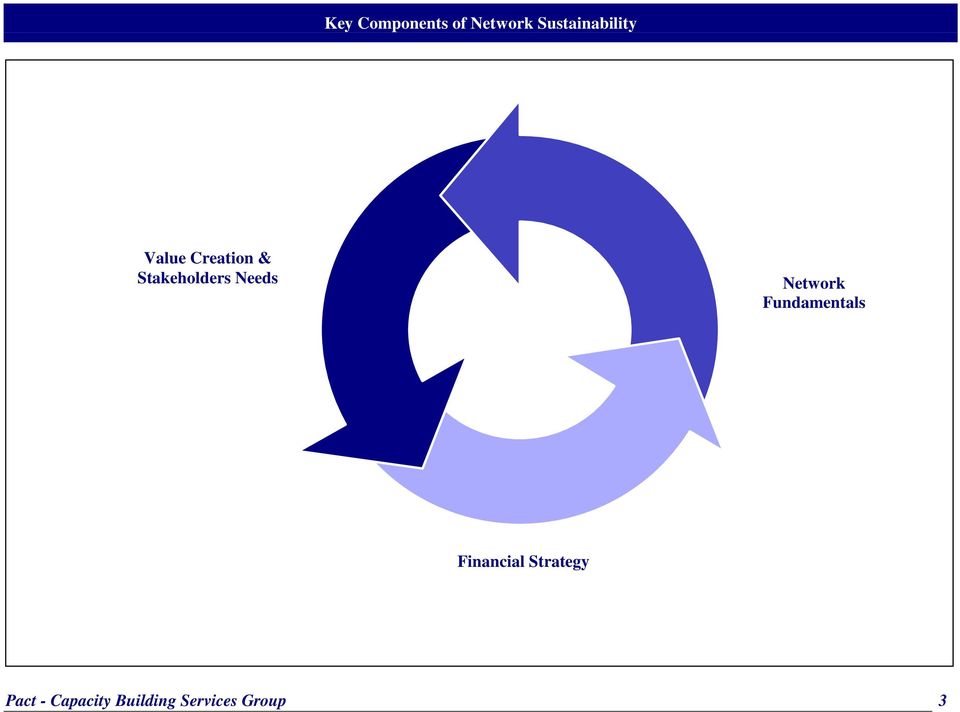
3 INTRODUCTION The term sustainability has become a common mantra in the field of international development. It drives policy, project design, funding availability and project execution. As dominant a term as it has become its meaning varies from context to context in which it is used. At a minimum, it connotes something that lasts and generally speaking, the focus of its practical meaning is usually weighted towards the financial aspects of sustainability. In other words, if funding is available to exist over time, an organization or network is often considered sustainable. The problem with this narrow definition of sustainability is that it presumes relevance and impact to be implicit by virtue of having enough funds to exist at any given moment. This assumption often leads to boom and bust cycles of both civil society organizations (CSOs) and networks, which relax in times of financial stability and are caught unawares when poor organizational fundamentals eventually decrease their ability to remain even financially sustainable much less relevant and impactful. Sustainability does not only imply availability of financial resources but also a combination of organizational fundamentals such as clear vision, sound planning, diversification, good financial and management practices, flexibility and adaptation to environmental changes, innovation, leadership, and commitment. True organizational sustainability requires balancing these and other fundamentals and leveraging them over time to attract the funding to keep the organization running, relevant and impactful. A network is an organizational form that must balance similar fundamentals in order to remain relevant and impactful over time. The particularities of network purposes and structure add interesting dimensions to the meaning of network sustainability and beg the following questions: Are networks inherently financially unsustainable in the classic sense? Does financial sustainability necessarily imply high value for the stakeholders of networks? Should networks be expected to survive on fee for service or membership dues or are grants and similar funding sources necessary? Is there a necessary life cycle of initial investment and intentional scaling down over time? Should networks aim for low overhead operations as a rule? Should networks be built to take advantage of economies of scale of their members? Can networks which were formed for tactical purposes (i.e., project networks) be converted into sustainable ongoing networks once the initial project funding is exhausted? These questions are at the core of analyzing why some networks succeed and others fail. In order to respond to these and other key questions, Pact has identified three interrelated components that are at the core of network sustainability: a) Value Creation in Response to Stakeholder Needs establishes a clear orientation that fosters the offering of services based on network stakeholder demand which is dynamic over time. b) Network Fundamentals are the foundation for network development and growth. Without solid fundamentals (i.e. mandate, vision, network structure, relationships and clear role separation with member organizations, management, etc.), sustainability is tenuous even if the network currently has meaningful financial support. c) Financial Strategy is the ability to efficiently align funding sources with network operational and strategic aims. It is the ability to leverage resources on the basis of strong network fundamentals and a solid value proposition. The degree of strength within and cohesion among these three components contributes directly to network sustainability and leads to competitive advantage. Pact - Capacity Building Services Group 2

4 Key Components of Network Sustainability Value Creation & Stakeholders Needs Network Fundamentals Financial Strategy Pact - Capacity Building Services Group 3
5 COMPONENTS OF NETWORK SUSTAINABILITY Value Creation and Stakeholders Needs The genesis of a network and its future development must be based on value creation in order to ensure long term sustainability. The creation of value, focused on stakeholders needs, is a key principle that not only fosters creative ways to address challenges but also enables the attainment of high impact interventions. Value creation 2 in a network involves aspects such as clear understanding of members needs, identification of innovative alternatives for solving problems, leverage of synergies among stakeholders for higher impact execution, and documentation and dissemination of best practices and lessons learned. A network can create value in different ways. Following are some of the many ways in which a network can create value: Promoting partnership with other stakeholders Conducting monitoring and evaluation in donors projects Identifying opportunities for joint interventions among network s members Documenting knowledge based on members interventions Implementing creative operational structures (Box 1 describes how Nicasalud3 is creating value through a very innovative operational structure) Clear purpose of network formation For network value added to be in response to stakeholder needs it is critical that the original purpose or mandate of the network be clear. Was the network created based on a true demand of network members that they as individual organizations couldn t have fulfilled more efficiently on their own? A successful network must be more than the sum of its members. Once it has been identified that a network has a strategic purpose for its members it must define strategies to carry out that particular value proposition. In addition to achieving clarity of purpose it is also important that all members are clear on the network value proposition and their own roles and responsibilities in sustaining the network including clarity on division of roles and responsibilities between a network and its members. Other key themes around clear purpose of network formation include: Clear understanding about potential synergies: appreciation about benefits and impact that can be achieved by working in networks. Agreement about priorities and strategies: clear definition of concrete actions around key objectives and goals. Management of information and knowledge: awareness about benefits of documentation and dissemination of best practices and successful approaches. 2 The creation of value is a continuous process framed by the network s strategic aims and by the features of the environment in which it operates. Thus, in order to be successful in value creation a network should carefully address the following dimensions: Members expectations and needs. This implies recognition of the objectives and goals of network s members and implementation of processes to achieve consensus around network s main aims. Through these processes a network identifies key outcomes that it must achieve to meet member s needs and it also promotes commitment about member s responsibilities to support network operations. Other stakeholders priorities and interests; this group is made up by donors, governmental agencies, municipalities, private firms, among others entities that have any interest on the network operations and outcomes. A clear reading of the opportunities or threats that this group can provide will help to identify ways for maximizing network impact through improved collaboration and leveraging of resources. 3 NicaSalud is a Nicaraguan NGO network specialized in health. It has a national reach and its membership integrates local and international organizations (25 entities in total). Pact - Capacity Building Services Group 4

6 Practical and clear operational procedures: rules that facilitate the network s operating and financial activities. Leadership based on values: clear orientation and motivation to carry out activities around network s principles. Awareness about the financial dimension: clear understanding about short and long term financial implications that come from programmatic decisions. Continuing common interest on key issue(s) A sense of mission and consensus around themes that interest network members is key confidence and participation among members generates a level of trust that improves relationships and facilitates coordination. But equally important is that mechanisms be in place for networks to continually gauge the dynamic nature of member needs and adjust to those needs within the limits of its mandate. If member needs change, the network must change (dissolve, redefine itself, etc.). A network that is financially sustainable and actively implementing activities, but that is out of touch with its membership is really no longer a network it is an independent NGO disguised in network form. Box 1: NicaSalud s Operational Structure The operational structure that NicaSalud implemented allows it to confront the geographical dispersion of its members as well as the growing interests on specific themes. At the same time, its structure helps to navigate financial limitations while emphasizing the advantages of exchange and learning among similar organizations. Thus, NicaSalud is creating solid conditions to support its long-term sustainability. The successful operational structure that NicaSalud was able to develop is based on two components. Their characteristics are as follows: a) Sub Regional Networks: When having a membership that extended at national level and with specific needs at regional level, NicaSalud decided to create 3 sub networks. Each one with an autonomous hand but incorporated into the global plan of NicaSalud. This way, each sub network has a coordinator and a secretary keeping close contact at regional and local levels with the Ministry of Health in order to harmonize activities. The advantages of having a Sub network are: The level of coordination for intra-regional interventions increases. Facilitates the dialogue and analysis of high-priority aspects within the region. Promotes the dissemination of outstanding information to assist daily work. b) Thematic groups: NicaSalud observed that not all the members at the national network level and at the sub network level shared common interests for the same topics. Instead they had certain topics that captured the attention of NGO groups that even operated in different regions. Facing this need, NicaSalud decided to respond by promoting the creation of Thematic Groups that would be focused on the study of specific topics (example: Child Health, Maternal Health, Monitoring and Evaluation among others). The advantages of creating Thematic Groups are: Analyze topics that respond to the NGOs needs (independently if they have financing from other than NicaSalud). Thematic groups have greater independence: define work plans, determine the frequency of their meetings, record their progress, etc. Stimulate the exchange of learning and observations between regions. In turn, with the purpose of making feasible the Regional Sub networks as well as the Thematic Groups, NicaSalud assigned members of its technical team to promote and monitor on the progress of the exchanges and learning at regional and thematic levels. Much of the coordination of regional NGO interventions - like the production of manuals and technical documents in the thematic groups have increased, generating consolidation among the members of NicaSalud. Pact - Capacity Building Services Group 5
7 Network Fundamentals Network fundamentals are the glue that solidifies a network. They are key assets that enable and sustain a network s operations. In the long term, solid network fundamentals make a huge difference on sustainability and impact. The following elements are examples of network fundamentals: Clear separation of roles between networks and membership Networks can become irrelevant, or even polemic, due to poor role differentiation between the network and its members. A network s roles at any given point in time must be centered on offering a value added for membership that members are not capable of achieving either individually or as efficiently as a network-led response. The drive for financial sustainability at the network level often leads networks to compete with their membership, or even pursue non competitive aims that don t benefit members at all. Box 2: Benefits of being a member of a Network Space for learning and training (Technical and Management strengthening) Access to an open space of dialogue, analysis and information exchange Members interests represented Access to systematized documentation (approaches, methodologies, etc.) Higher financing possibilities for projects, revolving funds, and/or access to loans Availability of technical assistance (counseling and accompaniment) Membership prestige and institutional representation Consultation and counseling possibilities among members Increase of the degree of inter-institutional relationships Better possibilities for coordination and joint actions Adequate scope and alignment Besides clearly defining roles and responsibilities, the scope of the network should be only ambitious enough to respond to member needs in an agile way. A network can only be as effective as its ability to respond within the limitations of its infrastructure and human resources. Unless the membership is large and wealthy, and willing to create significant infrastructure, network level roles should be limited to a few small priorities that clearly add value and don t overly tax the membership. Members will conduct the cost-benefit relationship of belonging to a network in a much stricter way than they would analyze continuing internal programs or priorities. If the network is seen to be pursuing non value added aims (in the form of projects, sale of services, etc.) in search of financial sustainability, it is likely that its scope is out of line with its capacity to respond. A network that is forced into contorting itself in the search for financial sustainability is a network in need of a rapid realignment and scaling down of scope. Network functions drive organizational structure The organizational form of the network besides only being large enough to respond to member needs in an agile way should be structured for efficiencies in response to membership. Roles of a network are typically different than those of a typical NGO. For example, if a network has a heavy focus on needs identification and communication in general (with members and in representation of members), resource mobilization and monitoring and evaluation of members, its organizational form should follow function. The organizational structure should gear itself around its key roles and not assume traditional NGO structures by default.` Pact - Capacity Building Services Group 6

8 Network fundamentals development responds to an organic process. They are developed through members increased awareness about what working under network logic means (Box 2 presents the benefits of being a member of a network). Network fundamentals are also improved by practical experiences that address critical issues in the network s agenda and create opportunities for a better understanding among members. Financial Strategy The financial dimension represents a key building block in network sustainability. Network financial strategy is the ability to efficiently align funding sources with network operational and strategic aims. It is the ability to leverage resources on the basis of strong network fundamentals and a solid value proposition. Innovation and accountability should drive a network s financial strategy. The former adds a source of value creation by looking for new ways to manage financial issues. The latter emphasizes professionalism and develops trust among stakeholders. The following are key features of a network s financial strategy: It must follow network strategic aims in order to align all organizational resources around value creation. It must build upon the network mandate which is structured around key value added niches that don t duplicate the functions of individual members. It must ground its value added in defined products and services towards its membership. It must be able to carry out the delivery of the products and services to its members in an efficient (perceived benefits to membership are higher than the costs) way and within the means of its membership (and stakeholders such as potential donors) to pay. It must understand at all times Who has interest in the success of this network? Identification of strategic allies (financial and others) provides the basic intelligence for the development of specific financial sustainability strategies. It must have specific sustainability goals and strategies, with a management system that facilitates strategy execution and monitoring. It must balance strategic themes such as the programmatic mandate and operational issues (cash flow needs, regulations, etc.). It must support decision-making process with timely, periodic, and accurate information. It must promote stewardship in order to maximize the use of the resources available. It has to create the conditions for a smooth financial transition between the short and long-term. A sound financial strategy approach allow a network to lead its future according its values, mission, and vision while avoiding to be driven by international cooperation trends or by financial institutions priorities. Thus, a successful financial strategy favors organizational autonomy, future viability, and flexibility for new innovation. An integral network s financial strategy should focuses on areas such as Strategic and Financial Planning, Diversification of Products and Services, Developing Opportunities and Resources, and Cost Management. In addition, a network depending upon its current situation or priorities may opt for specific strategies that can address issues related to income or expenses. Such specific options, among others, are Pact - Capacity Building Services Group 7

9 represented by income generating activities, fees for services, cost recovery, cost optimization, membership dues and reserves creation. A key message that arises from a network s financial strategy is that it is more than funding it also involves visioning, leadership, and a big picture approach that links financial and programmatic issues. Thus, by putting all these themes together a network has better possibilities to achieve organizational sustainability (Box 3 describes key elements about how PROCOSI 4 deals with the challenge of sustainability). Box 3: PROCOSI s Sustainability Recipe The achievement of sustainability is a permanent organizational challenge. It implies a fine combination of factors that go from the financial to the programmatic and from the operative to the strategic. In this manner the definition of a sustainability policy and strategy is critical for the viability of any organization. PROCOSI has developed a Sustainability Recipe to share with other networks searching for the ever elusive sustainability. This recipe has proven its value through the 16-year life of the network and is based on practical experience, collective reflection and an adaptation to contextual changes. The impact of the recipe has also helped PROCOSI s members to develop abilities and strategies that contribute to their own sustainability. The ingredients of the recipe are: Sure and sufficient flow of resources: It is necessary to have funding sources that not only assure operations in the short term but also in the medium and long term. This requires the development of creative and sustainable mechanisms of financing. At the moment, PROCOSI has a fiduciary fund that supports the availability of funds. Demand driven approach: Objectives are needed that respond and adapt to changing needs. If a network fails to articulate sound proposals it cannot attend to the needs of its members, thus putting at risk the network s viability. Competitive technical capacity: Including the expertise and capacity to manage programmatic and technical topics with an innovative focus and at an effective cost. PROCOSI works to maintain a well-prepared technical and administrative team. Organizational structure: Providing a stable and desirable work atmosphere facilitates the execution of objectives and goals, favors the practice of organizational values, and promotes accountability. Leadership: Leadership needs to be oriented to understanding what s needed to motivate and encourage its members, visualize a desired future, and generate the necessary changes to realize outlined objectives. Sense of ownership and incentives: The contributions of each member should lead to increased network responsibilities, rights and benefits. In the case of a network, such a contribution is translated in time, effort and money. In this manner member investments must offer a return with concrete benefits for each network member. 4 PROCOSI is a Bolivian NGO network working on health and development Its programs and projects have a national reach and concentrate on the severely poverty stricken areas of Bolivia. Its current membership has 37 international and national organizations. Pact - Capacity Building Services Group 8
10 Additional Lessons Learned around Network Sustainability Below are some key lessons learned around Network Sustainability Economies of scale and reduced costs can be achieved by participating as a member of a network. It is important that a network considers the sale of services as a mechanism to support its sustainability (i.e. Training, self-evaluation, strengthening processes, technical assistance, etc.). However, networks must be careful to not compete with their membership. The network structure can be attractive for donors since it reduces required bureaucratic correspondence with individual organizations. The potential standardization of administrativefinancial and monitoring and evaluation systems are attractive through a network as a one stop shop. However, project networks, or networks created or even quickly forced together for tactical purposes (such as to qualify for funding) often skip the round of building network fundamentals and end up in an inevitable cycle of: o Rapid scale up o Inflated operations o Crisis, scale down and reinvention as project funding nears termination Once a network is associated with a financial entity / donor, short term financial comfort may make it difficult to achieve the financial diversification necessary for long term sustainability. A strengthened network can offer quality services to other networks, to NGOs and to governmental agencies. Networks with memberships who join and are oriented to contributing, in addition to benefiting, are more likely to remain sustainable. Sustainable networks must develop and provide tangible and intangible benefits (e.g. economic, prestige, etc.) to its members. A network with agile mechanisms of communication and coordination can energize the exchanges among its members. The efficiency of a network is increased if it has a competent management that is focused on strategic issues. Sustainable networks must develop their capabilities to negotiate / lobby at external levels and to achieve consent at the internal level. Pact - Capacity Building Services Group 9
11 CONCLUSION Long term network sustainability is built around a balanced mix of a clear value proposition in response to stakeholder needs, solid network fundamentals and a clear financial strategy that efficiently aligns resources with network operational and strategic aims. While financial sustainability of a network doesn t necessarily imply high value for the stakeholders of networks, funding strategies to provide for basic network operations are key. Networks can be sustained artificially in the short term as in the case of well funded project networks however they will bust with the end of the project cycle if they aren t build upon strong network fundamentals. Networks should pursue a funding strategy (fee for service, membership dues, grants, etc.) and similar funding sources that responds efficiently to its well defined mandate and uniqueness of its functions. Networks should consider agile, low overhead operations that respond to a small number of key service functions to membership and clearly provide value without risking unsustainable scopes and structures. Pact - Capacity Building Services Group 10

Monitoring and Evaluation Plan Primer for DRL Grantees
 Monitoring and Evaluation Plan Primer for DRL Grantees I. What is a monitoring and evaluation plan? A monitoring and evaluation plan (M&E plan), sometimes also referred to as a performance monitoring or
Governance as Stewardship: Decentralization and Sustainable Human Development
 Governance as Stewardship: Decentralization and Sustainable Human Development by Jerry VanSant Research Triangle Institute USA EXECUTIVE SUMMARY Introduction The United Nations Development Programme (UNDP)
Strategic Plan. Page 1 of 6
 Strategic Plan The following represents the current AACE International Strategic Plan as approved by the Board of Directors at our meeting in April 2014 in Chicago, IL. The Strategic Plan is organized
A FRAMEWORK FOR NATIONAL HEALTH POLICIES, STRATEGIES AND PLANS
 A FRAMEWORK FOR NATIONAL HEALTH POLICIES, STRATEGIES AND PLANS June 2010 A FRAMEWORK FOR NATIONAL HEALTH POLICIES, STRATEGIES AND PLANS June 2010 This paper reviews current practice in and the potential
Central American Strategy for Rural Area-based Development ECADERT. Executive Summary
 Central American Strategy for Rural Area-based Development ECADERT Executive Summary The 2010-2030 Central American Strategy for Rural Area-based Development (ECADERT) addresses the need by Central American
The PMO as a Project Management Integrator, Innovator and Interventionist
 Article by Peter Mihailidis, Rad Miletich and Adel Khreich: Peter Mihailidis is an Associate Director with bluevisions, a project and program management consultancy based in Milsons Point in Sydney. Peter
Joint conclusions of the Spanish Presidency EU Youth Conference youth employment and social inclusion, Jerez, Spain 13-15 April 2010
 Joint conclusions of the Spanish Presidency EU Youth Conference youth employment and social inclusion, Jerez, Spain 13-15 April 2010 Youth Employment is the common theme of the three EU Youth Conferences
pm4dev, 2007 management for development series Introduction to Project Management PROJECT MANAGEMENT FOR DEVELOPMENT ORGANIZATIONS
 pm4dev, 2007 management for development series Introduction to Project Management PROJECT MANAGEMENT FOR DEVELOPMENT ORGANIZATIONS PROJECT MANAGEMENT FOR DEVELOPMENT ORGANIZATIONS A methodology to manage
CDIA Strategy and Action Plan for Pro-poor Urban Infrastructure Development 2011-2012. July 2011 Final Version CDIA
 CDIA Strategy and Action Plan for Pro-poor Urban Infrastructure Development 2011-2012 July 2011 Final Version CDIA Cities Development Initiative for Asia TABLE OF CONTENTS TABLE OF CONTENTS... I ACRONYMS...
The Natural Step Canada s Strategic Plan 2013-2017. The Natural Step Canada Strategic Plan 2013-2017 Summary for www.naturalstep.
 The Natural Step Canada Strategic Plan 2013-2017 Summary for www.naturalstep.ca 1 INTRODUCTION The Natural Step Canada is an entrepreneurial charity that delivers projects and programs based on our expertise
Part 1. MfDR Concepts, Tools and Principles
 Part 1. Concepts, Tools and Principles 3 Overview Part 1. MfDR Concepts, Tools and Principles M anaging for Development Results (MfDR) is multidimensional, relating back to concepts about how to make international
Organizational development of trade unions An instrument for self diagnosis Elaborated on the basis of an experience in Latin America.
 Organizational development of trade unions An instrument for self diagnosis Elaborated on the basis of an experience in Latin America FNV Mondiaal 2007 INDICE INTRODUCTION I. Concepts 1. What is organizational
Section Three: Ohio Standards for Principals
 Section Three: Ohio Standards for Principals 1 Principals help create a shared vision and clear goals for their schools and ensure continuous progress toward achieving the goals. Principals lead the process
NGOS AND PARTNERSHIP
 NGO Policy Briefing Paper No.4, April 2001 For the NGO Sector Analysis Programme NGOS AND PARTNERSHIP This Policy Briefing Paper presents the findings from the first phase of INTRAC s research Promoting
TORONTO CALL TO ACTION. 2006-2015 Towards a decade of Human Resources in Health for the Americas
 TORONTO CALL TO ACTION 2006-2015 Towards a decade of Human Resources in Health for the Americas Regional Meeting of the Observatory of Human Resources in Health 4-7 October, 2005 TOWARDS A DECADE OF HUMAN
Governance as Leadership: Reframing the Work of the Nonprofit Board
 Governance as Leadership: Reframing the Work of the Nonprofit Board This document presents a summary of Governance as Leadership: Reframing the Work of the Nonprofit Board, a seminar sponsored by The Pew
Title: President/CEO. Location: Washington, DC. Reports to: Board of Directors. Position Summary:
 Title: President/CEO Location: Washington, DC Reports to: Board of Directors Position Summary: The President/CEO of Africare has primary responsibility for the leadership and growth of this 40- year-old,
McKINSEY & COMPANY NONPROFIT BOARD SELF ASSESSMENT TOOL OVERVIEW
 OVERVIEW The Nonprofit Board Self Assessment Tool is designed to help nonprofit organizations assess their board's and identify priorities for board activities going forward. We believe this combination
ECLAC Economic Commission for Latin America and the Caribbean
 1 FOR PARTICIPANTS ONLY REFERENCE DOCUMENT DDR/2 22 June 2012 ENGLISH ORIGINAL: SPANISH ECLAC Economic Commission for Latin America and the Caribbean Eleventh meeting of the Executive Committee of the
2011 UNDP Global Management Meeting 27 June 2011. Speech delivered at the Opening Plenary by
 2011 UNDP Global Management Meeting 27 June 2011 Speech delivered at the Opening Plenary by H.E. Izabella Teixeira, Minister of the Environment of Brazil Your Excellency Mr Ban Ki-moon, the United Nations
From Strategic Planning to Strategic Positioning. By Shelli Bischoff-Turner
 From Strategic Planning to Strategic Positioning By Shelli Bischoff-Turner Introduction Strategic planning has been the mainstay of nonprofit organizational development for decades. Defining mission and
Summary of Challenges and Opportunities facing NGOs and the NGO Sector
 Summary of Challenges and Opportunities facing NGOs and the NGO Sector The Challenges and Opportunities listed below were generated from 5 of the first 11 regional NGO workshops; this exercise was not
NCNSP Design Principle 1: Ready for College
 College Credit College Ready Skills (High School) Course of Study NCNSP Design Principle 1: Ready for College Students are tracked according to past performance into regular and honors level courses. All
National Network of Fiscal Sponsors. Guidelines for Comprehensive Fiscal Sponsorship
 Introduction National Network of Fiscal Sponsors Guidelines for Comprehensive Fiscal Sponsorship Fiscal sponsorship has evolved as an effective and efficient mechanism for starting new nonprofits, seeding
Ministerie van Toerisme, Economische Zaken, Verkeer en Telecommunicatie Ministry of Tourism, Economic Affairs, Transport and Telecommunication
 SME Policy Framework for St. Maarten May, 2014 Department of Economic Affairs, Transportation & P. 1 of 16 TABLE OF CONTENTS 1. Introduction 2. SME Developments in St. Maarten 2.1 Definition 2.2 Government
7. ASSESSING EXISTING INFORMATION SYSTEMS AND INFORMATION NEEDS: INFORMATION GAP ANALYSIS
 7. ASSESSING EXISTING INFORMATION 6. COMMUNITY SYSTEMS AND LEVEL INFORMATION MONITORING NEEDS: OF THE INFORMATION RIGHT TO ADEQUATE GAP ANALYSIS FOOD 7. ASSESSING EXISTING INFORMATION SYSTEMS AND INFORMATION
Functional Title Classification FLSA Status Reports To Team Purpose
 Functional Title Classification FLSA Status Reports To Team Purpose Vice President of Marketing and Engagement Director, Marketing & Communications UWW 400 N Exempt President & CEO Marketing & Engagement
JOB DESCRIPTION. Job Purpose To provide overall leadership and strategic direction to the ACORD country programme.
 JOB DESCRIPTION Position: Location: Responsible to: COUNTRY DIRECTOR (CD) ADDIS ABABA, ETHIOPIA with regular visits to all project locations in Ethiopia Head of Programmes Operations & Development Background
Trustee Leadership Forum for Retirement Security Inaugural Meeting Summary
 Trustee Leadership Forum for Retirement Security Inaugural Meeting Summary On May 17-18, 2011, the Initiative for Responsible Investment hosted a meeting of laboraffiliated public and Taft-Hartley pension
OUR MISSION. The mission of the USC Rossier School of Education is to improve learning in urban education locally, nationally and globally.
 STRATEGIC PLAN 2012-2017 OUR MISSION The mission of the USC Rossier School of Education is to improve learning in urban education locally, nationally and globally. Urban education takes place within many
Individual Development Planning (IDP)
 Individual Development Planning (IDP) Prepared for Commerce Employees U.S. Department of Commerce Office of Human Resources Management Table of Contents Introduction / Benefits of Career Planning 1 Your
UNITED NATIONS COMMISSION ON SCIENCE AND TECHNOLOGY FOR DEVELOPMENT
 UNITED NATIONS COMMISSION ON SCIENCE AND TECHNOLOGY FOR DEVELOPMENT Chairman s draft recommendations on the basis of the consolidated version of the rolling document A. Shaping the outcomes of IGF meetings
Executive Board of the United Nations Entity for Gender Equality and the Empowerment of Women
 United Nations UNW/2015/CRP.8 Executive Board of the United Nations Entity for Gender Equality and the of Women Distr.: Limited 23 April 2015 Original: English Annual session of 2015 30 June - 2 July 2015
UNITED WAY ENTERPRISE-WIDE STRATEGY
 UNITED WAY WORLDWIDE UNITED WAY ENTERPRISE-WIDE STRATEGY THE UNITED WAY VISION AND MISSION VISION United Way envisions a world where all individuals and families achieve their human potential through education,
World Health Organization
 March 1, 2005 Proposed Networks to Support Health Decision-Making and Health Policy Formulation in Low and Lower Middle Income Countries & Considerations for Implementation World Health Organization A
A Relative Gap Moving from Gap to Strength A Relative Strength Organizational Readiness
 A Relative Gap Moving from Gap to Strength A Relative Strength Organizational Readiness Performance history Implementation of new programs historically has not been well planned, and has not had intended
HEAD OF POLICY AND ADVOCACY
 JOB DESCRIPTION JOB TITLE: DEPARTEMENT: LOCATION: REPORTING TO: COUNTRY REPRESENTATIVE - SENEGAL PAN- AFRICAN PROGRAMME DAKAR, SENEGAL HEAD OF POLICY AND ADVOCACY BACKGROUND & ORGANISATIONAL CONTEXT ACORD
Country Ownership of Policy Reforms and Aid Effectiveness: The Challenge of Enhancing the Policy Space for Developing Countries in Aid Relationships
 Country Ownership of Policy Reforms and Aid Effectiveness: The Challenge of Enhancing the Policy Space for Developing Countries in Aid Relationships Statement by Louis Kasekende, Chief Economist, African
SEARCH PROFILE. Executive Director Policy, Planning and Legislative Services. Alberta Seniors and Housing. Executive Manager I
 SEARCH PROFILE Executive Director Policy, Planning and Legislative Services Alberta Seniors and Housing Executive Manager I Salary Range: $125,318 - $164,691 ($4,801.47 $6,310.03 bi-weekly) Limited Competition
JULY 1, 2010 JUNE 30, 2013 STRATEGIC PLAN
 DEPARTMENT OF HUMAN RESOURCES JULY 1, 2010 JUNE 30, 2013 STRATEGIC PLAN Introduction Human resource strategies are institutional efforts to support people (leaders, faculty and staff) to contribute to
QUALITY TOOLBOX. Creating a Complete Business Management System. Many organizations have separate environmental management. Integrating environmental,
 QUALITY TOOLBOX Creating a Complete Business Management System Many organizations have separate environmental management and occupational, health, and safety management systems. They are defined as being
Leiders in cultuurverandering
 Leiders in cultuurverandering Een praktische gids voor strategische en culturele veranderingen in organisaties Jaap Boonstra Deze studie is eerder financieel mogelijk gemaakt en begeleid door de Stichting
Joseph Naughton-Travers, Ed.M., Senior Associate, OPEN MINDS The 2014 OPEN MINDS Planning & Innovation Institute June 3, 2014 9:45am 11:00am
 Joseph Naughton-Travers, Ed.M., Senior Associate, OPEN MINDS The 2014 OPEN MINDS Planning & Innovation Institute June 3, 2014 9:45am 11:00am I. Why Organizations Need An Externally- Focused, Resource-Based
Designing an Effective Organization Structure. January 2009
 Designing an Effective Organization Structure January 2009 Effective organization design considers five, interrelated components Clear vision and priorities Cohesive leadership team 1. Leadership 2. Decision
Standards for Advanced Programs in Educational Leadership
 Standards for Advanced Programs in Educational Leadership for Principals, Superintendents, Curriculum Directors, and Supervisors NATIONAL POLICY BOARD FOR EDUCATIONAL ADMINISTRATION Published January,
5. SOCIAL PERFORMANCE MANAGEMENT IN MICROFINANCE 1
 5. SOCIAL PERFORMANCE MANAGEMENT IN MICROFINANCE 1 INTRODUCTION TO SOCIAL PERFORMANCE MANAGEMENT Achieving Social and Financial Performance In the microfinance arena, performance has long been associated
Policy Paper on Non-Formal Education: A framework for indicating and assuring quality
 Policy Paper on Non-Formal Education: A framework for indicating and assuring quality Adopted by the Council of Members/ Extraordinary General Assembly 2-3 May 2008 (Castelldefels, Catalonia - Spain) 0.
USAID PROGRAM CYCLE OVERVIEW
 USAID PROGRAM CYCLE OVERVIEW USAID AUGUST 2012 CONTENTS Background... 3 Overview Summary... 3 Program Cycle Components:... 3 Agency Policies and Strategies:... 4 Country Development Cooperation Strategies:...
TABLE OF CONTENTS. The Concept of School Accreditation:... 4. Objectives of School Accreditation:... 4
 TABLE OF CONTENTS QNSA Handbook Foreword... 3 The Concept of School Accreditation:... 4 Objectives of School Accreditation:... 4 The Difference between the Accreditation and Licensing Process:... 6 Developing
Marketing Challenges for Financial Services
 Marketing Financial Services A Self Study Guide LESSON ONE Marketing Challenges for Financial Services Objective: to introduce the basics of marketing, particularly the concepts of market information and
Strategy and Performance Management in the Government
 Strategy and Performance Management in the Government A White Paper By James B. Whittaker Retired Rear Admiral, U.S. Navy, and author of President s Management Agenda: A Balanced Scorecard Approach 444
LEADING AN ORGANIZATION THROUGH CHANGE A DISCUSSION
 LEADING AN ORGANIZATION THROUGH CHANGE A DISCUSSION All businesses are faced with ongoing change. Some changes are driven internally as ways are developed to make processes more efficient. Other changes
pm4dev, 2007 management for development series Project Management Organizational Structures PROJECT MANAGEMENT FOR DEVELOPMENT ORGANIZATIONS
 pm4dev, 2007 management for development series Project Management Organizational Structures PROJECT MANAGEMENT FOR DEVELOPMENT ORGANIZATIONS PROJECT MANAGEMENT FOR DEVELOPMENT ORGANIZATIONS A methodology
EMERGENCY MANAGEMENT BRITISH COLUMBIA A STRATEGY TO ADVANCE SUPPORT FOR LOCAL AUTHORITY EMERGENCY MANAGEMENT PROGRAMS OCTOBER 14, 2015
 EMERGENCY MANAGEMENT BRITISH COLUMBIA A STRATEGY TO ADVANCE SUPPORT FOR LOCAL AUTHORITY EMERGENCY MANAGEMENT PROGRAMS OCTOBER 14, 2015 1 MESSAGE FROM THE ASSISTANT DEPUTY MINISTER I am pleased to introduce
UNIVERSITY OF MIAMI SCHOOL OF BUSINESS ADMINISTRATION MISSION, VISION & STRATEGIC PRIORITIES. Approved by SBA General Faculty (April 2012)
 UNIVERSITY OF MIAMI SCHOOL OF BUSINESS ADMINISTRATION MISSION, VISION & STRATEGIC PRIORITIES Approved by SBA General Faculty (April 2012) Introduction In 1926, we embarked on a noble experiment the creation
GLOSSARY OF EVALUATION TERMS
 Planning and Performance Management Unit Office of the Director of U.S. Foreign Assistance Final Version: March 25, 2009 INTRODUCTION This Glossary of Evaluation and Related Terms was jointly prepared
Revised Policy Paper on Non-Formal Education: A Framework for indicating and assuring quality
 Revised Policy Paper on Non-Formal Education: A Framework for indicating and assuring quality ADOPTED BY THE COUNCIL OF MEMBERS ANTWERP, BELGIUM, 6-7 MAY 2011 1 COMEM -FINAL Executive summary Non-Formal
reflected and translated into policy orientations and priorities as well strategy documents and a management plan.
 ECHO s main mission is to fund the co-ordinated delivery of Community humanitarian assistance and protection through partner humanitarian organisations in order to save and preserve life, reduce or prevent
ACG s Growth Strategy and High Performance Business Consulting Services
 ACG s Growth Strategy and High Performance Business Consulting Services ACG delivers telecom market share/forecast reports, consulting services, business case analysis, product and service message testing.
Structure of the Administration (political and administrative system)
 Thailand Performance Management 1. Introduction Structure of the Administration (political and administrative system) Since the declaration of the first constitution in 1932, the politics and government
FOREIGN AFFAIRS PROGRAM EVALUATION GLOSSARY CORE TERMS
 Activity: A specific action or process undertaken over a specific period of time by an organization to convert resources to products or services to achieve results. Related term: Project. Appraisal: An
Meeting Professionals International (MPI) June 2006, www.mpiweb.org
 1 360º of Teamwork: How Meetings and Travel Professionals Can Build Strategic Synergies to Drive Results A Position Paper from Meeting Professionals International s Global Corporate Circle of Excellence
Strategic Plan. Valid as of January 1, 2015
 Strategic Plan Valid as of January 1, 2015 SBP 00001(01/2015) 2015 City of Colorado Springs on behalf of Colorado Springs Page 1 of 14 INTRODUCTION Integrated and long-term strategic, operational and financial
Evaluation Results from National Consultation Organizers
 Evaluation Results from National Consultation Organizers September 2010 Responses Received from National Consultation Organizers (24): Region Countries responded Africa (3) Uganda, Cameroon, Ghana Asia/
How To Help The World Coffee Sector
 ICC 105 19 Rev. 1 16 October 2012 Original: English E International Coffee Council 109 th Session 24 28 September 2012 London, United Kingdom Strategic action plan for the International Coffee Organization
Summary of UNICEF Private Fundraising and Partnerships Plan 2014-2017
 Summary of UNICEF Private Fundraising and Partnerships Plan 2014-2017 1. Introduction The Private Fundraising and Partnerships Plan supports the UNICEF Strategic Plan 2014 2017 and other organizational
Evaluation of six development NGOs accredited by the Minister of Foreign and European Affairs of the Grand Duchy of Luxembourg
 Evaluation of six development NGOs accredited by the Minister of Foreign and European Affairs of the Grand Duchy of Luxembourg Synthesis report of the evaluation Extract of the final version dated November,
Competency Requirements for Executive Director Candidates
 Competency Requirements for Executive Director Candidates There are nine (9) domains of competency for association executives, based on research conducted by the American Society for Association Executives
Superintendent Effectiveness Rubric*
 Public Document 3 Purpose: Outlines the standards that are the foundation for the evaluation. Name of Superintendent: Date: Performance Rating Scale: Distinguished (4) Accomplished (3) standards for most
CSO CAPACITY ANALYSIS: A tool for assessing capacities for quality OVC response
 CSO CAPACITY ANALYSIS: A tool for assessing capacities for quality OVC response 1. Capacity areas for strengthening among OVC CSOs These capacity areas were generated from OVC grantee profiles and feedback
Project Management Institute STRATEGIC PLAN. Prepared by: PMI Board of Directors
 Project Management Institute STRATEGIC PLAN Prepared by: PMI Board of Directors Last Revised: 30 November 2012 TABLE OF CONTENTS OVERVIEW... 1 PMI S CORE IDEOLOGY... 3 Core Purpose.... 3 Our Core Values...
Strategic Planning (in nonprofit or for profit organizations)
 Strategic Planning (in nonprofit or for profit organizations) Written by Carter McNamara, MBA, PhD, Authenticity Consulting, LLC. Copyright 1997 2008. Adapted from the Field Guide to Nonprofit Strategic
Case Study: Population and Public Health Program of the BC Provincial Health Services Authority i
 Case Study: Population and Public Health Program of the BC Provincial Health Services Authority i Wayne Foster and Christopher Wilson. Originally published in Illustrations in Public Health of a More Collaborative
Guidance Note on Developing Terms of Reference (ToR) for Evaluations
 Evaluation Guidance Note Series UNIFEM Evaluation Unit October 2009 Guidance Note on Developing Terms of Reference (ToR) for Evaluations Terms of Reference (ToR) What? Why? And How? These guidelines aim
STRATEGIC PLAN. American Veterinary Medical Association 2015-2017
 STRATEGIC PLAN American Veterinary Medical Association 2015-2017 Adopted: January 9, 2015 Introduction Excellence is a continuous process and doesn t come by accident. For more than 150 years, the American
Compilation of Principles and Recommendations on Preparedness from a series of Workshops and Meetings
 Compilation of Principles and Recommendations on Preparedness from a series of Workshops and Meetings Disaster prone countries Advocacy and Awareness Make disaster risk reduction for resilience, including
Crosswalk of the New Colorado Principal Standards (proposed by State Council on Educator Effectiveness) with the
 Crosswalk of the New Colorado Principal Standards (proposed by State Council on Educator Effectiveness) with the Equivalent in the Performance Based Principal Licensure Standards (current principal standards)
PERFORMANCE MANAGEMENT IN THE BOTSWANA PUBLIC SERVICE
 -------- PERFORMANCE MANAGEMENT IN THE BOTSWANA PUBLIC SERVICE ABSTRACT Performance management is a reform initiative introduced by the Public Service to facilitate delivery of the national vision goals.
A guide to strategic human resource planning
 A guide to strategic human resource planning By Workinfo.com, www.workinfo.com 1. Introduction A comprehensive Human Resource Strategy plays a vital role in the achievement of an organisation's overall
COMPREHENSIVE ASSET MANAGEMENT STRATEGY
 COMPREHENSIVE ASSET MANAGEMENT STRATEGY APPROVED BY SENIOR MANAGEMENT COMMITTEE ON AUGUST 23, 2012 (TO BE FINALIZED AFTER APPROVAL OF CAM POLICY BY COUNCIL) August 2012 Contents CONTENTS EXECUTIVE SUMMARY
ACS WASC Accreditation Status Determination Worksheet
 ACS WASC Accreditation Status Determination Worksheet How are students achieving? Is the school doing everything possible to support high achievement for all its students? Directions 1. Discuss the evidence
Developing Post Disaster Recovery Frameworks
 Developing Post Disaster Recovery Frameworks Raja Rehan Arshad Team Leader Sustainable Recovery, GFDRR Disaster and Crisis Recovery Operations for Increased Resilience JVI, September 10-14, 2012 Why The
Service Delivery Review
 Building Strong Communities A Guide to Service Delivery Review for Municipal Managers August 2004 The Ministry of Municipal Affairs and Housing and its partners on this project offer A Guide to Service
PARIS AGENDA OR 12 RECOMMENDATIONS FOR MEDIA EDUCATION
 PARIS AGENDA OR 12 RECOMMENDATIONS FOR MEDIA EDUCATION 25 years after the adoption of the Grünwald Declaration that paved the way for media education at the international level, experts, education policy-makers,
Corporate risk register
 EXECUTIVE BOARD EB133/10 133rd Session 17 May 2013 Provisional agenda item 7.3 Corporate risk register Organization-wide strategic risk management in WHO Report by the Secretariat 1. This report is submitted
Unlocking the Potential of the Social Economy for EU Growth: The Rome Strategy
 Unlocking the Potential of the Social Economy for EU Growth: The Rome Strategy Based on the Proceedings of the Rome Conference, November 17 and 18, 2014 On the occasion of its Presidency of the EU Council,
Issues related to major redesigns in National Statistical Offices
 Issues related to major redesigns in National Statistical Offices Peter Morrison and Jacqueline Mayda Statistics Canada, Ottawa, Ontario Canada [email protected] [email protected]
STRATEGIC PLAN 2013/2014 TO 2015/2016
 STRATEGIC PLAN 2013/2014 TO 2015/2016 1. WCO Strategic Plan Introduction 1. The purpose of this document is to present the WCO Strategic Plan that was approved by the Council in June 2013 for the years
Strategic Planning Toolkit
 Strategic Planning Toolkit TABLE OF CONTENTS INTRODUCTION...1 The Purpose... 1 How to Use the Toolkit... 2 What is Strategic Planning?... 2 What Can Strategic Planning Do For Your Organization?... 3 DESIGNING