
Information Asymmetry, Price Momentum, and the Disposition Effect
|
|
|
- Alexander Horn
- 10 years ago
- Views:
Transcription
1 Information Asymmetry, Price Momentum, and the Disposition Effect Günter Strobl The Wharton School University of Pennsylvania October 2003 Job Market Paper Abstract Economists have long been puzzled by the tendency of investors to sell winning investments too soon and hold losing investments too long. Several behavioral explanations for this phenomenon, known as the disposition effect, have been advanced. This paper demonstrates that disposition effects are not intrinsically at odds with rational behavior. Specifically, we show (i) that disposition effects arise quite naturally in a world with changing information asymmetry, (ii) that existing empirical tests rejecting an information-based explanation are inconclusive, and (iii) that disposition effects are consistent with price momentum. Further, we derive new empirical implications relating disposition behavior to trading volume, return variability, and price dynamics. JEL classification: D82, D83, G14 Keywords: disposition effect, behavioral finance, rational expectations The author thanks Rüdiger Fahlenbrach, Simon Gervais, Gary Gorton, Richard Kihlstrom, Yihong Xia, and seminar participants at Duke University, the Wharton School, and the 2003 Midwest Finance Association meetings for their helpful comments and suggestions. Please address correspondence to Günter Strobl, Department of Finance, The Wharton School, University of Pennsylvania, Steinberg Hall Dietrich Hall Suite 2300, 3620 Locust Walk, Philadelphia, PA [email protected]

2 1 Introduction Recent empirical studies have documented a number of regularities in the behavior of investors that seem to be at odds with the rational expectations paradigm. One of the most striking patterns is the tendency of investors to sell their winners and to hold on to their losers. Such behavior, which has been termed the disposition effect by Shefrin and Statman (1985), has been found in a variety of data sets and time periods. 1 Although the existence of the disposition effect seems undisputed, economists and investment professionals have not agreed on an explanation for this phenomenon. The empirical literature favors a behavioral explanation offered by Shefrin and Statman (1985), which combines the ideas of mental accounting (Thaler (1985)) and prospect theory (Kahneman and Tversky (1979)). Shefrin and Statman argue that investors keep a separate mental account for each stock. Within that account, investors maximize an S -shaped valuation function, which is similar to a standard utility function except that it is defined on gains and losses relative to a reference point (usually the purchase price), rather than on absolute wealth. This valuation function is concave in the gains region and convex in the loss region. Thus, if a stock appreciates in price, the investor s wealth will be in a more risk-averse part of her valuation function, making a sale more likely. In contrast, if the stock is trading below its purchase price, the investor becomes risk-loving, and will hold on to the stock for a chance to break even. In addition, there are rational explanations for the disposition effect. First, portfolio rebalancing considerations suggest that investors who do not hold the market portfolio should respond to large price increases by selling some of the shares they hold in these stocks to restore diversification (Lakonishok and Smidt (1986)). Second, since transaction costs tend to be higher for lower priced stocks, and since losing investments are more likely to be lower priced, investors may refrain from selling losing investments simply to avoid 1 While Shefrin and Statman (1985) restrict their analysis to aggregate data on mutual fund redemptions, recent studies provide direct evidence from actual trading records of individual investors, such as discount brokerage clients (Odean (1998), Ranguelova (2001), Dhar and Zhu (2002)) and professional futures traders (Locke and Mann (2000)). The disposition effect is not particular to the U.S. market. It has also been documented for Finnish investors (Grinblatt and Keloharju (2001)), Israeli investors (Shapira and Venezia (2001)), and investors on the Australian Stock Exchange (Brown et al. (2002)). Weber and Camerer (1998) provide evidence for disposition behavior in an experimental setting. 1
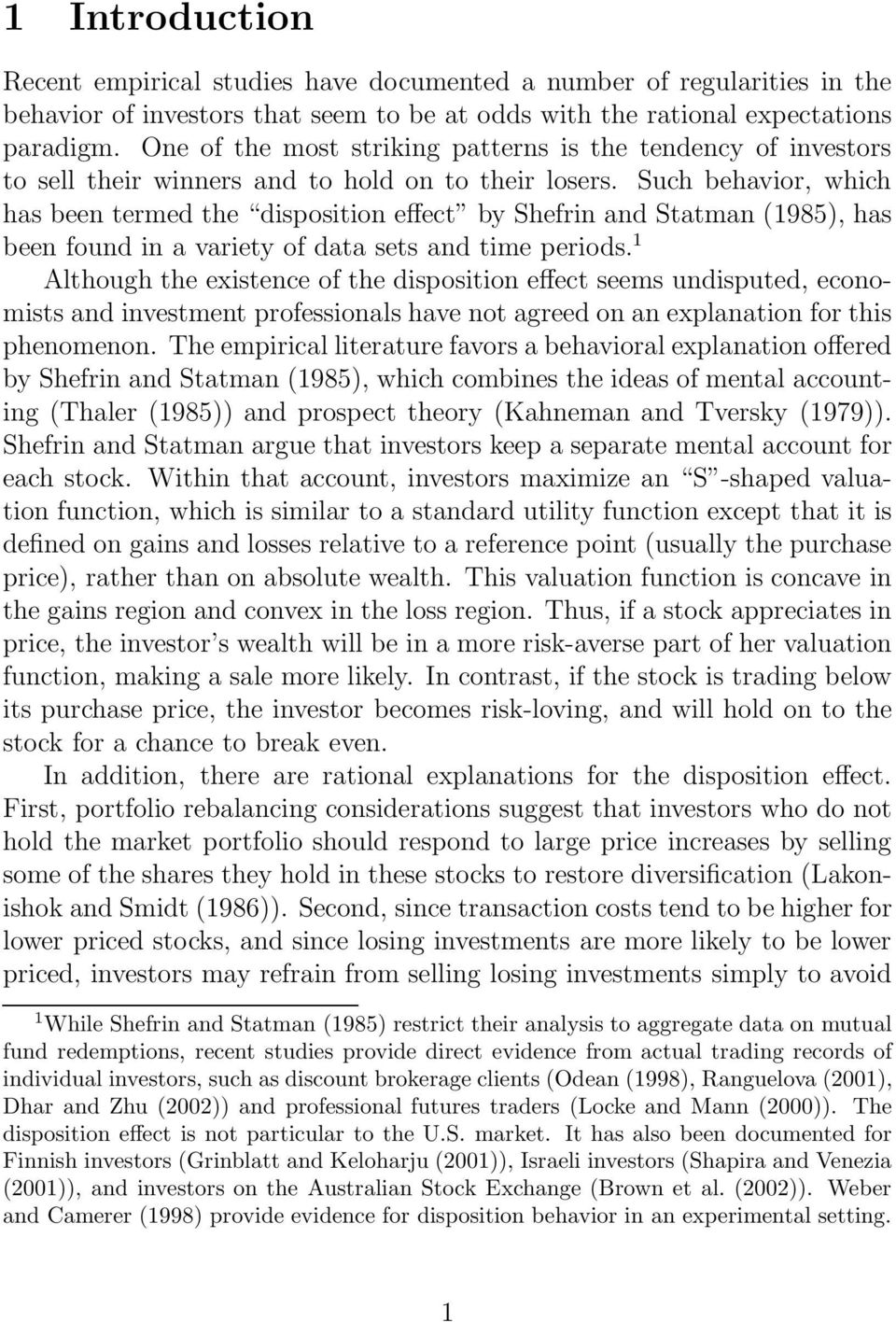
3 the higher transaction costs (Harris (1988)). Finally, disposition behavior may result from informational differences across investors (Lakonishok and Smidt (1986)). An investor who purchased a stock on favorable information may sell it when the price goes up because she rationally believes that the stock price now reflects this information. On the other hand, if the price goes down, the investor may continue to hold it, rationally believing that her information has not yet been incorporated into the price. These alternative rational explanations have been challenged by recent empirical studies. Odean (1998) shows that investors who sell their entire holdings of a stock and who are thus unlikely to be motivated by diversification continue to prefer selling winners. In addition, he provides evidence against the hypothesis that higher trading costs for lower priced stocks are responsible for the disposition effect. Even when differences in transaction costs are controlled for, investors appear to be reluctant to realize their losses. Moreover, Odean (1998) and Brown et al. (2002) argue that the investors preference for realizing winners rather than losers does not appear to be justified by the subsequent stock performance. Both studies find that, on average, winners that are sold outperform, over the subsequent six to 24 months, losers that are not sold, which leads them to reject the information-based explanation suggested by Lakonishok and Smidt. 2 This paper suggests that the case for rational disposition effects is not hopeless, however. In fact, a simple rational expectations model with asymmetrically informed agents can generate most of the empirically documented facts. The aim of this paper is threefold. First, we demonstrate that, depending on how the degree of information asymmetry changes over time, not only better informed investors choose to sell their winners rather than their losers (as suggested by Lakonishok and Smidt), but also less informed traders might prefer such a strategy. Second, we show that risk-averse investors can rationally exhibit disposition effects even though past winners continue to outperform past losers in subsequent periods. In other words, our results indicate that the existing empirical tests rejecting an information-based explanation for the disposition effect are inconclusive. Third, we examine the relationship between the investors trading behavior and equilibrium price dynamics. In particular, we show that both a disposition effect and price 2 While this result can certainly not be considered as evidence in favor of an informationbased explanation, we will show in Section 3 that it is not necessarily inconsistent with rational behavior when investors are risk averse. 2
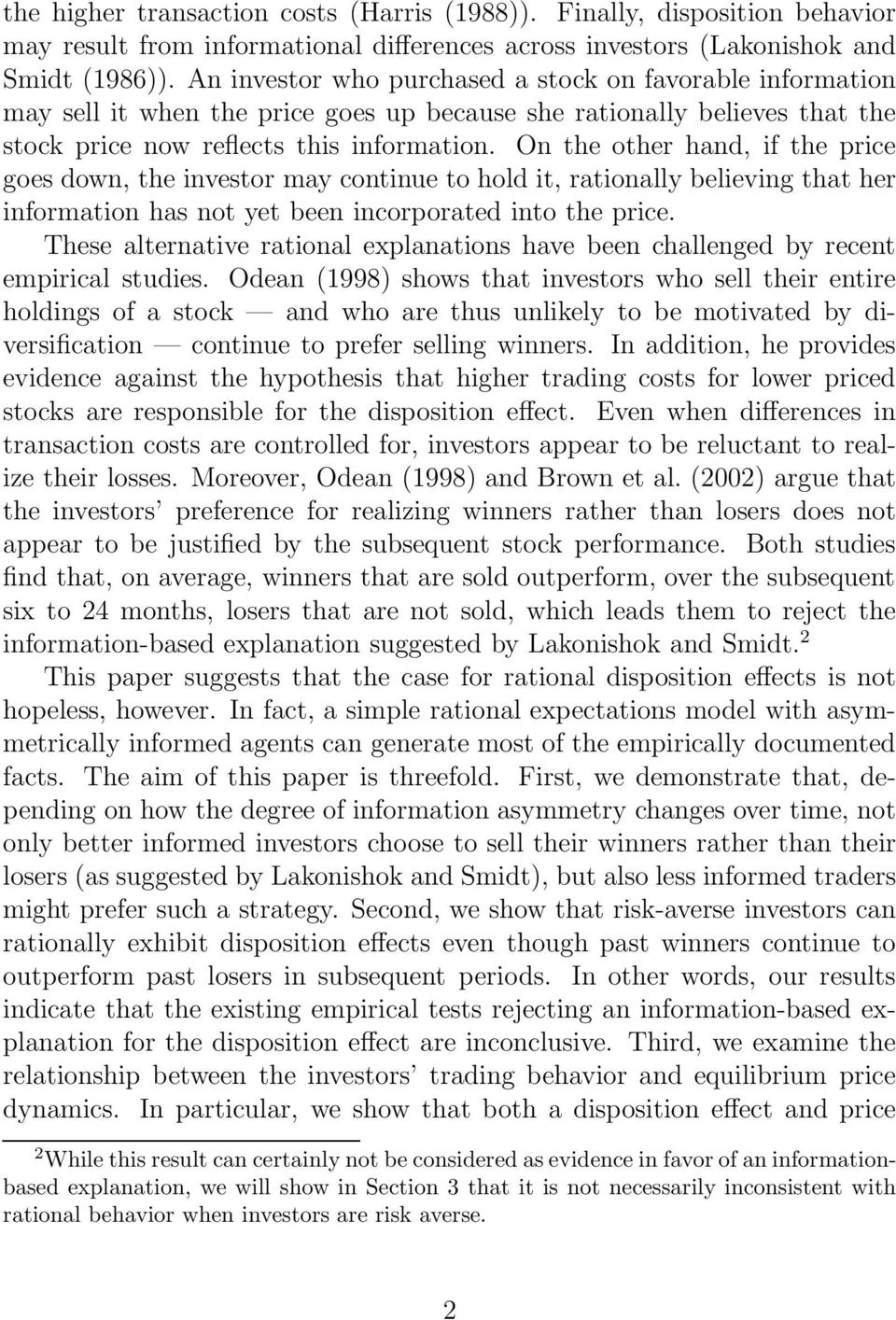
4 momentum can arise in a world with fully rational agents. The basic intuition for our results is as follows. Consider a dynamic model where in each period a fraction of investors receives private information concerning, say, a future earnings announcement or an annual report, and where liquidity shocks prevent prices from fully revealing this information. In such a framework, the informational advantage of privately informed agents can either increase or decrease over time, depending on the precision of their signals and the magnitude of liquidity shocks in each period. If the information disparity decreases over time (either because liquidity shocks become smaller, or because informed agents trade more aggressively and thus reveal more of their private information), less informed investors update their beliefs and hence their asset demands more significantly than better informed investors, as new information becomes available. Market clearing then implies that the latter follow a contrarian strategy: they tend to decrease their stock holdings when good news drives prices up ( sell their winners ) and to increase their stock holdings when bad news forces prices down ( hold on to their losers ). The opposite effect is observed when the information asymmetry between investors increases over time. In this case, better informed traders respond more aggressively to new information, forcing less informed traders to pursue a contrarian investment strategy. In other words, less informed investors underreact to new information, from the perspective of better informed investors, because the information conveyed by prices is very noisy. The economic setting we use extends the rational expectations model developed by Grossman and Stiglitz (1980) to two trading periods. However, unlike other dynamic versions of that model in which information is dispersed among many market participants, 3 we maintain the strictly hierarchical information structure of Grossman and Stiglitz s original framework to highlight our ideas in as simple a setting as possible. This admittedly restrictive assumption allows us to characterize equilibrium demands and prices in closed form and to derive conditions for the disposition behavior of various investor groups. Holden and Subrahmanyam (2002) use a similar framework to show that lags in information acquisition can generate positive serial correlation in asset returns. The remainder of this paper is organized as follows. Section 2 presents 3 See, e.g., Grundy and McNichols (1989), Brown and Jennings (1989), and He and Wang (1995) for a dynamic setting with a single risky asset, and Brennan and Cao (1997) and Zhou (1998) for the multiple-asset case. 3

5 the economic setting. Section 3 describes the equilibrium of the model and derives prices and demands in closed form. The necessary conditions for investors to exhibit disposition effects are provided in Section 4. Section 5 analyzes the relationship between the investors trading behavior and asset price dynamics. Section 6 concludes the paper. All proofs are contained in the Appendix. 2 The Model We consider a two-period exchange economy. Agents trade at dates 0 and 1 and consume at date 2. In each period, a fraction of investors receives private information concerning the assets future payoffs. There is some noise in the market, in the form of supply shocks, that prevents equilibrium prices from fully revealing the investors private information. The structure of the economy is common knowledge. 2.1 Assets There are two assets available for trading in the market: a riskless bond and a risky stock. The bond is in perfectly elastic supply. For simplicity, we normalize its interest rate to zero. Each share of the stock pays a liquidation value of V at date 2, which is drawn from a normal distribution with mean zero and variance one, and is unknown to investors prior to date 2. Shares of the stock are infinitely divisible and are traded competitively in the stock market. The price of the stock at date t = 0, 1 is denoted by P t. The aggregate supply of the stock is random and equals z 0 at date 0 and z 0 +z 1 at date 1. Such supply shocks are a typical ingredient of rational expectations models. The noise they create prevents equilibrium prices from fully revealing the informed agents private information. The assumption of a stochastic stock supply is equivalent to assuming the presence of liquidity traders who have inelastic demands of z 0 and z 1 shares of the stock, for reasons that are exogenous to the model. For simplicity, we assume that z 0 and z 1 are normally distributed with mean zero 4 and variances σ 2 z 0 and σ 2 z 1, respectively, and are independent of each 4 Normalizing the expected stock supply to zero can be done without loss of generality. Introducing a positive mean supply would cause the unconditional risk premium to be non-zero, but would not alter our basic results. 4

6 other and all other random variables. 5 The assumption that all uncertainty is resolved by date 2 is not crucial for our results. In a more realistic setting, the payment of the liquidating dividend could be interpreted as any public announcement (such as an earnings announcement) that temporarily eliminates, or at least reduces, informational differences among investors. As long as information is made public in the form of discrete news events, rather than continuously, the introduction of an infinite series of public announcements would not alter our basic conclusions Investors Our economy is populated by two types of market participants: informed investors who possess private information about the stock s payoff, and uninformed investors. In each period, informed investors receive a private signal that is related to the stock s payoff as follows: S t = V + ǫ t, t = 0, 1 where the error terms {ǫ t } t=1,2 are independently normally distributed with mean zero and variance σ 2 ǫ t, conditional on V. Thus, the investors signals are unbiased forecasts of V. Uninformed investors do not observe S 0 and S 1 directly, but can infer some of the informed agents private information from market prices. For tractability, we assume that informed and uninformed investors behave competitively. They take equilibrium prices as given even though their aggregate trades affect market prices. Such behavior can be justified by assuming that investors are individually infinitesimal, so that no single trader can influence the price. More precisely, we assume that there is a continuum of informed (uninformed) investors whose set has measure M (N). Since M and N can be interpreted as the proportions of each investor type, we normalize M + N = 1. It is also common knowledge that the endowment of every trader is equal to zero. Following Grossman and Stiglitz (1980), we assume that both informed and uninformed investors have negative exponential utility over terminal 5 This is equivalent to assuming that the demand of liquidity traders is independent over time. 6 See Holden and Subrahmanyam (2002) for a formalization of this approach. 5

7 wealth, with a common risk aversion coefficient γ, that is, U(W) = e γw. As well as allowing us to derive linear equilibria in closed form, this utility function has the advantage that income effects play no role in the agents portfolio choice. 7 This ensures that the disposition effect is not driven by the agents need to rebalance their portfolios as a result of price changes. 8 3 Equilibrium In this section, we solve for the equilibrium of the economy defined above. The equilibrium concept we use is that of a rational expectations equilibrium (REE), developed by Grossman (1976), Hellwig (1980), and Bray (1981). Formally, an REE is defined by prices P 0 and P 1, and by demand functions of informed and uninformed investors, such that: (i) for each price-taking investor, the trades specified by her demand function at a given date maximize her expected utility of consumption, subject to a budget constraint and available information, including past and current market prices; and (ii) for every combination of signals and supply shocks, markets clear. Given the well-known properties of CARA preferences under normal distributions of payoffs, signals, and supply shocks, we restrict our attention to linear equilibria. Thus, we postulate that the prices are linear functions of the private signals and the supply shocks to date, such that: P 0 = a S 0 + bz 0, (1) P 1 = c S 0 + d S 1 + e z 0 + f z 1. (2) In the ensuing analysis, we derive a linear equilibrium in which this conjecture is confirmed to be correct. Although the aggregate stock supply is independent of the stock s payoff, V, it enters the price functions because it affects the number of shares held by investors and, hence, the total risk the economy has to bear. 7 See, e.g., Huang and Litzenberger (1988). 8 If, for example, the utility function exhibited constant relative risk aversion, investors would respond to large price increases by selling some of their shares in order to restore the initial proportions of wealth invested in the risky and the riskless assets. 6

8 3.1 Optimal demand of informed investors The optimal demand of informed investors can be derived using backward induction. Each investor s final wealth at date 2 is given by: W I = x 0 (V P 0 ) + x 1 (V P 1 ), where x t denotes the investor s date t demand. Since W I is normally distributed, conditional on the informed investor s date 1 information set F1 I = {S 0, S 1, P 0, P 1, z 0, z 1 } 9, one can use the mean-variance framework to show that the optimal demand for shares at date 1 is equal to: x 1 = E [ ] V F1 I P1 γ V ar [V F1 I] x 0 = λ 0 S 0 + λ 1 S 1 P 1 x 0, (3) γ τ I where the values of the constants λ 0, λ 1, and τ I (which are provided in the Appendix) can be calculated from the projection theorem. 10 The right-hand side of this equation shows the familiar result that CARA preferences under normal distributions of payoffs lead to linear optimal demand functions. When making their portfolio decisions at date 0, informed investors can use their signal S 0 and the observed market price P 0 to predict future returns, i.e., F I 0 = {S 0, P 0, z 0 }. The following lemma shows that the date 0 demand of informed investors, x 0, is linear in the expected date 1 price change, E[P 1 P 0 F I 0 ], and in the expected date 2 price change, E[V P 1 F I 0 ]. Lemma 1 At date 0, the optimal demand of informed investors is given by: x 0 = E [ ] P 1 F0 I P0 + GI 11 λ 1 G I 12 E [ ] V P 1 F0 I, (4) γ G I 11 G I 11 γ τ I where G I 11 and G I 12 are functions of the price coefficients d and f. Note that the second component of the demand function is proportional to the investor s expected optimal stock holdings at date 1, E [ x 0 + x 1 F I 0] : on the one hand, informed investors attempt to exploit the expected price appreciation across dates 0 and 1; on the other hand, they hedge in advance 9 The information set contains the current price P 1, since investors can submit their demands as a function of the price. Moreover, knowing S 0 and S 1, informed investors can infer the supply shocks z 0 and z 1 from equilibrium prices. 10 See, e.g., Anderson (1984), chapter 2. 7

9 the anticipated demand at date 1. The constant (G I 11 λ 1G I 12 )/GI 11 represents the degree to which informed traders hedge their expected date 1 demand in advance. In fact, it is easy to show that this coefficient lies between zero and one, and increases (decreases) with the precision of the date 0 (date 1) signal S 0 (S 1 ). The coefficient equals one if either S 0 fully reveals V (i.e., if σ ǫ0 = 0) or if S 1 contains no additional information (i.e., if σ ǫ1 = ). 3.2 Optimal demand of uninformed investors At date 1, an uninformed investor faces the following optimization problem: max E [ ] exp { γ (y 0 (V P 0 ) + y 1 (V P 1 ))} F1 U, y 1 where y t denotes her date t demand. Since uninformed investors cannot observe the signals S 0 and S 1, their only source of information about the payoff V is past and current market prices, i.e., F1 U = {P 0, P 1 }. We show in Section 3.3 that technical analysis does have value in our economy, that is, the past price P 0 does affect investors date 1 beliefs (except for a set of parameter values with measure zero). Given the linearity of the equilibrium pricing relations, the random variables V, P 0, and P 1 are jointly normally distributed, which implies that the investor s terminal wealth conditional on F1 U is normally distributed as well. Therefore, one can use the standard mean-variance analysis to show that the uninformed investor s optimal date 1 demand is given by: y 1 = E [ ] V F1 U P1 y γ V ar [V F1 U 0 = κ 0 P 0 + (κ 1 1) P 1 y 0. (5) ] γ τ U The conditional moments of V can again be calculated from the projection theorem (see equations (11) and (12) in the Appendix). At date 0, uninformed investors can infer information about V from the observed market price P 0, i.e., F0 U = {P 0 }. Lemma 2 shows that their demand, y 0, is linear in E[P 1 P 0 F0 U] and E[V P 1 F0 U ] and, hence, in P 0. Lemma 2 At date 0, the optimal demand of uninformed investors is given by: y 0 = E [ ] P 1 F0 U P0 + 1 κ [ ] 1 E V P1 F0 U, (6) γ G U G U γ τ U where G U is a function of the price coefficients a, b, c, d, e, and f. 8

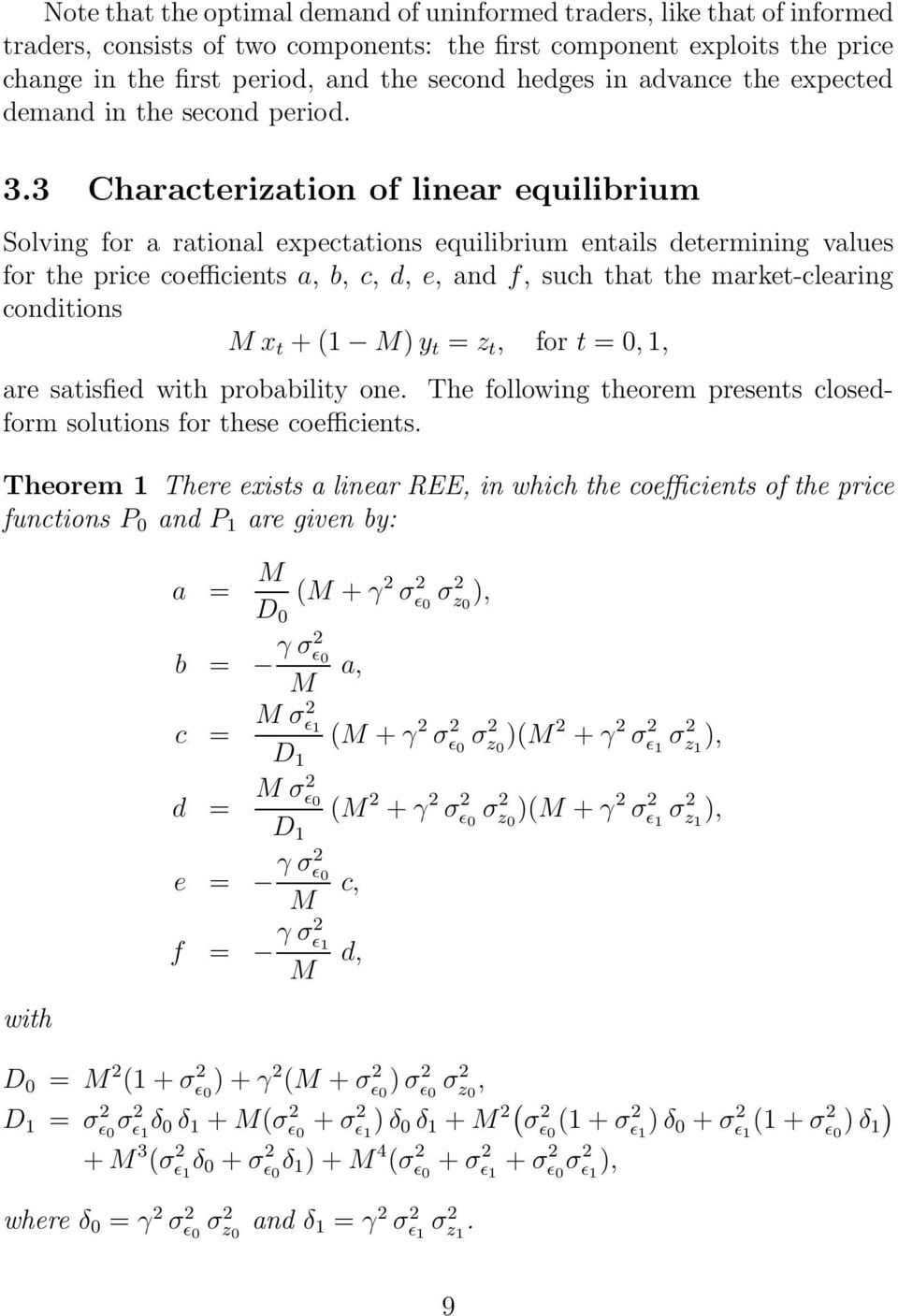
10 Note that the optimal demand of uninformed traders, like that of informed traders, consists of two components: the first component exploits the price change in the first period, and the second hedges in advance the expected demand in the second period. 3.3 Characterization of linear equilibrium Solving for a rational expectations equilibrium entails determining values for the price coefficients a, b, c, d, e, and f, such that the market-clearing conditions M x t + (1 M) y t = z t, for t = 0, 1, are satisfied with probability one. The following theorem presents closedform solutions for these coefficients. Theorem 1 There exists a linear REE, in which the coefficients of the price functions P 0 and P 1 are given by: a = M D 0 (M + γ 2 σ 2 ǫ 0 σ 2 z 0 ), with b = γ σ2 ǫ 0 M a, c = M σ2 ǫ 1 D 1 (M + γ 2 σ 2 ǫ 0 σ 2 z 0 )(M 2 + γ 2 σ 2 ǫ 1 σ 2 z 1 ), d = M σ2 ǫ 0 D 1 (M 2 + γ 2 σ 2 ǫ 0 σ 2 z 0 )(M + γ 2 σ 2 ǫ 1 σ 2 z 1 ), e = γ σ2 ǫ 0 M c, f = γ σ2 ǫ 1 M d, D 0 = M 2 (1 + σ 2 ǫ 0 ) + γ 2 (M + σ 2 ǫ 0 ) σ 2 ǫ 0 σ 2 z 0, D 1 = σ 2 ǫ 0 σ 2 ǫ 1 δ 0 δ 1 + M(σ 2 ǫ 0 + σ 2 ǫ 1 ) δ 0 δ 1 + M 2( σ 2 ǫ 0 (1 + σ 2 ǫ 1 ) δ 0 + σ 2 ǫ 1 (1 + σ 2 ǫ 0 ) δ 1 ) + M 3 (σ 2 ǫ 1 δ 0 + σ 2 ǫ 0 δ 1 ) + M 4 (σ 2 ǫ 0 + σ 2 ǫ 1 + σ 2 ǫ 0 σ 2 ǫ 1 ), where δ 0 = γ 2 σ 2 ǫ 0 σ 2 z 0 and δ 1 = γ 2 σ 2 ǫ 1 σ 2 z 1. 9
11 There may be multiple equilibria in our model, even within the class of linear equilibria. The reason is that calculating the equilibrium price coefficients involves solving a quintic equation, as the proof of Proposition 1 shows. The following proposition identifies sufficient conditions for the equilibrium characterized in Theorem 1 to be the unique linear REE. Proposition 1 The equilibrium specified in Theorem 1 is the unique linear REE if M ( 0.155) and if 4 Trading Behavior σ ǫ1 2 M 1 M σ ǫ 0. This section describes the trading behavior of informed and uninformed investors and derives empirical implications. We show that, depending on how the degree of information asymmetry between informed and uninformed investors changes over time, both types of investors can exhibit disposition effects. Before we present our results, we have to clarify what selling winners and holding on to losers means in the context of our model. Since individual investors typically do not engage in short-selling activities, most empirical studies focus only on long positions when calculating various measures for the disposition effect. There is no need to do so in our model: selling stocks simply refers to any situation in which the initial date 0 position is (partially) reversed at date 1. Thus, we will use the term selling a winner for situations in which an initial long position is reduced by selling stocks after a price increase, as well as for situations in which an initial short position is reduced by buying back shares after a price decrease. Furthermore, we will use the term holding on to a stock to describe all situations where the initial (long or short) position in a stock remains constant 11 or increases in the second trading round. Most empirical studies measure the disposition effect by calculating the difference between the investors propensity to realize winners and their propensity to realize losers in their portfolios. Specifically, they compare 11 While individual investors usually do not rebalance their portfolios on a daily basis, the agents in our model almost certainly change their portfolio holdings at date 1 (i.e., with probability one). 10

12 the proportion of gains realized (PGR), i.e., the number of winning stocks sold divided by the total number of winning stocks in a portfolio, with the proportion of losses realized (PLR), i.e., the number of losing stocks sold divided by the total number of losing stocks in a portfolio. A stock is considered a winner (loser), if its price is higher (lower) than its purchase price at the time of calculation. 12 A positive difference between PGR and PLR indicates that investors prefer to realize their winning investments. Note that this measure is not affected by price trends, since it compares the frequency with which investors sell their winning and losing investments relative to their opportunities to sell each type. 13 In our model, the theoretical analog of the PGR measure is the conditional probability that a winning stock is sold at date The PLR measure corresponds to the conditional probability that a losing investment is sold at date Trading behavior of informed investors There are two reasons why we might expect informed investors to exhibit disposition effects. First, selling stocks at high prices (likely winners) and buying stocks at low prices (likely losers) always seems a good idea when some investors trade for non-informational motives. In our model, changes in the aggregate supply are completely independent of the stock s date 2 payoff. Interpreting these supply shocks as the result of liquidity trading activity, we would expect rational risk-averse investors to absorb these shocks by providing liquidity at an appropriate risk premium. Investors are willing to buy (sell) stocks at prices below (above) the expected fundamental value. Since stocks with high (low) date 1 prices are, on average, winners (losers), informed investors are more likely to sell winners than losers if the variance of the date 1 supply shock is high enough. 15 The second reason is related to differences between the informed and uninformed investors information about the asset payoff, V. Specifically, 12 For a more detailed description of the methodology see Odean (1998). 13 In an upward-moving market, the number of opportunities to realize a gain will far exceed the number of opportunities to realize a loss. In this case, an observation of more realized gains than losses does not necessarily arise, because investors prefer to realize their winning investments. 14 Formally, for informed investors the event sell a winning stock is defined as {ω Ω : (x 0 > 0 P 1 > 0 x 1 < 0) (x 0 < 0 P 1 < 0 x 1 > 0)}. The other events are defined analogously. 15 Since this result is almost trivial, we do not give a formal proof. 11

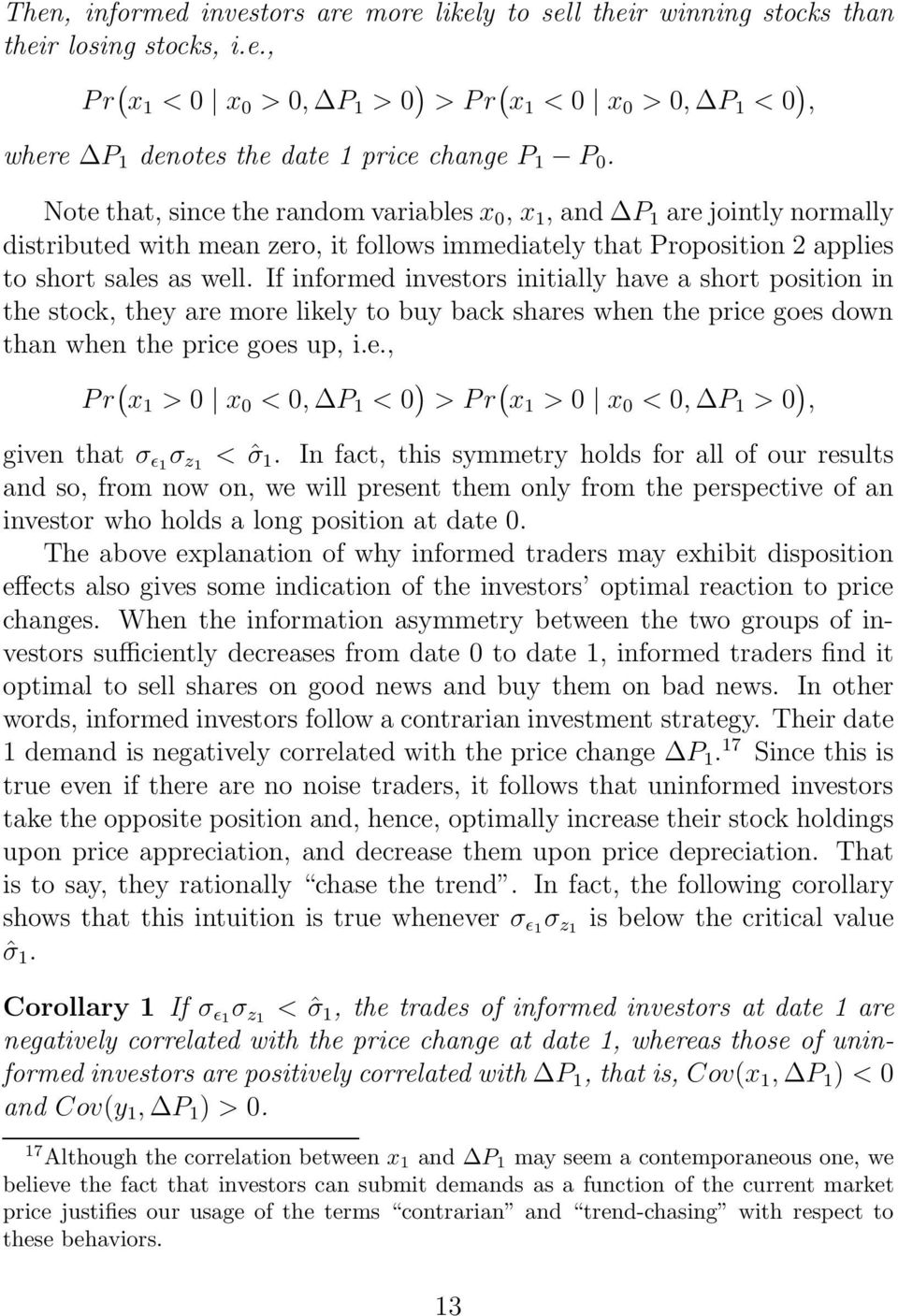
13 informed investors may exhibit disposition effects if their informational advantage over uninformed investors sufficiently decreases. For example, consider the extreme scenario where the signal S 1 is made public at date 1, and suppose that informed traders purchased the stock on the basis of favorable information at date 0. If S 1 is good news as well, both informed and uninformed investors will revise their expectations about the payoff V upwards, and demand higher stock holdings at date 1. This drives the price up. Although both types of investors respond to good news by demanding more stocks, they do so with different intensities. Not knowing S 0, uninformed investors learn more from the signal S 1 than informed investors do. In other words, the announcement of S 1 has a much stronger impact on the uninformed investors expectations about V and hence on their optimal demand. 16 In equilibrium, informed investors will therefore find it optimal to sell part of their stock holdings to uninformed investors at a price that exceeds their private valuations. To put it differently, from the informed investors perspective the price increase is not justified by the new information S 1, so they decide to sell shares. If, on the other hand, S 1 signals a low payoff, both informed and uninformed investors want to sell shares. Again, however, uninformed investors, not knowing the favorable signal S 0, are more eager to do so. The price will drop until informed investors are willing to buy shares from uninformed investors despite the bad signal S 1 and the market clears. This implies that, on average, informed investors react to a price increase by selling some of their shares and to a price decrease by buying even more shares. In general, the information asymmetry decreases from date 0 to date 1, if the variance of the date 1 supply shock z 1 is low relative to that of the date 0 shock z 0, the precision of the signal S 1 is high relative to that of the signal S 0, and the fraction of informed traders, M, is high. The following proposition shows that even in the absence of a date 1 supply shock, informed traders can show disposition effects. Proposition 2 Suppose σ ǫ1 σ z1 < M σ ǫ0 σ z0 M 2 ( 1 + σ 2ǫ0 ) + γ2 σ 4ǫ0 σ 2z0 ˆσ It is straightforward to show that V ar[v F0 U] V ar[v FI 0 ] > V ar[v FU 1 ] V ar[v F1] I if there is no date 1 supply shock. 12

14 Then, informed investors are more likely to sell their winning stocks than their losing stocks, i.e., Pr ( x 1 < 0 x 0 > 0, P 1 > 0 ) > Pr ( x 1 < 0 x 0 > 0, P 1 < 0 ), where P 1 denotes the date 1 price change P 1 P 0. Note that, since the random variables x 0, x 1, and P 1 are jointly normally distributed with mean zero, it follows immediately that Proposition 2 applies to short sales as well. If informed investors initially have a short position in the stock, they are more likely to buy back shares when the price goes down than when the price goes up, i.e., Pr ( x 1 > 0 x 0 < 0, P 1 < 0 ) > Pr ( x 1 > 0 x 0 < 0, P 1 > 0 ), given that σ ǫ1 σ z1 < ˆσ 1. In fact, this symmetry holds for all of our results and so, from now on, we will present them only from the perspective of an investor who holds a long position at date 0. The above explanation of why informed traders may exhibit disposition effects also gives some indication of the investors optimal reaction to price changes. When the information asymmetry between the two groups of investors sufficiently decreases from date 0 to date 1, informed traders find it optimal to sell shares on good news and buy them on bad news. In other words, informed investors follow a contrarian investment strategy. Their date 1 demand is negatively correlated with the price change P Since this is true even if there are no noise traders, it follows that uninformed investors take the opposite position and, hence, optimally increase their stock holdings upon price appreciation, and decrease them upon price depreciation. That is to say, they rationally chase the trend. In fact, the following corollary shows that this intuition is true whenever σ ǫ1 σ z1 is below the critical value ˆσ 1. Corollary 1 If σ ǫ1 σ z1 < ˆσ 1, the trades of informed investors at date 1 are negatively correlated with the price change at date 1, whereas those of uninformed investors are positively correlated with P 1, that is, Cov(x 1, P 1 ) < 0 and Cov(y 1, P 1 ) > Although the correlation between x 1 and P 1 may seem a contemporaneous one, we believe the fact that investors can submit demands as a function of the current market price justifies our usage of the terms contrarian and trend-chasing with respect to these behaviors. 13
15 The above result is consistent with Brennan and Cao (1996) and Watanabe (2002). In these models, less informed investors tend to be trendfollowers, even though they know they lose against better informed traders. It is worth noting that a recent study by Grinblatt and Keloharju (2000) seems to indicate that this result is not supported by the data. Using a comprehensive data set that documents the shareholdings of both institutional and retail investors in Finland from December 1994 to December 1996, Grinblatt and Keloharju report that the frequency of contrarian behavior seems to be inversely related to investor sophistication. 18 Furthermore, their analysis demonstrates that contrarian behavior is negatively correlated with investor performance. Investors who pursue momentum strategies outperform contrarian investors. 19 As we show in Section 4.2, however, these empirical findings are perfectly consistent with increasing information asymmetry between informed and uninformed investors in our model. So far, we have only considered the frequency with which informed investors sell winning and losing stocks. We now turn our attention to the size of these trades. The following proposition shows that informed traders are not only more likely to sell winners than losers, they also sell larger amounts of their winning stocks than of their losing stocks. Proposition 3 If σ ǫ1 σ z1 < ˆσ 1, the expected trade size is larger for sold winners than for sold losers, i.e., E [ x 1 x 0 > 0, P 1 > 0, x 1 < 0 ] > E [ x 1 x 0 > 0, P 1 < 0, x 1 < 0 ]. In the limiting case when the variance of the date 1 supply shock goes to zero, the average trading volume for sold losers converges to zero. In other words, if the signal S 1 becomes public knowledge, informed investors never sell their losers to uninformed investors. The same is true for large values 18 Grinblatt and Keloharju (2000) aggregate their data into six investor categories: households, nonprofit institutions, government, finance and insurance institutions, nonfinancial corporations, and foreign investors. They find that households, government investors, and nonprofit institutions exhibit contrarian behavior over all investment horizons, whereas finance and insurance institutions, as well as non-financial corporations, are only marginally contrarian. Foreign investors tend to be momentum investors (or trend-followers) over all horizons. 19 Grinblatt and Keloharju (2000) measure performance by examining whether the buy ratio of future winning stocks exceeds the buy ratio of future losing stocks. 14

16 of σ z1. If the expected supply shock is large 20 (i.e., if there are many liquidity traders in the market), rational investors will always pursue a contrarian investment strategy in order to benefit from non-fundamental price fluctuations caused by liquidity traders. Numerical calculations show that the difference between the expected trading volume of winners and losers that are sold typically increases with σ z1. The empirical validity of Proposition 3 remains an open question, as none of the studies on the disposition effect that we are aware of reports the average trade size for realized winners and losers. Whenever the aggregate stock supply varies over time and these variations are independent of the fundamentals, homogeneously informed investors will follow a contrarian strategy, and sell shares when the price is up and buy shares when the price is down. In such a symmetric information model, the period 2 price change P 2 = V P 1 would on average be higher for losing stocks that investors hold on to than for winning stocks that investors decide to sell. In fact, this argument has been used in empirical studies (see, e.g., Odean (1998) and Brown et al. (2002)) to take the superior ex-post return of winners that are sold, compared to losers that are not sold, as clear evidence against an information-based explanation for the disposition effect. Odean concludes that the investors preference for selling winners and holding on to losers is not justified by subsequent portfolio performance. The following proposition shows that this conclusion is not always correct. Even if the expected future return of winners exceeds that of losers, investors might rationally sell their winners and hold on to their losers. Proposition 4 There exist parameter values such that informed investors rationally exhibit disposition effects, even though the expected period 2 (dollar) return of winning stocks that they sell exceeds that of losing stocks that they buy, i.e., E [ P 2 x 0 > 0, P 1 > 0, x 1 < 0 ] > E [ P 2 x 0 > 0, P 1 < 0, x 1 > 0 ]. The economic intuition for this striking result is as follows. From the discussion above, we know that when the information asymmetry decreases sufficiently, uninformed investors overreact 21 to news released at date 1 20 Note that E[ z t ] = 2/π σ zt. 21 From the standpoint of informed investors, the behavior of uninformed investors looks like an overreaction to the new information about V revealed through the price P 1. However, it is fully rational given their limited information F U 1. 15

17 from the perspective of informed investors. Thus, in contrast to Proposition 4, we would expect the average period 2 price change following bad news to be higher than that following good news. This effect, however, is mitigated and, if σ ǫ1 and σ z1 are sufficiently small, even reversed, by the fact that the premium required by risk-averse investors to absorb the supply shock z 0 is gradually reduced over time as investors become better informed. In other words, the negative effect a positive supply shock has on the price at date 0 is only partially reversed at date 1. If, in addition, the date 1 supply shock and/or the residual uncertainty are small, hence, causing only a minor price change that is going to be reversed at date 2, then the latter effect dominates, and the price changes P 1 and P 2 are positively correlated. 22 To obtain a greater understanding of the above result, consider the case where the stock s payoff, as well as both signals, turn out to be equal to their expected value of zero, and assume that there is no supply shock at date 1. Since investors do not know this at date 0, they demand a risk premium for holding shares. Thus, if the stock supply z 0 is positive, the price at date 0 will be negative. This makes uninformed investors believe that informed investors have received bad news. When S 1 = 0 is revealed at date 1, uninformed investors will therefore adjust their expectations upward, whereas informed investors still expect the payoff to be zero. Moreover, since both types of investors now have more precise information about V, they bear less risk and consequently demand a lower risk premium. Thus, both groups of investors want to increase their portfolio holdings, but the change in demand is comparatively larger for uninformed traders. To clear the market, the price will go up until the amount of shares informed investors are willing to sell equals the amount uninformed investors want to buy. 23 But because of the residual uncertainty about V, this new price level will be below zero, the payoff informed investors expect to get at date 2. Thus, the period 2 price change will be positive as well. The reverse is true for a negative supply shock at date This shows that the supply shock z 0 causes the period 2 return, P 2, to be negatively correlated with the informed investors date 1 trades, x 1, but positively with the period 1 return, P 1, and the investors date 0 stock position, x 0. Therefore, in equilibrium, informed investors may 22 This result is consistent with the momentum effect documented by Jegadeesh and Titman (1993). We further discuss the relation between price momentum and disposition effects in Section This can also be seen from the price coefficients: b < e. 24 Recall that for simplicity, we normalized the average stock supply to zero. 16

18 optimally reduce their period 2 stock holdings even though they anticipate a further price increase, and vice versa. 25 The positive correlation of P 2 with x 0 and P 1 has implications for the period 2 return variability of winners and losers as well. The following proposition shows that the variance of the period 2 price change is typically higher for winners that informed investors sell at date 1 than for losers that they decide to keep. This result does not imply, however, that stocks with higher expected returns are more risky, from the investors perspective. In fact, the variance of P 2, conditional on the informed investors date 1 information set, F1 I, is constant. The higher return variability of winners follows from the larger variation of the expected price change E[ P 2 x 0, P 1, x 1 ] in the event {x 0 > 0, P 1 > 0, x 1 < 0} ( sold winner ), caused by the positive correlation between the informed investors initial stock holdings x 0 and the subsequent price change P 1. Proposition 5 If σ z1 is sufficiently small, the variance of P 2 is higher for winning stocks that informed investors sell at date 1 than for losing stocks that they buy, i.e., V ar [ P 2 x 0 > 0, P 1 > 0, x 1 < 0 ] > V ar [ P 2 x 0 > 0, P 1 < 0, x 1 > 0 ]. Although an analytical proof is available only when this result is stated for small σ z1, numerical calculations show that it generally holds whenever σ ǫ1 σ z1 < ˆσ 1. In any event, Proposition 5 may provide us with a possible test of the model, as this result has yet to be confirmed empirically. 4.2 Trading behavior of uninformed investors Using wealth, age, and trading experience as proxies for investor sophistication, recent empirical studies indicate that less sophisticated investors are more susceptible to disposition effects. 26 This result has generally been interpreted as evidence against rational explanations. Dhar and Zhu (2002), for 25 Notice that Proposition 4 only makes a statement about the relationship between expected returns and changes in the informed investors stock portfolios. In particular, it does not say that period 2 returns are negatively correlated with the investors optimal date 1 stock holdings. 26 See, e.g., Brown et al. (2002) and Dhar and Zhu (2002). In fact, Dhar and Zhu find that about one-fifth of the investors in their sample exhibit reverse disposition effects. These are typically older and wealthier investors who classify themselves as professionals. 17

19 example, argue that, as investors gain more trading experience, they become aware of their own behavioral biases and adjust their investment strategies accordingly. In this section, we offer an alternative explanation. In particular, our analysis suggests that inexperienced investors rationally follow trading strategies, as predicted by the disposition effect, when the information asymmetry between investors increases (or, at least, does not decrease too much) prior to public announcements. 27 Proposition 6 Uninformed investors are more likely to sell their winning stocks than their losing stocks, i.e., Pr ( y 1 < 0 y 0 > 0, P 1 > 0 ) > Pr ( y 1 < 0 y 0 > 0, P 1 < 0 ), if and only if σ ǫ1 σ z1 > ˆσ 1. The intuition behind the above proposition is as follows. Suppose that the signal S 0 contains no information at all. 28 In this case, informed and uninformed investors hold identical portfolios at date 0, absorbing the supply shock z 0. At date 1, the stock price increases, if one of two things happens: (i) informed traders receive good news and, hence, revise their expectations about V upwards, or (ii) the aggregate stock supply drops. Not being able to distinguish these two possible causes, uninformed investors respond to the observed price increase by selling (some of) their shares. The reverse is true if the price drops at date 1. In this case, uninformed investors optimally buy shares, hoping that the price depreciation is due to a positive supply shock and not to bad news about V. This analysis shows that, unlike the case where S 1 is announced publicly, uninformed investors now pursue a contrarian investment strategy. Corollary 2 If σ ǫ1 σ z1 > ˆσ 1, the date 1 trades of uninformed investors are negatively correlated with the date 1 price change, i.e., Cov(y 1, P 1 ) < 0. In the previous section, we argued that the risk premium required to bear the supply shock z 0 gradually decreases over time as investors become better 27 The investors information acquisition decision is exogenous to our model. However, since less experienced traders face higher information production (or processing) costs, it seems reasonable that these traders will be less informed. 28 In this case, the condition in Proposition 6 is satisfied for all σ ǫ1, σ z1 R +, because ˆσ 1 converges to zero as σ ǫ0 goes to infinity. 18
20 informed. In the absence of a date 1 supply shock, this positive autocorrelation in the conditional risk premium is sufficient to cause price continuation, which is a necessary condition for the period 2 return of winners to exceed that of losers (Proposition 4). In the case of a non-zero date 1 supply shock, the positive serial correlation in returns is reduced by the fact that the conditional risk premium attributable to the shock z 1 reverses by date 2. Still, if σ z1 is small, the gradual decrease of the risk premium related to z 0 dominates the price reversal due to z 1, making the overall serial correlation positive. However, as pointed out above, a sufficiently large supply shock at date 1 is essential for P 1 not to convey too much information, so that uninformed investors prefer to sell winners and buy losers, hoping to benefit from liquidity trades. In fact, there exists a non-empty set of parameter values for which both effects are present: (i) the information revealed by P 1 is noisy enough to make uninformed investors follow a contrarian strategy, and (ii) the reversal of the conditional risk premium due to z 1 is small enough to cause a positive autocorrelation in price changes. As a result, we obtain the empirically observed phenomenon that uninformed investors sell their winning stocks even though the subsequent return of these stocks is on average higher than that of losing stocks that they keep in their portfolios. Further, for this set of parameter values, the variance of P 2 of the winning stocks that are sold is higher than that of the losing stocks that are not sold. These results are summarized in the following proposition. Proposition 7 There exists a σ1 > ˆσ 1 such that for all σ ǫ1 σ z1 (ˆσ 1, σ1 ), the expected period 2 (dollar) return of winning stocks that uninformed investors sell is higher than that of losing stocks that they buy, i.e., E [ P 2 y 0 > 0, P 1 > 0, y 1 < 0 ] > E [ P 2 y 0 > 0, P 1 < 0, y 1 > 0 ]. Further, the variance of P 2 is higher for winning stocks that are sold than for losing stocks that are not sold, i.e., V ar [ P 2 y 0 > 0, P 1 > 0, y 1 < 0 ] > V ar [ P 2 y 0 > 0, P 1 < 0, y 1 > 0 ], if ˆσ 1 < σ ǫ1 σ z1 < σ 1, where ( ) M σǫ 2 σ 1 = 0 σz 2 0 M + γ2 σǫ 2 0 σz 2 0 M ( ) ( ) σǫ γ2 σǫ 2 0 σz 2 0 M + σ 2 ǫ0 19

21 4.3 Discussion Our analysis shows that disposition effects arise quite naturally in a world with changing information asymmetry. However, some caution is required in interpreting our results. In particular, our assumption that the aggregate stock supply is subject to stochastic changes deserves more attention. While some kind of noise is necessary to prevent prices from fully revealing the investors private information, these supply shocks also introduce a bias to the PGR/PLR ratio. The larger the expected supply shock, the more profitable it is for investors to follow a contrarian investment strategy. 29 This bias is especially troubling when we think of supply shocks as being the result of liquidity trading activity, for it then means that we ignore the trades of a potentially large group of investors that are obviously negatively correlated with prices: liquidity traders tend to buy stocks when prices are up and to sell stocks when prices are down, behavior that clearly contradicts the disposition effect. In order to assess the severity of this bias, we recalculate our PGR and PLR measures, only taking into account the information-based component of the investors demand, defined as x t = x t z t and ỹ t = y t z t. 30 This alternate definition ensures that the aggregate demand of informed and uninformed investors is uncorrelated with price changes. However, it makes our analysis less tractable. Necessary and sufficient conditions for informed and uninformed investors to exhibit disposition effects are no longer available in closed form. Nevertheless, numerical computations show that our basic results remain unchanged. Table 1 reports the PGR/PLR ratio and the expected period 2 return of winners and losers for two sets of parameters, one that decreases the information asymmetry between informed and uninformed traders across dates 0 and 1 (panel A), and one that increases it (panel B). As expected, in the former case, informed investors show disposition effects (PGR/PLR ratio > 1), whereas in the latter case uninformed investors do. For comparison, we calculate the disposition statistics for the investors total demand (reported in parentheses). These examples show that the intuition behind our results generalizes to a more realistic setting with constant aggre- 29 Note that the investors PGR/PLR ratio can be upwardly biased as well as downwardly biased, depending on the magnitude of the date 1 supply shock relative to that of the date 0 shock. 30 This is equivalent to assuming that investors experience endowment shocks of z 0 and z 1 at dates 0 and 1, respectively, but cannot infer the aggregate stock supply from their own endowment. 20
22 Panel A: Decreasing information asymmetry informed investors uninformed investors PGR/PLR ratio ( 1.978) ( 0.000) exp. P 2 difference (-0.066) (-1.119) Panel B: Increasing information asymmetry informed investors uninformed investors PGR/PLR ratio ( 1.196) ( ) exp. P 2 difference (-0.110) ( 0.222) Table 1: PGR/PLR ratios and differences in expected period 2 returns between winners that are sold and losers that are not sold for two sets of parameters: γ = 1, M = 1, σ 2 ǫ 0 = 1, σ ǫ1 = 1, σ 2 z 0 = 2, σ z1 = 1 in Panel A, 2 and γ = 1, M = 1, σ 2 ǫ 0 = 3, σ ǫ1 = 1, σ 2 z 0 = 2, σ z1 = 1 in Panel B. Values in 2 parentheses are based on total demand. gate stock supply. Interestingly, the difference between the expected period 2 return of winning stocks that are sold and that of losing stocks that are not sold increases when we consider only the information-based component of the investors demand. The reason is that a positive date 1 price change is likely to be accompanied by a negative supply shock z 1, which implies that the information-based demand x 1 will on average be higher than the total demand x 1 in this case. Thus, even better news is necessary to convince investors to sell some of their shares (i.e., to ensure that x 1 < 0). The opposite is true for a negative date 1 price change. 5 Momentum The consistent profitability of momentum strategies, i.e., strategies that buy stocks that performed well in the past and sell stocks that performed poorly, remains one of the most puzzling anomalies in finance. Jegadeesh and Titman (1993) show that past winners continue to outperform past losers by about 1% per month over the subsequent three to 12 months. Rouwenhorst (1998) finds similar results in 12 European markets. Recent empirical evidence indicates that momentum profits cannot be explained by Fama-French 21
23 factors, industry effects, or cross-sectional differences in expected returns. 31 Various explanations for the superior performance of momentum strategies have been advanced, most of them appealing to behavioral biases that lead investors to either underreact or belatedly overreact to information. 32 Johnson (2002) offers a rational explanation for these momentum effects. He shows that a single-firm model with a standard pricing kernel can produce a strong positive correlation between past realized returns and current expected returns when expected dividend growth rates vary over time. A different approach is taken by Holden and Subrahmanyam (2002), who show that medium-term continuations can arise in a rational expectations model when private information is received sequentially by risk-averse agents. In this case, the risk borne by the market decreases over time. This effect causes a positive autocorrelation in the conditional risk premium and thus leads to price continuations. As pointed out in Section 4, the same effect is at work in our model. 33 The risk premium related to the supply shock z 0 decreases across dates 0 and 1 as (some) investors observe the signal S 1, and it further decreases across dates 1 and 2 as prices approach full revelation. This gradual decrease introduces persistence into price changes. On the other hand, the additional risk premium due to the shock z 1 at date 1 reverses by date 2, causing a price reversal, on average. If this additional date 1 risk premium is small either because the average date 1 supply shock is small, or the residual uncertainty is low (which is the case when the mass of informed investors is large, the noise variance of S 1 is small, and/or the variance of the date 1 supply shock is small) the first effect dominates, resulting in positive serial correlation in returns. Proposition 8 The price changes P 1 = P 1 P 0 and P 2 = V P 1 are positively correlated if and only if σ ǫ1 σ z1 < σ 1, where σ 1 is defined in Proposition 7. Grinblatt and Han (2001) link price momentum to the disposition effect. In their model, a fraction of homogeneously informed investors is assumed to 31 See Fama and French (1996), Moskowitz and Grinblatt (1999), Grundy and Martin (2001), and Jegadeesh and Titman (2001, 2002). 32 See, e.g., Barberis, Shleifer, and Vishny (1998), Daniel, Hirshleifer, and Subrahmanyam (1998), and Hong and Stein (1999). 33 In fact, the two-period model of Holden and Subrahmanyam (2002) corresponds to the special case σ ǫ0 = of our model. 22
24 have a higher demand for losing stocks than for winning stocks, other things being equal. Grinblatt and Han show that such a demand perturbation tends to generate short-term price underreaction to public information and, hence, price continuation. This is in stark contrast to our result. While Grinblatt and Han take the trading strategies of disposition investors as given, and show that such a behavioral bias can cause momentum, we demonstrate that both disposition effects and momentum can arise in a world with fully rational agents. In fact, since ˆσ 1 < σ 1, our model shows that both scenarios informed investors exhibiting disposition effects, and uninformed investors exhibiting disposition effects are consistent with price continuation. However, there is no causal relation between these two effects. When the expected date 1 supply shock is sufficiently large, both informed and uninformed investors will sell their winners and hold on to their losers, even though or rather because price changes are negatively correlated. However, as discussed in the previous section, price momentum is a necessary condition for the average ex-post returns of winning stocks that investors sell to be higher than those of losing stocks that they hold on to (Propositions 4 and 7). Further empirical implications concerning the relation between momentum and the disposition effect can be obtained through numerical computations. Not surprisingly, we find that the correlation between P 1 and P 2 is decreasing in σ z1, and thus, is generally higher for values of σ ǫ1 σ z1 in the interval (0, ˆσ 1 ) than in the interval (ˆσ 1, σ 1 ). This implies that the disposition behavior of less informed investors is concentrated primarily in relation to stocks with weak momentum. 34 Put differently, the propensity of less informed investors to sell winners and hold on to losers, measured by the difference between the ratios PGR and PLR, is inversely related to the persistence in stock returns. Indirect empirical support for this result comes from a recent study by Ranguelova (2001). She documents that disposition behavior is more pronounced for large-cap stocks. In fact, trades in stocks at the bottom 40 % of the market capitalization distribution exhibit a reverse disposition effect : investors keep their winners and sell their losers. While difficult to explain with prospect-theory type preferences, these findings are consistent with our information-based explanation, since price continuations are typically weaker 34 We cannot make an analogous statement for (better) informed investors, because they exhibit disposition behavior for small values of σ z1, as well as for large values of σ z1 (the condition σ ǫ1 σ z1 < ˆσ 1 is sufficient but not necessary). In the former case, they primarily benefit from uninformed trend-followers, in the latter case from supply shocks. 23
25 for large firms (see, e.g., Jegadeesh and Titman (1993) or Hong, Lim, and Stein (2000)). 6 Conclusion This paper shows that rational investors can exhibit disposition effects even in a world without taxes, transaction costs, and portfolio rebalancing needs. We present a dynamic rational expectations model of asset prices that allows us to derive the investors optimal trading strategies in closed form. Our focus is on analyzing how dynamic changes in information asymmetry influence the investors behavior. We find that better informed investors tend to sell their winners and to hold on to their losers when the information asymmetry sharply decreases prior to public news releases (such as earnings announcements or annual reports). Less informed investors, on the other hand, exhibit such behavior when the information asymmetry increases or moderately decreases over time. In addition, our results show that, on average, investors sell larger amounts of their winning stocks than of their losing stocks. Interestingly, investors may optimally pursue a contrarian investment strategy even though past winners continue to outperform past losers in the future. The reason is that the increase in an investor s stock demand following good news can be outweighed by an opposite effect due to changes in her information quality (relative to that of other investors). If informational differences between investors decrease over time, better informed investors will trade less aggressively on new information, compared to less informed investors, and, hence, will optimally reduce their stock holdings when they receive good news and increase them when they receive bad news. The opposite is true when the information asymmetry between investors increases over time. This result indicates that existing empirical tests rejecting an information-based explanation for the disposition effect are inconclusive. We also study the relationship between optimal trading strategies and equilibrium price dynamics. We find that disposition behavior is generally consistent with both price continuations and price reversals. However, for ex-post returns of winning stocks that investors sell to exceed those of losing stocks that they hold on to, price changes must be positively correlated. Further, our model predicts that the disposition behavior of less informed investors is concentrated primarily in relation to stocks with weak momentum. In contrast to Grinblatt and Han (2001), who take the disposition behavior of 24
26 a group of investors as given, and show that such a behavioral bias can cause price momentum, our model suggests that both effects can be the result of informational differences between rational investors. Of course, investors may also exhibit prospect theory preferences, or irrationally believe in mean-reverting prices. By pointing out that disposition effects are not intrinsically at odds with rational behavior, this paper simply shows that the existing empirical evidence is insufficient to rule out either explanation. 7 Appendix The following lemma is a standard result on multivariate normal random variables (see, e.g., Bray (1981) or Brunnermeier (2001), chapter 3) and is used to derive the optimal date 0 demand of investors: Lemma 3 Let x R n be a normally distributed random vector with mean (vector) µ and covariance matrix Σ. Then, E [ ] e xt Ax+b T x+c = I 2ΣA 1 2 exp {c + b T µ + µ T A µ (b + 2A µ)t (Σ 1 2A) 1 (b + 2A µ) where A is a symmetric n n matrix, b is an n-vector, and c is a scalar. Note that (7) is only well-defined if I 2ΣA is positive definite. Further, in order to calculate the conditional probabilities and expectations in Section 4, we use the following results on normally distributed random variables (see David (1953) and Kamat (1953)): Lemma 4 Let {x i } i=1,2,3 be jointly normally distributed random variables with mean zero and correlation {ρ ij } i,j=1,2,3. Then, and Pr(x 1 > 0, x 2 > 0) = 1 2π (π arccosρ 12) Pr(x 1 > 0, x 2 > 0, x 3 > 0) = 1 4π (2π arccosρ 12 arccosρ 13 arccos ρ 23 ). 25 } (7)
27 Lemma 5 Let x 1 and x 2 be jointly normally distributed random variables with mean zero, variance one, and correlation ρ, and let [m, n] denote the incomplete moment given by [m, n] = 0 0 x m 1 x n 2 f(x 1, x 2 ) dx 1 dx 2, where f(x 1, x 2 ) denotes the joint probability-density function. Then, [1, 0] = 1 + ρ 2 2π, [2, 0] = 1 (π arccosρ + ρ ) 1 ρ 2π 2, [1, 1] = 1 2π (ρ(π arccosρ) + 1 ρ 2 ). For incomplete moments of the trivariate normal distribution, we refer the reader to Kamat (1953). The following corollary will be useful for proving Propositions 5 and 7. Corollary 3 Let x 1 and x 2 be jointly normally distributed random variables with mean zero and correlation ρ. Then, V ar [ x 1 + x 2 x 1 > 0, x 2 < 0 ] > V ar [ x 1 + x 2 x 1 > 0, x 2 > 0 ] (8) for all ρ ( 1, 0). Proof: Let V ar denote the difference between the two conditional variances in (8), i.e., V ar = V ar [ x 1 + x 2 x 1 > 0, x 2 < 0 ] V ar [ x 1 + x 2 x 1 > 0, x 2 > 0 ], and recall that V ar [ x 1 + x 2 ] = V ar [ x 1 ] + 2 Cov [ x 1, x 2 ] + V ar [ x 2 ]. From Lemmas 4 and 5, we have V ar [ x i x 1 > 0, x 2 < 0 ] = E [ x 2 i x 1 > 0, x 2 < 0 ] ( E [ x i x 1 > 0, x 2 < 0 ]) 2 ( ) = 1 ρ 1 ρ 2 π arccos( ρ) π(1 ρ) 2 V ar[x 2(π arccos( ρ)) 2 i ] 26
28 and V ar [ x i x 1 > 0, x 2 > 0 ] = E [ x 2 i x 1 > 0, x 2 > 0 ] ( E [ x i x 1 > 0, x 2 > 0 ]) 2 ( ) = 1 + ρ 1 ρ 2 π arccosρ π(1 + ρ) 2 V ar[x 2(π arccosρ) 2 i ], for i = 1, 2. Similarly, the conditional covariances are given by Cov [ x 1, x 2 x 1 > 0, x 2 < 0 ] = E [ x 1 x 2 x 1 > 0, x 2 < 0 ] E [ x 1 x 1 > 0, x 2 < 0 ] E [ x 2 x 1 > 0, x 2 < 0 ] ( ) 1 ρ 2 = ρ π arccos( ρ) + π(1 ρ) 2 V ar[x1 ]V ar[x 2(π arccos( ρ)) 2 2 ] and Cov [ x 1, x 2 x 1 > 0, x 2 > 0 ] = E [ x 1 x 2 x 1 > 0, x 2 > 0 ] E [ x 1 x 1 > 0, x 2 > 0 ] E [ x 2 x 1 > 0, x 2 > 0 ] ( ) 1 ρ 2 = ρ + π arccosρ π(1 + ρ) 2 V ar[x1 ]V ar[x 2(π arccosρ) 2 2 ]. Putting all terms together, we can rewrite V ar as follows: where V ar = c2 1 V ar[x 1] 2 c 12 V ar[x1 ]V ar[x 2 ] + c 2 2 V ar[x 2] 2 π (π arccosρ)2 (arccos ρ) 2 c 2 1 = c2 2 = ρ π2 2 ρ 1 ρ 2 (π arccosρ)(arccos ρ) 2 (arcsin ρ) ( π(1 + ρ 2 ) 2 ρ(arcsin ρ) ), c 12 = 1 2 (1 + ρ2 ) π ρ 2 (π arccosρ)(arccos ρ) +2 (arcsinρ) ( 2 ρ π (1 + ρ 2 )(arcsin ρ) ). Since c 12 < c 1 c 2 = c 2 1 for all ρ ( 1, 0), V ar is strictly positive, if x 1 and x 2 are negatively correlated. 27
29 Conditional moments of V The expected value and the variance of V conditional on the informed investors date 1 information set, F1 I, are given by E [ V F I 1] = E[V S0, S 1 ] = σ ǫ1 σ ǫ0 + σ ǫ1 + σ ǫ0 σ ǫ1 } {{ } λ 0 V ar [ V F I 1] = V ar[v S0, S 1 ] = S 0 + σ ǫ0 σ ǫ0 + σ ǫ1 + σ ǫ0 σ ǫ1 } {{ } λ 1 S 1, (9) σ ǫ0 σ ǫ1 σ ǫ0 + σ ǫ1 + σ ǫ0 σ ǫ1 τ I. (10) Similarly, the conditional moments of V based on the uninformed investors date 1 information set, F1 U, are given by E [ V F U 1 ] a σ 2 = P 1 (c + d) σ P0,P 1 } σp 2 0 σp 2 1 σp 2 0,P {{ 1 } κ 0 P 0 + (c + d) σ2 P 0 a σ P0,P 1 P σp 2 0 σp 2 1 σp 2 1, (11) 0,P } {{ 1 } κ 1 where V ar [ V F U 1 ] = 1 a 2 σ 2 P 1 + (c + d) 2 σ 2 P 0 2 a (c + d) σ P0,P 1 σ 2 P 0 σ 2 P 1 σ 2 P 0,P 1 τ U, (12) σ 2 P 0 V ar[p 0 ] = a 2 (1 + σ 2 ǫ 0 ) + b 2 σ 2 z 0, (13) σ 2 P 1 V ar[p 1 ] = c 2 (1 + σ 2 ǫ 0 ) + d 2 (1 + σ 2 ǫ 1 ) + 2 c d + e 2 σ 2 z 0 + f 2 σ 2 z 1, (14) σ P0,P 1 Cov[P 0, P 1 ] = a c(1 + σ 2 ǫ 0 ) + a d + beσ 2 z 0. (15) Proof of Lemma 1 Let us define J I (x 0 ) to be an informed trader s maximum expected utility from date 2 consumption given that her date 0 stock holding is x 0, that is, J I (x 0 ) = max E [ ] exp { γ (x 0 (V P 0 ) + x 1 (V P 1 ))} F1 I. (16) x 1 At date 0, each informed investor faces the following optimization problem: max E [ ] J I (x 0 ) F0 I, (17) x 0 28
30 where the investor s date 0 information set is given by F0 I = {S 0, P 0, z 0 }. Substituting the investor s optimal date 1 demand given by (3) into equation (16), we can rewrite the investor s date 1 value function as { J I (x 0 ) = exp γ (x 0 (P 1 P 0 ) + (λ )} 0S 0 + λ 1 S 1 P 1 ) 2 = exp { ( P1 γp 0 x 0 1 2τ I λ 2 0 S2 0 ) T ( 1 1 λ1 S 1 2τ I λ 1 λ 2 1 } {{ } A I 2 γ τ I ( γx0 1 τ I λ 0 S 0 1 τ I λ 0 λ 1 S 0 } {{ } b T I ) ) T ( P1 S 1 ) ( P1 S 1 ) }. (18) Given the conjectured equilibrium price function in (2), P 1 and S 1 are jointly normally distributed with respect to the date 0 information set, F I 0. Thus, it follows from Lemma 3 that maximizing (17) with respect to x 0 is equivalent to maximizing b T I µ I 1 2 (b I + 2A I µ I ) T (Σ 1 I + 2A I ) 1 (b } {{ } I + 2A I µ I ) γ P 0 x 0, (19) G I where µ I denotes the expectation and Σ I the variance of the random vector (P 1, S 1 ) T, conditional on F0 I: [( ) ] ( ( ) P1 F c + I µ I E 0 =, (20) S 1 [( P1 Σ I V ar S 1 = ) ] F I 0 d 2 (σ 2 ǫ 0 +σ 2 ǫ 1 +σ 2 ǫ 0 σ 2 ǫ 1 ) 1+σ 2 ǫ 0 + f 2 σ 2 z 1, d d ( σ 2 ǫ0 1+σ 2 ǫ 0 + σ 2 ǫ 1 ), d 1+σ 2 ǫ 0 )S 0 + e z σ 2 ǫ 0 S 0 ( σ 2 ǫ0 1+σ 2 ǫ 0 + σ 2 ǫ 1 ) σ 2 ǫ 0 1+σ 2 ǫ 0 + σ 2 ǫ 1. (21) Substituting the expressions for A I and b I from (18) into (19), we derive the first-order condition for a maximum with respect to x 0 as x 0 = E [ ] P 1 F0 I P0 + GI 11 λ 1 G I 12 λ 0 S 0 + λ 1 E [ [ ] S 1 F0] I E P1 F0 I γ G I 11 G I 11 γ τ I 29
31 = E [ ] P 1 F0 I P0 + GI 11 λ 1 G I 12 γ G I 11 G I 11 E [ ] V P 1 F0 I (22) γ τ I where G I ij are the elements of the matrix G I. It is easily verified that the demand defined by (22) is the unique maximum, since (19) is strictly concave in x Proof of Lemma 2 The optimal date 0 stock holdings of uninformed investors are found by solving the problem max E [ ] J U (y 0 ) F0 U, (23) y 0 where J U (y 0 ) is the uninformed investors date 1 value function: J U (y 0 ) = max E [ ] exp { γ (y 0 (V P 0 ) + y 1 (V P 1 ))} F1 U y 1 { = exp γ (y 0 (P 1 P 0 ) + (κ )} 0P 0 + (κ 1 1)P 1 ) 2. 2 γ τ U The only random variable in (23) is the date 1 price P 1, which is normally distributed given F0 U. Therefore, we can use Lemma 3 to rewrite the uninformed investors objective as max γ(µ U P 0 ) y 0 1 ( y 0 2 G U γy 0 + κ ) (κ 0 P 0 + (κ 1 1)µ U ), τ U where G U is a positive constant equal to (1/Σ U + (κ 1 1) 2 /τ U ) 1 and µ U and Σ U denote the conditional expectation and variance of P 1 : µ U E [ ] P 1 F0 U σ P0,P = 1 P σp 2 0, (24) 0 Σ U V ar [ P 1 F U 0 ] = σ 2 P1 σ2 P 0,P 1 σ 2 P 0, (25) 35 The second derivative of (19) is equal to γ 2 G I 11. If we let σ 2 S 1 denote the variance of S 1, σ 2 P 1 the variance of P 1, and ρ P1,S 1 the correlation between P 1 and S 1, conditional on F I 0, we can rewrite G I 11 as follows: G I λ = (1 ρ2 P 1,S 1 )σp 2 1 σs τ I σs 2 1 λ 2 1 σ2 P 1 2λ 1 ρ P1,S 1 σ P1 σ S1 + σs τ I This expression clearly shows that G I 11 is strictly positive and, hence, that (19) is a concave function of x 0. 30
32 where σp 2 0, σp 2 1, and σ P0,P 1 are defined in (13) (15). The unique 36 optimum of this quadratic maximization problem is given by y 0 = E [ ] P 1 F0 U P0 + 1 κ [ ] 1 κ 0 P 0 + (κ 1 1)E P1 F0 U γ G U G U γ τ U = E [ ] P 1 F0 U P0 + 1 κ [ ] 1 E V P1 F0 U γ G U G U γ τ U Proof of Theorem 1 To prove that the linear price functions specified in Theorem 1 constitute a rational expectations equilibrium, it only remains to show that they clear the market for all possible realizations of S 0, S 1, z 0, and z 1. The market-clearing condition at date 0 is given by M x 0 + (1 M) y 0 = z 0. Substituting the equilibrium price coefficients a, b, c, d, e, and f into the expressions for the conditional moments µ I, Σ I, µ U, and Σ U given by (20), (21), (24), and (25), we can rewrite the investors date 0 demand functions as follows: x 0 = 1 ( ( 1 S γ σǫ ) ) P 0 σǫ 2 0, (26) 0 y 0 = γ σ2 ǫ 0 σ 2 z 0 M + γ 2 σ 2 ǫ 0 σ 2 z 0 P 0. (27) Thus, the stock market clears at date 0, if M ( S γ σǫ 2 0 ( ) ) 1 + σǫ 2 0 P0 (1 M) γ σ2 ǫ 0 σz 2 0 P 0 M + γ 2 σǫ 2 0 σz 2 0 = z 0 0 or, equivalently, if M ( ) M + γ 2 σǫ 2 P 0 = 0 σz 2 0 M ( ) σ ( ) ǫ γ 2 M + σǫ 2 0 σ 2 ǫ0 σz 2 0 ( S 0 γ ) σ2 ǫ 0 M z The second derivative with respect to y 0 is γ 2 G U, which is clearly negative. 31
33 This expression is identical to the price function P 0 defined in Theorem 1. Similarly, the market-clearing condition at date 1 is given by M x 1 + (1 M) y 1 = z 1, or, in terms of total stock holdings, by M (x 0 + x 1 ) + (1 M) (y 0 + y 1 ) = z 0 + z 1. (28) From (3), (9), and (10), it follows that an informed investor s optimal stock holdings are given by x 0 + x 1 = 1 ( 1 S γ σǫ ( S 0 σǫ ) ) P 1 σǫ 2 0 σǫ 2 1. (29) 1 The optimal date 1 stock holdings of an uninformed investor are given by (5). Substituting the equilibrium price coefficients a, b, c, d, e, and f into the expressions for the conditional expectation and variance of V given by (11) and (12), we have y 0 + y 1 = γm2( ) (1 + σǫ 2 0 ) σǫ 2 1 σz 2 1 σǫ 2 0 σz γ 3 σǫ 4 0 σǫ 2 1 σz 2 0 σz 2 ( 1 ( ) )( ) P0 P M2 + γ 2 σǫ 2 0 σz 2 0 M + γ2 σǫ 2 1 σz 2 1 σ 2 1 ǫ0 γ σ2 ǫ 0 σ 2 z 0 M + γ 2 σ 2 ǫ 0 σ 2 z 0 P 0 (30) Substituting (29) and (30) into (28), replacing P 0 by a S 0 + bz 0, and solving for P 1, we get ( S 0 γ ) σ2 ǫ 0 P 1 = M σ2 ǫ 1 D 1 (M + γ 2 σ 2 ǫ 0 σ 2 z 0 )(M 2 + γ 2 σ 2 ǫ 1 σ 2 z 1 ) + M σ2 ǫ 0 D 1 (M 2 + γ 2 σ 2 ǫ 0 σ 2 z 0 )(M + γ 2 σ 2 ǫ 1 σ 2 z 1 ) M z 0 ( S 1 γ σ2 ǫ 1 M z 1 where D 1 is defined in Theorem 1. This proves that the prices specified in Theorem 1 clear the market. Proof of Proposition 1 In this proof, some (tedious) algebraic steps are only sketched and some complex expressions are omitted for brevity. The details are available from the author upon request. 32 ),
34 Suppose the uninformed investors optimal date 1 stock holdings, which were shown to be linear in P 0 and P 1 in Section 3.2, are given by y 0 + y 1 = β 0 P 0 + β 1 P 1. Further, let φ = b/a and consider the following linear transformations of the equilibrium prices: θ 0 1 a P 0, θ 1 γ τ I M λ 0 (( ) ) M (1 M) β 1 P 1 (1 M) β 0 P 0 1 γ τ I a P 0. Then, θ 0 = S 0 + φ z 0. Moreover, from the market clearing condition we have M γ τ I (λ 0 S 0 + λ 1 S 1 P 1 ) + (1 M) (β 0 P 0 + β 1 P 1 ) = z 0 + z 1, θ 1 = S 0 + λ 1 S 1 γ τ I (z 0 + z 1 ) (S 0 + φ z 0 ) λ 0 M λ ( 0 = σ2 ǫ 0 γ σ 2 ) S σǫ 2 1 ǫ0 1 M + φ z 0 γ σ2 ǫ 0 M z 1. Note that θ 0 and θ 1 are informationally equivalent to P 0 and P 1. Thus, the uninformed investors demand function can be written as y 0 + y 1 = E [V θ 0, θ 1 ] P 1 γ V ar [V θ 0, θ 1 ]. Applying the projection theorem, we get y 0 + y 1 = ˆκ 0 θ 0 + ˆκ 1 θ 1 P 1 γ ˆτ U, where the coefficients ˆκ 0, ˆκ 1, and ˆτ U are functions of γ, M, σ ǫ0, σ ǫ1, σ z0, σ z1, and φ. Substituting this demand function and the demand function of informed investors given by (29) into the market-clearing condition and solving for P 1 yields P 1 = c S 0 + d S 1 + e z 0 + f z 1, where the coefficients c, d, e, and f depend on γ, M, σ ǫ0, σ ǫ1, σ z0, σ z1, and φ. These price coefficients can now be used to express the informed investors 33
35 optimal date 0 demand function given by (4) in terms of S 0, z 0, P 0, the model primitives γ, M, σ ǫ0, σ ǫ1, σ z0, σ z1, and the price coefficient φ: x 0 = α S S 0 + α z z 0 + α P P 0, where both α S and α z are rational functions of φ with quartic numerator polynomials and identical denominator polynomials. Let y 0 = ψ P 0 denote the uninformed investors date 0 demand, where ψ is a function of φ. Then the date 0 market-clearing condition, which is given by implies that M (α S S 0 + α z z 0 + α P P 0 ) + (1 M) ψ P 0 = z 0, M α S a = M α P + (1 M) ψ, M α z 1 b = M α P + (1 M) ψ. Thus, the price coefficients a, b, c, d, e, and f constitute an equilibrium, if and only if φ satisfies the quintic equation φ = M α z 1 M α S. Fortunately, this equation can be written as the product of a linear term and two quadratic terms in φ: ( γ σ 2 ǫ0 + M φ )( g 0 + g 1 φ + g 2 φ 2)( h 0 + h 1 φ + h 2 φ 2) = 0, where g 0 = σ 4 ǫ 0 ( M + γ 2 σ 2 ǫ 1 (σ 2 z 0 + σ 2 z 1 ) ), g 1 = γ(1 + M) σ 2 ǫ 0 σ 2 ǫ 1 σ 2 z 0, g 2 = σ 2 z 0 ( M(σ 2 ǫ0 + σ 2 ǫ 1 ) + γ 2 σ 2 ǫ 0 σ 2 ǫ 1 σ 2 z 1 ), h 0 = σ 4 ǫ 0 (M 3 (σ 2 ǫ 0 + σ 2 ǫ 1 + σ 2 ǫ 0 σ 2 ǫ 1 ) + γ 4 σ 2 ǫ 0 σ 4 ǫ 1 σ 2 z 1 (σ 2 z 0 + σ 2 z 1 ) + γ 2 M σ 2 ǫ 1 ( σ 2 ǫ0 σ 2 z 1 + (M σ 2 ǫ 0 + (1 + σ 2 ǫ 0 ) σ 2 ǫ 1 )(σ 2 z 0 + σ 2 z 1 ) )), h 1 = γ σ 2 ǫ 0 σ 2 ǫ 1 σ 2 z 0 ( 2 M 2 (σ 2 ǫ 0 + σ 2 ǫ 1 + σ 2 ǫ 0 σ 2 ǫ 1 ) + γ 2 (1 + M) σ 2 ǫ 0 σ 2 ǫ 1 σ 2 z 1 ), h 2 = σ 2 z 0 ( M 2 (σ 2 ǫ 0 + σ 2 ǫ 1 ) + γ 2 σ 2 ǫ 0 σ 2 ǫ 1 σ 2 z 1 ) ( M(σ 2 ǫ 0 + σ 2 ǫ 1 + σ 2 ǫ 0 σ 2 ǫ 1 ) + γ 2 σ 2 ǫ 0 σ 2 ǫ 1 σ 2 z 1 ). 34
36 This shows that φ = γ σǫ 2 0 /M is indeed an equilibrium. Moreover, if the inequality σ ǫ1 2 M σ ǫ0 /(1 M) holds, then g1 2 < 4 g 0 g 2 and, hence, g 0 +g 1 φ+g 2 φ 2 > 0 for all φ R. Similarly, if M 2 3 1, then h 2 1 < 4 h 0 h 2 and h 0 + h 1 φ + h 2 φ 2 = 0 does not have a real root. This proves that if both conditions are satisfied, the equilibrium specified in Theorem 1 is the unique linear REE. Proof of Proposition 2 The proof consists of two parts. First, we show that y 1 and P 1 are perfectly positively correlated, if σ ǫ1 σ z1 < ˆσ 1. Then, we demonstrate that this implies that the probability of an informed investor selling a winner (loser) is greater (less) than 1 2. From (27) and (30), it follows immediately that an uninformed investor s stock demand at date 1 can be written as ( (1 ) ) γm 2 + σ 2 ǫ0 σ 2 ǫ1 σz 2 1 σǫ 2 0 σz γ 3 σǫ 4 0 σǫ 2 1 σz 2 0 σz 2 1 y 1 = ( )( ) P M2 + γ 2 σǫ 2 0 σz 2 0 M + γ2 σǫ 2 1 σz 2 1 σ 2 1. ǫ0 Thus, y 1 is linearly increasing (decreasing) in P 1, if and only if σ ǫ1 σ z1 is less (greater) than ˆσ 1 = M σ ǫ0 σ z0 M2 (1 + σ 2 ǫ 0 ) + γ 2 σ 4 ǫ 0 σ 2 z 0. Next, we show that this linear relationship between y 1 and P 1 puts a lower bound on the probability that an informed investor sells a winning stock. Using the market-clearing condition, we have Pr ( x 1 < 0 x 0 > 0, P 1 > 0 ) = Pr ( z 1 < (1 M) y 1 x 0 > 0, P 1 > 0 ) > Pr ( z 1 < 0 x 0 > 0, P 1 > 0 ), where the inequality follows from the fact that a price increase implies an increase in the uninformed investors stock holdings (i.e., y 1 > 0), if σ ǫ1 σ z1 < ˆσ 1. Since x 0, P 1, and z 1 are jointly normally distributed with zero means, Lemma 4 allows us to rewrite the conditional probability as Pr ( z 1 < 0 x 0 > 0, P 1 > 0 ) 35
37 = 2π arccosρ x 0, P 1 arccos( ρ x0,z 1 ) arccos( ρ z1, P 1 ) 2 (π arccos ρ x0, P 1 ) = 1 2 arcsin ρ z1, P 1 π + 2 arcsinρ x0, P 1, where ρ x0, P 1 denotes the correlation between x 0 and P 1, ρ z1, P 1 the correlation between z 1 and P 1, and ρ x0,z 1 the correlation between x 0 and z 1. The second equality follows from the fact that x 0 and z 1 are uncorrelated and that arcsin ρ + arccosρ = π. Thus, the probability of an informed investor selling a winner exceeds 1, if arcsin ρ 2 z 1, P 1 2 < 0 or, equivalently, if Cov[z 1, P 1 ] = f σz 2 1 < 0. This inequality obviously holds, since a positive supply shock increases the required risk premium and thus reduces the date 1 price (i.e., the coefficient f is negative). Similarly, the conditional probability that an informed investor sells a losing stock can be shown to be less than 1. 2 Pr ( x 1 < 0 x 0 > 0, P 1 < 0 ) = Pr ( z 1 < (1 M) y 1 x 0 > 0, P 1 < 0 ) < Pr ( z 1 < 0 x 0 > 0, P 1 < 0 ) = arcsin ρ z1, P 1 π 2 arcsin ρ x0, P 1 Thus, the probability is bounded above by 1, since Cov[z 2 1, P 1 ] < 0. This proves that informed investors are more likely to sell their winning stocks than their losing stocks, if σ ǫ1 σ z1 < ˆσ 1. Proof of Corollary 1 As shown in the proof of Proposition 2, y 1 is linearly increasing in P 1, if σ ǫ1 σ z1 < ˆσ 1. Thus, Cov[y 1, P 1 ] > 0. Furthermore, Cov[x 1, P 1 ] = 1 M Cov[z 1, P 1 ] 1 M M Cov[y 1, P 1 ] = 1 M f σ2 z 1 1 M M Cov[y 1, P 1 ] < 0, since f is negative. 36
38 Proof of Proposition 3 Suppose σ ǫ1 σ z1 < ˆσ 1. Then y 1 is linearly increasing in P 1 (see proof of Proposition 2) and, hence, the condition P 1 > 0 is equivalent to y 1 > 0 or, using the market-clearing condition, to M x 1 < z 1. Thus, E [ x 1 x 0 > 0, P 1 > 0, x 1 < 0 ] = E [ x 1 x 0 > 0, x 1 < 1 M z 1, x 1 < 0 ] < E [ x 1 x 0 > 0, x 1 < 0 ] < E [ x 1 x 0 > 0, x 1 > 1 M z 1, x 1 < 0 ] = E [ x 1 x 0 > 0, P 1 < 0, x 1 < 0 ]. This proves that the expected trade size of sold winners is larger than that of sold losers. Proof of Proposition 4 Let γ = 1, M = 1, σ 2 ǫ 0 = σ ǫ1 = σ z0 = 1, and σ z1 = 0. Then y 1 and P 1 are perfectly positively correlated (see proof of Proposition 2), and since there is no date 1 supply shock, x 1 and P 1 are perfectly negatively correlated. Furthermore, x 0, x 1, and P 2 are jointly normally distributed with mean zero and covariance matrix σ 2 x 0 ρ x0,x 1 σ x0 σ x1 σ x0, P 2 ρ x0,x 1 σ x0 σ x1 σ 2 x 1 σ x1, P 2 σ x0, P 2 σ x1, P 2 σ 2 P 2 = Thus, from the projection theorem and Lemmas 4 and 5, we have E [ P 2 x 0 > 0, P 1 > 0, x 1 < 0 ] = E [ P 2 x 0 > 0, x 1 < 0 ] = E [ 1 (x x 1 ) x 0 > 0, x 1 < 0 ] ( 3 ( = π arccos( ρx0,x 2π 1 ) )) 1 1 ρ x0,x 1 2 2π (σ x 0 σ x1 ) = 2 ( 67 19π π ) ( ( )) 1742 π arccos
39 Similarly, E [ P 2 x 0 > 0, P 1 < 0, x 1 > 0 ] = E [ 1 (x x 1 ) x 0 > 0, x 1 > 0 ] ( 3 ( ) ) ρ x0,x = π 1 arccosρx0,x 2π 1 2 2π (σ x 0 + σ x1 ) = 67 19π 15 67π ( ) 871 arccos Thus, for the given parameter values, the expected period 2 price change of winners informed investors sell exceeds that of losers they buy. We want to emphasize that the parameter set under which the result obtains is not a set of measure zero. That is, the result continues to hold for a range of values around the chosen value for each parameter. Proof of Proposition 5 First, note that the conditional variance of the period 2 price change can be decomposed as follows: V ar [ P 2 ] = E [ V ar[ P 2 x 0, P 1, x 1 ] ] +V ar [ E[ P2 x 0, P 1, x 1 ] ], where the first term on the right-hand side is identical for winners that are sold and for losers that are bought, since x 0, x 1, P 1, and P 2 are jointly normally distributed and the conditional variance V ar[ P 2 x 0, P 1, x 1 ] does therefore not depend on x 0, x 1, and P 1. Further, since the informed investors optimal date 1 stock holdings, x 0 + x 1, are linearly increasing in E[V P 1 F I 1], where F I 1 contains x 0 and P 1, we have E [ P 2 x 0, P 1, x 1 ] = E [ V P1 x 0 + x 1, P 1, x 1 ] = E [ V P 1 x 0 + x 1 ] = α (x 0 + x 1 ), for some positive constant α. Moreover, as σ z1 goes to zero, y 1 is linearly increasing in P 1 and x 1 = (1 M)/M y 1, which implies that 38
40 lim σz1 0 Corr[x 1, P 1 ] = 1. Thus, in order to prove Proposition 5, it suffices to show that V ar [ x 0 + x 1 x 0 > 0, x 1 < 0 ] > V ar [ x 0 + x 1 x 0 > 0, x 1 > 0 ]. By Corollary 3, this inequality holds if x 0 and x 1 are negatively correlated, or, since lim σz1 0 Corr[x 1, P 1 ] = 1, if x 0 and P 1 are positively correlated. Using again the fact that x 0 + x 1 is proportional to E[ P 2 F I 1], we have Cov[x 0 + x 1, P 1 ] = α 1 E [ E[ P 2 F I 1] P 1 ] = α 1 Cov[ P 1, P 2 ], where α > 0. Since lim σz1 0 Cov[ P 1, P 2 ] > 0 (see Proposition 8), this implies that lim σz1 0 Cov[x 0 + x 1, P 1 ] > 0, and since lim Cov[x 0, P 1 ] = lim Cov[x 0 + x 1, P 1 ] lim Cov[x σ z1 0 σz1 0 σz1 1, P 1 ], 0 that lim σz1 0 Cov[x 0, P 1 ] > 0, because lim σz1 0 Cov[x 1, P 1 ] < 0 by Corollary 1. Proof of Proposition 6 As shown in the proof of Proposition 2, y 1 and P 1 are perfectly negatively correlated, if σ ǫ1 σ z1 > ˆσ 1. This implies that Pr ( y 0 > 0, P 1 < 0, y 1 < 0 ) = 0 and, hence, that uninformed investors are more likely to sell their winning stocks than their losing stocks. If, on the other hand, σ ǫ1 σ z1 < ˆσ 1, y 1 and P 1 are perfectly positively correlated and Pr ( y 0 > 0, P 1 > 0, y 1 < 0 ) = 0. Thus, in this case, uninformed investors are more likely to sell their losers. This proves that the inequality σ ǫ1 σ z1 > ˆσ 1 is a necessary and sufficient condition for the result that uninformed investors prefer to sell winning stocks. Proof of Corollary 2 The negative correlation between y 1 and P 1 follows immediately from the fact that y 1 is linearly decreasing in P 1, if σ ǫ1 σ z1 > ˆσ 1 (see proof of Proposition 2). 39
41 Proof of Proposition 7 First, we prove the expected-returns inequality. Recall that y 0, y 1, and P 2 are jointly normally distributed and that the uninformed investors optimal date 1 stock holdings, y 0 + y 1, are linearly increasing in E[V P 1 F U 1 ], where F U 1 contains y 0 and P 1. Thus, E [ P 2 y 0, P 1, y 1 ] = E [ V P1 y 0 + y 1, P 1, y 1 ] = E [ V P 1 y 0 + y 1 ] = α (y 0 + y 1 ). for some positive constant α. Kamat (1953) has shown that incomplete moments of trivariate normally distributed random variables are continuous functions of the respective variances and covariances. Thus, the conditional expectations E[y 0 + y 1 y 0 > 0, P 1 > 0, y 1 < 0] and E[y 0 + y 1 y 0 > 0, P 1 < 0, y 1 > 0] are continuous in σ z1. In order to prove the first part of Proposition 7, it therefore suffices to show that the expected-returns inequality holds in the limit as σ z1 goes to ˆσ z1 ˆσ 1 /σ ǫ1. From the proof of Proposition 2, we know that y 1 converges to zero in this case. Hence, lim σ z1 ˆσ z1 E [ y 0 +y 1 y 0 > 0, P 1 > (<) 0, y 1 < (>) 0] = lim σ z1 ˆσ z1 E [ y 0 y 0 > 0, P 1 > (<) 0]. We are therefore left to show that lim E [ y 0 y 0 > 0, P 1 > 0 ] > lim E [ y 0 y 0 > 0, P 1 < 0 ]. σ z1 ˆσ z1 σ z1 ˆσ z1 From Lemmas 4 and 5, it follows immediately that a sufficient condition for this inequality to hold is that lim σz1 ˆσ z1 Cov[y 0, P 1 ] > 0. In fact, it is straightforward to show that y 0 and P 1 are positively correlated for all ˆσ z1 σ z1 < σ 1 /σ ǫ1. Using again the fact that y 0 + y 1 is linearly increasing in E[ P 2 F1 U ], we have Cov[y 0 + y 1, P 1 ] = β E [ E[ P 2 F U 1 ] P 1 ] = β Cov[ P1, P 2 ], for some positive constant β. Since Cov[ P 1, P 2 ] > 0 for all σ z1 < σ 1 /σ ǫ1 (see Proposition 8), this implies that Cov[y 0 + y 1, P 1 ] > 0, and since Cov[y 0, P 1 ] = Cov[y 0 + y 1, P 1 ] Cov[y 1, P 1 ], 40
42 that Cov[y 0, P 1 ] > 0 for all ˆσ z1 σ z1 < σ 1 /σ ǫ1, because for these parameter values, y 1 is linearly decreasing in P 1 (see proof of Proposition 2). This proves the existence of a σ 1 > ˆσ 1 such that for all σ ǫ1 σ z1 (ˆσ 1, σ 1), the expected period 2 return of winning stocks uninformed investors sell is higher than that of losing stocks they buy. The proof of the second part of Proposition 7 is analogous to the proof of Proposition 5. The conditional variance of the period 2 price change can again be decomposed into two parts: V ar [ P 2 ] = E [ V ar[ P 2 y 0, P 1, y 1 ] ] + V ar [ E[ P2 y 0, P 1, y 1 ] ], where the first term on the right-hand side is identical for winners that are sold and for losers that are bought, since y 0, y 1, P 1, and P 2 are jointly normally distributed. Further, since E[ P 2 y 0, P 1, y 1 ] = E[ P 2 y 0 +y 1 ], and since y 1 is linearly decreasing in P 1 for σ ǫ1 σ z1 > ˆσ 1, it suffices to show that V ar [ y 0 + y 1 y 0 > 0, y 1 < 0 ] > V ar [ y 0 + y 1 y 0 > 0, y 1 > 0 ]. By Corollary 3, this inequality holds if y 0 and y 1 are negatively correlated, or, equivalently, if y 0 and P 1 are positively correlated, which was shown to be true for all ˆσ 1 σ ǫ1 σ z1 < σ 1. Proof of Proposition 8 The covariance of P 1 and P 2 is equal to Cov[ P 1, P 2 ] = Cov[(c a) S 0 + d S 1 + (e b) z 0 + f z 1, V c S 0 d S 1 e z 0 f z 1 ] = (c a) ( 1 c ( 1 + σ 2 ǫ 0 ) d ) + d ( 1 c d ( 1 + σ 2 ǫ1 )) e(e b) σz 2 0 f 2 σz 2 1 = K (M ( 2 σ 2ǫ0 σ 2z0 ( ) ) 1 + σ 2ǫ0 σ σ 2ǫ1 2z1 + γ 2 σ 2 ǫ 0 σ 2 z 0 ( M σ 2 ǫ0 σ 2 z 0 ( M + σ 2 ǫ 0 ) σ 2 ǫ1 σ 2 z 1 ) ), where K is a strictly positive function of γ, M, σ ǫ0, σ ǫ1, σ z0, and σ z1. Thus, the price changes are positively correlated, if and only if ( ) σǫ 2 1 σz 2 M σǫ 2 1 < 0 σz 2 0 M + γ 2 σǫ 2 0 σz 2 0 M ( ) ( ) = σ σǫ γ2 σǫ 2 0 σz 2 0 M + σ ǫ0 41
43 References Anderson, T. W., 1984, An Introduction to Multivariate Statistical Analysis, John Wiley & Sons, New York, 2nd edn. Barberis, N., A. Shleifer, and R. Vishny, 1998, A Model of Investor Sentiment, Journal of Financial Economics, 49, Bray, M. M., 1981, Futures Trading, Rational Expectations, and the Efficient Markets Hypothesis, Econometrica, 49, Brennan, M. J., and H. H. Cao, 1996, Information, Trade, and Derivative Securities, Review of Financial Studies, 9, Brennan, M. J., and H. H. Cao, 1997, International Portfolio Investment Flows, Journal of Finance, 52, Brown, D. P., and R. H. Jennings, 1989, On Technical Analysis, Review of Financial Studies, 2, Brown, P., N. Chappel, R. da Silva, and T. Walter, 2002, The Reach of the Disposition Effect: Large Sample Evidence Across Investor Classes, Working paper, University of New South Wales. Brunnermeier, M. K., 2001, Asset Pricing under Asymmetric Information: Bubbles, Crashes, Technical Analysis, and Herding, Oxford University Press, New York. Daniel, K., D. Hirshleifer, and A. Subrahmanyam, 1998, Investor Psychology and Security Market Under- and Overreactions, Journal of Finance, 53, David, F. N., 1953, A Note on the Evaluation of the Multivariate Normal Integral, Biometrika, 40, Dhar, R., and N. Zhu, 2002, Up Close and Personal: An Individual Level Analysis of the Disposition Effect, Working paper, Yale School of Management. Fama, E. F., and K. R. French, 1996, Multifactor Explanations of Asset Pricing Anomalies, Journal of Finance, 51,
44 Grinblatt, M., and B. Han, 2001, The Disposition Effect and Momentum, Working paper, University of California at Los Angeles. Grinblatt, M., and M. Keloharju, 2000, The Investment Behavior and Performance of Various Investor Types: A Study of Finland s Unique Data Set, Journal of Financial Economics, 55, Grinblatt, M., and M. Keloharju, 2001, What Makes Investors Trade?, Journal of Finance, 56, Grossman, S. J., 1976, On the Efficiency of Competitive Stock Markets When Traders Have Diverse Information, Journal of Finance, 31, Grossman, S. J., and J. E. Stiglitz, 1980, On the Impossibility of Informationally Efficient Markets, American Economic Review, 70, Grundy, B. D., and J. S. Martin, 2001, Understanding the Nature of the Risks and the Source of the Rewards to Momentum Investing, Review of Financial Studies, 14, Grundy, B. D., and M. McNichols, 1989, Trade and the Revelation of Information through Prices and Direct Disclosure, Review of Financial Studies, 2, Harris, L., 1988, Predicting Contemporary Volume with Historic Volume at Differential Price Levels: Evidence Supporting the Disposition Effect: Discussion, Journal of Finance, 43, He, H., and J. Wang, 1995, Differential Information and Dynamic Behavior of Stock Trading Volume, Review of Financial Studies, 8, Hellwig, M. F., 1980, On the Aggregation of Information in Competitive Markets, Journal of Economic Theory, 22, Holden, C. W., and A. Subrahmanyam, 2002, News Events, Information Acquisition, and Serial Correlation, Journal of Business, 75, Hong, H., T. Lim, and J. C. Stein, 2000, Bad News Travels Slowly: Size, Analyst Coverage, and the Profitability of Momentum Strategies, Journal of Finance, 55,
45 Hong, H., and J. C. Stein, 1999, A Unified Theory of Underreaction, Momentum Trading, and Overreaction in Asset Markets, Journal of Finance, 54, Huang, C.-f., and R. H. Litzenberger, 1988, Foundations for Financial Economics, Prentice-Hall, Englewood Cliffs, New Jersey. Jegadeesh, N., and S. Titman, 1993, Returns to Buying Winners and Selling Losers: Implications for Stock Market Efficiency, Journal of Finance, 48, Jegadeesh, N., and S. Titman, 2001, Profitability of Momentum Strategies: An Evaluation of Alternative Explanations, Journal of Finance, 56, Jegadeesh, N., and S. Titman, 2002, Cross-Sectional and Time-Series Determinants of Momentum Returns, Review of Financial Studies, 15, Johnson, T. C., 2002, Rational Momentum Effects, Journal of Finance, 57, Kahneman, D., and A. Tversky, 1979, Prospect Theory: An Analysis of Decision Under Risk, Econometrica, 46, Kamat, A. R., 1953, Incomplete and Absolute Moments of the Multivariate Normal Distribution with some Applications, Biometrika, 40, Lakonishok, J., and S. Smidt, 1986, Volume for Winners and Losers: Taxation and Other Motives for Stock Trading, Journal of Finance, 41, Locke, P. R., and S. C. Mann, 2000, Do Professional Traders Exhibit Loss Realization Aversion?, Working paper, George Washington University. Moskowitz, T. J., and M. Grinblatt, 1999, Do Industries Explain Momentum?, Journal of Finance, 54, Odean, T., 1998, Are Investors Reluctant to Realize Their Losses?, Journal of Finance, 53, Ranguelova, E., 2001, Disposition Effect and Firm Size: New Evidence on Individual Investor Trading Activity, Working paper, Harvard University. 44
46 Rouwenhorst, K. G., 1998, International Momentum Strategies, Journal of Finance, 53, Shapira, Z., and I. Venezia, 2001, Patterns of Behavior of Professionally Managed and Independent Investors, Journal of Banking and Finance, 25, Shefrin, H., and M. Statman, 1985, The Disposition to Sell Winners Too Early and Ride Losers Too Long: Theory and Evidence, Journal of Finance, 40, Thaler, R., 1985, Mental Accounting and Consumer Choice, Marketing Science, 4, Watanabe, M., 2002, Rational Trend-followers and Contrarians in Excessively Volatile, Correlated Markets, Working paper, Yale School of Management. Weber, M., and C. F. Camerer, 1998, The Disposition Effect in Securities Trading: An Experimental Analysis, Journal of Economic Behavior and Organization, 33, Zhou, C., 1998, Dynamic Portfolio Choice and Asset Pricing with Differential Information, Journal of Economic Dynamics and Control, 22,
INVESTORS DECISION TO TRADE STOCKS AN EXPERIMENTAL STUDY. Sharon Shafran, Uri Ben-Zion and Tal Shavit. Discussion Paper No. 07-08.
 INVESTORS DECISION TO TRADE STOCKS AN EXPERIMENTAL STUDY Sharon Shafran, Uri Ben-Zion and Tal Shavit Discussion Paper No. 07-08 July 2007 Monaster Center for Economic Research Ben-Gurion University of
Discussion of Momentum and Autocorrelation in Stock Returns
 Discussion of Momentum and Autocorrelation in Stock Returns Joseph Chen University of Southern California Harrison Hong Stanford University Jegadeesh and Titman (1993) document individual stock momentum:
Financial Markets. Itay Goldstein. Wharton School, University of Pennsylvania
 Financial Markets Itay Goldstein Wharton School, University of Pennsylvania 1 Trading and Price Formation This line of the literature analyzes the formation of prices in financial markets in a setting
On the Efficiency of Competitive Stock Markets Where Traders Have Diverse Information
 Finance 400 A. Penati - G. Pennacchi Notes on On the Efficiency of Competitive Stock Markets Where Traders Have Diverse Information by Sanford Grossman This model shows how the heterogeneous information
Investors decision to trade stocks. An experimental study
 Investors decision to trade stocks An experimental study Sharon Shafran, Uri Benzion and Tal Shavit Sharon Shafran. Department of Management and Economics, The Open University of Israel, 108 Rabutzki,
Financial Market Microstructure Theory
 The Microstructure of Financial Markets, de Jong and Rindi (2009) Financial Market Microstructure Theory Based on de Jong and Rindi, Chapters 2 5 Frank de Jong Tilburg University 1 Determinants of the
Are Investors Reluctant to Realize Their Losses?
 THE JOURNAL OF FINANCE VOL. LIII, NO. 5 OCTOBER 1998 Are Investors Reluctant to Realize Their Losses? TERRANCE ODEAN* ABSTRACT I test the disposition effect, the tendency of investors to hold losing investments
THE FUNDAMENTAL THEOREM OF ARBITRAGE PRICING
 THE FUNDAMENTAL THEOREM OF ARBITRAGE PRICING 1. Introduction The Black-Scholes theory, which is the main subject of this course and its sequel, is based on the Efficient Market Hypothesis, that arbitrages
Returns Achieved by International and Local Investors in Stock Markets: Comparative Study using Evidence from the MENA Region Conceptual Framework
 Returns Achieved by International and Local Investors in Stock Markets: Comparative Study using Evidence from the MENA Region Conceptual Framework 1 st May 2016 1 RETURNS ACHIEVED BY INTERNATIONAL AND
IS MORE INFORMATION BETTER? THE EFFECT OF TRADERS IRRATIONAL BEHAVIOR ON AN ARTIFICIAL STOCK MARKET
 IS MORE INFORMATION BETTER? THE EFFECT OF TRADERS IRRATIONAL BEHAVIOR ON AN ARTIFICIAL STOCK MARKET Wei T. Yue Alok R. Chaturvedi Shailendra Mehta Krannert Graduate School of Management Purdue University
Regret and Rejoicing Effects on Mixed Insurance *
 Regret and Rejoicing Effects on Mixed Insurance * Yoichiro Fujii, Osaka Sangyo University Mahito Okura, Doshisha Women s College of Liberal Arts Yusuke Osaki, Osaka Sangyo University + Abstract This papers
Finance 400 A. Penati - G. Pennacchi Market Micro-Structure: Notes on the Kyle Model
 Finance 400 A. Penati - G. Pennacchi Market Micro-Structure: Notes on the Kyle Model These notes consider the single-period model in Kyle (1985) Continuous Auctions and Insider Trading, Econometrica 15,
The relationship between exchange rates, interest rates. In this lecture we will learn how exchange rates accommodate equilibrium in
 The relationship between exchange rates, interest rates In this lecture we will learn how exchange rates accommodate equilibrium in financial markets. For this purpose we examine the relationship between
Optimal Consumption with Stochastic Income: Deviations from Certainty Equivalence
 Optimal Consumption with Stochastic Income: Deviations from Certainty Equivalence Zeldes, QJE 1989 Background (Not in Paper) Income Uncertainty dates back to even earlier years, with the seminal work of
ECON20310 LECTURE SYNOPSIS REAL BUSINESS CYCLE
 ECON20310 LECTURE SYNOPSIS REAL BUSINESS CYCLE YUAN TIAN This synopsis is designed merely for keep a record of the materials covered in lectures. Please refer to your own lecture notes for all proofs.
Session IX: Lecturer: Dr. Jose Olmo. Module: Economics of Financial Markets. MSc. Financial Economics
 Session IX: Stock Options: Properties, Mechanics and Valuation Lecturer: Dr. Jose Olmo Module: Economics of Financial Markets MSc. Financial Economics Department of Economics, City University, London Stock
Why Do Firms Announce Open-Market Repurchase Programs?
 Why Do Firms Announce Open-Market Repurchase Programs? Jacob Oded, (2005) Boston College PhD Seminar in Corporate Finance, Spring 2006 Outline 1 The Problem Previous Work 2 3 Outline The Problem Previous
Stock Returns Following Profit Warnings: A Test of Models of Behavioural Finance.
 Stock Returns Following Profit Warnings: A Test of Models of Behavioural Finance. G. Bulkley, R.D.F. Harris, R. Herrerias Department of Economics, University of Exeter * Abstract Models in behavioural
CHAPTER 1: INTRODUCTION, BACKGROUND, AND MOTIVATION. Over the last decades, risk analysis and corporate risk management activities have
 Chapter 1 INTRODUCTION, BACKGROUND, AND MOTIVATION 1.1 INTRODUCTION Over the last decades, risk analysis and corporate risk management activities have become very important elements for both financial
Market Efficiency and Behavioral Finance. Chapter 12
 Market Efficiency and Behavioral Finance Chapter 12 Market Efficiency if stock prices reflect firm performance, should we be able to predict them? if prices were to be predictable, that would create the
PROSPECT THEORY AND INVESTORS TRADING BEHAVIOUR MARKET. Philip Brown Gary Smith * Kate Wilkie. Abstract
 PROSPECT THEORY AND INVESTORS TRADING BEHAVIOUR IN THE AUSTRALIAN STOCK MARKET by Philip Brown Gary Smith * Kate Wilkie Abstract What, apart from taxation incentives and information arrival, explains inter-temporal
I.e., the return per dollar from investing in the shares from time 0 to time 1,
 XVII. SECURITY PRICING AND SECURITY ANALYSIS IN AN EFFICIENT MARKET Consider the following somewhat simplified description of a typical analyst-investor's actions in making an investment decision. First,
Chapter 7. Sealed-bid Auctions
 Chapter 7 Sealed-bid Auctions An auction is a procedure used for selling and buying items by offering them up for bid. Auctions are often used to sell objects that have a variable price (for example oil)
C(t) (1 + y) 4. t=1. For the 4 year bond considered above, assume that the price today is 900$. The yield to maturity will then be the y that solves
 Economics 7344, Spring 2013 Bent E. Sørensen INTEREST RATE THEORY We will cover fixed income securities. The major categories of long-term fixed income securities are federal government bonds, corporate
Momentum Traders in the Housing Market: Survey Evidence and a Search Model
 Federal Reserve Bank of Minneapolis Research Department Staff Report 422 March 2009 Momentum Traders in the Housing Market: Survey Evidence and a Search Model Monika Piazzesi Stanford University and National
Market sentiment and mutual fund trading strategies
 Nelson Lacey (USA), Qiang Bu (USA) Market sentiment and mutual fund trading strategies Abstract Based on a sample of the US equity, this paper investigates the performance of both follow-the-leader (momentum)
A Simple Model of Price Dispersion *
 Federal Reserve Bank of Dallas Globalization and Monetary Policy Institute Working Paper No. 112 http://www.dallasfed.org/assets/documents/institute/wpapers/2012/0112.pdf A Simple Model of Price Dispersion
The High-Volume Return Premium: Evidence from Chinese Stock Markets
 The High-Volume Return Premium: Evidence from Chinese Stock Markets 1. Introduction If price and quantity are two fundamental elements in any market interaction, then the importance of trading volume in
Shahid Iqbal, Nazik Hussain, Madiha Latif and Sumaira Aslam. Department of Management Sciences, The Islamia University of Bahawalpur, Pakistan
 Middle-East Journal of Scientific Research 17 (11): 1591-1596, 2013 ISSN 1990-9233 IDOSI Publications, 2013 DOI: 10.5829/idosi.mejsr.2013.17.11.11787 Investor Type and Financial Market Anomalies: A Comparison
How to Win the Stock Market Game
 How to Win the Stock Market Game 1 Developing Short-Term Stock Trading Strategies by Vladimir Daragan PART 1 Table of Contents 1. Introduction 2. Comparison of trading strategies 3. Return per trade 4.
Two-State Options. John Norstad. [email protected] http://www.norstad.org. January 12, 1999 Updated: November 3, 2011.
 Two-State Options John Norstad [email protected] http://www.norstad.org January 12, 1999 Updated: November 3, 2011 Abstract How options are priced when the underlying asset has only two possible
Moral Hazard. Itay Goldstein. Wharton School, University of Pennsylvania
 Moral Hazard Itay Goldstein Wharton School, University of Pennsylvania 1 Principal-Agent Problem Basic problem in corporate finance: separation of ownership and control: o The owners of the firm are typically
The Equity Premium in India
 The Equity Premium in India Rajnish Mehra University of California, Santa Barbara and National Bureau of Economic Research January 06 Prepared for the Oxford Companion to Economics in India edited by Kaushik
Unraveling versus Unraveling: A Memo on Competitive Equilibriums and Trade in Insurance Markets
 Unraveling versus Unraveling: A Memo on Competitive Equilibriums and Trade in Insurance Markets Nathaniel Hendren January, 2014 Abstract Both Akerlof (1970) and Rothschild and Stiglitz (1976) show that
Stock market booms and real economic activity: Is this time different?
 International Review of Economics and Finance 9 (2000) 387 415 Stock market booms and real economic activity: Is this time different? Mathias Binswanger* Institute for Economics and the Environment, University
Low-Volatility Investing: Expect the Unexpected
 WHITE PAPER October 2014 For professional investors Low-Volatility Investing: Expect the Unexpected David Blitz, PhD Pim van Vliet, PhD Low-Volatility Investing: Expect the Unexpected 1 Expect the unexpected
Applied Economics For Managers Recitation 5 Tuesday July 6th 2004
 Applied Economics For Managers Recitation 5 Tuesday July 6th 2004 Outline 1 Uncertainty and asset prices 2 Informational efficiency - rational expectations, random walks 3 Asymmetric information - lemons,
Review for Exam 2. Instructions: Please read carefully
 Review for Exam 2 Instructions: Please read carefully The exam will have 25 multiple choice questions and 5 work problems You are not responsible for any topics that are not covered in the lecture note
Fixed odds bookmaking with stochastic betting demands
 Fixed odds bookmaking with stochastic betting demands Stewart Hodges Hao Lin January 4, 2009 Abstract This paper provides a model of bookmaking in the market for bets in a British horse race. The bookmaker
Market Efficiency: Definitions and Tests. Aswath Damodaran
 Market Efficiency: Definitions and Tests 1 Why market efficiency matters.. Question of whether markets are efficient, and if not, where the inefficiencies lie, is central to investment valuation. If markets
Algorithmic Trading Session 6 Trade Signal Generation IV Momentum Strategies. Oliver Steinki, CFA, FRM
 Algorithmic Trading Session 6 Trade Signal Generation IV Momentum Strategies Oliver Steinki, CFA, FRM Outline Introduction What is Momentum? Tests to Discover Momentum Interday Momentum Strategies Intraday
ECON4510 Finance Theory Lecture 7
 ECON4510 Finance Theory Lecture 7 Diderik Lund Department of Economics University of Oslo 11 March 2015 Diderik Lund, Dept. of Economics, UiO ECON4510 Lecture 7 11 March 2015 1 / 24 Market efficiency Market
The Rational Gambler
 The Rational Gambler Sahand Rabbani Introduction In the United States alone, the gaming industry generates some tens of billions of dollars of gross gambling revenue per year. 1 This money is at the expense
The Term Structure of Interest Rates, Spot Rates, and Yield to Maturity
 Chapter 5 How to Value Bonds and Stocks 5A-1 Appendix 5A The Term Structure of Interest Rates, Spot Rates, and Yield to Maturity In the main body of this chapter, we have assumed that the interest rate
Rolling Mental Accounts. Cary D. Frydman* Samuel M. Hartzmark. David H. Solomon* This Draft: November 17th, 2015
 Rolling Mental Accounts Cary D. Frydman* Samuel M. Hartzmark David H. Solomon* This Draft: November 17th, 2015 Abstract: When investors sell one asset and quickly buy another, their trades are consistent
Is the Forward Exchange Rate a Useful Indicator of the Future Exchange Rate?
 Is the Forward Exchange Rate a Useful Indicator of the Future Exchange Rate? Emily Polito, Trinity College In the past two decades, there have been many empirical studies both in support of and opposing
A Behavioural Explanation Of Six Finance. puzzle. Solution
 A Behavioural Explanation Of Six Finance Puzzles Solution Developed from Investor Psychology: A Behavioural Explanation Of Six Finance Puzzles, Henriëtte Prast, Research Series - De Nederlandsche Bank,
Chap 3 CAPM, Arbitrage, and Linear Factor Models
 Chap 3 CAPM, Arbitrage, and Linear Factor Models 1 Asset Pricing Model a logical extension of portfolio selection theory is to consider the equilibrium asset pricing consequences of investors individually
Momentum traders in the housing market: survey evidence and a search model. Monika Piazzesi and Martin Schneider
 Momentum traders in the housing market: survey evidence and a search model Monika Piazzesi and Martin Schneider This paper studies household beliefs during the recent US housing boom. The first part presents
CHAPTER 11: THE EFFICIENT MARKET HYPOTHESIS
 CHAPTER 11: THE EFFICIENT MARKET HYPOTHESIS PROBLEM SETS 1. The correlation coefficient between stock returns for two non-overlapping periods should be zero. If not, one could use returns from one period
Midterm Exam:Answer Sheet
 Econ 497 Barry W. Ickes Spring 2007 Midterm Exam:Answer Sheet 1. (25%) Consider a portfolio, c, comprised of a risk-free and risky asset, with returns given by r f and E(r p ), respectively. Let y be the
2. Information Economics
 2. Information Economics In General Equilibrium Theory all agents had full information regarding any variable of interest (prices, commodities, state of nature, cost function, preferences, etc.) In many
Choice under Uncertainty
 Choice under Uncertainty Part 1: Expected Utility Function, Attitudes towards Risk, Demand for Insurance Slide 1 Choice under Uncertainty We ll analyze the underlying assumptions of expected utility theory
Household Finance. Household Finance, JF August 2006
 Household Finance Household Finance, JF August 2006 Down or Out: Assessing the Welfare Costs of Household Investment Mistakes, with Laurent Calvet and Paolo Sodini, JPE October 2007 Fight or Flight? Rebalancing
THE ANALYSIS OF PREDICTABILITY OF SHARE PRICE CHANGES USING THE MOMENTUM MODEL
 THE ANALYSIS OF PREDICTABILITY OF SHARE PRICE CHANGES USING THE MOMENTUM MODEL Tatjana Stanivuk University of Split, Faculty of Maritime Studies Zrinsko-Frankopanska 38, 21000 Split, Croatia E-mail: [email protected]
UBS Global Asset Management has
 IIJ-130-STAUB.qxp 4/17/08 4:45 PM Page 1 RENATO STAUB is a senior assest allocation and risk analyst at UBS Global Asset Management in Zurich. [email protected] Deploying Alpha: A Strategy to Capture
AFM 472. Midterm Examination. Monday Oct. 24, 2011. A. Huang
 AFM 472 Midterm Examination Monday Oct. 24, 2011 A. Huang Name: Answer Key Student Number: Section (circle one): 10:00am 1:00pm 2:30pm Instructions: 1. Answer all questions in the space provided. If space
Online Appendix Feedback Effects, Asymmetric Trading, and the Limits to Arbitrage
 Online Appendix Feedback Effects, Asymmetric Trading, and the Limits to Arbitrage Alex Edmans LBS, NBER, CEPR, and ECGI Itay Goldstein Wharton Wei Jiang Columbia May 8, 05 A Proofs of Propositions and
Black Scholes Merton Approach To Modelling Financial Derivatives Prices Tomas Sinkariovas 0802869. Words: 3441
 Black Scholes Merton Approach To Modelling Financial Derivatives Prices Tomas Sinkariovas 0802869 Words: 3441 1 1. Introduction In this paper I present Black, Scholes (1973) and Merton (1973) (BSM) general
Capital Structure. Itay Goldstein. Wharton School, University of Pennsylvania
 Capital Structure Itay Goldstein Wharton School, University of Pennsylvania 1 Debt and Equity There are two main types of financing: debt and equity. Consider a two-period world with dates 0 and 1. At
In this article, we go back to basics, but
 Asset Allocation and Asset Location Decisions Revisited WILLIAM REICHENSTEIN WILLIAM REICHENSTEIN holds the Pat and Thomas R. Powers Chair in Investment Management at the Hankamer School of Business at
A Portfolio Model of Insurance Demand. April 2005. Kalamazoo, MI 49008 East Lansing, MI 48824
 A Portfolio Model of Insurance Demand April 2005 Donald J. Meyer Jack Meyer Department of Economics Department of Economics Western Michigan University Michigan State University Kalamazoo, MI 49008 East
The Behavior of Bonds and Interest Rates. An Impossible Bond Pricing Model. 780 w Interest Rate Models
 780 w Interest Rate Models The Behavior of Bonds and Interest Rates Before discussing how a bond market-maker would delta-hedge, we first need to specify how bonds behave. Suppose we try to model a zero-coupon
Portfolio Choice and Trading Volume with Loss-Averse Investors
 Portfolio Choice and Trading Volume with Loss-Averse Investors Francisco J. Gomes 1 London Business School March 2003 Abstract This paper presents a model of portfolio choice and stock trading volume with
Computational Finance Options
 1 Options 1 1 Options Computational Finance Options An option gives the holder of the option the right, but not the obligation to do something. Conversely, if you sell an option, you may be obliged to
The Binomial Option Pricing Model André Farber
 1 Solvay Business School Université Libre de Bruxelles The Binomial Option Pricing Model André Farber January 2002 Consider a non-dividend paying stock whose price is initially S 0. Divide time into small
Autocorrelation in Daily Stock Returns
 Autocorrelation in Daily Stock Returns ANÓNIO CERQUEIRA ABSRAC his paper examines the roles of spread and gradual incorporation of common information in the explanation of the autocorrelation in daily
Institutional Trading, Brokerage Commissions, and Information Production around Stock Splits
 Institutional Trading, Brokerage Commissions, and Information Production around Stock Splits Thomas J. Chemmanur Boston College Gang Hu Babson College Jiekun Huang Boston College First Version: September
Lecture 8: Stock market reaction to accounting data
 Lecture 8: Stock market reaction to accounting data In this lecture we will focus on how the market appears to evaluate accounting disclosures. For most of the time, we shall be examining the results of
Market Microstructure: An Interactive Exercise
 Market Microstructure: An Interactive Exercise Jeff Donaldson, University of Tampa Donald Flagg, University of Tampa ABSTRACT Although a lecture on microstructure serves to initiate the inspiration of
by Maria Heiden, Berenberg Bank
 Dynamic hedging of equity price risk with an equity protect overlay: reduce losses and exploit opportunities by Maria Heiden, Berenberg Bank As part of the distortions on the international stock markets
Not Only What But also When: A Theory of Dynamic Voluntary Disclosure
 Not Only What But also When: A Theory of Dynamic Voluntary Disclosure Ilan Guttman, Ilan Kremer, and Andrzej Skrzypacz Stanford Graduate School of Business September 2012 Abstract The extant theoretical
Mental-accounting portfolio
 Portfolios for Investors Who Want to Reach Their Goals While Staying on the Mean Variance Efficient Frontier SANJIV DAS is a professor of finance at the Leavey School of Business, Santa Clara University,
1 Portfolio mean and variance
 Copyright c 2005 by Karl Sigman Portfolio mean and variance Here we study the performance of a one-period investment X 0 > 0 (dollars) shared among several different assets. Our criterion for measuring
CHAPTER 11: THE EFFICIENT MARKET HYPOTHESIS
 CHAPTER 11: THE EFFICIENT MARKET HYPOTHESIS PROBLEM SETS 1. The correlation coefficient between stock returns for two non-overlapping periods should be zero. If not, one could use returns from one period
CHAPTER 22: FUTURES MARKETS
 CHAPTER 22: FUTURES MARKETS 1. a. The closing price for the spot index was 1329.78. The dollar value of stocks is thus $250 1329.78 = $332,445. The closing futures price for the March contract was 1364.00,
Key-words: return autocorrelation, stock market anomalies, non trading periods. JEL: G10.
 New findings regarding return autocorrelation anomalies and the importance of non-trading periods Author: Josep García Blandón Department of Economics and Business Universitat Pompeu Fabra C/ Ramon Trias
1 Uncertainty and Preferences
 In this chapter, we present the theory of consumer preferences on risky outcomes. The theory is then applied to study the demand for insurance. Consider the following story. John wants to mail a package
Excess Volatility and Closed-End Fund Discounts
 Excess Volatility and Closed-End Fund Discounts Michael Bleaney School of Economics University of Nottingham Nottingham NG7 RD, U.K. Tel. (+44) 115 951 5464 Fax (+44) 115 951 4159 e-mail: [email protected]
THE TRADITIONAL BROKERS: WHAT ARE THEIR CHANCES IN THE FOREX? 205
 Journal of Applied Economics, Vol. VI, No. 2 (Nov 2003), 205-220 THE TRADITIONAL BROKERS: WHAT ARE THEIR CHANCES IN THE FOREX? 205 THE TRADITIONAL BROKERS: WHAT ARE THEIR CHANCES IN THE FOREX? PAULA C.
4: SINGLE-PERIOD MARKET MODELS
 4: SINGLE-PERIOD MARKET MODELS Ben Goldys and Marek Rutkowski School of Mathematics and Statistics University of Sydney Semester 2, 2015 B. Goldys and M. Rutkowski (USydney) Slides 4: Single-Period Market
11.2 Monetary Policy and the Term Structure of Interest Rates
 518 Chapter 11 INFLATION AND MONETARY POLICY Thus, the monetary policy that is consistent with a permanent drop in inflation is a sudden upward jump in the money supply, followed by low growth. And, in
Do Direct Stock Market Investments Outperform Mutual Funds? A Study of Finnish Retail Investors and Mutual Funds 1
 LTA 2/03 P. 197 212 P. JOAKIM WESTERHOLM and MIKAEL KUUSKOSKI Do Direct Stock Market Investments Outperform Mutual Funds? A Study of Finnish Retail Investors and Mutual Funds 1 ABSTRACT Earlier studies
Understanding pricing anomalies in prediction and betting markets with informed traders
 Understanding pricing anomalies in prediction and betting markets with informed traders Peter Norman Sørensen Økonomi, KU GetFIT, February 2012 Peter Norman Sørensen (Økonomi, KU) Prediction Markets GetFIT,
Chapter 21: The Discounted Utility Model
 Chapter 21: The Discounted Utility Model 21.1: Introduction This is an important chapter in that it introduces, and explores the implications of, an empirically relevant utility function representing intertemporal
Computing the optimal portfolio policy of an investor facing capital gains tax is a challenging problem:
 MANAGEMENT SCIENCE Vol. 1, No., February, pp. 77 9 issn -199 eissn 1-1 1 77 informs doi 1.187/mnsc.1.1 INFORMS Portfolio Investment with the Exact Tax Basis via Nonlinear Programming Victor DeMiguel London