
NearPoint for Microsoft Exchange Server
|
|
|
- Josephine Cunningham
- 10 years ago
- Views:
Transcription
1 Information Immediacy, Discovery, & Continuity 4.2 NearPoint for Microsoft Exchange Server Archive Self-Service Retrieve (SSR) Client User s Guide 4.2

2 Copyright , Mimosa Systems, Inc. All Rights Reserved. Mimosa Systems, Inc Coronado Drive Santa Clara, CA The software and each of its components, including the source code, documentation, appearance, structure, and organization are owned by Mimosa and others and are protected under copyright and other laws. Title to the Software and any components or to any copy, modification, or merged portion shall remain with the respective copyright holders, subject to the licenses described within the Mimosa End User License Agreement ( EULA ). The Mimosa Software cannot be distributed without the prior written permission of Mimosa and cannot be copied, except as necessary for back-up purposes. The information contained in this manual is governed by the Limited Warranty expressed in the EULA. For additional third party copyright attributions see the Additional_Copyrights.pdf document present in the <drive>:\program Files\Mimosa directory. The following are trademarks, or registered trademarks of Mimosa Systems, Inc: Mimosa Mimosa NearPoint Mimosa Systems NearPoint One Pass Protection NearPoint Deployment Advantage Microsoft, Windows, Outlook, and Entourage, are either registered trademarks or trademarks of Microsoft Corporation in the United States and/or other countries. All other trademarks are the property of their respective owners. NearPoint for Microsoft Exchange Server Archive Self-Service Retrieve (SSR) Client User s Guide

3 CONTENTS 1. Preface NearPoint Data Management Solution Audience Product Documentation Typographical Conventions Getting Assistance The Archive SSR Client Introduction Opening the Archive SSR Client The Archive SSR Client Interface Setting User Preferences Cross-Platform Support Restoring Archived Items And Files Overview Browsing through the NearPoint archive Searching for items and files Restoring Items From the Archive Working in Offline Mode Types of Cache Enabling the Outlook Add-in Feature. 48 iii

4 4.3 Using the Outlook Add-In Feature Troubleshooting Tips Archiving Offline PST Files About Archiving Offline PST Files Additional Options for Auditors Overview Browsing through ITems and Files Searching custodian Content sources Viewing Public Folder Contents Troubleshooting SSR Troubleshooting Using the Clear Cache Tool Cross-Platform Troubleshooting. 74 User s Guide iv
5 1 PREFACE 1.1 NEARPOINT DATA MANAGEMENT SOLUTION.. The Iron Mountain NearPoint Data Management Solution includes the following components: NearPoint for Microsoft Exchange Server for archiving data NearPoint File System Archiving (FSA) option for archiving electronic data (files) that reside on enterprise share drives, file servers, and personal computers The NearPoint Data Management solution delivers the following benefits: A unified software platform for comprehensive and file data management Archive Self-Service Retrieve (SSR) Client to access and retrieve and files from the NearPoint archive. The NearPoint solution contains the following key features: and file archival for compliance and litigation support Retrieval of and files from the archive Continuous Exchange data protection and rapid disk-based disaster recovery Full-text indexed content search and discovery of header, body, attachments, and files Optimal storage through policy-driven mailbox extension by age and size 1
6 PREFACE Audience 1.2 AUDIENCE.. This guide is for two groups of users: End-users, who use the Archive SSR Client to retrieve and files from the NearPoint archive. Auditors, who view archived items and files of the custodians to them for audit or investigation purposes. 1.3 PRODUCT DOCUMENTATION.. The NearPoint documentation set consists of the following guides: Mimosa NearPoint for Microsoft Exchange Server Compatibility Document Mimosa NearPoint for Microsoft Exchange Server Installation Guide Mimosa NearPoint for Microsoft Exchange Server Administrator's Guide Mimosa NearPoint Archive Client User s Guide Mimosa NearPoint Archive Client Quick Start User s Guide The NearPoint Options documentation set consists of the following guides: Mimosa NearPoint Options Installation Guide Mimosa NearPoint File System Archiving Option Administrator's Guide Mimosa NearPoint PST Management Option Administrator's Guide Mimosa NearPoint Disaster Recovery Option (Using NetApp SnapMirror) Administrator's Guide Mimosa NearPoint Disaster Recovery Option (Using Dell EqualLogic) Administrator's Guide Mimosa NearPoint ediscovery Option Installation and Administration Guide User s Guide 2
7 PREFACE Typographical Conventions Mimosa NearPoint ediscovery Option User s Guide Mimosa NearPoint for SharePoint Installation and Administration Guide Mimosa NearPoint Intelligent Classification Application User s Guide Mimosa NearPoint Software Development Kit 1.4 TYPOGRAPHICAL CONVENTIONS.. NearPoint documentation uses the typographical conventions described in the following table. Convention Note: Warning: Best Practice: Bold Italic Glossary term Code text Red text Indicates Information provided as a note, tip, or advice Information that warns users to avoid error conditions Recommendations and suggestions for best results Names of commands and fields in the user interface Cross-references or names of Web sites and books Terms in the glossary Command-line instructions and names of registry keys Error conditions User s Guide 3

8 PREFACE Getting Assistance 1.5 GETTING ASSISTANCE.. To learn more about Mimosa Systems products, visit our Web site at To contact support, send us an message at or call one of the following hotline numbers: Country Hotline Number Australia France Germany New Zealand North America Customers who have 24x7 support: All other customers: New Zealand United Kingdom Singapore User s Guide 4
9 2 THE ARCHIVE SSR CLIENT 2.1 INTRODUCTION.. The NearPoint Archive Self-Service Retrieve (SSR) Client lets you access the items archived using NearPoint for Microsoft Exchange Server and files archived using the NearPoint File System Archiving (FSA) option. You can use the Archive SSR Client to perform the following tasks: Browse, search, and view archived items and files. Restore archived items and files. Archive Microsoft Personal Storage Table (PST) files directly in the archive. If you are an SSR auditor, you also can browse and search archived items and files of the custodians assigned to you by the NearPoint administrator. 5

10 THE ARCHIVE SSR CLIENT Opening the Archive SSR Client 2.2 OPENING THE ARCHIVE SSR CLIENT.. After your administrator installs the NearPoint Outlook add-in on computers in your organization, a new folder, Mimosa Archive, is visible in the navigation pane when you open Microsoft Outlook or Outlook Web Access (OWA). This folder is your entry point to the Archive SSR Client interface. Note: You also can open the Archive SSR Client through Web browsers, which include Microsoft Internet Explorer, Mozilla Firefox, Google Chrome, and Apple Safari. To open the Archive SSR Client, complete the following steps: 1. Open Outlook or OWA. 2. In the navigation pane, click the Mimosa Archive folder. 3. If prompted, type your login credentials, and then click OK. User s Guide 6

11 THE ARCHIVE SSR CLIENT The Archive SSR Client Interface 2.3 THE ARCHIVE SSR CLIENT INTERFACE.. The Archive SSR Client user interface helps you browse or search for items and files archived to the NearPoint archive. After you find what you are looking for, you can perform any of the following tasks: Forward, resend, or save items Restore items to a mailbox or a PST file Restore message folders to a mailbox or a PST file Restore archived files to a ZIP file Archive PST files When you click the Mimosa Archive folder, and log on, the details pane displays the Archive SSR Client user interface. The Archive SSR Client includes the following pages that help you perform different tasks, such as search, browse, and restore: Search page Use the Search page find specific items or files that are protected in the NearPoint archive. The Search page allows you to perform the following two types of searches: Quick Search: Perform Quick Search to find items and files based on keywords. For items, Quick Search looks inside the following parts: message bodies message subjects sender and recipient information (From, To, Cc, and Bcc) attachments Note: Quick search results are limited to the previous six months by default. This period can be configured in user preferences. See Defining the Browse filter and Search Limits on page -11 for more information. User s Guide 7
12 THE ARCHIVE SSR CLIENT The Archive SSR Client Interface For files, it looks inside the following parts: File names File content File metadata, such as owner and creation date Advanced Search: Perform Advanced Search to provide more information about the items or files that you want to find. Advanced Search lets you add the following types of data to your search criteria: Exchange Item Type Address Fields Timestamp Date Modified File Size Owner Versions Advanced Search also supports the following operators to refine your search criteria and yield more focused results: Boolean Proximity Wildcard Numeric Range Search Browse page Use the Browse page to view the list of your archived items and files. User s Guide 8

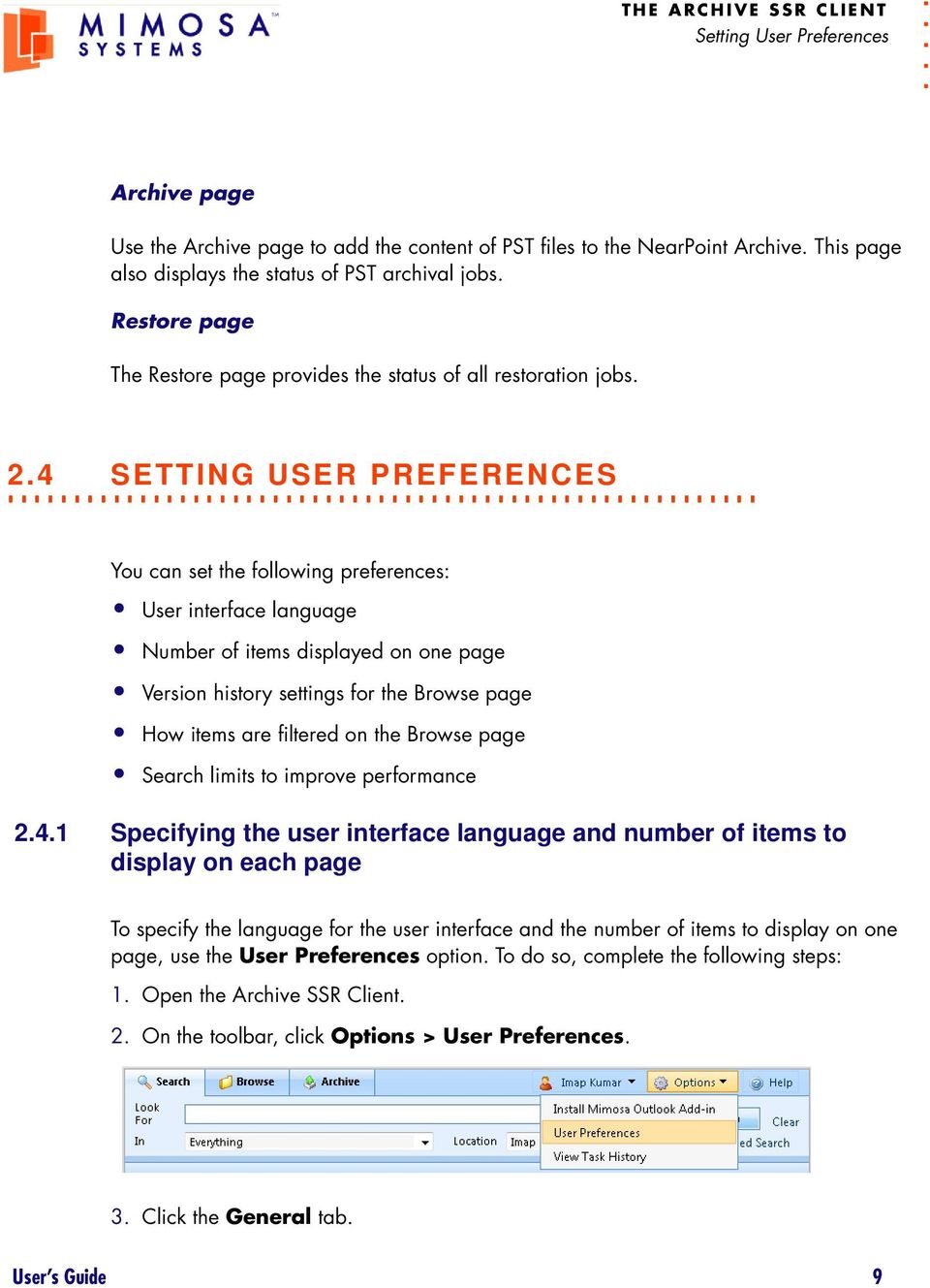
13 THE ARCHIVE SSR CLIENT Setting User Preferences Archive page Use the Archive page to add the content of PST files to the NearPoint Archive. This page also displays the status of PST archival jobs. Restore page The Restore page provides the status of all restoration jobs. 2.4 SETTING USER PREFERENCES.. You can set the following preferences: User interface language Number of items displayed on one page Version history settings for the Browse page How items are filtered on the Browse page Search limits to improve performance Specifying the user interface language and number of items to display on each page To specify the language for the user interface and the number of items to display on one page, use the User Preferences option. To do so, complete the following steps: 1. Open the Archive SSR Client. 2. On the toolbar, click Options > User Preferences. 3. Click the General tab. User s Guide 9
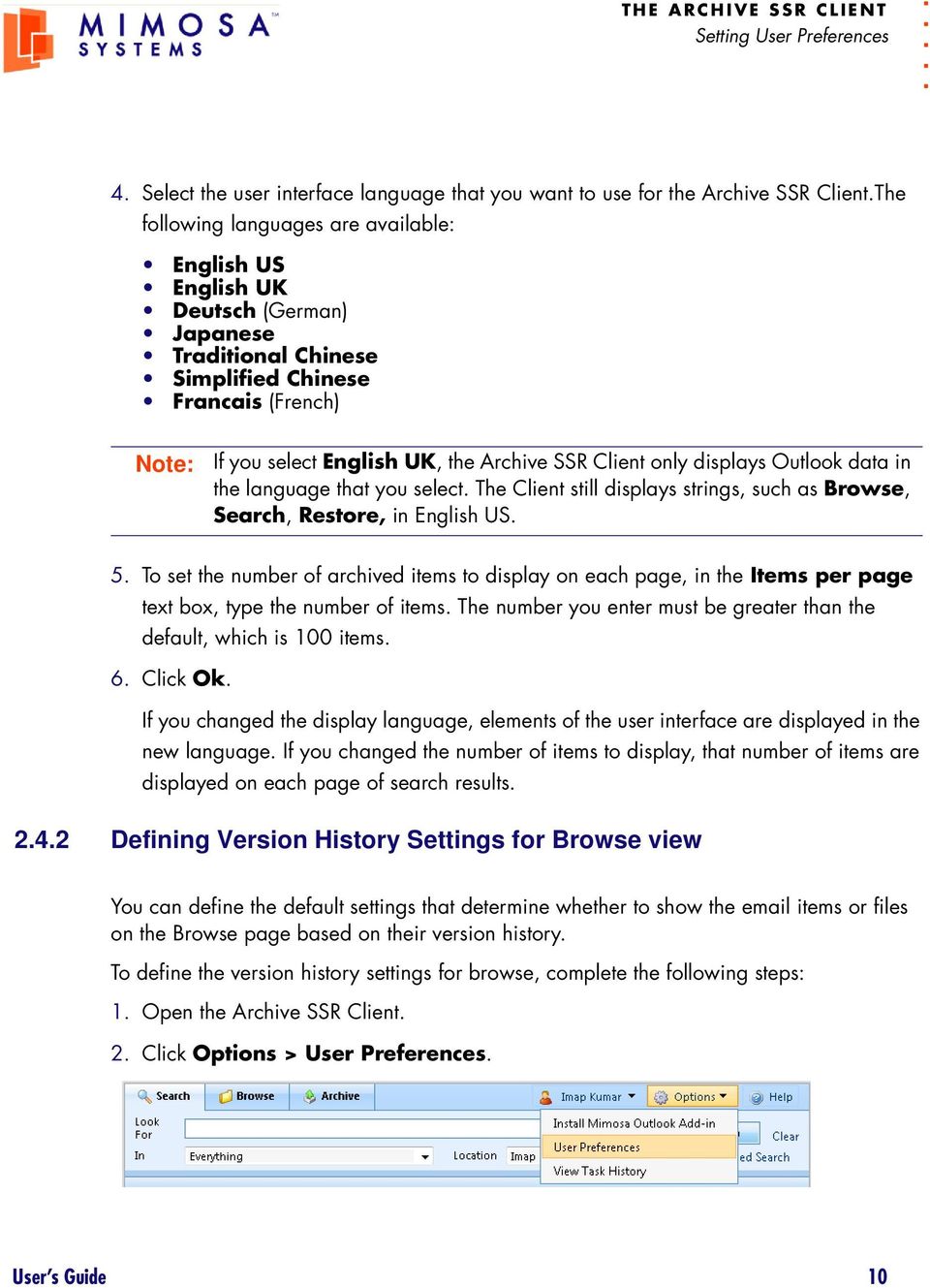
14 THE ARCHIVE SSR CLIENT Setting User Preferences 4. Select the user interface language that you want to use for the Archive SSR Client.The following languages are available: English US English UK Deutsch (German) Japanese Traditional Chinese Simplified Chinese Francais (French) Note: If you select English UK, the Archive SSR Client only displays Outlook data in the language that you select. The Client still displays strings, such as Browse, Search, Restore, in English US. 5. To set the number of archived items to display on each page, in the Items per page text box, type the number of items. The number you enter must be greater than the default, which is 100 items. 6. Click Ok. If you changed the display language, elements of the user interface are displayed in the new language. If you changed the number of items to display, that number of items are displayed on each page of search results Defining Version History Settings for Browse view You can define the default settings that determine whether to show the items or files on the Browse page based on their version history. To define the version history settings for browse, complete the following steps: 1. Open the Archive SSR Client. 2. Click Options > User Preferences. User s Guide 10
15 THE ARCHIVE SSR CLIENT Setting User Preferences 3. Click the Version History tab. 4. On the User Preferences dialog box, click the Version History tab. 5. Select the options that you want to use. 6. Click Ok Defining the Browse filter and Search Limits You can define the settings that determine how results are filtered on the browse page. Items displayed from an archive snapshot are filtered either by the date they were archived in NearPoint (the behavior in versions of NearPoint prior to 4.2), or by their Exchange receive date (the default). You can also define limits to searches that can increase search performance. To define the browse filter and search limits, complete the following steps: 1. Open the Archive SSR Client. 2. Click Options > User Preferences. 3. Click the Search & Browse tab. 4. Under Filter s based on, select either: Archived Date - items are filtered by the date they were added to the NearPoint archive. This is the default. Received Date - items are filtered by the date they were received by Exchange, regardless of when they were archived to NearPoint. 5. Under Show results up to, enter a search results limit (the default is 10,000). If a loose keyword is used (such as *) that returns a large number of results, when NearPoint reaches this number of results it displays the results and prompts you to cancel and refine the search, or continue searching. User s Guide 11

16 THE ARCHIVE SSR CLIENT Setting User Preferences 6. Under Limit search period in Quick Search to, select a period to limit quick searches to. Selecting a short period can speed up search performance. 7. Click Ok Viewing Task History You can view restore and deletion tasks in the SSR client. To view tasks, complete the following steps: 1. Open the Archive SSR Client. 2. Click Options > View Task History. 3. Under Display, select one of: Display All Tasks Display Restore To PST/ZIP jobs Display Restore To Mailbox jobs Display Deletion Tasks 4. Click Ok. User s Guide 12

17 THE ARCHIVE SSR CLIENT Cross-Platform Support 2.5 CROSS-PLATFORM SUPPORT.. This document describes how to use the Archive SSR Client with Microsoft Outlook or Microsoft Internet Explorer for . However, he NearPoint solution supports other programs and internet browsers, as shown in the following table: Browsers Supported Platforms Windows XP/2003 Mac OS Red Hat Enterprise Linux 3 Firefox Yes Yes No Safari No Yes No Internet Explorer Yes No No For supported browser versions, see the Mimosa NearPoint for Microsoft Exchange Server Compatibility Document. User s Guide 13

18 THE ARCHIVE SSR CLIENT Cross-Platform Support Entourage Support Use Microsoft Entourage for Mac to gain access to extended messages and their contents. However you cannot use Entourage to access the Mimosa Archive Folder home page. To search and browse the contents of the NearPoint archive, type the folder path URL in either a Safari or Firefox browser, and then view its contents. If you do not know the URL, contact your NearPoint administrator. An example of the folder path URL is User s Guide 14

19 3 RESTORING ARCHIVED ITEMS AND FILES 3.1 OVERVIEW.. You might accidentally delete your items or mail folders from your Exchange Server or files from your computer or file shares. Using the Archive SSR Client, you can access the NearPoint archive, look for the items and files, and restore them. To restore archived items or files, perform the following tasks: Find the specific items or files that you want to restore. Select the required items or files, and then restore them. Download the restored PST or ZIP files. 15

20 RESTORING ARCHIVED ITEMS AND FILES Browsing through the NearPoint archive 3.2 BROWSING THROUGH THE NEARPOINT ARCHIVE.. Use the Browse page to perform the following tasks. Read s and display their attachments. Restore one or more items or message folders to a mailbox or a PST file. Delete items from the NearPoint Server, the Exchange Server, or both. See file details and open them to read their contents. Restore one or more files to a compressed file. Delete files from the NearPoint Server. To access the Browse page, complete the following steps: 1. Click Browse tab of the Archive SSR Client. 2. From View drop-down list, select one of the following options: s To browse through archived items. Files To browse through archived files. User s Guide 16

21 RESTORING ARCHIVED ITEMS AND FILES Browsing through the NearPoint archive Using the Browse page The Browse page consists of three panes, as shown in the following figure: Navigation pane Displays the list of mailboxes or file folders stored in the NearPoint archive. It is similar to the Outlook navigation page, but adds filter options. User s Guide 17
22 RESTORING ARCHIVED ITEMS AND FILES Browsing through the NearPoint archive The View Contents as of Date filter lets you choose a date as of which you want to view contents in the NearPoint archive. For example, if you select Three Months Ago, NearPoint displays only messages that are at least three months old. Note: If you select a date before the NearPoint Server was used, you receive an error message: No items found. You also use the filter options to determine whether to display the Deleted Items or History Items (moved or modified items). Folder Contents pane Displays the items or files in the folder that you selected in the navigation pane. It is similar to the Outlook mail pane. The items are always displayed in the list, regardless of the type of item (that is, messages, meetings, appointments, notes). To change how to sort the items and files, doubleclick the name of the column heading. When you sort the items under the column heading in descending order, the column displays an up arrow (^) symbol. If you sort the items in ascending order, the column displays a down arrow (v) symbol. To adjust the width of each column, drag the separator lines between the column headings. To adjust the number of items displayed on each page in the folder contents pane, contact your NearPoint administrator. User s Guide 18
23 RESTORING ARCHIVED ITEMS AND FILES Browsing through the NearPoint archive Preview pane Displays a plain-text preview of the item or details of the file highlighted in the folder contents pane. To view the item or file, double-click it in the folder contents pane or press Enter. Note: NearPoint cannot preview s that have an archive size that exceeds 0.5 MB. To view the content of such s, double-click them. Browsing through archived PST files The Browse page displays archived PST files and mailboxes. You can browse archived PST files just like you browse items. Depending on the SSR View Style that the NearPoint administrator selects during configuration of the Self-Service policy, the PST files either merge with the archived mailboxes or appear as separate nodes in the navigation pane: Merged PST and Mailbox Archive View If the NearPoint administrator selected the Merged PST and Mailbox Archive View option, the navigation pane displays the PST file content merged with the archived mailbox. In the figure that follows, the folders USER1 and USER2 are PST file contents). This setting makes it convenient for users to view the all their archived items. User s Guide 19
24 RESTORING ARCHIVED ITEMS AND FILES Browsing through the NearPoint archive If the NearPoint administrator did not select the Merged PST and Mailbox Archive View option, the PST files are displayed as separate nodes at the same level as archived mailboxes in the navigation pane (folders NearPoint Retrieve PST, test.pst, USER1 and USER2 in the following figure). User s Guide 20
25 RESTORING ARCHIVED ITEMS AND FILES Browsing through the NearPoint archive Filtering items Use the Browse page filters to refine the list of items and files displayed. You can also use the filter options to select a point in time as of which you want to see the contents in the NearPoint archive. To filter the list of items, complete the following steps: 1. Click Filter button above the navigation pane. 2. From the View Contents as of Date drop-down list, select a point in time as of which you want to view the contents in NearPoint archive. Note: Folders with a created date later than the point in time selected are not displayed. If some s with an earlier received date are moved into this folder, they are also not displayed since the folder is not visible. 3. Select appropriate options to display or hide Item History (moved or modified items) or Deleted Items. 4. To apply the filters, click OK. User s Guide 21
26 RESTORING ARCHIVED ITEMS AND FILES Browsing through the NearPoint archive Filtering files Use the Browse page filters to refine the list of files displayed. You can also use the filter options to select a point in time as of which you want to see the contents in the NearPoint archive. To filter the list of files, complete the following steps: 1. Click Filter above the navigation pane. 2. From the View Contents as of Date drop-down list, select a point in time as of which you want to view the contents in NearPoint archive. 3. Select one of the following Ownership options: Display User Files - To display the files that you own. Display All Accessible Files - To display all the files to which you have access, regardless of whether you own them or someone else owns them. 4. Select one of the following Version History options: Display All Archived File Versions - To display every version of a file available in the NearPoint archive. Display Most Recent File Versions - To display only the most recent version of a file. 5. To apply the filters, click OK. User s Guide 22
27 RESTORING ARCHIVED ITEMS AND FILES Browsing through the NearPoint archive Viewing Items or Files in the Archive You have access to and can view items or files in the NearPoint archive from the Browse page. To view an item or file in the archive, complete the following steps: 1. In the navigation pane, select the folder that contains the item or file that you want to view. 2. In the folder contents pane, click the item or file that you want to view. If you select an item, the preview pane displays its preview. If you select a file, the preview pane displays its preview. 3. To view the entire item or file, double-click the item or file in the folder contents pane, or press Enter. The item or file opens in a new window. After you open the item or file, you can perform operations such as reply or forward the item or edit or save a copy of the file. Note: If you use Outlook 2000, the message item does not open as an Outlook window. Instead, it opens in OWA. Deleting items If the NearPoint administrator has granted you deletion rights, you can see a Delete button in the Archive SSR Client when you view a list of items. When you select an item and click the Delete button, NearPoint deletes the item from the NearPoint archive and from the Exchange server. To delete items, complete the following steps: 1. In the folder contents pane, select the items that you want to delete. 2. Click Delete >Delete All Checked Items. You receive a confirmation message. 3. To delete the selected items, click OK. NearPoint handles deletion requests in periodic batches, so the items you deleted may not be removed immediately from the list of items you see in the Archive SSR Client. However, you can check the status of your deletion requests. User s Guide 23
28 RESTORING ARCHIVED ITEMS AND FILES Searching for items and files 4. To check the status of a deletion request, from the Options menu, select View Task History. The Task History page opens. It displays the status of both delete and restore operations. 5. To delete the finished jobs, select the check box next to a job, and then click Delete. 3.3 SEARCHING FOR ITEMS AND FILES.. The Archive SSR Client offers two types of search, Quick Search or Advanced Search, to help you locate specific items or files in the NearPoint archive Performing a Quick Search Quick Search finds items and files that match keywords you specify. The content of all the items and files is fully indexed on the NearPoint Server to enable keyword searching. For items, Quick Search looks in message headers (Subject, From, To, Cc, and Bcc), message bodies, and attachments, while for files, it looks in file names, file content, and file metadata information such as owner and date of creation. Starting a Quick Search The Quick Search feature searches all items, PST files, and files archived to the NearPoint Server. You can search items, files, or both. You also can select specific mailbox folders, PST folders, file folders or shares as the focus of your search. To start a Quick Search, complete the following steps: 1. Click the Search tab. The Search page opens with the folder contents and preview pane. User s Guide 24
29 RESTORING ARCHIVED ITEMS AND FILES Searching for items and files 2. Enter keywords or phrases in the Look For text box. Note: You cannot search for words that exceed 32 characters. Replace characters such as?, <, >, :, and / with a period. when you search for a string that contains such characters. For example, if you search for search for only http... or http. 3. From the In drop-down list, select one of the following options: Everything Search items and files. s Search only items. Files Search only files. Browse Search specific content types. This option opens the Select Content Types dialog box that lets you to select specific types of items (for example, contacts, notes, and calendar items) or files (for example, Microsoft Office, text, or compressed files). Select the content types, and then click OK. 4. From the Location drop-down list, select one of the following options: Mailbox/Files folder Search entire mailboxes or file folders in the NearPoint archive. Select Folders When you select this option, you open the Select Folders dialog box that lets you select specific folders you want to search. Select the folders, and then click OK. 5. To view results, click Search. The folder contents pane displays the search results. Note: Quick search results are limited to a time period set in User Preferences. By default this is the previous six months, but this can be configured. See Defining the Browse filter and Search Limits on page -11 for more information. User s Guide 25
30 RESTORING ARCHIVED ITEMS AND FILES Searching for items and files Viewing Search Results The folder contents pane displays items and files that match the search criteria. NearPoint categorizes the search results onto three tabs: All Displays items and files that match the search criteria. s Displays items that match the search criteria. Files Displays the files that match the search criteria. The preview pane displays a preview of the item or details of the file highlighted in the folder contents pane. To view the item or file, either double-click it or press Enter. User s Guide 26
31 RESTORING ARCHIVED ITEMS AND FILES Searching for items and files Searching within results You can narrow your results if you search within the results from a quick search. When you search for a word or a phrase, you might receive a long list of items that match the search criteria. To narrow the search results, specify words that you want to find in the search results. For example, if six s in the NearPoint archive contain the word fax alone and three s contain the word fax and supervisor, the initial quick search for the word Fax returns all six s. If you perform another search for the word Supervisor from this result set, your results are three items. To search within results, complete the following steps: 1. Perform a quick search. To do so, use the steps in Starting a Quick Search on page -24. The folder contents pane displays the search results. Note: After you obtain results from a quick search, you will see Search results option under the In drop-down list. 2. Modify the search criteria as required. 3. From the In drop-down list, select Search results. 4. To search within the results from the previous quick search, click Search. The folder contents pane displays the results. Note: Currently, only a single level of Search within results is available. You can search results from a quick search only once. User s Guide 27
32 RESTORING ARCHIVED ITEMS AND FILES Searching for items and files Filtering Search Results To refine the search results, use the Filter and View options available on the s and Files tab of the Search Results page. Note: If you use custom fields when you define the search criteria, the Search Results page displays these fields. Use these custom fields to filter the contents. Filter the list of items To filter the list of items, complete the following steps: 1. Click the s tab on the Search Results page. 2. Click Filter button above the folder contents pane. 3. Select appropriate options to display or hide Item History (moved or modified items) or Deleted Items. 4. To apply the filters, click OK. User s Guide 28
33 RESTORING ARCHIVED ITEMS AND FILES Searching for items and files Filter the list of file items To filter the list of files, complete the following steps: 1. Click the Files tab on the Search Results page. 2. Click Filter button above the folder contents pane. 3. Select one of the following Version History options: Display All Archived File Versions To display all versions of a file in the NearPoint archive. Display Most Recent File Versions To display only the most recent version of a file. 4. Click OK to apply the filters. View specific types of items To apply view options for items, complete the following steps: 1. Click the s tab on the Search Results page. 2. From the View drop-down list, select the type of item that you want to view. User s Guide 29
34 RESTORING ARCHIVED ITEMS AND FILES Searching for items and files View specific types of files To apply view options for files, complete the following steps: 1. Click the Files tab on the Search Results page. 2. From the View drop-down list, select the type of files that you want to view. User s Guide 30
35 RESTORING ARCHIVED ITEMS AND FILES Searching for items and files Performing an advanced search Perform Advanced Search to provide more information about the items or files that you want to find in order to refine your search criteria. Advanced Search includes the following types of search criteria: Exchange Item Type, Address Fields, Timestamp, Date Modified, File Size, Owner, and Versions. To improve your search experience, the Advanced Search also supports the following search operators: Boolean, proximity, wildcard, numeric range. More detailed search criteria typically yield richer results. Starting an advanced search Use Advanced Search to specify detailed criteria to search items, PST files, and files in the NearPoint archive. To start an advanced search, complete the following steps: 1. Click the Search tab. The Search page opens with the folder contents and preview pane. 2. Enter keywords or phrases in the Look For text box. Note: You cannot search for words that exceed 32 characters. Replace characters such as?, <, >, :, and / with a period. when you search for a string that contains such characters. For example, if you search for search for only http... or http. 3. From the In drop-down list, select one of the following options: Everything Search items and files. s Search only items. Files Search only files. Browse Search specific content types. This option opens the Select Content Types dialog box that lets you to select specific types of items (for example, contacts, User s Guide 31
36 RESTORING ARCHIVED ITEMS AND FILES Searching for items and files notes, and calendar items) or files (for example, Microsoft Office, text, or compressed files). Select the content types, and then click OK. 4. From the Location drop-down list, select one of the following options: Mailbox/Files folder Search entire mailboxes or file folders in the NearPoint archive. Select Folders When you select this option, you open the Select Folders dialog box that lets you select specific folders you want to search. Select the folders, and then click OK. 5. To see the advanced search criteria fields, click Advanced Search. Advanced search criteria fields are dynamic, and are displayed based on the content type ( items, files, or both) selected in step 3. The sections that follow describe how to define each type of advanced criteria. User s Guide 32
37 RESTORING ARCHIVED ITEMS AND FILES Searching for items and files Specifying advanced search criteria for items and files If you selected to search Everything, that is, both items and files, the Search tab displays the fields shown in the following figure. To specify criteria that apply to both items and files, complete any of the following steps that help define the archived content you want to find: 1. Under Find Keywords in, select one or both of the following options: Title Search for keywords in the subject of items and file names. Content Search for keywords in the body of items and in file content. 2. To search for items modified on a particular date, from the Date Modified drop-down list, choose a time period such as This week, Last month, or Between a date range. If you select Is or Between, specify the date or date range using the Start Date and End Date calendar controls. 3. From the Size drop-down list, choose the approximate size of items you want to find. Any Files of any size Small Less than 100KB Medium 100KB to 1MB Large Greater than 1MB Less Than, Greater Than, or Specify Size Type a value representing the item size in kilobytes. User s Guide 33
38 RESTORING ARCHIVED ITEMS AND FILES Searching for items and files Specifying advanced search criteria for only items If you chose to search s only, the Search tab displays the fields shown in the following figure. To specify criteria that apply only to items, complete any of the following steps that help define the archived content you want to find: 1. From the Select subtypes drop-down list, select the type of items (such as messages, calendar items, tasks, journal, contacts, and notes) you want to search in. 2. To search specific parts of messages, from the Find keywords in drop-down list, select the message parts (such as subject, message body, or subject, message and attachments) you want to search in. 3. To search sent to or received from a specific user, under Search Criteria, click To. The Select Names dialog box opens. 4. From the Address Book drop-down list, select the address list to search: Mimosa Archive Global Address List Everyone in the Global Address List Senders of items in selected mailbox Only people who sent s to you Recipients of items in selected mailbox Only people who received s from you User s Guide 34
39 RESTORING ARCHIVED ITEMS AND FILES Searching for items and files Contact items in selected mailbox Only people in your list of Contactsl Note: To display al users in the list you chose, select Show All, and then click Go. 5. To select one user or a small group of users, complete one of the following steps: If you know the Exchange user name or last name of the person with whom you exchanged , type the name in the text box, and then click Go. Like Outlook, the Archive SSR Client finds the names if they occur in the To or Cc fields, but not in the Bcc field. If you are unsure of a name, click the From or Sent To button. In the Select Names dialog box, complete the following steps: a. From the Find Users drop-down list, select one of the following options: - Name contains any of these words - Name contains all of these words User s Guide 35
40 RESTORING ARCHIVED ITEMS AND FILES Searching for items and files b. In the text box, type all or part of a name to search for, and then click Go. The center pane displays the names that match your selection criteria. Note: The Select Names dialog box is available only in Internet Explorer. The application does not allow special characters in display names and addresses in Global Address List (GAL). The application ignores hyphens (-) in search criteria. For example, search word NPAdmin and NP-Admin would return the same results. The application allows you to use the wildcard character * at the end of the search text. For example, npad* would return results for npadmin and npadmin. If you type *npad or np*d, GAL does not return the expected results. c. From the list of names displayed, select the names of users relevant to your search, and then click OK. d. If you are searching for an from this person, click From. e. If you are searching for an sent to this person, click To.. Note: You can select multiple names to populate the From and Sent To boxes. f. After you select the names, click OK. The Select Names dialog box closes and the names appear in the Name list on the Advanced Search page 7. To search for items modified on a particular date, from the Date Modified dropdown list, choose a time period such as This week, Last month, or Between a date range. If you select Is or Between, specify the date or date range using the Start Date and End Date calendar controls. 8. From the Size drop-down list, choose the approximate size of items you want to find. Any Files of any size Small Less than 100KB User s Guide 36
41 RESTORING ARCHIVED ITEMS AND FILES Searching for items and files Medium 100KB to 1MB Large Greater than 1MB Less Than, Greater Than, or Specify Size Type a value representing the item size in kilobytes. Specifying advanced search criteria for searching files If you chose to search Files only, the Search tab displays the fields shown in the following figurei. To specify criteria that apply only to files, complete any of the following steps that help define the archived content you want to find: 1. Specify the parts of the files you want to search in. To do so, from the Find keywords in drop-down list, select any of the following options: Content Search for keywords in items body and file content. All Properties Search for keywords in all the file property boxes, such as, file extension, content, file type, author, and size. 2. To search for files modified on a particular date, from the Date Modified drop-down list, choose a time period such as This week, Last month, or Between a date range. If you select Is or Between, specify the date or date range using the Start Date and End Date calendar controls. 3. From the Size drop-down list, choose the approximate size of items you want to find. Any Files of any size Small Less than 100KB User s Guide 37
42 RESTORING ARCHIVED ITEMS AND FILES Searching for items and files Medium 100KB to 1MB Large Greater than 1MB Less Than, Greater Than, or Specify Size Type a value representing the item size in kilobytes. 4. To search for files based on their version, from the Version drop-down list, select one of the following options: Search in recent File Versions Search for only the most recent version of files. Search in all File Versions Search for all the versions of files available in the NearPoint archive. To search for files based on their owner, from the Ownership drop-down list, select one of the following options: Files that I have created Search for files owned by you. Files that I can access Search for all the files that you can access, regardless of who created or owns them. Distribution Lists If the retrieved s have distribution lists in their From or To lists, to expand them and display them after you retrieve them, select Expand Distribution Lists while searching. Using Custom Fields The NearPoint administrator can specify custom boxes that are used while indexing and archiving messages. You can use these custom boxes to narrow down your search criteria, or look for messages where the custom box is of a specific value. All custom boxes that the NearPoint administrator has specified are listed in the Custom Fields box. To use a specific custom box while defining the search criteria: 1. Select the custom box in the Custom Fields box. 2. Click Add. User s Guide 38
43 RESTORING ARCHIVED ITEMS AND FILES Restoring Items From the Archive 3. Specify the value of the custom box that should be matched while retrieving s from the NearPoint archive. You can specify multiple custom boxes here. Messages that satisfy all the custom boxes as well as the criteria set in the above boxes are retrieved and displayed in the Search Results page. Executing Advanced Search Once you have specified the advanced search criteria, click Search to see the results. For more information on viewing the search results, see Viewing Search Results on page RESTORING ITEMS FROM THE ARCHIVE.. If you accidentally delete your items or message folders from the Exchange Server, or files from your computers or file shares. You can restore these deleted items or files from the NearPoint archive without assistance from your NearPoint administrator. The Restore options are on the Browse page and the Search Results page. Use the Archive SSR Client you can restore the following pieces of information: One or more items to a mailbox or a PST file. Message folders to a mailbox or a PST file. Archived files to a ZIP file Restoring items or message folders to a mailbox You can restore one or more items or folders from the NearPoint archive to your Exchange Server. User s Guide 39
44 RESTORING ARCHIVED ITEMS AND FILES Restoring Items From the Archive To restore items or folders to a mailbox, complete the following steps: 1. From the Browse or Search Results page, select the items or folders that you want to restore. Note: You can restore message folders only from the Browse page. To do so, in the navigation pane, select the folders that you want to restore. 2. Click Restore> Restore Messages to Mailbox or Restore Folders to mailbox. The Restore Options dialog box opens. 3. Specify a name for the restore job in the Restore Job Name text box. User s Guide 40
45 RESTORING ARCHIVED ITEMS AND FILES Restoring Items From the Archive 4. Select one of the following Restore options: Restore All checked Items Restore only the selected items. Restore All Search Results Restore all the messages in the search results. 5. From the Restore Location drop-down list, select one of the following options: Restore to original location Restore the selected items to their original location, as they were before deletion. If you select this option, NearPoint retains the folder hierarchy by default. Select folders Restore selected items into a specific folder. To use this option, highlight the folder where you want to restore the items, and then click OK. If you have not created a folder in advance, use Create New Folder to create one. To do so, complete the following steps: a. Click Create New Folder. b. Enter a name for the folder. c. Select an existing folder under which you want to create the new folder. d. To close the window, click OK. Nearpoint creates a new folder in Outlook. 6. From the Overwrite Settings drop-down list, to specify how to manage the existing messages, select one of the following options: Existing messages will be ignored. Existing messages will be overwritten. Duplicate messages will be created. 7. To retain the folder hierarchy in the destination folder, select the Restore items with original folder hierarchy check box. 8. To begin the restoration process, click Select. On completion of restoration, you see a prompt that indicates that NearPoint has restored the messages to your Exchange Mailbox. User s Guide 41
46 RESTORING ARCHIVED ITEMS AND FILES Restoring Items From the Archive Restoring items or message folders to a PST file You might occasionally need to create PST files that contain items of interest, such as a set of search results, or a collection of all the items in a mailbox at a specific point in time. These PST files are convenient for review by one or more reviewers, including the initiator of this request. After you restore the archived items to a PST file, you then can download the PST file to your computer. When you download PST files, you can perform offline reviews of data in the PST and share the data with others without being tied to the NearPoint server. To restore items or message folders to a PST file, complete the following steps: 1. Use the Browse or Search Results page to select the items or message folders that you want to restore to a PST file. Note: You can restore message folders only from the Browse page. To do so, in the navigation pane, select the folders that you want to restore. 2. Click Restore> Restore Messages to PST or Restore Folders to PST as required. The Restore to PST dialog box opens. User s Guide 42
47 RESTORING ARCHIVED ITEMS AND FILES Restoring Items From the Archive 3. Enter the following information: Restore Job Name Enter a name for the restore job. Select one of the following Restore Options: - Restore All Checked Items To restore only the messages that you selected on the Search Results page, select this option. This option is not available when you restore mail folders to PST. - Restore All Search Results To restore all the messages on the Search Results page, select this option. This option is not available when you restore mail folders to PST. PST File Name The name of the PST file. If a PST file with the same name already exists, the application appends the selected content to the existing file. Otherwise, the application creates a new PST file. Outlook Display Name The display name that the PST file uses in Outlook. Password To password-protect your PST, type your password here. Confirm Password Re-type the password for verification. PST Format Select an appropriate version for the PST file depending on the version of Outlook that you use. Restore items with original folder hierarchy To retain the folder structure in the output PST file, select this check box. User s Guide 43
48 RESTORING ARCHIVED ITEMS AND FILES Restoring Items From the Archive Restoring files to a ZIP file You can restore one or more files from the NearPoint archive to a ZIP file. To restore files to a ZIP file, complete the following steps: 1. Use the Browse or Search Results page to select the files that you want to restore to a ZIP file. 2. To open the File Restore dialog box, click Restore> Restore Files. 3. Enter a name for the restore job. 4. Enter a file name for the ZIP file into which you want to restore the selected files in the ZIP File Name text box. 5. If you want to password-protect the ZIP file, type the password in the Password text box. 6. Re-type the password for verification purpose in the Confirm Password text box. 7. To retain the folder structure in the output ZIP file, select the Restore items with original folder hierarchy check box. 8. To start the restoration process, click OK. User s Guide 44
49 RESTORING ARCHIVED ITEMS AND FILES Restoring Items From the Archive Checking Status of the Restore Jobs The Task History page of the Archive SSR Client displays the status of all deletion and restore jobs. To display the page with the status of each restore job you started, from the Options menu, select View Task History. To filter the list of jobs to display only specify types of jobs, select from the options on the Filters menu. To delete finished jobs from the list, select the job, and then click Delete Downloading PST and ZIP files After you request to restore the archived items to a PST file or archived files to a ZIP file, you can download these PST or ZIP files to your computer. If you download PST or ZIP files, you can perform local reviews or share the data with others without depending on NearPoint. To download a PST or ZIP file, complete the following steps: 1. To launch the Restore page, click the Restore tab. 2. From the Filter drop-down list, select Display Restore to PST/ZIP jobs. 3. Select any of the completed restore to PST or ZIP jobs. User s Guide 45
50 RESTORING ARCHIVED ITEMS AND FILES Restoring Items From the Archive 4. To open the File Download dialog box, click the PST or ZIP file name link. 5. To save the file, click Save and choose a location. How to Open the download PST Files in Outlook To use Outlook to open the PST file, complete the following steps: 1. From the file list, click Open > Outlook Data File. 2. From the Open Outlook Data File window, navigate to the location where you saved the PST file, then select the PST file, and then click OK. NearPoint adds the PST file to the All Mail Folders group in the Outlook navigation pane. 3. The Outlook Reading pane shows the items that you selected to restore to a PST File. User s Guide 46
51 4 WORKING IN OFFLINE MODE To access archived messages or extended attachments in a mailbox, you must connect the client computer to the NearPoint Server network. The NearPoint Outlook add-in feature enables users to work offline and access archived messages and attachments from a local cache. This feature is useful in the following scenarios: You need to access your from a laptop or mobile device that is not connected to the NearPoint Server, for example, while traveling Network connection to the NearPoint Server is slow The NearPoint Server is offline for maintenance You must configure and synchronize the Outlook add-in feature before use. 4.1 TYPES OF CACHE.. The Outlook Add-in feature provides two types of cache: Extended Message Cache Local store for attachments that are extended on a NearPoint Server Archive Cache Local store for all messages received and sent through the mailbox within a certain period of time To update the cache, you perform synchronization. The client computer must be connected to NearPoint Server network during synchronization. This process performs the following tasks: 47
52 WORKING IN OFFLINE MODE Enabling the Outlook Add-in Feature Adds any messages and attachments that NearPoint added or extended after the last synchronization Removes any messages and attachments that NearPoint deleted from the archive after the last synchronization Removes any messages and attachments that are not in the configured time period Note Mailbox Archives in Exchange Server 2010 are not supported in the cache, and are not available in offline mode. 4.2 ENABLING THE OUTLOOK ADD-IN FEATURE.. To enable the facility to work offline, complete the following steps: 1. Install Microsoft.NET framework 2.0 or later on the client computer. 2. Download the software from 3. To check if the Install Mimosa Outlook Add-in option appears on the shortcut menu, right-click an extended message. If not, contact the NearPoint administrator to enable the Self-Service policy and the Outlook add-in feature for your account. Note: NearPoint does not support the Outlook add-in for Outlook Installing the Outlook Add-In Feature To install the Outlook add-in feature, complete the following steps: 1. Right-click any extended message, and then select Install Mimosa Outlook Add-in from the shortcut menu. 2. To install the feature, follow the instructions on the installation wizard. User s Guide 48
53 WORKING IN OFFLINE MODE Using the Outlook Add-In Feature 3. After you install the feature, restart Outlook. On successful installation, the Mimosa Archive toolbar appears below the Outlook toolbar. 4.3 USING THE OUTLOOK ADD-IN FEATURE.. This section covers following topics: Configuring Extended Message Cache Configuring the Archive Cache Enabling Seamless Stubbing Preserving Frequently Required Attachments from Deletion Manually Synchronizing the Outlook Add-in Feature Viewing Cache Reports Maintaining the Outlook Add-in Disabling the Mimosa Outlook Toolbar User s Guide 49
54 WORKING IN OFFLINE MODE Using the Outlook Add-In Feature Configuring Extended Message Cache The Extended Message Cache feature lets you to retrieve offline copies of extended message attachments to a local location. After you install the Extended Message Cache, NearPoint checks the local cache before it attempts to connect to the NearPoint Server. You can specify the following settings for the Extended Message Cache option: Frequency of refreshing the Extended Message Cache Location of the local Extended Message Cache Enable or disable the seamless stubbing option Preferred language You also can view any Extended Message Cache progress reports, alerts, and warnings, and perform maintenance tasks such as testing connection to the NearPoint Server, clearing the cache, and rebuilding the cache. To configure the Extended Message Cache, complete the following steps: 1. Click Options > Cache Options > Extended Message Cache. The Mimosa Offline Cache dialog box opens. 2. Specify the options you want to use. For option descriptions, see the table that follows this procedure. 3. To apply the changes, click OK. User s Guide 50
55 WORKING IN OFFLINE MODE Using the Outlook Add-In Feature The following table describes the configuration options: Option Description Enable offline caching Enable the Extended Message Cache option on your computer. of extended messages Hide progress popups when synchronizing Hide errors when synchronizing Refresh cache Max Size (MB) Cache Location Enable seamless stubbing Language Option To hide progress pop-up windows that appear at the lower right corner of your page while the cache is synchronized, select this option. Tip: To hide the pop-up windows during synchronization, on the pop-up window, select the Hide these popups option. To hide errors that occur during synchronization process, select this option. Later, you can view the errors on the Reports tab. Specify how often to refresh the Extended Message Cache. When NearPoint refreshes the Extended Message Cache, it retrieves attachments that were added to the archive and deletes any attachments that have been deleted since the last synchronization. Specify the Extended Message Cache size in MB. By default, the Extended Message Cache size is 1000 MB. After the cache reaches this limit, NearPoint deletes the oldest attachments from the cache to reclaim space for newer attachments. To select a local location for the Extended Message Cache, click Browse. Ensure that the space you specify in the Max Size box is available at the location you specify. To enable seamless stubbing, select this option. For more information, see Enabling Seamless Stubbing. From the drop-down list, select the default language. NearPoint also sets the language that you specify in this field as the default language for the Archive Cache options page. User s Guide 51
56 WORKING IN OFFLINE MODE Using the Outlook Add-In Feature Configuring the Archive Cache The Archive Cache option retrieves items that you received and sent during a specified period of time and stores them in a local location. If you use Desktop Search (only) to search for a message, and the message is present in the Archive Cache, the search results include the message. Use the Archive Cache Options dialog box to turn the Archive Cache option on or off and to specify the following settings: Frequency of refreshing the Archive Cache Location of the local Archive Cache Period of time for which the messages must be cached to the local location You also can view any Extended Message Cache progress reports, alerts, and warnings. In addition, you can perform maintenance tasks such as testing connection to the NearPoint Server, clearing cache, and rebuilding it. To configure the Archive Cache, complete the following steps: 1. Click Options > Cache Options > Archive Cache. The Mimosa Outlook Add-in Archive Cache Options dialog box opens. 2. Specify the options you want to use. For option descriptions, see the table that follows this procedure. 3. To apply the changes, click OK. User s Guide 52
57 WORKING IN OFFLINE MODE Using the Outlook Add-In Feature The following table describes the configuration options: Options Enable Archive Cache Hide progress popups when synchronizing Hide errors when synchronizing Synchronization interval Max Size (MB) Temporary Location Date frame interval Enable the Archive Cache option on your computer. To hide progress pop-up windows that appear at the lower right corner of your page while the cache is synchronized, select this option. Tip: To hide the pop-up windows during synchronization, on the pop-up window, select the Hide these popups option. To hide errors that occur during synchronization process, select this option. Later, you can view the errors on the Reports tab. Specify how often to refresh the Archive Cache. When NearPoint refreshes the Archive Cache, it retrieves the most recent items that were added to the archive and deletes any items that have been deleted since the last synchronization. Specify the Extended Message Cache size in MB. By default, the Extended Message Cache size is 1000 MB. After the cache reaches this limit, NearPoint deletes the oldest attachments from the cache to reclaim space for newer attachments. To select a local location for the Archive Cache, click... Ensure that the space that you specify in the Max Size box is available in the location specified here. Specify the period of time, in months, for which NearPoint must cache items. For example, if you specify 0 to 0 months, received and sent during the current month is cached. If you specify 0 to 1 months, received and sent in the previous and current months is cached. User s Guide 53
58 WORKING IN OFFLINE MODE Using the Outlook Add-In Feature Enabling Seamless Stubbing The NearPoint administrator uses the NearPoint Configuration Tool to configure how Outlook and the OWA client display extended messages. To retrieve the original message, open the extended message, and then double-click the stub. To hide these stubs and to display extended messages the same as regular messages, use the Archive Cache options to enable seamless stubbing. Note: The current NearPoint version supports this feature only in the Outlook client. This feature is available only in the English locale environment. To enable seamless stubbing, complete the following steps: 1. From the Mimosa toolbar, select Options > Cache Options > Extended Messages Cache. 2. Click the Cache Configuration tab. 3. Select Enable Seamless Stubbing. 4. To apply the changes, click Apply. Note: If you do not want the subject line to display the Mimosa icon and - Extended <original_bytes>, contact your NearPoint administrator to use the NearPoint Configuration Tool to set the icon settings to False. If the icon settings are set to False, the subject line does not display - Extended <original_bytes>. Also, instead of the Mimosa icon, the subject line displays. NearPoint now displays extended messages as normal messages without any icons or attached stubs. User s Guide 54
59 WORKING IN OFFLINE MODE Using the Outlook Add-In Feature Preserving Frequently Required Attachments from Deletion If you frequently need the attachment of a particular message in the offline mode, you can set that message to be always available in the offline mode. NearPoint does not delete messages set with this option when newer messages replace older messages. To preserve an extended message from deletion from the Archive Cache folder, complete the following steps: 1. Right-click the extended message, and then select Extended Messages Options from the shortcut menu.the options dialog box for the message opens. 2. Select Always cache this message for offline use. 3. Click OK. User s Guide 55
60 WORKING IN OFFLINE MODE Using the Outlook Add-In Feature Manually Synchronizing the Outlook Add-in Feature To synchronize the Outlook Add-in feature, complete the following steps: For Extended Message Cache, click Options > Synchronize > Extended Message Cache. For Archive Cache, click Options > Synchronize > Archive Cache. If the synchronization popup window is enabled, it shows that the operation is in progress. You also can check the status under the Results tab as described in Viewing Cache Reports section. User s Guide 56
61 WORKING IN OFFLINE MODE Using the Outlook Add-In Feature Viewing Cache Reports The Reports tab in the Extended Message Cache and Archive Cache configuration wizard lists the history of synchronization jobs for each cache option. To view details about a job, select it, and then click Click Here. The following figure shows a sample. User s Guide 57
62 WORKING IN OFFLINE MODE Using the Outlook Add-In Feature Maintaining the Outlook Add-in In the Configuration wizard of Extended Messages/Archive Cache, on the Maintenance tab: To ensure that you can reach the NearPoint Server, click Test Connection. To delete the contents of the Extended Message Cache, click Clear Cache. To synchronize the Extended Message Cache for the most recent attachments, click Synchronize Cache Disabling the Mimosa Outlook Toolbar To hide the Mimosa Outlook Toolbar, on the client computer, complete the following steps: 1. Open the Run window, enter the following command, and then click OK. regedit 2. In the navigation pane, click My Computer > MYKEY_LOCAL_MACHINE > SOFTWARE > Mimosa > Outlook Add-in. 3. Create a new key: Name HideAddinToolBar Type String Value 1 4. To have the changes to take effect, restart Outlook. User s Guide 58
63 WORKING IN OFFLINE MODE Troubleshooting Tips 4.4 TROUBLESHOOTING TIPS.. Guidance for installing the same version of the Mimosa Outlook Add-in feature over an existing Installation. Installing the same version of the Mimosa Outlook Add-in feature over an existing installation will present two options: Repair or Remove. Repair might fail if the previous MimosaArchiveCache.msi was not saved to disk first. In such case, you should first Remove the existing installation, then install again. Mimosa Outlook Add-in feature is installed, but the toolbar does not open. Explanation 1: Outlook has disabled the Mimosa Outlook Add-in feature. Resolution 1: Re-enable the Outlook Add-in feature. To do so, complete the following steps: 1. Open Outlook. 2. Click Help > About Microsoft Outlook. 3. Click Disabled Items. 4. From the list of disabled items, select Mimosa Archive Cache. 5. Click Enable, and then restart Outlook. Explanation 2: The version of.net Framework and the Mimosa Outlook Add-in feature are different. Resolution 2: Install the correct.net Framework version. For more information, see the NearPoint for Microsoft Exchange Server Installation Guide. The Mimosa Outlook Add-in feature is disabled even though users are authorized to use Self-Service Retrieve. Explanation: The Self-Service Retrieve policy has been modified recently. Resolution: Open Outlook, and then wait for the Synchronization operation to run in the background. Next, to verify if that you enabled the Mimosa Outlook Add-in feature, restart Outlook. User s Guide 59
64 WORKING IN OFFLINE MODE Troubleshooting Tips When you use the right-click menu to forward or reply to cached messages, the message opens in View mode. Explanation: This is a limitation of this NearPoint release. Resolution: Use the Forward and Reply buttons on the Outlook Standard toolbar to forward or reply to cached messages. The message preview does not retain the Mimosa header when you open an extended message from the Extended Message Cache. Explanation: Outlook might have failed to retain the message body correctly. Resolution: Restart Outlook. In Outlook 2002, the preview of extended messages is not displayed. Instead, a message This item contains active content that cannot be displayed in the preview pane. Open the item to read its contents. is displayed Explanation: NearPoint does not preview extended messages due to a security limitation with Outlook Resolution: To view the contents and the attachments of the message, double-click the message. User s Guide 60
65 5 ARCHIVING OFFLINE PST FILES 5.1 ABOUT ARCHIVING OFFLINE PST FILES.. Note: The PST Archiving feature is available only in Internet Explorer. Outlook lets you store message and item content on your local system by using data files to organize these Outlook items into specific folders. For example, you specific data files for a project, or from a company, into separate data file, which you name. Additionally, Outlook provides mechanisms to back up and archive a source data file locally or to a network share. Outlook data files, Outlook data file archives, and backups use the file extension.pst. These files are typically called PST files. NearPoint lets you archive the contents of offline PST files through the PST Archive Option. To use this feature, your company must have purchased and enabled this optional module of the NearPoint solution, and you must have granted access rights to this feature from your NearPoint administrator. When you archive offline PST files to the NearPoint server, you reap two key benefits: Protection from loss or accidental deletion Full-text indexing for easier searches PST files on computers might not be regularly backed up by users or system processes. If, for example, your computer is lost or stolen or has a hard drive failure, you can lose all PST messages. If you archive this content once, you protect your information. 61
66 ARCHIVING OFFLINE PST FILES If you archive your PST files to the NearPoint server, the content also becomes full-text indexed. You can search through stored message and item content in the subject body or attachment, not just the subject line, which simplifies how to find content How PST Archiving Works When you archive PST files, NearPoint uploads the entire file from your computer to the NearPoint server. Next, NearPoint extracts the imported file, and then deposits all message and item content found in the PST file in your archive Mailbox in NearPoint. The message header body and attachments and other item content, for example, notes, calendar, and contacts, become full-text indexed. The processing time to archive varies. It depends on the size of the PST file and the available NearPoint system resources. Use the Archive Self-Service Retrieve (SSR) Client, to retrieve and restore these new messages and items. Navigate to the same named PST folder in the Browse view or use the Quick Search or Advanced Search. From there, you can retrieve messages back to Outlook one by one, and as needed, restore selected messages back to your mailbox on the Exchange server. The following figure shows how NearPoint uploads PST files to the NearPoint server, then imports them into your archive folder files, and then restores them from the original PST file. User s Guide 62
67 ARCHIVING OFFLINE PST FILES Archiving PST Files Before you archive your PST files, take the files offline if Outlook still uses them. Alternatively, you can back up the PST files, and then archive the backup. If the PST file is continually in use, the action of a one-time archive of the PST does not ensure that the NearPoint archive remains up to date. To take a PST file offline in Outlook 2003, complete the following steps: 1. From the Files menu, choose Data File Management. 2. Select the PST folder name, and then click Close from the shortcut menu. For more information, see your Outlook documentation. User s Guide 63
68 ARCHIVING OFFLINE PST FILES To archive PST files, complete the following steps: 1. Click the Archive tab. The Archive page opens. 2. Click Browse, and then select a PST file that you want to archive. 3. In the Specify PST Display Name text box, type a name for the archive folder that will contain the contents of the selected PST file. 4. If you created the PST file with a password, select the PST Password check box. 5. Type the password in Password text box. 6. To archive the PST file, click Upload. The lower pane displays the PST archiving status. User s Guide 64
69 6 ADDITIONAL OPTIONS FOR AUDITORS 6.1 OVERVIEW.. If your NearPoint administrator has designated you as an auditor, in addition to the features available to end users, you can perform the following additional tasks: Browse the items and files of the custodians assigned to you Search for items and files of the custodians assigned to you View contents of the public folders 65
70 ADDITIONAL OPTIONS FOR AUDITORS Browsing through ITems and Files 6.2 BROWSING THROUGH ITEMS AND FILES.. The Browse page lets you select the custodians whose items and files you want to view. To browse through the items and files of the custodians, complete the following steps: 1. Navigate to the Browse page of the Archive SSR Client. 2. From the View drop-down list, select s or Files. 3. From the drop-down list located above the navigation pane, select Select Custodians. The Select Custodians dialog box opens. 4. Select the custodians whose items or files you want to view. User s Guide 66
71 ADDITIONAL OPTIONS FOR AUDITORS Browsing through ITems and Files 5. Click Select. You will see the selected custodians mailboxes or file shares/folders available for browsing in the navigation pane. Note: For Outlook 2003 only: To view messages that have extended attachments in your auditiee s mailboxes, complete the following steps: 1. From the Tools menu, select Options. 2. Click the Other tab, and then click Advanced Options. 3. Select the Allow script in shared folders option. If you use a version of Outlook earlier than 2003, do nothing. Earlier versions allow the scripts by default. User s Guide 67
72 ADDITIONAL OPTIONS FOR AUDITORS Searching custodian Content sources 6.3 SEARCHING CUSTODIAN CONTENT SOURCES.. You can search a custodian s content sources ( items or files) with Quick Search or Advanced Search, as described in Searching for items and files on page -24. However, for custodian searches, you choose the mailboxes/mailbox folders or file folders/shares of specific custodians as the scope of the search. To search a custodian s content sources, complete the following steps: 1. Open the Search page. 2. From the Location drop-down list, select one of the following options: All Custodians Search content sources of all the custodians assigned to you. Select custodians and their locations Select specific content sources of the custodians assigned to you. 3. If you chose Select custodians and their locations in the previous step, the Select Custodian s Content Sources dialog box opens. User s Guide 68
73 ADDITIONAL OPTIONS FOR AUDITORS Searching custodian Content sources 4. Select the custodians whose content sources you want to search. 5. Click OK. Based on the search criteria you specify, NearPoint searches the content sources that you selected. User s Guide 69
74 ADDITIONAL OPTIONS FOR AUDITORS Viewing Public Folder Contents 6.4 VIEWING PUBLIC FOLDER CONTENTS.. NearPoint administrators can assign auditors to view the contents of public folders. To view contents of public folders, complete the following steps: 1. Open the Browse page. 2. From the View drop-down list, select s. 3. From the drop-down list above the navigation pane, select Select Custodians. The Select Custodians dialog box opens. 4. Select the public folder that you want to view. User s Guide 70
75 ADDITIONAL OPTIONS FOR AUDITORS Viewing Public Folder Contents 5. Click Select. The navigation pane displays the selected public folder. Similarly, to perform Quick Search and Advanced Search on the public folders and their contents, select public folders as the scope of your searches. User s Guide 71
76 7 TROUBLESHOOTING 7.1 SSR TROUBLESHOOTING.. The Outlook Add-in feature works for only a single profile. If you use another profile when you log on, or others use their profiles to log on, the feature does not work. Explanation: The feature works only for one Outlook profile, the one that was active when the feature was installed on the computer. Resolution: Contact your NearPoint administrator to enable the Outlook Add-in for all users that log on to the specific computer. SSR search fails for any word that is more than 32 characters long. Explanation: When you perform an ediscovery search, you cannot use a keyword that exceeds 32 characters. Resolution: To use longer keywords in ediscovery searches, contact your NearPoint administrator to edit the allowed maximum number of characters allowed for keywords. 72
77 TROUBLESHOOTING SSR Troubleshooting You receive a script error from the SSR client when you open the Mimosa Archive folder. Explanation: This is a known problem. Resolution: To resolve this problem, complete the following steps: 1. Click Yes to clear the message and continue the operation. 2. Open Outlook. 3. Right-click the Mimosa Archive folder and, from the context menu, select Properties. The Properties dialog box opens. 4. Click the Home Page tab. 5. Copy the content of the Address field. 6. Open Internet Explorer and, from the Tools menu, select Internet Options, and then click the Security tab. 7. Under Select a zone to view or change security settings, click Trusted Sites, and then click the Sites button. The Trusted Sites dialog box opens. Note: If you are using a different browser, locate the Trusted Sites list within the browser application and perform steps similar to steps 7 to 9 of this procedure. 8. In the Add this website to the zone text box, paste the URL you copied in step 5, and then click Add. 9. Click Close on the Trusted Sites dialog box, and then click OK on the Internet Options dialog box. The next time you open the Mimosa Archive folder, the script error message will not appear. User s Guide 73
78 TROUBLESHOOTING Using the Clear Cache Tool 7.2 USING THE CLEAR CACHE TOOL.. A major reason for being unable to retrieve extended messages is corrupted Outlook Forms cache. If this problem persists, complete the following steps: 1. Contact your NearPoint administrator and request the Clear Cache Tool. 2. The NearPoint administrator sends an message to you that contains the tool details. Download and save the program on your local computer. 3. To run the tool, complete the following steps: a. Exit Outlook. b. Double-click the Clear Cache Tool executable. c. To clear the Outlook Forms Cache, click OK. 4. Start Outlook, and then attempt to retrieve the extended messages. 7.3 CROSS-PLATFORM TROUBLESHOOTING.. NearPoint does not send Quick Search notification to the Cross-Platform users by default. Explanation: You cannot activate notification settings on the NearPoint Server for cross-platform users. Resolution: To enable the settings for Quick Search notification for cross-platform users, contact the NearPoint administrator. User s Guide 74
3. Viewing and Restoring Email Items and Files from the Mimosa Archive
 1. Introduction The Mimosa Archive Self-service Retrieve (SSR) Client provides access to email items archived using the NearPoint system. You can use the Mimosa Archive SSR Client to perform the following
How To Use Nearpoint Ediscovery On A Pc Or Macbook
 NearPoint ediscovery Option User's Guide Software Release 4.2 Copyright 2003-2010, Mimosa Systems, Inc. All Rights Reserved. Mimosa Systems, Inc. 3200 Coronado Drive Santa Clara, CA 95054 www.mimosasystems.com
The LSUHSC N.O. Email Archive
 The LSUHSC N.O. Email Archive Introduction The LSUHSC N.O. email archive permanently retains a copy of all email items sent and received by LSUHSC N.O. Academic email users. Email items will be accessible
Outlook Web App User Guide
 Outlook Web App Table of Contents QUICK REFERENCE... 2 OUTLOOK WEB APP URL... 2 Imagine! Help Desk...... 2 OUTLOOK WEB APP MAIN WINDOW... 2 KEY NEW FEATURES... 3 GETTING STARTED WITH OUTLOOK... 4 LOGGING
Netmail Search for Outlook 2010
 Netmail Search for Outlook 2010 Quick Reference Guide Netmail Search is an easy-to-use web-based electronic discovery tool that allows you to easily search, sort, retrieve, view, and manage your archived
Personal Archive User Guide
 Personal Archive User Guide Personal Archive gives you an unlimited mailbox and helps you quickly and easily access your archived email directly from Microsoft Outlook or Lotus Notes. Since Personal Archive
B a r r a c u d a M e s s a g e A r c h i v e r O u t l o o k A d d - I n U s e r G u i d e. V e r si on 3. 1
 B a r r a c u d a M e s s a g e A r c h i v e r O u t l o o k A d d - I n U s e r G u i d e V e r si on 3. 1 Barracuda Networks, Inc. 3175 S. Winchester Blvd Campbell, CA 95008 http://www.barracuda.com
EMC SourceOne Offline Access
 EMC SourceOne Offline Access Version 7.2 User Guide 302-000-963 REV 01 Copyright 2005-2015 EMC Corporation. All rights reserved. Published April 30, 2015 EMC believes the information in this publication
Live Office. Personal Archive User Guide
 Live Office Personal Archive User Guide Document Revision: 14 Feb 2012 Personal Archive User Guide Personal Archive gives you an unlimited mailbox and helps you quickly and easily access your archived
NearPoint email Archive and Retrieval System
 NearPoint email Archive and Retrieval System Welcome to our email archive system, NearPoint from Mimosa. With this RPS Archive system keep in mind, you will still be using Outlook as you always have. Here
Zimbra Connector for Outlook User Guide. Release 6.0
 Zimbra Connector for Outlook User Guide Release 6.0 Network Edition August 2010 Legal Notices Copyright 2005-2010 Zimbra, Inc. All rights reserved. Zimbra and the Zimbra logo are trademarks of Zimbra.
Amazon WorkMail. User Guide Version 1.0
 Amazon WorkMail User Guide Amazon WorkMail: User Guide Copyright 2016 Amazon Web Services, Inc. and/or its affiliates. All rights reserved. Amazon's trademarks and trade dress may not be used in connection
Microsoft Outlook 2010. Reference Guide for Lotus Notes Users
 Microsoft Outlook 2010 Reference Guide for Lotus Notes Users ContentsWelcome to Office Outlook 2010... 2 Mail... 3 Viewing Messages... 4 Working with Messages... 7 Responding to Messages... 11 Organizing
Symantec Enterprise Vault
 Symantec Enterprise Vault Guide for Microsoft Outlook 2003/2007 Users 10.0 Full Outlook Add-In Symantec Enterprise Vault: Guide for Microsoft Outlook 2003/2007 Users The software described in this book
Colligo Email Manager 6.0. Connected Mode - User Guide
 6.0 Connected Mode - User Guide Contents Colligo Email Manager 1 Benefits 1 Key Features 1 Platforms Supported 1 Installing and Activating Colligo Email Manager 2 Checking for Updates 3 Updating Your License
Zimbra Connector for Outlook User Guide. Release 6.0
 Zimbra Connector for Outlook User Guide Release 6.0 Network Edition August 2009 Legal Notices Copyright 2009. Yahoo! Inc. All rights reserved. Zimbra is a trademark of Yahoo!. No part of this document
Parallels Panel. Parallels Small Business Panel 10.2: User's Guide. Revision 1.0
 Parallels Panel Parallels Small Business Panel 10.2: User's Guide Revision 1.0 Copyright Notice ISBN: N/A Parallels 660 SW 39 th Street Suite 205 Renton, Washington 98057 USA Phone: +1 (425) 282 6400 Fax:
Colligo Email Manager 5.1. User Guide
 5.1 User Guide Contents Enterprise Email Management for SharePoint 2010 1 Benefits 1 Key Features 1 Platforms Supported 1 Installing and Activating Colligo Email Manager 2 Managing SharePoint Sites 5 Adding
Symantec Enterprise Vault
 Symantec Enterprise Vault Guide for Microsoft Outlook 2003/2007 Users 10.0 Light Outlook Add-In Symantec Enterprise Vault: Guide for Microsoft Outlook 2003/2007 Users The software described in this book
Zimbra Connector for Microsoft Outlook User Guide. Network Edition 7.0
 Zimbra Connector for Microsoft Outlook User Guide Network Edition 7.0 February 2011 Legal Notices Copyright 2005-2011 VMware, Inc. All rights reserved. This product is protected by U.S. and international
Symantec Enterprise Vault
 Symantec Enterprise Vault Guide for Microsoft Outlook 2010/2013 Users 10.0 Light Outlook Add-In Symantec Enterprise Vault: Guide for Microsoft Outlook 2010/2013 Users The software described in this book
Exchange Granular Restore Instructional User Guide
 Exchange Granular Restore Instructional User Guide www.backup-assist.ca Contents 1. Exchange Granular Restore overview... 2 2. Creating an Exchange backup... 3 3. Exchange Granular Restore... 6 Step 1
Zimbra Connector for Microsoft Outlook User Guide 7.1
 Zimbra Connector for Microsoft Outlook User Guide 7.1 March 2011 Legal Notices Copyright 2005-2011 VMware, Inc. All rights reserved. This product is protected by U.S. and international copyright and intellectual
Web Mail Guide... Error! Bookmark not defined. 1 Introduction to Web Mail... 4. 2 Your Web Mail Home Page... 5. 3 Using the Inbox...
 Powered by Table of Contents Web Mail Guide... Error! Bookmark not defined. 1 Introduction to Web Mail... 4 1.1 Requirements... 4 1.2 Recommendations for using Web Mail... 4 1.3 Accessing your Web Mail...
How to access your email via Outlook Web Access
 How to access your email via Outlook Web Access 1) Open your internet browser and type in the following address: www.law.miami.edu * Aol users must minimize their browser and use Internet Explorer 6.0+
M i m o s a A r c h i v e S o f t w a r e ~ S e a r c h i n g f o r m e s s a g e s. Outline. Introduction to Mimosa Archive
 Outline Introduction to Mimosa Archive... 1 What to expect... 2 Why are we using this program?... 2 Webmail... 2 Search methods... 3 Quick Search... 3 Browse... 4 View messages... 6 Restore messages...
Colligo Email Manager 6.0. Offline Mode - User Guide
 6.0 Offline Mode - User Guide Contents Colligo Email Manager 1 Key Features 1 Benefits 1 Installing and Activating Colligo Email Manager 2 Checking for Updates 3 Updating Your License Key 3 Managing SharePoint
To install ZCO. Once you have the above information and the ZCO.msi installation file, use the following instructions to install ZCO.
 How to Install and Use Zimbra Connector for Outlook The Zimbra Connector for Outlook (ZCO) provides real time two-way synchronization of email messages, folders including the Chats folder, tags, contacts,
EMAIL QUICK START GUIDE
 IT Services Microsoft Outlook 2010 EMAIL QUICK START GUIDE Contents What is Outlook?...2 Quick Guide to Email...2 Create a new e-mail message...2 Forward or reply to an e-mail message...2 Creating new
Catholic Archdiocese of Atlanta Outlook 2003 Training
 Catholic Archdiocese of Atlanta Outlook 2003 Training Information Technology Department of the Archdiocese of Atlanta Table of Contents BARRACUDA SPAM FILTER... 3 WHAT IS THE SPAM FILTER MS OUTLOOK PLUG-IN?...
Symantec Enterprise Vault
 Symantec Enterprise Vault Guide for Microsoft Outlook 2010/2013 Users 10.0 Full Outlook Add-In Symantec Enterprise Vault: Guide for Microsoft Outlook 2010/2013 Users The software described in this book
Microsoft Office 365 online archive features and FAQs
 Microsoft Office 365 online archive features and FAQs 1 Contents Contents... 2 Purpose... 3 Document Support Boundaries... 3 Examples used in this document... 3 Office 365 Archive... 4 Office 365 Archive
Outlook 2010. Mail, Calendar, Contacts, Notes & Tasks. User Guide
 User Guide Outlook 2010 Mail, Calendar, Contacts, Notes & Tasks IT Training (818) 677-1700 [email protected] www.csun.edu/it/training CSUN IT Training YouTube Channel http://www.youtube.com/user/csuninfotech
Symantec Enterprise Vault
 Symantec Enterprise Vault Guide for Mac OS X Users 10.0 Symantec Enterprise Vault: Guide for Mac OS X Users The software described in this book is furnished under a license agreement and may be used only
Webmail Instruction Guide
 Webmail Instruction Guide This document is setup to guide your through the use of the many features of our Webmail system. You may either visit www.safeaccess.com or webmail.safeaccess.com to login with
Symantec Enterprise Vault
 Symantec Enterprise Vault Guide for Microsoft Outlook 2003/2007 Users 9.0 Symantec Enterprise Vault: Guide for Microsoft Outlook 2003/2007 Users The software described in this book is furnished under a
How To Use The Policy Patrol Archiver Server
 POLICY PATROL ARCHIVER FOR ADMINISTRATORS Manual MANUAL Policy Patrol Archiver For Administrators This manual, and the software described in this manual, are copyrighted. No part of this manual or the
Symantec Enterprise Vault
 Symantec Enterprise Vault Guide for Microsoft Outlook 2010 Users 9.0 Symantec Enterprise Vault: Guide for Microsoft Outlook 2010 Users The software described in this book is furnished under a license agreement
BackupAssist v6 quickstart guide
 Using the new features in BackupAssist v6... 2 VSS application backup (Exchange, SQL, SharePoint)... 2 Backing up VSS applications... 2 Restoring VSS applications... 3 System State backup and restore...
How To Use Gfi Mailarchiver On A Pc Or Macbook With Gfi Email From A Windows 7.5 (Windows 7) On A Microsoft Mail Server On A Gfi Server On An Ipod Or Gfi.Org (
 GFI MailArchiver for Exchange 4 Manual By GFI Software http://www.gfi.com Email: [email protected] Information in this document is subject to change without notice. Companies, names, and data used in examples
Version 2.1.x. Barracuda Message Archiver. Outlook Add-In User's Guide
 Version 2.1.x Barracuda Message Archiver Outlook Add-In User's Guide Barracuda Networks Inc. 3175 S. Winchester Blvd Campbell, CA 95008 http://www.barracuda.com Copyright Copyright 2005-2009, Barracuda
Symantec Enterprise Vault
 Symantec Enterprise Vault Guide for Microsoft Outlook 2010/2013 Users 10.0 Full Outlook Add-In Symantec Enterprise Vault: Guide for Microsoft Outlook 2010/2013 Users The software described in this book
Using Webmail. Technical Manual: User Guide. Document Updated: 1/07. The Webmail Window. Displaying and Hiding the Full Header.
 Using Webmail Technical Manual: User Guide The Webmail Window To save an attachment: 1. Click once on the attachment name. Or, if there are multiple attachments, click the Save icon to save all attachments
EMC SourceOne SEARCH USER GUIDE. Version 6.8 P/N 300-013-681 A01. EMC Corporation Corporate Headquarters: Hopkinton, MA 01748-9103. www.emc.
 EMC SourceOne Version 6.8 SEARCH USER GUIDE P/N 300-013-681 A01 EMC Corporation Corporate Headquarters: Hopkinton, MA 01748-9103 1-508-435-1000 www.emc.com Copyright 2005-2012 EMC Corporation. All rights
email-lead Grabber Business 2010 User Guide
 email-lead Grabber Business 2010 User Guide Copyright and Trademark Information in this documentation is subject to change without notice. The software described in this manual is furnished under a license
Archiving and Managing Your Mailbox
 Archiving and Managing Your Mailbox We Need You to Do Your Part We ask everyone to participate in routinely cleaning out their mailbox. Large mailboxes with thousands of messages impact backups and may
Using Webmail. Document Updated: 11/10. Technical Manual: User Guide. The Webmail Window. Logging In to Webmail. Displaying and Hiding the Full Header
 Using Webmail Technical Manual: User Guide Webmail is supported in the following browsers: Windows Internet Explorer 6, Internet Explorer 7, Firefox 2, and Firefox 3 Mac OSX Safari 2, Safari 3, Firefox
Microsoft Exchange Hosted Archive (MEHA)
 Microsoft Exchange Hosted Archive (MEHA) All the Features of NYSeMAIL Archiving including Using for Business Continuity Using MEHA Using MEHA The Microsoft Exchange Hosted Archive (MEHA) can be accessed
Outlook Web App McKinney ISD 5/27/2011
 Outlook Web App McKinney ISD 5/27/2011 Outlook Web App Tutorial Outlook Web Access allows you to gain access to your messages, calendars, contacts, tasks and public folders from any computer with internet
OWA - Outlook Web App
 OWA - Outlook Web App Olathe Public Schools 0 Page MS Outlook Web App OPS Technology Department Last Revised: May 1, 2011 Table of Contents MS Outlook Web App... 1 How to Access the MS Outlook Web App...
If you encounter difficulty or need further assistance the Archdiocesan help desk can be reached at (410) 547-5305, option 1. Email Access Methods:
 ArchMail (www.archbalt.org/archmail) is a centrally hosted email system for the employees of the Archdiocese. To simplify employee access multiple methods for accessing email have been established. This
Exchange Granular Restore User Guide
 User Guide Contents 1. overview... 2 2. Backup considerations... 3 Exchange VM Detection... 3 VSS Application backups... 3 Restore vs. Recovery... 3 Backup user identity... 3 3. Creating an Exchange backup...
Exchange Granular Restore. User Guide
 User Guide Contents 1. overview... 2 2. Backup considerations... 3 Backup user identity... 3 Exchange VM Detection... 3 Restore vs. Recovery... 3 3. Creating an Exchange backup... 4 4.... 7 Step 1 - Locate
Colligo Email Manager 6.2. Offline Mode - User Guide
 6.2 Offline Mode - User Guide Contents Colligo Email Manager 1 Benefits 1 Key Features 1 Platforms Supported 1 Installing and Activating Colligo Email Manager 3 Checking for Updates 4 Updating Your License
Table of Contents. 1. Introduction to the Outlook Mail Client
 M icrosoft Outlook is the Microsoft s flagship messaging tool for email, calendaring and information sharing for Microsoft Exchange Server and is the supported client at. This manual will provide an introduction
Outlook Web Access (OWA) for Staff
 Outlook Web Access (OWA) for Staff Note:The full version runs on Internet Explorer (IE) and the Light version runs on all other browsers (Firefox, Safari, Chrome etc). Web access URL / note the s after
Web Mail Classic Web Mail
 April 14 Web Mail Classic Web Mail Version 2.2 Table of Contents 1 Technical Requirements... 4 2 Accessing your Web Mail... 4 3 Web Mail Features... 5 3.1 Home... 5 3.1.1 Mailbox Summary... 5 3.1.2 Announcements...
Prepared by Mythtech Limited OFFICE 365 EMAIL MIGRATION MANUAL GUIDELINE
 Prepared by Mythtech Limited OFFICE 365 EMAIL MIGRATION MANUAL GUIDELINE Table of Contents Change Password... 1 Send New Email... 2 Forward E-mail... 3 Reply E-mail... 4 Archive old emails... 5 Office
Outlook Web Access (OWA) 2010 Email Cheat Sheet
 June 9, 2014 Outlook Web Access (OWA) 2010 Email Cheat Sheet Outlook Web Access 2010 allows you to gain access to your messages, calendars, contacts, tasks and public folders from any computer with internet
CITY OF BURLINGTON PUBLIC SCHOOLS MICROSOFT EXCHANGE 2010 OUTLOOK WEB APP USERS GUIDE
 CITY OF BURLINGTON PUBLIC SCHOOLS MICROSOFT EXCHANGE 2010 OUTLOOK WEB APP USERS GUIDE INTRODUCTION You can access your email account from any workstation at your school using Outlook Web Access (OWA),
Using Webmail. Document Updated: 9/08. Technical Manual: User Guide. The Webmail Window. Displaying and Hiding the Full Header.
 Using Webmail Technical Manual: User Guide Webmail is supported in the following browsers: Windows Internet Explorer 6, Internet Explorer 7, Firefox 2, and Firefox 3 Mac OSX Safari 2, Safari 3, Firefox
Importing Contacts to Outlook
 Importing Contacts to Outlook 1. The first step is to create a file of your contacts from the National Chapter Database. 2. You create this file under Reporting, Multiple. You will follow steps 1 and 2
ProperSync 1.3 User Manual. Rev 1.2
 ProperSync 1.3 User Manual Rev 1.2 Contents Overview of ProperSync... 3 What is ProperSync... 3 What s new in ProperSync 1.3... 3 Getting Started... 4 Installing ProperSync... 4 Activating ProperSync...
Managing Contacts in Outlook
 Managing Contacts in Outlook This document provides instructions for creating contacts and distribution lists in Microsoft Outlook 2007. In addition, instructions for using contacts in a Microsoft Word
Entourage - an Introduction to E-mail
 Entourage - an Introduction to E-mail Version 2004 for Macintosh Table of Contents What is Entourage Starting Entourage The Navigation Pane Getting Help Creating and Sending a Message Using the UI Exchange
Outlook 2010 Essentials
 Outlook 2010 Essentials Training Manual SD35 Langley Page 1 TABLE OF CONTENTS Module One: Opening and Logging in to Outlook...1 Opening Outlook... 1 Understanding the Interface... 2 Using Backstage View...
Message Archiving User Guide
 Message Archiving User Guide Spam Soap, Inc. 3193 Red Hill Avenue Costa Mesa, CA 92626 United States p.866.spam.out f.949.203.6425 e. [email protected] www.spamsoap.com RESTRICTION ON USE, PUBLICATION,
Attix5 Pro Server Edition
 Attix5 Pro Server Edition V7.0.2 User Manual for Mac OS X Your guide to protecting data with Attix5 Pro Server Edition. Copyright notice and proprietary information All rights reserved. Attix5, 2013 Trademarks
Quick Reference Guide Outlook 2010 for Windows: Outside the Mailbox Outlook Data Management
 Quick Reference Guide Outlook 2010 for Windows: Outside the Mailbox Outlook Data Management There are ramifications for having a Large Outlook mailbox and/or Large Outlook main folders. You may experience
Outlook Email. User Guide IS TRAINING CENTER. 833 Chestnut St, Suite 600. Philadelphia, PA 19107 215-503-7500
 Outlook Email User Guide IS TRAINING CENTER 833 Chestnut St, Suite 600 Philadelphia, PA 19107 215-503-7500 This page intentionally left blank. TABLE OF CONTENTS Getting Started... 3 Opening Outlook...
Beginners Guide. Entourage 2004
 Beginners Guide to Entourage 2004 Table of Contents Computer Services Introduction... 2 New e-mail service at NUI, Galway... 2 Online Documentation... 2 The Entourage Window... 3 Creating a Signature File...
Ontrack PowerControls User Guide Version 7.3.1
 ONTRACK POWERCONTROLS Ontrack PowerControls User Guide Version 7.3.1 Instructions for operating Ontrack PowerControls in Microsoft Exchange Server Environments FEBRUARY 2016 NOTICE TO USERS Ontrack PowerControls
Outlook Managing Your Items
 Course Description Managing your items is essential if you want Outlook to run as efficiently and effectively as possible. As with any filing system the longer you put off doing anything the larger the
Copyright 2012 Trend Micro Incorporated. All rights reserved.
 Trend Micro Incorporated reserves the right to make changes to this document and to the products described herein without notice. Before installing and using the software, please review the readme files,
Outlook 2007 - Exchange
 Information Technology MS Office Outlook 2007 Users Guide Outlook 2007 - Exchange Mail, Calendar, Contacts, Notes & Tasks Folders IT Training & Development 677-1700 [email protected] TABLE OF CONTENTS
MULTIFUNCTIONAL DIGITAL SYSTEMS. Operator s Manual for AddressBook Viewer
 MULTIFUNCTIONAL DIGITAL SYSTEMS Operator s Manual for AddressBook Viewer 2008, 2009 TOSHIBA TEC CORPORATION All rights reserved Under the copyright laws, this manual cannot be reproduced in any form without
BackupAssist v6 quickstart guide
 New features in BackupAssist v6... 2 VSS application backup (Exchange, SQL, SharePoint)... 3 System State backup... 3 Restore files, applications, System State and mailboxes... 4 Fully cloud ready Internet
Corporate Telephony Toolbar User Guide
 Corporate Telephony Toolbar User Guide 1 Table of Contents 1 Introduction...6 1.1 About Corporate Telephony Toolbar... 6 1.2 About This Guide... 6 1.3 Accessing The Toolbar... 6 1.4 First Time Login...
Archive Attender Version 3.5
 Archive Attender Version 3.5 Getting Started Guide Sherpa Software (800) 255-5155 www.sherpasoftware.com Page 1 Under the copyright laws, neither the documentation nor the software can be copied, photocopied,
HP Enterprise Integration module for SAP applications
 HP Enterprise Integration module for SAP applications Software Version: 2.50 User Guide Document Release Date: May 2009 Software Release Date: May 2009 Legal Notices Warranty The only warranties for HP
Archive Add-in User Guide
 Archive Add-in User Guide RESTRICTION ON USE, PUBLICATION, OR DISCLOSURE OF PROPRIETARY INFORMATION Copyright 2011 McAfee, Inc. This document contains information that is proprietary and confidential to
MailEnable Connector for Microsoft Outlook
 MailEnable Connector for Microsoft Outlook Version 2.23 This guide describes the installation and functionality of the MailEnable Connector for Microsoft Outlook. Features The MailEnable Connector for
Quick Reference Guide Outlook 2013 for Windows Outlook Data Management
 Quick Reference Guide Outlook 2013 for Windows Outlook Data Management There are ramifications for having a Large Outlook mailbox and/or Large Outlook main folders. You may experience slow response time
User Guide. Time Warner Cable Business Class Cloud Solutions Control Panel. Hosted Microsoft Exchange 2007 Hosted Microsoft SharePoint 2007
 Chapter Title Time Warner Cable Business Class Cloud Solutions Control Panel User Guide Hosted Microsoft Exchange 2007 Hosted Microsoft SharePoint 2007 Version 1.1 Table of Contents Table of Contents...
Telephony Toolbar Corporate. User Guide
 Telephony Toolbar Corporate User Guide Release 7.1 March 2011 Table of Contents 1 About This Guide...7 1.1 Open Telephony Toolbar - Corporate... 7 1.2 First Time Login... 8 1.3 Subsequent Use... 11 2 Using
Outlook Web Application (OWA) Basic Training
 Outlook Web Application (OWA) Basic Training Requirements to use OWA Full Version: You must use at least version 7 of Internet Explorer, Safari on Mac, and Firefox 3.X (these two achieve 99 percent feature
Upgrading to Document Manager 2.7
 Upgrading to Document Manager 2.7 22 July 2013 Trademarks Document Manager and Document Manager Administration are trademarks of Document Logistix Ltd. TokOpen, TokAdmin, TokImport and TokExRef are registered
EMC Documentum Webtop
 EMC Documentum Webtop Version 6.5 User Guide P/N 300 007 239 A01 EMC Corporation Corporate Headquarters: Hopkinton, MA 01748 9103 1 508 435 1000 www.emc.com Copyright 1994 2008 EMC Corporation. All rights
HP EMAIL ARCHIVING SOFTWARE FOR EXCHANGE
 You can read the recommendations in the user guide, the technical guide or the installation guide for HP EMAIL ARCHIVING SOFTWARE FOR EXCHANGE. You'll find the answers to all your questions on the HP EMAIL
GFI Product Manual. Outlook Connector User Manual
 GFI Product Manual Outlook Connector User Manual http://www.gfi.com [email protected] The information and content in this document is provided for informational purposes only and is provided "as is" with no
User Guide - Exchange Public Folder idataagent
 Page 1 of 191 User Guide - Exchange Public Folder idataagent TABLE OF CONTENTS OVERVIEW Introduction Key Features Add-On Components Terminology SYSTEM REQUIREMENTS - EXCHANGE PUBLIC FOLDER IDATAAGENT DEPLOYMENT
CTERA Agent for Linux
 User Guide CTERA Agent for Linux September 2013 Version 4.0 Copyright 2009-2013 CTERA Networks Ltd. All rights reserved. No part of this document may be reproduced in any form or by any means without written
Archive Add-in Administrator Guide
 Archive Add-in Administrator Guide RESTRICTION ON USE, PUBLICATION, OR DISCLOSURE OF PROPRIETARY INFORMATION Copyright 2011 McAfee, Inc. This document contains information that is proprietary and confidential
GFI Product Manual. Outlook Connector Manual
 GFI Product Manual Outlook Connector Manual The information and content in this document is provided for informational purposes only and is provided "as is" with no warranty of any kind, either express
Teamstudio USER GUIDE
 Teamstudio Software Engineering Tools for IBM Lotus Notes and Domino USER GUIDE Edition 30 Copyright Notice This User Guide documents the entire Teamstudio product suite, including: Teamstudio Analyzer
Archive Attender Version 3.5
 Archive Attender Version 3.5 End User Quick Guide Sherpa Software (800) 255-5155 www.sherpasoftware.com End User Quick Guide Table of Contents What is Archive Attender?... 3 How it Works... 3 What happens
ONE Mail Direct for Desktop Software
 ONE Mail Direct for Desktop Software Version: 1 Document ID: 3931 Document Owner: ONE Mail Product Team Copyright Notice Copyright 2015, ehealth Ontario All rights reserved No part of this document may
ABOUT THIS COURSE... 3 ABOUT THIS MANUAL... 4 LESSON 1: PERSONALIZING YOUR EMAIL... 5
 Table of Contents ABOUT THIS COURSE... 3 ABOUT THIS MANUAL... 4 LESSON 1: PERSONALIZING YOUR EMAIL... 5 TOPIC 1A: APPLY STATIONERY AND THEMES... 6 Apply Stationery and Themes... 6 TOPIC 1B: CREATE A CUSTOM
Security Explorer 9.5. User Guide
 2014 Dell Inc. ALL RIGHTS RESERVED. This guide contains proprietary information protected by copyright. The software described in this guide is furnished under a software license or nondisclosure agreement.