
Safety management small business toolkit Guide
|
|
|
- Philip Greene
- 10 years ago
- Views:
Transcription
1 Safety management small business toolkit Guide

2 Disclaimer This publication contains information regarding work health and safety. It includes some of your obligations under the Work Health and Safety (National Uniform Legislation) Act the WHS (NUL) Act that NT WorkSafe administers. The information provided is a guide only and must be read in conjunction with the appropriate legislation to ensure you understand and comply with your legal obligations. Acknowledgement This guide is based on material produced by WorkSafe Tasmania at Acknowledgement goes to: Safe Work Australia/ International Labour Organisation/ Public Liability Insurance Online/ Version: 1.0 Publish date: March 2015
3 Contents Introduction... 5 About the laws... 6 Start with a safety policy... 9 Work Health and Safety Policy Bullying Policy Drug and Alcohol Policy Responsibilities Contractor Safety Management Form Contractors safety requirements Take 5 Pre-Start Safety Checklist Introducing new workers to your workplace Induction Checklist Consultation Record of Consultation / Staff / Toolbox meeting Managing your work health and safety Step 1: Identify Hazards Step 2: Assess Risks Step 3: Control Risks Step 4: Review control measures Why keep records? Training Training register Competency register Work environment and facilities checklist Manual tasks checklist Managing noise checklist Preventing falls checklist Slips, trips and falls checklist Machinery and equipment checklist Forklift truck checklist Cutting tools safety checklist Bench grinder checklist Security checklist Chemicals handling checklist Chemical register Guide to safety management toolkit 3
4 Contents Electrical Safety checklist Emergency procedure Hazard report form Incident reporting What do I do at the incident site? You must notify NT WorkSafe: Further information
5 Introduction Are you a small business Small business often finds it hardest to manage work health and safety. In the Northern Territory workers compensation claim figures were: 1829 claims from small business (<20 employees), 970 claims from medium size business ( employees), and 229 claims from large organisations (200+employed). Safe Work Australia National Dataset for Compensation-based Statistics (NDS), However, work health and safety isn t just about saving money and protecting your business. It s about protecting your workers and ensuring they go home the same way as they come to work free from injury or illness. Health and safety is a good thing. It s good for you, your workers and your business. Start thinking about safety It doesn t have to be difficult: just look at the skills, resources and experience you have available at your workplace and draw on them. Who can advise and assist NT WorkSafe is available to help you manage health and safety in your workplace, by offering information and guidance on toll free phone A list of Northern Territory WHS Consultants is available on the NT WorkSafe website This toolkit is a great way to start, and an Inspector can visit your workplace and show you how to apply the resources in your workplace. You may qualify for Government support through the Department of Business Business Growth program. Part of the program is to develop an integrated management system with a Work Health and Safety component. Please [email protected] for more information. About this Toolkit This Safety Management Toolkit is aimed at employers and owners in small business now known as Person Conducting a Business or Undertaking (PCBU), which is explained more in this Toolkit. It will also be useful for managers. By following the steps in this Toolkit and applying them to your business, you ll be off to a good start to a safer, healthier and more successful business. We had a near fatality in our workplace several years ago. The person concerned has a serious injury that will be with them for the rest of their life and that is something I feel very guilty about. I should have dealt with OHS a long time ago, but in the scheme of things it didn t seem relevant and, to be honest, I didn t have the time. Today things are much different, health and safety is part of all our operations. It s not a problem at all and I know I have done all I can, as an employer, to make sure no one gets injured on my watch Employer, transport industry. Guide to safety management toolkit 5
6 About the laws: Codes of Practice About the laws In this section, you ll learn: about the work health and safety laws and Codes of Practice about the terms reasonably practicable, PCBU, worker and officer About the laws You may have heard the Work Health and Safety (National Uniform Legislation) Act and Regulations are lengthy. This is true because they contain a lot of specific and clear requirements for controlling certain hazards. The Regulations set out the step-bystep process of reducing risks arising from these hazards. Familiarising yourself with the Regulations and Codes of Practice that relate to your work will help you comply with the laws. About the Codes of Practice The Act and Regulations are supported by many Codes of Practice. These are good, user-friendly guides designed to de-mystify the Regulations, and help you manage health and safety issues. They contain easy to use checklists and practical examples of how to manage risks. The Codes of Practice include (but are not limited to): How to Manage Work Health and Safety Risks Managing the Work Environment and Facilities Work Health and Safety Consultation, Co-operation and Co-ordination Hazardous Manual Tasks First Aid in the Workplace Managing the Risks of Falls at Workplaces Managing Noise and Preventing Hearing Loss at Work. Using the codes that relate to your work will help you comply with the laws. These and the other codes can be found at the NT WorkSafe website. Go to and look under the Publications tab. Over time, further guidance material will be developed, so check the website regularly. 6
7 About the laws: Reasonably practicable PCBU What does reasonably practicable mean? The duty of care is qualified by the test of reasonably practicable. Reasonably practicable means that which is (or was at a particular time) reasonably able to be done to ensure work health and safety, taking into account and weighing up all relevant matters including: the likelihood of the hazard or the risk concerned occurring, and the degree of harm that might result from the hazard or the risk, and what the person concerned knows (or ought reasonably to know) about the hazard or risk and about ways of removing or reducing the risk, and the availability and suitability of ways to remove or reduce the risk, and after assessing the extent of the risk and the available ways of removing or reducing the risk, the cost associated with available ways of removing or reducing the risk, including whether the cost is grossly disproportionate to the risk. PCBU (formerly employer) The term employers has been replaced by Person Conducting a Business or Undertaking (PCBU). Although an employer is a PCBU, the term PCBU is much broader than this and may include: a corporation an association partners in a partnership a sole trader a volunteer organisation which employs one or more people to carry out work householders where there is an employment relationship between the householder and the worker. A PCBU conducts a business or undertaking alone or with others. The business or undertaking can operate for profit or not-for-profit. The definition of a PCBU focuses on the work arrangements and the relationships to carry out the work. Guide to safety management toolkit 7
8 About the laws: Worker Officer Worker You are considered to be a worker if you carry out work for a PCBU, such as: an employee a contractor or sub-contractor an employee of a contractor or sub-contractor an employee of a labour hire company an apprentice or trainee a student gaining work experience an outworker a volunteer. You can also be a PCBU and a worker if you carry out work for another PCBU. Officer An officer is a person who makes decisions, or participates in making decisions, that affect the whole or a substantial part of a business or undertaking or has the capacity to significantly affect the financial standing of the business or undertaking. If a person is responsible only for implementing those decisions, they are not considered an officer. A partner of a partnership is not an officer but is a PCBU. An officer of a PCBU must exercise due diligence to ensure that the PCBU complies with their duties under the WHS legislation. In short, an officer s duty relates to the strategic, structural, policy and key resource decisions that is, how a workplace is run. You are considered to be an officer if you are: an officer within the meaning of section 9 of the Commonwealth Corporations Act 2001 an officer of the Crown within the meaning of section 247 of the Work Health and Safety (National Uniform Legislation) Act an officer of a public authority within the meaning of section 252 of the Work Health and Safety (National Uniform Legislation) Act. 8
9 Start with a safety policy Start with a safety policy In this section, you ll learn: why you need work health and safety policies how to create policies what to do with your policy The practical tools you ll find: Sample Work Health and Safety Policy Sample Bullying Policy Sample Drug and Alcohol Policy Sample Contractor Safety Management Form Sample Take 5 Pre-Start Safety Checklist Where to start? No one wants to injure or kill any of their workers, but leaving safety to good luck rather than good management is risky for a business, and most likely will fail at some point. You can start taking preventative action now. Get your workers involved and welcome the opportunities to improve work health and safety and ensure your workers go home the same way they came to work free from injury and illness. Why have a policy? Even though you run a small business, employing perhaps only a handful of workers, you cannot afford to assume that everyone is aware of what s required with health and safety. You should also never assume that safety is common sense a workplace that relies solely on common sense is likely to be unsafe. What does a policy do? Writing a health and safety policy puts your commitment on paper and shows everyone you take work health and safety seriously. What should your policy contain? Your policy should state the responsibilities of everyone and set the rules and standards you expect everyone to follow. This reinforces the message that while you have a responsibility for safety, everyone else is responsible too. You can delegate health and safety tasks to others (however, you as the PCBU still have overall responsibility for work health and safety). This may include your managers, supervisors, health and safety committees and health and safety representatives. Involve your workers as you develop your policy so it becomes a shared commitment to health and safety. Guide to safety management toolkit 9
10 Start with a safety policy What do you do with your policy? Once you ve developed your policy, sign it and display it prominently. Tell everyone about it so they know what they should expect and what is expected of them. Just handing your workers something to read and getting them to sign it may not be adequate. So: go through it at a staff or toolbox meeting include it in inductions for new workers. Be mindful that people have varying levels of literacy, education and/or understanding; or they may speak a different language. Remember to review your policy regularly (say, once a year) to ensure it remains relevant and effective. What to do now: Read the sample policies in this Toolkit Copy the samples policies in this document and edit to suit your own workplace Sign the policies, explain them (at staff/toolbox meetings and inductions), display them prominently 10

11 Example of a Work Health and Safety Policy Work Health and Safety Policy PCBU Name: Goals To provide a workplace that is free from risks to health and safety by implementing the highest possible standards to protect workers health, safety, mental and social wellbeing. To engage and consult with all workers and others affected by our business or undertakings to ensure hazards are identified and the risks associated with them removed or reduced to the greatest degree. To create a workplace environment where workers and others affected by our business or undertakings are encouraged and supported to raise health and safety issues and help reduce and manage them. Obligations Management is firmly committed to a policy enabling all work activities to be carried out safely, and with all possible measures taken to remove (or at least reduce) risks to the health, safety and welfare of workers, contractors, authorised visitors, and anyone else who may be affected by our business or undertakings. We are committed to ensuring we comply with the Work Health and Safety (National Uniform Legislation) Act, the Work Health and Safety (National Uniform Legislation) Regulations, relevant Codes of Practice and relevant Australian Standards. Responsibilities Management Management will ensure, as far as is reasonably practicable, the health, safety and wellbeing of: all workers engaged, or caused to be engaged by us all workers whose activities in carrying out work are influenced or directed by us other people, by ensuring they are not put at risk from work carried out as part of our business undertakings. We will also: provide and maintain a work environment free from risks to health and safety provide and maintain safe plant (equipment), structures and safe systems of work ensure the safe use, handling and storage of plant (equipment), structures and substances provide adequate facilities for the welfare of workers in carrying out work provide any information, training, instruction or supervision that is necessary to protect all people from risks to their health and safety arising from work activities ensure that the health of workers and the conditions at the workplace are monitored for the purpose of preventing illness or injury of workers arising from our business consult with workers on all matters relating to health and safety. Guide to safety management toolkit 11

12 Example of a Work Health and Safety Policy Workers While at work, our workers must: take reasonable care for their own health, safety and wellbeing take reasonable care that what they do, or what they do not do, does not adversely affect the health and safety of other people comply (so far as they are reasonably able to) with any reasonable instruction given by management co-operate with any reasonable policy or procedure for work health or safety that has been communicated to them not misuse or interfere with anything provided for work health and safety report all incidents and near misses immediately, no matter how trivial engage in consultation with management to identify, assess and control hazards and the effectiveness of such controls report all known or observed hazards to their supervisor or manager as soon as possible. Applying this policy We seek the co-operation of all workers, contractors, visitors and others whom may be affected by our business or undertakings. We encourage and support suggestions to create a safe working environment as a result of all possible preventative measures being taken. This policy applies to all business operations and functions, including those situations where workers are required to work off-site. Reviewing this policy Management will review this policy annually, in consultation with workers: to assess the effectiveness of the policy by reviewing our overall health and safety performance by monitoring the effectiveness of policies and procedures. Communicating this policy This policy (and related procedures) shall be displayed in our workplace/s. All workers, contractors and others affected by our business or undertakings will be provided with a copy through their manager/supervisor. New workers will be provided with a copy as part of their induction. Relevant legislation Work Health and Safety (National Uniform Legislation) Act and Regulations Authorisation Policy authorised by:... Date to be reviewed:... 12

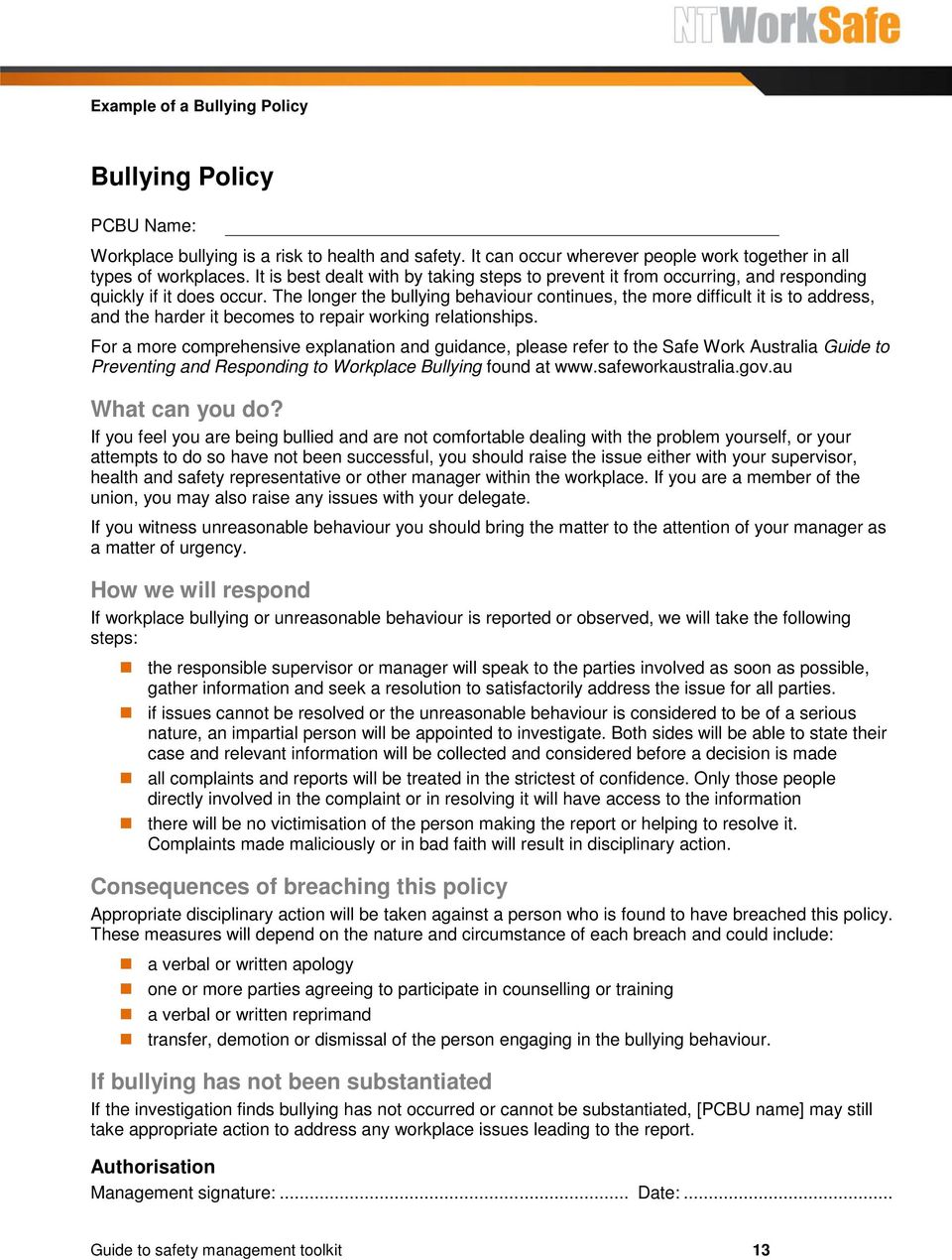
13 Example of a Bullying Policy Bullying Policy PCBU Name: Workplace bullying is a risk to health and safety. It can occur wherever people work together in all types of workplaces. It is best dealt with by taking steps to prevent it from occurring, and responding quickly if it does occur. The longer the bullying behaviour continues, the more difficult it is to address, and the harder it becomes to repair working relationships. For a more comprehensive explanation and guidance, please refer to the Safe Work Australia Guide to Preventing and Responding to Workplace Bullying found at What can you do? If you feel you are being bullied and are not comfortable dealing with the problem yourself, or your attempts to do so have not been successful, you should raise the issue either with your supervisor, health and safety representative or other manager within the workplace. If you are a member of the union, you may also raise any issues with your delegate. If you witness unreasonable behaviour you should bring the matter to the attention of your manager as a matter of urgency. How we will respond If workplace bullying or unreasonable behaviour is reported or observed, we will take the following steps: the responsible supervisor or manager will speak to the parties involved as soon as possible, gather information and seek a resolution to satisfactorily address the issue for all parties. if issues cannot be resolved or the unreasonable behaviour is considered to be of a serious nature, an impartial person will be appointed to investigate. Both sides will be able to state their case and relevant information will be collected and considered before a decision is made all complaints and reports will be treated in the strictest of confidence. Only those people directly involved in the complaint or in resolving it will have access to the information there will be no victimisation of the person making the report or helping to resolve it. Complaints made maliciously or in bad faith will result in disciplinary action. Consequences of breaching this policy Appropriate disciplinary action will be taken against a person who is found to have breached this policy. These measures will depend on the nature and circumstance of each breach and could include: a verbal or written apology one or more parties agreeing to participate in counselling or training a verbal or written reprimand transfer, demotion or dismissal of the person engaging in the bullying behaviour. If bullying has not been substantiated If the investigation finds bullying has not occurred or cannot be substantiated, [PCBU name] may still take appropriate action to address any workplace issues leading to the report. Authorisation Management signature:... Date:... Guide to safety management toolkit 13
14 Example of a Drug and Alcohol Policy Drug and Alcohol Policy PCBU Name: Goals This policy shows: our commitment to health and safety in this workplace, and reducing the risks to the health and safety of all workers, contractors and visitors our commitment to complying with the requirements of the Work Health and Safety Act (National Uniform Legislation) Act and Regulations, especially those for drugs and alcohol how we will deal with drugs and alcohol use and/or their effects in the workplace. This policy applies to everyone at [PCBU name]. Definition Drug and alcohol use can affect a person s ability to work safely. It creates a risk to workers and work health and safety. Responsibilities No one must drink alcohol or use drugs at this workplace, except: for legitimate medical reasons: You must notify your supervisor if prescribed medication is likely to affect your behaviour and therefore work health and safety. Your supervisor may assign you other duties while you re taking the medication at workplace-based social events: This is dealt with in more detail under Social events in this policy. The manager/supervisor at this workplace must, if they have reasonable grounds for believing that you are incapable of safely performing your duties or may be a risk to others due to the effects of drugs or alcohol, arrange for you to be removed safely from the workplace. Each person must ensure that they are not, by the consumption of drugs or alcohol, in such a condition as to endanger their own safety or that of others at this workplace. This includes not coming to work if, after drinking or using drugs in your social time, your ability to work safely is still impaired. If you come to work, you must report to your supervisor, who may assign you other duties or arrange for you to be removed safely from the workplace. 14
![drugs and alcohol how we will deal with drugs and alcohol use and/or their effects in the workplace. This policy applies to everyone at [PCBU name].](/docs-images/53/10846378/images/page_14.jpg "Definition Drug and alcohol use can affect a person s ability to work safely. It creates a risk to workers and work health and safety.")
15 Example of a Drug and Alcohol Policy Managing drugs and alcohol [PCBU name] will identify all workplace factors that may influence someone to turn to drugs or alcohol, and use the hazard management process to eliminate drug or alcohol use or control the risks from them. [PCBU name] will consult with workers, work health and safety representatives and/or the work health and safety committee on this issue. [Outline the specific actions you will take to address any factors in your workplace that may influence someone to turn to drugs or alcohol]. Disciplinary action If anyone is found to breach this policy, management will [outline the actions you will take e.g. giving a formal warning, followed by encouraging them to get treatment, suspension, and finally, dismissal]. Testing If you decide to introduce a testing program, you must include details about it in this policy. This includes: the practicalities of testing: who will do it, when and how it will be done, and what type of procedure will be used the procedures for the action you will take for a positive test result acknowledge that people have the legal right to refuse to be tested, unless specified in legislation or in their contract or employment agreement. Social events Responsible social events can be held at this workplace [include likely events, such as Christmas parties]. To ensure everyone remains safe: everyone is expected to act responsibly non-alcoholic drinks and food will be provided alternative public transport arrangements will be provided [include any other measures you may take]. Information and support [PCBU name] will provide regular training and information about the effects of drug and alcohol use on personal and work health and safety, and on the components of this policy. [Include any support, whether internal or external, that you can provide workers, especially those who admit they have a drug or alcohol problem]. Authorisation Policy authorised by:... Date to be reviewed:... Guide to safety management toolkit 15
![[PCBU name] will consult with workers, work health and safety representatives and/or the work health and safety committee on this issue.](/docs-images/53/10846378/images/page_15.jpg "[Outline the specific actions you will take to address any factors in your workplace that may influence someone to turn to drugs or alcohol].")
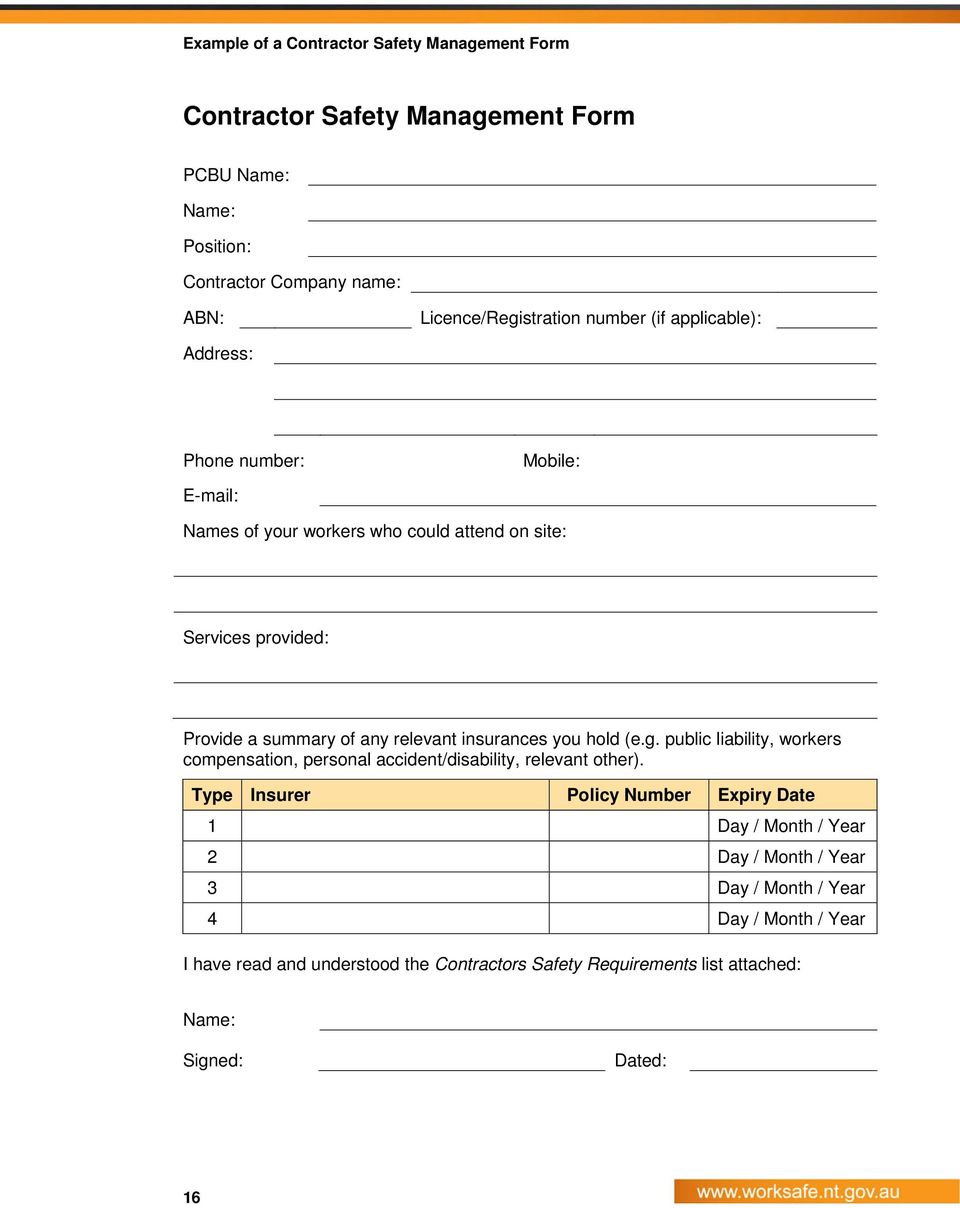
16 Example of a Contractor Safety Management Form Contractor Safety Management Form PCBU Name: Name: Position: Contractor Company name: ABN: Licence/Registration number (if applicable): Address: Phone number: Mobile: Names of your workers who could attend on site: Services provided: Provide a summary of any relevant insurances you hold (e.g. public liability, workers compensation, personal accident/disability, relevant other). Type Insurer Policy Number Expiry Date 1 Day / Month / Year 2 Day / Month / Year 3 Day / Month / Year 4 Day / Month / Year I have read and understood the Contractors Safety Requirements list attached: Name: Signed: Dated: 16
17 Example of a Contractor Safety Requirements list Contractors safety requirements PCBU Name: 1. As a contractor to our site, we regard you as a professional in your trade/area of expertise. As such, you have responsibility for your own safety and the safety of your co-workers and others that your work activities may impact upon. 2. All contractors are responsible for ensuring they, and all persons working for or contracted by them, have completed a basic site induction and have read and understood the safety requirements detailed below. This must be done before starting work. 3. If working on a construction site, all workers must hold a white card. 4. All contractors must sign in upon arrival and contact the person in charge of the area they will be working in. Sign out when you leave the site. 5. No work is to start until contractors, and everyone working for them or contracted by them, have been authorised to do so by the person in charge of the area they are working in. 6. Before starting work, all contractors working at this site have a duty to consult with other workers who may be affected by the planned work activities and where work health and safety matters arise during the course of the work. 7. All contractor equipment, materials, and personal protective equipment must be in good condition, properly maintained and suitable for the job at hand. They must comply with the relevant legislative requirements and/or Australian Standards. 8. All work must be conducted in a safe, healthy and environmentally responsible manner and comply with all legal/regulatory requirements. The Northern Territory Codes of Practice (at relating to the work must be followed where reasonable and practical to do so. 9. Control any hazards (as deemed appropriate). 10. No equipment is to be repaired or maintained unless properly isolated/switched off and/or stopped. 11. Any equipment or materials found to be unsafe should be reported immediately to the person in charge and should be tagged out of service. 12. On a construction site, all mains powered electrical equipment must have a current test tag. 13. A current safety data sheet must be available for any hazardous/dangerous chemical used. 14. For any high risk work (such as work at heights over 2m, confined space work, working with hazardous substances) you must have appropriate training and the correct equipment. An appropriate formal risk assessment, safe work method statement or job safety analysis must be completed before starting work. Guide to safety management toolkit 17

18 Example of a Contractor Safety Requirements list 15. Safety and protective equipment (such as hearing, foot, eye protection, hard hats, high visibility vests) must be worn/used as appropriate to the area and work being carried out. 16. All injuries, incidents and equipment damage/breakages/failures are to be reported immediately to the person in charge. If appropriate, an accident/incident form is to be filled out and submitted to the person in charge of the area. 17. A serious incident may be notifiable to NT WorkSafe. Call to notify and preserve the scene of the incident. 18. Beware of vehicle traffic operating on site. Where possible, you must follow the designated pedestrian walkways (designated by yellow lines). 19. Demarcate/isolate visitors/clients from the work you are doing with appropriate warning signage and barriers. 20. Do not enter any areas which you are not authorised to enter. 21. Agree to follow the business privacy/confidentiality policy. 22. Maintain reasonable standards of housekeeping, cleanliness and hygiene. 23. Smoking, alcohol and illegal drugs are prohibited at the site. 24. No form of harassment/bullying will be tolerated. 25. Understand site emergency requirements (basic evacuation procedures, exit locations, evacuation assembly location). 26. Comply with any reasonable direction from the PCBU, Principal Contractor or Site Management. You could be asked to leave the site if any of the above requirements are not followed to reasonable expectations. Please ask the person in charge of your work if any doubt exists. 27. Remember, at [Insert PCBU Name] we want you to be safe at work so you can go home at the end of each day. 18

19 Example of a Take 5 Pre-Start Safety Checklist Take 5 Pre-Start Safety Checklist PCBU Name: This checklist will help workers and contractors who are working on new or external worksites reduce their exposure to health and safety risks and hazards. It should take 5 minutes to complete. Time:... Task:... Date:... Supervisor/manager:... Location:... Attendees:... Before starting work: No. Pre-Start check Yes No N/A 1 Do you have to do an induction? 2 Do you need to be accompanied while on site? 3 Do you know the site s health and safety rules? 4 Are you familiar with security arrangements and the system for reporting incidents/near misses and hazards? 5 Are there emergency facilities and an evacuation procedure/route for the site? 6 Do you have access to appropriate emergency and first aid equipment? 7 Have you asked the person in charge about all relevant hazards? 8 If the work involves a high risk task (such as work at heights, hot-work, confined spaces), is a work permit/safe work method statement required? 9 Do you have the correct procedures and equipment to do the work safely? 10 Is there a requirement to lock/tag-out equipment or isolate/contain energy before starting work? 11 Is there appropriate separation of vehicles and people during the proposed work? 12 Is all required electrical/mechanical equipment in a safe condition? 13 Are hazardous/dangerous substances used and stored according to their safety data sheets? 14 Have you consulted with workers about the task and the safe way to do it? 15 Do you have all necessary PPE? 16 Have you got a safe way of getting in and out of your work area? 17 Have any manual handling risks been identified and accessed? If you answer No to any of those above, you may need to follow up with the person in charge before you start work to help ensure your safety. At the end of work: No. End of work check Yes No N/A 1 Have you left the worksite in an appropriate condition free from hazards and risks (clean-up, tools put way, housekeeping)? 2 If required, have you signed out? Return this checklist to your manager/supervisor after work is complete. Guide to safety management toolkit 19

20 Introducing new workers to your workplace Introducing new workers to your workplace In this section, you ll learn: why you need to induct your workers how to help new workers settle into your workplace The practical tools you ll find: Sample Induction Checklist and Acknowledgment What s an induction? When a new worker starts work, the usual protocol is to show them around and tell them what they need to know, (such as the facilities, work times and meal breaks) and introduce them to their immediate supervisor and fellow workers. This process is called an induction, and is important. During an induction, you must cover health and safety information, including: your work health and safety policy and safe work procedures how to report hazards, incidents, near misses and injuries who their health and safety representative, first aider and fire warden are. Remember your new workers will need closer supervision (including buddying) for some time, too. What about induction checklists? Use an induction checklist to make sure you cover all important information. Ensure your new workers can ask you questions and provide feedback before they sign the induction checklist. Remember your new workers (especially if they are young) may be nervous, or keen to impress, so they may not ask you questions. Encourage them to talk to you (or their supervisor or health and safety representative) if they re not sure about anything. If you ve never used an induction checklist before, it s worthwhile doing one with each of your existing workers (no matter how long they ve been with you). As we said earlier, you can t afford to assume that every worker is aware of what s required with health and safety. Keep copies of the completed induction checklists, and provide your workers with a copy too. What to do now: Read the sample induction checklist in this Toolkit Copy the sample induction checklist in this document and edit to suit your own workplace Formally induct your new and existing workers, allowing them opportunity to ask questions. Then get them to sign it once they understand the information Keep a copy yourself and provide your workers with a copy. 20

21 Example of Induction Checklist Induction Checklist PCBU Name: Worker s name:... Employment start date:... Position/job:... Manager/supervisor:... Department/Section:... Explain your business: The structure The type of work List and introduce your key people and their roles: Manager/owner Supervisor(s) Co-workers Health and safety representative(s) Fire/emergency warden(s) Explain their employment conditions: Name of award or agreement (if relevant) and award conditions Job description and responsibilities Leave entitlements Notification of sick leave or absences Out of hours enquiries and emergency procedures Time recording procedures Work times and meal breaks Explain their pay: Pay arrangements Rates of pay and allowances Superannuation Taxation and any other deductions (including completing the required forms) Union membership and award conditions Explain your work health and safety administration: Consultative and communication processes, including employee health and safety representatives (HSR) Hazard reporting, including where to find forms Incident /accident reporting procedures, including where to find reporting forms Hazards of work Policy and procedures Roles and responsibilities Employee assistance program (EAP) Workers compensation claims Explain your security: Cash For each worker and for their personal belongings Guide to safety management toolkit 21
22 Example of Induction Checklist Show your work health and safety environment: Safe work procedures (SWPs) list: Emergency plan, procedures, exits and fire extinguishers First aid facilities such as the first aid kit and room Information on workplace hazards and controls Show your work environment: Car parking Eating facilities Locker and change rooms Phone calls and message collecting system Washing and toilet facilities Work station, tools, machinery and equipment used for job Procedures for the workplace buildings Explain your training: First aid, fire safety and emergency procedures training Hazard-specific training (for example, manual handling, hazardous substances) On the job training in safe work procedures Job-specific training (for example, if a licence or permit is required) Conduct a follow-up review: Repeat any training required or provide additional training if needed Review work practices and procedures with the worker Ask and answer questions Comments/follow up action Induction Acknowledgment Conducted by (Name):... Date:... Position/Job:... Signature:... Worker Signature:... Review date:... Review conducted by (Name):... Date:... Position/Job:... Signature:... Worker Signature:... 22
23 Consultation Consultation In this section, you ll learn: why consulting with your workers is good for safety ways of consulting The practical tools you ll find: Sample Record of Consultation / Staff / Toolbox Meeting What is consultation? Consultation involves sharing information, giving workers a reasonable opportunity to express their views, and taking those views into account before making decisions. It allows you to really get to know your workplace, workers and the hazards they face. Who do you consult with? You must consult on health and safety matters with workers, workers health and safety representatives, and anyone else you engage to carry out work for you. This includes your contractors and sub-contractors and their workers, labour hire workers, volunteers and anyone else working for you and who is directly affected by any health and safety matter. You should also consult with union representatives. What are the benefits of consulting? It s easier to achieve a safer workplace when everyone is involved: when they talk and work together to address potential problems and collectively find solutions. Effective consultation has other benefits: greater awareness and commitment, because workers have been actively involved in how decisions are made positive working relationships, because hearing and understanding the views of others leads to greater co-operation and trust. Share work health and safety around and your business will be safer, healthier and more productive. How do you involve your workers? Never underestimate the value of your workers input when it comes to knowing about the hazards associated with their work. They often have ideas about how to reduce safety risks, make improvements and find solutions. Guide to safety management toolkit 23
24 Consultation Involve your workers as you: develop your work health and safety policy and procedures use safety checklists develop safe work procedures create hazard, incident, near miss and injury reporting procedures identify hazards, tasks and conditions, and the safe way to manage them review policies and procedures. What else can you do? Other ways to encourage talking about safety include: encouraging your workers to hold elections for health and safety representatives establishing a health and safety committee holding regular staff/toolbox meetings and make health and safety a topic to discuss (if you engage contractors, include them in this process and seek their feedback too) holding practical training sessions. These are also opportunities for you to get your workers feedback on the effectiveness of any existing or proposed safety solutions. Check if your workers are receiving enough and the correct information to do their job safely, or whether they need additional information and resources. For further information, refer to the Work Health and Safety Consultation, Cooperation and Coordination Code of Practice. Go to the NT WorkSafe website at and search under the Publications tab. What to do now: Read the sample records in this Toolkit Identify the most appropriate way of consulting in your workplace Keep a record of your consultation. 24
25 Consultation: Example of a record of consultation Record of Consultation / Staff / Toolbox meeting PCBU Name: Work group:... Meeting held at:... Date:... Meeting conducted by:... Signed:... HSR:... Signed:... Issues to be covered: Other issues addressed: Action Required: Action By whom Timeframe Attendance (all participants to print name and sign): 1... Signed: Signed: Signed: Signed:... Guide to safety management toolkit 25
26 Managing your work health and safety Managing your work health and safety In this section, you ll learn: what steps to take to manage work health and safety how to choose measures for controlling risks why you need to keep records The practical tools you ll find: Sample Work Environment and Facilities Checklist Sample Hazard Inspection Checklists Sample Safe Work Procedure: Bench Grinder Sample Hazard Report Form Sample Chemical Register Sample Emergency Procedure Managing work health and safety is an ongoing, step-by-step process. For further information, refer to the How to Manage Health and Safety Risks Code of Practice. Go to the NT WorkSafe website at and search under the Publications tab. Caption: Risk management model sourced from the NT Code of Practice How to manage work health and safety risks 26
27 Managing your work health and safety 1. Identify hazards Step 1: Identify Hazards What is a hazard? A hazard is a situation or thing that has the potential to harm a person. Hazards at work may include noisy machinery, a moving forklift, chemicals, electricity, working at heights, a repetitive job, bullying, a badly designed workplace and inadequate management systems (for example, no procedures). How do you identify hazards? Some ways to identify hazards include: conducting workplace inspections. Regularly walk around your workplace, use a checklist (there are samples later in the Toolkit) and check your work environment, the tasks your workers do, and the machinery or chemicals they use. Over time, working with hazards often becomes the norm and unsafe work becomes part of the job or just the way it is but this often results in incidents. Try to look at tasks and equipment as if you are seeing them for the first time consulting your workers. Workers are the ones using the equipment, performing the tasks or being in the work environment every day, and often, the people who know the best way to fix the problem. So they re essential for helping you identify hazards reviewing reports of hazards, incidents, near misses and injuries. You don t need an elaborate reporting system in place. See Incident Reporting in this toolkit for details reviewing sick leave, staff turnover and workers compensation statistics conducting a workplace audit. This assesses your safety management systems against standards and legal requirements reading the relevant Codes of Practice, operating manuals, safety alerts, safety data sheets and industry association safety alerts. It s really interesting to get out of my office and into the workplace and check out what s going on. My employees have some great ideas on how to make things safer and more productive. We discuss what needs to happen at our tool box meetings then we just do it. It works for everyone Manager, hospitality industry Guide to safety management toolkit 27
28 Managing your work health and safety 2. Assess risks Step 2: Assess Risks What is a risk? Risk is the likelihood that a harmful consequence (death, injury or illness) might occur when you are exposed to a hazard. Once you have identified a hazard, you need to determine the level of risk associated with it. What is a risk assessment? In a risk assessment, you need to consider what could happen if someone is exposed to a hazard, and the likelihood of that happening. It can help you determine: how severe a risk is whether any existing control measures are effective what action you should take to control the risk how urgently the action needs to be taken. The detail you go into depends on the type of hazard and the information, data and resources you have available. It can be as simple as discussing it with your workers, or involve specific risk analysis tools and techniques recommended by safety professionals. When do you do a risk assessment? You must do a risk assessment for certain high risk activities (for example, entry into confined spaces and some tasks performed on construction sites). You should do a risk assessment when there are any changes in your workplace, such as: starting a new business or purchasing a business changing work practices, procedures or the work environment purchasing equipment (new or used) using new substances planning to improve productivity or reduce costs receiving new information about workplace risks. You should also do a risk assessment when: you re uncertain how a hazard may result in injury or illness the work activity involves a number of different hazards and you don t understand how they may interact with each other to produce new or greater risks you re responding to a workplace incident (even if it hasn t caused an injury) you re responding to concerns raised by workers, health and safety representatives or others. 28
29 Managing your work health and safety 2. Assess risks When is a risk assessment not needed? You don t need to do a formal risk assessment if: the laws state, in a specific way, how to control a hazard or risk. You must comply with these specific requirements a Code of Practice states how to control a hazard or risk that is applicable to your situation. You can simply follow this guidance there are effective controls widely used in your industry that suit your circumstances. You can simply implement these controls if the hazards and their associated risks are well known and have well established and accepted control measures. You can simply implement these controls. How do you estimate the amount of harm? Consider: what type of injury could occur? What is the potential scale of the harm? Could the hazard cause death, serious injury or illness requiring hospitalisation, or a minor injury requiring first aid? what factors could influence how severe the harm is? For example, the distance someone might fall or the concentration of a particular substance will determine the level of harm. The harm may occur immediately something goes wrong (for example, injury from a fall) or it may take time to become apparent (for example, illness from long-term exposure to a substance). how many people are exposed to the hazard? How many could be harmed, in and outside your workplace? For example, a mobile crane collapse on a busy construction site has the potential to kill or injure a large number of people. In thinking about how each hazard may cause harm, consider: the effectiveness of your existing control measures and whether they control all types of harm how work is actually performed infrequent or abnormal situations may arise, as well as those that you d normally expect to occur. Guide to safety management toolkit 29
30 Managing your work health and safety 2. Assess risks How do you estimate the likelihood of someone being harmed? Ask: how often is the task done? Does this make the harm more or less likely? how often are people near the hazard? How close do people get to it? has it ever happened before, either in your workplace or somewhere else? How often? You could rate the likelihood as: certain to occur: very likely: possible: unlikely: rare: expected to occur in most circumstances will probably occur in most circumstances might occur occasionally could happen at some time may happen only in exceptional circumstances The level of risk will increase as the severity and likelihood of harm occurring increases. We have health and safety reps and a WHS Committee. It s great. We manage health and safety risks through involving everyone it s built into all we do. We support health and safety and we expect it. It s the way we do business Manager, community service non-profit organisation 30
31 Managing your work health and safety 3. Control risks Step 3: Control Risks What is risk control? Risk control means taking action to: first, try to remove any health and safety risks entirely if that is not possible, reduce the risks so far as is reasonably practicable. Who do you consult with? Consult with the workers (including contractors and sub-contractors) who will be directly affected by the decision. Often the solutions lie with your workers all they need is to be asked and involved. Not only will this help you choose the most appropriate control measures, it will increase their acceptance of these control measures. What resources can help you? Throughout the entire risk management process, look at these resources for guidance and information: the relevant Codes of Practice. Go to the NT WorkSafe website at and search under the Publications tab. operating manuals, safety alerts, material safety data sheets and industry association safety alerts. the manufacturers and suppliers of the equipment and chemicals you use industry associations and unions. How do you control risks? There are many ways to control risks. Some controls are more effective than others, so consider various control options, looking for what will most effectively remove the hazard or reduce the risk. This may be one single control measure, or you may find using a combination of different controls provides the highest level of protection. Some problems can be fixed easily and so should be done straight away, while others will need more effort and planning to resolve. For these, prioritise the areas for action, focusing first on the hazards with the highest level of risk. Where there is potential for a fatality or serious injury, take immediate action. Guide to safety management toolkit 31
32 Managing your work health and safety 3. Control risks The hierarchy of risk control The ways of controlling risks can be ranked from the highest level of protection and reliability to the lowest. This ranking is known as the hierarchy of control. Caption: Hierarchy of risk control sourced from the NT Code of Practice How to manage work health and safety risks Level 1 control measures The most effective control measure removes the hazard (and therefore its associated risks) from your workplace entirely. The best way to do this is by not introducing the hazard into your workplace in the first place. For example: eliminate the risk of a fall from height by doing the work at ground level outsource the task to a company purposely set up with the equipment and processes designed to do it and do it safely. It s often easier and more practical to eliminate hazards when you are planning or designing your work process, your work environment or products used for work. In these early stages, there s greater scope to design out hazards or incorporate compatible risk control measures. For example: a noisy old machine could be replaced with a new quieter one which is more effective than providing workers with personal hearing protection. You can also eliminate risks by removing the hazard completely. For example: remove trip hazards such as debris or electrical cords on the floor dispose (safely) of unwanted chemicals. If it s not possible to remove a hazard for example, if it means you can t make your product or deliver your service then reduce as many of the risks associated with the hazard as possible. 32
33 Managing your work health and safety 3. Control risks Level 2 control measures If it s not reasonably practicable to eliminate the hazard, then minimise its associated risk using one or more of the following approaches: Substitute the hazard with something safer. For example, replace solventbased paints with water-based ones Isolate the hazard from people: physically separate people from the source of harm, by barriers or distance. For example, install guard rails around exposed edges and holes in floors, use remote control systems to operate machinery, store chemicals in appropriate chemical storage away from the immediate work area Reduce the risks through engineering controls: change your workplace, equipment or work processes. For example, use mechanical aids such as trolleys or hoists to move heavy loads, place guards around moving parts of machinery, install residual current devices, set realistic and achievable work rates on a production line to reduce fatigue. Level 3 control measures These control measures rely on human behaviour and supervision, and used on their own are the least effective in minimising risks. Consultation 3 7 Action to be taken Reduce the level of harm using administrative controls. For example, develop safe work procedures for operating machinery safely, limit exposure time to a hazardous task by job rotation, plan a schedule and carry out preventative maintenance and inspections on machinery and equipment, provide training and instruction for safely handling a manual task, use signs to warn people of a hazard Use personal protective equipment (PPE). This includes breathing protection, hard hats, gloves, aprons and protective eyewear. PPE limits exposure to the harmful effects of a hazard, but only if workers wear and use it correctly. About safe work procedures Safe work procedures are a practical and consistent way for everyone to commit to safety. They clearly: document the sequence of steps for doing the task safely incorporate the appropriate risk control measures into those steps. When trained how to use a safe work procedure, everyone in your workplace will know the safe way to do their job, and will work the same way. They won t need to guess or make things up as they go along. You can develop safe work procedures by looking at information from manufacturers, suppliers, operator s manuals and relevant Codes of Practice. Remember to involve your workers. So write down the actions that your workers should follow, step by step, from beginning to end, in their logical order. Keep it straightforward and simple. Guide to safety management toolkit 33
34 Managing your work health and safety 4. Review control measures Step 4: Review control measures You may think that now you ve put your control measures in place, you re finished. However, managing work health and safety is an ongoing process. An important part is monitoring and regularly reviewing your chosen controls to make sure they work as planned. When should you review your controls? Once a year is generally a good timeframe for reviewing your controls. However, control measures for serious risks should be reviewed more frequently. You should also review your controls if: you introduce changes (to your work environment, business, the equipment or chemicals you use) they are not effectively managing the risk you identify new hazards or risks if consultation indicates you need to review them, or your workers ask you to review them if you have an incident. How do you review your controls? Consult your workers, and ask: are the control measures working effectively, in both design and operation? have the control measures introduced new problems? have new work methods, equipment or chemicals made the job safer? Investigate to confirm if: all hazards been identified safe work procedures are being followed the instruction and training provided to your workers on how to work safely has been successful. Other issues to look at include: checking reports and statistics to see if the frequency and severity of incidents are reducing over time checking your control measures whenever new laws or information becomes available. Are your controls still appropriate? What if you find a problem? If you find a problem, go back through the risk management steps, review your information and make further decisions about risk control. 34
35 Managing your work health and safety 4. Review control measures How else do you ensure your controls remain effective? Apart from regularly reviewing your control measures, these things will help you ensure they remain effective: make people accountable and give them authority. This ensures procedures are followed and maintained. If your managers or supervisors have clear health and safety responsibilities, they must also have the authority and resources to meet them. Remember, it s your duty to ensure they carry out the responsibilities you ve allocated to them communicate your safety information effectively. Consider the literacy levels of your workers, and what languages they speak. Visual signs and symbols may be more effective than written documents. Whatever you use, explain these to your workers keep your workers skills and competencies up to date. Risk controls (particularly lower level controls) depend on your workers and supervisors doing their jobs safely. Provide training to maintain current workers skills and ensure new workers can working safely keep up-to-date yourself. Information about equipment, machinery and chemicals may be updated by manufacturers and suppliers, so check to make sure your controls remain relevant. New technology may provide additional or more effective solutions to what you currently have, so stay informed of developments in your industry maintain your equipment. Conduct regular inspections and testing, and repair or replace damaged/worn parts or whole equipment. Check the control measures used are suitable for the nature and duration of work and are used correctly by your workers. Guide to safety management toolkit 35
36 Why keep records Why keep records? Keeping records of your risk management process is not just paperwork but has many benefits and purposes, including: demonstrating that you re managing work health and safety and complying with the laws (to your workers, the regulator, investors, shareholders, customers) providing a starting point for subsequent risk assessments demonstrating how you made your decisions about controlling risks helping you target training for your workers for the key hazards in your workplace providing a basis for preparing safe work procedures helping you review risks following any changes to legislation or your business activities allowing new workers to understand why risk control decisions have been made. What records should you keep? The detail and extent of your records will depend on the size of your workplace and the potential for major work health and safety issues. It s useful to keep information on: the identified hazards, assessed risks and chosen control measures. This includes any hazard checklists and forms, worksheets and assessment tools you used hazards, incidents, near misses and injuries that your workers tell you about how and when the control measures were implemented, monitored and reviewed who you consulted with how current your training records are any proposed plans for change in your workplace. Under the Regulations, there are specific record-keeping requirements for hazards (such as hazardous chemicals). If you have these hazards, make sure you comply with requirements. Make sure that everyone is aware of your record-keeping (including which records are accessible and where they are kept) and the requirements. What to do now: Read the sample checklists and forms in this Toolkit Use the examples in this toolkit to prepare checklists to suit your own workplace If any issues are identified, use this information as a starting point for risk control, and do it Use the checklists at least once a year to review your workplace, more if necessary Keep copies of these. 36
37 Training Training In this section, you ll learn: why training is important for work health and safety when training is needed The practical tools you ll find: Sample Training Register Sample Competency Register The next step to a safe and healthy workplace is making sure your workers are trained to safely do their work. What skills do your workers have and need? Find out what skills and experience your workers have, then work out how to build on and maintain these with appropriate training. Review what jobs workers are required to perform. Do they have problems performing those jobs? This may indicate a need for training. Do workers require licences or certain competencies to perform their work? If so, are they current? Workers who are elected as health and safety representatives will require the relevant training to perform their role. What if things change? If your work environment or work tasks change, if new equipment or chemicals are introduced, you need to work out what additional training is required. How should training support your risk controls? Hold practical training sessions to explain your safe work procedures and safety policy. This will ensure everyone understands them and the decision making behind them. It doesn t work to just give out a safety rule without information or explanation. A good example is using personal protective equipment (PPE). Workers are more likely to use PPE if they understand the health consequences of not wearing it. What is a training register? A training register helps you record and track what training your workers have received and what additional training they may require. It helps you keep track of the skills and competencies your workers possess in specific areas. What to do now: Read the sample registers in this Toolkit Copy the samples and prepare registers to suit your own workplace Complete the registers to document training done and skills possessed, and to identify gaps and needs Guide to safety management toolkit 37
38 Training: Example of training register Training register Training register Name of worker Training required Who will deliver training and how Scheduled date Complete 38
39 Training: Example of competency register Competency register Competency register Name of worker Manual handling First aid Security procedures Chemical handling Other Name Initial of worker and supervisor / manager Initial of worker and supervisor / manager Initial of worker and supervisor / manager Initial of worker and supervisor / manager Notes: 1. Write the names of the workers in the Name of worker area. 2. Write the name of the skill required in the Competencies columns (for example, manual handling, cash handling, chemical handling). 3. The worker and supervisor/manager should initial and date the appropriate column once it is achieved. Guide to safety management toolkit 39
40 Example of a work environment and facilities checklist Work environment and facilities checklist PCBU Name: Workers must be provided with a safe work environment and with adequate facilities. When completing this checklist, consider: the nature of the work carried out at your workplace the nature of the hazards at your workplace the size, location and nature of your workplace the number and composition of workers at your workplace. Involve your workers in filling out this checklist. Date checklist completed:... Name of person who completed checklist:... Position title:... Work environment and facilities Yes No Action to be taken Consultation Have workers and their health and safety representatives been consulted on any decisions about the adequacy of the facilities? Location and nature of the workplace Is the workplace near appropriate facilities? Is the means of access to those facilities safe? Do all workers on all shifts have access to the facilities? Managing facilities Are items such as soap and toilet paper replaced regularly? Is broken or damaged infrastructure (such as plumbing, air conditioning or lighting) repaired promptly? Is equipment and furniture (such as fridges, lockers and seating) maintained in good condition? Are facilities cleaned regularly (at least daily)? Workspace Is there safe entry to and exit from the workstation? Is there enough clear space, taking into account the physical actions needed to perform the task, and any equipment and personal protective equipment that is needed? Is there enough space in walkways and around cupboards, storage or doors? 40
41 Example of a Work environment and facilities checklist Work environment and facilities Yes No Action to be taken Floors Is adequate floor protection provided for workers who need to stand still for long periods? Is the floor insulation appropriate to the task? Are factors such as the work materials used, the likelihood of spills and the need for washing considered when choosing floor coverings? Seating Can the work be done from a seated position? Does the seating provide suitable body support and is it appropriate to the type of work being carried out? Is there additional seating for workers who work standing and need to sit from time to time? Lighting Does the lighting allow workers to move about easily and carry out their work effectively, without adopting awkward postures or straining their eyes to see? Is the working environment free of any glare, contrast or reflection? Air quality Is the temperature between 20ºC and 26ºC (or less if the work is physically active)? Are ventilation and air conditioning systems serviced regularly and maintained in a safe condition? Are rates of air movement in enclosed workplaces between 0.1 and 0.2 m per second? Is local exhaust ventilation used to control airborne contaminants released during a work process? Exposure to heat or cold Have all reasonably practicable control measures been implemented to minimise the risks of working in extreme hot or cold conditions? Have workers been trained to recognise unsafe conditions arising from exposure to hot or cold conditions, to follow safe work procedures and to report problems immediately? Drinking water Are the drinking water outlets accessible to workers? Are the drinking water outlets separate from toilet and washing facilities? Is the water clean, cool and hygienically provided no shared cups or glasses? Guide to safety management toolkit 41
42 Example of a Work environment and facilities checklist Work environment and facilities Yes No Action to be taken Toilets If the workplace has 10 or fewer workers (and two or fewer of one gender), has at least 1 unisex toilet been provided? If the workplace has more than 10 workers, is there at least 1 male toilet for every 20 men and 1 female toilet for every 15 women? Are there adequate toilet facilities for workers with disabilities? Are toilets connected to the sewer or an appropriate alternative? Are toilets clearly marked, and do they have lockable doors, adequate lighting and ventilation? Are the worker toilets separate from toilets for visitors, clients and the public? Is there adequate toilet paper, hand washing facilities and soap, rubbish bins and sanitary disposal bins? Hand-washing Are there enough hand washing basins for men and women? Does the nature of the work require additional hand washing facilities (taking into account exposure to dirty conditions, infectious agents, contaminants and health regulations)? Are the hand-washing facilities separate from workrelated troughs or sinks, protected from weather and accessible from work areas, dining facilities and toilets? Is hot and cold water, soap or other cleaning product provided? Is hygienic hand drying provided that does not involve workers sharing towels? Dining facilities Does the nature of the work cause a health and safety risk to workers from preparing food or eating in the workplace? Is a dining room or dining area required (according to the Managing the Work Environment and Facilities Code of Practice)? Is there adequate protection from the elements, the work area, contaminants and hazards? For workplaces needing a dining room, is there 1m 2 of clear floor space for each person likely to use the dining room at one time? If a shared dining facility is used, can it accommodate all workers likely to be eating at one time? 42
43 Example of a Work environment and facilities checklist Work environment and facilities Yes No Action to be taken Change rooms Are change rooms provided for workers who are required to change in and out of clothing? Are there arrangements in place for the privacy of male and female workers? Do change rooms allow a clear space of at least 0.5m 2 for each worker? Is the change room temperature comfortable for changing clothing? Is there enough seating, accessible mirrors, an adequate number of hooks for the numbers of workers changing at one time? Are there well-ventilated, accessible and secure lockers for each worker for storing clothing and personal belongings? Is it separate from any storage facilities provided for personal protective clothing and equipment? Is there clear space of at least 1.8m between rows of lockers facing each other and at least 0.9m between lockers and a seat or a wall? Showers Are showers provided for a worker whose work requires strenuous effort or leaves them dirty or smelly? Is there one shower cubicle for every 10 workers who may need to shower? Are there separate facilities for male and female workers, or other appropriate forms of security to ensure privacy? Is there a slip-resistant floor area of not less than 1.8m 2, which is capable of being sanitised? Are partitions between each shower at least 1.65m high and no more than 0.3m above the floor? Is there an adjacent dressing area for each shower, containing a seat and hooks, with a curtain or lockable door enclosing the shower and dressing cubicle? Is there clean hot and cold water and non-irritating soap or other cleaning product? If workers need to shower before they can leave the workplace, are towels provided? Guide to safety management toolkit 43
44 Example of a Work environment and facilities checklist Work environment and facilities Yes No Action to be taken Outdoor work Are there appropriate procedures to ensure outdoor workers have access to clean drinking water, toilets, dining facilities, hygienic storage of food and water, and emergency and first aid assistance? Is there access to shelter for eating meals and taking breaks and for protection when weather conditions become unsafe? Mobile or remote work Are there appropriate procedures to ensure that mobile or remote workers have access to clean drinking water, toilets, dining facilities, hygienic storage of food and water, and emergency and first aid assistance? Can mobile or remote workers access emergency communications that are reliable in their location, such as a satellite or mobile phone? Accommodation Is there accommodation separate from any workplace hazards that are likely to present a risk to the health or safety of a worker using the accommodation? Is it appropriately equipped, including: safe access and exits security of personal possessions fire safety arrangements electrical safety standards drinking water toilets, washing, bathing and laundry facilities procedures to ensure cleanliness suitable, quiet sleeping accommodation crockery, utensils and dining facilities rubbish collection heating, cooling and ventilation? Does the accommodation meet all relevant structural and stability requirements? Are the fittings, appliances and any other equipment maintained in good condition? 44
45 Example of a Work environment and facilities checklist Work environment and facilities Yes No Action to be taken Emergency plans Is there a written emergency plan covering relevant emergency situations, with clear emergency procedures? Is the plan accessible to all workers? Are workers, managers and supervisors instructed and trained in the procedures? Has someone with appropriate skills been made responsible for specific actions in an emergency (for example, has an area warden been appointed)? Is there someone responsible for ensuring workers and others are accounted for in an evacuation? Are emergency contact details relevant to the types of possible threats (for example fire, police, poison information centre) displayed in an easily accessible location? Are contact details of emergency services updated regularly? Is there a mechanism (such as a siren or bell alarm) for alerting everyone of an emergency? Is there a documented site plan that illustrates the location of fire protection equipment, emergency exits and assembly points? Is the site plan displayed in key locations throughout the workplace? Are procedures in place for assisting mobility-impaired people? Does the workplace have first aid facilities and emergency equipment to deal with the types of emergencies that may arise? Is the fire protection equipment suitable for the types of risks at the workplace (for example, foam or dry powder type extinguishers for fires that involve flammable liquids)? Is equipment easily accessible in an emergency? Are workers trained to use emergency equipment (for example, fire extinguishers, chemical spill kits, breathing apparatus, lifelines)? Have you considered neighbouring businesses and how you will let them know about an emergency situation should one arise? Have you considered the risks from neighbouring businesses and their operations? Are emergency practice runs done to assess the effectiveness of the emergency plan? Is someone responsible for reviewing the emergency plan and informing staff of any revisions? Guide to safety management toolkit 45
46 Example of a Work environment and facilities checklist Work environment and facilities Yes No Action to be taken Asbestos and asbestos containing material (ACM) Is asbestos/acm clearly labelled at the points it is located? Do you have an asbestos/acm register? Is the asbestos/acm register readily available to workers? Is there an asbestos/acm management plan in place? First Aid Is there adequate first aid equipment? Does each worker have access to the first aid equipment? Are there adequate number(s) of workers trained to administer first aid? Or do workers have access to an adequate number of other persons who have been trained to administer first aid? Personal protective equipment (PPE) Is PPE selected to minimise risk to health and safety in accordance with any relevant technical standard published by Safe Work Australia? Is PPE maintained, repaired or replaced as required? Is PPE in good working order, clean and hygienic? Do you provide information, training and instruction for using the PPE (including information about any limit to the effectiveness of the equipment)? Do workers use PPE in accordance with the information, training and instruction provided? Are areas where people must use PPE clearly identified by signs or other means? Other For further information, refer to Managing the Work Environment and Facilities Code of Practice or related guidance material on the NT WorkSafe website at under the Publications tab. 46
47 Example of a manual tasks checklist Manual tasks checklist PCBU Name: If you mark any No box on the checklist, you need to take action to make your workplace safer. Manual task check Yes No Work tasks Can all materials be lifted and carried easily? Are mechanical aids available and used? For example: trolleys and hoists Are workers trained in manual handling techniques and the use of mechanical aids? Work equipment Are work benches a comfortable height? Are chair backs and seat heights adjustable? Is office equipment adjusted to avoid body strain? For example: computer keyboards and screens. Are storage shelves organised to minimise bending and stretching? Work organisation Are tasks rotated to avoid repetitive work? Is work planned to balance out periods of high and low demand? Are workers able to take adequate breaks? Work area Do workers have adequate space to enable ease of movement? Are items that are regularly-used within easy reach? Is there sufficient clearance around machines or equipment to enable access for maintenance and repair? See also the Codes of Practice Hazardous Manual Tasks. Go to the NT WorkSafe website at and search under the Publications tab. Checklist completed Date checklist completed: Name of person who completed checklist: Position title: Guide to safety management toolkit 47
48 Example of a managing noise checklist Managing noise checklist PCBU Name: If you mark any Yes box on the checklist, you need to carry out a noise assessment if exposure to the noise cannot be immediately controlled. Noise management check Yes No Noise hazards Is a raised voice needed to communicate with someone about one metre away? Do your workers notice a reduction in hearing over the course of the day? For example: It only becomes noticeable after work when they may need to turn up the radio on the way home. Are your workers using noisy powered tools or machinery? Are there noises due to impacts such as hammering, pneumatic impact tools, or explosive sources such as explosive powered tools, detonators? Are personal hearing protectors used for some work? Do your workers complain that there is too much noise or that they can t clearly hear instructions or warning signals? Do your workers experience ringing in the ears or a noise sounding different in each ear? Do any long-term workers appear to be hard of hearing? Have there been any workers compensation claims for noise-induced hearing loss? Does equipment have manufacturer information (including labels) indicating noise levels equal or greater than any of the following: a) 80 db(a) LAeq,T (T= time period over which noise is measured)? b) 130 db(c) peak noise level? c) 88 db(a) sound power level? Do the results of audiometry tests indicate that past or present workers have hearing loss? Checklist completed Date checklist completed: Name of person who completed checklist: Position title: 48
49 Example of a managing falls checklist Preventing falls checklist PCBU Name: If you mark any No box on the checklist, you need to take action to make your workplace safer. Manage falls as per Part 4.4 Falls of the WHS (NUL) Regulations, which includes falling: from elevated workplaces, into openings, and at the same level. Falls prevention check Yes No Protective systems When workers are working at height, do you have: roof edge protection? scaffolds and work platforms? fall arrest anchorage and harnesses? Are these systems: in good working condition? regularly inspected? installed by a competent person? sufficient and appropriate for the task? Are workers trained in these systems? Ladders Have you chosen the correct ladder for the task (i.e. industrial-rated ladders, not domestic step ladders or extension ladders)? Is the ladder in good working condition? Is the ladder placed squarely on a firm, non-slip surface? Has the top of the ladder been restrained (i.e. tied to a support) or secured by a person holding the bottom until work is completed? Do workers know how to ascend and descend the ladder safely? Work areas Is the condition of the roof safe (consider the pitch, surface, and capacity of the roof to support loads)? Are workers clear of overhead powerlines? If no, have the powerlines been deactivated? Are suitable barriers placed around the area so no one is underneath, and the ladder/scaffold etc. can t be bumped or disturbed? Is the area free of hazards? For example: sloping or uneven ground, unfavourable weather conditions Other Do workers have appropriate clothing, footwear and safety equipment? Can the task be performed on the ground See the Codes of Practice Managing the Risks of Falls at Workplaces and Preventing Falls in Housing Construction on the NT WorkSafe website at Name of person who completed checklist: Position title: Date checklist completed: Guide to safety management toolkit 49
50 Example of a slips, trips and falls checklist Slips, trips and falls checklist PCBU Name: If you mark any No box on the checklist, you need to take action to make your workplace safer. Slip, trips and falls check Yes No Floors Are floors free of water, ice, oil or other fluids? Are floor surfaces even? For example: no loose tiles or carpet that is torn or has ridges or holes Are ramps designed to prevent slips and falls? Housekeeping Are walkways and doorways clear of boxes, extension cords and litter? Are spills cleaned up immediately? Are the responsibilities for cleaning floors, clearing work areas and walkways clearly specified? Stairs Are stairways kept clear of boxes, extension cords and litter? Is the tread on stairs adequate to minimise slipping? Is the tread on each stair adequate? Are hand-rails adequate? Lighting Are work areas, walkways and stairs well lit? Does the lighting enable workers to move between indoor and outdoor tasks safely? Footwear Is the footwear worn by workers suitable for the workplace? Checklist completed Date checklist completed: Name of person who completed checklist: Position title: 50
51 Example of a machinery and equipment safety checklist Machinery and equipment checklist PCBU Name: If you mark any No box on the checklist, you need to take action to make your workplace safer. Machinery and equipment check Yes No Safety devices Are machine guards in place on all operating equipment (according to manufacturer specifications)? Are belts, pulleys and other rotating parts properly guarded? Are emergency stop buttons clearly marked, operational and accessible? Work areas Is there sufficient clearance (work) space around all plant? Are machinery and equipment areas kept clean and free from obstructions Is the ventilation adequate? Are steps taken to reduce machinery noise? For example: isolating the plant, mufflers and baffles. Are tools and portable equipment stored safely? Safe operation Are workers trained to operate machinery safely and according to your safe work procedure? Do they hold any necessary licence to perform high-risk work or certificates of competency? For example: forklift Is your higher hazardous plant registered? For example: boilers Are workers supervised to ensure correct procedures are followed? Is machinery and equipment regularly inspected for damage or wear? Is machinery and equipment maintained according to the manufacturer instructions? Personal protective equipment (PPE) Do you provide adequate PPE? For example: safety footwear, eye protection, hearing protection. Do you and your workers maintain PPE in accordance with the manufacturers instructions? See also the Codes of Practice Managing Risks of Plant in the Workplace. Go to the NT WorkSafe website at and search under the Publications tab. Date checklist completed: Name of person who completed checklist: Position title: Guide to safety management toolkit 51
52 Example of a forklift truck checklist Forklift truck checklist PCBU Name: If you mark any No box on the checklist, you need to take action to make your workplace safer. Forklift check Yes No Traffic management plan Do you have a system in place to ensure pedestrian and forklift traffic are kept separated? Can you re-design the workplace layout to reduce or remove the need for pedestrians to be in areas where forklifts operate? Are pedestrian walkways clearly marked and even controlled by gates where necessary? Are exclusion zones for pedestrians clearly signed? Certificates Do the operators have a current licence to perform high-risk work? Are forklifts fitted with safety devices or structures adequate for the tasks being performed? Daily inspections Do operators check the following items on the forklift at the start of each shift before using it: structural damage? leaks? tyres and wheels? For example: tyre pressure, wheel nuts all tight and present. tyres? For example: that they are properly attached and level, and not worn, cracked or damaged. any attachments? For example: that they are secured to the forklift truck mast. chains, cables and hoses? safety devices such as seat belts, warning devices, flashing lights and beepers? battery and connector secure? guards? fluid levels? braking (including the handbrake) and hydraulic systems? Are forklifts maintained in good working order and condition? Are maintenance records kept for the life of the forklift? 52
53 Example of a forklift truck checklist Forklift check Yes No Operation Are the areas where forklifts operate well-ventilated? Are the areas where forklifts operate well-lit? Are the surfaces where forklifts operate level and non-slip? Are forklifts fitted with load-cell-weighing devices? Are forklifts fitted with tilt restrictors? Are forklifts fitted with operator restraint interlocks? Do operators verify that the forklift truck has the capacity to pick up the load in accordance with the compliance plate? Are batteries charged in a well-ventilated area? Are eye-washing facilities available and located near where battery charging is done? Checklist completed Date checklist completed: Name of person who completed checklist: Position title: Guide to safety management toolkit 53
54 Example of a cutting tools safety checklist Cutting tools safety checklist PCBU Name: If you mark any No box on the checklist, you need to take action to make your workplace safer. Cutting tool check Yes No Safe operation Are the appropriate cutting tools used for the task? Do workers know the correct and safe way to use, carry, store, clean and maintain cutting tools? Are cutting tools kept sharp? Are cutting tools regularly inspected for damage or wear? Are cutting tools maintained in accordance with the manufacturer instructions? Can you substitute the use of hand cutting tools in your workplace with other safer implements? Personal protective equipment (PPE) Do you provide suitable sheathes or belts for those workers who need to move around carrying cutting tools? Do you supply your workers with the correct PPE for working with cutting tools as required? For example: footwear, gloves, gauntlets and aprons. Do you and your workers maintain PPE in accordance with the manufacturer instructions? Work areas Are stable work surfaces in place? Do you provide appropriate disposal containers for damaged or unwanted blades? Are suitable storage facilities provided for cutting tools close to the work area? For example: racks, slots or boxes. Are appropriate first aid facilities kept nearby in case of an accident? Slicing/cutting/shredding machinery Are slicing/cutting/shredding machines guarded and fitted with emergency stop buttons? Are slicing/cutting/shredding machines securely attached to the benchtop? Checklist completed Date checklist completed: Name of person who completed checklist: Position title: 54
55 Example of bench grinder safety checklist Bench grinder checklist PCBU Name: If you mark any No box on the checklist, you need to take action to make your bench grinding activity safer. Bench grinder check Yes No Personal protective equipment (PPE) Safety glasses are worn at all times in work areas? Long and loose hair is contained? Hearing protection is used? Sturdy footwear is worn at all times in work areas? Close fitting/protective clothing is worn? Rings and jewellery are not worn? Pre-operational safety checks You have located and ensured you are familiar with all machine operations and controls? You have ensured all guards are fitted, secure and functional. Do not operate if guards are missing or faulty? You have checked workspaces and walkways to ensure no slip/trip hazards are present? You have ensured the wheels do not touch the work rest and that the gap between wheel and rest is no greater than 1.5mm? You have checked that the wheels are running true and are not glazed or loaded? You have checked for cracks in the wheel and report any you find? Operational safety checks You will ensure you stand to the side of the wheels when starting up? You will let the wheels gain maximum speed before starting to grind? You will ensure only one person may operate this machine at any one time? You will slowly move the workpiece across the face of the wheel? Ending operations and cleaning up You will switch off the machine when work completed? You will remember to clean up and absorb any coolant spills immediately? You will leave the machine in a safe, clean and tidy state? Guide to safety management toolkit 55
56 Example of a bench grinder safety checklist Bench grinder check Yes No Potential hazards and injuries: You are aware of, and will look out for, the following hazards and injuries: Hot metal Sparks Noise Sharp edges and burrs Hair/clothing getting caught in moving machine parts Wheels run on after switching off Eye injuries. Do Not! You will not do any of the following: Do not use faulty equipment. Immediately report any suspect machinery. Do not hold workpiece with gloves, cloth, apron or pliers. Do not grind non-ferrous metals. Do not grind on the side of the wheel. Do not hold small objects by hand. Never leave the machine running unattended. Do not bend down near the machine while it is running. Never force the workpiece against a wheel. If you do not understand any of the items in the bench grinder safety checklist, consult with your Supervisor before proceeding. Name of person who completed checklist: Position title: Date checklist completed: 56
57 Example of security checklist Security checklist PCBU Name: If you mark any No box on the checklist, you need to take action to make your workplace safer. Security check Yes No Working with money Is there a safe process for counting, storing, handling and transferring money? Are registers cleared regularly to maintain a small cash float? Are credit card and EFTPOS facilities offered to reduce the amount of cash taken? Is banking done by more than one person and/or at different times of day? Are all workers trained in cash handling procedures? Are all workers trained in what they should do in the event of a robbery? Working during higher risk times and working alone Are there safe processes for opening and closing times (particularly working at night)? Are rosters arranged so that more than one person is working at once if possible? Is public access to your business restricted if workers are working alone? Are there special safety procedures in place if workers are working alone? Do workers always have a way of quickly and easily contacting management? Are all workers trained in these procedures? Systems Do you have a surveillance or security system? Do you have an electronic sensor system to alert workers of clients entering the premises? Do workers have access to personal duress alarms or panic buttons? Do workers know the safety & security procedures and systems you have? Design Do you have good internal and external lighting? Do workers have a safe area they can retreat to in the case of a robbery or other threat? Are counters and floor spaces designed to reduce the risk of physical violence? Have other design issues been considered? For example: solid exterior doors, internal mirrors, window bars or grills, secured rear access. Checklist completed Date checklist completed: Name of person who completed checklist: Position title: Guide to safety management toolkit 57
58 Example of a chemical handling safety checklist Chemicals handling checklist PCBU Name: If you mark any No box on the checklist, you need to take action to make your workplace safer. Chemicals check Yes No Storage and labelling Are chemicals safely stored? Do you comply with any licensing requirements for the quantities of chemicals (or other dangerous goods) stored at your workplace? Are chemicals clearly labelled? Safety Data Sheets (SDS) Do you have SDS for all chemicals in the workplace? Do workers know about and understand SDS and have access to them? Training Have workers been trained in storage, use, disposal and emergency procedures relating to the chemicals? First aid and emergency procedures Do you have first aid facilities to deal with splashes or other chemical emergencies? For example: deluge showers, eye washes. Do you have equipment to deal with accidental release of chemicals? For example: containment barriers, absorption material. Personal protective equipment (PPE) Do you provide adequate PPE as required? For example: gloves, eye protection. Do you and your workers maintain PPE in accordance with the manufacturer instructions? See also the Codes of Practice Labelling of Workplace Hazardous Chemicals and Preparation of Safety Data Sheets for Hazardous Chemicals and. Go to the NT WorkSafe website at and search under the Publications tab. To view Managing Risks of Hazardous Chemicals in the Workplace go to Checklist completed Date checklist completed: Name of person who completed checklist: Position title: 58
59 Example of a chemical register Chemical register PCBU Name: Many chemicals used in work tasks are hazardous. The first step in managing chemicals is to check with your supplier if any chemicals you use are hazardous. If they are, your supplier must provide a Safety Data Sheet (SDS) if you ask for it. This provides information on safety risks and how to manage them. The SDS must be made available to your workers. You need to maintain a register listing the hazardous substances you use. You must also train your workers in the safe use of a hazardous substance. Chemical register Name of product: Manufacturer: Location stored: Used for: Safety Data Sheet: Yes: No: Maximum quantity held on site: Dangerous good class (1-9) if applicable: Comments: Chemical register Name of product: Manufacturer: Location stored: Used for: Safety Data Sheet: Yes: No: Maximum quantity held on site: Dangerous good class (1-9) if applicable: Comments: Repeat the above for all hazardous chemicals used or stored in the workplace Safety data sheet. This can be obtained from your supplier/manufacturer. Make sure all SDS are current and no more than five years old. Renew this chemical register annually to ensure it remains up to date. Keep copies in each of your chemical stores, and in the same place you keep your SDS. Guide to safety management toolkit 59
60 Example of an electrical safety checklist Electrical Safety checklist PCBU Name: If you mark any No box on the checklist, you need to take action to make your workplace safer. *For specialised advice about electrical safety, contact a licensed electrical contractor. Contact the NT WorkSafe Operations Team - Electrical Specialists for any questions or concerns you may have. Toll-free: Electrical safety check Yes No Electrical switchboards and equipment Are switchboards and electrical equipment in a safe condition?* Is everything on the switchboard clearly labelled? Have safety switches (residual current devices) been fitted to all circuits?* Power points, light fittings and switches Are all power points, light fittings and switches in a safe place and free from obvious defects? * For example: loose covers or wires, broken or damaged fittings, signs of overheating. Are isolating switches clearly labelled and accessible? Power tools, flexible leads and power boards Is portable electrical equipment protected by safety switches? Are all power tools, extension leads and power boards maintained in a safe operating condition (check for damaged insulation, water leaks, burn marks, bent or loose pins or fittings)? Are extension leads and power boards located in a safe position to prevent mechanical or other damage (including trips)? Inspecting and maintaining electrical equipment Are all electrical fittings and electrical equipment, including portable power tools, regularly inspected and maintained? Have all power leads and portable power tools been tested and tagged by a Competent Person? Electricity has the potential to seriously injure and kill. You are responsible for ensuring the electrical fittings and electrical equipment in your workplace are safe, and inspected and maintained regularly. Involve your workers in filling out this checklist. See also the Code of Practice Managing Electrical Risks at the Workplace at Checklist completed Date checklist completed: Name of person who completed checklist: Position title: 60
61 Example of an emergency procedure Emergency procedure PCBU Name: Follow these rules in an emergency: Alert the appropriate emergency authority. Stop work and leave the building IMMEDIATELY when the fire alarm sounds or when you are instructed to do so. Follow instructions, avoid panic, and co-operate with those responding to the emergency. Proceed to the designated or nearest emergency exit and remain at the Emergency Assembly Point. Do not delay leaving the building by looking for belongings or other people. Do not obstruct fire hydrants or the responding fire/rescue workers and their equipment. Do not re-enter the building until instructed to do so by your supervisor or fire/rescue worker. The above rules will be enforced. Periodic fire emergency drills may be conducted. Your life and the lives of others will depend on your co-operation. Emergency plan Our business is responsible for minimising the danger to life, property, and job security arising from the effects of fire, bomb threat, civil commotion, and natural and manmade disasters. To accomplish this an Emergency Response Team has been established to respond to emergencies. Its responsibilities include: arranging the evacuation of employees rendering first aid salvaging and restoring company operations. If you discover a fire: remain calm sound the nearest fire alarm and notify people in your area to evacuate dial the emergency number from the list below and give the operator the location of the fire. Emergency contacts and Emergency Response Team Examples of Emergency contact list: Police, Ambulance, Fire: 000 Royal Flying Doctor Service: Care Flight or Royal Flying Doctor Service: SES (State Emergency Services: Guide to safety management toolkit 61
62 Example of a hazard report form Hazard report form PCBU Name: Please print clearly Hazard report Person reporting hazard to complete: Location: Name: Reported to: Date: Worker to complete: Description of hazard: Corrective action: Taken: Yes No Required: Yes No Corrective action description: Worker: PCBU to complete: Date: Action taken: Discussed at staff meeting/whs committee Date: Description of further action required: PCBU: Date: 62
63 Incident reporting Incident reporting In this section, you ll learn: why you need to know about incidents easy ways of reporting incidents when and how to notify the authorities of an incident The practical tools you ll find: Sample Incident Notification Form Why should you encourage reporting? You may think the less you hear about work health and safety, the better but this couldn t be further from the truth. A lack of reporting of hazards, incidents, near misses and injuries doesn t necessarily mean your workplace is safe. Instead, it often indicates: there s no system in place for workers to report these issues to you. your workers feel uncomfortable mentioning work health and safety problems. Perhaps they believe you ll think they re a nuisance or a complainer, and speaking up may jeopardise their employment (especially if they re casual). It s easier to say nothing. Reports of hazards, incidents, near misses and injuries should be welcomed, as they enable you to take corrective action where necessary and reduce the likelihood of future injury, illness or incidents. Knowing about these is a free opportunity to fix a problem before a worker is injured and makes good business sense. What system should you have for internal reporting? You don t need an elaborate reporting system in place it could be an official form or a dedicated notebook or whiteboard in the lunch room. Encourage your workers to use this, then make sure you check it. It s important that your workers are comfortable reporting that hazards to you, and you re prepared to listen and act. Make sure your workers are confident about reporting any safety or health problems as soon as they notice them. You must also keep written records of incidents, illnesses and hazards. Guide to safety management toolkit 63
64 Incident reporting What about reporting an incident to the authorities? You must notify NT WorkSafe if: the death of a person, or someone suffers a serious injury or serious illness (they require immediate hospitalisation or medical treatment), or a dangerous incident occurs (for example, a fire, explosion, infrastructure collapse, chemical spill or leak). For further advice in identifying what incidents are notifiable, please refer to the information bulletin on the NT WorkSafe website by searching for Work Health and Safety - Incident Notification. If you re not sure, report it. What do I do at the incident site? If such an incident occurs in your workplace, you must not disturb the site until an NT WorkSafe Inspector arrives or authorises you to do so. Of course, this doesn t stop you from taking any action necessary to help an injured person or make the site safe from a further incident occurring. You must notify NT WorkSafe: immediately after becoming aware of the incident by calling (this line operates 24 hours a day, seven days a week) if the Regulator asks you may have to also provide written notification with 48 hours of the request You must keep a record of each notifiable incident for at least five years from the date you notify NT WorkSafe. What to do now: Read the reporting form in this Toolkit Develop a reporting system (for internal reporting and reporting to the authorities) and communicate this to your workers Keep copies of these 64
65 Incident notification form Page 1 Guide to safety management toolkit 65
66 Incident notification form Page 2 66
67 Further information Further information NT WorkSafe NT WorkSafe Inspectors can help you with practical assistance to help you manage your work health and safety. They address all the issues covered in this Toolkit. They can meet you at your workplace at a time that suits you, help you identify areas to target, and provide you with practical tools and support. To book a free and confidential visit from an NT WorkSafe Inspector, call or [email protected] Resources For information bulletins, guidance materials, links to legislation and Codes of Practice go to the NT WorkSafe website at Guide to safety management toolkit 67
68 NT WorkSafe Work Health and Safety Toll-free Fax Workers Rehabilitation and Compensation Toll-free
SAFETY MANAGEMENT TOOLKIT. Safety Management Toolkit 1
 SAFETY MANAGEMENT TOOLKIT Safety Management Toolkit 1 Safety Management Toolkit Please note This information is for guidance only and is not to be taken as an expression of the law. It should be read
Information for a person conducting a business or undertaking
 BULLETIN Information for a person conducting a business or undertaking Overview of your responsibilities to provide a healthy and safe workplace. The Work Health and Safety laws (WHS laws) aim to provide
Hazard Identification, Risk Assessment and Control Management
 The Paraplegic and Quadriplegic Association of SA Inc Hazard Identification, Risk Assessment and Control Management STATEMENT The Paraplegic and Quadriplegic Association of South Australia Incorporated
Policy Number: 054 Work Health and Safety July 2015
 Policy Number: 054 Work Health and Safety July 2015 TRIM Ref: TD14/318 Policy Details 1. Owner Manager, Business Operations 2. Compliance is required by Staff, contractors and volunteers 3. Approved by
Working for business. Workplace Safety Discount Application With employees
 Working for business Workplace Safety Discount Application With employees What is the Workplace Safety Discount? Workplace Safety Discount provides a framework for building successful and sustainable workplace
Bullying. A guide for employers and workers. Bullying A guide for employers and workers 1
 Bullying A guide for employers and workers Bullying A guide for employers and workers 1 Please note This information is for guidance only and is not to be taken as an expression of the law. It should be
INTRODUCTION TO THE WORK HEALTH AND SAFETY ACT
 INTRODUCTION TO THE WORK HEALTH AND SAFETY ACT Harmonisation Topics Agenda Person Conducting a Business or Undertaking (PCBU s) Directors & Officers inc due diligence Workers Consultation Health & Safety
WORK HEALTH AND SAFETY CONSULTATION, CO-OPERATION AND CO-ORDINATION
 WORK HEALTH AND SAFETY CONSULTATION, CO-OPERATION AND CO-ORDINATION Code of Practice DECEMBER 2011 Safe Work Australia is an Australian Government statutory agency established in 2009. Safe Work Australia
Risk Management & Assessment at UQ
 Risk Management & Assessment at UQ Course Overview: This training module has been developed for workers at the University of Queensland, and forms part of the OH&S training program at UQ. The aim of this
Small Business. Safety Solutions
 Small Business Safety Solutions Introduction ACCI would like to thank the South Australian WorkCover Corporation for their assistance in the development of Small Business Safety Solutions (2004). Important
Work Health & Safety Policy Document Number: WH&S 023 003 Ver 1
 Work Health & Safety Policy Document Number: WH&S 023 003 Ver 1 Approved by: Senior Leadership Team Page 1 of 7 POLICY OWNER: Human Resources PURPOSE: To ensure, so far as is reasonably practicable, that
The Essential Guide to Work Health and Safety for Volunteers. Volunteers
 The Essential Guide to Work Health and Safety for Volunteers Volunteers This resource kit was developed by Safe Work Australia in conjunction with the Department of Prime Minister and Cabinet Not-for-Profit
Work Health and Safety Management Plan
 Work Health and Safety Management Plan Controlled COPY No. 1 Issue No. 1.0 Date: 01 Jan 2013 This is a controlled document. Only registered holders of controlled copies will receive updates Wo Document
Six steps to Occupational Health and Safety
 Six steps to Occupational Health and Safety This booklet gives basic guidelines for workplace health and safety systems to help industry in NSW comply with the "duty of care" principle outlined in the
HS307 Hazard & Incident Reporting Procedure
 Policy Hierarchy link Responsible Officer Contact Officer HS307 Hazard & Incident Reporting Procedure Work Health and Safety Act 2011 Work Health and Safety Regulation 2011 Work Health and Safety Policy
Young Workers. A guide to rights and responsibilities at work for young people and employers. safe, fair, productive working lives
 Young Workers A guide to rights and responsibilities at work for young people and employers safe, fair, productive working lives If you are a young person thinking about starting work, or you are thinking
WHS Induction Series. 36 Toolbox Talks. Contents
 36 Toolbox Talks 3-5 minute toolbox talks for induction or refresher safety training. Having regular training programs that educate your workers about workplace issues has never been easier than now with
1. GENERAL STATEMENT OF COMPANY HEALTH, SAFETY AND ENVIRONMENTAL POLICY
 1. GENERAL STATEMENT OF COMPANY HEALTH, SAFETY AND ENVIRONMENTAL POLICY Dumfries Timber Co. Ltd. is committed to comply with our legal duties in order to provide a safe and healthy working environment
my SAFETY BASICS Get started today! nsca.org.au 1800 655 510 FREE for corporate members
 my SAFETY BASICS NSCA Safety Basics Program helps you reach safety compliance with: Customised review of your safety needs Dedicated support from expert safety advisors Helping you reach safety compliance
OCCUPATIONAL HEALTH AND SAFETY Global Policy
 OCCUPATIONAL HEALTH AND SAFETY Global Policy Each of us should behave in a manner that promotes a positive safety culture Our commitment Diageo is firmly committed to ensuring the occupational health,
WORK HEALTH AND SAFETY
 WORK HEALTH AND SAFETY SCOPE POLICY Work Health and Safety System Work Health and Safety Objectives Roles and Responsibilities Executive Responsibilities Manager Responsibilities Worker Responsibilities
ACCIDENT/INCIDENT REPORTING AND INVESTIGATION
 ACT PUBLIC SECTOR ACCIDENT/INCIDENT REPORTING AND INVESTIGATION 1. PURPOSE ACT Government Directorates and entities are required to report and investigate all workplace accidents and incidents and ensure
SMALL BUSINESS SAFETY STARTER KIT GUIDE 2001. WorkCover NSW Health and Safety Guide. WorkCover. Watching out for you.
 SMALL BUSINESS SAFETY STARTER KIT GUIDE 2001 WorkCover NSW Health and Safety Guide WorkCover. Watching out for you. HOW TO USE THIS KIT Read and familiarise yourself with the Starter Information on this
Work Health and Safety (WHS) Policy
 Basketball Queensland s Commitment Basketball Queensland (BQ) is committed to achieving organisational best practice in Work Health, and Safety (WHS). BQ has an organisational goal of Zero Harm and Loss
OCCUPATIONAL HEALTH AND SAFETY IN HOSPITALITY
 OCCUPATIONAL HEALTH AND SAFETY IN HOSPITALITY Employee Induction Checklist March 2003 CONTENTS HOSPITALITY INDUSTRY OHS EMPLOYEE INDUCTION CHECKLIST... 2 INTRODUCTION... 2 WHAT IS THE OHS INDUCTION CHECKLIST?...
OH&S Management Systems Audit Checklist (NAT, E3)
 3.1.2 3.1.1 Introduction OH&S Management Systems Audit Checklist (NAT, E3) This audit checklist is based on Element 3 (Implementation) of the National Self-Insurers OHS Audit Tool. For a full copy of the
A Short Guide to The Safety, Health and Welfare at Work Act, 2005
 A Short Guide to The Safety, Health and Welfare at Work Act, 2005 3 A Short Guide to the Safety, Health and Welfare at Work Act, 2005 Published in August 2005 by the Health and Safety Authority, 10 Hogan
Safety? We have an APP for that!
 Safety? We have an APP for that! Carltech s Accident Prevention Program Employee Safety Handbook Message from our President It is my pleasure to welcome you to the Carltech team! As one of our valued employees,
Measuring your capabilities in Workplace Safety Management
 Working with business Measuring your capabilities in Workplace Safety Management ACC Workplace Safety Management Practices Audit Standards Contents Section 1 Audit standards for ACC s Workplace Safety
WHS CONTRACTOR MANAGEMENT PROCEDURE
 1. Overview The Port Augusta City Council as part of its commitment under its WHS Contractor Management policy, recognises its obligation to: Ensure, so far as is reasonably practicable, the health and
Event Management Guidelines. Month 2011. 1 Event Management Guidelines (Month, 2011)
 Month 2011 1 (Month, 2011) Table of Contents Executive Summary... 2 More information... 2 Event Risk Assessment... 3 Event Checklist... 4 Event Details... 8 Event Contact List... 10 Event Task List...
WORKPLACE SAFETY KIT A STEP BY STEP GUIDE TO SAFETY FOR BUSINESS GUIDE 2001. WorkCover NSW Health and Safety Guide. WorkCover. Watching out for you.
 WORKPLACE SAFETY KIT A STEP BY STEP GUIDE TO SAFETY FOR BUSINESS GUIDE 2001 WorkCover NSW Health and Safety Guide WorkCover. Watching out for you. Table of Contents Table of Content: How to Use the Workplace
OHSMS Implementation Guide
 OHSMS Implementation Guide Developed by the Employee Health Unit, Department of Education and Early Childhood Development and Marsh Pty Ltd. Published by the Employee Health Unit, Department of Education
Measuring your capabilities in Fleet Safety Management ACC Fleet Saver
 Measuring your capabilities in Fleet Safety Management ACC Fleet Saver Audit Standard 29 May 2014 Table of Contents Page 2 1. Getting Started...3 2. Critical element 1: Registered Owner Commitment to Safety
Health and Safety Guidelines
 Health and Safety Guidelines for the On-Hire Industry These guidelines should be read and applied by the: Client engaging an Agency to fill an assignment Agency sourcing a person to fill the assignment
SPECIFIC SAFETY OBLIGATIONS FOR CONTRACTORS ENGAGED WITH THE CITY OF BUNBURY.
 SPECIFIC SAFETY OBLIGATIONS FOR CONTRACTORS ENGAGED WITH THE CITY OF BUNBURY. The City of Bunbury acknowledges that it has a Duty of Care obligation under the Occupational Safety and Health Act 1984 (Section
WORKPLACE INDUCTION FOR CONSTRUCTION WORKPLACES INFORMATION SHEET 1
 WORKPLACE INDUCTION FOR CONSTRUCTION WORKPLACES INFORMATION SHEET 1 Overview This Information Sheet provides advice for persons conducting a business or undertaking (PCBUs) including builders and principal
Model Work Health and Safety Act. Identification and Management of Psychological Hazards and Risks
 Model Work Health and Safety Act Identification and Management of Psychological Hazards and Risks Overview Model Work Health and Safety Act Understanding the Key Definitions The role of consultation in
Alcohol, Tobacco and Other Drugs Minimum Standard. April 2015
 Alcohol, Tobacco and Other Drugs Minimum Standard April 2015 Contents 1 Executive Summary... 2 2 More Information... 2 3 Using this Standard... 2 4 Standard Provisions... 2 4.1 Legislative Requirements...
How to manage health and safety in small businesses
 How to manage health and safety in small businesses Do I need to read this? Are you a self-employed person? Do you own a business and employ staff or contractors? Do you want some influence over your ACC
Incident Response and Investigation Procedure
 Incident Response and Investigation Procedure Related Policies Work Health and Safety Policy Responsible Executive Director, Human Resources Approved by Executive Director, Human Resources Approved and
Sample Risk Management Policy and Procedure
 Sample Risk Management Policy and Procedure 1. Purpose and Scope This policy establishes the process for the management of risks faced by [organisation]. The aim of risk management is to maximise opportunities
Guide Document for Development of WHS Management Plans
 DISCLAIMER: THIS DOCUMENT IS PROVIDED AS GUIDANCE TO ASSIST CONTRACTORS IN MEETING THEIR OBLIGATIONS UNDER THE WHS LAW AND NTG CONTRACTS. NTG DOES NOT ACCEPT ANY RESPONSIBILITY FOR THE CONTENTS OF CONTRACTORS
Form Workers compensation claim form
 Form Workers compensation claim form Part 1 of the claim form is to be filled in by the worker. The following information is provided as guidance to workers filling in Part 1 Notify your employer of your
Hazard Management Tool
 Developed by the Health and Safety Ontario members: Infrastructure Health and Safety Association Public Services Health & Safety Association Workplace Safety North Workplace Safety & Prevention Services
Community support services occupational health and safety compliance kit
 Community support services occupational health and safety compliance kit How to control the risk of workplace injuries in six areas of the community support services sector May 2011 MIA027/01/05.11 About
WHS Contractor Management Procedure
 Wudinna District Council 1. Overview Wudinna District Council as part of its commitment under its Policy recognises its obligation to: Ensure, so far as is reasonably practicable, the health and safety
SAFETY and HEALTH MANAGEMENT STANDARDS
 SAFETY and HEALTH STANDARDS The Verve Energy Occupational Safety and Health Management Standards have been designed to: Meet the Recognised Industry Practices & Standards and AS/NZS 4801 Table of Contents
FACT SHEET 1: WHS Harmonisation
 FACT SHEET 1: WHS Harmonisation New Legislation In July 2008, a formal agreement was made between the Commonwealth and all states and territories (with the exception of Western Australia) to implement
5.0 Incident Management
 5.0 Incident Management 5.1 Why are we doing it The Company is committed to the Health and Safety of its employees and others who visit the site (including contractors), and to follow up and take appropriate
Health & Safety at Work
 Ministry of Labour Worker Health & Safety at Work Prevention Starts Here Worker Health and Safety Awareness in 4 Steps This workbook belongs to: Contents 01 INTRODUCTION 03 STEP 1: GET ON BOARD 03 Everyone
Learner Guide. WHS, OH&S Workbook
 Learner Guide WHS, OH&S Workbook 2014 Contents Introduction 3 Outline 4 Topic 1 5 Harmonisation (Legislation) 5 A Safe Workplace 6 Enforcement 7 National Legislative Structure and Overview 8 Federal (Commonwealth)
Hazard Identification, Risk Assessment and Control Procedure
 Hazard Identification, Risk Assessment and Control Procedure 1. Purpose To ensure that there is a formal process for hazard identification, risk assessment and control to effectively manage workplace and
Training and Supervision FOR SCHOOLS
 Training and Supervision FOR SCHOOLS Employees undertaking tasks where they have not been adequately trained can cause serious injuries or even death. > Inform and train all employees in health and safety
Health and Safety Management in Healthcare
 Health and Safety Management in Healthcare Information Sheet Nov 2010 This information sheet gives guidance on the key elements of health and safety management in healthcare. It is intended for small employers
Elements of an Occupational Health and Safety Program
 Occupational Health and Safety Division Elements of an Occupational Health and Safety Program Table of Contents Introduction 3 What workplaces must have a program? 5 What criteria must the program meet?
CONTRACTOR SAFETY MANAGEMENT PROCEDURE
 CONTRACTOR SAFETY MANAGEMENT PROCEDURE Version 1.0 TRIM file number Short description Relevant to Authority Responsible officer Responsible office Date introduced July 20, 2015 Date(s) modified June 11,
tips How smallchangescan saveyou big, &
 warehousesafety tips How smallchangescan saveyou big preventaccidentsreduceinjuries, & increaseproductivity.. Table of Contents Welcome Statement...4 Safety Policy Statement...5 Guiding Principles...6
Workers Compensation claim form
 Form Workers Compensation claim form STOP - this form is available to be filled in electronically on the NT WorkSafe web site www.worksafe.nt.gov.au. Fill the form in electronically then save a copy to
Procedure. Work Health and Safety Incident Notification. Document number: PRO-00388. Description Process Owner Approved for issue. Rev no.
 Procedure Work Health and Safety Incident Notification Document number: PRO-00388 This document is the property of Seqwater. It must not be copied or reproduced in any way whatsoever without the authority
Know. Your. Rights. Understanding. grievances. www.worksmart.org.uk. and disciplinaries
 Understanding Know Your Rights www.worksmart.org.uk grievances and disciplinaries Introduction Whatever job you do, you can run into problems at work. Sometimes these can be sorted out quickly by informal
BASIC HEALTH AND SAFETY POLICY
 BASIC HEALTH AND SAFETY POLICY 1 In the following pages is an example of a basic health and safety policy. The text in the square brackets [ ] provide instructions on how to complete any gaps in the policy.
Corporate Health and Safety Policy Issue 9
 Corporate Health and Safety Policy Issue 9 July 2011 1 Contents Foreword by the Chief Executive 3 1. General health and safety policy statement 4 a Our responsibilities 5 b Health and safety management
WORK HEALTH AND SAFETY (WHS) MANAGEMENT PLAN FOR
 WORK HEALTH AND SAFETY (WHS) MANAGEMENT PLAN FOR DISCLAIMER This information is for guidance only and is not to be taken as an expression of the law. It should be read in conjunction with the relevant
4.05e WHS Guidelines for Incident Investigation Procedures Page 1 of 7
 Page 1 of 7 1 Purpose It is a legal requirement under the NSW Work Health and Safety Act 2011 and NSW Work Health and Safety Regulation 2011 to identify hazards, assess the risk of those hazards, implement
DEALING WITH WORKPLACE BULLYING - A WORKER S GUIDE NOVEMBER 2013
 DEALING WITH WORKPLACE BULLYING - A WORKER S GUIDE NOVEMBER 2013 Safe Work Australia is an Australian Government statutory agency established in 2009. Safe Work Australia consists of representatives of
Wide Bay Respite Services Supporting the caring role of families. Service Management Policy
 Service Management Policy Organisation Structure Flowchart Legislation / Industry Standards Department of Communities, Child Safety & Disability Services (Funding Body) Board of Management Other Agencies
Managing Occupational Safety and Health in Schools
 Managing Occupational Safety and Health in Schools Occupational Safety and Health Branch Labour Department This Guide is prepared by the Occupational Safety and Health Branch, Labour Department. This Edition
To affirm the Institute s commitment to provide and maintain, as far as is reasonably practicable, a safe and healthy work and learning environment.
 Policy Merge Transition Statement In November 2014, the (BKI) Board approved this policy as a BKI policy going forward. The content of this policy originated from either Bendigo TAFE, Kangan Institute
Work Health and Safety. Seven Steps for Small Business
 Work Health and Safety Seven Steps for Small Business Work health and safety (WHS) is a key management responsibility for every small business. South Australia s WHS laws took effect on 1 January 2013.
NT WORKERS COMPENSATION CLAIM FORM
 Information for Workers Guidance to PART 1 of the Claim Form Notify your employer of your injury, verbally or in writing, as soon as practicable. Fully complete PART 1 (questions 1 to 8) of the following
Disciplinary and Dismissals Policy
 Policy Purpose/statement/reason for being Disciplinary and Dismissals Policy E.G - MIP is designed to strengthen the effectiveness of individual s contribution to the Council s success. Purpose The Disciplinary
Health and Safety at Work Policy
 Health and Safety at Work Policy Introduction Management of health and safety issues is an integral part of our business and is given the highest priority. Compliance with Health and Safety legislation
Policy: Accident & Injury Reporting Category: Operations. Authorized by: Joan Arruda, CEO
 Category: Operations Authorized by: Pages: 11 Date effective: Dec. 15, 2010 To be revised: Dec. 15, 2013 Revised: May 9, 2011 Joan Arruda, CEO POLICY This Policy and Procedure is intended to bring consistency
WEEKLY SAFETY MEETING All Euramax Subsidiaries ACCIDENT REPORTING. Safety Meeting Contents. Meeting Notice. Leaders Guide.
 Safety Meeting Contents Meeting Notice Leaders Guide Employee Handout Employee Quiz Meeting Sign-In Sheet Employee Puzzle PRIOR TO THE WEEKLY MEETING: - Post the meeting notice by the timeclock - Read
Traffic Management Issue 1.0 Revision: v2 October 2014
 Disclaimer IMPORTANT: The information in this guide is of a general nature, and should not be relied upon as individual professional advice. If necessary, legal advice should be obtained from a legal practitioner
Getting Started with Workplace Health and Safety
 Getting Started with Workplace Health and Safety An Introduction to Workplace Health and Safety Policies, Procedures and Evaluation Victorian WorkCover Authority Revised June 2001 First published February
A guide for Victorian workplaces. Consultation. October 2012
 A guide for Victorian workplaces Consultation October 2012 Contents Definitions 1 Introduction 2 The benefits of consulting about health and safety 3 When is consultation required? 4 Who must be consulted
Part 1 To be filled in by the worker. The following information is provided as guidance to workers filling in Part 1.
 Form Workers compensation claim form Part 1 To be filled in by the worker. The following information is provided as guidance to workers filling in Part 1. Notify your employer of your injury or disease
SafetyMAP Initial Level User Guide
 SafetyMAP Initial Level User Guide Initial Level User Guide 4th Edition Introduction This User Guide has been produced to support SafetyMAP: Auditing Health and Safety Management Systems, 4 th Edition
Workplace bullying prevention and response
 Your guide to Workplace bullying prevention and response October 2012 Contents 1. Introduction 1 2. Workplace bullying and OHS law 2 3. Prevention 3 3.1 Policies and procedures 3 3.2 Information, instruction,
WHS Policies and Procedures Package
 WHS Policies and Procedures Package The following is an extract to highlight the style and layout of this publication, as well as a snapshot of the content. Some samples may not be included in their entirety
INTRODUCTION... 3. 1.0 Purpose... 4. 2.0 Policy... 4. Exception for Short-Term Workplace Visits... 4. Relevant Legislation and Regulations...
 March 2006 INTRODUCTION... 3 1.0 Purpose... 4 2.0 Policy... 4 Exception for Short-Term Workplace Visits... 4 Relevant Legislation and Regulations... 5 Definitions... 5 Contractor Safety Coordination Overview...
WORKER REPRESENTATION AND PARTICIPATION GUIDE
 WORKER REPRESENTATION AND PARTICIPATION GUIDE Safe Work Australia is an Australian Government statutory agency established in 2009. Safe Work Australia consists of representatives of the Commonwealth,
No. Name of Legislation Applicable Issues and Requirements Demonstration of Compliance 1. Health and Safety at Work Act 1974
 The Police Treatment Centres Health and Safety Legal Compliance Register No. Name of Legislation Applicable Issues and Requirements Demonstration of Compliance 1. Health and Safety at Work Act 1974 2.
EVENT RISK ASSESSMENT EXAMPLE / 04
 EVENT RISK ASSESSMENT EXAMPLE / 04 No matter the nature or size of your event, your event will have risks. It is your responsibility as the event organiser, to identify and manage these risks. Event organisers
Excavation & Trenching Procedure
 Excavation & Trenching 1. Overview The will ensure, as far as is reasonably practicable, that the conduct of work relating to excavation and trenching will not be harmful to the health and safety of employees
Risk Assessment Tool (example only)
 HAZARD IDENTIFICATION & RISK ASSESSMENT TOOL Hazard identification You have an obligation to identify, assess and control any foreseeable hazards that may result as a consequence of your actions. If it
Asbestos removal and licensing
 Applicant Guide Asbestos removal and licensing Includes: Asbestos removal and asbestos assessor licence and notifications of asbestos removal work, asbestos fibres and emergency demolition of structures
Policy Work Health & Safety (WHS) (AUS)
 Policy Work Health & Safety (WHS) (AUS) Navitas Limited ACN 109 613 309 Document Document I.D. GHR-04-04P Responsibility Group General Manager Human Resources Initial Issue Date June 2011 Version Control
Health and Safety Policy
 Health & Safety Policy 1.Introduction Health and safety is the concern of everyone within Escape Community Arts (Escape). This policy is intended to provide a practical framework for the implementation
OAKPARK SECURITY SYSTEMS LIMITED. Health & Safety Policy. Requests or suggestions for amendment to this procedure
 OAKPARK SECURITY SYSTEMS LIMITED Requests or suggestions for amendment to this procedure should be submitted to the owner of the process PROCESS OWNER: MANAGEMENT TEAM Current version: PREVIOUS VERSION
About injury management and staying at or returning to work
 About injury management and staying at or returning to work Returning to work after an injury is an essential part of rehabilitation and can help you improve the health and wellbeing of staff. It can also
HEALTH AND SAFETY POLICY AND PROCEDURES
 HEALTH AND SAFETY POLICY AND PROCEDURES 1 Introduction 1. The Health and Safety at Work etc. Act 1974 places a legal duty on the University to prepare and revise as often as may be appropriate, a written
Injury & Illness (IIPP)
 Associated Students, Inc. Injury & Illness Prevention Program (IIPP) Created on September 26, 2005 ASSOCIATED STUDENTS, INCORPORATED CALIFORNIA STATE POLYTECHNIC UNIVERSITY, POMONA EMPLOYEE ACKNOWLEDGEMENT
Policy and guidance for dealing with Alcohol and Drug related issues
 Policy and guidance for dealing with Alcohol and Drug related issues Introduction 1. In accordance with its mission the University has a duty to provide a safe and healthy working and learning environment
National Occupational Standards for Health & Safety Stand Alone Units. Unit HSS8: Review health & safety procedures in workplaces
 Unit HSS8: Review health & safety procedures in workplaces This unit is for a person required to review health and safety conditions in workplaces other than their own. This unit is about: Preparing to
Safety Systems Review Facilities Management Guidance and specification Version 1 2014
 Safety Systems Review Facilities Management Guidance and specification Version 1 2014 Membership Training Qualifications Audit and Consultancy Policy and Opinion Awards Contents Page Safety Systems Review