
International comparison of electricity and gas prices for commerce and industry
|
|
|
- Edgar Atkinson
- 10 years ago
- Views:
Transcription

1 International comparison of electricity and gas prices for commerce and industry FINAL REPORT ON A STUDY PREPARED FOR CREG October 2011 Frontier Economics Ltd, London.
2

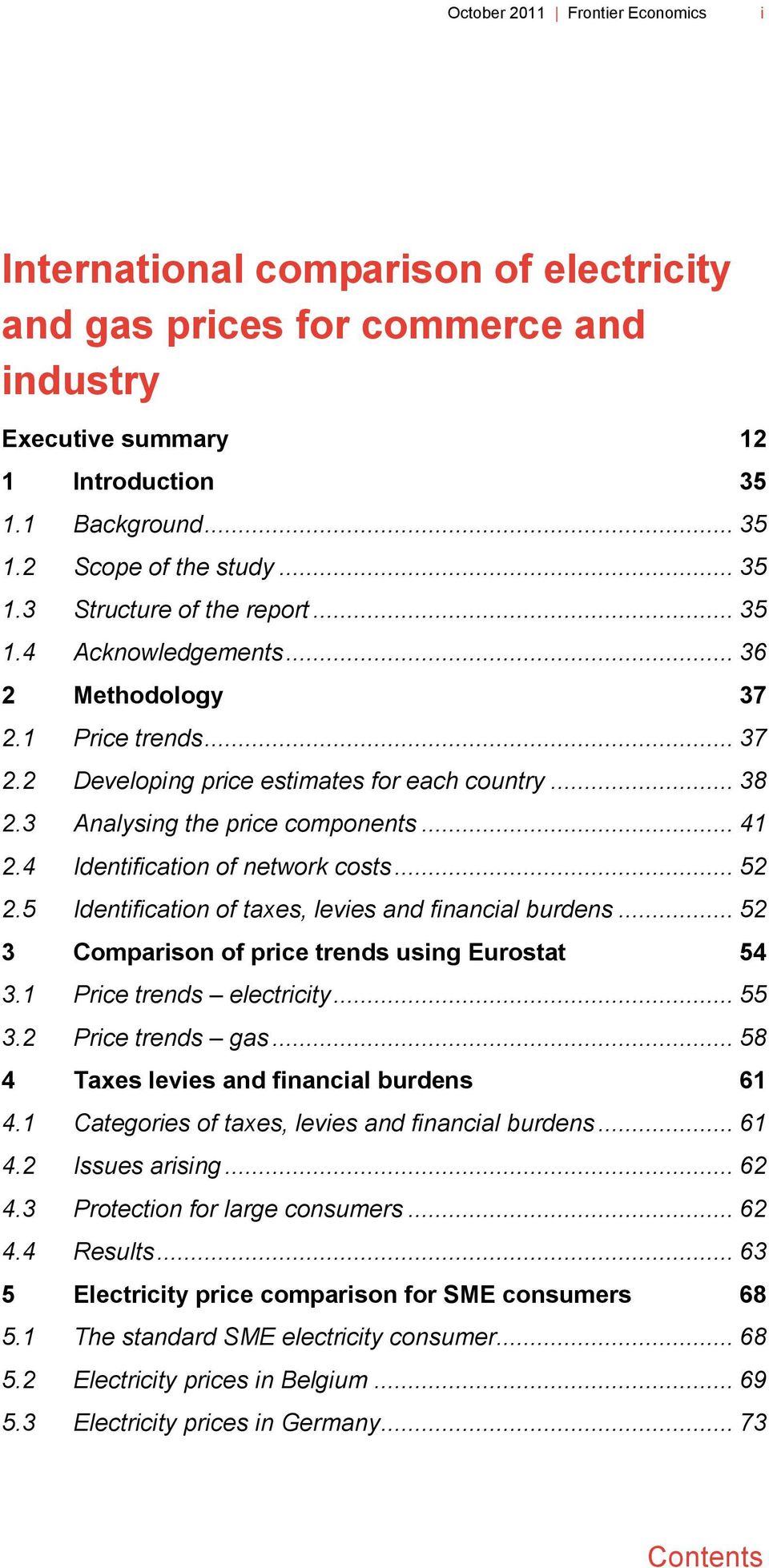
3 October 2011 Frontier Economics i International comparison of electricity and gas prices for commerce and industry Executive summary 12 1 Introduction Background Scope of the study Structure of the report Acknowledgements Methodology Price trends Developing price estimates for each country Analysing the price components Identification of network costs Identification of taxes, levies and financial burdens Comparison of price trends using Eurostat Price trends electricity Price trends gas Taxes levies and financial burdens Categories of taxes, levies and financial burdens Issues arising Protection for large consumers Results Electricity price comparison for SME consumers The standard SME electricity consumer Electricity prices in Belgium Electricity prices in Germany Contents
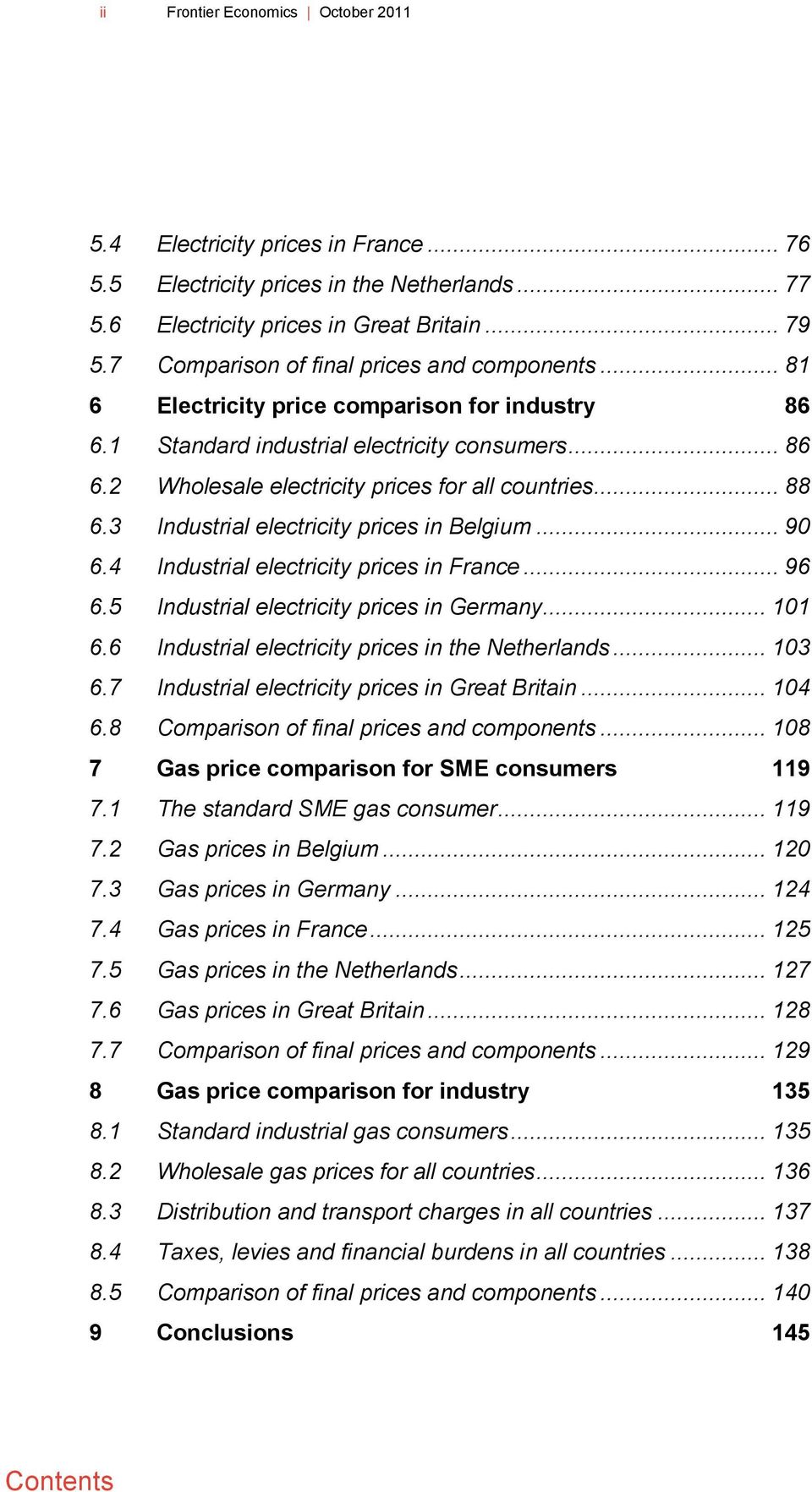
4 ii Frontier Economics October Electricity prices in France Electricity prices in the Netherlands Electricity prices in Great Britain Comparison of final prices and components Electricity price comparison for industry Standard industrial electricity consumers Wholesale electricity prices for all countries Industrial electricity prices in Belgium Industrial electricity prices in France Industrial electricity prices in Germany Industrial electricity prices in the Netherlands Industrial electricity prices in Great Britain Comparison of final prices and components Gas price comparison for SME consumers The standard SME gas consumer Gas prices in Belgium Gas prices in Germany Gas prices in France Gas prices in the Netherlands Gas prices in Great Britain Comparison of final prices and components Gas price comparison for industry Standard industrial gas consumers Wholesale gas prices for all countries Distribution and transport charges in all countries Taxes, levies and financial burdens in all countries Comparison of final prices and components Conclusions 145 Contents
5 October 2011 Frontier Economics iii 9.1 Electricity Gas Annex A - Definition of standard customers 151 Annex B - Taxes, levies and financial burdens 152 Annex C Estimated wholesale energy prices 195 Annex D Sterling/ euro exchange rates 197 Contents
6 iv Frontier Economics October 2011 International comparison of electricity and gas prices for commerce and industry Figure 1. Electricity prices for SME in ct /kwh 15 Figure 2. Electricity price components for SMEs in ct /kwh 16 Figure 3. Tax intensity of electricity prices for SME (excl. PSOs) 17 Figure 4. Electricity price components for a small industrial consumer (5GWh) in ct /kwh 18 Figure 5. Tax intensity of electricity prices for a small industrial consumer (5GWh) (excl. PSOs) 19 Figure 6. Electricity price components for a medium industrial consumer (25GWh) in ct /kwh 20 Figure 7. Tax intensity of electricity prices for a medium industrial consumer (25GWh) (excl. PSOs) 21 Figure 8. Electricity price components for a large industrial consumer (250GWh) in ct /kwh 22 Figure 9. Tax intensity of electricity prices for a large industrial consumer (250GWh) (excl. PSOs) 23 Figure 10. Gas prices for SME in ct /kwh 24 Figure 11. Gas price components for SME in ct /kwh 25 Figure 12. Tax intensity of gas prices for SME (excl. PSOs) 26 Figure 13. Gas price components for an industrial consumer (10GWh) in ct /kwh 28 Figure 14. Tax intensity gas prices for an industrial consumer (10GWh) (excl. PSOs) 29 Figure 15. Summary of final electricity prices for all consumer types in ct /kwh 30 Figure 16. Summary of tax intensities for all types of electricity consumers (excl. PSOs) 31 Tables & Figures

7 October 2011 Frontier Economics v Figure 17. Summary of final gas prices for all consumer types in ct /kwh 32 Figure 18. Summary of tax intensities for all types of gas consumers (excl. PSOs) 33 Figure 19. Forward electricity prices - Cal 2010 baseload contracts as traded between Jan-08 and Dec-09 (in /MWh) 42 Figure 20. Electricity spot market price development in Belgium (in % of the 2009 average) 45 Figure 21. Estimated hourly electricity prices in Belgium for 2010 (in /MWh) and the within year price trend 46 Figure 22. Hourly electricity prices for typical weeks within three representative seasons in Belgium for 2010 (in /MWh) 47 Figure 23. Hourly electricity prices for a typical winter week in Belgium, France, Germany, the Netherlands and Great Britain for 2010 (in /MWh) 48 Figure 24. Electricity price trends without VAT for SME consumers 55 Figure 25. Electricity price trends without VAT for small industry consumers 56 Figure 26. Electricity price trends without VAT for medium industry consumers 57 Figure 27. Electricity price trends without VAT for large industry consumers 58 Figure 28. Gas price trends without VAT for SME consumers 59 Figure 29. Gas price trends without VAT for industry consumers 59 Figure 30. Electricity prices for SME in ct /kwh 82 Figure 31. Electricity price components for SME in ct /kwh 83 Figure 32. Tax intensity of electricity prices for SME (excl. PSOs) 84 Figure 33. Scatter plot of electricity unit prices against their unit value of taxes for SME in ct /kwh (excl. PSOs) 85 Figure 34. Load profile for small industry electricity consumer (5GWh) by season 87 Tables & Figures

8 vi Frontier Economics October 2011 Figure 35. Load profile for medium industry electricity consumer (25GWh) by season 88 Figure 36. Electricity bill components for small industrial consumer in Belgium in 94 Figure 37. Electricity bill components for medium industrial consumers in Belgium in 95 Figure 38. Electricity bill components for large industrial consumer in Belgium in 96 Figure 39. Electricity price components for a small industrial consumer (5GWh) in ct /kwh 109 Figure 40. Tax intensity of electricity prices for the small industry consumer (5GWh) (excl. PSOs) 110 Figure 41. Scatter plot of unit electricity prices against their value of taxes and levies for the small industrial consumer (5GWh) (excl. PSOs) 111 Figure 42. Electricity price component for a medium industrial consumer (25GWh) in ct /kwh 112 Figure 43. Tax intensity of electricity prices for a medium industry consumer (25GWh) (excl. PSOs) 113 Figure 44. Scatter plot of unit electricity prices against their value of taxes and levies for a medium industrial consumer (25GWh) (excl. PSOs) 114 Figure 45. Electricity price components for a large industrial consumer (250GWh) in ct /kwh 115 Figure 46. Tax intensity of electricity prices for a large industry consumer (250GWh) (excl. PSOs) 116 Figure 47. Scatter plot of unit electricity prices against their value of taxes and levies for a small industrial consumer (250GWh) (excl. PSOs) 117 Figure 48. Hourly gas consumption pattern of SME for different seasons with a consumption of 2,300,000 kwh per year 120 Figure 49. Gas prices for SME in ct /kwh 130 Figure 50. Gas price components for SMEs in ct /kwh 131 Tables & Figures
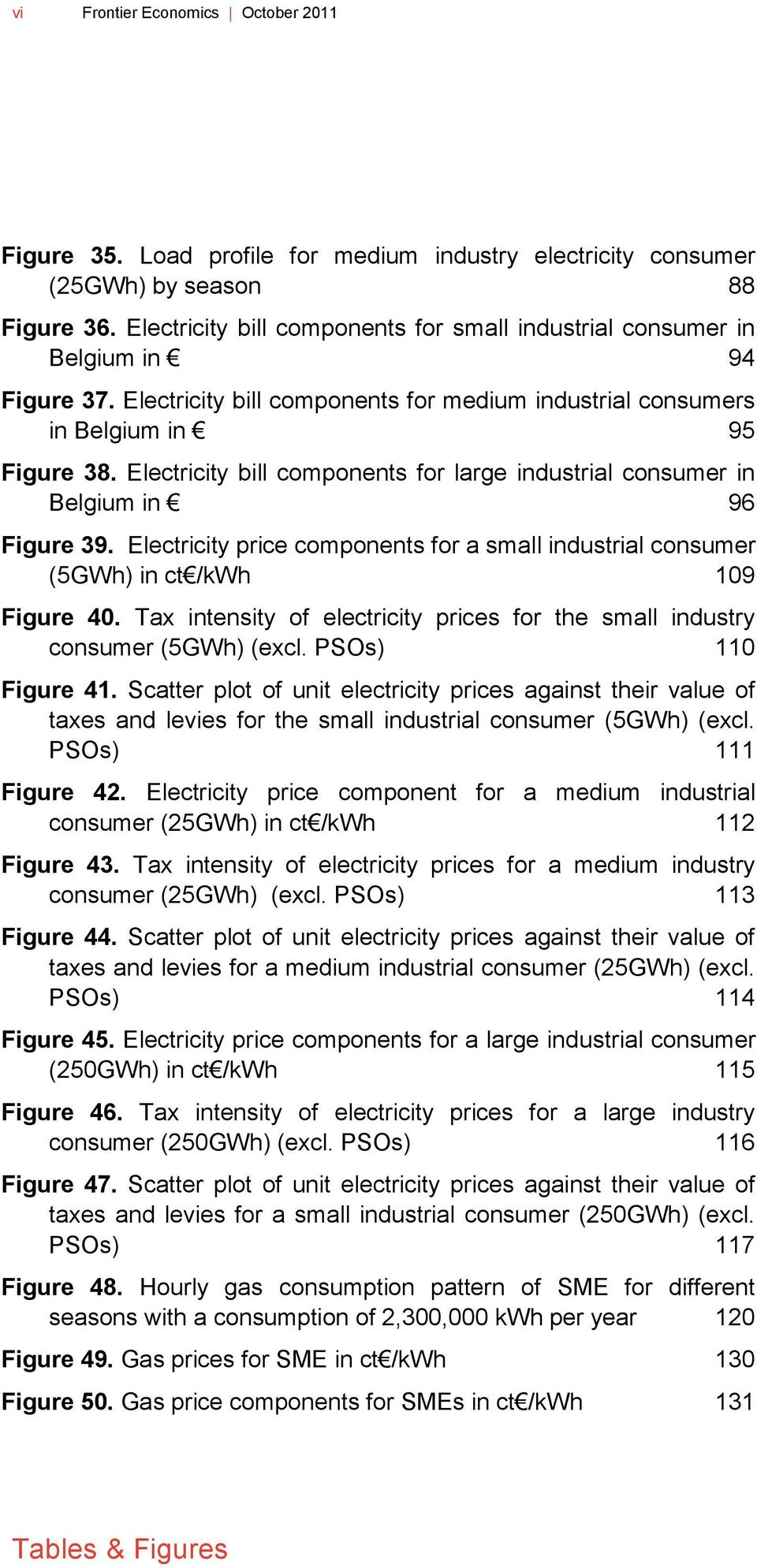
9 October 2011 Frontier Economics vii Figure 51. Tax intensity of gas prices for SME (excl. PSOs) 132 Figure 52. Scatter plot of unit gas prices against their unit value of taxes for SME in ct /kwh (excl. PSOs) 133 Figure 53. Seasonal load profile for the industrial gas consumer 136 Figure 54. Gas price components for an industrial consumer in ct / kwh 142 Figure 55. Tax intensity of gas prices for an industrial consumers (excl. PSOs) 143 Figure 56. Scatter plot of unit gas prices against their unit value of taxes for industrial gas consumer in ct /kwh (excl. PSOs) 144 Figure 57. Summary of final electricity prices for all consumer types in ct /kwh 145 Figure 58. Summary of tax intensities for all types of electricity consumers (excl. PSOs) 147 Figure 59. Summary of final gas prices for all types in ct /kwh 148 Figure 60. Summary of tax intensities for all types of gas consumers (excl. PSOs) 149 Table 1. Electricity prices for a small industrial consumer (5GWh) in ct /kwh 18 Table 2. Electricity prices for a medium industrial consumer (25GWh) in ct /kwh 20 Table 3. Electricity prices for a large industrial electricity consumer (250GWh) in ct /kwh 22 Table 4. Gas prices for an industrial gas consumer (10GWh) in ct /kwh 27 Table 5. Average forward price for different procurement strategies (in /MWh) 43 Table 6. Industry customer type definition of the CREG and Eurostat 54 Table 7. Taxes, levies and financial burdens on electricity in Belgium 64 Tables & Figures
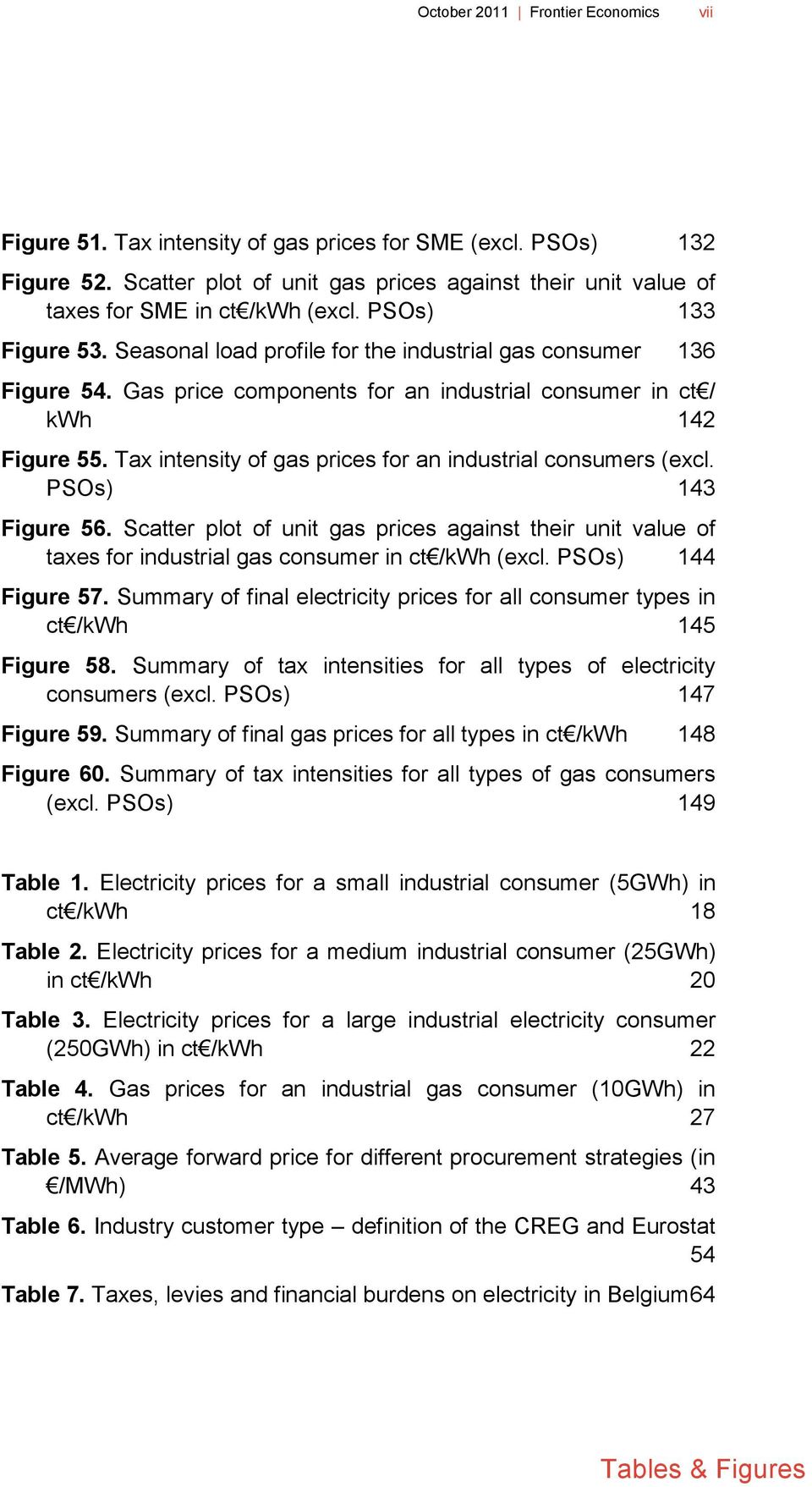
10 viii Frontier Economics October 2011 Table 8. Taxes, levies and financial burdens on electricity in FR, DE, NL and GB 65 Table 9. Taxes, levies and financial burdens on natural gas in Belgium 66 Table 10. Taxes, levies and financial burdens on natural gas in FR, DE, NL and GB 67 Table 11. Share of SME electricity consumers buying electricity on the default offer in Q3 of Table 12. Market shares for SME electricity consumers in Belgium in (normalised) 70 Table 13. Electricity bill and unit price for SME in Belgium (Nov. 2010) 71 Table 14. Electricity bill components for SMEs in Belgium in 73 Table 15. Published electricity tariffs for SME in Germany 74 Table 16. Average German SME electricity tariffs in ct /kwh 75 Table 17. Electricity bill components for SME in Germany in 76 Table 18. Electricity bill and unit price for SMEs in France (Nov. 2010) 77 Table 19. Electricity bill components for SMEs in France in 77 Table 20. Electricity bill components for SMEs in the Netherlands in 78 Table 21. Electricity bill components for SME in Great Britain in 81 Table 22. Electricity bill components for SME in 83 Table 23. Characteristics of industrial electricity consumers 87 Table 24. Average unit cost of electricity in 2010 for industrial consumers in ct /kwh 89 Table 25. Transmission and distribution unit charges for industrial consumers in Belgium in ct /kwh 91 Table 26. Aggregated unit value of taxes and levies for industrial electricity consumers in Belgium in ct /kwh 92 Table 27. Aggregate unit value Public Service Obligations for industrial electricity consumers in Belgium in ct /kwh 92 Tables & Figures
11 October 2011 Frontier Economics ix Table 28. Electricity bill components in and unit price for small industrial consumer in Belgium 93 Table 29. Electricity bill components in and unit price for medium industrial consumer in Belgium 94 Table 30. Electricity bill components in and unit price for large industrial consumer in Belgium 95 Table 31. Aggregate network unit charges for industrial electricity consumers in France in ct /kwh 97 Table 32. Aggregated unit value of taxes and levies for industrial electricity consumers in France ct /kwh 98 Table 33. Electricity bill components in and unit prices for industrial consumers in France 99 Table 34. Comparison of estimated built-up prices and prices in the market in France (excluding all taxes) in 100 Table 35. Adjusted electricity bill components in and unit price for industrial consumers in France 100 Table 36. Aggregate network unit charges for industrial electricity consumers in Germany in ct /kwh 101 Table 37. Aggregated unit value of taxes and levies for industrial electricity consumers in Germany in ct /kwh 102 Table 38. Electricity bill components in and unit prices for industrial consumers in Germany 102 Table 39. Aggregate network unit charges for industrial electricity consumers in the Netherlands in ct /kwh 103 Table 40. Aggregated unit value of taxes and levies for industrial electricity consumers in the Netherlands in ct /kwh 104 Table 41. Electricity bill components in and unit prices for industrial consumers in the Netherlands 104 Table 42. Aggregate network unit charges for industrial electricity consumers in Great Britain in ct /kwh 106 Table 43. Aggregated unit value of taxes and levies for industrial electricity consumers in Great Britain in ct /kwh 107 Tables & Figures

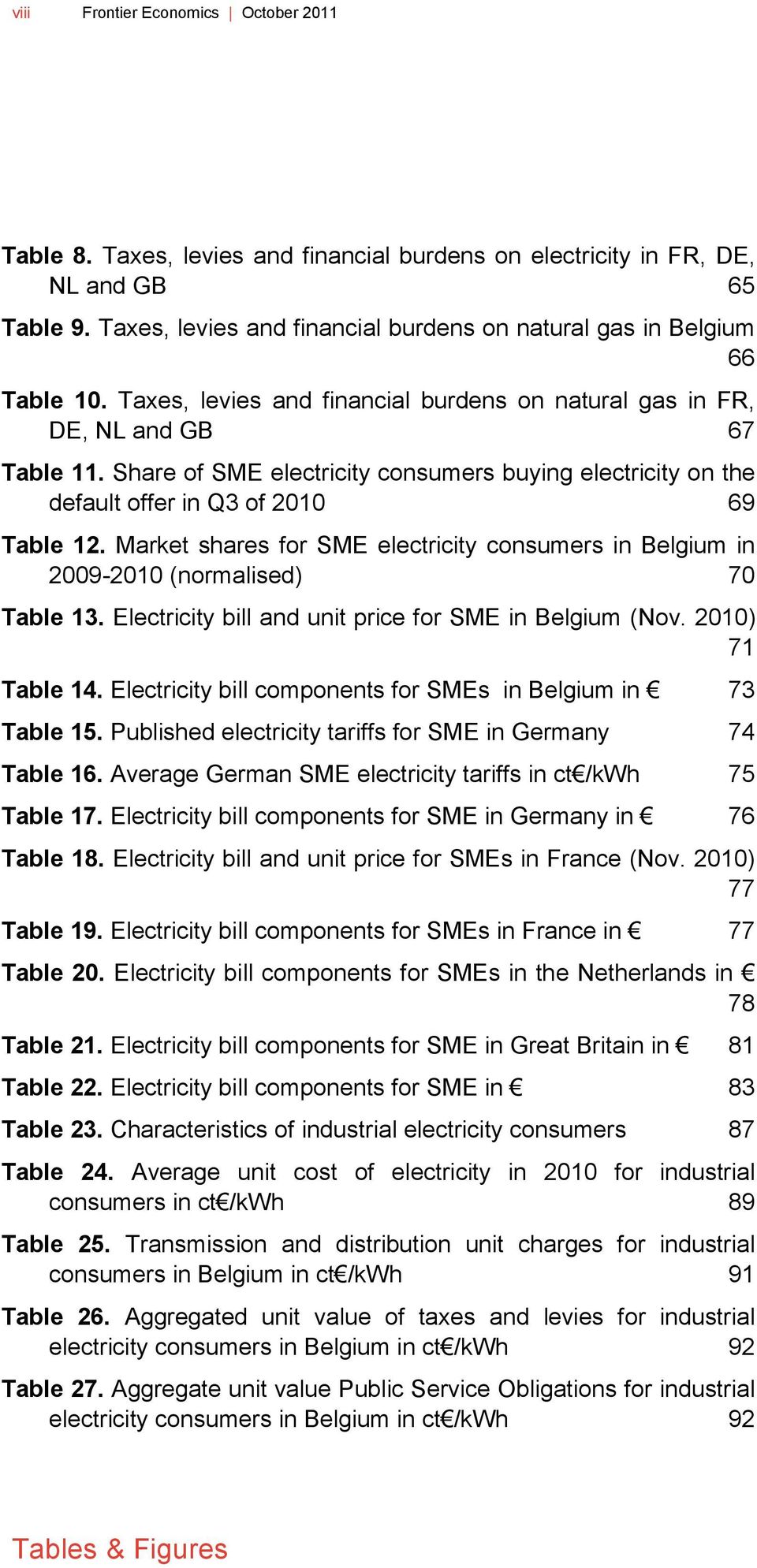
12 x Frontier Economics October 2011 Table 44. Electricity bill components in and unit prices for industrial consumers in Great Britain 107 Table 45. Electricity bill components in for a small industrial consumer (5GWh) 108 Table 46. Electricity bill components in for a medium industrial consumer (25GWh) 112 Table 47. Electricity bill components in for a large industrial consumer (250GWh) 115 Table 48. Market shares in (normalised) for SME gas consumers 121 Table 49. Share of SME gas consumers which remain on the default offer (number of connections) per region in Q4 of Table 50. Total gas bill and unit price for SME in Belgium 122 Table 51. Gas bill components for SME in Belgium in 124 Table 52. Average German SME gas price in ct /kwh 124 Table 53. Gas bill components for SME in Germany in 125 Table 54. Gas bill and unit price for SME in France 126 Table 55. Gas bill components for SME in France in 127 Table 56. Gas bill components for SME in the Netherlands in 128 Table 57. Gas bill components for SME in Great Britain in 129 Table 58. Average unit cost of wholesale gas in 2010 for industrial consumer 136 Table 59. Transport and distribution unit charges for the industrial gas consumer in ct /kwh 138 Table 60. Taxes and levies for the industrial gas consumer in per year 140 Table 61. Gas bill components and unit prices for an industrial consumer 141 Table 62. Data on renewable and cogen obligations in Flanders for Table 63. DSO surcharges for public service missions in Flanders ( /MWh) 159 Tables & Figures
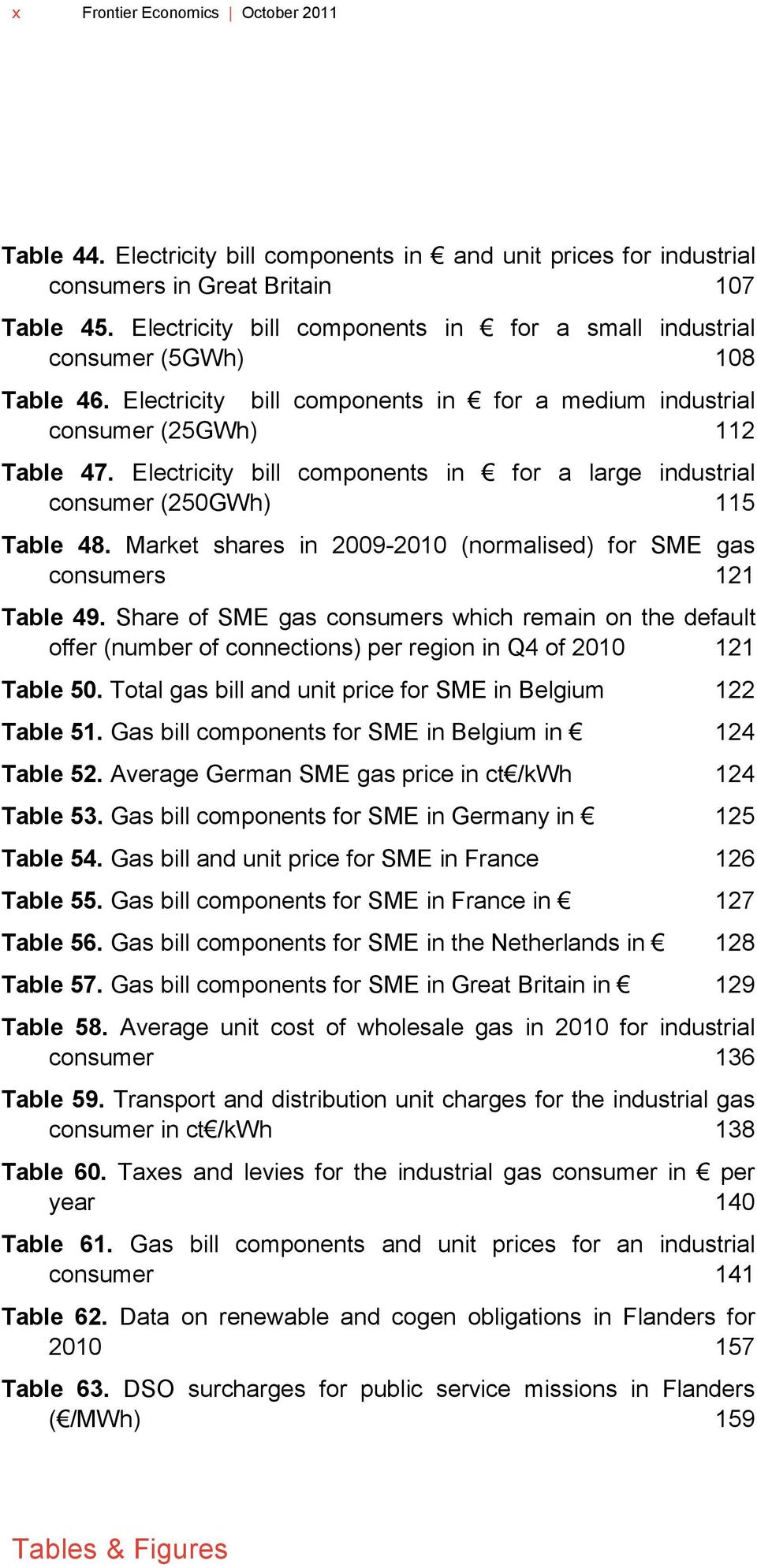
13 October 2011 Frontier Economics xi Table 64. DSO surcharges for occupation of public land in Flanders ( /MWh) 159 Table 65. Data on the renewable obligation in Wallonia for Table 66. DSO surcharges for public service missions in Wallonia ( /MWh) 161 Table 67. Data on the renewable obligation in Brussels for Table 68. DSO surcharge for public service obligations related to distribution of natural gas in Flanders ( /MWh) 167 Table 69. DSO surcharges for use of public land within the natural gas distribution in Flanders ( /MWh) 167 Table 70. DSO surcharges for public service obligation within the tariff for distribution of natural gas in Wallonia ( /MWh) 168 Table 71. Surcharges for use of the public domain in Wallonia from 2011 in ct /kwh 169 Table 72. DSO surcharge for public service obligations within the charge for distribution of natural gas in Brussels ( /MWh) 169 Table 73. Upper bounds for municipal concession fees (electricity) 180 Table 74. Upper bounds for municipal concession fees (natural gas) 183 Table 75. Energy tax rates electricity (excl. VAT) 185 Table 76. Energy tax natural gas (excl. VAT) 187 Table 77. Estimated wholesale costs of electricity for delivery in 2010 (ct /kwh) 195 Table 78. Estimated wholesale costs of gas for delivery in 2010 (ct /kwh) 196 Table 79. Average monthly exchange rates (GBP/EUR) 197 Tables & Figures
14 12 Frontier Economics October 2011 Executive summary The purpose of this study, commissioned by the CREG and its General Council, is to carry out a comparison of electricity and gas prices for commerce and industry in Belgium and four nearby countries, Germany, France, the Netherlands and Great Britain (GB). The comparisons refer to standard consumer definitions provided by the CREG for small and medium sized enterprises (SMEs) and different sizes of industrial consumer. A specific objective is to assess the importance of taxes, levies and financial burdens included in the final prices. Methodology The main steps we have undertaken to carry out the analysis are as follows: we first collected information on taxes, levies and financial burdens in each jurisdiction, paying particular attention to their application to larger consumers (entitlement to reduced rates of tax or levy, exemptions and caps on the total amounts paid); second, we collected representative electricity and gas price information for the SME consumer, where available, enabling direct comparison of the published prices. We did this using published price offers and price simulators to build up a picture of prices that took account of the market shares of the main suppliers, the proportion of consumers buying under different types of offer and geographical differences arising from variations in network charges. For countries without published prices, we use the same approach as for industry described below; third, we carried out an analysis of the three core price components by calculating: the supplier s cost of energy: for SME consumers we deducted the network charges and taxes, levies and financial burdens from the observed final price in order to obtain the energy costs for industrial consumers we multiplied the hourly consumer load profiles by the estimated hourly cost of energy, assuming that the energy was procured using market-based forward contracts for electricity and, for gas, under a combination of forward contracts and long-term gas supply contracts for continental countries and under forward contracts for GB; Executive summary
15 October 2011 Frontier Economics 13 the applicable network charges for electricity and gas given each consumer s load profile. This was done separately for transmission and distribution, or as a single bundled charge, depending on the network pricing regime in each country; and the applicable taxes, levies and financial burdens based on the initial research work, taking account of the size and other relevant consumption characteristics; and fourth, for industrial consumers, we added the different price components in order to derive a built-up price. For industrial consumers, this built-up price is the only source of end user price information available as there are no published price offers for larger consumers. Within the scope of taxes, levies and financial burdens we include any costs recovered from consumers that would not be incurred to run the business of the energy supplier or network company were it not for a legal requirement. As well as taxes, this definition includes the cost of public service obligations imposed on utilities which are then recovered in energy prices. For the Belgian regions, we also report the PSO component separately. The study is primarily focussed on taking a snapshot of prices at a particular point in time for the purposes of comparison. The date chosen when we collected price data was November However, we have also looked briefly at price trends over the last decade using Eurostat data. Price trends In order to gain some understanding of price trends, we reviewed Eurostat data for the period for average unit prices. Electricity prices for both SME and industrial consumers are closely bunched with the exception of France which has significantly lower prices. In general, industrial prices are strongly driven by wholesale prices and the particular policies regarding taxes, exemptions from certain levies and industry policies. Gas prices in all five countries appear to have followed similar trends in recent years. This may in part reflect the net-back pricing approach that often underlies prices in long-term wholesale gas supply contracts on the continent. Even in Great Britain where gas-to-gas competition is more predominant, the price of gas appears to be correlated with prices for alternative forms of energy such as crude oil and oil products. For much of the period, Great Britain had the lowest gas price for the two consumer categories that we have been able to compare. Belgium is at the lower end of the price range for the remaining countries. Price series data for large industrial consumers are very limited. Executive summary
16 14 Frontier Economics October 2011 Taxes, levies and financial obligations We have devoted significant effort to identifying the different taxes, levies and financial obligations that apply to energy consumption. They generally fall into one of four categories: the cost of public service obligations which may be borne directly and included in the price of energy or recovered by some form of levy; the cost of measures to support the excess costs of renewable energy and, in some countries, those of co-generation; taxes on energy that resemble excise duties; and VAT on the price of energy, usually including VAT on the taxes and levies referred to above. However, because commercial and industrial consumer can normally recover VAT on purchases, we have not included VAT in our price comparisons. There are a number of different issues that need to be kept in mind when considering taxes levies and financial burdens due to differences in policy between the countries concerned. These issues are: some countries levy taxes on energy but these are then partially recycled or set off against other taxes or contributions that depend on the specific characteristics of the consumer organisation; and while most countries recover the excess costs of renewable energy from consumers, some fund these costs from the national budget. For large consumers there are often lower rates of tax, exemptions or caps on the total amount to be paid. These measures differ between taxes and between gas and electricity and there is no consistent approach in each country. Belgium is unique among the countries under consideration in having a number of federal taxes and levies which apply to energy as well as a significant number of regional ones specific to each of Brussels, Flanders and Wallonia. For this reason, we report our results separately for each region in Belgium rather than trying to produce any form of weighted average. Price comparison for SME electricity consumers Figure 1 shows the average unit prices for SME electricity consumers. Germany has the highest prices and France the lowest. French prices are low as the market is still dominated by regulated prices. These regulated prices pass on to the consumer some of the benefits of low cost nuclear power and are not directly Executive summary
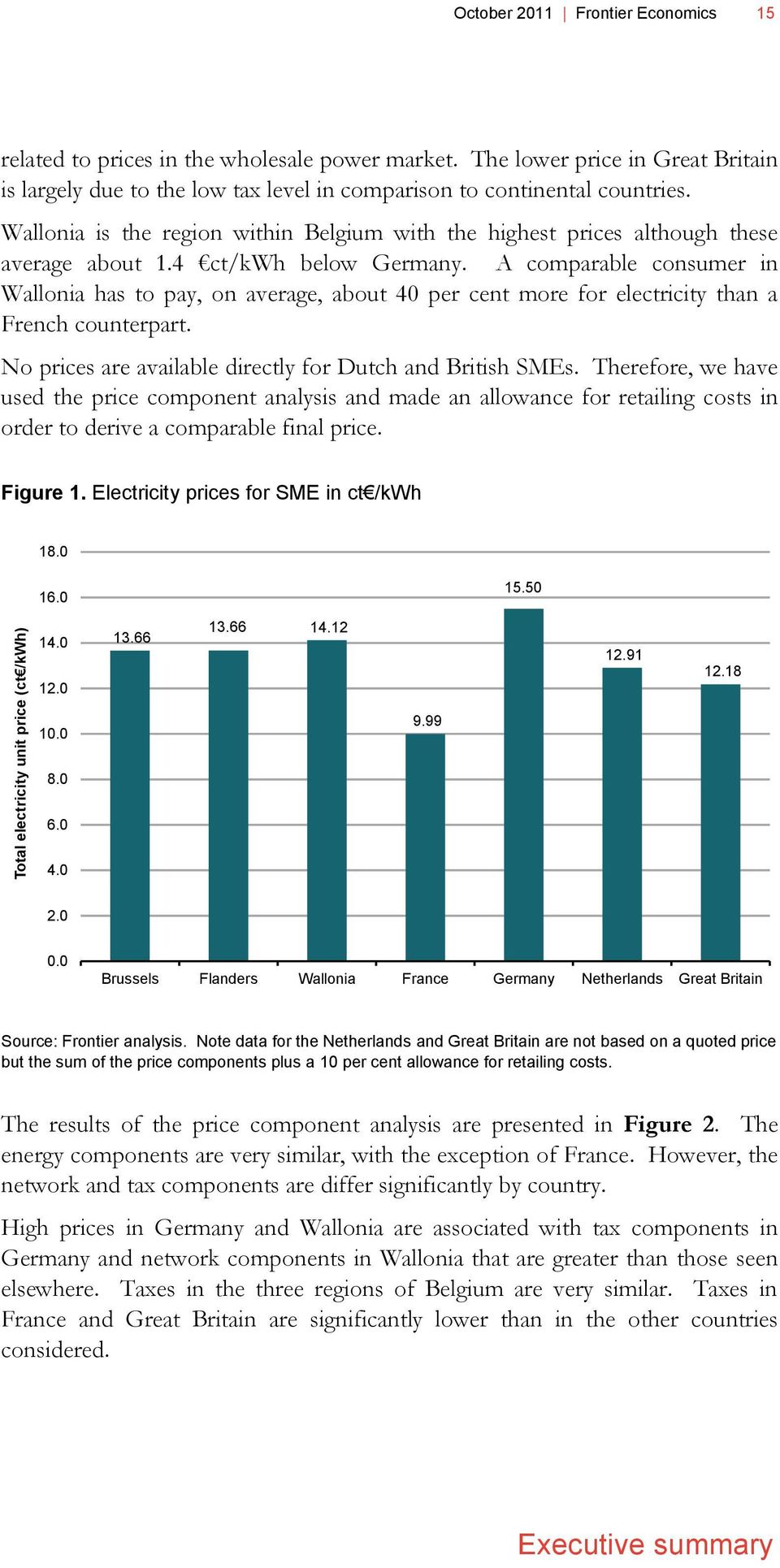
17 Total electricity unit price (ct /kwh) October 2011 Frontier Economics 15 related to prices in the wholesale power market. The lower price in Great Britain is largely due to the low tax level in comparison to continental countries. Wallonia is the region within Belgium with the highest prices although these average about 1.4 ct/kwh below Germany. A comparable consumer in Wallonia has to pay, on average, about 40 per cent more for electricity than a French counterpart. No prices are available directly for Dutch and British SMEs. Therefore, we have used the price component analysis and made an allowance for retailing costs in order to derive a comparable final price. Figure 1. Electricity prices for SME in ct /kwh Brussels Flanders Wallonia France Germany Netherlands Great Britain Source: Frontier analysis. Note data for the Netherlands and Great Britain are not based on a quoted price but the sum of the price components plus a 10 per cent allowance for retailing costs. The results of the price component analysis are presented in Figure 2. The energy components are very similar, with the exception of France. However, the network and tax components are differ significantly by country. High prices in Germany and Wallonia are associated with tax components in Germany and network components in Wallonia that are greater than those seen elsewhere. Taxes in the three regions of Belgium are very similar. Taxes in France and Great Britain are significantly lower than in the other countries considered. Executive summary
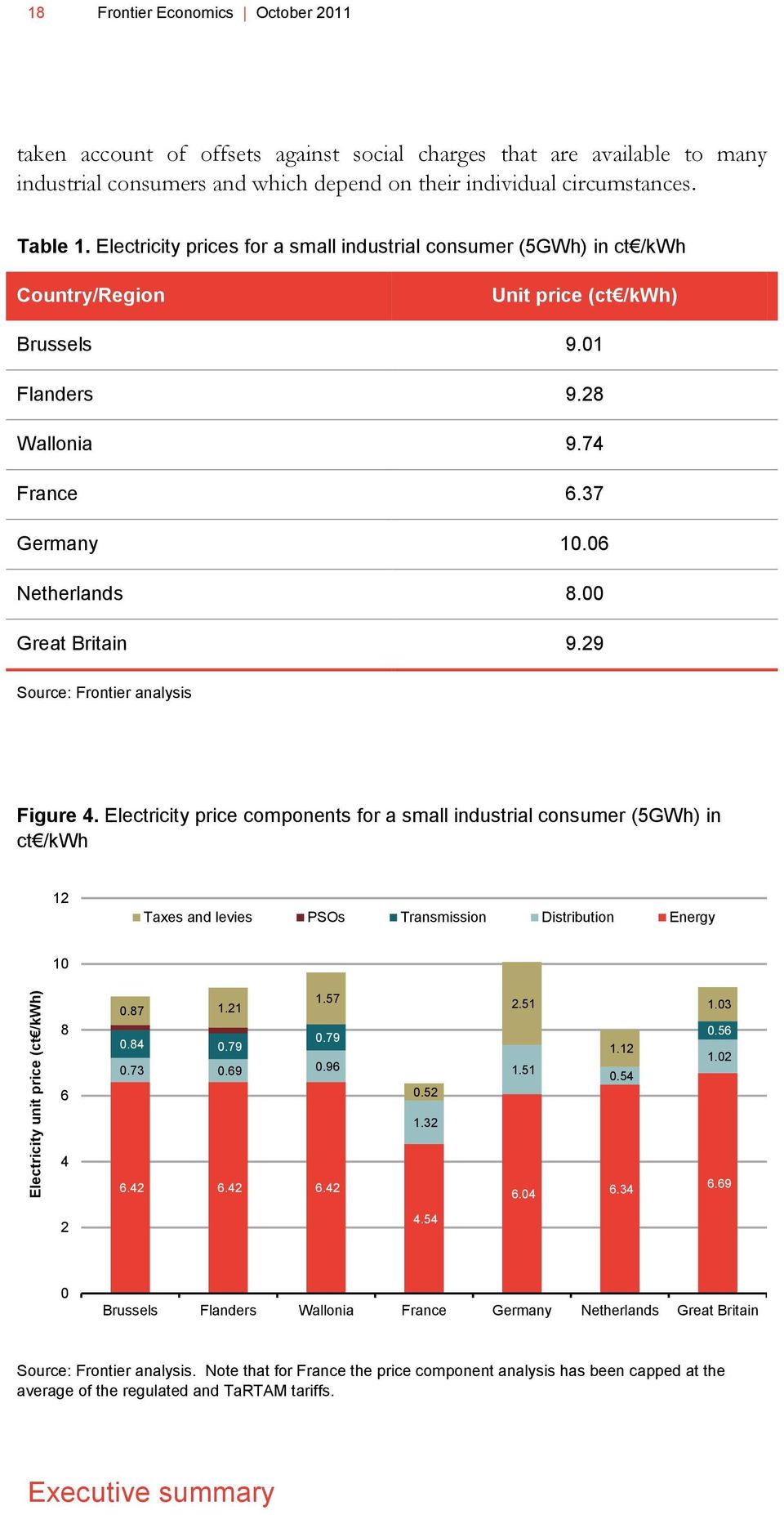
18 Electricity unit price (ct /kwh) 16 Frontier Economics October 2011 Figure 2. Electricity price components for SMEs in ct /kwh Taxes and levies PSOs Transmission Distribution Energy Brussels Flanders Wallonia France Germany Netherlands Great Britain Source: Frontier analysis. Note data for the Netherlands and Great Britain are not based on a quoted price but the sum of the price components plus a 10 per cent allowance for retailing costs. A more graphic illustration of the relative tax position appears in Figure 3, which shows total taxes, levies and financial burdens as a percentage of the total price. Germany and the Netherlands have the highest tax intensity. The tax intensity in France, Great Britain and the three Belgian regions (excluding the cost of PSOs) is significantly lower and quite similar. Executive summary

19 Tax intensity of electricity bill (in %) October 2011 Frontier Economics 17 Figure 3. Tax intensity of electricity prices for SME (excl. PSOs) 25% 21% 20% 17% 15% 10% 9% 11% 11% 8% 7% 5% 0% Brussels Flanders Wallonia France Germany Netherlands Great Britain Source: Frontier analysis Price comparisons for electricity consumers in industry We derived prices for a small (5 GWh pa), medium (25 GWh pa) and large (250 GWh pa) industrial electricity consumer. The prices are the sum of our calculations of the relevant amounts for wholesale energy, network charges and taxes, given the assumed consumer characteristics. Published final prices are not available. Small industrial electricity consumers Table 1 shows the overall built-up price and Figure 4 shows the price components for the small industry consumer. Prices are significantly lower in France than other countries. This is primarily because there is still a regulated tariff in place and, until 2007, even those who had moved to the unregulated market were allowed to return to a transitional regulated tariff known as TaRTAM. We have assumed that, for the most part, industrial consumers in France are supplied under one form of regulated tariff or another. The Netherlands is the next cheapest country while Wallonia and Germany have very similar prices. Taxes are higher in Germany but we note that we have not Executive summary
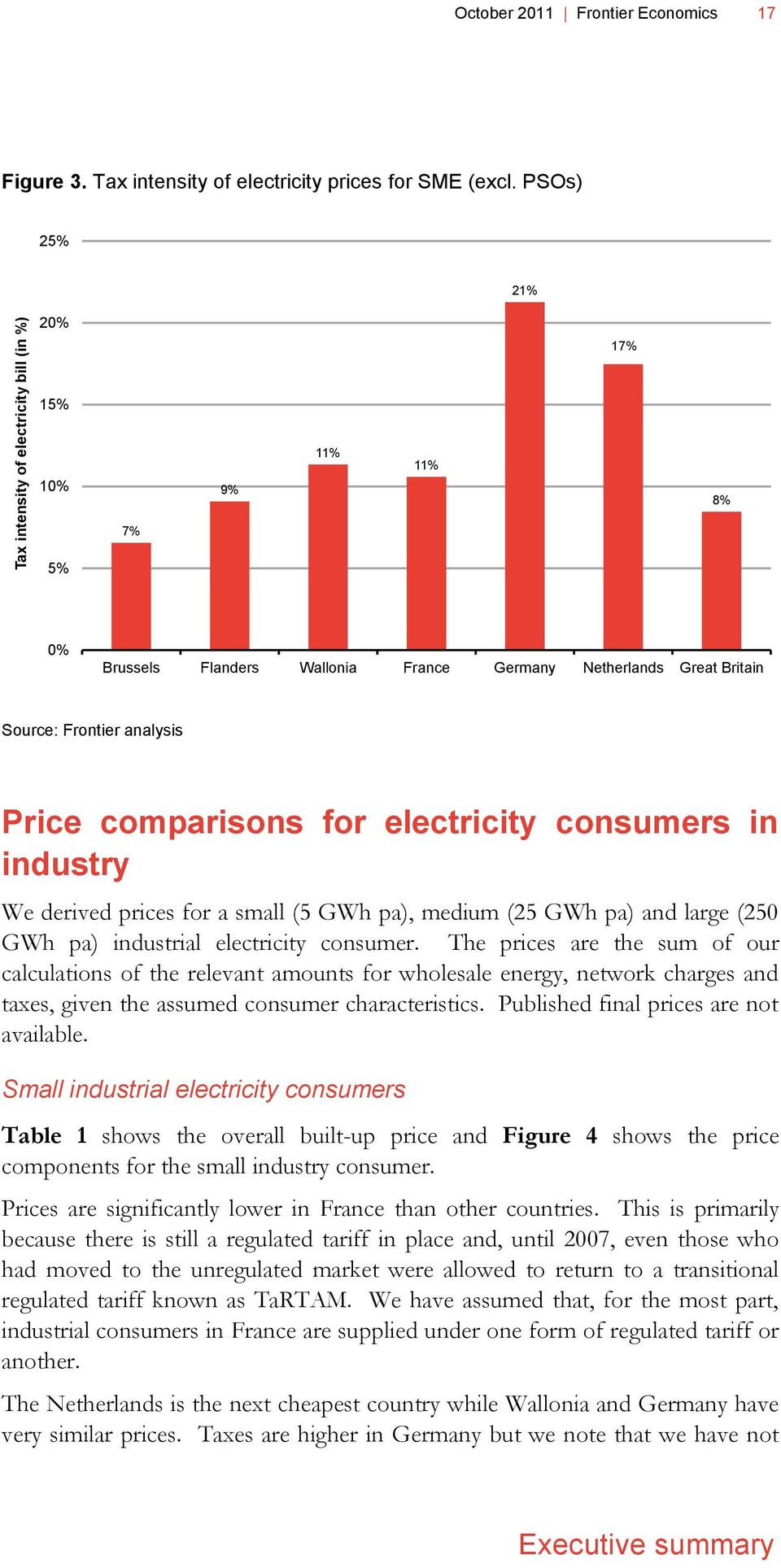
20 Electricity unit price (ct /kwh) 18 Frontier Economics October 2011 taken account of offsets against social charges that are available to many industrial consumers and which depend on their individual circumstances. Table 1. Electricity prices for a small industrial consumer (5GWh) in ct /kwh Country/Region Unit price (ct /kwh) Brussels 9.01 Flanders 9.28 Wallonia 9.74 France 6.37 Germany Netherlands 8.00 Great Britain 9.29 Source: Frontier analysis Figure 4. Electricity price components for a small industrial consumer (5GWh) in ct /kwh 12 Taxes and levies PSOs Transmission Distribution Energy Brussels Flanders Wallonia France Germany Netherlands Great Britain Source: Frontier analysis. Note that for France the price component analysis has been capped at the average of the regulated and TaRTAM tariffs. Executive summary
21 Tax intensity of electricity bill (in %) October 2011 Frontier Economics 19 The tax intensity of the price for small industrial consumers is shown in Figure 5. Taxes in France are a lower proportion of price than in any other country, followed by Great Britain. As expected, Germany has the highest tax intensity. Within Belgium, Wallonia has the highest tax intensity for this size of consumer followed by Flanders and Brussels. Figure 5. Tax intensity of electricity prices for a small industrial consumer (5GWh) (excl. PSOs) 30% 25% 25% 20% 15% 13% 16% 14% 11% 10% 10% 8% 5% 0% Brussels Flanders Wallonia France Germany Netherlands Great Britain Source: Frontier analysis We also found that there is a strong association between the sum of the price components and taxes for these consumers in each country and region. Medium industrial electricity consumers We now consider the medium industrial consumer. Table 2 shows the built-up prices and Figure 6 shows the price components. France remains the cheapest country due to the impact of tariff regulation. The difference between French prices and those for other countries is significantly less than for the small industrial consumer. This is because lower tax rates and exemptions reduce the impact of taxation in the other countries, especially in Germany. The overall spread of prices is also much narrower. Wallonia now has the highest price, followed closely by the other Belgian regions and Great Britain. The high price level in Great Britain follows from higher wholesale prices during peak demand periods. The higher prices in Belgium are associated with higher levels of tax than apply in the other countries considered for this size of consumer. Executive summary
22 Electricity unit price (ct /kwh) 20 Frontier Economics October 2011 Table 2. Electricity prices for a medium industrial consumer (25GWh) in ct /kwh Country/Region Unit price (ct /kwh) Brussels 8.65 Flanders 8.58 Wallonia 8.92 France 5.80 Germany 7.78 Netherlands 7.42 Great Britain 8.64 Source: Frontier analysis Figure 6. Electricity price components for a medium industrial consumer (25GWh) in ct /kwh Taxes and levies PSOs Transmission Distribution Energy Brussels Flanders Wallonia France Germany Netherlands Great Britain Source: Frontier analysis. Note that for France the price component analysis has been capped at the average of the regulated and TaRTAM tariffs. Executive summary
23 Tax intensity of electricity bill (in %) October 2011 Frontier Economics 21 Figure 7 shows the tax intensity of the prices for the medium industrial consumer. France, Germany, Great Britain and the Netherlands have very similar tax intensities of between 6-9 per cent. Wallonia has the highest intensity and the other Belgian regions have significantly higher tax intensities than the other countries considered. Figure 7. Tax intensity of electricity prices for a medium industrial consumer (25GWh) (excl. PSOs) 20% 16% 16% 13% 12% 10% 9% 8% 6% 6% 7% 4% 0% Brussels Flanders Wallonia France Germany Netherlands Great Britain Source: Frontier analysis We also find an association between the sum of price components and taxes for the seven countries / regions considered but it is not very strong. Large industrial electricity consumers Finally we consider the large industrial consumer. Table 3 and Figure 8 show final electricity prices and their build up from the three underlying components. Price spreads are much narrower than for the other industrial consumers. France remains the cheapest country but its advantage is significantly less than in the case of the small and medium industrial consumers. Prices in all regions of Belgium are now very similar and close to those in Germany. Great Britain has the highest price, driven by higher energy costs and relatively high taxes. The price component analysis reflects the fact that this size of consumer is connected directly to the transmission system and bears no charge for distribution. Some small differences in network charges and in the tax components are apparent. Network charges in Germany are significantly higher than in the other countries. Executive summary
24 Electricity unit price (ct /kwh) 22 Frontier Economics October 2011 Table 3. Electricity prices for a large industrial electricity consumer (250GWh) in ct /kwh Country/Region Unit price (ct /kwh) Brussels 7.21 Flanders 7.22 Wallonia 7.00 France 4.87 Germany 7.00 Netherlands 6.52 Great Britain 7.54 Source: Frontier analysis Figure 8. Electricity price components for a large industrial consumer (250GWh) in ct /kwh 10 Taxes and levies PSOs Transmission Distribution Energy Brussels Flanders Wallonia France Germany Netherlands Great Britain Source: Frontier analysis. Note that for France the price component analysis has been capped at the average of the regulated and TaRTAM tariffs. Executive summary
25 Tax intensity of electricity bill (in %) October 2011 Frontier Economics 23 Figure 9 shows the tax intensity for the large industrial consumer and indicates that, for this size of consumer, Great Britain and the Belgian regions have a tax intensity from 6-10 per cent while the other three countries fall in the range 1-4 per cent. Figure 9. Tax intensity of electricity prices for a large industrial consumer (250GWh) (excl. PSOs) 10% 9% 9% 9% 8% 8% 7% 7% 6% 5% 4% 4% 4% 3% 2% 1% 0% Brussels Flanders Wallonia France Germany Netherlands Great Britain 1% Source: Frontier analysis The association between price and taxes is relatively weak for the large industrial consumer. Price comparisons for SME gas consumers Great Britain has by far the lowest gas prices for SME consumers, as shown in Figure 10. British prices are more than 0.7 ct /kwh lower than in France, which has the second lowest prices. Except for Great Britain, gas prices for SME consumers are very closely grouped, with a spread of no more than 0.28 ct /kwh. Among that group, France has the lowest prices and prices in Germany are almost as low. Brussels has the highest prices in the countries and regions considered followed by Wallonia and Flanders. No SME data is published for the Netherlands and Great Britain. We have therefore used a value for end user prices derived from the price component analysis and added a retail margin of 5 per cent in order to obtain an estimate of the delivered price. Executive summary
26 Total gas unit price (ct /kwh) 24 Frontier Economics October 2011 Figure 10. Gas prices for SME in ct /kwh Brussels Flanders Wallonia France Germany Netherlands Great Britain Source: Frontier analysis. Data for the Netherlands and Great Britain is based on an estimate derived from the price component analysis plus a 10 per cent allowance for retailing costs. The price component analysis is shown in Figure 11. Energy costs appear to be higher in Belgium but network charges and taxes are higher in some of the other countries. Under the net-back approach to setting contract prices for wholesale gas, we would expect that the network and tax cost differences would be absorbed to a substantial extent in the supply chain and not be passed on to final consumers. This appears to be the case on the continent but not to the same extent in Great Britain for this class of consumer. Great Britain has the lowest energy cost and also relatively low network charges and taxes. A striking feature is the high contribution of taxes in the Netherlands which more than outweighs the lower wholesale gas prices. Transmission charges also appear to be higher in France than elsewhere. Executive summary
27 Natural gas unit price (ct /kwh) October 2011 Frontier Economics 25 Figure 11. Gas price components for SME in ct /kwh Energy Distribution Transport PSOs Taxes and levies Brussels Flanders Wallonia France Germany Netherlands Great Britain Source: Frontier analysis. Data for the Netherlands and Great Britain is based an estimate derived from the price component analysis plus a 10 per cent allowance for retailing costs. Figure 12 shows the tax intensity of the prices. All regions and countries have tax intensities in the range 3-6 per cent, except Germany and the Netherlands, the latter being exceptionally high. Executive summary
28 Tax intensity of gas bill (in %) 26 Frontier Economics October 2011 Figure 12. Tax intensity of gas prices for SME (excl. PSOs) 35% 31% 30% 25% 20% 15% 10% 10% 5% 6% 3% 3% 4% 6% 0% Brussels Flanders Wallonia France Germany Netherlands Great Britain Source: Frontier analysis Price comparisons for an industrial gas consumer As in the case of industrial electricity consumers, industrial gas prices are not published by suppliers and our analysis is based on building up the price from the three components. The standard consumer we have used uses 10 GWh of gas per year. The resulting prices are shown in Table 4 for each country and region and the price components are set out in Figure 13. France and Germany have the highest gas prices, followed by the Netherlands. Prices in all three Belgian regions are lower than elsewhere. Wallonia and Flanders have very similar prices while Brussels is slightly more expensive. The gas price in Great Britain lies in the middle of the price range. Looking at the price components, the Netherlands and Germany have high levels of tax while France and Germany have high network charges. Belgium has low levels of tax and network costs while the Netherlands has low network costs. There is little difference in the underlying commodity price between countries. As noted for smaller consumers, gas pricing is to some extent driven by a netback approach to pricing in which differences in gas taxes and network costs are absorbed in the supply chain and not reflected in the final price. We would Executive summary
29 October 2011 Frontier Economics 27 expect this effect to be less significant for industrial gas consumers but it may nevertheless work to reduce price differences. In the Netherlands, a gas producing country, the tax appears to be designed to capture the surplus between wholesale gas supply costs and market prices. Table 4. Gas prices for an industrial gas consumer (10GWh) in ct /kwh Country/Regions Unit price (ct /kwh) Brussels 2.50 Flanders 2.34 Wallonia 2.33 France 2.93 Germany 2.92 Netherlands 2.82 Great Britain 2.61 Source: Frontier analysis Executive summary
30 Natural gas unit price (ct /kwh) 28 Frontier Economics October 2011 Figure 13. Gas price components for an industrial consumer (10GWh) in ct /kwh 3.5 Energy Distribution Transport PSOs Taxes and levies Brussels Flanders Wallonia France Germany Netherlands Great Britain Source: Frontier analysis Figure 14 shows the tax intensity of prices and indicates that Flanders has the lowest tax intensity and the Netherlands the highest. The tax intensity in Brussels is significantly higher than in the two other Belgian regions. Great Britain displays the third highest tax intensity. Executive summary
31 Tax intensity of gas bill (in %) October 2011 Frontier Economics 29 Figure 14. Tax intensity gas prices for an industrial consumer (10GWh) (excl. PSOs) 25% 22% 20% 15% 10% 11% 5% 6% 5% 7% 2% 2% 0% Brussels Flanders Wallonia France Germany Netherlands Great Britain Source: Frontier analysis Overview for electricity Figure 15 summarises on a single chart electricity prices in the three Belgian regions relative to the highest and lowest prices found in all countries and regions 1, indicated by the labels. For clarity we have not shown the prices for all countries. This chart uses the final prices observed in the market for SME consumers and the sum of price components for industry except in the case of France for which regulated prices have been used. 1 The highest and lowest may be one of the Belgian regions or another country. Executive summary
32 Total electricity unit price (ct /kwh) 30 Frontier Economics October 2011 Figure 15. Summary of final electricity prices for all consumer types in ct /kwh DE DE FR Wallonia GB Highest Brussels Flanders Wallonia Lowest 6 4 FR FR SME Small industry Medium industry Large industry Source: Frontier analysis. Note that the price axis has been shortened to show greater detail in the range of actual prices. The key features are: lower unit prices as the size of the consumer increases; a narrower price range as the size of the consumer increases this falls from a range of 5.5 ct /kwh for SMEs to a range of 2.67 ct /kwh for the large industrial consumer; and prices in Belgium fall in the mid to upper end of the range for SME and small industrial consumers and at the upper end of the range for medium and large industrial consumers. Figure 16 shows the tax intensity of prices i.e. the proportion of taxes and levies in the final price. As for the price information, it compares data for the three Belgian regions with the highest and lowest among all countries and regions. It highlights the fact that tax intensity in Belgium for SME consumers lies at the lower end of the range but in the middle for the small and medium industrial consumers and at the upper end for big industrial electricity consumers. Executive summary
33 Tax intensity (in %) October 2011 Frontier Economics 31 Figure 16. Summary of tax intensities for all types of electricity consumers (excl. PSOs) 30% DE 25% 20% 15% Wallonia Flanders Highest Brussels Flanders Wallonia 10% Lowest 5% 0% Brussels FR NL SME Small industry Medium industry Large industry Source: Frontier analysis Executive summary
34 Total gas unit price (ct /kwh) 32 Frontier Economics October 2011 Overview for gas Figure 17 summarises on a single chart the gas price levels in the three Belgian regions relative to the highest and lowest prices found in all countries and regions surveyed. Figure 17. Summary of final gas prices for all consumer types in ct /kwh 5 Brussels 4 FR 3 2 Highest Brussels Flanders Wallonia Lowest GB 1 Wallonia 0 SME Industry Source: Frontier analysis As in the case of electricity, the industrial prices are derived from price component analysis and not observed directly in the market. The key features of the price comparison are: prices are much more tightly bunched than is the case for electricity, perhaps reflecting the fact that traditionally gas is priced in relation to substitute oil products and not built up from underlying costs; industrial consumers pay lower prices than SME. In Great Britain, where the price level is very low for SME consumer, the reduction for industrial consumers is much smaller than in the other countries; prices in Belgium are the lowest for the industrial consumer; France has the second lowest price for an SME but the highest price for an industrial consumer; and the price range is greater for the SMEs (1.0 ct/kwh) than for the industrial customer (0.60 ct /kwh). Executive summary
35 Tax intensity (in %) October 2011 Frontier Economics 33 Figure 18 shows the tax intensity for gas consumers. For gas, Belgium falls at the lower end of the range. Tax intensity in the Netherlands is significantly higher than in any other country. As noted above, to the extent that the net back pricing model is relevant, differences in taxes would be expected to have much a more limited impact on final prices. Figure 18. Summary of tax intensities for all types of gas consumers (excl. PSOs) 50% 40% NL 30% 20% Highest Brussels Flanders Wallonia Lowest 10% Wallonia Flanders 0% SME Industry Source: Frontier analysis Executive summary
36
37 October 2011 Frontier Economics 35 1 Introduction 1.1 Background The General Council of the CREG decided to commission a study to compare prices for electricity and gas in Belgium and four nearby countries - Germany, France, the Netherlands and Great Britain - for commercial and industrial consumers. An important part of the motivation was to understand the value of the taxes, levies and financial burdens in the final prices paid by consumers. As the countries concerned are also among Belgium s major trading partners, significant energy price differences can have an effect on competitiveness, especially in energy intensive industries. In October 2010 the CREG awarded responsibility for the study to Frontier Economics. 1.2 Scope of the study The study requires both price comparisons and breakdowns of the prices into their three main components: the cost for the supply of energy; the cost of transmission, distribution and other services provided by network operators; and the cost of the taxes, levies and financial burdens imposed on energy consumption directly or borne by the companies in the supply chain. To ensure comparability of prices across countries, the CREG defined a set of standard consumers for which energy bills and average unit prices have been calculated. These are shown in Annex A. The focus of the study is a snapshot of prices in November 2010 but we have also looked briefly at price trends since 2000 using Eurostat data. 1.3 Structure of the report The report is set out as follows: Section 2 describes the methodology we have used; Section 3 looks at price trends since the year 2000 using Eurostat data; Section 4 explains the work we have done to identify taxes, levies and financial burdens faced by gas and electricity utilities which are then recovered from final consumers; Introduction
38 36 Frontier Economics October 2011 Section 5 presents the results of the price comparison work for SME electricity consumers; Section 6 presents the results of the price comparison work for industrial electricity consumers; Section 7 presents the results of the price comparison work for SME gas consumers; Section 8 presents the results of the price comparison work for an industrial gas consumer; and Section 9 contains our overall conclusions. There are four annexes. Annex A sets out the definition of the standard consumers to be considered, as defined by the CREG. Annex B contains details of the taxes, levies and financial burdens in different countries. Annex C sets out our estimates of wholesale energy costs. Annex D presents the exchange rate development of the sterling against the. 1.4 Acknowledgements We have benefited from extensive advice from the CREG pricing team in relation to the energy markets in Belgium. We are also grateful for comments on the Draft Final Report from the other relevant national regulatory authorities. Responsibility for the results remains with Frontier Economics. Introduction
39 October 2011 Frontier Economics 37 2 Methodology The methodology adopted involves the following elements: high level analysis of retail price trends - a review of trends using Eurostat data for electricity and gas since 2000; analysis of retail price differences: development of the definition of the standard consumers to allow the components to be accurately identified; capturing information on the final prices paid for electricity and gas by the standard consumers in 2010, as far as these can be observed; analysis of the components of retail prices: identification of the cost of energy in 2010 for each of the standard consumers; identification of the network charges in 2010 for each of the standard consumers; identification of the taxes, levies and financial burdens applicable to electricity and gas in the five countries in 2010 and how these vary, depending on volume of consumption, industry type and other factors. In this section we describe our approach in each area. 2.1 Price trends Eurostat publishes statistics on average unit electricity and gas prices based on data supplied by national statistics services. Price data are available for different types of consumers that are defined by a number of annual consumption ranges. All of the CREG s standard consumer definitions can be mapped to these ranges but there is no data available for the very large industrial electricity consumer with a consumption of 250 GWh per year. Eurostat price data enables trends in average unit prices to be identified but the limited breakdown available into energy, network and tax components is not transparent. What constitutes tax is also narrowly defined to cover VAT and some other direct energy taxes but excludes indirect financial burdens such as the cost of public service obligations. In short, we do not think that the Eurostat data is a good basis to provide a detailed breakdown of energy prices into their components. Methodology
40 38 Frontier Economics October 2011 Another issue with Eurostat data is that a number of methodological changes were made in 2007 so that the price series is not strictly continuous. The changes followed liberalisation of the retail market and the decision by many countries not to regulate final prices, especially for large consumers. The consequence was that prices for large consumers ceased to be publicly available through Eurostat. We have downloaded the Eurostat data from their database and analysed the price trends. The results are reported in Section 3. Eurostat reports a single price for Belgium. However, in all our other work we have analysed prices for each of the Flanders, Wallonia and the Brussels Capital Region since taxes and network charges differ considerably between them. 2.2 Developing price estimates for each country In order to obtain comparable price data specific to each country for the different consumer types and which takes account, where possible, of the market share of different suppliers, we have used standard consumer definitions and collected representative national data Defining standard consumers The definitions of the standard consumers given in Annex A are sufficient to derive bills where final prices can be observed and where these take the form of simple tariffs. However, to break down prices into components, load profile information is needed. The load profile data is important in order to estimate: the cost of energy supplied given the hourly (electricity) or daily (gas) profile of prices in the wholesale market 2 ; for larger consumers 3, the level of the network charges given that sufficient capacity has to be purchased to cover peak demand and, in some countries, there is also a proportional or commodity element to the network charge which varies by time of day; and average unit prices where more complex tariffs with seasonal and hourly components are applicable. 2 This applies where we cannot derive the supplier energy costs as a residual from the final price or observe it directly in the price offer. 3 For smaller consumers, network operators generally give price directly expressed in term of kwh and the amount of subscribed capacity. Methodology
41 October 2011 Frontier Economics 39 Typically, this load profile data takes the form of coefficients for the period under consideration that can be applied to annual consumption to obtain the consumption in the relevant period (hours or days or months). For the SME consumers considered in Sections 5 and 7, we have derived typical load profiles from German data and applied these to the annual consumption in all five countries under consideration to obtain the energy demand in the relevant periods for pricing. Typical assumptions have also been made for power reservation or maximum demand, as detailed in the relevant sections. For the industrial consumers, Febeliec and the CREG were able to provide typical load profile data for electricity and gas directly and we have used these for all countries studied. We also made assumptions on the voltage or pressure level of the connection point where necessary. In deriving final prices for electricity and gas, we distinguish betwen two broad groups of standard consumer: SME consumers SME consumers for which price information is often available on the web or from other public sources; industrial consumers for which there is, in most countries, no detailed published price data available other than broad indications of average unit prices for consumers in different size ranges. Without any definition of the consumption profile, such data are not properly comparable. For this group we have therefore derived prices on a bottom up basis. For SME consumers we have proceeded as follows: identified the incumbent supplier for a country or region; taken the incumbent s default offer (for consumers who have not switched) and the incumbent s best offer for the same region, based on price comparison sites; taken a representative price from the competitor with the second highest market share in the same region; and weighted these prices together in proportion to their market shares, based on information published by the regulatory authorities, normalised so that the total is 100 per cent. Methodology
42 40 Frontier Economics October 2011 Regional differences A further complication arises because suppliers offers vary, in principle, depending on the network to which the consumer is connected. This is not an issue in France, where there is one primary network operator who delivers energy everywhere except in a few towns which have retained municipal distributors. It is a significant issue in Germany where there are more than 1000 local distribution companies. Our solution is to apply the above approach on a regional basis and to use a small sample of representative networks for each of the three supplier offers listed above to provide an average before they are weighted to form an average for the region. Availability of SME data For SME consumers the availability of data differs considerably between countries: France: there is a published tariff for SME consumers of all sizes and a price simulator from the incumbent, EDF; Belgium: there is some published information on the web sites of suppliers; Germany: only a limited number of suppliers publish tariffs for consumers with the defined size of 160 MWh. Most companies have a lower threshold for treating customer as SME or small industrials (e.g. 100 MWh). We use available information from suppliers in combination with anonymous contract information from VEA (an association for small and medium-sized commercial and industrial consumers) to derive a representative SME price for Germany; Netherlands: representative information on SME prices was not found to be publicly available. We have therefore used the bottom-up approach for the Dutch SME consumers, as described for industrial consumers, and cross-checked the results with Eurostat data; and Great Britain: representative information on SME prices was not found to be publicly available. We have therefore used a bottom-up approach for the British SME consumer and cross-checked the result with Eurostat data. Full details of data sources and how we have analysed them are described in Sections 5 and 7. Methodology
43 October 2011 Frontier Economics Industrial consumers For industrial consumers, only France has published tariffs and prices are, in general, not observable directly. For these consumers, we have therefore derived the final prices by adding estimates of the three price components as described below. 2.3 Analysing the price components In the next step, we decompose the retail prices into their components: the cost of energy purchased by suppliers; the network charges; and taxes, levies and financial burdens Identification of energy costs Our approach to identification of the energy component needs to be considered separately for small and large consumers of electricity and. SME consumers of electricity and gas The approach we have adopted for these consumers where price information is often publicly available is based on the prices observed in the market. We have derived the cost of energy to be paid to the supplier by deducting from the final price of electricity and gas all taxes and levies and all network charges. In the case of Belgium this underlying energy costs is disclosed in the default and market offers but for other countries we have derived the energy costs as a residual in the manner described above. The approach in the Netherlands and in Great Britain, where no final pricing data is available, is similar to the approach for large consumers. Electricity costs for industrial consumers Suppliers procure 4 electricity in advance of making offers to consumers so that they can do so on the basis of known costs for energy procurement. This is done by purchasing forward or futures contracts. In practice, procurement strategies may involve purchasing some electricity 2 or 3 years in advance, a substantial part in the year ahead of delivery and small amounts on the spot market the day before delivery. 4 Vertically integrated utilities will have internal arrangements with their trading departments which are similar in form to external contracts. Methodology
44 Jan-08 Feb-08 Mar-08 Apr-08 May-08 Jun-08 Jul-08 Aug-08 Sep-08 Oct-08 Nov-08 Dec-08 Jan-09 Feb-09 Mar-09 Apr-09 May-09 Jun-09 Jul-09 Aug-09 Sep-09 Oct-09 Nov-09 Dec-09 Electrcity forward price for year 2010 (in /MWh) 42 Frontier Economics October 2011 Our assumption is that cost of electricity for delivery in 2010 will be based on the price of the Cal 2010 baseload future contract traded in 2008 and As a result of the recent financial and economic crisis unfolding from the autumn of 2008, forward electricity prices were quite volatile in this period, as shown in Figure 19. The difference between the electricity forward price on the continent and in Great Britain is additionally driven by exchange rate differences. 5 We consider below which months in this period to use to derive an average price. Figure 19. Forward electricity prices - Cal 2010 baseload contracts as traded between Jan-08 and Dec-09 (in /MWh) Germany France Belgium Netherlands Great Britain 0 Source: Frontier analysis based on EEX, PowerNext, APX and BELPEX Prices also vary by hour and hourly prices are needed in order to assess the costs of supplying different load profiles. To obtain the price for the load profiles of the standard industrial consumers we have adopted the following approach: Deriving a forward procurement strategy: We assume that suppliers cover their energy demand with forwards contracts bought throughout a 12 month period. Owing to the strongly fluctuating level of forward prices in 2008 and 2009, energy costs depend crucially on the underlying procurement strategy. An average price for forwards traded in 2009 for delivery in 2010 would include the full impact of the crisis and could underestimate the 5 An overview of the exchange rate development over time is presented in Annex D. Methodology
45 October 2011 Frontier Economics 43 suppliers procurement costs. On the other hand, an average price for forwards traded in the year 2008 for delivery in 2010 would lead to prices that took no account of the crisis and that were therefore likely to be too high. We have therefore chosen to average prices for Cal2010 trade over the period from August 2008 till July This period covers both the maximum and the minimum prices of the whole two year period. Moreover, these values are broadly consistent with the average over the whole period from January 2008 till December The sensitivity of the results is shown in Table 5. The row with the bold figures in the table is the basis we have used in subsequent analysis. The methodology used to derive forward prices in Great Britain slightly differs from the methodology used for continental Europe as there is no Cal2010 product price reported for Great Britain. Instead, we have used seasonal forward product prices weighted according to the extent to which their delivery period falls within 2010 and converted the prices to Euros using monthly average exchange rates at time of trade. Table 5. Average forward price for different procurement strategies (in /MWh) Belgium France Germany Netherlands Great Britain Jul 2008 Jun 2009 Aug 2008 Jul 2009 Sep 2008 Aug 2009 Oct 2008 Sep 2009 Nov 2008 Oct 2009 All 2008 and Source: Frontier analysis Calibrating price levels: On electricity spot markets, generators and consumers (either suppliers or big industrial consumers) trade electricity that is to be delivered and consumed on the following day. Trade takes place for Methodology
46 44 Frontier Economics October 2011 each individual hour of the day, and prices therefore reflect different market conditions, notably demand/supply in the peak and off-peak hours, winter and summer etc. Even if only limited electricity is purchased on the spot market, the profile of spot price is used to estimate what premium different load profiles are likely to cost to supply in comparison to a baseload electricity price. We allowed for the hourly price variation by calculating the average spot price for the whole of 2009 and normalised the hourly prices by dividing each hour by the annual average price. In Great Britain, spot prices are reported half-hourly. For consistency reasons, we have calculated unweighted averages of these prices to derive hourly spot prices. The result is a set of coefficients that we have used to derive the price for any hour within a year for any given annual baseload price. There is one important point we had to deal with during this analysis. Spot market prices in France were exceptionally high on the 19 th of October 2009, reaching levels of up to 3,000 /MWh during several consecutive hours. Since these abnormal prices would have distorted the analysis significantly, we have replaced the prices for this period using data from the German and Belgian spot market and the price before and after the abnormal period. We have generally observed that the spot prices throughout the year 2009 fell from the start until the middle of the year and then rose in the period up until December 2009 (see Figure 20 for the Belgian example). This development is similar for all countries and can be explained largely by temperature-related demand and by changes in fuel prices used in electricity generation. Methodology
47 Belgian spot market price (in % of average 2009) October 2011 Frontier Economics 45 Figure 20. Electricity spot market price development in Belgium (in % of the 2009 average) 400% 300% 200% 100% 0% Jan-09 Feb-09 Mar-09 Apr-09 May-09 Jun-09 Jul-09 Aug-09 Sep-09 Oct-09 Nov-09 Dec-09 Source: Frontier analysis based on BELPEX data For 2009, the average electricity spot market price ranged from 38.9 /MWh in Germany to 41.5 /MWh in France. Great Britain was closer to France with an average spot price of 41.4 /MWh and Belgium and the Netherlands closer to Germany with an average spot price of 39.4 /MWh and 39.1 /MWh, respectively. In the next step, we have used the spot market coefficients and the average forward price for the Cal 2010 contract to derive prices for each individual hour. This results in a series of prices for each hour of the year 2010 for each of the five countries. The results for Belgium are presented in Figure 21. Methodology
48 Estimated hourly electricty prices ( /MWh) 46 Frontier Economics October 2011 Figure 21. Estimated hourly electricity prices in Belgium for 2010 (in /MWh) and the within year price trend Jan-10 Feb-10 Mar-10 Apr-10 May-10 Jun-10 Jul-10 Aug-10 Sep-10 Oct-10 Nov-10 Dec-10 Source: Frontier analysis based on BELPEX Based on this hourly price data, the estimation of the energy costs involves two additional steps: Aggregating prices for typical weeks: To cost the profiles of electricity consumption, we have derived price patterns for three typical weeks, one for each of summer, winter and a transitional period representing a week in spring and autumn. As expected, the prices vary between countries and between seasons as shown in Figure 22 and Figure 23. The price development in France and Belgium is very similar, and during summer and spring/autumn all five price series are almost identical. Prices in Great Britain have a much higher volatility than on the continent; and Combining hourly prices for typical weeks with load profiles to obtain energy costs: In the final step, prices for the typical weeks are multiplied by the hourly load for the typical weeks and the results scaled by the relevant number of weeks to provide an estimate of the energy costs over 2010 for each consumer type. Methodology
49 Average hourly electricity price (in /MWh) October 2011 Frontier Economics 47 Figure 22. Hourly electricity prices for typical weeks within three representative seasons in Belgium for 2010 (in /MWh) Winter Summer Spring/Autumn Hour of the week Source: Frontier analysis based on BELPEX data Methodology
50 Average hourly electricity price (in /MWh) 48 Frontier Economics October 2011 Figure 23. Hourly electricity prices for a typical winter week in Belgium, France, Germany, the Netherlands and Great Britain for 2010 (in /MWh) France Germany Belgium Netherlands Great Britain Hour of the week Source: Frontier analysis based on EEX, PowerNext, APEX and BELPEX data. Gas costs for industrial consumers Given fundamental differences between wholesale market structure in Great Britain and the rest of Europe, we applied two different calculation approaches to estimate the energy component of costs. We start this section with a description of the approach used for continental European markets, followed by the approach for Great Britain. Continental Europe In principle, two different price regimes exist for the gas markets in continental Europe. Traditionally, gas was exclusively sold under bilateral contracts with prices linked by indexation to other energy sources, mainly oil products. Given such an approach, the final delivered price for gas was set by the price of a competing fuel. All components such as transport tariffs, retail margins and taxes are subtracted from this (more or less exogenously determined) final price, leaving a margin ( net-back ) for the producer. An increase in taxes on gas in such a regime leads to a decrease in the producer margin as all other components are more or less fixed and the final price is defined by the substitute fuel price (including taxes on this fuel). Methodology
51 October 2011 Frontier Economics 49 Since the liberalisation of the European gas markets in 2000, several trading points for gas have developed. In the early years after introduction of liberalisation, the trading volumes were limited and the prices were not suitable as a representative and reliable market price. As a consequence, those prices had a limited impact on most retail customers and distribution companies. However, in recent years, liquidity has increased significantly on most national and regional virtual trading points and a transparent and standardised exchange trade has now been established. As a consequence, traded prices for gas are becoming increasingly important. In such a traded market, final prices are developed from the bottom-up, which means transport tariffs and margins are added to the wholesale price to obtain the final price. In continental Europe, traded markets for gas and supplies of gas purchased under long-term, bilateral contracts exist in parallel and interact there are nonetheless, at least for some periods, significant price differences between them. In the longer term perspective there will be a single price for gas but complete replacement of contract formulas is unlikely in the foreseeable future. We deal with this specific gas market structure by considering both pricing regimes in our wholesale price component calculations. Gas spot markets or exchange points (e.g. TTF) typically report daily prices. However, few suppliers procure gas solely in these markets or exchange points. Most have long term purchase contracts which use indexation terms based on the price of oil products or other competing energy sources. It is therefore necessary to estimate, based on industry knowledge, what proportion of supply comes from the two sources and then to calculate a weighted average price. Market based gas prices are being taken from the nearest relevant point for the country in question for which price data are reported. These are: Zeebrugge for Belgium; TTF for the Netherlands; PEG Nord for France; and NCG for Germany. The first two points are the only trading points in their countries. However, in France and Germany several trading points exist. The two we have chosen are the by far most liquid and representative for the two countries. With the exemption of PEG Nord, all the points have a liquid trade in a range of forward products, i.e. yearly, seasonal and monthly products. France and Belgium take the seasonal forward contract as their standard long-term product (e.g. summer 2012 and winter 2012/2013) whereas Germany and the Netherlands have stronger trading positions in yearly products (e.g. calendar year 2012). Both, however, have good liquidity in monthly contracts. We therefore Methodology
52 50 Frontier Economics October 2011 focus on the monthly product when deriving the market price for the individual countries as this is the most liquid product in all markets. The commercial terms in long term purchase contracts are subject to industry confidentiality. However, some indicators or estimates are published and we use these as a proxy. A reliable source is BAFA (German office for foreign trade and export control), which publishes a monthly average border price for Germany. Given some similarities between the contract frameworks (same supplier, same pipeline routes etc.) this index is also a good proxy for the surrounding countries. Further important sources for contract prices which we have considered include Argus, Heren European Gas Markets, Platts and Energate. In summary, the data available on long-term contract prices for gas by country is as follows: Belgium: CREG publishes two synthetic prices indices linked to prices at trading points and to gasoil and fuel oil prices, often used in long-term gas contract indexation. Contract prices for LNG from Qatar and pipeline gas from Norway are also available. The IEA publishes a monthly average for Belgium (but with a time lag of some months); Germany: data is available from BAFA (average border price) and for several contracts from Russian, Norwegian and Dutch sources; France: we have information on prices from Russian, Norwegian, Dutch (all pipelines) and Algerian (LNG) imports; and Netherlands: no recent information is available in the public domain on long-term contract prices. IEA provided an average import price but this series was suspended at the end of As those long-term contracts usually only have a limited flexibility (most Dutch gas export contracts are an exception) a price premium needs to be added to buy flexibility via storage or by other means. An entry fee to the virtual trading point also needs to be added as contract volumes are usually delivered at a cross border pipeline flange. We have included a value of 5 /MWh for these elements in Germany, France and the Netherlands based on industry knowledge. Since wholesale prices in Belgium are based, in part, on an index which is linked to the city gate, the addition for Belgium is only 2 /MWh. The weighting factors applied to the two price regimes (i.e. traded gas and longterm contracts) vary, in principle, for every customer group according to their seasonal load profile. We assume the procurement of flat gas on the traded market (i.e. the traded market is not used for complex portfolio management with different volumes of monthly products procured). This means, that all the flexibility requirements need to be bought with the supply contract. This Methodology
53 October 2011 Frontier Economics 51 assumption is consistent with historic practice when all deliveries were made under a single contract. After the development of trading points, a gradual substitution away from the old full supply contracts has been taking place. Given the strong seasonal demand profiles of all gas consumers, full reliance on the purchase of flat gas at trading points is not a realistic procurement strategy. In principle, the lowest monthly demand in the summer defines how much flat gas from a spot market can be purchased. Given the profiles for the standard consumers described above, we assume the traded market has a 25 per cent share of gas supplies for the SME consumer (if an estimate is needed because we cannot observe the final price paid by consumers) and 40 per cent for the industrial consumer. Great Britain Great Britain has a significantly longer history of gas market liberalisation and was for several years self-sufficient in gas. The traded market is quite liquid and the National Balancing Point can be considered as the sole price benchmark. Therefore traditional oil-indexed contracts play almost no direct role in setting wholesale market prices. In principle, our approach for Great Britain is similar to the approach we use for electricity. For both the SME and industrial consumer, we first derive a price for baseload gas for the calendar year We then derive a monthly profile of gas prices within the year, apply this to the baseload price for 2010 and then multiply the resultant monthly prices by the monthly demand profiles. As yearly forward products are not widely traded in Great Britain, we use quarterly products to estimate typical gas procurement costs. We use an average for each of the four quarterly products for delivery in 2010 over the trading period covering October 2008 to September 2009 as traded and published on the Intercontinental Exchange (ICE). This period is a plausible proxy for a procurement strategy of an industrial customer or a retail company. However, other procurement strategies are also observable on the market (e.g. shorter or longer trading periods), which could affect the resulting estimate of the end user gas price to some extent. An unweighted average of the quarterly prices leads to a price for a synthetic Cal 2010 product. To estimate a monthly price structure that can be applied to the monthly load profile, we use the monthly structure of the daily system prices of the NBP (i.e. System Average Price or SAP). 6 First, we calculate the monthly averages of the daily prices within each month. Second, we derive a monthly relative structure within the year by dividing the monthly average prices by the yearly average price. 6 These prices are published by the GB gas transport system operator National Grid: Methodology
54 52 Frontier Economics October 2011 Finally, we multiply the Cal 2010 price by the individual monthly factors to get monthly procurement prices. 7 The results of our work on energy costs for large consumers are set out in Annex C. 2.4 Identification of network costs Network companies publish regulated tariffs for use of their grids. To obtain the relevant cost, we consider: the voltage or pressure of the connection point; the maximum demand or flow rate that is required; and the volume of energy that will be taken, differentiated by time of day, if relevant for the tariff. Given the load profile data and other features of the standard consumer, we apply the network tariffs to estimate costs directly. Sections 5-8 identify the transmission and distribution companies for which we have collected use of network charges. Other important sources that we use to check data are: information from national regulators provided via the CREG; and the ETSO study of transmission tariffs in Identification of taxes, levies and financial burdens We have given the identification of taxes, levies and financial burdens borne by consumers a high priority in the analysis. It is important not only to identify what taxes, levies and financial burdens exist, but also to what extent consumers with defined characteristics are exempt from certain taxes or pay a lower rate of tax or have the total tax contribution capped. We define the relevant taxes, levies and financial burdens as those charges or costs which are imposed on suppliers, network companies or consumers by laws or regulations that do not relate directly to the provision of the service. In other 7 For our calculations, we only use the relative structure of the prices and not their actual level. For example, if the yearly average of SAP is 20 /MWh and the value for January is 30 /MWh, then our relative monthly value is 150%. If the synthetic Cal 2010 price is 22 /MWh, the January price for 2010 would be estimated as 33 /MWh. Methodology
55 October 2011 Frontier Economics 53 words, they are costs that would not be incurred were it not for the legal requirement. This definition covers a wide range of different costs, including taxes paid to central or regional government, explicit levies that are recycled within the sector to cover public service obligations and requirements to support the costs of renewable electricity production. Our approach has been to start with high level surveys of taxes, levies and burdens published by the European Commission and Eurogas and then to review more specific national data, including the original legislation or decrees, to establish exactly how the tax is applied. Methodology
56 54 Frontier Economics October Comparison of price trends using Eurostat This section provides a review of price trends using Eurostat data for electricity and gas prices since We show price trends for SME and industrial consumers for both electricity and gas, where available. Methodology changes made in 2007 are indicated in the trend graphs by a change of line style. The changes made included: Average prices instead of a snapshot Until the end of 2007 a halfyearly data snapshot was used (1 st of January and 1 st of July) for each customer group. Since 2008 an average price has been calculated for the duration of each half-year; Consumers defined by range of demand rather than specific volume Customer groups are defined by ranges of demand according to the new methodology; and Treatment of taxes and levies Eurostat has considered taxes and levies more consistently following the methodological change. For industrial consumers we show prices including all taxes except for VAT. Table 6 below gives the customer types considered in our analysis. We have chosen Eurostat customer definitions that match (as precisely as possible) the definitions given by CREG as shown in Annex A. Table 6. Industry customer type definition of the CREG and Eurostat Industry CREG definition in MWh Eurostat - old Consumption in MWh Eurostat - new Consumption in MWh Electricity (SME) 160 Ic 160 IB Electricity 5,000 If 10,000 ID 2,000-20,000 Electricity 25,000 Ig 24,000 IE 20,000-70,000 Electricity 250,000 Ii 70,000 IG > 150,000 Gas (SME) 2,300 I2 1,163 I ,780 Gas 10,000 I3-1 11,637 I3 2,780-27,800 Source: Eurostat and the CREG Comparison of price trends using Eurostat
57 ct/kwh October 2011 Frontier Economics Price trends electricity Prices for SME (type Ic old methodology, IB new methodology) are shown in Figure 24. Prices in Belgium, Germany and the Netherlands are closely grouped. French prices are significantly lower and are very stable, reflecting the limited exposure to fossil fuel prices. Prices in the United Kingdom 8 in 2000 are at the same level as Belgium and the Netherlands before they fall from 2002 onwards. In 2004, prices in the United Kingdom are 4ct /kwh cheaper than in Belgium. Since 2005, UK prices rose until they approached the lower bound of Belgium, German and Dutch prices in It is worth noting that SME prices in the United Kingdom are quite volatile, because they are more closely linked to wholesale prices than in other countries. Figure 24. Electricity price trends without VAT for SME consumers Source: Eurostat Belgium Germany France Netherlands United Kingdom Belgium Germany France Netherlands United Kingdom The price trends for small industry (type If in the old methodology, ID new methodology) and medium sized industry (type Ig old methodology, IE new methodology) show a similar trend to those for SME consumers from 2005 onwards (before 2005 there are data gaps). The results are presented in Figure 25 and Figure 26. Following the introduction of the new methodology, prices in 8 For data availability reasons the comparison of price trends in this chapter is based on price data for the United Kingdom instead of Great Britain as Eurostat does not provide data for Great Britain alone. Comparison of price trends using Eurostat
58 ct/kwh 56 Frontier Economics October 2011 Belgium, Germany, the Netherlands and the United Kingdom have been at the same level whereas prices in France are about 2ct/kWh lower. Figure 25. Electricity price trends without VAT for small industry consumers Source: Eurostat Belgium Germany France Netherlands United Kingdom Belgium Germany France Netherlands United Kingdom Comparison of price trends using Eurostat
59 ct/kwh October 2011 Frontier Economics 57 Figure 26. Electricity price trends without VAT for medium industry consumers Source: Eurostat Belgium Germany France Netherlands United Kingdom Belgium Germany France Netherlands United Kingdom Electricity price data for large industry are not consistently available from Eurostat. Figure 27 shows the data that are published. Belgian prices rose strongly from 4 ct /kwh in 2000 to 7 ct /kwh in 2008 but remained well below prices in Germany. Belgian prices have been between Germany and the Netherlands for all periods for which Eurostat has made data available. Since the methodology change, only Dutch and UK prices have been available. Comparison of price trends using Eurostat
60 ct/kwh 58 Frontier Economics October 2011 Figure 27. Electricity price trends without VAT for large industry consumers Source: Eurostat Belgium Germany France Netherlands United Kingdom Belgium Germany France Netherlands United Kingdom 3.2 Price trends gas Gas prices for SME and industry consumers exhibit similar trends, as shown in Figure 28 and Figure 29. Gas prices in Belgium, France and the United Kingdom are lower than in Germany and the Netherlands. For industrial consumers Belgian prices are even lower than those in France. The United Kingdom displays one of the lowest gas prices (mainly driven by gas-to-gas competition in the United Kingdom) of the five countries except during the period when the UK showed a strong price increase. Comparison of price trends using Eurostat
61 ct/kwh ct/kwh October 2011 Frontier Economics 59 Figure 28. Gas price trends without VAT for SME consumers Source: Eurostat Belgium Germany France Netherlands United Kingdom Belgium Germany France Netherlands United Kingdom Figure 29. Gas price trends without VAT for industry consumers Source: Eurostat Belgium Germany France Netherlands United Kingdom Belgium Germany France Netherlands United Kingdom Comparison of price trends using Eurostat
62
63 October 2011 Frontier Economics 61 4 Taxes levies and financial burdens This section provides an overview of the work to identify taxes, levies and financial burdens in each of the five countries. Full details are set out in Annex B. We consider in turn: the categories of taxes, levies and financial burdens; some of the issues which arise in comparison between countries; how large consumers are in some cases protected from the impact of the charges; and an overview of the results obtained. 4.1 Categories of taxes, levies and financial burdens We define taxes, levies and financial burdens as costs borne by consumers which are not essential for provision of the energy and network services, but must be paid by virtue of a law or regulation. The taxes, levies and financial burdens that we have identified fall into a number of categories: The cost of meeting Public Service Obligations (PSOs): If responsibility for the fulfilment lies with several parties and is not shared equally, these costs are usually reflected in a levy on supply which is then redistributed to the organisations that bear the cost of the obligations. If responsibility for the fulfilment lies with one utility or is shared equally among several, the costs may be reflected in one of the categories of operating cost, without an explicit levy being observable. The cost of meeting obligations to support development of renewable electricity production sources the support mechanisms vary between countries and may take the form of feed in tariffs, feed in premiums on the market price, quota obligations or auctions but all give rise to higher costs which are usually borne by consumers. Taxes on energy that resemble excise duties. VAT on the price of energy and often also on the levies and taxes referred to above. Taxes levies and financial burdens
64 62 Frontier Economics October 2011 At the request of the CREG, we have reported the PSO element separately from other taxes, levies and financial burdens in Belgium. 4.2 Issues arising While our definition of taxes, levies and financing burdens might at first sight appear straightforward, there are a number of issues in practice: Use of tax revenues: The Netherlands and Germany both have taxes on energy consumption but all or part of the tax is recycled to reduce taxes on employment or other taxes that are also borne by the enterprise. For example, the Netherlands impose an energy tax to raise prices in order to encourage efficient energy use but has an explicit policy that the tax will be revenue neutral. Germany adopts a similar policy in relation to social security contributions but does not guarantee revenue neutrality. In this case we have taken account of the tax as it affects the energy price but the wider policy framework needs to be kept in mind when making comparisons; and Promotion of green energy: For the cost of supporting green energy production financially are usually borne by consumers as part of the energy price, whatever the support mechanism used. However, in the Netherlands, the feed in premium (known as SDE) is currently financed from the central state budget and is not reflected in the energy price. We have therefore not considered it but it must be noted that the new Dutch coalition government has announced its intention to introduce a levy on consumption in 2011 so that consumers will in future fund the costs directly. 4.3 Protection for large consumers All of the countries consider that large industrial consumers merit some degree of relief from the cost of taxes, levies and financial burdens in order to sustain industrial competitiveness. However, the protection often applies to some taxes and not others, can be observed for one energy source but not another and so on. In short, there is no consistency in approach on different taxes within a country or between countries. The range of mechanisms employed includes: Exemption from the charge above certain consumption thresholds or thresholds of energy as a proportion of overall value added; Lower rates of tax on increasing bands of consumption, referred to as degressivity; Taxes levies and financial burdens
65 October 2011 Frontier Economics 63 Entitlement to exemptions or lower tax rates if agreements are reached with government on energy efficiency improvement programmes; Tax exemptions for industrial auto-producers and sites with a plant that is managed by a third party but exclusively supplies the respective site; In relation to green certificates, a fraction of the basic obligation applicable to consumption above certain levels; and Caps on the total financial amount of a specific tax that any one consumer is required to pay. Examples of all these approaches have been identified in our research. 4.4 Results In Table 7-Table 10 on the following pages, we provide a summary for electricity and gas showing the situation for all five countries. Belgium is subdivided into the regions of Flanders, Wallonia and Brussels Capital as local taxes vary significantly between them. As defined above, the taxes, levies and financial burdens fall into four different categories that are horizontally grouped. The detailed results for each country are set out in Annex B. Taxes levies and financial burdens
66 64 Frontier Economics October 2011 Table 7. Taxes, levies and financial burdens on electricity in Belgium Tax Public Service Obligations (PSO) Belgium Flanders Wallonia Brussels Cotisation fedérale The general tax rate is /MWh Consumers directly connected to the transmission grid pay 1.1% on top ( /MWh) Consumers connected to the distribution grid pay 0.1% TSO administration cost and 1.1% DSO administration cost (i.e /MWh) Consumers buying from renewable energy production and high-quality co-generation save a maximum of /MWh on the relevant share of energy (if approved 100% green). The contribution is subject to a degressive reduction in increments: -15% for consumers of MWh/year -20% for consumers of 50-1,000 MWh/year -25% for consumers of 1-25 GWh/year -45% for consumers of GWh/year -consumers above 250 GWh/year are capped at 250,000 Energy taxes Cotisation sur l énergie Commercial and household consumers connected at <1kV pay /MWh Commercial consumers with branch or environmental agreement connected at <1 kv pay /MWh Consumer connected to >1kV network and energy intensive consumers are exempt. Energy intensive is defined as energy purchases exceed 3% of the value of production or total value of taxes on energy must exceed 0.5% of their value added Environmental levies and obligations Recovery of the cost of Elia purchases of green certificates (from off-shore wind) The rate of this levy/tax is /MWh Surcharge for Elia's connection of offshore wind farms The rate of this levy/tax is /MWh Local/Regional surcharges and obligations Obligation to purchase Green (GC) and cogen certificates (CC): The obligation quota is: -Obligation of energy supplied: 6% (GC) and 4.9% (CC) -Fine for non-compliance: 125 /MWh (GC) and 45 /MWh (CC) Lower obligation quotas apply to consumption >20 GWh pa. The Elia surcharge for purchase of solar energy green certificates is /MWh. Surcharge to encourage greater energy efficiency and other public service missions The Elia rate is /MWh. In addition, the DSO charge varying rates depending on voltage: 0-2 /MWh at MT and 0-9 /MWh at BT. The surcharge for use of the public land depends on the DSO (and the voltage level) and varies between 0.00 /MWh and 0.4 /MWh. Obligation to purchase green certificates The obligation quota is: -Obligation as percentage of energy supplied: 11.75% (standard rate) -Fine for non-compliance: 100 /MWh Consumption above 5 GWh per quarter benefits from a lower quota rate DSO Surcharge for public service obligations varies between /MWh depending on voltage and DSO Surcharge for the use of public roadways depends on the connection to DSO/TSO and varies between /MWh. Surcharge for connection to the public electricity network depends on the annual consumption level: kWh: (fix) /MWh for >100kWh at low voltage -0.6 /MWh <10GWh at higher voltage -0.3 /MWh >10GWh at higher voltage The connection surcharge is exempt of VAT Obligation to purchase green certificates The obligation quota is: -Obligation of energy supplied: 2.75% -Fine for non-compliance: 100 /MWh Supplier surcharge for public service obligations /kva at medium and high tension - for low tension, the values are as follows: 0.00 (P<1.44 kva), (1.44kVA<P<6kVA), (6.01kVA<P<9.6kVA), (9.61<P<13 kva), (13.01kVA<P<18kVA), (18.01kVA<P<36kVA), (36.01kVA<P<56kVA), (56.01kVA<P<100kVA) Surcharge for use of public roads/land depends on the voltage: 2.92 /MWh (high voltage ), /MWh (medium voltage), and /MWh (low voltage) DSO Surcharge for public service obligations This charge is zero for medium voltage and /MWh for low voltage. VAT The regular VAT rate of 21% applies to the total electricity bill (exept for the surcharge for connection to the public electricity network in Wallonia) Source: CREG, CWAPE, VREG and Brugel. Belgian laws and royal decrees. Taxes levies and financial burdens
67 October 2011 Frontier Economics 65 Table 8. Taxes, levies and financial burdens on electricity in FR, DE, NL and GB Tax Public Service Obligations (PSO) France Germany Netherlands Contribution au service public de l électricité (CSPE) The uniform rate is 4.50 /MWh Self-producers and consumers where a 3rd-party managed site is on the consumption site does not pay for consumption below 240GWh GB CERT and CESP (applies to households only) Carbon Emission Reduction Target and Community Energy Saving Programme target investments in energy efficiency and are recovered from households through the retail price for electricity and gas. Annual consumption above 7 GWh is capped at 0.5% of the value added CERT costs about 24 p.a. for electricity CESP costs about 2 p.a. for electricity A general price cap applies at 0.5m per consumption site Social Spend Obligations (households only) The cost of social spend obligations ( 3 p.a.) is recovered from households in electricity prices. Energy taxes Contribution tarifaire d acheminement (CTA) The tax base is determined by the fixed part of the TURPE3 tariff: CG, CC and CS Consumers connected to the distribution network (<40 kv) pay a tax rate of 21% Consumers connected to the transmission grid (>40 kv) pay a tax rate of 8.2% Stromsteuer Regulerende energie belasting Climate change levy (CCL) The standard rate is /MWh The tax depends on the consumption level the base ratefor electricity is /kWh. - <10,000kWh: 11.14ct/kWh CCL does not apply to households. In commerce and For industrial consumers, consumption above 25-10,001-50,000kWh: 4.06ct/kWh industry, a number of electricity supplies are MWh is charged with the reduced rate of - 50,001kWh-10GWh: 1.08ct/kWh exempt from the levy: /MWh. - >10GWh (non-business): 0.10ct/kWh Supplies used in some forms of transport, - >10GWh (business): 0.05ct/kWh Auto-generated electricity in specific This rate is valid up to the amount of total circumstances, reductions of employer pension contribution All consumers receive a refund of per Supplies of electricity from renewable (electricity tax and pension reform needs to be connection per year (jointly with gas in principle sources, and seen as a bundle reform). For all electricity but all is allocated to electricity) Supplies of electricity from cogeneration. consumed above the base payment for the first Energy intensive users who sign a Climate 25 MWh (at 20.5 /MWh) and the payments Energy intensive consumers are exempt from Change Agreement benefit from a reduced rate which are balanced with the pension deductions the tax, as are businesses who rely on approved that is 20 per cent of the full rate (at 12.3 /MWh) a further tax deduction is energy efficiency requirements. ( /kWh) implemented: The decuted fee rate of /MWh will be reduced by 95%, so that the tax rate is /MWh. Environmental levies There is no specific environmental tax. However, EEG-Umlage and obligations a part of CSPE revenues are used to finance The levy is annually defined and is cost-based. renewable integration In the moment, the rate is /MWh. A further increase up to /MWh is calculated for Consumers with consumption above 10 GWh per year and electricity cost at least 15% of gross value added pay the reduced rate of 0.5 /MWh KWK-Umlage The levy is annually defined and is cost-based. At the moment, the rate is 1.30 /MWh. There is no specific environmental tax. However, Renewables obligation the government plans to introduce a levy on Under current legislation energy suppliers must electricity consumption at some time in 2011 to meet a renewables obligatios by presenting recover costs of the green energy stimulation ROCs per MWh sold to end customer subsidy. (2010/11). In November 2010 the buy-out price if suppliers fall short of their obligation is per ROC of shortfall. In Nov 2010 the effective unit price the average electricity consumer has to pay is /kWh. Consumers exceeding 100 MWh per year pay the reduced rate of 0.5 /MWh Demand above 100 MWh and electricity cost at least 4% of annual revenues pay the reduced rate of 0.25 /MWh Local/Regional surcharges and obligations Taxe locale sur l électricité (TLE) Konzessionsabgabe Tax rate: 0-8% for communities and 0-4% for The concession fee depends on the charging Départements (additive) municipality. However, there are price caps depending on the municipality's inhabitants: Consumers with demand below 36 kva pay TLE <25,000: 1.32ct/kWh on 80% of their electricity bill (excl. taxes) <100,000: 1.59ct/kWh <500,000: 1.99ct/kWh Consumers above 36 kva pay TLE on 30% of >500,000: 2.39ct/kWh their electricity bill (excl. taxes) Industrial clients under special contracts pay Demand above 250 kva is exempt 0.11ct/kWh and households with offpeak/interruptible tariffs pay 0.61ct/kWh. In some cases industrial customers do not need to pay a concession fee. VAT For demand up to 36kVA: Abonnement ( CTA and TLE): 5.5% Energy (and other taxes): 19.6% For demand above 36kVA: 19.6% on the whole electricity bill The regular VAT rate of 19% applies to the total The regular VAT rate of 19% applies to the total Household customers benefit from a reduced electricity bill electricity bill rate of 5 per cent. The standard rate for all other electricity consumers is 17.5% (Nov 2010, raised to 20% in January 2011). Source: National regulators, national utilities, price simulation sites and laws and regulations. Taxes levies and financial burdens
68 66 Frontier Economics October 2011 Table 9. Taxes, levies and financial burdens on natural gas in Belgium Tax Levies for Public Service Obligations (PSO) Belgium Flanders Wallonia Brussels Cotisation fedérale The 2010 general tax rate is / MWh There are neither elements of exoneration nor degressivity Surcharge in respect of protected consumers The rate is at / MWh Energy taxes Cotisation sur l énergie Smaller commercial and non-commercial consumers (T1-4) pay the regular tax rate of /MWh Large commercial and industrial consumers (T5/6) pay /MWh Environmental levies and obligations Local/Regional surcharges and obligations The DSO public service obligation depends on the customer type and the DSO -for T1-T3: /MWh -for T4 an exemption applies The surcharge for the use of public land also depends on tariff and DSO -for T1-T3: /MWh -for T4: /MWh The DSO public service obligation depends on the precise tariff and is 2.34 /MWh for T1-T3 customers. T4 customers are exempt. Surcharge for connection to the public gas network /MWh for consumption 0-75 kwh /MWh for add. consumption up to 1GWh /MWh for add. consumption up to 10GWh /MWh for add. consumption >10GWh The connection surcharge is exempt of VAT DSO public service obligations charge depends on the tariff: -T1-T3 consumers pay /MWh -T4 consumers pay /MWh Surcharge for the use of public roadways The surcharge amounts to /MWh and is payable by each consumer type. VAT The regular VAT rate of 21% applies to the total electricity bill, exept for the surcharge in respect of protected consumers (and is noted otherwise) Sourcs: CREG, CWAPE, VREG and Brugel. Belgian laws and royal decrees. Taxes levies and financial burdens
69 October 2011 Frontier Economics 67 Table 10. Taxes, levies and financial burdens on natural gas in FR, DE, NL and GB Tax Public Service Obligations (PSO) France Germany Netherlands Contribution au tarif spécial de solidarité (CTSS) The uniform tax rate is /MWh (excl. taxes) and applies to each gas consumer Exemptions apply to electricity-producing plants or combined heat and power generators (CHP) GB CERT and CESP (households only) Carbon Emission Reduction Target and Community Energy Saving Programme target investments in energy efficiency and are recovered from households via the retail price for gas and electricity. CERT is at about 24 p.a. (for gas) CESP costs about 1 p.a. (for gas) Social Spend Obligation (households only) The cost of social obligations ( 3 p.a.) is recovered from all households in gas prices. Energy taxes Contribution tarifaire d acheminement Erdgassteuer Regulerende energie belasting Climate change levy (CCL) (CTA) The standard tax rate is 5.50 /MWh in The tax rate depends on the total annual gas The base rate for natural gas is /kWh. The CTA on gas distribution is given by applying consumption and its usage: the tax rate of 17.7% to the abonnement annuel Industrial customers only have to pay <48,850kWh: ct/kwh CCL is not applicable to households. In du tarif d acheminement. /MWh for all volumes above approx. 93 MWh. - 48,851-1,660,900kWh: ct/kwh commerce and industry, a number of gas Deductions: If the total payments for the gas tax - 1,660,901-9,770,000kWh: ct/kwh supplies are exempt from the levy: The CTA for transmission consists of the tax are higher then the corresponding savings - 9,770,001-97,700,000kWh: 0.141ct/kWh Supplies used in some forms of transport, rate 5.3% multiplied by the transport cost of the coming from the pension reform then payments > 97,700,001kWh: 0.093ct/kWh for commercial Natural gas that is self-supplied in specific gas supplier. It is then allocated to the above the savings are partly refundable. There is use and 0.132ct/kWh for non-commercial use circumstances. consumers based on their characteristics. a 95% reduction which applies to a tax rate of Energy intensive users who sign a Climate 1.46 /MWh which leads to a tax rate above the Change Agreement benefit from a reduced rate Taxe intérieure de consommation sur le minimum payment and the value of the pension that is 20 per cent of the full rate gaz naturel (TICGN) savings of /MWh. ( /kWh). The tax is 1.19 /MWh for total gas demand Exemptions apply for private consumption (households), use as a chemical feedstock, use for co-generation or as a transport fuel. Environmental levies and obligations Local/Regional surcharges and obligations Biogasumlage The surcharge differs by area, between 0.05 /kwh/h/a (Thyssengas H) and 0.32 /kwh/h/a (Gaspool). Konzessionsabgabe The concession fee depends on the charging municipality. However, there are price caps depending on the municipality's inhabitants and the usage (cooking/hot water / other purposes): <25,000: 0.51ct/kWh (0.22ct/kWh) <100,000: 0.61ct/kWh (0.27ct/kWh) <500,000: 0.77ct/kWh (0.33ct/kWh) >500,000: 0.93ct/kWh (0.40ct/kWh) Industrial clients under special contracts pay 0.03ct/kWh and consumers >5GWh are exempt. VAT There are two different tax rates applying: Abonnement (incl. CTA): 5.5% Energy (and other taxes): 19.6% The regular VAT rate of 19% applies to the total There are two different VAT rates applying: Residential customers benefit from a reduced electricity bill Normal consumers pay 19% VAT rate of 5 per cent. The standard rate for all other gas consumers is 17.5% (Nov 2010, raised to 20% in January 2011). Source: National regulators, national utilities, price simulation sites and laws and regulations. Taxes levies and financial burdens
70 68 Frontier Economics October Electricity price comparison for SME consumers In Section 5 we present the comparison of the electricity prices and their components in Belgium, France, Germany, the Netherlands and Great Britain for SME consumers. To allow for the regional characteristics of the Belgian electricity market, we derive a price for each of the three regions: Brussels Capital, Flanders and Wallonia. The approach we have adopted is as follows: We first describe the characteristics of the SME consumers used in the analysis; Second, we analyse the electricity prices of the five countries in detail, focussing on: methodology and data sources; market structure and major market participants; overall price levels; the components of the overall prices (the suppliers energy costs, network charges, taxes and levies); and Finally, we compare electricity prices and their components among the five countries and consider the importance of taxes, levies and other financial burdens in the overall price. 5.1 The standard SME electricity consumer The SME consumer is assumed to have an annual consumption of 160,000 kwh with 135,000 kwh taken during peak time and the remaining 25,000 kwh taken during off-peak time, consistent with previous analysis done by the CREG for Belgium. SME consumers in all five countries under review are assumed to choose tariff options that distinguish peak and off-peak periods, where these are available and cheaper. The annual maximum load is assumed to be 111 kva 9. The standard SME consumer is assumed to be connected to the medium voltage grid. 9 For offers in which 111 kva does not correspond directly to power level defined in the tariff, we have chosen the next higher level. Electricity price comparison for SME consumers
71 October 2011 Frontier Economics Electricity prices in Belgium Overall price levels Belgian SMEs can choose between indexed products and contracts with fixed prices for fixed durations. The indexed offers use indices published monthly by the CREG or wholesale price indices derived by each electricity supplier individually from published data. Larger SMEs can also decide on the voltage of their connection. Larger SMEs such as our standard consumer opt for medium voltage, whereas small SMEs might prefer a connection to the low voltage grid. For any given delivery point throughout the country, the network charges are common to all electricity suppliers. However, differences in these costs exist between varying delivery points for any given supplier. We have therefore looked at each of the three Belgian regions Flanders, Wallonia and Brussels Capital separately, always considering the same set of representative Distribution Service Operator(s) (DSO): Brussels Capital: Sibelga; Flanders: Gaselwest and Imewo; and Wallonia: IEH and IDEG. We have reviewed the electricity suppliers offers on the basis of their market shares and noted the proportion of consumers remaining on the incumbent s default tariff. We take the incumbent s default offer, the incumbent s market offer and the offer of the alternative supplier with the largest market share after the incumbent. The share of SMEs that buy power on the basis of the incumbent s default offer is given in Table 11 on the basis of connections. Table 11. Share of SME electricity consumers buying electricity on the default offer in Q3 of Brussels Capital Flanders Wallonia Share on the default offer 40% 20% 28% Source: Frontier analysis based on Brugel, CWAPE and VREG We have taken the proportion of SME consumers that buy electricity on the basis of the default offer and weighted the active consumers with the relevant 10 Note that some of the numbers are approximations since we had to use graphs for assessing the shares of active and passive clients. Electricity price comparison for SME consumers
72 70 Frontier Economics October 2011 supplier s market shares. The data are then normalised to eliminate the small share held by other suppliers. The results are shown in Table 12. Table 12. Market shares for SME electricity consumers in Belgium in (normalised) Brussels Capital Flanders Wallonia Electrabel (ECS) 89% 78% 69% SPE (Luminus) 11% 22% 31% Source: Frontier analysis based on CWAPE, VREG and BRUGEL There is a further issue concerning the determination of an average electricity price for SME clients. Electrabel Standard is the only tariff option for SME consumers connected at the medium voltage grid. All other publicly available offers refer to low voltage connections. Both Electrabel and Luminus have other medium voltage tariffs, but these are not publicly available. To address this issue, we have taken the distribution, transmission and taxes, levies and financial burdens from the price component analysis for medium voltage consumers and added the energy component from competitive offers for lower voltage consumers. Although, low voltage contracts are designed to meet smaller consumption levels, this approach does capture the main benefit of the medium voltage connection. To determine the network charges, we have used the publicly available tariff sheets from the DSOs web sites. To derive the prices, we made the following assumptions: Use of indices: Besides the official indices published by the CREG, there are a number of indices published by the suppliers. For the CREG indices, we have used the value published in December 2010, i.e. Ne is equal to and Nc equals The company-specific values are values based on the wholesale market development of the past months. For Electrabel, this is the so called Endex Belgium Index month (EBIm) is ct /kwh and for Luminus, the Iem is It is important to bear in mind that the monthly indices are a snapshot and do only represent the price for the individual month. Electricity consumers are assumed to pay an annual bill based on only this value, whereas under the indexed offer they pay a different price for each of the subscribed months, depending on the index value. Therefore, our approach assumes a stable index value throughout the whole study period. The average of Nc for 2010 was with a minimum of in January and a maximum in December. The average value of Ne in 2010 was with a minimum of in January and a maximum of in December. Electricity price comparison for SME consumers
73 October 2011 Frontier Economics 71 No reactive energy charges: we have assumed the reactive energy charges to be zero for all periods and DSOs. This is supported by information that the CREG provided that most consumers have a power factor (cos(ϕ)) of more than 0.9, the threshold below which charges apply, and therefore their use of reactive power is at no cost to them; Use of monthly values: whenever we had to decide between monthly and annual values, we have chosen the monthly values and multiplied by 12 to derive an annual bill. The results are shown in Table 13 and indicate that SMEs in Wallonia pay the most for electricity, followed by those in Brussels, with Flanders being the cheapest by a significant amount. Table 13. Electricity bill and unit price for SME in Belgium (Nov. 2010) Brussels Capital Flanders Wallonia Total bill ( p.a.) 21,858 21,863 23,588 Unit price (ct /kwh) Source: Frontier analysis based on Electrabel s and Luminus websites Price component analysis The price component analysis involves breaking down the overall price into the following components: the charges made by the supplier in respect of wholesale energy and retailing; the charges for transmission of electricity made by Elia; the charges for distribution of electricity made by the relevant DSOs for each region as discussed above the charges for Public Service Obligations (PSOs) made by the suppliers and by the DSOs; and applicable taxes, levies and financial burdens (other than the PSOs referred to above). Since we can, in most cases, observe the final electricity price for SME customers directly, we can derive the suppliers charges for energy by deducting the network charges, PSOs and taxes. In Belgium each of the components is, in any case, disclosed separately on the tariff sheets Electricity price comparison for SME consumers
74 72 Frontier Economics October 2011 The transmission charges have been taken from data on the suppliers offer fiches and corrected to deduct taxes, levies and surcharges normally recovered by Elia as part of the standard transmission tariff. Distribution charges have been taken from the same source as for the representative DSOs and, as for transmission, we have deducted a number of taxes, levies and surcharges that are normally recovered in the distribution charge. The cost of PSOs included in the DSO and supplier charges are reported separately in the price component analysis. We have calculated the costs of the following taxes, levies and surcharges (excluding PSOs): taxes and surcharges specific to Elia normally included in transmission charges: the surcharge to recover the cost of purchasing green certificates for offshore wind; the surcharge to recover Elia s contribution to the cost of cables for offshore wind farms; the surcharge to recover the cost of buying solar power in Flanders 11 ; and the surcharge for the use of public land in Wallonia; taxes and levies normally included in DSO s distribution charges: the surcharge for the use of public land; and the surcharge on electricity connections in Wallonia; and additional taxes and levies included in the suppliers tariffs: the federal contribution or surcharge; the energy surcharge; the cost of the green certificate quota to support renewable energy; and the cost of the certificate quota to support co-generation in Flanders. VAT is not included as this can normally be recovered from output VAT by commercial entities. 11 Unless specifically mentioned, the surcharges apply in all three regions. Electricity price comparison for SME consumers
75 October 2011 Frontier Economics 73 Table 14 shows the build-up of the electricity bill on the basis of the approach described above in absolute terms. Both network charges and taxes are the highest in Wallonia. Taxes are lowest in Brussels. Table 14. Electricity bill components for SMEs in Belgium in Energy Transmission Distribution Taxes and levies PSOs Total bill Brussels 12,863 1,347 5,162 1,433 1,052 21,858 Flanders 13,099 2,080 4,700 1, ,863 Wallonia 12,801 2,080 5,144 2, ,588 Source: Frontier analysis 5.3 Electricity prices in Germany Overall price levels SME consumers can choose from a wide range of products offered by the supply companies. If the demand reaches a certain threshold (most companies set this at 100,000 kwh, with some below and some above) individual offers are made, depending on parameters such as the load profile. Typically, suppliers do not publish their prices for commercial and industrial consumers in this latter category. No price comparison website for SMEs with a demand of 160,000 kwh exists (e.g. Verivox only provides data up to 100,000 kwh). For the assessment of a representative SME price for Germany we checked the websites of the suppliers for tariffs. We found that a few publish an offer for the assumed consumption, some others publish tariffs for commercial consumers with a consumption up to 100,000 kwh and the majority do not publish any competitive offer at all (e.g. some only offer a household tariff excl. VAT). We summarise the results for all suppliers in our basket that publish a specific offer for SMEs with 160 MWh in Table 15. All offers include the standard rate of the energy tax (2.05 ct /kwh) but exclude VAT. Electricity price comparison for SME consumers
76 74 Frontier Economics October 2011 Table 15. Published electricity tariffs for SME in Germany Supplier Tariff Base price in /month Unit charge (in ct /kwh) Total bill (in p.a.) Average price (in ct /kwh) Vattenfall (Hamburg) Hamburg Profi Gewerbe , EnBW Ideal Profi , Vattenfall (Berlin) Berlin ProfiPlus , Rhein- Energie Trade Online , DREWAG Strom produktiv , Source: Frontier analysis based on companies websites Given a limited number of offers for the defined consumer case, we use VEA (Bundesverband der Energie-Abnehmer Association of Energy Consumers) data as a cross check. VEA publishes a fortnightly index for several consumer categories from 125,000 kwh up to 20 GWh. This includes two categories with 160,000 kwh, one connected to the medium- and one to the low-voltage grid. We use the latter ( VEA case 7 ) for our assessment. The index is given as a range of recently observed market prices and also provides a regional breakdown for Western and Eastern Germany. The data is based on a regular survey VEA conducts with approx. 4,500 industrial and commercial companies, representing more than 20,000 consumption sites. The price index for the end of November 2010 ( ) is shown in Table 16. As VEA publishes prices without energy taxes, we have added 2.05 ct /kwh (the normal tax rate) to the VEA index value. Electricity price comparison for SME consumers
77 October 2011 Frontier Economics 75 Table 16. Average German SME electricity tariffs in ct /kwh Min Max Average Average incl. energy tax Western Germany Eastern Germany Average (weight 80:20) Source: VEA (published on as at 22 November 2010 The VEA survey data suggests prices that are a little higher than those within the offers we have found on the suppliers websites. However, as we are only able to observe offers in more competitive markets, such as Berlin or Hamburg, which tend to have lower margins, the calculated average above seems to be more valid as a proxy for Germany. Given an average price of ct /kwh, a company with a consumption of 160,000 kwh has to pay 24,800 per year for electricity Price component analysis The price component analysis is conceptually identical to that described for Belgium. The suppliers energy charges for electricity have been derived by deducting network charges and taxes from the final price. Distribution charges have been taken from the same source used to obtain the representative sample of supplier prices at the regional level. We take an unweighted average of all network operators in the incumbent areas. In Germany, the tariff charged by the distribution network operator already includes the charges for transmission and these are not readily unbundled. Note that in the price sheets of the suppliers no information is given about the size of the transmission tariff (the only information given is that network tariffs include transmission costs). We have calculated the costs of the following taxes, levies and surcharges: Electricity tax (Stromsteuer); Concession fees (Konzessionsabgabe); Surcharge to recover the excess cost of renewable energy (EEG); and Surcharge to recover the excess cost of cogeneration (KWK). Electricity price comparison for SME consumers
78 76 Frontier Economics October 2011 Table 17 shows the build-up of the electricity bill on the basis of the approach described above. Table 17. Electricity bill components for SME in Germany in Energy Network charges Taxes and levies Total bill Germany 13,906 5,622 5,272 24,800 Source: Frontier analysis 5.4 Electricity prices in France Overall price levels In France, the prices for SME electricity consumers are assumed to be equal to the relevant regulated tariff. Although the share of consumers subscribed to market-based contracts is now 6 per cent 12, the regulated segment is still considered as the benchmark. The maximum load of our standard consumer (111 kva) falls above the threshold for the Tariff Bleu (36 kva) but below that for the Tarif Vert (250kVA). Our SME must therefore choose the Tarif Jaune which is only available at low voltage. We have therefore used this tariff and note that the network component will be based on a different voltage level to that in other countries. To derive the average unit price for the SME consumer we have mapped the load profile on to the time periods in the medium utilisation, base option of the Tarif Jaune. These are peak and off peak periods on each day (off peak 22h- 6h) in both summer and winter and a winter season from November to March inclusive. Each time period has its own price and we have calculated the average unit price after adding the fee for subscribed power in per kva: It is assumed that the SME chooses a maximum power of 120 kva, the first threshold above the 111 kva load assumed for the standard SME consumer. The average unit price and typical bill for an SME consumer are shown in Table Based on data published by the CRE for 2010 for medium sized consumers. Electricity price comparison for SME consumers
79 October 2011 Frontier Economics 77 Table 18. Electricity bill and unit price for SMEs in France (Nov. 2010) Total bill ( p.a.) Unit price (ct /kwh) France 15, Source: Frontier analysis Price component analysis The price component analysis is conceptually identical to that described for Belgium and Germany. There is a single set of charges for access to the public electricity network in France that covers both transmission and distribution. For reasons given above, we have based our assessment on the network charges for low voltage consumers of the relevant size. We have calculated the costs of the following taxes, levies and surcharges: Contribution au service public d électricité (CSPE); Contribution tarifaire d acheminement (CTA); and Local electricity taxes (TLE). VAT is excluded as it can be recovered by commercial enterprises. Table 19 shows the build-up of the electricity bill on the basis of the approach described above. Table 19. Electricity bill components for SMEs in France in Energy Network charges Taxes and levies Total bill France 8,069 6,230 1,692 15,991 Source: Frontier analysis 5.5 Electricity prices in the Netherlands Overall price levels We were unable to identify representative public information for SMEs in the Netherlands. Most consumers of the standard SME consumer size appear to receive individual quotations from suppliers. We have the Eurostat data and we were able to obtain one price sheet from Essent. However, we decided that the best approach would be to build up the price from its components using the Electricity price comparison for SME consumers
80 78 Frontier Economics October 2011 same methodology as that outlined in Section 2 in relation to industrial energy prices Price component analysis The price component analysis is conceptually identical to that described for Belgium, except that we have derived the energy component by analysis of wholesale market prices and the load profile of the consumer. We obtain an estimate of 6.94 ct /kwh. Transmission charges are based on information provided by the Dutch energy regulator, the Energiekamer. Distribution charges have been taken from the same source used to obtain the representative sample of supplier prices at regional level. We have calculated the costs of the only applicable energy tax, the Regulerende Energie Belasting. As for other SME consumers, we excluded VAT. We have netted off the refund of for essential supplies from the aggregate value of taxes. The total price of ct /kwh contains nothing to cover the suppliers retailing costs (trading, energy balancing, marketing, billing and cash collection), which cannot be ignored for a customer of this size. Comparison with the Eurostat price of ct /kwh for this consumer type would suggest a gross supplier margin of 16 per cent while comparison with the market offer from Essent suggests a gross margin of about 2 per cent. We have therefore included a gross supplier margin of 10 per cent as a reasonable estimate but note the greater degree of uncertainty attached to the resultant end user price. Table 30 shows the build-up of the electricity bill on the basis of the approach described above. The retail margin is included in the energy cost. Table 20. Electricity bill components for SMEs in the Netherlands in Energy Network charges Taxes and levies Total bill Netherlands 13,174 3,868 3,607 20,649 Source: Frontier analysis Electricity price comparison for SME consumers
81 October 2011 Frontier Economics Electricity prices in Great Britain Overall price levels As in the Netherlands we were unable to identify representative public information on end user prices for SMEs in Great Britain. Most consumers of the standard SME consumer size appear to receive individual quotations from suppliers depending on their metering information. Therefore we take the approach of building up the price from its components using the same methodology as that outlined in Section 2 in relation to industrial energy prices. In addition, we have used the Quarterly Energy Prices report as of December 2010 from the Department of Energy and Climate Change (DECC) to compare prices for industrial customers of different sizes with our final built-up prices. Since the currency in Great Britain is Pound Sterling we have converted values into euro by applying the exchange rate of November 2010, i.e EUR/GBP Price component analysis The price component analysis is conceptually identical to that described for other countries, except that we have derived the energy component by analysis of wholesale market prices and the load profile of the consumer as for industrial customers. As described in Section 2, the methodology for deriving wholesale prices in Great Britain is slightly different from the methodology on the continent. We obtain a unit price estimate of 6.98 ct /kwh. In comparison to the other countries under consideration where the energy component has been determined as a residual, this GB energy price would not cover certain costs contained in the retail price, for example, trading costs, energy balancing costs, marketing costs and billing and cash collection costs. To help make the final results for GB comparable with those of other countries we have added a 10 per cent retail margin. Although the cross-check with DECC s quarterly numbers would imply a 13 per cent margin, we do not want to overestimate the impact of these costs. Note therefore that there is a degree of uncertainty in the resultant end user price. Transmission charges are taken from the statement of methodology of the British electricity TSO, National Grid. There are two charging methodologies: non half-hourly (NHH) metered customers like households are charged on the basis of their energy consumption during peak hours, while half-hourly (HH) metered customers like SME and industrial customers are charged according to their capacity. The capacity tariff is based on the triad, the three half hours during winter with the highest national demand. National Grid annually publishes the triad of the Electricity price comparison for SME consumers
82 80 Frontier Economics October 2011 previous year and adjusts its tariffs. 13 We have calculated the demand on the basis of the SME s load profile and have multiplied that by the unit charge ( /kw). The unit charge is the unweighted average of the eight representative transmission zones under consideration, namely Southern Scotland, Northern, East Midlands, Midlands, South Wales, South East, London and South Western. As a final step, we have allowed for losses. We multiply the transmission tariff by the average transmission loss adjustment factor of the eight regions and distribution loss adjustment factors of the eight distribution networks. Distribution charges follow two different methodologies in Great Britain. The Common Distribution Charging Methodology (CDCM) is for small and medium customers connected to the low and high voltage grid, and the EHV Distribution Charging Methodology (EDCM) is for extra high voltage connections. Tariffs under EDCM are individually negotiated taking the CDCM tariffs as an upper bound. The SME consumer is assumed to be connected to the high 14 voltage grid to be half-hourly metered the relevant CDCM tariff is called HV HH metered. HH metered network tariffs comprise a fixed, an energy, a capacity and a reactive energy term. 15 The fixed part is simply a fixed charge per site per day per year and its contribution to the total distribution tariff is very low. The capacity charge is given as pence per kva per day per year. The energy component is the most complex part of the tariff. There are three different unit rates (red, amber and green) which apply to three different times of the day, reflecting the cost drivers of each DNO s network. Although the precise definitions vary between distribution network operators, red hours generally cover the afternoon peak; amber hours cover the rest of the working days and weekend peaks, while all other hours fall into the green category. To obtain distribution tariffs, we have determined eight representative distribution network operators corresponding to the transmission areas, namely WPD West, WPD Wales, CN West, CN East, SP Distribution, SEPD, CE YEDL and EDFEN LPN. 16 We have determined the annual electricity consumption for each of the different times of day using the SME s load profile. We have derived the total fixed, capacity and energy charges for each of the eight DNOs and have finally calculated an unweighted average of the charges across 13 In the financial year 2009/2010, the triad consisted of Monday, h00-17h30, h00-17h30 and h00-17h30. Since our load profiles are hourly, we have assumed that consumption in both half hours is identical and divided hourly demand by two. 14 This is UK terminology and refers primarily to the 11kV network which would be considered as medium voltage in most continental countries. 15 As for all other countries, we have assumed the reactive energy term to be zero. 16 We refer to the network operator names in period April 2010 March Names may have since changed to consolidation and sales of network businesses. Electricity price comparison for SME consumers
83 October 2011 Frontier Economics 81 the eight networks. Note first that the capacity term is, on average, more important than the energy term, contributing about 60 per cent to the total distribution cost. Second, it is important to bear in mind that this contribution varies between different distribution zones as does the overall cost level ranging from circa 2,700 to circa 4,500 per year. There are two taxes, levies or financing burdens that apply to SME electricity customers in Great Britain, namely the Climate Change Levy (CCL) and the Renewable Obligation (RO). We have assumed that both taxes apply at the full rate. While this is always the case for the RO, the rate for CCL can be reduced to 20 per cent of the full rate upon signing a Climate Change Agreement. VAT is excluded from the analysis. Table 21 shows the build-up of the electricity bill on the basis of the approach described above. The supplier margin has been included in the energy cost. Table 21. Electricity bill components for SME in Great Britain in Energy Transmission Distribution Taxes and levies Total bill Great Britain 13,118 1,281 3,434 1,647 19,481 Source: Frontier analysis 5.7 Comparison of final prices and components Figure 30 shows the average unit prices for electricity sold to SME consumers as derived in this section. All figures exclude VAT. SMEs in France enjoy the lowest prices by a significant margin while those in Germany pay the most. The relatively low price in Great Britain (lower than all other countries except France) is largely due to the low level of taxes and levies in comparison to the continent. Prices in the Netherlands and the Belgian regions lie in the middle of the range and are quite closely bunched. Wallonia has the most expensive prices of this group followed by Brussels and Flanders. SMEs in the Netherlands pay a little less than those in Flanders, although the Dutch price could range from 11.8 ct /kwh (based on a price published by Essent) to 13.9 ct /kwh (based on Eurotat), depending on the assumption adopted about suppliers retailing costs. Electricity price comparison for SME consumers
84 Total electricity unit price (ct /kwh) 82 Frontier Economics October 2011 Figure 30. Electricity prices for SME in ct /kwh Brussels Flanders Wallonia France Germany Netherlands Great Britain Source: Frontier analysis. Note data for the Netherlands and Great Britain is not based on a quoted price but on the price component analysis plus an estimated retail margin of 10 per cent. The results of the price component analysis are presented in Figure 31. The energy components are very similar, except for France which is lower than for the other countries. However, the network and tax components show a number of differences between countries. Energy prices are much lower for France because the regulated tariff appears to pass on to consumers some of the benefits of low cost nuclear power instead of being based directly on wholesale market prices. Higher final prices in Germany and Wallonia are associated with higher taxes in Germany and higher network charges in Wallonia. Taxes plus PSO charges in Flanders are lower than those for Wallonia and Brussels. Taxes in Great Britain are the lowest of the group. Electricity price comparison for SME consumers
85 Electricity unit price (ct /kwh) October 2011 Frontier Economics 83 Figure 31. Electricity price components for SME in ct /kwh Taxes and levies PSOs Transmission Distribution Energy Brussels Flanders Wallonia France Germany Netherlands Great Britain Source: Frontier analysis. Transmission charges are included in the distribution charge for France, Germany and the Netherlands. The same data showing the breakdown of the SME electricity bill is given in Table 22. All numbers exclude VAT. Table 22. Electricity bill components for SME in Energy Distribution Transmission Taxes and levies PSOs Total bill Unit price ct /kwh Brussels 12,863 5,162 1,347 1,433 1,052 21, Flanders 12,824 4,700 2,080 1, , Wallonia 12,801 5,144 2,080 2, , France 8,069 6,230 1,692 15, Germany 13,906 5,622 5,272 24, Netherlands 13,174 3,868 3,607 20, Great Britain 13,118 3,434 1,281 1,647 19, Source: Frontier analysis Electricity price comparison for SME consumers
86 Tax intensity of electricity bill (in %) 84 Frontier Economics October 2011 A more graphic illustration of differences in the tax intensity appears in Figure 32. Germany and the Netherlands have the highest tax intensity. The tax intensity in all three Belgium regions (excluding the cost of PSOs) and in France is quite similar and lies in the range of 7-11 per cent. Customers in Great Britain face a tax intensity that is lower than anywhere except Wallonia and would be the lowest if the cost of PSOs were included. Figure 32. Tax intensity of electricity prices for SME (excl. PSOs) 25% 21% 20% 17% 15% 10% 9% 11% 11% 8% 7% 5% 0% Brussels Flanders Wallonia France Germany Netherlands Great Britain Source: Frontier analysis Figure 33 shows a plot of the unit price from the component analysis against the unit value of taxes and levies for all SME electricity consumers. The trend line does not provide a very good fit to the data. Additional data points could change the position of the line significantly. The Pearson correlation coefficient is 61 per cent suggesting a moderate association between high prices, including taxes, and the value of the taxes. Electricity price comparison for SME consumers
87 Total electricity unit price (ct /kwh) October 2011 Frontier Economics 85 Figure 33. Scatter plot of electricity unit prices against their unit value of taxes for SME in ct /kwh (excl. PSOs) Taxes and levies unit price (ct /kwh) Source: Frontier analysis Electricity price comparison for SME consumers
88 86 Frontier Economics October Electricity price comparison for industry Electricity prices for industry cannot be observed directly in the market. Quotations are only available to individual industrial consumers and take account of their specific load characteristics. An alternative approach is needed to derive and compare these prices. In this section we present the work we have done to derive prices for industrial electricity consumers by aggregating data for wholesale power prices, transmission charges, distribution charges and all taxes, levies and financial burdens. The geographic scope is identical to that for smaller consumers although the data for large industrial consumers in Brussels is hypothetical in character since above a certain threshold such consumers do not exist. Our analysis and results are presented as follows: first we describe the standard industrial consumers that we have considered and their consumption profiles; second we derive energy prices from the market data for all five countries for each consumer using the methodology set out in Section 2; third, for each country in turn, we build up the final prices by adding network charges and the relevant taxes and levies, taking account of any exemptions and degressivity that may exist; and fourth, we conclude with a comparison of prices and an assessment of the extent to which taxes, levies and financial burdens are associated with price differences. All of the price data in this section excludes VAT. 6.1 Standard industrial electricity consumers The three industrial consumers that we have considered reflect those defined in Annex A. In order to derive all of the charges we have made a number of other assumptions about the characteristics of these consumers. These are summarised in Table 23. The peak period follows the definition in Belgium and corresponds to 7.00h to 22.00h on week days. Electricity price comparison for industry
89 Maximum load (in kw) October 2011 Frontier Economics 87 Table 23. Characteristics of industrial electricity consumers Small Medium Large Peak MWh 2,500 13,500 N/A Offpeak MWh 2,500 11,500 N/A Total MWh 5,000 25, ,000 Power booked (kva) 800 4,500 29,000 Full load hours 6,250 5,556 8,620 Connection voltage MT Trans MT HT Source: Frontier analysis and CREG The CREG provided us with profiles of typical small and medium industrial consumers from its database of industrial consumers. The medium-sized consumer has a slightly peakier, more seasonal load than the small consumer. As described in the methodology set out in Section 2, we have considered profiles in typical weeks in winter, summer and the equinoxes. The load profile for the small industry consumer is shown in Figure 34 and that for the medium consumer in Figure 35. Figure 34. Load profile for small industry electricity consumer (5GWh) by season 800 kw 700 kw 600 kw 500 kw 400 kw 300 kw 200 kw 100 kw 0 kw Hour of the week Winter Summer Spring/Autumn Source: Frontier analysis based on CREG data Electricity price comparison for industry
90 Maximum load (in kw) 88 Frontier Economics October 2011 Figure 35. Load profile for medium industry electricity consumer (25GWh) by season 4,500 kw 4,000 kw 3,500 kw 3,000 kw 2,500 kw 2,000 kw 1,500 kw 1,000 kw 500 kw 0 kw Hour of the week Winter Summer Spring/Autumn Source: Frontier analysis based on CREG data The largest industrial consumer has a baseload profile but we have assumed that there is a three week stoppage in August with no consumption. 6.2 Wholesale electricity prices for all countries As explained in Section 2, we have used data on the Cal 2010 baseload contract for the relevant market (and a proxy for Cal 2010 in Great Britain) and the pattern of hourly spot prices in each market to derive the average unit cost of energy for each of the load profiles of the three industrial consumers. The results of applying this approach are shown in Table 24. We note that there is only one wholesale power market in Belgium, which is common to Brussels, Flanders and Wallonia. Electricity price comparison for industry
91 October 2011 Frontier Economics 89 Table 24. Average unit cost of electricity in 2010 for industrial consumers in ct /kwh Country Small Medium Large Belgium France Germany Netherlands Great Britain Source: Frontier analysis As would be expected, prices for the large baseload consumer are the lowest of the industrial consumers but the difference between the small and medium consumers depends on the market. In France 17 the prices are almost identical while in Belgium and the Netherlands, where prices are peakier, the profile of the medium-sized consumer has a slightly higher average unit price. The higher average wholesale prices in Great Britain are driven by very high prices during the week s peak consumption hours and the strong GBP/EUR exchange rate before the financial crisis. Having derived the average unit energy prices for each of the three industrial consumers in each the five countries, we now take each country in turn and build up the full delivered price of electricity. This comprises: the estimated cost of energy; transmission charges corresponding to the load characteristics of each consumer; distribution charges corresponding to the load characteristics of each consumer (unless connected directly to the transmission grid as in the case of the largest industrial consumer); and taxes, levies and financial burdens as described in Section 4. It is important to note that our approach does not include any estimate of the gross margin of the supplier which must cover energy trading costs, marketing and sales, consumer service, billing, cash collection, bad debts and profit. It also excludes estimated balancing costs arising where the assumed profile does not correspond to the actual profile. We would expect these costs to be very small for industrial consumers and correspond to no more than a few per cent of the 17 Note that these are market prices in France and are not, in practice, fully reflected in regulated tariffs. Electricity price comparison for industry
92 90 Frontier Economics October 2011 delivered price. We would also expect them to be quite similar in each country so their exclusion will not impact the price comparisons. 6.3 Industrial electricity prices in Belgium As in Section 5, we have considered all three regions in Belgium for pricing purposes and report all three separately rather than attempting to calculate any form of weighted average Distribution and transmission charges Our approach to deriving transmission and distribution charges for the three Belgian regions varies depending on the consumer and whether the region is Brussels or the two larger regions. The small and medium industrial consumers are both connected to the distribution network and pay both transmission and distribution charges to the DSO. The DSO is in turn billed for transmission by Elia. We have therefore taken both transmission and distribution charges from the matrices published by the representative distribution companies in each region, except in Brussels where we have used Sibelga s network pricing simulator in the absence of a published matrix. In each case we have only taken into account those elements that are intended to recover the costs of the network business (capacity fees, system management fees, charges for losses, metering costs and auxiliary service fees), excluding public service obligations and taxes. The representative DSOs are identical to those given in Section 5 in relation to SME consumers. The large industrial consumer is connected directly to Elia s federal transmission network and does not incur distribution charges. We have derived the transmission charge from Elia s tariff schedule but excluded the costs of public service obligations, taxes and levies. The results for transmission and distribution are shown in Table 25. As expected the transmission charges for the large consumer are the same in all regions. For the small and medium industrial consumers, the transmission charge is a recovery of the overall charge for the network decided by the DSO on the basis of consumer characteristics. As shown in the table, there are some differences between regions based on practices adopted by the representative DSOs in each region. Differences are also apparent in the distribution charges. Wallonia is the most expensive for the small industrial consumer whereas Brussels is the most expensive for the medium industrial consumer we would however expect very few, if any, consumers of this size to be connected to the Sibelga network in Brussels. Note that the costs of Public Service Obligations borne by DSOs have been removed and are reported separately in the price component analysis. Electricity price comparison for industry
93 October 2011 Frontier Economics 91 Table 25. Transmission and distribution unit charges for industrial consumers in Belgium in ct /kwh Region Small Medium Large Transmission - Brussels Flanders Wallonia Distribution - Brussels Flanders Wallonia Source: Frontier analysis Taxes, levies and financial burdens We have taken account of all taxes, levies and financial burdens identified in Annex B in our analysis, excluding the cost of PSOs which are reported separately. Where relevant we have allowed for exemptions, caps and degressivity applicable to larger consumers. The charges we have considered are: taxes and levies specific to Elia normally included in transmission charges: the surcharge to recover the cost of purchasing green certificates for offshore wind; the surcharge to recover Elia s contribution to the cost of cables for offshore wind farms; the surcharge to recover the cost of buying solar power in Flanders 18 the surcharge for use of public land in Wallonia; and taxes and levies normally included in DSO s distribution charges: the surcharge for the use of public land; the surcharge on electricity connections in Wallonia; and 18 Unless specifically mentioned, the surcharges apply in all three regions. Electricity price comparison for industry
94 92 Frontier Economics October 2011 additional taxes and levies included in the suppliers tariffs: the federal contribution or surcharge; the energy surcharge; the cost of the green certificate quota to support renewable energy; and the cost of the certificate quota to support co-generation in Flanders. We have assumed that the full rate of the federal contribution is applied and that there is no rebate in respect of purchases of green energy. The aggregate unit value of taxes and levies for the three industrial consumers is shown in Table 26. Table 26. Aggregated unit value of taxes and levies for industrial electricity consumers in Belgium in ct /kwh Region Small Medium Large Brussels Flanders Wallonia Source: Frontier analysis The cost of Public Service Obligations borne by DSOs and suppliers is reported separately. These are shown in Table 27. Table 27. Aggregate unit value Public Service Obligations for industrial electricity consumers in Belgium in ct /kwh Region Small Medium Large Brussels Flanders Wallonia Source: Frontier analysis For small and medium industry consumers taxes and levies are highest in Wallonia and second highest in Flanders. For large industrial consumers, Wallonia is a little cheaper than Flanders. In all provinces there is clear evidence of degressivity with the aggregate unit value of taxes declining as the size of the Electricity price comparison for industry
95 October 2011 Frontier Economics 93 consumer increases. The charges for Public Service Obligations are significant in Brussels and Flanders for small industry consumers. For medium consumers the charges remain high in Brussels because the load is peaky and the basis for recovery is a fixed amount per kva Final electricity prices for industry We now bring together all of the data described above to calculate the overall price for each of the industrial consumers in turn. VAT is excluded in all cases. Small industrial consumer The build-up of the overall bill from the four components for a small industrial consumer in each of the three regions is shown in Table 28. Table 28. Electricity bill components in and unit price for small industrial consumer in Belgium Region Energy Transmission Distribution Taxes and levies PSOs Total bill Brussels 320,928 42,104 36,665 43,272 7, ,553 Flanders 320,928 39,397 34,493 60,505 8, ,919 Wallonia 320,928 39,713 47,909 78, ,125 Source: Frontier analysis The overall bill is highest for Wallonia and lowest in Brussels. Flanders lies between the two other regions. A graph of the same data is shown in Figure 36 and highlights the higher distribution charges and higher taxes in Wallonia, relative to Flanders and even more so relative to Brussels, for this class of consumer. Electricity price comparison for industry
96 Total electricity bill ( /year) 94 Frontier Economics October 2011 Figure 36. Electricity bill components for small industrial consumer in Belgium in 600,000 Taxes and levies PSOs Transmission Distribution Energy 500, , ,000 43,272 60,505 78,573 42,104 39,397 39,713 36,665 34,493 47, , , , , ,000 0 Brussels Flanders Wallonia Source: Frontier analysis Medium industrial consumer The build-up of the overall bill from the four components for a medium industrial consumer in each of the three regions is shown in Table 29. Table 29. Electricity bill components in and unit price for medium industrial consumer in Belgium Region Energy Transmission Distribution Taxes and levies PSOs Total bill Brussels 1,635, ,653 59, ,315 42,660 2,163,743 Flanders 1,635, ,989 12, ,705 2,175 2,145,204 Wallonia 1,635, ,471 19, , ,231,048 Source: Frontier analysis The overall bill for medium industry is highest in Wallonia and lowest in Flanders, with distribution charges and taxes varying between the regions. Brussels is slightly more expensive than Flanders. Transmission charges differ marginally because of different losses and recovery policies in DSOs. Figure 37 displays the data graphically and shows the same points. Electricity price comparison for industry
97 Total electricity bill ( /year) October 2011 Frontier Economics 95 Figure 37. Electricity bill components for medium industrial consumers in Belgium in 2,500,000 Taxes and levies PSOs Transmission Distribution Energy 2,000, , , ,127 1,500, , , ,471 59,813 12,033 19,147 1,000,000 1,635,303 1,635,303 1,635, ,000 0 Brussels Flanders Wallonia Source: Frontier analysis Large industrial consumer The build-up of the overall bill from the three components for a large baseload industrial consumer in each of the three regions is shown in Table 30. Table 30. Electricity bill components in and unit price for large industrial consumer in Belgium Region Energy Transmission Taxes and levies PSOs Total bill Brussels 15,689, ,379 1,635,200 47,400 18,014,315 Flanders 15,689, ,379 1,713, ,044,877 Wallonia 15,689, ,379 1,159, ,491,315 Source: Frontier analysis The overall bills are all very close together. In contrast to the position for small and medium industrial consumer, the overall bill is highest in Flanders and lowest in Wallonia for large industrial consumers. With energy costs and network charges identical, price differences are solely due to the impact of taxes and levies. The key difference is the impact of the obligation to purchase Electricity price comparison for industry
98 Total electricity bill ( /year) 96 Frontier Economics October 2011 cogeneration certificates in Flanders. As previously noted, the price for Brussels is hypothetical as such large consumers are unlikely to locate in the capital region. Figure 38 displays the data graphically and shows the same points. Taxes and levies are significantly greater than network charges for this consumer type. Figure 38. Electricity bill components for large industrial consumer in Belgium in 20,000,000 17,500,000 15,000,000 Taxes and levies PSOs Transmission Energy 1,635,200 1,713,163 1,159, , , ,379 12,500,000 10,000,000 7,500,000 15,689,336 15,689,336 15,689,336 5,000,000 2,500,000 0 Brussels Flanders Wallonia Source: Frontier analysis 6.4 Industrial electricity prices in France We now consider industrial consumers in France. Uniquely among the five countries considered, French industrial consumers are entitled to be supplied at a regulated tariff 19 which passes on some of the economic rent associated with nuclear power to the consumer. An approach to building up the prices paid from wholesale power market data, a market on which nuclear power is valued at its opportunity costs, would lead to higher prices than those implied by the regulated tariffs. In the case of France, we therefore build up the prices in the same manner as for the other countries but then compare the results with the regulated tariffs for the relevant industrial consumer types and adjust the final price. 19 The conditions under which this entitlement was available in November 2010 are described later in this section. Electricity price comparison for industry
99 October 2011 Frontier Economics Distribution and transmission charges France has an integrated tariff for use of the public electricity networks without regard to whether the network operator is ERDF or RTE. Suppliers serving consumers at low and medium voltages are connected to the ERDF network, but pay network charges that also include the cost of the transmission grid. It is not therefore possible to separate charges for transmission and distribution. The main charges applicable to connected loads are those related to energy withdrawal, system management and metering. Depending on the relationship between planned and actual load, there may also be charges for exceeding the booked capacity 20 and for grouping points of connection. We have assumed that these complementary charges are all zero. In order to apply the network tariffs it is necessary to make some assumptions about the voltage level of connection. We have assumed the following voltages and domaine de tension 21 which are consistent with the voltages assumed in the regulated sales tariffs used elsewhere: small industrial consumer: Domain HTA 1 between 1 and 40 kv; medium industrial consumer: Domain HTA 2 between 40kV and 50 kv; and large industrial consumer: Domain HTB 1 between 50 and 130 kv. Combining the relevant charge structure for each domaine de tension with the characteristics of the load set out at the beginning of this section, we obtain the charges for network use shown in Table 31. As expected the charge for the large consumer is significantly lower due to the baseload character and higher connection voltage. The charges for the small and medium consumer are very similar but the slightly peakier character of the medium industrial consumer leads to a higher unit price in spite of the higher connection voltage assumed. Table 31. Aggregate network unit charges for industrial electricity consumers in France in ct /kwh Small Medium Large France Source: Frontier analysis 20 These charges vary depending on whether request was made for short term excess power. 21 Full definitions of all domains may be found at Electricity price comparison for industry
100 98 Frontier Economics October Taxes, levies and financial burdens We have taken account of the all taxes, levies and financial burdens identified in Annex B in our analysis. Where relevant we have allowed for exemptions, caps and degressivity applicable to larger consumers. The charges we have considered are: the contribution au service public d électricité (CSPE); and the contribution tarifaire d acheminement.. Local taxes on electricity do not apply to consumers with a load exceeding 250 kw. We have assumed that the full rate of the CSPE is applied and that there is no refund in respect of consumers with demand in excess of 7 GWh whose energy purchases constitute more than 0.5 per cent of their value added. The large industrial consumer benefits from the cap of 0.5m on CSPE contributions. The aggregate unit value of taxes and levies for the three industrial consumers is shown in Table 32. Table 32. Aggregated unit value of taxes and levies for industrial electricity consumers in France ct /kwh Small Medium Large France Source: Frontier analysis The results are similar to those for network charges with the small and medium industrial consumer paying similar amounts and the large industrial consumer paying significantly less Final prices We now bring together all of the data described above to calculate the overall price for each of the industrial consumers in turn. VAT is excluded in all cases. The build-up of the overall bill from the three components and the average unit cost for the three industrial consumers is shown in Table 33. Electricity price comparison for industry
101 October 2011 Frontier Economics 99 Table 33. Electricity bill components in and unit prices for industrial consumers in France Energy Network charges Taxes and levies Total bill Unit Price (ct /kwh) Small 316,972 65,801 26, , Medium 1,596, , ,184 2,071, Large 15,474, , ,380 16,638, Source: Frontier analysis As expected, the average unit prices are significantly lower for the large industrial consumer and quite similar for the small and medium sized consumer. As noted in the introduction, France is unique among the five countries in having regulated tariffs for industrial consumers as well as market offers. The relevant tariff for all consumers with load in excess of 250kVA (all three of our industrial consumers) is the green 22 tariff. A consumer who decides to move to the free market does not have the right of return to the regulated tariff. However, until July 2007 consumers who were not satisfied with their market offer could choose to be charged on the basis of a transitional regulated tariff known as TaRTAM. According to CRE data, in September 2010, about 30 per cent of demand above 250 kva was supplied on the basis of the regulated green tariff. Of the remainder about 30 per cent were supplied on the basis of market offers and 40 per cent on the TaRTAM. Assuming there have been few new consumers since 2007, we can infer that those remaining on market offers have received a better deal than is available with the TaRTAM. This suggests that a reasonable approximation for the current prices would be a simple average of the regulated green tariff and the TaRTAM 23. The green tariff options open to industrial consumers comparable to our standard consumers have eight different hourly-seasonal time periods for energy consumption. Price for energy and subscribed demand are also differentiated by utilisation or load factor (four variants). To estimate the tariff we have allocated the load profiles to the eight time periods and chosen the utilisation variant which minimises the cost, given the load profile. We have used Tariff Option Vert A8 for the small industrial consumer (800kVA) and Tariff Option Vert B 22 This the colour code for the tariff. It does not imply the electricity is from renewable sources. 23 We note that the TaRTAM tariff was phased out by the law governing the new organisation of the electricity market that introduced Accès Régulé à l'electricité Nucléaire Historique from July It ceased to be available to new consumers from June Electricity price comparison for industry
102 100 Frontier Economics October 2011 for the medium and large industrial consumers 24. CSPE and CTA are not yet included in these prices. Table 34 below provides a comparison between the built up prices and the average of the relevant green and TaRTAM tariffs, excluding all taxes. Table 34. Comparison of estimated built-up prices and prices in the market in France (excluding all taxes) in Built up price (before tax) Average of Green and TaRTAM tariff Difference Small 382, ,603 90,170 Medium 1,939,751 1,317, ,239 Large 16,124,526 11,662,372 4,462,155 Source: Frontier analysis The current prices paid in France are substantially lower than the built up prices because the former include some of the producer surplus associated with the historic nuclear park. However, the tax elements of the tariffs are identical because the CSPE is charged at a fixed rate per MWh and the CTA is based on the relevant network charges which are the same for all. For comparison purposes, we have therefore capped the final price at the level applicable in the market (including CSPE and CTA but without VAT) and calculated the energy component as a residual. The revised estimates of the price components are shown in Table 35. Table 35. Adjusted electricity bill components in and unit price for industrial consumers in France Energy (by difference) Network charges Taxes and levies Total bill Unit price (ct /kwh) Small 226,802 65,801 26, , Medium 974, , ,184 1,449, Large 11,012, , ,381 12,176, Source: Frontier analysis 24 Regulated tariff rates excluding taxes are taken from the Arrêté of 31 August 2010 for the TaRTAM and the Arrêté of 12 August 2010 for the TRV. Electricity price comparison for industry
103 October 2011 Frontier Economics Industrial electricity prices in Germany Distribution and transmission charges In Germany a single charge for network usage is paid directly to the operator of the network to which the consumer is connected. It includes charges for all voltage levels above, so if a consumer is connected to the medium voltage grid, all charges for higher distribution voltages and transmission are already included. As for SMEs we use a sample of network operators to obtain a representative average for Germany. The tariffs consist of a capacity charge (in /kw p.a.), a unit charge (in ct /kwh), fees for metering and a component for reactive power. Based on the standard load profile we calculate the following network tariffs. Table 36. Aggregate network unit charges for industrial electricity consumers in Germany in ct /kwh Small Medium Large Germany Source: Frontier analysis We note that the network ownership in Germany is very diverse, resulting in a wide range in network charges for the standard industrial consumers, depending on the region: Small: to ct /kwh; Medium: to ct /kwh; and Large: to ct /kwh Taxes, levies and financial burdens We have taken account of all the taxes, levies and financial burdens identified in Annex B in our analysis. Where relevant we have allowed for exemptions, caps and degressivity applicable to larger consumers. The charges we have considered are: Electricity tax (Stromsteuer): we apply the standard fee rate up to 25 MWh, a further tranche of 1,000 MWh at the reduced rate (implying pension contribution savings of 12,300 Euro) and the rest of the consumption receives a 95 per cent refund of the reduced rate. Concession fee (Konzessionsabgabe): we apply the reduced rate for industrial consumers (0.11 ct /kwh). Electricity price comparison for industry
104 102 Frontier Economics October 2011 Surcharge for renewable support (EEG): we include all deductions for the producing sector within the relevant demand range; and Surcharge for CHP (KWKG): we apply the reduced rate for the small industrial consumer and the rate for energy intensive industry for the medium and the large consumer. Table 37. Aggregated unit value of taxes and levies for industrial electricity consumers in Germany in ct /kwh Small Medium Large Germany Source: Frontier analysis This result is a weighted average. In practice consumers can face a range of prices depending on individual characteristics other than their load profile and connection voltage. This applies especially to the electricity tax, where factors such as company pension contributions are needed to determine refunds or applicability of reduced rates of tax Final prices We now bring together all of the data described above to calculate the overall price for each of the industrial consumers in turn. VAT is excluded in all cases. The results are given in Table 38. Table 38. Electricity bill components in and unit prices for industrial consumers in Germany Energy Network charges Taxes and levies Total bill Unit Price ct /kwh Small 302,183 75, , , Medium 1,535, , ,837 1,946, Large 14,723,378 2,150, ,537 17,502, Source: Frontier analysis Electricity price comparison for industry
105 October 2011 Frontier Economics Industrial electricity prices in the Netherlands Distribution and transmission charges In the Netherlands a single charge for transmission and distribution is paid to the network operator to which the consumer is connected. The amount includes a charge for system services. For the calculation of a representative average we consider the network tariffs for the areas Amsterdam, Rotterdam, and Nijmegen as these encompass a high proportion of demand. There are two network operators in these areas: Liander (in Amsterdam and Nijmegen); and Stedin (in Rotterdam). The tariffs for industry consist of a connection charge ( Periodieke Aansluitvergoeding Transport ) and a transport independent tariff ( Transportonafhankelijk Tarief ) (both in /a) as well as a transport dependent tariff ( Vergoeding Transportvermogen ) (in /kw/a). Further components are a unit charge for low and medium voltage and a charge for system services (in /kwh) as well as a tariff for reactive power (in /kvarh) 25. Table 39 sets out the respective average network tariffs for each industrial consumer based on the assumed load profiles. In general, the Dutch network tariffs are relatively low. Table 39. Aggregate network unit charges for industrial electricity consumers in the Netherlands in ct /kwh Small Medium Large The Netherlands Source: Frontier analysis Taxes, levies and financial burdens For Dutch industrial consumers only the energy tax (REB) needs to be taken into account. As described in Annex B, the tax rate changes with tranches of electricity consumed. Every consumer receives tax relief of per year. Since this is a lump sum, its relative value decreases with the size of the consumer. The resulting average tax rates for the three standard consumers are shown in Table As noted in Section 5, we assume that the use of reactive power does not exceed the threshold at which a charge is applied. Electricity price comparison for industry
106 104 Frontier Economics October 2011 Table 40. Aggregated unit value of taxes and levies for industrial electricity consumers in the Netherlands in ct /kwh Small Medium Large Netherlands Source: Frontier analysis Final prices We now summarise the data discussed in the subsections above and calculate an overall price for each of the industrial consumers. VAT is excluded. The build-up of the overall bill from the three components and the average unit cost for the three industrial consumers is shown in Table 41. The average unit prices decline with size in spite of the peakier consumption profile of the medium consumer. This is because larger consumers benefit from lower taxes and because the cost of energy is lower for the large baseload industrial consumer. Table 41. Electricity bill components in and unit prices for industrial consumers in the Netherlands Energy Network charges Taxes and levies Total bill Unit Price ct /kwh Small 316,900 27,062 55, , Medium 1,611, , ,379 1,856, Large 15,473, , ,879 16,288, Source: Frontier analysis 6.7 Industrial electricity prices in Great Britain Distribution and transmission charges Transmission charges are taken from the statement of methodology of the British electricity TSO, National Grid. 26 Generally, there are two charging methodologies: non half-hourly (NHH) metered customers like households are 26 Note that we have not applied BSUOS charges which are used to recover the costs of system operations from generation and demand users of the transmission grid. The generation component of BSUOS charges is captured by the wholesale electricity price while the demand component is passed through to end users as part of the suppliers margins. Electricity price comparison for industry
107 October 2011 Frontier Economics 105 charged on the basis of their energy consumption during peak hours, while halfhourly (HH) metered customers like SME and industrial customers are charged based on their capacity. The capacity tariff is based on the triad, the three half hours during winter with the highest national demand. National Grid annually publishes the triad of the previous year for information purposes. 27 We have calculated the demand for capacity on the basis of the load profiles of the three industry customers and have multiplied that by the unit charge ( /kw). The unit charge is the unweighted average of the eight representative transmission zones under consideration, namely Southern Scotland, Northern, East Midlands, Midlands, South Wales, South East, London and South Western. In a final step, we have allowed for network losses by multiplying the transmission tariff by the average transmission loss adjustment factor of the eight regions and distribution loss adjustment factors of the eight distribution networks. The distribution charges only apply for the small and the medium industrial customer since we assume that the large baseload consumer is directly connected to the transmission grid. Distribution charges follow two different methodologies in Great Britain. The Common Distribution Charging Methodology (CDCM) is for small and medium customers connected to the low and high voltage grid, and the EHV Distribution Charging Methodology (EDCM) for extra high voltage connections. Tariffs under EDCM are individually negotiated. Both the small and the medium industry customer are very likely to be connected to the EHV grid (voltage above 132kV). However, since the EDCM tariffs are negotiated individually, we cannot observe a standard tariff. The Methodology Statement explains that EDCM tariffs are referenced to discounted CDCM tariff rates, taking into account individual load, capacity and capital cost requirements. The CDCM tariffs therefore serve as an upper bound and the results for distribution charges in Great Britain should therefore be understood as maximum distribution costs for the small and medium industrial customer. On this basis, both small and medium industrial consumers are assumed to be connected to the high voltage grid and to be half-hourly metered the relevant CDCM tariff is called HV HH metered. HH metered tariffs comprise a fixed component, an energy component, a capacity component and a reactive energy component. 28 The fixed part is simply a fixed charge per site per day per year and its contribution to the total distribution tariff is very low. The capacity charge is given as unit pence per kva per day per year. 27 In the financial year 2009/2010, the triad consisted of Monday, h00-17h30, h00-17h30 and h00-17h30. Since our load profiles are hourly, we have assumed that consumption in both half hours is identical and divided hourly demand by two. 28 As for all other countries, we have assumed the reactive energy term to be zero. Electricity price comparison for industry
108 106 Frontier Economics October 2011 The energy component is the most complex part of the tariff. There are three different unit rate time bands (red, amber and green) applied on a time of day basis reflecting the requirements of the cost drivers of their individual networks. Although the precise definitions vary between distribution network operators, red hours generally cover the afternoon peak; amber hours cover the rest of the working days hours and weekend peaks, while all other hours fall into the green category. In order to obtain distribution tariffs, we have determined eight representative distribution network operators corresponding to the transmission areas, namely WPD West, WPD Wales, CN West, CN East, SP Distribution, SEPD, CE YEDL and EDFEN LPN. 29 We have determined the annual electricity consumption for each of the different times of day using the respective load profiles. We have then derived the total fixed, capacity and energy charges for each of the eight DNOs and have finally calculated an unweighted average of the charges. Note first that the energy term is on average more important than the capacity term contributing about per cent to the total distribution cost, varying between different distribution zones. Second, it is important to bear in mind that the overall charge level has a broad range varying from circa 35,000 to circa 75,000 for the small industrial client and between about 180,000 and 320,000 for the medium size industry customer. Table 42 sets out the respective average aggregated distribution and transmission tariffs for each industrial consumer based on the assumed load profiles in Great Britain. Table 42. Aggregate network unit charges for industrial electricity consumers in Great Britain in ct /kwh Small Medium Large Great Britain Source: Frontier analysis Taxes, levies and financial burdens There are two taxes and levies that apply to industrial customers in Great Britain, assuming that VAT is excluded as in all other countries under consideration: Climate Change Levy (CCL); and Renewable Obligation (RO). 29 Note that the network companies might have different names since the industry has recently undergone significant M&A activity. We refer to the network operator names as of the period April 2010 March Electricity price comparison for industry
109 October 2011 Frontier Economics 107 The CCL applies at two rates: The standard rate and the reduced rate that is 20 per cent of the standard rate. The reduced rate is applicable for customers who have signed a Climate Change Agreement. We have assumed that the small industrial customer has not signed such an agreement and has to pay the full rate. However, we have assumed that both the medium and the big industry customer have signed such an agreement and therefore qualify for the reduced rate. This result is backed by DECC s Quarterly Energy Prices report that publishes the average price of the CCL for different sizes of non-domestic customers. For completeness, the big industrial customer saves circa 1.1m with the Climate Change Agreement. The RO applies at its full rate for all sizes of customer. Table 43 summarises the above for the three types of industrial consumer. Table 43. Aggregated unit value of taxes and levies for industrial electricity consumers in Great Britain in ct /kwh Small Medium Large Great Britain Source: Frontier analysis Final prices We now summarise the data discussed in the subsections above and calculate an overall price for each of the industrial consumers. VAT is excluded. The build-up of the overall bill from the three components and the average unit cost for the three industrial consumers is shown in Table 44. The average unit prices decline with size in spite of the peakier consumption profile of the medium consumer. This is because larger consumers benefit from lower taxes and because the unit cost of energy is lower for the large baseload industrial consumer. Table 44. Electricity bill components in and unit prices for industrial consumers in Great Britain Energy Network charges Taxes and levies Total bill Unit Price ct /kwh Small 334,391 78,839 51, , Medium 1,660, , ,420 2,160, Large 16,241,598 1,124,842 1,474,200 18,840, Source: Frontier analysis Electricity price comparison for industry
110 108 Frontier Economics October Comparison of final prices and components We examine the overall results for each type of industrial consumer in turn. Table 45 shows the build-up of the total bill and Figure 39 shows the price components for the small industry consumer. There is no separate transmission data for France, Germany and the Netherlands. Prices are significantly lower in France, primarily because there is still a regulated tariff and, until 2007, even those who had moved to the market were allowed to return to a transitional regulated tariff. We have assumed that most industrial consumers in France are still supplied on this basis. The Netherlands is the next cheapest. Wallonia and Germany have the highest prices and are very similar. Taxes are higher in Germany but we note that we have not taken account of offsets with social charges as described in Annex B. Within Belgium, Brussels has the lowest price for this consumer size. Flanders lies between the two other regions. Table 45. Electricity bill components in for a small industrial consumer (5GWh) Country Energy Transmission Distribution Taxes and levies Total bill Unit Price ct /kwh Brussels 320,928 42,104 36,665 50, , Flanders 320,928 39,397 34,493 69, , Wallonia 320,928 39,713 47,909 78, , France 226,802 65,801 26, , Germany 302,183 75, , , Netherlands 316,900 27,062 55, , Great Britain 334,391 27,760 51,078 51, , Source: Frontier analysis; Taxes and levies include PSOs for Brussels (7,584 ) and Flanders (8,595 ). Electricity price comparison for industry
111 Electricity unit price (ct /kwh) October 2011 Frontier Economics 109 Figure 39. Electricity price components for a small industrial consumer (5GWh) in ct /kwh 12 Taxes and levies PSOs Transmission Distribution Energy Brussels Flanders Wallonia France Germany Netherlands Great Britain Source: Frontier analysis. Note that for France the price component analysis has been capped at the average of the regulated and TaRTAM tariffs. Transmission charges for France, Germany and the Netherland are included in the distribution charge. Tax intensity of the price is shown in Figure 40. Taxes in France are a lower proportion of price than in any other country, followed by Brussels and Great Britain. As expected, Germany has the highest tax intensity. The Netherlands has similar tax intensity to Brussels. Within Belgium, Brussels has the lowest tax intensity followed by Flanders and Wallonia. Electricity price comparison for industry
112 Tax intensity of electricity bill (in %) 110 Frontier Economics October 2011 Figure 40. Tax intensity of electricity prices for the small industry consumer (5GWh) (excl. PSOs) 30% 25% 25% 20% 15% 13% 16% 14% 11% 10% 10% 8% 5% 0% Brussels Flanders Wallonia France Germany Netherlands Great Britain Source: Frontier analysis A plot of the unit price against the unit value of taxes and levies is shown in Figure 41. The trend line shows a good fit to the data. The Pearson correlation co-efficient is 74 per cent suggesting a relatively strong degree of association. Electricity price comparison for industry
113 Total electricity unit price (ct /kwh) October 2011 Frontier Economics 111 Figure 41. Scatter plot of unit electricity prices against their value of taxes and levies for the small industrial consumer (5GWh) (excl. PSOs) Taxes and levies unit price (ct /kwh) Source: Frontier analysis We now turn to the medium industrial consumer. Table 46 shows the build-up of the total bill and Figure 42 shows the build-up of the prices from their components. France remains the cheapest country due to the impact of tariff regulation but its advantage is less than for the small industrial consumer since degressivity and exemptions are reducing the impact of taxation in the other countries, especially in Germany. The spread of prices is also much narrower. Wallonia now has the highest price, followed by Brussels. All three Belgian regions are more expensive for the medium industrial consumer than the neighbouring countries, except for Great Britain that lies close to Brussels. Electricity price comparison for industry
114 Electricity unit price (ct /kwh) 112 Frontier Economics October 2011 Table 46. Electricity bill components in for a medium industrial consumer (25GWh) Energy Transmission Distribution Taxes and levies Total bill Unit Price ct /kwh Brussels 1,635, ,653 59, ,975 2,163, Flanders 1,635, ,989 12, ,880 2,145, Wallonia 1,635, ,471 19, ,127 2,231, France 974, , ,184 1,449, Germany 1,535, , ,837 1,946, Netherlands 1,611, , ,379 1,856, Great Britain 1,660, , , ,420 2,160, Source: Frontier analysis; Taxes and levies include PSOs for Brussels (42,660 ) and Flanders (2,175 ). Figure 42. Electricity price component for a medium industrial consumer (25GWh) in ct /kwh Taxes and levies PSOs Transmission Distribution Energy Brussels Flanders Wallonia France Germany Netherlands Great Britain Source: Frontier analysis. Note that for France the price component analysis has been capped at the average of the regulated and TaRTAM tariffs. Transmission charges for France, Germany and the Netherland are included in the distribution charge. Electricity price comparison for industry
115 Tax intensity of electricity bill (in %) October 2011 Frontier Economics 113 Figure 43 shows the tax intensity of the prices. France, Germany, the Netherlands and Great Britain have very similar tax intensities. Wallonia has the highest intensity and all Belgian regions have a higher intensity than the other countries considered. Figure 43. Tax intensity of electricity prices for a medium industry consumer (25GWh) (excl. PSOs) 20% 16% 16% 13% 12% 10% 9% 8% 6% 6% 7% 4% 0% Brussels Flanders Wallonia France Germany Netherlands Great Britain Source: Frontier analysis The scatter plot of unit prices and the unit value of taxes and levies are shown in Figure 44. The trend line does not fit to the six data point very well and the Pearson correlation co-efficient is 62 per cent. Electricity price comparison for industry
116 Total electricity unit price (ct /kwh) 114 Frontier Economics October 2011 Figure 44. Scatter plot of unit electricity prices against their value of taxes and levies for a medium industrial consumer (25GWh) (excl. PSOs) Taxes and levies unit price (ct /kwh) Source: Frontier analysis Finally we consider the large industrial consumer. Table 47 shows the build-up of the total bill and Figure 45 shows the unit prices and their components. Price spreads across the countries are much narrower than before. France remains the cheapest country but its advantage is significantly less than for the small and medium industrial consumers. Prices in all Belgium regions are now very similar and close to those in Germany. The Netherlands is more expensive than France but cheaper than the other countries. Big customers in Great Britain face the highest prices, being 2.67 ct /kwh above the unit price in France. The reason is the combination of high wholesale prices and transmission charges. Electricity price comparison for industry
117 Electricity unit price (ct /kwh) October 2011 Frontier Economics 115 Table 47. Electricity bill components in for a large industrial consumer (250GWh) Energy Transmission Taxes and levies Total bill Unit Price ct /kwh Brussels 15,689, ,379 1,682,600 18,014, Flanders 15,689, ,379 1,713,163 18,044, Wallonia 15,689, ,379 1,159,600 17,491, France 11,012, , ,381 12,176, Germany 14,723,378 2,150, ,537 17,502, Netherlands 15,473, , ,879 16,288, Great Britain 16,241,597 1,124,842 1,474,200 18,840, Source: Frontier analysis; Taxes and levies include PSOs for Brussels (47,400 ). Figure 45. Electricity price components for a large industrial consumer (250GWh) in ct /kwh 10 Taxes and levies PSOs Transmission Distribution Energy Brussels Flanders Wallonia France Germany Netherlands Great Britain Source: Frontier analysis. Note that for France the price component analysis has been capped at the average of the regulated and TaRTAM tariffs. Transmission charges for France, Germany and the Netherland are included in the distribution charge. Electricity price comparison for industry
118 Tax intensity of electricity bill (in %) 116 Frontier Economics October 2011 Figure 46 shows the tax intensity for the large industrial consumer. France, Germany and the Netherlands all have a tax intensity of 4 per cent or below. Within Belgium, Flanders has the highest tax intensity at 9.5 per cent for this size of consumer and Wallonia the lowest at 7 per cent. Great Britain lies within the tax intensities in Belgium. The reason that Great Britain changes from a relatively low tax country for smaller industrial customers to a high tax country for large industrial customers is the impact of the Renewable Obligation. This has includes no element of degressivity or exemption and the other elements of the price fall faster than the cost of the obligation. Figure 46. Tax intensity of electricity prices for a large industry consumer (250GWh) (excl. PSOs) 10% 9% 9% 9% 8% 8% 7% 7% 6% 5% 4% 4% 4% 3% 2% 1% 0% Brussels Flanders Wallonia France Germany Netherlands Great Britain 1% Source: Frontier analysis The scatter plot of unit prices and the unit value of taxes and levies are shown in Figure 47. The trend line is not a particularly good fit and several data points are some distance away from it, a not unexpected result given how closely prices are bunched. The Pearson correlation coefficient is 64 per cent. Electricity price comparison for industry
119 Total electricity unit price (ct /kwh) October 2011 Frontier Economics 117 Figure 47. Scatter plot of unit electricity prices against their value of taxes and levies for a small industrial consumer (250GWh) (excl. PSOs) Taxes and levies unit price (ct /kwh) Source: Frontier analysis Electricity price comparison for industry
120
121 October 2011 Frontier Economics Gas price comparison for SME consumers In this section we present a comparison of the natural gas prices for SME consumers in Belgium, France, Germany, the Netherlands and Great Britain. As for electricity, we allow for the federal structure of the Belgium gas market and derive a price for each of the three regions: Brussels Capital, Flanders and Wallonia. The approach is as follows: We first describe the characteristics of the SME consumers used in the analysis; Second, we analyse the gas prices of the five countries in detail, focussing on methodology and data sources; market structure and major market participants; overall price levels; the components of the overall prices (energy costs, network charges, taxes, levies and financial burdens); and Finally, we compare gas prices and their components between the five countries and consider the importance of taxes, levies and other financial burdens in the overall price. As for electricity, the approach we use assumes that the final price is the sum of the energy cost, network charges and taxes. This methodology is fully compatible with a market price system, but is in conflict with the net-back approach in traditional long-term gas supply contracts on the continent. In the case of the latter, network charges and gas taxes are deducted from the delivered price, which is set by reference to substitute fuels, in order to obtain the value of gas, rather than added to a wholesale price to obtain the delivered price. As a consequence, it is important to recognise when reviewing the results that higher taxes on gas may not, in the medium to long term, drive higher prices at the burner tip, but lead to lower wholesale prices. This consideration is more relevant for smaller customers, who usually rely heavily on oil-indexed contracts, than for industrial consumers, whose contracts are based to a greater extent on wholesale market prices. 7.1 The standard SME gas consumer The SME consumer is assumed to have an annual consumption of 2,300,000 kwh and an estimated capacity of 100 m 3 /h. This is known as a T4 consumer in Belgium. It is assumed that consumption takes place on 200 days per year. Our consumption pattern allows for seasonality, i.e. for a significantly higher Gas price comparison for SME consumers
122 Maximum load (in kw) 120 Frontier Economics October 2011 consumption in winter than in summer. Specific assumptions on seasonal load are made for France where there is a seasonal tariff. We have used load profile data published by RWE for an industrial laundry as an example of a SME consumer, as shown in Figure 48. The consumption is highest on weekdays during the winter. Moreover, it can be seen that consumption decreases at the end of Friday and remains low during the weekend until Monday morning. Figure 48. Hourly gas consumption pattern of SME for different seasons with a consumption of 2,300,000 kwh per year 1,400 kw Winter Summer Spring/Automn 1,200 kw 1,000 kw 800 kw 600 kw 400 kw 200 kw 0 kw Hour of the week Source: Frontier based on RWE 7.2 Gas prices in Belgium SME consumers can choose between indexed products and contracts with fixed prices for 1-2 years. The indexed offer uses price indices published by the CREG and/or wholesale price indices derived by the each individual gas supplier to represent their gas procurement cost. The tariff structure comprises a fixed annual charge and a price for gas consumed. For any given delivery point, the network charges and the taxes and levies do not differ between gas suppliers. However, differences do exist for delivery points in different areas of the country within and between regions. As for electricity, we have therefore looked at Flanders, Wallonia and Brussels Capital separately, always considering prices in the areas of a representative set of Distribution Service Operator(s) (DSO). Gas price comparison for SME consumers
123 October 2011 Frontier Economics 121 We have used the following DSO companies for each of the three regions: Brussels Capital: Sibelga; Flanders: Gaselwest, Imewo, Imea and Inter-Energa; and Wallonia: IGH, ALG, Sedilec, IDEG. We have chosen the gas suppliers on the basis of their market share, focussing on the incumbent and the most important challenger. The normalised market shares of these suppliers, eliminating the small market shares held by other suppliers in the SME market, are shown in Table 48 by region. Table 48. Market shares in (normalised) for SME gas consumers Brussels Capital Flanders Wallonia Electrabel (ECS) 86% 80% 68% SPE (Luminus) 14% 20% 32% Source: CWAPE, VREG and Brugel. Note that in Wallonia we use the residential market share as a proxy for the SME market share due to lack of market specific data. The market shares of the incumbent are then disaggregated to take account of the consumers who remain on the default offer, and the consumers who have switched to market offers, as shown in Table 49. Table 49. Share of SME gas consumers which remain on the default offer (number of connections) per region in Q4 of 2010 Brussels Capital Flanders Wallonia Share on the default tariff 35% 13% 27% Source: Frontier analysis based on Brugel, CWAPE and VREG. Note that some of the numbers are approximations since we had to use graphs for deriving the shares of active and passive clients There is one further issue to address in order to determine the average gas price for a T4 SME client. Electrabel Standard is the only publicly available tariff option for professional consumers that relates to contracts of this size. The published market offers (Electrabel Expert and Luminus Activ) are for T3 clients. We have looked at the commodity element of Electrabel Standard offer for T3 and T4 clients and find that at the boundary the two tariffs are very close together. It seems that the main difference between these clients relate to the network charges. We have therefore used the energy component of the market offers for T3 clients in our calculations. To derive the final prices, we have used the following assumptions: Gas price comparison for SME consumers
124 122 Frontier Economics October 2011 monthly values: whenever necessary, we have used the monthly values for the indices and for metering periods. indices: besides the official indices published by the CREG, there are a number of indices published by the supplier. For the former, we always refer to the values in December 2010, i.e. Igd is equal to and TTF equals The company-specific values are values based on the wholesale market development of the past months and the values to be used in November 2010 are therefore the values published in October For Electrabel, this is the so called Gas reference price (Grp), equal to 0.25TTF GOL603 2, and the Gpi, equal to , and for Luminus, the Igm equal to It is important to bear in mind that the monthly indices are a snapshot and only represent the price for an individual month. Gas consumers are assumed to pay an annual bill based on only this value, whereas under the indexed offer they pay a different price for each of the subscribed months, depending on the index value. Therefore, our approach assumes a stable index value throughout the whole study period. The average of Igd for 2010 was with a minimum of in January and a maximum in December. Our comparison, shown in Table 50, indicates that prices are the highest in Brussels, followed closely by Wallonia and the lowest in Flanders. Table 50. Total gas bill and unit price for SME in Belgium Brussels Capital Flanders Wallonia Avg. bill ( p.a.) 95,970 91,025 94,204 Avg. unit price (ct /kwh) Source: Frontier analysis based on Electrabel s and Luminus websites Price component analysis The price component analysis involves breaking down the overall price into the following components: the wholesale price of gas which we take as the difference between the final price and the sum of network charges and all taxes and levies; the charges for transport of gas by Fluxyx charged directly to the supplier; Gas price comparison for SME consumers
125 October 2011 Frontier Economics 123 the charges for distribution of gas by the relevant DSOs for each region as discussed above; and the applicable taxes, levies and financial burdens. The Fluxys transport charges borne by suppliers in respect of smaller consumers were based on data provided by the CREG. Distribution charges have taken from the tariff matrices for the representative DSOs. We have calculated the costs of the following taxes, levies and surcharges: taxes and levies normally included in DSO s distribution charges: the surcharge to recover the cost of public service obligations in Brussels 30 ; the surcharges for the use of public land and roadways in Flanders and Brussels; the surcharge on gas connections in Wallonia; taxes and levies included in the suppliers tariffs: the federal contribution or surcharge; the energy surcharge; and the surcharge to recover the cost of supplying protected consumers. VAT is not included in the price as it can normally be recovered by commercial enterprises. Table 51 shows the build-up of the gas bill on the basis of the approach described above. The higher prices in Brussels are primarily due to higher taxes and levies, while prices in Wallonia include a higher distribution charge than those for Flanders. 30 Note that in contrast to electricity, only commercial and industrial clients in Brussels have to pay a charge for Public Service Obligations. This surcharge is very low in comparison to the overall tax level. We will therefore include it in the tax and give the value for Brussels in a corresponding footnote. Gas price comparison for SME consumers
126 124 Frontier Economics October 2011 Table 51. Gas bill components for SME in Belgium in Energy Transport Distribution Taxes and levies Total bill Brussels 79,243 3,128 7,884 5, ,970 Flanders 79,001 3,128 5,742 3,154 91,025 Wallonia 80,531 3,128 7,344 3,201 94,204 Source: Frontier analysis 7.3 Gas prices in Germany Overall price levels for gas The only published tariffs are for very small commercial consumers which are not representative for a consumer of 2.3 GWh per year. We therefore use data from a consumer organisation, the VEA. We take VEA Standard Case 6 for our assessment, which has a maximum consumption of up to 5 GWh. However, the prices published are only slightly (i.e. approx. 0.1 to 0.2 ct /kwh) below those published for standard case 7 (1.5 GWh), so we think the price is also representative for 2.3 GWh consumers. As for electricity, the energy tax (0.55 ct /kwh for gas) has to be added to the VEA assessment. The results are shown in Table 52. Table 52. Average German SME gas price in ct /kwh Min Max Average Average incl. energy tax Western Germany Eastern Germany Average (weight 80:20) Source: VEA (published on 31 This value includes 191 of charges for Public Service Obligations. Gas price comparison for SME consumers
127 October 2011 Frontier Economics Price component analysis The analysis of price components follows the same approach as that for Belgium. As for electricity in Germany, the gas network tariffs also include distribution and transport charges. Given the fragmented German gas industry, with several market areas, more than 20 high-pressure and far-distance transport operators ( Ferngasstufe 1 ), an intermediate transport level ( Ferngasstufe 2 ) and some gas flows across distribution networks, it is difficult to identify charges for individual transport levels. Note that the methodology for recovery of transport charges by network companies differs considerably. For instance, some companies include the transport charges in their variable prices exclusively whereas others split them between the capacity payments and the variable prices. For those companies for which we have information (4 out of 10) we calculated the transport share for small customers which amounts to about 0.11 ct /kwh on average, equivalent to about 8 per cent of the total net network tariff. We have calculated the costs of the following taxes, levies and surcharges: Gas tax (Erdgasteuer); Concession tax (Konzessionabgabe); and biogas surcharge (based on Germanys largest market area NCG). Table 53 shows the build-up of the gas bill on the basis of the approach described above. Table 53. Gas bill components for SME in Germany in Energy Network charges Taxes and levies Total bill Germany 68,288 12,818 8,594 89,700 Source: Frontier analysis 7.4 Gas prices in France Overall price levels The prices for SME gas consumers are assumed to correspond to the regulated tariff. Although the share of consumers subscribed to market-based contracts is about 20 per cent, the regulated segment is still considered as the benchmark. To derive the price for the SMEs we have used the GDF price simulator. We have obtained the prices for Paris and Marseille and calculated a simple average of the two. We have used the following assumptions to derive prices. Gas price comparison for SME consumers
128 126 Frontier Economics October 2011 For consumption of 2,300,000 kwh of gas we use the tariff called B2S Binôme 2 Saisons for annual consumption patterns between 100 and 5,000 MWh. In contrast to the electricity consumption that is fairly uniform throughout the year, gas consumption varies significantly between the seasons. Our assumed winter/summer split is taken from a study of the Austrian energy regulator e-control 32. Following their results, 32 per cent of energy is consumed in the summer semester and 68 per cent of gas is consumed during the winter semester. The final results in Table 54 show the total annual gas bill and the unit price per kwh. The prices contain all additional surcharges and taxes apart from VAT. To have some sense of the price difference across the country, the winter unit energy price in Paris is given as 4.23 ct per kwh, whereas the price in Marseille equals 4.17 ct /kwh. The main reason for the difference is higher regional transport tariffs in Marseille. Table 54. Gas bill and unit price for SME in France Total bill ( p.a.) Unit price (ct /kwh) France 89, Source: Frontier analysis Price component analysis The analysis of price components follows the same form as that for Belgium. The transport charges have been taken from data provided by the French regulator, the CRE. The distribution charges have been taken from the GrDF web site and the relevant regulation. We have calculated the costs of the following taxes, levies and surcharges: internal gas consumption tax (TICGN); contribution to the special gas solidarity tax (CTSS); and the levy on energy delivery (CTA). 32 Nischkauer, H. (2005): Temperaturabhaengigkeit des Strom- und Gasverbrauchs, Working Paper Nr. 15, e-control. Gas price comparison for SME consumers
129 October 2011 Frontier Economics 127 Table 55 shows the build-up of the gas bill on the basis of the approach described above in absolute terms. Table 55. Gas bill components for SME in France in Energy Transport Distribution Taxes and levies Total bill France 67,000 7,555 11,658 3,261 89,474 Source: Frontier analysis 7.5 Gas prices in the Netherlands Overall price levels In the Netherlands, most consumers of the size the standard SME consumer appear to receive individual quotations from suppliers. We were unable to identify representative public information for SMEs. We have only the Eurostat data. We therefore decided that the best approach would be to build up the price from its components using the same methodology as that outlined in Section 2 in relation to industrial energy prices Price component analysis The analysis of price components follows the same form as that for Belgium. Based on the methodology described in Section 2, we estimate wholesale gas costs for SME consumers in 2010 in the Netherlands to be 2.18 ct /kwh and we have assumed that this is common to all suppliers. Transport charges are based on data provided by the Dutch regulator, the Energiekamer, and are /MWh. We have calculated the cost of the energy tax (REB), the only relevant tax in the Netherlands. As in the case of the SME electricity consumer, we need to consider what charge to include for the supplier s retailing costs. These are the costs of any energy imbalances, marketing and sales of gas and billing and collection activities. A comparison of the sum of the components described above with the relevant figure from Eurostat (4.43 ct /kwh) implies a margin of just over 16 per cent. We think on the high side for a consumer of this size. We have therefore followed the same approach as for electricity and allowed for a gross margin of 10 per cent to recover the supplier s retailing costs. Gas price comparison for SME consumers
130 128 Frontier Economics October 2011 Table 56 shows the build-up of the gas bill on the basis of the approach described above. Table 56. Gas bill components for SME in the Netherlands in Energy Transport Distribution Taxes and levies Total bill Netherlands 59,632 3,122 1,781 29,623 94,157 Source: Frontier analysis 7.6 Gas prices in Great Britain Overall price levels In Great Britain, most consumers of the size of the standard SME consumer appear to receive individual quotations from suppliers. We were unable to identify representative public information for SMEs. We have only the Eurostat data. We therefore decided that the best approach would be to build up the price from its components using the same methodology as that outlined in Section 2 in relation to industrial energy prices. In a second step, we have used the Quarterly Energy Price report from December 2010 of the Department of Energy and Climate Change (DECC) to check whether our estimated prices are in line with DECC s prices. Given different methodologies it is not possible to recreate their results but they provide a useful benchmark Price component analysis Based on the methodology described in Section 2, we estimate wholesale gas costs for SME consumers in 2010 in Great Britain to be 2.26 ct /kwh and we have assumed that this is common to all suppliers. Transport charges are based on data from the transmission operator National Grid and amount to 0.04 ct /kwh. Distribution charges amount to 0.36 ct /kwh. We have used an unweighted average of charges published by all five local distribution companies. Tax components sum to 0.19 ct /kwh, with Climate Change Levy being the only relevant tax for SME customers. Gas price comparison for SME consumers
131 October 2011 Frontier Economics 129 We also need to consider an appropriate retail margin. According to OFGEM 33, margins have ranged between approximately 5 per cent and 12 per cent in the last two years for small consumers. We assume that SME customers are located at the lower end of this range and we have used a figure of 5%. Table 57 shows the build-up of the gas bill on the basis of the approach described above. The retail margin is included in energy costs. Table 57. Gas bill components for SME in Great Britain in Energy Transport Distribution Taxes and levies Total bill Great Britain 59,243 1,176 8,181 4,413 73,012 Source: Frontier analysis 7.7 Comparison of final prices and components Except for Great Britain, the gas prices for SMEs shown in Figure 49 are very closely grouped, with a spread of not more than 0.28 ct /kwh. Among this group, France and Germany are the cheapest of the surveyed countries, closely followed by Flanders. Prices in Brussels are the highest of all but only by a very small amount. Great Britain has by far the lowest prices, some 0.7 ct /kwh below the second lowest, France. 33 See OFGEM, Electricity and Gas Supply Market Report, March Gas price comparison for SME consumers
132 Total gas unit price (ct /kwh) 130 Frontier Economics October 2011 Figure 49. Gas prices for SME in ct /kwh Brussels Flanders Wallonia France Germany Netherlands Great Britain Source: Frontier analysis. The final prices for the Netherlands and Great Britain are based on a built up price and not one observed in the market. In both cases we have added a 10 per cent wholesale margin to the energy component. The price component analysis is shown in Figure 50. The most striking feature is the high contribution of taxes in the Netherlands which more than outweighs lower energy costs. Network charges appear to be slightly higher in France than elsewhere. Great Britain has the lowest energy cost of the five countries. Gas price comparison for SME consumers
133 Natural gas unit price (ct /kwh) October 2011 Frontier Economics 131 Figure 50. Gas price components for SMEs in ct /kwh Energy Distribution Transport PSOs Taxes and levies Brussels Flanders Wallonia France Germany Netherlands Great Britain Source: Frontier analysis Figure 51 shows the tax intensity of the SME gas prices. As noted above, the dominant feature is the high tax intensity in the Netherlands. However, this high tax does not make gas prices in the Netherlands significantly higher than elsewhere. Since the Netherlands is a major gas producer, this suggests that the tax may have been designed to capture economic surpluses that would otherwise arise in the gas supply chain. Taxes in all three Belgian regions are at the lower end of the countries under consideration, with Wallonia and Flanders having the lowest tax intensities of all countries. Gas price comparison for SME consumers
134 Tax intensity of gas bill (in %) 132 Frontier Economics October 2011 Figure 51. Tax intensity of gas prices for SME (excl. PSOs) 35% 31% 30% 25% 20% 15% 10% 10% 5% 6% 3% 3% 4% 6% 0% Brussels Flanders Wallonia France Germany Netherlands Great Britain Source: Frontier analysis Figure 52 shows the plot of unit prices against taxes. This suggests that there is very limited association between taxes and prices in the gas sector for SMEs. The Pearson correlation coefficient of 0.25 confirms this assumption. Even the exclusion of the outliers does not increase the association between taxes and total unit prices. Gas price comparison for SME consumers
135 Total natural gas unit price (ct /kwh) October 2011 Frontier Economics 133 Figure 52. Scatter plot of unit gas prices against their unit value of taxes for SME in ct /kwh (excl. PSOs) Taxes and levies unit price (ct /kwh) Source: Frontier analysis Gas price comparison for SME consumers
136
137 October 2011 Frontier Economics Gas price comparison for industry Gas prices for industry cannot be observed directly in the market. Quotations are only available to individual industrial consumers and take account of their specific demand characteristics. An alternative approach is needed to derive and compare gas prices. In this section we present the work we have to done to derive prices for industrial gas consumers by aggregating data for wholesale gas prices, transport charges, distribution charges and all taxes, levies and financial burdens. The geographic scope is identical to that for smaller consumers. Our results are presented as follows: first, we describe the standard industrial gas consumer that we have considered and its consumption profile; second, we derive wholesale prices from the market data for all five countries using the methodology set out in Section 2; third, for each country in turn, we build up the final prices by adding network charges and the relevant taxes and levies, taking account of any exemptions and degressivity that may exist; and fourth, we conclude with a comparison of prices and an assessment of the extent to which taxes, levies and financial burdens are associated with price differences. 8.1 Standard industrial gas consumers The industrial gas consumer that we have considered uses 10 GWh per annum, as defined in Annex A. In order to derive all of the charges we have assumed that this consumer would have a peak demand of per m 3 /hr/ per annum and is connected to the medium pressure distribution network 34. A consumer of this size is known as a T6 in Belgium. The CREG provided us with a typical seasonal profile for a gas consumer of this size as shown in Figure We note that in some locations in Belgium such a consumer might be connected directly to the transport network. Gas price comparison for industry
138 Monthly gas consumption (in kwh) 136 Frontier Economics October 2011 Figure 53. Seasonal load profile for the industrial gas consumer kwh kwh kwh kwh kwh kwh kwh kwh 0 kwh Jan Feb Mar Apr May Jun Jul Aug Sep Oct Nov Dec Month of the year Source: Frontier analysis based on CREG 8.2 Wholesale gas prices for all countries As explained in Section 2, we have used data on typical contract gas prices and on gas market prices, together with estimates of the cost of flexibility and entry fees, to derive estimates of the commodity price for this gas consumer in different markets. The results of applying this approach are shown in Table 58. Table 58. Average unit cost of wholesale gas in 2010 for industrial consumer Country Unit price (ct /kwh) Belgium 2.11 France 2.23 Germany 2.17 Netherlands 2.04 Great Britain 2.11 Source: Frontier analysis The prices are the lowest in the Netherlands, which has indigenous gas production, followed by Belgium which has one of the longest established spot Gas price comparison for industry
139 October 2011 Frontier Economics 137 markets in continental Europe. Great Britain has the same unit price as Belgium given that its wholesale gas market is also very competitive and shows a high level of liquidity. As noted in Section 2, the wholesale price estimates include an allowance for seasonal flexibility. Having derived the average unit energy prices for each of the five countries, we now take each country in turn and build up the full delivered price of gas. This comprises: the estimated wholesale cost of energy; transport charges corresponding to the seasonal load profile; distribution charges corresponding to seasonal load profile; and taxes, levies and financial burdens as described in Section 4. It is important to recall that, as explained in Section 6, our approach does not include any estimate of the gross margin of the supplier which must cover any imbalance costs, marketing and sales, consumer service, billing, cash collection, bad debts and profit. We would expect these costs to be proportionately very small for industrial consumers and correspond to no more than a few per cent of the delivered price. We would also expect them to be quite similar in each country so their exclusion is unlikely to distort price comparisons. Compared to the situation for smaller consumers, the net back approach to pricing is likely to be of less significance for industrial consumers. This is due to the more market-related procurement strategies of industrial consumers (or their suppliers), who often purchase gas for industry individually on a back-to-back basis. 8.3 Distribution and transport charges in all countries Our approach to deriving transport and distribution charges reflects the specific characteristics of the gas industry in each country. In Belgium, suppliers must pay Fluxys for gas transport and storage and DSOs for distribution, although the charges for the latter are relatively low for a T6 consumer. We have used the same representative DSOs per region as described in Section 7. In France, suppliers pay separate charges to GRT Gaz on the basis of the tariff known as ATRT 4 and to GrDF on the basis of the tariff known as ATRD 3. In Germany, suppliers pay their local distribution company for network use and these charges include the charges of the relevant transport companies for the region concerned. Gas price comparison for industry
140 138 Frontier Economics October 2011 In the Netherlands, we have based the estimate of GTS transport charges on data provided by Energiekamer to the CREG. The distribution tariffs differ between regions. For example, in Rotterdam (Stedin) the tariff amounts to 0.09 ct /kwh, whereas in Amsterdam (Liander) the tariff is much lower with 0.05 ct /kwh. The results for transport and distribution are shown in Table 59. The data suggests that France has the highest network charges followed by Germany. The Netherlands have the lowest charges in total. Great Britain has very low transport charges but distribution charges are the second most expensive after France. Table 59. Transport and distribution unit charges for the industrial gas consumer in ct /kwh Country Transport Distribution Brussels Flanders Wallonia France Germany 0.44 The Netherlands Great Britain Source: Frontier analysis. Note that in Germany the distribution charges include transport. 8.4 Taxes, levies and financial burdens in all countries We have taken account of all of the taxes, levies and financial burdens identified in Annex B for each country in our analysis. Where relevant we have allowed for exemptions, caps and degressivity applicable to a consumer using 10 GWh per annum. The charges we have considered are: with respect to Belgium: federal contribution; federal energy tax; Gas price comparison for industry
141 October 2011 Frontier Economics 139 the surcharge in respect of protected consumers; the surcharge for the use of public land/roadways in Flanders, Wallonia (in line with the December 2010 amendment) and Brussels; and the surcharge for connection to the public network in Wallonia; with respect to France: the internal gas consumption tax (TICGN); contribution to the gas solidarity tariff (CTSS); the surcharge on delivery (CTA) with respect to Germany: gas tax (incl. reduced tax rate under consideration of pension savings); concession fees (however, for consumers above 5 GWh, fees are set to 0); the biogas surcharge (based on Network Connect Germany tariffs, but per unit costs are below 0.01 ct /kwh); with respect to the Netherlands: the energy tax known as REB; and with respect to Great Britain: the Climate Change Levy (CCL). The aggregate unit value of taxes and levies for the industrial gas consumer is shown in Table 60. Taxes and levies are significantly higher in Germany and the Netherlands than in the other countries considered. Gas price comparison for industry
142 140 Frontier Economics October 2011 Table 60. Taxes and levies for the industrial gas consumer in per year Country Taxes and levy rates Brussels 15, Flanders 4,339 Wallonia 4,921 France 15,462 Germany 31,625 The Netherlands 63,188 Great Britain 19,188 Source: Frontier analysis 8.5 Comparison of final prices and components We now bring together all of the data described above to calculate the overall price for the industrial gas consumer. VAT is excluded. The build-up of the overall bill from the four components and the average unit cost for the industrial gas consumer in each country/ region is shown in Table 61 and a graph of the same data is shown in Figure 54. These prices are quite closely grouped but not as closely as for SME consumers. Belgium has lower prices than the other countries, especially in Wallonia and Flanders. Prices are highest in France and Germany. There is little difference in the wholesale gas price among the five countries. But network charges are notably higher in France and Germany than in Belgium for this size of consumer. Transport charges are lowest in Great Britain. Taxes in the Netherlands are also much higher than in other countries. As noted for the SME consumers, gas pricing is to some extent driven by a netback approach in which differences in gas taxes and network costs are absorbed in the supply chain and not full reflected in the final price. 35 This value contains 430 of charges for Public Service Obligations. Gas price comparison for industry
143 October 2011 Frontier Economics 141 Table 61. Gas bill components and unit prices for an industrial consumer Country Energy Transport Distribution Taxes and levies Total bill Unit Price ct /kwh Brussels 211,026 10,560 13,642 15, , Flanders 211,026 10,560 7,685 4, , Wallonia 211,026 10,560 6,907 4, , France 223,455 23,080 30,978 15, , Germany 216,620 43,780 31, , Netherlands 204,088 8,822 6,310 63, , Great Britain 211,112 5,112 25,808 19, , Source: Frontier analysis. 36 This value contains 430 of charges for Public Service Obligations. Gas price comparison for industry
144 Natural gas unit price (ct /kwh) 142 Frontier Economics October 2011 Figure 54. Gas price components for an industrial consumer in ct / kwh 3.5 Energy Distribution Transport PSOs Taxes and levies Brussels Flanders Wallonia France Germany Netherlands Great Britain Source: Frontier analysis Figure 55 shows the tax intensity of industrial gas prices and indicates that Flanders and Wallonia have the lowest tax intensity and the Netherlands has the highest. The tax intensity in Brussels is significantly higher than that for Flanders and Wallonia but is still lower than Germany. Gas price comparison for industry
145 Tax intensity of gas bill (in %) October 2011 Frontier Economics 143 Figure 55. Tax intensity of gas prices for an industrial consumers (excl. PSOs) 25% 22% 20% 15% 10% 11% 5% 6% 5% 7% 2% 2% 0% Brussels Flanders Wallonia France Germany Netherlands Great Britain Source: Frontier analysis Gas price comparison for industry
146 Total natural gas unit price (ct /kwh) 144 Frontier Economics October 2011 Figure 56 shows the scatter plot of unit prices against the unit values of taxes and levies. The points do not lie very close to the trend line and there is a low Pearson correlation coefficient of 63 per cent. Figure 56. Scatter plot of unit gas prices against their unit value of taxes for industrial gas consumer in ct /kwh (excl. PSOs) Taxes and levies unit price (ct /kwh) Source: Frontier analysis Gas price comparison for industry
147 Total electricity unit price (ct /kwh) October 2011 Frontier Economics Conclusions Sections 5 8 present the main results of the price comparisons and the analysis of the components of price as at November For SME consumers we have, for the most part, been able to compare prices observed in the market whereas for industry we have used price component analysis to build up the final prices, in the absence of published price offers. This Section 9 now sets out our conclusions. 9.1 Electricity Figure 57 summarises on a single chart the prices in the three Belgian regions relative to the highest and lowest prices found in all countries and regions 37, indicated by the labels. For clarity we have not shown the prices for all countries. This chart uses the final prices observed in the market for SME consumers and the sum of price components for industry except in the case of France for which regulated prices have been used. Figure 57. Summary of final electricity prices for all consumer types in ct /kwh DE DE FR Wallonia GB Highest Brussels Flanders Wallonia Lowest 6 4 FR FR SME Small industry Medium industry Large industry Source: Frontier analysis. Note that the price axis has been shortened to show greater detail in the range of actual prices. The key features of the overall analysis are: 37 The highest and lowest may be one of the Belgian regions or another country. Conclusions
148 146 Frontier Economics October 2011 unit prices fall as the size of the consumer increases; the price range narrows as the size of the consumer increases this falls from 5.51 ct /kwh for SMEs to 2.67 ct /kwh for the large industrial consumer; and prices in Belgium fall in the mid to upper end of the range for SMEs and small industrial consumers and at the upper end of the range for medium and at large industrial consumers, in large part because price in France are very low. Figure 58 shows the tax intensity of prices i.e. the proportion of taxes and levies in the final price. As with the previous graph, this figure compares data for the three Belgian regions with the highest and lowest among all countries and regions. It highlights the fact that tax intensity in Belgium, excluding the cost of PSOs, lies at the lower end of the range for SME consumers, in the middle for the small and medium industrial consumer and at the upper end for big industrial electricity consumers. Conclusions
149 Tax intensity (in %) October 2011 Frontier Economics 147 Figure 58. Summary of tax intensities for all types of electricity consumers (excl. PSOs) 30% DE 25% 20% 15% Wallonia Flanders Highest Brussels Flanders Wallonia 10% Lowest 5% 0% Brussels FR NL SME Small industry Medium industry Large industry Source: Frontier analysis 9.2 Gas Figure 59 summarises on a single chart the price levels for the two standard gas consumers in the three Belgian regions relative to the highest and lowest prices found in all countries and regions surveyed. Conclusions
150 Total gas unit price (ct /kwh) 148 Frontier Economics October 2011 Figure 59. Summary of final gas prices for all types in ct /kwh 5 Brussels 4 FR 3 2 Highest Brussels Flanders Wallonia Lowest GB 1 Wallonia 0 SME Industry Source: Frontier analysis As in the case of electricity, the industrial prices are derived from price component analysis and not observed directly in the market. The key features are: prices (except for Great Britain for SMEs) are much more tightly bunched than was the case for electricity, perhaps reflecting the fact that traditionally gas is priced in relation to substitute oil products and not on a cost plus basis; larger consumers pay lower prices than SMEs. In Great Britain, where the price level is already very low for SMEs, the reduction for industrial consumers is much smaller than in the other countries; prices in Belgium are the lowest for the industrial consumer; France has the second lowest price for SME consumers but the highest one for an industrial consumer; and the price range is greater for SMEs (about 1 ct/kwh) than for industrial customer (about 0.60 ct /kwh). Figure 60 shows the tax intensity for gas consumers. For gas, Belgium falls at the lower end of the range. Tax intensity in the Netherlands is significantly higher than in any other country. As noted above, to the extent that the net back Conclusions
151 Tax intensity (in %) October 2011 Frontier Economics 149 pricing model is applicable, differences in taxes would have much more limited impact on final prices. Figure 60. Summary of tax intensities for all types of gas consumers (excl. PSOs) 50% 40% NL 30% 20% Highest Brussels Flanders Wallonia Lowest 10% Wallonia Flanders 0% SME Industry Source: Frontier analysis Conclusions
152
153 October 2011 Frontier Economics 151 Annex A - Definition of standard customers The CREG provided the following definitions for standard commercial and industrial consumers: one small and medium enterprise consumer (SME): for electricity: Eurostat - Ic: kwh, medium voltage network; for gas: T4 ( kwh/year); one industrial customer e.g. for electricity for gas consumption 5 GWh/ year in a point of consumption consumption 25 GWh/year (stable between 8 and 18h during the working days and very low consumption between 8 and 18 h, during weekend and holidays) consumption of 250 GWh /year with a baseload profile. consumption of 10,000,000 kwh/year. Annex A - Definition of standard customers
154 152 Frontier Economics October 2011 Annex B - Taxes, levies and financial burdens This annex reviews the different taxes, levies and financial burdens which apply to electricity and gas consumers apply in each of the five countries and the extent to which certain classes of consumers or of consumption benefit from a lower rate of, or exemptions from, the charges. Belgium In Belgium, different charges arise at federal and at regional level. For each of electricity and gas we first consider the position at federal level and then look at each of the three regions in turn. The legal basis of each charge is given in the text. AR indicates Arrêté Royal, a federal regulation, AGW indicates a regulation of the Government of Wallonia and AGF indicates a regulation of the Government of Flanders. The regional DSOs include surcharges in their costs to recover historic pension liabilities. Some consider these to be a tax levy or financing burden. These charges are identified in this annex but following discussion with the CREG we have left the costs as part of the network charges and not categorised them with taxes, levies and financing burdens. Electricity Federal level The following federal taxes, levies and financial burdens apply to electricity consumers in Belgium: the federal contribution (cotisation fedérale); energy tax (cotisation sur l énergie); recovery of the cost of Elia purchases of green certificates; provision of submarine cables to connect offshore wind producers; and VAT. Federal contribution The federal contribution on electricity was established by the law of 29 th April 1999 about the organisation of the electricity sector 38 and regulated by the AR of 38 Art 21(2) to 21 (4) Annex B - Taxes, levies and financial burdens
155 October 2011 Frontier Economics th March 2003 as modified by the AR of 27 th March The purpose of the contribution is to finance a number of public service obligations. The tax is charged on the basis of kwh consumed and, since 1 st July 2009, is collected by Elia. As detailed below, the law provides for certain exemptions and degressivity in the applicable rate in certain cases. The federal contribution raises money to: 1. recover, in part, the cost of the CREG (the balance is raised from the contribution on gas consumption); 2. fund the decommissioning of the Mol-Dessel nuclear site and related waste treatment (denuclearisation costs); 3. support federal policies to reduce greenhouse gases in line with the Kyoto protocol; 4. to finance certain social measures implemented by CPAS 39 related to the supply of energy to vulnerable consumers; 5. to support the cost of the social tariff offered to protected consumers; and 6. to finance the cost of the lump sum heating allowance to eligible users of electric heating. This last fund will run until the end of 2010 and will no longer exist from 2011 onwards. The rate for 2010 is /MWh at the level of Elia as TSO. This value is increased by 0.1 per cent for administration costs when billed to DSOs, who then recover the contribution from suppliers responsible for consumers connected to their networks, taking into account their network losses. Suppliers then add a further 1.1 per cent to their own administration costs. Consumer directly connected to the Elia network pay at the current rate plus 1.1 per cent. Suppliers must exempt consumers from contributions to items 2 and 3 (denuclearisation and Kyoto measures) in the above list to the extent that the origin of the power they supply is from renewable sources or good quality cogeneration. The exemption can translate into a saving of a maximum of /MWh if the supplier has been approved by regional regulators as a 100 per cent green fuel mix supplier. Larger consumption sites benefit from the following reduced rates on the relevant tranche of consumption: annual consumption between 20MWh/year and 50 MWh/year: 15 per cent; annual consumption between 50MWh/year and 1000 MWh/year: 20 per cent; 39 Centres publics d'action sociale Annex B - Taxes, levies and financial burdens
156 154 Frontier Economics October 2011 annual consumption between 1,000MWh/year and 25,000 MWh/year: 25 per cent; annual consumption between 25,000MWh/year and 250,000 MWh/year: 45 per cent. The contribution from any federal site which consumes more than 250 GWh is capped at 250,000. The contribution rate increased by more than 50 per cent in 2010 over the value for 2009 due to under recovery in the previous year, the decline in electricity consumption due to the recession and the increasing contribution of renewable energy in the overall energy balance. VAT is applicable to the federal contribution. Energy tax (excise duty) An energy tax was originally instituted by the law of 22 nd July 1993 and the current rates were set in the Programme law of 27 th December The tax is used to finance government programmes that have nothing directly to do with the energy sector. The rates of the tax for electricity (before VAT) are as follows by category of consumer: any consumer connected to the network at a voltage exceeding 1kV benefits from a zero contribution rate; energy intensive consumers with a branch agreement (covenant) or environmental permit and connected at a voltage < 1 kv: 0.00 /MWh other enterprises with a branch agreement (covenant) or environmental permit connected at <1 kv: /MWh other enterprises and non-commercial consumers connected at a voltage < 1 kv: /MWh. Energy intensive users are defined as all those that have either energy purchases which exceed 3 per cent of the value of production or the total value of taxes on energy must exceed 0.5 per cent of their value added. Apart from the variations in rates noted above, there are no exemptions on electricity consumption. The rate of energy tax recovered from consumers is increased to allow for VAT. Purchase of green certificates by Elia (offshore wind) AR 16 th July 2002 on renewable electricity production support mechanisms, as modified by AR of 31 st October 2008, places an obligation on Elia to offer Annex B - Taxes, levies and financial burdens
157 October 2011 Frontier Economics 155 minimum prices for electricity produced from renewable sources. minimum prices are differentiated by technology. These Producers exercise this option to have Elia purchase the green certificate if the market price is lower than the defined purchase price. We understand that Elia currently makes purchases in respect of certificates from offshore wind generation. The guarantee price for offshore wind green certificate is 107 /MWh for installations that form part of a land concession in respect of production from the first 216 MW of capacity and 90 /MWh on production from subsequent capacity. Elia has the right to recover the sum of: the difference between the purchase price and the sale price of green certificates from all renewable electricity production. We understand that offshore wind certificates have no resale value in effect the certificates are not accepted by any of the three regional schemes to meet suppliers obligations and suppliers face no federal obligation interest charges on the capital employed in the operation at a rate equal to the interest on government bonds, plus a premium of 0.7 per cent; an administration fee set at 0.3 per cent of the costs incurred, subject to a cap of 100,000 for each individual land concession. The cost to Elia is divided by estimated gross energy offtake, less injected power up to a capacity of 25 MW, to obtain the green certificate surcharge. This surcharge is then recovered by Elia in the form of a complement to the transmission tariff. The surcharge in 2010 is /MWh. Surcharge for connection of offshore wind farms Under Art 7.2 of the Law on the organisation of the 29 th April 1999, Elia is required to pay one third of the costs of cable to connect wind farms up to a maximum value of 25 million for a park of 216 MW or more. The maximum is reduced pro rata for smaller wind farms. For each individual marine land concession, the total of 25 million is divided in 5 yearly payments, the first payment starting after the beginning of the cable installation works. Elia is permitted to recover this cost as a surcharge which is billed as a complement to the transmission tariff. The surcharge for 2010 is /MWh. Annex B - Taxes, levies and financial burdens
158 156 Frontier Economics October 2011 VAT VAT is due at a rate of 21 per cent on all components of the tariff, including the federal contribution and energy tax. Regional level Flanders The following regional taxes, levies and financial burdens apply to electricity consumers in Flanders: the costs incurred by suppliers in meeting their obligation to purchase green certificates and co-generation certificates from accredited producers; a surcharge to recover the costs incurred by Elia, acting as a DSO, and by other DSOs for purchasing green certificates issued by solar producers at the minimum price; a surcharge to recover the costs incurred by Elia, acting as a DSO, and other DSOs in relation to the measures to promote the rational use of energy and other public service missions; and a surcharge for the use of public land. Obligation to purchase Green and cogen certificates The decree of the Flemish parliament of 17 July 2000 requires suppliers to purchase green certificates in respect of an increasing proportion of energy supplied. Green certificates are issued by producers certified by the VREG at a rate of 1 certificate for each MWh produced. There is a similar obligation in respect of certificates representing production from good quality co-generation (known as WKCs in Flemish). In both cases, those issued with the certificates are entitled to a minimum price paid by the DSOs to the extent that the market price falls below this minimum. Suppliers who fail to surrender and cancel the requisite number of certificates are required to pay a penalty price. Details for the schemes in Flanders are shown in Table 62. Annex B - Taxes, levies and financial burdens
159 October 2011 Frontier Economics 157 Table 62. Data on renewable and cogen obligations in Flanders for 2010 Renewable electricity production Good quality cogen production Obligation in year beginning 31 st March 2010 as percentage of energy supplied 6% 4.9% Minimum price for certificates /MWh depending on technology 27 Penalty for non-compliance /MWh Market price range to Oct 2010 /MWh Source: VREG and CREG Study 966 on support for green energy The decree defines a system of degressivity on the green certificate obligation for larger consumers on the following basis: on consumption at an offtake point in the previous year >20GWh but <100GWh, the consumption to which the obligation applies is reduced by 25 per cent of the difference between 20GWh and the recorded consumption; and on consumption in excess of 100GWh, the consumption to which the obligation applies is reduced by 20GWh plus 50 per cent of the difference between the recorded consumption and 100GWh. There is no similar degressivity arrangement for cogen. Suppliers electricity tariffs for residential consumers state how much will be charged in respect of these obligations but this cost recovery is not formally regulated it is a matter for suppliers to decide and is restrained only by competition. For example, Electrabel Consumer Solutions state that they will recover an amount equal to: the obligation x penalty value x 75% for green certificates 41 ; and the obligation x penalty value x 80% for cogen certificates. 40 There are small differences depending on whether the certificate is with our without the certificate of origin which can be sold separately. 41 This amounts to 0.06*125*0.75= Adding VAT at 21 per cent gives Annex B - Taxes, levies and financial burdens
160 158 Frontier Economics October 2011 Elia surcharge for purchase of solar energy green certificates Under the Flemish decree of 17 July 2000, and subsequent amendments, the obligation on Elia as a DSO in Flanders to provide minimal support for solar energy in the form of an obligation to purchase the corresponding green certificates at a pre-defined price on request falls on Elia. The price varies according to the date of construction of the plants. Elia minimises the cost by reselling the certificates in the market and recovers the net cost as a surcharge on the transmission tariff. In 2010 this surcharge amounted to /MWh. For distribution connected consumers, the DSO pass on the surcharge, adjusted for network losses. Consumers with annual consumption in excess of 250 GWh per annum do not pay this surcharge. Surcharge in respect of measure to encourage greater energy efficiency and other public service missions The Flemish government decree of 29 March 2002 imposes obligations on DSOs in Flanders to work with consumers connected at low voltages to make reductions in their electricity consumption in year n-2 in order to save primary energy. The programme is known by its initials in Flemish of REG (URE in French). The interventions required may involve information provision, issue of coupons to purchase energy savings devices and other measures. A programme of action must be agreed with the Flemish Department of Natural Resources and Energy (ANRE). For the period after 2008, the target reduction in electricity consumption is 1 per cent in each year on consumption in year n-2. DSOs recover the costs of this programme in their network charges for all consumers. Elia, as the DSO for the kv network in Flanders includes an explicit surcharge in its tariff schedule. Other DSOs include the costs under the heading of public service obligations with the details of their network charges. These public service missions include, in addition to the REG: provision of public lighting under AGF of 26 March 2004; and provision of certain quantities of rebated electricity to residential properties connected to the DSO s network under AGF of 17 July 2000, as amended. The quantity is 100 kwh per household kwh times the number of residents at the address. The rebate is ct /kwh HT in The effect is to decrease what suppliers charge and to increase the network charge. The applicable surcharge rate charged by Elia for 2010 is /MWh without regard to voltage level. This surcharge does not apply to consumers with annual consumption in excess of 250 GWh. For distribution connected consumers, this surcharge is passed on by DSOs, adjusted for network losses. Annex B - Taxes, levies and financial burdens
161 October 2011 Frontier Economics 159 The surcharge rate for public service missions for a sample of DSOs in Flanders is shown in Table 63: Table 63. DSO surcharges for public service missions in Flanders ( /MWh) DSO Trans MT MT BT Gaselwest Imewo Source: CREG Surcharge for use of the public land Municipalities have the right under law to apply charges for use of public land. In Flanders the surcharge is expressed as a charge per kwh which varies by voltage level as a function of losses. Rates are shown in Table 64. Table 64. DSO surcharges for occupation of public land in Flanders ( /MWh) DSO Trans MT MT BT Gaselwest Imewo Source: CREG VAT VAT is payable on all of components in Flanders. Regional level Wallonia The following regional taxes, levies and financial burdens apply to electricity consumers in Wallonia: the costs incurred by suppliers in meeting their obligation to purchase green certificates from accredited producers; a surcharge applied by DSOs to recover the costs of public service obligations; a surcharge for the use of public roads applied by both Elia as a local TSO and by the DSOs; and a surcharge for connection to the public electricity network. Annex B - Taxes, levies and financial burdens
162 160 Frontier Economics October 2011 Obligation to purchase green certificates The Wallonian decree on the organisation of the electricity market of 12 April 2001 provides for the issue of green certificates to eligible renewable and high quality cogen production. Each MWh of production earns certificates to the extent it economises on CO 2 emissions in comparison to a reference plant emitting 456 kg of CO 2 per MWh. There are no separate cogen certificates in Wallonia. The decree also provides for the government to impose an obligation on suppliers to purchase certificates as a proportion of the energy supplied or face a penalty. Details of the scheme for the year 2010 are shown in Table 65. Table 65. Data on the renewable obligation in Wallonia for 2010 Values Obligation for 2010 as percentage of energy supplied 11.75% Minimum price for certificates /MWh 65 Penalty for non-compliance /MWh 100 Market price range to Oct 2010 /MWh Source: CWAPE and CREG Study 966 on support for green energy Suppliers electricity tariffs typically state how much will be charged in respect of the obligations but this is not regulated it is a matter for suppliers to decide. For example, Electrabel Customer Solutions state that for households they will recover an amount equal to: the obligation x penalty value x 75% for green certificates. For SME consumers they recover an amount which is 85 per cent of the penalty value. The regulations define a system of degressivity on the green certificate obligation for consumers with quarterly consumption in excess of 1.25 GWh and/or which have concluded an agreement with the region on improvements in their energy efficiency. The reductions in the obligation are as follows: 42 There are small differences depending on whether the certificate is with our without the certificate of origin which can be sold separately. Annex B - Taxes, levies and financial burdens
163 October 2011 Frontier Economics 161 a quota equal to the that applicable in the previous year (10 per cent) increased by half the difference between this quota and the current rate of per cent; a quota of half the full rate of per cent on quarterly consumption of 5-25 GWh; and a quota of 2 per cent in absolute terms on quarterly consumption above 25 GWh. Surcharge for public service obligations ARW of 30 March 2006 imposes a wide range of public service obligations on to suppliers and network companies. Many of these are simply setting standard of service for a public utility but some have a social or environmental character. The cost incurred by DSOs in meeting these obligations is recovered as a component of the network charge. The charges for two representative DSOs are shown in Table 66. Table 66. DSO surcharges for public service missions in Wallonia ( /MWh) DSO Trans MT MT BT IDEG IEH Source: CREG Surcharge for the use of public roadways This surcharge is imposed for use of land by the electricity lines and cables whether they follow public roadways or cross land in a municipality. The surcharge is established by the AGW of 28 November The size of the surcharge is a function of the number of kwh received by the network, the number of kwh delivered to clients and the length of electricity lines. It is recovered uniformly in a charge per kwh applicable to all consumptions delivered but varies between Elia and each DSO as a function of the network characteristics. The surcharge rates for Elia and for two representative DSOs are as follows: Elia /MWh at BT, at MT and at Trans HT IDEG /MWh at BT, for MT and at Trans HT IEH /MWh at BT, at MT and at Trans HT Annex B - Taxes, levies and financial burdens
164 162 Frontier Economics October 2011 Surcharge for connection to the public electricity network ARW of 19 June 2003 imposes a tax on connections to the public electricity network payable by suppliers and recovered from final consumers. The tax is payable to the regional authorities. The rates of tax vary as a function of the annual volume of energy supplied as follows: VAT for consumption from 0 to 100 kwh (i.e. a fixed charge); 0.75 /MWh on all additional consumption at low voltage connections 0.6 /MWh on all consumption up to 10 GWh for higher voltage connections 0.3 /MWh on all consumption equal or in excess of 10 GWh for higher voltage connections. VAT is payable at the standard rate on all components in Wallonia except for the connection surcharge which is exempt. Regional level Brussels The following regional taxes, levies and financial burdens apply to electricity consumers in Brussels: the costs incurred by suppliers in meeting their obligation to purchase green certificates from accredited producers; a surcharge applied by suppliers to recover the cost of public service obligations; a surcharge for the use of public land/roads applied to deliveries both by Elia as a local TSO and by the DSOs and a surcharge applied by the DSO as part of the network tariff to recover the costs of public service obligations. Obligation to purchase green certificates The Brussels Capital regional decree of 6 May 2004 on the promotion of green electricity and co-generation provides for the issue of green certificates to eligible renewable and high quality cogen production. Each MWh of production earns certificates to the extent it economises on CO 2 emissions in comparison to a reference plant emitting 217 kg of CO 2 per MWh. There are no separate cogen certificates in Brussels. The decree also provides for the government to impose an obligation on suppliers to purchase certificates as a fraction of their production or face a penalty. Annex B - Taxes, levies and financial burdens
165 October 2011 Frontier Economics 163 Details of the scheme for the year 2010 are shown in Table 67 below: Table 67. Data on the renewable obligation in Brussels for 2010 Values Obligation 2010 as percentage of energy supplied 2.75% Minimum price for certificates /MWh (65) 43 Penalty for non-compliance /MWh 100 Market price range to Oct 2010 /MWh Source: BRUGEL and CREG Study 966 on support for green energy Green certificates issued in respect of production in Wallonia can also be used to satisfy the obligation in Brussels. Published electricity tariffs for residential consumers state how much will be charged in respect of the obligations. For example, Electrabel Customer Solutions state that for households they will recover an amount equal to: the obligation x penalty value x 75% for green certificates The amount for SME is 85 per cent of the penalty value. Supplier surcharge for public service obligations The Ordinance of the Brussels-Capital Region of 19 July 2001 with regard to the organisation of the market provides for suppliers to collect a surcharge (droit de financement) from consumer to finance certain public service obligations. The charges are based on the kva of the connection for consumers not connected at low voltage and for those connected at low voltage the size of the power supply made available. The rates for are as follows: medium and high tension connection points 0.79 /kva/month excluding VAT 43 Since the Brussels certificates can be used in Wallonia the minimum price for Wallonia applies. There are some price differences depending on the technology. 44 There are small differences depending on whether the certificate is with our without the certificate of origin which can be sold separately. 45 Rates are adjusted annually by consumer price inflation index. Annex B - Taxes, levies and financial burdens
166 164 Frontier Economics October 2011 low tension, including VAT power of less than 1.44 kva: 0.00 pa power between 1.44 and 6 kva: pa power between 6.01 and 9.6 kva: pa power between 9.61 and 13 kva: pa (this corresponds to the standard Dc client used for price comparisons with annual consumption of 3,500 kwh) power between and 18 kva: pa power between and 36 kva: pa power between and 56 kva: pa power between and 100 kva: pa Surcharge applied by the DSO as part of the network tariff for use of public roads/ land The Ordinance of the Brussels-Capital Region of 1 April 2004 provides for Elia and the DSO for the region (Sibelga) to collect a surcharge payable to the municipal authorities of the region. The surcharges excluding VAT in 2010 are as follows: Elia for offtake points from 380kV to 30 kv: /MWh Sibelga for medium voltage offtake: /MWh Sibelga for low voltage offtake: /MWh. Surcharge within the DSO network tariffs for public service obligations In addition to the surcharge on suppliers in respect of public service obligations, the DSO also includes a sum within the network tariff for public service obligations required by law in the Brussels Capital Region. These include promotion of energy efficiency. For 2010, Sibelga shows this charge as zero for medium voltage consumers and / MWh for low voltage consumers. VAT All components in the Brussels Capital Region are subject to VAT. Natural Gas The following taxes, levies and financial burdens apply to natural gas consumers in Belgium. Different taxes apply at federal and regional level. Annex B - Taxes, levies and financial burdens
167 October 2011 Frontier Economics 165 Federal level The following federal taxes, levies and financial burdens apply to natural gas consumers in Belgium: the federal contribution (cotisation fedérale); energy tax (cotisation sur l énergie); surcharge in respect of protected consumers; and VAT Federal contribution The federal contribution for gas is regulated by the law of 12 April 1965 concerning the pipeline transport of gas and, as for electricity, is regulated by an AR of 24 th March Unlike electricity, only three public service obligations are funded by the federal gas contribution. These are: 1. recover the balance of the cost of the CREG not recovered from electricity consumers; 2. finance certain social measures implemented by CPAS 47 related to the supply of energy to vulnerable consumers; and 3. finance the cost of the lump sum heating allowance to eligible users of gas heating. The rate for 2010 is /MWh. There is no exoneration or degressivity for the federal contribution for natural gas. Energy tax (excise duty) An energy tax was originally instituted by the law of 22 nd July 1993 and the current rates were set in the Programme law of 27 th December The tax is used to finance government programmes that have nothing directly to do with the energy sector. The rates of the tax for natural gas (before VAT) are as follows by category of consumer: 46 Arrêté royal établissant une cotisation fédérale destinée au financement de certaines obligations de service public et des coûts liés à la régulation et au contrôle du marché du gaz naturel. 47 Centres publics d'action sociale Annex B - Taxes, levies and financial burdens
168 166 Frontier Economics October 2011 energy intensive consumers with a branch agreement (covenant) or environmental permit: 0.00 /MWh other industrial consumers connected to transmission or distribution grid (T5/6): /MWh other enterprises and non-commercial consumers (T1-4): /MWh. Apart from the variations in rates noted above, there are no exemptions on natural gas consumption. Surcharge in respect of protected consumers The AR of 22 December 2003 provides for a surcharge on gas supply to fund deficits caused by setting maximum prices on gas for those who meet the criteria to be considered as protected consumers. This is in contrast to the federal electricity contribution which recovers the cost of supplying protected consumers. The value of this surcharge in 2010 is /MWh. VAT The federal government collects VAT on the full value of the gas tariff, including all taxes. Regional level Flanders The only regional taxes, levies and financial burdens for natural gas consumers in Flanders are those that apply within the DSO tariff to recover the cost of public service obligations applicable under regional regulations and the surcharge for use of public land. DSO public service obligations The details are set out in Table 68 below for 2010 and are taken from the tariffs, as approved by the CREG. Annex B - Taxes, levies and financial burdens
169 October 2011 Frontier Economics 167 Table 68. DSO surcharge for public service obligations related to distribution of natural gas in Flanders ( /MWh) DSO T6 T4 T1-T3 Imea Gaselwest Imewo Inter-Energa Source: CREG Surcharge for the use of public land The details are set out below in Table 69 for 2010 and are taken from the tariffs as approved by the CREG. Table 69. DSO surcharges for use of public land within the natural gas distribution in Flanders ( /MWh) DSO T6 T4 T1-T3 Imea Gaselwest Imewo Inter-Energa Source: CREG Regional level Wallonia The following regional taxes, levies and financial burdens apply to natural gas consumers in Wallonia: a surcharge applied by DSOs to recover the costs of public service obligations within the network tariffs; and 48 Inter-Energy has no PSO since it uses the form of tariff applicable in 2008 which did not provide for PSOs. 49 As a pure municipal company, Inter-Energa does not pay for use of public land. Annex B - Taxes, levies and financial burdens
170 168 Frontier Economics October 2011 a surcharge for connection to the public electricity network collected by suppliers. DSO public service obligations The details are set out in Table 70 below for 2010 and are taken from the tariffs approved by the CREG. Table 70. DSO surcharges for public service obligation within the tariff for distribution of natural gas in Wallonia ( /MWh) DSO T6 T4 T1-T3 IGH IDEG SEDILEC ALG Source: CREG Surcharge for connection to the public electricity network The details are set out below for 2010 and are taken from the AGW of 19 th June for consumption between 0 and 75 kwh: VAT included for additional annual gas consumption up to 1 GWh: /MWh for additional annual gas consumption up to 10 GWh: 0.06 /MWh for additional annual gas consumption above 10 GWh: 0.03 /MWh Surcharge for the use of public domain The Wallonian decree of 22 December 2010 modifies the Decree of 19 th December 2002 concerning the organization of the regional gas market and sets surcharges for use of the public domain with effect from These vary depending on the DSO concerned and the type of consumer. The surcharges are degressive with respect to volume and are shown below in Table 71. For the avoidance of doubt, we have not taken these new surcharges into account in the tariff calculations for November ALG has no PSO since pending agreement with CREG on new tariffs; it still uses the form of tariff applicable in 2008 which did not provide for PSOs. Annex B - Taxes, levies and financial burdens
171 October 2011 Frontier Economics 169 Table 71. Surcharges for use of the public domain in Wallonia from 2011 in ct /kwh Consumer type IDEG IGH SEDILEC ALG T1 T T T T Source: AGW 22 nd December 2010 Regional level Brussels The only regional taxes, levies and financial burdens that apply to natural gas consumers in the Brussels Capital Region are: that included within the DSO network tariff to recover the cost of public service obligations applicable under regional regulations; and the surcharge for use of public roadways. DSO public service obligations The details are set out in Table 72 for 2010 and are taken from the tariffs as approved by the CREG. Table 72. DSO surcharge for public service obligations within the charge for distribution of natural gas in Brussels ( /MWh) DSO T6 T4 T1-T3 Sibelga Source: CREG Surcharge for the use of public roadways The ordinance of 1 April 2004 provides the legal basis of this surcharge. It amounts to /MWh and does not contain any degressivity mechanism. T1 to T6 consumers are liable to the surcharge. VAT VAT is payable on the standard rate on all of the above charges except the surcharge on connections to public gas networks in Wallonia. Annex B - Taxes, levies and financial burdens
172 170 Frontier Economics October 2011 Annex B - Taxes, levies and financial burdens
173 France Electricity The following taxes, levies and financial burdens apply to electricity consumers in France. However, their applicability and/or assessment base varies between consumers depending on the quantity consumed and other characteristics: CSPE Contribution au service public de l électricité (Public service obligation levy) CTA Contribution tarifaire d acheminement (Levy on energy delivery) TLE Taxe locale sur l électricité (Local electricity taxes) TVA Taxe à la valeur ajoutée (VAT) CSPE - Contribution au service public de l électricité The CSPE was officially introduced in 2002/2003 by the «Loi n du 3 janvier 2003 relative aux marchés du gaz et de l électricité et au service public de l énergie». Previously «Loi n du 10 février 2000 relative à la modernisation et au développement du service public de l électricité» had already established the requirement for a financial contribution to the public electricity service and the legal framework in which this contribution could be applied. Further detailed regulations can be found in «Décret n du 28 janvier 2004 relatif à la compensation des charges de service public de l électricité», «Arrêté du 24 novembre 2005 fixant le pourcentage de prise en compte, dans les charges de service public de l électricité, de la participation instituée en faveur des personnes en situation de précarité» and «Arrêté du 25 octobre 2006 fixant les modalités de remboursement partiel de la contribution aux charges de service public de l électricité». Note that a modification of «Loi n du 3 janvier 2003 relative aux marchés du gaz et de l électricité et au service public de l énergie» will come into effect on 1 January The revenue from CSPE is used to recover the additional cost resulting from support and integration of renewable energy sources and cogeneration via buying obligations, recover the additional production cost of electricity in areas not interconnected to the «réseau électrique métropolitain continental» (e.g. Corsica, islands in Brittany and TOMs (overseas departments)), recover suppliers revenue losses and costs arising due to social tariffs, e.g. «produit de première nécessité» or «dispositif institué en faveur des personnes en situation de précarité»,
174 172 Frontier Economics October 2011 contribute to the financing of the TaRTAM tariff with 0.55 /MWh, and finance the budget of the energy ombudsman. The tax rate, annually determined by the Commission de régulation de l énergie (CRE) and the national government, was first set at 3.00 /MWh in 2002 and increased to 4.50 /MWh in The rate has not increased before January 2011, when the rate rose significantly to 7.50 /MWh. CSPE has to be paid by each final electricity consumer on the basis of their total annual consumption, including auto-producers. However, two types of consumers are exempt from the contribution up to a consumption of 240 GWh per year per production site 51 : first self-producers and second consumers purchasing electricity from a third-party-owned generation site on the actual consumption site. In addition to these exemptions, there is a cap of 500,000 p.a. on the contribution. Finally, «Loi n du 13 juillet 2005 de programme fixant les orientations de la politique énergétique» introduced a new cap on the CSPE for large industrial clients that consume more than 7 GWh equalling 0.5 per cent of the value added of the company. Even if, on this criterion, a large industrial client is exempt, it has to pay its total tax burden at first instance, and is reimbursed in the following tax year. The rebate is equal to the difference between the CSPE amount paid by all of the company s consumption sites and 0.5 per cent of the value added (note that each client site can still benefit from the cap on the CSPE equal to 500,000). VAT applies fully with 19.6 per cent to the amount of CSPE paid by residential and commercial consumers; however CSPE is not subject to TLE. CTA Contribution tarifaire d acheminement The CTA is based on article 18 of «Loi n du 9 août 2004, relative au service public de l électricité et du gaz et aux entreprises électriques et gazières» and its tax base and rate are fixed by decree of the Minister of Energy, i.e. by «Décret n du 6 septembre 2010 modifiant le décret n du 14 février 2005 relatif à la contribution tarifaire sur les prestations de transport et de distribution d électricité et de gaz naturel». The CTA was introduced to support the specific contributions to pension insurances of personnel working in the electricity and gas industries and is thus paid to the to «Caisse Nationale des Industries Electriques de Gazières» (CNIEG). The CTA contribution is equal to 21 per cent if the consumer is connected to the distribution network (voltage is below 40 kv), and 8.2 per cent for transmission services if the consumer is connected to a grid with voltage above 40 kv. The 51 Consumption above this threshold is subject to the levy.
175 tax base is defined by the fix part of the TURPE3 (Tarifs d Utilisation des Réseaux Publics d Electricité) tariff. This fix part is determined by the sum of the annual management and metering cost, namely composante annuelle de gestion (CG) and composante annuelle de comptage (CC), and the fix part of the electricity withdrawal cost, i.e. composante annuelle de soutirage (CS). Since the fixed part of the network usage charge depends on the final consumer s tariff, the CTA also depends on the kind of tariff and varies significantly between consumer types. Each consumer has to pay CTA to its electricity (and gas) supplier who acts as a tax collector. Note that the CTA used not to be an undisclosed component of the regulated tariff and was only stated separately on the electricity bill recently. CTA is not subject to TLE but it is liable to VAT on the following basis. Consumers with the blue tariff (i.e. power below or equal to 36kVA through the normal distribution network with a maximum voltage of 50 kv), the yellow tariff (power between 36 and 250 kva through the normal distribution network with a maximum voltage of 50 kv), and consumers under the Green A tariff (receiving power exceeding 250 kva but are still using the normal distribution network with a voltage lower than 50 kv) pay 5.5 per cent VAT. The full VAT rate of 19.6 per cent applies to consumers purchasing energy under the Green B and C tariff with power exceeding 250 kva service through a network with voltage above 50 kv. There are no specific exemptions for large industrial consumers per se. CTA is subject to a reduced rate of VAT at 5.5 per cent for lower voltage consumers. TLE Taxe locale sur l électricité The TLE is a local tax on electricity consumption and is levied by the «Communes» (municipalities) and «Départements» (departments). The legal basis for the «Taxe communale» are articles L2333-2, L2333-3, L2333-4, L2333-5, and R of «Code général des collectivités territoriales»; and articles L and article for the «Taxe départementale». «Loi n du 30 décembre 2003 de finances rectificative» allows other electricity suppliers than EDF to collect their clients TLE contributions. The tax is optional concerning its application and, if applied, the rate of tax and therefore practice varies between municipalities and departments. The tax base is equal to a percentage of the electricity bill before taxes charged by the supplier, namely: 80 per cent of the total electricity bill before taxes if the supply of power being of less or equal to 36kVA takes place through the normal distribution network (Blue Tariff), and
176 174 Frontier Economics October per cent of the total electricity bill if power is between 36 and 250 kw is delivered through the distribution network of a maximum voltage being equal to 50 kv. Consumers who consume power exceeding 250 kw are exempt from TLE independent of whether they are connected to the regular distribution network or not. The maximum tax rate is 8 per cent for municipalities, and 4 per cent for departments (total maximum equals 12 per cent). The CRE mentions an observed average tax rate of 11 per cent. Changes to TLE are being made through the new «Projet de loi portant nouvelle organisation du marché de l électricité». Article 12 defines the following key changes: Making the tax mandatory and uniform to consumers of each region The tax base changes from the total electricity bill to the cost of the energy consumed i.e. the variable part of the bill; A national tax will include the big industrial companies (power above 250 kva) that have been exempt so far The minimum is set at 0.50 /MWh for commercial consumers and at 1.00 /MWh for residential consumers. The local authorities can modify the system above these minima. Research has shown that the TLE s yields circa 1.5bn. In order to keep the revenue at this level it would be necessary to set the tax rate to 0.5 /MWh for commercial consumers and as high as 8.5 /MWh for residential consumers and small businesses (i.e. consumers demanding not more than 36 kva). The TLE is subject to the reduced VAT rate of 5.5 per cent. TVA Taxe à la valeur ajoutée Applicability of VAT depends on the power demand of consumers. For electricity consumer with a demand of less or equal to 36kVA VAT applies at two different rates: The reduced rate of 5.5 per cent applies to the «abonnement» (before tax), CTA and TLE 19.6 per cent on the net electricity price and all other taxes Consumers who demand more than 36 kva of power have to pay the regular VAT rate of 19.6 per cent on the whole electricity bill.
177 Natural Gas The following taxes, levies and financial burdens apply to natural gas consumers in France. However, their applicability and/or assessment base vary between consumers depending on the quantity consumed and other characteristics: TICGN Taxe intérieure de consommation sur le gaz naturel (Gas excise tax) CTSS Contribution au tarif spécial de solidarité (gaz) (Gas solidarity levy) CTA Contribution tarifaire d acheminement (levy on energy delivery) TVA Taxe à la valeur ajoutée (VAT) TICGN taxe interieure de consommation sur le gaz naturel The TICGN was introduced in 1986 by «Loi n du 30 décembre 1985 de finances pour 1986», however its characteristics are momentarily based on «Loi n du 25 décembre 2007 de finances rectificative pour 2007» that came into power in April The tax applies whenever gas is used for combustion and is collected by gas suppliers. The tax rate is equal to 1.19 /MWh and has not been changed since its introduction in However, there is a number of exemptions from paying TICGN, namely: If gas is used as raw material (e.g. in the chemical industry) or as motor fuel (Gaz Naturel pour Véhicule) If gas is dually used (i.e. for both, fuel and other purposes), is used in a mineralogical process, for the production of electricity, for the extraction/production of natural gas or if it is used as an input for cogeneration (for the first 5 years following installation). If the gas is used for private consumption in a household. TICGN is subject to VAT at the regular rate of 19.6 per cent. CTSS Contribution au tarif spécial de solidarité (gaz) Based on article 14 of «Loi n du 7 décembre 2006 relative au secteur de l énergie», «l arrêté du 28 octobre 2009» enables the CRE to define the tax rate annually. The document for 2010 is the «délibération de la CRE parue le 29 décembre 2009». The CTSS is exclusively meant to reimburse the costs of the social tariff to suppliers, who obliged to offer a so called «tarif spécial de solidarité», which
178 176 Frontier Economics October 2011 supports poor residential gas consumers (circa 1m households in France benefit from the social tariff in 2009). The tax which is collected by gas suppliers amounts to HT/MWh and is paid by every gas consumer, without any general exemptions. However, gas consumed by electricity-producing plants or combined heat and power generators (CHP) is exempt from the contribution. The amount of CTSS is, in addition, liable to VAT. CTA - contribution tarifaire d acheminement The CTA is based on article 18 of the loi n du 9 août 2004 relative au service public de l électricité et du gaz et aux entreprises électriques et gazières» and its tax base and rate are fixed by decree of the Minister of Energy, i.e. by «Décret n du 6 septembre 2010 modifiant le décret n du 14 février 2005 relatif à la contribution tarifaire sur les prestations de transport et de distribution d électricité et de gaz naturel». The contribution was introduced to support specific needs related to pension insurances of personnel working in the electricity and gas industries and is thus paid over to the «Caisse Nationale des Industries Electriques de Gazières» (CNIEG). It is collected by the gas supplier. CTA is based on a pro rata share of the tariff before tax for the usage of both the transmission and distribution facilities for natural gas. The amount payable is independent of the actual consumption and levels vary depending on the nonenergy component of the tariff option chosen. More precisely, there are two components, one for distribution and one for transmission. The part for distribution is calculated by applying the current rate of 17.7 per cent to the amount of the annual subscription (called «l abonnement annuel du tarif d acheminement» or ATRD3), whereas the price of the subscription is determined by «l arrêté du 24 juin 2009 relatif à l ATRD3» and the «décret n du 14 février 2005 relatif à la CTA». The part for transport is defined by applying the current tax rate of 5.3 per cent to the overall yearly transport cost of the gas supplier. This amount is then allocated to each consumer depending on the individual contract type, notably his chosen subscription. Every electricity consumer is subject to CTA and the amount is separately stated on the electricity bill. VAT applies at its reduced rate of 5.5 per cent on CTA. TVA Taxe à la valeur ajoutée Final consumers have to pay VAT on top of their gas bill. There are two rates which apply to different parts of the bill.
179 The reduced rate of 5.5 per cent applies to the subscription value. This is the fixed part of your gas bill and the CTA. The regular rate of 19.6 per cent applies to the rest of the bill, i.e. the gas price per unit multiplied by consumption, and TICGN and CTSS.
180 178 Frontier Economics October 2011 Germany Electricity The following taxes, levies and financial burdens apply to electricity consumers in Germany. However, their applicability and/or assessment base vary between consumers depending on the quantity consumed and other characteristics: Stromsteuer Stromsteuer (electricity tax) Konzessionsabgabe (concession fee for municipalities) EEG-Umlage (renewable energy support surcharge) KWK-Umlage (CHP surcharge) Mehrwertsteuer (VAT) The electricity tax was introduced in 1999 by the Stromsteuergesetz (StromStG, Law on Electricity Taxes)). Revenues from this tax are used to reduce the employer s contribution to the national pension system. It includes a standard tax rate for electricity consumption and several exceptions for specific industrial consumers as well as agriculture and forestry. Since 1999 the standard rate of tax has been doubled from /MWh to /MWh. This rate has applied since For industrial consumers (defined as being part of the producing sector ), as well as agriculture and forestry, the standard tax rate applies only up to a consumption of 25 MWh (which translates into a tax payment of ) per year. Above this consumption threshold, the tax rate is reduced to /MWh. This rate is valid up to the amount of total reductions of employer pension contribution (electricity tax and pension reform needs to be seen as a bundled reform). For example, if the company pays 12,300 less for their employees pension contribution, up to 1,000 MWh is taxed at /MWh. If the pension deduction was 24,600 then up to 2,000 MWh is taxed at the rate of /MWh. For all electricity consumed above the base payment for the first 25 MWh (at /MWh) and the payments which are balanced with the pension deductions (at /MWh) a further tax reduction is implemented. The rate of /MWh is further reduced by 95 per cent, and becomes /MWh. The remaining 5 per cent is seen as an economically reasonable own contribution. For 2011, some changes are implemented: the minimum payment will be increased from to 1,000 ;
181 the reduced tax rate will be increased from to /MWh; and the further reduction is amended from 95 to 90 per cent of the (amended) reduced tax rate, which implies a rate of instead of /MWh. Konzessionsabgabe According to the Konzessionsabgabenverordnung (KAV, Decree on Concession Fees) from 1992, local distribution companies have to pay a fee to the municipality for right-of-way over public land and exclusive right to build electricity distribution networks within the municipal borders. The municipality can decide about the absolute level of the fee, but this freedom is subject to a system of caps as defined by the KAV. In principle, the higher the population the higher the fee can be set. For example, the maximum fee rate for a municipality below 25,000 inhabitants is 1.32 ct /kwh whereas for municipalities above 500,000 inhabitants a fee up to 2.39 ct /kwh is possible (compare Table 73). These limits only apply to households. Other upper bounds exist for industrial and other consumers with special delivery conditions (0.11 ct /kwh) or households with off-peak tariffs (0.61 ct /kwh). In some case industrial consumers don t need to pay any concession fee at all (when their average electricity purchase price is below a certain threshold).
182 180 Frontier Economics October 2011 Table 73. Upper bounds for municipal concession fees (electricity) Customer type ct /kwh Residential consumers to 25,000 inhabitants 1.32 to 100,000 inhabitants 1.59 to 500,000 inhabitants 1.99 above 500,000 inhabitants 2.39 Others (special delivery contracts) Industrial/commercial 0.11 Households with off-peak/interruptible tariffs 0.61 Source: KAV EEG-Umlage (surcharge) A surcharge for renewable energies was introduced in 2000 by the EEG (Gesetz zum Vorrang Erneuerbarer Energien, Renewable Energy Support Act) and since then modified twice. According to EEG, operators of renewable electricity generation receive a fixed tariff for every kwh produced which includes a significant subsidy. This is paid by the network companies who then sell the electricity in the wholesale market. The difference between this plant specific tariff (e.g. defined by technology, age of plant or location) and the market price goes into a virtual basket. The total value of the basket for all installed renewables is recovered from all electricity consumers with a surcharge. The surcharge is recalculated every year as a function of the value of the basket. The size of the surcharge is driven by the volume of installed capacity for each technology (which increases drastically in Germany in the past years), its production and the spread between renewable subsidy tariffs and the market price (which increased also in recent years given lower electricity prices because of the economic crisis). In consequence the contribution increased from approx ct /kwh in 2008 and 1.31 in 2009 to ct /kwh in As renewables capacity is steadily increasing, a further increase of the EEG surcharge up to ct /kwh in 2011 is calculated. Energy-intensive industrial consumers benefit from reductions in the standard rate of the surcharge. This applies to companies with both an annual electricity demand of more than 10 GWh and with electricity purchasing costs of more
183 than 15 per cent of the gross value added. The surcharge for these companies is set to 0.05 ct /kwh. However, there is a 10 per cent excess for the case that the yearly consumption is above 10 GWh but below 100 GWh or the ratio of electricity costs is more than 15 per cent but less than 20 per cent. In those cases, the total average tax for 2010 is ct /kwh (= 10%* %*0.05). For companies above 100 GWh the excess is not valid, so there average tax rate is 0.05 ct /kwh for the total consumption. KWK-Umlage (surcharge) To ensure operation of CHP plants, after introduction of power market liberalization in Germany, the KWKG (Gesetz zum Schutz der Stromerzeugung aus Kraft-Wärme-Kopplung (2000) and Gesetz für die Erhaltung, die Modernisierung und den Ausbau der Kraft-Wärme-Kopplung (2002), with another amendment in 2009) was implemented. Similar to the renewable support system (EEG) KWKG is also based on a fixed subsidy for every produced kwh. The exact value of the subsidy depends on plant parameters like age, efficiency and size. The value of the aggregate payments to CHP owners is recovered from all electricity consumers by a surcharge. As CHP production varies every year, the surcharge passed to consumers also varies. In 2009 this surcharge was ct /kwh and for 2010 it is set to ct /kwh. However, certain reductions on the standard surcharge rate are given in the KWKG. For electricity consumption above 100 MWh per year a reduced rate of 0.05 ct /kwh is defined. For energy intensive companies (i.e. a demand of more than 100 MWh and electricity costs of more than 4 per cent of their revenues) this rate is ct /kwh. Mehrwertsteuer (VAT) All components of the electricity end-user price (incl. network charges, surcharges and other taxes) are subject to the regular VAT tax rate, which is 19 per cent (since 2007). The legal background is the UStG (Umsatzsteuergesetz). Natural Gas The following taxes, levies and financial burdens apply to natural gas consumers in Germany. However, their applicability and/or assessment base vary between consumers depending on the quantity consumed and other characteristics: Erdgassteuer (gas tax) Konzessionsabgabe (concession fee for municipalities) Biogasumlage (biogas surcharge) Mehrwertsteuer (VAT)
184 182 Frontier Economics October 2011 Erdgassteuer Gas consumption is taxed under the EnergieStG (Energiesteuergesetz, Energy Tax Law) which is the successor of the formerly relevant Mineralölsteuergesetz (MinöStG, Mineral Oil Tax Law). The standard tax rate has increased significantly in the past year and is 5.50 /MWh in For companies of the producing sector tax reliefs are granted, such that industrial consumers only have to pay 3.30 /MWh for all volumes above approximately 93 MWh (equivalent to a minimum payment of , same as for electricity). For gas further reductions are possible. If the total payments for the gas tax are higher than the corresponding savings from the pension reform (see electricity tax section) then payments above the savings are partly refundable. However, in contrast to electricity, the 95 per cent reduction does not apply to the reduced tax rate of 3.30 /MWh but to a lower figure of 1.46 /MWh, after taking account of a base rate of 1.84 /MWh. Thus the tax rate above the minimum payment and the value of the pension saving is /MWh (= %*1.46 /MWh). However, it needs to be recognised that the gas tax and electricity tax are designed to offset of pension savings, so these savings are only taken into account once. This means that the tax savings are higher when a company consumes both electricity and gas compared to the case when both fuels were treated separately. Konzessionsabgabe Comparable to the electricity sector, KAV (Konzessionsabgabenverordnung Decree on Concession Fees) provides maximum fees for natural gas consumers in relation to the size of the municipality (compare Table 74). In contrast to electricity, the KAV differentiates between two types of tariff consumers. If gas is only consumed for cooking and water heating, then the range of maximum fees varies between 0.51 ct /kwh (municipalities below 25,000 inhabitants) and 0,93 ct /kwh (more then 5000,000 inhabitants). For other purposes (which is mainly space heating) the maximum concession fees (again for the same city sizes) vary between 0.22 and 0.40 ct /kwh. For consumers supplied under a special delivery contract (which is the norm for industrial consumers) the maximum concession fee is 0.03 ct /kwh. For companies with a gas off-take of more than 5 GWh per year no concession fee has to be paid.
185 Table 74. Upper bounds for municipal concession fees (natural gas) Consumer type ct /kwh Residential consumers For cooking and hot water to 25,000 inhabitants 0.51 to 100,000 inhabitants 0.61 to 500,000 inhabitants 0.77 above 500,000 inhabitants 0.93 Other purposes to 25,000 inhabitants 0.22 to 100,000 inhabitants 0.27 to 500,000 inhabitants 0.33 above 500,000 inhabitants 0.40 Others (with special supply contracts) Commercial/Industrial consumers 0.03 Consumers > 5 GWh 0.00 Source: KAV Biogasumlage (surcharge) According to GasNEV (Verordnung über die Entgelte für den Zugang zu Gasversorgungsnetzen Decree on Gas Network Tariffs and Access) network operators need to pay a fixed tariff for every unit of biogas that is fed into their network. This tariff is fixed at 0.7 ct /kwh for the first 10 years of lifetime of the biogas plant. KOV III (Kooperationsvereinbarung Gas III Cooperation Agreement Gas III) implemented recovery of the costs incurred from network users; this is done by a surcharge included in the network tariffs. The surcharge is defined as a mark-up on the exit fees and is therefore a capacity charge in relation to the yearly peak hour demand (expressed in kwh/h/a). The surcharge is different for every market area because the volume of injected biogas varies. The rate of surcharge is amended every year, depending on the forecast feed-in
186 184 Frontier Economics October 2011 of biogas. Differences from over- or underestimations are carried over to the next year. In 2010, the size of the applicable surcharges differed significantly by area, with Thyssengas H charging the lowest (0.05 /kwh/h/a) and Gaspool the highest (0.32 /kwh/h/a). The largest market are, Net Connect Germany, was in the middle of this range (0.18 /kwh/h/a). Mehrwertsteuer (VAT) All components of the gas end-user price (incl. network charges and taxes) are subject to the regular VAT tax rate, which is 19 per cent (since 2007). The legal background is the UStG (Umsatzsteuergesetz).
187 Netherlands Electricity The following taxes, levies and financial burdens apply to electricity consumers in the Netherlands. However, their applicability and/or assessment base vary between consumers depending on the quantity consumed and other characteristics: Regulerende energie belasting (Energy tax) Omzetbelasting (Belasting over de toegevoegde waarde) (VAT) Regulerende energie belasting (Energy tax) The energy tax has been in force since January 1996 and is legally based on the law on environmental taxes (Wet belastingen op milieugrondslag Wbm) (Stb. 1994, 923) as last amended by the law of December 23, 2009 (Stb. 610). The energy tax is focused on small consumers in order to stimulate energy efficiency improvements. The energy tax has a degressive tax rate structure. Table 75 shows the energy tax rates for electricity for different consumption levels. Table 75. Energy tax rates electricity (excl. VAT) Electricity Energy tax in ct /kwh 0-10,000 kwh ,001-50,000 kwh ,001-10,000,000 kwh 1.08 > 10,000,000 kwh (non-business use) > 10,000,000 kwh (business use) Source: Eurogas - Energy taxation in the European Economic Area, April 2010 The energy tax in the Netherlands is based on a principle of revenue neutrality. The government has decided to recycle revenues back to households and industries through a number of mechanisms. This includes reductions in the income tax rate for the first income bracket, tax-free allowances or refunds for households, reductions in social security contributions paid by employers, increases in the income tax allowance for small independent businesses and reductions in the corporate tax rate for industries.
188 186 Frontier Economics October 2011 Part of the energy consumed is exempt from tax as the government decided not to tax essential electricity consumption that is required to cover basic necessities. In 2010 all consumers with an electricity connection receive a refund of per connection per year 52. This refund has no direct link to the annual consumption of a consumer. This replaced an earlier mechanism in which 800 kwh was provided free of tax. Certain energy intensive industries are completely exempt from the energy tax. This relates to chemical reduction, electrolyse and metal industries (Art. 64 (3) Wbm). Another exemption applies to the business use above 10,000,000 kwh per electricity connection. Industrial consumers can apply for total energy tax abatement if they agree to obligations for energy efficiency measures as defined in a covenant between industry and government. The exemption could be granted for a year after a case-by-case audit of the applications. The exemptions can be granted by several related ministries (namely Economics, House building and Environment, Agriculture or Transport). Renewable electricity production The Netherlands has a system of feed-in premiums to stimulate the production of renewable electricity. Producers receive a premium over the market prices based on a reference tariff. At present the value of the subsidies is part of the government s budget but plans have been announced to introduce a levy on electricity consumption at some time in Omzetbelasting (Belasting over de toegevoegde waarde) (VAT) The standard VAT tax rate in the Netherlands is 19 per cent (since 2001). The legal background is the law on turnover tax, 1968 (Stb. 329), as last amended by the law of 23 December 2009 (Stb. 611). Natural Gas The following taxes, levies and financial burdens apply to natural gas consumers in the Netherlands. However, their applicability and/or assessment base vary between consumers depending on the quantity consumed and other characteristics: Regulerende energie belasting (Energy tax) Omzetbelasting (Belasting over de toegevoegde waarde) (VAT) 52 As described in the next section, this also includes a refund of energy tax paid on natural gas.
189 Regulerende energie belasting (Energy tax) As for electricity, the energy tax on natural gas has a degressive tax rate structure. Table 76 shows the energy tax for natural gas for different consumption levels. For horticulture (greenhouse farms) the tax rates are significantly lower. However, this sector is (beside power plants above 20 MW and cogeneration) the only industry granted with a reduced rate of tax. Table 76. Energy tax natural gas (excl. VAT) Natural gas Energy tax in ct /kwh Energy tax in ct /kwh (horticulture use) 0-48,850 kwh ,851-1,660,900 kwh ,660,901-9,770,000 kwh ,770,001-97,700,000 kwh > 97,700,001 kwh (non-business use) > 97,700,001 kwh (business use) Source: Eurogas - Energy taxation in the European Economic Area, April 2010 As noted above for electricity, energy tax on natural gas follows the principle of revenue neutrality and the proceeds are recycled back to energy consumers by reductions in other taxes and contributions. In the past 800 m³ of gas consumption was tax free. However, this arrangement was replaced by an annual tax refund in As of 2010 there is a single consolidated refund to households in respect of energy tax for electricity and gas, as described for electricity. Omzetbelasting (Belasting over de toegevoegde waarde) (VAT) The standard VAT tax rate is 19 per cent (since 2001) except for horticultural uses where the VAT rate is reduced to 6 per cent. The legal background is the law on turnover tax, 1968 (Stb. 329), as last amended by the law of 23 December 2009 (Stb. 611).
190 188 Frontier Economics October 2011 Great Britain Electricity The following taxes, levies and financial burdens apply to electricity consumers in Great Britain. However, their applicability and/or assessment base vary between consumers depending on the quantity consumed and other characteristics: Climate change levy (CCL); Renewables Obligation (RO); Carbon Emission Reduction Target (CERT); Community Energy Saving Programme (CESP); Social Spend Obligations; and VAT. Climate Change Levy (CCL) The Climate Change Levy (CCL) is based on the Finance Act 2000 and was introduced in April The levy is payable on electricity, gas, coal, mineral oil and other fossil fuels. The CCL forms part of GB s Climate Change Programme and is aimed at providing incentives to increase energy efficiency and reduce carbon emissions. Revenues are partly used to fund energy efficiency initiatives, of which the Carbon Trust is the most important one. The regime applicable in November 2010 is in force since April To allow for inflation, the tax rates in per kwh have been adjusted several times since The tax applies at different rates for different fuel types. For electricity the base rate is: per kwh. Residential consumption is not liable to the levy. There are a number of electricity supplies that are exempt from the levy, namely: supplies used in certain forms of transport; electricity used by auto-producers 53 ; 53 Electricity used on premises where it is produced, and exceptionally that used on remote sites, is exempt from the levy if such use is clearly necessary for, or directly related to, the production process. Consumption of electricity for operational distribution use for example line losses and substation use is exempt. By contrast, electricity that is used for heating and lighting of administrative buildings is liable to CCL.
191 supplies of electricity from renewable sources for this purpose, renewable generators are issued with levy exemption certificates which they can sell; and supplies of electricity from cogeneration. Energy intensive consumers who have signed a Climate Change Agreement benefit from a reduced rate of 20 per cent of the full rate, i.e per kwh consumed. The CCAs set out actions towards increased energy efficiency from the industrial applicants. VAT is payable on CCL payments. Renewable Obligation (RO) The Renewable Obligation scheme is another part of the GB s Climate Change Programme and was introduced in April The Utilities Act 2000 empowered the Secretary of State to require electricity suppliers to source a certain share of their total supply from renewable energy sources or make a buyout payment. Subsequently, the Department of Trade and Industry (now the Department of Energy and Climate Change) introduced the Renewables Obligation. The operational details are determined annually by the Renewables Obligation Order, including the level of the obligation and the buy-out price that must be paid by those who do not comply. The most recent order is the Renewables Obligation (Amendment) Order 2010 that came into force in April 2010 and extended the scheme until The RO requires suppliers to source a certain amount of their energy from renewable resources, as evidenced by the surrender of Renewable Obligation Certificates (ROC), or pay the buy-out price. This share increased from 3 per cent of total sales in 2002 to 11.1 per cent in 2010/11 and will further increase under current legislation up to 15.4 per cent by 2015/2016. ROCs are issued to accredited generators of renewable electricity and sold to suppliers 54. Originally, one ROC was issued for each MWh of renewable energy and the RO was expressed in percentage terms. However, since the introduction of banding 55, the obligation is expressed in terms of the number of ROCs per MWh supplied. Under current legislation energy suppliers meet their obligations by presenting ROCs per MWh sold to end customers. If suppliers fall short of their obligation, they must pay the buy-out price to Ofgem. The buy-out price is annually determined and varies in line with the retail price index. In 54 Many suppliers are also active in the field of renewable energy generation. 55 Under banding high costs sources are granted >1 ROC per MWh and mature low cost sources are granted < 1 ROC per MWh. Existing rights have been grandfathered.
192 190 Frontier Economics October 2011 November 2010, the buy-out price is per MWh of shortfall. The funds collected are recycled back to the suppliers that have met their obligation on a pro-rata basis. Suppliers recover the additional costs from consumers but there is no explicit levy cost recovery is disciplined only by competition. In November 2010, the effective unit price the average electricity consumer has to pay was per kwh and this is to be paid by residential and nonresidential consumers likewise. Carbon Emission Reduction Target (CERT) The Carbon Emission Reduction Target (CERT) is based on the The Electricity and Gas (Carbon Emissions Reduction) Order 2008 and its amending orders The Electricity and Gas (Carbon Emissions Reduction) (Amendment) Order 2009 and The Electricity and Gas (Carbon Emissions Reduction) (Amendment) Order The aim of the CERT is the reduction in carbon emissions from electricity and gas consumption, and is exclusively recovered from residential consumers. On the basis of each obligated supplier s domestic customer numbers (suppliers with less than 50,000 domestic customers are exempt) Ofgem apportions the overall carbon reduction obligation of 293 million tons to the electricity and gas suppliers. 56 To meet their individual targets suppliers have to implement carbon reduction measures in the form of energy efficiency remedies, e.g. investments in insulation or provision of low energy light bulbs. Moreover, 40 per cent (or more) of the target has to be met by the so called Priority Group, namely low income consumers on benefits and those over 70 years old. The obligation is common to electricity and gas. According to the Department of Energy and Climate change, the cost to suppliers of achieving the CERT (from April 2008 to December 2012) is estimated to total 5.5 billion. Ofgem estimates the annual cost of CERT for each individual household to equal 45 for electricity and gas together, based on Ofgem s own standard consumption figures (3300 kwh for electricity and 20,000 kwh for gas in 2009). For electricity only, the average annual cost equals This cost of CERT is not presented as a separate part of the energy bill and is not recovered as an explicit levy. It falls with the amount that suppliers charge for energy. The reduced VAT rate of 5 per cent is applicable. 56 These suppliers are referred to as the Big 6 comprise British Gas, EDF Energy, E.ON, RWE npower, Scottish Power and Scottish and Southern Energy. 57 All numbers for CERT, CESP and social spending obligations stem from Energy UK, Energy Supply Margins: Update December 2010.
193 Community Energy Saving Programme (CESP) The Community Energy Saving Programme (CESP) is based on The Electricity and Gas (Community Energy Saving Programme) Order 2009 and came into force in September It is part of the UK s Home Energy Saving Programme that aims at improving energy efficiency standards across Great Britain in deprived areas. As CERT, this levy is exclusively borne by residential electricity and gas customers. CESP requires electricity and gas suppliers and electricity generators to comply with an overall carbon emissions reduction target of million tonnes of carbon dioxide. Gas and electricity suppliers that have 50,000 or more domestic customers and electricity generators producing more than 10 TWh per year have to meet individual carbon reduction obligation. The allocation of the obligation to individual suppliers is administered by Ofgem and follows a pro-rata approach on the basis of total supply and total generation, respectively. To meet their obligations, energy suppliers and generators must implement measures that achieve improvements in energy efficiency, an increase in microgeneration or a reduction in energy consumption. The most common remedy is to improve insulation. While CERT addresses a broad target group, CESP is focused on deprived areas selected using the Income Domain of the Indices of Multiple Deprivation (IMD). Only the lowest 10 per cent of areas in England and the lowest 15 per cent in Scotland and Wales qualify for CESP, corresponding to 4,500 eligible areas. To allocate resources in the most efficient way Local Authorities and energy suppliers are required to liaise and to follow a a street-by-street approach. In addition to the reduction in carbon emissions, CESP is expected to deliver annual average fuel bill savings for those households involved. The overall social costs of the CESP are estimated to amount to 350m for the whole period. Ofgem estimates the annual cost of CESP for the average household energy consumer to amount to 2 for electricity. This cost is not presented as a separate part of the energy bill and is not subject to an explicit levy. It falls into the suppliers cost of energy. A VAT rate of 5 per cent is applicable. Social Spend Obligation The Gas and Electricity Acts require the regulator for electricity and gas, Ofgem, to have regard to the interests of vulnerable energy customers. The focus is on individuals who are disabled, chronically sick, of pensionable age or on low incomes. Ofgem defines its various actions in the Social Action Strategy and implements social obligations by requiring the electricity and gas suppliers
194 192 Frontier Economics October 2011 compliance through the licensing process. The most common action is work to eradicate fuel poverty by In addition, there are number of other small measures that support socially deprived customers. The suppliers have to spend money to fulfil these obligations amounting to 150m in 2010/2011 for both electricity and natural gas. These costs are passed-on to residential customers bearing about 3 per year included in their electricity bill. VAT All electricity consumption in the United Kingdom is liable to VAT. Residential customers benefit from a reduced rate of 5 per cent. The standard rate that is due from all other electricity and gas consumers was 17.5 per cent in November Note that the standard VAT rate has been raised in January 2011 to 20 per cent, while the reduced rate has not been affected. Natural gas The following taxes, levies and financial burdens apply to natural gas consumers in Great Britain. However, their applicability and/or assessment base vary between consumers depending on the quantity consumed and other characteristics: Climate change levy (CCL); Carbon Emission Reduction Target (CERT); Community Energy Saving Programme (CESP); Social Spend Obligations; and VAT. Climate Change Levy (CCL) The Climate Change Levy (CCL) described for electricity also applies to gas. The base rate for natural gas is: per kwh. Household customers do not pay the levy. There are a number of gas supplies that are entirely exempt from the levy, namely: Supplies of gas used in some forms of transport, and 58 Energy consumers are defined as fuel poor when they need to spend more than 10 per cent of their annual income on residential energy consumption.
195 Natural gas producers that are self-supplied in specific circumstances 59. Energy intensive users who have signed a Climate Change Agreement benefit from a reduced rate that is 20 per cent of the full rate, i.e per kwh OF natural gas. The CCAs set out actions towards higher energy efficiency from the industrial applicants. CCL payments are subject to VAT Carbon Emission Reduction Target (CERT) The Carbon Emission Reduction Target (CERT) described for electricity also applies to gas, and is also borne by residential consumers only. According to the Department of Energy and Climate change, the cost to suppliers of achieving the CERT (from April 2008 to December 2012) is estimated to total 5.5 billion. Ofgem estimates the annual cost of CERT for each individual household to equal 45 for a dual fuel plan including electricity and gas together. However, it is not clear if Ofgem takes into account the average reduction in energy consumption thanks to the efficiency measures, if any. For gas only, the average annual cost of CERT sums up to The cost of CERT is recovered by suppliers as part of their energy costs. The charge is subject to VAT. Community Energy Saving Programme (CESP) The Community Energy Saving Programme (CESP) described for electricity also applies to gas and is also exclusively borne by residential consumers. Ofgem estimates the annual cost of CESP for the average household gas consumer to be 1 per annum. This levy is not presented as a separate part of the energy bill and falls into the energy cost component. Therefore, the normal reduced VAT rate is applicable. 59 Energy used on production premises, and exceptionally that used on remote sites, is exempt from the levy if such use is clearly necessary for, or directly related to, the production process. By contrast, gas that is used for heating of administrative buildings is liable to CCL. 60 All numbers for CERT, CESP and social spending obligations stem from Energy UK, Energy Supply Margins: Update December 2010.
196 194 Frontier Economics October 2011 Social Spend Obligation The social spend obligation is as defined for electricity. Again, this levy is exclusively recovered from residential gas consumers. Ofgem estimated that the amount corresponds to 3 p.a. in the average household gas bill. VAT All gas consumption in the United Kingdom is liable to VAT. Residential customers benefit from a reduced rate of 5 per cent. The standard rate that is due from all other gas consumers has been at 17.5 per cent in November Note that the standard rate has been raised in January 2011 to 20 per cent, while the reduced rate has not been affected.
197 Annex C Estimated wholesale energy prices Section 2 of the report explained our approach to the estimation of wholesale energy costs for electricity and gas in order to undertake the price component analysis for large consumers for which no published prices exist. In this annex we summaries the results for each type of energy in separate tables to make it easy to compare the results for each consumer type. Electricity The table below shows the estimated unit cost of electricity for delivery in 2010 based on the hourly load profiles of the standard industrial consumers. Table 77. Estimated wholesale costs of electricity for delivery in 2010 (ct /kwh) Country 5 GWh 25 GWh 250 GWh Belgium France Germany Netherlands Great Britain Source: Frontier analysis based on hourly load profiles and data on wholesale market prices Gas The table below shows the estimated unit cost of gas for an industrial consumer for delivery in 2010 based on the seasonal load.
198 196 Frontier Economics October 2011 Table 78. Estimated wholesale costs of gas for delivery in 2010 (ct /kwh) Country SME 10 GWh Belgium France Germany Netherlands Great Britain Source: Frontier analysis based on seasonal load profiles and data on market and contract prices Annex C Estimated wholesale energy prices
199 Annex D Sterling/ euro exchange rates For wholesale market prices in Great Britain, we have used on average monthly exchange rates from the Bank of England. For the analysis we have relied on the average exchange rate from November 2010 that is 1.17 EUR/GBP. For the analysis of the wholesale prices, the underlying exchange rates are presented in Table 79. Table 79. Average monthly exchange rates (GBP/EUR) Month Exchange rate (GBP/EUR) January February March April May June July August September October November December January February March April May
200 198 Frontier Economics October 2011 Table 79. Average monthly exchange rates (GBP/EUR) Month Exchange rate (GBP/EUR) June July August September October November December January February March April May June July August September October November December Source: Bank of England Annex D Sterling/ euro exchange rates
201 FRONTIER ECONOMICS EUROPE BRUSSELS COLOGNE LONDON MADRID Frontier Economics Ltd 71 High Holborn London WC1V 6DA Tel. +44 (0) Fax. +44 (0)
International comparison of electricity and gas prices for households
 International comparison of electricity and gas prices for households FINAL REPORT ON A STUDY PREPARED FOR THE CREG October 2011 Frontier Economics Ltd, London. October 2011 Frontier Economics i International
The current electricity costs of energy-intensive industries in Germany
 Memo From: Dr. Felix Christian Matthes Energy & Climate Division [email protected] Berlin, 23 June 2013 The current electricity costs of energy-intensive industries in Germany Background The electricity
Domestic Customer Tariff Breakdown - RoI Note this is approximate due to tariff and consumption variations
 Guide to Electricity price formation in Ireland and Northern Ireland The numbers The average household consumes 4,300 kwh 1 of electricity per annum in Ireland and 4,100 in Northern Ireland. At an average
2014 Residential Electricity Price Trends
 FINAL REPORT 2014 Residential Electricity Price Trends To COAG Energy Council 5 December 2014 Reference: EPR0040 2014 Residential Price Trends Inquiries Australian Energy Market Commission PO Box A2449
NERA Analysis of Energy Supplier Margins
 7 December 2009 NERA Analysis of Energy Supplier Margins By Graham Shuttleworth Even though wholesale energy prices have fallen recently, gas and electricity suppliers are earning very little margin on
Annex 2C International comparisons of gas and electricity prices
 Annex 2C International comparisons of gas and electricity prices Wholesale gas prices in the UK have risen between 23 and 24. This has caused industrial and domestic gas prices to increase and the gap
Review of European Electricity Prices
 On behalf of Union of the Electricity Industry EURELECTRIC Final Report Prepared by KEMA Consulting GmbH Bonn, Germany Disclaimer This report is based on empirical evidence and provides facts and observations
A Gazprom A Energy Gazprom whitepaper Energy Guide. Energy. What are you paying for?
 A Gazprom A Energy Gazprom whitepaper Energy Guide Energy What are you paying for? 2 Introduction According to government statistics, the cost of buying electricity to businesses in the UK has increased
Pass Through Costs for Business Electricity Customers from 1 st October 2015
 Pass Through Costs for Business Electricity Customers from 1 st October 2015 DOCUMENT TYPE: Information Note REFERENCE: CER 15/226 DATE PUBLISHED: 22 nd September 2015 The Commission for Energy Regulation,
Small Medium Enterprises Total Tax Contribution Report. Commissioned by the Department of the Treasury December 2009
 Small Medium Enterprises Total Tax Contribution Report Commissioned by the Department of the Treasury December 2009 1.0 Executive Summary This study analyses the impact of Australia s taxation system on
MFFA Belastingadvies Tax Advice
 MFFA Belastingadvies Tax Advice Specialized in Expats and International Companies Amsterdam Zwolle Assen The Netherlands VAT in Europe an introduction General comments European Union: 27 member states
Competition in British household energy supply markets
 Date: October 2014 Competition in British household energy supply markets An independent assessment Prepared by: Robert Buckley, Anna Moss Cornwall Energy About Cornwall Energy Cornwall Energy s team of
Electricity and natural gas price statistics 1
 Electricity and natural gas price statistics 1 Source: Statistics Explained (http://epp.eurostat.ec.europa.eu/statistics_explained/) - 21/11/2011-09:11:44 Electricity and natural gas price statistics Data
Status Review of End-User Price Regulation as of 1 January 2010 Ref: E10-CEM-34-03 8 September 2010
 Status Review of End-User Price Regulation as of January 00 Ref: E0-CEM-34-03 8 September 00 Council of European Energy Regulators ASBL 8 rue le Titien, 000 Bruxelles Arrondissement judiciaire de Bruxelles
04b Energy Costs and Prices
 04b Energy Costs and Prices Brussels, 23 th October 2015 Prof. Michel HUART MECA H417 / MECA H530 Sustainable energy A. General overview http://atm.ulb.ac.be Lesson plan Content Prices and costs (CAPEX,
Domestic Energy Prices: Data sources and methodology
 Domestic Energy Prices: Data sources and methodology 1. Introduction 1.1 Background Domestic Energy Prices Statistics Domestic price statistics provide important information for monitoring the energy market.
AGREEMENT ON AN INTERNATIONAL ENERGY PROGRAM. (As amended 30 November 2007)
 AGREEMENT ON AN INTERNATIONAL ENERGY PROGRAM (As amended 0 November 2007) AGREEMENT ON AN INTERNATIONAL ENERGY PROGRAM (As amended 0 November 2007) TABLE OF CONTENTS PREAMBLE Article 1... 6 Chapter I EMERGENCY
Energy Taxation in Europe, Japan and The United States
 Energy Taxation in Europe, Japan and The United States ENERGY TAXATION IN EUROPE, JAPAN AND THE UNITED STATES Summary of the energy taxation survey of electricity, fuels, district heat and transport in
Rule change request. 18 September 2013
 Reform of the distribution network pricing arrangements under the National Electricity Rules to provide better guidance for setting, and consulting on, cost-reflective distribution network pricing structures
2013 Residential Electricity Price Trends
 FINAL REPORT 2013 Residential Electricity Price Trends 13 December 2013 Reference: EPR0036 Final Report Inquiries Australian Energy Market Commission PO Box A2449 Sydney South NSW 1235 E: [email protected]
Competition in British business energy supply markets An independent assessment for
 Date: April 2014 Competition in British business energy supply markets An independent assessment for Prepared by: Anna Moss, Robert Buckley Cornwall Energy About Cornwall Energy Cornwall Energy s team
Retail Operating Costs A REPORT PREPARED FOR THE ECONOMIC REGULATION AUTHORITY OF WESTERN AUSTRALIA. March 2012
 Retail Operating Costs A REPORT PREPARED FOR THE ECONOMIC REGULATION AUTHORITY OF WESTERN AUSTRALIA March 2012 Frontier Economics Pty. Ltd., Australia. i Frontier Economics March 2012 Public Retail Operating
Poland must fully transpose the Third Energy Package Directives without further delay to liberalise the electricity and gas markets.
 Poland Key Issues + With regard to electricity, coal is still the main source of fuel for power generation. Poland's generating capacity is ageing, and the country needs better incentives for investment
Most household services provide you with a fixed monthly bill: Broadband Internet service
 Predict-a-Bill Natural Gas Most household services provide you with a fixed monthly bill: Cell phone service Broadband Internet service And now... your natural gas supply! Predict-a-Bill advantage: Developed
DISCLOSURE OF ELECTRICITY PRICING METHODOLOGY PURSUANT TO REQUIREMENT 22 OF THE ELECTRICITY INFORMATION DISCLOSURE REQUIREMENTS 2004
 DISCLOSURE OF ELECTRICITY PRICING METHODOLOGY PURSUANT TO REQUIREMENT 22 OF THE ELECTRICITY INFORMATION DISCLOSURE REQUIREMENTS 2004 Effective 1 April 2010 TABLE OF CONTENTS 1 INTRODUCTION... 1 2 DESCRIPTION
Energy Tariffs and Associated Charges
 Energy Tariffs and Associated Charges As permitted by Ergon Energy www.ergon.com.au The tariffs applied to the on-supply arrangement are in-line with the local area retailer s standing offer (Ergon Energy).
Electricity & Gas Retail Markets Annual Report 2013
 Electricity & Gas Retail Markets Annual Report 2013 DOCUMENT TYPE: REFERENCE: Information Paper CER/14/134 DATE PUBLISHED: 25 th June 2014 QUERIES TO: Adrienne Costello [email protected] The Commission
Finance and Policy Committee. Date: 14 October 2014. Item 17: TfL Energy Purchasing 2017 to 2020. This paper will be considered in public.
 Finance and Policy Committee Date: 14 October 2014 Item 17: TfL Energy Purchasing 2017 to 2020 This paper will be considered in public 1 Summary 1.1 This paper: (a) reviews the current purchasing strategy
THE PERFORMANCE - OF THE UK INLAND MAILS BUSINESS OF CONSIGNIA
 THE PERFORMANCE - OF THE UK INLAND MAILS BUSINESS OF CONSIGNIA Paper 1 of a series of papers prepared by Consignia in June 2002 for Postcomm s review of the price control for 2003 Summary The overall performance
August 2000. A Review of the Development of Competition in the Industrial and Commercial Gas Supply Market
 August 2000 A Review of the Development of Competition in the Industrial and Commercial Gas Supply Market Executive summary This document explains the conclusions of Ofgem s 1999 review of the development
Review of the Energy Savings Scheme. Position Paper
 Review of the Energy Savings Scheme Position Paper October 2015 Contents Executive summary... 3 Energy Savings Scheme Review Report package... 3 Expanding to gas... 3 Target, penalties and duration...
Electricity Price Comparison. Namibia Manufacturers Association (NMA)
 Electricity Price Comparison December 2012 Submitted to: Namibia Manufacturers Association (NMA) P O Box 20810 Windhoek Namibia Tel +264 (0)61 233206 Fax +264 (0)61 233360 Submitted by: EMCON (Pty) Ltd
REPORT (Z)140327-CDC-1318
 Commission for Regulation of Electricity and Gas (CREG) Rue de l Industrie 26-38 1040 Brussels Tel.: 02/289.76.11 Fax: 02/289.76.09 COMMISSION FOR REGULATION OF ELECTRICITY AND GAS REPORT (Z)140327-CDC-1318
Total Tax Contribution of the UK banking sector
 www.pwc.co.uk Total Tax Contribution of the UK banking sector A publication prepared by PwC for the British Bankers Association September 2015 Table of Contents Foreword... 4 Executive summary... 5 Purpose
ELECTRICITY PRICING INFORMATION. This list shows the terms that appear on electricity bills and what they mean:
 ELECTRICITY PRICING INFORMATION GLOSSARY OF BILLING TERMS: The Government of Ontario requires all electricity distributors to issue standardized bills to their low- volume consumers, such as residential
Schedule 19 POWER PURCHASES FROM COGENERATION AND SMALL POWER PRODUCTION QUALIFYING FACILITIES
 I. APPLICABILITY & AVAILABILITY This Schedule is applicable to any Cogenerator or Small Power Producer (Qualifying Facility), as defined in the Public Utility Regulatory Policies Act of 1978 (PURPA), which
How To Make Money From Energy Storage
 Business Models for Energy Storage Michael Pollitt With thanks to Francisco Castellano Ruz and Karim Anaya Judge Business School University of Cambridge UKES 2015 University of Birmingham 26 November 2015
RWE npower Consolidated Segmental Statement for the year ended 31 December 2012. RWE npower Page 1 of 13
 year ended 31 December 2012 RWE npower Page 1 of 13 1. Background to the Consolidated Segmental Statement ( CSS ) On 21 October 2009 the Office of Gas and Electricity Markets (Ofgem) introduced two licence
Your Power. Traction energy
 Your Power Traction energy Table of content 1. What is traction energy? 3 1.1 From producer to train 1.2 Advantages 1.3 Energy, voltage or current 1.4 Transport and distribution 1.5 Supply of traction
EPEX SPOT reaches in 2015 the highest spot power exchange volume ever
 PRESS RELEASE EPEX SPOT reaches in 2015 the highest spot power exchange volume ever New, integrated exchange reaches a total of 566 TWh traded, up by 19% UK and France power markets flourish, reaching
gasnetworks.ie Methodology for forecasting gas demand
 gasnetworks.ie Methodology for forecasting gas demand 1 Contents 1 Introduction 2 1.1 Scope of the report 3 1.2 Use and publication of the forecasts 4 1.3 Structure of the document 5 2 Conceptual background
Power NI: tariff methodology
 Research and Information Service Paper 12/14 23 September 213 NIAR 640-13 Aidan Stennett Power NI: tariff methodology 1 Introduction The following paper supplements Northern Ireland Assembly Research and
EDF ENERGY S CONSOLIDATED SEGMENTAL STATEMENT YEAR ENDED 31 DECEMBER 2013
 This Consolidated Segmental Statement ( CSS ) satisfies Standard Licence Condition 19A of the Gas and Electricity Supply Licences and Standard Licence Condition 16B of the Electricity Generation Licence.
Price developments on the EU retail markets for electricity and gas 1998 2011
 Price developments on the EU retail markets for electricity and gas 1998 2011 The Market Observatory for Energy has analysed price developments on the retail markets for electricity and natural gas (domestic
Results and Challenges 2012
 Results and Challenges 2012 Contents Profile 3 Preface 4 Summary 7 Energy prices 8 The Danish Energy Regulatory Authority is developing new electricity price statistics 20 The electricity bill incomprehensible
GDF SUEZ. Introduction. Jean-François Cirelli
 GDF SUEZ Introduction Jean-François Cirelli Content 1. Focus on gas market dynamics 2. Focus on electricity market dynamics 3. Focus on P&L resilience and sensitivities 4. Focus on synergies and performance
ESRI Research Note. The Irish Electricity Market: New Regulation to Preserve Competition Valeria di Cosmo and Muireann Á. Lynch
 ESRI Research Note The Irish Electricity Market: New Regulation to Preserve Competition Valeria di Cosmo and Muireann Á. Lynch Research Notes are short papers on focused research issues. They are subject
Macroeconomic. impact of the Wind Energy Sector in Belgium
 Macroeconomic impact of the Wind Energy Sector in Belgium Report December 2012 For further information please visit www.deloitte.es Deloitte provides audit, tax and legal advisory, consulting and corporate
Energy Purchasing Strategy Mid-year Review 2015
 Energy Purchasing Strategy Mid-year Review 2015 Foreword from Ben Dhesi Ben Dhesi Managing Director I am pleased to introduce this midterm Energy Trading report for Pulse Business Energy. At a time when
How To Understand The Price Variances In The European Energy Market
 Electricity Prices: Data and Comparisons Information Paper 26 March 2013 1 Contents Table 1. Foreword...3 2. Executive Summary...5 3. Introduction...7 3.1. Purpose of the paper... 7 3.2. Background...
STUDY (F)111208-CDC-1129
 Commission for Electricity and Gas Regulation Nijverheidsstraat 26-38 1040 Brussels Tel.: 02/289.76.11 Fax: 02/289.76.09 COMMISSION FOR ELECTRICITY AND GAS REGULATION STUDY (F)111208-CDC-1129 on the relationship
August 2014. Industry Report: SolarBusinessServices. Solar Businesses in Australia. Prepared for: Rec Agents Association
 August 2014 Prepared by: Industry Report: SolarBusinessServices Prepared for: Solar Businesses in Australia Rec Agents Association P a g e 1 RAA Industry Report Solar Businesses in Australia Final 2014
Gas transport tariffs calculation
 Ad Hoc Expert Facility under the INOGATE project Support to Energy Market Integration and Sustainable Energy in the NIS (SEMISE) Gas transport tariffs calculation 1 TABLE OF CONTENTS 1. INTRODUCTION...
WP1 Task 1 The Drivers of Electricity Demand and Supply
 PROJECT NO 518294 SES6 CASES COST ASSESSMENT OF SUSTAINABLE ENERGY SYSTEMS Observatoire Méditerranéen de l Energie WP1 Task 1 The Drivers of Electricity Demand and Supply Version April 2007 1. Drivers
Trends in electricity prices and their relation to the competitiveness and efficiency in EU countries
 International Conference on Renewable Energies and Power Quality (ICREPQ 15) La Coruña (Spain), 25 th to 27 th March, 2015 exçxãtuäx XÇxÜzç tçw céãxü dâtä àç ]ÉâÜÇtÄ(RE&PQJ) ISSN 2172-038 X, No. 13, April
Volatility, risk and risk premium in German and Continental power markets
 Volatility, risk and risk premium in German and Continental power markets Stefan Judisch / Andree Stracke RWE Supply & Trading GmbH 22 nd January 2015 RWE Supply & Trading PAGE 0 Agenda 1. What are the
Household Energy Price Index for Europe. February 5th 2015. January Prices Just Released
 Household Energy Price Index for Europe February 5th 2015 January Prices Just Released The most up-to-date picture of European household electricity and gas prices: VaasaETT and two leading European energy
FRANCE: UPDATE ON THE SUPPORT MECHANISM FOR RENEWABLE ENERGY PROJECTS
 BRIEFING FRANCE: UPDATE ON THE SUPPORT MECHANISM FOR RENEWABLE ENERGY PROJECTS SEPTEMBER 2015 ENERGY TRANSITION ACT ADOPTED ON 22 JULY 2015 NEW SUPPORT MECHANISM THE CONTRACT FOR DIFFERENCE CALCULATION
Power Tariff Structure in Thailand 23 October 2012, Singapore Dr. Pallapa Ruangrong Energy Regulatory Commission of Thailand
 Power Tariff Structure in Thailand 23 October 2012, Singapore Dr. Pallapa Ruangrong Energy Regulatory Commission of Thailand Singapore EAS ABOUT THAILAND Population 67 Million Customers (at end-2011) 19
How To Understand The Data Collection Of An Electricity Supplier Survey In Ireland
 COUNTRY PRACTICE IN ENERGY STATISTICS Topic/Statistics: Electricity Consumption Institution/Organization: Sustainable Energy Authority of Ireland (SEAI) Country: Ireland Date: October 2012 CONTENTS Abstract...
Electricity & Gas Prices in Ireland. 2 nd Semester (July December) 2013
 Electricity & Gas Prices in Ireland 2 nd Semester (July December) 2013 ENERGY POLICY STATISTICAL SUPPORT UNIT Electricity & Gas Prices in Ireland 2 nd Semester (July December) 2013 Report prepared by Martin
Electricity & Gas Retail Markets Annual Report 2014
 Electricity & Gas Retail Markets Annual Report 2014 DOCUMENT TYPE: REFERENCE: Information Paper CER/15/15112 DATE PUBLISHED: June 2015 QUERIES TO: [email protected] The Commission for Energy Regulation, The
ING LIFELONG INCOME. To live long is good. To live long and well is better! ing.be/personalbanking
 ING LIFELONG INCOME To live long is good. To live long and well is better! ing.be/personalbanking You want to take full advantage of your pension but with a certain degree of financial security. That s
Retail Market Development in the Energy Community - First Results of an ECRB Survey -
 Retail Market Development in the Energy Community - First Results of an ECRB Survey - Edin Zametica, ECRB CRM WG Chair Advisor to the Commission (BIH-SERC) Vienna, 17 June 2014 Energy Community Regulatory
Enlarged Wind Power Statistics 2010 including Denmark, Germany, Ireland and Great Britain
 1 Enlarged Wind Power Statistics 2010 including Denmark, Germany, Ireland and Great Britain Background This work is based on hourly time series for wind power output in Denmark, Germany, Ireland and Great
Efficient Retail Pricing in Electricity and Natural Gas Markets
 Efficient Retail Pricing in Electricity and Natural Gas Markets Steven L. Puller Department of Economics Texas A&M University and NBER Jeremy West Department of Economics Texas A&M University January 2013
Draft consolidated baseline and monitoring methodology ACM00XX
 Draft consolidated baseline and monitoring methodology ACM00XX Consolidated baseline and monitoring methodology for new grid connected fossil fuel fired power plants using a less GHG intensive technology
Comparison of the ERRA and the EUROSTAT Electricity Price Statistical Databases
 ERRA Tariff/Pricing Committee Meeting, February 6-7, 2006 Warsaw, Poland Comparison of the ERRA and the EUROSTAT Electricity Price Statistical Databases Mr. Ede Tresó leading senior advisor Electricity
Disclaimer: All costs contained within this report are indicative and based on latest market information. 16 th March 2015
 Disclaimer: All costs contained within this report are indicative and based on latest market information 16 th March 2015 FD SUMMARY The make up of the electricity bill is changing, with non-commodity
UNDERSTANDING YOUR UTILITY BILL A GUIDE FOR BUSINESSES IN OHIO
 UNDERSTANDING YOUR UTILITY BILL A GUIDE FOR BUSINESSES IN OHIO TABLE OF CONTENTS INTRODUCTION Introduction... 3 Basic Billing Concepts... 4 Customer Choice Programs... 4 Gas Consumption and Charges...
VALUE ADDED TAX COMMITTEE (ARTICLE 398 OF DIRECTIVE 2006/112/EC)
 EUROPEAN COMMISSION DIRECTORATE-GENERAL TAXATION AND CUSTOMS UNION Indirect Taxation and Tax administration VAT and other turnover taxes taxud.d.1(2009)358416 EN Brussels, 12 November 2009 VALUE ADDED
Conditions means the standard terms and conditions set out in this document;
 October 2014 Conditions of Supply for Electricity SME Business Customers These are our terms and conditions which are applicable to Commercial Customers with tariffs in Duos Group DG1, DG2, DG 5 or DG
PV Parity project (IEE/10/307 / SI2.592205) Electricity prices scenarios until at least the year 2020 in selected EU countries. Deliverable 2.
 PV Parity project (IEE/10/307 / SI2.592205) Electricity prices scenarios until at least the year 2020 in selected EU countries Deliverable 2.2 Prepared by WIP Renewable Energies (WIP) Sylvensteinstr. 2
The energy industry and energy price issues in Slovakia during recent years 1
 The energy industry and energy price issues in Slovakia during recent years 1 Ing. Mikulá Cár, PhD. National Bank of Slovakia The energy industry and energy prices are becoming a subject of political decisions
Business and broker interaction in the energy market
 Date: August 2013 Business and broker interaction in the energy market A review by Cornwall Energy Prepared by: Robert Buckley, Anna Moss, and Daniel Starman About Cornwall Energy Cornwall Energy s team