
WhatsUp Gold. User s Guide. Software Version 4. Ipswitch, Inc.
|
|
|
- Shona Ball
- 10 years ago
- Views:
Transcription
1 User s Guide Software Version 4 Ipswitch, Inc.

2 Ipswitch, Inc. Phone: Hartwell Ave Fax: Lexington, MA Web: The information in this document is subject to change without notice and should not be construed as a commitment by Ipswitch, Inc. While every effort has been made to assure the accuracy of the information contained herein, Ipswitch, Inc. assumes no responsibility for errors or omissions. Ipswitch, Inc. assumes no liability for damages resulting from the use of the information contained in this document. The software described in this document is furnished under a license and may be used or copied only in accordance with the terms of that license. Copyright by Ipswitch, Inc. All rights reserved. IMail, WhatsUp, the WhatsUp logo, WS_FTP, the WS_FTP logos, Ipswitch, and the Ipswitch logo are trademarks of Ipswitch, Inc. Other products or company names are or may be trademarks or registered trademarks and are the property of their respective companies. No part of this publication may be reproduced, photocopied, stored on a retrieval system, or transferred without the expressed prior written consent of Ipswitch, Inc. Printing History March 1997 December 1997 April 1999 First edition. Second edition. Third edition.

3 Contents Preface ix What This Package Includes ix The Ipswitch Products ix Visit Our Web Site x Please Send Us Your Comments x Getting Technical Support x Downloading Patches and Upgrades xi Chapter 1: Introduction What is? Mapping the Network How It Works Receiving Notification What s New in Version 4.0? Standard Features Mapping Capabilities Monitoring Capabilities Notification Capabilities System Requirements Upgrading Installation Testing on Your Network Creating a New Network Map Adding a File Server Initiating Monitoring Running as an NT Service Setting Up to Run as an NT Service Starting and Stopping the NT Service Upgrading After Installing as an NT Service Chapter 2: Creating Network Maps Creating a Network Map Discover and Map Network Devices Loading a Hosts File Using the Scan Tool Results of the Scan Using the Scan WinNet Tool Traceroute Mapping Manually Drawing a Map Tips for Making a Map Easier to Read Device Properties Contents iii

4 The Polling Method Defining General Properties Setting Up Monitoring Using the Right Mouse Menu Creating a Subnet Setting Map Properties Setting Map Colors Editing a Network Map Getting In and Out of Edit Mode Draw Toolbar Edit Toolbar Keeping Tools Active Drawing Creating a Custom Device Type Changing Item Properties Attached Lines Creating Text Captions Arranging the Toolbars Saving and Naming a Network Map Chapter 3: Setting Up Notifications Defining Notifications Defining System (Sound and WinPopup) Notifications Defining Pager Notifications Defining Beeper Notifications Defining Notifications Defining Group Notifications Notification Message Variables Testing Beeper, Pager, and Notifications Defining Program Notifications Setting Up a Voice Modem Defining Voice Notifications Assigning Notifications to Devices Using the Alerts Tab Assigning a Notification Editing Notifications Assigning Notifications Globally iv User s Guide

5 Chapter 4: Monitoring Services Monitoring Standard TCP/IP Services Monitoring Custom Services Defining a Custom TCP/IP Service Using Rules Expressions Rules Expressions Text and Quantifiers Tables Testing a Rules Expression Summary of Requirements for Monitoring Services Custom Services API Chapter 5: Using from the Console Opening Network Maps Starting and Stopping Polling To Initiate a Single Check To Stop a Single Check To Initiate Automatic Polling To Stop Automatic Polling Monitoring the Network Map Display Alarms Acknowledge Alerts Notifications Status Information Using the Status Window Viewing and Changing Dependencies Setting Up and Down Dependencies Viewing the Polling Statistics in the Statistics Window Debug Log Information Viewing Active Notifications Using the Mini Status View Logging and Reporting Events Types of Events Logged Changing How Events Are Logged Viewing the Event Log Creating an Event Report Using the Command Line Utility to Create Event Reports Basic Command Syntax Examples Return Codes Logging and Reporting Polling Statistics The Polling Statistics Changing Statistics Logging Viewing the Statistics Log Contents v
6 Creating Reports on Polling Statistics Statistics Report Legend Using the Command Line Utility to Create Statistics Reports Basic Command Syntax Examples Return Codes Sending Recurring Status Reports Chapter 6: Using from a Web Browser Setting Up the Web Server Customizing Your Web Site Making Maps Available for Web Viewing Setting Web Server Access Default User Accounts for the Web Server Setting Up User Accounts for the Web Server Setting Web Access by IP Address Logging On to the Web Server Web Display Web Functions Chapter 7: Monitoring SNMP Devices SNMP Implementation in SNMP Backgrounder Management Information Base (MIB) Security SNMP Agent or Manager SNMP Operations SNMP Traps Setting Up the MIB in Viewing SNMP Objects Graphing SNMP Values Starting the SNMP Graphing Utility The Graph Window Adding, Editing, and Deleting SNMP Objects Saving and Opening Graph Files Graph Options Receiving SNMP Traps Set Devices to Send Traps to Setting Up the MIB Entries for Traps Enabling the Trap Handler Setting Up Notifications for Traps Viewing Trap Log Entries Monitoring SNMP Service vi User s Guide

7 Chapter 8: Using Network Tools Using Format, Copy, and Print Functions Selecting the Results Display Format Using Cut, Copy and Paste Printing Results Display Device Information Checking a Web Address Synchronizing Time Verifying Connectivity to an Internet Host Pinging a Host Tracing the Route to an Internet Host TraceRoute Search Finding Host and Name Server Information on the Internet Lookup Query Displaying Information About Internet Users and Organizations Finger a Host Displaying Information About Internet Domain Ownership and Internet Organizations Whois Search Searching Directories for Names and Information Viewing Quotations from a Quote Server Scanning Your Network Viewing and Graphing SNMP Values Displaying Information About Your Local Network Testing Throughput Between Your Computer and a Remote Computer Index Contents vii

8 viii User s Guide

9 Preface is a graphical network monitoring system designed for multi-protocol networks. monitors your critical devices and services and initiates visual and audible alarms when there s a problem. In addition, can notify you remotely by beeper, alphanumeric pager, , or telephone. runs on Windows 95, Windows 98, or Windows NT on the Intel platforms. What This Package Includes includes the following: diskettes or CD License agreement This manual, the User s Guide The Ipswitch Products Other Ipswitch products include: WS_FTP Pro FTP Client WS_FTP Pro provides two powerful Windows interfaces for connecting to remote hosts and transferring files. The Bonus Utility Pack that ships with WS_FTP Pro 6.x includes the WS_FTP Find Utility, the WS_FTP Scripting Utility, and the WS_FTP Synchronize Utility. WS_FTP Server WS_FTP Server is a full-featured FTP server for Windows NT systems. WS_FTP Server lets you create FTP sites that make files and folders on your PC available to other users. WS_FTP Server offers many features not found in most commercial servers today, including automatic resumption of interrupted transfers. IMail Server for Windows NT IMail Server for Windows NT is an electronic mail server system based on Internet standards. Preface ix

10 IMail Server provides Simple Mail Transfer Protocol (SMTP) for sending and receiving mail over the Internet or over an internal TCP/IP network. It supports any mail client that uses the Post Office Protocol, Version 3 (POP3) or Internet Message Access Protocol (IMAP4). Web Messaging lets users access their mail from any web browser; users do not need to have a mail client. WS_Ping ProPack WS_Ping ProPack is the ultimate network information tool. It provides everything you need to help track down network problems and to get information about users, hosts, and networks on the Internet or on your intranet. Tools include Info, Time, HTML, Ping, Traceroute, Lookup, Finger, Whois, LDAP, Quote, Scan, SNMP, WinNet, and Throughput. WS_Ping ProPack runs on Windows 95, Windows 98, or Windows NT on the Intel platforms. Visit Our Web Site To learn more about Ipswitch products, find evaluation versions, or purchase our products online, visit the Ipswitch web site at: On our technical support pages, you can view our KnowledgeBase of technical information about Ipswitch products and keep up-to-date on product news. Please Send Us Your Comments We welcome your feedback on this product and its documentation. Please send your comments and suggestions to the following address: [email protected]. Getting Technical Support To get technical support, send to [email protected]. technical support is always available; however, a service agreement is required for telephone support beyond the warranty period, and for major upgrades. For more information about Ipswitch Technical support and service agreements, go to the Ipswitch web site at and click Service and Support. x User s Guide

11 Downloading Patches and Upgrades If a software patch is created to fix a bug in the currently shipping version of a product, Ipswitch will make the patch available on our FTP server (ftp.ipswitch.com) and web sites. Product upgrades to extend capabilities are also made available on our FTP and web sites. A valid service agreement for includes major product upgrades for twelve months. Check our FTP or web site for current software patches and upgrades. To download software from the Ipswitch web site: 1 In your web browser, go to: 2 Click Service and Support, and then click Patches and Upgrades. 3 Read the introductory information about patches and upgrades at the top of the page. 4 Under, click the appropriate link. 5 Follow the instructions on your screen. Preface xi

12 xii User s Guide

13 Chapter 1: Introduction This chapter describes the basic operation of and lists both standard and new features. In addition, you will find system requirements, upgrading and installation instructions, a quick test procedure, and the procedure for running as an NT service. Note For updated information since this manual was printed, see the Release Notes, whatsupg.txt. What is? is an easy-to-use tool for monitoring TCP/IP, NetBIOS, and IPX networks. initiates both visible and audible alarms when monitored devices and system services go down. can also notify you of problems by digital beeper, alphanumeric pager, , or voice message. provides a web interface so you can view network status from a web browser on any computer on the Internet. You can configure WhatsUp Gold and start monitoring your network without any special training. The following three sections cover the main functions of : mapping, monitoring, and notification. Mapping the Network can map your network in several different ways, including an automatic discover and map capability that can scan files and the Windows network. You can also create a network map by scanning a range of IP addresses, loading a hosts file, scanning a Windows network, or drawing it. The scan methods: Poll devices on the network to which your computer is connected Identify any TCP/IP, NetBIOS, or IPX devices Create a graphical network map with an icon for each device Devices can be workstations, servers, hosts, bridges, routers, LAN boxes, hubs, printers, or any custom device you want to Introduction 1
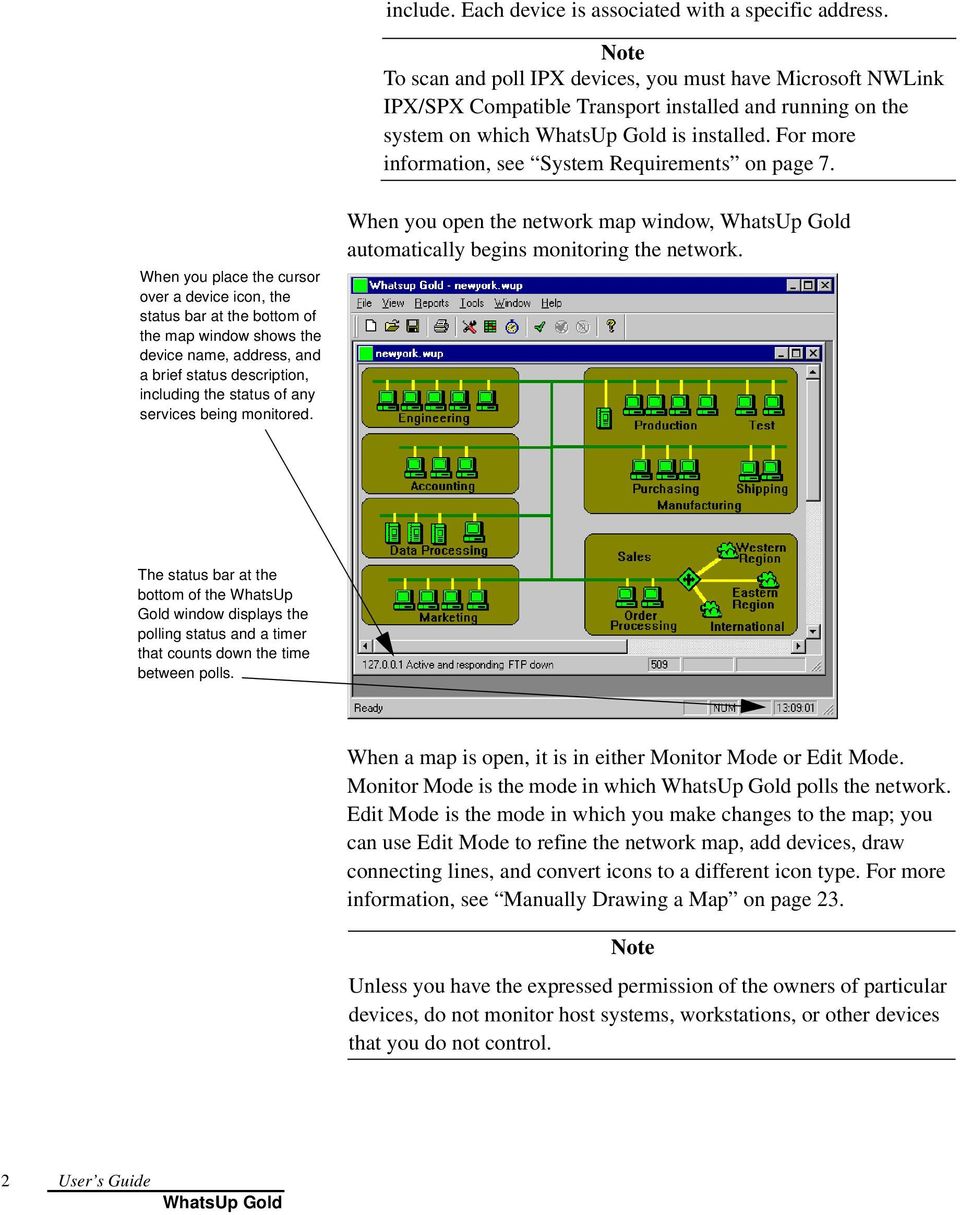
14 include. Each device is associated with a specific address. Note To scan and poll IPX devices, you must have Microsoft NWLink IPX/SPX Compatible Transport installed and running on the system on which is installed. For more information, see System Requirements on page 7. When you place the cursor over a device icon, the status bar at the bottom of the map window shows the device name, address, and a brief status description, including the status of any services being monitored. When you open the network map window, automatically begins monitoring the network. The status bar at the bottom of the WhatsUp Gold window displays the polling status and a timer that counts down the time between polls. When a map is open, it is in either Monitor Mode or Edit Mode. Monitor Mode is the mode in which polls the network. Edit Mode is the mode in which you make changes to the map; you can use Edit Mode to refine the network map, add devices, draw connecting lines, and convert icons to a different icon type. For more information, see Manually Drawing a Map on page 23. Note Unless you have the expressed permission of the owners of particular devices, do not monitor host systems, workstations, or other devices that you do not control. 2 User s Guide
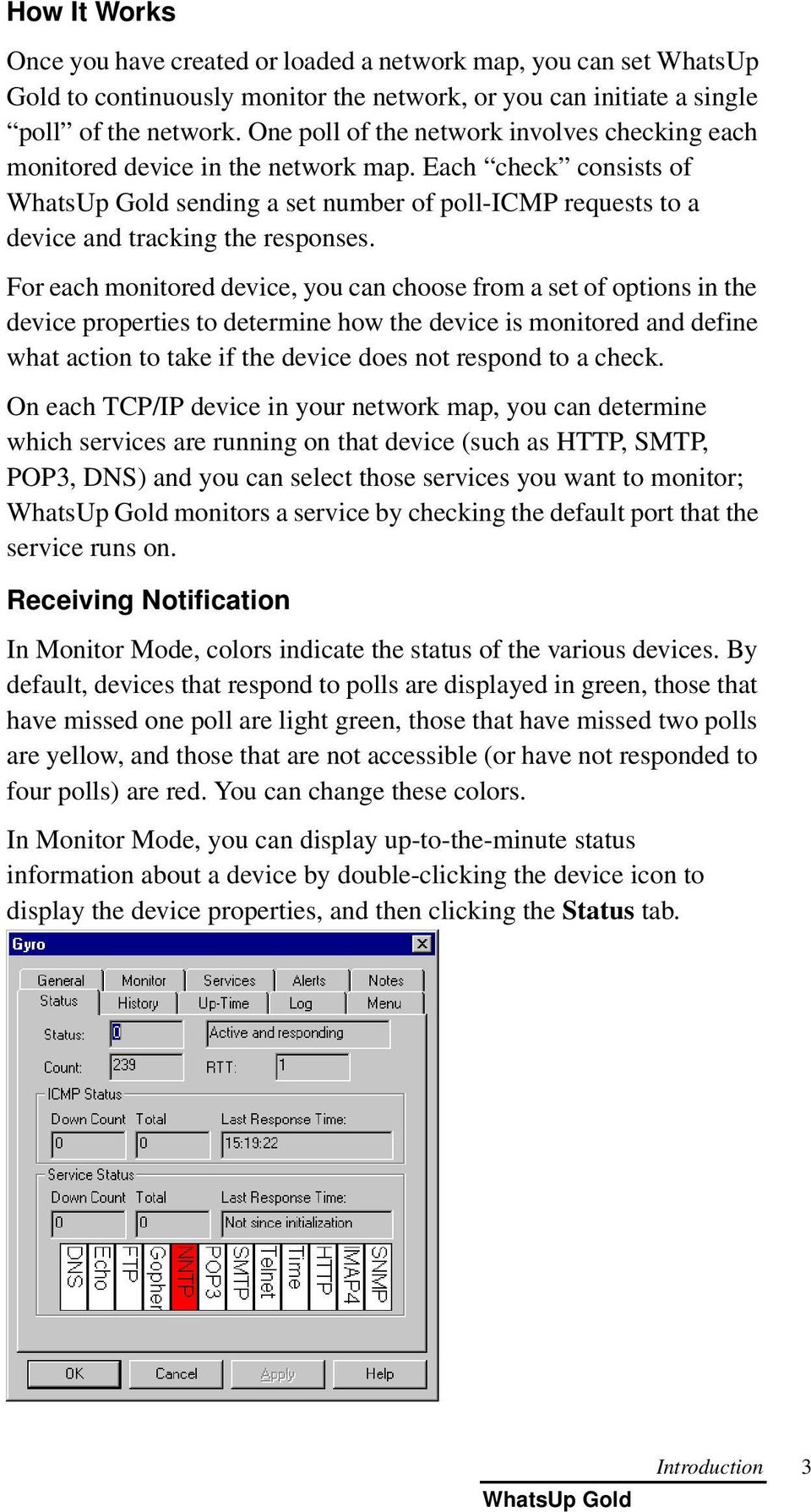
15 How It Works Once you have created or loaded a network map, you can set WhatsUp Gold to continuously monitor the network, or you can initiate a single poll of the network. One poll of the network involves checking each monitored device in the network map. Each check consists of sending a set number of poll-icmp requests to a device and tracking the responses. For each monitored device, you can choose from a set of options in the device properties to determine how the device is monitored and define what action to take if the device does not respond to a check. On each TCP/IP device in your network map, you can determine which services are running on that device (such as HTTP, SMTP, POP3, DNS) and you can select those services you want to monitor; monitors a service by checking the default port that the service runs on. Receiving Notification In Monitor Mode, colors indicate the status of the various devices. By default, devices that respond to polls are displayed in green, those that have missed one poll are light green, those that have missed two polls are yellow, and those that are not accessible (or have not responded to four polls) are red. You can change these colors. In Monitor Mode, you can display up-to-the-minute status information about a device by double-clicking the device icon to display the device properties, and then clicking the Status tab. Introduction 3
16 In addition, you can define notification actions (such as sending a message to a pager or account) for a device or a range of devices. What s New in Version 4.0? Version 4 of offers many new capabilities: Data reporting and export, including comprehensive Event Reports, Statistics Reports, and raw data output to a tabdelimited file A group notification that allows you to define response teams by combining multiple notifications into a single named group User-defined device types and icons that allow you to create your own application-specific device types Enhanced custom services monitoring, including the ability to define custom services globally and monitor them on any device Extensible interface for specifying additional custom services monitoring using Microsoft s Component Object Model (COM) plug-in technology. See the Note under Custom Services API on page 76. Standard Features Standard features fall into three categories: mapping, monitoring, and notification. Mapping Capabilities The mapping capabilities of include: Automatic network scan and mapping Multiple protocol support: TCP/IP, Novell NetWare IPX, and Microsoft NetBIOS Drawing tools for organizing your network map Linked subnet mapping and monitoring 4 User s Guide
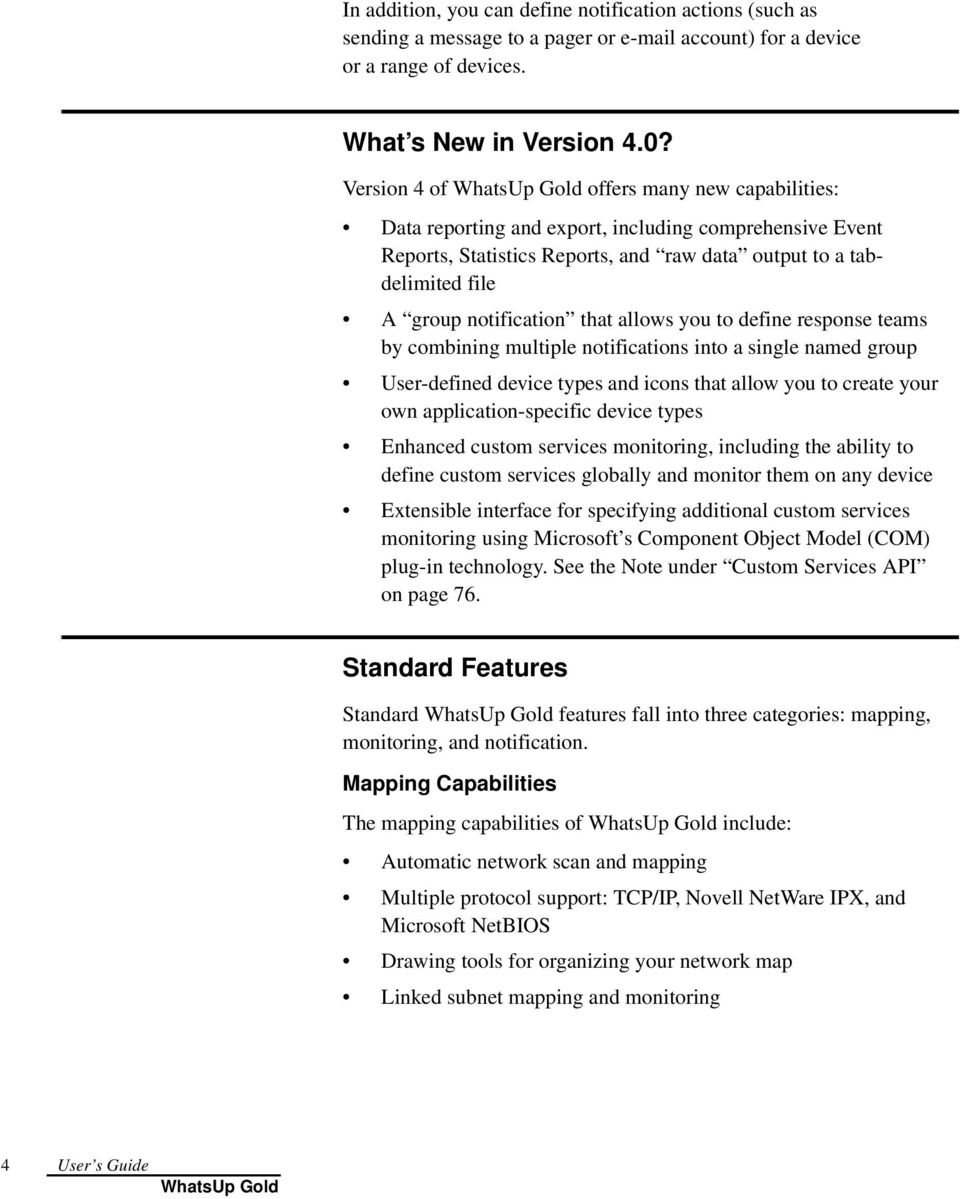
17 Monitoring Capabilities The monitoring capabilities of include: Monitoring of a range of devices, including hosts, servers, hubs, workstations, bridges, routers, LAN concentrators, and printers Scalability from small flat networks to large hierarchical, subnetted networks Graphical display in map window of monitored devices and their status Multiple views of the network (in addition to the map window) Status Window that shows each component, its status, and the status of any services being monitored Statistics Window that shows statistics for a network map and lets you sort on column headings Introduction 5
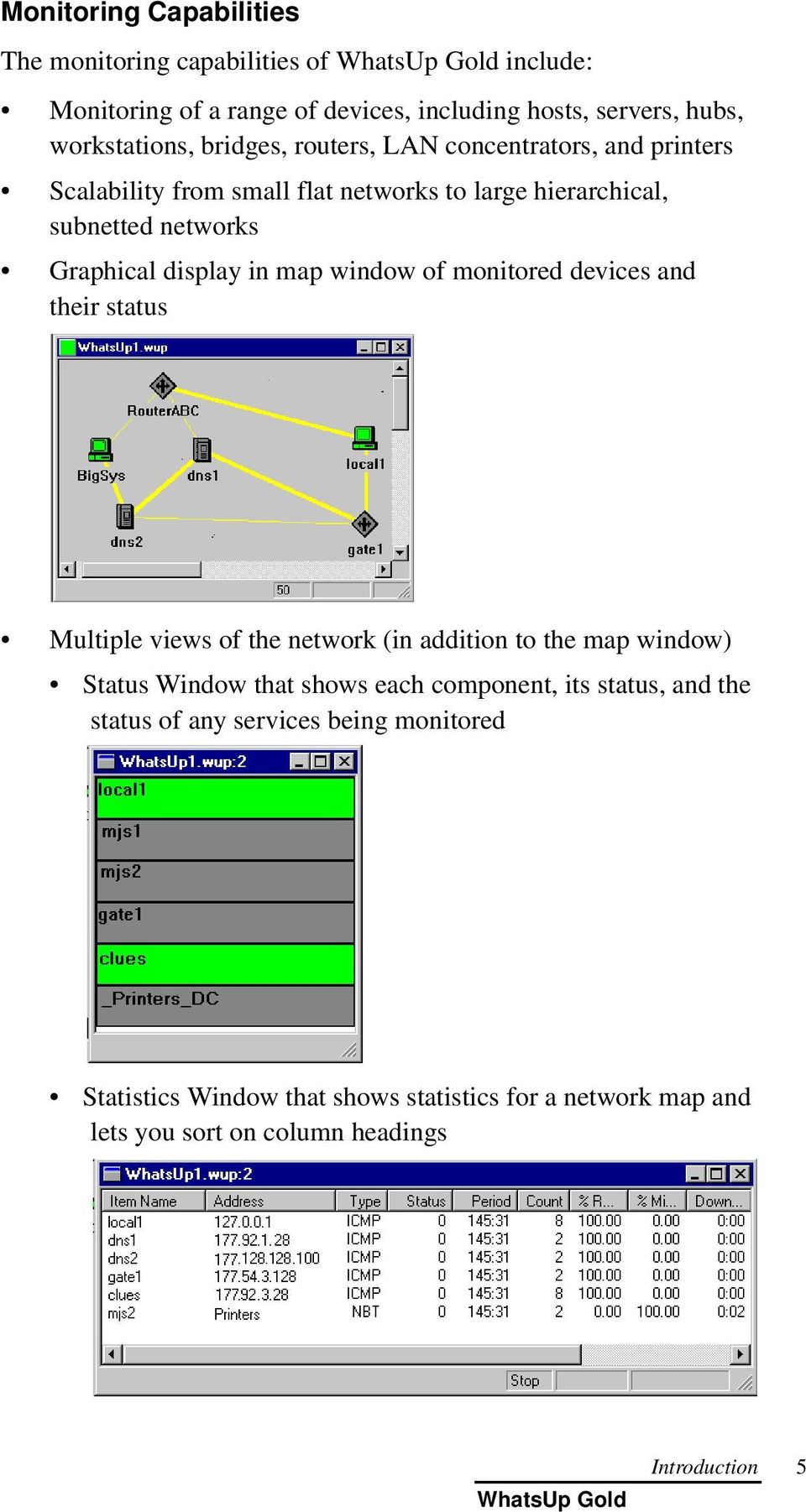
18 Dependencies Window that shows user-defined up and down dependencies as well as the polling sequence for a network Ability to save different configurations ( contexts ) of WhatsUp Gold windows Display and polling of multiple network maps simultaneously On-going confirmation of network connections Capture and reporting of network statistics such as response time, total number of polls, total lost packets, and response time Ability to make the checking of a particular device dependent on the status of another device Scanning of all IP ports on networked devices, identifying the standard services running on each port (e.g., SMTP, POP3, FTP, Telnet, WWW, or NNTP). Notification of SNMP traps, and graphing of real-time SNMP data, such as the packet input and output of a monitored router Web access to open network maps and full administration capabilities from any web browser on the network. Users can log on to the web server and (depending on assigned permissions) can view map status, device status, or logs. With permissions, they can also configure maps, devices, reports, and users. Ability to run as an NT service and use the web interface to view maps and monitor your network Network tools that let you search for and display information about organizations, networks, computers, or people on a network (Ping, Traceroute, Lookup, Whois, Finger, Whois, LDAP, Quote, Scan, SNMP, Time, Info, HTML, and Throughput) Ability to configure to use your favorite Telnet program 6 User s Guide

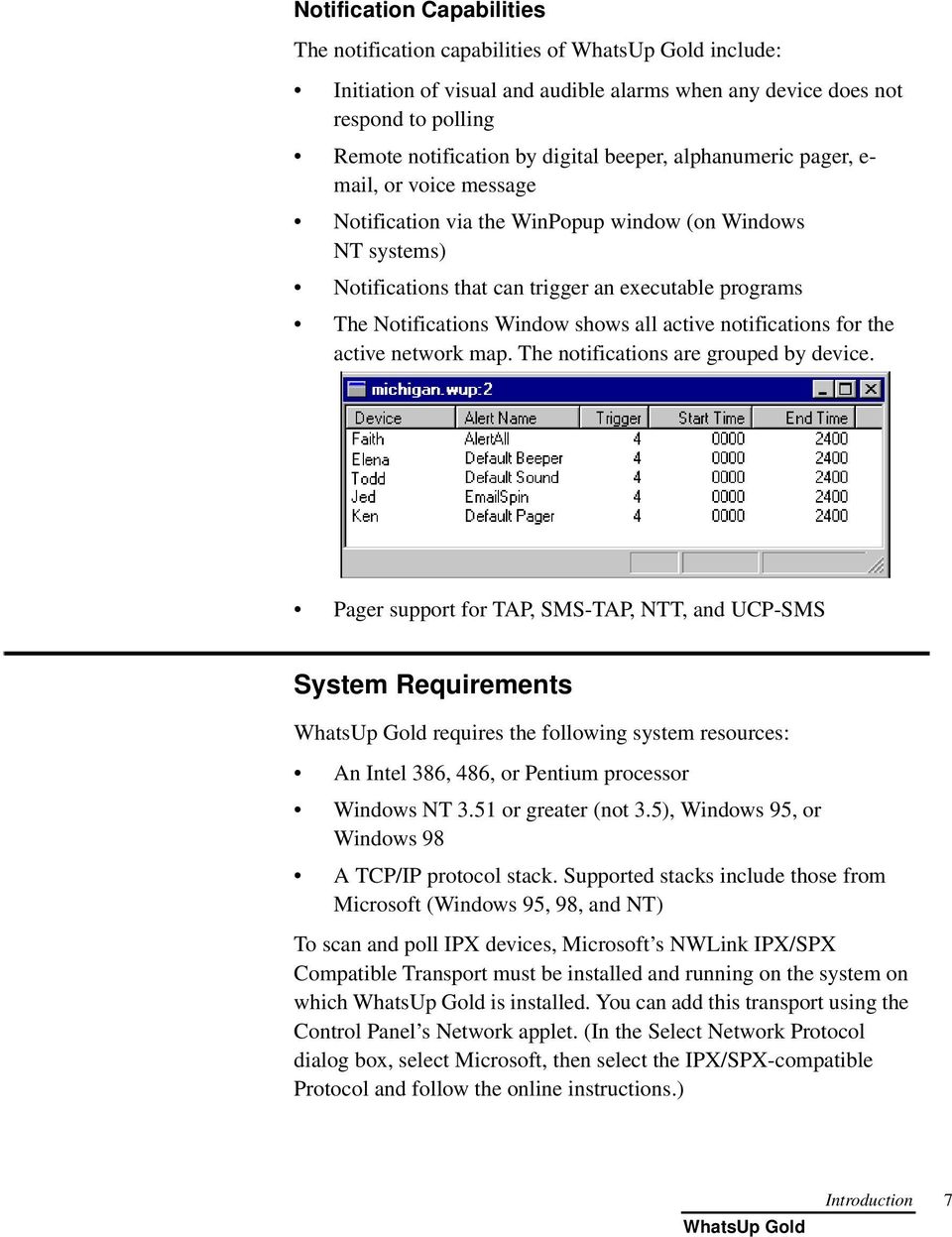
19 Notification Capabilities The notification capabilities of include: Initiation of visual and audible alarms when any device does not respond to polling Remote notification by digital beeper, alphanumeric pager, e- mail, or voice message Notification via the WinPopup window (on Windows NT systems) Notifications that can trigger an executable programs The Notifications Window shows all active notifications for the active network map. The notifications are grouped by device. Pager support for TAP, SMS-TAP, NTT, and UCP-SMS System Requirements requires the following system resources: An Intel 386, 486, or Pentium processor Windows NT 3.51 or greater (not 3.5), Windows 95, or Windows 98 A TCP/IP protocol stack. Supported stacks include those from Microsoft (Windows 95, 98, and NT) To scan and poll IPX devices, Microsoft s NWLink IPX/SPX Compatible Transport must be installed and running on the system on which is installed. You can add this transport using the Control Panel s Network applet. (In the Select Network Protocol dialog box, select Microsoft, then select the IPX/SPX-compatible Protocol and follow the online instructions.) Introduction 7
20 Upgrading If you are upgrading from a previous version of or WhatsUp, you should note the following: Back up any network maps (.db for WhatsUp and.wup for ). (When you open a.db file in, the file is automatically converted to the.wup format and saved with a.wup extension.) Back up your services.ini and hosttypes.ini files. During installation, will ask if you want to overwrite your old services.ini and hosttypes.ini files; answer No. Be sure that has completely shut down before doing an upgrade installation. If you exit during a check, it may take up to 30 seconds for to remove itself from memory. Until it is removed from memory, WhatsUp Gold will appear in the task list if you press Ctrl+Alt+Del. If you install as an NT service, you will have to manually stop the service before upgrading. The installation program will not attempt to stop the service before updating and will not remove the service if you select to remove the previous installation. In other words, the service has to be installed manually and thus must be removed manually. Note Any notifications you have already defined are stored in a file named ipnotify.ini in your Windows or NT directory. This file is shared by other Ipswitch products and is therefore not deleted or replaced when you uninstall or upgrade. Furthermore, if you ever move to a new system, you will need to manually copy the ipnotify.ini file to the Windows or NT directory of the new system. 8 User s Guide

21 Installation To install or upgrade : 1 Insert the Disk 1, or CD-ROM, into the appropriate drive. 2 Do one of the following: For Windows 95, 98, and NT 4.0, click Start, select Run, and then enter the diskette/cd path followed by install.exe. For example: a:install.exe For Windows NT 3.51, select Run from the File menu, and then enter the diskette/cd path followed by install.exe. For example: a:install.exe 3 To view a demo of, open the map named world.wup. Testing on Your Network The following procedures let you try out. They take you through starting a simple network map, adding a file server, and editing the map. Edit Mode button Add Workstation button Display tool Creating a New Network Map To create a new network map: 1 Select New from the File menu. 2 Select Create a blank map and click Finish. displays a blank map. 3 Click the Edit Mode button in the main toolbar. displays the Edit Mode toolbars. 4 Click the Add Workstation button in the Edit Toolbar, and then click the map to create an icon for the workstation. 5 Click the Display tool in the Edit Toolbar, and then click the device icon you just created. The device properties appear. Introduction 9
22 6 On the General tab, enter the information as shown. Set the Display Name to ConsoleTest or whatever name you would like for the console (the system on which WhatsUp Gold is installed). Set the Address to for this device. (This is the local loopback network address; it is the address you use to monitor your own system from your system.) 7 Click the Monitor tab and select Monitor This Device. 8 Click the Alerts tab and select Enable alerts and Enable Sound. 9 Click OK. Add Server tool Display tool Adding a File Server To create an icon for one of your file servers: 1 Click the Add Server tool in the Edit Toolbar, and then click the desired location on the map to create the icon. 2 Click the Display tool in the Edit Toolbar, then click the icon you just created to view its properties. 10 User s Guide
23 3 On the General tab, set the Display Name to Server. 4 Set the Address to the IP address, or set the Host Name text box to the name of a system on your network. (Note: If you use a name, the network stack must be able to resolve it from a local hosts file or by looking it up on a Domain Name Server, a server that lists host names and their IP addresses. This name is looked up whenever the map is loaded.) 5 Click OK. 6 Click the Monitor tab, select the Monitor This Device. 7 Click the Alerts tab and select Enable alerts and Enable Sound, and then click OK. 8 Save the map by selecting Save As from the File menu. Save the map with the name of MyTestMap. Edit Mode button Check button Initiating Monitoring You are now ready to start monitoring your little network of two items. 1 Click the Edit Mode button to exit Edit Mode and return to Monitor Mode. 2 Click the Check button to poll the network. Introduction 11
24 Your screen should look something like this. The status bar indicates that is polling and shows the total count of polls. Running as an NT Service can run as a system service on Windows NT 4.0 or later. When running as a service, uses only the web monitor as its user interface. To use less memory, no map windows are opened on the NT console. Running as an NT service allows you to log off the NT console, thus providing an extra level of security; the service can run completely hidden. As with any NT service, you can set WhatsUp Gold to restart whenever Windows NT is rebooted. Setting Up to Run as an NT Service We recommend that you create your network maps using WhatsUp Gold in normal operating mode on the Windows NT console. Once your maps are created, select any desired program options (from the View menu, select Program Options). These options will be in effect during operation as an NT service. On the Startup tab in the Program Options, you can specify multiple maps to load at startup in the Map Names box by specifying the names of the maps, separated by commas. Additional maps can be subsequently loaded and unloaded using the web interface, provided the maps are in the directory specified in the Directory box. Note that contexts are not used when operating as an NT service. 12 User s Guide
25 If you set up any permissions or other web configuration parameters (set on the Web and Web Users tabs) while running in normal operating mode on the NT console, you may need to reboot the server before switching to NT service mode. On the Web Users tab, if you select Automatically save changes from web interface, you will be able to change program options from the web interface. Starting and Stopping the NT Service Your installation includes an executable file named wugsvc.exe for the purpose of installing, removing, starting, and stopping the NT service. To install and start as an NT service, enter the following command at the Command Prompt: wugsvc -install To remove as an NT service, enter the following command at the Command Prompt: wugsvc -remove Note that these two commands don t install or remove ; they merely install and remove the NT service capability. Upgrading After Installing as an NT Service If you install as an NT service, you will have to manually stop the service before upgrading. The installation program will not attempt to stop the wugsvc service before updating and will not remove the service if you choose to remove the previous installation. In other words, the service has to be installed manually and thus must be removed manually. Introduction 13
26 14 User s Guide
27 Chapter 2: Creating Network Maps With, you can use one of the automatic methods to quickly create a map of your network; then you can start polling your network immediately, using the default properties that assigned to the map and the individual network devices. However, to customize so it polls your network exactly the way that best suits your needs, you ll probably want to do the following steps (covered in this chapter): 1 Create a network map using one or more WhatsUp tools or techniques 2 View and edit the default properties for network devices (hosts, servers, etc.) 3 View and edit the default map properties 4 Use Edit Mode to visually organize your network map Creating a Network Map The network map is a graphical representation of the devices in a network. The following shows a typical network map. Network devices can be workstations, hosts, servers, routers, bridges, hubs, LAN boxes, printers, subnetworks ( subnets ), or custom host types. Creating Network Maps 15
28 provides several methods and tools to create a network map and add devices to it: Discover and Map - uses the Windows registry, hosts file, and network information to detect network devices Hosts file - uses the hosts file on your system Scan - locates devices within a range of IP addresses Scan WinNet - scans your Windows network for devices Traceroute tool - maps routers between your local host and a remote host Edit Toolbar - provides tools you can use to add devices to a network map You can use any combination of methods and tools to create a network map. Each of these methods and tools is described in the following sections. Discover and Map Network Devices The Discover and Map capability creates a map from information on your computer or on the network to which your computer is connected by reading network files and identifying devices listed in the files. These files can include a hosts file, the Windows registry, and Windows network information. To use the Discover and Map capability: 1 From the File menu, select New to view the New Map dialog box. 16 User s Guide
29 2 Select Discover and map network devices, and then click Next. The Discover Devices screen appears. 3 Select the parameters you want to use to create the map. Import devices from registry. Reads the Windows registry to find host names and IP addresses, and creates an icon for each host. Import devices from hosts file. Reads a hosts file on the local system and creates an icon for each network device. Discover devices from Network Neighborhood. If your computer is connected to a Microsoft Windows network, scans the network and creates an icon for each device it finds. (This can take a few minutes, depending on the size of your network.) 4 Click the Next button. An information screen appears. Click Finish to start the Discover and Map process. loads the network files and creates icons for any network devices it finds. 5 From the File menu, select Save or Save As to save the map. 6 See Tips for Making a Map Easier to Read on page 23. Loading a Hosts File You can load a hosts file (which lists device names and their associated IP addresses) and creates an icon for each device listed in the file. Creating Network Maps 17
30 1 Select an existing map or create a new map window. To select an existing map, select Open from the File menu and enter a map file name; the devices in the hosts file will be added to this map. To create a new map, select New from the File menu. Select Create a blank map, and then click Finish. 2 From the Tools menu, select Import -> Hosts File. The Browse dialog box appears. 3 Locate the hosts file and click OK. reads the hosts file and creates an icon for each network device it finds. 4 From the File menu, select Save or Save As to save the map. 5 See Tips for Making a Map Easier to Read on page 23. Using the Scan Tool To automatically detect the network devices within a specified range of IP addresses, you can use the Scan tool. You specify a range of IP addresses to be scanned, and polls each address in the range. If finds an active network device in the range, it creates a workstation icon for the device. The Scan tool can also identify the network services (such as FTP, HTTP, SMTP) on each network device. To start a Scan: 1 Select an existing map or create a new map window. To select an existing map, select Open from the File menu and enter the map file name; the devices found by the Scan tool will be added to this map (if you select Map Results as described below). To create a new map window, select New from the File menu. Select Create a blank map and then click Finish. 2 From the Tools menu, select Import -> Scan IP. The Scan dialog box appears. 18 User s Guide
31 3 Enter a range of network addresses to scan. Your current network is used as the default range. For example, if your network addresses range from through , you enter the range shown above. The scan works consecutively from the last number of the Start Address through the last number in the End Address. For example, if you enter as the Start Address and as the End Address, the Scan only scans from 50 to 60 in each of the networks from through Set the scanning options. Map Results. Select this option so that will create an icon on the map for each device it finds. Resolve Names. If you select this, resolves the host name for each active IP address and displays the name in the dialog box; the name is also displayed on the map if Map Results is selected. Timeout. Enter the timeout in milliseconds (ms). If a network device does not respond to the Scan within this time, the Scan continues on to the next IP address. This should be set to 300 ms or greater. For maximum scanning speed, set this to 300 ms and uncheck Resolve Names. Creating Network Maps 19
32 DNS, Echo, FTP, Gopher, HTTP, IMap4, NNTP, POP3, SMTP, SNMP, Time. Select the services you want to scan for, and will scan each active network device in the IP address range for the selected services. However, note that scanning network devices for these services can significantly increase the time it takes to complete a scan. All IP. The Scan finds all the devices in the specified range of IP addresses. If this not selected, the Scan finds only those devices that are running one of the services selected. Scan Ports. Make sure this is not selected when creating a map. See the Scan tool help topic for other uses of this tool. 5 Click Start. (The Start button toggles to Stop. You can click Stop at any time to stop the scan. Wait at least three seconds for the system to respond to a Stop request.) 6 Click Exit to close the Scan dialog box. 7 From the File menu, select Save or Save As to save the map. 8 See Tips for Making a Map Easier to Read on page 23. Results of the Scan When you start a Scan as described in Step 5 above, scans the range of IP addresses. For each active IP address it finds, it lists the address. It also lists the host name if Resolve Names is selected. If Map Results is selected, creates an icon on the 20 User s Guide
33 active map for each device it finds. On the device properties Services tab, the services found during the Scan are checked. Devices that have an SNMP service running are flagged with an asterisk. Services tab for the KentSquare device: However, if a device already existed on the active map, services found become selected on the Services tab of the device properties. Services tab of device properties before the Scan: Services tab of device properties after a Scan for SNMP and Echo services: If you ve defined a custom device type and select SNMP on the Scan tab, the Scan will recognize the custom device type and icon (if the correct entry has been made to the hosttypes.ini file). For more information, see Creating a Custom Device Type on page 35. Creating Network Maps 21
34 Using the Scan WinNet Tool The Scan WinNet tool creates a map by scanning the Windows network to which your computer is connected, and finding the other devices on the network. It creates an icon for each device that it finds on the network. To start a Scan WinNet: 1 Select an existing map or create a new map window. To select an existing map, select Open from the File menu and enter the map file name; the devices found on the Windows network will be added to this map. To create a new map, select New from the File menu. Select Create a blank map, and then click Finish. 2 From the Tools menu, select Import -> Scan WinNet. scans your Windows network and creates an icon on the map for each device that it finds. Note that this scan can take a few minutes to complete depending on the size of your network. Note The Scan WinNet will also find NetWare devices, but you will not be able to monitor these devices. 3 From the File menu, select Save or Save As to save the map. 4 See Tips for Making a Map Easier to Read on page 23. Traceroute Mapping The Traceroute tool lets you map the network devices (usually routers) that comprise the route of an IP packet from your local host to a remote Internet host. displays an icon for each router and shows the connections from router to router. 1 For information on how to use the Traceroute tool, see Tracing the Route to an Internet Host on page User s Guide
35 Manually Drawing a Map Edit Mode button You can create network devices manually by using Edit Mode. 1 Select an existing map or create a new map window. To select an existing map, select Open from the File menu and enter the map file name. To create a new map, select New from the File menu. Select Create empty map, and then click Finish. 2 In the main toolbar, click the Edit Mode button. The editing toolbars appear. 3 Use the drawing tools to create network devices. For more information, see Editing a Network Map on page From the File menu, select Save or Save As to save the map. 5 See Tips for Making a Map Easier to Read on page 23. Tips for Making a Map Easier to Read Edit Mode button If you have a large number of devices in your network and you used Discover and Map, Scan IP, or Scan WinNet to create a network map, the first version of the map may be a bit difficult to read. Use the tips below for making your map more readable. Select Map Properties from the File menu, and select Clip Names. You can also try the Wrap Names option to see if that makes the device names easier to read. Enter or modify the properties of the network devices. For starters, you might want to turn off monitoring for those network devices that you don t need to monitor right away. To do this, double-click the device icon to view the device properties; then click the Monitor tab and make sure Monitor This Device is turned off. Click the Edit Mode button and then drag device icons to new locations. For more information on organizing devices using shapes and lines, see Editing a Network Map on page 33. Creating Network Maps 23
36 To change a device s icon, double-click it to display its properties, select the General tab, then select a new Type from the drop-down list. Device Properties needs basic information about a device in order to monitor the device. When you create a map using Discover and Map, Scan IP, or Scan WinNet, automatically determines the device s display name, host name, and IP address. This section describes why and how you might change the default device properties that determines or assigns. The Polling Method By default, uses the ICMP polling method for TCP/IP devices, IPX for IPX devices, and NetBIOS for NetBIOS devices. You can change the default polling method at the bottom of the General tab of the device properties. ICMP sends packets (echo requests) to a device and tracks the responses. TCP/IP is useful for monitoring devices outside of a firewall when the firewall does not pass ICMP packets, but does pass TCP/IP packets. To use the TCP/IP method, at least one TCP/IP service must be monitored on the device (selected on the Services tab of the device properties). NetBIOS is the polling method to use for Windows networks. IPX is the polling method for Novell NetWare networks. Note To scan and poll IPX devices, the system on which WhatsUp Gold is installed must have Microsoft NWLink IPX/SPX Compatible Transport installed and running. For more information, see System Requirements in Chapter 1. If the polling method for a device is NetBIOS or IPX, you will not be able to monitor TCP/IP services on this device. 24 User s Guide
37 Defining General Properties On the General tab, you can make any changes to general properties, change the icon type for the device, and set the method uses to poll the device. To view or change device properties: 1 Double-click the device to display its properties, and click the General tab. 2 In the Display Name text box, enter a name using up to eight characters. This is the name displayed on the network map. 3 Host Name (limited to 25 characters). If the polling method is ICMP or TCP/IP, enter either the host name here or the IP address in Step 4. If you enter a host name, it must be a name that can be resolved to an IP address. If the polling method is NetBIOS or IPX, you must enter a valid NetBIOS or IPX name. 4 In the Address text box, enter a valid IP address. If the polling method is ICMP or TCP/IP and you entered a Host Name in Step 3, you can leave this blank and will use the Host Name to look up the IP address. Check the box next to the Address text box only if you want to look up the IP address each time it checks this device. (This is useful if you use DHCP to assign IP addresses dynamically, but note that if you use this feature for a large Creating Network Maps 25
38 number of devices, the name lookups put a heavy load on the DNS server.) If the polling method is NetBIOS or IPX, leave the address blank; will display the hardware Ethernet address of the device after it completes one poll. 5 In the Type text box, select the desired device type from the dropdown list. This selection determines which icon is displayed on the network map. Note that the subnet icon is a special type that is used to link a subnet map to a primary map. For more information, see Creating a Subnet on page In the Info Line 1 and Info Line 2 text boxes, enter any additional information about this device. This information can be included in notification messages. For example, you can enter a point of contact for a device or location. 7 Select the method to use for polling this device. For detailed information, see The Polling Method on page Click Apply to apply your changes. Click OK to apply the changes and exit the dialog box. Setting Up Monitoring You use the Monitor tab to turn monitoring on or off for a device, to specify how often to check the device, the number of seconds to wait for a response, and any up or down dependencies. 1 In the device properties, click the Monitor tab. 26 User s Guide
39 2 Make sure Monitor This Device is selected. 3 In the Poll Frequency text box, enter a value to determine how often this device should be checked. The Poll Frequency determines if this device is checked on every poll (value = 1), every second poll (value = 2), every third poll (value = 3), and so on. The default value is every poll (1), but you can use this property to poll a particular device less frequently. 4 In the Timeout text box, enter the number of seconds to wait for a response from a monitored device. You can enter a value from 1 to 20 seconds. The default value (set in the map properties) is 5 seconds. This timeout should be set to the smallest possible value. For a local network, a timeout of 2 seconds is usually sufficient. For a long-distance (or slow-path) network, this timeout may need to be as high as 10 seconds. 5 Set the Time Period options to specify when you want to monitor this device. Click the Change button to change the default setting of 7 days a week, 24 hours a day. Select the Day of Week options: 7 days a week is the default. You can clear the 7 days a week option and then select the specific days of the week that you want to monitor this device. Select one of the three Time of Day options: 24 hours a day means that monitoring is active all day. Between lets you specify the hours between which the device will be monitored. Not between lets you specify the hours that monitoring will not be active. Because the first value must be less than the second value, use the Not between option to enable monitoring between an afternoon time and a morning time. Click OK to save your changes and exit the dialog box. 6 (Optional) To draw an attached line from this device to another device, select a device from the Connected to item drop-down list. (Attached lines move when you move the device icon.) draws an attached line between the devices. This is the primary connection (width of two pixels) if it is the only connection from the device or the most recent connection made from that device. In these cases, any other attached lines from this device will be secondary connections (width of one pixel). Creating Network Maps 27
40 7 To make this device an up dependency for another device (meaning it gets checked only if the other device is up), select the other device from the Check only if up item list. 8 To make this device a down dependency for another device (meaning it gets checked only if the other device is down), select the other device from the Check only if down item list. 9 Click Apply to apply your changes. Click OK to apply the changes and exit the dialog box. Using the Right Mouse Menu Select a device and then click the right mouse button to display the device pop-up menu. When you re in Edit Mode, the menu looks like the image to the left; in Monitor Mode, the menu has fewer commands. New lets you add devices to the map. Edit lets you cut, copy, paste, and delete. Item Properties shows you the device properties. Net Tools is the same as selecting Net Tools from the Tools menu. Import is the same as selecting Import from the Tools menu. Connect calls telnet.exe or whatever program you specify in the Telnet program box on the Progs/SNMP tab of Program Options. Ping sends an ICMP echo request to the device. Traceroute shows the network path used to reach a specified TCP/IP address. Browse. If this device is running a web server on port 80, this command launches a web browser and finds the web site. Attach to draws an attached line from the selected device to the next device you click. Disconnect disconnects any attached lines from the selected device. Move to Top. If the selected item is a drawn shape, such as a rectangle or circle, this command moves it in front of all other drawn shapes. Move to Bottom. If the selected item is a drawn shape, such as a rectangle or circle, this command moves it behind all other drawn shapes. 28 User s Guide
41 Creating a Subnet Edit Mode button Add Subnet tool The Subnet feature of allow you to create separate maps for different segments of your network, yet maintain a connection between the maps. If you already have a primary network map, you create a second network map for a particular network segment and then link it to the primary map; this makes the second map a subnet of the primary map. can simultaneously monitor the network map and any subnet maps. When a device or service goes down in a subnet map, the subnet icon on the primary map changes color to indicate that there s a problem in the subnet. The subnet icon in the primary network map will have the color of the highest priority alarm that occurs in the subnet map. For example, if a device in the subnet does not respond to four polls, the subnet icon is red. To create a subnet map (assuming you already have a primary map): 1 Create a new map and add the devices for the subnet. You can use any of the methods for creating a network map described in the previous section. You can also cut and paste devices from an existing map. 2 Save the new map. 3 Open the primary map or, if it s already open, make it the active map. 4 Click the Edit Mode button to view the editing toolbars. 5 Click the Add Subnet tool and then click the primary map where you want to create the subnet icon. 6 Double-click the subnet icon to display its properties and click the General tab. 7 In the Display Name box, enter the file name of the subnet map, not the Map Title. This must be the name of the.wup file without the file extension. For example, if the subnet map file is named SubnetA.wup, you enter SubnetA here. 8 Click Apply to save your changes. On the Monitor tab, make sure Monitor This Item is selected. Creating Network Maps 29
42 When you open a network map, can also open any associated subnet maps and start monitoring them. (From the View menu, select Program Options -> Startup, and then enable the Auto Load Subnets option.) If a subnet map window is not opened, you can right-click the subnet icon and select Load Subnet from the menu to open it. If a subnet map is opened but is hidden behind other windows, you can right-click the subnet icon and select View Subnet from the menu to bring the subnet map to the top. Setting Map Properties You can set the polling and display properties for each primary network map and subnet map. Open the map window for the network map, then select Map Properties from the File menu. Or, right-click an empty area of the map to display the right mouse menu and then select Map Properties. Map Title. This title is used to identify the network map when accessed from a web browser. Map Poll Frequency. This is the number of seconds between the start of polls. The status bar of each map window displays a timer that counts down from this number to zero before starting each poll. 30 User s Guide
43 Note that this timer continues to count down during polls: if the previous poll is not complete when the timer reaches zero, a new poll is not started. Default Timeout. This is the number of seconds to wait for a response from a polled device. This default value is used for new devices that are added to the map. Auto Resize Map. When this is selected, the map shrinks to fit the display window, if necessary. If the window is larger than required to display all of the devices, the map is not resized. (This option applies to the map window in Monitor Mode only, it does not affect Edit Mode.) Clip Names. When this is selected, the Display Names for devices are terminated at the first space or period in the name, thus shortening the display name. Wrap Names. When this is selected, long display names are wrapped at every space or period in the name. Host Label Font. Specifies the font used for the device s Display Name. Click the Change button to open the standard Windows font selection dialog box. The Sample Label shows the current font selection. Map width/height in pixels. Specifies the maximum map size and the size of the internal display buffers. These should be set to the same size as the display screen. The default setting is 800 by 600. In Edit Mode, these settings appear as a dotted line in the map. Bitmap Background. Allows you to specify a bitmap to use as a background for a map. This could be a floor plan, a geographical map, or any other image you want. You can position the bitmap to completely fill the map background (Stretch), or place it within the map using the TopLeft, Center, or Tile settings. Note that the color depth of the bitmap must be equal to, or less than, the color depth of the screen. Creating Network Maps 31
44 Setting Map Colors For each network map, you can set the default colors for the various alerts and for the various parts of the map window (such as the background, attached lines, and other drawn objects). To set map colors: 1 Place the cursor on an empty area of the map and select Map Properties from the right mouse menu. 2 Click the Colors tab. 3 To change the color for an item, select the item name in the list box and click the desired color. Responding. This is the color that indicates that a device is responding to polls. The default is solid bright green. Lost 1 pkt. The color that indicates that a device has not responded to one poll. The default is solid light green. Lost 2 pkts. The color that indicates that a device has not responded on two consecutive polls. The default is solid yellow. Lost 3 pkts. The color that indicates that a device has not responded on three consecutive polls. The default is solid yellow. Lost 4-7 pkts. The color that indicates that a device has not responded on four to seven polls. The default is solid light red. Lost 8+ pkts. The color that indicates that a device has not responded on eight or more polls or has a network error. The default is solid dark red. Service down. The color that indicates that a service is down on a device. The default is solid purple. Inactive. The color that indicates a device that is not being monitored. The default is solid dark grey. Background. The color of the map window background. The default is solid light grey. Text. The color for drawn text. The default is solid black. Attach lines. The color for attached lines. The default is solid yellow. 32 User s Guide
45 Note The default color for freehand (unattached) lines is black; you can change this using the color toolbar. Editing a Network Map You use Edit Mode to move device icons around in the map window. When you re in Edit Mode, you can use tools to: Add and delete device icons Cut, copy, and paste device icons and drawn objects Draw, color, and size graphic shapes to visually organize network elements Edit Mode button Getting In and Out of Edit Mode To access Edit Mode, make sure the map that you want to edit is active, then click the Edit Mode button in the main toolbar. The editing toolbars appear. Note stops polling the network when you re in Edit Mode. Draw Toolbar Use the Draw Toolbar to add free (unattached) lines, rectangles, filled rectangles, ellipses, filled ellipses, and text blocks to your map. Creating Network Maps 33
46 Edit Toolbar Use the Edit Toolbar to create device icons and to select, move, cut, copy, and paste device icons and drawing objects. When the display tool is active, you can click a device icon to view and modify its properties. The select tool is the default active tool. When the select tool is active, you can drag any map object to a new location. Add workstation Add server Add host Add router Add bridge Add LAN box Add printer Add hub Add subnet Add custom device. For more information, see Creating a Custom Device Type on page 35. Edit Mode button To exit Edit Mode and return to Monitor Mode, click the Edit Mode button again. The toolbars disappear. Keeping Tools Active When you re in Edit Mode, you click a tool to use it. By default, the tool stays active for one operation. If you want the tool to remain active until you decide to change it, select Keep Buttons Down from the Options menu. Border color Fill color Drawing To draw a shape, such as a rectangle, ellipse, filled rectangle, or filled ellipse, click the appropriate tool, and then drag to create the shape. The shape uses the active border color, as shown in the illustration to the left. Filled objects use the active fill color. To change the border color, click the left mouse button on any color. To change the fill color, click the right mouse button on any color. 34 User s Guide
47 Creating a Custom Device Type The Edit Toolbar provides tools that let you add a workstation, host, server, router, bridge, hub, LAN box, subnet, or custom devices to your network map. To create a custom device type, 1 Select Device Types from the View menu. 2 Click New. 3 Enter a name for the new device type and click OK. 4 In the Icon Filename text box, enter the name of an icon (.ico) file that: Has a depth of 16 colors Is exactly 32 pixels tall and 32 pixels wide Has a black border surrounded by white Has transparent pixels that can use to display status colors 5 Select the Type (polling method) of the device. For more information, see The Polling Method on page If the Type is TCP/IP, select whatever Services you want to monitor by default when you create a device of this type. Creating Network Maps 35
48 Custom device tool 7 Click Save to save the new device type. To use the custom device type on a network map: 1 Click the custom device tool in the Edit Toolbar. 2 Click the map location where you want to add the custom device type. You see the following dialog box. 3 Choose the custom device type from the drop down list. 4 Click OK. If you have created a custom device and you intend to use the Scan tool (with the Map Results option turned on) to add devices to an existing network map, you will probably want the Scan tool to automatically use the proper custom icon for the device. To have the Scan tool use the custom icon, the following conditions must be met: The SNMP agent must be enabled on the device(s) you want to be mapped as custom devices. You must know the correct community name for the device. (You will be prompted for this; the default community name is public.) The hosttype.ini file must include a section (added with a text editor) for the custom host type that specifies: [device_name_in_brackets] BMPNAME=bitmapname TYPE=0 SCOUNT=0 OBJID=sysobjectid where bitmapname is the name of the.ico file, and sysobjectid is the number for the SNMP object named SysObjectID. (For examples of what these entries should look like, open hosttype.ini in a text editor to view existing entries.) SNMP must be selected on the Scan tab when you run the Scan tool. 36 User s Guide
49 If any of these conditions are not met, the Scan tool will use one of the standard device icons for the custom device. Changing Item Properties To change the line width or color of a drawn object, select the object, and then select Item Properties from the pop-up menu. Attached Lines In addition to the freehand lines that behave like any other drawn object, you can also use attached lines. You can attach a device to up to five other devices or drawn objects. The primary connection (the last connection made) is represented by a line that is two pixels wide. Any secondary connections (all other connections) are shown as lines that are one pixel wide. To attach one device to another: 1 Right-click the device icon you want to draw an attached line from; this displays the right mouse menu. 2 Select Attach to. The cursor changes to a line character. 3 Click the item to which you want to attach the device. Or, to set only the primary connection: 1 Double click a device icon to display its properties. 2 Click the Monitor tab. 3 In the Connect to drop-down list, select the primary device to attach to. To disconnect attached lines: When you move an icon that has attached lines, the attached ends of the lines move with it. 1 Right-click an attached device. 2 Select Disconnect from the right mouse menu. Creating Network Maps 37
50 Or, to disconnect only the primary connection: 1 Double click a device to display its properties. 2 Select the Monitor tab. 3 In the Connect to drop-down list, select None. Text tool Creating Text Captions You can use text captions to further identify a network map or segments of a map. Text is available in many fonts, sizes, text effects, and colors. In addition, you can specify an opaque background for the text block, which is also available with a choice of colors. Text blocks can be rotated a full 360 degrees (if you select a TrueType font) to address special text labeling requirements. To add text to the network map: 1 Select the border color in the Color Toolbar. 2 In the Draw Toolbar, click the Text tool. 3 Place the cursor where you want to locate the text and click. The Sample Text and its properties dialog box appear. 4 In the Text box, replace Sample Text with the desired text. 5 Set the color, font, or rotation options as appropriate. Foreground. Click Change Color to select another color. Opaque. Select this to set the text against a background color. Background. If Opaque is selected, the background color is used. You can click Change Color to select another color. Change Font. Click Change Font to change the font of the text. Rotation. Enter a number from 0 to 360 to represent the degrees to rotate the text. You must be using one of the TrueType fonts in order to rotate text. Note Even after you rotate text, the text retains its original anchor points. To select rotated text, click an original anchor point. 6 Click OK. 38 User s Guide
51 Arranging the Toolbars In Edit Mode, you can arrange the five toolbars any number of ways, on or off a gray toolbar backdrop. Toolbar backdrop To make a toolbar float in its own window, drag the double gray lines at the top of the toolbar to an area off the toolbar backdrop. To move a free-floating toolbar onto the toolbar backdrop, drag its title bar to the toolbar backdrop; to use the toolbar backdrop if it s not visible, double-click a toolbar s title bar. You can also reshape the Standard Toolbar by grabbing a side and drag to the desired shape. Saving and Naming a Network Map If you save a new map by selecting Save from the File menu, the map file is saved with a default name. The first default file name assigned by is WhatsUp.wup, and subsequent maps saved this way are named WhatsUp1.wup, WhatsUp2.wup... WhatsUpn.wup. To save a map with your own name, use the Save As command. Creating Network Maps 39
52 40 User s Guide
53 Chapter 3: Setting Up Notifications When a device does not respond to polling, or when a service goes down on a device, or when an SNMP trap is received, can notify you in several ways; it can: Change the color of the device icon on the map Invert the icon s name Sound an alarm Activate a beeper Send a message to a pager Send an message Send a pre-recorded voice message to a telephone or answering machine (if you have a voice modem installed) Display a WinPopup on a Windows NT system Send a group of notifications You can also set up a recurring report to use a beeper, pager, or message to send a network status report at a specified time interval. For more information, see Sending Network Status Reports in Chapter 5. Setting up notifications involves two steps: 1 You first need to define the notifications that you will want to use, such as activating a network administrator s beeper or sending to an individual. This section describes how to do this. 2 Then, you assign a notification to a particular device, selected devices, or all devices. For information on assigning notifications to a device, see Assigning Notifications to Devices on page 57. For information assigning notifications for selected devices or for all devices, see Assigning Notifications Globally on page 63. Setting Up Notifications 41
54 Defining Notifications You define the different types of notifications using the Notifications Editor. Access the Notifications Editor in one of two ways: From the View menu, select Notifications. Open the device properties, click the Alerts tab, and select Enable Alerts and Enable Notifications. Then click the Notifications Editor button. Note Any notifications you define are stored in a file named ipnotify.ini in your Windows or NT directory. This file is shared by other Ipswitch products and is therefore not deleted or replaced when you uninstall or upgrade. Furthermore, if you ever move to a new system, you will need to manually copy the ipnotify.ini file to the Windows or NT directory of the new system. Defining System (Sound and WinPopup) Notifications System notifications are of two types: sound notifications and WinPopups. A sound notification sounds an alarm when a device goes down or comes back up. WinPopup notifications display a message in the WinPopup window on particular Windows NT systems. Select View -> Notifications and click the System tab. 42 User s Guide
55 Browse Invoke Sound Recorder Quiet button To define a sound notification: 1 Click New and enter a unique name for the notification. The new notification name appears in the list box. 2 In the Filename text box, enter the name of the.wav file to be played when this notification is triggered. Click the Browse button to the right of the file name to select a.wav file. Click the Invoke Sound Recorder button to the right of the file name to open the specified.wav file in the Sound Recorder. For more information, see the Sound Recorder Help menu. 3 Optionally, select Continuous to play the sound continuously until the Quiet button is clicked. 4 Click Save to save the new notification. To define a WinPopup notification (on Windows NT systems only): 1 Click New and enter a unique name for the notification. The new notification name appears in the list box. 2 In the Destination text box, specify the Windows NT hosts or domain that you want to receive this notification. Note that domains are marked with an asterisk (*). 3 In the Message text box, enter a text message plus any of the variables described in Notification Message Variables on page 51. (You can use these to add status information.) 4 Click Save to save the new notification. Defining Pager Notifications You can define a pager notification to send a message to a pager when a device does not respond. supports PageNet and other TAP (Telocator Alphanumeric input Protocol) pager services, as well as SMS-TAP and NTT pager services. Setting Up Notifications 43
56 To define a pager notification: 1 In the Notification System dialog box, click the Pager tab. 2 Click New and enter a unique name to identify the pager notification, for example, Page Bob. The new notification name appears in the list box. 3 In the Pager Type section, select the type of pager service that you are using. 4 In the Terminal Phone Number box, enter the phone number to dial. If required, enter the pager password in the Terminal Password box. You can use parenthesis to delimit the area code and a dash to separate the exchange from the extension numbers, for example: (617) In the Pager ID box, enter the pager identification number. 6 In the Message String box, enter a text message plus any of the notification variables described in Notification Message Variables on page 51. You can use these variables to add status information to the notification. 44 User s Guide
57 7 Click Comm Setup to view the following dialog box. Beeper section Pager section Mail section 8 In the Alpha Pager section of the dialog box, enter: Modem Initialization String (ATEO). The default string is ATEO. This string should contain the modem commands for Command Echo Off (EO). Baud Rate. Select the speed (measured in bits per second) at which the serial port will communicate with the modem. COM Port. Select the port to which your modem is attached. 8N1. The TAP protocol requires the 7E1 setting for communications, but if your pager uses 8N1, you can select this option. Protocol. Select the protocol used by your pager service. When you have entered the information, click OK to save your changes and exit the Communications Setup dialog box. 9 On the Pager tab, click Save to save the new notification. Setting Up Notifications 45
58 Defining Beeper Notifications A beeper notification activates a beeper when a device does not respond to polling. To create a beeper notification: 1 Select View -> Notifications and click the Beeper tab. 2 Click New and enter a unique name to identify the beeper notification, for example, Beep Bob. The new notification name appears in the list box. 3 In the Beeper Number box, enter the phone number to dial. You can use parenthesis to delimit the area code and a dash to separate the exchange from the extension numbers, for example: (617) In the Dial String box, the default is ATDT%s,,,,%s#. replaces the first %s with the phone number and the second %s with the beeper code. Most modems and beepers support the use of # to terminate the message and * to print out a dash. If the code is dialed too soon, you can increase the number of commas in the dial string; you can decrease the number of commas if the modem waits too long. 5 In the Common to all section, the Up Code specifies the characters sent to the beeper to indicate that the device has come 46 User s Guide
59 back up after being down (the default value is 0*). The Down Code specifies the code sent to indicate the device is down (the default value is 9*). The SNMP Trap Code specifies the code sent to indicate that an SNMP trap has been received for the device. You can use the asterisk (*) character to separate the code from a subsequent message. When sent to the beeper, the Up or Down code will be followed by the Item digital code that indicates which device the notification is for. (The Item digital code is specified in the Add/Edit Notifications dialog box when you assign a beeper notification to a particular device. For more information, see Assigning Notifications to Devices on page 57.) 6 Click Comm Setup to view the Communications Setup. Beeper section Pager section Mail section 7 Enter the following information in the Digital Beeper section of the dialog box: Dial String. This is the default dial string for beeper notifications. Baud Rate. Select the speed (bits per second) at which the serial port will communicate with the modem. COM Port. Select the port to which your modem is attached. Modem Init String. The default string is ATEOQOV1X4. This string should include the modem commands for Command Echo Off (EO), Result Codes On (QO), Verbal Results (V1), and Extended Status (X4). Setting Up Notifications 47
60 Timeout. The timeout value determines how long the system waits, after sending the last character, before it hangs up the phone (if a transition is not recognized). When you have entered the information, click OK to save your changes and exit the Communications Setup dialog box. 8 On the Beeper tab, click Save to save the new notification. Defining Notifications An notification sends a message to an address when a device does not respond. 1 Select View -> Notifications and click the Mail tab. 2 Click New and enter a unique name to identify the notification, for example, Mail to Netadmin. The new notification name appears in the list box. 3 In the IP Address of SMTP Host box, enter the IP address of your SMTP mail host. 4 In the To box, enter one or more addresses that are accepted by the SMTP server. Separate each address with a comma. The addresses should not contain brackets, braces, quotes, or parentheses. 5 The From address defines the sender of an notification as: <whatsup@%s>, where %s is converted by to the local host name. In most cases, you will not need to change 48 User s Guide
61 this address. If you do change the address, be sure to keep the angle brackets (< >) in place. 6 In the Subject box, enter a text message and/or any of the notification variables described in Notification Message Variables on page 51. You can use these variables to add status information to the notification. 7 In the Message String box, enter a text message plus any of the notification variables described in Notification Message Variables on page 51. You can use these variables to add status information to the notification. 8 Click Save to save the new notification. Defining Group Notifications A group notification includes multiple pager, beeper, , or voice notifications. Each group notification can be set up to Notify All (send all its member notifications at once) or Notify First (send one member notification at a time until one is successfully sent). Example A. One group notification might be named SeriousProblem and it might include the following four pager notifications: PageTodd 24 hours a day on Monday, Wednesday, or Friday PageElena 24 hours a day on Tuesday or Thursday PageKenny 24 hours a day on Saturday or Sunday PageManager 24hours a day, 7 days a week Example B. Another group notification might try a series of beeper and notifications until one is successfully sent. In other words, suppose you have a group notification named Operations; its members are: BeepJed Jed BeepHeidi Heidi BeepFaith Faith In this case, would try to beep Jed first, but if this beeper message is not sent successfully, it then tries to Jed. Setting Up Notifications 49
62 If the to Jed is also not successfully sent, next tries to beep Heidi. Now, lets suppose the beeper message to Heidi is sent successfully; in this case, will not attempt to send any more notifications in the Operations group. To define a group notification: 1 Select View -> Notifications and click the Group tab. 2 Click the New button, enter a name for the group, and click OK. 3 Add each member notification to the group by clicking the Add button to view the Add/Edit Notification dialog box shown on page 57. The appearance of this dialog box varies slightly depending on the notification that is selected in the drop-down list at the top of the dialog box. As described in the steps on page 57, select a member notification from the drop-down list, set the options for the selected notification including Trigger and Time Period, and then click OK. Repeat for each notification in the group. 4 (Optional) To send the member notifications one at a time until one of them is sent successfully, select, and then use the Up and Down buttons to sequence the list of members. 5 Click the Save button. 50 User s Guide
63 Notification Message Variables In pager and notification messages, you can use the following variables to encode information about a device. %a = IP address or hardware address %C = Item digital code %c = System Type %d = Date (yy.mm.dd) %h = Host Address/Name %L = Log file (or %Lnn where nn=last nn lines of the log file) This variable can be used in messages only. %N = Notes %n = Display Name %S = Status (such as timed out or did not respond ) %s = Integer status (these are Winsock error codes) %t = Time (hh:mm:ss) %u = UP or DOWN %v = Down services %V = Down services with services printed %1 = Info line 1 %2 = Info line 2 Testing Beeper, Pager, and Notifications To test a beeper, pager, or notification, select it in the Notification Editor and click the Test button. runs a test and responds with a Succeeded or Failed message. Setting Up Notifications 51
64 Defining Program Notifications A program notification starts an application when a device goes down or comes back up. 1 Select View -> Notifications and click the Program tab. 2 Click New, enter a name to identify the program notification, and click OK. The new notification name appears in the list box. 3 In the Program Filename box, enter the executable name of the application you want to start. 4 In the Working Directory box, specify a directory where the working files for the application are stored. 5 In the Command Line Arguments box, enter any of the notification variables described in Notification Message Variables on page 51. The default variables are the display name (%n), up or down status (%u), and IP address (%a) of the device. 6 Click Save to save the new notification. Setting Up a Voice Modem To use voice notifications, you must install a supported voice modem and the Unimodem/V drivers on the system on which is installed. has been tested with the US Robotics Sportster Voice 33.6 Faxmodem with Personal Voice Mail and with the Diamond 3500 voice modem. 52 User s Guide
65 Note At the time this manual was published, the Unimodem/V drivers were supported on Windows 95 only. Therefore, you can not use voice notifications on Windows NT. To install the driver and voice modem: 1 Download the Unimodem/V driver, unimodv.exe, from Microsoft. Copy it to an empty directory and run it to extract several files. See the readme.txt for installation instructions. 2 If your voice modem is not directly supported by Unimodem/V, go to your modem manufacturer s web site and locate the Unimodem/V support files and.wav driver. Copy the proper.inf files into your \windows\inf directory, open the Windows Explorer to the directory, select the files, and select Install from the right mouse menu (or read the vendor s instructions). 3 If the.wav files are compatible with your modem, you can use them. If they re not compatible, or you want to change the message, you can record new files. The suggested default setting for recording is: PCM 8,000 Hz, 16 bit, Mono. Wave files needed for voice notifications are: Default.wav file Message isdown.wav... is down. isup.wav... is now reachable. svcdown.wav a service is down on... svcup.wav the service is now up on... ahost.wav a host... pressone.wav WhatsUp has a message for you. Press 1 for the message. 4 Set the.wav files on the Voice tab to point to the.wav files that you create. For more information, see the following section, Defining Voice Notifications. 5 Make sure your serial port has a COM driver. You can check this in the Control Panel by selecting System -> Device Manager -> Ports -> (modem s COM port). Setting Up Notifications 53
66 If you do not have all of the above installed (voice modem, Unimodem/V drivers, and a COM driver), you will not see the Voice tab in the Notifications Editor dialog box. Defining Voice Notifications You can define voice notifications to send a voice message to a telephone or answering machine when a device goes down or comes back up. You can use the default.wav files included with WhatsUp Gold to send a message, or you can record your own.wav files. Note The Voice tab is displayed only if the system has a voice modem and the Unimodem/V driver installed. When a voice notification is triggered, WhatsUp calls the specified telephone number and plays the initial message. The default initial message (pressone.wav) is WhatsUp has a message for you. Press one for the message. When you press 1 on the phone, one of the up or down messages will play, such as A host is down. If you want to include the device name in the message (for example, Gyro is down ), you can record a.wav file of a particular device name and enter the.wav file name in the Add Notifications dialog box when you add the voice notification to that device. For more information, see Assigning Notifications to Devices on page Select View -> Notifications and click the Voice tab. 54 User s Guide
67 Browse Invoke Sound Recorder If you do not have a voice modem, Unimodem/V drivers, and a COM driver installed, you will not see the Voice tab in the Notifications Editor dialog box. 2 Click New and enter a unique name to identify the voice notification, for example, Phone Fred. The new notification name appears in the list box. 3 In the Phone number box, enter the phone number to dial. You can use parentheses to delimit the area code and a dash to separate the exchange from the extension numbers, for example: (617) 555-xxxx. 4 In the Repeat Msg box, enter or select the sound (.wav) file that will be played as the initial voice message to tell the recipient that they have received a message from. The default message (pressone.wav) is WhatsUp has a message for you. Press 1 for the message. When the recipient presses 1 on the phone, one of the status messages will be played. Click Browse to select a.wav file. Click the Invoke Sound Recorder button to open the.wav file in the Sound Recorder. You can play the sound file or edit it to create a different sound. For more information on Sound Recorder, see the Sound Recorder Help. 5 In the Count text box, enter the number of times to play the initial message (specified in the Repeat Msg box) before timing out (if the message is not acknowledged). 6 In the Button text box, enter the number on the telephone that the recipient presses to get the status message. The default message (specified in the Repeat Msg box) tells the recipient to press 1 to receive the status message. You can set this number to 99 to make it accept any number pressed on the telephone. Note If voice mail or an answering machine answers the phone, the voice notification will not get beyond the initial.wav file specified in the Repeat Msg box. 7 Optionally, enter or select the sound (.wav) file that will be played Setting Up Notifications 55
68 for any of the status messages. The default status messages are: Property Default.wav file Message Item Down isdown.wav... is down. Item Up isup.wav... is now reachable. Svc Down svcdown.wav a service is down on... Svc Up svcup.wav the service is now up on... Wave file (in Alerts) ahost.wav a host... Browse Invoke Sound Recorder Click the Browse button to select a.wav file. Click the Invoke Sound Recorder button to open the.wav file in the Sound Recorder. You can play the sound file or edit it to create a different sound. For information on recording and editing sound files, select an item from the Sound Recorder s Help menu. 8 Click Save to save the new notification. 56 User s Guide
69 Assigning Notifications to Devices WhatsUp can notify you when: A device is down A service on a device is down An SNMP trap has been received for a device In order to receive a notification for one of these events, you need to define the notifications you want to use. Then, once you have defined the notifications, you assign them to the appropriate device(s). These can be individual devices, selected devices, or all devices in a particular network map. This section describes how to assign notifications to individual devices. For information about assigning notifications globally (to selected devices or to all devices in a map), see Assigning Notifications Globally on page 63. Note Global notifications (assigned to selected or all devices using map properties) override notifications assigned to individual devices. Therefore, assign notifications globally before you assign them to individual devices. Using the Alerts Tab You use the Alerts tab to: Enable logging Enable a sound alarm Assign notifications and/or enable notifications To use the Alerts tab: 1 Double-click the device to view the device properties, and then click the Alerts tab. If alerts are not enabled and no notifications are assigned, the Alerts tab is similar to the following: Setting Up Notifications 57
70 List box If notifications have been assigned to the device, they appear in the list box. If the assigned notifications are enabled, they appear in a black font; but if the notifications were assigned and subsequently disabled, they appear in a gray font. You can have up to 10 notifications for each device. Enabled notifications Notifications that have been assigned but disabled 2 Make sure Enable Alerts is selected. 3 In the Log Activity section, make sure Enable is selected if you want to write entries to the Events Log when this device goes down or comes back up. (These entries can be viewed 58 User s Guide
71 on the Log tab of the device properties.) The Threshold value should be less than or equal to the Trigger value for a sound alarm or a notification. 4 (Optional) In the Sound section of the Alerts tab, select Enable Sound to sound an alarm (a specified.wav file) when the device fails. Note To play the alarm sounds, you must have a sound card installed on your system. Quiet button Browse Invoke Sound Recorder Trigger. Enter the number of missed polls after which the alarm will be sounded. The default value is 4. Continuous. Select this option to sound the alarm until it is manually turned off (by clicking the Quiet button in the main toolbar). Filename. Enter or select the sound (.wav) file that will be played when the device goes down. provides three.wav files: alarm1.wav, alarm2.wav, alarm3.wav. Click the Browse button to browse the directories and select a.wav file. Click the Invoke Sound Recorder button to open the.wav file in the Sound Recorder. You can play the sound file or edit it to create a different sound. For information on using Sound Recorder, see the Sound Recorder Help. 5 (Optional) In the Notifications section of the Alerts tab, select Enable Notifications to activate this section of the Alerts tab. To delete a notification, select the notification in the list box and click Delete. To edit a notification, see Editing Notifications on page 62. To assign a notification to this device, see below. Setting Up Notifications 59
72 Assigning a Notification Note Before you can assign a notification to a device, you must define the notification. For more information, see Defining Notifications on page 42. To assign a notification, you add it to the list box on the Alerts tab (if Enable alerts and Enable Notifications are selected): 1 On the Alerts tab, click the Add button to view the Add/Edit Notifications dialog box. The appearance of this dialog box varies slightly depending on the notification that is selected in the dropdown list at the top of the dialog box. 2 Select a defined notification, such as Default Beeper or Default Pager, from the drop-down list. All your defined notifications are available from this list. 3 Enter a Trigger. After this number of failed checks, WhatsUp Gold sends the notification. We recommend that this number be at least 4. 4 (Optional) Select Auto send UP alert after sending DOWN alert to send the notification when the device(s) comes back up after a down notification. This option is active for all notifications except sounds. 60 User s Guide
73 Quiet button 5 Select Send alert even if console response to send any active notifications for the device(s) even if the alarm has been turned off on the console by clicking the Quiet button in the main toolbar. (Clicking the Quiet button normally prevents further processing of the notifications associated with a network event.) 6 Select On SNMP Trap to trigger a notification when an SNMP trap is received for the device(s). For more information on SNMP traps, see Chapter 7: Monitoring SNMP Devices on page Under Time Period, click Change to change the default setting of 7 days a week, 24 hours a day. Set the Day of Week options. Select one of the three Time of Day options. 24 hours a day means that the notifications are active all day. Between lets you specify the hours between which the notifications will be active. Not between lets you specify the hours the notifications will not be active. Because the first value must be less than the second value, use Not between to enable notifications between an afternoon time and a morning time. Click OK. 8 If you are assigning a beeper notification, the Item digital code option appears. The Item digital code is a unique numeric code that identifies the device, for example, the IP address. This code is sent to the beeper following an Up or Down code. Setting Up Notifications 61
74 Note You can use an asterisk (*) character to separate numbers in an IP address. The period character (.) is not allowed in this box. 9 If you are assigning a voice notification, the Wave file text box appears. You can use this box to specify a.wav file that identifies the device that s down. To do this, record a.wav file for the device; for example, the recording could say Gyro for a device named Gyro. When the device goes down, the voice message will be Gyro is down. The default value in this box is [auto]; this looks for the file display_name.wav (for example, gyro.wav). If the file is not found, it plays the file ahost.wav, which says a host, as in A host is down. Editing Notifications You can edit: The way a notification works with a particular device The basic definition of a notification To edit the way the notification works with this device, select the notification on the Alerts tab and click the Edit button to see the Add/Edit dialog box shown on page 60. The steps below the illustration describe each of the values in this dialog box. To edit the notification definition, you use the Notifications Editor. You can access the Notifications Editor in one of two ways: From the View menu, select Notifications. If you are on the Alerts tab of device properties, select Enable alerts and Enable Notifications. Then click the Notifications Editor button. Note that if you are editing notifications from the Alerts tab, you must click Save to apply your changes. 62 User s Guide
75 Assigning Notifications Globally You can assign notifications globally by using the Alerts tab of the map properties. Using this tab, you can assign notifications to all devices in the map, or to just the selected devices. Note Notifications assigned globally (on the Alerts tab of map properties) replace notifications assigned to individual devices. Because of this, you should assign global notifications before you assign notifications for individual devices. To assign a notification to selected devices in a network map, or to all devices in a map: 1 Open the network map. 2 (Optional) If you want to assign notifications to less than all the devices on the map, select those devices to which you want to assign the notification. 3 From the File menu, select Map Properties and then click the Alerts tab. Active notifications appear in this list box The notifications that appear in the list box in the Notifications section are the active notifications for the selected device(s). Setting Up Notifications 63
76 4 Make sure Enable Alerts is selected. 5 In the Log Activity section, make sure Enable is selected if you want to write up and down events to the Event Log. The Threshold value should be less than or equal to the Trigger value for a sound alarm or a notification. 6 (Optional) In the Sound section of the Alerts tab, select Enable Sound, and then assign or change the sound alarm. Note To play the alarm sounds, you must have a sound card installed on your system. Also, do not enable sounds if you plan to run as an NT service. Quiet button Browse Invoke Sound Recorder Trigger. Enter the number of missed polls after which the alarm will be sounded. The default value is 4. Continuous. Select this option to sound the alarm until it is manually turned off (by clicking the Quiet button in the main toolbar). Filename. Enter or select the sound (.wav) file that will be played when the devices go down. provides three.wav files: alarm1.wav, alarm2.wav, alarm3.wav. Click the Browse button to browse the directories and select a.wav file. Click the Invoke Sound Recorder button to open the.wav file in the Sound Recorder. You can play the sound file or edit it to create a different sound. For information on using Sound Recorder, see the Sound Recorder Help. 7 In the Notifications section of the Alerts tab, select Enable to activate this section of the Alerts tab. 8 (Optional) To delete a notification, select it and click Delete. Note When deleting notifications, make sure you have selected Apply to all or Apply to selected before you click the Apply button. 9 (Optional) To edit a notification, see Editing Notifications on page User s Guide
77 10 (Optional) To add notifications to the list box, see Assigning a Notification on page Do one of the following: Select Apply to all. Select Apply to selected. 12 Click Apply to apply your changes. Click OK to apply your changes and exit the Properties dialog box. Setting Up Notifications 65
78 66 User s Guide
79 Chapter 4: Monitoring Services can monitor services and notify you if they go down. It can monitor: Standard TCP/IP services Non-standard TCP/IP services such as those that use nonstandard port numbers Any other services that can be checked by a custom, user-defined module using Microsoft s Component Object Model interface. See the Note under Custom Services API on page 76. When checks a device, it also checks each of the services you have selected to monitor on that device. If a service is down, the device icon on the network map changes color to purple. Note Using to monitor a service that is logged by another application may increase the size of that application s log files by generating entries to those files. In addition, the other application may view the checks as failed connections; this could negatively impact any statistics generated from the other application s log files. You can double click a device and select the Status tab to show the status of monitored services; green indicates the service is up, and red indicates down. Monitoring Services 67
80 Note To reduce the load on your network, we recommend you monitor only the most critical services, and not every service on a device. Monitoring Standard TCP/IP Services Standard TCP/IP services include DNS, FTP, POP3, SMTP, HTTP, SNMP, IMAP4, HTTP, Echo, Gopher, Telnet, and Time. You can scan a device to see which of these standard services are running on it. For more information, see Scanning Your Network on page 160. By default, monitors services using ICMP packets, but if you want to monitor a service that is outside a firewall and the firewall does not pass ICMP packets, you need to change the ICMP setting to TCP on the General tab of the device properties. Note In order to use the TCP method of monitoring a device, at least one TCP/IP service must be monitored on that device. TCP/IP services can be monitored only on a device that has ICMP or TCP selected as the polling method (on the General tab of the device properties). In other words, if you have selected IPX or NetBIOS as 68 User s Guide
81 the polling method for the device, you cannot monitor the TCP/IP services on that device. You indicate what TCP/IP services you want to monitor on the Services tab of the device properties. 1 Double click a device to view its properties. Click the Monitor tab and select Monitor This Device. 2 Click the Services tab. 3 Select the services you want to monitor. If you just used the Scan tool on this device, all the active services on the device are selected. If you haven t already used the Scan tool, you can click the Scan button on the Services tab to scan the device and determine if any of the standard services are running on it: selects all active services it finds. 4 Click Apply to save changes. Monitoring Custom Services You can also monitor custom services. Custom services include: TCP/IP services that are not listed on the Services tab (such as Radius or IRC) TCP/IP services that use a nonstandard port number Monitoring Services 69
82 You can define an unlimited number of TCP/IP custom services; these become dynamic, sharable objects that can be monitored on any device on any network map. is shipped with four custom services already defined for you: HTTP Content Scan Radius Server (Remote Authentication and Dial-In User Service) SSL Server You can define additional TCP services. For example, you may want to monitor an IRC (Internet Relay Chat) service, a Windows NT Disk Space Monitor service, a Lotus Notes server, a Microsoft SQL server, or a Microsoft Exchange service. Defining a Custom TCP/IP Service The monitoring of a service always involves a protocol handshake and can also include some additional information exchange between and the service. You can search the response from the service for an exact match of a particular text string, or you can use rules expressions to analyze the response for a more generic text pattern. For example, if you are looking for any error message, and you know that all possible error messages have the word fail in common, you can use a rule expression to look for just the word fail. Or, you can create a rule expression that looks for any number of possible error messages. (You can search for this, that, or the other. ). To define a custom TCP/IP service: 1 Select Custom Services from the View menu. You see the 70 User s Guide
83 Custom Services dialog box. The list box shows the custom services that are already defined. 2 Click the New button. 3 Select TCP/IP Service from the Type drop-down list. 4 In the Name text box, enter a unique name for the service. This name will be displayed on the Services tab of the device properties. Click OK to return to the Custom Services dialog box shown above. The name you entered for the new service now appears in the list box. 6 In the Port text box, enter the TCP or UDP port that you wish to monitor. For example, 6667 is the standard port for IRC. 7 In the Timeout Seconds text box, set the timeout for the service status. This is separate from the timeouts used for polling and is specified in seconds. 8 Select the TCP or UDP network type. 9 In the Expect on connect text box, enter a text string or a rule expression that you expect the remote service to send back to you on connect. For information on composing a rule expression, see Using Rules Expressions on page In the Send command on connect text box, enter the command to send to the service s port. Monitoring Services 71
84 Examples: For IRC, the command is Version\r\n For HTTP, the command is: GET /Access/myprogs/dbstat.qry HTTP/1.0\r\nAccept: */*\r\nuser-agent: Ipswitch_Whatsup/4.0\r\n\r\n (This is for a cgi program named dbstat.qry located in /Access/ myprogs/; this program performs a status check of a database.) 11 In the Expected command response text box, enter text or a rule expression that represents the expected response to the send command. For example, for IRC, this is :irc For the HTTP example above, you might scan for an approximate match by using:.*(failed fail error died) You can enter a customized string that you have set up on the service to tell you that everything is OK. For more information, see Using Rules Expressions on page In the Send to disconnect text box, enter a command string to disconnect from the service properly. For most TCP/IP servers, the string QUIT\r\n is proper. If a command string is not specified, the connection is closed by sending a FIN packet and then an RST packet. 13 Click Save. Note You must click the Save button to save the custom service. Using Rules Expressions The rule expression syntax is: search_text quantifier Note that search_text can be any combination of literal text and the text patterns shown below. To create a rule expression: 72 User s Guide
85 Browse button 1 In the Custom Services dialog box shown on page 70, click the Browse button next to Expect on connect or Expected command response to view the Rules Expression Editor. 2 Select the contains option to look for messages that contain the search string; select doesn t contain to look for messages that do not contain the search string. 3 Select Match Case to search for text that matches the case of the search string; to ignore case, make sure Match Case is not selected. 4 Enter the expected text by doing one or more of the following: Type the literal text that you want to search for. For example, if you want to find the word fail, type fail. Type the text pattern and quantifiers you want to search for; See Rules Expressions Text and Quantifiers Tables on page 74. Click Insert Expression or Insert Quantifier to insert a generic form of a text pattern or a quantifier. Then edit the inserted expression. See Rules Expressions Text and Quantifiers Tables below. 5 Click OK to save the rule. Monitoring Services 73
86 Rules Expressions Text and Quantifiers Tables Text Pattern Expression Any character. Any of the values separated by vertical bars (this that other) within the parentheses; the vertical bar represents or Any word character (a-z, A-Z, 0-9) \w Any non-word character \W Any digit (0-9) \d Any non-digit \D Any white space (spaces and/or tabs and/or \s carriage returns) Any non-white space \S Any punctuation character (any character other \p than \w or \s) Any non-punctuation character \P Binary value %nnn where nnn is a number between 0 and 255 Quantifier Expression Zero or more * One or more + Exactly 100 {100} At least n1, but not more than n2 (where n1 and {n1,n2} n2 are numbers) Note: As shown above, the following characters have special meaning in a rule: {}() *+,.:% If you want to use one of these characters in a search string, precede it with a backslash. For example, to search for a plus sign, enter \+ in the search string. 74 User s Guide
87 Testing a Rules Expression To test a rule expression, you use the Rules Expression Editor. Test results are displayed here. Browse button 1 If the Rules Expression Editor is not visible, select Custom Services from the View menu. Then, select the rule you want to test. Click the Browse button next to the rule to view the Rules Expression Editor. 2 In the lower text box of the Rules Expression Editor, copy a message that meets your intended search criteria and click Test. If the rule expression does what you intended it to, Returned TRUE is displayed. If the rule expression doesn t test true, Returned FALSE is displayed. Edit the rule expression and test again. For a long or complex rule expression, we recommend you test one part of it at a time. Monitoring Services 75
88 Summary of Requirements for Monitoring Services When you want to send notifications about services (either standard or custom), you need to make the following changes to the device properties: Turn on Monitor This Device on the Monitor tab of the device properties Use the Alerts tab of the device properties to assign notifications to the device. Custom Services API provides a COM (Component Object Model) interface to allow experienced COM program developers to create customized service checks. Note in the WUG program directory. The information in this file is for experienced COM program developers to use to extend the monitoring capabilities of. It is beyond the scope of this document and Ipswitch technical support to provide any guidance on writing COM applications. 76 User s Guide
89 Chapter 5: Using from the Console has two interfaces: the console and the web interface. The console is the system in which is installed. This chapter describes how to use the console to start and stop polling of the devices in your network map and how to display network status. The next chapter tells you how to use from the web interface. Opening Network Maps In order for to monitor a network, you need to have the network map open. You can open previously-defined maps [File --> Open] or create a new network map [File --> New]. For detailed information on creating a network map, see Chapter 2: Creating Network Maps on page 15. You can open multiple map windows and can monitor the network maps simultaneously. For any device that you do not want to poll, you can turn off Monitor This Item on the Monitor tab of the device properties. (The icon for any device that is not being actively monitored is displayed in dark gray by default.) Starting and Stopping Polling You can start a single check of the network, in which case WhatsUp Gold makes a single pass through the devices in the network map, polling each device. You can also initiate automatic polling, in which case polls the devices continuously, starting each new pass after a specified time interval. When you open a network map, Whatsup Gold immediately starts automatic polling. can also open any subnet maps; for more information, see Creating a Subnet on page 29. Using from the Console 77
90 To Initiate a Single Check Poll button You can initiate a single check, or polling, of currently active devices by clicking the Poll button on the main window s toolbar or by selecting Poll from the Tools menu. These two actions are equivalent and result in sending a set number of polls (ICMP echo requests) to the specified IP address for each active device and tracking the responses. If is in automatic polling mode, initiating a single check will interrupt the automatic polling, do an immediate poll of each device in the map, and then restart automatic polling. To Stop a Single Check Stop Poll button Stopwatch button To stop a single check, or polling, of currently active devices, simply click the Stop Poll button on the main toolbar. To Initiate Automatic Polling When you open a network map, Whatsup Gold immediately starts automatic polling on the map and any associated subnet maps. To change the default settings for automatic polling, choose Map Properties from the File menu. The map properties appear. On the Map tab, set the number of seconds you want between checks (Map Poll Frequency), the number of seconds to wait before time out (Default Timeout), and any other options you may want to change. If polling is stopped, you can restart automatic polling of currently active devices by clicking the Stopwatch button in the main toolbar. checks each device and tracks the responses. After waiting the time set in the Map Poll Frequency, it makes a second polling pass through the devices and continues polling until you stop polling by clicking on the Stopwatch button again or by closing the map window. polls the devices in the order in which they were created in the network map. To view or change the polling sequence, select Dependencies Window from the Windows menu. For more information, see Viewing and Changing Dependencies on page User s Guide
91 To Stop Automatic Polling To temporarily stop automatic polling, click the Stopwatch button in the main toolbar. To resume polling, click Stopwatch again. Note If you exit during a poll, it may take up to 30 seconds for to remove itself from memory. Until it is removed from memory, appears in the Windows task list (when you press Ctrl+Alt+Del). Monitoring the Network Map Display By default, the following conventions are used in the map window to indicate the status of a device or service: Green the device is up (responding to polling) Light green the device has missed at least one polling request Yellow the device has missed two polling requests Red the device is down (It is not accessible or has not responded to four consecutive polling requests) Purple a standard service on the device is down Inverted name an event has been recorded for the device You can change the default colors in the map properties, as described in the Map Color Properties topic in Help. You can quickly display a brief status message by moving the cursor over a device icon. In the status bar of the map window, a message displays the device s host name, IP address, and current status or service status. displays a count-down timer on the right side of the status bar of the map window. The timer is set to the Map Poll Frequency (File -> Map Properties) and counts down to one between each poll. resets this timer after each poll. Using from the Console 79
92 Quiet button Alarms An alarm sounds when a device fails to respond to four (the default) consecutive polling requests, provided sound alerts are enabled (on the Alerts tab of device properties). To play the alarm, you must have a sound card installed on your system. You can set the number of failed poll requests that triggers an alarm. To turn off an alarm, click the Quiet button in the main toolbar, or select Stop Alarm from the Tools menu. Acknowledge Alerts To acknowledge alerts, select Acknowledge from the Tools menu. Acknowledge is active only when there are unacknowledged alerts. Clicking it acknowledges alerts and prevents any pending alerts from being sent. Notifications Enabled notifications are sent when: The device fails to respond to the specified number of polling requests A monitored service goes down An SNMP trap is received for a device To view the active notifications for a network map, select Notifications Window from the Windows menu. For more information, see Viewing Active Notifications on page 88. Status Information To display status information associated with any of the displayed devices (active or inactive), double click the device to view its properties. Click the Status tab to display current status information. 80 User s Guide
93 The Status tab displays the status of packets sent by to poll this device and a current status message. These status numbers are measured from the last time the device s counters were cleared. Status. Current status of the device. A zero status code indicates the device is up. A numeric status code above is a Winsock error code. The text for the error message is also displayed. Count. Total number of times this device was polled. RTT. Round Trip Time (RTT) is the time (in milliseconds) that it took the last packet sent to arrive at the device and return. The Status tab shows the following three items for the Device (ICMP) Status and Service Status: Down Count. Count of how many polls have passed since the device or service last responded. Total. Total count of how many polls occurred where the device or service did not respond since the counter was last cleared, started, or since the device was added to the map. Last Response Time. Time of day (in hours:minutes:seconds) of the last response. Using from the Console 81
94 The services graph at the bottom of the dialog box shows the status of any services being monitored on the device (as specified on the Services tab). These are TCP/IP services and cannot be monitored if NetBIOS or IPX is the selected polling method. A service is green if it is up, red if it is down, or white if it is not selected for monitoring. You can also display the following status information from within a device s properties: Click the History tab to display a graph of the round trip times of the device over the last 30 polls. Red vertical bars indicate the device was not responding. Click the Up-Time tab to display a pie chart that shows the percentage of successful polls for the total poll count for the device. Click the Log tab to display any service or device up or down events for this device. On the Alerts tab, you can enable logging for the device (select Enable in the Log Activity section) and you can set the Threshold number of missed polls, after which an entry is made in the Event Log. Using the Status Window The Status Window shows a list of all the devices in the currently active map and displays the status using the same colors used on the network map. The Status Window also shows the status of any services that are being monitored on a device. From the Windows menu, select Status Window. The Status Window appears. 82 User s Guide
95 You many need to expand the Status Window in order to read the service status information. Poll button In the main toolbar, click the Poll button to start a single check of each device. Click the Stopwatch button to start automatic polling of each device. You can double click a device in this window to display the device properties. Viewing and Changing Dependencies By default, polls devices in the order that they were added to the map. In the Dependencies Window, you can view and change the polling sequence and a device's dependency on other devices. From the Windows menu, select Dependencies Window. Using from the Console 83
96 The Dependencies Window shows the network as a hierarchical tree showing the polling sequence and user-defined up and down dependencies. The value in the parenthesis after the name is an item identifier to resolve ambiguous device names. Poll Sequence and Up Dependencies. Devices are listed in the order they are polled. If a device is up dependent on the device above it, it is indented. You can drag a device within the branch to change the polling order of the device. To change the polling sequence, do one of the following: In the Poll Sequence and Up Dependencies list, drag a device to a different location in the Poll Sequence list. Right-click a device and use the popup menu. Select a device and use the Arrange menu. The following commands appear on the popup and Arrange menus: Move to Start of Poll. Make the device the first device to be polled. Move to Earlier in Poll. Move the device up one position in the order. Move to End of Poll. Make the device the last device to be polled. Move to Later in Poll. Move the device down one position in the polling order. 84 User s Guide
97 Setting Up and Down Dependencies You can set any of the devices in the map to have an up or down dependency on another device in the map. An up dependency means that the device is checked only if another specified device is up. A down dependency means that the device gets checked only if the other device is down. Dependencies are shown in the Up Dependencies and Down Dependencies lists by their location. If a device is dependent on another device, it is indented below the other device. To set an up or down dependency: 1 In the Up Dependencies or Down Dependencies list, move the device that you want to have a dependency so that it appears just below the device it will depend on. 2 Right-click the device that you want to have the dependency. 3 Select Depend on Prior Item from the right-mouse menu. Viewing the Polling Statistics in the Statistics Window provides easy access to the polling statistics for the active map. From the Windows menu, select Statistics Window to view the accumulated statistics for each device in the active network map. The polling statistics are retained when you close or open network maps. Each map has an associated.wui file. Polling statistics are logged in the map_name.wui file. Using from the Console 85
98 The Statistics Window lists all of the devices in the network map and shows the following statistics for each device: Item Name. The device name. Address. The device TCP/IP address (if the polling method is ICMP or TCP/IP). Type. The polling method (ICMP, TCP, NetBIOS, or IPX) set on the General tab in the device properties. Status. The device s last read status. A zero status indicates the device is up. Any other value means an error has occurred. If it is a TCP/IP device, you may see a status code above 10000, which is a Winsock error response. To view a reported error, click the Status tab of the device properties. For each device, the Statistics Window also shows the counters described below. These values are cumulative until you reset them for a map in one of two ways: using the Reset Counters command on the Tools menu (available only when the Statistics Window is open) using the Reset Counters function in the web interface The counters shown in this window are not the same as those shown in the Statistics Log. Counters in the Statistics Window are cumulative per device. Counters in the Statistics Log are written per device at an interval determined by the setting on the Statistics Generation tab of Program Options. Period. The time (in hours:minutes) since the counters were last cleared. 86 User s Guide
99 Count. The number of times the device has been polled since last cleared. % Responded. Of the total number of polls to the device, the percent that responded. % Missed. Of the total number of polls to the device, the percent that failed. Down Time. The total down time (in hours:minutes) for this device. This is calculated by multiplying the number of missed polls by the Map Poll Frequency. For example, if the device misses 7 polls, and the poll frequency is once per minute, the down time will be 7 minutes. # Alerts. The number of alerts that have occurred for the device. Avg RTT. Average round trip time (RTT) of the last polls sent. Min RTT. Minimum RTT of polls sent to the device. Max RTT. Maximum RTT of polls sent to the device. Down Count. Current count of lost polls, if the device is down. Total Down Count. Total count of lost polls since the map was loaded. Service Down Count. Current count of lost service polls, if a service is down. Total Service Down Count. Total count of lost service polls since the map was loaded. You can click any of the column headings to toggle the sort between ascending and descending. Debug Log Information All actions, such as poll requests and service checks performed by, are recorded in the Debug Log. The Debug Log is a real-time log that displays events as they occur. Using from the Console 87
100 Viewing Active Notifications You can view the notifications that are enabled for the active network map by using the Notifications Window. From the View menu, select Notifications Window. The notifications are grouped by device. You can click on any of the column headings to toggle the sort between ascending and descending order. Using the Mini Status View The Mini Status view provides a small profile window that you can use to monitor network status in place of the map window and the other windows. The Mini Status view lists all devices in the currently active maps and displays status using the same colors used in the map window. From the View menu, select Mini Status. The main window is closed and the Mini Status view appears. 88 User s Guide
101 Each map is listed in a separate column. Any services being monitored on a device are shown. Click the Mini Status view to silence an alarm. Double-click the Mini Status view to expand back to the map window. Logging and Reporting Events logs events in the Event Log (whatsupg.log) and lets you create reports based on the event data. logs both application-level events (such as opening or closing a map) and device-specific events, such as a device or service down. After logs sufficient event data, you can generate reports on the data or save the data to a tab-delimited format that can be imported to another application. The following sections describe the types of events logged, how you can modify event logging, and how you can generate reports on the events. Types of Events Logged records events in the log (whatsupg.log) as they occur. logs the following types of events for any open maps: Device changes logs an up or down alert for a device or a service, and missed polls for a device. When a device comes back up, logs the total number of missed polls and the total down time. Using from the Console 89
102 To log these events for a device, make sure that logging is enabled on the Alerts tab of the device properties. Map changes includes map open and close and changes to the map configuration. Access table lockout events occurs when a web access attempt is denied, for example, due to settings on the Web Access tab of Program Options. The log entry also shows the IP address of the host that attempted to log on to the web server. SNMP traps logs SNMP trap server start or stop and any SNMP traps received for a device. Notifications all notifications that get sent are logged. Acknowledged Alerts logs an event when you select Tools -> Acknowledge (to clears all alerts) on the console. NT Service events any up or down events resulting from checking an NT Service. Changing How Events Are Logged The application-level events (such as opening or closing a map) are logged automatically. For device-specific events, you can determine: whether the up or down events for a device are logged the number of polls missed (Threshold) before a service or device down event is recorded To change how events are logged for a single device: 1 Double-click the device to display its properties. 2 Select the Alerts tab. 3 In the Log Activity section, make the changes you want. If you do not want to log up and down events or missed polls for this device, make sure Enable is not checked. If you want to change the number of missed polls that generate a log entry, change the value in the Threshold box. The default value is 1, which means that when a device misses one poll, it is logged as an event. 4 Click Apply to save your changes. 90 User s Guide
103 Note that the Trigger value (on the device Alerts tab) determines the number of missed polls that will trigger a down event for the device. A log entry is also made for each down event. If the Threshold value is not equal to the Trigger value, you will see alerts in the log with no corresponding up or down events. This will also distort any Event reports created from the data. To change how events are logged for all devices or multiple selected devices: 1 Right-click on the map, and then select Map Properties. 2 Click the Alerts tab. 3 In the Log Activity section, make the changes you want. If you do not want to log events for this device, make sure Enable is turned off. If you want to change the number of missed polls that generate a log entry, change the value in the Threshold box. The default value is 1. 4 Select Apply to all or Apply to selected. Viewing the Event Log The Event Log provides a history of the events that occur for any network maps that are open. For a description of the events that get logged, see Types of Events Logged on page 89. To view the event information, select Event Log from the View menu. The following screen shows an example: Using from the Console 91
104 The Event Log shows the following information: the date and time the event occurred, the host name and address of the device, the type of event (such as the device going down or coming up), and the reason for the failure, such as timed out, or not responding. The Event Log holds the event data for all of your maps. It holds data starting with the date you first started monitoring a map, or since you last cleared the log by clicking Clear in the Event Log or by clearing the log from the web interface. Creating an Event Report After has been monitoring a map long enough to generate event data, you can create reports based on the event data. For a description of the events that get logged, see Types of Events Logged on page 89. If you want to change how events get logged, see Changing How Events Are Logged on page 90. To create an Event Report: 1 From the Reports menu, select Event Report. The Create Event Report dialog box appears. 2 Select the Date Range for the report. When you select an option, the Start Date and End Date are shown. The default includes all days since you started monitoring the map, or since the event data was last cleared by clicking Clear in the Event Log or by clearing the log from the web interface. Select Custom if you want to enter a Start Date and End Date for the report. Enter dates in the format yyyymmdd, for example: Select the Report Type. 92 User s Guide
105 Summary. Reports total service and device down time for each device and sorts by device name in Ascending or Descending order. You can also sort by Worst First order, which means the device with the most down time is shown first. Detail. Reports all up and down events for each device. For each device down event, the elapsed down time is reported. The report sorts devices by device name in Ascending or Descending order. You can also sort by Worst First order, which means the device with the most down time is shown first. In addition, the Detail report shows the following events: map configuration changes, acknowledge alerts events, NT service restarts, and access table lockouts. For more information about these events, see Types of Events Logged on page 89. Raw Data. Exports the data from the Event Log to a standard format file that can be imported to another application. The data is sorted by date and time in ascending order. 4 Select the Map Name of the map for which you want a report. 5 Click OK to generate the report. generates the specified report and displays it in the Report Window. From the Report Window, you can save the data to a file, print it, or copy data to another application. If you get the message insufficient data, it s possible that you have not monitored the map long enough to generate event data. Using from the Console 93
106 Using the Command Line Utility to Create Event Reports Wugrpt.exe is a utility used to generate reports from the Event Log (whatsupg.log) data. You can invoke wugrpt from the Windows Command Prompt (MS- DOS prompt). You must invoke wugrpt with the -mmapname argument. All other arguments are optional. By default, the report is displayed in the MS-DOS window. Basic Command Syntax wugrpt -mmapname [-syyyymmdd] [-eyyyymmdd] [-llogfile] [-osortmode] [-rreport] [-tmaptitle] Argument Explanation -mmapname You must use the -m argument to specify the name of the map to use for the report. All other arguments are optional. -syyyymmdd Use -s to specify the start date for the report. The default is the oldest date in the log. -eyyyymmdd Use -e to specify the end date for the report. The default is the most recent date in the log. -llogfile Use -l to specify an alternate log file. The default is whatsupg.log. -osortmode Use -o to specify one of the sort modes: Ascend sorts by device name in ascending order (this is the default value); Descend sorts by device name in descending order; Score sorts by the device s score, which is determined by the sum of polls missed. Score sorts from highest to lowest value. -rreport Use -r to specify one of the report types: Detail generates a report by device for all events for the selected map in the specified period. Summary generates a report by device for any down or up events in the selected map in the specified period. Export generates a tab delimited file of the raw data. -tmaptitle Use -t to specify the title to use at the top of the report. The default title is the map name. -? Use -? to see a summary of argument options. 94 User s Guide
107 Examples The following examples create Event Reports for the Boston1 map: wugrpt -mwhatsup1 Generates a detail report for all days in the log (uses defaults). wugrpt -mwhatsup1 -s e Generates a detail report for one month of log data. Return Codes Wugrpt returns 1 if it performed at least one of the requested operations; it returns 0 if it failed. Logging and Reporting Polling Statistics lets you log and report on polling statistics to provide a picture of how your network is performing over a selected time interval. can log polling statistics for each device in an open map. After logs sufficient polling data, you can generate reports on the data or save the data to a tab-delimited format that can be imported to another application. The following sections describe the polling statistics, how you can change statistics logging, and how you can generate reports from the statistics. The Polling Statistics writes values for the polling statistics to the Statistics Log (wugstats.log). By default, the statistics data is saved to the log every hour, but you can change this interval. can log the following polling statistics for each device in an open map: Average RTT. The average Round Trip Time (RTT) for polls to the device. This average is taken over the interval you specify for statistics generation (View->Program Options->Statistics Generation). The default value is one hour. Maximum RTT. The highest RTT recorded for the device during the statistics interval (default is one hour). Using from the Console 95
108 Minimum RTT. The lowest RTT recorded during the statistics interval (default is one hour). Percentage of missed polls. The average percentage of missed polls during the statistics interval (default is one hour). Note that the counters shown in the Statistics Log are not the same as those shown in the Statistics Window. Counters in the Statistics Window are cumulative per device. Counters in the Statistics Log are written per device at an interval determined by the setting on the Statistics Generation tab of Program Options. Changing Statistics Logging You can set how often you want the Statistics log to accumulate polling statistics. By default, the statistics are saved to the log (wugstats.log) every hour writes the value for each statistic to the log, and then sets the value back to zero. Values are recorded for each open map. To set how often to update the Statistics log: 1 From the View menu, select Program Options and click the Statistics Generation tab. 2 Change the value for hours. You can set this value from 0 to 254 hours. To turn off statistics logging, set the value to zero. 3 Optionally, click Update Now to write current statistics to the log and reset the counters for each statistic. 4 Optionally, click Clear to set the counters for the statistics to zero. 96 User s Guide
109 Viewing the Statistics Log To view the Statistics Log, select Statistics Log from the View menu. The Log Viewer appears. The following screen shows an example: The Statistics Log shows the following information: the date and time the statistics were recorded, map name, host name, average RTT, maximum RTT, minimum RTT, percent missed. For a description of these statistics, see The Polling Statistics on page 95. The Statistics Log holds the polling data for all of your maps. It holds data starting with the date you first started monitoring a map, or since you lasted cleared the log by clicking Clear in the Statistics Log or by clearing the log from the web interface. If you use the default time interval of one hour for generating statistics (on the Statistics Generation tab of Program Options), you will see entries for each device recorded one hour apart, while the map is open. Creating Reports on Polling Statistics After has monitored a map long enough to generate statistics data, you can create reports based on the statistics. To create a statistics report: 1 From the Reports menu, select Statistics Report. The Create Statistics Report dialog box appears. Using from the Console 97
110 2 Select the Date Range for the report. When you select an option, the Start Date and End Date are shown. The default includes all days since you started monitoring the map, or since the statistics were last cleared by clicking Clear in the Statistics Log or by clearing the log from the web interface. Select Custom if you want to enter a Start Date and End Date for the report. Enter dates in the format yyyymmdd, for example: Select the Report Type. Detail. Report polling statistics for each device and sort by device name in Ascending or Descending order. The reported statistics are calculated from data in the Statistics Log. For definitions of the reported statistics, see Statistics Report Legend on page 99. Raw Data. Save the data from the Statistics Log to a tabdelimited format that can be imported by another application. The data is sorted by device polling order. 4 Select the Map Name of the map for which you want a report. 5 Click OK to generate the report. generates the specified report and displays it in the report window. From the report window, you can save the data to a file, print it, or copy data to another application. 98 User s Guide
111 If you get the message insufficient data, it s possible that you have not monitored the map long enough to generate polling statistics. As mentioned above, you can create a raw data file of the Statistics Report. The tab-delimited raw data file can be imported by another application, for example by a spreadsheet application. Statistics Report Legend The values in the statistics report are calculated from the data in the Statistics Log (wugstats.log). When you create a statistics report, calculates the average of n daily observations (Sample) for the statistics for each device in the selected map. Thus, in the Statistics report, you will see an entry for each device in the map with average daily values for the following: Using from the Console 99
112 Average RTT. The arithmetic mean of n samples of Round Trip Time (RTT). Average Maximum RTT. The arithmetic mean of n samples of Maximum RTT. Average Standard Deviation. The standard deviation from the Average RTT of the Average Maximum RTT in n samples. Average Minimum RTT. The arithmetic mean of n samples of Minimum RTT. Average Percentage of Missed Polls. The arithmetic mean of n samples of the percentage of missed polls. Sample. Number (n) of data samples used to calculate the above data. If you use the default for statistics generation (one hour), then if the map was monitored for all 24 hours of the day, you will have 24 samples. Using the Command Line Utility to Create Statistics Reports Wugstat.exe is a utility used to generate reports from Statistics Log (wugstats.log) data. You can invoke wugstat from the Windows Command Prompt (MS- DOS prompt). You must invoke wugstat with the -mmapname argument. All other arguments are optional. By default, the report is displayed in the MS-DOS window. 100 User s Guide
113 Basic Command Syntax wugstat -mmapname [-syyyymmdd] [-eyyyymmdd] [-llogfile] [-osortmode] [-rreport] [-tmaptitle] Argument Explanation -mmapname You must use the -m argument to specify the name of the map to use for the report. -syyyymmdd Use -s to specify the start date for the report. The default is the oldest date in the log. -eyyyymmdd Use -e to specify the end date for the report. The default is the most recent date in the log. -llogfile Use -l to specify an alternate log file. The default is wugstats.log. -osortmode Use -o to specify one of the sort modes: Ascend sorts by device name in ascending order (this is the default value); Descend sorts by device name in descending order. -rreport Use -r to specify one of the report types: Detail generates a detailed report that lists AvgRTT, MaxRTT, MinRTT, and % Missed Polls by device; Export generates a tab delimited file of the raw data. -tmaptitle Use -t to specify the title to use at the top of the report. The default title is the map name. -? Use -? to see a summary of argument options. Examples The following examples create statistics reports for the Boston1 map: wugstat -mwhatsup1 Generates a detail report for all days in the log (uses defaults). wugstat -mwhatsup1 -s e Generates a detail report for one month of log data. Return Codes Wugstat returns 1 if it performed at least one of the requested operations; it returns 0 if it failed. Using from the Console 101
114 Sending Recurring Status Reports can send a recurring network status report as a beeper, pager, or message. The Recurring Report provides snapshot of your network status and can include: the count and names of devices that are up the count and names of devices that are down names of devices that have a service down the most recent lines from the Event Log You can set options to send the report at a specified interval. This report lets you receive up-to-date status reports at a remote site, so you can be assured the network is running smoothly, or so you can be quickly apprised of any problems. The following example shows a Recurring Report sent via To set up a Recurring Report: 1 From the Reports menu, select Recurring Reports. The Recurring Reports dialog box appears. 2 Select Enable Reports. 102 User s Guide
115 3 Click Add. The Add/Edit WhatsUp Reports dialog box appears. 4 Select a notification from the drop-down list. For example, if you defined a notification that sends to the network administrator, you can select that notification from the drop-down list. For information on defining a notification, see Chapter 3: Setting Up Notifications on page Enter how often (in minutes) you want to send the report. 6 Select the Time Period when you would like to receive the report. Click Change to change the default setting of 7 days a week, 24 hours a day. Using from the Console 103
116 Select the Day of Week options: 7 days a week is the default. You can turn off the 7 days a week option and then select the specific days of the week that you want to receive reports. Select one of the three Time of Day options. 24 hours a day means that the reports will be sent all day. Between lets you specify the hours between which the reports are sent. Not between lets you specify the hours during which reports will not be sent. Because the first value must be less than the second value, use the Not between option to send reports between an afternoon time and a morning time. To receive a report at a specific time every day, enter the time in first box and the time plus one minute in the second box. For example, enter 0600 and 0601 in the boxes for the Not between option. 7 Check any other options you want to use. You can use the following options for pager and notifications, but not for beeper notifications. Include UP count. Report the number of up devices. Include UP names. Report the names of the up devices. Include DOWN count. Report the number of down devices. Include DOWN names. Report the names of the down devices. For mail notifications, you can also specify the following option: Include last lines of log file. Check the box and enter the number of lines from the end of the Event Log (the most recently recorded lines) that you want to include in the report. For beeper notifications, you must use the following option to send a report message: Message format. You can begin the message with 99 (or any numeric character) to identify to the beeper user that this is a message from. The message must contain three %u characters, which denote the following: the first %u = number of up devices, the second %u = number of down devices, the third %u = number of up devices that have services down. 104 User s Guide
117 No other message variables (% characters) are allowed. You can use an asterisk (*), which prints on most beepers as a dash (-) to separate characters in the message. An example of the beeper message is: 99*%u*%u*%u* 8 Click OK to save the new notification and close the Add/Edit WhatsUp Reports dialog box. The new notification appears in the list on the Reports tab. 9 In the Recurring Reports dialog box, click OK to save the changes and close the dialog box. Using from the Console 105
118 106 User s Guide
119 Chapter 6: Using from a Web Browser This chapter describes how to set up the web server and use a web browser to access mapping, monitoring, and notification functions from a remote computer. Setting Up the Web Server provides a web server that lets you view the status of your network and change settings from any web browser. You can enable/disable the web server and set access to this server through the web properties. If you run as a Windows NT service (see chapter 1), the web browser will be your primary interface. To set up the web server: 1 From the View menu, select Program Options, and click the Web tab to display the setup properties. 2 Make sure the Enable Web Server option is checked. 3 If you want web users to be able to change settings from the web interface, make sure Enable Web Configuration is checked. Using from a Web Browser 107
120 You can set access for each web user account (see Setting Web Access in this chapter). If Enable Web Configuration is not checked, the web users cannot change any settings; they can use only the view functions. 4 Enter or change any of the setup information. Main Title. The title displayed on the main web page ( Top View ) for the web site. You can enter any text for the title. Refresh Frequency. The number of seconds between updates to the display on the web site. You can set the refresh rate in the range from 10 to seconds. TCP Port. The default is port 80, which is the standard TCP/IP port for a web (HTTP) server. If you already have a web server running on this system, set the port number in this box to another port number (for example, 8000). You can add information to the main page ( Top View ) by using the Main Page Prefix and Main Page Suffix options. You can also use the web server to serve your own web pages. See Customizing Your Web Site on page Click OK to apply changes. The changes take effect immediately. Customizing Your Web Site You can customize your web site as follows: Add your own web pages to the site. Display information at the top or bottom of the main page ( Top View ), which appears after a successful logon. To do either of these customizations: 1 From the View menu, select Program Options. The Options dialog box appears. 2 Select the Web tab to display the setup properties. 3 Use the following options to add information to the web site. 108 User s Guide
121 HTML Files Directory. If you want the web server to serve your own web pages, you can add any HTML files to this directory. The default is the \Web subdirectory of the directory in which you installed. If you use a different directory, you need to specify the full path to the directory in this text box. Subdirectories to this directory are also supported. Note The Help files for the web interface (*.htm) are installed in the \Web directory. If you change the default HTML Files Directory, you should move the Help files into the new directory. To open a web page, in your browser s address field, enter the host name of the system on which is installed, and the file name for the web page. For example, assuming the web server is running on the default HTTP port 80, you might enter: Note that you should avoid placing a file named default.htm in this directory because uses that name to activate the web server. Main Page Prefix. Enter a message to be displayed at the top of the main web page ( Top View ). You can enter up to 100 characters of plain text and/or HTML code in this edit box. The HTML begin and end tags (<HTML> and </HTML>) are automatically added to any HTML code you enter. Right-click in this edit box to access the standard Windows cut, copy, paste, and delete functions. Main Page Suffix. Enter a message to be displayed at the bottom of the main web page ( Top View ). You can enter up to 100 characters of plain text and/or HTML code in this edit box. The HTML begin and end tags (<HTML> and </HTML>) are automatically added to any HTML code you enter. Right-click in this edit box to access the standard Windows cut, copy, paste, and delete functions. Using from a Web Browser 109
122 Note Within the Main Page Prefix or Suffix, you can create a link to other web pages, such as a page that lists phone contacts for network operations. These additional web pages must be stored in the HTML Files Directory. 4 Click OK to apply your changes. The changes take effect immediately. The following example shows the main web page with prefix and suffix information displayed: Main Title Main Page Prefix Main Page Suffix Making Maps Available for Web Viewing Any network maps that are open in can be viewed from a web browser. In addition, web users with Configure program permission can load any maps in the map directory on the system where is installed. There are two ways to set the map directory: From the console, select Program Options from the View menu, click the Startup tab to display the Startup options. In the Directory box, enter the full path for the directory that contains the network maps. 110 User s Guide
123 From a web browser, log on to the web server. The web site main page ( Top View ) appears. Select Settings to display the program settings. In the Startup Map Directory box, enter the path for the directory that contains the network maps. You must restart for the change to take effect. Setting Web Server Access There are two ways that you can set access to the web server. You can use either one or both together. Require a user ID and password to view page on the WhatsUp Gold web site. This includes setting the pages and functions that the user can access. Specify an IP address or set of IP addresses that are either granted access to the web site or are denied access. Default User Accounts for the Web Server provides two default user IDs for accessing the web server: The user ID admin with password admin has full access to pages and functions, with the exception that they cannot set up or change web user accounts. The user ID guest with no password has access to all WhatsUp Gold pages but cannot change any settings. If a user enters any user ID with no password, they will be logged on to the guest account. If you do not want users to access the web server in this way, then you should disable the permissions for the guest account. Setting Up User Accounts for the Web Server You can add up to 20 user accounts for web access to and you can assign different levels of access to each user. Using from a Web Browser 111
124 1 From the View menu, select Program Options and click the Web Users tab to display the user access properties. 2 Select the Enable passwords option (make sure it is checked). If this option is not selected, web users can log on without specifying a password. 3 Click an empty slot in the list of users, then enter a user ID and password for the new account. The first slot is always the default guest account, which does not require a password. You cannot remove this account, but you can change the permissions assigned to the account. 4 Select the web pages and the web functions that you want the user to have. Note For more information about the views and functions available from the web server, see Web Display on page 117. Access main page. The user can view a list of active maps with Items Up, Items Down, and Services Down reported for each map. When this option is not checked, you cannot provide the user the Configure program, Configure reports, or Configure users functions. 112 User s Guide
125 Access map pages. The user can click a map title (in the main page or Top View ) to view the network map in a table format. The user can also view a summary of polling statistics and services for the map. When this option is not selected, you cannot give the user access to the device pages or logs, or to the Configure maps or Configure hosts functions. Access host pages. The user can click a device name (in the map page) to view a detailed summary of activity for that device. When this option is not selected, you cannot give the user access to the Configure hosts function. Access log. The user can view the log of events. Acknowledge alerts. Lets the user acknowledge a change and stop further alerts for the device(s). Configure programs. Lets the user change program settings, create a new map, load and unload maps, and create, edit, and assign notifications. Configure maps. Lets the user change map settings, reset counters for all devices, and add and remove devices. Configure hosts. Lets the user change host settings; reset counters for individual devices; configure service monitoring; and add, edit, and remove alerts. Configure reports. Lets the user add, edit, and delete report notifications. Configure users. Lets the user add, edit, and delete web user accounts. Access tools. Lets the user access and use the Ping and Traceroute tools. 5 If you want changes made from the web interface (by any web users) to be saved in the application, select Automatically save changes from web interface. If this option is not selected, any changes made from the web interface will last only for the duration of the web session. 6 Click Apply to save your changes. Using from a Web Browser 113
126 When a user opens the web pages, they will be prompted to enter the logon user ID and password before they can view the pages. Note You can disable access to the configuration functions for all web users, thus overriding the settings for each individual user. To do this, from the View menu, select Program Options, click the Startup tab, and then turn off the Enable Web Configuration option. Setting Web Access by IP Address You can specify a list of IP addresses to be granted or denied access to the web pages. To deny access to a specific computer or group of computers: 1 From the View menu, select Program Options and click the Web Access tab to display the access properties. 2 Select Granted Access. 3 Click Add. The Deny Access On dialog box appears. 4 In the IP Address box, enter the IP address of the computer to be denied access to the site. 114 User s Guide
127 To deny access to a group of computers, select the Group of Computers option. In the IP Address and Subnet Mask boxes, enter the IP address and subnet mask for the group to be denied access. For example, if you enter and a subnet mask of , all IP addresses in the range through will be denied access. 5 Click OK to add the IP address(es) to the list. Access will be granted to all computers except those listed. 6 On the Web Access tab, click Apply to save the changes. To grant access to a specific computer or group of computers: 1 On the Web Access tab, select Denied Access. 2 Click Add. The Grant Access On dialog box appears. 3 In the IP Address box, enter the IP address of the computer to be granted access to the site. To grant access to a group of computers, select the Group of Computers option. In the IP Address and Subnet Mask boxes, enter the IP address and subnet mask for the group to be denied access. For example, if you enter and a subnet mask of , all IP addresses in the range through will be granted access. 4 Click OK to add the IP address(es) to the list. Access will be denied to all computers except those listed. 5 On the Web Access tab, click Apply to save the changes. If the Enable passwords option (on the Web Users tab) is selected, when a user logs on from a valid IP address, they are prompted to enter the logon user ID and password before they can view the specified pages. To edit a web access address, select the IP address in the list, then click Edit to display properties, and then enter any changes. To remove an address from either list, select the address and click Remove. Using from a Web Browser 115
128 Logging On to the Web Server The web server is assigned a web address that can be used to open the web page from any browser. This web address consists of the host name of the system on which is installed, and the web server port number. The default port number is 80. To log on to the web server: 1 Open any browser on your network and enter your web address in the Address (or URL:) box. For example, if your system is named monitor1.ipswitch.com, then the web address will be: Note You can save your web address as a favorite or bookmark site in your browser. After connecting, the logon dialog box appears. 2 Enter the user ID and password for your web account. You may not have to enter a password, depending on how your administrator set up access to the web server. (See Enable passwords on the Web Users tab.) The main page ( Top View ) for the web server appears. You can use the views and functions provided to your web user account. If your attempt to connect to the web server is denied, make sure the following have been done: Your administrator has set up access to the web server for you. The Enable Web Server option in View -> Program Options -> Web is selected. Your computer s IP address is allowed access on the Web Access tab (View -> Program Options -> Web Access). 116 User s Guide
129 Web Display After logging on to the web site, you can use the following web pages (depending on your permissions): Top View page, Map View pages, Summary View pages, Device pages, and the Events Log. This section briefly describes the views available from a web browser. Refer to the web monitor s help system for detailed information. Top View. The Top View page is displayed after you log on. It lists each active network map by map title (the title is set in Map Properties). You can click a map title to display the map page for that network. Map View. Click a map name in the Top View to display the Map View. The Map View of the network map lists each device in the map and shows status using the same colors used in the map window on the console. Any services being monitored on a device are shown. The Map View will show any alerts that occur for devices in the map and will play an audible alarm (if your computer has a sound card). You can click Acknowledge to acknowledge the alert and turn off an alarm. Using from a Web Browser 117
130 Device View. Click any device in the list to show its Device View. The Device View lists the host name, IP address, and polling statistics for the device. The polling statistics are the same as those displayed in the Statistics Window in the application. 118 User s Guide
131 Summary View. The Summary View lists all devices in the selected network map and shows the polling statistics for each device. Log View. You can click the Log View button to view the Event Log page. The Event Log page shows all events that have been logged for the devices in a network map. Web Functions This section briefly describes the functions available from a web browser. Refer to the web monitor s help system for detailed information. The functions available to each user are determined by the permissions granted to the user account. For information on setting up web accounts, see Setting Up User Accounts for the Web Server on page 111. Configure program. Configure the startup settings for WhatsUp Gold and the display settings for the web pages. Configure maps. Change settings for a selected map, such as map title, poll timer, and timeout. Configure devices. Change the settings for a device, such as the display name, host name, IP address, polling frequency, polling schedule, and up and down dependencies. Using from a Web Browser 119
132 Configure reports. Configure the recurring network status report. This report provides a snapshot of your network s status (including Up and Down devices and down services) and can be sent via , pager, or beeper notification. Configure users. Add, remove, and change web user accounts. Acknowledge alerts. Acknowledge a reported change (alert) and stop any further alerts for the change. Access tools. Use the Ping, Trace, Lookup, and Scan tools. These tools operate from the system on which the application is installed. For example, when you do a trace from the web interface, you are tracing the route from the system to a remote system. 120 User s Guide
133 Chapter 7: Monitoring SNMP Devices The Simple Network Management Protocol (SNMP) is an Internet standard that allows management data on different network devices to be read and monitored by an application. You can use to view and monitor SNMP objects on any device that implements an SNMP agent. This chapter describes how implements SNMP, how to view and monitor SNMP values for a networked device, and how can receive unsolicited messages (known as traps) from an SNMP device. SNMP Implementation in This section provides an overview of the SNMP monitoring functions available in. It assumes you are familiar with the SNMP standard and Management Information Base (MIB) for SNMP objects. For background information on SNMP and the MIB, see the SNMP Backgrounder section in this chapter. provides limited monitoring of devices that support SNMP. supports the current Internet standards: SNMP Version 1 and MIB II. You can make custom extensions to MIB II to add enterprise specific SNMP objects. does not let you change the value of an SNMP object on a device and does not provide SNMP manager functions. You can use to do the following types of SNMP monitoring: View SNMP information on a device. You can use the SNMP tool (Net Tools->SNMP from the View menu) to view SNMP information for a device. Graph selected SNMP values. You can graph the values for an SNMP object by starting the SNMP Graphing Utility either from within the SNMP tool or by selecting the utility from the Start menu (Start -> Programs -> -> SNMP Graphing Utility). Monitoring SNMP Devices 121
134 Receive traps from SNMP devices. A trap is sent when the status of a device changes. Traps are unsolicited messages, such as a router indicating one of its interfaces went down or a printer indicating it is out of paper. records traps in the device s Log tab and in the Event log. You can also set to send a notification (via pager, beeper, , or voice) when a trap is received. When a trap is recorded for a device, that device s label will be inverted (as happens with any change in status). You can then check the Log tab in the device properties for the trap information. Monitor whether SNMP is running on a device. You can select SNMP on the device properties Services tab and monitor it just as you can monitor any TCP service. This checks if SNMP is running on the device; no SNMP management is involved. The following sections describe how to use each of these capabilities. SNMP Backgrounder The Simple Network Management Protocol (SNMP) defines a method by which a remote user can view or change management information for a networked device (a host, gateway, server, etc.). A monitoring or management application on the remote user s system uses the protocol to communicate with an SNMP agent on the device to access the management data. The SNMP agent on each device can provide information about the device s network configuration and operations, such as the device s network interfaces, routing tables, IP packets sent and received, and IP packets lost. This information, called SNMP objects, is stored in a standard format defined in the Management Information Base (MIB). The MIB defines the SNMP objects that can be managed and the format for each object. 122 User s Guide
135 MIB SNMP SNMP SNMP SNMP agent agent agent agent MIB MIB MIB MIB The SNMP protocol, together with the MIB, provide a standard way to view and change network management information on devices from different vendors. Any application that implements SNMP can access MIB data on a specified device. For a detailed description of SNMP, see Request for Comments (RFC) For a description of the MIB, see RFC Note The Internet Engineering Task Force (IETF) publishes Requests for Comments (RFCs) for all Internet standards. Each RFC provides a detailed description of the particular standard. View RFCs online at Management Information Base (MIB) The MIB contains the essential objects that make up the management information for the device. The Internet TCP/IP MIB, commonly referred to as MIB-II, defines the network objects to be managed for a TCP/IP network and provides a standard format for each object. This section provides a brief description of the MIB. For a detailed description of the MIB, see RFC The MIB is defined as an object tree divided into logically related groups of objects. For example, MIB-II contains the following groups of objects: system contains general information about the device, for example: sysdescr (description), syscontact (person responsible), and sysname (device name). Monitoring SNMP Devices 123
136 interfaces contains information about network interfaces, such as Ethernet adapters, or point-to-point links; for example: ifdescr (name), ifoperstatus (status), ifphysaddress (physical address), ifinoctets, and ifoutoctets (number of octets received and sent by the interface). ip contains information about the processing of IP packets, such as routing table information: iproutedest (the destination), and iproutenexthop (the next hop of the route entry). Other groups provide information about the operation of a specific protocol, for example, tcp, udp, icmp, snmp, and egp. The enterprises group contains vendor specific objects that are extensions to the MIB. The MIB provides an extensible design to which both public and private objects can be added. Each object in the MIB has a numeric object identifier and a text name. For example, the system group contains an object named sysdescr, which provides a description of the device. The sysdescr object has the following object identifier: iso org dod internet mgmt mib system sysdescr This object identifier would be to which is appended an instance sub-identifier of 0. That is, identifies the one and only instance of sysdescr. You will find all of the MIB-II objects (for TCP/IP networks) under the MIB node of tree (so all these objects will have an identifier that starts with ). Security Limited security is provided for access to a device s data by use of a community profile. The network administrator can assign a community name within the SNMP agent, or manager, on a device. The network management application can access data on the device only if it knows the community name. Most SNMP agent software (on the device) also let you specify the IP addresses for which the agent will accept requests. 124 User s Guide
137 SNMP Agent or Manager SNMP agent or manager software must be installed and enabled on any devices for which you want to receive SNMP information. Windows 95 and Windows NT provide an SNMP agent. Network systems manufacturers provide an SNMP agent for their routers, hubs, and other network boxes. SNMP Operations An SNMP application can read values for the SNMP objects (for monitoring of devices) and some applications can also change the variables (to provide remote management of devices). Basic SNMP operations include: Get gets a specified SNMP object for a device Get next gets the next object in a table or list Set sets the value of an SNMP object on a device Trap sends a message about an event (that occurs on the device) to the management application The SNMP agent software on a device listens on port 161 for requests from an SNMP application. The SNMP agent and application communicate using UDP. Trap messages, which are unsolicited messages from a device, are sent on port 162. If an SNMP application makes a request for information about a device but an SNMP agent is not enabled on the device, the UDP packets are discarded. SNMP Traps The SNMP standard provides a limited number of unsolicited messages (called traps) that are sent from a device to an SNMP application. These messages can be sent by the SNMP agent on the device to notify an SNMP application of a change in status. There are six standard traps which you can receive from any SNMP agent and there can also be enterprise specific traps for a device, which are defined by the device vendor. Monitoring SNMP Devices 125
138 Traps are numbered as follows: Trap # Trap type Description 0 Cold start The device is rebooting itself and may change its configuration or the SNMP agent s configuration. 1 Warm start The device is rebooting itself but neither the device s nor the SNMP agent s configuration will change. 2 Link down One of the communication links for the device is down. 3 Link up One of the communication links for the device is back up. 4 Authorization failure 5 EGP neighbor loss 6 Enterprise specific traps The device has received a protocol message that is not properly authenticated. An EGP neighbor for which the device is an EGP peer is down and the peer relationship no longer exists. The SNMP specification lets vendors define enterprise specific traps, for example a trap that occurs on a particular vendor s router. Enterprise specific traps should be added to the MIB on the device and on the management application. Setting Up the MIB in can set up the MIB entries in your local system s Windows registry. These entries include the SNMP objects defined in the MIB-II standard, including the standard traps. Setting up the entries allows the SNMP tool to convert SNMP object identifiers into object names and names into object identifiers. To set up the MIB entries: 1 From the View menu, select Program Options and click the Progs/SNMP tab. 2 Check the Add registry entries option, and then click Apply. reads the entries from the mib.txt file (located in the directory where you installed ) and adds them to the following registry keys: HKEY_LOCAL_MACHINE\Software\Ipswitch\WhatsUp\SNMP\ObjID 126 User s Guide
139 uses the ObjID entries to decode text names to numeric object identifiers for the network objects. HKEY_LOCAL_MACHINE\Software\Ipswitch\WhatsUp\SNMP\Obj uses the Obj entries to convert numeric object identifiers to text names in returned messages. You can add your own information (for enterprise specific MIB data) under those keys by editing mib.txt and using the Add registry entries option as described above. (You need to run this procedure each time you update the mib.txt file.) The mib.txt file is an ASCII file that can be edited with any text editor. The format is one line per object, with the object s name followed by a comma, and then the MIB number. For example: sysname, Viewing SNMP Objects The SNMP tool lets you view information on a remote device that has an SNMP agent. To view SNMP information: 1 From the Tools menu, select Net Tools, and click the SNMP tab to display the SNMP options. 1. Enter the device name or address. 2. Click to display MIB tree. 3. Select an object, then click Start. The window displays the object s value. Monitoring SNMP Devices 127
140 2 In the Address box, enter the host name or IP address of the device for which you want to view SNMP objects, or select one from the drop-down list. 3 If necessary, change the string in the Community box. The default string is public SNMP (Version 1) as a protocol does not support security. Security is implemented within the SNMP manager itself (on the device) by specifying the IP addresses from which it will accept requests. However, simple security can be implemented by use of the community string. The default string (public) will work for most SNMP hosts unless the administrator has specifically removed public and replaced it with a string of his/her own. If you know a device is manageable via SNMP and public doesn t work, you will have to talk to the owner of that device to get a community name that will work. 4 In the What box, enter an SNMP object name or identifier to retrieve, or browse the MIB tree and select an object. Clicking the button next to the What box displays a tree view of the SNMP object entries in the Windows registry (the MIB). When you select an object in the tree view, the object identifier is entered in the What box. Each SNMP object has a name and numeric identifier. For example, in the system group, the network object named SysDescr with object identifier contains a description of the device. An object can have one or more instances, depending on the configuration of the monitored device. For example, a device can have two network adapters, in which case there will be two instances of the ifphysaddress object, which has object identifier In this case, you need to specify an instance number at the end of the object identifier (such as ). If you do not specify an instance, it defaults to zero. For more information on SNMP objects, see the SNMP Backgrounder section of this chapter. You use the What box in combination with the radio buttons (Get, Get Next, Get All Subitems, Monitor) to display values for a network object or objects. 128 User s Guide
141 Get. If you know the object name or identifier, you can enter it in the What box and use the Get option. For example, on a Windows NT system, a Get request for ifphysaddress.2 returns the network adapter address. If it is a wrong name or number, you will not get any information back. If there is more than one instance of the object, you need to enter the specific instance. Get Next. Use Get Next to get the next object instance from a table or list within the SNMP agent on the device. You can determine the values to use in the What box by what is returned using Get Next. You should use this option with most of the items that are in the MIB. Entering *sysinfo in the What box returns most of the system identification objects. Get All Subitems. This option returns any subitems of the named item. Monitor. Starts the SNMP Graphing Utility and graphs the network object specified in the What box. 5 Optionally, change the Delay setting (the default is 1000 milliseconds). This value tells the SNMP tool how long to wait for a response to an SNMP request before reporting a timeout. 6 Click Start to retrieve the object you entered in the What box. Any information found for the object is shown in the results window. Graphing SNMP Values Some of the SNMP objects are best monitored by displaying their changing values in a graph. s SNMP Graphing Utility lets you select one or more SNMP objects and show a real-time graph of their values. You can also save a particular graph setup to a file and later open the file and resume graphing the SNMP objects. Starting the SNMP Graphing Utility To start the SNMP Graphing Utility, do one of the following: From the Start menu, select Programs -> -> SNMP Graphing Utility. Monitoring SNMP Devices 129
142 From the SNMP tool (Tools -> Net Tools -> SNMP), enter an SNMP object identifier in the What box, then select the Monitor option, and then click Start. The Graphing Utility appears and begins real-time graphing of the selected SNMP object. (When you select the utility from the Start menu, the utility starts the default graph file, GRAPH.wgg. This graph contains one graph object, timer, that shows the time elapsed between SNMP values reported, which is determined by the Interval specified in the graph options (select Edit- >Graph properties).) Vertical maximum Vertical labels Value bar Legend By default, the SNMP Graphing Utility graphs the change between each reported value of the SNMP object. You can set the utility to graph only the reported values for an object (by selecting Absolute values in Edit -> Item Properties). Up to 20 SNMP objects can be active on the graph. You can set the color and line width to distinguish each graphed object. The Graph Window The main window of the SNMP Graphing Utility shows a line graph for each SNMP object added to the graph and shows the following information (set by selecting Edit -> Graph Properties): 130 User s Guide
143 Vertical scale. This is the vertical scale of values on the graph. The Vertical Maximum is used to determine the vertical scale. The Vertical Labels show values in the vertical scale. You can turn the labels on and off in the Graph Options. Grid lines. You can display vertical or horizontal lines to mark values on the graph. You can turn these lines on and off by using the Vertical grid and Horizontal grid options. Legend. The Legend, displayed at the bottom of the window, lists each SNMP object that is on the current graph. The device s IP address is shown first, followed by the object identifier for the graphed object, for example: You can select an item in the Legend and display values in the Value Bar. You can double click an item to display its Graph Item Properties. If more than two items are graphed, a vertical scroll bar will appear in the legend. Value bar. The Value Bar appears immediately below the graph and shows the following information for the currently selected graph object (the item highlighted in the Legend): Color box Scale Last Avg Min Max The color assigned to the line graph for the SNMP object. The value used to scale the graph. This can be changed in the Graph Item Properties. The last reported value for the SNMP object. The average of the reported values for the SNMP object (since the graph was started). The minimum value reported for the SNMP object since the graph was started. The maximum value reported for the SNMP object since the graph was started. The following sections describe how to graph SNMP objects and change graphing options. Monitoring SNMP Devices 131
144 Adding, Editing, and Deleting SNMP Objects To add an SNMP object to the graph: 1 From the Edit menu, select Add Item to Graph. The Graph Item Properties appear. 2 In the Host box, enter the host name or IP address of the device for which you want to graph SNMP objects, or select one from the drop-down list. 3 If necessary, change the string in the Community Name box. The default string is: public The default (public) will work for most SNMP hosts unless the administrator has specifically removed public and replaced it with a string of their own. If you know a device is manageable via SNMP and public doesn t work, you will have to talk to the owner of that device to get a community name that will work. 4 Use the Item and Instance boxes along with the MIB tree to select the SNMP object that you want to graph. If you know the object identifier for the SNMP object, you can enter it in the Item box. Use the Instance box to enter the instance of the selected SNMP object. Use the MIB tree if you want to browse the available SNMP objects. When you select an object in the MIB tree, its object identifier is displayed in the Item and Instance boxes. 132 User s Guide
145 5 Set any of the following options: Absolute values. When checked (or turned on), graphs the reported values of an SNMP object rather than graphing the change between the last reported value and the current value (which is the default method). When graphing a counter, such as ifoutoctets, the reported values will continuously increase, so if you check Absolute values, the graph will continue to stairstep up the scale. AutoScale. When checked, the graph scale for the SNMP object is determined by the graphing utility. This is a relative scale that is calculated to make the graph fit into the vertical scale. If you turn off this option, the Scale option becomes active and you can enter a value to scale the graph. Scale. When AutoScale is turned off (not checked), you can enter a fixed value in this text box to determine the scale of the graph. You may want to try different values in this box until you find a scale that is useful. Bytes to bits. When checked, multiplies the value reported for the SNMP object by 8 to approximate the count in bits. This option can be used with SNMP objects that are counters, for example if you want to know the baud rate while monitoring a T1 router port, you want (ifoutoctets * 8) to give you a value close to the real baud rate. Reset values. When checked, clears the values for the selected SNMP object when you exit the dialog box. You can clear the values for all SNMP objects on the graph by selecting Clear from the Edit menu. Line width. Sets the width of the line that represents the selected SNMP object. Select a width from the drop-down list. Color. Sets the color of the line that represents the selected SNMP object. Select a color from the drop-down list. 6 Click OK to add the SNMP object to the graph. Monitoring SNMP Devices 133
146 To edit a graph item s properties: 1 To select the item to edit, do one of the following: In the graph legend, double click the item you want to modify. In the graph legend, click the item you want to modify, and then select Item Properties from the Edit menu. The Edit Item Properties dialog box appears. 2 Make any changes to the properties and click OK to save them and exit the dialog box. To delete an item from the graph: In the graph legend, click the item you want to delete, and then select Delete Graph Item from the Edit menu. Saving and Opening Graph Files You can save a graph to a file and it will save the selected graph items and options. Data values are not saved. You can later reopen the graph file and resume real-time graphing of the saved SNMP items. SNMP graph files use the extension.wgg. To save a graph: 1 From the File menu, select Save Graph. The Save As dialog box appears. 2 In the File name box, enter a file name with a.wgg extension. 3 Click Save to save the graph objects. To open a saved graph: 1 From the File menu, select Open Graph. The Open dialog box appears. 2 Select a graph file name (with a.wgg extension) and click Open. 134 User s Guide
147 Graph Options You can change the look and operation of the graph window by using the SNMP graph options. To set graph options: 1 From the Edit menu, select Graph Properties to view the Graph Options dialog box. 2 Set any of the options: Legend. When checked, the Legend appears at the bottom of the graph window. The Legend displays each graphed SNMP object and its associated device. Value Bar. When checked, the Value Bar is displayed below the graph. The Value Bar shows statistics for the selected graph item. Vertical Grid. When checked, displays vertical lines on the graph to mark intervals on the vertical scale. Horizontal Grid. When checked, displays horizontal lines on the graph to mark intervals on the horizontal scale. Vertical Labels. When checked, shows labels to mark values on the vertical scale. Vertical Maximum. The number entered in this box determines the maximum value on the graph s vertical scale and is used to determine the interval values on the grid. Interval (seconds). Sets the time between recording values on the graph. Monitoring SNMP Devices 135
148 Receiving SNMP Traps has an internal SNMP trap handler, which when enabled, listens for and accepts SNMP traps that are addressed to it. A trap is sent when the status of a device changes. Traps are unsolicited messages, such as a router indicating one of its interfaces went down or a printer indicating it is out of paper. When a trap arrives from a device, inverts the device s label to show a status change and records the trap information in the device s Log tab and in the Event Log. You can also set up to send a notification message (via pager, beeper, , or voice) when a trap is received for a device. To receive traps in, you need to do the following: 1 On the devices that will be monitored, set the SNMP agent to send traps to. 2 Set up the MIB entries for traps 3 Enable the SNMP Trap Handler 4 Set up any notifications for traps The following sections describe how to do each of these steps. Set Devices to Send Traps to Trap manager addresses must be set in the SNMP agent on each physical SNMP device. This cannot be done from. Setting Up the MIB Entries for Traps There are six standard traps that are identified in the MIB. In addition, vendors can define enterprise specific traps for their own devices. If you will use any enterprise specific traps, you need to enter them in the MIB. converts the numeric identifiers in traps to text according to the entries in the Windows registry key: HKEY_LOCAL_MACHINE\Software\Ipswitch\WhatsUp\SNMP\Trap The six standard SNMP traps are added to this list when you add the MIB entries to the registry. If you need to add other traps, you can enter them under the above registry key. 136 User s Guide
149 Enabling the Trap Handler To enable s SNMP trap handler: 1 From the View menu, select Program Options. The options dialog box appears. 2 Click the Progs/SNMP tab to display the SNMP options. 3 Check the Enable SNMP Trap Handler option, and then click Apply. Setting Up Notifications for Traps You can set up to send a notification when an SNMP trap is received for a device. You can specify that the notification is sent when any trap message is received or when a specified trap number(s) is received. For background information about SNMP traps and trap numbers, see SNMP Traps on page 125. To set up a notification for a trap message: 1 Double click the device to display its properties. 2 Click the Alerts tab to display alerts properties. 3 Select Enable Alerts (make sure it is checked). 4 In the Notifications section, click Add. The Add/Edit Notifications dialog box appears. Monitoring SNMP Devices 137
150 5 From the drop-down list, select the notification you want to trigger when this device receives a trap message. You can create new notifications and make them available in the drop-down list. See the Defining Notifications section in Chapter 5 for the step-by-step procedure. 6 Select the On SNMP Trap option (make sure it is checked). When this option is enabled, and the edit box to the right of it is empty, the specified notification will be sent when any trap is received for the device. If the edit box contains a trap number or numbers, notification is sent only if a trap with the specified number is received. Separate multiple entries in the text box with a comma. Note that notification will be sent if an SNMP trap arrives for the device and a notification will also be sent if the device misses the number of polls specified in the Trigger box. If you want only to be notified of an SNMP trap, set the Trigger to 9999 so it won t generate a device down notification. 7 Set the Time Period in which you want the notification to be active. 8 Click OK to save your changes. The notification is added to the device s list of notifications. 9 In the Alerts tab, click OK to save changes and exit the dialog box. 138 User s Guide
151 When a trap message (or the specified trap message number) is received for the device, the notification will be sent. Viewing Trap Log Entries To view trap information for a device, select the device properties and click the Log tab. To view trap information for all devices, you can select Event Log from the View menu. Traps are logged regardless of whether you have enabled log events for the device. Traps are also logged to the SNMP.log file in the main directory. Monitoring SNMP Service To monitor whether SNMP is running on a device: 1 Double click the device to display its properties. 2 Click the Services tab to display services properties. 3 Check the SNMP service. Use the default (public) in the Community box unless your system administrator has set a different community. 4 Click Apply to apply your changes. Click OK to apply the changes and exit the dialog box. If SNMP service is being monitored on a device, an asterisk (*) is displayed next to the device icon in the map. Monitoring SNMP Devices 139
152 140 User s Guide
153 Chapter 8: Using Network Tools includes a versatile set of tools that let you search for and display information about organizations, networks, computers, or people on a network. Accessed from the Tools menu, network tools include: Info Display a summary of device information. Time Synchronize your computer s clock with a remote time server. HTML Query a web address. Ping Verify connectivity to a host. TraceRoute Trace and view the route to an Internet host. Lookup Query Internet domain name servers for information about hosts and name servers. Finger Display information about users on a host. Whois Display information from the network information center about Internet domain ownership and Internet groups. LDAP Search directories for names and information. Quote View quotations from a quote server. Scan Scan a range of IP addresses to create a network map. For information on using this tool, see Chapter 2: Creating Network Maps on page 15. SNMP View and graph Simple Network Management Protocol values for a device. For information on using this tool, see Chapter 7: Monitoring SNMP Devices on page 121. WinNet View Windows Network domains, hosts, and workstations. Throughput Test data throughput on the connection between your computer and a remote computer. Using Network Tools 141
154 Using Format, Copy, and Print Functions This section describes how to select the format of the results returned by any of the tools, and how to copy or print the results. Selecting the Results Display Format You can display the results reported by any of the tools in either of two formats: click Report View to display the formatted results with labels; click List View to display results in a list format. Note that the button toggles between Report View and List View modes. Using Cut, Copy and Paste You can use the standard Windows cut, copy, and paste functions in all the tools and you can cut, copy, and paste between the tools as well as between a tool and any Windows application. In general, to cut, copy, or paste data in a text box or in a display window, you can click the right mouse button to display the pop-up menu. You can also select the Copy, Paste, and Select All commands from the Edit menu. When displaying results in the Report View, the right-mouse popup menu is not available. In Report View, you can click a single item to select it, then select Copy from the Edit menu. To copy all data in Report View, you must first select Select All from the Edit menu, and then you can use Copy from the Edit menu. Note In the Info tool, you can select and copy text only when displaying results in the List View. Printing Results You can print the results displayed by any of the tools. Within a tool s tab, display the results of a query, and then select Print from the File menu. The Windows print setup dialog box appears. 142 User s Guide
155 Display Device Information The Info tool displays a summary of information about a network host or device, including the official host name, IP address, and contact information (from the Whois database). An Info request on a host name also polls (pings) the host to verify connectivity. The Info tool provides a quick way to get host information it runs Lookup and Whois queries on the specified host and also pings the host to check its availability. To send an Info query: 1 From the Tools menu, select Net Tools and select the Info tab to display the Info options. 2 In the Hostname box, enter the name of a host you want to query. This must be a fully qualified host name (for example: whitehouse.gov) 3 Click the Start button. The results of the query appear in the window. During the query, the Start button toggles to Stop. You can click Stop at any time to stop the query. Click Clear to erase the results from the display window. Using Network Tools 143
156 Checking a Web Address The HTML tool s primary purpose is to help developers debug their web sites. The HTML tool sends a get request to a specified web address (URL) and returns full header information (including cookies) and also returns the page data (raw or formatted HTML code). To query a web address: 1 From the Tools menu, select Net Tools and select the HTML tab to display the HTML options. 2 In the URL (Uniform Resource Locator) box, enter the web address of the web page you want to query. This must be a specific web site file (for example: name/page) 3 Select the format for displaying the page data: Select Raw to display page data with embedded HTML code. Select Formatted to display the page data with carriage returns inserted. 4 Click the Start button. The results of the query appear in the window. During the query, the Start button toggles to Stop. You can click Stop at any time to stop the query. Click Clear to erase the results from the display window. 144 User s Guide
157 Synchronizing Time The Time tool lets you synchronize your local system s clock with the clock of a remote time server. Remote time servers provide a constantly updated time of day reading (in hours, minutes, and seconds) and the date (year, month, day). The Time tool provides predefined entries for some publicly available time servers. You can also query your own or other time servers. Using the Time tool, you can also: Synchronize your local clock on demand Interrogate multiple time of day servers simultaneously and display the difference (in seconds) between the remote time server and the local system time. Adjust the displayed time of a remote time server by setting an offset (plus or minus hours) from GMT. Sort the display (for multiple time servers) by column (Server Name, Time, Difference, Offset, and Error Code). To synchronize your local system s clock with a remote time server: 1 From the Tools menu, select Net Tools and select the Time tab to display Time options. 2 In the Time Server box, type the host name or IP Address (for example, xfiles-jr.esa.lanl.gov, navobs1.wustl.edu, wwwvb.isi.edu) of the remote time server you want to query. The drop-down list shows the previous host names or IP addresses you have queried. 3 Click the Synch Clock to Remote Time option (make sure it is checked). Your local system s date and clock time is always displayed above the results area. 4 Optionally, use the Offset box to adjust the displayed time of a remote time server by an offset (plus or minus hours) from GMT. 5 Click the Start button. Using Network Tools 145
158 A connection is established with the remote time server and the server name and current time are reported in the display window. The reported time is constantly updated until you do one of the following: Click Clear to clear the display. Select the time server in the display, and then select Remove from the right-mouse menu. The display window also shows the time difference between your local system s clock and the time server s clock, any time offset you specified, and any error codes reported. (If Time reports an error code, try another time server from the list.) During the query, the Start button toggles to Stop. You can click Stop at any time to stop the query. Click Clear to erase the results from the display window. To sort values in a column in ascending order, click the column heading. To reverse the sort order, click again. To interrogate multiple time servers: Enter or select the time server s host name or IP address in the Time Server box and then click Start. Each time server you select is displayed on a separate line. To update the time reported by the server now: Right-click the time server in the Server Name column to display the pop-up menu, and then select Update Time from Server. 146 User s Guide
159 To synchronize the local clock with the time server now: Right-click the time server in the Server Name column to display the pop-up menu, and then select Sync Clock To Remote Time. To suspend polls to a time server: Right-click the time server in the Server Name column to display the pop-up menu, and then select Stop Monitoring This Item. To restart monitoring, right-click on the server and select Start Monitoring This Item. To suspend polls to all time servers: Right-click any time server in the Server Name column to display the pop-up menu, and then select Stop Monitoring All Items. To restart monitoring, right-click on any server and select Start Monitoring All Items. To remove a time server from the list of servers: Right-click the time server in the Server Name column to display the pop-up menu, and then select Remove. To change the offset (to account for time zone differences): 1 Click the time server in the Server Name column or select a server from the Time Server drop-down list. 2 In the Offset drop-down list, select the desired offset. 3 Click Start. Verifying Connectivity to an Internet Host The Ping tool is a network diagnostic tool used to verify connectivity to a particular system on your network. Ping sends an ICMP echo request in the form of a data packet to a remote host and displays the results for each echo reply. This exchange is referred to as pinging. The Ping command also displays the time for a response to arrive in milliseconds (this will vary depending on network load) and debugging information about the network interface. You can have multiple instances of the Ping tool active simultaneously. Using Network Tools 147
160 Pinging a Host To Ping a host: 1 From the Tools menu, select Net Tools and select the Ping tab to display ping options. 2 In the Hostname or IP Address box, type a host name or IP Address (for example, internic.net). 3 Select the protocol to use for pinging depending on the type of host selected. Use ICMP for TCP/IP hosts, IPX for Novell NetWare hosts, or NetBEUI for Windows network hosts. Note To ping an IPX device, Microsoft s NWLink IPX/SPX Compatible Transport must be installed and running on the system. For more information, see System Requirements on page 7. 4 Set any of the options you want to use: Count. The number of data packets sent by the ping command. Delay (sec). Number of seconds to wait between sending a ping. Size. The length in bytes of each packet sent by the ping command. Timeout (ms). The ping will fail if the host does not respond after this number of milliseconds. 5 Click the Start button. The Ping tool sends an echo request and waits for the echo reply. If the Ping was successful, summary lines are displayed in the Ping tab, indicating the result of the Ping. 148 User s Guide
161 If the reply is not received within the timeout value, the Ping fails. This means there has been a failure at one of several points from your PC to the remote host. The host may not be functioning and therefore is unable to respond, a network or gateway in the path from the user may not be working, or the host may not implement the service you are requesting. During the ping, the Start button toggles to Stop. You can click Stop at any time to stop the ping. Click Clear to erase the results from the display window. Tracing the Route to an Internet Host The Traceroute tool lets you trace and view the actual route an IP packet follows from the local host to another host on the Internet. Response times are displayed in milliseconds and will vary depending on network load. TraceRoute is useful for finding potential trouble spots on large and complex networks that are connected together by routers. The results of a traceroute can be mapped to a network map. Using Network Tools 149
162 TraceRoute Search To initiate a traceroute search, do the following: 1 From the Tools menu, select Net Tools and select the TraceRoute tab to display the traceroute options. 2 In the Host Name or IP Address text box, enter a host name or IP address for the remote host this is the host to which you want to trace the route. The drop-down list shows the previous host names or IP addresses for which you ve done a traceroute. 3 Set any of the options you want to use. Maximum Hopcount. The maximum number of hops to trace before ending the traceroute. When an IP packet passes from one host to another, it is referred to as one hop. Resolve Addresses. When enabled, the host names of each router along the route will be displayed along with the IP addresses. When disabled, only the IP addresses are shown. Showing the host names will add time to the traceroute as it requires that the IP addresses be resolved. Map Results. When this option is enabled, when you launch a trace to a host, draws a map of the route, displaying an icon for each router and showing the connections from router to router until it reaches the host. Set Dependencies. This option is used with the Map Results option. When enabled, it will set each router found by the traceroute as an up dependency on the previous router in the route. This means that when polling, if a router is down, WhatsUp Gold will not poll routers further along the route to a host. 4 Click the Start button. The results of the TraceRoute search are displayed in the results area. 150 User s Guide
163 During the trace, the Start button toggles to Stop. You can click Stop at any time to stop the trace. Click Clear to erase the results from the display window. If the Map Results option is enabled, draws a map of the route. It adds icons for any devices (such as routers) that are not already in the map. The following example shows the map of the route from Sleepy (the local host) through each router along the path to the Internic s host. Using Network Tools 151
164 Finding Host and Name Server Information on the Internet The Lookup tool lets you query Internet domain name servers for information about hosts and name servers. You can use Lookup to: Find the IP address from a name or a name from an IP address List just the name and Internet address of a host or domain Query the name server for information about various hosts and domains List hosts in a domain Lookup Query To initiate a Lookup query: 1 From the Tools menu, select Net Tools and select the Lookup tab to display lookup options. 2 In the Name or IP Address text box, enter a host name or IP address of the device or domain name server you want to look up. 3 Set any of the options you want to use. DNS Server. Enter the IP address of the domain name server you want to query or select [stack] from the drop-down list to use the network stack in your operating system. Note: When you select the [stack] option, Lookup uses the WinSock stack's lookup routines. If you specify a server, Lookup creates and interprets its own DNS packets and does not use the WinSock stack routines. 152 User s Guide
165 Query Type. Select a type from the drop-down list. The query types are: Type A ALL CNAME HINFO MX NS PTR SOA Returns the following information: The host s Internet address All information The canonical or primary name for the owner The CPU type and operating system type of the host The host that acts as the mail exchanger The name server for the named zone The host name, if the query is an Internet address; otherwise, a pointer to other data The domain s start of authority information Note If you use the network stack, you can only do name-to-address lookups (A) or address-to-name lookups (PTR). If you specify a DNS server, you can use all of the query types. The Verbose option is useful only when you specify a DNS server. When enabled, you can see the information that comes back from the DNS server. 4 Click the Start button. The information returned by the lookup query is displayed in the results area. Using Network Tools 153
166 During the query, the Start button toggles to Stop. You can click Stop at any time to stop the query. Click Clear to erase the results from the display window. Displaying Information About Internet Users and Organizations The Finger tool lets you identify and display information about all users on a network host. This information includes a display of current users on the host (their user IDs and user names). Also displayed for each user are the home directory, login time, idle times, office location, last time they received mail, and last time they read mail. A Finger request will also display any information contained in the file.plan or the file.project in the user s home directory. These files are often used as a simple way to distribute information. If the specified host does not have a Finger server, the Finger client displays the message: Connection not made Finger a Host To initiate a Finger query, do the following: 1 From the Tools menu, select Net Tools, and select the Finger tab to display Finger options. 154 User s Guide
167 2 In the Finger String text box, enter a host name or IP address. The drop-down list shows the previous host names or IP addresses for which you sent a Finger request. 3 Click the Start button. The Finger client contacts the host s Finger server. The results of the query appear in the window. During the query, the Start button toggles to Stop. You can click Stop at any time to stop the query. Click Clear to erase the results from the display window. Displaying Information About Internet Domain Ownership and Internet Organizations The Whois tool, like Finger, is an Internet directory service. Whois provides information about who owns an Internet host or domain and who you can contact regarding that host or domain. A Whois request displays a contact name, mailing address, telephone number, and network mailbox for all users and organizations who are registered with the Network Information Center (NIC) database. Using Network Tools 155
168 Note The current host server for the Network Information Center (NIC) is rs.internic.net. You can send a Whois query to this host to display information on using services that the NIC provides. Whois Search To initiate a Whois search, do the following: 1 From the Tools menu, select Net Tools, and select the Whois tab to display the Whois options. 2 In the Search String text box, enter a search string. If you know the name or handle of an organization, enter it here. 3 In the WAIS Host text box, enter a host name or user name. 4 Click the Start button. The Whois client contacts that host s Whois server. The results of the query appear in the window. During the query, the Start button toggles to Stop. You can click Stop at any time to stop the query. Click Clear to erase the results from the display window. 156 User s Guide
169 Searching Directories for Names and Information Lightweight Directory Access Protocol (LDAP) is an Internet standard for accessing directory information stored on a server. It permits an LDAP-enabled client to search for and view information stored in an LDAP directory on another computer. LDAP is a subset of the x.500 directory access protocol. The LDAP tool lets you view information on a remote computer that has an LDAP server. Most LDAP servers will let you view addresses and users full names, and many servers will provide information such as the user s organization name, division or department name, and postal address. In addition, any LDAP server can contain its own customized set of attributes or data. To view LDAP information: 1 From the Tools menu, select Net Tools, and select the LDAP tab to display the LDAP options. 2 Define a query for LDAP information. Use the three text entry boxes at the top of the LDAP dialog to specify a query for LDAP information. In the first text box, enter the LDAP attribute that you want to display, or select an attribute from the drop-down list. If you want to display all the entries for the selected attribute (for example, you want to display all mail addresses), you can ignore the other two text boxes. If you want to further narrow your search to display specific entries, you can use the second and third text boxes. In the second text box, you can select one of the following: contains is is like the text (in the third box) is part of the entry the text is the exact name of the entry the text is a near match for the entry (not supported by all LDAP servers) Using Network Tools 157
170 Then, in the last text box, you can enter criteria (such as a name) to display only those entries that meet the search criteria. For example, if you want to search an LDAP directory for information about a company named Acme, you could enter it as follows: 3 In the LDAP Host box, enter the name of the host that you want to query. This must be a fully qualified host name (for example, mail.acme.com). From the drop-down list, you can select some of the more widely-used LDAP directories, such as ldap.whowhere.com, ldap.bigfoot.com, ldap.four11.com, and ldap.infospace.com. Your previous LDAP entries are also shown in the drop-down list. 4 Click the Start button. Any LDAP information that meets the specified search criteria is displayed. 158 User s Guide
171 Note If there are too many responses to your query, most LDAP servers will not return anything. You ll need to further define your search criteria. During the query, the Start button toggles to Stop. You can click Stop at any time to stop the query. Click Clear to erase the results from the display window. Viewing Quotations from a Quote Server The Quote client lets you view information on a remote host that supports a Quote server. Quote servers often display a quote of the day. For example, if you connect to the Ipswitch quote server, you may see a quote like the following: It was as true as taxes is. And nothing s truer than them. Charles Dickens ( ) To view Quotes: 1 From the Tools menu, select Net Tools, and select the Quote tab to display the Quote options. This must be a fully qualified host name (for example: quotes.ipswitch.com). 2 In the Quote server box, enter the name of a host that contains the quote server. 3 Click the Start button. The results of the query appear in the window. During the query, the Start button toggles to Stop. You can click Stop at any time to stop the query. Click Clear to erase the results from the display window. Using Network Tools 159
172 Scanning Your Network The Scan tool lets you scan a range of IP addresses to create a map of the devices in your network. For more information, see Chapter 2: Creating Network Maps on page 15. Viewing and Graphing SNMP Values The SNMP tool lets you view and graph Simple Network Management Protocol values for a device. The device must be SNMP enabled. For information on using this tool, see Chapter 7: Monitoring SNMP Devices on page 121. Displaying Information About Your Local Network The WinNet tool scans your local network and displays the names of Windows network resources (domains, hosts, or shared resources). Note that resources on the Windows network use NetBEUI (Windows NetBIOS) names which may or may not correspond to Internet host or domain names. You can use the drop-down list to select the items for which you want to scan. In addition, you can enter the NetBEUI name of a Windows resource on your network and view information about that resource. 1 From the Tools menu, select Net Tools, and select the WinNet tab. 2 In the Network Items text box, select the type of network items that you want to display from the drop-down list. You can select from the following item types: networks show all networks (groups of domains) domains show all domains (groups of servers) servers show all servers shares show all shared devices, such as printers all show all the above types of items 3 Click the Start button. 160 User s Guide
173 scans your local network and displays the name and address of the specified items. During the scan, the Start button toggles to Stop. You can click Stop at any time to stop the scan. Click Clear to erase the results from the display window. Testing Throughput Between Your Computer and a Remote Computer Throughput is a diagnostic tool that lets you test the data speed on a connection with a remote host. It sends a specified number of IP packets to a specified remote computer and calculates the average kilobytes per second sent over the communications link. To test throughput on a connection: 1 From the Tools menu, select Net Tools and select the Throughput tab. 2 In the Hostname or IP Address box, type a host name or IP Address (for example, internic.net). 3 Set any of the options you want to use: Packet Count. The number of data packets sent by the ping command. Timeout (ms). The ping will fail if the host does not respond after this number of milliseconds. Delay (ms). Number of milliseconds to wait between sending a ping. Max Size. The maximum length in bytes of each packet sent by the ping command. TCP. TCP checks are through the echo port, which must be running on the remote system. Throughput is more accurate if this option is not used. 4 Click the Start button. For each data packet sent, Throughput shows the number of packets sent and the number received by the remote host, and the time it took to receive a response (in milliseconds). The kilobytes per second (which is the throughput) on the connection is Using Network Tools 161
174 calculated. Reported speed will vary depending on the system you are checking and the size of data packets. During the test, the Start button toggles to Stop. You can click Stop at any time to stop the test. Click Clear to erase the results from the display window. 162 User s Guide
175 Numerics A acknowledging alerts from console 80, 90, 93 from web interface 120 add-ins 76 alarm colors 32, 79 alarms 80 sounding 42 sounds 59, 64 turning off 80, 90, 93 turning off sound 61, 64 alerts acknowledging from console 80, 90, 93 acknowleging from web interface 120 attached lines disconnecting 37 drawing 37 B background image for maps 31 baud rate beeper 47 pager 45 beeper notifications 46 binary value searching for 74 bitmaps map background 31 bridges See devices. C cgi program 72 checking definition 3 colors device status 32, 79 map 32 setting 32 COM extensibility 76 COM interface 76 COM Port 47 Comm Setup beeper 47 pager 45 command line creating Events Reports with 94 creating Statistics Reports with 100 community name 36 context 12 D db files 8 Debug Log 87 deleting notifications 64 dependencies 26, 85 setting 28 Dependencies Window 6, 83 devices 2 addresses 2 alerts 57 custom 35 general properties of 25 global notifications 63 IPX 2 monitoring 26 monitoring services on 68 names 23, 25 status 80 types 2 DHCP 25 dial string 47 disconnecting attached lines 37 Discover and Map 16, 24 Disk Space Monitor service 70 display name 25, 51 DNS See Domain Name Server. Domain Name Server 11, 20, 26 drawing shapes and lines 33 text 38 E Echo 20 Edit Mode 33 creating a map 23 definition 2 notifications 48 error codes (Winsock) 51, 81, 86 Ethernet 26 Event Log 58, 64, 91 changing 90 creating report from 92 enabling/disabling 64 entering up/down events 58 exporting data from 93 referencing in notifications 51 referencing in recurring reports 104 types of events 89 viewing 91 Event Report 94 Exchange service 70 exporting data 93, 98 extensibility 76 F features new 4 standard 4 FTP 20 G global notifications 63 Gopher 20 group notifications 49 Index 163
176 H host name 25 hosts See devices. hosts file importing devices from 17 specifying 18 hosttype.ini 36 HTTP 20 HTTP Content Scan 70 I ICMP echo requests 78 ICMP packets 24 ICMP requests 3 icon custom device 35, 36 IMail Server for Windows NT ix IMap4 20 importing devices 17 installation 9 upgrades 8 insufficient data 99 integer status 51 Internet Relay Chat 71 IP addresses 20, 25 scanning a range of 19 separating numbers in 62 IP packet 149 ipnotify.ini file 8, 42 Ipswitch products ix technical support x web site x IPX 24, 25 IPX devices 24 polling 24 scanning 24 IRC 71 IRC service monitoring 69 Item digital code 47, 51, 61 L LANbox See devices. lines attached See attached lines free (unattached) 33 List Window 85 Log tab 59 logs See Debug Log, Event Log, Statistics Log. loopback network address 10 M maps 2, 4 alarms 80 bitmap backgrounds 31 colors 32 creating 15 drawing 23 Scan tool 18 Scan WinNet tool 22 Traceroute 22 creating subnet maps 29 monitoring 79 naming 39 poll frequency 30 properties 30 saving 39 titles 30 members (of group notifications) 50 MIB II 121 Microsoft Exchange service 70 Microsoft NWLink IPX/SPX Compatible Transport 7 Microsoft SQL server 70 Mini Status view 88 modems 47 drivers 52 initialization string 45 setting up 52 Monitor Mode definition 2 monitoring 5 Disk Space Monitor 70 enabling/disabling 77 establishing the active maps 77 HTTP Content Scan 70 IRC 69 Microsoft Exhange 70 network maps 79 network type 24 polling frequency 27 Radius service 69 setting up 26 SQL service 70 SSL service 70 using a web browser 107 using Dependencies Window 83 using map window 79 using Mini Status view 88 using Notifications Window 88 using Statistics Window 85 using Status Window 82 N NetBIOS 24, 25 NetWare IPX 24 network devices See devices. network elements See devices. network maps See maps. Network Neighborhood discovering devices from 17 network status report 102 network type 24 NNTP 20 notifications 3, 7 adding to list box 60 assigning globally 63 assigning to devices 57 beeper User s Guide
177 defining 42 editing global 63 group 49 how stores 8, 42 message variables in 51 moving to another system 8, 42 overriding 63 pager 43 program 52 properties 57 receiving 80 setting globally 63 sharing among Ipswitch applications 8, 42 sound 43 system 42 upgrading 8, 42 viewing active 80 voice 54 WinPopup 43 Notifications Window 88 Novell IPX See IPX. Novell NetWare networks 24 NT service ( as) 12, 64 starting and stopping 13 NWLink IPX/SPX Compatible Transport 24 P pager notifications 43 patch software xi phone number beeper 46 modem 55 pager 44 voice notification 55 plug-ins 76 polling automatic 78 definition 3 dependencies 26 frequency 27, 30 ICMP requests 3 methods 24 setting dependencies 85 single check 78 single poll 78 starting and stopping 77 statistics 85, 95 stopping a single check 78 stopping automatic 79 time of day 27 timeout 26, 27 POP3 20 primary connection 38 primary map 29 printers See devices. progam notifications 52 programs starting 52 properties devices 25 display name 25 drawn objects 37 host name 25 IP address 25 maps 30 protocols supported 24 Q Quiet button 61, 64 R Radius service 69 recording wav files 53, 62 recurring report 102 registry See Windows registry. Remote Authentication and Dial-In User Service 70 reports event 92 recurring 102 statistics 95 using command line to create 94, 100 rotating text captions 38 round trip time 81 routers See devices. RTT See round trip time. rules expressions search text 73 text patterns 74 S Scan IP tool See Scan tool. Scan tool 18 custom icons 36 Scan WinNet tool 22 scanning the Windows network 22 service agreements x services 3 how they are monitored 3 monitoring 68 properties 68 status 82 Simple Network Management Protocol See SNMP. SMTP 20 mail host 48 SNMP 20 agent 36 backgrounder 122 concepts 122 manager 121 MIB II 121 overview 121 trap 57, 61, 80 software patches xi sound notification 42 sounds quieting alarm 59, 64, 80 Index 165
178 recording 53, 62 turning off alarm 59, 64, 80 SQL server 70 SSL server 70 statistics See polling statistics. Statistics Log 95 changing 96 exporting data from 98 viewing 97 Statistics Reports 95 Statistics Window 5, 85 status device 80 message 79 network element 80 report 102 services 82 viewing 82 Status Window 5, 82 subnet maps 29 loading 30 viewing 30 SysObjectID 36 system notifications 42 system requirements 7 systems See devices. T TAP protocol 45 TCP/IP networks 24 TCP/IP protocol stack 7 TCP/IP services 3 technical support x testing installation 9 notifications 51 text captions creating 38 threshold 59, 64 time period 27, 61 Time server 20 timeout beeper 48 polling 27, 31 Scan tool 19 tips making a map easier to read 23 toolbars arranging 39 Traceroute tool 149 trigger 59, 60, 64 turning off sound alarms 61, 64 U UDP 71 Unimodem V 52 upgrading xi, 8 keeping old notifications 8, 42 user accounts 111 V voice modem setting up 52 voice notifications 54 adding 62 Voice tab 54 W Web pages customizing 108 functions 119 HTML Files Directory 109 Main Page Prefix 109 Main Page Suffix 109 main page title 108 refresh frequency 108 TCP Port 108 Top View title 108 views 117 Web server access by IP address 111, 114 customizing 108 functions 119 logging on 116 making maps available 110 setting up 107 user accounts 111 views 117 windows Dependencies Window 6 Mini Status See Mini Status view. Notifications Window 88 Statistics Window 5 Status Window 5 Windows registry importing devices from 17 WinNet scanning tool 22 WinPopup notifications 42 Winsock error codes 51 Winsock errors 81, 86 WS_FTP Find Utility ix WS_FTP Pro (FTP Client) ix WS_FTP Scripting Utility ix WS_FTP Server ix WS_FTP Synchronize Utility ix WS_Ping ProPack x Z zero status code User s Guide
WhatsUp Gold. User s Guide. Software Version 5. Ipswitch, Inc.
 User s Guide Software Version 5 Ipswitch, Inc. The information in this document is subject to change without notice and should not be construed as a commitment by Ipswitch, Inc. While every effort has
WhatsUp Gold. User s Guide. Software Version 6. Ipswitch, Inc.
 User s Guide Software Version 6 Ipswitch, Inc. The information in this document is subject to change without notice and should not be construed as a commitment by Ipswitch, Inc. While every effort has
WhatsUp Gold. User s Guide. Software Version 8. Ipswitch, Inc.
 User s Guide Software Version 8 Ipswitch, Inc. Ipswitch, Inc. 10 Maguire Road Suite 220 Lexington, MA 02421-3110 Phone: 781-676-5700 Web: http://www.ipswitch.com The information in this document is subject
WhatsUp Gold. User s Guide. Software Version 7. Ipswitch, Inc.
 User s Guide Software Version 7 Ipswitch, Inc. Ipswitch, Inc. 81 Hartwell Avenue Lexington, MA 02421-3127 Phone: 781-676-5700 Web: http://www.ipswitch.com The information in this document is subject to
WS_FTP Server. User s Guide. Software Version 3.1. Ipswitch, Inc.
 User s Guide Software Version 3.1 Ipswitch, Inc. Ipswitch, Inc. Phone: 781-676-5700 81 Hartwell Ave Web: http://www.ipswitch.com Lexington, MA 02421-3127 The information in this document is subject to
Ipswitch WS_FTP Server
 Ipswitch WS_FTP Server User s Guide Software Version 5.0 Ipswitch, Inc Ipswitch Inc. Web: http://www.ipswitch.com 10 Maguire Road Phone: 781.676.5700 Lexington, MA Fax: 781.676.5710 02421 Copyrights The
WhatsUp Gold v11 Features Overview
 WhatsUp Gold v11 Features Overview This guide provides an overview of the core functionality of WhatsUp Gold v11, and introduces interesting features and processes that help users maximize productivity
Flow Publisher v1.0 Getting Started Guide. Get started with WhatsUp Flow Publisher.
 Flow Publisher v1.0 Getting Started Guide Get started with WhatsUp Flow Publisher. Contents CHAPTER 1 Welcome Welcome to Flow Publisher... 1 About Flow Publisher... 2 Deploying Deploying Flow Publisher...
WS_FTP Pro. User s Guide. Software Version 6.5. Ipswitch, Inc.
 User s Guide Software Version 6.5 Ipswitch, Inc. Ipswitch, Inc. Phone: 781-676-5700 81 Hartwell Ave Fax: 781-676-5710 Lexington, MA 02421-3127 Web: http://www.ipswitch.com The information in this document
WS_FTP Pro. User s Guide. Software Version 6. Ipswitch, Inc.
 User s Guide Software Version 6 Ipswitch, Inc. Ipswitch, Inc. Phone: 781-676-5700 81 Hartwell Ave Fax: 781-676-5710 Lexington, MA 02421-3127 Web: http://www.ipswitch.com The information in this document
Installation Guide for Workstations
 Installation Guide for Workstations Copyright 1998-2005, E-Z Data, Inc. All Rights Reserved. No part of this documentation may be copied, reproduced, or translated in any form without the prior written
CentreWare Internet Services Setup and User Guide. Version 2.0
 CentreWare Internet Services Setup and User Guide Version 2.0 Xerox Corporation Copyright 1999 by Xerox Corporation. All rights reserved. XEROX, The Document Company, the digital X logo, CentreWare, and
IMail Server. Getting Started Guide. Software Version 7. Ipswitch, Inc.
 Getting Started Guide Software Version 7 Ipswitch, Inc. Ipswitch, Inc. 81 Hartwell Ave Lexington, MA 02421 Phone: 781-676-5700 Fax: 781-676-5710 Web: http://www.ipswitch.com Copyrights The information
WhatsUpGold. v12.3. User Guide
 WhatsUpGold v12.3 User Guide CHAPTER 1 WhatsUp Gold Overview Welcome to Ipswitch WhatsUp Gold v12... 1 WhatsUp Gold editions... 2 New in v12.3... 4 Finding more information and updates... 5 Sending feedback...
WhatsUp Gold v16.2 Installation and Configuration Guide
 WhatsUp Gold v16.2 Installation and Configuration Guide Contents Installing and Configuring Ipswitch WhatsUp Gold v16.2 using WhatsUp Setup Installing WhatsUp Gold using WhatsUp Setup... 1 Security guidelines
WhatsUpGold. v3.0. WhatsConnected User Guide
 WhatsUpGold v3.0 WhatsConnected User Guide Contents CHAPTER 1 Welcome to WhatsConnected Finding more information and updates... 2 Sending feedback... 3 CHAPTER 2 Installing and Configuring WhatsConnected
AXIS Camera Station Quick Installation Guide
 AXIS Camera Station Quick Installation Guide Copyright Axis Communications AB April 2005 Rev. 3.5 Part Number 23997 1 Table of Contents Regulatory Information.................................. 3 AXIS Camera
Installing the Microsoft Network Driver Interface
 Installing the Microsoft Network Driver Interface Overview This guide explains how to install the PictureTel Live200 Microsoft Network Driver Interface (NDIS) software you have downloaded from PictureTel's
MDM Mass Configuration Tool User s Manual
 User s Manual First Edition, October 2010 www.moxa.com/product 2010 Moxa Inc. All rights reserved. Reproduction without permission is prohibited. User s Manual The software described in this manual is
VERITAS Backup Exec 9.1 for Windows Servers Quick Installation Guide
 VERITAS Backup Exec 9.1 for Windows Servers Quick Installation Guide N109548 Disclaimer The information contained in this publication is subject to change without notice. VERITAS Software Corporation makes
Using WhatsUp Gold VoIP Monitor About, configuring, installing, and using the VoIP monitor features in WhatsUp Gold
 Using WhatsUp Gold VoIP Monitor About, configuring, installing, and using the VoIP monitor features in WhatsUp Gold Contents CHAPTER 1 About WhatsUp Gold VoIP Monitor About Cisco IP SLA features in the
Using WhatsUp IP Address Manager 1.0
 Using WhatsUp IP Address Manager 1.0 Contents Table of Contents Welcome to WhatsUp IP Address Manager Finding more information and updates... 1 Sending feedback... 2 Installing and Licensing IP Address
VERITAS Backup Exec TM 10.0 for Windows Servers
 VERITAS Backup Exec TM 10.0 for Windows Servers Quick Installation Guide N134418 July 2004 Disclaimer The information contained in this publication is subject to change without notice. VERITAS Software
Legal Notes. Regarding Trademarks. 2012 KYOCERA Document Solutions Inc.
 Legal Notes Unauthorized reproduction of all or part of this guide is prohibited. The information in this guide is subject to change without notice. We cannot be held liable for any problems arising from
Using Actions and Alerts
 Using Actions and Alerts Depending on the responses received from polling, or the types of messages received, WhatsUp Gold can be set up to fire actions to notify you of any change on your network. Actions
WhatsUp Gold v16.3 Installation and Configuration Guide
 WhatsUp Gold v16.3 Installation and Configuration Guide Contents Installing and Configuring WhatsUp Gold using WhatsUp Setup Installation Overview... 1 Overview... 1 Security considerations... 2 Standard
IMail Server. Getting Started Guide. Software Version 8.1. Ipswitch, Inc
 IMail Server Getting Started Guide Software Version 8.1 Ipswitch, Inc Ipswitch, Inc. Website: http://www.ipswitch.com 10 Maguire Road Phone: 781-676-5700 Suite 220 Fax: 781-676-5710 Lexington, MA 02421-3110
Features Overview Guide About new features in WhatsUp Gold v12
 Features Overview Guide About new features in WhatsUp Gold v12 Contents CHAPTER 1 Learning about new features in Ipswitch WhatsUp Gold v12 Welcome to WhatsUp Gold... 1 What's new in WhatsUp Gold v12...
Using WhatsUp Gold VoIP Monitor About, configuring, installing, and using the VoIP monitor features in WhatsUp Gold
 Using WhatsUp Gold VoIP Monitor About, configuring, installing, and using the VoIP monitor features in WhatsUp Gold Contents CHAPTER 1 About WhatsUp Gold VoIP Monitor About Cisco IP SLA features in the
Virtual CD v10. Network Management Server Manual. H+H Software GmbH
 Virtual CD v10 Network Management Server Manual H+H Software GmbH Table of Contents Table of Contents Introduction 1 Legal Notices... 2 What Virtual CD NMS can do for you... 3 New Features in Virtual
Getting Started with. Ascent Capture Internet Server 5. 10300260-000 Revision A
 Ascent Capture Internet Server 5 Getting Started with Ascent Capture Internet Server 5 10300260-000 Revision A Copyright Copyright 2001 Kofax Image Products. All Rights Reserved. Printed in USA. The information
NETWORK PRINT MONITOR User Guide
 NETWORK PRINT MONITOR User Guide Legal Notes Unauthorized reproduction of all or part of this guide is prohibited. The information in this guide is subject to change without notice. We cannot be held liable
Network Scanner Tool R3.1. User s Guide Version 3.0.04
 Network Scanner Tool R3.1 User s Guide Version 3.0.04 Copyright 2000-2004 by Sharp Corporation. All rights reserved. Reproduction, adaptation or translation without prior written permission is prohibited,
Remote Access Server - Dial-Out User s Guide
 Remote Access Server - Dial-Out User s Guide 95-2345-05 Copyrights IBM is the registered trademark of International Business Machines Corporation. Microsoft, MS-DOS and Windows are registered trademarks
Using Additional Pollers with WhatsUp Gold v16.0 Learn how to install, configure, and manage pollers for load balancing on your WhatsUp Gold system
 Using Additional Pollers with WhatsUp Gold v16.0 Learn how to install, configure, and manage pollers for load balancing on your WhatsUp Gold system Contents CHAPTER 1 Polling Overview WhatsUp Gold Polling
User Manual. Onsight Management Suite Version 5.1. Another Innovation by Librestream
 User Manual Onsight Management Suite Version 5.1 Another Innovation by Librestream Doc #: 400075-06 May 2012 Information in this document is subject to change without notice. Reproduction in any manner
Administrator s Guide
 Administrator s Guide Citrix Network Manager for MetaFrame XPe Version 1.0 Citrix Systems, Inc. Information in this document is subject to change without notice. Companies, names, and data used in examples
InfoPrint 4247 Serial Matrix Printers. Remote Printer Management Utility For InfoPrint Serial Matrix Printers
 InfoPrint 4247 Serial Matrix Printers Remote Printer Management Utility For InfoPrint Serial Matrix Printers Note: Before using this information and the product it supports, read the information in Notices
HP A-IMC Firewall Manager
 HP A-IMC Firewall Manager Configuration Guide Part number: 5998-2267 Document version: 6PW101-20110805 Legal and notice information Copyright 2011 Hewlett-Packard Development Company, L.P. No part of this
IsItUp Quick Start Manual
 IsItUp - When you need to know the status of your network Taro Software Inc. Website: www.tarosoft.com Telephone: 703-405-4697 Postal address: 8829 110th Lane, Seminole Fl, 33772 Electronic mail: [email protected]
WhatsVirtual for WhatsUp Gold v16.0 User Guide
 WhatsVirtual for WhatsUp Gold v16.0 User Guide Contents Welcome Welcome to WhatsVirtual... 1 Using WhatsVirtual Discovering virtual devices... 2 Viewing discovery output... 4 Manage and monitor virtual
Network User's Guide for HL-2070N
 f Multi-Protocol On-board Print Server Network User's Guide for HL-2070N Please read this manual thoroughly before using the printer. You can print or view this manual from the Printer CD-ROM at any time,
Troubleshooting File and Printer Sharing in Microsoft Windows XP
 Operating System Troubleshooting File and Printer Sharing in Microsoft Windows XP Microsoft Corporation Published: November 2003 Updated: August 2004 Abstract File and printer sharing for Microsoft Windows
Network Monitoring with SNMP
 Network Monitoring with SNMP This document describes how SNMP is used in WhatsUp Gold v11 and provides examples on how to configure performance, active, and passive monitors. Introduction SNMP (Simple
Version 3.8. Installation Guide
 Version 3.8 Installation Guide Copyright 2007 Jetro Platforms, Ltd. All rights reserved. This document is being furnished by Jetro Platforms for information purposes only to licensed users of the Jetro
Mercy s Remote Access Instructions
 Mercy s Remote Access Instructions ~~~~~~~~~~~~~~ Section A Windows 2000 / XP ~~~~~~~~~~~~~~ I. Install Meditech............................... A1 II. Install VPN Client............................. A3
There are numerous ways to access monitors:
 Remote Monitors REMOTE MONITORS... 1 Overview... 1 Accessing Monitors... 1 Creating Monitors... 2 Monitor Wizard Options... 11 Editing the Monitor Configuration... 14 Status... 15 Location... 17 Alerting...
Microsoft BackOffice Small Business Server 4.5 Installation Instructions for Compaq Prosignia and ProLiant Servers
 Integration Note October 2000 Prepared by OS Integration Engineering Compaq Computer Corporation Contents Introduction...3 Requirements...3 Minimum Requirements...4 Required Information...5 Additional
Compuprint 4247 Serial Matrix Printers
 Compuprint 4247 Serial Matrix Printers Remote Printer Management Utility for Serial Matrix Printers MAN10300-00.00 First edition (October 2011) This edition applies to the Compuprint 4247 printers and
TOSHIBA GA-1310. Printing from Windows
 TOSHIBA GA-1310 Printing from Windows 2009 Electronics for Imaging, Inc. The information in this publication is covered under Legal Notices for this product. 45081979 04 February 2009 CONTENTS 3 CONTENTS
Installation Notes for Outpost Network Security (ONS) version 3.2
 Outpost Network Security Installation Notes version 3.2 Page 1 Installation Notes for Outpost Network Security (ONS) version 3.2 Contents Installation Notes for Outpost Network Security (ONS) version 3.2...
MULTIFUNCTIONAL DIGITAL SYSTEMS. Operator s Manual for AddressBook Viewer
 MULTIFUNCTIONAL DIGITAL SYSTEMS Operator s Manual for AddressBook Viewer 2008, 2009 TOSHIBA TEC CORPORATION All rights reserved Under the copyright laws, this manual cannot be reproduced in any form without
Moxa Device Manager 2.0 User s Guide
 First Edition, March 2009 www.moxa.com/product 2009 Moxa Inc. All rights reserved. Reproduction without permission is prohibited. Moxa Device Manager 2.0 User Guide The software described in this manual
Symantec AntiVirus Business Pack Administrator s Guide
 Symantec AntiVirus Business Pack Administrator s Guide Symantec AntiVirus Business Pack Administrator s Guide The software described in this book is furnished under a license agreement and may be used
Operating Instructions
 Operating Instructions (For Setting Up) Digital Imaging Systems Installation Overview Model No. DP-8060 / 8045 / 8035 Table of Contents Setting Your Machine Installation Overview General Installation Overview...
Crystal Reports Installation Guide
 Crystal Reports Installation Guide Version XI Infor Global Solutions, Inc. Copyright 2006 Infor IP Holdings C.V. and/or its affiliates or licensors. All rights reserved. The Infor word and design marks
NEC Express5800 Series NEC ESMPRO AlertManager User's Guide
 NEC Express5800 Series NEC ESMPRO AlertManager User's Guide 7-2006 ONL-4152aN-COMMON-128-99-0606 PROPRIETARY NOTICE AND LIABILITY DISCLAIMER The information disclosed in this document, including all designs
Core Protection for Virtual Machines 1
 Core Protection for Virtual Machines 1 Comprehensive Threat Protection for Virtual Environments. Installation Guide e Endpoint Security Trend Micro Incorporated reserves the right to make changes to this
NDA-30141 ISSUE 1 STOCK # 200893. CallCenterWorX-Enterprise IMX MAT Quick Reference Guide MAY, 2000. NEC America, Inc.
 NDA-30141 ISSUE 1 STOCK # 200893 CallCenterWorX-Enterprise IMX MAT Quick Reference Guide MAY, 2000 NEC America, Inc. LIABILITY DISCLAIMER NEC America, Inc. reserves the right to change the specifications,
BillQuick Agent 2010 Getting Started Guide
 Time Billing and Project Management Software Built With Your Industry Knowledge BillQuick Agent 2010 Getting Started Guide BQE Software, Inc. 2601 Airport Drive Suite 380 Torrance CA 90505 Support: (310)
Setup and Configuration Guide for Pathways Mobile Estimating
 Setup and Configuration Guide for Pathways Mobile Estimating Setup and Configuration Guide for Pathways Mobile Estimating Copyright 2008 by CCC Information Services Inc. All rights reserved. No part of
Allworx OfficeSafe Operations Guide Release 6.0
 Allworx OfficeSafe Operations Guide Release 6.0 No part of this publication may be reproduced, stored in a retrieval system, or transmitted, in any form or by any means, electronic, mechanical, photocopy,
User Guidance. CimTrak Integrity & Compliance Suite 2.0.6.19
 CimTrak Integrity & Compliance Suite 2.0.6.19 Master Repository Management Console File System Agent Network Device Agent Command Line Utility Ping Utility Proxy Utility FTP Repository Interface User Guidance
1. Set Daylight Savings Time... 3. 2. Create Migrator Account... 3. 3. Assign Migrator Account to Administrator group... 4
 1. Set Daylight Savings Time... 3 a. Have client log into Novell/Local Machine with Administrator Account...3 b. Access Adjust Date/Time...3 c. Make sure the time zone is set to Central Time...3 2. Create
Symantec Backup Exec TM 11d for Windows Servers. Quick Installation Guide
 Symantec Backup Exec TM 11d for Windows Servers Quick Installation Guide September 2006 Symantec Legal Notice Copyright 2006 Symantec Corporation. All rights reserved. Symantec, Backup Exec, and the Symantec
Getting Started with Vision 6
 Getting Started with Vision 6 Version 6.9 Notice Copyright 1981-2009 Netop Business Solutions A/S. All Rights Reserved. Portions used under license from third parties. Please send any comments to: Netop
C-more Remote Access, Data Log, FTP File Transfer, and Email Tutorial
 C-more Remote Access, Data Log, FTP File Transfer, and Email Tutorial P a g e 2 Introduction: This script will walk you through the basic process of setting up the remote access, data logging, FTP file
Personal Call Manager User Guide. BCM Business Communications Manager
 Personal Call Manager User Guide BCM Business Communications Manager Document Status: Standard Document Version: 04.01 Document Number: NN40010-104 Date: August 2008 Copyright Nortel Networks 2005 2008
SC-T35/SC-T45/SC-T46/SC-T47 ViewSonic Device Manager User Guide
 SC-T35/SC-T45/SC-T46/SC-T47 ViewSonic Device Manager User Guide Copyright and Trademark Statements 2014 ViewSonic Computer Corp. All rights reserved. This document contains proprietary information that
Networking Best Practices Guide. Version 6.5
 Networking Best Practices Guide Version 6.5 Summer 2010 Copyright: 2010, CCH, a Wolters Kluwer business. All rights reserved. Material in this publication may not be reproduced or transmitted in any form
FREEping Installation and User Guide
 FREEping Installation and User Guide Tools4ever Hermesweg 46 3741 GP Baarn Version 1.6 (c) Tools4ever 1998-2000 http://www.tools4ever.com 1. Contents 1. Contents...2 2. Introduction...3 3. Installation...4
PRINT FLEET MANAGER USER MANUAL
 PRINT FLEET MANAGER USER MANUAL 1 Disclaimer of warranties and limitation of liabilities ( YES ) reserves all rights in the program as delivered. The program or any portion thereof may not be reproduced
User Guide. Version 3.2. Copyright 2002-2009 Snow Software AB. All rights reserved.
 Version 3.2 User Guide Copyright 2002-2009 Snow Software AB. All rights reserved. This manual and computer program is protected by copyright law and international treaties. Unauthorized reproduction or
Windows 2003 Server Installation Guide
 Windows 2003 Server Installation Guide Revision 2.0 April 14, 2011 Licenses This manual is the exclusive property of Prometric, Inc. This manual is licensed for use with restrictions to authorized centers
Assignment One. ITN534 Network Management. Title: Report on an Integrated Network Management Product (Solar winds 2001 Engineer s Edition)
 Assignment One ITN534 Network Management Title: Report on an Integrated Network Management Product (Solar winds 2001 Engineer s Edition) Unit Co-coordinator, Mr. Neville Richter By, Vijayakrishnan Pasupathinathan
MGC WebCommander Web Server Manager
 MGC WebCommander Web Server Manager Installation and Configuration Guide Version 8.0 Copyright 2006 Polycom, Inc. All Rights Reserved Catalog No. DOC2138B Version 8.0 Proprietary and Confidential The information
Ascent Capture 5 Web Validation Server Getting Started with Ascent Capture Web Validation Server
 Ascent Capture 5 Web Validation Server Getting Started with Ascent Capture Web Validation Server 10300253-000 Revision A Copyright Copyright 2001 Kofax Image Products. All Rights Reserved. Printed in USA.
DocuPrint C3290 FS Features Setup Guide
 DocuPrint C3290 FS Features Setup Guide Adobe and PostScript are trademarks of Adobe Systems Incorporated in the United States and/or other countries. Apple, Bonjour, ColorSync, EtherTalk, Macintosh, and
NCD ThinPATH Load Balancing Startup Guide
 NCD ThinPATH Load Balancing Startup Guide Copyright Copyright 1999 by Network Computing Devices, Inc. (NCD).The information contained in this document is subject to change without notice. Network Computing
HP IMC Firewall Manager
 HP IMC Firewall Manager Configuration Guide Part number: 5998-2267 Document version: 6PW102-20120420 Legal and notice information Copyright 2012 Hewlett-Packard Development Company, L.P. No part of this
Basic Network Configuration
 Basic Network Configuration 2 Table of Contents Basic Network Configuration... 25 LAN (local area network) vs WAN (wide area network)... 25 Local Area Network... 25 Wide Area Network... 26 Accessing the
TANDBERG MANAGEMENT SUITE 10.0
 TANDBERG MANAGEMENT SUITE 10.0 Installation Manual Getting Started D12786 Rev.16 This document is not to be reproduced in whole or in part without permission in writing from: Contents INTRODUCTION 3 REQUIREMENTS
UFR II Driver Guide. UFR II Driver Ver. 2.20 ENG
 UFR II Driver Guide UFR II Driver Ver. 2.20 Please read this guide before operating this product. After you finish reading this guide, store it in a safe place for future reference. ENG 0 Ot UFR II Driver
Xerox 700 Digital Color Press with Integrated Fiery Color Server. Utilities
 Xerox 700 Digital Color Press with Integrated Fiery Color Server Utilities 2008 Electronics for Imaging, Inc. The information in this publication is covered under Legal Notices for this product. 45072726
Ipswitch WhatsUp Professional and Premium Edition 2006
 Ipswitch WhatsUp Professional and Premium Edition 2006 User s Guide Software Version 2 Ipswitch, Inc Ipswitch Inc. Web: HTTP://www.ipswitch.com 10 Maguire Rd, Suite 220 Phone: 781.676.5700 Lexington, MA
Avalanche Remote Control User Guide. Version 4.1.3
 Avalanche Remote Control User Guide Version 4.1.3 ii Copyright 2012 by Wavelink Corporation. All rights reserved. Wavelink Corporation 10808 South River Front Parkway, Suite 200 South Jordan, Utah 84095
IMail Server Getting Started Guide v8.2
 IMail Server Getting Started Guide v8.2 IMail Server Getting Started Guide Software Version 8.2 Ipswitch, Inc Ipswitch, Inc. Web: www.ipswitch.com 10 Maguire Road Phone: 781-676-5700 Suite220 Fax: 781-676-5710
FortKnox Personal Firewall
 FortKnox Personal Firewall User Manual Document version 1.4 EN ( 15. 9. 2009 ) Copyright (c) 2007-2009 NETGATE Technologies s.r.o. All rights reserved. This product uses compression library zlib Copyright
WhatsUp Gold v11 Features Overview
 WhatsUp Gold v11 Features Overview This guide provides an overview of the core functionality of WhatsUp Gold v11, and introduces interesting features and processes that help users maximize productivity
Novell ZENworks Asset Management 7.5
 Novell ZENworks Asset Management 7.5 w w w. n o v e l l. c o m October 2006 USING THE WEB CONSOLE Table Of Contents Getting Started with ZENworks Asset Management Web Console... 1 How to Get Started...
Getting Started. Symantec Client Security. About Symantec Client Security. How to get started
 Getting Started Symantec Client Security About Security Security provides scalable, cross-platform firewall, intrusion prevention, and antivirus protection for workstations and antivirus protection for
new Business Online Technical Troubleshooting Guide
 new Business Online Technical Troubleshooting Guide TABLE OF CONTENTS How to install Java 1.6 Page 3 How to install Java 1.6 without ActiveX control Page 6 How to uninstall Java Runtime Environment Page
LifeSize Control Installation Guide
 LifeSize Control Installation Guide April 2005 Part Number 132-00001-001, Version 1.0 Copyright Notice Copyright 2005 LifeSize Communications. All rights reserved. LifeSize Communications has made every
Installing and Configuring WhatsUp Gold
 Installing and Configuring WhatsUp Gold This guide provides information about installing and configuring WhatsUp Gold v14.2, including instructions on how to run the WhatsUp web interface through an Internet
Cisco 831 Router and Cisco SOHO 91 Router Cabling and Setup Quick Start Guide
 English CHAPTER 1 Cisco 831 Router and Cisco SOHO 91 Router Cabling and Setup Quick Start Guide Cisco One-Year Limited Hardware Warranty Terms Easy Installation: Try These Steps First! (CRWS Users) Overview