
X48TurboTwins-WiFi / X48TurboTwins
|
|
|
- Albert Perry
- 10 years ago
- Views:
Transcription
1 X48TurboTwins-WiFi / X48TurboTwins User Manual Version 1.1 Published June 2008 Copyright 2008 ASRock INC. All rights reserved. 1

2 Copyright Notice: No part of this manual may be reproduced, transcribed, transmitted, or translated in any language, in any form or by any means, except duplication of documentation by the purchaser for backup purpose, without written consent of ASRock Inc. Products and corporate names appearing in this manual may or may not be registered trademarks or copyrights of their respective companies, and are used only for identification or explanation and to the owners benefit, without intent to infringe. Disclaimer: Specifications and information contained in this manual are furnished for informational use only and subject to change without notice, and should not be constructed as a commitment by ASRock. ASRock assumes no responsibility for any errors or omissions that may appear in this manual. With respect to the contents of this manual, ASRock does not provide warranty of any kind, either expressed or implied, including but not limited to the implied warranties or conditions of merchantability or fitness for a particular purpose. In no event shall ASRock, its directors, officers, employees, or agents be liable for any indirect, special, incidental, or consequential damages (including damages for loss of profits, loss of business, loss of data, interruption of business and the like), even if ASRock has been advised of the possibility of such damages arising from any defect or error in the manual or product. This device complies with Part 15 of the FCC Rules. Operation is subject to the following two conditions: (1) this device may not cause harmful interference, and (2) this device must accept any interference received, including interference that may cause undesired operation. CALIFORNIA, USA ONLY The Lithium battery adopted on this motherboard contains Perchlorate, a toxic substance controlled in Perchlorate Best Management Practices (BMP) regulations passed by the California Legislature. When you discard the Lithium battery in California, USA, please follow the related regulations in advance. Perchlorate Material-special handling may apply, see ASRock Website: 2

3 Contents 1 Introduction Package Contents Specifications Minimum Hardware Requirement Table for Windows Vista TM Premium 2008 and Basic Logo Motherboard Layout ASRock 1394_SPDIF I/O Plus ASRock WiFi g Module Specifications (For X48TurboTwins-WiFi Only) Installation Screw Holes Pre-installation Precautions CPU Installation Installation of Heatsink and CPU fan Installation of Memory Modules (DIMM) Expansion Slots (PCI and PCI Express Slots) CrossFire TM Operation Guide Surround Display Feature Jumpers Setup Onboard Headers and Connectors HDMI_SPDIF Header Connection Guide esataii Interface Introduction SATAII Hard Disk Setup Guide Serial ATA (SATA) / Serial ATAII (SATAII) Hard Disks Installation Hot Plug and Hot Swap Functions for SATA / SATAII HDDs and esataii Devices SATA / SATAII HDD Hot Plug Feature and Operation Guide Driver Installation Guide Installing Windows XP / XP 64-bit / Vista TM / Vista TM 64-bit With RAID Functions Installing Windows XP / XP 64-bit With RAID Functions Setting Up a RAID Ready System Migrating a RAID Ready System to RAID 0, RAID 1 or RAID Installing Windows Vista TM / Vista TM 64-bit With RAID Functions
4 2.19 Installing Windows 2000 / XP / XP 64-bit / Vista TM / Vista TM 64-bit Without RAID Functions Installing Windows 2000 / XP / XP 64-bit Without RAID Functions Installing Windows Vista TM / Vista TM 64-bit Without RAID Functions DTS Operation Guide (For X48TurboTwins-WiFi Only) Untied Overclocking Technology BIOS SETUP UTILITY Introduction BIOS Menu Bar Navigation Keys Main Screen Advanced Screen CPU Configuration Chipset Configuration ACPI Configuration IDE Configuration PCIPnP Configuration Floppy Configuration Super IO Configuration USB Configuration Hardware Health Event Monitoring Screen Boot Screen Boot Settings Configuration Security Screen Exit Screen Software Support Install Operating System Support CD Information Running Support CD Drivers Menu Utilities Menu Contact Information

5 Chapter 1: Introduction Thank you for purchasing ASRock X48TurboTwins-WiFi / X48TurboTwins motherboard, a reliable motherboard produced under ASRock s consistently stringent quality control. It delivers excellent performance with robust design conforming to ASRock s commitment to quality and endurance. In this manual, chapter 1 and 2 contain introduction of the motherboard and step-by-step guide to the hardware installation. Chapter 3 and 4 contain the configuration guide to BIOS setup and information of the Support CD. Because the motherboard specifications and the BIOS software might be updated, the content of this manual will be subject to change without notice. In case any modifications of this manual occur, the updated version will be available on ASRock website without further notice. You may find the latest VGA cards and CPU support lists on ASRock website as well. ASRock website If you require technical support related to this motherboard, please visit our website for specific information about the model you are using Pack ackage age Contents ASRock X48TurboTwins-WiFi / X48TurboTwins Motherboard (ATX Form Factor: 12.0-in x 9.6-in, 30.5 cm x 24.4 cm) ASRock X48TurboTwins-WiFi / X48TurboTwins Quick Installation Guide ASRock X48TurboTwins-WiFi / X48TurboTwins Support CD ASRock WiFi g Module Operation Guide (For X48TurboTwins-WiFi Only) Motherboard Accessories One 80-conductor Ultra ATA 66/100/133 IDE Ribbon Cable One Ribbon Cable for a 3.5-in Floppy Drive Four Serial ATA (SATA) Data Cables (Optional) One Serial ATA (SATA) HDD Power Cable (Optional) One HDMI_SPDIF Cable (Optional) One ASRock 1394_SPDIF I/O Plus I/O Panel Shield WiFi Accessories (For X48TurboTwins-WiFi Only) One ASRock WiFi g Module One Antenna One WiFi Bracket 5

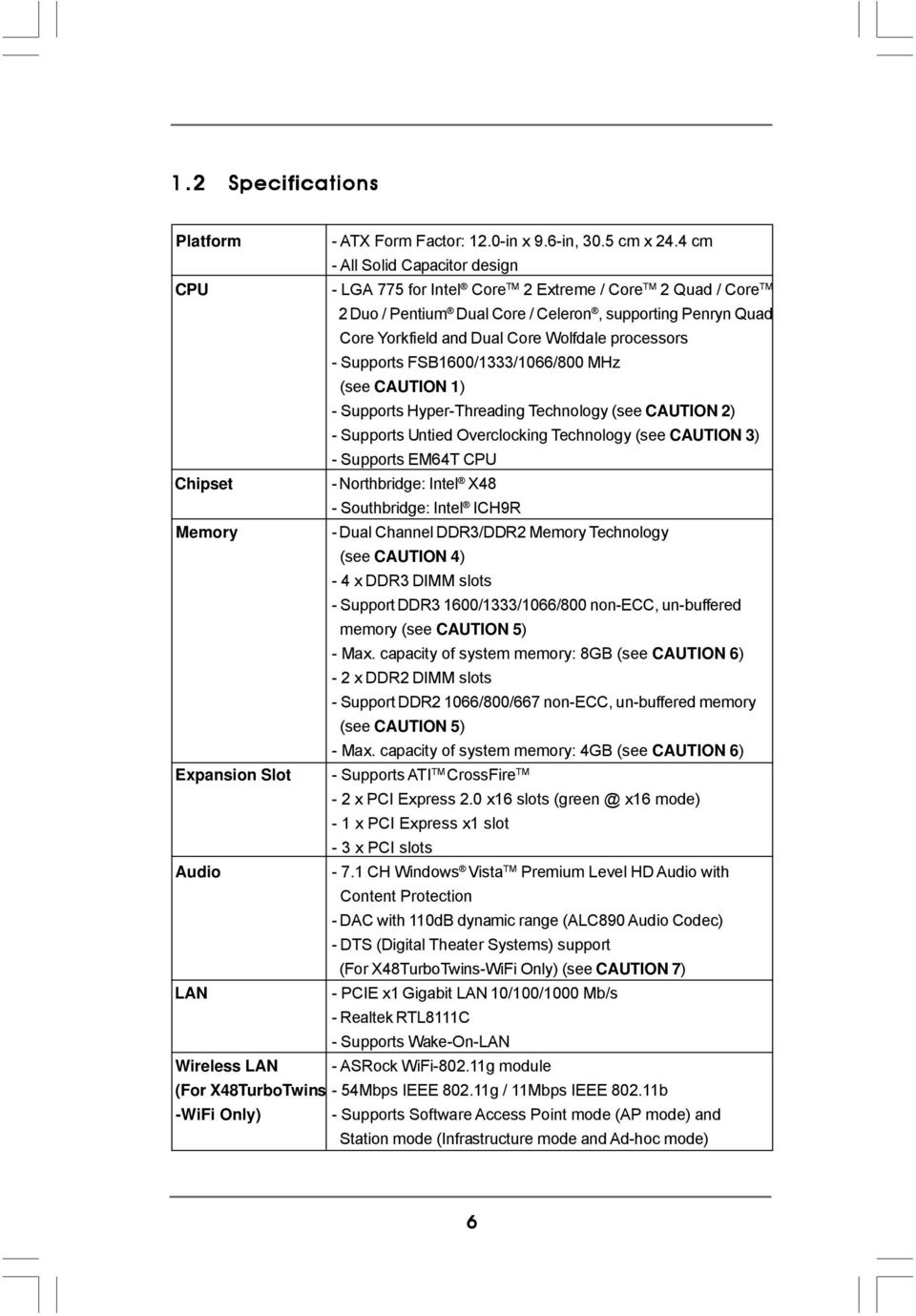
6 1.2 Specifications Platform - ATX Form Factor: 12.0-in x 9.6-in, 30.5 cm x 24.4 cm - All Solid Capacitor design CPU - LGA 775 for Intel Core TM 2 Extreme / Core TM 2 Quad / Core TM 2 Duo / Pentium Dual Core / Celeron, supporting Penryn Quad Core Yorkfield and Dual Core Wolfdale processors - Supports FSB1600/1333/1066/800 MHz (see CAUTION 1) - Supports Hyper-Threading Technology (see CAUTION 2) - Supports Untied Overclocking Technology (see CAUTION 3) - Supports EM64T CPU Chipset - Northbridge: Intel X48 - Southbridge: Intel ICH9R Memory - Dual Channel DDR3/DDR2 Memory Technology (see CAUTION 4) - 4 x DDR3 DIMM slots - Support DDR3 1600/1333/1066/800 non-ecc, un-buffered memory (see CAUTION 5) - Max. capacity of system memory: 8GB (see CAUTION 6) - 2 x DDR2 DIMM slots - Support DDR2 1066/800/667 non-ecc, un-buffered memory (see CAUTION 5) - Max. capacity of system memory: 4GB (see CAUTION 6) Expansion Slot - Supports ATI TM CrossFire TM - 2 x PCI Express 2.0 x16 slots x16 mode) - 1 x PCI Express x1 slot - 3 x PCI slots Audio CH Windows Vista TM Premium Level HD Audio with Content Protection - DAC with 110dB dynamic range (ALC890 Audio Codec) - DTS (Digital Theater Systems) support (For X48TurboTwins-WiFi Only) (see CAUTION 7) LAN - PCIE x1 Gigabit LAN 10/100/1000 Mb/s - Realtek RTL8111C - Supports Wake-On-LAN Wireless LAN - ASRock WiFi g module (For X48TurboTwins - 54Mbps IEEE g / 11Mbps IEEE b -WiFi Only) - Supports Software Access Point mode (AP mode) and Station mode (Infrastructure mode and Ad-hoc mode) 6
7 Rear Panel I/O ASRock 1394_SPDIF I/O Plus - 1 x PS/2 Mouse Port - 1 x PS/2 Keyboard Port - 1 x Coaxial SPDIF Out Port - 1 x Optical SPDIF Out Port - 6 x Ready-to-Use USB 2.0 Ports - 2 x esataii Ports - 1 x RJ-45 LAN Port with LED (ACT/LINK LED and SPEED LED) - 1 x IEEE 1394 Port - HD Audio Jack: Side Speaker/Rear Speaker/Central/Bass/ Line in/front Speaker/Microphone (see CAUTION 8) Connector - 6 x SATAII 3.0Gb/s connectors, support RAID (RAID 0, RAID 1, RAID 10, RAID 5 and Intel Matrix Storage), NCQ, AHCI and Hot Plug functions (see CAUTION 9) - 2 x esataii 3.0Gb/s connectors (shared with 2 SATAII connectors) (see CAUTION 10) - 1 x ATA133 IDE connector (supports 2 x IDE devices) - 1 x Floppy connector - 1 x DeskExpress Hot Plug Detection header - 1 x COM port header - 1 x HDMI_SPDIF header - 1 x IEEE 1394 header - CPU/Chassis FAN connector - 24 pin ATX power connector - 8 pin 12V power connector - CD in header - Front panel audio connector - 2 x USB 2.0 headers (support 4 USB 2.0 ports) (see CAUTION 11) - 1 x WiFi header (see CAUTION 12) BIOS Feature - 8Mb AMI BIOS - AMI Legal BIOS - Supports Plug and Play - ACPI 1.1 Compliance Wake Up Events - Supports jumperfree - AMBIOS Support - CPU, DRAM, NB, SB, VTT Voltage Multi-adjustment - Supports I. O. T. (Intelligent Overclocking Technology) Support CD - Drivers, Utilities, AntiVirus Software (Trial Version) Unique Feature - ASRock OC Tuner (see CAUTION 13) - Hybrid Booster: - CPU Frequency Stepless Control (see CAUTION 14) 7

8 - ASRock U-COP (see CAUTION 15) - Boot Failure Guard (B.F.G.) Hardware - CPU Temperature Sensing Monitor - Chassis Temperature Sensing - CPU Fan Tachometer - Chassis Fan Tachometer - CPU Quiet Fan - Voltage Monitoring: +12V, +5V, +3.3V, CPU Vcore OS - Microsoft Windows 2000 / XP / XP 64-bit / Vista TM / Vista TM 64-bit compliant (see CAUTION 16) Certifications - FCC, CE, WHQL * For detailed product information, please visit our website: WARNING Please realize that there is a certain risk involved with overclocking, including adjusting the setting in the BIOS, applying Untied Overclocking Technology, or using the thirdparty overclocking tools. Overclocking may affect your system stability, or even cause damage to the components and devices of your system. It should be done at your own risk and expense. We are not responsible for possible damage caused by overclocking. CAUTION! 1. If you want to change a new CPU on this motherboard, please remove the AC power cord from your PC in advance. This motherboard supports native FSB1600/1333/1066/800 MHz. For normal operation, you do no need to adjust the jumper settings. For special overclocking mode, please refer to page 27 and 28 for proper jumper settings. 2. About the setting of Hyper Threading Technology, please check page This motherboard supports Untied Overclocking Technology. Please read Untied Overclocking Technology on page 51 for details. 4. This motherboard supports Dual Channel Memory Technology. Before you implement Dual Channel Memory Technology, make sure to read the installation guide of memory modules on page 18 for proper installation. 5. Please check the table below for the CPU FSB frequency and its corresponding memory support frequency. CPU FSB Frequency Memory Support Frequency 1600 DDR2 800, DDR2 1066, DDR3 800, DDR3 1066, DDR DDR2 667, DDR2 800, DDR2 1066, DDR3 800, DDR3 1066, DDR DDR2 667, DDR2 800, DDR2 1066, DDR3 800, DDR DDR2 667, DDR2 800, DDR
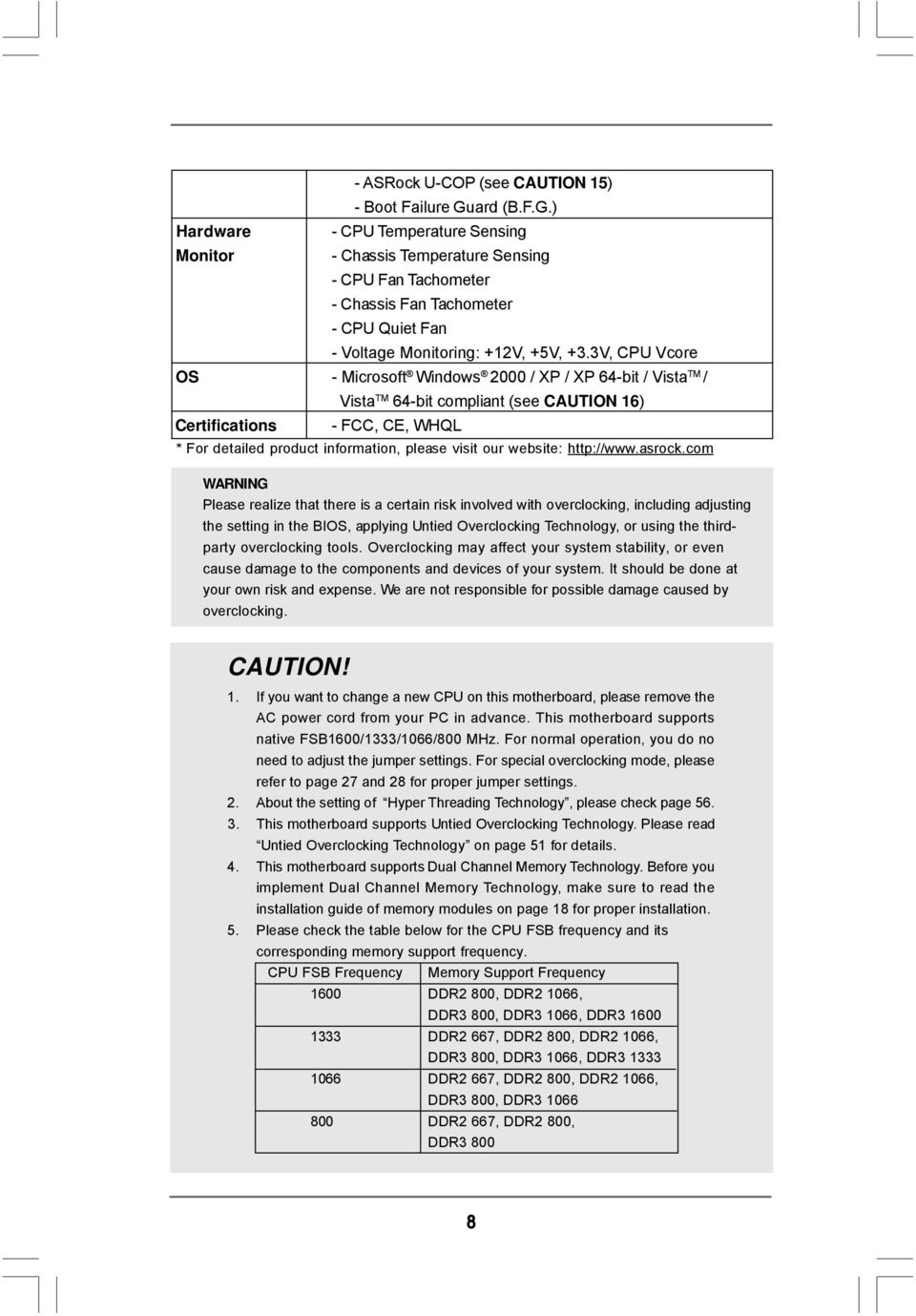
9 * DDR memory modules will operate in overclocking mode. * When you use a FSB1600-CPU on this motherboard, it will run at DDR2 960 if you adopt a DDR memory module. When you use a FSB1333-CPU on this motherboard, it will run at DDR if you adopt a DDR memory module. * If you adopt a DDR memory module on this motherboard, you need to adjust the jumpers. Please refer to page 28 for proper jumper settings. 6. Due to the operating system limitation, the actual memory size may be less than 4GB for the reservation for system usage under Windows XP and Windows Vista TM. For Windows XP 64-bit and Windows Vista TM 64-bit with 64-bit CPU, there is no such limitation. 7. DTS (Digital Theater Systems) is a multi-channel digital surround sound format. To enable DTS function, you need to adjust the settings after audio driver installation. Please refer to DTS Operation Guide on page 49 for details. 8. For microphone input, this motherboard supports both stereo and mono modes. For audio output, this motherboard supports 2-channel, 4- channel, 6-channel, and 8-channel modes. Please check the table on page 12 for proper connection. 9. Before installing SATAII hard disk to SATAII connector, please read the SATAII Hard Disk Setup Guide on page 38 to adjust your SATAII hard disk drive to SATAII mode. You can also connect SATA hard disk to SATAII connector directly. 10. This motherboard supports esataii interface, the external SATAII specification. Please read esataii Interface Introduction on page 35 for details about esataii and esataii installation procedures. 11. Power Management for USB 2.0 works fine under Microsoft Windows Vista TM 64-bit / Vista TM / XP 64-bit / XP SP1 or SP2 / 2000 SP WiFi header supports WiFi+AP function with ASRock WiFi g or WiFi n module, an easy-to-use wireless local area network (WLAN) adapter. It allows you to create a wireless environment and enjoy the convenience of wireless network connectivity. Please visit our website for the availability of ASRock WiFi g or WiFi n module. ASRock website It is a user-friendly ASRock overclocking tool which allows you to surveil your system by hardware monitor function and overclock your hardware devices to get the best system performance under Windows environment. Please visit our website for the operation procedures of ASRock OC Tuner. ASRock website: Although this motherboard offers stepless control, it is not recommended to perform over-clocking. Frequencies other than the recommended CPU bus frequencies may cause the instability of the system or damage the CPU. 9

10 15. While CPU overheat is detected, the system will automatically shutdown. Before you resume the system, please check if the CPU fan on the motherboard functions properly and unplug the power cord, then plug it back again. To improve heat dissipation, remember to spray thermal grease between the CPU and the heatsink when you install the PC system. 16. ASRock WiFi g module and RAID / AHCI functions are not supported under Windows 2000 OS. It is recommended to use IDE mode under Windows Please refer to page 61 for detailed setup. 1.3 Minimum Hardware Requirement Table for Windows Vista TM Premium 2008 and Basic Logo For system integrators and users who purchase this motherboard and plan to submit Windows Vista TM Premium 2008 and Basic logo, please follow below table for minimum hardware requirements. CPU Celeron 420 Memory 1GB system memory (Premium) 512MB Single Channel (Basic) VGA DX10 with WDDM Driver with 128bit VGA memory (Premium) with 64bit VGA memory (Basic) * After June 1, 2008, all Windows Vista TM systems are required to meet above minimum hardware requirements in order to qualify for Windows Vista TM Premium 2008 logo. 10

11 Bottom: MIC IN Top: IEEE 1394 Center: ESATAII_TOP Bottom: ESATAII_BOTTOM Bottom: CTR BASS PS2 Keyboard Top: LINE IN Center: FRONT Top: SIDE SPK Center: REAR SPK AUDIO CODEC CD1 LAN PHY 1 1 HDMI_SPDIF1 1 PS2_USB_PWR1 ESATAII_TOP ESATAII_BOTTOM WIFI FSB1 FSB3 IR1 1 FRONT_ CPU_FAN1 USB8_9 1 USB6_7 1 SATAII_5 (Port4) SATAII_6 (Port5) SATAII_3 (Port2) SATAII_4 (Port3) SATAII_1 (Port0) SATAII_2 (Port1) CLRCMOS1 1 1 SPEAKER1 PLED PWRBTN 1 PANEL1 HDLED RESET 1.4 Motherboard Layout cm (9.6 in) PS2 Mouse Coaxial SPDIF Optical SPDIF ATX12V USB 2.0 T: USB0 B: USB1 USB 2.0 T: USB2 B: USB3 USB 2.0 Top: T: USB4 RJ-45 B: USB5 ATXPWR1 1 FSB2 Intel X48 Chipset FSB1600 DDR DDR Dual Channel Quad Core CPU DDRII_1 (64 bit, 240-pin module) DDR3_A1 (64 bit, 240-pin module) DDR3_A2 (64 bit, 240-pin module) DDRII_2 (64 bit, 240-pin module) DDR3_B1 (64 bit, 240-pin module) DDR3_B2 (64 bit, 240-pin module) IDE1 30.5cm (12.0 in) PCIE1 35 PCIE2 PCI Express Super I/O HD_AUDIO1 PCIE3 PCI1 RoHS PCI2 PCI3 FLOPPY1 1 COM1 8Mb BIOS VIA VT6308S 1394a Intel ICH9R CMOS Battery CHA_FAN PS2_USB_PWR1 Jumper 21 USB 2.0 Header (USB6_7, Blue) 2 ATX 12V Connector (ATX12V1) 22 USB 2.0 Header (USB8_9, Blue) 3 esataii Connector (esataii_bottom) 23 SATAII Connector Pin CPU Socket (SATAII_5 (Port4), Orange) 5 North Bridge Controller 24 Front Panel IEEE 1394 Header 6 CPU Fan Connector (CPU_FAN1) (FRONT_1394) 7 2 x 240-pin DDR2 DIMM Slots 25 DeskExpress Hot Plug Detection Header (Dual Channel A: DDRII_1, DDRII_2; Yellow) (IR1) 8 2 x 240-pin DDR3 DIMM Slots 26 SPI BIOS Chip (Dual Channel B: DDR3_A1, DDR3_B1; Green) 27 Floppy Connector (FLOPPY1) 9 2 x 240-pin DDR3 DIMM Slots 28 COM Port Header (COM1) (Dual Channel C: DDR3_A2, DDR3_B2; Pink) 29 WiFi Header (WiFi) 10 IDE1 Connector (IDE1, Blue) 30 Front Panel Audio Header (HD_AUDIO1) 11 South Bridge Controller 31 Internal Audio Connector: CD1 (Black) 12 SATAII Connector (SATAII_1 (Port0), Red) 32 HDMI_SPDIF Header (HDMI_SPDIF1) 13 Clear CMOS Jumper (CLRCMOS1) 33 PCI Slots (PCI1-3) 14 Chassis Fan Connector (CHA_FAN1) 34 PCI Express 2.0 x16 Slot (PCIE3, Green) 15 SATAII Connector (SATAII_2 (Port1), Red) 35 PCI Express 2.0 x16 Slot (PCIE2, Green) 16 Chassis Speaker Header (SPEAKER 1) 36 PCI Express x1 Slot (PCIE1) 17 System Panel Header (PANEL1) 37 ATX Power Connector (ATXPWR1) 18 SATAII Connector (SATAII_3 (Port2), Red) 38 FSB1 / FSB2 / FSB3 Jumpers 19 SATAII Connector (SATAII_4 (Port3), Red) 39 esataii Connector (esataii_top) 20 SATAII Connector (SATAII_6 (Port5), Orange) 11

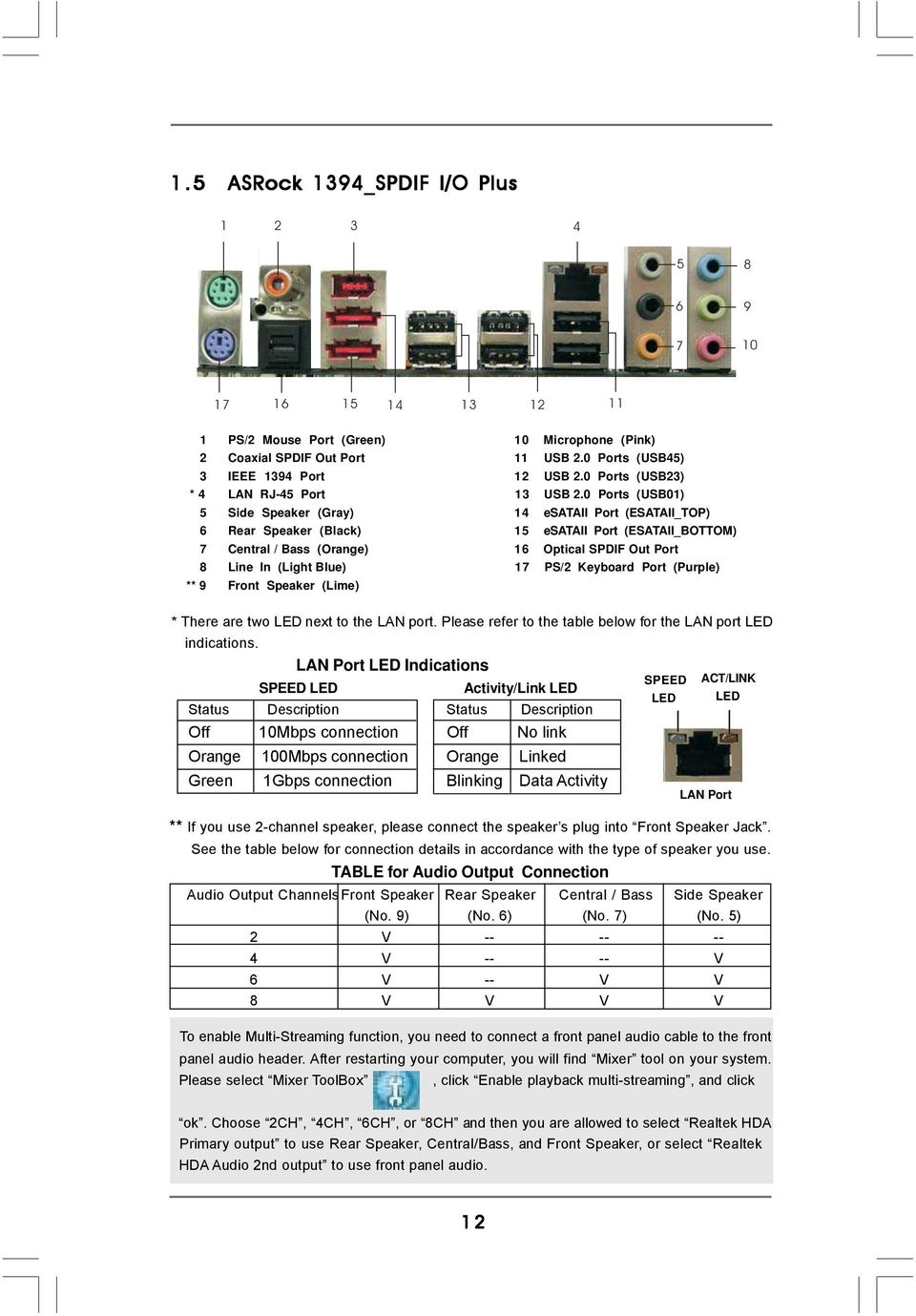
12 1.5 ASRock 1394_SPDIF I/O Plus PS/2 Mouse Port (Green) 10 Microphone (Pink) 2 Coaxial SPDIF Out Port 11 USB 2.0 Ports (USB45) 3 IEEE 1394 Port 12 USB 2.0 Ports (USB23) * 4 LAN RJ-45 Port 13 USB 2.0 Ports (USB01) 5 Side Speaker (Gray) 14 esataii Port (ESATAII_TOP) 6 Rear Speaker (Black) 15 esataii Port (ESATAII_BOTTOM) 7 Central / Bass (Orange) 16 Optical SPDIF Out Port 8 Line In (Light Blue) 17 PS/2 Keyboard Port (Purple) ** 9 Front Speaker (Lime) * There are two LED next to the LAN port. Please refer to the table below for the LAN port LED indications. LAN Port LED Indications SPEED ACT/LINK SPEED LED Activity/Link LED LED LED Status Description Status Description Off 10Mbps connection Off No link Orange 100Mbps connection Orange Linked Green 1Gbps connection Blinking Data Activity LAN Port ** If you use 2-channel speaker, please connect the speaker s plug into Front Speaker Jack. See the table below for connection details in accordance with the type of speaker you use. TABLE for Audio Output Connection Audio Output ChannelsFront Speaker Rear Speaker Central / Bass Side Speaker (No. 9) (No. 6) (No. 7) (No. 5) 2 V V V 6 V -- V V 8 V V V V To enable Multi-Streaming function, you need to connect a front panel audio cable to the front panel audio header. After restarting your computer, you will find Mixer tool on your system. Please select Mixer ToolBox, click Enable playback multi-streaming, and click ok. Choose 2CH, 4CH, 6CH, or 8CH and then you are allowed to select Realtek HDA Primary output to use Rear Speaker, Central/Bass, and Front Speaker, or select Realtek HDA Audio 2nd output to use front panel audio. 12
13 1.6 ASRock WiFi g Module Specifications (For X48TurboT urbotwins wins-wif ifi i Only) ASRock WiFi g module is an easy-to-use wireless local area network (WLAN) adapter to support WiFi+AP function. With ASRock WiFi g module, you can easily create a wireless environment and enjoy the convenience of wireless network connectivity. Therefore, from anywhere within the signal range, you will be able to play LAN games, connect to the internet, access and share printers, and make Internet phone calls easily. Standard - IEEE g Data Rate - 6, 9, 12, 18, 24, 36, 48, 54Mbps Security - Access Point mode (AP mode): WEP, WPA Network - Access Point mode (AP mode) Architecture Types - Station mode: Infrastructure mode and Ad-Hoc mode Frequency Band - 2.4~2.5GHz Operating Range - Indoor: 80ft (30m) Outdoor: 200ft (60m) * The range varies in different environments Number of - up to 16 stations Connected Devices (AP Mode) Antenna - ASRock WiFi g omni-directional antenna LED - Green data transmission (AIR) LED Support OS - Windows XP / XP 64-bit / Vista TM / Vista TM 64-bit Compatibility - Full compatible with IEEE g standard products Software Support - ASRock WiFi g Wizard If you want to start to use ASRock WiFi g module on this motherboard, please carefully read ASRock WiFi g Module Operation Guide in the package for the detailed introduction and operation procedures. You can also read the document in the following path of ASRock motherboard support CD:..\ ASRock WiFi g \ Vista64_Vista_XP64_XP 13

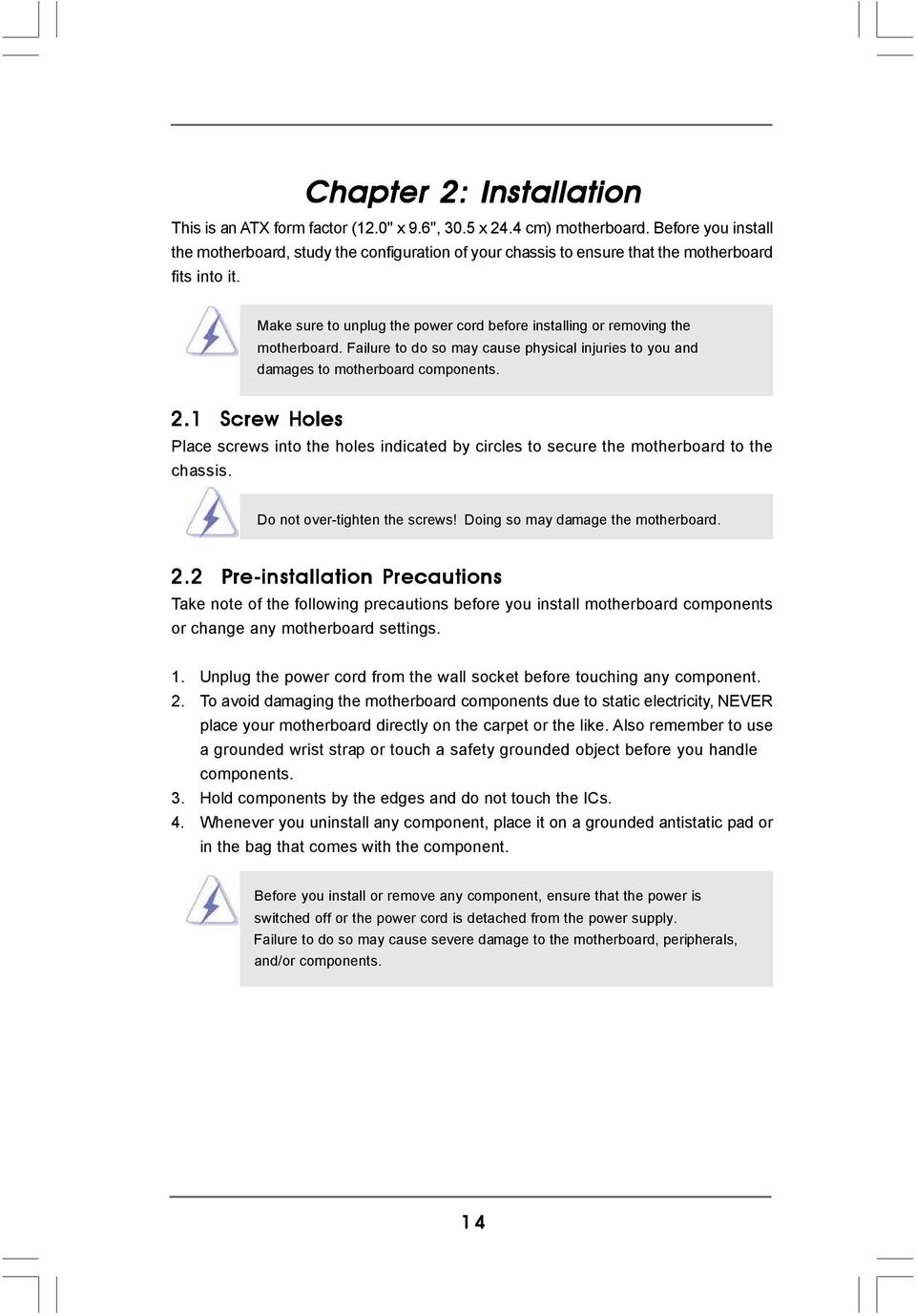
14 Chapter 2: Installation This is an ATX form factor (12.0" x 9.6", 30.5 x 24.4 cm) motherboard. Before you install the motherboard, study the configuration of your chassis to ensure that the motherboard fits into it. Make sure to unplug the power cord before installing or removing the motherboard. Failure to do so may cause physical injuries to you and damages to motherboard components. 2.1 Screw Holes Place screws into the holes indicated by circles to secure the motherboard to the chassis. Do not over-tighten the screws! Doing so may damage the motherboard. 2.2 Pre-installation Precautions Take note of the following precautions before you install motherboard components or change any motherboard settings. 1. Unplug the power cord from the wall socket before touching any component. 2. To avoid damaging the motherboard components due to static electricity, NEVER place your motherboard directly on the carpet or the like. Also remember to use a grounded wrist strap or touch a safety grounded object before you handle components. 3. Hold components by the edges and do not touch the ICs. 4. Whenever you uninstall any component, place it on a grounded antistatic pad or in the bag that comes with the component. Before you install or remove any component, ensure that the power is switched off or the power cord is detached from the power supply. Failure to do so may cause severe damage to the motherboard, peripherals, and/or components. 14
15 2.3 CPU Installation For the installation of Intel 775-LAND CPU, please follow the steps below. 775-Pin Socket Overview Before you insert the 775-LAND CPU into the socket, please check if the CPU surface is unclean or if there is any bent pin on the socket. Do not force to insert the CPU into the socket if above situation is found. Otherwise, the CPU will be seriously damaged. Step 1. Open the socket: Step 1-1. Disengaging the lever by depressing down and out on the hook to clear retention tab. Step 1-2. Rotate the load lever to fully open position at approximately 135 degrees. Step 1-3. Rotate the load plate to fully open position at approximately 100 degrees. Step 2. Insert the 775-LAND CPU: Step 2-1. Hold the CPU by the edges where are marked with black lines. black line black line Step 2-2. Orient the CPU with IHS (Integrated Heat Sink) up. Locate Pin1 and the two orientation key notches. Pin1 Pin1 orientation orientation alignment key key notch key notch alignment key 775-LAND CPU 775-Pin Socket 15

16 For proper inserting, please ensure to match the two orientation key notches of the CPU with the two alignment keys of the socket. Step 2-3. Carefully place the CPU into the socket by using a purely vertical motion. Step 2-4. Verify that the CPU is within the socket and properly mated to the orient keys. Step 3. Remove PnP Cap (Pick and Place Cap): Use your left hand index finger and thumb to support the load plate edge, engage PnP cap with right hand thumb and peel the cap from the socket while pressing on center of PnP cap to assist in removal. 1. It is recommended to use the cap tab to handle and avoid kicking off the PnP cap. 2. This cap must be placed if returning the motherboard for after service. Step 4. Close the socket: Step 4-1. Rotate the load plate onto the IHS. Step 4-2. While pressing down lightly on load plate, engage the load lever. Step 4-3. Secure load lever with load plate tab under retention tab of load lever. 16

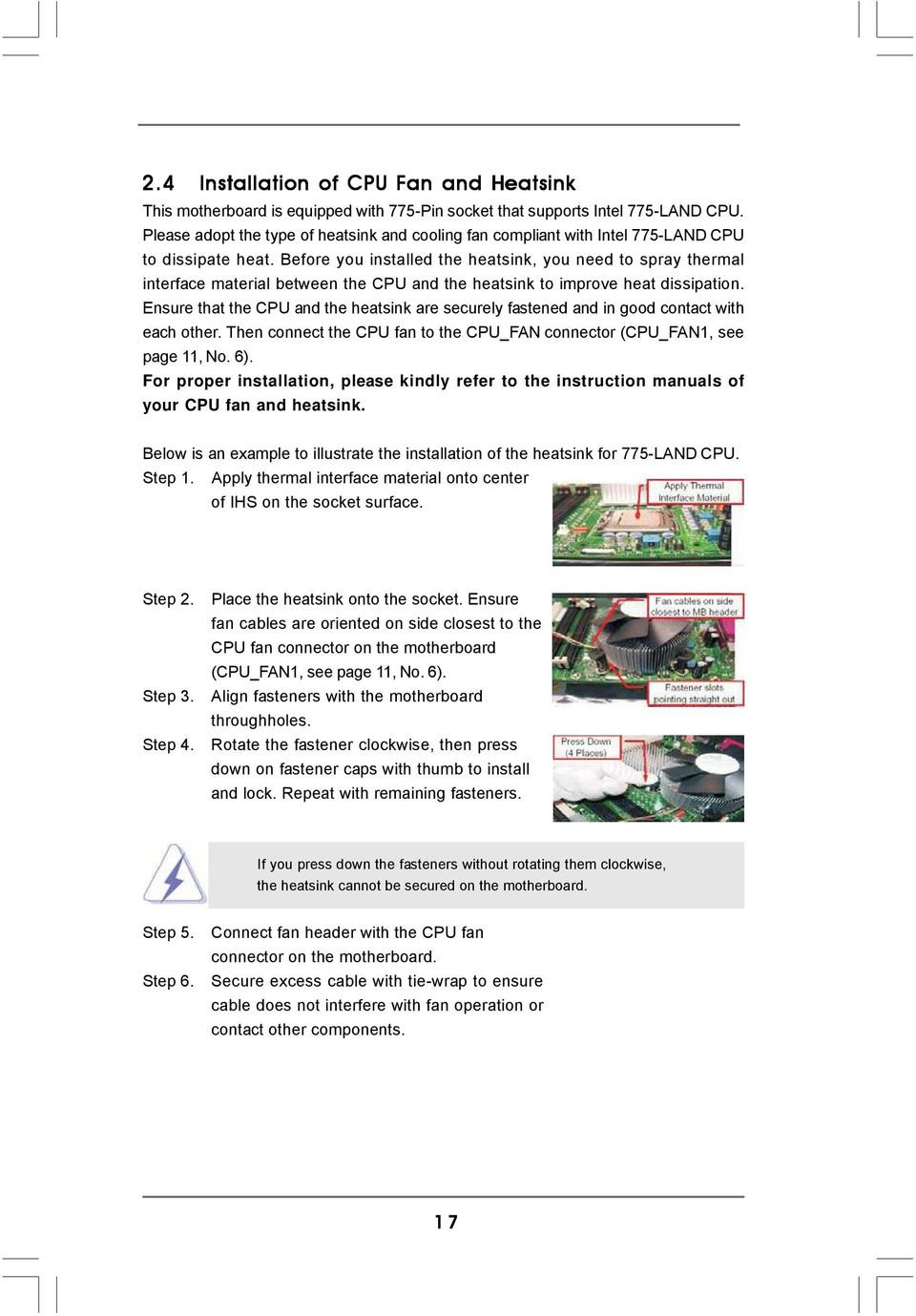
17 2.4 Installation of CPU Fan and Heatsink This motherboard is equipped with 775-Pin socket that supports Intel 775-LAND CPU. Please adopt the type of heatsink and cooling fan compliant with Intel 775-LAND CPU to dissipate heat. Before you installed the heatsink, you need to spray thermal interface material between the CPU and the heatsink to improve heat dissipation. Ensure that the CPU and the heatsink are securely fastened and in good contact with each other. Then connect the CPU fan to the CPU_FAN connector (CPU_FAN1, see page 11, No. 6). For proper installation, please kindly refer to the instruction manuals of your CPU fan and heatsink. Below is an example to illustrate the installation of the heatsink for 775-LAND CPU. Step 1. Apply thermal interface material onto center of IHS on the socket surface. Step 2. Step 3. Step 4. Place the heatsink onto the socket. Ensure fan cables are oriented on side closest to the CPU fan connector on the motherboard (CPU_FAN1, see page 11, No. 6). Align fasteners with the motherboard throughholes. Rotate the fastener clockwise, then press down on fastener caps with thumb to install and lock. Repeat with remaining fasteners. If you press down the fasteners without rotating them clockwise, the heatsink cannot be secured on the motherboard. Step 5. Step 6. Connect fan header with the CPU fan connector on the motherboard. Secure excess cable with tie-wrap to ensure cable does not interfere with fan operation or contact other components. 17
18 2.5 Installation of Memory Modules (DIMM) This motherboard provides two 240-pin DDR2 (Double Data Rate 2) DIMM slots and four 240-pin DDR3 (Double Data Rate 3) DIMM slots, and supports Dual Channel Memory Technology. For dual channel configuration, you always need to install identical (the same brand, speed, size and chip-type) DDR2/DDR3 DIMM pair in the slots of the same color. In other words, you have to install identical DDR2 DIMM pair in Dual Channel A (DDRII_1 and DDRII_2; Yellow slots; see p.11 No.7), identical DDR3 DIMM pair in Dual Channel B (DDR3_A1 and DDR3_B1; Green slots; see p.11 No.8), or identical DDR3 DIMM pair in Dual Channel C (DDR3_A2 and DDR3_B2; Pink slots; see p.11 No.9), so that Dual Channel Memory Technology can be activated. This motherboard also allows you to install four DDR3 DIMMs for dual channel configuration, and please install identical DDR3 DIMMs in all four slots. You may refer to the Dual Channel Memory Configuration Table below. Dual Channel DDR2 Memory Configurations (DS: Double Side, SS: Single Side) DDRII_1 DDRII_2 (Yellow Slot) (Yellow Slot) 2 memory modules SS SS 2 memory modules DS DS Dual Channel DDR3 Memory Configurations (DS: Double Side, SS: Single Side) DDR3_A1 DDR3_A2 DDR3_B1 DDR3_B2 (Green Slot) (Pink Slot) (Green Slot) (Pink Slot) 2 memory modules SS X SS X 2 memory modules DS X DS X 2 memory modules X SS X SS 2 memory modules X DS X DS 4 memory modules SS SS SS SS 4 memory modules DS DS DS DS 18

19 1. If you want to install two memory modules, for optimal compatibility and reliability, it is recommended to install them in the slots of the same color. In other words, install them in the set of yellow slots (DDRII_1 and DDRII_2), in the set of green slots (DDR3_A1 and DDR3_B1), or in the set of pink slots (DDR3_A2 and DDR3_B2). 2. If only one memory module or three memory modules are installed in DDR3 DIMM slots on this motherboard, it is unable to activate the Dual Channel Memory Technology. If only one memory module is installed in DDR2 DIMM slots on this motherboard, it is unable to activate the Dual Channel Memory Technology. 3. If a pair of memory modules is NOT installed in the same Dual Channel, for example, installing a pair of memory modules in DDR3_A1 and DDR3_B2, it is unable to activate the Dual Channel Memory Technology. 4. It is not allowed to install a DDR3 memory module into DDR2 slot or install a DDR2 memory module into DDR3 slot; otherwise, this motherboard and DIMM may be damaged. 5. DDR2 and DDR3 memory modules cannot be installed on this motherboard at the same time. 6. To have the best performance with DDR XMP memory modules, it is suggested to install one memory module on each channel. For example, install them in the set of green slots (DDR3_A1 and DDR3_B1) or in the set of pink slots (DDR3_A2 and DDR3_B2). 19

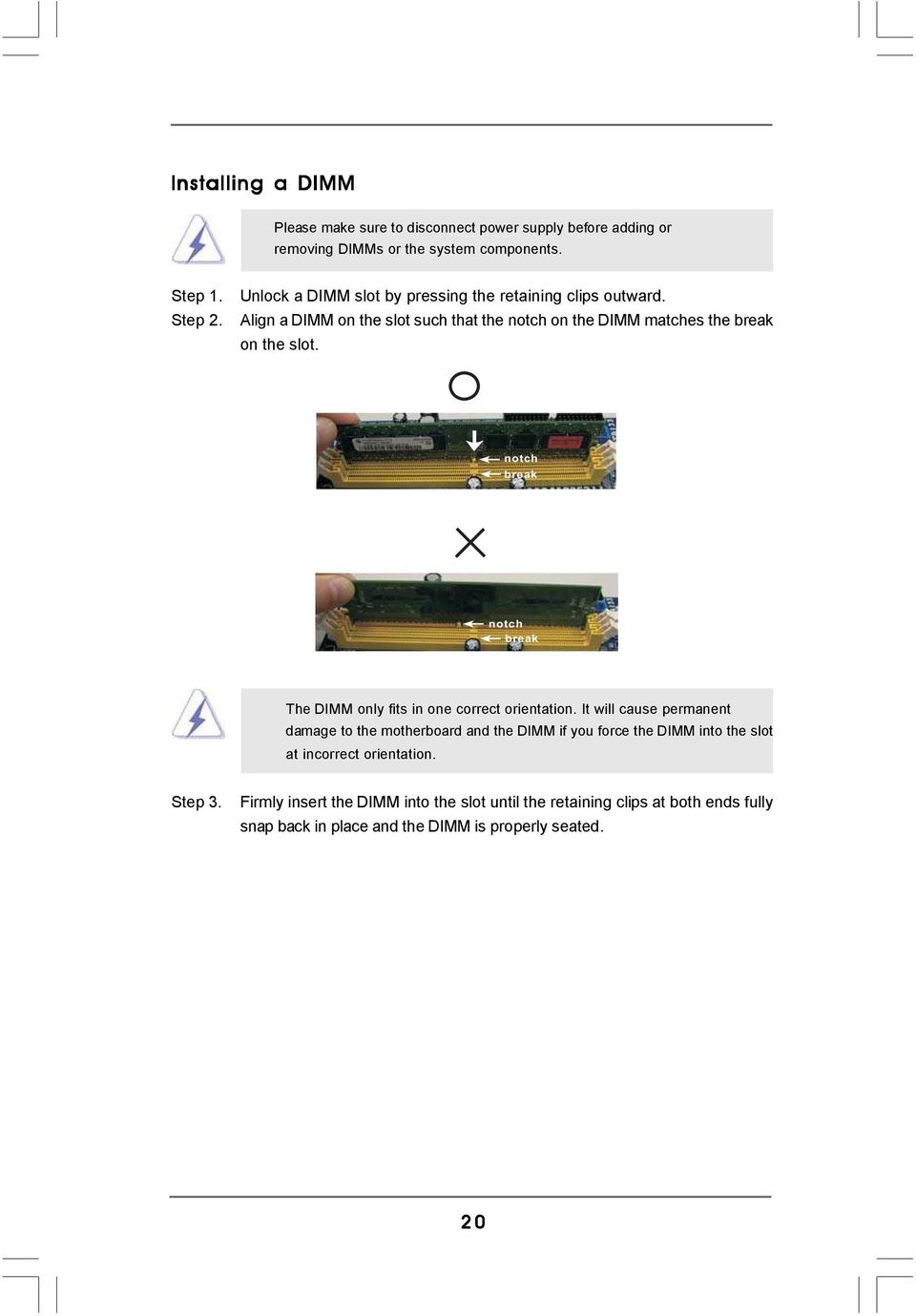
20 Installing a DIMM Please make sure to disconnect power supply before adding or removing DIMMs or the system components. Step 1. Step 2. Unlock a DIMM slot by pressing the retaining clips outward. Align a DIMM on the slot such that the notch on the DIMM matches the break on the slot. notch break notch break The DIMM only fits in one correct orientation. It will cause permanent damage to the motherboard and the DIMM if you force the DIMM into the slot at incorrect orientation. Step 3. Firmly insert the DIMM into the slot until the retaining clips at both ends fully snap back in place and the DIMM is properly seated. 20
21 2.6 Expansion Slots (PCI and PCI Express Slots) There are 3 PCI slots and 3 PCI Express slots on this motherboard. PCI slots: PCI slots are used to install expansion cards that have the 32-bit PCI interface. PCIE slots: PCIE1 (PCIE x1 slot; White) is used for PCI Express cards with x1 lane width cards, such as Gigabit LAN card, SATA2 card and ASRock PCIE_DE card. PCIE2 / PCIE3 (PCIE x16 slot; Green) is used for PCI Express cards with x16 lane width graphics cards. If you want to use ASRock DeskExpress function on this motherboard, please install ASRock PCIE_DE card on PCIE1 slot. Installing an expansion card Step 1. Before installing the expansion card, please make sure that the power supply is switched off or the power cord is unplugged. Please read the documentation of the expansion card and make necessary hardware settings for the card before you start the installation. Step 2. Remove the bracket facing the slot that you intend to use. Keep the screws for later use. Step 3. Align the card connector with the slot and press firmly until the card is completely seated on the slot. Step 4. Fasten the card to the chassis with screws. 21
22 2.7 CrossFire TM Operation Guide This motherboard supports CrossFire TM feature. CrossFire TM technology offers the most advantageous means available of combining multiple high performance Graphics Processing Units (GPU) in a single PC. Combining a range of different operating modes with intelligent software design and an innovative interconnect mechanism, CrossFire TM enables the highest possible level of performance and image quality in any 3D application. Currently CrossFire TM feature is supported with Windows XP with Service Pack 2 and Vista TM OS. Please check AMD website for ATI TM CrossFire TM driver updates. What graphics cards work with CrossFire TM? A complete CrossFire TM system requires a CrossFire TM Ready motherboard, a CrossFire TM Edition graphics card and a compatible standard Radeon (CrossFire TM Ready) graphics card from the same series, or two CrossFire TM Ready cards. This applies to cards from ATI TM or any of its partners. Please refer to below table for CrossFire TM VGA card support list according to the OS you install. For Windows XP Vendor Chipset Model Driver ATI Radeon HD2900XT MSI RX2900XT-VT2D512E Catalyst 7.11 Radeon HD 2600XT Gigabyte GV-RX26T256HP-B Catalyst 7.9 Radeon HD 2600PRO MSI RX2600PRO-T2D256EZ Catalyst 7.9 Radeon X1950XTX GeCube RX1950XTX Catalyst 7.11 Radeon X1950PRO Gecube Radeon X1950Pro 256MB Catalyst 7.11 For Windows Vista Vendor Chipset Model Driver ATI Radeon HD2900XT MSI RX2900XT-VT2D512E Catalyst 7.11 Radeon HD 2600XT Gigabyte GV-RX26T256HP-B Catalyst 7.9 Radeon HD 2600PRO MSI RX2600PRO-T2D256EZ Catalyst 7.9 Radeon X1950XTX GeCube RX1950XTX Catalyst 7.11 Radeon X1950PRO Gecube Radeon X1950Pro 256MB Catalyst 7.11 Radeon X1600PRO MSI RX1600PRO-TD256E Catalyst 7.3 Radeon X1300 PRO MSI RX1300PRO-TD256E Catalyst If a customer incorrectly configures their system they will not see the performance benefits of CrossFire TM. All three CrossFire TM components, a CrossFire TM Ready graphics card, a CrossFire TM Ready motherboard and a CrossFire TM Edition co-processor graphics card, must be installed correctly to benefit from the CrossFire TM multi-gpu platform. 2. If you pair a 12-pipe CrossFire TM Edition card with a 16-pipe card, both cards will operate as 12-pipe cards while in CrossFire TM mode. 22
23 Enjoy the benefit of CrossFire TM Different CrossFire TM cards may require different methods to enable CrossFire TM feature. In below procedures, we use Radeon 2600XT as the example graphics card. For other CrossFire TM cards that ATI TM has released or will release in the future, please refer to ATI TM graphics card manuals for detailed installation guide. Step 1. Install one Radeon graphics card to PCIE2 slot. For the proper installation procedures, please refer to section Expansion Slots. Step 2. Install one Radeon graphics card to PCIE3 slot. For the proper installation procedures, please refer to section Expansion Slots. Step 3. Connect two Radeon graphics cards by installing two CrossFire TM Bridge on CrossFire TM Bridge Interconnects on the top of Radeon graphics cards. (CrossFire TM Bridge is provided with the graphics card you purchase, not bundled with this motherboard. Please refer to your graphics card vendor for details.) CrossFire TM Bridge 23
24 Step 4. Connect the DVI monitor cable to the DVI connector on the Radeon graphics card on PCIE2 slot. (You may use the DVI to D-Sub adapter to convert the DVI connector to D-Sub interface, and then connect the D-Sub monitor cable to the DVI to D-Sub adapter.) Step 5. Step 6. Power on your computer and boot into OS. Remove the ATI TM driver if you have any VGA driver installed in your system. The Catalyst Uninstaller is an optional download. We recommend using this utility to uninstall any previously installed Catalyst drivers prior to installation. Please check AMD website for ATI TM driver updates. Step 7. Step 8. Step 9. Install the required drivers to your system. For Windows XP OS: A. ATI TM recommends Windows XP Service Pack 2 or higher to be installed (If you have Windows XP Service Pack 2 or higher installed in your system, there is no need to download it again): B. You must have Microsoft.NET Framework installed prior to downloading and installing the CATALYST Control Center. Please check Microsoft website for details. For Windows Vista TM OS: Install the CATALYST Control Center. Please check AMD website for details. Restart your computer. Install the VGA card drivers to your system, and restart your computer. Then you will find ATI Catalyst Control Center on your Windows taskbar. ATI Catalyst Control Center 24
25 Step 10. Double-click ATI Catalyst Control Center. Click View, and select Advanced View. Click CrossFire TM, and then set the option Enable CrossFire TM to Yes. View CrossFire TM Enable CrossFire TM Although you have selected the option Enable CrossFire TM, the CrossFire TM function may not work actually. Your computer will automatically reboot. After restarting your computer, please confirm whether the option Enable CrossFire TM in ATI Catalyst Control Center is selected or not; if not, please select it again, and then you are able to enjoy the benefit of CrossFire TM feature. Step 11. You can freely enjoy the benefit of CrossFire TM feature. * CrossFire TM appearing here is a registered trademark of ATI TM Technologies Inc., and is used only for identification or explanation and to the owners benefit, without intent to infringe. * For further information of ATI TM CrossFire TM technology, please check AMD website for updates and details. 2.8 Surround Display Feature This motherboard supports Surround Display upgrade. With the external add-on PCI Express VGA cards, you can easily enjoy the benefits of Surround Display feature. For the detailed instruction, please refer to the document at the following path in the Support CD:..\ Surround Display Information 25
26 2.9 Jumpers Setup The illustration shows how jumpers are setup. When the jumper cap is placed on pins, the jumper is Short. If no jumper cap is placed on pins, the jumper is Open. The illustration shows a 3-pin jumper whose pin1 and pin2 are Short when jumper cap is placed on these 2 pins. Jumper Setting Description PS2_USB_PWR1 1_2 2_3 Short pin2, pin3 to enable (see p.11 No. 1) +5V +5VSB +5VSB (standby) for PS/2 or USB wake up events. Note: To select +5VSB, it requires 2 Amp and higher standby current provided by power supply. Clear CMOS Jumper (CLRCMOS1) (see p.11, No. 13) 1_2 Default 2_3 Clear CMOS Note: CLRCMOS1 allows you to clear the data in CMOS. The data in CMOS includes system setup information such as system password, date, time, and system setup parameters. To clear and reset the system parameters to default setup, please turn off the computer and unplug the power cord from the power supply. After waiting for 15 seconds, use a jumper cap to short pin2 and pin3 on CLRCMOS1 for 5 seconds. However, please do not clear the CMOS right after you update the BIOS. If you need to clear the CMOS when you just finish updating the BIOS, you must boot up the system first, and then shut it down before you do the clear- CMOS action. 26
27 FSB1 Jumper (FSB1, 3-pin jumper, see p.11 No. 38) 1_2 FSB2 Jumper (FSB2, 5-pin jumper, see p.11 No. 38) FSB3 FSB2 FSB1 1_2 Default FSB3 Jumper 1_2 (FSB3, 5-pin jumper, see p.11 No. 38) When you mount a FSB800 or FSB1066 CPU, and try to overclock to FSB1333 or FSB1600 (by BIOS setting) you may face the problem, that DRAM frequency will be overclocked very high. Please use jumper to force NB to be strapped at higher frequency, so the DRAM can work at lower frequency. If you want to overclock the CPU you adopt to FSB1066 on this motherboard, you need to adjust the jumpers. Please short pin4, pin5 for FSB2 jumper and pin4, pin5 for FSB3 jumper. Otherwise, the CPU may not work properly on this motherboard. Please refer to below jumper settings. If you want to overclock the CPU you adopt to FSB1333 on this motherboard, you need to adjust the jumpers. Please short pin3, pin4 for FSB2 jumper and pin4, pin5 for FSB3 jumper. Otherwise, the CPU may not work properly on this motherboard. Please refer to below jumper settings. 4_5 FSB3 FSB2 4_5 FSB1 If you want to overclock the CPU you adopt to FSB1600 on this motherboard, you need to adjust the jumpers. Please short pin3, pin4 for FSB2 jumper and pin3, pin4 for FSB3 jumper. Otherwise, the CPU may not work properly on this motherboard. Please refer to below jumper settings. 1_2 4_5 FSB3 FSB2 3_4 FSB1 1_2 3_4 FSB3 FSB2 3_4 FSB1 1_2 27
28 If you use a FSB1600-CPU and adopt a DDR memory module on this motherboard, you need to adjust the jumpers. Please short pin4, pin5 for FSB3. Otherwise, the CPU and memory module may not work properly on this motherboard. Please refer to below jumper settings. FSB3 FSB2 FSB1 4_5 1_2 1_2 FSB1600 / DDR If you use a FSB1333-CPU and adopt a DDR memory module on this motherboard, you need to adjust the jumpers. Please short pin4, pin5 for FSB2. Otherwise, the CPU and memory module may not work properly on this motherboard. Please refer to below jumper settings. 1_2 FSB3 FSB2 4_5 FSB1 1_2 FSB1333 / DDR If you use a FSB1066-CPU and adopt a DDR memory module on this motherboard, you need to adjust the jumpers. Please short pin2, pin3 for FSB3. Otherwise, the CPU and memory module may not work properly on this motherboard. Please refer to below jumper settings. 2_3 FSB3 FSB2 1_2 FSB1 1_2 FSB1066 / DDR
29 2.10 Onboard Headers and Connectors Onboard headers and connectors are NOT jumpers. Do NOT place jumper caps over these headers and connectors. Placing jumper caps over the headers and connectors will cause permanent damage of the motherboard! FDD connector (33-pin FLOPPY1) (see p.11 No. 27) Pin1 FLOPPY1 the red-striped side to Pin1 Note: Make sure the red-striped side of the cable is plugged into Pin1 side of the connector. Primary IDE connector (Blue) (39-pin IDE1, see p.11 No. 10) PIN1 IDE1 connect the blue end connect the black end to the motherboard to the IDE devices 80-conductor ATA 66/100/133 cable Note: Please refer to the instruction of your IDE device vendor for the details. Serial ATAII Connectors (SATAII_1 (Port0): see p.11, No. 12) SATAII_5 (Port4) SATAII_1 (Port0) (SATAII_2 (Port1): see p.11, No. 15) SATAII_6 (Port5) SATAII_2 (Port1) (SATAII_3 (Port2): see p.11, No. 18) (SATAII_4 (Port3): SATAII_3 (Port2) see p.11, No. 19) (SATAII_5 (Port4): see p.11, No. 23) SATAII_4 (Port3) (SATAII_6 (Port5): see p.11, No. 20) These six Serial ATAII (SATAII) connectors support SATA data cables for internal storage devices. The current SATAII interface allows up to 3.0 Gb/s data transfer rate. SATAII_5 (Port4) and SATAII_6 (Port5) connectors can be used for internal storage device or be connected to esataii connectors to support esataii device. Please read esataii Interface Introduction on page 35 for details about esataii and esataii installation procedures. 29
30 esataii Connectors (esataii_top: see p.11, No. 39) (esataii_bottom: see p.11, No. 3) esataii_top esataii_bottom These esataii connectors support SATA data cables for external SATAII function. The current esataii interface allows up to 3.0 Gb/s data transfer rate. Serial ATA (SATA) Either end of the SATA data cable Data Cable can be connected to the SATA / (Optional) SATAII hard disk or the SATAII connector on this motherboard. You can also use the SATA data cable to connect SATAII_5 (Port4) or SATAII_6 (Port5) connector and esataii connector. Serial ATA (SATA) Power Cable (Optional) connect to the SATA HDD power connector connect to the power supply Please connect the black end of SATA power cable to the power connector on each drive. Then connect the white end of SATA power cable to the power connector of the power supply. USB 2.0 Headers USB_PWR Besides six default USB 2.0 (9-pin USB8_9) P-9 P+9 GND (see p.11 No. 22) DUMMY two USB 2.0 headers on this 1 motherboard. Each USB 2.0 GND P+8 P-8 header can support two USB USB_PWR USB_PWR 2.0 ports. (9-pin USB6_7) P-7 P+7 (see p.11 No. 21) GND DUMMY ports on the I/O panel, there are 1 GND P+6 P-6 USB_PWR WiFi Header (11-pin WIFI) (see p.11 No. 29) 1 USB+5V_1 NC NC GND1 PLTRST# +3SVB D0-D0+ GND1 USB+5V_1 PME# 30 This header supports WiFi+AP function with ASRock WiFi g or WiFi n module, an easy-to-use wireless local area network (WLAN) adapter. It allows you to create a wireless environment and enjoy the convenience of wireless network connectivity.
31 If you don t plan to use WiFi+AP functin on this motherboard, this header can be used as a 4-Pin USB 2.0 header to support one USB 2.0 port. To connect the 4-Pin USB device cable to this header, please refer to this picture for proper installation. DeskExpress Hot Plug Detection Header (5-pin IR1) (see p.11 No. 25) 1 IRTX +5VSB Hotplug# GND IRRX This header supports the Hot Plug detection function for ASRock DeskExpress. Internal Audio Connectors (4-pin CD1) (CD1: see p.11 No. 31) CD-L GND GND CD-R CD1 This connector allows you to receive stereo audio input from sound sources such as a CD-ROM, DVD-ROM, TV tuner card, or MPEG card. Front Panel Audio Header (9-pin HD_AUDIO1) (see p.11 No. 30) GND PRESENCE# MIC_RET OUT_RET 1 OUT2_L J_SENSE OUT2_R MIC2_R MIC2_L This is an interface for front panel audio cable that allows convenient connection and control of audio devices. 1. High Definition Audio supports Jack Sensing, but the panel wire on the chassis must support HDA to function correctly. Please follow the instruction in our manual and chassis manual to install your system. 2. If you use AC 97 audio panel, please install it to the front panel audio header as below: A. Connect Mic_IN (MIC) to MIC2_L. B. Connect Audio_R (RIN) to OUT2_R and Audio_L (LIN) to OUT2_L. C. Connect Ground (GND) to Ground (GND). D. MIC_RET and OUT_RET are for HD audio panel only. You don t need to connect them for AC 97 audio panel. E. Enter BIOS Setup Utility. Enter Advanced Settings, and then select Chipset Configuration. Set the Front Panel Control option from [Auto] to [Enabled]. F. Enter Windows system. Click the icon on the lower right hand taskbar to enter Realtek HD Audio Manager. For Windows 2000 / XP / XP 64-bit OS: Click Audio I/O, select Connector Settings, choose Disable front panel jack detection, and save the change by clicking OK. For Windows Vista TM / Vista TM 64-bit OS: Click the right-top Folder icon, choose Disable front panel jack detection, and save the change by clicking OK. 31
32 System Panel Header (9-pin PANEL1) (see p.11 No. 17) PLED+ PLED- PWRBTN# GND 1 DUMMY RESET# GND HDLED- HDLED+ This header accommodates several system front panel functions. Chassis Speaker Header (4-pin SPEAKER 1) (see p.11 No. 16) 1 SPEAKER DUMMY DUMMY +5V Please connect the chassis speaker to this header. Chassis Fan Connector (3-pin CHA_FAN1) (see p.11 No. 14) GND +12V CHA_FAN_SPEED Please connect a chassis fan cable to this connector and match the black wire to the ground pin. CPU Fan Connector (4-pin CPU_FAN1) (see p.11 No. 6) GND +12V CPU_FAN_SPEED FAN_SPEED_CONTROL Please connect a CPU fan cable to this connector and match the black wire to the ground pin. Though this motherboard provides 4-Pin CPU fan (Quiet Fan) support, the 3-Pin CPU fan still can work successfully even without the fan speed control function. If you plan to connect the 3-Pin CPU fan to the CPU fan connector on this motherboard, please connect it to Pin 1-3. Pin 1-3 Connected 3-Pin Fan Installation ATX Power Connector (24-pin ATXPWR1) (see p.11, No. 37) 13 1 Please connect an ATX power supply to this connector Though this motherboard provides 24-pin ATX power connector, it can still work if you adopt a traditional 20-pin ATX power supply. To use the 20-pin ATX power supply, please plug your power supply along with Pin 1 and Pin Pin ATX Power Supply Installation
33 ATX 12V Power Connector (8-pin ATX12V1) (see p.11 No. 2) Please connect an ATX 12V power supply to this connector. Though this motherboard provides 8-pin ATX 12V power connector, it can still work if you adopt a traditional 4-pin ATX 12V power supply. To use the 4-pin ATX power supply, please plug your power supply along with Pin 1 and Pin Pin ATX 12V Power Supply Installation 8 4 IEEE 1394 Header RXTPAM_0 Besides one default IEEE 1394 GND (9-pin FRONT_1394) RXTPBM_0 port on the I/O panel, there is one (see p.11 No. 24) +12V GND IEEE 1394 header 1 (FRONT_1394) on this +12V RXTPBP_0 motherboard. This IEEE 1394 GND RXTPAP_0 header can support one IEEE 1394 port. Serial port Header (9-pin COM1) (see p.11 No.28) HDMI_SPDIF Header (3-pin HDMI_SPDIF1) (see p.11 No. 32) 1 RRXD1 DDTR#1 DDSR#1 CCTS#1 1 RRI#1 RRTS#1 GND TTXD1 DDCD#1 GND +5V SPDIFOUT This COM1 header supports a serial port module. HDMI_SPDIF header, providing SPDIF audio output to HDMI VGA card, allows the system to connect HDMI Digital TV/ projector/lcd devices. Please connect the HDMI_SPDIF connector of HDMI VGA card to this header. HDMI_SPDIF Cable (Optional) C B A Please connect the black end (A) of HDMI_SPDIF cable to the HDMI_SPDIF header on the motherboard. Then connect the white end (B or C) of HDMI_SPDIF cable to the HDMI_SPDIF connector of HDMI VGA card. A. black end B. white end (2-pin) C. white end (3-pin) +5V SPDIFOUT blue SPDIFOUT blue GND black GND black SPDIFOUT blue GND black 33
34 2.11 HDMI_SPDIF Header Connection Guide HDMI (High-Definition Multi-media Interface) is an all-digital audio/video specification, which provides an interface between any compatible digital audio/ video source, such as a set-top box, DVD player, A/V receiver and a compatible digital audio or video monitor, such as a digital television (DTV). A complete HDMI system requires a HDMI VGA card and a HDMI ready motherboard with a HDMI_SPDIF header. This motherboard is equipped with a HDMI_SPDIF header, which provides SPDIF audio output to HDMI VGA card, allows the system to connect HDMI Digital TV/projector/LCD devices. To use HDMI function on this motherboard, please carefully follow the below steps. Step 1. Install the HDMI VGA card to the PCI Express Graphics slot on this motherboard. For the proper installation of HDMI VGA card, please refer to the installation guide on page 21. Step 2. Connect the black end (A) of HDMI_SPDIF cable to the HDMI_SPDIF header (HDMI_SPDIF1, yellow, see page 11, No. 32) on the motherboard. Make sure to correctly connect the HDMI_SPDIF cable to the motherboard and the HDMI VGA card according to the same pin definition. For the pin definition of HDMI_SPDIF header and HDMI_SPDIF cable connectors, please refer to page 33. For the pin definition of HDMI_SPDIF connectors on HDMI VGA card, please refer to the user manual of HDMI VGA card vendor. Incorrect connection may cause permanent damage to this motherboard and the HDMI VGA card. Step 3. Connect the white end (B or C) of HDMI_SPDIF cable to the HDMI_SPDIF connector of HDMI VGA card. (There are two white ends (2-pin and 3-pin) on HDMI_SPDIF cable. Please choose the appropriate white end according to the HDMI_SPDIF connector of the HDMI VGA card you install. white end (2-pin) (B) white end (3-pin) (C) Step 4. Step 5. Please do not connect the white end of HDMI_SPDIF cable to the wrong connector of HDMI VGA card or other VGA card. Otherwise, the motherboard and the VGA card may be damaged. For example, this picture shows the wrong example of connecting HDMI_SPDIF cable to the fan connector of PCI Express VGA card. Please refer to the VGA card user manual for connector usage in advance. Connect the HDMI output connector on HDMI VGA card to HDMI device, such as HDTV. Please refer to the user manual of HDTV and HDMI VGA card vendor for detailed connection procedures. Install HDMI VGA card driver to your system. 34
35 2.12 esataii AII Interface Introduction What is esataii? This motherboard supports esataii interface, the external SATAII specification. esataii allows you to enjoy the SATAII function provided by the I/O of your computer, offering the high speed data transfer rate up to 3.0Gb/s, and the convenient mobility like USB. esataii is equipped with Hot Plug capability that enables you to exchange drives easily. For example, with esataii interface, you may simply plug your esataii hard disk to the esataii ports instead of opening your chassis to exchange your SATAII hard disk. Currently, on the market, the data transfer rate of USB 2.0 is up to 480Mb/s, and for IEEE 1394 is up to 400Mb/s. However, esataii provides the data transfer rate up to 3000Mb/s, which is much higher than USB 2.0 and IEEE 1394, and still keeps the convenience of Hot Plug feature. Therefore, on the basis of the advantageous transfer speed and the facilitating mobile capability, in the near future, esataii will replace USB 2.0 and IEEE 1394 to be a trend for external interface. NOTE: 1. If you set Configure SATAII as option in BIOS setup to AHCI or RAID mode, Hot Plug function is supported with esataii devices. Therefore, you can insert or remove your esataii devices to the esataii ports while the system is power-on and in working condition. 2. If you set Configure SATAII as option in BIOS setup to IDE mode, Hot Plug function is not supported with esataii devices. If you still want to use esataii function in IDE mode, please insert or remove your esataii devices to the esataii ports only when the system is power-off. 3. Please refer to page 43 to 48 for detailed information of RAID mode, IDE mode, and AHCI mode. How to install esataii? SATAII connectors (SATAII_5 (Port4) and SATAII_6 (Port5)) esataii connectors (esataii_top and esataii_bottom) 35
36 1. If you just plan to install one esataii device to this motherboard, it is recommended to enable the bottom esataii port of the I/O shield. In order to enable the bottom esataii port of the I/O shield, you need to connect one of the orage SATAII connectors (SATAII_6 (Port5); see p.11 No.20) and one of the orange esataii connectors (esataii_bottom; see p.11 No.3) with a SATA data cable first. Then the bottom esataii port of the I/O shield is enabled. Connect the SATA data cable to one of the orange SATAII connector (SATAII_6 (Port5)) Connect the SATA data cable to one of the orange esataii connector (esataii_bottom) 2. If you plan to install two esataii devices to this motherboard, you need to enable both the top and the bottom esataii ports of the I/O shield. In order to enable the top and the bottom esataii ports of the I/O shield, you have to connect one of the orange SATAII connector (SATAII_6 (Port5); see p.11 No.20) and one of the orange esataii connector (esataii_bottom; see p.11 No.3) with a SATA data cable first, and then connect the other orange SATAII connector (SATAII_5 (Port4); see p.11 No.23) and the other orange esataii connector (esataii_top; see p.11 No.39) with the other SATA data cable. After that, both the top and the bottom esataii ports of the I/O shield are enabled. Connect the SATA data cables to both orange SATAII connectors (SATAII_6 (Port5) and SATAII_5 (Port4)) Connect the SATA data cables to both orange esataii connectors (esataii_bottom and esataii_top) 36
37 3. Use the esataii device cable to connect esataii device and the esataii port of the I/O shield. Connect one end of the esataii device cable to esataii device Connect the other end of the esataii device cable to esataii port of the I/O shield Comparison between esataii and other devices IEEE 1394 USB 2.0 SATA esataii/sataii 400Mb/s 480Mb/s 1.5Gb/s (1500Mb/s) 3.0Gb/s (3000Mb/s) 37
38 2.13 SATAII AII Hard Disk Setup Guide Before installing SATAII hard disk to your computer, please carefully read below SATAII hard disk setup guide. Some default setting of SATAII hard disks may not be at SATAII mode, which operate with the best performance. In order to enable SATAII function, please follow the below instruction with different vendors to correctly adjust your SATAII hard disk to SATAII mode in advance; otherwise, your SATAII hard disk may fail to run at SATAII mode. Western Digital If pin 5 and pin 6 are shorted, SATA 1.5Gb/s will be enabled. On the other hand, if you want to enable SATAII 3.0Gb/s, please remove the jumpers from pin 5 and pin 6. SAMSUNG If pin 3 and pin 4 are shorted, SATA 1.5Gb/s will be enabled. On the other hand, if you want to enable SATAII 3.0Gb/s, please remove the jumpers from pin 3 and pin 4. HITACHI Please use the Feature Tool, a DOS-bootable tool, for changing various ATA features. Please visit HITACHI s website for details: The above examples are just for your reference. For different SATAII hard disk products of different vendors, the jumper pin setting methods may not be the same. Please visit the vendors website for the updates. 38
39 2.14 Serial ATA A (SATA) A) / Serial ATAII AII (SATAII) AII) Hard Disks Installation This motherboard adopts Intel ICH9R south bridge chipset that supports Serial ATA (SATA) / Serial ATAII (SATAII) hard disks and RAID (RAID 0, RAID 1, RAID 10, RAID 5, and Intel Matrix Storage) functions. You may install SATA / SATAII hard disks on this motherboard for internal storage devices. This section will guide you to install the SATA / SATAII hard disks. STEP 1: STEP 2: STEP 3: STEP 4: Install the SATA / SATAII hard disks into the drive bays of your chassis. Connect the SATA power cable to the SATA / SATAII hard disk. Connect one end of the SATA data cable to the motherboard s SATAII connector. Connect the other end of the SATA data cable to the SATA / SATAII hard disk. 1. If you plan to use RAID 0, RAID 1, RAID 10 or Intel Matrix Storage function, you need to install at least 2 SATA / SATAII hard disks. If you plan to use RAID 5 function, you need to install at least 3 SATA / SATAII hard disks. 2. It is not recommended to switch the Configure SATAII as setting between AHCI, RAID and IDE mode after OS installation. 39
40 2.15 Hot Plug and Hot Swap Functions for SATA A / SATAII AII HDDs and esataii AII Devices This motherboard supports Hot Plug and Hot Swap functions for SATA / SATAII / esataii Devices in RAID / AHCI mode. Intel ICH9R south bridge chipset provides hardware support for Advanced Host controller Interface (AHCI), a new programming interface for SATA host controllers developed thru a joint industry effort. NOTE What is Hot Plug Function? If the SATA / SATAII HDDs are NOT set for RAID configuration, it is called Hot Plug for the action to insert and remove the SATA / SATAII HDDs while the system is still power-on and in working condition. However, please note that it cannot perform Hot Plug if the OS has been installed into the SATA / SATAII HDD. What is Hot Swap Function? If SATA / SATAII HDDs are built as RAID1 or RAID 5 then it is called Hot Swap for the action to insert and remove the SATA / SATAII HDDs while the system is still power-on and in working condition. esataii is equipped with Hot Plug capability that enables you to exchange drives easily. For example, with esataii interface, you may simply plug your esataii devices to the esataii ports instead of opening your chassis to exchange your SATAII hard disk. 40
41 2.16 SATA A / SATAII AII HDD Hot Plug Feature and Operation Guide This motherboard supports Hot Plug feature for SATA / SATAII HDD in RAID / AHCI mode. Please read below operation guide of SATA / SATAII HDD Hot Plug feature carefully. Before you process the SATA / SATAII HDD Hot Plug, please check below cable accessories from the motherboard gift box pack. A. 7-pin SATA data cable B. SATA power cable with SATA 15-pin power connector interface A. SATA data cable (Red) B. SATA power cable SATA 7-pin The SATA 15-pin power 1x4-pin conventional connector connector (Black) connect power connector (White) to SATA / SATAII HDD connect to power supply Caution 1. Without SATA 15-pin power connector interface, the SATA / SATAII Hot Plug cannot be processed. 2. Even some SATA / SATAII HDDs provide both SATA 15-pin power connector and IDE 1x4-pin conventional power connector interfaces, the IDE 1x4-pin conventional power connector interface is definitely not able to support Hot Plug and will cause the HDD damage and data loss. Points of attention, before you process the Hot Plug: 1. Below operation procedure is designed only for our motherboard, which supports SATA / SATAII HDD Hot Plug. * The SATA / SATAII Hot Plug feature might not be supported by the chipset because of its limitation, the SATA / SATAII Hot Plug support information of our motherboard is indicated in the product spec on our website: 2. Make sure your SATA / SATAII HDD can support Hot Plug function from your dealer or HDD user manual. The SATA / SATAII HDD, which cannot support Hot Plug function, will be damaged under the Hot Plug operation. 3. Please make sure the SATA / SATAII driver is installed into system properly. The latest SATA / SATAII driver is available on our support website: 4. Make sure to use the SATA power cable & data cable, which are from our motherboard package. 5. Please follow below instructions step by step to reduce the risk of HDD crash or data loss. 41
42 How to Hot Plug a SATA / SATAII HDD: Points of attention, before you process the Hot Plug: Please do follow below instruction sequence to process the Hot Plug, improper procedure will cause the SATA / SATAII HDD damage and data loss. Step 1 Please connect SATA power cable 1x4-pin end Step 2 (White) to the power supply 1x4-pin cable. Connect SATA data cable to the motherboard s SATAII connector. SATA power cable 1x4-pin power connector (White) Step 3 Connect SATA 15-pin power cable connector Step 4 (Black) end to SATA / SATAII HDD. Connect SATA data cable to the SATA / SATAII HDD. How to Hot Unplug a SATA / SATAII HDD: Points of attention, before you process the Hot Unplug: Please do follow below instruction sequence to process the Hot Unplug, improper procedure will cause the SATA / SATAII HDD damage and data loss. Step 1 Unplug SATA data cable from SATA / SATAII HDD side. Step 2 Unplug SATA 15-pin power cable connector (Black) from SATA / SATAII HDD side. 42
43 2.17 Driver Installation Guide To install the drivers to your system, please insert the support CD to your optical drive first. Then, the drivers compatible to your system can be auto-detected and listed on the support CD driver page. Please follow the order from up to bottom side to install those required drivers. Therefore, the drivers you install can work properly Installing Windows XP / XP 64-bit / Vista TM / Vista TM 64-bit With RAID Functions If you want to install Windows XP / XP 64-bit / Vista TM / Vista TM 64-bit OS on your SATA / SATAII HDDs with RAID functions, please follow below procedures according to the OS you install. Since Windows 2000 RAID / AHCI driver is not provided by the chipset vendor, RAID / AHCI functions are not supported under Windows Installing Windows XP / XP 64-bit With RAID Functions If you want to install Windows XP / XP 64-bit on your SATA / SATAII HDDs with RAID functions, please follow below steps. STEP 1: Set up BIOS. A. Enter BIOS SETUP UTILITY Advanced screen IDE Configuration. B. Set SATAII Configuration to [Enhanced], and then in the option Configure SATAII as, please set the option to [RAID]. STEP 2: Make a SATA / SATAII Driver Diskette. A. Insert the Support CD into your optical drive to boot your system. B. During POST at the beginning of system boot-up, press <F11> key, and then a window for boot devices selection appears. Please select CD-ROM as the boot device. C. When you see the message on the screen, Do you want to generate Serial ATA driver diskette [YN]?, press <Y>. D. Then you will see these messages, Please insert a diskette into the floppy drive. WARNING! Formatting the floppy diskette will lose ALL data in it! Start to format and copy files [YN]? Please insert a floppy diskette into the floppy drive, and press <Y>. E. The system will start to format the floppy diskette and copy SATA / SATAII drivers into the floppy diskette. 43
44 STEP 3: Use RAID Installation Guide to set RAID configuration. Before you start to configure the RAID function, you need to check theinstallation guide in the Support CD for proper configuration. Please refer to the document in the Support CD, Guide to SATA Hard Disks Installation and RAID Configuration, which is located in the folder at the following path:.. \ RAID Installation Guide STEP 4: Install Windows XP / XP 64-bit OS on your system. (Windows 2000 is not supported.) After making a SATA / SATAII driver diskette and using RAID Installation Guide to set RAID configuration, you can start to install Windows XP / XP 64-bit on your system. At the beginning of Windows setup, press F6 to install a third-party RAID driver. When prompted, insert the SATA / SATAII driver diskette containing the Intel RAID driver. After reading the floppy disk, the driver will be presented. Select the driver to install according to the mode you choose and the OS you install. You may select: "Intel(R) ICH8R/ICH9R SATA RAID Controller (Desktop - Windows XP)" for Windows XP or "Intel(R) ICH8R/ICH9R SATA RAID Controller (Desktop - Windows XP64)" for Windows XP 64-bit. After the installation of Windows XP / Windows XP-64bit OS, if you want to manage RAID functions, you are allowed to use both RAID Installation Guide and Intel Matrix Storage Manager Information for RAID configuration. Please refer to the document in the Support CD, Guide to SATA Hard Disks Installation and RAID Configuration, which is located in the folder at the following path:.. \ RAID Installation Guide and the document in the support CD, Guide to Intel Matrix Storage Manager, which is located in the folder at the following path:.. \ Intel Matrix Storage Manager Information If you want to use Intel Matrix Storage Manager in Windows environment, please install SATA / SATAII drivers from the Support CD again so that Intel Matrix Storage Manager will be installed to your system as well Setting Up a RAID Ready System You can also set up a RAID Ready system with a single SATA / SATAII hard disk. A RAID Ready system can be seamlessly upgraded to RAID 0, RAID 1 or RAID 5 at a later date by using RAID migration feature of Intel Matrix Storage. The following steps outline how to build an Intel RAID Ready system. 1. Assemble the system and attach a single SATA / SATAII hard drive. 2. Set up system BIOS as step 1 of page 43. When done, exit Setup. 3. Make a SATA / SATAII driver diskette as step 2 of page 43. Begin Windows setup by booting from the installation CD. 4. At the beginning of Windows setup, press F6 to install a third-party RAID driver. When prompted, insert the SATA / SATAII driver diskette containing the Intel RAID driver. After reading the floppy disk, the driver will be presented. 44
45 Select the driver to install according to the mode you choose and the OS you install. You may select: "Intel(R) ICH8R/ICH9R SATA RAID Controller (Desktop - Windows XP)" for Windows XP or "Intel(R) ICH8R/ICH9R SATA RAID Controller (Desktop - Windows XP64)" for Windows XP 64-bit. 5. Finish the Windows installation and install all necessary drivers. 6. Install the Intel(R) Matrix Storage Manager software via the CD-ROM included with your motherboard or after downloading it from the Internet. This will add the Intel(R) Matrix Storage Console which can be used to manage the RAID configuration. 7. After setting up a RAID Ready system as the above steps, you can follow the procedures of the next section to migrate the system to RAID 0, RAID 1 or RAID Migrating a RAID Ready System to RAID 0, RAID 1 or RAID 5 If you have an existing RAID Ready system, then you can use the following steps to perform a migration from a single non-raid configuration to a two drive RAID 0, RAID 1 configuration or three drive RAID 5 configuration. To prepare for this, you will need another SATA / SATAII hard drive with a capacity equal to or greater than that currently being used as the source hard drive. 1. Physically attach one additional SATA / SATAII hard drive to the SATAII port not being used. Note the serial number of the hard drive already in the system; you will use this to select it as the source hard drive when initiating the migration. 2. Boot Windows, install the Intel(R) Matrix Storage Manager software, if not already installed, using the setup package obtained from a CD-ROM or from the Internet. This will install the necessary Intel Storage Utility and start menu links. 3. Open the Intel Storage Utility from the Start Menu and select Create RAID volume from Existing Hard Drive from the Actions menu. This will activate the Create RAID volume from Existing Hard Drive Wizard. Click through the dialogs as prompted. It s important to understand what will occur during the migration process because any data on the destination hard drive will be lost. 4. Once the migration is complete, reboot the system. If you migrated to a RAID 0 volume, use Disk Management from within Windows in order to partition and format the empty space created when the two hard drive capacities are combined. You may also use third-party software to extend any existing partitions within the RAID volume. 45
46 Installing Windows Vista TM / Vista TM 64-bit With RAID Functions If you want to install Windows Vista TM / Vista TM 64-bit on your SATA / SATAII HDDs with RAID functions, please follow below steps. STEP 1: Set up BIOS. A. Enter BIOS SETUP UTILITY Advanced screen IDE Configuration. B. Set SATAII Configuration to [Enhanced], and then in the option Configure SATAII as, please set the option to [RAID]. STEP 2: Use RAID Installation Guide to set RAID configuration. Before you start to configure the RAID function, you need to check the installation guide in the Support CD for proper configuration. Please refer to the document in the Support CD, Guide to SATA Hard Disks Installation and RAID Configuration, which is located in the folder at the following path:.. \ RAID Installation Guide STEP 3: Install Windows Vista TM / Vista TM 64-bit OS on your system. Insert the Windows Vista TM / Vista TM 64-bit optical disk into the optical drive to boot your system, and follow the instruction to install Windows Vista TM / Vista TM 64-bit OS on your system. When you see Where do you want to install Windows? page, please insert the ASRock Support CD into your optical drive, and click the Load Driver button on the left on the bottom to load the Intel RAID drivers. Intel RAID drivers are in the following path in our Support CD:.. \ I386 (For Windows Vista TM OS).. \ AMD64 (For Windows Vista TM 64-bit OS) After that, please insert Windows Vista TM / Vista TM 64-bit optical disk into the optical drive again to continue the installation. After the installation of Windows Vista TM / Vista TM 64-bit OS, if you want to manage RAID functions, you are allowed to use both RAID Installation Guide and Intel Matrix Storage Manager Information for RAID configuration. Please refer to the document in the Support CD, Guide to SATA Hard Disks Installation and RAID Configuration, which is located in the folder at the following path:.. \ RAID Installation Guide and the document in the support CD, Guide to Intel Matrix Storage Manager, which is located in the folder at the following path:.. \ Intel Matrix Storage Manager Information If you want to use Intel Matrix Storage Manager in Windows environment, please install SATA / SATAII drivers from the Support CD again so that Intel Matrix Storage Manager will be installed to your system as well. 46
47 2.19 Installing Windows 2000 / XP / XP 64-bit / Vista TM Vista TM 64-bit Without RAID Functions If you want to install Windows 2000 / XP / XP 64-bit / Vista TM / Vista TM 64-bit OS on your SATA / SATAII HDDs without RAID functions, please follow below procedures according to the OS you install. TM / Since Windows 2000 RAID / AHCI driver is not provided by the chipset vendor, RAID / AHCI functions are not supported under Windows Installing Windows 2000 / XP / XP 64-bit Without RAID Functions If you want to install Windows 2000 / XP / XP 64-bit OS on your SATA / SATAII HDDs without RAID functions, please follow below steps. Using SATA / SATAII HDDs and esataii devices with NCQ function STEP 1: Set Up BIOS. A. Enter BIOS SETUP UTILITY Advanced screen IDE Configuration. B. Set SATAII Configuration to [Enhanced], and then in the option Configure SATAII as, please set the option to [AHCI]. STEP 2: Make a SATA / SATAII driver diskette. Please make a SATA / SATAII driver diskette by following section step 2 on page 43. STEP 3: Install Windows XP / XP 64-bit OS on your system. (Windows 2000 is not supported.) After making a SATA / SATAII driver diskette, you can start to install Windows XP / XP 64-bit on your system. At the beginning of Windows setup, press F6 to install a thirdparty AHCI driver. When prompted, insert the SATA / SATAII driver diskette containing the Intel AHCI driver. After reading the floppy disk, the driver will be presented. Select the driver to install according to the mode you choose and the OS you install. You may select: "Intel(R) ICH9 SATA AHCI Controller (Desktop - Windows XP)" for Windows XP or "Intel(R) ICH9 SATA AHCI Controller (Desktop - Windows XP64)" for Windows XP 64- bit. Using SATA / SATAII HDDs and esataii devices without NCQ function STEP 1: Set up BIOS. A. Enter BIOS SETUP UTILITY Advanced screen IDE Configuration. B. Set SATAII Configuration to [Enhanced], and then in the option Configure SATAII as, please set the option to [IDE]. STEP 2: Install Windows 2000 / XP / XP 64-bit OS on your system. 47
48 Installing Windows Vista TM / Vista TM 64-bit Without RAID Functions If you want to install Windows Vista TM / Vista TM 64-bit OS on your SATA / SATAII HDDs without RAID functions, please follow below steps. If you set at AHCI mode and install Windows Vista TM / Vista TM 64-bit OS on IDE HDD, you will see below message when you install the AHCI driver from our support CD, The computer currently contains version of solfware which is newer than the version you are about to install. Are you sure you want to overwrite the current software with the older version ? It is recommended to install this driver for better SATA / SATAII HDD compatibility. Using SATA / SATAII HDDs and esataii devices with NCQ function STEP 1: Set Up BIOS. A. Enter BIOS SETUP UTILITY Advanced screen IDE Configuration. B. Set SATAII Configuration to [Enhanced], and then in the option Configure SATAII as, please set the option to [AHCI]. STEP 2: Install Windows Vista TM / Vista TM 64-bit OS on your system. Insert the Windows Vista TM / Vista TM 64-bit optical disk into the optical drive to boot your system, and follow the instruction to install Windows Vista TM / Vista TM 64-bit OS on your system. When you see Where do you want to install Windows? page, please insert the ASRock Support CD into your optical drive, and click the Load Driver button on the left on the bottom to load the Intel AHCI drivers. Intel AHCI drivers are in the following path in our Support CD:.. \ I386 (For Windows Vista TM OS).. \ AMD64 (For Windows Vista TM 64-bit OS) After that, please insert Windows Vista TM / Vista TM 64-bit optical disk into the optical drive again to continue the installation. Using SATA / SATAII HDDs and esataii devices without NCQ function STEP 1: Set up BIOS. A. Enter BIOS SETUP UTILITY Advanced screen IDE Configuration. B. Set SATAII Configuration to [Enhanced], and then in the option Configure SATAII as, please set the option to [IDE]. STEP 2: Install Windows Vista TM / Vista TM 64-bit OS on your system. 48
49 2.20 DTS Operation Guide (For X48TurboT urbotwins wins-wif ifi i Only) DTS (Digital Theater Systems) is a multi-channel digital surround sound format to bring you a new class of entertainment experience by using home PCs. DTS makes audio tracks more closely match the original master recording than other digitally encoded soundtracks. Coupled with the multi-dimensional benefit of surround sound technology, the audio quality of DTS-format soundtracks and music mixes dramatically improves content. Please follow below steps to enable DTS function: 1. Install the drivers to your system from ASRock support CD. 2. Reboot your system. 3. You will find the icon (Realtek HD Audio Manager) on the Windows task bar. 4. Double-click this icon to open Realtek HD Audio Manager. 5. On the bottom of Realtek HD Audio Manager. You can find that the DTS Connect contains 2 elements: DTS Neo: PC and DTS Interactive. Click the button to enable or disable it. DTS Neo: PC DTS Interactive DTS Neo: PC DTS Neo: PC turns your stereo audio (WMA, MP3, CD and more) into a convincing 7.1-channel audio experience. DTS Interactive DTS Interactive provides a single cable connection to your DTS enabled surround sound system. Your stereo or multi-channel (up to 5.1) audio sources are re-encoded into a DTS audio signal and sent out from your PC to any DTS enabled system such as, powered PC speakers, an A/V receiver or any other DTS compatible surround sound system. 6. If you select DTS Neo: PC. You can click the icon (Detail Settings) to access advanced controls. 49
50 Music Mode Cinema Mode Music Mode The music mode is for use with any stereo music recordings, which preserves the integrity of the stereo mix while augmenting it with a center channel to anchor the image, and deriving enough surround content to yield a spacious, three-dimensional listening experience. The Music mode includes the control that allows the sound to be tailored to room layout and personal preferences. Cinema Mode The Cinema mode is for use with stereo television shows and all programs encoded in DTS Surround. The result is enhanced soundfield directionality that approaches the quality of discrete 7.1-channel sound. 50
51 2.21 Untied Overclocking Technology This motherboard supports Untied Overclocking Technology, which means during overclocking, FSB enjoys better margin due to fixed PCI / PCIE buses. Before you enable Untied Overclocking function, please enter Overclock Mode option of BIOS setup to set the selection from [Auto] to [Manual]. Therefore, CPU FSB is untied during overclocking, but PCI / PCIE buses are in the fixed mode so that FSB can operate under a more stable overclocking environment. Please refer to the warning on page 8 for the possible overclocking risk before you apply Untied Overclocking Technology. 51
52 Chapter 3: BIOS SETUP UTILITY 3.1 Introduction This section explains how to use the BIOS SETUP UTILITY to configure your system. The BIOS FWH chip on the motherboard stores the BIOS SETUP UTILITY. You may run the BIOS SETUP UTILITY when you start up the computer. Please press <F2> during the Power-On-Self-Test (POST) to enter the BIOS SETUP UTILITY, otherwise, POST will continue with its test routines. If you wish to enter the BIOS SETUP UTILITY after POST, restart the system by pressing <Ctl> + <Alt> + <Delete>, or by pressing the reset button on the system chassis. You may also restart by turning the system off and then back on. Because the BIOS software is constantly being updated, the following BIOS setup screens and descriptions are for reference purpose only, and they may not exactly match what you see on your screen BIOS Menu Bar The top of the screen has a menu bar with the following selections: Main To set up the system time/date information Advanced To set up the advanced BIOS features H/W Monitor To display current hardware status Boot To set up the default system device to locate and load the Operating System Security To set up the security features Exit To exit the current screen or the BIOS SETUP UTILITY Use < > key or < > key to choose among the selections on the menu bar, and then press <Enter> to get into the sub screen. 52
53 3.1.2Navigation Keys Please check the following table for the function description of each navigation key. Navigation Key(s) Function Description / Moves cursor left or right to select Screens / Moves cursor up or down to select items + / - To change option for the selected items <Enter> To bring up the selected screen <F1> To display the General Help Screen <F9> To load optimal default values for all the settings <F10> To save changes and exit the BIOS SETUP UTILITY <ESC> To jump to the Exit Screen or exit the current screen 3.2 Main Screen When you enter the BIOS SETUP UTILITY, the Main screen will appear and display the system overview. X48TurboTwins-WiFi BIOS SETUP UTILITY Main Advanced H/W Monitor Boot Security Exit System Overview System Time [ 14:00:09] System Date [Wed 04/23/2008] BIOS Version : X48TurboTwins-WiFi P1.00 Processor Type : Intel (R) Core(TM)2 Duo CPU 2.66GHz (64bit) Processor Speed : 2666MHz Microcode Update : 10676/60B Cache Size : 6144KB Total Memory DDRII1 DDRII2 DDR3_1 DDR3_2 DDR3_3 DDR3_4 : 1024MB : 1024MB/333MHz (DDR2 667) : None : None : None : None : None Use [Enter], [TAB] or [SHIFT-TAB] to select a field. Use [+] or [-] to configure system Time. Select Screen Select Item +- Change Field Tab Select Field F1 General Help F9 Load Defaults F10 Save and Exit ESC Exit v02.54 (C) Copyright , American Megatrends, Inc. System Time [Hour:Minute:Second] Use this item to specify the system time. System Date [Day Month/Date/Year] Use this item to specify the system date. 53
54 X48TurboTwins BIOS SETUP UTILITY Main Advanced H/W Monitor Boot Security Exit System Overview System Time [ 14:00:09] System Date [Wed 04/23/2008] BIOS Version : X48TurboTwins P1.00 Processor Type : Intel (R) Core(TM)2 Duo CPU 2.66GHz (64bit) Processor Speed : 2666MHz Microcode Update : 10676/60B Cache Size : 6144KB Total Memory DDRII1 DDRII2 DDR3_1 DDR3_2 DDR3_3 DDR3_4 : 1024MB : 1024MB/333MHz (DDR2 667) : None : None : None : None : None Use [Enter], [TAB] or [SHIFT-TAB] to select a field. Use [+] or [-] to configure system Time. Select Screen Select Item +- Change Field Tab Select Field F1 General Help F9 Load Defaults F10 Save and Exit ESC Exit v02.54 (C) Copyright , American Megatrends, Inc. System Time [Hour:Minute:Second] Use this item to specify the system time. System Date [Day Month/Date/Year] Use this item to specify the system date. 3.3 Advanced Screen In this section, you may set the configurations for the following items: CPU Configuration, Chipset Configuration, ACPI Configuration, IDE Configuration, PCIPnP Configuration, Floppy Configuration, SuperIO Configuration, and USB Configuration. BIOS SETUP UTILITY Main Advanced H/W Monitor Boot Security Exit Advanced Settings Configure CPU WARNING : Setting wrong values in below sections may cause system to malfunction. CPU Configuration Chipset Configuration ACPI Configuration IDE Configuration PCIPnP Configuration Floppy Configuration SuperIO Configuration USB Configuration Select Screen Select Item Enter Go to Sub Screen F1 General Help F9 Load Defaults F10 Save and Exit ESC Exit v02.54 (C) Copyright , American Megatrends, Inc. Setting wrong values in this section may cause the system to malfunction. 54
55 3.3.1CPU Configuration Advanced CPU Configuration Overclock Mode CPU Frequency (MHz) PCIE Frequency (MHz) Boot Failure Guard Spread Spectrum BIOS SETUP UTILITY [Auto] [333] [100] [Enabled] [Auto] Select the over clock mode. Ratio Actual Value 8 Enhanced Halt State Intel Virtualization tech. CPU Thermal Throttling No-Excute Memory Protection Hyper Threading Technology Intel (R) SpeedStep(tm) tech. [Disabled] [Enabled] [Enabled] [Disabled] [Enabled] [Auto] Select Screen Select Item +- Change Option F1 General Help F9 Load Defaults F10 Save and Exit ESC Exit v02.54 (C) Copyright , American Megatrends, Inc. Overclock Mode Use this to select Overclock Mode. Configuration options: [Auto], [Manual] and [I.O.T.]. The default value is [Auto]. If you select [Manual], Untied Overclocking function is enabled. Please refer to page 51 for the details of Untied Overclocking Technology. If you select [I.O.T.] (Intelligent Overclocking Technology), you are allowed to adjust the CPU frequency and PCIE frequency in the following two items. Therefore, the system will automatically enable the overclocking function when your CPU is heavy loaded. CPU Frequency (MHz) Use this option to adjust CPU frequency. PCIE Frequency (MHz) Use this option to adjust PCIE frequency. Boot Failure Guard Enable or disable the feature of Boot Failure Guard. Spread Spectrum This item should always be [Auto] for better system stability. Ratio Actual Value This is a read-only item, which displays the ratio actual value of this motherboard. Enhance Halt State All processors support the Halt State (C1). The C1 state is supported through the native processor instructions HLT and MWAIT and requires no hardware support from the chipset. In the C1 power state, the processor maintains the context of the system caches. Intel (R) Virtualization tech. When this option is set to [Enabled], a VMM (Virtual Machine Architecture) can utilize the additional hardware capabilities provided by Vanderpool 55
56 Technology. This option will be hidden if the installed CPU does not support Intel (R) Virtualization Technology. CPU Thermal Throttling You may select [Enabled] to enable P4 CPU internal thermal control mechanism to keep the CPU from overheated. No-Excute Memory Protection No-Execution (NX) Memory Protection Technology is an enhancement to the IA-32 Intel Architecture. An IA-32 processor with No Execute (NX) Memory Protection can prevent data pages from being used by malicious software to execute code. This option will be hidden if the current CPU does not support No-Excute Memory Protection. Hyper Threading Technology To enable this feature, it requires a computer system with an Intel Pentium 4 processor that supports Hyper-Threading technology and an operating system that includes optimization for this technology, such as Microsoft Windows XP. Set to [Enabled] if using Microsoft Windows XP, or Linux kernel version or higher. This option will be hidden if the installed CPU does not support Hyper-Threading technology. Intel (R) SpeedStep(tm) tech. Intel (R) SpeedStep(tm) tech. is Intel s new power saving technology. Processor can switch between multiple frequency and voltage points to enable power savings. The default value is [Auto]. Configuration options: [Auto], [Enabled] and [Disabled]. If you install Windows XP and select [Auto], you need to set the Power Schemes as Portable/Laptop to enable this function. If you install Windows Vista TM and want to enable this function, please set this item to [Enabled]. This item will be hidden if the current CPU does not support Intel (R) SpeedStep(tm) tech.. Please note that enabling this function may reduce CPU voltage and lead to system stability or compatibility issue with some power supplies. Please set this item to [Disable] if above issue occurs. 56
57 3.3.2Chipset Configuration Advanced Chipset Configuration Memory Remap Feature DRAM Frequency Flexibility Option DRAM tcl DRAM trcd DRAM trp DRAM tras DRAM Command Rate Primary Graphics Adapter OnBoard HD Audio Front Panel OnBoard Lan OnBoard 1394 CPU Voltage DRAM Voltage NB Core Voltage BIOS SETUP UTILITY [Disabled] [Auto] [Disabled] [Auto] [Auto] [Auto] [Auto] [Auto] [PCI] [Auto] [Auto] [Enabled] [Enabled] [Auto] [Auto] [Auto] ENABLE: Allow remapping of overlapped PCI memory above the total physical memory. DISABLE: Do not allow remapping of memory. Select Screen Select Item + - Change Option F1 General Help F9 Load Defaults F10 Save and Exit ESC Exit v02.54 (C) Copyright , American Megatrends, Inc. Memory Remap Feature Use this item to enable or disable memory remap feature. Configuration options: [Enabled] and [Disabled]. The default value is [Disabled]. DRAM Frequency If [Auto] is selected, the motherboard will detect the memory module(s) inserted and assigns appropriate frequency automatically. You may select [333MHz (DDR2 667)], [400MHz (DDR2 800)] or [533MHz (DDR2 1066)] for DDR2 memory modules, or select [400MHz (DDR3 800)], [533MHz (DDR3 1066)], [667MHz (DDR3 1333)] or [800MHz (DDR3 1600)] for DDR3 memory modules. The configuration options depend on the CPU and memory module you adopt on this motherboard. Please refer to page 8 for the CPU FSB frequency and its corresponding memory support frequency. Flexibility Option The default value of this option is [Disabled]. It will allow better tolerance for memory compatibility when it is set to [Enabled]. DRAM tcl Use this item to adjust the means of memory accessing. Configuration options for DDR2 memory modules are [3], [4], [5], [6] and [Auto]. Configuration options for DDR3 memory modules are are [5], [6], [7], [8], [9], [10], [11] and [Auto]. DRAM trcd This controls the latency between the DRAM active command and the read / write command. Configuration options: [Auto], [3 DRAM Clocks] to [15 DRAM Clocks]. DRAM trp This controls the idle clocks after a precharge command is issued. Configuration options: [Auto], [3 DRAM Clocks] to [15 DRAM Clocks]. 57
58 DRAM tras This controls the number of DRAM clocks for TRAS. Configuration options: Configuration options for DDR2 memory modules are [Auto], [9 DRAM Clocks] to [17 DRAM Clocks]. Configuration options for DDR3 memory modules are [Auto], [9 DRAM Clocks] to [30 DRAM Clocks]. DRAM Command Rate This option only appears when you adopt DDR3 memory modules. This controls the Command Rate timing for DDR3 memory. Configuration options: [Auto], [1N] and [2N]. XMP Technology This option only appears when you adopt DDR3 XMP (Xtreme Memory Profiles) memory modules. The default value is [Auto]. You may select Profile 1 or Profile 2 and follow the recommended value to adjust the overclocking mode. For example, when you select Profile 1, please follow the string shown on the screen (Profile 1 : DDR V) to set up the options DRAM tcl to [8], DRAM trcd to [8 DRAM Clocks], DRAM trp to [8 DRAM Clocks], DRAM tras to [28 DRAM Clocks], and DRAM Voltage to [1.80V]. Primary Graphics Adapter This allows you to select [PCI] or [PCI Express] as the boot graphic adapter priority. The default value is [PCI]. OnBoard HD Audio Select [Auto], [Enabled] or [Disabled] for the onboard HD Audio feature. If you select [Auto], the onboard HD Audio will be disabled when PCI Sound Card is plugged. Front Panel Select [Auto], [Enabled] or [Disabled] for the onboard HD Audio Front Panel. OnBoard Lan This allows you to enable or disable the OnBoard Lan feature. OnBoard 1394 This allows you to enable or disable the OnBoard 1394 feature. CPU Voltage Use this to select CPU Voltage. Configuration options: [Auto] and [Manual]. The default value of this feature is [Auto]. DRAM Voltage Use this to select DRAM Voltage. Configuration options for DDR2 memory modules: [Auto], [1.79V], [1.85V], [1.90V], [1.96V], [2.02V], [2.08V], [2.14V], [2.20V], [2.31V], [2.37V], [2.42V], [2.48V], [2.54V], [2.60V], [2.66V] and [2.72V]. Configuration options for DDR3 memory modules: [Auto], [1.47V], [1.53V], [1.59V], [1.65V], [1.71V], [1.77V], [1.83V], [1.88V], [1.95V], [2.05V], [2.11V], [2.17V], [2.23V], [2.29V], [2.34V] and [2.40V]. The default value of this feature is [Auto]. 58
59 NB Core Voltage Use this to select Northbridge Core Voltage. Configuration options: [Auto], [Low], [Middle], [High] and [Highest]. The default value of this feature is [Auto]. SB Voltage Use this to select Southbridge Voltage. Configuration options: [Auto], [Low], [Middle], [High] and [Highest]. The default value of this feature is [Auto]. VTT Voltage Use this to select VTT Voltage. Configuration options: [Auto], [Low], [Middle], [High] and [Highest]. The default value of this feature is [Auto]. GLTREF Voltage Use this to select GLTREF Voltage. Configuration options: [Auto], [0.67 x Vtt], [0.65 x Vtt], [0.63 x Vtt] and [0.615 x Vtt]. The default value of this feature is [Auto]. DRAM RCOMP Setting Use this to adjust DRAM RCOMP Setting feature. Configuration options: [Auto] and [Manual]. The default value of this feature is [Auto]. CIR10 Field 1 Use this to enable or disable CIR10 Field 1. The default value of this feature is [Enabled]. 59
60 3.3.3 ACPI Configuration Advanced BIOS SETUP UTILITY ACPI Configuration Suspend To RAM Repost Video on STR Resume Restore on AC/Power Loss Ring-In Power On PCI Devices Power On PS / 2 Keyboard Power On RTC Alarm Power On ACPI HPET Table [Auto] [No] [Power Off] [Disabled] [Disabled] [Disabled] [Disabled] [Disabled] Select auto-detect or disable the STR feature. Select Screen Select Item +- Change Option F1 General Help F9 Load Defaults F10 Save and Exit ESC Exit v02.54 (C) Copyright , American Megatrends, Inc. Suspend to RAM Use this item to select whether to auto-detect or disable the Suspend-to- RAM feature. Select [Auto] will enable this feature if the OS supports it. If you set this item to [Disabled], the function Repost Video on STR Resume will be hidden. Repost Video on STR Resume This feature allows you to repost video on STR resume. (STR refers to suspend to RAM.) Restore on AC/Power Loss This allows you to set the power state after an unexpected AC/power loss. If [Power Off] is selected, the AC/power remains off when the power recovers. If [Power On] is selected, the AC/power resumes and the system starts to boot up when the power recovers. Ring-In Power On Use this item to enable or disable Ring-In signals to turn on the system from the power-soft-off mode. PCI Devices Power On Use this item to enable or disable PCI devices to turn on the system from the power-soft-off mode. PS/2 Keyboard Power On Use this item to enable or disable PS/2 keyboard to turn on the system from the power-soft-off mode. RTC Alarm Power On Use this item to enable or disable RTC (Real Time Clock) to power on the system. 60
61 ACPI HPET Table Use this item to enable or disable ACPI HPET Table. The default value is [Disabled]. Please set this option to [Enabled] if you plan to use this motherboard to submit Windows Vista TM certification IDE Configuration Advanced IDE Configuration SATAII Configuration Configure SATAII as Hot Plug OnBoard IDE Controller BIOS SETUP UTILITY [Enhanced] [AHCI] [Enabled] [Enabled] Options Disabled Compatible Enhanced SATAII 1 SATAII 2 SATAII 3 SATAII 4 SATAII 5 SATAII 6 IDE1 Master IDE1 Slave AHCI CD/DVD Boot Time out [20] [Hard Disk] [Not Detected] [Not Detected] [Not Detected] [Not Detected] [Not Detected] [Not Detected] [Not Detected] Select Screen Select Item +- Change Option F1 General Help F9 Load Defaults F10 Save and Exit ESC Exit v02.54 (C) Copyright , American Megatrends, Inc. SATAII Configuration Please select [Compatible] when you install legacy OS. If native OS (Windows 2000 / XP) is installed, please select [Enhanced]. Then in the option Configure SATAII as, you are allowed to set the selection to [RAID] if you plan to enable RAID function. Configuration options: [AHCI], [IDE] and [RAID]. The default value is [AHCI]. If you select [AHCI] or [RAID] mode, the option Hot Plug will appear. You are allowed to use the Hot Plug function under Windows environment if this option is enabled. Configuration options: [Enabled] and [Disabled]. AHCI (Advanced Host Controller Interface) supports NCQ and other new features that will improve SATA disk performance but IDE mode does not have these advantages. OnBoard IDE Controller Use this item to enable or disable onboard IDE controller. The default value is [Enabled]. 61
62 IDE Device Configuration You may set the IDE configuration for the device that you specify. We will use the Primary IDE Master as the example in the following instruction. Advanced BIOS SETUP UTILITY Primary IDE Master Device Vendor Size LBA Mode Block Mode PIO Mode Async DMA Ultra DMA S.M.A.R.T. Type LBA/Large Mode Block (Multi-Sector Transfer) PIO Mode DMA Mode S.M.A.R.T. 32Bit Data Transfer :Hard Disk :ST340014A :40.0 GB :Supported :16Sectors :4 :MultiWord DMA-2 :Ultra DMA-5 :Supported [Auto] [Auto] [Auto] [Auto] [Auto] [Disabled] [Enabled] Select the type of device connected to the system. Select Screen Select Item +- Change Option F1 General Help F9 Load Defaults F10 Save and Exit ESC Exit v02.54 (C) Copyright , American Megatrends, Inc. TYPE Use this item to configure the type of the IDE device that you specify. Configuration options: [Not Installed], [Auto], [CD/DVD], and [ARMD]. [Not Installed]: Select [Not Installed] to disable the use of IDE device. [Auto]: Select [Auto] to automatically detect the hard disk drive. After selecting the hard disk information into BIOS, use a disk utility, such as FDISK, to partition and format the new IDE hard disk drives. This is necessary so that you can write or read data from the hard disk. Make sure to set the partition of the Primary IDE hard disk drives to active. 62
63 [CD/DVD]: This is used for IDE CD/DVD drives. [ARMD]: This is used for IDE ARMD (ATAPI Removable Media Device), such as MO. LBA/Large Mode Use this item to select the LBA/Large mode for a hard disk > 512 MB under DOS and Windows; for Netware and UNIX user, select [Disabled] to disable the LBA/Large mode. Block (Multi-Sector Transfer) The default value of this item is [Auto]. If this feature is enabled, it will enhance hard disk performance by reading or writing more data during each transfer. PIO Mode Use this item to set the PIO mode to enhance hard disk performance by optimizing the hard disk timing. DMA Mode DMA capability allows the improved transfer-speed and data-integrity for compatible IDE devices. S.M.A.R.T. Use this item to enable or disable the S.M.A.R.T. (Self-Monitoring, Analysis, and Reporting Technology) feature. Configuration options: [Disabled], [Auto], [Enabled]. 32-Bit Data Transfer Use this item to enable 32-bit access to maximize the IDE hard disk data transfer rate. 63
64 3.3.5PCIPnP Configuration Advanced BIOS SETUP UTILITY Advanced PCI / PnP Settings PCI Latency Timer PCI IDE BusMaster [32] [Enabled] Value in units of PCI clocks for PCI device latency timer register. Select Screen Select Item +- Change Option F1 General Help F9 Load Defaults F10 Save and Exit ESC Exit v02.54 (C) Copyright , American Megatrends, Inc. PCI Latency Timer The default value is 32. It is recommended to keep the default value unless the installed PCI expansion cards specifications require other settings. PCI IDE BusMaster Use this item to enable or disable the PCI IDE BusMaster feature. 64
65 3.3.6 Floppy Configuration In this section, you may configure the type of your floppy drive. Advanced BIOS SETUP UTILITY Floppy Configuration 1 Floppy A [1.44 MB 3 2 "] Select the type of floppy drive connected to the system. Select Screen Select Item +- Change Option F1 General Help F9 Load Defaults F10 Save and Exit ESC Exit v02.54 (C) Copyright , American Megatrends, Inc Super IO Configuration Advanced BIOS SETUP UTILITY Configure Super IO Chipset OnBoard Floppy Controller Serial Port Address Infrared Port Address [Enabled] [3F8 / IRQ4] [Disabled] Allow BIOS to Enable or Disable Floppy Controller. Select Screen Select Item +- Change Option F1 General Help F9 Load Defaults F10 Save and Exit ESC Exit v02.54 (C) Copyright , American Megatrends, Inc. OnBoard Floppy Controller Use this item to enable or disable floppy drive controller. Serial Port Address Use this item to set the address for the onboard serial port or disable it. Configuration options: [Disabled], [3F8 / IRQ4], [2F8 / IRQ3], [3E8 / IRQ4], [2E8 / IRQ3]. Infrared Port Address Use this item to set the address for the onboard infrared port or disable it. Configuration options: [Disabled], [2F8 / IRQ3], and [2E8 / IRQ3]. If you plan to use ASRock DeskExpress on this motherboard, please keep this item on [Disabled] option. 65
66 3.3.8USB Configuration Advanced BIOS SETUP UTILITY USB Configuration USB Controller USB 2.0 Support Legacy USB Support [Enabled] [Enabled] [BIOS Setup Only] To enable or disable the onboard USB controllers. Select Screen Select Item +- Change Option F1 General Help F9 Load Defaults F10 Save and Exit ESC Exit v02.54 (C) Copyright , American Megatrends, Inc. USB Controller Use this item to enable or disable the use of USB controller. USB 2.0 Support Use this item to enable or disable the USB 2.0 support. Legacy USB Support Use this option to select legacy support for USB devices. There are four configuration options: [Enabled], [Auto], [Disabled] and [BIOS Setup Only]. The default value is [BIOS Setup Only]. Please refer to below descriptions for the details of these four options: [Enabled] - Enables support for legacy USB. [Auto] - Enables legacy support if USB devices are connected. [Disabled] - USB devices are not allowed to use under legacy OS and BIOS setup when [Disabled] is selected. If you have USB compatibility issue, it is recommended to select [Disabled] to enter OS. [BIOS Setup Only] - USB devices are allowed to use only under BIOS setup and Windows / Linux OS. 66
67 3.4 Hardware Health Event Monitoring Screen In this section, it allows you to monitor the status of the hardware on your system, including the parameters of the CPU temperature, motherboard temperature, CPU fan speed, chassis fan speed, and the critical voltage. BIOS SETUP UTILITY Main Advanced H/W Monitor Boot Security Exit Hardware Health Event Monitoring CPU Temperature M / B Temperature : 37C/98F : 31C/87F Enable/Disable CPU Quiet Fan Function. CPU Fan Speed Chassis Fan Speed : 3400 RPM :N/A Vcore V V V CPU Quiet Fan : 1.629V : 3.306V : 5.067V : V [Disabled] F1 F9 F10 ESC Select Screen Select Item General Help Load Defaults Save and Exit Exit v02.54 (C) Copyright , American Megatrends, Inc. CPU Quiet Fan This item allows you to identify the temperature of CPU fan. If you set this option as [Disabled], the CPU fan will operate in full speed. If you set this option as [Enabled], you will find the items Target CPU Temperature and Target Fan Speed appear to allow you adjusting them. The default value is [Disabled]. You are allowed to enable this function only when you install 4-pin CPU fan. Target CPU Temperature The target temperature will be between 45 C/113 F and 65 C/149 F. The default value is [50 C/122 F]. Target Fan Speed Use this option to set the target fan speed. You can freely adjust the target fan speed according to the target CPU temperature that you choose. Configuration options: [Level 1], [Level 2], [Level 3], [Level 4], [Level 5], [Level 6] [Level 7], [Level 8] and [Level 9]. 67
68 3.5 Boot Screen In this section, it will display the available devices on your system for you to configure the boot settings and the boot priority. BIOS SETUP UTILITY Main Advanced H/W Monitor Boot Security Exit Boot Settings Boot Settings Configuration Configure Settings during System Boot. 1st Boot Device 2nd Boot Device 3rd Boot Device 4th Boot Device Hard Disk Drives Removable Drives CD/DVD Drives [1st Floppy Device] [HDD: PM - HDS722580VL] [CD/DVD: 3S-CD-ROM C] [USB] Select Screen Select Item Enter Go to Sub Screen F1 General Help F9 Load Defaults F10 Save and Exit ESC Exit v02.54 (C) Copyright , American Megatrends, Inc Boot Settings Configuration BIOS SETUP UTILITY Boot Boot Settings Configuration Full Screen Logo AddOn ROM Display Boot Logo Boot From Onboard LAN Bootup Num-Lock [Enabled] [Enabled] [Auto] [Disabled] [On] Disabled: Displays normal POST messages. Enabled: Displays OEM Logo instead of POST messages. Select Screen Select Item + - Change Option F1 General Help F9 Load Defaults F10 Save and Exit ESC Exit v02.54 (C) Copyright , American Megatrends, Inc. Full Screen Logo Use this item to enable or disable OEM Logo. The default value is [Enabled]. AddOn ROM Display Use this option to adjust AddOn ROM Display. If you enable the option Full Screen Logo but you want to see the AddOn ROM information when the system boots, please select [Enabled]. Configuration options: [Enabled] and [Disabled]. The default value is [Enabled]. 68
69 Boot Logo Use this option to select logo in POST screen. This option only appears when you enable the option Full Screen Logo. Configuration options: [Auto], [Aircraft], [Scenery] and [ASRock]. The default value is [Auto]. Currently, the option [Auto] is set to Aircraft. Boot From Onboard LAN Use this item to enable or disable the Boot From Onboard LAN feature. Boot Up Num-Lock If this item is set to [On], it will automatically activate the Numeric Lock function after boot-up. 3.6 Security Screen In this section, you may set or change the supervisor/user password for the system. For the user password, you may also clear it. BIOS SETUP UTILITY Main Advanced H/W Monitor Boot Security Exit Security Settings Supervisor Password : Not Installed User Password : Not Installed Change Supervisor Password Change User Password Install or Change the password. Select Screen Select Item Enter Change F1 General Help F9 Load Defaults F10 Save and Exit ESC Exit v02.54 (C) Copyright , American Megatrends, Inc. 69
70 3.7 Exit Screen BIOS SETUP UTILITY Main Advanced H/W Monitro Boot Security Exit Exit Options Save Changes and Exit Discard Changes and Exit Discard Changes Load Optimal Defaults Exit system setup after saving the changes. F10 key can be used for this operation. Select Screen Select Item Enter Go to Sub Screen F1 General Help F9 Load Defaults F10 Save and Exit ESC Exit v02.54 (C) Copyright , American Megatrends, Inc. Save Changes and Exit When you select this option, it will pop-out the following message, Save configuration changes and exit setup? Select [OK] to save the changes and exit the BIOS SETUP UTILITY. Discard Changes and Exit When you select this option, it will pop-out the following message, Discard changes and exit setup? Select [OK] to exit the BIOS SETUP UTILITY without saving any changes. Discard Changes When you select this option, it will pop-out the following message, Discard changes? Select [OK] to discard all changes. Load Optimal Defaults When you select this option, it will pop-out the following message, Load optimal defaults? Select [OK] to load the default values for all the setup configurations. 70
71 Chapter 4: Software Support 4.1 Install Operating System This motherboard supports various Microsoft Windows operating systems: 2000 / XP / XP 64-bit / Vista TM / Vista TM 64-bit. Because motherboard settings and hardware options vary, use the setup procedures in this chapter for general reference only. Refer to your OS documentation for more information. 4.2 Support CD Information The Support CD that came with the motherboard contains necessary drivers and useful utilities that enhance the motherboard features Running The Support CD To begin using the support CD, insert the CD into your CD-ROM drive. The CD automatically displays the Main Menu if AUTORUN is enabled in your computer. If the Main Menu did not appear automatically, locate and double click on the file ASSETUP.EXE from the BIN folder in the Support CD to display the menus Drivers Menu The Drivers Menu shows the available devices drivers if the system detects installed devices. Please install the necessary drivers to activate the devices Utilities Menu The Utilities Menu shows the applications software that the motherboard supports. Click on a specific item then follow the installation wizard to install it Contact Information If you need to contact ASRock or want to know more about ASRock, welcome to visit ASRock s website at or you may contact your dealer for further information. 71
P43R1600Twins-WiFi / P43R1600Twins-110dB / P43R1600Twins
 P43R1600Twins-WiFi / P43R1600Twins-110dB / P43R1600Twins User Manual Version 1.0 Published May 2008 Copyright 2008 ASRock INC. All rights reserved. 1 Copyright Notice: No part of this manual may be reproduced,
ALiveNF5-eSATA2+ User Manual. Version 1.0 Published January 2007 Copyright 2007 ASRock INC. All rights reserved.
 ALiveNF5-eSATA2+ User Manual Version 1.0 Published January 2007 Copyright 2007 ASRock INC. All rights reserved. 1 Copyright Notice: No part of this manual may be reproduced, transcribed, transmitted, or
A770DE. User Manual. Version 1.0 Published November 2008 Copyright 2008 ASRock INC. All rights reserved.
 A770DE User Manual Version 1.0 Published November 2008 Copyright 2008 ASRock INC. All rights reserved. 1 Copyright Notice: No part of this manual may be reproduced, transcribed, transmitted, or translated
X58 SuperComputer. User Manual. Version 1.2 Published April 2009 Copyright 2009 ASRock INC. All rights reserved.
 X58 SuperComputer User Manual Version 1.2 Published April 2009 Copyright 2009 ASRock INC. All rights reserved. 1 Copyright Notice: No part of this manual may be reproduced, transcribed, transmitted, or
A780GXH/128M. User Manual. Version 1.1 Published March 2009 Copyright 2009 ASRock INC. All rights reserved.
 A780GXH/128M User Manual Version 1.1 Published March 2009 Copyright 2009 ASRock INC. All rights reserved. 1 Copyright Notice: No part of this manual may be reproduced, transcribed, transmitted, or translated
880GXH/USB3. User Manual. Version 1.0 Published April 2010 Copyright 2010 ASRock INC. All rights reserved.
 880GXH/USB3 User Manual Version.0 Published April 200 Copyright 200 ASRock INC. All rights reserved. Copyright Notice: No part of this manual may be reproduced, transcribed, transmitted, or translated
Getting Started. Chapter 1
 Chapter 1 Getting Started Thank you for choosing the 7728 v2.x Series Micro-ATX mainboard. The 7728 v2.x Series mainboards are based on Intel H61 chipsets for optimal system efficiency. Designed to fit
A785GXH/128M. User Manual. Version 1.0 Published August 2009 Copyright 2009 ASRock INC. All rights reserved.
 A785GXH/128M User Manual Version 1.0 Published August 2009 Copyright 2009 ASRock INC. All rights reserved. 1 Copyright Notice: No part of this manual may be reproduced, transcribed, transmitted, or translated
PV530-ITX. www.asrock.com. Product Brief. Detail Specification. VIA PV530 CPU + VX900 Chipset
 Detail Specification Platform - Mini-ITX Form Factor: 6.7-in x 6.7-in, 17.0 cm x 17.0 cm - Solid Capacitor for CPU power CPU Chipset Memory - VIA PV530 Processor (1.8 GHz) - Supports FSB800 MHz - Supports
IPN73-BA Motherboard layout reference Contents
 IPN73-BA Motherboard layout reference Contents Specifications summary Motherboard layout Rear panel connectors Function selectors Status indicators Internal connectors February 2008 Specifications summary
760GM-GS3 / 760GM-S3. User Manual. Version 1.0 Published September 2010 Copyright 2010 ASRock INC. All rights reserved.
 760GM-GS3 / 760GM-S3 User Manual Version 1.0 Published September 2010 Copyright 2010 ASRock INC. All rights reserved. 1 Copyright Notice: No part of this manual may be reproduced, transcribed, transmitted,
N61P-GS / N61P-S. User Manual. Version 1.0 Published September 2008 Copyright 2008 ASRock INC. All rights reserved.
 N61P-GS / N61P-S User Manual Version 1.0 Published September 2008 Copyright 2008 ASRock INC. All rights reserved. 1 Copyright Notice: No part of this manual may be reproduced, transcribed, transmitted,
N68PV-GS. User Manual. Version 1.0 Published September 2008 Copyright 2008 ASRock INC. All rights reserved.
 N68PV-GS User Manual Version 1.0 Published September 2008 Copyright 2008 ASRock INC. All rights reserved. 1 Copyright Notice: No part of this manual may be reproduced, transcribed, transmitted, or translated
ALiveNF6G-DVI ALiveNF6G-VSTA
 ALiveNF6G-DVI ALiveNF6G-VSTA User Manual Version.3 Published December 2006 Copyright 2006 ASRock INC. All rights reserved. Copyright Notice: No part of this manual may be reproduced, transcribed, transmitted,
880GMH/U3S3. User Manual. Version 1.0 Published February 2011 Copyright 2011 ASRock INC. All rights reserved.
 880GMH/U3S3 User Manual Version 1.0 Published February 2011 Copyright 2011 ASRock INC. All rights reserved. 1 Copyright Notice: No part of this manual may be reproduced, transcribed, transmitted, or translated
970 Pro3 R2.0. User Manual. Version 1.0 Published September 2012 Copyright 2012 ASRock INC. All rights reserved.
 970 Pro3 R2.0 User Manual Version 1.0 Published September 2012 Copyright 2012 ASRock INC. All rights reserved. 1 Copyright Notice: No part of this manual may be reproduced, transcribed, transmitted, or
N68-GE3 UCC. User Manual. Version 1.0 Published July 2010 Copyright 2010 ASRock INC. All rights reserved.
 N68-GE3 UCC User Manual Version 1.0 Published July 2010 Copyright 2010 ASRock INC. All rights reserved. 1 Copyright Notice: No part of this manual may be reproduced, transcribed, transmitted, or translated
Getting Started. Chapter 1
 Chapter 1 Getting Started Thank you for choosing the 7667 v2.2 Series (MS-7667) Micro-ATX mainboard. The series mainboards are based on Intel P67 chipsets for optimal system efficiency. Designed to fit
G31M-GS / G31M-S. User Manual. Version 2.0 Published June 2009 Copyright 2009 ASRock INC. All rights reserved.
 G3M-GS / G3M-S User Manual Version 2.0 Published June 2009 Copyright 2009 ASRock INC. All rights reserved. Copyright Notice: No part of this manual may be reproduced, transcribed, transmitted, or translated
AP480-S Motherboard layout reference Contents
 AP80-S Motherboard layout reference Contents Specifications summary Motherboard layout Rear panel connectors Function selectors Internal connectors JUL 2008 Specifications summary CPU Chipset Front Side
AD2550B-ITX. User Manual. Version 1.1 Published June 2013 Copyright 2013 ASRock INC. All rights reserved.
 AD2550B-ITX User Manual Version 1.1 Published June 2013 Copyright 2013 ASRock INC. All rights reserved. 1 Copyright Notice: No part of this manual may be reproduced, transcribed, transmitted, or translated
IPMIP-GS Series Motherboard layout reference
 IPMIP-GS Series Motherboard layout reference Contents Specifications summary Motherboard layout Rear panel s Internal s This manual is meant as a general reference guide. Refer to the product itself for
H55 Pro. User Manual. Version 1.0 Published December 2009 Copyright 2009 ASRock INC. All rights reserved.
 H55 Pro User Manual Version.0 Published December 2009 Copyright 2009 ASRock INC. All rights reserved. Copyright Notice: No part of this manual may be reproduced, transcribed, transmitted, or translated
EVGA Z97 Classified Specs and Initial Installation (Part 1)
 User Guide EVGA Z97 Classified Specs and Initial Installation (Part 1) - 1 - Table of Contents Before you Begin 3 Parts Not in the kit.4 Intentions of the kit 4 Motherboard Specifications 5 Unpacking and
K7S8XE. User Manual. Version 1.0 Published April 2003 Copyright 2003 ASRock INC. All rights reserved.
 K7S8XE User Manual Version 1.0 Published April 2003 Copyright 2003 ASRock INC. All rights reserved. 1 Copyright Notice: No part of this manual may be reproduced, transcribed, transmitted, or translated
P75 Pro3. User Manual. Version 1.0 Published August 2012 Copyright 2012 ASRock INC. All rights reserved.
 P75 Pro3 User Manual Version 1.0 Published August 2012 Copyright 2012 ASRock INC. All rights reserved. 1 Copyright Notice: No part of this manual may be reproduced, transcribed, transmitted, or translated
A75M-ITX. User Manual. Version 1.0 Published July 2011 Copyright 2011 ASRock INC. All rights reserved.
 A75M-ITX User Manual Version 1.0 Published July 2011 Copyright 2011 ASRock INC. All rights reserved. 1 Copyright Notice: No part of this manual may be reproduced, transcribed, transmitted, or translated
970 Pro3. User Manual. Version 1.0 Published April 2012 Copyright 2012 ASRock INC. All rights reserved.
 970 Pro3 User Manual Version 1.0 Published April 2012 Copyright 2012 ASRock INC. All rights reserved. 1 Copyright Notice: No part of this manual may be reproduced, transcribed, transmitted, or translated
Getting Started. Chapter 1
 Chapter 1 Getting Started Thank you for choosing the 7681 v3.2 Series (MS7681) ATX mainboard. The series mainboards are based on Intel P67 chipsets for optimal system efficiency. Designed to fit the advanced
M266A. User Manual. Version 3.0 Published July 2003 Copyright 2003 ASRock INC. All rights reserved.
 M266A User Manual Version 3.0 Published July 2003 Copyright 2003 ASRock INC. All rights reserved. 1 Copyright Notice: No part of this manual may be reproduced, transcribed, transmitted, or translated in
P4I45D. User Manual. Published October 2002 Copyright 2002 ASRock INC. All rights reserved.
 P4I45D User Manual Published October 2002 Copyright 2002 ASRock INC. All rights reserved. 1 Copyright Notice: No part of this manual may be reproduced, transcribed, transmitted, or translated in any language,
X79 Extreme4. User Manual. Version 1.1 Published July 2013 Copyright 2013 ASRock INC. All rights reserved.
 X79 Extreme4 User Manual Version 1.1 Published July 2013 Copyright 2013 ASRock INC. All rights reserved. 1 Copyright Notice: No part of this manual may be reproduced, transcribed, transmitted, or translated
990FX Extreme4. User Manual. Version 1.2 Published July 2013 Copyright 2013 ASRock INC. All rights reserved.
 990FX Extreme4 User Manual Version 1.2 Published July 2013 Copyright 2013 ASRock INC. All rights reserved. 1 Copyright Notice: No part of this manual may be reproduced, transcribed, transmitted, or translated
890FX Deluxe5. User Manual. Version 1.0 Published January 2011 Copyright 2011 ASRock INC. All rights reserved.
 890FX Deluxe5 User Manual Version 1.0 Published January 2011 Copyright 2011 ASRock INC. All rights reserved. 1 Copyright Notice: No part of this manual may be reproduced, transcribed, transmitted, or translated
Z68 Pro3 Gen3. User Manual. Version 1.0 Published August 2011 Copyright 2011 ASRock INC. All rights reserved.
 Z68 Pro3 Gen3 User Manual Version 1.0 Published August 2011 Copyright 2011 ASRock INC. All rights reserved. 1 Copyright Notice: No part of this manual may be reproduced, transcribed, transmitted, or translated
FM2A85X Extreme4-M. User Manual. Version 1.1 Published July 2013 Copyright 2013 ASRock INC. All rights reserved.
 FM2A85X Extreme4-M User Manual Version 1.1 Published July 2013 Copyright 2013 ASRock INC. All rights reserved. 1 Copyright Notice: No part of this manual may be reproduced, transcribed, transmitted, or
IPAEL-GS. Motherboard layout reference. Contents
 IPAEL-GS Motherboard layout reference Contents Specifications summary Motherboard layout Rear panel connectors Function selectors Internal connectors Oct 2008 Specifications summary CPU Socket: Intel Socket
K7S8X. User Manual. Version 1.0 Published January 2003 Copyright 2003 ASRock INC. All rights reserved.
 K7S8X User Manual Version 1.0 Published January 2003 Copyright 2003 ASRock INC. All rights reserved. 1 Copyright Notice: No part of this manual may be reproduced, transcribed, transmitted, or translated
H97M-E/CSM. Chipset. Memory. Graphic. Expansion Slots. Storage
 H97M-E/CSM Intel Socket 1150 for the 5 th /New 4 th /4 th Generation Core i7/core i5/core i3/pentium /Celeron Processors Supports Intel 22 nm CPU Supports Intel Turbo Boost Technology 2.0 * The Intel Turbo
Z97-PRO GAMER Especificaciones
 Z97-PRO GAMER Especificaciones CPU Intel Socket 1150 for the 5 th /New 4 th /4 th Generation Core i7/core i5/core i3/pentium /Celeron Processors Supports Intel 22 nm CPU Supports Intel Turbo Boost Technology
IPIBL-SI. Motherboard
 Motherboard E3513 First Edition November 2007 Contents specifications summary... iii 1. Motherboard layout... 1 2. Central Processing Unit (CPU)... 2 2.1 Overview... 2 2.2 Installing the CPU... 2 3. System
ZOTAC ZBOX User s Manual
 ZOTAC ZBOX User s Manual No part of this manual, including the products and software described in it, may be reproduced, transmitted, transcribed, stored in a retrieval system, or translated into any language
EVGA X99 Classified Specs and Initial Installation (Part 1)
 User Guide EVGA X99 Classified Specs and Initial Installation (Part 1) - 1 - Table of Contents Before you Begin 3 Parts Not in the kit.4 Intentions of the kit 4 Motherboard Specifications 5 Unpacking and
H61M-GS / H61M-S. User Manual. Version 1.1 Published May 2012 Copyright 2012 ASRock INC. All rights reserved.
 H61M-GS / H61M-S User Manual Version 1.1 Published May 2012 Copyright 2012 ASRock INC. All rights reserved. 1 Copyright Notice: No part of this manual may be reproduced, transcribed, transmitted, or translated
H61M-VG3 / H61M-VS3. User Manual. Version 1.0 Published October 2012 Copyright 2012 ASRock INC. All rights reserved.
 H61M-VG3 / H61M-VS3 User Manual Version 1.0 Published October 2012 Copyright 2012 ASRock INC. All rights reserved. 1 Copyright Notice: No part of this manual may be reproduced, transcribed, transmitted,
A75M-HVS. User Manual. Version 1.1 Published June 2011 Copyright 2011 ASRock INC. All rights reserved.
 A75M-HVS User Manual Version 1.1 Published June 2011 Copyright 2011 ASRock INC. All rights reserved. 1 Copyright Notice: No part of this manual may be reproduced, transcribed, transmitted, or translated
P67 Pro3. www.asrock.com. Detail Specification. Product Brief. Intel P67 Chipset
 Detail Specification Platform CPU - ATX Form Factor: 12.0-in x 9.6-in, 30.5 cm x 24.4 cm - All Solid Capacitor design (100% Japan-made high-quality Conductive Polymer Capacitors) - Supports 2 nd Generation
Z77 Pro3. User Manual. Version 1.2 Published June 2013 Copyright 2013 ASRock INC. All rights reserved.
 Z77 Pro3 User Manual Version 1.2 Published June 2013 Copyright 2013 ASRock INC. All rights reserved. 1 Copyright Notice: No part of this manual may be reproduced, transcribed, transmitted, or translated
FM2A75M-ITX. User Manual. Version 1.0 Published September 2012 Copyright 2012 ASRock INC. All rights reserved.
 FM2A75M-ITX User Manual Version 1.0 Published September 2012 Copyright 2012 ASRock INC. All rights reserved. 1 Copyright Notice: No part of this manual may be reproduced, transcribed, transmitted, or translated
XFX Motherboard Series
 User Guide XFX Motherboard Series nforce 630i with Geforce 7150 nforce 630i with Geforce 7100 nforce 610i with Geforce 7050 with Integrated Graphics ii XFX nforce 630i/610i Motherboard Before You Begin
Motherboard P4SD-LA. ( Oxford ) User Guide
 ( Oxford ) User Guide Motherboard Checklist Contents specifications summary... iii 1. Motherboard layout... 1 2. Central Processing Unit (CPU)... 2 3. System memory... 3 Memory configurations... 3 Installing
TS500-E5. Configuration Guide
 TS500-E5 Configuration Guide E4631 Second Edition V2 March 2009 Copyright 2009 ASUSTeK COMPUTER INC. All Rights Reserved. No part of this manual, including the products and software described in it, may
H61DE/S3. User Manual. Version 1.1 Published May 2012 Copyright 2012 ASRock INC. All rights reserved.
 H61DE/S3 User Manual Version 1.1 Published May 2012 Copyright 2012 ASRock INC. All rights reserved. 1 Copyright Notice: No part of this manual may be reproduced, transcribed, transmitted, or translated
B75 Pro3-M. User Manual. Version 1.1 Published June 2013 Copyright 2013 ASRock INC. All rights reserved.
 B75 Pro3-M User Manual Version 1.1 Published June 2013 Copyright 2013 ASRock INC. All rights reserved. 1 Copyright Notice: No part of this manual may be reproduced, transcribed, transmitted, or translated
AD2550-ITX. User Manual. Version 1.0 Published March 2013 Copyright 2013 ASRock INC. All rights reserved.
 AD2550-ITX User Manual Version 1.0 Published March 2013 Copyright 2013 ASRock INC. All rights reserved. 1 Copyright Notice: No part of this manual may be reproduced, transcribed, transmitted, or translated
B75M-DGS. User Manual. Version 1.0 Published July 2012 Copyright 2012 ASRock INC. All rights reserved.
 B75M-DGS User Manual Version 1.0 Published July 2012 Copyright 2012 ASRock INC. All rights reserved. 1 Copyright Notice: No part of this manual may be reproduced, transcribed, transmitted, or translated
Chapter 5 Cubix XP4 Blade Server
 Chapter 5 Cubix XP4 Blade Server Introduction Cubix designed the XP4 Blade Server to fit inside a BladeStation enclosure. The Blade Server features one or two Intel Pentium 4 Xeon processors, the Intel
Home Theater PC Chassis
 Home Theater PC Chassis Model: HTPC 180 BA & SA Color: Black & Silver Quick Installation Guide (U.S. & Canada Only) Version 1.0 DISCLAIMER No warranty or representation, either expressed or implied, is
Product Specifications. Shuttle Barebone D10. Shuttle Mini-PC with 7" Touchscreen. Feature Highlight. www.shuttle.com
 Shuttle Mini-PC with 7" The embedded touchscreen display delivers the simplest operation by giving you the multiple functions beyond your image. In addition, you can spread your work or entertainment over
ZOTAC ZBOX nano User s Manual
 ZOTAC ZBOX nano User s Manual No part of this manual, including the products and software described in it, may be reproduced, transmitted, transcribed, stored in a retrieval system, or translated into
K8NF4G-SATA2. User Manual. Version 1.0 Published July 2005 Copyright 2005 ASRock INC. All rights reserved.
 K8NF4G-SATA2 User Manual Version 1.0 Published July 2005 Copyright 2005 ASRock INC. All rights reserved. 1 Copyright Notice: No part of this manual may be reproduced, transcribed, transmitted, or translated
USB 2.0 VGA ADAPTER USER MANUAL
 USB 2.0 VGA ADAPTER USER MANUAL CONTENTS INTRODUCTION... 3 FEATURES... 3 SYSTEM REQUIREMENTS... 3 PACKAGE CONTENTS... 3 SUPPORTED COMMON DISPLAY RESOLUTION... 4 TECHNICAL SPECIFICATIONS... 4 INSTALLATION
(AOpen reserves the right to revise all the specifications and information contained in this document which is subject to change without notice.
 (AOpen reserves the right to revise all the specifications and information contained in this document which is subject to change without notice.) PS/2 Mouse Connector USB2.0 Ports SPP/EPP/ECP Parallel
P4SD-LA (Yale) User Guide. Motherboard
 (Yale) User Guide Motherboard Checklist Contents specifications summary... iii 1. Motherboard layout... 1 2. Central Processing Unit (CPU)... 2 3. System memory... 3 Memory configurations... 3 Installing
HP ProLiant DL165 G7 Server. Installation Instructions
 HP ProLiant DL165 G7 Server Installation Instructions Identifying server components Front panel components Figure 1 Front Panel Components / 4 3.5 HDD Item 1 Thumbscrews for rack mounting 2 Drive status
FM2A85X Extreme4. User Manual. Version 1.0 Published October 2012 Copyright 2012 ASRock INC. All rights reserved.
 FM2A85X Extreme4 User Manual Version 1.0 Published October 2012 Copyright 2012 ASRock INC. All rights reserved. 1 Copyright Notice: No part of this manual may be reproduced, transcribed, transmitted, or
Z77 WS. User Manual. Version 1.0 Published August 2012 Copyright 2012 ASRock INC. All rights reserved.
 Z77 WS User Manual Version 1.0 Published August 2012 Copyright 2012 ASRock INC. All rights reserved. 1 Copyright Notice: No part of this manual may be reproduced, transcribed, transmitted, or translated
PS/2 Keyboard Connector
 PS/2 Mouse Connector SPP/EPP/ECP Parallel Port RJ45 LAN Jack (for AX45F-4DL, AX45F-4DN and AX45F-4D Max) Line-In USB 2.0 Ports Speaker Out MIC-In Realtek Gigabit LAN chip (for AX45F-4D Max and AX45F-4DL)
Motherboard Specifications, A8M2N-LA (Naos)
 HP Customer Care > Compaq Presario SR2010NX Desktop PC Motherboard Specifications, A8M2N-LA (Naos) Support details» Motherboard specifications table» Motherboard layout and photos» Clearing the BIOS settings»
G31M-GS / G31M-S. User Manual. Version 1.1 Published September 2008 Copyright 2008 ASRock INC. All rights reserved.
 G31M-GS / G31M-S User Manual Version 1.1 Published September 2008 Copyright 2008 ASRock INC. All rights reserved. 1 Copyright Notice: No part of this manual may be reproduced, transcribed, transmitted,
ZOTAC ZBOX User s Manual
 ZOTAC ZBOX User s Manual No part of this manual, including the products and software described in it, may be reproduced, transmitted, transcribed, stored in a retrieval system, or translated into any language
How To Use An Atx 2.2.2 (Micro Atx) With A Power Supply And Power Supply (Micro Mini Atx (Micro Micro Atx), And Power Cable) For A Power Source (Power Supply) For An I
 775Twins-HDTV User Manual Version 1.1 Published November 2005 Copyright 2005 ASRock INC. All rights reserved. 1 Copyright Notice: No part of this manual may be reproduced, transcribed, transmitted, or
SATA II-150 PCI Quick Installation Guide
 SATA II-150 PCI Quick Installation Guide Introducing the SATA II-150 PCI The SATA II-150 PCI is an ultra high-speed dual channel Serial ATA Generation 2 controller for use in PCI enabled systems. Features
SABERTOOTH Z97 MARK 2
 SABERTOOTH Z97 MARK 2 Intel Socket 1150 for the 5 th /New 4 th /4 th Generation Core i7/core i5/core i3/pentium /Celeron Processors Supports Intel 22 nm CPU Supports Intel Turbo Boost Technology 2.0 *
H61M-DGS. User Manual. Version 1.0 Published December 2011 Copyright 2011 ASRock INC. All rights reserved.
 H61M-DGS User Manual Version 1.0 Published December 2011 Copyright 2011 ASRock INC. All rights reserved. 1 Copyright Notice: No part of this manual may be reproduced, transcribed, transmitted, or translated
Platform CPU. Chipset Memory. Expansion Slot. Audio LAN. Rear Panel I/O SATA3 USB 3.0. Connector. Smart Switch. BIOS Feature
 Detail Specification Platform CPU - ATX Form Factor: 12.0-in x 9.6-in, 30.5 cm x 24.4 cm - All Solid Capacitor design (100% Japan-made high-quality Conductive Polymer Capacitors) - Supports 2 nd Generation
E350M1/USB3. User Manual. Version 1.1 Published June 2011 Copyright 2011 ASRock INC. All rights reserved.
 E350M1/USB3 User Manual Version 1.1 Published June 2011 Copyright 2011 ASRock INC. All rights reserved. 1 Copyright Notice: No part of this manual may be reproduced, transcribed, transmitted, or translated
FM2A75M-DGS. User Manual. Version 1.0 Published August 2012 Copyright 2012 ASRock INC. All rights reserved.
 FM2A75M-DGS User Manual Version 1.0 Published August 2012 Copyright 2012 ASRock INC. All rights reserved. 1 Copyright Notice: No part of this manual may be reproduced, transcribed, transmitted, or translated
FM2A85X-ITX. User Manual. Version 1.1 Published July 2013 Copyright 2013 ASRock INC. All rights reserved.
 FM2A85X-ITX User Manual Version 1.1 Published July 2013 Copyright 2013 ASRock INC. All rights reserved. 1 Copyright Notice: No part of this manual may be reproduced, transcribed, transmitted, or translated
Product Specification. Barebone SG33G5. Shuttle's first XPC Barebone to support HDMI for high-res HD-playback. Feature Highlight. www.shuttle.
 Shuttle's first XPC Barebone to support HDMI for high-res HD-playback The Shuttle XPC Barebone SG33G5 is Vista-ready and incorporates Intel G33 Express chipset with GMA 3100 GPU and HDMI output which easily
MB ASUS P5G41T-M LX2/GB/LPT Codice Produttore: BRV_33.2118
 MB ASUS P5G41T-M LX2/GB/LPT Codice Produttore: BRV_33.2118 MB ASUS P5G41T-M LX2/GB/LPT LGA775 G41 FSB1333 2D3DC-1066 VGA1024+PCIE16X 2PCI 4SATA2 8USB GLAN MATX BULK 90-MIBBCA-G0ECY0KZ Codice articolo del
P4i45E. User Manual. Version 3.0 Published October 2003 Copyright 2003 ASRock INC. All rights reserved.
 P4i45E User Manual Version 3.0 Published October 2003 Copyright 2003 ASRock INC. All rights reserved. 1 Copyright Notice: No part of this manual may be reproduced, transcribed, transmitted, or translated
ZOTAC ZBOX User s Manual
 ZOTAC ZBOX User s Manual No part of this manual, including the products and software described in it, may be reproduced, transmitted, transcribed, stored in a retrieval system, or translated into any language
Z77E-ITX. User Manual. Version 1.1 Published July 2012 Copyright 2012 ASRock INC. All rights reserved.
 Z77E-ITX User Manual Version 1.1 Published July 2012 Copyright 2012 ASRock INC. All rights reserved. 1 Copyright Notice: No part of this manual may be reproduced, transcribed, transmitted, or translated
ENLTV-FM3. PCI TV Tuner Adapter with FM Radio. User s Guide
 ENLTV-FM3 PCI TV Tuner Adapter with FM Radio User s Guide User s Notice No part of this manual, including the products and software described in it, may be reproduced, transmitted, transcribed, stored
IPIBL-LA (Berkeley-GL8E) Motherboard
 (Berkeley-GL8E) Motherboard E3188 First Edition V1 April 2007 Contents (Berkeley-GL8E) specifications summary... iii 1. Motherboard layout... 1 2. Central Processing Unit (CPU)... 2 2.1 Overview... 2 2.2
Copyright Notice: Disclaimer: CALIFORNIA, USA ONLY. Version 1.0 Published July 2014 Copyright 2014 ASRock INC. All rights reserved.
 FM2A78M-HD+ R2.0 FM2A78M-HD+ R2.0 Version 1.0 Published July 2014 Copyright 2014 ASRock INC. All rights reserved. Copyright Notice: No part of this documentation may be reproduced, transcribed, transmitted,
A7V8X-LA Kamet 2. User Guide. Motherboard
 A7V8X-LA Kamet 2 User Guide Motherboard Checklist Contents A7V8X-LA specification summary... iv 1. Motherboard layout... 1 2. Central Processing Unit (CPU)... 2 Installing the CPU... 2 3. System memory...
Technical Information Jumpers, Connectors and Memory JXM7031 (7031-xxx) MicroATX Motherboard Dual Jasper Forest Processors
 Technical Information Jumpers, Connectors and Memory JXM7031 (7031-xxx) MicroATX Motherboard Dual Jasper Forest Processors Dimension Diagram * = Pin 1 = Card Slots are on.800 centers Notes: All dimensions
Tyan Computer. Transport PX22. Service Engineer s Manual
 Tyan Computer Transport PX22 Service Engineer s Manual 1 Precaution To read through the user manual, check all assembly and follow setup process before any operation on this server To keep paper clips,
System Installation. 3-1 Socket 370 Celeron/Pentium-III Processor. Installing S370 CPU. Removing CPU. Configuring System Bus
 System Installation This chapter provides you with instructions to set up your system. The additional information is enclosed to help you set up onboard PCI device and handle WDT operation in software
User Guide USB 2.0 LAPTOP DOCKING STATION WITH VIDEO N2953
 USB 2.0 LAPTOP DOCKING STATION WITH VIDEO 410-1864-001B / ACP51US 1 YEAR LIMITED WARRANTY: We pride ourselves on the quality of our products. For complete warranty details and a list of our worldwide offices,
Using GIGABYTE Notebook for the First Time
 Congratulations on your purchase of the GIGABYTE Notebook P7! This Manual will help you to get started with setting up your notebook. For more detailed information, please visit our website at http://www.gigabyte.com.