
Chapter Seven: REQUIREMENT 7. Usable Kitchens and Bathrooms PART A: Usable Kitchens PART B: Usable Bathrooms
|
|
|
- Harry McBride
- 10 years ago
- Views:
Transcription
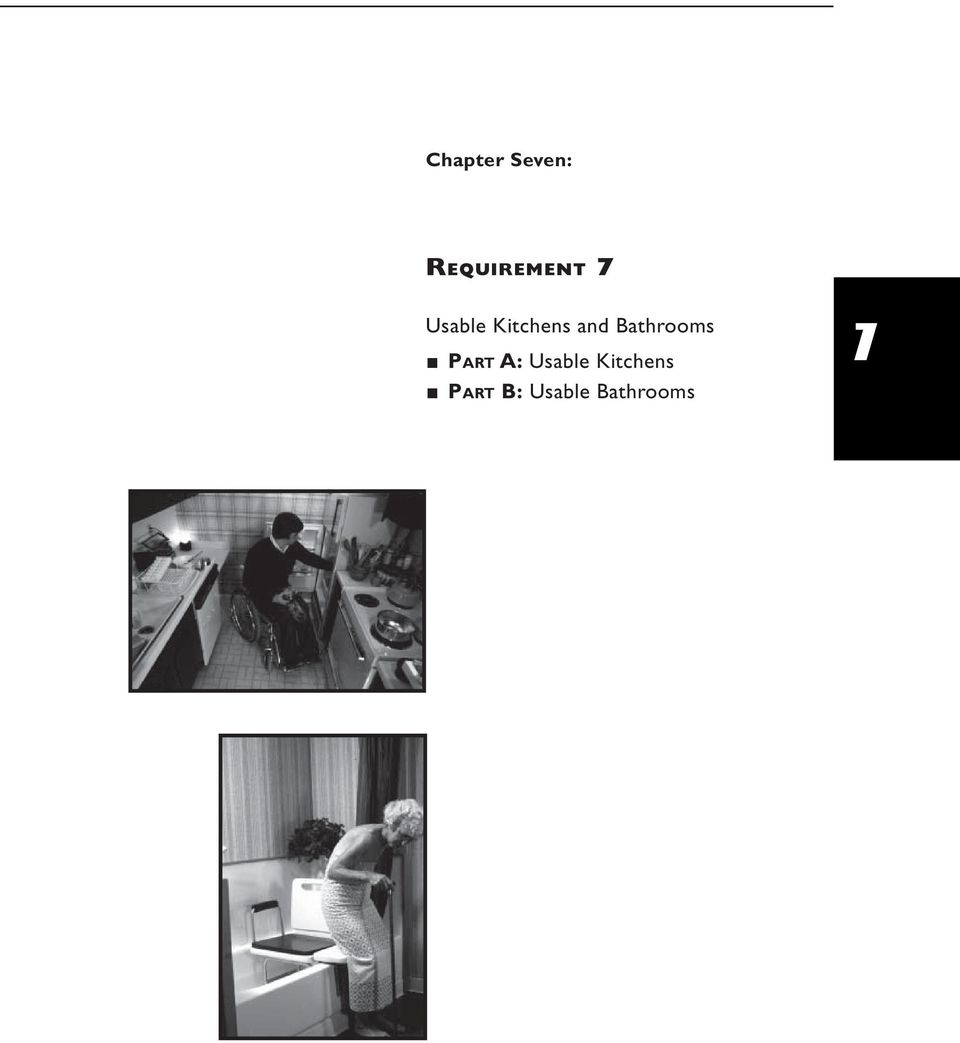
1 Chapter Seven: REQUIREMENT 7 Usable Kitchens and Bathrooms PART A: Usable Kitchens PART B: Usable Bathrooms 7
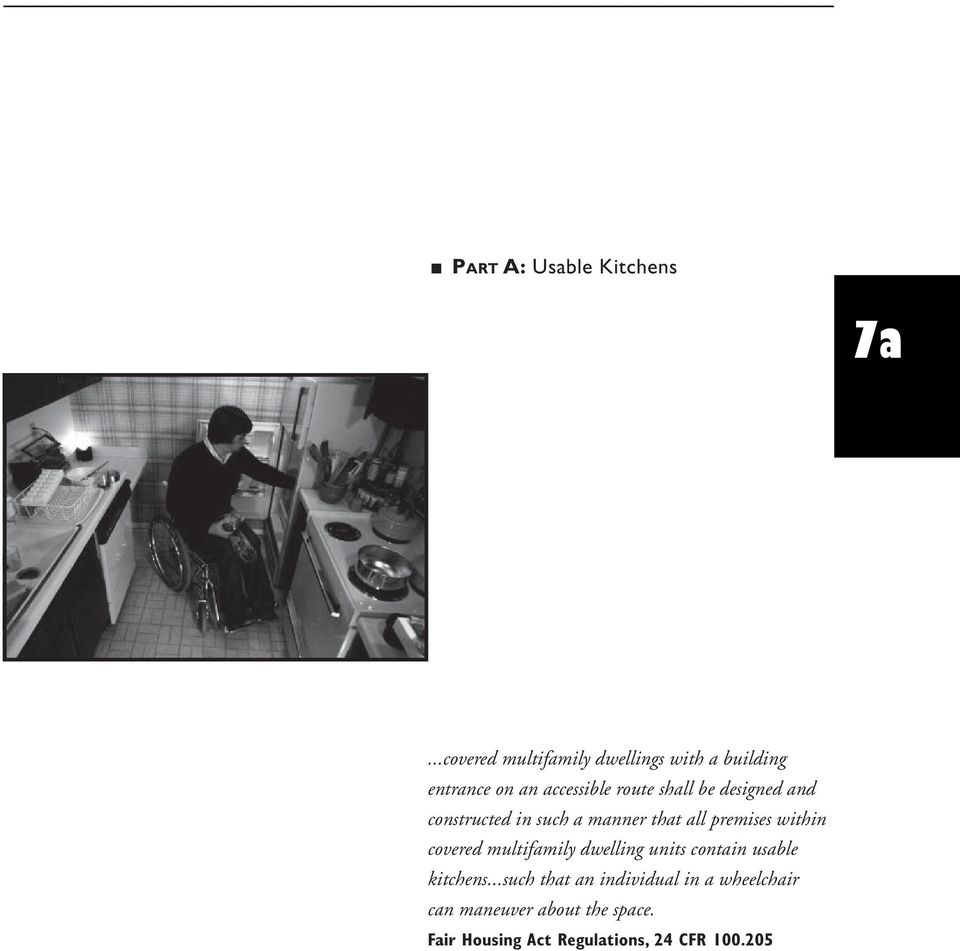
2 PART A: Usable Kitchens 7a...covered multifamily dwellings with a building entrance on an accessible route shall be designed and constructed in such a manner that all premises within covered multifamily dwelling units contain usable kitchens...such that an individual in a wheelchair can maneuver about the space. Fair Housing Act Regulations, 24 CFR
3 PART TWO: CHAPTER 7 FAIR HOUSING ACT DESIGN MANUAL counters may be at the standard height of 36" (counter height of 34" as shown in Fig. 2(c) of the Guidelines does not apply) lever hardware, although preferred and more usable by everyone, is not required kitchens in covered units must be on an accessible route and have door openings at least 32" clear to allow passage; see Chapter 4 Usable Doors and Chapter 5 Accessible Route outlet located beyond reach of seated person permitted if other outlets in accessible locations are provided, see Chapter 6 Switches, Outlets, and Controls ranges and cooktops may have front-, rear-, or side-mounted controls; for safety reasons and ease of use, front- or sidemounted controls are preferred Notes in italic type are recommendations only and are not required by ANSI or Guidelines. Guideline Specifications for Kitchens adequate space within the kitchen to provide 30" X 48" clear floor space at each fixture and appliance in U-shaped kitchens, if less than 60" between the two legs of the U, then sink base must be removable, see page
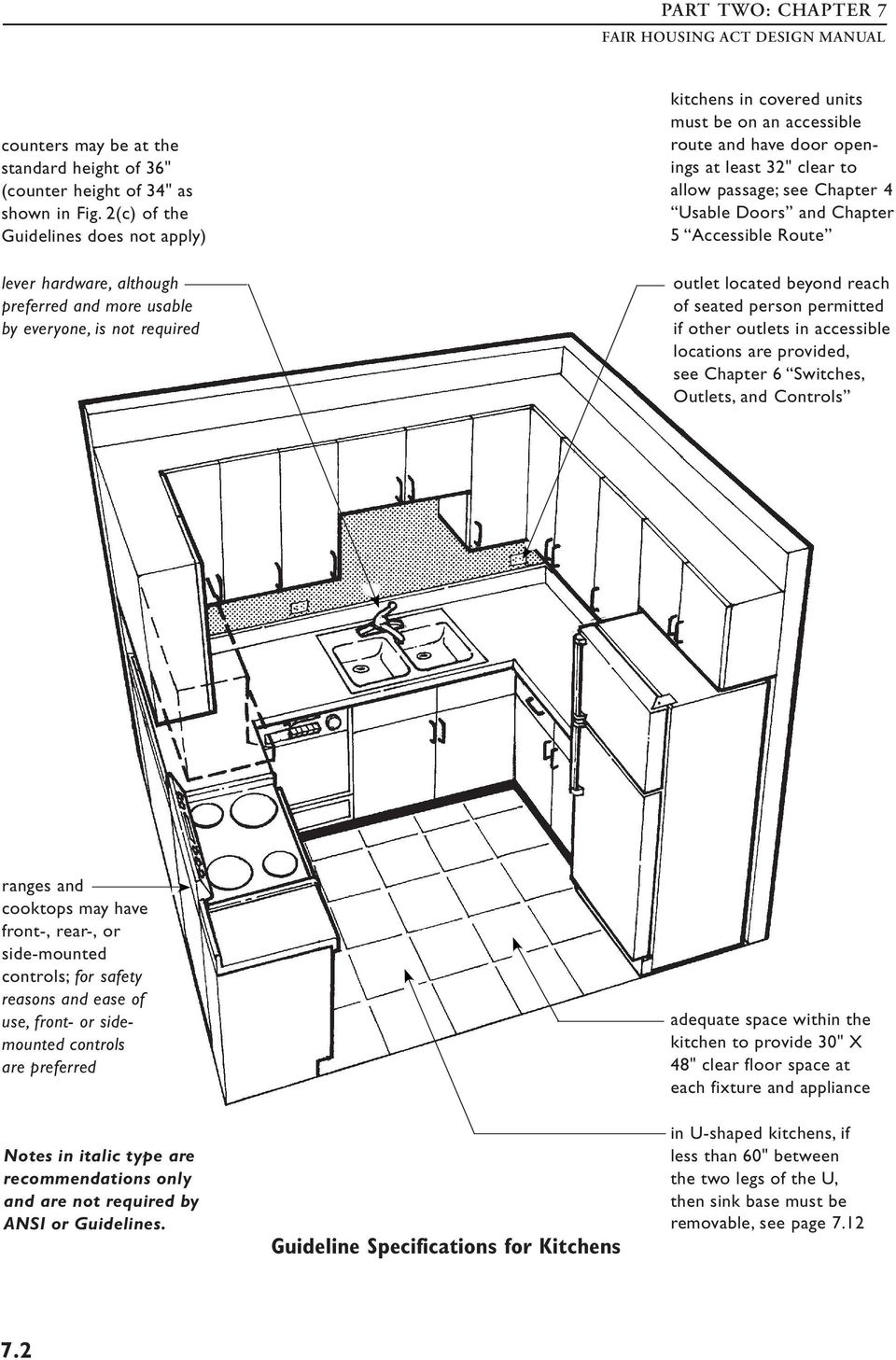
4 USABLE KITCHENS AND BATHROOMS PART A: USABLE KITCHENS INTRODUCTION CLEAR FLOOR SPACE AT Kitchens that comply with the Fair Housing Accessibility Guidelines (the Guidelines) can be designed to look and function like conventional kitchens typically found in multifamily housing. The Guidelines specify that three specific requirements must be provided to allow people who rely on mobility aids to use the kitchen. Usable kitchens, as specified in the Guidelines, are not necessarily accessible kitchens, but they do provide maneuvering space for a person who uses a wheelchair, scooter, or walker to approach and operate most appliances and fixtures. The Guidelines 1) specify minimum clear floor spaces at fixtures and appliances, 2) define minimum clearance between counters, and 3) provide additional specifications when a U-shaped kitchen is planned. Wheelchair turning spaces, described in accessibility standards, are not required in kitchens that meet the Guidelines, except in some U-shaped kitchens, see page 7.9. Additional supplemental design information, presented in italic type, is offered for designers/builders who may wish to increase the accessibility of dwelling units. This supplemental information is not required by HUD, the Fair Housing Act, or the Guidelines. FIXTURES AND APPLIANCES The Guidelines specify that a 30-inch x 48-inch clear floor space be provided at each kitchen appliance or fixture, and that each of these clear floor spaces adjoin the accessible route that must pass into and through the kitchen. It is anticipated that in any conventional kitchen plan, the overlapping of the minimum 36-inch wide accessible route with the clear floor spaces at all fixtures and appliances provides the necessary maneuvering space to make it possible for a person using a mobility aid to approach, and then position himself or herself close enough to use the fixture safely. The clear floor space must be positioned either parallel or perpendicular to and centered on the appliance or fixture, i.e., the clear floor space must have its centerline aligned with the centerline of the fixture or appliance. This centered position is most critical at corners where an appliance may have to be pulled away from the corner to allow a full centered approach. The two types of approaches and where they are necessary are described on the following pages. 30" X 48" clear floor space Clear Floor Space for Wheelchair Parking at Appliances and Fixtures 7.3

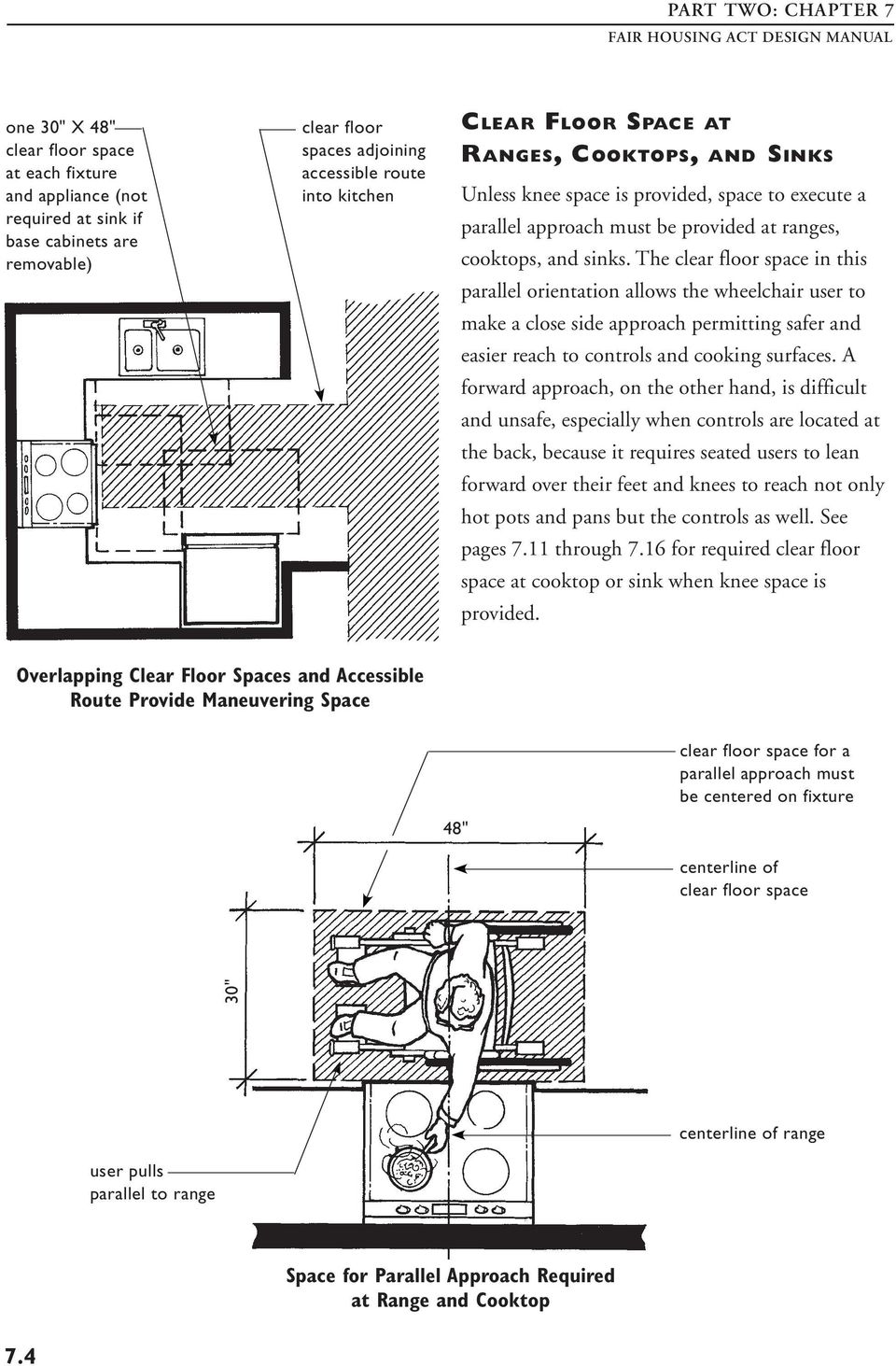
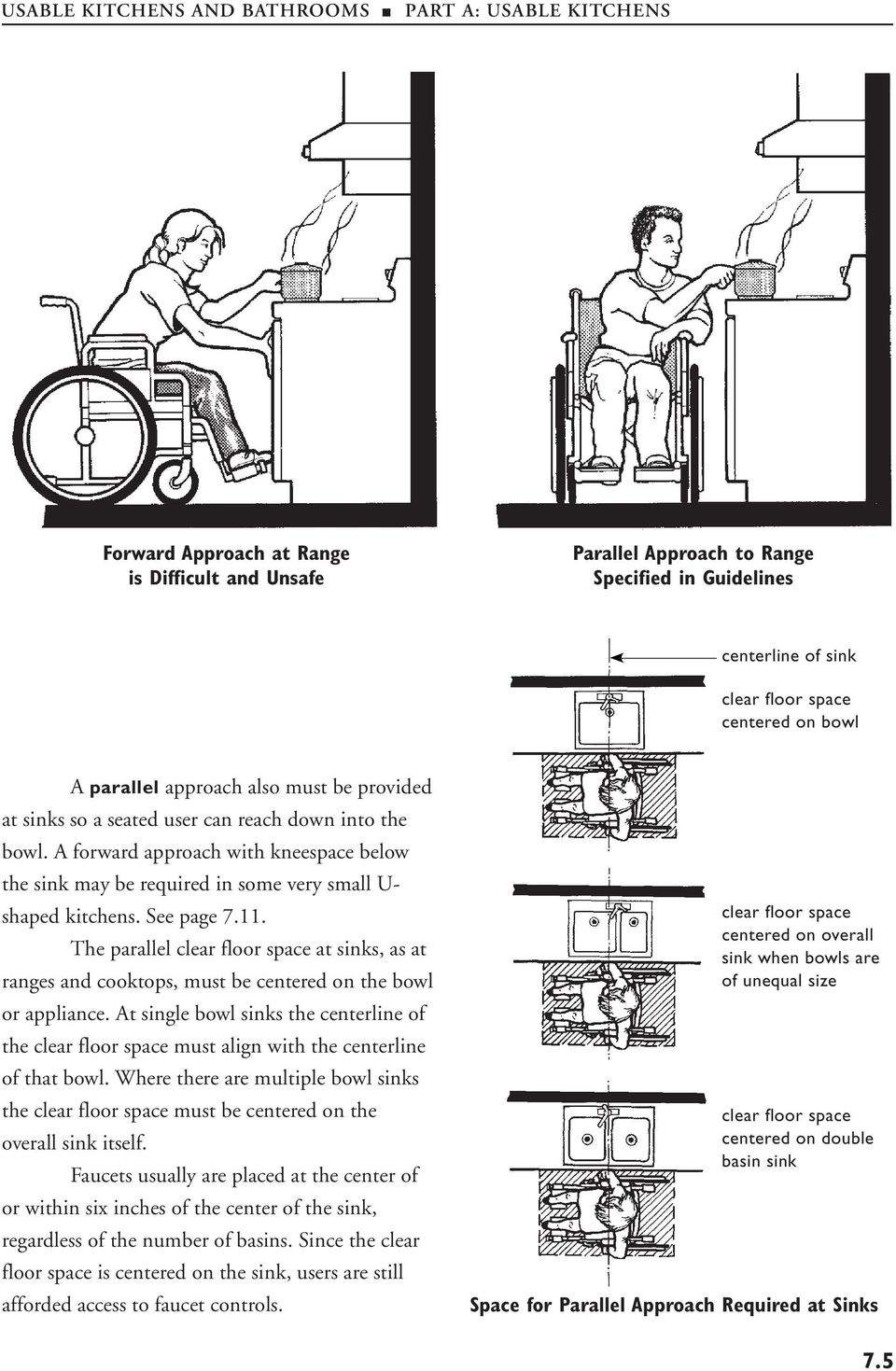
5 PART TWO: CHAPTER 7 FAIR HOUSING ACT DESIGN MANUAL one 30" X 48" clear floor CLEAR FLOOR SPACE AT clear floor space spaces adjoining RANGES, COOKTOPS, AND SINKS at each fixture accessible route and appliance (not into kitchen Unless knee space is provided, space to execute a required at sink if parallel approach must be provided at ranges, base cabinets are removable) cooktops, and sinks. The clear floor space in this parallel orientation allows the wheelchair user to 30" make a close side approach permitting safer and easier reach to controls and cooking surfaces. A forward approach, on the other hand, is difficult and unsafe, especially when controls are located at the back, because it requires seated users to lean forward over their feet and knees to reach not only hot pots and pans but the controls as well. See pages 7.11 through 7.16 for required clear floor space at cooktop or sink when knee space is provided. Overlapping Clear Floor Spaces and Accessible Route Provide Maneuvering Space 48" clear floor space for a parallel approach must be centered on fixture centerline of clear floor space 30" centerline of range user pulls parallel to range Space for Parallel Approach Required at Range and Cooktop 7.4
6 USABLE KITCHENS AND BATHROOMS PART A: USABLE KITCHENS Forward Approach at Range is Difficult and Unsafe Parallel Approach to Range Specified in Guidelines centerline of sink clear floor space centered on bowl A parallel approach also must be provided at sinks so a seated user can reach down into the bowl. A forward approach with kneespace below the sink may be required in some very small U- shaped kitchens. See page The parallel clear floor space at sinks, as at ranges and cooktops, must be centered on the bowl or appliance. At single bowl sinks the centerline of the clear floor space must align with the centerline of that bowl. Where there are multiple bowl sinks the clear floor space must be centered on the overall sink itself. Faucets usually are placed at the center of or within six inches of the center of the sink, regardless of the number of basins. Since the clear floor space is centered on the sink, users are still afforded access to faucet controls. clear floor space centered on overall sink when bowls are of unequal size clear floor space centered on double basin sink Space for Parallel Approach Required at Sinks 7.5
7 PART TWO: CHAPTER 7 FAIR HOUSING ACT DESIGN MANUAL CLEAR FLOOR SPACE AT OVENS, DISHWASHERS, REGRIGERATORS, FREEZERS, AND TRASH COMPACTORS parallel approach perpendicular or forward approach 30" 48" The 30-inch x 48-inch clear floor space oriented in either one of two positions parallel or perpendicular is required at the oven, dishwasher, refrigerator, freezer, and trash compactor. Wall- mounted and microwave ovens, like ovens in ranges, also must have either a parallel or perpendicular clear floor space adjacent to the appliance. Even though this group of appliances has operable doors that require the user to be able to get out of the way of the door swing, for purposes of design and room layout the clear floor space must be centered on the appliance itself. However, the clear floor space for the specific appliance and the clear floor space for adjacent appliances and fixtures, combined with the 36-inch wide accessible route into the room, provide the functional space necessary to open a door and maneuver close to the appliance to be able to reach into it. clear floor space for at least one type of approach (forward or parallel) must be centered on the refrigerator; this applies to side-by-side as well as over/under models REF Space for Either a Forward or Parallel Approach Must be Provided range forward approach to oven racks parallel approach to oven racks Functional Use of Oven Could Be From Any One of These Positions 7.6

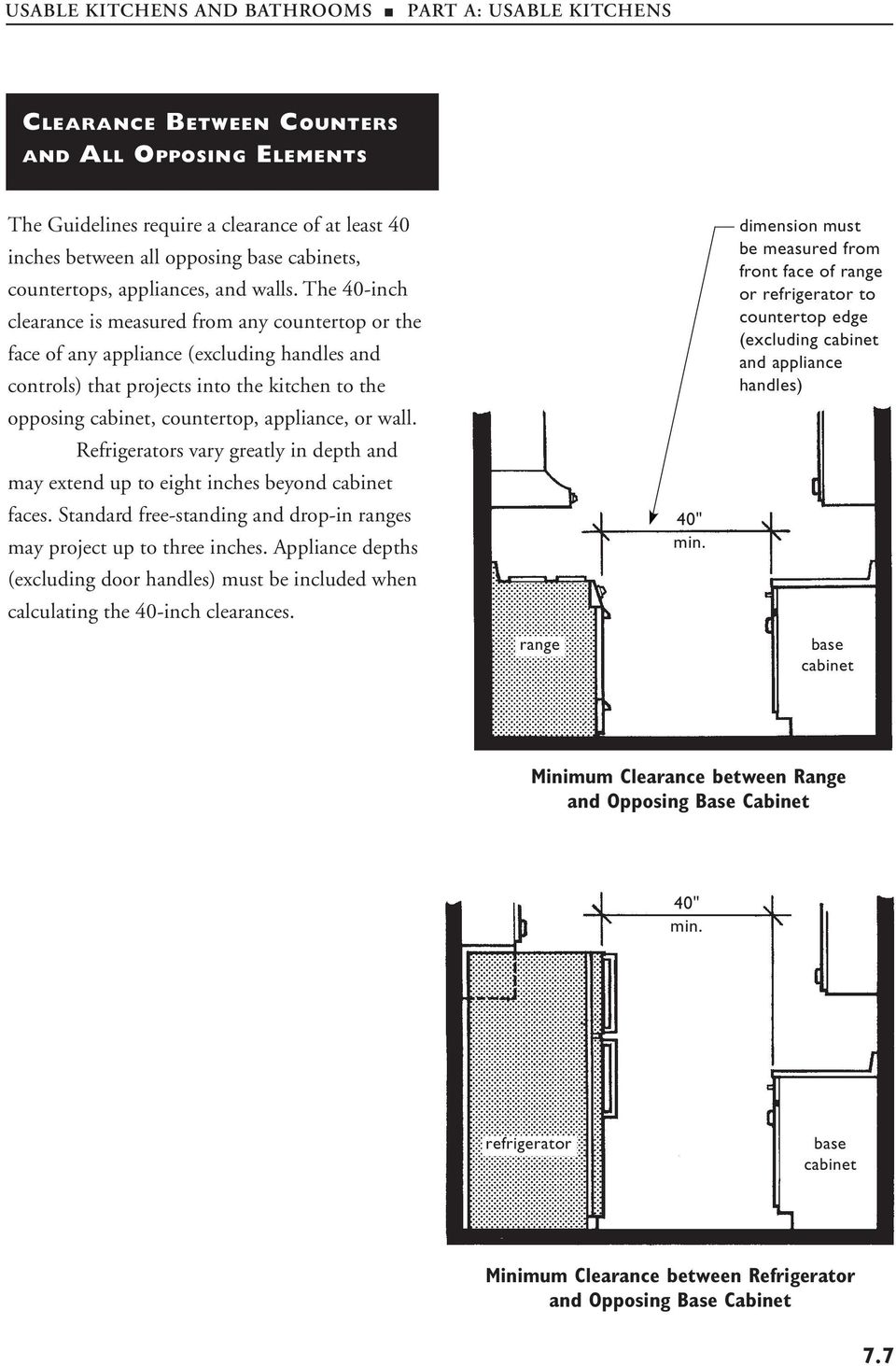
8 USABLE KITCHENS AND BATHROOMS PART A: USABLE KITCHENS CLEARANCE BETWEEN COUNTERS AND ALL OPPOSING ELEMENTS The Guidelines require a clearance of at least 40 inches between all opposing base cabinets, countertops, appliances, and walls. The 40-inch clearance is measured from any countertop or the face of any appliance (excluding handles and controls) that projects into the kitchen to the opposing cabinet, countertop, appliance, or wall. Refrigerators vary greatly in depth and may extend up to eight inches beyond cabinet faces. Standard free-standing and drop-in ranges may project up to three inches. Appliance depths (excluding door handles) must be included when calculating the 40-inch clearances. range 40" min. dimension must be measured from front face of range or refrigerator to countertop edge (excluding cabinet and appliance handles) base cabinet Minimum Clearance between Range and Opposing Base Cabinet 40" min. refrigerator base cabinet Minimum Clearance between Refrigerator and Opposing Base Cabinet 7.7
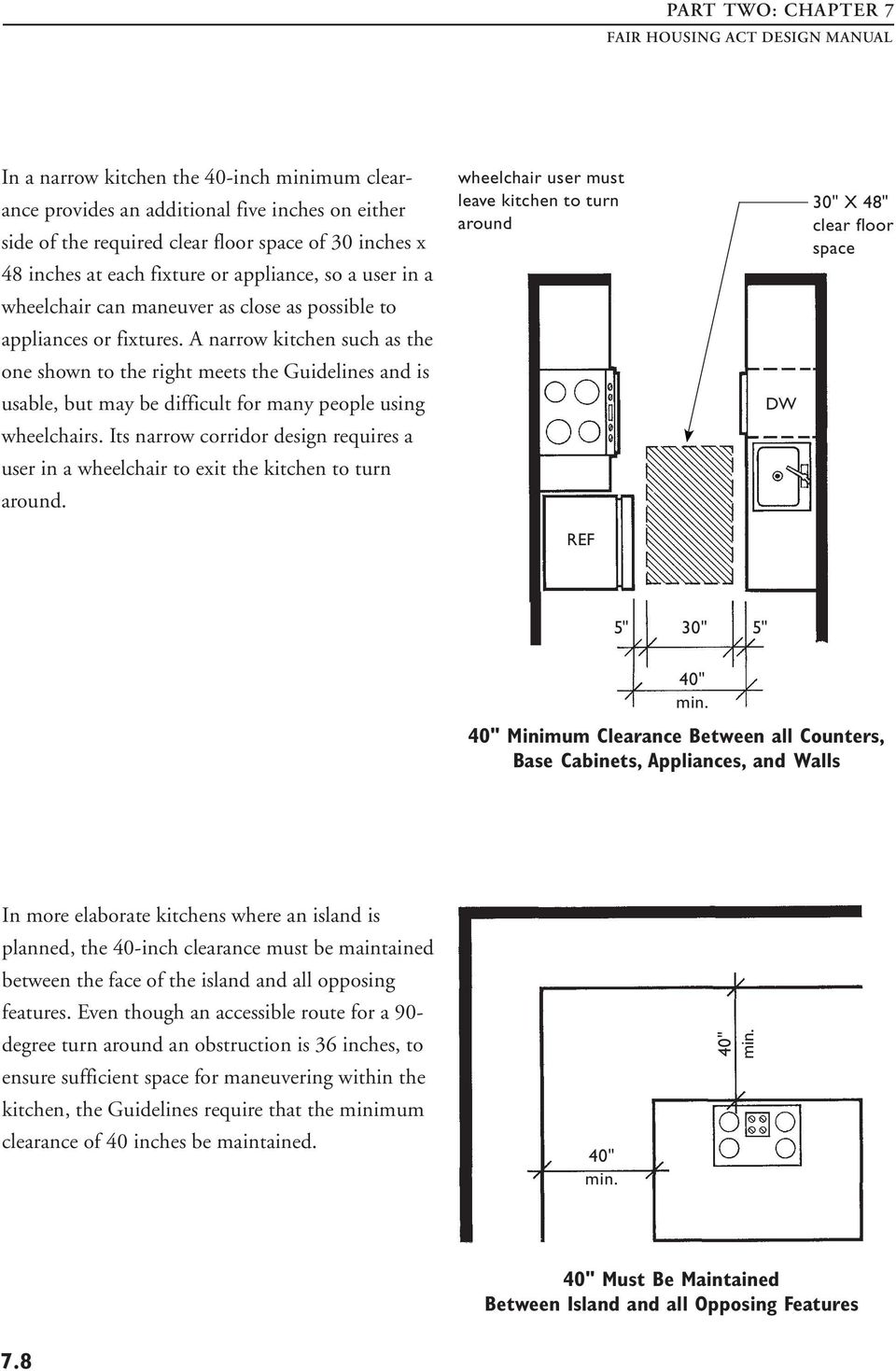
9 PART TWO: CHAPTER 7 FAIR HOUSING ACT DESIGN MANUAL In a narrow kitchen the 40-inch minimum clearance provides an additional five inches on either side of the required clear floor space of 30 inches x 48 inches at each fixture or appliance, so a user in a wheelchair can maneuver as close as possible to appliances or fixtures. A narrow kitchen such as the one shown to the right meets the Guidelines and is usable, but may be difficult for many people using wheelchairs. Its narrow corridor design requires a user in a wheelchair to exit the kitchen to turn around. wheelchair user must leave kitchen to turn around DW 30" X 48" clear floor space REF 5" 30" 5" 40" min. 40" Minimum Clearance Between all Counters, Base Cabinets, Appliances, and Walls In more elaborate kitchens where an island is planned, the 40-inch clearance must be maintained between the face of the island and all opposing features. Even though an accessible route for a 90 degree turn around an obstruction is 36 inches, to ensure sufficient space for maneuvering within the kitchen, the Guidelines require that the minimum clearance of 40 inches be maintained. 40" min. 40" min. 40" Must Be Maintained Between Island and all Opposing Features 7.8
10 USABLE KITCHENS AND BATHROOMS PART A: USABLE KITCHENS U-SHAPED KITCHENS A 60-inch diameter turning circle is required in a U-shaped kitchen that has a sink, range, or cooktop at its base. This turning diameter is necessary to provide adequate maneuvering space for a person using a wheelchair to approach and position themselves parallel to the appliance or fixture at the base of the U. Any appliances, such as refrigerators and ranges (excluding door handles), that project beyond countertops and cabinets must not encroach upon this 60-inch diameter turning space. In addition to the turning space, the kitchen must be arranged so there is a 30-inch x 48-inch clear floor space for a parallel approach centered on the sink, range, or cooktop. The centerline of the fixture or appliance must be aligned with the centerline of the clear floor space. When a sink, even a standard single basin sink, is at the bottom of the U and a dishwashing machine is planned to be included adjacent to the sink, the distance between the legs of the U must be greater than 60 inches to allow for a full centered approach at the sink. See the lower plan in the right column. range tray base cabinet or similar must be wider if refrigerator is 1" filler placed closer to sink 24" 30" 9" DW 60" min. sink base 60" diameter turning circle required 60" Diameter Turning Circle when Sink (Only), Cooktop, or Range is at Bottom of U-Shaped Kitchen 30" X 48" clear floor space centerline of clear floor space aligned with centerline of range refrigerator must be selected and positioned so it does not encroach upon the 60" diameter turning circle or the clear floor space at the sink range REF 30" X 48" clear floor space centered on sink 60" diameter turning circle this dimension may need to be increased slightly for a double basin sink if wider than 30" 64" min. Sink and Dishwasher at Bottom of U-Shaped Kitchen Increases Room Width 7.9

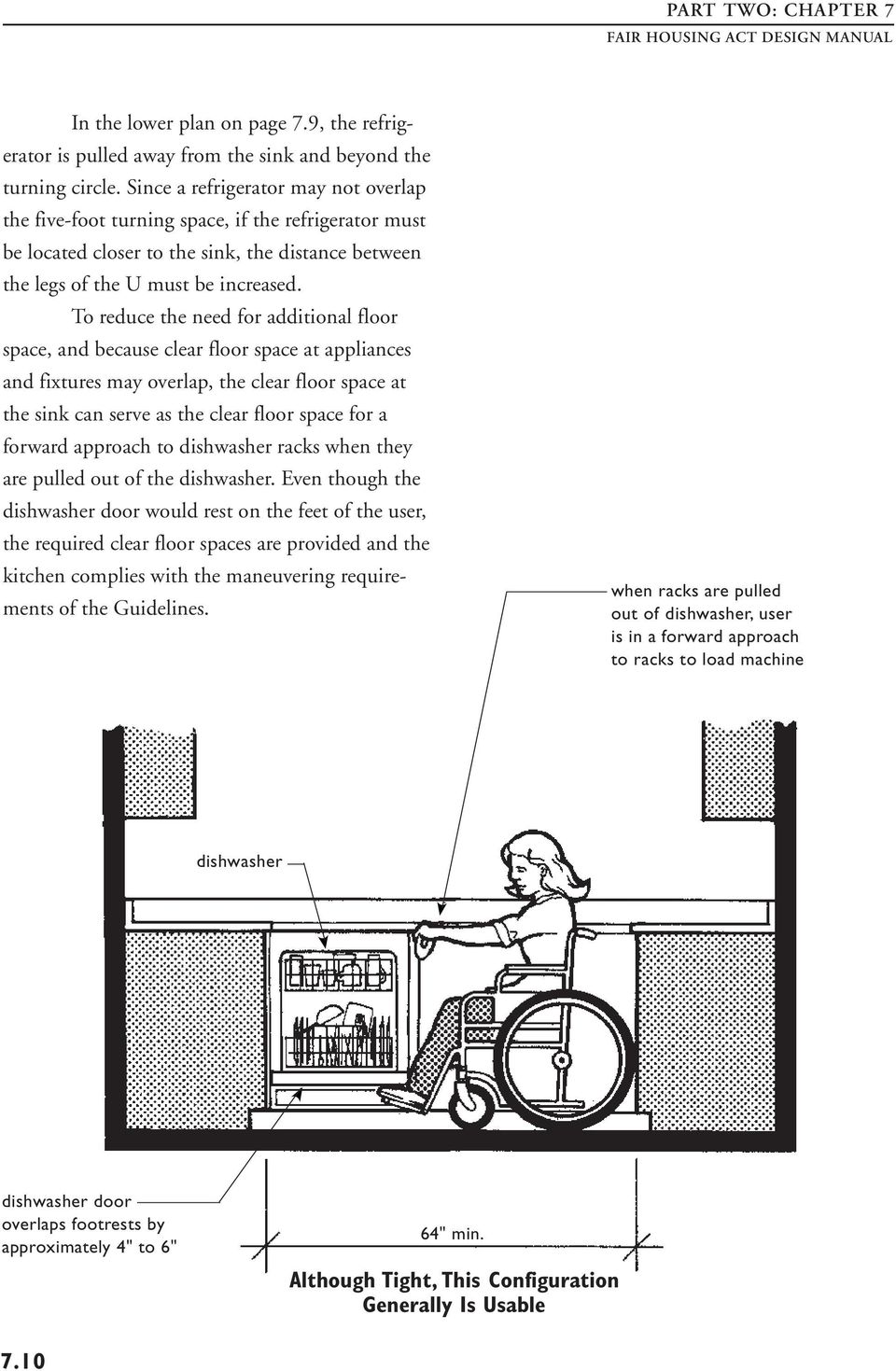
11 PART TWO: CHAPTER 7 FAIR HOUSING ACT DESIGN MANUAL In the lower plan on page 7.9, the refrigerator is pulled away from the sink and beyond the turning circle. Since a refrigerator may not overlap the five-foot turning space, if the refrigerator must be located closer to the sink, the distance between the legs of the U must be increased. To reduce the need for additional floor space, and because clear floor space at appliances and fixtures may overlap, the clear floor space at the sink can serve as the clear floor space for a forward approach to dishwasher racks when they are pulled out of the dishwasher. Even though the dishwasher door would rest on the feet of the user, the required clear floor spaces are provided and the kitchen complies with the maneuvering requirements of the Guidelines. when racks are pulled out of dishwasher, user is in a forward approach to racks to load machine dishwasher dishwasher door overlaps footrests by approximately 4" to 6" 64" min. Although Tight, This Configuration Generally Is Usable 7.10
12 USABLE KITCHENS AND BATHROOMS PART A: USABLE KITCHENS AN EXCEPTION The Guidelines permit U-shaped kitchens with a sink or cooktop at the base of the U to have less than 60 inches between the legs of the U only when removable base cabinets are provided under the cooktop or sink. A clearance of at least 40 inches is required. Since knee space cannot be provided below a range, kitchens with a range at the base of the U must have the 60-inch minimum turning diameter. Once the base cabinet is removed, the resulting knee space allows a person using a wheel- chair to pull up under the feature to reach controls and perform cooking/cleaning functions. A note of caution: knee space beneath cooktops provides essential maneuvering space for seated people, but it also creates a greater risk from hot food spilled in the lap. If cooktops are to be provided with knee space below, although not required, it is suggested that they be placed in lowered or adjustable height counter segments so they can be used more easily and safely by people using wheelchairs. Knee space configurations are shown on pages 7.14 and wheelchair user cannot turn around in either kitchen and must back into space to open refrigerator 30" min. sink with removable base cabinet and knee space below cooktop with removable base cabinet and knee space below 30" min. REF 40" min. Sink at Base of Narrow U-Shaped Kitchen 30" x 48" clear floor space; only 19" of clear floor space may extend under sink or cooktop wall-mounted oven DW REF 40" min. Cooktop at Base of Narrow U-Shaped Kitchen (Not Allowed for a Range) 7.11

13 PART TWO: CHAPTER 7 FAIR HOUSING ACT DESIGN MANUAL REMOVABLE BASE CABINETS Narrow U-shaped kitchens, where knee space must be provided below sinks or cooktops, can appear identical to those kitchens which lack this additional feature since knee space can be concealed by a removable base cabinet. When a potential resident or owner needs the knee space it can be provided quickly and easily. Specifications for knee space are based on the Guidelines requirements for bathrooms and ANSI 4.19 and See also pages and standard sinks acceptable, sinks with rear located drains simplify knee space recommended pipe protection and hinged panel with disposal cover; note pipes and disposal also can be wrapped in insulation, see details page 7.15 Notes in italic type are recommendations only and are not required by ANSI or Guidelines. cut away back and frame and reinforce with gussets 30" wide x 27" high clear knee space carry floor, cabinet, and wall finishes under and behind removable cabinets removable cabinet front removable cabinet front and bottom Possible Removable Cabinet Options for Required Knee Spaces at Sinks or Cooktops in Narrow (Less Than 60" Wide) U-Shaped Kitchens removable cabinet 7.12

14 USABLE KITCHENS AND BATHROOMS PART A: USABLE KITCHENS The Guidelines require that the floor, walls, and cabinet faces of knee space be finished during initial construction so no other work is necessary when the base cabinet is removed. When sinks or cooktops are installed at the bottom of a narrow U-shaped kitchen, regardless of whether the knee space is exposed or concealed by a removable cabinet, hot pipes or exposed sharp edges should be insulated or enclosed at the time of initial construction. Protection methods are addressed on page 7.14 Knee Space and Pipe Protection. There are no kitchen cabinet manufacturers that currently offer removable base cabinets in their standard lines. The methods for providing removable cabinets presented here are some of the possible solutions. Of those shown, the removable cabinet front is likely to be the easiest to accomplish based upon current manufacturing processes. However, the resident may need to reinstall the cabinet at a later date, therefore, storage needs to be considered. It is recommended that instructions regarding proper storage be taped to the inside of the cabinet, as well as reinstallation instructions, if applicable. Other similar design options include removable cabinet floor and bottom, or, with some modification of rear supports, removal of the entire cabinet. This last option requires the counter to be installed independent of the base cabinet, with storage of the removable portion of the cabinet again a consideration. Use of swinging retractable cabinet door hardware provides another excellent method to conceal knee space because the doors are selfstoring and no part of the cabinet has to be removed or stored at another location. A special combination hinge allows the doors to swing open in a traditional manner and, when desired, allows the doors to be pushed back into the cabinet. doors closed Use of Self-Storing Door Hardware to Expose Knee Space doors opening doors retracted 7.13

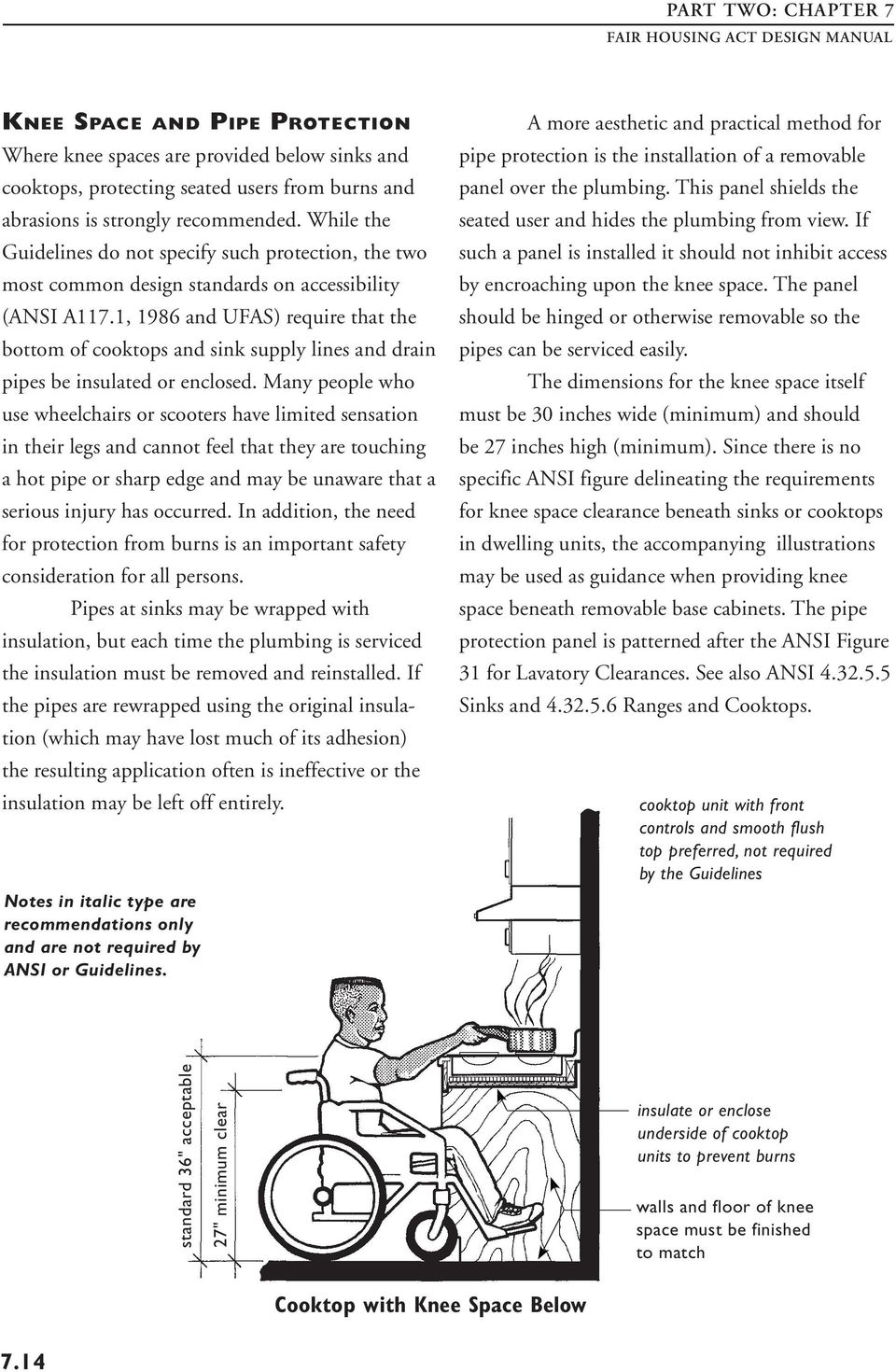
15 PART TWO: CHAPTER 7 FAIR HOUSING ACT DESIGN MANUAL KNEE SPACE AND PIPE PROTECTION Where knee spaces are provided below sinks and cooktops, protecting seated users from burns and abrasions is strongly recommended. While the Guidelines do not specify such protection, the two most common design standards on accessibility (ANSI A117.1, 1986 and UFAS) require that the bottom of cooktops and sink supply lines and drain pipes be insulated or enclosed. Many people who use wheelchairs or scooters have limited sensation in their legs and cannot feel that they are touching a hot pipe or sharp edge and may be unaware that a serious injury has occurred. In addition, the need for protection from burns is an important safety consideration for all persons. Pipes at sinks may be wrapped with insulation, but each time the plumbing is serviced the insulation must be removed and reinstalled. If the pipes are rewrapped using the original insulation (which may have lost much of its adhesion) the resulting application often is ineffective or the insulation may be left off entirely. Notes in italic type are recommendations only and are not required by ANSI or Guidelines. A more aesthetic and practical method for pipe protection is the installation of a removable panel over the plumbing. This panel shields the seated user and hides the plumbing from view. If such a panel is installed it should not inhibit access by encroaching upon the knee space. The panel should be hinged or otherwise removable so the pipes can be serviced easily. The dimensions for the knee space itself must be 30 inches wide (minimum) and should be 27 inches high (minimum). Since there is no specific ANSI figure delineating the requirements for knee space clearance beneath sinks or cooktops in dwelling units, the accompanying illustrations may be used as guidance when providing knee space beneath removable base cabinets. The pipe protection panel is patterned after the ANSI Figure 31 for Lavatory Clearances. See also ANSI Sinks and Ranges and Cooktops. cooktop unit with front controls and smooth flush top preferred, not required by the Guidelines standard 36" acceptable 27" minimum clear insulate or enclose underside of cooktop units to prevent burns walls and floor of knee space must be finished to match Cooktop with Knee Space Below 7.14
16 USABLE KITCHENS AND BATHROOMS PART A: USABLE KITCHENS standard 6", 7", 8", and 9" deep sinks with center drain Knee Space at Sink with Pipe Protection Panel sinks with rear located drain are not required but are a significant advantage when creat ing usable knee space standard 36" acceptable 27" minimum varies 9" min. 12" pre ferred 8" min. 3" min. pipe protection and appearance panel adjacent cabinet, wall, and floor must be finished to match Knee Space at Sink with Wrapped Pipes standard 36" acceptable 27" minimum varies standard depth sinks up to 9" permitted, rear drain preferred although wrapped insulation is acceptable under the Guidelines, this method of pipe protection is discouraged adjacent cabinet, wall, and floor must be finished to match Knee Space at Sink with Garbage Disposal and Pipe Protection Panel disposal cover 12" wide ± open bottom for ventilation and access to reset buttons standard 36" acceptable varies 27" minimum 9" min. 12" pre ferred 8" min. 3" min. standard depth sinks up to 9" permitted, rear drain preferred pipe protection and appearance panel adjacent cabinet, wall, and floor must be finished to match 7.15

17 PART TWO: CHAPTER 7 FAIR HOUSING ACT DESIGN MANUAL shallow basin sink and rear drain, although not required by the Guidelines, greatly improve access by wheelchair user lever hardware, although preferred, is not required knee spaces must have walls and floor surfaces finished plumbing and other elements should be covered by a removable pipe protection and appearance panel, or be wrapped with padded insulating material, see details page 7.15 knee space 30" wide is required and 27" high is recommended under sinks or cooktops located at bottom of U-shaped kitchens when the U is less than 60" wide 30" min. 40" min. face to face of appliances and cabinets Knee Space at Narrow U-Shaped Kitchens Notes in italic type are recommendations only and are not required by ANSI or Guidelines. 30" X 48" min. clear floor space; must not extend more than 19" into knee space 7.16

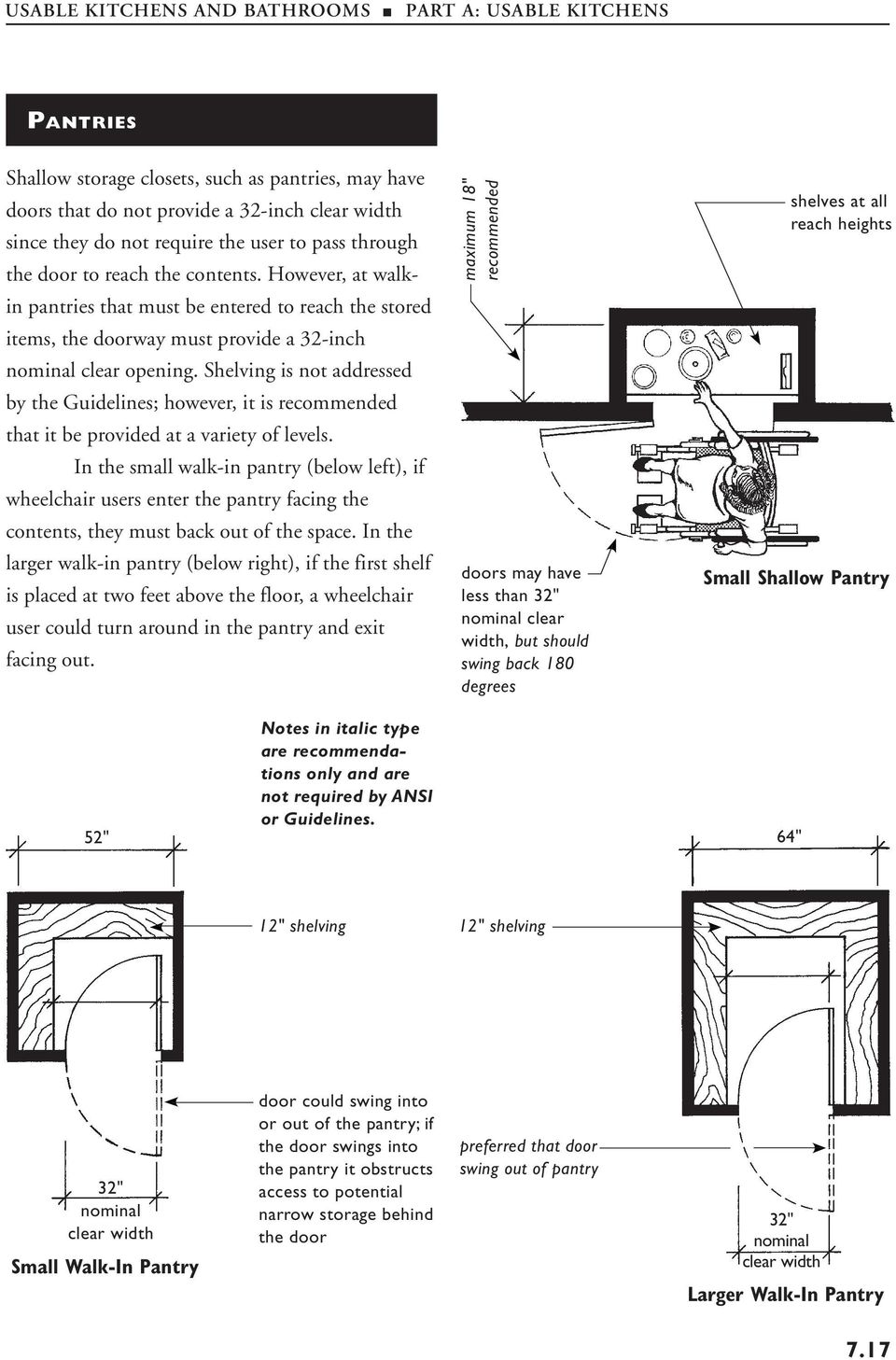
18 USABLE KITCHENS AND BATHROOMS PART A: USABLE KITCHENS PANTRIES Shallow storage closets, such as pantries, may have doors that do not provide a 32-inch clear width since they do not require the user to pass through the door to reach the contents. However, at walkin pantries that must be entered to reach the stored items, the doorway must provide a 32-inch nominal clear opening. Shelving is not addressed by the Guidelines; however, it is recommended that it be provided at a variety of levels. In the small walk-in pantry (below left), if wheelchair users enter the pantry facing the contents, they must back out of the space. In the larger walk-in pantry (below right), if the first shelf is placed at two feet above the floor, a wheelchair user could turn around in the pantry and exit facing out. maximum 18" recommended doors may have less than 32" nominal clear width, but should swing back 180 degrees shelves at all reach heights Small Shallow Pantry 52" Notes in italic type are recommendations only and are not required by ANSI or Guidelines. 64" 12" shelving 12" shelving 32" nominal clear width Small Walk-In Pantry door could swing into or out of the pantry; if the door swings into the pantry it obstructs access to potential narrow storage behind the door preferred that door swing out of pantry 32" nominal clear width Larger Walk-In Pantry 7.17
19 PART TWO: CHAPTER 7 FAIR HOUSING ACT DESIGN MANUAL RECOMMENDATIONS FOR INCREASED ACCESSIBILITY bottom of oven should be positioned so lowest oven rack is at or near countertop height AT WALL OVENS Wall-mounted ovens, like ovens in ranges, must have either a parallel or forward clear floor space adjacent to the appliance. When a single wall-mounted oven is installed, it is recommended that the bottom of the oven be mounted at or near counter height so a seated user could reach over a potentially hot door and, at a minimum, pull out the bottom oven rack. Controls also should be within the reach of a seated user. If double ovens are installed, a wheelchair user must be able to execute a parallel or a forward approach at the appliance. At least one oven interior and its controls, even though appliance controls are not covered by the Guidelines, should be within the reach range of a seated person. See page 5.5 for reach ranges. lowest oven rack 36" high countertop beyond 36" max. recommended 54" max. recommended Inches to Bottom 54 Inches Recommended Reach to of Single Wall-Mounted Oven Controls at Single Wall-Mounted Oven

20 USABLE KITCHENS AND BATHROOMS PART A: USABLE KITCHENS AT LAUNDRY EQUIPMENT The Guidelines do not require washers and dryers in individual dwelling units to be accessible, which also means that they are not required to have 30-inch x 48-inch parallel clear floor spaces positioned in front of them. However, when located in the kitchen along a row containing other appliances, it is recommended that space be provided for a parallel approach to each machine. The Guidelines permit the installation of stacked washers and dryers. It is recommended that the controls be within the reach of seated users; see the illustration in the upper right column. If the washer and dryer are located behind doors or are in a separate utility room, clear floor spaces in front of the machines are not required. However, if the door to the utility room is intended for user passage, the door must provide a 32-inch nominal clear opening. When laundry equipment is located in a common use area, it must conform to the requirements for accessible public and common use facilities, see page Note: Non-italic type indicates a requirement of the Guidelines. 54" max. dryer top-loading washer high side reach limit for a parallel approach floor of dryer Stacked Washer/Dryer Unit with Dryer and All Controls Within Reach Range of Seated User front loading washing machines preferred D W DW clear floor spaces may overlap clear floor space obstructed by doors, permitted under the Guidelines D W DW doors may be removed to improve access; appliances should be positioned as close to the front of the closet as possible Clear Floor Space at Laundry Equipment Not Required But Recommended 7.19

21 PART TWO: CHAPTER 7 FAIR HOUSING ACT DESIGN MANUAL AT OTHER APPLIANCES AND FIXTURES While not required by the Guidelines, careful consideration should be given to the selection of other appliances and fixtures installed in kitchens so potential residents who may currently, or in the future, have a physical limitation may more completely use and enjoy their dwelling. A partial list of additional considerations for kitchens: ranges and cooktops with controls that are front- or side-mounted and have click stops to indicate heat settings, vent hoods with controls mounted at or near countertop level, shallow sink basins with rear-mounted drains when removable base cabinets are provided, lever or blade type handle faucets and controls, revolving/extending semicircular shelves for corner base cabinet storage. levers are ideal but rarely found on appliances Preferred Control Choices blades help indicate positions and make turning somewhat easier small lever or extended blade provides position pointer and leverage for easy turning without grasping lever handle or blade high contrast labeling Ideal Control Knob Revolving/Extending Shelves at Corner Base Cabinets Are an Advantage for All Users Lever Handles on Faucets Are Easy for Most People to Operate 7.20
22 USABLE KITCHENS AND BATHROOMS PART A: USABLE KITCHENS EXAMPLES OF KITCHEN FLOOR PLANS THAT COMPLY WITH THE GUIDELINES The plans presented on the following pages are examples of usable kitchens that comply with the Fair Housing Accessibility Guidelines (the Guidelines). They range from very small to larger, more elaborate kitchens but are only a small sampling of the layouts possible. The plans are neither required nor even suggested as ideal examples. They are included to illustrate typical applications or interpretations of specific requirements of the Guidelines under various circumstances. The plans may be used as resource material and planning guides when developing new multifamily housing designs. Conventional industry standard fixture and appliance sizes have been used consistently when developing these plans. It is important to allow sufficient space for any fixtures that may be larger than those shown here. Although designers should rely upon the dimensions indicated and not scale off the drawings, all plans in this section are reproduced at 1/4 inch scale. The plans are presented in pairs, with the first plan showing fixture and appliance placement and key dimensions, such as aisle widths, that are required by the Guidelines. The second plan gives the overall room dimensions which are offered for comparison purposes only and are not required by the Guidelines. The second plan also shows clear floor spaces adjoining individual appliances and fixtures and describes their use, and, to give the reader the real space that appliances occupy, appliance doors are shown in their open position. Text and notes presented in italic type are comments or recommendations and are not required by the Guidelines. 7.21
23 PART TWO: CHAPTER 7 FAIR HOUSING ACT DESIGN MANUAL Very Small Parallel Wall Kitchen (Without Dishwasher) In this kitchen design, walls may not continue across either open end because they would obstruct clear floor spaces required at each appliance. Although discouraged because maneuvering space would be severely restricted, the sink end could be closed if a removable cabinet that conceals a minimum 30-inch wide knee space is provided under the sink; 36-inch wide knee space is preferred. 3'-4" min. 3' - 4" min. clear space between counter and face of refrigerator indicates overhead cabinets REF 5'-7" clear floor space at sink to allow close parallel approach; also serves as forward approach to oven racks when pulled out of the oven clear floor space at refrigerator 7'-11" REF clear floor space at range cooking surface although not required, it is preferred that refrigerator door swings back 180 degrees to permit close parallel approach 7.22
24 REF USABLE KITCHENS AND BATHROOMS PART A: USABLE KITCHENS Parallel Wall Kitchen 3'-0" min. 3'-0" min. Since there is no opposing cabinet, counter, appliance, or wall in this location, the refrigerator may encroach on the 3'-4" minimum dimension by 4"; however, the 3'-0" minimum accessible route must still be maintained. DW indicates overhead cabinets 3'-4" minimum clear space between counter and face of appliance(s) forward approach to refrigerator provided; the location of the wall to the left of the refrigerator does not permit the door to swing out of the way for a close parallel approach 7'-0" DW REF 10'-2" parallel approach to dishwasher counter surface, and forward approach to oven racks when pulled out of the oven parallel approach, centered on sink, permits a forward approach to dishwasher baskets when pulled out of the dishwasher 7'-7" clear floor space for parallel approach to range cooking surface 7.23
25 REF PART TWO: CHAPTER 7 FAIR HOUSING ACT DESIGN MANUAL Narrow U-Shaped Kitchen (Without Dishwasher) sink or cooktop in this location must have removable cabinet to provide knee space below indicates overhead cabinets 3'-4" min. REF although not required by the Guidelines, this optional rotating/sliding cabinet storage maximizes use of difficult to reach space for all users (see page 7.20) 7'-11" ; knee space under sink must be a minimum of 30" wide; removable base cabinets may be used if permanent knee space is not desired clear floor space for parallel approach to range cooking surface 7'-10" A typical oven door projects 20" when fully open and must be fairly close to fully open to pull out lower rack. Enough floor area must be available for a clear floor space in this location to permit a forward approach to oven racks when pulled out of the oven clear floor space for forward approach may extend a maximum of 19" into knee space although not required, it is preferred that refrigerator door swings back 180 degrees to permit close parallel approach clear floor space for parallel approach to refrigerator
26 USABLE KITCHENS AND BATHROOMS PART A: USABLE KITCHENS Wider U-Shaped Kitchen DW 5'-4" min. indicates overhead cabinets 5'-0" min. REF although not required by the Guidelines, optional rotating/sliding cabinet storage maximizes use of difficult-to-reach space pantry with narrow door acceptable, maximum 18" depth recommended laundry equipment is easier for person using a wheelchair to reach into if machines are recessed as little as possible and their front faces are flush with door frame D W 9'-7" ; DW ; clear floor space at range cooking surface 12'-6" 5'-8" W D REF clear floor space for parallel approach centered on overall sink and forward approach to dishwasher baskets when pulled out of the dishwasher clear floor space at refrigerator permits parallel approach; also permits maneuvering into parallel approach at oven although not required, it is best if refrigerator door swings 180 degrees to permit close parallel approach 7.25
27 PART TWO: CHAPTER 7 FAIR HOUSING ACT DESIGN MANUAL Parallel Wall Kitchen DW REF indicates overhead cabinets 3'-4" min. W/D built-in table 11'-6" clear floor space for parallel approach to range cooktop ; 8'-8" 9'-5" clear floor space at dishwasher also permits a forward approach to oven racks when pulled out of the oven while not required, clear floor space for parallel approach to stackable washer/dryer is recommended because of pantry depth, door must be 32 inches nominal clear width 7.26 W/D DW REF built-in table clear floor space for parallel approach at sink; this same clear floor space allows a forward approach to dishwasher baskets when they are pulled out of the dishwasher clear floor space permits parallel approach to refrigerator (although not required by the Guidelines, it is best if refrigerator door swings back 180 degrees to permit close parallel approach)
28 USABLE KITCHENS AND BATHROOMS PART A: USABLE KITCHENS Small L-Shaped Kitchen DW indicates overhead cabinets 3'-4" min. REF parallel approach to range cooktop 9'-6" sufficient space in front of the refrigerator to permit a forward approach to oven racks when they are pulled out of the oven REF 6'-9" DW parallel approach centered on sink permits a forward approach to dishwasher baskets when they are pulled out of the dishwasher both forward and limited parallel approach to pantry permitted because pantry is shallow, door may be less than 32" nominal clear width forward approach to refrigerator 7.27
29 PART TWO: CHAPTER 7 FAIR HOUSING ACT DESIGN MANUAL 9'-6" Larger L-Shaped Kitchen DW indicates overhead cabinets 3'-0" min. shown at 4'-0" 14'-4" REF clear floor space for a parallel approach at range cooktop parallel approach at refrigerator, (although not required by the Guidelines, it is best if refrigerator door swings back 180 degrees to permit close parallel approach) 7.28 REF DW parallel approach centered on sink permits a forward approach to dishwasher baskets when pulled out of the dishwasher forward approach at dishwasher the parallel approach at the refrigerator permits a forward approach to oven racks when they are pulled out of the oven
30 USABLE KITCHENS AND BATHROOMS PART A: USABLE KITCHENS Broken U-Shaped Kitchen If a corner position with knee space below is being considered for either the sink or cooktop, it is preferred that the sink be located in the corner, as opposed to the cooktop. This is because a cooktop with knee space below at the standard 36-inch height of a kitchen countertop is dangerous for seated users. 3'-4" min. REF indicates overhead cabinets 3'-4" min. DW 10'-9" sufficient space is available for either a parallel or forward approach at oven 10'-9" REF parallel approach at refrigerator parallel approach to range cooktop although not required since pantry is shallow, 32" nominal clear door width preferred DW corner sink with removable cabinet provides knee space below, allows forward approach 12" to 18" minimum base cabinet recommended so dishwasher is positioned a sufficient distance to allow user to pull in under sink, lower dishwasher door, pull out racks, and load machine 7.29
31 PART TWO: CHAPTER 7 FAIR HOUSING ACT DESIGN MANUAL Spacious U-Shaped Kitchen While this kitchen has an overall U shape, it functions like a parallel wall kitchen with two points of entry and exit and allows close parallel approach to the fixture at the base of the U. 3'-4" min. 3'-4" min. 3'-4" between all opposing features must be maintained REF FREZ indicates overhead cabinets 3'-4" min. DW TC parallel clear floor spaces at the dishwasher and trash compactor permit either a left- or right-handed forward approach to oven racks when they are slid out of the oven parallel clear floor spaces at both refrigerator and freezer 9'-4" REF FREZ DW TC wide pantry doors provide excellent access to contents 16'-3" 7.30
32 PART B: Usable Bathrooms 7b...covered multifamily dwellings with a building entrance on an accessible route shall be designed and constructed in such a manner that all premises within covered multifamily dwelling units contain usable...bathrooms such that an individual in a wheelchair can maneuver about the space. Fair Housing Act Regulations, 24 CFR
33 PART TWO: CHAPTER 7 FAIR HOUSING ACT DESIGN MANUAL Definitions from the Guidelines Bathroom. A bathroom which includes a water closet (toilet), lavatory (sink), and bathtub or shower. It does not include singlefixture facilities or those with only a water closet and lavatory. It does include a compartmented bathroom. A compartmented bathroom is one in which the fixtures are distributed among interconnected rooms. A compartmented bathroom is considered a single unit and is subject to the Act's requirements for bathrooms. Powder Room. A room with only a water closet (toilet) and lavatory (sink). (Definition found in Requirement 6.) 7.32
34 USABLE KITCHENS AND BATHROOMS PART B: USABLE BATHROOMS INTRODUCTION The Fair Housing Accessibility Guidelines (the Guidelines) provide specifications for bathroom design that make it possible for people who use mobility aids, and who, heretofore, could not even get into conventional bathrooms in multifamily housing, to now use such facilities. Though not fully accessible, when designed to comply with the Guidelines, these usable bathrooms provide a person who uses a wheelchair or scooter or who may use a walker or other mobility aid with a bathroom that has enough maneuvering space to allow the person to enter, close the door, use the fixtures, and exit. In some cases, a resident with a disability will find it necessary to make additional modifications to meet his or her specific needs. In covered multifamily housing, bathrooms that meet the definition in the Guidelines for a bathroom must then meet the specifications outlined in the Guidelines for usable bathrooms. The Guidelines distinguish between bathrooms and powder rooms and provide different specifications (see definitions on facing page). Usable bathroom specifications include: 1. an accessible route to and into the bathroom with a nominal 32-inch clear door opening (Requirements 3 and 4), 2. switches, outlets, and controls in accessible locations (Requirement 5), 3. reinforced walls to allow for the later installation of grab bars around the toilet, tub, and shower stall; under certain conditions provisions for reinforcing must be made in shower stalls to permit the installation of a wall-hung bench seat (Requirement 6), 4. maneuvering space within the bathroom to permit a person using a mobility aid to enter the room, close and reopen the door, and exit (Requirement 7), and 5. maneuvering and clear floor space within the bathroom to permit a person using a mobility aid to approach and use fixtures; fixture dimensions and placement are specified only under certain conditions (Requirement 7). Powder rooms, except as noted below, are only subject to the following specifications: 1. they must be on an accessible route with a nominal 32-inch clear door opening (Requirements 3 and 4) and 2. they must have switches, outlets, and controls in accessible locations (Requirement 5). There is an exception, however, with respect to multistory dwelling units in buildings with one or more elevators. The level served by the building elevator must be the primary entry level for the dwelling unit and there must be either a usable bathroom or a usable powder room on the entry level. If there is both a bathroom and a powder room, then the bathroom would be required to be usable and meet Requirements 3 through 7 of the Guidelines. In cases where only a powder room is provided, then it must meet, in addition to Requirements 3, 4, and 5, the applicable provisions of Requirements 6 (Reinforced Walls) and 7 (Maneuvering and Clear Floor Spaces) of the Guidelines. The chart on page 7.35 summarizes the requirements for usable bathrooms and usable powder rooms. Accessible route, usable doors, controls in accessible locations, and reinforced walls for later installation of grab bars are covered in other chapters of this manual. Maneuvering and clear 7.33
35 PART TWO: CHAPTER 7 FAIR HOUSING ACT DESIGN MANUAL floor space requirements are explained in the first part of this chapter, followed by a presentation of a variety of bathroom floor plans that comply with the requirements of the Guidelines. TWO BATHROOM SPECIFICATIONS To satisfy the maneuvering and clear floor space requirements for usable bathrooms, Requirement 7 of the Guidelines gives two sets of specifications to design bathrooms, referred to in this manual as Specification A and Specification B. Although not the only difference between the two specifications, a bathroom designed to meet Specification B has greater access to the bathtub than a bathroom designed to meet Specification A. The two specifications and their differences will be described in the following discussions of maneuvering and clear floor space requirements. HOW MANY BATHROOMS AND FIXTURES MUST COMPLY WITH THE GUIDELINES? In dwelling units containing more than one bathroom, if Specification A is selected as the basis for designing a bathroom, all bathrooms in the dwelling unit also must comply with the A Specifications. If Specification B is selected, only one bathroom in the dwelling unit must meet those requirements; all other bathrooms in the dwelling unit must be on an accessible route (Requirement 4), have doors with a nominal 32-inch clear opening (Requirement 3), have switches, outlets, and controls in accessible locations (Requirement 5), and have reinforced walls around toilets, tubs, and shower stalls (Requirement 6). However, maneuvering space as specified in the Guidelines Requirement 7 is not required in other bathrooms within the dwelling unit when one bathroom is designed to meet the B Specifications. However, any powder room provided in a dwelling unit, regardless of which set of specifications the bathroom(s) meets, is still subject to Requirements 3 (Usable Doors), 4 (Accessible Route), and 5 (Controls in Accessible Locations). The exception that requires certain powder rooms also to meet Requirements 6 (Reinforcing) and 7 (Maneuvering and Clear Floor Space) is discussed on page In bathrooms where several of each type of fixture are provided, e.g., a separate shower and tub or two lavatories, all fixtures must be usable in Specification A bathrooms while only one of each type of fixture must be usable by a person with a disability in a Specification B bathroom. WHICH BATHROOM SHOULD MEET THE REQUIREMENTS OF THE GUIDELINES? When a builder or developer is deciding whether to use the A or B Specifications when designing bathrooms, it is important to consider the number of bathrooms in the dwelling unit. If there is only one bathroom, the builder may follow the Specifications for either A or B. However, while not required by the Guidelines, it is recommended that Specification B, which provides the higher level of accessibility, be used. In multiple bathroom dwelling units the issue is somewhat more complex. If the B Specification is selected for use in a two-bathroom dwelling, which bathroom should comply? The master or the hall bathroom? If the hall bathroom is selected to be the usable bathroom and the family member who has a disability would normally occupy the master bedroom, then he or she would have to go down the hall to that bathroom. If, on the other hand, the master bath is 7.34
36 USABLE KITCHENS AND BATHROOMS PART B: USABLE BATHROOMS the usable bathroom and the family member with a disability is one of the children, then it will be necessary for the child to continually enter the master bedroom suite. Where there are two or more bathrooms, the ideal situation would be to have at least one bathroom meet Specification B, and the other bathrooms meet Specification A. However, it is acceptable under the Guidelines to have only one bathroom meet Specification B, and the other bathrooms meet Requirements 3, 4, 5, and 6 of the Guidelines, but not Requirement 7. This discussion is advisory only. Bathroom Requirements for Covered Dwelling Units Powder Room Requirements for Covered Dwelling Units All bathrooms as defined in the Guidelines must: 1. be on an accessible route (Requirement 4), 2. have 32-inch nominal clear width doorways (Requirement 3), 3. have switches, outlets, and controls in accessible locations (Requirement 5), 4. have reinforcing around toilets, tubs, and showers (Requirement 6), and 5. meet Requirement 7, Specification A or B: Specification A If Specification A is used it applies to all bathrooms, and all fixtures in those bathrooms must be usable. Specification B If Specification B is used, it applies to one bathroom, and only one of each type of fixture must be usable; additional bathrooms in the unit are exempt only from maneuvering and clear floor space requirements at fixtures. Powder rooms must: 1. be on an accessible route (Requirement 4), 2. have 32-inch nominal clear width doorways (Requirement 3), and 3. have switches, outlets, and controls in accessible locations (Requirement 5). Exception When the powder room is the only toilet facility on the entry level of a multi-story unit in a building with one or more elevators, it must, in addition to Requirements 3, 4, and 5, meet the reinforcing specifications of Requirement 6 and the maneuvering and clear floor specifications of Requirement
37 PART TWO: CHAPTER 7 FAIR HOUSING ACT DESIGN MANUAL additional inaccessible receptacle permitted reinforced wall areas for future installation of grab bars around toilet and bathtub receptacle required in an accessible location lever handles not required, but recommended clear floor space at each fixture required fixed base cabinet acceptable since parallel approach centered on basin is possible 30" X 48" clear floor space for parallel approach 32" nominal width Example A Bathroom 9'-4" X 5'- 2" (See plan page 7.66) 30" X 48" min. clear floor space outside swing of door required; in this plan the clear floor space doubles as the space for access to bathtub. Toilet beside and close to bathtub allowed in A bathroom only. Provides less access to bathtub and controls. Notes in italic type are recommendations only and are not required by the Guidelines. 7.36
38 USABLE KITCHENS AND BATHROOMS PART B: USABLE BATHROOMS reinforced wall areas for future installation of grab bars around toilet and bathtub additional inaccessible receptacle permitted specifically designated clear floor space at bathto the bathtub and its tub allows greater access controls, see page 7.55 receptacle required in an accessible location lever handles not required, but recommended 32" nominal width fixed base cabinet acceptable since parallel approach centered on basin is possible 30" X 48" clear floor space for parallel approach Example B Bathroom Greater Access to Bathtub 6'-10" X 7'- 9" (Similar to Plan on Page 7.67) clear floor space at each fixture required 30" X 48" min. clear floor space outside swing of door required Notes in italic type are recommendations only and are not required by the Guidelines. 7.37
39 PART TWO: CHAPTER 7 FAIR HOUSING ACT DESIGN MANUAL receptacle required in an accessible location (Requirement 5) lever faucet handles, although not required by the Guidelines, are recommended additional inaccessible receptacle permitted removable base cabinet required since close parallel approach centered on basin not possible (Requirement 7) 30" X 48" clear floor space at lavatory outside swing of door (Requirement 7) reinforced areas for future installation of grab bars (Requirement 6) 32" nominal width (Requirement 3) accessible route to and into powder room (Requirement 4) 48" X 66" clear floor space at toilet (Requirement 7) Usable Powder Room 5'-6" X 5'-8" (See Plan Page 7.81) Notes in italic type are recommendations only and are not required by the Guidelines. Powder Room in Single-Story Powder Room Must Meet Requirements 3, 4, 5, 6, and 7 Dwelling Unit Must Meet Only When It Is the Only Toilet Facility on the Entry Level of a Requirements 3, 4, and 5 Multistory Unit in a Building with One or More Elevators 7.38
40 USABLE KITCHENS AND BATHROOMS PART B: USABLE BATHROOMS MANEUVERING SPACE IN BATHROOMS The Guidelines offer two different wordings for the maneuvering space requirements for bathrooms complying with Specification A and Specification B. When applied, the requirements yield almost identical results. Neither Specification requires that the space for a five-foot circular turn or a T-turn (see page 19) be available so a user in a wheelchair would have the space necessary to turn around in the bathroom. However, there are very specific clear floor space requirements that have been adapted from the ANSI A Standard to make it possible for many people with mobility disabilities to be able to use bathrooms designed to meet the requirements of the Guidelines. When the maneuvering space requirements of both Specification A and B are analyzed carefully, the primary difference is that a clear floor space must be provided adjacent to the foot of the tub in Specification B bathrooms to increase access to the bathtub and the bathtub controls. To assist the reader in understanding the other differences in the two specifications, this manual will describe in detail bathroom elements and features as required by the Guidelines. BOTH SPECIFICATION A AND SPECIFICATION B BATHROOMS REQUIRE THE FOLLOWING: 1. A 30-inch x 48-inch clear floor space outside the swing of the door as it is closed. In bathrooms where the door swings out of the room all the clear floor spaces at fixtures still must be provided. In addition, the user must be able to reopen the door to exit. 2. Usable bathroom fixtures. Making bathroom fixtures usable in both Specification A and B bathrooms involves providing certain clear floor space dimensions at each fixture and meeting certain requirements for the shower if the shower is the only bathing facility in the covered dwelling unit. In addition, Specification B sets additional requirements for bathroom fixtures such as providing clear floor space at the bathtub in a manner that allows greater access to the bathtub and meeting certain specifications on the installation of vanities and lavatories. The maneuvering space necessary for usable bathrooms is thus made up of the combination of the designated clear floor spaces at fixtures and the presence of clear floor space outside the swing of the door. Clear floor spaces may overlap each other and the maneuvering space also may include knee or toe space under lavatories or toilet bowls. See the illustration at the top of page " 48" Minimum Clear Floor Space for Person Using a Wheelchair The Guidelines contain no requirements for location or type of controls except in Specification B bathrooms, the controls must be located at the foot of the tub. There generally are no fixture specifications, except size of showers when they are the only bathing fixture in the unit and when knee space must be provided under lavatories. If the bathroom has sufficient space to allow a parallel approach centered on the lavatory, then standard base cabinets may be used below a lavatory. If not, a removable vanity cabinet is required so necessary knee space for a forward approach is available at the lavatory. 7.39
41 PART TWO: CHAPTER 7 FAIR HOUSING ACT DESIGN MANUAL 48" X 56" clear floor space at toilet 7'- 9" 30" X 48" clear floor space for maneuvering outside swing of door doubles as clear floor space at bathtub 6' - 10" 5' - 0" doors may swing into 30" X 48" clear floor the clear floor space at space parallel to and fixtures, provided there centered on basin Maneuvering Space in Bathrooms is space to position a wheelchair outside the swing of the door so it can be closed 3'-0" wide (min.) accessible route to bathroom CLEAR FLOOR SPACE AT TOILET FIXTURES The clear floor space at toilets varies in size and is larger than the clear floor space for wheelchairs shown at other fixtures. Different amounts of clear floor space must be maintained around a toilet fixture depending upon the direction of approach, either front or side, to allow ease of use by persons using wheelchairs. Many people who use wheelchairs are unable to stand while transferring from a wheelchair to the toilet. Some people can transfer to and from the toilet from only one side. Others can complete right, left, or front transfers. The technique used depends on which approach is most familiar, easiest, and safest to complete. The unobstructed clear floor space re- quired by the Guidelines allows a wheelchair user to approach the toilet and transfer onto the fixture using a variety of independent and assisted transfer techniques. The transfer techniques most commonly used are the forward, perpendicular, diago nal, reverse diagonal, and parallel. Whenever possible, it is best to position the toilet to allow forward, perpendicular, and diagonal approaches. 7.40
42 USABLE KITCHENS AND BATHROOMS PART B: USABLE BATHROOMS user swings footrest to side and pulls chair close to toilet to transfer Forward Approach (Front Transfer) armrest removed from wheelchair so user can make a sliding side transfer more easily Perpendicular Approach (Side Transfer) vanity cabinet could prevent this type of common transfer; if cabinet were removed 6" to 8" of rear wheels will fit under lavatory armrest Diagonal Approach (Probably Most Frequently Used Unassisted Transfer Technique) 7.41
43 PART TWO: CHAPTER 7 FAIR HOUSING ACT DESIGN MANUAL Reverse Diagonal Approach (Diagonal Transfer) sliding board Parallel Approach (Side Transfer Using Sliding Board) 7.42
44 USABLE KITCHENS AND BATHROOMS PART B: USABLE BATHROOMS ONE OF THREE CLEAR FLOOR SPACES REQUIRED IN BOTH A AND B BATHROOMS When planning both Specification A and B bathrooms, one of the following three clear floor spaces must be provided at toilets to allow people using wheelchairs and walkers to maneuver, approach the seat, and make a safe transfer onto the toilet. The clear floor space dimensions are to be applied or either a wall-hung lavatory or a countertop lavatory. Depending upon the placement of the other bathroom fixtures and the clearances in that room, any vanity cabinet may be fixed or may be required to be removable. The Guidelines allow a countertop lava- tory, with either a removable or fixed base cabinet, to be a maximum depth of 24 inches. A wing or privacy wall also may overlap the clear floor space; superimposed over a plan during the design process however, it, too, is restricted to a length of 24 to determine if space requirements at toilets are inches and must be at least 33 inches from the being met. opposite wall. In a compartmented bathroom, the In the plans shown below to illustrate the 33-inch dimension would have to be increased. See clear floor space options at toilets, the arrows the example on page pointing in toward the clear floor space are indicat- In terms of accessibility or usability of the ing the direction of approach to the toilet by a toilet, from left to right, diagram number one person using a wheelchair. In plans one and two, offers a middle level of usability, number two offers the incomplete box at the right of the toilet may be the lowest level, and number three, the highest. 33" min. 18" 15" wall-hung lavatory or vanity with fixed or removable cabinet 33" min. 18" 15" wall-hung lavatory or vanity with fixed or removable cabinet 18" 66" min. 56" min. 56" min. 48" min. 1 48" X 66" 48" min. 2 48" X 56" Clear Floor Space at Toilets (One of the Three Must be Provided in A and B Bathrooms) 60" min. 3 60" X 56" 7.43
45 PART TWO: CHAPTER 7 FAIR HOUSING ACT DESIGN MANUAL 33" min. 18" 15" lavatory, any other fixture, or wing wall must not project into room any more than 24" 33" min. 18" 15" a shower installed adjacent to the toilet is not acceptable under the Guidelines 24" max. 36" shower Acceptable Not Acceptable Some Features May Overlap Clear Floor Space at Toilet 48-INCH X 66-INCH CLEAR FLOOR SPACE To provide space for a forward approach when a lavatory is adjacent to the toilet, the clear floor space must be a minimum of 66 inches long. The door is located opposite the toilet to provide the maneuvering space necessary to execute a forward approach to the toilet (see bottom right illustration). The user may slide the wheelchair footrests under the toilet bowl or will swing them to either side of the toilet to pull in closer to the bowl to execute a front transfer. The space for a perpendicular approach is actually wider than in clear floor space number two. An added benefit of the 48-inch x 66-inch clear floor space is that a limited version of the commonly used diagonal approach to the toilet also is possible. 66" min. 33" min. 18" 15" forward approach lavatory with knee space below size and position of base cabinet, if installed perpendicular approach diagonal approach improved if knee space is available below lavatory position for forward approach many users can execute a forward, a perpendicular, and a limited diagonal approach in a 48" X 66" clear floor space door located here to allow full forward approach 48" min. 1 48" X 66" Clear Floor Space (with Overlapping Lavatory) 7.44
46 USABLE KITCHENS AND BATHROOMS PART B: USABLE BATHROOMS 48-INCH X 56-INCH CLEAR FLOOR SPACE The 48-inch x 56-inch clear floor space enclosed on three sides is the minimum space in which a person using a wheelchair will be able to get close enough to make a side or perpendicular approach to the toilet. The 48-inch dimension is consistent with the length of the minimum clear floor space for wheelchairs. A person wishing to make a right transfer will approach the toilet head on as shown in the lower right illustration, or depending upon preference, the user may wish to back into the clear floor space to execute a left transfer. The 56-inch dimension may allow some users to angle their wheelchair slightly to execute a safer transfer onto the toilet. This angled position is improved if the lavatory is open below. The Guidelines do not require that this additional maneuvering space be provided for access to toilets, but it can be accomplished with the installation of a lavatory with a removable base cabinet. As much as six to nine inches of the large wheels on a manual wheelchair (somewhat less for power wheelchairs) can be positioned under the lavatory. Removable base cabinets are required in other situations and will be discussed in the next section on Clear Floor Space at Lavatories. See page " min. 18" 15" lavatory with knee space below the primary approach that can be executed in a 48" X 56" clear floor space is perpendicular 56" min. size and position of base cabinet, if installed perpendicular approach position for side transfer 48" min. 2 48" X 56" Clear Floor Space (with Overlapping Lavatory) 7.45
47 PART TWO: CHAPTER 7 FAIR HOUSING ACT DESIGN MANUAL 60-INCH X 56-INCH CLEAR FLOOR SPACE This clear floor space, minus the lavatory, is the same length as at toilet clear floor space number two, but its width is increased by 12 inches. Its shape and size permit a large variety of transfer positions to be assumed by someone using a wheelchair or scooter, including parallel, perpendicular, and diagonal approaches. However, a forward approach as shown at clear floor space number one is not possible unless the depth of this space is increased to 66 inches. The 60-inch x 56 inch clear floor space has added value in that it has sufficient space so someone could assist a person using a wheelchair in making a transfer. 18" position for a parallel approach 56" min. perpendicular approach parallel approach 60" min. 3 60" X 56" Clear Floor Space (with No Overlapping Elements) many users can execute a parallel, a perpendicular, and a diagonal approach in a 60" X 56" clear floor space 7.46
48 USABLE KITCHENS AND BATHROOMS PART B: USABLE BATHROOMS CLEAR FLOOR SPACE AT LAVATORIES A 30-inch x 48-inch clear floor space is required at the lavatory so a person who uses a wheelchair or scooter can get close enough to the basin and controls to use the fixture. When knee space is not provided for a forward approach, this 30-inch x 48-inch clear floor space must be parallel to the cabinet or counter front and centered on the basin. Either a countertop lavatory with a vanity cabinet or a wall-hung lavatory may be installed in Specification A and B bathrooms. There are no specifications for control location or type nor for drain location. The lavatory type and width, plus the available maneuvering space in the room, determines whether or not a vanity cabinet must be removable. To economize on floor space the basin may be offset so the length of the countertop may be less than 48 inches. In 36-inch wide countertops, the basin may be offset provided it remains centered on the required 48-inch long clear floor space. If a lavatory must be installed where space does not permit a close parallel approach with the 30-inch x 48-inch clear floor space centered on the basin, the centerline of the basin must be at least 15 inches from an adjoining wall or fixture. It must have knee space at least 30 inches wide to allow a user to execute a forward approach into clear floor space beneath the fixture. Knee space must be provided below narrow lavatories lacking this parallel and centered approach, because, if not, the user must make an awkward and often impossible, painful twisting motion over the side of the wheelchair to reach the faucet handle that is positioned somewhat behind one shoulder. In addition, it is difficult from this position to wash both hands, lean over the basin to clean teeth, etc. Information on removable base cabinets and knee space is given on page " centerline of basin and clear floor space aligned 30" X 48" clear floor space flush with vanity front Removable Base Cabinet Not Required Because Clear Floor Space Centered on Basin (Applicable in A and B Bathrooms) 24" 15" min. 30" 36" 30" X 48" clear floor space permits a parallel approach centered on the basin 48" Use of Offset Basin to Reduce Lavatory Length (Applicable in A and B Bathrooms) 30" wide (min.) lavatory with removable vanity cabinet is necessary 30" X 48" clear floor space for a parallel approach can not be centered on basin; therefore, knee space and clear floor space for forward approach is required X Not Acceptable for Parallel Approach Removable Base Cabinet Must Be Provided Because Clear Floor Space Can Not Be Centered (Required in A and B Bathrooms) 7.47
49 PART TWO: CHAPTER 7 FAIR HOUSING ACT DESIGN MANUAL Double Basin and Pedestal Lavatories It is also possible to install double basin lavatories and pedestal lavatories so they meet the requirements of the Guidelines. Countertops for double basin lavatories vary in length and may be as short as 60 inches. Where two basins are planned for installation in a 60-inch long countertop, and especially where obstructions such as a wall and bathtub (as shown in the illustration at right) enclose the available maneuvering space, a forward approach with a removable vanity cabinet should be used. However, in this illustration the countertop is 72 inches long and the person using a wheelchair can be parallel and centered on the basin. Pedestal lavatories are manufactured with a variety of pedestal widths and depths. They can be installed in bathrooms covered by the Guidelines, provided a parallel approach centered on the basin can be made. Giving the appearance of having knee space, unlike a removable base cabinet where the knee space can be constructed to specific design parameters, pedestal lavatories have no removable element. As they are currently manufactured, most pedestal lavatories do not provide adequate knee 24" 72" min. Offset Basin at Double Lavatory if this wall were not located here and more floor area were available behind the user, the basin may not be required to be offset or the counter as long space to allow a user to make a head-on or forward approach. If pedestal lavatories are installed with the 30-inch x 48-inch clear floor space centered on the basin, a user may execute a variety of approaches. Angled approaches are possible provided adjacent fixtures do not interfere. 24" 24" centerline of basin aligned with centerline of lavatory 30" X 48" clear floor space centered on basin Usable Pedestal Lavatory 7.48
50 USABLE KITCHENS AND BATHROOMS PART B: USABLE BATHROOMS Removable Vanity Cabinets Knee spaces are particularly important in bathrooms that are small and have limited maneuvering space. It is especially critical where a close parallel and centered approach cannot be provided at the lavatory basin. When knee space is necessary for a bathroom to be usable, that space must be provided at the time of initial construction. However, it may be concealed by a vanity cabinet that, when removed, will expose knee space. When the cabinet is in place a more common appearance is maintained and storage is provided. As in kitchens, finishes on the floor and walls in the knee space must be installed during initial construction so no additional finish work is required when the vanity cabinet is removed. When a removable vanity cabinet is installed, the countertop and lavatory can be supported by wall-mounted brackets that fit inside the cabinet. These brackets are hidden when the base cabinet is in place; once the cabinet is removed, the brackets are exposed. Unfortunately, removable vanity cabinets are not yet part of manufacturers off-the-shelf product lines. With growing demand, some of the commercial manufacturers are beginning to produce prototypes that should result, in the near future, in mass marketed lavatories with removable base cabinets. Standard vanity cabinets may be modified and used as removable cabinets. The cabinet back or back supports may need to be cut down to clear the support system and to provide clearance for water lines, valves, and drain pipes. If the back of the cabinet is removed or significantly modified, the sides may have to be reinforced. back and cross member may need to be removed for plumbing and lavatory clearance plywood gussets may be needed for stiffening sides wall-mounted countertop support brackets Removing Vanity Cabinet to Expose Knee Space Standard Base Cabinet Modified to Be Removable countertop lavatory removable vanity cabinet 7.49
51 PART TWO: CHAPTER 7 FAIR HOUSING ACT DESIGN MANUAL Any brackets used to support countertop lavatories should not interfere with maneuvering space within the bathroom; this is especially critical in small bathrooms where maneuvering space is at a minimum. The angled bracket shown in this series of illustrations is held away from the floor and is based on the ANSI knee space requirements. Use of a similarly designed bracket is strongly recommended. Supports that are the full depth of the counter that go to the floor are discouraged at narrow lavatories but are acceptable for wider lavatories where it is assumed that more floor area will be available for maneuvering. Where supports extend to the floor, at least 30 inches must be provided between them to allow maneuvering space for a forward approach to the lavatory. This may require that some vanity cabinets be wider than 30 inches, so when the cabinet is removed and the concealed supports are exposed, 30 inches is provided between them. supports that are the full depth of the counter and come to the floor interfere with maneuvering and are discouraged, especially in small bathrooms exposed knee space pipes should be insulated or covered with removable panel recommended bracket profile Exposed Knee Space Under Bracket-Supported Countertop Lavatory Pipe Protection at Knee Space Plumbing below the lavatory should be covered to prevent burns and abrasions. This can be done by using removable insulation to cover the hot water pipe and the drain, or by adding a fixed, one-piece cover. The most economical method of providing protection from hot pipes and sharp surfaces is to wrap them with insulation. Although this solution is effective, it is often difficult to maintain the insulation; it may be removed when repairs are made and either is difficult to rewrap due to loss of adhesion or is not replaced at all. foam or fiber insulation with protective overwrap on drain, hot water supply, and sharp edges Lavatory with Removable Insulation Pipe Protection 7.50
52 USABLE KITCHENS AND BATHROOMS PART B: USABLE BATHROOMS A reasonably priced aesthetic and functional improvement is possible with the installation of a commercially available or custom-made pipe cover. These pipe covers should be designed and installed so they are easy to remove and replace when the drain trap or valves need repair. For countertop lavatories, an appearance and protection panel that covers the water pipes and drain can be mounted directly to the support brackets. Such a panel can be removed easily to service pipes, and unlike wrapped insulation, retains a more aesthetically pleasing appearance. It is recommended that the insulation or protection be installed at the time of construction. The shape of the knee space influences the design of any pipe protection method and is considered in the next section. Countertop Lavatory with Wall Brackets and Appearance and Protection Panel brackets held away from floor provide needed maneuvering space for feet and ankles removable protection and appearance panel cover mounted directly on support brackets easy to remove and replace commercial cover Lavatory with Removable Cover for Pipe Protection Preferred Appearance and Protection Panel 7.51
53 PART TWO: CHAPTER 7 FAIR HOUSING ACT DESIGN MANUAL Knee Space Design Knee space dimensions are specifically delineated in the Guidelines for lavatories in Specification B bathrooms. However, in Specification A bathrooms, if parallel approach is not possible within the space, any cabinets provided would have to be removable to afford the necessary knee clearance for forward approach. [Guidelines Requirement 7 (2) (a) Note] In Specification A bathrooms, knee space must be at least 17 inches deep, but only 19 of the 48 inches of clear floor space required for the perpendicular approach may extend under the lavatory. While the Guidelines do not provide further specifications for knee space, it is recommended that ANSI A117.1 be followed. The specific requirements given in the Guidelines for knee space in Specification B Bathrooms include: centerline of the fixture at least 15 inches from an adjoining wall or fixture, top of fixture rim a maximum of 34 inches above the floor, apron at least 27 inches above the floor, and kneespace a least 17 inches deep. 17" min. (ANSI " max.) In both ANSI and the Specification B bathroom requirements, only 19 inches of the 30 inch x 48-inch clear floor space may extend under a lavatory. Seventeen inches is the minimum depth allowed for either a wall-hung or a countertop lavatory. This ensures that the basin extends sufficiently so a wheelchair user s feet do not strike the wall on which the fixture is mounted before his or her torso is close enough to the front of the lavatory to be able to reach the controls and use the basin. The dimensions given in the Guidelines for Specification B bathrooms are consistent with those found in the ANSI Standard. They do not completely define the shape of the knee space, and it is recommended that builders/developers follow the ANSI Standard when knee space must be provided in either Specification A or Specification B bathrooms. bracketsupported countertop lavatory 17" min. support brackets 9" min. 27" min. 29" min. not in ANSI " max. 27" min. 34" max. 8" min. 6" max. 48" 19" max. 48" 19" max. clear knee space ANSI 1986 Requirements at Knee Space (Guidance for Knee Space in A Bathrooms) Knee Space at Lavatories that Meets the Requirements for B Bathrooms 7.52
54 USABLE KITCHENS AND BATHROOMS PART B: USABLE BATHROOMS CLEAR FLOOR SPACE AT BATHTUBS/SHOWERS The following discussion of bathtubs focuses on bathing fixtures that are a combination of bathtub and shower. It does not cover showers that are separate bathing fixtures; these will be addressed starting on page The Guidelines require that one of three different clear floor spaces be provided at bathtubs so people who use wheelchairs or scooters can get close enough to execute transfers into and out of bathtubs. The diagrams below, taken from the Guidelines, show the clear floor space requirements for bathtubs; numbers one and two apply to Specification A bathrooms and number three to Specification B bathrooms. In all three clear floor spaces, the shaded areas must remain clear, except that in clear floor space diagram number 2, a lavatory that meets all applicable clear floor space requirements for lavatories may be located next to the toilet. In Specification A bathrooms, either a lavatory or a toilet may encroach upon the clear floor space next to the bathtub. In clear floor space diagram number one, the arrow indicating direction of approach is relevant only if the lavatory is wall-hung and has knee space below. The user pulls forward into the knee space to transfer and/or operate controls, see illustration on the top of the next page. lavatory with knee space below lavatory with proper clear floor space could be located beside toilet foot head foot head foot head 30" min. 60" min. 1 Specification A Bathrooms 30" X 60" direction of approach 48" min. 18" min. direction of approach 60" min. 2 Specification A Bathrooms 48" X 60" 30" min. 48" 3 Specification B Bathrooms 30" X 48" Clear Floor Space at Bathtubs/Showers Shaded Areas Must Remain Unobstructed (Taken from Guideline Figures 7(b) and 8) 7.53
55 PART TWO: CHAPTER 7 FAIR HOUSING ACT DESIGN MANUAL despite the availability of knee space below the lavatory, some users may find it difficult to stretch and reach controls wall-hung or countertop lavatory (24" deep max.) with knee space below parallel approach to bathtub 19" max. 21" Parallel Approach to Bathtub at Lavatory with Knee Space Permitted in Specification A Bathrooms 30" X 48" clear floor space for a forward approach must not extend more than 19" beneath lavatory When a lavatory with vanity cabinet is adjacent to tub, a person using in a wheelchair must make a perpendicular approach to the tub rim to be sufficiently close to operate the controls. The user will have to remove footrests, place feet in tub, and execute a stretch which may be difficult for some people. If a countertop lavatory with a vanity cabinet is located adjacent to the bathtub, a person using a wheelchair must be able to execute a close parallel approach centered on the basin. If the lavatory does not afford a full parallel approach to the basin, knee space and clear floor space for a forward approach are required, and any cabinets would have to be removable. When the lavatory with vanity is adjacent to a bathtub, reach to the controls is possible only from a perpendicular approach which may be difficult for some wheelchair users. To improve access to controls, a resident who uses a wheelchair could have a new vanity with knee space installed or have controls repositioned closer to the tub rim. typical 21" deep lavatory with vanity cabinet below in this location must permit clear floor space to be centered on lavatory basin perpendicular approach 60" min. Perpendicular Approach to Bathtub at Vanity Cabinet Permitted in Specification A Bathrooms Only 7.54
56 USABLE KITCHENS AND BATHROOMS PART B: USABLE BATHROOMS 48" min. 30" min. 18" min. 15" min. 30" X 48" clear floor space flush with control wall surface Toilets typically protrude into the room farther than vanity cabinets, making it necessary for a person using a wheelchair to perform, what may be for some people, a difficult stretch to operate tub controls. perpendicular approach 60" min. Perpendicular Approach to Bathtub at Toilet Permitted in Specification A Bathrooms Only The only permissible overlapping element is a 17" to 19" wall-hung lavatory with knee space below. 19" max. In Specification A bathrooms, the Guidelines also allow a toilet to occupy the space next to the bathtub. The approach by a person using a wheelchair is perpendicular to the bathtub. This arrangement of fixtures also makes it difficult to reach the controls, but reach can be improved if users can remove their footrests and position their feet in the tub to get closer to the tub rim. A second option for some users is to transfer onto the toilet to reach the controls. The user then must transfer back into his or her wheelchair and maneuver to get sufficiently close to the bathtub rim to make a transfer down into the bathtub. Other users may add a bathtub seat that allows them to remain at the height of the tub rim while bathing. Transfers back into a wheelchair may be easier from a tub seat rather than from the floor of the bathtub, but this option does not allow the user to be immersed in water for a soaking bath. In Specification B bathrooms, a 30-inch x 48-inch clear floor space is required adjacent to the bathtub to provide greater access for transfer- ring into and out of the bathtub. The controls must be on the wall at the foot of the bathtub, as shown in the Guidelines Requirement 7, Figure 8. The edge of the clear floor space should be flush with the control wall surface. Neither a vanity cabinet nor a toilet may encroach on this clear floor space. However, a wallhung lavatory with a depth of 17 to 19 inches and with knee space below is the only fixture that may overlap the clear floor space at bathtubs in Specification B bathrooms. A lavatory that is deeper than 19 inches only may be installed if it is recessed into the wall to allow the edge of the 30-inch x 48-inch clear floor space to begin flush with the control wall surface at the foot of the bathtub. parallel approach Parallel Approach at Bathtub with Small Wall-Hung Lavatory Applies to Specification B Bathrooms Only 7.55
57 PART TWO: CHAPTER 7 FAIR HOUSING ACT DESIGN MANUAL CLEAR FLOOR SPACE AT SHOWERS Shower stalls in covered dwelling units may be of any size or configuration and are not limited to the 36-inch x 36-inch stall shown in the diagram on the right, taken from the Guidelines, that illustrates clear floor space requirements for showers. An exception regarding minimum stall size is made when a shower stall is the only bathing fixture in the covered dwelling unit; this is discussed on page A 30-inch x 48-inch clear floor space must be provided at shower stalls, parallel to the fixture and flush with the control wall. In 36-inch x 36-inch showers, the clear floor space must be positioned exactly as shown in the upper right diagram, with 12 inches offset behind the wall opposite the control wall. The Guidelines require this clear floor space beside the shower fixture primarily to ensure that adequate maneuvering space is available outside the stall for a person using a mobility aid to get sufficiently close to enter and exit the stall safely. The 36-inch x 48-inch shower in the center is generally not intended for use with a wall hung bench seat because a user seated on the bench could not reach the controls. However, because some users may elect to add their own seat, an additional 12 inches of clear floor space is, as well as reinforcing for such a seat, recommended (see page 6.13). In Specification A bathrooms, where all fixtures must meet the Guidelines, if the room is equipped with both a bathtub and a separate shower, both fixtures must be provided with the required clear floor space. In Specification B bathrooms, only one bathing fixture must be provided with the required clear floor space. All shower stalls must have reinforced walls for later installation of grab bars (see Chapter 6). The Guidelines contain no specifications that limit the curb height, nor do they address control type or location. 30" X 48" clear floor space flush and parallel with control wall 48" 30" min. 36" min. 36" Guideline Requirements for Clear Floor Space at Showers 36" X 48" shower 30" X 48" clear floor space flush with the control wall 32" X 60" shower 30" X 48" clear floor space flush with the control wall 36" 32" 60" control wall 48" Other Shower Sizes Meet the Requirements of the Guidelines 7.56
58 USABLE KITCHENS AND BATHROOMS PART B: USABLE BATHROOMS preferred location for controls reachable from outside the stall as well as from the optional bench optional freestanding bench 1/2" max. threshold beveled at 1:2 48" pedestal or countertop lavatory with removable vanity so user can pull up close to shower to reach controls size and position of vanity cabinet, if installed clear floor space goes under the lavatory 12" 32" nominal clear width for stall door 48" Glass Shower Stall with These Features May Work Well for Many People Who Use Wheelchairs Fixtures that May Overlap Clear Floor Space at Showers In both Specification A and B bathrooms, no other fixture may overlap the clear floor space at showers when the shower is only 36 inches long. However, if the shower is 42 inches long and a lavatory is mounted on the control wall beside the shower, it may overlap the clear floor space by six inches. The portion of the lavatory that overlaps the clear floor space must have knee space below or a removable vanity cabinet. Thirtysix inches of the stall entrance must always remain clear for maneuvering and transfers. These limitations ensure that if a wall-mounted transfer seat or a free-standing shower bench or stool is placed in the shower, sufficient space to make a transfer is available. some users will need to lean forward to transfer Lavatory Must Not Encroach on Clear Floor Space at 36-Inch X 36-Inch Shower 7.57
59 PART TWO: CHAPTER 7 FAIR HOUSING ACT DESIGN MANUAL clear floor space offset so user can position wheelchair to make a safe transfer optional seat Lavatory may be wall-hung or countertop with vanity below. If a vanity cabinet is present then cabinets must 36" X 42" shower is be removable. not a transfer shower, although users could place a bench in the stall to sit while bathing optional portable shower bench 48" min. 36" min. 36" min. must remain clear 6" max. 42" front face of vanity or wall-hung lavatory in line with control wall 30" min. 36" min. 6" max. may overlap clear floor space 36" Lavatory at 36-Inch X 36-Inch Shower Applicable in Specification A and B Bathrooms Lavatory at 36-Inch X 42-Inch Shower Applicable in Specification A and B Bathrooms Shower as Only Bathing Fixture In both Specification A and B bathrooms, when a stall shower is the only bathing fixture in the covered dwelling unit it must be at least 36 inches x 36 inches in size. This also applies to any planned bathrooms on the primary entry level of covered multistory dwelling units in buildings with one or more elevators. Shower stalls of larger sizes and configurations are permitted, even when the shower stall is the only bathing fixture in the covered unit. While reinforced walls for later installation of grab bars are required in all bathrooms, Specification A bathrooms do not require reinforcing to support a wall-mounted shower seat in the shower stall. However, it is strongly recommended that appropriate reinforcing for shower seats be installed in Specification A bathrooms. See Chapter 6: Reinforced Walls for Grab Bars. In Specification B bathrooms, however, in addition to the reinforcing required for grab bars, the shower stall must have reinforcing to allow for later installation of an optional wall-mounted seat in a shower stall measuring a nominal 36 inches square. By adding this requirement the Guidelines are setting the framework for a shower that could evolve into the ANSI accessible 36-inch x 36-inch transfer shower. 7.58
60 USABLE KITCHENS AND BATHROOMS PART B: USABLE BATHROOMS The 36-inch x 36-inch transfer shower with a low curb and L-shaped seat is a versatile and successful bathing fixture for people who use wheelchairs or have difficulty walking. If a seat is installed that can be folded up against the wall, an ambulatory user also can stand in the shower. The illustration below on the right shows the primary features found in a transfer shower. The 30-inch x 48-inch clear floor space beside the shower provides access to the control wall, and because it extends beyond the back of the stall, it allows a person using a wheel- chair to position his or her chair in line with the wall-hung seat to make a safe sliding transfer. Reinforcing for a shower seat is not required in stalls of larger sizes, e.g., 30 inches x 60 inches because the stall is so long that the user is not able to reach the controls from a seat at the opposite end of the stall. However, it is recommended that reinforcing be installed in stalls of different configurations and that thought be given to placing controls within reach of this potential seat as well as from outside the stall. In Specification B bathrooms, when shower is only bathing fixture and is a nominal 36" X 36", it must have reinforcing for grab bars and a wall-mounted shower seat. optional shower seat sloping floor folding. L-shaped seat 36" min. 1/2" max. curb beveled at 1:2 recommended 36" min. When Shower Stall Is the Only Bathing Fixture It Must Be at Least 36 Inches X 36 Inches clear floor space 36-Inch X 36-Inch Shower with Folding Seat small lip or raised floor area 7.59
61 PART TWO: CHAPTER 7 FAIR HOUSING ACT DESIGN MANUAL RECOMMENDATIONS FOR INCREASED ACCESSIBILITY While the builder or developer of multifamily housing is not required to address all the design concerns faced by people with disabilities who may live in a development, there are certain aspects of bathroom design which should be considered when selecting fixtures. Toilet Seat Height There is no single seat height which would suit all users. Low toilet seats are difficult for people who have trouble getting up on their feet and for people who use wheelchairs who may be able to transfer onto the seat but not get back into their chairs without assistance. High seats may be difficult for some wheelchair users to get onto and for shorter people because their feet do not touch the floor, making it difficult to maintain balance. ANSI specifies that toilet seats in dwelling units shall be at least 15 inches and no more than 19 inches measured to the top of the toilet seat. Standard toilets with 15-inch high seats are widely available in the marketplace and offer the best flexibility for adaptation for a wider range of people. For a user who may require that the seat be higher, it is relatively simple to install a seat spacer or thick seat. By contrast, to lower a toilet usually requires replacing the entire toilet fixture. It is recommended that standard low 15-inch toilets be installed in all dwelling units covered by the Guidelines. 18" standard seat seat spacer Elevated Seats at Conventional Toilets single lever handle 15" Handles, Faucets, and Controls Many people have difficulty using faucets and controls that require grasping and twisting of symmetrical shapes such as round, cylindrical, or square handles. It is preferable to install lever or blade handles which Ideal Faucet Control 7.60
62 USABLE KITCHENS AND BATHROOMS PART B: USABLE BATHROOMS can be used without gripping or twisting. If a faucet can be operated with a closed fist and requires less than five pounds of force to operate, then it is a usable control for most people with disabilities. Control location also can greatly improve ease and safe use of the fixture. When bathtub controls are offset toward the outside of the bathing fixture, the need to bend and stretch to reach the controls from outside the fixture is greatly reduced - a help for any user with limited flexibility. Another Usable Faucet Control blade handles Auxiliary Handles at Doors Suggestions to increase the accessibility and usability of bathrooms are made in the following section, Example Bathroom Floor Plans that Comply with the Guidelines. One enhancement frequently highlighted is the installation of auxiliary handles on bathroom doors. Not required by the Guidelines, this additional hardware works well for many people with mobility impairments who have difficulty closing doors. With the installation of a second handle (such as a 4-inch loop handle similar to those used on drawers and kitchen cabinets) on the pull side of the door, near the hinge edge, the user is provided with an additional, and often easier, method of closing a door. Preferred Offset Control Location 6" max. Auxiliary Handle on Pull Side of Door Legend: ; ; ; reinforcing in walls or floors for grab bars auxiliary handle makes it easier to close door at each fixture outside swing of door 7.61
63 PART TWO: CHAPTER 7 FAIR HOUSING ACT DESIGN MANUAL EXAMPLES OF BATHROOM FLOOR PLANS THAT COMPLY WITH THE GUIDELINES The plans presented on the following pages are examples of usable bathrooms and powder rooms that comply with either Specification A or Specification B or both. These plans are only a sampling of possible layouts that would conform to the specifications and are not intended to limit designers options; certainly other layouts are feasible. The plans are neither required nor even suggested as ideal examples. They are included to illustrate typical applications or interpretations of specific requirements of the Guidelines under various circumstances. The plans may be used as resource material and planning guides when developing new multifamily housing designs. Conventional industry standard fixture sizes have been used consistently when developing these plans. The toilets used measure 29 inches from the back wall to the front edge of the bowl. As toilets vary in size, with some being as long as 30 inches, it is important to allow sufficient space for doors to clear the toilet bowl. Wall-hung lavatories are 19 inches deep and countertop lavatories with base cabinets below are 21 inches deep unless noted otherwise on the plans. Doors are 34 inches wide to provide the required nominal 32-inch clear opening. Rooms may need to be enlarged if a 36-inch door is installed. Bathtubs in the small bathrooms are 60 inches long and, along with showers, vary as the rooms become less conventional. It is important to allow sufficient space for any fixtures that may be larger than those shown here. Although designers should rely upon the dimensions indicated and not scale off the drawings, all plans in this section are reproduced at 1/4-inch scale. Some of the plans are more usable than others by people with disabilities and comments are included to describe where improvements could be made. The plans are divided according to bathing fixture type: bathtub/showers, showers, and multiple bathing fixtures. The plans are presented in pairs, with the first showing the overall room shape while the dimensioned plan describes the clear floor spaces at fixtures and indicates minimum wall and/or floor areas to be reinforced. Text and notes presented in italic type are comments or recommendations and are not required by the Guidelines. Legend: ; ; ; reinforcing in walls or floors for grab bars at each fixture outside swing of door 7.62
64 USABLE KITCHENS AND BATHROOMS PART B: USABLE BATHROOMS BATHROOMS WITH BATHTUB BATHING FIXTURE A Bathroom with Bathtub since parallel approach centered on basin not possible, cabinet below lavatory must be removable no leg or support should be present on right outside corner so user can pull in under the lavatory where a removable cabinet is provided below a countertop less than 32'' in width, care must be taken to prevent support method or brackets from encroaching upon required kneespace, see page 7.50 door must swing out (see note below) 8'-0" reinforcing may be ; required in floor ; depending on type of ; grab bars planned for countertop lavatory with knee space below to allow forward approach to fixture reinforcing in walls or ; Legend: ; floors for grab bars at each fixture ; 5'-6" reinforcing must be located in this area to provide support for a drop-down grab bar or a floor-mounted bar similar to those shown on page 6.6; the bar must swing out of the way so access to the tub and controls is available A person using a wheelchair would back into the room to use the bathtub but must be able to close the door and have an unblocked forward approach to the bathtub; therefore, to comply with the Guidelines, the door must swing out. outside swing of door 7.63
65 PART TWO: CHAPTER 7 FAIR HOUSING ACT DESIGN MANUAL A Bathroom with Bathtub door and countertop sized so they do not conflict clear floor space for maneuvering outside swing of door while not required, access is improved if door swings out and an auxiliary door handle is installed 9'-8" vanity with clear floor space centered on basin to permit parallel approach 24'' minimum reinforcing required, 42" preferred 5'-0" clear floor space at lavatory doubles as clear floor space at bathtub Legend: ; reinforcing in walls or floors for grab bars at each fixture ; ; outside swing of door 7.64
66 USABLE KITCHENS AND BATHROOMS PART B: USABLE BATHROOMS A Bathroom with Bathtub The Guidelines do not require space for a five-foot turn or a T-turn in bathrooms; see page In this bathroom, most persons using a wheelchair will not be able to turn around and may have to back into or out of the room. This, combined with the lack of space to the latch side of the door, makes this room difficult to use by many people. Therefore, it is recommended that the 5'-2" dimension be increased and/or that knee space be provided under the lavatory. clear floor space for maneuvering outside swing of door while not required, access is improved if door swings out and an auxiliary door handle is installed if room has a 21" deep lavatory countertop and 60" long tub, depending on size of door trim, a narrow gap may result at one end of the tub; the wall could be furred out at the control end or a tile ledge could be added reinforcing may be required in floor, depending on type of grab bars planned for vanity with clear floor space centered on basin to permit parallel approach 9'-4" 5'-2" reinforcing must be located in this area to provide support for a drop-down grab bar or a floor-mounted bar similar to those shown on page 6.6; the bar must swing out of the way so access to the tub and controls is available Legend: ; reinforcing in walls or floors for grab bars at each fixture ; ; outside swing of door 7.65
67 PART TWO: CHAPTER 7 FAIR HOUSING ACT DESIGN MANUAL B Bathroom with Bathtub if tile area is a shelf, reinforcing should be located in the vertical wall to support future grab bar mounted 33" to 36" above the floor clear floor space for maneuvering outside swing of door tile area could be either a seat or a shelf 24'' minimum reinforcing required, 42" preferred 7'-9" while not required, access is improved if door swings out and an auxiliary door handle is installed ; ; vanity with clear floor space centered on basin to permit parallel approach 6'-10" if tile area is a seat at back of bathtub, reinforcing at least 6" to 8" wide must be located here no reinforcing required in this wall Legend: ; reinforcing in walls or floors for grab bars at each fixture ; ; outside swing of door 7.66
68 USABLE KITCHENS AND BATHROOMS PART B: USABLE BATHROOMS B Bathroom with Bathtub Only 19 inches of the required 30-inch x 48-inch clear floor space can go under a lavatory. A deeper lavatory would require that the clear floor space be positioned away from the plumbing wall and closer to the tub, causing it to overlap with the door swing. If a deeper lavatory is desired the room must be lengthened. clear floor space for maneuvering outside swing of door 19" maximum deep wallhung lavatory with knee space 5'-0" 8'-3" while not required, access is improved if door swings out and an auxiliary door handle is installed Legend: ; reinforcing in walls or floors for grab bars at each fixture ; ; outside swing of door 7.67
69 PART TWO: CHAPTER 7 FAIR HOUSING ACT DESIGN MANUAL B Bathroom with Bathtub because lavatory has no knee space below, to meet the Guidelines bathtub controls must be located on this wall clear floor space for maneuvering outside swing of door end of knee space flush with bathtub control wall permits access to controls; because knee space is not the full depth, user must still be able to execute a parallel approach to lavatory if lavatory has knee space below, bathtub controls can be located on a common plumbing wall alternate door location Option 1: Plumbing on Opposite Walls Lavatory With Base Cabinet Below (No Knee Space) Option 2: Plumbing on Common Wall Lavatory With Shallow Knee Space storage shelves 8'-6" 6'-0" 5'-0" 6'-0" 36" wide vanity with offset basin to permit parallel approach centered on basin Legend: ; reinforcing in walls or floors for grab bars at each fixture ; ; outside swing of door 7.68
70 USABLE KITCHENS AND BATHROOMS PART B: USABLE BATHROOMS B Bathroom with Bathtub shallow linen closets may have doors that do ; not provide a nominal 32" clear opening whirlpool tub controls located within reach of seated user 1'-8" reinforcing for deckmounted grab bars 8'-0" 5'-0" 2'-8" whirlpool ; ; tub ; ; ; ; ; ; ; ; 5'-0" 2'-11" clear floor space for maneuvering outside swing of door (extends into knee space at lavatory) 24" long max. partition wall removable base cabinet at knee space 24'' min. reinforcing required, 42" preferred 24" deep max. countertop lavatory with removable vanity cabinet below to allow a forward approach, see page 7.47 for more detailed discussion 8'-3" Legend: ; reinforcing in walls or floors for grab bars at each fixture ; ; outside swing of door 7.69
71 PART TWO: CHAPTER 7 FAIR HOUSING ACT DESIGN MANUAL Compartmentalized A Bathroom with Bathtub clear floor space for maneuvering within tub/toilet area removable base cabinet at knee space open to bedroom if 6" of space were added between bathtub and toilet, bathroom also could be a B bathroom 5'-6" 24" deep vanity with clear floor space for parallel approach to 6'-6" 5'-0" right basin plus knee space below left basin for a forward approach in A bathrooms all fixtures, including both lavatories, must be usable Legend: ; reinforcing in walls or floors for grab bars at each fixture ; ; outside swing of door 7.70
72 USABLE KITCHENS AND BATHROOMS PART B: USABLE BATHROOMS BATHROOMS WITH SHOWER BATHING FIXTURE A and B Bathroom with Shower while not required, access is improved if door swings out and an auxiliary door handle is installed linen closets may have doors that do not provide a nominal 32" clear width if they do not require the user to pass through the door to reach the contents clear floor space for maneuvering outside swing of door 8'-0" 36" x 36" min. shower with clear floor space offset to provide access to optional seat vanity with clear floor space centered on basin to permit parallel approach optional shower seat 6'-10" ; ; ; ; 24'' min. reinforcing required, 42" preferred transferring onto toilet may be difficult for some people, recommend increasing this dimension 6" Legend: ; reinforcing in walls or floors for grab bars at each fixture ; ; outside swing of door 7.71
73 PART TWO: CHAPTER 7 FAIR HOUSING ACT DESIGN MANUAL A and B Bathroom with Shower clear floor space for maneuvering outside swing of door while not required, access is improved if door swings out and an auxiliary door handle is installed where a removable cabinet is provided below a countertop less than 32'' in width, care must be taken to prevent support method or brackets from encroaching upon required knee space, see page '-7" removable base cabinet at knee space 36" x 36" min. shower offset to provide access no leg or support to optional seat should be present on left outside corner so user can pull in under the lavatory 30" wide countertop optional shower seat lavatory with knee ; space below to allow forward approach to fixture ; reinforcing in walls or ; Legend: ; floors for grab bars at each fixture outside swing of door 7.72 with clear floor space ; 5'-6"
74 USABLE KITCHENS AND BATHROOMS PART B: USABLE BATHROOMS A and B Bathroom with Shower clear floor space for maneuvering outside swing of door alternate door location 6'-0" 3'-0" 36" wide vanity with offset basin to permit parallel ; approach centered on basin ; ; ; ; reinforcing in walls or ; Legend: ; floors for grab bars at each fixture 6'-6" 24'' min. reinforcing required, 42" preferred 3'-0" optional shower seat 36" x 36" min. shower with clear floor space offset to provide access to optional seat outside swing of door 7.73
75 PART TWO: CHAPTER 7 FAIR HOUSING ACT DESIGN MANUAL A and B Bathroom with Shower ; 24'' min. reinforcing required, 42" preferred 9'-6" 6'-0" 6'-6" clear floor space for maneuvering outside swing of door while not required, access is improved if door swings out and an auxiliary door handle is installed storage shelves 36" wide vanity with offset basin to permit parallel approach centered on basin 36" x 36" min. shower with clear floor space offset to provide access to optional seat ; ; optional shower seat 3'-0" Legend: ; reinforcing in walls or floors for grab bars at each fixture ; ; outside swing of door 7.74
76 USABLE KITCHENS AND BATHROOMS PART B: USABLE BATHROOMS A Bathroom with Large Shower oversized shower with glass door enclosure clear floor space for maneuvering outside swing of door storage shelves pedestal lavatory with clear floor 9'-4" space centered on basin to permit parallel approach ; ; 24'' minimum reinforcing required, 42" preferred ; ; reinforcing in walls or ; Legend: ; floors for grab bars at each fixture 6'-6" sliding glass doors may have to be removed to provide opening large enough to allow a transfer from outside the shower optional additional set of controls and shower head for use from seat optional built-in seat outside swing of door 7.75
77 PART TWO: CHAPTER 7 FAIR HOUSING ACT DESIGN MANUAL Single Room Occupancy Unit with Roll-In Shower roll-in shower has no lip or curb clear floor space for maneuvering within shower/toilet room bathroom floor is waterproofed and sloped so entire room acts as shower/wet area door must swing out sleeping/dressing area 24'' minimum reinforcing required, 42" preferred 8'-0" 6' 4'-0" ; ; vanity with clear floor space to permit parallel approach centered on basin 6'-6" 2'-6" ; 4'-6" optional folding shower seat Legend: ; ; ; reinforcing in walls or floors for grab bars at each fixture outside swing of door 7.76
78 USABLE KITCHENS AND BATHROOMS PART B: USABLE BATHROOMS BATHROOMS WITH TWO BATHING FIXTURES B Bathroom with Two Bathing Fixtures (Accessible Shower/Inaccessible Bathtub) inaccessible raised or sunken whirlpool bathtub although not required, since the toilet is in an alcove, it is recommended that the alcove width be increased from the Guidelines min. of 33'' to 36'' (shown at 33") 24" long max. partition wall step while not required, access is improved if door swings out and an auxiliary door handle is installed clear floor space for maneuvering outside swing of door 8'-4" 36" x 36" minimum shower with clear floor space offset to provide access to seat optional shower seat 24'' minimum reinforcing required, 42" preferred 8'-6" step because bathtub is inaccessible, clear floor space at that fixture is not required; however reinforcing for grab bars is required Legend: ; reinforcing in walls or floors for grab bars at each fixture ; ; outside swing of door 7.77
79 PART TWO: CHAPTER 7 FAIR HOUSING ACT DESIGN MANUAL A and B Bathroom with Two Bathing Fixtures (Accessible Bathtub/Accessible Shower) removable base cabinet at knee space whirlpool bathtub ; deck or floormounted grab bar reinforcing should be 6" to 8" wide min. reinforcing for grab bars may be installed in the floor when 2'-6" 10'-0" whirlpool bathtub is not surrounded by walls ; ; controls located within reach of seated user ; ; ; ; ; ; 4'-0" 30" x 48" shower with clear floor space 24'' minimum reinforcing required, 42" preferred 7'-0" clear floor space for maneuvering outside swing of door (extends into knee space at lavatory) custom corner countertop lavatory with knee space below to allow forward approach to fixture 24" long maximum partition wall, shorter preferred although not required, since the toilet is in an alcove, it is recommended that the alcove width be increased from the Guidelines min. of 33'' to 36'' (shown at 33") Legend: ; reinforcing in walls or floors for grab bars at each fixture ; ; outside swing of door 7.78
80 USABLE KITCHENS AND BATHROOMS PART B: USABLE BATHROOMS B Bathroom with Two Bathing Fixtures (Accessible Bathtub/Inaccessible Shower) controls located within reach of seated user linen closet doors may be less than 32" nominal clear width if user is not required to pass through the door to reach the contents step shower clear floor space for maneuvering outside swing of door this room could be improved by omitting the closet to allow additional maneuvering space some people using wheel chairs will have to leave the sliding door open in order to position their chair to make a transfer onto toilet linen closet while not required, access is improved if door swings out and an auxiliary door handle is installed grab bars can be deckmounted if solid construction, wall-mounted if tub is prefabricated 8'-0" inaccessible shower still must have reinforcing for grab bars deck or floor-mounted grab bar reinforcing should be 6'' to 8'' wide min. 6'-10" 5'-0" 1'-6" ; step 4'-0" 4'-0" 1'-9" 9'-9" 4'-0" 5'-0" 2'-8" 12'-4" Legend: ; reinforcing in walls or floors for grab bars at each fixture ; ; outside swing of door 7.79
81 PART TWO: CHAPTER 7 FAIR HOUSING ACT DESIGN MANUAL POWDER ROOMS Powder rooms must meet the requirements for clear floor space at fixtures and reinforcing in walls only when they are on the accessible level of multistory units in buildings having one or more elevators. removable base cabinet at knee space while not required, access is improved if door swings out and an auxiliary door handle is installed clear floor space for maneuvering outside swing of door (extends into knee space at lavatory) 24'' minimum reinforcing required, 42" preferred 5'-6" 5'-8" where a removable cabinet is provided below a countertop less than 32'' in width, care must be taken to prevent support method or brackets from encroaching upon required knee space, see page " deep countertop lavatory with knee space below to allow forward approach to fixture Legend: ; reinforcing in walls or floors for grab bars at each fixture ; ; outside swing of door 7.80
82 USABLE KITCHENS AND BATHROOMS PART B: USABLE BATHROOMS Powder Room Powder rooms must meet the requirements for clear floor space at fixtures and reinforcing in walls only when they are on the accessible level of multistory units in buildings having one or more elevators. removable base cabinet at knee space clear floor space for maneuvering to comply with the Guidelines, door must be outswinging so there is a clear floor space outside the swing of door 5'-3" 24'' min. reinforcing required, 42" preferred 5'-3" countertop lavatory with knee space below to allow forward approach to fixture where a removable cabinet is provided below a countertop less than 32'' in width, care must be taken to prevent support method or brackets from encroaching upon required knee space, see page 7.50 Legend: ; reinforcing in walls or floors for grab bars at each fixture ; ; outside swing of door 7.81
83 PART TWO: CHAPTER 7 FAIR HOUSING ACT DESIGN MANUAL Powder Room Powder rooms must meet the requirements for clear floor space at fixtures and reinforcing in walls only when they are on the accessible level of multistory units in buildings having one or more elevators. clear floor space for maneuvering outside swing of door While an inswinging door is allowed, it is difficult to open door once inside the room unless the user backs into the space. Access is improved if door swings out and an auxiliary door handle is installed. 6'-10" 24'' min. reinforcing required, 42" preferred 5'-3" vanity with clear floor space to permit parallel approach centered on basin Legend: ; reinforcing in walls or floors for grab bars at each fixture ; ; outside swing of door 7.82
84 USABLE KITCHENS AND BATHROOMS PART B: USABLE BATHROOMS Powder Room Powder rooms must meet the requirements for clear floor space at fixtures and reinforcing in walls only when they are on the accessible level of multistory units in buildings having one or more elevators. clear floor space for maneuvering outside swing of door storage shelves to comply with the Guidelines, door must be outswinging so there is a clear floor space outside the swing of door removable base cabinet at knee space 4'-0" 24" minimum reinforcing required, 42" preferred 6'-9" countertop lavatory with knee space below to allow forward approach to fixture 30" is insufficient space to make a 90-degree turn under the lavatory, therefore 36" is recommended Legend: ; reinforcing in walls or floors for grab bars at each fixture ; ; outside swing of door 7.83
Base Cabinet with Self-storing Folding Doors and Floor
 Usable Kitchens When designing a kitchen for use by persons with mobility impairments, especially those who use wheelchairs, careful layout of the kitchen is crucial to maintaining accessibility. People
REQUIREMENT 5. Light Switches, Electrical Outlets, Thermostats, and Other Environmental Controls in Accessible Locations
 Chapter Five: REQUIREMENT 5 Light Switches, Electrical Outlets, Thermostats, and Other Environmental Controls in Accessible Locations 5...covered multifamily dwellings with a building entrance on an accessible
604 Water Closets and Toilet Compartments
 604 Water Closets and Toilet Compartments 604.1 General. Accessible water closets and toilet compartments shall comply with Section 604. 604.2 Location. The water closet shall be positioned with a wall
Kitchen Planning Guidelines With Access Standards
 Kitchen Planning Guidelines With s 1: Door/Entry The clear opening of a doorway should be at least 32 wide. This would require a minimum 2-10 door. The clear opening of a doorway should be at least 34.
Strategies for Compliant Bathrooms
 (888) 341-7781 (V/TTY) - Technical Guidance www.fairhousingfirst.org 2005-2006 Designed and Developed by: The BearingPoint Team for U.S. Dept. of Housing and Urban Development C-OPC-22667 October 2005
Bath Planning Guidelines With Access Standards
 Bath Planning Guidelines With s 1: Door/Entry The clear opening of a doorway should be at least 32. This would require a minimum 2-10 door. If the existing structure precludes changing the opening then
REQUIREMENT 3. Usable Doors
 Chapter Three: REQUIREMENT 3 Usable Doors 3...covered multifamily dwellings with a building entrance on an accessible route shall be designed in such a manner that all the doors designed to allow passage
Accessible. Accessible Multifamily Housing. Key Code Requirements from Volume 1-C (1999) of the North Carolina State Building Code
 Accessible Accessible Multifamily Housing Key Code Requirements from Volume 1-C (1999) of the North Carolina State Building Code HOUSING HOUSING HOUSING HOUSING HOUSING HOUSING HOUSING HOUSING HOUSING
UNIVERSAL DESIGN CHECKLIST
 Community Development and Sustainability Department 23 Russell Boulevard, Suite 2 Davis, California 95616 Phone: (530)757-5610 Fax: (530)757-5660 TDD: (530)757-5666 Website: www.cityofdaivs.org/cdd Email:
GENERAL WIRING RULES FOR HOUSES
 GENERAL WIRING RULES FOR HOUSES 1. Romex has to be installed in drilled holes in joists or studs even above suspended ceilings - No stapling to bottom edges of joists or studs. You may staple wire to flat
ADA Design Guide Washrooms & Showers
 ADA Design Guide Washrooms & Showers Accessories Faucets Showers Toilets Lavatories interactive version available at bradleycorp.com/adaguide.pdf Accessible Stall Design There are many dimensions to consider
BUILDING PERMIT SPECIFICATIONS
 BUILDING PERMIT SPECIFICATIONS The below noted requirements are based upon La Plata County Building Code. These specifications are not intended as a complete set of requirements, but are intended to provide
All Apartments River Village Community Bedroom Bathroom Kitchen Living Room Commons/Hallways/Stairwells Doors Windows
 All Apartments Paint cost per linear foot $3.79 Drywall repair per linear foot $10.25 Drywall repair with paint cost per linear foot $14.04 Flooring cost per square foot $8.95 Item Removal Fee (Per Item)
Kitchen planning guide.
 Kitchen planning guide. Your kitchen plan. This guide is meant to help you start planning your new kitchen. Once completed, you can save, print or email the document to your designer or dealer as the first
Universal Design Recommendations for Accessible University Settings. Mauricio A. Lizama, Ph.D., ATP
 INFORME TÉCNICO Unidad de Diseño, Desarrollo y Evaluación de AT PRATP Septiembre, 2009 Universal Design Recommendations for Accessible University Settings Mauricio A. Lizama, Ph.D., ATP The features listed
Kitchen & Bath Measurements Guide
 Kitchen & Bath Measurements Guide High End design without High End pricing Kitchen & Bath Measurement Guide ABOUT US Interstock Premium Cabinetry (IPC) is a manufacturer and importer of kitchen cabinets
Schedule of Maintenance Fees
 Schedule of Maintenance Fees Effective July 1, 2015 It is the policy of the Housing Authority of Murray not to charge for NORMAL wear and tear. However, the Housing Authority reserves the right in every
Common ADA Errors and Omissions in New Construction and Alterations
 U.S. Department of Justice Civil Rights Division Disability Rights Section Common ADA Errors and Omissions in New Construction and Alterations Introduction The ADA requires that new construction and alterations
The UPLANDS at ORO VALLEY Sterling Features
 The UPLANDS at ORO VALLEY Sterling Features STERLING FEATURES Enhanced Air Quality System 2x6 Exterior Walls in Living Area Engineered Post Tension Concrete Slab Dual Pane Low-E Windows Covered Patio Gated
Adult Family Home (AFH) LOCAL BUILDING INSPECTION CHECKLIST Code References: 2012 IRC Section R325 (WAC 51-51) APPLICATION NUMBER:
 Adult Family Home (AFH) LOCAL BUILDING INSPECTION CHECKLIST Code References: 2012 IRC Section R325 (WAC 51-51) APPLICATION NUMBER: SECTIONS 1, 2, 3, AND 4 MUST BE COMPLETED BY APPLICANT BEFORE INSPECTION
PUBLIC RESTROOMS, DESIGN INTENT
 PUBLIC RESTROOMS, DESIGN INTENT 1.01 STRUCTURAL A. Where feasible, metal stud partitions will be constructed on a 6 high concrete curb. 1.02 MECHANICAL A. Restrooms will have a minimum of 15 air changes
The emergency provisions affect the following Building Code sections:
 On August 1, 2012 new emergency chapter 11B code provisions became effective. Attached are copies of the emergency express terms and the applicable figures. The new requirements are underlined and deleted
Area of Rescue Assistance Communication System ADA Code Applicable excerpts:
 Area of Rescue Assistance Communication System ADA Code Applicable excerpts: CONTENTS (Guidelines and Definitions) Page 1 Area of Rescue Assistance Requirements Page 2 Emergency Communication Equipment
New York City Department of Buildings
 The New NYC Building Code Chapter 11 Accessibility New York City Department of Buildings Technical Affairs Keith Wen, R.A. Copyright Materials This presentation is protected by US and International Copyright
Page 1 of 6 COMPLIANCE CHECKLIST. > Long Term Care Facility - Nursing Unit
 COMPLIANCE CHECKLIST Page 1 of 6 > Long Term Care Facility - Nursing Unit The following checklist is for plan review of new long-term care facilities and new additions to existing long-term care facilities.
Summit Series Single Section and Double Section Homes
 Single Section and Double Section Homes SM-01 All New 20 Wides Now Available! SM-08 Units shown with optional features SM-01-4814 42 Bedrooms 41 Bathrooms 648 Sq. Ft. SM-01-5214 42 Bedrooms 41 Bathrooms
Significant Changes to the 2013 California Building Code Chapter 11B accessibility standards
 Significant Changes to the 2013 California Building Code Chapter 11B accessibility standards Last updated: 4/8/13 The Division of State Architect s (DSA) office has recently posted the Final Approved Express
Common ADA Errors and Omissions in New Construction and Alterations
 Common ADA Errors and Omissions in New Construction and Alterations Learning Objectives Course Number: 6002 Credit Hours: 1 After completing this course you will have a better understanding of numerous
Typical Finished Basement Details
 Fauquier County, Virginia Typical Finished Basement Details Based on the 2012 International Residential Code Finished basements must be constructed in conformance with this document. For requirements,
KITCHEN AND BATH REMODELING BUILDING PERMIT REQUIREMENTS
 St. Louis County Department of Public Works Division of Code Enforcement KITCHEN AND BATH REMODELING BUILDING PERMIT REQUIREMENTS This guideline is intended to provide the homeowner/contractor with the
R432. Health, Health Systems Improvement, Licensing. R432-5. Nursing Facility Construction. R432-5-1. Legal Authority. R432-5-2. Purpose.
 R432. Health, Health Systems Improvement, Licensing. R432-5. Nursing Facility Construction. R432-5-1. Legal Authority. This rule is promulgated pursuant to Title 26, Chapter 21. R432-5-2. Purpose. The
Expanding Your Market
 U.S. Department of Justice Civil Rights Division Disability Rights Section Expanding Your Market Maintaining Accessible Features in Retail Establishments Introduction More than 50 million Americans with
HOUSING QUALITY STANDARDS (HQS)
 HOUSING QUALITY STANDARDS (HQS) HQS INSPECTIONS Part II Site Inspections 24 CFR 982.401 & 405 1si Rev. 4-20-06 General Conditions All doors and windows accessible to the outside, must have a workable lock.
Plumbing Supply Piping Planning Tool Reducing Water Wasted Waiting for Hot
 Plumbing Supply Piping Planning Tool Reducing Water Wasted Waiting for Hot Craig Selover Selover Consulting [email protected] H:248 542-3010 C:248 917-1380 Floor Plan Floor Plan All Piping WaterSense,HERS,
GUIDELINES FOR WIRING SINGLE FAMILY DWELLING UNITS
 GUIDELINES FOR WIRING SINGLE FAMILY DWELLING UNITS This guideline has been prepared to assist the owner/occupant of a single family dwelling with compliance to the requirements of the National Electrical
NEW YORK. Downloaded 01.15.11
 Nurses Station & Resident Call System PRE 1975: NEW YORK Downloaded 01.15.11 713 1.3 Nursing units. Each nursing unit shall include the following service areas and shall meet the following minimum requirements:
2015 Beaver Run Refurbishment Department Flip Packet for Homeowners
 2015 Beaver Run Refurbishment Department Flip Packet for Homeowners Table of Contents 1 Specifications/Standards for Flipped Units 2 Studio Before & After Floor Plans 3 Breckenridge Studio Photos 4 Suite
THE CENTER FOR UNIVERSAL DESIGN NC STATE UNIVERSITY College of Design. Residential Rehabilitation, Remodeling and Universal Design
 THE CENTER FOR UNIVERSAL DESIGN NC STATE UNIVERSITY College of Design Residential Rehabilitation, Remodeling and Universal Design Dedication The Center for Universal Design dedicates this noteworthy publication
Typical Finished Basement Details
 Fairfax County, Virginia Typical Finished Basement Details Based on the 2012 International Residential Code Finished basements must be constructed in conformance with this document. For requirements, details
Kitchen and Bath Design Tutorial
 Chapter 5: Kitchen and Bath Design Tutorial This tutorial continues where the Materials Tutorial left off. You should save this tutorial using a new name to archive your previous work. The tools and techniques
TARRANT COUNTY PUBLIC HEALTH DEPARTMENT 817-321-4960 fax 817-321-4961 FOOD ESTABLISHMENT REVIEW APPLICATION
 TARRANT COUNTY PUBLIC HEALTH DEPARTMENT 817-321-4960 fax 817-321-4961 FOOD ESTABLISHMENT REVIEW APPLICATION Date: NEW REMODEL Name of Establishment: Category: Restaurant Institution Daycare Retail Market
City of Wichita, Kansas Americans with Disabilities Act Transition Plan Main Library Address
 City of Wichita, Kansas Americans with Disabilities Act Transition Plan Main Library Address July 005 Prepared by DMCG Disability Management Consulting Group L.L.C. 801 Jonquil Place Columbia, MO 650 In
RRIO Checklist. Use of checklist: Definitions: Limitations
 CITY OF SEATTLE RENTAL REGISTRATION AND INSPECTION ORDINANCE (RRIO) RRIO Checklist Use of checklist: Property owners will use the RRIO Checklist to confirm that their rental housing properties and units
Master Bathroom Design Tips
 Master Bathroom Design Tips Master bathrooms typically need to accommodate two people at once and so when planning your space, efficiency is just as important as comfort. The design concept of work zones
Plumbing Lesson One: Help! Call the Plumber. Student Handouts
 Lesson One: Help! Call the Plumber Student Handouts Building Basics was paid for under an EL Civics grant from the U. S. Department of Education administered by the Virginia Department of Education. It
How to Design Your Perfect Kitchen in Just 15 Minutes Using Microsoft Word
 How to Design Your Perfect Kitchen in Just 15 Minutes Using Microsoft Word A Simple Guide to Planning the Most Important Room in Your House! www.cutpricekitchens.co.uk 1 CONTENTS Part 1: Professional Kitchen
ESTIMATING PLUMBING, HEATING, VENTILATING, AND AIR CONDITIONING (HVAC), AND ELECTRICAL WORK
 C H A P T E R 7 ESTIMATING PLUMBING, HEATING, VENTILATING, AND AIR CONDITIONING (HVAC), AND ELECTRICAL WORK OBJECTIVES After reading this chapter and completing the review questions, you should be able
Damage Charge Lists. FLOORING Replace Repair Carpet per square foot (Mohwak heat carpet tile)
 American River Courtyard Charge List Damage Charge Lists LIVING ROOM FURNITURE Replace Repair Coffee Table $164.00 Sectional sofa corner section $457.00 Sectional sofa two seat section $525.00 Sectional
Welcome to the AccessibilityOnline Webinar Series. A collaborative program between the National Network of ADA Centers and the. U.S.
 Welcome to the AccessibilityOnline Webinar Series A collaborative program between the National Network of ADA Centers and the US Access Board The Session is Scheduled to begin at 2:30pm Eastern Time We
the Rehabilitation Plan
 Utilizing Universal Design in the Rehabilitation Plan Susan Bachner, Occupational Therapist and Accessibility/Home Modifications Consultant CMSA 10/9/12 Home assessment includes 3 critical variables (P-E-O*)
Ministry of the Environment Decree on accessible building
 F1 THE FINNISH BUILDING REGULATIONS 1 Barrier-free Building Regulations and 2005 Ministry of the Environment Decree on accessible building adopted in Helsinki on the 1 st of October 2004 In accordance
The Peaks Features List
 The Peaks Features List INSIDE SRY Luxuriously appointed two-story residences Generous outdoor living spaces integral to plan Versatile dry bars at all great rooms 10 high ceilings downstairs, 9 upstairs
Kitchen and Bath Design Tutorial
 Adding Cabinets Kitchen and Bath Design Tutorial This tutorial continues where the Interior Design Tutorial left off. You should save this tutorial using a new name to archive your previous work. The tools
This handout is a guide only and does not contain all of the requirements of the Minnesota State Building Code or city ordinances.
 Basement Finishing Guide Community Development Department Building Inspections Division 5200 85 th Avenue North / Brooklyn Park, MN 55443 Phone: (763) 488-6379 / Fax: (763) 493-8171 6/15 www.brooklynpark.org
MP 5.7 RESIDENTIAL SERVICES BUILDING STANDARD
 MP 5.7 RESIDENTIAL SERVICES BUILDING STANDARD Index Purpose... 3 Commencement.3 Application...3 Compliance..3 Associated Requirements... 3 Definitions... 4 Kitchen Facilities... 6 Laundry Facilities...
Your Basement Remodeling Specialist LLC
 Your Basement Remodeling Specialist LLC Contents Introduction 3 Remodel Details 4 Basement Bid Scope 5 Financial Arrangements 6 Homeowners Shopping Guide 7 The following is provided with your actual quote:
GENERAL ELECTRICAL REQUIREMENTS
 GENERAL ELECTRICAL REQUIREMENTS RECEPTACLE SPACING Within 6-feet of the edge of any door HABITABLE Not more than 12-feet apart along wall ROOMS: At all wall spaces 24 or more wide Within 24 of edge of
2015-2016 Design Scenario Interior Design STAR Event
 2015-2016 Design Scenario Interior Design STAR Event The Pocono s Children s Camp Developed with input by professional members of The American Society of Interior Designers (ASID) Project Overview and
BUILT-IN DISHWASHER INSTALLATION INSTRUCTIONS
 BUILT-IN DISHWASHER INSTALLATION INSTRUCTIONS PLEASE READ COMPLETE INSTRUCTIONS BEFORE YOU BEGIN LEAVE INSTALLATION INSTRUCTIONS AND USER'S GUIDE WITH OWNER ALL ELECTRIC WIRING AND PLUMBING MUST BE DONE
Kitchen and Bath Design Tutorial
 Adding Cabinets Chapter 5: Kitchen and Bath Design Tutorial This tutorial continues where the Materials Tutorial left off. You should save this tutorial using a new name to archive your previous work.
Page 1 of 5 COMPLIANCE CHECKLIST. > Hospice Inpatient Facility Nursing Care Unit
 COMPLIANCE CHECKLIST Page 1 of 5 > Hospice Inpatient Facility Nursing Care Unit The following checklist is for plan review of hospice inpatient facilities. This checklist is derived from Section 105 CMR
Design Questionnaire. Design & Style
 Designing your kitchen requires not only deciding on décor and colors but also creating a space plan and choosing products that will allow your kitchen to function the way that best suits you. Answering
Report Index PROPERTY DESCRIPTION 1 ELECTRICAL SYSTEM 2 COMMON INTERIOR AREAS 3 INTERIOR ROOMS 6 KITCHEN 8 BATHROOMS 10
 Report Index PROPERTY DESCRIPTION 1 ELECTRICAL SYSTEM 2 COMMON INTERIOR AREAS 3 INTERIOR ROOMS 6 KITCHEN 8 BATHROOMS 10 PROPERTY DESCRIPTION PROPERTY INSPECTED: INSPECTION ADDRESS: 4722 Baltimore Avenue
LONDON BOROUGH OF BROMLEY STANDARDS FOR HOUSES IN MULTIPLE OCCUPATION (HMO) INTRODUCTION
 LONDON BOROUGH OF BROMLEY STANDARDS FOR HOUSES IN MULTIPLE OCCUPATION (HMO) INTRODUCTION 1. Minimum Standards: This document sets out the minimum standards required in HMOs located within the London Borough
Latigos Trail 911 Latigos Trail ~ Des Peres, Missouri 63131 $428,500
 63131 $428,500 4 Bedroom / 3 Bath / 2 Car Garage 1,676 Sq. Ft. of Living Space Includes Finished Lower Level w/ Bedroom, Full Bath, & Recreation Room Large Lot - 105 x 150 (15,750 Sq. Ft.) For More Information
The replacement or modification of existing windows shall comply with the following requirements:
 City of La Habra Heights Building Division 1245 N. Hacienda Road La Habra Heights, CA 90631 Office: (562) 694-6302 ext. 228 Fax: (562) 690-5010 WINDOW REPLACEMENT 2010 CALIFORNIA RESIDENTIAL CODE (CRC)
Technical Bulletin: Understanding the ADA and Implications for Office Design
 Technical Bulletin: Understanding the ADA and Implications for Office Design What is the ADA? The Americans with Disabilities Act (ADA) is a federal law enacted in 1990. It prohibits discrimination on
HEALTH FACILITY CHECKLIST SECTION 1226 [OSHPD 3] CLINICS 1226.6 PRIMARY CARE CLINICS
![HEALTH FACILITY CHECKLIST SECTION 1226 [OSHPD 3] CLINICS 1226.6 PRIMARY CARE CLINICS](/thumbs/39/20230946.jpg "HEALTH FACILITY CHECKLIST SECTION 1226 [OSHPD 3] CLINICS 1226.6 PRIMARY CARE CLINICS") Compliance Checklist: [OSHPD 3] Primary Care Clinics Page 1 of 7 HEALTH FACILITY CHECKLIST SECTION 1226 [OSHPD 3] CLINICS 1226.6 PRIMARY CARE CLINICS Primary Care Clinics are Health Facilities licensed
Compliance Checklist: [OSHPD 3] Primary Care Clinics Page 1 of 7 HEALTH FACILITY CHECKLIST SECTION 1226 [OSHPD 3] CLINICS 1226.6 PRIMARY CARE CLINICS Primary Care Clinics are Health Facilities licensed
Irvinton Village Apartments 2901 Fulton Houston, Texas 77009 Houston Housing Authority J. Allen Management Managing Agent
 Irvinton Village Apartments 2901 Fulton Houston, Texas 77009 Houston Housing Authority J. Allen Management Managing Agent Scope for Irvinton Village Unit #512 Overall Scope: Demolition, Renovation, and
Alpha System ADAPTABLE KEWAUNEE LABORATORY FURNITURE. encouraging new discovery
 Alpha System ADAPTABLE LABORATORY FURNITURE KEWAUNEE encouraging new discovery Alpha 6 partition modules with Kemresin worktops. Minneapolis, Minnesota Alpha 6 partition modules with Alpha overhead service
Report for. Dick and Jane Homeowner. 1234 Lovers Lane, Houston, Texas 77000
 Report for Dick and Jane Homeowner 1234 Lovers Lane, Houston, Texas 77000 March 17, 2004 I NI NP R Inspection Item I. STRUCTURAL SYSTEMS o o o A. Foundations (If all crawl space areas are not inspected,
House Design Tutorial
 Chapter 2: House Design Tutorial This House Design Tutorial shows you how to get started on a design project. The tutorials that follow continue with the same plan. When we are finished, we will have created
U.S. Department of Housing and Urban Development Office of Public and Indian Housing. A Good Place to Live!
 U.S. Department of Housing and Urban Development Office of Public and Indian Housing A Good Place to Live! Introduction Having a good place to live is important. Through your Public Housing Agency (or
How To Build A Basement House
 Single Family Basement Finish Purpose of Guide The purpose of this guide is to assist you in the permit process for your project. This handout is intended as a basic plan submittal under the 2009 International
ADA Checklist for Polling Places
 U.S. Department of Justice Civil Rights Division Disability Rights Section Americans with Disabilities Act ADA Checklist for Polling Places February 2004 Reproduction Reproduction of this document is encouraged.
City of Elk River BASEMENT Office Use Only
 City of Elk River BASEMENT Office Use Only Fire and Building Safety Division (FABS) Building Permit Application Notes Scan Permit Total Date Permit # PID # $ Site Address Suite/Unit Structure Type Single
INTERNATIONAL RESIDENTIAL PLUMBING CODE
 INTERNATIONAL RESIDENTIAL PLUMBING CODE RP2-06/07 P2705.1 Proponent: Guy Tomberlin, Fairfax County, Virginia, representing Virginia Plumbing and Mechanical Revise as follows: P2705.1General. The installation
GROWTH MANAGEMENT DEPARTMENT 201 SE 3 rd ST, (Second Floor), Ocala, FL 34471 (352) 629-8421; FAX: (352) 629-8264
 BUILDING CODE GUIDELINES FOR ELECTRICAL INSPECTIONS Building Code compliance is the obligation of design professionals and/or contractors. Plan Review and Inspection Guidelines are intended to be used
FUTRUS WALL-MOUNT VANITY SINK SOLUTIONS WITH DUPONT CORIAN
 FUTRUS WALL-MOUNT VANITY SINK MODEL FWS_3018R ADA PRODUCT SPECIFICATION The wall-mount vanity sink shall be made of Corian solid surface. Bathroom module shall be 30 (762 mm) in length, 18 (457 mm) in
CITY OF FAIRFAX CODE ADMINISTRATION 703-385-7830 / FAX 703-385-9265 www.fairfaxva.gov
 CITY OF FAIRFAX CODE ADMINISTRATION 703-385-7830 / FAX 703-385-9265 www.fairfaxva.gov Finishing a basement to make additional living space in a house is a popular construction project for many homeowners.
Minimum Housing and Health Standards
 APPENDIX M.O. 57/2012 Minimum Housing and Health Standards Original version July 20, 1999. Revisions to Part lll, Housing Premises, sections 3 and 4, June 30, 2012 (all revisions are bolded and underlined).
TIPS TO PREPARE FOR MOVING OUT OF YOUR UNIT Cleaning Tips and Price List
 TIPS TO PREPARE FOR MOVING OUT OF YOUR UNIT Cleaning Tips and Price List The Residence Life Department wants to provide you with a few handy cleaning tips so that you can leave your room in tip top shape
Plumbing Lesson One: Help! Call the Plumber. Facilitator Guide
 Plumbing Lesson One: Help! Call the Plumber Facilitator Guide Building Basics was paid for under an EL Civics grant from the U. S. Department of Education administered by the Virginia Department of Education.
Typical storey plan with two toilet clusters SANITARY PROVISION SANITARY PROVISION. Individual washroom. Standalone, unisex individual washroom
 ACCESSIBLE TOILET REQUIREMENTS Code 2007 o Where toilets are provided at every level of a building Accessible individual washroom or WC compartment can be provided Disadvantage If WC compartment is provided,
#1) BEFORE Purchasing Land Here Is A Checklist Of Things You Should Check
 #1) BEFORE Purchasing Land Here Is A Checklist Of Things You Should Check Zoning laws Deed restrictions on home size, foundation style, roof pitch, etc. Suitability (slope, wetland issues, etc.) Accessibility
City of Los Angeles Department of Building and Safety Disabled Access Section COMMERCIAL ACCESSIBILITY PLAN REVIEW LIST JOB ADDRESS CITY ZIP
 GENERAL PROJECT INFORMATION PLAN CHECK NO JOB ADDRESS CITY ZIP REVIEWED BY PHONE DATE Email NOTE: Code references are to the 2014 edition of the City of Los Angeles Building Code with July 1, 2015 Supplement
Accessibility Guide for Small Businesses
 . Accessibility Guide for Small Businesses June 2015 Second Edition Preface This document is intended to provide explanation and technical guidance to assist owners of small businesses of the accessibility
HOW AND WHERE DO I USE IKEA
 HOW AND WHERE DO I USE IKEA KITCHEN PANNELS? PANELS? A Publication of Inspired Kitchen Design IKEA sells only three panel types which are designed to be cut for many distinct uses. These panel configurations
Applications for building permits will not be reviewed until all of the required information has been submitted.
 NOTICE: Applications for building permits will not be reviewed until all of the required information has been submitted. Once all items are submitted a minimum of ten (10) working days are required to
COST OF WORK FORM. Abbreviations: ea = each, LF = linear feet, SF = square feet, HSF = square feet of living area (including garage conversion space)
 COST OF WORK FORM All costs shown are estimates using base grade materials, taxes, and labor. For houses where a higher quality is indicated, the costs should be increased for work requiring upgraded materials.