
Relion Protection and Control. 670 series 2.1 IEC Cyber security deployment guideline
|
|
|
- Moris Cunningham
- 10 years ago
- Views:
Transcription
1 Relion Protection and Control 670 series 2.1 IEC

2

3 Document ID: 1MRK UEN Issued: December 2015 Revision: - Product version: 2.1 Copyright 2015 ABB. All rights reserved

4 Copyright This document and parts thereof must not be reproduced or copied without written permission from ABB, and the contents thereof must not be imparted to a third party, nor used for any unauthorized purpose. The software and hardware described in this document is furnished under a license and may be used or disclosed only in accordance with the terms of such license. This product includes software developed by the OpenSSL Project for use in the OpenSSL Toolkit. ( This product includes cryptographic software written/developed by: Eric Young ([email protected]) and Tim Hudson ([email protected]). Trademarks ABB and Relion are registered trademarks of the ABB Group. All other brand or product names mentioned in this document may be trademarks or registered trademarks of their respective holders. Warranty Please inquire about the terms of warranty from your nearest ABB representative.
5 Disclaimer The products are designed to be connected to and to communicate information and data via a network interface. It is the user s sole responsibility to provide and continuously ensure a secure connection between the product and the user s network or any other network (as the case may be). The user shall establish and maintain any appropriate measures (such as but not limited to the installation of firewalls, application of authentication measures, encryption of data, installation of anti-virus programs, etc) to protect the product, the network, its system and the interface against any kind of security breaches, unauthorized access, interference, intrusion, leakage and/or theft of data or information. ABB Ltd and its affiliates are not liable for damages and/or losses related to such security breaches, any unauthorized access, interference, intrusion, leakage and/or theft of data or information. The data, examples and diagrams in this manual are included solely for the concept or product description and are not to be deemed as a statement of guaranteed properties. All persons responsible for applying the equipment addressed in this manual must satisfy themselves that each intended application is suitable and acceptable, including that any applicable safety or other operational requirements are complied with. In particular, any risks in applications where a system failure and/or product failure would create a risk for harm to property or persons (including but not limited to personal injuries or death) shall be the sole responsibility of the person or entity applying the equipment, and those so responsible are hereby requested to ensure that all measures are taken to exclude or mitigate such risks. This document has been carefully checked by ABB but deviations cannot be completely ruled out. In case any errors are detected, the reader is kindly requested to notify the manufacturer. Other than under explicit contractual commitments, in no event shall ABB be responsible or liable for any loss or damage resulting from the use of this manual or the application of the equipment.

6 Conformity This product complies with the directive of the Council of the European Communities on the approximation of the laws of the Member States relating to electromagnetic compatibility (EMC Directive 2004/108/EC) and concerning electrical equipment for use within specified voltage limits (Low-voltage directive 2006/95/EC). This conformity is the result of tests conducted by ABB in accordance with the product standard EN for the EMC directive, and with the product standards EN and EN for the low voltage directive. The product is designed in accordance with the international standards of the IEC series.

7 Table of contents Table of contents Section 1 Introduction...5 This manual... 5 Intended audience... 5 Product documentation...6 Product documentation set...6 Related documents...7 Document symbols and conventions...10 Symbols...10 Document conventions...10 Section 2 Security in Substation Automation General security in Substation Automation Section 3 Secure system setup...15 Physical interfaces...15 Communication ports and services FTP access with TLS, FTPACCS...18 Encryption algorithms Denial of service Certificate handling...19 Section 4 Local user account management Authorization...21 Predefined user roles Password policies...25 IED User management Starting IED user management General settings User profile management Adding new users...28 Adding users to new user roles Deleting existing users Changing password...34 User role management...36 Adding new users to user roles Deleting existing User from user roles Reusing user accounts...38 Writing user management settings to the IED...39 Reading user management settings from the IED...39 Saving user management settings series 2.1 IEC 1

8 Table of contents Section 5 Central Account Management...41 Introduction...41 Certificate management Creating IED certificates...42 Importing and writing certificates to an IED...44 Reading certificates from an IED...47 Certificate information on local HMI...49 Invalid certificates...52 Deleting certificates from an IED...52 Activation of Central Account Management Manual configuration of Central Account Management...59 Reading configuration from IED Deactivation of Central Account Management from PCM Deactivation of Central Account Management on local HMI Authorization with Central Account Management enabled IED Predefined user roles Password policy settings for Central Account Management enabled IED...68 PCM600 access to Central Account Management enabled IED Changing password...69 Error messages Trouble shooting Central Account Management Section 6 User activity logging Activity logging protocol...79 Activity logging ACTIVLOG Settings...79 Generic security application GSAL...80 Security alarm SECALARM...80 Signals...81 Settings...81 About Security events...81 Event types...82 Section 7 Local HMI use Logging on...85 Logging off...88 Saving settings Recovering password Fallback access Section 8 Standard compliance statement...93 Applicable standards IEEE1686 compliance series 2.1 IEC

9 Table of contents Section 9 Glossary series 2.1 IEC 3

10 4

11 1MRK UEN - Section 1 Introduction Section 1 Introduction 1.1 This manual The cyber security deployment guideline describes the process for handling cyber security when communicating with the IED. Certification, Authorization with role based access control, and product engineering for cyber security related events are described and sorted by function. The guideline can be used as a technical reference during the engineering phase, installation and commissioning phase, and during normal service. 1.2 Intended audience This guideline is intended for the system engineering, commissioning, operation and maintenance personnel handling cyber security during the engineering, installation and commissioning phases, and during normal service. The personnel is expected to have general knowledge about topics related to cyber security. 670 series 2.1 IEC 5

12 Planning & purchase Engineering Installing Commissioning Operation Maintenance Decommissioning Deinstalling & disposal Section 1 1MRK UEN - Introduction 1.3 Product documentation Product documentation set Engineering manual Installation manual Commissioning manual Operation manual Application manual Technical manual Communication protocol manual Cyber security deployment guideline IEC en.vsd IEC V4 EN Figure 1: The intended use of manuals throughout the product lifecycle The engineering manual contains instructions on how to engineer the IEDs using the various tools available within the PCM600 software. The manual provides instructions on how to set up a PCM600 project and insert IEDs to the project structure. The manual also recommends a sequence for the engineering of protection and control functions, LHMI functions as well as communication engineering for IEC , IEC 61850, DNP3, LON and SPA. The installation manual contains instructions on how to install the IED. The manual provides procedures for mechanical and electrical installation. The chapters are organized in the chronological order in which the IED should be installed. The commissioning manual contains instructions on how to commission the IED. The manual can also be used by system engineers and maintenance personnel for assistance during the testing phase. The manual provides procedures for the checking of external circuitry and energizing the IED, parameter setting and configuration as series 2.1 IEC

13 1MRK UEN - Section 1 Introduction Related documents well as verifying settings by secondary injection. The manual describes the process of testing an IED in a substation which is not in service. The chapters are organized in the chronological order in which the IED should be commissioned. The relevant procedures may be followed also during the service and maintenance activities. The operation manual contains instructions on how to operate the IED once it has been commissioned. The manual provides instructions for the monitoring, controlling and setting of the IED. The manual also describes how to identify disturbances and how to view calculated and measured power grid data to determine the cause of a fault. The application manual contains application descriptions and setting guidelines sorted per function. The manual can be used to find out when and for what purpose a typical protection function can be used. The manual can also provide assistance for calculating settings. The technical manual contains operation principle descriptions, and lists function blocks, logic diagrams, input and output signals, setting parameters and technical data, sorted per function. The manual can be used as a technical reference during the engineering phase, installation and commissioning phase, and during normal service. The communication protocol manual describes the communication protocols supported by the IED. The manual concentrates on the vendor-specific implementations. The point list manual describes the outlook and properties of the data points specific to the IED. The manual should be used in conjunction with the corresponding communication protocol manual. The cyber security deployment guideline describes the process for handling cyber security when communicating with the IED. Certification, Authorization with role based access control, and product engineering for cyber security related events are described and sorted by function. The guideline can be used as a technical reference during the engineering phase, installation and commissioning phase, and during normal service. Documents related to REB670 Application manual Commissioning manual Product guide Technical manual Type test certificate Ordering form, REB670 Customized Ordering form, REB670 Preconfigured Identify number 1MRK UEN 1MRK UEN 1MRK BEN 1MRK UEN 1MRK TEN 1MRK BEN 1MRK BEN 670 series 2.1 IEC 7

14 Section 1 1MRK UEN - Introduction Documents related to REC670 Application manual Commissioning manual Product guide Technical manual Type test certificate Ordering form, REC670 Customized Ordering form, REC670 Preconfigured Identify number 1MRK UEN 1MRK UEN 1MRK BEN 1MRK UEN 1MRK TEN 1MRK BEN 1MRK BEN Documents related to RED670 Application manual Commissioning manual Product guide Technical manual Type test certificate Ordering form, RED670 Customized Ordering form, RED670 Preconfigured Identify number 1MRK UEN 1MRK UEN 1MRK BEN 1MRK UEN 1MRK TEN 1MRK BEN 1MRK BEN Documents related to REG670 Application manual Commissioning manual Product guide Technical manual Type test certificate Ordering form, REG670 Customized Ordering form, REG670 Preconfigured Identify number 1MRK UEN 1MRK UEN 1MRK BEN 1MRK UEN 1MRK TEN 1MRK BEN 1MRK BEN Documents related to REL670 Application manual Commissioning manual Product guide Technical manual Type test certificate Ordering form, REL670 Customized Ordering form, REL670 Preconfigured Identify number 1MRK UEN 1MRK UEN 1MRK BEN 1MRK UEN 1MRK TEN 1MRK BEN 1MRK BEN series 2.1 IEC
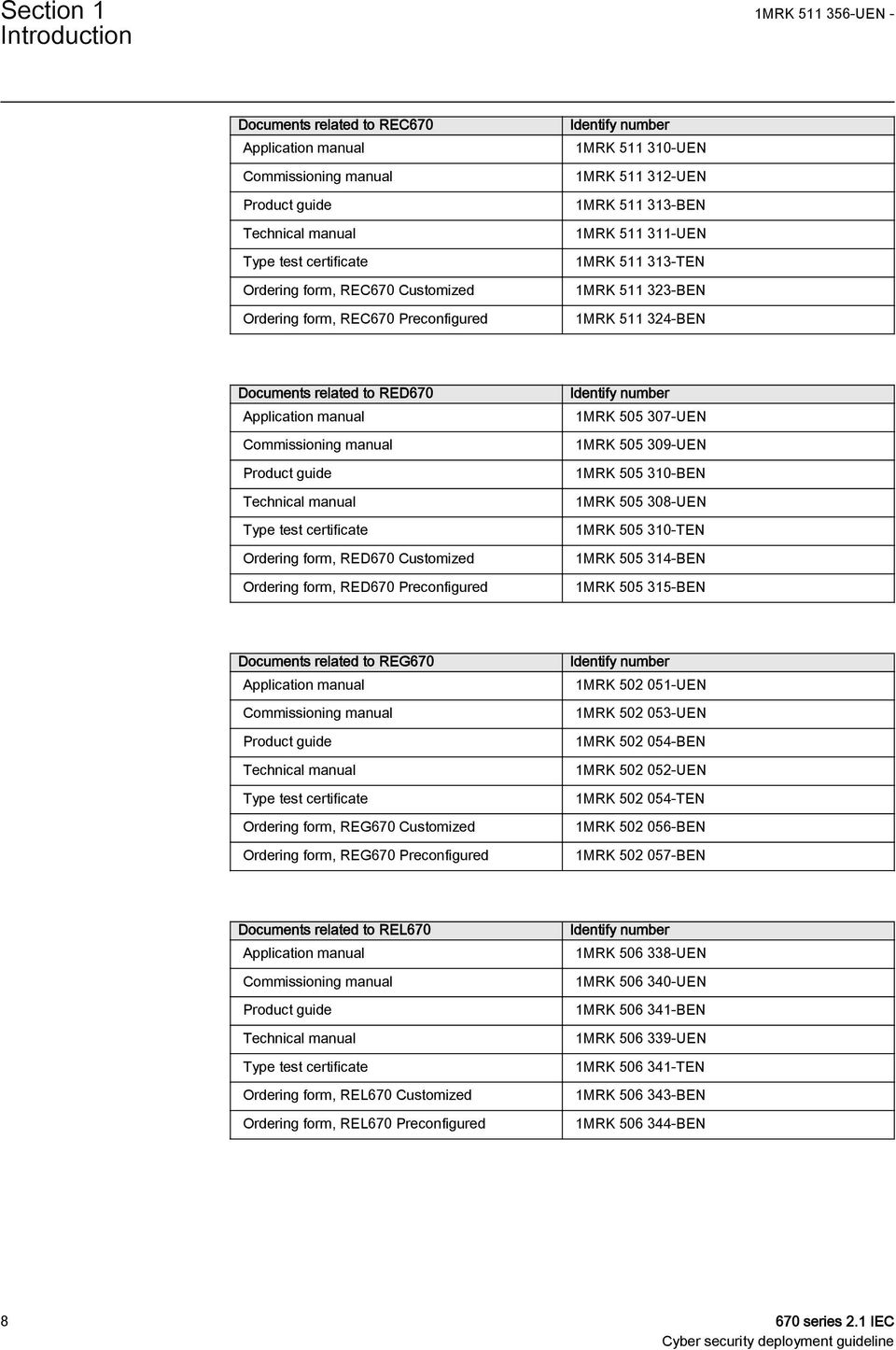
15 1MRK UEN - Section 1 Introduction Documents related to RET670 Application manual Commissioning manual Product guide Technical manual Type test certificate Ordering form, RET670 Customized Ordering form, RET670 Preconfigured Identify number 1MRK UEN 1MRK UEN 1MRK BEN 1MRK UEN 1MRK TEN 1MRK BEN 1MRK BEN Documents related to RES670 Application manual Commissioning manual Product guide Technical manual Type test certificate Ordering form, RES670 Customized Ordering form, RES670 Preconfigured Identify number 1MRK UEN 1MRK UEN 1MRK BEN 1MRK UEN 1MRK TEN 1MRK BEN 1MRK BEN 670 series manuals Identify number Operation manual Engineering manual Installation manual Communication protocol manual, DNP3 Communication protocol manual, IEC Communication protocol manual, IEC Edition 1 Communication protocol manual, IEC Edition 2 Communication protocol manual, LON Communication protocol manual, SPA Point list manual, DNP3 Accessories guide Connection and Installation components Test system, COMBITEST 1MRK UEN 1MRK UEN 1MRK UEN 1MRK UUS 1MRK UEN 1MRK UEN 1MRK UEN 1MRK UEN 1MRK UEN 1MRK UUS 1MRK BEN 1MRK UEN 1MRK BEN 1MRK BEN 670 series 2.1 IEC 9

16 Section 1 1MRK UEN - Introduction 1.4 Document symbols and conventions Symbols The electrical warning icon indicates the presence of a hazard which could result in electrical shock. The warning icon indicates the presence of a hazard which could result in personal injury. The caution hot surface icon indicates important information or warning about the temperature of product surfaces. The caution icon indicates important information or warning related to the concept discussed in the text. It might indicate the presence of a hazard which could result in corruption of software or damage to equipment or property. The information icon alerts the reader of important facts and conditions. The tip icon indicates advice on, for example, how to design your project or how to use a certain function. Although warning hazards are related to personal injury, it is necessary to understand that under certain operational conditions, operation of damaged equipment may result in degraded process performance leading to personal injury or death. It is important that the user fully complies with all warning and cautionary notices Document conventions Abbreviations and acronyms in this manual are spelled out in the glossary. The glossary also contains definitions of important terms. Push button navigation in the LHMI menu structure is presented by using the push button icons. For example, to navigate between the options, use and. HMI menu paths are presented in bold. For example, select Main menu/settings series 2.1 IEC

17 1MRK UEN - Section 1 Introduction LHMI messages are shown in Courier font. For example, to save the changes in non-volatile memory, select Yes and press. Parameter names are shown in italics. For example, the function can be enabled and disabled with the Operation setting. Each function block symbol shows the available input/output signal. the character ^ in front of an input/output signal name indicates that the signal name may be customized using the PCM600 software. the character * after an input signal name indicates that the signal must be connected to another function block in the application configuration to achieve a valid application configuration. Logic diagrams describe the signal logic inside the function block and are bordered by dashed lines. Signals in frames with a shaded area on their right hand side represent setting parameter signals that are only settable via the PST or LHMI. If an internal signal path cannot be drawn with a continuous line, the suffix -int is added to the signal name to indicate where the signal starts and continues. Signal paths that extend beyond the logic diagram and continue in another diagram have the suffix -cont. 670 series 2.1 IEC 11

18 12

19 1MRK UEN - Section 2 Security in Substation Automation Section 2 Security in Substation Automation 2.1 General security in Substation Automation The electric power grid has evolved significantly over the past decade thanks to many technological advancements and breakthroughs. As a result, the emerging smart grid is quickly becoming a reality. At the heart of these intelligent advancements are specialized IT systems various control and automation solutions such as substation automation systems. To provide end users with comprehensive real-time information, enabling higher reliability and greater control, automation systems have become ever more interconnected. To combat the increased risks associated with these interconnections, we offer a wide range of cyber security products and solutions for automation systems and critical infrastructure. The new generation of automation systems uses open standards such as IEC , DNP 3.0 and IEC and commercial technologies, in particular Ethernet- and TCP/IP-based communication protocols. They also enable connectivity to external networks, such as office intranet systems and the Internet. These changes in technology, including the adoption of open IT standards, have brought huge benefits from an operational perspective, but they have also introduced cyber security concerns previously known only to office or enterprise IT systems. To counter cyber security risks, open IT standards are equipped with cyber security mechanisms. These mechanisms, developed in a large number of enterprise environments, are proven technologies. They enable the design, development and continual improvement of cyber security solutions specifically for control systems, including substation automation applications. ABB fully understands the importance of cyber security and its role in advancing the security of substation automation systems. A customer investing in new ABB technologies can rely on system solutions where reliability and security have the highest priority. At ABB, we are addressing cyber security requirements on a system level as well as on a product level to support cyber security standards such as NERC-CIP, IEEE 1686 and BDEW Whitepaper. We support verified third-party security patches and antivirus software to protect station computers from viruses and other types of attacks. Cyber security can also be improved by preventing the unauthorized use of removable media (such as USB memory sticks) in station computers. We have built additional security mechanisms into our products. Those offer advanced account management, secure communication, and detailed security audit trails. This makes it easier for our customers to address NERC CIP requirements and maintain compliance standards. 670 series 2.1 IEC 13

20 Section 2 1MRK UEN - Security in Substation Automation Maintenance Center (Security Zone 4) Encrypted communication Workstation Antivirus Security Zone 2 MicroSCADA Pro SYS600 Antivirus Remote Control Center (Security Zone 3) Encrypted communication Firewall / Router / VPN Station LAN Firewall / Router / VPN MicroSCADA Pro SYS600C IEC Station Bus Perimeter Protection IEC V3 EN Control and Protection IED Security Zone 1 IEC en.ai Figure 2: System architecture for substation automation system series 2.1 IEC

21 1MRK UEN - Section 3 Secure system setup Section 3 Secure system setup 3.1 Physical interfaces To reduce exposure for cyber-attacks and thus comply with cyber security requirements, it must be possible to prevent services in the IED from operating on other physical interfaces than the ones specified by the vendor or by the owner. 3.2 Communication ports and services The port security guideline cannot suggest concrete products for a secure system setup. This must be decided within the specific project, requirements and existing infrastructure. The ports used in the IED series to set up a firewall are given in tables 1 and 2. The ports are listed in ascending order. The column Default state defines whether a port is open or closed by default. All ports that are closed can be opened as described in the comment column in the table. Front refers to the physical front port. On the rear side of the IED there are two network interfaces, one is labeled LAN AB, and the other is labeled LAN CD. The protocol availability on these ports is configurable. ABB recommends using common security measures, like firewalls, up to date anti virus software, etc. to protect the IED and the equipment around it. Table 1: Available ports Port Protocol Default state Front LAN AB LAN CD Service Comment 21 TCP open OFF OFF OFF FTP File transfer protocol 21 TCP open ON ON ON FTPS Explicit FTP over TLS 102 TCP closed OFF OFF OFF IEC (MMS) MMS communication 123 UDP closed OFF OFF OFF SNTP Enabled when IED is configured as SNTP master TCP closed OFF OFF OFF FST (SPA on TCP/ IP) 2102 TCP open ON ON ON PCM Access (IED configuration protocol) Table continues on next page SPA protocol on TCP/IP used by FST (Field Service Tool) IED configuration protocol 670 series 2.1 IEC 15
22 Section 3 1MRK UEN - Secure system setup Port Protocol Default state Front LAN AB LAN CD Service Comment TCP closed OFF OFF OFF DNP3.0 DNP3.0 DNP communication only UDP closed OFF OFF OFF DNP3.0 DNP3.0 DNP communication only UDP closed ON ON ON SNTP Client Enabled when IED is configured as SNTP client TCP closed ON ON ON FTPS TCP data ports for FTP PASV command. Ports opens on demand. Table 2: Additional available ports in RES670 Port Protocol Default state Front LAN AB LAN CD Service Comment 4711 TCP closed OFF OFF OFF IEEE1344 Phasor measurement 4712 TCP closed OFF OFF OFF C Phasor measurement TCP closed OFF OFF OFF C37.118/ IEEE1344 Command, header and configuration UDP closed OFF OFF OFF C37.118/ IEEE1344 Data and configuration Phasor measurement Phasor measurement In addition to FTP, SPA, and IED configuration protocol, the IEDs support two Ethernet communication protocols which are IEC61850 and DNP3.0. RES670 also supports the IEEE1344/C communication protocol. These communication protocols are enabled by configuration. This means that the port is closed and unavailable if the configuration of the IED series does not contain a communication line of the protocol. If a protocol is configured, the corresponding port is open all the time. See the IED series technical manual and the corresponding protocol documentation on how to configure a certain communication protocol. There are some restrictions and dependencies: The port used for IEC (default TCP port 102) is fixed and cannot be changed. The ports used for DNP3 are configurable. The communication protocol DNP3 could operate on UDP (default port ) or TCP (default port ). It is series 2.1 IEC
23 1MRK UEN - Section 3 Secure system setup defined in the configuration which type of Ethernet communication is used. Only one type is possible at a time. In RES670 the TCP/ UDP port used for IEEE1344/C protocol can be changed in the IED. The port used for FTP (default TCP port 21) can be changed in the IED if needed by a 3rd party FTP client. The range port used for FTP PASV command can be changed in the IED. The maximum number of simultaneous ports is 16. The port used for SNTP when IED is configured as SNTP Client can be changed in the IED. If the FTP port is changed, PCM600 cannot be used as it cannot be configured to use other IP-ports than port 21 for FTP. Two ports are used by PCM600. For configuration and parameter settings, the IP port for a proprietary ODBC protocol is used (TCP port 2102) and the port is fixed and cannot be changed. For Field service tool, the IP port for a proprietary SPA protocol is used (TCP port 7001), and the port is fixed and cannot be changed. IP routing is not possible via any of the physical interfaces. Some IP ports are not possible to use in all physical interfaces. IEC V2 EN IEC en.psd Figure 3: Ethernet port used for PCM600 only, front view 670 series 2.1 IEC 17
24 Section 3 1MRK UEN - Secure system setup IEC en.vsd IEC V2 EN Figure 4: Optical ethernet ports, position X311, rear view 3.3 FTP access with TLS, FTPACCS The FTP Client defaults to the best possible security mode when trying to negotiate with TLS. The automatic negotiation mode acts on configured port number 21 and server features, it tries to negotiate with explicit TLS via AUTH TLS. If the specified port is any other, it tries to negotiate in a similar way. Using FTP without TLS encryption gives the FTP client reduced capabilities. This mode is only for accessing disturbance recorder data from the IED. If normal FTP is required to read out disturbance recordings, create a specific account for this purpose with rights only to do File transfer. The password of this user will be exposed in clear text on the wire. 3.4 Encryption algorithms TLS connections are encrypted with AES 256 if possible or AES 128 as a minimum. At startup a negotiation decides between these two options series 2.1 IEC
25 1MRK UEN - Section 3 Secure system setup No passwords are stored in clear text within the IED. A hashed representation of the passwords with SHA 256 is stored in the IED. These are not accessible from outside via any ports. A user with SECADM or RBACMNT role is allowed to read out the hashed password on a secured (TLS) ODBC link. 3.5 Denial of service The denial of service function is designed to limit the CPU load that can be produced by the Ethernet network traffic on the IED. The communication facilities must not be allowed to compromise the primary functionality of the device. All inbound network traffic is quota controlled, so that a too heavy network load can be controlled. Heavy network load might for instance be the result of malfunctioning equipment connected to the network. The denial of service functions DOSFRNT, DOSLANAB, DOSLANCD measure the IED load from communication and, if necessary, limits it from jeopardizing the IED's control and protection functionality due to a high CPU load. The function has the following outputs: LINKUP indicates the Ethernet link status WARNING indicates that the data rate is approaching 3000 frames/s ALARM indicates that the IED limits the IP-communication For more information see related documents in the Introduction section in this manual. 3.6 Certificate handling A self-signed certificate is signed by the IED. Certificates use encryption to provide secure communication over the network. Certificate encryption strength depends on the certificate authority (CA). A self-signed X.509 certificate and an RSA key-pair with key-length of 2048 bits will be generated by the IED. The RSA key stored in the certificate is used to establish secure communication. The certificate is always trusted during communication between the IED and PCM600. If Windows is configured to use UAC High the certificate have to be manually trusted in a dialog box. This certificate handling changes with Central Account Management and the possibility to use other certificates but self-signed in the IED. 670 series 2.1 IEC 19
26 20
27 1MRK UEN - Section 4 Local user account management Section 4 Local user account management 4.1 Authorization User roles with different user rights are predefined in the IED. It is recommended to use user defined users instead of the predefined built-in users. The IED users can be created, deleted and edited only with PCM600. One user can belong to one or several user roles. By default, the users in Table 3 are created in the IED, and when creating new users, the predefined roles from Table 4 can be used. At delivery, the IED user has full access as SuperUser until users are created with PCM600. Table 3: User name SuperUser Guest Administrator Default users User rights Full rights, only presented in LHMI. LHMI is logged on by default until other users are defined Only read rights, only presented in LHMI. LHMI is logged on by default when other users are defined (same as VIEWER) Full rights. Password: Administrator. This user has to be used when reading out disturbances with third party FTP-client. Table 4: Predefined user roles according to IEC User roles Role explanation User rights VIEWER Viewer Can read parameters and browse the menus from LHMI OPERATOR Operator Can read parameters and browse the menus as well as perform control actions ENGINEER Engineer Can create and load configurations and change settings for the IED and also run commands and manage disturbances INSTALLER Installer Can load configurations and change settings for the IED SECADM Table continues on next page Security administrator Can change role assignments and security settings. Can deploy certificates. 670 series 2.1 IEC 21
28 Section 4 1MRK UEN - Local user account management User roles Role explanation User rights SECAUD Security auditor Can view audit logs RBACMNT ADMINISTRATOR RBAC management Administrator rights Can change role assignment Sum of all rights for SECADM, SECAUD and RBACMNT This User role is vendor specific and not defined in IEC Changes in user management settings do not cause an IED reboot. After three consecutive failed login attempts the user will be locked out for ten minutes before a new attempt to login can be performed. This time is settable 10 minutes to 60 minutes. The PCM600 tool caches the login credentials after successful login for 15 minutes. During that time no more login will be necessary. Table 5: Function Authority status ATHSTAT Authority check ATHCHCK Authority-related IED functions Description This function is an indication function block for user logon activity. User denied attempt to log-on and user successful logon are reported. To safeguard the interests of our customers, both the IED and the tools that are accessing the IED are protected, by means of authorization handling. The authorization handling of the IED and the PCM600 is implemented at both access points to the IED: local, through the local HMI remote, through the communication ports The IED users can be created, deleted and edited only in the CAM server. Authority management AUTHMAN This function enables/disables the maintenance menu. It also controls the maintenance menu log on time out. For more information on Authority management AUTHMAN, Authority status ATHSTAT, and Authority check ATHCHCK functions, see Chapter Basic IED functions in technical manual series 2.1 IEC
29 1MRK UEN - Section 4 Local user account management At delivery, the IED has a default user defined with full access rights. PCM600 uses this default user to access the IED. This user is automatically removed in IED when users are defined via the IED Users tool in PCM600. Default User ID: Administrator Password: Administrator It is strongly recommended to define users via the IED Users tool in PCM600. Only characters A - Z, a - z and 0-9 shall be used in user names. User names are not case sensitive. For passwords see the Password policies in PCM Predefined user roles There are different roles of users that can access or operate different areas of the IED and tool functionalities. Ensure that the user logged on to the IED has the required access when writing particular data to the IED from PCM600. For more information about setting user access rights, see the PCM600 documentation. The meaning of the legends used in the table: X= Full access rights R= Only reading rights - = No access rights Table 6: Predefined user roles according to IEC Access rights VIEWER OPERATOR ENGINEER INSTALLER SECADM SECAUD RBACMNT ADMINISTRATOR Config Basic - - X X Config Advanced FileTransfer Tools UserAdministrati on - - X X X X X - X Setting Basic R - X X Setting Advanced Table continues on next page R - X X X series 2.1 IEC 23
30 Section 4 1MRK UEN - Local user account management Access rights VIEWER OPERATOR ENGINEER INSTALLER SECADM SECAUD RBACMNT ADMINISTRATOR Control Basic - X X Control Advanced - X X IEDCmd Basic - X X IEDCmd Advanced FileTransfer Limited DB Access normal - - X X X X X X X - X X X X X X Audit log read X - X Setting Change Setting Group Security Advanced - X X X X X X - X Table 7: Access rights explanation Access rights Explanation Config Basic Configuration Basic is intended for engineers that only adapt an existing configuration e.g. the I/ O-Configuration using SMT Config Advanced FileTransfer Tools UserAdministration Setting Basic Setting Advanced Control Basic Control Advanced IEDCmd Basic IEDCmd Advanced FileTransfer Limited DB Access normal Audit log read Setting Change Setting Group Security Advanced Configuration Advanced is intended for engineers that do the whole application engineering and using e.g. ACT FileTransfer Tools is used for some configuration files for the configuration and shall have the same value as Config Advanced UserAdministration is used to handle user management e.g. adding new user Setting Basic is used for basic settings e.g. control settings and limit supervision Setting Advanced is used for the relay engineer to set settings e.g. for the protection functions Control Basic is used for a normal operator without possibility to bypass safety functions e.g. interlock or synchro-check bypass Control Advanced is used for an operator that is trusted to do process commands that can be dangerous IEDCmd Basic is used for commands to the IED that are not critical e.g. Clear LEDs, manual triggering of disturbances IEDCmd Advanced is used for commands to the IED that can hide information e.g. Clear disturbance record FileTransfer - Limited is used for access to disturbance files e.g. through FTP Database access for normal user. This is needed for all users that access data from PCM Audit log read allows reading the audit log from the IED Setting Change Setting Group is separated to be able to include the possibility to change the setting group without changing any other setting Security Advanced is the privilege required to do some of the more advanced security-related settings IED users can be created, deleted and edited only with the IED Users tool within PCM600. From the LHMI, no users can be created nor changed series 2.1 IEC
31 1MRK UEN - Section 4 Local user account management First user created must be appointed the role SECADM to be able to write users, created in PCM600, to the IED. In order to allow the IED to communicate with PCM600 when users are defined via the IED Users tool, the access rights UserAdministration and FileTransfer Limited must be applied to at least one user. DB Access normal and File Transfer Limited are required for PCM600 access to the IED. 4.3 Password policies Only ASCII characters are allowed when typing username or password. Currently passwords in the range and (ASCII ranges, decimal) are supported. Password policies are set in the IED Users tool in PCM600. There are several options for forcing the password safer. Minimum length of password (1-18) Require lowercase letters ( a - z ) Require uppercase letters ( A - Z ) Require numeric letters ( 0-9 ) Require special characters (!@#+ *%&/=? ) Password expiry time (default 90 days) To achieve IEEE 1686 conformity, a password with a minimum length of 8 characters must be used, and the square Enforce Password Policies shall be ticked. After password expiry the user is still able to login, but a warning dialog will be displayed on the Local HMI. Also a security event will be issued. 670 series 2.1 IEC 25
32 Section 4 1MRK UEN - Local user account management IEC V1 EN IEC en.vsd Figure 5: Password expiry warning dialog IEC en.psd IEC V2 EN Figure 6: Change Password Policies dialog box in IED Users tool in PCM IED User management The IED Users tool in PCM600 is used for editing user profiles and role assignments. In the IED Users tool, the data can be retrieved from an IED or data can be written to an IED if permitted. The data from an IED can be saved to the project database. Always use Read User Management Settings from IED before making any changes when managing user profiles. If this is not done password changes made by users may be lost! Nothing is changed in the IED until a writing-to-ied operation is performed series 2.1 IEC
33 1MRK UEN - Section 4 Local user account management Starting IED user management Connect the PC to the IED Start PCM600 Select an IED in the plant structure Select Tools/IED Users or, Right-click an IED in the plant structure and select IED Users The IED User dialog box appears General settings In the General tab, by clicking Restore factory settings the default users can be restored in the IED Users tool. For the IED series this means reverting back to the factory delivered users. Performing this operation does not remove the users in the IED. Nothing is changed in the IED until a writing-to-ied operation is performed. This is not the same action as Revert to IED defaults in the recovery menu. The previous administrator user ID and password have to be given so that the writing toward the IED can be done. Editing can be continued by clicking on Restore factory settings when not connected to the IED. IEC V2 EN IEC en.vsd Figure 7: General tab 670 series 2.1 IEC 27
34 Section 4 1MRK UEN - Local user account management User profile management In the User Management tab, the user profiles of the selected IED can be edited. New users can be created, existing users can be deleted and different user group members can be edited. A user profile must always belong to at least one user group. IEC V2 EN IEC en.vsd Figure 8: Create new user Adding new users 1. Click in the Users tab to open the wizard series 2.1 IEC
35 1MRK UEN - Section 4 Local user account management IEC en.psd IEC V2 EN Figure 9: Create new user 2. Follow the instructions in the wizard to define a user name, password and user role. Select at least one user role where the defined user belongs. The user profile can be seen in the User details field. 670 series 2.1 IEC 29
36 Section 4 1MRK UEN - Local user account management IEC en.vsd IEC V3 EN Figure 10: Select user role 3. Select the user from the user list and type a new name or description in the Description/full name field to change the name or description of the user series 2.1 IEC
37 1MRK UEN - Section 4 Local user account management IEC V2 EN IEC en.vsd Figure 11: Enter description Adding users to new user roles 1. Select the user from the Users list. 2. Select the new role from the Select a role list. 3. Click. Information about the roles to which the user belongs to can be seen in the User details area. 670 series 2.1 IEC 31
38 Section 4 1MRK UEN - Local user account management IEC V2 EN IEC en.vsd Figure 12: Adding user Deleting existing users 1. Select the user from the Users list series 2.1 IEC
39 1MRK UEN - Section 4 Local user account management IEC V2 EN IEC en.vsd Figure 13: Select user to be deleted 2. Click. 670 series 2.1 IEC 33
40 Section 4 1MRK UEN - Local user account management IEC V2 EN IEC en.vsd Figure 14: Delete existing user Changing password 1. Select the user from the Users list series 2.1 IEC
41 1MRK UEN - Section 4 Local user account management IEC V2 EN IEC en.vsd Figure 15: Select user 2. Click. 3. Type the old password once and the new password twice in the required fields. The passwords can be saved in the project database or sent directly to the IED. No passwords are stored in clear text within the IED. A hash representation of the passwords is stored in the IED and it is not accessible from outside via any ports. 670 series 2.1 IEC 35
42 Section 4 1MRK UEN - Local user account management IEC en.psd IEC V2 EN Figure 16: Change password User role management In the Roles tab, the user roles can be modified. The user's memberships to specific roles can be modified with a list of available user roles and users series 2.1 IEC
43 1MRK UEN - Section 4 Local user account management IEC V2 EN IEC en.vsd Figure 17: Editing users Adding new users to user roles 1. Select the required role from the Roles list. The role profile can be seen under the Role details field. 2. Select the new user from the Select a user list. 3. Click. The new user is shown in the Users assigned list Deleting existing User from user roles 1. Right-click the user in the Users assigned list. 2. Select Remove This Role from Selected Member. 670 series 2.1 IEC 37
44 Section 4 1MRK UEN - Local user account management IEC V2 EN IEC en.vsd Figure 18: Remove Role from User Reusing user accounts IED user account data can be exported from one IED and imported to another. The data is stored in an encrypted file. Exported passwords are hashed and not in clear text. To export IED user account data from an IED 1. Click the Import Export tab in the IED User tool in PCM Click Export IED account data. The user account data is exported to a file with user defined filename and location. Import IED user rights to an IED 1. Click Import IED account data. 2. Open the previously exported file. Only users who have the right to change the user account data in PCM600 are allowed to export and import series 2.1 IEC
45 1MRK UEN - Section 4 Local user account management IEC V2 EN IEC en.vsd Figure 19: Importing and exporting user account data Writing user management settings to the IED Click the Write User Management Settings to IED button on the toolbar. IEC en.psd IEC V2 EN Figure 20: Write to IED The data is saved when writing to the IED starts Reading user management settings from the IED Click the Read User Management Settings from IED button on the toolbar. 670 series 2.1 IEC 39
46 Section 4 1MRK UEN - Local user account management Saving user management settings Select File/Save from the menu. Click the Save toolbar button. The save function is enabled only if the data has changed series 2.1 IEC
47 1MRK UEN - Section 5 Central Account Management Section 5 Central Account Management 5.1 Introduction Central Account Management is an authentication infrastructure that offers a secure solution for enforcing access control to IEDs and other systems within a substation. This incorporates management of user accounts, roles and certificates and the distribution of such, a procedure completely transparent to the user. In this manual the LDAP server software description and handling is based on SDM600, which is an ABB product. Other Central Account Management software can be used, provided it has sufficient functionality. 670 series 2.1 IEC 41


48 Section 5 1MRK UEN - Central Account Management 5.2 Certificate management Security Administrator Normal User Manually transferred certificate files SDM600 PCM600 Start secure communication Replicate users Login Change own password Start secure communication Deploy certificate to IED Write Role to Right mapping Activate CAM Deactivate CAM Login Change own password IED IEC en.vsdx IEC V1 EN Figure 21: Overview of the functionality between the products in the system. Before any distribution of users and roles can take place, a trust relation must be established. The CAM server, such as the SDM600, also acts as a CA meaning that it is able to issue digital certificates. Each device, such as an IED, will have its own unique device certificate, one which must be imported into the PCM600 configuration and then written to the IED. At this point trust is automatically established directly between the CAM server and the IED. The Security Administrator is responsible for this setup Creating IED certificates As mention above, SDM600 can be used to create IED certificates. Below follows a short guide on how to create device certificates series 2.1 IEC
49 1MRK UEN - Section 5 Central Account Management 1. In PCM600, export the Substation Configuration Description (SCD). IEC V1 EN Figure 22: Export SCD file Generate the SCD file from PCM In SDM600, import SCD via the Load Structure tool. Refer to Setting Up the SDM600 Structure in the SDM600 User Manual. 3. Update "Alternative IP Addresses" with all configured interfaces on the device. 4. Generate certificates in the Central Account Management server for all IEDs 5. Export the certificate or the configuration package from the Central Account Management server. 6. Use PCM600 to load the certificate and configuration into the correct IED IED deploys only certificates bundled in a PCKS#12 file format. 670 series 2.1 IEC 43
50 Section 5 1MRK UEN - Central Account Management SDM600 allows user to set key length of the certificates that needs to be deployed in IED. While it may be prudent to use a larger key size, it would also mean it requires a considerable longer time for the TLS handshake (between IED and tools/ Central Account Management servers) before any secure communication starts. We recommend to deploy certificates with key length of 2048 in the IED. NSA (National Security Agency) recommendation is that RSA keys of 2048 bit key size is acceptable. IED will use the certificate imported via PCM600 to automatically access to the SDM600 server. This certificate is also used as a server certificate to secure communication of FTP and ODBC protocols. However, it is possible to deploy server certificates (External) for FTP and ODBC protocol. PCM600 does not support this feature. The security administrator uses a 3rd party FTP client to transfer the pkcs#12 package to certificates/import/external and use the SITE cmd "PKCS12Install <path to file> <KEK> to activate the external certificate Importing and writing certificates to an IED The following are the steps to import and write certificates to the IED. 1. Connect PC to the IED. 2. Start PCM600, open project. 3. Select VoltageLevel, Bay or IED in the plant structure. 4. Select Tools/Account Management or right click on VoltageLevel, Bay or IED in the plant structure and select Account Management The Account Management dialog will appear as shown below IEC V1 EN Figure 23: Account Management Tool in PCM 5. Select the Import and Write Certificates option. 6. Select those IEDs to which certificates needs to be written series 2.1 IEC

51 1MRK UEN - Section 5 Central Account Management IEC V1 EN Figure 24: Import and Write certificates tool view in PCM Select for those IEDs to which certificates needs to be written 8. Click on Import certificate button. IEC V1 EN Figure 25: Importing certificate (p12) file 9. If certificate is password protected the user will be prompted to enter the password Select CAM as the Certificate Unit Click the OK button. 670 series 2.1 IEC 45

52 Section 5 1MRK UEN - Central Account Management IEC V1 EN Figure 26: Entering password of a certificate Only CAM certificates can be written from PCM600 to IED. 10. Select certificate IEC V1 EN Figure 27: Choosen certificate 11. Click button to write certificate(s) for the enabled IEDs and click Yes in the confirmation dialog series 2.1 IEC

53 1MRK UEN - Section 5 Central Account Management IEC vsdx IEC V1 EN Figure 28: Write certificate confirmation dialog 12. The process and the status of the writing is indicated in the Account Management tab. IEC V1 EN Figure 29: Result of written certificates When Central Account Management is enabled in IED, and if user deploys an invalid certificate in to an IED (e.g.: SDM600 certificate of another SDM server, than the one that is configured in the IED), then replication will fail at the time when IED tries to replicate. However, Central Account Management still remains to be enabled in the IED. In this situation, IED will fall back to replica users if Replication is enabled. Then, the certificates can be re-deployed if the SECADM is part of the replicated users. Otherwise, Central Account Management should be deactivated through Maintenance menu, "Disable CAM and Delete Certificates" option. In the case that Replication is disabled in the IED, the IED will be locked out and the only way to get out of this situation is through Maintenance menu, "Disable CAM and Delete Certificates" option Reading certificates from an IED The following are the steps to read certificates from an IED: 670 series 2.1 IEC 47

54 Section 5 1MRK UEN - Central Account Management 1. Connect PC to the IED 2. Start PCM600, open project 3. Select Voltage Level or Bay or IED in the plant structure. 4. Select Tools/Account Management or 5. Right click on Voltage Level or Bay or IED in the plant structure and select Account Management The Account Management dialog will appear as shown below. IEC V1 EN Figure 30: Account Management Tool in PCM 6. Select the Read and Delete Certificates option. IEC V1 EN Figure 31: Read and Delete Certificates view in PCM Select for those IEDs from which certificates needs to be read. 8. Click button to read certificates from the IED IEC V1 EN 9. Figure 32: Click the Reading certificates from IED button to view certificates that are read from the IED series 2.1 IEC

55 1MRK UEN - Section 5 Central Account Management IEC V1 EN Figure 33: Certificates that are read from the IED 10. Double click on a Certificate Unit to view the details of it or 11. Right click on a Certificate Unit and select Properties IEC V1 EN IEC V1 EN Figure 34: Viewing details of certificate of an IED in PCM Certificate information on local HMI Information about the currently installed certificates can be found in the local HMI by traversing the menu tree by using the arrow keys. Main menu/diagnostics/ Communication 670 series 2.1 IEC 49
56 Section 5 1MRK UEN - Central Account Management IEC V1 EN Figure 35: Certificates view In the Certificates view certificate information is grouped according to usage. Selecting CAM and pressing will show information about the certificates used for Central Account Management. IEC V1 EN Figure 36: Certificate information for CAM certificates Only the categories with installed certificates are shown. If no external or CAM certificates are installed then a category named internal is shown which lists the certificates generated by the device. In figure 37 two certificates are shown for the selected usage series 2.1 IEC
57 1MRK UEN - Section 5 Central Account Management IEC V1 EN Figure 37: CAM certificates By pressing on a menu item without information in the right field more information will be shown. For instance, by pressing in the Issued to menu item shown in figure 38 below, more information will be shown as in figure 39 below. IEC V1 EN Figure 38: Detailed certificate information 670 series 2.1 IEC 51
58 Section 5 1MRK UEN - Central Account Management IEC V1 EN Figure 39: Certificate issued to Invalid certificates The certificate can be invalid for different reasons, e.g. if the certificate has expired. In this case, if the IED is using a self-signed certificate, it will generate a new self signed certificate. Otherwise, when IED is using a certificate generated by SDM600, it is required that the security administrator generates new certificates and re-deploy them using PCM600. If the certificate has expired, PCM600 will issue a warning to the user about connecting to a device with expired certificate. SDM600 will reject user authentication with expired certificate. If the replication is enabled and server rejects the authentication (due to expired certificate) then the user is allowed to login using the replicated data. IED will raise a security event 30 days before the certificate will expire and continue till the expiry date once every day. There are two main cases when the IED access the server: 1. When a cyclic replication is done 2. When a user should be authenticated or change the password These two cases are different in that sense that one has an ongoing user interaction, while the other occurs cyclically without user interaction. In both cases a security event will be generated in the IED. If user interaction is involved, a generic connection problem message will be presented Deleting certificates from an IED Deletion of certificates from IED is possible only after reading certificates from IED series 2.1 IEC
59 1MRK UEN - Section 5 Central Account Management 1. Select the Certificate Units that needs to be deleted. IEC V1 EN 2. Click on the delete-button in the toolbar. A confirmation dialog appears IEC en.vsdx IEC V1 EN Figure 40: Certificate deletion confirmation dialog 3. Click on the Yes button to confirm the deletion. The certificates are deleted from the IED, confirmation of this can be seen in the tool. IEC V1 EN Figure 41: Deletion of certificates from an IED Only CAM certificates can be deleted from PCM series 2.1 IEC 53
60 Section 5 1MRK UEN - Central Account Management It will not be possible to delete Internal and External certificates from PCM600 When IED is in Central Account Management mode, it is not recommended to remove Central Account Management certificates from the IED, because this action could cause connectivity problems between Central Account Management server (SDM600) and IED. 5.3 Activation of Central Account Management Central Account Management on the IED must be activated from PCM600. The following are the steps to activate Central Account mamagement on the IED: 1. Connect PC to the IED 2. Start PCM600, open project 3. Right click at Substation and select Export to export project SCD file series 2.1 IEC
61 1MRK UEN - Section 5 Central Account Management IEC V1 EN Figure 42: Export SCD file 4. Import project SCD file in SDM600 and generate CAM configuration package. Please refer to SDM600 documentation for the detailed steps to generate CAM configuration package from SCD file. 5. From PCM600, select Voltage Level or Bay or IED in the plant structure 6. Select Tools/Account Management 7. Right click on Voltage Level or Bay or IED in the plant structure and select Account Management. The Account Management dialog will appear as shown below 670 series 2.1 IEC 55

62 Section 5 1MRK UEN - Central Account Management IEC V1 EN Figure 43: Account Management Tool in PCM 8. Click on SDM600 Configuration button, to open SDM600 configuration tool. IEC V1 EN Figure 44: Import SDM600 configuration 9. From Tool bar, click to import SDM600 configuration zip file that is generated above at step # If the SDM600 configuration zip file/certificate is protected with password (KEK), then the user will be prompted to enter password. IEC V1 EN Figure 45: Password for the certificate package series 2.1 IEC


63 1MRK UEN - Section 5 Central Account Management 11. Import Summary dialog will show the actions performed on each IED in the plant structure. IEC V1 EN Figure 46: SDM600 configuration import results 12. Click on Done button. 13. In Account management tool, select the IED(s) for which Central Account Management needs to be activated. 14. To enable Central Account Management for the selected IED(s), from Toolbar, click button. IEC V1 EN Figure 47: Writing Central Account Management to IED 670 series 2.1 IEC 57
64 Section 5 1MRK UEN - Central Account Management IEC V1 EN Figure 48: Central Account Management write status When Central Account Management is set to active, the IED will do the following: Verify the configuration to secure that SDM600 can be accessed. Replicate the defined user group from SDM600 to the IED. At least one user must be replicated. The maximum number of replicated users supported by the IED is 100. If replication group is empty or contains more then 100 users, the Central Account Management will fail. It is recommended to define replication groups in SDM600 and associate them to the devices when CAM configuration is created. One replication group can be used in several devices. SDM600 has the possibility to replicate all users from the server however this is not consider a good security practice and it reduces the maximum number of replicated users. If replication is disabled and the Central Account Management server is not reachable, the user will not be able to login to the IED. Replication support is only available if the customer is using SDM600. If the customer is using LDAP servers other than SDM600 no user replication is possible.. The replication support must be disabled to enable CAM in the IED The configuration for Central Account Management is handled by a new tool in PCM600. The possibility to enable/disable replication is done in a checkbox (Replication) in the tool. When this is successfully done, the IED will indicate that Central Account Management as active. In addition the IED will delete any users locally defined in the IED by PCM600 user tool series 2.1 IEC
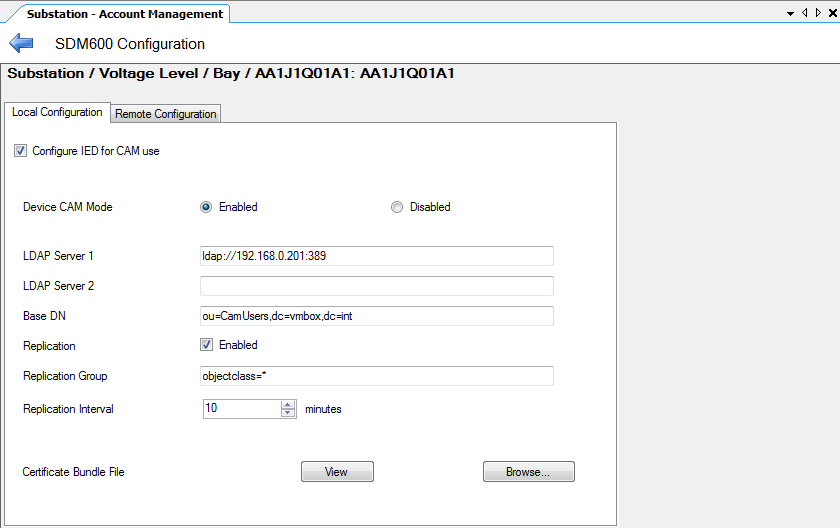
65 1MRK UEN - Section 5 Central Account Management If the Central Account Management activation fails, the activate parameter will be reset and Central Account Management must be activated again and a failure message will be indicated in PCM Output window. When Central Account Management is activated, any ongoing sessions with the IED will continue until they are closed Manual configuration of Central Account Management It is possible to edit Central Account Management configuration parameters and modify them (if needed) in PCM600. In order to edit configuration parameters, right click on the Device and select Edit as shown below. IEC V1 EN Figure 49: Edit configuration The following screen appears, where in which user can edit the Central Account Management configuration parameters and/or manually change the certificate. IEC V1 EN Figure 50: Local configuration 670 series 2.1 IEC 59
66 Section 5 1MRK UEN - Central Account Management Local Configuration tab indicates the configuration that currently exists in PCM600. Remote Configuration tab indicates the configuration that currently exists in the IED. IEC V1 EN Figure 51: Remote configuration Remote Configuration tab will have the configuration only if Read Central Account Management Configuration from the IED as described in section Reading configuration from IED is performed Reading configuration from IED It is possible to read Central Account Management configuration from the IED by right clicking on the Device and selecting Read from IED. IEC V1 EN Figure 52: Read configuration from IED series 2.1 IEC
67 1MRK UEN - Section 5 Central Account Management Deactivation of Central Account Management from PCM600 When Central Account Management is switched off in the IED, the IED will go back to be open. There will not be any IED users defined even if that was the case when Central Account Management was activated. Instead the built-in, factory default users will be reactivated. 1. Right click on the Device in Account Management tool and select Edit as shown in figure 52 IEC V1 EN Figure 53: Deactivation of Central Account Management 2. Select Device CAM Mode as Disable as shown in fig Click on Save & Close button, to save and close manual configuration screen. 4. Right click on the Device, and select Write to IED as shown in fig 54 IEC V1 EN Figure 54: Write configuration to IED 5. PCM600 output window indicates the result of the write operation as shown in fig series 2.1 IEC 61

68 IEC en.vsdx Section 5 1MRK UEN - Central Account Management IEC V1 EN Figure 55: PCM600 output window indicating deactivation of Central Account Management in the IED Deactivation of Central Account Management on local HMI In case of wrong configuration of CAM and Certificates, there is a possibility to disable Central Account Management and delete the loaded certificates in the IED. This can be done from recovery menu option. To enter this menu, the IED must be rebooted and a specific key combination must be pressed on the LHMI during the IED boot sequence. 1. Switch off the power supply to the IED and leave it off for one minute. 2. Switch on the power supply to the IED and press and hold down and until the Maintenance Menu appears on the LHMI (this takes around 20-60s). 3. Navigate down and select Recovery Menu and press or. Maintenance Menu 1: Activate FTP server 2: Abort IED-update 3: Display IP address 4: View system event log 5: Recovery Menu (Password protected) Press C/Clear to continue start-up IEC en.vsd IEC V3 EN Figure 56: 4. Enter PIN code 8282 and press Enter PIN code 8 *** IEC V3 EN IEC en.vsd Figure 57: 5. Select Delete Certificates and Disable CAM and press or series 2.1 IEC
69 1MRK UEN - Section 5 Central Account Management Recovery menu 5.1: Turn off Authority (temporary) 5.2: Turn off Change-lock (temporary) 5.3: Turn off IEC : Revert to IED defaults 5.5: Disable CAM and delete all certificates Press C/Clear to continue start-up IEC en.vsdx IEC V3 EN Figure 58: Selection menu 6. Select OK to Delete Certificates and Disable CAM PLEASE CONFIRM Delete Certificates, Disable CAM? (persistent) Cancel IEC V1 EN IEC en.vsd Figure 59: Confirmation 7. Press to continue the startup sequence (now all the loaded certificates are deleted in the IED and Central account management is disabled in the IED). To cancel the operation in any step, press. 5.4 Authorization with Central Account Management enabled IED The users, their roles and rights are created, deleted and edited only in the Central Account Management server (SDM600). However, the user rights can be edited in the IED by using the PCM600 user tool. One user can have one or several user roles. By default, the users in Table 3 are created in the IED, and when creating new users in the SDM600 server, the predefined roles from Table 4 can be used. At delivery, the IED user has full access as SuperUser when using the LHMI and as Administrator when using FTP or PCM600 until Central Account Management is activated. 670 series 2.1 IEC 63
70 Section 5 1MRK UEN - Central Account Management Table 8: User name SuperUser Guest Administrator Default users User rights Full rights, only presented in LHMI. LHMI is logged on by default until other users are defined Only read rights, only presented in LHMI. LHMI is logged on by default when other users are defined (same as VIEWER) Full rights. Password: Administrator. This user has to be used when reading out disturbances with third party FTP-client. Table 9: Predefined user roles according to IEC User roles Role explanation User rights VIEWER Viewer Can read parameters and browse the menus from LHMI OPERATOR Operator Can read parameters and browse the menus as well as perform control actions ENGINEER Engineer Can create and load configurations and change settings for the IED and also run commands and manage disturbances INSTALLER Installer Can load configurations and change settings for the IED SECADM Security administrator SECAUD Security auditor Can view audit logs RBACMNT ADMINISTRATOR RBAC management Administrator rights Can change role assignments and security settings. Can deploy certificates. Can change role assignment Sum of all rights for SECADM, SECAUD and RBACMNT This User role is vendor specific and not defined in IEC Changes in user management settings do not cause an IED reboot. The PCM600 tool caches the login credentials after successful login for 15 minutes. During that time no more login will be necessary. The successfully activation of Central Account Management will disable built-in users or remove all local created users from PCM600. Management of user credentials and roles is handled on the central Account Management server e.g. SDM600 The IED employs two strategies to ensure availability of the authentication system even if there is a problem with the network or authentication server: series 2.1 IEC
71 1MRK UEN - Section 5 Central Account Management A substation can be equipped with two redundant authentication servers operating in a hot standby mode. If configured by the security administrator, the IED itself maintains a local replica in the database with selected users. This database is periodically updated with data from the server and used as fallback if none of the servers are reachable. Note that not all users in the SDM600 server are part of the replica. There might be users that are not assigned to any replication group. IED only replicates those users which are part of replication group configured in the IED. This replication can be disabled using PCM600 by the security administrator, which means that the IED will forward login requests to the SDM600 for authorization and in case of problems with the network users will not be able to log in to the IED. If user replication has been disabled in a CAM-enabled IED and if communication with SDM600 is lost, access to that IED will be denied until communication is re-established. All communication between the central management and the IEDs is protected using secure communication. Customers using SDM600 are required to generate and distribute certificates during the engineering process of the substation. These certificates ensure mutual trust between IED and for example SDM600, FTP, PCM600 and other system. Table 10: Function Authority status ATHSTAT Authority check ATHCHCK Authority-related IED functions Description This function is an indication function block for user logon activity. User denied attempt to logon and user successful logon are reported. To safeguard the interests of our customers, both the IED and the tools that are accessing the IED are protected, by means of authorization handling. The authorization handling of the IED and the PCM600 is implemented at both access points to the IED: local, through the local HMI remote, through the communication ports The IED users can be created, deleted and edited only in the CAM server. Authority management AUTHMAN This function enables/disables the maintenance menu. It also controls the maintenance menu logon time out. For more information on the functions Authority Management (AUTHMAN), Authority Status (ATHSTAT), and Authority Check (ATHCHCK) functions, refer to chapter Basic IED functions in the Technical Manual. 670 series 2.1 IEC 65
72 Section 5 1MRK UEN - Central Account Management 5.5 Predefined user roles There are different roles of users that can access or operate different areas of the IED and tool functions. The meaning of the legends used in the table: X= Full access rights R= Only reading rights - = No access rights Table 11: Predefined user roles according to IEC Access rights VIEWER OPERATOR ENGINEER INSTALLER SECADM SECAUD RBACMNT Config Basic - - X X Config Advanced - - X X FileTransfer Tools - - X X UserAdministration X - X X ADMINISTR ATOR Setting Basic R - X X Setting Advanced R - X X Control Basic - X X Control Advanced - X X IEDCmd Basic - X X IEDCmd Advanced - - X FileTransfer Limited - X X X X X X X DB Access normal - X X X X X X X Audit log read X - X Setting Change Setting Group - X X X Security Advanced X - X ADMINISTRATOR is a vendor specific user role and not specified in IEC Table 12: Access rights explanation Access rights Explanation Config Basic Configuration Basic is intended for engineers that only adapt an existing configuration e.g. the I/ O-Configuration using SMT Config Advanced FileTransfer Tools Table continues on next page Configuration Advanced is intended for engineers that do the whole application engineering and using e.g. ACT FileTransfer Tools is used for some configuration files for the configuration and shall have the same value as Config Advanced series 2.1 IEC
73 1MRK UEN - Section 5 Central Account Management Access rights UserAdministration Setting Basic Setting Advanced Control Basic Control Advanced IEDCmd Basic IEDCmd Advanced FileTransfer Limited DB Access normal Audit log read Setting Change Setting Group Security Advanced Explanation UserAdministration is used to handle user management e.g. adding new user Setting Basic is used for basic settings e.g. control settings and limit supervision Setting Advanced is used for the relay engineer to set settings e.g. for the protection functions Control Basic is used for a normal operator without possibility to bypass safety functions e.g. interlock or synchro-check bypass Control Advanced is used for an operator that is trusted to do process commands that can be dangerous IEDCmd Basic is used for commands to the IED that are not critical e.g. Clear LEDs, manual triggering of disturbances IEDCmd Advanced is used for commands to the IED that can hide information e.g. Clear disturbance record FileTransfer - Limited is used for access to disturbance files e.g. through FTP Database access for normal user. This is needed for all users that access data from PCM Audit log read allows reading the audit log from the IED Setting Change Setting Group is separated to be able to include the possibility to change the setting group without changing any other setting Security Advanced is the privilege required to do some of the more advanced security-related settings IED users can be created, deleted and edited only in the SDM600 server. From the LHMI or PCM600, no users can be created nor changed when Central Account Management has been enabled in the IED. However, user rights are edited using the PCM600 user tool (IEDUM) and password can be changed from PCM600 or LHMI. At delivery, the IED has a default Administrator defined with full access rights. PCM600 uses this default user to access the IED. This user is automatically removed in IED when users are defined in the SDM600 server and replicated to the IED. Only characters A - Z, a - z and 0-9 shall be used in user names. User names are not case sensitive. For passwords see the Password policies. In order to allow the IED to communicate with PCM600 when users are defined in the SDM600 server, the access rights UserAdministration and FileTransfer Limited must be applied to at least one user. User rights are assigned using the PCM600 user tool (IEDUM). "DB Access normal" and "FileTransfer Limited" are required for PCM600 access to the IED. 670 series 2.1 IEC 67
74 Section 5 1MRK UEN - Central Account Management 5.6 Password policy settings for Central Account Management enabled IED The password policy is set in the Central Account Management server (SDM600). Refer to SDM600 user manual. 5.7 PCM600 access to Central Account Management enabled IED During normal access, e.g. parameter writing, of the IED from PCM600, the user interaction will be very similar as to a non Central Account Management enabled IED. The following steps are included in the process: When a login is needed the login dialog is presented to the user When the user name and password is entered the user credentials are sent to the IED The IED forwards these credentials to the Central Account Management server to authenticate the user and get the user roles back. If a user has multiple roles, then the privilege he gets is the union of all the roles. If the IED fails in accessing the Central Account Management server, the local replica of the users are used to authenticate the user and get the user roles back The IED check the Rights for the Roles and secure that only authorized things according to the Rights are allowed If communication with the Central Account Management server is lost, the current password will not expire until the communication with the server is reestablished. When the user tries to communicate with an IED using PCM600, then PCM600 will validate the Certificate presented by the IED and if there are new warnings/errors found during certificate validation, PCM600 will display a Security Warning to the user. In this situation, user needs to take appropriate action on the security warning to continue communicating with the IED. If the user tries to authenticate towards a Central Account Management enabled IED using PCM600, with credentials that will expire in the near future, a new warning will be shown to the user and an option to change the password will be provided series 2.1 IEC
75 1MRK UEN - Section 5 Central Account Management Changing password The user can also change the own password from PCM600 or LHMI. The following process is used: A change password dialog is presented for the user in PCM600 or LHMI The IED will forward this to the Central Account Management server Password can only be changed if the IED has contact with Central Account Management server The Central Account Management server verifies the password towards the password policies If it fails an error code will be sent back to the user An acknowledgement is sent back to the IED and forwarded to PCM600 or LHMI The user gets an acknowledge that the password has changed As soon as the IED get feedback from the Central Account Management server that the password is about to expire or that the password need to be changed, the user will be forced to change the password. The actual change will be according to above. The SDM600 server will issue a warning message that the password is going to expire (for instance in 5 days) if this feature in configured in SDM600. If the password has expired or is not valid for other reasons, a new password must be set in the Central Account Management server. A change of password for any user, via PCM600 or LHMI, will force a replication of the users to the IED. Otherwise, if the communication to the Central Account Management server is lost shortly after the passwords is changed, the old password must be used until the connection to Central Account Management server is restored. All other IEDs in the system need to wait until next cyclic replication. Changing password 1. Right click on the IED in plant structure and select IED users tool. 2. Go to General Tab. 3. Click on Change Own Password, then following dialog will appear 670 series 2.1 IEC 69
76 Section 5 1MRK UEN - Central Account Management IEC en.vsdx IEC V1 EN Figure 60: Change own password 4. User can enter details and click on OK button. Password will be changed and the result of the operation will be indicated in the PCM600 output window Error messages When a user wants to access the IED or change the password, it might fail. In such cases the user will be presented that it failed and also a reason. The tables below list the possible error messages. The UAL column marks if the error is logged as a security event. The User feedback column marks the message to the user. In some cases another error is listed and will be presented for the user series 2.1 IEC
77 1MRK UEN - Section 5 Central Account Management Table 13: Error indications from failed login Description EVENT NUMBER User feedback Login successful. An additional password expiry time can be sent by the CAM server. This information contains the number of seconds for which the password is still valid at the time the authentication was executed.* Login successful. When in Central Account Management: Password has expired and the user had grace logins left. (Of which one was used for this login).* When in PCM600 users: Password expired login OK.** 1110 *: Your password will expire in x days. Do you want to change it? 1115 *: Password must be changed. **: Login OK, password expired. Login failed 1120 Access denied Login failed. Password has expired. User should contact the system administrator to reset the password. Login failed 3 times (in case of PCM600 users only) An error occurred during authentication. (E.g. No server connection and replica.) User authentication has failed due to wrong username and/or password Password expired 1170 Login blocked for this ID! Error in the Central Account Server! 1130 Access denied Table 14: Error indications from failed change password Description EVENT NUMBER User feedback Password of <User name> has been successfully changed to <new password> Provided credentials <old password> could not be used to login. Password is not changed. Provided credentials <old password> already expired. Password is not changed. Password <new password> did not fulfill the password policy of the CAM server. Password is not changed. Table continues on next page 2210 Password change successful Old password invalid Password expired 2235 Password do not meet policy requirement 670 series 2.1 IEC 71
78 Section 5 1MRK UEN - Central Account Management Description EVENT NUMBER User feedback CAM server failed to write password to the provider. Password is not changed. Connection to CAM server could not be established or connection has been terminated unexpectedly. Verify status and connectivity of the CAM server. Password is not changed. Generic error. Password is not changed Error in the Central Account Server! 2220 Error in the Central Account Server! 2220 Error in the Central Account Server! 5.8 Trouble shooting Central Account Management. To know the status of the Central Account Management, the diagnostics information is provided on Local HMI. This is available under Diagnostics/ Communication/CAM status/camstatus 1. When IED is not configured with any users the default status of the CAMStatus diagnostics will be: series 2.1 IEC
79 1MRK UEN - Section 5 Central Account Management IEC V1 EN Figure 61: CAM default status 2. When IED is not configured with Central Account Management the default status of the CAMStatus diagnostics will be: 670 series 2.1 IEC 73
80 Section 5 1MRK UEN - Central Account Management IEC V1 EN Figure 62: CAM diagnostics default staus 3. When the IED is Central Account Management configured with One server, the status of CAMStatus will be: series 2.1 IEC
81 1MRK UEN - Section 5 Central Account Management IEC V1 EN Figure 63: IED CAM configured status Table 15: Label Rational Values Remarks UAMMode CAMServerXStatus Replication Table continues on next page User account management mode Indicates the connectivity status of the server X. Indicates the status of the last replication Builtin Local Central Not configured Online Offline Not replicated Good When IED is configured with PCM users When IED is configured with default users When Central Account Management is active When there is no server URL specified When specified server is online When specified server is offline When replication is not configured When last replication was successful 670 series 2.1 IEC 75
82 Section 5 1MRK UEN - Central Account Management Label Rational Values Remarks Failed When last replication cycle has failed Last Update Indicates the last update of the status information above. Never Timestamp 4. Errors during activation or redeployment of Certificates: When replication was not configured Time when successful replication took place. Table 16: Errors Symptoms Probable causes Solution PCM error CAM enabling failed. or Security event 3810 CAM server communication failed. or Security event 3820 Replication performed. No users replicated!. or Security event 3830 Replication attempted but failed. No capacity. Wrong configuration parameters (e.g. LDAP address ). Server(s) not reachable during activation, Invalid or wrong certificate is deployed. In case of replication is enabled, the replica is not valid (no users or more than 100 users in the replication group). Check IED.2.1 CAM configuration parameters In case of security event 3810 CAM server communication failed: Check if servers are reachable and the IED is connected. Also, check if the deployed certificates are valid. In case of 3820 Replication performed. No users replicated! or 3830 Replication attempted but failed. No capacity. Check if there are sufficient users in the replication group and there are not more than 100 users in the replication group. If the Central Account Management is activated without replication to a non existent Central Account Management server or in case of invalid certificate being redeployed. The only way to disable Central Account Management is through maintenance menu on Local HMI. If the initial activation of CAM failed, the IED reverts to local UAM or default users. Access to the device is possible using the local default credentials. If syslog is not configured then security events can be read from Event Viewer tool in PCM Server not reachable during runtime: series 2.1 IEC
83 1MRK UEN - Section 5 Central Account Management Table 17: Symptoms Probable causes Solution Diagnostics on Local HMI: Central Account Manager Server status will be indicated as Offline. Security Event: 3810 CAM Server communication failed. Server(s) not reachable Check if LDAP server is up and running Check IED connection Authentication will continue to work based on the latest local LDAP Replica if replication is enabled. After reconnection with the server(s), authentication will again run via the LDAP server and the local replica will be updated. IEC V1 EN Figure 64: Replication status 6. Local replication failed 670 series 2.1 IEC 77
84 Section 5 1MRK UEN - Central Account Management Table 18: Symptoms Probable causes Solution Diagnostics: Replication Failed. ReplicaLastUpdate shows the time when last successful replication. Security Event: 3810 CAM Server communication failed Server(s) not reachable Server configuration has changed Check if LDAP server is up and running Verify with system administrator that LDAP settings are still valid Check the IED connection Authentication will continue to work based on the latest local LDAP replica. After reconnection with the server(s), authentication will again run via the LDAP server and the local replica will be updated series 2.1 IEC
85 1MRK UEN - Section 6 User activity logging Section 6 User activity logging 6.1 Activity logging protocol Activity Logging can be reported from the IED through two different protocols; either IEC or Syslog. Syslog is a standard for computer message logging (RFC 5424). For IEC61850, configuration is as for buffered reporting. Syslog is configured through a number of parameters where the Syslog server is defined. The IED is the Syslog client and it sends the events to the Syslog server. Both IEC61850 and Syslog are to be seen as online protocols when it comes to activity logging. If an event has occurred while or Syslog communication has been down, the events will not be retransmitted. In this case, use PCM600 to read out the activity logging from the IED. 6.2 Activity logging ACTIVLOG ACTIVLOG contains all settings for activity logging. There can be 6 external log servers to send syslog events to. Each server can be configured with IP address; IP port number and protocol format. The format can be either syslog (RFC 5424) or Common Event Format (CEF) from ArcSight. 6.3 Settings Table 19: ACTIVLOG Non group settings (basic) Name Values (Range) Unit Step Default Description ExtLogSrv1Type Off SYSLOG UDP/IP SYSLOG TCP/IP CEF TCP/IP - - Off External log server 1 type ExtLogSrv1Port External log server 1 port number ExtLogSrv1IP 0-18 IP Address ExtLogSrv2Type Off SYSLOG UDP/IP SYSLOG TCP/IP CEF TCP/IP External log server 1 IP-address - - Off External log server 2 type ExtLogSrv2Port External log server 2 port number Table continues on next page 670 series 2.1 IEC 79
86 Section 6 1MRK UEN - User activity logging Name Values (Range) Unit Step Default Description ExtLogSrv2IP 0-18 IP Address ExtLogSrv3Type Off SYSLOG UDP/IP SYSLOG TCP/IP CEF TCP/IP External log server 2 IP-address - - Off External log server 3 type ExtLogSrv3Port External log server 3 port number ExtLogSrv3IP 0-18 IP Address ExtLogSrv4Type Off SYSLOG UDP/IP SYSLOG TCP/IP CEF TCP/IP External log server 3 IP-address - - Off External log server 4 type ExtLogSrv4Port External log server 4 port number ExtLogSrv4IP 0-18 IP Address ExtLogSrv5Type Off SYSLOG UDP/IP SYSLOG TCP/IP CEF TCP/IP External log server 4 IP-address - - Off External log server 5 type ExtLogSrv5Port External log server 5 port number ExtLogSrv5IP 0-18 IP Address ExtLogSrv6Type Off SYSLOG UDP/IP SYSLOG TCP/IP CEF TCP/IP External log server 5 IP-address - - Off External log server 6 type ExtLogSrv6Port External log server 6 port number ExtLogSrv6IP 0-18 IP Address External log server 6 IP-address 6.4 Generic security application GSAL As a logical node GSAL is used for monitoring security violation regarding authorization, access control and inactive association including authorization failure. Therefore, all the information in GSAL can be configured to report to client. For more information about GSAL, see IEC Edition 2 Communication Protocol Manual. 6.5 Security alarm SECALARM The function creates and distributes security events for mapping the security events on protocols such as DNP series 2.1 IEC
87 1MRK UEN - Section 6 User activity logging It is possible to map respective protocol to the signals of interest and configure them for monitoring with the Communication Management tool (CMT) in PCM600. No events are mapped by default. Parameter names: EVENTID: Event ID of the generated security event SEQNUMBER: Sequence number of the generated security event IEC V1 EN SECALARM EVENTID SEQNUMBER IEC en.vsd Figure 65: Function block, Security alarm SECALARM Signals Table 20: SECALARM Output signals Name Type Description EVENTID INTEGER EventId of the generated security event SEQNUMBER INTEGER Sequence number of the generated security event Settings Table 21: SECALARM Non group settings (basic) Name Values (Range) Unit Step Default Description Operation Off On - - On Operation On/Off 6.6 About Security events Relevant user operations are logged as security events. A security event contains an event ID, a time stamp, a sequence number, the user name, the severity of the action and the name of the source. These events can be sent to external security log servers using Syslog. The log servers are configured from PCM600. Syslog is a standard protocol for event logging. To be able to access the security logs the user need the role SECAUD (security auditor) or the access right Audit log read. 670 series 2.1 IEC 81
88 Section 6 1MRK UEN - User activity logging 6.7 Event types The following table contains the event types that can be logged, including their mapping on the logical node GSAL Table 22: Event type codes Event number Acronyms GSAL mapping English 1110 LOGIN_OK GSAL.Ina Login successful 1115 LOGIN_OK_PW_EXPIRED GSAL.Ina Password expired, login successful 1120 LOGIN_FAIL_UNKNOWN_USER GSAL.AuthFail Login failed - Unknown user 1130 LOGIN_FAIL_WRONG_CR GSAL.AuthFail Login failed - Wrong credentials 1150 LOGIN_FAIL_PW_EXPIRED GSAL.AuthFail Login failed - Password expired 1170 LOGIN_FAIL_3_TIMES GSAL.AuthFail Login failed 3 times 1210 LOGOUT_USER GSAL.Ina Logout (user logged out) 1370 VIEW_SEC_EV_LIST_OK GSAL.Ina Viewed security event logs successfully 1380 PARAM_CHANGE_OK GSAL.Ina Parameter changed successfully 1460 PARAM_CHANGE_FAIL_RIGHTS GSAL.AcsCtlFail Parameter changes failed no rights 1470 PARAM_CHANGE_FAIL_RANGE GSAL.SvcViol Parameter change failed - out of range 1710 CONFIG_RESET_FACTORY_DEF GSAL.Ina Device reset to factory default 2110 USER_ACCNT_CREATE_OK GSAL.Ina User account created successfully 2120 USER_ACCNT_DEL_OK GSAL.Ina User account deleted successfully 2130 USER_ACCNT_CREATE_FAIL GSAL.SvcViol User account creation failed 2140 USER_ACCNT_DEL_FAIL GSAL.SvcViol User account deletion failed 2160 USER_NEW_ROLE_OK GSAL.Ina New role assigned to user successfully 2170 USER_ROLE_REMOVED_OK GSAL.Ina User role assignment removed successfully 2210 USER_PW_CHANGE_OK GSAL.SvcViol User password changed successfully 2220 USER_PW_CHANGE_FAIL GSAL.SvcViol Change of user password failed 2233 USER_PW_CHANGE_FAIL_SHORT GSAL.SvcViol User password change failed too short 2235 USER_PW_CHANGE_FAIL_POLICY GSAL.SvcViol User Password change failed - policy check failed 3710 CAM_SRV_COMM_OK GSAL.Ina CAM Server communication successful 3810 CAM_SRV_COMM_FAIL GSAL.Ina CAM Server communication failed 3820 CAM_REPLICATION_NO_USERS GSAL.Ina Replication performed. No users replicated! 3830 CAM_REPLICATION_NO_CAPACITY GSAL.Ina Replication attempted but failed. No capacity SSL_CONN_FAIL_CERT GSAL.AuthFail SSL Connection failed - Certificate validation failed 5110 MANUAL_RESET GSAL.Ina Manual reset Table continues on next page series 2.1 IEC
89 1MRK UEN - Section 6 User activity logging Event number Acronyms GSAL mapping English 5270 SYS_STARTUP GSAL.Ina System startup 5280 SYS_SHUTTING_DOWN GSAL.Ina System shutting down 6110 TEST_MODE_START_OK GSAL.Ina Test Mode started successfully 6120 TEST_MODE_END GSAL.Ina Test mode ended successfully 6130 CONTRL_OP_PERF_OK GSAL.Ina Control operation performed successfully 6132 CONTRL_OP_PERF_FAIL GSAL.Ina Failed to perform a control operation 6140 SIGN_FORCED_VALUE GSAL.Ina Signal forced - value changed successfully 7310 HW_CHANGE_DETECTED GSAL.Ina Hardware change detected 8020 DATE_TIME_SET_OK GSAL.Ina Date and time set successfully 8030 NEW_CERT_GEN_OK GSAL.Ina New certificate generated successfully 8230 NEW_CERT_GEN_FAIL GSAL.Ina New certificate generation failed 9010 ATT_DET_FLOODING GSAL.Ina Flooding attack detected 9530 PKI_CERT_EXP_NEAR GSAL.Ina Certificate about to expire 9620 X509_CERT_EXPIRED GSAL.Ina Certificate validation failed - Certificate expired 9640 X509_CERT_UNTRUSTED GSAL.Ina Certificate validation failed - Certificate signature check failed MAINT_ENTER_MENU_OK GSAL.Ina Device successfully entered maintenance menu due to user action MAINT_FORCED_MENU_OK GSAL.Ina Device successfully forced into maintenance menu due to new state MAINT_FTP_ACTIV_OK GSAL.Ina FTP server successfully activated from maintenance menu MAINT_FTP_ACTIV_FAIL GSAL.Ina Activation of FTP server from maintenance menu failed MAINT_UPDATE_ABORT_OK GSAL.Ina Firmware update procedure aborted successfully MAINT_RECOVERY_ENTER_OK GSAL.Ina Recovery menu entered successfully MAINT_RECOVERY_ENTER_FAIL GSAL.Ina Failed to enter Recovery menu MAINT_AUTH_DIS_OK GSAL.Ina Authentication disabled from maintenance menu successfully MAINT_CHANGE_LOCK_DIS_OK GSAL.Ina Change lock disabled successfully from Maintenance menu MAINT_61850_DIS_OK GSAL.Ina IEC disabled successfully from Maintenance menu TRANSFER_CONFIG_OK GSAL.Ina Configuration transferred to the device successfully CONFIG_MODE_ENTER_OK GSAL.Ina Entered configuration mode successfully CONFIG_MODE_EXIT_OK GSAL.Ina Exited configuration mode successfully TRANSFER_FIRMW_OK GSAL.Ina Firmware transferred to the device successfully Table continues on next page 670 series 2.1 IEC 83
90 Section 6 1MRK UEN - User activity logging Event number Acronyms GSAL mapping English READ_FIRMW_OK GSAL.Ina Firmware files read/exported from the device successfully TRANSFER_CERTS_OK GSAL.Ina Certificates transferred to the device successfully READ_CERTS_OK GSAL.Ina Exported/read certificates from device successfully ADD_ENTITY_CERT_OK GSAL.Ina Installed entity certificate successfully REMOVE_ENTITY_CERT_OK GSAL.Ina Removed entity certificate successfully ADD_TRUST_ANCHOR_CERT_OK GSAL.Ina Installed trust anchor certificate successfully REMOVE_TRUST_ANCHOR_CERT_OK GSAL.Ina Removed entity certificate successfully TRANSFER_CONFIG_FAIL GSAL.SvcViol Failed to transfer configuration to the device CONFIG_MODE_ENTER_FAIL GSAL.Ina Failed to enter configuration mode CONFIG_MODE_EXIT_FAIL GSAL.Ina Failed to exit configuration mode TRANSFER_FIRMW_FAIL GSAL.SvcViol Failed to transfer firmware to the device READ_FIRMW_FAIL GSAL.Ina Failed to read firmware files from the device TRANSFER_CERTS_FAIL GSAL.Ina Failed to transfer certificates to the device READ_CERTS_FAIL GSAL.Ina Failed to read certificates from the device series 2.1 IEC
91 1MRK UEN - Section 7 Local HMI use Section 7 Local HMI use At delivery, login is not required and the user has full access until users and passwords are created with PCM600 and written into the IED. The LHMI is logged on as SuperUser by default until other users are defined. Commands, changing parameter values and resetting indications, for example, are actions requiring password when the password protection is activated. Reading information on the LHMI is always allowed without password. The LHMI is logged on as Guest by default when other users are defined. Utility security policies and practical consideration should always be taken on the feasibility of using passwords. In emergency situations, the use of passwords could delay urgent actions. When security issues must be met, the two factors must be seriously considered. The auxiliary power supply to the IED must not be switched off before changes such as passwords, setting parameter or local/remote control state changes are saved. 7.1 Logging on 1. Press to activate the login procedure. The login is also activated when attempting a password-protected operation. 2. Press to activate the User field. If CAM is activated an on-screen keyboard is shown. 3. Type in the user name using the on-screen keyboard. You can end user name editing at any time by pressing while the user field is focused (or navigate to the OK button and press ), or press (or navigate to the Cancel button and press ) to abort the login attempt. If CAM is not activated select the user by scrolling with and, and press to confirm. 670 series 2.1 IEC 85
92 Section 7 1MRK UEN - Local HMI use IEC V3 EN IEC en.vsd Figure 66: Selecting the user name 4. Select OK on the on-screen keyboard and press to stop editing the user name. 5. Press to select the Password field and press to activate it. An on-screen keyboard is shown. Each added character is shown for a short time, then hidden with an asterisk character * to enhance security. You can end password editing at any time by pressing while the password field is focused (or navigate to the OK button and press ) to attempt to login, or press (or navigate to the Cancel button and press ) to abort the login attempt. When the cursor is moved, the newly selected character is shown for a short time. IEC vsdx IEC V1 EN 6. Type in the password using the on-screen keyboard. IEC V3 EN IEC en.vsd Figure 67: Entering the password Passwords are case sensitive series 2.1 IEC
93 1MRK UEN - Section 7 Local HMI use Only characters A - Z, a - z and 0-9 shall be used in user names. User names are not case sensitive. For passwords see the Password policies in PCM Select OK on the on-screen keyboard and press to stop editing the password. 8. Select OK in the Log on dialog and press to confirm the login, or press or Cancel to cancel the procedure. If the login fails, a message is displayed on the display. IEC vsdx IEC V3 EN Figure 68: Error message indicating an incorrect password If a false password is entered three times, the login is blocked for that ID and the following message is displayed: IEC vsdx GUID-3C167B43-074C-41E5-8FB1-A761A5A5D713 V2 EN Figure 69: Error message indicating blocked ID The logon dialog appears if the attempted operation requires another level of user rights. Once a user is created and written into the IED, login is possible with the password assigned in the tool. If there is no user created, an attempt to login causes the display to show a corresponding message. IEC en.vsd IEC V2 EN Figure 70: No user defined 670 series 2.1 IEC 87
94 Section 7 1MRK UEN - Local HMI use 7.2 Logging off The user is automatically logged off after the display timeout. The IED returns to a state where only reading is enabled. Manual logoff is also possible. 1. Press. 2. To confirm logoff, select Yes and press. IEC en.vsd IEC V3 EN Figure 71: Logging off To cancel logoff, press. 7.3 Saving settings Editable values are stored in the nonvolatile flash memory. Most of the parameter changes take effect immediately after storing, but some parameter changes require application restart. Values stored in the flash memory remain in effect also after reboot. 1. Press to confirm any changes. 2. Press to move upwards in the menu tree or to enter the Main Menu. 3. To save the changes in nonvolatile memory, select Yes and press. To exit without saving changes, select No and press. To cancel saving settings, select Cancel and press. Pressing Cancel in the Save changes dialog closes only the Save changes dialog box, but the IED remains in the editing mode. All the changes applied to any setting are not lost, and changing settings can continue. To leave the change setting mode, select No or Yes in the Save changes dialog. After changing the parameters marked with the exclamation mark!, the IED restarts automatically for the changes to take effect series 2.1 IEC
95 1MRK UEN - Section 7 Local HMI use 7.4 Recovering password This section is only valid for PCM600 users. For Central Account Management users, the administrator should reset the password in the Central Account Management server (SDM600). In case of password loss or any other file system error that prevents the IED from working properly, the whole file system can be restored to IED default state. All the default settings and configuration files stored in the IED at the factory are restored. One important usage of this menu is to disable the authority system. This can be used to recover an IED where the user-defined passwords are lost It is possible to disable the Maintenance menu. This is done by setting the parameter MaintMenuEnable to No in the Group AUTHMAN: 1 using the Parameter settings in PCM600. If the Maintenance menu is disabled, there is no way to bypass authority if passwords are forgotten. To be able to do field updating; the maintenance menu have to be re-enabled. To enter this menu, the IED must be rebooted and a specific key combination must be pressed on the LHMI during the IED boot sequence. 1. Switch off the power supply to the IED and leave it off for one minute. 2. Switch on the power supply to the IED and press and hold down. and until the Maintenance Menu appears on the LHMI (this takes around 20-60s). 3. Navigate down and select Recovery Menu and press or. Maintenance Menu 1: Activate FTP server 2: Abort IED-update 3: Display IP address 4: View system event log 5: Recovery Menu (Password protected) Press C/Clear to continue start-up IEC en.vsd IEC V3 EN Figure 72: Select Recovery menu 4. Enter PIN code 8282 and press. 670 series 2.1 IEC 89
96 Section 7 1MRK UEN - Local HMI use Enter PIN code 8 *** IEC V3 EN IEC en.vsd Figure 73: Enter PIN code 5. Select Turn off authority and press or. Recovery menu 5.1: Turn off Authority (temporary) 5.2: Turn off Change-lock (temporary) 5.3: Turn off IEC : Revert to IED defaults 5.5: Disable CAM and delete all certificates Press C/Clear to continue start-up IEC en.vsdx IEC V3 EN Figure 74: Turn off Authority 6. Select OK to turn off the authority and press. PLEASE CONFIRM Turn off authority? (not persistent) OK Cancel IEC en.vsd IEC V3 EN Figure 75: Confirm selection In a Central Account Management enabled IED, the IED will be set to default after Turn off authority. For an IED with local account management, the below sequence is applicable. 7. Press to continue the startup sequence, (now the authority is temporarily disabled until next reboot of the IED). To cancel the operation in any step, press. Open PCM600 and start the IED Users tool series 2.1 IEC
97 1MRK UEN - Section 7 Local HMI use Remove the faulty user Create a new user with the same access rights Write the user management settings to the IED The IED perform a reboot, new settings are activated and the authority system is enabled again. The Maintenance Menu is only available on the Local HMI. The purpose of this menu is to have a way to recover in the field at different situations. The recovery menu is also protected with a 4 digit PIN code, fixed for all IEDs. Avoid unnecessary restoring of factory IED default setting (Revert to IED defaults), since all parameter settings earlier written to the IED are overwritten with factory default values. When Revert to IED defaults is selected the IED restores the factory IED default settings and restarts. Restoring can take several minutes. Confirmation of the restored factory IED default settings is shown on the display for a few seconds, after which the IED restarts. 7.5 Fallback access There exist a fallback solution, to access the IED via Maintenance menu. Since the Maintenance menu requires direct access to the IED and a restart of the device, this will be reported in the system. In the Maintenance menu there are two options: Temporarily disable authentication until next reboot of the device. This is also applicable for local account management IEDs. Delete Certificates, Disable CAM? according to above. This will delete all certificates in the IED and disables Central Account Management. It is persistent and Central Account Management deployment has to be done again in the IED. For customers that do not allow any fallback, this fallback functionality can be disabled by setting parameter MaintMenuDisAuth in: Main Menu/Configuration/ Communication/Cyber security/authman:1 670 series 2.1 IEC 91
98 Section 7 1MRK UEN - Local HMI use When the IED is reverted to IED defaults through Maintenance menu, the certificates will be deleted series 2.1 IEC
99 1MRK UEN - Section 8 Standard compliance statement Section 8 Standard compliance statement 8.1 Applicable standards Cyber security issues have been the subject of standardization initiatives by ISA, IEEE, or IEC for some time and ABB plays an active role in all these organizations, helping to define and implement cyber security standards for power and industrial control systems. Some of the cyber security standards which are most important for substation automation are still under active development such as IEC62351 and IEC62443 (former ISA S99). ABB is participating in the development by delegating subject matter experts to the committee working on the respective standard. Since these standards are still under development ABB strongly recommends to use existing common security measures as available on the market, for example, VPN for secure Ethernet Communication. An overview of applicable security standards and their status is shown in Table 23: Table 23: Overview of cyber security standards Standard Main focus Status NERC CIP v5 IEC IEEE 1686 NERC CIP cyber security regulation for North American power utilities Data and communications security IEEE standard for substation intelligent electronic devices (IEDs) cyber security capabilities Released, ongoing * Partly released, ongoing Finalized * Ongoing: major changes will affect the final solution. ABB has identified cyber security as a key requirement and has developed a large number of product features to support international cyber security standards such as NERC-CIP, IEEE1686, as well as local activities like the German BDEW white paper. The two standards IEC and IEC are still under revision. Due to interoperability reasons ABB recommend not to implement these standards yet. Nevertheless, ABB considers these standards already today as a guideline to implement product features or system architectures. 670 series 2.1 IEC 93
100 Section 8 1MRK UEN - Standard compliance statement 8.2 IEEE1686 compliance Table 24: IEEE1686 compliance Clause Title Status Comment 5 IED cyber security features 5.1 Electronic access control IED access control overview Password defeat mechanisms Number of individual users Password construction Acknowledge Acknowledge Comply Comply Exceed Comply IED access control Acknowledge Authorization levels by password Authorization using role-based access control (RBAC) IED main security functions Comply Exceed Acknowledge Access is protected for local access through control panel. Access is protected for local access through a communication /diagnostic port. Access is protected for remote access through a communication media 20 unique ID/password combinations are supported (only applicable in Local User Account Management) The minimum enforced password length is configurable. If password policy is enforced, minimum is 6. Use of mix of lower and UPPERCASE characters is enforced, configurable in password policies Use of numerical values is enforced, configurable in password policies. Use of nonalphanumeric character #, %, &, *) is enforced, configurable in password policies. When Central Account Management is active the password policy is not defined in the IED. IED provides 8 user-defined roles a) View data Comply Feature is accessible through individual user accounts b) View configuration settings Comply Feature is accessible through individual user accounts c) Force values Comply Feature is accessible through individual user accounts d) Configuration change Comply Feature is accessible through individual user accounts e) Firmware change Comply Feature is accessible through individual user accounts f) ID/password or RBAC management Table continues on next page Comply Feature is accessible through individual user accounts series 2.1 IEC
101 1MRK UEN - Section 8 Standard compliance statement Clause Title Status Comment g) Audit log Comply Feature is accessible through individual user accounts Password display Comply Access time-out Comply A time-out feature exists. The time period is configurable by the user. 5.2 Audit trail Acknowledge Audit trail background Comply The Audit log can be viewed through PCM Storage capability Comply Storage record Comply a) Event record number Comply b) Time and date Comply c) User identification Comply d) Event type Comply Audit trail event types Acknowledge a) Login Comply b) Manual logout Comply c) Timed logout Comply d) Value forcing Comply e) Configuration access Exception f) Configuration change Comply g) Firmware change Comply h) ID/password creation or modification Comply i) ID/password deletion Comply j) Audit-log access Comply k) Time/date change Comply l) Alarm incident Comply 5.3 Supervisory monitoring and control Overview of supervisory monitoring and control Acknowledge Comply Made available through IEC61850 and syslog Events Exception Time/date change and configuration access not reported; Otherwise compliance Alarms Acknowledge a) Unsuccessful login attempt Comply b) Reboot Comply A start-up event is created every boot c) Attempted use of unauthorized configuration software Table continues on next page Exception Client certificates are not in use 670 series 2.1 IEC 95
102 Section 8 1MRK UEN - Standard compliance statement Clause Title Status Comment d) Invalid configuration or firmware download e) Unauthorized configuration or firmware file f) Time signal out of tolerance g) Invalid field hardware changes Alarm point change detect Event and alarm grouping Supervisory permissive control 5.4 IED cyber security features IED functionality compromise Specific cryptographic features a) Webserver functionality b) File transfer functionality c) Text-oriented terminal connections d) SNMP network management e) Network time synchronization f) Secure tunnel functionality Cryptographic techniques Encrypting serial communications Protocol-specific security features 5.5 IED configuration software Comply Exception Exception Comply Comply Exception Exception Acknowledge Comply Exception Comply Exception Comply Comply Comply Comply Comply Comply Comply Acknowledge Not supported IED validates the time synchronization messages but it does not alarm if message is not within the tolerances of the IED's clock IED send a hardware changed detected alarm. Not supported Not supported Services and ports used for real-time protocols are listed in the user documentation. File transfer functionality provided by the IED user File transter protocol over TLS. Feature not supported File transfer protocol over TLS Feature not supported Feature not supported Feature not supported Recommendation from the NIST Computer Security Division are taken into account in the cryptographic techniques implemented by the IED Feature not supported Authentication Exception IED can be configured using unauthorized copies of the configuration software. However configuration download is handled by authentication. Table continues on next page series 2.1 IEC
103 1MRK UEN - Section 8 Standard compliance statement Clause Title Status Comment Digital signature Exception Feature not supported ID/password control Comply Stored in the IED ID/password controlled features View configuration data Change configuration data 5.6 Communications port access 5.7 Firmware quality assurance Comply Comply Comply Comply Exception Quality control is handled according to ISO9001 and CMMI. 670 series 2.1 IEC 97
104 98
105 1MRK UEN - Section 9 Glossary Section 9 Glossary AES AGSAL ANSI ASCII CA CAM CMT CPU CRC DARPA DHCP DNP3 EMC EN Advanced Encryption Standard (AES) is a specification for the encryption of electronic data. The key size used for an AES cipher specifies the number of repetitions of transformation rounds that convert the input, called the plaintext, into the final output, called the ciphertext. The number of cycles of repetition are as follows: 10 cycles of repetition for 128-bit keys. 12 cycles of repetition for 192-bit keys. 14 cycles of repetition for 256-bit keys. Generic security application American National Standards Institute American Standard Code for Information Interchange (ASCII) is a character-encoding scheme originally based on the English alphabet. ASCII codes represent text in computers, communications equipment, and other devices that use text. In cryptography, certificate authority, or certification authority, (CA) is an entity that issues digital certificates. The digital certificate certifies the ownership of a public key by the named subject of the certificate Central Account Management. User, roles and rights are handled in a Central Account Management server. Communication Management tool in PCM600 Central processor unit Cyclic redundancy check Defense Advanced Research Projects Agency (The US developer of the TCP/IP protocol etc.) Dynamic Host Configuration Protocol DNP3 (Distributed Network Protocol) is a set of communications protocols used between components in process automation systems. Its main use is in utilities such as electric and water companies. It plays a crucial role in SCADA systems, where it is used by SCADA Master Stations (aka Control Centers), Remote Terminal Units (RTUs), and Intelligent Electronic Devices (IEDs). It is primarily used for communications between a master station and RTUs or IEDs'. Electromagnetic compatibility Electromagnetic compatibility (EMC) - Product standard for measuring relays and protection equipment. 670 series 2.1 IEC 99
106 Section 9 1MRK UEN - Glossary EN EN ESD FTP FTPS GDE GOOSE GPS GSM GTM HMI ID IEC IEC IEC IEC IEC IED IEDUM IEEE IEEE 1344 IEEE 1686 Electromagnetic compatibility (EMC) - Product standard for measuring relays and protection equipment. Electromagnetic compatibility (EMC) - Product standard for measuring relays and protection equipment. Electrostatic discharge File Transfer Protocol (FTP) is a standard network protocol used to transfer files from one host or to another host over a TCP-based network, such as the Internet. FTPS (also known as FTP-ES, FTP-SSL and FTP Secure) is an extension to the commonly used File Transfer Protocol (FTP) that adds support for the Transport Layer Security (TLS) and the Secure Sockets Layer (SSL) cryptographic protocols. Graphical display editor within PCM600 Generic object-oriented substation event Global positioning system GPS time synchronization module GPS Time Module Human-machine interface IDentification International Electrical Committee This standard specifies the general performance requirements of all electrical measuring relays and protection equipment used in the electrotechnical fields covered by the IEC. Communication standard for protective equipment. A serial master/slave protocol for point-to-point communication Substation automation communication standard Communication protocol standard Intelligent electronic device IED User Management Institute of Electrical and Electronics Engineers A standard that defines parameters for synchrophasors for power systems. The standard also added extension to the IRIG- B time code to cover year, time quality, daylight saving time, local time offset and leap second information. IEEE 1344 was published in 1994 and was superseded by IEEE C in 2005 and the time extensions were adopted as part of the IRIG timing standard in the 2004 edition. Standard for Substation Intelligent Electronic Devices (IEDs') Cyber Security Capabilities series 2.1 IEC
107 1MRK UEN - Section 9 Glossary IEEE C IEEE C IEEE C IP IEEE standard for synchrophasors for power systems. The standard was published in 2006 and a new version of the standard was published in December 2011 which split the IEEE C into IEEE C and IEEE C IEEE standard for synchrophasor measurements for power systems. IEEE C is superseded by IEEE C a IEEE standard for synchrophasor data transfer for power systems. 1. Internet protocol. The network layer for the TCP/IP protocol suite widely used on Ethernet networks. IP is a connectionless, best-effort packet-switching protocol. It provides packet routing, fragmentation and reassembly through the data link layer. 2. Ingression protection, according to IEC standard IP 20 Ingression protection, according to IEC standard, level 20 ISO 9001 IT KEK LAN LED LHMI MicroSCADA NCC ODBC PC PCI PCM600 PIN PKCS#12 PST RTU SA SCADA Set of standards for quality management. Information technology key encryption key. Key used to protect other keys (e.g. TEK, TSK). Local area network Light-emitting diode Local Human Machine Interface, also Local HMI. System for supervision, control and data acquisition National Control Centre Open Database Connectivity is a standard for accessing database management systems (DBMS). Personal Computer Peripheral component interconnect, a local data bus Protection and control IED manager Personal Identification Number Archive file format of the Public-Key Cryptography Standards for bundle all the member of a chain of trust Parameter setting tool within PCM600 Remote terminal unit Substation Automation Supervision, control and data acquisition, see also MicroSCADA 670 series 2.1 IEC 101
108 Section 9 1MRK UEN - Glossary SCT System configuration tool according to standard IEC SHA SMT SNTP SPA TLS Syslog TCP TCP/IP UDP UMT UTC The Secure Hash Algorithm is a family of cryptographic hash functions. The SHA 2 family comprise two similar hash functions, with different block sizes, known as SHA-256 and SHA-512. Signal matrix tool within PCM600 Simple network time protocol is used to synchronize computer clocks on local area networks. This reduces the requirement to have accurate hardware clocks in every embedded system in a network. Each embedded node can instead synchronize with a remote clock, providing the required accuracy. Strömberg protection acquisition, a serial master/slave protocol for point-to-point communication Transport Layer Security (TLS) is a cryptographic protocol that provides communication security over the Internet. TLS encrypt the segments of network connections at the Application Layer for the Transport Layer, using asymmetric cryptography for key exchange, symmetric encryption for confidentiality, and message authentication codes for message integrity. Syslog is a standard for computer data logging. Syslog can be used for computer system management and security auditing as well as generalized informational, analysis, and debugging messages Transmission control protocol. The most common transport layer protocol used on Ethernet and the Internet. Transmission control protocol over Internet Protocol. The de facto standard Ethernet protocols incorporated into 4.2BSD Unix. TCP/IP was developed by DARPA for Internet working and encompasses both network layer and transport layer protocols. While TCP and IP specify two protocols at specific protocol layers, TCP/IP is often used to refer to the entire US Department of Defense protocol suite based upon these, including Telnet, FTP, UDP and RDP. The User Datagram Protocol (UDP) is one of the core members of the Internet protocol suite. With UDP, computer applications can send messages, in this case referred to as datagrams, to other hosts on an Internet Protocol (IP) network without prior communications to set up special transmission channels or data paths. User management tool Coordinated Universal Time. A coordinated time scale, maintained by the Bureau International des Poids et Mesures (BIPM), which forms the basis of a coordinated dissemination series 2.1 IEC
109 1MRK UEN - Section 9 Glossary VPN of standard frequencies and time signals. UTC is derived from International Atomic Time (TAI) by the addition of a whole number of "leap seconds" to synchronize it with Universal Time 1 (UT1), thus allowing for the eccentricity of the Earth's orbit, the rotational axis tilt (23.5 degrees), but still showing the Earth's irregular rotation, on which UT1 is based. The Coordinated Universal Time is expressed using a 24-hour clock, and uses the Gregorian calendar. It is used for aeroplane and ship navigation, where it is also sometimes known by the military name, "Zulu time." "Zulu" in the phonetic alphabet stands for "Z", which stands for longitude zero. A Virtual Private Network (VPN) extends a private network across public networks like the Internet. It enables a host computer to send and receive data across shared or public networks as if it were a private network with all the functionality, security and management policies of the private network. 670 series 2.1 IEC 103
110 104
111 105
112 Contact us ABB AB Substation Automation Products SE Västerås, Sweden Phone +46 (0) Fax +46 (0) MRK UEN - Copyright 2015 ABB. All rights reserved.
Relion Protection and Control. 670 series IEC 2.0 Cyber Security Deployment Guideline
 Relion Protection and Control 670 series IEC 2.0 Document ID: 1MRK 511 309-UEN Issued: May 2014 Revision: - Product version: 2.0 Copyright 2014 ABB. All rights reserved Copyright This document and parts
Grid Automation Products. SAM600 Process Bus I/O System Cyber Security Deployment Guideline
 Grid Automation Products SAM600 Process Bus I/O System Cyber Security Deployment Guideline Document ID: 1MRK 511 430-UEN Issued: April 2016 Revision: - Product version: 1.1 Copyright 2016 ABB. All rights
Document ID. Cyber security for substation automation products and systems
 Document ID Cyber security for substation automation products and systems 2 Cyber security for substation automation systems by ABB ABB addresses all aspects of cyber security The electric power grid has
Relion Protection and Control. 650 series Cyber Security Deployment Guideline
 Relion Protection and Control 650 series Document ID: 1MRK 511 285-UEN Issued: March 2013 Revision: - Product version: 1.3 Copyright 2013 ABB. All rights reserved Copyright This document and parts thereof
Symphony Plus Cyber security for the power and water industries
 Symphony Plus Cyber security for the power and water industries Symphony Plus Cyber Security_3BUS095402_(Oct12)US Letter.indd 1 01/10/12 10:15 Symphony Plus Cyber security for the power and water industries
Protection and Control IED Manager PCM600 Getting Started Guide
 Protection and Control IED Manager PCM600 Document ID: 1MRS757866 Issued: 2013-04-11 Revision: A Product version: 2.5 or later Copyright 2013 ABB. All rights reserved Copyright This document and parts
Remote Access Platform. Architecture and Security Overview
 Remote Access Platform Architecture and Security Overview NOTICE This document contains information about one or more ABB products and may include a description of or a reference to one or more standards
Lifecycle Service Tool. Operator's manual
 REF 542plus 1MRS756725 Issued: 23.12.2008 Version: A/23.12.2008 REF 542plus Contents Copyrights... 5 1. Introduction...7 1.1. This manual... 7 1.2. Use of symbols... 7 1.3. Intended audience... 7 1.4.
NovaTech NERC CIP Compliance Document and Product Description Updated June 2015
 NovaTech NERC CIP Compliance Document and Product Description Updated June 2015 This document describes the NovaTech Products for NERC CIP compliance and how they address the latest requirements of NERC
GE Measurement & Control. Cyber Security for NEI 08-09
 GE Measurement & Control Cyber Security for NEI 08-09 Contents Cyber Security for NEI 08-09...3 Cyber Security Solution Support for NEI 08-09...3 1.0 Access Contols...4 2.0 Audit And Accountability...4
Emerson Smart Firewall
 DeltaV TM Distributed Control System Product Data Sheet Emerson Smart Firewall The Emerson Smart Firewall protects the DeltaV system with an easy to use perimeter defense solution. Purpose built for easy
USER GUIDE WEB-BASED SYSTEM CONTROL APPLICATION. www.pesa.com August 2014 Phone: 256.726.9200. Publication: 81-9059-0703-0, Rev. C
 USER GUIDE WEB-BASED SYSTEM CONTROL APPLICATION Publication: 81-9059-0703-0, Rev. C www.pesa.com Phone: 256.726.9200 Thank You for Choosing PESA!! We appreciate your confidence in our products. PESA produces
Snapshot Reports for 800xA User Guide
 Snapshot Reports for 800xA User Guide System Version 5.1 Power and productivity for a better world TM Snapshot Reports for 800xA User Guide System Version 5.1 NOTICE This document contains information
StruxureWare Power Monitoring 7.0.1
 StruxureWare Power Monitoring 7.0.1 Installation Guide 7EN02-0308-01 07/2012 Contents Safety information 5 Introduction 7 Summary of topics in this guide 7 Supported operating systems and SQL Server editions
Barracuda Link Balancer Administrator s Guide
 Barracuda Link Balancer Administrator s Guide Version 1.0 Barracuda Networks Inc. 3175 S. Winchester Blvd. Campbell, CA 95008 http://www.barracuda.com Copyright Notice Copyright 2008, Barracuda Networks
System 800xA Operations Operator Workplace Support for Mobile Devices
 System 800xA Operations Operator Workplace Support for Mobile Devices System Version 6.0 Power and productivity for a better world TM System 800xA Operations Operator Workplace Support for Mobile Devices
System 800xA Tools. System Version 5.1. Power and productivity for a better world TM
 System 800xA Tools System Version 5.1 Power and productivity for a better world TM System 800xA Tools System Version 5.1 NOTICE This document contains information about one or more ABB products and may
HP A-IMC Firewall Manager
 HP A-IMC Firewall Manager Configuration Guide Part number: 5998-2267 Document version: 6PW101-20110805 Legal and notice information Copyright 2011 Hewlett-Packard Development Company, L.P. No part of this
Avalanche Remote Control User Guide. Version 4.1.3
 Avalanche Remote Control User Guide Version 4.1.3 ii Copyright 2012 by Wavelink Corporation. All rights reserved. Wavelink Corporation 10808 South River Front Parkway, Suite 200 South Jordan, Utah 84095
RSA Authentication Manager 7.1 Basic Exercises
 RSA Authentication Manager 7.1 Basic Exercises Contact Information Go to the RSA corporate web site for regional Customer Support telephone and fax numbers: www.rsa.com Trademarks RSA and the RSA logo
Integrate Check Point Firewall
 Integrate Check Point Firewall EventTracker Enterprise Publication Date: Oct.26, 2015 EventTracker 8815 Centre Park Drive Columbia MD 21045 www.eventtracker.com Abstract The purpose of this document is
Relion 611 series. Feeder Protection and Control REF611 Modbus Point List Manual
 Relion 611 series Feeder Protection and Control REF611 Modbus Document ID: 1MRS757463 Issued: 2011-11-18 Revision: A Product version: 1.0 Copyright 2011 ABB. All rights reserved Copyright This document
Personal Call Manager User Guide. BCM Business Communications Manager
 Personal Call Manager User Guide BCM Business Communications Manager Document Status: Standard Document Version: 04.01 Document Number: NN40010-104 Date: August 2008 Copyright Nortel Networks 2005 2008
System 800xA PC, Network, and Software Monitoring Configuration
 System 800xA PC, Network, and Software Monitoring Configuration System Version 6.0 Power and productivity for a better world System 800xA PC, Network, and Software Monitoring Configuration System Version
NEC Express5800 Series NEC ESMPRO AlertManager User's Guide
 NEC Express5800 Series NEC ESMPRO AlertManager User's Guide 7-2006 ONL-4152aN-COMMON-128-99-0606 PROPRIETARY NOTICE AND LIABILITY DISCLAIMER The information disclosed in this document, including all designs
RSA Authentication Agent 7.2 for Microsoft Windows Installation and Administration Guide
 RSA Authentication Agent 7.2 for Microsoft Windows Installation and Administration Guide Contact Information Go to the RSA corporate web site for regional Customer Support telephone and fax numbers: www.rsa.com
How To Create An Easybelle History Database On A Microsoft Powerbook 2.5.2 (Windows)
 Introduction EASYLABEL 6 has several new features for saving the history of label formats. This history can include information about when label formats were edited and printed. In order to save this history,
Dell Statistica 13.0. Statistica Enterprise Installation Instructions
 Dell Statistica 13.0 2015 Dell Inc. ALL RIGHTS RESERVED. This guide contains proprietary information protected by copyright. The software described in this guide is furnished under a software license or
Copyright. Disclaimer. Introduction 1. System Requirements... 3. Installing the software 4
 Digital Signatures User Guide Revision 1.2 build 1, Document Revision 1.12 Published 31. Octover 2011 ii Contents Copyright Disclaimer iii iii Introduction 1 System Requirements... 3 Installing the software
PowerLogic ION Enterprise 5.6
 PowerLogic ION Enterprise 5.6 Power Management Software User Guide April 2007 Notices This section describes the symbols used in this guide. Danger This alerts you to things that may cause serious injury
enicq 5 System Administrator s Guide
 Vermont Oxford Network enicq 5 Documentation enicq 5 System Administrator s Guide Release 2.0 Published November 2014 2014 Vermont Oxford Network. All Rights Reserved. enicq 5 System Administrator s Guide
HP IMC Firewall Manager
 HP IMC Firewall Manager Configuration Guide Part number: 5998-2267 Document version: 6PW102-20120420 Legal and notice information Copyright 2012 Hewlett-Packard Development Company, L.P. No part of this
Endpoint Security VPN for Windows 32-bit/64-bit
 Endpoint Security VPN for Windows 32-bit/64-bit E75.20 User Guide 13 September 2011 2011 Check Point Software Technologies Ltd. All rights reserved. This product and related documentation are protected
Symantec AntiVirus Corporate Edition Patch Update
 Symantec AntiVirus Corporate Edition Patch Update Symantec AntiVirus Corporate Edition Update Documentation version 10.0.1.1007 Copyright 2005 Symantec Corporation. All rights reserved. Symantec, the Symantec
Configuring the WT-4 for ftp (Ad-hoc Mode)
 En Configuring the WT-4 for ftp (Ad-hoc Mode) Windows XP Introduction This document provides basic instructions on configuring the WT-4 wireless transmitter and a Windows XP Professional SP2 ftp server
CYBER SECURITY: SYSTEM SERVICES FOR THE SAFEGUARD OF DIGITAL SUBSTATION AUTOMATION SYSTEMS. Massimo Petrini (*), Emiliano Casale TERNA S.p.A.
 21, rue d Artois, F-75008 PARIS D2-102 CIGRE 2012 http : //www.cigre.org CYBER SECURITY: SYSTEM SERVICES FOR THE SAFEGUARD OF DIGITAL SUBSTATION AUTOMATION SYSTEMS Massimo Petrini (*), Emiliano Casale
System 800xA Multisystem Integration
 System 800xA Multisystem Integration System Version 5.1 Power and productivity for a better world T System 800xA Multisystem Integration System Version 5.1 NOTICE This document contains information about
Question Name C 1.1 Do all users and administrators have a unique ID and password? Yes
 Category Question Name Question Text C 1.1 Do all users and administrators have a unique ID and password? C 1.1.1 Passwords are required to have ( # of ) characters: 5 or less 6-7 8-9 Answer 10 or more
Portal Administration. Administrator Guide
 Portal Administration Administrator Guide Portal Administration Guide Documentation version: 1.0 Legal Notice Legal Notice Copyright 2013 Symantec Corporation. All rights reserved. Symantec, the Symantec
How To Backup A Database In Navision
 Making Database Backups in Microsoft Business Solutions Navision MAKING DATABASE BACKUPS IN MICROSOFT BUSINESS SOLUTIONS NAVISION DISCLAIMER This material is for informational purposes only. Microsoft
Copyright 2012 Trend Micro Incorporated. All rights reserved.
 Trend Micro Incorporated reserves the right to make changes to this document and to the products described herein without notice. Before installing and using the software, please review the readme files,
COM600 series, Version 4.1 Cyber Security Deployment Guideline
 COM600 series, Version 4.1 1MRS758267 Issued: 13.03.2015 Version: A/13.03.2015 COM600 series, Version 4.1 Contents: 1. About this manual... 5 1.1. Copyright... 5 1.2. Disclaimer... 5 1.3. Conformity...
SonicWALL PCI 1.1 Implementation Guide
 Compliance SonicWALL PCI 1.1 Implementation Guide A PCI Implementation Guide for SonicWALL SonicOS Standard In conjunction with ControlCase, LLC (PCI Council Approved Auditor) SonicWall SonicOS Standard
For Active Directory Installation Guide
 For Active Directory Installation Guide Version 2.5.2 April 2010 Copyright 2010 Legal Notices makes no representations or warranties with respect to the contents or use of this documentation, and specifically
Step-by-Step Guide to Securing Windows XP Professional with Service Pack 2 in Small and Medium Businesses
 Step-by-Step Guide to Securing Windows XP Professional with Service Pack 2 in Small and Medium Businesses 2004 Microsoft Corporation. All rights reserved. This document is for informational purposes only.
Security Controls for the Autodesk 360 Managed Services
 Autodesk Trust Center Security Controls for the Autodesk 360 Managed Services Autodesk strives to apply the operational best practices of leading cloud-computing providers around the world. Sound practices
Dell One Identity Cloud Access Manager 7.0.2. Installation Guide
 Dell One Identity Cloud Access Manager 7.0.2 2014 Dell Inc. ALL RIGHTS RESERVED. This guide contains proprietary information protected by copyright. The software described in this guide is furnished under
Summary of CIP Version 5 Standards
 Summary of CIP Version 5 Standards In Version 5 of the Critical Infrastructure Protection ( CIP ) Reliability Standards ( CIP Version 5 Standards ), the existing versions of CIP-002 through CIP-009 have
CAP 501. User s Guide
 CAP 501 1MRS751900-MUM CAP 501 Issued: 02.12.2003 Version: K/07.02.2006 Contents 1. About this manual...7 1.1. Copyrights...7 1.2. Trademarks...7 1.3. Guarantee...7 1.4. General...7 1.5. Use of symbols...8
NETASQ SSO Agent Installation and deployment
 NETASQ SSO Agent Installation and deployment Document version: 1.3 Reference: naentno_sso_agent Page 1 / 20 Copyright NETASQ 2013 General information 3 Principle 3 Requirements 3 Active Directory user
Policy Based Encryption E. Administrator Guide
 Policy Based Encryption E Administrator Guide Policy Based Encryption E Administrator Guide Documentation version: 1.2 Legal Notice Legal Notice Copyright 2012 Symantec Corporation. All rights reserved.
Policy Based Encryption E. Administrator Guide
 Policy Based Encryption E Administrator Guide Policy Based Encryption E Administrator Guide Documentation version: 1.2 Legal Notice Legal Notice Copyright 2012 Symantec Corporation. All rights reserved.
System System 800xA PC, Network, and Software Monitoring Configuration
 System System 800xA PC, Network, and Software Monitoring Configuration System Version 5.1 Power and productivity for a better world TM System 800xA PC, Network, and Software Monitoring Configuration System
How to Secure a Groove Manager Web Site
 How to Secure a Groove Manager Web Site Information in this document, including URL and other Internet Web site references, is subject to change without notice. Unless otherwise noted, the companies, organizations,
GlobalSCAPE DMZ Gateway, v1. User Guide
 GlobalSCAPE DMZ Gateway, v1 User Guide GlobalSCAPE, Inc. (GSB) Address: 4500 Lockhill-Selma Road, Suite 150 San Antonio, TX (USA) 78249 Sales: (210) 308-8267 Sales (Toll Free): (800) 290-5054 Technical
Virtual CD v10. Network Management Server Manual. H+H Software GmbH
 Virtual CD v10 Network Management Server Manual H+H Software GmbH Table of Contents Table of Contents Introduction 1 Legal Notices... 2 What Virtual CD NMS can do for you... 3 New Features in Virtual
Prestige 202H Plus. Quick Start Guide. ISDN Internet Access Router. Version 3.40 12/2004
 Prestige 202H Plus ISDN Internet Access Router Quick Start Guide Version 3.40 12/2004 Table of Contents 1 Introducing the Prestige...3 2 Hardware Installation...4 2.1 Rear Panel...4 2.2 The Front Panel
System 800xA Tools. System Version 6.0. Power and productivity for a better world TM
 System 800xA Tools System Version 6.0 Power and productivity for a better world TM System 800xA Tools System Version 6.0 NOTICE This document contains information about one or more ABB products and may
Sophos Enterprise Console Help. Product version: 5.1 Document date: June 2012
 Sophos Enterprise Console Help Product version: 5.1 Document date: June 2012 Contents 1 About Enterprise Console...3 2 Guide to the Enterprise Console interface...4 3 Getting started with Sophos Enterprise
SafeGuard Enterprise Web Helpdesk. Product version: 6 Document date: February 2012
 SafeGuard Enterprise Web Helpdesk Product version: 6 Document date: February 2012 Contents 1 SafeGuard web-based Challenge/Response...3 2 Installation...5 3 Authentication...8 4 Select the Web Helpdesk
WinCC Runtime Professional Readme SIMATIC HMI. WinCC V11 SP1. Readme WinCC Runtime Professional. Special considerations for Windows 7.
 WinCC Runtime Professional Readme SIMATIC HMI WinCC V11 SP1 Special considerations for Windows 7 1 Installation 2 Runtime 3 Options 4 HMI devices 5 Readme WinCC Runtime Professional System Manual Online
 Station Automation Series COM600 Protection and control from ABB Future-proof Concept: Extensive Substation System Integration and Interoperability The Station Automation Series COM600 is a dedicated system
Interworks. Interworks Cloud Platform Installation Guide
 Interworks Interworks Cloud Platform Installation Guide Published: March, 2014 This document contains information proprietary to Interworks and its receipt or possession does not convey any rights to reproduce,
Experion HS Supplementary Installation Tasks Guide
 Experion HS Supplementary Installation Tasks Guide EHDOC-X138-en-410A July 2013 Release 410 Document Release Issue Date EHDOC-X138- en-410a 410 0 July 2013 Disclaimer This document contains Honeywell proprietary
DIGIPASS CertiID. Getting Started 3.1.0
 DIGIPASS CertiID Getting Started 3.1.0 Disclaimer Disclaimer of Warranties and Limitations of Liabilities The Product is provided on an 'as is' basis, without any other warranties, or conditions, express
McAfee SMC Installation Guide 5.7. Security Management Center
 McAfee SMC Installation Guide 5.7 Security Management Center Legal Information The use of the products described in these materials is subject to the then current end-user license agreement, which can
Security Guide for the BD Remote Instrument Support Solution BD Biosciences workstations
 Security Guide for the BD Remote Instrument Support Solution BD Biosciences workstations 11/2010 This document includes the following topics: About this guide (page 2) TeamViewer remote desktop support
Operating Manual QUESTOR
 QUESTOR AS 273 Management Software Document: KSW3s527.0004 / en 2010.08 Edition: August 2010 QUESTOR TABLE OF CONTENT 1 Product description EN-4 1.1 Purpose... EN-4 1.2 System components... EN-4 1.2.1
Netop Remote Control Security Server
 A d m i n i s t r a t i o n Netop Remote Control Security Server Product Whitepaper ABSTRACT Security is an important factor when choosing a remote support solution for any enterprise. Gone are the days
Sophos Enterprise Console server to server migration guide. Product version: 5.1 Document date: June 2012
 Sophos Enterprise Console server to server migration guide Product : 5.1 Document date: June 2012 Contents 1 About this guide...3 2 Terminology...4 3 Assumptions...5 4 Prerequisite...6 5 What are the key
Creating client-server setup with multiple clients
 Creating client-server setup with multiple clients Coffalyser.Net uses a SQL client server database model to store all project/experiment- related data. The client-server model has one main application
Configuring the WT-4 for ftp (Infrastructure Mode)
 Introduction En Configuring the WT-4 for ftp (Infrastructure Mode) This document provides basic instructions on configuring the WT-4 wireless transmitter and a ftp server for transmission over an infrastructure
Symantec Backup Exec System Recovery Exchange Retrieve Option User's Guide
 Symantec Backup Exec System Recovery Exchange Retrieve Option User's Guide Symantec Backup Exec System Recovery Exchange Retrieve Option User's Guide The software described in this book is furnished under
KeyAdvantage System DMS Integration. Software User Manual
 KeyAdvantage System DMS Integration Software User Manual ii Copyright Disclaimer Trademarks and patents Intended use EMC Directive Regulatory 2013 United Technologies Corporation. All rights reserved.
vcloud Director User's Guide
 vcloud Director 5.5 This document supports the version of each product listed and supports all subsequent versions until the document is replaced by a new edition. To check for more recent editions of
Core Protection for Virtual Machines 1
 Core Protection for Virtual Machines 1 Comprehensive Threat Protection for Virtual Environments. Installation Guide e Endpoint Security Trend Micro Incorporated reserves the right to make changes to this
Craig Pelkie Bits & Bytes Programming, Inc. [email protected]
 Craig Pelkie Bits & Bytes Programming, Inc. [email protected] The Basics of IP Packet Filtering Edition IPFILTER_20020219 Published by Bits & Bytes Programming, Inc. Valley Center, CA 92082 [email protected]
Attix5 Pro. Your guide to protecting data with Attix5 Pro Desktop & Laptop Edition. V6.0 User Manual for Mac OS X
 Attix5 Pro Your guide to protecting data with Attix5 Pro Desktop & Laptop Edition V6.0 User Manual for Mac OS X Copyright Notice and Proprietary Information All rights reserved. Attix5, 2011 Trademarks
Sage 100 ERP. Installation and System Administrator s Guide
 Sage 100 ERP Installation and System Administrator s Guide This is a publication of Sage Software, Inc. Version 2014 Copyright 2013 Sage Software, Inc. All rights reserved. Sage, the Sage logos, and the
Sophos Enterprise Console server to server migration guide. Product version: 5.2
 Sophos Enterprise Console server to server migration guide Product : 5.2 Document date: December 2014 Contents 1 About this guide...3 2 Terminology...4 3 Assumptions...5 4 Prerequisite...6 5 What are the
MGC WebCommander Web Server Manager
 MGC WebCommander Web Server Manager Installation and Configuration Guide Version 8.0 Copyright 2006 Polycom, Inc. All Rights Reserved Catalog No. DOC2138B Version 8.0 Proprietary and Confidential The information
Sophos Mobile Control SaaS startup guide. Product version: 6
 Sophos Mobile Control SaaS startup guide Product version: 6 Document date: January 2016 Contents 1 About this guide...4 2 About Sophos Mobile Control...5 3 What are the key steps?...7 4 Change your password...8
Symantec Database Security and Audit 3100 Series Appliance. Getting Started Guide
 Symantec Database Security and Audit 3100 Series Appliance Getting Started Guide Symantec Database Security and Audit 3100 Series Getting Started Guide The software described in this book is furnished
Outpost Network Security
 Administrator Guide Reference Outpost Network Security Office Firewall Software from Agnitum Abstract This document provides information on deploying Outpost Network Security in a corporate network. It
Remote Management Reference
 www.novell.com/documentation Remote Management Reference ZENworks 11 Support Pack 2 October 2013 Legal Notices Novell, Inc., makes no representations or warranties with respect to the contents or use of
Hillstone StoneOS User Manual Hillstone Unified Intelligence Firewall Installation Manual
 Hillstone StoneOS User Manual Hillstone Unified Intelligence Firewall Installation Manual www.hillstonenet.com Preface Conventions Content This document follows the conventions below: CLI Tip: provides
Getting Started. Symantec Client Security. About Symantec Client Security. How to get started
 Getting Started Symantec Client Security About Security Security provides scalable, cross-platform firewall, intrusion prevention, and antivirus protection for workstations and antivirus protection for
Configuring the WT-4 for ftp (Ad-hoc Mode)
 En Configuring the WT-4 for ftp (Ad-hoc Mode) Mac OS X Introduction This document provides basic instructions on configuring the WT-4 wireless transmitter and a Mac OS X (10.5.2) ftp server for transmission
Kerio VPN Client. User Guide. Kerio Technologies
 Kerio VPN Client User Guide Kerio Technologies 2011 Kerio Technologies s.r.o. All rights reserved. This guide provides detailed description on Kerio VPN Client, version 7.1 for Windows. All additional
Dell One Identity Cloud Access Manager 8.0.1 - How to Configure Microsoft Office 365
 Dell One Identity Cloud Access Manager 8.0.1 - How to Configure Microsoft Office 365 May 2015 This guide describes how to configure Microsoft Office 365 for use with Dell One Identity Cloud Access Manager
vcenter Support Assistant User's Guide
 vcenter Support Assistant 5.5 This document supports the version of each product listed and supports all subsequent versions until the document is replaced by a new edition. To check for more recent editions
PREFACE http://www.okiprintingsolutions.com 07108001 iss.01 -
 Network Guide PREFACE Every effort has been made to ensure that the information in this document is complete, accurate, and up-to-date. The manufacturer assumes no responsibility for the results of errors
TPM. (Trusted Platform Module) Installation Guide V3.3.0. for Windows Vista
 TPM (Trusted Platform Module) Installation Guide V3.3.0 for Windows Vista Table of contents 1 Introduction 1.1 Convention... 4 1.2 TPM - An Overview... 5 2 Using TPM for the first time 2.1 Enabling TPM...
SafeGuard Enterprise Web Helpdesk. Product version: 6.1
 SafeGuard Enterprise Web Helpdesk Product version: 6.1 Document date: February 2014 Contents 1 SafeGuard web-based Challenge/Response...3 2 Scope of Web Helpdesk...4 3 Installation...5 4 Allow Web Helpdesk
Diamond II v2.3 Service Pack 4 Installation Manual
 Diamond II v2.3 Service Pack 4 Installation Manual P/N 460987001B ISS 26APR11 Copyright Disclaimer Trademarks and patents Intended use Software license agreement FCC compliance Certification and compliance
Trustwave SEG Cloud Customer Guide
 Trustwave SEG Cloud Customer Guide Legal Notice Copyright 2015 Trustwave Holdings, Inc. All rights reserved. This document is protected by copyright and any distribution, reproduction, copying, or decompilation
Dell SonicWALL Aventail 10.6.5 Connect Tunnel User Guide
 Dell SonicWALL Aventail 10.6.5 Connect Tunnel User Guide 1 Notes, Cautions, and Warnings NOTE: A NOTE indicates important information that helps you make better use of your system. CAUTION: A CAUTION indicates
HP Intelligent Management Center v7.1 Virtualization Monitor Administrator Guide
 HP Intelligent Management Center v7.1 Virtualization Monitor Administrator Guide Abstract This guide describes the Virtualization Monitor (vmon), an add-on service module of the HP Intelligent Management
Microsoft Dynamics GP. Workflow Installation Guide Release 10.0
 Microsoft Dynamics GP Workflow Installation Guide Release 10.0 Copyright Copyright 2008 Microsoft Corporation. All rights reserved. Complying with all applicable copyright laws is the responsibility of
Configuring Security Features of Session Recording
 Configuring Security Features of Session Recording Summary This article provides information about the security features of Citrix Session Recording and outlines the process of configuring Session Recording