
NYSDOH. Cancer Services Program Operations Manual
|
|
|
- Elinor Powell
- 10 years ago
- Views:
Transcription
1 NYSDOH Cancer Services Program Operations Manual
2 BLANK FOR PRINTING

3 Table of Contents Chapter 1: Program Overview Chapter 1: CSP Program Overview A. NYSDOH CSP Definitions B. The NYS Medicaid Cancer Treatment Program (MCTP) C. Public Health Insurance Programs D. NYS Tobacco Control Integration Chapter 2: Partnership Required Activities and Standards Chapter 2: Partnership Required Activities and Standards A. Required Activities B. Key Staff and Functions C. Provider Credentialing D. Requirements for Clinical Service Providers E. Confidentiality F. Indus Data Submission and Form Retention G. CSP Performance Measures Reports H. Reporting Requirements and Contract Monitoring I. Communications Attachment 2-I Attachment 2-II Attachment 2-III Attachment 2-IV Attachment 2-V Chapter 3: Eligibility... 0 Chapter 3: Eligibility A. Eligibility Assessment and Triage B. Eligibility Criteria C. Eligibility Criteria Definitions Attachment 3-I Client Intake Script Attachment 3-II Client Intake Algorithm Chapter 4: Cancer Screening Guidance... 0 Chapter 4: Cancer Screening Guidance A. Client Consent for Participation in the CSP B. Cancer Screening C. Cancer Screening Intervals D. Diagnostic Follow-up of Abnormal Screening Test Results E. Prior Approval Process for Colonoscopy for Individuals at Increased Risk, High Risk and Symptomatic for CRC F. CSP Reimbursement for Anesthesia with Colonoscopy G. Identification and Reporting of Colorectal Cancer Screening Complications H. CSP Policy for Breast Cancer Screening for Women below the Age of

4 I. Use of Magnetic Resonance Imaging (MRI) as an Adjunct Screening Tool in Women at High Risk for Breast Cancer (for women of all ages): Attachment 4-I Consent for CSP Participation Attachment 4-II CBE Form Attachment 4-III Regulations regarding fecal tests Attachment 4-IV CRC Informed Decision Making Pilot Program Attachment 4-V CSP Colonoscopy Prior Approval Request Form Attachment 4-VI Request for Program-funded Anesthesia with Colonoscopy Attachment 4-VII Provider Attestation of Eligibility of Women less than Chapter 5: Case Management... 0 Chapter 5: Case Management A. Case Management Definitions and Implementation Guidance B. Expectations of Case Managers Attachment 5-I Barrier Assessment Attachment 5-II Client Care Plan Attachment 5-III Case Management Satisfaction Survey Attachment 5-IV Partnership Case Management Evaluation Tool Attachment 5-V Missed Appointment/"Lost to follow up" Protocol Attachment 5-VI CM Procedure for Identification of Complications Following a CSP Funded Colonoscopy Attachment 5-VII Case Management CRC Complications Algorithm Attachment 5-VIII Definitions of Colonoscopy Complications Chapter 6: Reimbursement... 0 Chapter 6: Reimbursement A. Guidelines B. Maximum Allowable Reimbursement for Clinical Services Attachment 6-I NYSDOH CSP Reimbursement Schedule Attachment 6-II Guidance for CSP Partnerships & Title X Family Planning Providers Attachment 6-III Rescreening Reimbursement Criteria Following Program-Funded Colonoscopy Chapter 7: NYS Medicaid Cancer Treatment Program (MCTP)... 0 Chapter 7: NYS Medicaid Cancer Treatment Program (MCTP) A. Medicaid Cancer Treatment Program (MCTP) B. Eligibility Requirements C. Additional Guidance/Clarification regarding MCTP Eligibility Requirements Chapter 8: CSP Sustainability... 0 Chapter 8: New York State Department of Health Cancer Services Program Sustainability Strategy Attachment 8-I Key Messages for CSP Sustainability Activities Attachment 8-II Who Are Stakeholders? Attachment 8-III Sustainability Activities Attachment 8-IV Sample Letter to the Editor Attachment 8-V CSP Sustainability Activity Form
5 Chapter 9: Promotional Materials Guidelines... 0 Chapter 9: Guidelines for Contractor Use of the CSP Logo and Review and Development of Educational and Promotional Materials A. CSP Logo B. Ownership of Products Developed with NYSDOH C. Materials Review Process D. Materials Development Strategies and Resources E. Additional Resources Attachment 9-I Sample Print Material Review Tool Attachment 9-II Sample Print Material Content Review Tool Chapter 10: Staff List... 0 Chapter 10: CSP Staff List A. NYSDOH CSP Units and Staff Content Area B. Bureau of Chronic Disease Control Staff C. Alphabetical Staff Listing Chapter 11: Abbreviations and Acronyms... 0 Chapter 11: Abbreviations and Acronyms Revision History... 0 Revision History:
6

7 NYSDOH Chapter 1: Program Overview CSP Operations Manual 04/2011

8 BLANK FOR PRINTING

9 Chapter 1: Program Overview, CSP Operations Manual Chapter 1: CSP Program Overview The New York State Department of Health (NYSDOH) Cancer Services Program (CSP) functions to improve access to, and utilization of, high quality, guideline-concordant cancer screening services for all residents of New York State (NYS). The NYSDOH CSP oversees the delivery of comprehensive breast, cervical and colorectal cancer screening services to eligible New York State (NYS) residents through contracts with communitybased coalitions known as CSP partnerships. CSP partnerships include both the contracting agency (CSP contractor) and the area s participating health care providers and community organizations. These partnerships provide patient education, screening and diagnostic services and assist those diagnosed with cancer to obtain prompt treatment. A. NYSDOH CSP Definitions CSP Contractor ( contractor ) NYSDOH CSP contractors are responsible for coordinating or subcontracting for coordination of a community-based partnership in their proposed service area to offer comprehensive, age-appropriate and guideline-concordant cancer screening services. Comprehensive clinical screening services are defined as all guideline concordant screening services (breast, cervical and colorectal) to eligible men and women. CSP contractors receive a combination of funding from the federal Centers for Disease Control and Prevention (CDC) National Breast and Cervical Cancer Early Detection Program (NBCCEDP) and NYS to reimburse health care providers for eligible clinical services. CSP contractors provide services in every county of NYS. CSP contractors are required to implement and manage the following activities of the CSP on the local level: Partnership building and management - build and maintain collaborative relationships with health, human service and other community organizations to provide and promote utilization of cancer screening services among the priority populations throughout the entire service area. Outreach and public education - identify, educate and enroll eligible women and men from the priority populations into comprehensive, age-appropriate, guidelineconcordant breast, cervical and colorectal cancer screening services. Screening and diagnostic services - establish systems and procedures for the provision of breast, cervical and colorectal cancer screening and diagnostic services to eligible populations, according to CSP guidelines. Case management - ensure that all men and women with abnormal cancer screening results are assessed for their need for case management services and are provided with such services to increase adherence to diagnostic and treatment recommendations. Program management - manage, coordinate and administer the program to implement all required activities and fulfill contractual agreements in a timely Chapter 1-1 -
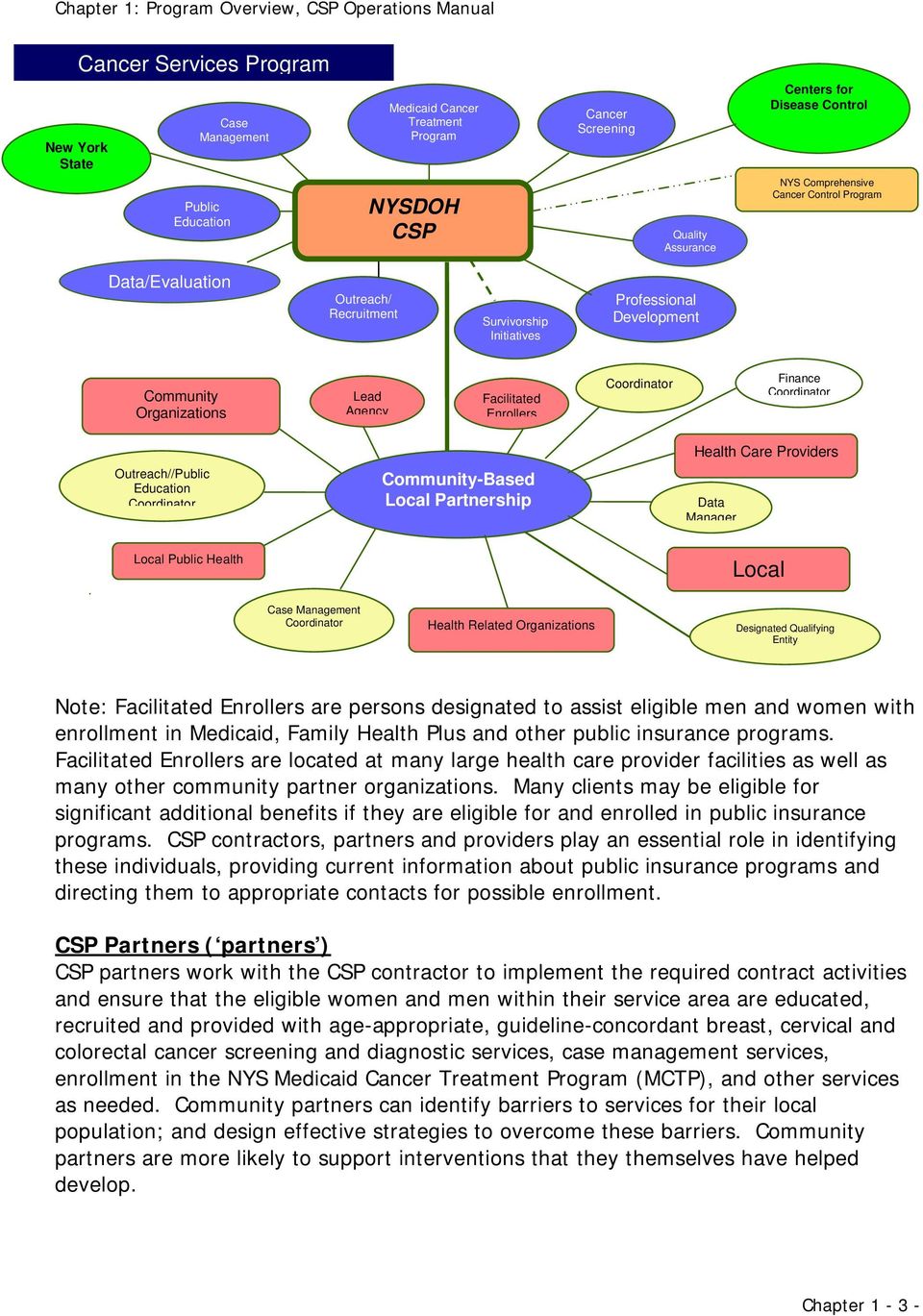
10 Chapter 1: Program Overview, CSP Operations Manual manner, and ensuring that barriers to implementation of the required activities are addressed to reduce potential effects on CSP performance. CSP Partnership ( partnership ) A CSP partnership is defined as the CSP contractor plus community partners and health care providers that collectively initiate efforts to promote and provide cancer screening. The basic premise of a partnership is that when individuals or organizations join together, they will be more successful in their collective efforts than they could be as individuals. Note that the term partnership does not imply a formal, legal entity. The partnership model was selected as the most efficacious approach to provide statewide cancer screening services. The model is based on the concept of the community of solution, in which varieties of existing community entities contribute and mobilize their resources collectively to solve a community problem. Through the partnership model, screening programs are better able to identify and meet the diverse needs of the priority populations in communities across the state. The diagram that follows illustrates the concept of the partnership and its partners and members. Chapter 1-2 -

11 Chapter 1: Program Overview, CSP Operations Manual Cancer Services Program New York State Case Management Public Education Medicaid Cancer Treatment Program NYSDOH CSP Cancer Screening Quality Assurance Centers for Disease Control NYS Comprehensive Cancer Control Program Data/Evaluation Outreach/ Recruitment Survivorship Initiatives Professional Development Community Organizations Lead Agency Facilitated Enrollers Coordinator Finance Coordinator Outreach//Public Education Coordinator Community-Based Local Partnership Health Care Providers Data Manager Local Public Health Local Case Management Coordinator Health Related Organizations Designated Qualifying Entity Note: Facilitated Enrollers are persons designated to assist eligible men and women with enrollment in Medicaid, Family Health Plus and other public insurance programs. Facilitated Enrollers are located at many large health care provider facilities as well as many other community partner organizations. Many clients may be eligible for significant additional benefits if they are eligible for and enrolled in public insurance programs. CSP contractors, partners and providers play an essential role in identifying these individuals, providing current information about public insurance programs and directing them to appropriate contacts for possible enrollment. CSP Partners ( partners ) CSP partners work with the CSP contractor to implement the required contract activities and ensure that the eligible women and men within their service area are educated, recruited and provided with age-appropriate, guideline-concordant breast, cervical and colorectal cancer screening and diagnostic services, case management services, enrollment in the NYS Medicaid Cancer Treatment Program (MCTP), and other services as needed. Community partners can identify barriers to services for their local population; and design effective strategies to overcome these barriers. Community partners are more likely to support interventions that they themselves have helped develop. Chapter 1-3 -
12 Chapter 1: Program Overview, CSP Operations Manual Partners can help CSP contractors reach their goals by: Expanding and maximizing resources. Coordinating program activities. Identifying approaches and resources to overcome obstacles to the provision of cancer screening and diagnostic follow-up for the CSP priority populations. Using their relationships to identify, educate and move community members to cancer screening services Promoting the delivery of breast, cervical and colorectal cancer screening. Partners include community organizations (such as service clubs, senior services programs, libraries, faith-based organizations, community centers, chambers of commerce, etc.); health care providers in a variety of settings (hospitals, community health centers, local health departments, clinics, family planning providers, primary care providers, specialists, etc.); local businesses (media representatives, beauty salons and barbershops, etc.); health-related organizations (American Cancer Society, Avon Foundation, Susan G. Komen for the Cure, etc.); and government (elected officials, local health departments, etc.). Partners assist with implementation of required activities as appropriate to the mission and role of their organizations. Partners may provide a valuable source of services, promote the screening programs, and add in-kind resources. CSP Providers ( providers ) CSP providers are defined as health care providers who have been credentialed and approved by the NYSDOH CSP to provide screening and diagnostic services to CSP clients. CSP contractors are responsible for recruiting providers to adequately address the breast, cervical and colorectal cancer screening, diagnostic and treatment referral needs of the CSP partnership. Please see CSP Operations Manual, Chapter 2: Partnership Required Activities and Standards for additional information about provider credentialing and requirements of CSP providers. CSP Clients ( clients ) CSP clients are defined as eligible men and women who receive at least one CSPreimbursed breast, cervical or colorectal cancer screening or diagnostic service. In general, the eligible populations screened through the CSP partnerships, and for whom the NYSDOH CSP reimburses for clinical services, include women ages 40 and over and men ages 50 and over who are unserved or underserved. As defined by NYS Public Health Law , these are persons having inadequate access and financial resources to obtain cancer screening and detection services, including persons who lack health insurance or whose health insurance coverage is inadequate or who cannot meet their deductible obligations for purposes of accessing coverage under their health insurance and who are age-appropriate for breast, cervical and/or colorectal cancer screening. Chapter 1-4 -

13 Chapter 1: Program Overview, CSP Operations Manual Please see CSP Operations Manual, Chapter 3: Eligibility for guidance to determine CSP client eligibility. CSP Priority Population ( priority population ) CSP priority population refers to sub-groups of the eligible population who are disproportionately affected by breast, cervical or colorectal cancers and, as a result, are of special concern to the NYSDOH CSP. These populations are the focus of outreach, recruitment and screening efforts. Priority populations include: Uninsured and underinsured persons ages Women ages 40 and over who are rarely or never screened for cervical cancer defined as those who have never had Pap tests or have not had Pap tests within the past five years. Persons who are geographically or culturally isolated. The medically unserved or underserved. Members of racial, ethnic and cultural minority populations. CSP Contractor Staff Personnel who fulfill one or more of the key staffing functions under the NYSDOH CSP contract are referred to as CSP contractor staff. CSP contractors are required to fulfill the five key staffing functions of partnership coordination, outreach and public education, data management, case management and fiscal management to ensure required activities are implemented. Please see CSP Operations Manual, Chapter 2: Partnership Required Activities and Standards for additional information about key staff and functions. NYSDOH CSP Staff The NYSDOH CSP staff provides oversight and guidance to the CSP contractors through programmatic, administrative and fiscal technical assistance, public and healthcare provider education regarding cancer prevention and early detection, and assistance implementing effective outreach to the eligible priority populations. Additionally, NYSDOH CSP staff work with CSP contractor staff to ensure that individuals with abnormal screening results receive follow-up and case management as needed and that quality clinical services are provided by the partnerships through credentialing activities and a quality assurance program. The NYSDOH Cancer Screening Research and Evaluation Unit (a.k.a. Data Unit) provides data management support and monitors and assesses program data for NYSDOH CSP staff and CSP contractors. NYSDOH CSP Regional Managers work with the CSP contractors to provide technical assistance regarding all aspects of contract implementation and management. Regional managers are the first point of contact for all contract questions including billing, vouchers, eligibility, reimbursement, work plans, budgets, reporting requirements and implementation of all required activities. Chapter 1-5 -

14 Chapter 1: Program Overview, CSP Operations Manual Cancer Survivorship Due to early detection and improved treatments, it is estimated that nearly 800,000 New Yorkers have survived cancer. A cancer survivor is defined as an individual living with cancer, from the time of diagnosis through the remaining years of life. Numerous organizations offer services for cancer survivors, their caregivers and their families that address a wide range of issues, including medical, emotional, psychosocial, financial and legal needs. These supportive services are offered in a variety of formats across NYS. Please refer to CSP Operations Manual, Chapter 10: Staff List for contact information for survivorship initiatives. B. The NYS Medicaid Cancer Treatment Program (MCTP) In addition to screening services, the CSP partnerships provide diagnostic and case management services, and assist eligible men and women diagnosed with cancer in obtaining Medicaid coverage through the NYS MCTP. Since 2002, the MCTP has provided full Medicaid coverage for the entire treatment period for eligible men and women diagnosed with breast cancer and for women diagnosed with cervical cancer. The MCTP for women diagnosed with breast or cervical cancer is funded and administered by NYS and the Federal government. In 2006, the NYS legislation that created this program was expanded to cover treatment for colorectal and prostate cancers; coverage for colorectal cancer began on April 1, 2007 and coverage for prostate cancer began October 1, The NYSDOH CSP does not provide a prostate screening program, nor does the NYSDOH CSP support routine population-based prostate cancer screening. However, the CSP partnerships can enroll eligible men in need of prostate cancer treatment into the MCTP who are screened and/or diagnosed with prostate cancer through a CSP provider. Please see CSP Operations Manual, Chapter 7: NYS Medicaid Cancer Treatment Program for information about the implementation of the MCTP by CSP partnerships. C. Public Health Insurance Programs The NYSDOH places a high priority on identifying individuals who may be eligible for Medicaid, Family Health Plus, or other public insurance programs so that they can have access to a payment source for their complete health needs. Many CSP clients may be eligible for significant additional healthcare benefits if they are eligible for and enrolled in public insurance programs. CSP partnerships play an essential role in identifying these individuals, providing current information about public insurance programs and directing them to appropriate contacts for possible enrollment. NYSDOH provides CSP partnerships with contact information for public health insurance programs. Individuals who qualify for enrollment in public insurance programs will continue to be included in CSP screening recall protocols and processes to ensure that they are notified for and access important cancer screening services at appropriate intervals. Likewise, uninsured individuals who are not eligible for public health insurance programs will be directed to CSP partnerships by public insurance program enrollers for needed cancer screening services. Chapter 1-6 -

15 Chapter 1: Program Overview, CSP Operations Manual D. NYS Tobacco Control Integration The NYSDOH Tobacco Control Program (TCP) implements evidence-based and promising strategies to prevent and reduce tobacco use. The program has effectively worked to increase access to cessation services and motivate smokers to try to quit through the implementation of a multi-pronged cessation approach in NYS. Effective April 1, 2010, as required by the CDC, the NYSDOH requires CSP partnerships to implement activities to ensure that all CSP clients, at time of intake, are assessed for smoking status, and if applicable, referred to the NYS Smokers Quitline, NY- QUITS ( ). It is recommended that all CSP clients, regardless of smoking status, be sent NYS Quitcards. NYSDOH provides CSP partnerships with the contact list for the TCP statewide Cessation Centers, who will work with CSP providers and health-care organizations, to implement systems to screen patients for tobacco use and prompt providers to offer advice and assistance to quit. Chapter 1-7 -

16 BLANK FOR PRINTING

17 NYSDOH Chapter 2: Partnership Required Activities and Standards CSP Operations Manual 04/2011

18 BLANK FOR PRINTING

19 Chapter 2: Partnership Required Activities and Standards, CSP Operations Manual Chapter 2: Partnership Required Activities and Standards A. Required Activities The NYSDOH CSP contracts with organizations to implement the CSP integrated breast, cervical and colorectal cancer screening partnerships in communities across the state. Contractors must hire staff and/or enter into subcontract(s) to implement all required activities. The contractor is the primary point of contact with the NYSDOH CSP and is responsible for ensuring all required activities and program guidelines are implemented. Activities specific to the local implementation of the required activities are developed annually through the work plan process. Work plans are routinely reviewed and revised in collaboration with contractor staff and the CSP Regional Manager (see Section H, Reporting Requirements and Contract Monitoring of this chapter for more information). Contractors are required to execute and manage the activities listed below under the guidance of the NYSDOH CSP. 1. Partnership building and management build and maintain collaborative relationships with health, human service and other community organizations to provide and promote utilization of cancer screening services among the priority populations throughout the entire proposed service area. Required activities: Cultivate relationships (a.k.a. partnerships) with organizations such as public health agencies, public and private businesses, service and social groups, faith-based organizations, non-profit organizations, medical institutions, medical care providers, government agencies and interested individuals representing priority populations who are willing to share their resources to assist in implementing all required activities. Recruit partners with appropriate knowledge, skills and resources based upon current and anticipated overall partnership needs to serve the priority populations throughout the entire proposed service area. Ensure that partners include representatives from screening, diagnostic and treatment providers. Develop formal, active working relationships through letters of agreement, memoranda of understanding or sub-contractual arrangements with other local partners serving the priority populations. Conduct a minimum of four partnership meetings annually. Regularly communicate with partners and providers in writing to facilitate communication about program services and operations, review performance measures and current budget expenditures, identify gaps in services and areas for collaboration and gather input into the development of annual program work plans and budgets. Chapter 2-1 -
20 Chapter 2: Partnership Required Activities and Standards, CSP Operations Manual Engage partners to assess needs, conduct education, and develop, implement and evaluate comprehensive plans for outreach and inreach activities to priority populations throughout the entire service area. Establish relationships with other community organizations and providers to establish referrals for client services not reimbursed by the CSP, such as child care, medical equipment or transportation. 2. Outreach to the priority populations educate and enroll women and men from the eligible priority populations into comprehensive and age-appropriate breast, cervical and colorectal cancer screening services. The goal of outreach and education activities is to enroll members of the priority populations into comprehensive, age-appropriate breast, cervical and colorectal cancer screening services. Active outreach relies on comprehensive, tailored, population-specific strategies designed to reach and enroll men and women from priority populations into clinical screening services. Active outreach entails creative approaches, beyond merely providing brochures or flyers describing the program, which is considered passive outreach. Inreach activities involve approaching members of the priority populations who are using other health services (e.g., getting a flu shot, receiving care for diabetes or heart disease, etc.) and enrolling them into the Program. Required activities: Deliver clear and consistent messages about breast, cervical and colorectal cancer screening that are written at appropriate reading levels for those with low health literacy skills with guidance from and review by the CSP Partner Relations and Communications Unit, using NYSDOH-developed templates when available. Develop and revise as appropriate a comprehensive, active outreach plan tailored to the priority populations that includes general population-based education and recruitment strategies. Develop and implement inreach strategies to approach members of the priority populations using other health services and enroll them into the Program. Develop and monitor effective strategies for educating members of the priority populations about the importance of early detection and screening for breast, cervical and colorectal cancer. Develop strategies to promote the services provided by the partnership and the CSP. Chapter 2-2 -

21 Chapter 2: Partnership Required Activities and Standards, CSP Operations Manual 3. Screening and diagnostic services establish systems and procedures for the provision of breast, cervical and colorectal cancer screening and diagnostic services to eligible populations according to CSP guidelines. Required activities: Establish and maintain a comprehensive provider network for breast, cervical and colorectal cancer screening and diagnostic services and treatment referrals and for prostate cancer diagnostic services and treatment referrals that will maximize access to and quality of care. Ensure a sufficient number of appropriate types of providers participate in the partnership. Establish, maintain and update annual written agreements with providers. Participate in all CSP credentialing activities in order to ensure providers have unrestricted licenses and are appropriately qualified and credentialed. Establish systems and procedures for the provision of breast, cervical and colorectal cancer screening and diagnostic services to eligible populations, according to the Operations Manual, including 1) the development of a mechanism for obtaining required CSP client information and signed consent forms prior to initiation of clinical services; 2) a system for recalling men and women for rescreening at required intervals, including those recently enrolled in public insurance programs, such as Medicaid and Family Health Plus; 3) a method for purchase and distribution of fecal test kits for colorectal cancer (either fecal occult blood test [FOBT] or fecal immunochemical test [FIT]) and other program materials; and 4) the establishment of standing medical orders for fecal test kit distribution, development and follow-up. Clients should elect to use one of the available fecal tests, i.e., either FOBT or FIT. In instances where the use of the selected test poses a barrier to the participation of a provider or individual patient, consideration will be made for use of the alternative test. Develop and implement procedures for the timely follow-up of men and women with abnormal screening results to schedule them for appropriate diagnostic tests and report results to the CSP in a timely manner, as per CSP Operations Manual, Chapter 4: Cancer Screening Guidance, Section D. Work with neighboring partnerships to best serve the clients within the service area and adjacent counties. Develop and implement procedures to refer all eligible men and women in need of treatment for breast, cervical, colorectal, or prostate cancer for enrollment in the NYS MCTP (see CSP Operations Manual, Chapter 7: NYS Chapter 2-3 -
22 Chapter 2: Partnership Required Activities and Standards, CSP Operations Manual Medicaid Cancer Treatment Program). Secure commitment from clinical providers to treat men and women diagnosed with breast cancer, cervical cancer and/or precancerous cervical lesions, and colorectal cancer through the program who do not qualify for NYS MCTP, regardless of their ability to pay. Men screened and/or diagnosed with prostate cancer through CSP providers and who meet CSP eligibility criteria (see CSP Operations Manual, Chapter 3: Eligibility) are eligible for prostate cancer treatment coverage through the NYS MCTP. Please note that men with a diagnosis of prostate cancer for whom the treatment plan is active surveillance are considered "in need of treatment. The NYSDOH does not currently support routine population-based screening for prostate cancer and therefore does not reimburse for prostate cancer screening. Ensure timely response to reviews of clinical and treatment services. Ensure that CSP clients are provided with referrals to no cost or sliding fee clinics for needed services that are identified in the course of cancer screening but that are not specifically related to breast, cervical or colorectal cancer, as needed. Ensure that providers will accept the CSP maximum allowable reimbursement rate schedule as payment in full. Ensure that providers of screening and/or diagnostic services bill all available insurance (e.g., Medicaid) before billing the CSP. 4. Case management ensure that all CSP clients with abnormal screening results are assessed for their need for case management services and are provided with such services accordingly. Required activities: Assist CSP clients in need of follow-up to ensure that they receive comprehensive, coordinated care in a timely manner based on individualized needs. Develop individual written care plans including periodic reassessment of clients needs. Develop relationships with community resources to help address barriers that CSP clients may encounter that challenge their ability to obtain diagnostic services, evaluation, and if necessary, treatment. Provide appropriate continued reassessment and follow-up of the clients needs throughout the duration of care and evaluate client satisfaction. Chapter 2-4 -
23 Chapter 2: Partnership Required Activities and Standards, CSP Operations Manual Ensure client is aware of the provider s recommended rescreening protocol once all diagnostic follow-up has been completed. Assist Designated Qualified Entities (DQEs) with overcoming any barriers which prevent the client from meeting with the DQE for a face-to-face interview and/or the DQE informing the client of documents required for the application process. DQEs are the individuals authorized to complete applications for enrollment of men and women in the NYS MCTP for breast, cervical, colorectal, and prostate cancer treatment. 5. Program management manage, coordinate and administer the program to implement all required activities and fulfill contractual agreements in a timely manner, and ensure that barriers to implementation of the required activities are addressed to reduce potential effects on CSP performance. Required administrative activities: Utilize monthly performance measure reports and monthly clinical service budget monitoring tools to monitor progress and budget expenditures and identify need for improvements and changes in systems or activities. Monitor, review and revise work plans according to monthly performance measure reports and the monthly budget monitoring tool. Please contact your Regional Manager to access the most current budget monitoring assessment tool. Ensure timely, complete and accurate submissions of annual work plans and budgets, as requested by the NYSDOH CSP. Ensure timely, complete and accurate submissions of semi-annual reports as requested by the NYSDOH CSP using standardized report formats provided by the CSP. Ensure that the program is fully staffed and systems are in place to recruit, train, evaluate and retain all staff as needed. Ensure timely submission of contact information for key staff as requested by the NYSDOH CSP in order to ensure that the CSP database, public website and toll-free referral phone line database contact information are accurate and up-to-date. Note that these are maintained by the NYSDOH CSP in order to facilitate communication with partnerships and provide contact information for statewide promotion of the partnerships. Ensure that contractor staff (Coordinator, Outreach/Recruitment, Case Manager, Data Manager and Fiscal staff) and applicable community-based partners and providers attend CSP trainings, regional meetings and other contractor meetings as directed by the NYSDOH CSP. Chapter 2-5 -
24 Chapter 2: Partnership Required Activities and Standards, CSP Operations Manual Provide proof of or exemption from workers compensation and workers disability insurance coverage and information on policies and procedures to demonstrate compliance with applicable federal regulations governing the grant funds. Items requested as part of contract paperwork will include, but not be limited to, time and effort procedures and A-133 audit reports. Assess need and recruit providers to meet the clinical and geographic/access needs for the provision of cancer screening and diagnostic services. Maintain communication with clinical providers, laboratories, imaging facilities and partners regarding program changes, professional development opportunities and other issues related to program services and requirements. Ensure that providers submit all forms accurately and in a timely manner. Identify and facilitate access to training of DQEs to assist eligible men and women with enrollment into the NYS MCTP. Implement reciprocal referral system whereby CSP clients are directed to facilitated enrollers for possible enrollment in Medicaid, Family Health Plus or other public insurance programs to ensure that they receive insurance coverage for all of their health care needs. Similarly, educate facilitated enrollers for these programs about the CSP so that individuals not eligible for Medicaid programs are referred to CSP partnerships for ageappropriate, guideline concordant breast, cervical and colorectal cancer screening and diagnostic services. Cooperate fully with the CSP Quality Assurance team to identify providers with potential quality concerns, explore reasons for unusual data patterns, and remediate providers clinical and data reporting deficiencies in a timely manner. Ensure that providers and/or contractor staff assess clients at intake for smoking status and, if applicable, refer smokers to the NYS Tobacco Control Program Quitline. Conduct educational visits to inform community members and decision makers about the impact of cancer, how the local CSP partnership addresses the problem, and the unmet need in the community. See CSP Operations Manual, Chapter 8: Sustainability for more information. Plan and implement media/promotional activities (letters to the editor, newspaper articles, etc.) publicizing CSP screening events, client Chapter 2-6 -
25 Chapter 2: Partnership Required Activities and Standards, CSP Operations Manual testimonials and other CSP activities to increase public awareness of, and support for, the CSP. Required fiscal management activities: Prepare and submit vouchers to NYSDOH CSP on a monthly basis Ensure prompt disbursement of funds (within 30 days of receipt of payment from HRI, Inc. or NYS) to providers and agencies for whom clinical or infrastructure claims were submitted. For underinsured client reimbursement, bill all third-party Payors first, with the understanding that the difference between the actual cost of an allowable service and the insurance payment may be billed to the NYSDOH CSP, provided the reimbursement from all sources does not exceed the maximum reimbursement rate. See CSP Operations Manual, Chapter 6: Reimbursement, Attachment 6-I: New York State Department of Health Cancer Services Program Reimbursement Schedule for more information. Required data management activities: Submit all required forms and data (e.g., client demographics, screening and diagnostic services and treatment information) as directed by the NYSDOH CSP via the Indus online data system for clients screened by CSP providers and for whom reimbursement is requested for any clinical services. The CSP requires that Screening Intake Forms (SIFs) be submitted within 30 days of the date of finding for abnormal results and 90 days for normal results. It is important that services are reported on time so that clients can receive diagnostic and treatment services as needed and so that providers are reimbursed as soon as possible. Ensure timely submission of data to facilitate timely reimbursement to providers (within 30 days of receipt of payment from HRI, Inc. or NYS). Ensure timely submission of data to facilitate enrollment of all eligible clients into NYS MCTP. Conduct provider training and follow-up with providers where necessary to ensure timely and appropriate submission of all required forms and data. Promptly obtain missing or corrected information from providers. Promptly distribute monthly data reports received from the NYSDOH CSP to the appropriate entities. Chapter 2-7 -
26 Chapter 2: Partnership Required Activities and Standards, CSP Operations Manual B. Key Staff and Functions In addition to ensuring partnership required activities are implemented, CSP contractors are required to fulfill the staff functions listed below. One qualified staff person may be responsible for multiple functions. The determination of who will serve in each role is to be made by the contractor in consultation with the NYSDOH CSP. Staffing needs should be commensurate with the services provided and reviewed routinely with the NYSDOH CSP Regional Manager. Staffing plans should be revisited annually as part of the process of preparing the contractor s work plan and budget for each contract year. 1. Partnership coordination - The Partnership Coordinator serves as the point of contact for all general, contractual and financial communication between the NYSDOH CSP and the contractor. The percentage of time designated for the Coordinator position should be commensurate with the volume of clinical services being provided through the partnership and the needs of the contractor to implement work plan activities and meet or exceed CSP performance measures. The Coordinator should be at least a.5 full-time equivalent (FTE). The Partnership Coordinator should have the ability and knowledge to: Administer all required activities, functions and other contract deliverables. Provide leadership for program planning, implementation and evaluation. Identify potential problems and best practices. Develop, cultivate and maintain productive working relationships among contractor staff, subcontractors, NYSDOH CSP staff and community partners. Identify need and recruit clinical providers and maintain regular effective communication. Communicate effectively and routinely with contractor staff, partners, clinical providers and NYSDOH CSP staff. Initiate and guide the development and routine review of annual work plan containing specific, measurable, time-phased and realistic objectives, activities and performance measures with input from the partnership. Initiate and guide the development of the annual budget and routine review of clinical expenditures with input from the partnership. Educate clinical providers about the CSP breast, cervical and colorectal cancer early detection program and the policies, procedures, and requirements for participation. Chapter 2-8 -
27 Chapter 2: Partnership Required Activities and Standards, CSP Operations Manual Represent the partnership and promote the NYSDOH CSP in the proposed service area. 2. Outreach and Public Education - Outreach staff work with all partnership collaborators to develop public education and awareness activities. Staff also conducts strategic active outreach and inreach initiatives to enroll members of the eligible priority populations throughout the entire service area, consistent with CSP performance measures and the clinical services budget. Staff responsible for outreach and public education activities should have the ability to: Work effectively with diverse groups of people from a variety of cultural and educational backgrounds. Use data to identify and locate eligible priority populations in the proposed service area. Tailor outreach and education strategies to the cultural values, norms and behaviors of the eligible priority populations. Educate all community members about the importance of screening, explain the services available and address barriers to screening. Motivate and encourage members of the eligible priority populations to complete all screening exams for which they are eligible. Engage partners to reach and bring members of the eligible priority populations into clinical screening services. Use data to develop and evaluate the effectiveness of targeted outreach strategies used in recruiting members of the eligible priority populations into screening and meeting projected screening numbers. 3. Data management - Data management involves serving as the point of contact for all data-related communication between NYSDOH CSP staff and the partnership. Staff responsible for data management activities should have the ability to: Use computer programs proficiently, this includes the use of the Internet, and database management and data entry programs. Collect, enter and edit data accurately. Chapter 2-9 -
28 Chapter 2: Partnership Required Activities and Standards, CSP Operations Manual Ensure the security and confidentiality of all data collected. Review and assess the completeness, accuracy and timeliness of data from providers. Communicate with providers when information is inadequate or missing. Assess CSP outcomes. Read and interpret data reports. 4. Case management - Case management involves working with patients, partners and community resources to assist CSP clients with identified barriers to adhere to diagnostic and treatment recommendations. The contractor may fulfill this function by designating case management staff or the function may be fulfilled through shared responsibility of providers and contractor staff. The case management function is described in detail in the CSP Operations Manual, Chapter 5: Case Management. Staff responsible for case management activities should have the ability to: Develop a system to track abnormal screening results to ensure the timeliness and completeness of follow-up. Understand health-seeking behaviors and the strategies to address barriers to seeking health services. Identify community resources that address barriers to care. Assess the needs and support systems for CSP clients in order to remove barriers to diagnostic follow-up. Refer CSP clients with abnormal screening results and diagnoses of breast, cervical or colorectal cancer to a DQE for possible enrollment in the NYS MCTP. Refer CSP clients with abnormal screening results for support services, as appropriate. Communicate with CSP clients to enhance their understanding of the need to have diagnostic services following an abnormal screening. Communicate effectively with CSP providers. Promote and communicate breast, cervical and colorectal cancer clinical guidelines to CSP providers. Chapter
29 Chapter 2: Partnership Required Activities and Standards, CSP Operations Manual 5. Fiscal management- Fiscal management involves serving as the point of contact for all contractual and financial communication with the NYSDOH CSP. Staff responsible for fiscal management activities should have the ability to: Monitor the CSP contractor clinical services and infrastructure budgets and reporting regularly to the partnership on the status of these budgets. Promptly prepare and submit vouchers to designated NYSDOH CSP personnel on a monthly basis (upon receipt of monthly billing reports from the data manager). Promptly disperse funds to all CSP providers and agencies for whom clinical or infrastructure costs were submitted for reimbursement (within 30 days of receiving payment of vouchers from NYS and HRI). Attach the appropriate billing reports and other documentation to vouchers. Attest to the NYSDOH CSP that all costs for which reimbursement is requested are true and accurate, to the best of their knowledge, by signing state vouchers. C. Provider Credentialing All health care providers must be credentialed by the NYSDOH CSP in order to be reimbursed for services provided to CSP clients. All contractors must participate in the credentialing process. Contractors are required to submit to the NYSDOH CSP the names, license numbers, practice locations and other requested information annually to allow for provider credentialing activities by the NYSDOH CSP. Any new providers added during the contract year must be credentialed by the NYSDOH CSP before a site code is assigned. This process usually takes approximately 10 business days to complete. Site codes are assigned to each CSP provider site to track services provided. The codes are entered into Indus to identify where services took place and to reimburse providers. Contractors must notify the CSP with requests for new site codes, or with changes to existing ones. See Attachments 2-I and 2-II for detailed instructions regarding site codes. A provider, who has a license restriction, or becomes subject to any disciplinary action taken by a government program, hospital managed care organization, or licensing authority, including but not limited to an active or stayed suspension or restriction of provider's or practitioner's license or certification, (as referenced in provisions seven and eight of Appendix A-2 of CSP partnership contract and in provisions ten, eleven, twelve and fourteen of Appendix A-3 of the provider agreement found below), will be reviewed by the NYSDOH CSP to determine if the restriction is related to services provided Chapter
30 Chapter 2: Partnership Required Activities and Standards, CSP Operations Manual through the CSP or constitutes fraud or malpractice. If the restriction involves one of these areas, the NYSDOH CSP will send the provider a letter notifying him/her that he/she is prohibited from participation in the CSP. The provider will also be notified of the opportunity to appeal this decision by submitting a request for an appeal to a NYSDOH review panel. D. Requirements for Clinical Service Providers The contract with the NYSDOH requires contractors or subcontractors on behalf of the partnership to obtain annual provider agreements with their providers offering clinical services to CSP clients. The agreement must contain or reference Appendix A3 (see next page), which outlines provider responsibilities. Chapter
31 Chapter 2: Partnership Required Activities and Standards, CSP Operations Manual APPENDIX A-3 Providers of screening and/or diagnostic services in the New York State Department of Health Cancer Services Program, agree to: 1. Abide by the applicable provisions of the New York State Department of Health Cancer Service Program (PROGRAM) Operations Manual including but not limited to: clinical guidelines, eligibility criteria and case management chapters. 2. Provide clients of the PROGRAM with the same quality of care as afforded to any other patients in their care. 3. Request reimbursement for clinical services ONLY for clients who meet the eligibility criteria as defined in the PROGRAM Operations Manual. 4. Treat the PROGRAM as the payor of last resort. All providers agree to first bill client s other insurance and/or third party payor for services provided through the PROGRAM. Provider further agrees that it may only seek PROGRAM reimbursement from the State contractor for the partnership and may not submit claims for reimbursement directly to the State. 5. Accept reimbursement rates established by the PROGRAM as payment in full for all services that are covered by the PROGRAM. Providers agree not to charge clients for the difference between the PROGRAM reimbursement rate and the provider s usual fees. Under no circumstances shall providers bill PROGRAM clients for services that are covered by the PROGRAM. 6. Promptly refer PROGRAM clients for all needed and appropriate diagnostic and treatment services without consideration of their ability to pay. This assurance includes any and all necessary services NOT covered by the PROGRAM. 7. Obtain signed written consent forms from all PROGRAM clients for the provision of clinical services and release of their medical information to the relevant other entities participating in the partnership and the New York State Department of Health for the purposes of case management, tracking and reimbursement, in addition to any other consents or authorizations the providers may obtain or which may be required by law to obtain. 8. Submit accurate demographic, screening, diagnostic treatment and any other data required by the STATE in a timely manner and in the format required by the STATE. The provider agrees that the reimbursement for clinical services will not be provided by the STATE to the STATE contractor for the partnership for reimbursement to the provider until data have been submitted and accepted on the PROGRAM data system. Chapter
32 Chapter 2: Partnership Required Activities and Standards, CSP Operations Manual 9. Maintain adequate medical, business, financial, personnel, and other records, which may be applicable to the PROGRAM. PROGRAM providers agree to provide the PROGRAM access to medical, including original mammograms, consents, business, personnel, financial and other records, which may be relevant to the Cancer Services Program for purposes of inspection, auditing and copying. 10. Ensure that all licensed health care professionals are appropriately licensed to practice their profession in the State of New York, and maintain the appropriate credentials for the services that they are providing. Maintain all applicable provider, office based surgery and/or facility credentials, certifications, licenses, operating certificates, and/or approvals required by law and necessary to perform and bill for PROGRAM services and facility fees, including but not limited to approvals for laboratory, mammography, office based surgery and diagnostic and treatment center services. 11. Immediately notify the PROGRAM (i) if Provider s or Practitioner s license to practice or certification to operate in any state, certification(s) to prescribe medication, if applicable, or staff privileges at any hospital, if applicable, are voluntarily surrendered, restricted temporarily or permanently reclassified, suspended or revoked for any reason; and (ii) if Provider or Practitioner is indicted or convicted of a criminal offense, regardless of the nature of the offense, or if the Provider or Practitioner becomes subject to any disciplinary action taken by a government program, hospital, managed care organization, or licensing authority, including, but not limited to an active or stayed suspension or restriction of Provider s or Practitioner s license or certification. 12. Provide all information necessary to comply with the credentialing and recredentialing activities, and further, to provide such information within a reasonable time period. 13. Cooperate fully with PROGRAM quality assurance efforts, including, participating in discussions to explore reasons for unusual data patterns, and agree to undertake any proposed remediation plans to any clinical and/or data reporting deficiencies in a timely manner. 14. The PROGRAM reserves the right to discontinue any service providers from participation in the PROGRAM for any reason. 15. Paragraphs nine and thirteen of this Appendix A-3 shall survive termination of the AGREEMENT. Chapter
33 Chapter 2: Partnership Required Activities and Standards, CSP Operations Manual E. Confidentiality 1. Health Insurance Portability and Accountability Act (HIPAA) The first federal privacy standards to protect patients medical records and individually identifiable health information provided to health plans, doctors, hospitals and other health care providers that were issued as part of the Health Insurance Portability and Accountability Act (HIPAA) of 1996 took effect on April 14, These standards, which were developed by the U.S. Department of Health and Human Services, provide patients with access to their medical records and more control over how their personal health information is used and disclosed. Additionally, HIPAA includes provisions designed to encourage electronic transactions and requires safeguards to protect the security and confidentiality of health information. In order for medical information to be released, patients need to sign a specific authorization, unless a specific exception in the law applies. The federal privacy standards generally do not affect state laws that already provide additional protections for patients. The NYSDOH CSP is exempt from being a covered entity/program itself as it is a government grant. Therefore, covered entities sharing data with the CSP must follow the detailed requirements of HIPAA, but the CSP may disclose data pursuant only to state law requirements, not federal. However, in all cases, reasonable efforts must be made to limit the amount of information disclosed to the minimum amount necessary to accomplish the intended purpose. 2. CSP partnership confidentiality requirements It is the responsibility of the contractor to ensure that all partnership staff sign written confidentiality agreements to maintain the confidentiality of all CSP clients information. Partnership staff must treat all information pertaining to CSP clients as confidential information. Written or electronic evidence of client participation must not be left unattended on desks or in other open-access areas. Staff must maintain and use such information only for the purposes intended for the CSP and only to the extent necessary to fulfill CSP objectives. Limited access to fax machines, computer terminals (e.g., password protection), voic , cabinets, and workspace areas should be observed by all partnership staff. Client information and ancillary records (e.g., laboratory results, radiology results, and pharmacy records) should be maintained in secure data storage areas, which Chapter
34 Chapter 2: Partnership Required Activities and Standards, CSP Operations Manual can include, but are not limited to, files in locked rooms or limited access areas, and password encoded desktop and laptop computer systems. Access to data files, both paper forms and computer files, is restricted to partnership staff who needs such information to perform their work responsibilities. Any discarded information containing client information must be shredded. CSP client information is confidential and may only be given to authorized individuals after consent has been obtained from the client. Any proposed research regarding any CSP client(s) or the CSP must first be approved by the NYSDOH Institutional Review Board. Please forward all such requests to the appropriate CSP Regional Manager (see CSP Operations Manual, Chapter 10: Staff List). All responsible persons and entities will be held accountable for breaches of confidentiality and for misuse of confidential data such that job suspensions or terminations or legal proceedings may be instituted against them. Staff permitted to work from home by the contractor must be able to demonstrate appropriate safeguards to prevent the inadvertent sharing or loss of patient information including, but not limited to, firewalls that do not allow outside access to a wireless network and a level of encryption that ensures security. F. Indus Data Submission and Form Retention The NYSDOH CSP maintains a secure on-line, real-time, internet-based data entry system through a contract with Indus Consultancy Services, Inc. (commonly referred to as the Indus system, or Indus). Contractors are responsible for entering screening, diagnostic, treatment, and demographic information into this data system for CSP clients. The use of data available through Indus facilitates timely provider reimbursement, patient tracking and follow-up, improves the quality of data collected, and helps reinforce CSP procedures. On-line data queries and reports are available for contractors and NYSDOH CSP staff to monitor performance. Contractors should establish efficient notification systems with CSP providers in order to receive information from them to ensure that services are reported in a timely manner. These systems are needed to ensure that the following occur: Positive screening findings are followed-up quickly and appropriately; Timely case management services can be provided; Chapter
35 Chapter 2: Partnership Required Activities and Standards, CSP Operations Manual Clients eligible for the NYS MCTP can receive coverage for treatment; Quality clinical care is provided to CSP clients; Rescreening can occur at the appropriate interval; and CSP providers are reimbursed as soon as possible. Detailed instructions regarding form completion and Indus data entry can be found in the CSP Data Dictionary. Current versions of data entry forms and the CSP Data Dictionary are available on the Resources page of the Indus data system or by contacting the NYSDOH CSP Data Unit at 1. Timely submission of Screening Intake Forms (SIFs) and Follow-up Forms (FFs) on the Indus data system As of April 1, 2011, the Indus data system only allows for the reimbursement of CSP funds for services that are submitted and accepted onto the data system within 90 days of the date of service. Exceptions to this 90-day rule can be made for services processed with Insurance Denial Conversion Forms, for contractor errors corrected through Revision Forms, and for other special circumstances that justify a longer period of time for data submission. CSP Data Unit administrators have override capability on the Indus data system for the 90-day rule. Requests for overrides should be submitted by to [email protected]. The 90-day rule for data submission on the SIF and FF is outlined below. SIF: The Indus data system assesses the submission date for each individual service on the SIF and determines whether the service was submitted and accepted onto the system within 90 days of the service date. For example, if a mammogram is provided on May 15, 2011 and submitted and accepted onto the data system on August 20, 2011, the system will NOT allow program funds for this service. It is not prudent to delay entry of SIFs until all screenings are complete. The Indus data system allows contractors to submit services on the SIF, have the form accepted, and then add additional services as they are provided. FF: The Indus data system starts counting the 90 days with the LAST service date on the FF. For example, if a FF with a surgical consult on May 15, 2011 and a colonoscopy on July 15, 2011 is submitted and accepted onto the system on September 20, 2011, the data system would allow reimbursement for both of the services on this FF even though the submission is greater than 90 Chapter
36 Chapter 2: Partnership Required Activities and Standards, CSP Operations Manual days after the surgical consult in May. The data system begins counting the 90 days with the LAST service date on the form (in this case, July 15, 2011). Given these rules, situations like cancellations of appointments, delays in scheduling colonoscopies, and extended periods of time between follow-up services should not affect whether services can be reimbursed. FFs should not be submitted onto the data system until they are complete. Contractors are expected to ensure data are submitted in accordance with the 90-day rule, so that services can be reimbursed. 2. Revisions to SIFs and FFs on the Indus data system Once SIFs and FFs have been submitted and accepted on the Indus data system, there are several types of revisions that can be made by CSP contractor staff. The following fields can be modified directly by the CSP contractor staff on an accepted form: Screening Intake Form: Field 1 - Name Fields Address Field 9 - Sex Field 11- Spanish, Hispanic or Latino Field 12 - Race Field 16 - Monthly Household Income Field 17 - Family Size Field 18 - Health Insurance ALL SITE CODES (all site codes except the intake site) Follow-up Form: ALL SITE CODES The following types of revisions to an accepted Screening Intake Form (SIF) can be made directly by contractor staff: a. If a SIF has been entered and accepted on the Indus data system with the cervical portion of the form completed (and the breast portion blank), the contractor staff can directly edit the form to add breast cancer screening services that occur within 90 days of the cervical screening services. b. If a SIF has been entered and accepted on the Indus data system with the breast portion of the form completed (and the cervical portion blank), the contractor staff can directly edit the form to add cervical cancer screening services that occur within 90 days of the breast screening services. Chapter
37 Chapter 2: Partnership Required Activities and Standards, CSP Operations Manual c. If a SIF has been entered and accepted on the Indus data system with a CBE and no mammogram, the contractor staff can directly edit the form to add a screening mammogram that occurred within 90 days of the CBE. This also works if the form was accepted with a mammogram and no CBE, the contractor staff can directly edit the form to add a CBE that occurred within 90 days of the mammogram. d. If a SIF has been entered and accepted on the Indus data system with breast and/or cervical cancer screening services, the contractor staff can directly edit the form to add colorectal cancer screening services that occur within 6 months of the breast and cervical screenings. For all other changes, corrections, or additions to data on SIFs or FFs that have already been submitted and accepted on the Indus data system, CSP contractor staff must submit either a Screening Intake Revision Form or a Follow-Up Revision Form. Copies of these forms and detailed instructions regarding completion of these forms are available on the Resources page of the Indus data system or by contacting the NYSDOH CSP Data Unit at [email protected]. 3. Submitting SIFs and FFs on the Indus data system for NYS MCTP clients When submitting SIFs and FFs for potential NYS MCTP clients, it is important to consider the Medicaid enrollment date to avoid double payment of services by both Medicaid and the CSP. Enrollment in the MCTP starts on the first day of the month of diagnosis (e.g., for a biopsy done on 1/18/11 with a positive finding, enrollment would start 1/1/11) OR 90 days prior to the application date, whichever is later. The CSP should be the payor of last resort. NYS MCTP clients can enter the CSP at several points during the process of their diagnosis and treatment. The guidance for submission of SIFs and FFs on the Indus data system depends on when the client enters the program. The following scenarios represent different types of clients and the appropriate way to submit the SIFs and FFs for these clients. a. CSP Enrolled Clients: If a client enrolled in the CSP who received screening and/or follow-up procedures through the program is believed to be eligible for the MCTP, contractor staff should submit SIFs and FFs onto the Indus data system as if Medicaid will be paying for some services. Any procedures that occurred within the month of diagnosis should be entered on the SIF and FF as being paid with other funds because Medicaid will enroll the client and pay for services rendered back to the first day of the month in which the client was diagnosed. Remember, the client will be insured by Medicaid for all Medicaid approved procedures that occurred during that month as long as they were performed by a provider that accepts Medicaid reimbursement. Services that are not Medicaid approved or that are rendered by providers that do NOT accept Medicaid reimbursement should be entered on the SIF and FF as being paid with program funds. Chapter
38 Chapter 2: Partnership Required Activities and Standards, CSP Operations Manual If the client is approved for the MCTP, the acceptance letter will include an enrollment date. The contractor staff should compare this enrollment date to the already accepted SIF and FF and confirm that any services that occurred prior to the client s MCTP enrollment date are paid for with program funds and services that occurred on or after the enrollment date and were rendered by a provider that accepts Medicaid reimbursement are entered as other funds. Revision forms should be submitted to the CSP Data Unit to change funds as needed. Please list "MCTP" as the reason for the revision on the form. If the client is NOT approved for MCTP, revision forms should be submitted to the CSP Data Unit to change procedures listed as paid with other funds to paid with program funds. Please list "Denied MCTP" as the reason for the revision on the form. b. Clients NOT enrolled in the CSP: For all applicants to the MCTP who were not enrolled in the CSP at the time they received screening and follow-up procedures, the SIFs and FFs should NOT be entered on the Indus data system. Hard copies of SIFs and FFs should be submitted with the MCTP applications. Please see CSP Operations Manual, Chapter 7: Medicaid Cancer Treatment Program and the Medicaid Cancer Treatment Program Application manual for more information about eligibility criteria and the application process for the MCTP. 4. Form retention recommendations The CSP does not have any formal requirements for retention of SIFs, FFs, or monthly billing reports. Accepted forms and monthly billing reports are available electronically on the Indus data system. Contractors are required to follow their agency's policies about retention of screening intake forms, follow-up forms, and monthly billing reports, as well as consent forms, clinical or medical records and case management notes. If a contractor disposes of forms with confidential client information, these forms must be shredded. The CSP does recommend that contractors retain SIFs and FFs until the services on these forms appear on the monthly billing report to verify that the information was accurately entered on the Indus data system and appears correctly on the monthly billing report. The CSP also recommends that monthly billing reports be retained until the voucher is submitted and processed. Clients who receive case management services should have all case management notes, documentation, forms, etc. retained within their individual charts for a minimum of five (5) years. Clinical documentation related to case management needs should be retained for a minimum of two (2) years following the conclusion of that client's diagnostic followup. For questions or guidance about case management issues, please contact the CSP Case Management Coordinator at (518) Chapter
39 Chapter 2: Partnership Required Activities and Standards, CSP Operations Manual G. CSP Performance Measures Reports The CSP Data Unit prepares performance measure (PM) reports for contractors and the NYSDOH CSP staff to monitor program services and other issues relevant to quality assurance, as well as to identify contractors in need of assistance or intervention. The CSP distributes the PM reports to all contractors, summarizing key indicators of performance such as the ability to reach the priority populations, timeliness and appropriateness of follow-up, timely submission of data forms, and the ability to expend clinical services funds. Contractors are expected to meet or exceed CSP PM goals. The PMs are included as objectives in contractor work plans and are used to measure effectiveness related to required activities. The NYSDOH CSP PMs are primarily modeled after those used by the CDC to measure statewide performance. Contractors that meet or exceed the PM goals, as well as other partnership/contract requirements, are best positioned to receive the maximum available funding for subsequent contract years. See next page for a list of CSP PMs. Chapter
40 Chapter 2: Partnership Required Activities and Standards, CSP Operations Manual NYSDOH Cancer Services Program Program Performance Measures No. Performance Measure Description Goal 1 Percent of screening mammogram clients age 50 and older >=75% 2 Percent of initial program-funded Pap tests for women rarely or never screened for cervical cancer >=20% 3 Percent of women rescreened by mammogram within 8-18 months >=60% 4 Percent of male clients age 50 and older >=20% 5 Percent of clients rescreened by fecal test within months >=60% 6 Percent of clients age 50 to 64 >=75% 7 Percent of women age 50 and older with comprehensive cancer screening >=50% 8 PM removed 9 Percent of eligible population screened in each county >=20% 10 Percent of abnormal cervical screenings with timely follow-up >=75% 11 Percent of abnormal breast screenings with timely follow-up >=75% 12 Percent of abnormal colorectal screenings with timely follow-up >=75% 13 Percent of eligible clients enrolled in the Medicaid Cancer Treatment Program >=90% 14 Percent of Screening Intake Forms with timely submission >=85% 15 Percent of Follow-Up Forms with timely submission >=85% 16a Percent of federal clinical service funds expended >=95% 16b Percent of state clinical service funds expended >=95% Chapter
41 Chapter 2: Partnership Required Activities and Standards, CSP Operations Manual H. Reporting Requirements and Contract Monitoring 1. Annual work plan and budget development The annual work plan and budget should be prepared by the Partnership Coordinator with participation and input from other appropriate contractor staff and the partnership members. The NYSDOH CSP provides required goals and objectives that focus on the implementation and evaluation of required CSP deliverables and that are consistent with PMs. Work plans should include detailed activities that will be implemented to fulfill each of the required objectives. A detailed budget and budget justification is required to justify proposed expenditure of infrastructure funding. The work plan and budget format is included in an Excel workbook provided to contractors by the NYSDOH CSP that also includes semiannual report forms and other required reports and documents. Please contact your Regional Manager to access the most current Excel workbook containing work plan and budget forms. 2. Semiannual reports Semiannual reports should be prepared by Partnership Coordinators with participation and input from other appropriate contractor staff and the partnership members, using data from the most recent PM reports. The report format is included in the Excel workbook that also includes annual work plans and budgets and other required reports and documents. Semiannual reports should address the contractor s progress and strategies over the past six-month period to implement the work plan activities, to meet, exceed and improve on PMs, assess community partner and provider participation in the partnership and evaluate outreach and public education activities. Reports include comments on barriers and solutions to overcome barriers. Reports are submitted to the Regional Manager. Semiannual reports will be submitted describing activities for the periods from April 1 through September 30 and October 1 through March 31, respectively. Please contact your Regional Manager to access the most current Excel workbook containing semiannual report forms. 3. Annual Comprehensive site visit Regional Managers will assess contractor performance related to implementation of the five required program goals and activities utilizing the Annual Comprehensive Site Visit Review Tool. Contractors will be required to provide documentation and demonstrate implementation of key required activities for all five goals (e.g., produce samples of provider agreements used and communications to providers regarding program policies, guidelines, etc.) A formal, written summary and contractor action plan outlining all required action steps will be provided to the contractor following the annual site visit. Regional Managers will assess contractor progress in responding to required actions steps and adhering to action plans on a pre-determined schedule as indicated in the timeline within the contractor action plan. 4. Annual equipment inventory Chapter
42 Chapter 2: Partnership Required Activities and Standards, CSP Operations Manual Contractors are required to complete and submit an annual Equipment Inventory Form (consistent with approved budget items) to their Regional Manager within 30 days of the end of the annual contract period. Equipment items purchased by the contracting agency using NYSDOH funds are to be listed in the inventory with identifying information such as tag number (number assigned by contracting agency), serial number (manufacturer s serial number), location, and any relevant remarks. See Attachment 2-III for a copy of the Equipment Inventory Form. Regional Managers will review the contractor Equipment Inventory Forms at the time of submission and at the annual comprehensive site visits to inventory all equipment, furniture supplies or other property purchased through the contract with the NYSDOH. Equipment for the purposes of the inventory is defined as any item costing five hundred dollars ($500.00) or more and having a life expectancy of greater than three (3) years. 5. Monthly contract monitoring On a monthly basis, Regional Managers will: Review contractor vouchers and budget monitoring tools submitted by contractors to ensure all clinical services and infrastructure budget lines are expended and that expenditures are related and appropriate to activities detailed in approved work plans. In addition, Regional Managers will review contractors clinical services budgets in comparison with key PMs to determine success reaching eligible priority populations. Review contractor PMs to identify challenges and barriers and provide assistance to contractors to meet or exceed measures. Review Recruitment Activity chart. Review the contractor Incentive Tracking Tool used to track each incentive distributed to CSP clients (e.g., a $5 gas card for returning FOBT kit). Regional Managers will require use of this tool to ensure contractor accountability for program incentives. See Attachment 2-IV for the Incentive Tracking Form. Track and monitor whether contractors have responded to requests from the NYSDOH CSP in a timely and accurate manner (e.g., status of outstanding FFs and medical record requests). 6. Clinical services reimbursement budget management The clinical service reimbursement contract budgets are limited to a fixed dollar amount that cannot be exceeded. Work plan activities will maximize the number of individuals screened within the eligibility criteria and the allocated clinical services budget. These will include careful monitoring of screening and diagnostic expenditures to ensure that screening services occur throughout the program year and careful assessment of CSP eligibility to maximize services to the priority population and align with the federal Chapter
43 Chapter 2: Partnership Required Activities and Standards, CSP Operations Manual clinical practice guidelines for cancer screening services. Contractors must implement plans to closely monitor clinical services budgets to stay within the allocation, ensure that services are provided throughout the contract year, and maximize the services provided to the priority population. A budget monitoring tool is provided to all contractors to assist with the tracking of clinical service expenditures. The tool provides estimated monthly screening capacities based on individual contractor annual allocated screening dollars. The tool also assists contractors to track PMs; calculations to meet the performance measures are included in the screening projections. The budget monitoring tool should be used in conjunction with PM reports to assess the provision of services to the eligible priority populations and to revise activities to better target these populations as indicated by the reports. Please contact your Regional Manager to access the most current budget monitoring assessment tool. I. Communications The NYSDOH CSP provides information, support, training and technical assistance to contractors in a variety of ways. Contractor staff should ensure that they refer to and participate in the following, as appropriate. 1. Contact Information Form Contractors must update the contact information form when they add new staff and when staff leaves. The completed form should be sent to the Regional Manager as soon as staff changes occur. See Attachment 2-V for the CSP Contact Update Form. 2. Program Update and communication databases The CSP distributes periodic updates, programmatic changes, training announcements and opportunities, and the CSP Program Update via the CSP BML; contractors should forward information provided by the CSP to their participating clinical services providers as appropriate. The communication target audience will be identified in the salutation (e.g.: Coordinators"). The recipient should share information with other staff as deemed appropriate based on content. Providers can be added to a CSP Provider Database which will be used to distribute CSP information directly to providers by sending an e- mail to [email protected]. 3. Partnership naming conventions and use of logo The CSP developed contractor guidelines specifying partnership names for the use of the CSP logo and the review and development of educational and promotional materials. Strategies and tools for materials development at the local level are also included in the guidelines. The CSP requires partnerships to use the name Cancer Services Program of X County/Counties to build name awareness and consistency for clients, partners and health care providers across the state. The name reflects the integration of the three screening services and acknowledges that the programs serve both men and women. The CSP developed a logo with the selected tagline, Your partner for cancer screening, support and information, to offer contractors a common symbol and tagline that has the potential to become universally recognized and understood. See CSP Operations Manual, Chapter 9: Promotional Materials Guidelines for more information. Chapter
44 Chapter 2: Partnership Required Activities and Standards, CSP Operations Manual 4. Data Unit inquires For questions about data inquires, Indus access, SIFs, data dictionary copies, data corrections, and insurance denial conversions please contact the CSP Data Unit at 5. Case management conference calls Case management conference calls are held monthly to discuss common case management challenges and identify and share solutions and strategies, to discuss the implementation of new policies, and to review case management protocol. Contractors are expected to share this information with their providers who offer case management services to CSP clients. For questions or guidance about case management conference calls, please contact the CSP Case Management Coordinator at (518) OUTreach and recruitment conference calls and webinars OUTreach and recruitment conference calls and webinars are held monthly or bi-monthly to discuss common outreach and recruitment challenges, best practices, strategies for reaching and recruiting priority populations, using partners to help access clients, and the benefits of active recruitment in the community, public education, etc. The calls are also an opportunity for staff to network with and learn from others across the state. Professional development needs are identified through these calls. Contractors are expected to actively participate and implement shared strategies as appropriate. The calls and webinars are open to CSP Outreach and Recruitment staff, CSP Coordinators, subcontracted outreach staff, community partners and NYSDOH CSP staff. For questions or guidance about OUTreach and recruitment conference calls, please contact the CSP Outreach and Recruitment Coordinator at (518) New staff orientation All new contractor staff are required to participate in training offered by the NYSDOH CSP. These training sessions provide new staff with an overview of all aspects of the CSP partnership. Some sessions are available anytime via webinar and others are offered in-person periodically throughout the year and are announced via the Canserv BML and the CSP Program Update. Chapter
45 Chapter 2: Partnership Required Activities and Standards, CSP Operations Manual Attachment 2-I NEW YORK STATE DEPARTMENT OF HEALTH CANCER SERVICES PROGRAM INSTRUCTIONS FOR CREDENTIALING PACKET Application Submission and Review Process Please complete each field and submit all required documentation when requesting a new site or reactivating a site. The CSP reviews each of the fields in the application for accuracy and validity. This information is necessary to ensure the quality and credibility of CSP providers. For all other requests please complete the information as requested on page 1 of the credentialing packet. Type of Request Practice/ Facility Name Doing Business As (DBA) Name Partnership Name & Contact Information Correspondence Address Pay to Address Service Address Place of Service Please select the type of request you need and complete the corresponding pages as indicated in parentheses. Please provide the legal name of the practice or the corporation. The CSP will verify legal names with the Department of State, if the practice is a sole proprietorship or general partnership please include a copy of a W-9 tax form or Assumed Name Certificate for legal name verification. Provide if applicable. Please enter the name of the partnership this application is being submitted for. Please enter name of the CSP contractor staff submitting the credentialing packet and the associated phone, fax and address information. Enter the address where all correspondence will be sent. Please enter the address where the payments will be sent. If payments are sent to the Correspondence Address check the Same as Correspondence Address box. This address is where services are provided to clients. If the service address is the same as the correspondence check the Same as Correspondence Address box. If services are provided at more than one location, complete a new enrollment packet for each service address. Check the box from the list which describes the service site. Hospital- Services are provided within a hospital setting, this may include clinics located within the hospital or hospital departments. Hospital Extension Clinic- Off site or satellite extension clinic affiliated with a hospital. Private Office- Services are provided in a physician s office or in an office owned by a group that is not licensed by the NYS DOH. Diagnosis & Treatment Center/ Free Standing Clinic- Services are provided in a clinic setting that is not connected to a hospital. The clinic is licensed under Article 28 of public health law. Chapter
46 Chapter 2: Partnership Required Activities and Standards, CSP Operations Manual Mobile Van- Services are provided on a mobile van. Free Standing Imaging Center- Services are provided in a free standing imaging center that is not connected to another facility. Laboratory- Facility that examines specimens for the purpose of providing information on diagnosis, prognosis, or treatment of disease. Other- Services are provided in a setting not described in this list. Please provide the type of service setting. Family Planning Provider &/or Federally Qualified Health Center Organizational Structure Licensed Under Article 28 Facility National Provider Identifier (NPI) Federal Employer Id No Services Breast Services Cervical Services Colorectal Services Prostate Services Please indicate if the practice is a NYS DOH supported Family Planning Provider, Title X Provider or a Federally Qualified Health Center (FQHC). A FQHC is a nonfor profit organization that receives grant funds under Section 330 of the Public Health Services Act. Check the box from the list that indicates how the practice or facility is organized. A copy of a W-9 or Assumed Name Certificate must be included for sole proprietorships or general partnerships. Article 28 refers to all facilities licensed under Article 28 of the Public Health Law. For example: hospitals, extension clinics, diagnostic and treatment centers, or health clinics, such as Planned Parenthood are licensed as an Article 28. They have a facility license that lists the services they can provide. Laboratories would only be considered Article 28 facilities if they are the hospital s lab. Please list the facility or practice NPI. NPI numbers can be found at Please list the facility tax identification number. Providers can submit for the services for which they are authorized to perform and have indicated so on the application. Please check all breast services that will be provided to CSP clients. For facilities that are FDA approved for mammography please indicate if the facility is approved for analog and/or digital mammography units. Please submit a copy of the FDA certificate. For facilities that provide CBE, please indicate if they use the CSP CBE form. If they use an alternative form, please submit a copy of their CBE form for review. Please check all cervical services that will be provided to CSP clients. Please check all colorectal services that will be provided to CSP clients. Clients must access the Medicaid Cancer Treatment Program (MCTP) for prostate cancer treatment through a CSP credentialed provider. You will not need to obtain a provider agreement since there is no reimbursement for screening or diagnostic procedures at this time. Chapter
47 Chapter 2: Partnership Required Activities and Standards, CSP Operations Manual Laboratory Services Please check the box for the corresponding level of laboratory services. Please provide a copy of your most recent CLIA certificate. CLIA Approved/ Compliance means that the provider has paid a fee to be certified to provide specific, more complex testing, such as cytology, pathology, blood bank, clinical testing, etc. CLIA Waived means that a provider received a waiver from CLIA to perform lowlevel complexity testing. For the purposes of CSP reimbursement the only tests would be the FOBT kits and limited FIT kits (not the Insure test). No CSP Laboratory Services Provided please choose this option if the facility or practice does not perform any CSP reimbursable laboratory services. Pre-Op Testing Services Only Other Service Notes Provider List Please check all pre-op testing services that will be provided to CSP clients. Office Based Surgery Please identify practices performing Office Based Procedures (OBS) and their accrediting organization. Non-article 28 practices that perform OBS are required by NYS Public Health Law to be accredited. Any surgical or other invasive procedure requiring general anesthesia, moderate sedation, or deep sedation performed in a private office setting requires accreditation. Practices must be accredited by one of the following three organizations: Accreditation Association for Ambulatory Health Care (AAAHC), American Association for Accreditation of Ambulatory Surgery Facilities (AAAASF), or The Joint Commission. Other Services: Please identify is provider sites are Intake Sites Only, provide anesthesia, or are eligible to receive reimbursement for facility fees (Article 28 facilities only). Please add any notes regarding the provision of services that may assist the CSP in understanding the set up of this practice or facility. List all provider names, licenses, National Provider Identifiers (NPI), and profession information for providers that will see CSP clients at non-article 28 facilities excluding laboratories. The CSP only requires information on physicians, physicians assistants, nurse practitioners, and nurse midwives. Provider license information is not required for Article 28 facilities. Please make sure you have included the following documents with your completed application (if applicable): W9 Tax Form or Assumed Name Certificate Mammography Certificate CLIA Certificate (04/2011) Chapter
48 Chapter 2: Partnership Required Activities and Standards, CSP Operations Manual Attachment 2-II NEW YORK STATE DEPARTMENT OF HEALTH CANCER SERVICES PROGRAM CREDENTIALING PACKET TYPE OF REQUEST: REQUEST NEW SITE CODE (complete entire packet) RE-ACTIVATE SITE CODE (complete entire packet) PROVIDER AGREEMENT ON FILE FOR CURRENT PROGRAM YEAR (APR 1 MAR 31): YES NO PENDING ADD ADDITIONAL PROVIDERS TO ACTIVE SITE CODE (complete page 1 and 4) ADD SERVICES PROVIDED TO ACTIVE SITE CODE (complete page 1 and 3) CHANGE ADDRESS OR CONTACT INFORMATION TO ACTIVE SITE CODE (complete page 1 and 2) INACTIVATE PROVIDER(S) (complete page 1 and 4) INACTIVATE SITE CODE (complete page 1 only- Indicate reason(s) why you are closing this code: Provider sees mostly year old CSP clients Reduction in reimbursement rates Screening cap Site Code: Other Delay in receiving payment Not willing to sign provider agreement PRACTICE/FACILITY NAME: DBA (IF APPILCABLE): PARTNERSHIP NAME: SUBMITTED BY: PHONE NO: FAX NO: ADDRESS: DOH ADMINISTRATIVE USE ONLY SITE CODE: APPROVED DENIED PROVIDER AGREEMENT DUE DATE IF NO OR PENDING REASON DENIED: DATE: REVIEWED BY: Please Enrollment Packet and required documents to: [email protected] *ENROLLMENT PACKET MUST BE COMPLETED BY CSP CONTRACTOR STAFF* *ALL FILEDS MUST BE COMPLETELY FILLED OUT AND REQURIED DOCUMENTS INCLUDED FOR PACKET TO BE PROCESSED* *DETAILED INSTRUCTIONS FOR COMPLETNG CREDENTIALING PACKET ARE AVAILABLE* *PLEASE ALLOW UP TO 2 WEEKS FOR NEW SITE CODE REQUESTS TO BE PROCESSED* (04/2011) Chapter
49 Chapter 2: Partnership Required Activities and Standards, CSP Operations Manual CORRESPONDENCE ADDRESS ATTENTION: STREET: CITY: STATE: ZIP CODE: COUNTY: TELEPHONE (INCLUDING AREA CODE): FAX: PAY TO ADDRESS Same as Correspondence Address ATTENTION: STREET: CITY: STATE: ZIP CODE: TELEPHONE (INCLUDING AREA CODE): FAX: SERVICE SITE ADDRESS Same as Correspondence Address ATTENTION: STREET: CITY: STATE: ZIP CODE: COUNTY: TELEPHONE (INCLUDING AREA CODE): FAX: ADDITIONAL SERVICE SITE ADDRESSES If services are provided at multiple locations please complete an enrollment packet for each service site that sees CSP clients. PLACE OF SERVICE (CHECK ONE) HOSPITAL HOSPITAL EXTENSION CLINIC PRIVATE OFFICE DTC/FREE STANDING CLINIC MOBILE VAN FREE STANDING IMAGING CENTER LABORATORY OTHER Please indicate if this site is a Family Planning Provider, Title X Provider and/or a Federally Qualified Health Center Family Planning Provider Title X Provider Federally Qualified Health Center ORGANIZATIONAL STRUCTURE Please check the box that described the organizational structure of the business. CORPORATION (e.g. PC, PLLC, LLC, LLP, INC) GOVERNMENTAL (local, state, federal) SOLE PROPRIETORSHIP* GENERAL PARTNERSHIP* *Please submit a copy of a W9 or Assumed Name Certificate for Sole Proprietors or General Partnerships LICENSED UNDER ARTICLE 28: YES NO FACILITY/PRACTICE NPI: FEDERAL EMPLOYER ID NO: Chapter
50 Chapter 2: Partnership Required Activities and Standards, CSP Operations Manual SERVICES PROVIDED BREAST SERVICES CBE Uses CSP CBE Form MAMMOGRAPHY (Must be a FDA certified breast imaging Uses Alt Form (include in packet) center). Please submit a copy of certificate. Check type(s) of DIAGNOSTIC BREAST ULTRASOUND approved unit(s). SURGICAL CONSULT Digital Analog BIOPSY SELECT APPLICABLE SERVICES FNA BX W/ IMAGE GUIDANCE INCISIONAL BX CORE BX PRE-OP MAMMOGRAPHIC NEEDLE LOC & WIRE PLACEMENT STEREOTACTIC BX W/ STANDARD CORES* Stereotactic Bx must be done at FDA Mammography approved sites. OTHER BREAST SERVICES: CERVICAL SERVICES PELVIC EXAM CONSULT COLPOSCOPY AND BX LEEP/LEETZ CERVICAL CONE BX OTHER CERVICAL SERVICES: COLORECTAL SERVICES FOBT/FIT DISTRIBUTION FOBT/FIT PROCESSING* *Must check corresponding lab service CONSULT SIGMOIDOSCOPY DCBE COLONOSCOPY* Colonoscopies at non-article 28 facilities must be done at OBS accredited facilities. Facility fee does not apply unless performed at Article 28 facility. OTHER COLORECTAL SERVICES: Service Notes: FNA BX W/O IMAGE GUIDANCE EXCISIONAL BX U/S GUIDED CORE VACUUM ASSISTED BX PRE-OP U/S NEEDLE LOC & WIRE PLACEMENT STEREOTACTIC BX VACUUMM ASSISTED ROTATION DEV* *STEREO LOCATION IF NOT FDA APPROVED SITE: PROSTATE DIAGNOSTIC SERVICES* *No reimbursement for screening and diagnostic services LABORATORY SERVICES APPROVED/COMPLIANCE* Please submit a copy of the most recent CLIA certificate. WAIVED-FOBT NO CSP LABORATORY SERVICES PROVIDED PRE-OP TESTING SERVICES ONLY CBC EKG/ECG CHEST X-RAY OTHER OBS PROVIDER- Check OBS Accreditation Org. AAAASF AAAHC JOINT COMMISSION INTAKE SITE ONLY ANESTHESIA FACILITY FEES Chapter
51 Chapter 2: Partnership Required Activities and Standards, CSP Operations Manual Attachment 2-III Equipment Inventory Any equipment, furniture supplies or other property purchased through your contract with the Department of Health is the property of New York State. Equipment, for the purposes of the inventory, is defined as any item costing five hundred dollars ($500.00) or more and having a life expectancy of greater than three (3) years. Equipment items purchased by the contracting agency using State Health Department funds are to be listed in the inventory with identifying information such as tag number (number assigned by contracting agency), serial (manufacturer s serial number), location, and any relevant remarks. Disposition of the inventoried property will be made in accordance with applicable provisions of the law at the end of the contract. ANNUAL EQUIPMENT INVENTORY Contractor Name: Contract Number: Contract Period: Item Serial No. Location Date Signature (04/2011) Chapter
52 Chapter 2: Partnership Required Activities and Standards, CSP Operations Manual Attachment 2-IV Incentive Tracking Form Contract Period Vendor Card # Amount (04/2011) Given to (Client ID#) Program Staff Member sending/giving card Program Staff Member Authorizing Signature Chapter
53 Chapter 2: Partnership Required Activities and Standards, CSP Operations Manual Attachment 2-V CSP Contact Update Form New Staff or Change in Staff Contact/Function Information Please complete ALL information below for each new staff person or for each change in staff contact information. completed forms to your regional manager. Person Completing Form: Partnership Name: Date Submitted: Contact Information Please check all that apply New Staff: Change In Contact Information: Change in Function: Name: Address: City: State: Zip: Telephone #: ( ) Extension: Fax #: ( ) Date Contact Information is Active: Please check all that apply New Staff: Change In Contact Information: Change in Function: Name: Address: City: State: Zip: Telephone #: ( ) Extension: Fax #: ( ) Date Contact Information is Active: Please check all that apply New Staff: Change In Contact Information: Change in Function: Name: Address: City: State: Zip: Telephone #: ( ) Extension: Fax #: ( ) Date Contact Information is Active: (04/2011) Functions Performed: Coordinator Recruitment/Outreach Data Management Case Management Public Contact Fiscal DQE Contract Agency Contact Other Coordinator Recruitment/Outreach Data Management Case Management Public Contact Fiscal DQE Contract Agency Contact Other Coordinator Recruitment/Outreach Data Management Case Management Public Contact Fiscal DQE Contract Agency Contact Other Chapter
54 BLANK FOR PRINTING
55 NYSDOH Chapter 3: Eligibility CSP Operations Manual 04/2011
56 BLANK FOR PRINTING
57 Chapter 3: Eligibility, CSP Operations Manual Chapter 3: Eligibility This section provides guidance for determining which screening services individuals are eligible to receive through the CSP partnerships. Definitions to determine individual eligibility based on gender, age, income, health insurance status, and other clinical assessment are provided as well as an algorithm and script for use with clients at initial contact. Clients determined to be eligible for one or more CSP screening services are then enrolled in the program. Clients can be enrolled by CSP contractor staff or by provider staff, depending on where they access services. A. Eligibility Assessment and Triage Contractors should use the intake script and algorithm (Attachments 3-I and 3- II) when first speaking with potential clients. Use of these tools ensures that all clients receive the same information about CSP eligibility. Please note that these are scripts for use at initial client contact and are not meant for use to determine final client eligibility and subsequent enrollment in the CSP. Any staff conducting initial client intake should refer clients to those people in the partnership who have the ultimate responsibility for determining client eligibility. B. Eligibility Criteria The following section describes eligibility for screening services in the CSP. CSP contractor staff should be familiar with screening eligibility and communicate eligibility guidance and intake processes to all providers and partners engaging in client intake, eligibility assessment, program enrollment and provision of clinical services to CSP clients. The CSP will only provide reimbursement for services provided to eligible CSP clients. (Please see CSP Operations Manual, Chapter 6: Reimbursement for a description of all screening and diagnostic services that are reimbursed by the CSP.) Staff responsible for enrolling clients will review eligibility criteria with all clients prior to obtaining client consent. The consent form includes an attestation by the client that he or she meets CSP eligibility guidelines for income and insurance status (see CSP Operations Manual, Chapter 4: Cancer Screening Guidance, Attachment 4-I). Staff responsible for enrolling clients must review eligibility, acquire the attestation from the client and maintain documentation of the client consent. Chapter 3-1 -
58 Chapter 3: Eligibility, CSP Operations Manual Eligibility Criteria Eligibility Categories Residency Gender Age Income (See C.4 for income definitions) Health Insurance Other Screening and Prevention Services Clinical Breast Exam Pap Test & Pelvic Exam Screening Mammogram New York State Resident Female Male * Persons under age 40 are generally not eligible for the CSP ** Age >64 are not eligible unless uninsured or underinsured for screening service = Eligible for program reimbursement N/A = Not Applicable 18-39* ** <250 % FPG >250% FPG (See C.5 for expanded income eligibility definitions) Uninsured (See C.6 for definitions) See C.2 See C.3 See C.7 Not Eligible Not Eligible FOBT/FIT Kit Colonoscopy Screening/Diagn ostic Medical Consultation for Symptoms of CRC only Not Eligible Underinsured (See C.7 for definitions) See C.7 See C.3 See C.7 Not Eligible Not Eligible See C.7 ALL CLIENTS MUST MEET Prior Approval SEE SECTION C.9 See C.10 See C.10 Not Eligible Not Eligible See C.10 See C.10 See C.9 See C.9 Insured Not Eligible Not Eligible Not Eligible Not Eligible Not Eligible Not Eligible Post Hysterectomy (See C.8 for definitions) No FOBT or FIT kit in 10 months Not Undergoing Treatment (See C.11 for definitions) N/A N/A N/A N/A N/A N/A N/A N/A N/A N/A N/A Chapter 3-2 -
59 Chapter 3: Eligibility, CSP Operations Manual C. Eligibility Criteria Definitions 1. Residency Women and men whose permanent or principal home is in New York State are eligible for the program. A person who is visiting New York is not considered a New York resident. There is no length of residency requirement. 2. Male Clinical Breast Examination (CBE) Criteria Men who are at higher risk for breast cancer based on a personal or family history of breast cancer or men who are currently experiencing symptoms of breast cancer and who also meet all other eligibility criteria may be enrolled in the CSP for associated diagnostic testing. A licensed health care provider should provide documentation that attests to the need for diagnostic services for breast cancer evaluation. 3. Breast Cancer Screening/Diagnostics for Women Ages Women ages who are found to be at high risk for or who have clinically significant findings for breast cancer may be eligible for CSP services. These findings must be assessed by a NYS-licensed health care provider and documented on the CSP Provider Attestation of Client Eligibility for Women less than 40 Years of Age form (CSP Operations Manual, Chapter 4: Cancer Screening Guidance, Attachment 4-VII). Women who are ages who present with self-reported symptoms are not eligible for clinical breast exams (CBEs) through the CSP; they must first be assessed by a NYS-licensed health care provider as described above. Please refer to CSP Operations Manual, Chapter 4: Cancer Screening Guidance, Section H for more information. 4. Income Persons living at or below 250% of the current Federal Poverty Guidelines (FPG) meet the income criteria for CSP enrollment (see Table 1). Calculations should be based on self-reported, gross household income from all non-public sources. Child support and sources of public support (i.e. food stamps and housing subsidy) should not be included. The CSP client consent form (see CSP Operations Manual, Chapter 4: Cancer Screening Guidance, Attachment 4-I: Informed Consent/Release of Medical Information/Provision of Case Management) includes an attestation of income eligibility by the client. Staff responsible for enrolling clients must confirm the attestation by signing and dating the form. The form must be maintained in appropriate partnership files. Household income is the sum of income received in the previous calendar year by all household members, including household members not related to the client, people living alone, and others in non-family households. Chapter 3-3 -
60 Chapter 3: Eligibility, CSP Operations Manual Size of Family Unit Table 1: 2011 Federal Poverty Guidelines Poverty Guideline 250 % of Guideline Total Monthly Household Income 1 $10,890 $27,225 $ $14,710 $36,775 $ $18,530 $46,325 $ $22,350 $55,875 $ $26,170 $65,425 $ $29,990 $74,975 $ $33,810 $84,525 $ $37,630 $94,075 $7840 For families with more than 8 persons, add the following amount for each additional person $3,820 Source: Department of Health and Human Services 2011 Federal Poverty Guidelines For more information on poverty guidelines, access the U.S. Department of Health and Human Services website at: 5. Expanded Income Eligibility A client living above 250% of the FPG who meets all other eligibility criteria may be enrolled in the CSP if he/she meets the criteria for uninsured or underinsured outlined below. 6. Uninsured Criteria A client is uninsured if he or she has no health insurance of any type. 7. Underinsured Criteria A client is underinsured if he/she has: Health insurance that does not cover clinically appropriate cancer screening or diagnostic services. Health insurance with an annual deductible, monthly spend down, or co-payment that is high enough to prevent him/her from obtaining cancer screening services. Chapter 3-4 -
61 Chapter 3: Eligibility, CSP Operations Manual Staff responsible for enrolling clients will review eligibility criteria with all clients prior to obtaining client consent. The consent form includes an attestation by the client that he or she meets CSP eligibility guidelines for income and insurance status, as noted above. The client s insurance will be billed first and the CSP will reimburse for services based on the CSP maximum allowable reimbursement rates after the insurance has either denied the claim or made partial payment. Staff responsible for enrolling clients must review eligibility, acquire the attestation from the client and maintain documentation both of the client consent and billing. Both client and CSP provider must be aware that there is no CSP reimbursement if the insurance payment is more than or equal to the CSP maximum allowed reimbursement. Clients with high deductibles must be enrolled in the CSP prior to receiving services and only after the client has identified the deductible to be a barrier to obtaining screening services. Data submission for services does not occur until information is obtained from billing the insurance first. It is not appropriate to enroll clients after the service has already occurred as a means to pay a bill. Clients who meet this eligibility criteria must attest that they are underinsured on the CSP client consent form (see CSP Operations Manual, Chapter 4: Cancer Screening Guidance, Attachment 4-I: Informed Consent/Release of Medical Information/Provision of Case Management). Staff responsible for enrolling clients must confirm the attestation by signing and dating the form. The form must be maintained in appropriate partnership files. As always, contractors should focus client recruitment activities on the uninsured populations in their communities. 8. Post Hysterectomy Clients with a hysterectomy (surgical removal of a woman s uterus) must meet one of the following criteria to be eligible for a Pap test and pelvic exam: Had a supracervical or partial hysterectomy and therefore have an intact cervix. o Note: The presence of a cervix can be determined by physical exam if the client is not sure if they have a cervix and medical records are unavailable to assess the presence of a cervix. Clients are eligible for an initial pelvic exam for this determination. Had a hysterectomy due to cervical cancer or because of a history of in-utero diethylstilbestrol (DES) exposure. Chapter 3-5 -
62 Chapter 3: Eligibility, CSP Operations Manual 9. Colonoscopy; Screening or Diagnostic Eligibility Uninsured and underinsured clients of any age who are found to be at increased or high risk for colorectal cancer (CRC) may be eligible for colonoscopy through the CSP after undergoing prior approval for colonoscopy. Please refer to CSP Operations Manual, Chapter 4: Cancer Screening Guidance, Section E. Clients ages who are symptomatic for colorectal cancer may be eligible for a diagnostic colonoscopy. For more information, see Section C-10 below. Please note that clients who are at increased risk, high risk or have clinically significant signs and symptoms of CRC should NOT receive a fecal test (FOBT or FIT kit). 10. Medical Consultation Clients ages 50 to 64 who present with one or more of the signs and symptoms of CRC listed below may be eligible for the CSP. These signs and symptoms must be assessed by a NYS-licensed health care provider to aid in the determination of CSP eligibility. A client may be referred directly for medical consultation for this evaluation. Signs and Symptoms of CRC: Definite, palpable, right sided, abdominal mass Definite, palpable, rectal (not pelvic) mass Prolonged rectal bleeding with change in bowel habit to more frequent defecation or looser stools Persistent rectal bleeding without anal symptoms (soreness, discomfort itching, lumps, prolapse, pain) Nonspecific signs or symptoms strongly suggestive of colorectal cancer: melena (black, tarry stools), penciling of stools (thin stools difficult to pass) or iron deficiency anemia of undefined origin 11. Not Undergoing Treatment Clients with a personal history of breast, cervical, colorectal cancer or dysplasia must complete treatment and have no evidence of residual or recurrent disease, must not be currently receiving coverage through the NYS Medicaid Cancer Treatment Program (Operations Manual, Chapter 7) and must be released to routine screening to be eligible for screening services through the CSP. Women receiving long-term hormonal therapy (e.g. Tamoxifen) have completed treatment for the purposes of this definition. Chapter 3-6 -
63 Chapter 3: Eligibility, CSP Operations Manual Attachment 3-I Client Intake Script Instructions for Use: This phone script is to be used to triage potentially eligible clients and will provide a consistent message to clients across all contractors. This is not the final eligibility determination and as such, contractors should train staff to refer clients to those people in your partnership who have the ultimate responsibility for determining client eligibility. 1. Do you have any insurance (or have you or your spouse served in the military and could be eligible for Veteran s benefits)? Yes Go to 1.a. No Have you applied for some type of public health insurance like Family Health Plus or Medicaid? o Yes did not qualify - Go to Question 2. (back of this page) o Yes it is pending. In that case, we recommend that you call the public health insurance carrier/ company so you can get the names and phone #s of providers in your area who accept your type of insurance. However, if you find out you did not qualify, then please call us back and we will ask you a few additional questions for eligibility for our program. <Collect follow up contact information.> o No: You might be eligible for some type of public health insurance that could pay for your cancer screenings and other health needs. I ll give you the phone # of someone who can help you in determining which type of insurance is appropriate for you. In case you are not eligible for public health insurance, I would like to ask you a couple additional questions for eligibility for our program. <Give the caller the facilitated enroller information and then proceed to question #2.> 1. a. Does it cover cancer screenings? Yes: but caller indicates they cannot have screening because of co pay, deductible or spend down amount Go to Question 2. Yes: Caller does not indicate they cannot have screening because of copay, deductible or spend down amount. I m sorry but you don t meet the eligibility criteria for the cancer screening program. You should call your Chapter 3-7 -
64 Chapter 3: Eligibility, CSP Operations Manual insurance company (or nearest office of Veteran s affairs) so you can get the names and phone #s of providers in your area who accept your type of insurance. No: Go to Question How old are you? a) Under age 40: 1)Seeking breast cancer screening proceed to A response (below) 2)Seeking cervical cancer screening The CSP does not offer cervical cancer screening to those under age 40. Let me give the names and phone #s of providers in the community** who offer this service at low cost or on a sliding fee scale. ** Use individual providers, FQHCs, or Family Planning Clinics/Title X providers 3)Seeking colorectal cancer screening The CSP does not offer colorectal cancer screening to those average risk under age 40, because there is no recommended screening under age 40. If thinks high risk proceed to A response b) Ages 40 to 49 proceed to B response c) Ages 50 and older proceed to C response A The client meets insurance eligibility, but is under age 40 and is seeking a breast or CRC cancer screening: You might be eligible for a cancer screening. I m going to give your information to our program coordinator who will (talk to you now) or (call you back within 24hrs.). Her/His name is. B The client meets insurance eligibility, and is years old: You may be eligible for a breast and cervical cancer screening. proceed to refer for income eligibility and completion of INTAKE, or if INTAKE done by provider Let me give you the names and phone #s of participating providers in your area that offer breast and cervical cancer screenings. C The client meets insurance eligibility, and is 50 or older: You may be eligible for a breast, cervical and colorectal cancer screening proceed to refer for income eligibility and completion of INTAKE, or if INTAKE done by provider Let me give you the names and phone #s of providers in your area that offer breast, cervical and CRC screening. Chapter 3-8 -
65 Chapter 3: Eligibility, CSP Operations Manual Attachment 3-II Client Intake Algorithm Instructions for Use: This phone script is to be used to triage potentially eligible clients and will provide a consistent message to clients across all contractors. This is not the final eligibility determination and as such, contractors should train staff to refer clients to those people in your partnership who have the ultimate responsibility for determining client eligibility. 1. Do you have any insurance (or have you or your spouse served in the military and could be eligible for Veteran s benefits)? NO Have you applied for some type of public health insurance like Family Health Plus or Medicaid? YES Yes: it is pending. In that case, we recommend that you call the public health insurance carrier/ company so you can get the names and phone #s of providers in your area who accept your type of insurance. However, if you find out you did not qualify, then please call us back and we will ask you a couple additional questions for eligibility for our program. <Collect follow up contact information.> NO OR YES 1a. Does it cover cancer screenings? No: You might be eligible for some type of public health insurance that could pay for your cancer screenings and other health needs. I ll give you the phone # of someone who can help you in determining which type of insurance is appropriate for you. In case you are not eligible for public health insurance, I would like to ask you a couple additional questions for eligibility for our program. <Give the caller the facilitated enroller information and then proceed to question #2.> Yes: But did not Qualify- Go to Question 2. NO 2. How old are A The client meets insurance eligibility, but is under age 40 and is seeking a breast or CRC cancer screening: You might be eligible for a cancer screening. I m going to give your information to our program coordinator who will (talk to you now) or (call you back within 24hrs.). Her/His name is. B The client meets insurance eligibility, and is y.o.: You may be eligible for a breast and cervical cancer screening proceed to refer for income eligibility and completion of INTAKE, or if INTAKE done by provider Let me give you the names and phone # s of participating providers in your area that offer breast and cervical cancer screenings. C The client meets insurance eligibility, and is 50 or older: You may be eligible for a breast, cervical and colorectal cancer screening proceed to refer for income eligibility and completion of INTAKE, or if INTAKE done by provider Let me give you the names and phone # s of providers in your area that offer breast, cervical and a CRC screening. YES YES Yes: Caller does not indicate they cannot have screening because of co pay, deductible or spend down amount. I m sorry but you don t meet the eligibility criteria for the cancer screening program. You should call your insurance company (or nearest office of Veteran s affairs) so you can get the names and phone #s of providers in your area who accept your type of insurance. OR Yes: but caller indicates they cannot have screening because of co-pay, deductible or spend down amount Go to Question 2 a) Under 40 y.o.: 1) Seeking breast cancer screening? proceed to A response (at left) 2) Seeking cervical cancer screening? The CSP does not offer cervical cancer screening to those under age 40. Let me give the names and phone # s of providers in the community** who offer this service at low cost or on a sliding fee scale. ** Use individual providers, FQHCs, or Family Planning Clinics/Title X providers 3) Seeking colorectal cancer screening? The CSP does not offer colorectal cancer screening to those average risk under age 40, because there is no recommended screening under age 40. If thinks high risk proceed to A response b) Age 40 to 49 years old proceed to B response c) Age 50 years and older proceed to C Chapter 3-9 -
66 BLANK FOR PRINTING
67 NYSDOH Chapter 4: Cancer Screening Guidance CSP Operations Manual 04/2011
68 BLANK FOR PRINTING
69 Chapter 4: Cancer Screening Guidance, CSP Operations Manual Chapter 4: Cancer Screening Guidance This chapter provides Cancer Services Program (CSP) contractors with background information about the screening tests reimbursed by the CSP. This chapter describes the use of the client informed consent document, a description of tests for each of the three cancers screened for in the CSP, a review of screening intervals for each of these cancers as they relate to the CSP data reporting on the CSP Screening Intake Form (SIF) and Follow-Up Form (FF), and important information regarding diagnostic evaluation of abnormal screening results and reporting. Additionally, this section addresses the definition of high risk and clinically significant findings related to breast and colorectal cancer. This section reviews only those clinical services for which the CSP provides reimbursement. The CSP is a population-based, average-risk screening program that bases its recommendations and reimbursement policies on evidenced-based guidelines published by reputable organizations such as the Centers for Disease Control and Prevention (CDC), the Agency for Healthcare Research and Quality, United States Preventive Services Task Force (USPSTF), the National Comprehensive Cancer Network (NCCN), the National Cancer Institute (NCI), the American Cancer Society (ACS), the American College of Obstetricians and Gynecologists (ACOG) and the American Society for Colposcopy and Cervical Pathology (ASCCP). When evidence-based guidelines are not available, the CSP relies on developing consensus through internal and external NYSDOH clinician review. A. Client Consent for Participation in the CSP Staff responsible for enrolling clients are required to obtain a signed CSP consent form from each client at the time of his or her enrollment, prior to the provision of services by a CSP provider. The consent form informs the client about CSP reimbursed services and CSP income and insurance eligibility guidelines, as well as requires clients to attest to their eligibility for CSP services. The consent form also serves as permission to release information regarding provided services and gives permission for a case manager to contact clients with an abnormal screening result. The required consent form to be used by all contractors and their participating providers is included as Attachment 4-I. This consent form is available in English, Spanish, Russian, Chinese, French, Korean and Haitian Creole; please contact your CSP Regional Manager to request copies of the required consent forms. B. Cancer Screening 1. Breast Cancer Screening Breast cancer screening tests reimbursed by the CSP include: Mammography (either screen film or digital) and Chapter 4-1 -
70 Chapter 4: Cancer Screening Guidance, CSP Operations Manual Clinical Breast Examination (CBE) According to program guidance from the National Breast and Cervical Cancer Early Detection Program (NBCCEDP), a combination of CBE and mammography can generally detect an abnormality at an early stage of the disease. Mammography is recommended to detect breast cancer in its earliest, most treatable stage. Research from clinical trials demonstrates that mammography can reduce breast cancer mortality by more than 30 percent. Additionally, several studies have evaluated the proportion of cancers (4.6%- 5.9%) identified by CBE that were not detected by mammography. CSP providers must offer access to CBE and mammography for breast cancer screening for eligible women. Breast self-examination (BSE) is the regular practice of observation and palpation of one s own breasts for the purpose of identifying changes. Although BSE is frequently advocated, evidence for its effectiveness to date has not been shown to decrease breast cancer mortality. BSE is not reimbursed by the CSP. Many organizations indicate that it is important for women to know how their breasts usually look and feel and to talk to a health care provider if any lumps or other changes in the breasts are noticed. The CSP recommends BSE be taught only in the context of a CBE by an examining clinician. a. Mammography A mammogram is an X-ray examination of the breast. A screening mammogram is performed in women who do not have symptoms of breast cancer (i.e., the woman is asymptomatic). A diagnostic mammogram is performed in women presenting with symptoms. A standard screening mammogram takes four views of the breasts and may locate abnormalities before they can be felt on physical examination. Screening mammography in the United States uses screen-film technology; however there is growing use of digital mammography across the country, including NYS. The ability of a mammogram to find breast cancer may depend on the size of the tumor, the density of the breast tissue, and the skill of the radiologist. The results of screening mammograms provided to CSP clients must be reported using the Breast Imaging Reporting and Data System (BIRADS) categories developed by the American College of Radiology (ACR). Mammography providers are also required by the Mammography Quality Standards Act (MQSA) to include a BIRADS result on each mammogram report. The mammography result reported to the CSP on the SIF should be the same as the result indicated by the radiologist on the mammography report. While it is important for clinicians to correlate the results of both a mammogram and a CBE (described below), the results of each test should be determined and reported independently (i.e., the mammography result should NOT be changed because of a CBE finding). For additional questions about BIRADS categories please visit: Chapter 4-2 -
71 Chapter 4: Cancer Screening Guidance, CSP Operations Manual Under the MQSA enacted by Congress in 1992, only facilities that are fully certified by the U.S. Food and Drug Administration (FDA) may provide mammography. Therefore only those facilities that meet this standard are eligible to participate in the CSP. Additional information about MQSA can be accessed on-line at the FDA website. This site can also be accessed to locate FDA-certified mammography facilities. Please note that new mammography equipment used by a provider with full certification for other equipment is allowed during the provisional phase of the certification process for the new equipment. Questions about mammography certification should be referred to the Associate Radiologic Technologist, Bureau of Environmental Radiation Protection, at (518) or [email protected]. b. Clinical Breast Examination (CBE) A CBE is a thorough examination of the breast and related structures by a trained health care professional. The exam includes inspection and palpation of the breast and surrounding tissue, including axilla (under the arms), above and below the clavicle and nipple. The CSP recommends and reimburses for the provision of a comprehensive CBE and documentation as described in the November/December 2004 CA: A Cancer Journal for Clinicians Clinical Breast Examination: Practical Recommendations for Optimizing Performance and Reporting. Reprints are available by contacting the CSP Professional Development staff at (518) It is optimal for the CBE to precede a screening mammogram so that the doctor reading the X-ray (radiologist) has the knowledge of any CBE findings when interpreting the mammogram. A CBE should be scheduled 7-10 days after the onset of the menstrual cycle, when the breasts are often less tender. For lactating women, the breasts should be empty. CBE results, whether normal or abnormal, must be documented by the clinician who performed the examination on the approved CSP CBE Documentation Form (Attachment 4-II). The recommended care plan (immediate follow-up, short-term re-screening or annual screening) should be indicated on the documentation form as well. With prior approval from the CSP, CSP providers may use an alternate form or Electronic Medical Record (EMR) screenshot. The alternative form must contain, at a minimum, the same information required on the CSP CBE Documentation Form in Attachment 4-II. Alternative forms must be sent to the CSP for approval: Clinical Care Unit Cancer Services Program 150 Broadway, Suite 350 Albany, NY Chapter 4-3 -
72 Chapter 4: Cancer Screening Guidance, CSP Operations Manual Providers will be notified in writing within 30 days if the alternate forms are acceptable. Minimum Qualifications for CBE Providers: In accordance with New York State Education Law, CBEs must be performed by a practitioner who is licensed by the State of New York, or another state, as a Registered Nurse (RN), Nurse Practitioner (NP), Physician s Assistant (PA), Doctor of Medicine (MD), or Doctor of Osteopathy (DO) (NYS Education Law, Title VIII, Article 130, 131, 131-B, 139, 140). A licensed radiologic technologist (RT) may perform CBEs in the CSP, under the supervision of a licensed physician, provided that: o The licensed RT meets the personnel requirements for performing mammography as defined by the MQSA administered by the FDA. The licensee must maintain MQSA status through continuing medical education as required under MQSA; o The licensed RT is certified in mammography and maintains registration in this specialty through the American Registry of Radiologic Technologists; and o The licensed RT successfully completes a training course in the performance of CBEs. The CSP offers periodic CBE skills refresher trainings. It is recommended that providers who perform CBEs attend a skills update once every two years. For a schedule of CBE trainings, contact your CSP Regional Manager. 2. Cervical Cancer Screening Cervical cancer screening tests reimbursed by the CSP include: Papanicolaou (Pap) Test (either conventional or liquid-based) and pelvic examination High-Risk HPV DNA test, Hybrid Capture II or Cervista HR a. Pap test (Pap Smear) and Pelvic Examination A Pap test is a procedure performed to collect cells from the surface of the cervix (ectocervix) and from the endocervical canal to check for abnormalities. Cells are gently scraped from the cervix and endocervix using a spatula, broom, or endocervical brush. Conventional Pap tests are done by placing the scraped cells onto a glass microscope slide and then applying a fixative. Liquid-based Pap tests are done by vigorously dispersing the scraped cells into a liquid solution. In either test type, the cells are later examined for the presence or absence of abnormalities. Chapter 4-4 -
73 Chapter 4: Cancer Screening Guidance, CSP Operations Manual A Pap test is completed during the visual part of a pelvic examination. The CSP reimburses for a bi-manual pelvic examination. A bi-manual examination occurs when a clinician uses both hands to feel the inside of the vagina, the uterus and the ovaries for any problems. Bi-manual exams are not specific tests for cervical cancer and may be done without also performing a Pap test. Bi-manual pelvic exams performed in conjunction with a Pap test at appropriate intervals are reimbursable through the CSP. Partnerships must utilize cytology laboratories certified under the Clinical Laboratory Improvement Amendments (CLIA) of 1998 to evaluate Pap tests. b. High-Risk HPV DNA Test The high-risk HPV DNA test (HPV DNA test) tests for high-risk types of the HPV virus that cause abnormal cervical cell changes. HPV infection is a major risk factor for the development of cervical cancer. An HPV DNA test can be done after abnormalities are seen on a Pap test to determine if the cell changes are being caused by any of the types of HPV known to cause cervical cancer. The results of this test can help health care providers on the best course of treatment for a patient. An HPV DNA test may also be done in women over the age of 30 at the same time as a Pap test to screen for HPV infection. 3. Colorectal Cancer (CRC) Screening CRC screening tests reimbursed by the CSP include: Fecal Test - fecal occult blood test (FOBT) OR fecal immunochemical test (FIT) Colonoscopy (under special circumstances, see below) Double Contrast Barium Enema (when a colonoscopy is medically contraindicated, see below) Flexible Sigmoidoscopy (when a colonoscopy is medically contraindicated, see below) a. Fecal Tests: Fecal Occult Blood Test (FOBT) or Fecal Immunochemical Test (FIT)* *FIT tests are also referred to as immunochemical fecal occult blood tests, or ifobt. Fecal tests check for blood in the stool. These tests are performed at home by individuals using small samples of stool placed on special cards which are then returned to the doctor or laboratory for testing. Microscopic blood in the stool may be a sign of polyps (abnormal growths) within the colon that may mean an increased risk of CRC or Chapter 4-5 -
74 Chapter 4: Cancer Screening Guidance, CSP Operations Manual cancer. See Attachment 4-III for more information on laboratory and physician ordering requirements. The CSP recommends and reimburses for the use of either FOBT or FIT for individuals at average risk (no known risk factors) for CRC; fecal tests have been proven to reduce the risk of mortality due to CRC. FOBT and FIT both require annual screening and a complete diagnostic evaluation when positive results are found. Partnerships must follow individual manufacturer instructions for the completion of the kits. Test kits are returned to a physician or lab for development. Differences between FOBT and FIT include the following: FOBT tests for peroxidase which is nonspecific for human blood (certain foods in a person s diet can make FOBT tests appear abnormal), while FIT tests for human globin which is specific for human blood. FOBT requires patients to adhere to certain dietary and medicinal restrictions while FIT does not have dietary or medicinal restrictions. An exception is the brand MonoHaem. The sampling method for FOBT and some FITs are different. FOBT costs less than FIT. Scientific studies have found that the FIT provides improved sensitivity and slightly better sensitivity than FOBT. Studies have also found that the elimination of dietary and medicinal restriction and the simplified stool sampling of some FIT brands significantly improves patient participation rates in CRC screening and annual rescreening. A single test of a stool sample in the clinical setting, as is often collected during a digital rectal exam, is not an adequate substitute for the recommended fecal test procedure of collecting multiple samples. Multiple samples increase the likelihood that the test will detect bleeding abnormalities that might go unnoticed on a single-sample test. An inoffice, single-sample test done in conjunction with a digital rectal exam is NOT recommended for CRC screening and is NOT reimbursed by the CSP. Additionally, any client who receives an in-office, single-sample fecal test and has a positive or abnormal result cannot be enrolled in the CSP for a screening or diagnostic colonoscopy. While these clients will need to be referred for gastrointestinal (GI) evaluation, they are ineligible for CSP-funded services. b. Screening Colonoscopy A colonoscopy involves the examination of the entire colon and rectum using a long, flexible tubular instrument, called a colonoscope. The colonoscope contains a light Chapter 4-6 -
75 Chapter 4: Cancer Screening Guidance, CSP Operations Manual source and a camera lens. If polyps or suspicious areas are seen, these areas can be removed during the procedure. Most colonoscopies are performed in a hospital or diagnostic and treatment center by a gastroenterologist. Because the procedure is uncomfortable, conscious sedation or anesthesia is typically provided during the exam. The colon must be flushed before a colonoscopy is performed so that the doctor can clearly see the lining. This preparation includes dietary restrictions one week prior to the colonoscopy. The day before the colonoscopy, only clear liquids can be consumed and a prescribed laxative, which can cause loose and frequent bowel movements, must be taken. The CSP provides reimbursement for the use of colonoscopy as a first-line CRC screening test only for those individuals determined to be at high or increased risk for CRC. The use of colonoscopy in average-risk clients is limited to diagnostic colonoscopies if an abnormality is found during a fecal test. Approximately 15% to 20% of CRC cases occur among people who are at increased risk and approximately 5% to 10% of CRC cases occur among people who are at high risk. If a colonoscopy is determined to be medically contraindicated by a physician, individuals at increased or high risk should be screened with a double contrast barium enema alone or in combination with a flexible sigmoidoscopy (see below). c. Double Contrast Barium Enema (DCBE) and Flexible Sigmoidoscopy The CSP provides reimbursement for DCBE and flexible sigmoidoscopy only for individuals at increased or high risk for CRC when colonoscopy is medically contraindicated. During a DCBE, the colon is first filled with a chalky white solution containing barium and is then drained, leaving behind a thin layer of barium along the colon s surface. The colon is filled with air to provide a detailed view of the inner surface of the colon, and an X-ray is taken. If any polyps or suspicious areas are seen during the DCBE, a diagnostic colonoscopy should be performed. A flexible sigmoidoscopy involves the examination of the first third of the colon by a flexible, tubular instrument that is shorter than the colonoscope. The tubular instrument contains a light source and camera to view this portion of the colon. Cleansing of the bowel, similar to preparation for colonoscopy, is required. Sedation may be used; however, many sigmoidoscopies are performed in an office by general internists and family practice doctors without sedation. A diagnostic colonoscopy should be performed if any polyps or suspicious areas are detected during the sigmoidoscopy. Chapter 4-7 -
76 Chapter 4: Cancer Screening Guidance, CSP Operations Manual C. Cancer Screening Intervals 1. Breast Cancer The CSP recommends and reimburses for breast cancer screening tests at the following intervals: Mammogram every one to two years beginning at age 40 and continuing for as long as a woman is in good health CBE annually for women ages 40 and over in conjunction with a gynecological health assessment or just prior to their screening mammogram Women at increased risk for breast cancer should discuss screening options with their medical providers. While the CSP does not provide reimbursement for all advanced testing for women at high risk for breast cancer, the CSP partnerships may assist women to obtain alternate funds, either through referral to public health insurance programs for which they qualify, or to other available sources. 2. Cervical Cancer The CSP recommends and reimburses for cervical cancer screening tests at the following intervals: Pap tests bi-annually in women over the age of 40 and then every three years after the completion of three consecutive, normal liquid-based or conventional Pap tests within a five-year period (60 months).** High-Risk HPV DNA test in women over the age of 40 when done in conjunction with a liquid-based Pap test. Women who have both a negative high-risk HPV DNA test and a negative Pap test should not have another cervical cancer screening for three years.** **Note: Women who are immunocompromised, are infected with HIV, or were exposed in utero (as a fetus) to diethylstilbestrol (DES) should be screened annually with a Pap test. Additionally, women who have received treatment for pre-cancerous cervical conditions (e.g., Cervical Intraepithelial Neoplasia 2) should be followed appropriately by their health care provider before returning to a regular biannual screening schedule. Cervical cancer screening in women who have had a hysterectomy (removal of the uterus) is addressed in CSP Operations Manual, Chapter 3: Eligibility, Section C Colorectal Cancer The CSP recommends and reimburses for CRC screening tests at the following intervals: Chapter 4-8 -
77 Chapter 4: Cancer Screening Guidance, CSP Operations Manual Fecal tests (either FOBT or FIT) annually in average-risk men and women ages 50 and older. Colonoscopy in men and women at increased or high risk for CRC to begin at varying ages depending on the individual s risk criteria. The CSP initiated a pilot program for colonoscopy in average-risk individuals who undergo Informed Decision Making (IDM) at specific contractor/providers in For information related to the IDM pilot see Attachment 4-IV. Following a screening colonoscopy for a CSP client, CSP providers should recommend the date of the next screening or surveillance visit. Refer to CSP Operations Manual, Chapter 6: Reimbursement to determine when the subsequent CRC screening or diagnostic services can be reimbursed through the CSP. D. Diagnostic Follow-up of Abnormal Screening Test Results 1. Breast Cancer Diagnostic follow-up is performed when a breast cancer screening test (mammogram and/or CBE) indicates that additional evaluation is required to assess an abnormal finding. A self-reported abnormal finding (i.e., a finding reported by a client) is not considered an abnormal finding. CSP contractors and providers must follow the required timeframes for diagnostic follow-up per program guidance from the NBCCEDP. Diagnostic follow-up for an abnormal finding on a breast screening test must be completed as soon as possible, but no later than 60 days from the initial screening date. The CSP will reimburse for breast cancer diagnostic services for clients only under the following circumstances: A mass or other suspicious finding is noted on a CBE. For the purposes of follow-up a repeat CBE, surgical consultation and/or ultrasound must be performed. A mammogram alone cannot rule out breast cancer after an abnormal CBE. A screening mammogram is interpreted with a BIRADS result of suspicious abnormality, highly suggestive of malignancy, or assessment incomplete. In the CSP, a BIRADS 0 or assessment incomplete mammogram that requires additional mammographic or special views is reported as diagnostic mammogram on the Follow-up Form, not as a diagnostic mammogram on the Screening Intake Form. For further information related to the reporting of information on CSP data forms, please refer to the CSP Data Dictionary located on the Resource tab of the Indus Data system. The CSP provides reimbursement for diagnostic follow-up for abnormal breast findings that are related to breast cancer. The CSP does not reimburse for surveillance of Chapter 4-9 -
78 Chapter 4: Cancer Screening Guidance, CSP Operations Manual benign breast conditions. If there is a clinically significant change to a previously confirmed benign breast finding, a new diagnostic evaluation may be initiated. Clients of any age diagnosed with breast cancer or precancerous breast conditions should be appropriately referred for treatment and may be eligible for Medicaid coverage for this treatment. See CSP Operations Manual, Chapter 7: NYS Medicaid Cancer Treatment Program for information about Medicaid coverage for breast cancer treatment. 2. Cervical Cancer Diagnostic follow-up is performed when a cervical cancer screening test indicates that additional evaluation is required to assess the abnormality. CSP contractors and providers must follow the required timeframes for diagnostic follow-up per program guidance from the NBCCEDP. Diagnostic follow-up for an abnormal finding on a cervical cancer screening test should be completed as soon as possible, but no later than 90 days after the date from the initial screening. The CSP only provides reimbursement for diagnostic follow-up for abnormal Pap test results and pelvic exam findings that are potentially related to cervical cancer or precancerous cervical changes. The CSP partnerships should assist women with Pap test and pelvic examination results indicative of another type of gynecologic cancer (vaginal, vulvar, endometrial or ovarian) to obtain alternate funds through referral to public health insurance programs for eligible women or through other sources. Clients with non-cancerous conditions (such as infections or sexually transmitted diseases [STDs]) may be referred to Title X Family Planning Clinics, Federally Qualified Health Centers, or STD clinics for diagnosis and treatment of these conditions. Clients of any age diagnosed with precancerous cervical changes or cervical cancer should be appropriately referred for treatment and may be eligible for Medicaid coverage for this treatment. See CSP Operations Manual, Chapter 7: NYS Medicaid Cancer Treatment Program for information about Medicaid coverage for cervical cancer treatment. 3. Colorectal Cancer Diagnostic follow-up is performed when a CRC screening test indicates that additional evaluation is required to assess the abnormality that is present. CSP contractors and providers must follow required timeframes for diagnostic follow-up per program guidance. Chapter
79 Chapter 4: Cancer Screening Guidance, CSP Operations Manual Diagnostic follow-up for all positive fecal tests must be completed as soon as possible, but no later than 60 days from the fecal test development date. Providers should conduct proper follow-up for all positive fecal tests with a complete examination of the colon. Abnormal results on a colonoscopy may be indicative of different conditions, including some not related to CRC or polyps. Clients found to have a condition other than polyps or CRC (such as hemorrhoids, upper gastrointestinal bleeding, or inflammatory bowel disease) should be appropriately managed by a health care provider. The CSP does not reimburse for treatment services for diagnoses other than those related to CRC. The CSP partnerships may assist such men or women to obtain alternate funds through referral to public health insurance programs, or other sources. Clients found to have adenomatous polyps, hyperplastic polyps, hereditary nonpolyposis colon cancer (HNPCC) or familial adenomatous polyposis (FAP) should be appropriately followed-up according to clinical guidelines. Clients diagnosed with CRC should be appropriately referred for treatment and may be eligible for Medicaid coverage for this treatment. See CSP Operations Manual, Chapter 7: NYS Medicaid Cancer Treatment Program for information about Medicaid coverage for CRC treatment. E. Prior Approval Process for Colonoscopy for Individuals at Increased Risk, High Risk and Symptomatic for CRC The CSP supports screening for asymptomatic, average-risk people age 50 and older by multi-slide high sensitivity, take-home fecal tests. CSP clients with abnormalities found on multi-slide, take-home fecal tests should be scheduled for a colonoscopy. Individuals aged 50 to 64 with specific symptoms of CRC and those individuals determined to be at elevated risk due to personal or family medical history or current medical or genetic conditions may be screened directly by colonoscopy. To be screened directly by colonoscopy, clients must receive prior approval through the CSP contractor. CSP contractors are responsible for communicating this policy to their clients and providers. CSP providers will need to submit clear documentation of the individual s risk status in accordance with eligibility criteria to the CSP contractor. See CSP Operations Manual, Chapter 3: Eligibility for more information. The designated CSP contractor staff will review the medical record documentation and complete a CSP Colonoscopy Prior Approval Request Form (Attachment 4-V). A signed copy of this form shall be maintained in the CSP client record and a copy returned to the provider for inclusion in the client s medical record. Chapter
80 Chapter 4: Cancer Screening Guidance, CSP Operations Manual F. CSP Reimbursement for Anesthesia with Colonoscopy The CSP reimburses for monitored anesthesia care only when medically indicated and administered by an anesthesiologist or certified registered nurse anesthetist (CRNA). If a medical provider or hospital chooses to use monitored anesthesia care when it is not medically necessary, the CSP will not reimburse for this service and the provider must find an alternate means to pay for these services. The routine assistance of an anesthesiologist or CRNA for average-risk adult patients undergoing lower GI endoscopic procedures is not considered medically necessary. Thus, the CSP will not reimburse for anesthesia services unless there is a determined medical necessity and accompanying documentation is provided. This position is supported by the March 2004 consensus statement issued by the American College of Gastroenterology, American Gastroenterological Association and American Society for Gastrointestinal Endoscopy. This guidance is not intended to dictate to providers how to practice medicine; providers are expected to exercise their medical judgment in providing the most appropriate care. However, reimbursement by the CSP will require documentation of the medical necessity and verification by the contractor on a Request for Program Funded Anesthesia with Colonoscopy form (Attachment 4-VI). This information should be included in the client clinical record or documented in the colonoscopy consultation or procedure report. Documenting the reason on the CSP reporting form alone is not appropriate documentation of medical necessity. The contractor will review supporting clinical documentation. If approved, this form should be completed by the designated contractor staff and forwarded to the CSP Data Unit, who will in turn make an override to allow for reimbursement. CSP contractors are required to communicate this policy and procedure with their credentialed providers. The CSP does not reimburse for conscious sedation as a separate reimbursement fee. Conscious sedation is included in the fee for colonoscopy, regardless of who administers the conscious sedation. Clients who are scheduled for an upper endoscopy evaluation at the same time as the CSP-reimbursed colonoscopy do not qualify for CSP-funded monitored anesthesia care (MAC), under the medically necessary criteria category of a prolonged procedure. G. Identification and Reporting of Colorectal Cancer Screening Complications Any complications resulting from a CSP-funded colonoscopy MUST be identified and reported. This includes colonoscopy performed in an outpatient setting, such as a diagnostic and treatment center credentialed under Article 28 PHL, ambulatory surgical center, or an accredited office-based surgery practice. The CSP partnership Case Chapter
81 Chapter 4: Cancer Screening Guidance, CSP Operations Manual Manager is responsible for the identification of clients who have experienced complications and reporting to the CSP on the CSP data system (INDUS). See CSP Operations Manual, Chapter 5: Case Management for more information. H. CSP Policy for Breast Cancer Screening for Women below the Age of 40 Beginning April 1, 2009, women under the age of 40 were no longer eligible for breast cancer screening through the CSP, with the exception of women in that age group who are at high risk for breast cancer or have clinically significant findings for breast cancer. The CSP established criteria and the implementation of an evaluation of women under 40 who may be high-risk for breast cancer that is consistent with the National Cancer Institute recommendation that women who are at higher than average risk for breast cancer talk with a health care provider about whether to have breast cancer screening before the age of 40. The decision to screen for breast cancer should be based on an informed decision-making process between a woman and her health care provider. Please note that mammography may not be indicated for women younger than age 35 who meet one or more of the high-risk criteria on a risk assessment. Clinically accepted guidelines from the National Comprehensive Cancer Network (NCCN) should be utilized when determining whether breast cancer screening is necessary in younger women. Evaluation There are multiple factors that determine a woman's risk for breast cancer, including, but not limited to, a personal and/or family history of breast, ovarian and other cancers, the age at which the person(s) was diagnosed with a particular cancer, or a history of chest irradiation for treatment of lymphoma during adolescence or young adulthood. These individuals are considered to have an "undetermined" risk for breast cancer and should be referred to an appropriate health care provider for a full clinical assessment which can include an evaluation of lifetime risk of breast cancer using clinically recognized risk assessment tools. Where appropriate, individuals can be referred for zero-based sliding fee scale genetic counseling for assessment of risk. The CSP toll-free referral line ( ) can link individuals with genetic counseling services in their area. It is not the role of CSP partnership staff to provide clinical risk assessments. Women younger than the age of 40 who meet CSP financial eligibility and present to a CSP partnership with a concern of being at high risk for breast cancer should undergo risk evaluation by an appropriate health care provider before being referred for breast cancer screening services in the CSP. The CSP will reimburse for breast cancer screening services (CBE and screening mammography) and any necessary CSPreimbursable diagnostic services for individuals under the age of 40 when one of the following criteria are met and screening has been recommended and documented by a Chapter
82 Chapter 4: Cancer Screening Guidance, CSP Operations Manual NYS-licensed health care provider on a Provider Attestation of Client Eligibility for Women less than 40 years of Age form (Attachment 4-VII): High Risk for Breast Cancer Criteria A woman is determined to have a 5-year risk of invasive breast cancer greater than or equal to 1.7%, or a lifetime risk greater than or equal to 20%. A woman is determined to have a known genetic predisposition for breast cancer by genetic testing (i.e., a BRCA 1 or 2 mutation). A woman has a personal history of breast cancer (and is not in active treatment). A woman has a personal history of receiving thoracic (chest) irradiation in her teens or 20s. These high-risk criteria have been adapted from those identified by the National Comprehensive Cancer Network (NCCN). Clinically Significant Findings Criteria Women younger than the age of 40 presenting with a self-reported symptom concerning for breast cancer should undergo an evaluation with a NYS-licensed health care provider. The CSP will not reimburse for CBE in year old individuals with self-reported symptoms. The CSP will reimburse for diagnostic evaluation of one or more of the following clinically significant findings after such a finding has been evaluated by a NYS-licensed health care provider who determines whether diagnostic evaluation is necessary AND that provider documents the request on a Provider Attestation of Client Eligibility for Women less than 40 Years of Age form (Attachment 4-VII). The following clinically significant findings have been identified by the NBCCEDP and the NCCN and are endorsed by the CSP: Discrete, dominant mass in breast. Spontaneous nipple discharge without a discrete, dominant mass in breast. Asymmetric thickening or nodularity. Skin or nipple changes. The following diagnostic services, where appropriate, are reimbursable through the CSP: diagnostic ultrasound, breast fluid cytology, diagnostic mammography and/or referral for surgical consultation and biopsy if necessary. Chapter
83 Chapter 4: Cancer Screening Guidance, CSP Operations Manual I. Use of Magnetic Resonance Imaging (MRI) as an Adjunct Screening Tool in Women at High Risk for Breast Cancer (for women of all ages): The CSP acknowledges recent literature regarding the use of MRI as an adjunct screening tool in women at high risk for breast cancer. The level of evidence for these recommendations, however, is based on nonrandomized screening trials, observational studies and expert opinion. In 2005, the NBCCEDP released a white paper on technologies for the early detection of breast cancer. At that time it was recommended that MRI not be reimbursed as a screening examination for women of any age at either high or average risk for breast cancer. The rationale for this decision was based on concerns about program operations, accuracy, reproducibility and access. The NBCCEDP has not changed its position on this topic since that time. Additionally, in 2007, a Hayes technology review looked at MRI for breast cancer screening in women at high risk. Although moderate evidence was found to suggest that MRI was more sensitive than mammography for the detection of breast cancers, there was a lack of randomized trials comparing mammography screening programs with programs that combine mammography with MRI. Based on this information, the relative impact of MRI on the breast cancer mortality of high-risk women is currently unknown. Therefore, the CSP does not reimburse for the use of MRI as an adjunct screening tool in women of any age including those at high risk for breast cancer. Chapter
84 Chapter 4: Cancer Screening Guidance, CSP Operations Manual Attachment 4-I Consent for CSP Participation CONSENT FOR CANCER SERVICES PROGRAM PARTICIPATION About the Cancer Services Program (CSP) Partnership Client ID Number: Partnership Name: Fax Number: The CSP Partnership is a New York State Department of Health (NYSDOH) program that works with contract administrators, and with doctors, nurses and other health care providers to offer free, age-appropriate, risk-based screening for breast cancer, cervical (opening of the womb) cancer, and colorectal (the colon and rectum) cancer. Screening tests can help find these cancers in early stages when they may be easier to treat. Sometimes, when these cancers are found and treated early, they can be cured. Contract administrators work with you, health care providers and the NYSDOH to provide the services described in this consent. The Age-Appropriate, Risk-Based Screenings Offered by the CSP are: Mammograms and clinical breast exams for breast cancer Pap tests and pelvic exams for cervical cancer Take home fecal tests (FIT or FOBT) for colorectal cancer Screening colonoscopy for men and women at increased risk for colorectal cancer (this means they have a greater chance of getting colorectal cancer) People Who Have Abnormal Screening Tests (the screening tests show they may have one of these cancers) May Also Have the Following Services from the CSP Partnership: Diagnostic tests: These are tests and exams that check to see if cancer is there. Case management: People help you get to the diagnostic tests by helping make appointments, finding a way to appointments, finding child care, and many other ways to make it easier to get to the important diagnostic test appointments. Help finding treatment if cancer is found. Help getting in the Medicaid Cancer Treatment Program if you meet the program eligibility (rules). The Medicaid Cancer Treatment Program offers full Medicaid insurance for people with breast, cervical, colorectal or prostate cancer who meet the program eligibility (rules). Income and Insurance Eligibility Free cancer screening by the CSP is only offered to women and men who meet income and health insurance eligibility (rules). Income eligibility means that the total amount of money earned by people living in your house must be below a certain amount for you to get free CSP services. CSP services are also offered to women and men who do not have health insurance (including Medicaid or other public insurance) or whose health insurance does not pay for cancer screenings. CSP services may also be offered to women and men who have health insurance, but cannot afford to pay the insurance co-pay, deductible, or spend down. The CSP partnership staff or health care provider will give you information about income and health insurance and talk to you about whether or not you meet these program rules. Client Initials Page 1 of 2 Chapter
85 Chapter 4: Cancer Screening Guidance, CSP Operations Manual Signing this consent means that: I have read the program information on page 1 and have talked to a CSP Partnership staff or provider and understand the services being offered to me by the CSP. I agree to be in this program and understand that by agreeing to be in this program, I give permission to the New York State Department of Health, contract administrators and health care providers, including doctors, clinics and/or hospitals to release (share) information about me. I understand this information includes financial and insurance information and medical information about me and related to my breast, cervical and/or colorectal cancer screening and any related diagnostic and treatment care I receive. I understand this information will be released (shared) to other health care providers, contract administrators, other staff, health care providers or agencies participating in the CSP Partnership and the New York State Department of Health for my health care, treatment and follow-up, and for case management, tracking and payment purposes. I understand that information about me and my medical information will be released only as allowed by this consent or as allowed or required by law. I understand that this consent is for CSP cancer screening and related diagnostic and treatment services and case management, as needed and as provided under the CSP Partnership. I understand that I may choose not to have the services that are offered to me at any time. I understand that someone will contact me if I am found to have an abnormal screening test (my screening test shows that I may have cancer). Case management services are provided to help me to get the recommended diagnostic follow-up testing and treatment, if needed. I understand that case management services are provided at no cost to me and that I can choose not to have the service at any time. I understand that my healthcare provider may recommend tests or procedures that may not be paid for under this program. Attestation of Eligibility A CSP Partnership staff or provider told me about the program services and eligibility requirements and answered any questions I had. By signing this consent, I attest that to the best of my knowledge, I understand this information and by checking the boxes below, the following is true. I understand that the CSP Partnership and the New York State Department of Health may verify (check) the information I have provided herein. I meet the following income eligibility requirements (choose one): My household income is at or below 250% of the Federal Poverty Guideline (FPG). My household income is above 250% of the FPG, but I cannot afford cancer screening/s. I meet the following insurance eligibility requirements (choose one): I do not have health insurance of any type (this includes Medicare, Medicaid, Family Health Plus, or other public or private insurance). My health insurance deductible, monthly spend down, or co-payment is too high and prevents me from getting cancer screening services or my health insurance does not provide coverage for cancer screening and/or diagnostics. I authorize information about my services to be left on my answering machine. Client Information and Signature Client Name (Print) Client Signature Partnership Witness (Signature) Client Initials Page 2 of 2 (04/2011) DOB Date Date Chapter
86 Chapter 4: Cancer Screening Guidance, CSP Operations Manual Attachment 4-II CBE Form CANCER SERVICES PROGRAM CLINICAL BREAST EXAM FORM Name: DOB: Date: Last First MI MM/DD/YR MM/DD/YR Review of Patient History Patient noticed changes in breasts since last visit? Site code No Yes Describe Patient has a personal or family history of breast cancer? No Yes Who? what age? Patient noted spontaneous nipple discharge? No Yes Describe Visual Exam Skin: Normal/Benign Scar(s) Dimpling Other: Nipples: Everted Inverted Retraction Physical Exam: Right Left Lymph Nodes (Axillary/Clavicular) Diagram Documentation Codes Scar Nodularity Mole Fibrocystic Area Mass Node Dimpling Describe all clinical exam findings, including NORMAL and ABNORMAL (indicate size, shape, mobility, location of palpable findings). Findings: Plan: Referral: No Yes (explain) Breast Findings: Check one box only 1. Normal, Benign, Fibrocystic Rescreen in 1-2 Years 2.Probably Benign Repeat Exam in 3-6 months 3. Mass or Other Findings Immediate Testing Name of Examiner (please print) Signature of Examiner Date * R 6 L (04/2011) This report should be maintained as part of the patient medical record. Chapter
87 Chapter 4: Cancer Screening Guidance, CSP Operations Manual Attachment 4-III Regulations regarding fecal tests New York State Department of Health Regulations Regarding Laboratory Testing Fecal Tests In accordance with 10 NYCRR Section 58, all fecal tests (FOBT and FIT) must be ordered by a licensed physician or other health care provider authorized by law (nurse practitioner, physician assistant or certified nurse midwife) and developed by a clinical laboratory holding a permit, as designated in Section The laboratory must provide a report to the ordering provider who, in turn, is responsible for ensuring that the patient is notified of the test results and that those patients with abnormal/at-risk results are counseled appropriately and/or referred to appropriate follow-up care. Often partnerships distribute fecal test kits outside of a clinical setting such as health fairs, educational sessions, and door-to-door campaigns. Due to the nature of this program, a blanket order from an ordering provider which is kept on file with the laboratory used to process the fecal kit (or other tests offered) may be necessary. A blanket order outlines the ordering provider's responsibility as well as the policies and procedures for ordering the test, release of test results and the follow-up of abnormal results. There is no standard format or template for a blanket order, but usually providers work with the laboratory to create one that is satisfactory to both parties. This is a typical agreement between laboratories and ordering providers when testing occurs in health fair settings. When kits are distributed outside of a clinical setting, the program falls within the health fair category. In this case, the laboratory your partnership uses to develop fecal kits must apply for a Health Fair Permit. Your laboratory is probably already familiar with the process and may have this permit or may only need to add heath fairs to an existing permit. This is a simple process, is offered at no cost and approval is usually swift. For more information, or to get an application form, go to In summary, the NYSDOH regulations do not "require" a blanket order, as such, but rather require that fecal tests be ordered and followed up by a physician. How this is handled is left up to the ordering provider and the laboratory. Testing that takes place outside of a clinical setting requires that a laboratory obtain a Health Fair Permit. These requirements can be found in the NYSDOH Clinical Laboratory Statute and Regulations, also located at the above web address. For additional information contact your CSP Regional Manager. Chapter
88 Chapter 4: Cancer Screening Guidance, CSP Operations Manual Attachment 4-IV CRC Informed Decision Making Pilot Program CSP Informed Decision Making for Colorectal Cancer (CRC) Screening Tests - Pilot Program This CSP pilot program offers clients in select partnerships the option of choosing which CRC screening test they prefer, FIT or screening colonoscopy. Participating partnerships are selected based on increased availability for the screening colonoscopy procedure and have established an agreed upon reimbursement rate for this service. This option is currently offered to clients in designated CSP partnerships within the New York City region under an agreement with the New York City Department of Health and Mental Hygiene (NYCDOHMH) and the Health and Hospitals Corporation (HHC) facilities. CSP clients in these regions are offered informed decision making with the choice of a fecal test or a screening colonoscopy. By providing both fecal tests and screening colonoscopies, the CSP acknowledges the options for CRC screening tests and can evaluate uptake of either test at the partnership level. Only those partnerships identified by the CSP to participate in this pilot project may provide and receive reimbursement for provision of screening colonoscopy to average risk clients, and only after first providing clients with all documents and information involved in the Informed Decision Making for CRC Screening Tests Pilot Program. Chapter
89 Chapter 4: Cancer Screening Guidance, CSP Operations Manual Partnership Process for CSP Informed Decision Making for Colorectal Cancer Screening The following procedures will be performed by the partnership to ensure consistent administration of the CSP CRC Informed Decision Making Pilot Program. 1. Send all clients eligible for CRC screening an invitation letter to participate in the pilot. Include with the screening letter, a Screen for Life pamphlet, the CSP informed consent, and the client choice form and a postage paid envelope with the partnership address. 2. Call clients within one week of mailing the letter. 3. Trained partnership staff will use the informed decision making tool during initial client contact via phone. During that initial contact, partnership staff will ask the client whether he/she is aware of any other potential candidates for CRC screening (i.e., spouse, partner, relative, neighbor, co-worker, etc.). 4. After the client has spoken to a trained partnership staff, the client will be instructed to sign the choice form indicating their CRC screening preference, along with the CSP informed consent form, and return both in the partnership addressed stamped envelope that was included with the original screening invitation letter. 5. The signed CSP consent form and the client choice form must be returned to the partnership before follow-up to the client s choice can proceed. The partnership will keep all signed consent forms and client choice forms in their office in a secure location. 6. If the partnership does not receive the signed forms within one week of speaking to the client then a partnership staff will call the client once a week until the signed forms have been received. 7. If the client elects to use a FIT/FOBT kit for their screening modality, the partnership will explain the procedure to them and send the kit in the mail, along with the instructions for completing the kit and the kit return information. 8. If the client chooses to have a screening colonoscopy, partnership staff will assist the client with contacting and scheduling an appointment with a primary care provider. Once the client has been evaluated by a provider, the partnership will link the client to the hospital-based patient navigator and hospital-based financial counselor. 9. The hospital based patient navigator is responsible for getting the client an appointment with the Gastroenterologist, and provide instructions in the bowel prep. 10. Partnership staff is responsible for obtaining FIT/FOBT kit results. If a test result is positive, the partnership case manager contacts the client to explain the next steps, which will include a colonoscopy and contact with a hospital-based patient navigator and financial counselor. Chapter
90 Chapter 4: Cancer Screening Guidance, CSP Operations Manual 11. The partnership case manager is responsible for assessing a client s potential barriers and implementing a care plan that will address how an identified barrier will be resolved. A barrier assessment is completed on all clients with a (+) FIT/FOBT result, and for all clients who chose to undergo a screening colonoscopy. This ensures that clients will be able to complete their screening or diagnostic colonoscopy. 12. The partnership case manager will call the provider to find out about a client s appointments and is also responsible for calling the client 1-2 days prior to remind them of the appointment. 13. If colorectal cancer is diagnosed, the case manager will assist the client in applying for the Medicaid Cancer Treatment Program (MCTP). 14. The case manager will call the client 7 days and 30 days following the colonoscopy to ask about any complications that might have occurred as a result of the procedure. 15. For clients not recruited via the screening invitation letter sent out by the partnership, partnership staff will speak with them, utilizing the informed decision making tool. A CSP informed consent form and a client choice form will be sent to the client in a selfaddressed stamped envelope following that discussion. The process following these initial steps will continue as above from #6-14. Chapter
91 Chapter 4: Cancer Screening Guidance, CSP Operations Manual COLORECTAL CANCER INFORMED DECISION MAKING PILOT Sample SCREENING INVITATION LETTER January 2011 Dear : Happy New Year! The beginning of a new year is a great time to take action for your health. If you are medically uninsured or underinsured, we invite you to complete a FREE colorectal cancer screening test. Colorectal cancer is the second leading cancer killer of both men and women in the United States. Often, there are no symptoms of colorectal cancer so you could have it and not know it. The good news is that colorectal cancer can be prevented with regular screening. Screening tests can find cancer in its earliest stages when treatment is most successful. The American Cancer Society recommends that all men and women ages 50 and older get screened for colorectal cancer. The Cancer Services Program of X County is here to help you decide which colorectal cancer screening test is right for you. Enclosed with this letter is some information about the screening tests that are available. Please call us at XXX-XXX-XXXX (insert partnership phone number) to talk about getting screened for colorectal cancer now. We look forward to hearing from you and helping you take action for your health. Sincerely, Chapter
92 Chapter 4: Cancer Screening Guidance, CSP Operations Manual CRC Informed Decision Making Tool CSP phone script for IDM for eligible clients Once a colorectal screening letter is sent to a client, call the client within the following two weeks to discuss the screening options with her/him. You may also get calls from potential new clients as a result of the screening letter (for example, a female client may have a husband, brother, uncle, etc. that may call because of the letter). This phone script is intended to be used when speaking to clients as a follow-up to the colorectal screening letter. Hello, Mrs. /Ms. /Mr., this is (insert name here) from the Cancer Services Program of (insert name of county here). I m calling about the colorectal cancer screening letter we sent you a couple of weeks ago and want to talk to you about getting your screening done. First, let me ask you a question: do you have health insurance right now? Did you know that colorectal cancer is the second leading cause of cancer deaths in the United States of America and affects men and women of all races? It can be prevented through regular screening, and if found early, it is easily treatable. Colorectal cancer is cancer that occurs in the colon, which is the large intestine, or rectum and is sometimes called colon cancer. Because most cases (80%-90%) of colorectal cancer start as polyps, which are growths that shouldn t be there, in the colon or rectum, screening tests can find these polyps so that they can be removed before they turn into cancer. Not all polyps turn into cancer, though, and it can take on average, ten years for a polyp to become cancerous. Unfortunately, precancerous polyps and early-stage colorectal cancer don t always cause symptoms at first, a screening test is needed to learn if precancerous polyps or early stage cancer are present. There are certain factors that can place you at higher risk for getting colorectal cancer, so let me ask you a few questions first to see if you are at high risk. 1. Do you have rectal bleeding that s been happening for more than 6 weeks plus changes in your bowel habits (like more frequent bowel movements, less frequent bowel movements, diarrhea, pencil-thin stools)? (If yes, there is no need to ask the remaining questions, enroll the person in the CSP and refer her/him to a GI provider. If the person is already a CSP client, refer her/him to a GI provider.) 2. Do you have rectal bleeding that s been happening for more than 6 weeks but don t have any rectal pain? (If yes, there is no need to ask the remaining questions, just enroll the person in the CSP and refer her/him to a GI provider. If the person is already a CSP client, then refer her/him to a GI provider.) 3. Has a doctor told you that you have an abdominal or rectal mass? (If yes, there is no need to ask the remaining questions, just enroll the person in the CSP and refer her/him to a GI provider. If the person is already a CSP client, then refer her/him to a GI provider.) 4. Has a doctor ever told you that you have chronic ulcerative colitis, Crohn's disease, or an inflammatory bowel disease, this does NOT include irritable bowel syndrome? (If yes, there is no Chapter
93 Chapter 4: Cancer Screening Guidance, CSP Operations Manual need to ask the remaining questions, just enroll the person in the CSP and refer her/him to a GI provider. If the person is already a CSP client, then refer her/him to a GI provider.) 5. Have you ever been told you had an abnormal colorectal polyp called an adenoma, multiple adenomas, or an adenoma that grew/developed abnormally (called dysplasia) or had villous changes? (If yes, there is no need to ask the remaining questions, just enroll the person in the CSP and refer her/him to a GI provider. If the person is already a CSP client, then refer her/him to a GI provider.) 6. Have you ever been diagnosed with colorectal cancer? (If yes, there is no need to ask the remaining questions, just enroll the person in the CSP and refer her/him to a GI provider. If the person is already a CSP client, then refer her/him to a GI provider.) 7. Has a mother, father, brother or sister ever been diagnosed with colorectal adenomatous polyps before they were 60 years old? (If more than 1 of these people has been diagnosed with adenomatous polyps, the age of diagnosis does not matter. If the answer to this question is yes, there is no need to ask the remaining questions, just enroll the person in the CSP and refer her/him to a GI provider. If the person is already a CSP client, then refer her/him to a GI provider.) 8. There are two rare genetic conditions: one known as Familial Adenomatous Polyposis and the other as Hereditary Non-polyposis Colon Cancer. Has a doctor ever told you that you have one of these? (If yes, enroll the person in the CSP and refer her/him to a GI provider. If the person is already a CSP client, then refer her/him to a GI provider.) I know that was a lot of questions, so thank you for answering them. Since you don t have any of the conditions we just went over, that means you re at average risk for developing colorectal cancer. There are 2 ways you can be screened for colorectal cancer if you re at average risk and I ll tell you about both so you can make an informed decision about which would be best for you. The first is being screened with a FIT kit. FIT stands for fecal immunochemical test. This test detects hidden blood in the stool. Hidden blood in the stool means you can t see it, but it s in there. Since some polyps can bleed, having blood in the stool might mean that there is a polyp in your colon or rectum, and some polyps can lead to cancer. With the FIT kit, there are no dietary or medication (prescription or over-the-counter) restrictions prior to the test. For this test, you put a small stool sample on a test card, which will be given to you along with complete instructions, and send the cards to the lab in the pre-stamped envelope when complete. You do this for two (2) separate bowel movements. There are no risks involved in using this test and you repeat it every year. If the lab finds hidden blood in your stool, they will notify the Cancer Services Program within hours, and a case manager from the program will call you to talk about the next steps, which will include talking to a doctor about a colonoscopy. The second screening option is a colonoscopy. This test uses a colonoscope, which is a lighted tube with a camera at the end. The colonoscope is inserted through the rectum in order to view the colon and Chapter
94 Chapter 4: Cancer Screening Guidance, CSP Operations Manual the rectum, looking for polyps and removing any that are found. There are several dietary and medication restrictions you must follow for this test. It also requires that you take strong laxatives 12 hours prior to the test in order to clear the colon and rectum of any solids, which means you ll need to stay close to the bathroom because you ll be making several trips. A clear colon and rectum allows the colonoscope to pass more easily and makes sure that everything can be seen. The test is done at the hospital outpatient service; it is done in a day and you will not have to stay overnight. You will be medicated through a vein in your arm and this medication will lessen the discomfort of the test. You will be awake but drowsy during the test. Because of this medication, you will need to have someone drive you home after the test. The test usually lasts minutes, depending on whether any polyps are removed. If polyps are removed, the doctor will send them to the lab for testing to determine whether they are cancerous or not. If the polyps are cancerous, the doctor will contact you to discuss next steps. A case manager with the Cancer Services Program will also call you to help you seek treatment. If no polyps are found or if polyps that were removed are found to be non-cancerous, you will need to repeat this test every 3-10 years, depending on what the doctor recommends. Possible risks with a colonoscopy include nicking the lining of the colon, cramps, and bleeding if a polyp is removed. The doctor will explain these in more detail. Do you have any questions about the FIT kit or a colonoscopy? I will send you a Colorectal Cancer Screening Choice form that you will need to sign once you make a decision about which screening test you d like. If you have any questions once you get the form, please don t hesitate to call me at (insert phone # here). Thank you for your time Mrs. /Ms. /Mr. Chapter
95 Chapter 4: Cancer Screening Guidance, CSP Operations Manual New York State Department of Health Cancer Services Program Colorectal Cancer Screening Choice Form I understand the benefits and risks associated with using a FIT kit or having a colonoscopy to screen for colorectal cancer. Any questions I had have been answered. I am making the decision to (check one box): proceed with the FIT kit testing proceed with a colonoscopy not proceed with any colorectal screening at this time Patient Signature Signature of CSP partnership staff Date Date (04/2011) Chapter
96 Chapter 4: Cancer Screening Guidance, CSP Operations Manual Attachment 4-V CSP Colonoscopy Prior Approval Request Form Cancer Service Program Colonoscopy Prior Approval Request Form Client # Initials Partnership# Site Code Colonoscopy Screening for Individuals at Increased Risk for CRC Documentation has been provided and this client is eligible for a colonoscopy: Un/underinsured individuals with a single, small (<1 cm) adenoma, eligible 3-6 years after original polypectomy Un/underinsured individuals with a large (1 cm+) adenoma, multiple adenomas, or adenomas with highgrade dysplasia or villous change, eligible within 3 years after the initial polypectomy Un/underinsured individuals history of curative-intent resection of colorectal cancer, eligible 1 year after cancer resection Un/underinsured individuals with either colorectal cancer or adenomatous polyps, in any first-degree relative before age 60, or in two or more first-degree relatives at any age, eligible at age 40, or 10 years before youngest case in the family, whichever comes first Colonoscopy Screening for Individuals at High-Risk for CRC Documentation has been provided and this client is eligible for a colonoscopy: Un/underinsured individuals with a family history of familial adenomatous polyposis (FAP), eligible at puberty Un/underinsured individuals with a family history of hereditary non-polyposis colon cancer (HNPCC), eligible at age 21 Un/underinsured individuals diagnosed with inflammatory bowel disease, chronic ulcerative colitis or Crohn s disease, 8 years after onset of symptoms. Diagnostic Colonoscopy for Symptomatic Clients (Age only) Documentation has been provided and the client is eligible for a diagnostic colonoscopy: Un/underinsured individuals age 50 to 64 with a definite, palpable, right sided, abdominal mass Un/underinsured individuals age 50 to 64 with a definite, palpable, rectal (not pelvic or anal) mass Un/underinsured individuals age 50 to 64 with prolonged rectal bleeding with change in bowel habit Un/underinsured individuals age 50 to 64 with rectal bleeding persistently without anal symptoms (soreness, discomfort, itching, lumps, prolapse, pain) Un/underinsured individuals age 50 to 64 with nonspecific signs or symptoms strongly suggestive of colorectal cancer: melena (black, tarry stools), penciling of stools (thin stools difficult to pass) or iron deficiency anemia of undefined origin Documentation provided does not meet criteria for a CSP funded colonoscopy I have reviewed the documentation provided and confirm eligibility of a CSP reimbursed colonoscopy. Date Print Name Signature of Partnership Designee (Form revised January 2010) Chapter
97 Chapter 4: Cancer Screening Guidance, CSP Operations Manual Attachment 4-VI Request for Program-funded Anesthesia with Colonoscopy Cancer Services Program Request for Program-Funded Anesthesia with Colonoscopy Partnership: Provider Name: CSP Site Code: Client Name: CSP Client #: Client Date of Birth: Client requires program-funded anesthesia and documentation of medical necessity is included in the clinical records reviewed by the CSP partnership staff. (Please check at least one): Client has an unstable medical condition: Please state condition: Client has respiratory complications such as emphysema, shortness of breath, or asthma Client has a psychiatric or developmental diagnosis that prevents him/her from cooperating during the procedure (acute confusion state, senile dementia, anxiety, panic attacks) Client is or becomes uncooperative or combative during procedure (Requiring anesthesia to be called in) Client s airway is in danger of compromise Client has dysmorphic facial features Client has oral, neck or jaw abnormalities Client is morbidly obese (BMI > 41 or BMI > 35 with co-morbid medical conditions) Client has a diagnosis of clinically significant sleep apnea, stridor, or tracheal stenosis Client with intolerance to standard sedatives Client has had previous problems with or allergies to anesthesia or sedation Client is anticipated to be poorly responsive to sedation. This includes patients who have long term use of narcotics, benzodiazepines, alcohol, or neuropsychiatric medications Drug or alcohol withdrawal or intoxication Other Complicated or prolonged procedures (standard colonoscopies do not fit into this category) requiring Anesthesia to be called in. Print name of Partnership staff requesting and then provide Signature and Date Date received in CSP Date entered in Indus CSP Data Unit staff (Form revised December 2009) Chapter
98 Chapter 4: Cancer Screening Guidance, CSP Operations Manual Attachment 4-VII Provider Attestation of Eligibility of Women less than 40 New York State Department of Health Cancer Services Program Provider Attestation of Eligibility of Women less than 40 Years of Age (Print name of provider and CSP designated site code) and (Print name of CSP Partnership) Print Client Name: CSP client #: Client Date of Birth: High Risk for Breast Cancer This client meets the criteria outlined in the New York State Department of Health Cancer Services Program (CSP) Operations Manual for breast cancer screening for high risk women less than 40 years of age. High Risk for Breast Cancer Criteria (Choose all that apply) Client 5-year risk =. (A woman of any age is determined to have a 5-year risk of invasive breast cancer greater than or equal to 1.7 %, as determined by a clinically recognized risk assessment tool.) Client lifetime risk =. (A woman age 35 or older with a lifetime risk greater than or equal to 20%, as determined by a clinically recognized risk assessment tool.) A known genetic predisposition for breast cancer by genetic testing (e.g., BRCA 1 or 2 mutation) A personal history of breast cancer (and is not in active treatment) A personal history of receiving thoracic (chest) irradiation in teens or 20s. OR Clinically Significant Finding(s) for Breast Cancer I have performed a clinical breast exam on the above named client and have determined that she meets the criteria outlined in the New York State Department of Health Cancer Services Program (CSP) Operations Manual for clinically significant finding(s) of breast cancer in women less than 40 years of age. Clinically Significant Findings Criteria (Choose all that apply) Discrete, dominant mass in breast Spontaneous nipple discharge without a discrete, dominant mass in breast Asymmetric thickening or nodularity Skin or nipple changes Provider Signature and Date (Form revised January 2011) Chapter
99 BLANK FOR PRINTING
100 BLANK FOR PRINTING
101 NYSDOH Chapter 5: Case Management CSP Operations Manual 04/2011
102 BLANK FOR PRINTING
103 Chapter 5: Case Management, CSP Operations Manual Chapter 5: Case Management A. Case Management Definitions and Implementation Guidance Case management begins at the point of an abnormal screening finding, and is defined as activities that increase client adherence to diagnostic and treatment recommendations. Case management services must be available to clients to address any barriers that could prevent or delay their seeking care. The key components of case management are assessment, planning, coordination, resource development, monitoring and evaluation. Case management is a cooperative process between the client and case management service providers. 1. Assessment is the process of gathering critical information from the client and examining the client s need for re-screening, diagnostic, treatment, and support services. Some partnerships may choose to utilize the Barrier Assessment checklist (Attachment 5-I) to expedite the assessment process. During the initial assessment, it is important to ascertain whether an Informed Consent/Release of Medical Information/Case Management Form has been signed by the client. If not, one will need to be obtained (see Section B-2 of this chapter for more information). 2. Planning involves addressing barriers found during the client s assessment and documenting them in an individual written Client Care Plan. The Client Care Plan (Attachment 5-II) outlines identified issues and the steps being taken to overcome barriers. The plan to address the barriers to care requires contact with the client to ensure his/her needs are being met. See Section B-10 of this chapter for more information about documentation requirements. 3. Coordination is the provision of active assistance by the case manager to ensure that the client receives the services identified on his/her Client Care Plan. This is a collaborative process: the case manager works to encourage selfsufficiency and supports client/family autonomy through provision of information, resources, skills and other tools. Any steps taken to coordinate service needs should be documented in the client s CSP record. Development of and consistent updates to the Community Resource Guide are imperative for this phase of case management to be successful in assisting a client to overcome identified barriers. See Section B-6 of this chapter for more information about the Community Resource Guide. 4. Monitoring refers to the ongoing reassessment of the client s needs throughout the duration of care to ensure that the quality of care and the provided services are meeting the client s current needs and to ensure that new needs are identified and met. Any new identified barriers should be documented in the client s CSP record noting the steps necessary to address these barriers (the Client Care Plan). If a client decides that case management services are no Chapter 5-1 -
104 Chapter 5: Case Management, CSP Operations Manual longer needed, s/he should be informed that this service is available at any time during the diagnostic follow-up process and s/he can call the partnership should s/he decide to resume case management services. As with other elements of case management, this should be documented in the client's record. 5. Resource Development involves the establishment of formal and informal agreements to maximize availability and access to essential diagnostic, treatment and support services. This step is accomplished through contracts and agreements with providers and community organizations. These resources should be included in the Community Resource Guide developed by the partnership (see Section B-6 of this chapter). 6. Evaluation refers to the process of assessing client satisfaction, access and timeliness of referral services, and the quality of individual case management plans. Once case management ends, the Case Management Satisfaction Survey (Attachment 5-III) must be sent to the client with a self-addressed stamped envelope for its return at no cost to him/her (see Section B-7 of this chapter for more information). B. Expectations of Case Managers 1. Meet with providers to discuss the CSP case management services available to CSP clients. If the provider is performing case management activities, inform him/her that the contractor case manager is available to assist with locating clients who cancel or miss appointments. Explain the importance of receiving results of abnormal findings within three business days of the provider having reviewed those results, and discuss how those results will be communicated to the contractor case manager (e.g., fax, , telephone call and/or select a specific day during the week that the providers could communicate the results to the partnership case manager). 2. Obtain an Informed Consent/Release of Medical Information/Consent for Case Management Services from the provider or client; keep a copy in the client s CSP record (CSP Operations Manual, Chapter 4: Cancer Screening Guidance, Attachment 4-I). A verbal consent from the client is acceptable; however, it must be followed by an attempt to get a signed consent. Send the consent to the client with a cover letter requesting their signature, and include a selfaddressed stamped envelope. 3. After verifying with the provider that the client is aware of his/her abnormal finding, contact the client to offer case management services; explain the role of the case manager and that case management services are free. If the client states that case management services are not needed at this time, give the client the partnership telephone number and assure the client that this service is available, if needed, in the future. Chapter 5-2 -
105 Chapter 5: Case Management, CSP Operations Manual 4. If the client consents to case management, perform a Barrier Assessment (Attachment 5-I). Document identified barriers and the steps to resolve them as part of the written Client Care Plan (Attachment 5-II). All communication with the client or pertaining to the client (e.g., clinical providers, community resources, etc.) is to be documented in the client record. This documentation can be done by anyone within the partnership, not just the case manager. 5. Contact the client 1-2 days prior to an appointment as a reminder; perform a barrier assessment at that time. The call allows the client an opportunity to verify whether or not he/she will be able to make his/her scheduled appointment. If the client cannot make his/her appointment and a barrier is identified, implement a care plan that addresses and resolves the barrier. Use of a tickler/reminder system may be helpful as a way to trigger client contact. 6. Develop a Community Resource Guide and routinely review and update it to ensure clients are provided with accurate and current resources to address potential barriers to diagnostic follow-up. The Community Resource Guide should include the names of community-based organizations, transportation, translation and financial services, and other local, state, and national resources with contact names, addresses and telephone numbers. This guide may be updated by anyone within the partnership. 7. Send the Case Management Satisfaction Survey (Attachment 5-III) with a selfaddressed stamped envelope within 30 days of the end of case management services. Review the survey results to identify issues that can be addressed immediately. Complete a quarterly review of surveys to identify possible trends (e.g., a particular provider billing CSP clients, lengthy wait times at a particular provider, etc.). 8. Review and assess the quality of case management services offered to clients within the partnership using the CSP Case Management Evaluation Tool (Attachment 5-IV). 9. Refer eligible clients with a precancerous or cancer diagnosis to the partnership Designated Qualified Entity (DQE) to begin the application process for the NYS Medicaid Cancer Treatment Program (MCTP) immediately. The DQE may request assistance from the case manager to obtain required documentation or assist the client with transportation for the face-to-face interview with the DQE. Although case management through the CSP ends once a client begins treatment, the CSP recommends that case managers maintain occasional contact (every 3-4 months) with the cancer treatment center case manager and the client to ensure the client is following through on the treatment recommendations. Please see CSP Operations Manual, Chapter 7: NYS Medicaid Cancer Treatment Program for more information about this program. Chapter 5-3 -
106 Chapter 5: Case Management, CSP Operations Manual 10. Document all client contact, or contact pertaining to the client, completely and comprehensively. Document the date and time, a summary of the discussion that occurred, newly identified barriers, newly identified care plan activity, followup activities to be carried out by CSP staff or the client, and the CSP staff member s signature documenting the entry. Documentation can be completed by anyone dealing with the client or the client s needs; it is not necessary to have case management activities documented solely by the case manager. If case management is initiated at the provider s office and transferred to the partnership, include all case management activities conducted by the provider s office in the partnership s case management notes as well. This ensures continuity of care for the client. 11. Ensure every client with an abnormal finding has a CSP client record. This record will contain all clinical documentation related to the abnormal screening, diagnostic procedures, case management notes (including the Barrier Assessment and Client Care Plan), case management notes from the provider, and the signed informed consent. 12. Use the CSP protocol to reach clients to reach clients who miss several appointments or for those you consider lost to follow-up. See Attachment 5-V for more information. 13. The CSP case manager is responsible for the identification of clients who have experienced complications following a CSP-funded colonoscopy. See Attachments 5-VI, 5-VII and 5-VIII for more information. Chapter 5-4 -
107 Chapter 5: Case Management, CSP Operations Manual Attachment 5-I Barrier Assessment Barrier Assessment 1 Do you understand what follow-up appointments have been recommended by the doctor? Yes No 2 Do you need help scheduling these appointments? Yes No If so, what type of help? (i.e., is there a language barrier, difficulty navigating a provider s phone system, no phone access, etc.)? 3 Do you work outside the home? Yes No If so, what type of work? 4 Are appointments scheduled during work hours a problem? Yes No Do you receive paid time off at work? (clients may not want to take time off from work to go to appointments if they will not be paid for that time) Yes No Is transportation or distance to the appointment(s) a problem? If so, why (e.g., gas money, lack of transportation, too far away, etc.) Yes No 5 Do you need someone to go with you to the appointment(s), either for physical assistance (wheelchair, poor eyesight, etc.) or to provide Yes No emotional support? If so, do you have someone to go with you? Yes No If for physical assistance, what type is needed? 6 Do you need child or elder care in order to make it to your appointment(s)? Yes No 7 There may be some services that will not be paid for by the CSP partnership. Will this cause a problem for you or prevent you from Yes No following up? 8 Do you need help filling out paperwork or forms (i.e., due to literacy, language, education, etc.)? Yes No 9 Do you have questions for your doctor? Yes No If so, what questions do you have (e.g., about the tests and what the results might mean, what's involved in the test or procedure, what exactly is being done, etc.)? Chapter 5-5 -
108 Chapter 5: Case Management, CSP Operations Manual 10 Did the doctor's office tell you that you needed someone to drive you to and from the appointment(s) (e.g., due to medication the client might Yes No have to take or the procedure the client will undergo)? If so, do you have someone to drive you? Yes No 11 For colonoscopy only Was the preparation for this test explained to you? Yes No During the course of your conversation with the client, you will need to 12 determine whether there are any religious or cultural beliefs that might prevent him/her from following up or going to the appointment(s). Please document any such barriers here: (04/2011) Chapter 5-6 -
109 Chapter 5: Case Management, CSP Operations Manual Attachment 5-II Client Care Plan Client Name: Phone Number: DOB: Client Care Plan Identified Barrier(s) Plan 1) Provider recommended followup appointments 2) Needs help to schedule appointments 3) Works outside the home Does not get paid time off Unable to schedule appointments during work hours 4) Transportation issues 5) Needs someone to go with her/him to the appointment Physical/emotional support To drive 6) Needs child/elder care 7) Money issues Chapter 5-7 -
110 Chapter 5: Case Management, CSP Operations Manual 8) Needs help completing paperwork 9) Needs referral for MCTP 10) Client questions for Provider/MD 11) Needs further instruction regarding preparation for a colonoscopy 12) Religious/cultural barriers 13) Other (04/2011) Chapter 5-8 -
111 Chapter 5: Case Management, CSP Operations Manual Attachment 5-III Case Management Satisfaction Survey Case Management Satisfaction Survey Case management services were explained to me. The case manager listened to my concerns and answered my questions. The case manager returned my calls within 1-2 business days. I received information in a language I understood. I received help from the case manager to get the services I needed. I feel I was referred to specialists/others in a timely manner. I was treated with respect. The case manager asked me about any problems I might have being able to make my appointment(s). If treatment was required please answer the following questions: Very Satisfied Satisfied No Opinion Dissatisfied Very Dissatisfied Not Applicable The case manager called me occasionally to see how I was doing. 2) The case manager helped me, or referred me to someone, to complete a Medicaid application that would pay for my treatment. Chapter 5-9 -
112 Chapter 5: Case Management, CSP Operations Manual Overall rating of case manager Overall rating of medical providers Did you receive a bill for any of the medical services you received? Yes No If so, what bills did you receive and did the case manager help you to resolve them? Do you think you will need further assistance from the case manager? Yes No If so, what type of assistance will you need? Would you recommend our program to other women/men? Yes No If not, why? What suggestions do you have that might help us improve our program: Other comments: (04/2011) Chapter
113 Chapter 5: Case Management, CSP Operations Manual Attachment 5-IV Partnership Case Management Evaluation Tool NEW YORK STATE DEPARTMENT OF HEALTH CANCER SERVICES PROGRAM Partnership Case Management (CM) Evaluation Tool Client Name : Client ID #: Partnership: Case Manager (CM): Date of Review: Provider Site #: Abnormal Screening: Breast, Cervical, Colorectal Date of Abnormal Screening: Abnormal Results: Date CM Notified of Abnormal Results: Date CM Initially Contacted Client: Partnership Case Management Questions Yes No N/A Comments Did the client receive all diagnostic services within 60 days from the date of initial screening? **If no, explain reason for delay. If reason for delay not known, state this as well. Is there a signed consent for CM in the client record? Date of consent: Did the client decline case management? Is clinical documentation of the abnormal screening in the chart? Is clinical documentation of the diagnostic follow-up procedures/testing in the chart? If applicable, were attempts made to contact the client during non-working hours/days? Was a barrier assessment completed? Is there a documented plan to address each barrier? Is there documentation/evidence of ongoing monitoring for other barriers? Is there evidence of close communication between the CM, client, and provider? Was the client contacted 1-2 days before the appointment? Was the client contacted after the appointment? Is the client aware of the provider s rescreening recommendation (after the final diagnosis has been made)? Did the client receive all of the appropriate referrals? If applicable, was the protocol for lost to follow-up or work-up refused utilized? Is there evidence of initial contact with the treatment provider? If applicable, was the client referred to the DQE? Was a client satisfaction survey sent? Comments: (04/2011) Chapter
114 Chapter 5: Case Management, CSP Operations Manual Attachment 5-V Missed Appointment/"Lost to follow up" Protocol New York State Department of Health Cancer Services Program Case Management Protocol to Use When a Client Misses Appointments or is Considered Lost to Follow-Up The following protocol provides suggestions to reach clients who are no shows for several appointments or those you are unable to locate for follow-up. No client is considered lost to follow-up unless these steps have been taken first: Make three attempts to contact the client by telephone at different times of the day and days of the week (e.g. early morning, late afternoon, evening, weekends, etc.). Try calling other contact provided on the SIF to ask if the client is away or out of the country, or ask if there is another telephone number where the client can be reached. If the telephone number is incorrect or disconnected, try looking in the local phone book. Sometimes the client will have moved within the same area or will have obtained a new phone number. This is the simplest solution to try first! If attempts at contacting the client by telephone fail, send three letters over a time period of three weeks to the client, detailing why you are attempting to contact them and the availability of case management services. The last letter should be mailed certified with return receipt. If the letter is returned with a new forwarding address, re-send the letter.* If the telephone number is incorrect or the client has moved, contact directory assistance (area code ). Give the operator the last name and the last known address. If the number is non-published, confirm you have the correct address. Directory assistance will confirm/deny the information; however, they will not give out any new information. Once all telephone and written attempts at locating the client have failed, fax the latest SIF to Terri On the cover sheet sent with the fax, note that you have been unable to locate the client. Terri will notify you whether she is able to locate the person or not. If the client is reached, explain the importance of following through with the diagnostic services and if assistance is needed now or in the future, case management is available. If the client refuses follow-up services, explain that a letter of refusal for diagnostic services will be mailed.* *Once confirmation that the certified letter has been received, or the refusal letter has been sent further case management attempts can be discontinued. Chapter
115 Chapter 5: Case Management, CSP Operations Manual Attachment 5-VI CM Procedure for Identification of Complications Following a CSP Funded Colonoscopy Case Management Procedure for Identification of Complications Following a CSP Funded Colonoscopy (See Attachment 5-VII for algorithm and Attachment 5-VIII for definitions of colonoscopy complications): 1. Any client who meets eligibility for a CSP-funded colonoscopy must have followup by the CSP case manager to identify potential complications resulting from the colonoscopy. The results of that follow-up must be reported on the CSP data system, Indus. 2. The case manager calls the client to offer case management services. At this time, the case manager will complete a barrier assessment and assist the client in scheduling his/her consult or colonoscopy procedure, if needed. If the client is able to schedule his/her own appointment, the case manager will remind him/her to call back with the date and time. The case manager will follow-up with the client within three days to ensure he/she has been able to make the appointment. If he/she has not, the case manager will offer to schedule it for them. If the case manager is unable to reach the client by phone, he/she will contact the provider s office to ask whether the client has made an appointment. The case manager will continue this process until an appointment has been made for the consult and/or the colonoscopy. 3. If the client has a consult done prior to the colonoscopy, the case manager will call him/her 1-2 days following the consult to see if there are any tests that need to be completed before a colonoscopy can be scheduled. Any required pretesting should be confirmed with the consulting provider. If needed, the case manager will assist the client in completing these tests. 4. The case manager will call the client 1-2 days prior to his/her appointment(s) as a reminder. The case manager will also complete another barrier assessment to ensure the client will be able to make the appointment. 5. The case manager will call the client 7 days after colonoscopy to ask him/her about the procedure and about any experienced complications.* If no complications are reported, the case manager will inform the client to expect a call in a few weeks to check up and make sure everything is still going well. If a complication is reported, the case manager will ask the client what it was. The case manager will then ascertain where care was provided and will contact the hospital/provider to request the report and clinical documentation to verify the complication. If the documentation does not Chapter
116 Chapter 5: Case Management, CSP Operations Manual support evidence of a complication, the case manager will indicate this when reporting on the Indus data system. If the documentation does indicate that a complication occurred, the case manager will indicate the complication on the Indus data system. 6. If no complications are reported, the case manager will call the patient again 30 days after the procedure to inquire about any complications up this point. If no complications are reported, the case manager will indicate this on the Indus data system. If a complication is reported, the case manager will ask the client what it was. The case manager will then ascertain where care was provided and will contact the hospital/provider to request the report and clinical documentation to verify the complication. If the documentation does not support evidence of a complication, the case manager will indicate this when reporting on the Indus data system. If the documentation does indicate that a complication occurred, the case manager will indicate the complication on the Indus data system. *See Attachment 5-VIII for definitions of these complications Chapter
117 Chapter 5: Case Management, CSP Operations Manual Attachment 5-VII Case Management CRC Complications Algorithm Case Management Colorectal Cancer Complications Algorithm Case manager receives client information regarding a positive FIT/FOBT result; identification of increased/high risk criteria; or identification of presence of CRC symptoms Call client to offer case management & to assist with scheduling a surgical consult Call client to remind him/her of the consult/procedure Call client 7 days following the colonoscopy to ask him/her how the procedure went & whether there were any complications Yes, there was a complication No, there was no complication Ask the client what the complication was Call the client again, 30 days after the colonoscopy, to ask whether there have been any complications Contact the provider & obtain supporting clinical documentation of the complication Yes, clinical documentation supports that a complication occurred No, clinical documentation does not support that a complication occurred No, there was no complication Enter 0-no complications reported into Indus Enter the complication in Indus Enter 0-no complications reported Chapter
118 Chapter 5: Case Management, CSP Operations Manual Attachment 5-VIII Definitions of Colonoscopy Complications 0 = No complication reported: self-explanatory Definitions of Colonoscopy Complications 1= Bleeding requiring transfusion: if a transfusion has occurred, clinical documentation will state one of the following examples transfused with packed red blood cells; transfused with packed cells; transfused with red cells; or transfused with RBCs. 2= Bleeding not requiring transfusion: clinical documentation will have a description of the bleeding, including the amount ( scant, small, or a measured amount), with a description of what steps were taken to stop the bleeding. The documentation samples in #1 will NOT appear on the report. 3= Cardiopulmonary events (e.g., hypotension, hypoxia, arrhythmia, etc.): hypotension (low blood pressure), hypoxia (lack of oxygen), arrhythmia (irregular heartbeat accompanied by heart palpitations, dizziness, fainting, shortness of breath, and/or chest pains). These symptoms will typically occur during or immediately after the colonoscopy procedure. 4= Complications related to anesthesia: these include allergic reactions (the medical term is anaphylaxis) which usually are described as difficulty breathing, swelling of the face & mouth, appearance of a red rash, increased heart rate, and/or low blood pressure (the medical term is hypotension). Non-allergic reactions that might occur are nausea, vomiting, low blood pressure (hypotension), and respiratory depression (poor breathing). 5= Bowel perforation*: clinical documentation might state that the client complained of persistent abdominal pain and distention; or that the client presented with peritonitis, fever, and an elevated white blood cell count (the medical term is leukocytosis). Documentation will state that a perforation occurred and where it is located; how the perforation was treated will also be included. 6= Post polypectomy syndrome/excessive abdominal pain*: clinical documentation will reveal client complaints of abdominal pain, fever, and an elevated white blood cell count (the medical term is leukocytosis). This complication will occur if a polyp is removed. 7= Death: self-explanatory 8= Other: other possible complications include rupture of the spleen, appendicitis, excessive bleeding related to reasons other than polyp removal or bowel perforation, and problems related to improper disinfection of the colonoscope (the lighted tube used to view the colon). 99= Unknown: this selection should be used when clinical documentation is unable to be obtained despite repeated attempts, which prevents confirmation of a specific complication. *Although #5 & #6 have similar symptoms, the complications are a result of different issues. Symptoms for #5 occur from a bowel perforation and symptoms for #6 occur from the removal of a polyp. Chapter
119 BLANK FOR PRINTING
120 BLANK FOR PRINTING
121 NYSDOH Chapter 6: Reimbursement CSP Operations Manual 04/2011
122 BLANK FOR PRINTING
123 Chapter 6: Reimbursement, CSP Operations Manual Chapter 6: Reimbursement A. Guidelines Clinical services are paid for by the CSP contractor to the CSP-credentialed provider after the contractor has submitted all required data to the NYSDOH CSP and has been reimbursed by the NYSDOH. It is the responsibility of the contractor to reimburse participating providers for CSP-reimbursable clinical services from a provider invoice and in accordance with the CSP maximum allowable reimbursement rates. Therefore, contractors must have written agreements with participating providers that include agreements to provide services as outlined by the CSP Operations Manual and provisions of the contract described in Appendix A- 3 (see CSP Operations Manual, Chapter 2: Partnership Required Activities and Standards, Section D for a copy of Appendix A-3). For reimbursement of clinical services, contractors and providers must: 1. Request reimbursement for clinical services only for clients who meet the eligibility criteria as defined in the CSP Operations Manual, Chapter 3: Eligibility. 2. Treat the CSP as the Payor of last resort. All providers agree to first bill client s other insurance and/or third party payor(s) for services provided through the CSP. Providers further agree that they may only seek CSP reimbursement from the CSP contractor and may not submit claims for reimbursement directly to New York State (NYS). 3. Accept reimbursement rates established by the CSP as payment in full for all services that are covered by the CSP. Maximum allowable reimbursement rates are issued annually by the CSP and are included in the New York State Department of Health Cancer Services Program Reimbursement Schedule (Attachment 6-I). The New York State Department of Health Cancer Services Program Reimbursement Schedule represents reimbursement in full for specific services. The CSP does not reimburse for services billed by Current Procedural Terminology (CPT) code or on Health Care Financing Administration (HCFA) billing forms. Providers agree not to charge clients for the difference between the CSP reimbursement rate and the provider s usual fees. The CSP reimbursement rate is based on Medicare regional rates which include the technical and professional component of the service to be reimbursed. Under no circumstance shall providers bill CSP clients for the services that are reimbursed by the CSP. 4. Submit reimbursable services in a timely manner on a completed Screening Intake Form (SIF) and, where applicable, a Follow-up Form (FF). 5. Submit accurate demographic, screening, diagnostic, treatment and any other data required by NYS in a timely manner and in the format required by NYS. 6. The provider agrees that the reimbursement for clinical services will not be provided by NYS to the CSP contractor for reimbursement to the provider until appropriate data have been submitted and accepted in the CSP data system. Chapter 6-1 -
124 Chapter 6: Reimbursement, CSP Operations Manual B. Maximum Allowable Reimbursement for Clinical Services The CSP is the Payor of last resort. The CSP will pay for services according to the New York State Department of Health Cancer Services Program Reimbursement Schedule (Attachment 6- I) ONLY if the client meets all eligibility criteria and no other sources of payment are available for the services. Other sources include private insurance, managed care plans, Medicare, Medicaid, and Title X Family Planning Services. Payor of last resort as it applies to Indian Health Service (IHS) Clinics and Tribally Operated Clinics: IHS is designated as the Payor of last resort, meaning that all other available alternative resources, including IHS facilities, must first be used before payment is expected. According to 42 CFR (2002), IHS is the Payor of last resort for persons who have an alternate resource, notwithstanding any State or local law or regulation to the contrary. Accordingly, IHS will not be responsible for or authorize payment for medical services to the extent that an alternate resource is available (Reference: CDC, NBCCEDP Program Guidance Manual, Policies and Procedures, Attachment C-1, April 2007). Therefore, the CSP may be billed for eligible services rendered outside of the IHS provider or facility to persons qualifying under the IHS who have no additional health insurance coverage or source of payment. Refer to the New York State Department of Health Cancer Services Program Reimbursement Schedule (Attachment 6-I). The reimbursement criteria are not clinical guidelines. These criteria address reimbursement of services through the CSP only. Alternate funds must be identified to reimburse for services which are recommended by providers, but are not reimbursed by the CSP. NOTE: For reimbursement policies related to Family Planning Programs, refer to Attachment 6-II Guidance for Cancer Services Program Partnerships and Title X Family Planning Providers, July Breast Cancer Screening Services 1. Clinical Breast Exam (CBE) The CSP will reimburse for: A screening CBE annually for women aged 40 years and older. o A screening CBE for a women under age 40 who has been determined to be high-risk for breast cancer in accordance with CSP high-risk criteria and has a signed attestation. See CSP Operations Manual, Chapter 4: Cancer Screening Guidance, Section H. A short-term CBE (i.e., a CBE performed sooner than one year) for women aged 40 years and older, if ordered by a clinician, at least 30 days after an initial CBE to assess a probably benign CBE finding. This should be submitted on a new SIF. Chapter 6-2 -
125 Chapter 6: Reimbursement, CSP Operations Manual A repeat CBE, performed as follow-up to a CBE finding that was initially reported as suspicious for breast cancer. This should be submitted on the FF. More than one CBE in a year if a woman aged 40 years or older presents with an interval finding within the year (e.g., a woman finds a lump in her breast after having a negative CBE within the past year). The CSP does not reimburse for screening CBE in women under age 40 who have clinically significant findings for breast cancer or for men at any age. The CSP will, however, reimburse for a repeat CBE reported on the FF as part of diagnostic evaluation for a woman under age 40 and for men 18 years of age and older for clinical correlation of diagnostic testing and when it is performed within 30 days of the diagnostic testing. 2. Screening Mammogram The CSP will reimburse for: A screening mammogram annually for women ages 40 years and older. A short-term repeat mammogram (i.e., a mammogram performed sooner than one year) following a reported BI-RAD 3 probably benign short-term mammogram recommended. This should be submitted on a new SIF. The CSP does not reimburse for screening mammography in average-risk women under age 40. Women ages who are determined to be at high risk for breast cancer or who have clinically significant findings for breast cancer may be eligible for some CSP-reimbursed services (see CSP Operations Manual, Chapter 3: Eligibility, Section C-3). The CSP reimburses for film-screen and digital mammography at the same rate. The CSP will not reimburse for computer-assisted detection (CAD). The CSP will not reimburse for a screening mammogram for men. Cervical Cancer Screening Services 1. Pelvic Exam The CSP will reimburse for: A pelvic exam for women ages 40 years and older, when performed at the same time as an appropriate cervical cancer screening test. A short-term repeat pelvic exam (i.e., a pelvic exam performed sooner than one year) in women ages 40 years and older based on abnormal findings of a previous cervical cancer screening or a cervical cancer screening performed for surveillance purposes Chapter 6-3 -
126 Chapter 6: Reimbursement, CSP Operations Manual following recommended treatment when performed at the same time as an appropriate cervical cancer screening test. This should be submitted on a new SIF. A short-term pelvic exam (i.e., pelvic exam performed sooner than one year) in women ages 40 years and older who present with an interval finding that may be suspicious for cervical cancer. This should be documented in the medical record and submitted on a new SIF. An initial pelvic exam for women ages 40 and older who have had a hysterectomy and who are not sure if their cervix is intact for the purpose of determining if the client still has a cervix. For further explanation, see CSP Operations Manual, Chapter 3: Eligibility, Section C-8. The CSP will not reimburse for pelvic exams performed during the years in between cervical cancer screenings for women who are receiving cervical cancer screening according to an appropriately lengthened interval. 2. Cervical Cytology (Pap Test) The CSP will reimburse for: A liquid-based Pap test every two years for women ages 40 years and older with an intact cervix and a prior negative test. Once there are three consecutive negative Pap tests in a 60-month period, the CSP will reimburse for Pap test and pelvic exam once every three years for cervical cancer screening. Except in those for whom there is medical exemption from the every three year screening interval (see below). A conventional Pap test every year for women ages 40 years and older with an intact cervix who have been rarely or never screened. After three consecutive negative Pap tests in a 60-month period, the CSP will reimburse for Pap test and pelvic exam once every three years for cervical cancer screening. Except in those for whom there is medical exemption from the every three year screening interval. A short-term repeat Pap test (i.e., a Pap test performed sooner than one year) in women ages 40 years and older based on abnormal cytology findings or a repeat Pap test for surveillance purposes following recommended treatment or because the prior Pap test was unsatisfactory. This should be submitted on a new SIF. A conventional or liquid-based Pap test every two years, after initial surveillance at the appropriate prescribed intervals with negative results, for women ages 40 years and older who have had a hysterectomy due to cervical cancer, precancerous cervical dysplasia. See CSP Operations Manual, Chapter 3: Eligibility, Section C-8 for more information. A conventional or liquid-based Pap test annually for women 40 years and older who have a documented medical exception of being immunocompromised, are infected with HIV, or were exposed in utero (as a fetus) to diethylstilbestrol (DES). Chapter 6-4 -
127 Chapter 6: Reimbursement, CSP Operations Manual The CSP provides reimbursement for conventional and liquid-based cytology at different reimbursement rates. The CSP reimburses one reimbursement rate for conventional and one reimbursement rate for liquid-based cytology, regardless of the methodology or level of interpretation or CPT code that is billed for reimbursement. The CSP will not reimburse for a Pap test for a client who has had a total hysterectomy and whose cervix was removed for reasons other than those listed above (see CSP Operations Manual, Chapter 3:Eligibility, Section C-8). 3. Human Papillomavirus (HPV) DNA Testing (High-Risk Only) The CSP will reimburse for High-Risk (HR) HPV DNA (Hybrid Capture II) or Cervista HR HPV for women ages 40 and older: In conjunction with cytology for cervical cancer screening performed at the appropriate interval. When performed as surveillance 12 months after biopsy has confirmed CIN 1 or less with index Pap test for colposcopy of ASC-US, ASC-H, or LGSIL. When performed in 12 months, as follow-up to a prior negative Pap test and a positive HR HPV DNA test. When performed as surveillance 6 to 12 months after treatment of CIN 2 or greater, in lieu of Pap tests at 6 and 12 months. Colorectal Cancer Screening Services 1. Fecal Tests a. Fecal Occult Blood Test (FOBT) Kit The CSP will reimburse for an annual three-slide, take-home FOBT kit: Only for men and women ages 50 years and older at average risk for colorectal cancer who have not completed an FOBT or FIT kit in the past ten months. The CSP will not reimburse for an in-office, single-slide fecal test. Please note: diagnostic services based on a positive in-office, single-slide fecal test will also not be reimbursed. b. Fecal Immunochemical Test (FIT) Kit The CSP will reimburse for an annual multi-slide, take-home FIT kit: Chapter 6-5 -
128 Chapter 6: Reimbursement, CSP Operations Manual Only for men and women ages 50 years and older at average risk for colorectal cancer who have not completed a FIT or FOBT kit in the past ten months. 2. Screening Colonoscopy The CSP will reimburse for: Screening colonoscopy for clients who are at increased or high risk for colorectal cancer (see CSP Operations Manual, Chapter 3: Eligibility, Section C-9). The CSP will not reimburse for screening colonoscopy in clients who are at average risk for colorectal cancer. An exception is those clients who have undergone the informed decision making protocol in the selected CSP pilot programs. See CSP Operations Manual, Chapter 4: Cancer Screening Guidance, Attachment 4-IV for more information. Breast Cancer Diagnostic Services The reimbursement policies below apply to women ages 40 and older, women under the age of 40 who are deemed high-risk for or with clinically significant findings for breast cancer, and men deemed at high risk for or with clinically significant findings for breast cancer who are otherwise eligible for the CSP. The following diagnostic procedures can be reimbursed only following an abnormal CBE or a screening mammogram with a finding of BI-RAD 4, 5, or 6/0. The CSP will reimburse for the following services only until a definitive diagnosis is obtained. Coverage for post-diagnostic services may be available to eligible clients that enroll in the NYS Medicaid Cancer Treatment Program (MCTP) (see CSP Operations Manual, Chapter 7: NYS Medicaid Cancer Treatment Program). The numbers in parentheses below represent the codes for each procedure on the Follow-up Form and Indus. (01) Diagnostic Mammogram The CSP will reimburse for: A diagnostic mammogram, either bilateral or unilateral. In the CSP, a diagnostic mammogram is defined as one or more special views such as a cone view, magnification view, or compressed view which is performed in addition to the four standard views - medial, lateral, oblique [MLO] and craniocaudal [CC] of the left and right breasts. A specimen radiograph (post-operative mammogram of the removed area of concern). A post-procedure mammogram to examine the site of biopsy. The CSP does not reimburse for additional implant displaced views as a diagnostic mammogram. Chapter 6-6 -
129 Chapter 6: Reimbursement, CSP Operations Manual (02) Repeat Clinical Breast Exam The CSP will reimburse for: A repeat CBE following a finding on a screening CBE. A repeat CBE if done at the time of a surgical consult or second opinion. A repeat CBE for clinical correlation of imaging findings within 30 days of the original abnormal screening CBE. (03) Surgical Consult/Second Opinion The CSP will reimburse for: A surgical consult prior to a biopsy OR on the same day of the biopsy. A second opinion when performed prior to the biopsy. The CSP does not reimburse for a surgical consult or a second opinion once a diagnosis has been determined (i.e., post-diagnosis). (04) Diagnostic Breast Ultrasound (Sonogram) The CSP will reimburse for: A breast ultrasound only after a clinically significant finding has been determined by a NYS-licensed health care provider on a CBE or mammogram. Bilateral ultrasounds (i.e., ultrasounds performed on both breasts) only if there are bilateral findings. One short-term, repeat ultrasound when clinically indicated based on the findings from a previous probable benign short-term study. In order to receive reimbursement for this procedure, the provider must submit it on a Revision Form. A diagnostic ultrasound when performed as image guidance to a biopsy procedure that does not result in biopsy, because the lesion/area to be biopsied is not located. The CSP will not reimburse for screening ultrasounds. The CSP will not reimburse for ultrasounds when performed as follow-up on mammography findings of benign dense breast tissue or to follow benign breast conditions post-diagnosis. (07) Fine Needle Aspiration Breast Biopsy (FNAB) with ultrasound guidance The CSP will reimburse for: Chapter 6-7 -
130 Chapter 6: Reimbursement, CSP Operations Manual FNAB with image guidance only when performed to rule out breast cancer, not when performed to drain a cyst or performed to reduce pain from simple cysts. One FNAB with image guidance per lesion if there are multiple lesions. Only one FNAB with image guidance if there are multiple samples taken from a single lesion. Please note that the reimbursement rate includes reimbursement for ultrasound guidance used during the FNAB. If the ultrasound does not locate the lesion at the time of FNAB and the biopsy is not performed, then the ultrasound can be reimbursed as (04) Diagnostic Ultrasound, and the FNAB is not reported. The CSP will not reimburse for a post-biopsy FNAB. The CSP will not reimburse for FNAB for cyst draining or when performed to relieve mastalgia. (08) Core Breast Biopsy The CSP will reimburse for: A core biopsy taken from a lesion to rule out breast cancer. (09) Incisional Breast Biopsy The CSP will reimburse for: An incisional biopsy taken from a lesion to rule out breast cancer. (10) Excisional Breast Biopsy The CSP will reimburse for: An excisional breast biopsy that removes the entire lesion to rule out breast cancer. One excisional biopsy per lesion if there are multiple lesions. Only one excisional biopsy if there are multiple samples taken from a single lesion. The CSP does not reimburse for an excisional breast biopsy (lumpectomy) if performed after a diagnosis of cancer has already been determined. (11) Cytology, Breast Fluids The CSP will reimburse for: Cytology of breast fluids, only when submitted to a lab for diagnosis following an FNAB. One cytology per lesion if there are multiple samples. Chapter 6-8 -
131 Chapter 6: Reimbursement, CSP Operations Manual (12) Histology, Breast Tissue The CSP will reimburse for: Histology, breast tissue following a core, incisional, excisional or stereotactic biopsy. Only one histology per lesion for all biopsies. Multiple samples from the same lesion will be reimbursed as one histology. (14) Cytology, Nipple Smear The CSP will reimburse for: Cytology, nipple smear when done to rule out breast cancer. The reimbursement fee includes both the collection and reading of the sample. (15) Pre-operative Mammographic Needle Localization and Wire Placement The CSP will reimburse for: Mammographic needle localization when performed pre-operatively to a biopsy to locate a lesion and place a wire to localize the lesion prior to biopsy. When a mammographic needle localization is attempted and the area of concern is not found and, therefore, no needle/wire is advanced and the biopsy is cancelled, a (01) Diagnostic Mammogram and (03) Surgical Consult can be reimbursed and the (15) Pre-operative Mammographic Needle Localization and wire placement is not reported on the FF. (16) Stereotactic Biopsy Procedures with standard core(s) or (28) Stereotactic Biopsy Procedure with vacuum-assisted rotating biopsy device The CSP will reimburse for: A stereotactic biopsy when performed to rule out breast cancer. When a stereotactic procedure is performed utilizing standard core biopsy(s), the all-inclusive rate for stereotactic procedures includes payment for mammographic localization, core biopsy(s), image-guided clip placement and the post-procedure specimen radiograph. Procedure code (16) Stereotactic Biopsy Procedures with standard core(s) must be reported. When the stereotactic procedure is performed utilizing the vacuum-assisted rotating device, the all-inclusive rate for stereotactic procedures includes payment for mammographic localization, vacuum-assisted core biopsy(s), image-guided clip placement and the postprocedure specimen radiograph. Procedure code (28) Stereotactic Biopsy Procedure with vacuum-assisted rotating biopsy device must be reported. Chapter 6-9 -
132 Chapter 6: Reimbursement, CSP Operations Manual For pathology reimbursement associated with the stereotactic biopsy procedure, see (12) Histology, Breast Tissue, above. If a stereotactic breast biopsy is attempted and the lesion cannot be identified and, subsequently, the biopsy cannot be performed, (01) Diagnostic Mammogram view(s) taken to locate the lesion and the (03) Surgical Consult can be reimbursed; the all-inclusive stereotactic procedure should not be reported on the FF. (18) Anesthesiologist Services The CSP will reimburse for: Anesthesiologist services only when an anesthesiologist or nurse anesthetist administers IV-monitored anesthesia care. An anesthesiologist fee will not be reimbursed for a surgeon or other physician (nonanesthesiologist) administering local anesthesia or conscious sedation. (19) Chest X-Ray The CSP will reimburse for: A pre-operative chest X-ray only prior to a breast biopsy. (20) Electrocardiogram (ECG/EKG) The CSP will reimburse for: A pre-operative ECG/EKG only prior to a breast biopsy. (21) Complete Blood Count (CBC) The CSP will reimburse for: A pre-operative CBC only prior to a breast biopsy. (22) Pre-operative Ultrasonic Needle Localization and Wire Placement The CSP will reimburse for: Ultrasonic needle localization when performed pre-operatively to locate a lesion and place a wire to localize the lesion prior to biopsy. When ultrasonic needle localization is attempted and the area of concern is not found and, subsequently, the needle/wire is not advanced and the biopsy is cancelled, a (04) Diagnostic Chapter
133 Chapter 6: Reimbursement, CSP Operations Manual Ultrasound and (03) Surgical Consult can be reimbursed and the (22) Pre-operative Ultrasonic Needle Localization and Wire Placement is not reported. (23) Facility Fee Core Biopsy The CSP will reimburse for: A facility fee for a core biopsy when performed at an Article 28 facility. A facility fee is intended to cover the use of operating and recovery rooms and medicalsurgical supplies. (24) Facility Fee Excisional/Incisional Biopsy The CSP will reimburse for: A facility fee for an excisional or an incisional biopsy when performed at an Article 28 facility. A facility fee is intended to cover the use of operating and recovery rooms and medicalsurgical supplies. (25) Ultrasound-Guided Core Needle Biopsy with Vacuum-Assisted Device The CSP will reimburse for: Ultrasound-guided core needle biopsy using a vacuum-assisted rotating biopsy device only when performed to rule out breast cancer. Please note that the reimbursement rate includes reimbursement for ultrasound guidance used during this procedure. (29) Fine Needle Aspiration Breast Biopsy (FNAB) without image guidance The CSP will reimburse for: FNAB with image guidance only when performed to rule out breast cancer, not when performed to drain a cyst or performed to reduce pain from simple cysts. One FNAB without image guidance per lesion if there are multiple lesions. Only one FNAB without image guidance if there are multiple samples taken from a single lesion. Please note that if the lesion is not palpable at the time of the biopsy and the biopsy is not performed, then the FNAB is not reported. The CSP will not reimburse for a post-biopsy FNAB. The CSP will not reimburse for FNAB for cyst draining or when performed to relieve mastalgia. Chapter
134 Chapter 6: Reimbursement, CSP Operations Manual Cervical Cancer Diagnostic Services The reimbursement policies below apply to women ages 40 years and over who are otherwise eligible for the CSP. The following procedures can be reimbursed only after one or more of the following conditions have been met: A screening pelvic exam with an exam finding that is reported as suspicious for cervical cancer. A Pap test with a finding of: o Atypical Squamous Cells of Undetermined Significance (ASC-US) (03) o Low-grade Squamous Intraepithelial Lesion (LSIL) (04) o High-grade Squamous Intraepithelial Lesion (HSIL) (05) o Squamous Cell Cancer (06) o Atypical Squamous Cells: Cannot Exclude HSIL (ASC-H) (08), or Atypical Glandular Cells (AGC) o All subtypes including adenocarcinoma in situ, but excluding atypical endometrial cells only (12). The CSP will reimburse for services only until a definitive diagnosis is obtained. Coverage for post-diagnostic services may be available to eligible clients that enroll in the NYS Medicaid Cancer Treatment Program (MCTP) (see CSP Operations Manual, Chapter 7: NYS Medicaid Cancer Treatment Program). The numbers in parentheses below are the codes that should be reported for each procedure on the CSP Follow-up Form and on Indus. (52) Colposcopy without Biopsy The CSP will reimburse for: A colposcopy without biopsy when a colposcopy is performed and no lesion is visualized or biopsied. According to the American Society for Colposcopy and Cervical Pathology (ASCCP), colposcopy with endocervical sampling is preferred in women with no lesions observed and/or with unsatisfactory colposcopy (incomplete visualization of entire squamocolumnar junction and margin of any visible lesion). The CSP will not reimburse for the colposcopy if a Pap test and a colposcopy are performed on the same day. The CSP will reimburse for a short-term repeat colposcopy without biopsy only as active surveillance at 6-month intervals to a biopsy confirmed Cervical Intraepithelial Neoplasia - Chapter
135 Chapter 6: Reimbursement, CSP Operations Manual Grade 2 or 2,3 (CIN2 or 2,3) that is not being actively treated when the client is not eligible for MCTP Active Surveillance. The CSP will not pay for surveillance or repeat colposcopy when a diagnosis of Cervical Intraepithelial Neoplasia- Grade 1 is obtained, unless the client has a new abnormal Pap test that initiates colposcopy follow-up. (53) Colposcopy-Directed Biopsy The CSP will reimburse for: A colposcopy-directed biopsy when a colposcopy is performed, lesions are visualized, and a biopsy is taken from one or more lesions. Only one colposcopy fee will be reimbursed regardless of the number of tissue samples taken during biopsy. (54) Gynecologic Consultation (Cervical) The CSP will reimburse for: A gynecologic consultation prior to a colposcopy in order to discuss the options available to the client and/or the procedure that is about to be performed. A gynecologic consultation after a colposcopy but prior to a diagnostic excisional procedure in order to discuss the options available to the client and/or the procedure that is about to be performed. Only one gynecologic consult will be reimbursed, unless it is a second opinion by a participating provider prior to the colposcopy. The CSP will not reimburse for a surgical consult or a second opinion that is completed post-diagnosis. (56) Diagnostic Loop Electrosurgical Excision Procedure (LEEP) or Loop Electrical Excision of the Transformation Zone (LEETZ) Biopsy (the process of obtaining a specimen from the transformation zone and endocervical canal for histological evaluation) The CSP will reimburse for: A LEEP or LEETZ biopsy that is performed as a diagnostic procedure and meets the criteria below: o The initial Pap test finding was: HSIL, AGC (favor neoplasia), adenocarcinoma in situ (AIS), or squamous cell cancer. Chapter
136 Chapter 6: Reimbursement, CSP Operations Manual o A colposcopy, with minimum of ECC, had a finding of CIN I or less, negative, cervicitis, metaplasia, atypical or mild dysplasia was found, or the colposcopy was unsatisfactory. o The index cytology and the ECC histology are reviewed and a discordant diagnosis remains. (57) Diagnostic Cold Knife Cone Biopsy The CSP will reimburse for: A diagnostic cold knife cone biopsy which is performed as a diagnostic procedure and meets the following criteria: o The initial Pap test finding was HSIL, AGC (favor neoplasia), adenocarcinoma in situ (AIS), or squamous cell cancer. o A colposcopy, with minimum of ECC, had a finding of CIN I or less; negative, cervicitis, metaplasia, atypical or mild dysplasia was found; or the colposcopy was unsatisfactory. o The index cytology and the ECC histology are reviewed and a discordant diagnosis remains. (58) Diagnostic Laser Cone Biopsy The CSP will reimburse for: A diagnostic laser cone biopsy which is performed as a diagnostic procedure and meets the following criteria: o The initial Pap test finding was: HSIL, AGC (favor neoplasia), adenocarcinoma in situ (AIS), or squamous cell cancer. o A colposcopy, with minimum of ECC, had a finding of CIN I or less; negative, cervicitis, metaplasia, atypical or mild dysplasia was found; or the colposcopy was unsatisfactory. o The index cytology and the ECC histology are reviewed and a discordant diagnosis remains. (59) Cervical Pathology Tissue The CSP will reimburse for: One pathology charge when the tissue samples are submitted in one container (in toto). Chapter
137 Chapter 6: Reimbursement, CSP Operations Manual Multiple pathology charges if the tissue samples are submitted in separate containers. ECC pathology when the procedure is performed on the same day as the colposcopy. (61) Conventional Cytology The CSP will reimburse for: Conventional cytology when required to be performed at the time of surveillance colposcopy or when the colposcopy for a HSIL or AGC Pap test occurs greater than 5 months after the initial (index) cytology. These are the only instance a Pap test is submitted on the Follow-up Form. (62) Chest X-Ray The CSP will reimburse for: A pre-operative chest X-ray only prior to a colposcopy or diagnostic excisional procedures (LEEP, LEETZ, cold knife, or laser cone biopsy). (63) Electrocardiogram (ECG/EKG) The CSP will reimburse for: A pre-operative ECG/EKG only prior to a colposcopy or diagnostic excisional procedures (LEEP, LEETZ, cold knife, or laser cone biopsy). (64) Complete Blood Count (CBC) The CSP will reimburse for: A pre-operative CBC only prior to a colposcopy or diagnostic excisional procedures (LEEP, LEETZ, cold knife, or laser cone biopsy). (65) High-Risk Human Papillomavirus DNA Test (HR HPV) The CSP will reimburse for: HR HPV DNA Hybrid Capture 2 high-risk types only or Cervista HR HPV test immediately following a finding of ASCUS (03) on a screening Pap test (reflex testing). o When performed at the time as a colposcopy for evaluation of an AGC pap, when HPV testing was not done as part of screening with a Pap test. The CSP will not reimburse for HR HPV testing performed on a Pap test finding greater than ASC, as those clients will be referred to diagnostic evaluation with colposcopy/ecc. Chapter
138 Chapter 6: Reimbursement, CSP Operations Manual The CSP will not reimburse for HR HPV DNA test performed on the same day as a colposcopy, except in the case of a woman aged 40 and older with a diagnosis of AGC as indicated above. (66) Colposcopy with Cervical Biopsy and Endocervical Curettage (ECC) The CSP will reimburse for: A colposcopy with cervical biopsy and ECC when a colposcopy is performed, lesions are visualized, a biopsy is taken from one or more lesions and an ECC is performed. (67) Colposcopy with ECC The CSP will reimburse for: A colposcopy without cervical biopsy and an ECC is performed. (68) Endometrial Biopsy The CSP will reimburse for: Endometrial biopsy after a Pap test result of AGC (all subcategories except endometrial only) AND the client is either aged 40 years or older OR has a clinical history of abnormal bleeding or a condition consistent with chronic anovulation (a condition whereby an egg is not released from a woman s ovary). (69) Article 28 Facility Fee for Diagnostic LEEP, LEETZ, Cold Knife or Laser Cone Biopsy The CSP will reimburse for: A facility fee for diagnostic LEEP, LEETZ, cold knife or laser cone biopsy when performed at an Article 28 facility. A facility fee is intended to cover the use of operating and recovery rooms, personnel and medical-surgical supplies. (70) Anesthesiologist Services The CSP will reimburse for: Anesthesiologist services during diagnostic LEEP, LEETZ, cold knife or laser cone biopsy only when an anesthesiologist or nurse anesthetist administers IV-monitored anesthesia care. An anesthesiologist fee will not be reimbursed for a surgeon or other physician (nonanesthesiologist) administering local anesthesia or conscious sedation. Chapter
139 Chapter 6: Reimbursement, CSP Operations Manual (71) Liquid Based Cytology The CSP will reimburse for: Liquid-based cytology when required to be performed at the time of surveillance colposcopy, or when the colposcopy for a HSIL or AGC Pap test occurs greater than 5 months after the index cytology. These are the only instance a Pap test is submitted on the Follow-up Form. Colorectal Cancer Diagnostic Services The following diagnostic procedures will be reimbursed only after a positive multi-slide, takehome fecal test result or if the client is assessed to be at increased or high risk for colorectal cancer or symptomatic for colorectal cancer (see CSP Operations Manual, Chapter 3: Eligibility, Section C-9). The CSP will reimburse for services only until a definitive diagnosis is obtained. Coverage for post-diagnostic services may be available to eligible clients that enroll in the NYS MCTP (see CSP Operations Manual, Chapter 7: NYS Medicaid Cancer Treatment Program). The numbers in parentheses below are the codes for each procedure that should be indicated on the CSP Follow-up Form and on Indus. (32) Flexible Sigmoidoscopy The CSP will reimburse for: A flexible sigmoidoscopy when a colonoscopy is medically contraindicated, as determined by a physician and documented in the client s medical record. A flexible sigmoidoscopy when a colonoscopy is incomplete and, therefore, no final diagnosis is determined. (33) Flexible Sigmoidoscopy with Polypectomy by Hot Biopsy Forceps or Cautery The CSP will reimburse for: A flexible sigmoidoscopy with polypectomy when a colonoscopy is medically contraindicated, as determined by a physician and documented in the client s medical record. A flexible sigmoidoscopy with polypectomy when a colonoscopy is incomplete and, therefore, no final diagnosis is determined. (34) Flexible Sigmoidoscopy with Biopsy (Single or Multiple) The CSP will reimburse for: Chapter
140 Chapter 6: Reimbursement, CSP Operations Manual A flexible sigmoidoscopy with biopsy when a colonoscopy is medically contraindicated, as determined by a physician and documented in the client s medical record. A flexible sigmoidoscopy with biopsy when a colonoscopy is incomplete and, therefore, no final diagnosis is determined. (35) Radiologic Exam; Colon, Barium Enema The CSP will reimburse for: A double contrast barium enema (DCBE) when a colonoscopy is medically contraindicated, as determined by a physician and documented in the client s medical record. A DCBE when a colonoscopy is incomplete and, therefore, no final diagnosis is determined. (36) Colonoscopy The CSP will reimburse for: A diagnostic colonoscopy following a positive multi-slide, take-home fecal test kit or following the identification of symptoms of colorectal cancer. A screening colonoscopy for any client who has undergone prior approval and is determined to be at increased or high risk for colorectal cancer, according to CSP eligibility and guidance for prior approval. See CSP Operations Manual Chapter 3: Eligibility, Section C-9 and Chapter 4: Cancer Screening Guidance, Section E for more information. A repeat colonoscopy if the initial colonoscopy could not be completed for reasons such as poor preparation or client s inability to tolerate the first procedure. (37) Colonoscopy with Biopsy (Single or Multiple) The CSP will reimburse for: A diagnostic colonoscopy with biopsy following a positive multi-slide, take-home fecal test kit or following the identification of symptoms of colorectal cancer. A screening colonoscopy with biopsy for any client at increased or high risk for colorectal cancer according to CSP eligibility guidelines (see CSP Operations Manual, Chapter 3: Eligibility, Section C-9). A repeat colonoscopy with biopsy if the initial colonoscopy could not be completed for reasons such as poor preparation or client s inability to tolerate the first procedure. Chapter
141 Chapter 6: Reimbursement, CSP Operations Manual (38) Colonoscopy with Removal of Tumor(s), Polyp(s), by Hot Biopsy Forceps or Bipolar Cautery The CSP will reimburse for: A diagnostic colonoscopy with hot biopsy or bipolar cautery following a positive multislide, take-home fecal test kit or following the identification of symptoms of colorectal cancer. A screening colonoscopy with hot biopsy or bipolar cautery for any client at increased or high risk for colorectal cancer according to CSP eligibility guidelines (See Chapter 3: Eligibility, Section C-10). A repeat colonoscopy with biopsy if the initial colonoscopy could not be completed for reasons such as poor preparation or client s inability to tolerate the first procedure. (39) Colonoscopy with Removal of Tumor(s), Polyp(s) By Snare Technique The CSP will reimburse for: A diagnostic colonoscopy by snare technique following a positive multi-slide, take-home fecal test kit or following the identification of symptoms of colorectal cancer. A screening colonoscopy by snare technique for any client at increased or high risk for colorectal cancer according to CSP eligibility guidelines (see CSP Operations Manual Chapter 3: Eligibility, Section C-9). A repeat colonoscopy by snare technique if the initial colonoscopy could not be completed for reasons such as poor preparation or client s inability to tolerate the first procedure. (41) Anesthesiologist Services The CSP will reimburse for: Monitored anesthesia care (MAC) only when medically indicated and administered by an anesthesiologist/anesthetist. The CSP will not reimburse for the administration of medication and monitoring of the patient performed by the endoscopy team. The presence of an anesthesiologist/anesthetist will not be deemed medically necessary, except in those rare instances when a client has a preexisting unstable medical condition. For more information, see CSP Operations Manual, Chapter 4: Cancer Screening Guidance, Section F. Conscious sedation (such as with Versed and Demerol) is included in the reimbursement fee for colonoscopy. Chapter
142 Chapter 6: Reimbursement, CSP Operations Manual (42) Surgical Pathology, Gross and Microscopic Examination The CSP will reimburse for: Surgical pathology of tissue removed during a colonoscopy with biopsy (procedures 37, 38 or 39) or flexible sigmoidoscopy with biopsy (procedures 33 or 34). Multiple pathologies of tissue samples if removed and analyzed separately during a colonoscopy with biopsy (procedures 37, 38 or 39) or flexible sigmoidoscopy with biopsy (procedures 33 or 34). (43) Medical or Surgical Consultation The CSP will reimburse for: A consultation following a positive multi-slide, take-home fecal test kit result and prior to a colonoscopy, sigmoidoscopy, or barium enema or following the identification of symptoms of colorectal cancer. A medical consultation for a client who is determined at increased or high risk for colorectal cancer according to CSP guidance prior to a colonoscopy, sigmoidoscopy, or barium enema. For more information, see CSP Operations Manual, Chapters 3 and 4. A medical consultation for a client age who presents with symptoms as outlined in CSP Operation Manual, Chapter 3: Eligibility, Sections C-9 and C-10. A second opinion by another program provider occurring prior to a colonoscopy, sigmoidoscopy, or barium enema. The CSP will not reimburse for a medical consultation that is completed post-diagnosis. The CSP will not reimburse for a medical or surgical consultation to determine if a client is increased or high-risk. (45) Chest X-Ray The CSP will reimburse for: A pre-operative chest x-ray provided only prior to a colonoscopy, sigmoidoscopy, or barium enema. (46) Electrocardiogram (EKG/ECG) The CSP will reimburse for: A pre-operative EKG provided only prior to a colonoscopy, sigmoidoscopy, or barium enema. Chapter
143 Chapter 6: Reimbursement, CSP Operations Manual (47) Complete Blood Count (CBC) The CSP will reimburse for: A pre-operative CBC provided only prior to a colonoscopy, sigmoidoscopy, or barium enema. (48) Facility Fee Sigmoidoscopy The CSP will reimburse for: A facility fee for a sigmoidoscopy performed at an Article 28 facility. A facility fee is intended to cover the use of operating and recovery rooms and medicalsurgical supplies. (49) Facility Fee Colonoscopy The CSP will reimburse for: A facility fee for a colonoscopy performed at an Article 28 facility. A facility fee is intended to cover the use of operating and recovery rooms and medicalsurgical supplies. The facility fee does not apply to non-article 28 accredited office-based surgery practices. (50) Second Technique Colonoscopy Biopsy Procedure The CSP will reimburse for: A second biopsy technique performed during a colonoscopy. This reimbursement addresses the additional expense associated with performing a second biopsy technique. For example, one polypectomy may be performed using the snare technique (procedure code 39), while another polypectomy may be performed using hot biopsy forceps (procedure code 38) during the same colonoscopy procedure. In this example, the more expensive procedure (snare technique) should be entered on the Follow-up Form using procedure code 39. The second technique by hot biopsy forceps should be entered on the Follow-up Form using procedure code 50. A second technique will not be reimbursed if more than one polyp is removed using the same technique. Chapter
144 Chapter 6: Reimbursement, CSP Operations Manual Re-screening after a CSP-funded Colonoscopy For detailed reimbursement criteria about what colorectal cancer screening and diagnostic services can be reimbursed and when those services can be reimbursed after a CSP-funded colonoscopy has been completed, refer to Attachment 6-III. These reimbursement criteria are not eligibility guidelines for an initial screening through the CSP. For eligibility guidelines, refer to CSP Operations Manual, Chapter 3: Eligibility, Section C- 9. Chapter
145 Chapter 6: Reimbursement, CSP Operations Manual Attachment 6-I NYSDOH CSP Reimbursement Schedule New York State Department of Health Cancer Services Program Reimbursement Schedule 4/1/2011-3/31/2012 * Breast/Cervical Procedures Indus Procedure Codes Guiding CPT Code(s)*** Upstate < Medicare Regions > Manhattan Rest of Metro Hudson Valley Queens Screening mammogram - bilateral (film or digital) ** SIF $87.58 $87.83 $88.61 $87.58 $87.58 Screening mammogram - bilateral diagnostic (film or digital) ** SIF $ $ $ $ $ Screening mammogram - unilateral diagnostic (film or digital) ** SIF $87.20 $94.01 $94.86 $87.20 $92.34 Assessment, education and CBE SIF $35.62 $43.64 $44.01 $38.68 $43.04 Assessment, education and pelvic exam with Pap test SIF $35.62 $43.64 $44.01 $38.68 $43.04 Repeat CBE 2 Half of $17.81 $21.82 $22.01 $19.34 $21.52 Diagnostic mammogram - unilateral (film or digital) ** $87.20 $94.01 $94.86 $87.20 $92.34 Diagnostic Breast ultrasound $96.19 $ $ $ $ Fine needle aspiration biopsy without image guidance $ $ $ $ $ Fine needle aspiration biopsy with image guidance $ $ $ $ $ Pre-operative ultrasonic needle localization and wire placement $ $ $ $ $ Core biopsy $ $ $ $ $ Incisional biopsy $ $ $ $ $ Excisional biopsy $ $ $ $ $ Stereotactic biopsy procedures- with standard core biopsy $ $ $ $ $ Stereotactic biopsy procedures with vacuum assisted rotating device $ $ $ $ $ Pre-operative mammographic needle localization and wire placement $ $ $ $ $ Colposcopy without biopsy $92.81 $ $ $ $ Colposcopy with cervical biopsy and $ $ $ $ $ Chapter
146 Chapter 6: Reimbursement, CSP Operations Manual ECC Colposcopy with one or more cervical biopsies $ $ $ $ $ Colposcopy with ECC $ $ $ $ $ Endometrial biopsy $93.74 $ $ $ $ Vacuum-assisted biopsy with US guidance $ $ $ $ $ High Risk HPV DNA Hybrid Capture 2 or Cervista HR $53.81 $53.81 $53.81 $53.81 $53.81 Pap smear cytology, conventional SIF, $15.42 $15.42 $15.42 $15.42 $15.42 Pap smear cytology, liquid based prep SIF, $26.12 $26.12 $26.12 $26.12 $26.12 Fluid cytology, Breast and nipple, (Not vaginal / cervical) 11, $ $ $ $ $ Diagnostic LEEP/LEETZ $ $ $ $ $ Diagnostic Cone Biopsy- Cold knife or Laser CKC 57, LC $ $ $ $ $ Article 28 Facility Fee - Diagnostic LEEP/LEETZ, etc 69 APC 0193 $1, $1, $1, $1, $1, Article 28 Facility Fee - Core Biopsy 23 APC 0005 $ $ $ $ $ Article 28 Facility Fee - Incisional/Excisional Biopsy 24 APC 0028 $1, $1, $1, $1, $1, Colorectal Procedures FOBT Kit Processing SIF $4.19 $4.19 $4.19 $4.19 $4.19 * Reimbursement rates are the higher of either 90% of the NY regional Medicare rate or the NYS Medicaid fee. ** NYS provides reimbursement for digital mammography and or mammography with CAD at the conventional film rate *** These CPT codes are for reference only. Reimbursement is not limited to these CPT codes. Other CPT codes that fulfill the service/procedure as listed may also be reimbursed at these rates. Chapter
147 Chapter 6: Reimbursement, CSP Operations Manual Attachment 6-II Guidance for CSP Partnerships & Title X Family Planning Providers Guidance for Cancer Services Program Partnerships and Title X Family Planning Providers July 2009 This information is being provided to assist partnerships and providers with understanding client eligibility for CSP reimbursable services when clients are referred to Title X family planning providers. As of April 1, 2009, the CSP eligibility for reimbursable services changed to serve women ages 40 years and older. There are a few exceptions to this which are outlined in the CSP policy. See CSP Operations Manual Chapter 4: Cancer Screening Guidance, Section H (CSP Policy for Breast Cancer Screening for Women below the Age of 40. However, clients 40 years of age and older who are referred to a Title X family planning provider should not automatically be assured that the visit will qualify for submission to the CSP for reimbursement. The NYS Department of Health recommends that clients receive, as appropriate, the full range of services for which they are eligible. Therefore, if a woman 40 years of age or older presents to a Title X family planning provider for a visit (annual exam) for breast cancer screening (CBE) and cervical cancer screening (pelvic exam, Pap test and /or HR HPV DNA) and is also in need of contraceptive services, the full range of services are to be provided. Therefore, when a client ages 40 years and older requires information and a service to regulate fertility, the visit becomes a Title X family planning visit; the breast and/or cervical cancer screening performed at this family planning visit are not eligible for CSP reimbursement. Clients who receive Title X eligible services will be assessed and assigned to a sliding fee scale for the Title X family planning visit. A woman 40 years of age and older who has breast and/or cervical cancer screening at a family planning provider and who meets CSP eligibility will still qualify for a CSP-reimbursable mammogram at a CSP-participating provider, whether or not she is a Title X client. Title X does not cover breast imaging services. It is recommended that clients referred by CSP contractors to Title X family planning providers be informed at the time of referral, that if, at the time of the visit for breast and/or cervical cancer screening, they need or require any services related to birth control or family planning, the visit will not be eligible for CSP reimbursement and that they will be responsible for the fee-scaled cost of the visit. CSP contractor staff members are not required to triage or ask women questions about their methods of contraception. However, CSP contractor staff must communicate to a woman referred to a Title X family planning provider that the cancer screening services at this visit may not be reimbursable by the CSP. Some examples of this include: A 40 year old woman is referred by CSP contractor staff to a Title X family planning provider for breast and cervical cancer screening. During the visit, the woman indicates that she needs either a new prescription or renewal for birth control (oral contraceptives, NuvaRing, Evra, Depo-Provera, etc.). The visit becomes a Title X family planning visit and is not eligible to be billed to the CSP. A 40 year old woman is referred by CSP contractor staff to a Title X family planning provider for breast and cervical cancer screening and she has an IUD. If at the visit there is a need to Chapter
148 Chapter 6: Reimbursement, CSP Operations Manual discuss a problem with her IUD or the need to change the method, then it is not a CSP-eligible visit: this constitutes a Title X family planning visit which is not eligible for CSP reimbursement. If however, she has an IUD, but there is no required counseling or method change for this client, and all that is performed is her routine breast and cervical cancer screening, then it is a CSP eligible visit. A 40 year old woman had a tubal ligation at age 37 and is not in need of any services for birth control or regulation of her fertility; she requests breast and cervical cancer screening. This woman is CSP-eligible. If however, at the time of the visit, she requests counseling and information regarding reversal of her tubal ligation so that she might achieve another pregnancy, the visit would then be a Title X family planning visit and is not reimbursable by the CSP. A 40 year old woman is relying on her male partner s vasectomy as her method of birth control. This woman is eligible for breast and cervical cancer screening. However, if this same woman indicates at the time of the visit that while one of her partners has a vasectomy, she has another partner, who does not and needs to discuss the use of other methods of birth control, including the use of condoms, that visit now becomes a Title X family planning visit and is not reimbursable by the CSP. A 40 year old woman has a same sex partner and is not in need of contraception or a 40 year old woman is not sexually active and requires no information or services related to birth control or the regulation of her fertility. This woman is eligible for a CSP-reimbursed visit for breast and cervical cancer screening. If, in either of these situations, the woman indicated at the visit that she needed information regarding planning a pregnancy, then the visit is not eligible for CSP reimbursement. This example would include the client with a same sex partner who is interested in information regarding her and her partner attempting a pregnancy with a donor. This is not a CSP eligible visit Chapter
149 Chapter 6: Reimbursement, CSP Operations Manual Attachment 6-III Rescreening Reimbursement Criteria Following Program-Funded Colonoscopy New York State Department of Health Cancer Services Program Re-screening Reimbursement Criteria Following a Program-Funded Colonoscopy This document outlines CSP criteria for the reimbursement of re-screening after a CSP-funded colonoscopy. These criteria are based on the recommendations of the American Cancer Society (ACS) 1, the American College of Gastroenterology (ACG) 2. These criteria are not eligibility guidelines for an initial screening through the CSP. Furthermore, these criteria are not clinical guidelines. These criteria pertain only to the reimbursement of services through the CSP. Alternate funds must be identified to reimburse for services that are recommended by providers, but are not covered through the CSP. Information about the client s risk status and findings from the previously funded colonoscopy must be taken into account to determine what subsequent services will be reimbursed and when those services will be reimbursed after a CSP-funded colonoscopy. The following are three examples of situations that might occur: 1. A client enrolled in the CSP had a positive fecal test and a subsequent diagnostic colonoscopy. The final diagnosis was hemorrhoids. This client would now be eligible for reimbursement for a fecal test no sooner than five years after that previously funded colonoscopy. Please note: An annual fecal test is not recommended for five years after a colonoscopy has been performed. 3 The CSP will not reimburse for annual fecal tests for five years following a program-funded colonoscopy. 2. A client enrolled in the CSP is determined to be at increased risk due to a family history of colorectal cancer in a first-degree relative. During the colonoscopy, the client was found to have adenomatous polyps. This client would now be eligible for reimbursement for a colonoscopy no sooner than one year after that last colonoscopy. Please note: If the physician recommends that the next colonoscopy be scheduled five years later, then the client should be recalled for the next colonoscopy in five years. These reimbursement criteria represent the minimum time interval between reimbursable services. 3. A client enrolled in the CSP (regardless of risk status) was referred for a colonoscopy, which was unable to be completed. Reasons why a colonoscopy could not be completed include, but are not limited to, poor bowel preparation, client s inability to tolerate the procedure, or incomplete polypectomy or biopsy. In this case, the client would be eligible for another colonoscopy within one year of that incomplete colonoscopy. Ideally, the client should be scheduled for another colonoscopy as soon as possible. The table below outlines the combination of scenarios when an enrolled client would be eligible for reimbursement for a subsequent colonoscopy or fecal test based on risk status and findings of the previously funded colonoscopy. While these criteria address the majority of situations that may occur, individual cases may still warrant consultation with CSP staff. Please feel free to contact your regional manager or NYSDOH CSP staff at (518) or (518) should you have any questions. Chapter
150 Chapter 6: Reimbursement, CSP Operations Manual References: 1. Winawer S, Zauber A, Fletcher R, Stillman J, et al. American Cancer Society Guidelines for Colonoscopy Surveillance after Polypectomy: A Consensus Update by the US Multi-Society Task Force on Colorectal Cancer. CA A Cancer Journal for Clinicians. 2006: 56(3): On the Internet at 2. Bond, JH. Polyp guideline: diagnosis, treatment, and surveillance from patients with colorectal polyps. The American Journal of Gastroenterology. 2000; 95(11): On the Internet at Chapter
151 Chapter 6: Reimbursement, CSP Operations Manual Eligible for Reimbursement for: Colonoscopy Fecal Test Finding on Most Recent Colonoscopy < 1 Year 1 Year 3 Years 5 Years During the previous CSP screening visit, the client completed a program-funded diagnostic colonoscopy, because the client was either 1) average risk, asymptomatic, age 50 or older and had a positive fecal test or 2) average risk, symptomatic, age 50 to st Colonoscopy was unable to be completed with no final diagnosis determined (this is a repeat colonoscopy) Colorectal Cancer diagnosed and cancer treatment completed Inflammatory Bowel Disease Crohn s Disease Chronic Ulcerative Colitis Adenomatous Polyp Other Polyps Hemorrhoids Diverticulitis Other Diagnosis No Abnormality At This Time During the previous CSP screening visit, the client completed a program-funded screening colonoscopy, because the 2 client was at increased or high risk for colorectal cancer, regardless of whether symptoms were present. st 1 Colonoscopy was unable to be completed with no final diagnosis determined (this is a repeat colonoscopy) Colorectal Cancer diagnosed and cancer treatment completed Inflammatory Bowel Disease Crohn s Disease Chronic Ulcerative Colitis Adenomatous Polyp Other Polyps Hemorrhoids Diverticulitis Other Diagnosis No Abnormality At This Time Chapter
152 BLANK FOR PRINTING
153 NYSDOH Chapter 7: NYS Medicaid Cancer Treatment Program (MCTP) CSP Operations Manual 04/2011
154 BLANK FOR PRINTING
155 Chapter 7: NYS Medicaid Cancer Treatment Program, CSP Operations Manual Chapter 7: NYS Medicaid Cancer Treatment Program (MCTP) A. Medicaid Cancer Treatment Program (MCTP) The Medicaid Cancer Treatment Program (MCTP) is a Medicaid program for eligible persons who are found to be in need of treatment for breast, cervical, colorectal or prostate cancer (and in some cases pre-cancerous conditions of these cancers). To be enrolled in the MCTP, an individual must complete an application with a New York State Department of Health Cancer Services Program (CSP) trained designee, referred to as a Designated Qualified Entity (DQE). A DQE is a person designated and trained by the New York State Department of Health as a Qualified entity, for the purpose of assisting individuals to complete the MCTP application. Once an individual is enrolled in the MCTP, full Medicaid coverage is provided for an initial period of enrollment as determined by the type of cancer being treated. Recertification is required yearly, if the individual is still in need of treatment, at which time eligibility is reassessed. Enrollees must receive services from a Medicaid enrolled provider in order to have their services covered. MCTP coverage is limited to the individual enrollee and cannot be extended to family members or dependents. When an application is processed by the State Medicaid office and an applicant appears to be eligible for regular Medicaid in any of the mandatory Medicaid categories, the individual will be authorized for a limited time period on MCTP and will be notified by mail that an application for regular Medicaid must be submitted to their local Department of Social Services. This chapter of the Operations Manual describes eligibility requirements for the MCTP as they relate to each cancer type and provides additional clarification regarding MCTP eligibility criteria. B. Eligibility Requirements This section describes eligibility requirements for each of the four cancer types covered by the MCTP. Differences in eligibility requirements reflect differences in both state and federal legislation and subsequent New York State Department of Health policies. Section C provides additional clarification regarding the below listed eligibility requirements. 1. BREAST CANCER TREATMENT (Legislation enacted 10/1/2002, Expanded 11/1/2008) To be eligible for treatment coverage for breast cancer, or pre-cancerous breast conditions, individuals must be: Chapter 7-1 -
156 Chapter 7: NYS Medicaid Cancer Treatment Program, CSP Operations Manual Screened for and diagnosed with breast cancer, or a precancerous breast condition, by a New York State licensed health care provider, OR, if diagnosed with such in another state, were screened and/or diagnosed by that state s National Breast and Cervical Cancer Early Detection Program; Not covered under any creditable insurance at the time of MCTP application; In need of treatment for breast cancer or a pre-cancerous breast condition; A resident of New York State (NYS); and A United States (US) citizen or an alien with satisfactory immigration status. If an individual who meets the above requirements appears to be eligible for Medicaid in any of the mandatory categories, the individual will be given Medicaid coverage under the MCTP for a limited time, pending a Medicaid eligibility determination. 2. CERVICAL CANCER TREATMENT (Legislation enacted 10/1/2002, Expanded 11/1/2008) To be eligible for treatment coverage for cervical cancer, or pre-cancerous cervical conditions, individuals must be: Screened for and diagnosed with cervical cancer, or a precancerous cervical condition, by a New York State licensed health care provider, OR, if diagnosed with such in another state, were screened and/or diagnosed by that state s National Breast and Cervical Cancer Early Detection Program ; Not covered under any creditable insurance at the time of MCTP application; In need of treatment for cervical cancer or a pre-cancerous cervical condition; A resident of New York State (NYS); and A United States (US) citizen or an alien with satisfactory immigration status. If an individual who meets the above requirements appears to be eligible for Medicaid in any of the mandatory categories, the individual will be given Medicaid coverage under the MCTP for a limited time, pending a Medicaid eligibility determination. Chapter 7-2 -
157 Chapter 7: NYS Medicaid Cancer Treatment Program, CSP Operations Manual 3. COLORECTAL CANCER TREATMENT (NYS Legislation enacted 4/1/2007) To be eligible for treatment coverage for colorectal cancer, or pre-cancerous colorectal conditions, individuals must be: Cancer Services Program (CSP) eligible at the time of screening or diagnosis; Screened and/or diagnosed with colorectal cancer by a current CSP credentialed provider; Under 65 years of age; Income eligible (income at or below 250% Federal Poverty Guidelines (FPG) at the time of MCTP application); Not covered under any creditable insurance at the time of MCTP application; In need of treatment for colorectal cancer or a pre-cancerous colorectal condition; A resident of New York State (NYS); and A United States (US) citizen or an alien with satisfactory immigration status. If an individual who meets the above requirements appears to be eligible for Medicaid in any of the mandatory categories, the individual will be given Medicaid coverage under the MCTP for a limited time, pending a Medicaid eligibility determination. 4. PROSTATE CANCER TREATMENT (NYS legislation enacted 10/1/2007) To be eligible for treatment coverage for prostate cancer, or pre-cancerous prostate conditions, individuals must be: Screened and/or diagnosed with prostate cancer by a current CSP credentialed provider*; Under 65 years of age; Income eligible (income at or below 250% Federal Poverty Guidelines (FPG) at the time of MCTP application); Not covered under any creditable insurance at the time of MCTP application; Chapter 7-3 -
158 Chapter 7: NYS Medicaid Cancer Treatment Program, CSP Operations Manual In need of treatment for prostate cancer or a pre-cancerous prostate condition; A resident of New York State (NYS); and A United States (US) citizen or an alien with satisfactory immigration status. *For the purposes of program implementation, screened or diagnosed with prostate cancer through a current CSP-credentialed provider is interpreted as a man having received screening or diagnostic testing by a health care provider or facility currently credentialed as a provider in the CSP. Please note that this eligibility criterion reflects the fact that the CSP does not currently provide reimbursement for prostate cancer screening or diagnostic services. If an individual who meets the above requirements appears to be eligible for Medicaid in any of the mandatory categories, the individual will be given Medicaid coverage under the MCTP for a limited time, pending a Medicaid eligibility determination. C. Additional Guidance/Clarification regarding MCTP Eligibility Requirements This section provides additional detail regarding each of the listed eligibility criteria. Questions about eligibility criteria should be directed to the Cancer Services Program. Please note that this information, as well as additional detail regarding the MCTP application components and completion process, is provided within a separate manual developed for DQEs. 1) Income at or Below 250% Federal Poverty Guideline (FPG) at the Time of MCTP Application (Colorectal and Prostate Cancer treatment only) a) Individuals diagnosed with colorectal or prostate cancer, who are in need of treatment and who meet all other eligibility criteria, must have a household income at or below 250% of the FPG at the time of MCTP application submission in order to be eligible for the MCTP. The following information should be considered in assessing this eligibility criterion: i) Definition of a household: Anyone applying, their spouse and their children under the age of 21. Medicaid staff will look at legal lines of responsibility in determining who can be included in the Medicaid household and the programs for which the applicant may be eligible. ii) Definition of income: Any payment received by the applicant from any source. Income may be recurring, a one-time payment, earned or unearned. (1) Earned income is income received as a result of work activity. This includes wages, salaries, tips, commissions and income received from selfemployment. Chapter 7-4 -
159 Chapter 7: NYS Medicaid Cancer Treatment Program, CSP Operations Manual (2) Unearned income is income which is paid because of a legal or moral obligation rather than for current services performed. It includes pension, government benefits, dividends, interest, insurance compensation and other types of payments. If an individual receives Social Security Disability Insurance (SSDI) benefits (i.e., dependent benefits, disability benefits, survivor benefits), this is counted in the household income. Note: Dependent benefits for children under the age of 21 are not counted if the child is not applying for Medicaid. 2) Not Covered under any Creditable Insurance at the Time of MCTP Application a) Individuals with the following types of coverage would be considered to have creditable coverage and would not be eligible for the MCTP: i) A group health plan; or ii) Health Insurance Coverage benefits consisting of medical care (provided directly through insurance or reimbursement, or otherwise and including items and services paid for as medical care) under any hospital or medical service policy or certificate, hospital or medical service plan contract, or health maintenance organization contract offered by a health insurance issuer; or iii) Medicare; or iv) Medicaid; or v) Armed Forces Insurance; or vi) A state health risk pool. b) Insurance (lost coverage or treatment not covered): i) All individuals that are in need of treatment for breast, cervical, colorectal or prostate cancer or a pre-cancerous condition (and who otherwise meet all other eligibility criteria) and who have either lost their health insurance or their insurance does not cover the cost of treatment for breast, cervical, colorectal or prostate cancer or pre-cancerous conditions, are eligible to apply for the MCTP. 3) In Need of Treatment for Cancer a) Individuals diagnosed with breast, cervical, colorectal or prostate cancer, or precancerous conditions, must be recommended for treatment in order to meet this eligibility requirement. The following cancer-specific treatment modalities, although not an exhaustive list, reflect treatments that are recognized as meeting the MCTP eligibility criteria for an individual in need of treatment. i) Treatment for Breast Cancer: Chapter 7-5 -
160 Chapter 7: NYS Medicaid Cancer Treatment Program, CSP Operations Manual (1) Surgery (2) Chemotherapy (3) Radiation therapy (4) Hormonal therapy (tamoxifen, femara, etc.) ii) Treatment for Cervical Cancer: (1) LEEP/LEETZ (2) Cryotherapy (3) Chemotherapy (4) Radiation therapy (5) Hysterectomy (6) Active surveillance with colposcopy/cytology iii) Treatment for Colorectal Cancer: (1) Surgery (2) Chemotherapy (3) Radiation therapy iv) Treatment for Prostate Cancer: (1) Surgery (2) Chemotherapy (3) Radiation therapy (4) Expectant management/active Surveillance (5) Hormonal therapy 4) Out of Country Residents: a) Individuals who have been diagnosed with breast, cervical, colorectal or prostate cancer or a pre-cancerous condition in another country and later move to NYS are not eligible to apply for the MCTP. 5) Undocumented Immigrants a) Individuals must be United States citizens, Nationals, Native Americans or aliens with satisfactory immigration status to complete an MCTP application. Chapter 7-6 -
161 BLANK FOR PRINTING
162 BLANK FOR PRINTING
163 NYSDOH Chapter 8: CSP Sustainability CSP Operations Manual 04/2011
164
165 Chapter 8: CSP Sustainability, CSP Operations Manual Chapter 8: New York State Department of Health Cancer Services Program Sustainability Strategy The main objective of the New York State Department of Health (NYSDOH) Cancer Services Program (CSP) sustainability activities is the education of key stakeholders (elected leaders, community members, the media, etc) about the important role of this program in the communities that they serve. The CSP contractor and its partnership play an integral role in the dissemination of this information; CSP partnerships should educate community decision makers about the burden of cancer, about the state-funded work they are doing in their communities, and the continued unmet need for awareness, education, early detection, diagnosis and treatment for breast, cervical and colorectal cancers. This document is meant as an introduction to sustainability activities for CSP contractors and provides information, tools and strategies to communicate with stakeholders. The NYSDOH CSP will provide a Sustainability Strategy document annually with updated key messages for each contract year. CSP contractors, in conjunction with their partnerships, are expected to implement sustainability activities over the course of the grant period. Sustainability activities can include writing letters to the editor, making educational visits to community members and decision makers, building relationships with media, disseminating client stories and testimonials, and recruiting community champions. Sustainability activities can be implemented by contractors, partners and clients to improve reach in the community, build relationships with a broad array of stakeholders, and gain access to the expertise of partnership members. CSP contractor work plans include objectives that address sustainability strategies. Contractors, in conjunction with their partnerships, should implement sustainability activities each contract year to meet the following work plan goals/objectives: Goal 1, Objective 6: Each contract year, identify, recruit and maintain X# community partners and CSP clients willing to share testimonials or personal stories to educate community leaders and decision makers about the local CSP. Goal 5, Objective 8: Each contract year, conduct at least X# educational visits to inform community members and decision makers about the impact of cancer, how the local CSP partnership program addresses the problem, and the unmet need in the community. Goal 5, Objective 9: Plan and implement X# media/promotional activities (letters to the editor, newspaper articles, etc) publicizing Chapter 8-1 -
166 Chapter 8: CSP Sustainability, CSP Operations Manual CSP partnership screening events, client testimonials, and other CSP activities to increase public support of the CSP. CSP contractors should develop and maintain close relationships with community and statewide leaders and ensure these contacts and other stakeholders are wellinformed about the CSP and the work that is being done to address the burden of cancer in New York State (NYS). CSP Regional Managers are available to work with partnerships to develop and implement work plan sustainability strategies. Sustainability activities for CSP partnerships should address one or more of the following key messages (2011): 1. Cancer screening saves lives. Detecting cancer early increases the chances of successful treatment and improves survival rates. 2. The CSP Partnership of X County works diligently in this community to provide screening and early detection of breast, cervical and colorectal cancer to women and men in need. 3. Even with the passing of national health reform (Patient Protection and Affordable Care Act), New Yorkers will still need to be made aware of and assisted with obtaining high quality cancer screening, diagnostic and treatment services if we are to continue to have an impact on the high burden of cancer. As a result of sustainability activities, stakeholders will better understand: Who the CSP partnerships are in their communities and what they do in each community with the resources they have The magnitude and burden of breast, cervical and colorectal cancer in NYS The benefits of breast, cervical and colorectal cancer screening and early detection The unmet need for cancer screening in their communities The direct relationship between cancer screening and public health outcomes Sustainability activities differ from lobbying. Sustainability strategies seek to educate stakeholders about the important work done by CSP partnerships and the need for CSP partnerships in local communities. Lobbying, on the other hand, is the attempt to influence the passage or defeat of legislation, affect the approval or disapproval of legislation by the Governor, change the adoption or rejection of a rule/regulation having the effect of law, or have an effect on the outcome of a rate making proceeding by a state agency. (NYS Lobbying Act CSP partnerships should focus on sustainability activities only; lobbying is not permitted when state, federal, or other restricted funds are involved. Chapter 8-2 -
167 Chapter 8: CSP Sustainability, CSP Operations Manual Attachments to this document serve as resources to inform partnership sustainability activities. The attachments clarify expectations by providing information and examples of sustainability activities that address the CSP key messages. Attachment 8-I: Attachment 8-II: Attachment 8-III: Attachment 8-IV: Key Messages for CSP Sustainability Activities Who are Stakeholders? Sustainability Activities Sample Sustainability Initiative: Letter to the editor Contractors are asked to submit a sustainability tracking form recording completed sustainability activities to their Regional Manager. Please see Attachment 8-V for a copy of the CSP Sustainability Tracking Form. Contact your Regional Manager for an electronic version of the form. Chapter 8-3 -
168 Chapter 8: CSP Sustainability, CSP Operations Manual Attachment 8-I Key Messages for CSP Sustainability Activities Key Messages for CSP Sustainability Activities Sustainability activities for CSP partnerships in the program year should address the three key messages presented here. To assist CSP partnerships with the development of educational materials that include these key messages, background information supporting the key messages is provided. Educational information should be tailored to the local program/community. Whenever possible, local data should be used. Key Message #1. Cancer screening saves lives. Detecting cancer early increases the chances of successful treatment and improves survival rates. Despite advances in prevention and treatment, cancer continues to be the second leading cause of death in New York State, exceeded only by heart disease. Prevention and early detection are the keys to reducing cancer incidence and cancer deaths. For breast, cervical and colorectal cancers, early detection through routine screening is the key to effective treatment and reduction of mortality. The NYSDOH CSP offers critical cancer screening services to thousands of women and men across the state, increasing their chances for receiving timely treatment and improving their survival rates. Cancer burden and screening Breast cancer is the second leading cause of cancer-related death among women in NYS, after lung cancer. Every year, about 14,000 women in NYS are newly diagnosed with breast cancer, and more than 2,900 women die from the disease. (NYS Cancer Registry ) Mammography is the best available method to detect breast cancer in its earliest, most treatable form. Studies show that early detection of breast cancer can save lives. Between 2003 and 2007, over 900 women were newly diagnosed with cervical cancer each year in New York State, and approximately 280 deaths were reported annually. (NYS Cancer Registry ) However, cervical cancer was once the leading cause of death for women in the United States. There are usually no symptoms of cervical cancer in its earliest, most treatable stage. It can be detected though, even in its earliest stages, by the Papanicolaou (Pap) test. This quick, effective way to detect cervical abnormalities has reduced cervical cancer rates dramatically since it was first introduced in the United States 65 years ago. (CDC, Cervical Cancer Statistics) Colorectal cancer is the third leading cause of cancer-related death in NYS. More than 10,400 new cases of colorectal cancer are diagnosed each year in NY and approximately 3,600 men and women die from the disease annually. (NYS Cancer Registry ) Colorectal cancer often starts as a small growth called a Chapter 8-4 -
169 Chapter 8: CSP Sustainability, CSP Operations Manual polyp, long before symptoms appear. Screening tests can prevent colorectal cancer by finding polyps early when the chance of being cured is most favorable. Examples: The CSP of X County has been providing critical, potentially life-saving screening services for our residents since (year). In that time, X# of men and women have received breast, cervical and colorectal cancer screening. When women and men screened by the CSP of X County have a positive screening result, they are brought back for follow-up and, if diagnosed with cancer, are referred for appropriate treatment. Eligible men and women are enrolled in the Medicaid Cancer Treatment Program to ensure that cost is not a barrier to needed, potentially life-saving services. The CSP of X County has enrolled X# of men and women into the New York State Medicaid Cancer Treatment Program for treatment of breast, cervical and colorectal cancer since (year). Screening tests can help prevent colorectal cancer by finding polyps before they become cancer. When colorectal cancer is found and treated early, it can be cured. The CSP of X County screened X# of men and women for colorectal cancer since (year). Screening for cervical cancer and treating diagnosed precancerous conditions can prevent cancer. The CSP of X County screened X# of women for cervical cancer since (year). The CSP of X County provides an invaluable service to community residents making them aware of the need to be screened for cancers and offering screening to those who might not otherwise access the services. Since (year), the CSP of X County screened X# of uninsured men and women for breast, cervical and colorectal cancer. As a result, X# of breast, cervical and colorectal cancer cases were detected. Key Message #2: The CSP Partnership of X County works diligently in this community to provide screening and early detection of breast, cervical and colorectal cancer to women and men in need. From April 1, 2009 through March 31, 2010, the CSP partnerships provided over 32,283 mammograms, 30,561 Clinical Breast Examinations and 14,368 Pap tests to women ages 40 and older, diagnosing 375 cases of breast cancer and 315 cases of cervical cancer or precancerous conditions. In the same time period, CSP partnerships provided 7,685 colorectal cancer screenings to men and women ages 50 and older, diagnosing 347 cases of colorectal cancer or precancerous conditions. Data from the Expanded BRFSS can be accessed online and provide local level estimates for the percent of the population that is up-to-date on mammography Chapter 8-5 -
170 Chapter 8: CSP Sustainability, CSP Operations Manual screening, Pap tests and colorectal cancer screening. Estimates for the percent insured and the percent accessing primary care are also available. Data from the NYS Cancer Registry can be accessed online and provide estimates of state and county-specific cancer incidence and mortality. Examples: The need for cancer screening is great. In the last year, the CSP of X County screened X# individuals, which is approximately X% of those individuals eligible for screening services. Over the last year, the CSP of X County diagnosed: cases of breast cancer, cases of cervical cancer, cases of pre-cancerous colorectal polyps, and cases of colorectal cancer. The CSP of X County screened X% of its uninsured population for breast, cervical and colorectal cancer in (year). The cancer screening services of the CSP of X County directly benefit our local community: In the last year, the CSP of X County screened X# individuals. In the last year, the CSP of X County enrolled X# of individuals into the New York State Medicaid Cancer Treatment Program. In the last year, the CSP of X County provided X# of X cancer screenings on mobile mammography vans. Men and women who do not have private insurance are less likely than those with private insurance to have a primary care physician. Those men and women with no usual source of health care, with no health insurance, and/or who have recently immigrated to the US are least likely to receive recommended cancer screening tests at the recommended intervals. In the US and NYS, cancer screening rates among racial and ethnic minorities lag behind those of White men and women. Black and Hispanic Americans suffer a disproportionate burden of late stage cancer diagnoses and death. The number of self-identified Hispanic and Black clients uninsured in our community is X#. Chapter 8-6 -
171 Chapter 8: CSP Sustainability, CSP Operations Manual Key Message #3: Even with the passing of national health reform (Patient Protection and Affordable Care Act), New Yorkers will still need to be made aware of and assisted with obtaining high quality cancer screening, diagnostic and treatment services if we are to continue to have an impact on the high burden of cancer. The Patient Protection and Affordable Care Act (PPACA) was signed into law on March 23, 2010, expanding health insurance coverage to an additional 32 million Americans over the next four years. The implementation of the PPACA is complex and will take several years to be fully implemented. In fact, the requirement for the uninsured to purchase insurance will not become effective until The expansion of health insurance will reduce the volume of the uninsured population with whom the CSP currently works. While cancer screening clinical services may not require a reimbursement source for a large percentage of individuals, there are many program aspects that continue to be necessary in order for New Yorkers to benefit from critical, potentially life-saving cancer screening services: Recruitment, public and provider education, quality assurance, and data collection. Patient navigation and coordination of care. Language and cultural barriers, transportation barriers, knowledge and attitude barriers to preventive medicine will continue to exist and even with insurance, men and women will need assistance to fully access these services. Examples: Half of all Americans do not receive recommended preventive care. In the last year, the CSP of X County held X# of public education/media campaigns to remind both insured and uninsured members of our community about lifesaving cancer prevention and screening. In the last year, the CSP of X County helped X# of individuals with positive cancer screenings overcome barriers to receiving diagnostic services through case management. The CSP of X County is experienced providing patient education and outreach activities to engage residents in obtaining preventive cancer screening. The CSP of X County has been particularly successful recruiting those underserved residents who may not otherwise seek preventive care. The CSP of X County is uniquely qualified to provide care coordination for residents in need of important cancer screening, diagnostic and treatment services. Chapter 8-7 -
172 Chapter 8: CSP Sustainability, CSP Operations Manual Negotiating the health care system, overcoming barriers, and accessing care will be no easier for our residents with health insurance than it is now for those without coverage. Patient education, patient navigation and case management services will be essential to moving all patients more effectively through the health care system. The CSP of X County provides education, recruitment, and care of uninsured and underinsured individuals in need of age-appropriate, guideline-concordant cancer screening services. Chapter 8-8 -
173 Chapter 8: CSP Sustainability, CSP Operations Manual Attachment 8-II Who Are Stakeholders? Who are Stakeholders? The Centers for Disease Control and Prevention (CDC) defines stakeholders as the people or organizations that are invested in the program, are interested in the results of the program, and/or have a stake in what will be done with the results. Stakeholders may be divided into three groups: 1. Decision makers: persons in a position to make decisions about the program for example, funding agencies, coalition members, elected officials, and the general public or taxpayers. 2. Implementers: those involved in program operations for example, program management, program staff, clinical providers, funding agencies and community or local coalition or partnership members. 3. Participants: those served or affected by the program for example, patients or clients, family members, advocacy groups, community members, and elected officials. Potential stakeholders in public health programs: Program managers and staff Local, state, and regional coalitions interested in the public health issue Local grantees of your funds Local and national advocacy partners Other funding agencies, such as national and state governments State or local health departments and health commissioners Local government, state legislators, and state governors Privately owned businesses and business associations Health care systems and the medical community Local media outlets Religious organizations Community organizations Private citizens Representatives of populations disproportionately affected by the problem The CSP defines partners as those that assist with the implementation of required activities as appropriate to the mission and role of their organizations. Partners provide valuable services, promote the CSP, and add in-kind resources. Partners can be, and in many cases are, stakeholders in the program. However, not all stakeholders are partnership members. Chapter 8-9 -
174 Chapter 8: CSP Sustainability, CSP Operations Manual Educating stakeholders and partners about the work of the CSP, the program s successes and the unmet needs of the community on a regular basis helps them to better fulfill their role to implement, participate and make decisions about the program. Reference: CDC, Chapter
175 Chapter 8: CSP Sustainability, CSP Operations Manual Attachment 8-III Sustainability Activities Sustainability Activities CSP contractors may implement any/all of the following sustainability activities, as appropriate to their community, partnership and contract work plan. Consider creating a sustainability calendar that will alert stakeholders and partners to key events occurring within the partnership that will highlight the CSP. To reduce confusion and create consistency, always use Cancer Services Program when speaking of the program you administer/support. 1. Letters to the Editor Write and submit letters to the editor highlighting your CSP partnership. Gather partners and engage them in letter writing activities. Consider starting each CSP partnership meeting with a letter writing brainstorming session to identify topics and media to target with letters. Use local data, promote current and popular events, highlight the successes of the program and include the challenges as well. Incorporate personal stories about the CSP s impact using statistics and, when appropriate, client testimonials. Use the outline in Attachment 8-IV as an example. Implement this activity monthly between November and March. 2. Ongoing Communication with Legislators and other key stakeholders Solicit contributions from all partnership members for a monthly or quarterly newsletter. This communication can be prepared and sent regularly to all stakeholders. Clip newspaper articles about local area cancer-related services and issues and send with a personal note. Invite elected representatives to CSP partnership events. Submit communications that are brief, focused and in line with the three CSP key messages. (see Attachment 8-I) Chapter
176 Chapter 8: CSP Sustainability, CSP Operations Manual Collaborate with statewide and local CSP partners to draft submissions to the Legislative Gazette. Compile client testimonials and work with statewide partners such as the American Cancer Society (ACS), Susan G. Komen for the Cure, etc. to disseminate information to key decision makers. Implement these activities on a routine basis (monthly, bi-monthly or quarterly), as decided by your partnership. Use your best judgment regarding the amount and frequency of correspondence. 3. Educational Meetings with Legislators Meet with legislators to educate them and make a compelling case for cancer screening. Coordinate the scheduling of educational visits to local legislative representatives with advocacy organizations; advocates make asks about funding partnership staff/partners do not. Create a list of all representatives in the area including those districts that cross into other areas and regions. (NYS Senate - and NYS Assembly - Foster relationships with local representatives; make legislative representatives supporters of the CSP partnership. Coordinate visits with other CSP partnerships in your legislative district. Be aware of ideal times for scheduling legislative visits-- visits in the summer months can often be conducted in a representative s local office; visits scheduled for January through March must often occur in Albany. Arrange visits in a way that keeps them manageable; include a small number of people and provide a concise message. We suggest your visit include no more than two CSP partnership members, a constituent and an advocacy organization representative (e.g., ACS). Provide the full scope of CSP need and prominently highlight its accomplishments. Bring personal stories of the burden of cancer from the legislator s constituents. Chapter
177 Chapter 8: CSP Sustainability, CSP Operations Manual Establish a relationship with a legislative staffer or health advisor over the course of the year; invite legislators to at least one partnership event or meeting each year. 4. Build and Maintain Relationships with the Media Develop and maintain a list of all local media outlets, relevant reporters and journalists in your service area. The list should include the names and contact information of reporters for radio, TV, newspapers, Pennysavers, and shopper guides. This list should be updated regularly. Have partnership members select one reporter with whom to meet and build a rapport. Make regular editorial board visits to highlight the local work of the CSP. Invite media contacts to all events that highlight the work of the partnership (e.g., screening events, program recognition events, etc.). Implement these activities on an on-going basis, throughout the contract year. 5. Sphere of Influence Query Ascertain whether partnership members, providers, and community members know any legislators and/or key stakeholders in your region politically or socially. Discuss if they are willing to share information about the CSP with these stakeholders. Create a list of CSP partnership members potential legislative connections to generate a plan for introductory meetings between those partners, CSP staff and the legislative contacts. Implement this activity quarterly at partnership meetings during the contract year. 6. Personal Stories/Testimonials Gather testimonials from clients who have been screened and treated by your CSP partnership to demonstrate the impact and burden of cancer on diagnosed individuals and to highlight the success of their participation in the CSP partnership. Archive testimonials in various formats (pictures, videos, personal letters, etc.) for different uses. Be sure to obtain releases from clients granting you permission to use the information provided. Chapter
178 Chapter 8: CSP Sustainability, CSP Operations Manual Send copies of testimonials to ACS for their use during legislative visits. Be sure that permission has been obtained for this purpose prior to use. Send testimonials to media outlets for Letters to the Editor submissions when appropriate. (See Attachment 8-IV) Maintain testimonials for use by CSP to develop media campaigns. Bring personal stories to visits with legislators and use letters in newsletters and other planned, routine communication. Gather and use stories on an on-going basis throughout the contract year. Chapter
179 Chapter 8: CSP Sustainability, CSP Operations Manual Attachment 8-IV Sample Letter to the Editor Guidelines: Sample Letter to the Editor 1. Check with your local newspapers for guidelines for opinion/editorial submissions. The word limit will vary according to the paper, but is typically around words. Shorter is better. 2. Do not try to make more than one point. Focus on one key message making one point and doing it succinctly and persuasively. 3. Consider writing three opinion articles, each based on just one of the three messages in Attachment 8-I of this document. 4. Localize the issue with local data and program information so that readers understand how the CSP partnership benefits their community. (See Attachment 8-1, key message #2, for data sources) 5. Include a brief bio, along with your phone number, address, and mailing address at the bottom of your letter. All letters should be organized to include the following: 1. Opening (Hook the reader. Consider using a testimonial you have gathered to add a more personal feel. See example below.) 2. Main Argument (Make your main point clearly and persuasively in one to two sentences.) 3. Tell the Readers Why They Should Care Explain why the readers should care about the issue. Will it save them tax money? Improve the health of their community? Protect their future? Answer the so what does this mean to me? question, can they relate to this on a personal level? Localize the issue so readers understand the relevance of your argument to them and their community. Include local statistics when you can to highlight your key points. 4. Restate Your Position and Issue a Call to Action Sample Letter to the Editor Eighteen months ago, I was diagnosed with cervical and uterine cancer. I had no health insurance. At the time, I was unaware of the New York State Health Department Cancer Services Program, which provides cancer screenings for free to eligible people. I had been ill for several months and foolishly put off going to a doctor because I did not know how I was going to pay for it. Finally, I was so sick I didn t have a choice. Rounds of tests were ordered and when it was becoming pretty certain that I had cervical and uterine cancer, I received a call from the hospital that my mammogram showed a mass in my breast, and I would have to Chapter
180 Chapter 8: CSP Sustainability, CSP Operations Manual see a breast surgeon. I felt like the whole world was falling down on me, terrified of having cancer and terrified I would not be able to pay the mounting bills. Then this kind person on the other end of the phone said I needed to speak to a nurse and put me in touch with a nurse from the NYS Cancer Services Program whom I refer to as my Guardian Angel, because she is. She immediately took over and got my screenings covered and got me into a program that would cover the cost of my cancer treatments until I was eligible for Medicare. This relieved much of the stress, so that I could focus on my treatment and getting well. Today I am in what my doctor says is perfect remission and will be considered cured in nine months. Thankfully the breast mass was benign. I know this would not have been possible without the Cancer Services Program. I don t know what I would have done without it. I can t begin to express how grateful I am that the Cancer Services Program was there for me. -Printed with permission from Eileen A. Cancer is the second leading cause of death in New York State. Screening is available to detect breast, cervical and colorectal cancers in their earliest stages, when treatment is most likely to be successful. Screenings can find cancers before any signs or symptoms appear and can even prevent cancer in some cases. Since its inception in X year the NYS Cancer Services Program of X County has provided uninsured and underinsured women with X# breast cancer screenings, finding X# breast cancers and enrolling X# women in the NYS Medicaid Cancer Treatment Program. These are women who otherwise might not have received these critical services. The State funds programs in every county and borough in the state to provide cancer screening services, but there are still women in NY who do not know about our program. Some women do not know that screening tests are important and available and many more simply cannot afford the services they need. Like Eileen, they believe that if they do not have health insurance or qualify for public insurance, they cannot afford life-saving cancer screening. These women could be your family members, friends, neighbors, and co-workers. Outcomes are improved when breast, cervical and colorectal cancers are found early. Current funding for the Cancer Services Program in our county provides access for an estimated % of uninsured New Yorkers to get the lifesaving screening, diagnostic, and support services they need. Help spread the word about the CSP in our community to promote critical cancer screening services to those who need them. Chapter
181 Chapter 8: CSP Sustainability, CSP Operations Manual Attachment 8-V CSP Sustainability Activity Form CSP Sustainability Activity Form Major Stakeholder Activities and Outcomes CSP of Month/Year Partnership educational visit to stakeholder (legislator, community business partner, elected official etc.) Stakeholder Outcome CSP of Month/Year Stakeholder participation in screening or CSP promotional events Stakeholder Outcome Chapter
182 Chapter 8: CSP Sustainability, CSP Operations Manual CSP of Month/Year Media to educate public & stakeholder (note type of media letter to editor, TV hit, etc.) Stakeholder Outcome CSP of Month/Year Community Awareness Building (may also be included in recruitment activity record) Stakeholder Outcome (04/2011) Chapter
183 BLANK FOR PRINTING
184
185 NYSDOH Chapter 9: Promotional Materials Guidelines CSP Operations Manual 04/2011
186 BLANK FOR PRINTING
187 Chapter 9: Promotional Materials Guidelines, CSP Operations Manual Chapter 9: Guidelines for Contractor Use of the CSP Logo and Review and Development of Educational and Promotional Materials This section provides CSP contractors with guidelines for use of the CSP logo and review and development of educational and promotional materials. Strategies and tools for materials development at the local level are also provided. A. CSP Logo I. Rationale for Use of Logo Using a visual symbol consistently over time helps build public awareness. The CSP developed a logo with the selected tagline, Your partner for cancer screening, support and information to offer contractors a common symbol and tagline that has the potential to become universally recognized and understood. Over time, with consistent use, the logo will help strengthen the identity of the CSP by making it more recognizable to clients as well as providers, partners, and community-based organizations who work together to ensure access to services throughout the continuum of cancer care. II. III. Use of CSP Partnership Name In April 2008, the CSP adopted the new name, CSP Partnerships, to refer to the contractors providing breast, cervical and colorectal cancer screening and diagnostic services. These were formerly referred to by the CSP as Healthy Living or Healthy Women s Partnerships. This new name better reflects the integration of the three screening services and acknowledges that the programs serve both men and women. The CSP requires partnerships to use the name to build name awareness and consistency for clients, partners and health care providers across the state. CSP Partnerships are required to refer to themselves as follows: CSP of X County/Counties. Logo Options Two logos have been developed. The first (A) is the local CSP partnership logo. The second (B) is the New York State Department of Health (NYSDOH) version, primarily for use by the Cancer Services Program on statewide reports and materials for use promoting the program on a statewide level. Contractors may want to use the NYSDOH version in instances where multiple contractors collaborate to develop a regional campaign, etc. Chapter 9-1 -
188 Chapter 9: Promotional Materials Guidelines, CSP Operations Manual Chapter 9-2 -
189 Chapter 9: Promotional Materials Guidelines, CSP Operations Manual IV. General Rules for Use of Contractor Logo (A) The following guidelines must be adhered to when using logo A. The logo should appear on all materials funded in part, or whole, by the CSP such as letterhead, business cards, brochures, posters, billboards and promotional products. The logo cannot be used by anyone except CSP contractors UNLESS specific approval has been provided by the NYSDOH CSP Public Education and Promotions Coordinator. See CSP Operations Manual, Chapter 10: Staff List, for contact information. (a) Logo MAY NOT be altered The size and position of the graphics have been designed to achieve balance with the words and should not be changed. Do not use other figures, graphics, photos or clip art as part of the logo. Do not print the logo as a fainter, less opaque version or use shadows. Do not position the logo on a diagonal. Do not place the logo on a dark or textured surface. Do not cut and paste the logo from previously printed materials, which can distort the image. This will affect its legibility. The logo can only be replicated in the following colors: black, white, and blue. (b) Logo placement The logo should not be used in ways that reduce or block its readability. The logo can be used as a stand-alone image on materials or in conjunction with a contractor s logo. The logo should always be surrounded by sufficient white space". (c) Use of Logo A on billboards When preparing billboards or posters, it is recommended that the logo, if not used as part of the poster, be placed in a lower corner of the poster (d) Use of Logo A on letterhead and business cards Chapter 9-3 -
190 Chapter 9: Promotional Materials Guidelines, CSP Operations Manual The logo may be used on letterhead alone or in conjunction with contractor letterhead and, in plain text, as part of a signature on a letter, e.g., Coordinator, Cancer Services Program of X County. The logo may be used on business cards. It is recommended that it be placed in the upper left corner. (e) Use of the NYSDOH Logo (B) 1. Logo B (NYSDOH Logo) may only be used by contractors with the express, written permission of the NYSDOH, as provided by the CSP Regional Manager. Contractors are encouraged to use the local/contractor logos (A and B) in most instances. 2. To request use of Logo B, send an request to the CSP Regional Manager and the CSP Public Education and Promotions Coordinator and attach a copy of the document for which you are seeking Departmental approval. Please provide sufficient time for review and approval of the request to use Logo B, generally, eight weeks. The should very briefly describe: Rationale for use of logo OR for the publication or promotional material Brief summary of the development process Purpose and intended audience Type of medium/manner in which the document will be distributed (e.g., newspaper ad, billboard, TV/radio, mailing, etc.) Date you plan to distribute/promote 3. You will be notified by your Regional Manager if use of the NYSDOH logo is approved or denied. (f) Requesting your logo The CSP will provide contractors with electronic versions of personalized logos for use on contractor materials. Please your Regional Manager to request a personalized logo and provide the following information: Name of contractor or partnership Specify the file format needed, i.e.,.jpg,.eps,.pdf, Microsoft Word Chapter 9-4 -
191 Chapter 9: Promotional Materials Guidelines, CSP Operations Manual B. Ownership of Products Developed with NYSDOH When NYSDOH funds are used to develop media campaigns and messages, brochures, tool kits or any materials or products, those materials or products belong to the people of New York. Contractors should be aware of the following conditions, as per contract language (Appendix A-2, Program Specific Clauses): I. Any publishable or otherwise reproducible material developed under, or in the course of performing the AGREEMENT, dealing with any aspect of performance under this AGREEMENT, or of the results and accomplishments attained in such performance, shall be the sole and exclusive property of the STATE, and shall not be published or otherwise disseminated for profit by the CONTRACTOR or any other party unless prior written approval is secured from the STATE. The STATE authorizes the CONTRACTOR to disseminate materials developed under this AGREEMENT free of charge, or at cost, to other parties. The STATE shall have a perpetual royalty-free, non-exclusive and irrevocable right to reproduce, publish or otherwise use, and to authorize others to use, any such material for governmental purposes. II. III. The CONTRACTOR shall obtain written approval of the PROGRAM prior to publication or use of all materials, articles, documents, forms, papers, and similar materials whether electronic or paper form (Materials) developed under or in the course of performing this AGREEMENT. Any Materials developed by the CONTRACTOR under or in the course of performing this AGREEMENT must contain the following acknowledgement: Funded by a grant from the New York State Department of Health, Bureau of Chronic Disease Control and such Materials must include the Cancer Services Program logo. CONTRACTOR shall obtain prior written approval of the STATE for any publication or use of the Cancer Services Program logo. No report, document or other data produced in whole or in part with the funds provided under this AGREEMENT may be copyrighted by the CONTRACTOR or any of its employees, nor shall any notice of copyright be registered by the CONTRACTOR or any of its employees in connection with any report, document or other data developed pursuant to this AGREEMENT. C. Materials Review Process I. All materials that are developed or purchased with NYSDOH CSP funds and/or contain the CSP logo MUST BE APPROVED prior to expenditure of NYSDOH CSP funds or publishing of material to include logo. Please provide sufficient time for review; submissions should be made at least 4 weeks prior to the need to expend funds. Submissions requesting use of the NYSDOH Logo B should be submitted at least 8 weeks Chapter 9-5 -
192 Chapter 9: Promotional Materials Guidelines, CSP Operations Manual prior to the need to expend funds. See Section C-III of this chapter, Materials Review Timeline, for more information. As with materials that are developed by contractors, written approval is required for materials purchased with NYSDOH CSP funds, such as brochures, posters, billboards, gear, ads, etc. The goals of review are to ensure that materials are accurate and up-to-date; consistent with all funder requirements and applicable state laws, rules, regulations and policies; consistent with recommended clinical guidelines; and appropriate for the intended audience. Tip: It is recommended that all materials developed or purchased with NYSDOH CSP funds be pretested by three (3) to five (5) members of the intended audience. Pretesting helps ensure that the message you send is the message your audience receives. Use the results of the pretest to revise your materials. A sample review tool is included as Attachment 9-I. II. Materials Requiring CSP Review and Approval a) Examples of the types of materials requiring review are listed below, consistent with funding requirements. Types of Materials Requiring Review pamphlet/brochure/flier/booklet poster television public service announcement billboard or transit poster radio public service announcement CD-ROM/DVD wallet card/palm card web page(s) b) Any educational material that includes the CSP logo or is to be purchased or developed by a NYSDOH CSP contractor utilizing NYSDOH CSP funds requires review. Review of reprints that have received prior approval is recommended but not required (except as noted in 3, below) before reprinting in order to ensure the material is scientifically and technically accurate. Contractors should ensure that materials purchased from vendors are up-to-date and are the most current versions available. A sample content review tool, included as Attachment 9-II, may be used for this purpose. Chapter 9-6 -
193 Chapter 9: Promotional Materials Guidelines, CSP Operations Manual c) Review of reprints that have received prior approval IS REQUIRED in the following instances: When documentation of the prior review and approval is unavailable. Prior to reprinting, contractors must provide the Regional Manager with documentation of prior approval or verify that such documentation is already on file with the Regional Manager. Laws, rules, regulations or policy changes require such revisions. The intended target audience for the material has changed. d) All web pages providing educational information developed completely or in part with NYSDOH CSP funds and materials posted to web pages supported completely or in part by NYSDOH CSP funds must be reviewed and approved of as per these guidelines prior to posting on the website. Please note that NYSDOH CSP review and approval for revised web pages or revised materials posted to the website need only be done when information changes require review for scientific and technical accuracy; when laws, rules, regulations or policy changes require revisions; or when the intended target audience of the website or material on the site changes. Contractors should establish a system for routine review and website maintenance to ensure that information is accurate and up-to-date. e) Materials that have been reviewed and approved in one format (e.g. pamphlet) do not need to be reviewed again for reproduction in another format (e.g. website posting) if there is no change in content. f) Materials developed by the agencies and organizations listed in the box below, promotional materials that do not contain any educational messages, and materials developed or purchased using funding from other sources DO NOT require review. Promotional materials are, for example, a pen or palm card promoting a hotline number that includes hours of operation and the agency phone number. However, if the card also includes an educational message promoting cancer screening and prevention, review is required, as per this guidance. Please note that while promotional items do not require review per these Chapter 9-7 -
194 Chapter 9: Promotional Materials Guidelines, CSP Operations Manual guidelines, the purchases must be reflected in the approved contractor work plans and budgets. Materials that do NOT Require Review Developed or distributed by the following organizations: - New York State Department of Health (NYSDOH) - Centers for Disease Control and Prevention (CDC) Materials that do not contain any educational messages III. Materials Review Timeline All reviews and approvals must be acquired PRIOR TO DEVELOPMENT AND RELEASE OF MATERIALS AND EXPENDITURE OF FUNDS. The CSP Regional Manager is responsible for approval of funds prior to material development, purchase, printing, posting or airing. a) For materials to be DEVELOPED: Contractors should seek initial conceptual approval from the Regional Manager before proceeding with development of new materials. When submitting an initial conceptual proposal for the development of a new material, the contractor should submit a proposal to their Regional Manager that includes the purpose of material, intended audience, specific key messages, planned distribution points and the type of medium to be used (e.g., billboard, brochure, radio, etc.). After concept approval, the CSP Regional Manager is responsible for working with CSP contractors to ensure ALL media messages: Are clearly understood Use language that is appropriate for the intended audience Are developed at a 6th 8th grade reading level Use current and correct terminology Use medically accurate text and drawings Do not discriminate (e.g., based upon sexual orientation, race, gender or ethnicity) i. Please allow sufficient time for conceptual review, generally no less than two (2) weeks. Conceptual approval does not imply complete approval for purchase and dissemination of materials. Chapter 9-8 -
195 Chapter 9: Promotional Materials Guidelines, CSP Operations Manual ii. iii. Once the Regional Manager approves the conceptual development, the contractor coordinates development of the new material. Once ready, the developed material should be submitted to the Regional Manager for review prior to printing, posting, airing, etc. It is strongly recommended that the contractors allow sufficient time for review, generally no less than four (4) weeks for review. Printing, posting, etc. should not be completed prior to receiving approvals. Contractors will receive written correspondence from the CSP resulting in one of the following outcomes of the review process: Authorized for development completion, purchase and/or printing/distribution with NYSDOH CSP funds. This indicates that the material is approved as submitted. o The Regional Manager provides written approval to the contractor as notification that NYSDOH CSP funds may be expended for the requested purpose o The Regional Manager maintains the written approval in the contractor files along with a copy of the material. - OR - Not authorized as submitted. This indicates that the material does not meet the goals of the review. o The Regional Manager will send written notification to the contractor justifying the reason for this disposition. x o The material may be re-submitted for review and approval after required revisions have been incorporated. o The Regional Manager maintains documentation in the contractor files along with a copy of the material. b) For educational materials to be PURCHASED: The contractor submits the materials to the Regional Manager for review. Please allow sufficient time for this review, generally no less than four (4) weeks. Once the contractor acquires written approval for the new material, two (2) copies of the material should be submitted to the Regional Manager for the contractor s file. Chapter 9-9 -
196 Chapter 9: Promotional Materials Guidelines, CSP Operations Manual c) For educational materials to be REPRINTED: Please see Section C-II of this chapter, Materials Requiring CSP Review and Approval, items III-V to determine when review of reprinted materials is required. Once the contractor acquires written approval for the material, two (2) copies of the proposed material should be submitted to the Regional Manager for the contractor s file. D. Materials Development Strategies and Resources The following are strategies for writing simply, using language and visuals that your audience may relate to and understand, and organizing information so it is clear and easy to act on and recall. (Source: Simply Put, CDC, Office of Communication) 1. Message Content a) Limit the number of messages Present readers with no more than three or four main ideas per document or section of document Tell readers only what they need to know and skip details that are nice to know Stick to one idea at a time Avoid lengthy lists limit lists to five or six items b) Tell readers what you want them to do Clearly state what actions you want readers to take Accentuate the positive c) Tell readers what they will gain from reading the material Readers want to know what they ll gain from the material. Answer the question, What s in it for me? d) Choose words carefully Keep it short Write as if you were talking to a friend Avoid talking down to your readers Chapter
197 Chapter 9: Promotional Materials Guidelines, CSP Operations Manual Be consistent with word use Avoid abbreviations or acronyms when you can Instead of statistics, use general words like most, many, and half e) Be sensitive to cultural differences Use terms with which your audience is familiar and comfortable If you need to identify a group of people by race or ethnicity, use a term preferred by that group Tailor messages to each cultural or ethnic group or subgroup 2. Text Appearance 1) Use font sizes between 12 points and 14 points 2) For the body of text, use fonts with serifs, like the one used in this line 3) Do not use fancy or script lettering 4) Mix upper and lower case letters. ALL CAPS IS HARD TO READ. 5) Use boldface or underlining to emphasize words or phrases; limit the use of italics 6) Use dark letters on a light background 3. Visuals 1) Use visuals to help communicate your message Present one message per visual Use visuals that explain the text, but stay away from visuals that decorate your material 2) Choose the best type of visual for your materials and audience Photographs may work best for depicting real life events, showing people and conveying emotions Cartoons may be good to convey humor or to set a more casual tone Chapter
198 Chapter 9: Promotional Materials Guidelines, CSP Operations Manual 3) Make visuals culturally relevant and sensitive Use images and symbols familiar to your audience If you show people in your visuals, make them of the same racial or ethnic group as your intended audience 4) Use only professional, adult-looking visuals Avoid poor quality visuals Adults may not pick up materials if they have cute images 4. Layout and Design 1) Design an effective cover Make the cover attractive to your audience Show the main message and the intended audience on the cover 2) Organize your messages so they are easy to act on and recall Place the most important information at the beginning and end Use headings and sub-headings 3) Leave plenty of white space Leave a lot of white space around the edges and between columns Limit the amount of text and visuals on one page 4) Make the text easy for the eye to follow Break up text with bullets Do not justify the right margin Use columns Place key information in a text box 5. Tips on Translation 1) Messages that work well with an English-speaking audience may not work for audiences who speak another language 2) Design materials appropriate for your intended audience 3) Get advice from community organizations in the areas you wish to reach Chapter
199 Chapter 9: Promotional Materials Guidelines, CSP Operations Manual 4) Carefully select and instruct your translator 5) Avoid literal translation 6) Field test draft materials with members of your intended audience 6. Testing for Readability 1) Testing for readability allows you to make sure the reading level of your material matches the reading skills of your intended audience 2) Aim for 6th-8th grade reading level (See website reference for Simply Put in the next section about readability testing.) E. Additional Resources 1. Pfizer Principles for Clear Health Communication. Available on-line at: 2. CDCynergy. An interactive CD-ROM about health communication planning. Available on-line at: 3. Simply Put. A guide to developing low-literacy health information; contains information about testing for readability. Available on-line at: 4. Making Health Communication Programs Work: A Planner s Guide. Available on-line at: Chapter
200 Chapter 9: Promotional Materials Guidelines, CSP Operations Manual Attachment 9-I Sample Print Material Review Tool Publication and Review Information Material Title: Format: Language(s): Author/Publisher/Developer: Reviewer: Date: Directions for Completing Checklist The following set of review criteria have been adapted from: Guidelines for Health Education and Risk Reduction Activities, April 1995, Centers for Disease Control and Prevention, Atlanta, Georgia. To complete the checklist, each reviewer indicates his/her assessment of the degree to which the author/publisher/developer met the review criteria by placing a check mark in the appropriate box after each item. Excellent: Indicates that the material exceeds the review criteria for the material to be fully successful. Fully Successful: Indicates that the material met the review criteria successfully. Needs Attention: Indicates that the material needs improvement to meet review criteria. N/A: Indicates that these criteria did not apply to this situation. If undecided, use Comments section below to clarify. Review Criteria 1. Material Provides a call for action Excellent Fully Successful Needs Attention N/A 2. The text provides reasons for changing behavior Excellent Needs Attention Fully Successful N/A 3. Material provides current and accurate medical information Excellent Needs Attention Fully Successful N/A 4. The format of the text is visually appealing: typeface is no smaller than a 12 point font, sentences are not too long and the page is not too text dense Excellent Needs Attention Fully Successful N/A 5. Graphics and photos are immediately identifiable, relevant and simple. They reinforce the text Excellent Needs Attention Fully Successful N/A Chapter
201 Chapter 9: Promotional Materials Guidelines, CSP Operations Manual 6. Material is clearly introduced and states the purpose of the text to the reader Excellent Needs Attention Fully Successful N/A 7. Major points of the text are summarized at the end Excellent Needs Attention Fully Successful N/A 8. Material is brief, concise and in the language or dialect of the intended audience Excellent Needs Attention Fully Successful N/A 9. Material is written at the educational and reading level of the target audience and avoids jargon and technical phrases Excellent Needs Attention Fully Successful N/A 10. Material avoids or defines difficult words or concepts Excellent Needs Attention Fully Successful N/A 11. Material uses terms consistently (e.g., uses either "colorectal" or "colon" rather than using these terms interchangeably Excellent Needs Attention Fully Successful N/A 12. Material is straightforward and clear. It does not use abbreviations, acronyms, euphemisms, unclear statistics or anything else that could cause confusion Excellent Needs Attention Fully Successful N/A 13. Text uses lists, bullets or illustrations instead of long discussions. Graphics are used to emphasize key points Excellent Needs Attention Fully Successful N/A 14. Text is underlined, boldfaced or "boxed" for reinforcement Excellent Needs Attention Fully Successful N/A Comments: (04/2011) Chapter
202 Chapter 9: Promotional Materials Guidelines, CSP Operations Manual Attachment 9-II Sample Print Material Content Review Tool This review tool will be completed by NYSDOH CSP when reviewing contractor materials. Reviewer Name: Title: Organization: Material Title: Date of Review: Format: Please evaluate the material on the basis of the following criteria: 1. Is the information scientifically accurate? Yes No Comment: 2. Is the information current and up to date? Yes No Comment: 3. Strengths: 4. Weaknesses: Disposition: Accept as is Accept with minor revisions (explain below): Reject (explain below): (04/2011) Chapter
203 BLANK FOR PRINTING
204
205 NYSDOH Chapter 10: Staff List CSP Operations Manual 04/2011
206 BLANK FOR PRINTING
207 Chapter 10: Staff List, CSP Operations Manual Chapter 10: CSP Staff List A. NYSDOH CSP Units and Staff Content Area The NYSDOH CSP staff directs the activities of the CSP and is available to partnerships as a resource. The CSP Regional Manager is the first level of support for contractor staff and providers. Name Title For Questions About Contact at Sheri Scavone Diana Spencer Melanie Steeves Director Program support Program Materials Editor All program issues General program contact Program Update, public website, program reports, CSP correspondence, CDC Success Stories [email protected] [email protected] [email protected] General questions about the CSP should be ed to the CanServ BML at [email protected]. Field Operations and Partnership Development (FOPD) Unit The FOPD Unit provides guidance and technical assistance to CSP partnerships related to implementation of required activities: partnership building and maintenance; recruitment of and outreach to eligible priority populations; breast, cervical and colorectal cancer screening and diagnostic activities; case management; and program management. Regional Managers in this unit are located throughout NYS and work directly with partnerships providing contract management, oversight and guidance on all aspects of partnership operations. The Regional Managers are the first point of contact for partnerships for questions about daily operations, billing reports, vouchering, budgets and work plans, etc. The Regional Managers also assist with the integration of other chronic disease-related Department programs into the CSP partnerships. FOPD staff provides assistance in the following areas: Partnership Building and Maintenance - providing guidance and strategies for identifying and recruiting community partners and providers, building collaborative relationships with external organizations, integrating activities with other chronic disease programs, and running and maintaining the partnership. Chapter
208 Chapter 10: Staff List, CSP Operations Manual Program Management - providing assistance with work plan and budget development, implementation of work plans and review of performance measures for use in improving work plans; using data and tools to evaluate contractors and hold them accountable for grant deliverables. Field Operations and Partnership Development Staff Name Title For Questions About Director, Field Operations & Partnership development and Heather LeBlanc Partnership Development program management, Unit work plan development, semi-annual reports, CSP Partnership Council Stan Mathews Program Specialist Work plans, semiannual reports, vendor responsibility process, CSP contractor contact database, contractor meetings, conference calls, BCAC support staff Regional Managers are the first point of contact for all partnership questions, including, billing, vouchers, eligibility, reimbursement, work plans, budgets, reporting requirements and implementation of all required activities. Regional Managers Michele Benedict Linda Garner Lloyd James Kathy McNeice Tammy Nazarko Anita Pedulla Janet Roach Erica Wade-Loop Counties Served Albany, Columbia, Delaware, Greene, Ontario, Otsego, Rensselaer, Schoharie, Seneca, Wayne, Yates Chautauqua, Erie, Genesee, Livingston, Monroe, Niagara, Orleans, Wyoming, Bronx, Kings, Manhattan, Richmond Clinton, Essex, Franklin, Fulton, Hamilton, Montgomery, Saratoga, Schenectady, Warren, Washington Dutchess, Orange, Putnam, Rockland, Ulster, Westchester Manhattan, Nassau, Queens, Suffolk Alleghany, Broome, Cattaraugus, Chemung, Chenango, Cortland, Schuyler, Steuben, Sullivan, Tioga, Tompkins Cayuga, Herkimer, Jefferson, Lewis, Madison, Oneida, Onondaga, Oswego, St. Lawrence Chapter
209 Chapter 10: Staff List, CSP Operations Manual Clinical Care Unit (CCU) The CCU provides technical assistance, training and guidance to CSP partnerships related to the provision of quality clinical services. CCU staff provides assistance in the following areas: Quality Assurance and Improvement (QA) - monitoring clinical performance and outcomes among partnerships to identify opportunities and strategies for improving services to ensure that women and men in the CSP receive quality clinical services. Credentialing - reviewing and verifying facility and provider information to ensure that all CSP participating facilities are licensed and registered to offer specified services, and that participating providers in the CSP have active and unrestricted professional licenses. All credentialing communication should be directed to [email protected]. Case Management - working with patients, partners and community resources to assist men and women with any identified barriers to adhere to diagnostic and treatment recommendations. Clinical Care Unit Staff Name Title For Questions About Sharon Bisner Director, Clinical Care Unit Quality assurance, clinical issues Erin Shortt Quality Assurance Specialist Quality assurance reviews, credentialing Case management, Theresa Roberts Case Management clinical follow-up, Coordinator training for new case managers Deborah McGee Case Management Specialist Case management, John O Connell Associate Radiologic Technologist clinical follow-up Mammography interpretation, continuing education for radiologic technologists Chapter
210 Chapter 10: Staff List, CSP Operations Manual Partner Relations and Communications Unit The Partner Relations and Communications Unit is responsible for general education and awareness efforts, including program communications, the development and distribution of CSP educational and promotional materials, and the development of campaigns to promote the local partnerships and other contractors. This unit also provides training and technical assistance regarding one-on-one, active outreach strategies and professional development. Partner Relations and Communications staff provides assistance in the following areas: General Education and Awareness - educating the public about the importance of age-appropriate cancer screening through publications and media campaigns; assisting partnerships with the development of public education and promotional materials to ensure consistency and appropriate health literacy levels. Professional Development - identifying training needs and resources and the subsequent planning, provision and evaluation of training; improving partnership staff and provider knowledge, attitudes, skills and behavior so that men and women receive high-quality screening, diagnostic services and treatment referrals. Program Promotion - increasing awareness of the CSP among the general public and providers by developing and promoting the NYSDOH public website and the CSP toll-free referral line a resource which promotes the individual partnerships and other Department cancer-related initiatives. Outreach - working with partnership staff to develop public education, awareness and active outreach and inreach plans to enroll members of the priority populations into comprehensive, age-appropriate screening services. Social Marketing - providing training and guidance regarding the development of social marketing campaigns for recruitment efforts. Chapter
211 Chapter 10: Staff List, CSP Operations Manual Partner Relations and Communications Unit Staff Name Title For Questions About Colorectal cancer Director, Partner Relations and Elisè Collins population-based Communications Unit strategies Julie Steele Linda Bellick Ellen Bradt Denise DiNoto Public Education and Promotions Coordinator Outreach and Recruitment Coordinator Professional Development Coordinator Professional Development Specialist Public education materials, promotional development, media campaigns Outreach, Ask Me campaign, social marketing, toll-free referral line Professional education, including cultural competency Professional education, CBE continuing education program, CBE documentation review Cancer Screening Research and Evaluation Unit (Data Unit) The Data Unit is responsible for maintaining, analyzing and distributing CSP data for the purpose of program planning, program monitoring, quality assurance and evaluation. The NYS MCTP is also coordinated and supported through the Data Unit. Data Unit staff provides assistance in the following areas: Training - training partnerships staff in the completion of data entry forms, the use of the online Indus data system and the completion and processing of NYS MCTP applications. Data Requests - providing program data to partnerships for the purpose of planning, monitoring and evaluation; additional data regarding cancer incidence and mortality and other population statistics are provided upon request. Technical Assistance - providing ongoing technical assistance regarding CSP Screening Intake (SIF) and Follow-up Form (FF) completion, data entry on the Indus data system, use of the data system to monitor clients and conduct recall, and completion of NYS MCTP applications. Chapter
212 Chapter 10: Staff List, CSP Operations Manual Routine technical support questions and requests (see box below) should be directed to the Data Unit address at: The following requests and questions should be submitted via the Data Unit address: All data requests (using the electronic Data Request Form) Addition or inactivation of Indus users Problems with the Indus system How to use the Indus system Screening intake form (SIF) questions Requests for copies of the Data Manual Site code questions Data correction questions Insurance denial form questions All other requests and questions can be directed to the Data Unit staff listed below by (see Section C of this chapter) or by phone at (518) Data Unit Staff Name Title For Questions About Director, Cancer Screening Oversight of Data Unit, Rachel Kramer Research and Evaluation data requests Unit (Data Unit) Follow-up/Rescreening Follow-up, rescreening, Terri Campbell John DeFlumer Antoinette (Nettie) Romanzo-Smith Coordinator Medicaid Cancer Treatment Program Coordinator Data Management and Technical Support Coordinator training NYS MCTP client applications Indus data system Maria Scanlon Program Support Administrative support Yin Su Data Analyst Data requests James Wade Health Program Aide Contact database, provider enrollment forms Chapter
213 Chapter 10: Staff List, CSP Operations Manual Fiscal Unit Fiscal Unit staff coordinates contracts, budgets, and vouchers and provides reports for the evaluation of contractor spending. Fiscal Unit Staff Name Title For Questions About Tom Justin Senior Fiscal Officer Fiscal issues, contracts Suzanne Fusco Fiscal Officer Aide B. Bureau of Chronic Disease Control Staff Cancer Genetics Resources Some CSP clients are at increased risk for cancer due to their personal or family histories. Clients may bring up these concerns, or increased risk may be identified through use of a risk assessment tool. A list of indications for genetic counseling and consideration of genetic testing for Hereditary Breast/Ovarian Cancer mutations can be found on the Department of Health cancer genetics web page ( Clients who might benefit should be referred to a NYS cancer genetic counselor. NYS genetic counselors (many of whom see patients on a zero-based sliding fee scale) can be found through the CSP toll-free referral line at CANCER (2262) or at For questions about Cancer Genetics Resources, contact Karen Greendale, Director, Cancer Survivorship Initiatives, at [email protected]. Cancer Survivorship Initiatives The Cancer Survivorship Initiatives program facilitates identification of and access to supportive services for cancer survivors and their families. Support services are offered by numerous organizations across NYS and can vary widely. These services include assistance with free or low-cost cancer-related legal and financial issues for those who cannot afford private representation, support groups, individual therapy, telephone support services, supportive educational web-based services, community outreach, workshops, transportation to treatment, and educational and awareness events. Chapter
214 Chapter 10: Staff List, CSP Operations Manual For questions about Cancer Survivorship Initiatives, contact Mary Catherine Daniels, Coordinator, Cancer Survivorship Initiatives, at Comprehensive Cancer Control Program (CCCP) The CCCP supports initiatives related to the implementation of the New York State Comprehensive Cancer Control Plan (the Plan). This includes activities addressing skin cancer prevention, ovarian cancer early detection and colorectal cancer awareness and screening. The CCCP works closely with the New York State Cancer Consortium, the network of organizations and individuals statewide who have come together to implement the Plan. ( For questions about the CCCP, contact Leslie Larsen, CCCP Manager, at [email protected]. Chapter
215 Chapter 10: Staff List, CSP Operations Manual C. Alphabetical Staff Listing Phone: (518) * Fax: (518) * *Unless otherwise listed Name Title Bellick, Linda Outreach and Recruitment Coordinator Benedict, Michelle Regional Manager, CRNY (518) Bisner, Sharon Director, CCU Bradt, Ellen Professional Development Campbell, Terri Collins, Elisè DeFlumer, John DiNoto, Denise Coordinator Follow-up/Rescreening Coordinator Director, Partner Relations and Communications Unit Medicaid Cancer Treatment Program Coordinator Professional Development Specialist (518) (518) Fusco, Suzanne Fiscal Officer Aide (518) Garner, Linda Regional Manager, WNY (585) James, Lloyd Regional Manager, Metro (212) Justin, Tom Senior Fiscal Officer (518) Kramer, Rachel Director, Data Unit (518) LeBlanc, Heather Director, FOPD Mathews, Stan CSP Program Specialist McGee, Deborah Case Management Specialist McNeice, Kathy Regional Manager, CRNY (518) Nazarko, Tammy Regional Manager, Hudson Valley O Connell, John Associate Radiologic Technologist (518) Chapter
216 Chapter 10: Staff List, CSP Operations Manual Name Title Pedulla, Anita Roach, Janet Roberts, Theresa Romanzo-Smith, Antoinette (Nettie) Regional Manager, Metro Regional Manager, CNY Case Management Coordinator Data Management and Technical Support Coordinator (631) (607) Scanlon, Maria Support, Data Unit (518) Scavone, Sheri Director, CSP Shortt, Erin Quality Assurance Specialist Spencer, Diana Support, CSP Steele, Julie Public Education and Promotions Coordinator Steeves, Melanie Program Materials Editor Su, Yin Data Analyst Wade, James Health Program Aide (518) Wade-Loop, Erica Regional Manager, FOPD (315) Wiegert, Michelle Support, CSP (518) CSP BML (CanServ) Data Unit BML Credentialing BML Web Address Chapter
217 BLANK FOR PRINTING
218
219 NYSDOH Chapter 11: Abbreviations and Acronyms CSP Operations Manual 04/2011
220 BLANK FOR PRINTING
221 Chapter 11: Abbreviations and Acronyms, CSP Operations Manual Chapter 11: Abbreviations and Acronyms ACG American College of Gastroenterology ACOG American College of Obstetricians and Gynecologists ACIP Advisory Committee on Immunization Practices ACS American Cancer Society AGC Atypical glandular cells AGCUS Atypical glandular cells of undetermined significance ASCCP American Society for Colposcopy and Cervical Pathology ASC-H Atypical squamous cells, cannot rule out high-grade squamous intraepithelial lesion ASCUS Atypical squamous cells of undetermined significance BI-RADS Breast Imaging Reporting and Data System BSE Breast self-examination BSROE Budget statement and report of expenditures CBC Complete blood count CBE Clinical breast examination CCU Clinical care unit CDC Centers for Disease Control and Prevention CIN Cervical intraepithelial neoplasia CLIA Clinical Laboratory Improvement Act COLA Cost of living adjustment CRC Colorectal cancer CSSI Cancer Support and Survivorship Initiatives CSP Cancer Services Program DCBE Double contrast barium enema DOH or NYSDOH Department of Health (or New York State Department of Health) DQE Designated Qualified Entity DSS Department of Social Services Chapter
222 Chapter 11: Abbreviations and Acronyms, CSP Operations Manual ECC Endocervical curettage ECG/EKG Electrocardiogram E&R Report of Expenditure and Revenue FAP Familial adenomatous polyposis FDA Food and Drug Administration FF Follow up forms FIT/FOBT Fecal Immunochemical Test / Fecal Occult Blood Test FNAB Fine needle aspirate biopsy FOPD Field Operations and Partnership Development FPG Federal Poverty Guidelines FPP Family planning program FQHC Federally Qualified Health Center HGSIL High-grade squamous intraepithelial lesion HIPAA Health Insurance Portability and Accountability Act HNPCC Hereditary non-polyposis colon cancer HRI Health Research, Inc. HPV Human papilloma virus IHS Indian Health Services LEEP Loop electrosurgical excision procedure LEETZ Large loop excision of the transformation zone LGSIL Low-grade squamous intraepithelial lesion MAC Monitored anesthesia care MBR Monthly billing report MCTP Medicaid Cancer Treatment Program MQSA Federal Mammography Quality Standards Act MRI Magnetic Resonance Imaging NBCCEDP National Breast and Cervical Cancer and Early Detection Program NCCN National Comprehensive Cancer Network Chapter
223 Chapter 11: Abbreviations and Acronyms, CSP Operations Manual NCI National Cancer Institute NYS New York State OHIP Office of Health Insurance Programs PM Performance measure QA Quality assurance RT Radiologic technologist RM Regional Manager SIF Screening Intake Form SIL Squamous intraepithelial lesion STD Sexually transmitted disease USPSTF United States Preventive Services Task Force VFC Vaccines for Children Chapter
224 BLANK FOR PRINTING
225 NYSDOH Revision History CSP Operations Manual 04/2011
226 BLANK FOR PRINTING
227 Revision History Revision History: Date Revision Chapter/Page(s) updated April 2011 Document Creation N/A
228 BLANK FOR PRINTING
229 BLANK FOR PRINTING
230
Colorado Cancer Coalition Priorities: 2016 2018
 Option 3 of 10: Screening & Early Detection: Screening Rates Presenter: Toni Panetta, MA, Director of Mission Programs, Susan G. Komen Colorado Goal 5: Objective 5.1: Objective 5.2 Focus Area: Focus Area:
Broward Health s Breast Cancer Navigation Program Meeting the needs of underserved patients
 Broward Health s Breast Cancer Navigation Program Meeting the needs of underserved patients by Pia Delvaille, ARNP, MSN Broward Health, a nonprofit community health system, is one of the ten largest public
This publication was developed and produced with funding from the Centers for Disease Control and Prevention under a cooperative agreement.
 This publication was developed and produced with funding from the Centers for Disease Control and Prevention under a cooperative agreement. Suggested Citation Centers for Disease Control and Prevention.
Maryland Affiliate of. Susan G. Komen for the Cure. Grant Writing Workshop. Who is Susan G. Komen for the Cure? Workshop Agenda.
 Maryland Affiliate of Susan G. Komen for the Cure Grant Writing Workshop Rebecca McCoy, MPH Grants and Education Program Manager [email protected] 410-938-8990 Workshop Agenda Introductions Breast Cancer
Your Non-Profit Organization
 Title Strategies Line to Sustain Speaker Date Location Show me the MONEY$$$$ Your Non-Profit Organization Ginger Harrell Cerise Hunt May 24, 2012 Learning Objectives To gain insight and understanding on
Health Care Homes Certification Assessment Tool- With Examples
 Guidelines: Health Care Homes Certification Assessment Form Structure: This is the self-assessment form that HCH applicants should use to determine if they meet the requirements for HCH certification.
Iowa Medicaid Integrated Health Home Provider Agreement General Terms
 Iowa Medicaid Integrated Health Home Provider Agreement General Terms This Agreement is between the state of Iowa, Department of Human Services, (the Department ) and the Provider (the Provider ). The
Department of Health and Mental Hygiene Community and Public Health Administration
 Audit Report Department of Health and Mental Hygiene Community and Public Health Administration January 2002 This report and any related follow-up correspondence are available to the public. Alternate
2014 Quality Improvement and Utilization Management Evaluation Summary
 2014 Quality Improvement and Utilization Management Evaluation Summary INTRODUCTION The Quality Improvement (QI) and Utilization Management (UM) Program Evaluation summarizes the completed and ongoing
Request for Applications
 Request for Applications Breast and Cervical Cancer Control Program Screening Services, NC WISEWOMAN Cardiovascular Disease Screening Services FUNDING AGENCY: North Carolina Department of Health and Human
SUBTITLE D--PROVISIONS RELATING TO TITLE IV SEC 10408 GRANTS FOR SMALL BUSINESSES TO PROVIDE COMPREHENSIVE WORKPLACE WELLNESS PROGRAMS
 SUBTITLE D--PROVISIONS RELATING TO TITLE IV SEC 10408 GRANTS FOR SMALL BUSINESSES TO PROVIDE COMPREHENSIVE WORKPLACE WELLNESS PROGRAMS The Secretary of HHS will award grants to eligible employers to provide
Iowa s Maternal Health, Child Health and Family Planning Business Plan
 Iowa s Maternal Health, Child Health and Family Planning Business Plan CHILD HEALTH Who we are... A public-private partnership that... Promotes access to regular preventive health care services for children
Making the Grade! A Closer Look at Health Plan Performance
 Primary Care Update August 2011 Making the Grade! A Closer Look at Health Plan Performance HEDIS (Healthcare Effectiveness Data and Information Set) is a set of standardized measures designed to track
Clinic/Provider Name (Please Print or Type) North Dakota Medicaid ID Number
 Contract to Provide Health Management Services Supplementary Agreement Between The Department of Human Services, Medical Services Division (North Dakota Medicaid) and Clinic/Provider Name (Please Print
MINISTRY OF HEALTH AND LONG-TERM CARE Primary Health Care Team FACT SHEET. Family Health Team Blended Salary Model for Physicians
 MINISTRY OF HEALTH AND LONG-TERM CARE Primary Health Care Team FACT SHEET To: Title: Family Health Teams Family Health Team Blended Salary Model for Physicians Date: December 4, 2006 Eligible Family Health
Department of Health and Mental Hygiene. Family Health Administration
 Department of Health and Mental Hygiene Family Health Administration Report dated July 18, 2008 Presentation to Joint Audit Committee Laura R. Morgan, CPA December 9, 2008 Audit Overview The Family Health
Guide to Health Promotion and Disease Prevention
 Family Health Teams Advancing Primary Health Care Guide to Health Promotion and Disease Prevention January 16, 2006 Table of Contents 3 Introduction 3 Purpose 3 Background 4 Developing Health Promotion
HealthCare Partners of Nevada. Heart Failure
 HealthCare Partners of Nevada Heart Failure Disease Management Program 2010 HF DISEASE MANAGEMENT PROGRAM The HealthCare Partners of Nevada (HCPNV) offers a Disease Management program for members with
CHAPTER 17: HEALTH PROMOTION AND DISEASE MANAGEMENT
 CHAPTER 17: HEALTH PROMOTION AND DISEASE MANAGEMENT HEALTH SERVICES AND PROGRAMS The Plan s Health Promotion and Disease Management Department seeks to improve the health and overall well-being of our
Pages: 9 Date: 03/13/2012 Subject: Credentialing and Recredentialing. Prepared By: MVBCN Clinical Director
 Governing Body: Mid-Valley Behavioral Care Network (MVBCN) Pages: 9 Date: 03/13/2012 Subject: Credentialing and Recredentialing Prepared By: MVBCN Clinical Director Approved By: Oregon Health Authority
Approaches to Asthma Management:
 Approaches to Asthma Management: BY CAROL MCPHILLIPS-TANGUM AND CAROLINE M. ERCEG ASTHMA IS A CHRONIC DISEASE that affects millions of people in the United States and disproportionately impacts children,
June 20, 2013. Dear Community Members:
 W-2-196 Rev. 10/10 June 20, 2013 Dear Community Members: The New York City Human Resources Administration (HRA) Home Care Services Program (HCSP) intends to issue a Request for Proposals to procure an
Transition from Targeted Case Management (TCM) to Health Home Care Management and non-medicaid funded Care Management (CM)
 Transition from Targeted Case Management (TCM) to Health Home Care Management and non-medicaid funded Care Management (CM) Interim Instruction: February 21, 2012 The New York State (NYS) Office of Mental
Medicare s Preventive Care Services. Manage Your Chronic Kidney Disease (CKD stages 3-4) with Diet
 s Preventive Care Services Manage Your Chronic Kidney Disease (CKD stages 3-4) with Diet What do the kidneys do? Your kidneys have important jobs to do in your body. Two of the kidneys most important jobs
GAO PREVENTION AND PUBLIC HEALTH FUND. Activities Funded in Fiscal Years 2010 and 2011. Report to Congressional Requesters
 GAO United States Government Accountability Office Report to Congressional Requesters September 2012 PREVENTION AND PUBLIC HEALTH FUND Activities Funded in Fiscal Years 2010 and 2011 To access this report
State Plan for the State Vocational Rehabilitation Services Program and State Plan Supplement for the State Supported Employment Services Program
 Page 1 of 64 Screen 1 of 17 State Plan for the State Vocational Rehabilitation Services Program and State Plan Supplement for the State Supported Employment Services Program Indiana State Plan for Fiscal
ADRC READINESS CHECKLIST
 ADRC READINESS CHECKLIST This checklist is intended to help in planning for the development of and evaluating readiness to begin operations as an Aging and Disability Resource Center (ADRC). The readiness
State of Mississippi. Oral Health Plan
 State of Mississippi Oral Health Plan 2006 2010 Vision Statement: We envision a Mississippi where every child enjoys optimal oral health; where prevention and health education are emphasized and treatment
Summary of Cancer Prevention and Screening Benefits of the Affordable Care Act (ACA) in Kentucky for health professionals
 Summary of Cancer Prevention and Screening Benefits of the Affordable Care Act (ACA) in Kentucky for health professionals Talk with patients about ü Potential benefits, harms, and unknowns of cancer ü
Public Health Services
 Public Health Services FUNCTION The functions of the Public Health Services programs are to protect and promote the health and safety of County residents. This is accomplished by monitoring health status
Ontario Health Insurance Plan (OHIP) Billing Codes Information and Procedures for Claiming the Cumulative Preventative Care Bonus
 Ontario Health Insurance Plan (OHIP) Billing Codes Information and Procedures for Claiming the Cumulative Preventative Care Bonus Eligible Patient Enrolment Model (PEM) physicians may receive Cumulative
GENERAL GOVERNMENT ADMINISTRATION EXECUTIVE RECORDS RETENTION AND DISPOSITION SCHEDULES (ERRDS) ERRDS, HEALTH POLICY COMMISSION
 TITLE 1 CHAPTER 18 PART 669 GENERAL GOVERNMENT ADMINISTRATION EXECUTIVE RECORDS RETENTION AND DISPOSITION SCHEDULES (ERRDS) ERRDS, HEALTH POLICY COMMISSION 1.18.669.1 ISSUING AGENCY: New Mexico Commission
Department Of Human Services. Medical Assistance Transportation Program. Request for Information (RFI)
 Department Of Human Services Medical Assistance Transportation Program Request for Information (RFI) Date: October 21, 2015 Table of Contents PART 1: GENERAL INFORMATION... 3 1.1 Purpose of this Request
Title I. QUALITY, AFFORDABLE HEALTH COVERAGE FOR ALL AMERICANS
 HELP Health Reform Legislation Section by Section Summary of Initial Draft Legislation Title I. QUALITY, AFFORDABLE HEALTH COVERAGE FOR ALL AMERICANS Preventive Services: Health insurance policies will
GRANTWRITING WORKSHOP. Cathreena Kang Mission Programs Manager
 GRANTWRITING WORKSHOP Cathreena Kang Mission Programs Manager AGENDA Introductions Background Overview of the community grants process Community Profile and funding priorities Request for Applications
Aetna Life Insurance Company
 Aetna Life Insurance Company Hartford, Connecticut 06156 Amendment Policyholder: Group Policy No.: Effective Date: UNIVERSITY OF PENNSYLVANIA POSTDOCTORAL INSURANCE PLAN GP-861472 This Amendment is effective
SOCIETY FOR PUBLIC HEALTH EDUCATION 10 G Street, Suite 605 Washington, DC 20002-4242 Phone 202/408-9804 Fax 202/408-9815 Website www.sophe.
 SOCIETY FOR PUBLIC HEALTH EDUCATION 10 G Street, Suite 605 Washington, DC 20002-4242 Phone 202/408-9804 Fax 202/408-9815 Website www.sophe.org July 15, 2009 The Honorable Henry Waxman Chairman Energy and
Public Health - Seattle & King County
 - Seattle & King County Mission Statement Alonzo Plough, Director The mission of Public Health - Seattle & King County is to provide public health services that promote health and prevent disease among
Medicare Chronic Care Management Service Essentials
 Medicare Chronic Care Management Service Essentials As part of an ongoing effort to enhance care coordination for Medicare beneficiaries, the Centers for Medicare & Medicaid Services (CMS) established
NO. 160. AN ACT RELATING TO THE COORDINATION, FINANCING AND DISTRIBUTION OF LONG-TERM CARE SERVICES. (H.782)
 NO. 160. AN ACT RELATING TO THE COORDINATION, FINANCING AND DISTRIBUTION OF LONG-TERM CARE SERVICES. (H.782) It is hereby enacted by the General Assembly of the State of Vermont: Sec. 1. DEFINITIONS For
Clinic Readiness Survey Leadership
 Clinic Readiness Survey Leadership Date of interview: Organizational interview ID#: Interviewer: Interview modality: 1 phone 2 in-person STOP CRC is a program about colon health. As part of STOP CRC, we
How are Health Home Services Provided to the Medically Needy?
 Id: NEW YORK State: New York Health Home Services Effective Date- January 1, 2012 SPA includes both Categorically Needy and Medically Needy Beneficiaries- check box 3.1 - A: Categorically Needy View Attachment
MODULE 11: Developing Care Management Support
 MODULE 11: Developing Care Management Support In this module, we will describe the essential role local care managers play in health care delivery improvement programs and review some of the tools and
1.5 The state legally may carry out each provision of the State Plan and its supplement.yes
 State Plan for the State Vocational Rehabilitation Services Program and State Plan Supplement for the State Supported Employment Services Program South Carolina Commission for the Blind State Plan for
AMENDMENTS TO THE SEXUAL ASSAULT EMERGENCY TREATMENT ACT ADDRESSING THE RESPONSIBILITIES OF EMERGENCY ROOM PHYSICIANS, EFFECTIVE JANUARY 1, 2016
 AMENDMENTS TO THE SEXUAL ASSAULT EMERGENCY TREATMENT ACT ADDRESSING THE RESPONSIBILITIES OF EMERGENCY ROOM PHYSICIANS, EFFECTIVE JANUARY 1, 2016 Public Act 099-0454 amends several sections of the Sexual
Prevention and Public Health Fund: Community Transformation Grants to Reduce Chronic Disease
 Prevention and Public Health Fund: Community Transformation Grants to Reduce Chronic Disease The Affordable Care Act created Community Transformation Grants aimed at helping communities implement projects
CONNECTICUT DEPARTMENT OF PUBLIC HEALTH HEALTH CARE AND SUPPORT SERVICES HIV MEDICATION ADHERENCE PROGRAM PROTOCOL
 CONNECTICUT DEPARTMENT OF PUBLIC HEALTH HEALTH CARE AND SUPPORT SERVICES HIV MEDICATION ADHERENCE PROGRAM PROTOCOL Revised July 2013 HIV MEDICATION ADHERENCE PROGRAM PROGRAM OVERVIEW People living with
CHAPTER 535 HEALTH HOMES. Background... 2. Policy... 2. 535.1 Member Eligibility and Enrollment... 2. 535.2 Health Home Required Functions...
 TABLE OF CONTENTS SECTION PAGE NUMBER Background... 2 Policy... 2 535.1 Member Eligibility and Enrollment... 2 535.2 Health Home Required Functions... 3 535.3 Health Home Coordination Role... 4 535.4 Health
Health Information Exchange in NYS
 Health Information Exchange in NYS Roy Gomes, RHIT, CHPS Implementation Project Manager 1 Who is NYeC? 2 Agenda NYeC Background Overview and programs Assist providers transitioning from paper to electronic
How To Get Involved With The American Cancer Society
 An Introduction to the American Cancer Society & Primary Care Systems Work Presented by: Jessica Jamison, MPH Sr. Director, Primary Care Systems Who We Are Mission Statement: The American Cancer Society
OREGON ADMINISTRATIVE RULES OREGON HEALTH AUTHORITY, PUBLIC HEALTH DIVISION CHAPTER 333 DIVISION 10 HEALTH PROMOTION AND CHRONIC DISEASE PREVENTION
 OREGON ADMINISTRATIVE RULES OREGON HEALTH AUTHORITY, PUBLIC HEALTH DIVISION CHAPTER 333 DIVISION 10 HEALTH PROMOTION AND CHRONIC DISEASE PREVENTION WISEWOMAN Program 333-010-0200 Description of the WISEWOMAN
Exhibit 4. Provider Network
 Exhibit 4 Provider Network Provider Contract Requirements ICS must develop, implement, and maintain a comprehensive provider network that assures access to primary and specialty health related care that
Assertive Community Treatment (ACT) Providing Health Home Care Management Interim Instruction: February 19, 2014
 Assertive Community Treatment (ACT) Providing Health Home Care Management Interim Instruction: February 19, 2014 Introduction The Office of Mental Health (OMH) licensed and regulated Assertive Community
Core Monitoring Guide
 Core Monitoring Guide April 2005 eta UNITED STATES DEPARTMENT OF LABOR EMPLOYMENT AND TRAINING ADMINISTRATION Core Monitoring Guide April 2005 United States Department of Labor Employment and Training
Senate-Passed Bill (Patient Protection and Affordable Care Act H.R. 3590)**
 Prevention and Screening Services Cost-sharing Eliminates cost sharing requirements for requirements for all preventive services (including prevention and colorectal cancer screening) that have a screening
Arkansas Department of Career Education Arkansas Rehabilitation Services Division
 Agency # 172.00 Arkansas Department of Career Education Arkansas Rehabilitation Services Division Fiscal Year 2015 State Plan For the Vocational Rehabilitation Services and Supported Employment Services
RULES AND REGULATIONS DEPARTMENT OF HEALTH DIVISION OF DEVELOPMENTAL DISABILITIES CHAPTER 1
 RULES AND REGULATIONS DEPARTMENT OF HEALTH DIVISION OF DEVELOPMENTAL DISABILITIES CHAPTER 1 Rules For Individually-selected Service Coordination Section 1. Authority. The Department of Health, through
Quality Improvement Program
 Quality Improvement Program Section M-1 Additional information on the Quality Improvement Program (QIP) and activities is available on our website at www.molinahealthcare.com Upon request in writing, Molina
Division of Medical Services
 Division of Medical Services Program Planning & Development P.O. Box 1437, Slot S-295 Little Rock, AR 72203-1437 501-682-8368 Fax: 501-682-2480 TO: Arkansas Medicaid Health Care Providers Alternatives
I. Insurance Reforms and Expansion of Coverage. Implementation Date Plan years beginning on or after six months after passage of the Act.
 University of Wisconsin Center for Tobacco Research and Intervention (UW-CTRI) Summary of Selected Tobacco, Prevention, and Public Health Provisions from H.R. 3590, the Patient Protection and Affordable
LOS ANGELES ACCESS TO HEALTH COVERAGE COALITION
 LOS ANGELES ACCESS TO HEALTH COVERAGE COALITION Standards and Guidelines for Outreach, Enrollment, Retention and Utilization Committing to Excellence October 2008 (Edition 2) Los Angeles Access to Health
Health Homes (Section 2703) Frequently Asked Questions
 Health Homes (Section 2703) Frequently Asked Questions Following are Frequently Asked Questions regarding opportunities made possible through Section 2703 of the Affordable Care Act to develop health home
CASE MANAGEMENT STANDARDS TRANSITIONAL GRANT AREA REA (TGA)
 S OF CARE Oakland Transitional Grant Area Care and Treatment Services O C T O B E R 2 0 0 7 Office of AIDS Administration 1000 Broadway, Suite 310 Oakland, CA 94607 Tel: (510) 268-7630 Fax: (510) 768-7631
COMMUNITY PROFILE REPORT
 COMMUNITY PROFILE REPORT Puget Sound Affiliate Susan G. Komen for the Cure 112 Fifth Avenue North Seattle, Washington 98109 www.komenpugetsound.org Executive Summary Introduction The Susan G. Komen Foundation
Disclosure. I have the following relationships with commercial interests:
 Disclosure Electra Paskett, Ph.D., MPH I have the following relationships with commercial interests: Merck Research grant, in-kind donation Pfizer Stock ownership Meridian Bioscience Stock ownership A
EHDI staff have modified the provision of technical support to hospitals, with regional
 Program Narrative Accomplishments: EHDI staff have modified the provision of technical support to hospitals, with regional group meetings replacing the previous individual hospital site visits. This new
Screening for Cancer in Light of New Guidelines and Controversies. Christopher Celio, MD St. Jude Heritage Medical Group
 Screening for Cancer in Light of New Guidelines and Controversies Christopher Celio, MD St. Jude Heritage Medical Group Screening Tests The 2 major objectives of a good screening program are: (1) detection
REQUEST FOR QUOTES (RFQ) HEALTH COVERAGE ANALYST/PROJECT MANAGER
 REQUEST FOR QUOTES (RFQ) HEALTH COVERAGE ANALYST/PROJECT MANAGER Applications Due: Tuesday, June 16, 2015, 12:00 pm I. BACKGROUND The San Mateo County Health System (Health System) mission is to help residents
Ryan White Part A. Quality Management
 Quality Management Case Management (Non-Medical) Broward County/Fort Lauderdale Eligible Metropolitan Area (EMA) The creation of this public document is fully funded by a federal Ryan White CARE Act Part