
TABLE OF CONTENTS Part A GENERAL MATTERS... 7 Part B REMUNERATION... 16
|
|
|
- Bridget Daniel
- 10 years ago
- Views:
Transcription
1

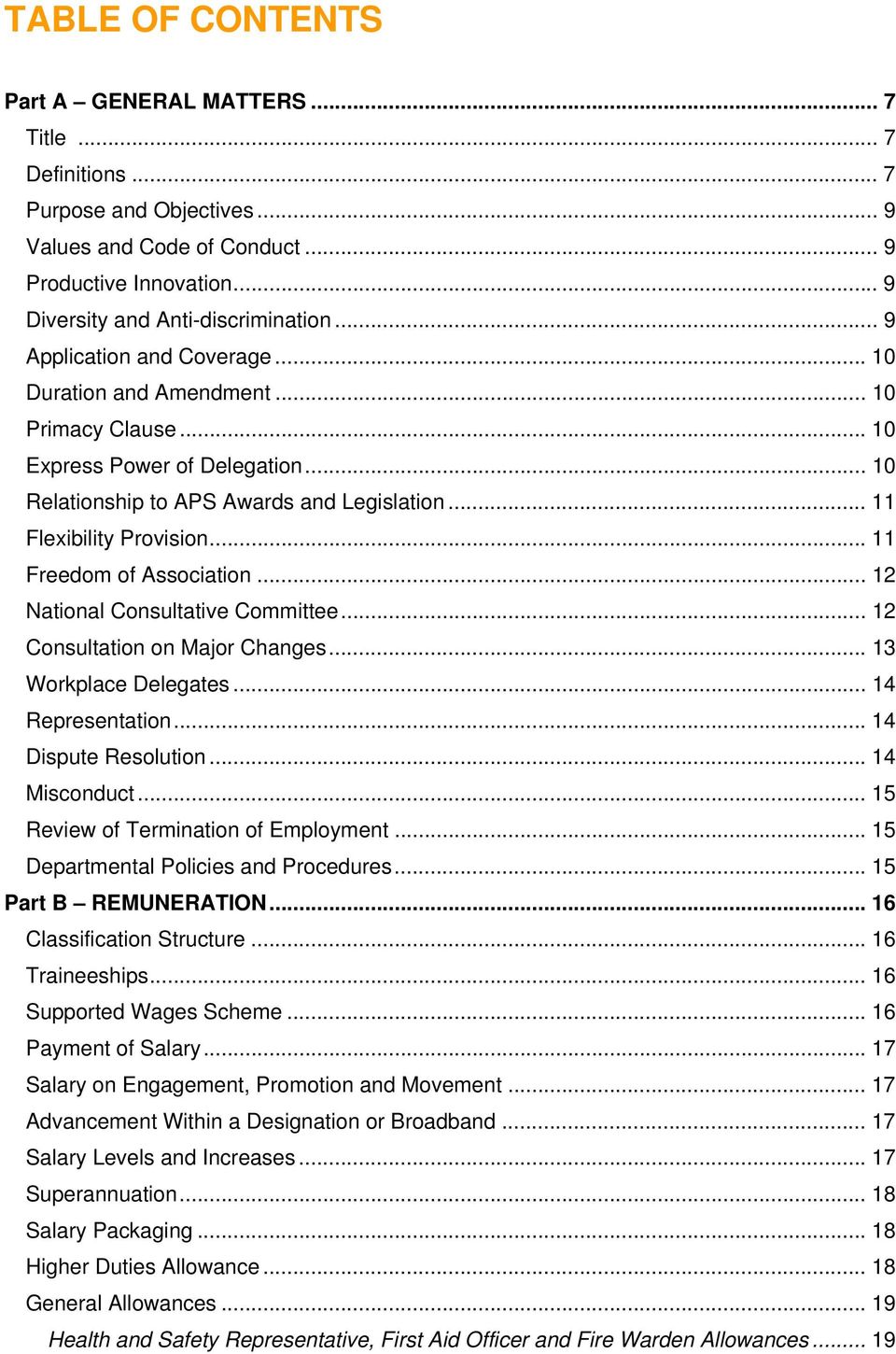
2 TABLE OF CONTENTS Part A GENERAL MATTERS... 7 Title... 7 Definitions... 7 Purpose and Objectives... 9 Values and Code of Conduct... 9 Productive Innovation... 9 Diversity and Anti-discrimination... 9 Application and Coverage Duration and Amendment Primacy Clause Express Power of Delegation Relationship to APS Awards and Legislation Flexibility Provision Freedom of Association National Consultative Committee Consultation on Major Changes Workplace Delegates Representation Dispute Resolution Misconduct Review of Termination of Employment Departmental Policies and Procedures Part B REMUNERATION Classification Structure Traineeships Supported Wages Scheme Payment of Salary Salary on Engagement, Promotion and Movement Advancement Within a Designation or Broadband Salary Levels and Increases Superannuation Salary Packaging Higher Duties Allowance General Allowances Health and Safety Representative, First Aid Officer and Fire Warden Allowances... 19
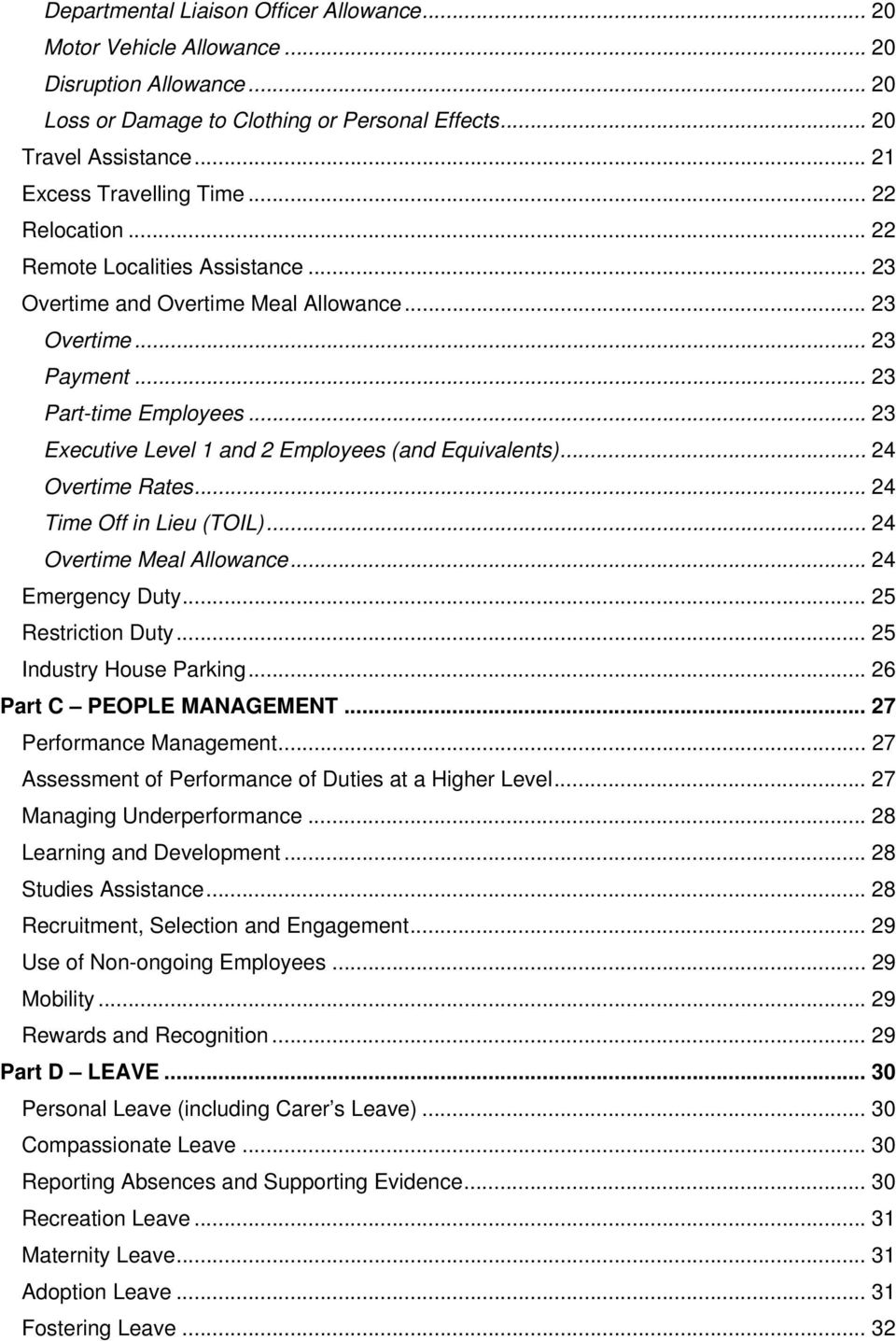
3 Departmental Liaison Officer Allowance Motor Vehicle Allowance Disruption Allowance Loss or Damage to Clothing or Personal Effects Travel Assistance Excess Travelling Time Relocation Remote Localities Assistance Overtime and Overtime Meal Allowance Overtime Payment Part-time Employees Executive Level 1 and 2 Employees (and Equivalents) Overtime Rates Time Off in Lieu (TOIL) Overtime Meal Allowance Emergency Duty Restriction Duty Industry House Parking Part C PEOPLE MANAGEMENT Performance Management Assessment of Performance of Duties at a Higher Level Managing Underperformance Learning and Development Studies Assistance Recruitment, Selection and Engagement Use of Non-ongoing Employees Mobility Rewards and Recognition Part D LEAVE Personal Leave (including Carer s Leave) Compassionate Leave Reporting Absences and Supporting Evidence Recreation Leave Maternity Leave Adoption Leave Fostering Leave... 32
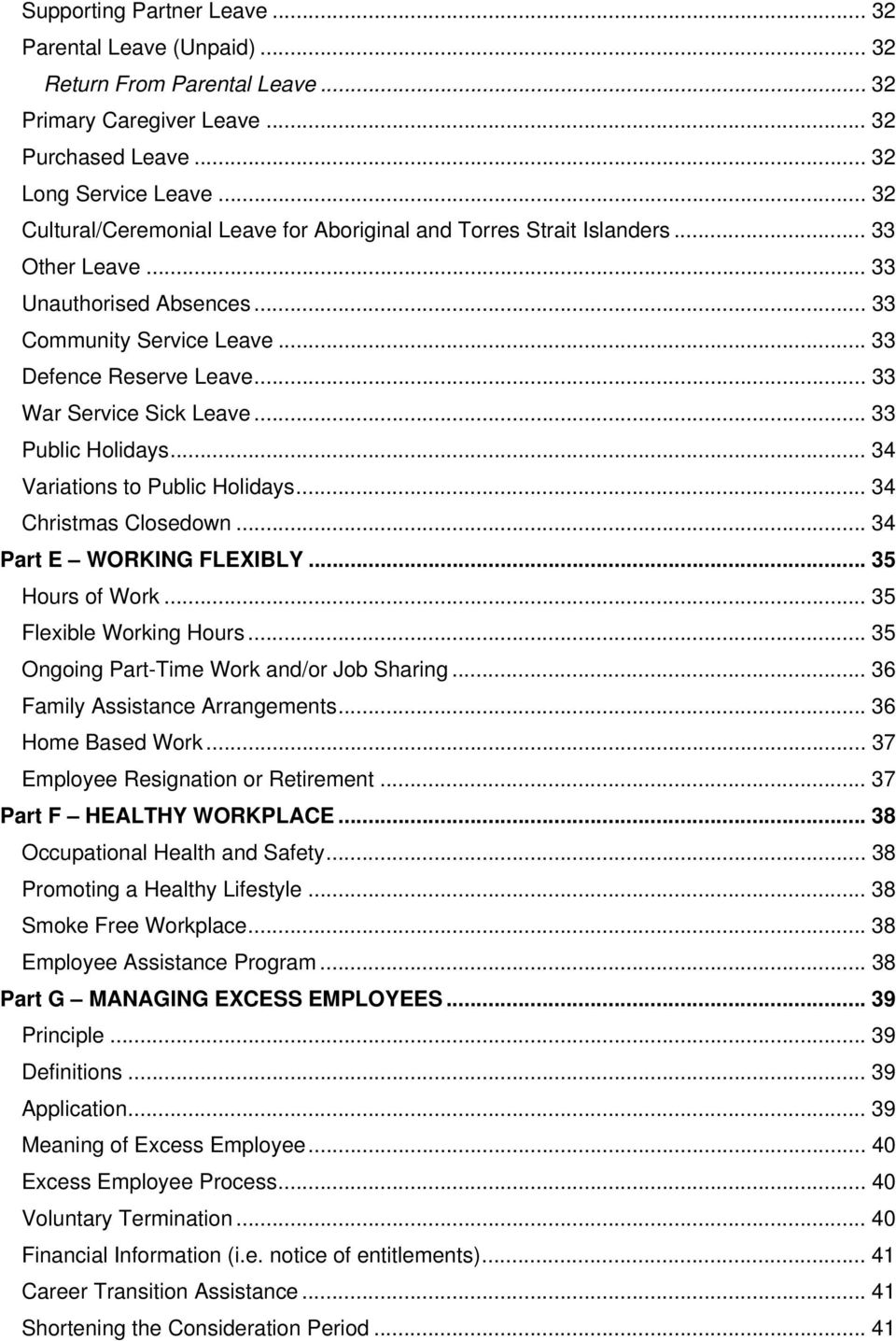
4 Supporting Partner Leave Parental Leave (Unpaid) Return From Parental Leave Primary Caregiver Leave Purchased Leave Long Service Leave Cultural/Ceremonial Leave for Aboriginal and Torres Strait Islanders Other Leave Unauthorised Absences Community Service Leave Defence Reserve Leave War Service Sick Leave Public Holidays Variations to Public Holidays Christmas Closedown Part E WORKING FLEXIBLY Hours of Work Flexible Working Hours Ongoing Part-Time Work and/or Job Sharing Family Assistance Arrangements Home Based Work Employee Resignation or Retirement Part F HEALTHY WORKPLACE Occupational Health and Safety Promoting a Healthy Lifestyle Smoke Free Workplace Employee Assistance Program Part G MANAGING EXCESS EMPLOYEES Principle Definitions Application Meaning of Excess Employee Excess Employee Process Voluntary Termination Financial Information (i.e. notice of entitlements) Career Transition Assistance Shortening the Consideration Period... 41
5 Severance Pay Service for Severance Pay Purposes Service Not to Count for Severance Pay Purposes Redeployment Redeployment Period Redeployment Services Leave and Expenses to Seek Employment Leave during Redeployment Period Moving Household Involuntary Termination after Unsuccessful Reassignment Notice of Termination (i.e. notice periods) Reduction in Classification Reviews Agreement Not to Prevent Other Action SIGNATURES SCHEDULE 1 APS CLASSIFICATIONS, INNOVATION DESIGNATIONS AND SALARY RATES S1.1 APS Classifications, Innovation Designations and Salary Rates S1.2 Innovation Legal Designations S1.3 Legal Designation: Eligibility and Selection Requirements S1.4 Salary Determination and Advancement Provisions SCHEDULE 2 MATTERS RELATING TO NMI EMPLOYEES S2.1 APS Classifications, NMI Designations and Salary Rates S2.2 Accelerated Pay Point Advancement S2.3 Advancement Through Merit Applying for Merit Advancement The Merit Advancement Committee Consideration by the Merit Advancement Committee Approval and Outcomes of Merit Advancement Review of decisions S2.4 Special Regional Conditions SCHEDULE 3 MATTERS RELATING TO QUESTACON EMPLOYEES S3.1 APS Classifications, Questacon Designations and Salary Rates S3.2 Questacon Working Hour Loading Rates S3.3 Movement Through A Firm Barrier S3.4 Salary Advancement from Junior to Adult Rates of Pay S3.5 Questacon Apprentice Transition Bonus S3.6 Cadets Books and Equipment Allowance... 58

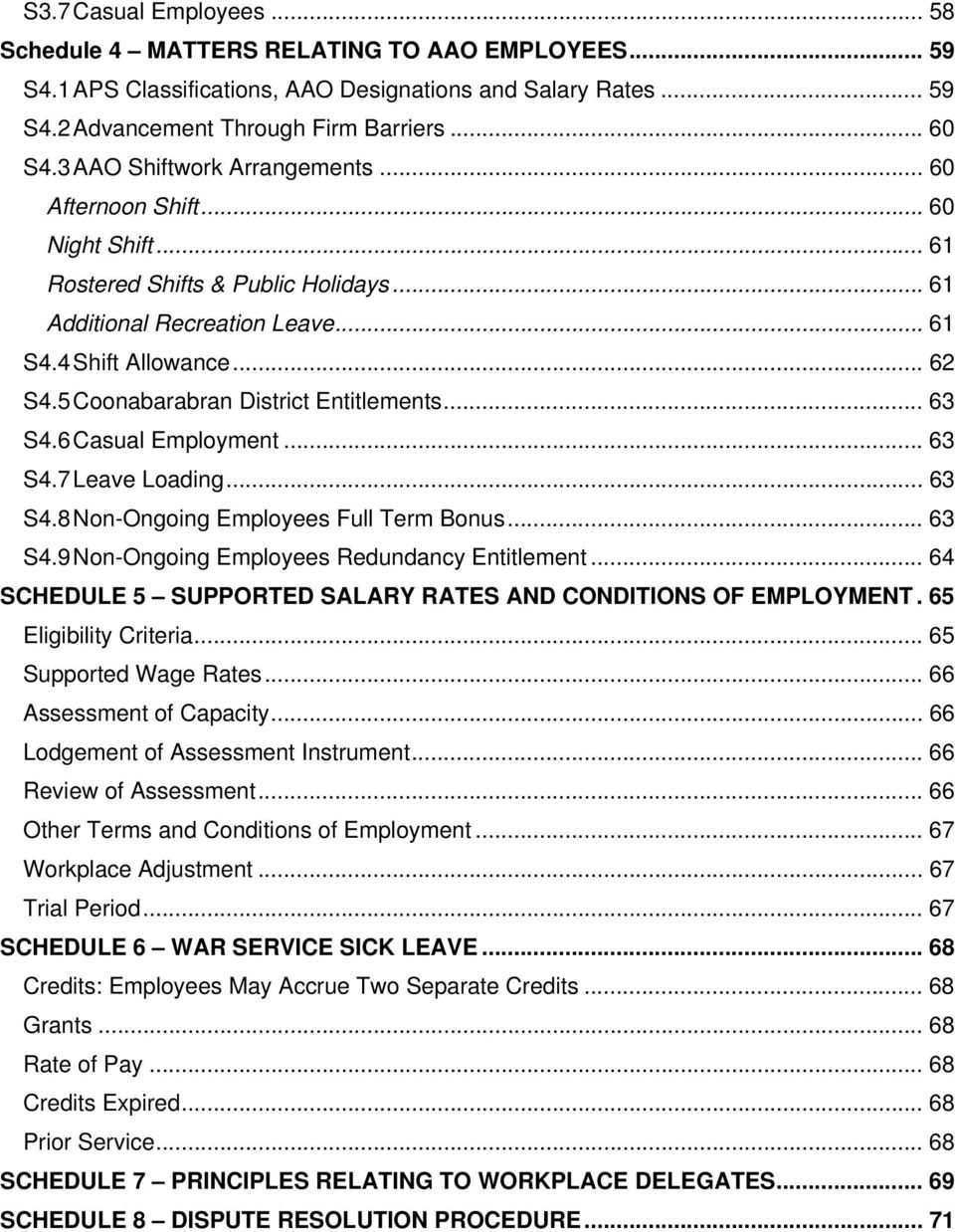
6 S3.7 Casual Employees Schedule 4 MATTERS RELATING TO AAO EMPLOYEES S4.1 APS Classifications, AAO Designations and Salary Rates S4.2 Advancement Through Firm Barriers S4.3 AAO Shiftwork Arrangements Afternoon Shift Night Shift Rostered Shifts & Public Holidays Additional Recreation Leave S4.4 Shift Allowance S4.5 Coonabarabran District Entitlements S4.6 Casual Employment S4.7 Leave Loading S4.8 Non-Ongoing Employees Full Term Bonus S4.9 Non-Ongoing Employees Redundancy Entitlement SCHEDULE 5 SUPPORTED SALARY RATES AND CONDITIONS OF EMPLOYMENT. 65 Eligibility Criteria Supported Wage Rates Assessment of Capacity Lodgement of Assessment Instrument Review of Assessment Other Terms and Conditions of Employment Workplace Adjustment Trial Period SCHEDULE 6 WAR SERVICE SICK LEAVE Credits: Employees May Accrue Two Separate Credits Grants Rate of Pay Credits Expired Prior Service SCHEDULE 7 PRINCIPLES RELATING TO WORKPLACE DELEGATES SCHEDULE 8 DISPUTE RESOLUTION PROCEDURE... 71
7 PART A GENERAL MATTERS Title 1. This Agreement shall be known as the One Innovation Enterprise Agreement Definitions 2. In this Agreement, unless the contrary intention appears: AAO means the Australian Astronomical Observatory, a Division of the Department. Agreement means the One Innovation Enterprise Agreement APS means the Australian Public Service. Band means a grouping of designation levels. Casual Employee means a non-ongoing employee engaged by Innovation pursuant to s22(2)(c) of the Public Service Act De facto partner means a person who, although not legally married to the employee, lives with the employee in a relationship as a couple on a genuine domestic basis (whether the employee and the person are of the same sex or different sexes) and includes a former de facto partner of the employee. Delegate means a person who is authorised by the Secretary to exercise particular powers or functions. Dependent means a member of an employee s immediate family who ordinarily resides with the employee and is wholly or significantly financially dependent upon the employee. Designated Hours means non-standard working arrangements (including rostered or shift work) as determined by assigned duties/role statement and/or agreed to by the employee s manager. Department means the Department of Innovation, Industry, Science and Research. Employee means an ongoing or non-ongoing employee either full-time or part-time engaged by Innovation pursuant to s22(2) of the Public Service Act Employee Representative means a person nominated by an employee, including a union official, who may act as an advocate for the employee. Immediate Family means a person who is related by blood or marriage, adoption, fostering or traditional kinship; or a person who stands in a demonstrated genuine domestic relationship with the employee without discrimination as to sexual preference. Family includes a spouse (including a former spouse), a de facto partner, a child (including an adopted child or a step child) a parent, grandparent, grandchild or sibling of the employee or spouse or de facto partner of the employee. Innovation means the Department of Innovation, Industry, Science and Research, excluding IP Australia, a Division of the Department. Manager means an employee who has operational and/or supervisory responsibility for another employee or a team of employees. NMI means the National Measurement Institute, a Division of the Department. Non-ongoing employee means an employee engaged for a specific period, or the duration of a specified task, or duties that are irregular or intermittent, as defined by s22(2) of the Public Service Act Page 7

8 Non-SES employee means an employee with a designation listed in the Schedules to this Agreement. Ongoing employment means ongoing employment as defined by the Public Service Act Questacon means Questacon - The National Science and Technology Centre, a Division of the Department. Supporting partner means a person who stands in a demonstrated genuine domestic relationship with the employee without discrimination as to sexual preference. The Secretary means the Secretary of the Department of Innovation, Industry, Science and Research. Union means an employee organisation registered under the terms of the relevant legislation that is entitled to represent the interests of Innovation employees. Work Level Standard means the measure of the work value of duties undertaken by an Innovation employee as prescribed in the Work Level Standard for the employee s designation as varied from time to time. Workplace Delegate is a union member elected by other union members as defined and bound by the relevant union s rules. Page 8

9 Purpose and Objectives 3. The purpose of this Agreement is to advance Innovation s objectives as set out in the Innovation Strategic Plan. 4. The Parties covered by the Agreement will endeavour to provide a work environment that: is enjoyable and rewarding; facilitates a healthy work/life balance; is safe and healthy; is free from workplace harassment and bullying; has shared goals and instils a sense of belonging; provides opportunities for development; provides competitive terms and conditions; and encourages innovative work practices. Values and Code of Conduct 5. The Parties covered by the Agreement are committed to the APS Values and the APS Code of Conduct set out in the Public Service Act In addition to the APS Values, Innovation employees demonstrate the following Innovation values : Commitment to excellence; Learning from all we have done and applying it to what we will do; Equilibrium between our professional and personal lives; Achievement of our personal and our business goals; and Resilience as we embrace change. Productive Innovation 7. This Agreement provides the basis for the objectives of clauses 3 and 4 to be achieved in a number of ways. The Parties covered by the Agreement will seek to identify and implement ongoing efficiency measures in Innovation to assist achieving the strategic goals of Innovation and the objectives set out in clause 4. To better accomplish this, Innovation will, in consultation with its employees, and where they choose their representative(s), actively invite ideas from, and engage with, employees about how to achieve productive innovation leading to efficiency measures, streamlined processes, effective service delivery and productivity savings. Diversity and Anti-discrimination 8. The Parties covered by the Agreement recognise the benefits that flow from diversity in the workplace. The Parties covered by the Agreement will continue to uphold and promote a work environment that is free from discrimination on the basis of race, colour, sex, sexual preference, age, physical or mental disability, marital status, family responsibilities, pregnancy, religion, political opinion, national extraction or social Page 9

10 origin, or on the basis that an individual either is, or is not, a member of a union of employees or of a particular union of employees. Application and Coverage 9. This Agreement is made in accordance with s172 of the Fair Work Act 2009 and covers: a) the Secretary; and b) all non-ses employees of Innovation; and c) the following employee organisations, where those organisations make an application to Fair Work Australia to be covered by the Agreement and Fair Work Australia approves the application: o o o o the Association of Professional Engineers, Scientists and Managers, Australia; the Australian Manufacturing Workers Union; the Community and Public Sector Union; and the Media, Entertainment and Arts Alliance. 10. This Agreement applies in respect of the employment of non-ses employees of Innovation. Duration and Amendment 11. This Agreement commences 7 days following approval by Fair Work Australia. 12. This Agreement will have a nominal expiry date of 30 June From the commencement of this Agreement, a party to the Agreement or an employee whose employment is subject to the Agreement shall not pursue further claims for terms and conditions of employment that would have effect during the period of operation of this Agreement, except where consistent with the terms of this Agreement. Primacy Clause 14. To maintain the integrity of the agreement reached between the Parties, the Parties agree to meet and consult if an event occurs that makes a clause of this Agreement unenforceable, or undermines the operation of a clause of this Agreement, or otherwise changes the intention of the Parties to this Agreement. Express Power of Delegation 15. The Secretary may, in writing, delegate to another Innovation employee, any of his powers or functions under this Agreement. 16. An Innovation employee exercising powers or functions under a delegation under this section must comply with any directions of the person who delegated the power or function. Page 10

11 Relationship to APS Awards and Legislation 17. The Parties covered by the Agreement agree that this Agreement displaces the Australian Public Service Award 1998, as varied from time to time, and that the award does not apply to Innovation s employees from the date of commencement of this Agreement. 18. Without incorporating the terms of any legislation into this Agreement, it is acknowledged that employment in Innovation is subject to the provisions of various Acts (and regulations or instruments made under those Acts) as in force from time to time; including: Long Service Leave (Commonwealth Employees) Act 1976; Maternity Leave (Commonwealth Employees) Act 1973; Occupational Health and Safety Act 1991; Paid Parental Leave Act 2010; Privacy Act 1988; Public Service Act 1999; Public Employment (Consequential and Transitional) Amendment Act 1999; Safety, Rehabilitation and Compensation Act 1988; Superannuation Act 1976; Superannuation Act 1990; Superannuation Act 2005; Superannuation Benefits (Supervisory Mechanisms) Act 1990; Superannuation Productivity Benefit Act 1988; and Fair Work Act Flexibility Provision 19. The Secretary and an employee covered by this Agreement may agree to make an individual flexibility arrangement to vary the effect of terms of the agreement if: a) the agreement deals with one or more of the following matters: (i) arrangements about when work is performed; (ii) overtime rates; (iii) penalty rates; (iv) allowances; (v) remuneration; and/or (vi) leave; and b) the arrangement meets the genuine needs of Innovation and the employee in relation to one or more of the matters mentioned in paragraph (a); and c) the arrangement is genuinely agreed to by the Secretary and employee. 20. The Secretary must ensure that the terms of the individual flexibility arrangement: a) are about permitted matters under s172 of the Fair Work Act 2009; and b) are not unlawful terms under s194 of the Fair Work Act 2009; and Page 11
12 c) result in the employee being better off overall than the employee would be if no arrangement was made. 21. The Secretary must ensure that the individual flexibility arrangement: a) is in writing; and b) includes the name of the employer and employee; and c) is signed by the Secretary and employee and if the employee is under 18 years of age, signed by a parent or guardian of the employee; and d) includes details of: i) the terms of the Agreement that will be varied by the arrangement; and ii) how the arrangement will vary the effect of the terms; and iii) how the employee will be better off overall in relation to the terms and conditions of his or her employment as a result of the arrangement; and e) states the day on which the arrangement commences and ceases. 22. The Secretary must give the employee a copy of the individual flexibility arrangement within 14 days after it is agreed to. 23. The Secretary or employee may terminate the individual flexibility arrangement: a) by giving no more than 28 days written notice to the other party to the arrangement; or b) if the Secretary and employee agree in writing, at any time. Freedom of Association 24. The Parties covered by the Agreement recognise that employees are free to choose to join or not join a union. Irrespective of that choice employees will not be disadvantaged or discriminated against in respect of their employment under this Agreement. Employees who choose to be members of a union have the right to have their industrial interests represented by that union and to participate in lawful union activities, subject to the terms of this Agreement and relevant industrial legislation. National Consultative Committee 25. A National Consultative Committee (NCC) comprising elected employees, union representatives and not more than an equal number of management representatives will be established to be the primary forum to facilitate discussions between Innovation and its employees. The NCC will operate in accordance with the NCC Operational Guidelines. 26. The NCC will be supported by Divisional Consultative Committees (DCC) established in each Division. These committees: a) will meet regularly; b) provide nominees for NCC membership; c) can determine their own procedures, including electing spokespersons; and d) will be responsible for consultation with local management on local issues. Page 12
13 27. Heads of Division will be responsible for convening and ensuring the continued operation of a DCC. They will ensure that employees have access to facilities and resources necessary for performing the role of a DCC representative or NCC representative. 28. Necessary training and facilities to enable participation in these processes will be provided, including dedicated secretariat support for the NCC as required from time to time. Participation will be considered as a work priority and included in the relevant work unit plans. 29. Innovation will consult with the NCC about matters of a corporate nature relating to employment in Innovation, in particular: a) issues surrounding the implementation of this Agreement; b) organisational, personnel and employment policies and practices, accommodation and outsourcing; c) changes to personnel and employment policies and practices before changes are made; and d) major employment implications arising from changes to organisational structures, processes and systems. 30. For the purpose of this Agreement consult means: a) providing relevant information to employees and where they choose their representatives, about impending changes, decisions, reviews or other issues that will impact on them so that they are able to meaningfully participate in debate; and, for this to be effective, the participation must be contributing to the decision-making process not only in appearance, but in fact; b) in making decisions, taking account of the views expressed by employees and where they choose, their representatives; and c) explaining decisions that have been made, including how the views expressed by employees and where they choose, their representatives were taken into account. 31. Nothing prevents a party covered by the Agreement initiating the Dispute Resolution provisions of this Agreement where a party fails to comply with the requirements of clause All members of the NCC will be formally advised of all meetings and provided with all papers in a timely fashion and have full participation rights at these meetings. Consultation on Major Changes 33. This clause applies where a decision is made to introduce major changes in a work area that are likely to have significant effects on employees, other than where provision is made elsewhere in this Agreement regarding a specific change. 34. Where a definite decision is made to introduce major changes in program, organisation, structure, or technology that are likely to have significant effects on employees, Innovation must notify the employees who are likely to be affected by the proposed changes and their representative, if the employees appoint one. Page 13

14 35. Significant effects include: a) termination of the employment; b) major change to the composition, operation or size of Innovation s workforce or to the skills required of employees; c) the elimination or diminution of job opportunities, promotion opportunities or job tenure; d) significant alteration of hours of work; e) the need to retrain employees; f) the need to relocate employees to another workplace; and g) the major restructuring of jobs. 36. Innovation must discuss with the affected employees, and their representatives, the introduction of the changes referred to in clause 35, the effects the changes are likely to have on employees and measures to avert or mitigate the adverse effects of such changes on the employees and must give prompt consideration to matters raised by the employees and/or their representatives in relation to the changes. 37. The discussions must commence as soon as practicable after a definite decision has been made to make the changes referred to in clause For the purposes of the discussion, the employees and their representatives are to be provided in writing all relevant information about the change including the nature of the change proposed, the expected effects of the changes is likely to have on the employees and any other matters likely to affect the employees. Innovation is not required to disclose confidential or commercially sensitive information to the employees. Workplace Delegates 39. The role of workplace delegates is to be respected and facilitated in accordance with the Principles Relating to Workplace Delegates set out at Schedule 7. Representation 40. In any matter arising under this Agreement, an employee may have a representative (which may be a union representative) assist, represent or advocate on behalf of the employee where appropriate. All relevant parties will deal with such representative in good faith. Dispute Resolution 41. The Parties covered by the Agreement recognise that disputes concerning workplace matters may arise and it is the responsibility of the parties covered by the Agreement to take reasonable and genuine steps to prevent or settle disputes by early and timely discussion and consultation. 42. Disputes will be managed in accordance with the procedures outlined at Schedule Where the right of review provided by s33 of the Public Service Act 1999 is exercised, and does not fail for want of jurisdiction, the employee will have no right of review with respect to that matter under the dispute resolution procedures in this Agreement. Page 14
15 Review of Actions 44. Employees have a right of review of certain employment related actions under the Public Service Act 1999 and the Public Service Regulations The Innovation Review of Actions policy and procedures provides further information relating to review of actions, including access to independent mediation or inquiry. 45. Employees may seek advice and representation at any stage of the process. Misconduct 46. Breaches of the APS Code of Conduct will be handled in accordance with s15 of the Public Service Act The Innovation Code of Conduct policy and procedures provides further information relating to the handling of Code of Conduct matters. 47. Employees may seek advice and representation at any stage of the process. Review of Termination of Employment 48. The sole and exhaustive rights and remedies of an employee in relation to termination of employment are those that the employee has under: Part 3-2 of the Fair Work Act 2009; other Commonwealth laws (including the Constitution); and common law. 49. Termination of, or a decision to terminate employment, cannot be reviewed under the dispute resolution procedures/review of action procedures of this Agreement. 50. Nothing in this Agreement prevents the Secretary from terminating the employment of an employee for serious misconduct, without further notice or payment in lieu, in accordance with s789 (b) of the Fair Work Act 2009, subject to compliance with the procedures established by the Secretary for determining whether an employee has breached the Code of Conduct under s15 of the Public Service Act Departmental Policies and Procedures 51. This Agreement is supported by Departmental policies and procedures to provide more detailed guidance to managers and employees on the application of the provisions of this Agreement. Particular policies are identified in the relevant clause, however they are not incorporated into and do not form part of this Agreement. 52. These policies and procedures may be altered through consultation with the NCC and will apply in the form they are in as at the time of any relevant action or decision, however in the event of any inconsistency between this Agreement and a policy or procedure, the express terms of this Agreement will prevail. Page 15

16 PART B REMUNERATION Classification Structure 53. This Agreement contains Innovation s Designations, including broadbanded designations, and pay arrangements as specified in the schedules to the Agreement. Employees will be paid by reference to the Innovation Designations. Innovation Designations correspond to the APS Classification Structure as set out in the relevant Schedule. 54. The Secretary may broadband other designations during the life of the Agreement. 55. Current Work Level Standards will be maintained for the duration of this Agreement and should be referenced when determining the appropriate designation stream to be used. Traineeships 56. Innovation will continue to make available employment under APS Training Classifications, approved apprenticeships and traineeships approved under relevant Commonwealth legislation. 57. Conditions for training classifications (e.g. mandatory entry level requirements, accelerated advancement points, prescribed training programs, trainee evaluation and completion criteria for training programs or courses), will be set out in the relevant policies and procedures. 58. On successful completion of their course of study or training, employees will be advanced as follows: a) Cadet APS employees will be allocated an operational classification under s23 of the Public Service Act 1999, to the minimum salary point of an APS Level 3. Cadets who are invited onto the Graduate Program will be assigned to the Innovation APS3/APS4 Graduate Advancement broadband designation and continue to be paid at the APS Level 3. On successful completion of the program, they will be advanced under the terms of this Agreement to at least the equivalent minimum salary point of an APS Level 4 within the Innovation APS3/APS4 Graduate Advancement broadband designation and then assigned to the Innovation APS Level 4 designation. b) Graduate APS employees will be allocated an operational classification under s23 of the Public Service Act 1999, to the equivalent minimum salary point of an APS Level 3 within the Innovation APS3/APS4 Graduate Advancement broadband designation. Those employees will then be advanced under the terms of this Agreement to at least the equivalent minimum of an APS Level 4 salary point within the Innovation APS3/APS4 Graduate Advancement broadband designation and then assigned to the Innovation APS Level 4 designation. Innovation APS3/APS4 Graduate Advancement broadbanded positions will be separate from, and in addition to, other Innovation positions. Supported Wages Scheme 59. The Supported Wages Scheme will be administered in accordance with Schedule 5. Page 16
17 Payment of Salary 60. Employees will be paid fortnightly. 61. The fortnightly rate of pay will be ascertained by applying the following formula: Fortnightly pay = Annual Salary x Salary on Engagement, Promotion and Movement 62. Upon engagement, promotion or movement at level within the APS or from a Commonwealth Parliamentary Department, the salary payable will be the minimum of the pay scale applicable to the designation, except: a) when the Secretary authorises payment of salary at a higher pay point applicable to the designation, subject to any specified qualification or advancement barrier, where the experience, qualifications and skills of the employee warrant payment of salary above the minimum rate; or b) for employees on movement at level, the salary payable within the relevant designation will be equal to the salary previously received by the employee at the equivalent classification, or the next highest point if the salary previously received by the employee is not a point in the relevant designation; or c) for employees on promotion or movement at level whose previous salary for the relevant classification exceeds the maximum for that designation, the employee s salary will be maintained until absorbed by future pay increases in the salary rate for the designation; or d) where an employee agrees to be assigned duties at a lower designation level, the employee s salary will be paid at the highest point for the lower designation. Advancement Within a Designation or Broadband 63. Salary advancement is effective 1 July each year and operates in accordance with the Performance Planning Review (PPR) Framework and any provisions outlined in the schedules to this Agreement. Salary Levels and Increases 64. Provisions of this Agreement relating to salary and related matters are set out in the schedules to this Agreement. 65. Upon commencement of this Agreement and subject to an employee s performance in the 2010/2011 PPR period being at least Fully Effective, before any increase in clause 66 is applied, employees whose salary is not a point in the relevant designation will be advanced to the next highest point within the relevant designation. 66. The following increase will be applied to each designation: 3% with effect from the commencement of this Agreement; and 3% with effect from 1 July 2012; and 3% with effect from 1 July Page 17

18 Superannuation 67. Where an employee is ineligible to join the Commonwealth s Defined Benefit Schemes (CSS or PSS (defined benefit)) Innovation will maintain the rate of employer contributions at 15.4% for the life of this Agreement regardless of the employee's choice of fund. 68. Innovation may choose to limit superannuation choice on the basis of funds that allow employee and/or employer contributions to be paid by electronic funds transfer. 69. Except for members of defined benefits schemes the salary for superannuation will be the employee's ordinary time earnings within the meaning of the Superannuation Guarantee (Administration) Act 1992, excluding lump sum bonuses. 70. Where continued membership of an existing defined benefits superannuation scheme is available to an employee who accepted employment with NMI on 1 July 2010 as part of the establishment of the national trade measurement system, and the employee elects to continue their membership of that fund, Innovation will contribute the employer contribution rate determined by the relevant fund. Salary Packaging 71. All employees will have access to salary packaging provisions on a salary sacrifice basis, in accordance with Innovation guidelines. Employees will have the option of electing to take nominated benefits in lieu of their salary. The principal basis on which the benefits are accessible is that the total cost to Innovation of payment of the benefit (including any changes to Innovation s taxation liability) is to be equivalent to the total cost to Innovation of the salary sacrificed. 72. The employee s rate of salary specified in the schedules to this Agreement will be salary for all purposes. Participation in the salary packaging arrangements will not affect salary for these purposes. The employee s salary for superannuation purposes will be the greater of the salary for the employee s designation or as determined under the relevant superannuation fund s rules. Higher Duties Allowance 73. Opportunities for work at higher levels will continue to be made available, where appropriate, in order to: a) enable Innovation to manage short-term absences and temporary requirements; and b) enable employees to develop or enhance skills and demonstrate higher level competencies. 74. An employee may be assigned to temporarily perform duties: a) at a higher designation level; or b) where the vacant position has higher work level standards within a broadbanded designation, and the position needs to be filled by a subordinate employee within the same broadband. 75. An employee who is assigned to perform all the duties of a higher designation (or work level standard) will be paid at the minimum salary point for the higher designation (or work level standard) unless the Secretary determines otherwise. Page 18

19 76. Where an employee is assigned to temporarily perform part of the duties of a higher designation, the Secretary may determine the amount of higher duties allowance payable. 77. Where the period of work is expected to be a continuous period of 4 weeks or more (whether or not that expectation is realised), higher duties allowance will be payable for the entire period worked at the higher level, from commencement of the period. 78. Where the period of work is not expected to be for 4 weeks or more, but for whatever reason does extend to 4 weeks or more, higher duties allowance will be payable for the entire period worked at the higher level, backdated to commencement of the period. 79. Where consecutive periods worked at a higher level in different positions, in aggregate, are equal to 4 weeks, or are expected to equal 4 weeks or more, then higher duties allowance is payable for each period as above. 80. Payment of higher duties allowance for periods of less than 4 weeks occurs where: a) an employee is within the Questacon 1 designation higher duties allowance is payable in respect of any period during which the employee is assigned to perform the duties of a higher designation; or b) a Questacon casual employee is rostered to perform duties at a higher designation for 3 or more shifts within a 4 week period higher duties allowance is payable in respect of all shifts within that 4 week period in which the employee performs duties at the higher designation; or c) an employee temporarily performs the duties of the AAO Operations Manager the Secretary may approve payment of higher duties allowance after a continuous period of more than 2 weeks. 81. Any higher duties that will be performed for a period of 12 months or more will be subject to a merit selection process in accordance with the Innovation Recruitment, Selection and Engagement Policy and Procedures. General Allowances 82. Provisions relating to allowances and similar conditions are set out in this Agreement and in the supporting policies and procedures referred to in this Agreement. Unless specified otherwise, the allowances referred to in this section will be administered in accordance with the Innovation General Allowance Policy and Procedures. Allowances and conditions for employees undertaking duties overseas are contained in the Overseas Conditions Policy and Procedures. 83. The allowance rates contained in this Agreement are the minimum allowances payable. The Secretary may review and increase the rates of allowances payable having regard to the relevance and adequacy of rates. Revised rates, if any, will be made available to employees. Health and Safety Representative, First Aid Officer and Fire Warden Allowances 84. Where an employee, excluding a Questacon employee, is appointed as a Health and Safety Representative or Fire Warden, and the employee continues to demonstrate skills, knowledge and commitment to their role, a fortnightly allowance of $22 will be paid. Page 19
20 85. Where an employee, excluding a Questacon employee, is appointed as a First Aid Officer, and the employee continues to demonstrate skills, knowledge and commitment to their role, a First Aid Officer allowance will be paid in accordance with the required qualification. Payment of an allowance under b) and c) is subject to the Secretary determining there is an identified need for a higher first aid qualification in the workplace: a) Required qualification: Senior First Aid Certificate of the Australian Red Cross Society, Standard A (or equivalent) $22 per fortnight; or b) Required qualification: Senior First Aid Certificate of the Australian Red Cross Society, Standard B (or equivalent) $25 per fortnight; or c) Required qualification: Senior First Aid Certificate of the Australian Red Cross Society, Standard C (or equivalent) $30 per fortnight. 86. Where an employee undertakes more than one of these roles they will not be entitled to payment of more than one allowance. 87. Employees being paid multiple allowances at the commencement of this Agreement will continue to receive those allowances while they continue to perform those roles. Departmental Liaison Officer Allowance 88. An employee who performs the duties of Departmental Liaison Officer is entitled to be paid an allowance of 20% of the employee s salary. Motor Vehicle Allowance 89. The Secretary may authorise an employee to use a private motor vehicle owned or hired by that employee for official purposes where it will result in greater efficiency, or involve the Commonwealth in less expense. In those circumstances the employee will be paid an allowance of 75 cents per kilometre. The allowance payable will be reviewed each 1 July in accordance with the Australian Taxation Office recommended rates. Disruption Allowance 90. The Secretary may compensate affected employees where an employee s working conditions are affected by: a) environmental factors including dust, noise, fumes, heat vibrations, cold, wet, dirt, loss of amenities, general inconvenience; and b) building activities that may cause disabilities at an office location. 91. Where employees are temporarily relocated, the Excess Travelling Time provisions in clause 97 will apply for the duration of the temporary relocation. Loss or Damage to Clothing or Personal Effects 92. The Secretary may authorise reimbursement of an amount considered reasonable to cover the loss or damage to an employee s clothing or personal effects which resulted from the performance of their duties subject to a minimum value of $20. Page 20
21 Travel Assistance 93. Innovation will provide employees with travel assistance to cover all reasonable expenses incurred while undertaking business travel. Travel Assistance, both within Australia and overseas, will be administered in accordance with the Domestic Travel Arrangements for Non-SES Employees, the Chief Executive Instructions and Procedural Rules. 94. Key elements of Innovation s Travel Assistance include: a) meeting reasonable expenses associated with business related travel including incidentals, meals and accommodation; b) accommodation which is assessed as 3 or 4 star and is within the close proximity of the business location, will be deemed to be a reasonable expense; c) where an employee will be absent overnight on official business, an employee s manager may approve $55 per night for reasonable expenses incurred while staying privately, provided approval is obtained prior to travel and no accommodation is charged to the travel card for that night s absence; d) reimbursement of expenditure that cannot be reasonably purchased with the travel card during periods of multi day travel (ie not available for Single Day Travel) up to $20 for each day will be automatically considered reasonable, however employees will be required to provide evidence of all expenditure to their manager s satisfaction; e) an employee who is undertaking business travel may apply for reimbursement of Business Related Expenses if they incur unavoidable, additional expenses outside the Travel Assistance provided. These expenses must be incurred at the traveller's home base and, other than in exceptional circumstances, must be approved prior to the travel being undertaken; f) after an employee has resided in the one locality for a period of 21 days, the employee will be entitled to the amount expended on accommodation, meals and incidentals, or an amount which the Secretary considers to be reasonable in the circumstances; g) unless agreed otherwise, business class travel will be the normal class of travel used for official overseas travel; and h) Single Day Travel where an employee is travelling on official business for more than 10 hours which does not involve being absent overnight, the employee s Travel Assistance is restricted to a non-acquitable taxable amount of $60 only, paid through the payroll system. 95. The Secretary may approve payment of a cash advance to meet reasonable accommodation, meal and incidental expenses in exceptional circumstances. This may include travel to remote localities or areas that do not accept the travel card. An employee must have made reasonable efforts to locate acceptable accommodation. The employee will be required to acquit the advance on return from travel. 96. Where an employee travelling for business purposes takes personal leave for a condition for which the employee is not at fault, and is unable to return home, the employee is entitled to continue to receive Travel Assistance. Page 21
22 Excess Travelling Time 97. Excluding where travel is a part of an employee s normal duties, an employee up to and including APS Level 4 (and equivalent designations), who is travelling or on duty away from the employee s usual place of work, including for the purposes of clause 91, will be compensated for time necessarily spent in travel or on duty (exclusive of overtime duty) in excess of their usual hours of duty for the day. The employee will also be compensated for the time necessarily elapsing between time of departure from home and commencement of duty at the employee s usual place of work, and the time necessarily elapsing between time of ceasing duty at the employee s usual place of work and arrival at home. 98. The rate of payment or time in lieu will be single time on Monday to Saturdays and time and a half on Sundays and Public Holidays. Time in lieu arrangements are to be agreed with the employee s manager prior to undertaking travel. Relocation 99. Relocation Assistance will be administered in accordance with these clauses in conjunction with the Innovation Relocation Policy and Procedures For the purposes of determining Relocation Assistance the following principles apply: a) Innovation Initiated Relocations (i) (ii) Permanent Where an employee is permanently relocated, Innovation will meet all reasonable costs associated with the relocation. In addition, employees will be entitled to a non-acquitable taxable one-off lump sum payment of $500 for employees without dependants or $1000 for employees with dependants to cover miscellaneous expenditure associated with the relocation. Temporary Where costs have been met for temporary relocation they will also be met for return to the original location. The entitlement of employees moved temporarily will depend on the length of the movement. As a guide, the following should be a minimum entitlement: Up to 12 months Employees in this category should receive payment for all reasonable expenses. 12 months or more Employees in this category should be considered as if it were an ongoing assignment of duties. b) Employee Initiated Relocations Relocation Assistance will be agreed between the employee, manager and a Corporate Division representative at the time of assignment of duties. c) Relocation on Move From Another APS Agency to Innovation Where an employee is relocated to Innovation from another APS agency as a result of a merit recruitment process, Innovation will meet all reasonable costs associated with the relocation. Relocation Page 22
23 Assistance will be agreed between the employee, manager and a Corporate Division representative at the time of move. d) Relocation on Engagement to the APS Relocation Assistance will be agreed between the employee, manager and a Corporate Division representative at the time of offer. e) Job Swaps Job swaps under clause 236 of this Agreement will be deemed permanent Innovation initiated relocations. Remote Localities Assistance 101. Where an employee is engaged or relocated to a remote or isolated locality, the assistance provided will be determined on a case by case basis as per the Innovation Relocation Policy and Procedures Employees who had an entitlement to Remote Localities Assistance at the commencement of the Innovation Enterprise Agreement will continue to receive that entitlement while they remain in those localities. Overtime and Overtime Meal Allowance Overtime 103. An employee may be required to work reasonable overtime subject to the conditions below. Overtime is to be worked at the prior direction of the manager, or if the circumstances do not permit prior direction, subsequent approval in writing by the manager. Payment 104. APS Level 1 6 employees and equivalents are entitled to overtime payment as follows: excluding meal breaks. Monday to Friday overtime payment will be for hours worked outside the bandwidth or inside the bandwidth, where the employee has worked in excess of their standard ordinary hours on that day, or Saturday, Sunday and Public Holidays overtime payment will be for all hours worked, with the exception of Questacon employees who are rostered to work on those day, 105. Any time claimed for flex time purposes cannot be claimed as overtime. Part-time Employees 106. APS Level 1 6 part-time employees who are directed to work outside their agreed daily hours for any particular day are entitled to overtime payments. However, if a regular pattern of overtime develops, the manager should discuss with the part-time employee the suitability of their hours of work. Page 23
24 Executive Level 1 and 2 Employees (and Equivalents) 107. Executive Level 1 and 2 employees are not eligible for overtime payments except in exceptional circumstances as determined by the Secretary. Overtime Rates 108. The rates payable for overtime are as follows: Monday to Saturday: Time and a half for the first three hours each day and double time thereafter. Sunday: Double time. Public holidays and Easter Saturday where it is not declared or prescribed as a Public Holiday: Double time and a half, calculated as follows: o Duty during standard hours (refer clause 194) will be paid at time and a half in addition to normal salary payment for the day. Duty outside standard hours will be paid at double time and a half When overtime is not continuous with ordinary duty the minimum payment will be 4 hours Where overtime is not continuous with ordinary duty and involves duty both before and after midnight the minimum payment provisions will be satisfied when the total payment equals or exceeds the minimum payment for one day (i.e. 4 hours overtime) Where a higher overtime rate applies to one of the days, payment for the whole period will be calculated at the higher rate The rate of overtime includes any allowances being paid as salary Where more than one attendance is involved in a day only one minimum overtime payment will be payable Where an employee works overtime they will be entitled to an eight hour break (plus reasonable travelling time) before recommencing work without incurring any loss of pay Where the employee works on a Saturday, Sunday or public holiday in the 24 hours preceding the employee s ordinary commencing time on the employee s next ordinary day they will be entitled to an eight hour break (plus reasonable travelling time) before recommencing work without incurring any loss of pay Where the break detailed in clauses 114 and 115 is not possible, due to operational reasons, the employee (excluding Executive Level 1 and 2 and equivalents unless approved by the Secretary) will be paid double time for the next period of work until the employee has had an eight hour break (plus reasonable travelling time). Time Off in Lieu (TOIL) 117. Employees may, with the agreement of their manager take time off in lieu of payment for overtime. TOIL will be at the same rate as the applicable overtime rate. Overtime Meal Allowance 118. Where an employee works overtime to the end of or beyond a meal allowance period, they will receive a meal allowance of $25. Page 24
25 119. Meal allowance periods are: Emergency Duty 7.00 am to 9.00 am; 12 noon to 2.00 pm; 6.00 pm to 7.00 pm; and Midnight to 1.00 am Where an employee is recalled to duty to meet an emergency and no notice of such a call was given to the employee before ceasing ordinary duty, they will be paid at the overtime rate for the period of the emergency duty, subject to: a one hour minimum payment when work is performed without the necessity to travel to the workplace; or a two hour minimum payment including travel time if work is required to be performed at the workplace Where an employee performs emergency duty for more than three hours (excluding travelling time) the employee will be entitled to an eight hour break before recommencing work without incurring any loss of pay Where this break is not possible, due to operational reasons, the employee (excluding Executive Level 1 and 2 and equivalents unless approved by the Secretary) will be paid double time for the next period of work until the employee has had an eight hour break (excluding travelling time) The provisions relating to Emergency Duty will not apply where an employee is recalled to duty while subject to the Restriction Duty provisions. Restriction Duty 124. Where the Secretary requires an employee to remain contactable and available to perform extra duty outside the employee s standard hours of duty the employee will be paid a restriction allowance while they are restricted outside the standard hours of duty Restriction Allowance is payable whether or not the restricted employee is required to perform duty outside their standard hours of duty; is only paid up to the maximum of the salary rate of the APS Level 6 classification; salary includes any allowances paid as salary; will be paid at the rate of 10%; is not paid during any periods of overtime or emergency duty; and will not be paid if the employee is not contactable An alternative rate of Restriction Allowance may be determined by the Secretary having regard to the circumstances of the restriction situation. Page 25
26 127. Where a restricted employee is required to perform duty, they will be paid overtime subject to: a one hour minimum payment when work is performed without the necessity to travel to the workplace; or a two hour minimum payment including travel time if work is required to be performed at the workplace. Industry House Parking 128. Car parking arrangements for Executive Level 2 employees and equivalent in Industry House will continue for the life of this Agreement. These arrangements will be administered in accordance with the Parking Arrangements Guidelines. Page 26
27 PART C PEOPLE MANAGEMENT Performance Management 129. The purpose of the Innovation Performance Planning and Review (PPR) Framework is to foster a performance culture in Innovation by: a) linking organisational efforts to corporate outcomes; b) identifying, measuring and improving performance against corporate goals; c) ensuring employees have a shared understanding of what needs to be achieved; d) providing a mechanism to facilitate communication and feedback on performance; e) identifying and meeting development and career planning needs of employees; and f) recognising achievement in order to reward and retain employees There will be continuous review and improvement of the Framework The Innovation PPR Principles of the Framework have been developed to provide a base for the consistent application and interpretation of performance management across Innovation All employees are required to participate in the PPR process, however employees who commence with Innovation in the last three months of the PPR cycle will not receive a performance rating in respect of that PPR period, but will still be eligible to receive any general salary increase due on the following 1 July The link to salary advancement will operate in the following way; Superior or Fully Effective General salary increases awarded and a one salary point advancement to occur, but not beyond the top of the classification or broadband; Unsatisfactory No salary point advancement and general salary increase not paid until after performance returns to Fully Effective An employee s performance can be assessed as Unsatisfactory at any time during the PPR cycle provided they receive adequate warning Any aspect of the application of the PPR may be reviewed under the Review of Actions provisions Provisions for salary advancement between broadbanded designations are contained in the relevant schedules to this Agreement. Assessment of Performance of Duties at a Higher Level 137. The performance of employees who have been performing duties at a higher level for 4 weeks or more during the assessment period, will be assessed in relation to that level as well as in relation to their substantive level. The assessment at the higher level may be used to determine salary placement during further periods of performance at that level, in accordance with the provisions of clause 75, of this Agreement. Page 27
28 Managing Underperformance 138. Managers should provide regular feedback to staff and instances of underperformance should be identified and addressed at the earliest possible time Underperformance will be managed in accordance with the Innovation Managing Underperformance Policy and Procedures and against agreed criteria. These procedures are not to be used to address misconduct Innovation s policy and procedures relating to the Code of Conduct are to be used in those cases. Probationary employees are also excluded from these procedures Where individual employees are assessed as performing at the unsatisfactory level and have been unable to demonstrate improved performance within a reasonable time, their performance will be formally reviewed. Innovation will give those employees the opportunity and appropriate assistance to improve their performance. Where employees are unable to demonstrate improved performance within a reasonable period of formal review, Innovation will retain the option of moving those employees to more suitable employment either at level or at lower levels or to terminate their employment The underlying principles in this review will be: a) the acceptance of procedural fairness; b) identification of inefficiency through the performance management process including through feedback sessions between annual appraisals; c) normal counselling and assistance to identify and improve efficiency prior to the assessment in subclause (d); d) an assessment period of not less than 1 month and not longer than 2 months, after identification of underperformance under subclause (b), prior to the imposition of any recommended actions (this assessment may be undertaken by an independent person where the employee so wishes and the Secretary or delegate so directs); and e) employees will not be disadvantaged because of factors that are beyond their control. Learning and Development 142. Innovation is committed to the principle of lifelong learning and recognises the importance of supporting the development of our employees to achieve their personal goals as well as the Department s vision. Individuals are encouraged to take responsibility for their ongoing development in consultation with their manager, who will provide guidance and reasonable support From time to time the Secretary may identify specific learning and development programs, designed to build essential capabilities. Studies Assistance 144. Through its Learning and Development Strategy, Innovation will continue its current commitment to the development of its employees by maintaining and improving a range of programs and initiatives, including reimbursement of expenses of up to $1200 per annum to undertake University or TAFE/CIT studies and paid leave to attend mandatory course related activities that are scheduled during business hours up to 8 hours per week, excluding leave to attend exams. Page 28
29 Recruitment, Selection and Engagement 145. Employees, including prospective employees, will be selected to undertake duties in accordance with the Innovation Recruitment, Selection and Engagement Policy and Procedures. Use of Non-ongoing Employees 146. The usual basis of employment in Innovation will be as ongoing employees. Innovation will employ non-ongoing employees in accordance with the Innovation Recruitment, Selection and Engagement Policy and Procedures When considering temporarily filling a short term vacancy consideration will be given to ongoing employees who express an interest in performing the duties. Mobility 148. Innovation is committed to supporting and encouraging career development and mobility in a way that: a) provides staff with opportunities to broaden their skills and experience and achieve their goals and potential; and b) benefits the organisation by developing and deploying capability that is aligned with current and future organisational priorities. Rewards and Recognition 149. Innovation encourages rewards and recognition that can be applied throughout the Department, including departmental wide measures and a framework for Divisions to take further initiatives. These arrangements provide the flexibility to deliver rewards and recognition at appropriate times. Page 29
30 PART D LEAVE 150. Unless specified otherwise, all forms of leave referred to in this section will be administered in accordance with the Innovation Leave Policy and Procedures. Personal Leave (including Carer s Leave) 151. Employees will accrue on a daily basis 18 days paid cumulative Personal Leave every 12 months for the purposes of absence due to personal illness and caring responsibilities Part-time employees will accrue Personal Leave on a pro rata basis Where an ongoing employee joins Innovation from an employer staffed under the Public Service Act 1999, the Parliamentary Service Act 1999 or from the ACT Government Service, accrued Personal Leave (however described) will be transferred, provided there is continuity of service Employees will not be entitled to take paid Personal Leave while also entitled to paid leave under the Maternity Leave (Commonwealth Employees) Act Where an employee does not have an entitlement to paid Carer s Leave, they will be entitled to 2 days unpaid leave on each occasion when a member of the employee s immediate family or household, requires care or support because of: a) a personal illness, or personal injury affecting the member; or b) an unexpected emergency affecting the member The Secretary may approve an employee taking Personal Leave at half pay in exceptional circumstances. Compassionate Leave 157. Employees (excluding casual employees) are entitled to 2 days paid Compassionate Leave on each occasion where a member of the employee's immediate family or household: a) contracts or develops a personal illness that poses a serious threat to his or her life; or b) sustains a personal injury that poses a serious threat to his or her life; or c) dies Casual employees are entitled to 2 days unpaid Compassionate Leave on each occasion described in clause Use of Compassionate Leave does not preclude the use of Personal Leave to extend the period of absence. Reporting Absences and Supporting Evidence 160. An employee unable to attend for duty must ensure their manager is advised as soon as reasonably practicable. Failure to do so may result in the absence being treated as an unauthorised absence The requirement to provide supporting evidence for applications of Personal/Carer s or Compassionate Leave will be at the discretion of the employee s manager usually Page 30
31 where the absence exceeds three consecutive days or 10 days in total in a 12 month period and in accordance with the Leave Policy. Recreation Leave 162. Employees will accrue on a daily basis 20 days paid recreation leave every 12 months Part-time employees will receive a pro rata credit based on the number of days/hours worked Employees with more than 40 days accrued recreation leave at 30 September may be directed to take up to 25% of their accrued leave. The allowable amount of accrued recreation leave at 30 September each year will be increased by any annual entitlement to additional Recreation Leave under this Agreement Recreation leave credits may be taken at any time, subject to operational requirements and the approval of the employee s manager Employees may also access recreation leave where their personal leave credits have been exhausted Employees may elect to take Recreation Leave at half pay Employees may, with the written agreement of their manager, cash out accrued recreation leave provided they retain a minimum balance of 20 days and subject to their having taken a period of leave (Recreation or Long Service Leave) in the same year equal to the amount of leave being cashed out Where an ongoing employee joins Innovation from an employer staffed under the Public Service Act 1999, the Parliamentary Service Act 1999 or from the ACT Government Service, accrued recreation leave will be transferred, provided there is continuity of service. Maternity Leave 170. Eligible Innovation employees are entitled to maternity leave in accordance with the Maternity Leave (Commonwealth Employees) Act In addition to any paid maternity leave entitlement, employees will also be entitled to 2 weeks additional paid leave. Employees must elect to have their salary payments at either full pay or half pay, which may only be varied in exceptional circumstances. Where an employee elects to take paid Maternity Leave at half pay, a maximum of 14 weeks will count as service for all purposes. Adoption Leave 171. An employee, who is the primary carer, will be entitled to paid Adoption Leave of 14 weeks at full pay or 28 weeks at half pay for the purposes of adopting a child. Adoption Leave may be taken in one block or as separate absences over a period of time at the discretion of an employee s manager. The adoptive child must not be a child or step-child of the employee or the employee s partner unless that child had not been in the custody and care of the employee or the employee s partner for a significant period. An employee with less than 12 months continuous service in the APS is eligible for Adoption Leave, but only two weeks will be paid leave. Where an employee elects to take paid Adoption Leave at half pay, a maximum of 14 weeks will count as service for all purposes. Page 31
32 Fostering Leave 172. An employee, who is appointed as a legal foster carer, will be entitled to paid Fostering Leave of 14 weeks at full pay or 28 weeks at half pay for the purposes of fostering a child. Fostering Leave may be taken in one block or as separate absences over a period of time at the discretion of an employee s manager. The fostered child must not be a child or step-child of the employee or the employee s partner unless that child had not been in the custody and care of the employee or the employee s partner for a significant period. An employee with less than 12 months continuous service in the APS is eligible for Fostering Leave, but only two weeks will be paid leave. Where an employee elects to take paid Fostering Leave at half pay, a maximum of 14 weeks will count as service for all purposes. Supporting Partner Leave 173. Employees will be entitled to two weeks paid Supporting Partner Leave within one month of the birth of their partner's child or upon the adoption or fostering of a child. Employees accessing maternity leave, adoption leave or fostering leave are not eligible for paid Supporting Partner leave. Parental Leave (Unpaid) 174. From the commencement of this agreement, employees will be entitled to unpaid parental leave in accordance with the Fair Work Act Return From Parental Leave 175. Employees returning from a period of parental leave will return to their pre-parental leave position, or where that position no longer exists, a position for which the employee is qualified and suited nearest in status and pay to the pre-parental leave position. Primary Caregiver Leave 176. Where employees produce evidence that they are the primary caregiver, they will be entitled to two weeks paid primary caregiver leave up until the child s sixth birthday. Such leave is in addition to Supporting Partner Leave. Primary caregiver leave can be taken in conjunction with a period of paid parental leave. Employees accessing maternity leave, adoption leave or fostering leave are not eligible for paid primary caregiver leave. Purchased Leave 177. Employees will have access to the purchased leave scheme which provides for access to up to ten weeks additional leave in any period up to a year, by paying for the leave progressively over the course of the relevant period. Long Service Leave 178. Eligible employees may access Long Service Leave for a minimum period of seven calendar days. Employees should note that the method of calculating long service leave provided for in the Long Service Leave Act 1976 uses calendar months for both accruing and debiting periods of Long Service Leave. Page 32
33 Cultural/Ceremonial Leave for Aboriginal and Torres Strait Islanders 179. Aboriginal and Torres Strait Islander employees will be granted 5 days paid leave per annum to participate in ceremonial activities and meet cultural obligations, including NAIDOC activities. Other Leave 180. The Secretary may approve additional leave, paid or unpaid, on a case by case basis. Unauthorised Absences 181. If an employee is absent from duty without authorisation for any period for the purpose of engaging in industrial action, the period of the absence will be dealt with in accordance with the Fair Work Act If an employee, for any other purpose, is absent from duty for any period in excess of 30 minutes, the period of the absence may, at the discretion of Innovation, not count as service for any purpose. When the unauthorised absence is recognised as service, Innovation may require the employee to work outside standard hours, without the payment of overtime, for a period of time equivalent to the period of any unauthorised absence Where an employee is absent from duty without authorisation, all pay and other benefits provided under this Agreement will cease to be available until the employee resumes duty or is granted leave. Where unauthorised leave is followed by termination of employment, accrued entitlements will be paid. Community Service Leave 184. Employees will be entitled to paid leave for the purposes of engaging in community service activities, including jury service and emergency management activities, as per s108 of the Fair Work Act Leave to community service personnel for emergency services duties encompasses leave for required regular training, all emergency services responses, reasonable recovery time and ceremonial duties. Defence Reserve Leave 186. Employees engaged in Defence Force Reserve activities will be entitled to leave in accordance with the policy of the Defence Reserve Support Council as outlined in the Australian Government APS Bargaining Framework, details of which are contained in the Innovation Leave Policy and Procedures. War Service Sick Leave 187. Employees may be eligible to be granted War Service Sick Leave while unfit for duty because of a war-caused condition. This leave will be administered in accordance with Schedule 6. Page 33
34 Public Holidays 188. An employee will observe the following public holidays each year and will be paid salary as if that day were not a public holiday: a) New Year s Day (1 January) b) Australia Day (26 January); c) Good Friday; d) Easter Monday; e) Anzac Day (25 th April); f) The Queen s birthday holiday (,on the day on which it is celebrated in a State or Territory or a region of a State or Territory); g) Christmas Day (25 December); h) Boxing Day (26 December); i) any other day, or part-day, declared or prescribed by or under a law of a State or Territory to be observed within the State or Territory, or a region of the State or Territory, as a public holiday, other than a day or part-day, that is excluded by the Fair Work regulations from counting as a public holiday An employee who is rostered to work on a public holiday may, with the Secretary s prior approval, either: a) absent themselves from work on that day and be paid as if that day were not a public holiday; or b) attend work on that day and be paid salary as if that day were not a public holiday, and have an alternate day off in lieu of foregoing the public holiday. Variations to Public Holidays 190. Cultural or religious days of significance: Where the Secretary and the relevant employee agree, a cultural or religious day of significance to the employee may be substituted for any holiday prescribed under clause 188. Where an employee cannot work on a day for which a substituted holiday has been granted in accordance with this clause (cultural or religious days of significance), the affected employee will work make-up times at times to be agreed with the Secretary, without entitlement to overtime payment. Christmas Closedown 191. Employees are entitled to three days of paid leave in the period between Christmas and New Year in addition to their Recreation and Personal Leave entitlements. With the exception of Questacon and AAO employees, these three days will be treated as public holidays for the purposes of determining the rate of pay payable to an employee required to work on one or more of these days Questacon may roster employees who work Designated Hours or casual employees to work on one or more of the days referred to in clause 191, however only the day after the Boxing Day public holiday will be treated as a public holiday for the purposes of determining the rate of pay payable to an employee required to work on that day AAO employees rostered to work on one or more of the days referred to in clause 191, will be granted an amount of time off in lieu equal to the hours worked on those days. Page 34
35 PART E WORKING FLEXIBLY Hours of Work 194. Full-time employees covered by this Agreement, will have 37.5 hours per week as the standard ordinary hours of duty to be worked on Monday to Friday, between the hours of 8.30 am to pm and 1.30 pm to 5.00 pm. Part-time employees standard ordinary hours of duty are those agreed in their part-time work agreement Designated Hours employees will work an average of 37.5 hours per 7 days (Monday to Sunday) over a 4 week settlement period For health and safety reasons employees should not work more than 10 hours ordinary duty on any one day unless specifically approved by their manager to do so; nor should employees work more than five consecutive hours without at least a 30 minute break The parties covered by the Agreement recognise and emphasise the importance of balancing work life and personal life. The appropriate balance is a critical element in developing and maintaining healthy and productive teams. While it is acknowledged that peak workload periods may necessitate some extra hours being worked by some employees, this should be regarded as the exception rather than the rule. Managers will coordinate and balance workloads within their teams to ensure that this principle is practiced. Time in lieu of extra hours (including due to travel requirements) may be one strategy a manager may pursue in this regard With reference to the bandwidth and pattern of hours, it is not the intention of the Parties covered by the Agreement that employees are expected, or perceive that they are expected, to work the full bandwidth and pattern of hours on a daily basis. The intention is to offer the flexibility for managers and their employees to effectively balance work and personal priorities The NCC will investigate strategies to assist employees in balancing work life and personal priorities, in particular the management of excess hours. Flexible Working Hours 200. The bandwidth for ordinary hours of work from Monday to Friday (other than on public holidays and other days which are not working days for Innovation s employees) will be: a) For NMI employees 7.00 am to 9.00 pm; b) For Questacon Employees 7.00 am to pm; and c) For all other employees 7.00 am to 7.00 pm, 201. Flexible working hours will be administered in accordance with the Innovation Hours of Work and Flextime Policy and Procedures. Working flexible hours could include variations in attendance times and short term absences (time in lieu) without the need for a leave application Bandwidths will not apply where an employee and the employee s supervisor agree in writing, to other arrangements. However, in those cases, overtime is claimable if an employee is directed to work for more than their standard ordinary hours of duty on any day To assist employees balance their work and family/personal life responsibilities, regular workplace meetings and training courses will be scheduled to meet the needs Page 35
36 of the participants. Wherever possible meetings and training courses will not be scheduled before 9.00am and will conclude by 5.00pm All employees up to and including APS Level 6 (and equivalent designations) will have access to Flextime to allow them to plan their work hours subject to their not carrying more than: a) a Flextime debit of more than 10 hours; or b) a Flextime credit of more than 1 standard working week from one settlement period to the next The Secretary may withdraw an employee s or group of employee s access to Flextime: a) where there is insufficient work; or b) due to operational requirements; or c) where an employee does not adhere to the Flextime requirements; or d) where an employee s manager considers the employee s attendance is unsatisfactory. Ongoing Part-Time Work and/or Job Sharing 206. Employees will have access to part-time work and job share arrangements in appropriate circumstances. The specified weekly hours for part-time employees can be any number of hours less than full-time hours Regular hours included in part-time work agreements, must generally be within the bandwidth hours specified in clause 200. However, ongoing part-time employees will be able to access more flexible working hours with the approval of their managers Part-time work and job share arrangements will be administered in accordance with Innovation s Part-time Work Policy and Procedures All employees returning from a period of leave that is coupled with the birth, adoption or fostering of a child (refer clauses 170, 171, 172 or 174) will be guaranteed ongoing part-time work up to the child s sixth birthday Guaranteed part-time work arrangements will also apply for primary care givers in exceptional circumstances. Other applications for part-time work arrangements will only be refused on reasonable business grounds. Family Assistance Arrangements 211. Innovation will provide family assistance arrangements as follows: a) vacation child care subsidy for accredited providers of $26 per day, or $13 per half day, per primary school age child on days the parent(s)/guardian(s) are at work; and b) employees who are breastfeeding, shall be provided with the facilities and support necessary. Employees taking lactation breaks will be considered on duty; and c) women in their third trimester will be provided with a car park or alternative arrangements where agreed between the employee and their manager. Page 36
37 212. Innovation employees will have access to a work/life information and referral service that provides information on options for child care, elder care and care for dependants with a disability Further details are set out in the Innovation Family Assistance Arrangements Policy and Procedures. Home Based Work 214. Innovation is committed to providing a range of opportunities to promote greater flexibility in employment arrangements. Home based work provides a degree of flexibility to employees and their managers concerning working arrangements that will better balance the demands of the workplace and personal circumstances At the discretion of an employee s manager, an employee may access periodic short term work from home Innovation will facilitate access to Home Based Work in accordance with the Innovation Home Based Work Policy and Procedures. Employee Resignation or Retirement 217. All employees, other than casual employees, where practicable are required to give a minimum two weeks written notice to their manager of their intention to resign or retire from the APS Upon an employee giving notice of resignation, the Secretary may determine that the employee not be required to work through the notice period but will pay the employee the balance of the required notice period in lieu. Page 37
38 PART F HEALTHY WORKPLACE Occupational Health and Safety 219. Innovation is committed to providing employees with a safe and healthy workplace, and the value of focusing on prevention of workplace injuries, through the identification and removal of hazards and potential hazards. Health and Safety Management Arrangements detail Innovation s Occupational Health and Safety Management System. Further information on workplace health and safety, first aid program and return to work of employees after injury or illness are provided in Innovation s relevant policies. Promoting a Healthy Lifestyle 220. Innovation actively promotes employee activities that lead to a healthy lifestyle. A subsidy of $200 for ongoing employees and non-ongoing employees with at least 12 months continuous service is available per financial year on production of receipts for health related lifestyle expenses. The subsidy will be administered in accordance with the Innovation Health Related Lifestyle Expenses Policy and Procedures. Smoke Free Workplace 221. Innovation is a smoke free work place and does not permit smoking when employees are on duty. During the life of this Agreement, Innovation will continue to provide support for employees to quit smoking. Employee Assistance Program 222. The Employee Assistance Program (EAP) is a confidential service to help employees deal with personal problems that may affect their work performance and well being. Innovation provides the EAP service free of charge to all Innovation employees and their immediate families. Page 38
39 PART G MANAGING EXCESS EMPLOYEES Principle 223. Innovation will provide employees who are excess or potentially excess because of economic, structural, organisational or technological change with assistance to maximise redeployment opportunities and, as much as practicable, will avoid involuntary retrenchments These excess employee provisions recognise the need for financial security and supportive career counselling while employees seek new work Where 15 or more employees become excess the notification requirements of the Fair Work Act 2009 will apply. Definitions 226. Under this Part the following definitions apply: Consideration Period is a period of two months commencing from the time the Secretary has made an offer of voluntary termination. Redeployment Periods are periods of: a) six months where an employee has twenty or more years of service or is over forty five years of age; or b) four months for other employees commencing one month after an offer of voluntary termination and reduced by an amount equivalent to the employee s redundancy entitlement under the National Employment Standards. Salary includes: a) higher duties allowance if the employee was entitled to receive that allowance for a continuous period of at least one year immediately before the employee is given an offer of a voluntary termination; and b) other allowances in the nature of salary which are paid during periods of Recreation Leave and on a regular basis, excluding allowances which are a reimbursement for expenses incurred. Application 227. This part applies to all employees, excluding: a) an employee serving a probationary period; and b) non-ongoing employees Page 39
40 228. An offer of voluntary termination to an employee who is not fit for and not at work may be made to an employee who is excess in accordance with the paragraph below only where the Secretary, having regard to the Commonwealth s liability, decides it is appropriate. Meaning of Excess Employee 229. An employee is an excess employee for the purposes of this part if: a) the number of employees is greater than is necessary for the efficient and economical working of Innovation; or b) the services of an employee cannot be effectively used because of technological or other changes in work methods or changes in the nature, extent or organisation of the functions of Innovation; or c) the duties usually performed by the employee are to be performed in a different locality and the employee is not willing to perform the duties at the other locality and the Secretary has determined that these provisions will apply to that employee. Excess Employee Process 230. Where an excess employee situation is identified, the following process will be applied. In the first month, the Secretary: a) will advise, in writing, the employee(s) directly affected of the situation, the reasons and scope; and b) will hold discussions with the employee(s) and/or their representatives where requested by the employee; and c) may offer affected employees a voluntary termination, (commencement of the consideration period). Voluntary Termination 231. Where the Secretary has made an offer of a voluntary termination, the employee will be given a period of 2 months, i.e. the consideration period, to accept the offer of voluntary termination. The offer must state when the Secretary proposes to issue the termination notice if the offer is accepted An employee who has received an offer of voluntary termination must advise the Secretary in writing before the end of the consideration period whether the employee wishes to be considered for re-assignment or termination If an employee accepts an offer of voluntary termination, the Secretary must issue a notice of termination under s29 of the Public Service Act 1999 on the grounds that the employee is excess to the requirements of the Agency, at the time set out in the offer, unless another time has been agreed, or the Secretary and the employee agree subsequent to the offer, not to proceed with the voluntary termination If the employee does not accept an offer of a voluntary termination or express a preference, the employee will be taken to have a preference to be considered for reassignment and will move into the redeployment period Employees will be made excess one month after being made an offer of voluntary termination unless during this time they have been terminated, redeployed or the Secretary decides they are no longer in an excess situation. Page 40
41 236. Job swaps will be available until the end of the period for consideration of voluntary termination where an Innovation employee who is excess but does not want a voluntary termination, swaps jobs with an employee from within Innovation or from another agency who is not excess but who wants voluntary termination, subject to the Secretary s approval on a case by case basis Only one offer of voluntary termination will be made to an employee during an excess employee process An employee will not be declared excess, and will not be involuntarily terminated if a redundancy situation affects a number of employees engaged in similar work at the same location who have been invited to elect to be terminated, and there exists one or more employees who have elected to be terminated, been refused, and still wish to accept voluntary retrenchment. Financial Information (i.e. notice of entitlements) 239. At the time of the offer of voluntary termination or as soon as possible thereafter but, in any event, no later than one month after the offer the Secretary must give an employee the following financial information: a) the amount of severance pay, pay in lieu of notice and paid up leave credits; and b) superannuation entitlements upon voluntary termination; and c) options open to the employee in relation to superannuation; and d) taxation rules applying to payments to the employee From the time of offer of voluntary termination until termination or re-assignment employees will be able to access up to a maximum of $600 for the purpose of seeking financial advice. Career Transition Assistance 241. At the time of the offer of voluntary termination or as soon as possible thereafter but, in any event, no later than one month after the offer, the employee(s) will be provided with Career Transition Assistance which will include: a) advice on the re-assignment and redundancy process; and b) a point of contact for individual queries; and c) assistance with identifying re-assignment opportunities; and d) training/redeployment assistance. Shortening the Consideration Period 242. The two month consideration period can be reduced. This is subject to the employee advising that they have been provided with access to the financial information the employee requires, and the agreement of the Secretary The employee will be paid salary in lieu for the portion of the consideration period unexpired at the date of termination The Secretary cannot require an employee to reduce this period and only an employee can request that their period be shortened. Page 41
42 Severance Pay 245. An employee who accepts voluntary termination is entitled to the following severance pay: a) 2 weeks salary for each completed continuous year of service; and b) a pro-rata payment for completed continuous months of service since the last completed year of service subject to any minimum amount the employee is entitled to under the National Employment Standards The minimum amount of severance pay is an amount equal to 4 weeks salary and the maximum amount payable is an amount equal to 48 weeks salary Severance pay is calculated on a pro-rata basis for any period of service when the employee worked part time. Service for Severance Pay Purposes 248. Service for severance pay purposes means: a) service in Innovation: or b) Government service as defined in s10 of the Long Service Leave (Commonwealth Employees) Act 1976; or c) service with a Commonwealth body (other than service with a Joint Commonwealth-State body corporate) in which the Commonwealth has a controlling interest which is recognised for Long Service Leave purposes; d) service with the Australian Defence Forces; or e) APS service immediately preceding deemed resignation under repealed s49 of the Public Service Act 1922, if the service has not previously been recognised for severance pay purposes; or f) service in another organisation where an employee moved from the APS to that organisation with a transfer of function or where an employee engaged by the organisation on work within a function is engaged in the APS as a result of the transfer of that function to the APS and such service is recognised for Long Service Leave purposes For earlier periods of service to count, there must be no breaks between the periods of service except where: a) the break in service is less than 1 month and occurs where an offer of employment with the new employer was made and accepted by the employee before ceasing employment with the preceding employer; or b) the earlier period of service was with the APS and ceased because the employee was deemed to have resigned from the APS on marriage under the repealed s49 of the Public Service Act Service Not to Count for Severance Pay Purposes 250. Any period of service which ceased pursuant to s29(3) or 29(4) of the Public Service Act 1999 or the equivalent previous provisions of the superseded Public Service Act 1922, or an equivalent provision under other Commonwealth legislation, including termination with the payment of a redundancy benefit or similar payment or an employer financed retirement benefit, will not count as service for severance pay purposes. Page 42
43 251. Absences from duty which do not count as service for Long Service Leave purposes will not count as service for severance pay purposes. Redeployment Redeployment Period 252. The intention of the redeployment retention period is to enable excess employees to be reassigned within the APS or to find other suitable employment. Consistent with this intention, during the retention period: a) the Department will continue to provide and resource career transition services and support, and take all reasonable steps to move an excess employee to a suitable vacancy, including, with the approval of the Public Service Commissioner where necessary, to another agency, and to support placements outside the APS consistent with this Agreement; and b) employees will take all reasonable steps to secure permanent reassignment or placement. Redeployment Services 253. The following provisions will apply to employees during their redeployment period: a) the employee can access up to $5000 for payment of external redeployment services or training opportunities that would be expected to enhance the employment prospects of employees. The Secretary may approve a higher amount having regard for the particular circumstances of the excess employee; and b) potentially excess and excess Innovation employees will be considered first and in isolation from, and not in competition with, other applicants who are not excess for an advertised vacancy to which the employee seeks transfer but only at or below the employee s level; and c) suitable trial placements in another organisation including private sector organisations will be funded for up to 3 months where there is an identifiable opportunity for permanent placement and no job swap arrangement is involved. An individual employee may undertake more than one trial placement; and d) if a suitable vacancy does not exist at the same level within Innovation, the Secretary may reassign the employee to a job with a lower classification. If this occurs, the employee will be entitled to income maintenance during the redeployment period to maintain their level of salary. Where an employee is reduced in classification after the offer of voluntary termination and before the end of the redeployment period, income maintenance will apply for the balance of the period. Leave and Expenses to Seek Employment 254. An employee will be entitled to reasonable paid leave to attend necessary employment interviews, from the date the employee is: a) advised that the Secretary has approved an election by the employee to be terminated, or b) advised in writing by the Secretary that the employee is an excess employee. Page 43
44 255. Where expenses to attend interviews are not met by the prospective employer, the employee will be entitled to reasonable travel and incidental expenses incurred. Leave during Redeployment Period 256. The Secretary will extend the redeployment period for absence on certified leave for personal illness or injury, or mandatory Maternity Leave during the redeployment period where the period of absence exceeds one week. The redeployment period will not be extended for other absences except where the Secretary considers there were compelling reasons for taking such leave and the employee s ability to participate in the re-assignment process has been significantly affected by the absence. Moving Household 257. Where it is necessary as a result of assignment or reduction in classification for an excess employee to move the employee s household to a new locality, the employee will be entitled to reasonable expenses. Involuntary Termination after Unsuccessful Reassignment 258. The employment of excess employees who have not been reassigned at the end of the redeployment period may be terminated without their consent. Termination will take effect at the end of the redeployment period, including any extension of the redeployment period consistent with the paragraph above An employee who is to be involuntarily terminated after unsuccessful reassignment will be provided with relevant financial information at the time the Secretary issues the notice of termination In deciding whether to terminate an excess employee, the Secretary will take account of any re-assignment process that may be in progress Where an excess employee terminates during or at the end of the redeployment period they will be paid a severance benefit in accordance with clauses 245 to 247, reduced by an amount equivalent to the employee s entitlement to redundancy pay under the National Employment Standards, less any salary already received by the employee during the redeployment period. Notice of Termination (i.e. notice periods) 262. An employee s employment is terminated by the Secretary giving the employee a notice of termination under s29 of the Public Service Act 1999 on the grounds that the employee is excess to the requirements of the Agency. The notice period is: a) 5 weeks if the employee is at least 45 years old and has at least 5 years continuous service; or b) 4 weeks in any other case The Secretary may terminate an employee before the end of the notice period. If this occurs, a payment in lieu of notice must be made of the amount of salary which the employee would have received had the employee worked until the end of the notice period In situations where an employee is to be terminated at the end of a redeployment period the period of notice will as far as practicable be concurrent with the redeployment period. Page 44
45 Reduction in Classification 265. Where the Secretary proposes to reduce an excess employee s classification, the employee will be given no less than one months notice Where an excess employee is reduced in classification, the employee s salary immediately preceding the date of reduction, will be maintained for the unexpired portion of the redeployment period. Reviews 267. Without affecting the employee s right under the Fair Work Act 2009, an excess employee will have the right of review against: a) any decision taken in relation to the employee s eligibility for benefits under clauses 254 and 255; b) the amount of such benefits; or c) the amount of income maintenance payable under clause A review made under clause 267 will be referred to a committee comprising: a) an independent convenor agreed to by the Secretary and the employee or their nominated representative; and b) a nominee of the Secretary; and c) a nominee of the employee s choice The Committee will report its findings to the Secretary with a recommendation for action appropriate to the case Rights of review against the giving of notice of reduction in classification are available through the Review of Actions provisions set out at clause 44 of this Agreement. Rights of review against the giving of notice of retrenchment will be in accordance with the termination of employment provisions of the Fair Work Act 2009 as set out at clause 48 of this Agreement. Agreement Not to Prevent Other Action 271. Nothing in these provisions will prevent the reduction in classification of an employee, or the termination of an employee as a result of action under the provisions of the Public Service Act 1999 relating to breaches of the Code of Conduct, physical or mental incapacity where this impacts on the employee's ability to perform the inherent requirements of their job, unsatisfactory or non-performance of duties, or loss of essential qualifications. Page 45
46
47 SCHEDULE 1 APS CLASSIFICATIONS, INNOVATION DESIGNATIONS AND SALARY RATES S1.1 APS Classifications, Innovation Designations and Salary Rates APS Classifications, Local Designations and Salary Rates for Innovation Employees excluding Employees of the AAO, NMI and Questacon Divisions APS Classification APS 1 APS 2 APS 3 APS 4 APS 5 APS 6 EL 1 EL 2 Innovation Designation APS Level 1 APS Level 2 APS Level 3 APS Level 4 APS Level 5 APS Level 6 Exec Level 1 Exec Level 2 Pay Point Annual salary prior to commencement of Agreement Annual Salary on Commencement of Agreement Annual Salary on 1 July 2012 Annual Salary on 1 July 2013 under 18 $22,967 $23,656 $24,366 $25,097 at 18 $26,795 $27,599 $28,427 $29,280 at 19 $31,005 $31,935 $32,893 $33,880 at 20 $34,832 $35,877 $36,953 $38,062 1 $38,278 $39,426 $40,609 $41,827 2 $40,382 $41,593 $42,841 $44,127 3 $42,485 $43,760 $45,072 $46,425 1 $43,319 $44,619 $45,957 $47,336 2 $45,677 $47,047 $48,459 $49,912 3 $48,236 $49,683 $51,174 $52,709 1 $49,338 $50,818 $52,343 $53,913 2 $51,295 $52,834 $54,419 $56,051 3 $53,510 $55,115 $56,769 $58,472 1 $54,990 $56,959 $58,668 $60,428 2 $57,349 $59,301 $61,080 $62,912 3 $59,848 $61,643 $63,493 $65,398 1 $61,333 $63,448 $65,351 $67,312 2 $63,255 $65,219 $67,176 $69,191 3 $65,038 $66,989 $68,999 $71,069 1 $66,245 $69,937 $72,035 $74,196 2 $71,171 $74,316 $76,545 $78,842 3 $76,403 $78,695 $81,056 $83,488 1 $84,354 $88,580 $91,237 $93,975 2 $88,519 $92,022 $94,783 $97,626 3 $92,684 $95,465 $98,328 $101,278 1 $97,464 $105,266 $108,424 $111,677 2 $104,843 $110,974 $114,303 $117,732 3 $113,283 $116,681 $120,182 $123,787 Page 47
48 APS Classifications, Local Designations and Salary Rates for Innovation Employees excluding Employees of the AAO, NMI and Questacon Divisions APS Classification APS 4 APS 5 APS 6 EL 1 1 $56,737 $58,439 $60,192 $61,998 2 $59,639 $61,428 $63,271 $65,169 3 $62,257 $64,125 $66,048 $68,030 4 $65,038 $66,989 $68,999 $71,069 1 $69,002 $71,072 $73,204 $75,400 2 $72,834 $75,019 $77,270 $79,588 3 $78,719 $81,081 $83,513 $86,018 1 $88,734 $91,396 $94,138 $96,962 2 $96,489 $99,384 $102,365 $105,436 3 $104,242 $107,369 $110,590 $113,908 EL 2 SPAO1 1 $113,283 $116,681 $120,182 $123,787 EL 2 SPAO2 1 $118,911 $122,478 $126,153 $129,937 EL 2 SO(E)A 1 $118,911 $122,478 $126,153 $129,937 APS 2 APS 3 PO1 1 $46,195 $47,581 $49,008 $50,479 2 $48,236 $49,683 $51,174 $52,709 3 $50,836 $52,361 $53,932 $55,550 4 $54,487 $56,122 $57,805 $59,539 APS 4 5 $58,158 $59,903 $61,700 $63,551 APS 5 APS 6 EL 1 6 $61,738 $63,590 $65,498 $67,463 7 $64,807 $66,751 $68,754 $70,816 1 $66,245 $69,937 $72,035 $74,196 2 $71,490 $74,316 $76,545 $78,842 3 $76,403 $78,695 $81,056 $83,488 1 $84,354 $88,580 $91,237 $93,975 2 $88,519 $92,022 $94,783 $97,626 3 $92,684 $95,465 $98,328 $101,278 EL 2 SO(P)A / SPOA 1 $116,971 $120,480 $124,095 $127,817 EL 2 APS 4 APS 6 EL 1 EL 2 Innovation Designation PAO1 PAO2 PAO3 PO2 SO(P)C / SPOC SO(P)B / SPOB ITO1 ITO2 SO(IT)C / SITOC SO(IT)B / SITOB Pay Point Annual salary prior to commencement of Agreement Annual Salary on Commencement of Agreement Annual Salary on 1 July 2012 Annual Salary on 1 July $97,464 $105,266 $108,424 $111,677 2 $104,843 $110,974 $114,303 $117,732 3 $113,283 $116,681 $120,182 $123,787 1 $53,250 $56,959 $58,668 $60,428 2 $57,069 $59,919 $61,717 $63,568 3 $61,029 $62,860 $64,746 $66,688 1 $66,245 $69,937 $72,035 $74,196 2 $71,171 $74,316 $76,545 $78,842 3 $76,403 $78,695 $81,056 $83,488 1 $84,354 $88,580 $91,237 $93,975 2 $88,519 $92,022 $94,783 $97,626 3 $92,684 $95,465 $98,328 $101,278 1 $97,464 $105,266 $108,424 $111,677 2 $104,843 $110,974 $114,303 $117,732 3 $113,283 $116,681 $120,182 $123,787 EL 2 SO(IT)A / SITOA 1 $116,971 $120,480 $124,095 $127,817 Page 48
49 APS Classifications, Local Designations and Salary Rates for Innovation Employees excluding Employees of the AAO, NMI and Questacon Divisions APS Classification Innovation Designation Pay Point APS 3 APS 5 APS 6 El 1 EL 2 APS Trainee APS 3 APS 4 APS Trainee TO2 TO3 TO4 SO(T)C SO(T)B Graduate APS Graduate Advancement Broadband 1 $48,648 $50,573 $52,090 $53,653 2 $52,322 $54,259 $55,887 $57,563 3 $56,256 $57,944 $59,682 $61,472 1 $57,121 $63,448 $65,351 $67,312 2 $61,663 $65,820 $67,795 $69,828 3 $66,205 $68,191 $70,237 $72,344 1 $66,245 $69,937 $72,035 $74,196 2 $71,171 $74,316 $76,545 $78,842 3 $76,403 $78,695 $81,056 $83,488 1 $84,354 $88,580 $91,237 $93,975 2 $88,519 $92,022 $94,783 $97,626 3 $92,684 $95,465 $98,328 $101,278 1 $97,464 $105,266 $108,424 $111,677 2 $104,843 $110,974 $114,303 $117,732 3 $113,283 $116,681 $120,182 $123,787 1 $46,864 $48,270 $49,718 $51,210 2 $48,035 $49,476 $50,960 $52,489 3 $49,323 $50,803 $52,327 $53,897 1 $49,338 $50,818 $52,343 $53,913 2 $51,295 $52,834 $54,419 $56,051 APS 3 3 $53,510 $55,115 $56,769 $58,472 APS 4 Cadet APS Annual salary prior to commencement of Agreement 1 $54,990 $56,959 $58,668 $60,428 2 $57,349 $59,301 $61,080 $62,912 3 $59,848 $61,643 $63,493 $65,398 Full Time Study under 18 $12,996 $14,193 $14,619 $15,057 at 18 $15,736 $16,559 $17,056 $17,567 at 19 $17,543 $19,158 $19,733 $20,325 at 20 $19,710 $21,526 $22,172 $22,837 1 $20,593 Annual Salary on Commencement of Agreement Annual Salary on 1 July 2012 Annual Salary on 1 July $21,168 $23,655 $24,365 $25,096 Training under 18 $22,967 $23,656 $24,366 $25,097 at 18 $26,795 $27,599 $28,427 $29,280 at 19 $31,005 $31,935 $32,893 $33,880 at 20 $34,832 $35,877 $36,953 $38,062 1 $38,278 $39,426 $40,609 $41,827 2 $40,097 $41,300 $42,539 $43,815 3 $42,302 $43,571 $44,878 $46,225 Page 49
50 S1.2 Innovation Legal Designations APS Classification Innovation Designation Pay Point Annual salary prior to commencement of Agreement Annual Salary on Commencement of Agreement Annual Salary on 1 July 2012 Annual Salary on 1 July 2013 APS 3 1 $50,836 $52,361 $53,932 $55,550 2 $54,487 $56,122 $57,805 $59,539 APS 4 3 $58,158 $59,903 $61,700 $63,551 APS 5 Legal Counsel 4 $61,728 $63,580 $65,487 $67,452 5 $66,245 $69,937 $72,035 $74,196 APS 6 6 $70,160 $73,254 $75,452 $77,715 7 $74,340 $76,570 $78,867 $81,233 8 $84,354 $88,580 $91,237 $93,975 EL 1 Senior Legal Counsel 9 $94,298 $97,975 $100,914 $103, $104,242 $107,369 $110,590 $113,908 1 $112,050 $115,412 $118,874 $122,440 EL 2 Principal Legal Counsel 2 $115,434 $118,897 $122,464 $126,138 3 $119,883 $123,479 $127,184 $130,999 S1.3 Legal Designation: Eligibility and Selection Requirements S1.3.1 S1.3.2 S1.3.3 The eligibility requirements for entry to Legal Counsel and Senior Legal Counsel jobs are: a) a degree in Laws from an Australian tertiary institution or a comparable overseas qualification which is appropriate to the duties of the classification; or b) admission as a legal practitioner, however described, of the High Court or the Supreme Court of an Australian State or Territory; and c) unless the Secretary otherwise determines, possession of a current restricted practising certificate issued by the ACT Law Society, or the obtaining of such a certificate within 3 months of commencing employment with Innovation. The eligibility requirements for entry to Principal Legal Counsel jobs are: a) admission as a legal practitioner, however described, of the High Court or the Supreme Court of an Australian State or Territory; and b) unless the Secretary otherwise determines, possession of a current restricted practising certificate issued by the ACT Law Society, or the obtaining of such a certificate within 3 months of commencing employment with Innovation. Selection for Legal Counsel, Senior Legal Counsel and Principal Legal Counsel jobs will be made in accordance with Innovation s selection requirements. Page 50
51 S1.4 Salary Determination and Advancement Provisions S1.4.1 S1.4.2 Where an employee commences in, or is promoted to a Legal Counsel, Senior Legal Counsel or Principal Legal Counsel job, salary will be determined within the relevant classification level set out in the Table above having regard to the experience, qualifications and skills of the employee and his or her likely corporate contribution, subject to the following: a) an employee shall not be paid higher than the third pay point in the Legal Counsel scale, unless the employee has a degree in Laws from an Australian tertiary institution or a comparable overseas qualification which is appropriate to the duties of the classification; and b) a Legal Counsel shall not be paid higher than the seventh pay point in the Legal Counsel scale, unless the employee: i) has satisfied the requirements for admission as a legal practitioner, however described, of the high court or the Supreme Court of an Australian State or Territory; and ii) the Secretary determines that the employee is capable of performing work at the Senior Legal Counsel level, and that there is work at that level available for the employee to perform. Eligibility for advancement through a normal pay point in the scale set out in clause S1.2 will become due on 1 July each year after assessment of performance under Innovation's Performance Management System as set out in this Agreement (to the extent that it is not inconsistent with this Schedule) on the following conditions: a) an employee within the Legal Counsel classification shall not be advanced beyond the seventh pay point in the Government Lawyer scale unless the employee: i) has satisfied the requirements for admission as a legal practitioner, however described, of the high court or the Supreme Court of an Australian State or Territory; and ii) the Secretary determines that the employee is capable of performing work at the Senior Legal Counsel level, and that there is work at that level available for the employee to perform. b) where an employee is advanced to the Senior Legal Counsel level, such employee will only be advanced to the first salary point in the Senior Legal Counsel scale and must remain at that level for at least 12 months before being eligible for further advancement within the Senior Government Lawyer scale; and c) where the Secretary determines that there is more than one employee at the Legal Counsel level who is capable of performing work at the Senior Legal Counsel level, but that there is insufficient work available at the Senior Legal Counsel level for all such employees, a merit selection exercise should be conducted to determine which employee or employees will be advanced to the Senior Legal Counsel level. Page 51
52 SCHEDULE 2 MATTERS RELATING TO NMI EMPLOYEES S2.1 APS Classifications, NMI Designations and Salary Rates APS Classifications, Local Designations and Salary Rates for NMI Division Employees APS Classsification NMI Broadband NMI Designation Pay Point Annual salary prior to commencement of Agreement Annual Salary on Commencement of Agreement Annual Salary on 1 July 2012 Under 18 $22,336 $23,006 $23,696 $24,407 At 18 $26,058 $26,840 $27,645 $28,474 At 19 $30,154 $31,059 $31,990 $32,950 APS 1 NMI 1 At 20 $33,876 $34,892 $35,939 $37,017 1 $37,227 $38,344 $39,494 $40,679 2 $40,757 $41,980 $43,239 $44,536 NMI BAND 1 3 $44,286 $45,615 $46,983 $48,393 1 $45,721 $47,093 $48,505 $49,961 APS 2 NMI 2 2 $47,155 $48,570 $50,027 $51,528 3 $48,591 $50,049 $51,550 $53,097 1 $49,908 $51,405 $52,947 $54,536 APS 3 NMI 3 2 $51,889 $53,446 $55,049 $56,701 3 $53,866 $55,482 $57,146 $58,861 1 $55,190 $56,959 $58,668 $60,428 2 $56,514 $58,294 $60,043 $61,844 APS 4 NMI 4 3 $57,838 $59,629 $61,418 $63,260 4 $59,163 $60,964 $62,793 $64,677 5 $60,484 $62,299 $64,167 $66,092 1 $62,044 $63,905 $65,822 $67,797 2 $63,335 $65,235 $67,192 $69,208 APS 5 NMI BAND 2 NMI 5 3 $64,628 $66,567 $68,564 $70,621 4 $65,918 $67,896 $69,932 $72,030 1 $67,729 $69,937 $72,035 $74,196 2 $70,029 $72,271 $74,439 $76,672 3 $72,329 $74,605 $76,843 $79,148 APS 6 NMI 6 4 $74,628 $76,939 $79,247 $81,625 5 $77,613 $79,941 $82,340 $84,810 6 $79,228 $81,605 $84,053 $86,575 1 $82,623 $88,580 $91,237 $93,975 2 $86,017 $90,901 $93,628 $96,437 EL 1 NMI 7 3 $89,411 $93,222 $96,019 $98,899 4 $92,760 $95,543 $98,409 $101,361 5* $93,650 $96,460 $99,353 $102,334 NMI BAND 3 1 $95,702 2 $100,275 $105,266 $108,424 $111,677 EL 2 NMI 8 3 $103,288 $107,874 $111,110 $114,444 4 $106,301 $110,482 $113,796 $117,210 5 $109,315 $113,090 $116,483 $119,977 6 $112,327 $115,697 $119,168 $122,743 7* $117,220 $120,737 $124,359 $128,089 * These pay points only apply to employees at these points immediately prior to the commencement of this agreement Firm Barrier - Advancement through firm barriers is subject to the process outlined in this schedule Excluding the advancement of Trade Measurement Officers through the NMI 2/3 and NMI 4/5 Firm Barrier Annual Salary on 1 July 2013 Hard Barrier - Movement through hard barriers is subject to a merit process in accordance with the Public Service Act 1999 Page 52
53 S2.2 Accelerated Pay Point Advancement S2.2.1 Where an employee has attained a Superior performance rating and there are at least two higher pay points available within their designation, they may be considered for an advancement of two pay points. Approval for accelerated pay point advancement will be at the discretion of the relevant general manager, who will have regard to the comments and/or recommendations from the employee s manager. Decisions made in relation to accelerated pay point advancement within a classification may be reviewed under the Innovation Review of Actions Policy and Procedures. S2.3 Advancement Through Merit S2.3.1 S2.3.2 NMI values excellence, innovation and achievement in the workplace and provides an opportunity through the merit advancement process for outstanding employees to be advanced to a higher designation on the basis of their personal merits, their contribution to NMI, and NMI s requirement for work from those employees at the higher level. Where an employee has consistently exceeded performance expectations and has achieved significant outcomes contributing to the success of their team and the organisation, the employee or their manager may seek for the employee to be considered by the NMI Chief Executive Officer (the CEO) for advancement to a higher designation within the broadband or a reclassification of their position following due process. Should a position be reclassified in a different broadband, it would be subject to open competitive merit selection. S2.3.3 S2.3.4 S2.3.5 Applying for Merit Advancement The merit advancement process is open to all ongoing employees. To be eligible, an employee should have been rated as Superior for their performance over normally two consecutive PPR cycles. In exceptional circumstances consideration will be given to employees who have been rated as Fully Effective. The employee can initiate the merit advancement process by making a written request to their manager within two weeks after the completion of a PPR cycle. A manager can also initiate the merit advancement process by discussing with the employee their intention to take the case to the General Manager. The request for merit advancement will initially be considered by the employee s Manager and General Manager, and they will: a) determine whether there is work available at a higher designation for the foreseeable future; and b) having regard to the NMI Work Level Standards, develop a job description and the selection criteria for the role at the higher designation. Page 53
54 S2.3.6 S2.3.7 The employee will be advised in writing of the outcome of the above considerations and, if it has been determined that there is a role available at a higher designation, the employee will be provided with a copy of the job description and selection criteria for the higher role. The employee will be invited to prepare a formal application consisting of a statement of claims against the selection criteria to demonstrate their suitability for the higher role. Two weeks will be provided for the employee to prepare this statement. S2.3.8 S2.3.9 The Merit Advancement Committee The Merit Advancement Committee (MAC) will consider all applications for merit advancement for which the employee s Manager and General Manager have determined that work is available at the higher designation. The MAC will be appointed by the CEO and will consist of senior NMI managers and at least one independent observer, who will be an NMI 8 employee. The role of the independent observer is not to contribute to the deliberations, but to ensure that the process is being followed. Consideration by the Merit Advancement Committee S The MAC will make a recommendation to the CEO regarding whether or not the employee being considered satisfies the selection criteria for the role at the higher designation. S The employee s statement against the criteria of the role at the higher designation will form the basis upon which the MAC will make its assessment and recommendation. Where required and appropriate, the MAC may also seek further information about the employee s performance and capabilities (e.g. by interviewing the employee and/or their manager, requesting referee reports, reviewing work samples, etc.) to assist with their assessment. Approval and Outcomes of Merit Advancement S Where the CEO approves a request for merit advancement to a higher designation within the same broadband as the employee s current classification, the employee will be reassigned to the higher designation. S Where the CEO approves the creation of an ongoing position at a higher designation n that is in a different broadband, the role must be advertised in the APS Gazette and filled in accordance with the APS merit selection process. Review of decisions S An employee may submit an appeal directly to the CEO where: a) they have been advised by their Manager and/or General Manager that there is no work available at a higher designation; or b) they have been advised that they have been assessed by the MAC to be not suitable for the role at the higher designation; and c) the employee is not satisfied with the decision(s). S Decisions made under the merit advancement process may also be reviewed under the Innovation Review of Actions Policy. Page 54
55 S2.4 Special Regional Conditions S2.4.1 An employee engaged by NMI because of, and immediately following, the transfer of a State and Territory trade measurement function to the Commonwealth, and who was located in Cairns, Darwin, Dubbo, Rockhampton, or Townsville on 1 July 2010, will be entitled to the provisions set out below whilst they remain at those locations. Location Cairns Darwin Dubbo Rockhampton Townsville Provisions Five additional days paid Recreation Leave per year. An allowance of: $50.70 per fortnight for an employee with dependant(s); $25.35 per fortnight for an employee without dependant(s). Ten additional days paid Recreation Leave per year. An allowance of $36.81 per fortnight for an employee with dependant(s). Five additional days paid Recreation Leave per year. An allowance of: $26.60 per fortnight for an employee with dependant(s); $13.30 per fortnight for an employee without dependant(s). Five additional days paid Recreation Leave per year. An allowance of: $43.40 per fortnight for an employee with dependant(s); $21.70 per fortnight for an employee without dependant(s). S2.4.2 S2.4.3 S2.4.4 The allowance provided above shall be paid to an employee absent on paid leave (e.g. Recreation Leave, Personal Leave, Long Service Leave), but shall not be paid during periods of leave without pay. Part-time employees are entitled to a pro-rata payment of the allowance. Employees who take up duty with NMI in Alice Springs, Cairns, Darwin, Dubbo, Rockhampton or Townsville in circumstances other than those described above will not be entitled to receive these provisions. Where an employee is to be relocated to one of the special regions, relocation assistance may be provided on a case by case basis as per the Innovation Relocation Policy. Special regional conditions, including the provisions above, may be reviewed and adjusted by the Secretary from time to time. Any such review will not diminish an employee s entitlement under this Agreement. Page 55
56 SCHEDULE 3 MATTERS RELATING TO QUESTACON EMPLOYEES S3.1 APS Classifications, Questacon Designations and Salary Rates APS Classifications, Local Designations and Salary Rates for Questacon Division Employees APS Classification APS 1 APS 1 APS 2 APS 3 APS 4 APS 5 Questacon Broadband Questacon 1 Questacon 2 Questacon Designation APS Level 1 Cadet (Practical training) APS Level 1 Cadet (Full time study) APS Level 1 APS Level 2/ Questacon Graduate Programme employees APS Level 3 APS Level 4 APS Level 5 Pay Point Annual Salary Annual Salary on Prior to Translation to New Commencement Salary Rates on of this Commencement of Agreement this Agreement New Pay Point Annual Salary After 3% increase after Translation to New Salary Rates Annual Salary on 1 July 2012 Annual Salary on 1 July 2013 Under 18 $19,723 $22,967 Under 18 $23,656 $24,366 $25,097 At 18 $23,009 $26,795 At 18 $27,599 $28,427 $29,280 At 19 $26,624 $31,005 At 19 $31,935 $32,893 $33,880 At 20 $29,911 $34,832 At 20 $35,877 $36,953 $38,062 1 $32,870 2 $35,603 $38,278 1 $39,426 $40,609 $41,827 $40,097 2 $41,300 $42,539 $43,815 $42,302 3 $43,571 $44,878 $46,225 Under 18 $11,833 $13,780 Under 18 $14,193 $14,619 $15,058 At 18 $13,805 $16,077 At 18 $16,559 $17,056 $17,568 At 19 $15,974 $18,600 At 19 $19,158 $19,733 $20,325 At 20 $17,946 $20,899 At 20 $21,526 $22,172 $22,837 1 $19,721 2 $21,361 $22,966 $23,655 $24,365 $25,096 Under 18 $19,723 $22,967 Under 18 $23,656 $24,366 $25,097 At 18 $23,009 $26,795 At 18 $27,599 $28,427 $29,280 At 19 $26,624 $31,005 At 19 $31,935 $32,893 $33,880 At 20 $29,911 $34,832 At 20 $35,877 $36,953 $38,062 1 $32,870 2 $35,603 $38,278 1 $39,426 $40,609 $41,827 3 $37,476 $40,382 2 $41,593 $42,841 $44,127 4 $39,351 $42,485 3 $43,760 $45,072 $46,425 1 $42,616 2 $43,810 $43,319 1 $44,619 $45,957 $47,336 3 $45,034 $45,677 2 $47,047 $48,459 $49,912 4 $46,295 $48,236 3 $49,683 $51,174 $52,709 1 $47,591 $49,338 1 $50,818 $52,343 $53,913 2 $48,925 $51,295 2 $52,834 $54,419 $56,051 3 $50,294 $53,510 3 $55,115 $56,769 $58,472 1 $53,504 $55,300 1 $56,959 $58,668 $60,428 2 $55,001 $57,574 2 $59,301 $61,080 $62,912 3 $56,542 $59,848 3 $61,643 $63,493 $65,398 1 $58,126 $61,600 1 $63,448 $65,351 $67,312 2 $59,754 $63,319 2 $65,219 $67,176 $69,191 3 $61,427 $65,038 3 $66,989 $68,999 $71,069 Page 56
57 APS Classifications, Local Designations and Salary Rates for Questacon Division Employees APS Classification Questacon Broadband Questacon Designation Pay Point Annual Salary Annual Salary on Prior to Translation to New Commencement Salary Rates on of this Commencement of Agreement this Agreement New Pay Point Annual Salary After 3% increase after Translation to New Salary Rates Annual Salary on 1 July 2012 Annual Salary on 1 July $64,355 2 $66,157 APS 6 EL 1 APS Level 6 Executive Level 1 3 $68,008 $67,900 1 $69,937 $72,035 $74,196 4 $69,914 $72,152 2 $74,316 $76,545 $78,842 5 $71,870 $76,403 3 $78,695 $81,056 $83,488 1 $82,437 2 $84,497 $86,000 1 $88,580 $91,237 $93,975 3 $86,610 $89,342 2 $92,022 $94,783 $97,626 EL 2 Executive Level 2 4 $88,773 $92,684 3 $95,465 $98,328 $101,278 1 $95,939 2 $101,386 $102,200 1 $105,266 $108,424 $111,677 3 $107,146 $107,742 2 $110,974 $114,303 $117,732 4 $110,652 $113,283 3 $116,681 $120,182 $123,787 Firm Barrier - Advancement through firm barriers is subject to the process outlined in this schedule Hard Barrier - Movement through hard barriers is subject to a merit process in accordance with the Public Service Act 1999 S3.2 Questacon Working Hour Loading Rates Working hours rates Monday to Friday (7.00am 10.00pm) Working hours rates Saturday to Sunday (7.00am 10.00pm) Hours worked on a public holiday Designated Hours employee (including rostered/shift work arrangements) Ordinary time rate for Designated Hours Ordinary time rate plus 30 percent for Designated Hours Ordinary time rate plus 80 percent Casual employee Ordinary time rate Ordinary time rate Ordinary time rate 100% 100% 100% Casual loading Casual loading Casual loading 20% 20% 20% Penalties Not applicable Penalties 30% Penalties 80% Total = 120 percent of ordinary time rate Total = 150 percent of ordinary time rate Total = 200 percent of ordinary time rate Page 57
58 S3.3 Movement Through A Firm Barrier S3.3.1 S3.3.2 S3.3.3 Progression to a higher designation within a broadband is not automatic. Progression to a higher designation within a broadband can only occur when the Secretary determines: a) there is work available at the higher designation level; and b) an individual employee s performance is assessed as at least Fully Effective and they demonstrate an ability to undertake the work at the higher designation level. Broadbanding does not replace merit selection. Within a work area, where there are a number of employees at the same level, doing similar work, a streamlined merit selection exercise should be used. S3.4 Salary Advancement from Junior to Adult Rates of Pay S3.4.1 The salary of an employee engaged on age based rates of pay will be increased to the APS Level 1.1 pay point upon satisfactory assessment against the performance criteria as set out in the Transition to Adult Salary Rates Policy. S3.5 Questacon Apprentice Transition Bonus S3.5.1 Questacon apprentices undertaking a work based training programme will be paid, on satisfactory completion of their training, a one-off bonus of $1500. S3.6 Cadets Books and Equipment Allowance S3.6.1 A cadet employee is entitled to reimbursement for all compulsory fees paid during the year and payment of an annual allowance of $500 or another amount as determined by the Secretary, to provide for books and equipment. S3.7 Casual Employees S3.7.1 S3.7.2 S3.7.3 S3.7.4 S3.7.5 Casual employees will receive a salary loading of 20% in lieu of public holidays and paid leave, other than Long Service Leave. Such employees will accrue Long Service Leave in accordance with the Long Service Leave (Commonwealth Employees) Act Casual employees may be rostered for work Monday to Sunday, subject to the employee s agreed availability. Casual employees will be paid in accordance with the rates set out at clause S3.2. Casual employees will be entitled to a 15 minute paid break every 4 hours. A casual employee who is rostered for 5 hours or more will be required to take an additional unpaid 30 minute break. Casual employees will be paid for a minimum of 2 hours work on each day the casual employee is rostered to work. Clauses 103 to 127 (inclusive), 188 to 190 (inclusive) and 200 to 218 (inclusive) do not apply to casual employees. Page 58
59 SCHEDULE 4 MATTERS RELATING TO AAO EMPLOYEES S4.1 APS Classifications, AAO Designations and Salary Rates APS Classifications, Local Designations and Salary Rates for AAO Division Employees APS Classsification AAO Broadband AAO Designation APS 1 Level 1 APS 2 APS 3 APS 4 APS 5 APS 6 EL 1 EL 2 AAO BAND 1 AAO BAND 2 Level 2 Level 3 Level 3 Upper Level 4 Level 5 Level 6 Level 7 Annual salary prior to commencement Annual Salary after Leave Bonus Rolled New Annual Salary on Commencement Annual Salary on Annual Salary on Pay Point of Agreement into salary Pay Point of Agreement 1 July July 2013 Under 18 $19,478 $19,740 Under 18 $20,332 $20,942 $21,570 At 18 $22,725 $23,030 At 18 $23,721 $24,432 $25,165 At 19 $26,296 $26,649 At 19 $27,448 $28,272 $29,120 At 20 $29,542 $29,939 At 20 $30,837 $31,762 $32,715 1 $32,464 2 $33,294 $33,741 1 $34,753 $35,796 $36,869 3 $34,122 $34,581 2 $35,618 $36,687 $37,787 4 $34,952 $35,421 3 $36,484 $37,578 $38,705 5 $35,778 $36,258 4 $37,346 $38,466 $39,620 6 $36,606 $37,097 5 $38,210 $39,356 $40,537 1 $37,997 2 $39,359 3 $40,716 4 $42,077 5 $43,434 $44,017 1 $45,337 $46,697 $48,098 6 $44,790 $45,391 2 $46,753 $48,155 $49,600 7 $46,151 $46,770 3 $48,173 $49,619 $51,107 8 $47,150 $47,788 4 $49,221 $50,698 $52,219 9 $48,865 $49,521 5 $51,006 $52,537 $54,113 1 $50,746 $51,427 1 $52,970 $54,559 $56,196 2 $52,474 $53,178 2 $54,773 $56,417 $58,109 3 $54,200 $54,927 3 $56,575 $58,272 $60,021 4 $55,928 $56,678 4 $58,379 $60,130 $61,934 5 $57,648 $58,422 5 $60,174 $61,979 $63,839 6 $59,379 $60,176 6 $61,981 $63,840 $65,756 1 $61,103 $61,923 1 $63,781 $65,694 $67,665 2 $62,830 $63,673 2 $65,583 $67,551 $69,577 3 $64,564 $65,430 3 $67,393 $69,415 $71,498 1 $66,761 $67,657 1 $69,687 $71,777 $73,930 2 $68,957 $69,882 2 $71,979 $74,138 $76,362 3 $71,153 $72,108 3 $74,271 $76,499 $78,794 4 $73,350 $74,334 4 $76,564 $78,861 $81,227 5 $75,546 $76,560 5 $78,857 $81,222 $83,659 1 $78,742 $79,799 1 $82,193 $84,658 $87,198 2 $81,937 $83,036 2 $85,528 $88,093 $90,736 3 $85,131 $86,273 3 $88,862 $91,527 $94,273 1 $90,086 $91,269 1 $94,007 $96,828 $99,733 2 $95,040 $96,223 2 $99,110 $102,083 $105,146 3 $99,994 $101,177 3 $104,213 $107,339 $110,559 4 $104,949 $106,132 4 $109,316 $112,596 $115,974 1 $108,040 $109,223 1 $112,500 $115,875 $119,351 2 $111,131 $112,314 2 $115,684 $119,154 $122,729 3 $114,223 $115,406 3 $118,869 $122,435 $126,108 4 $117,313 $118,496 4 $122,051 $125,713 $129,484 5 $120,403 $121,586 5 $125,234 $128,991 $132,861 Firm Barrier - Advancement through firm barriers is subject to the process outlined in this schedule Hard Barrier - Movement through hard barriers is subject to a merit process in accordance with the Public Service Act 1999 Page 59
60 S4.2 Advancement Through Firm Barriers S4.2.1 S4.2.2 Following the annual performance appraisal process, advancement to a higher designation level through a firm barrier within a broadband, may be approved by the Director, Australian Astronomical Observatory on the recommendation of the Promotions Committee where: a) the employee s performance is assessed as at least satisfactory; and b) the particular job meets a work availability test to demonstrate whether work at the next designation, based on the AAO work level standards, is available and required on an on-going basis; and c) the employee has a sustained record of achievement that clearly demonstrates their on-going ability to meet the requirements defined in the AAO work level standards for the next designation. The period over which sustained performance can be demonstrated will normally be at least two and will not be less than one full performance appraisal cycle; and d) work at the next designation level requires higher level leadership, management, and/or supervisory skills to be exercised in relation to human, capital or financial resources; or e) work at the next designation level requires a higher level of technical skill. Proposals for advancement may be initiated by an employees managers or the employees themselves. S4.3 AAO Shiftwork Arrangements S4.3.1 S4.3.2 S4.3.3 S4.3.4 S4.3.5 An employee will be considered a shiftworker if rostered to perform ordinary duty outside the bandwidth for ordinary hours of 7.00am to 7.00pm, Monday to Friday, and/or on a Saturday, Sunday or public holiday for an ongoing or fixed period. Except at the regular change-over of shifts, an employee may not work more than one shift in each 24 hours. Shiftworkers may exchange shifts by mutual agreement, provided that a) they have the consent of the Operations Manager; b) the daily limit provision of clause S4.3.2 is satisfied; and c) the arrangement would not result in overtime or emergency duty payment for either party AAO employees working shift are provided with an AAO vehicle for transportation to site. Limited personal non-commercial use is permitted. The vehicle should remain within the Coonabarabran locality. AAO employees working shift may avail themselves of an evening meal as provided by the ANU Lodge. The meal cannot, however, be converted into a payment if the employee elects not to partake. S4.3.6 S4.3.7 Afternoon Shift The afternoon shift shall be a 7 day roster followed by 2 consecutive rostered days off. The duration of each shift should normally be at least 7 hours 30 minutes, plus a minimum meal break of half an hour. If a meal break of more than 30 minutes is taken, the additional time above the 30 minutes shall be added on to the finishing time. The afternoon shift commencement time will vary according to the season as determined by the Operations Manager. The afternoon shift technician must be in attendance for the entire shift except with the prior approval of the Operations Manager. Shift commencement time may be varied with the approval of the Operations Manager to meet personal obligations or operational requirements. Page 60
61 S4.3.8 S4.3.9 The bandwidth for afternoon shift will be from 12.00pm to 12.00am, Monday to Sunday. Where an employee working on afternoon shift is directed to work longer than 7 hours 30 minutes either before or after their shift or outside the bandwidth, the Flextime and Overtime provisions will apply with the added exceptions: a) the net flextime debit that may be accumulated during the 7 day shift period should not exceed five hours; and b) flex leave taken whilst on afternoon shift should only be used on an infrequent basis and not as a means of shortening the normal duration of shifts. The afternoon shiftworker is on call from the departure at night until the arrival of the day shift during weekdays and at all times when not on duty at weekends and public holidays. The officers must be able to be contacted, fit for duty and return to the observatory within 90 minutes of a call. S The afternoon shift technician rostered to work on Christmas Day will not be required to be on duty but will be rostered on a call out basis. The afternoon shift technician will ensure that they are contactable, available and fit for duty. No call out allowance is payable in addition to normal salary for the day. The Director may vary this arrangement if it proves unworkable or shiftworkers request the arrangement be changed. Night Shift S The night shift shall be a 7 day roster followed by 2 consecutive rostered days off. The duration of each shift is between sunset and sunrise and is determined by the requirements of the observer, instrument and the observing programme. As the duration of the night shift is longer than a standard working day, a loading is included in the shift allowance payment to recognise this. S There will be times where observing related duties will not be required (poor weather, for example). On these occasions, the night shiftworkers will profitably engage in their normal day to day duties and carry out the routine work associated with that daytime role. Finish times depend on the weather and the observing instrument. The observer may terminate a shift early if conditions prevent productive use of the telescope. S The AAO shall provide employees working night shiftwork with accommodation at the ANU Lodge at the conclusion of each night shift. This provision cannot be converted into a payment if the employee elects not to partake. S Flexible Working Hours and Flextime provisions do not apply to employees whilst on night shift. Rostered Shifts & Public Holidays S Where, in a cycle of shifts on a regular roster, a shiftworker is required to perform rostered duty on each of the days of the cycle, and a prescribed public holiday falls on a day on which the employee is rostered off duty, the employee will be granted one day s leave in lieu to be taken within one month of the public holiday. Where it is not practicable to grant a day off in lieu, the employee will be paid one day s pay at the ordinary rate. Additional Recreation Leave S Shift-workers who are regularly rostered to work on Sundays and public holidays will be granted an additional one week's leave equivalent to their ordinary weekly hours of duty each year. A shift-worker who is rostered to perform duty less than 10 Sundays during the accrual period will be granted additional leave at the rate of one-tenth of a working week for each Sunday rostered. This additional leave credit will be subject to the same terms and conditions as Recreation Leave credits. Page 61
62 S Inclusion of overtime shifts. A rostered Sunday overtime shift will not count for the purposes of S where it is less than 3 hours duration. A rostered overtime shift that commences or ceases on a Sunday will be deemed to be a Sunday overtime shift for the purposes of S S4.4 Shift Allowance S4.4.1 S4.4.2 S4.4.3 S4.4.4 S4.4.5 S4.4.6 S4.4.7 S4.4.8 S4.4.9 A shift allowance is payable to all shiftworkers and replaces penalty payments, meal allowances, overtime associated with the night shift, on call allowances and telephone allowances. The shift allowance is not included in the calculation of overtime salary or any other allowance based on salary. Shift allowances are paid to employees working night shifts for more than 21 nights a year or afternoon shifts for 3 or more weeks a year. The shift allowance replaces penalty payments, overtime associated with the night shift, on call allowances and telephone allowances. The shift allowances shall be calculated as follows: S For all AAO Telescope night assistants working more than 21 nights a year, a shift allowance per night of 3.57%/7 = 0.51% of the salary applicable to the top of level 4 S For all observers on the Schmidt Telescope working more than 21 nights a year, a shift allowance of 0.51% per night of the salary applicable to the top of level 4 S For all afternoon shift technicians, a shift allowance per night of 1.20%/7 = 0.17% of the salary applicable to the top of level 4. The allowances are set for each individual at the beginning of the financial year, based on the expected number of shifts to be worked. If unforeseen events result in a shift worker working fewer shifts than planned in a year, a corresponding reduction is made to the allowance to be paid the following year. The allowances may be designated as part of superannuable pay, at the individual's discretion, but any such designation is irrevocable. Determining superannuable salary in the first instance for someone wishing to include their shift allowance is achieved using the following formula: where BS+[TP-BS-(ECRxBS)] base salary (BS) means the pay rate level in Schedule 1 paid to the employee. It does not include any allowance paid to the employee. employer's contribution rate (ECR) is the percentage rate the employer contributes to an employee s superannuation fund superannuable salary (SS) is the salary on which the employees superannuation contribution is based shift allowance (SA) is the allowance paid to employees working shifts in lieu of penalty payments, over time, call out and telephone allowances total package (TP) is base salary + shift allowance + (base salary * employer s contribution rate) In subsequent years, superannuable salary is calculated as base salary plus current shift allowance minus employer's superannuation contribution payable on the number of shifts worked in the previous year. Page 62
63 S4.5 Coonabarabran District Entitlements S4.5.1 S4.5.2 S4.5.3 S4.5.4 An employee residing in Coonabarabran is entitled to the district allowance at the rate of $900 a year for those without dependents and $1800 for those with eligible dependents. An eligible dependant/eligible partner is a dependent or partner who resides with the employee, and whose income is less than $13,873 per annum. An employee with a spouse or partner who is also entitled to the payment of district allowance will be regarded as an employee without dependents for the calculation of the district allowance. Where an employee is entitled to the payment of district allowance on the day immediately prior to the commencement of a period of Recreation Leave, the payment of district allowance will continue during the Recreation Leave, irrespective of where the employee resides during the leave. The annual Recreation Leave entitlement under clause 162 of employees stationed at Coonabarabran will be increased by 2 days per annum. S4.6 Casual Employment S4.6.1 A casual employee shall be paid for work performed at an hourly rate based on the appropriate salary of one of the AAO designation levels prescribed in clause S4.1 ( the appropriate annualised salary ). S4.6.2 The hourly rate shall be calculated by dividing the appropriate fortnightly salary by 75, and then adding a 25% casual loading. The casual loading is in recognition that the casual employee is not entitled to any payment under the clauses of this Agreement in relation to Recreation Leave, Personal/Carer s Leave, paid Maternity Leave, Parental Leave, War Service Sick Leave, Jury Service Leave, Ceremonial Leave, public holidays, or study support. S4.6.3 S4.6.4 S4.6.5 Where there is insufficient work available on any one day, and a casual employee is directed to leave work, that employee will receive payment for the hours worked and for the remainder of the previously agreed hours of work for that day. The employment of a casual employee may be terminated at any time without notice provided that the employee receives payment for the hours the employee was appointed to work on the day the employee is advised of the termination of employment. A casual employee is required to give at least one hour s notice of termination of employment and shall be paid for all hours worked. S4.7 Leave Loading S4.7.1 S4.7.2 The previous entitlement to Annual Leave Loading under clause 30.7 of the Australian Astronomical Observatory Enterprise Agreement ceases on commencement of this Agreement. The previous entitlement will be rolled into base salary as set out in clause S4.1. S4.8 Non-Ongoing Employees Full Term Bonus S4.8.1 Non-ongoing employees who had an entitlement to a Full Term Bonus under the terms of clause 13.8 of the Anglo-Australian Telescope Board Enterprise Agreement , will retain that entitlement so long as they are employed continuously in the AAO. Page 63
64 S4.9 Non-Ongoing Employees Redundancy Entitlement S4.9.1 S4.9.2 Where a non-ongoing employee s (who was previously covered by the Anglo- Australian Telescope Board Enterprise Agreement and whose employment has been continuous) position has become redundant because external funding essential to the employee s position ceases, or AAO no longer requires anyone to perform the work that the employee has been performing, the Managing Excess Employees provisions of this Agreement shall apply. For the purposes of this Agreement, breaks between non-ongoing appointments of up to three months in total in any 12 month period will not constitute a break in continuous service. Page 64
65 SCHEDULE 5 SUPPORTED SALARY RATES AND CONDITIONS OF EMPLOYMENT S5.1 Supported salary rates and conditions of employment shall apply to an employee with a disability who is eligible for consideration under the supported wage system. In the context of this clause, the following definitions will apply: Eligibility Criteria Supported Wage System means the Commonwealth Government system to promote employment for people who cannot perform work at full salary because of a disability, as documented in Supported Wage System: Guidelines and Assessment Process. Accredited Assessor means a person accredited by the managing unit established by the Commonwealth under the Supported Wage System to perform assessments of an individual s productive capacity within the Supported Wage System. Disability Support Pension means the Commonwealth pension scheme to provide income security for persons with a disability as provided for under the Social Security Act 1991, as amended from time to time, or any successor to that scheme. Assessment instrument means the form provided for under the Supported Wage System that records the assessment of the productive capacity of the person to be employed under the Supported Wage System. S5.2 Employees covered by the Supported Wage System (the System) will be those who are unable to perform the range of duties to the competence level required within the class of work for which the employee is engaged, because of the effects of a disability on their productive capacity and who meet the impairment criteria test for a Disability Support Pension. The System s provisions do not apply to any existing employee who has a claim against the employer which is subject to the provisions of workers compensation legislation, or any Departmental arrangements relating to the rehabilitation of employees who are injured in the course of their employment. The System s provisions also do not apply to employers in respect of their facility, program, undertaking, service or the like which receives funding under the Disability Services Act 1986, and fulfils the dual role of service provider and sheltered employer to people with disabilities who are in receipt of or are eligible for a Disability Support Pension, except with respect to an organisation which has received recognition under s10 or s12a of that Act, or if a part only has received recognition, that part. Page 65
66 Supported Wage Rates S5.3 Employees to whom the System applies shall be paid the applicable percentage of the salary prescribed by this Agreement for the class of work which the person is performing according to the following schedule: Assessed Capacity % of Prescribed Salary (clause S5.4) 10% * 10% 20% 20% 30% 30% 40% 40% 50% 50% 60% 60% 70% 70% 80% 80% 90% 90% (Provided that the minimum amount payable shall be not less than the minimum amount determined by Fair Work Australia from time to time per week). *Where a person s assessed capacity is 10%, they shall receive a high degree of assistance and support. Assessment of Capacity S5.4 For the purpose of establishing the percentage of the salary to be paid to an employee, the productive capacity of the employee will be assessed in accordance with the Supported Wage System and documented in an assessment instrument. Lodgement of Assessment Instrument S5.5 All assessment instruments shall be agreed and signed by the parties to the assessment. All assessment instruments, including the appropriate percentage of the salary to be paid to the employee, shall be lodged by the employer with Fair Work Australia. Review of Assessment S5.6 The assessment of the applicable percentage should be subject to annual review or earlier, on the basis of a reasonable request for such a review. The process of review shall be in accordance with the procedures for assessing capacity under the Supported Wage System. Page 66
67 Other Terms and Conditions of Employment S5.7 Where an assessment has been made, the applicable percentage shall apply to salary only. Employees covered by the provisions of the System will be entitled to the same terms and conditions of employment as all other workers covered by this Agreement paid on a pro rata basis. Workplace Adjustment S5.8 A part of Innovation wishing to employ a person under the provisions of the System is that it shall take reasonable steps to make changes in the workplace to enhance the employee s capacity to do the job. Changes may involve re-design of job duties, working time arrangements and work organisation in consultation with other workers in the area. Trial Period S5.9 In order for an adequate assessment of the employee s capacity to be made, an employer may employ a person under the provisions of the System for a trial period not exceeding twelve weeks, except that in some cases additional work adjustment time (not exceeding four weeks) may be needed. During that trial period the assessment of capacity shall be undertaken and the proposed salary for a continuing employment relationship shall be determined. The minimum amount payable to the employee during the trial period shall be no less that $64 per week. Work trials should include induction or training as appropriate to the job being trialled. Where Innovation and the employee wish to establish a continuing employment relationship following the completion of the trial period, a further contract of employment shall be entered into based on the outcome of assessment under clause S5.4. Page 67
68 SCHEDULE 6 WAR SERVICE SICK LEAVE S6.1 A war caused condition means: an injury or disease of an employee that has been determined under the Veterans Entitlements Act 1986 as amended from time to time to be war caused or defence caused. Credits: Employees May Accrue Two Separate Credits S6.2 Employees are allotted a nine week, once only, special credit of War Service Sick Leave on commencement of ongoing employment in the APS. If the employee was eligible for War Service Sick Leave during a previous period of APS employment, on rejoining the APS the special credit allotted, will be any special credit that remained unused on the final day of the previous APS employment. S6.3 In addition to the special credit, ongoing employees are allotted a three week credit (annual credits) of War Service Sick Leave on commencement, and after each subsequent twelve months service. Unused annual credits will accumulate, subject to a maximum annual credit balance of nine weeks. If the employee was eligible for War Service Sick Leave during a previous period of APS employment, on rejoining the APS any unused accrued annual credits can be brought forward, subject to the maximum annual credit of nine weeks. S6.4 War Service Sick Leave accruals will be deferred by any periods where an employee has been absent on leave without pay which does not count as service, or for any unauthorised absence. Grants S6.5 Approval of War Service Sick Leave will be subject to the provision of a medical certificate stating the nature of the medical condition, and a statement from the Department of Veterans' Affairs stating the medical condition is a war-caused condition. S6.6 Leave from annual credits may not be granted until the special credit has expired. Rate of Pay S6.7 War Service Sick Leave is paid, and counts as service for all purposes. Credits Expired S6.8 Where an employee s War Service Sick Leave credits have expired, Personal Leave provisions will apply. Prior Service S6.9 Leave that counts as service for Personal Leave purposes will be deemed to count as service for War Service Sick Leave purposes. Page 68
69 SCHEDULE 7 PRINCIPLES RELATING TO WORKPLACE DELEGATES S7.1 The role of union workplace delegates and other elected union representatives is to be respected and facilitated. S7.2 Agencies and union workplace delegates must deal with each other in good faith. S7.3 In discharging their representative roles at the workplace level, the rights of union workplace delegates include but are not limited to: the right to be treated fairly and to perform their role as workplace delegates without any discrimination in their employment; recognition by the agency that endorsed workplace delegates speak on behalf of their members in the workplace; the right to participate in collective bargaining on behalf of those whom they represent, as per the Fair Work Act 2009; the right to reasonable paid time to provide information to and seek feedback from employees in the workplace on workplace relations matters at the agency during normal working hours; the right to employees in their workplace to provide information and seek feedback, subject to individual employees exercising a right to opt out ; undertaking their role and having union representation on an agency s workplace relations consultative committee; reasonable access to agency facilities (including telephone, facsimile, photocopying, internet and facilities, meeting rooms, lunch rooms, tea rooms and other areas where employees meet) for the purpose of carrying out work as a delegate and consulting with members and other interested employees and the union, subject to agency policies and protocols; the right to address new employees about union membership at the time they enter employment; the right to consultation, and access to relevant information about the workplace and the agency; and the right to reasonable paid time to represent the interests of members to the employer and industrial tribunals. S7.4 In discharging any roles that may involve undertaking union business, the rights of union workplace delegates include but are not limited to: reasonable paid time during normal working hours to consult with other delegates and union officials in the workplace, and receive advice and assistance from union staff and officials in the workplace; reasonable access to appropriate training in workplace relations matters including training provided by a union; reasonable paid time off to represent union members in the agency at relevant union forums. S7.5 In exercising their rights, workplace delegates and unions will consider operational issues, departmental policies and guidelines and the likely affect on the efficient operation of the agency and the provision of services by the Commonwealth. Page 69
70 S7.6 For the avoidance of doubt, elected union representatives include APS employees elected to represent union members in representative forums, including, for example, CPSU Section Secretaries, Governing Councillors and Section Councillors, and APESMA Government Division Committee members. Page 70
71 SCHEDULE 8 DISPUTE RESOLUTION PROCEDURE S8.1 If a dispute relates to: a) a matter arising under the agreement; or b) the National Employment Standards; this term sets out procedures to settle the dispute. S8.2 An employee who is a party to the dispute may appoint a representative for the purposes of the procedures in this term. S8.3 In the first instance, the parties to the dispute must try to resolve the dispute at the workplace level, by discussions between the employee or employees and relevant supervisors and/or management. S8.4 If discussions at the workplace level do not resolve the dispute, a party to the dispute may refer the matter to Fair Work Australia. S8.5 Fair Work Australia may deal with the dispute in 2 stages: a) Fair Work Australia will first attempt to resolve the dispute as it considers appropriate, including by mediation, conciliation, expressing an opinion or making a recommendation; and b) if Fair Work Australia is unable to resolve the dispute at the first stage, Fair Work Australia may then: i) arbitrate the dispute; and ii) make a determination that is binding on the parties. Note: If Fair Work Australia arbitrates the dispute, it may also use the powers that are available to it under the Act. A decision that Fair Work Australia makes when arbitrating a dispute is a decision for the purpose of Div 3 of Part 5.1 of the Act. Therefore, an appeal may be made against the decision. S8.6 While the parties are trying to resolve the dispute using the procedures in this term: a) an employee must continue to perform his or her work as he or she would normally unless he or she has a reasonable concern about an imminent risk to his or her health or safety; and b) an employee must comply with a direction given by the employer to perform other available work at the same workplace, or at another workplace, unless: i) the work is not safe; or ii) applicable occupational health and safety legislation would not permit the work to be performed; or iii) the work is not appropriate for the employee to perform; or iv) there are other reasonable grounds for the employee to refuse to comply with the direction. S8.7 The parties to the dispute agree to be bound by a decision made by Fair Work Australia in accordance with this term. Page 71
Attorney-General s Department Enterprise Agreement 2011
 Attorney-General s Department Enterprise Agreement 2011 Contents Page Contents Part 1 Introduction 8 Division 1.1 About this Agreement 8 1.01 Objective and overriding commitment 8 1.02 Particular commitments
TABLE OF CONTENTS PART A.
 TABLE OF CONTENTS PART A. TECHNICAL MATTERS... 4 1. Objectives of the Agreement... 4 2. Title of this Agreement... 4 3. Coverage, parties and persons bound... 4 4. Categories of employment... 4 5. Commencement
DSS Enterprise Agreement. 2015 to 2018
 DSS Enterprise Agreement 2015 to 2018 Contents PART 1 SCOPE OF THE AGREEMENT... 5 AGREEMENT TITLE... 5 PARTIES BOUND... 5 COMMENCEMENT AND DURATION... 5 DSS GUIDELINES AND POLICIES... 5 DELEGATION... 5
Enterprise Agreement 2011 2014. Australian Securities and Investments Commission
 Enterprise Agreement 2011 2014 Australian Securities and Investments Commission Contents Australian Securities and Investments Commission Enterprise Agreement 2011 2014 PAGE 2 CONTENTS DEFINITIONS... 4
MISSION AUSTRALIA COMMUNITY SERVICES ENTERPRISE AGREEMENT 2011-2014 COMMISSIONER MCKENNA SYDNEY, 9 AUGUST 2011
 [2011] FWAA 5229 DECISION Fair Work Act 2009 s.185 Enterprise agreement Mission Australia (AG2011/10881) MISSION AUSTRALIA COMMUNITY SERVICES ENTERPRISE AGREEMENT 2011-2014 Social, community, home care
Tourism Australia Enterprise Agreement 2013-2016
 Tourism Australia Enterprise Agreement 2013-2016 SECTION A TITLE AND SCOPE OF AGREEMENT 5 1. TITLE 5 2. COVERED 5 3. COMMENCEMENT AND DURATION 5 4. RELATIONSHIP WITH OTHER AGREEMENTS, AWARDS, LEGISLATION
Attorney-General's Department Enterprise Agreement 2011
 Attorney-General's Department Enterprise Agreement 2011 Contents Page Contents Part 1 Introduction 8 Division 1.1 1.01 1.02 1.03 1.04 Division 1.2 1.05 1.06 1.07 1.08 Part 2 About this Agreement Objective
AUSTRALIAN FISHERIES MANAGEMENT AUTHORITY ENTERPRISE AGREEMENT
 AUSTRALIAN FISHERIES MANAGEMENT AUTHORITY ENTERPRISE AGREEMENT 2011 2 PART 1 - INTRODUCTION AND BACKGROUND... 7 1. APPLICATION... 7 2. PERIOD OF OPERATION... 7 3. PARTIES TO THE AGREEMENT... 7 4. CLOSED
Determination 2015/19: Principal Executive Office - Classification Structure and Terms and Conditions
 REMUNERATION TRIBUNAL Determination 2015/19: Principal Executive Office - Classification Structure and Terms and Conditions The Remuneration Tribunal has determined a Principal Executive Office (PEO) classification
Western Power and CEPU Enterprise Agreement 2013
 Western Power and CEPU Enterprise Agreement 2013 Page Number 1 Contents Page 1. Title... 3 2. Coverage... 3 3. No Extra Claims... 3 4. The Objectives of this Agreement... 3 5. Mutual Obligations... 4 6.
TASMANIAN INDUSTRIAL COMMISSION. Industrial Relations Act 1984 s23 application for award or variation of award
 TASMANIAN INDUSTRIAL COMMISSION Industrial Relations Act 1984 s23 application for award or variation of award The Minister administering the State Service Act 2000 (T13841 of 2011) HEALTH AND HUMAN SERVICES
Telecommunications Services Award 2010
 The above award was first made on 3 April 2009 [PR986383] This consolidated version of the award includes variations made on 11 September 2009 [PR988405] NOTE: Transitional provisions may apply to certain
Determination 2012/14: Principal Executive Office - Classification Structure and Terms and Conditions
 REMUNERATION TRIBUNAL Determination 2012/14: Principal Executive Office - Classification Structure and Terms and Conditions The Remuneration Tribunal has determined a Principal Executive Office (PEO) classification
ACCC enterprise agreement
 ea ACCC enterprise agreement 2011 14 The Australian Competition and Consumer Commission fosters competitive, efficient, fair and informed markets Australian Competition and Consumer Commission Enterprise
WORKCOVER QUEENSLAND EMPLOYEES AWARD STATE 2014
 CITATION: WorkCover Queensland Employees Award - State 2014 - Modern Award WORKCOVER QUEENSLAND EMPLOYEES AWARD STATE 2014 Table of Contents PART 1 Title and Operation... 3
WELCOME ABOARD. Enterprise Agreement 2012-2015
 WELCOME ABOARD Enterprise Agreement 2012-2015 Contents PART 1 - INTRODUCTION TO THE AGREEMENT 1 1. TITLE...1 2. LIFE OF AGREEMENT...1 3. APPLICATION AND PARTIES COVERED...1 4. AGREEMENT OBJECTIVES...2
VICTORIAN WORKCOVER AUTHORITY AGREEMENT 2005 2008 (known as WORKSAFE VICTORIA EBA 2012)
 VICTORIAN WORKCOVER AUTHORITY AGREEMENT 2005 2008 (known as WORKSAFE VICTORIA EBA 2012) 1 Arrangement 1 Arrangement 2 Title 3 Definitions 4 Scope & parties bound 5 Relationship to Award & other Agreements
Australian Electoral Commission
 Australian Electoral Commission Commonwealth Electoral Act 1918 Collective Determination 2015/1 I, Kevin Kitson, A/g Electoral Commissioner, and delegate of the Australian Electoral Commission, make the
Management of Excess Teaching Service
 Management of Excess Teaching Service Last updated 6 August 2015 MANAGEMENT OF EXCESS TEACHING SERVICE CONTENTS PAGE OVERVIEW... 2 CONSULTATION... 3 IDENTIFICATION... 5 REDEPLOYMENT/CAREER TRANSITION SUPPORT...
DEPARTMENT OF FOREIGN AFFAIRS AND TRADE ENTERPRISE AGREEMENT 2011-2014
 DEPARTMENT OF FOREIGN AFFAIRS AND TRADE ENTERPRISE AGREEMENT 2011-2014 1 SCOPE AND OBJECTIVE... 7 Title... 7 Parties Covered... 7 Objective... 7 Interpretations/Definitions... 9 Representation... 11 Commencement
ENTERPRISE AGREEMENT 2011-2014
 ENTERPRISE AGREEMENT 2011-2014 Formal acceptance of the Agreement By signing below, the parties to the Agreement signify their acceptance of its terms and conditions. Terry Moran Secretary Address: Date
St John of God Health Care HSU Health Professionals, Administrative, Clerical and Technical Enterprise Agreement 2015
 St John of God Health Care HSU Health Professionals, Administrative, Clerical and Technical Enterprise Agreement 2015 Introduction St John of God Health Care is committed to the dignity and worth of each
Northern Territory of Australia. Government Gazette. No. S60 11 June 2015
 Northern Territory of Australia Government Gazette ISSN-0157-833X No. S60 11 June 2015 Northern Territory of Australia Children's Commissioner Act Appointment of Children's Commissioner I, John Laurence
MCDONALD'S AUSTRALIA ENTERPRISE AGREEMENT 2013 COMMISSIONER BULL SYDNEY, 24 JULY 2013
 [2013] FWCA 5001 DECISION Fair Work Act 2009 s.185 - Application for approval of a single-enterprise agreement McDonald's Australia Limited (AG2013/7236) MCDONALD'S AUSTRALIA ENTERPRISE AGREEMENT 2013
General Retail Industry Award 2010
 Table of Contents Part 1 Application and Operation... 3 1. Title... 3 2. Commencement date... 3 3. Definitions and interpretation... 3 4. Coverage... 5 5. Access to the award and the National Employment
SECTION 6: LEAVE PROVISIONS
 SECTION 6: LEAVE PROVISIONS 35. Annual leave 35.1 Full-time employees will accrue an annual leave credit of 20 days (150 hours) for each full year that they are employed. Annual leave will accrue and be
Neami Limited National Employment Agreement 2012
 Neami Limited National Employment Agreement 2012 CONTENTS PART 1 APPLICATION AND OPERATION OF AGREEMENT... 4 1. OBJECTIVES 4 2. APPLICATION 4 3. PERIOD OF OPERATION 4 4. DEFINITIONS AND INTERPRETATION
COMPARISON TABLE - CURRENT AWARDS/MODERN AWARD
 COMPARISON TABLE - CURRENT AWARDS/MODERN AWARD AWARD MATTER HEALTH AND ALLIED SERVICES - PRIVATE SECTOR - VICTORIA CONSOLIDATED AWARD 1998 HEALTH PROFESSIONALS and SUPPORT SERVICES AWARD 2010 Definitions
Retail Agreement 2003
 Retail Agreement 2003 PART 1 -APPLICATION & OPERATION OF AGREEMENT 1.1 Title 1.2 Arrangement This Agreement shall be known as the Target Retail Agreement 2003. PART 1 -APPLICATION & OPERATION OF AGREEMENT
Title. 1 This agreement will be known as the Victorian Government Schools Agreement 2013. Arrangement 2 This agreement is arranged as follows:
 Title 1 This agreement will be known as the Victorian Government Schools Agreement 2013. Arrangement 2 This agreement is arranged as follows: Subject Clause Allowances 20 Arrangement 2 Attendance 24 Class
CROWN EMPLOYEES (ROADS AND TRAFFIC AUTHORITY OF NEW SOUTH WALES - SALARIED STAFF SALARIES AND CONDITIONS OF EMPLOYMENT) AWARD 2008
 CROWN EMPLOYEES (ROADS AND TRAFFIC AUTHORITY OF NEW SOUTH WALES - SALARIED STAFF SALARIES AND CONDITIONS OF EMPLOYMENT) AWARD 2008 INDUSTRIAL RELATIONS COMMISSION OF NEW SOUTH WALES Applications by Public
Part B: Employment 9. Part C: Other conditions of service 17. Schedule 1: Salary Scales 32. Schedule 2: Casual staff 35
 Part A: Agreement formalities 3 1 Title 3 2 Operation of agreement 3 3 Definitions 3 4 Application 4 5 Access to Agreement 4 6 Entire Agreement 4 7 Savings Provision and Relationship with Other Awards
Exposure Draft (Version 2.2-25 September 2015) HEALTH PRACTITIONERS AND DENTAL OFFICERS (QUEENSLAND HEALTH) AWARD - STATE 2015
 Exposure Draft (Version 2.2-25 September 2015) HEALTH PRACTITIONERS AND DENTAL OFFICERS (QUEENSLAND HEALTH) AWARD - STATE 2015 Table of Contents Page PART 1 - Title and Operation... 3 1. Title... 3 2.
IRC No 433 of 2015 Walton P New Award effective 1 July 2015 STAFF SPECIALISTS (STATE) AWARD INDUSTRIAL RELATIONS COMMISSION OF NEW SOUTH WALES AWARD
 IRC No 433 of 2015 Walton P New Award effective 1 July 2015 STAFF SPECIALISTS (STATE) AWARD INDUSTRIAL RELATIONS COMMISSION OF NEW SOUTH WALES AWARD INDEX PART A - AWARD Clause No. Subject Matter 1. Title
Employees. Table of Contents
 Table of Contents 1. Introduction 2 2. Recruitment 2 3. Pay and Leave Administration 5 3.1 Pay Administration 5 3.2 Leave Administration 7 4. Benefits 10 5. Employee Assistance Program 12 6. Conflict Resolution
Workers Rights A guide for employees
 Workers Rights A guide for employees 2 Workers rights A guide for employees Workers Rights is a simple guide to workplace entitlements under the Fair Work Act 2009 designed to assist workers to understand
PRE-SCHOOL (KINDERGARTEN) TEACHING STAFF AWARD
 PRE-SCHOOL (KINDERGARTEN) TEACHING STAFF AWARD This is a consolidated award of the Industrial Relations Commission of South Australia published pursuant to the provisions of the FAIR WORK ACT 1994. MEMBER:
Award Maintenance. Agreement Maintenance. 1. Recruitment and retention initiatives
 ANF Medical Centres & Clinics Claim Part A Award Maintenance The new Agreement is to contain all conditions contained in the Nurses Award 2010 and the National Employment Standards (where these are beneficial)
Fitness Industry Award 2010
 Fitness ndustry Award 2010 NOTE: Transitional provisions may apply to certain clauses see clause 2 and Schedule A Table of Contents Part 1 Application and Operation... 3 1. Title... 3 2. Commencement and
General practice registrar employment agreement. 2015 and 2016 training year
 General practice registrar employment agreement 2015 and 2016 training year 1 This employment agreement template contains the standard contractual agreements as per the Fair Work Act 2009, and the 2015
Holidays and leave. Annual holidays entitlements. Principles underpinning the Holidays Act. Establishing entitlements
 Holidays and leave This guide provides information on employees minimum legal entitlements to: annual holidays public holidays sick leave, and bereavement leave. Principles underpinning the Holidays Act
CITATION: TAFE Teachers' Award - State 2012 2012 State Wage Case Reprint <http://www.qirc.qld.gov.au> QUEENSLAND INDUSTRIAL RELATIONS COMMISSION
 CITATION: TAFE Teachers' Award - State 2012 2012 State Wage Case Reprint QUEENSLAND INDUSTRIAL RELATIONS COMMISSION Industrial Relations Act 1999 - s. 698 - reprint of award
MODERN AWARD NUMBER MA 000002 CLERKS PRIVATE SECTOR AWARD 2010 MODERN AWARD THIS AWARD APPLIES TO ALL EMPLOYERS FROM 01 JANUARY 2010
 MAKNG HUMAN RESOURCES AND NDUSTRAL RELATONS WORK FOR YOUR BUSNESS MODERN AWARD NUMBER MA 000002 CLERKS PRVATE SECTOR AWARD 2010 MODERN AWARD THS AWARD APPLES TO ALL EMPLOYERS FROM 01 JANUARY 2010 WAGE
UNIVERSITY OF OTAGO GENERAL PRACTITIONER INDIVIDUAL EMPLOYMENT AGREEMENT
 UNIVERSITY OF OTAGO GENERAL PRACTITIONER INDIVIDUAL EMPLOYMENT AGREEMENT 1 July 2012 Contents UNIVERSITY OF OTAGO... 1 GENERAL PRACTITIONER... 1 INDIVIDUAL EMPLOYMENT... 1 AGREEMENT... 1 EMPLOYMENT AGREEMENT...
Victorian Public Health Sector Maintenance Multi-Employer Agreement 2013-2016
 Victorian Public Health Sector Maintenance Multi-Employer Agreement 2013-2016 page 1 PART 1 APPLICATION AND OPERATION OF THE AGREEMENT 1 TITLE This Agreement shall be known as the Victorian Public Health
Legal Services Award 2010
 Legal Services Award 2010 An introductory guide Version 2.0 28-06-2011 Practice support a. User Warning This Introductory Guide to the Legal Services Award 2010 has been prepared as an indicative guide
S U P E R S E D E D DIRECTIVE. No: 29/99. 1. TITLE: Senior Executives and Senior Officers - Employment Conditions. Supersedes: 1/99 and 2/99
 QUEENSLAND GOVERNMENT DIRECTIVE (refer Section 34 of the Public Service Act 1996) No: 29/99 Supersedes: 1/99 and 2/99 1. TITLE: Senior Executives and Senior Officers - Employment Conditions 2. PURPOSE:
EMPLOYMENT RELATIONS Pay and the minimum wage
 EMPLOYMENT RELATIONS Pay and the minimum wage DOL 11669.5 MAY 13 Ministry of Business, Innovation and Employment (MBIE) Hikina Whakatutuki Lifting to make successful MBIE develops and delivers policy,
Introduction... 1. Part one Legislative and industrial framework... 2. 1.1 Public Service Act and subordinate legislation... 2
 i Contents Introduction... 1 Part one Legislative and industrial framework... 2 1.1 Public Service Act and subordinate legislation... 2 1.1.1 Ongoing APS employees... 3 1.1.2 Non-ongoing APS employees...
Dental Therapists, Dental Hygienists and Oral Health Therapists. Victorian Public Sector. Multi-Enterprise Agreement
 Dental Therapists, Dental Hygienists and Oral Health Therapists Victorian Public Sector Multi-Enterprise Agreement 2009-2013 DENTAL THERAPISTS, DENTAL HYGIENISTS AND ORAL HEALTH THERAPISTS VICTORIAN PUBLIC
TEACHERS' (NSW HEALTH EARLY CHILDHOOD SERVICE CENTRES) SALARIES AND MISCELLANEOUS CONDITIONS AWARD
 IRC784 of 2015 Commissioner Tabbaa - New Award effective 1 September 2015 TEACHERS' (NSW HEALTH EARLY CHILDHOOD SERVICE CENTRES) SALARIES AND MISCELLANEOUS CONDITIONS AWARD INDUSTRIAL RELATIONS COMMISSION
10 Salary and Allowances
 CONTENTS Salary and Allowances 10 Salary and Allowances 10.1 Payment of Teachers Salaries 1 10.1.1 General 1 10.1.1.1 Notification of Return to Duty 1 10.1.1.2 Pay Advice Slips 1 10.1.1.3 Income Tax and
ACT PUBLIC SECTOR SUPPORT SERVICES ENTERPRISE AGREEMENT 2013 2017
 ACT PUBLIC SECTOR SUPPORT SERVICES ENTERPRISE AGREEMENT 2013 2017 THIS PAGE LEFT INTENTIONALLY BLANK TABLE OF CONTENTS Section A -Scope of Agreement 13 A.1 TITLE...13 A.2 MAIN PURPOSE...13 A.3 APPLICATION
Southern State Superannuation Act 2009
 Version: 27.8.2015 South Australia Southern State Superannuation Act 2009 An Act to continue the Triple S contributory superannuation scheme for persons employed in the public sector; and for other purposes.
Introduction. Thank you for your interest in working with the Queensland Ambulance Service.
 Introduction Thank you for your interest in working with the Queensland Ambulance Service. This information package has been developed to inform potential applicants about the recruitment and selection
CHANGE MANAGEMENT POLICY AND PROCEDURE
 CHANGE MANAGEMENT POLICY AND PROCEDURE This Change Management Policy and Procedure contains guidance to managers and staff who are involved in the development and implementation of changes in working arrangements
44. FAIR PAY AND CONDITIONS STANDARD
 Australian Master Human Resources Guide 45. NATIONAL EMPLOYMENT STANDARDS (NES) Janet Wood Workplace Relations Writer and Consultant [ 45-010] Introduction Under the Fair Work Act 2009 (FW Act), the National
Paid Parental Leave scheme Employer Toolkit
 Paid Parental Leave scheme Employer Toolkit July 2011 www.centrelink.gov.au Table of contents Purpose of the toolkit 3 Section one What employers need to know about the Paid Parental Leave scheme 4 About
CITATION: Nurses' Aged Care Award - State 2005 Reprint of Award - 1 March 2012 <http://www.qirc.qld.gov.au> QUEENSLAND INDUSTRIAL RELATIONS COMMISSION
 CITATION: Nurses' Aged Care Award - State 2005 Reprint of Award - 1 March 2012 QUEENSLAND INDUSTRIAL RELATIONS COMMISSION Industrial Relations Act 1999 - s. 698 - reprint of
RAMSAY HEALTH CARE WA LHMU Union COLLECTIVE AGREEMENT 2008. Clause CONTENTS Page No
 RAMSAY HEALTH CARE WA LHMU Union COLLECTIVE AGREEMENT 2008 Clause CONTENTS Page No 1. TITLE 2 2. PARTIES, AREA AND SCOPE 2 3. TERM 2 4. OPERATION 2 5. INTENT OF PARTIES 2 6. INTERPRETATION 3 7. DUTIES
ST.GEORGE BANK ENTERPRISE AGREEMENT 2007
 ST.GEORGE BANK ENTERPRISE AGREEMENT 2007 PART 1 - APPLICATION AND OPERATION OF AGREEMENT 1. TITLE OF AGREEMENT This Agreement will be known as the St.George Bank Enterprise Agreement 2007. 2. CONTENTS
From Hiring to Firing
 From Hiring to Firing A Basic Guide to the Australian Employment Law Life Cycle HIRING For many employers, the key to having a productive and high-performing workforce is recruiting the right people. It
Practical guide... termination of employment
 The decision to dismiss an employee is an area of the employment relationship that requires an understanding of a wide range of legislative and other obligations of an employer. The decision is also a
SPI POWERNET & SPI ELECTRICITY ETU ENTERPRISE AGREEMENT 2010-2013
 SPI POWERNET & SPI ELECTRICITY ETU ENTERPRISE AGREEMENT 2010-2013 Final Table of Contents PART 1 FORMAL REQUIREMENTS... 4 1. TITLE... 4 2. ARRANGEMENT... 4 3. APPLICATION AND PARTIES COVERED... 4 4. RELATIONSHIP
Trans Canada Trail Ontario
 TABLE OF CONTENTS Section PAGE 1.0 Purpose and Scope of Policy 1 2.0 Introduction and Regulations 1 3.0 Recruitment and Selection 1 4.0 Probation 2 5.0 Hours of Work 3 6.0 Performance Appraisal 3 7.0 Employee
5.2.1 The guidelines for section 30 of the EMDG Act are related to those for sections 64 and 96 of the EMDG Act
 EXPORT MARKET DEVELOPMENT GRANTS ADMINISTRATIVE GUIDELINES PART 5 ELIGIBLE EXPENSES The EMDG scheme reimburses some of the costs incurred by eligible businesses engaging in eligible export promotion activities.
1 APPLICATION AND OPERATION... 5 2 CONSULTATION AND DISPUTE RESOLUTION... 6 3 TYPES OF EMPLOYMENT AND TERMINATION OF EMPLOYMENT...
 ATTACHMENT A 1 APPLICATION AND OPERATION... 5 1.1 Title...5 1.2 Commencement date...5 1.3 Definitions and interpretation...5 1.4 Coverage...6 1.5 Access to the award and the National Employment Standards...6
The University of Notre Dame Australia. Staff Enterprise Agreement 2011-2014
 The University of Notre Dame Australia Staff Enterprise Agreement 2011-2014 1 The University of Notre Dame Australia Staff Enterprise Agreement 2011 2014 ARRANGEMENT 1 Title of the Agreement... 3 2 Coverage
INDEX. PART 1 AGREEMENT ADMINISTRATION... 2 1.2 Definitions...
 AIRSERVICES AUSTRALIA ENTERPRISE AGREEMENT 2013-2017 INDEX PART 1 AGREEMENT ADMINISTRATION... 1 1.1 Title... 2 1.2 Definitions... 2 1.3 Commencement and Period of Operation...3 1.4 Scope and Parties Bound...3
CROWN EMPLOYEES (POLICE OFFICERS DEATH AND DISABILITY) AWARD 2005
 (1851) SERIAL C4235 CROWN EMPLOYEES (POLICE OFFICERS DEATH AND DISABILITY) AWARD 2005 INDUSTRIAL RELATIONS COMMISSION OF NEW SOUTH WALES Application by New South Wales Police. (No. IRC 6040 of 2005) Before
Unfair Dismissal Overview Definitions What is a dismissal? Constructive Dismissal not What is unfair dismissal? unfairly dismissed
 Unfair Dismissal Overview This module contains information on the new unfair dismissal laws and covers off the following matters: Definitions surrounding unfair dismissal The Small Business Fair Dismissal
How To Work For A School In Victoria
 VECTAA 2009 PART A EARLY CHILDHOOD TEACHERS & ASSISTANTS VICTORIAN EARLY CHILDHOOD TEACHERS AND ASSISTANTS AGREEMENT 2009 1. TITLE This Agreement shall be referred to as the Victorian Early Childhood Teachers
CROWN EMPLOYEES (TEACHERS IN SCHOOLS AND RELATED EMPLOYEES) SALARIES AND CONDITIONS AWARD 2009
 (264) SERIAL C7330 CROWN EMPLOYEES (TEACHERS IN SCHOOLS AND RELATED EMPLOYEES) SALARIES AND CONDITIONS AWARD 2009 INDUSTRIAL RELATIONS COMMISSION OF NEW SOUTH WALES Application by New South Wales Teachers
QUEENSLAND INDUSTRIAL RELATIONS COMMISSION. Industrial Relations Act 1999 s. 156 Certification of an agreement
 QUEESLAD IDUSTRIAL RELATIOS COMMISSIO Industrial Relations Act 1999 s. 156 Certification of an agreement State Government Security Certified Agreement 2013 (CA/2013/53) DEPUTY PRESIDET BLOOMFIELD 19 July
Termination of Employment: Including Unfair Dismissal
 Termination of Employment: Including Unfair Dismissal There are many different ways that your employment may end, and each way has different legal requirements and implications. Dismissal If you are a
LEGAL PROTECTION FOR YOUR BUSINESS
 Legal Sense (PTY) Ltd. is an Authorised Financial Services Provider FSP No: 26702 LEGAL PROTECTION FOR YOUR BUSINESS Criminal Civil Labour Contracts Debt Collection www.legalsense.co.za 0861 573 673 [email protected]
Independent Schools NSW. (Teachers) Multi-Enterprise Agreement 2015-2017
 AGREEMENT ISSUED WITH UNDERTAKINGS Independent Schools NSW (Teachers) Multi-Enterprise Agreement 2015-2017 page 1 PART A Application and Operation 1. Title This Agreement shall be known as the Independent
Westmead Rehabilitation Hospital Pty Ltd T/A Westmead Rehabilitation Hospital (AG2014/5818)
 [2014] FWCA 3308 DECISION Fair Work Act 2009 s.185 Enterprise agreement Westmead Rehabilitation Hospital Pty Ltd T/A Westmead Rehabilitation Hospital (AG2014/5818) WESTMEAD REHABILITATION HOSPITAL PTY
Your Rights at Work in Australia Prepared by Labor Council of NSW For more information call our hotline1800 688 919
 Your Rights at Work in Australia Prepared by Labor Council of NSW www.labor.net.au For more information call our hotline1800 688 919 HOW PAY AND CONDITIONS ARE SET IN AUSTRALIA ACTS OF PARLIAMENT Legislation
JOB SHARING POLICY AND PROCEDURE
 JOB SHARING POLICY AND PROCEDURE INTRODUCTION 1. Carmarthenshire County Council is fully committed to equality of opportunity in employment. The aim of the Job Share Policy is to provide opportunities
Educational Services (Schools) General Staff Award 2010
 The above award was first made on 4 September 2009 [PR988936] This consolidated version of the award includes variations made on 15 December 2009 [PR990818]; 16 December 2009 [PR991584] NOTE: Transitional
Short-Term Disability Pay Policy for Hourly & Commissioned Associates
 Short-Term Disability Pay Policy for Hourly & Commissioned Associates POLICY DESCRIPTION Effective March 1, 2014 Effective March 1, 2014, Updated November 26, 2013 1 of 15 Table of Contents Table of Contents...
CITATION: Dental Assistants (Private Practice) Award - State 2006 Reprint of Award - 1 March 2011 <http://www.qirc.qld.gov.au>
 CITATION: Dental Assistants (Private Practice) Award - State 2006 Reprint of Award - 1 March 2011 QUEENSLAND INDUSTRIAL RELATIONS COMMISSION Industrial Relations Act 1999 -
Wages Definition Manual
 Wages Definition Manual January 2014 Disclaimer This publication may contain work health and safety and workers compensation information. It may include some of your obligations under the various legislations
www.superstaff.co.nz PO Box 11766 Ellerslie 1542 Auckland 0800 787379 TERMS OF BUSINESS
 The Engagement of Temporary Employees TERMS OF BUSINESS 1. You ( the Client ) are deemed to have accepted the Terms of Business by engaging a Temporary Employee ( Temporary ) introduced to the Client by
SOUTH AUSTRALIAN SCHOOL AND PRESCHOOL EDUCATION STAFF ENTERPRISE AGREEMENT 2012
 SOUTH AUSTRALIAN SCHOOL AND PRESCHOOL EDUCATION STAFF ENTERPRISE AGREEMENT 2012 File No. 2788 of 2013 CROSS REFERENCE FILE NO. 5590/2012 VARIATION ORDERS MADE PURSUANT TO SECTION 84 ON 17 JULY 2013 1.