
RAMSAY HEALTH CARE WA LHMU Union COLLECTIVE AGREEMENT Clause CONTENTS Page No
|
|
|
- Isaac Moody
- 10 years ago
- Views:
Transcription
1 RAMSAY HEALTH CARE WA LHMU Union COLLECTIVE AGREEMENT 2008 Clause CONTENTS Page No 1. TITLE 2 2. PARTIES, AREA AND SCOPE 2 3. TERM 2 4. OPERATION 2 5. INTENT OF PARTIES 2 6. INTERPRETATION 3 7. DUTIES 4 8. SEPARATION 5 9. PROBATION TIME NOT WORKED RIGHT OF PERMANENT TRANSFER DISPUTE RESOLUTION PART-TIME PERMANENT RELIEF WORKER CASUAL EMPLOYEES HOURS OVERTIME ACCRUED TIME OFF ON CALL ALLOWANCE ROSTERS MEAL AND MEAL HOURS PAYMENT OF WAGES SHIFT AND WEEKEND WORK CALCULATION OF PENALTIES HIGHER DUTIES LAUNDRY AND UNIFORMS FARES AND MOTOR VEHICLE ALLOWANCE SUPERANNUATION OCCUPATIONAL SAFETY AND HEALTH ANNUAL LEAVE AND PUBLIC HOLIDAYS PUBLIC HOLIDAY LEAVE PERSONAL LEAVE LONG SERVICE LEAVE PARENTAL AND ADOPTION LEAVE COMPASSIONATE LEAVE TIME OFF WITHOUT PAY INTRODUCTION OF CHANGE AND REDUNDANCY TIME AND WAGES RECORD ANT-DISCRIMINATION PROVISION EDUCATION AND TRAINING LEAVE SALARY PACKAGING DEFERRED SALARY SCHEME OVERPAYMENTS JURY AND WITNESS LEAVE RECLASSIFICATION SIGNATORIES TO AGREEMENT 31 SCHEDULE A SALARIES 32 SCHEDULE B UNDERPINNING CONDITIONS 1

2 B1 Private Hospitals and Residential Aged Care (Nursing Homes) 42 Conditions B2 Enrolled Nurses and Nursing Assistants (Private) Conditions 81 B3 Nursing Assistant Conditions TITLE This Agreement shall be called the RAMSAY HEALTH CARE WA - LHMU UNION COLLECTIVE AGREEMENT PARTIES, AREA AND SCOPE The parties to the agreement to be Ramsay Health Care Pty Ltd trading as Hollywood Private Hospital (HPH), Joondalup Health Campus (JHC), Attadale Private Hospital(APH) and Glengarry Private Hospital (GPH) (herinafter RHC WA ) and the Liquor, Hospitality and Miscellaneous Union ) (herinafter union ) This agreement shall apply to and bind RHC WA and its employees at HPH, JHC, APH and GPH who are eligible for membership of the Liquor, Hospitality and Miscellaneous Union. 3. TERM The term of this Agreement shall be from the date of lodgement with the Workplace Authority and will nominally expire on 17 December Notwithstanding the above, this Agreement shall continue to operate until it is replaced in accordance with the provisions of the applicable legislation. 4. OPERATION (1) This Agreement replaces the following agreements: (a) (b) Ramsay Health Care LHMU Attadale, Glengarry and Joondalup Private Hospitals Union Collective Agreement 2006 and Ramsay Health Care LHMU Hollywood and Coastal Private Hospitals (Federal) EBA (2) The parties agree that this Agreement shall be read and interpreted in conjunction with the Schedules to the agreement. (3) Where there is any inconsistency between the terms of the Agreement and the terms of the schedules, this Agreement shall prevail to the extent of any inconsistency. 5. INTENT OF PARTIES (1)RHC WA is one of the largest Australian health care groups. In its dedication to continually raising the standard of patient care and attaining recognition for its overall professionalism, RHC WA recognises that the success of each hospital and the overall organisation is based upon its greatest asset - its people. Consistent with this philosophy, this agreement has an enterprise orientation that reflects: (a) The desire to implement work practices which provide for more flexibility of working arrangements to facilitate the efficient and effective satisfaction of customer needs and the highest level of patient care; 2
3 (b) A focus on the continuous improvement of our standard of care and services; (c) The development and maintenance of the most productive and harmonious working relationship obtainable between staff and the management of RHC WA; (d) The fostering of a work culture which values participation of staff in day to day decision making, employee empowerment and a team spirit; (e) The need to enhance skills and job satisfaction and generally assist in the development of all staff to their full potential; (f) The desire to reward and retain current staff and attract new staff where appropriate. 6. INTERPRETATION In this Agreement; "Accrued Time Off" means paid time off accruing to an employee resulting from an entitlement to the 40-hour week; "ASAPO" means Australian Society of Anaesthetics Paramedical Officers. "By Agreement" means that where the provisions of this Agreement provide they may be varied by agreement between RHC WA and the employee, agreement shall not be deemed to have been reached unless freely entered into by both parties with full understanding of the effect of such agreement. Withholding agreement shall not disadvantage an employee. Where the hospital seeks such agreement with an employee, that employee shall be made aware of his/her right, and given reasonable opportunity, to contact and seek representation. "Casual Employee" means an employee, other than an Enrolled Nurse, engaged for a period of less than one month. Applicable to JHC, APH and GPH only. "Casual Enrolled Nurse" means an Enrolled Nurse who is engaged on an hourly basis who does not appear regularly on the roster and does not work regular shifts. Applicable to JHC, APH and GPH only. "Fixed Term Contract" includes a contract of employment in which an employee is engaged for the duration of a project or for a specific period of time. Nothing in this subclause shall restrict the right of RHC WA or the employee to terminate the engagement within the specified term in accordance with the provisions of Clause 7 Separation. "Maintenance Level 1" means an employee whose principal duties consist of maintenance, servicing and repairs of a minor nature to fitments, equipment, buildings or furniture and may include general yard, grounds, cleaning and rubbish removal duties or assisting a tradesperson. "Maintenance Level 2" means an employee whose principal duties require the use of skills above and beyond those of a employee at Level 1. Duties at Level 2 may include repair and maintenance of equipment, buildings and building services; learning, recording and understanding daily log readings and any other duties as required which do not involve tradesperson or equivalent specialist skills. "Nursing care" means: 3
4 (i) giving assistance to a person who is unable to maintain his/her bodily needs without frequent assistance, or (ii) carrying out tasks which are directly related to the maintenance of a person's bodily needs where that person is unable to carry out those tasks for him/herself, or (iii) assisting a person [registered pursuant to the provisions of the Nurses Act 1992 (WA)] to carry out the work described in paragraphs (i) or (ii) or any other work directly related to a persons care. Ordinary Hourly rate (i) the ordinary hourly rate of an employee who accesses accrued time off pursuant to clause17 will be calculated dividing the base weekly rate by 40. (ii) the ordinary hourly rate of an employee who does not accrue time off pursuant to clause 17 will be calculated by dividing the base weekly rate of pay by 38. "Ordinary time earnings" includes the ordinary rate and shift and weekend penalties. "Part-time" means an employee who is regularly employed to work less hours than those prescribed for full time employees; "Permanent Relief Worker" means an employee who is employed on a permanent contract of employment pursuant to clause 14 but who has no minimum hours or guarantee of hours or shifts. "Patient Care Assistant / Nursing Assistant" means an employee, other than one registered pursuant to the provisions of the Nurses and Midwives Act 2006 or one who is in training for the purpose of such registration, whose substantial employment in terms of the purpose to be achieved by it is the provision of nursing care to persons. "Public Holiday" means all Public Holidays as gazetted under the Public and Bank Holidays Act 1972; "Enrolled Nurse" means a Enrolled Nurse who is registered in Division 2 as an Enrolled Nurse under the Nurses and Midwives Act 2006 Schedules means schedules A and B of this agreement. "Temporary Employee" means an employee engaged for a specific period not exceeding 12 months or a Casual Employee whose employment extends to a month or more. A Temporary Employee shall accrue and be paid all the benefits prescribed by this Agreement for time worked as if that employee was permanently employed; "Union" means the Liquor Hospitality and Miscellaneous Union; "Year of employment" for the purpose of this Agreement shall mean all service whether full time or part time and regardless of the class of work with RHC WA. Such service shall be calculated in periods of calendar years from the date of commencement of work with RHC WA and shall be by automatic progression,unless otherwise prescribed in the classification structure in Schedule A of this agreement, subject to satisfactory service. 7. DUTIES Each employee is required to work in accordance with his/her duty statement and RHC WA's policies and procedures. RHC WA may direct the employee to carry out such duties as are within the limits of the employee's skill, competence or training provided that such duties are not designed to promote deskilling. 4

5 8. SEPARATION (1) RHC WA Giving Notice (a) The contract of service may be terminated by RHC WA only by giving to the employee the required period of notice in writing and the contract shall expire at the end of that period of notice. (b) The required period of notice shall be: Employee's period of continuous Service with RHC WA Not more than 3 years More than 3 years but not more than 5 years More than 5 years Period of notice 2 weeks 3 weeks 4 weeks The required period of notice is increased by one week if the employee is over 45 years old and has completed at least 2 years continuous service with RHC WA. (c) Provided that payment in lieu of the required period of notice shall be made by RHC WA if the required notice is not given. RHC WA may terminate the contract of service by providing part of the required notice and payment in lieu of the balance. (2) Employee Giving Notice (a) The contract of service may be terminated by the employee on any day by giving to RHC WA two weeks notice in writing and the contract shall expire at the end of that period of notice. (b) If an employee fails to give the required notice or leaves during the notice period, RHC WA may, at its discretion, deduct from any monies due to the employee, an amount equal to ordinary time earnings for the period of notice not given. (3) The employee and RHC WA may agree in writing to vary or dispense with the period of notice prescribed in this clause. (4) Nothing in this clause affects RHC WA's right to dismiss an employee without notice for serious misconduct that justifies instant dismissal. (5) Certificate of Service Where an employee whose service terminates requests a certificate of service, a certificate signed by RHC WA stating the name of the employee, the period of service, whether the service was full time or part time and the classifications in this Agreement in which work has been carried out, shall be provided. 9. PROBATION The first three months of employment will be on a probationary basis during which time, and notwithstanding the provisions of Clause 8 - 'Separation', either party may terminate the contract by giving one weeks notice in writing or payment for forfeiture in lieu thereof. RHC WA shall provide the employee with an appraisal of his or her performance during the probationary period. 10. TIME NOT WORKED 5
6 The employee shall not be entitled to payment for any period of unauthorised absence. 11. RIGHT OF PERMANENT TRANSFER The employee shall be required to comply with any reasonable request to transfer to another position within RHC WA at the employee's appointed classification. Where the employee believes the proposed transfer is not reasonable, the employee may use the provisions of Clause 12 - 'Dispute Resolution' to resolve their issues with RHC WA's request. 12. DISPUTE RESOLUTION (1) Any matter of dispute raised by RHC WA or employee shall be settled in accordance with the following procedure: (a) (b) (c) (a) (e) As soon as practicable after the dispute has arisen, it shall be considered jointly by the appropriate supervisor, the employee or employees concerned and where requested, by the employee representative. If the dispute cannot be resolved at this level after 2 working days, it should be referred to the appropriate senior representative of RHC WA, the employee or employees concerned and where requested, by the employee representative. If the dispute is not resolved it shall be considered jointly by the appropriate senior representative of RHC WA, the employee or employees concerned and, where requested, by the employee representative and if possible resolved within 5 working days. If the dispute is not resolved at subclause (1)(b), it shall be considered jointly by RHC WA, the employee concerned and, where requested, by an employee representative and if possible resolved within 7 working days. Should the matter remain in dispute after the above processes have been exhausted, either party may refer the matter to the Australian Industrial Relations Commission for conciliation and if necessary arbitration. If arbitration is necessary, the Commission may exercise the procedural powers in relation to hearings, witnesses, evidence and submission which are necessary to make arbitration effective and may take all necessary action to resolve the dispute. (2) Arbitration will be considered binding on both parties. (3) Disputes in relation to work performance will unless otherwise determined by the relevant RHC WA Director be dealt with through the performance management process. (4) The status quo (i.e. the conditions applying prior to the issue arising) will remain until the matter is resolved in accordance with the process outlined above for JHC, APH and GPH sites only. 13. PART-TIME (1) (a) Except as provided in subclause (c), a part-time employee shall be remunerated at a weekly rate pro rata to the rate prescribed for the class of work on which he/she is engaged in the proportion which his/her ordinary weekly hours averaged over the qualifying period, bears to 40. 6
7 (b) Except as provided in subclause (c), a part-time employee shall be allowed all leave in the same manner as full time employees. Payment for such leave shall be in the same ratio as his/her ordinary weekly hours, averaged over the qualifying period, bears to 40. (c) Where a part-time employee is not in receipt of accrued time off the divisor shall be 38. (2) A part-time employee will be engaged for a guaranteed minimum number of hours each fortnight. (3) A part-time employee may, by agreement, work additional hours subject to the limits of full time employees outlined in Clause 16 - 'Hours'. (4) All part-time employees at HPH and Enrolled Nurses employed at JHC, APH and GPH who opt to work additional hours can elect to have those additional hours paid as follows: (a) (b) (c) (d) Ordinary rate of pay and accrue all leave entitlements on additional hours; or Hourly rate of pay utilising a divisor of 1/38, or 1/40 in the case of the employee accessing accrued time off pursuant to clause 18 Accrued Time Off of this Agreement, plus a loading of 20% in lieu of entitlements. Employees will be required to elect which arrangement shall apply annually during the period of the agreement. Such election will be maintained for a period of twelve months. Where the employee elects to be paid in accordance with subclause 13(4)(b), the additional hours will be taken into consideration for the review provided in subclause 13(6). (3) Additional hours for part-timers will be offered without consideration by RHC WA to which choice an individual has made pursuant to subclause (3) of this clause. (4)Where an employee regularly works extra hours in addition to those specified in their contract, the employee can request a review of their minimum contracted hours. Applicable to JHC, APH and GPH only. (5) Where these additional hours have been assigned to an employee on a regular basis, the employee's contract of employment shall be varied, at the written request of the employee, to ensure the contract reflects the hours being worked by the employee. Applicable to JHC, APH and GPH only. (6) However, any additional hours an employee has worked for reasons unlikely to reoccur, such as maternity leave, relief shall not be counted for the purpose of establishing future contracted hours. 14. PERMANENT RELIEF WORKER (1) A Permanent Relief Worker (PRW) is employed on a no fixed hours basis and is not guaranteed any shifts. The PRW's appointment is subject to the satisfactory completion of a three-month probationary period. The PRW will have the right to refuse any offered shifts. (2) PRWs will be paid an hourly rate of pay as specified for the relevant classification and will accrue entitlements to all leave on a pro rata basis that is accrued by a full time employee under this agreement. (3) PRWs will receive an entitlement to paid parental leave subject to reaching the same qualifying period and conditions of a full time employee. Paid hours will be based on the average fortnightly hours worked by the PRW in the 26 completed pay periods preceding commencement of parental leave. 7

8 (4) PRWs will be paid according to the 38-hour divisor and as such will not be eligible to accrue Accrued Time Off. (5) At no time shall more than five per cent of all employees covered by this Agreement be employed subject to this provision. 15. CASUAL EMPLOYEE This clause is applicable to JHC, APH and GPH only. (1) Casual Employee means an employee, other than an Enrolled Nurse, engaged for a period of less than one month. Where the employment continues beyond one month he/she shall be deemed to be a temporary employee from the end of that month. (2) Casual employees shall be paid at the rate of 20 per cent in addition to one thirty eighth (1/38) of the weekly rates herein prescribed for their class of work. (3) A casual employee shall be engaged on an hourly contract of service. (4) Prior to the engagement of Casual Employees, additional hours up to thirty-eight (38) per week shall be offered to existing Part Time Employees, followed by Permanent Relief Workers. (5) Should permanent staff vacancies arise, provided that Permanent Relief Workers do not wish to take up the positions, Casual Employees will have access to apply for the position and every endeavour will be made to place people who are seeking permanent work in a permanent position. (6) The contract of service of a Casual Employee may be terminated by either party giving one hours notice or by payment or forfeiture as the case may be in lieu of notice. 16. HOURS (1)(a) Ordinary hours of work shall not exceed 80 hours per fortnight for those employees who accrue time off in accordance with clause 17- Accrued time off. (b) Provided that the ordinary hours of work for an employee who does not accrue time off in accordance with Clause 17 - 'Accrued Time Off' shall not exceed 76 hours per fortnight. (2) Ordinary hours may be worked over any day of the week, Monday to Sunday inclusive, and shall be arranged by RHC WA to meet its needs. (3)(a) Ordinary hours shall not be worked over more than 10 days in a fortnight. (b) An employee shall where practicable, or unless otherwise by agreement, be allowed two consecutive days off duty each week. (c) An employee shall not be rostered to work on more than six consecutive days unless otherwise by agreement. (4) An employee shall not be rostered to work less than three hours or more than 10 ordinary hours in any shift provided that this may be extended to 12 ordinary hours by written agreement between the employee and RHC WA. (5) The roster shall in each case provide for a minimum 10-hour break between shifts except for enrolled nurses who may be rostered after a minimum 9-hour break. 8

9 (6) Broken shifts shall not be rostered but may be worked where an employee is called in to work at short notice either by agreement or as a result of being placed on call. (7) Where an employee is required to travel as part of his/her duty such traveling time shall be considered as part of his/her working time. (8) RHC WA shall ensure that each employee has a written contract of employment specifying the guaranteed minimum hours the employee will be engaged to work each fortnight. (9) Nothing in this clause will prevent other arrangements being considered by the parties provided that the variation would not create any occupational safety and health issues. This subclause is applicable to HPH only. 17. OVERTIME (1) Overtime shall mean all time worked beyond or in excess of the ordinary hours prescribed in Clause 15 - 'Hours' of this Agreement. Overtime shall be paid at the rate of time and one half for the first two hours and double time thereafter. Such rates shall be calculated on an employee's ordinary hourly rates. (2) Where an employee is required to work on a rostered day off, all time worked shall be at double time. (3) In lieu of payment for overtime, and by agreement between the employee and RHC WA, time off equivalent to the time worked may be granted when overtime is occasioned through the failure of another employee to report for duty. (4) An employee who has completed his/her usual hours of duty and has left the job and who is recalled to work after the usual ceasing time shall be paid a minimum of three hours at overtime rates. (5) When overtime work is necessary the employee shall, wherever it is reasonably practicable to arrange, have at least 10 consecutive hours off duty between working successive days, except for Enrolled Nurses, who shall, wherever it is reasonably practicable to arrange, have at least 9 hours off duty between working successive days. (6) Wherever an employee has not received a break of 10 consecutive hours off duty, or in the case of an Enrolled Nurse 9 consecutive hours off duty between the work of successive days, the employee shall be entitled to payment at overtime rates until he/she has had the required 10 or 9.hours off duty. (7) The working of overtime will be by mutual consent provided that in emergency situations RHC WA shall have the right to require staff to work reasonable overtime. (8) Guidelines for use of overtime: (a) Staff will not be permitted to work in excess of a total of 90 hours per fortnight (including normal rostered hours) unless in extreme circumstances. (b) Additional hours will be made available to employees in the following order: (i) Part time staff will be given the option to work additional hours; (ii) Work will be offered to the Permanent Relief Worker; (iii) Work will be offered to Casual Employees (iv) Full time staff will be offered overtime. 9

10 (9) RHC WA reserves the right to refuse requests for overtime from staff who have a sick leave record that is of concern to RHC WA or if there are any risks from an Occupational Health and Safety perspective. 18. ACCRUED TIME OFF (1) Entitlement (a) A full time employee (other than a permanent relief worker) shall accrue an entitlement to time off at the rate of 8 hours for each month. A part time employee shall accrue a pro rata entitlement in the same ratio as his/her ordinary weekly hours, averaged over the month, bears to 40. (b) An employee shall not accrue an entitlement to time off during: The first 4 weeks of annual leave; Any period of annual leave cashed out; Long service leave; Any period of unpaid leave; or any absence on workers compensation leave in excess of one calendar month. Accrual shall continue during any other period of leave (including any additional annual leave) prescribed by this Agreement. (2) Taking Accrued Time Off (a) HPH Employees Where an employee has accrued a sufficient entitlement, the accrued time off will be rostered as a single day absence either in the month of, or in the month following, the accrual. Alternatively an employee may, by agreement in writing with RHC WA, be paid twice yearly (July and December), unless otherwise agreed, for all the accrued time off standing to his/her credit in lieu of taking the time off. (b) JHC, APH and GPH employees Where an employee has accrued a sufficient entitlement, the accrued time off will be rostered as follows: (i) in a minimum period of one week made up of five consecutive Accrued Days Off in conjunction with a period of annual leave; or (ii) as single day absences at a time suitable to RHC WA and subject to 48 hours' clear notice being given to the employee; or (iii) as single day absences or as a block of any number of days at a time or times mutually acceptable to RHC WA and the employee; or (iv) in periods of less than one day/shift or less at RHC WA or employee's request and subject to mutual agreement, provided that in such a case the period of time off work shall be taken from the commencement of the employee's normal rostered shift or up to the conclusion of the employee's normal rostered shift. 10
11 (v) Alternatively an employee may, by agreement in writing with RHC WA, be paid twice yearly, (July and December) unless otherwise agreed, for all the accrued time off standing to his/her credit in lieu of taking the time off. (vi) RHC WA and employee may, by agreement, substitute a rostered accrued day off for an alternative rostered accrued day off, in which case the accrued day off shall become an ordinary working day. (3) Rate of Pay Accrued Time Off shall be paid at the ordinary hourly rate. (4) Termination An employee who at the time of termination has accrued time off to his/her credit shall be paid for those hours at ordinary rates. (5) Pay Out of Entitlements When an employee proceeds on parental leave, RHC WA may pay the employee for any accrued time off then standing to his/her credit. (6) An employee may be paid a rate of pay using a divisor of 38 hours per week in lieu of the provisions of this clause: (a) (b) Where the employee works no more than 32 hours per fortnight or four shifts per fortnight at HPH; or no more than 20 hours per fortnight at JHC, APH and GPH he/she will not accrue an entitlement to accrued time off. At the request of the employee. Such request shall remain in force for the period of employment, provided that it can be revoked by agreement between RHC WA and employee. 19. ON CALL ALLOWANCE (1) Employees who are rostered to make themselves available to return to work shall receive a payment of $5.50 per hour while they are on call. (2) In the event that the employee is re-called to work, the allowance is not payable for the period that the employee is actually working. Instead, employees recalled to work will receive payment for overtime in accordance with this Agreement for a minimum period of three hours. 20. ROSTERS (1) A roster of working hours shall be posted in a convenient place where each employee concerned can readily see the roster. (2) The roster shall be posted, where practicable, at least 7 days before it comes into operation and may only be altered where practicable by 48 hours notice but not less than 24 hours notice. (3) Should the employee agree, at the request of RHC WA, to change a rostered shift with less than 24 hours notice, the employee will be paid any penalties he/she would have received had the change in rostered shift not occurred. This will not apply when the employee has requested a change in a rostered shift or when a shift is swapped between employees at the employees s own request. 11
12 (4) Ramsay supports the principles of self-rostering within the parameters of each units operational requirements. 21. MEAL AND MEAL HOURS (1)(a) Meal breaks shall be a minimum of 30 minutes and a maximum of one hour, other than by agreement, and subject to subclause (2) of this Clause shall not be counted as time worked. (b) The employee shall not be required to work for more than 5 hours consecutively, or 6 hours consecutively by agreement, without a meal break. (2) Where the employee is required to be on duty or available at RHC WA during his/her meal break, the employee shall be paid at ordinary rates. Provided that the time when the employee is on duty or available but not working shall not be counted as time worked for the purposes of Clause 16 - 'Overtime'. (3) One fifteen (15) minute or two seven (7) minute tea breaks shall be allowed during each shift and shall be taken when convenient to RHC WA without deduction of pay for such time. (4) An employee who has not been notified the previous day or earlier that he or she is required to attend work at a time when a meal is usually taken shall be provided with such a meal. (5)Night staff who are required to be on duty or available at RHC WA during his/her meal break shall be paid an allowance of $4.28 in lieu of the provision of a meal. This allowance will be increased in line with pay increases under this agreement. 22. PAYMENT OF WAGES (1)(a) Wages shall be paid fortnightly by electronic funds transfer into one or two accounts nominated by the employee held at any major bank, building society or credit union. Any costs associated with the establishment by the employee of such an account and of the operation of it shall be borne by the employee. (2) Where payment is not made within the nominated time and the problem is within the control of RHC WA it shall be rectified within 24 hours of being brought to attention by the employee either by payment by the usual means or by the provision of cash or cash cheque for an amount equivalent to the normal wages. Overtime rates shall apply for duty performed beyond a 24-hour delay until the problem is rectified. (3) Each employee shall be provided with a pay advice slip on each day that wages are paid. The pay advice slip shall detail: (a) The name of the employee; (b) The classification of the employee in accordance with the Agreement under which he or she is employed; (c) The date on which the payment to which the pay slip relates is made; (d) The period of days to which that payment relates; (e) If the employee is paid at an hourly rate of remuneration: 12
13 (i) the ordinary hourly rate; and (ii) the number of hours in that period for which the employee was employed at that rate; and (iii) the amount of the payment made at that rate. (f) If the employee is paid at another hourly rate of remuneration in addition to the ordinary hourly rate: (i) that other rate, or those other rates, of remuneration; and (ii) the number of hours in the period for which the employee was employed at the other rate or rates; and (iii) the amount of the payment made at the other rate or rates; (g) If the employee is paid at an annual rate of remuneration - that rate as at the latest date to which the payment relates; (h) the gross amount of the payment; (j) the net amount of the payment; (k) any amount included in the net amount of the payment that is by way of an allowance; (l) the following details of each amount deducted from the gross amount of the payment; (i) the purpose of each deduction; or (ii) the name, or the name and number, of the fund or account into which the amount of the deduction was paid; (m)superannuation (i) the amount of each contribution made for the benefit of the employee during the period to which the pay slip relates; and (ii) the name of the fund to which that contribution was made. (n) the amount of accrued time off standing to the credit of the employee; (o) the composition of any annual leave payment; (p) the composition of any termination payment. (4) No deductions shall be made from an employee's wages unless the employee has agreed to such deduction in writing, or the deduction is authorised by this Agreement. (5) Termination Payment Upon termination of employment, RHC WA shall pay to the employee all monies earned by or payable to the employee before the employee leaves RHC WA or the same shall be forwarded to the employee by post on the next working day following termination. Provided that: 13
14 (a) Where the employment is terminated without notice in accordance with Clause 8 - 'Separation' RHC WA shall, as soon as reasonably possible, forward by post all monies earned by or payable to the employee; (b) By agreement the monies earned by or payable to the employee may be paid by electronic funds transfer into the employee's account(s). 23. SHIFT AND WEEKEND WORK (1) A loading of 15% of the ordinary wage shall be paid for the time worked on afternoon shift as defined hereunder. (i) "Afternoon shift" commences between noon and 6.00 pm and finishes at or after 6.00 pm. (ii) "Night shift" commences after 6pm and finishes after midnight. (2) Permanent afternoon shift staff shall receive a loading of 18.75% and are not eligible for an additional weeks leave. Permanent night shift staff shall receive a loading of 20% and are not eligible for an additional weeks leave. (3) An employee shall be paid for ordinary hours worked on a weekend, i.e. between midnight on Friday and midnight on Saturday, at the rate of time and one half and between midnight on Saturday and midnight on Sunday at the rate of time and three quarters. 24. CALCULATION OF PENALTIES Where the employee works hours which would entitle him or her to payment of more than one of the penalties payable in accordance with the overtime, shift and weekend penalties, or public holiday provisions of this Agreement, only the highest of any such penalty shall be payable. 25. HIGHER DUTIES (1) An employee who is capable of performing and does perform all duties of a position which attracts a higher rate of pay than that which he or she usually performs shall be entitled to the higher rate whilst so engaged. (2) Where an employee performs some, but not all, of the duties of a position, the employee will be paid a rate of pay which is less than the rate the higher position normally attracts which shall be determined by agreement between RHC WA and the employee. (3) Provided that payment for higher duties shall not apply to an employee required to act in another position whilst the permanent employee is on a single Accrued Day Off as prescribed by Clause 17 - 'Accrued Time Off' of this Agreement. 26. LAUNDRY AND UNIFORMS (1)(a) (i) Where RHC WA requires a uniform to be worn, four such uniforms shall be made available for use by each employee. Adequate provision will also be made for employees required to work in cold areas of RHC WA. (ii) Provided that a part time employee working three shifts or less each week shall be supplied with an equivalent number of uniforms to the average number of shifts worked in each week. 14
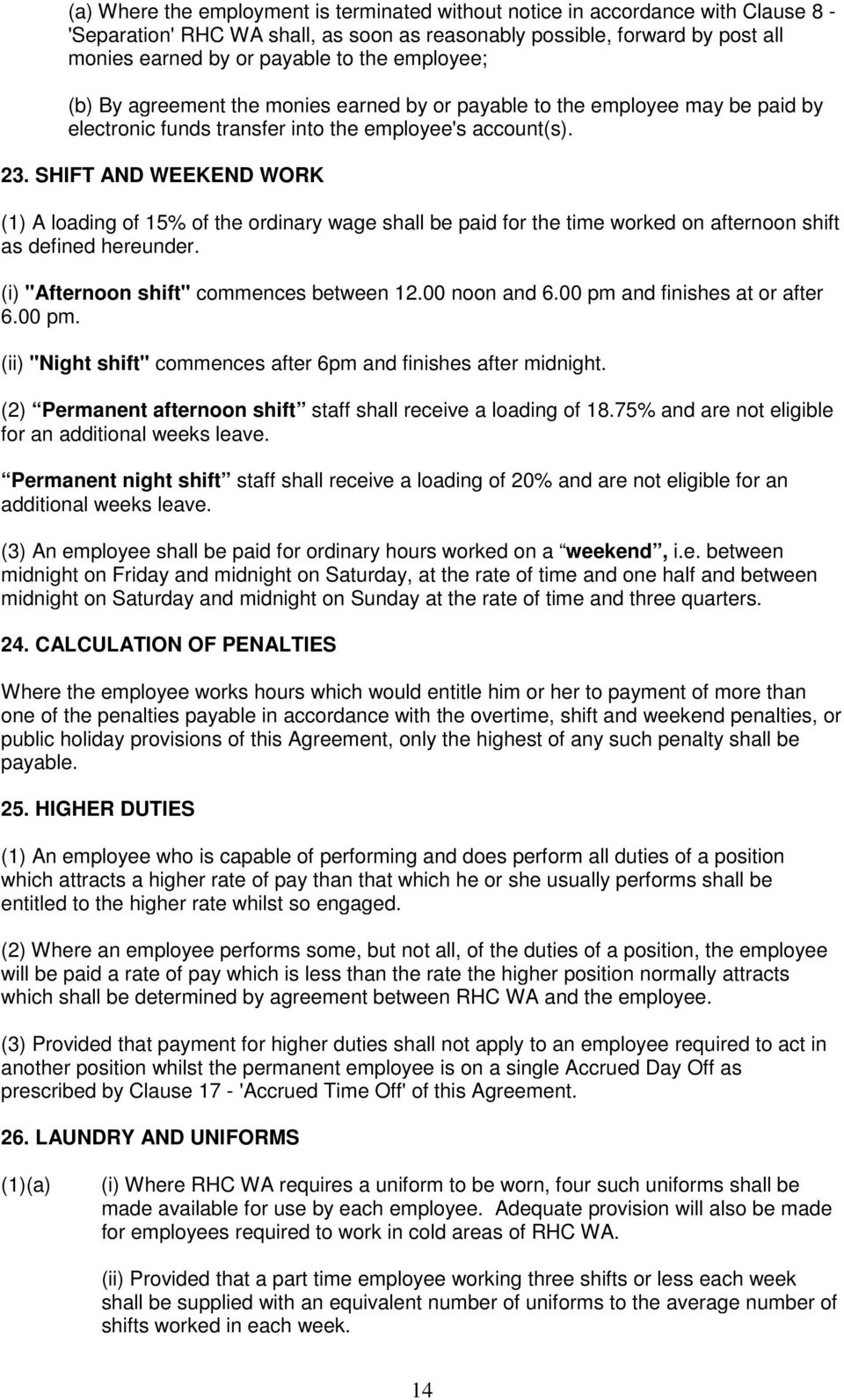
15 (iii) A Permanent Relief Worker will be supplied with an equivalent number of uniforms to the average hours worked over a twelve-month period. (b) Uniforms provided by RHC WA shall at all times remain the property of RHC WA and must be returned to RHC WA on termination. A failure to return RHC WA uniforms may lead to a delay in the processing of any termination payment and to RHC WA deducting the cost of the uniforms from any monies owing to the employee. (c) Uniforms shall not be worn other than in the course of, and in travelling to and from, employment. (2) (a) In lieu of the provision of uniforms, RHC WA shall pay an allowance of $4.27 per week. The allowance shall be paid pro-rata to part-time employees in the proportion that the number of ordinary hours worked each fortnight bears to 80. (b)this allowance will be increased in line with pay increases under this agreement. (3) Employees shall meet all costs and responsibilities associated with laundering uniforms. The additional payment prescribed in Schedule A includes an amount to compensate for this requirement. (4) Employees shall be responsible for the provision of appropriate clean and safe footwear. (5) The provisions of this Clause shall not detract from RHC WA's obligation pursuant to Section 19 of the Occupational Health and Safety Welfare Act 1984 to provide employees with adequate personal protective clothing and equipment where it is not practicable to avoid the presence of hazards at the workplace. 27. FARES AND MOTOR VEHICLE ALLOWANCE (1) An employee required to work outside RHC WA during his or her normal working hours shall be paid any reasonable travelling and accommodation expenses incurred provided that travelling expenses shall not be paid where an allowance is paid in accordance with subclause (2) hereof. (2) An employee required and authorised to use his or her own motor vehicle in the course of his duties shall be paid an allowance of not less than 69 cents per kilometre. (3) The rate prescribed in subclause (2) shall be adjusted from the first pay period commencing on or after 1 July each year to reflect increases in the CPI Index for Transportation- Private Motoring (Perth) for the previous 12 months. (4) Nothing in this clause shall prevent RHC WA and the employee making other arrangements as to car allowance not less favourable to the employee. 28. SUPERANNUATION (1) RHC WA shall contribute on behalf of the employee in accordance with the requirements of the Superannuation Guarantee (Administration) Act (2) RHC WA shall initially contribute an amount equal to 9% of the employee's ordinary time earnings and shall thereafter increase the level of contribution in accordance with the provisions of the Superannuation Guarantee (Administration) Act (3) Contributions shall be paid into the Health Employee's Superannuation Trust Australia Fund (HESTA) or any other alternative fund provided it complies with the requirements of the 15

16 Superannuation Guarantee (Administration Act 1992.) If the employee fails to nominate an alternative fund payment will be made to the Employee's Superannuation Trust Australia Fund (HESTA). (4) Contributions shall be paid monthly. 29. OCCUPATIONAL SAFETY AND HEALTH (1) RHC WA takes seriously its obligation to conduct all activities, as far as practicable, to achieve a safe and healthy working environment for staff, patients and the general community. (2) Consistent with the requirements of the Occupational Safety and Health Act 1984 (WA), RHC WA will continue to encourage, and do what is reasonably possible, to maintain a safe working environment. This will be achieved by the recognition and removal of hazards and by the provision of appropriate policies and procedures. (3) RHC WA will provide necessary protective clothing and equipment and training to enable the employee to carry out his/her duties in a safe and healthy manner and to enable hazards to be avoided. (4) RHC WA will establish and maintain an Occupational Safety and Health Committee, which includes elected employee representatives. The process for nomination and election of employee representatives will be in accordance with the relevant Occupational Safety and Health legislation. RHC WA will consult with representatives of that committee and employees and, where requested, their representatives as necessary to maintain a safe and healthy working environment. RHC WA will provide appropriately accredited training for elected representatives. 30. Annual Leave Entitlement (1)(a) Each employee shall after the completion of each 12 months continuous service be entitled to four consecutive weeks annual leave. Eligible employees may also be entitled to additional annual leave because of shift work arrangements, up to a maximum of one week. in accordance with subclauses 30(2) (b) The entitlement accrues pro rata on a weekly basis. (c) In paragraph (a), "service" shall not include any period of unpaid leave other than the first 3 months of unpaid personal leave and the first month of workers' compensation leave. Shift Work (2)(a) An employee who in each roster period rotates afternoon and/or night shift with day shift shall be granted an additional 5 days annual leave. (b) An employee whose shifts are not subject to regular rotation shall accrue one additional days annual leave (to a maximum of 5 days) for each 30 afternoon or night shifts worked. (c) An employee shall be paid for any period of leave prescribed by this subclause in accordance with subclause (11)(a) hereof. Compaction of Annual Leave (9) An employee who was employed continuously on both a full-time and part-time basis, or a part-time basis only, may elect to take a lesser period of annual leave calculated by converting the part-time service to equivalent full-time service provided that such compaction does not reduce the annual leave entitlement below four weeks. 16

17 Such election is to be made in writing by the employee and approved by RHC WA. Cashing In of Annual Leave (10)An employee will be allowed to cash in up to 50% of his/her annual leave balance provided that a minimum of four weeks leave is maintained for the taking of actual leave. Annual Leave Rate of Pay (11)(a) The employee shall be paid for any period of annual leave prescribed in this clause at their ordinary hourly rate plus the following: Any shift and weekend penalties which the employee would have received had the employee not proceeded on annual leave or A loading of 17.5% in respect of all periods of annual leave whichever is the greater. (b) Where it is not possible to calculate the shift and weekend penalties the employee would have received, the employee shall be paid at the rate of the average of such payments made each week over the four weeks prior to taking the leave. ( c ) An employee on higher duties for a period of four consecutive weeks or less at the time of taking the leave shall be paid at the ordinary rate of wage the employee would have received had he/she not been on higher duties. Timing of Payment (12) The employee is to be paid for a period of annual leave at the time payment is made in the normal course of employment, unless the employee requests in writing that he or she be paid before the period of leave commences in which case the employee is to be so paid. Provided that, where annual leave is paid in advance, payment for time worked may be adjusted in the pay period following the period of annual leave. Taking Annual Leave (13)(a) The employee may, with the approval of the employer, be allowed to take the annual leave prescribed by this clause before the completion of twelve month's continuous service. (b) The annual leave prescribed in this clause may be split into portions by mutual agreement between the employer and the employee. (c) When the employee requests that the annual leave be split into portions the employer shall make every reasonable endeavour to accommodate the wishes of the employee. (d) Where an employee has accrued more than two years annual leave entitlement, RHC WA may direct the employee to take up to a quarter of that annual leave accrued. (e)rhc WA must give the employee 2 weeks notice before directing an employee to take leave pursuant to this clause. (e) RHC WA shall give the employee at least 2 week's notice of the period of time when it will be convenient to the employer for the employee to take the leave pursuant to this clause.. Termination 17
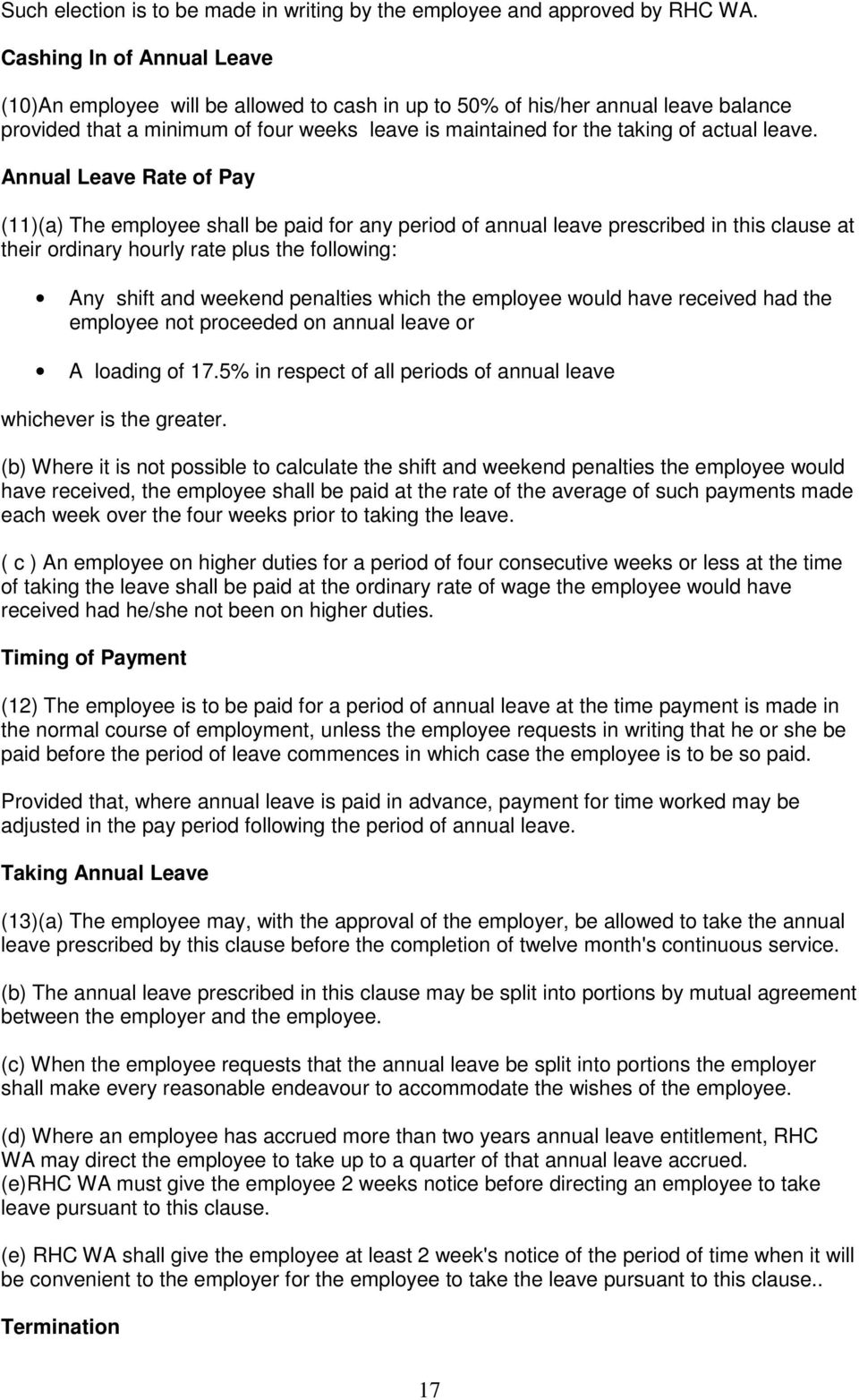
18 (14) If an employee's employment terminates, the employee shall be paid a pro rata entitlement (at the rate prescribed by subclause (10) hereof) in respect of each completed week of service for which annual leave has not already been taken. Provided that: (a) Leave loading shall not apply to pro rata leave on termination but shall apply (in accordance with subclause (10) hereof) to leave resulting from a completed year of service. (b) Employees to whom subclause (2) hereof applies shall be paid for such additional days leave as have accrued under that subclause at the date of termination. 31. PUBLIC HOLIDAY LEAVE (1)(a) An employee (other than an employee employed regularly in a non-client related position including gardener, maintenance employee and storeperson) shall be entitled to 10 days public holiday leave. (b)where an employee covered by this subclause is rostered to work on a public holiday or day observed in lieu thereof, he or she shall be entitled to ordinary rates of pay and a loading of 50% for the actual time worked. (c) Employees who observe public holidays as they occur and who would have worked an afternoon or night shift on the public holiday, shall be paid their normal shift penalty for that day as per Clause 23 Shift and Weekend Work. (2)(a) An employee employed regularly in a non client related position, including gardener, maintenance employee and storeperson, who is not required to work on any public holiday, or day observed in lieu thereof, shall be entitled to a day's leave without deduction of pay. (b) An employee employed regularly in a non client related position, including gardener, maintenance employee and storeperson, who is required to work on a public holiday, or day observed in lieu thereof, shall be entitled to ordinary rates of pay and a loading of 50% for the actual time worked together with an equivalent period of time off to be added to the period of annual leave. (3)(a) RHC WA has the right to roster staff off for up to 5 single days from public holiday entitlement to suit operational requirements. Rostering staff off for up to 5 single days is not confined to Public Holidays but will also apply to facilitate periods of low activity. (b) Rostering staff off in accordance with subclause 5(a) above will wherever possible be done on a voluntary basis in the first instance and will be monitored to ensure it is conducted in a fair and equitable manner. Staff, where possible, will be given the opportunity to work in other areas of the hospital in preference to being rostered off. (c) RHC WA will give at least two weeks notice of its intention to roster a staff member off on a public holiday and at least one weeks notice of its intention to roster a staff member off to facilitate a period of low activity. (d) Rostering for up to 5 single days would commence from January to December each year for the period of this agreement and on a pro rata basis from the date of registration of the agreement. Public Holiday Occurring During Annual Leave (6) An employee shall be entitled to a day's leave in lieu of a public holiday, without deduction of pay, in respect of a public holiday which occurs during the employee's annual leave. 18

19 Day Observed in Lieu of Public Holiday (7) Where any public holiday prescribed by this Agreement falls on a Saturday or a Sunday, such holiday shall be observed on the next succeeding Monday and where Boxing Day falls on a Sunday or Monday, such holiday shall be observed on the next succeeding Tuesday. Provided that: (a) A day observed in lieu of the holiday may be appointed by proclamation published in the Gazette under the Public and Bank Holidays Act 1972; (b) Another day may be observed in lieu of the holiday by agreement between the employee and the hospital. 31. PERSONAL LEAVE (1) In this clause immediate family shall include: (a)a spouse, child, parent, grandparent, grandchild or sibling of the employee; (b)a child, parent, grandparent, grandchild or sibling of a spouse of the employee. (2) A full time employee shall accrue 10 days paid personal leave per annum. (3) The entitlement shall accrue pro rata on a weekly basis. (4) In the case of an employee at JHC, APH or GPH who is unable to attend or remain at work on the grounds of personal ill health or injury or on account of the illness or injury of a member of an employees immediate family or household the employee is entitled to be paid at the rate the employee would have been paid had that employee attended work to the extent of his/her accrued entitlement for the period of absence up to and including the number of hours which the employee was rostered to work on that day. Employee can only access up to a total of 10 days personal leave each year to care for an immediate family member. (5) In the case of an employee at HPH who is unable to attend or remain at work on the grounds of personal ill health or injury or on account of the illness or injury of a member of an employees immediate family or household the employee will receive payment at the ordinary hourly rate of pay to the extent of his/her accrued entitlement for the period of absence up to and including the number of hours which the employee was rostered to work on that day. Employee can only access up to a total of 10 days personal leave each year to care for an immediate family member. (5) Unused portions of personal leave entitlement shall accumulate from year to year and may be taken in any subsequent year. (6) An employee shall advise RHC WA prior to the commencement of the shift of the inability to attend work. If such notification is not possible then advice shall (wherever possible) be provided within a period of one hour of the usual time of the commencement of the shift. If not already provided, the employee shall also advise RHC WA as soon as reasonable and practicable of the estimated duration of the absence. (7) An employee may be required to provide a medical certificate after two absences in any year of service or for any absence of more than two days. (8) An employee who suffers personal ill health or injury whilst on annual leave may be paid personal leave in lieu of annual leave subject to: (a) providing a medical certificate stating the illness or injury necessitated confinement to home or hospital for seven consecutive days or more. 19
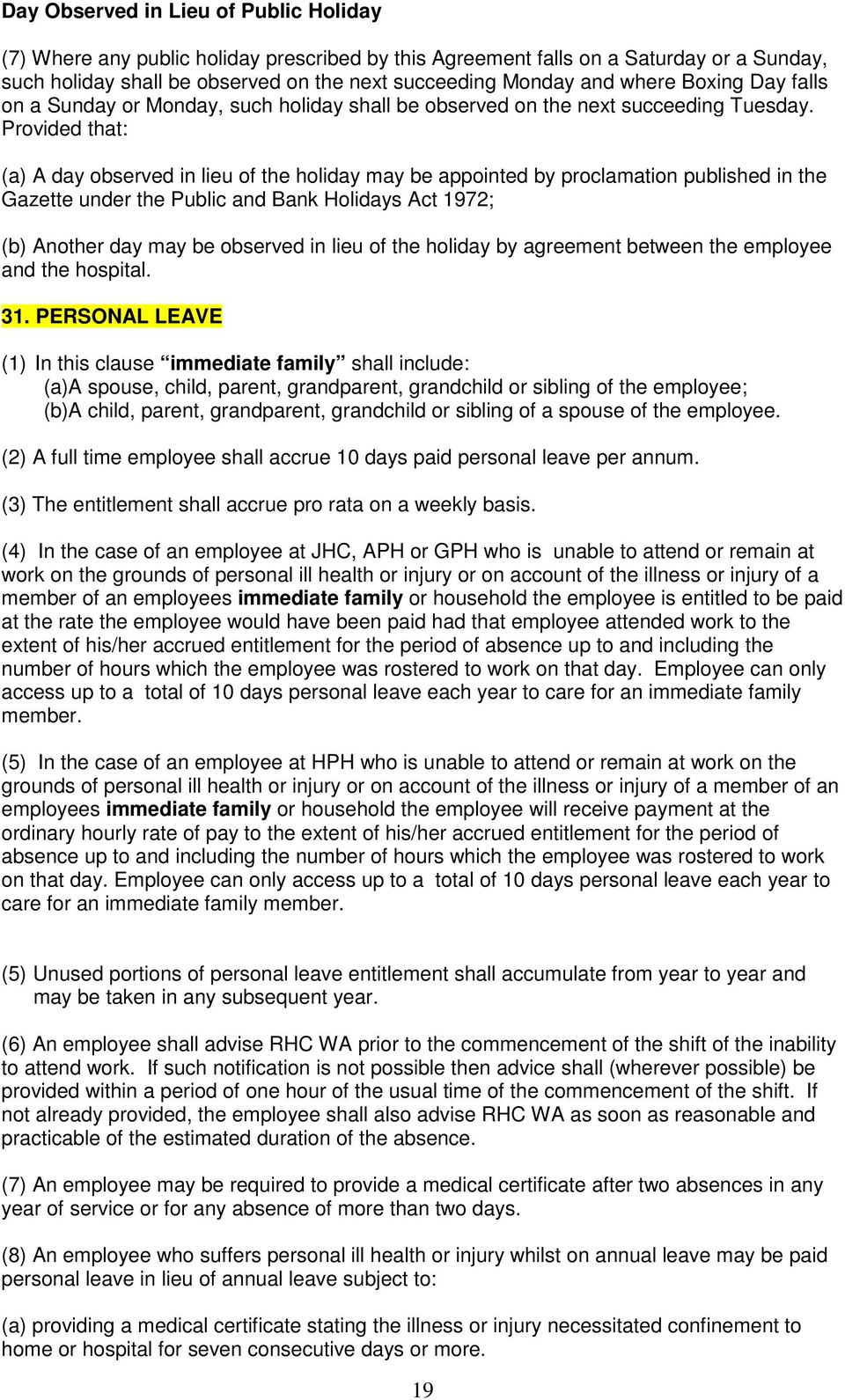
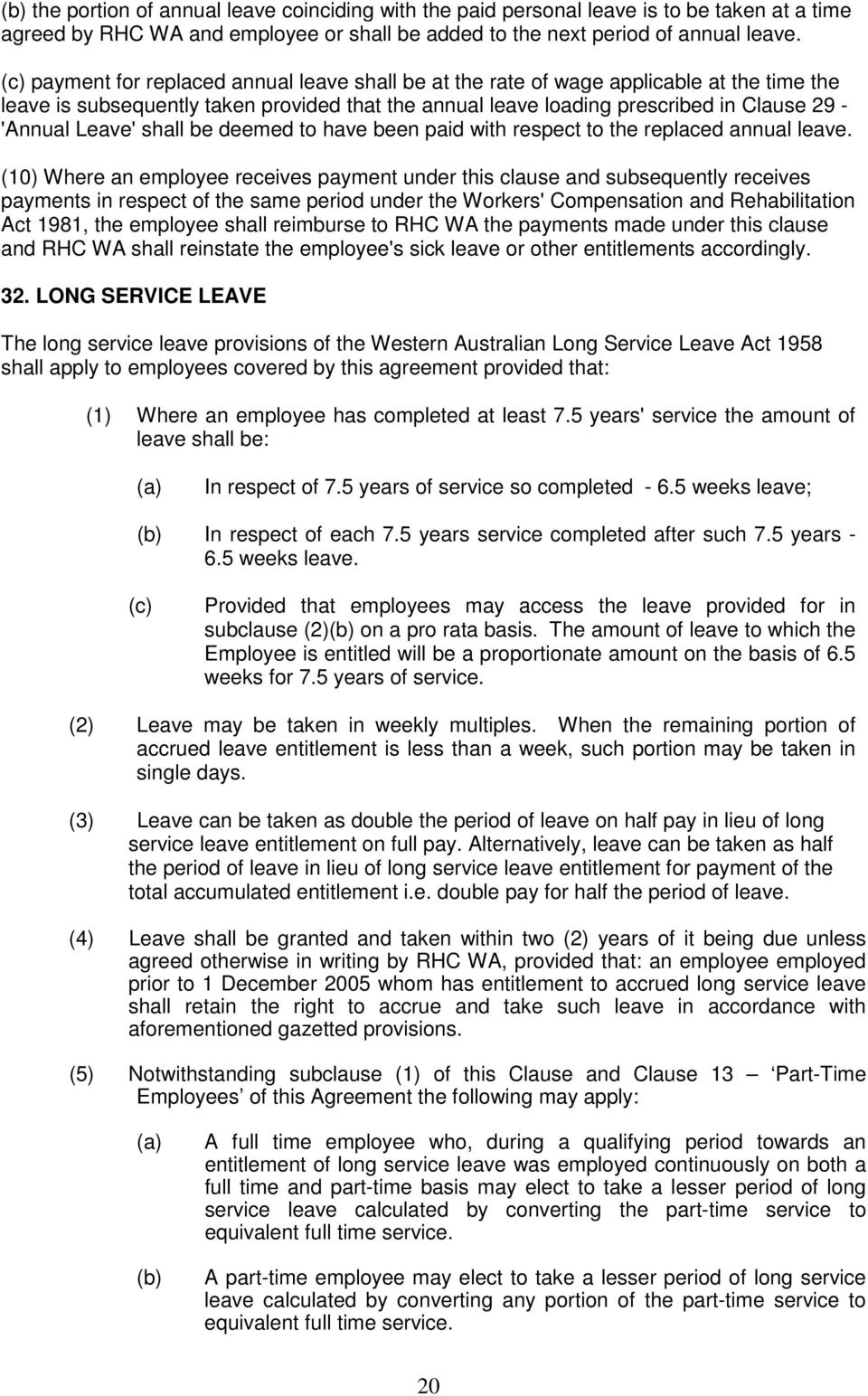
20 (b) the portion of annual leave coinciding with the paid personal leave is to be taken at a time agreed by RHC WA and employee or shall be added to the next period of annual leave. (c) payment for replaced annual leave shall be at the rate of wage applicable at the time the leave is subsequently taken provided that the annual leave loading prescribed in Clause 29 - 'Annual Leave' shall be deemed to have been paid with respect to the replaced annual leave. (10) Where an employee receives payment under this clause and subsequently receives payments in respect of the same period under the Workers' Compensation and Rehabilitation Act 1981, the employee shall reimburse to RHC WA the payments made under this clause and RHC WA shall reinstate the employee's sick leave or other entitlements accordingly. 32. LONG SERVICE LEAVE The long service leave provisions of the Western Australian Long Service Leave Act 1958 shall apply to employees covered by this agreement provided that: (1) Where an employee has completed at least 7.5 years' service the amount of leave shall be: (a) In respect of 7.5 years of service so completed weeks leave; (b) In respect of each 7.5 years service completed after such 7.5 years weeks leave. (c) Provided that employees may access the leave provided for in subclause (2)(b) on a pro rata basis. The amount of leave to which the Employee is entitled will be a proportionate amount on the basis of 6.5 weeks for 7.5 years of service. (2) Leave may be taken in weekly multiples. When the remaining portion of accrued leave entitlement is less than a week, such portion may be taken in single days. (3) Leave can be taken as double the period of leave on half pay in lieu of long service leave entitlement on full pay. Alternatively, leave can be taken as half the period of leave in lieu of long service leave entitlement for payment of the total accumulated entitlement i.e. double pay for half the period of leave. (4) Leave shall be granted and taken within two (2) years of it being due unless agreed otherwise in writing by RHC WA, provided that: an employee employed prior to 1 December 2005 whom has entitlement to accrued long service leave shall retain the right to accrue and take such leave in accordance with aforementioned gazetted provisions. (5) Notwithstanding subclause (1) of this Clause and Clause 13 Part-Time Employees of this Agreement the following may apply: (a) (b) A full time employee who, during a qualifying period towards an entitlement of long service leave was employed continuously on both a full time and part-time basis may elect to take a lesser period of long service leave calculated by converting the part-time service to equivalent full time service. A part-time employee may elect to take a lesser period of long service leave calculated by converting any portion of the part-time service to equivalent full time service. 20
21 33. PARENTAL AND ADOPTION LEAVE (1) Interpretation in this Clause: "adoption", in relation to a child, is a reference to a child who: (a) Is not the natural child or the step-child of the employee or the employee's spouse; (b) Is less than 5 years of age; and (c) Has not lived continuously with the employee for 6 months or longer; "Continuous service" means service under an unbroken contract of employment and includes (a) Any period of parental leave; and (b) any period of leave or absence authorised by RHC WA or this Agreement, an employee's contract of employment or the Workplace Relations Act 1996 or any other replacement Act; "Expected date of birth" means the day certified by a medical practitioner to be the day on which the medical practitioner expects the employee or the employee's spouse, as the case may be, to give birth to a child; "Parental leave" means leave provided for by this clause; "Spouse" includes a de facto spouse. (2) Entitlement to parental leave Subject to the provisions of this clause, an employee is entitled to take up to 52 consecutive weeks of parental leave. The 52 weeks includes all periods of paid and unpaid leave, in respect of: (a) the birth of a child to the employee or the employee's spouse; or (b) the placement of a child with the employee with a view to the adoption of the child by the employee. (3) Paid Parental Leave: (a) Full-time and part-time employees (provided they are the primary care giver) are entitled to up to ten weeks paid parental leave based on their length of continuous service as follows: (i) Completion of twelve (12) months continuous service and less than three (3) years service - eight (8) weeks paid (ii) Completion of more than three (3) years continuous service - ten (10) weeks paid (b) Paid parental leave is calculated on the base rate of pay based on contractual hours and excludes all penalties and allowances. (c) Paid parental Ieave can be taken on half pay for double the period. (d) Paid parental leave for Permanent Relief Workers will be calculated on the average hours worked in the preceding twelve (12) month period. (4) An employee is not entitled to take parental leave unless he or she - 21
22 (a) has, before the expected date of birth or placement, completed at least 12 months' continuous service with RHC WA; and (b) has given RHC WA at least 10 weeks' written notice of his or her intention to take the leave. Provided that an employee shall not be in breach of these notice requirements where failure to give such notice results from confinement or adoption or placement occurring earlier than the expected date. (5) An employee is not entitled to take parental leave at the same time as the employee's spouse but this paragraph does not apply to one week's unpaid parental leave- (a) taken by the male parent immediately after the birth of the child; or (b) taken by the employee and the employee's spouse immediately after a child has been placed with them with a view to their adoption of the child. (6) The entitlement to parental leave is reduced by any period of parental leave taken by the employee's spouse in relation to the same child, except the period of one week's unpaid leave referred to in subclause (5). (7) Maternity leave to start 6 weeks before birth A female employee who has given notice of her intention to take parental leave, other than for an adoption, is to start the leave 6 weeks before the expected date of birth unless in respect of any period closer to the expected date of birth a medical practitioner has certified that the employee is fit to work. (8) Medical certificate An employee who has given notice of his or her intention to take parental leave, other than for adoption, is to provide to RHC WA a certificate from a medical practitioner stating that the employee or the employee's spouse, as the case may be, is pregnant and the expected date of birth. (9) Notice of spouse's parental leave (a) An employee who has given notice of his or her intention to take parental leave or who is actually taking parental leave is to notify RHC WA of particulars of any period of parental leave taken or to be taken by the employee's spouse in relation to the same child. (b) Any notice given under paragraph (a) is to be supported by a statement of information to the satisfaction of RHC WA or a statutory declaration by the employee as to the truth of the particulars notified, (10) Notice of parental leave details (a) An employee who has given notice of his or her intention to take parental leave is to give RHC WA at least four weeks written notice of the dates on which the employee wishes to terminate the leave. (b) The period of leave may be varied, by the employee giving not less than four weeks notice in writing, unless a lesser period is agreed, provided that the period may be lengthened once only, unless by agreement of RHC WA. 22
23 (c) An employee shall confirm his/her intention of returning to work by notice in writing to RHC WA given not less than four weeks prior to the expiration of the period of parental leave. (11) Special parental leave and sick leave (a) Where the pregnancy of an employee not then on parental leave terminates after 28 weeks other than the birth of a living child then: (i) she shall be entitled to such period of unpaid leave (to be known as special parental leave) as a duly qualified medical practitioner certifies as necessary before her return to work, or (ii) for illness other than the normal consequences of confinement she shall be entitled, either in lieu of or in addition to special parental leave, to such paid sick leave as to which she is then entitled and which a duly qualified medical practitioner certifies as necessary before her return to work. (b) Where an employee not then on parental leave suffers illness related to her pregnancy, she may take such paid sick leave as to which she is then entitled and such further unpaid leave (to be known as special parental leave) as a duly qualified medical practitioner certifies as necessary before her return to work, provided that the aggregate of paid sick leave, special parental leave and parental leave shall not exceed 52 weeks. (c) For the purposes of this clause, parental leave shall include special parental leave. (12) Transfer to a Safe Job; (a) Where in the opinion of a duly qualified medical practitioner, illness or risks arising out of the pregnancy or hazards connected with the work assigned to the employee make it inadvisable for the employee to continue in her current position, the employee shall, if RHC WA deems is practicable, be transferred to a safe job with no change to the employees terms and conditions of employment. (b) If the transfer to a safe job is not practicable, the employee may, or RHC WA may require the employee to, take leave for such period as is certified necessary by a duly qualified medical practitioner. This leave will be in addition to the entitlement to 52 weeks leave. The employee will be paid for this period of leave at a rate that is no less than the rate that, immediately before the period begins, is the employees ordinary rate of wage (excluding penalties and loading). (13) Return to work after parental leave (a) On finishing parental leave, an employee is entitled to the position he or she held immediately before starting parental leave. (b) If the position referred to in paragraph (a) is not available, the employee is entitled to an available position - (i) for which the employee is qualified; and (ii) that the employee is capable of performing, most comparable in status and pay to that of his or her former position. (c) Where, immediately before starting parental leave, an employee was acting in, or performing on a temporary basis the duties of, the position referred to in paragraph (a), that 23
24 paragraph applies only in respect of the position held by the employee immediately before taking the acting or temporary position. (14) Effect of parental leave on employment: Any absence on parental leave shall not break the continuity of service of an employee but shall not be taken into account in calculating the period of service.. (15) Parental Leave and Other Leave Entitlements: Subject to subclause (5) and (6) of this clause, provided the aggregate of leave including leave taken pursuant to this clause does not exceed 52 weeks: (a) An employee may, in lieu of or in conjunction with parental leave, take any annual leave or long service leave or any part thereof to which she is then entitled. (b) Subject to the provision of subclause (12) hereof, paid sick leave or other paid authorised absences (excluding annual leave or long service leave), shall not be available to an employee during her absence on parental leave. (16) Termination of Employment: An employee on parental leave may terminate her employment at any time during the period of leave by notice given in accordance with this Agreement. (17) Replacement Employees: (a) A replacement employee is an employee specifically engaged as a result of an employee proceeding on parental leave. (b) Before RHC WA engages a replacement employee under this subclause, RHC WA shall inform that person of the temporary nature of the employment and of the rights of the employee who is being replaced. (c) Before RHC WA engages a person to replace an employee temporarily promoted or transferred in order to replace an employee exercising her rights under this clause, RHC WA shall inform that person of the temporary nature of the promotion or transfer and of the rights of the employee who is being replaced. (d) Provided that nothing in this subclause shall be construed as requiring RHC WA to engage a replacement employee. 34. COMPASSIONATE LEAVE (1) Definitions Compassionate Leave means paid leave taken by an employee: (a) for the purpose of spending time with a person who: (i) (ii) is a family member; and has a personal illness, or injury, that poses a serious threat to their life; or (b) on the death of a family member or any other person who immediately before that person's death lived with the employee as a family member. 24
25 family member means a member of the employee s immediate family or a member of the employee s household as defined in the Workplace Relations Act 1996 (Cwth) as amended; or a relative as defined in the Equal Opportunity Act 1984 (WA) as amended (2) An employee is entitled to a period of three (3) days of Compassionate Leave for each occassion that a family member: (a) (b) (c) contracts or develops a personal illness that poses a serious threat to their life; or sustains a personal injury that poses a serious threat to their life; or dies. (3) Employees entitled to a period of Compassionate Leave are entitled, for any particular occasion, to take the leave as: (a) (b) (c) a single, unbroken period of up to three (3) days; or Three (3) separate periods of one (1) day each; or any separate periods to which the employee and RHC WA agree. (4) Employees are entitled to Compassionate Leave at ordinary hourly rate of pay (5) Payment for such leave may be subject to the employee providing evidence of the illness, injury or death. (6) RHC WA shall make every endeavour to grant an employee s request for Accrued Days Off, paid accrued leave and unpaid leave of absence resulting from the employee s need to take Compassionate Leave. (7) Compassionate leave is not to be taken where the employee is absent on another form of leave or would not otherwise have been on duty unless the absence has been taken to enable the employee to be with a seriously ill, injured or dying relative. 35. TIME OFF WITHOUT PAY Time off without pay for whatever purpose may be granted by agreement between RHC WA and the employee. 36. INTRODUCTION OF CHANGE AND REDUNDANCY (1) Interpretation In this Clause: "Employee" does not include an employee engaged on a temporary basis or on a fixed term contract; "Redundant" means being no longer required by RHC WA to continue doing a job because RHC WA has decided that the job will not be done by any of its employees. "significant effect" for the purposes of this Clause, means the effect an action of RHC WA has on an employee if: 25
26 (a) There is to be a major change in the composition, operation or size of, or skills required in, RHC WA's workforce that will affect the employee; or (b) There is to be elimination or reduction of a job opportunity, promotion opportunity or job tenure for the employee; or (c) The guaranteed hours of the employee's work are substantially increased or decreased and the employee considers the change significant; or (d) The employee is required to be retrained; or (e) The employee is to be transferred to another job or work location; or (f) The employee's job is to be restructured. "Week s Pay" means the ordinary weekly rate of wage for the employee concerned. (2) Employee to be Informed (a) Where RHC WA has decided to: (i) take action that is likely to have a significant effect on an employee; or (ii) make an employee s position redundant; the employee is entitled to be informed by RHC WA, as soon as reasonably practicable after the decision has been made, of the action or the redundancy, as the case may be. (b) Discussions to occur RHC WA shall thereafter hold discussions with the employee affected as to: (i) the likely effects of the action or the redundancy in respect of the employee; and (ii) measures that may be taken by the employee or RHC WA to avoid or minimise a significant effect. Provided that RHC WA shall not be required to disclose confidential information the disclosure of which may seriously harm RHC WA's interests. (3) Employee representative to be informed: Where RHC WA has made a definite decision to introduce major changes that are likely to have significant effects on employees, RHC WA shall notify and hold discussions with the Employee (s) representative(s) where requested by the employees. (4) Severance Pay: (a) For staff at JHC, APH and GPH, - In addition to the period of notice prescribed in Clause 8 - 'Separation' of this Agreement, for ordinary termination, an employee whose employment is terminated on the grounds of redundancy shall be entitled to receive two weeks pay for each completed year of continuous service provided that the maximum entitlement shall be 45 weeks salary. (b) For staff at HPH entitlement will be as follows: In addition to the period of notice prescribed in Clause 8 Separation of this Agreement, for ordinary termination, an employee whose employment is terminated on the grounds of 26
27 redundancy shall be entitled to the following amount of severance pay in respect of a continuous period of service. Period of Continuous Service Severance Pay Less than 1 year Nil 1 year but less than 2 years 4 weeks 2 years but less than 3 years 6 weeks 3 years but less than 4 years 7 weeks 4 years but less than 5 years 8 weeks (c) For the purpose of this clause continuity of service shall not be broken on account of: (i) any absence from work on account of personal leave as prescribed by this agreement or on account of leave lawfully granted by RHC WA; or (ii) any absence with reasonable cause, proof whereof shall be upon the employee; or (iii) any absence on approved leave without pay, provided that in the calculation of continuous service under this subclause any time in respect of which an employee is absent from work except time for which an employee is entitled to claim annual leave, personal leave, long service leave and public holidays as prescribed by this agreement shall not count as time worked. (d) Service by the employee with a business which has been transmitted from one hospital to another and the employee's service has been deemed continuous in accordance with the Western Australian Long Service Leave Act 1958 shall also constitute continuous service for the purpose of this clause. (5) Employee Leaving During Notice: An employee whose employment is to be terminated on the grounds of redundancy may terminate employment during the period of notice and, if so, shall be entitled to the same benefits and payments under this clause had the employee remained with RHC WA until the expiry of such notice. Provided that in such circumstances the employee shall not be entitled to payment in lieu of notice. (6) Alternative Employment RHC WA, in a particular redundancy case, may make application to the Commission to have the general severance pay prescription varied if RHC WA obtains acceptable alternative employment for an employee. (7) Leave for Job Interviews: (a) An employee who has been given notice that he or she has been, or will be, made redundant shall during the period of notice of termination be entitled to be absent from work up to a maximum of 8 ordinary hours during each week of notice without deduction of pay for the purpose of being interviewed for further employment. (b) An employee who claims to be entitled to paid leave under paragraph (a) shall, at the request of RHC WA, be required to produce reasonable proof of attendance at an interview or the employee shall not receive payment for the time absent. 37. TIME AND WAGES RECORD (1) A time and wages record shall be kept by RHC WA. 27
28 (2) The record shall contain the following information: (a) The name and address of each employee subject to this Agreement; (b) The date on which each employee commenced employment with RHC WA; (c) The date of birth of the employee if paid as a junior employee; (d) The classification and increment of the employee; (e) Whether the employee is employed on a full time, part-time or flexible-worker basis; (f) The commencing and finishing time of work each day; (g) The total number of ordinary hours and the total number of overtime hours worked each day; (h) The number of ordinary hours for which payment has been made; and (j) The wages and allowances paid to each employee in each pay period under this Agreement and any deductions there from. (3) The employee or their representative shall be permitted reasonable time to inspect the record and, if required, take an extract or copy of any of the information contained therein. 38. ANTI-DISCRIMINATION PROVISION (1) It is the intention of RHC WA to achieve the principal object in section 3(j) of the Workplace Relations Act 1996 by helping to prevent and eliminate discrimination on the basis of race, colour, sex, sexual preference, age, physical or mental disability, marital status, family responsibilities, pregnancy, religion, political opinion, national extraction or social origin. (2) Accordingly, in fulfilling its obligations under the disputes avoidance and settling clause, RHC WA will make every endeavour to ensure that neither the agreement provisions nor their operation are directly discriminatory in their effects. (3) Nothing in this clause is to be taken to affect: (a) Any different treatment (or treatment having different effects) which is specifically exempted under the Commonwealth anti discrimination legislation; (b) An employee, RHC WA or registered organisation, pursuing matters of discrimination in any state or federal jurisdiction, including by application to the Human Rights and Equal Opportunity Commission; or 39. EDUCATION AND TRAINING LEAVE (1) RHC WA shall provide opportunities for employees to participate in learning activities such as: (a) ongoing competency based training; (b) in service education; (c) management and leadership training; and (d) dispute resolution training where such training is relevant to the employee's area of work and/or RHC WA's ongoing operational needs. 28
29 (2) In recognition of the importance of on-going education and training RHC WA may provide paid leave during the academic year (including exam leave) and/or all or part of course fees for an approved course of study relevant to the needs of RHC WA. Approval shall be the responsibility of a member of the Executive. (3) In-service training, when compulsory, shall be provided as paid time and free of charge. When voluntary, in-service training may not necessarily be provided as paid time. 40. SALARY PACKAGING Employees will have the option to salary package a component of salary for other benefits in accordance with RHC WA's policy in relation to salary packaging. 41. DEFERRED SALARY SCHEME (1) This clause will only apply to staff who work full time for the entire period of the deferred salary scheme and will not apply to part-time or permanent relief worker employees. (2) Employees employed full time will have access to the 4/5 pay option, whereby they work for 4 years at 80% pay and then take one year off at 80% pay in accordance with the following: (a) By written agreement between RHC WA and employee, an employee may be paid 80% of her/his ordinary hourly rate salary under this Agreement, and any other relevant agreement upon the expiry of this Agreement, over a 5 year period. The fifth year will then be taken as leave with pay with the accrued ordinary hourly rate annualised over the year. (b) The fifth year will be treated as continuous service. (c) The leave may not be accrued unless RHC WA agrees to accrual. (3) In deciding whether to support a particular request for this arrangement, RHC WA will take into account factors such as operational requirements. To satisfy operational requirements, the number of employees allowed to work under this arrangement may be restricted at any one time and/or the timing of the arrangements may need to be staggered. (4) An employee may withdraw from this arrangement in writing. He/she would then receive a lump sum equal to the accrued credit, paid at a time agreed between RHC WA and employee but not more than 3 months from the time of the employee's withdrawal from the arrangement. Provided that an employee who terminates his or her employment prior to the completion of the fourth year will be paid the accrued credit in their final payment, to the completion of the fourth year will be paid the accrued credit in their final payment. (5) Any paid leave taken during the first 4 years of the arrangements will be paid at 80% of the employee's ordinary rate of pay. (6) It is the responsibility of the employee to investigate the impact of the arrangement on his/her superannuation and taxation. (7) Penalties will not be deferred under this arrangement only the ordinary hourly rate. All penalties will be paid as earned. (8) Payment of salary for the fifth year will be at the higher rate of pay (76 hour divisor) and as such the employee will not accrue ADOs during the entire period of the leave. 42. OVERPAYMENTS 29
30 Where an employee is paid for work not subsequently performed or is overpaid in any other manner, RHC WA is entitled to recoup the overpayments. The rate at which such money is recouped shall be agreed between RHC WA and employee. 43. JURY AND WITNESS LEAVE (1) Employees summoned for jury duty or as a witness in relation to their official capacity will be granted paid leave to attend the Court as required. (2) Employees requesting time off for jury/witness duty must notify their relevant manager upon receiving a formal request to attend. (3) On presentation of proof of appearance payment of salary will be made at ordinary rates through the payroll system. (4) RHC WA will claim reimbursement from the Court. 44. RECLASSIFICATION (1) Except as provided in clause 2, the employer agrees to enter into discussions within the term of this Agreement with a view to determining appropriate classification descriptors and duties to create consistency at all worksites. (2) RHC WA agrees to enter into discussions within 6 months of registration of this Agreement to create a classification structure for Laundry Assistants and ED Orderly s with a view to determining appropriate classification descriptors and duties to create consistency at all worksites. (3) The employer will review the classifications in full consultation with employees concerned and, where requested, the employees representative. (4) The review of classifications as provided in this clause will not adversely affect the wage rates and conditions for existing employees. (5) Any dispute that may arise shall be determined in accordance with clause (12) Dispute Resolution Procedure. 30
31 45. SIGNATORIES TO AGREEMENT Signed for and on behalf of RAMSAY HEALTH CARE PTY LTD: Kevin Cass-Ryall State Operations Manager Ramsay Healthcare WA 15 Monash Avenue, Nedlands, WA In the presence of: (Name and Address) Date:.. Signed for and on behalf of LIQUOR HOSPITALITY AND MISCELLANEOUS UNION David Kelly Secretary 61 Thomas Street, Subiaco, WA In the presence of: (Name and Address) Date:... 31
32 SCHEDULE A - SALARIES (1) This Schedule prescribes the ordinary rate payable to employees covered by this Agreement plus the pay increases agreed to as identified in the schedule. (2)(a) Unless otherwise specified progression for all classifications for which there is more than one wage point, shall be by automatic annual increments, subject to a satisfactory performance appraisal. (b) Any disagreement in relation to the payment of an annual increment shall be dealt with in accordance with clause -12 Dispute Resolution. (3) The ordinary hourly rate for each employee shall be calculated by dividing the weekly rate by 40 for an employee accessing accrued time off and by 38 for an employee not accessing accrued time off. (4) No employee, who at the date of this Agreement was in receipt of a rate of wage higher than that prescribed herein for his/her classification of work, shall have that rate reduced by the operation of this Agreement. (6) The operative dates for pay increases in Columns A, B and C in the Parts to this Schedule are as follows:- (a) Column A - First Pay Period commencing on or after acceptance of EBA (b) Column B - First Pay Period commencing on or after 1 July 2009 (c) Column C First Pay Period commencing on or after 1 December 2009 (d) Column D - First Pay Period commencing on or after 1 December PART ONE - PATIENT CARE ASSISTANT / NURSING ASSISTANT (1) The minimum weekly rate of pay shall be in accordance with the following schedule: Classification Current Pay Rate HPH. Current Pay Rate JHC, APH, GPH COLUMN A Applicable from first full pay period following acceptance of the Agreement. COLUMN B 3% from first full pay period in July 2009 COLUMN C 2% from first full pay period in December 2009 Column D 4% from first full pay period in December 2010 $ per week. $ per week $ per week $ per week $ per week $ per week Patient Care Assistant / Nursing Assistant No Certificate Upon obtaining relevant Certificate 111 qualification. Twelve months upon obtaining relevant Certificate
33 qualification. Transition to new structure. Staff at the time of acceptance of this Agreement who are employed in the role of Patient Care Assistant/Nursing Assistant and who hold a relevant Cert 111 will move to the second pay rate on the structure and will move to the third pay rate of the structure twelve months later. Staff who do not hold a relevant Cert 111 qualification will move to the first pay rate on the structure and will progress to the second point upon obtaining a relevant Cert 111 qualification. New Staff. All new staff will commence on the first point of the structure and will progress through the structure as follows: Progress to the second pay rate upon obtaining a relevant Cert 111 qualification Progress to the third pay rate twelve months after. PART TWO - ENROLLED NURSES (1) The minimum weekly rate of pay shall be in accordance with the following schedule: Classification Current Rate HPH Current Rate JHC, GPH and APH COLUMN A Applicable from first full pay period following acceptance of Agreement COLUMN B 3% from first full pay period in July 2009 COLUMN C 2% from first full pay period in December 2009 COLUMN D 4% from first full pay period in December 2010 $ per week $ per week $ per week $ per week $ per week $ per week Level Level Level Level Advanced Skills Year Advanced Skills Year Advanced Specialist (2) Enrolled Nurses proceed from Level 1 to Level 4 by annual increments based on a satisfactory performance appraisal. Incremental advancement is based on experience at this level and not service to the organisation. (3) "Advanced Skills Enrolled Nurse" means an Enrolled Nurse who: (a) has completed at least three (3) years of clinical practice; (b) demonstrates the ability to work with professional guidance in less stable conditions; and (c) has obtained additional competencies relevant to the workplace or specialty at this level. (d) Advanced Skills Enrolled Nurse Year 2 - progression will be by annual increment. For staff who, at the time of acceptance of this Agreement have been at the level of Advanced 33
34 Skills Enrolled Nurse for twelve months or more, will progress to the second incremental point from the first full pay period in July (4) "Advanced Specialist Enrolled Nurse" means an Enrolled Nurse who; (a) Has completed at least 5 years clinical experience and who effectively delivers specialist skills and knowledge, and (b) (i) Obtained a recognised post graduate qualification relevant to their area of clinical practice, or (ii) has obtained an ASAPO recognised or Ramsay Healthcare approved qualification in Anaesthetics, or (iii) who has been recognised through prior learning (internally or externally) in one of the above mentioned qualifications and is actively (prepared to) work in the designated area. (c) An Enrolled Nurse may also be recognised as an Advanced Specialist Enrolled Nurse at the discretion of the Director of Clinical Services or equivalent. (5) A Casual Enrolled Nurse shall receive 1/38 th of the ordinary hourly rate at the applicable classification plus 20% for each hour worked. PART THREE - SUPPORT SERVICES (2) The minimum weekly rate of pay shall be in accordance with the following schedule: Classification Current Rate HPH Current Rate JHC, GPH and APH COLUMN A Applicable from first full pay period following acceptance of Agreement COLUMN B 2% from first full pay period in July 2009 COLUMN C 3% from first full pay period in December 2009 COLUMN D 5% from first full pay period in December 2010 Level 1: $ per week $ per week $ per week $ per week $ per week $ per week Comprehends the following classes of work: Cleaner Gardener (other) Laundry Assistant Car Park Attendant 34
35 1st year of employment 2nd year of employment 3rd year of employment and thereafter Level Comprehends the following classes of work: Mail Courier 1st year of employment 2nd year of employment 3rd year of employment and thereafter Level 3 Comprehends the following classes of work: Gardener Maintenance Employee Laundry Machine Operator Ward Orderly/ Hotel Service Attendant 1st year of employment 2nd year of employment 3rd year of employment and thereafter Level Comprehends the following classes of work: 1st year of employment 2nd year of employment 3rd year of employment and thereafter
36 Level 5 Comprehends the following classes of work: Storeperson Driver Bus Mental Health Support Worker Cook (Other) 1st year of employment 2nd year of employment 3rd year of employment and thereafter Level 6 Comprehends the following classes of work: Canteen Supervisor Leading Hands *Dietary Liason Assistant *(JHC Only) 1st year of employment 2nd year of employment 3rd year of employment and thereafter Level Comprehends the following classes of work: *Theatre Support Workers *(JHC Only) 1st year of employment 2nd year of employment 3rd year of employment and thereafter
37 Level 8 Comprehends the following classes of work: First Cook (where more than one employed) 1st year of employment 2nd year of employment 3rd year of employment and thereafter Level 9 Comprehends the following classes of work: Tradesperson cook Catering Supervisor Support Services Supervisor 1st year of employment 2nd year of employment 3rd year of employment and thereafter Level 10 Comprehends the Following Class of work Chef 1 st year of employment 2 nd year of employment 3 rd year of employment (3) Apprentices The minimum rate of wage payable to apprentices shall be the following percentage of the prescribed wage for a Tradesperson Cook (first year of employment): 37
38 Four Year Term % First year 42 Second year 55 Third year 75 Fourth year 88 Three and a Half Year Term % First six months 42 Next year 55 Next following year 75 Final year 88 Three Year Term % First year 55 Second year 75 Third year 88 (4) In charge allowance: Except in the case of a classification, which requires the employee to be in charge of other employees, any employee placed in charge of three or more employees shall have his/her ordinary rate increased by $14.20 per week. This allowance will be increased in line with pay increases under this agreement. PART FOUR PATIENT SERVICE ASSISTANTS / CATERING ASSISTANTS. (1) The minimum weekly rate of pay shall be in accordance with the following schedule: Classification COLUMN A COLUMN C Applicable from first full pay period following acceptance of the Agreement. COLUMN B 2% from first full pay period in July % from first full pay period in December 2009 Column D 5% from first full pay period in December 2010 $ per week $ per week $ per week $ per week No relevant certificate 11 qualification Upon obtaining relevant Certificate 11 qualification. Twelve months upon obtaining relevant Certificate 11 qualification. Increment Increment Transition of staff employed at commencement of Agreement. Patient Service Assistants. 38
39 Patient Service Assistants will transfer at level as follows: Current Level 4.1 will move to Current level 4.2 will move to Current Level 4.3 will move to All Patient Service Assistants will be required to commit to obtaining a relevant Cert 11 qualification to progress through levels. All patient Service Assistants who will have completed twelve months service at the top of the structure prior to implementing the above will progress to Increment 2 from the first full pay period in July 09. Catering Services. All catering staff other than Menu assistants will transfer as follows: Those that do not hold a relevant Cert 11 qualification will transfer to the first point of the new structure and will only progress through the other levels upon obtaining a relevant certificate 11 qualification. Menu Assistants Current staff employed at HPH in the role of Menu Assistants will be paid as per the structure for Patient Care Assistants/Nursing Assistants. The same transitional arrangements will apply. This is a Certificate 111 qualification. New Staff: All new staff employed in the role of Menu Assistants will commence at the first point of the new structure and will progress through the structure upon obtaining the relevant requirements. PART FIVE - STERILE SUPPLY DEPARTMENT STRUCTURE (1) The minimum weekly rate of pay shall be in accordance with the following schedule: Classification Current Pay Rate $ per week COLUMN A Applicable from first full pay period following acceptance of Agreement $ per week 39 COLUMN B 3% from first full pay period in July 2009 $ per week COLUMN C 2% from first full pay period in December 2009 $ per week COLUMN D 4% from first full pay period in December 2010 $ per week Level Level Level Advanced Skill Team Leader
40 Supervisor Transition of staff employed at time of commencement of this Agreement. Current Level 1.1 and 1.2 move to Year 1 rate (Column A) Current Level 2.1 and 2.2 move to Year 3 rate (Column A) Current Level 3 move to Advanced Skill rate (Column A) Current Level 4 to move to Team Leader (column A). Level 1 SSD Technician. None or minimal experience and has yet to complete internal competencies. Advancement to Level 2 is based on completion of the internal Level 1 competencies or upon completion of twelve months service. Level 2 SSD Technician. At this level the person will be required to: Complete any outstanding internal level 1 competencies. Complete the internal competencies for Level 2 SSD Technician. When person completes both requirements he/she will move to Level 3 SSD Technician. Level 3 SSD Technician. At this level the person will be required to: Have already completed the internal Level 1 and Level 2 competencies. Undertake Part 1 of a certificate in sterilisation at AQF 3 or equivalent. When person completes all requirements of this Level 3 he/she will move to Advanced Skill Level. Advanced Skill Level SSD Technician At the level the person will be required to: Have already completed the internal Level 1 and Level 2 competencies. Complete Part 1 and Part 2 of a certificate in sterilisation at AQF 3 or equivalent. Complete the remaining internal competencies. Team Leader. This level is reached by appointment only. The appointed person will have Met the requirements and performed satisfactorily as an Advanced Skill SSD Technician. Demonstrated skills and ability to co-ordinate a shift including prioritising and organising work activities and allocation of resources to meet operational requirements. Demonstrated skills and ability in assessing learning requirements of staff and assisting in staff training and the introduction of new equipment. 40
41 Supervisor. This level is reached by appointment only. The appointed person will have: Extensive experience in SSD operations; and A certificate I sterilisation practices at AQF3 or equivalent. Completed or be working towards a Certificate 1V in Assessment and Workplace Training BSZ or equivalent. 41
42 SCHEDULE B-B1 PRIVATE HOSPITAL AND RESIDENTIAL AGED CARE (NURSING HOMES) 2002 SCHEDULE 1. TITLE This Schedule shall be known as the Private Hospital and Residential Aged Care (Nursing Homes) Conditions 2. ARRANGEMENT 1. Title 2. Arrangement 3. Commencement Date of Award and Period of Operation - Delete 4. Parties bound 5. Effect of Schedule 6. Definitions 7. Ordinary hours 8. Accrued time off 9. Part-time employees 10. Casual employees 11. Temporary employees 12. Rosters 13. Wages 14. Payment of wages 15. Higher duties 16. Overtime 17. Meal and tea breaks 18. Shift and weekend penalties 19. Calculation of penalties 20. Blank 21. Uniform and laundry allowance 22. Location allowance 23. Motor vehicle allowance 24. Accommodation charges 25. Personal leave 25A Bereavement Leave 25B Casual Employees 26 Annual leave 27 Public holidays 28 Long service leave 29 Parental leave 30 Posting of Schedule 31 Redundancy 32 Notice of Termination 33 Supported wage system 34 National Training Wage Award 35 Superannuation 36 Enterprise flexibility provisions - Deleted 37 Dispute settlement 38 Anti-discrimination 39 Index of facilitative provisions - Deleted 42
43 Schedule A Respondents Deleted 4. SCOPE This Schedule applies to employees of the Employer employed by them in the callings described in Clause 13 Wages in: 4.1 Private Hospitals; or 4.2 Residential care facilities wholly or partially funded under the Aged Care Act 1997 (Cth); licensed under the Hospitals Act 1927 (WA). 4.3 Provided that this Schedule shall not apply to any employees of the Employer employed in any facility covered by Schedule D Residential Aged Care (Hostels) Conditions. 5. EFFECT OF SCHEDULE 5.1 DELETED 5.2 Nothing contained in this Schedule shall operate to reduce the wage of any employee who at the date of this Agreement is being paid a higher rate of wage than the minimum prescribed for their class of work. 6. DEFINITIONS 6.1 Accrued time off means the paid time off accruing to an employee resulting from an entitlement to the 38-hour week as prescribed by clause 7 - Ordinary Hours. 6.2 Afternoon shif t means a shift commencing after noon and before 6.00 p.m. and finishing at or after 6.00 p.m. 6.3 Full-time employee means an employee engaged to work an average of 38 ordinary hours per week. 6.4 Maintenance employee (hospital worker level 1) means an employee whose principal duties consist of maintenance, servicing and repairs, of minor nature, to fitments, equipment, buildings or furniture and may include general yard, grounds, cleaning and rubbish removal duties or assisting a trades person. 6.5 Maintenance employee (hospital worker level 3) means an employee whose principal duties require the use of skills above and beyond those of an employee at level 1. Duties at level 3 may include repair and maintenance of equipment, buildings and building services; learning, recording and understanding daily log readings and any other duties as required which do not involve trades person or equivalent specialist skills. 6.6 Night shift means a shift commencing at or after 6.00 p.m. and before 4.00 a.m. 6.7 Orderly means an employee who is not otherwise classified in this Schedule. 43
44 6.8 Union means Liquor, Hospitality and Miscellaneous Union. 7. ORDINARY HOURS 7.1 The ordinary hours of work of a full-time employee are an average of 38 per week and shall be worked in one of the following ways: hours in each four week period with time off accruing in accordance with clause 8 - Accrued time off; hours in each week; four days of nine and a half hours in each week; four days of eight hours and one of six hours in each week; hours in each fortnight; hours in each four week period; or nineteen days of eight hours in each four week period. 7.2 The ordinary hours of work shall be worked in accordance with unless there is agreement between the employer and employee to the contrary. 7.3 Notwithstanding 7.2 an employee who works no more than sixteen hours or two shifts per week shall not be entitled to accrue time off unless the employer agrees. 7.4 The agreed hours of work arrangement must meet the following conditions: Ordinary hours of work shall not exceed ten per day The minimum shift length is three consecutive hours Split shifts may be worked by agreement between the employer and employee. No part of the split shift shall be less than two hours in duration Days off duty shall, where practicable, be taken in blocks of two or more days No employee shall work more than ten ordinary shifts in each fortnight or twenty ordinary shifts in each four-week period (depending on whether ordinary hours are averaged over a two or four week period) No employee shall be rostered to work more than ten consecutive days An employee changing from night shift to day shift, or from day shift to night shift, shall be free from duty during the twenty hours immediately preceding the commencement of the changed shift An employee shall not be rostered for duty until at least ten hours have elapsed from when the previous rostered shift ended A shorter break between shifts may on occasion be agreed between the employer and employee. This does not however enable an employer and employee to agree to a roster that regularly operates on this basis. 44
45 7.5 Notwithstanding anything to the contrary in this Schedule, and at the option of the employer, employees employed in clinics or departments which function during the normal clerical hours of duty may be granted hours of duty together with public holidays, annual leave and overtime as are generally applicable to the clerical staff employed in the said clinics or departments. The daily hours of duty shall include an unpaid meal break of not more than one hour. 8. ACCRUED TIME OFF 8.1 Where the ordinary hours of work are to be worked in accordance with 7.1.1, time off shall accrue at the rate of three minutes for each ordinary hour worked. 8.2 Time off shall also accrue during: any period of paid leave prescribed by this Schedule other than long service leave and the first four weeks of annual leave; and the first four weeks of workers compensation leave. After the first four weeks of workers compensation leave the employee shall not accrue time off and his/her ordinary hourly rate of wage shall be calculated by dividing the ordinary weekly rate of wage by 38 (instead of 40). 8.3 Accrued time off shall be paid at the ordinary rate using a divisor of 40 hours per week. 8.4 Accrued time off shall be taken: at a time or times agreed between the employer and employee; or as single day absences at a time suitable to the employer and subject to 48 hours clear notice given to the employee. 8.5 By agreement, accrued time off may be taken in advance of it having accrued. In such a case the advance payment shall be offset against any future accrual or against monies otherwise payable to the employee on termination. 8.6 Cashing-in and payment on termination An employee may at any time, by written agreement with the employer, be paid for any or all of the accrued time off standing to the employee s credit in lieu of taking the time off An employee shall be paid for any untaken accrued time off on termination of the employment. 8.7 Transmission of business Where a business has been transmitted from one employer to another and the employee s service has been deemed continuous in accordance with the Long Service Leave Act 1958 (WA), the accrued time off standing to the credit of the employee at the date of transmission from service with the transmittor shall stand to the credit of the employee at the commencement of service with the transmittee and may be claimed in accordance with the provisions of this clause. 8.8 This clause shall apply to part-time employees in the same proportion as the hours normally worked bear to a full-time employee. 45
46 8.9 This clause does not apply to casual employees. 9. PART-TIME EMPLOYEES 9.1 Part-time employee means an employee who regularly works less than an average of 38 ordinary hours per week. 9.2 A part-time employee shall receive payment for wages, annual leave, long service leave and personal leave in the same ratio as the ordinary hours worked relate to fulltime employees. 9.3 A part-time employee may agree to work additional hours or shifts at ordinary rates, subject only to the normal rostering parameters of a full-time employee. Provided that a part-time employee shall not be required to work additional hours or shifts. 10. CASUAL EMPLOYEES 10.1 Casual employee means an employee engaged on an hourly contract of employment and who is not entitled to paid leave A casual employee shall be paid 25% in addition to the rates specified in this Schedule for their class of work Right to convert to full or part-time employment A casual employee engaged by one employer on a regular and systematic basis for a sequence of periods of employment during a period of six months may elect to convert their contract of employment to full or part-time employment The employer shall give such an employee written notice of the provisions of this subclause within four weeks of the end of the six months An employee who does not make an election within four weeks of receiving written notice under is deemed to have elected not to convert Where an employer fails to give the notice required in , the employee may at any time thereafter elect to convert to full or part-time employment by giving the employer four weeks written notice. The employer shall consent to or refuse the election within four weeks of receiving the notice but shall not unreasonably refuse. Any dispute about a refusal of an election shall be dealt with through the dispute settlement procedure Once an employee has converted to full or part-time employment, the employee may only revert to casual employment by written agreement with the employer. 11. TEMPORARY EMPLOYEES 11.1 Temporary employee means an employee engaged for a specific period or task longer than one month but less than twelve months. 46
47 11.2 A temporary employee shall accrue and be paid all the benefits prescribed by this Schedule for time worked as if the employee was engaged as a full-time or part-time employee. 12. ROSTERS 12.1 A roster of hours to be worked by each employee shall be in ink and posted by the employer in a place where it is readily accessible and visible to the employees covered by it The roster shall be posted at least 48 hours before it comes into operation and may be altered by the employer giving 48 hours notice or otherwise by agreement between the employer and employee or employees concerned. 13. WAGES 13.1 The minimum rate of wages payable to employees covered by this Schedule shall be the Base Rate plus the Arbitrated Safety Net Adjustment (ASNA) Payment and Living Wage set out below: CLASSIFICATION Base Rate $ 1 st to 5th ASNA, living wage and safety nets $ Minimum Weekly Rate $ Hospital worker level 1 Comprehends the following classes of work: Car park attendant Cleaner Dining attendant Domestic Gardener (other) Hotel services assistant Ironer and presser Kitchen assistant Laundry assistant Maintenance employee (as defined - see clause 6 - Definitions) Orderly (other) Pantry assistant Yard assistant Ward assistant 1st year of employment nd year of employment rd year of employment and thereafter Hospital worker level 2 Comprehends the following classes of work: First laundry worker (where more than 1 employed) 47
48 CLASSIFICATION 48 Base Rate 1 st to 5th ASNA, living wage and safety nets $ Minimum Weekly Rate $ $ Gardener (only one employed) House parent Machinist Orderly (handling patients) Washing machine attendant 1st year of employment nd year of employment rd year of employment and thereafter Hospital worker level 3 Comprehends the following classes of work: Boiler firing orderly Call room orderly CSSD assistant (1st year of employment) Gardener (herbicide and propagator) Machinist (who cuts and fits) Maintenance employee (as defined - see clause 6 - Definitions) Menu assistants Security attendant Shaving orderly Theatre assistant Theatre orderly TSSU assistant (1st year of employment) 1st year of employment nd year of employment rd year of employment and thereafter Hospital worker level 4 Comprehends the following classes of work: Cook (other) CSSD Assistant (2nd, 3rd year of employment and thereafter rate) TSSU Assistant (2nd, 3rd year of employment and thereafter rate) 1st year of employment nd year of employment rd year of employment and thereafter Hospital worker level 5 Comprehends the following classes of work: Cook (only one employed) Driver (under 3 tonnes) Storeperson 1st year of employment nd year of employment rd year of employment and thereafter Hospital worker level 6
49 CLASSIFICATION Base Rate $ 1 st to 5th ASNA, living wage and safety nets $ Minimum Weekly Rate $ Comprehends the following classes of work: Bus driver (less than 25 passengers) Canteen supervisor Driver (over 3 tonnes) 1st year of employment nd year of employment rd year of employment and thereafter Hospital worker level 7 Comprehends the following classes of work: Bus driver (over 25 passengers) Second cooks 1st year of employment nd year of employment rd year of employment and thereafter Hospital worker level 8 Comprehends the following classes of work: Deputy head orderly First cook (where more than one employed) Horticulturist Machinist tradesperson Senior food service attendant (hospitals less than 100 beds) 1st year of employment nd year of employment rd year of employment and thereafter Hospital Worker Level 9 Comprehends the following classes of work: Catering supervisor Cleaning services supervisor Domestic supervisor/housekeeper Head gardener Head orderly Laundry supervisor Linen services supervisor Senior food services attendant (more than 100 beds) Tradesperson cook 1st year of employment nd year of employment rd year of employment and after Hospital Worker Level 10 49
50 CLASSIFICATION Base Rate $ 1 st to 5th ASNA, living wage and safety nets $ Minimum Weekly Rate $ Comprehends the following classes of work: Chef 1st year of employment nd year of employment rd year of employment and after Residential Aged Care Workers (Cerebral Palsy) DELETED 13.3 Mobile Assistants (Australian Red Cross) DELETED 13.4 Junior hospital employees The minimum rate of wage payable to Junior Hospital Employees shall be the following percentage of the prescribed wage for an adult employee in their first year of employment doing the same class of work: AGE % Under 17 years of age 60 At 17 years of age 70 At 18 years of age 80 At 19 years of age Apprentices The weekly wage rate for an apprentice shall be a percentage of the Trade s rate as under: Percentage of Trade s Weekly Rate % (a) Four year term First year 42 Second year 55 Third year 75 Fourth year (b) (c) Three and a half year term First six months 42 Next year 55 Next following year 75 Final year 88 Three year term First year 55 Second year 75 Third year 88 50
51 For the purposes of this subclause trade s rate means the rate of wage payable to a trades person cook as prescribed in this clause Notwithstanding the provisions of this Schedule, no apprentice, 21 years of age or over, shall be paid less than $ per week as their ordinary rate of pay in respect of the ordinary hours of work prescribed by this Schedule (a) Where the said minimum rate of pay is applicable, the same rate shall be payable on holidays, during annual leave, sick leave, long service leave and any other leave prescribed by this Schedule (b) Provided that, where in this Schedule an additional rate is prescribed for any work as a percentage, fraction or multiple of the ordinary rate of pay, it shall be calculated upon the ordinary rate of pay which, but for this subclause, would have applied General conditions The ordinary wages of any employee placed in charge of three or more employees shall be increased by $19.42 per week Where the term year of employment is used it shall mean all service whether full-time or part-time and regardless of the class of work with that employer (a) Such service shall be calculated in periods of calendar years from the date of commencement of work with the employer and shall be by automatic progression subject to satisfactory service (b) Provided that in determining the rate of wage of an employee nineteen years of age and over service prior to attaining the age of nineteen years shall not be counted in determining the total service of an employee for the purpose of this clause Paragraphs and shall not apply to Mobile assistants The hourly rate of wage for each employee shall be calculated by dividing the weekly rate herein expressed as follows: (a) for an employee working an average of 38 hours per week dividing the weekly rate herein expressed by 40; or (b) for an employee actually working 38 hours by dividing the weekly rate herein expressed by Arbitrated safety net adjustment The rates of pay in this Schedule include the arbitrated safety net adjustment payable under the Safety Net Review Wages June 2005 decision [PR002005]. This arbitrated safety net adjustment may be offset against any equivalent amount in rates of pay received by employees whose wages and conditions of employment are regulated by this Schedule which are above the wage rates prescribed in the Schedule. Such above-schedule payments include wages payable pursuant to certified agreements, currently operating enterprise flexibility agreements, Australian workplace agreements, award variations to give effect to enterprise agreements and over award arrangements. Absorption which is contrary to the terms of an agreement is not required. 51
52 Increases made under previous National Wage Case principles or under the current Statement of Principles, excepting those resulting from enterprise agreements, are not to be used to offset arbitrated safety net adjustments Allowances In addition to the rates prescribed in this clause, an orderly assisting in autopsy shall be paid an allowance of $30.95 per cadaver. 14. PAYMENT OF WAGES 14.1 Wages shall be paid by cash, cheque or direct transfer at the employer s discretion following consultation with employees Where the employer requires the employee to establish an account for the purpose of receiving their wages, the employee shall bear the cost associated with the establishment and maintenance of such account The employer may require such an account to be established at a major bank or building society The employer shall pay any transfer fees associated with the transfer of funds from the employer s bank to another bank or financial institution Where payment is not made to the employee within the nominated time the problem shall be rectified as soon as reasonably practicable by the usual payment method or a different method if agreed No deduction shall be made from an employee s wages unless the employee has agreed to such deduction in writing, or the deduction is authorised by the Schedule Wages shall be paid fortnightly, provided that by agreement between the employer and the employee, wages may be paid at other intervals Subject to 14.7, upon termination of employment, the employer shall pay to the employee all moneys earned by or payable to the employee before the employee leaves the premises or the same shall be forwarded to the employee by post on the next working day following the termination Where the employee terminates their employment without notice in accordance with this Schedule the employer shall forward as soon as reasonably possible all moneys earned by or payable to such employee to that employee by post If an employee fails to collect their wages on the appointed day, such wages shall thereafter be available for collection (at previously notified times) during office hours. 15. HIGHER DUTIES 15.1 An employee who is required to perform all the duties of a position which carries a higher rate of pay than that which they usually perform shall be entitled to the higher rate whilst so engaged When a relief employee performs some, but not all, of the duties of the position a rate of wage less than the rate the position normally attracts can be paid by agreement between the employer and the employee. 52
53 15.3 Provided that payment for higher duties shall not apply to an employee required to act in another position whilst the permanent employee is taking a single day or less as accrued time off. 16. OVERTIME 16.1 All time worked beyond or in excess of the ordinary rostered hours of duty prescribed in clause 7 Ordinary Hours or 9.3 Part Time Employees, on any day the employee is rostered on duty is overtime and shall be paid for at time and one half for the first two hours and double time thereafter All time worked by employees on any day on which they are rostered off duty or days worked in excess of those provided in clause 7 - Ordinary hours or 9.3 is overtime and shall be paid for at double time Time off in lieu of payment for overtime An employee may elect, with the consent of the employer, to take time off in lieu of payment for overtime at a time or times agreed with the employer Overtime taken as time off during ordinary time hours shall be taken at the ordinary time rate, that is an hour for each hour worked An employer shall, if requested by an employee, provide payment, at the rate provided for the payment of overtime in the Schedule, for any overtime worked under where such time has not been taken within four weeks of accrual Meal Money Where an employee is required to work overtime for a period of at least two hours in excess of the required daily hours of work the employee shall be provided with a meal free of cost or shall be paid the sum of $7.97 as meal money. This subclause shall not apply where the employee has been advised of the necessity to work overtime on the previous day or earlier Re-Call An employee who has completed his usual hours of duty and has left the job and who is recalled to work after the usual ceasing time shall be paid a minimum of three hours at overtime rates When overtime work is necessary it shall, wherever reasonably practicable, be so arranged that the employee shall have at least ten consecutive hours off duty between the work of successive days. 17. MEAL AND TEA BREAKS 17.1 No employee shall work more than five hours without a meal break except that, by agreement between the employer and employee, the employee may work up to 6 hours without a meal break Meal breaks shall not be less than 30 minutes Meal breaks shall not be counted as time worked unless the employee is: 53
54 called on duty; or required to be on call; during the meal break in which case the time worked or spent on call, as the case may be, shall be counted in the ordinary working hours of the shift Morning and afternoon tea breaks of not more than seven minutes shall be allowed without deduction of pay at a time convenient to the employer. By agreement between the employer and employee the tea breaks may be combined and taken as one fifteen minute tea break at a mutually convenient time No more than three breaks (including the meal break) shall be allowed in any one shift. 18. SHIFT AND WEEKEND PENALTIES 18.1 Where on any day an employee commences ordinary hours of work before 4.00 a.m. or after noon they shall be paid a loading with respect to those ordinary hours of 15% The provisions of 18.1 do not apply to an employee who on any day commences ordinary hours of work after noon and completes those hours before 6.00 p.m. on that day The second portion of a broken shift, where the second portion commences after noon shall be regarded as a separate shift for the purposes of this clause provided that a shift broken by a meal break of one hour or less shall not constitute a broken shift A loading of 18.75% of the ordinary wage shall be paid for time worked on permanent afternoon or night shifts provided that in the case of an employee who works permanent afternoon or night shifts at their own request the provisions of 18.1 shall apply All work performed during ordinary hours on a Saturday shall be paid at the rate of time and one half and on a Sunday at the rate of time and three quarters. 19. CALCULATION OF PENALTIES Where an employee works hours which would entitle that employee to payment of more than one of the penalties payable in accordance with clause 16 Overtime, clause 18 Shift and Weekend Penalties and clause 27 Public Holidays, only the highest of any such penalty shall be payable. 20. BLANK This clause has been intentionally left blank. 21. UNIFORM AND LAUNDRY ALLOWANCE 2.1 Where the employer requires the employee to wear a uniform but does not provide the employee with a uniform the employer shall pay the employee an allowance of $5.25 per week. 54
55 21.2 For purposes of this clause a uniform : is required to be worn where the employer specifies at least one item of clothing or footwear to be worn according to its type or colour; and is not required to be worn where the only item, or items, specified by the employer to be worn is or are specified for the purposes of meeting the requirements of the Occupational Health and Safety Act 1984 (WA) as amended from time to time If the employer requires the employee to wear a uniform but does not launder uniforms for the employee, the employee shall be paid an allowance of $1.37 per week in lieu The allowances prescribed in this clause shall be pro rated in the case of part-time employees in the proportion that the hours worked each week bear to
56 22. LOCATION ALLOWANCE 22.1 Subject to the provisions of this clause, in addition to the rates prescribed in the wages clause of this Schedule, an employee shall be paid the following weekly allowances when employed in the towns listed below. TOWN Per Week $ Agnew Argyle Balladonia Barrow Island Boulder 7.20 Broome Bullfinch 8.20 Carnarvon Cockatoo Island Coolgardie 7.20 Cue Dampier Denham DERBY Esperance 5.20 Eucla Exmouth Fitzroy Crossing Goldsworthy Halls Creek Kalbarri 6.00 Kalgoorlie 7.20 Kambalda 7.20 Karratha Koolan Island Koolyanobbing 8.20 Kununurra Laverton Learmonth Leinster Leonora Madura Marble Bar Meekatharra Mount Magnet Mundrabilla Newman Norseman Nullagine Onslow Pannawonica PARABURDOO Port Hedland Ravensthorpe 9.20 Roebourne Sandstone SHARK BAY Shay Gap
57 Southern Cross 8.20 Telfer Teutonic Bore Tom Price Whim Creek Wickham Wiluna Wittenoom Wyndham Except as provided in 22.3, an employee who has: A dependant shall be paid double the allowance prescribed in 22.1; A partial dependant shall be paid the allowance prescribed in 22.1, plus the difference between that rate and the amount such partial dependant is receiving by way of a district or location allowance Where an employee: is provided with board and lodging by their employer free of charge; or is provided with an allowance in lieu of board and lodging by virtue of an award or other industrial instrument; such employee shall be paid 66-2/3% of the allowances prescribed in Subject to 22.2, junior employees, casual employees, part-time employees, apprentices receiving less than adult rate and employees employed for less than a full week shall receive that proportion of the location allowance which equates to the proportion that their wage for ordinary hours that week is to the adult rate for the work performed Where an employee is on annual leave or receives payment in lieu of annual leave they shall be paid for the period of such leave the location allowance to which they would ordinarily be entitled Where an employee is on long service leave or other approved leave with pay (other than annual leave) they shall only be paid location allowance for the period of such leave they remain in the location in which they are employed For the purposes of this clause: Dependant shall mean: (a) a spouse or defacto spouse; or (b) a child where there is no spouse or defacto spouse; who does not receive a district or location allowance but shall exclude a dependent whose salary/wage package includes, or can be reasonably expected to include a consideration of the purposes for which the location allowance is payable pursuant to the provisions of this clause Partial dependant shall mean a dependant as prescribed in who receives a district or location allowance which is less than the location allowance prescribed in
58 22.8 Deleted 23. MOTOR VEHICLE ALLOWANCE 23.1 Where an employer requires an employee to work away from the employee s usual place of employment the employer shall pay the employee reasonable travelling expenses incurred by the employee as a result except where an allowance is paid in accordance with Where an employee is required and authorised to use the employee s motor vehicle in the course of their duties the employee shall be paid the following allowance: LOCATION CENTS PER KILOMETRE Metropolitan area 58.9 North of 23.5 South Latitude 67.3 South West Land Division 61.1 Rest of State 62.9 Motor cycle Where an employee in the course of a journey travels through two or more of the separate areas payment at the rates prescribed herein shall be made at the appropriate rate applicable to each of the separate areas traversed Notwithstanding anything contained in this clause an employer and employee may make any other arrangements as to car allowance not less favourable to the employee. Any such agreement shall be in writing and included in the time and wages record. 24. ACCOMMODATION CHARGES Where the employee is provided with accommodation by the employer, the following charges, or deductions, as the case may be, may be made: TYPE OF ACCOMMODATION Shared room with communal toilet, laundry and sitting room facilities Single room with communal toilet, laundry and sitting room facilities CHARGE PER WEEK $ Single room - self contained within facility grounds PERSONAL LEAVE The provisions of this clause apply to full-time and regular part-time employees (on a pro rata basis) but do not apply to casual employees. The entitlements of casual employees are set out in clause 25B Definitions 58
59 The term immediate family includes: spouse (including a former spouse, a de facto spouse and a former de facto spouse) of the employee. A de facto spouse means a person of the opposite sex to the employee who lives with the employee as his or her husband or wife on a bona fide domestic basis; and child or an adult child (including an adopted child, a step child or an exnuptial child), parent, grandparent, grandchild or sibling of the employee or spouse of the employee Amount of paid personal leave Paid personal leave is available to an employee, when they are absent: due to personal illness or injury; or for the purposes of caring for an immediate family or household member who is sick and requires the employee s care and support or who requires care due to an unexpected emergency The amount of personal leave to which a full-time employee is entitled depends on how long they have worked for the employer and accrues as follows: Length of time worked for the employer Personal leave (hours) less than 1 month 16 1 month to less than 3 months 32 3 months to less than 6 months 48 6 months to less than 12 months 76 Each year thereafter Unused personal leave accrues fully from year to year An employee shall not be entitled to claim payment for any period exceeding 380 hours in any one year of service or 400 hours where the employee accrues time off in accordance with clause 8 - Accrued time off Paid personal leave shall be paid at the ordinary rate An employee shall not be entitled to claim payment for personal leave in respect of any day on which the employee is absent on accrued time off in accordance with clause 8 - Accrued time off. Provided that payment for personal (personal injury or sickness) leave may be made where an employee on accrued time off is ill for seven or more consecutive days and in all other respects complies with the requirements of Personal leave for personal injury or sickness An employee is entitled to use the full amount of their personal leave entitlement including accrued leave for the purposes of personal illness or injury, subject to the conditions set out in this clause An employee who suffers personal ill health or injury whilst on annual leave may be paid personal leave due to personal injury or sickness in lieu of annual leave subject to: 59
60 (a) providing a medical certificate stating the illness or injury necessitated confinement to home or hospital for seven consecutive days or more; (b) the portion of annual leave coinciding with the paid personal leave due to personal injury or sickness is to be taken at a time agreed by the employer and employee or shall be added to the next period of annual leave (c) Payment for replaced annual leave shall be at the rate of wage applicable at the time the leave is subsequently taken provided that the annual leave loading prescribed in clause 28 - Annual leave shall be deemed to have been paid with respect to the replaced annual leave Where a business has been transmitted from one employer to another and the employee s service has been deemed continuous in accordance with clause 2(3) of the Long Service Leave Provisions contained in Schedule E to this Agreement, the paid personal leave due to personal injury or sickness standing to the credit of the employee at the date of transmission from service with the transmittor shall stand to the credit of the employee at the commencement of service with the transmittee and may be claimed in accordance with the provisions of this clause The provisions of this clause with respect to payment do not apply to employees who are entitled to payment under the Workers Compensation and Assistance Act 1981 (WA) nor to employees whose injury or illness is the result of the employee s own misconduct No paid personal leave due to personal injury or sickness shall be granted if the illness or injury has been caused by the misconduct of the employee Nulsen Haven Association - Deleted 25.4 Personal leave to care for an immediate family or household member An employee is entitled to use up to 10 days personal leave, including accrued leave, each year to care for members of their immediate family or household who are sick and require care and support or who require care due to an unexpected emergency, subject to the conditions set out in this clause. By agreement between an employer and an individual employee, the employee may access an additional amount of their accrued personal leave for the purposes set out in , beyond the limit set out in In such circumstances, the employer and the employee shall agree upon the additional amount that may be accessed Employee must give notice To be entitled to payment in accordance with clause 25.3, the employee shall as soon as reasonably practicable advise the employer of their inability to attend for work, the nature of the illness or injury and the estimated duration of the absence. Except in extraordinary circumstances the employee shall provide this advice to 60
61 the employer prior to the commencement of the employee s rostered ordinary hours Notice required for clause 25.4: (a) Before taking personal leave to care for an immediate family or household member, an employee must give at least two hours notice before their next rostered starting time, unless they have a good reason for not doing so (b) The notice must include: the name of the person requiring care and support and their relationship to the employee; the reasons for taking the leave; the estimated length of absence (c) If it is not practicable for the employee to give prior notice of absence, the employee must notify the employer by telephone at the first opportunity Evidence supporting claim Evidence required for clause personal leave for personal injury or sickness: (a) An employee shall not be entitled to paid leave for personal injury or sickness for any absence of more than two consecutive days unless the employee provides the employer with a medical certificate for the absence, dated at the time of the absence (b) An employee is allowed a maximum of two absences without a medical certificate in any twelve month period. The employer will put in writing that the next and subsequent absences in that year, if any, shall be accompanied by such certificate Where an employee seeks personal leave to care for an immediate family or household member in accordance with 25.4, the employee must, if required by the employer, establish by production of a medical certificate or statutory declaration, the illness of the person concerned and that the illness is such as to require care by another When taking leave to care for members of their immediate family or household who require care due to an unexpected emergency, the employee must, if required by the employer, establish by production of documentation acceptable to the employer or a statutory declaration, the nature of the emergency and that such emergency resulted in the person concerned requiring care by the employee Unpaid personal leave Where an employee has exhausted all paid personal leave entitlements, they are entitled to take unpaid personal leave to care for members of their immediate family or household who are sick and require care and support or who require care due to an unexpected emergency. The employer and the employee shall agree on the period. In the absence of agreement, the employee is entitled to take up to two days (up to a maximum of 16 hours) per occasion, provided the requirements of 25.5 and 25.6 are met. 61
62 25A. BEREAVEMENT LEAVE The provisions of this clause apply to full-time and regular part-time employees (on a pro rata basis) but do not apply to casual employees. The entitlements of casual employees are set out in clause 25B. 25A.1 Paid leave entitlement An employee is entitled to up to two days bereavement leave on each occasion of the death of either a member of the employee s immediate family or household. 25A.1.2 The employer may require the employee to provide satisfactory evidence of the death of the member of the employee s immediately family or household. 25A.2 Unpaid bereavement leave An employee may take unpaid bereavement leave by agreement with the employer. 25B. CASUAL EMPLOYEES 25B.1 Caring responsibilities 25B.1.1 Subject to the evidentiary and notice requirements in 25.5 and 25.6, casual employees are entitled to not be available to attend work, or to leave work: if they need to care for members of their immediate family or household who are sick and require care and support, or who require care due to an unexpected emergency, or the birth of a child; or upon the death in Australia of an immediate family or household member. 25B B.1.3 The employer and the employee shall agree on the period for which the employee will be entitled to not be available to attend work. In the absence of agreement, the employee is entitled to not be available to attend work for up to 48 hours (i.e. two days) per occasion. The casual employee is not entitled to any payment for the period of nonattendance. An employer must not fail to re-engage a casual employee because the employee accessed the entitlements provided for in this clause. The rights of an employer to engage or not to engage a casual employee are otherwise not affected. 26. ANNUAL LEAVE 26.1 Entitlement Except as hereinafter provided, employees shall be entitled to six consecutive weeks leave after each twelve months continuous service. 62
63 Notwithstanding the provisions of : (a) an employee employed regularly in a non-client related position including gardener, machinist, maintenance employee and stores person who is not required to be available to work on any public holiday named in clause 27 - Public holidays; and (b) Blood Transfusion Service - Deleted shall be entitled to four consecutive weeks leave after each twelve months continuous service The annual leave prescribed in and shall accrue pro rata on a weekly basis Shift employees who, in each roster rotate afternoon and/or night shift with day shift shall be granted an additional weeks leave. Provided that for employees whose shifts are not subject to regular rotation one days additional annual leave shall be accrued for each 30 afternoon or night shifts worked to a maximum of five annual leave days each twelve months Taking leave Annual leave shall be given as soon as practicable after falling due and shall not accumulate except with the consent of the employee, but in no case shall it accumulate for more than two years By agreement annual leave may be taken in advance of it having accrued. In such a case the advance payment shall be offset against any future accrual or against monies otherwise payable to the employee on termination of employment Annual leave may be split into more than one portion: (a) where the twelve accrued days off are taken in conjunction with annual leave, by the employer once per annum provided that no portion is less than two weeks; or (b) subject to , by agreement between the employer and the employee An employee may request to take annual leave in single day portions: (a) to a maximum of ten single days; and (b) at the initiative of the employee; and (c) for the purpose of assisting employees in balancing their work and family responsibilities Each employee shall be given at least fourteen days notice of the commencement date of their leave except that by agreement between the employer and employee the notice period may be dispensed with Rate of pay An employee on annual leave shall be paid the wage, which the employee would have received (including any shift and weekend penalties) for any 63
64 ordinary hours which the employee would have worked had the employee not been on annual leave during the relevant period (a) Where it is not possible to calculate the shift and weekend penalties which the employee would have received, an estimate shall be made based upon the payments made to the employee in the twelve weeks prior to taking the leave Provided that an employee taking annual leave shall not be paid less than the applicable ordinary rate of wage in clause 13 - Wages, and a 17.5% loading for any ordinary hour which the employee would have worked had the employee not been on leave during the relevant period. This paragraph shall not apply to two of the six weeks leave prescribed by or to proportionate annual leave on termination The employee is to be paid for a period of annual leave prior to commencing the leave Termination Subject to this clause, if: (a) the employee lawfully terminates their employment; or (b) the employee s employment is terminated by the employer for reasons other than misconduct; the employee shall be paid (at the rate prescribed in 26.3) for any annual leave which has accrued but not been taken An employee whose employment is terminated because of misconduct is entitled to be paid only for any untaken leave that relates to a year of service completed before the misconduct occurred Absence from work Any time in respect of which an employee is absent from work except time for which that employee is entitled to claim paid sick leave or unpaid sick leave up to three months, or the first calendar month of any absence on workers compensation, or any absence on annual leave, long service leave and compassionate leave shall not count for the purpose of determining annual leave entitlements Transmission of business Where, pursuant to the Long Service Leave Act 1958 (WA), the period of continuous service which an employee has had with the transmittor (including any such service with any prior transmittor) is deemed to be service of the employee with the transmittee then that period of continuous service shall be deemed to be service with the transmittee for the purposes of this subclause Casuals The provisions of this clause shall not apply to casual employees. 27. PUBLIC HOLIDAYS 64
65 27.1 An employee who works on any public holiday named herein or day observed in lieu thereof, shall be paid a loading of 50% of the ordinary wage for the time worked in ordinary hours on that day For the purposes of this clause the following days shall be public holidays: New Year s Day, Australia Day, Good Friday, Easter Monday, Anzac Day, Labour Day, Foundation Day, Sovereign s Birthday, Christmas Day and Boxing Day An employee who is not required to work on any public holiday named in this clause or day observed in lieu thereof, shall be entitled to a day s leave and shall be paid at the ordinary rate of wage the employee would receive for hours usually worked on that day Blood Transfusion Service Mobile Assistants - DELETED 28. LONG SERVICE LEAVE 28.1 The long service leave provisions in the Long Service Leave Act 1958 (WA) as amended are incorporated in and shall be deemed part of this Schedule Local Government employees - DELETED 28.3 Employees of the Cerebral Palsy Association of W.A. Ltd, the Association for the Blind of W.A. (Inc.) and the Nulsen Haven Association (Inc). - DELETED 29. PARENTAL LEAVE Subject to the terms of this clause employees (other than casual employees) are entitled to maternity, paternity and adoption leave and to work part-time in connection with the birth or adoption of a child Definitions For the purpose of this clause child means a child of the employee under school age or in the case of adoption where child means a person under school age who is placed with the employee for the purposes of adoption, other than a child or step-child of the employee or of the spouse of the employee or a child who has previously lived continuously with the employee for a period of six months or more Subject to in this clause, spouse includes a defacto or former spouse In 29.5, spouse includes a de facto spouse but does not include a former spouse Basic entitlement After twelve months continuous service, parents are entitled to a combined total of 52 weeks unpaid parental leave on a shared basis in relation to the birth or adoption of their child. For females, maternity leave may be taken and for males, paternity leave may be taken. Adoption leave may be taken in the case of adoption. 65
66 Subject to , parental leave is to be available to only one parent at a time, in a single unbroken period, except that both parents may simultaneously take: (a) for maternity and paternity leave, an unbroken period of one week at the time of the birth of the child; (b) for adoption leave, an unbroken period of up to three weeks at the time of placement of the child Right to request An employee entitled to parental leave pursuant to the provisions of this clause may request the employer to allow the employee: (a) to extend the period of simultaneous unpaid parental leave provided for in subclauses (a) and (b) up to a maximum of eight weeks; (b) to extend the period of unpaid parental leave provided for in clause by a further continuous period of leave not exceeding 12 months; (c) to return from a period of parental leave on a part-time basis until the child reaches school age, to assist the employee in reconciling work and parental responsibilities The employer shall consider the request having regard to the employee s circumstances and, provided the request is genuinely based on the employee s parental responsibilities, may only refuse the request on reasonable grounds related to the effect on the workplace or the employer s business. Such grounds might include cost, lack of adequate replacement staff, loss of efficiency and the impact on customer service Employee request and employer decision to be in writing The employee s request and employer s decision made under (c) must be recorded in writing Request to return to work part-time (a) Subject to subclause (b), where an employee wishes to make a request under (c), such a request must be made as soon as possible but no less than seven weeks prior to the date upon which the employee is due to return to work from parental leave (b) If an employee makes a request under (c) less than seven weeks prior to the date upon which the employee is due to return to work from parental leave, the employer shall consider the request having regard to the employee s circumstances. Provided the request is genuinely based on the employee s parental responsibilities, the employer may only refuse the request on the grounds set out in , or on reasonable grounds that due to a lack of notice the employer is genuinely unable to accommodate the employee s request. Such grounds might include an inability to recruit replacement staff or to restructure the position within the available time constraints Maternity leave 66
67 An employee will provide to the employer: (a) at least ten weeks in advance of the expected date of commencement of parental leave - a certificate from a registered medical practitioner stating that she is pregnant and the expected date of confinement; and (b) at least four weeks in advance of the expected date of commencement of parental leave - written notification of the date on which she proposes to commence maternity leave An employee will not be in breach of if failure to give the stipulated notice is occasioned by confinement occurring earlier than the presumed date Subject to and unless agreed otherwise between the employer and employee, an employee may commence parental leave at any time within six weeks immediately prior to the expected date of the birth Where an employee continues to work within the six week period immediately prior to the expected date of birth, or where the employee elects to return to work within six weeks after the birth of the child, an employer may require the employee to provide a medical certificate stating that she is fit to work on her normal duties Special maternity leave (a) Where the pregnancy of an employee not then on maternity leave terminates after 28 weeks other than by the birth of a living child, the employee may take unpaid special maternity leave of such periods as a registered medical practitioner certifies as necessary (b) Where an employee is suffering from an illness not related to the direct consequences of the confinement, an employee may take any paid sick leave to which she is entitled in lieu of, or in addition to, special maternity leave (c) Where an employee not then on maternity leave suffers illness related to her pregnancy, she may take any paid sick leave to which she is then entitled and such further unpaid special maternity leave as a registered medical practitioner certifies as necessary before her return to work. The aggregate of paid sick leave, special maternity leave and parental leave, including parental leave taken by a spouse, may not exceed 52 weeks Where leave is granted under during the period of leave an employee may return to work at any time, as agreed between the employer and the employee provided that time does not exceed four weeks from the recommencement date desired by the employee Paternity leave An employee will provide to the employer at least ten weeks prior to each proposed period of paternity leave: 67
68 (a) a certificate from a registered medical practitioner which names his spouse, states that she is pregnant and the expected date of confinement, or states the date on which the birth took place; and (b) written notification of the dates on which he proposes to start and finish the period of paternity leave; and (c) Except in relation to leave taken simultaneously with the child s mother under and (a), a statutory declaration stating: (c) (i) that he will take that period of paternity leave to become the primary care-giver of a child; (c) (ii) particulars of any period of maternity leave sought or taken by his spouse; and (c) (iii) that for the period of paternity leave he will not engage in any conduct inconsistent with his contract of employment An employee will not be in breach of , if the failure to give the stipulated notice is because of the birth occurring earlier than expected, the death of the mother of the child or other compelling circumstances Adoption leave The employee will notify the employer at least ten weeks in advance of the date of commencement of adoption leave and the period of leave to be taken. An employee may commence adoption leave prior to providing such notice, where through circumstances beyond the control of the employee, the adoption of a child takes place earlier Before commencing adoption leave, an employee will provide the employer with a statutory declaration stating: (a) the employee is seeking adoption leave to become the primary caregiver of the child; (b) particulars of any period of adoption leave sought or taken by the employee s spouse; and (c) that for the period of adoption leave the employee will not engage in any conduct inconsistent with their contract of employment An employer may require an employee to provide confirmation from the appropriate government authority of the placement Where the placement of child for adoption with an employee does not proceed or continue, the employee will notify the employer immediately and the employer will nominate a time not exceeding four weeks from receipt of notification for the employee s return to work An employee will not be in breach of this clause as a consequence of failure to give the stipulated periods of notice if such failure results from a requirement of an adoption agency to accept earlier or later placement of a child, the death of a spouse or other compelling circumstances An employee seeking to adopt a child is entitled to unpaid leave for the purpose of attending any compulsory interviews or examinations as are 68
69 necessary as part of the adoption procedure. The employee and the employer should agree on the length of the unpaid leave. Where agreement cannot be reached, the employee is entitled to take up to two days unpaid leave. Where paid leave is available to the employee, the employer may require the employee to take such leave instead Variation of period of parental leave Unless agreed otherwise between the employer and employee, an employee may apply to their employer to change the period of parental leave on one occasion. Any such change to be notified at least four weeks prior to the commencement of the changed arrangements Parental leave and other entitlements An employee may in lieu of or in conjunction with parental leave, access any annual or long service leave entitlements, which have accrued, subject to the total amount of leave not exceeding 52 weeks Transfer to a safe job Where an employee is pregnant and, in the opinion of a registered medical practitioner, illness or risks arising out of the pregnancy or hazards connected with the work assigned to the employee make it inadvisable for the employee to continue at her present work, the employee will, if the employer deems it practicable, be transferred to a safe job at the rate and on the conditions attaching to that job until the commencement of maternity leave If the transfer to a safe job is not practicable, the employee may elect, or the employer may require the employee, to commence parental leave for such period as is certified necessary by a registered medical practitioner Returning to work after a period of parental leave An employee will notify their intention to return to work after a period of parental leave at least four weeks prior to the expiration of the leave An employee will be entitled to the position, which they held immediately before proceeding on parental leave. In the case of an employee transferred to a safe job pursuant to 29.8, the employee will be entitled to return to the position she held immediately before such transfer Where such position no longer exists but there are other positions available which the employee is qualified for and is capable of performing, the employee will be entitled to a position as nearly comparable in status and pay to that of the former position Replacement employees A replacement employee is an employee specifically engaged or temporarily promoted or transferred, as a result of an employee proceeding on parental leave A replacement employee will be informed of the temporary nature of the employment and of the rights of the employee who is being replaced Communication during parental leave 69
70 Where an employee is on parental leave and a definite decision has been made to introduce significant change at the workplace, the employer shall take reasonable steps to: (a) (b) make information available in relation to any significant effect the change will have on the status or responsibility level of the position the employee held before commencing parental leave; and provide an opportunity for the employee to discuss any significant effect the change will have on the status or responsibility level of the position the employee held before commencing parental leave The employee shall take reasonable steps to inform the employer about any significant matter that will affect the employee s decision regarding the duration of parental leave to be taken, whether the employee intends to return to work and whether the employee intends to request to return to work on a part-time basis The employee shall also notify the employer of changes of address or other contact details that might affect the employer s capacity to comply with subclause POSTING OF SCHEDULE An up to date copy of this Schedule shall be exhibited by each employer on the business premises at a place where it is readily accessible and visible to employees covered by it. 31. REDUNDANCY 31.1 Definitions Business includes trade, process, business or occupation and includes part of any such business Redundancy occurs where an employer has made a definite decision that the employer no longer wishes the job the employee has been doing done by anyone and that decision leads to the termination of employment of the employee, except where this is due to the ordinary and customary turnover of labour Small employer means an employer who employs fewer than 15 employees Transmission includes transfer, conveyance, assignment or succession whether by agreement or by operation of law and transmitted has a corresponding meaning Week's pay means the ordinary time rate of pay for the employee concerned. Provided that such rate shall exclude: overtime; penalty rates; disability allowances; shift allowances; special rates; 70
71 31.2 Transfer to lower paid duties fares and travelling time allowances; bonuses; and any other ancillary payments of a like nature. Where an employee is transferred to lower paid duties by reason of redundancy the same period of notice must be given as the employee would have been entitled to if the employment had been terminated and the employer may at the employer's option, make payment in lieu thereof of an amount equal to the difference between the former ordinary rate of pay and the new ordinary time rate for the number of weeks of notice still owing Severance pay Severance pay - other than employees of a small employer An employee, other than an employee of a small employer as defined in 31.1, whose employment is terminated by reason of redundancy is entitled to the following amount of severance pay in respect of a period of continuous service: Period of continuous service Severance pay Less than 1 year Nil 1 year and less than 2 years 4 weeks' pay* 2 years and less than 3 years 6 weeks' pay 3 years and less than 4 years 7 weeks' pay 4 years and less than 5 yeas 8 weeks' pay 5 years and less than 6 years 10 weeks' pay 6 years and less than 7 years 11 weeks' pay 7 years and less than 8 years 13 weeks' pay 8 years and less than 9 years 14 weeks' pay 9 years and less than 10 years 16 weeks' pay 10 years and over 12 weeks' pay * Week's pay is defined in Provided that the severance payments shall not exceed the amount which the employee would have earned if employment with the employer had proceeded to the employee's normal retirement date Continuous service is defined as work for an employer on a regular and systematic basis (including any period of authorised paid leave or absence). Periods of authorised unpaid leave or absence do not constitute a break in service but do not count as service Severance pay employees of a small employer The severance pay provisions contained in subclause do not apply to employees of a small employer, as defined in subclause of this clause Employee leaving during notice period 71
72 An employee given notice of termination in circumstances of redundancy may terminate his/her employment during the period of notice set out in clause 32 - Notice of Termination. In this circumstance the employee will be entitled to receive the benefits and payments they would have received under this clause had they remained with the employer until the expiry of the notice, but will not be entitled to payment in lieu of notice Alternative employment An employer, in a particular redundancy case, may make application to the Commission to have the general severance pay prescription varied if the employer obtains acceptable alternative employment for an employee This provision does not apply in circumstances involving transmission of business as set in Job search entitlement During the period of notice of termination given by the employer in accordance with clause 32.1, an employee shall be allowed up to one day's time off without loss of pay during each week of notice for the purpose of seeking other employment If the employee has been allowed paid leave for more than one day during the notice period for the purpose of seeking other employment, the employee shall, at the request of the employer, be required to produce proof of attendance at an interview or he or she shall not receive payment for the time absent. For this purpose a statutory declaration will be sufficient The job search entitlements under this subclause apply in lieu of the provisions of Transmission of business The provisions of this clause are not applicable where a business is before or after the date of this schedule, transmitted from an employer (in this subclause called the transmittor) to another employer (in this subclause called the transmittee), in any of the following circumstances: (a) Where the employee accepts employment with the transmittee which recognises the period of continuous service which the employee had with the transmittor and any prior transmittor to be continuous service of the employee with the transmittee; or (b) Where the employee rejects an offer of employment with the transmittee: in which the terms and conditions are substantially similar and no less favourable, considered on an overall basis, than the terms and conditions applicable to the employee at the time of ceasing employment with the transmittor; and which recognises the period of continuous service which the employee had with the transmittor and any prior transmittor to be continuous service of the employee with the transmittee DELETED 72
73 31.8 Employees exempted This clause does not apply to: employees terminated as a consequence of serious misconduct that justifies dismissal without notice; probationary employees; apprentices; trainees; employees engaged for a specific period of time or for a specified task or tasks; or casual employees Incapacity to pay DELETED Redundancy disputes procedure Paragraphs 2 and 3 of this sub-clause impose additional obligations on an employer where an employer contemplates termination of employment due to redundancy and a dispute arises (`a redundancy dispute'). These additional obligations do not apply to employers who employ fewer than 15 employees Where a redundancy dispute arises, and if it has not already done so, an employer must provide affected employees and the relevant union if requested by an affected employee) in good time, with relevant information including: (a) the reasons for any proposed redundancy; (b) the number and categories of workers likely to be affected; and (c) the period over which any proposed redundancies are intended to be carried out Where a redundancy dispute arises and discussions occur in accordance with this clause the employer will, as early as possible, consult on measures taken to avert or to minimise any proposed redundancies and measures to mitigate the adverse effects of any proposed redundancies on the employees concerned. 32. NOTICE OF TERMINATION 32.1 Notice of termination by employer In order to terminate the employment of an employee the employer must give to the employee the period of notice specified in the table below: Period of continuous service Period of notice 1 year or less 1 week Over 1 yr and up to the completion of 3 years 2 weeks Over 3 yrs and up to the completion of 5 years 3 weeks Over 5 yrs of completed service 4 weeks 73
74 In addition to the notice in , employees over 45 years of age at the time of the giving of the notice with not less than two years continuous service, are entitled to an additional week's notice Payment in lieu of the prescribed notice in and must be made if the appropriate notice period is not required to be worked. Provided that employment may be terminated by the employee working part of the required period of notice and by the employer making payment for the remainder of the period of notice The required amount of payment in lieu of notice must equal or exceed the total of all amounts that, if the employee's employment had continued until the end of the required period of notice, the employer would have become liable to pay to the employee because of the employment continuing during that period. That total must be calculated on the basis of: (a) the employee's ordinary hours of work (even if not standard hours); and (b) the amounts ordinarily payable to the employee in respect of those hours, including (for example) allowances, loading and penalties; and (c) any other amounts payable under the employee's contract of employment The period of notice in this clause does not apply: (a) in the case of dismissal for serious misconduct; (b) to apprentices; (c) to employees engaged for a specific period of time or for a specific task or tasks; (d) to trainees whose employment under a traineeship agreement or an approved traineeship is for a specified period or is, for any other reason, limited to the duration of the agreement; or (e) to casual employees. Continuous service is defined as work for an employer on a regular and systematic basis (including any period of authorised leave or absence) Notice of termination by an employee Subject to subclause , the notice of termination required to be given by an employee is two weeks notice in writing If an employee fails to give the notice specified in the employer has the right to withhold monies due to the employee to a maximum amount equal to the amount the employee would have received under Casual employees Any party wishing to terminate the contract of employment of a casual employee must give one hour s notice or pay or forfeit (as the case may be) one hour s pay. 74
75 32.4 Probationary employees An employee may be engaged for a probationary period of not longer than three months. Any party wishing to terminate the contract of employment of a probationary employee must give one day s notice or pay or forfeit (as the case may be) one day s pay Temporary employees Any party wishing to terminate the contract of employment of a temporary employee engaged for a period of less than twelve months must give one week s notice or pay or forfeit (as the case may be) one week s pay Job search entitlement Where an employer has given notice of termination to an employee, an employee shall be allowed up to one day's time off without loss of pay for the purpose of seeking other employment. The time off shall be taken at times that are convenient to the employee after consultation with the employer Duties as directed An employer may direct an employee to carry out such duties, and use such tools and equipment, as are within the limits of the employee s skill, competence and training provided that such duties are not designed to promote de-skilling Transmission of business Where a business is transmitted from one employer to another, as set out in clause 32A - Redundancy, the period of continuous service that the employee had with the transmittor or any prior transmittor is deemed to be service with the transmittee and taken into account when calculating notice of termination. However, an employee shall not be entitled to notice of termination or payment in lieu of notice for any period of continuous service in respect of which notice has already been given or paid for. 33. SUPPORTED WAGE SYSTEM 33.1 This clause defines the conditions which will apply to employees who because of the effects of a disability are eligible for a supported wage under the terms of this Schedule. In the context of this clause, the following definitions will apply: Supported wage system means the Commonwealth Government system to promote employment for people who cannot work at full Schedule wages because of a disability, as documented in Supported Wage System: Guidelines and Assessment Process Accredited assessor means a person accredited by the management unit established by the Commonwealth under the supported wage system to perform assessments of an individual's productive capacity within the supported wage system Disability support pension means the Commonwealth pension scheme to provide income security for persons with a disability as provided under the Social Security Act 1991, as amended from time to time, or any successor to that scheme. 75
76 Assessment instrument means the form provided for under the supported wage system that records the assessment of the productive capacity of the person to be employed under the supported wage system Eligibility criteria Employees covered by this clause will be those who are unable to perform the range of duties to the competence level required within the class of work for which the employee is engaged under this Schedule, because of the effects of a disability on their productive capacity and who meet the impairment criteria for receipt of a disability support pension This clause does not apply to any existing employee who has a claim against the employer which is subject to the provisions of workers' compensation legislation or any provision of this Schedule relating to the rehabilitation of employees who are injured in the course of their employment This clause does not apply to employers in respect of their facility, programme, undertaking, service or the like which receives funding under the Disability Services Act 1986 and fulfils the dual role of service provider and sheltered employer to people with disabilities who are in receipt of or are eligible for a disability support pension, except with respect to an organisation which has received recognition under s.10 or under s.12a of the Disability Services Act, or if a part only has received recognition, that part Supported wage rates Employees to whom this clause applies shall be paid the applicable percentage of the minimum rate of pay prescribed by this Agreement for the class of work which the person is performing according to the following schedule: Assessed capacity Prescribed Rate (a) 10%* 10% 20% 20% 30% 30% 40% 40% 50% 50% 60% 60% 70% 70% 80% 80% 90% 90% 76
77 Provided that the minimum amount payable shall be not less than $62.00 per week * Where a person's assessed capacity is 10%, they shall receive a high degree of assistance and support Assessment of capacity For the purpose of establishing the percentage of the rate to be paid to an employee under this Schedule, the productive capacity of the employee will be assessed in accordance with the supported wage system and documented in an assessment instrument by either: The employer and a union party to the Agreement, in consultation with the employee or, if desired by any of these; The employer and an accredited assessor from a panel agreed by the parties to the Agreement and the employee Lodgement of assessment instrument All assessment instruments under the conditions of this clause, including the appropriate percentage of the wage to be paid to the employee, shall be lodged by the employer with the Registrar of the Australian Industrial Relations Commission All assessment instruments shall be agreed and signed by the parties to the assessment, provided that where the union which is party to the Agreement, is not a party to the assessment, it shall be referred by the Registrar to the union by certified mail and shall take effect unless an objection is notified to the Registrar within ten working days Review of assessment The assessment of the applicable percentage should be subject to annual review or earlier on the basis of a reasonable request for such a review. The process of review shall be in accordance with the procedures for assessing capacity under the supported wage system Other terms and conditions of employment Where an assessment has been made, the applicable percentage shall apply to the wage rate only. Employees covered by the provisions of the clause will be entitled to the same terms and conditions of employment as all other workers covered by this Agreement paid on a pro rata basis Workplace adjustment An employer wishing to employ a person under the provisions of this clause shall take reasonable steps to make changes in the workplace to enhance the employee's capacity to do the job. Changes may involve re-design of job duties, working time arrangements and work organisation in consultation with other workers in the area Trial period
78 In order for an adequate assessment of the employee's capacity to be made, an employer may employ a person under the provisions of this clause for a trial period not exceeding twelve weeks, except that in some cases additional work adjustment time (not exceeding four weeks) may be needed During that trial period the assessment of capacity shall be undertaken and the proposed wage rate for a continuing employment relationship shall be determined The minimum amount payable to the employee during the trial period shall be no less than $56 per week Work trials should include induction or training as appropriate to the job being trialled Where the employer and employee wish to establish a continuing employment relationship following the completion of the trial period, a further contract of employment shall be entered into based on the outcome of assessment under 33.4 hereof. 34. NATIONAL TRAINING WAGE AWARD A party to this Agreement shall comply with the terms of the National Training Wage Award 2000 [PR [AW790899]], as varied, as though bound by clause 4 of that award. 35. SUPERANNUATION 35.1 Contributions 35.2 Fund The employer shall contribute on behalf of each employee in accordance with the requirements of the Superannuation Guarantee (Administration) Act 1992, the Superannuation Guarantee Charge Act 1992, the Superannuation Industry (Supervision) Act 1993 and the Superannuation (Resolution of Complaints) Act 1993 as varied from time to time Contributions into the nominated fund shall be paid monthly and within 30 days of the end of each month The employer shall continue to contribute an amount of not less than 3% on behalf of an employee in receipt of payments under the Workers Compensation and Assistance Act 1981 (WA) For the purpose of this clause the employee s earnings base shall include base rate, over award payments, supplementary payments, shift and weekend penalties and appropriate leading hand allowances Subject to , employer contributions shall be paid into Health Employees Superannuation Trust Australia (HESTA) DELETED 35.3 Local government DELETED 78
79 36. ENTERPRISE FLEXIBILITY PROVISIONS - DELETED 37. DISPUTE SETTLEMENT 37.1 Subject to the provisions of the Workplace Relations Act 1996 (as amended) any dispute or matter raised by an employer or employee, shall be settled in accordance with the following procedure: Step Step Step Step 4 As soon as practicable after the dispute has arisen, it shall be considered jointly by the appropriate supervisor, the employee or employees concerned and, where requested, by the union workplace representative. If the dispute is not resolved it shall be considered jointly by the appropriate senior representative of the employer, the employee or employees concerned and, where requested, by the union workplace representative. If the dispute is not resolved it shall be considered jointly by the employer, the employee or employees concerned and, where requested, by an official of the Union. If the dispute is not resolved it may then be referred to the Australian Industrial Relations Commission for assistance in its resolution The employer shall provide a notice board in the workplace in such a place where it may be conveniently and readily be seen by each employee to facilitate communication between employees and their representatives on employment related matters. 38. ANTI-DISCRIMINATION 38.1 It is the intention of the respondents to this Agreement to achieve the principal object in s.3(j) of the Workplace Relations Act 1996 through respecting and valuing the diversity of the work force by helping to prevent and eliminate discrimination on the basis of race, colour, sex, sexual preference, age, physical or mental disability, marital status, family responsibilities, pregnancy, religion, political opinion, national extraction or social origin Accordingly, in fulfilling their obligations under the dispute avoidance and settling clause, the respondents must make every endeavour to ensure that neither the Schedule provisions nor their operation are directly or indirectly discriminatory in their effects Nothing in this clause is taken to affect: 79
80 any different treatment (or treatment having different effects) which is specifically exempted under the Commonwealth anti-discrimination legislation; junior rates of pay; an employee, employer or registered organisation, pursuing matters of discrimination in any State or federal jurisdiction, including by application to the Human Rights and Equal Opportunity Commission; the exemptions contained in the Act. 80
81 SCHEDULE B-B2 ENROLLED NURSES CONDITIONS 1. TITLE This Schedule shall be known as the "Enrolled Nurses Conditions 2. ARRANGEMENT PART I 1. Title 2. Arrangement 3. Scope 4. Term - Deleted 5. Area 6. Definitions 7. Hours 8. Overtime 9. Standby 10. Annual Leave 11. Public Holidays 12. Long Service Leave 13. Sick Leave 14. Maternity Leave 15. Compassionate Leave 16. Contract of Service 17. Laundry and Uniforms 18. Rosters 19. Time and Wages Record - Deleted 20. Interviews - Deleted 21. Notices 22. Deductions for Lodging 23. Location Allowances 24. Casual Employees 25. Shift Work and Weekend Work 26. Payment of Wages 27. Calculation of Penalties 28. Part Time Employees 29. Temporary Employees 30. Wages 31. Liberty to Apply - Deleted 32. Fares and Motor Vehicle Allowances 33. Effect of 38 Hour Week 34. Deleted 35. Dispute Settlement Procedure 36. Introduction to Change 37. Structural Efficiency Implementation Tasks - Deleted 38. Enterprise Flexibility Provisions - Deleted PART II Deleted 81
82 Schedule A Parties to the Award Deleted Schedule B - Respondents Deleted Schedule C Ramsay Health Care Deleted Appendix S. 40B Inspection of Records - Deleted 3. SCOPE (1) Part 1 of this schedule shall apply to the workers described in Clause Wages of this schedule employed in the hospital industry as carried out by the employer(s) named as party to this Agreement who are not otherwise covered by Schedule C of this Agreement. (2) DELETED 4. TERM - DELETED 5. AREA This schedule shall have effect throughout the state of Western Australia. 6. DEFINITIONS (1) "Nursing Assistant" means an employee, other than one registered pursuant to the provisions of the Nurses Act, 1992 or one who is in training for the purpose of such registration, whose substantial employment in terms of the purpose to be achieved by it is the provision of nursing care to persons. (2) "Nursing care" means - (a) (b) (c) giving assistance to a person who, because of disability, is unable to maintain his/her bodily needs without frequent assistance, or carrying out tasks which are directly related to the maintenance of a person's bodily needs where that person because of disability is unable to carry out those tasks for her/himself, or assisting a person registered pursuant to the provisions of the Nurses Act 1992 to carry out the work described in paragraphs (a) or (b) hereof or any other work directly related to a person's care. The term does not include work related to a person's care where that work does not involve personal contact with that person. (3) "Enrolled Nurse Level One" means a Registered Enrolled Nurse registered as such pursuant to the Nurses Act, 1992 as amended. (4) "Enrolled Nurse Level Two" means a Registered Enrolled Nurse who: (a) has become proficient to do work deemed extraordinary by the employer or the Western Australian Industrial Relations Commission; or 82
83 (b) (c) has obtained a post basic certificate approved by the Nurses' Board of W.A. and he/she is required to use the knowledge gained in that certificate as part of his/her employment. Provided that an Enrolled Nurse Level One who is considered proficient to operate a renal dialysis machine shall be deemed to be included in this classification while operating this machine. (5) "Enrolled Nurse Level Three" means a Registered Enrolled Nurse who has been classified Special Class by the employer or by the Western Australian Industrial Relations Commission. (6) "Union" means the Liquor, Hospitality and Miscellaneous Union, Western Australian Branch. (7) "Part-time Employee" means an employee who regularly works less than forty hours per week. (8) "Casual Employee" means an employee engaged for a period of less than one month. Where the employment continues beyond one month, he/she shall be deemed to be a temporary employee from the end of that month. (9) "Temporary Employee" means an employee engaged for a specific period or periods longer than one month but less than 12 months. (10) "Accrued Day(s) Off" means the paid day(s) off accruing to an employee resulting from an entitlement to the 38 hour week as prescribed in Clause 7. - Hours of this schedule. 7. HOURS (1) The ordinary working hours shall be an average of 38 hours per week over any five days of the week, with no more than 10 hours per shift, worked over any one of the following cycles. (a) A four-week cycle of nineteen days of eight hours each with 0.4 of one hour each day worked accruing as an entitlement to take the twentieth day in each cycle as a day off and paid for as though worked. Provided that an employee who, at the completion of a 20 day work cycle, has not accrued sufficient hours to enable him/her to take a full paid shift off duty, shall continue past the 20 day work cycle until sufficient hours have accrued to enable him/her to take a full paid shift off duty. (b) (c) (d) Actual hours of 76 hours over nine days per fortnight with the tenth day to be taken as an unpaid rostered day off. Actual hours of 40 per week or 80 per fortnight with two hours of each week's work accruing as an entitlement to a maximum of twelve days off in each twelve month period. For the purposes of paragraph (c) the Accrued Days Off shall be taken in a minimum period of one week made up of five consecutive Accrued Days Off in conjunction with a period of annual leave or at a time mutually acceptable to the employer and the employee; or As single day absences at a time suitable to the employer and subject to 48 hours' clear notice given to the employee in accordance with Clause Rosters of this schedule. 83
84 (e) Notwithstanding the provisions of paragraph (c): (i) (ii) where an employer and employee mutually agree Accrued Days Off may be taken in single day absences; at the request of an employee an employer may agree to an Accrued Day Off being taken in a period of less than one day provided that the period of time off work is taken from the commencement of the employee's normal rostered shift or up to the conclusion of the employee's normal rostered shift. (2) In addition to subclause (1) of this clause, by agreement between the employer and the Union a work cycle of 38 hours per week or 76 hours per fortnight or any other method agreed may be worked. (3) Any change in rostering arrangements will be designed to improve productivity, efficiency and cost effectiveness in the workplace. (a) (b) Any proposed roster variations for each site or sub site shall be explained to the employees concerned (and where requested, the Union) who will consider them. The affected parties (i.e. site management and employees) will then consult with each other with a view to agreeing to the proposed roster. DELETED PARAGRAPH (c) Where agreement cannot be reached, the issues may be referred to the Dispute Settlement Procedure contained in this Agreement. (4) The provisions of this clause shall apply to a part-time employee in the same proportion as the hours normally worked bear to a full-time employee. (5) At the discretion of the employer employees may be paid a rate of pay using a divisor of 38 hours per week in lieu of Accrued Days Off under the following conditions. (a) (b) Where the employee works no more than 16 hours per week or two shifts per week; or At the request of the employee. The employee may withdraw the request within 14 days of submitting it to the employer after which time it shall be binding on the employee. Such agreement shall remain in force for the period of employment, provided that it can be revoked by agreement between the employer and employee. (6) An employer and employee may, by agreement, substitute the Accrued Day Off the employee is to take off for another day, in which case the Accrued Day Off shall become an ordinary working day. (7) No employee shall be required to work in excess of five shifts per week or 10 shifts per fortnight. (8) An employee on day shift shall, where practicable, be allowed two days' continuous time off duty per week and on night shift shall, where practicable, be allowed two days' continuous time off duty per week or four days' continuous time off duty per fortnight. Provided that where the days off duty as specified are missed and not taken 84
85 within four weeks, equivalent time shall be added to the annual leave of the employee. (9) (a) An employee changing from night shift to day shift, or from day shift to night shift, shall be free from duty during the 20 hours immediately preceding the commencement of the changed shift. (b) (c) (d) An employee changing from evening shift to day shift shall not be required to commence such duty until a period of 10 hours has elapsed since ceasing evening shift. An employee shall not be rostered for duty until at least 10 hours have elapsed from when the previous rostered shift ended. The provisions of this subclause shall not apply if the employee is required to perform duty to enable the nursing services of the hospital to be carried on when an employee is absent from duty or in an emergency or where the parties mutually agree to vary the provisions of this subclause. (10) (a) Meal breaks shall not be less than 30 minutes and shall not be counted as time worked. Provided that where an employee is called on duty during a meal time the period worked shall be counted in the ordinary working hours of the shift. Provided further, that where the employee is required to be on call for the whole of the shift a meal break shall be taken in the employer's time. (b) No more than three breaks shall be allowed in any one shift, including meal breaks. Unless the employer and employee mutually agree to work up to six hours without a meal break, the employee shall not work for more than five hours without a meal break. (11) Morning and afternoon tea breaks of not more than seven minutes shall be allowed without deduction of pay at a time convenient to the employer. (12) Where an employee is required to travel as part of his/her duty such travelling time shall be considered as part of his/her working time and there shall be no reduction in respect thereof. (13) Where a business has been transmitted from one employer to another and the employee's service has been deemed continuous in accordance with the Long Service Leave Act 1958 (WA), the accrued days off standing to the credit of the employee at the date of transmission from service with the transmittor shall stand to the credit of the employee at the commencement of service with the transmittee and may be claimed in accordance with the provisions of this clause. (14) Notwithstanding anything to the contrary in this schedule, and at the option of the employer, employees employed in clinics or departments which function during the normal clerical hours of duty may be granted hours of duty together with public holidays, annual leave and overtime, as are generally applicable to the clerical staff employed in the said clinics or departments. The daily hours of duty shall include a break of not more than one hour for lunch and such time shall not be included as part of the normal working week of 40 hours. (15) DELETED 8. OVERTIME 85
86 (1) Except as hereinafter provided, all time worked in excess of the ordinary working hours prescribed in clause 7. - Hours of this schedule shall be overtime and be paid for at the rate of time and a half for the first two hours and double time thereafter. (2) All work performed by workers on any day on which they are rostered off duty or days worked in excess of those provided for in Clause 7. - Hours shall be paid for at the rate of double time. (3) A worker recalled to work, shall be paid a minimum of three hours at overtime rates, and for all reasonable expenses incurred in returning to work. (4) Where the worker and the employer so agree, time off in lieu of payment for overtime may be allowed proportionate to the payment to which she is entitled. Such time off to be taken at the convenience of the hospital provided that - (a) (b) such time off is in unbroken periods according to each period of overtime worked; and the overtime is made up within twenty eight days from the time when it became due, except where it arises from the changeover from night duty to day duty, or day duty to night duty. (5) Where an employee is required to work overtime and such overtime is worked for a period of at least two hours in excess of the required daily hours of work the employee shall be provided with a meal free of cost or shall be paid the sum of paid $7.85 as meal money. This subclause shall not apply where the employee has been advised of the necessity to work overtime on the previous day or earlier. (6) When overtime work is necessary it shall, wherever reasonably practicable, be so arranged that the employee shall have at least 10 consecutive hours off duty between the work of successive days. 9. STANDBY (1) For the purposes of this schedule an employee is on call when she is directed by the employer to remain at such a place as will enable the employer to readily contact her during the hours when she is not otherwise on duty. In so determining the place at which the employee shall remain, the employer may require that place to be within a specified radius from the hospital. (2) (a) Subject to paragraph (b) of this subclause, an employee shall be paid 0.52% of the rate prescribed for an Enrolled Nurse Level 1 in the third year of employment or thereafter, for each hour or part thereof she is on call. Provided that payment in accordance with this paragraph shall not be made with respect to any period for which payment is otherwise made in accordance with the provisions of Clause 8. - Overtime of this Schedule when the employee is recalled to work. (b) Where the employer supplies the employee with a long-range beeper the employee shall be paid 75% of the rate prescribed by paragraph (a) of this subclause. (3) If the usual means of contact between the employer and the employee on call is a telephone and if the employee pays or contributes towards the payment of the rental of such telephone the employer shall pay the employee an amount being a proportion 86
87 of the telephone rental calculated on the basis that for each seven days on which an employee is required to be on call the employer shall pay the employee 1/52nd of the annual rental paid by the employee. 10. ANNUAL LEAVE (1) (a) Except as hereinafter provided, a period of seven consecutive weeks' leave shall be allowed to an employee by the employer after each period of twelve months' continuous employment with such employer. This subclause shall apply to current employees engaged before 12 April 1990 who were in receipt of additional annual leave days as prescribed by this subclause on a no reduction basis, and shall remain in force until 12 April (b) Subclause (b) shall apply to employees engaged on or after 12 April (i) (ii) Except as hereinafter provided, a period of six consecutive weeks' leave shall be allowed to an employee by the employer after each period of twelve months' continuous employment with such employer. Shift employees who in each roster rotate afternoon and/or night shift with day shift shall be granted an additional week's leave. Provided that for employees whose shifts are not subject to regular rotation one day's additional annual leave shall be accrued for each 30 afternoon or night shifts worked to a maximum of 5 annual leave days each month. (c) Where, pursuant to the Long Service Leave Act 1958 (WA), the period of continuous service which an employee has had with the transmittor (including any such service with any prior transmittor) is deemed to be service of the employee with the transmittee then that period of continuous service shall be deemed to be service with the transmittee for the purposes of this subclause. (2) Prior to commencing leave each employee shall be paid for that period of leave as follows - (a) (b) Where an employee has worked less than the fulltime hours per week specified in Clause 7. - Hours of this schedule, over the accrual period for which annual leave is being taken, the hours for which payment is made shall be calculated on an average of the number of hours worked per week during the accrual period; The rate of wage the employee would have received had she/he not proceeded on leave. In the case of rostered employees that wage shall include the shift work and weekend penalties that employee would have received had he/she not proceeded on leave. Where it is not possible to calculate the shift and weekend penalties the employee would have received the employee shall be paid the average of such payments made each week over the four weeks prior to taking the leave; or (c) For 5/7ths of that leave the rate of wage shown in Clause Wages of this schedule for her class of work and in addition be paid a loading of 17.5% of that wage and for the remaining 2/7ths of the leave due in each year be paid according to paragraph (b) of this subclause whichever is the greater benefit. 87
88 (d) Provided that the 17.5% loading prescribed by this subclause shall not be paid on proportionate annual leave on termination. (3) (a) Except as provided in part (b) of this subclause if after one month's continuous employment an employee lawfully terminates her employment or her employment is terminated by the employer through no fault of the employee, the employee shall be paid 5.38 hours pay (at the rate prescribed by subclause (2) of this clause) in respect of each completed week of continuous service for which annual leave has not already been taken. (b) An employee who is dismissed for a misconduct which occurred after the completion of a twelve month qualifying period, but before she has taken annual leave in respect of that qualifying period, shall subject to Clause Contract of Service, be given payment for the leave accrued but not taken. (4) (a) The annual leave prescribed in subclause (1) of this clause may be split into more than one portion: (i) (ii) Where the 12 accrued days off are taken in conjunction with annual leave, by the employer once per annum provided that no portion is less than two weeks. By agreement between the employer and the employee. (b) Any dispute arising out of this clause in relation to splitting or not splitting an employee's annual leave entitlement, if not resolved by agreement between the employer and the employee shall be referred to the Dispute Settlement Procedure of this Agreement. (5) Any time in respect of which an employee is absent from work except time for which that employee is entitled to claim paid sick leave or unpaid sick leave up to three months, or the first calendar month of any absence on workers' compensation, or any absence on annual leave, long service leave and compassionate leave shall not count for the purpose of determining annual leave entitlements. (6) Leave shall be given as soon as practicable after falling due and shall not accumulate except with the consent of the employee, but in no case shall it accumulate for more than two years. (7) Before going on annual leave each employee shall be given at least two week's notice of the date leave is to be taken, unless the employee and the employer agree to a lesser period. (8) (a) The annual leave prescribed by this clause may be given and taken before the completion of 12 months continuous service as prescribed by subclause (1) of this clause. (b) If the services of an employee terminate and the employee has taken a period of leave in accordance with this subclause and if the period of leave so taken exceeds that which would become due pursuant to subclause (3) of this clause the employee shall be liable to pay the amount representing the difference between the amount received by him for the period of leave taken in accordance with this subclause and the amount which would have accrued in accordance with subclause (3) of this clause. The employer may deduct this amount from moneys due to the employee by reason of the other provisions of this schedule at the time of termination. (9) The provisions of this clause shall not apply to casual employees. 88
89 (10) When an employee proceeds on the first four weeks' of the annual leave prescribed by subclause (1) of this clause there will be no accrual towards an Accrued Day(s) Off as prescribed in subclauses (1) and (2) of Clause 7. - Hours of this schedule. Accrual towards an Accrued Day(s) Off shall continue during any other period of annual leave prescribed by this clause. 11. PUBLIC HOLIDAYS (1) An employee who works on any public holiday herein or day observed in lieu thereof, shall be paid a loading of 50% of the ordinary wage for the time worked in ordinary hours on that day. (2) For the purposes of this clause the following days shall be public holidays: New Year's Day, Australia Day, Good Friday, Easter Monday, Anzac Day, Labour Day, Foundation Day, Sovereign's Birthday, Christmas Day and Boxing Day. 12. LONG SERVICE LEAVE (1) The Long Service Leave provisions contained at clause 21 of this Agreement, are hereby incorporated and shall be deemed part of this schedule. (2) When an employee proceeds on long service leave there will be no accrual towards an Accrued Day(s) Off as prescribed in subclauses (1) and (2) of Clause 7. - Hours of this schedule. (3) Any long service leave accumulated as at 1 July, 1985 shall be adjusted in hours in the ratio of 38 to 40. (4) Exception related to Brightwater Care Group Inc. and Silver Chain Nursing Association Inc. is Deleted. 13. SICK LEAVE (1) (a) An employee who is unable to attend or remain at his place of employment during the ordinary hours of work by reason of personal ill health or injury shall be entitled to payment during such absence in accordance with the following provisions. (b) (c) Entitlement to payment shall accrue at the rate of one sixth of a week for each completed month of service with the employer. If in the first or successive years of service with the employer an employee is absent on the ground of personal ill health or injury for a period longer than his entitlement to paid sick leave, payment may be adjusted at the end of that year of service, or at the time the employee's services terminate, if before the end of that year of service, to the extent that the employee has become entitled to further paid sick leave during that year of service. (2) The unused portions of the entitlement to paid sick leave in any one year shall accumulate from year to year and subject to this clause may be claimed by the employee if the absence by reason of personal ill health or injury exceeds the period for which entitlement has accrued during the year at the time of the absence. Provided that an employee shall not be entitled to claim payment for any period exceeding 10 weeks in any one year of service. 89
90 (3) To be entitled to payment in accordance with this clause the employee shall as soon as reasonably practicable advise the employer of his inability to attend for work, the nature of his illness or injury and the estimated duration of the absence. Provided that such advice, other than in extraordinary circumstances shall be given to the employer within 24 hours of the commencement of the absence. (4) The provisions of this clause do not apply to an employee who fails to produce a certificate from a medical practitioner dated at the time of the absence or who fails to supply such other proof of the illness or injury as the employer may reasonably require provided that the employee shall not be required to produce a certificate from a medical practitioner with respect to absences of two days or less unless after two such absences in any year of service the employer requests in writing that the next and subsequent absences in that year if any, shall be accompanied by such certificate. Provided that where an employee has had two absences on paid sick leave adjacent to other days off duty within a period of twelve months the employer may request in writing that any further absences adjacent to days off be accompanied by such certificate. Provided that this request shall remain in force until the employee has completed a continuous period of twelve months without such absence. (5) (a) Subject to the provisions of this subclause, the provisions of this clause apply to an employee who suffers personal ill health or injury during the time when he is absent on annual leave and an employee may apply for and the employer shall grant paid sick leave in place of paid annual leave. (b) (c) (d) (e) Application for replacement shall be made within seven days of resuming work and then only if the employee was confined to his place of residence or a hospital as a result of his personal ill health or injury for a period of seven consecutive days or more and he produces a certificate from a registered medical practitioner that he was so confined. Provided that the provisions of this paragraph do not relieve the employee of the obligation to advise the employer in accordance with subclause (3) of this clause if he is unable to attend for work on the working day next following his annual leave. Replacement of paid annual leave by paid sick leave shall not exceed the period of paid sick leave to which the employee was entitled at the time he proceeded on annual leave and shall not be made with respect to fractions of a day. Where paid sick leave has been granted by the employer in accordance with paragraphs (a), (b) and (c) of this subclause, that portion of the annual leave equivalent to the paid sick leave is hereby replaced by the paid sick leave and the replaced annual leave may be taken at another time mutually agreed to by the employer and the employee or, failing agreement, shall be added to the employee's next period of annual leave or, if termination occurs before then, be paid for in accordance with the provisions of Clause Annual Leave. Payment for replaced annual leave shall be at the rate of wage applicable at the time the leave is subsequently taken provided that the annual leave loading prescribed in Clause Annual Leave shall be deemed to have been paid with respect to the replaced annual leave. (6) Where a business has been transmitted from one employer to another and the employee's service has been deemed continuous in accordance with the Long Service Leave Act 1958 (WA), the paid sick leave standing to the credit of the employee at the date of transmission from service with the transmittor shall stand to 90
91 the credit of the employee at the commencement of service with the transmittee and may be claimed in accordance with the provisions of this clause. (7) The provisions of this clause with respect to payment do not apply to employees who are entitled to payment under the Workers' Compensation and Assistance Act 1981 nor to employees whose injury or illness is the result of the employee's own misconduct. (8) The provisions of this clause do not apply to casual employees. (9) An employee shall not be entitled to claim payment for non-attendance on the ground of personal ill-health or injury nor will the employee's sick leave entitlements be reduced if such personal ill-health or injury occurs on a day when an employee is absent on an Accrued Day Off in accordance with the provisions of subclauses (1) and (2) of Clause 7. - Hours of this schedule unless such illness is for a period of seven consecutive days or more and in all other respects complies with the requirements of subclause (5) hereof. (10) An employee whilst on paid sick leave shall continue to accrue an entitlement to an Accrued Day Off as prescribed in subclauses (1) and (2) of Clause 7. - Hours of this schedule. 14. MATERNITY LEAVE (1) Eligibility for Maternity Leave An employee who becomes pregnant shall, upon production to her employer of a certificate from a duly qualified medical practitioner stating the presumed date of her confinement, be entitled to maternity leave provided that she has had not less than 12 months' continuous service with that employer immediately preceding the date upon which she proceeds upon such leave. For the purposes of this clause: (a) (b) An employee shall include a part-time employee but shall not include an employee engaged upon casual or seasonal work. Maternity leave shall mean unpaid maternity leave. (2) Period of Leave and Commencement of Leave (a) (b) (c) (d) Subject to subclauses (3) and (6) hereof, the period of maternity leave shall be for an unbroken period of from twelve to 52 weeks and shall include a period of six weeks' compulsory leave to be taken immediately before the presumed date of confinement and a period of six weeks' compulsory leave to be taken immediately following confinement. An employee shall, not less than 10 weeks prior to the presumed date of confinement, give notice in writing to her employer stating the presumed date of confinement. An employee shall give not less than four weeks' notice in writing to her employer of the date upon which she proposes to commence maternity leave, stating the period of leave to be taken. An employee shall not be in breach of this order as a consequence of failure to give the stipulated period of notice in accordance with paragraph (c) hereof 91
92 if such failure is occasioned by the confinement occurring earlier than the presumed date. (3) Transfer to a Safe Job Where in the opinion of a duly qualified medical practitioner, illness or risks arising out of the pregnancy or hazards connected with the work assigned to the employee make it inadvisable for the employee to continue at her present work, the employee shall, if the employer deems it practicable, be transferred to a safe job at the rate and on the conditions attaching to that job until the commencement of maternity leave. If the transfer to a safe job is not practicable, the employee may, or the employer may require the employee to, take leave for such period as is certified necessary by a duly qualified medical practitioner. Such leave shall be treated as maternity leave for the purposes of subclauses (7), (8), (9) and (10) hereof. (4) Variation of Period of Maternity Leave (a) (b) Provided the addition does not extend the maternity leave beyond 52 weeks, the period may be lengthened once only, save with the agreement of the employer, by the employee giving not less than 14 days' notice in writing stating the period by which the leave is to be lengthened. The period of leave may, with the consent of the employer, be shortened by the employee giving not less than 14 days' notice in writing stating the period by which the leave is to be shortened. (5) Cancellation of Maternity Leave (a) (b) Maternity leave, applied for but not commenced, shall be cancelled when the pregnancy of an employee terminates other than by the birth of a living child. Where the pregnancy of an employee then on maternity leave terminates other than by the birth of a living child, it shall be the right of the employee to resume work at a time nominated by the employer which shall not exceed four weeks from the date of notice in writing by the employee to the employer that she desires to resume work. (6) Special Maternity Leave and Sick Leave (a) Where the pregnancy of an employee not then on maternity leave terminates after 28 weeks other than by the birth of a living child then - (i) (ii) she shall be entitled to such period of unpaid leave (to be known as special maternity leave) as a duly qualified medical practitioner certifies as necessary before her return to work, or for illness other than the normal consequences of confinement she shall be entitled, either in lieu of or in addition to special maternity leave, to such paid sick leave as to which she is then entitled and which a duly qualified medical practitioner certifies as necessary before her return to work. (b) Where an employee not then on maternity leave suffers illness related to her pregnancy, she may take such paid sick leave as to which she is then entitled and such further unpaid leave (to be known as special maternity leave) as a duly qualified medical practitioner certifies as necessary before her return to 92
93 work, provided that the aggregate of paid sick leave, special maternity leave and maternity leave shall not exceed 52 weeks. (c) (d) For the purposes of subclauses (7), (8) and (9) hereof, maternity leave shall include special maternity leave. An employee returning to work after the completion of a period of leave taken pursuant to this subclause shall be entitled to the position which she held immediately before proceeding on such leave or, in the case of an employee who was transferred to a safe job pursuant to subclause (3), to the position she held immediately before such transfer. Where such position no longer exists but there are other positions available, for which the employee is qualified and the duties of which she is capable of performing, she shall be entitled to a position as nearly comparable in status and salary or wage to that of her former position. (7) Maternity Leave and Other Leave Entitlements Provided the aggregate of leave including leave taken pursuant to subclauses (3) and (6) hereof does not exceed 52 weeks: (a) (b) An employee may, in lieu of or in conjunction with maternity leave, take any annual leave or long service leave or any part thereof to which she is then entitled. Paid sick leave or other paid authorised schedule absences (excluding annual leave or long service leave), shall not be available to an employee during her absence on maternity leave. (8) Effect of Maternity Leave on Employment Notwithstanding any schedule or other provision to the contrary, absence on maternity leave shall not break the continuity of service of an employee but shall not be taken into account in calculating the period of service for any purpose of theagreement. (9) Termination of Employment (a) (b) An employee on maternity leave may terminate her employment at any time during the period of leave by notice given in accordance with this schedule. An employer shall not terminate the employment of an employee on the ground of her pregnancy or of her absence on maternity leave, but otherwise the rights of an employer in relation to termination of employment are not hereby affected. (10) Return to Work After Maternity Leave (a) (b) An employee shall confirm her intention of returning to her work by notice in writing to the employer given not less than four weeks prior to the expiration of her period of maternity leave. An employee, upon the expiration of the notice required by paragraph (a) hereof, shall be entitled to the position which she held immediately before proceeding on maternity leave or, in the case of an employee who was transferred to a safe job pursuant to subclause (3), to the position which she held immediately before such transfer. Where such position no longer exists 93
94 but there are other positions available for which the employee is qualified and the duties of which she is capable of performing, she shall be entitled to a position as nearly comparable in status and salary or wage to that of her former position. (11) Replacement Employees (a) (b) (c) (d) (e) A replacement employee is an employee specifically engaged as a result of an employee proceeding on maternity leave. Before an employer engages a replacement employee under this subclause, the employer shall inform that person of the temporary nature of the employment and of the rights of the employee who is being replaced. Before an employer engages a person to replace an employee temporarily promoted or transferred in order to replace an employee exercising her rights under this clause, the employer shall inform that person of the temporary nature of the promotion or transfer and of the rights of the employee who is being replaced. Provided that nothing in this subclause shall be construed as requiring an employer to engage a replacement employee. A replacement employee shall not be entitled to any of the rights conferred by this clause except where her employment continues beyond the twelve months qualifying period. (12) Effect of Maternity Leave on Accrued Day(s) Off (a) (b) When an employee proceeds on maternity leave there will be no accrual towards an Accrued Day(s) Off as prescribed in subclauses (1) and (2) of Clause 7. - Hours of this schedule. When an employee proceeds on maternity leave the employer may pay an employee the amount of hours accrued towards an Accrued Day(s) Off as prescribed in subclauses (1) and (2) of Clause 7. - Hours of this schedule. (13) Where a business has been transmitted from one employer to another and the employee's service has been deemed continuous in accordance with the Long Service Leave Act 1958 (WA), the entitlement to maternity leave as prescribed by this clause standing to the credit of the employee at the date of transmission from service with the transmittor shall stand to the credit of the employee at the commencement of service with the transmittee and may be claimed in accordance with the provisions of this clause. 15. COMPASSIONATE LEAVE (1) An employee shall, on the death within Australia, of a wife, husband, de-facto wife or de-facto husband, father, father-in-law, mother, mother-in-law, brother, sister, child or stepchild be entitled on notice, of leave up to and including the day of the funeral of such relation and such leave shall be without deduction of pay for a period not exceeding the number of hours worked by the employee in two ordinary working days. Proof of such death shall be furnished by the employee to the satisfaction of his employer. (2) Provided that payment in respect of compassionate leave is being made only where the employee otherwise would have been on duty and will not be granted in any case 94
95 where the employee concerned would have been off duty in accordance with his roster, or on long service leave, annual leave, sick leave, worker's compensation, leave without pay or on a public holiday. (3) An employee shall not be entitled to claim payment for compassionate leave on a day when that employee is absent on an Accrued Day(s) Off in accordance with the provisions of subclauses (1) and (2) of Clause 7. - Hours of this schedule. (4) An employee, whilst on compassionate leave prescribed by this clause shall continue to accrue an entitlement to an Accrued Day(s) Off as prescribed in subclauses (1) and (2) of Clause 7. - Hours of this schedule. 16. CONTRACT OF SERVICE (1) The contract of service period shall be: (a) (b) one hour for casual employees. two weeks for all other employees. (2) An employee may be engaged on a probationary period of not longer than three months, during which time it will be possible for either the employer or employee to terminate the contract of service with one day's written notice. (3) The contract of service may be terminated by either the employer or employee by giving: (a) (b) notice of one hour for casual employees. written notice of two weeks for all other employees. (4) Where an employee does not give the required period of notice of termination of services the wages payable for the contract of service period may be forfeited at the discretion of the employer. (5) The employer may pay the wages payable for the contract of service period in lieu of notice of termination being given by either the employer or employee. (6) The services of an employee may be terminated for serious misconduct without prior notice. In such circumstances the employer is required to pay all monies owing up to the date of dismissal. (7) (a) An employer may direct an employee to carry out such duties as are within the limits of the employee's skill, competence and training provided that such duties are not designed to promote de-skilling. (b) (c) An employer may direct, pursuant to paragraph (a) of this subclause, an employee to carry out such duties and use such tools and equipment as may be required provided that the employee has been properly trained in the use of such tools and equipment. Any direction issued by an employer pursuant to paragraphs (a) and (b) of this subclause shall be consistent with the responsibility of the employer to provide a safe and healthy working environment in accordance with the provisions of the Occupational Health, Safety and Welfare Act, 1987 and Regulations. 95
96 17. LAUNDRY AND UNIFORMS (1) Where the employer requires a uniform to be worn, a supply of four such uniforms shall be made available for use by each employee but such uniforms shall at all times remain the property of the employer. (2) In lieu of the provision of uniforms, the employer may pay an allowance of $4.00 per week. (3) The term "uniform" shall include all items of clothing and footwear which are specified by the employer, according to type or colour or according to the exclusion of ordinary clothing or footwear, to be worn. (4) Each employee shall be entitled to all reasonable laundry work at the expense of the employer, but where the employer elects not to launder the uniforms, the employee shall be paid an allowance of $1.40 per week. (5) Where employees are required to assist with showering duties they shall be provided with waterproof aprons and boots. 18. ROSTERS (1) A roster shall be posted in a convenient place where it can be readily seen by the employee(s) concerned. (2) Such roster shall be written in ink and shall denote the hours to be worked by each employee and shall be open for inspection at all reasonable times. (3) The roster shall be posted at least 48 hours before it comes into operation and may be altered by 48 hours' notice, but this shall not prevent a part time employee working additional shifts in accordance with subclause (5) of Clause Part Time Employees of this schedule. (4) A roster for accrued days off may allow an employee to take accrued days off before they become due. 19. TIME AND WAGES RECORD - DELETED 20. INTERVIEWS - DELETED 21. NOTICES A copy of this schedule shall be posted on a board of reasonable size in the place where it may be conveniently and readily be seen by every worker concerned. An authorised Union representative may also post thereon such other notices relating to employment related matters as are reasonable. 22. DEDUCTIONS FOR LODGING (1) (a) Where employees are provided with lodging by the employer, the following charges, or deductions as the case may be, may be made by the employer:- 96
97 TYPE OF LODGING $ Per Week Lodging Lodging for employees sharing rooms 7.50 Lodging for self contained furnished single accommodation within hospital grounds (b) "Lodging, means a room constituting a bedroom, together with communal toilet, laundry and sitting room facilities, for the purposes of this clause. (2) (a) The amounts herein prescribed shall be varied as the result of State Wage Case variations to the rate of wage for a Registered General Nurse (First Year) under the Nurses' (Private Hospitals) Award, by the same proportion and at the same time. (b) Any variation to the lodging charges shall be calculated to the nearest ten cents. 23. LOCATION ALLOWANCES (1) Subject to the provisions of this clause, in addition to the rates prescribed in the wages clause of this schedule, an employee shall be paid the following weekly allowances when employed in the towns prescribed hereunder. Provided that where the wages are prescribed as fortnightly rates of pay, these allowances shall be shown as fortnightly allowances. TOWN PER WEEK Agnew $17.30 Argyle $45.60 Balladonia $17.40 Barrow Island $29.70 Boulder $7.20 Broome $27.70 Bullfinch $8.20 Carnarvon $14.20 Cockatoo Island $30.40 Coolgardie $7.20 Cue $17.70 Dampier $24.00 Denham $14.20 Derby $28.80 Esperance $5.20 Eucla $19.40 Exmouth $25.00 Fitzroy Crossing $34.80 Goldsworthy $15.40 Halls Creek $39.90 Kalbarri $6.00 Kalgoorlie $7.20 Kambalda $
98 Karratha $28.60 Koolan Island $30.40 Koolyanobbing $8.20 Kununurra $45.60 Laverton $17.60 Learmonth $25.00 Leinster $17.30 Leonora $17.60 Madura $18.40 Marble Bar $43.80 Meekatharra $15.20 Mount Magnet $19.00 Mundrabilla $18.90 Newman $16.60 Norseman $14.90 Nullagine $43.70 Onslow $29.70 Pannawonica $22.40 Paraburdoo $22.30 Port Hedland $23.90 Ravensthorpe $9.20 Roebourne $32.90 Sandstone $17.30 Shark Bay $14.20 Shay Gap $15.40 Southern Cross $8.20 Telfer $40.50 Teutonic Bore $17.30 Tom Price $22.30 Whim Creek $28.40 Wickham $27.60 Wiluna $17.60 Wittenoom $38.70 Wyndham $42.90 (2) Except as provided in subclause (3) of this clause, an employee who has: (a) (b) a dependant shall be paid double the allowance prescribed in subclause (1) of this clause; a partial dependant shall be paid the allowance prescribed in subclause (1) of this clause plus the difference between that rate and the amount such partial dependant is receiving by way of a district or location allowance. (3) An employee shall be paid 66 2 / 3 per cent of the allowances prescribed in subclause (1) of this clause where such employee: (a) (b) is provided with board and lodging by his/her employer, free of charge; or is provided with an allowance in lieu of board and lodging by virtue of the Agreement or an order or agreement made pursuant to the Act; 98
99 (4) Subject to subclause (2) of this clause, junior employees, casual employees, part time employees, apprentices receiving less than adult rate and employees employed for less than a full week shall receive that proportion of the location allowance as equates with the proportion that their wage for ordinary hours that week is to the adult rate for the work performed. (5) Where an employee is on annual leave or receives payment in lieu of annual leave he/she shall be paid for the period of such leave the location allowance to which he/she would ordinarily be entitled. (6) Where an employee is on long service leave or other approved leave with pay (other than annual leave) he/she shall only be paid location allowance for the period of such leave he/she remains in the location in which he/she is employed. (7) For the purposes of this clause: (a) "Dependant" shall mean - (i) a spouse or defacto partner; or (ii) a child where there is no spouse or defacto partner; who does not receive a location allowance or who, if in receipt of a salary or wage package, receives no consideration for which the location allowance is payable pursuant to the provisions of this clause. (b) "Partial Dependant" shall mean a "dependant" as prescribed in paragraph (a) of this subclause who receives a location allowance which is less than the location allowance prescribed in subclause (1) of this clause or who, if in receipt of a salary or wage package, receives less than a full consideration for which the location allowance is payable pursuant to the provisions of this clause. (8) DELETED (9) That part of each location allowance representing prices shall be varied from the beginning of the first pay period commencing on or after the 1st day in July of each year in accordance with the annual percentage change in the Consumer Price Index (excluding housing), for Perth measured to the end of the immediately preceding March quarter, the calculation to be taken to the nearest ten cents. 24. CASUAL EMPLOYEES A casual employee shall be paid twenty five per cent over the rates specified herein for his/her class of work. 25. SHIFT WORK AND WEEKEND WORK (1) (a) Where on any day a worker commences her ordinary hours of work before 4.00 a.m. or after noon, she shall be paid a loading with respect to those ordinary hours of 12½%. (b) The provisions of paragraph (a) of this subclause do not apply to a worker who on any day commences her ordinary hours of work after noon and completes those hours before 6.00 p.m. on that day. 99
100 (c) Where a worker works a broken shift each portion of that shift shall be considered a separate shift for the purpose of this clause provided that a shift broken by a meal break of one hour or less shall not constitute a broken shift. (2) (a) Subject to the provisions of subclause (4) of this clause all work performed during ordinary hours on a Saturday or Sunday shall be paid at the rate of time and one half. (b) The rates prescribed in this subclause shall be in substitution for and not cumulative on the rates prescribed in subclause (1) of this clause. (3) Where a worker's rostered hours of duty in any day are extended by an early start or a late finish the shift work or weekend rates as the case may be shall be paid for such additional time worked in addition to any overtime payable under clause 8 - Overtime of this schedule. (4) Where the ordinary hours of work span midnight on a Friday night or Sunday night the additional payments for shift work and work during the weekend may be made at the option of the employer - (a) (b) by calculation for the whole shift according to the rate of the additional payment for the greater part of the shift; or by calculation for each part of the shift according to the rate applicable for additional payment for shift work and work during the weekend as the case may be. Provided that having decided on one method of calculation the employer shall give at least two weeks' notice of intention to change to the other method and any such change shall be given effect with respect to the shift commencing on a Friday. (5) The following provisions shall apply in lieu of the foregoing for the period on and from 1 July, (6) (a) Where on any day an employee commences ordinary hours of work before 4.00am or after noon, they shall be paid a loading with respect to those ordinary hours of 15%. (b) (c) The provisions of paragraph (a) of this subclause do not apply to an employee who on any day commences ordinary hours of work after noon and completes those hours before 6.00pm on that day. Where an employee works a broken shift each portion of that shift shall be considered a separate shift for the purpose of this clause provided that a shift broken by a meal break of one hour or less shall not constitute a broken shift. (7) (a) Subject to the provisions of subclause (9) of this clause all work performed during ordinary hours on a Saturday shall be paid at the rate of time and one half and on a Sunday at the rate of time and three quarters. (b) The rates prescribed in this subclause shall be in substitution for and not cumulative on the rates prescribed in subclause (1) of this clause. (8) Where an employee's rostered hours of duty in any day are extended by an early start or a late finish the shift work or weekend rates as the case may be shall be paid for such additional time worked in addition to any overtime payable under Clause 8. - Overtime of this schedule. 100
101 (9) Where the ordinary hours of work span midnight on a Friday night or Sunday night the additional payments for shift work and work during the weekend may be made at the option of the employer: (a) (b) by calculation for the whole shift according to the rate of the additional payment for the greater part of the shift; or by calculation for each part of the shift according to the rate applicable for additional payment for shift work and work during the weekend as the case may be. Provided that having decided on one method of calculation the employer shall give at least two weeks' notice of intention to change to the other method and any such change shall be given effect with respect to the shift commencing on a Friday. 26. PAYMENT OF WAGES (1) Wages shall be paid by cheque, direct transfer or cash at the employer's discretion following consultation with the employees. (2) (a) (i) Where the employer requires the employee to establish an account for the purpose of receiving his/her wages the employee shall pay the costs associated with the establishment and maintenance of such account. (ii) The employer may require such an account to be established at a major bank or building society. (b) In respect of transfer fees associated with the transfer of funds from the employer's bank to any other bank or financial institution, such fees shall be paid by the employer. (3) In the case of payment by cheque the employer shall arrange encashment facilities at a branch of a bank in close proximity to the place of work. Where it is impractical for the employee to cash the cheque on pay day, reasonable access to the facility shall be allowed by the employer during working time. (4) If, for reasons within the control of the employer, wages are not available at the nominated time and the employee is kept waiting for a period exceeding 30 minutes, overtime rates shall apply, provided that in the case of an employee rostered for duty on that day, the 30 minute period shall commence from the employee's finishing time. (5) No deduction shall be made from an employee's wages unless the employee has agreed to such deduction in writing, or the deduction is authorised by the Agreement. (6) Each employee shall be provided with a pay advice slip on each day that wages are paid. The pay advice slip shall detail: (a) (b) (c) (d) (e) the rate of wage the hours worked, including overtime the gross wage the net wage any allowances paid 101
102 (f) (g) (h) any deductions made the composition of any annual leave payment the composition of any termination payment. (7) Wages shall be paid fortnightly, provided that by agreement between the employer and the Union whererequested, wages may be paid at other intervals. (8) Subject to subclause (9) hereof, upon termination of employment, the employer shall pay to the employee all monies earned by or payable to the employee before the employee leaves the hospital or the same shall be forwarded to the employee by post on the next working day following termination. (9) Where an employee terminates his or her employment without notice as required by Clause Contract of Service of this schedule, the employer shall forward as soon as reasonably possible all monies earned by or payable to such employee to that employee by post. (10) If an employee fails to collect his or her wages on the appointed day, such wages shall thereafter be available for collection (at previously notified times) during office hours. (11) Accrued Days Off which accrue prior to the first pay period commencing on or after 14 July 1988 shall be paid as follows: (a) (b) An employee who regularly performs shift or weekend work shall be paid for accrued days off, including shift or weekend penalties, when those days are taken as leave for the hours worked during which the leave was accumulated and shall be paid at the rate applicable at the time the leave is taken. An employee who performs shift or weekend work irregularly shall be paid for accrued days off the average of shift or weekend penalties paid in the preceding month. (12) Accrued Days' Off which accrue from the first pay period commencing on or after 14 July 1988 shall be paid at the ordinary rate of wage, exclusive of penalties, which an employee would normally receive for his/her class of work. 27. CALCULATION OF PENALTIES Where an employee works hours, which would entitle that employee to payment of more than one of the penalties payable in accordance with Clause 8. - Overtime, Clause Public Holidays and Clause Shift Work and Weekend Work only the highest of any such penalty shall be payable. 28. PART-TIME EMPLOYEES (1) Notwithstanding anything contained herein, an employer shall be at liberty to employ part-time employees. (2) Part-time employees shall be remunerated at a weekly rate pro rata to the rate prescribed for the class of work on which they are engaged only in the proportion which their ordinary weekly hours bears to forty. 102
103 (3) Part-time employees shall be allowed annual leave and sick leave in the same manner as full time employees. Payment for such leave shall be in the same ratio as their ordinary weekly hours, averaged over the qualifying period, bear to forty. (4) (a) The laundry and uniform allowances prescribed in this schedule shall be paid pro rata to part time employees in the proportion that the hours worked each week bear to 40. (b) A part-time employee working 3 shifts or less each week shall be supplied with one uniform per shift each week. (5) A part-time employee may work shifts additional to the rostered shifts at ordinary rates, subject only to the normal rostering parameters of a full-time employee, where the employee has previously indicated a willingness to work extra shifts or where the extra shift was arranged prior to the completion of the employee's previous shift. Provided that a part-time employee shall not be required to work an extra shift. 29. TEMPORARY EMPLOYEES A temporary employee shall accrue and be paid all the benefits prescribed by this schedule for time worked as if the employee was permanently employed, notwithstanding breaks in employment, and shall be entitled to or give, as the case may be, one week's notice of termination of the contract of service, and shall either be paid or forfeit, as the case may be, one week's pay if the required notice is not given. 30. WAGES (1) The minimum rate of wage payable to employees covered by this schedule shall be as follows: (a) Trainee Enrolled Nurse Base Rate $ Arbitrated Safety Net Adjustment $ Minimum Weekly Rate $ 1st year of training nd year of training (b) Enrolled Nurse Level One 1st year of employment nd year of employment rd year of employment and thereafter (c) Enrolled Nurse Level Two st year of employment nd year of employment rd year of employment and thereafter
104 (d) Enrolled Nurse Level Three (e) Nursing Assistant (at 19 years of age and over) 1st year of employment nd year of employment rd year of employment and thereafter (f) Nursing Assistant (under 19 years of age) shall be paid a percentage of the total weekly wage prescribed for a Nursing Assistant in their first year of employment in subclause (1)(e) hereof as follows: Under 17 years of age 73% Under 18 years of age 81% Under 19 years of age 87% (g) (h) (i) Provided that an Enrolled Nurse undergoing training in a post basic course approved by the Nurses' Board of W A will be paid the '1st year of employment' rate of wage at the appropriate level during the training period. Provided further that an Enrolled Nurse (Student) who is 21 years of age or over shall be paid at the rate applicable to a Nursing Assistant (at 19 years of age and over) at the 'first year of employment' rate. The rates of pay in this schedule include arbitrated safety net adjustments available since December 1993, under the Arbitrated Safety Net Adjustment Principle. These arbitrated safety net adjustments may be offset against any equivalent amount in the rate of pay received by employees since 1 November 1991 above the rate prescribed in the Agreement, except where such absorption is contrary to the terms of an industrial agreement. Increases in rates of pay otherwise made under the State Wage Case Principles, excepting those resulting from enterprise agreements, are not to be used to offset arbitrated safety net adjustments. (2) (a) The rate of wage prescribed in subclause (1) of this clause for an enrolled nurse student shall be varied so as to maintain the same percentage relationship that exists with the rates prescribed for an Enrolled Nurse Level 1 in their 3 rd Year of employment and thereafter (b) (c) (d) No employee, who at the date of this order was in receipt of a rate of wage higher than that prescribed herein for his/her classification of work, shall have that rate reduced by the operation of this clause. A Nursing Assistant who has completed his/her first year of employment and who is accepted for training as an enrolled nurse shall be paid not less than he/she would have received had he/she continued as a Nursing Assistant. Any employee who has passed the examination for registration prescribed by the Nurses' Board of Western Australia shall, for the purpose of this clause, be deemed to be an Enrolled Nurse. 104
105 (3) (a) When the term "year of employment" is used in this clause it shall mean all service whether full time or part time in any of the classifications contained in this schedule with any hospital covered by this schedule and shall be calculated in periods of completed months from the date of commencement of work covered by this schedule. (b) (c) (d) The service referred to in paragraph (a) hereof may be increased by any similar service with hospitals not covered by this schedule, and in the event of a dispute over the inclusion of such service for the purpose of determining the year of employment the dispute may be referred to the Dispute Settlement Procedures of this Agreement for determination. Employees shall be paid the rates shown in this clause according to their year of employment calculated in accordance with the provisions of this subclause subject to satisfactory performance. Proof of previous service, if required by the employer, shall rest on the employee; provided that production of the certificate or certificates referred to in paragraph (d) hereof shall be sufficient proof for the purpose of this paragraph. Each employee whose service terminates shall at the time of termination be given a certificate signed by the employer in which shall be stated the name of the employee, the period of service, whether the service was full time or part time and the classifications in this schedule in which work has been carried out. Provided that where an employee terminates without that employee having given the prescribed period of notice, the employer shall be under no obligation to provide the certificate at the time of termination. The employee shall however, be entitled to request and receive the certificate at any time after the termination. (4) (a) No employee under this schedule who is 21 years of age or over shall receive less than the Federal Minim WAage prescribed from time to time in accordance with the provisions of the Workplace Relations Act 1996 (b) DELETED (5) The hourly rate for an employee working an average of 38 hours per week shall be calculated by dividing the weekly rate herein expressed by 40. (6) The hourly rate for an employee actually working 38 hours shall be calculated by dividing the weekly rate herein expressed by LIBERTY TO APPLY - DELETED 32. FARES AND MOTOR VEHICLE ALLOWANCES (1) Where an employee is required during his/her normal working hours by his/her employer to work outside his/her usual place of employment, the employer shall pay the employee any reasonable travelling expenses incurred except where an allowance is paid in accordance with subclause (2) of this clause. (2) (a) Where an employee is required and authorised to use his/her own motor vehicle in the course of his/her duties he/she shall be paid an allowance not less than that provided for in the schedules set out hereunder. Notwithstanding anything contained in this subclause, the employer and the 105
106 employee may make any other arrangements as to car allowance not less favourable to the employee. (b) (c) Where an employee in the course of a journey travels through two or more of the separate areas, payment at the rates prescribed herein shall be made at the appropriate rate applicable to each of the separate areas traversed. A year for the purpose of this clause shall commence on the 1st day of July and end on the 30th day of June next following. Rates of hire for use of employee's own vehicle on employer's business: Schedule 1 - Motor Vehicle Allowances Area Details Engine Displacement (in cubic centimetres) Over Over 2600cc 1600cc to 2600cc 1600 cc and Under Rate per kilometre (Cents) Metropolitan Area South West Land Division North of 23.5o South Latitude Rest of the State Motor vehicles with rotary engines are to be included in the cc. Schedule 2 - Motor Cycle Allowances Distance travelled during a year on Official Business Rate per Kilometre (Cents) All areas of the State EFFECT OF 38-HOUR WEEK (1) Termination (a) (b) An employee subject to the provisions of subclause (1) of Clause 7. - Hours of this schedule who has not taken any Accrued Day(s) Off accumulated during a work cycle in which employment is terminated, shall be paid the total of hours accumulated towards the Accrued Day(s) Off for which payment has not already been made. An employee who has taken any Accrued Day(s) Off during a work cycle in which employment is terminated shall have the wages due on termination reduced by the total hours for which payment has already been made but for which the employee had no entitlement toward those Accrued Day(s) Off. (2) Workers' Compensation (a) 20 Day Work Cycle 106
107 (i) (ii) (iii) Where an employee is on employees' compensation for periods for less than one complete 20 days work cycle, such employee will accrue towards and be paid for the succeeding Accrued Day Off following such absence. An employee will not accrue Accrued Day(s) Off for periods of employees' compensation where such period of leave exceeds one or more complete 20 days work cycle. Where an employee is on workers' compensation for less than one complete 20-day work cycle and an Accrued Day Off falls within the period, the employee will not be re-rostered for an additional Accrued Day Off. (b) 12 Months' Work Cycle (i) (ii) Where an employee is on employees' compensation for period for less than a total of 20 consecutive work days in a work cycle such employee will accrue towards and be paid for the succeeding Accrued Day(s) Off following such leave. Where an employee is on employees' compensation for periods greater than a total of 20 consecutive days in a work cycle such employee will have the period of employees' compensation added to the work cycle. (3) Leave Without Pay (iii) Where an employee is on workers' compensation for greater than 20 consecutive workdays and an Accrued Day Off as prescribed in subclause (1) of Clause 7. - Hours of this schedule falls within the period the employee shall be re-rostered for another Accrued Day Off on completion of the 20 day work cycle following such absence. An employee who is absent on any form of leave without pay shall not accumulate an entitlement to an Accrued Day Off for the period of such leave nor will the employee be entitled to an Accrued Day Off whilst on leave without pay. (4) Pay Out of Entitlements An employee whose hours are worked in accordance with Clause 7(1)(a) and who, after 12 months employment, is to take the full six consecutive weeks annual leave prescribed by Clause Annual Leave of this schedule may by mutual written agreement, be paid at the time of taking such annual leave, for any Accrued Day(s) Off then standing to the credit of that employee. Such payment will be in full discharge of any liability on the employer arising pursuant to Clause 7. - Hours of this schedule. An employee shall not otherwise be paid for Accrued Day(s) Off without actually taking them as days off. 34. DELETED 35. DISPUTE SETTLEMENT PROCEDURES (1) Any grievance, complaint or dispute, or any matter raised by the Employer or employees, shall be settled in accordance with the procedure outlined in this clause. 107
108 (2) These procedures have been developed by agreement between the parties. The Union recognises the right and responsibility of Private Health Employers to provide uninterrupted and efficient services to the Community. The employer recognises the rights and responsibilities of the Union to represent its members in compliance with its rules and the Workplace Relations Act (3) The procedure is also intended to provide effective and speedy means for resolution of employee difficulties and problems. (4) Depending on the issues involved, the size of the organisation and the union membership of the employees concerned, a procedure involving the following stages of discussion shall apply. These are: (a) (b) (c) (d) discussions between the employee/s concerned and the immediate supervisors; discussions involving the employee/s concerned, and an elected on site union representative if requested, the employer representative or senior officer; senior officer to resolve issue, if unable to refer to Senior Management. Employee may notify Union at this stage if desired; discussions involving union officials and/or site union representatives, where requested and senior management representative(s). (5) Sensible time limits shall be allowed for the completion of the various stages of the discussions. At least seven days should be allowed for all stages of the discussions to be finalised. (6) Emphasis shall be placed on a negotiated settlement. However, if the negotiation process is exhausted without the dispute being resolved the parties may jointly or individually refer the matter to the Australian Industrial Relations Commission for assistance in resolving that dispute by conciliation and/or arbitration. The parties will abide by the Commission s decision. (7) Where the employer seeks to discipline an employee, or terminate an employee the following steps shall be observed: (a) (b) (c) (d) In the event that an employee commits a misdemeanour, the employee's immediate supervisory or any other staff member so authorised, may exercise the employer's right to reprimand the employee so that the employee understands the nature and implications of their conduct. The first two reprimands shall take the form of warnings and, if given verbally, shall be confirmed in writing as soon as practicable after the giving of the reprimand. Should it be necessary, for any reason, to reprimand an employee three times in a period not exceeding twelve months' continuous service, the contract of service shall, upon the giving of that third reprimand, be terminable in accordance with the provisions of this schedule. The status quo (ie. the conditions applying prior to the issue arising) will remain until the issue is resolved in accordance with the procedure outlined above. (8) Resolving issues of an industry wide nature Deleted 108
109 (9) For the purposes of this procedure: "employer" means the relevant officer nominated at each work site. "senior officer" means an officer nominated by management. "industry wide issues" - Deleted "work site" means as agreed between the parties. (10) The parties commitment to implementing a new wage and classification structure is deleted. (11) The parties acknowledge that this procedure formed part of the package, which justified the payment of the increases available under the Structural Efficiency Principle. (12) DELETED 36. INTRODUCTION TO CHANGE (1) Where an employer has made a definite decision to introduce major changes that are likely to have significant effects on employees, the employer shall notify employees who may be affected, and their Union. (2) As soon as practicable the employer shall enter into discussions with employees on issues involved in the changes. (3) The employer shall discuss with the Union, where requested by an employee, any matters raised in relation to the changes. 109
110 SCHEDULE B-B3 As varied to 17 March 2006 NURSING ASSISTANTS CONDITIONS 1. TITLE This Schedule shall be known as the Nursing Assistants Conditions 2. ARRANGEMENT 1. Title 2. Arrangement 3. Commencement date of award and period of operation DELETED 4. Parties bound 5. Effect Schedule 6. Definitions 7. Ordinary hours 8. Accrued time off 9. Part-time employees 10. Casual employees 11. Temporary employees 12. Rosters 13. Wages 14. Payment of wages 15. Blank 16. Overtime 17. Meal and tea breaks 18. Shift and weekend penalties 19. Calculation of penalties 20. Stand-by allowance 21. Uniform and laundry allowance 22. Location allowance 23. Motor vehicle allowance 24. Accommodation charges 25. Personal leave 25A. Bereavement leave 26. Annual leave 27. Public holidays 28. Long service leave 29. Parental leave 30. Posting of Schedule 31. Redundancy 32. Notice of termination 33. Supported wage system 34. National Training Wage Award 35. Superannuation 36. Enterprise flexibility provisions DELETED 110
111 37. Dispute settlement 38. Anti-discrimination 39. Index of facilitative provisions DELETED Schedule A Respondents DELETED 3. COMMENCEMENT DATE OF AWARD AND PERIOD OF OPERATION - DELETED 4. SCOPE This Schedule applies to employees of the Employer employed by them in the callings described in Clause 13 Wages in: 4.1 Private Hospitals; or 4.2 Residential care facilities wholly or partially funded under the Aged Care Act 1997 (Cth); licensed under the Hospitals Act 1927 (WA). Provided that this Schedule shall not apply to any employees of the Employer employed in any facility covered by Schedule D Residential Aged Care (Hostels) Conditions. 5. EFFECT OF SCHEDULE 5.1 DELETED 5.2 Nothing contained in this Schedule shall operate to reduce the wage of any employee who at the date of this Agreement is being paid a higher rate of wage than the minimum prescribed for their class of work. 6. DEFINITIONS 6.1 Accrued time off means the time off accruing to an employee resulting from an entitlement to the 38 hour week as prescribed in clause 7 - Ordinary hours, of this Schedule. 6.2 Afternoon shift means a shift commencing after noon and before 6.00 p.m. and finishing at or after 6.00 p.m. 6.3 Full-time employee means an employee engaged to work an average of 38 ordinary hours per week. 6.4 Night shift means a shift commencing at or after 6.00 p.m. and before 4.00 a.m. 111
112 6.5 Nursing assistant means an employee, other than one registered pursuant to the provisions of the Nurses Act 1992 (WA) or one who is in training for the purpose of such registration, whose substantial employment in terms of the purpose to be achieved by it is the provision of nursing care to persons. 6.6 Nursing care means: giving assistance to a person who, because of disability, is unable to maintain their bodily needs without frequent assistance; or carrying out tasks which are directly related to the maintenance of a person s bodily needs where that person because of disability is unable to carry out those tasks for themselves, or assisting a person registered pursuant to the provisions of the Nurses Act 1992 (WA) to carry out the work described in or hereof or any other work directly related to a person s care The term does not include work related to a person s care where that work does not involve personal contact with that person. 6.7 Union means Liquor, Hospitality and Miscellaneous Union. 7. ORDINARY HOURS 7.1 The ordinary hours of work of a full-time employee are an average of 38 per week and shall be worked in one of the following ways: hours in each four-week period with time off accruing in accordance with clause 8 - Accrued time off; hours in each week; four days of 9-½ hours in each week; four days of eight hours and one of six hours in each week; hours in each fortnight; hours in each four week period; or nineteen days of eight hours in each four-week period. 7.2 The ordinary hours of work shall be worked in accordance with unless there is agreement between the employer and employee to the contrary. 7.3 Notwithstanding 7.2 an employee who works no more than sixteen hours or two shifts per week shall not be entitled to accrue time off unless the employer agrees. 7.4 The agreed hours of work arrangement must meet the following conditions: 112
113 7.4.1 Ordinary hours of work shall not exceed ten per day The minimum shift length is three consecutive hours Split shifts may be worked by agreement between the employer and employee. No part of the split shift shall be less than two hours in duration Days off duty shall, where practicable, be taken in blocks of two or more days No employee shall work more than ten ordinary shifts in each fortnight or twenty ordinary shifts in each four-week period (depending on whether ordinary hours are averaged over a two or four week period) No employee shall be rostered to work more than ten consecutive days An employee changing from night shift to day shift, or from day shift to night shift, shall be free from duty during the twenty hours immediately preceding the commencement of the changed shift An employee shall not be rostered for duty until at least ten hours have elapsed from when the previous rostered shift ended A shorter break between shifts may on occasion be agreed between the employer and employee. This does not however enable an employer and employee to agree to a roster that regularly operates on this basis. 7.5 Notwithstanding anything to the contrary in this Schedule, and at the option of the employer, employees employed in clinics or departments which function during the normal clerical hours of duty may be granted hours of duty together with public holidays, annual leave and overtime as are generally applicable to the clerical staff employed in the said clinics or departments. The daily hours of duty shall include an unpaid meal break of not more than one hour. 8. ACCRUED TIME OFF 8.1 Where the ordinary hours of work are to be worked in accordance with of this Schedule, time off shall accrue at the rate of three minutes for each ordinary hour worked. 8.2 Time off shall also accrue during: any period of paid leave prescribed by this Schedule other than long service leave and the first four weeks of annual leave; and the first four weeks of workers compensation leave. After the first four weeks of workers compensation leave the employee shall not accrue time off and his/her ordinary hourly rate of wage shall be calculated by dividing the ordinary weekly rate of wage by 38 (instead of 40). 113
114 8.3 Accrued time off shall be paid at the ordinary rate using a divisor of 40 hours per week. 8.4 Accrued time off shall be taken: at a time or times agreed between the employer and employee; or as single day absences at a time suitable to the employer and subject to 48 hours clear notice given to the employee. 8.5 By agreement, accrued time off may be taken in advance of it having accrued. In such a case the advance payment shall be offset against any future accrual or against monies otherwise payable to the employee on termination. 8.6 Cashing-in and payment on termination An employee may at any time, by written agreement with the employer, be paid for any or all of the accrued time off standing to the employee s credit in lieu of taking the time off An employee shall be paid for any untaken accrued time off on termination of the employment. 8.7 Transmission of business Where a business has been transmitted from one employer to another and the employee s service has been deemed continuous in accordance with the Long Service Leave Act 1958 (WA), the accrued time off standing to the credit of the employee at the date of transmission from service with the transmittor shall stand to the credit of the employee at the commencement of service with the transmittee and may be claimed in accordance with the provisions of this clause. 8.8 This clause shall apply to part-time employees in the same proportion as the hours normally worked bear to a full-time employee. 8.9 This clause does not apply to casual employees. 9. PART-TIME EMPLOYEES 9.1 Part-time employee means an employee who regularly works less than an average of 38 ordinary hours per week. 9.2 A part-time employee shall receive payment for wages, annual leave, long service leave and personal leave in the same ratio as the ordinary hours worked relate to full-time employees. 9.3 A part-time employee may agree to work additional hours or shifts at ordinary rates, subject only to the normal rostering parameters of a full-time employee. Provided that a part-time employee shall not be required to work additional hours or shifts. 114
115 10. CASUAL EMPLOYEES 10.1 Casual employee means an employee engaged on an hourly contract of employment and who is not entitled to paid leave A casual employee shall be paid 25% in addition to the rates specified in this Schedule for their class of work Right to convert to full-time or part-time employment A casual employee engaged by one employer on a regular and systematic basis for a sequence of periods of employment during a period of six months may elect to convert their contract of employment to full-time or part-time employment The employer shall give such an employee written notice of the provisions of this subclause within four weeks of the end of the six months An employee who does not make an election within four weeks of receiving written notice under this subclause is deemed to have elected not to convert Where an employer fails to give the notice required in , the employee may at any time thereafter elect to convert to full or part-time employment by giving the employer four weeks written notice. The employer shall consent to or refuse the election within four weeks of receiving the notice but shall not unreasonably refuse. Any dispute about a refusal of an election shall be dealt with through the dispute settlement procedure Once an employee has converted to full or part-time employment, the employee may only revert to casual employment by written agreement with the employer Caring responsibilities Subject to the evidentiary and notice requirements in 25.5 and 25.6, casual employees are entitled to not be available to attend work, or to leave work: if they need to care for members of their immediate family or household who are sick and require care and support, or who require care due to an unexpected emergency, or the birth of a child; or upon the death in Australia of an immediate family or household member The employer and the employee shall agree on the period for which the employee will be entitled to not be available to attend work. In the absence of agreement, the employee is entitled to not be available to attend work for up to 48 hours (i.e. two days) per occasion. The casual employee is not entitled to any payment for the period of non-attendance. 115
116 An employer must not fail to re-engage a casual employee because the employee accessed the entitlements provided for in this clause. The rights of an employer to engage or not to engage a casual employee are otherwise not affected. 11. TEMPORARY EMPLOYEES 11.1 Temporary employee means an employee engaged for a specific period or task longer than one month but less than twelve months A temporary employee shall accrue and be paid all the benefits prescribed by this Schedule for time worked as if the employee was engaged as a fulltime or part-time employee. 12. ROSTERS 12.1 A roster of hours to be worked by each employee shall be in ink and posted by the employer in a place where it is readily accessible and visible to the employees covered by it The roster shall be posted at least 48 hours before it comes into operation and may be altered by the employer giving 48 hours notice or otherwise by agreement between the employer and employee or employees concerned. 13. WAGES 13.1 The minimum rate of wage payable to nursing assistants covered by this Schedule shall be as follows: Nursing assistant (at 19 years of age and over) Base rate $ 2005 ASNA $ Minimum weekly rate $ 1st year of employment nd year of employment rd year of employment and thereafter Nursing assistant (under nineteen years of age) shall be paid a percentage of the total weekly wage prescribed for a Nursing assistant in their first year of employment in 13.1 hereof as follows: Age Under 17 years of age Under 18 years of age Percentage of Adult rate 73% 81% 116
117 Under 19 years of age 87% 13.3 A nursing assistant who has completed their first year of employment and who is accepted for training as an enrolled nurse shall be paid not less than they would have received had they continued as a Nursing assistant When the term year of employment is used in 13.1 it shall mean all service whether full-time or part-time in any of the classifications contained in this Schedule with any hospital covered by this Schedule and shall be calculated in periods of completed months from the date of commencement of work covered by this Schedule The service referred to in 13.4 may be increased by any similar service with hospitals not covered by this Schedule, and in the event of a dispute between an employer and the Union over the inclusion of such service for the purpose of determining the year of employment the dispute may be dealt with in accordance with the Dispute Resolution Process contained in this Schedule Employees shall be paid the rates shown in this clause according to their year of employment calculated in accordance with the provisions of this subclause subject to satisfactory performance. Proof of previous service, if required by the employer, shall rest on the employee. Production of a certificate of service signed by a previous employer stating the name of the employee, the period of service, whether the service was full or part-time and the classifications in this Schedule in which work has been carried out shall be sufficient proof for the purpose of this paragraph Conditions applying to House care persons (as defined) employed by Anglican Homes Incorporated, Rocky Bay (Inc) and Brightwater Care Group (Inc) within cluster or modulised nursing homes or group homes. - DELETED 13.8 General Conditions The rates of pay in this Schedule include the arbitrated safety net adjustment payable under the Safety Net Review Wages June 2005 decision [PR002005]. This arbitrated safety net adjustment may be offset against any equivalent amount in rates of pay received by employees whose wages and conditions of employment are regulated by this Schedule which are above the wage rates prescribed in the Schedule. Such above-schedule payments include wages payable pursuant to certified agreements, currently operating enterprise flexibility agreements, Australian workplace agreements, award variations to give effect to enterprise agreements and overaward arrangements. Absorption which is contrary to the terms of an agreement is not required. Increases made under previous National Wage Case principles or under the current Statement of Principles, excepting those resulting from enterprise agreements, are not to be used to offset arbitrated safety net adjustments. 117
118 The hourly rate for an employee working an average of 38 hours per week shall be calculated by dividing the weekly rate herein expressed by The hourly rate for an employee actually working 38 hours shall be calculated by dividing the weekly rate herein expressed by PAYMENT OF WAGES 14.1 Wages shall be paid by cash, cheque or direct transfer at the employer s discretion following consultation with employees Where the employer requires the employee to establish an account for the purpose of receiving their wages, the employee shall bear the cost associated with the establishment and maintenance of such account The employer may require such an account to be established at a major bank or building society The employer shall pay any transfer fees associated with the transfer of funds from the employer s bank to another bank or financial institution Where payment is not made to the employee within the nominated time the problem shall be rectified as soon as reasonably practicable by the usual payment method or a different method if agreed No deduction shall be made from an employee s wages unless the employee has agreed to such deduction in writing, or the deduction is authorised by the Schedule Wages shall be paid fortnightly provided that by agreement between the employer and the employee wages may be paid at other intervals Subject to 14.7 hereof, upon termination of employment, the employer shall pay to the employee all moneys earned by or payable to the employee before the employee leaves the premises or the same shall be forwarded to the employee by post on the next working day following the termination Where the employee terminates their employment without notice in accordance with this Schedule the employer shall forward as soon as reasonably possible all moneys earned by or payable to such employee to that employee by post If an employee fails to collect their wages on the appointed day, such wages shall thereafter be available for collection (at previously notified times) during office hours. 15. BLANK This clause has intentionally been left blank. 118
119 16. OVERTIME 16.1 All time worked in excess of the ordinary working hours prescribed in clause 7 - Ordinary hours or 9.3 is overtime and shall be paid for at time and one half for the first two hours and double time thereafter All time worked on any day on which an employee is rostered off duty or days worked in excess of those provided for in clause 7 - Ordinary hours or 9.3 is overtime and shall be paid for at double time Time off in lieu of payment for overtime An employee may elect, with the consent of the employer, to take time off in lieu of payment for overtime at a time or times agreed with the employer Overtime taken as time off during ordinary time hours shall be taken at the rate provided for the payment of overtime in the Schedule An employer shall, if requested by an employee, provide payment, at the rate provided for the payment of overtime in the Schedule, for any overtime worked under of this subclause where such time has not been taken within four weeks of accrual An employee recalled to work shall be paid a minimum of three hours at overtime rates and for all reasonable expenses incurred in returning to work Where an employee is required to work overtime for a period of at least two hours in excess of the required daily hours of work the employee shall be provided with a meal free of cost or shall be paid the sum of $7.96 as meal money. This subclause shall not apply where the employee has been advised of the necessity to work overtime on the previous day or earlier When overtime work is necessary it shall, wherever reasonably practicable, be so arranged that the employee shall have at least ten consecutive hours off duty between the work of successive days. 17. MEAL AND TEA BREAKS 17.1 No employee shall work more than five hours without a meal break except that, by agreement between the employer and employee, the employee may work up to six hours without a meal break Meal breaks shall not be less than 30 minutes Meal breaks shall not be counted as time worked unless the employee is: called on duty; or required to be on call; 119
120 during the meal break in which case the time worked or spent on call, as the case may be, shall be counted in the ordinary working hours of the shift Morning and afternoon tea breaks of not more than seven minutes shall be allowed without deduction of pay at a time convenient to the employer. By agreement between the employer and employee the tea breaks may be combined and taken as one fifteen minute tea break at a mutually convenient time No more than three breaks (including the meal break) shall be allowed in any one shift. 18. SHIFT AND WEEKEND PENALTIES 18.1 Where on any day an employee commences ordinary hours of work before 4.00 a.m. or after noon they shall be paid a loading with respect to those ordinary hours of 15% The provisions of 18.1 of this subclause do not apply to an employee who on any day commences ordinary hours of work after noon and completes those hours before 6.00 p.m. on that day The second portion of a broken shift, where the second portion commences after noon shall be regarded as a separate shift for the purposes of this clause provided that a shift broken by a meal break of one hour or less shall not constitute a broken shift All work performed during ordinary hours on a Saturday shall be paid at the rate of time and one half and on a Sunday at the rate of time and three quarters Where an employee s rostered hours of duty in any day are extended by an early start or a late finish the shift work or weekend rates as the case may be shall be paid for such additional time worked in addition to any overtime payable under clause 16 - Overtime of this Schedule. 19. CALCULATION OF PENALTIES Where an employee works hours which would entitle that employee to payment of more than one of the penalties payable in accordance with clause 16 - Overtime, clause 18 - Shift and weekend penalties and clause 27 - Public holidays only the highest of any such penalty shall be payable. 20. STAND-BY ALLOWANCE 20.1 The employer may require the employee to be on stand-by An employee is on stand-by when they are: 120
121 not otherwise on duty; and directed by the employer to remain at a place or carry a mobile telephone, pager or such other device as will enable the employer to readily contact them for the purpose of returning to work or otherwise The payment of any stand-by allowance under this clause is subject to the employee complying with any reasonable restrictions placed upon the employee to ensure that the employee is readily available for work if required. Such reasonable restrictions may include a requirement that the employee remain within a certain radius of a workplace or be able to attend the workplace within a specified time Stand-by allowances shall be paid as follows: $3.09 per hour; or $2.32 per hour where an employee is supplied with a mobile phone, pager or other similar device Payment in accordance with 20.4 shall not be made with respect to any period for which payment is otherwise made in accordance with the provisions of clause 16 - Overtime Where an employee usually communicates with the employer by telephone for purposes of stand-by and the employee pays, or contributes towards, the rental of the telephone used, the employer shall pay the employee a proportion of the telephone rental being for each seven days of stand-by, 1/52nd of the annual rental paid by the employee. 21. UNIFORM AND LAUNDRY ALLOWANCE 21.1 If the employer requires the employee to wear a uniform but does not provide the employee with a uniform the employer shall pay the employee an allowance of $5.31 per week For purposes of this clause a uniform: is required to be worn where the employer specifies at least one item of clothing or footwear to be worn according to its type or colour; and is not required to be worn where the only item, or items, specified by the employer to be worn is or are specified for the purposes of meeting the requirements of the Occupational Health and Safety Act 1984 (WA) as amended from time to time If the employer requires the employee to wear a uniform but does not launder uniforms for the employee, the employee shall be paid an allowance of $1.39 per week in lieu. 121
122 21.4 The allowances prescribed in this clause shall be pro-rated in the case of parttime employees in the proportion that the hours worked each week bear to LOCATION ALLOWANCE 22.1 Subject to the provisions of this clause, in addition to the rates prescribed in the wages clause of this Schedule, an employee shall be paid the following weekly allowances when employed in the towns prescribed hereunder. Provided that where the wages are prescribed as fortnightly rates of pay, these allowances shall be shown as fortnightly allowances. Town $ Per week Agnew Argyle Balladonia Barrow Island Boulder 7.20 Broome Bullfinch 8.20 Carnarvon Cockatoo Island Coolgardie 7.20 Cue Dampier Denham Derby Esperance 5.20 Eucla Exmouth Fitzroy Crossing Goldsworthy Halls Creek Kalbarri 6.00 Kalgoorlie 7.20 Kambalda 7.20 Karratha Koolan Island Koolyanobbing 8.20 Kununurra Laverton Learmonth Leinster Leonora Madura Marble Bar Meekatharra Mount Magnet Mundrabilla Newman
123 Norseman Nullagine Onslow Pannawonica Paraburdoo Port Hedland Ravensthorpe 9.20 Roebourne Sandstone Shark Bay Shay Gap Southern Cross 8.20 Telfer Teutonic Bore Tom Price Whim Creek Wickham Wiluna Wittenoom Wyndham
124 22.2 Except as provided in 22.3 of this clause, an employee who has: A dependant shall be paid double the allowance prescribed in 22.1 of this clause; A partial dependant shall be paid the allowance prescribed in 22.1 of this clause plus the difference between that rate and the amount such partial dependant is receiving by way of a district or location allowance Where an employee: is provided with board and lodging by their employer free of charge; or is provided with an allowance in lieu of board and lodging by virtue of an award or other industrial instrument; such employee shall be paid 66-2 / 3 % of the allowances prescribed in 22.1 of this clause Subject to 22.2 of this clause, junior employees, casual employees, parttime employees, apprentices receiving less than adult rate and employees employed for less than a full week shall receive that proportion of the location allowance which equates to the proportion that their wage for ordinary hours that week is to the adult rate for the work performed Where an employee is on annual leave or receives payment in lieu of annual leave they shall be paid for the period of such leave the location allowance to which they would ordinarily be entitled Where an employee is on long service leave or other approved leave with pay (other than annual leave) they shall only be paid location allowance for the period of such leave they remain in the location in which they are employed For the purposes of this clause: Dependant shall mean: (a) a spouse or defacto spouse; or (b) a child where there is no spouse or defacto spouse; 124
125 (c) who does not receive a district or location allowance but shall exclude a dependent whose salary/wage package includes, or can be reasonably expected to include a consideration of the purposes for which the location allowance is payable pursuant to the provisions of this clause Partial dependant shall mean a dependant as prescribed in 22.1 of this subclause who receives a district or location allowance which is less than the location allowance prescribed 22.1 of this clause. 23. MOTOR VEHICLE ALLOWANCE 23.1 Where an employer requires an employee to work away from the employee s usual place of employment the employer shall pay the employee reasonable travelling expenses incurred by the employee as a result except where an allowance is paid in accordance with 23.2 below Where an employee is required and authorised to use the employee s motor vehicle in the course of their duties the employee shall be paid the following allowance: Location CENTS KILOMETRE Metropolitan area 58.9 North of 23.5 South Latitude 67.3 South West Land Division 61.1 Rest of State 62.9 Motor cycle 23.9 PER 23.3 Where an employee in the course of a journey travels through two or more of the separate areas payment at the rates prescribed herein shall be made at the appropriate rate applicable to each of the separate areas traversed Notwithstanding anything contained in this clause an employer and employee may make any other arrangements as to car allowance not less favourable to the employee. Any such agreement shall be in writing and included in the time and wages record. 24. ACCOMMODATION CHARGES Where the employee is provided with accommodation by the employer, the following charges, or deductions, as the case may be, may be made: 125
126 Type of Accommodation Shared room with communal toilet, laundry and sitting room facilities Single room with communal toilet, laundry and sitting room facilities Charge week $12.90 $25.60 Per Single room - self contained within facility grounds $ PERSONAL LEAVE The provisions of this clause apply to full-time and regular part-time employees (on a pro rata basis) but do not apply to casual employees. The entitlements of casual employees are set out in clause 25B Definitions The term immediate family includes: spouse (including a former spouse, a de facto spouse and a former de facto spouse) of the employee. A de facto spouse means a person of the opposite sex to the employee who lives with the employee as his or her husband or wife on a bona fide domestic basis; and child or an adult child (including an adopted child, a step child or an exnuptial child), parent, grandparent, grandchild or sibling of the employee or spouse of the employee Amount of paid personal leave Paid personal leave is available to an employee, when they are absent: due to personal illness or injury; or for the purposes of caring for an immediate family or household member who is sick and requires the employee s care and support or who requires care due to an unexpected emergency The amount of personal leave to which a full-time employee is entitled depends on how long they have worked for the employer and accrues as follows: Length of time worked for the employer Personal leave (hours) 126
127 Less than 1 month 16 1 month to less than 3 months 32 3 months to less than 6 months 48 6 months to less than 12 months 76 Each year thereafter Unused personal leave accrues fully from year to year An employee shall not be entitled to claim payment for any period exceeding 380 hours in any one year of service or 400 hours where the employee accrues time off in accordance with clause 8 - Accrued time off. Provided that payment for personal leave for personal injury or sickness may be made where an employee on accrued time off is ill for seven or more consecutive days and in all other respects complies with the requirements of Paid personal leave shall be paid at the ordinary rate Personal leave for personal injury or sickness An employee is entitled to use the full amount of their personal leave entitlement including accrued leave for the purposes of personal illness or injury, subject to the conditions set out in this clause An employee who suffers personal ill health or injury whilst on annual leave may be paid personal leave due to personal injury or sickness in lieu of annual leave subject to: (a) providing a medical certificate stating the illness or injury necessitated confinement to home or hospital for seven consecutive days or more; (b) the portion of annual leave coinciding with the paid personal leave due to personal injury or sickness is to be taken at a time agreed by the employer and employee or shall be added to the next period of annual leave; (c) payment for replaced annual leave shall be at the rate of wage applicable at the time the leave is subsequently taken provided that the annual leave loading prescribed in clause 25A - Annual leave shall be deemed to have been paid with respect to the replaced annual leave Where a business has been transmitted from one employer to another and the employee s service has been deemed continuous in accordance with clause 2.3 of the Long Service Leave 127
128 Provisions contained in Schedule E to this Agreement, the paid personal leave due to personal injury or sickness standing to the credit of the employee at the date of transmission from service with the transmittor shall stand to the credit of the employee at the commencement of service with the transmittee and may be claimed in accordance with the provisions of this clause The provisions of this clause with respect to payment do not apply to employees who are entitled to payment under the Workers Compensation and Assistance Act 1981 (WA), nor to employees whose injury or illness is the result of the employee s own misconduct No paid personal leave due to personal injury or sickness shall be granted if the illness or injury has been caused by the misconduct of the employee Assn for Blind, Cerebral Palsy, Nulsen Haven- DELETED 25.4 Personal leave to care for an immediate family or household member An employee is entitled to use up to 10 days personal leave, including accrued leave, each year to care for members of their immediate family or household who are sick and require care and support or who require care due to an unexpected emergency, subject to the conditions set out in this clause By agreement between an employer and an individual employee, the employee may access an additional amount of their accrued personal leave for the purposes set out in , beyond the limit set out in In such circumstances, the employer and the employee shall agree upon the additional amount that may be accessed Employee must give notice To be entitled to payment in accordance with clause 25.3, the employee shall, as soon as reasonably practicable, advise the employer of their inability to attend for work, the nature of the illness or injury and the estimated duration of the absence. Except in extraordinary circumstances the employee shall provide this advice to the employer prior to the commencement of the employee s rostered ordinary hours Before taking personal leave to care for an immediate family or household member under clause 25.4, an employee must give at least two hours notice before their next rostered starting time, unless they have a good reason for not doing so. 128
129 (a) The notice must include: The name of the person requiring care and support and their relationship to the employee; The reasons for taking the leave; The estimated length of absence (b) If it is not practicable for the employee to give prior notice of absence, the employee must notify the employer by telephone at the first opportunity Evidence supporting claim Evidence required for clause personal leave for personal injury or sickness: (a) An employee shall not be entitled to be paid personal leave due to personal injury or sickness for any absence of more than two consecutive days unless the employee provides the employer with a medical certificate for the absence, dated at the time of the absence (b) An employee is allowed a maximum of two absences without a medical certificate in any twelve month period. The employer will put in writing that the next and subsequent absences in that year, if any, shall be accompanied by such certificate Where an employee seeks personal leave to care for an immediate family or household member, the employee must, if required by the employer, establish by production of a medical certificate or statutory declaration, the illness of the person concerned and that the illness is such as to require care by another When taking leave to care for members of their immediate family or household who require care due to an unexpected emergency, the employee must, if required by the employer, establish by production of documentation acceptable to the employer or a statutory declaration, the nature of the emergency and that such emergency resulted in the person concerned requiring care by the employee Unpaid personal leave Where an employee has exhausted all paid personal leave entitlements, they are entitled to take unpaid personal leave to care for members of their immediate 129
130 family or household who are sick and require care and support or who require care due to an unexpected emergency. The employer and the employee shall agree on the period. In the absence of agreement, the employee is entitled to take up to two days (up to a maximum of 16 hours) per occasion, provided the requirements of 25.5 and 25.6 are met. 25A. BEREAVEMENT LEAVE The provisions of this clause apply to full-time and regular part-time employees (on a pro rata basis) but do not apply to casual employees. The entitlements of casual employees are set out in clause A.1 Paid leave entitlement An employee is entitled to up to two days bereavement leave on each occasion of the death of either a member of the employee s immediate family or household. 25A.1.2 The employer may require the employee to provide satisfactory evidence of the death of the member of the employee s immediately family or household. 25A.2 Unpaid bereavement leave Notwithstanding the above subclause 25A.2.1, an employee may take additional unpaid bereavement leave by agreement with the employer. 26. ANNUAL LEAVE 26.1 Entitlement Except as hereinafter provided, employees shall be entitled to six consecutive weeks leave after each twelve months continuous service The annual leave prescribed in shall accrue pro rata on a weekly basis Shift employees who, in each roster rotate afternoon and/or night shift with day shift shall be granted an additional weeks leave. Provided that for employees whose shifts are not subject to regular rotation one days additional annual leave shall be accrued for each 30 afternoon or night shifts worked to a maximum of five annual leave days each twelve months Taking leave 130
131 Annual leave shall be given as soon as practicable after falling due and shall not accumulate except with the consent of the employee, but in no case shall it accumulate for more than two years By agreement annual leave may be taken in advance of it having accrued. In such a case the advance payment shall be offset against any future accrual or against monies otherwise payable to the employee on termination of employment Annual leave may be split into more than one portion: (a) where the twelve accrued days off are taken in conjunction with annual leave, by the employer once per annum provided that no portion is less than two weeks; or (b) subject to , by agreement between the employer and the employee An employee may request to take annual leave in single day portions: (a) to a maximum of ten single days; and (b) at the initiative of the employee; and (c) for the purpose of assisting employees in balancing their work and family responsibilities Each employee shall be given at least fourteen days notice of the commencement date of their leave except that by agreement between the employer and employee the notice period may be dispensed with Rate of pay An employee on annual leave shall be paid the wage which the employee would have received (including any shift and weekend penalties) for any ordinary hours which the employee would have worked had the employee not been on annual leave during the relevant period (a) Where it is not possible to calculate the shift and weekend penalties which the employee would have received, an 131
132 estimate shall be made based upon the payments made to the employee in the twelve weeks prior to taking the leave Provided that an employee taking annual leave shall not be paid less than the applicable ordinary rate of wage in clause 13 - Wages and a 17.5% loading for any ordinary hour which the employee would have worked had the employee not been on leave during the relevant period. This paragraph shall not apply to two of the six weeks leave prescribed by or to proportionate annual leave on termination The employee is to be paid for a period of annual leave prior to commencing the leave Termination Subject to this clause, if: (a) the employee lawfully terminates their employment; or (b) the employee s employment is terminated by the employer for reasons other than misconduct; the employee shall be paid (at the rate prescribed in 26.3) for any annual leave which has accrued but not been taken An employee whose employment is terminated because of misconduct is entitled to be paid only for any untaken leave that relates to a year of service completed before the misconduct occurred Absence from work Any time in respect of which an employee is absent from work except time for which that employee is entitled to claim paid sick leave or unpaid sick leave up to three months, or the first calendar month of any absence on workers compensation, or any absence on annual leave, long service leave and compassionate leave shall not count for the purpose of determining annual leave entitlements Transmission of business Where, pursuant to paragraph (3) of subclause 2 - Long Service, of the Long Service Leave provisions contained in Schedule E of this Agreement, the period of continuous service which an employee has had with the transmittor (including any such service with any prior transmittor) is deemed to be service of the employee with the transmittee then that 132
133 period of continuous service shall be deemed to be service with the transmittee for the purposes of this subclause Casuals The provisions of this clause shall not apply to casual employees. 27. PUBLIC HOLIDAYS 27.1 An employee who works on any public holiday herein or day observed in lieu thereof, shall be paid a loading of 50% of the ordinary wage for the time worked in ordinary hours on that day For the purposes of this clause the following days shall be public holidays: New Year s Day, Australia Day, Good Friday, Easter Monday, Anzac Day, Labour Day, Foundation Day, Sovereign s Birthday, Christmas Day and Boxing Day. 28. LONG SERVICE LEAVE 28.1 The long service leave provisions contained in Schedule E of this Agreement are incorporated in and shall be deemed part of this Schedule and shall apply other than to Local Government employees Local Government employees - DELETED 28.3 Employees of the Cerebral Palsy Association of W.A. Ltd, the Association for the Blind of W.A. (Inc.) and Nulsen Haven Association (Inc) shall be entitled to long service leave conditions DELETED 29. PARENTAL LEAVE Subject to the terms of this clause employees (other than casual employees) are entitled to maternity, paternity and adoption leave and to work part-time in connection with the birth or adoption of a child Definitions For the purpose of this clause child means a child of the employee under school age or in the case of adoption where child means a person under school age who is placed with the employee for the purposes of adoption, other than a child or stepchild of the employee or of the spouse of the employee or a child 133
134 who has previously lived continuously with the employee for a period of six months or more Subject to clause in this clause, spouse includes a defacto or former spouse In clause 29.5, spouse includes a de facto spouse but does not include a former spouse Basic entitlement After twelve months continuous service, parents are entitled to a combined total of 52 weeks unpaid parental leave on a shared basis in relation to the birth or adoption of their child. For females, maternity leave may be taken and for males, paternity leave may be taken. Adoption leave may be taken in the case of adoption Subject to parental leave is to be available to only one parent at a time, in a single unbroken period, except that both parents may simultaneously take: (a) for maternity and paternity leave, an unbroken period of one week at the time of the birth of the child; (b) for adoption leave, an unbroken period of up to three weeks at the time of placement of the child Right to Request An employee entitled to parental leave pursuant to the provisions of this clause may request the employer to allow the employee: (a) to extend the period of simultaneous unpaid parental leave provided for in subclauses (a) and (b) up to a maximum of eight weeks; (b) to extend the period of unpaid parental leave provided for in clause by a further continuous period of leave not exceeding 12 months; (c) to return from a period of parental leave on a part-time basis until the child reaches school age, to assist the employee in reconciling work and parental responsibilities. 134
135 The employer shall consider the request having regard to the employee s circumstances and, provided the request is genuinely based on the employee s parental responsibilities, may only refuse the request on reasonable grounds related to the effect on the workplace or the employer s business. Such grounds might include cost, lack of adequate replacement staff, loss of efficiency and the impact on customer service Employee request and employer decision to be in writing The employee s request and employer s decision made under (c) must be recorded in writing Request to return to work part-time [1] (a) Subject to subclause (b), where an employee wishes to make a request under (c), such a request must be made as soon as possible but no less than seven weeks prior to the date upon which the employee is due to return to work from parental leave. [2] (b) If an employee makes a request under (c) less than seven weeks prior to the date upon which the employee is due to return to work from parental leave, the employer shall consider the request having regard to the employee s circumstances. Provided the request is genuinely based on the employee s parental responsibilities, the employer may only refuse the request on the grounds set out in , or on reasonable grounds that due to a lack of notice the employer is genuinely unable to accommodate the employee s request. Such grounds might include an inability to recruit replacement 135
136 29.4 Maternity leave staff or to restructure the position within the available time constraints An employee will provide to the employer: (a) at least ten weeks in advance of the expected date of commencement of parental leave - a certificate from a registered medical practitioner stating that she is pregnant and the expected date of confinement; and (b) at least four weeks in advance of the expected date of commencement of parental leave - written notification of the date on which she proposes to commence maternity leave An employee will not be in breach of if failure to give the stipulated notice is occasioned by confinement occurring earlier than the presumed date Subject to and unless agreed otherwise between the employer and employee, an employee may commence parental leave at any time within six weeks immediately prior to the expected date of the birth Where an employee continues to work within the six week period immediately prior to the expected date of birth, or where the employee elects to return to work within six weeks after the birth of the child, an employer may require the employee to provide a medical certificate stating that she is fit to work on her normal duties Special maternity leave (a) Where the pregnancy of an employee not then on maternity leave terminates after 28 weeks other than by the birth of a living child, the employee may take unpaid special maternity leave of such periods as a registered medical practitioner certifies as necessary (b) Where an employee is suffering from an illness not related to the direct consequences of the confinement, an employee may take any paid sick leave to which she is entitled in lieu of, or in addition to, special maternity leave. 136
137 (c) Where an employee not then on maternity leave suffers illness related to her pregnancy, she may take any paid sick leave to which she is then entitled and such further unpaid special maternity leave as a registered medical practitioner certifies as necessary before her return to work. The aggregate of paid sick leave, special maternity leave and parental leave, including parental leave taken by a spouse, may not exceed 52 weeks Where leave is granted under during the period of leave an employee may return to work at any time, as agreed between the employer and the employee provided that time does not exceed four weeks from the recommencement date desired by the employee Paternity leave An employee will provide to the employer at least ten weeks prior to each proposed period of paternity leave: (a) a certificate from a registered medical practitioner which names his spouse, states that she is pregnant and the expected date of confinement, or states the date on which the birth took place; and (b) written notification of the dates on which he proposes to start and finish the period of paternity leave; and (c) Except in relation to leave taken simultaneously with the child s mother under and (a), a statutory declaration stating: (c) (i) that he will take that period of paternity leave to become the primary care-giver of a child; (c) (ii) particulars of any period of maternity leave sought or taken by his spouse; and (c) (iii) that for the period of paternity leave he will not engage in any conduct inconsistent with his contract of employment An employee will not be in breach of if the failure to give the stipulated notice is because of the birth occurring earlier than expected, the death of the mother of the child or other compelling circumstances Adoption leave 137
138 The employee will notify the employer at least ten weeks in advance of the date of commencement of adoption leave and the period of leave to be taken. An employee may commence adoption leave prior to providing such notice, where through circumstances beyond the control of the employee, the adoption of a child takes place earlier Before commencing adoption leave, an employee will provide the employer with a statutory declaration stating: (a) the employee is seeking adoption leave to become the primary care-giver of the child; (b) particulars of any period of adoption leave sought or taken by the employee s spouse; and (c) that for the period of adoption leave the employee will not engage in any conduct inconsistent with their contract of employment An employer may require an employee to provide confirmation from the appropriate government authority of the placement Where the placement of child for adoption with an employee does not proceed or continue, the employee will notify the employer immediately and the employer will nominate a time not exceeding four weeks from receipt of notification for the employee s return to work An employee will not be in breach of this clause as a consequence of failure to give the stipulated periods of notice if such failure results from a requirement of an adoption agency to accept earlier or later placement of a child, the death of a spouse or other compelling circumstances An employee seeking to adopt a child is entitled to unpaid leave for the purpose of attending any compulsory interviews or examinations as are necessary as part of the adoption procedure. The employee and the employer should agree on the length of the unpaid leave. Where agreement cannot be reached, the employee is entitled to take up to two days unpaid leave. Where paid leave is available to the employee, the employer may require the employee to take such leave instead Variation of period of parental leave 138
139 Unless agreed otherwise between the employer and employee, an employee may apply to their employer to change the period of parental leave on one occasion. Any such change to be notified at least four weeks prior to the commencement of the changed arrangements Parental leave and other entitlements An employee may in lieu of or in conjunction with parental leave, access any annual or long service leave entitlements which have accrued subject to the total amount of leave not exceeding 52 weeks Transfer to a safe job Where an employee is pregnant and, in the opinion of a registered medical practitioner, illness or risks arising out of the pregnancy or hazards connected with the work assigned to the employee make it inadvisable for the employee to continue at her present work, the employee will, if the employer deems it practicable, be transferred to a safe job at the rate and on the conditions attaching to that job until the commencement of maternity leave If the transfer to a safe job is not practicable, the employee may elect, or the employer may require the employee, to commence parental leave for such period as is certified necessary by a registered medical practitioner Returning to work after a period of parental leave An employee will notify their intention to return to work after a period of parental leave at least four weeks prior to the expiration of the leave An employee will be entitled to the position which they held immediately before proceeding on parental leave. In the case of an employee transferred to a safe job pursuant to 29.8 the employee will be entitled to return to the position she held immediately before such transfer Where such position no longer exists but there are other positions available which the employee is qualified for and is capable of performing, the employee will be entitled to a position as nearly comparable in status and pay to that of the former position Replacement employees 139
140 A replacement employee is an employee specifically engaged or temporarily promoted or transferred, as a result of an employee proceeding on parental leave A replacement employee will be informed of the temporary nature of the employment and of the rights of the employee who is being replaced COMMUNICATION DURING PARENTAL LEAVE Where an employee is on parental leave and a definite decision has been made to introduce significant change at the workplace, the employer shall take reasonable steps to: (a) make information available in relation to any significant effect the change will have on the status or responsibility level of the position the employee held before commencing parental leave; and (b) provide an opportunity for the employee to discuss any significant effect the change will have on the status or responsibility level of the position the employee held before commencing parental leave The employee shall take reasonable steps to inform the employer about any significant matter that will affect the employee s decision regarding the duration of parental leave to be taken, whether the employee intends to return to work and whether the employee intends to request to return to work on a part-time basis The employee shall also notify the employer of changes of address or other contact details that might affect the employer s capacity to comply with POSTING OF SCHEDULE An up to date copy of this Schedule shall be exhibited by each employer on the business premises at a place where it is readily accessible and visible to employees covered by it. 31. REDUNDANCY 31.1 Definitions Business includes trade, process, business or occupation and includes part of any such business. 140
141 Redundancy occurs where an employer has made a definite decision that the employer no longer wishes the job the employee has been doing done by anyone and that decision leads to the termination of employment of the employee, except where this is due to the ordinary and customary turnover of labour Small employer means an employer who employs fewer than 15 employees Transmission includes transfer, conveyance, assignment or succession whether by agreement or by operation of law and transmitted has a corresponding meaning Week's pay means the ordinary time rate of pay for the employee concerned. Provided that such rate shall exclude: overtime; penalty rates; disability allowances; shift allowances; special rates; fares and travelling time allowances; bonuses; and any other ancillary payments of a like nature Transfer to lower paid duties Where an employee is transferred to lower paid duties by reason of redundancy the same period of notice must be given as the employee would have been entitled to if the employment had been terminated and the employer may at the employer's option, make payment in lieu thereof of an amount equal to the difference between the former ordinary rate of pay and the new ordinary time rate for the number of weeks of notice still owing Severance pay Severance pay - other than employees of a small employer An employee, other than an employee of a small employer as defined in 31.1, whose employment is terminated by reason of redundancy is entitled to the following amount of severance pay in respect of a period of continuous service: Period of continuous service Severance pay Less than 1 year Nil 1 year and less than 2 years 4 weeks' pay* 2 years and less than 3 years 6 weeks' pay 141
142 3 years and less than 4 years 7 weeks' pay 4 years and less than 5 yeas 8 weeks' pay 5 years and less than 6 years 10 weeks' pay 6 years and less than 7 years 11 weeks' pay 7 years and less than 8 years 13 weeks' pay 8 years and less than 9 years 14 weeks' pay 9 years and less than 10 years 16 weeks' pay 10 years and over 12 weeks' pay * Week's pay is defined in Provided that the severance payments shall not exceed the amount which the employee would have earned if employment with the employer had proceeded to the employee's normal retirement date Continuous service is defined as work for an employer on a regular and systematic basis (including any period of authorised paid leave or absence). Periods of authorised unpaid leave or absence do not constitute a break in service but do not count as service DELETED Severance pay employees of a small employer The severance pay provisions contained in subclause do not apply to employees of a small employer, as defined in subclause of this clause Employee leaving during notice period An employee given notice of termination in circumstances of redundancy may terminate his/her employment during the period of notice set out in clause 32 - Notice of Termination. In this circumstance the employee will be entitled to receive the benefits and payments they would have received under this clause had they remained with the employer until the expiry of the notice, but will not be entitled to payment in lieu of notice Alternative employment An employer, in a particular redundancy case, may make application to the Commission to have the general severance pay prescription varied if the employer obtains acceptable alternative employment for an employee This provision does not apply in circumstances involving transmission of business as set in Job search entitlement 142
143 During the period of notice of termination given by the employer in accordance with clause 32.1, an employee shall be allowed up to one day's time off without loss of pay during each week of notice for the purpose of seeking other employment If the employee has been allowed paid leave for more than one day during the notice period for the purpose of seeking other employment, the employee shall, at the request of the employer, be required to produce proof of attendance at an interview or he or she shall not receive payment for the time absent. For this purpose a statutory declaration will be sufficient The job search entitlements under this subclause apply in lieu of the provisions of Transmission of business The provisions of this clause are not applicable where a business is before or after the date of this schedule, transmitted from an employer (in this subclause called the transmittor) to another employer (in this subclause called the transmittee), in any of the following circumstances: (a) Where the employee accepts employment with the transmittee which recognises the period of continuous service which the employee had with the transmittor and any prior transmittor to be continuous service of the employee with the transmittee; or (b) Where the employee rejects an offer of employment with the transmittee: DELETED 31.8 Employees exempted in which the terms and conditions are substantially similar and no less favourable, considered on an overall basis, than the terms and conditions applicable to the employee at the time of ceasing employment with the transmittor; and which recognises the period of continuous service which the employee had with the transmittor and any prior transmittor to be continuous service of the employee with the transmittee. This clause does not apply to: employees terminated as a consequence of serious misconduct that justifies dismissal without notice; 143
144 probationary employees; apprentices; trainees; employees engaged for a specific period of time or for a specified task or tasks; or casual employees DELETED Redundancy disputes procedure Paragraphs and of this subclause impose additional obligations on an employer where an employer contemplates termination of employment due to redundancy and a dispute arises (`a redundancy dispute'). These additional obligations do not apply to employers who employ fewer than 15 employees Where a redundancy dispute arises, and if it has not already done so, an employer must provide affected employees and the relevant union or unions (if requested by an affected employee) in good time, with relevant information including: (a) the reasons for any proposed redundancy; (b) the number and categories of workers likely to be affected; and (c) the period over which any proposed redundancies are intended to be carried out Where a redundancy dispute arises and discussions occur in accordance with this clause the employer will, as early as possible, consult on measures taken to avert or to minimise any proposed redundancies and measures to mitigate the adverse effects of any proposed redundancies on the employees concerned. 32. NOTICE OF TERMINATION 32.1 Notice of termination by employer In order to terminate the employment of an employee the employer must give to the employee the period of notice specified in the table below: Period of continuous service Period of notice 144
145 1 year or less 1 week Over 1 year and up to the completion of 3 years 2 weeks Over 3 years and up to the completion of 5 years 3 weeks Over 5 years of completed service 4 weeks In addition to the notice in , employees over 45 years of age at the time of the giving of the notice with not less than two years continuous service, are entitled to an additional week's notice Payment in lieu of the prescribed notice in and must be made if the appropriate notice period is not required to be worked. Provided that employment may be terminated by the employee working part of the required period of notice and by the employer making payment for the remainder of the period of notice The required amount of payment in lieu of notice must equal or exceed the total of all amounts that, if the employee's employment had continued until the end of the required period of notice, the employer would have become liable to pay to the employee because of the employment continuing during that period. That total must be calculated on the basis of: (a) the employee's ordinary hours of work (even if not standard hours); and (b) the amounts ordinarily payable to the employee in respect of those hours, including (for example) allowances, loading and penalties; and (c) any other amounts payable under the employee's contract of employment The period of notice in this clause does not apply: (a) in the case of dismissal for serious misconduct; (b) to apprentices; (c) to employees engaged for a specific period of time or for a specific task or tasks; (d) to trainees whose employment under a traineeship agreement or an approved traineeship is for a specified period or is, for any other reason, limited to the duration of the agreement; or (e) to casual employees Continuous service is defined as work for an employer on a regular and systematic basis (including any period of authorised leave or absence). 145
146 32.2 Notice of termination by an employee Subject to subclause , the notice of termination required to be given by an employee is two weeks notice in writing If an employee fails to give the notice specified in the employer has the right to withhold monies due to the employee to a maximum amount equal to the amount the employee would have received under Casual employees Any party wishing to terminate the contract of employment of a casual employee must give one hour s notice or pay or forfeit (as the case may be) one hour s pay Probationary employees An employee may be engaged for a probationary period of not longer than three months Any party wishing to terminate the contract of employment of a probationary employee must give one day s notice or pay or forfeit (as the case may be) one day s pay Temporary employees Any party wishing to terminate the contract of employment of a temporary employee engaged for a period of less than twelve months must give one week s notice or pay or forfeit (as the case may be) one week s pay Job search entitlement Where an employer has given notice of termination to an employee, an employee shall be allowed up to one day's time off without loss of pay for the purpose of seeking other employment. The time off shall be taken at times that are convenient to the employee after consultation with the employer Duties as directed An employer may direct an employee to carry out such duties, and use such tools and equipment, as are within the limits of the employee s skill, competence and training provided that such duties are not designed to promote de-skilling Transmission of business 146
147 Where a business is transmitted from one employer to another, as set out in clause 32A - Redundancy, the period of continuous service that the employee had with the transmittor or any prior transmittor is deemed to be service with the transmittee and taken into account when calculating notice of termination. However, an employee shall not be entitled to notice of termination or payment in lieu of notice for any period of continuous service in respect of which notice has already been given or paid for. 33. SUPPORTED WAGE SYSTEM 33.1 This clause defines the conditions, which will apply to employees who, because of the effects of a disability, are eligible for a supported wage under the terms of this Schedule. In the context of this clause the following definitions will apply: Accredited Assessor means a person accredited by the management unit established by the Commonwealth under the Supported Wage System to perform assessments of an individual s productive capacity within the Supported Wage System Disability Support Pension means the Commonwealth pension scheme to provide income security for persons with a disability as provided under the Social Security Act 1991, as amended from time to time, or any successor to that scheme Assessment instrument means the form provided for under the Supported Wage System that records the assessment of the productive capacity of the person to be employed under the supported wage system Supported Wage System means the Commonwealth Government system to promote employment for people who cannot work at full schedule wages because of a disability, as documented in Supported Wage System: Guidelines and Assessment Process Eligibility criteria Employees covered by this clause will be those who are unable to perform the range of duties to the competence level required within the class of work for which the employee is engaged under this Schedule, because of the effects of a disability on their productive capacity and who meet the impairment criteria for receipt of a Disability Support Pension This clause does not apply to any existing employee who has a claim against the employer which is subject to the provisions of 147
148 workers compensation legislation or any provision of this Schedule relating to the rehabilitation of employees who are injured in the course of their employment This clause does not apply to employers in respect of their facility, programme, undertaking, service or the like which receives funding under the Disability Services Act 1986 and fulfils the dual role of service provider and sheltered employer to people with disabilities who are in receipt of, or are eligible for, a Disability Support Pension, and such employees (a) Provided that this exclusion shall not prevent Services funded under Section 10 or 12A of the Act referred to in hereof, engaging persons who meet the eligibility criteria under the Supported Wage System, on work covered by this Schedule, where both parties wish to access the system and all other criteria are met Supported wage rates Employees to whom this clause applies shall be paid the applicable percentage of the minimum rate of pay prescribed by this Agreement for the class of work which the person is performing according to the following schedule: Assessed capacity Prescribed Rate 10% 10% 20% 20% 30% 30% 40% 40% 50% 50% 60% 60% 70% 70% 80% 80% 90% 90% Provided that the minimum amount payable shall be not less than $61 per week Where a person s assessed capacity is 10%, they shall receive a high degree of assistance and support Assessment of capacity 148
149 For the purpose of establishing the percentage of the rate to be paid to an employee under this Schedule, the productive capacity of the employee will be assessed in accordance with the Supported Wage System and documented in an assessment instrument by either: The employer and union party to the Agreement, in consultation with the employee, or The employer and an accredited assessor agreed to by the employer and the union party to the Agreement in consultation with the employee Lodgement of assessment instrument All assessment instruments under the conditions of this clause, including the appropriate percentage of the wage to be paid to the employee, shall be lodged by the employer with the Registrar of the Australian Industrial Relations Commission All assessment instruments shall be agreed and signed by the parties to the assessment, provided that where the union which is party to the Agreement is not a party to the assessment, it shall be referred by the Registrar to the union by certified mail and shall take effect unless an objection is notified to the Registrar within ten working days Review of assessment The assessment of the applicable percentage should be subject to annual review or earlier on the basis of a reasonable request for such a review. The process of review shall be in accordance with the procedures for assessing capacity under the Supported Wage System Other Terms and Conditions of employment Where an assessment has been made, the applicable percentage shall apply to the wage rate only. Employees covered by the provisions of the clause will be entitled to the same terms and conditions of employment as all other employees covered by this Agreement, but be paid at the rate of wage as determined in accordance with this clause Workplace adjustment An employer wishing to employ a person under the provisions of this clause shall take reasonable steps to make changes in the workplace to enhance the employee s capacity to do the job. Changes may involve re- 149
150 design of job duties, working time arrangements and work organisation in consultation with other employees in the area Trial period In order for an adequate assessment of the employee s capacity to be made, an employer may employ a person under the provisions of this clause for a trial period not exceeding twelve weeks, except that in some cases additional work adjustment time (not exceeding four weeks) may be needed During that trial period the assessment of capacity shall be undertaken and the proposed wage rate for a continuing employment relationship shall be determined The minimum amount payable to the employee during the trial period shall be no less than $56.00 per week Work trials should include induction or training as appropriate to the job being trialled Where the employer and employee wish to establish a continuing employment relationship following the completion of the trial period, a further contract of employment shall be entered into based on the assessment under of this clause The conditions of employment, as agreed, to apply during a trial period or in a continuing employment relationship shall be documented, a copy of which shall be provided by the employer to the person employed in accordance with this clause. 34. NATIONAL TRAINING WAGE AWARD A party to this Agreement shall comply with the terms of the National Training Wage Award 2000 [PR [AW790899]], as varied, as though bound by clause 4 of that award. 35. SUPERANNUATION 35.1 Contributions The employer shall contribute on behalf of each employee in accordance with the requirements of the Superannuation Guarantee (Administration) Act 1992, the Superannuation 150
151 35.2 Fund Guarantee Charge Act 1992, the Superannuation Industry (Supervision) Act 1993 and the Superannuation (Resolution of Complaints) Act 1993 as varied from time to time Contributions into the nominated fund shall be paid monthly and within 30 days of the end of each month The employer shall continue to contribute an amount of not less than 3% on behalf of an employee in receipt of payments under the Workers Compensation and Assistance Act 1981 (WA) For the purpose of this clause the employee s earnings base shall include base rate, over award payments, supplementary payments, shift and weekend penalties and appropriate leading hand allowances Subject to of this clause, employer contributions shall be paid into Health Employees Superannuation Trust Australia (HESTA) DELETED 35.3 Local Government - DELETED 36. ENTERPRISE FLEXIBILITY PROVISIONS DELETED 37. DISPUTE SETTLEMENT 37.1 Subject to the provisions of the Workplace Relations Act 1996 (as amended) any dispute or matter raised by an employer or employee, shall be settled in accordance with the following procedure Step 1 As soon as practicable after the dispute has arisen, it shall be considered jointly by the appropriate supervisor, the employee or employees concerned and, where requested, by the union workplace representative Step 2 151
152 If the dispute is not resolved it shall be considered jointly by the appropriate senior representative of the employer, the employee or employees concerned and, where requested, by the union workplace representative Step 3 If the dispute is not resolved it shall be considered jointly by the employer, the employee or employees concerned and, where requested, by an official of the Union Step 4 If the dispute is not resolved it may then be referred to the Australian Industrial Relations Commission for assistance in its resolution The employer shall provide a notice board in the workplace in such a place where it may be conveniently and readily be seen by each employee to facilitate communication between employees and their representatives on employment related matters. 38. ANTI-DISCRIMINATION 38.1 It is the intention of the respondents to this Agreement to achieve the principal object in s.3(j) of the Workplace Relations Act 1996 through respecting and valuing the diversity of the work force by helping to prevent and eliminate discrimination on the basis of race, colour, sex, sexual preference, age, physical or mental disability, marital status, family responsibilities, pregnancy, religion, political opinion, national extraction or social origin Accordingly, in fulfilling their obligations under the dispute avoidance and settling clause, the respondents must make every endeavour to ensure that neither the Schedule provisions nor their operation are directly or indirectly discriminatory in their effects Nothing in this clause is taken to affect: any different treatment (or treatment having different effects) which is specifically exempted under the Commonwealth antidiscrimination legislation; junior rates of pay; 152
153 an employee, employer or registered organisation, pursuing matters of discrimination in any State or federal jurisdiction, including by application to the Human Rights and Equal Opportunity Commission; the exemptions contained in s.170ck (3) and (4) of the Act. 153
St John of God Health Care HSU Health Professionals, Administrative, Clerical and Technical Enterprise Agreement 2015
 St John of God Health Care HSU Health Professionals, Administrative, Clerical and Technical Enterprise Agreement 2015 Introduction St John of God Health Care is committed to the dignity and worth of each
COMPARISON TABLE - CURRENT AWARDS/MODERN AWARD
 COMPARISON TABLE - CURRENT AWARDS/MODERN AWARD AWARD MATTER HEALTH AND ALLIED SERVICES - PRIVATE SECTOR - VICTORIA CONSOLIDATED AWARD 1998 HEALTH PROFESSIONALS and SUPPORT SERVICES AWARD 2010 Definitions
TABLE OF CONTENTS PART A.
 TABLE OF CONTENTS PART A. TECHNICAL MATTERS... 4 1. Objectives of the Agreement... 4 2. Title of this Agreement... 4 3. Coverage, parties and persons bound... 4 4. Categories of employment... 4 5. Commencement
MISSION AUSTRALIA COMMUNITY SERVICES ENTERPRISE AGREEMENT 2011-2014 COMMISSIONER MCKENNA SYDNEY, 9 AUGUST 2011
 [2011] FWAA 5229 DECISION Fair Work Act 2009 s.185 Enterprise agreement Mission Australia (AG2011/10881) MISSION AUSTRALIA COMMUNITY SERVICES ENTERPRISE AGREEMENT 2011-2014 Social, community, home care
Westmead Rehabilitation Hospital Pty Ltd T/A Westmead Rehabilitation Hospital (AG2014/5818)
 [2014] FWCA 3308 DECISION Fair Work Act 2009 s.185 Enterprise agreement Westmead Rehabilitation Hospital Pty Ltd T/A Westmead Rehabilitation Hospital (AG2014/5818) WESTMEAD REHABILITATION HOSPITAL PTY
TEACHERS' (NSW HEALTH EARLY CHILDHOOD SERVICE CENTRES) SALARIES AND MISCELLANEOUS CONDITIONS AWARD
 IRC784 of 2015 Commissioner Tabbaa - New Award effective 1 September 2015 TEACHERS' (NSW HEALTH EARLY CHILDHOOD SERVICE CENTRES) SALARIES AND MISCELLANEOUS CONDITIONS AWARD INDUSTRIAL RELATIONS COMMISSION
Western Power and CEPU Enterprise Agreement 2013
 Western Power and CEPU Enterprise Agreement 2013 Page Number 1 Contents Page 1. Title... 3 2. Coverage... 3 3. No Extra Claims... 3 4. The Objectives of this Agreement... 3 5. Mutual Obligations... 4 6.
Telecommunications Services Award 2010
 The above award was first made on 3 April 2009 [PR986383] This consolidated version of the award includes variations made on 11 September 2009 [PR988405] NOTE: Transitional provisions may apply to certain
WORKCOVER QUEENSLAND EMPLOYEES AWARD STATE 2014
 CITATION: WorkCover Queensland Employees Award - State 2014 - Modern Award WORKCOVER QUEENSLAND EMPLOYEES AWARD STATE 2014 Table of Contents PART 1 Title and Operation... 3
LEGAL PROTECTION FOR YOUR BUSINESS
 Legal Sense (PTY) Ltd. is an Authorised Financial Services Provider FSP No: 26702 LEGAL PROTECTION FOR YOUR BUSINESS Criminal Civil Labour Contracts Debt Collection www.legalsense.co.za 0861 573 673 [email protected]
General Retail Industry Award 2010
 Table of Contents Part 1 Application and Operation... 3 1. Title... 3 2. Commencement date... 3 3. Definitions and interpretation... 3 4. Coverage... 5 5. Access to the award and the National Employment
General practice registrar employment agreement. 2015 and 2016 training year
 General practice registrar employment agreement 2015 and 2016 training year 1 This employment agreement template contains the standard contractual agreements as per the Fair Work Act 2009, and the 2015
Independent Schools NSW. (Teachers) Multi-Enterprise Agreement 2015-2017
 AGREEMENT ISSUED WITH UNDERTAKINGS Independent Schools NSW (Teachers) Multi-Enterprise Agreement 2015-2017 page 1 PART A Application and Operation 1. Title This Agreement shall be known as the Independent
TASMANIAN INDUSTRIAL COMMISSION. Industrial Relations Act 1984 s23 application for award or variation of award
 TASMANIAN INDUSTRIAL COMMISSION Industrial Relations Act 1984 s23 application for award or variation of award The Minister administering the State Service Act 2000 (T13841 of 2011) HEALTH AND HUMAN SERVICES
Fitness Industry Award 2010
 Fitness ndustry Award 2010 NOTE: Transitional provisions may apply to certain clauses see clause 2 and Schedule A Table of Contents Part 1 Application and Operation... 3 1. Title... 3 2. Commencement and
Award Maintenance. Agreement Maintenance. 1. Recruitment and retention initiatives
 ANF Medical Centres & Clinics Claim Part A Award Maintenance The new Agreement is to contain all conditions contained in the Nurses Award 2010 and the National Employment Standards (where these are beneficial)
REGISTERED NURSES AND ENROLLED MENTAL HEALTH NURSES AUSTRALIAN NURSING FEDERATION DEPARTMENT OF HEALTH CERTIFIED AGREEMENT
 REGISTERED NURSES AND ENROLLED MENTAL HEALTH NURSES AUSTRALIAN NURSING FEDERATION DEPARTMENT OF HEALTH CERTIFIED AGREEMENT 2005 PART 1 - APPLICATION & OPERATION OF AGREEMENT 1. TITLE This Agreement shall
INDEPENDENT PRIVATE HOSPITALS OF AUSTRALIA AND NURSING STAFF ENTERPRISE AGREEMENT 2009-2010 DEPUTY PRESIDENT SAMS SYDNEY, 10 FEBRUARY 2010
 [2010] FWAA 1009 DECISION Fair Work Act 2009 s.185 Approval of enterprise agreement Independent Private Hospitals of Australia (AG2009/24336) INDEPENDENT PRIVATE HOSPITALS OF AUSTRALIA AND NURSING STAFF
Victorian Public Health Sector Maintenance Multi-Employer Agreement 2013-2016
 Victorian Public Health Sector Maintenance Multi-Employer Agreement 2013-2016 page 1 PART 1 APPLICATION AND OPERATION OF THE AGREEMENT 1 TITLE This Agreement shall be known as the Victorian Public Health
MCDONALD'S AUSTRALIA ENTERPRISE AGREEMENT 2013 COMMISSIONER BULL SYDNEY, 24 JULY 2013
 [2013] FWCA 5001 DECISION Fair Work Act 2009 s.185 - Application for approval of a single-enterprise agreement McDonald's Australia Limited (AG2013/7236) MCDONALD'S AUSTRALIA ENTERPRISE AGREEMENT 2013
SUMMARY OF KEY CHANGES NURSES AND MIDWIVES (VICTORIAN PUBLIC SECTOR)(SINGLE INTERST EMPLOYERS) ENTERPRISE AGREEMENT 2012-2016
 SUMMARY OF KEY CHANGES NURSES AND MIDWIVES (VICTORIAN PUBLIC SECTOR)(SINGLE INTERST EMPLOYERS) ENTERPRISE AGREEMENT 2012-2016 The Single Interest Employers Agreement provides terms and conditions of employment
DEPARTMENT OF HEALTH MEDICAL PRACTITIONERS (METROPOLITAN HEALTH SERVICES) AMA INDUSTRIAL AGREEMENT 2013
 DEPARTMENT OF HEALTH MEDICAL PRACTITIONERS (METROPOLITAN HEALTH SERVICES) AMA INDUSTRIAL AGREEMENT 2013 PSAAG 4 of 2013 - 1 - PART 1 - PRELIMINARIES 1. TITLE This Agreement shall be known as the Department
Retail Agreement 2003
 Retail Agreement 2003 PART 1 -APPLICATION & OPERATION OF AGREEMENT 1.1 Title 1.2 Arrangement This Agreement shall be known as the Target Retail Agreement 2003. PART 1 -APPLICATION & OPERATION OF AGREEMENT
Final Award February 2009. Dental Private Practice Award 2010. Table of Contents. Part 1 Application and Operation of Award... 3. 1. Title...
 Final Award February 2009 Dental Private Practice Award 2010 Table of Contents Part 1 Application and Operation of Award... 3 1. Title... 3 2. Commencement date... 3 3. Definitions and interpretation...
Dental Therapists, Dental Hygienists and Oral Health Therapists. Victorian Public Sector. Multi-Enterprise Agreement
 Dental Therapists, Dental Hygienists and Oral Health Therapists Victorian Public Sector Multi-Enterprise Agreement 2009-2013 DENTAL THERAPISTS, DENTAL HYGIENISTS AND ORAL HEALTH THERAPISTS VICTORIAN PUBLIC
DSS Enterprise Agreement. 2015 to 2018
 DSS Enterprise Agreement 2015 to 2018 Contents PART 1 SCOPE OF THE AGREEMENT... 5 AGREEMENT TITLE... 5 PARTIES BOUND... 5 COMMENCEMENT AND DURATION... 5 DSS GUIDELINES AND POLICIES... 5 DELEGATION... 5
SPI POWERNET & SPI ELECTRICITY ETU ENTERPRISE AGREEMENT 2010-2013
 SPI POWERNET & SPI ELECTRICITY ETU ENTERPRISE AGREEMENT 2010-2013 Final Table of Contents PART 1 FORMAL REQUIREMENTS... 4 1. TITLE... 4 2. ARRANGEMENT... 4 3. APPLICATION AND PARTIES COVERED... 4 4. RELATIONSHIP
MODERN AWARD NUMBER MA 000002 CLERKS PRIVATE SECTOR AWARD 2010 MODERN AWARD THIS AWARD APPLIES TO ALL EMPLOYERS FROM 01 JANUARY 2010
 MAKNG HUMAN RESOURCES AND NDUSTRAL RELATONS WORK FOR YOUR BUSNESS MODERN AWARD NUMBER MA 000002 CLERKS PRVATE SECTOR AWARD 2010 MODERN AWARD THS AWARD APPLES TO ALL EMPLOYERS FROM 01 JANUARY 2010 WAGE
WA HEALTH HEALTH SERVICES UNION PACTS INDUSTRIAL AGREEMENT 2011. Agreement No. PSAAG 18 of 2011
 WA HEALTH HEALTH SERVICES UNION PACTS INDUSTRIAL AGREEMENT 2011 Agreement No. PSAAG 18 of 2011 PART 1 APPLICATION OF AGREEMENT 1. TITLE This Agreement will be known as the WA Health Health Services Union
How To Work For A School In Victoria
 VECTAA 2009 PART A EARLY CHILDHOOD TEACHERS & ASSISTANTS VICTORIAN EARLY CHILDHOOD TEACHERS AND ASSISTANTS AGREEMENT 2009 1. TITLE This Agreement shall be referred to as the Victorian Early Childhood Teachers
Tourism Australia Enterprise Agreement 2013-2016
 Tourism Australia Enterprise Agreement 2013-2016 SECTION A TITLE AND SCOPE OF AGREEMENT 5 1. TITLE 5 2. COVERED 5 3. COMMENCEMENT AND DURATION 5 4. RELATIONSHIP WITH OTHER AGREEMENTS, AWARDS, LEGISLATION
370 group Limited trading as 370 apprenticeships Enterprise Agreement 2011 2015
 370 group Limited trading as 370 apprenticeships Enterprise Agreement 2011 2015 Page 1 of 54 TABLE OF CONTENTS 1. SCOPE AND APPLICATION... 3 2. PARTIES BOUND... 3 3. DATE AND PERIOD OF OPERATION... 3 4.
Northern Territory of Australia. Government Gazette. No. S60 11 June 2015
 Northern Territory of Australia Government Gazette ISSN-0157-833X No. S60 11 June 2015 Northern Territory of Australia Children's Commissioner Act Appointment of Children's Commissioner I, John Laurence
Part B: Employment 9. Part C: Other conditions of service 17. Schedule 1: Salary Scales 32. Schedule 2: Casual staff 35
 Part A: Agreement formalities 3 1 Title 3 2 Operation of agreement 3 3 Definitions 3 4 Application 4 5 Access to Agreement 4 6 Entire Agreement 4 7 Savings Provision and Relationship with Other Awards
QUEENSLAND INDUSTRIAL RELATIONS COMMISSION. Industrial Relations Act 1999 s. 156 Certification of an agreement
 QUEESLAD IDUSTRIAL RELATIOS COMMISSIO Industrial Relations Act 1999 s. 156 Certification of an agreement State Government Security Certified Agreement 2013 (CA/2013/53) DEPUTY PRESIDET BLOOMFIELD 19 July
St John of God Health Care Inc T/A St John of God Hospital Burwood (AG2014/1644)
 [2014] FWCA 5302 DECISION Fair Work Act 2009 s.185 Enterprise agreement St John of God Health Care Inc T/A St John of God Hospital Burwood (AG2014/1644) ST JOHN OF GOD HEALTHCARE NSW HOSPITALS AND NEW
WELCOME ABOARD. Enterprise Agreement 2012-2015
 WELCOME ABOARD Enterprise Agreement 2012-2015 Contents PART 1 - INTRODUCTION TO THE AGREEMENT 1 1. TITLE...1 2. LIFE OF AGREEMENT...1 3. APPLICATION AND PARTIES COVERED...1 4. AGREEMENT OBJECTIVES...2
Trans Canada Trail Ontario
 TABLE OF CONTENTS Section PAGE 1.0 Purpose and Scope of Policy 1 2.0 Introduction and Regulations 1 3.0 Recruitment and Selection 1 4.0 Probation 2 5.0 Hours of Work 3 6.0 Performance Appraisal 3 7.0 Employee
AUSTRALIAN FISHERIES MANAGEMENT AUTHORITY ENTERPRISE AGREEMENT
 AUSTRALIAN FISHERIES MANAGEMENT AUTHORITY ENTERPRISE AGREEMENT 2011 2 PART 1 - INTRODUCTION AND BACKGROUND... 7 1. APPLICATION... 7 2. PERIOD OF OPERATION... 7 3. PARTIES TO THE AGREEMENT... 7 4. CLOSED
SECTION 6: LEAVE PROVISIONS
 SECTION 6: LEAVE PROVISIONS 35. Annual leave 35.1 Full-time employees will accrue an annual leave credit of 20 days (150 hours) for each full year that they are employed. Annual leave will accrue and be
Woolworths Ltd (Trading as Woolworths / Safeway Supermarkets) and AUSTRALASIAN MEAT INDUSTRY EMPLOYEES UNION AGREEMENT 2008
 Woolworths Ltd (Trading as Woolworths / Safeway Supermarkets) and AUSTRALASIAN MEAT INDUSTRY EMPLOYEES UNION AGREEMENT 2008 Clause No. Subject Matter Page No. PART 1 APPLICATION OF THE AGREEMENT 1. GENERAL
Educational Services (Schools) General Staff Award 2010
 The above award was first made on 4 September 2009 [PR988936] This consolidated version of the award includes variations made on 15 December 2009 [PR990818]; 16 December 2009 [PR991584] NOTE: Transitional
TAFE NSW Administrative, Support & Related Employees Enterprise Agreement 2015
 TAFE NSW Administrative, Support & Related Employees Enterprise Agreement 2015 Meeting 4: 29 & 30 July 2015 Proposal: Part Year Employment 4.2 TRANSFORMATION WWW.TAFENSW.EDU.AU WITHOUT PREJUDICE 1 Proposed
PRE-SCHOOL (KINDERGARTEN) TEACHING STAFF AWARD
 PRE-SCHOOL (KINDERGARTEN) TEACHING STAFF AWARD This is a consolidated award of the Industrial Relations Commission of South Australia published pursuant to the provisions of the FAIR WORK ACT 1994. MEMBER:
HR Services. Employee Handbook. Conditions of Service for Support Staff. Working Week. (a) Support Staff
 HR Services Employee Handbook Conditions of Service for Support Staff Working Week (a) Support Staff (i) Full time staff are contractually required to work a 35 hour week, consisting of 9.00 a.m. -5.00
Title. 1 This agreement will be known as the Victorian Government Schools Agreement 2013. Arrangement 2 This agreement is arranged as follows:
 Title 1 This agreement will be known as the Victorian Government Schools Agreement 2013. Arrangement 2 This agreement is arranged as follows: Subject Clause Allowances 20 Arrangement 2 Attendance 24 Class
IRC No 433 of 2015 Walton P New Award effective 1 July 2015 STAFF SPECIALISTS (STATE) AWARD INDUSTRIAL RELATIONS COMMISSION OF NEW SOUTH WALES AWARD
 IRC No 433 of 2015 Walton P New Award effective 1 July 2015 STAFF SPECIALISTS (STATE) AWARD INDUSTRIAL RELATIONS COMMISSION OF NEW SOUTH WALES AWARD INDEX PART A - AWARD Clause No. Subject Matter 1. Title
1 APPLICATION AND OPERATION... 5 2 CONSULTATION AND DISPUTE RESOLUTION... 6 3 TYPES OF EMPLOYMENT AND TERMINATION OF EMPLOYMENT...
 ATTACHMENT A 1 APPLICATION AND OPERATION... 5 1.1 Title...5 1.2 Commencement date...5 1.3 Definitions and interpretation...5 1.4 Coverage...6 1.5 Access to the award and the National Employment Standards...6
Exposure Draft (Version 2.2-25 September 2015) HEALTH PRACTITIONERS AND DENTAL OFFICERS (QUEENSLAND HEALTH) AWARD - STATE 2015
 Exposure Draft (Version 2.2-25 September 2015) HEALTH PRACTITIONERS AND DENTAL OFFICERS (QUEENSLAND HEALTH) AWARD - STATE 2015 Table of Contents Page PART 1 - Title and Operation... 3 1. Title... 3 2.
Employees. Table of Contents
 Table of Contents 1. Introduction 2 2. Recruitment 2 3. Pay and Leave Administration 5 3.1 Pay Administration 5 3.2 Leave Administration 7 4. Benefits 10 5. Employee Assistance Program 12 6. Conflict Resolution
Attorney-General s Department Enterprise Agreement 2011
 Attorney-General s Department Enterprise Agreement 2011 Contents Page Contents Part 1 Introduction 8 Division 1.1 About this Agreement 8 1.01 Objective and overriding commitment 8 1.02 Particular commitments
Determination 2015/19: Principal Executive Office - Classification Structure and Terms and Conditions
 REMUNERATION TRIBUNAL Determination 2015/19: Principal Executive Office - Classification Structure and Terms and Conditions The Remuneration Tribunal has determined a Principal Executive Office (PEO) classification
Holidays and leave. Annual holidays entitlements. Principles underpinning the Holidays Act. Establishing entitlements
 Holidays and leave This guide provides information on employees minimum legal entitlements to: annual holidays public holidays sick leave, and bereavement leave. Principles underpinning the Holidays Act
VICTORIAN WORKCOVER AUTHORITY AGREEMENT 2005 2008 (known as WORKSAFE VICTORIA EBA 2012)
 VICTORIAN WORKCOVER AUTHORITY AGREEMENT 2005 2008 (known as WORKSAFE VICTORIA EBA 2012) 1 Arrangement 1 Arrangement 2 Title 3 Definitions 4 Scope & parties bound 5 Relationship to Award & other Agreements
Understand Your Pay and Working Conditions as a Graduate Nurse/Midwife Paul Gilbert
 Understand Your Pay and Working Conditions as a Paul Gilbert Assistant Secretary Australian Nursing and Midwifery Federation (Victorian Branch) Award Annual Leave Personal Leave Long Service Leave Parental
BIRMINGHAM CITY UNIVERSITY ACADEMIES TRUST SICK PAY AND ABSENCE MANAGEMENT SCHEME
 BIRMINGHAM CITY UNIVERSITY ACADEMIES TRUST SICK PAY AND ABSENCE MANAGEMENT SCHEME 1. Introduction 1.1. BCUAT wants to ensure that employees who are absent from work due to ill-health or injury receive
PURCHASE OF HOLIDAY CREDITS DURING PERIODS OF SICKNESS OR TEMPORARY LAY-OFF
 REFERENCE: SNIJIB 2010/6 30 July 2010 NOTICE OF PROMULGATION TO THE INDUSTRY IN SCOTLAND & NORTHERN IRELAND PURCHASE OF HOLIDAY CREDITS DURING PERIODS OF SICKNESS OR TEMPORARY LAY-OFF The Scottish & Northern
Enterprise Agreement 2011 2014. Australian Securities and Investments Commission
 Enterprise Agreement 2011 2014 Australian Securities and Investments Commission Contents Australian Securities and Investments Commission Enterprise Agreement 2011 2014 PAGE 2 CONTENTS DEFINITIONS... 4
44. FAIR PAY AND CONDITIONS STANDARD
 Australian Master Human Resources Guide 45. NATIONAL EMPLOYMENT STANDARDS (NES) Janet Wood Workplace Relations Writer and Consultant [ 45-010] Introduction Under the Fair Work Act 2009 (FW Act), the National
CITATION: Nurses' Aged Care Award - State 2005 Reprint of Award - 1 March 2012 <http://www.qirc.qld.gov.au> QUEENSLAND INDUSTRIAL RELATIONS COMMISSION
 CITATION: Nurses' Aged Care Award - State 2005 Reprint of Award - 1 March 2012 QUEENSLAND INDUSTRIAL RELATIONS COMMISSION Industrial Relations Act 1999 - s. 698 - reprint of
Hotel and Tavern Workers State Award Summary
 Hotel and Tavern Workers State Award Summary Things to check as an employee or employer include: Pay rates Employment of children Allowances Overtime rates Public holidays Meal breaks Leave entitlements
LOCAL ISSUES. ST. MICHAEL S HOSPITAL (hereinafter referred to as "the Hospital") ONTARIO NURSES ASSOCIATION (hereinafter referred to as "the Union")
 LOCAL ISSUES Between: ST. MICHAEL S HOSPITAL (hereinafter referred to as "the Hospital") And: ONTARIO NURSES ASSOCIATION (hereinafter referred to as "the Union") Combined Expiry Date: March 31, 2016 TABLE
QANTAS SUPERANNUATION PLAN Formerly the Qantas Airways Limited Staff Superannuation Plan TRUST DEED AND RULES
 Trust Deed QANTAS SUPERANNUATION PLAN Formerly the Qantas Airways Limited Staff Superannuation Plan TRUST DEED AND RULES Please note that the Trust Deed is a legal document. A detailed knowledge of superannuation
UNIVERSITY OF OTAGO GENERAL PRACTITIONER INDIVIDUAL EMPLOYMENT AGREEMENT
 UNIVERSITY OF OTAGO GENERAL PRACTITIONER INDIVIDUAL EMPLOYMENT AGREEMENT 1 July 2012 Contents UNIVERSITY OF OTAGO... 1 GENERAL PRACTITIONER... 1 INDIVIDUAL EMPLOYMENT... 1 AGREEMENT... 1 EMPLOYMENT AGREEMENT...
NURSES AND MIDWIVES (VICTORIAN PUBLIC HEALTH SECTOR) (SINGLE INTEREST EMPLOYERS) ENTERPRISE AGREEMENT 2012-2016
 NURSES AND MIDWIVES (VICTORIAN PUBLIC HEALTH SECTOR) (SINGLE INTEREST EMPLOYERS) ENTERPRISE AGREEMENT 2012-2016 1 PART A PRELIMINARY 1 Title This Agreement shall be known as the Nurses and Midwives (Victorian
STAFF SICKNESS AND ABSENCE MANAGEMENT POLICY
 STAFF SICKNESS AND ABSENCE MANAGEMENT POLICY AIMS To ensure that staff absence is managed in a way which safeguards the interests of the students and other staff whilst at the same time showing understanding
The University of Notre Dame Australia. Staff Enterprise Agreement 2011-2014
 The University of Notre Dame Australia Staff Enterprise Agreement 2011-2014 1 The University of Notre Dame Australia Staff Enterprise Agreement 2011 2014 ARRANGEMENT 1 Title of the Agreement... 3 2 Coverage
& Waitemata District Health Board. Dental Therapists and Dental Assistants. Collective Agreement
 & Waitemata District Health Board Dental Therapists and Dental Assistants Collective Agreement 1 May 2012 30 April 2014 OBJECTIVES: The parties to this agreement: a) Are committed to promoting, protecting
Legal Services Award 2010
 Legal Services Award 2010 An introductory guide Version 2.0 28-06-2011 Practice support a. User Warning This Introductory Guide to the Legal Services Award 2010 has been prepared as an indicative guide
Re: Vancouver Coastal Health Authority - Vancouver Detox/ BCGEU (2012 to 2014) Superior Benefits
 ANNOTATED MEMORANDUM OF AGREEMENT between Health Services & Support Community Subsector Association of Bargaining Agents and Health Employers' Association of British Columbia Re: Vancouver Coastal Health
[EMPLOYERS NAME AND ADDRESS]
![[EMPLOYERS NAME AND ADDRESS]](/thumbs/30/14286809.jpg "[EMPLOYERS NAME AND ADDRESS]") THIS CONTRACT HAS BEEN PROVIDED BY WITHY KING SOLICITORS FOR MEMBERS OF ANA THIS IS FOR GUIDANCE ONLY. IS YOUR RESPONSIBILITY TO ENSURE ITS LEGAL CONTENT. Contracts Drawing up a contract at the beginning
THIS CONTRACT HAS BEEN PROVIDED BY WITHY KING SOLICITORS FOR MEMBERS OF ANA THIS IS FOR GUIDANCE ONLY. IS YOUR RESPONSIBILITY TO ENSURE ITS LEGAL CONTENT. Contracts Drawing up a contract at the beginning
b. Any change in the standard work week for full-time employees shall require approval of the appropriate employer representative and the President.
 Page: 45 C. Civil Service Employees 1. Coverage This Subsection C. applies to all civil service employees of the Board unless otherwise provided by these Regulations, by law, or by the terms of a collective
S U P E R S E D E D DIRECTIVE. No: 29/99. 1. TITLE: Senior Executives and Senior Officers - Employment Conditions. Supersedes: 1/99 and 2/99
 QUEENSLAND GOVERNMENT DIRECTIVE (refer Section 34 of the Public Service Act 1996) No: 29/99 Supersedes: 1/99 and 2/99 1. TITLE: Senior Executives and Senior Officers - Employment Conditions 2. PURPOSE:
Neami Limited National Employment Agreement 2012
 Neami Limited National Employment Agreement 2012 CONTENTS PART 1 APPLICATION AND OPERATION OF AGREEMENT... 4 1. OBJECTIVES 4 2. APPLICATION 4 3. PERIOD OF OPERATION 4 4. DEFINITIONS AND INTERPRETATION
Determination 2012/14: Principal Executive Office - Classification Structure and Terms and Conditions
 REMUNERATION TRIBUNAL Determination 2012/14: Principal Executive Office - Classification Structure and Terms and Conditions The Remuneration Tribunal has determined a Principal Executive Office (PEO) classification
ST.GEORGE BANK ENTERPRISE AGREEMENT 2007
 ST.GEORGE BANK ENTERPRISE AGREEMENT 2007 PART 1 - APPLICATION AND OPERATION OF AGREEMENT 1. TITLE OF AGREEMENT This Agreement will be known as the St.George Bank Enterprise Agreement 2007. 2. CONTENTS
CITATION: Dental Assistants (Private Practice) Award - State 2006 Reprint of Award - 1 March 2011 <http://www.qirc.qld.gov.au>
 CITATION: Dental Assistants (Private Practice) Award - State 2006 Reprint of Award - 1 March 2011 QUEENSLAND INDUSTRIAL RELATIONS COMMISSION Industrial Relations Act 1999 -
10 Salary and Allowances
 CONTENTS Salary and Allowances 10 Salary and Allowances 10.1 Payment of Teachers Salaries 1 10.1.1 General 1 10.1.1.1 Notification of Return to Duty 1 10.1.1.2 Pay Advice Slips 1 10.1.1.3 Income Tax and
CALVARY HEALTH CARE - ACT PRIVATE NURSING AND MIDWIFERY SERVICES ENTERPRISE AGREEMENT 2012-2015
 CALVARY HEALTH CARE - ACT PRIVATE NURSING AND MIDWIFERY SERVICES ENTERPRISE AGREEMENT 2012-2015 1. ARRANGEMENT The Agreement is arranged as follows: Subject Matter Page No. 1. ARRANGEMENT... 2 2. NAME
Macquarie Superannuation Plan Group Income Protection Contract
 Macquarie Superannuation Plan Group Income Protection Contract This Contract applies to the following products: Macquarie Superannuation Insurance Macquarie Super Manager Life Insurance SuperOptions Insurance
QUEENSLAND INDUSTRIAL RELATIONS COMMISSION. Industrial Relations Act 1999 s. 156 certification of an agreement
 QUEENSLAND INDUSTRIAL RELATIONS COMMISSION Industrial Relations Act 1999 s. 156 certification of an agreement Greenslopes Private Hospital - ASU Certified Agreement 2006 Matter No. CA/2006/96 COMMISSIONER
www.superstaff.co.nz PO Box 11766 Ellerslie 1542 Auckland 0800 787379 TERMS OF BUSINESS
 The Engagement of Temporary Employees TERMS OF BUSINESS 1. You ( the Client ) are deemed to have accepted the Terms of Business by engaging a Temporary Employee ( Temporary ) introduced to the Client by
Version 28: 14th April 2014. H: Business Support Salaried Term Time. (Full-time & Permanent) H: NATIONAL CONTRACT OF EMPLOYMENT FOR
 H: NATIONAL CONTRACT OF EMPLOYMENT FOR BUSINESS SUPPORT SALARIED TERM TIME STAFF (FULL-TIME & PERMANENT) IN COLLEGES OF FURTHER EDUCATION IN WALES 1 THE EMPLOYER: THE EMPLOYEE: DATE OF ISSUE: [Name and
CROWN EMPLOYEES (TEACHERS IN SCHOOLS AND RELATED EMPLOYEES) SALARIES AND CONDITIONS AWARD 2009
 (264) SERIAL C7330 CROWN EMPLOYEES (TEACHERS IN SCHOOLS AND RELATED EMPLOYEES) SALARIES AND CONDITIONS AWARD 2009 INDUSTRIAL RELATIONS COMMISSION OF NEW SOUTH WALES Application by New South Wales Teachers
Pay Guide - Educational Services (Schools) General Staff Award 2010 [MA000076]
![Pay Guide - Educational Services (Schools) General Staff Award 2010 [MA000076]](/thumbs/39/18617116.jpg "Pay Guide - Educational Services (Schools) General Staff Award 2010 [MA000076]") Pay Guide - Educational Services (Schools) General Staff Award 2010 [MA000076] Published 28 June 2016 Pay rates change from 1 July each year, the rates in this guide apply from 01 July 2016. Information
Pay Guide - Educational Services (Schools) General Staff Award 2010 [MA000076] Published 28 June 2016 Pay rates change from 1 July each year, the rates in this guide apply from 01 July 2016. Information
Australian Rail Track Corporation Services Company Pty Ltd. Australian Rail Track Corporation Services Company Enterprise Agreement 2008
 Australian Rail Track Corporation Services Company Pty Ltd Australian Rail Track Corporation Services Company Enterprise Agreement 2008 Page 1 of 37 Contents Clause Page 1. Introduction...5 1.1 Introduction...5
JOB-SHARING SCHEME FOR ACADEMIC STAFF POLICY & GUIDELINES
 JOB-SHARING SCHEME FOR ACADEMIC STAFF POLICY & GUIDELINES 1. APPROVAL OF APPLICATIONS 1.1 Applications for job-sharing will be assessed and approved by the Institute. The Institute will consider favourably
TAFE SA Regulations 2012
 Historical version: 1.11.2012 to 21.11.2012 South Australia TAFE SA Regulations 2012 under the TAFE SA Act 2012 Contents Part 1 Preliminary 1 Short title 4 Interpretation Part 2 Prescribed employees Division