
National Psychology Examination - Assessment Domain Additional Resources
|
|
|
- Annabelle Stafford
- 9 years ago
- Views:
Transcription
1 National Psychology Examination - Assessment Domain Additional Resources May 2014 This document provides additional resources and assistance for candidates preparing for the National Psychology Examination. Specifically, it provides additional information on Domain 2 of the exam - the assessment domain. The National Psychology Examination supports applications for general registration and ensures a consistent professional standard of psychologists nationally. The Board has published a curriculum to provide guidance to candidates sitting the examination as part of completing the requirements to be eligible for general registration. The competencies for general registration are measured by four examination domains: ethics, assessment, interventions and communication. Further background information relevant to the assessment domain is provided here. The assessment domain of the curriculum specifies six specific tests that require detailed knowledge, and 20 tests with which you need to be familiar. Six tests you must know well Competence in the administration, scoring and interpretation is required for the following 6 tests. The rationale for the choice of the six tests lies in their educational value as good examples of tests assessing specific areas of functioning. These tests are: 1. WAIS IV (Wechsler Adult Intelligence Scale) 2. WISC IV (Wechsler Intelligence Scale for Children) 3. PAI, 2007 (Personality Assessment Inventory) 4. DASS (Depression, Anxiety and Stress Scale) 5. K-10 (Kessler-10) 6. SDQ (Strengths and Difficulties Questionnaire) Candidates must be competent in the administration, scoring and interpretation of these 6 tests. Therefore it is recommended that candidates: Read and study the Test Publisher's manuals for each of the relevant tests. Practice administering each of the 6 tests and practice scoring and interpreting these tests based on the manuals and relevant published test norms. Read and study books and journals on each of the tests. The National psychology examination recommended reading list includes relevant supplementary books and readings on each of these tests. Note also that there is a lot of relevant material on websites on each of the tests. Learn how to report the outcomes of assessments using these tests in written reports G.P.O. Box 9958 Melbourne VIC

2 20 Tests with which you need to be familiar Candidates must have familiarity with the use and purpose of the following tests. Please note that some tests are currently being updated or have recently been updated. The national psychology examination committee will accept older versions of tests that have been normed on the Australian population, if the more recent version does not have Australian norms. Where a new version has Australian norms, a two year period is allowed to transition between test versions. 1. WPPSI III - Wechsler Preschool and Primary Scale of Intelligence (and WPPSI-IV A&NZ Standardised Edition) 2. SB5 - Stanford Binet Intelligence Scales 3. KAIT - Kaufman Adolescent and Adult Intelligence Test 4. WASI - Wechsler Abbreviated Scale of Intelligence (and WASI II, no Australian norms) 5. WJ III COG - Woodcock-Johnson Test of Cognitive Abilities III 6. WIAT II - Wechsler Individual Achievement Test (and WIAT-III, no Australian norms) 7. ABAS (and ABAS II) - Adaptive Behavior Assessment System 8. WMS IV - Wechsler Memory Scale Fourth Edition 9. WRAML2 - Wide Range Assessment of Memory and Learning Second Edition 10. SDS - Self Directed Search (and 2nd Australian Edition 2012, Form R) 11. Strong - Strong Interest Inventory PF 5th Ed - Sixteen Personality Factor Questionnaire Fifth Edition 13. NEO-PI-R - NEO Personality Inventory (and NEO-PI-3 and NEO-4; no Australian norms) 14. PHQ 9 - Patient Health Questionnaire 9 Item. 15. BDI - Beck Depression Inventory (and BDI-2) 16. GAF - Global Assessment of Functioning 17. STAI - State Trait Anxiety Inventory 18. ORS - Outcome Rating Scale 19. MMPI-2 - Minnesota Multiphasic Personality Inventory CBCL - Achenbach Child Behaviour Checklist and Teacher/Youth reports You do not need to have detailed knowledge of the administration, scoring and interpretation of the above tests. Studying the following test summaries will give you helpful information on each of these tests. The summaries provide you with essential information required to meet part of the objectives of this assessment domain. Therefore, studying the summaries below will provide relevant information in preparing for the examination. You do not need to memorise all the facts related to these tests. However, you do need to understand when a particular test would be selected for a particular problem, and what kind of information you would get from administering that particular test. Test summaries Disclaimer: The following information is provided to assist candidates preparing for the national psychology examination. It is not mandatory material, as such information can be obtained elsewhere, and no responsibility is taken for any errors. Candidates are responsible for checking the relevant original sources and undertaking their own study of these tests. Tests are continuously being updated and new knowledge in the field might supersede material published here. The Board is happy to be informed about errors or corrections that need to be made, or improvements to the material provided below. Please send correspondence addressed to the National Psychology Examination Committee by to: [email protected] This document was last updated on 2 May

3 Test 1: Wechsler Preschool and Primary Scale of Intelligence Third Edition (WPPSI III; Wechsler, 2004) and WIPPSI IV (Australian and New Zealand Standardised Edition, 2014) Description and Background The Wechsler Preschool and Primary Scale of Intelligence Third Edition (WPPSI-III) and WPPSI- IV A&NZ is an intelligence test designed for use with preschool and early primary school aged children. The WPPSI-IV is the current edition of the original WPPSI developed in the 1960 s (Wechsler, 1967), however this has only very recently been released as an Australian Standardised Edition (April 2014). Thus, the WPPSI III also continues to be used routinely in Australia. The WPPSI III is comprised of a series of 14 subtests that are used to calculate a Full Scale Intelligence Quotient (IQ), Verbal IQ and Performance IQ. The WPPSI III subtest structure varies according to age groups. There are four core subtests for the younger age group (ages 2-6 through 3-11), and there are 11 core subtests for the older age group (ages 4 through 7-3). Supplemental and optional subtests are also available to replace core subtests or provide optional cognitive functioning information. The WPPSI is often used in school and clinical settings to assess a child s level of intelligence, or to assess cognitive delay, learning difficulties or giftedness. Table. Subtest structure of the WPPSI-III Subtest What does it measure? 2-6 through through 7-3 Information Long-term memory for factual information Core* Core* Vocabulary Knowledge of words - Core* Word Reasoning Verbal reasoning - Core* Block Design Matrix Reasoning Picture Concepts Coding Nonverbal reasoning and visual-spatial organisation Visual-perceptual analogic reasoning ability without a speed component Abstract, categorical reasoning based on visual-perceptual recognition processes Ability to learn an unfamiliar task involving speed of mental operation and psychomotor speed Core + Core + - Core + - Core + - Coding Similarities Verbal concept formation - Supplemental^ Comprehension Practical reasoning and judgement in social situations - Supplemental^ Object Assembly Visual-perceptual organisation Core + Supplemental^ Picture completion Symbol Search Visual discrimination involving the ability to distinguish between essential and nonessential details Speed of visual-perceptual discrimination and scanning - Supplemental^ - Core^ Receptive Vocabulary Word knowledge Core* Optional Picture Naming Knowledge of words Supplemental^ Optional Subtests mark with an * form the verbal composite for the specified age group. Subtests marked with a + form the performance composite for the specified age group. Subtests marked with a ^ form the supplemental tests for the specified age group. 3

4 Several changes were made to the structure of the test with the development of the WPPSI IV. Specifically, Word Reasoning and Picture Completion subtests have been dropped, and new Working Memory subtests have been added (Picture Memory and Zoo Locations). Processing subtests have been changed to Bug Search (previously Symbol Search) and Animal Coding (previously Coding). Modifications were also made to the administration, scoring and items. See for a detailed summary of changes. Age Range The WPPSI III is for use on children belonging to two age groups: 2 years and 6 months through 3 years and 11 months, and 4 years to 7 years and 3 months. Content of the test and subtests vary for each age group (See Table). The age range for the WPPSI IV was extended to 7 years and 7 months. Reliability Internal consistency reliability for the composite scores for the WPPSI III is good. Across the age groups, reliability coefficients range between.94 and.96 for the Verbal IQ Composite, between.89 and.95 for the Performance IQ Composite, and between.95 and.97 for the Full Scale IQ. Coefficients for the Processing Speed Quotient range between.86 and.92 (for the later age group only the Processing Speed Quotient subtests are not administered to the earlier age group), and for the General Language Composite between.90 and.94. Average internal consistency reliability coefficients for the 14 subtests range between.83 (Symbol Search) to.95 (Similarities) across the age groups. Stability coefficients over a period of 14 to 50 days (M = 26 days) are.87 for Verbal IQ,.81 for Performance IQ, and.86 for the Full Scale IQ across the age groups. Similarly, across the age groups, stability coefficients for subtests ranged from.61 (Picture Concepts) to.85 (Picture Naming). Note: core tests were used to construct the IQs used in the reliability analyses. The reliability for the IQs resulting when a supplementary test is used to substitute a core test is unknown. Validity The WPPSI-III has satisfactory criterion validity, correlating with WPPSI-R, WISC-III, WISC-IV, and other measures of intelligence, achievement, and memory. Administration The WPSSI-III is a standardised test and Australian norms based on the 2001 Australian Census are available and built into the WPPSI III Australian Standardised Edition. The core battery for the younger group takes approximately 30 to 50 minutes to administer, and 40 to 60 minutes for the older group. In the younger age group, only one substitution of tests is permitted, namely Picture Naming for Receptive Vocabulary. In the older age group, Picture Completion or Object Assembly can be used as a supplement for Block Design, Matrix Reasoning or Picture Concepts. Comprehension can be used as a supplement for Information, Vocabulary, or Word Reasoning, and Symbol Search can be used as a supplement for Coding. WPPSI administration procedures are standardised and must be adhered to. Administration involves a one-on-one interview with a combination of questioning and tasks. Administration of the WPPSI generally requires high levels of expertise in test interpretation and can be purchased by persons who (i) hold a doctorate degree in psychology, education or a closely related field, (ii) are certified to practice in a field related to the WPPSI, and (iii) hold a full/active membership in a professional organisation (i.e. the APS). Versions of the WPPSI have been translated and adapted for use with different populations, including French, German, Italian, Swedish, Korean, Japanese, Canadian, Australian and Dutch. 4

5 Scoring and interpretation The WPPSI-III and IV can be scored manually or with a software program. The WPPSI-III uses standard scores (M = 100, SD = 15) for the Verbal IQ, Performance IQ, and Full Scale IQ. Raw subtest scores are converted to scaled scores (M = 10, SD = 3) for the 14 subtests. Intelligence Quotients and scaled scores are classified as Very Superior, Superior, High Average, Average, Low Average, Borderline, Intellectual Deficient or Extremely Low. Australian Norms Australian norms based on the 2001 Census are available and built into the WPPSI III Australian Standardised Edition. New Australian and New Zealand norms are also built into the WPPSI IV (A&NZ). Test Availability The WPSSI-III and WPPSI IV A&NZ Standardised Edition kits are available from Pearson Clinical Assessment (Australia and New Zealand). References Sattler, J.M. (2008). Wechsler Preschool and Primary Scale of Intelligence Third Edition (WPPSI-III): Description. Assessment of Children. San Diego, CA: Jerome M. Sattler, Publisher, Inc. Sattler, J.M. (2008). WPPSI-III subtests and interpreting the WPSSI-III. Assessment of Children. San Diego, CA: Jerome M. Sattler, Publisher, Inc. Wechsler, D. (1967). Wechsler Preschool and Primary Scale of Intelligence. San Antonio, TX: The Psychological Corporation. Wechsler, D. (2002).WPPSI-III Technical and Interpretive Manual. San Antonio, TX: The Psychological Corporation. 5

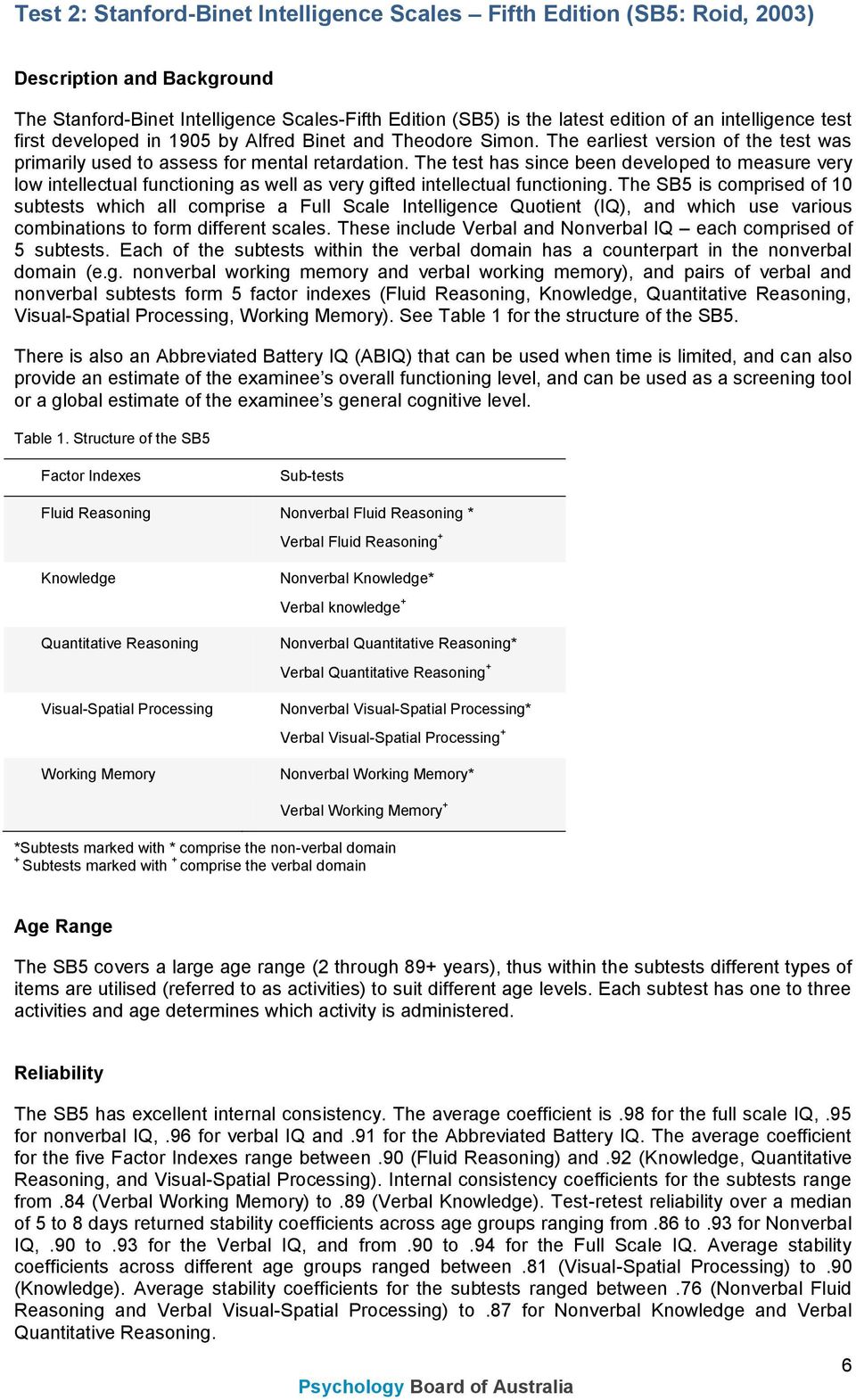
6 Test 2: Stanford-Binet Intelligence Scales Fifth Edition (SB5: Roid, 2003) Description and Background The Stanford-Binet Intelligence Scales-Fifth Edition (SB5) is the latest edition of an intelligence test first developed in 1905 by Alfred Binet and Theodore Simon. The earliest version of the test was primarily used to assess for mental retardation. The test has since been developed to measure very low intellectual functioning as well as very gifted intellectual functioning. The SB5 is comprised of 10 subtests which all comprise a Full Scale Intelligence Quotient (IQ), and which use various combinations to form different scales. These include Verbal and Nonverbal IQ each comprised of 5 subtests. Each of the subtests within the verbal domain has a counterpart in the nonverbal domain (e.g. nonverbal working memory and verbal working memory), and pairs of verbal and nonverbal subtests form 5 factor indexes (Fluid Reasoning, Knowledge, Quantitative Reasoning, Visual-Spatial Processing, Working Memory). See Table 1 for the structure of the SB5. There is also an Abbreviated Battery IQ (ABIQ) that can be used when time is limited, and can also provide an estimate of the examinee s overall functioning level, and can be used as a screening tool or a global estimate of the examinee s general cognitive level. Table 1. Structure of the SB5 Factor Indexes Sub-tests Fluid Reasoning Nonverbal Fluid Reasoning * Verbal Fluid Reasoning + Knowledge Quantitative Reasoning Visual-Spatial Processing Working Memory Nonverbal Knowledge* Verbal knowledge + Nonverbal Quantitative Reasoning* Verbal Quantitative Reasoning + Nonverbal Visual-Spatial Processing* Verbal Visual-Spatial Processing + Nonverbal Working Memory* Verbal Working Memory + *Subtests marked with * comprise the non-verbal domain + Subtests marked with + comprise the verbal domain Age Range The SB5 covers a large age range (2 through 89+ years), thus within the subtests different types of items are utilised (referred to as activities) to suit different age levels. Each subtest has one to three activities and age determines which activity is administered. Reliability The SB5 has excellent internal consistency. The average coefficient is.98 for the full scale IQ,.95 for nonverbal IQ,.96 for verbal IQ and.91 for the Abbreviated Battery IQ. The average coefficient for the five Factor Indexes range between.90 (Fluid Reasoning) and.92 (Knowledge, Quantitative Reasoning, and Visual-Spatial Processing). Internal consistency coefficients for the subtests range from.84 (Verbal Working Memory) to.89 (Verbal Knowledge). Test-retest reliability over a median of 5 to 8 days returned stability coefficients across age groups ranging from.86 to.93 for Nonverbal IQ,.90 to.93 for the Verbal IQ, and from.90 to.94 for the Full Scale IQ. Average stability coefficients across different age groups ranged between.81 (Visual-Spatial Processing) to.90 (Knowledge). Average stability coefficients for the subtests ranged between.76 (Nonverbal Fluid Reasoning and Verbal Visual-Spatial Processing) to.87 for Nonverbal Knowledge and Verbal Quantitative Reasoning. 6
7 Validity Several studies have explored the concurrent validity of the SB5. The median correlation between the Full Scale IQ of the SB5 and other measures of intelligence (i.e. WISC-III, WAIS-III, WPPSI-R, WJ-III, WIAT-II) is r =.84. Administration The SB5 is used in several contexts and for different purposes (i.e. clinical and neuropsychological assessment, educational placement, compensation evaluations, career assessment, adult neuropsychological treatment, forensics, and research on aptitude). The Full Scale Battery normally takes minutes to administer, and the ABIQ up to minutes. Testing takes place in a standardised and quiet environment. The examiner sits adjacent to the examinee, and shields the record form by the item presentation book. The record form is filled out by the examiner and in paper and pencil form. The publisher of the SB5 utilises the American Psychological Association s Guidelines on Test User Qualifications to screen individuals who wish to purchase the test (APA, 2001). To purchase in Australia, test users must be a registered psychologist or a provisional psychologist under the supervision of a registered psychologist (ACER Australia). Scoring and interpretation The SB5 is a standardised test that can be hand or computer scored. Raw scores for subtests are converted into scaled scores (M = 10, SD = 3), and normalised standard scores are computed for the Full Scale, Nonverbal and Verbal IQ, and the five factor indexes (M = 100, SD = 15). The instrument has been standardised with sample of 4800 individuals selected to represent the population in the United States during the early twenty-first century. The SB5 does provide labels for categories of the IQ scores (see Table 2), but indicates that the dividing points between categories are arbitrary. Table 2. Categories of IQ Scores for the SB5 Factor Indexes Sub-tests Very gifted or highly advanced Gifted or very advances Superior High average Average Low average Borderline impaired or delayed Mildly impaired or delayed Moderately impaired or delayed Australian Norms The SB5 does not have Australian norms. Test Availability The SB5 test kit (including an Australian adaptation pack) is available from ACER Psychology and Psychological Assessments Australia. 7

8 References American Psychological Association (2001). Report of the Taskforce on Test User Qualifications. Washington, DC: Author. Roid, G.H. (2003). Stanford-Binet Intelligence Scales, Fifth Edition. Itasca, IL: Riverside Publishing. Sattler, J.M. (2008). Assessment of children: Cognitive foundations (5 th ed.). Jermone M. Sattler, Publisher: California. 8

9 Test 3: Kaufman Adolescent and Adult Intelligence Test (KAIT: Kaufman & Kaufman, 1993) Background and Purpose The Kaufman Adolescent and Adult Intelligence Test (KAIT) is a test of intelligence. It is underpinned by an integration of three developmental models of intelligence: Horn and Cattell s theory of fluid and crystallised intelligence (Horn & Cattell, 1966); (b) the Luria-Golden definition on planning ability (Golden, 1981; Luria, 1980); and (c) Piaget s stage of formal operations (Piaget, 1972). The core battery of the KAIT comprises six subtests, which are used to generate three Intelligence Quotients (Crystallised, Fluid and Composite Intelligence). The expanded battery includes the six core subtests and four additional subtests. See the Table below for the KAIT subtests and description of the construct it measures. The KAIT also includes an optional mental status subtest that measures orientation and attention. Table. KAIT sub-tests Core Battery Expanded Battery Subtest What does it measure? Subtest What does it measure? Definitions* Measures word knowledge and verbal concept formation Famous Faces Measures the fund of acquired information Auditory Comprehension* Measures understanding and comprehension of oral information Memory for Block Designs Measures the ability to construct geometric designs from memory Double Meanings* Measures the ability to find a word, given two clues for each of two distinct meanings Rebus Delayed Recall Measures memory for previously learned visual information Rebus Learning^ Measures the ability to learn and apply new information Auditory Delayed Recall Measures memory for previously learned auditory information Logical Steps^ Measures logical reasoning and application of logical relationships to solve problems Mystery Codes^ Measures the ability to detect logical relationships and apply them to novel problems *Used to generate crystallised intelligence quotient ^Used to generate fluid intelligence quotient Age Range The KAIT is test of intelligence for persons aged between 11 and 85 years and over. Reliability Test-retest reliability for the three IQ scales is good. Over a test-retest interval ranging between 6 and 99 days (M = 31 days), average stability coefficients for the crystallised, fluid and composite intelligence quotients were.87,.94 and.94, respectively. Mean stability coefficients for the six core subtests ranges from.72 to.95, with a mean of.80. Split-half method for internal consistency generated internal consistency reliability coefficients of.95 for both crystallised and fluid intelligence and.97 for composite intelligence. The six core subtests also demonstrate good internal consistency, with ranging between.87 and.93. 9

10 Validity Concurrent validity is adequate, evidenced by correlations of the Composite Intelligence Quotient and other measures of intelligence (range.63 to.95). The KAIT also demonstrates adequate construct validity with tests such as WISC-R, WAIS-R, and K-ABC. Exploratory and confirmatory factor analytic studies support the two main domains of intelligence (crystallised and fluid) underpinning the development of the instrument. Administration The KAIT core subtests take about 1 hour to administer and the additional subtests take an additional 30 minutes. The KAIT is a standardised test and must be administered in accordance with procedures outlined in the test manual (Kaufman & Kaufman, 1993). The test is administered individually as a structured interview. The KAIT subtests are arranged in two easels in the order of standard administration. The easels let the examiner see the test directions and scoring key on one side while the individual sees the item stimulus on the other side. The examiner must position themselves either adjacent or opposite keeping the individual record form behind the test easel. KAIT examiners must have professional training in individual assessment. They are expected to understand theory and research in areas such as child development, tests and measurement, cognitive psychology, educational psychology and neuropsychology. They also should have supervised experience in clinical observation of behaviour and formal graduate-level training in individual intellectual assessment (Kaufman & Kaufman, 1993). Scoring and interpretation Raw scores are converted to scaled scores for the 10 subtests (M = 10, SD = 3), and to standard scores (IQs) for the fluid and crystallised scales and for the composite intelligence scale derived from age based norms (M = 100, SD = 15). The test manual offers descriptive categories for IQ scores (upper extreme, well above average, above average, average, below average, well below average, lower extreme,-mild deficit, lower extreme-moderate deficit). Qualitative descriptors for the mental status subtest are provided in the test manual. Australian norms The KAIT does not have any Australian norms. Test Availability The complete KAIT kit is available from Pearson Clinical Assessment (Australia & New Zealand). References Horn, J.L., & Cattell, R.B. (1966). Refinement and test of the theory of fluid and crystallized general intelligences. Journal of Educational Psychology, 57, Golden, C.J. (1981). The Luria-Nebraska Children s Battery: Theory and formulation. In G.W. Hynd & J.E. Obrzut (Eds), Neuropsychological assessment and the school-age child: issues and procedures. (pp ). New York: Grune & Stratton. Kaufman, A.S., & Kaufman, N.L. (1993). Kaufman Adolescent & Adult Intelligence Test. Circle Pines. MN: American Guidance Service Luria, A.R. (1980). Higher cortical functions in man (2 nd ed.). New York: Basic Books. Piaget, J. (1972). Intellectual evolution from adolescence to adulthood. Human Development, 15,

11 Test 4: Wechsler Abbreviated Scale of Intelligence (WASI) and WASI II (no Australian norms) Background and Description The Wechsler Abbreviated Scale of Intelligence (WASI) was developed as a short and reliable measure of intelligence for use in clinical, psycho-educational and research settings. The WASI is comprised of four subtests (Vocabulary, Block Design, Similarities, and Matrix Reasoning) that are similar to their counterparts in the WISC III and WAIS III. The four subtests combine to make the Full Scale IQ (FISQ-4). The Vocabulary and Similarities subtests combine to make a Verbal IQ (VIQ), and the Block Design and Matrix Reasoning the Performance IQ (PIQ). The subtests Vocabulary and Matrix Reasoning can also be combined to comprise another Full Scale IQ (FISQ- 2). The four subtests were chosen for their strong association with general cognitive abilities and their relationship to the constructs of intelligence, such as the verbal and performance, and crystallised and fluid dichotomies. The Table below provides a description of each subscale. The WASI can be used for differentiating individuals who are gifted or those with mental retardation, as well as individuals whose intelligence falls within the normal range. The WASI is not a substitute for the WISC or WAIS, but can be used as an effective screener to determine the need for more comprehensive assessment. Table. IQ and subtest structure of the WASI IQ Subtest What does it measure? Verbal Vocabulary Expressive vocabulary, verbal knowledge, and fund of information Similarities Verbal concept formation, abstract verbal reasoning ability, and general intellectual ability Performance Block Design Perceptual organisation and general intelligence Matrix Reasoning Nonverbal fluid reasoning and general intellectual ability The WASI II is also available, however does not have Australian norms. The WASI II includes revisions to instructions in order to make them more streamlined and shorter, and to enhance the link to the WISC IV and WAIS IV. Specifically, the WASI II subtests can be used as substitutes in the WISC IV and WAIS IV. Age Range The WASI is intended for use with individual s aged 6 through 89 years. Reliability The WASI has adequate reliability. The average internal consistency reliability for the FSIQ-4 and FISQ-2 for children aged 6 through 16 is.96 and.93 respectively, and.93 and.94 for the VIQ and PIQ, respectively. In the adult sample, average internal consistency reliability coefficients for the FSIQ-4 and FSIQ-2 are.98 and.96 respectively, and.96 for both the VIQ and PIQ. Average internal consistency reliabilities for the subtests are satisfactory in both samples, ranging from.87 (Similarities) and.92 (Matrix Reasoning) for the children s sample, and from.92 (Similarities and Block Design) and.94 (Vocabulary and Matrix Reasoning). Test-retest reliability was evaluated over a period of 2 to 12 weeks (M = 31 days) in a sample of 222 (116 children and 106 adults). Stability coefficients for the children sample were.93 for the FISQ-4,.85 for the FISQ-2,.92 for the VIQ and.88 for the PIQ. Subtest stability coefficients ranged between.77 (Matrix Reasoning) and.86 (Similarities). Stability coefficients for the adult sample were.92 for 11

12 the FSIQ-4,.88 for the FISQ-2,.92 for the VIQ and.87 for the PIQ. Subtest stability coefficients ranged between.79 (Matrix Reasoning) and.90 (Vocabulary). Validity The WASI has acceptable correlations with various measures of intelligence (WISC-III =.87, and WAIS-III =.92), ability and achievement. Administration The WASI is individually administered, standardised test. It takes approximately 30 minutes to administer all four subtests, and 15 minutes for the two-subtest form. Like many of the Wechsler tests, the WASI has several start, reverse, discontinue and stop rules. The specific rule however, varies according to age group. For example, the stop rule for the similarities subtest for children aged 6-8 is after 20 items, after 24 for children aged 9-11, and there is no stop rule for older individuals. The WASI is a standardised test and requires standardised testing conditions. Testing should take place in a quiet, well-lit room and free from interruption. Assessors should read test instructions verbatim from the administration booklet. The assessor records the participants responses on a paper form. There is only one form across the age range. Persons who have completed formal graduate or professional level training in psychological assessment can administer the WASI. Other professionals may also administer the WASI, including those with a Bachelor s degree in psychology, education, counselling, speech therapy, and occupational therapy however results can only be interpreted by someone who has training in psychological assessment. Scoring and interpretation The WASI standardisation sample is 2245 (1100 children and 1145 adults aged 17 to 89) children and adults in the US representative of the US population in the late 1990 s. To score, the WASI subtest raw scores are converted to T scores, which in turn are used to calculate the WASI IQ scores. For each scale (Verbal, Performance, Full Scale), the distribution of sums of the T scores are converted to a scale with a mean of 100 and SD of 15. The WASI manual provides tables for estimating IQ scores ranges on the WISC III and WAIS III, and are similarly categorised as Very Superior, Superior, High Average, Average, Low Average, Borderline or Extremely Low. Based on the standardisation sample, the manual also provided age equivalents and percentile ranks for IQ and subtest scores. Test Availability The WASI is no longer available through Pearson Clinical Assessment (Australia and New Zealand) as the WASI II has been released. WASI record form can still be obtained separately. The complete WASI II kit is available through the same distributor. References Wechsler, D. (1999). Wechsler Abbreviated Scale of Intelligence: Manual. U.S.A. The Psychological Corporation. Sattler, J.M. (2008). Assessment of Children: Cognitive Foundations. Dan Diego, Jerome M. Sattler, Publisher, Inc. 12

13 Test 5: Woodcock-Johnson III Tests of Cognitive Abilities (Woodcock, McGrew, & Mather, 2001) Description and Background The Woodcock-Johnson III Tests of Cognitive Abilities (WJ III COG) were first developed in 1977, and has since been revised in 1989 and again in The latter is the third and current version of the tests. The tests were developed based on the theories of Raymond B. Cattell, John Horn and John B. Carroll s about the structure of intelligence (CHC theory: Schneider & McGrew, 2012). The standard battery is comprised of 10 tests, and the extended of 20 tests (10 tests in the standard battery plus 10 extended tests). The tests cover the seven clusters outlined in the CHC model. See the Table below for WJ III COG tests and description of the construct it measures. Table. WJ III COG tests Standard Battery Extended Battery Subtest What does it measure? Subtest What does it measure? Verbal Comprehension* Word knowledge General Information* Acquired knowledge Visual-Auditory Learning* Meaningful memory Retrieval Fluency* Ideational fluency Spatial Relations* Visual-spatial ability Picture Recognition* Visual recognition memory Sound Blending* Ability to synthesise sounds Auditory Attention* Auditory discrimination Concept Formation* Inductive and fluid reasoning Analysis-Synthesis* General sequential reasoning Visual Matching* Visual perceptual speed Decision Speed* Reasoning speed Numbers Reversed* Short-term auditory memory Memory for Words* Short-term auditory memory Incomplete Words Auditory analysis and auditory closure Rapid Picture Naming Cognitive fluency Auditory Working Memory Short-term auditory memory span Planning Sequential reasoning Visual-Auditory Learning- Delayed Delayed Recall Pair Cancellation Sustained attention and concentration *Test is included in the General Intellectual Ability (GIA) Score Age Range The WJ III COG is designed for use on participants aged anywhere between 2 through 90 + years. Reliability Stability coefficients have only been reported for 5 of the 20 WJ III COG tests: Incomplete Words, Concept Formation, Analysis-Synthesis, Visual Matching, and Memory for Words. In a study of 1196 individuals across four age groups (2-7, 8-18, 19-44, 45-95), stability coefficients of.71 (Memory for Words) to.86 (Visual Memory) were reported for a test-retest interval of less than one year (Woodcock et al., 2007). No mean or median test-retest interval was reported. The WJ III COG has satisfactory internal consistency (Woodcock et al.). The internal consistency reliability coefficients for the GIA standard and extended are.97 and.98 respectively, and the internal consistency reliability coefficients for the 20 WJ III COG tests range between.76 to

14 Validity Concurrent validity is satisfactory, evidenced by correlations of the GIA and other measures of intelligence (range.62 to.76). The WJ III COG also demonstrates construct validity Woodcock et al., 2007). Factor analytic studies support the underpinning Cattell Horn and Carroll model, and correlations between related clusters are higher than correlations between unrelated clusters. Administration The WJ III COG is administered individually, and must be administered by a registered psychologist with post-graduate training. The tests may be administered by a registered psychologist with no post-graduate training, however in this instance they must have attended suitable training programs in test administration and interpretation. The standard battery of tests takes about 40 minutes to administer and the extended can take up to about 2 hours (Sattler, 2008). The tests include a combination of one-on-one interviewing and paper and pencil tasks. Scoring and interpretation The WJ III COG is a standardised test and is scored electronically, using the software package provided with the test kit. The scoring software provides standard scores for each test (M = 100, SD = 15), with possible scores ranging between 1 and 200, as well as percentile ranks, age equivalents, grade equivalents, instructional ranges, and discrepancy scores. A Relative Profile Index (RPI) and an overall General Intellectual Ability (GIA) score are also provided. The RPI is a criterion-referenced measure, providing information about the relative ease or difficulty the individual is likely to encounter with age-level tasks. The GIA for the standard battery is formed by scores on 7 of the 10 tests: Verbal Comprehension, Visual-Auditory Learning, Spatial Relations, Sound Blending, Concept Formation, Visual Matching, and Numbers Reversed. For the extended battery, the GIA is formed by the 7 listed above, as well as 7 from the extended battery: General Information, Retrieval Fluency, Picture Recognition, Auditory Attention, Analysis-Synthesis, Decision Speed, and Memory for Words. Each of the tests that comprise the GIA is weighted, and the weights differ across age groups. Verbal Comprehension is weighted the highest at every age level. The U.S normative sample for the WJ III COG was updated in 2007 to reflect the 2005 U.S Census data (Woodcock, McGrew, & Schenk, 2007). Australian norms An Australian normative study was carried out in 2009 on a normative sample of Psychological Assessments Australia released an Australian Adaptation of the Woodcock-Johnson III in The Australian norms have been incorporated in this package. Test Availability The Cognitive Abilities battery of the WJ III (Australian Adaptation) is available from Psychological Assessments Australia. References Sattler, J.M. (2008). Assessment of children: Cognitive foundations (5 th ed.). Jerome M. Sattler, Publisher: California. Schneider, W.J., & McGrew, K.S. (2012). The Cattell-Horn-Carroll model of intelligence, in D. P. Flanagan & P.L. Harrison, Contemporary intellectual assessment: Theories, tests, and issues (third edition) (pp ). The Guilford Press: New York. Woodcock, R.W., McGrew, K.S., & Mather, N. (2001). The Woodcock-Johnson III. Itasca, IL: Riverside Woodcock, R.W., McGrew, K.S., & Schenk, F.A. (2007). Woodcock-Johnson III Normative Update Technical Manual. Itasca: Riverside. 14

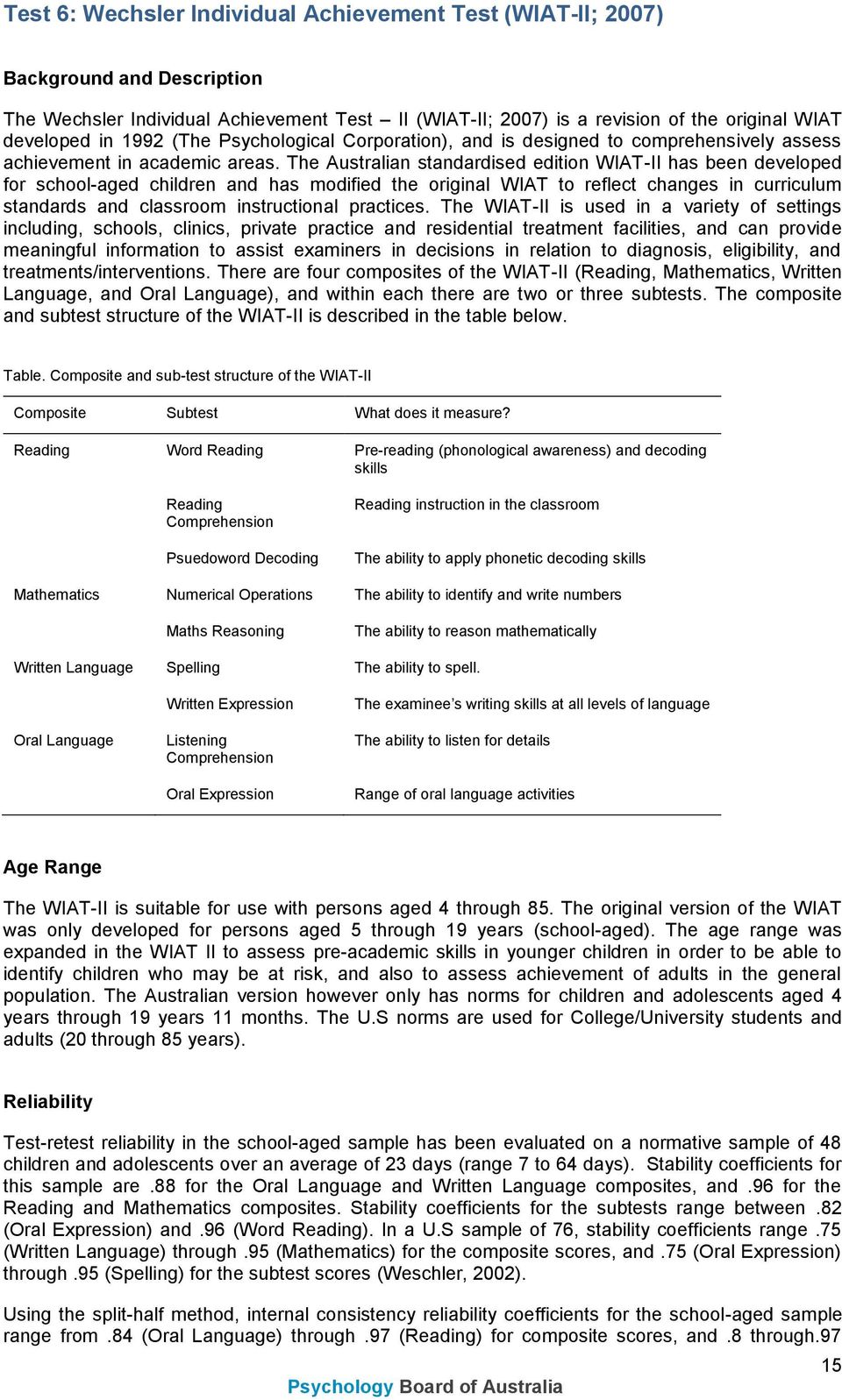
15 Test 6: Wechsler Individual Achievement Test (WIAT-II; 2007) Background and Description The Wechsler Individual Achievement Test II (WIAT-II; 2007) is a revision of the original WIAT developed in 1992 (The Psychological Corporation), and is designed to comprehensively assess achievement in academic areas. The Australian standardised edition WIAT-II has been developed for school-aged children and has modified the original WIAT to reflect changes in curriculum standards and classroom instructional practices. The WIAT-II is used in a variety of settings including, schools, clinics, private practice and residential treatment facilities, and can provide meaningful information to assist examiners in decisions in relation to diagnosis, eligibility, and treatments/interventions. There are four composites of the WIAT-II (Reading, Mathematics, Written Language, and Oral Language), and within each there are two or three subtests. The composite and subtest structure of the WIAT-II is described in the table below. Table. Composite and sub-test structure of the WIAT-II Composite Subtest What does it measure? Reading Word Reading Pre-reading (phonological awareness) and decoding skills Reading Comprehension Psuedoword Decoding Reading instruction in the classroom The ability to apply phonetic decoding skills Mathematics Numerical Operations The ability to identify and write numbers Maths Reasoning The ability to reason mathematically Written Language Spelling The ability to spell. Oral Language Written Expression Listening Comprehension Oral Expression The examinee s writing skills at all levels of language The ability to listen for details Range of oral language activities Age Range The WIAT-II is suitable for use with persons aged 4 through 85. The original version of the WIAT was only developed for persons aged 5 through 19 years (school-aged). The age range was expanded in the WIAT II to assess pre-academic skills in younger children in order to be able to identify children who may be at risk, and also to assess achievement of adults in the general population. The Australian version however only has norms for children and adolescents aged 4 years through 19 years 11 months. The U.S norms are used for College/University students and adults (20 through 85 years). Reliability Test-retest reliability in the school-aged sample has been evaluated on a normative sample of 48 children and adolescents over an average of 23 days (range 7 to 64 days). Stability coefficients for this sample are.88 for the Oral Language and Written Language composites, and.96 for the Reading and Mathematics composites. Stability coefficients for the subtests range between.82 (Oral Expression) and.96 (Word Reading). In a U.S sample of 76, stability coefficients range.75 (Written Language) through.95 (Mathematics) for the composite scores, and.75 (Oral Expression) through.95 (Spelling) for the subtest scores (Weschler, 2002). Using the split-half method, internal consistency reliability coefficients for the school-aged sample range from.84 (Oral Language) through.97 (Reading) for composite scores, and.8 through.97 15
16 (Word Reading) for the subtest scores. For the U.S based college students and adult sample, internal consistency reliability coefficients range from.88 (Oral Language) and.98 (Reading) for the composite scores, and.75 through.96 for the subtest scores (Weschler, 2002). Validity The WIAT-II Australian edition demonstrates concurrent validity. Investigations of correlations between WIAT-II subtest and full scale scores with other measures of intelligence and ability tests (eg. WISC-IV, WAIS-III, Differential Ability Scales, Wide Range Reading Achievement Test, PAL- RW, Peabody Picture Vocabulary Test) have demonstrated adequate validity. Administration The WIAT-II is individually administered through structured interview in a quiet, well-lit and well ventilated room, with examinee and examiner sitting opposite or adjacent from one another and the stimulus book between them. Instructions are delivered to the examinee verbatim as printed on the examiner s pages of the stimulus booklet. The responses are recorded by the examiner on the WIAT-II record form. Participants are required to respond on paper for some items. The WIAT-II can be used as a whole battery, or can be used to assess certain aspects of achievement. Administration time depends on the number of subtests being administered and on the age of the examinee. The full battery takes approximately 45 minutes for children of Preschool/Kindergarten age, 90 minutes for children who are in school year levels 1 through 6, and 1.5 hours for persons in year 7 and above. Professionals who have knowledge and training in psychological and/or educational testing and the use of individually administered instruments are qualified to administer and interpret the results of the WIAT-II. Scoring and interpretation Interpretation of scores on the WIAT-II Australian edition is based on a standardisation sample of 1261 children, adolescents and young adults who were representative of the Australian population according to 2001 census data. The norms on the WIAT II Australian were established on the basis of standard administration and scoring procedures under uniform testing conditions. Total subtest raw scores are converted to scaled scores using tables of scores in the scoring and normative supplement, and based year or age. Standard subtest scores are then converted to standard composite scores using the supplemental score conversion worksheets or using a purposefully designed software package that is available for purchase with the test. Normative standard scores are provided by age and year-level, and can be categorised as Very Superior, Superior, High Average, Average, Low Average, Borderline, or Extremely Low. Test Availability The WIAT II Australian complete kit is available from Pearson Clinical Assessment (Australia and New Zealand). References Wechsler, D. (2002). Wechsler Individual Achievement Test Second Edition: Australian Standardised Edition. Sydney, Australia: PsychCorp. Wechsler, D. (2002). Scoring and normative supplement for pre-school-year 12. Australia: PsychCorp. Sydney, Wechsler, D. (2002). Supplement for college students and adults. PsychCorp. Sydney, Australia: 16

17 Test 7: Adaptive Behavior Assessment System ABAS and ABAS Second Edition (Harrison & Oakland, 2003) Background and Description The Adaptive Behavior Assessment System and ABAS Second Edition (ABAS-II) is designed to measure the adaptive behaviour skills of individuals of all ages, and has been designed particularly for use with persons who have intellectual disabilities and those with other difficulties, disabilities and disorders that interfere with daily functioning. The ABAS is often used for diagnosis and classification of disabilities, and for evaluating and monitoring individual s progress over time. Common settings for use of the ABAS include settings and agencies that provide services to children (e.g. schools, community agencies, day care programs etc) and adults (e.g. community programs, vocational and occupational training facilities, prisons etc). The ABAS-II covers 10 adaptive skills proposed by the American Association of Mental Retardation (AAMR). Functioning on each skill area can be evaluated, as well as General Adaptive Skills. There are several forms in the ABAS-II: Adult Form, Parent/Primary Caregiver Form (Ages 0 5), Parent Form (Ages 5-21), Teacher/Daycare Provider Form (ages 2 5), and the Teacher Form (Ages 5 21). Age Range The ABAS-II can be used in the assessment of persons aged between 0 and 89. The different forms are used to assess adaptive skills across the age groups. Reliability The ABAS-II has adequate internal consistency and test-retest reliability. Internal consistency reliability coefficients for the General Adaptive Composite (GAC) is.99 for the Teacher Form, and both Adult Forms (self and other), and.98 for the Parent Form. Coefficients for the 10 adaptive skills areas range between.89 and.96 for the Teacher Form,.86 to.93 for the Parent Form,.88 to.94 for the Adult Form (self), and.93 and.97 for the Adult Form (others). Stability coefficients of the GAC for a sample of 143 children over 11 days are.97 for the Teacher Form and Adult Form (others),.96 for the Parent Form and.99 for the Adult Form (self). In the same sample, stability coefficients for the adaptive skills areas range between.88 and.97 for the Teacher Form,.79 and.96 for the Parent Form,.91 to.97 for the Adult Form (self), and.86 to.96 for the Adult Form (others). Validity The ABAS-II is able to differentiate between different clinical groups, and has demonstrated concurrent validity. The correlation between the GAC and the Vineland Adaptive Behaviour Scale Classroom Edition Composite is.82. Further, correlations between.56 and.79 have been reported for the GAC and the Wechsler Individual Achievement Test (WIAT), and between.42 and.55 for the GAC and other measures of intelligence. Administration Each of the forms take approximately 15 to 20 minutes to complete, and are completed in paper and pencil format. The Teacher s Form is completed by either the child s teacher or a teacher s aide and the Parent Form by the parent or primary caregiver. The Adult Form (other) is completed by a family member or other adults familiar with the referred individual and the Adult Form (self) by the referred individual if they have adequate reading comprehension. To be qualified in the administration of the ABAS-II, users must be trained in the basic principles of psychological and educational assessment and test interpretation, the strengths and limitations of tests, and the use of assessment in data-based decision. 17

18 Scoring and interpretation Each form is scored the same. Each item is rated on a 4 point scale (0 = is not able, 1 = never when needed, 2 = sometimes when needed, 3 = always when needed). Raw scores are converted into standard scores for the 10 adaptive skill areas (M = 10, SD = 3), to a General Adaptive Composite (GAC) for the total score (M = 100, SD = 15), and to age equivalent scores. The manual provides confidence intervals and percentile ranks for the GAC. Classifications are used for the adaptive skill areas and the GAC: Extremely Low, Borderline, Below Average, Average, Above Average, and Superior. The ABAS-II can also be scored and a report generated using a software package. Table. ABAS adaptive skills areas. Adaptive Skill Area Communication Community Use Functional Academics Home/School Living Health and Safety Leisure Self-Care Self-Direction Social Work Description Speech, language, and listening skills needed for communication with other people. Skills needed for functioning in the community (eg. Shopping skills, getting around the community). Basic reading, writing and other academic skills needed for daily, independent functioning. Skills needed for the basic care of the home or living setting (eg. Cleaning, property maintenance and food preparation). Skills needed for protection of health and to respond to illness and injury. Skills needed for engaging in and planning leisure and recreational activities. Skills needed for personal care (e.g. eating, bathing, grooming) Skills needed for independence, responsibility, and self-control (e.g. following directions, making choices). Skills needed to interact socially and to get along with other people (e.g. Showing and recognising emotions, using manners) Skills needed for successful functioning in holding a job in a work setting. *Included in the Adult Forms and Parent Form (for ages 5-21) and only completed when the individuals have a part or fulltime job. + Included in the Teacher/Daycare Provider and Parent/Primary Caregiver Forms. The ABAS-II is a standardised test, normed on a sample of 5270 individuals representative of the US population (US Census 1999). The standardisation sample for the Parent/Primary Caregiver and Teacher/Daycare Provider Forms for children ages birth to 5 years comprised of 2100 individuals. Australian Norms This test does not have Australian norms. Test Availability The ABAS-II Examination kit is available from ACER, Pearson Clinical Assessment (Australia and New Zealand) and Psychological Assessments Australia. References Harrison, P.L., & Oakland, T. (2010). Adaptive behaviour Assessment System Second Edition: Manual. Los Angeles, CA: Western Psychological Services Sattler, J.M. (2002). Assessment of children: Behavioural and Clinical Applications Fourth Edition. La Mesa, CA: Sattler Publishing 18

19 Test 8: Wechsler Memory Scale IV, Fourth Edition (2009) Description and Background The WMS-IV has been designed to assess various memory and working memory abilities. As a revised version of the WMS-III, the WMS-IV now also includes a brief evaluation of cognitive status. Similarly, the WMS-IV provides two batteries: the Adult Battery and the Older Adults Battery. The latter has a reduced number of subtests in order to reduce administration time. See Table 1. The Adult Battery is comprised of seven subtests: three that were retained from the WMS-III (Logical Memory, Verbal Paired Associates, and Visual Reproduction), and four new ones (Brief Cognitive Status Exam, Designs, Spatial Addition, and Symbol Span). Four of the subtests include a delayed memory condition that is administered minutes following. See Table 1. Six primary subtests are used to generate five index scores: (1) Auditory Memory and (2) Visual Memory, (3) Visual Working Memory, (4) Immediate Memory, and (5) Delayed Memory. See Table 2 for description of each and the subtests that comprise them. The Brief Cognitive Status Exam is considered optional, and is used to gain additional or supplementary information about cognitive functioning. The WMS-IV is used by psychologists in a variety of settings (including psychiatric, education, forensic, counselling, neuropsychological, rehabilitation etc) and is generally used to provide comprehensive assessment of clinically relevant aspects of memory functioning. Age Range The WMS-IV has been designed for use with persons aged between 16 and 90. The Adult Battery is designed for use with people aged between 16 and 69, and the Older Adult Battery for persons aged between 65 and 90. Table 1. WMS-IV Subtests Subtest Brief Cognitive Status Exam + Logical Memory I + Logical Memory II* + Verbal Paired Associates I + Verbal Paired Associates II* + Designs I Designs II* Visual Reproduction I + Visual Reproduction II* + Spatial Addition Symbol Span + What does it assess? A variety of cognitive functions (orientation to time, mental control, clock drawing, incidental recall, automaticity and inhibitory control) Narrative memory under a free recall condition. Long-term narrative memory with free recall and recognition tasks. Verbal memory for associated word pairs. Long term recall for verbally paired information with cued recall and recognition tasks. Spatial memory for unfamiliar visual material. Long-term spatial and visual memory with free recall and recognition tasks. Memory for nonverbal visual stimuli Long-term visual-spatial memory with free recall and recognition. Visual-spatial working memory using a visual addition task Visual working memory using novel visual stimuli. *indicates delayed condition for respective subtest + indicates the subtests available in the older adult battery 19

20 Table 2. WMS-IV Index Scores and Subtests that comprise them Index Description Subtests Auditory Memory Visual Memory Visual Working Memory* Immediate Memory Delayed Memory Ability to remember orally presented information. Ability to remember visually-presented information Capacity to remember and manipulate visually presented information in short-term memory storage Ability to remember both visually- and orallypresented information immediately after it is presented. Ability to remember both visually- and orallypresented information after a minute delay. Logical Memory I and II, and Paired Verbal Associates I and II. Designs I and II, and Visual Reproduction I and II Spatial Addition and Symbol Span Logical Memory I, Verbal Paired Associates I, Designs I, and Visual Reproduction I Logical Memory II, Verbal Paired Associates II, Designs II, and Visual Reproduction II *Note: Visual Working Memory Index is not available in the older battery. Reliability The WMS-IV has demonstrated good reliability. Average internal consistency reliability coefficients for Index scores range between.93 (Visual Working Memory Index) and.96 (Visual Memory Index) for the Adult Battery, and between.92 (Delayed Memory) and.97 (Visual Memory) for the Older Adult Battery. Average internal consistency reliability coefficients for the subtests range between.82 (Logical Memory I) and.97 (Visual Reproduction II) for the Adult Battery, and between.74 (Verbal Paired Associates) and.96 (Visual Reproduction II) for the Older Adult Battery. Test-retest reliability coefficients over an average test-retest interval of 23 days (range 14 to 84 days) for the index scores range between.81 (Visual Memory and Delayed Memory Indexes) and.83 (Auditory Memory and Visual Working Memory Indexes), and between.80 (Visual Memory Index) and.87 (Auditory Memory Index) for the Older Adult Battery. Over the same test-retest interval, stability coefficients for subtests range between.64 (Visual Reproduction II) and.77 (Designs II and Spatial Addition) for the Adult Battery, and between.69 (Visual Reproduction II) and.81 (Verbal Paired Associates II) for the Older Adult Battery. Validity The WMS-IV has demonstrated evidence of concurrent validity with other measures of memory, cognitive and intellectual ability, neuropsychological status, achievement, activities of daily life, and behavioural symptoms (Wechsler, 2009b). Administration The WMS-IV is an individually-administered semi-structured interview. It is recommended the interview is carried out well lit and quiet room that is free from distractions, and the examinee and examiner should sit directly opposite one another. The WMS-IV is a standardised test and subtests must be administered as ordered on the record form. Depending on ability, as well as medical and personality factors, most persons are able to complete the full battery (Adult Version) in less than 2 hours, though it is generally completed in minutes. The examiner records responses and observations on the record form and participant response booklets are used the Brief Cognitive Status Exam and the Visual Reproduction subtests. Users of the WMS-IV must have graduate level training and experience in the administration and interpretation of standardised clinical instruments. 20

21 Scoring and interpretation The WMS-IV is a standardised test based on a normative sample of 1400 individuals representative of the U.S population, based on 2005 U.S. Census data. The WMS-IV can be scored either by hand on the record form or electronically using an optional software package. Subtest raw scores are converted to scaled scores. The sums of scaled scores are then used to derive the index scores which have a mean of 100 and standard deviation of 15. Percentile ranks and confidence intervals for scaled subtest scores and index scores are provided in the Administration and Scoring Manual (Wechsler, 2009a). Test Availability The Australian Language Adapted Edition of the WMS-IV Complete Kit is available from Pearson Clinical Assessment (Australia and New Zealand). References Wechsler, D. (2009a). Wechsler Memory Scale, Fourth Edition: Administration and scoring manual. Sydney: Pearson Wechsler, D. (2009b). Wechsler Memory Scale, Fourth Edition: Technical and interpretive manual. Sydney: Pearson 21
22 Test 9: Wide Range Assessment of Memory and Learning Second Edition Description and Background The Wide Range Assessment of Learning, second Edition (WRAML2) is designed to assess memory functioning. Specifically, it assesses immediate and/or delayed recall as well as the differentiation between verbal, visual and more global memory deficits. The WRAML2 is comprised of six core subtests that yield three index scores: Verbal Memory Index, Visual Memory Index, and Attention/Concentration Index. The three indexes combine to form a General Memory Index. There are also several optional subtests of the WRAML, which can be used to provide an extended assessment of memory with regards to Working Memory, Verbal Recognition and Visual Recognition. The Table below provides a description of the six core subtests. A screening battery may also be administered, and is comprised of the four verbal and visual memory subtests. Table. WRAML 2 Core Subtests and Indexes Index Subtest Description^ Verbal Memory Index Story Memory* + Evaluates auditory memory of extended meaningful verbal material Verbal Learning* + Evaluates auditory memory of verbal information that is without context Visual Memory Index Design Memory* + Evaluates short-term visual retention of quasi-meaningful visual information Attention/Concentration Index *indicates core subtest ^ Adams & Reynolds, Comprise Screening Battery Picture Memory* + Finger Windows* Number/Letter* Evaluates visual memory using skill to detect changes in specific features or details within meaningful visual arrays Evaluates short-term memory of rote, visual sequential pattern. Evaluates ability to repeat sequence of orally presented numbers and letters. The WRAML is used in a variety of settings such as psychiatric, schools, rehabilitation units, vocational counselling, hospital clinics and private practice, and is often used to help understand memory deficits associated with brain injury, dementia and learning disabilities. Age Range The WRAML has been designed for use with persons aged 5 through 90 years. Reliability The WRAML2 demonstrates good internal consistency reliability. The median internal consistency reliability coefficient is.93 for the General Memory Index and Screening Memory Index, and.92,.89 and.86 for the Verbal Memory, Visual Memory and Attention Concentration Indexes, respectively. The median internal consistency coefficients for the core subtests, range between.81 (Finger Windows) and.92 (Story Memory). Test-retest reliability was based on a sample of 142 individuals, with a median interval testing time of 49 days (ranging from 14 to 401 days). Stability coefficients for the General Memory Index and Memory Screening Index are.81 and.78, respectively. For the Verbal Memory, Visual Memory and Attention/Concentration Indexes, stability coefficients are.85,.67 and.68, respectively. Finally, stability coefficients for the subtests range between.53 (Design Memory) and.78 (Verbal Learning). 22
23 Validity Correlations with other memory and learning scales such as the WMS-III, CMS, TOMAL and CVLT have demonstrated modest to good concurrent reliability. Administration The WRAML2 is an individually administered and standardised test. Core subtests must be administered in the order presented in the Manual. The interview should be conducted in a quiet, well-lit room that is free from distraction. Subtests should be administered by reading verbatim the dialogue provided in the manual. The core battery of subtests takes up to one hour to administer and the screening battery takes up to 20 minutes. The WRAML2 should only be administered by trained clinicians and/ or researchers who have experience in the administration of psychometric instruments, and who are familiar with the age group of the participant being examined. Interpretation of results however is restricted to persons with graduate level training and supervised clinical experience in the area of cognitive assessment. Scoring and interpretation The WRAML2 can be scored manually on the Examiner Form or electronically using the optional software package. Raw subtest scores are obtained by summing responses, and are subsequently converted to scaled scores. Scaled scores are converted to Index composite scores which range from 55 through 45 (M = 100, SD = 15). General Memory Index is computed based on the sum of scaled index scores, and also has a mean of 100 and standard deviation of 15. Results are interpreted based on the percentile ranks and confidence intervals for the normative sample. Test Availability The WRAML2 complete kit is available from ACER Psychology and Psychological Assessments Australia. References Adams, W., & Reynolds, C.R. (2009). Essentials of WRAML2 and TOMAL-2 Assessment. New Jersey: John Wiley & Sons. Adams, W., & Sheslow, D. (2003). Wide Range Assessment of Memory and Learning (WRAML2): Administration and Technical Manual. Wide Range Strauss, E., Sherman, E.M.S., & Spreen, O. (2006). A compendium of neuropsychological tests. Oxford University Press. 23
24 Test 10: Self Directed Search (Shears & Harvey-Beavis, 2001) Description and Background The Self Directed Search (SDS) was first developed in the early 1970 s as a career counselling tool. The instrument is used in over 25 countries and is available in English, Spanish, Vietnamese, French and Braille forms. The Australian version was originally developed in mid 1980 s, and revised in 2000, and again in 2012 to reflect changes in society in relation to work and technology. The SDS has been designed to assist individuals in making career decisions that are related to their own skills and interests. The instrument is underpinned by John Holland s theory of personality types and work environments (1973; 1997), and the instrument is based on the four working assumptions at the centre of his theory. (1) Most people can be categorised predominantly as one of six personality types: Realistic (R), Investigative (I), Artistic (A), Social (S), Enterprising (E), and Conventional (C). (2) Work environments can be categorised in terms of the same six types. Each environment is dominated by a given type of personality. (3) People tend to seek environments that correspond with their personality type. (4) Behaviour is determined by interaction between personality and environment. Based on these assumptions, individuals respond to items and they are able to generate a code that demonstrates the respondent s resemblance to the personality types. The code is used to identify congruent work occupations. The SDS assessment booklet has 5 sections: Occupational Daydreams, Activities, Competencies, Occupations, and Self-estimates. Within each of these there are items relating to each of the six personality types. Age Range The SDS is suitable for persons aged 15 years and older. The suitability for younger persons has not been well investigated. Although a form of the test has been developed for younger groups ( Career Explorer ), it has not been adapted for an Australian audience. Reliability Internal consistency for secondary and tertiary education samples is satisfactory to high. For the Activities, Competencies and Occupations scales, internal consistency reliability coefficients range between.76 to.88 for secondary school samples and.75 to.86 for tertiary samples. On the summary scales (personality types across the scales) coefficients range from.87 to.91, for both secondary and tertiary samples. Validity Concurrent validity has been assessed by comparing the incidence of agreement between the individual s high-point code (the first letter of a person s summary code), and the first letter of the code of the most recent daydream or aspiration. The percentage of occurrence was 44.6% for girls and 54.0% for boys. Administration The task is generally self-administered and scored, and can be administered in the school setting, individually or small groups. Although only the Form R has been adapted for use in Australia, three other U.S based forms exist: Form CP, Form E, and Career Explorer. Form CP was designed for professionals and adults in transition, focusing on long-term career planning and professional 24
25 activities that require a high level of education. Form E was developed for adults and adolescents with limited reading abilities, and the Career Explorer form has been designed for use with junior secondary students. The SDS is generally completed using paper and pencil however the U.S versions can also be completed online The full test takes about 50 minutes to complete. Using an assessment booklet, the individual will: list occupational aspirations; indicate preferred activities in the six areas (RIASEC); report competencies in the six areas; indicate occupational preferences in the six areas; and rate abilities in the six areas. Scoring and Interpretation The SDS is intended to be self-scored and self-interpreted. To score the SDS, an individual sums the responses for each of the personality types in the Activities, Competencies and Occupations sections, transcribes the tallies together with the ratings assigned in the Self-Estimates section, and adds the part scores to obtain a total for each of the personality types. The three highest scoring personality types combine to make the 3 letter summary code. A Summary Aspiration Code is obtained by weighting the code letters of the respondent s expressed day dreams according to their position in the three-letter code as 3, 2 or 1, and summing the results from each letter across aspirations. The Summary Aspiration Code generated demonstrates the respondents resemblance to the six personality types described by Holland. The respondent then uses this summary code to locate recommended occupational possibilities in an occupational classification booklet (the Occupations Finder ). The booklet lists over 1000 occupations, with their corresponding three letter code. The individual will identify the occupations that match or strongly resemble the occupation classification code. The SDS booklet offers suggestions to help choose and steps to help obtain the desired career. Australian norms The SDS was updated in 2012 to include 1184 of the most common occupations and specialisations in Australia. Test Availability The SDS Specimen Set 2012 Update is available from ACER Psychology. The test can be taken by individuals online through and a report generated immediately. References Holland, J.L. (1973). Making vocational choices. A theory of careers. Englewood Cliffs, NJ: Prentice-Hall. Holland, J.L. (1997). Making vocational choices. A theory of vocational personalities and work environments. (3 rd edition). Odessa, FL: Psychological Assessment Resources. Shears, M., & Harvey-Beavis, A. (2001). Self-directed search: Australian Manual. Melbourne, Australia: ACER Press 25
26 Test 11: Strong Interest Inventory Background and Description The Strong Interest Inventory was originally published in 1927 by E.K. Strong, and known as the measurement of interests. Since then, the instrument has undergone several revisions. The Strong Interest Inventory was designed as a career-planning tool, and is used to aid people in making decisions about their career and education. Often, it is used in high school and college/university setting, and also for those in transition periods. The questionnaire measures interest in a broad range of occupations, work and leisure activities, and compares how these interests are similar to those who are successfully employed in these positions. The Strong Interest Inventory is comprised of four scales, as outlined in the following Table. Table. Scales of the Strong Interest Inventory and what they measure. Scale General Occupational Themes (GOTs) Basic Interest Scales (BITs) Personal Style Scales (PSSs) Occupational Scales (OSs) What does it measure? Measure basic categories of occupational interests based on John Holland s (1959) theory Realistic, Investigative, Artistic, Social, Enterprising, and Conventional (RIASEC) Measure clusters of interest related to the GOTs in areas such as Arithmetic, Science, Performing Arts, and Sales. Measures preferences for and comfort levels with styles of living and working. Includes: Work Style, Learning Environment, Leadership Style, Risk Taking and Team Orientation. Measure the extent to which a person s interests are similar to the interests of people of the same gender working in 122 diverse occupations (i.e. Accountant, Corporate Trainer etc). Age Range The Strong Interest Inventory is designed for use by individuals who are currently considering career options (ie. adolescents/adults in high school or college), and adults in career transition periods. Reliability Internal consistency reliability of all scales are high. Specifically, coefficients for the General Occupational Themes range between.90 and.95, and between.80 and.92 for the Basic Interest Scales. Similarly, coefficients for the Personal Style Scales range between.82 and.87 (Donnay & Borgen, 1996). Validity Several studies have demonstrated the validity of the Strong Interest Inventory. Specifically, some studies have found the General Occupational Themes to be predictive of work-related variables (Donnay & Borgen, 1996; Rottinghaus et al., 2002), and the Basic Interest Scales to be accurate in discriminating between occupation (Borgen & Lindley, 2003). Similarly, the Strong Interest Inventory has demonstrated concurrent validity with similar instruments such as the Skills Confidence Inventory (Tuel & Betz, 1998) and the MBTI (Hammer & Kummerow, 1996). Finally, the Occupation Scales have been found to be predictive of subsequent occupations (Dirk a& Hansen, 2004). 26
27 Administration and Scoring The Strong Interest Inventory is a self-reported questionnaire that can be completed either by paper and pencil or electronically, and takes about 30 minutes to complete. It is suggested that results are interpreted with a counsellor to help clients understand scores. It can be scored manually or electronically. Normative Sample Norms for the 1994 version of the Strong Interest Inventory (Harmon et al., 1994) are referred to as the general reference sample (GRS). The GRS were comprised of 18,951 employed adults who were selected on the basis of a set of criteria including job satisfaction, job experience, typicality of job description and age (see Harmon et al., 1994 for more information). The GRS is generally representative of the racial and ethnic makeup of the U.S. workforce. All scales of the Strong Interest Inventory are measured using the GRS, excluding the OSs. Test Availability Resource material for the Strong Interest Inventory is available from CPP Asia Pacific and online or hard copy computer generated reports are also available. References Borgen, F. H., & Lindley, L. D. (2003). Optimal functioning in interests, self-efficacy, and personality. In W. B. Walsh (Ed.), Counseling psychology and optimal human functioning (pp ). Hillsdale, NJ: Lawrence Erlbaum Press. Dirk, B. J., & Hansen, J. C. (2004, February). Development and validation of discriminant functions for the Strong Interest Inventory. Journal of Vocational Behavior, 64 (1), Donnay, D. A. C., & Borgen, F. H. (1996). Validity, structure, and content of the 1994 Strong Interest Inventory. Journal of Counseling Psychology, 43, Hammer, A. L., & Kummerow, J. K. (1996). Strong and MBTI career development guide (rev. ed.). Mountain View, CA: CPP, Inc. Harmon, L.W., Hansen, J.C., Borgen, F.H., & Hammer, A.L. (1994). Strong Interest Inventory applications and technical guide. Palo Alto, CA: Consulting Psychologists Press. Holland, J.L. (1959). A theory of vocational choice. Journal of Counseling Psychology, 6, Rottinghaus, P. J., Lindley, L. D., Green, M. A., & Borgen, F. H. (2002). Educational aspirations: The contribution of personality, self-efficacy, and interests. Journal of Vocational Behavior, 61, Tuel, B. D., & Betz, N. E. (1998). Relationships of career self-efficacy expectations to the Myers- Briggs Type Indicator and the Personal Style Scales. Measurement and Evaluation in Counseling and Development, 31,
28 Test 12: The Sixteen Personality Factor Questionnaire (16PF) Fifth Edition Description and Background The Sixteen Personality Factor Questionnaire (16PF Fifth Edition) is the most recent edition of the original test published in 1949, and is a broad measure of personality based on Raymond Cattells sixteen primary personality factors (Cattell, 1946). Containing 185 items, the 16PF generates scores for the sixteen primary personality factor scales, as well as an Impression Management Index (IM), which assesses social desirability. The latter provides insight into the degree of willingness to admit undesirable behaviours or attributes. The Table below lists the sixteen primary personality factors, and provides a description of what low and high scores might indicate on these scales. In addition to the primary scales, the 16PF also contains a set of five scales that combine related primary scales into five global factors of personality: Extraversion, Anxiety, Tough- Mindedness, Independence and Self-Control. The 16PF is used in a variety of settings and generally used to aid in clinical decision-making, guiding vocational and occupational preferences and suitability, and by human resource managers to assist in selecting suitable personnel. Table. The 16 primary personality factors Factor Descriptors of low range (Left Meaning) Descriptors of high range (Right Meaning) Warmth Reserved, Impersonal, Distant Warm, Outgoing, Attentive to Others Reasoning Concrete Abstract Emotional Stability Reactive, Emotionally Changeable Emotionally Stable, Adaptive, Mature Dominance Deferential, Cooperative, Avoids Conflict Dominant, Forceful, Assertive Liveliness Serious, Restrained, Careful Lively, Animated, Spontaneous Rule-Consciousness Expedient, Nonconforming Rule-Conscious, Dutiful Social Boldness Shy, Threat-Sensitive, Timid Socially Bold, Venturesome, Thick- Skinned Sensitivity Utilitarian, Objective, Unsentimental Sensitive, Aesthetic, Sentimental Vigilance Trusting, Unsuspecting, Accepting Vigilant, Suspicious, Sceptical, Wary Abstractedness Grounded, Practical, Solution-Oriented Abstracted, Imaginative, Idea-Oriented Privateness Forthright, Genuine, Artless Private, Discreet, Non-Disclosing Apprehension Self-Assured, Unworried, Complacent Apprehensive, Self-Doubting, Worried Openness to Change Traditional, Attached to Familiar Open to Change, Experimenting Self-Reliance Group-Oriented, Affiliative Self-Reliant, Solitary, Individualistic Perfectionism Tolerates Disorder, Unexacting, Flexible Perfectionistic, Organised, Self-Disciplined Tension Relaxed, Placid, Patient Tense, High Energy, Impatient, Driven Age Range The 16PF is designed for use with adults, aged 16 and older. The High School Personality Questionnaire is an adolescent version of the 16PF, which is suitable for persons, aged 12 through 18 (Schuerger, 2001). The 16PF has been translated into 35 different languages and dialects. 28
29 Reliability Internal consistency and test-retest reliability for the 16 PF is adequate. In the normative sample of 2500 adults, internal consistency coefficients for the primary factor scales range between.64 (Openness to Change) to.85 (Social Boldness). Internal consistency coefficients for the global factors were not conducted with the normative sample. Test-retest reliability over a period of two months was examined in a university sample of 159 students (34 male, 125 female). Over the period, stability coefficients averaged.70, ranging.56 (Vigilance) through.79 (Social Boldness) for the primary factors. Stability coefficients ranged.70 (Anxiety) through.82 (Tough-Mindedness) for global factor scores. Validity Evidence of convergent and discriminant validity has been demonstrated through comparisons of the sixteen primary factor and five global scales with other tests of normal personality (see Russell & Karol, 1997). Specifically, standardised scores have been correlated with scores on the Personality Research Form (PRF), the California Psychological Inventory (CPI), the NEO PI-R, and the Myers-Briggs Type Indicator (MBTI). Administration The 16PF is a multiple choice self-report instrument and can be administered individually or in a group setting, and can be administered by paper and pencil or electronically with the test software. The test is comprised of 185 items and takes approximately 35 to 50 minutes to complete by hand or 25 to 35 minutes to complete electronically. A shorter version of the test, the 16PF Select (Cattell et al., 1999) was developed to for use in time sensitive settings (eg. employee screening). Scoring and interpretation The 16PF can be hand-scored with a set of scoring keys or electronically using computer software. For hand-scoring, translucent scoring keys are held over the answer sheet to obtain raw scores for each of the primary personality factors and the Impression Management Index. Raw primary factor scores are converted to standardised scores using a norm table. A norm table is also used to convert the raw score for the Impression Management Index, however the latter is converted into a percentile as rather than a standardised score. If the Impression Management Index exceeds the 95 th or is below the 5 th percentile of the normative sample, the examiner might consider re-testing. A worksheet for hand-calculating global factor scores is used to obtain standardised scores for the five global factors. The five global factors and sixteen primary personality factors are graphed to achieve a profile of an individual s personality pattern. Lower standardised scores indicate left meaning direction, and higher standardised scores represent right meaning direction (See Table). Australian Norms The 16PF is a standardised test. The original norms for the 16PF were based on a US census representative sample. In 2002, Australian normative data based on 1000 persons aged 17 through 62 and representative of the Australian population was released (Maraist, 2002). Test Availability Starter kits for the 16PF Fifth Edition is available from Pearson Clinical Psychology (USA), Reports can be generated with Q-global (online), with local software, or by mail in service. OneTest and CPP Asia Pacific also provide platforms whereby the 16PF can be completed. 29
30 References Cattell, R.B. (1946). The description and measurement of personality. New York: World Book. Cattell, R.B., Cattell, A.K., Cattell, H.E.P., & Kelly, M.L. (1999). 16PF Select Questionnaire. Champaign, IL: Institute for Personality and Ability Testing. Maraist, C.C. (2002). 16PF5-AUS Questionnaire: Norm update supplement Release Melbourne: Psych Press. Russell, M.T., & Karol, D.L. (1997). The 16PF fifth edition administrator s manual. Institute for Personality and Ability Testing. Schuerger, J.M. (2001). 16PF Adolescent Personality Questionnaire. Champaign, IL: Institute for Personality and Ability Testing. 30
31 Test 13: NEO Personality Inventory-Revised (NEO PI-R; McCrae & Costa, 2010), NEO-PI-3 and NEO-4 Description and Background The NEO Personality Inventory-Revised (NEO PI-R) is one of a series of several inventories designed to measure five broad domains of normal personality in adults (McCrae & Costa, 2010). The development of the NEO PI-R is based on decades of research on the Five Factor Model of Personality. Comprised of 240 items, the NEO PI-R consists of five global domains (Neuroticism; Extraversion; Openness to Experience; Agreeableness; Conscientiousness), and six facets within each domain. The Table below provides a description of the five global domains and the facets that comprise them. Table 1. NEO PI-R five global personality domains and facets within Domain Description Facets Neuroticism (N) Measures proneness to psychological distress Anxiety (N1); Angry Hostility (N2); Depression (N3); Self-Consciousness (N4); Impulsiveness (N5); Vulnerability (N6) Extraversion (E) Openness to Experience (O) Agreeableness (A) Conscientiousness (C) Measures quantity and intensity of energy directed towards the outside world Measures active seeking and appreciation of experiences for one s own sake Measures the kinds of interactions the individual prefers Measures degree of organisation, persistence, control and motivation Warmth (E1); Gregariousness (E2); Assertiveness (E3); Activity (E4); Excitement Seeking (E5); Positive Emotions (E6) Fantasy (O1); Aesthetics (O2); Feelings (O3); Actions (O4); Ideas (O5); Values (O6) Trust (A1); Straightforwardness (A2); Altruism (A3); Compliance (A4); Modesty (A5); Tender-Mindedness (A6) Competence(C1); Order (C2); Dutifulness (C3); Achievement Striving (C4); Self-Discipline (C5); Deliberation (C6) There are two forms of the NEO PI-R. Form S (Self) is completed by the individual being evaluated, and Form R (Rater) is completed by a person who is well acquainted with the individual being evaluated. Clinicians can compare scores obtained on each form to contrast and understand personality for the different perspectives. The NEO PI-R is neither a diagnostic instrument nor measure of psychopathology, and is most often used in clinical, educational, organisational and research settings. Later versions of the NEO have also been released (the NEO PI-3 and NEO 4). The structure of the NEO PI-3 has essentially remained the same, however items have been revised to make the instrument more appropriate to younger examinees, or examinees with lower education levels. The NEO PI-3 also has updated U.S norms. The NEO-4 provides a quick four-factor assessment of personality (Extraversion, Openness to Experience, Agreeableness and Conscientiousness). The latter is most suitable for use in business settings. Age Range The NEO PI-R is suitable for adults aged 17 years and older. The NEO PI-3 (McCrae & Costa, 2010) is suitable for persons as young as 12 years. 31
32 Reliability Internal consistency reliability was examined in 1539 individuals using scores on Form S. Coefficients for the five personality domains range from.86 (Agreeableness) to.92 (Neuroticism), and from.56 (Tender-Mindedness A6) to.81 (Depression N3) for the facet scales. Test-retest reliability was examined in a smaller subset of college students over an average 3 month period. Stability coefficients for the domain scores range from.75 to.83, with an average of.79. Long term stability of the NEO PI-R scores has been examined by Costa & McCrae (1988). Over a 6 year period and in a large sample, the stability coefficients were.83,.82 and.83 for the domains of Neuroticism, Extraversion and Openness, respectively. Stability coefficients over a three year period for Agreeableness and Conscientiousness were.63 and.79, respectively. Validity The NEO PI-R has demonstrated convergent validity through correlations between facet scores and alternative measures of different constructs. For example, A1 (Trust) is positively correlated with the trusting scale of the Interpersonal Style Inventory (see McCrae & Costa, 2010). Administration The NEO PI-R is a self-report questionnaire that may be administered individually or in a group setting, electronically or by paper and pencil. Reading level of the questionnaire is levelled at grade 6, and generally takes about 30 to 40 minutes to complete, but may take longer for individuals who have limited reading ability. Two other forms of the NEO also exist. The NEO Five Factor Inventory (NEO-FFI-3: McCrae & Costa, 2010) is an authorised shorter version of the NEO PI-R, and is designed for use when time is limited or only scores on the five personality domains are required. The NEO-PI-3 is also a revised version of the NEO PI-R, which replaces 37 of the 240 items with items that are easier to read than those on the NEO PI-R. Subsequently, the latter is suitable for adolescent populations as well as adults. Similarly, the NEO PI-R has 9 published translations, and 25 validated translations. Australian norms Australian data for the NEO-PI-R is available here. No Australian normative data is available for the NEO-PI-3 or NEO-4. Scoring and interpretation The NEO inventories are scored electronically if administered on the computer. Data from pen and paper questionnaires can also be inputted, and scored electronically. Alternatively, the questionnaires can also be scored manually using the hand-scorable answer sheet. Responses to the questionnaire are given on a 5 point Likert scale (0 through 4). Total raw scores for the facets are obtained by summing the responses for each of the facet items (range 0 through 32), and raw scores for the five personality domains are obtained by summing the raw scores for the relevant facet items. Domain scores can range 0 through 192. Raw domain and facet scores are then plotted on gender and age based profile forms, and T scores are also presented. On the profile sheet, scores are also classified as very low, average, high and very high. Factor scores that are based on the normative sample can also be generated using the software, or by applying formulae to T scores. The profile sheet can also be used to compare and contrast the scores obtained on the parallel forms (Form R and Form S). The NEO inventories can be administered and scores by individuals with no formal training in clinical psychology or related fields. However, interpretation of the results requires professional training in psychological testing and measurement. 32
33 Test Availability The NEO-PI-R kits are no longer available through Psychological Assessments Australia or ACER Australia, however hand scoring and computer scoring materials remain available for this version. Psychological Assessments Australia and ACER do have the NEO-PI-3 and NEO-4 kits available. References Costa, P.T., & McCrae, R.R. (1998). Personality in adulthood: A six-year longitudinal study of self-reports and spouse ratings on the NEO-PI. Journal of Personality and Social Psychology, 45, McCrae, R.R., & Costa, P.T. (2010). NEO Inventories for the NEO Personality Inventory-3 (NEO-PI-3), NEO Five-Factor Inventory-3 (NEO-FFI-3) and NEO Personality Inventory-Revised (NEO PI-R): Professional Manual. Lutz, Florida: PAR. Weiner, I.B., & Greene, R.L. (2008). Handbook of Personality Assessment. Hoboken, NJ: John Wiley & Sons. 33
34 Test 14: Patient Health Questionnaire PHQ-9 for Depression Description and Background The PHQ-9 refers to the 9 item depression module of the full PRIME-MD Patient Health Questionnaire (PHQ: Spitzer, Kroenke & Williams, 1999), used in primary care settings as a screener and diagnostic tool for common mental disorders, such as depression, anxiety, alcohol, eating and somatoform disorders. The 9 items of the PHQ-9 are based directly on the DSM-IV (APA, 1994) criteria for Major Depression (see Table for items), and can be either as a diagnostic and/or severity measure of depression, as well as a means for informing and monitoring treatment. The brevity of the PHQ-9 makes it quick and easy to administer in primary care settings. The PHQ- 9 is freely available. The items and response scale are provided in the Table below. Table. PHQ-9 items Over the past 2 weeks, how often have you been bothered by any of the following problems? Not at all Several Days More than half the days Nearly everyday 1. Little interest or pleasure in doing things Feeling down, depressed or hopeless Trouble falling asleep, staying asleep or sleeping too much Feeling tired or having little energy Poor appetite or overeating Feeling bad about yourself or that you re a failure or have let yourself or your family down. 7. Trouble concentrating on things, such as reading the newspaper or watching television 8. Moving or speaking so slowly that other people could have noticed. Or, the opposite being so fidgety or restless that you have been moving around a lot more than usual 9. Thoughts that you would be better off dead or of hurting yourself in some way Age Range The PHQ-9 is designed for use with adults, as is the full PHQ. Reliability The psychometric properties of the PHQ-9 have been well studied in two large samples of 3000 primary care patients and 3000 obstetrics-gynaecology patients. The internal consistency reliability coefficient for the PHQ-9 was.89 for the primary care sample, and.86 for the obstetricsgynaecology sample. Similarly, the test-retest reliability was also good. Over a period of up to 48 hours, the mean stability coefficient was.84. Validity The PHQ demonstrates adequate construct validity. Specifically, there is a strong association between increasing scores on the PHQ-9 and lower scores on all SF-20 scales (Kroenke, 2001). The PHQ-9 most strongly correlates with the SF-20 Mental Health scale (.73), followed by general 34
35 health perceptions (.55), and social functioning (.52). Similarly, PHQ-9 scores are positively related to symptom-related difficulty, the number of sick days and health care utilisation (Kroenke, 2001). Administration The PHQ-9 was designed as a self-administered self-report questionnaire to be administered in the primary care setting. However, clinicians can also administer if necessary. PHQ-9 is generally administered as part of the larger PRIME MD PHQ, which is three pages long and takes approximately 5-10 minutes to administer. Although the PHQ-9 is available in 31 languages, the translations have not been validated as depression screeners. Scoring and interpretation Patients respond on a four point scale of 0 (not at all) to 3 (nearly every day). See Table 1. The total score is calculated by summing responses. As a severity measure, scores can range 0 through 27. Scores of 0-4 are indicative of minimal depressive symptoms, 5-9 of mild depressive symptoms, of moderate depressive symptoms (or mild depression), of moderately severe major depression, and scores 20 or greater of severe major depression. As a diagnostic measure, major depression is diagnosed if at least 5 of the nine depressive symptoms have been present at least more than half of the days, however one of these symptoms must be items 1 or 2 (anhedonia or depressed mood, respectively). The 9 th item ( thoughts that you would be better off dead of hurting yourself in some way ) counts if it is present at all, regardless of frequency. Australian norms No Australian norms are available. Test Availability The PHQ-9 and instruction manual is available online ( References Kroenke, K., & Spitzer, R.L. (2002). The PHQ-9: A new depression diagnostic and severity measure. Psychiatric Annals, 32(9), 1-7. Kroenke, K., Spitzer, R.L., & Williams, J.B.W. (2001). The PHQ-9: Validity of a Brief Depression Severity Measure. Journal of General Internal Medicine, 16, Spitzer, R.L., Kroenke, K., Williams, J.B.W. (1999) Validation and utility of a self-report version of PRIME-MD: the PHQ Primary Care Study. JAMA, 282,
36 Test 15: Beck Depression Inventory (BDI and BDI II) Description and Background The BDI was published in the public domain in 1961 (Beck et al) and remains one of the most popular measures of depressive symptoms. The BDI-II (Beck, Steer & Brown, 1996) correlates very highly (around.9) with the original version, and retains the 21 item structure of the first version, but items were re-worded slightly to match diagnostic criteria. The BDI was published in 1987 (Beck & Steer), and again in 1998 with the BDI-II. With regard to the latter, four items (weight loss, body image change, somatic preoccupation, and work difficulty) were replaced by four new items (agitation, worthlessness, concentration difficulty and loss of energy). Similarly, two items were modified to allow for increases as well as decreases in appetite and sleep. The development of the BDI-II was based around the assessment of symptoms that correspond to the DSM-IV criteria for diagnosing depressive disorders. See Table 1 for a list of items. Age Range The BDI is intended for use with adolescents and adults aged 13 through 80. Psychometric Characteristics of the BDI There has been a multitude of research studies carried out over the past 35 years investigating the psychometric properties of the BDI. A comprehensive review (Beck et al., 1988) of these studies has demonstrated high internal consistency in both psychiatric and non-psychiatric samples (mean internal consistency reliability coefficient of.87), adequate test-retest reliability and high concurrent validity with other measures of depression. Reliability of the BDI-II Internal consistency of the BDI-II on a sample of 500 individuals, representing psychiatric outpatients and college-students, was high (.92 for college students and.93 for psychiatric outpatients). The latter are higher than those reported for the BDI-IA. Similarly, in a subsample of 26 outpatients, the BDI-II demonstrates good test-retest reliability across two therapy sessions, one week apart (r = 93, p <.001). Validity of the BDI-II Convergent validity of the BDI-II has been investigated by comparisons with earlier versions of the BDI and other measures of depression and anxiety. Specifically, the correlation between total scored on the BDI-II and BDI is.93. Similarly, depression measures such as the Beck Hopelessness Scale (BHS), Revised Hamilton Psychiatric Rating Scale for Depression (HRSD-R) and the Scale for Suicidal Ideation (SSI) were positively and significantly correlated with scores on the BDI-II (.68,.71 and.37 respectively). The BDI-II has also demonstrated significant correlations with measures of anxiety, such as the Beck Anxiety Inventory (BAI,.60) and the Revised Hamilton Anxiety Rating Scale (HARS-R,.47) Administration Although originally developed to be administered by trained interviewers (Beck et al., 1961), the BDI-II is a self-report instrument that is most often self-administered (Beck et al., 1998). The BDI-II record form includes the self-administration directions. The latter differ from those given in the BDI. Specifically, the time-frame has been extended from the past week to the past two weeks, to ensure consistency with DSM-IV criteria for major depression. The BDI-II takes approximately 5-10 minutes to complete, however may take longer depending on severity of depression and other psychiatric symptoms. For persons who have difficulty reading or concentrating, test items can be read aloud. 36
37 The BDI is simple to administer. Thus, while it can be administered by paraprofessionals, it is recommended only those with appropriate clinical training and experience should interpret the data obtained. Table. BDI-II items 1. Sadness 12. Loss of Interest 2. Pessimism 13. Indecisiveness 3. Past Failure 14. Worthlessness 4. Loss of Pleasure 15. Loss of Energy 5. Guilty Feelings 16. Changes in Sleep Pattern 6. Punishment Feelings 17. Irritability 7. Self-Dislike 18. Changes in Appetite 8. Self-Criticalness 19. Concentration Difficulty 9. Suicidal Thoughts or Wishes 20. Tiredness or Fatigue 10. Crying 21. Loss of Interest in Sex 11. Agitation Scoring and interpretation Each item of the BDI-II is rated on a 4 point scale ranging from 0 to 3. To obtain the total score, the indicated responses for the 21 items are summed, with scores ranging 0 through 63. The BDI-II can also be scored electronically, with an optional software package. Total scores indicate the overall severity of depression, with scores of 0-13 indicating minimal depression, mild depression, moderate depression and severe depression. Australian norms No Australian norms are available for the BDI-II or BDI. Test Availability The BDI-II Complete hand scoring Kit is available from Pearson Clinical Assessment (Australia and New Zealand). The scale is also published in Beck et al., (1961). References Beck, A.T., Steer, R.A., & Garbin, M.G. (1988). Psychometric properties of the Beck Depression Inventory: Twenty-five years of evaluation. Clinical Psychology Review, 8, Beck, A.T., Ward, C.H., Mendelson, M., Mock, J., & Erbaugh, J. (1961). An inventory for measuring depression. Archives of General Psychiatry, 4, Beck, A.T., & Steer, R.A. (1987). Manual for the Beck Depression Inventory. San Antonio, TX: The Psychological Corporation. Beck, A.T., Steer, R.A., & Brown, G.K. (1996). Beck Depression Inventory Second Edition: Manual. San Antonio, TX: The Psychological Corporation. 37
38 Test 16: Global Assessment of Functioning (GAF) Description and Background The DSM IV is a multiaxial diagnostic system, with each axis representing different information about individuals. Axis V, which reflects global functioning, is assessed with the Global Assessment of Functioning (GAF) clinician rating scale. The GAF is a single item rating, representing the clinician s global judgement of the individuals overall level of psychological, social and occupational functioning. The GAF is used to supplement existing symptomatic and diagnostic information about the patient covered in Axis I and II, and can be used for treatment planning and monitoring. The single clinician rating is made on a scale of 1 to 100, with higher scores representing better functioning. The rating of overall psychological functioning on such scale was operationalised by Luborsky (1962) as a global rating of psychological health-sickness. A modified version by Endicott et al (1976) Global Assessment Scale (GAS) was included in the DSM-III-R (date) as the GAF, and modified again for the DSM-IV and DSM-IV-TR (1994; 2001). The GAF is similar to the GAS in that it has similar criteria and the same interval design (i.e. scores from 1 through 100, with 10 point anchor intervals). Age Range The GAF can be administered on school aged children and adults. For children, occupational functioning is interchanged with school functioning. The Children s Global Assessment Scale (CGAS) has also been developed for use with children. Validity Several studies (e.g. Moos & colleagues, 2002) have demonstrated that GAF scores are significantly associated with current symptoms and functioning as measured with standardised instruments. For example, Startup, Jackson & Bendix (2002) examined the correlation between GAF scores and measures of psychiatric symptoms (i.e. SANS, SAPS) and social behaviour (i.e. Social Behaviour Schedule) at intake, 6 month follow up and 12 month follow up. Although they reported few significant correlations at intake, almost all were strongly and significantly correlated at the 6 month and 12 month follow-up. This pattern is similar to that reported by Endicott et al., (1976) for the GAS. Studies (Greenberg & Rosenheck, 2005) have also demonstrated the discriminant validity of the GAF, with significant change scores at various points during treatment (i.e. upon admission to an inpatient unit, and on discharge). Reliability The GAF demonstrates high internal consistency, with one study reporting Cronbach s alpha values of.85 to.86 across several years (Greenberg & Rosenheck, 2005). Similarly, reliability studies have demonstrated adequate inter-rater reliability for the GAF, with coefficients ranging.53 to.66 (Rey et al., 1995). Administration The GAF is simple to administer and involves assigning a rating based on interactions with the client during a diagnostic interview or treatment session. Clinician ratings should reflect level of functioning at the time of the evaluation. Similarly, ratings should only represent psychological, social and occupational functioning, and not impairment in functioning due to physical (or environmental limitations). Inter-rater reliability studies suggest mental health professionals need only brief training in order to use the scale reliably (Startup et al., 2002; Jones et al., 1995) 38
39 Scoring and interpretation The DSM-IV GAF comprises 10 intervals, each representing different levels of functioning and symptom severity. To assign a GAF score, the clinician is advised to begin at the top level of the scale, until a range is identified that matches the client s symptom severity, or level of functioning (whichever is worse). The clinician s selection of rating should by examining and eliminating other ranges. Within the 10 point range, clinicians assign a specific number rating (ie. 64 in the range). Scores are interpreted by examining the descriptions provided for each interval in the DSM- IV, and are used to inform treatment selection and to monitor the client s progress. In the DSM-III-R, the rating is made on a scale from 1 to 90, and from 1 to 100 for the DSM-IV. Australian Norms There are no Australian norms for the GAF, however the GAF has been successfully used in a range of psychiatric populations. Test Availability The scale forms part of the DSM-III, DSM-IV and DSM-IV-TR, and is readily available within these (i.e. p.32 of the DSM-IV), and readily available online. References American Psychological Association (1994). Diagnostic and statistical manual of mental disorders (4 th edition). Washington, DC: Author. Endicott, J., Spitzer, R.L., Fleiss, J.L., & Cohen, J. (1976). The global assessment scale: A procedure for measuring overall severity of psychiatric disturbance. Archives of General Psychiatry, 33, Greenberg GA, Rosenheck R: Using the GAF as a national mental health outcome measure in the Department of Veterans Affairs. Psychiatric Services 56: , 2005 Jones, S.H., Thornicroft, G., Coffee, M., & Dunn, G. (1995). A brief mental health outcome scale: reliability and validity of the Global Assessment of Functioning (GAF). British Journal of Psychiatry, 166, Luborsky, L. (1962). Clinicians judgement of mental health. Archives of General Psychiatry, 7, Moos RH, Nichol AC, Moos BS: Global Assessment of Functioning ratings and the allocation and outcomes of mental health services. Psychiatric Services 53: , Reh, J.M., Starling, J., Wever, C., Dossetor, D.R., & Plapp, J.M. (2006). Inter-rater reliability of Clobal Assessment of Functioning in a clinical setting, Journal of Child Psychology and Psychiatry, 36, 5, Startup. M., Jackson, M.C., & Bendix, S. (2002). The concurrent validity of the Global Assessment of Functioning. The British Journal of Clinical Psychology, 41, 4,
40 Test 17: State-Trait Anxiety Inventory for Adults (STAI: Spielberger et al., 1983) Description and Background The State-Trait Anxiety Inventory for Adults (STAI) is a 40 item self-report questionnaire for evaluating state and trait anxiety, and is based on research by Cattell (1966) and Spielberger (1979). The current form of the STAI (Form Y) has been developed on the basis of insights gained from extensive research on the original form of the STAI (Form X). The STAI is comprised of two 20 item scales: (1) the S-Anxiety scale for measuring state anxiety (how respondents feel right now ), and (2) the T-Anxiety scale for measuring trait anxiety (how respondents generally feel). The S- Anxiety scale can also be used to evaluate how respondents felt at a particular time in the past, and how they anticipate they would feel in a given situation. The STAI is generally used in psychiatric settings to aid in clinical diagnosis and differentiate between depression and anxiety. The STAI is also used for assessing clinical anxiety in medical, surgical and psychosomatic patients. Age Range The STAI is designed for use on adults. Another version, the State-Trait Anxiety Inventory for Children (STAIC) is recommended for use with children. Reliability Test-retest reliability for Form X of the STAI scales was evaluated using a 118 college students. Over a period of 20 days, stability coefficients for males were.54 and.86 for the S-Anxiety and T- Anxiety scale, respectively. Similarly, stability coefficients for females were.27 and.76 for the S- Anxiety and T-Anxiety scale, respectively. The test-retest reliability of Form Y has been evaluated in a sample of high-school students over a period of 30 days. Stability coefficients were.62 and.71 for males, and.34 and.75 for females on the S-Anxiety and T-Anxiety scale, respectively. Internal consistency reliability coefficients for the S-Anxiety scale of Form Y in a large sample of working adults ranges from.92 to.93, and.90 to.94 for males and females, respectively. Similarly, coefficients for the T-Anxiety scale of Form Y range from.90 to.92, and.89 to.92 for males and females respectively. Validity Correlations between the STAI and other measures of State and Trait Anxiety have provided evidence for concurrent validity. The IPAT Anxiety Scale and Taylor Manifest Anxiety Scale have positive correlations with the T-Anxiety Scale of Form X ranging from.75 to.76 and.79 to.80, respectively. Administration The STAI was designed to be self-administered either individually or in groups. Although there are no time restrictions, the full questionnaire generally takes 10 minutes tom complete, and can be administered individually or in a group. Repeated administrations of the S-Anxiety form take approximately 5 minutes. A 10-item S-Anxiety scale also exists for when time is restricted (Spielberger, 1979). The STAI was standardised based on the administration of the S-Anxiety followed by the T-Anxiety scale, thus the manual recommends following this order of administration. During administration, it is critical examinees have a clear understanding of differing instructions for each form. Specifically, examinees are required to report how they feel right now... at this moment for the S-Anxiety scale and how they generally feel for the T-Anxiety scale. Responses on both forms are provided on a four-point scale. The S-Anxiety asks examinees to describe the intensity of their feelings (1, not at all; 2, somewhat; 3, moderately so; 4, very much so) and the T-Anxiety scale asks examinees to rate the frequency of their feelings (1, almost never; 2, sometimes; 3, often; 4, almost always). The STAI requires a 6 th grade reading ability, and has been adapted in more than 40 languages. 40
41 Scoring and interpretation Each STAI item is given a weighted score of 1 to 4, and raw scores for the S-Anxiety and T-Anxiety are generated by summing the weighted items. Ten S-Anxiety and 11 T-Anxiety items are reversed scored. Scores for each scale range between 20 and 80. The manual provides percentile ranks form comparisons against several normative samples: working adults, college students, high school students and military recruits. Test Availability The STAI (Form X and Y) is available from the publisher Mind Garden, Inc. References Spielberger, C.D. (1983). State-Trait Anxiety Inventory (Form Y). California: Mind Garden, Inc. Spielberger, C.D. (1966). Theory and research on anxiety. In C.D. Spielberger (Ed.), Anxiety and Behaviour. New York: Academic Press. 41
42 Test 18: Outcome Rating Scale (ORS) Description and Background The Outcome Rating Scale (ORS: Miller, Duncan, Brown, Spakrs & Claus, 2003) was developed as a brief alternative to the Outcome Questionnaire 45.2 (Lambert et al., 1996). It is a four-item visual analogue scale designed to track client well-being and therapy outcomes over a period of time. Specifically, the four items were adapted from the three areas of client functioning as assessed by the OQ-45.2 individual, interpersonal and social functioning. The ORS has been designed to discriminate between normal and clinical levels of distress, and similarly, it provides a means of detecting change in the severity of distress over time. Thus, when treatment is successful, scores on the ORS will increase over time. The ORS is generally integrated into ongoing treatment as part of a Feedback-Informed Treatment model, and often used in conjunction with the Session Rating Scale. Two other versions of the ORS are also used for different age groups: the Children s Outcome Rating Scale (CORS) and the Young Children s Outcome Rating Scale (YCORS). Age Range The ORS is designed for use with adolescents and adults aged 13 years and older. For children aged under 6, and 6 through 12, clinicians can use the CORS and YCORS, respectively. Reliability Internal consistency and test-retest reliability were evaluated a non clinical sample, comprised on 86 adults. Each participant was completed the scale four times. The average coefficient alpha for internal consistency was.93 across all administrations (N = 336). The latter was equivalent the larger scale OQ Test-retest stability coefficients were.66,.58 and.49 for the second, third and fourth administrations, respectively. These were significantly lower than those of the OQ-45.2, which were.83,.75 and.74 for the second, third and fourth administrations, respectively. Validity The ORS demonstrates moderate concurrent validity with the OQ The overall correlation between the two scales is.59. The ORS demonstrates ability to discriminate between non clinical and clinical samples, with scores for non clinical samples significantly higher (M = 28.0, SD = 6.8) than those of clinical samples (M = 19.6, SD = 8.7: Miller et al., 2003). Administration The ORS is administered at the beginning of every session, or once a week if treatment is more frequent. The test is completed by the client with the therapist present, by pencil and paper. Each of the four items requires participants to reflect on the prior week (or since last visit) and place a hash mark (or X) on a line indicating the degree of functioning in relation to the different areas (i.e. interpersonal, individual, social and overall wellbeing). The ORS takes only 1-2 minutes to complete each session, however it is recommended therapists thoroughly initiate their clients to the ORS at the first session (Bargmann & Robinson, 2011). For some clients, engaging in a dialogue that assists them to remember the events of the past week (or since the last session), can help ensure responses are based on the weekly average, rather than the way they are feeling right at the moment of administration (Bargmann & Robinson, 2011). Taking less than a minute, the ORS is scored by the therapist immediately following administration and openly discussed with the client. Specifically, the therapist engages in dialogue with the client about how their score relates to (1) the clinical cut-off, and (2) scores of previous sessions. 42
43 Scoring and interpretation The ORS is very simple to score and interpret. To score the ORS, the therapist measures the distance in centimetres between the left pole of the response line and the clients marking on individual items, to the nearest millimetres (i.e. 5.7 mm is equivalent to a score of 5.7.). The four scores are summed to obtain the overall score. Based on a sample of 34,790, the clinical cut-off was determined to be 25 for adults (Miller et al., 2003). Because children and adolescents tend to report higher scores, the cut-off for adolescents aged 13 through 18 is 28 (Miller et al., 2003). Therapists can monitor scores across sessions by plotting on a paper graph or by entering scores into one of the computer-based applications that are available. Scores can be aggregated with the SRS. To attribute changes on the scale to non-random, substantial therapeutic changes the difference between any two scores must exceed the Reliable Change Index (RCI) or 5 points (Miller et al., 2003). Scores that exceed both the RCI and the clinical cut-off (25), it is referred to as a clinically significant change. If using the computer technology, therapists can also compare their clients scores to a computer-generated expected treatment response (ETR), that that particular session. Australian Norms A large international database of more than 300,000 administrations of the ORS is available whereby clinicians can compare their patient scores. Test Availability The ORS is available in Miller et al References Bargmann, S., & Robinson, B. (2011). Manual 2: Feedback-Informed Clinical Work. The Basics. International Center for Clinical Excellence. Lambert, M. J., Hansen, N.B., Umphress, V., Lunnen, K., Okiishi, J., Burlingame, et al. (1996). Administration and scoring manual for the OQ Stevenson, MD: American Professional Credentialing Services. Miller, S.D., Duncan, B.L., Brown, J., Sparks, J.A. & Claud, D.A. (2003). The outcome rating scale: A preliminary study of the reliability, validity, and feasibility of a brief visual analog measure. Journal of Brief Therapy, 2(2), Miller, S.D. & Duncan, B.L. (2004). The Outcome and Session Rating Scales: Administration and Scoring Manual. Chicago, IL: ISTC 43
44 Test 19: Minnesota Multiphasic Personality Inventory-2 (MMPI-2: Butcher, Dahlstron, Graham, Tellegen, & Kaemmer, 2001) Description and Background The Minnesota Multiphasic Personality Inventory-2 (MMPI-2) is a standardised questionnaire that broadly measures the major dimensions of psychopathology found in Axis I and some Axis II disorders of the DSM. Based on the original version of the MMPI (Hathaway & McKinley, 1940), the MMPI-2 was revised to provide better coverage of topics and areas than the original item pool. The current version (MMPI-2) is comprised of 567 items that form multiple scales. Specifically, there are 9 validity scales, 10 clinical scales, 15 content scales, 9 restructured clinical scales and 20 supplementary scales. The validity scales provide a means of detecting whether respondents are answering in a manner that might invalidate the overall test results (ie. faking bad). See Table 1. The clinical scales are the core scales used in the test, and measure abnormal behaviour and personality traits. Several clinical subscales can also be generated. The content scales can be used to supplement or extend interpretations derived from the clinical scales. Similarly, there are several component scales within the content scales. See Table 1 for clinical scales/subscales, and content/component scales. More than 120 scales and subscales exist within the MMPI-2. The MMPI-2 is generally used in psychiatric settings to assist with diagnosis and inform the selection of appropriate treatment approaches. Table 1. MMPI-2 Validity Scales Validity Scales Cannot Say (?) Variable Response Inconsistency (VRIN) True Response Inconsistency (TRIN) Infrequency (F) Back F (F B) Infrequency-Psychopathology (F P) Lie (L) Correction (K) Superlative Self-Presentation (S) F-K Index Purpose A count of the number of items left unanswered or marked as both True and False Measures tendency to respond to items in ways that are inconsistent or contradictory Measures tendency to respond to items in ways that are inconsistent or contradictory Measures extent to which a person answers in an atypical and deviant manner Identifies a fake-bad mode of responding Measures infrequent responding that is less sensitive than F to the presence of severe psychopathology Measures the tendency to lie in response to items to deny minor faults and character flaws Detects persons who are describing themselves in overly positive terms. Identifies persons attempting to be overly virtuous. Measure of test response simulation or endorsing an excessive number of problems Age Range The MMPI-2 is designed for use with adults aged 18 years and older. Another version, the MMPI-A has been developed for use with adolescents aged 14 to 18 years of age. Reliability Using data from the normative sample, internal consistency reliability coefficients for the clinical scales ranged between.34 (Pa) and.85 (Pt and Sc), and between.37 (Mf) and.87 (Pt) for males and females, respectively. Similarly, internal consistency reliability coefficients for content scales ranged between.72 (FRS & TPA) and.86 (CYN) for males, and between.68 (TPA) and.86 (DEP) for females. In a sub-sample of 193 individuals from the normative sample, test-retest reliability was 44
45 examined over an average interval of 8.58 days (median 7 days). Stability coefficients for the clinical scales ranged between.67 (Pa) and.93 (Si), and between.54 (Sc) and.92 (Si) for males and females, respectively. Similarly, stability coefficients for content scales ranged between.77 (BIZ) and.91 (SOD) for males, and between.78 (BIZ) and.91 (SOD) for females. Table 2. MMPI clinical scales/subscales and content/component scales Clinical Scales Content Subscales Content Scales Component Scales 1 (Hs: Hypochondriasis) Nil Anxiety (ANX) Nil 2 (D: Depression) Subjective Depression (D 1); Psychomotor Retardation (D 2); Physical Malfunctioning (D 3); Mental Dullness (D 4); Brooding (D 5) Fears (FRS) Generalised Fearfulness (FRS 1); Multiple Fears (FRS 2) 3 (Hy: Hysteria) Denial of Social Anxiety (Hy 1); Need for Affection (Hy 2); Lassitide-Malaise (Hy 3); Somatic Complaints (Hy 4); Inhibition of Aggression (Hy 5) Obsessiveness (OBS) Nil 4 (Pd: Psychopathic Deviate) Familial Discord (Pd 1); Authority Problems (Pd 2); Social Imperturbability (Pd 3); Social Alienation (Pd 4); Self-Alienation (Pd 5) Depression (DEP) Lack of Drive (DEP 1); Dysphoria (DEP 2); Self-Depreciation (DEP 3); Suicidal Ideation (DEP 4) 5 (Mf: Maculinity- Femininity) Nil Health Concerns (HEA) Gastrointestinal Symptoms (HEA 1); Neurological Symptoms (HEA 2); General Health Concerns (HEA 3) 6 (Pa: Paranoia) Persecutory Ideas (Pa 1); Poignancy (Pa 2); Naivete (Pa 3) Bizarre Mentation Psychotic Symptomatology (BIZ 1); Schizotypal Characteristics (BIZ 2) 7 (Pt: Psychasthenia) Nil Anger (ANG) Explosive Behaviour (ANG 1); Irritability (ANG 2) 8 (Sc: Schizophrenia) Social Alienation (Sc 1); Emotional Alienation (Sc 2); Lack of Ego Mastery, Cognitive (Sc 3); Lack of Ego Mastery, Conative (Sc 4); Lack of Ego Mastery, Defective Inhibition (Sc 5); Bizarre Sensory Experiences (Sc 6) Cynacism (CYN) Misanthropic Beliefs (CYN 1); Interpersonal Suspiciousness (CYN 2) 9 (Ma: Hypomania) Amorality (Ma 1); Psychomotor Acceleration (Ma 2); Imperturbability (Ma 3); Ego Inflation (Ma 4) Antisocial Practices (ASP) Antisocial Attitudes (ASP 1); Antisocial Behaviour (ASP 2) 0 (Si: Social Introversion) Shyness/Self-Consciousness (Si 1); Social Avoidance (Si 2); Alienation Self and Others (Si 3) Type A (TPA) Impatience (TPA 1); Competitive Drive (TPA 2) Low Self-Esteem (LSE) Self-Doubt (LSE 1); Submissiveness (LSE 2) Social Discomfort (SOD) Introversion (SOD 1); Shyness (SOD 2) Family Problems (FAM) Family Discord (FAM 1); Familial Alienation (FAM 2) Work Inference (WRK) Nil Negative Treatment Inferences (TRT) Low Motivation (TRT 1); Inability to Disclose (TRT 2) 45
46 Administration The MMPI-2 is a standardised self-report questionnaire that takes approximately 60 to 90 minutes to administer. The test can be administered online or in paper and pencil format, requiring examinees to read the item booklet and record responses on the answer sheet. Similarly, examinees with limited vision or reading difficulties can listen to the items on a CD Rom and record responses on the answer sheet. The latter is also useful for administration with large groups. Electronic administration is also available through National Computer Systems. The test generally takes approximately 60 to 90 minutes to administer, with all items requiring a true/false response. Items in the test are written at a 6 th -8 th grade level and have been translated into more than 50 languages. To administer the MMPI-2, graduate level training in psychological testing is required. Scoring and interpretation The MMPI-2 can be scored electronically or manually by hand. If administered electronically, it is automatically scores electronically. Similarly, responses from answer sheets can be inputted and also scores electronically. If manually scored, all subscales except the Cannot Say validity subscale are scores using plastic scoring templates which are placed over the answer sheet. The Cannot Say scale is scored by simply totalling the number of items not marked and double marked. Raw scale scores are plotted on gender specific norm-based profile sheets, with each column on the profile sheet representing a different scale. Raw scores can be converted to T scores using a T score conversion table provided in the Manual. T scores on the clinical scales and subscales can be categorised as very high (75 and above), high (65 to 74), Moderate (55 to 64), average (45 to 54) and low (below 45). Australian Norms The MMPI2 was standardised on a sample of 2600 individuals across the US, to reflect national census parameters. There are no published Australian norms for this test. Test Availability The MMPI-2 kits are available from Pearson Clinical Assessments (Australia and New Zealand). References Butcher, J.N., Graham, J.R., Ben-Porath, Y.S., Tellegen, A., & Dahlstrom, W.G. (2001). MMPI-2: Manual for Administration, Scoring, and Interpretation (Revised Edition). Minnesota: University of Minnesota Press. Weiner, I.B., & Greene, R.L. (2008). Handbook of Personality Assessment. Hoboken, NJ: John Wiley & Sons. Groth-Marnat, G. (2009). Handbook of Psychological Assessment (5 th Ed). Hoboken, NJ: John Wiley & Sons. 46
47 Test 20: Achenbach Child Behaviour Checklist (Achenbach & Rescorla, 2001) Purpose The Child Behaviour Checklist (CBCL) forms part of an integrated set of three forms for assessing competencies, adaptive functioning, and internalising and externalising problems in children. The set of forms is referred to as the Achenbach System of Empirically Based Assessment (ASEBA). Because children can behave differently in different situation, it is an assumption that the most comprehensive assessment can only be made when multiple informants independently complete separate forms describing the child s behaviour. Thus, the Teacher s Report Form (TRF) and Youth-Self Report (YSR) Form are recommended to supplement the parent/caregiver completed CBCL. All forms have parallel syndromes scales, as well as internalising, externalising and total problems scales. Profiles also include DSM oriented scales. See the following Table for syndromes scales and DSM oriented scales. Table. Cross informant syndromes and DSM oriented scales Cross Informant Syndromes Anxious/Depressed Withdrawn/Depressed Somatic Complaints Social Problems Thought Problems DSM Oriented Scales Affective Problems Anxiety Problems Somatic Problems Attention Deficit/Hyperactivity Problems Oppositional Defiant Problems Attention Problems Rule-Breaking Behaviour Aggressive Behaviour The CBCL and associated forms are used in many different contexts, including mental health, educational, medical, child and family service, and forensic settings. Age Range The CBCL and associated forms is designed for use by parents of children aged between 6 and 18 years. A pre-school aged version of the CBCL also exists for children aged between 18 months and 5 years. The TRF is completed by teachers, and the YSR is completed by adolescents aged between 11 and 18 years. The latter has a fifth grade reading level. Reliability Internal consistency reliability coefficients for the syndrome scales range between.78 to.97 on the CBCL,.71 to.95 on the YSR and.72 to.95 on the TRF. The only reliability coefficients below.75 were on the YSR Withdrawn/Depressed and Social Problems Syndromes, and the TRF Somatic Complaints and Thought Problem Syndromes. For the DSM oriented scales, coefficients ranged from.72 to.91 on the CBCL,.67 to.83 on the YSR, and.73 to.94 on the TRF. Over a period of 8 to 16 days, test-retest reliability coefficients the syndrome scales range between.78 (Somatic Complaints and Thought Problems) to.94 (Aggressive Behaviour) on the CBCL,.71 (Withdrawn/Depressed) to.86 (Aggressive Behaviour) on the YSR, and.72 Somatic Complaints and Thought Problems) to.95 (Attention Problems, Rule-Breaking Behaviour and Aggressive Behaviour) on the TRF. Test-retest reliability coefficients for the DSM-oriented scales range between.72 (Anxiety Problems) and.91 (Conduct Problems) for the CBCL,.67 (Anxiety Problems) and.81 (Affective Problems) for the YSR, and.73 (Anxiety Problems) and.94 (ADH Problems) for the TFR. 47
48 Validity Correlations between the ASEBA forms with other instruments have been performed to determine concurrent validity. Correlations between the ASEBA and the Behavioural Assessment System for Children (BASC) scales ranged between.38 and.89. All correlations exceeded.70 for Somatic Complaints, Attention Problems, and Rule-Breaking Behaviour Syndromes. Correlations for Thought processes and Aggressive Behaviour Syndromes ranged from.60 to.85. Correlations between ASEBA DSM oriented scales and the corresponding BASC scales ranged between.52 to.85. Administration The CBCL is completed by parents/carers or others who see the child in home-like environments, the TRF by the child s teacher and the YSR by the child if aged between 11 and 18 years. All forms are completed by pencil and paper, and items are scored on a three point scale (0 = not true, 1 = somewhat or sometimes true, 2 = very true or often true). Each of the forms takes about 15 to 20 minutes to complete. Items are read to respondents if reading skills are poor. Administration requirements differs for according to specific applications of the forms, but graduate training of at least the masters degree level or at least two years of relevant experience is generally required. Scoring and interpretation The forms can be scored manually using scoring template or can be electronically scored using computer software. Each syndrome scale, DSM oriented scale, and the total score can be categorised as normal, borderline, or clinical behaviour. These categorisations are based on T scores and percentile ranks for all samples (M = 50, SD = 10). Australian Norms This test does not have Australian norms. Test Availability CBCL Specimen Sets are available through ACER Australia. References Achenbach, T.M., & Rescorla, L.A. (2001). Manual for the ASEBA School-Age forms & profiles. Burlington, VT: University of Vermont, Research Center for Children, Youth & Families. Achenbach, T.M., & Rescorla, L.A. (2002). Manual for the ASEBA preschool forms and profiles. Burlington, VT: University of Vermont, Research Center for Children, Youth and Families. 48
Early Childhood Measurement and Evaluation Tool Review
 Early Childhood Measurement and Evaluation Tool Review Early Childhood Measurement and Evaluation (ECME), a portfolio within CUP, produces Early Childhood Measurement Tool Reviews as a resource for those
Harrison, P.L., & Oakland, T. (2003), Adaptive Behavior Assessment System Second Edition, San Antonio, TX: The Psychological Corporation.
 Journal of Psychoeducational Assessment 2004, 22, 367-373 TEST REVIEW Harrison, P.L., & Oakland, T. (2003), Adaptive Behavior Assessment System Second Edition, San Antonio, TX: The Psychological Corporation.
Early Childhood Measurement and Evaluation Tool Review
 Early Childhood Measurement and Evaluation Tool Review Early Childhood Measurement and Evaluation (ECME), a portfolio within CUP, produces Early Childhood Measurement Tool Reviews as a resource for those
School Psychology Resources Catalog
 For questions about the implementation of these materials/kits, please contact Shirley Cutshall, Director of Special Programs & Services at 360-299-4098 or [email protected]. To reserve materials, please
GRADUATE STUDENTS ADMINISTRATION AND SCORING ERRORS ON THE WOODCOCK-JOHNSON III TESTS OF COGNITIVE ABILITIES
 , Vol. 46(7), 2009 Published online in Wiley InterScience (www.interscience.wiley.com) C 2009 Wiley Periodicals, Inc..20405 GRADUATE STUDENTS ADMINISTRATION AND SCORING ERRORS ON THE WOODCOCK-JOHNSON III
Disability Services Office Health, Counselling & Disability Services
 Queen s University Documentation Requirements for Students with Learning Disabilities The following outlines the specific type and format of documentation that students with learning disabilities (LD)
Psychoeducational Assessment How to Read, Understand, and Use Psychoeducational Reports
 Psychoeducational Assessment How to Read, Understand, and Use Psychoeducational Reports by Dr. Sherry Mee Bell Psychoeducational assessment is designed to answer these questions: Does the client have a
Patterns of Strengths and Weaknesses in L.D. Identification
 Patterns of Strengths and Weaknesses in L.D. Identification October 3, 2013 Jody Conrad, M.S., N.C.S.P School Psychologist, SOESD Definitions of SLD Federal and State A disorder in one or more basic psychological
Learning Disability Documentation Instructions Updated December, 2015
 Learning Disability Documentation Instructions Updated December, 2015 The Office of Accessibility Services establishes academic and/or housing accommodations for students with a documented disability.
************************************************** [20073873]. Leiter International Performance Scale Third Edition. Purpose: Designed to "measure
![************************************************** [20073873]. Leiter International Performance Scale Third Edition. Purpose: Designed to measure](/thumbs/30/14728980.jpg "************************************************** [20073873]. Leiter International Performance Scale Third Edition. Purpose: Designed to measure") ************************************************** [20073873]. Leiter International Performance Scale Third Edition. Purpose: Designed to "measure nonverbal intelligence and abilities as well as attention
************************************************** [20073873]. Leiter International Performance Scale Third Edition. Purpose: Designed to "measure nonverbal intelligence and abilities as well as attention
Common Educational Tests used for Assessments for Special Education
 Cognition/Intelligence Ability to reason, to think abstractly, and to solve problems. Wechsler tests: WISC-III, WAIS-R, WPPSI-R Stanford-Binet: Fourth Edition Differential Ability Scales (DAS) Verbal Intelligence
ETS Policy Statement for Documentation of Intellectual Disabilities in Adolescents and Adults
 ETS Policy Statement for Documentation of Intellectual Disabilities in Adolescents and Adults First Edition 2013 Office of Disability Policy Educational Testing Service Princeton, NJ 08541 2013 ETS All
Accommodations STUDENTS WITH DISABILTITES SERVICES
 Accommodations Otis College of Art and Design is committed to providing equality of education opportunity to all students. To assist in increasing the student s learning outcome, Students with Disabilities
The University of Memphis Guidelines for Documentation of a Learning Disability in Adolescents and Adults
 The University of Memphis Guidelines for Documentation of a Learning Disability in Adolescents and Adults Introduction The prevailing legal climate surrounding higher education and disability issues, combined
CHC theory is derived from the concept that there are three strata of human cognitive abilities that differ in breadth and generality.
 Introduction 2011 Insight is a group-administered test of cognitive abilities for students, based upon the Cattell-Horn-Carroll (CHC) theory of cognitive abilities. Probably the best known and most widely
Woodcock-Johnson WJ III
 Woodcock-Johnson III Assessment Service Bulletin Number 2 WJ III Technical Abstract Fredrick A. Schrank, PhD Kevin S. McGrew, PhD Richard W. Woodcock, EdD This abstract outlines the procedures followed
Standardized Tests, Intelligence & IQ, and Standardized Scores
 Standardized Tests, Intelligence & IQ, and Standardized Scores Alphabet Soup!! ACT s SAT s ITBS GRE s WISC-IV WAIS-IV WRAT MCAT LSAT IMA RAT Uses/Functions of Standardized Tests Selection and Placement
Guidelines for the Documentation of a Learning Disability in Adolescents and Adults
 C O N C O R D I A C O L L E G E M O O R H E A D M I N N E S O TA COUNSELING CENTER, 901 8 TH STREET SOUTH, MOORHEAD, MN 56562 Guidelines for the Documentation of a Learning Disability in Adolescents and
Interpretive Report of WISC-IV and WIAT-II Testing - (United Kingdom)
 EXAMINEE: Abigail Sample REPORT DATE: 17/11/2005 AGE: 8 years 4 months DATE OF BIRTH: 27/06/1997 ETHNICITY: EXAMINEE ID: 1353 EXAMINER: Ann Other GENDER: Female Tests Administered: WISC-IV
Eligibility for DD Services and the SIB-R
 Eligibility for DD Services and the SIB-R For adults and children with intellectual and related developmental disabilities Stacy Waldron, PhD (With assistance from Monique Marrow, PhD and Meredith Griffith,
The child is given oral, "trivia"- style. general information questions. Scoring is pass/fail.
 WISC Subscales (WISC-IV shown at bottom with differences noted) Verbal Subscales What is Asked or Done What it Means or Measures Information (Supplemental in WISC-IV) The child is given oral, "trivia"-
Office of Disability Support Service 0106 Shoemaker 301.314.7682 Fax: 301.405.0813 www.counseling.umd.edu/dss. A Guide to Services for Students with a
 Office of Disability Support Service 0106 Shoemaker 301.314.7682 Fax: 301.405.0813 www.counseling.umd.edu/dss A Guide to Services for Students with a Learning Disability (Revised 4.28.14) Do I Have A Learning
Guidelines for Documentation of a Learning Disability (LD) in Gallaudet University Students
 Guidelines for Documentation of a Learning Disability (LD) in Gallaudet University Students Gallaudet University Office for Students with Disabilities Washington, D.C. 20002 2 Guidelines for Documentation
Interpretive Report of WMS IV Testing
 Interpretive Report of WMS IV Testing Examinee and Testing Information Examinee Name Date of Report 7/1/2009 Examinee ID 12345 Years of Education 11 Date of Birth 3/24/1988 Home Language English Gender
Overview of the Wechsler Preschool and Primary Scale of Intelligence-Fourth Edition
 Overview John A. Hanson Ph.D. LP Assessment Consultant Objectives discuss the fundamental changes from the WPPSI-III to the WPPSI-IV; describe how the changes impact assessment of young children and interpretation
The Relationship between the WISC-IV GAI and the KABC-II
 Marshall University Marshall Digital Scholar Theses, Dissertations and Capstones 1-1-2010 The Relationship between the WISC-IV GAI and the KABC-II Nancy R. Oliver [email protected] Follow this and additional
Normal toddler, school age and adolescent neurocognitive development and measurements in these age groups
 Normal toddler, school age and adolescent neurocognitive development and measurements in these age groups Gahan J. Pandina, PhD Janssen Research & Development April 17, 2015 Presented at FDA, Center for
Guidelines for Documentation of a A. Learning Disability
 Guidelines for Documentation of a Learning Disability A. Learning Disability B. Attention Deficit Disorder C. Psychiatric Disabilities D. Chronic Health Disabilities A. Learning Disability Students who
Interpretive Report of WAIS IV Testing. Test Administered WAIS-IV (9/1/2008) Age at Testing 40 years 8 months Retest? No
 Interpretive Report of WAIS IV Testing Examinee and Testing Information Examinee Name Date of Report 9/4/2011 Examinee ID Years of Education 18 Date of Birth 12/7/1967 Home Language English Gender Female
Introducing the WAIS IV. Copyright 2008 Pearson Education, inc. or its affiliates. All rights reserved.
 Introducing the WAIS IV Overview Introduction Revision Goals Test Structure Normative / Validity / Clinical Information Wechsler s View of Intelligence "The global capacity of a person to act purposefully,
Technical Report. Overview. Revisions in this Edition. Four-Level Assessment Process
 Technical Report Overview The Clinical Evaluation of Language Fundamentals Fourth Edition (CELF 4) is an individually administered test for determining if a student (ages 5 through 21 years) has a language
Adaptive Behavior Assessment System-Second Edition Interpretive Report
 Examinee Information Name: Jane Smith Age: 9 years, 7 months Date of Birth: 4/5/1998 Age at Testing: 9 years, 7 months Gender: Female Grade: 3rd Ethnicity: School/Daycare: Wiman Elementary
Essentials of WAIS-IV Assessment
 Question from chapter 1 Essentials of WAIS-IV Assessment 1) The Binet-Simon Scale was the first to include age levels. a) 1878 b) 1898 c) 1908 d) 1928 2) The Wechsler-Bellevue Intelligence Scale had as
Assessing Adaptive Behavior in Young Children. Gloria Maccow, Ph.D. Assessment Training Consultant
 Assessing Adaptive Behavior in Young Children Gloria Maccow, Ph.D. Assessment Training Consultant Objectives Describe adaptive behavior and the adaptive skills typically demonstrated by young children;
PSY554 Fall 10 Final Exam Information
 PSY554 Fall 10 Final Exam Information As part of your work as a counselor, you will be exposed to a wide variety of assessment instruments. At times, you might be asked to comment on the appropriateness
The Scoop on Understanding Psych Testing: What do all those numbers really mean???
 The Scoop on Understanding Psych Testing: What do all those numbers really mean??? Caley Schwartz, Ph.D. Caley Schwartz Psychological Services, LLC (203)464-9053! Clinical Instructor Yale Child Study Center
PSYCHOLOGICAL AND NEUROPSYCHOLOGICAL TESTING
 Status Active Medical and Behavioral Health Policy Section: Behavioral Health Policy Number: X-45 Effective Date: 01/22/2014 Blue Cross and Blue Shield of Minnesota medical policies do not imply that members
Efficacy Report WISC V. March 23, 2016
 Efficacy Report WISC V March 23, 2016 1 Product Summary Intended Outcomes Foundational Research Intended Product Implementation Product Research Future Research Plans 2 Product Summary The Wechsler Intelligence
SPECIFIC LEARNING DISABILITIES (SLD)
 Together, We Can Make A Difference Office 770-577-7771 Toll Free1-800-322-7065 www.peppinc.org SPECIFIC LEARNING DISABILITIES (SLD) Definition (1) Specific learning disability is defined as a disorder
MULTIPLE CHOICE. Choose the one alternative that best completes the statement or answers the question.
 Chapter 7 COGNITION PRACTICE 234-239 INTELLIGENCE Name Period Date MULTIPLE CHOICE. Choose the one alternative that best completes the statement or answers the question. 1) A general term referring to
SPECIFICATIONS FOR PSYCHIATRIC AND PSYCHOLOGICAL EVALUATIONS
 SPECIFICATIONS FOR PSYCHIATRIC AND PSYCHOLOGICAL EVALUATIONS Why are both a psychiatric and a psychological evaluation required? Mental disorders, as well as the medications used for treatment, may produce
I. Course Title: Individual Psychological Evaluation II with Practicum Course Number: PSY 723 Credits: 3 Date of Revision: September 2006
 I. Course Title: Individual Psychological Evaluation II with Practicum Course Number: PSY 723 Credits: 3 Date of Revision: September 2006 II. Course Prerequisite(s): PSY 721 Advanced Tests and Measurements
Woodcock-Johnson. Use of the WJ III TM
 TM Woodcock-Johnson III Assessment Service Bulletin Number 3 Use of the WJ III TM Discrepancy Procedures for Learning Disabilities Identification and Diagnosis Nancy Mather, PhD Fredrick A. Schrank, PhD
Patterns of Strengths and Weaknesses Standards and Procedures. for. Identification of Students with Suspected Specific Learning Disabilities
 Patterns of Strengths and Weaknesses Standards and Procedures for Identification of Students with Suspected Specific Learning Disabilities March, 2010 Table of Contents Patterns of Strengths and Weaknesses
WMS III to WMS IV: Rationale for Change
 Pearson Clinical Assessment 19500 Bulverde Rd San Antonio, TX, 28759 Telephone: 800 627 7271 www.pearsonassessments.com WMS III to WMS IV: Rationale for Change Since the publication of the Wechsler Memory
What s the Score? Why Test? I
 Chapter 4 What s the Score? Everybody gets tested and not many people like it. For families with children with Down syndrome, testing began at birth and never let up. When our children were born, one of
standardized tests used to assess mental ability & development, in an educational setting.
 Psychological Testing & Intelligence the most important aspect of knowledge about genetic variability is that it gives us respect for people s individual differences. We are not all balls of clay that
PSYCHOLOGICAL ASSESSMENT I PCO 6316C
 PSYCHOLOGICAL ASSESSMENT I PCO 6316C Instructor: Michael J. Herkov, Ph.D. Office: 4001SW 13 th Street Suite 613 Phone: (352) 265-5516 352 678-0010 (c) Email: [email protected] Office Hours: Monday: 1:00-5:00
Psychology 371: Child and Adolescent Psychological Assessment Syllabus Spring 2005
 1 Psychology 371: Child and Adolescent Psychological Assessment Syllabus Spring 2005 Class Time: Monday 9:00 a.m. 12:00 p.m. Meeting Place: Instructor: Timothy Stickle, Ph.D. Office: John Dewey Hall, Room
Psychometric Foundations and Assessment of Intelligence - CPSE 647
 Psychometric Foundations and Assessment of Intelligence CPSE 647 Winter Semester 2010 Instructor: Mark E. Beecher, PhD Office Phone: 8014223035 Office: 1535 WSC Office Hours: Appointment recommended, but
General Ability Index January 2005
 TECHNICAL REPORT #4 General Ability Index January 2005 Susan E. Raiford, Ph.D. Lawrence G. Weiss, Ph.D. Eric Rolfhus, Ph.D. Diane Coalson, Ph.D. OVERVIEW This technical report is the fourth in a series
It s WISC-IV and more!
 It s WISC-IV and more! Integrate the power of process! Unleash the diagnostic power of WISC IV Integrated and unlock the potential of the child insight. intervene. integrated. Author: David Wechsler WISC
Assessment, Case Conceptualization, Diagnosis, and Treatment Planning Overview
 Assessment, Case Conceptualization, Diagnosis, and Treatment Planning Overview The abilities to gather and interpret information, apply counseling and developmental theories, understand diagnostic frameworks,
Course Syllabus Psychology 6100 - Intellectual Assessment and Psych 6101 IQ Lab Fall 2014
 Course Syllabus Psychology 6100 - Intellectual Assessment and Psych 6101 IQ Lab Fall 2014 Instructor: James O. Rust, Ph.D. Class Time: TR 11:20-12:45, Lab TR 1:15-2:10 Office: Jones 207 Office Hours: MWF
TEST REVIEW. Purpose and Nature of Test. Practical Applications
 TEST REVIEW Wilkinson, G. S., & Robertson, G. J. (2006). Wide Range Achievement Test Fourth Edition. Lutz, FL: Psychological Assessment Resources. WRAT4 Introductory Kit (includes manual, 25 test/response
Categories of Exceptionality and Definitions
 7. CATEGORIES and DEFINITIONS of EXCEPTIONALITIES Purpose of the standard To provide the ministry with details of the categories and definitions of exceptionalities available to the public, including parents
G e n e ra l A b i l i t y I n d ex January 2005
 G e n e ra l A b i l i t y I n d ex January 2005 Susan E. Raiford, Ph.D. Lawrence G.Weiss, Ph.D. Eric Rolfhus, Ph.D. Diane Coalson, Ph.D. OVERVIEW T E C H N I C A L R E P O R T # 4 Updated December 2008:
Using the WASI II with the WISC IV: Substituting WASI II Subtest Scores When Deriving WISC IV Composite Scores
 Introduction Using the WASI II with the WISC IV: Substituting WASI II Subtest s When Deriving WISC IV Composite s Technical Report #1 November 2011 Xiaobin Zhou, PhD Susan Engi Raiford, PhD This technical
Department of Education Learners first, connected and inspired
 Department of Education Learners first, connected and inspired Frequently Asked Questions about Early Entry to Kindergarten (Cross Sectoral Information for Parents) Frequently Asked Questions about Early
Gifted & Talented Program Description
 Gifted & Talented Program Description The purpose of Cedar Unified School District s gifted and talented program is to nurture academic excellence and improve student achievement among all students. To
SAMPLE PSYCHOEDUCATIONAL REPORT
 SAMPLE PSYCHOEDUCATIONAL REPORT Atlanta Pediatric Psychology Associates 3580 Habersham at Northlake Tucker, Georgia 30084 (770) 939-3073 PSYCHOEDUCATIONAL EVALUATION NAME: Sally Smith AGE: 9 years, 3 months
Technical Report #2 Testing Children Who Are Deaf or Hard of Hearing
 Technical Report #2 Testing Children Who Are Deaf or Hard of Hearing September 4, 2015 Lori A. Day, PhD 1, Elizabeth B. Adams Costa, PhD 2, and Susan Engi Raiford, PhD 3 1 Gallaudet University 2 The River
Forensic Psychology Information Pack
 Forensic Psychology Information Pack A range of products from Pearson Assessment for professionals working in the area of forensic psychology Administration and Scoring Manual www.pearsonclinical.co.uk
WISC-III and CAS: Which Correlates Higher with Achievement for a Clinical Sample?
 School Psychology Quarterly, Vol. 21, No. 1, 2006, pp. 62 76 WISC-III and CAS: Which Correlates Higher with Achievement for a Clinical Sample? Jack A. Naglieri and Brianna Y. De Lauder George Mason University
CHAPTER 8: INTELLIGENCE
 CHAPTER 8: INTELLIGENCE What is intelligence? The ability to solve problems and to adapt to and learn from life s everyday experiences The ability to solve problems The capacity to adapt and learn from
CHAPTER 2: CLASSIFICATION AND ASSESSMENT IN CLINICAL PSYCHOLOGY KEY TERMS
 CHAPTER 2: CLASSIFICATION AND ASSESSMENT IN CLINICAL PSYCHOLOGY KEY TERMS ABC chart An observation method that requires the observer to note what happens before the target behaviour occurs (A), what the
High School to College Transition for Students with Specific Learning Disabilities. Best Practice Documentation Guidelines for Secondary Educators
 High School to College Transition for Students with Specific Learning Disabilities Best Practice Documentation Guidelines for Secondary Educators The following document was developed by a group of secondary
ELSO RECOMMENDATIONS FOR FOLLOW-UP FOR ECMO PATIENTS. I. Overview 1. II. Pre-discharge Evaluation 4. III. 4-6 Month Evaluation 5
 ELSO RECOMMENDATIONS FOR FOLLOW-UP FOR ECMO PATIENTS TABLE OF CONTENTS I. Overview 1 II. Pre-discharge Evaluation 4 III. 4-6 Month Evaluation 5 IV. 1 Year Evaluation 5 V. 2 Year Evaluation 5 VI. 3 Year
FORM C TESTING ACCOMMODATIONS LEARNING DISABILITIES VERIFICATION (Please print or type; must be legible)
 THE STATE BAR OF CALIFORNIA CALIFORNIA BOARD OF LEGAL SPECIALIZATION/OFFICE OF ADMISSIONS 180 Howard Street San Francisco, CA 94105-1639 (415) 538-2300 845 S. Figueroa Street Los Angeles, CA 90017-2515
2 The Use of WAIS-III in HFA and Asperger Syndrome
 2 The Use of WAIS-III in HFA and Asperger Syndrome Published in: Journal of Autism and Developmental Disorders, 2008, 38 (4), 782-787. Chapter 2 Abstract The WAIS III was administered to 16 adults with
Areas of Processing Deficit and Their Link to Areas of Academic Achievement
 Areas of Processing Deficit and Their Link to Areas of Academic Achievement Phonological Processing Model Wagner, R.K., Torgesen, J.K., & Rashotte, C.A. (1999). Comprehensive Test of Phonological Processing.
SPECIAL EDUCATION and RELATED SERVICES SPARTA SCHOOL DISTRICT - SPECIAL SERVICES DEPT. JULY 28, 2014
 SPECIAL EDUCATION and RELATED SERVICES SPARTA SCHOOL DISTRICT - SPECIAL SERVICES DEPT. JULY 28, 2014 TODAY S OBJECTIVES To provide an overview regarding: Child Study Team general procedures to include
Lepage Associates Solution-Based Psychological & Psychiatric Services With office in S. Durham/RTP, Main Telephone: (919) 572-0000
 Page 1 of 5 Lepage Associates Solution-Based Psychological & Psychiatric Services With office in S. Durham/RTP, Main Telephone: (919) 572-0000 Raleigh and Chapel Hill www.lepageassociates.com LEPAGE ASSOCIATES
wps wps Includes Norms for: NEW Infant and Preschool (Ages 0 5) School (Ages 5 21) Adult (Ages 16 89) Western Psychological Services
 wps Western Psychological Services Addi t i onal copi es of t hi s manual ( W- 486M) may be pur - chas ed f r om WPS. wps W-486M Includes Norms for: NEW Infant and Preschool (Ages 0 5) School (Ages 5 21)
Which WJ-III Subtests Should I Administer?
 Which WJ-III Subtests Should I Administer? P R E S E N T E D B Y : J U D D F R E D S T R O M A R E A S P E C I A L E D U C A T I O N C O O P A S E C. N E T Woodcock-Johnson III tests of Achievement Eligibility
WISC-V Interpretive Considerations for Laurie Jones (6/1/2015)
 WISC-V Interpretive Considerations for Laurie Jones (6/1/2015) Interpretive considerations provide additional information to assist you, the examiner, in interpreting Laurie's performance. This section
What are psychometric tests?
 508 U2 AOS2: Intelligence and personality Figure 18.1 A school psychologist gives a student a Wechsler Intelligence Scale test. This tests cognitive abilities in children and adults. What are psychometric
Despite changes in special education law (i.e., Public Law 108-446, Individuals With
 Factorial Invariance of Woodcock-Johnson III Scores for African Americans and Caucasian Americans Journal of Psychoeducational Assessment Volume 24 Number 4 December 2006 358-366 2006 Sage Publications
Psychology Courses (PSYCH)
 Psychology Courses (PSYCH) PSYCH 545 Abnormal Psychology 3 u An introductory survey of abnormal psychology covering the clinical syndromes included in the diagnostic classification system of the American
Courses in the College of Letters and Sciences PSYCHOLOGY COURSES (840)
 Courses in the College of Letters and Sciences PSYCHOLOGY COURSES (840) 840-545 Abnormal Psychology -- 3 cr An introductory survey of abnormal psychology covering the clinical syndromes included in the
Overview of Kaufman Brief Intelligence Test-2 Gloria Maccow, Ph.D., Assessment Training Consultant
 Overview of Kaufman Brief Intelligence Test-Second Edition Webinar Presented by: Gloria Maccow, Ph.D. Assessment Training Consultant (2004) 2 Copyright 2011 09/28/2011 Agenda Describe the KBIT-2. Describe
History of the Stanford-Binet Intelligence Scales: Content and Psychometrics
 Stanford-Binet Intelligence Scales, Fifth Edition Assessment Service Bulletin Number 1 History of the Stanford-Binet Intelligence Scales: Content and Psychometrics Kirk A. Becker The 2003 publication of
SYLLABUS FOR POST-GRADUATE DIPLOMA IN GUIDANCE AND. Personality and Adjustment M. Marks: 100
 SYLLABUS FOR POST-GRADUATE DIPLOMA IN GUIDANCE AND COUNSELING Duration of the programme: : I: Two semesters July to December January to June (Vocation and holidays shall be as per university calendar)
Introducing the Woodcock-Johnson IV:
 hmhco.com 800.323.9540 Introducing the Woodcock-Johnson IV: The most comprehensive system for evaluating strengths and weaknesses among contemporary measures of achievement, oral language, and cognitive
Woodcock Reading Mastery Tests Revised, Normative Update (WRMT-Rnu) The normative update of the Woodcock Reading Mastery Tests Revised (Woodcock,
 Woodcock Reading Mastery Tests Revised, Normative Update (WRMT-Rnu) The normative update of the Woodcock Reading Mastery Tests Revised (Woodcock, 1998) is a battery of six individually administered tests
M.A. EDUCATIONAL PSYCHOLOGY
 M.A. EDUCATIONAL PSYCHOLOGY EDCI 663 Advanced Graduate Writing This course is designed to introduce graduate students to various forms of writing required in graduate studies. It also introduces them to
Documentation Guidelines for ADD/ADHD
 Documentation Guidelines for ADD/ADHD Hope College Academic Success Center This document was developed following the best practice recommendations for disability documentation as outlined by the Association
Development of the WAIS III: A Brief Overview, History, and Description Marc A. Silva
 SPRING 2008, VOLUME 1, ISSUE 1, 117 135 Development of the WAIS III: A Brief Overview, History, and Description Marc A. Silva Abstract: The purpose of this article is to introduce the WAIS III to junior
Test Administrator Requirements
 CELF 4 CTOPP Clinical Evaluation of Language Fundamentals, Fourth Edition Comprehensive Phonological Processing The CELF 4, like its predecessors, is an individually administered clinical tool for the
APPIC APPLICATION Summary of Practicum Experiences
 APPIC APPLICATION Summary of Practicum Experiences 1. Intervention Experience How much experience do you have with different types of psychological interventions? NOTE: Remember that hours accrued while
Investigations Into the Construct Validity of the Saint Louis University Mental Status Examination: Crystalized Versus Fluid Intelligence
 Journal of Psychology and Behavioral Science June 2014, Vol. 2, No. 2, pp. 187-196 ISSN: 2374-2380 (Print) 2374-2399 (Online) Copyright The Author(s). 2014. All Rights Reserved. Published by American Research
SPECIFIC LEARNING DISABILITY
 SPECIFIC LEARNING DISABILITY 24:05:24.01:18. Specific learning disability defined. Specific learning disability is a disorder in one or more of the basic psychological processes involved in understanding
Cochise College Administrative Policy
 Cochise College Administrative Policy Category: Students Policy Number: 4005 Title: Americans With Disabilities Act Cochise College fully recognizes all provisions of the Americans with Disabilities Act
Intelligence. My Brilliant Brain. Conceptual Difficulties. What is Intelligence? Chapter 10. Intelligence: Ability or Abilities?
 My Brilliant Brain Intelligence Susan Polgar, Chess Champion Chapter 10 Psy 12000.003 http://www.youtube.com/watch?v=4vlggm5wyzo http://www.youtube.com/watch?v=95eyyyg1g5s 1 2 What is Intelligence? Intelligence
BRIGHT CHILD GIFTED CHILD
 Henrico County Public Schools Gifted Education Programs Frequently Asked Questions About Gifted Programs and the Identification/Placement Process 2014-2015 What is giftedness? The National Association
A Comparison of Low IQ Scores From the Reynolds Intellectual Assessment Scales and the Wechsler Adult Intelligence Scale Third Edition
 A Comparison of Low IQ Scores From the Reynolds Intellectual Assessment Scales and the Wechsler Adult Intelligence Scale Third Edition Thomas B. Umphress Abstract Twenty people with suspected intellectual